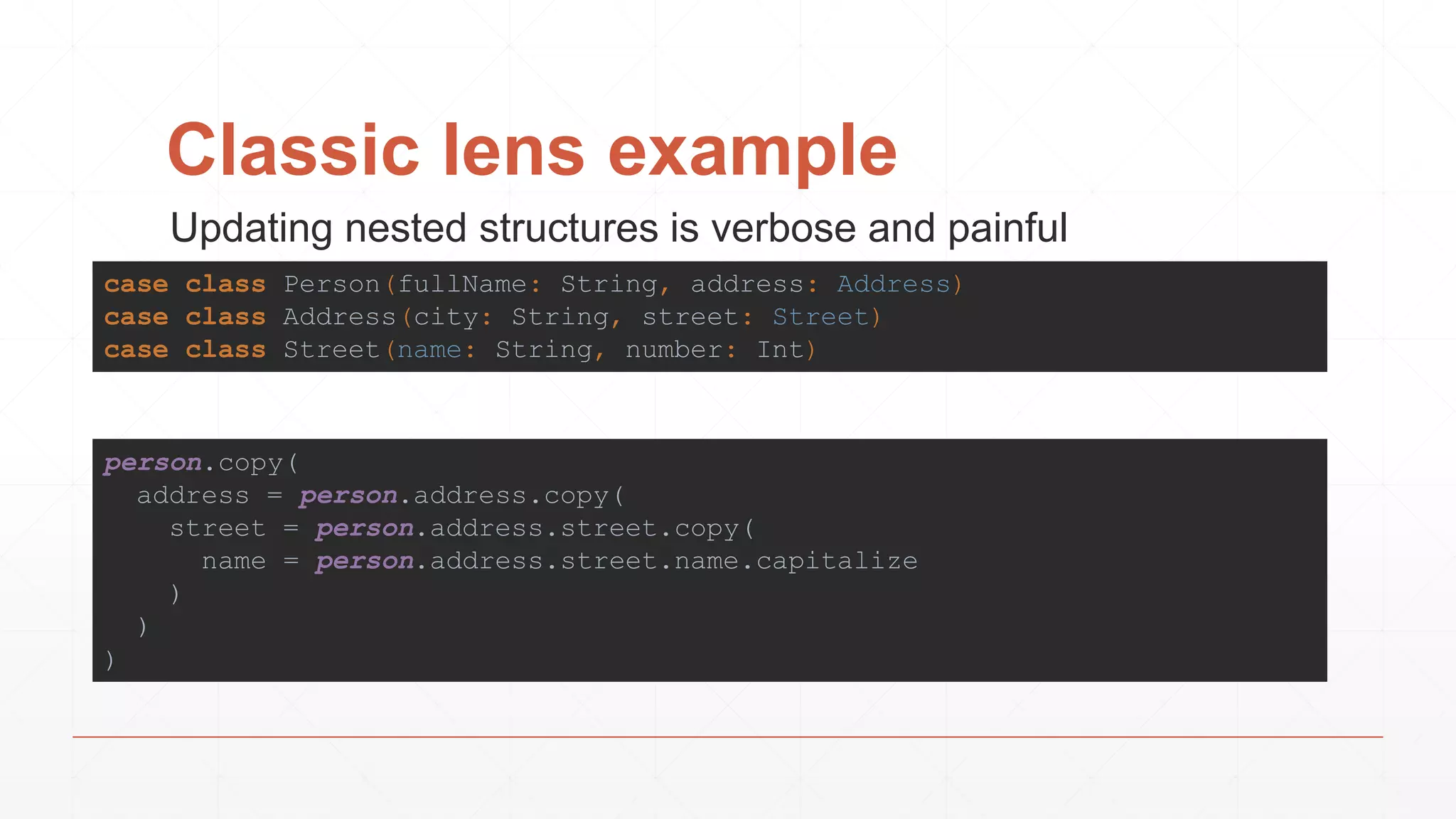
This document discusses the concept of lenses in functional programming, specifically in Scala, focusing on their implementation through the Monocle library. It explains how lenses facilitate the manipulation of nested data structures while reducing verbosity and complexity. The document also covers advanced topics like polymorphic lenses, isomorphisms, and the creation of lenses using van Laarhoven's theory, highlighting various functional programming principles and techniques.
![What are lenses?
trait Lens[S,A]{
def get(s: S): A
def set(a: A)(s: S): S
}
In the simplest model, it's just a pair of a getter and a setter:
get
S
A1
S
A2
set
Lens[S, A]
A2](https://image.slidesharecdn.com/opticswithmonoclemotiv-150323141953-conversion-gate01/75/Optics-with-monocle-Modeling-the-part-and-the-whole-3-2048.jpg)

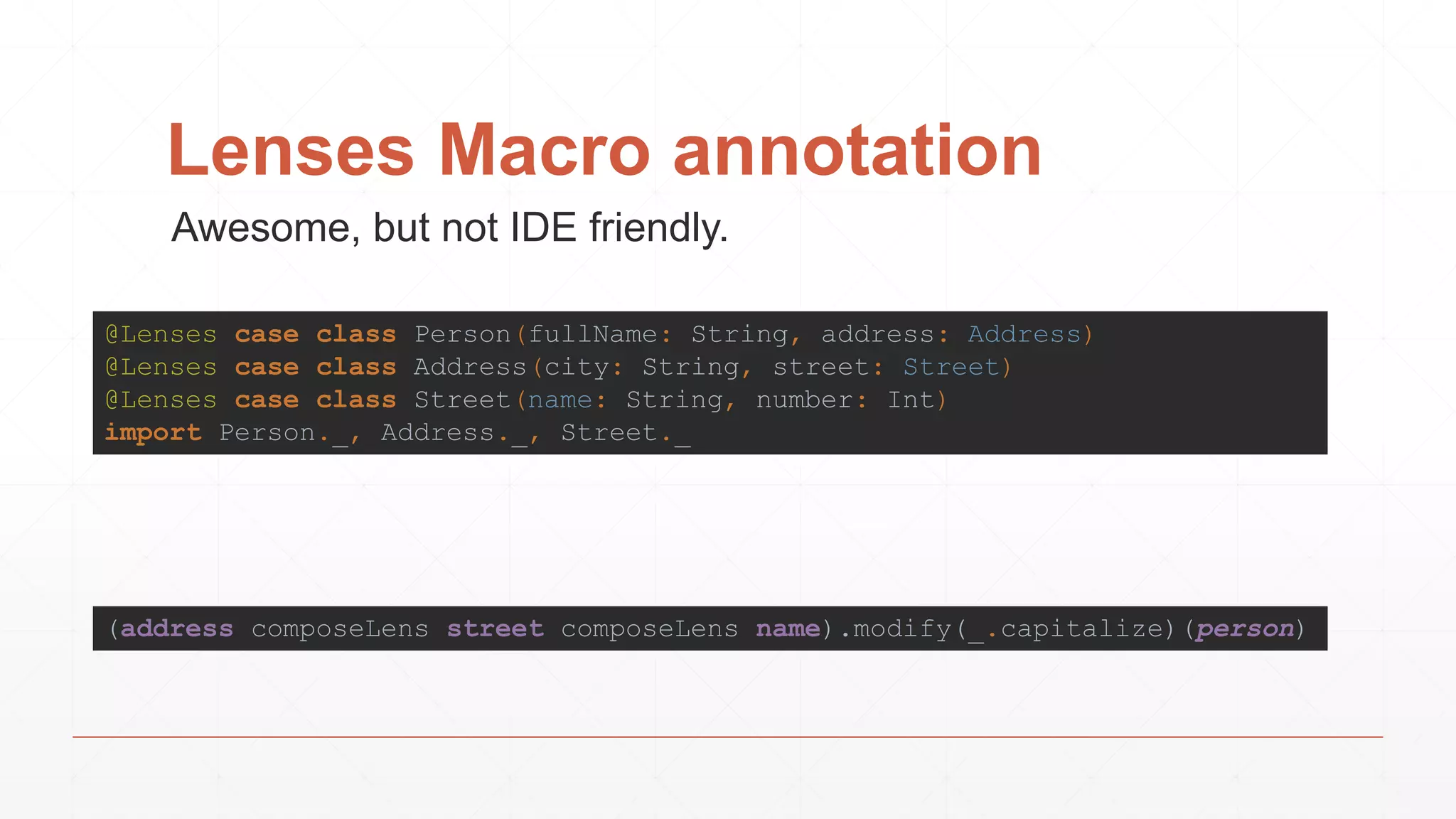
val street = Lenser[Address](_.street)
val name = Lenser[Street](_.name)
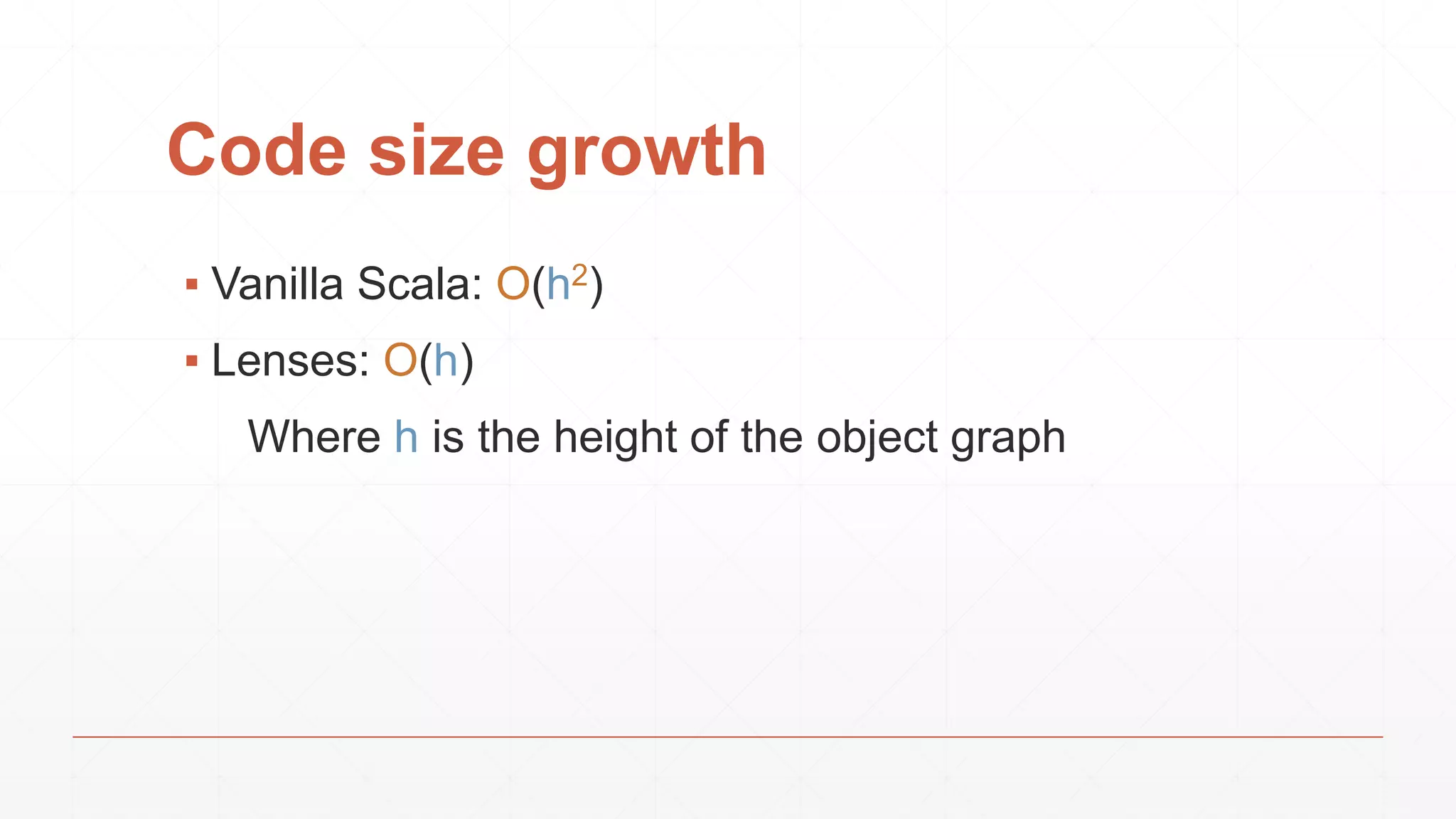
Define lenses once, and compose as you wish](https://image.slidesharecdn.com/opticswithmonoclemotiv-150323141953-conversion-gate01/75/Optics-with-monocle-Modeling-the-part-and-the-whole-5-2048.jpg)
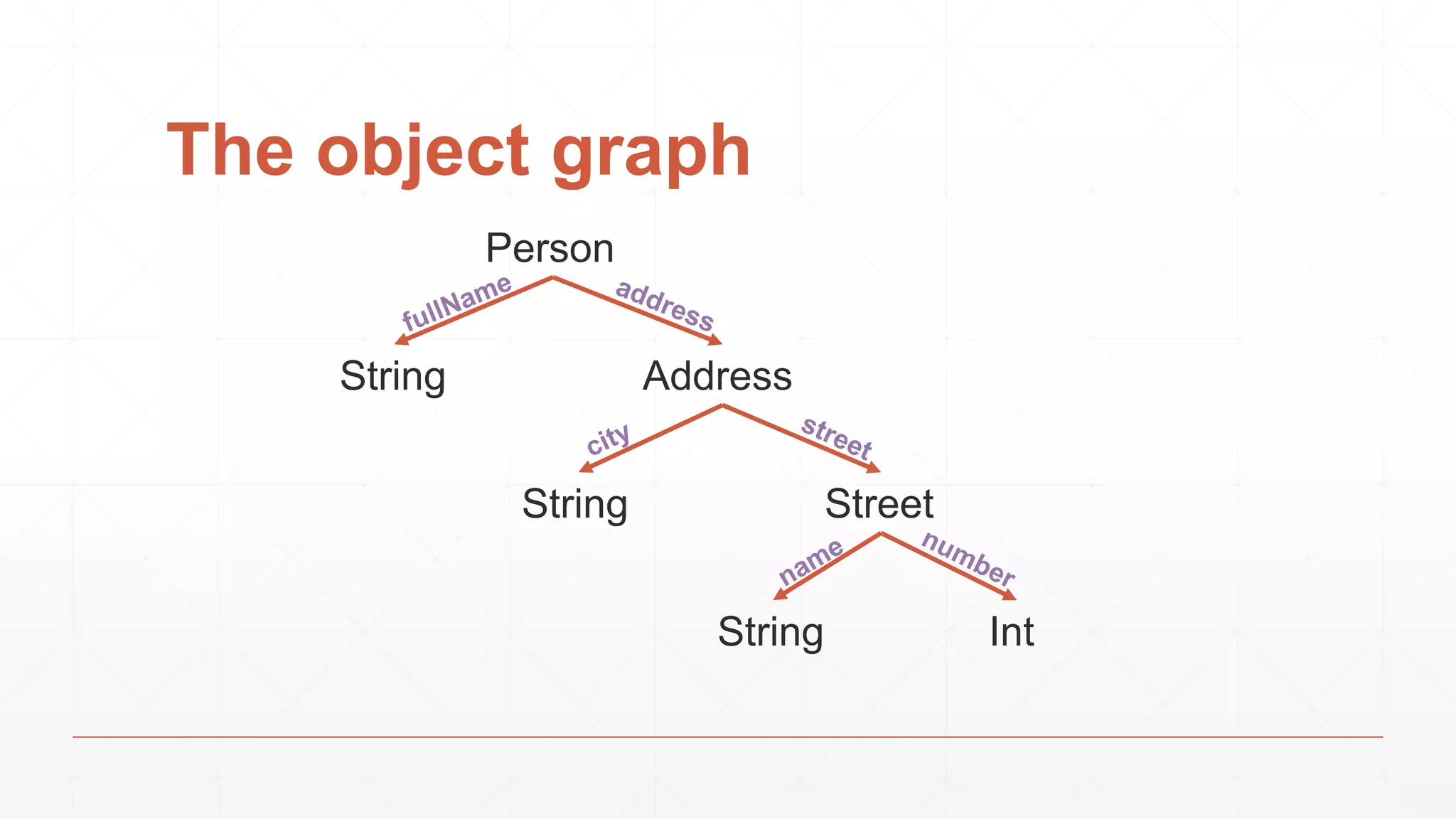
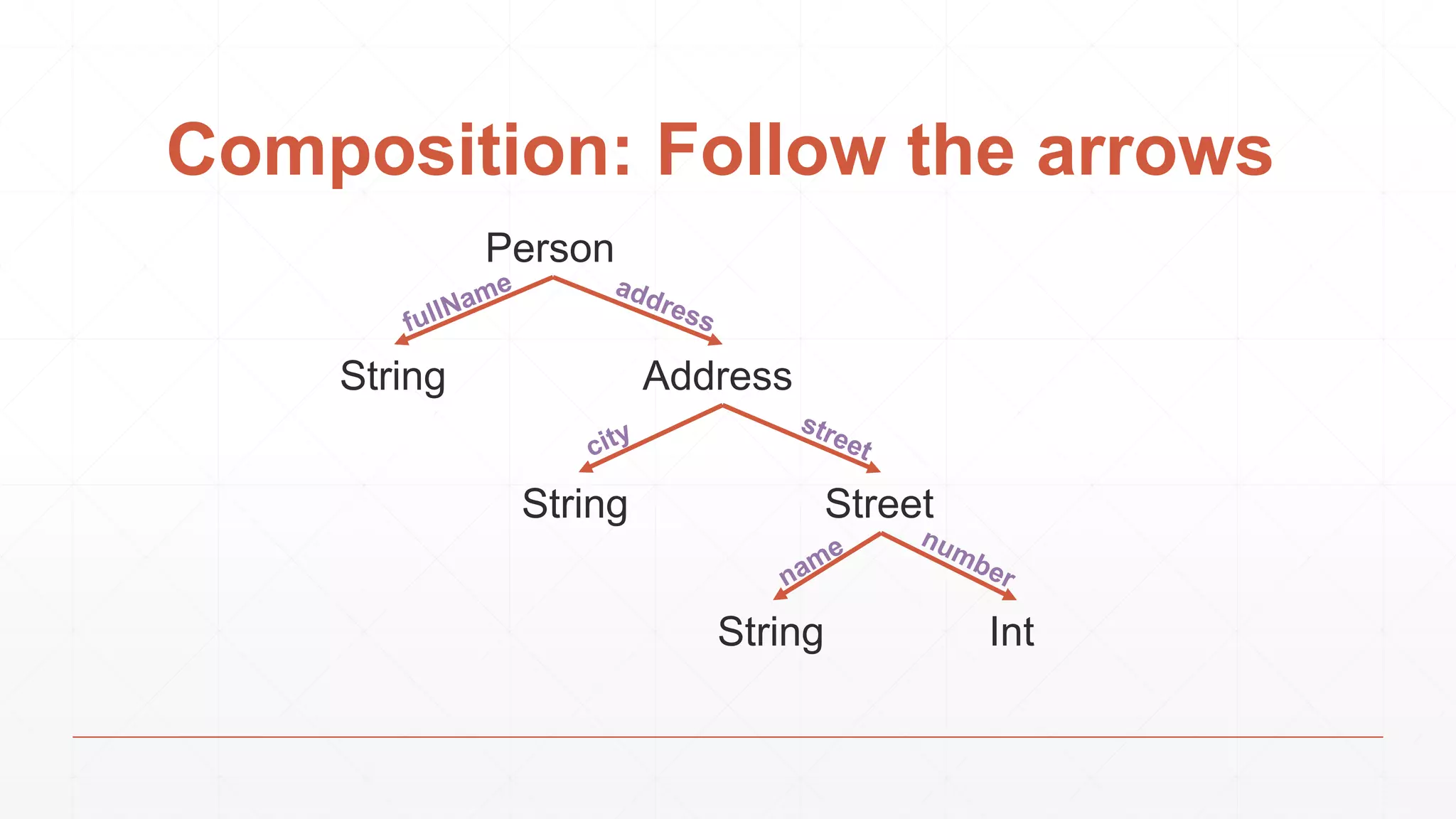
![Lens composition
We compose lenses exactly how we would do it with copy.
S
set
Lens[S,A] compose Lens[A,B]
A
B2
get
S
A
B1
get B2](https://image.slidesharecdn.com/opticswithmonoclemotiv-150323141953-conversion-gate01/75/Optics-with-monocle-Modeling-the-part-and-the-whole-10-2048.jpg)
![Lens composition
We compose lenses exactly how we would do it with copy.
S
set
Lens[S,A] compose Lens[A,B]
A
B2
get
S
A
B1
get B2](https://image.slidesharecdn.com/opticswithmonoclemotiv-150323141953-conversion-gate01/75/Optics-with-monocle-Modeling-the-part-and-the-whole-11-2048.jpg)
![Lens composition
We compose lenses exactly how we would do it with copy.
S
set
Lens[S,A] compose Lens[A,B]
A
B2
get
S
A
B1
get B2
A
B2](https://image.slidesharecdn.com/opticswithmonoclemotiv-150323141953-conversion-gate01/75/Optics-with-monocle-Modeling-the-part-and-the-whole-12-2048.jpg)
![Lens composition
We compose lenses exactly how we would do it with copy.
S
set
Lens[S,A] compose Lens[A,B]
A
B2
get
S
A
B1
get B2
A
B2](https://image.slidesharecdn.com/opticswithmonoclemotiv-150323141953-conversion-gate01/75/Optics-with-monocle-Modeling-the-part-and-the-whole-13-2048.jpg)
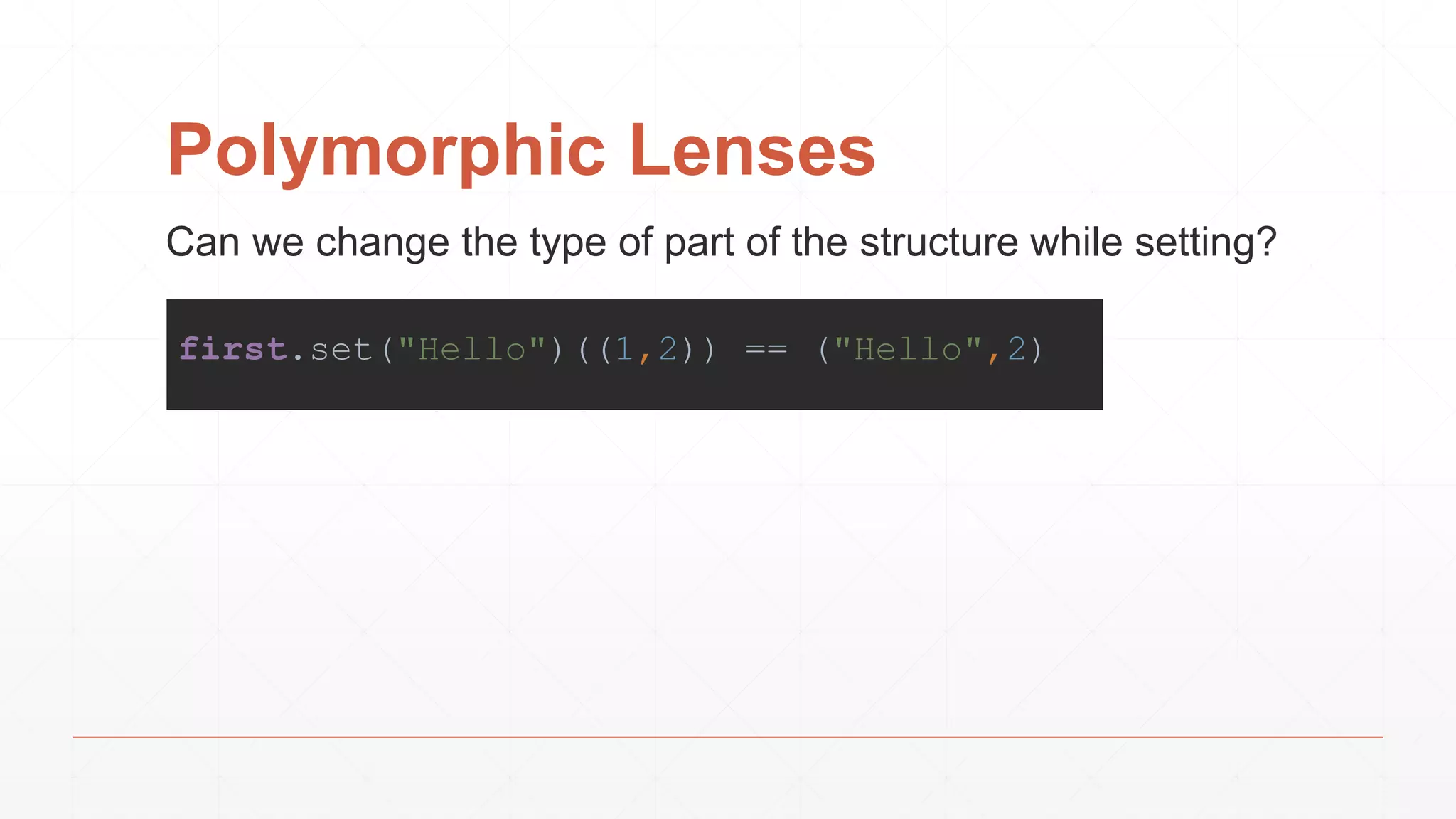
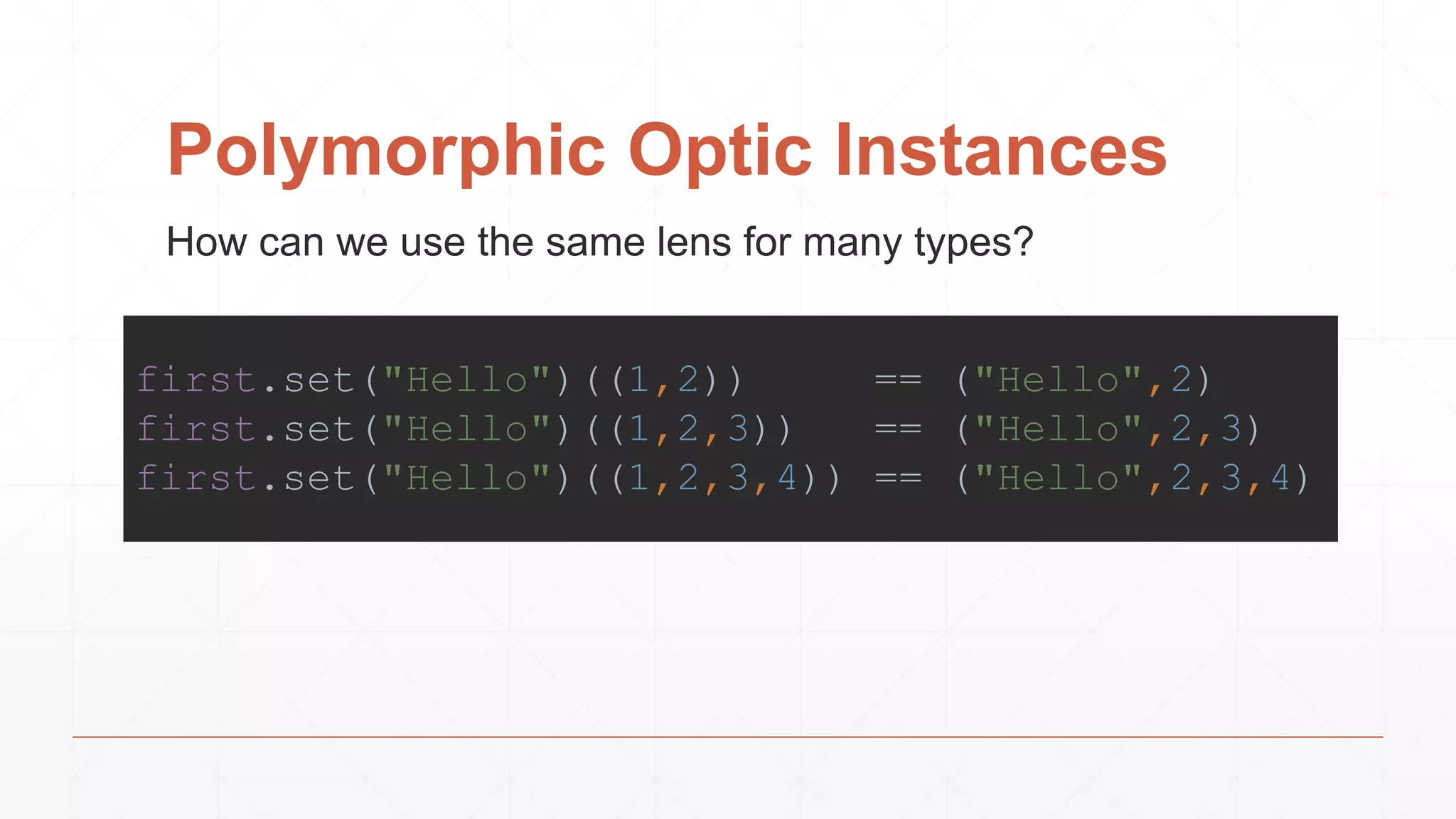
![Polymorphic Lenses
Can we change the type of part of the structure while setting?
trait PLens[S, T, A, B] {
def get(s: S): A
def set(b: B)(s: S): T
} get
S
A
T
B
B
set
PLens[S, T, A, B]](https://image.slidesharecdn.com/opticswithmonoclemotiv-150323141953-conversion-gate01/75/Optics-with-monocle-Modeling-the-part-and-the-whole-15-2048.jpg)
![Example: Unit conversion
Meters CM MM
?
Lens[Meters,CM]
Lens[Meters,MM]
Optics as different points of view of data](https://image.slidesharecdn.com/opticswithmonoclemotiv-150323141953-conversion-gate01/75/Optics-with-monocle-Modeling-the-part-and-the-whole-16-2048.jpg)
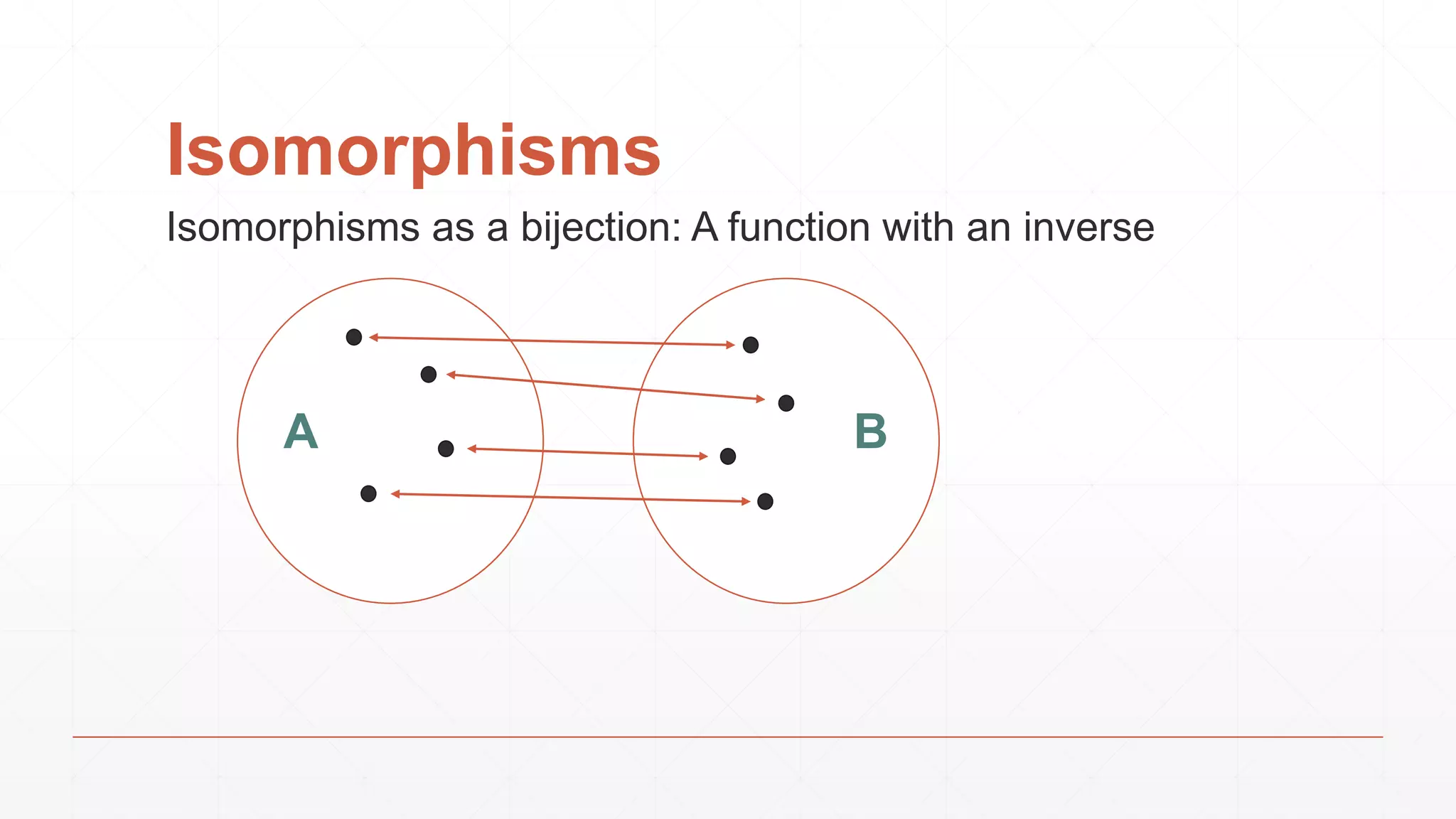
![Isomorphisms
Do we get more power if our lens is bidirectional?
Meters CM MM
Iso[Meters,CM]
Iso[Meters,MM]](https://image.slidesharecdn.com/opticswithmonoclemotiv-150323141953-conversion-gate01/75/Optics-with-monocle-Modeling-the-part-and-the-whole-17-2048.jpg)
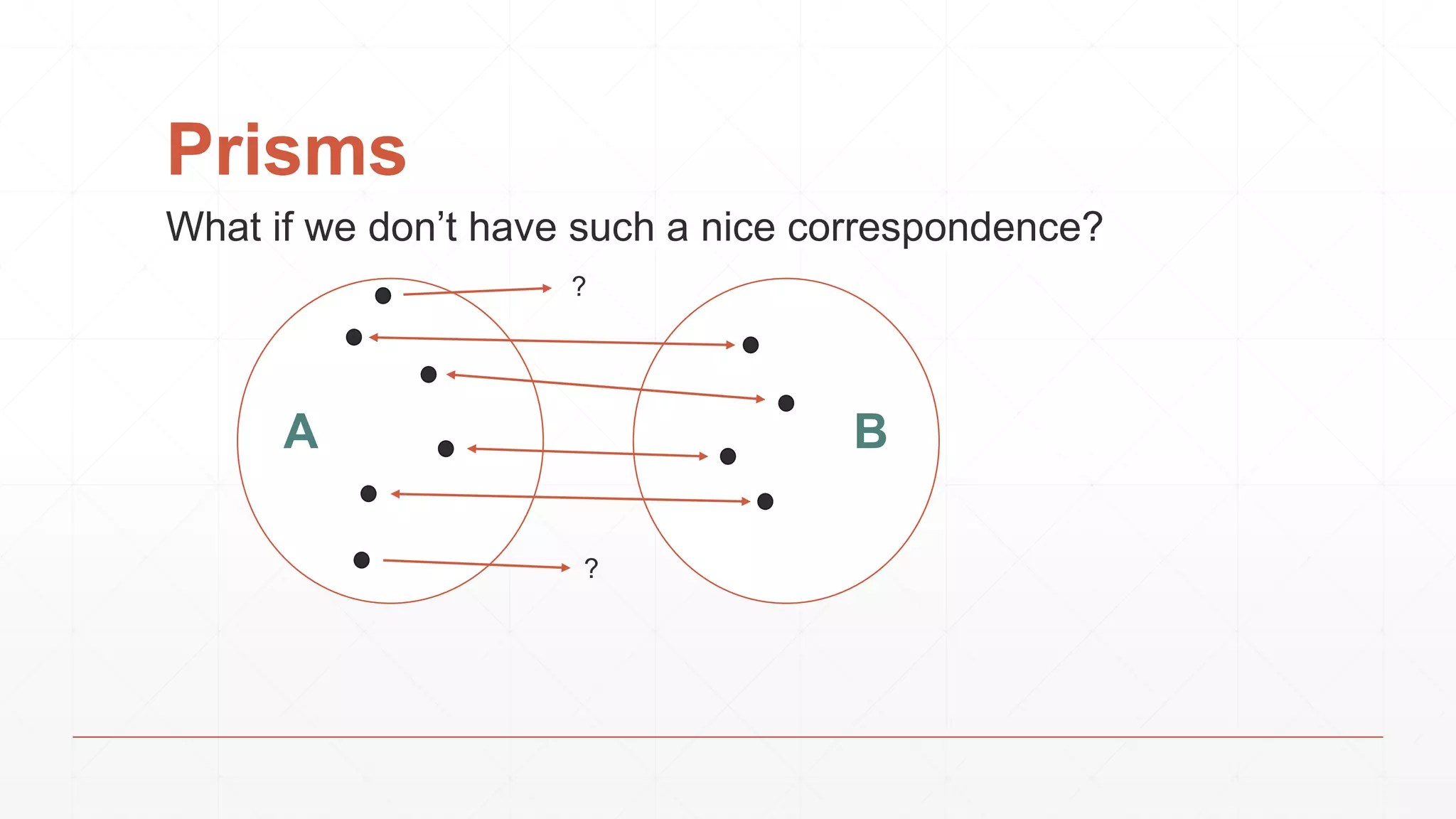
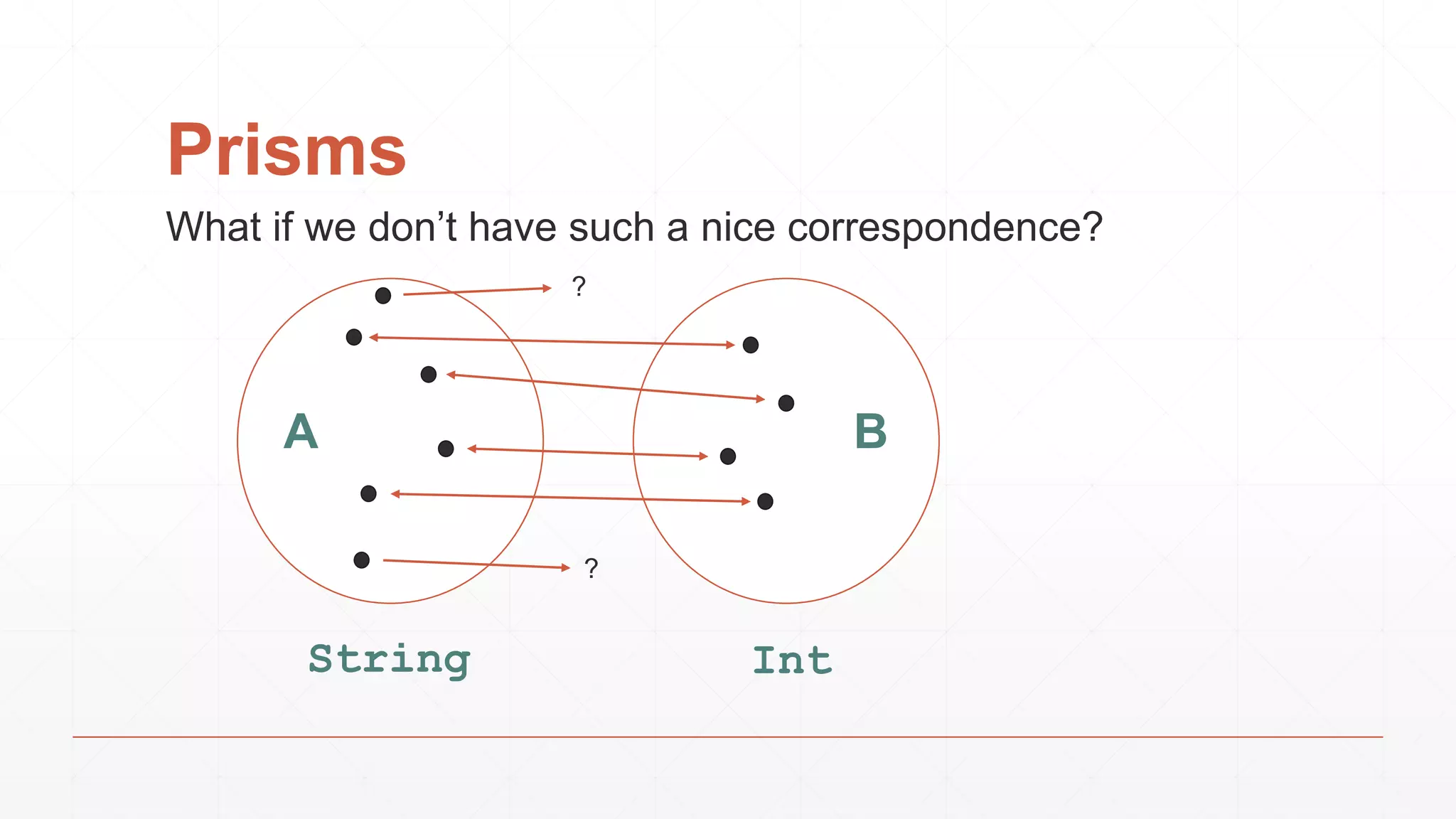
![Prisms
What if we don’t have such a nice correspondence?
?
?
IntString
IntString
Option[Int]String
A B](https://image.slidesharecdn.com/opticswithmonoclemotiv-150323141953-conversion-gate01/75/Optics-with-monocle-Modeling-the-part-and-the-whole-21-2048.jpg)
![Prisms
What if we don’t have such a nice correspondence?
?
?
IntString
IntString
Option[Int]String
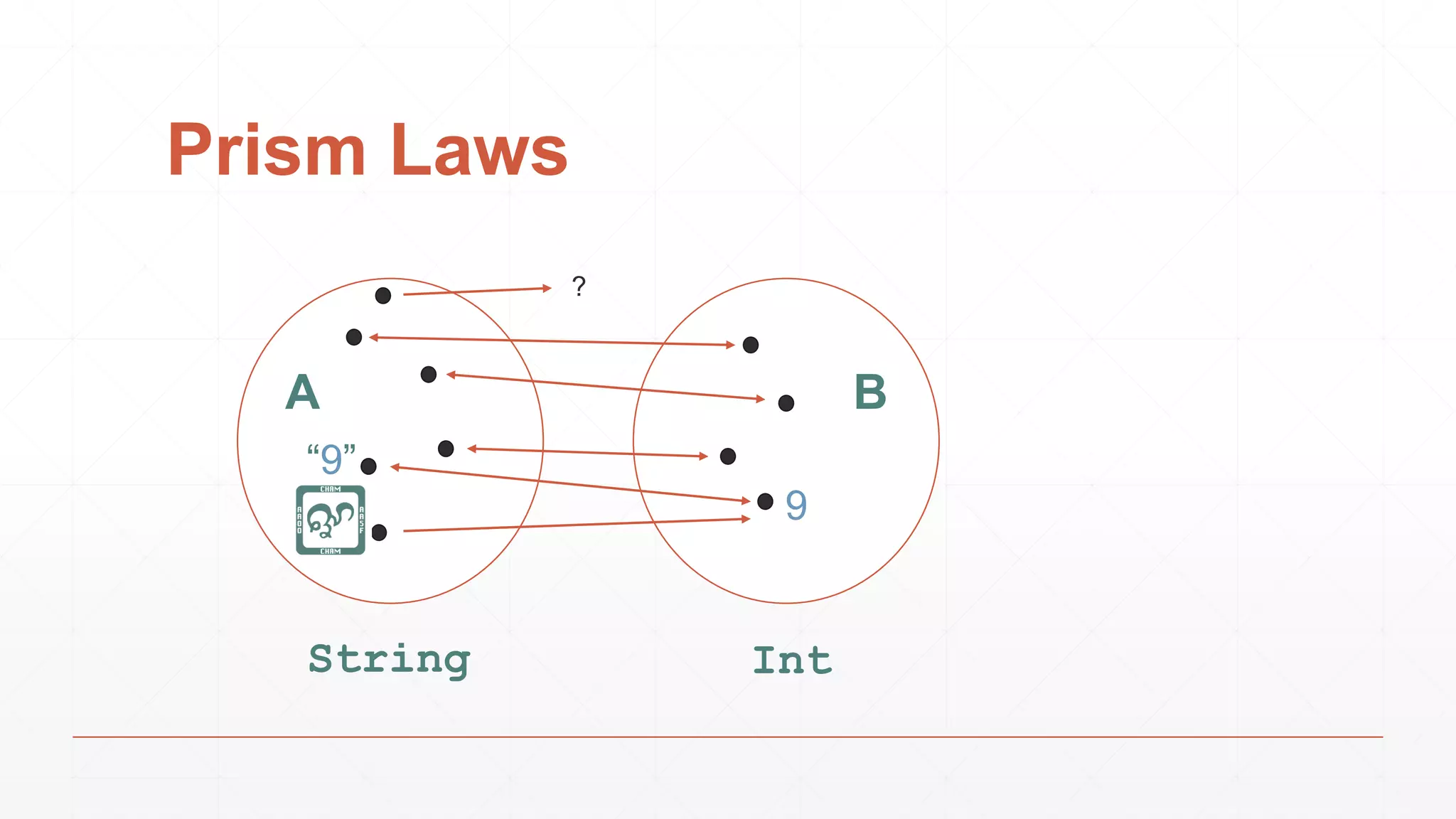
Laws:
1. If there is an answer, going
back must give the source.
2. If we go back, there must
be an answer, which is
the source.
A B](https://image.slidesharecdn.com/opticswithmonoclemotiv-150323141953-conversion-gate01/75/Optics-with-monocle-Modeling-the-part-and-the-whole-22-2048.jpg)
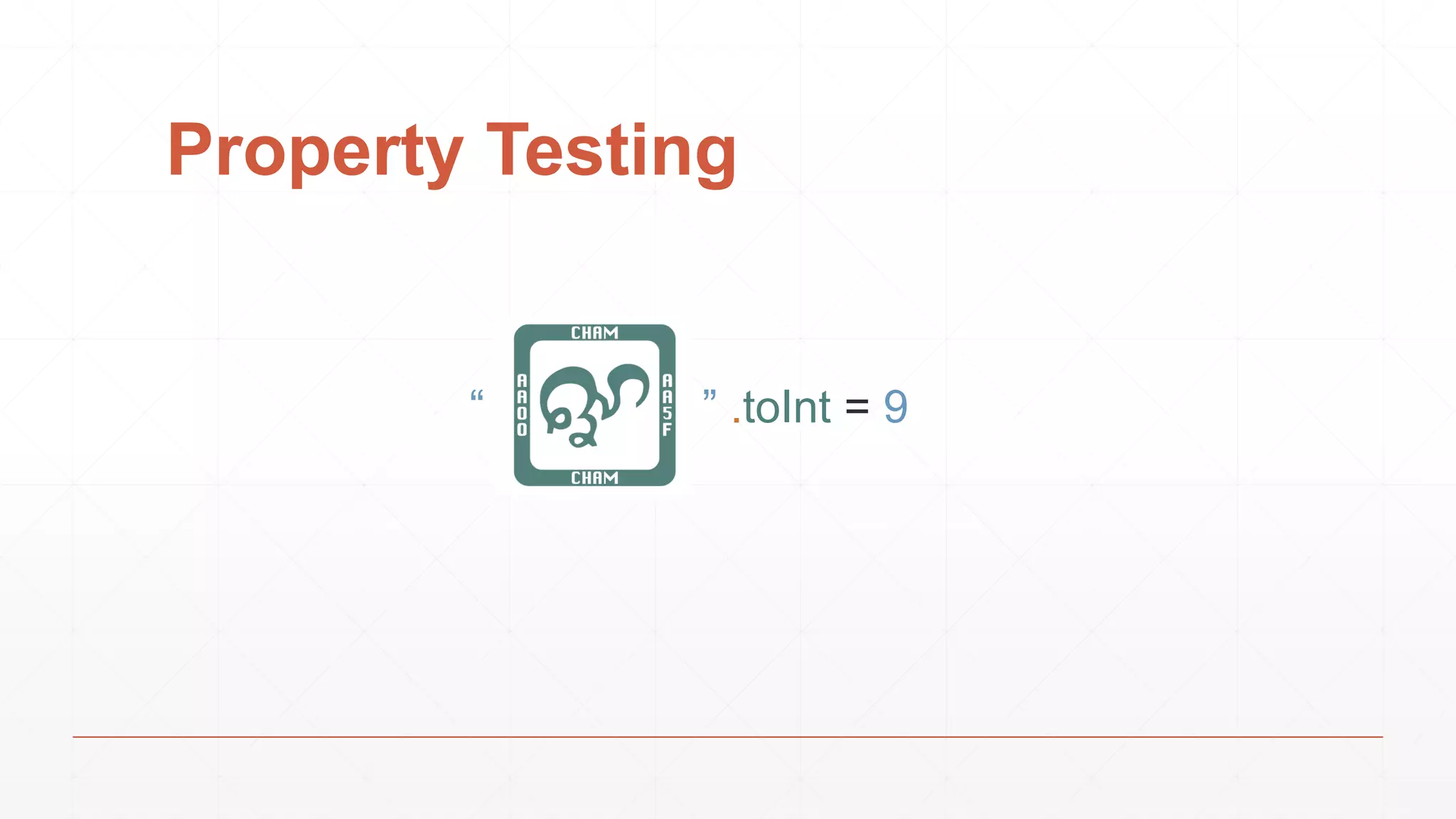
![Property Testing
Laws => Automated property testing
Int =String
Option[Int] =String
_.toString
Try(_.toInt).toOption](https://image.slidesharecdn.com/opticswithmonoclemotiv-150323141953-conversion-gate01/75/Optics-with-monocle-Modeling-the-part-and-the-whole-23-2048.jpg)
![Example: Double binding
°C30 °F86
Iso[Celcius, Fahrenheit]
Prism[String, °F]Prism[String, °C]](https://image.slidesharecdn.com/opticswithmonoclemotiv-150323141953-conversion-gate01/75/Optics-with-monocle-Modeling-the-part-and-the-whole-27-2048.jpg)
![Example: Double binding
°C30 °F86
Iso[Celcius, Fahrenheit]
Prism[String, °F]Prism[String, °C]](https://image.slidesharecdn.com/opticswithmonoclemotiv-150323141953-conversion-gate01/75/Optics-with-monocle-Modeling-the-part-and-the-whole-28-2048.jpg)
![Example: Double binding
°C30 °F86
Iso[Celcius, Fahrenheit]
Prism[String, °F]Prism[String, °C]](https://image.slidesharecdn.com/opticswithmonoclemotiv-150323141953-conversion-gate01/75/Optics-with-monocle-Modeling-the-part-and-the-whole-29-2048.jpg)
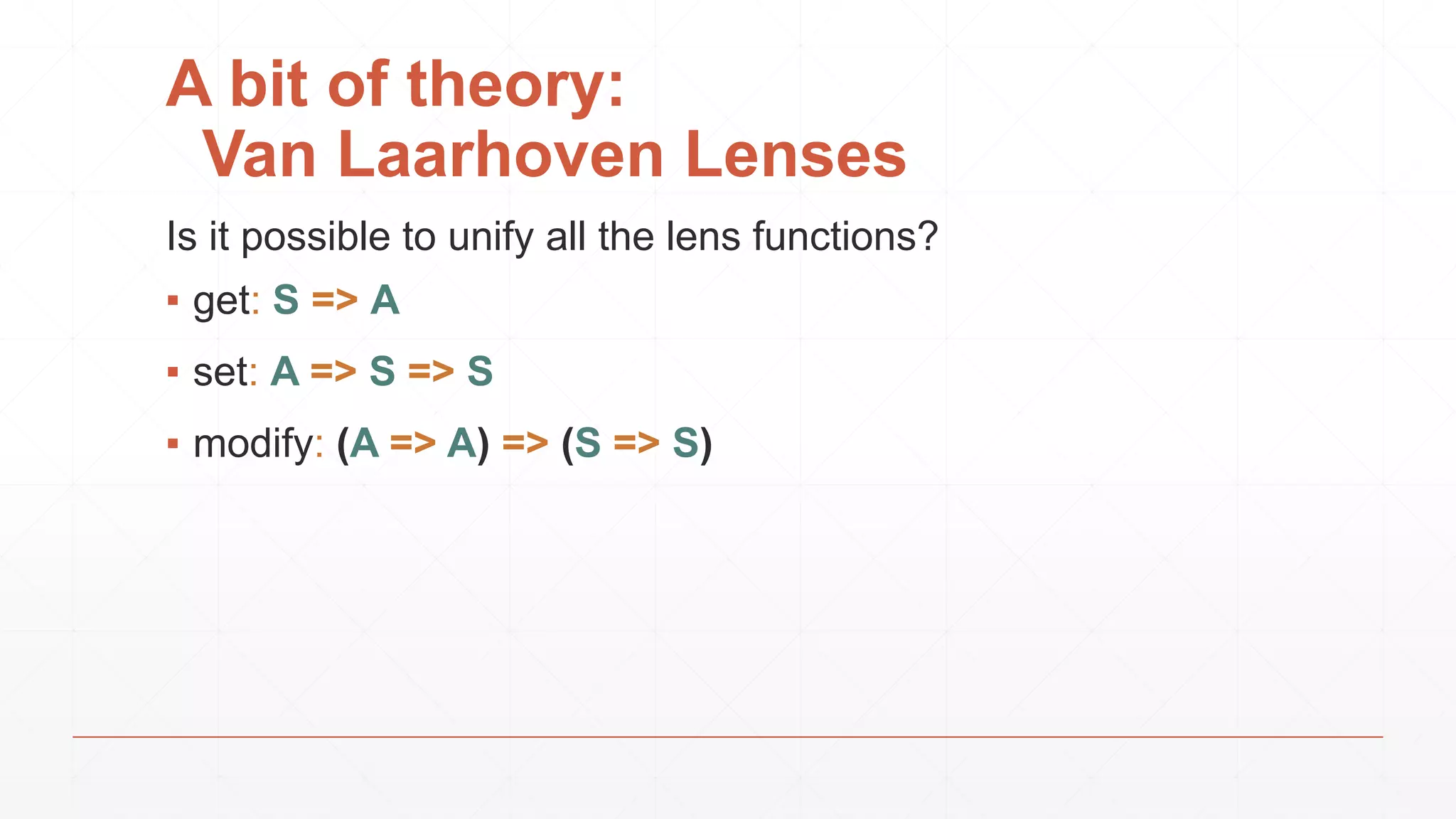
![Is it possible to unify all the lens functions?
▪ get: S => A
▪ set: A => S => S
▪ modify: (A => A) => (S => S)
▪ modifyMaybe: (A => Option[A]) => (S => Option[S])
▪ modifyList: (A => List[A]) => (S => List[S])
A bit of theory:
Van Laarhoven Lenses](https://image.slidesharecdn.com/opticswithmonoclemotiv-150323141953-conversion-gate01/75/Optics-with-monocle-Modeling-the-part-and-the-whole-31-2048.jpg)
![Functors
trait Functor[F[_]]{
def map[A,B](f: A => B)(fa: F[A]): F[B]
}](https://image.slidesharecdn.com/opticswithmonoclemotiv-150323141953-conversion-gate01/75/Optics-with-monocle-Modeling-the-part-and-the-whole-32-2048.jpg)
![List Functor
trait Functor[F[_]]{
def map[A,B](f: A => B)(fa: F[A]): F[B]
}
Functor[List]{
def map[A,B](f: A => B)(list: List[A]): List[B] =
list.map(f)
}](https://image.slidesharecdn.com/opticswithmonoclemotiv-150323141953-conversion-gate01/75/Optics-with-monocle-Modeling-the-part-and-the-whole-33-2048.jpg)
![Option Functor
trait Functor[F[_]]{
def map[A,B](f: A => B)(fa: F[A]): F[B]
}
Functor[Option]{
def map[A,B](f: A => B)(opt: Option[A]): Option[B] = opt match {
case None => None
case Some(a) => Some(f(a))
}
}](https://image.slidesharecdn.com/opticswithmonoclemotiv-150323141953-conversion-gate01/75/Optics-with-monocle-Modeling-the-part-and-the-whole-34-2048.jpg)
![Van Laarhoven Lenses
The answer:
Functor[F] => (A => F[A]) => (S => F[S])](https://image.slidesharecdn.com/opticswithmonoclemotiv-150323141953-conversion-gate01/75/Optics-with-monocle-Modeling-the-part-and-the-whole-35-2048.jpg)
![Van Laarhoven Lenses
The answer:
Functor[F] => (A => F[A]) => (S => F[S])
▪
▪
▪ :
▪ modifyMaybe: (A => Option[A]) => (S => Option[S])
▪ modifyList: (A => List[A]) => (S => List[S])](https://image.slidesharecdn.com/opticswithmonoclemotiv-150323141953-conversion-gate01/75/Optics-with-monocle-Modeling-the-part-and-the-whole-36-2048.jpg)
![Van Laarhoven Lenses
The answer:
Functor[F] => (A => F[A]) => (S => F[S])
▪ get: S => A
▪ set: A => S => S
▪ modify: (A => A) => (S => S)
▪
▪](https://image.slidesharecdn.com/opticswithmonoclemotiv-150323141953-conversion-gate01/75/Optics-with-monocle-Modeling-the-part-and-the-whole-37-2048.jpg)
![Van Laarhoven Lenses
The answer:
lens: Functor[F] => (A => F[A]) => (S => F[S])
type Id[A] = A
lens: (A => Id[A]) => (S => Id[S])
lens: (A => A) => (S => S)
modify = lens[Id]](https://image.slidesharecdn.com/opticswithmonoclemotiv-150323141953-conversion-gate01/75/Optics-with-monocle-Modeling-the-part-and-the-whole-38-2048.jpg)
![Identity Functor
trait Functor[F[_]]{
def map[A,B](f: A => B)(fa: F[A]): F[B]
}
type Id[A] = A
Functor[Id]{
def map[A,B] (f: A => B)(a: Id[A]): Id[B]
}](https://image.slidesharecdn.com/opticswithmonoclemotiv-150323141953-conversion-gate01/75/Optics-with-monocle-Modeling-the-part-and-the-whole-39-2048.jpg)
![Identity Functor
trait Functor[F[_]]{
def map[A,B](f: A => B)(fa: F[A]): F[B]
}
type Id[A] = A
Functor[Id]{
def map[A,B] (f: A => B)(a: Id[A]): Id[B]
def map[A,B] (f: A => B)(a: A): B = f(a)
}](https://image.slidesharecdn.com/opticswithmonoclemotiv-150323141953-conversion-gate01/75/Optics-with-monocle-Modeling-the-part-and-the-whole-40-2048.jpg)
![Van Laarhoven Lenses
The answer:
lens: Functor[F] => (A => F[A]) => (S => F[S])
set(b) = modify(_ => b)
get: S => A = ???](https://image.slidesharecdn.com/opticswithmonoclemotiv-150323141953-conversion-gate01/75/Optics-with-monocle-Modeling-the-part-and-the-whole-41-2048.jpg)
![Van Laarhoven Lenses
The answer:
lens: Functor[F] => (A => F[A]) => (S => F[S])
set(b) = modify(_ => b)
get: S => A = ???](https://image.slidesharecdn.com/opticswithmonoclemotiv-150323141953-conversion-gate01/75/Optics-with-monocle-Modeling-the-part-and-the-whole-42-2048.jpg)
![Van Laarhoven Lenses
The answer:
lens: Functor[F] => (A => F[A]) => (S => F[S])
type Const[X][T] = X
F = Const[A]
lens: (A => Const[A][A]) => (S => Const[A][S])
lens: (A => A) => (S => A)
get = lens[Const[A]](a => a)](https://image.slidesharecdn.com/opticswithmonoclemotiv-150323141953-conversion-gate01/75/Optics-with-monocle-Modeling-the-part-and-the-whole-43-2048.jpg)
![Const Functor
trait Functor[F[_]]{
def map[A,B](f: A => B)(fa: F[A]): F[B]
}
type Const[X][T] = X
Functor[Const[X]]{
def map[A,B] (f: A => B)(fa: Const[X][A]): Const[X][B]
}](https://image.slidesharecdn.com/opticswithmonoclemotiv-150323141953-conversion-gate01/75/Optics-with-monocle-Modeling-the-part-and-the-whole-44-2048.jpg)
![Const Functor
trait Functor[F[_]]{
def map[A,B](f: A => B)(fa: F[A]): F[B]
}
type Const[X][T] = X
Functor[Const[X]]{
def map[A,B] (f: A => B)(fa: Const[X][A]): Const[X][B]
def map[A,B] (f: A => B)(x: X): X = x
}](https://image.slidesharecdn.com/opticswithmonoclemotiv-150323141953-conversion-gate01/75/Optics-with-monocle-Modeling-the-part-and-the-whole-45-2048.jpg)
![Van Laarhoven Lenses
The answer:
Functor[F] => (A => F[A]) => (S => F[S])
▪ get: S => A
▪ set: A => S => S
▪ modify: (A => A) => (S => S)
▪ modifyMaybe: (A => Option[A]) => (S => Option[S])
▪ modifyList: (A => List[A]) => (S => List[S])](https://image.slidesharecdn.com/opticswithmonoclemotiv-150323141953-conversion-gate01/75/Optics-with-monocle-Modeling-the-part-and-the-whole-46-2048.jpg)
![Creating Van Laarhoven Lenses
lens: Functor[F] => (A => F[A]) => (S => F[S])
def get: S => A
def set: A => S => S
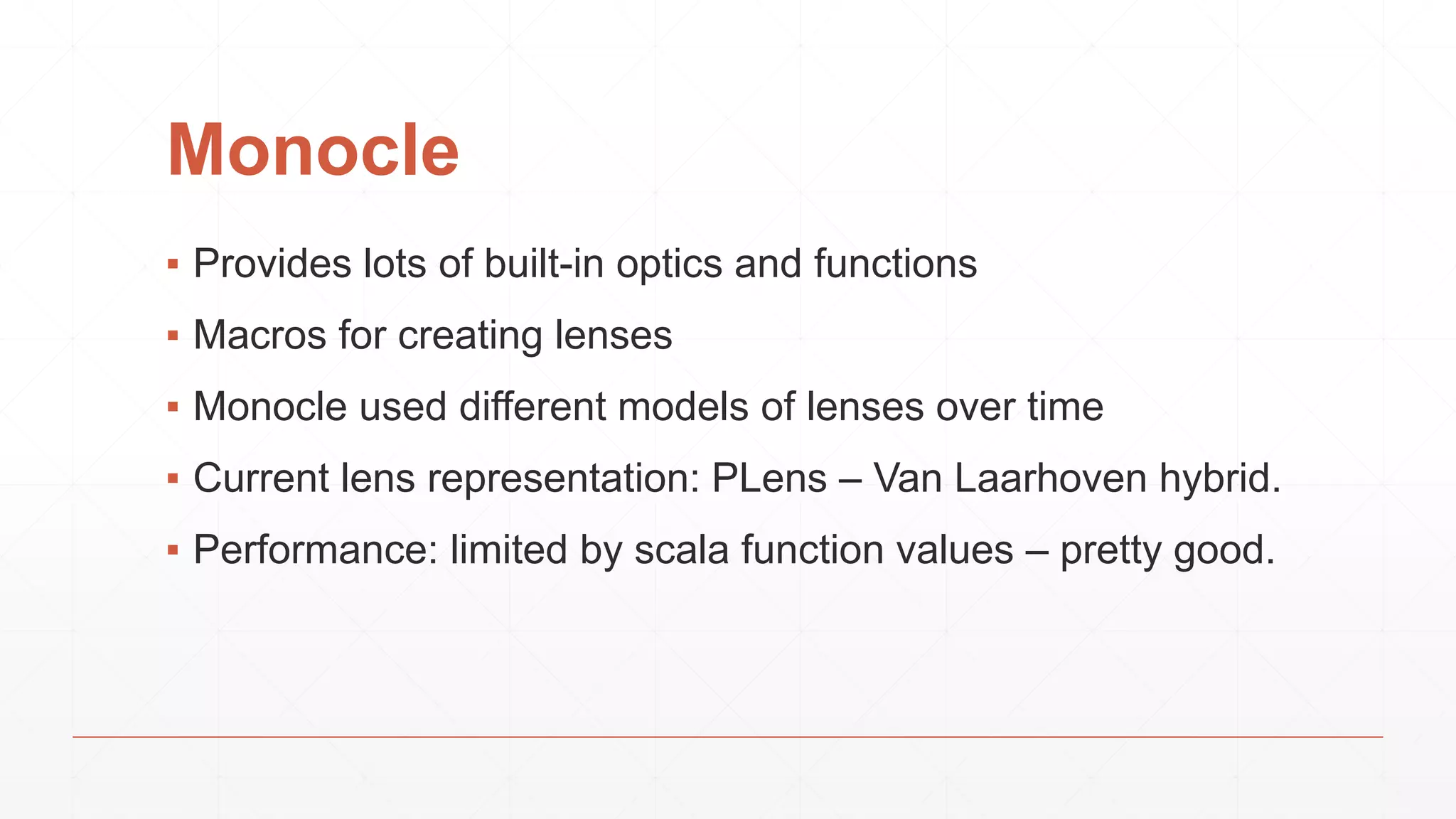
def lens[F[_]:Functor](f: A => F[A])(s: S): F[S] =
f(get(s)). map (a => set(a)(s))
A
F[A]
(A => S) =>
F[A] => F[S]
(A => S)
F[S]
Shortly:
lens f s = f(get(s)).map(a => set(a)(s))](https://image.slidesharecdn.com/opticswithmonoclemotiv-150323141953-conversion-gate01/75/Optics-with-monocle-Modeling-the-part-and-the-whole-47-2048.jpg)
![Creating Van Laarhoven Lenses
lens: Functor[F] => (A => F[A]) => (S => F[S])
type Id[A] = A
F = Id
lens: (A => A) => (S => S)
lens f s = f(get(s)).map(a => set(a)(s))
[ A ] [ A => S ]
modify f s = set(f(get(s)))(s)
set x s = modify(_ => x) s
= set(x)(s)](https://image.slidesharecdn.com/opticswithmonoclemotiv-150323141953-conversion-gate01/75/Optics-with-monocle-Modeling-the-part-and-the-whole-48-2048.jpg)
![Creating Van Laarhoven Lenses
lens: Functor[F] => (A => F[A]) => (S => F[S])
type Const[A][X] = A
F = Const[A]
lens: (A => A) => (S => A)
lens f s = f(get(s)).map(a => set(a)(s))
[ A ] [ A => S ]
get’ f s = f(get(s))
get s = get’(id)(s) = get(s)](https://image.slidesharecdn.com/opticswithmonoclemotiv-150323141953-conversion-gate01/75/Optics-with-monocle-Modeling-the-part-and-the-whole-49-2048.jpg)



![ASTs - Lenses for APIs
We can simplify our mental model with lenses
case class Person(fullName: String, address: Address)
Case class
decleration
Class
name
List[Field name -> Type]](https://image.slidesharecdn.com/opticswithmonoclemotiv-150323141953-conversion-gate01/75/Optics-with-monocle-Modeling-the-part-and-the-whole-54-2048.jpg)
![ASTs - Lenses for APIs
We can simplify our mental model with lenses
case class Person(fullName: String, address: Address)
Case class
decleration
Class
name
List[Field name -> Type]
Public
constructor
Lens[Complex model, Simple model]
val](https://image.slidesharecdn.com/opticswithmonoclemotiv-150323141953-conversion-gate01/75/Optics-with-monocle-Modeling-the-part-and-the-whole-55-2048.jpg)
![Example: Json
The structure of a specific Json object isn’t defined at the type system;
Each element can be a String or a Number or an Array or an Object.
We want to process Json assuming our specific structure, and let the system handle failures for
us.
We can define Prism[Json, String], Prism[Json, Double], Prism[Json, List[Json]]
and Prism[Json, Map[String, Json]].
Now we can compose these prisms to go deep inside a Json object and manipulate it.](https://image.slidesharecdn.com/opticswithmonoclemotiv-150323141953-conversion-gate01/75/Optics-with-monocle-Modeling-the-part-and-the-whole-57-2048.jpg)
![* Polymorphic Lens Composition
get
S
A
T
B
B
set
PLens[S, T, A, B]
get
A
C
B
D
D
set
PLens[A, B, C, D]
get
S
C
T
D
D
set
PLens[S, T, C, D]](https://image.slidesharecdn.com/opticswithmonoclemotiv-150323141953-conversion-gate01/75/Optics-with-monocle-Modeling-the-part-and-the-whole-58-2048.jpg)


