This document discusses side effects in Scala programs and proposes an IO monad to encapsulate side effects. Some key points:
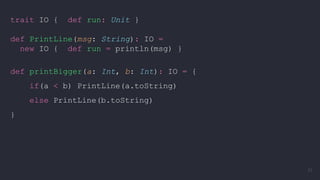
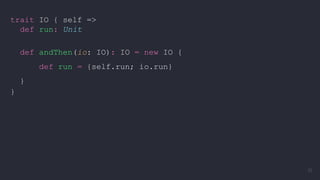
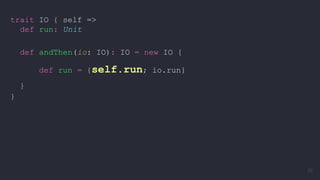
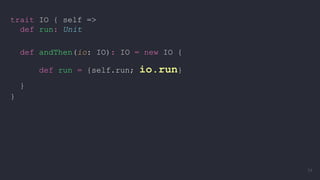
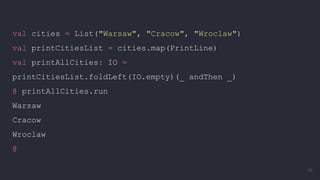
- It introduces an IO trait that represents computations that may produce side effects. IO values can be combined using flatMap and map to sequence computations.
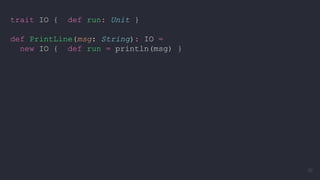
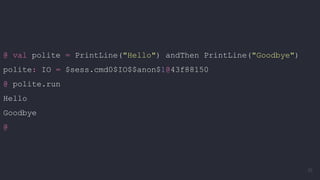
- Common side effects like printing are modeled as IO values. An interpreter is defined to actually run IO actions by pattern matching on the data structure.
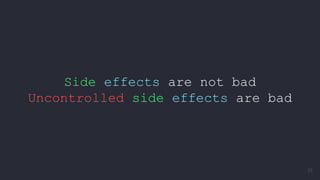
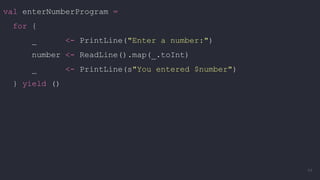
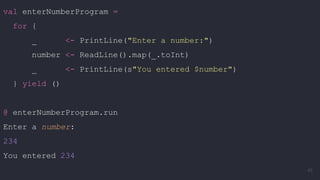
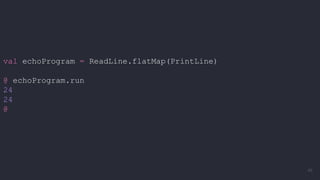
- The document shows how the IO monad allows separating pure logic from effects, running effects in order, and capturing external interactions like input/output as data. This provides better control over side effects.
- Later sections discuss implementing the interpreter recursively to properly sequence nested effects. The


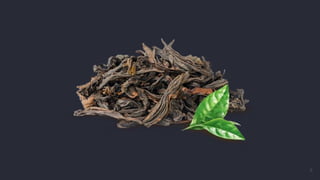

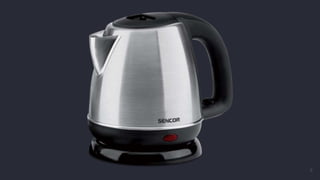
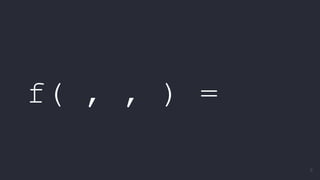
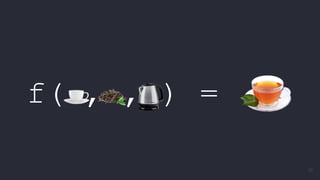
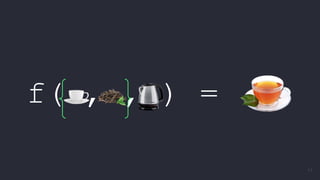
![val deliciousTeaFut: Future[ ] =
Future[ ].map{kettle => (...) }
15](https://image.slidesharecdn.com/takingyourside-effectsaside-170408113600/85/Taking-your-side-effects-aside-15-320.jpg)
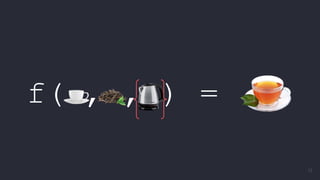
![val deliciousTeaFut: Future[ ] =
Future[ ].map{kettle => (...) }
(implicit ec:ExecutionContext)
16](https://image.slidesharecdn.com/takingyourside-effectsaside-170408113600/85/Taking-your-side-effects-aside-16-320.jpg)
![Why not Future[ ]?
22](https://image.slidesharecdn.com/takingyourside-effectsaside-170408113600/85/Taking-your-side-effects-aside-22-320.jpg)
![A => B
A => F[B]
26](https://image.slidesharecdn.com/takingyourside-effectsaside-170408113600/85/Taking-your-side-effects-aside-26-320.jpg)
![A => B
A => F[B]
27](https://image.slidesharecdn.com/takingyourside-effectsaside-170408113600/85/Taking-your-side-effects-aside-27-320.jpg)
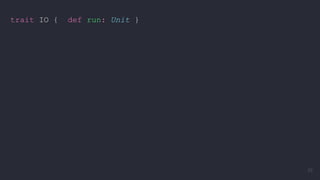
![trait IO[A] { self =>
def run: A
}
39](https://image.slidesharecdn.com/takingyourside-effectsaside-170408113600/85/Taking-your-side-effects-aside-39-320.jpg)
![trait IO[A] { self =>
def run: A
def map[B](f: A => B): IO[B]
def flatMap[B](f: A => IO[B]): IO[B]
}
40](https://image.slidesharecdn.com/takingyourside-effectsaside-170408113600/85/Taking-your-side-effects-aside-40-320.jpg)
![trait IO[A] { self =>
def run: A
def map[B](f: A => B): IO[B] =
new IO[B] { def run = f(self.run) }
def flatMap[B](f: A => IO[B]): IO[B] =
new IO[B] { def run = f(self.run).run }
}
41](https://image.slidesharecdn.com/takingyourside-effectsaside-170408113600/85/Taking-your-side-effects-aside-41-320.jpg)
![trait IO[A] { self =>
def run: A
def map[B](f: A => B): IO[B] =
new IO[B] { def run = f(self.run) }
def flatMap[B](f: A => IO[B]): IO[B] =
new IO[B] { def run = f(self.run).run }
}
def ReadLine(): IO[String] = new IO[String] {
def run(): String = readLine
}
42](https://image.slidesharecdn.com/takingyourside-effectsaside-170408113600/85/Taking-your-side-effects-aside-42-320.jpg)
![def ReadLine(): IO[String] = new IO[String] {
def run(): String = readLine}
def PrintLine(msg: String): IO[Unit] = new IO[Unit] {
def run = println(msg)
}
val enterNumberProgram =
for {
_ <- PrintLine("Enter a number:")
number <- ReadLine().map(_.toInt)
_ <- PrintLine(s"You entered $number")
} yield ()
43](https://image.slidesharecdn.com/takingyourside-effectsaside-170408113600/85/Taking-your-side-effects-aside-43-320.jpg)
: IO[A] = {
lazy val t = forever(io)
io flatMap (_ => t)
}
48](https://image.slidesharecdn.com/takingyourside-effectsaside-170408113600/85/Taking-your-side-effects-aside-48-320.jpg)
: IO[A] = {
lazy val t = forever(io)
io flatMap (_ => t)
}
@ val greetLikeMad = forever(PrintLine("Hello"))
greetLikeMad: IO[Unit] = $sess.cmd0$IO$$anon$2@31e5554e
@ greetLikeMad.run
49](https://image.slidesharecdn.com/takingyourside-effectsaside-170408113600/85/Taking-your-side-effects-aside-49-320.jpg)
: IO[A] = {
lazy val t = forever(io)
io flatMap (_ => t)
}
@ val greetLikeMad = forever(PrintLine("Hello"))
greetLikeMad: IO[Unit] = $sess.cmd0$IO$$anon$2@31e5554e
@ greetLikeMad.run
Hello
Hello
(...)
Hello
java.lang.StackOverflowError
sun.nio.cs.UTF_8.updatePositions(UTF_8.java:77)
sun.nio.cs.UTF_8.access$200(UTF_8.java:57)
(...)
$sess.cmd0$IO$$anon$2.run(cmd0.sc:6)
$sess.cmd0$IO$$anon$2.run(cmd0.sc:6)
$sess.cmd0$IO$$anon$2.run(cmd0.sc:6) 50](https://image.slidesharecdn.com/takingyourside-effectsaside-170408113600/85/Taking-your-side-effects-aside-50-320.jpg)
: IO[B] =
new IO[B] { def run = f(self.run).run }
51](https://image.slidesharecdn.com/takingyourside-effectsaside-170408113600/85/Taking-your-side-effects-aside-51-320.jpg)
![sealed trait IO[A] { self =>
def flatMap[B](f: A ⇒ IO[B]): IO[B] = ???
}
53](https://image.slidesharecdn.com/takingyourside-effectsaside-170408113600/85/Taking-your-side-effects-aside-53-320.jpg)
![sealed trait IO[A] { self =>
def flatMap[B](f: A ⇒ IO[B]): IO[B] = FlatMap(this, f)
}
case class FlatMap[A, B](sub: IO[A], k: A ⇒ IO[B]) extends IO[B]
54](https://image.slidesharecdn.com/takingyourside-effectsaside-170408113600/85/Taking-your-side-effects-aside-54-320.jpg)
![sealed trait IO[A] { self =>
def flatMap[B](f: A ⇒ IO[B]): IO[B] = FlatMap(this, f)
}
case class FlatMap[A, B](sub: IO[A], k: A ⇒ IO[B]) extends IO[B]
55](https://image.slidesharecdn.com/takingyourside-effectsaside-170408113600/85/Taking-your-side-effects-aside-55-320.jpg)
![sealed trait IO[A] { self =>
def flatMap[B](f: A ⇒ IO[B]): IO[B] = FlatMap(this, f)
}
case class FlatMap[A, B](sub: IO[A], k: A ⇒ IO[B]) extends IO[B]
56](https://image.slidesharecdn.com/takingyourside-effectsaside-170408113600/85/Taking-your-side-effects-aside-56-320.jpg)
![sealed trait IO[A] { self =>
def map[B](f: A ⇒ B): IO[B] = ???
def flatMap[B](f: A ⇒ IO[B]): IO[B] = FlatMap(this, f)
}
case class FlatMap[A, B](sub: IO[A], k: A ⇒ IO[B]) extends IO[B]
57](https://image.slidesharecdn.com/takingyourside-effectsaside-170408113600/85/Taking-your-side-effects-aside-57-320.jpg)
![sealed trait IO[A] { self =>
def map[B](f: A ⇒ B): IO[B] = ???
def flatMap[B](f: A ⇒ IO[B]): IO[B] = FlatMap(this, f)
}
case class FlatMap[A, B](sub: IO[A], k: A ⇒ IO[B]) extends IO[B]
case class Return[A](a: A) extends IO[A]
58](https://image.slidesharecdn.com/takingyourside-effectsaside-170408113600/85/Taking-your-side-effects-aside-58-320.jpg)
![sealed trait IO[A] { self =>
def map[B](f: A ⇒ B): IO[B] = flatMap(f andThen (Return(_)))
def flatMap[B](f: A ⇒ IO[B]): IO[B] = FlatMap(this, f)
}
case class FlatMap[A, B](sub: IO[A], k: A ⇒ IO[B]) extends IO[B]
case class Return[A](a: A) extends IO[A]
59](https://image.slidesharecdn.com/takingyourside-effectsaside-170408113600/85/Taking-your-side-effects-aside-59-320.jpg)
![sealed trait IO[A] { self =>
def map[B](f: A ⇒ B): IO[B] = flatMap(f andThen (Return(_)))
def flatMap[B](f: A ⇒ IO[B]): IO[B] = FlatMap(this, f)
}
case class FlatMap[A, B](sub: IO[A], k: A ⇒ IO[B]) extends IO[B]
case class Return[A](a: A) extends IO[A]
def PrintLine(s: String): IO[Unit] = ???
60](https://image.slidesharecdn.com/takingyourside-effectsaside-170408113600/85/Taking-your-side-effects-aside-60-320.jpg)
![sealed trait IO[A] { self =>
def map[B](f: A ⇒ B): IO[B] = flatMap(f andThen (Return(_)))
def flatMap[B](f: A ⇒ IO[B]): IO[B] = FlatMap(this, f)
}
case class FlatMap[A, B](sub: IO[A], k: A ⇒ IO[B]) extends IO[B]
case class Return[A](a: A) extends IO[A]
def PrintLine(s: String): IO[Unit] = Return(println(s))
61](https://image.slidesharecdn.com/takingyourside-effectsaside-170408113600/85/Taking-your-side-effects-aside-61-320.jpg)
![sealed trait IO[A] { self =>
def map[B](f: A ⇒ B): IO[B] = flatMap(f andThen (Return(_)))
def flatMap[B](f: A ⇒ IO[B]): IO[B] = FlatMap(this, f)
}
case class FlatMap[A, B](sub: IO[A], k: A ⇒ IO[B]) extends IO[B]
case class Return[A](a: A) extends IO[A]
def PrintLine(s: String): IO[Unit] = Return(println(s))
62](https://image.slidesharecdn.com/takingyourside-effectsaside-170408113600/85/Taking-your-side-effects-aside-62-320.jpg)
![sealed trait IO[A] { self =>
def map[B](f: A ⇒ B): IO[B] = flatMap(f andThen (Return(_)))
def flatMap[B](f: A ⇒ IO[B]): IO[B] = FlatMap(this, f)
}
case class FlatMap[A, B](sub: IO[A], k: A ⇒ IO[B]) extends IO[B]
case class Return[A](a: A) extends IO[A]
def PrintLine(s: String): IO[Unit] = ???
63](https://image.slidesharecdn.com/takingyourside-effectsaside-170408113600/85/Taking-your-side-effects-aside-63-320.jpg)
![sealed trait IO[A] { self =>
def map[B](f: A ⇒ B): IO[B] = flatMap(f andThen (Return(_)))
def flatMap[B](f: A ⇒ IO[B]): IO[B] = FlatMap(this, f)
}
case class FlatMap[A, B](sub: IO[A], k: A ⇒ IO[B]) extends IO[B]
case class Return[A](a: A) extends IO[A]
case class Suspend[A](resume: () ⇒ A) extends IO[A]
def PrintLine(s: String): IO[Unit] = ???
64](https://image.slidesharecdn.com/takingyourside-effectsaside-170408113600/85/Taking-your-side-effects-aside-64-320.jpg)
![sealed trait IO[A] { self =>
def map[B](f: A ⇒ B): IO[B] = flatMap(f andThen (Return(_)))
def flatMap[B](f: A ⇒ IO[B]): IO[B] = FlatMap(this, f)
}
case class FlatMap[A, B](sub: IO[A], k: A ⇒ IO[B]) extends IO[B]
case class Return[A](a: A) extends IO[A]
case class Suspend[A](resume: () ⇒ A) extends IO[A]
def PrintLine(s: String): IO[Unit] = Suspend(() => println(s))
65](https://image.slidesharecdn.com/takingyourside-effectsaside-170408113600/85/Taking-your-side-effects-aside-65-320.jpg)
![def PrintLine(s: String): IO[Unit] =
Suspend(() => Return(println(s)))
val p = IO.forever(PrintLine("...")) //this is flatMap
FlatMap(Suspend(() => println(s)), _ => FlatMap(Suspend(() =>
println(s)), _ => FlatMap(...)))
66](https://image.slidesharecdn.com/takingyourside-effectsaside-170408113600/85/Taking-your-side-effects-aside-66-320.jpg)
![def PrintLine(s: String): IO[Unit] =
Suspend(() => Return(println(s)))
val p = IO.forever(PrintLine("...")) //this is flatMap
FlatMap(Suspend(() => println(s)), _ => FlatMap(Suspend(() =>
println(s)), _ => FlatMap(...)))
IO[A]
67](https://image.slidesharecdn.com/takingyourside-effectsaside-170408113600/85/Taking-your-side-effects-aside-67-320.jpg)
![def PrintLine(s: String): IO[Unit] =
Suspend(() => Return(println(s)))
val p = IO.forever(PrintLine("...")) //this is flatMap
FlatMap(Suspend(() => println(s)), _ => FlatMap(Suspend(() =>
println(s)), _ => FlatMap(...)))
A => IO[B]
68](https://image.slidesharecdn.com/takingyourside-effectsaside-170408113600/85/Taking-your-side-effects-aside-68-320.jpg)
: A
71](https://image.slidesharecdn.com/takingyourside-effectsaside-170408113600/85/Taking-your-side-effects-aside-71-320.jpg)
: A = io match {}
72](https://image.slidesharecdn.com/takingyourside-effectsaside-170408113600/85/Taking-your-side-effects-aside-72-320.jpg)
: A = io match {
case Return(x) ⇒ x
}
73](https://image.slidesharecdn.com/takingyourside-effectsaside-170408113600/85/Taking-your-side-effects-aside-73-320.jpg)
: A = io match {
case Return(x) ⇒ x
case Suspend(r) ⇒ r()
}
74](https://image.slidesharecdn.com/takingyourside-effectsaside-170408113600/85/Taking-your-side-effects-aside-74-320.jpg)
: A = io match {
case Return(x) ⇒ x
case Suspend(r) ⇒ r()
case FlatMap(y, g) ⇒
}
case class FlatMap[A, B](sub: IO[A], k: A ⇒ IO[B])
75](https://image.slidesharecdn.com/takingyourside-effectsaside-170408113600/85/Taking-your-side-effects-aside-75-320.jpg)
: A = io match {
case Return(x) ⇒ x
case Suspend(r) ⇒ r()
case FlatMap(y, g) ⇒ run(g(run(y)))
}
case class FlatMap[A, B](sub: IO[A], k: A ⇒ IO[B])
76](https://image.slidesharecdn.com/takingyourside-effectsaside-170408113600/85/Taking-your-side-effects-aside-76-320.jpg)
: A = io match {
case Return(x) ⇒ x
case Suspend(r) ⇒ r()
case FlatMap(y, g) ⇒ run(g(run(y)))
}
case class FlatMap[A, B](sub: IO[A], k: A ⇒ IO[B])
77](https://image.slidesharecdn.com/takingyourside-effectsaside-170408113600/85/Taking-your-side-effects-aside-77-320.jpg)
: A = io match {
case Return(x) ⇒ x
case Suspend(r) ⇒ r()
case FlatMap(y, g) ⇒
}
case class FlatMap[A, B](sub: IO[A], k: A ⇒ IO[B])
78](https://image.slidesharecdn.com/takingyourside-effectsaside-170408113600/85/Taking-your-side-effects-aside-78-320.jpg)
: A = io match {
case Return(x) ⇒ x
case Suspend(r) ⇒ r()
case FlatMap(y, g) ⇒ y match {
case Return(a1) ⇒
case Suspend(r) ⇒
case FlatMap(y1, g1) ⇒
}
}
case class FlatMap[A, B](sub: IO[A], k: A ⇒ IO[B])
79](https://image.slidesharecdn.com/takingyourside-effectsaside-170408113600/85/Taking-your-side-effects-aside-79-320.jpg)
: A = io match {
case Return(x) ⇒ x
case Suspend(r) ⇒ r()
case FlatMap(y, g) ⇒ y match {
case Return(a1) ⇒ run(g(a1))
case Suspend(r) ⇒ run(g(r()))
case FlatMap(y1, g1) ⇒
}
}
case class FlatMap[A, B](sub: IO[A], k: A ⇒ IO[B])
80](https://image.slidesharecdn.com/takingyourside-effectsaside-170408113600/85/Taking-your-side-effects-aside-80-320.jpg)
: A = io match {
case Return(x) ⇒ x
case Suspend(r) ⇒ r()
case FlatMap(y, g) ⇒ y match {
case Return(a1) ⇒ run(g(a1))
case Suspend(r) ⇒ run(g(r()))
case FlatMap(y1, g1) ⇒ run(y1 flatMap g1 flatMap g)
}
}
case class FlatMap[A, B](sub: IO[A], k: A ⇒ IO[B])
81](https://image.slidesharecdn.com/takingyourside-effectsaside-170408113600/85/Taking-your-side-effects-aside-81-320.jpg)
: A = io match {
case Return(x) ⇒ x
case Suspend(r) ⇒ r()
case FlatMap(y, g) ⇒ y match {
case Return(a1) ⇒ run(g(a1))
case Suspend(r) ⇒ run(g(r()))
case FlatMap(y1, g1) ⇒ run(y1 flatMap g1 flatMap g)
} //FlatMap(FlatMap(y1,g1), g)
}
case class FlatMap[A, B](sub: IO[A], k: A ⇒ IO[B])
82](https://image.slidesharecdn.com/takingyourside-effectsaside-170408113600/85/Taking-your-side-effects-aside-82-320.jpg)
: A = io match {
case Return(x) ⇒ x
case Suspend(r) ⇒ r()
case FlatMap(y, g) ⇒ y match {
case Return(a1) ⇒ run(g(a1))
case Suspend(r) ⇒ run(g(r()))
case FlatMap(y1, g1) ⇒
//run(y1 flatMap g1 flatMap g)
run(y1.flatMap(a ⇒ g1(a).flatMap(g)))
} // FlatMap(y1, a => FlatMap(g1(a), a1 => FlatMap...))
} 83](https://image.slidesharecdn.com/takingyourside-effectsaside-170408113600/85/Taking-your-side-effects-aside-83-320.jpg)
![84
Trampolining
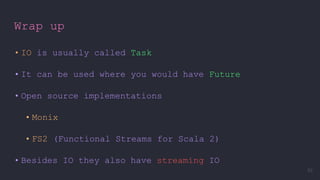
• Trade stack for heap
• Build a call tree
• It has a higher cost than a function call
• It’s a special case of a Free Monad
• type IO[A] = Free[() => A, A]](https://image.slidesharecdn.com/takingyourside-effectsaside-170408113600/85/Taking-your-side-effects-aside-84-320.jpg)

 extends IO[A]
87](https://image.slidesharecdn.com/takingyourside-effectsaside-170408113600/85/Taking-your-side-effects-aside-87-320.jpg)
 => Unit
) extends IO[A]
88](https://image.slidesharecdn.com/takingyourside-effectsaside-170408113600/85/Taking-your-side-effects-aside-88-320.jpg)
: Unit
case class Async[A](
register: (A => Unit) => Unit
) extends IO[A]
89](https://image.slidesharecdn.com/takingyourside-effectsaside-170408113600/85/Taking-your-side-effects-aside-89-320.jpg)
![import scala.concurrent.ExecutionContext.global
def DoubleOnSeperateThread(d: Double) = Async[Double] {
onDone =>
{
global.execute { () =>
onDone(d * 2.0) //(A => Unit)}
}
}
val program = ReadLine
.map(_.toDouble)
.flatMap(x => DoubleOnSeperateThread(x))
.flatMap(y => PrintLine(y.toString))
IO.run(program)
90](https://image.slidesharecdn.com/takingyourside-effectsaside-170408113600/85/Taking-your-side-effects-aside-90-320.jpg)
: A = io match {
(...)
case Async(register) => //(A => Unit) => Unit
val latch = new CountDownLatch(1)
var a: A = null.asInstanceOf[A]
register { a0 =>
a = a0
latch.countDown()
}
latch.await()
a 91](https://image.slidesharecdn.com/takingyourside-effectsaside-170408113600/85/Taking-your-side-effects-aside-91-320.jpg)
: A = io match {
(...)
case Async(register) => //(A => Unit) => Unit
val latch = new CountDownLatch(1)
var a: A = null.asInstanceOf[A]
register { a0 => //(A => Unit), onDone
a = a0
latch.countDown()
}
latch.await()
a 92](https://image.slidesharecdn.com/takingyourside-effectsaside-170408113600/85/Taking-your-side-effects-aside-92-320.jpg)


![谷歌留痕技术教程[ 𝙩𝙤𝙥 𝟮𝟯𝟯. 𝙘 𝙤𝙢 ]](https://cdn.slidesharecdn.com/ss_thumbnails/top233-260130173900-2eb784f9-thumbnail.jpg?width=640&height=640&fit=bounds)


