This document summarizes a presentation about type classes in Scala. It introduces type classes like Monoid and Functor. It provides examples of Monoid instances for types like Int and Option. It explains how to define type classes for new types. It shows how to generalize functions like sequence and traverse to work for any Applicative functor using type classes. Finally, it discusses related concepts like Semigroup, Semigroupal functors, and NonEmptyList.
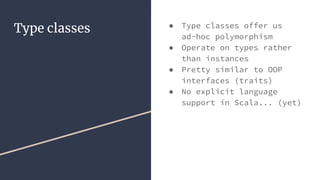
![A small type class example
@typeclass
trait Show[T] {
def show(value: T): String
}
implicit val showString: Show[String] = new Show[String] {
def show(value: String): String = value
}
implicit val showInt: Show[Int] = _.toString
def emptyIfFalse[T: Show](t: T, f: T => Boolean): String =
if (f(t)) t.show else “”](https://image.slidesharecdn.com/scaladays1-180516144147/85/Oh-All-the-things-you-ll-traverse-5-320.jpg)
![Something a bit more useful
@typeclass
trait Monoid[T] {
def empty: T
def combine(a: T, b: T): T
}
implicit val monoidInt: Monoid[Int] = new Monoid[Int] {
def empty: Int = 0
def combine(a: Int, b: Int): Int = a + b
}](https://image.slidesharecdn.com/scaladays1-180516144147/85/Oh-All-the-things-you-ll-traverse-6-320.jpg)
![Something a bit more useful
def sumInt(list: List[Int]): Int =
list.foldLeft(0)(_ + _)
def sumString(list: List[String]): String =
list.foldLeft("")(_ + _)
def sumSet[T](list: List[Set[T]]): Set[T] =
list.foldLeft(Set.empty[T])(_ union _)
def sum[T: Monoid](list: List[T]): T =
list.foldLeft(Monoid[T].empty)(_ combine _)](https://image.slidesharecdn.com/scaladays1-180516144147/85/Oh-All-the-things-you-ll-traverse-7-320.jpg)
![Something a bit more useful
def sumInt(list: List[Int]): Int =
list.foldLeft(0)(_ + _)
def sumString(list: List[String]): String =
list.foldLeft("")(_ + _)
def sumSet[T](list: List[Set[T]]): Set[T] =
list.foldLeft(Set.empty[T])(_ union _)
def sum[T: Monoid](list: List[T]): T =
list.foldLeft(Monoid[T].empty)(_ combine _)](https://image.slidesharecdn.com/scaladays1-180516144147/85/Oh-All-the-things-you-ll-traverse-8-320.jpg)
![Implicit derivation
implicit def optionMonoid[T: Monoid] = new Monoid[Option[T]] {
def empty = None
def combine(a: Option[T], b: Option[T]) = (a, b) match {
case (Some(x), Some(y)) => Some(x |+| y)
case (Some(x), None) => Some(x)
case (None, Some(y)) => Some(y)
case (None, None) => None
}
}](https://image.slidesharecdn.com/scaladays1-180516144147/85/Oh-All-the-things-you-ll-traverse-9-320.jpg)
![Monoids everywhere
implicit def functionMonoid[A, B: Monoid] = new Monoid[A => B] {
def empty = _ => Monoid[B].empty
def combine(x: A => B, y: A => B): A => B =
a => x(a) |+| y(a)
}
implicit def tupleMonoid[A: Monoid, B: Monoid] = new Monoid[(A, B)] {
def empty = (Monoid[A].empty, Monoid[B].empty)
def combine(x: (A, B), y: (A, B)): (A, B) =
(x._1 |+| y._1, x._2 |+| y._2)
}](https://image.slidesharecdn.com/scaladays1-180516144147/85/Oh-All-the-things-you-ll-traverse-11-320.jpg)
![Monoids everywhere
implicit def eitherMonoid[A, B: Monoid]: Monoid[Either[A, B]]
implicit def mapMonoid[A, B: Monoid]: Monoid[Map[A, B]]
implicit def futureMonoid[A: Monoid]: Monoid[Future[A]]
And many more!](https://image.slidesharecdn.com/scaladays1-180516144147/85/Oh-All-the-things-you-ll-traverse-12-320.jpg)
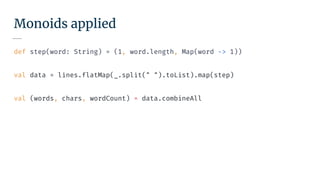
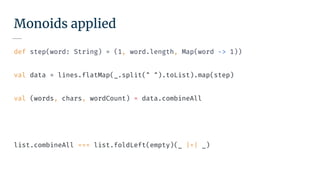
![Monoids applied
def step(word: String) = (1, word.length, Map(word -> 1))
val data = lines.flatMap(_.split(" ").toList).map(step)
val empty = Monoid[(Int, Int, Map[String, Int])].empty
val (words, chars, wordCount) = data.foldLeft(empty)(_ |+| _)](https://image.slidesharecdn.com/scaladays1-180516144147/85/Oh-All-the-things-you-ll-traverse-13-320.jpg)
![Parallel fold
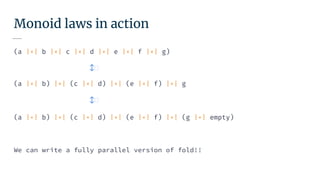
val grouped: List[List[A]] =
list.grouped(getRuntime.availableProcessors)
val innerFolded: List[A] =
grouped.parallelMap(_.combineAll)
val result: A =
innerFolded.combineAll](https://image.slidesharecdn.com/scaladays1-180516144147/85/Oh-All-the-things-you-ll-traverse-18-320.jpg)
![Let’s talk about Functors
@typeclass
trait Functor[F[_]] {
def map[A, B](fa: F[A])(f: A => B): F[B]
}
List(1, 2, 3).map(_.toString)
Option(42).map(_.toString)
Right(23).map(_.toString)
Vector(-1, 39, 11).map(_.toString)
Future(22).map(_.toString)](https://image.slidesharecdn.com/scaladays1-180516144147/85/Oh-All-the-things-you-ll-traverse-19-320.jpg)
![Let’s talk about Monoidal Functors
(A |+| A): A
(F[A] |+| F[A]): F[A]
(F[A] |@| F[B]): F[???]](https://image.slidesharecdn.com/scaladays1-180516144147/85/Oh-All-the-things-you-ll-traverse-20-320.jpg)
![Let’s talk about Monoidal Functors
(A |+| A): A
(F[A] |+| F[A]): F[A]
(F[A] |@| F[B]): F[(A, B)]](https://image.slidesharecdn.com/scaladays1-180516144147/85/Oh-All-the-things-you-ll-traverse-21-320.jpg)
![Let’s talk about Monoidal Functors
@typeclass
trait Monoidal[F[_]] extends Functor[F] {
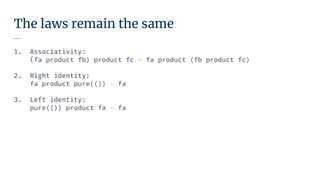
def product[A, B](fa: F[A], fb: F[B]): F[(A, B)]
def pure[A](a: A): F[A]
}
implicit val optionMonoidal: Monoidal[Option]
implicit val futureMonoidal: Monoidal[Future]](https://image.slidesharecdn.com/scaladays1-180516144147/85/Oh-All-the-things-you-ll-traverse-22-320.jpg)
: Future[List[A]]
}](https://image.slidesharecdn.com/scaladays1-180516144147/85/Oh-All-the-things-you-ll-traverse-23-320.jpg)
: Future[List[A]]
def sequence[F[_]: Monoidal, A](l: List[F[A]]): F[List[A]] =
l.foldRight(Monoidal[F].pure(List.empty[A]))
{ (fa: F[A], acc: F[List[A]]) =>
val prod: F[(A, List[A])] = fa.product(acc)
prod.map(_ +: _)
}](https://image.slidesharecdn.com/scaladays1-180516144147/85/Oh-All-the-things-you-ll-traverse-24-320.jpg)
: Future[List[A]]
def sequence[F[_]: Monoidal, A](l: List[F[A]]): F[List[A]] =
l.foldRight(Monoidal[F].pure(List.empty[A]))
{ (fa: F[A], acc: F[List[A]]) =>
val prod: F[(A, List[A])] = fa.product(acc)
prod.map(_ +: _)
}](https://image.slidesharecdn.com/scaladays1-180516144147/85/Oh-All-the-things-you-ll-traverse-25-320.jpg)
: Future[List[A]]
def sequence[F[_]: Monoidal, A](l: List[F[A]]): F[List[A]] =
l.foldRight(Monoidal[F].pure(List.empty[A]))
{ (fa: F[A], acc: F[List[A]]) =>
(fa, acc).mapN(_ +: _)
}](https://image.slidesharecdn.com/scaladays1-180516144147/85/Oh-All-the-things-you-ll-traverse-26-320.jpg)
: Future[List[A]]
def sequence[F[_]: Monoidal, A](l: List[F[A]]): F[List[A]] =
l.foldRight(Monoidal[F].pure(List.empty[A]))
{ (fa: F[A], acc: F[List[A]]) =>
(fa, acc).mapN(_ +: _)
}
fa.product(fb).map(f) === (fa, fb).mapN(f)](https://image.slidesharecdn.com/scaladays1-180516144147/85/Oh-All-the-things-you-ll-traverse-27-320.jpg)
(f: A => Future[B]): Future[List[B]]
def traverse[F[_]: Monoidal, A, B](l: List[A])(f: A => F[B]): F[List[B] =
l.foldRight(Monoidal[F].pure(List.empty[B]))
{ (a: A, acc: F[List[B]]) =>
(acc, f(a)).mapN(_ :+ _)
}
l.traverse(f) === l.map(f).sequence](https://image.slidesharecdn.com/scaladays1-180516144147/85/Oh-All-the-things-you-ll-traverse-28-320.jpg)
![The Foldable type class
So far we used List everywhere, but what about Vector, Stream, etc?
@typeclass
trait Foldable[F[_]] {
def foldMap[A, M: Monoid](fa: F[A])(f: A => M): M
def combineAll[M: Monoid](fa: F[M]): M = foldMap(identity)
}
implicit val listFoldable: Foldable[List]
implicit def vectorFoldable: Foldable[Vector]
implicit def optionFoldable: Foldable[Option]](https://image.slidesharecdn.com/scaladays1-180516144147/85/Oh-All-the-things-you-ll-traverse-31-320.jpg)
![The Traverse type class
@typeclass
trait Traverse[T[_]] extends Foldable[T] with Functor[T] {
def sequence[F[_]: Applicative, A](tfa: T[F[A]]): F[T[A]]
def traverse[F[_]: Applicative, A, B](ta: T[A], f: A => F[B]): F[T[B]]
}
implicit def vectorTraversable: Traverse[Vector]
implicit def optionTraversable: Traverse[Option]
type EitherString[A] = Either[String, A]
implicit def eitherStringTraversable: Traverse[EitherString]](https://image.slidesharecdn.com/scaladays1-180516144147/85/Oh-All-the-things-you-ll-traverse-32-320.jpg)
![The Traverse type class
@typeclass
trait Traverse[T[_]] extends Foldable[T] with Functor[T] {
def sequence[F[_]: Applicative, A](tfa: T[F[A]]): F[T[A]]
def traverse[F[_]: Applicative, A, B](ta: T[A], f: A => F[B]): F[T[B]]
}
implicit def vectorTraversable: Traverse[Vector]
implicit def optionTraversable: Traverse[Option]
implicit def eitherStringTraversable[E]: Traverse[Either[E, ?]]](https://image.slidesharecdn.com/scaladays1-180516144147/85/Oh-All-the-things-you-ll-traverse-33-320.jpg)
![The Traverse type class
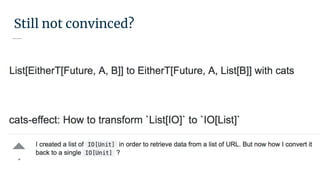
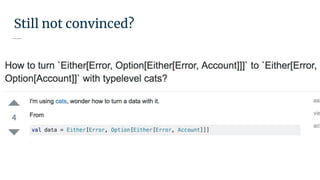
List[Future[A]] => Future[List[A]]
Stream[Option[A]] => Option[Stream[A]]
Either[E, IO[A]] => IO[Either[E, A]]
Vector[ValidatedNel[Error, A]] => ValidatedNel[Error, Vector[A]]](https://image.slidesharecdn.com/scaladays1-180516144147/85/Oh-All-the-things-you-ll-traverse-34-320.jpg)
![ValidatedNel???
sealed trait Validated[+E, +A]
case class Valid[+A](a: A) extends Validated[Nothing, A]
case class Invalid[+E](e: E) extends Validated[E, Nothing]
type ValidatedNel[E, A] = Validated[NonEmptyList[E], A]
def validate(u: String): ValidatedNel[Error, User]
val users: ValidatedNel[Error, List[User]] = lines.traverse(validate)](https://image.slidesharecdn.com/scaladays1-180516144147/85/Oh-All-the-things-you-ll-traverse-35-320.jpg)
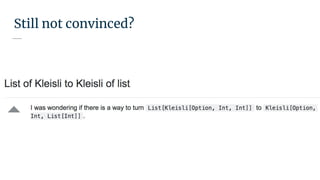
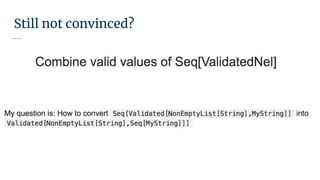
![Bonus: Semigroups!
@typeclass
trait Semigroup[T] {
def combine(a: T, b: T): T
}
Semigroups describe an associative binary operation.
@typeclass
trait Monoid[T] extends Semigroup[T] {
def empty: T
}](https://image.slidesharecdn.com/scaladays1-180516144147/85/Oh-All-the-things-you-ll-traverse-40-320.jpg)
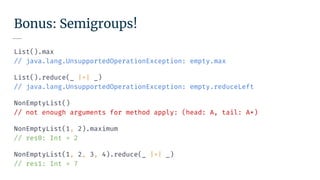
![… and Semigroupal Functors!
@typeclass
trait Semigroupal[F[_]] extends Functor[F] {
def product[A, B](fa: F[A], fb: F[B]): F[(A, B)]
}
@typeclass
trait Monoidal[F[_]] extends Semigroupal[F] {
def pure[A](a: A): F[A]
}](https://image.slidesharecdn.com/scaladays1-180516144147/85/Oh-All-the-things-you-ll-traverse-42-320.jpg)
![… and Semigroupal Functors!
@typeclass
trait Apply[F[_]] extends Functor[F] {
def product[A, B](fa: F[A], fb: F[B]): F[(A, B)]
}
@typeclass
trait Applicative[F[_]] extends Semigroupal[F] {
def pure[A](a: A): F[A]
}](https://image.slidesharecdn.com/scaladays1-180516144147/85/Oh-All-the-things-you-ll-traverse-43-320.jpg)
![… and Semigroupal Functors!
implicit def mapApplicative[K] = new Applicative[Map[K, ?]] {
def pure[V](v: V): Map[K, V] = ???
// ...
}
It doesn’t work!
implicit def mapApply[K] = new Apply[Map[K, ?]] {
// ...
}
This does! :)](https://image.slidesharecdn.com/scaladays1-180516144147/85/Oh-All-the-things-you-ll-traverse-44-320.jpg)