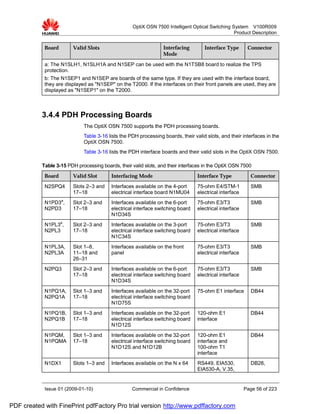
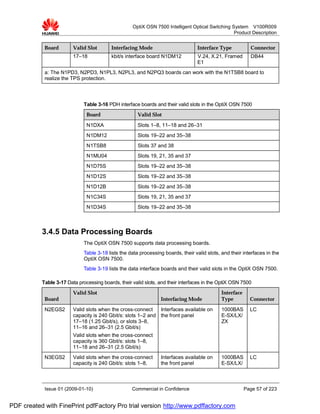
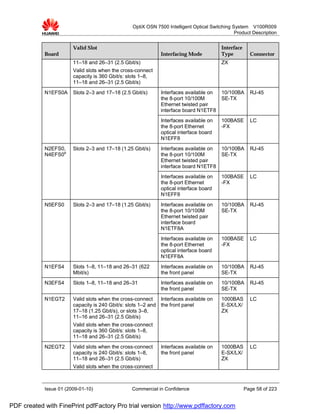
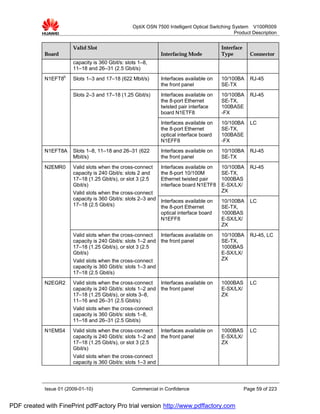
Product Description


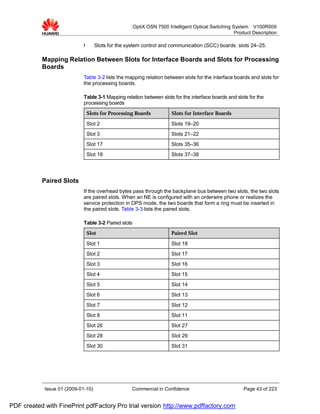
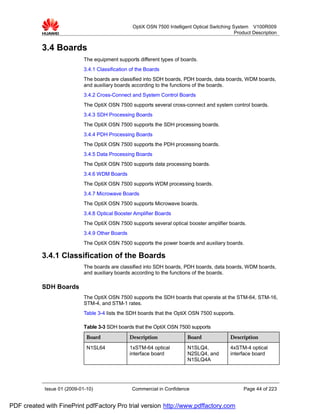
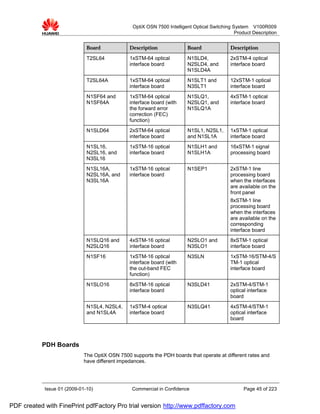
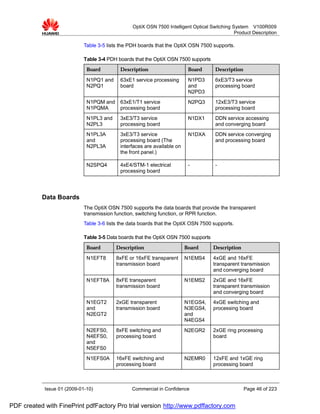
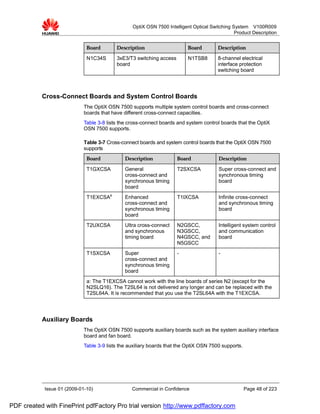
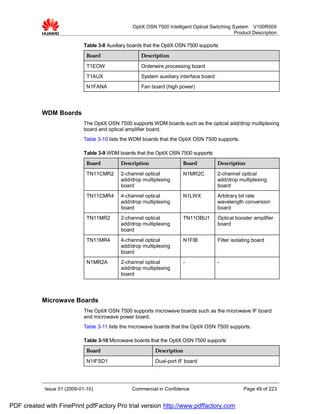
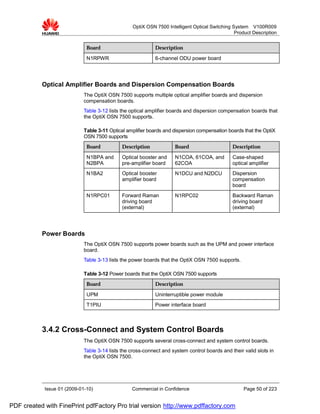
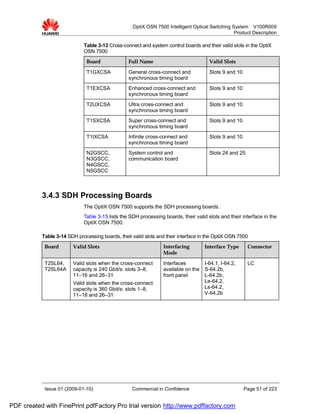
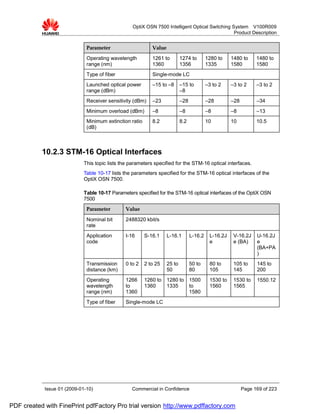
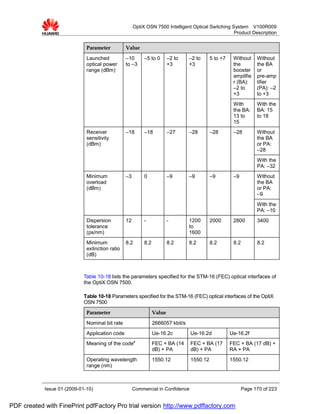
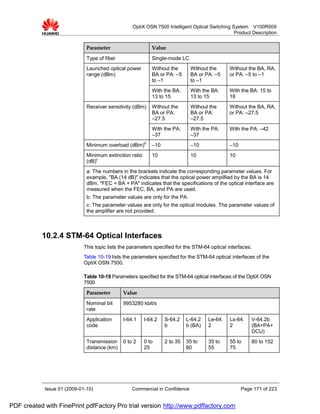
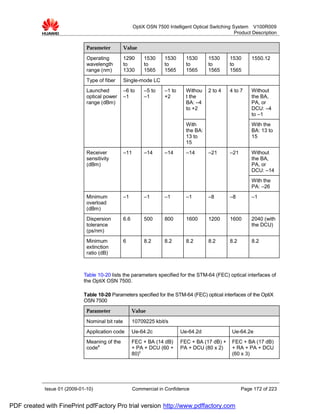
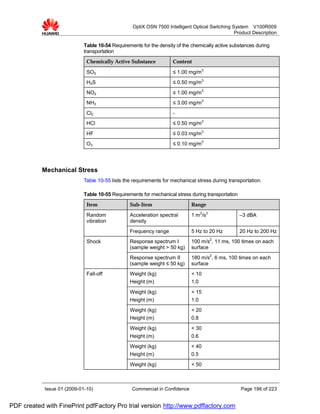
              OptiX OSN 7500 Intelligent Optical Switching
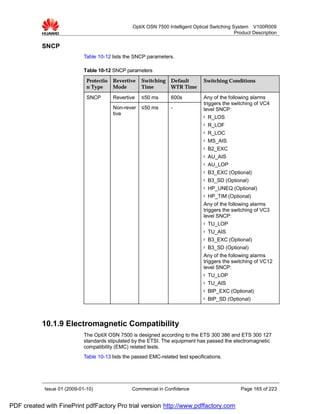
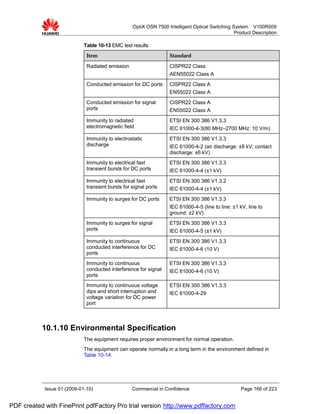
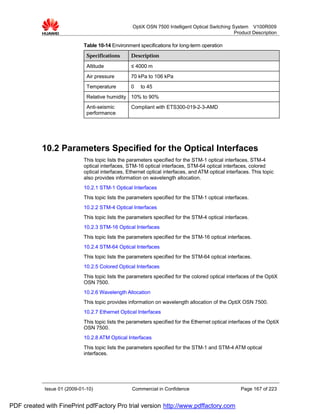
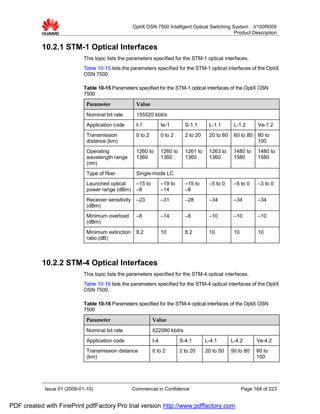
              System
              V100R009


              Issue      01

              Date       2009-01-10


              HUAWEI TECHNOLOGIES CO., LTD.

PDF created with FinePrint pdfFactory Pro trial version http://www.pdffactory.com
Huawei Technologies Co., Ltd. provides customers with comprehensive technical support and service.
            Please feel free to contact our local office or company headquarters.


            Huawei Technologies Co., Ltd.
            Address:       Huawei Industrial Base
                           Bantian, Longgang
                           Shenzhen 518129
                           People's Republic of China

            Website:       http://www.huawei.com

            Email:         support@huawei.com


            Copyright © Huawei Technologies Co., Ltd. 2009. All rights reserved.
            No part of this document may be reproduced or transmitted in any form or by any means without prior
            written consent of Huawei Technologies Co., Ltd.


            Trademarks and Permissions

                     and other Huawei trademarks are trademarks of Huawei Technologies Co., Ltd.
            All other trademarks and trade names mentioned in this document are the property of their respective
            holders.


            Notice
            The information in this document is subject to change without notice. Every effort has been made in the
            preparation of this document to ensure accuracy of the contents, but all statements, information, and
            recommendations in this document do not constitute the warranty of any kind, express or implied.


            Issue 01 (2009-01-10)                       Commercial in Confidence                     Page 2 of 223


PDF created with FinePrint pdfFactory Pro trial version http://www.pdffactory.com
OptiX OSN 7500 Intelligent Optical Switching System V100R009
                                                                                               Product Description


                                                                About This Document

           Author
            Prepared by                                       Date
            Reviewed by                                       Date

            Approved by                                       Date


           Summary
                             This document includes:

                              Chapter                      Description

                              1 Network Application        Describes the OptiX OSN 7500 and its position in the
                                                           network.
                              2 Function                   This chapter generally describes the features of the
                                                           OptiX OSN 7500 in the terms of capacity, interface,
                                                           boards, OAM and other functions.
                              3 Hardware                   Describes the mechanical structure and the
                                                           adaptable cabinet installation of the OptiX OSN
                                                           7500.
                              4 Software Architecture      Describes the software system of the OptiX OSN
                                                           7500. It includes intelligent software, board software,
                                                           NE software and NM software.
                              5 Data Features              Describes the Ethernet, RPR and ATM features of
                                                           the OptiX OSN 7500 in terms of function, application
                                                           and protection.
                              6 ASON Features              This chapter introduces the ASON features of the
                                                           OptiX OSN 7500 in terms of service classes and
                                                           application.
                              7 Protection                 Describes protection modes (including equipment
                                                           level and network level) and characteristics
                                                           supported by the OptiX OSN 7500.


            Issue 01 (2009-01-10)                Commercial in Confidence                           Page 3 of 223


PDF created with FinePrint pdfFactory Pro trial version http://www.pdffactory.com
OptiX OSN 7500 Intelligent Optical Switching System V100R009
                                                                                               Product Description


                              8 OAM                         This chapter describes main technical characteristics
                                                            of the OptiX OSN 7500 in terms of maintenance and
                                                            centralized management.
                              9 Security Management         This chapter describes main technical characteristics
                                                            of the OptiX OSN 7500 in terms of safe operation.
                              10 Technical Specifications   This chapter describes the hardware dimension,
                                                            interface specifications, transmission performance,
                                                            environment requirements and power specification
                                                            for the OptiX OSN 7500.
                              10.8 Power Consumption        This appendix lists the power consumption and
                              and Weight of Each Board      weight of the boards that are configured on the OptiX
                                                            OSN 7500.
                              11 Compliant Standards        This appendix lists international standards to which
                                                            the OptiX OSN 7500 conforms in terms of design and
                                                            performance.
                              12 Glossary                   This appendix lists the terms used in this document.
                              13 Acronyms and               The appendix lists the acronyms and abbreviations
                              Abbreviations                 used in this document.


            Issue 01 (2009-01-10)                Commercial in Confidence                           Page 4 of 223


PDF created with FinePrint pdfFactory Pro trial version http://www.pdffactory.com
OptiX OSN 7500 Intelligent Optical Switching System V100R009
                                                                                              Product Description


           History
                              Issue   Details                   Date             Author           Approved by


            Issue 01 (2009-01-10)               Commercial in Confidence                           Page 5 of 223


PDF created with FinePrint pdfFactory Pro trial version http://www.pdffactory.com
OptiX OSN 7500 Intelligent Optical Switching System V100R009
                                                                                                                     Product Description


                                                                                                                                             Contents

           1 Network Application......................................................................................................11
           2 Function ........................................................................................................................ 14
                   2.1 Capacity .......................................................................................................................................... 14
                        2.1.1 Cross-Connect Capacity ........................................................................................................ 14
                        2.1.2 Microwave Capacity ............................................................................................................... 15
                        2.1.3 Slot Access Capacity.............................................................................................................. 16
                   2.2 Service ............................................................................................................................................ 17
                        2.2.1 Service Type .......................................................................................................................... 17
                        2.2.2 Service Access Capacity........................................................................................................ 18
                   2.3 Interface .......................................................................................................................................... 19
                        2.3.1 Service Interfaces .................................................................................................................. 20
                        2.3.2 Administration and Auxiliary Interfaces .................................................................................. 21
                   2.4 Networking Topology ...................................................................................................................... 21
                   2.5 Protection........................................................................................................................................ 23
                        2.5.1 Equipment Level Protection ................................................................................................... 24
                        2.5.2 Network Level Protection ....................................................................................................... 24
                   2.6 Board REG Function....................................................................................................................... 25
                   2.7 ASON Features............................................................................................................................... 27
                   2.8 Built-in WDM Technology................................................................................................................ 27
                   2.9 Microwave Technology ................................................................................................................... 28
                   2.10 110 V/220 V Power Supply ........................................................................................................... 28
                   2.11 Clock ............................................................................................................................................. 29
                   2.12 High Precise Timing...................................................................................................................... 29
                   2.13 OAM Information Interworking ...................................................................................................... 30
                   2.14 OAM.............................................................................................................................................. 31
                        2.14.1 Software Package Loading .................................................................................................. 32
                        2.14.2 Hot Patch ............................................................................................................................. 33
                        2.14.3 NSF Function ....................................................................................................................... 33
                        2.14.4 Board Version Replacement ................................................................................................ 33
                        2.14.5 PRBS Function..................................................................................................................... 34
                        2.14.6 Inter-Board Alarm Suppression............................................................................................ 34
                        2.14.7 TCM...................................................................................................................................... 35
                        2.14.8 ETH-OAM............................................................................................................................. 35
                   2.15 Security Management................................................................................................................... 36


            Issue 01 (2009-01-10)                                      Commercial in Confidence                                                        Page 6 of 223


PDF created with FinePrint pdfFactory Pro trial version http://www.pdffactory.com
OptiX OSN 7500 Intelligent Optical Switching System V100R009
                                                                                                                     Product Description

           3 Hardware....................................................................................................................... 37
                   3.1 Overview ......................................................................................................................................... 37
                   3.2 Cabinet............................................................................................................................................ 39
                   3.3 Subrack........................................................................................................................................... 40
                        3.3.1 Structure................................................................................................................................. 41
                        3.3.2 Slot Allocation......................................................................................................................... 42
                   3.4 Boards............................................................................................................................................. 44
                        3.4.1 Classification of the Boards ................................................................................................... 44
                        3.4.2 Cross-Connect and System Control Boards .......................................................................... 50
                        3.4.3 SDH Processing Boards ........................................................................................................ 51
                        3.4.4 PDH Processing Boards ........................................................................................................ 56
                        3.4.5 Data Processing Boards ........................................................................................................ 57
                        3.4.6 WDM Boards.......................................................................................................................... 61
                        3.4.7 Microwave Boards.................................................................................................................. 62
                        3.4.8 Optical Booster Amplifier Boards ........................................................................................... 62
                        3.4.9 Other Boards.......................................................................................................................... 63

           4 Software Architecture .................................................................................................. 65
                   4.1 Overview ......................................................................................................................................... 65
                   4.2 Communication Protocols............................................................................................................... 66
                   4.3 Board Software ............................................................................................................................... 66
                   4.4 NE Software.................................................................................................................................... 66
                   4.5 Network Management System........................................................................................................ 67
                   4.6 ASON Software............................................................................................................................... 68

           5 Data Features................................................................................................................ 70
                   5.1 Ethernet Features ........................................................................................................................... 70
                        5.1.1 Functions................................................................................................................................ 70
                        5.1.2 Application.............................................................................................................................. 81
                        5.1.3 Protection ............................................................................................................................... 85
                   5.2 RPR Features ................................................................................................................................. 86
                        5.2.2 Functions................................................................................................................................ 88
                        5.2.3 Application.............................................................................................................................. 91
                        5.2.4 Protection ............................................................................................................................... 93
                   5.3 ATM Features.................................................................................................................................. 94
                        5.3.1 Functions................................................................................................................................ 94
                        5.3.2 Application.............................................................................................................................. 97
                        5.3.3 Protection ............................................................................................................................. 100
                   5.4 DDN Features ............................................................................................................................... 100
                        5.4.1 Functions.............................................................................................................................. 101
                        5.4.2 Application............................................................................................................................ 101
                        5.4.3 Protection ............................................................................................................................. 102
                   5.5 SAN Features ............................................................................................................................... 103


            Issue 01 (2009-01-10)                                     Commercial in Confidence                                                        Page 7 of 223


PDF created with FinePrint pdfFactory Pro trial version http://www.pdffactory.com
OptiX OSN 7500 Intelligent Optical Switching System V100R009
                                                                                                                     Product Description

           6 ASON Features ........................................................................................................... 104
                   6.1 Automatic Discovery of the Topologies ......................................................................................... 104
                        6.1.1 Auto-Discovery of Control Links........................................................................................... 104
                        6.1.2 Auto-Discovery of TE Links .................................................................................................. 106
                   6.2 End-to-End Service Configuration ................................................................................................ 106
                   6.3 Mesh Networking Protection and Restoration .............................................................................. 107
                   6.4 ASON Clock Tracing ..................................................................................................................... 108
                   6.5 SLA ............................................................................................................................................... 111
                   6.6 Diamond Services......................................................................................................................... 113
                   6.7 Gold Services ............................................................................................................................... 117
                   6.8 Silver Services .............................................................................................................................. 119
                   6.9 Copper Services ........................................................................................................................... 121
                   6.10 Iron Services ............................................................................................................................... 122
                   6.11 Tunnels........................................................................................................................................ 123
                   6.12 Service Association..................................................................................................................... 126
                   6.13 Service Optimization................................................................................................................... 127
                   6.14 Service Migration ........................................................................................................................ 127
                   6.15 Reverting Services to Original Routes........................................................................................ 128
                   6.16 Preset Restoring Trail ................................................................................................................. 128
                   6.17 Shared Mesh Restoration Trail ................................................................................................... 128
                   6.18 Shared Risk Link Group.............................................................................................................. 130
                   6.19 Amalgamation of ASON and LCAS ............................................................................................ 130

           7 Protection ................................................................................................................... 132
                   7.1 Equipment Level Protection.......................................................................................................... 132
                        7.1.1 TPS Protection ..................................................................................................................... 133
                        7.1.2 1+1 Hot Backup for the Cross-Connect and Timing Units ................................................... 134
                        7.1.3 1+1 Hot Backup for the SCC Unit ........................................................................................ 134
                        7.1.4 1+1 Protection for Ethernet Boards ..................................................................................... 135
                        7.1.5 1+1 Protection for ATM Boards ............................................................................................ 136
                        7.1.6 Protection for the Microwave Boards ................................................................................... 137
                        7.1.7 1+1 Hot Backup for the Power Interface Unit ...................................................................... 138
                        7.1.8 Protection for the Wavelength Conversion Unit ................................................................... 138
                        7.1.9 Intelligent Fans..................................................................................................................... 139
                        7.1.10 1:N Protection for the +3.3 V Board Power Supply ........................................................... 139
                        7.1.11 Board Protection Schemes Under Abnormal Conditions ................................................... 139
                   7.2 Network Level Protection.............................................................................................................. 140
                        7.2.1 Linear MSP .......................................................................................................................... 141
                        7.2.2 MSP Ring ............................................................................................................................. 141
                        7.2.3 SNCP ................................................................................................................................... 142
                        7.2.4 DNI ....................................................................................................................................... 146
                        7.2.5 Fiber-Shared Virtual Trail Protection.................................................................................... 147


            Issue 01 (2009-01-10)                                      Commercial in Confidence                                                        Page 8 of 223


PDF created with FinePrint pdfFactory Pro trial version http://www.pdffactory.com
OptiX OSN 7500 Intelligent Optical Switching System V100R009
                                                                                                                  Product Description

                        7.2.6 Optical-Path-Shared MSP.................................................................................................... 147
                        7.2.7 RPR Protection .................................................................................................................... 149
                        7.2.8 VP-Ring/VC-Ring Protection................................................................................................ 150

           8 OAM............................................................................................................................. 152
                   8.1 Operation and Maintenance ......................................................................................................... 152
                   8.2 Network Management................................................................................................................... 154

           9 Security Management ................................................................................................ 155
                   9.1 Authentication Management ......................................................................................................... 155
                   9.2 Authorization Management ........................................................................................................... 155
                   9.3 Network Security Management..................................................................................................... 156
                   9.4 System Security Management...................................................................................................... 156
                   9.5 Log Management.......................................................................................................................... 157
                        9.5.1 NE Security Log Management ............................................................................................. 157
                        9.5.2 Syslog Management ............................................................................................................ 157

           10 Technical Specifications.......................................................................................... 159
                   10.1 Overall Specifications of the Equipment ..................................................................................... 159
                        10.1.1 Specifications of the Cabinet.............................................................................................. 160
                        10.1.2 Specifications of the Subrack............................................................................................. 160
                        10.1.3 Power Supply Parameters ................................................................................................. 161
                        10.1.4 Timeslot Numbering ........................................................................................................... 161
                        10.1.5 Laser Safety Class ............................................................................................................. 162
                        10.1.6 Timing and Synchronization Performance ......................................................................... 162
                        10.1.7 Transmission Performance ................................................................................................ 163
                        10.1.8 Protection Performance ..................................................................................................... 163
                        10.1.9 Electromagnetic Compatibility............................................................................................ 165
                        10.1.10 Environmental Specification............................................................................................. 166
                   10.2 Parameters Specified for the Optical Interfaces ......................................................................... 167
                        10.2.1 STM-1 Optical Interfaces ................................................................................................... 168
                        10.2.2 STM-4 Optical Interfaces ................................................................................................... 168
                        10.2.3 STM-16 Optical Interfaces ................................................................................................. 169
                        10.2.4 STM-64 Optical Interfaces ................................................................................................. 171
                        10.2.5 Colored Optical Interfaces ................................................................................................. 173
                        10.2.6 Wavelength Allocation........................................................................................................ 174
                        10.2.7 Ethernet Optical Interfaces ................................................................................................ 175
                        10.2.8 ATM Optical Interfaces ....................................................................................................... 176
                   10.3 Parameters Specified for the Electrical Interfaces...................................................................... 177
                        10.3.1 PDH Electrical Interfaces ................................................................................................... 178
                        10.3.2 DDN Electrical Interfaces................................................................................................... 178
                   10.4 Parameters Specified for the Auxiliary Interfaces ....................................................................... 179
                        10.4.1 Clock Interface Specifications ............................................................................................ 179
                        10.4.2 64 kbit/s Interface Specifications........................................................................................ 180


            Issue 01 (2009-01-10)                                   Commercial in Confidence                                                   Page 9 of 223


PDF created with FinePrint pdfFactory Pro trial version http://www.pdffactory.com
OptiX OSN 7500 Intelligent Optical Switching System V100R009
                                                                                                                  Product Description

                        10.4.3 RS-232 Interface Specifications......................................................................................... 180
                        10.4.4 RS-422 Interface Specifications......................................................................................... 180
                        10.4.5 Orderwire Phone Interface Specifications.......................................................................... 181
                   10.5 Microwave RF Performance ....................................................................................................... 181
                        10.5.1 Radio Work Modes............................................................................................................. 182
                        10.5.2 Frequency Band................................................................................................................. 183
                        10.5.3 Receiver Sensitivity............................................................................................................ 184
                        10.5.4 Transceiver Performance................................................................................................... 186
                        10.5.5 Anti-Multipath Fading Performance.................................................................................... 189
                        10.5.6 IF Performance .................................................................................................................. 190
                        10.5.7 Baseband Signal Processing Performance of the Modem ................................................ 190
                        10.5.8 Equipment Reliability ......................................................................................................... 190
                   10.6 Safety Certification...................................................................................................................... 191
                   10.7 Environmental Conditions ........................................................................................................... 192
                        10.7.1 Environment for Storage .................................................................................................... 192
                        10.7.2 Environment for Transportation.......................................................................................... 194
                        10.7.3 Environment for Operation................................................................................................. 197
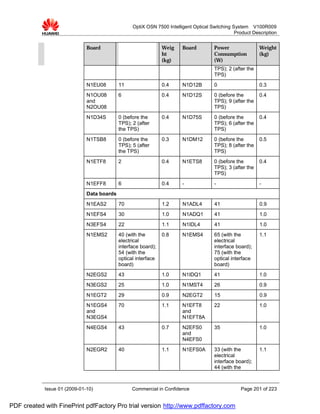
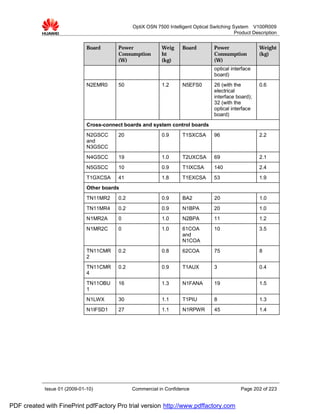
                   10.8 Power Consumption and Weight of Each Board ........................................................................ 199

           11 Compliant Standards ............................................................................................... 203
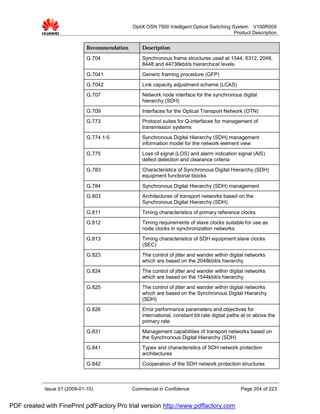
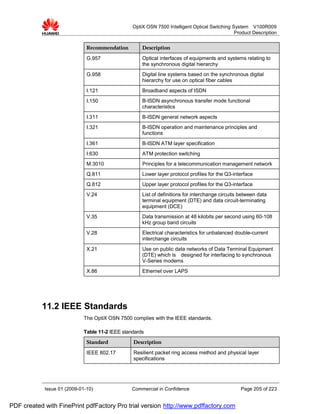
                   11.1 ITU-T Recommendations ............................................................................................................ 203
                   11.2 IEEE Standards........................................................................................................................... 205
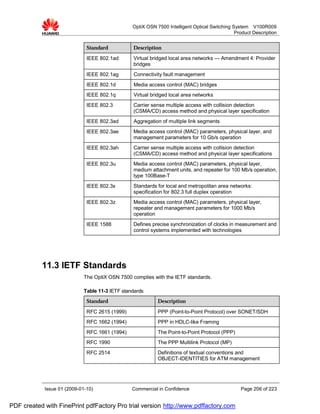
                   11.3 IETF Standards ........................................................................................................................... 206
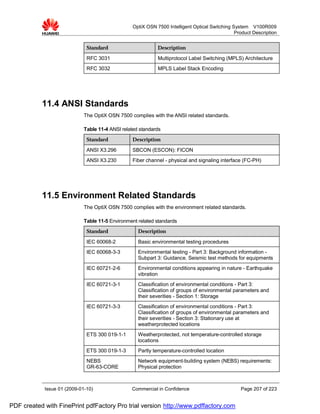
                   11.4 ANSI Standards........................................................................................................................... 207
                   11.5 Environment Related Standards ................................................................................................. 207
                   11.6 EMC Standards ........................................................................................................................... 208
                   11.7 Safety Compliance Standards..................................................................................................... 208
                   11.8 Protection Standards................................................................................................................... 209
                   11.9 ASON Standards ......................................................................................................................... 209
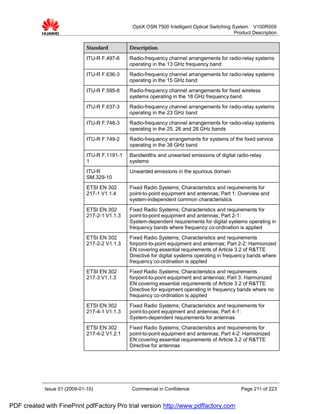
                   11.10 Microwave Standards................................................................................................................ 210

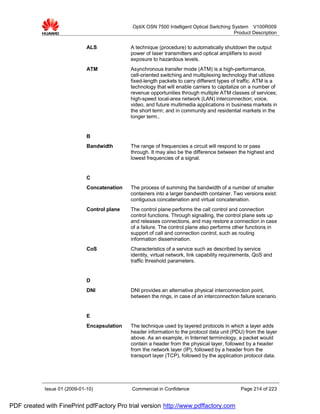
           12 Glossary.................................................................................................................... 213
           13 Acronyms and Abbreviations.................................................................................. 219


            Issue 01 (2009-01-10)                                   Commercial in Confidence                                                  Page 10 of 223


PDF created with FinePrint pdfFactory Pro trial version http://www.pdffactory.com
OptiX OSN 7500 Intelligent Optical Switching System V100R009
                                                                                                  Product Description


                                                         1            Network Application

                             This chapter describes the position and application of the OptiX OSN 7500 intelligent
                             optical switching system (the OptiX OSN 7500) in an optical transmission network.
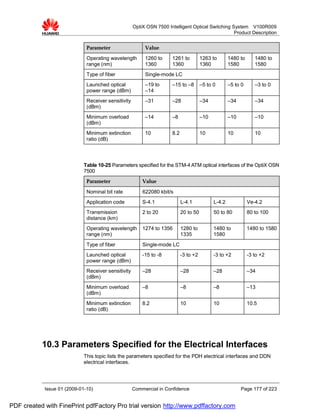
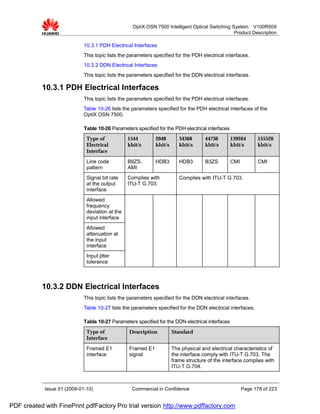
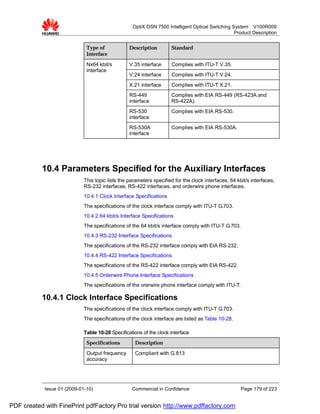
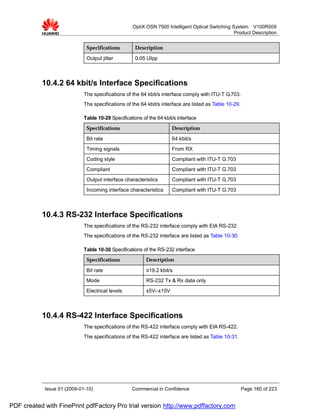
                             The OptiX OSN 7500 is the optical core switching (OCS) equipment. It is a next
                             generation equipment that Huawei has developed based on the type of metropolitan
                             area network (MAN) and its development trend in the future.
                             As an intelligent optical core switching system with large capacity, the OptiX OSN
                             7500 is mainly used at the backbone layer of the MAN to groom and transmit various
                             services with different granularities.
                             The OptiX OSN 7500 has 360 Gbit/s higher order and 80 Gbit/s lower order
                             cross-connect capacities, and features large switching capacity.
                             The OptiX OSN 7500 integrates the following technologies:
                             l      Synchronous digital hierarchy (SDH)
                             l      Plesiochronous digital hierarchy (PDH)
                             l      Ethernet
                             l      Asynchronous transfer mode (ATM)
                             l      Storage area network (SAN)
                             l      Wavelength division multiplexing (WDM)
                             l      Digital data network (DDN)
                             l      Automatically switched optical network (ASON)
                             l      Microwave Technology
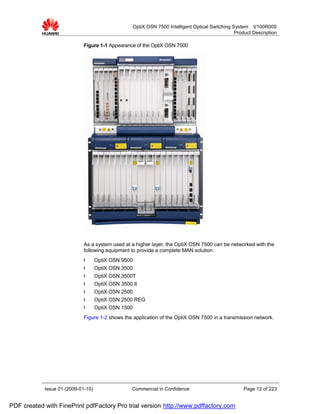
                             Figure 1-1 shows the appearance of the OptiX OSN 7500.


            Issue 01 (2009-01-10)                   Commercial in Confidence                          Page 11 of 223


PDF created with FinePrint pdfFactory Pro trial version http://www.pdffactory.com
OptiX OSN 7500 Intelligent Optical Switching System V100R009
                                                                                                 Product Description

                             Figure 1-1 Appearance of the OptiX OSN 7500


                             As a system used at a higher layer, the OptiX OSN 7500 can be networked with the
                             following equipment to provide a complete MAN solution:
                             l      OptiX OSN 9500
                             l      OptiX OSN 3500
                             l      OptiX OSN 3500T
                             l      OptiX OSN 3500 II
                             l      OptiX OSN 2500
                             l      OptiX OSN 2500 REG
                             l      OptiX OSN 1500
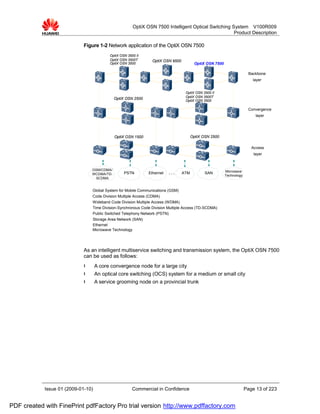
                             Figure 1-2 shows the application of the OptiX OSN 7500 in a transmission network.


            Issue 01 (2009-01-10)                  Commercial in Confidence                          Page 12 of 223


PDF created with FinePrint pdfFactory Pro trial version http://www.pdffactory.com
OptiX OSN 7500 Intelligent Optical Switching System V100R009
                                                                                                     Product Description

                             Figure 1-2 Network application of the OptiX OSN 7500
                                          OptiX OSN 3500 II
                                          OptiX OSN 3500T       OptiX OSN 9500
                                          OptiX OSN 3500                                OptiX OSN 7500

                                                                                                                        Backbone
                                                                                                                          layer


                                                                                  OptiX OSN 3500 II
                                                                                  OptiX OSN 3500T
                                             OptiX OSN 2500                       OptiX OSN 3500

                                                                                                                       Convergence
                                                                                                                           layer


                                             OptiX OSN 1500                            OptiX OSN 2500

                                                                                                                         Access
                                                                                                                          layer


                                 GSM/CDMA/                                                               Microwave
                                 WCDMA/TD-        PSTN        Ethernet   ...     ATM          SAN
                                                                                                         Technology
                                  SCDMA


                                 Global System for Mobile Communications (GSM)
                                 Code Division Multiple Access (CDMA)
                                 Wideband Code Division Multiple Access (WDMA)
                                 Time Division-Synchronous Code Division Multiple Access (TD-SCDMA)
                                 Public Switched Telephony Network (PSTN)
                                 Storage Area Network (SAN)
                                 Ethernet
                                 Microwave Technology


                             As an intelligent multiservice switching and transmission system, the OptiX OSN 7500
                             can be used as follows:
                             l      A core convergence node for a large city
                             l      An optical core switching (OCS) system for a medium or small city
                             l      A service grooming node on a provincial trunk


            Issue 01 (2009-01-10)                      Commercial in Confidence                                       Page 13 of 223


PDF created with FinePrint pdfFactory Pro trial version http://www.pdffactory.com
OptiX OSN 7500 Intelligent Optical Switching System V100R009
                                                                                                Product Description


                                                                                  2            Function

           2.1 Capacity
                             The capacity covers the cross-connect capacity and slot access capacity.
                             2.1.1 Cross-Connect Capacity
                             Different cross-connect boards have different cross-connect capacities.
                             2.1.2 Microwave Capacity
                             The number of IFSD1 boards that can be configured for different types of the OptiX
                             OSN equipment is different. Hence, the number of microwave directions supported by
                             different types of the OptiX OSN equipment is also different.
                             2.1.3 Slot Access Capacity
                             The slot access capacity varies according to the cross-connect boards.

           2.1.1 Cross-Connect Capacity
                             Different cross-connect boards have different cross-connect capacities.
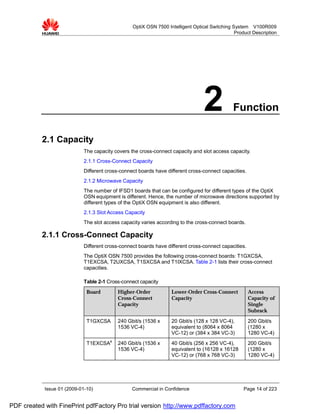
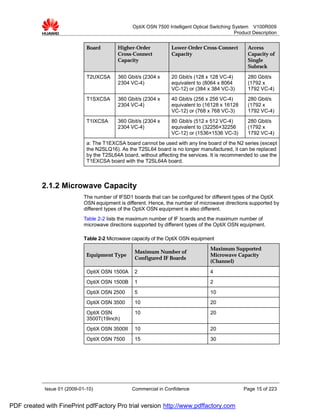
                             The OptiX OSN 7500 provides the following cross-connect boards: T1GXCSA,
                             T1EXCSA, T2UXCSA, T1SXCSA and T1IXCSA. Table 2-1 lists their cross-connect
                             capacities.

                             Table 2-1 Cross-connect capacity
                              Board        Higher-Order            Lower-Order Cross-Connect           Access
                                           Cross-Connect           Capacity                            Capacity of
                                           Capacity                                                    Single
                                                                                                       Subrack

                              T1GXCSA      240 Gbit/s (1536 x      20 Gbit/s (128 x 128 VC-4),         200 Gbit/s
                                           1536 VC-4)              equivalent to (8064 x 8064          (1280 x
                                                                   VC-12) or (384 x 384 VC-3)          1280 VC-4)
                              T1EXCSAa     240 Gbit/s (1536 x      40 Gbit/s (256 x 256 VC-4),         200 Gbit/s
                                           1536 VC-4)              equivalent to (16128 x 16128        (1280 x
                                                                   VC-12) or (768 x 768 VC-3)          1280 VC-4)


            Issue 01 (2009-01-10)                 Commercial in Confidence                          Page 14 of 223


PDF created with FinePrint pdfFactory Pro trial version http://www.pdffactory.com
OptiX OSN 7500 Intelligent Optical Switching System V100R009
                                                                                               Product Description


                              Board        Higher-Order           Lower-Order Cross-Connect         Access
                                           Cross-Connect          Capacity                          Capacity of
                                           Capacity                                                 Single
                                                                                                    Subrack

                              T2UXCSA      360 Gbit/s (2304 x     20 Gbit/s (128 x 128 VC-4)        280 Gbit/s
                                           2304 VC-4)             equivalent to (8064 x 8064        (1792 x
                                                                  VC-12) or (384 x 384 VC-3)        1792 VC-4)
                              T1SXCSA      360 Gbit/s (2304 x     40 Gbit/s (256 x 256 VC-4)        280 Gbit/s
                                           2304 VC-4)             equivalent to (16128 x 16128      (1792 x
                                                                  VC-12) or (768 x 768 VC-3)        1792 VC-4)
                              T1IXCSA      360 Gbit/s (2304 x     80 Gbit/s (512 x 512 VC-4)        280 Gbit/s
                                           2304 VC-4)             equivalent to (32256×32256        (1792 x
                                                                  VC-12) or (1536×1536 VC-3)        1792 VC-4)
                              a: The T1EXCSA board cannot be used with any line board of the N2 series (except
                              the N2SLQ16). As the T2SL64 board is no longer manufactured, it can be replaced
                              by the T2SL64A board, without affecting the services. It is recommended to use the
                              T1EXCSA board with the T2SL64A board.


           2.1.2 Microwave Capacity
                             The number of IFSD1 boards that can be configured for different types of the OptiX
                             OSN equipment is different. Hence, the number of microwave directions supported by
                             different types of the OptiX OSN equipment is also different.
                             Table 2-2 lists the maximum number of IF boards and the maximum number of
                             microwave directions supported by different types of the OptiX OSN equipment.

                             Table 2-2 Microwave capacity of the OptiX OSN equipment
                                                                                    Maximum Supported
                                                  Maximum Number of
                              Equipment Type                                        Microwave Capacity
                                                  Configured IF Boards
                                                                                    (Channel)

                              OptiX OSN 1500A     2                                 4
                              OptiX OSN 1500B     1                                 2
                              OptiX OSN 2500      5                                 10
                              OptiX OSN 3500      10                                20
                              OptiX OSN           10                                20
                              3500T(19inch)
                              OptiX OSN 3500II    10                                20
                              OptiX OSN 7500      15                                30


            Issue 01 (2009-01-10)                Commercial in Confidence                          Page 15 of 223


PDF created with FinePrint pdfFactory Pro trial version http://www.pdffactory.com
OptiX OSN 7500 Intelligent Optical Switching System V100R009
                                                                                                                                                                                  Product Description


           2.1.3 Slot Access Capacity
                             The slot access capacity varies according to the cross-connect boards.
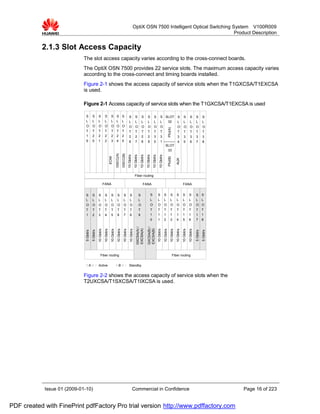
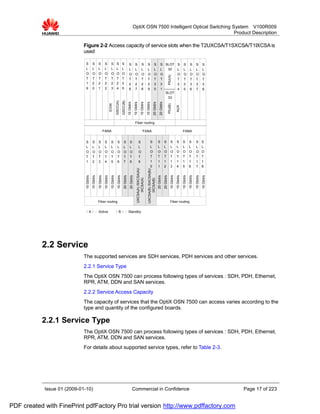
                             The OptiX OSN 7500 provides 22 service slots. The maximum access capacity varies
                             according to the cross-connect and timing boards installed.
                             Figure 2-1 shows the access capacity of service slots when the T1GXCSA/T1EXCSA
                             is used.

                             Figure 2-1 Access capacity of service slots when the T1GXCSA/T1EXCSA is used

                              S          S          S            S            S            S             S                S               S              S           S            S               S SLOT S                                            S           S         S          S
                              L          L          L            L            L            L             L                L               L              L           L            L               L  32  L                                            L           L         L          L
                              O          O          O            O            O            O             O                O               O              O           O            O               O      O                                            O           O         O          O


                                                                                                                                                                                                                        PIU(A)
                              T          T          T            T            T            T             T                T               T              T           T            T               T      T                                            T           T         T          T
                              1          2          2            2            2            2             2                2               2              2           2            3               3      3                                            3           3         3          3
                              9          0          1            2            3            4             5                6               7              8            9           0               1      4                                            5           6         7          8
                                                                                                                                                                                                    SLOT
                                                                                                                                                                                                     33
                                                                                          GSCC(A)
                                                                                                         GSCC(B)
                                                                                                                        10 Gbit/s
                                                                                                                                        10 Gbit/s
                                                                                                                                                        10 Gbit/s
                                                                                                                                                                    10 Gbit/s
                                                                                                                                                                                10 Gbit/s
                                                                                                                                                                                                10 Gbit/s
                                                                             EOW


                                                                                                                                                                                                                        PIU(B)

                                                                                                                                                                                                                                        AUX
                                                                                                                                        Fiber routing

                                                                FANA                                                                                         FANA                                                                                   FANA


                              S          S          S            S            S             S               S               S                       S                       S               S               S               S           S           S           S           S S
                              L          L          L            L            L             L               L               L                       L                       L               L               L               L           L           L           L           L L
                              O          O          O            O            O             O               O               O                       O                       O               O               O               O           O           O           O           O O
                              T          T          T            T            T             T               T               T                       T                       T               T               T               T           T           T           T           T T
                              1          2          3            4            5             6               7               8                       9                       1               1               1               1           1           1           1           1 1
                                                                                                                                                                            0               1               2               3           4           5           6           7 8
                                                                                                                                             GXCSA(A) /


                                                                                                                                                                      GXCSA(B) /
                                                                                                                                             EXCSA(A)


                                                                                                                                                                      EXCSA(B)
                                                    10 Gbit/s
                                                                 10 Gbit/s
                                                                              10 Gbit/s
                                                                                             10 Gbit/s
                                                                                                            10 Gbit/s
                                                                                                                            10 Gbit/s


                                                                                                                                                                                            10 Gbit/s
                                                                                                                                                                                                            10 Gbit/s
                                                                                                                                                                                                                            10 Gbit/s
                                                                                                                                                                                                                                        10 Gbit/s
                                                                                                                                                                                                                                                    10 Gbit/s
                                                                                                                                                                                                                                                                10 Gbit/s
                              5 Gbit/s
                                         5 Gbit/s


                                                                                                                                                                                                                                                                            5 Gbit/s
                                                                                                                                                                                                                                                                                       5 Gbit/s


                                                        Fiber routing                                                                                                                                                            Fiber routing


                             ( A ) : Active                                               ( B ) : Standby


                             Figure 2-2 shows the access capacity of service slots when the
                             T2UXCSA/T1SXCSA/T1IXCSA is used.


            Issue 01 (2009-01-10)                                                                                                   Commercial in Confidence                                                                                                                                      Page 16 of 223


PDF created with FinePrint pdfFactory Pro trial version http://www.pdffactory.com
OptiX OSN 7500 Intelligent Optical Switching System V100R009
                                                                                                                                                                                    Product Description

                             Figure 2-2 Access capacity of service slots when the T2UXCSA/T1SXCSA/T1IXCSA is
                             used

                              S           S           S            S            S            S             S                S              S                S          S               S               S SLOT S                                           S            S         S           S
                              L           L           L            L            L            L             L                L              L                L          L               L               L  32  L                                           L            L         L           L
                              O           O           O            O            O            O             O                O              O                O          O               O               O      O                                           O            O         O           O


                                                                                                                                                                                                                             PIU(A)
                              T           T           T            T            T            T             T                T              T                T          T               T               T      T                                           T            T         T           T
                              1           2           2            2            2            2             2                2              2                2          2               3               3      3                                           3            3         3           3
                              9           0           1            2            3            4             5                6              7                8          9               0               1      4                                           5            6         7           8
                                                                                                                                                                                                         SLOT
                                                                                                                                                                                                          33


                                                                                            GSCC(A)
                                                                                                           GSCC(B)
                                                                                                                          10 Gbit/s
                                                                                                                                          10 Gbit/s
                                                                                                                                                          10 Gbit/s
                                                                                                                                                                      10 Gbit/s
                                                                                                                                                                                     20 Gbit/s
                                                                                                                                                                                                     20 Gbit/s
                                                                               EOW


                                                                                                                                                                                                                             PIU(B)

                                                                                                                                                                                                                                             AUX
                                                                                                                                           Fiber routing

                                                                  FANA                                                                                         FANA                                                                                      FANA


                              S           S           S            S            S             S              S                S                       S                       S                  S               S               S           S           S           S           S           S
                              L           L           L            L            L             L              L                L                       L                       L                  L               L               L           L           L           L           L           L
                              O           O           O            O            O             O              O                O                       O                       O                  O               O               O           O           O           O           O           O
                              T           T           T            T            T             T              T                T                       T                       T                  T               T               T           T           T           T           T           T
                              1           2           3            4            5             6              7                8                       9                       1                  1               1               1           1           1           1           1           1
                                                                                                                                                                              0                  1               2               3           4           5           6           7           8
                                                                                                                                                UXCSA(A) /SXCSA(A)/


                                                                                                                                                                        UXCSA(B) /SXCSA(B)/
                              10 Gbit/s
                                          10 Gbit/s
                                                      10 Gbit/s
                                                                   10 Gbit/s
                                                                                10 Gbit/s
                                                                                               10 Gbit/s
                                                                                                              20 Gbit/s
                                                                                                                              20 Gbit/s


                                                                                                                                                                                                 20 Gbit/s
                                                                                                                                                                                                                 20 Gbit/s
                                                                                                                                                                                                                                 10 Gbit/s
                                                                                                                                                                                                                                             10 Gbit/s
                                                                                                                                                                                                                                                         10 Gbit/s
                                                                                                                                                                                                                                                                     10 Gbit/s

                                                                                                                                                                                                                                                                                 10 Gbit/s
                                                                                                                                                                                                                                                                                             10 Gbit/s
                                                                                                                                                     IXCSA(A)


                                                                                                                                                                             IXCSA(B)


                                                      Fiber routing                                                                                                                                                             Fiber routing

                             ( A ) : Active                                                 ( B ) : Standby


           2.2 Service
                             The supported services are SDH services, PDH services and other services.
                             2.2.1 Service Type
                             The OptiX OSN 7500 can process following types of services : SDH, PDH, Ethernet,
                             RPR, ATM, DDN and SAN services.
                             2.2.2 Service Access Capacity
                             The capacity of services that the OptiX OSN 7500 can access varies according to the
                             type and quantity of the configured boards.

           2.2.1 Service Type
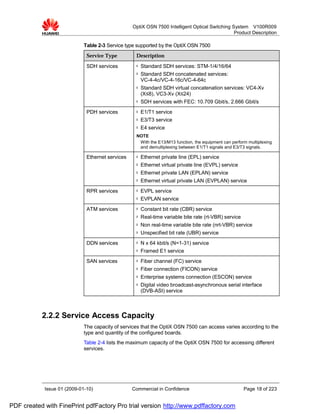
                             The OptiX OSN 7500 can process following types of services : SDH, PDH, Ethernet,
                             RPR, ATM, DDN and SAN services.
                             For details about supported service types, refer to Table 2-3.


            Issue 01 (2009-01-10)                                                                                                     Commercial in Confidence                                                                                                                                           Page 17 of 223


PDF created with FinePrint pdfFactory Pro trial version http://www.pdffactory.com
OptiX OSN 7500 Intelligent Optical Switching System V100R009
                                                                                                Product Description

                             Table 2-3 Service type supported by the OptiX OSN 7500
                              Service Type         Description

                              SDH services         l   Standard SDH services: STM-1/4/16/64
                                                   l   Standard SDH concatenated services:
                                                       VC-4-4c/VC-4-16c/VC-4-64c
                                                   l   Standard SDH virtual concatenation services: VC4-Xv
                                                       (X≤8), VC3-Xv (X≤24)
                                                   l   SDH services with FEC: 10.709 Gbit/s, 2.666 Gbit/s
                              PDH services         l   E1/T1 service
                                                   l   E3/T3 service
                                                   l   E4 service
                                                   NOTE
                                                    With the E13/M13 function, the equipment can perform multiplexing
                                                    and demultiplexing between E1/T1 signals and E3/T3 signals.

                              Ethernet services    l   Ethernet private line (EPL) service
                                                   l   Ethernet virtual private line (EVPL) service
                                                   l   Ethernet private LAN (EPLAN) service
                                                   l   Ethernet virtual private LAN (EVPLAN) service
                              RPR services         l   EVPL service
                                                   l   EVPLAN service
                              ATM services         l   Constant bit rate (CBR) service
                                                   l   Real-time variable bite rate (rt-VBR) service
                                                   l   Non real-time variable bite rate (nrt-VBR) service
                                                   l   Unspecified bit rate (UBR) service
                              DDN services         l   N x 64 kbit/s (N=1-31) service
                                                   l   Framed E1 service
                              SAN services         l   Fiber channel (FC) service
                                                   l   Fiber connection (FICON) service
                                                   l   Enterprise systems connection (ESCON) service
                                                   l   Digital video broadcast-asynchronous serial interface
                                                       (DVB-ASI) service


           2.2.2 Service Access Capacity
                             The capacity of services that the OptiX OSN 7500 can access varies according to the
                             type and quantity of the configured boards.
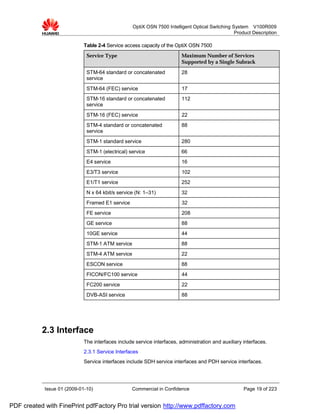
                             Table 2-4 lists the maximum capacity of the OptiX OSN 7500 for accessing different
                             services.


            Issue 01 (2009-01-10)                 Commercial in Confidence                             Page 18 of 223


PDF created with FinePrint pdfFactory Pro trial version http://www.pdffactory.com
OptiX OSN 7500 Intelligent Optical Switching System V100R009
                                                                                                 Product Description

                             Table 2-4 Service access capacity of the OptiX OSN 7500
                              Service Type                               Maximum Number of Services
                                                                         Supported by a Single Subrack
                              STM-64 standard or concatenated            28
                              service
                              STM-64 (FEC) service                       17
                              STM-16 standard or concatenated            112
                              service
                              STM-16 (FEC) service                       22
                              STM-4 standard or concatenated             88
                              service
                              STM-1 standard service                     280
                              STM-1 (electrical) service                 66
                              E4 service                                 16
                              E3/T3 service                              102
                              E1/T1 service                              252
                              N x 64 kbit/s service (N: 1–31)            32
                              Framed E1 service                          32
                              FE service                                 208
                              GE service                                 88
                              10GE service                               44
                              STM-1 ATM service                          88
                              STM-4 ATM service                          22
                              ESCON service                              88
                              FICON/FC100 service                        44
                              FC200 service                              22
                              DVB-ASI service                            88


           2.3 Interface
                             The interfaces include service interfaces, administration and auxiliary interfaces.
                             2.3.1 Service Interfaces
                             Service interfaces include SDH service interfaces and PDH service interfaces.


            Issue 01 (2009-01-10)                 Commercial in Confidence                           Page 19 of 223


PDF created with FinePrint pdfFactory Pro trial version http://www.pdffactory.com
OptiX OSN 7500 Intelligent Optical Switching System V100R009
                                                                                                 Product Description

                             2.3.2 Administration and Auxiliary Interfaces
                             The equipment provides several types of administration and auxiliary interfaces.

           2.3.1 Service Interfaces
                             Service interfaces include SDH service interfaces and PDH service interfaces.
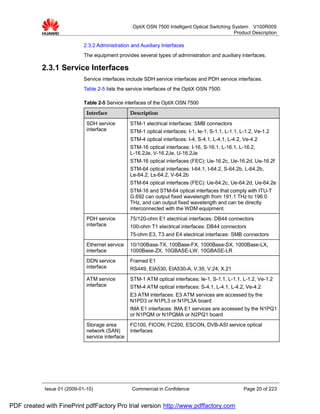
                             Table 2-5 lists the service interfaces of the OptiX OSN 7500.

                             Table 2-5 Service interfaces of the OptiX OSN 7500
                              Interface           Description
                              SDH service         STM-1 electrical interfaces: SMB connectors
                              interface           STM-1 optical interfaces: I-1, Ie-1, S-1.1, L-1.1, L-1.2, Ve-1.2
                                                  STM-4 optical interfaces: I-4, S-4.1, L-4.1, L-4.2, Ve-4.2
                                                  STM-16 optical interfaces: I-16, S-16.1, L-16.1, L-16.2,
                                                  L-16.2Je, V-16.2Je, U-16.2Je
                                                  STM-16 optical interfaces (FEC): Ue-16.2c, Ue-16.2d, Ue-16.2f
                                                  STM-64 optical interfaces: I-64.1, I-64.2, S-64.2b, L-64.2b,
                                                  Le-64.2, Ls-64.2, V-64.2b
                                                  STM-64 optical interfaces (FEC): Ue-64.2c, Ue-64.2d, Ue-64.2e
                                                  STM-16 and STM-64 optical interfaces that comply with ITU-T
                                                  G.692 can output fixed wavelength from 191.1 THz to 196.0
                                                  THz, and can output fixed wavelength and can be directly
                                                  interconnected with the WDM equipment.
                              PDH service         75/120-ohm E1 electrical interfaces: DB44 connectors
                              interface           100-ohm T1 electrical interfaces: DB44 connectors
                                                  75-ohm E3, T3 and E4 electrical interfaces: SMB connectors
                              Ethernet service    10/100Base-TX, 100Base-FX, 1000Base-SX, 1000Base-LX,
                              interface           1000Base-ZX, 10GBASE-LW, 10GBASE-LR
                              DDN service         Framed E1
                              interface           RS449, EIA530, EIA530-A, V.35, V.24, X.21
                              ATM service         STM-1 ATM optical interfaces: Ie-1, S-1.1, L-1.1, L-1.2, Ve-1.2
                              interface           STM-4 ATM optical interfaces: S-4.1, L-4.1, L-4.2, Ve-4.2
                                                  E3 ATM interfaces: E3 ATM services are accessed by the
                                                  N1PD3 or N1PL3 or N1PL3A board
                                                  IMA E1 interfaces: IMA E1 services are accessed by the N1PQ1
                                                  or N1PQM or N1PQMA or N2PQ1 board
                              Storage area        FC100, FICON, FC200, ESCON, DVB-ASI service optical
                              network (SAN)       interfaces
                              service interface


            Issue 01 (2009-01-10)                 Commercial in Confidence                            Page 20 of 223


PDF created with FinePrint pdfFactory Pro trial version http://www.pdffactory.com
OptiX OSN 7500 Intelligent Optical Switching System V100R009
                                                                                                      Product Description


                                    Ue-16.2c, Ue-16.2d, Ue-16.2f, Le-64.2, Ls-64.2, L-16.2Je, V-16.2Je, U-16.2Je, Ve-1.2, Ve-4.2
                                    are technical specifications defined by Huawei.

           2.3.2 Administration and Auxiliary Interfaces
                             The equipment provides several types of administration and auxiliary interfaces.
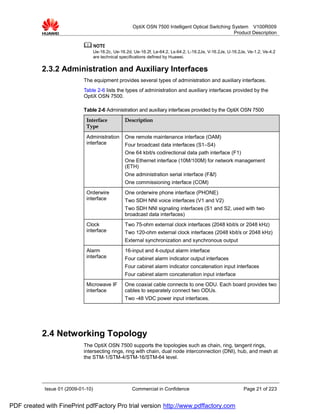
                             Table 2-6 lists the types of administration and auxiliary interfaces provided by the
                             OptiX OSN 7500.

                             Table 2-6 Administration and auxiliary interfaces provided by the OptiX OSN 7500
                              Interface             Description
                              Type

                              Administration        One remote maintenance interface (OAM)
                              interface             Four broadcast data interfaces (S1–S4)
                                                    One 64 kbit/s codirectional data path interface (F1)
                                                    One Ethernet interface (10M/100M) for network management
                                                    (ETH)
                                                    One administration serial interface (F&f)
                                                    One commissioning interface (COM)
                              Orderwire             One orderwire phone interface (PHONE)
                              interface             Two SDH NNI voice interfaces (V1 and V2)
                                                    Two SDH NNI signaling interfaces (S1 and S2, used with two
                                                    broadcast data interfaces)
                              Clock                 Two 75-ohm external clock interfaces (2048 kbit/s or 2048 kHz)
                              interface             Two 120-ohm external clock interfaces (2048 kbit/s or 2048 kHz)
                                                    External synchronization and synchronous output
                              Alarm                 16-input and 4-output alarm interface
                              interface             Four cabinet alarm indicator output interfaces
                                                    Four cabinet alarm indicator concatenation input interfaces
                                                    Four cabinet alarm concatenation input interface
                              Microwave IF          One coaxial cable connects to one ODU. Each board provides two
                              interface             cables to separately connect two ODUs.
                                                    Two -48 VDC power input interfaces.


           2.4 Networking Topology
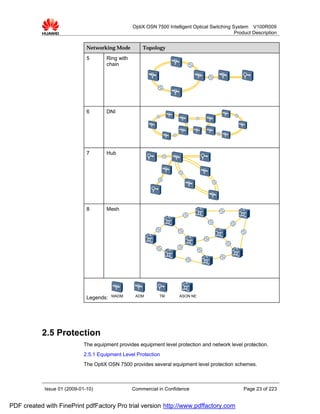
                             The OptiX OSN 7500 supports the topologies such as chain, ring, tangent rings,
                             intersecting rings, ring with chain, dual node interconnection (DNI), hub, and mesh at
                             the STM-1/STM-4/STM-16/STM-64 level.


            Issue 01 (2009-01-10)                      Commercial in Confidence                                Page 21 of 223


PDF created with FinePrint pdfFactory Pro trial version http://www.pdffactory.com
OptiX OSN 7500 Intelligent Optical Switching System V100R009
                                                                                                     Product Description

                             The OptiX OSN 7500 supports the separate and hybrid configuration of the following
                             types of NEs:
                             l      Terminal multiplexer (TM)
                             l      Add/drop multiplexer (ADM)
                             l      Multiple add/drop multiplexer (MADM)
                             The OptiX OSN 7500 can be interconnected with Huawei OSN, DWDM, and Metro
                             equipment series, to provide a complete transmission network solution.


                                    When the equipment is interconnecting, make sure that the K bytes to be received and
                                    transmitted are on the same path at both ends.
                             l      The OptiX OSN 7500 can be used with another OptiX OSN equipment to provide
                                    a complete ASON solution. This solution covers all the layers including the
                                    backbone layer, the convergence layer, and the access layer.
                             l      Through an SDH interface or a GE interface, the OptiX OSN 7500 can be
                                    interconnected with the WDM equipment.
                             l      Through an SDH, PDH, Ethernet, ATM, or DDN interface, the OptiX OSN 7500
                                    can be interconnected with the OptiX Metro equipment.
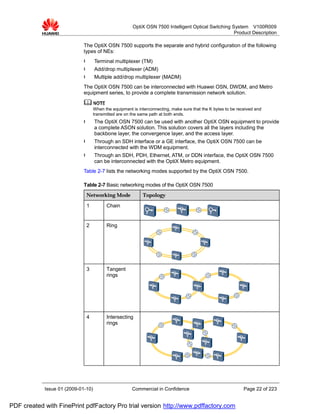
                             Table 2-7 lists the networking modes supported by the OptiX OSN 7500.

                             Table 2-7 Basic networking modes of the OptiX OSN 7500
                              Networking Mode               Topology

                              1           Chain


                              2           Ring


                              3           Tangent
                                          rings


                              4           Intersecting
                                          rings


            Issue 01 (2009-01-10)                      Commercial in Confidence                                Page 22 of 223


PDF created with FinePrint pdfFactory Pro trial version http://www.pdffactory.com
OptiX OSN 7500 Intelligent Optical Switching System V100R009
                                                                                                Product Description


                              Networking Mode         Topology

                              5       Ring with
                                      chain


                              6       DNI


                              7       Hub


                              8       Mesh


                                         MADM      ADM        TM       ASON NE
                              Legends:


           2.5 Protection
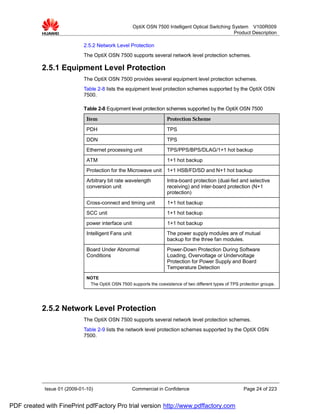
                             The equipment provides equipment level protection and network level protection.
                             2.5.1 Equipment Level Protection
                             The OptiX OSN 7500 provides several equipment level protection schemes.


            Issue 01 (2009-01-10)                 Commercial in Confidence                          Page 23 of 223


PDF created with FinePrint pdfFactory Pro trial version http://www.pdffactory.com
OptiX OSN 7500 Intelligent Optical Switching System V100R009
                                                                                                    Product Description

                             2.5.2 Network Level Protection
                             The OptiX OSN 7500 supports several network level protection schemes.

           2.5.1 Equipment Level Protection
                             The OptiX OSN 7500 provides several equipment level protection schemes.
                             Table 2-8 lists the equipment level protection schemes supported by the OptiX OSN
                             7500.

                             Table 2-8 Equipment level protection schemes supported by the OptiX OSN 7500
                              Item                                   Protection Scheme
                              PDH                                    TPS
                              DDN                                    TPS
                              Ethernet processing unit               TPS/PPS/BPS/DLAG/1+1 hot backup
                              ATM                                    1+1 hot backup
                              Protection for the Microwave unit      1+1 HSB/FD/SD and N+1 hot backup
                              Arbitrary bit rate wavelength          Intra-board protection (dual-fed and selective
                              conversion unit                        receiving) and inter-board protection (N+1
                                                                     protection)
                              Cross-connect and timing unit          1+1 hot backup
                              SCC unit                               1+1 hot backup
                              power interface unit                   1+1 hot backup
                              Intelligent Fans unit                  The power supply modules are of mutual
                                                                     backup for the three fan modules.
                              Board Under Abnormal                   Power-Down Protection During Software
                              Conditions                             Loading, Overvoltage or Undervoltage
                                                                     Protection for Power Supply and Board
                                                                     Temperature Detection
                              NOTE
                               The OptiX OSN 7500 supports the coexistence of two different types of TPS protection groups.


           2.5.2 Network Level Protection
                             The OptiX OSN 7500 supports several network level protection schemes.
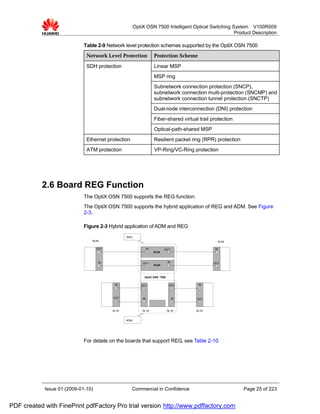
                             Table 2-9 lists the network level protection schemes supported by the OptiX OSN
                             7500.


            Issue 01 (2009-01-10)                     Commercial in Confidence                             Page 24 of 223


PDF created with FinePrint pdfFactory Pro trial version http://www.pdffactory.com
OptiX OSN 7500 Intelligent Optical Switching System V100R009
                                                                                                     Product Description

                             Table 2-9 Network level protection schemes supported by the OptiX OSN 7500
                              Network Level Protection               Protection Scheme

                              SDH protection                         Linear MSP
                                                                     MSP ring
                                                                     Subnetwork connection protection (SNCP),
                                                                     subnetwork connection multi-protection (SNCMP) and
                                                                     subnetwork connection tunnel protection (SNCTP)
                                                                     Dual-node interconnection (DNI) protection
                                                                     Fiber-shared virtual trail protection
                                                                     Optical-path-shared MSP
                              Ethernet protection                    Resilient packet ring (RPR) protection
                              ATM protection                         VP-Ring/VC-Ring protection


           2.6 Board REG Function
                             The OptiX OSN 7500 supports the REG function.
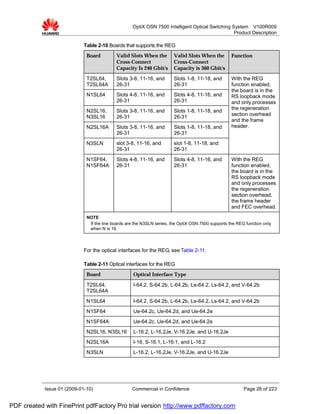
                             The OptiX OSN 7500 supports the hybrid application of REG and ADM. See Figure
                             2-3.

                             Figure 2-3 Hybrid application of ADM and REG
                                                 REG
                                SL64                                                               SL64

                                    OUT                         IN          OU T                 IN
                                                                     SL64


                                    IN                     OU T               IN                OUT
                                                                     SL64


                                                            OptiX OSN 7500

                                           IN             OUT                  OUT       IN


                                          OUT              IN                      IN    OUT


                                          SL16             SL16              SL16       SL16


                                                 ADM


                             For details on the boards that support REG, see Table 2-10.


            Issue 01 (2009-01-10)                   Commercial in Confidence                                  Page 25 of 223


PDF created with FinePrint pdfFactory Pro trial version http://www.pdffactory.com
OptiX OSN 7500 Intelligent Optical Switching System V100R009
                                                                                                  Product Description

                             Table 2-10 Boards that supports the REG
                              Board         Valid Slots When the         Valid Slots When the        Function
                                            Cross-Connect                Cross-Connect
                                            Capacity Is 240 Gbit/s       Capacity is 360 Gbit/s
                              T2SL64,       Slots 3-8, 11-16, and        Slots 1-8, 11-18, and       With the REG
                              T2SL64A       26-31                        26-31                       function enabled,
                                                                                                     the board is in the
                              N1SL64        Slots 4-8, 11-16, and        Slots 4-8, 11-16, and       RS loopback mode
                                            26-31                        26-31                       and only processes
                                                                                                     the regeneration
                              N2SL16,       Slots 3-8, 11-16, and        Slots 1-8, 11-18, and
                                                                                                     section overhead
                              N3SL16        26-31                        26-31
                                                                                                     and the frame
                              N2SL16A       Slots 3-8, 11-16, and        Slots 1-8, 11-18, and       header.
                                            26-31                        26-31
                              N3SLN         slot 3-8, 11-16, and         slot 1-8, 11-18, and
                                            26-31                        26-31
                              N1SF64,       Slots 4-8, 11-16, and        Slots 4-8, 11-16, and       With the REG
                              N1SF64A       26-31                        26-31                       function enabled,
                                                                                                     the board is in the
                                                                                                     RS loopback mode
                                                                                                     and only processes
                                                                                                     the regeneration
                                                                                                     section overhead,
                                                                                                     the frame header
                                                                                                     and FEC overhead.
                              NOTE
                               If the line boards are the N3SLN series, the OptiX OSN 7500 supports the REG function only
                               when N is 16.


                             For the optical interfaces for the REG, see Table 2-11.

                             Table 2-11 Optical interfaces for the REG
                              Board                  Optical Interface Type
                              T2SL64,                I-64.2, S-64.2b, L-64.2b, Le-64.2, Ls-64.2, and V-64.2b
                              T2SL64A
                              N1SL64                 I-64.2, S-64.2b, L-64.2b, Le-64.2, Ls-64.2, and V-64.2b
                              N1SF64                 Ue-64.2c, Ue-64.2d, and Ue-64.2e
                              N1SF64A                Ue-64.2c, Ue-64.2d, and Ue-64.2e
                              N2SL16, N3SL16         L-16.2, L-16.2Je, V-16.2Je, and U-16.2Je
                              N2SL16A                I-16, S-16.1, L-16.1, and L-16.2
                              N3SLN                  L-16.2, L-16.2Je, V-16.2Je, and U-16.2Je


            Issue 01 (2009-01-10)                   Commercial in Confidence                               Page 26 of 223


PDF created with FinePrint pdfFactory Pro trial version http://www.pdffactory.com
OptiX OSN 7500 Intelligent Optical Switching System V100R009
                                                                                                      Product Description


           2.7 ASON Features
                             The OptiX OSN 7500 provides a set of stand-alone ASON software system to realize
                             the intelligent management of services and bandwidth resources.
                             The ASON features of the OptiX OSN 7500 are as follows:
                             l      Supports automatic end-to-end service configuration.
                             l      Supports service level agreement (SLA).
                             l      Supports mesh networking and protection.
                             l      Provides traffic engineering control to ensure load-balance traffic network wide
                                    and improve the bandwidth availability.
                             l      Provides distributed mesh network protection including real-time rerouting and
                                    pre-configuration.
                             l      Supports span protection and end-to-end service protection, improving the
                                    scalability of the network.
                             l      Provides ASON clock tracing.

                                    The intelligent software system can be bundled with or separated from the OptiX OSN 7500
                                    according to the requirement. If not equipped with the intelligent software system, the OptiX
                                    OSN 7500 does not support the intelligent features described in this manual.


           2.8 Built-in WDM Technology
                             The equipment supports the built-in WDM technology, which enables the transmission
                             of several wavelengths in one fiber.
                             The OptiX OSN 7500 provides a built-in WDM technology. The functions of the
                             equipment are as follows:
                             l      Any four adjacent standard DWDM wavelengths that comply with ITU-T G.694.1
                                    can be added or dropped.
                             l      The optical terminal multiplexer (OTM) or the optical add/drop multiplexer (OADM)
                                    station that adds or drops four wavelengths is supported. Concatenation is
                                    supported, and thus multiple waves can be added or dropped.
                             l      The conversion between client-side signal wavelengths and ITU-T G.692
                                    compliant standard wavelengths is supported. During the conversion, all the
                                    signals are transparently transmitted.
                             l      Intermediate ports are provided for expansion. When intermediate ports are
                                    cascaded with other OADM boards, the expansion of add/drop channels is
                                    realized.
                             l      The 3R (regeneration, retiming and reshaping) functions are provided for
                                    client-side uplink and downlink signals (at a rate of 34 Mbit/s to 2.7 Gbit/s). In the
                                    case of these client-side signals, clock recovery is available, and the signal rate
                                    can be monitored.
                             l      Dual fed and selective receiving boards support intra-board protection. One
                                    board of this type can be used to realize the optical channel protection, with the
                                    protection switching time less than 50 ms.


            Issue 01 (2009-01-10)                       Commercial in Confidence                                  Page 27 of 223


PDF created with FinePrint pdfFactory Pro trial version http://www.pdffactory.com
OptiX OSN 7500 Intelligent Optical Switching System V100R009
                                                                                                       Product Description

                             l      Single fed and single receiving boards support inter-board protection. A 1+1
                                    inter-board standby scheme is supported, with the protection switching time less
                                    than 50 ms.
                             l      Supports standard CWDM wavelengths, which can be multiplexed or
                                    demultiplexed.
                             l      Supports the remote optical pumping amplifier (ROPA) system to transmit signals
                                    over a long distance.
                             l      Supports the intelligent power adjustment (IPA) function.


           2.9 Microwave Technology
                             The OptiX OSN 7500 supports the built-in microwave boards of intermediate
                             frequency. It can work with the outdoor unit (ODU) of the OptiX RTN 600 to achieve
                             wireless service transmission.
                             In the case of the OptiX OSN 7500, the service signals are transmitted on the basis of
                             the microwave transmission flow shown in Figure 2-4.

                             Figure 2-4 Processing flow of the service signals

                                                                Baseband             Baseband
                                                                  signal              signal                IF signal          RF signal

                                                    Service                Cross -
                                 PDH/SDH/Ethernet                                               Microwave
                                                    interface              connect                                      ODU
                                                                                                IF board
                                                    board                  board
                                                                                                                                           Antenna


                             The OptiX OSN 7500 supports the following microwave functions:
                             l      Software programmed radio (SPR) function. The microwave capacity and
                                    modulation mode can be set through software.
                             l      Microwave frames based on TU and STM-1. The air interface is used for the
                                    product to interconnect with the other OptiX OSN products that adopt the
                                    microwave frames based on TU and STM-1 or to interconnect with the OptiX
                                    RTN 600.
                             l      1+1 protection and N+1 protection.
                             l      Automatic transmit power control (ATPC) function.


           2.10 110 V/220 V Power Supply
                             The equipment supports the input of 110 V or 220 V AC power supply. When DC
                             power supply is not available, the equipment can still be supplied with AC power.
                             The OptiX OSN OptiX OSN 7500 supports the 110 V/220 V power supply through an
                             uninterrupted power modules (UPM). The UPM is used to convert 110 V/220 V AC
                             into –48 V DC, and to provide power supply for the OptiX OSN OptiX OSN 7500.
                             A UPM consists of five power boxes and thus realizes the protected power supply.
                             The output power of each UPM is 5 x 800 W.


            Issue 01 (2009-01-10)                        Commercial in Confidence                                             Page 28 of 223


PDF created with FinePrint pdfFactory Pro trial version http://www.pdffactory.com
OptiX OSN 7500 Intelligent Optical Switching System V100R009
                                                                                                     Product Description

                             The dimensions of the power box are 436 mm (W) x 255 mm (D) x 130 mm (H).


           2.11 Clock
                             The OptiX OSN 7500 supports the clock functions.
                             l      SSM clock protocol
                             l      Tributary retiming
                             l      Two 75-ohm/120-ohm external clock output and input
                             l      External clock output shutdown
                             l      Line clock source
                             l      Tributary clock source
                             l      Three working modes are as follows:
                                    −   Tracing mode
                                    −   Holdover mode
                                    −   Free-run mode
                             l      ASON clock tracing
                             For the detailed information of the relevant clock, see the clock topic in the Feature
                             Description.


           2.12 High Precise Timing
                             To meet the requirement of precise time synchronization between equipment, the
                             OptiX OSN equipment adopts the precise time synchronization technology. The time
                             information is accessed in the SDH network and transmitted to the equipment (such
                             as the 3G wireless base station) that requires precise time.
                             The OptiX OSN 7500 adopts the precise time synchronization technology that meets
                             the requirements in IEEE 1588 standard. The system control and communication
                             board (N3GSCC) and the cross-connect board (T1IXCSA) are used to replace the
                             GPS. The time information is accessed through the S1 and S2 interfaces on the
                             T1EOW board and is carried by the line board to synchronize the time in the global
                             network.


                             The high precise timing function can be enabled only when the working and protection
                             cross-connect and SCC boards are upgraded and support the high precise timing
                             function of an NE.

                             The OptiX OSN 7500 provides the following line boards that support the time
                             synchronization function.
                             l      10 Gbit/s rate: N1SL64 and N1SLD64.
                             l      2.5 Gbit/s rate: N3SL16A, N1SLD16 and N1SLQ16.


            Issue 01 (2009-01-10)                    Commercial in Confidence                            Page 29 of 223


PDF created with FinePrint pdfFactory Pro trial version http://www.pdffactory.com
OptiX OSN 7500 Intelligent Optical Switching System V100R009
                                                                                                     Product Description

                             l      155 Mbit/s rate: N1SL1A and N1SLQ1A.
                             The OptiX OSN 7500 contains the data processing board (namely, the N5EFS0 board)
                             that supports the time synchronization function.


                                    The N5EFS0 boards supports the time synchronization function only when it works with the
                                    N1EFF8A and N1ETF8A access boards.


           2.13 OAM Information Interworking
                             The OptiX OSN 7500 supports OAM information interworking.
                             Any of the following methods can be adopted for the OptiX OSN 7500 to transparently
                             transmit the OAM information of the third-party equipment, or for the third-party
                             equipment to transparently transmit the OAM information of the OptiX OSN 7500.
                             l      HWECC
                             l      IP over DCC
                             l      OSI over DCC
                             Table 2-12 lists the DCC resource allocation modes supported by the OptiX OSN
                             7500.

                             Table 2-12 DCC allocation modes of the OptiX OSN 7500
                              DCC Allocation                  N2GSCC/N3GSCC/N4GSCC/N5GSCC
                              Channel type                    Supports the D1–D1, D1–D3 and D4–D12 channel
                                                              types.
                              Operation          Mode 1        Supports 160 D1–D3 channels.
                              mode
                                                 Mode 2        Supports 40 D1–D3 channels.
                                                              Supports 40 D4–D12 channels.
                                                 Mode 3        Supports 26 D1–D3 channels.
                                                              Supports 26 D4–D12 channels.
                                                 Mode 4        Supports 12 D1–D3 channels.
                                                              Supports 12 D4–D12 channels.
                                                 Mode 5        Supports 8 D1–D3 channels.
                                                 Mode 6        Supports 10 D1–D3 channels.
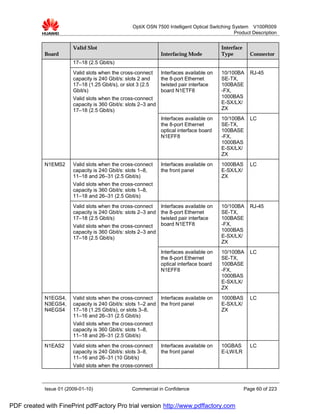
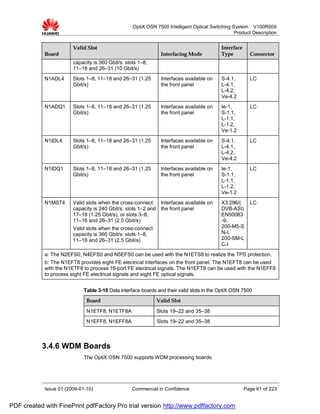
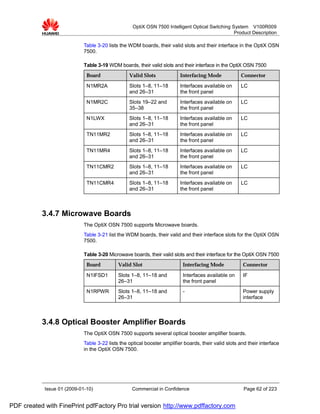
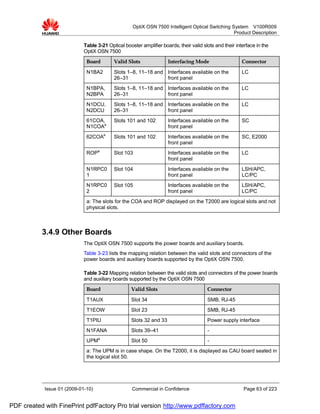
                                                 Mode 7        Supports 70 D1–D3 channels.
                                                              Supports 30 D4–D12 channels.
                                                 Mode 8        Supports 100 D1–D3 channels.
                                                              Supports 20 D4–D12 channels.
                                                 Mode 9        Supports 30 D1–D1 channels.
                                                              Supports 150 D1–D3 channels.


            Issue 01 (2009-01-10)                      Commercial in Confidence                               Page 30 of 223


PDF created with FinePrint pdfFactory Pro trial version http://www.pdffactory.com
OptiX OSN 7500 Intelligent Optical Switching System V100R009
                                                                                                 Product Description


                              DCC Allocation             N2GSCC/N3GSCC/N4GSCC/N5GSCC

                                              Mode 10    Supports 30 D1–D1 channels.
                                                         Supports 39 D1–D3 channels.
                                                         Supports 37 D4–D12 channels.
                              Protocol type              Supports HWECC, IP, and OSI protocols.
                              Default mode               Mode 1


           2.14 OAM
                             The OptiX OSN 7500 provides maintenance and management functions.The OAM of
                             the network can be realized by using the T2000. This topic describes the key
                             equipment-level OAM solutions.
                             2.14.1 Software Package Loading
                             The OptiX OSN 7500 provides the functions of software package loading and
                             simulation software package loading.
                             2.14.2 Hot Patch
                             The OptiX OSN 7500 supports the hot patch technology.
                             2.14.3 NSF Function
                             The non-interrupted service forwarding (NSF) function is supported by the Ethernet
                             boards. With the NSF function, services are not interrupted during an upgrade of the
                             board software and network processor (NP) software.
                             2.14.4 Board Version Replacement
                             The board version replacement function replaces an old version board with a new
                             version board. After the replacement, the configuration and service status of the new
                             version board are consistent with the configuration and service status of the old
                             version board.
                             2.14.5 PRBS Function
                             The OptiX OSN 7500 supports the pseudo-random binary sequence (PRBS) test
                             function.
                             2.14.6 Inter-Board Alarm Suppression
                             The OptiX OSN 7500 supports the suppression of tributary/data board alarms that are
                             raised as a result of the alarms on the line board.
                             2.14.7 TCM
                             The tandem connection monitor (TCM) is a method used to monitor bit errors.If a
                             VC-4 passes through several networks, the TCM method can be used to monitor the
                             bit errors of each section.
                             2.14.8 ETH-OAM


            Issue 01 (2009-01-10)                  Commercial in Confidence                          Page 31 of 223


PDF created with FinePrint pdfFactory Pro trial version http://www.pdffactory.com
OptiX OSN 7500 Intelligent Optical Switching System V100R009
                                                                                                   Product Description

                             The ETH-OAM function enhances the method of performing Ethernet Layer 2
                             maintenance. It can be implemented to verify service connectivity, commission
                             deployed services, locate network faults, and so on.

           2.14.1 Software Package Loading
                             The OptiX OSN 7500 provides the functions of software package loading and
                             simulation software package loading.

           Software Package Loading
                             The software package loading function supports mass loading of software at NE-level
                             and diffused loading of software at network-level. This function realizes upgrade and
                             management of NE software, simplifies the upgrade operations, and improves the
                             usability of the upgrade operations.
                             The software package loading has the following features:
                             l      Users load the software in a uniform operation interface.
                             l      The complete software package is stored on the compact flash (CF) card of the
                                    N3GSCC or N4GSCC or N5GSCC board. If the board software files are lost,
                                    these files can be restored from the N3GSCC or N4GSCC or N5GSCC board.
                             l      The automatic matching and loading of software package is supported. If the
                                    software version of the in-service board does not match the software package,
                                    the board software is automatically updated.
                             l      The software package loading is an incremental scheme and is performed to load
                                    the files required in the current update.
                             l      The network-level diffused loading feature realizes the synchronous software
                                    package loading on the NEs in the entire network. These NEs are configured with
                                    the same series of SCC boards.
                             l      The NG-SDH equipment supports the anti-mistake package loading function.
                             The software package loading is applied in the following scenarios:
                             l      Upgrade of the NE software
                             l      Replacement of the service boards
                             l      Replacement of the auxiliary boards
                             l      Replacement of the cross-connect boards
                             l      Replacement of the N3GSCC or N4GSCC or N5GSCC boards
                             l      Replacement of the CF cards of the N3GSCC or N4GSCC or N5GSCC boards

           Simulation Package Loading
                             If a software package needs to be loaded to an NE and if the mapping relation
                             between the NE boards and the software is specified according to the simulation
                             package, you can enable the simulation package loading function to increase the
                             loading efficiency.
                             The simulation software package includes:
                             l      All the necessary software to be loaded to the NE
                             l      Package description document that specifies the loading attributes of each
                                    software


            Issue 01 (2009-01-10)                   Commercial in Confidence                           Page 32 of 223


PDF created with FinePrint pdfFactory Pro trial version http://www.pdffactory.com
OptiX OSN 7500 Intelligent Optical Switching System V100R009
                                                                                                  Product Description

                             The simulation software package loading has the following features:
                             l      Simplifying the upgrade operation
                             l      Improving the upgrade security
                             l      Improving the upgrade efficiency

           2.14.2 Hot Patch
                             The OptiX OSN 7500 supports the hot patch technology.
                             Some equipment requires long-term uninterrupted operation. When a defect is located
                             or a new requirement needs to be applied to the equipment software, a process of
                             replacing old codes with new codes should be performed to rectify the defect or
                             realize the new requirement, without any service interruption. These new codes are
                             referred to as a hot patch.
                             The hot patch technology has the following features:
                             l      The hot patch solves most of the software problems without affecting services.
                             l      The hot patch effectively decreases the number of software versions and
                                    prevents frequent software version upgrade.
                             l      The hot patch operation does not affect services and can be performed remotely.
                                    The hot patch also provides a rollback function. This helps to decrease the
                                    upgrade cost and to avoid upgrade risks.
                             l      The hot patch can be used as an effective method for locating faults, and thus
                                    improves the efficiency of solving problems.

           2.14.3 NSF Function
                             The non-interrupted service forwarding (NSF) function is supported by the Ethernet
                             boards. With the NSF function, services are not interrupted during an upgrade of the
                             board software and network processor (NP) software.
                             In the NSF mode, the upgrade of the board software and NP software for the N4EFS0
                             and N2EFS4boards can be completed after performing a warm reset of the boards. In
                             this case, the service interruption time is less than 50 ms, which meets the
                             carrier-class requirements.


                             If the two versions before and after the upgrade have significant differences, the
                             service interruption during the NSF-mode upgrade cannot be controlled within 50 ms,
                             and this ensures only a low service interruption time.


           2.14.4 Board Version Replacement
                             The board version replacement function replaces an old version board with a new
                             version board. After the replacement, the configuration and service status of the new
                             version board are consistent with the configuration and service status of the old
                             version board.


            Issue 01 (2009-01-10)                   Commercial in Confidence                          Page 33 of 223


PDF created with FinePrint pdfFactory Pro trial version http://www.pdffactory.com
OptiX OSN 7500 Intelligent Optical Switching System V100R009
                                                                                                   Product Description

                             This function provides a flexible board replacement scheme, and thus reduces the
                             equipment cost and the maintenance cost.
                             For detailed replacement relations of boards that support this function, refer to Part
                             Replacement Design.
                             When using the board version replacement function, note the following points:
                             l      The new board may not support the functions of the original board. Before the
                                    replacement, fully consider the difference of functions of the two boards. For
                                    example, If the T2SL64 board is configured with the TCM function or AU-3
                                    services, it cannot be replaced with the N1SL64 board.
                             l      The line board to be replaced cannot have an optical-path-shared MSP
                                    configured.

           2.14.5 PRBS Function
                             The OptiX OSN 7500 supports the pseudo-random binary sequence (PRBS) test
                             function.
                             The PRBS function is mainly used for network self-test and maintenance. An NE that
                             provides the PRBS function can work as a simple device used to analyze if a service
                             path is faulty. Such analysis can be performed for the NE and the entire network.
                             During deployment or troubleshooting, the PRBS function realizes the test without a
                             real test device.
                             The PRBS function has the following two types:
                             l      If the PRBS function is used for lower order services, the PRBS module is
                                    integrated on a tributary board.
                             l      If the PRBS function is used for higher order services, the PRBS module is
                                    integrated on a line board or a cross-connect board.
                             The PRBS function is implemented in the following process:
                             l      For the opposite tributary or line of a path to be tested, the user issues a loopback
                                    command on the T2000.
                             l      On the T2000, the user issues a command to enable the PRBS function for this
                                    path.
                             l      The tributary, line, or cross-connect board performs the PRBS function and starts
                                    the statistics.
                             l      The tributary, line, or cross-connect board reports the PRBS test result.
                             l      The user queries the PRBS statistics result.
                             l      The user releases the loopback of the path on the opposite tributary or line board.
                             For details, refer to PRBS.

           2.14.6 Inter-Board Alarm Suppression
                             The OptiX OSN 7500 supports the suppression of tributary/data board alarms that are
                             raised as a result of the alarms on the line board.
                             When there are cross-connections between a line board and a tributary/data board,
                             many alarms are raised on the tributary/data board if alarms are raised on the line
                             board. These alarms are all reported to the T2000. Such a large number of alarms can


            Issue 01 (2009-01-10)                    Commercial in Confidence                           Page 34 of 223


PDF created with FinePrint pdfFactory Pro trial version http://www.pdffactory.com
OptiX OSN 7500 Intelligent Optical Switching System V100R009
                                                                                                    Product Description

                             disturb the troubleshooting and affect the problem solution efficiency. Therefore, the
                             inter-board alarm suppression function is used to solve this problem.
                             If there are services from the line board to the tributary/data board in the same NE,
                             and if higher order alarms are raised on the line board, relevant lower order alarms on
                             the tributary/data board are suppressed.
                             If alarms are relevant to the tributary/data board only (which means the line board at
                             the service source does not generate higher order alarms), the alarms on the
                             tributary/data board are not suppressed. In this case, these alarms are reported to the
                             T2000 and are not mistakenly suppressed.

           2.14.7 TCM
                             The tandem connection monitor (TCM) is a method used to monitor bit errors.If a
                             VC-4 passes through several networks, the TCM method can be used to monitor the
                             bit errors of each section.
                             The N2SL1, N2SLQ1, N2SLO1, N3SLO1, N2SL4, N3SLN, N3SLD41, N3SLQ41,
                             N2SLD4, N2SLQ4, N3SLT1, N2SL16, N3SL16, N2SLQ16, N2SL16A and T2SL64A
                             boards support the TCM at the VC-4 level.

           2.14.8 ETH-OAM
                             The ETH-OAM function enhances the method of performing Ethernet Layer 2
                             maintenance. It can be implemented to verify service connectivity, commission
                             deployed services, locate network faults, and so on.
                             For the OptiX OSN 7500, Ethernet service processing boards provide the ETH-OAM
                             function, which complies with IEEE 802.1ag and IEEE 802.3ah. The ETH-OAM
                             function provides a complete ETH-OAM solution to automatically detect and locate
                             faults.
                             The IEEE 802.1ag ETH-OAM is realized through the following methods:
                             l      The link trace (LT) test, which is used to locate the faulty point.
                             l      The loopback (LB) test, which is used for a bidirectional continuity check.
                             l      The continuity check (CC), which is used for a unidirectional continuity check.
                             l      OAM_Ping test, which is used to test the packet loss ratio and latency in service.
                             The IEEE 802.3ah ETH-OAM function is realized through the following methods:
                             l      Automatic OAM Discovery, which is used to obtain the capability for the opposite
                                    end to support the IEEE 802.3ah OAM protocol.
                             l      Link performance monitoring, which is used to monitor the bit error performance
                                    of the link.
                             l      Fault detection, which is used to report a fault to the opposite end.
                             l      Remote loopback, which is used to locate a fault and test the link performance.
                             l      Self-loop check, which is used to check the self-loop port.
                             l      Loop shutdown, which is used to block a self-loop port and rectify a port loop.


            Issue 01 (2009-01-10)                    Commercial in Confidence                             Page 35 of 223


PDF created with FinePrint pdfFactory Pro trial version http://www.pdffactory.com
OptiX OSN 7500 Intelligent Optical Switching System V100R009
                                                                                                Product Description


           2.15 Security Management
                             The T2000 uses many schemes to ensure the security of the OptiX OSN 7500 NE.
                             l      Authentication management
                             l      Authorization Management
                             l      Network Security Management
                             l      System Security Management
                             l      Log Management
                             For the details of security management, refer to the Security Management.


            Issue 01 (2009-01-10)                 Commercial in Confidence                          Page 36 of 223


PDF created with FinePrint pdfFactory Pro trial version http://www.pdffactory.com
OptiX OSN 7500 Intelligent Optical Switching System V100R009
                                                                                               Product Description


                                                                               3            Hardware

           3.1 Overview
                             The OptiX OSN 7500 consists of the cabinet, subrack, and boards.
                             Figure 3-1 shows the OptiX OSN 7500 subrack installed in an ETSI cabinet.


            Issue 01 (2009-01-10)                Commercial in Confidence                          Page 37 of 223


PDF created with FinePrint pdfFactory Pro trial version http://www.pdffactory.com
OptiX OSN 7500 Intelligent Optical Switching System V100R009
                                                                                                          Product Description

                             Figure 3-1 Structure of the OptiX OSN 7500 equipment

                                                                                   1


                                                                               4            2


                                        3

                                            5


                                                                                                    7


                                        6                                              7


                                 7


                                                    H
                                                D       W


                              1. DC                 2. Side panel           3. Cable distribution   4. Orderwire phone
                              PDU                                           plate                   fixing frame
                              5.                    6. fiber management     7. Front door
                              Subrack               tray


                             The OptiX OSN 7500 uses various types of boards and thus forms the system frame
                             where the cross-connect matrix is the core. The system frame of the OptiX OSN 7500

                             has the following units:
                             l       SDH interface unit
                             l       PDH interface unit
                             l       DDN interface unit
                             l       Data (Ethernet/ATM/SAN/Video) processing unit


            Issue 01 (2009-01-10)                           Commercial in Confidence                          Page 38 of 223


PDF created with FinePrint pdfFactory Pro trial version http://www.pdffactory.com
OptiX OSN 7500 Intelligent Optical Switching System V100R009
                                                                                                       Product Description

                             l      WDM processing unit
                             l      SDH cross-connect matrix unit
                             l      Synchronous timing unit
                             l      SCC unit
                             l      Overhead processing unit
                             l      Power interface unit
                             l      Auxiliary interface unit
                             l      Optical amplifier unit and dispersion compensation unit
                             Figure 3-2 shows the system architecture of the OptiX OSN 7500.

                             Figure 3-2 System architecture


                                                                                                                                                SDH/PDH/Ethernet/
                                                                                                                                                ATM/DDN interface
                                                                SDH interface

                                                                                                                                                                      PDH signal


                                                                                                  Cross-connect
                                                                                                                                                                      SDH signal


                                                                                                                                                     board
                                                                                                       matrix
                                 STM-N optical                                                                                                                      Ethernet signal
                                                                                 unit


                                     signal                                                                                                                           ATM signal
                                                                                                                                                                     DDN signal


                                                                                                                  Interface unit
                                                                                         Synchronous
                                                                    processing


                                                                                                                                   Auxiliary
                                                                                          timing unit
                                                     Overhead


                                                                                                                                               SCC unit
                                                                                  unit


           3.2 Cabinet
                             The cabinet that complies with the ETSI standards is used for the OptiX OSN 7500. A
                             power supply box is installed on the top of the cabinet to access –48 V or –60 V
                             power.
                             Figure 3-3 shows the outer view of an ETSI cabinet.


            Issue 01 (2009-01-10)                       Commercial in Confidence                                                                                    Page 39 of 223


PDF created with FinePrint pdfFactory Pro trial version http://www.pdffactory.com
OptiX OSN 7500 Intelligent Optical Switching System V100R009
                                                                                                Product Description

                             Figure 3-3 Appearance of an ETSI cabinet


                                           T63E cabinet                         N63E cabinet


           3.3 Subrack
                             The subrack consists of slots and boards that can be configured.
                             3.3.1 Structure


            Issue 01 (2009-01-10)                Commercial in Confidence                           Page 40 of 223


PDF created with FinePrint pdfFactory Pro trial version http://www.pdffactory.com
OptiX OSN 7500 Intelligent Optical Switching System V100R009
                                                                                                    Product Description

                             The OptiX OSN 7500 subrack has a two-layer structure. The subrack consists of the

                             processing board area, interface board area, fan area, and fiber routing area.
                             3.3.2 Slot Allocation
                             The OptiX OSN 7500 subrack has two layers. The upper layer has 20 slots and the
                             lower layer has 18 slots.

           3.3.1 Structure
                             The OptiX OSN 7500 subrack has a two-layer structure. The subrack consists of the
                             processing board area, interface board area, fan area, and fiber routing area.
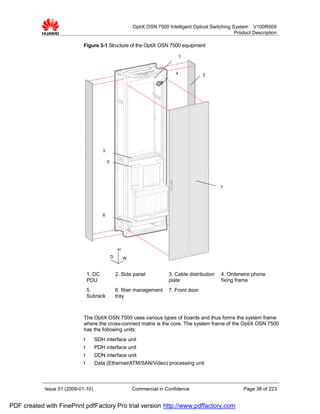
                             Figure 3-8 shows the structure of the OptiX OSN 7500 subrack

                             Figure 3-4 Structure of the OptiX OSN 7500 subrack


                                                                                            Upper layer processing
                                                                                                 board area


                                 Fiber routing area                                           Interface board area


                                                                                                 Fan area


                                                                                                Lower layer processing
                             Fiber routing area                                                      board area


                                                                                                 H

                                                                                            W
                                                                                                     D


                             The functions of the areas are as follows:
                             l      Upper layer processing board area and lower layer processing board area: These
                                    areas house the processing boards of the OptiX OSN 7500.
                             l      Interface board area: This area houses the interface boards of the OptiX OSN
                                    7500.
                             l      Fan area: This area houses three fan modules, which dissipate heat generated
                                    by the equipment.
                             l      Fiber routing area: This area houses the fiber jumpers in the subrack.


            Issue 01 (2009-01-10)                     Commercial in Confidence                           Page 41 of 223


PDF created with FinePrint pdfFactory Pro trial version http://www.pdffactory.com
OptiX OSN 7500 Intelligent Optical Switching System V100R009
                                                                                                                                Product Description


                                      The interface board is also called the access board or transit board. The interface board
                                      provides physical interfaces for optical signals and electrical signals, and transmits the optical
                                      signals or electrical signals to the corresponding processing board.


           3.3.2 Slot Allocation
                             The OptiX OSN 7500 subrack has two layers. The upper layer has 20 slots and the
                             lower layer has 18 slots.
                             Figure 3-9 shows the slot layout of the OptiX OSN 7500 subrack.

                             Figure 3-5 Slot layout of the OptiX OSN 7500 subrack

                                 S L S LS LS       LS   SL
                                                         S                    S    S        S   S         S   S SLOT S                 S   S     S   S
                                 L L OL OL         OL   LO
                                                         L                    L    L        L   L         L   L      L                 L   L     L   L
                                                                                                                 32
                                 O T O T O TO      TO   OTO                   O    O        O   O         O   O      O                 O   O     O   O


                                                                                                                      PIU(A)
                                 T T 1 T 1T        1T   T1T                   T    T        T   T         T   T      T                 T   T     T   T
                                 1 4 2 52 62       72   28
                                                         2                    2    2        2   2         3   3      3                 3   3     3   3
                                 9 0 1 2            3 4 5                     6    7        8   9         0   1      4                 5   6     7   8
                                                                                                                  SLOT
                                                   S     S
                                                                                                                      33
                                                         GSCC(A)
                                                                    GSCC(B)


                                                                                                                      PIU(B)
                                                   C     C
                                                   EOW


                                                                                                                               AUX


                                                                   Fiber            routing

                                  SLOT 39          FAN                        SLOT 40           FAN                    SLOT 41             FAN

                                 S    S   S    S    S    S          S          S    S            S            S   S      S     S      S    S     S   S
                                 L    L   L    L    L    L          L          L    L            L            L   L      L     L      L    L     L   L
                                 O    O   O    O    O    O          O          O    O            O            O   O      O     O      O    O     O   O
                                 T    T   T    T    T    T          T          T    T            T            T   T      T     T      T    T     T   T
                                 1    2   3    4    5    6          7          8    9            1            1   1      1     1      1    1     1   1
                                                                                                 0            1   2      3     4      5    6     7   8
                                                                                       XCS(A)


                                                                                                 XCS(B)


                                       Fiber   routing                                                                Fiber          routing


                                     (A): Active              (B): S tandby


           Slot Area for Interface Boards
                             l        Slots for the service interface boards: slots 19–22 and 35–38.
                             l        Slot for the orderwire interface board: slot 23.
                             l        Slot for the auxiliary interface board: slot 34.

           Slot Area for Processing Boards
                             l        Slots for the service processing boards: slots 1–8, 11–18 and 26–31.
                             l        Slots for the cross-connect and timing boards: slots 9–10.
                             l        Slots for the PIU boards: slots 32–33.


            Issue 01 (2009-01-10)                                              Commercial in Confidence                                                  Page 42 of 223


PDF created with FinePrint pdfFactory Pro trial version http://www.pdffactory.com
OptiX OSN 7500 Intelligent Optical Switching System V100R009
                                                                                                    Product Description

                             l      Slots for the system control and communication (SCC) boards: slots 24–25.

           Mapping Relation Between Slots for Interface Boards and Slots for Processing
           Boards
                             Table 3-2 lists the mapping relation between slots for the interface boards and slots for
                             the processing boards.

                             Table 3-1 Mapping relation between slots for the interface boards and slots for the
                             processing boards
                              Slots for Processing Boards              Slots for Interface Boards

                              Slot 2                                   Slots 19–20
                              Slot 3                                   Slots 21–22
                              Slot 17                                  Slots 35–36
                              Slot 18                                  Slots 37–38


           Paired Slots
                             If the overhead bytes pass through the backplane bus between two slots, the two slots
                             are paired slots. When an NE is configured with an orderwire phone or realizes the
                             service protection in DPS mode, the two boards that form a ring must be inserted in
                             the paired slots. Table 3-3 lists the paired slots.

                             Table 3-2 Paired slots
                              Slot                                     Paired Slot

                              Slot 1                                   Slot 18
                              Slot 2                                   Slot 17
                              Slot 3                                   Slot 16
                              Slot 4                                   Slot 15
                              Slot 5                                   Slot 14
                              Slot 6                                   Slot 13
                              Slot 7                                   Slot 12
                              Slot 8                                   Slot 11
                              Slot 26                                  Slot 27
                              Slot 28                                  Slot 29
                              Slot 30                                  Slot 31


            Issue 01 (2009-01-10)                   Commercial in Confidence                            Page 43 of 223


PDF created with FinePrint pdfFactory Pro trial version http://www.pdffactory.com
OptiX OSN 7500 Intelligent Optical Switching System V100R009
                                                                                                 Product Description


           3.4 Boards
                             The equipment supports different types of boards.
                             3.4.1 Classification of the Boards
                             The boards are classified into SDH boards, PDH boards, data boards, WDM boards,
                             and auxiliary boards according to the functions of the boards.
                             3.4.2 Cross-Connect and System Control Boards
                             The OptiX OSN 7500 supports several cross-connect and system control boards.
                             3.4.3 SDH Processing Boards
                             The OptiX OSN 7500 supports the SDH processing boards.
                             3.4.4 PDH Processing Boards
                             The OptiX OSN 7500 supports the PDH processing boards.
                             3.4.5 Data Processing Boards
                             The OptiX OSN 7500 supports data processing boards.
                             3.4.6 WDM Boards
                             The OptiX OSN 7500 supports WDM processing boards.
                             3.4.7 Microwave Boards
                             The OptiX OSN 7500 supports Microwave boards.
                             3.4.8 Optical Booster Amplifier Boards
                             The OptiX OSN 7500 supports several optical booster amplifier boards.
                             3.4.9 Other Boards
                             The OptiX OSN 7500 supports the power boards and auxiliary boards.

           3.4.1 Classification of the Boards
                             The boards are classified into SDH boards, PDH boards, data boards, WDM boards,
                             and auxiliary boards according to the functions of the boards.

           SDH Boards
                             The OptiX OSN 7500 supports the SDH boards that operate at the STM-64, STM-16,
                             STM-4, and STM-1 rates.
                             Table 3-4 lists the SDH boards that the OptiX OSN 7500 supports.

                             Table 3-3 SDH boards that the OptiX OSN 7500 supports
                              Board               Description              Board               Description
                              N1SL64              1xSTM-64 optical         N1SLQ4,             4xSTM-4 optical
                                                  interface board          N2SLQ4, and         interface board
                                                                           N1SLQ4A


            Issue 01 (2009-01-10)                 Commercial in Confidence                           Page 44 of 223


PDF created with FinePrint pdfFactory Pro trial version http://www.pdffactory.com
OptiX OSN 7500 Intelligent Optical Switching System V100R009
                                                                                               Product Description


                              Board             Description              Board               Description

                              T2SL64            1xSTM-64 optical         N1SLD4,             2xSTM-4 optical
                                                interface board          N2SLD4, and         interface board
                                                                         N1SLD4A
                              T2SL64A           1xSTM-64 optical         N1SLT1 and          12xSTM-1 optical
                                                interface board          N3SLT1              interface board
                              N1SF64 and        1xSTM-64 optical         N1SLQ1,             4xSTM-1 optical
                              N1SF64A           interface board (with    N2SLQ1, and         interface board
                                                the forward error        N1SLQ1A
                                                correction (FEC)
                                                function)
                              N1SLD64           2xSTM-64 optical         N1SL1, N2SL1,       1xSTM-1 optical
                                                interface board          and N1SL1A          interface board
                              N1SL16,           1xSTM-16 optical         N1SLH1 and          16xSTM-1 signal
                              N2SL16, and       interface board          N1SLH1A             processing board
                              N3SL16
                              N1SL16A,          1xSTM-16 optical         N1SEP1              2xSTM-1 line
                              N2SL16A, and      interface board                              processing board
                              N3SL16A                                                        when the interfaces
                                                                                             are available on the
                                                                                             front panel
                                                                                             8xSTM-1 line
                                                                                             processing board
                                                                                             when the interfaces
                                                                                             are available on the
                                                                                             corresponding
                                                                                             interface board
                              N1SLQ16 and       4xSTM-16 optical         N2SLO1 and          8xSTM-1 optical
                              N2SLQ16           interface board          N3SLO1              interface board
                              N1SF16            1xSTM-16 optical         N3SLN               1xSTM-16/STM-4/S
                                                interface board (with                        TM-1 optical
                                                the out-band FEC                             interface board
                                                function)
                              N1SLO16           8xSTM-16 optical         N3SLD41             2xSTM-4/STM-1
                                                interface board                              optical interface
                                                                                             board
                              N1SL4, N2SL4,     1xSTM-4 optical          N3SLQ41             4xSTM-4/STM-1
                              and N1SL4A        interface board                              optical interface
                                                                                             board


           PDH Boards
                             The OptiX OSN 7500 supports the PDH boards that operate at different rates and
                             have different impedances.


            Issue 01 (2009-01-10)                Commercial in Confidence                          Page 45 of 223


PDF created with FinePrint pdfFactory Pro trial version http://www.pdffactory.com
OptiX OSN 7500 Intelligent Optical Switching System V100R009
                                                                                                Product Description

                             Table 3-5 lists the PDH boards that the OptiX OSN 7500 supports.

                             Table 3-4 PDH boards that the OptiX OSN 7500 supports
                              Board         Description                    Board       Description

                              N1PQ1 and     63xE1 service processing       N1PD3       6xE3/T3 service
                              N2PQ1         board                          and         processing board
                                                                           N2PD3
                              N1PQM and     63xE1/T1 service               N2PQ3       12xE3/T3 service
                              N1PQMA        processing board                           processing board
                              N1PL3 and     3xE3/T3 service                N1DX1       DDN service accessing
                              N2PL3         processing board                           and converging board
                              N1PL3A        3xE3/T3 service                N1DXA       DDN service converging
                              and           processing board (The                      and processing board
                              N2PL3A        interfaces are available on
                                            the front panel.)

                              N2SPQ4        4xE4/STM-1 electrical          -           -
                                            processing board


           Data Boards
                             The OptiX OSN 7500 supports the data boards that provide the transparent
                             transmission function, switching function, or RPR function.
                             Table 3-6 lists the data boards that the OptiX OSN 7500 supports.

                             Table 3-5 Data boards that the OptiX OSN 7500 supports
                              Board        Description                    Board       Description

                              N1EFT8       8xFE or 16xFE transparent      N1EMS4      4xGE and 16xFE
                                           transmission board                         transparent transmission
                                                                                      and converging board
                              N1EFT8A      8xFE transparent               N1EMS2      2xGE and 16xFE
                                           transmission board                         transparent transmission
                                                                                      and converging board
                              N1EGT2       2xGE transparent               N1EGS4,     4xGE switching and
                              and          transmission board             N3EGS4,     processing board
                              N2EGT2                                      and
                                                                          N4EGS4
                              N2EFS0,      8xFE switching and             N2EGR2      2xGE ring processing
                              N4EFS0,      processing board                           board
                              and
                              N5EFS0
                              N1EFS0A      16xFE switching and            N2EMR0      12xFE and 1xGE ring
                                           processing board                           processing board


            Issue 01 (2009-01-10)                Commercial in Confidence                            Page 46 of 223


PDF created with FinePrint pdfFactory Pro trial version http://www.pdffactory.com
OptiX OSN 7500 Intelligent Optical Switching System V100R009
                                                                                                Product Description


                              Board        Description                    Board       Description
                              N1EFS4,      4xFE switching and             N1ADL4      1xSTM-4 ATM service
                              N2EFS4,      processing board                           processing board
                              and
                              N3EFS4
                              N2EGS2       2xGE switching and             N1ADQ1      4xSTM-1 ATM service
                              and          processing board                           processing board
                              N3EGS2
                              N1MST4       4-port multi-service           N1IDL4      1xSTM-4 ATM service
                                           transparent transmission                   processing board
                                           board
                              N1EAS2       2-port 10xGE Layer 2           N1IDQ1      4xSTM-1 ATM service
                                           switching and processing                   processing board
                                           board


           Interface Boards and Switching and Bridging Boards
                             The OptiX OSN 7500 supports optical interface boards, electrical interface boards,
                             and switching and bridging boards.
                             Table 3-7 lists the interface boards and switching and bridging boards that the OptiX
                             OSN 7500 supports.

                             Table 3-6 Interface boards and switching and bridging boards that the OptiX OSN 7500
                             supports
                              Board        Description                     Board        Description
                              N1EU08       8xSTM-1 electrical interface    N1D12S       32xE1/T1 switching
                                           board                                        access board (120 ohms)
                              N1OU08       8xSTM-1 optical interface       N1D12B       32xE1/T1 access board
                                           board (LC)                                   (120 ohms)
                              N2OU08       8xSTM-1 optical interface       N1EFF8       8x100M Ethernet optical
                                           board (SC)                      and          interface board
                                                                           N1EFF8A
                              N1D75S       32xE1 switching access          N1ETF8       8x100M Ethernet twisted
                                           board (75 ohms)                 and          pair interface board
                                                                           N1ETF8A
                              N1MU04       4xE4/STM-1 electrical           N1ETS8       8x10/100M Ethernet
                                           interface board                              twisted pair interface
                                                                                        switching board
                              N1D34S       6xE3/T3 switching access        N1DM12       DDN service interface
                                           board                                        board


            Issue 01 (2009-01-10)                 Commercial in Confidence                          Page 47 of 223


PDF created with FinePrint pdfFactory Pro trial version http://www.pdffactory.com
OptiX OSN 7500 Intelligent Optical Switching System V100R009
                                                                                                Product Description


                              Board        Description                    Board         Description

                              N1C34S       3xE3/T3 switching access       N1TSB8        8-channel electrical
                                           board                                        interface protection
                                                                                        switching board


           Cross-Connect Boards and System Control Boards
                             The OptiX OSN 7500 supports multiple system control boards and cross-connect
                             boards that have different cross-connect capacities.
                             Table 3-8 lists the cross-connect boards and system control boards that the OptiX
                             OSN 7500 supports.

                             Table 3-7 Cross-connect boards and system control boards that the OptiX OSN 7500
                             supports
                              Board            Description            Board             Description

                              T1GXCSA          General                T2SXCSA           Super cross-connect and
                                               cross-connect and                        synchronous timing
                                               synchronous timing                       board
                                               board
                              T1EXCSAa         Enhanced               T1IXCSA           Infinite cross-connect
                                               cross-connect and                        and synchronous timing
                                               synchronous timing                       board
                                               board
                              T2UXCSA          Ultra cross-connect    N2GSCC,           Intelligent system control
                                               and synchronous        N3GSCC,           and communication
                                               timing board           N4GSCC, and       board
                                                                      N5GSCC
                              T1SXCSA          Super                  -                 -
                                               cross-connect and
                                               synchronous timing
                                               board
                              a: The T1EXCSA cannot work with the line boards of series N2 (except for the
                              N2SLQ16). The T2SL64 is not delivered any longer and can be replaced with the
                              T2SL64A. It is recommended that you use the T2SL64A with the T1EXCSA.


           Auxiliary Boards
                             The OptiX OSN 7500 supports auxiliary boards such as the system auxiliary interface
                             board and fan board.
                             Table 3-9 lists the auxiliary boards that the OptiX OSN 7500 supports.


            Issue 01 (2009-01-10)                 Commercial in Confidence                            Page 48 of 223


PDF created with FinePrint pdfFactory Pro trial version http://www.pdffactory.com
OptiX OSN 7500 Intelligent Optical Switching System V100R009
                                                                                                Product Description

                             Table 3-8 Auxiliary boards that the OptiX OSN 7500 supports
                              Board                   Description

                              T1EOW                   Orderwire processing board
                              T1AUX                   System auxiliary interface board
                              N1FANA                  Fan board (high power)


           WDM Boards
                             The OptiX OSN 7500 supports WDM boards such as the optical add/drop multiplexing
                             board and optical amplifier board.
                             Table 3-10 lists the WDM boards that the OptiX OSN 7500 supports.

                             Table 3-9 WDM boards that the OptiX OSN 7500 supports
                              Board          Description                  Board          Description

                              TN11CMR2       2-channel optical            N1MR2C         2-channel optical
                                             add/drop multiplexing                       add/drop multiplexing
                                             board                                       board
                              TN11CMR4       4-channel optical            N1LWX          Arbitrary bit rate
                                             add/drop multiplexing                       wavelength conversion
                                             board                                       board
                              TN11MR2        2-channel optical            TN11OBU1       Optical booster amplifier
                                             add/drop multiplexing                       board
                                             board
                              TN11MR4        4-channel optical            N1FIB          Filter isolating board
                                             add/drop multiplexing
                                             board
                              N1MR2A         2-channel optical            -              -
                                             add/drop multiplexing
                                             board


           Microwave Boards
                             The OptiX OSN 7500 supports microwave boards such as the microwave IF board
                             and microwave power board.
                             Table 3-11 lists the microwave boards that the OptiX OSN 7500 supports.

                             Table 3-10 Microwave boards that the OptiX OSN 7500 supports
                              Board                         Description

                              N1IFSD1                       Dual-port IF board


            Issue 01 (2009-01-10)                 Commercial in Confidence                           Page 49 of 223


PDF created with FinePrint pdfFactory Pro trial version http://www.pdffactory.com
OptiX OSN 7500 Intelligent Optical Switching System V100R009
                                                                                                Product Description


                              Board                         Description

                              N1RPWR                        6-channel ODU power board


           Optical Amplifier Boards and Dispersion Compensation Boards
                             The OptiX OSN 7500 supports multiple optical amplifier boards and dispersion
                             compensation boards.
                             Table 3-12 lists the optical amplifier boards and dispersion compensation boards that
                             the OptiX OSN 7500 supports.

                             Table 3-11 Optical amplifier boards and dispersion compensation boards that the OptiX
                             OSN 7500 supports
                              Board           Description            Board                     Description

                              N1BPA and       Optical booster and    N1COA, 61COA, and         Case-shaped
                              N2BPA           pre-amplifier board    62COA                     optical amplifier
                              N1BA2           Optical booster        N1DCU and N2DCU           Dispersion
                                              amplifier board                                  compensation
                                                                                               board
                              N1RPC01         Forward Raman          N1RPC02                   Backward Raman
                                              driving board                                    driving board
                                              (external)                                       (external)


           Power Boards
                             The OptiX OSN 7500 supports power boards such as the UPM and power interface
                             board.
                             Table 3-13 lists the power boards that the OptiX OSN 7500 supports.

                             Table 3-12 Power boards that the OptiX OSN 7500 supports
                              Board                         Description

                              UPM                           Uninterruptible power module
                              T1PIU                         Power interface board


           3.4.2 Cross-Connect and System Control Boards
                             The OptiX OSN 7500 supports several cross-connect and system control boards.
                             Table 3-14 lists the cross-connect and system control boards and their valid slots in
                             the OptiX OSN 7500.


            Issue 01 (2009-01-10)                 Commercial in Confidence                          Page 50 of 223


PDF created with FinePrint pdfFactory Pro trial version http://www.pdffactory.com
OptiX OSN 7500 Intelligent Optical Switching System V100R009
                                                                                                 Product Description

                             Table 3-13 Cross-connect and system control boards and their valid slots in the OptiX
                             OSN 7500
                               Board              Full Name                           Valid Slots

                               T1GXCSA            General cross-connect and           Slots 9 and 10
                                                  synchronous timing board
                               T1EXCSA            Enhanced cross-connect and          Slots 9 and 10
                                                  synchronous timing board
                               T2UXCSA            Ultra cross-connect and             Slots 9 and 10
                                                  synchronous timing board
                               T1SXCSA            Super cross-connect and             Slots 9 and 10
                                                  synchronous timing board
                               T1IXCSA            Infinite cross-connect and          Slots 9 and 10
                                                  synchronous timing board
                               N2GSCC,            System control and                  Slots 24 and 25
                               N3GSCC,            communication board
                               N4GSCC,
                               N5GSCC


           3.4.3 SDH Processing Boards
                             The OptiX OSN 7500 supports the SDH processing boards.
                             Table 3-15 lists the SDH processing boards, their valid slots and their interface in the
                             OptiX OSN 7500.

           Table 3-14 SDH processing boards, their valid slots and their interface in the OptiX OSN 7500
            Board        Valid Slots                             Interfacing        Interface Type      Connector
                                                                 Mode

            T2SL64,      Valid slots when the cross-connect      Interfaces         I-64.1, I-64.2,     LC
            T2SL64A      capacity is 240 Gbit/s: slots 3–8,      available on the   S-64.2b,
                         11–16 and 26–31                         front panel        L-64.2b,
                         Valid slots when the cross-connect                         Le-64.2,
                         capacity is 360 Gbit/s: slots 1–8,                         Ls-64.2,
                         11–18 and 26–31                                            V-64.2b


            Issue 01 (2009-01-10)                  Commercial in Confidence                            Page 51 of 223


PDF created with FinePrint pdfFactory Pro trial version http://www.pdffactory.com
OptiX OSN 7500 Intelligent Optical Switching System V100R009
                                                                                                Product Description


            Board       Valid Slots                            Interfacing        Interface Type     Connector
                                                               Mode

            N1SLD64     If the cross-connect capacity is 240   Interfaces       I-64.1, S-64.2b      LC
                        Gbit/s, these slots are unavailable.   available on the
                        Valid slots when the cross-connect     front panel
                        capacity is 360 Gbit/s: slots 7–8,
                        11–12 and 30–31
            N1SL64      Slots 4–8, 11–16 and 26–31             Interfaces         I-64.1, I-64.2,    LC
                                                               available on the   S-64.2b,
                                                               front panel        L-64.2b,
                                                                                  Le-64.2,
                                                                                  Ls-64.2,
                                                                                  V-64.2b
            N1SF64      Slots 4–8, 11–16 and 26–31             Interfaces         Ue-64.2c,          LC
                                                               available on the   Ue-64.2d,
                                                               front panel        Ue-64.2e
            N1SF64A     Slots 4–8, 11–16 and 26–31             Interfaces         Ue-64.2c,          LC
                                                               available on the   Ue-64.2d,
                                                               front panel        Ue-64.2e
            N1SF16      Valid slots when the cross-connect     Interfaces         Ue-16.2c,          LC
                        capacity is 240 Gbit/s: slots 3–8,     available on the   Ue-16.2d
                        11–16 and 26–31                        front panel
                        Valid slots when the cross-connect
                        capacity is 360 Gbit/s: slots 1–8,
                        11–18 and 26–31
            N1SL16,     Valid slots when the cross-connect     Interfaces         L-16.2,            LC
            N2SL16,     capacity is 240 Gbit/s: slots 3–8,     available on the   L-16.2Je,
            N3SL16      11–16 and 26–31                        front panel        V-16.2Je,
                        Valid slots when the cross-connect                        U-16.2Je
                        capacity is 360 Gbit/s: slots 1–8,
                        11–18 and 26–31
            N1SLD16     Slots 1–8, 11–18 and 26–31             Interfaces         I-16, S-16.1,      LC
                                                               available on the   L-16.1, L-16.2
                                                               front panel
            N1SLO16     If the cross-connect capacity is 240   Interfaces         I-16, S-16.1,      LC
                        Gbit/s, these slots are unavailable.   available on the   L-16.1, L-16.2
                        Valid slots when the cross-connect     front panel
                        capacity is 360 Gbit/s: slots 7–8,
                        11–12 and 30–31
            N1SL16A     Valid slots when the cross-connect     Interfaces         I-16, S-16.1,      LC
            ,           capacity is 240 Gbit/s: slots 3–8,     available on the   L-16.1, L-16.2
            N2SL16A     11–16 and 26–31                        front panel
                        Valid slots when the cross-connect
                        capacity is 360 Gbit/s: slots 1–8,
                        11–18 and 26–31


            Issue 01 (2009-01-10)                 Commercial in Confidence                          Page 52 of 223


PDF created with FinePrint pdfFactory Pro trial version http://www.pdffactory.com
OptiX OSN 7500 Intelligent Optical Switching System V100R009
                                                                                                Product Description


            Board       Valid Slots                             Interfacing        Interface Type        Connector
                                                                Mode
            N1SLQ16     Valid slots when the cross-connect      Interfaces         I-16, S-16.1,         LC
            ,           capacity is 240 Gbit/s: slots 1–2 and   available on the   L-16.1, L-16.2
            N2SLQ16     17–18 (for the board housed in any      front panel
                        of slots 1–2 and 17–18, two optical
                        interfaces can be configured), and
                        slots 3–8, 11–16 and 26–31 (for the
                        board housed in any of slots 3–8,
                        11–16 and 26–31, four optical
                        interfaces can be configured)
                        Valid slots when the cross-connect
                        capacity is 360 Gbit/s: slots 1–8,
                        11–18 and 26–31 (for the board
                        housed in any of slots 1–8, 11–18
                        and 26–31, four optical interfaces
                        can be configured)
            N1SLQ4,     Valid slots when the cross-connect      Interfaces         I-4, S-4.1, L-4.1,    LC
            N1SLQ4      capacity is 240 Gbit/s: slots 1–2 and   available on the   L-4.2, Ve-4.2
            A,          17–18 (for the board housed in any      front panel
            N2SLQ4      of slots 1–2 and 17–18, two optical
                        interfaces can be configured), or
                        slots 3–8, 11–16 and 26–31 (for the
                        board housed in any of slots 3–8,
                        11–16 and 26–31, four optical
                        interfaces can be configured)
                        Valid slots when the cross-connect
                        capacity is 360 Gbit/s: slots 1–8,
                        11–18 and 26–31 (for the board
                        housed in any of slots 1–8, 11–18
                        and 26–31, four optical interfaces
                        can be configured)
            N3SLD41     Slots 1–8, 11–18 and 26–31              Interfaces         I-1/I-4,              LC
            ,                                                   available on the   S-1.1/S-4.1,
            N3SLQ41                                             front panel        L-1.1/L-4.1,
                                                                                   L-1.2/L-4.2,
                                                                                   Le-1.2/Le-4.2
            N1SLD4,     Slots 1–8, 11–18 and 26–31              Interfaces         I-4, S-4.1, L-4.1,    LC
            N1SLD4A                                             available on the   L-4.2, Ve-4.2
            , N2SLD4                                            front panel
            N1SL4,      Slots 1–8, 11–18 and 26–31              Interfaces         I-4, S-4.1, L-4.1,    LC
            N1SL4A,                                             available on the   L-4.2, Ve-4.2
            N2SL4                                               front panel


            Issue 01 (2009-01-10)                 Commercial in Confidence                              Page 53 of 223


PDF created with FinePrint pdfFactory Pro trial version http://www.pdffactory.com
OptiX OSN 7500 Intelligent Optical Switching System V100R009
                                                                                              Product Description


            Board       Valid Slots                          Interfacing        Interface Type        Connector
                                                             Mode

            N3SLN       Slots 1–8, 11–18 and 26–31           Interfaces         I-1/I-4,              LC
                                                             available on the   S-1.1/S-4.1,
                                                             front panel        L-1.1/L-4.1,
                                                                                L-1.2/L-4.2,
                                                                                Le-1.2/Le-4.2,
                                                                                I-16, S-16.1,
                                                                                L-16.1, L-16.2,
                                                                                Le-16.2
            N1SLQ1,     Slots 1–8, 11–18 and 26–31           Interfaces         I-1, Ie-1, S-1.1,     LC
            N1SLQ1                                           available on the   L-1.1, L-1.2,
            A                                                front panel        Ve-1.2
            N2SLQ1      Slots 1–8, 11–18 and 26–31           Interfaces         I-1, S-1.1, L-1.1,    LC
                                                             available on the   L-1.2, Ve-1.2
                                                             front panel
            N1SLH1,     Slots 2–3 and 17–18                  Interfaces       S-1.1 optical           LC
            N1SLH1A                                          available on the interface
            a
                                                             8 x STM-1 line
                                                             processing
                                                             board N1OU08
                                                             Interfaces         S-1.1 optical         SC
                                                             available on the   interface
                                                             8 x STM-1 line
                                                             processing
                                                             board N2OU08
                                                             Interfaces         75-ohm STM-1          SMB
                                                             available on the   electrical
                                                             8 x STM-1 line     interface
                                                             processing
                                                             board N1EU08
            N2SLO1      Slots 1–8, 11–18 and 26–31           Interfaces         I-1.1, S-1.1,         LC
                                                             available on the   L-1.1, L-1.2,
                                                             front panel        Ve-1.2
            N3SLO1      Slots 1–8, 11–18 and 26–31           Interfaces         I-1.1, S-1.1,         LC
                                                             available on the   L-1.1, L-1.2,
                                                             front panel        Ve-1.2


            Issue 01 (2009-01-10)              Commercial in Confidence                              Page 54 of 223


PDF created with FinePrint pdfFactory Pro trial version http://www.pdffactory.com
OptiX OSN 7500 Intelligent Optical Switching System V100R009
                                                                                                Product Description


            Board       Valid Slots                             Interfacing        Interface Type        Connector
                                                                Mode

            N1SLT1      Valid slots when the cross-connect      Interfaces       S-1.1                   LC
                        capacity is 240 Gbit/s: slots 1–2 and   available on the
                        17–18 (for the board housed in any      front panel
                        of slots 1–2 and 17–18, eight optical
                        interfaces can be configured), and
                        slots 3–8, 11–16 and 26–31 (for the
                        board housed in any of slots 3–8,
                        11–16 and 26–31, 12 optical
                        interfaces can be configured)
                        Valid slots when the cross-connect
                        capacity is 360 Gbit/s: slots 1–8,
                        11–18 and 26–31 (for the board
                        housed in any of slots 1–8, 11–18
                        and 26–31, 12 optical interfaces can
                        be configured)
            N3SLT1      Valid slots when the cross-connect      Interfaces         S-1.1                 LC
                        capacity is 240 Gbit/s: slots 1–8 ,     available on the
                        11–18 and 26–31                         front panel
                        Valid slots when the cross-connect
                        capacity is 360 Gbit/s: slots 1–8 ,
                        11–18 and 26–31
            N1SL1,      Slots 1–8, 11–18 and 26–31              Interfaces         I-1, S-1.1, L-1.1,    LC
            N1SL1A,                                             available on the   L-1.2, Ve-1.2
            N2SL1                                               front panel
            N1SEP1a     Slots 2–3 and 17–18                     Interfaces         I-1, Ie-1, S-1.1      LC
                                                                available on the
                                                                8 x STM-1 line
                                                                processing
                                                                board N1OU08
                                                                Interfaces         I-1, Ie-1, S-1.1      SC
                                                                available on the
                                                                8 x STM-1 line
                                                                processing
                                                                board N2OU08
                                                                Interfaces         75-ohm STM-1          SMB
                                                                available on the   electrical
                                                                8 x STM-1 line     interface
                                                                processing
                                                                board N1EU08
            N1SEP1b     Slots 1–3 and 17–18                     Interfaces         75-ohm STM-1          SMB
                                                                available on the   electrical
                                                                front panel        interface


            Issue 01 (2009-01-10)                 Commercial in Confidence                              Page 55 of 223


PDF created with FinePrint pdfFactory Pro trial version http://www.pdffactory.com
OptiX OSN 7500 Intelligent Optical Switching System V100R009
                                                                                                  Product Description


            Board        Valid Slots                              Interfacing       Interface Type       Connector
                                                                  Mode
            a: The N1SLH1, N1SLH1A and N1SEP can be used with the N1TSB8 board to realize the TPS
            protection.
            b: The N1SEP1 and N1SEP are boards of the same type. If they are used with the interface board,
            they are displayed as "N1SEP" on the T2000. If the interfaces on their front panels are used, they are
            displayed as "N1SEP1" on the T2000.


           3.4.4 PDH Processing Boards
                             The OptiX OSN 7500 supports the PDH processing boards.
                             Table 3-16 lists the PDH processing boards, their valid slots, and their interfaces in the
                             OptiX OSN 7500.
                             Table 3-16 lists the PDH interface boards and their valid slots in the OptiX OSN 7500.

           Table 3-15 PDH processing boards, their valid slots, and their interfaces in the OptiX OSN 7500
            Board        Valid Slot       Interfacing Mode                       Interface Type           Connector

            N2SPQ4       Slots 2–3 and    Interfaces available on the 4-port     75-ohm E4/STM-1          SMB
                         17–18            electrical interface board N1MU04      electrical interface
            N1PD3a,      Slot 2–3 and     Interfaces available on the 6-port     75-ohm E3/T3             SMB
            N2PD3        17–18            electrical interface switching board   electrical interface
                                          N1D34S
            N1PL3a,      Slot 2–3 and     Interfaces available on the 3-port     75-ohm E3/T3             SMB
            N2PL3        17–18            electrical interface switching board   electrical interface
                                          N1C34S
            N1PL3A,      Slot 1–8,        Interfaces available on the front      75-ohm E3/T3             SMB
            N2PL3A       11–18 and        panel                                  electrical interface
                         26–31
            N2PQ3        Slot 2–3 and     Interfaces available on the 6-port     75-ohm E3/T3             SMB
                         17–18            electrical interface switching board   electrical interface
                                          N1D34S
            N1PQ1A,      Slot 1–3 and     Interfaces available on the 32-port    75-ohm E1 interface       DB44
            N2PQ1A       17–18            electrical interface switching board
                                          N1D75S
            N1PQ1B,      Slot 1–3 and     Interfaces available on the 32-port    120-ohm E1               DB44
            N2PQ1B       17–18            electrical interface switching board   interface
                                          N1D12S
            N1PQM,       Slot 1–3 and     Interfaces available on the 32-port    120-ohm E1               DB44
            N1PQMA       17–18            electrical interface switching board   interface and
                                          N1D12S and N1D12B                      100-ohm T1
                                                                                 interface
            N1DX1        Slots 1–3 and    Interfaces available on the N x 64     RS449, EIA530,           DB28,
                                                                                 EIA530-A, V.35,


            Issue 01 (2009-01-10)                  Commercial in Confidence                             Page 56 of 223


PDF created with FinePrint pdfFactory Pro trial version http://www.pdffactory.com
OptiX OSN 7500 Intelligent Optical Switching System V100R009
                                                                                                  Product Description


            Board        Valid Slot       Interfacing Mode                        Interface Type            Connector
                         17–18            kbit/s interface board N1DM12           V.24, X.21, Framed        DB44
                                                                                  E1
            a: The N1PD3, N2PD3, N1PL3, N2PL3, and N2PQ3 boards can work with the N1TSB8 board to
            realize the TPS protection.


                              Table 3-16 PDH interface boards and their valid slots in the OptiX OSN 7500
                               Board                   Valid Slot

                               N1DXA                   Slots 1–8, 11–18 and 26–31
                               N1DM12                  Slots 19–22 and 35–38
                               N1TSB8                  Slots 37 and 38
                               N1MU04                  Slots 19, 21, 35 and 37
                               N1D75S                  Slots 19–22 and 35–38
                               N1D12S                  Slots 19–22 and 35–38
                               N1D12B                  Slots 19–22 and 35–38
                               N1C34S                  Slots 19, 21, 35 and 37
                               N1D34S                  Slots 19–22 and 35–38


           3.4.5 Data Processing Boards
                              The OptiX OSN 7500 supports data processing boards.
                              Table 3-18 lists the data processing boards, their valid slots, and their interfaces in the
                              OptiX OSN 7500.
                              Table 3-19 lists the data interface boards and their valid slots in the OptiX OSN 7500.

           Table 3-17 Data processing boards, their valid slots, and their interfaces in the OptiX OSN 7500
                         Valid Slot                                                           Interface
            Board                                                Interfacing Mode             Type          Connector
            N2EGS2       Valid slots when the cross-connect    Interfaces available on        1000BAS       LC
                         capacity is 240 Gbit/s: slots 1–2 and the front panel                E-SX/LX/
                         17–18 (1.25 Gbit/s), or slots 3–8,                                   ZX
                         11–16 and 26–31 (2.5 Gbit/s)
                         Valid slots when the cross-connect
                         capacity is 360 Gbit/s: slots 1–8,
                         11–18 and 26–31 (2.5 Gbit/s)
            N3EGS2       Valid slots when the cross-connect      Interfaces available on      1000BAS       LC
                         capacity is 240 Gbit/s: slots 1–8,      the front panel              E-SX/LX/


            Issue 01 (2009-01-10)                   Commercial in Confidence                              Page 57 of 223


PDF created with FinePrint pdfFactory Pro trial version http://www.pdffactory.com
OptiX OSN 7500 Intelligent Optical Switching System V100R009
                                                                                                Product Description


                        Valid Slot                                                        Interface
            Board                                             Interfacing Mode            Type          Connector
                        11–18 and 26–31 (2.5 Gbit/s)                                      ZX
                        Valid slots when the cross-connect
                        capacity is 360 Gbit/s: slots 1–8,
                        11–18 and 26–31 (2.5 Gbit/s)
            N1EFS0A     Slots 2–3 and 17–18 (2.5 Gbit/s)      Interfaces available on     10/100BA      RJ-45
                                                              the 8-port 10/100M          SE-TX
                                                              Ethernet twisted pair
                                                              interface board N1ETF8
                                                              Interfaces available on     100BASE       LC
                                                              the 8-port Ethernet         -FX
                                                              optical interface board
                                                              N1EFF8
            N2EFS0,     Slots 2–3 and 17–18 (1.25 Gbit/s)     Interfaces available on     10/100BA      RJ-45
            N4EFS0a                                           the 8-port 10/100M          SE-TX
                                                              Ethernet twisted pair
                                                              interface board N1ETF8
                                                              Interfaces available on     100BASE       LC
                                                              the 8-port Ethernet         -FX
                                                              optical interface board
                                                              N1EFF8
            N5EFS0      Slots 2–3 and 17–18 (1.25 Gbit/s)     Interfaces available on     10/100BA      RJ-45
                                                              the 8-port 10/100M          SE-TX
                                                              Ethernet twisted pair
                                                              interface board
                                                              N1ETF8A
                                                              Interfaces available on     100BASE       LC
                                                              the 8-port Ethernet         -FX
                                                              optical interface board
                                                              N1EFF8A
            N1EFS4      Slots 1–8, 11–18 and 26–31 (622       Interfaces available on     10/100BA      RJ-45
                        Mbit/s)                               the front panel             SE-TX
            N3EFS4      Slots 1–8, 11–18 and 26–31            Interfaces available on     10/100BA      RJ-45
                                                              the front panel             SE-TX
            N1EGT2      Valid slots when the cross-connect    Interfaces available on     1000BAS       LC
                        capacity is 240 Gbit/s: slots 1–2 and the front panel             E-SX/LX/
                        17–18 (1.25 Gbit/s), or slots 3–8,                                ZX
                        11–16 and 26–31 (2.5 Gbit/s)
                        Valid slots when the cross-connect
                        capacity is 360 Gbit/s: slots 1–8,
                        11–18 and 26–31 (2.5 Gbit/s)
            N2EGT2      Valid slots when the cross-connect    Interfaces available on     1000BAS       LC
                        capacity is 240 Gbit/s: slots 1–8,    the front panel             E-SX/LX/
                        11–18 and 26–31 (2.5 Gbit/s)                                      ZX
                        Valid slots when the cross-connect


            Issue 01 (2009-01-10)                Commercial in Confidence                             Page 58 of 223


PDF created with FinePrint pdfFactory Pro trial version http://www.pdffactory.com
OptiX OSN 7500 Intelligent Optical Switching System V100R009
                                                                                                 Product Description


                        Valid Slot                                                         Interface
            Board                                               Interfacing Mode           Type          Connector
                        capacity is 360 Gbit/s: slots 1–8,
                        11–18 and 26–31 (2.5 Gbit/s)
            N1EFT8b     Slots 1–3 and 17–18 (622 Mbit/s)        Interfaces available on    10/100BA      RJ-45
                                                                the front panel            SE-TX
                        Slots 2–3 and 17–18 (1.25 Gbit/s)       Interfaces available on    10/100BA      RJ-45
                                                                the 8-port Ethernet        SE-TX,
                                                                twisted pair interface     100BASE
                                                                board N1ETF8               -FX
                                                                Interfaces available on    10/100BA      LC
                                                                the 8-port Ethernet        SE-TX,
                                                                optical interface board    100BASE
                                                                N1EFF8                     -FX
            N1EFT8A     Slots 1–8, 11–18 and 26–31 (622         Interfaces available on    10/100BA      RJ-45
                        Mbit/s)                                 the front panel            SE-TX
            N2EMR0      Valid slots when the cross-connect      Interfaces available on    10/100BA      RJ-45
                        capacity is 240 Gbit/s: slots 2 and     the 8-port 10/100M         SE-TX,
                        17–18 (1.25 Gbit/s), or slot 3 (2.5     Ethernet twisted pair      1000BAS
                        Gbit/s)                                 interface board N1ETF8     E-SX/LX/
                        Valid slots when the cross-connect                                 ZX
                        capacity is 360 Gbit/s: slots 2–3 and Interfaces available on      10/100BA      LC
                        17–18 (2.5 Gbit/s)                    the 8-port Ethernet          SE-TX,
                                                              optical interface board      1000BAS
                                                              N1EFF8                       E-SX/LX/
                                                                                           ZX
                        Valid slots when the cross-connect    Interfaces available on      10/100BA      RJ-45, LC
                        capacity is 240 Gbit/s: slots 1–2 and the front panel              SE-TX,
                        17–18 (1.25 Gbit/s), or slot 3 (2.5                                1000BAS
                        Gbit/s)                                                            E-SX/LX/
                        Valid slots when the cross-connect                                 ZX
                        capacity is 360 Gbit/s: slots 1–3 and
                        17–18 (2.5 Gbit/s)
            N2EGR2      Valid slots when the cross-connect    Interfaces available on      1000BAS       LC
                        capacity is 240 Gbit/s: slots 1–2 and the front panel              E-SX/LX/
                        17–18 (1.25 Gbit/s), or slots 3–8,                                 ZX
                        11–16 and 26–31 (2.5 Gbit/s)
                        Valid slots when the cross-connect
                        capacity is 360 Gbit/s: slots 1–8,
                        11–18 and 26–31 (2.5 Gbit/s)
            N1EMS4      Valid slots when the cross-connect    Interfaces available on      1000BAS       LC
                        capacity is 240 Gbit/s: slots 1–2 and the front panel              E-SX/LX/
                        17–18 (1.25 Gbit/s), or slot 3 (2.5                                ZX
                        Gbit/s)
                        Valid slots when the cross-connect
                        capacity is 360 Gbit/s: slots 1–3 and


            Issue 01 (2009-01-10)                  Commercial in Confidence                            Page 59 of 223


PDF created with FinePrint pdfFactory Pro trial version http://www.pdffactory.com
OptiX OSN 7500 Intelligent Optical Switching System V100R009
                                                                                                Product Description


                        Valid Slot                                                        Interface
            Board                                               Interfacing Mode          Type          Connector
                        17–18 (2.5 Gbit/s)
                        Valid slots when the cross-connect      Interfaces available on   10/100BA      RJ-45
                        capacity is 240 Gbit/s: slots 2 and     the 8-port Ethernet       SE-TX,
                        17–18 (1.25 Gbit/s), or slot 3 (2.5     twisted pair interface    100BASE
                        Gbit/s)                                 board N1ETF8              -FX,
                        Valid slots when the cross-connect                                1000BAS
                        capacity is 360 Gbit/s: slots 2–3 and                             E-SX/LX/
                        17–18 (2.5 Gbit/s)                                                ZX
                                                                Interfaces available on   10/100BA      LC
                                                                the 8-port Ethernet       SE-TX,
                                                                optical interface board   100BASE
                                                                N1EFF8                    -FX,
                                                                                          1000BAS
                                                                                          E-SX/LX/
                                                                                          ZX
            N1EMS2      Valid slots when the cross-connect      Interfaces available on   1000BAS       LC
                        capacity is 240 Gbit/s: slots 1–8,      the front panel           E-SX/LX/
                        11–18 and 26–31 (2.5 Gbit/s)                                      ZX
                        Valid slots when the cross-connect
                        capacity is 360 Gbit/s: slots 1–8,
                        11–18 and 26–31 (2.5 Gbit/s)
                        Valid slots when the cross-connect    Interfaces available on     10/100BA      RJ-45
                        capacity is 240 Gbit/s: slots 2–3 and the 8-port Ethernet         SE-TX,
                        17–18 (2.5 Gbit/s)                    twisted pair interface      100BASE
                        Valid slots when the cross-connect    board N1ETF8                -FX,
                        capacity is 360 Gbit/s: slots 2–3 and                             1000BAS
                        17–18 (2.5 Gbit/s)                                                E-SX/LX/
                                                                                          ZX
                                                                Interfaces available on   10/100BA      LC
                                                                the 8-port Ethernet       SE-TX,
                                                                optical interface board   100BASE
                                                                N1EFF8                    -FX,
                                                                                          1000BAS
                                                                                          E-SX/LX/
                                                                                          ZX
            N1EGS4,     Valid slots when the cross-connect    Interfaces available on     1000BAS       LC
            N3EGS4,     capacity is 240 Gbit/s: slots 1–2 and the front panel             E-SX/LX/
            N4EGS4      17–18 (1.25 Gbit/s), or slots 3–8,                                ZX
                        11–16 and 26–31 (2.5 Gbit/s)
                        Valid slots when the cross-connect
                        capacity is 360 Gbit/s: slots 1–8,
                        11–18 and 26–31 (2.5 Gbit/s)
            N1EAS2      Valid slots when the cross-connect      Interfaces available on   10GBAS        LC
                        capacity is 240 Gbit/s: slots 3–8,      the front panel           E-LW/LR
                        11–16 and 26–31 (10 Gbit/s)
                        Valid slots when the cross-connect


            Issue 01 (2009-01-10)                 Commercial in Confidence                            Page 60 of 223


PDF created with FinePrint pdfFactory Pro trial version http://www.pdffactory.com
OptiX OSN 7500 Intelligent Optical Switching System V100R009
                                                                                                 Product Description


                        Valid Slot                                                         Interface
            Board                                              Interfacing Mode            Type          Connector
                        capacity is 360 Gbit/s: slots 1–8,
                        11–18 and 26–31 (10 Gbit/s)
            N1ADL4      Slots 1–8, 11–18 and 26–31 (1.25       Interfaces available on     S-4.1,        LC
                        Gbit/s)                                the front panel             L-4.1,
                                                                                           L-4.2,
                                                                                           Ve-4.2
            N1ADQ1      Slots 1–8, 11–18 and 26–31 (1.25       Interfaces available on     Ie-1,         LC
                        Gbit/s)                                the front panel             S-1.1,
                                                                                           L-1.1,
                                                                                           L-1.2,
                                                                                           Ve-1.2
            N1IDL4      Slots 1–8, 11–18 and 26–31 (1.25       Interfaces available on     S-4.1,        LC
                        Gbit/s)                                the front panel             L-4.1,
                                                                                           L-4.2,
                                                                                           Ve-4.2
            N1IDQ1      Slots 1–8, 11–18 and 26–31 (1.25       Interfaces available on     Ie-1,         LC
                        Gbit/s)                                the front panel             S-1.1,
                                                                                           L-1.1,
                                                                                           L-1.2,
                                                                                           Ve-1.2
            N1MST4      Valid slots when the cross-connect    Interfaces available on      X3.296/(      LC
                        capacity is 240 Gbit/s: slots 1–2 and the front panel              DVB-ASI)
                        17–18 (1.25 Gbit/s), or slots 3–8,                                 EN50083
                        11–16 and 26–31 (2.5 Gbit/s)                                       -9,
                        Valid slots when the cross-connect                                 200-M5-S
                        capacity is 360 Gbit/s: slots 1–8,                                 N-I,
                        11–18 and 26–31 (2.5 Gbit/s)                                       200-SM-L
                                                                                           C-I
            a: The N2EFS0, N4EFS0 and N5EFS0 can be used with the N1ETS8 to realize the TPS protection.
            b: The N1EFT8 provides eight FE electrical interfaces on the front panel. The N1EFT8 can be used
            with the N1ETF8 to process 16-port FE electrical signals. The N1EFT8 can be used with the N1EFF8
            to process eight FE electrical signals and eight FE optical signals.


                             Table 3-18 Data interface boards and their valid slots in the OptiX OSN 7500
                              Board                          Valid Slot

                              N1ETF8, N1ETF8A                Slots 19–22 and 35–38
                              N1EFF8, N1EFF8A                Slots 19–22 and 35–38


           3.4.6 WDM Boards
                             The OptiX OSN 7500 supports WDM processing boards.


            Issue 01 (2009-01-10)                  Commercial in Confidence                            Page 61 of 223


PDF created with FinePrint pdfFactory Pro trial version http://www.pdffactory.com
OptiX OSN 7500 Intelligent Optical Switching System V100R009
                                                                                                  Product Description

                             Table 3-20 lists the WDM boards, their valid slots and their interface in the OptiX OSN
                             7500.

                             Table 3-19 WDM boards, their valid slots and their interface in the OptiX OSN 7500
                              Board               Valid Slots             Interfacing Mode             Connector

                              N1MR2A              Slots 1–8, 11–18        Interfaces available on      LC
                                                  and 26–31               the front panel
                              N1MR2C              Slots 19–22 and         Interfaces available on      LC
                                                  35–38                   the front panel
                              N1LWX               Slots 1–8, 11–18        Interfaces available on      LC
                                                  and 26–31               the front panel
                              TN11MR2             Slots 1–8, 11–18        Interfaces available on      LC
                                                  and 26–31               the front panel
                              TN11MR4             Slots 1–8, 11–18        Interfaces available on      LC
                                                  and 26–31               the front panel
                              TN11CMR2            Slots 1–8, 11–18        Interfaces available on      LC
                                                  and 26–31               the front panel
                              TN11CMR4            Slots 1–8, 11–18        Interfaces available on      LC
                                                  and 26–31               the front panel


           3.4.7 Microwave Boards
                             The OptiX OSN 7500 supports Microwave boards.
                             Table 3-21 list the WDM boards, their valid and their interface slots for the OptiX OSN
                             7500.

                             Table 3-20 Microwave boards, their valid slots and their interface for the OptiX OSN 7500
                              Board          Valid Slot                    Interfacing Mode            Connector

                              N1IFSD1        Slots 1–8, 11–18 and          Interfaces available on     IF
                                             26–31                         the front panel
                              N1RPWR         Slots 1–8, 11–18 and          -                           Power supply
                                             26–31                                                     interface


           3.4.8 Optical Booster Amplifier Boards
                             The OptiX OSN 7500 supports several optical booster amplifier boards.
                             Table 3-22 lists the optical booster amplifier boards, their valid slots and their interface
                             in the OptiX OSN 7500.


            Issue 01 (2009-01-10)                  Commercial in Confidence                             Page 62 of 223


PDF created with FinePrint pdfFactory Pro trial version http://www.pdffactory.com
OptiX OSN 7500 Intelligent Optical Switching System V100R009
                                                                                                  Product Description

                             Table 3-21 Optical booster amplifier boards, their valid slots and their interface in the
                             OptiX OSN 7500
                              Board        Valid Slots               Interfacing Mode                    Connector

                              N1BA2        Slots 1–8, 11–18 and Interfaces available on the              LC
                                           26–31                front panel
                              N1BPA,       Slots 1–8, 11–18 and Interfaces available on the              LC
                              N2BPA        26–31                front panel
                              N1DCU,       Slots 1–8, 11–18 and Interfaces available on the              LC
                              N2DCU        26–31                front panel
                              61COA,       Slots 101 and 102         Interfaces available on the         SC
                              N1COAa                                 front panel
                              62COAa       Slots 101 and 102         Interfaces available on the         SC, E2000
                                                                     front panel
                              ROPa         Slot 103                  Interfaces available on the         LC
                                                                     front panel
                              N1RPC0       Slot 104                  Interfaces available on the         LSH/APC,
                              1                                      front panel                         LC/PC
                              N1RPC0       Slot 105                  Interfaces available on the         LSH/APC,
                              2                                      front panel                         LC/PC
                              a: The slots for the COA and ROP displayed on the T2000 are logical slots and not
                              physical slots.


           3.4.9 Other Boards
                             The OptiX OSN 7500 supports the power boards and auxiliary boards.
                             Table 3-23 lists the mapping relation between the valid slots and connectors of the
                             power boards and auxiliary boards supported by the OptiX OSN 7500.

                             Table 3-22 Mapping relation between the valid slots and connectors of the power boards
                             and auxiliary boards supported by the OptiX OSN 7500
                              Board                Valid Slots                          Connector

                              T1AUX                Slot 34                              SMB, RJ-45
                              T1EOW                Slot 23                              SMB, RJ-45
                              T1PIU                Slots 32 and 33                      Power supply interface
                              N1FANA               Slots 39–41                          -
                              UPMa                 Slot 50                              -
                              a: The UPM is in case shape. On the T2000, it is displayed as CAU board seated in
                              the logical slot 50.


            Issue 01 (2009-01-10)                   Commercial in Confidence                              Page 63 of 223


PDF created with FinePrint pdfFactory Pro trial version http://www.pdffactory.com
OptiX OSN 7500 Intelligent Optical Switching System V100R009
                                                                                          Product Description


            Issue 01 (2009-01-10)          Commercial in Confidence                           Page 64 of 223


PDF created with FinePrint pdfFactory Pro trial version http://www.pdffactory.com
OptiX OSN 7500 Intelligent Optical Switching System V100R009
                                                                                                Product Description


                                                     4            Software Architecture

           4.1 Overview
                             The software system is of a modular design. Each module provides specific functions
                             and works with other modules.
                             The entire software is distributed in three modules including board software, NE
                             software and NM system.
                             The software resides respectively on functional boards, the SCC, and NM computer.
                             Hierarchical structure ensures that it is highly reliable and efficient. Each layer
                             performs specific functions and provides service for the upper layer.
                             The system software architecture is shown in Figure 4-1.
                             In the diagram, all modules are NE software except "Network Management System"
                             and "Board Software". The ASON software is also contained in the NE software.

                             Figure 4-1 Software architecture

                                                     Network Management
                                                           System


                                                                                  NE software
                                                        ASON software
                                                         High Level
                                                     Communication Module
                                    Real-time
                                                      Network side Module          Database
                                    multi-task
                                                                                  Management
                                    operating
                                                    Equipment Management            Module
                                     system
                                                           Module

                                                     Communication Module


                                                        Board Software


            Issue 01 (2009-01-10)                 Commercial in Confidence                          Page 65 of 223


PDF created with FinePrint pdfFactory Pro trial version http://www.pdffactory.com
OptiX OSN 7500 Intelligent Optical Switching System V100R009
                                                                                                  Product Description


           4.2 Communication Protocols
                             Complete protocol stack and messages of Qx interface are described in ITU-T G.773,
                             Q.811 and Q.812.
                             Qx interface is mainly used to connect mediation device (MD), Q adaptation (QA) and
                             NE (NE) equipment through local communication network (LCN).
                             At present, QA is provided by NE management layer. MD and operating system (OS)
                             are provided by NM layer. They are connected to each other through Qx interface.
                             According to the Recommendations, Qx interface provided by the system is
                             developed on the basis of TCP/IP connectionless network layer service (CLNS1)
                             protocol stack.
                             In addition, to support remote access of the NM through Modem, IP layer uses serial
                             line internet protocol (SLIP).


           4.3 Board Software
                             The board software runs on each board and it manages, monitors and controls the
                             operation of the board.
                             It receives the command issued from the NE software and reports the board status to
                             the NE software through performance events and alarm.
                             The specific functions include:
                             l      Alarm management
                             l      Performance management
                             l      Configuration management
                             l      Communication management
                             It directly controls the functional circuits in corresponding boards and implements
                             ITU-T compliant specific functions of the NE.


           4.4 NE Software
                             The NE software manages, monitors and controls the board operations in the NE. In
                             addition, the NE software functions as a communication service unit between the
                             T2000 and the boards, so that the T2000 can control and manage the NE.
                             According to ITU-T M.3010, NE software is at unit management layer in telecom
                             management network, performing NE function (NEF), partial mediation function (MF)
                             and OS function at network unit layer.
                             Data communication function (DCF) provides communication channel between NE
                             and other equipment (including NM and other NEs).
                             l      Real-time multi-task operating system
                             l      The NE software offers real-time multi-task operating system to manage public
                                    resources and support application programs.


            Issue 01 (2009-01-10)                   Commercial in Confidence                          Page 66 of 223


PDF created with FinePrint pdfFactory Pro trial version http://www.pdffactory.com
OptiX OSN 7500 Intelligent Optical Switching System V100R009
                                                                                                  Product Description

                             l      It isolates the application programs from the processor and provides an
                                    application program execution environment, which is independent of the
                                    processor hardware.
                             l      Communication module
                             l      The communication module is the interface module between NE software and
                                    board software.
                             l      According to related protocol, communication function between the NE software
                                    and the board software is for information exchange and maintenance of the
                                    equipment.
                             l      Through the communication, board maintenance and operation commands from
                                    the NE software are sent to the boards. On the other hand, the state, alarm and
                                    performance events of the board are reported to the NE software.
                             l      Network Side (NS) Module
                             l      The NS module is between the communication module and the equipment
                                    management module. It converts the data format between the user operation side
                                    (at the application layer) and the NE equipment management layer, and provides
                                    security control for the NE layer.
                             l      Functionally, the NS module is divided into the following three submodules:
                                    −   Qx interface module
                                    −   Command line interface module
                                    −   Security management module
                             l      Equipment management module
                             l      The equipment management module is the core of the NE software for the NE
                                    management. It includes administrator and agent.
                             l      Administrator can send NM operation commands and receive events.
                             l      Agent can respond to the NM operation commands sent by the administrator,
                                    implement the operations of the managed object, and send up events according
                                    to the change of status of the managed object.
                             l      High-level communication module
                             l      The high-level communication module exchanges management information
                                    among NEs and between the NM system and the NE.
                             l      It consists of network communication module, serial communication module and
                                    ECC communication module.
                             l      Database management module
                             l      The database management module is a part of the NE software.
                             l      It includes two independent parts: data and program.
                             l      The data are organized in the form of database, including network database,
                                    alarm database, performance database and equipment database.
                             l      The program manages and accesses the data in the database.


           4.5 Network Management System
                             The NM system implements a unified management over the optical transmission
                             network, and maintains all OSN, SDH, Metro, DWDM NE equipment in the network.


            Issue 01 (2009-01-10)                   Commercial in Confidence                          Page 67 of 223


PDF created with FinePrint pdfFactory Pro trial version http://www.pdffactory.com
OptiX OSN 7500 Intelligent Optical Switching System V100R009
                                                                                                    Product Description

                             In compliance with ITU-T Recommendations, it is an NM system that integrates
                             standard management information model as well as object-oriented management
                             technology.
                             It exchanges information with the NE software through the communication module to
                             monitor and manage the network equipment.
                             The NM software runs on a workstation or PC, managing the equipment and the
                             transmission network to help to operate, maintain and manage the transmission
                             equipment.
                             The management functions of the NM software include:
                             l      Alarm management: collects, prompts, filters, browses, acknowledges, checks,
                                    clears, and counts in real time; fulfills alarm insertion, alarm correlation analysis
                                    and fault diagnosis.
                             l      Performance management: sets performance monitoring; browses, analyzes and
                                    prints performance data; forecasts medium-term and long-term performance; and
                                    resets performance register.
                             l      Configuration management: configures and manages interfaces, clocks, services,
                                    trails, subnets and time.
                             l      Security management: provides NM user management, NE user management,
                                    NE login management, NE login lockout, NE setting lockout and local craft
                                    terminal (LCT) access control of the equipment.
                             l      Maintenance management: provides loopback, board resetting, automatic laser
                                    shutdown (ALS) and optical fiber power detection, and collects equipment data to
                                    help the maintenance personnel in troubleshooting.
                             l      Querying service alarm: queries the current real alarms on the service path;
                                    determines the connectivity or degrade status of the service, according to the
                                    current alarm; analyzes the faulty node and locates the faulty board.
                             l      Detecting the MS protection channel: detects the VC-4 channel alarms on the
                                    VC-4 channel that maps the MS protection channel.


           4.6 ASON Software
                             According to the ITU-T Recommendations, an automatically switched optical network
                             (ASON) includes three planes: control plane, management plane, and transport plane.
                             The management plane refers to an upper layer management system such as the
                             T2000. The transport plane refers to a traditional SDH network. The control plane is
                             where the ASON software is applied, and uses the LMP (link management protocol),
                             OSPF-TE (open shortest path first- traffic engineering), and RSVP-TE (reservation
                             protocol-traffic engineering) protocols.
                             Figure 4-2 shows the ASON software architecture. The ASON software mainly
                             includes the link management module, the signaling module, the routing module, and
                             the cross-connection management module.


            Issue 01 (2009-01-10)                    Commercial in Confidence                            Page 68 of 223


PDF created with FinePrint pdfFactory Pro trial version http://www.pdffactory.com
OptiX OSN 7500 Intelligent Optical Switching System V100R009
                                                                                                   Product Description

                             Figure 4-2 ASON software architecture

                                                                                 AOSN software


                              T2000              Signaling module                                   NE
                                                                                                  software
                                                                         Cross-connection
                                                                           management
                                                                             module
                                                 Routing module


                                                          LMP link management
                                                                 module


           Link Management Module
                             By using the LMP protocol, the link management module provides the following
                             functions:
                             l      Create and maintain control channels.
                             l      Verify member links and TE links.

           Signaling Module
                             By using the RSVP-TE protocol, the signaling module provides the following
                             functions:
                             l      Set up or interrupt service connections according to user requests.
                             l      Synchronize and restore services on the basis of service status changes.

           Routing Module
                             By using the OSPF-TE protocol, the routing module provides the following functions:
                             l      Collect and flood the TE link information.
                             l      Collect and flood the control link information of the control plane.
                             l      Compute service trails and control the routing.

           Cross-Connection Management Module
                             The cross-connection management module provides the following functions:
                             l      Create and delete cross-connections.
                             l      Report link status, alarms, and other relevant information.


            Issue 01 (2009-01-10)                    Commercial in Confidence                                Page 69 of 223


PDF created with FinePrint pdfFactory Pro trial version http://www.pdffactory.com
OptiX OSN 7500 Intelligent Optical Switching System V100R009
                                                                                                 Product Description


                                                                        5            Data Features

           5.1 Ethernet Features
                             This section describes the functions, application and protection of the Ethernet
                             features of the OptiX OSN 7500.
                             5.1.1 Functions
                             The OptiX OSN 7500 provides many Ethernet boards to meet different Ethernet
                             service requirements.
                             5.1.2 Application
                             The OptiX OSN 7500 has the Ethernet access function integrated on the SDH
                             transmission platform.
                             5.1.3 Protection
                             OptiX OSN 7500 provides layered protection on Ethernet services.

           5.1.1 Functions
                             The OptiX OSN 7500 provides many Ethernet boards to meet different Ethernet
                             service requirements.
                             Table 5-1, Table 5-2, Table 5-3, Table 5-4, Table 5-5, Table 5-6 and Table 5-7 list the
                             Ethernet boards that provide the switching function. Table 5-8 lists the Ethernet
                             boards that provide the transparent transmission function.

                             Table 5-1 Function list of EFS4
                              Function                  N1EFS4                    N2EFS4, N3EFS4

                              Interface                 4 FE                      4 FE
                              Interface type            10Base-T, 100Base-TX
                              Interface board           None                      None
                              Service frame format      In compliance with Ethernet II, IEEE 802.3, IEEE 802.1
                                                        q/p
                              JUMBO frame               Supported, 9600 bytes


            Issue 01 (2009-01-10)                  Commercial in Confidence                           Page 70 of 223


PDF created with FinePrint pdfFactory Pro trial version http://www.pdffactory.com
OptiX OSN 7500 Intelligent Optical Switching System V100R009
                                                                                                    Product Description


                              Function                     N1EFS4                   N2EFS4, N3EFS4

                              Uplink bandwidth             4 VC-4                    8 VC-4
                              Mapping mode                 VC-12: VC-12-xv (x≤63); VC-3: VC-3-xv (x≤12)
                              Number of VCTRUNKs           12                       24
                              Ethernet private line        Supported
                              (EPL)
                              Ethernet virtual private     Supported
                              line (EVPL)
                              Ethernet private LAN         Supported
                              (EPLAN)
                              Ethernet virtual private     Not supported
                              LAN (EVPLAN)
                              Static MPLS label            MartinioE label supported
                              Stack VLAN                   Supported
                              VLAN                         Supports VLAN, in compliance with IEEE 802.1q/p
                              RSTP                         Supported
                              IGMP Snooping                Supported
                              Encapsulation                GFP-F (Frame–Mapped GFP)
                              Link state pass              Supports P2P LPT         Supports P2P and P2MP LPT
                              through (LPT)
                              Link capacity                In compliance with ITU-T G.7042
                              adjustment scheme
                              (LCAS)
                              Committed access rate        Supported (The granularity is 64 kbit/s.)
                              (CAR)
                              Intra-board link             Not supported            Supported
                              aggregation
                              Flow control                 In compliance with IEEE 802.3x
                              Test frame                   Supported
                              Ethernet OAM                 Not supported            Supported, in compliance with
                                                                                    IEEE 802.1ag and 802.3ah
                              Ethernet performance         Supported
                              monitoring
                              NSF Function                 Not supported             Supported
                              RMON                         Supported


            Issue 01 (2009-01-10)                  Commercial in Confidence                             Page 71 of 223


PDF created with FinePrint pdfFactory Pro trial version http://www.pdffactory.com
OptiX OSN 7500 Intelligent Optical Switching System V100R009
                                                                                                    Product Description

                             Table 5-2 Function list of EFS0 and EFS0A
                              Function                   N2EFS0           N1EFS0A         N4EFS0          N5EFS0

                              Interface                  8 FE             16 FE           8 FE            8 FE
                              Interface type             10Base-T, 100Base-TX, 100Base-FX
                              Interface board            N1ETS8           N1ETF8,         N1ETS8          N1ETS8
                                                         (used with       N1EFF8          (used with      (used with
                                                         TSB8 to                          TSB8 to         TSB8 to
                                                         realize 1:1                      realize 1:1     realize 1:1
                                                         TPS),                            TPS),           TPS),
                                                         N1ETF8,                          N1ETF8,         N1ETF8,
                                                         N1EFF8                           N1EFF8          N1EFF8,
                                                                                                          N1ETF8A,
                                                                                                          N1EFF8A
                              Service frame format       In compliance with Ethernet II, IEEE 802.3, IEEE 802.1 q/p
                              JUMBO frame                Supported, 9600 bytes
                              Uplink bandwidth           8 VC-4           16 VC-4         8 VC-4          8 VC-4
                              Mapping mode               VC-12: VC-12-xv (x≤63); VC-3: VC-3-xv (x≤12)
                              Number of                  24               32              24              24
                              VCTRUNKs
                              Ethernet private line      Supported
                              (EPL)
                              Ethernet virtual           Supported
                              private line (EVPL)
                              Ethernet private LAN       Supported
                              (EPLAN)
                              Ethernet virtual           Not supported
                              private LAN
                              (EVPLAN)
                              Static MPLS label          MartinioE label supported
                              Stack VLAN                 Supported
                              VLAN                       Supports VLAN, in compliance with IEEE 802.1q/p
                              RSTP                       Supported
                              IGMP Snooping              Supported
                              Encapsulation              GFP-F,           GFP-F           GFP-F,          GFP-F
                                                         LAPS, HDLC                       LAPS,
                                                                                          HDLC
                              Link state pass            Supports P2P     Supports        Supports        Supports
                              through (LPT)              LPT              P2P and         P2P and         P2P and
                                                                          P2MP LPT        P2MP LPT        P2MP LPT


            Issue 01 (2009-01-10)                   Commercial in Confidence                            Page 72 of 223


PDF created with FinePrint pdfFactory Pro trial version http://www.pdffactory.com
OptiX OSN 7500 Intelligent Optical Switching System V100R009
                                                                                                Product Description


                              Function               N2EFS0           N1EFS0A         N4EFS0          N5EFS0
                              Link capacity          In compliance with ITU-T G.7042
                              adjustment scheme
                              (LCAS)
                              Committed access       Supported (The granularity is 64 kbit/s.)
                              rate (CAR)
                              Intra-board link       Supported        Supported       Supported       Supported
                              aggregation
                              Flow control           In compliance with IEEE 802.3x
                              Test frame             Supported
                              Ethernet OAM           Not supported    Supported,      Supported,      Supported,
                                                                      in              in              in
                                                                      compliance      compliance      compliance
                                                                      with IEEE       with IEEE       with IEEE
                                                                      802.1ag and     802.1ag and     802.1ag and
                                                                      IEEE            802.3ah         IEEE
                                                                      802.3ah                         802.3ah
                              Ethernet               Supported
                              performance
                              monitoring
                              NSF Function           Not supported    Not             Supported       Not
                                                                      supported                       supported
                              RMON                   Supported


                             Table 5-3 Function list of EGS2
                              Function                   N2EGS2                   N3EGS2

                              Interface                  2 GE
                              Interface type             1000Base-SX, 1000Base-LX, 1000Base-ZX
                              Interface board            None
                              Service frame format       In compliance with Ethernet II, IEEE 802.3, IEEE
                                                         802.1q/p
                              JUMBO frame                Supported, 9600 bytes
                              Uplink bandwidth           16 VC-4
                              Mapping mode               VC-12: VC-12-xv (x≤63); VC-3: VC-3-xv (x≤12)
                              Number of VCTRUNKs         48
                              EPL                        Supported
                              EVPL                       Supported


            Issue 01 (2009-01-10)                 Commercial in Confidence                          Page 73 of 223


PDF created with FinePrint pdfFactory Pro trial version http://www.pdffactory.com
OptiX OSN 7500 Intelligent Optical Switching System V100R009
                                                                                                 Product Description


                              Function                     N2EGS2                   N3EGS2

                              EPLAN                        Supported
                              EVPLAN                       Not supported
                              Static MPLS label            MartinioE label supported
                              Stack VLAN                   Supported
                              VLAN                         Supports VLAN, in compliance with IEEE 802.1q/p
                              RSTP                         Supported
                              IGMP Snooping                Supported
                              Encapsulation                GFP-F
                              LPT                          Supports P2P LPT         Supports P2P and P2MP LPT
                              LCAS                         In compliance with ITU-T G.7042
                              CAR                          Supported (The granularity is 64 kbit/s.)
                              QoS traffic classification   Supports port flow, port+VLAN flow and port+VLAN+PRI
                                                           flow.
                              CoS                          Supported
                              Shaping                      Not supported            Not supported
                              Flow control                 In compliance with IEEE 802.3x
                              Test frame                   Supported
                              Ethernet performance         Supported
                              monitoring
                              Ethernet OAM                 Not supported            Supported
                              RMON                         Supported
                              Link aggregation             Supports manual link     Supports manual link
                                                           aggregation              aggregation


                             Table 5-4 Function list of EGS4
                              Function              N1EGS4                 N3EGS4              N4EGS4

                              Interface             4 x GE
                              Interface type        1000Base-SX, 1000Base-LX, 1000Base-ZX
                              Interface board       None
                              Service frame         In compliance with Ethernet II, IEEE 802.3, IEEE 802.1q/p
                              format
                              JUMBO frame           Supported, 9216 bytes


            Issue 01 (2009-01-10)                  Commercial in Confidence                            Page 74 of 223


PDF created with FinePrint pdfFactory Pro trial version http://www.pdffactory.com
OptiX OSN 7500 Intelligent Optical Switching System V100R009
                                                                                                Product Description


                              Function            N1EGS4                N3EGS4                N4EGS4

                              Uplink bandwidth    16 VC-4
                              Mapping mode        VC-12: VC-12-xv (x≤64); VC-3: VC-3-xv (x≤24); VC-4: VC-4-xv
                                                  (x≤8)
                              Number of           64
                              VCTRUNKs
                              EPL                 Supported
                              EVPL                Supports VLAN-based and QinQ-based EVPL services.
                              EPLAN               Supported
                              EVPLAN              Supported
                              Static MPLS label   Not supported
                              VLAN                Supports VLAN and QinQ, in compliance with IEEE 802.1q/p.
                              RSTP                Supported
                              IGMP Snooping       Supported
                              Encapsulation       GFP-F, LAPS, HDLC
                              LPT                 Supports P2P and      Supports P2P          Supports P2P and
                                                  P2MP LPT              and P2MP LPT          P2MP LPT
                              LCAS                In compliance with ITU-T G.7042
                              BPS                 Supported
                              PPS                 Supported
                              CAR                 Supported (The granularity is 64 kbit/s.)
                              QoS traffic         Supports port flow, port+VLAN flow and port+SVLAN flow.
                              classification
                              CoS                 Supported
                              Shaping             Supported
                              Flow control        Supports flow control based on GE port, in compliance with
                                                  IEEE 802.3x
                              Ethernet            Supported
                              performance
                              monitoring
                              Ethernet OAM        Supported, in compliance with IEEE 802.1ag and 802.3ah
                              Test frame          Supported
                              Link aggregation    Supports manual link aggregation, static link aggregation and
                                                  distributed link aggregation.


            Issue 01 (2009-01-10)                 Commercial in Confidence                          Page 75 of 223


PDF created with FinePrint pdfFactory Pro trial version http://www.pdffactory.com
OptiX OSN 7500 Intelligent Optical Switching System V100R009
                                                                                                Product Description

                             Table 5-5 Function list of EMS2
                              Function            N1EMS2

                              Interface           2 GE and 16 FE
                              Interface type      1000Base-SX, 1000Base-LX, 1000Base-ZX, 10Base-T,
                                                  100Base-TX, 100Base-FX
                              Interface board     Supports 2 x GE if the N1EMS2 board is not used with an
                                                  interface board. Supports 2 x GE and 16 x FE if the N1EMS2
                                                  board is used with interface boards N1ETF8 or N1EFF8.
                              Service frame       In compliance with Ethernet II, IEEE 802.3, IEEE 802.1q/p
                              format
                              JUMBO frame         Supported, 9600 bytes
                              Uplink bandwidth    16 VC-4
                              Mapping mode        VC-12: VC-12-xv (x≤63); VC-3: VC-3-xv (x≤12)
                              Number of           48
                              VCTRUNKs
                              EPL                 Supported
                              EVPL                Supports VLAN-based services.
                              EPLAN               Supported
                              EVPLAN              Not supported
                              Static MPLS         Not supported
                              label
                              VLAN                Supports VLAN, in compliance with IEEE 802.1q/p.
                              RSTP                Supported
                              IGMP Snooping       Supported
                              Encapsulation       GFP-F
                              LPT                 Supports P2P and P2MP LPT
                              LCAS                In compliance with ITU-T G.7042
                              BPS/PPS             Not supported
                              CAR                 Supported (The granularity is 64 kbit/s.)
                              QoS traffic         Supports port flow, port+VLAN flow and port+VLAN+PRI flow.
                              classification
                              CoS                 Supported
                              Shaping             Not supported
                              Flow control        Supports flow control based on GE/FE port, in compliance with
                                                  IEEE 802.3x.


            Issue 01 (2009-01-10)                 Commercial in Confidence                          Page 76 of 223


PDF created with FinePrint pdfFactory Pro trial version http://www.pdffactory.com
OptiX OSN 7500 Intelligent Optical Switching System V100R009
                                                                                                Product Description


                              Function            N1EMS2
                              Ethernet            Supported
                              performance
                              monitoring
                              Ethernet OAM        Supported, in compliance with IEEE 802.1ag and 802.3ah
                              Test frame          Supported
                              Link aggregation    Supports manual link aggregation


                             Table 5-6 Function list of EMS4
                              Function            N1EMS4

                              Interface           4 GE and 16 FE
                              Interface type      1000Base-SX, 1000Base-LX, 1000Base-ZX, 10Base-T,
                                                  100Base-TX, 100Base-FX
                              Interface board     Supports 4 x GE if the N1EMS4 board is not used with an
                                                  interface board. Supports 4 x GE and 16 x FE if the N1EMS4
                                                  board is used with interface boards N1ETF8 or N1EFF8.
                              Service frame       In compliance with Ethernet II, IEEE 802.3, IEEE 802.1q/p
                              format
                              JUMBO frame         Supported, 9216 bytes
                              Uplink bandwidth    16 VC-4
                              Mapping mode        VC-12: VC-12-xv (x≤64); VC-3: VC-3-xv (x≤24); VC-4: VC-4-xv
                                                  (x≤8)
                              Number of           64
                              VCTRUNKs
                              EPL                 Supported
                              EVPL                Supports VLAN-based and QinQ-based EVPL services.
                              EPLAN               Supported
                              EVPLAN              Supported
                              Static MPLS         Not supported
                              label
                              VLAN                Supports VLAN and QinQ, in compliance with IEEE 802.1q/p.
                              RSTP                Supported
                              IGMP Snooping       Supported
                              Encapsulation       GFP-F, LAPS, HDLC
                              LPT                 Supports P2P and P2MP LPT


            Issue 01 (2009-01-10)                 Commercial in Confidence                          Page 77 of 223


PDF created with FinePrint pdfFactory Pro trial version http://www.pdffactory.com
OptiX OSN 7500 Intelligent Optical Switching System V100R009
                                                                                                Product Description


                              Function            N1EMS4

                              LCAS                In compliance with ITU-T G.7042
                              BPS/PPS             Supported
                              CAR                 Supported (The granularity is 64 kbit/s.)
                              QoS traffic         Supports port flow, port+VLAN flow and port+SVLAN flow.
                              classification
                              CoS                 Supported
                              Shaping             Supported
                              Flow control        Supports flow control based on GE/FE port, in compliance with
                                                  IEEE 802.3x
                              Ethernet            Supported
                              performance
                              monitoring
                              Ethernet OAM        Supported, in compliance with IEEE 802.1ag and 802.3ah
                              Test frame          Supported
                              Link aggregation    Supports manual link aggregation, static link aggregation and
                                                  distributed link aggregation.


                             Table 5-7 Function list of EAS2
                              Function                 N1EAS2

                              Interface                2 x 10GE
                              Interface type           10GBASE-LW, 10GBASE-LR
                              Interface board          None
                              Service frame format     In compliance with Ethernet II, IEEE 802.3, IEEE 802.1q/p
                              JUMBO frame              Supported, 9600 bytes
                              Maximum uplink           64 VC-4
                              bandwidth
                              Mapping mode             Virtual concatenation:
                                                       VC-3: VC-3-xv (x≤24); VC-4: VC-4-xv (x≤8)
                                                       Contiguous concatenations:
                                                       VC-4-4C
                              Number of                24
                              VCTRUNKs
                              EPL                      Supported
                              EVPL                     Supports VLAN-based and QinQ-based EVPL services.


            Issue 01 (2009-01-10)                 Commercial in Confidence                          Page 78 of 223


PDF created with FinePrint pdfFactory Pro trial version http://www.pdffactory.com
OptiX OSN 7500 Intelligent Optical Switching System V100R009
                                                                                                 Product Description


                              Function                  N1EAS2

                              EPLAN                     Supported
                              EVPLAN                    Supported
                              Static MPLS Label         Not supported
                              VLAN                      Supports VLAN and QinQ, in compliance with IEEE
                                                        802.1q/p.
                              RSTP                      Supported
                              IGMP Snooping             Supported
                              Encapsulation             GFP-F
                              LPT                       Supports P2P and P2MP LPT
                              LCAS                      In compliance with ITU-T G.7042
                              CAR                       Supported (The granularity is 64 kbit/s.)
                              QoS traffic               Supports port flow, PORT+VLAN flow, PORT+SVLAN flow
                              classification            and PORT+SVLAN+CVLAN flow
                              CoS                       Supported
                              Shaping                   Supported
                              Flow control              In compliance with IEEE 802.3x
                              Ethernet performance      Supported
                              monitoring
                              Ethernet OAM              Supported, in compliance with IEEE 802.1ag
                              Test frame                Supported
                              Link aggregation          Supports manual link aggregation, static link aggregation,
                                                        and distributed link aggregation.


                             Table 5-8 Function list of EGT2, EFT8 and EFT8A
                              Function           N1EGT2, N2EGT2          N1EFT8                 N1EFT8A

                              Interface          2 GE                    16 FE                  8 FE
                              Interface type     1000Base-SX,            10Base-T,              10Base-T,
                                                 1000Base-LX,            100Base-TX,            100Base-TX
                                                 1000Base-ZX             100Base-FX


            Issue 01 (2009-01-10)                 Commercial in Confidence                             Page 79 of 223


PDF created with FinePrint pdfFactory Pro trial version http://www.pdffactory.com
OptiX OSN 7500 Intelligent Optical Switching System V100R009
                                                                                                  Product Description


                              Function          N1EGT2, N2EGT2            N1EFT8                N1EFT8A

                              Interface board   None                      Supports 8 x FE if    None
                                                                          the N1EFT8 board
                                                                          is not used with an
                                                                          interface board.
                                                                          Supports 16 x FE if
                                                                          the N1EFT8 board
                                                                          is used with
                                                                          interface boards
                                                                          N1ETF8 and
                                                                          N1EFF8.
                              Service frame     In compliance with Ethernet II, IEEE 802.3, IEEE 802.1qTAG
                              format
                              JUMBO frame       Supported, 9600           Supported by the latter four ports, 9600
                                                bytes                     bytes
                              Uplink            16 VC-4                   8 VC-4                4 VC-4
                              bandwidth
                              Mapping mode      VC-3: VC-3-xv             VC-12: VC-12-xv       VC-12: VC-12-xv
                                                (x≤24); VC-4:             (x≤63); VC-3:         (x≤63); VC-3:
                                                VC-4-xv (x≤8)             VC-3-xv (x≤3)         VC-3-xv (x≤3)
                              Number of         2                         16                    8
                              VCTRUNKs
                              Ethernet          Only EPL supported; EVPL, EPLAN and EVPLAN not supported
                              service types
                              MPLS              Not supported
                              VLAN              Transparent transmission
                              Encapsulation     GFP-F, LAPS, HDLC
                              LPT               Supports P2P LPT
                              LCAS              In compliance with ITU-T G.7042
                              CAR               Not supported
                              Flow control      In compliance with IEEE 802.3x
                              Test frame        Supported
                              Ethernet OAM      Supported 802.1ag         Not supported         Not supported
                              Ethernet          Supported
                              performance
                              monitoring


            Issue 01 (2009-01-10)                   Commercial in Confidence                          Page 80 of 223


PDF created with FinePrint pdfFactory Pro trial version http://www.pdffactory.com
OptiX OSN 7500 Intelligent Optical Switching System V100R009
                                                                                                    Product Description


           5.1.2 Application
                             The OptiX OSN 7500 has the Ethernet access function integrated on the SDH
                             transmission platform.
                             The OptiX OSN 7500 supports the following types of Ethernet services:
                             l      EPL Service
                             l      EVPL Service
                             l      EPLAN Service
                             l      EVPLAN Service

           EPL Service
                             The EPL implements the point-to-point transparent transmission of Ethernet services.
                             As shown in Figure 5-1, the Ethernet services of different NEs are transmitted to the
                             destination node through their respective VCTRUNKs. The Ethernet services are also
                             protected by the SDH self-healing ring (SHR). This ensures the secure and reliable
                             transmission of services.

                             Figure 5-1 EPL service based on port
                                 B                                                                             B
                                       PORT2          VCTRUNK2                   VCTRUNK2              PORT2

                                      PORT1           VCTRUNK 1                  VCTRUNK 1             POTR1

                                 A                                                                             A


                                               NE 1                                             NE 2

                                                  OptiX OSN                        Enterprise
                                                  equipment                          user


           EVPL Service
                             The OptiX OSN 7500 adopts two ways to support EVPL services.
                             l      Port-shared EVPL services. The services are isolated by VLAN tags and share a
                                    bandwidth.
                             As shown in Figure 5-2, traffic classification is performed for the Ethernet service
                             according to VLAN ID, to distinguish different VLANs from different departments of
                             Companie A. The two traffics are transmitted in respective VCTRUNKs.


            Issue 01 (2009-01-10)                     Commercial in Confidence                             Page 81 of 223


PDF created with FinePrint pdfFactory Pro trial version http://www.pdffactory.com
OptiX OSN 7500 Intelligent Optical Switching System V100R009
                                                                                                        Product Description

                             Figure 5-2 Port-shared EVPL services
                              Headquarters of                                                                          Department 1
                                company A
                                                                          VCTRUNK1                           VLAN100
                                                VLAN100                                                    PORT1
                                                                         VCTRUNK2                            VLAN200
                                                VLAN200
                                                  PORT1                                                      PORT2

                                                                                                                       Department 2


                                                          NE 1                                      NE 2


                                                             OptiX OSN                       Enterprise
                                                             equipment                         user


                             l      VCTRUNK-shared EVPL services. OptiX OSN 7500 adopts three ways to realize
                                    convergence and distribution of EVPL services.
                                    −   EVPL services based on VLAN ID, as shown in Figure 5-3.
                                    −   EVPL services based on MPLS, as shown in Figure 5-4.
                                    −   EVPL services based on QinQ, as shown in Figure 5-5.

                             Figure 5-3 EVPL service based on VLAN ID
                                            B                                                                              B'

                                                  VLAN200                                                    VLAN200
                                                                              VCTRUNK
                                                  VLAN100                                                     VLAN100

                                        A
                                                    PORT 1   PORT2                                  PORT2      PORT 1           A'


                                                             NE 1                                   NE 2


                                                                               Cyber cafe                     OptiX OSN
                                                 Community
                                                                                 user                         equipment
                                                   user


            Issue 01 (2009-01-10)                         Commercial in Confidence                             Page 82 of 223


PDF created with FinePrint pdfFactory Pro trial version http://www.pdffactory.com
OptiX OSN 7500 Intelligent Optical Switching System V100R009
                                                                                                         Product Description

                             Figure 5-4 EVPL service based on MPLS
                                                                Add label                                       Strip label
                                                               PE           P                              P               PE

                                                       PORT2                                                                    PORT2              Department B
                             Department B
                                                                                                                       `
                                                                                          VCTRUNK1
                             Department
                                                                                                                                                   Department A
                                 A                      PORT1                                                                   PORT1
                                                                     NE 1                                       NE 2

                                            Branch 1                                                                                    Branch 2


                                                                                          OptiX OSN
                                                       Company A
                                                                                          equipment


                             Figure 5-5 EVPL service based on QinQ
                                                                    Add label                               Strip label
                                                            C-Aware             S-Aware               S-Aware          C-Aware


                             Department                PORT2                                                                    PORT2              Department
                                                                                                                                                       B
                                                                                                                        `
                                 B
                                                                                          VCTRUNK1
                             Department                                                                                                            Department
                                 A                      PORT1                                                                   PORT1                  A
                                                                    NE 1                                     NE 2
                                            Branch 1                                                                                    Branch 2


                                                       Company A                          OptiX OSN
                                                                                          equipment


           EPLAN Service
                             Through the EPLAN service, NEs can communicate with each other and dynamically
                             share a bandwidth, the OptiX OSN 7500 adopts virtual bridge (VB) to support Layer 2
                             switching of Ethernet data. This is referred to as the EPLAN service.
                             Each NE in the system can create one or several VBs. Each VB establishes a media
                             access control (MAC) address table. The system updates the table by self-learning.
                             The data packets are transmitted over the mapping VCTRUNK according to the
                             destination MAC address, as shown in Figure 5-6.


            Issue 01 (2009-01-10)                          Commercial in Confidence                                                       Page 83 of 223


PDF created with FinePrint pdfFactory Pro trial version http://www.pdffactory.com
OptiX OSN 7500 Intelligent Optical Switching System V100R009
                                                                                                           Product Description

                             Figure 5-6 EPLAN service


                                                                                               PORT1


                                                                                                VB     VCTRUNK1
                                                                          Port 1

                                                                                    NE3
                                                                               1
                                                        Department 3 of
                                                          company A
                                                                                                                        VCTRUNK2


                                                                                                                          VB         PORT1
                              PORT1      VB

                                                                                                                        VCTRUNK1
                                      VCTRUNK1


                                                   Port 1                                                      Port 1
                                                              NE 1                                     NE 2

                                      Department 1 of                                                                              Department 2 of
                                        company A                                                                                    company A
                                                  Access                                                      OptiX OSN
                                                                                   Company A
                                                   point                                                      equipment


           EVPLAN Service
                             The EVPLAN services can dynamically share the bandwidth and the data packets in
                             the same VLAN are isolated from each other. When the data services with the same
                             VLAN ID are accessed into the same NE and dynamically share the bandwidth, the
                             EVPLAN service can meet the service requirements.
                             As shown in Figure 5-7, the Ethernet processing boards of the OptiX OSN 7500 adopt
                             VB+S-VLAN filter table to support the EVPLAN services.


            Issue 01 (2009-01-10)                           Commercial in Confidence                                        Page 84 of 223


PDF created with FinePrint pdfFactory Pro trial version http://www.pdffactory.com
OptiX OSN 7500 Intelligent Optical Switching System V100R009
                                                                                                                 Product Description

                             Figure 5-7 EVPLAN service


                                                                                                                 PORT2
                                                                                                                 PORT1


                                                                                                                             VCTRUNK2
                                                                                                VCTRUNK1
                                                                  Department 3
                                                                  of company B
                                                                                                                 VB
                                                                                                      C-Aware
                                                  Department 3
                                                                                                 S-Aware   S-Aware
                                                  of company A                   Port 1
                                                                                          NE3
                                                                        Port 2
                                           VCTRUNK1
                                 S-Aware
                                                                                                                                        VCTRUNK2
                              C-Aware
                                                                                                                                S-Aware
                                 PORT2        VB                                                                                                PORT2
                                 PORT1                                    LSP                              LSP                            VB    PORT1
                                                                                                                                 C-Aware
                                                                 NE 1                                              NE 2

                                                 Port 2                                                                         Port 1

                                                          Port 1                                                    Port 2

                                                                                                                                               Department 2
                                                                                                                                               of company B
                                  Department 1                                                                            Department 2
                                  of company A    Department 1                                                            of company A
                                                  of company B

                                             Acess                                                                                          OptiX OSN
                                                                        Company A                           Company B
                                             point                                                                                          equipment


           5.1.3 Protection
                             OptiX OSN 7500 provides layered protection on Ethernet services.
                             The optical transmission layer supports MSP, SNCP, SNCMP and SNCTP.
                             The protection schemes supported at the Ethernet service layer are as follows:
                             l       LCAS
                             l       The LCAS enables the configuration of system capacity, the increase and
                                     decrease of the concatenated VC quantity, the dynamic change of bearer
                                     bandwidth (services are not damaged during the dynamic change) and protects
                                     and restores failed members.
                             l       For details, refer to .
                             l       STP/RSTP
                             l       The Ethernet boards support the spanning tree protocol (STP) and the rapid
                                     spanning tree protocol (RSTP). When the STP or the RSTP is started, it logically
                                     modifies the network topology to prevent a broadcast storm. The STP or the
                                     RSTP realizes link protection by restructuring the topology.
                             l       For details, refer to STP and RSTP.
                             l       Tributary protection switching (TPS)
                             l       The TPS provides equipment level protection for tributary services. When a
                                     protected board becomes faulty, its services are switched to the protection board.
                                     This ensures a reliable operation of the equipment.
                             l       For details, refer to 7.1.1 TPS Protection.
                             l       Board protection switching (BPS)
                             l       The BPS is a board-based protection scheme that requires an active board and a
                                     standby board. When the active board detects a link down failure of any port, or


            Issue 01 (2009-01-10)                                  Commercial in Confidence                                                                   Page 85 of 223


PDF created with FinePrint pdfFactory Pro trial version http://www.pdffactory.com
OptiX OSN 7500 Intelligent Optical Switching System V100R009
                                                                                                    Product Description

                                    detects a board hardware failure, the cross-connect board switches all the
                                    services from the active board to the standby board to realize the service
                                    protection.
                             l      For details, refer to BPS.
                             l      Port protection switching (PPS)
                             l      The PPS is a port-based protection scheme that requires an active board and a
                                    standby board. When the active board detects a link down failure of any port, or
                                    detects a board hardware failure, the cross-connect board switches the services
                                    of one or more affected ports to the standby boards. In this case, a protection
                                    switching for the entire board is not necessary.
                             l      For details, refer to PPS.
                             l      Link aggregation group (LAG)
                             l      A link aggregation group (LAG) bundles multiple links that are connected to the
                                    same equipment, to increase the bandwidth and improve the link reliability. An
                                    LAG can be regarded as one link.
                             l      For details, refer to LAG.
                             l      DLAG
                             l      The DLAG requires two boards. One board is the working board and the other is
                                    the protection board.
                             l      During switching, only the affected ports are switched and the other ports are not
                                    switched. The equipment configured with the DLAG should be connected to the
                                    equipment where the LACP is running. When any intermediate node is between
                                    two equipment sets where the DLAG is configured, the intermediated node
                                    should support the transparent transmission of the protocol packets.
                             l      The DLAG can be of modes: revertive or non-revertive.
                             l      For details, refer to DLAG.
                             l      LPT
                             l      The link state pass through (LPT) is a link-based protection scheme. In a network,
                                    when the active and standby ports between routers belong to different links, the
                                    LPT function is available for protection. When the working link becomes faulty,
                                    the LPT function shuts down the local port so that the opposite router knows that
                                    the working link is abnormal. As a result, services are switched from the active
                                    port to the standby port. Thus, these services are protected.
                             l      For details, refer to LPT.

           MSP, SNCP, SNCMP and SNCTP
                             At the optical transmission layer, Ethernet services can be protected by the MSP,
                             SNCP, SNCMP and SNCTP schemes. For details, refer to 7.2.2 MSP Ring and 7.2.3
                             SNCP.


           5.2 RPR Features
                             The RPR of the OptiX OSN 7500 is suitable for the ring topology. The RPR can
                             quickly recover Ethernet services from a fiber cut or a link failure.
                             The main features of the RPR are as follows:


            Issue 01 (2009-01-10)                    Commercial in Confidence                           Page 86 of 223


PDF created with FinePrint pdfFactory Pro trial version http://www.pdffactory.com
OptiX OSN 7500 Intelligent Optical Switching System V100R009
                                                                                                   Product Description

                             l      Provide the topology auto-discovery function to reflect the network status in real
                                    time.
                             l      Support fairness algorithm by configurable weight and support five service levels.
                             l      Support a maximum of 255 nodes in the ring network and support stripping at the
                                    destination node.
                             l      Solve the fairness and congestion control problems.
                             l      Provide RPR protection.
                             The RPR defined by IEEE 802.17 uses a dual-ring topology in which the two rings are
                             in reverse directions, as shown in Figure 5-8. The outer ring and the inner ring
                             transmit data packets and control packets. Hence, this increases the bandwidth
                             utilization. The control packets on the inner ring carry the control information on the
                             outer ring, and the control packets on the outer ring carry the control information on
                             the inner ring. The two rings protect each other.

                             Figure 5-8 RPR ring
                                                               Node 1


                                 Outer ring data
                                                        Outer ring control


                                    Node 2                2.5 Gbit/s RPR                  Node 4


                                                              Inner ring data
                                                                                    Inner ring control


                                                              Node 3


                             5.2.1 Functions
                             The RPR functions provide the basic functions, service class, topology auto-discovery,
                             spatial reuse and fairness algorithm.
                             5.2.2 Application
                             The RPR boards support the application of RPR features in EVPL and EVPLAN
                             services.
                             5.2.3 Protection
                             The RPR services of the OptiX OSN 7500 are protected by various protection
                             schemes.


            Issue 01 (2009-01-10)                    Commercial in Confidence                            Page 87 of 223


PDF created with FinePrint pdfFactory Pro trial version http://www.pdffactory.com
OptiX OSN 7500 Intelligent Optical Switching System V100R009
                                                                                                  Product Description


           5.2.2 Functions
                             The RPR functions provide the basic functions, service class, topology auto-discovery,
                             spatial reuse and fairness algorithm.

           Basic Functions
                             The N2EMR0 and N2EGR2 boards of the OptiX OSN 7500 support the RPR features
                             defined by IEEE 802.17. Table 5-9 lists the basic functions of the RPR boards.

                             Table 5-9 Function list of RPR boards
                              Function                  N2EMR0                        N2EGR2
                              Interface                 1 GE and 12 FE                2 GE
                              Service frame format      Ethernet II, IEEE 802.3, IEEE 802.1QTAG
                              JUMBO frame               Supported, 9600 bytes
                              Maximum uplink            16 VC-4 (2.5 Gbit/s)
                              bandwidth
                              Mapping granularity       VC-3: VC-3-xv (x≤2); VC-4: VC-4-xv (x≤8)
                              EVPL                      Supported
                              EVPLAN                    Supported
                              Static MPLS label         MartinioE label supported
                              Stack VLAN                Supported
                              VLAN                      Supports 4096 VLAN tags, and the adding, deleting, and
                                                        exchange of VLAN tags; compliant with IEEE 802.1q.
                              Spanning tree             Supports RSTP and STP.
                              IGMP Snooping             Supported
                              RPR protection            Supports the steering, wrapping, wrapping+steering
                                                        protection schemes, with the protection switching time
                                                        being less than 50 ms.
                              Encapsulation             GFP-F, compliant with ITU-T G.7041.LAPS, compliant with
                                                        ITU-T X.86.
                              LCAS                      Supported, compliant with ITU-T G.7042
                              CAR                       Supported (The granularity is 64 kbit/s.)
                              Flow control              Supported, compliant with IEEE 802.3X
                              QoS traffic               Supports traffic classification based on PORT,
                              classification            PORT+VLAN ID, PORT+VLAN ID+VLAN PRI.
                              Intra-board link          Supported
                              aggregation


            Issue 01 (2009-01-10)                 Commercial in Confidence                            Page 88 of 223


PDF created with FinePrint pdfFactory Pro trial version http://www.pdffactory.com
OptiX OSN 7500 Intelligent Optical Switching System V100R009
                                                                                                  Product Description


                              Function                  N2EMR0                        N2EGR2
                              Weighted fairness         Supported
                              algorithm
                              Topology                  Supported
                              auto-discovery
                              Maximum number of         255
                              nodes
                              Service class             Five classes: A0, A1, B_CIR, B_EIR, and C


           Service Class
                             The user data has three classes, which are A, B and C. On an RPR ring, Class A is
                             further divided into the A0 and A1 subclasses. Class B is also divided into the B_CIR
                             (committed information rate) and B_EIR (excess information rate) subclasses.
                             Table 5-10 lists the differences among these classes.

                             Table 5-10 RPR service class
                              Class      Subclass     Bandwidth           Jitter     Fairness        Application
                                                                                     Algorithm

                              A          A0           Pre-allocated,      Low        Irrelevant      Real-time
                                                      irreclaimable                                  services
                                         A1           Pre-allocated,      Low        Irrelevant      Real-time
                                                      reclaimable                                    services
                              B          B_CIR        Pre-allocated,      Mediu      Irrelevant      Near real-time
                                                      reclaimable         m                          services
                                         B_EIR        Preemptible, not    High       Relevant        Near real-time
                                                      pre-allocated                                  services
                              C          C            Preemptible, not    High       Relevant        Best effort
                                                      pre-allocated                                  transmission


           Topology Auto-Discovery
                             The topology auto-discovery protocol provides an accurate and reliable method to
                             quickly discover the topologies and their changes, for all the nodes in a ring network.
                             Hence, the topology auto-discovery realizes the plug and play feature for the RPR.
                             To increase or decrease the total bandwidth of an RPR, you can use the LCAS
                             function, which realizes the dynamic increase and decrease of bandwidth without
                             affecting the existing services.


            Issue 01 (2009-01-10)                   Commercial in Confidence                          Page 89 of 223


PDF created with FinePrint pdfFactory Pro trial version http://www.pdffactory.com
OptiX OSN 7500 Intelligent Optical Switching System V100R009
                                                                                                   Product Description

           Spatial Reuse
                             On an RPR, the stripping of unicast frames at the destination node realizes the spatial
                             reuse for ring bandwidth. As shown in Figure 5-9, the bandwidth of a single ring is 1.25
                             Gbit/s. Traffic 1 sent from Node 1 to Node 4 is stripped from the ring at the destination
                             Node 4, and thus the bandwidth behind Node 4 is left unused. In this case, Node 4 is
                             able to send traffic to Node 3 at a 1.25 Gbit/s bandwidth. In this way, the bandwidth
                             utilization is improved.

                             Figure 5-9 Spatial reuse
                                                                Node 1


                                                                                          Traffic 1
                                                                                        1.25 Gbit/s


                                    Node 2                      Dual-ring                    Node 4
                                                             2.5 Gbit/s RPR


                                                                                         Traffic 2
                              Bandwidth of single ring is                               1.25 Gbit/s
                                    1.25Gbit/s
                                                                Node 3


           Fairness Algorithm
                             The outer ring and the inner ring of an RPR support independent weighted fairness
                             algorithm. The fairness algorithm ensures the fair access of lower-class B_EIR and C
                             services. The weight in the fairness algorithm is configurable so that different nodes
                             can have different access rates. Weights need to be set for a node on the outer ring
                             and the inner ring separately. In the case of preemptible bandwidth, these two weights
                             decide the bandwidth at which the node transmits lower-class services on the inner
                             ring and the outer ring.
                             As shown in Figure 5-10, the weights of Nodes 2, 3 and 4 on the outer ring are 1. On
                             the outer ring, assume that the preemptible bandwidth that is available for lower-class
                             services is 1.2 Gbit/s. In this case, the fairness algorithm allocates 400 Mbit/s each for
                             the lower-class services transmitted from Nodes 2, 3 and 4 to Node 1.
                             Figure 5-11 shows a fairness algorithm with different weights, that is, the weights of
                             Nodes 2, 3 and 4 on the outer ring are 1, 3 and 2 respectively. In this case, the
                             fairness algorithm allocates 200 Mbit/s, 600 Mbit/s, and 400 Mbit/s bandwidths for the
                             lower-class services transmitted from Nodes 2, 3 and 4 to Node 1.


            Issue 01 (2009-01-10)                    Commercial in Confidence                          Page 90 of 223


PDF created with FinePrint pdfFactory Pro trial version http://www.pdffactory.com
OptiX OSN 7500 Intelligent Optical Switching System V100R009
                                                                                                      Product Description

                             Figure 5-10 Fairness algorithm when the weight is 1


                                                                                 Node       Weight
                                                                   3
                                                                                Node2          1
                                     2                                          Node3
                                                       Node 2                                  1
                                                                                Node4          1

                                           Node 3                  Node 1
                             1
                                                     Dual-ring
                                                  2.5 Gbit/s RPR

                                         Node 4                    Node 6
                                                                                Traffic   Bandwidth
                                                                                  1       400 Mbit/s
                                                      Node 5
                                                                                   2      400 Mbit/s
                                                                                   3      400 Mbit/s


                             Figure 5-11 Fairness algorithm when the weights are different


                                                                                Node       Weight
                                                                3
                                                                               Node2         1
                                     2                                         Node3
                                                      Node 2                                  3
                                                                               Node4          2

                                           Node 3                  Node 1
                             1
                                                     Dual-ring
                                                  2.5 Gbit/s RPR

                                         Node 4                 Node 6
                                                                                Traffic   Bandwidth
                                                                                  1       400 Mbit/s
                                                     Node 5
                                                                                  2       600 Mbit/s
                                                                                  3       200 Mbit/s


           5.2.3 Application
                             The RPR boards support the application of RPR features in EVPL and EVPLAN
                             services.

           EVPL Service
                             The EVPL service supports traffic classification based on port or port+VLAN, and
                             encapsulates and forwards the traffic in the MPLS MartinioE format.
                             Figure 5-12 illustrates the accessing, forwarding and stripping of a unidirectional
                             EVPL service. Node 2 adds the Tunnel and VC labels into the packet, and sends the


            Issue 01 (2009-01-10)                      Commercial in Confidence                           Page 91 of 223


PDF created with FinePrint pdfFactory Pro trial version http://www.pdffactory.com
OptiX OSN 7500 Intelligent Optical Switching System V100R009
                                                                                                             Product Description

                             packet onto the RPR. Node 3 forwards the packet to the destination Node 4, which
                             then strips the packet.
                             Figure 5-13 illustrates the EVPL service convergence, in which the traffic classification
                             is based on port+VLAN so that multiple services can be converged at the GE port of
                             Node 1.

                             Figure 5-12 EVPL service accessing, forwarding and stripping


                                                                                    Node 1


                                                                              Dual-ring
                                                                           2.5 Gbit/s RPR
                                          FE/GE                                                                               FE/GE
                                                                 Node 2                        Node 4


                                                                                                                             Action     Stripping
                                                                 LSP
                                                                                                                             Tunnel        100
                                                                                   Node 3
                                 Action         Insertion                                                                     VC           100
                                 Tunnel            100
                                    VC             100
                               Destination        Node 4
                                                                                    Action                Forwarding


                             Figure 5-13 EVPL service convergence

                                                  VLAN 2                VLAN 3                  Traffic             Tunnel         VC   Destination
                                                                                             Port1+VLAN 2            200         200      Node 2
                                                                                             Port1+VLAN 3            300         300      Node 3

                                                                                             Port1+VLAN 4            400         400      Node 4
                                                  VLAN 4               GE


                                                                           Node 1


                                           FE                                                                  FE
                                                            Node 2                  Node 4
                                VLAN 2                                                                                        VLAN 4

                                                                       Dual-ring

                                                                     2.5 Gbit/s RPR


                                                                         Node 3


                                                                      FE


                                                                        VLAN 3


           EVPLAN Service
                             The EVPLAN service supports traffic classification based on port or port+VLAN, and
                             encapsulates and forwards the traffic in the stack VLAN format. The EVPLAN service
                             is realized by creating virtual bridges (VBs) in the board. The VB supports the
                             self-learning of source MAC addresses and the configuration of static MAC routes.


            Issue 01 (2009-01-10)                              Commercial in Confidence                                                               Page 92 of 223


PDF created with FinePrint pdfFactory Pro trial version http://www.pdffactory.com
OptiX OSN 7500 Intelligent Optical Switching System V100R009
                                                                                                       Product Description

                             Figure 5-14 shows an example of the EVPLAN service. Port rpr1 is where the packets
                             are accessed onto the RPR. By address self-learning, the VB of each node
                             determines the forwarding port and the destination node of the packets. At Node 1, if
                             the destination MAC address of the packets is A1, the packets are forwarded through
                             Port 1. If the destination address is A2, the packets are forwarded through Port 2. If
                             the destination address is B1, B2 or C1, the packets are forwarded onto the RPR
                             through Port rpr1, added with a stack VLAN tag whose value is 100. Node 2 forwards
                             packets in the same way.

                             Figure 5-14 RPR EVPLAN service
                                                           A1        A2
                                                                                  MAC forwarding table of node 1
                                                                                  MAC      Port     stack VLAN
                                                                Port 2
                                                                                  A1      port 1     none
                                                    Port 1
                                                                                  A2      port 2     none
                                                                                  B1       rpr1       100
                                                             Node 1               B2       rpr1      100
                                 B1
                                                                                  C1       rpr1      100
                                                          Dual-ring
                                                          A2
                                                       2.5 Gbit/s RPR
                                      Port 1
                                                  Node 2                 Node 4
                                        Port 2
                                 B2
                                                                                  MAC forwarding table of node 2
                                                                Node 3
                                                                                  MAC      Port     stack VLAN
                                                                                   A1      rpr1      100
                                                                                  A2       rpr1      100
                                                                                  B1      port 1     none
                                                         Port 1
                                                                                  B2      port 2     none
                                                                                  C1       rpr1      100
                                                         C1


           5.2.4 Protection
                             The RPR services of the OptiX OSN 7500 are protected by various protection
                             schemes.
                             The protection schemes of the RPR services include:
                             l        Wrapping, steering and wrapping+steering
                             l        When a failure is detected on the ring, the wrapping function performs an
                                      automatic loopback at the nodes that are adjacent to the failure point, to connect
                                      the inner ring and the outer ring. The protection switching time is less than 50 ms.
                                      The advantages of this protection scheme are enhanced protection speed and
                                      minimal loss of data, and the disadvantage is the waste of bandwidth.
                             l        In the steering protection, switching is not performed at the failure point. Instead,
                                      the source node sends the traffic to the destination node through a new route that
                                      is generated by the topology auto-discovery protocol. If the number of nodes on
                                      the ring is less than 16, the steering protection switching time is less than 50 ms.
                                      The advantage of this protection scheme is that it does not waste bandwidth. The
                                      disadvantage is that, when the network scale is large, the protection switching
                                      speed is low, and some data is discarded before a new route is generated.
                             l        In the wrapping+steering protection, when a failure is detected on the ring, the
                                      ring first performs a wrapping switching to ensure the switching speed and
                                      decrease the packet loss. After the topology auto-discovery protocol generates a


            Issue 01 (2009-01-10)                       Commercial in Confidence                                   Page 93 of 223


PDF created with FinePrint pdfFactory Pro trial version http://www.pdffactory.com
OptiX OSN 7500 Intelligent Optical Switching System V100R009
                                                                                                   Product Description

                                    new ring topology, the ring performs the steering protection so that the traffic is
                                    sent to the destination through the best route. This reduces the waste of
                                    bandwidth.
                             l      For details, refer to RPR.
                             l      LCAS
                             l      The LCAS function adds and reduces the bandwidth dynamically, and protects
                                    the bandwidth.
                             l      For details, refer to LCAS.
                             l      RSTP
                             l      The RPR boards support the rapid spanning tree protocol (RSTP). The RSTP
                                    realizes link protection by restructuring the topology. When the RSTP is started, it
                                    logically modifies the network topology to prevent a broadcast storm.
                             l      For details, refer to STP and RSTP.
                             l      Optical transmission layer protections, such as MSP, SNCP, SNCMP, and
                                    SNCTP
                             l      At the optical transmission layer, Ethernet services can be protected when the
                                    MSP, SNCP, SNCMP, or SNCTP scheme is used.
                             l      For details, refer to 7.2.1 Linear MSP, 7.2.2 MSP Ring and 7.2.3 SNCP.


           5.3 ATM Features
                             This section describes the functions, application and protection of the ATM features of
                             the OptiX OSN 7500.
                             5.3.1 Functions
                             The OptiX OSN 7500 provides four types of ATM processing boards, which are ADL4,
                             ADQ1, IDL4 and IDQ1. The IDL4 and IDQ1 boards support the IMA function.
                             5.3.2 Application
                             The OptiX OSN 7500 supports the application of several types of ATM services.
                             5.3.3 Protection
                             The ATM services of the OptiX OSN 7500 are protected at several layers.

           5.3.1 Functions
                             The OptiX OSN 7500 provides four types of ATM processing boards, which are ADL4,
                             ADQ1, IDL4 and IDQ1. The IDL4 and IDQ1 boards support the IMA function.
                             An ADL4 board can access and process one STM-4 ATM service and an ADQ1 board
                             can access and process four STM-1 ATM services. When working with the
                             N1PL3/N1PL3A/N1PD3 board, the ADL4 or ADQ1 board can access and process E3
                             ATM services.
                             Table 5-11 lists the functions of the ADL4 and ADQ1 boards.


            Issue 01 (2009-01-10)                    Commercial in Confidence                            Page 94 of 223


PDF created with FinePrint pdfFactory Pro trial version http://www.pdffactory.com
OptiX OSN 7500 Intelligent Optical Switching System V100R009
                                                                                                  Product Description

                             Table 5-11 Functions of ADL4 and ADQ1
                              Function               ADL4                              ADQ1

                              Front panel            1 x STM-4                         4 x STM-1
                              interface
                              Optical interface      S-4.1, L-4.1, L-4.2 and Ve-4.2    Ie-1, S-1.1, L-1.1, L-1.2 and
                              specification                                            Ve-1.2
                              Connector type         LC
                              Optical module         SFP
                              type
                              E3 ATM interface       Accesses 12 x E3 services by using the N1PD3, N1PL3, or
                                                     N1PL3A board.
                              IMA                    Not supported
                              Maximum uplink         8 VC-4, or 12 VC-3 + 4 VC-4
                              bandwidth
                              ATM switching          1.2 Gbit/s
                              capability
                              Mapping mode           VC-3; VC-4: VC-4-xv (x≤4)
                              Service type           CBR, rt-VBR, nrt-VBR and UBR
                              Number of ATM          2048
                              connections
                              Traffic type and       IETF RFC2514, ATM forum TM 4.0
                              QoS
                              Supported ATM          Spatial multicast and logical multicast
                              multicast
                              connections
                              ATM protection         1+1, 1:1
                              Mode (ITU-T I.630)
                              ATM protection         Unidirectional, bidirectional
                              operation mode
                              (ITU-T I.630)
                              ATM protection         VP-Ring, VC-Ring
                              level (ITU-T I.630)
                              OAM function           AIS (Alarm Indication Signal), RDI (Remote Defect
                              (ITU-T I.610)          Indication), LB (Loopback), CC (Continuity Check)


                             An IDL4 board can access and process one STM-4 ATM service and an IDQ1 board
                             can access and process four STM-1 ATM services. When working with the E1
                             processing board, the IDL4 or IDQ1 board can access and process IMA services.
                             Table 5-12 lists the functions of the IDL4 and IDQ1 boards.


            Issue 01 (2009-01-10)                   Commercial in Confidence                          Page 95 of 223


PDF created with FinePrint pdfFactory Pro trial version http://www.pdffactory.com
OptiX OSN 7500 Intelligent Optical Switching System V100R009
                                                                                                  Product Description

                             Table 5-12 Functions of IDL4 and IDQ1
                              Function                IDL4                            IDQ1

                              Front panel             1 x STM-4                       4 x STM-1
                              interface
                              Optical interface       S-4.1, L-4.1, L-4.2 and         Ie-1, S-1.1, L-1.1, L-1.2 and
                              specification           Ve-4.2                          Ve-1.2
                              Connector type          LC
                              Optical module          SFP
                              type
                              E3 ATM interface        Not supported
                              IMA (compliant with Accesses and processes IMA services when working with the
                              ATM Forum IMA       E1 processing board N1PQ1 or N1PQMA or N1PQM or
                              1.1 standards)      N2PQ1.
                                                      Supports a maximum of 63 IMA E1 services.
                                                      Supports the mapping of a maximum of 16 IMA groups to the
                                                      ATM port.
                                                      Each IMA group supports 1–32 E1 services. Supports the
                                                      mapping of a maximum of 16 E1 links (which are not in any
                                                      IMA group) to the ATM port.
                                                      Supports a maximum of 226 ms of IMA multipath delay.
                              Maximum uplink          8 VC-4, or 63 VC-12 + 7 VC-4
                              bandwidth
                              ATM switching           1 Gbit/s
                              capability
                              Mapping mode            VC-12; VC-4: VC-4-xv (X≤4)
                              Service type            CBR, rt-VBR, nrt-VBR and UBR
                              Number of ATM           2048
                              connections
                              Traffic type and        IETF RFC2514, ATM forum TM 4.0
                              QoS
                              Supported ATM           Spatial multicast and logical multicast
                              multicast
                              connections
                              ATM protection          1+1, 1:1
                              Mode (ITU-T I.630)
                              ATM protection          Unidirectional, bidirectional
                              operation mode
                              (ITU-T I.630)
                              ATM protection          VP-Ring, VC-Ring
                              level (ITU-T I.630)


            Issue 01 (2009-01-10)                   Commercial in Confidence                            Page 96 of 223


PDF created with FinePrint pdfFactory Pro trial version http://www.pdffactory.com
OptiX OSN 7500 Intelligent Optical Switching System V100R009
                                                                                                   Product Description


                              Function                 IDL4                          IDQ1
                              OAM function             AIS, RDI, LB, CC
                              (ITU-T I.610)
                              Board level 1+1          Supported, with switching time less than 1s
                              protection


           5.3.2 Application
                             The OptiX OSN 7500 supports the application of several types of ATM services.

           Supported Services and Traffic Types
                             The OptiX OSN 7500 supports CBR, rt-VBR, nrt-VBR and UBR services, but does not
                             support ABR services.
                             l      The CBR services apply to voice services, and video services and circuit
                                    emulation services of a constant bit rate. These services require guaranteed
                                    transmission bandwidth and latency.
                             l      The rt-VBR services apply to audio and video services of a variable bit rate.
                             l      The nrt-VBR services are mainly used for data transmission.
                             l      The UBR services are generally used for LAN emulation and file transfer.
                             In terms of the supported services and traffic types, the OptiX OSN 7500 meets IETF
                             RFC2514, ATM Forum TM 4.0, and ATM Forum UNI 3.1 Recommendations. See
                             Table 5-13.

                             Table 5-13 ATM service types and traffic types
                              No.       Traffic Type                   Service        Parameter
                                                                       Type

                              1         atmNoTrafficDescriptor         UBR            None
                              2         atmNoClpNoScr                  UBR.1          Clp01Pcr
                                                                       CBR            Clp01Pcr
                              3         atmClpNoTaggingNoScr           CBR            Clp01Pcr, Clp0Pcr
                              4         atmClpTaggingNoScr             CBR            Clp01Pcr, Clp0Pcr
                              5         atmNoClpScr                    nrt-VBR.1      Clp01Pcr, Clp01Scr, Mbs
                              6         atmClpNoTaggingScr             nrt-VBR.2      Clp01Pcr, Clp0Scr, Mbs
                              7         atmClpTaggingScr               nrt-VBR.3      Clp01Pcr, Clp0Scr, Mbs
                              8         atmClpTransparentNoScr         CBR.1          Clp01Pcr, Cdvt
                              9         atmClpTransparentScr           rt-VBR.1       Clp01Pcr, Clp01Scr, Mbs,
                                                                                      Cdvt
                              10        atmNoClpTaggingNoScr           UBR.2          Clp01Pcr, Cdvt


            Issue 01 (2009-01-10)                   Commercial in Confidence                           Page 97 of 223


PDF created with FinePrint pdfFactory Pro trial version http://www.pdffactory.com
OptiX OSN 7500 Intelligent Optical Switching System V100R009
                                                                                                         Product Description


                              No.            Traffic Type                              Service                    Parameter
                                                                                       Type

                              11             atmNoClpNoScrCdvt                         UBR                        Clp01Pcr, Cdvt
                                                                                       CBR                        Clp01Pcr, Cdvt
                              12             atmNoClpScrCdvt                           rt-VBR.1                   Clp01Pcr, Clp01Scr, Mbs,
                                                                                                                  Cdvt
                              13             atmClpNoTaggingScrCdvt                    rt-VBR.2                   Clp01Pcr, Clp0Scr, Mbs, Cdvt
                              14             atmClpTaggingScrCdvt                      rt-VBR.3                   Clp01Pcr, Clp0Scr, Mbs, Cdvt


           Application of Bandwidth Exclusive ATM Services
                             When the bandwidth is not shared, ATM services are processed by the ATM service
                             processing board, at the ATM layer of only the source and sink NEs. On intermediate
                             NEs, only SDH timeslot pass-through is performed, without ATM layer processing. In
                             this case, each ATM service exclusively occupies a VC-3 or VC-4 path. At the central
                             node, the ATM services are converged to an STM-1 or STM-4 optical port for output.
                             As shown in Figure 5-15, the 34 Mbit/s ATM services of NE1 and NE3 exclusively
                             occupy a VC-3 bandwidth each. The 155 Mbit/s ATM service of NE2 exclusively
                             occupies a VC-4 bandwidth, and only the SDH timeslot pass-through is performed at
                             NE3. After the three services reach the central station NE4, they are converged by the
                             ATM board and are output through the 622 Mbit/s optical interface on the front panel.

                             Figure 5-15 Application of bandwidth exclusive ATM services

                                                      DSLAM


                                                                          34M ATM
                                                                           Traffic
                                                                                           Service
                                                                                         Convergence


                                                                  NE 1


                                      155M ATM                2.5 Gbit/s SDH
                                                                                             622M ATM
                                       Traffic                     Ring                        Traffic

                                                    NE 2                        NE 4

                                                                                                         Router

                              DSLAM


                                                                  NE 3


                                                                          34M ATM

                                                                           Traffic
                                                      DSLAM


            Issue 01 (2009-01-10)                          Commercial in Confidence                                                Page 98 of 223


PDF created with FinePrint pdfFactory Pro trial version http://www.pdffactory.com
OptiX OSN 7500 Intelligent Optical Switching System V100R009
                                                                                                                    Product Description

           Application of Bandwidth Shared ATM Services
                             The VR-Ring and VC-Ring realize the bandwidth sharing and the statistical
                             multiplexing for ATM services. The ATM services on each NE share the same VC
                             (VC-3, VC-4, or VC-4-xv) path and are processed at the ATM layer of all NEs.
                             As shown in Figure 5-16, NE1 accesses E3 ATM traffic from the tributary board and
                             sends it to the ATM board for ATM switching and protection configuration (1+1 or 1:1).
                             Then, after the traffic is encapsulated into VC-4-xv, it is sent to the line by the
                             cross-connect board. NE2 accesses STM-1 ATM traffic from the optical interface, and
                             then performs the ATM switching and protection configuration. At the same time, the
                             ATM traffic from NE1 is dropped at NE2 for ATM layer processing. Then, the locally
                             accessed traffic and the traffic from the upstream are encapsulated into the same
                             VC-4-xv and sent to the downstream NE. The processing at NE3 and NE4 is similar.
                             One VP-Ring/VC-Ring has a maximum bandwidth of 300 Mbit/s.

                             Figure 5-16 VP-Ring/VC-Ring

                                                                      DSLAM
                             The ATM traffic from NE1 is dropped to
                              the NE2,and then sent to VP/VC-Ring                     34M ATM
                                after converged with local service.   NE 1             Traffic


                                             155M ATM
                                               Traffic                                           NE 4
                                                                                                                    Router
                                                                              VC4-Xv
                                                                             VP/VC-Ring

                                                     NE 2                                               622M ATM
                                       DSLAM                                                              Traffic


                                                                      NE 3
                                                                                      34M ATM
                                                                                       Traffic

                                                                      DSLAM


           Application of IMA Services
                             The inverse multiplexing for ATM (IMA) technology is used to demultiplex an ATM
                             integrated cell flow into several lower rate links. At the other end, the lower rate links
                             are multiplexed to recover the original integrated cell flow.
                             The IMA technology is applicable when ATM cells are transmitted through an interface
                             of the E1 rate or other rates. The IMA technology only provides a path, and does not
                             process service types and ATM cells. The signals at the ATM layer and a higher layer
                             are transparently transmitted.
                             Figure 5-17 illustrates the IMA service networking.


            Issue 01 (2009-01-10)                                     Commercial in Confidence                               Page 99 of 223


PDF created with FinePrint pdfFactory Pro trial version http://www.pdffactory.com
OptiX OSN 7500 Intelligent Optical Switching System V100R009
                                                                                                       Product Description

                             Figure 5-17 IMA service networking


                                                                                        RNC


                                                                          NE1

                                               T2000
                                                                                              40km
                                                  25km

                                               NE2                                                   NE4
                                 NodeB 1                            STM-16 two-fiber
                                                                    bidirectional MSP
                                                                           ring
                                                                                                           NodeB 4

                                                       35km                                    30km


                                                                            NE3
                                     NodeB 2


                                                              NodeB 3


           5.3.3 Protection
                             The ATM services of the OptiX OSN 7500 are protected at several layers.
                             The protections that are available are as follows:
                             l      ATM layer protections
                             l      The ATM layer protections are classified in different ways. You can select a
                                    combination of the following protection types as required, for example, 1+1
                                    bidirectional non-revertive protection.
                             l      For details, refer to ATM/IMA.
                             l      Optical transmission layer protections, such as MSP, SNCP, SNCMP, and
                                    SNCTP
                             l      The ATM service is also protected by the self-healing network at the optical
                                    transmission layer, where the protection schemes include MSP, SNCP, SNCMP,
                                    and SNCTP. You can set the hold-off time for the ATM protection switching. In this
                                    way, when network impairment occurs, the MSP, SNCP , SNCMP or SNCTP at
                                    the optical transmission layer performs the switching first, thus achieving the
                                    protection of the working ATM service (in this case, the protection switching at the
                                    ATM layer is not performed).
                             l      For details, refer to 7.2.1 Linear MSP, 7.2.2 MSP Ring and 7.2.3 SNCP.
                             l      1+1 board level protection for IMA boards
                             l      The IDQ1 and IDL4 boards support the 1+1 board level protection.
                             l      For details, refer to ATM/IMA.


           5.4 DDN Features
                             This section describes the functions and application of the DDN features of the OptiX
                             OSN 7500.


            Issue 01 (2009-01-10)                        Commercial in Confidence                                    Page 100 of 223


PDF created with FinePrint pdfFactory Pro trial version http://www.pdffactory.com
OptiX OSN 7500 Intelligent Optical Switching System V100R009
                                                                                                Product Description

                             5.4.1 Functions
                             The OptiX OSN 7500 uses the N1DX1/N1DXA processing boards and the N1DM12
                             interface board to access and process DDN services.
                             5.4.2 Application
                             When the DDN service access and convergence board is configured in the OptiX
                             OSN 7500, the SDH network is able to access and groom DDN services.
                             5.4.3 Protection
                             The OptiX OSN 7500 provides TPS protection for DDN services.

           5.4.1 Functions
                             The OptiX OSN 7500 uses the N1DX1/N1DXA processing boards and the N1DM12
                             interface board to access and process DDN services.
                             Table 5-14 lists the functions and features of the DDN.

                             Table 5-14 Functions and features of DDN
                              Board Feature         Description

                              Processing            Processes eight N x 64 kbit/s and eight framed E1 services,
                              capability            and cross-connects 48 x 64 kbit/s and 63 x 64 kbit/s signals at
                                                    the system side.
                              Bandwidth at SDH      48 x E1,and 63 x E1.
                              side
                              Interface             N x 64 bit/s interface: RS449, EIA530, EIA530-A, V.35, V.24
                              specifications        and X.21.Framed E1 interface: CRC4 and non-CRC4.
                              Interface             75 ohms or 120 ohms.
                              impedance
                              Connector type        The connectors are on the DM12 board. The DB28 connector
                                                    is used for N x 64 bit/s signals, and the DB44 connector is
                                                    used for framed E1 signals.
                              Protection            Supports 1:N(N≤4) TPS protection with the switching time
                                                    being less than 50 ms.
                              Loopback              Supports inloop and outloop for all the ports.
                              PRBS self-test        Supported.
                              Alarm and             A large number of alarms and performance events are
                              performance           provided to facilitate the equipment management and
                                                    maintenance.


           5.4.2 Application
                             When the DDN service access and convergence board is configured in the OptiX
                             OSN 7500, the SDH network is able to access and groom DDN services.


            Issue 01 (2009-01-10)                 Commercial in Confidence                           Page 101 of 223


PDF created with FinePrint pdfFactory Pro trial version http://www.pdffactory.com
OptiX OSN 7500 Intelligent Optical Switching System V100R009
                                                                                                       Product Description

                             The N1DX1 and the N1DXA boards are mainly used for the following functions, so
                             various services such as RS449, EIA530, EIA530-A, V.35, V.24, X.21 and framed E1
                             can be accessed to a transmission network.
                             l      Point-to-point transmission for video conferences and routers
                             l      Point-to-multipoint transmission for video conferences and routers
                             l      Multipoint-to-multipoint transmission for video conferences and routers
                             l      Access and convergence of multipoint routers
                             The N1DX1 and N1DXA boards are applicable to DDN private networks for
                             small-sized and medium-sized enterprises, government agencies, and banking and
                             security service halls.

                             Figure 5-18 DDN networking and application
                                                                               NE1


                              Branch of                                                                4 x 64k   Headquarters
                             company A         4 x 64k                                                           of company A
                                                                           NG-SDH
                                                              NE2                      NE4


                              Branch of                                                         Frame E1         Headquarters
                             company B         Frame E1
                                                                                                                 of company B


                                                                               NE3


                                                                    OptiX NE         Enterprise user


                             As shown in Figure 5-18, point-to-point transmission of Nx64 kbit/s services can be
                             performed between the headquarters and branches of Company A, and point-to-point
                             transmission of framed E1 services can be performed between the headquarters and
                             branches of Company B. The Nx64 kbit/s services of Company A and framed E1
                             services of Company B can also be transmitted in hybrid mode over the NG-SDH
                             network.
                             For details, see the Planning Guide.

           5.4.3 Protection
                             The OptiX OSN 7500 provides TPS protection for DDN services.
                             In TPS protection, when any working board is faulty or not in position, the DDN
                             services are switched to the protection board. This ensures the reliable operation of
                             the equipment.
                             The OptiX OSN 7500 supports one group of 1:N (N≤4) TPS protection for the N1DX1
                             boards.


            Issue 01 (2009-01-10)                        Commercial in Confidence                                  Page 102 of 223


PDF created with FinePrint pdfFactory Pro trial version http://www.pdffactory.com
OptiX OSN 7500 Intelligent Optical Switching System V100R009
                                                                                                   Product Description


           5.5 SAN Features
                             The OptiX OSN 7500 provides a multiservice transparent transmission processing
                             board, N1MST4, to access and transparently transmit FC, FICON, ESCON and
                             DVB-ASI services.
                             The detailed description of the N1MST4 board is as follows:
                             l      The N1MST4 board provides four independent multiservice access ports. All the
                                    port connectors are of the LC (SFP) type.
                             l      Using all the four ports, the N1MST4 board supports 4 x FC (FC100/FICON and
                                    FC200) services, with the total bandwidth of not more than 2.5 Gbit/s. The board
                                    also supports the full-rate transmission of FC services, which means that one
                                    FC200 (2125 Mbit/s) service or two FC100 services are supported.
                             l      The first and second ports support the distance extension function at the SDH
                                    side. FC100 (1062.5 Mbit/s )supports 3000 km, and FC200 supports 1500 km.
                             l      The first and second ports support the distance extension function at the client
                                    side. FC100 supports 40 km, and FC200 supports 20 km.
                             l      Using all the four ports, the N1MST4 board supports 4 x ESCON (200 Mbit/s)or 4
                                    x DVB-ASI (270 Mbit/s) services.
                             l      All services are encapsulated in the GFP-T format, which is compliant with ITU-T
                                    G.7041. All services are mapped into VC-4 or VC-4-xc (x=4, 8, or 16).


            Issue 01 (2009-01-10)                   Commercial in Confidence                         Page 103 of 223


PDF created with FinePrint pdfFactory Pro trial version http://www.pdffactory.com
OptiX OSN 7500 Intelligent Optical Switching System V100R009
                                                                                                Product Description


                                                                     6          ASON Features

           6.1 Automatic Discovery of the Topologies
                             The automatic discovery of the topologies includes the automatic discovery of the
                             control links and TE links.
                             6.1.1 Auto-Discovery of Control Links
                             The ASON network automatically discovers the control links through the OSPF-TE
                             protocol.
                             6.1.2 Auto-Discovery of TE Links
                             The ASON network spreads the TE links to the entire network through the OSPF-TE
                             protocol.

           6.1.1 Auto-Discovery of Control Links
                             The ASON network automatically discovers the control links through the OSPF-TE
                             protocol.
                             When the fiber connection is complete in an ASON network, each ASON NE uses
                             the OSPF protocol to discover the control links and then floods the information about
                             its own control links to the entire network. See Figure 6-1. As a result, each NE
                             obtains the information of the control links in the entire network and also obtains the
                             information about the network-wide control topology. The following figure shows the
                             details. Each ASON NE then computes the shortest route to any ASON NE and writes
                             these routes into the route forwarding table, which is used for the signaling RSVP to
                             transmit and receive packets.


            Issue 01 (2009-01-10)                 Commercial in Confidence                         Page 104 of 223


PDF created with FinePrint pdfFactory Pro trial version http://www.pdffactory.com
OptiX OSN 7500 Intelligent Optical Switching System V100R009
                                                                                                 Product Description

                             Figure 6-1 Auto-discovery of control links


                                            ASON Domain


                             When the fiber connection in the entire network is complete, ASON NEs automatically
                             discover the network-wide control topology and report the topology information to the
                             management system for real-time display. See Figure 6-2.

                             Figure 6-2 Management of control topology


                                    R1                                                                 R4


                              R2

                                                                                                     R3
                                                                                           : ASON NE
                                                                                           : User equipment


            Issue 01 (2009-01-10)                  Commercial in Confidence                        Page 105 of 223


PDF created with FinePrint pdfFactory Pro trial version http://www.pdffactory.com
OptiX OSN 7500 Intelligent Optical Switching System V100R009
                                                                                                Product Description


           6.1.2 Auto-Discovery of TE Links
                             The ASON network spreads the TE links to the entire network through the OSPF-TE
                             protocol.
                             After an ASON NE creates a control channel between neighboring NEs through LMP,
                             the TE link verification can be started. Each ASON NE floods its own TE links to the
                             entire network through OSPF-TE. Each NE then gets the network-wide TE links, that
                             is, the network-wide resource topology.
                             ASON software detects change in the resource topology in real time, including the
                             deletion and addition of links, and the change in the link parameters, and then reports
                             the change to T2000, which performs a real-time refresh.
                             As shown in Figure 6-3, if one TE link is cut, the NM updates the resource topology
                             displayed on the NM in real time.

                             Figure 6-3 TE link auto-discovery


                                    R1                                                                R4


                              R2

                                                                                                    R3

                                                                                             : ASON NE
                                                                                            : User equipment


           6.2 End-to-End Service Configuration
                             The ASON network supports end-to-end service configuration, which is very
                             convenient.
                             The ASON supports both SDH permanent connections and end-to-end ASON
                             services. To configure an ASON service, you only need to specify its source node,
                             sink node, bandwidth requirement, and protection level. Service routing and
                             cross-connection at intermediate nodes are all automatically completed by the


            Issue 01 (2009-01-10)                 Commercial in Confidence                         Page 106 of 223


PDF created with FinePrint pdfFactory Pro trial version http://www.pdffactory.com
OptiX OSN 7500 Intelligent Optical Switching System V100R009
                                                                                                     Product Description

                             network. You can also set explicit node, excluded node, explicit link and excluded link
                             to constrain the service routing.
                             Compared with the service configuration of SDH networks, it fully utilizes the routing
                             and signaling functions of the ASON NEs and thus it is convenient to configure
                             services.
                             For example, consider the configuration of a 155 Mbit/s ASON service between A and
                             I in Figure 6-4. The network automatically finds the A-D-E-I route and configures
                             cross-connection at nodes A, D, E and I. Although there is more than one route from A
                             to I, the network calculates the best route according to the configured algorithm. It is
                             assumed that A-D-E-I is the best route.
                             The service is created as follows:
                             l      Choose the bandwidth granularity.
                             l      Choose the server level.
                             l      Choose the source node.
                             l      Choose the sink node.
                             l      Create the service.

                             Figure 6-4 End-to-end service configuration


                                      R1                                                                   R4
                                                                       E

                                                                                             I
                                                   D
                                                                            F
                                                             C
                                             A
                                                   B
                                                                                      H
                                                                           G
                                                                                                        R3
                                 R2

                                                                                                  : ASON NE

                                                                                                  : User equipment


           6.3 Mesh Networking Protection and Restoration
                             The ASON provides mesh networking protection to enhance service survivability and
                             network security.
                             As a main networking mode of ASON, mesh features high flexibility and scalability.
                             Compared with the traditional SDH networking mode, the mesh networking does not
                             need to reserve 50% bandwidth. Thus, it can save bandwidth resources to satisfy
                             increasingly large bandwidth demand. In addition, this networking mode also provides
                             more than one recovery route for each services so it can best utilize the network
                             resources and enhance the network security.


            Issue 01 (2009-01-10)                   Commercial in Confidence                            Page 107 of 223


PDF created with FinePrint pdfFactory Pro trial version http://www.pdffactory.com
OptiX OSN 7500 Intelligent Optical Switching System V100R009
                                                                                                     Product Description

                             As shown in Figure 6-5, when the C-G link fails, to restore the service, the network
                             calculates another route from D to H and creates a new LSP to transmit the service.

                             Figure 6-5 Trail restoration


                                      R1
                                                                      E                                    R4

                                                                                               I
                                                   D
                                                                               F

                                              A               C

                                                        B
                                                                                       H
                                                                              G

                                 R2
                                                                                                           R3
                                                                                                      : ASON NE

                                                                                                      : User equipment


           6.4 ASON Clock Tracing
                             ASON NEs support both the traditional clock tracing mode and the ASON clock
                             tracing mode. In an ASON domain, some or all ASON NEs can be set with the ASON
                             clock tracing mode. In this way, these ASON NEs form an ASON clock subnet.
                             In an ASON clock subnet, each ASON NE automatically traces the best clock source.
                             The clock is then automatically traced and switched. In this way, clock interlock is
                             avoided. In addition, the clock configuration is simplified. For an ASON domain with
                             many ASON NEs, several ASON clock subnets should be created if more than 20
                             ASON NEs are on the clock tracing link in a clock subnet. Each ASON clock subnet
                             generates its own clock tracing relation to trace the primary source in the local subnet.
                             In each ASON clock subnet, the change of primary source and link does not affect the
                             clock tracing relation in other ASON clock subnets. Generally, one ASON clock subnet
                             is created in one ASON domain.

           Advantages of the ASON Clock Tracing
                             The ASON clock tracing has the following advantages.
                             l      Simple configuration: For one ASON clock subnet, only the primary clock need be
                                    created to realize auto-tracing and auto-switching of the clock.
                             l      Auto-tracing and auto-switching: In an ASON clock subnet, the clock has the
                                    auto-tracing and auto-switching features.
                             l      The ASON tracing avoids the clock interlock.


            Issue 01 (2009-01-10)                   Commercial in Confidence                           Page 108 of 223


PDF created with FinePrint pdfFactory Pro trial version http://www.pdffactory.com
OptiX OSN 7500 Intelligent Optical Switching System V100R009
                                                                                                  Product Description

           Clock Protection Protocol
                             To realize the ASON clock tracing, all ASON NEs within the ASON clock subnet must
                             start the standard SSM protocol.

           Primary Reference Clock Source
                             Within the ASON clock subnet, the ASON software automatically sets the clock
                             tracing relation. At the edge of an ASON clock subnet, the external clock source, or
                             internal clock source of edge NEs should be manually set as the primary reference
                             clock source for the ASON clock subnet. The following clock sources can be set as
                             the primary clock reference source.
                             l      Line clock source
                             l      External clock source
                             l      Internal clock source of edge NEs
                             For one ASON clock subnet, several primary reference clock sources can be set. The
                             ASON clock subnet, however, traces only one of these primary reference clock
                             sources. The other clock sources back up the traced clock source. When the selected
                             primary reference clock source fails, the entire subnet automatically traces another
                             backup primary reference clock source. In this way, a new clock tracing tree is
                             established. A priority should be set for the primary reference clock source.
                             As shown in Figure 6-6, in an ASON clock subnet, primary and secondary clock
                             sources are configured at NE A and NE B respectively. Other ASON NEs in the ASON
                             clock subnet automatically create clock tracing trees by computation. In this way, the
                             entire subnet traces the primary BITS and all clocks in the subnet keep synchronous.
                             When the primary BITS fails, each ASON NE creates the clock tracing tree by
                             re-computation. In this way, the entire subnet traces the secondary BITS and all
                             clocks in the subnet keep synchronous.

                             Figure 6-6 ASON clock subnet

                                      BITS                                                      BITS
                                 Primary base
                                 clock source                                           B    Standby base
                                                                                             clock source
                                              A


                                                                                            :ASON NE
                                                                                            : BITS


            Issue 01 (2009-01-10)                   Commercial in Confidence                           Page 109 of 223


PDF created with FinePrint pdfFactory Pro trial version http://www.pdffactory.com
OptiX OSN 7500 Intelligent Optical Switching System V100R009
                                                                                                   Product Description

           Interfacing Mode
                             By default, the ASON software automatically creates the clock tracing tree according
                             to the network topology. In this way, each ASON NE then can automatically trace an
                             available clock source. If necessary, set the interfacing mode of some optical
                             interfaces to the clock quality not detected mode to adjust the clock tracing tree. In this
                             way, these optical interfaces are excluded from the options of the clock tracing
                             sources for ASON NEs.

           Regeneration Source
                             A regeneration source is a device used to regenerate clock signals. If an NE is
                             configured with such a device, the system tracing clock of the NE is strengthened and
                             the quality of the out-link clock is increased. During the computation for creating the
                             clock tracing tree, the clock signals strengthened by the regeneration source are
                             selected with priority.
                             For configuration of the regeneration source, 2M input and output interfaces are used.
                             An NE receives the upstream clock signals and outputs them to the regeneration
                             device. The regenerated clock signals then return to the NE through the 2M input
                             interface. The clock then works as the system tracing clock for the NE. In this way,
                             clock signals are strengthened and the line clock signals output from the NE are also
                             strengthened.

           Clock Tracing Relation in the ASON Clock Subnet
                             The clock tracing relation in the ASON clock subnet is as follows:
                             l      The ASON clock subnet take priority to trace the primary source of the highest
                                    clock quality.
                             l      If multiple primary reference clock sources are of the same quality, the ASON
                                    clock subnet traces the primary reference clock source of the highest priority.
                             l      If multiple primary reference clock sources are of the same quality and priority,
                                    the ASON clock subnet traces the clock source in the trail with the least hops to
                                    generate multiple clock tracing trees. In this way, too long clock tracing trail is
                                    avoided.
                             l      If all the primary reference clock sources are invalid, the ASON clock subnet
                                    traces the internal clock source with the smallest node ID. Thus, clocks in the
                                    entire network are synchronized.

           Hybrid Network of the ASON Clock Subnet and Traditional Clock Subnet
                             If the traditional clock subnet works in the SSM disabled mode, you should configure
                             the quality and priority of the primary reference clock source in the ASON clock
                             subnet.
                             If the traditional clock network works in the standard SSM mode, you should configure
                             only the quality of the primary reference clock source in the ASON clock subnet.
                             If the traditional clock subnet works in the extended SSM mode, you should only
                             modify the subnet to the standard SSM mode, and then form a hybrid network with the
                             ASON clock subnet.


            Issue 01 (2009-01-10)                    Commercial in Confidence                          Page 110 of 223


PDF created with FinePrint pdfFactory Pro trial version http://www.pdffactory.com
OptiX OSN 7500 Intelligent Optical Switching System V100R009
                                                                                                 Product Description

           Modifying the Traditional ASON Subnet to the ASON Clock Subnet
                             If the ASON NE is working in the traditional clock tracing mode and in the SSM
                             disabled mode, you should create the ASON clock subnet and configure the quality
                             and priority of the primary reference clock source.
                             If the ASON NE is working in the traditional clock tracing mode and in the standard
                             SSM mode, you should directly create the ASON clock subnet and configure the
                             priority of the primary reference clock source.
                             If the ASON NE is working in the traditional clock tracing mode and in the extended
                             SSM mode, you should modify the extended SSM mode to the standard SSM mode.
                             Then you should create the ASON clock subnet and configure the priority of the
                             primary reference clock source.


           6.5 SLA
                             The ASON network can provide services of different QoS to different clients.
                             The service level agreement (SLA) is used to classify services according to the
                             service protection, as listed in Table 6-1.

                             Table 6-1 Service level
                              Service     Protection and              Implementation          Switching and
                                          Restoration Scheme          Means                   Rerouting Time

                              Diamond     Protection and              SNCP and                Switching time < 50ms
                              service     restoration                 rerouting               Rerouting time < 2 s
                              Gold        Protection and              MSP and rerouting       Switching time < 50ms
                              service     restoration                                         Rerouting time < 2 s
                              Silver      Restoration                 Rerouting               Rerouting time < 2 s
                              service
                              Copper      No protection               -                       -
                              service     No restoration
                              Iron        Preemptable                 MSP                     -
                              service


                             Table 6-2 lists details of the TE links used by ASON services.


            Issue 01 (2009-01-10)                 Commercial in Confidence                           Page 111 of 223


PDF created with FinePrint pdfFactory Pro trial version http://www.pdffactory.com
OptiX OSN 7500 Intelligent Optical Switching System V100R009
                                                                                                   Product Description

                             Table 6-2 TE links used by ASON services
                              Service Level            Working              Protection          Non-Protection
                                                       Resource of TE       Resource of TE      Resource of TE
                                                       Link                 Link                Link
                              Diam    Service          Not used             Not used            Used
                              ond     creation
                              servi
                              ce      Service          Not used             Used when the       Used with the
                                      rerouting                             resource is not     priority
                                                                            enough
                                      Service          Not used             Not used            Used
                                      optimization
                              Gold    Service          Used with the        Not used            Used when the
                              servi   creation         priority                                 resource is not
                              ce                                                                enough
                                      Service          Used with the        Used when the       Used when the
                                      rerouting        priority             resource is not     resource is not
                                                                            enough              enough
                                      Service          Used with the        Not used            Used when the
                                      optimization     priority                                 resource is not
                                                                                                enough
                              Silve   Service          Not used             Not used            Used
                              r       creation
                              servi
                              ce      Service          Not used             Used when the       Used with the
                                      rerouting                             resource is not     priority
                                                                            enough
                                      Service          Not used             Not used            Used
                                      optimization
                              Cop     Service          Not used             Not used            Used
                              per     creation
                              servi
                              ce      Service          Not used             Not used            Used
                                      optimization
                              Iron    Service          Not used             Used with the       Used when the
                              servi   creation                              priority            resource is not
                              ce                                                                enough
                                      Service          Not used             Used with the       Used when the
                                      optimization                          priority            resource is not
                                                                                                enough


            Issue 01 (2009-01-10)                    Commercial in Confidence                        Page 112 of 223


PDF created with FinePrint pdfFactory Pro trial version http://www.pdffactory.com
OptiX OSN 7500 Intelligent Optical Switching System V100R009
                                                                                                   Product Description


           6.6 Diamond Services
                             Diamond services have the best protection ability. When there are enough resources
                             in the network, diamond services provide a permanent 1+1 protection. Diamond
                             services are applicable to voice and data services, VIP private line, such as banking,
                             security and aviation.
                             A diamond service is a service with 1+1 protection from the source node to the sink
                             node. It is also called a 1+1 service. For a diamond service, there are two different
                             LSPs available between the source node and the sink node. The two LSPs should be
                             as separate as possible. One is the working LSP and the other is the protection LSP.
                             The same service is transmitted to the working LSP and the protection LSP at the
                             same time. If the working LSP is normal, the sink node receives the service from the
                             working LSP; otherwise, from the protection LSP.
                             Figure 6-7 shows a diamond service.

                             Figure 6-7 Diamond Services
                                                                                    Working LSP


                                      R1                                                                 R4
                                                                     E
                                                                                           I

                                                    D
                                                                            F
                                              A                C
                                                     B
                                                                                     H
                                                                           G
                                 R2

                                                                                                        R3
                                              Protection LSP
                                                                                                    :ASON NE
                                                                                                    :User equipment


                             There are three types of diamond services.
                             l      Permanent 1+1 diamond service: rerouting is triggered once an LSP fails.
                             l      Rerouting 1+1 diamond service: rerouting is triggered only when both LSPs fail.
                             l      Non-rerouting diamond service: rerouting is never triggered.
                             Table 6-3 lists the attributes of the permanent 1+1 diamond service.
                             Table 6-4 lists the attributes of the rerouting 1+1 diamond service.
                             Table 6-5 lists the attributes of the non-rerouting 1+1 diamond service.


            Issue 01 (2009-01-10)                    Commercial in Confidence                         Page 113 of 223


PDF created with FinePrint pdfFactory Pro trial version http://www.pdffactory.com
OptiX OSN 7500 Intelligent Optical Switching System V100R009
                                                                                                  Product Description

                             Table 6-3 Attributes of the permanent 1+1 diamond services
                              Attribute                Permanent 1+1 Diamond Service

                              Requirements for         Sufficient non-protection resources are available between
                              creation                 the source node and the sink node.
                              Protection and           l   If the resources are sufficient, two LSPs are always
                              restoration                  available for a permanent 1+1 diamond service. One is
                                                           the active LSP and the other is the standby LSP.
                                                       l   If the resources are not sufficient, one LSP can still be
                                                           reserved for a permanent 1+1 diamond service to ensure
                                                           the service survivability.
                              Rerouting                l   Supports rerouting lockout.
                                                       l   Supports rerouting priority.
                                                       l   Supports three rerouting policies:
                                                                                   −   Use existing trails whenever
                                                                                       possible
                                                                                   −   Do not use existing trails
                                                                                       whenever possible
                                                                                   −   Best route
                              Revertive                Supports Automatically Revertive, Non-Revertive, and
                                                       Scheduled revertive.
                                                       l   After the automatically revertive diamond service is
                                                           rerouted, the service is automatically reverted to the
                                                           original path if the fault in the original path is rectified.
                                                       l   After the scheduled revertive diamond service is rerouted,
                                                           the user can set the service to be reverted to the original
                                                           path at a specific future time (ranging from 10 minutes to
                                                           30 days) on the NMS if the fault in the original path is
                                                           rectified.
                                                       l   After the non-revertive diamond service is rerouted, the
                                                           service is not reverted to the original route after the fault is
                                                           rectified.
                              Service migration        l   Supports migration between diamond services and
                                                           permanent SNCP connections.
                                                       l   Supports migration between diamond services and gold
                                                           services.
                                                       l   Supports migration between diamond services and silver
                                                           services.
                                                       l   Supports migration between diamond services and
                                                           copper services.
                              Service switching        Supports manual switching.
                              Service optimization     Supports service optimization.
                              Service association      Does not support service association.
                              ASON server trail        Support diamond ASON server trails.


            Issue 01 (2009-01-10)                   Commercial in Confidence                               Page 114 of 223


PDF created with FinePrint pdfFactory Pro trial version http://www.pdffactory.com
OptiX OSN 7500 Intelligent Optical Switching System V100R009
                                                                                                    Product Description


                              Attribute                  Permanent 1+1 Diamond Service
                              Alarms to trigger          R_LOS, R_LOF, B2_EXC, B2_SD, MS_AIS, MS_RDI,
                              rerouting                  AU_AIS, B3_EXC (can be set), B3_SD (can be set)


                             Table 6-4 Attributes of the rerouting 1+1 diamond service
                              Attribute           Rerouting 1+1 Diamond Service
                              Requirements        Sufficient non-protection resources are available between the
                              for creation        source node and the sink node
                              Protection and      l   When the standby LSP fails, services are not switched.
                              restoration             Rerouting is not triggered.
                                                  l   When the active LSP fails, services are switched to the standby
                                                      LSP for transmission. Rerouting is not triggered.
                                                  l   When both the active and the standby LSPs fail, rerouting is
                                                      triggered to create a new LSP to restore services.
                              Rerouting           l   Supports rerouting lockout.
                                                  l   Supports rerouting priority.
                                                  l   Supports three rerouting policies:
                                                                            −   Use existing trails whenever possible
                                                                            −   Do not use existing trails whenever
                                                                                possible
                                                                            −   Best route
                              Revertive           Supports Automatically Revertive, Non-Revertive, and
                                                  Scheduled revertive.
                                                  l   After the automatically revertive diamond service is rerouted,
                                                      the service is automatically reverted to the original path if the
                                                      fault in the original path is rectified.
                                                  l   After the scheduled revertive diamond service is rerouted, the
                                                      user can set the service to be reverted to the original path at a
                                                      specific future time (ranging from 10 minutes to 30 days) on the
                                                      NMS if the fault in the original path is rectified.
                                                  l   After the non-revertive diamond service is rerouted, the service
                                                      is not reverted to the original route after the fault is rectified.
                              Service             l   Supports migration between diamond services and permanent
                              migration               SNCP connections.
                                                  l   Supports migration between diamond services and gold
                                                      services.
                                                  l   Supports migration between diamond services and silver
                                                      services.
                                                  l   Supports migration between diamond services and copper
                                                      services.
                              Service             Supports manual switching.
                              switching


            Issue 01 (2009-01-10)                     Commercial in Confidence                           Page 115 of 223


PDF created with FinePrint pdfFactory Pro trial version http://www.pdffactory.com
OptiX OSN 7500 Intelligent Optical Switching System V100R009
                                                                                                  Product Description


                              Attribute         Rerouting 1+1 Diamond Service
                              Service           Supports service optimization.
                              optimization
                              Service           Does not support service association.
                              association
                              ASON server       Support diamond ASON server trails.
                              trail
                              Alarms to         R_LOS, R_LOF, B2_EXC, B2_SD, MS_AIS, MS_RDI, AU_AIS,
                              trigger           B3_EXC (can be set), B3_SD (can be set)
                              rerouting


                             Table 6-5 Attributes of the non-rerouting 1+1 diamond service
                              Attribute         Non-rerouting 1+1 diamond service

                              Requirements      Sufficient non-protection resources are available between the
                              for creation      source node and the sink node
                              Protection and    l   When the active LSP fails, services are switched to the standby
                              restoration           LSP for transmission. Rerouting is not triggered.
                                                l   When the standby LSP fails, services are not switched.
                                                    Rerouting is not triggered.
                                                l   When both the active and the standby LSPs fail, rerouting is not
                                                    triggered.
                              Service           l   Supports migration between diamond services and permanent
                              migration             SNCP connections.
                                                l   Supports migration between diamond services and gold
                                                    services.
                                                l   Supports migration between diamond services and silver
                                                    services.
                                                l   Supports migration between diamond services and copper
                                                    services.
                              Service           Supports manual switching.
                              switching
                              Service           Supports service optimization.
                              optimization
                              Service           Does not support service association.
                              association
                              ASON server       Support diamond ASON server trails.
                              trail


            Issue 01 (2009-01-10)                   Commercial in Confidence                        Page 116 of 223


PDF created with FinePrint pdfFactory Pro trial version http://www.pdffactory.com
OptiX OSN 7500 Intelligent Optical Switching System V100R009
                                                                                                  Product Description


           6.7 Gold Services
                             Gold services are applicable to voice and significant data services. Compared with
                             diamond services, gold services have greater bandwidth utilization.
                             A gold service needs only one LSP. This LSP must use working resource of TE links
                             or non-protection resource of TE links. When a fiber on the path of a gold service is
                             cut, the ASON triggers MSP switching to protect the service at first. If the multiplex
                             section protection fails, the ASON triggers rerouting to restore the service.
                             As shown in Figure 6-8, a gold service can be configured from A to I.

                             Figure 6-8 Gold services


                                                                                                          R4
                                    R1                                E         MSP
                                                                                            I
                                                    D
                                                                            F
                                                 MSP       C
                                             A
                                                    B                       MSP
                                                                                    H
                                                                           G
                               R2
                                                                                                       R3
                                                                                                     :ASON NE

                                                                                                     :User equipment


                             Table 6-6 lists the attributes of gold services.

                             Table 6-6 Attributes of gold services
                              Attribute                   Gold Service
                              Requirements for            Sufficient working resources or non-protection resources
                              creation                    are available between the source node and the sink node.


            Issue 01 (2009-01-10)                  Commercial in Confidence                          Page 117 of 223


PDF created with FinePrint pdfFactory Pro trial version http://www.pdffactory.com
OptiX OSN 7500 Intelligent Optical Switching System V100R009
                                                                                                 Product Description


                              Multiplex section         l   Supports using the working resources of a 1:1 linear
                              protection                    multiplex section protection chain to create gold
                                                            services.
                                                        l   Supports using the working resources of a 1+1 linear
                                                            multiplex section protection chain to create gold
                                                            services.
                                                        l   Supports using the working resources of a 1:N linear
                                                            multiplex section protection chain to create gold
                                                            services.
                                                        l   Supports using the working resources of a two-fiber
                                                            bidirectional multiplex section protection ring to create
                                                            gold services.
                                                        l   Supports using the working resources of a four-fiber
                                                            bidirectional multiplex section protection ring to create
                                                            gold services.
                              Protection and            When a fiber is cut for the first time, MS switching is
                              restoration               performed to protect services. When MS switching fails,
                                                        rerouting is then triggered to restore services.
                              Rerouting                 l   Supports rerouting lockout.
                                                        l   Supports rerouting priority.
                                                        l   Supports three rerouting policies:
                                                                                    −   Use existing trails whenever
                                                                                        possible
                                                                                    −   Do not use existing trails
                                                                                        whenever possible
                                                                                    −   Best route
                              Revertive                 Supports Automatically Revertive, Non-Revertive, and
                                                        Scheduled revertive.
                                                        l   After the automatically revertive gold service is
                                                            rerouted, the service is automatically reverted to the
                                                            original path if the fault in the original path is rectified.
                                                        l   After the scheduled revertive gold service is rerouted,
                                                            the user can set the service to be reverted to the original
                                                            path at a specific future time (ranging from 10 minutes
                                                            to 30 days) on the NMS if the fault in the original path is
                                                            rectified.
                                                        l   After the non-revertive gold service is rerouted, the
                                                            service is not reverted to the original route after the fault
                                                            is rectified.
                              Preset restoring trail    Supports setting the preset restoring trail.


            Issue 01 (2009-01-10)                  Commercial in Confidence                              Page 118 of 223


PDF created with FinePrint pdfFactory Pro trial version http://www.pdffactory.com
OptiX OSN 7500 Intelligent Optical Switching System V100R009
                                                                                                 Product Description


                              Service migration         l   Supports migration between permanent connections
                                                            and gold services.
                                                        l   Supports migration between gold services and diamond
                                                            services.
                                                        l   Supports migration between gold services and silver
                                                            services.
                                                        l   Supports migration between gold services and copper
                                                            services.
                              Service switching          Supports manual switching.
                              Service optimization       Supports service optimization.
                              ASON server trail         Supports gold ASON server trails.
                              Alarms to trigger         R_LOS, R_LOF, B2_EXC, B2_SD, MS_AIS, MS_RDI,
                              rerouting                 AU_AIS, B3_EXC (can be set), B3_SD (can be set)


           6.8 Silver Services
                             Silver services, the revertive time is hundreds of milliseconds to several seconds.
                             The silver level service is suitable for those data or internet services that have low
                             real-time requirement.
                             Silver services are also called rerouting services. When an LSP failure, the ASON
                             triggers rerouting to restore the service. If there are not enough resources, service
                             may be interrupted.
                             As shown in Figure 6-9, A-B-G-H-I is a silver service trail. If the fiber between B and G
                             is cut, the ASON triggers rerouting from A to create a new LSP that does not pass the
                             cut fiber. Hence, services are protected.


            Issue 01 (2009-01-10)                 Commercial in Confidence                          Page 119 of 223


PDF created with FinePrint pdfFactory Pro trial version http://www.pdffactory.com
OptiX OSN 7500 Intelligent Optical Switching System V100R009
                                                                                                   Product Description

                             Figure 6-9 A silver service


                                                                       E
                                    R1                                                                              R4
                                                                                E
                                                                   LSP after rerouting
                                                                                                    I
                                                     D                             F

                                               A               C
                                                     B
                                                                                             H
                                                                                  G
                              R2
                                                                                                                 R3
                                            Original LSP
                                                                                                        : ASON NE

                                                                                                        : User equipment


                             Table 6-7 lists the attributes of silver services.

                             Table 6-7 Attributes of silver services
                              Attribute                    Silver Services
                              Requirements for             Sufficient non-protection resources are available
                              creation                     between the source node and the sink node.
                              Service restoration          When the original LSP fails, rerouting is triggered to
                                                           create a new LSP to restore services.
                              Rerouting                    l   Supports rerouting lockout.
                                                           l   Supports rerouting priority.
                                                           l   Supports three rerouting policies:
                                                                                         −   Use existing trails whenever
                                                                                             possible
                                                                                         −   Do not use existing trails
                                                                                             whenever possible
                                                                                         −   Best route


            Issue 01 (2009-01-10)                    Commercial in Confidence                                 Page 120 of 223


PDF created with FinePrint pdfFactory Pro trial version http://www.pdffactory.com
OptiX OSN 7500 Intelligent Optical Switching System V100R009
                                                                                                  Product Description


                              Revertive                   Supports Automatically Revertive, Non-Revertive, and
                                                          Scheduled revertive.
                                                          l   After the automatically revertive silver service is
                                                              rerouted, the service is automatically reverted to the
                                                              original path if the fault in the original path is rectified.
                                                          l   After the scheduled revertive silver service is rerouted,
                                                              the user can set the service to be reverted to the
                                                              original path at a specific future time (ranging from 10
                                                              minutes to 30 days) on the NMS if the fault in the
                                                              original path is rectified.
                                                          l   After the non-revertive silver service is rerouted, the
                                                              service is not reverted to the original route after the fault
                                                              is rectified.
                              Preset restoring trail      Supports setting the preset restoring trail.
                              Shared mesh                 Supports setting the shared mesh restoration trial for
                              restoration trail           revertive silver trials.
                              Service migration           l   Supports migration between permanent connections
                                                              and silver services.
                                                          l   Supports migration between diamond services and
                                                              silver services.
                                                          l   Supports migration between gold services and silver
                                                              services.
                                                          l   Supports migration between silver services and copper
                                                              services.
                              Service optimization        l   Supports service optimization.
                                                          l   If a revertive silver service reroutes, it cannot be
                                                              optimized before reverting to its original route.
                              Service association         Supports service association.
                              ASON server trail           Supports silver ASON server trails.
                              Alarms to trigger           R_LOS, R_LOF, B2_EXC, B2_SD, MS_AIS, MS_RDI,
                              rerouting                   AU_AIS, B3_EXC (can be set), B3_SD (can be set)


           6.9 Copper Services
                             The copper services are seldom used. Generally, temporary services, such as the
                             abrupt services in holidays, are configured as copper services.
                             Copper services are also called non-protection services. If an LSP fails, services do
                             not reroute and are interrupted. Table 6-8 lists the attributes of copper services.


            Issue 01 (2009-01-10)                   Commercial in Confidence                               Page 121 of 223


PDF created with FinePrint pdfFactory Pro trial version http://www.pdffactory.com
OptiX OSN 7500 Intelligent Optical Switching System V100R009
                                                                                                   Product Description

                             Table 6-8 Attributes of copper services
                              Attribute             Silver Service

                              Requirements for      Sufficient non-protection resources are available between the
                              creation              source node and the sink node.
                              Service               Does not support rerouting.
                              restoration
                              Service migration     l   Supports migration between copper services and traditional
                                                        services.
                                                    l   Supports migration between copper services and diamond
                                                        services.
                                                    l   Supports migration between copper services and gold
                                                        services.
                                                    l   Supports migration between copper services and silver
                                                        services.
                              Service               Supports service optimization.
                              optimization
                              Service               Supports service association.
                              association
                              ASON server           Supports ASON server trails.
                              trail


           6.10 Iron Services
                             The iron services are also seldom used. Generally, temporary services are configured
                             as iron services. For example, when service volume soars, during holidays, the
                             services can be configured as iron services to fully use the bandwidth resources.
                             An iron service is also called a preemptable service. Iron services apply
                             non-protection resources or protection resources of the TE link to create LSPs.
                             When an LSP fails, services are interrupted and rerouting is not triggered.
                             l      When the iron service uses the protection resources of the TE link, if the MS
                                    switching occurs, the iron service is preempted and the service is interrupted.
                                    After the MS is recovered, the iron service is restored. The interruption,
                                    preemption and restoration of the iron service are all reported to the T2000.
                             l      When the iron service uses the non-protection resources, if the network
                                    resources are insufficient, the iron service may be preempted by the rerouted
                                    silver service or diamond service. Thus, the service is interrupted.
                             Table 6-9 lists the attributes of iron service.


            Issue 01 (2009-01-10)                   Commercial in Confidence                         Page 122 of 223


PDF created with FinePrint pdfFactory Pro trial version http://www.pdffactory.com
OptiX OSN 7500 Intelligent Optical Switching System V100R009
                                                                                                   Product Description

                             Table 6-9 Attributes of iron services
                              Attribute         Iron Service

                              Requirements      Sufficient protection resources or non-protection resources are
                              for creation      available between the source node and the sink node.
                              Multiplex         To create iron services, the following resources can be used:
                              section           l   Protection resources of 1:1 linear MSP
                              protection
                                                l   Protection resources of 1:N linear MSP
                                                l   Protection resources of two-fiber bidirectional MSP
                                                l   Protection resources of four-fiber bidirectional MSP
                              Service           Does not support rerouting.
                              restoration
                              Service           Supports migration between iron services and extra permanent
                              migration         connections.
                              Service           Supports service optimization.
                              optimization


           6.11 Tunnels
                             Tunnels are mainly used to carry VC-12 or VC-3 services. Tunnels are also called as
                             ASON server trails.
                             When lower order services are to be created, first create a VC-4 tunnel. The
                             protection level for the tunnel can be diamond, gold, silver or copper. Then, use the
                             management system to complete the configuration of the lower order service. See
                             Figure 6-10.


            Issue 01 (2009-01-10)                    Commercial in Confidence                        Page 123 of 223


PDF created with FinePrint pdfFactory Pro trial version http://www.pdffactory.com
OptiX OSN 7500 Intelligent Optical Switching System V100R009
                                                                                                      Product Description

                             Figure 6-10 Tunnel


                                                                                     VC4 tunnel       VC12 service


                                                                                                                        R4
                              R1


                                                                                                                           R3


                                     R2


                                                                                                                  : ASON NE

                                                             ASON domain                                          : User equipment


                             The configuration of a tunnel is different from that of the above-mentioned service
                             types. Its cross-connection from the tributary board to the line board can only be
                             configured manually. As shown in Figure 6-11, there is a tunnel between NE1 and
                             NE2 which can be a diamond ASON server trail, a gold ASON server trail, silver
                             ASON server trail or copper ASON server trail. During service creation, the ASON
                             automatically chooses the line boards of NE1 and NE2 and the timeslots of the line
                             boards.
                             After creating tunnels, you must manually create and delete the lower order
                             cross-connection from the tributary board to the line board. During rerouting or
                             optimization of the tunnels, however, the cross-connections at the source and sink
                             nodes automatically switch to the new ports.


                                    In addition, the end-to-end tunnel and lower order service can be created.


                             Figure 6-11 Lower cross-connection


                                VC12                    ASON server trail            VC12

                                          NE1                VC4              NE2


                                             Cross-
                                           connection
                              VC12


                              Tributary unit     Line unit


            Issue 01 (2009-01-10)                       Commercial in Confidence                                 Page 124 of 223


PDF created with FinePrint pdfFactory Pro trial version http://www.pdffactory.com
OptiX OSN 7500 Intelligent Optical Switching System V100R009
                                                                                                   Product Description

                             Table 6-10 lists the attributes of tunnels.

                             Table 6-10 Attributes of tunnels
                              Attribute     Diamond              Gold Tunnel         Silver Tunnel     Copper
                                            Tunnel                                                     Tunnel

                              Requirem      Same as              Same as gold        Same as silver    Same as
                              ents for      diamond              services            services          copper
                              creation      services                                                   services
                              Service       Same as              Same as gold        Same as silver    Does not
                              restoratio    diamond              services            services          support
                              n             services                                                   rerouting
                              Rerouting     l   Supports         l   Supports        l   Supports      Does not
                                                rerouting            rerouting           rerouting     support
                                                lockout.             lockout.            lockout.      rerouting
                                            l   Supports         l   Supports        l   Supports
                                                rerouting            rerouting           rerouting
                                                priority.            priority.           priority.
                              Revertive     Supported            Supported           Supported         Not supported
                              Pre-config    Supported            Supported           Supported         Not supported
                              uration of
                              restoring
                              route
                              Service       Not supported        Not supported       Supported         Supported
                              associatio
                              n
                              Service       l   Supports migration between tunnel services and permanent
                              migration         connections.
                                            l   Supports migration between diamond tunnels and gold tunnels.
                                            l   Supports migration between diamond tunnels and silver tunnels.
                                            l   Supports migration between diamond tunnels and copper tunnels.
                                            l   Supports migration between silver tunnels and copper tunnels.
                                            l   Supports migration between gold tunnels and silver tunnels.
                                            l   Supports migration between gold tunnels and copper tunnels.
                              Service       Supports service optimization.
                              optimizati
                              on
                              Tunnel        VC-4
                              level


            Issue 01 (2009-01-10)                    Commercial in Confidence                         Page 125 of 223


PDF created with FinePrint pdfFactory Pro trial version http://www.pdffactory.com
OptiX OSN 7500 Intelligent Optical Switching System V100R009
                                                                                                      Product Description


           6.12 Service Association
                             The service association can be used to associate the same service accessed from
                             different points into the ASON network.
                             Service association involves associating two ASON services that have different routes.
                             During the rerouting or optimization of either service, the rerouting service avoids the
                             route of the associated service. Service association is mainly used for services
                             (dual-source) accessed from two points.
                             As shown in Figure 6-12, D-E-I and A-B-G-H are two associated LSPs. When the fiber
                             between B and G is cut, the rerouting of the A-B-G-H LSP avoids the D-E-I LSP.

                             Figure 6-12 Service association


                                               R1                                                         R4
                                                                             E               I
                                       1+ protection
                                         1
                                                              D
                                                                                 F                     1+ protection
                                                                                                         1

                                                         A         C
                                                              B
                                                                                        H
                                                                                 G
                                          R2
                                                                                                         R3

                                                                                                               : ASON NE

                                                                                                               : User equipment


                             Table 6-11 lists the attributes of service association.

                             Table 6-11 Attributes of service association
                              Attribute                Service Association

                              Service creation         Supports the creation of the associated services with the same
                                                       source node.
                              Service                  Supports optimization of associated services.
                              optimization
                              Rerouting                When one service reroutes, it avoids the route of the associated
                                                       service.


            Issue 01 (2009-01-10)                      Commercial in Confidence                            Page 126 of 223


PDF created with FinePrint pdfFactory Pro trial version http://www.pdffactory.com
OptiX OSN 7500 Intelligent Optical Switching System V100R009
                                                                                                     Product Description


                              Attribute            Service Association

                              Service type         l   Supports the association of two silver services.
                                                   l   Supports association of two copper services.
                                                   l   Supports the association of a silver service and a copper
                                                       service.
                                                   l   Supports the association of two silver tunnels.
                                                   l   Supports the association of two copper tunnels.
                                                   l   Supports the association of a silver tunnel and a copper tunnel.


           6.13 Service Optimization
                             After the topology changes several times, the ASON may have less satisfactory
                             routes and thus requires service optimization. Service optimization involves creating a
                             new LSP, switching the optimized service to the new LSP, and deleting the original
                             LSP to change and optimize the service without disrupting the service. Of course, the
                             service route can be restricted during the service optimization.
                             LSP optimization has the following features.
                             l      Only manual optimization is supported.
                             l      The optimization does not change the protection level of the optimized service.
                             l      During optimization, rerouting, downgrade/upgrade, or deleting operations are
                                    not allowed.
                             l      During creation, rerouting, downgrading/upgrading, starting or deleting
                                    operations, optimization is not allowed.
                             l      The following service types support optimization: diamond, gold, silver, copper
                                    and tunnel services.


           6.14 Service Migration
                             OptiX GCP supports the conversion between ASON services, and between ASON
                             services and traditional services. The service conversion is in-service conversion,
                             which would not interrupt the services.

           Service Migration between ASON Trails and Permanent Connections
                             Currently, Huawei's OptiX GCP supports:
                             l      Migration between diamond services and permanent SNCP connections
                             l      Migration between gold services and permanent connections
                             l      Migration between silver services and permanent connections
                             l      Migration between copper services and permanent connections
                             l      Migration between iron services and permanent connections
                             l      Migration between tunnel services and server trail.


            Issue 01 (2009-01-10)                   Commercial in Confidence                             Page 127 of 223


PDF created with FinePrint pdfFactory Pro trial version http://www.pdffactory.com
OptiX OSN 7500 Intelligent Optical Switching System V100R009
                                                                                                  Product Description

           Service Migration between ASON Trails
                             Currently, Huawei's OptiX GCP supports:
                             l      Migration between a diamond, a gold, silver, copper service
                             l      Migration between a diamond, a gold, silver, copper tunnels


           6.15 Reverting Services to Original Routes
                             After many changes in an ASON network, service routes may differ from the original
                             routes. You can revert all service to the original routes.
                             Generally, the route during ASON service creation is the original route of the ASON
                             service. If the original route recovers after rerouting of the ASON services, the
                             services can be adjusted to the original route manually.


           6.16 Preset Restoring Trail
                             Customers may require that the services route to a specified trail in the case of trail
                             failure. To this end, the OptiX GCP provides the function of presetting the trail for
                             restoration. This function helps increase the controllability of service routing.
                             The OptiX GCP supports setting a preset restoring trail for a diamond/silver/gold
                             ASON trail. When the ASON trail reroutes, the service is restored to the preset
                             restoring trail firstly.


           6.17 Shared Mesh Restoration Trail
                             For a revertive silver service, a restoration trail can be reserved. In the case of
                             rerouting, the silver service reroutes to the reserved restoration trail. Such a
                             restoration trail is called a shared mesh restoration trail.
                             When a service configured with the shared mesh restoration trail reroutes, the service
                             uses the resources on this trail with priority. If all resources on the shared mesh
                             restoration trail are usable, these resources are used for service restoration. If only
                             partial resources on the shared mesh restoration trail are usable, these resources are
                             used with priority for computation of a restoration trail. The other resources may be
                             faulty or used by other services that share the trail.
                             As shown in Figure 6-13, the shared mesh restoration trail for two revertive silver
                             services share the TE link and timeslots between G and H. When the revertive silver
                             service 1 (A-B-C) reroutes, the service directly reroutes to the shared mesh
                             restoration trail 1 (A-G-H-C). When the revertive silver service 2 (D-E-F) reroutes, the
                             service directly reroutes to the shared mesh restoration trail 2 (D-G-H-F). If both silver
                             services reroute, only one of them can reroute to the shared mesh restoration trail, for
                             the two restoration trails share the TE link and timeslots between G and H.


            Issue 01 (2009-01-10)                   Commercial in Confidence                          Page 128 of 223


PDF created with FinePrint pdfFactory Pro trial version http://www.pdffactory.com
OptiX OSN 7500 Intelligent Optical Switching System V100R009
                                                                                                      Product Description

                             Figure 6-13 Shared mesh restoration trail
                                    Revertive silver service 1
                                            A                     B                   C


                                                             Share MESH
                                                           restoration trail 1
                                                 G                                H

                                                             Share MESH
                                                           restoration trail 2


                                            D                      E                  F
                                     Revertive silver service 2


           Features of the Shared Mesh Restoration Trail
                             The shared mesh restoration trail has the following features.
                             l      Only the revertive silver service can be configured with the shared mesh
                                    restoration trail.
                             l      A shared mesh restoration trail cannot be set to concatenation services at
                                    different levels.
                             l      For a silver service configured with the shared mesh restoration trail, the revertive
                                    attribute cannot be changed.
                             l      The resources on a shared mesh restoration trail can only be the unprotected
                                    resources of TE links.
                             l      For a silver service configured with the shared mesh restoration trail, do not set
                                    the preset restoration trail.

           Differences Between Shared Mesh Restoration Trail and Preset Restoration
           Trail
                             The shared mesh restoration trail and the preset restoration trail have the following
                             differences.
                             l      For a preset restoration trail, only route information of the trail is recorded and no
                                    resources are actually reserved. In this way, the resources for a preset restoration
                                    trail may be used by other services. When the service reroutes, the preset
                                    restoration trail cannot be used.
                             l      For a shared mesh restoration trail, resources are actually reserved. The
                                    reserved resources cannot be used by other services. In this way, services can
                                    be restored with the best effort. In addition, to increase the resource utilization,
                                    the shared mesh restoration trails for different services can share some
                                    resources.


            Issue 01 (2009-01-10)                      Commercial in Confidence                         Page 129 of 223


PDF created with FinePrint pdfFactory Pro trial version http://www.pdffactory.com
OptiX OSN 7500 Intelligent Optical Switching System V100R009
                                                                                                 Product Description


           6.18 Shared Risk Link Group
                             In the ASON network, the SRLG needs to be set when a group of optical fibers are in
                             one cable.
                             The SRLG is the shared risk link group. Fibers in the same optical cable have the
                             same risks, that is, when the cable is cut, all fibers are cut. Hence, an ASON service
                             should not be rerouted to another link that has the same risk.
                             Hence, the SRLG needs to be correctly set for the links sharing the same risk in the
                             network so as to avoid that the LSP after rerouting of the ASON services and the
                             faulty link share the same risk and to shorten the service restoration time during
                             ASON service rerouting. You can change the SRLG attribute.


           6.19 Amalgamation of ASON and LCAS
                             The ASON supports amalgamation of ASON and LCAS.

           LCAS
                             LCAS is Link Capacity Adjustment Scheme. With LCAS enabled, the bandwidth of
                             VCTRUNK can be adjusted dynamically without affecting services. As shown in
                             Figure 6-14, VCTRUNK1 is bound with four VC4s, with two transmitted over path 1
                             and two over path 2. If the VC4 in path 1 fails, the two VC4s in path 2 will transmit all
                             Ethernet service without affecting the service of VCTRUNK1. You can add VC4 on
                             either path if necessary.

                             Figure 6-14 LCAS (different path)


                                                                  Path 1


                                                             VCTRUNK1
                             Router A                                                         Router B
                                            NE1                                    NE2
                                                                  Path 2


                             If these VC4s are transmitted over a path, adding/deleting VC4 will not affect the
                             service. As shown in Figure 6-15, VCTRUNK1 is bound with four VC4s. If the first VC4
                             fails, the Ethernet service remains unaffected.


            Issue 01 (2009-01-10)                  Commercial in Confidence                          Page 130 of 223


PDF created with FinePrint pdfFactory Pro trial version http://www.pdffactory.com
OptiX OSN 7500 Intelligent Optical Switching System V100R009
                                                                                                 Product Description

                             Figure 6-15 LCAS (same path)


                                                           VCTRUNK1


                             Router A                                                       Router B
                                            NE1                                  NE2


           ASON Trail Group
                             An ASON trail group associates all member trails for the same LCAS service within
                             one LSP group. These member trails then can be added, deleted or modified. To
                             provide virtual services with the error tolerance ability, these member trails must be as
                             separate as possible.
                             Each ASON trail group is identified by an ID. The ASON NE allocates an ID to each
                             ASON trail group. The member trails within an ASON trail share the same source and
                             sink. The trails must also be as separated as possible.


            Issue 01 (2009-01-10)                 Commercial in Confidence                          Page 131 of 223


PDF created with FinePrint pdfFactory Pro trial version http://www.pdffactory.com
OptiX OSN 7500 Intelligent Optical Switching System V100R009
                                                                                                    Product Description


                                                                                  7            Protection

           7.1 Equipment Level Protection
                             The equipment level protection includes TPS protection, 1+1 protection for boards
                             and 1+1 protection for power supplies.
                             7.1.1 TPS Protection
                             The equipment supports TPS protection of many service types.
                             7.1.2 1+1 Hot Backup for the Cross-Connect and Timing Units
                             With the 1+1 protection for the cross-connect and timing units, the equipment can run
                             in a safe manner.
                             7.1.3 1+1 Hot Backup for the SCC Unit
                             With the 1+1 protection for the SCC unit, the equipment can run in a secure manner.
                             7.1.4 1+1 Protection for Ethernet Boards
                             The Ethernet boards support the 1+1 BPS, PPS and DLAG protection schemes.
                             7.1.5 1+1 Protection for ATM Boards
                             The N1IDL4 and N1IDQ1 boards of the OptiX OSN 7500 support board-level 1+1
                             protection.
                             7.1.6 Protection for the Microwave Boards
                             The OptiX OSN 7500 provides the microwave boards that support the 1+1
                             HSB/FD/SD protection and the N+1 (N≤3) protection.
                             7.1.7 1+1 Hot Backup for the Power Interface Unit
                             The equipment supports 1+1 backup for the PIU.
                             7.1.8 Protection for the Wavelength Conversion Unit
                             The WDM board that supports the 1+1 protection is the N1LWX.
                             7.1.9 Intelligent Fans
                             Intelligent fans can automatically adjust the rotating speed according to the
                             temperature of the equipment.
                             7.1.10 1:N Protection for the +3.3 V Board Power Supply


            Issue 01 (2009-01-10)                     Commercial in Confidence                        Page 132 of 223


PDF created with FinePrint pdfFactory Pro trial version http://www.pdffactory.com
OptiX OSN 7500 Intelligent Optical Switching System V100R009
                                                                                                  Product Description

                             The equipment supports 1:N protection for the +3.3 V board power supply. With this
                             protection, the board can be supplied with power in a reliable manner.
                             7.1.11 Board Protection Schemes Under Abnormal Conditions
                             The protection schemes under abnormal conditions include undervoltage protection
                             and overvoltage protection.

           7.1.1 TPS Protection
                             The equipment supports TPS protection of many service types.
                             Table 7-1 lists the supported TPS protection schemes and boards. Table 7-2 lists the
                             TPS protection parameters.

                             Table 7-1 TPS protection schemes and supported boards
                              Service          Protection          Supported Boards           Revertive Mode
                              Type             Scheme

                              E1/T1            One 1:N             N1PQM, N1PQMA,             Revertive
                                               protection (N ≤     N1PQ1, N2PQ1a
                                               4)
                              E3/T3/E4/S       One 1:N             N1PD3, N1PL3,
                              TM-1             protection (N ≤     N2SPQ4, N2PQ3,
                                               3)                  N2PD3, N2PL3,
                                                                   N1SEP1
                              Ethernet         One 1:1             N2EFS0, N4EFS0,
                                               protection          N5EFS0, N1EFS0A
                              DDN              One 1:N             N1DX1
                                               protection (N ≤
                                               4)
                              a: The N1PQ1 and N2PQ1 boards do not support T1 services.


                             Table 7-2 TPS protection parameters
                              Parameter               Description
                              Priority                1–X: X is equal to the number of working boards. Priority 1 is
                                                      the highest priority.
                              Switching type          Forced switching, manual switching, lockout of switching,
                                                      and automatic switching.
                              Switching condition     Any of the following conditions triggers the switching:
                                                      l   The clock of the working board is lost.
                                                      l   The working board is offline.
                                                      l   The working board is cold reset.
                                                      l   The hardware of the working board fails.
                                                      l   A switching command is issued.


            Issue 01 (2009-01-10)                   Commercial in Confidence                         Page 133 of 223


PDF created with FinePrint pdfFactory Pro trial version http://www.pdffactory.com
OptiX OSN 7500 Intelligent Optical Switching System V100R009
                                                                                                  Product Description


                              Parameter               Description

                              Switching time          ≤ 50 ms
                              Revertive mode          Revertive
                              WTR time                300s to 720s. The WTR time of 600s is recommended.


           7.1.2 1+1 Hot Backup for the Cross-Connect and Timing Units
                             With the 1+1 protection for the cross-connect and timing units, the equipment can run
                             in a safe manner.
                             For the OptiX OSN 7500, the cross-connect and timing units are integrated in the
                             cross-connect and timing board. The cross-connect and timing board adopts a 1+1
                             hot backup mechanism so that the cross-connect and timing units are protected. Table
                             7-3 lists the 1+1 hot backup parameters of the cross-connect and timing units.

                             Table 7-3 1+1 hot backup parameters of the cross-connect and timing units
                              Parameter               Description

                              Slots for working       Slot 9 and slot 10
                              and protection
                              boards
                              Switching condition     Any of the following conditions triggers the switching:
                                                      l   The working board is offline.
                                                      l   The working board is cold reset.
                                                      l   The board is warm reset and the switching protocol is
                                                          triggered.
                                                      l   The hardware of the working board fails.
                                                      l   A switching command is issued.
                              Revertive mode          Non-revertive. After successful switching, the original
                                                      protection board becomes the working board, and the
                                                      original working board becomes the protection board.


           7.1.3 1+1 Hot Backup for the SCC Unit
                             With the 1+1 protection for the SCC unit, the equipment can run in a secure manner.
                             For the OptiX OSN 7500, the GSCC board provides the system control and
                             communication (SCC) functions.
                             The active and standby GSCC boards form a 1+1 hot backup mechanism. When the
                             active GSCC is working, the standby GSCC is in the protection state.
                             Table 7-4 lists the 1+1 hot backup parameters of the SCC unit.


            Issue 01 (2009-01-10)                   Commercial in Confidence                         Page 134 of 223


PDF created with FinePrint pdfFactory Pro trial version http://www.pdffactory.com
OptiX OSN 7500 Intelligent Optical Switching System V100R009
                                                                                                   Product Description

                             Table 7-4 1+1 hot backup parameters of the SCC unit
                              Parameter                 Description

                              Slots for working         Slot 24 and slot 25
                              and protection
                              boards
                              Switching condition       Any of the following conditions triggers the switching:
                                                        l   The working board is offline.
                                                        l   The working board is under a cold reset.
                                                        l   The hardware of the working board fails.
                                                        l   A switching command is issued.
                              Revertive mode            Non-revertive. After successful switching, the original
                                                        protection board becomes the working board, and the
                                                        original working board becomes the protection board.


           7.1.4 1+1 Protection for Ethernet Boards
                             The Ethernet boards support the 1+1 BPS, PPS and DLAG protection schemes.
                             The N1EMS4, N1EGS4 N3EGS4 and N4EGS4 boards support the 1+1 BPS, PPS
                             and DLAG protection.
                             The N1EAS2 board only supports the DLAG protection.
                             Table 7-5 lists the 1+1 protection parameters for Ethernet boards.

                             Table 7-5 1+1 protection parameters of Ethernet boards
                              Parameter      BPS, PPS                                 DLAG

                              Slots for      The bandwidth of the protection board is not less than the bandwidth
                              working and    of the working board.
                              protection
                              boards
                              Switching      Any of the following conditions          Any of the following conditions
                              condition      triggers the switching:                  triggers the switching:
                                             l    The port status of the working      l   The port to be protected on the
                                                  board is Link Down.                     working board is in the Link
                                             l    The clock of the working board          Down state.
                                                  is lost.                            l   The clock of the working board
                                             l    The hardware of the working             is lost.
                                                  board fails.                        l   The hardware of the working
                                             l    The working board is off line.          board fails.
                                             l    A switching command is
                                                                                      l   The working board is off line.
                                                  issued.                             l   The working board fails to
                                                                                          transmit and receive packets,
                                                                                          but the protection board
                                                                                          transmits and receives packets


            Issue 01 (2009-01-10)                   Commercial in Confidence                             Page 135 of 223


PDF created with FinePrint pdfFactory Pro trial version http://www.pdffactory.com
OptiX OSN 7500 Intelligent Optical Switching System V100R009
                                                                                                  Product Description


                              Parameter        BPS, PPS                            DLAG
                                                                                       successfully.
                              Switching        ≤ 350 ms                            In full duplex mode: ≤ 4 s
                              time                                                 In auto-negotiation mode: ≤ 500
                                                                                   ms
                              Revertive        Non-revertive mode                  l   Revertive (default)
                              mode                                                 l   Non-revertive


                             When a protection group needs to perform the BPS or PPS or DLAG protection
                             switching, the following conditions must be met.
                             l      The equipment interconnected with the protection group must have the same
                                    working mode as the protection group.
                             l      The transmit end and the receive end should be connected directly through
                                    optical fibers or network cables. No intermediate equipment should be present
                                    between the two ends.
                             l      The working mode should not be modified. Otherwise, the protection group
                                    becomes abnormal.


                             The equipment cannot detect the modification of the working mode at the receive end
                             of the protection group.


           7.1.5 1+1 Protection for ATM Boards
                             The N1IDL4 and N1IDQ1 boards of the OptiX OSN 7500 support board-level 1+1
                             protection.
                             The N1IDQ1 and N1IDL4 boards support the DPS. When the DPS needs to be
                             configured.
                             Table 7-6 lists the 1+1 protection parameters of ATM boards.

                             Table 7-6 1+1 protection parameters of ATM boards
                              Parameter                Description
                              Slots for working and    Configured as required.
                              protection boards


            Issue 01 (2009-01-10)                   Commercial in Confidence                           Page 136 of 223


PDF created with FinePrint pdfFactory Pro trial version http://www.pdffactory.com
OptiX OSN 7500 Intelligent Optical Switching System V100R009
                                                                                                  Product Description


                              Parameter                Description

                              Switching condition      Any of the following conditions triggers the switching:
                                                       l   A manual switching command is issued.
                                                       l   The working board is offline.
                                                       l   The working board is under a cold reset.
                                                       l   The power supply of the working board fails.
                                                       l   The clock of the working board fails.
                                                       l   The hardware of the working board fails.
                              Revertive mode           Non-revertive
                              Switching time           ≤ 50 ms


           7.1.6 Protection for the Microwave Boards
                             The OptiX OSN 7500 provides the microwave boards that support the 1+1
                             HSB/FD/SD protection and the N+1 (N≤3) protection.

                             Table 7-7 1+1 HSB/FD/SD protection for the microwave boards
                              Parameter                             Description
                              Switching condition (the              The hardware of the IF board or the IF unit is
                              switching occurs if one condition     faulty.
                              is met)                               The hardware of the ODU is faulty.
                                                                    POWER_FAIL
                                                                    VOLT_LOS (IF board)
                                                                    RADIO_TSL_HIGH
                                                                    RADIO_TSL_LOW
                                                                    RADIO_RSL_HIGH
                                                                    IF_INPWR_ABN
                                                                    CONFIG_NOSUPPORT
                                                                    R_LOC
                                                                    R_LOF
                                                                    R_LOS
                                                                    MW_LOF
                                                                    MW_RDI
                                                                    The board is offline.
                              Switching time                        ≤500 ms
                              Revertive mode                        Revertive
                              WTR time                              300–720 seconds (generally, set it to 600
                                                                    seconds)


            Issue 01 (2009-01-10)                   Commercial in Confidence                          Page 137 of 223


PDF created with FinePrint pdfFactory Pro trial version http://www.pdffactory.com
OptiX OSN 7500 Intelligent Optical Switching System V100R009
                                                                                                 Product Description

                             Table 7-8 N+1 protection for the microwave boards
                              Parameter                           Description

                              Switching condition (the            R_LOS
                              switching occurs if one condition   R_LOF
                              is met)
                                                                  R_LOC
                                                                  MS_AIS
                                                                  B2_EXC
                                                                  B2_SD(Optional condition)
                                                                  MW_LOF
                                                                  The board is offline.
                              Switching time                      ≤50 ms
                              Revertive mode                      Revertive
                              WTR time                            300–720 seconds (generally, set it to 600
                                                                  seconds)


           7.1.7 1+1 Hot Backup for the Power Interface Unit
                             The equipment supports 1+1 backup for the PIU.
                             The OptiX OSN 7500 can access two –48 V DC power supplies by using two T1PIU
                             boards. These two power supplies provide a mutual backup for each other. When
                             either of them fails, the other power supply provides a backup to ensure normal
                             operation of the equipment.

           7.1.8 Protection for the Wavelength Conversion Unit
                             The WDM board that supports the 1+1 protection is the N1LWX.
                             In the OptiX OSN 7500, the arbitrary bit rate wavelength conversion unit N1LWX has
                             two types: One is single fed and single receiving, and the other is dual fed and
                             selective receiving.
                             A dual fed and selective receiving N1LWX board supports intra-board protection, and
                             one board of this type can realize optical channel protection. The single fed and single
                             receiving LWX boards support inter-board protection, that is, 1+1 inter-board hot
                             backup protection.
                             Table 7-9 lists the 1+1 inter-board protection parameters of the N1LWX board.

                             Table 7-9 1+1 inter-board protection parameters of N1LWX
                              Parameter                 Description

                              Slots for working and     Configurable as required.
                              protection boards


            Issue 01 (2009-01-10)                 Commercial in Confidence                         Page 138 of 223


PDF created with FinePrint pdfFactory Pro trial version http://www.pdffactory.com
OptiX OSN 7500 Intelligent Optical Switching System V100R009
                                                                                                  Product Description


                              Parameter                  Description

                              Switching condition        Any of the following conditions triggers the switching:
                                                         l   The hardware of the working board fails.
                                                         l   A switching command is issued.
                              Revertive mode             Non-revertive
                              Switching time             ≤ 50 ms


           7.1.9 Intelligent Fans
                             Intelligent fans can automatically adjust the rotating speed according to the
                             temperature of the equipment.
                             The OptiX OSN 7500 uses three intelligent fan modules to realize heat dissipation.
                             The power supplies of the three fan modules are of mutual backup.
                             The intelligent fans provide the functions of intelligent speed regulation and failure
                             detection. When one fan module becomes faulty, the other fan modules operate at the
                             full speed. The running status of the fans is indicated by the corresponding indicators
                             on the front panel of the fan module.

           7.1.10 1:N Protection for the +3.3 V Board Power Supply
                             The equipment supports 1:N protection for the +3.3 V board power supply. With this
                             protection, the board can be supplied with power in a reliable manner.
                             The OptiX OSN 7500 provides reliable power backup for the +3.3 V power supply of
                             other boards, including the SCC and service boards by using the power backup unit
                             on the T1AUX board. When the power supply of a board fails, the backup power
                             supply immediately provides backup to ensure the normal operation of the board.

           7.1.11 Board Protection Schemes Under Abnormal Conditions
                             The protection schemes under abnormal conditions include undervoltage protection
                             and overvoltage protection.

           Power-Down Protection During Software Loading
                             The verification function is provided for applications and data. After software loading is
                             interrupted, the basic input/output system (BIOS) does not boot any applications or
                             data that are not successfully or completely loaded. Instead, the BIOS waits for the
                             loading to be resumed, until the software is successfully and completely loaded.

           Overvoltage or Undervoltage Protection for Power Supply
                             The power board provides a lightning protection component to effectively avoid the
                             damage that may be caused by transient high voltages such as lightning.
                             When a board is in undervoltage, the board automatically resets its CPU so that the
                             software can re-initialize the chip.


            Issue 01 (2009-01-10)                   Commercial in Confidence                         Page 139 of 223


PDF created with FinePrint pdfFactory Pro trial version http://www.pdffactory.com
OptiX OSN 7500 Intelligent Optical Switching System V100R009
                                                                                                  Product Description

                             The software provides mirroring protection for key registers whose abnormality can
                             affect services. In this case, when the value of such a register is changed due to
                             unstable voltages, the value can be restored to normal.
                             When a board is in undervoltage, the power system also automatically turns off the
                             power supply on the main loop so that the system is protected.

           Board Temperature Detection
                             Temperature detection circuits are built in boards (for example, the cross-connect and
                             timing board) that generates a large amount of heat. When the board detects a high
                             temperature, an alarm is generated to prompt the maintenance personnel about
                             cleaning the fans.


           7.2 Network Level Protection
                             The network level protection includes MSP protection, SNCP protection and DNI
                             protection.
                             7.2.1 Linear MSP
                             The linear MSP supported by the equipment are 1+1 single-ended switching, 1+1
                             dual-ended switching and 1:N dual-ended switching MSP.
                             7.2.2 MSP Ring
                             The MSP rings supported by the equipment are four-fiber MSP ring and two-fiber MSP
                             ring.
                             7.2.3 SNCP
                             The subnet connection protection schemes are SNCP, SNCMP and SNCTP.
                             7.2.4 DNI
                             The DNI network topology protection scheme effectively enhances the reliability of
                             inter-ring services. The DNI realizes the protection of services between two rings,
                             which are networked by the equipment from different vendors and adopt different
                             protection schemes. The DNI provides protection in the case of fiber failure and node
                             failure.
                             7.2.5 Fiber-Shared Virtual Trail Protection
                             When the fiber-shared virtual trail protection is used, an STM-64, STM-16, STM-4 or
                             even STM-1 optical channel is logically divided into several lower order or higher
                             order channels. These channels are then connected to other links at the channel layer
                             to form rings. In the case of the rings at the channel layer, protection schemes such as
                             the MSP, SNCP and non-protection can be set accordingly.
                             7.2.6 Optical-Path-Shared MSP
                             In the optical-path-shared MSP scheme, an optical interface can be configured into
                             multiple MSP groups, so multiple MSP rings can share the same fiber and optical
                             interface.
                             7.2.7 RPR Protection
                             The RPR protection schemes are Wrapping and Steering.


            Issue 01 (2009-01-10)                 Commercial in Confidence                          Page 140 of 223


PDF created with FinePrint pdfFactory Pro trial version http://www.pdffactory.com
OptiX OSN 7500 Intelligent Optical Switching System V100R009
                                                                                                Product Description

                             7.2.8 VP-Ring/VC-Ring Protection
                             The protection scheme at the ATM layer is VP-Ring/VC-Ring.

           7.2.1 Linear MSP
                             The linear MSP supported by the equipment are 1+1 single-ended switching, 1+1
                             dual-ended switching and 1:N dual-ended switching MSP.
                             The linear MSP is mainly used in a chain network. The OptiX OSN 7500 provides 1+1
                             and 1:N (N≤14) protection schemes, and supports a maximum of 120 linear MSPs. In
                             the 1:N protection scheme, extra services are supported to be transmitted on the
                             protection system. The switching time of linear MSP is less than 50 ms, as required in
                             ITU-T G.841.
                             For details, refer to the OptiX OSN 7500 Intelligent Optical Switching System
                             Planning Guidelines.

           7.2.2 MSP Ring
                             The MSP rings supported by the equipment are four-fiber MSP ring and two-fiber MSP
                             ring.
                             The OptiX OSN 7500 supports the hybrid application of two-fiber and four-fiber MSP
                             rings, with the switching time less than 50 ms, as required in ITU-T G.841.
                             Table 7-10 lists the maximum number of MSP rings supported by the OptiX OSN
                             7500.

                             Table 7-10 Maximum number of MSP rings supported by the OptiX OSN 7500
                              Protection Scheme                           Maximum Number of MSP Rings
                                                                          Supported

                              STM-64 four-fiber MSP ring                  7
                              STM-64 two-fiber MSP ring                   14
                              STM-16 four-fiber MSP ring                  22
                              STM-16 two-fiber MSP ring                   40


                             The MSP supported by the OptiX OSN 7500 has the following features.

           Adjustable MS Bandwidth
                             The MS bandwidth refers to the number of VC-4s used by an MSP ring or chain.
                             In the case of the MSP, the OptiX OSN 7500 supports the bandwidth adjustment by
                             VC-4 without interrupting services. For an STM-64 bidirectional MSP ring, the MS
                             bandwidth ranges from one VC-4 to 32 VC-4s.


            Issue 01 (2009-01-10)                 Commercial in Confidence                        Page 141 of 223


PDF created with FinePrint pdfFactory Pro trial version http://www.pdffactory.com
OptiX OSN 7500 Intelligent Optical Switching System V100R009
                                                                                                      Product Description

           Upgradeable MS Bandwidth
                             The The OptiX OSN 7500 supports in-service upgrade of the MS bandwidth without
                             interrupting services. For example, an STM-4 MSP ring can be upgraded to an
                             STM-16 MSP ring without interrupting services.

           Two Sets of K Bytes at the Multiplex Section
                             For STM-16 and STM-64 optical interfaces, the OptiX OSN 7500 is able to process
                             two sets of K bytes at the multiplex section. In this case, two MSP rings can be set up
                             in one optical interface.

           MS Squelching
                             The OptiX OSN 7500 supports the squelching of misconnected services at the VC-4
                             level.
                             In an MSP ring, each protection timeslot is shared by different spans or occupied by
                             extra traffic. When there is no extra traffic in the ring, and a multipoint failure causes a
                             node to be isolated from the ring, traffics that occupy the same timeslot may try to
                             preempt this timeslot. As a result, the misconnection of services occurs. When extra
                             traffic is transmitted in the protection path, the traffic on the working path may preempt
                             the protection timeslot that is being used by extra traffic, even if only one point fails in
                             the ring. As a result, the misconnection also occurs.
                             To prevent service misconnection, each OptiX OSN 7500 node sets up a detailed list
                             of connections. Each node knows the source and the sink of any AU-4. With the
                             automatic protection switching (APS) commands, each node can detect in advance
                             the possibility of misconnection. By inserting the AU-AIS alarm, each node then
                             discards these services that may be misconnected.


                                    The equipment supports the function of querying the MSP squelching. After the MS protocol
                                    module triggers the MS squelching function and delivers the squelching status information to a
                                    line board, the cross-connect board initiates a command to query the current MS squelching
                                    status of the handshake detection board. Then, the cross-connect board compares the
                                    squelching status with the relevant information stored on the cross-connect board. If the
                                    squelching status is inconsistent with each other, the cross-connect board issues a command to
                                    correct the MS squelching status.

           7.2.3 SNCP
                             The subnet connection protection schemes are SNCP, SNCMP and SNCTP.
                             The OptiX OSN 7500 supports the SNCP, SNCMP, and SNCTP of the VC-12, VC-3,
                             VC-4, and AU-3 services.

           SNCP
                             The OptiX OSN 7500 supports the end-to-end conversion between an unprotected
                             trail and an SNCP-protected trail. See Figure 7-1.


            Issue 01 (2009-01-10)                      Commercial in Confidence                               Page 142 of 223


PDF created with FinePrint pdfFactory Pro trial version http://www.pdffactory.com
OptiX OSN 7500 Intelligent Optical Switching System V100R009
                                                                                                     Product Description

                             Figure 7-1 End-to-end conversion between an unprotected trail and an SNCP-protected
                             trail
                                           The unprotected trail


                                                    NE2                       NE6
                                            NE1              NE3      NE5            NE7
                                                    NE4                        NE8


                                 Convert to an unprotected trail       Convert to an SNCP-protected trail
                                              The working trail


                                                    NE2                       NE6
                                            NE1              NE3      NE5            NE7
                                                    NE4                        NE8


                                              The protction trail


                             The SNCP function of the OptiX OSN 7500 is compliant with ITU-T G.841 and G.842.
                             The OptiX OSN 7500 supports a maximum of 8064 SNCP protection pairs.
                             In the trail management window of the T2000, you can convert an exiting unprotected
                             trail to an SNCP-protected trail. In the opposite way, you can also convert an
                             SNCP-protected trail to an unprotected trail. In addition, the following trail-level
                             operations are supported:
                             l      Manual switching to protection path
                             l      Manual switching to working path
                             l      Forced switching to protection path
                             l      Forced switching to working path
                             l      Wait-to-restore (WTR) time setting
                             l      Revertive mode setting

           SNCMP
                             The SNCMP is an N+1 (which means multiple protection paths protect a working path)
                             protection scheme. The SNCMP is different from the SNCP in that the SNCP is a 1+1
                             protection scheme.
                             The SNCMP of the OptiX OSN 7500 support a maximum of 3+1 multichannel SNCP
                             schemes. In addition, it supports a maximum of 1008 SNCMP protection groups.
                             The SNCMP provides multiple protection paths for a service. In this case, the service
                             protection is implemented by a mechanism of multiple fed at the source and selective
                             receiving at the sink. The SNCMP is supplementary to the SNCP.


            Issue 01 (2009-01-10)                      Commercial in Confidence                             Page 143 of 223


PDF created with FinePrint pdfFactory Pro trial version http://www.pdffactory.com
OptiX OSN 7500 Intelligent Optical Switching System V100R009
                                                                                                           Product Description

                             Figure 7-2 illustrates the principle of multipath protection. The source broadcasts
                             services to multiple paths, and the sink determines which service to receive according
                             to the service priority and then the service quality. When services are correctly
                             received on both the working and protection paths, the sink selects the service from
                             the working path.

                             Figure 7-2 Principle of multipath protection
                                              A                                                             B


                                                       Working

                                                      Protection 1
                              Source                                                                            Sink
                                                                                     Intermediate
                                                      Protection 2                   subnetworks
                                                      Protection 3


                             In the SNCMP networking shown in Figure 7-3, two protection paths protect a working
                             path, and Protection 2 is a protection path that uses microwave as the transmission
                             media. Under normal conditions, NE3 receives the service from the working path.

                             Figure 7-3 SNCMP networking


                                                      NE 3


                                       NE 4
                                                                        NE 2

                                                                                                    Microware
                                       Protection 1   NE 1           Working
                                                                                                     Radio


                                                                      Protection 2


                                                                                      Microware
                                                                                        Radio


                             When the transmission between NE1 and NE2 becomes faulty, as shown in Figure
                             7-4, NE3 receives the service from the higher priority protection path Protection 1.


            Issue 01 (2009-01-10)                            Commercial in Confidence                                  Page 144 of 223


PDF created with FinePrint pdfFactory Pro trial version http://www.pdffactory.com
OptiX OSN 7500 Intelligent Optical Switching System V100R009
                                                                                                         Product Description

                             Figure 7-4 SNCMP service route in the case of single point failure


                                                    NE 3


                                     NE 4
                                                                 NE 2

                                                                                          Microware
                                     Protection 1   NE 1      Working
                                                                                           Radio


                                                               Protection 2


                                                                              Microware
                                                                                Radio


                             When the transmissions between NE1 and NE2, and between NE1 and NE4, both
                             become faulty, as shown in Figure 7-5, NE3 receives the service from the second
                             protection path Protection 2.

                             Figure 7-5 SNCMP service route in the case of multipoint failure


                                                    NE 3


                                     NE 4
                                                                 NE 2

                                                              Working                     Microware
                                     Protection 1   NE 1                                   Radio


                                                               Protection 2


                                                                              Microware
                                                                                Radio


           SNCTP
                             The SNCTP provides protection paths at the VC-4 level. When the working path is
                             faulty, all its services can be switched to the protection path.
                             The OptiX OSN 7500 supports a maximum of 896 SNCTP groups.
                             The SNCTP is different from the SNCP in that the SNCTP checks the status of only
                             the entire VC-4 path, and such a check is irrelevant to the levels of services in the path.
                             When the working path is faulty, relevant higher order alarms are raised, and then all
                             services in the working path are switched to the protection path. If the fault is relevant
                             only to lower order services, lower order alarms are raised, and the switching does not
                             occur.


            Issue 01 (2009-01-10)                          Commercial in Confidence                        Page 145 of 223


PDF created with FinePrint pdfFactory Pro trial version http://www.pdffactory.com
OptiX OSN 7500 Intelligent Optical Switching System V100R009
                                                                                                           Product Description


           7.2.4 DNI
                             The DNI network topology protection scheme effectively enhances the reliability of
                             inter-ring services. The DNI realizes the protection of services between two rings,
                             which are networked by the equipment from different vendors and adopt different
                             protection schemes. The DNI provides protection in the case of fiber failure and node
                             failure.
                             The OptiX OSN 7500 supports the DNI protection, which is compliant with the ITU-T
                             G.842.
                             The DNI provides protection for services between the following rings:
                             l      Two SNCP rings
                             l      An SNCP ring and an MSP ring
                             l      Two MSP rings
                             Figure 7-6 illustrates a DNI protection of two SNCP rings.

                             Figure 7-6 DNI protection of two SNCP rings
                                                              NE A


                                                           SNCP Ring
                                                              1

                                                   NE C                   NE D


                                                   NE E                   NE F


                                                           SNCP Ring
                                                              2


                                                                   NE G
                                         Selecting Point
                                         Forward Working Routing
                                         Reverse Working Routing


                             When any of the following faults occurs, the inter-ring services can be protected.
                             l      A fiber cut occurs on SNCP Ring 1.
                             l      A fiber cut occurs on SNCP Ring 2.
                             l      A fiber cut occurs on the two SNCP rings.
                             l      NE C (primary node) or NE D (secondary node) is faulty.
                             l      NE E (primary node) or NE F (secondary node) is faulty.
                             l      NE C and NE E are faulty.
                             l      NE D and NE F are faulty.


            Issue 01 (2009-01-10)                            Commercial in Confidence                        Page 146 of 223


PDF created with FinePrint pdfFactory Pro trial version http://www.pdffactory.com
OptiX OSN 7500 Intelligent Optical Switching System V100R009
                                                                                                  Product Description

                             The primary node and the secondary node protect each other. When one node is
                             faulty, inter-ring services are not affected.

           7.2.5 Fiber-Shared Virtual Trail Protection
                             When the fiber-shared virtual trail protection is used, an STM-64, STM-16, STM-4 or
                             even STM-1 optical channel is logically divided into several lower order or higher
                             order channels. These channels are then connected to other links at the channel layer
                             to form rings. In the case of the rings at the channel layer, protection schemes such as
                             the MSP, SNCP and non-protection can be set accordingly.
                             Figure 7-7 shows the fiber-shared virtual trail protection.

                             Figure 7-7 Fiber-shared virtual trail protection


                                       STM-64
                                                        STM-64


                                         STM-16                   STM-16
                                          SNCP                     MSP


           7.2.6 Optical-Path-Shared MSP
                             In the optical-path-shared MSP scheme, an optical interface can be configured into
                             multiple MSP groups, so multiple MSP rings can share the same fiber and optical
                             interface.
                             A prerequisite for this function is that the optical interface board must be able to
                             process multiple sets of independent K bytes. The T2SL64, T2SL64A, N1SL64,
                             N1SLD64, N1SL16, N1SLO16, N2SL16, N1SF16, N3SL16, N1SF64, and N1SF64A
                             boards of the OptiX OSN 7500 support the configuration of shared optical paths. An
                             STM-64 or STM-16 optical interface supports a maximum of two sets of K bytes. Up to
                             two MSP rings can be created for an optical interface if the SF64 and SL64 boards
                             support STM-64 optical interfaces. The two sets of K bytes are separately located in
                             the first and seventeenth VC-4s. Up to two MSP rings can be created for an optical
                             interface if the SF16 and SL16 boards support STM-16 optical interfaces. The two
                             sets of K bytes are separately located in the first and fifth VC-4s.
                             Figure 7-8 shows the networking of two-fiber optical-path-shared MSP supported by
                             the OptiX OSN 7500.


            Issue 01 (2009-01-10)                   Commercial in Confidence                        Page 147 of 223


PDF created with FinePrint pdfFactory Pro trial version http://www.pdffactory.com
OptiX OSN 7500 Intelligent Optical Switching System V100R009
                                                                                                   Product Description

                             Figure 7-8 Optical-path-shared MSP


                                                     STM-4/16               STM-4/16
                               STM-4/16
                                                    Optical-path-
                                                  shared MSP ring

                                                       STM-16/64


                                                        STM-4/16
                                                       Optical-path-
                                                     shared MSP ring
                               STM-4/16                                       STM-4/16


                             For example, two lower-rate west line units share one higher-rate east line unit, as
                             shown in Figure 7-9.

                             Figure 7-9 One higher-rate line shared by two lower-rate lines

                              MSP ring 1
                                            STM-16

                                                               STM-64

                              MSP ring 2    STM-16


                             The OptiX OSN 7500 also supports the line units at the same rate to form a shared
                             protection group in two directions, as shown in Figure 7-10. In this case, the west
                             STM-16 line units can only add part of their VC-4s into the MSP ring protection group.

                             Figure 7-10 One line shared by two lines at the same rate

                              MSP ring 1
                                            STM-16

                                                               STM-16

                              MSP ring 2    STM-16


            Issue 01 (2009-01-10)                  Commercial in Confidence                          Page 148 of 223


PDF created with FinePrint pdfFactory Pro trial version http://www.pdffactory.com
OptiX OSN 7500 Intelligent Optical Switching System V100R009
                                                                                                    Product Description


           7.2.7 RPR Protection
                             The RPR protection schemes are Wrapping and Steering.
                             Figure 7-11 shows a bidirectional RPR that is of a reverse dual-ring structure. The
                             outer ring and the inner ring both transmit data packets and control packets. The
                             control packets on the inner ring carry the control information of the data packets on
                             the outer ring, and the control packets on the outer ring carry the control information of
                             the data packets on the inner ring.
                             The RPR has the following advantage: On the RPR, every node assumes that the
                             packets added to the ring will finally reach their destination, regardless of which path
                             is used. A node can only perform three types of operations on the packets, that is,
                             insertion (adding a new packet onto the ring), forwarding (forwarding the packet), and
                             stripping (dropping the packet locally). Compared with a mesh network, an Ethernet
                             ring considerably decreases the communication traffic among nodes. This is because
                             a mesh network determines the forwarding port on the basis of every single packet.

                             Figure 7-11 Example of bidirectional RPR

                                                           Node 4

                                        Outer ring


                                                     Inner ring

                               Node 3                                           Node 5
                                                           RPR


                                                                             Node 1

                                         Node 2


                             In the case of a fiber cut, the RPR provides the wrapping and steering functions for
                             packets.
                             The wrapping function connects the inner ring and the outer ring at the two nodes that
                             are adjacent to the fiber cut point. See Figure 7-12.


            Issue 01 (2009-01-10)                    Commercial in Confidence                         Page 149 of 223


PDF created with FinePrint pdfFactory Pro trial version http://www.pdffactory.com
OptiX OSN 7500 Intelligent Optical Switching System V100R009
                                                                                                    Product Description

                             Figure 7-12 RPR wrapping protection

                                                         Node 4

                                     Outer ring


                                                     Inner ring
                               Node 3                                       Node 5
                                                       RPR


                                         Node 2                   Node 1

                                                       Wapping


                             The steering function reversely transmits packets from the transmit node in the case
                             of a fiber cut. See Figure 7-13.

                             Figure 7-13 RPR steering protection

                                                    Node 4

                                     Outer ring


                                                  Inner ring
                                Node 3                                       Node 5
                                                        RPR


                                                                           Node 1
                                          Node 2

                                                       Steering


                             In both protection schemes, the packets can reach their destination in a reverse
                             direction, and the service failure time is less than 50 ms. During the protection
                             switching, the wrapping function is usually performed first. After the new topology and
                             the new service trail are created, the steering function is then performed. Such a
                             mechanism ensures that packets are not lost during the protection switching, and that
                             the protection switching time is decreased.

           7.2.8 VP-Ring/VC-Ring Protection
                             The protection scheme at the ATM layer is VP-Ring/VC-Ring.


            Issue 01 (2009-01-10)                     Commercial in Confidence                        Page 150 of 223


PDF created with FinePrint pdfFactory Pro trial version http://www.pdffactory.com
OptiX OSN 7500 Intelligent Optical Switching System V100R009
                                                                                                      Product Description

                             Figure 7-14 shows the principle of VP-Ring/VC-Ring protection at the ATM layer. The
                             VP-Ring/VC-Ring protection scheme reserves the protection resources, and can be
                             applied on any physical topology. The reserved protection resources include routes
                             and bandwidths.

                             Figure 7-14 VP-Ring/VC-Ring protection
                                                                         NE2


                                                                       Working path
                                         ATM                                                            ATM
                                        service                                                        service

                                                  NE1                 Protection path            NE3


                                                                           NE4


                             The OptiX OSN 7500 provides protection for virtual paths (VPs) and virtual channels
                             (VCs), and protects ATM services through a dual fed and selective receiving
                             mechanism. Two connections (VP/VC), which represent the working path and the
                             protection path, are set up at the source node NE1 and the sink node NE3. In normal
                             conditions, the receive end selects the service from the working path. When the
                             primary ring becomes faulty, the receive end detects the failure and triggers the
                             protection. In this way, the receive end selects the service from the protection path,
                             and thus the ATM service is protected.


            Issue 01 (2009-01-10)                       Commercial in Confidence                           Page 151 of 223


PDF created with FinePrint pdfFactory Pro trial version http://www.pdffactory.com
OptiX OSN 7500 Intelligent Optical Switching System V100R009
                                                                                                   Product Description


                                                                                               8             OAM

           8.1 Operation and Maintenance
                             The cabinet, boards and functions of the OptiX OSN 7500 are designed according to
                             the customer requirements to facilitate the operation and maintenance of the
                             equipment. Hence, the OptiX OSN 7500 provides powerful equipment maintenance
                             capability for customers.

           Alarm and Performance Management
                             l      In the case of an emergency, the GSCC board generates audible and visual
                                    alarms to prompt the network administrators to take proper measures.
                             l      The AUX board provides 16 alarm input interfaces, four alarm output interfaces,
                                    four output interfaces for cabinet alarm indicators, and alarm concatenation
                                    interfaces to facilitate operation and maintenance of the equipment.
                             l      Each board provides running and alarm indicators to help the network
                                    administrators to locate and rectify faults quickly.
                             l      Alarm storms can be suppressed. If the number of reported alarms exceeds 1000,
                                    the NE reports that excessive alarms are generated. Then, the board does not
                                    report excessive alarms.
                             l      The NG-SDH equipment supports the alarm muting function. You can mute an
                                    alarm by pressing the key on the GSCC board or by using the NM interface.
                             l      The connectivity of the network cable between NEs can be automatically
                                    monitored. After detecting any faults, they automatically report the relevant
                                    alarms.
                             l      The working temperature of certain boards can be queried.
                             l      When an MSP switching or a TPS switching occurs, the state of an alarm or of a
                                    performance event is not changed in the working path. Thus, the service
                                    administrator focuses on the service state only.

           ALS Function
                             The OptiX OSN 7500 provides the automatic laser shutdown (ALS) function for the
                             SDH and Ethernet single-mode optical interfaces.
                             l      When a fiber that connects two optical interfaces is cut, an R-LOS alarm is
                                    generated at the optical interface of the local end. If the R_LOS alarm lasts for
                                    500 ms, the laser of the transmit optical interface at the local end is automatically


            Issue 01 (2009-01-10)                    Commercial in Confidence                          Page 152 of 223


PDF created with FinePrint pdfFactory Pro trial version http://www.pdffactory.com
OptiX OSN 7500 Intelligent Optical Switching System V100R009
                                                                                                   Product Description

                                    shut down. By default, the laser pulse is generated at a 60-second interval and
                                    lasts for 2s every time.
                             l      After the fiber connection is restored, the optical interface at the opposite end
                                    detects the laser pulse generated from the local end. The laser of the optical
                                    interface at the opposite end then continuously launches laser beams. After
                                    receiving the laser beams launched by the opposite end, the laser of the local
                                    end then also continuously launches the laser beams. As a result, the two optical
                                    interfaces can communicate with each other and the R-LOS alarm is cleared.

           Optical Power Management
                             l      The OptiX OSN 7500 supports in-service detection of the optical power of SDH
                                    and Ethernet optical interfaces.
                             l      The OptiX OSN 7500 provides the function to query the parameters of the SDH
                                    optical module. The parameters that can be queried include the optical interface
                                    type, fiber mode (single-mode or multi-mode), transmission distance,
                                    transmission rate, and wavelength.
                             l      The optical interface board uses the pluggable optical module. Users can choose
                                    single-mode or multi-mode optical modules according to the requirement, which
                                    facilitates the maintenance.
                             l      The optical power threshold of the boards can be queried.

           Multiple Maintenance Methods
                             l      The OptiX OSN 7500 provides the orderwire phone function for management
                                    personnel at different node sites to communicate with each other.
                             l      The T2000 can be used to dynamically monitor the equipment running status and
                                    alarms of each equipment in a network.
                             l      The in-service upgrade of the board software and the in-service loading of NE
                                    software are supported. The board software and the FPGA can be remotely
                                    loaded with the error-proof loading and resumable loading functions.
                             l      The OptiX OSN 7500 supports the remote maintenance function. When the
                                    equipment becomes faulty, the maintenance personnel can use the public phone
                                    network to remotely maintain the OptiX OSN 7500 system.
                             l      The N1PQ1, N1PQM, N1PQMA, N2PQ1 line boards and cross-connect boards
                                    support the PRBS test and the remote bit error test.
                             l      The OptiX OSN 7500 provides the press-to-collect function for fault data. This
                                    function reduces the data collection time before service restoration. By using this
                                    function, the user is able to selectively collect fault data, and to manually cancel
                                    the collection according to the requirement.
                             l      The OptiX OSN 7500 provides the board version replacement function. This
                                    helps to replace the board of an old version with the board of a new version. After
                                    the replacement, the configuration and service status of the board of a new
                                    version are the same as the configuration and service status of the board of a old
                                    version old.
                             l      Ethernet boards provide the OAM function. This function is used to automatically
                                    detect faults in Ethernet, and to help locate and isolate these faults.
                             l      The alarms of the services can be queried.
                             l      The connectivity status of the services can be determined.
                             l      The faulty node can be analyzed.


            Issue 01 (2009-01-10)                    Commercial in Confidence                         Page 153 of 223


PDF created with FinePrint pdfFactory Pro trial version http://www.pdffactory.com
OptiX OSN 7500 Intelligent Optical Switching System V100R009
                                                                                                  Product Description

                             l      The power consumption of the equipment and boards can be queried and
                                    controlled. After being inserted, the board does not work if the total power
                                    consumption of the boards exceeds the power consumption threshold of the
                                    equipment.
                             l      The port status can be queried.
                             l      The operation logs can be queried. The operations and maintenance activities
                                    can be traced to determine the fault causes and the accident responsibilities.
                             l      The enabling state of detecting the alarms in the MSP protection path can be
                                    queried.
                             l      The daylight saving time can be set. The daylight saving time is adjusted
                                    according to the daylight saving time in the country.


           8.2 Network Management
                             The OptiX OSN 7500 is uniformly managed by the OptiX iManager T2000
                             transmission network management system. The T2000 manages the OSN, SDH,
                             Metro and DWDM equipment in the entire network. In compliance with ITU-T
                             Recommendations, the T2000 adopts a standard management information model and
                             the object-oriented management technology. The T2000 exchanges information with
                             the NE software through the communication module, to implement monitoring and
                             management over the network equipment.
                             The OptiX OSN 7500 supports the simple network management protocol (SNMP),
                             which solves the uniform NMS problem for the networking of equipment from different
                             vendors.


            Issue 01 (2009-01-10)                   Commercial in Confidence                        Page 154 of 223


PDF created with FinePrint pdfFactory Pro trial version http://www.pdffactory.com
OptiX OSN 7500 Intelligent Optical Switching System V100R009
                                                                                                    Product Description


                                                        9            Security Management

           9.1 Authentication Management
                             Considering the security, only the legal user can log in to the NE after authentication.
                             l      NE login management: You can successfully log in to the NE only by entering a
                                    valid user name and a valid password.
                             l      NE user switching: On a client, only one user is allowed to operate the NE each
                                    time. For this reason, if multiple users intend to operate the same NE
                                    simultaneously, they need to be switched to ensure that the data is unique.
                             l      Forcibly making other users exit from the NE: To avoid errors caused by
                                    simultaneous configuration by multiple users, or to prevent other users from
                                    illegally logging in to the NE, one user can forcibly make other users who are at
                                    lower level exit from the NE.
                             l      NE login locking: After the locking function is enabled, a user whose level is lower
                                    than that of the current user is not allowed to log in to the NE.
                             l      NE setting locking: You can lock the settings of functional modules of the NE to
                                    prevent other users from operating the locked modules.
                             l      Query the online NE users.


           9.2 Authorization Management
                             Proper authority assignment to different NE users can ensure the successful
                             operations performed by each user and the security of the NE system.
                             l      NE user management:
                                    −   According to the operation authorities, NE users are divided into five levels,
                                        which involve monitoring level, operation level, maintenance level, system
                                        level, and debugging level in an ascending order.
                                    −   According to the T2000, NE users are classified into LCT NE users, EMS NE
                                        users, CMD NE users, and general NE users.
                                    −   Create NE users, assign authorities, or specify a user flag.
                                    −   Modify the user name, change the password, modify the operation authority,
                                        or change the user flag.
                                    −   Delete NE users.


            Issue 01 (2009-01-10)                    Commercial in Confidence                          Page 155 of 223


PDF created with FinePrint pdfFactory Pro trial version http://www.pdffactory.com
OptiX OSN 7500 Intelligent Optical Switching System V100R009
                                                                                                    Product Description

                             l      NE user group management:
                                    −   According to the operation authority, by default, NE user groups are divided
                                        into administrator group, super administrator group, operator group,
                                        monitoring personnel group, and maintenance personnel group.
                                    −   Modify the group of a user.


           9.3 Network Security Management
                             Safe data transmission between the T2000 and NEs is the prerequisite for the T2000
                             to effectively manage the NEs.
                             l      The T2000 communicates with NEs through the security socket layer (SSL)
                                    protocol. Therefore, the data is complete and safe.
                             l      Set the ACL rule to filter the received IP packets, control the data traffic in the
                                    network, and to avoid malicious attack. According to the system security level, the
                                    ACL rule is divided into basic ACL and advanced ACL.
                                    −   For an NE that requires lower security level, you can set the basic ACL rule
                                        only to check the source address of the IP packets only.
                                    −   For an NE that requires higher security level, you can set the advanced ACL
                                        rule. In this case, the NE checks the source address, sink address, source
                                        port, sink port, and protocol type of the received IP packets.
                                    −   If both the advanced and the basic ACL rules are available, the NE adopts the
                                        advanced ACL rule to check the packets.
                                    −   Query the ACL rule.
                                    −   Modify the ACL rule.
                                    −   Delete the ACL rule.
                             l      An NE can access the T2000 by using any of the following methods:
                                    −   Access over the Ethernet network. By default, an NE allows the T2000 to
                                        access it over the Ethernet network.
                                    −   Access through the serial interface.
                                    −   Access through the OAM port.
                                    −   Access through the COM port. Owing to the security, after an NE is initialized
                                        or downloads data, by default, the COM access function is disabled. The COM
                                        access function can be enabled when necessary.
                             l      Control the access to NEs by using LCT: If the T2000-LCT needs to be used to
                                    manage NEs, you can enable the LCT access authority allowed by the NE on the
                                    T2000.
                             l      When the T2000 communicates with an NE, confidential data (such as user
                                    name and password) is encrypted.


           9.4 System Security Management
                             Considering the security, the system provides some security policies, which must be
                             executed forcibly.
                             l      Query or set the Warning Screen information of the NE.


            Issue 01 (2009-01-10)                    Commercial in Confidence                         Page 156 of 223


PDF created with FinePrint pdfFactory Pro trial version http://www.pdffactory.com
OptiX OSN 7500 Intelligent Optical Switching System V100R009
                                                                                                   Product Description

                             l      Query and set the Warning Screen switch of the NE to decide whether to report
                                    an alarm after a user logs in to the NE.
                             l      Query or set the earliest expiry time and the latest expiry time of the password.
                             l      Query or set the maximum number of illegal login attempts.
                             l      Query or set the maximum number of overdue password attempts.
                             l      Query or set the password uniqueness.


           9.5 Log Management
                             The OptiX OSN 7500 provides log management functions.
                             9.5.1 NE Security Log Management
                             The NE security logs record the operations performed by all the NE users and the
                             operation results. By querying these logs, the administrator can trace and review the
                             operations.
                             9.5.2 Syslog Management
                             The system log service (Syslog service) is used for the security management on an
                             NE. For unified control by maintenance engineers, all types of information are
                             transmitted to the log server in the format complying with the system log (Syslog)
                             protocol.

           9.5.1 NE Security Log Management
                             The NE security logs record the operations performed by all the NE users and the
                             operation results. By querying these logs, the administrator can trace and review the
                             operations.
                             l      Query the security logs of the NE.
                             l      Set forwarding NE logs to the Syslog Server.

           9.5.2 Syslog Management
                             The system log service (Syslog service) is used for the security management on an
                             NE. For unified control by maintenance engineers, all types of information are
                             transmitted to the log server in the format complying with the system log (Syslog)
                             protocol.
                             The OptiX OSN 7500 supports:
                             l      Enabling and disabling of Syslog protocol
                             l      Setting of Syslog protocol transmit modes: UDP (by default) and TCP
                             l      Adding and deletion of Syslog servers
                             l      Coexisting of multiple Syslog servers and the sending of logs to multiple servers
                                    at the same time
                             l      Reporting of alarms upon the communication disconnection between the Syslog
                                    server and the NE
                             Figure 9-1 shows how the Syslog protocol is transmitted in a network. To ensure the
                             security of system logs, make sure that at least two system log servers are available
                             in a network. Normally, IP protocol is used for the communication between the NE and


            Issue 01 (2009-01-10)                    Commercial in Confidence                         Page 157 of 223


PDF created with FinePrint pdfFactory Pro trial version http://www.pdffactory.com
OptiX OSN 7500 Intelligent Optical Switching System V100R009
                                                                                                       Product Description

                             the system log servers. The communication between NEs can be realized through
                             several methods, for example, ECC mode or IP over DCC mode.

                             Figure 9-1 Schematic diagram of Syslog protocol transmitting
                                                                                NE B


                                NMS                      NE A                                           NE C
                                                        (client)                                       (client)

                                                                        ECC/ IP OVER DCC
                                            TCP/IP

                                                 real time
                                                                                                                     Syslog Server B
                                                security log


                             Syslog Server A
                                                                               NE D


                                    Normally, a system log server is a workstation or server that is dedicated to storing the system
                                    logs of all NEs in a network.
                                    A forwarding gateway NE receives the system logs of other NEs and forwards the logs to the
                                    system log server. In Figure 9-1, NE A and NE C are forwarding gateway NEs.

                             When IP protocol is adopted on each NE for communication, every NE can directly
                             communicate with the two system log servers through the IP protocol. Hence,
                             configure the IP addresses and port numbers on the NE, and the system is able to
                             transmit the NE logs to the two Syslog servers through the auto addressing function of
                             IP protocol. No forwarding gateway NE is required.
                             When ECC mode is adopted on each NE for communication, the NE that does not
                             directly connect to the Syslog servers cannot communicate with the servers. The logs
                             of the NE must be transmitted to a gateway NE that directly communicates with the
                             Syslog servers through ECC. Then, the logs are forwarded to the Syslog servers by
                             the gateway NE. Hence, the forwarding gateway NE must be configured, for example,
                             configure NE A as the forwarding gateway NE for NE D.
                             For detailed Syslog configuration procedures, refer to the OptiX OSN 7500 Optical
                             Switching System Configuration Guide.


            Issue 01 (2009-01-10)                        Commercial in Confidence                                 Page 158 of 223


PDF created with FinePrint pdfFactory Pro trial version http://www.pdffactory.com
OptiX OSN 7500 Intelligent Optical Switching System V100R009
                                                                                                 Product Description


                                      10                    Technical Specifications

           10.1 Overall Specifications of the Equipment
                             The overall specifications of the equipment include the specifications of the cabinet,
                             specifications of the subrack, power supply parameters, timeslot numbering, laser
                             safety class, timing and synchronization performance, transmission performance,
                             protection performance, and environmental specification.
                             10.1.1 Specifications of the Cabinet
                             The technical specifications of the cabinet include the dimensions, weight, and
                             number of permitted subracks.
                             10.1.2 Specifications of the Subrack
                             The technical specifications of the subrack include the dimensions, weight, and
                             maximum power consumption.
                             10.1.3 Power Supply Parameters
                             The equipment supports the access of the –48 V or –60 V DC power.
                             10.1.4 Timeslot Numbering
                             The equipment supports two TU-12 numbering schemes.
                             10.1.5 Laser Safety Class
                             The safety class of the laser on each board is Class 1, Class 4, or Class 1M.
                             10.1.6 Timing and Synchronization Performance
                             The timing and synchronization performance complies with ITU-T G.813.
                             10.1.7 Transmission Performance
                             The transmission performance complies with ITU-T standards.
                             10.1.8 Protection Performance
                             The protection performance complies with the ITU-T G.841 requirements.
                             10.1.9 Electromagnetic Compatibility


            Issue 01 (2009-01-10)                 Commercial in Confidence                         Page 159 of 223


PDF created with FinePrint pdfFactory Pro trial version http://www.pdffactory.com
OptiX OSN 7500 Intelligent Optical Switching System V100R009
                                                                                                 Product Description

                             The OptiX OSN 7500 is designed according to the ETS 300 386 and ETS 300 127
                             standards stipulated by the ETSI. The equipment has passed the electromagnetic
                             compatibility (EMC) related tests.
                             10.1.10 Environmental Specification
                             The equipment requires proper environment for normal operation.

           10.1.1 Specifications of the Cabinet
                             The technical specifications of the cabinet include the dimensions, weight, and
                             number of permitted subracks.
                             Table 10-1 lists the technical specifications of the ETSI cabinet.

                             Table 10-1 Technical specifications of the ETSI cabinet
                              Dimensions (mm)               Weight (kg)                   Number of Permitted
                                                                                          Subracks

                              600 (W) x 300 (D) x 2000      55                            1
                              (H) (T63E)
                              600 (W) x 300 (D) x 2000      42                            1
                              (H) (N63E)
                              600 (W) x 600 (D) x 2000      79                            1
                              (H)
                              600 (W) x 300 (D) x 2200      60                            2
                              (H) (T63E)
                              600 (W) x 300 (D) x 2200      45                            2
                              (H) (N63E)
                              600 (W) x 600 (D) x 2200      84                            2
                              (H)
                              600 (W) x 300 (D) x 2600      70                            2
                              (H) (T63E)
                              600 (W) x 600 (D) x 2600      94                            2
                              (H)


           10.1.2 Specifications of the Subrack
                             The technical specifications of the subrack include the dimensions, weight, and
                             maximum power consumption.
                             Table 10-2 lists the dimensions and weight of the OptiX OSN 7500 subrack.

                             Table 10-2 Dimensions and weight of the OptiX OSN 7500 subrack
                              Dimensions (mm)                                     Weight (kg)

                              496.4 (W) x 295 (D) x 756.7 (H)                     30 (net weight of the subrack that


            Issue 01 (2009-01-10)                  Commercial in Confidence                         Page 160 of 223


PDF created with FinePrint pdfFactory Pro trial version http://www.pdffactory.com
OptiX OSN 7500 Intelligent Optical Switching System V100R009
                                                                                                Product Description


                              Dimensions (mm)                                     Weight (kg)
                                                                                  is not installed with boards)


                             Table 10-3 lists the maximum power consumption of the OptiX OSN 7500 subrack.

                             Table 10-3 Maximum power consumption of the OptiX OSN 7500 subrack
                              Maximum Power Consumption                           Fuse Capacity

                              1000 W                                              32 A


           10.1.3 Power Supply Parameters
                             The equipment supports the access of the –48 V or –60 V DC power.
                             Table 10-4 lists the power supply parameters.

                             Table 10-4 Power supply parameters
                              Item                      Specification

                              Power supply mode         DC power supply
                              Nominal voltage           –48 V or –60 V
                              Voltage range             –38.4 V to –57.6 V or –48 V to –72 V
                              Maximum power             1000 W
                              consumption
                              Maximum current           25 A


           10.1.4 Timeslot Numbering
                             The equipment supports two TU-12 numbering schemes.
                             Table 10-5 and Table 10-6 describe the two TU-12 numbering schemes of the OptiX
                             OSN 7500.

                             Table 10-5 TU-12 numbering in a VC-4 (scheme I)
                                          TUG2      TUG2       TUG2       TUG          TUG        TUG        TUG
                                          (7-1)     (7-2)      (7-3)      (7-4)        (7-5)      (7-6)      (7-7)

                              TU-3        1 2 3 4 5 6 7 8 9 1 1 1 1 1 1 1 1 1 1 2 2
                              (3-1)                         0 1 2 3 4 5 6 7 8 9 0 1
                              TU-3        2 2 2 2 2 2 2 2 3 3 3 3 3 3 3 3 3 3 4 4 4
                              (3-2)       2 3 4 5 6 7 8 9 0 1 2 3 4 5 6 7 8 9 0 1 2
                              TU-3        4 4 4 4 4 4 4 5 5 5 5 5 5 5 5 5 5 6 6 6 6


            Issue 01 (2009-01-10)                 Commercial in Confidence                           Page 161 of 223


PDF created with FinePrint pdfFactory Pro trial version http://www.pdffactory.com
OptiX OSN 7500 Intelligent Optical Switching System V100R009
                                                                                                 Product Description


                                           TUG2       TUG2      TUG2       TUG        TUG       TUG        TUG
                                           (7-1)      (7-2)     (7-3)      (7-4)      (7-5)     (7-6)      (7-7)
                              (3-3)        3 4 5 6 7 8 9 0 1 2 3 4 5 6 7 8 9 0 1 2 3


                             Table 10-6 TU-12 numbering in a VC-4 (scheme II)
                                           TUG2       TUG2       TUG2      TUG2       TUG2      TUG2       TUG2
                                           (7-1)      (7-2)      (7-3)     (7-4)      (7-5)     (7-6)      (7-7)

                              TU-3         1 2 4 4 2 4 7 2 4 1 3 5 1 3 5 1 3 5 1 4 6
                              (3-1)          2 3   5 6   8 9 0 1 2 3 4 5 6 7 8 9 0 1
                              TU-3         2 2 4 5 2 4 8 2 5 1 3 5 1 3 5 1 3 5 2 4 6
                              (3-2)          3 4   6 7   9 0 1 2 3 4 5 6 7 8 9 0 1 2
                              TU-3         3 2 4 6 2 4 9 3 5 1 3 5 1 3 5 1 3 6 2 4 6
                              (3-3)          4 5   7 8   0 1 2 3 4 5 6 7 8 9 0 1 2 3


           10.1.5 Laser Safety Class
                             The safety class of the laser on each board is Class 1, Class 4, or Class 1M.
                             Table 10-7 lists the safety classes of the lasers on the boards.

                             Table 10-7 Laser safety class
                              Laser Safety      Board
                              Class

                              Class 1           N1SL64, T2SL64, T2SL64A, N1SF64, N1SF64A, N1SLD64,
                                                N1SL16, N2SL16, N3SL16, N1SL16A, N2SL16A, N1SLO16,
                                                N1SLQ16, N2SLQ16, N1SF16, N1SL4, N1SL4A, N2SL4,
                                                N3SLO1, N3SLN, N3SLQ41, N3SLD41, N3SL41, N1SLQ4,
                                                N1SLQ4A, N2SLQ4, N1SLD4, N1SLD4A, N2SLD4, N1SLT1,
                                                N3SLT1, N1SLQ1, N1SLQ1A, N2SLQ1, N1SL1, N1SL1A,
                                                N2SL1, N1SLH1, N1SLH1A, N2SLO1, N1EGT2, N2EGT2,
                                                N2EGS2, N3EGS2, N1EMS4, N1EGS4, N3EGS4, N4EGS4,
                                                N1EAS2, N2EGR2, N2EMR0, N1ADL4, N1ADQ1, N1IDL4,
                                                N1IDQ1, N1MST4, N1OU08, N2OU08, N1EFF8
                              Class 4           N1RPC01, N1RPC02
                              Class 1M          BA2, BPA, 61COA, N1COA, 62COA, N1FIB, ROP, N1MR2A,
                                                N1MR2C, N1LWX, TN11OBU1, TN11MR2, TN11MR4,
                                                TN11CMR2, TN11CMR4, N1IFSD1


           10.1.6 Timing and Synchronization Performance
                             The timing and synchronization performance complies with ITU-T G.813.


            Issue 01 (2009-01-10)                  Commercial in Confidence                        Page 162 of 223


PDF created with FinePrint pdfFactory Pro trial version http://www.pdffactory.com
OptiX OSN 7500 Intelligent Optical Switching System V100R009
                                                                                                Product Description

                             Table 10-8 lists the timing and synchronization performance.

                             Table 10-8 Timing and synchronization performance
                              Performance                                                Description

                              Output Jitter                                              ITU-T G.813 compliant
                              Output Frequency in Free-Run Mode                          ITU-T G.813 compliant
                              Long-Term Phase Variation in Locked Mode                   ITU-T G.813 compliant


           10.1.7 Transmission Performance
                             The transmission performance complies with ITU-T standards.
                             Table 10-9 lists the transmission performance.

                             Table 10-9 Transmission performance
                              Performance                  Description

                              Jitter at STM-N Interface    Compliant with ITU-T G.813/G.825
                              Jitter at PDH Interface      Compliant with ITU-T G.823/G.783
                              Bit Error                    Compliant with ITU-T G.826


           10.1.8 Protection Performance
                             The protection performance complies with the ITU-T G.841 requirements.

           Linear MSP
                             Table 10-10 lists the linear MSP parameters.

                             Table 10-10 Linear MSP parameters
                              Protection      Revertive     Switching    Switching   Default        Switching
                              Type            Mode          Protocol     Time        WTR            Condition
                                                                                     Time

                              1+1             Non-revert    Not          ≤ 50 ms     -              Any of the
                              single-ended    ive           required                                following
                              switching                                                             conditions
                                                                                                    triggers the
                              1+1             Revertive     Not          ≤ 50 ms     600s           switching:
                              single-ended                  required
                              switching
                                                                                                    l   R_LOS
                                                                                                    l   R_LOF
                              1+1             Non-revert    APS          ≤ 50 ms     -              l   MS_AIS
                              dual-ended      ive           protocol
                              switching                                                             l   B2_EXC
                                                                                                        B2_SD


            Issue 01 (2009-01-10)                 Commercial in Confidence                         Page 163 of 223


PDF created with FinePrint pdfFactory Pro trial version http://www.pdffactory.com
OptiX OSN 7500 Intelligent Optical Switching System V100R009
                                                                                                Product Description


                              Protection      Revertive       Switching     Switching   Default      Switching
                              Type            Mode            Protocol      Time        WTR          Condition
                                                                                        Time
                              1+1             Revertive       APS           ≤ 50 ms     600s
                              dual-ended                      protocol
                              switching
                              1:N (N≤14)      Revertive       APS           ≤ 50 ms     600s
                              dual-ended                      protocol
                              switching


           MSP Ring
                             Table 10-11 lists the MSP ring parameters.

                             Table 10-11 MSP ring parameters
                              Protection     Revertiv     Switching Mode         Switchi   Default   Switching
                              Type           e Mode                              ng        WTR       Condition
                                                                                 Time      Time

                              Two-fiber      Revertive    l   Forced             ≤ 50 ms   600s      Any of the
                              bidirectiona                    switching                              following
                              l MSP                       l   Manual                                 conditions
                                                              switching                              triggers the
                                                                                                     switching:
                                                          l   Exercise
                                                              switching
                                                                                                     l   R_LOS
                                                                                                     l   R_LOF
                              Two-fiber      Revertive    l   Forced             ≤ 50 ms   600s
                              unidirection                    switching
                                                                                                     l   MS_AIS
                              al MSP                      l   Manual
                                                                                                     l   B2_EXC
                                                              switching                              l   B2_SD
                                                          l   Exercise                               l   Forced
                                                              switching                                  switching
                                                                                                     l   Manual
                              Four-fiber     Revertive    l   Forced             ≤ 50 ms   600s
                                                                                                         switching
                              bidirectiona                    switching - ring
                              l MSP                                                                  l   Exercise
                                                          l   Manual
                                                                                                         switching
                                                              switching - ring
                                                          l   Exercise
                                                              switching - ring
                                                          l   Forced
                                                              switching - span
                                                          l   Manual
                                                              switching - span
                                                          l   Exercise
                                                              switching - span


            Issue 01 (2009-01-10)                 Commercial in Confidence                           Page 164 of 223


PDF created with FinePrint pdfFactory Pro trial version http://www.pdffactory.com
OptiX OSN 7500 Intelligent Optical Switching System V100R009
                                                                                                Product Description

           SNCP
                             Table 10-12 lists the SNCP parameters.

                             Table 10-12 SNCP parameters
                              Protectio   Revertive   Switching    Default        Switching Conditions
                              n Type      Mode        Time         WTR Time

                              SNCP        Revertive   ≤50 ms       600s           Any of the following alarms
                                                                                  triggers the switching of VC4
                                          Non-rever   ≤50 ms       -              level SNCP:
                                          tive
                                                                                  l   R_LOS
                                                                                  l   R_LOF
                                                                                  l   R_LOC
                                                                                  l   MS_AIS
                                                                                  l   B2_EXC
                                                                                  l   AU_AIS
                                                                                  l   AU_LOP
                                                                                  l   B3_EXC (Optional)
                                                                                  l   B3_SD (Optional)
                                                                                  l   HP_UNEQ (Optional)
                                                                                  l   HP_TIM (Optional)
                                                                                  Any of the following alarms
                                                                                  triggers the switching of VC3
                                                                                  level SNCP:
                                                                                  l   TU_LOP
                                                                                  l   TU_AIS
                                                                                  l   B3_EXC (Optional)
                                                                                  l   B3_SD (Optional)
                                                                                  Any of the following alarms
                                                                                  triggers the switching of VC12
                                                                                  level SNCP:
                                                                                  l   TU_LOP
                                                                                  l   TU_AIS
                                                                                  l   BIP_EXC (Optional)
                                                                                  l   BIP_SD (Optional)


           10.1.9 Electromagnetic Compatibility
                             The OptiX OSN 7500 is designed according to the ETS 300 386 and ETS 300 127
                             standards stipulated by the ETSI. The equipment has passed the electromagnetic
                             compatibility (EMC) related tests.
                             Table 10-13 lists the passed EMC-related test specifications.


            Issue 01 (2009-01-10)                 Commercial in Confidence                         Page 165 of 223


PDF created with FinePrint pdfFactory Pro trial version http://www.pdffactory.com
OptiX OSN 7500 Intelligent Optical Switching System V100R009
                                                                                                 Product Description

                             Table 10-13 EMC test results
                              Item                                 Standard

                              Radiated emission                    CISPR22 Class
                                                                   AEN55022 Class A
                              Conducted emission for DC ports      CISPR22 Class A
                                                                   EN55022 Class A
                              Conducted emission for signal        CISPR22 Class A
                              ports                                EN55022 Class A
                              Immunity to radiated                 ETSI EN 300 386 V1.3.3
                              electromagnetic field                IEC 61000-4-3(80 MHz–2700 MHz: 10 V/m)
                              Immunity to electrostatic            ETSI EN 300 386 V1.3.3
                              discharge                            IEC 61000-4-2 (air discharge: ±8 kV; contact
                                                                   discharge: ±6 kV)
                              Immunity to electrical fast          ETSI EN 300 386 V1.3.3
                              transient bursts for DC ports        IEC 61000-4-4 (±1 kV)
                              Immunity to electrical fast          ETSI EN 300 386 V1.3.2
                              transient bursts for signal ports    IEC 61000-4-4 (±1 kV)
                              Immunity to surges for DC ports      ETSI EN 300 386 V1.3.3
                                                                   IEC 61000-4-5 (line to line: ±1 kV, line to
                                                                   ground: ±2 kV)
                              Immunity to surges for signal        ETSI EN 300 386 V1.3.3
                              ports                                IEC 61000-4-5 (±1 kV)
                              Immunity to continuous               ETSI EN 300 386 V1.3.3
                              conducted interference for DC        IEC 61000-4-6 (10 V)
                              ports
                              Immunity to continuous               ETSI EN 300 386 V1.3.3
                              conducted interference for signal    IEC 61000-4-6 (10 V)
                              ports
                              Immunity to continuous voltage       ETSI EN 300 386 V1.3.3
                              dips and short interruption and      IEC 61000-4-29
                              voltage variation for DC power
                              port


           10.1.10 Environmental Specification
                             The equipment requires proper environment for normal operation.
                             The equipment can operate normally in a long term in the environment defined in
                             Table 10-14.


            Issue 01 (2009-01-10)                  Commercial in Confidence                        Page 166 of 223


PDF created with FinePrint pdfFactory Pro trial version http://www.pdffactory.com
OptiX OSN 7500 Intelligent Optical Switching System V100R009
                                                                                                 Product Description

                             Table 10-14 Environment specifications for long-term operation
                              Specifications      Description

                              Altitude            ≤ 4000 m
                              Air pressure        70 kPa to 106 kPa
                              Temperature         0    to 45
                              Relative humidity 10% to 90%
                              Anti-seismic        Compliant with ETS300-019-2-3-AMD
                              performance


           10.2 Parameters Specified for the Optical Interfaces
                             This topic lists the parameters specified for the STM-1 optical interfaces, STM-4
                             optical interfaces, STM-16 optical interfaces, STM-64 optical interfaces, colored
                             optical interfaces, Ethernet optical interfaces, and ATM optical interfaces. This topic
                             also provides information on wavelength allocation.
                             10.2.1 STM-1 Optical Interfaces
                             This topic lists the parameters specified for the STM-1 optical interfaces.
                             10.2.2 STM-4 Optical Interfaces
                             This topic lists the parameters specified for the STM-4 optical interfaces.
                             10.2.3 STM-16 Optical Interfaces
                             This topic lists the parameters specified for the STM-16 optical interfaces.
                             10.2.4 STM-64 Optical Interfaces
                             This topic lists the parameters specified for the STM-64 optical interfaces.
                             10.2.5 Colored Optical Interfaces
                             This topic lists the parameters specified for the colored optical interfaces of the OptiX
                             OSN 7500.
                             10.2.6 Wavelength Allocation
                             This topic provides information on wavelength allocation of the OptiX OSN 7500.
                             10.2.7 Ethernet Optical Interfaces
                             This topic lists the parameters specified for the Ethernet optical interfaces of the OptiX
                             OSN 7500.
                             10.2.8 ATM Optical Interfaces
                             This topic lists the parameters specified for the STM-1 and STM-4 ATM optical
                             interfaces.


            Issue 01 (2009-01-10)                  Commercial in Confidence                          Page 167 of 223


PDF created with FinePrint pdfFactory Pro trial version http://www.pdffactory.com
OptiX OSN 7500 Intelligent Optical Switching System V100R009
                                                                                                   Product Description


           10.2.1 STM-1 Optical Interfaces
                             This topic lists the parameters specified for the STM-1 optical interfaces.
                             Table 10-15 lists the parameters specified for the STM-1 optical interfaces of the OptiX
                             OSN 7500.

                             Table 10-15 Parameters specified for the STM-1 optical interfaces of the OptiX OSN
                             7500
                              Parameter               Value

                              Nominal bit rate        155520 kbit/s
                              Application code        I-1            Ie-1        S-1.1      L-1.1       L-1.2       Ve-1.2
                              Transmission            0 to 2         0 to 2      2 to 20    20 to 60    60 to 80 80 to
                              distance (km)                                                                      100
                              Operating               1260 to        1260 to     1261 to    1263 to     1480 to     1480 to
                              wavelength range        1360           1360        1360       1360        1580        1580
                              (nm)
                              Type of fiber           Single-mode LC
                              Launched optical        –15 to         –19 to      –15 to     –5 to 0     –5 to 0     –3 to 0
                              power range (dBm)       –8             –14         –8
                              Receiver sensitivity    –23            –31         –28        –34         –34         –34
                              (dBm)
                              Minimum overload        –8             –14         –8         –10         –10         –10
                              (dBm)
                              Minimum extinction      8.2            10          8.2        10          10          10
                              ratio (dB)


           10.2.2 STM-4 Optical Interfaces
                             This topic lists the parameters specified for the STM-4 optical interfaces.
                             Table 10-16 lists the parameters specified for the STM-4 optical interfaces of the OptiX
                             OSN 7500.

                             Table 10-16 Parameters specified for the STM-4 optical interfaces of the OptiX OSN
                             7500
                              Parameter                        Value

                              Nominal bit rate                 622080 kbit/s
                              Application code                 I-4             S-4.1       L-4.1       L-4.2       Ve-4.2
                              Transmission distance            0 to 2          2 to 20     20 to 50    50 to 80    80 to
                              (km)                                                                                 100


            Issue 01 (2009-01-10)                    Commercial in Confidence                                Page 168 of 223


PDF created with FinePrint pdfFactory Pro trial version http://www.pdffactory.com
OptiX OSN 7500 Intelligent Optical Switching System V100R009
                                                                                                 Product Description


                              Parameter                     Value
                              Operating wavelength          1261 to         1274 to        1280 to    1480 to     1480 to
                              range (nm)                    1360            1356           1335       1580        1580
                              Type of fiber                 Single-mode LC
                              Launched optical power        –15 to –8       –15 to         –3 to 2    –3 to 2     –3 to 2
                              range (dBm)                                   –8
                              Receiver sensitivity (dBm)    –23             –28            –28        –28         –34
                              Minimum overload (dBm)        –8              –8             –8         –8          –13
                              Minimum extinction ratio      8.2             8.2            10         10          10.5
                              (dB)


           10.2.3 STM-16 Optical Interfaces
                             This topic lists the parameters specified for the STM-16 optical interfaces.
                             Table 10-17 lists the parameters specified for the STM-16 optical interfaces of the
                             OptiX OSN 7500.

                             Table 10-17 Parameters specified for the STM-16 optical interfaces of the OptiX OSN
                             7500
                              Parameter         Value

                              Nominal bit       2488320 kbit/s
                              rate
                              Application       I-16     S-16.1     L-16.1        L-16.2    L-16.2J    V-16.2J    U-16.2J
                              code                                                          e          e (BA)     e
                                                                                                                  (BA+PA
                                                                                                                  )
                              Transmission      0 to 2   2 to 25    25 to         50 to     80 to      105 to     145 to
                              distance (km)                         50            80        105        145        200
                              Operating         1266     1260 to    1280 to       1500      1530 to    1530 to    1550.12
                              wavelength        to       1360       1335          to        1560       1565
                              range (nm)        1360                              1580
                              Type of fiber     Single-mode LC


            Issue 01 (2009-01-10)                 Commercial in Confidence                                  Page 169 of 223


PDF created with FinePrint pdfFactory Pro trial version http://www.pdffactory.com
OptiX OSN 7500 Intelligent Optical Switching System V100R009
                                                                                                    Product Description


                              Parameter          Value
                              Launched           –10       –5 to 0       –2 to    –2 to     5 to +7    Without     Without
                              optical power      to –3                   +3       +3                   the         the BA
                              range (dBm)                                                              booster     or
                                                                                                       amplifie    pre-amp
                                                                                                       r (BA):     lifier
                                                                                                       –2 to       (PA): –2
                                                                                                       +3          to +3
                                                                                                       With        With the
                                                                                                       the BA:     BA: 15
                                                                                                       13 to       to 18
                                                                                                       15
                              Receiver           –18       –18           –27      –28       –28        –28         Without
                              sensitivity                                                                          the BA
                              (dBm)                                                                                or PA:
                                                                                                                   –28
                                                                                                                   With the
                                                                                                                   PA: –32
                              Minimum            –3        0             –9       –9        –9         –9          Without
                              overload                                                                             the BA
                              (dBm)                                                                                or PA:
                                                                                                                   –9
                                                                                                                   With the
                                                                                                                   PA: –10
                              Dispersion         12        -             -        1200      2000       2800        3400
                              tolerance                                           to
                              (ps/nm)                                             1600
                              Minimum            8.2       8.2           8.2      8.2       8.2        8.2         8.2
                              extinction ratio
                              (dB)


                             Table 10-18 lists the parameters specified for the STM-16 (FEC) optical interfaces of
                             the OptiX OSN 7500.

                             Table 10-18 Parameters specified for the STM-16 (FEC) optical interfaces of the OptiX
                             OSN 7500
                              Parameter                          Value
                              Nominal bit rate                   2666057 kbit/s
                              Application code                   Ue-16.2c         Ue-16.2d            Ue-16.2f
                                                       a
                              Meaning of the code                FEC + BA (14     FEC + BA (17        FEC + BA (17 dB) +
                                                                 dB) + PA         dB) + PA            RA + PA
                              Operating wavelength               1550.12          1550.12             1550.12
                              range (nm)


            Issue 01 (2009-01-10)                     Commercial in Confidence                               Page 170 of 223


PDF created with FinePrint pdfFactory Pro trial version http://www.pdffactory.com
OptiX OSN 7500 Intelligent Optical Switching System V100R009
                                                                                                 Product Description


                              Parameter                     Value

                              Type of fiber                 Single-mode LC
                              Launched optical power        Without the      Without the       Without the BA, RA,
                              range (dBm)                   BA or PA: –5     BA or PA: –5      or PA: –5 to –1
                                                            to –1            to –1
                                                            With the BA:     With the BA:      With the BA: 15 to
                                                            13 to 15         13 to 15          18
                              Receiver sensitivity (dBm)    Without the      Without the       Without the BA, RA,
                                                            BA or PA:        BA or PA:         or PA: –27.5
                                                            –27.5            –27.5
                                                            With the PA:     With the PA:      With the PA: –42
                                                            –37              –37
                              Minimum overload (dBm)b       –10              –10               –10
                              Minimum extinction ratio      10               10                10
                              (dB)c
                              a: The numbers in the brackets indicate the corresponding parameter values. For
                              example, "BA (14 dB)" indicates that the optical power amplified by the BA is 14
                              dBm. "FEC + BA + PA" indicates that the specifications of the optical interface are
                              measured when the FEC, BA, and PA are used.
                              b: The parameter values are only for the PA.
                              c: The parameter values are only for the optical modules. The parameter values of
                              the amplifier are not provided.


           10.2.4 STM-64 Optical Interfaces
                             This topic lists the parameters specified for the STM-64 optical interfaces.
                             Table 10-19 lists the parameters specified for the STM-64 optical interfaces of the
                             OptiX OSN 7500.

                             Table 10-19 Parameters specified for the STM-64 optical interfaces of the OptiX OSN
                             7500
                              Parameter       Value
                              Nominal bit     9953280 kbit/s
                              rate
                              Application     I-64.1     I-64.2   S-64.2    L-64.2   Le-64.    Ls-64.    V-64.2b
                              code                                b         b (BA)   2         2         (BA+PA+
                                                                                                         DCU)
                              Transmission    0 to 2     0 to     2 to 35   35 to    35 to     55 to     80 to 152
                              distance (km)              25                 80       55        75


            Issue 01 (2009-01-10)                 Commercial in Confidence                           Page 171 of 223


PDF created with FinePrint pdfFactory Pro trial version http://www.pdffactory.com
OptiX OSN 7500 Intelligent Optical Switching System V100R009
                                                                                                     Product Description


                              Parameter          Value
                              Operating          1290       1530     1530      1530      1530     1530      1550.12
                              wavelength         to         to       to        to        to       to
                              range (nm)         1330       1565     1565      1565      1565     1565
                              Type of fiber      Single-mode LC
                              Launched           –6 to      –5 to    –1 to     Withou    2 to 4   4 to 7    Without
                              optical power      –1         –1       +2        t the                        the BA,
                              range (dBm)                                      BA: –4                       PA, or
                                                                               to +2                        DCU: –4
                                                                                                            to –1
                                                                               With                         With the
                                                                               the BA:                      BA: 13 to
                                                                               13 to                        15
                                                                               15
                              Receiver           –11        –14      –14       –14       –21      –21       Without
                              sensitivity                                                                   the BA,
                              (dBm)                                                                         PA, or
                                                                                                            DCU: –14
                                                                                                            With the
                                                                                                            PA: –26
                              Minimum            –1         –1       –1        –1        –8       –8        –1
                              overload
                              (dBm)
                              Dispersion         6.6        500      800       1600      1200     1600      2040 (with
                              tolerance                                                                     the DCU)
                              (ps/nm)
                              Minimum            6          8.2      8.2       8.2       8.2      8.2       8.2
                              extinction
                              ratio (dB)


                             Table 10-20 lists the parameters specified for the STM-64 (FEC) optical interfaces of
                             the OptiX OSN 7500.

                             Table 10-20 Parameters specified for the STM-64 (FEC) optical interfaces of the OptiX
                             OSN 7500
                              Parameter                Value

                              Nominal bit rate         10709225 kbit/s
                              Application code         Ue-64.2c              Ue-64.2d              Ue-64.2e
                              Meaning of the           FEC + BA (14 dB)      FEC + BA (17 dB) +    FEC + BA (17 dB)
                              codea                    + PA + DCU (60 +      PA + DCU (80 x 2)     + RA + PA + DCU
                                                       80)c                                        (60 x 3)


            Issue 01 (2009-01-10)                      Commercial in Confidence                         Page 172 of 223


PDF created with FinePrint pdfFactory Pro trial version http://www.pdffactory.com
OptiX OSN 7500 Intelligent Optical Switching System V100R009
                                                                                                 Product Description


                              Parameter            Value
                              Operating            1550.12               1550.12                 1550.12
                              wavelength
                              range (nm)
                              Type of fiber        Single-mode LC
                              Launched optical     –4 to –1              –4 to –1                –4 to –1
                              power range
                              (dBm)b
                              Receiver             –14                   –14                     –14
                              sensitivity (dBm)b
                              Minimum              –1                    –1                      –1
                              overload (dBm)b
                              Minimum              10                    10                      10
                              extinction ratio
                              (dB)b
                              Dispersion           800                   800                     800
                              tolerance
                              (ps/nm)b
                              a: The numbers in the brackets indicate the corresponding parameter values. For
                              example, "BA (14 dB)" indicates that the optical power amplified by the BA is 14
                              dBm. "FEC + BA + PA + RA" indicates that the specifications of the optical interface
                              are measured when the FEC, BA, PA, and Raman amplifier (RA) are used.
                              b: The parameter values are only for the optical modules. The parameter values of
                              the amplifier and dispersion compensation unit (DCU) are not provided.
                              c: The parameter values indicate the distances that correspond to different
                              dispersion compensation values.


           10.2.5 Colored Optical Interfaces
                             This topic lists the parameters specified for the colored optical interfaces of the OptiX
                             OSN 7500.
                             Table 10-21 lists the parameters specified for the colored optical interfaces of the
                             OptiX OSN 7500.

                             Table 10-21 Parameters specified for the colored optical interfaces of the OptiX OSN
                             7500
                              Parameter            Value

                              Nominal bit rate     2488320 kbit/s       2666057         9953280         10709225
                                                                        kbit/s          kbit/s          kbit/s
                              Dispersion-limite    170        640       640             40              40
                              d distance (km)


            Issue 01 (2009-01-10)                  Commercial in Confidence                           Page 173 of 223


PDF created with FinePrint pdfFactory Pro trial version http://www.pdffactory.com
OptiX OSN 7500 Intelligent Optical Switching System V100R009
                                                                                                Product Description


                              Parameter           Value
                              Launched            –2 to      –5 to –1   –5 to –1        –4 to –1        –4 to –1
                              optical power       +3
                              range (dBm)
                              Receiver            –28        –28        –28             –14             –14
                              sensitivity (dBm)
                              Minimum             –9         –9         –9              –1              –1
                              overload (dBm)
                              Maximum             3400       12800      12800           800             800
                              allowed
                              dispersion
                              (ps/nm)
                              Minimum             8.2        10         10              10              10
                              extinction ratio
                              (dB)
                              Optical             Without the FEC:      With the        Without the     With the
                              signal-to-noise     21                    FEC: 16         FEC: 26         FEC: 20
                              ratio (OSNR)
                              (dB)                                      Without the                     Without the
                                                                        FEC: 21                         FEC: 26


           10.2.6 Wavelength Allocation
                             This topic provides information on wavelength allocation of the OptiX OSN 7500.
                             The STM-16 and STM-64 optical interfaces of the OptiX OSN 7500 support the output
                             of the wavelengths that comply with ITU-T G.694.1. The output wavelengths can be
                             directly added to the WDM system. Table 10-22 provides the wavelength allocation
                             information of the STM-16 and STM-64 optical interfaces.

                             Table 10-22 Wavelength allocation information of the STM-16 and STM-64 optical
                             interfaces
                              No.   Frequency           Wavelength      No.     Frequency          Wavelength
                                    (THz)               (nm)                    (THz)              (nm)

                              1     192.1               1560.61          21     194.1              1544.53
                              2     192.2               1559.79          22     194.2              1543.73
                              3     192.3               1558.98          23     194.3              1542.94
                              4     192.4               1558.17          24     194.4              1542.14
                              5     192.5               1557.36          25     194.5              1541.35
                              6     192.6               1556.56          26     194.6              1540.56
                              7     192.7               1555.75          27     194.7              1539.77
                              8     192.8               1554.94          28     194.8              1538.98


            Issue 01 (2009-01-10)                 Commercial in Confidence                            Page 174 of 223


PDF created with FinePrint pdfFactory Pro trial version http://www.pdffactory.com
OptiX OSN 7500 Intelligent Optical Switching System V100R009
                                                                                                    Product Description


                              No.   Frequency           Wavelength         No.   Frequency           Wavelength
                                    (THz)               (nm)                     (THz)               (nm)

                              9     192.9               1554.13            29    194.9               1538.19
                              10    193.0               1553.33            30    195.0               1537.40
                              11    193.1               1552.52            31    195.1               1536.61
                              12    193.2               1551.72            32    195.2               1535.82
                              13    193.3               1550.92            33    195.3               1535.04
                              14    193.4               1550.12            34    195.4               1534.25
                              15    193.5               1549.32            35    195.5               1533.47
                              16    193.6               1548.51            36    195.6               1532.68
                              17    193.7               1547.72            37    195.7               1531.90
                              18    193.8               1546.92            38    195.8               1531.12
                              19    193.9               1546.12            39    195.9               1530.33
                              20    194.0               1545.32            40    196.0               1529.55


           10.2.7 Ethernet Optical Interfaces
                             This topic lists the parameters specified for the Ethernet optical interfaces of the OptiX
                             OSN 7500.
                             The characteristics of the 10-Gigabit Ethernet optical interfaces of the OptiX OSN
                             7500 comply with IEEE 802.3ae. The characteristics of the Gigabit Ethernet optical
                             interfaces of the OptiX OSN 7500 comply with IEEE 802.3z. The characteristics of the
                             100 Mbit/s Ethernet optical interfaces of the OptiX OSN 7500 comply with IEEE
                             802.3u. Table 10-23 lists the parameters specified for the Ethernet optical interfaces.

                             Table 10-23 Parameters specified for the Ethernet optical interfaces of the OptiX OSN
                             7500
                              Type of       Type       Launched       Operatin    Minimu       Receiver     Minimu
                              Interface     of         Optical        g           m            Sensitivit   m
                                            Fiber      Power          Wavelen     Overload     y (dBm)      Extinctio
                                                       (dBm)          gth         (dBm)                     n Ratio
                                                                      Range                                 (dB)
                                                                      (nm)
                              1000BAS       Single-    –2 to +5       1500 to     –3           –22          9
                              E-ZX (80      mode                      1580
                              km)           LC
                              1000BAS       Single-    –4.5 to 0      1275 to     –3           –23          9
                              E-VX (40      mode                      1350
                              km)           LC


            Issue 01 (2009-01-10)                     Commercial in Confidence                        Page 175 of 223


PDF created with FinePrint pdfFactory Pro trial version http://www.pdffactory.com
OptiX OSN 7500 Intelligent Optical Switching System V100R009
                                                                                                  Product Description


                              Type of     Type       Launched       Operatin    Minimu         Receiver      Minimu
                              Interface   of         Optical        g           m              Sensitivit    m
                                          Fiber      Power          Wavelen     Overload       y (dBm)       Extinctio
                                                     (dBm)          gth         (dBm)                        n Ratio
                                                                    Range                                    (dB)
                                                                    (nm)

                              1000BAS     Single-    –9 to –3       1270 to     –3             –19           9
                              E-LX (10    mode                      1355
                              km)         LC
                              1000BAS     Multi-     –9.5 to 0      770 to      0              –17           9
                              E-SX        mode                      860
                              (0.5 km)    LC
                              100BAS      Single-    –15 to –8      1261 to     –7             –28           10
                              E-FX (15    mode                      1360
                              km)         LC
                              100BAS      Single-    –19 to –14     1270 to     –14            –30           10
                              E-FX (2     mode                      1380
                              km)         LC
                              10GBAS      Single-    -6 to -1       1260 to     0.5            -12.6         3.5
                              E-LR        mode                      1355
                              (LAN)       LC
                              10GBAS      Single-    -6 to -1       1260 to     0.5            -12.6         3.5
                              E-LW        mode                      1355
                              (WAN)       LC


           10.2.8 ATM Optical Interfaces
                             This topic lists the parameters specified for the STM-1 and STM-4 ATM optical
                             interfaces.
                             Table 10-24 lists the parameters specified for the STM-1 ATM optical interfaces of the
                             OptiX OSN 7500.
                             Table 10-25 lists the parameters specified for the STM-4 ATM optical interfaces of the
                             OptiX OSN 7500.

                             Table 10-24 Parameters specified for the STM-1 ATM optical interfaces of the OptiX OSN
                             7500
                              Parameter                  Value
                              Nominal bit rate           155520 kbit/s
                              Application code           Ie-1        S-1.1          L-1.1       L-1.2        Ve-1.2
                              Transmission distance      0 to 2      2 to 20        20 to 60    60 to 80     80 to 100
                              (km)


            Issue 01 (2009-01-10)                   Commercial in Confidence                            Page 176 of 223


PDF created with FinePrint pdfFactory Pro trial version http://www.pdffactory.com
OptiX OSN 7500 Intelligent Optical Switching System V100R009
                                                                                                   Product Description


                              Parameter                   Value
                              Operating wavelength        1260 to     1261 to          1263 to       1480 to      1480 to
                              range (nm)                  1360        1360             1360          1580         1580
                              Type of fiber               Single-mode LC
                              Launched optical            –19 to      –15 to –8        –5 to 0       –5 to 0      –3 to 0
                              power range (dBm)           –14
                              Receiver sensitivity        –31         –28              –34           –34          –34
                              (dBm)
                              Minimum overload            –14         –8               –10           –10          –10
                              (dBm)
                              Minimum extinction          10          8.2              10            10           10
                              ratio (dB)


                             Table 10-25 Parameters specified for the STM-4 ATM optical interfaces of the OptiX OSN
                             7500
                              Parameter                  Value

                              Nominal bit rate           622080 kbit/s
                              Application code           S-4.1              L-4.1            L-4.2             Ve-4.2
                              Transmission               2 to 20            20 to 50         50 to 80          80 to 100
                              distance (km)
                              Operating wavelength       1274 to 1356       1280 to          1480 to           1480 to 1580
                              range (nm)                                    1335             1580
                              Type of fiber              Single-mode LC
                              Launched optical           -15 to -8          -3 to +2         -3 to +2          -3 to +2
                              power range (dBm)
                              Receiver sensitivity       –28                –28              –28               –34
                              (dBm)
                              Minimum overload           –8                 –8               –8                –13
                              (dBm)
                              Minimum extinction         8.2                10               10                10.5
                              ratio (dB)


           10.3 Parameters Specified for the Electrical Interfaces
                             This topic lists the parameters specified for the PDH electrical interfaces and DDN
                             electrical interfaces.


            Issue 01 (2009-01-10)                    Commercial in Confidence                              Page 177 of 223


PDF created with FinePrint pdfFactory Pro trial version http://www.pdffactory.com
OptiX OSN 7500 Intelligent Optical Switching System V100R009
                                                                                                 Product Description

                             10.3.1 PDH Electrical Interfaces
                             This topic lists the parameters specified for the PDH electrical interfaces.
                             10.3.2 DDN Electrical Interfaces
                             This topic lists the parameters specified for the DDN electrical interfaces.

           10.3.1 PDH Electrical Interfaces
                             This topic lists the parameters specified for the PDH electrical interfaces.
                             Table 10-26 lists the parameters specified for the PDH electrical interfaces of the
                             OptiX OSN 7500.

                             Table 10-26 Parameters specified for the PDH electrical interfaces
                              Type of            1544        2048        34368       44736        139264       155520
                              Electrical         kbit/s      kbit/s      kbit/s      kbit/s       kbit/s       kbit/s
                              Interface
                              Line code          B8ZS,       HDB3        HDB3        B3ZS         CMI          CMI
                              pattern            AMI
                              Signal bit rate    Complies with           Complies with ITU-T G.703.
                              at the output      ITU-T G.703.
                              interface
                              Allowed
                              frequency
                              deviation at the
                              input interface
                              Allowed
                              attenuation at
                              the input
                              interface
                              Input jitter
                              tolerance


           10.3.2 DDN Electrical Interfaces
                             This topic lists the parameters specified for the DDN electrical interfaces.
                             Table 10-27 lists the parameters specified for the DDN electrical interfaces.

                             Table 10-27 Parameters specified for the DDN electrical interfaces
                              Type of            Description          Standard
                              Interface

                              Framed E1          Framed E1            The physical and electrical characteristics of
                              interface          signal               the interface comply with ITU-T G.703. The
                                                                      frame structure of the interface complies with
                                                                      ITU-T G.704.


            Issue 01 (2009-01-10)                  Commercial in Confidence                             Page 178 of 223


PDF created with FinePrint pdfFactory Pro trial version http://www.pdffactory.com
OptiX OSN 7500 Intelligent Optical Switching System V100R009
                                                                                                 Product Description


                              Type of             Description        Standard
                              Interface
                              Nx64 kbit/s         V.35 interface     Complies with ITU-T V.35.
                              interface
                                                  V.24 interface     Complies with ITU-T V.24.
                                                  X.21 interface     Complies with ITU-T X.21.
                                                  RS-449             Complies with EIA RS-449 (RS-423A and
                                                  interface          RS-422A).
                                                  RS-530             Complies with EIA RS-530.
                                                  interface
                                                  RS-530A            Complies with EIA RS-530A.
                                                  interface


           10.4 Parameters Specified for the Auxiliary Interfaces
                             This topic lists the parameters specified for the clock interfaces, 64 kbit/s interfaces,
                             RS-232 interfaces, RS-422 interfaces, and orderwire phone interfaces.
                             10.4.1 Clock Interface Specifications
                             The specifications of the clock interface comply with ITU-T G.703.
                             10.4.2 64 kbit/s Interface Specifications
                             The specifications of the 64 kbit/s interface comply with ITU-T G.703.
                             10.4.3 RS-232 Interface Specifications
                             The specifications of the RS-232 interface comply with EIA RS-232.
                             10.4.4 RS-422 Interface Specifications
                             The specifications of the RS-422 interface comply with EIA RS-422.
                             10.4.5 Orderwire Phone Interface Specifications
                             The specifications of the orerwire phone interface comply with ITU-T.

           10.4.1 Clock Interface Specifications
                             The specifications of the clock interface comply with ITU-T G.703.
                             The specifications of the clock interface are listed as Table 10-28.

                             Table 10-28 Specifications of the clock interface
                              Specifications        Description
                              Output frequency      Compliant with G.813
                              accuracy


            Issue 01 (2009-01-10)                  Commercial in Confidence                           Page 179 of 223


PDF created with FinePrint pdfFactory Pro trial version http://www.pdffactory.com
OptiX OSN 7500 Intelligent Optical Switching System V100R009
                                                                                                  Product Description


                              Specifications         Description

                              Output jitter          0.05 UIpp


           10.4.2 64 kbit/s Interface Specifications
                             The specifications of the 64 kbit/s interface comply with ITU-T G.703.
                             The specifications of the 64 kbit/s interface are listed as Table 10-29.

                             Table 10-29 Specifications of the 64 kbit/s interface
                              Specifications                          Description

                              Bit rate                                64 kbit/s
                              Timing signals                          From RX
                              Coding style                            Compliant with ITU-T G.703
                              Compliant                               Compliant with ITU-T G.703
                              Output interface characteristics        Compliant with ITU-T G.703
                              Incoming interface characteristics      Compliant with ITU-T G.703


           10.4.3 RS-232 Interface Specifications
                             The specifications of the RS-232 interface comply with EIA RS-232.
                             The specifications of the RS-232 interface are listed as Table 10-30.

                             Table 10-30 Specifications of the RS-232 interface
                              Specifications              Description

                              Bit rate                    ≤19.2 kbit/s
                              Mode                        RS-232 Tx & Rx data only
                              Electrical levels           ±5V–±15V


           10.4.4 RS-422 Interface Specifications
                             The specifications of the RS-422 interface comply with EIA RS-422.
                             The specifications of the RS-422 interface are listed as Table 10-31.


            Issue 01 (2009-01-10)                  Commercial in Confidence                             Page 180 of 223


PDF created with FinePrint pdfFactory Pro trial version http://www.pdffactory.com
OptiX OSN 7500 Intelligent Optical Switching System V100R009
                                                                                                 Product Description

                             Table 10-31 Specifications of the RS-422 interface
                              Specifications           Description

                              Bit rate                 ≤19.2 kbit/s
                              Mode                     RS-422 Tx & Rx data only
                              Electrical levels        ±2.0V


           10.4.5 Orderwire Phone Interface Specifications
                             The specifications of the orerwire phone interface comply with ITU-T.
                             The specifications of the orerwire phone interface are listed as Table 10-32.

                             Table 10-32 Specifications of the orerwire phone interface
                              Specifications                Description

                              Speech channel interface
                              Impedance                     600 ohms
                              Bandwidth                     300 Hz–3400 Hz
                              Operating current             18 mA
                              Input gain                    –4/0/0 dB
                              Output gain                   0/–7/0 dB
                              Signalling                    DTMF compliant with ITU-T Rec. Q.23
                              Analog EOW extension
                              Impedance                     600 ohms
                              Bandwidth                     300 Hz–3400 Hz
                              Tx level                      –3.5 dBr ± 1 dBr
                              Rx level                      –3.5 dBr ± 1 dBr


           10.5 Microwave RF Performance
                             This topic describes the radio work mode, frequency band, receiver sensitivity,
                             transceiver performance, distortion sensitivity, IF performance, baseband signal
                             processing performance of the modem, and link reliability.
                             10.5.1 Radio Work Modes
                             The OptiX OSN equipment supports various work modes bases on TU/SDH
                             microwave frames.


            Issue 01 (2009-01-10)                  Commercial in Confidence                          Page 181 of 223


PDF created with FinePrint pdfFactory Pro trial version http://www.pdffactory.com
OptiX OSN 7500 Intelligent Optical Switching System V100R009
                                                                                                Product Description

                             10.5.2 Frequency Band
                             Different types of ODUs support different frequency bands.
                             10.5.3 Receiver Sensitivity
                             Different working modes and working frequencies have different receiver sensitivities.
                             10.5.4 Transceiver Performance
                             Different types of ODUs have different transceiver performances.
                             10.5.5 Anti-Multipath Fading Performance
                             The fading performance indicates the capability of the OptiX OSN equipment for
                             fighting against multipath fading.
                             10.5.6 IF Performance
                             The IF performance indicates the performances of the IF signals and ODU O&M
                             signals.
                             10.5.7 Baseband Signal Processing Performance of the Modem
                             The baseband signal processing performance of the modem indicates the
                             performances of the FEC encoding mode and adaptive time-domain equalizer for
                             baseband signals.
                             10.5.8 Equipment Reliability
                             The 1+0 non-protection configuration and 1+1 protection configuration have different
                             link reliabilities.

           10.5.1 Radio Work Modes
                             The OptiX OSN equipment supports various work modes bases on TU/SDH
                             microwave frames.

                             Table 10-33 Radio work modes
                              Service Capacity             Modulation Scheme        Channel Spacing (MHz)

                              4E1                          QPSK                     7
                              4E1                          16QAM                    3.5
                              8E1                          QPSK                     14 (13.75)
                              8E1                          16QAM                    7
                              16E1                         QPSK                     28 (27.5)
                              16E1                         16QAM                    14 (13.75)
                              STM-1                        128QAM                   28
                              22E1                         32QAM                    14 (13.75)
                              26E1                         64QAM                    14 (13.75)
                              32E1                         128QAM                   14 (13.75)


            Issue 01 (2009-01-10)                 Commercial in Confidence                        Page 182 of 223


PDF created with FinePrint pdfFactory Pro trial version http://www.pdffactory.com
OptiX OSN 7500 Intelligent Optical Switching System V100R009
                                                                                                      Product Description


                              Service Capacity                Modulation Scheme              Channel Spacing (MHz)

                              35E1                            16QAM                          28 (27.5)
                              44E1                            32QAM                          28 (27.5)
                              53E1                            64QAM                          28 (27.5)


                                    l   The channel spacings 13.75 MHz and 27.5 MHz are applied to the 18 GHz frequency band.
                                    l   The channel spacings listed in the table are the minimum channel spacings supported by
                                        the OptiX RTN 600. The channel spacings larger than the values are also supported.

           10.5.2 Frequency Band
                             Different types of ODUs support different frequency bands.
                             The OptiX OSN equipment supports two types of ODUs, that is, standard power ODU
                             (SP ODU) and high power ODU (HP ODU). The following three table respectively list
                             the frequency information on three types of ODUs, that is, SP ODU, SPA ODU, and
                             HP ODU.

                             Table 10-34 Frequency Band (SP ODU)
                              Frequency           Frequency Range (GHz)               T/R Spacing (MHz)
                              Band

                              7 GHz               7.093–7.897                         154, 160, 161, 168, 196, 245
                              8 GHz               7.731–8.496                         119, 126, 266, 311.32
                              11 GHz              10.675–11.745                       490, 500, 530
                              13 GHz              12.751–13.248                       266
                              15 GHz              14.403–15.348                       315, 322, 420, 490, 728
                              18 GHz              17.685–19.710                       1008, 1010, 1560
                              23 GHz              21.200–23.618                       1008, 1200, 1232
                              26 GHz              24.549–26.453                       1008
                              38 GHz              37.044–39.452                       1260


                             Table 10-35 Frequency Band (SPA ODU)
                              Frequency           Frequency Range (GHz)                T/R Spacing (MHz)
                              Band

                              6 GHz               5.850–6.425 (L6)                     252.04, 300 (L6)
                                                  6.425–7.125 (U6)                     340 (U6)
                              7 GHz               7.093–7.897                          154, 161, 168, 196, 245


            Issue 01 (2009-01-10)                      Commercial in Confidence                               Page 183 of 223


PDF created with FinePrint pdfFactory Pro trial version http://www.pdffactory.com
OptiX OSN 7500 Intelligent Optical Switching System V100R009
                                                                                                Product Description


                              Frequency      Frequency Range (GHz)            T/R Spacing (MHz)
                              Band

                              8 GHz          8.279–8.496                      119, 126, 266, 311.32
                              11 GHz         10.700–11.700                    490, 500, 530
                              13 GHz         12.751–13.248                    266
                              15 GHz         14.400–15.358                    420, 490
                              18 GHz         17.685–19.710                    1008, 1010
                              23 GHz         21.200–23.618                    1008, 1232


                             Table 10-36 Frequency Band (HP ODU)
                              Frequency      Frequency Range (GHz)            T/R Spacing (MHz)
                              Band

                              7 GHz          7.093–7.897                      154, 160, 161, 168, 196, 245
                              8 GHz          7.731–8.497                      119, 126, 151.614, 208, 266,
                                                                              311.32
                              11 GHz         10.675–11.745                    490, 500, 530
                              13 GHz         12.751–13.248                    266
                              15 GHz         14.400–15.358                    315, 322, 420, 475, 490, 640, 644,
                                                                              728
                              18 GHz         17.685–19.710                    1008, 1010, 1560
                              23 GHz         21.200–23.618                    1008, 1200, 1232
                              26 GHz         24.250–26.453                    800, 1008
                              32 GHz         31.815–33.383                    812
                              38 GHz         37.044–40.105                    700, 1260


           10.5.3 Receiver Sensitivity
                             Different working modes and working frequencies have different receiver sensitivities.


            Issue 01 (2009-01-10)                 Commercial in Confidence                        Page 184 of 223


PDF created with FinePrint pdfFactory Pro trial version http://www.pdffactory.com
OptiX OSN 7500 Intelligent Optical Switching System V100R009
                                                                                                       Product Description


                                    l   For a guaranteed value, remove 3 dB from the typical value.
                                    l   As listed in the following three tables, the radio work modes corresponding to the receiver
                                        sensitivity use the microwave frame structure based on TU or STM-1.


                             Table 10-37 Typical values of the receiver sensitivity (i)
                              Item             Performance

                                               4xE1                         8xE1                        16xE1

                                               QPSK          16QAM          QPSK          16QAM         QPSK            16QAM

                              RSL@BER=10–6 (dBm)
                              @6GHz            –91.5         –87.5          –88.5         –84.5          –85.5          –81.5
                              @7GHz            –91.5         –87.5          –88.5         –84.5          –85.5          –81.5
                              @8GHz            –91.5         –87.5          –88.5         –84.5          –85.5          –81.5
                              @11GHz           –91.0         –87.0          –88.0         –84.0          –85.0          –81.0
                              @13GHz           –91.0         –87.0          –88.0         –84.0          –85.0          –81.0
                              @15GHz           –91.0         –87.0          –88.0         –84.0          –85.0          –81.0
                              @18GHz           –91.0         –87.0          –88.0         –84.0          –85.0          –81.0
                              @23GHz           –90.5         –86.5          –87.5         –83.5          –84.5          –80.5
                              @26GHz           –90.0         –86.0          –87.0         –83.0          –84.0          –80.0
                              @32GHz           –89.0         –85.0          –86.0         –82.0          –83.0          –79.0
                              @38GHz           –88.5         –84.5          –85.5         –81.5          –82.5          –78.5


                             Table 10-38 Typical values of the receiver sensitivity (ii)
                              Item             Performance

                                               22xE1         26xE1          32xE1         35xE1          44xE1          53xE1

                                               32QAM         64QAM          128QAM        16QAM          32QAM          64QAM
                                                   –6
                              RSL@BER=10 (dBm)
                              @6GHz            –80.5         –76.5          –73.0         –79.0          –77.5          –73.5
                              @7GHz            –80.5         –76.5          –73.0         –79.0          –77.5          –73.5
                              @8GHz            –80.5         –76.5          –73.0         –79.0          –77.5          –73.5
                              @11GHz           –80.0         –76.0          –72.5         –78.5          –77.0          –73.0
                              @13GHz           –80.0         –76.0          –72.5         –78.5          –77.0          –73.0
                              @15GHz           –80.0         –76.0          –72.5         –78.5          –77.0          –73.0


            Issue 01 (2009-01-10)                       Commercial in Confidence                                 Page 185 of 223


PDF created with FinePrint pdfFactory Pro trial version http://www.pdffactory.com
OptiX OSN 7500 Intelligent Optical Switching System V100R009
                                                                                                  Product Description


                              Item          Performance

                                            22xE1       26xE1         32xE1        35xE1     44xE1        53xE1

                                            32QAM       64QAM         128QAM       16QAM     32QAM        64QAM

                              @18GHz        –80.0       –76.0         –72.5        –78.5     –77.0        –73.0
                              @23GHz        –79.5       –75.5         –72.0        –78.0     –76.5        –72.5
                              @26GHz        –79.0       –75.0         –71.5        –77.5     –76.0        –72.0
                              @32GHz        –78.0       –74.0         –70.5        –76.5     –75.0        –71.0
                              @38GHz        –77.5       –73.5         –70.0        –76.0     –74.5        –70.5


                             Table 10-39 Typical values of the receiver sensitivity (iii)
                              Item                                    Performance

                                                                      STM-1

                                                                      128QAM

                              RSL@BER=10–6 (dBm)
                              @6GHz                                   –69.5
                              @7GHz                                   –69.5
                              @8GHz                                   –69.5
                              @11GHz                                  –69.0
                              @13GHz                                  –69.0
                              @15GHz                                  –69.0
                              @18GHz                                  –69.0
                              @23GHz                                  –68.5
                              @26GHz                                  –68.0
                              @32GHz                                  –67.0
                              @38GHz                                  –66.5


           10.5.4 Transceiver Performance
                             Different types of ODUs have different transceiver performances.
                             The following three table lists the transceiver performances of three types of ODUs,
                             that is, SP ODU, SPA ODU, and HP ODU.


            Issue 01 (2009-01-10)                   Commercial in Confidence                         Page 186 of 223


PDF created with FinePrint pdfFactory Pro trial version http://www.pdffactory.com
OptiX OSN 7500 Intelligent Optical Switching System V100R009
                                                                                              Product Description

                             Table 10-40 Transceiver Performance (SP ODU)
                              Item              Performance

                                                QPSK                 16QAM/32QAM           64QAM/128QAM

                              Nominal maximum transmit power (dBm)
                              @7GHz             25.5                 21.0                  15.0
                              @8GHz             25.5                 21.0                  15.0
                              @11GHz            24.5                 20                    14
                              @13GHz            24.5                 20                    14
                              @15GHz            24.5                 20                    14
                              @18GHz            24                   20                    14
                              @23GHz            22.5                 19                    13
                              @26GHz            22                   18                    12
                              @38GHz            20.5                 16                    10
                              Nominal           –4
                              minimum
                              transmit power
                              (dBm)
                              Nominal         –20
                              maximum receive
                              power (dBm)
                              Frequency         ±5
                              stability (ppm)


                             Table 10-41 Transceiver Performance (SPA ODU)
                              Item               Performance

                                                 QPSK                16QAM/32QAM           64QAM/128QAM

                              Nominal maximum transmit power (dBm)
                              @6GHz              26.5                24.0                  23.0
                              @7GHz              25.5                21.5                  20.0
                              @8GHz              25.5                21.5                  20.0
                              @11GHz             24.5                22                    18
                              @13GHz             24.5                20                    18
                              @15GHz             24.5                20                    18
                              @18GHz             22.5                19                    17


            Issue 01 (2009-01-10)               Commercial in Confidence                          Page 187 of 223


PDF created with FinePrint pdfFactory Pro trial version http://www.pdffactory.com
OptiX OSN 7500 Intelligent Optical Switching System V100R009
                                                                                              Product Description


                              Item               Performance

                                                 QPSK                16QAM/32QAM           64QAM/128QAM

                              @23GHz             22.5                19                    16
                              Nominal minimum    0
                              transmit power
                              (dBm)
                              Nominal            –20
                              maximum receive
                              power (dBm)
                              Frequency          ±5
                              stability (ppm)


                             Table 10-42 Transceiver Performance (HP ODU)
                              Item              Performance

                                                QPSK                 16QAM/32QAM           64QAM/128QAM

                              Nominal maximum transmit power (dBm)
                              @7GHz              30                  28                    24
                              @8GHz              30                  28                    24
                              @11GHz             28                  26                    21
                              @13GHz             26                  23                    18
                              @15GHz             26                  23                    18
                              @18GHz             25.5                22                    17
                              @23GHz             25                  22                    17
                              @26GHz             25                  22                    17
                              @32GHz             23                  21                    16
                              @38GHz             23                  20                    16
                              Nominal minimum transmit power (dBm)
                              @7GHz              9
                              @8GHz              9
                              @11GHz             6
                              @13GHz             3
                              @15GHz             3
                              @18GHz             2


            Issue 01 (2009-01-10)               Commercial in Confidence                        Page 188 of 223


PDF created with FinePrint pdfFactory Pro trial version http://www.pdffactory.com
OptiX OSN 7500 Intelligent Optical Switching System V100R009
                                                                                                 Product Description


                              Item                 Performance

                                                   QPSK                 16QAM/32QAM           64QAM/128QAM

                              @23GHz               2
                              @26GHz               2
                              @32GHz               1
                              @38GHz               1
                              Nominal              –20
                              maximum receive
                              power (dBm)
                              Frequency            ±5
                              stability (ppm)


           10.5.5 Anti-Multipath Fading Performance
                             The fading performance indicates the capability of the OptiX OSN equipment for
                             fighting against multipath fading.

                             Table 10-43 Anti-multipath fading performance
                              Item                             Performance

                              STM-1/128QAM W-curve             See Figure 10-1.
                              STM-1/128QAM W-curve             51 dB.


                             Figure 10-1 W-curve


            Issue 01 (2009-01-10)                  Commercial in Confidence                        Page 189 of 223


PDF created with FinePrint pdfFactory Pro trial version http://www.pdffactory.com
OptiX OSN 7500 Intelligent Optical Switching System V100R009
                                                                                                  Product Description


           10.5.6 IF Performance
                             The IF performance indicates the performances of the IF signals and ODU O&M
                             signals.

                             Table 10-44 IF performance
                              Item                                                       Performance

                              IF signal
                              Transmit frequency of the IF board (MHz)                   350
                              Receive frequency of the IF board (MHz)                    140
                              Impedance (ohm)                                            50
                              ODU O&M signal
                              Modulation scheme                                          ASK
                              Transmit frequency of the IF board (MHz)                   5.5
                              Receive frequency of the IF board (MHz)                    10


           10.5.7 Baseband Signal Processing Performance of the Modem
                             The baseband signal processing performance of the modem indicates the
                             performances of the FEC encoding mode and adaptive time-domain equalizer for
                             baseband signals.

                             Table 10-45 Baseband signal processing performance of the modem
                              Item              Performance

                              Encoding mode     l   Reed-Solomon (RS) encoding for PDH signals
                                                l   Trellis-coded modulation (TCM) and RS two-level encoding for
                                                    SDH signals
                              Adaptive          Consisting of the 24-tap feed forward equalizer filter and the
                              time-domain       3-tap decision feedback equalizer.
                              equalizer for
                              baseband
                              signals


           10.5.8 Equipment Reliability
                             The 1+0 non-protection configuration and 1+1 protection configuration have different
                             link reliabilities.


            Issue 01 (2009-01-10)                   Commercial in Confidence                        Page 190 of 223


PDF created with FinePrint pdfFactory Pro trial version http://www.pdffactory.com
OptiX OSN 7500 Intelligent Optical Switching System V100R009
                                                                                                  Product Description

                             Table 10-46 Link reliability per hop
                              Item                  Performance

                                                    1+0 Non-protection          1+1 Protection Configuration
                                                    Configuration

                              MTBF (h)              14.71x10⁴                   71.43x10⁴
                              MTTR (h)              1                          1
                              Availability          99.99932%                   99.99986%


           10.6 Safety Certification
                             The OptiX OSN 7500 has received several safety certifications.
                             Table 10-47 lists the safety certifications that the OptiX OSN 7500 has received.

                             Table 10-47 Safety certifications that the OptiX OSN 7500 has received
                              Item                                  Standard

                              EMC                                   CISPR22 Class A
                                                                    CISPR24
                                                                    EN55022 Class A
                                                                    EN50024
                                                                    ETSI EN 300 386 Class A
                                                                    ETSI ES 201 468
                                                                    CFR 47 FCC Part 15 Class A
                                                                    ICES 003 Class A
                                                                    AS/NZS CISPR22 Class A
                                                                    GB9254 Class A
                                                                    VCCI Class A
                              Safety                                IEC 60950-1
                                                                    IEC/EN41003
                                                                    EN 60950-1
                                                                    UL 60950-1
                                                                    CSA C22.2 No 60950-1
                                                                    AS/NZS 60950-1
                                                                    BS EN 60950-1
                                                                    IS 13252
                                                                    GB4943


            Issue 01 (2009-01-10)                  Commercial in Confidence                           Page 191 of 223


PDF created with FinePrint pdfFactory Pro trial version http://www.pdffactory.com
OptiX OSN 7500 Intelligent Optical Switching System V100R009
                                                                                                 Product Description


                              Item                                  Standard

                              Laser safety                          FDA rules
                                                                    21 CFR 1040.10 and 1040.11
                                                                    IEC60825-1
                                                                    IEC60825-2
                                                                    EN60825-1
                                                                    EN60825-2
                                                                    GB7247
                              Health                                ICNIRP Guideline
                                                                    1999-519-EC
                                                                    EN 50385
                                                                    OET Bulletin 65
                                                                    IEEE Std C95.1
                              Environment protection                RoHS


           10.7 Environmental Conditions
                             The OptiX OSN 7500 requires a different environment during storage, transportation,
                             and operation. This topic lists the environmental conditions.
                             The following international standards are used as the reference for specifying the
                             environmental conditions:
                             l      ETS (European Telecommunication Standards) 300 019-1-3: Class 3.2 Partly
                                    temperature-controlled location
                             l      NEBS GR-63-CORE: Network Equipment-Building System (NEBS)
                                    Requirements: Physical Protection
                             10.7.1 Environment for Storage
                             The OptiX OSN 7500 requires a proper environment for storage.
                             10.7.2 Environment for Transportation
                             The OptiX OSN 7500 requires a proper environment for transportation.
                             10.7.3 Environment for Operation
                             The OptiX OSN 7500 requires a proper environment for operation.

           10.7.1 Environment for Storage
                             The OptiX OSN 7500 requires a proper environment for storage.

           Climatic Conditions
                             Table 10-48 lists the climatic conditions for storage.


            Issue 01 (2009-01-10)                  Commercial in Confidence                        Page 192 of 223


PDF created with FinePrint pdfFactory Pro trial version http://www.pdffactory.com
OptiX OSN 7500 Intelligent Optical Switching System V100R009
                                                                                                  Product Description

                             Table 10-48 Climatic conditions for storage
                              Item                                  Range

                              Altitude                              ≤ 4000 m
                              Air pressure                          70 kPa to 106 kPa
                              Air temperature                       –40    to +70
                              Rate of change of temperature         ≤1     /min
                              Relative humidity                     5% to 100%
                              Solar radiation                       ≤ 1120 W/s2
                              Heat radiation                        ≤ 600 W/s2
                              Movement of surrounding air           ≤ 30 m/s


           Waterproof Requirements
                             Generally, the equipment on the customer site must be stored indoors.
                             There should be no water on the floor or water entering the equipment cartons. The
                             equipment should be placed away from places where there are possibilities of water
                             leakage such as near the auto fire-fighting facilities and heating facilities.
                             If the equipment is stored outdoors, ensure that the following conditions are met:
                             l      The cartons must be intact.
                             l      Take rainproof measures to prevent water from entering the cartons.
                             l      There should be no water on the ground where the cartons are placed.
                             l      The cartons must be free from direct exposure to sunlight.

           Biological Conditions
                             l      Prevent the growth of microbes such as mould and fungus.
                             l      Prevent the presence of rodents and other animals.

           Air Cleanness
                             l      The air must be free from explosive, electric-conductive, magnetic-conductive, or
                                    corrosive dust.
                             l      The density of the mechanically active substances must meet the requirements
                                    specified in Table 10-49.

                             Table 10-49 Requirements for the density of the mechanically active substances during
                             storage
                              Mechanically Active Substance              Content

                              Dust (suspension)                          ≤ 5.00 mg/m3
                              Dust (sedimentation)                       ≤ 20.0 mg/m2·h


            Issue 01 (2009-01-10)                   Commercial in Confidence                        Page 193 of 223


PDF created with FinePrint pdfFactory Pro trial version http://www.pdffactory.com
OptiX OSN 7500 Intelligent Optical Switching System V100R009
                                                                                                  Product Description


                              Mechanically Active Substance            Content

                              Sand                                     ≤ 300 mg/m3


                             l      The density of the chemically active substances must meet the requirements
                                    specified in Table 10-50.

                             Table 10-50 Requirements for the density of the chemically active substances during
                             storage
                              Chemically Active Substance             Content
                              SO2                                     ≤ 0.30 mg/m3
                              H2S                                     ≤ 0.10 mg/m3
                              NO2                                     ≤ 0.50 mg/m3
                              NH3                                     ≤ 1.00 mg/m3
                              Cl2                                     ≤ 0.10 mg/m3
                              HCl                                     ≤ 0.10 mg/m3
                              HF                                      ≤ 0.01 mg/m3
                              O3                                      ≤ 0.05 mg/m3


           Mechanical Stress
                             Table 10-51 lists the requirements for mechanical stress during storage.

                             Table 10-51 Requirements for mechanical stress during storage
                              Item                 Sub-Item               Range

                              Random               Acceleration           -                  0.02 m2/s3      -
                              vibration            spectral density
                                                   Frequency              5 Hz to 20         10 Hz to 50     50 Hz to
                                                                          Hz                 Hz              100 Hz
                                                   dB/oct                 +12                -               -12


           10.7.2 Environment for Transportation
                             The OptiX OSN 7500 requires a proper environment for transportation.

           Climatic Conditions
                             Table 10-52 lists the climatic conditions for transportation.


            Issue 01 (2009-01-10)                   Commercial in Confidence                              Page 194 of 223


PDF created with FinePrint pdfFactory Pro trial version http://www.pdffactory.com
OptiX OSN 7500 Intelligent Optical Switching System V100R009
                                                                                                   Product Description

                             Table 10-52 Climatic conditions for transportation
                              Item                                  Range

                              Altitude                              ≤ 4000 m
                              Air pressure                          70 kPa to 106 kPa
                              Air temperature                       –40   to +70
                              Rate of change of temperature         ≤ 1 /min
                              Relative humidity                     5% to 100%
                              Solar radiation                       ≤ 1120 W/s2
                              Heat radiation                        ≤ 600 W/s2
                              Movement of surrounding air           ≤ 30 m/s


           Waterproof Requirements
                             Ensure that the following conditions are met when transporting the equipment:
                             l      The cartons must be intact.
                             l      Take rainproof measures to prevent water from entering the cartons.
                             l      There should be no water in the transportation tool.

           Biological Conditions
                             l      Prevent the growth of microbes such as mould and fungus.
                             l      Prevent the presence of rodents and other animals.

           Air Cleanness
                             l      The air must be free from explosive, electric-conductive, magnetic-conductive, or
                                    corrosive dust.
                             l      The density of the mechanically active substances must meet the requirements
                                    specified in Table 10-53.

                             Table 10-53 Requirements for the density of the mechanically active substances during
                             transportation
                              Mechanically Active Substance          Content

                              Dust (suspension)                      No requirement
                              Dust (sedimentation)                   ≤ 3.0 mg/m2·h
                              Sand                                   ≤ 100 mg/m3


                             l      The density of the chemically active substances must meet the requirements
                                    specified in Table 10-54.


            Issue 01 (2009-01-10)                   Commercial in Confidence                         Page 195 of 223


PDF created with FinePrint pdfFactory Pro trial version http://www.pdffactory.com
OptiX OSN 7500 Intelligent Optical Switching System V100R009
                                                                                                Product Description

                             Table 10-54 Requirements for the density of the chemically active substances during
                             transportation
                              Chemically Active Substance           Content

                              SO2                                   ≤ 1.00 mg/m3
                              H2S                                   ≤ 0.50 mg/m3
                              NO2                                   ≤ 1.00 mg/m3
                              NH3                                   ≤ 3.00 mg/m3
                              Cl2                                   -
                              HCl                                   ≤ 0.50 mg/m3
                              HF                                    ≤ 0.03 mg/m3
                              O3                                    ≤ 0.10 mg/m3


           Mechanical Stress
                             Table 10-55 lists the requirements for mechanical stress during transportation.

                             Table 10-55 Requirements for mechanical stress during transportation
                              Item               Sub-Item                    Range
                              Random             Acceleration spectral       1 m2/s3                –3 dBA
                              vibration          density
                                                 Frequency range             5 Hz to 20 Hz          20 Hz to 200 Hz
                              Shock              Response spectrum I         100 m/s2, 11 ms, 100 times on each
                                                 (sample weight > 50 kg)     surface
                                                 Response spectrum II        180 m/s2, 6 ms, 100 times on each
                                                 (sample weight ≤ 50 kg)     surface
                              Fall-off           Weight (kg)                 < 10
                                                 Height (m)                  1.0
                                                 Weight (kg)                 < 15
                                                 Height (m)                  1.0
                                                 Weight (kg)                 < 20
                                                 Height (m)                  0.8
                                                 Weight (kg)                 < 30
                                                 Height (m)                  0.6
                                                 Weight (kg)                 < 40
                                                 Height (m)                  0.5
                                                 Weight (kg)                 < 50


            Issue 01 (2009-01-10)                 Commercial in Confidence                          Page 196 of 223


PDF created with FinePrint pdfFactory Pro trial version http://www.pdffactory.com
OptiX OSN 7500 Intelligent Optical Switching System V100R009
                                                                                                   Product Description


                              Item                  Sub-Item                       Range
                                                    Height (m)                     0.4
                                                    Weight (kg)                    < 100
                                                    Height (m)                     0.3
                                                    Weight (kg)                    > 100
                                                    Height (m)                     0.1
                              NOTE
                               The shock response spectrum is the maximum acceleration response curve generated by the
                               equipment that is spurred by a specified shock. Static load is the pressure from the top, which
                               the equipment with the package can endure when the equipment is placed in a specific manner.


           10.7.3 Environment for Operation
                             The OptiX OSN 7500 requires a proper environment for operation.

           Climatic Conditions
                             Table 10-56 and Table 10-57 list the climatic conditions when the OptiX OSN 7500
                             operates.

                             Table 10-56 Requirements for temperature and humidity
                              Temperature                                      Relative Humidity
                              Long-term             Short-term working         Long-term               Short-term working
                              working               conditions                 working                 conditions
                              conditions                                       conditions
                              0     to 45           –5    to +55               10% to 90%              5% to 95%
                              NOTE
                               The temperature and humidity values are tested in a place that is 1.5 m above the floor and 0.4
                               m in front of the equipment. Short-term working conditions mean that the continuous working
                               time of the equipment does not exceed 96 hours, and that the accumulated working time every
                               year does not exceed 15 days.


                             Table 10-57 Other climatic conditions
                              Item                                             Range

                              Altitude                                         ≤ 4000 m
                              Air pressure                                     70 kPa to 106 kPa
                              Rate of change of temperature                    ≤ 30 /h
                              Solar radiation                                  ≤ 700 W/s2
                              Heat radiation                                   ≤ 600 W/s2


            Issue 01 (2009-01-10)                    Commercial in Confidence                               Page 197 of 223


PDF created with FinePrint pdfFactory Pro trial version http://www.pdffactory.com
OptiX OSN 7500 Intelligent Optical Switching System V100R009
                                                                                                  Product Description


                              Item                                         Range

                              Movement of surrounding air                  ≤ 5 m/s


           Biological Conditions
                             l      Prevent the growth of microbes such as mould and fungus.
                             l      Prevent the presence of rodents and other animals.

           Air Cleanness
                             l      The air must be free from explosive, electric-conductive, magnetic-conductive, or
                                    corrosive dust.
                             l      The density of the mechanically active substances must meet the requirements
                                    specified in Table 10-58.

                             Table 10-58 Requirements for the density of the mechanically active substances during
                             operation
                              Mechanically Active               Content
                              Substance

                              Dust particle                     ≤ 3 x 10⁵ particles/m 3
                              Dust (suspension)                 ≤ 0.2 mg/m3
                              Dust (sedimentation)              ≤ 1.5 mg/m2·h
                              Sand                              ≤ 20 mg/m3


                             l      The density of the chemically active substances must meet the requirements
                                    specified in Table 10-59.

                             Table 10-59 Requirements for the density of the chemically active substances during
                             operation
                              Chemically Active                 Content
                              Substance

                              SO2                               ≤ 0.30 mg/m3
                              H2S                               ≤ 0.10 mg/m3
                              NH3                               ≤ 1.00 mg/m3
                              Cl2                               ≤ 0.10 mg/m3
                              HCl                               ≤ 0.10 mg/m3
                              HF                                ≤ 0.01 mg/m3
                              O3                                ≤ 0.05 mg/m3
                              NOX                               ≤ 0.50 mg/m3


            Issue 01 (2009-01-10)                   Commercial in Confidence                        Page 198 of 223


PDF created with FinePrint pdfFactory Pro trial version http://www.pdffactory.com
OptiX OSN 7500 Intelligent Optical Switching System V100R009
                                                                                                   Product Description

           Mechanical Stress
                             Table 10-60 lists the requirements for mechanical stress during operation.

                             Table 10-60 Requirements for mechanical stress during operation
                              Item                 Sub-Item                  Range
                              Sinusoidal           Velocity                  ≤ 5 mm/s               -
                              vibration
                                                   Acceleration              -                      ≤ 2 m/s2
                                                   Frequency range           5 Hz to 62 Hz          62 Hz to 200 Hz
                              Shock                Shock response            Half-sin wave, 30 m/s2, 11 ms, three times
                                                   spectrum II               on each surface
                                                   Static load               0 kPa
                              NOTE
                               The shock response spectrum is the maximum acceleration response curve generated by the
                               equipment that is spurred by a specified shock. Static load is the pressure from the top, which
                               the equipment with the package can endure when the equipment is placed in a specific manner.


           10.8 Power Consumption and Weight of Each Board
                             Different boards have different power consumption and weight.
                             Table 10-61 lists the power consumption and weight of each board.

                             Table 10-61 Power consumption and weight of each board
                              Board           Power                 Weig      Board           Power                  Weight
                                              Consumption           ht                        Consumption            (kg)
                                              (W)                   (kg)                      (W)

                              SDH boards
                              T2SL64          30                    1.1       T2SL64A         40                     1.1
                              N1SL64          22                    1.1       N1SLD64         41                     1.2
                              N1SF64          23                    1.1       N1SF16          26                     1.1
                              N1SF64A         33                    1.1       N1SL16A         20                     1.1
                                                                              and
                                                                              N2SL16A
                              N3SL16          22                    1.1       N1SLQ16         21                     0.9
                              N2SLQ16         38                    1.3       N1SL4A          17                     1.0
                              N1SL16          20                    1.1       N1SLD4A         17                     1.0
                              and
                              N2SL16


            Issue 01 (2009-01-10)                    Commercial in Confidence                               Page 199 of 223


PDF created with FinePrint pdfFactory Pro trial version http://www.pdffactory.com
OptiX OSN 7500 Intelligent Optical Switching System V100R009
                                                                                               Product Description


                              Board        Power               Weig    Board         Power                Weight
                                           Consumption         ht                    Consumption          (kg)
                                           (W)                 (kg)                  (W)

                              N1SLO16      38                  1.0     N1SLQ4A       17                   1.0
                              N1SL4 and    15                  1.0     N1SL1A        17                   1.0
                              N2SL4
                              N1SLD4       15                  1.0     N1SLN         12                   0.6
                              and
                              N2SLD4
                              N1SLQ4       16                  1.0     N3SLD41       13                   0.6
                              and
                              N2SLQ4
                              N1SL1 and    14                  1.0     N3SLQ41       14                   0.6
                              N2SL1
                              N1SLQ1       15                  1.0     N1SLQ1A       17                   1.0
                              and
                              N2SLQ1
                              N2SLO1       26                  1.1     N1SLT1        15                   1.2
                              N3SLO1       24                  1.2     N3SLT1        25                   1.3
                              N1SLH1       22                  1.0     N1SEP1        17                   1.0
                                                                       and
                                                                       N1SEP
                              N1SLH1A      21                  1.0     N1RPC01       110                  4.0
                              N1RPC02      70                  4.2     -             -                    -
                              PDH boards
                              N1PD3        19                  1.1     N2PQ3         13                   0.9
                              N2PD3        12                  0.9     N1PQ1         19                   1.0
                              N1PL3 and    15                  1.0     N2PQ1         13                   1.0
                              N1PL3A
                              N2PL3 and    12                  0.9     N1PQM         22                   1.0
                              N2PL3A
                              N2SPQ4       24                  0.9     N1PQMA        21                   1.0
                              N1DX1        15 (before the      1.0     N1DXA         10                   0.8
                                           tributary
                                           protection
                                           switching
                                           (TPS)); 31 (after
                                           the TPS)
                              Interface boards and switching and bridging boards
                              N1MU04       2                   0.4     N1C34S        0 (before the        0.3


            Issue 01 (2009-01-10)                Commercial in Confidence                        Page 200 of 223


PDF created with FinePrint pdfFactory Pro trial version http://www.pdffactory.com
OptiX OSN 7500 Intelligent Optical Switching System V100R009
                                                                                                Product Description


                              Board                             Weig    Board         Power                Weight
                                                                ht                    Consumption          (kg)
                                                                (kg)                  (W)
                                                                                      TPS); 2 (after the
                                                                                      TPS)
                              N1EU08        11                  0.4     N1D12B        0                    0.3
                              N1OU08        6                   0.4     N1D12S        0 (before the        0.4
                              and                                                     TPS); 9 (after the
                              N2OU08                                                  TPS)
                              N1D34S        0 (before the       0.4     N1D75S        0 (before the        0.4
                                            TPS); 2 (after                            TPS); 6 (after the
                                            the TPS)                                  TPS)
                              N1TSB8        0 (before the       0.3     N1DM12        0 (before the        0.5
                                            TPS); 5 (after                            TPS); 8 (after the
                                            the TPS)                                  TPS)
                              N1ETF8        2                   0.4     N1ETS8        0 (before the        0.4
                                                                                      TPS); 3 (after the
                                                                                      TPS)
                              N1EFF8        6                   0.4     -             -                    -
                              Data boards
                              N1EAS2        70                  1.2     N1ADL4        41                   0.9
                              N1EFS4        30                  1.0     N1ADQ1        41                   1.0
                              N3EFS4        22                  1.1     N1IDL4        41                   1.0
                              N1EMS2        40 (with the        0.8     N1EMS4        65 (with the         1.1
                                            electrical                                electrical
                                            interface board);                         interface board);
                                            54 (with the                              75 (with the
                                            optical interface                         optical interface
                                            board)                                    board)
                              N2EGS2        43                  1.0     N1IDQ1        41                   1.0
                              N3EGS2        25                  1.0     N1MST4        26                   0.9
                              N1EGT2        29                  0.9     N2EGT2        15                   0.9
                              N1EGS4        70                  1.1     N1EFT8        22                   1.0
                              and                                       and
                              N3EGS4                                    N1EFT8A
                              N4EGS4        43                  0.7     N2EFS0        35                   1.0
                                                                        and
                                                                        N4EFS0
                              N2EGR2        40                  1.1     N1EFS0A       33 (with the         1.1
                                                                                      electrical
                                                                                      interface board);
                                                                                      44 (with the


            Issue 01 (2009-01-10)                 Commercial in Confidence                        Page 201 of 223


PDF created with FinePrint pdfFactory Pro trial version http://www.pdffactory.com
OptiX OSN 7500 Intelligent Optical Switching System V100R009
                                                                                              Product Description


                              Board       Power              Weig     Board         Power                Weight
                                          Consumption        ht                     Consumption          (kg)
                                          (W)                (kg)                   (W)
                                                                                    optical interface
                                                                                    board)
                              N2EMR0      50                 1.2      N5EFS0        26 (with the         0.6
                                                                                    electrical
                                                                                    interface board);
                                                                                    32 (with the
                                                                                    optical interface
                                                                                    board)
                              Cross-connect boards and system control boards
                              N2GSCC      20                 0.9      T1SXCSA       96                   2.2
                              and
                              N3GSCC
                              N4GSCC      19                 1.0      T2UXCSA       69                   2.1
                              N5GSCC      10                 0.9      T1IXCSA       140                  2.4
                              T1GXCSA    41                  1.8      T1EXCSA       53                   1.9
                              Other boards
                              TN11MR2     0.2                0.9      BA2           20                   1.0
                              TN11MR4     0.2                0.9      N1BPA         20                   1.0
                              N1MR2A      0                  1.0      N2BPA         11                   1.2
                              N1MR2C      0                  1.0      61COA         10                   3.5
                                                                      and
                                                                      N1COA
                              TN11CMR     0.2                0.8      62COA         75                   8
                              2
                              TN11CMR     0.2                0.9      T1AUX         3                    0.4
                              4
                              TN11OBU     16                 1.3      N1FANA        19                   1.5
                              1
                              N1LWX       30                 1.1      T1PIU         8                    1.3
                              N1IFSD1     27                 1.1      N1RPWR        45                   1.4


            Issue 01 (2009-01-10)               Commercial in Confidence                        Page 202 of 223


PDF created with FinePrint pdfFactory Pro trial version http://www.pdffactory.com
OptiX OSN 7500 Intelligent Optical Switching System V100R009
                                                                                              Product Description


                                            11                    Compliant Standards

           11.1 ITU-T Recommendations
                             The OptiX OSN 7500 complies with the ITU-T recommendations.

                             Table 11-1 ITU-T recommendations
                              Recommendation        Description

                              G.652                 Characteristics of a single-mode optical fiber cable
                              G.655                 Characteristics of a non-zero dispersion-shifted
                                                    single-mode optical fiber and cable
                              G.661                 Definition and test methods for the relevant generic
                                                    parameters of optical fiber amplifiers
                              G.662                 Generic characteristics of optical fiber amplifier devices
                                                    and sub-systems
                              G.663                 Application related aspects of optical fiber amplifier devices
                                                    and sub-systems
                              G.671                 Transmission characteristics of optical components and
                                                    subsystems
                              G.691                 Optical interfaces for single channel STM-64 and other
                                                    SDH systems with optical amplifiers
                              G.692                 Optical interfaces for multichannel systems with optical
                                                    amplifiers
                              G.694.1               Spectral grids for WDM applications: DWDM frequency
                                                    grid
                              G.694.2               Spectral grids for WDM applications: CWDM wavelength
                                                    grid
                              G.702                 Digital hierarchy bit rates
                              G.703                 Physical/electrical characteristic of hierarchical digital
                                                    interfaces


            Issue 01 (2009-01-10)               Commercial in Confidence                           Page 203 of 223


PDF created with FinePrint pdfFactory Pro trial version http://www.pdffactory.com
OptiX OSN 7500 Intelligent Optical Switching System V100R009
                                                                                             Product Description


                              Recommendation       Description

                              G.704                Synchronous frame structures used at 1544, 6312, 2048,
                                                   8448 and 44736kbit/s hierarchical levels
                              G.7041               Generic framing procedure (GFP)
                              G.7042               Link capacity adjustment scheme (LCAS)
                              G.707                Network node interface for the synchronous digital
                                                   hierarchy (SDH)
                              G.709                Interfaces for the Optical Transport Network (OTN)
                              G.773                Protocol suites for Q-interfaces for management of
                                                   transmission systems
                              G.774 1-5            Synchronous Digital Hierarchy (SDH) management
                                                   information model for the network element view
                              G.775                Loss of signal (LOS) and alarm indication signal (AIS)
                                                   defect detection and clearance criteria
                              G.783                Characteristics of Synchronous Digital Hierarchy (SDH)
                                                   equipment functional blocks
                              G.784                Synchronous Digital Hierarchy (SDH) management
                              G.803                Architectures of transport networks based on the
                                                   Synchronous Digital Hierarchy (SDH)
                              G.811                Timing characteristics of primary reference clocks
                              G.812                Timing requirements of slave clocks suitable for use as
                                                   node clocks in synchronization networks
                              G.813                Timing characteristics of SDH equipment slave clocks
                                                   (SEC)
                              G.823                The control of jitter and wander within digital networks
                                                   which are based on the 2048kbit/s hierarchy
                              G.824                The control of jitter and wander within digital networks
                                                   which are based on the 1544kbit/s hierarchy
                              G.825                The control of jitter and wander within digital networks
                                                   which are based on the Synchronous Digital Hierarchy
                                                   (SDH)
                              G.826                Error performance parameters and objectives for
                                                   international, constant bit rate digital paths at or above the
                                                   primary rate
                              G.831                Management capabilities of transport networks based on
                                                   the Synchronous Digital Hierarchy (SDH)
                              G.841                Types and characteristics of SDH network protection
                                                   architectures
                              G.842                Cooperation of the SDH network protection structures


            Issue 01 (2009-01-10)              Commercial in Confidence                          Page 204 of 223


PDF created with FinePrint pdfFactory Pro trial version http://www.pdffactory.com
OptiX OSN 7500 Intelligent Optical Switching System V100R009
                                                                                               Product Description


                              Recommendation         Description

                              G.957                  Optical interfaces of equipments and systems relating to
                                                     the synchronous digital hierarchy
                              G.958                  Digital line systems based on the synchronous digital
                                                     hierarchy for use on optical fiber cables
                              I.121                  Broadband aspects of ISDN
                              I.150                  B-ISDN asynchronous transfer mode functional
                                                     characteristics
                              I.311                  B-ISDN general network aspects
                              I.321                  B-ISDN operation and maintenance principles and
                                                     functions
                              I.361                  B-ISDN ATM layer specification
                              I.630                  ATM protection switching
                              M.3010                 Principles for a telecommunication management network
                              Q.811                  Lower layer protocol profiles for the Q3-interface
                              Q.812                  Upper layer protocol profiles for the Q3-interface
                              V.24                   List of definitions for interchange circuits between data
                                                     terminal equipment (DTE) and data circuit-terminating
                                                     equipment (DCE)
                              V.35                   Data transmission at 48 kilobits per second using 60-108
                                                     kHz group band circuits
                              V.28                   Electrical characteristics for unbalanced double-current
                                                     interchange circuits
                              X.21                   Use on public data networks of Data Terminal Equipment
                                                     (DTE) which is designed for interfacing to synchronous
                                                     V-Series modems
                              X.86                   Ethernet over LAPS


           11.2 IEEE Standards
                             The OptiX OSN 7500 complies with the IEEE standards.

                             Table 11-2 IEEE standards
                              Standard           Description

                              IEEE 802.17        Resilient packet ring access method and physical layer
                                                 specifications


            Issue 01 (2009-01-10)                Commercial in Confidence                         Page 205 of 223


PDF created with FinePrint pdfFactory Pro trial version http://www.pdffactory.com
OptiX OSN 7500 Intelligent Optical Switching System V100R009
                                                                                               Product Description


                              Standard           Description

                              IEEE 802.1ad       Virtual bridged local area networks — Amendment 4: Provider
                                                 bridges
                              IEEE 802.1ag       Connectivity fault management
                              IEEE 802.1d        Media access control (MAC) bridges
                              IEEE 802.1q        Virtual bridged local area networks
                              IEEE 802.3         Carrier sense multiple access with collision detection
                                                 (CSMA/CD) access method and physical layer specification
                              IEEE 802.3ad       Aggregation of multiple link segments
                              IEEE 802.3ae       Media access control (MAC) parameters, physical layer, and
                                                 management parameters for 10 Gb/s operation
                              IEEE 802.3ah       Carrier sense multiple access with collision detection
                                                 (CSMA/CD) access method and physical layer specifications
                              IEEE 802.3u        Media access control (MAC) parameters, physical layer,
                                                 medium attachment units, and repeater for 100 Mb/s operation,
                                                 type 100Base-T
                              IEEE 802.3x        Standards for local and metropolitan area networks:
                                                 specification for 802.3 full duplex operation
                              IEEE 802.3z        Media access control (MAC) parameters, physical layer,
                                                 repeater and management parameters for 1000 Mb/s
                                                 operation
                              IEEE 1588          Defines precise synchronization of clocks in measurement and
                                                 control systems implemented with technologies


           11.3 IETF Standards
                             The OptiX OSN 7500 complies with the IETF standards.

                             Table 11-3 IETF standards
                              Standard                      Description

                              RFC 2615 (1999)               PPP (Point-to-Point Protocol) over SONET/SDH
                              RFC 1662 (1994)               PPP in HDLC-like Framing
                              RFC 1661 (1994)               The Point-to-Point Protocol (PPP)
                              RFC 1990                      The PPP Multilink Protocol (MP)
                              RFC 2514                      Definitions of textual conventions and
                                                            OBJECT-IDENTITIES for ATM management


            Issue 01 (2009-01-10)                Commercial in Confidence                        Page 206 of 223


PDF created with FinePrint pdfFactory Pro trial version http://www.pdffactory.com
OptiX OSN 7500 Intelligent Optical Switching System V100R009
                                                                                                Product Description


                              Standard                       Description

                              RFC 3031                       Multiprotocol Label Switching (MPLS) Architecture
                              RFC 3032                       MPLS Label Stack Encoding


           11.4 ANSI Standards
                             The OptiX OSN 7500 complies with the ANSI related standards.

                             Table 11-4 ANSI related standards
                              Standard           Description

                              ANSI X3.296        SBCON (ESCON): FICON
                              ANSI X3.230        Fiber channel - physical and signaling interface (FC-PH)


           11.5 Environment Related Standards
                             The OptiX OSN 7500 complies with the environment related standards.

                             Table 11-5 Environment related standards
                              Standard              Description

                              IEC 60068-2           Basic environmental testing procedures
                              IEC 60068-3-3         Environmental testing - Part 3: Background information -
                                                    Subpart 3: Guidance. Seismic test methods for equipments
                              IEC 60721-2-6         Environmental conditions appearing in nature - Earthquake
                                                    vibration
                              IEC 60721-3-1         Classification of environmental conditions - Part 3:
                                                    Classification of groups of environmental parameters and
                                                    their severities - Section 1: Storage
                              IEC 60721-3-3         Classification of environmental conditions - Part 3:
                                                    Classification of groups of environmental parameters and
                                                    their severities - Section 3: Stationary use at
                                                    weatherprotected locations
                              ETS 300 019-1-1       Weatherprotected, not temperature-controlled storage
                                                    locations
                              ETS 300 019-1-3       Partly temperature-controlled location
                              NEBS                  Network equipment-building system (NEBS) requirements:
                              GR-63-CORE            Physical protection


            Issue 01 (2009-01-10)                Commercial in Confidence                         Page 207 of 223


PDF created with FinePrint pdfFactory Pro trial version http://www.pdffactory.com
OptiX OSN 7500 Intelligent Optical Switching System V100R009
                                                                                               Product Description


           11.6 EMC Standards
                             The OptiX OSN 7500 complies with the EMC related standards.

                             Table 11-6 EMC related standards
                              Standard               Description

                              IEC 61000-4-2          Electromagnetic compatibility-Part4-2: Testing and
                              EN 61000-4-2           measurement techniques-Electrostatic discharge immunity
                                                     test
                              IEC 61000-4-3          Electromagnetic compatibility (EMC)-Part 4-3: Testing and
                              EN 61000-4-3           measurement techniques-Radiated, radio-frequency,
                                                     electromagnetic field immunity test
                              IEC 61000-4-4          Electromagnetic compatibility (EMC)-Part 4-4: Testing and
                              EN 61000-4-4           measurement techniques-Electrical fast transient/burst
                                                     immunity test
                              IEC 61000-4-5          Electromagnetic compatibility (EMC)-Part 4-5: Testing and
                              EN 61000-4-5           measurement techniques-Surge immunity test

                              IEC 61000-4-6          Electromagnetic compatibility (EMC)-Part 4-6: Testing and
                              EN 61000-4-6           measurement techniques-Immunity to conducted
                                                     disturbances, induced by radio-frequency fields
                              IEC 61000-4-29         Electromagnetic compatibility (EMC)-Part 4-29: Testing
                              EN 61000-4-29          and measurement techniques-Voltage dips, shot
                                                     interruptions and voltage variations on d.c. input power
                                                     port immunity tests
                              CISPR 22/EN 55022      Information technology equipment-Radio disturbance
                                                     characteristics-Limits and methods of measurement
                              CISPR 24/EN 55024      Information technology equipment-immunity
                                                     charateristics-Limits and methods of measurement
                              ETSI EN 300386         Electromagnetic compatibility and radio spectrum matters
                                                     (ERM); Telecommunication network equipment;
                                                     ElectroMagnetic compatibility (EMC) requirements
                              ETSI EN 201468         Elecromagnetic compatibility and radio spectrum matters
                                                     (ERM); Additional electromagnetic compatibility (EMC)
                                                     telecommunications equipment for enhanced availability of
                                                     service in specific applications
                              ETSI EN 300132-2       Power supply interface at the input totelecommunications
                                                     equipment; Part 2: Operated by direct current (dc)


           11.7 Safety Compliance Standards
                             The OptiX OSN 7500 complies with the safety compliance related standards.


            Issue 01 (2009-01-10)                Commercial in Confidence                        Page 208 of 223


PDF created with FinePrint pdfFactory Pro trial version http://www.pdffactory.com
OptiX OSN 7500 Intelligent Optical Switching System V100R009
                                                                                                Product Description

                             Table 11-7 Safety compliance related standards
                              Standard              Description

                              EN 60950              Information technology equipment - safety
                              IEC 950               Safety of information technology equipment including
                                                    electrical business equipment
                              CAN/CSA-C22.2         Audio, video and similar electronic equipment
                              No 1-M94
                              CAN/CSA-C22.2         Safety of information technology equipment
                              No 950-95
                              73/23/EEC             Low voltage directive
                              UL 60950-1            Safety of information technology equipment
                              IEC 60529             Degrees of protection provided by enclosures (IP Code)


           11.8 Protection Standards
                             The OptiX OSN 7500 complies with the protection related standards.

                             Table 11-8 Protection related standards
                              Standard               Description

                              IEC 61024-1            Protection of structures against lightning
                              IEC 61312-1            Protection against lightning electromagnetic impulse part I:
                                                     general principles
                              IEC 61000-4-5          Electromagnetic compatibility (EMC)- Part 4: Testing and
                                                     measurement techniques - Section 5: Surge immunity test
                              ITU-T K.11             Principles of protection against overvoltage and overcurrents
                              ITU-T K.20             Resistibility of telecommunication switching equipment to
                                                     overvoltages and overcurrents
                              ITU-T K.27             Bonding configurations and earthing inside a
                                                     telecommunication building
                              ITU-T K.41             Resistibility of internal interfaces of telecommunication
                                                     centres to surge overvoltages


           11.9 ASON Standards
                             The OptiX OSN 7500 complies with the ASON related standards.


            Issue 01 (2009-01-10)                 Commercial in Confidence                         Page 209 of 223


PDF created with FinePrint pdfFactory Pro trial version http://www.pdffactory.com
OptiX OSN 7500 Intelligent Optical Switching System V100R009
                                                                                               Product Description

                             Table 11-9 ASON related standards
                              Standard           Description

                              G.807              Requirements for automatic switched transport networks
                                                 (ASTN)
                              G.8080             Architecture for the automatically switched optical network
                                                 (ASON)
                              G.7712             Architecture and specification of data communication network
                              G.7713             Distributed call and connection management (DCM) based on
                                                 PNNI
                              G.7714             Protocol for automatic discovery in SDH and OTN networks
                              G.7715             ASON routing architecture and requirements for link state
                                                 protocols
                              G.7716             Control plane initial establishment, reconfiguration and
                                                 recovery
                              G.7717             Connection admission control
                              G.7718             Framework for ASON management
                              RFC 3471           Signaling functional description
                              (GMPLS)


           11.10 Microwave Standards
                             The OptiX OSN 7500 complies with the microwave related standards.

                             Table 11-10 Microwave related standards
                              Standard          Description

                              ITU-R F.384-7     Radio-frequency channel arrangements for medium and high
                                                capacity analogue or digital radio-relay systems operating in the
                                                upper 6 GHz band
                              ITU-R F.383-6     Radio-frequency channel arrangements for high capacity
                                                radio-relay systems operating in the lower 6 GHz band
                              ITU-R F.385-8     Radio-frequency channel arrangements for fixed wireless
                                                systems operating in the 7 GHz band
                              ITU-R F.386-6     Radio-frequency channel arrangements for medium and high
                                                capacity analogue or digital radio-relay systems operating in the
                                                8 GHz band
                              ITU-R F.387-9     Radio-frequency channel arrangements for radio-relay systems
                                                operating in the 11 GHz band


            Issue 01 (2009-01-10)                Commercial in Confidence                        Page 210 of 223


PDF created with FinePrint pdfFactory Pro trial version http://www.pdffactory.com
OptiX OSN 7500 Intelligent Optical Switching System V100R009
                                                                                              Product Description


                              Standard         Description

                              ITU-R F.497-6    Radio-frequency channel arrangements for radio-relay systems
                                               operating in the 13 GHz frequency band
                              ITU-R F.636-3    Radio-frequency channel arrangements for radio-relay systems
                                               operating in the 15 GHz band
                              ITU-R F.595-8    Radio-frequency channel arrangements for fixed wireless
                                               systems operating in the 18 GHz frequency band
                              ITU-R F.637-3    Radio-frequency channel arrangements for radio-relay systems
                                               operating in the 23 GHz band
                              ITU-R F.748-3    Radio-frequency channel arrangements for radio-relay systems
                                               operating in the 25, 26 and 28 GHz bands
                              ITU-R F.749-2    Radio-frequency arrangements for systems of the fixed service
                                               operating in the 38 GHz band
                              ITU-R F.1191-1   Bandwidths and unwanted emissions of digital radio-relay
                              1                systems
                              ITU-R            Unwanted emissions in the spurious domain
                              SM.329-10
                              ETSI EN 302      Fixed Radio Systems; Characteristics and requirements for
                              217-1 V1.1.4     point-to-point equipment and antennas; Part 1: Overview and
                                               system-independent common characteristics
                              ETSI EN 302      Fixed Radio Systems; Characteristics and requirements for
                              217-2-1 V1.1.3   point-to-point equipment and antennas; Part 2-1:
                                               System-dependent requirements for digital systems operating in
                                               frequency bands where frequency co-ordination is applied
                              ETSI EN 302      Fixed Radio Systems; Characteristics and requirements
                              217-2-2 V1.1.3   forpoint-to-point equipment and antennas; Part 2-2: Harmonized
                                               EN covering essential requirements of Article 3.2 of R&TTE
                                               Directive for digital systems operating in frequency bands where
                                               frequency co-ordination is applied
                              ETSI EN 302      Fixed Radio Systems; Characteristics and requirements
                              217-3 V1.1.3     forpoint-to-point equipment and antennas; Part 3: Harmonized
                                               EN covering essential requirements of Article 3.2 of R&TTE
                                               Directive for equipment operating in frequency bands where no
                                               frequency co-ordination is applied
                              ETSI EN 302      Fixed Radio Systems; Characteristics and requirements for
                              217-4-1 V1.1.3   point-to-point equipment and antennas; Part 4-1:
                                               System-dependent requirements for antennas
                              ETSI EN 302      Fixed Radio Systems; Characteristics and requirements for
                              217-4-2 V1.2.1   point-to-point equipment and antennas; Part 4-2: Harmonized
                                               EN covering essential requirements of Article 3.2 of R&TTE
                                               Directive for antennas


            Issue 01 (2009-01-10)               Commercial in Confidence                        Page 211 of 223


PDF created with FinePrint pdfFactory Pro trial version http://www.pdffactory.com
OptiX OSN 7500 Intelligent Optical Switching System V100R009
                                                                                              Product Description


                              Standard         Description
                              ETSI EN 301      Fixed Radio Systems; Conformance testing; Part 1:
                              126-1 V1.1.2     Point-to-Point equipment - Definitions, general requirements and
                                               test procedures
                              ETSI EN 301      Fixed Radio Systems; Conformance testing; Part 3-1:
                              126-3-1 V1.1.2   Point-to-Point antennas; Definitions, general requirements and
                                               test procedures
                              ETSI EN 301      Fixed Radio Systems; Point-to-point and Multipoint Systems;
                              390 V1.2.1       Spurious emissions and receiver immunity limits
                                               atequipment/antenna port of Digital Fixed Radio Systems
                              iec              Hollow metallic waveguides Part 2: Relevant specifications for
                              60153-2-1974     ordinary rectangular waveguides
                              iec              Flanges for waveguides Part 2: Relevant specifications for
                              60154-2-1980     flanges for ordinary rectangular waveguides


            Issue 01 (2009-01-10)               Commercial in Confidence                        Page 212 of 223


PDF created with FinePrint pdfFactory Pro trial version http://www.pdffactory.com
OptiX OSN 7500 Intelligent Optical Switching System V100R009
                                                                                                 Product Description


                                                                         12                     Glossary

                             This chapter lists the glossary used in this manual.

                              1+1 protection      A 1+1 protection architecture has one normal traffic signal, one
                                                  working SNC/trail, one protection SNC/trail and a permanent
                                                  bridge.
                              1:N protection      A 1:N protection architecture has N normal traffic signals, N
                                                  working SNCs/trails and one protection SNC/trail. It may have
                                                  one extra traffic signal.
                              10BASE-T            10Base-T is a transmission medium specified by IEEE 802.3i
                                                  that carries information at rates up to 10Mbps in baseband form
                                                  using unshielded twisted pair (UTP) conductors with low cost
                                                  Level 3 or better UTP wiring up to 100 meters (328 ft.). 10BaseT
                                                  uses RJ45 connectors and sometimes 50-pin AMP connectors
                                                  to a patch panel.
                              100BASE-T           IEEE 802.3 Physical Layer specification for a 100 Mb/s
                                                  CSMA/CD local area network.
                              100Base-TX          IEEE 802.3 Physical Layer specification for a 100 Mb/s
                                                  CSMA/CD local area network over two pairs of Category 5
                                                  unshielded twisted-pair (UTP) or shielded twisted-pair (STP)
                                                  wire.
                              3R                  Regeneration, Retiming, and Reshaping.


                              A
                              ADM                 A communications device that multiplexes (combines) several
                                                  signals for transmission over a single medium. A demultiplexor
                                                  completes the process by separating multiplexed signals from a
                                                  transmission line.Frequently a multiplexor and demultiplexor are
                                                  combined into a single device capable of processing both
                                                  outgoing and incoming signals.
                              Alarm               A means of alerting the operator that a specified abnormal
                                                  condition exists.


            Issue 01 (2009-01-10)                 Commercial in Confidence                         Page 213 of 223


PDF created with FinePrint pdfFactory Pro trial version http://www.pdffactory.com
OptiX OSN 7500 Intelligent Optical Switching System V100R009
                                                                                            Product Description


                              ALS             A technique (procedure) to automatically shutdown the output
                                              power of laser transmitters and optical amplifiers to avoid
                                              exposure to hazardous levels.
                              ATM             Asynchronous transfer mode (ATM) is a high-performance,
                                              cell-oriented switching and multiplexing technology that utilizes
                                              fixed-length packets to carry different types of traffic. ATM is a
                                              technology that will enable carriers to capitalize on a number of
                                              revenue opportunities through multiple ATM classes of services;
                                              high-speed local-area network (LAN) interconnection; voice,
                                              video, and future multimedia applications in business markets in
                                              the short term; and in community and residential markets in the
                                              longer term..


                              B
                              Bandwidth       The range of frequencies a circuit will respond to or pass
                                              through. It may also be the difference between the highest and
                                              lowest frequencies of a signal.


                              C
                              Concatenation   The process of summing the bandwidth of a number of smaller
                                              containers into a larger bandwidth container. Two versions exist:
                                              contiguous concatenation and virtual concatenation.
                              Control plane   The control plane performs the call control and connection
                                              control functions. Through signalling, the control plane sets up
                                              and releases connections, and may restore a connection in case
                                              of a failure. The control plane also performs other functions in
                                              support of call and connection control, such as routing
                                              information dissemination.
                              CoS             Characteristics of a service such as described by service
                                              identity, virtual network, link capability requirements, QoS and
                                              traffic threshold parameters.


                              D
                              DNI             DNI provides an alternative physical interconnection point,
                                              between the rings, in case of an interconnection failure scenario.


                              E
                              Encapsulation   The technique used by layered protocols in which a layer adds
                                              header information to the protocol data unit (PDU) from the layer
                                              above. As an example, in Internet terminology, a packet would
                                              contain a header from the physical layer, followed by a header
                                              from the network layer (IP), followed by a header from the
                                              transport layer (TCP), followed by the application protocol data.


            Issue 01 (2009-01-10)             Commercial in Confidence                         Page 214 of 223


PDF created with FinePrint pdfFactory Pro trial version http://www.pdffactory.com
OptiX OSN 7500 Intelligent Optical Switching System V100R009
                                                                                            Product Description


                              EPL             A point-to-point interconnection between two UNIs without SDH
                                              bandwidth sharing. Transport bandwidth is never shared
                                              between different customers.
                              Ethernet        The IEEE 802.3 standard for contention networks. Ethernet
                                              uses a bus or star topology and relies on the form of access
                                              known as Carrier Sense Multiple Access with Collision
                                              Detection (CSMA/CD) to regulate communication line traffic.
                                              Network nodes are linked by coaxial cable, by fiber-optic cable,
                                              or by twisted-pair wiring. Data is transmitted in variable-length
                                              frames containing delivery and control information and up to
                                              1,500 bytes of data. The Ethernet standard provides for
                                              baseband transmission at 10 megabits (10 million bits) per
                                              second and is available in various forms, including those known
                                              as Thin Ethernet, Thick Ethernet, 10Base2, 10Base5, 10BaseF,
                                              and 10BaseT. The IEEE standard dubbed 802.3z, or Gigabit
                                              Ethernet, operates at 10 times 100 Mbps speed.
                              ETSI            ETSI standards-setting body in Europe. Also the standards body
                                              responsible for GSM.
                              EVPL            A service that is both a line service and a virtual private service.
                              Extra traffic   The traffic that is carried over the protection channels when that
                                              capacity is not used for the protection of working traffic. Extra
                                              traffic is not protected.


                              F
                              Fairness        To ensure that all the stations can share the bandwidth fairly in
                              algorithm       the event of congestion or overload, RPR presents a special fair
                                              algorithm for fair bandwidth sharing and allocation.
                              FEC             forward error correction (FEC) is a system of error control for
                                              data transmission, whereby the sender adds redundant data to
                                              its messages, which allows the receiver to detect and correct
                                              errors (within some bound) without the need to ask the sender
                                              for additional data. The advantage of forward error correction is
                                              that retransmission of data can often be avoided, at the cost of
                                              higher bandwidth requirements on average, and is therefore
                                              applied in situations where retransmissions are relatively costly
                                              or impossible.
                              Fiber jumper    Fiber that is used for connections between the subrack and the
                                              ODF, and for connections between subracks or inside a
                                              subrack.
                              Forced switch   An action when the network operator forces the network to use
                                              the protection resources instead of the working resources, or
                                              vice-versa, regardless of the state of the resources.
                              Frame           In data transmission, the sequence of contiguous bits delimited
                                              by, and including, beginning and ending flag sequences.


            Issue 01 (2009-01-10)             Commercial in Confidence                           Page 215 of 223


PDF created with FinePrint pdfFactory Pro trial version http://www.pdffactory.com
OptiX OSN 7500 Intelligent Optical Switching System V100R009
                                                                                          Product Description


                              I
                              IMA           Short for inverse multiplexing over ATM. IMA is a physical layer
                                            technology in which a high-speed stream of ATM cells is broken
                                            up and transmitted across multiple T1/E1 links, then is
                                            reconstructed back into the original ATM cell order at the
                                            destination. IMA is first standardized (v1.0) by the ATM Forum
                                            in1997, and updated (v1.1) in 1999.
                              IMA group     IMA group refers to physical links grouped to form a
                                            higher-bandwidth logical link, whose rate is approximately the
                                            sum of the individual link rates.
                              Intelligent   An Intelligent Network service is a sophisticated
                              Network       telecommunication service. Its creation and its operation are
                              Service       facilitated by telecommunication network architecture, based on
                                            Intelligent Network (IN) concept.


                              J
                              Jitter        The variation in the time taken for packets to be delivered to an
                                            endpoint or network entity.


                              L
                              Loopback      A troubleshooting technique that returns a transmitted signal to
                                            its source so that the signal or message can be analyzed for
                                            errors.


                              M
                              Manual        When the protection path is normal and there is no request of a
                              Switching     higher level switching, the service is manually switched from the
                                            working path to the protection path, to test whether the network
                                            still has the protection capability.
                              Map           A procedure by which tributaries are adapted into Virtual
                                            Containers at the boundary of an SDH network.
                              MSP           The function performed to provide capability for switching a
                                            signal between and including two MST functions, from a
                                            "working" to a "protection" channel.
                              Multiplexer   An equipment which combines a number of tributary channels
                                            onto a fewer number of aggregate bearer channels, the
                                            relationship between the tributary and aggregate channels being
                                            fixed.


                              O
                              ODU           The ODU is the outdoor part of the OptiX RTN 600 system. It
                                            performs frequency conversion and amplification for RF signals.


            Issue 01 (2009-01-10)           Commercial in Confidence                         Page 216 of 223


PDF created with FinePrint pdfFactory Pro trial version http://www.pdffactory.com
OptiX OSN 7500 Intelligent Optical Switching System V100R009
                                                                                           Product Description


                              Optical        Devices or subsystems in which optical signals can be amplified
                              Amplifier      by means of the stimulated emission taking place in an suitable
                                             active medium.
                              Orderwire      Orderwire is able to provide voice communication for operators
                                             or maintenance engineers at different workstation.


                              P
                              Paired slots   A pair of slots whose overhead can be processed by the bus on
                                             the backplane. For the two boards in the paired slots, the
                                             inter-board cross-connection can be directly configured, and the
                                             cross-connect grooming of services can be realized without the
                                             cross-connect board.


                              R
                              Ring network   A ring network is a network topology in which each node
                                             connects to exactly two other nodes, forming a circular pathway
                                             for signals.
                              RPR            Resilient packet ring (RPR) technology is optimized for robust
                                             and efficient packet networking over a fiber ring topology. It has
                                             resilient mechanisms such as dynamic bandwidth allocation
                                             through fairness algorithm, space multiplexing, and wrap
                                             protection. RPR nodes are connected in a ring topology by two
                                             fibers, each transmitting in the opposite direction. RPR networks
                                             delivers data, voice, and video services through packets.


                              S
                              SNCP           A working subnetwork connection is replaced by a protection
                                             subnetwork connection if the working subnetwork connection
                                             fails, or if its performance falls below a required level.
                              SLA            The contract between a service provider and the customer that
                                             specifies the level of service that will be provided.


                              T
                              TCM            A method used to monitor bit errors. If a VC-4 passes through
                                             several networks, the bit errors of each section can be
                                             monitored through TCM.
                              TCP/IP         A suite of communications protocols used to connect hosts on
                                             the Internet. TCP/IP uses several protocols, the two main ones
                                             being TCP and IP.
                              Timeslot       Continuously repeating interval of time or a time period in which
                                             two devices are able to interconnect.
                              TPS            In the optical transmission system, tributary protection switching
                                             (TPS) refers to the protection switching of tributary signals.


            Issue 01 (2009-01-10)            Commercial in Confidence                         Page 217 of 223


PDF created with FinePrint pdfFactory Pro trial version http://www.pdffactory.com
OptiX OSN 7500 Intelligent Optical Switching System V100R009
                                                                                                Product Description


                              Transport plane The transport plane provides bidirectional or unidirectional
                                              transfer of user information, from one location to another. It can
                                              also provide transfer of some control and network management
                                              information. The transport plane is layered; it is equivalent to the
                                              transport network defined in ITU-T Rec. G.805.


                              V
                              VC                 Virtual concatenation is the primary enhancement to voice
                                                 optimized SONET, in order to support the transport of variable
                                                 bit data streams.


                              W
                              WTR                A period of time that must elapse before a - from a fault
                                                 recovered - trail/connection can be used again to transport the
                                                 normal traffic signal and/or to select the normal traffic signal
                                                 from.


            Issue 01 (2009-01-10)                 Commercial in Confidence                        Page 218 of 223


PDF created with FinePrint pdfFactory Pro trial version http://www.pdffactory.com
OptiX OSN 7500 Intelligent Optical Switching System V100R009
                                                                                                Product Description


                           13                   Acronyms and Abbreviations

                             This chapter lists the acronyms and abbreviations used in this manual.

                              A
                              ABR                  Available Bit Rate
                              ADM                  Add/Drop Multiplexer
                              AMI                  Alternate Mark Inversion
                              APS                  Automatic Protection Switching
                              ASON                 Automatically Switched Optical Network
                              ATM                  Asynchronous Transfer Mode
                              ATPC                 Automatic Transmit Power Control
                              B
                              BITS                 Building Integrated Timing Supply System
                              BPA                  Optical Booster & Pre-amplifier Unit
                              C
                              CAR                  Committed Access Rate
                              CBR                  Constant Bit Rate
                              CC                   Continuity Check
                              CF                   Compact Flash
                              CMI                  Coded Mark Inversion
                              CR-LDP               Constrained Route Label Distribution Protocol
                              CSPF                 Constrained Shortest Path First
                              D
                              DCC                  Data Communication Channels
                              DCE                  Data Circuit-terminal Equipment
                              DDN                  Digital Data Network


            Issue 01 (2009-01-10)                 Commercial in Confidence                         Page 219 of 223


PDF created with FinePrint pdfFactory Pro trial version http://www.pdffactory.com
OptiX OSN 7500 Intelligent Optical Switching System V100R009
                                                                                          Product Description


                              DVB-ASI       Digital Video Broadcast-Asynchronous Serial Interface
                              DWDM          Dense Wavelength Division Multiplexing
                              E
                              ECC           Embedded Control Channel
                              EMC           Electromagnetic Compatibility
                              EPL           Ethernet Private Line
                              EPLAN         Ethernet Private LAN
                              ESCON         Enterprise Systems Connection
                              ETS           European Telecommunication Standards
                              ETSI          European Telecommunications Standards Institute
                              EVPL          Ethernet Virtual Private Line
                              EVPLAN        Ethernet Virtual Private LAN
                              F
                              FC            Fiber Channel
                              FE            Fast Ethernet
                              FEC           Forward Error Correction
                              FICON         Fiber Connection
                              FPGA          Field Programmable Gate Array
                              G
                              GE            Gigabit Ethernet
                              GFP           Generic Framing Procedure
                              GMPLS         General Multiprotocol Label Switching
                              H
                              HDB3          High Density Bipolar of order 3 code
                              HDLC          High level Data Link Control
                              I
                              IEC           International Electrotechnical Commission
                              IEEE          Institute of Electrical and Electronics Engineers
                              IETF          Internet Engineering Task Force
                              IF            Intermediate Frequency
                              IGMP          Internet Group Management Protocol
                              IMA           Inverse Multiplexing for ATM


            Issue 01 (2009-01-10)          Commercial in Confidence                         Page 220 of 223


PDF created with FinePrint pdfFactory Pro trial version http://www.pdffactory.com
OptiX OSN 7500 Intelligent Optical Switching System V100R009
                                                                                          Product Description


                              ITU-T         International Telecommunication Union - Telecommunication
                                            Standardization Sector
                              L
                              LACP          Link Aggregation Control Protocol
                              LAN           Local Area Network; Local Area Network
                              LAPS          Link Access Procedure-SDH
                              LB            Loopback
                              LCAS          Link Capacity Adjustment Scheme
                              LCT           Local Craft Terminal
                              LPT           Link State Path Through
                              LSP           Label Switch Path
                              M
                              MAC           Media Access Control
                              MADM          Multi Add/Drop Multiplexer
                              MCF           Message Communication Function
                              MLM           Multi-Longitudinal Mode (laser)
                              MPLS          Multiprotocol Label Switching
                              MSP           Multiplex Section Protection
                              N
                              NEBS          Network Equipment-Building System
                              nrt-VBR       Non-Real Time Variable Bite rate
                              NS            Network Side
                              NSF           Non-interrupted Service Forwarding
                              O
                              OADM          Optical Add/drop Multiplexer
                              OAM           Operation, Administration and Maintenance
                              OAM&P         Operation, Administration, Maintenance and Provision
                              ODU           Outdoor Unit
                              OSP           OptiX Software Platform
                              OTM           Optical Terminal Multiplexer
                              P
                              PDH           Plesiochronous Digital Hierarchy
                              PE            Provider Edge


            Issue 01 (2009-01-10)          Commercial in Confidence                         Page 221 of 223


PDF created with FinePrint pdfFactory Pro trial version http://www.pdffactory.com
OptiX OSN 7500 Intelligent Optical Switching System V100R009
                                                                                          Product Description


                              PPP           Point-to-Point Protocol
                              Q
                              QoS           Quality of Service
                              R
                              RPR           Resilient Packet Ring
                              RSTP          Rapid Span Tree Protocol
                              rt-VBR        Real Time Variable Bite rate
                              RSVP-TE       Resource Reservation Setup Protocol with Traffic-Engineering
                                            Extensions
                              S
                              SDH           Synchronous Digital Hierarchy
                              SFP           Small Form Pluggable
                              SLA           Service Level Agreement
                              SLM           Single-Longitudinal Mode (laser)
                              SNCP          Subnetwork Connection Protection
                              SNCMP         Subnetwork Connection Multi-protection
                              SNCTP         Subnetwork Connection Tunnel Protection
                              STP           Spanning Tree Protocol
                              T
                              TCM           Tandem Connection Monitoring
                              TPS           Tributary Protection Switching
                              U
                              UBR           Unspecified Bit Rate
                              UPM           Uninterrupted Power Modules
                              V
                              VC            Virtual Channel
                              VCC           Virtual Channel Connection
                              VLAN          Virtual Local Area Network
                              VP            Virtual Path
                              VPC           Virtual Path Connection
                              VPN           Virtual Private Network
                              W
                              WDM           Wavelength Division Multiplexing


            Issue 01 (2009-01-10)          Commercial in Confidence                         Page 222 of 223


PDF created with FinePrint pdfFactory Pro trial version http://www.pdffactory.com
OptiX OSN 7500 Intelligent Optical Switching System V100R009
                                                                                          Product Description


                              WTR           Wait-to-Restore


            Issue 01 (2009-01-10)          Commercial in Confidence                         Page 223 of 223


PDF created with FinePrint pdfFactory Pro trial version http://www.pdffactory.com

Opti x osn 7500 product description

  • 1.
    Product Description OptiX OSN 7500 Intelligent Optical Switching System V100R009 Issue 01 Date 2009-01-10 HUAWEI TECHNOLOGIES CO., LTD. PDF created with FinePrint pdfFactory Pro trial version http://www.pdffactory.com
  • 2.
    Huawei Technologies Co.,Ltd. provides customers with comprehensive technical support and service. Please feel free to contact our local office or company headquarters. Huawei Technologies Co., Ltd. Address: Huawei Industrial Base Bantian, Longgang Shenzhen 518129 People's Republic of China Website: http://www.huawei.com Email: support@huawei.com Copyright © Huawei Technologies Co., Ltd. 2009. All rights reserved. No part of this document may be reproduced or transmitted in any form or by any means without prior written consent of Huawei Technologies Co., Ltd. Trademarks and Permissions and other Huawei trademarks are trademarks of Huawei Technologies Co., Ltd. All other trademarks and trade names mentioned in this document are the property of their respective holders. Notice The information in this document is subject to change without notice. Every effort has been made in the preparation of this document to ensure accuracy of the contents, but all statements, information, and recommendations in this document do not constitute the warranty of any kind, express or implied. Issue 01 (2009-01-10) Commercial in Confidence Page 2 of 223 PDF created with FinePrint pdfFactory Pro trial version http://www.pdffactory.com
  • 3.
    OptiX OSN 7500Intelligent Optical Switching System V100R009 Product Description About This Document Author Prepared by Date Reviewed by Date Approved by Date Summary This document includes: Chapter Description 1 Network Application Describes the OptiX OSN 7500 and its position in the network. 2 Function This chapter generally describes the features of the OptiX OSN 7500 in the terms of capacity, interface, boards, OAM and other functions. 3 Hardware Describes the mechanical structure and the adaptable cabinet installation of the OptiX OSN 7500. 4 Software Architecture Describes the software system of the OptiX OSN 7500. It includes intelligent software, board software, NE software and NM software. 5 Data Features Describes the Ethernet, RPR and ATM features of the OptiX OSN 7500 in terms of function, application and protection. 6 ASON Features This chapter introduces the ASON features of the OptiX OSN 7500 in terms of service classes and application. 7 Protection Describes protection modes (including equipment level and network level) and characteristics supported by the OptiX OSN 7500. Issue 01 (2009-01-10) Commercial in Confidence Page 3 of 223 PDF created with FinePrint pdfFactory Pro trial version http://www.pdffactory.com
  • 4.
    OptiX OSN 7500Intelligent Optical Switching System V100R009 Product Description 8 OAM This chapter describes main technical characteristics of the OptiX OSN 7500 in terms of maintenance and centralized management. 9 Security Management This chapter describes main technical characteristics of the OptiX OSN 7500 in terms of safe operation. 10 Technical Specifications This chapter describes the hardware dimension, interface specifications, transmission performance, environment requirements and power specification for the OptiX OSN 7500. 10.8 Power Consumption This appendix lists the power consumption and and Weight of Each Board weight of the boards that are configured on the OptiX OSN 7500. 11 Compliant Standards This appendix lists international standards to which the OptiX OSN 7500 conforms in terms of design and performance. 12 Glossary This appendix lists the terms used in this document. 13 Acronyms and The appendix lists the acronyms and abbreviations Abbreviations used in this document. Issue 01 (2009-01-10) Commercial in Confidence Page 4 of 223 PDF created with FinePrint pdfFactory Pro trial version http://www.pdffactory.com
  • 5.
    OptiX OSN 7500Intelligent Optical Switching System V100R009 Product Description History Issue Details Date Author Approved by Issue 01 (2009-01-10) Commercial in Confidence Page 5 of 223 PDF created with FinePrint pdfFactory Pro trial version http://www.pdffactory.com
  • 6.
    OptiX OSN 7500Intelligent Optical Switching System V100R009 Product Description Contents 1 Network Application......................................................................................................11 2 Function ........................................................................................................................ 14 2.1 Capacity .......................................................................................................................................... 14 2.1.1 Cross-Connect Capacity ........................................................................................................ 14 2.1.2 Microwave Capacity ............................................................................................................... 15 2.1.3 Slot Access Capacity.............................................................................................................. 16 2.2 Service ............................................................................................................................................ 17 2.2.1 Service Type .......................................................................................................................... 17 2.2.2 Service Access Capacity........................................................................................................ 18 2.3 Interface .......................................................................................................................................... 19 2.3.1 Service Interfaces .................................................................................................................. 20 2.3.2 Administration and Auxiliary Interfaces .................................................................................. 21 2.4 Networking Topology ...................................................................................................................... 21 2.5 Protection........................................................................................................................................ 23 2.5.1 Equipment Level Protection ................................................................................................... 24 2.5.2 Network Level Protection ....................................................................................................... 24 2.6 Board REG Function....................................................................................................................... 25 2.7 ASON Features............................................................................................................................... 27 2.8 Built-in WDM Technology................................................................................................................ 27 2.9 Microwave Technology ................................................................................................................... 28 2.10 110 V/220 V Power Supply ........................................................................................................... 28 2.11 Clock ............................................................................................................................................. 29 2.12 High Precise Timing...................................................................................................................... 29 2.13 OAM Information Interworking ...................................................................................................... 30 2.14 OAM.............................................................................................................................................. 31 2.14.1 Software Package Loading .................................................................................................. 32 2.14.2 Hot Patch ............................................................................................................................. 33 2.14.3 NSF Function ....................................................................................................................... 33 2.14.4 Board Version Replacement ................................................................................................ 33 2.14.5 PRBS Function..................................................................................................................... 34 2.14.6 Inter-Board Alarm Suppression............................................................................................ 34 2.14.7 TCM...................................................................................................................................... 35 2.14.8 ETH-OAM............................................................................................................................. 35 2.15 Security Management................................................................................................................... 36 Issue 01 (2009-01-10) Commercial in Confidence Page 6 of 223 PDF created with FinePrint pdfFactory Pro trial version http://www.pdffactory.com
  • 7.
    OptiX OSN 7500Intelligent Optical Switching System V100R009 Product Description 3 Hardware....................................................................................................................... 37 3.1 Overview ......................................................................................................................................... 37 3.2 Cabinet............................................................................................................................................ 39 3.3 Subrack........................................................................................................................................... 40 3.3.1 Structure................................................................................................................................. 41 3.3.2 Slot Allocation......................................................................................................................... 42 3.4 Boards............................................................................................................................................. 44 3.4.1 Classification of the Boards ................................................................................................... 44 3.4.2 Cross-Connect and System Control Boards .......................................................................... 50 3.4.3 SDH Processing Boards ........................................................................................................ 51 3.4.4 PDH Processing Boards ........................................................................................................ 56 3.4.5 Data Processing Boards ........................................................................................................ 57 3.4.6 WDM Boards.......................................................................................................................... 61 3.4.7 Microwave Boards.................................................................................................................. 62 3.4.8 Optical Booster Amplifier Boards ........................................................................................... 62 3.4.9 Other Boards.......................................................................................................................... 63 4 Software Architecture .................................................................................................. 65 4.1 Overview ......................................................................................................................................... 65 4.2 Communication Protocols............................................................................................................... 66 4.3 Board Software ............................................................................................................................... 66 4.4 NE Software.................................................................................................................................... 66 4.5 Network Management System........................................................................................................ 67 4.6 ASON Software............................................................................................................................... 68 5 Data Features................................................................................................................ 70 5.1 Ethernet Features ........................................................................................................................... 70 5.1.1 Functions................................................................................................................................ 70 5.1.2 Application.............................................................................................................................. 81 5.1.3 Protection ............................................................................................................................... 85 5.2 RPR Features ................................................................................................................................. 86 5.2.2 Functions................................................................................................................................ 88 5.2.3 Application.............................................................................................................................. 91 5.2.4 Protection ............................................................................................................................... 93 5.3 ATM Features.................................................................................................................................. 94 5.3.1 Functions................................................................................................................................ 94 5.3.2 Application.............................................................................................................................. 97 5.3.3 Protection ............................................................................................................................. 100 5.4 DDN Features ............................................................................................................................... 100 5.4.1 Functions.............................................................................................................................. 101 5.4.2 Application............................................................................................................................ 101 5.4.3 Protection ............................................................................................................................. 102 5.5 SAN Features ............................................................................................................................... 103 Issue 01 (2009-01-10) Commercial in Confidence Page 7 of 223 PDF created with FinePrint pdfFactory Pro trial version http://www.pdffactory.com
  • 8.
    OptiX OSN 7500Intelligent Optical Switching System V100R009 Product Description 6 ASON Features ........................................................................................................... 104 6.1 Automatic Discovery of the Topologies ......................................................................................... 104 6.1.1 Auto-Discovery of Control Links........................................................................................... 104 6.1.2 Auto-Discovery of TE Links .................................................................................................. 106 6.2 End-to-End Service Configuration ................................................................................................ 106 6.3 Mesh Networking Protection and Restoration .............................................................................. 107 6.4 ASON Clock Tracing ..................................................................................................................... 108 6.5 SLA ............................................................................................................................................... 111 6.6 Diamond Services......................................................................................................................... 113 6.7 Gold Services ............................................................................................................................... 117 6.8 Silver Services .............................................................................................................................. 119 6.9 Copper Services ........................................................................................................................... 121 6.10 Iron Services ............................................................................................................................... 122 6.11 Tunnels........................................................................................................................................ 123 6.12 Service Association..................................................................................................................... 126 6.13 Service Optimization................................................................................................................... 127 6.14 Service Migration ........................................................................................................................ 127 6.15 Reverting Services to Original Routes........................................................................................ 128 6.16 Preset Restoring Trail ................................................................................................................. 128 6.17 Shared Mesh Restoration Trail ................................................................................................... 128 6.18 Shared Risk Link Group.............................................................................................................. 130 6.19 Amalgamation of ASON and LCAS ............................................................................................ 130 7 Protection ................................................................................................................... 132 7.1 Equipment Level Protection.......................................................................................................... 132 7.1.1 TPS Protection ..................................................................................................................... 133 7.1.2 1+1 Hot Backup for the Cross-Connect and Timing Units ................................................... 134 7.1.3 1+1 Hot Backup for the SCC Unit ........................................................................................ 134 7.1.4 1+1 Protection for Ethernet Boards ..................................................................................... 135 7.1.5 1+1 Protection for ATM Boards ............................................................................................ 136 7.1.6 Protection for the Microwave Boards ................................................................................... 137 7.1.7 1+1 Hot Backup for the Power Interface Unit ...................................................................... 138 7.1.8 Protection for the Wavelength Conversion Unit ................................................................... 138 7.1.9 Intelligent Fans..................................................................................................................... 139 7.1.10 1:N Protection for the +3.3 V Board Power Supply ........................................................... 139 7.1.11 Board Protection Schemes Under Abnormal Conditions ................................................... 139 7.2 Network Level Protection.............................................................................................................. 140 7.2.1 Linear MSP .......................................................................................................................... 141 7.2.2 MSP Ring ............................................................................................................................. 141 7.2.3 SNCP ................................................................................................................................... 142 7.2.4 DNI ....................................................................................................................................... 146 7.2.5 Fiber-Shared Virtual Trail Protection.................................................................................... 147 Issue 01 (2009-01-10) Commercial in Confidence Page 8 of 223 PDF created with FinePrint pdfFactory Pro trial version http://www.pdffactory.com
  • 9.
    OptiX OSN 7500Intelligent Optical Switching System V100R009 Product Description 7.2.6 Optical-Path-Shared MSP.................................................................................................... 147 7.2.7 RPR Protection .................................................................................................................... 149 7.2.8 VP-Ring/VC-Ring Protection................................................................................................ 150 8 OAM............................................................................................................................. 152 8.1 Operation and Maintenance ......................................................................................................... 152 8.2 Network Management................................................................................................................... 154 9 Security Management ................................................................................................ 155 9.1 Authentication Management ......................................................................................................... 155 9.2 Authorization Management ........................................................................................................... 155 9.3 Network Security Management..................................................................................................... 156 9.4 System Security Management...................................................................................................... 156 9.5 Log Management.......................................................................................................................... 157 9.5.1 NE Security Log Management ............................................................................................. 157 9.5.2 Syslog Management ............................................................................................................ 157 10 Technical Specifications.......................................................................................... 159 10.1 Overall Specifications of the Equipment ..................................................................................... 159 10.1.1 Specifications of the Cabinet.............................................................................................. 160 10.1.2 Specifications of the Subrack............................................................................................. 160 10.1.3 Power Supply Parameters ................................................................................................. 161 10.1.4 Timeslot Numbering ........................................................................................................... 161 10.1.5 Laser Safety Class ............................................................................................................. 162 10.1.6 Timing and Synchronization Performance ......................................................................... 162 10.1.7 Transmission Performance ................................................................................................ 163 10.1.8 Protection Performance ..................................................................................................... 163 10.1.9 Electromagnetic Compatibility............................................................................................ 165 10.1.10 Environmental Specification............................................................................................. 166 10.2 Parameters Specified for the Optical Interfaces ......................................................................... 167 10.2.1 STM-1 Optical Interfaces ................................................................................................... 168 10.2.2 STM-4 Optical Interfaces ................................................................................................... 168 10.2.3 STM-16 Optical Interfaces ................................................................................................. 169 10.2.4 STM-64 Optical Interfaces ................................................................................................. 171 10.2.5 Colored Optical Interfaces ................................................................................................. 173 10.2.6 Wavelength Allocation........................................................................................................ 174 10.2.7 Ethernet Optical Interfaces ................................................................................................ 175 10.2.8 ATM Optical Interfaces ....................................................................................................... 176 10.3 Parameters Specified for the Electrical Interfaces...................................................................... 177 10.3.1 PDH Electrical Interfaces ................................................................................................... 178 10.3.2 DDN Electrical Interfaces................................................................................................... 178 10.4 Parameters Specified for the Auxiliary Interfaces ....................................................................... 179 10.4.1 Clock Interface Specifications ............................................................................................ 179 10.4.2 64 kbit/s Interface Specifications........................................................................................ 180 Issue 01 (2009-01-10) Commercial in Confidence Page 9 of 223 PDF created with FinePrint pdfFactory Pro trial version http://www.pdffactory.com
  • 10.
    OptiX OSN 7500Intelligent Optical Switching System V100R009 Product Description 10.4.3 RS-232 Interface Specifications......................................................................................... 180 10.4.4 RS-422 Interface Specifications......................................................................................... 180 10.4.5 Orderwire Phone Interface Specifications.......................................................................... 181 10.5 Microwave RF Performance ....................................................................................................... 181 10.5.1 Radio Work Modes............................................................................................................. 182 10.5.2 Frequency Band................................................................................................................. 183 10.5.3 Receiver Sensitivity............................................................................................................ 184 10.5.4 Transceiver Performance................................................................................................... 186 10.5.5 Anti-Multipath Fading Performance.................................................................................... 189 10.5.6 IF Performance .................................................................................................................. 190 10.5.7 Baseband Signal Processing Performance of the Modem ................................................ 190 10.5.8 Equipment Reliability ......................................................................................................... 190 10.6 Safety Certification...................................................................................................................... 191 10.7 Environmental Conditions ........................................................................................................... 192 10.7.1 Environment for Storage .................................................................................................... 192 10.7.2 Environment for Transportation.......................................................................................... 194 10.7.3 Environment for Operation................................................................................................. 197 10.8 Power Consumption and Weight of Each Board ........................................................................ 199 11 Compliant Standards ............................................................................................... 203 11.1 ITU-T Recommendations ............................................................................................................ 203 11.2 IEEE Standards........................................................................................................................... 205 11.3 IETF Standards ........................................................................................................................... 206 11.4 ANSI Standards........................................................................................................................... 207 11.5 Environment Related Standards ................................................................................................. 207 11.6 EMC Standards ........................................................................................................................... 208 11.7 Safety Compliance Standards..................................................................................................... 208 11.8 Protection Standards................................................................................................................... 209 11.9 ASON Standards ......................................................................................................................... 209 11.10 Microwave Standards................................................................................................................ 210 12 Glossary.................................................................................................................... 213 13 Acronyms and Abbreviations.................................................................................. 219 Issue 01 (2009-01-10) Commercial in Confidence Page 10 of 223 PDF created with FinePrint pdfFactory Pro trial version http://www.pdffactory.com
  • 11.
    OptiX OSN 7500Intelligent Optical Switching System V100R009 Product Description 1 Network Application This chapter describes the position and application of the OptiX OSN 7500 intelligent optical switching system (the OptiX OSN 7500) in an optical transmission network. The OptiX OSN 7500 is the optical core switching (OCS) equipment. It is a next generation equipment that Huawei has developed based on the type of metropolitan area network (MAN) and its development trend in the future. As an intelligent optical core switching system with large capacity, the OptiX OSN 7500 is mainly used at the backbone layer of the MAN to groom and transmit various services with different granularities. The OptiX OSN 7500 has 360 Gbit/s higher order and 80 Gbit/s lower order cross-connect capacities, and features large switching capacity. The OptiX OSN 7500 integrates the following technologies: l Synchronous digital hierarchy (SDH) l Plesiochronous digital hierarchy (PDH) l Ethernet l Asynchronous transfer mode (ATM) l Storage area network (SAN) l Wavelength division multiplexing (WDM) l Digital data network (DDN) l Automatically switched optical network (ASON) l Microwave Technology Figure 1-1 shows the appearance of the OptiX OSN 7500. Issue 01 (2009-01-10) Commercial in Confidence Page 11 of 223 PDF created with FinePrint pdfFactory Pro trial version http://www.pdffactory.com
  • 12.
    OptiX OSN 7500Intelligent Optical Switching System V100R009 Product Description Figure 1-1 Appearance of the OptiX OSN 7500 As a system used at a higher layer, the OptiX OSN 7500 can be networked with the following equipment to provide a complete MAN solution: l OptiX OSN 9500 l OptiX OSN 3500 l OptiX OSN 3500T l OptiX OSN 3500 II l OptiX OSN 2500 l OptiX OSN 2500 REG l OptiX OSN 1500 Figure 1-2 shows the application of the OptiX OSN 7500 in a transmission network. Issue 01 (2009-01-10) Commercial in Confidence Page 12 of 223 PDF created with FinePrint pdfFactory Pro trial version http://www.pdffactory.com
  • 13.
    OptiX OSN 7500Intelligent Optical Switching System V100R009 Product Description Figure 1-2 Network application of the OptiX OSN 7500 OptiX OSN 3500 II OptiX OSN 3500T OptiX OSN 9500 OptiX OSN 3500 OptiX OSN 7500 Backbone layer OptiX OSN 3500 II OptiX OSN 3500T OptiX OSN 2500 OptiX OSN 3500 Convergence layer OptiX OSN 1500 OptiX OSN 2500 Access layer GSM/CDMA/ Microwave WCDMA/TD- PSTN Ethernet ... ATM SAN Technology SCDMA Global System for Mobile Communications (GSM) Code Division Multiple Access (CDMA) Wideband Code Division Multiple Access (WDMA) Time Division-Synchronous Code Division Multiple Access (TD-SCDMA) Public Switched Telephony Network (PSTN) Storage Area Network (SAN) Ethernet Microwave Technology As an intelligent multiservice switching and transmission system, the OptiX OSN 7500 can be used as follows: l A core convergence node for a large city l An optical core switching (OCS) system for a medium or small city l A service grooming node on a provincial trunk Issue 01 (2009-01-10) Commercial in Confidence Page 13 of 223 PDF created with FinePrint pdfFactory Pro trial version http://www.pdffactory.com
  • 14.
    OptiX OSN 7500Intelligent Optical Switching System V100R009 Product Description 2 Function 2.1 Capacity The capacity covers the cross-connect capacity and slot access capacity. 2.1.1 Cross-Connect Capacity Different cross-connect boards have different cross-connect capacities. 2.1.2 Microwave Capacity The number of IFSD1 boards that can be configured for different types of the OptiX OSN equipment is different. Hence, the number of microwave directions supported by different types of the OptiX OSN equipment is also different. 2.1.3 Slot Access Capacity The slot access capacity varies according to the cross-connect boards. 2.1.1 Cross-Connect Capacity Different cross-connect boards have different cross-connect capacities. The OptiX OSN 7500 provides the following cross-connect boards: T1GXCSA, T1EXCSA, T2UXCSA, T1SXCSA and T1IXCSA. Table 2-1 lists their cross-connect capacities. Table 2-1 Cross-connect capacity Board Higher-Order Lower-Order Cross-Connect Access Cross-Connect Capacity Capacity of Capacity Single Subrack T1GXCSA 240 Gbit/s (1536 x 20 Gbit/s (128 x 128 VC-4), 200 Gbit/s 1536 VC-4) equivalent to (8064 x 8064 (1280 x VC-12) or (384 x 384 VC-3) 1280 VC-4) T1EXCSAa 240 Gbit/s (1536 x 40 Gbit/s (256 x 256 VC-4), 200 Gbit/s 1536 VC-4) equivalent to (16128 x 16128 (1280 x VC-12) or (768 x 768 VC-3) 1280 VC-4) Issue 01 (2009-01-10) Commercial in Confidence Page 14 of 223 PDF created with FinePrint pdfFactory Pro trial version http://www.pdffactory.com
  • 15.
    OptiX OSN 7500Intelligent Optical Switching System V100R009 Product Description Board Higher-Order Lower-Order Cross-Connect Access Cross-Connect Capacity Capacity of Capacity Single Subrack T2UXCSA 360 Gbit/s (2304 x 20 Gbit/s (128 x 128 VC-4) 280 Gbit/s 2304 VC-4) equivalent to (8064 x 8064 (1792 x VC-12) or (384 x 384 VC-3) 1792 VC-4) T1SXCSA 360 Gbit/s (2304 x 40 Gbit/s (256 x 256 VC-4) 280 Gbit/s 2304 VC-4) equivalent to (16128 x 16128 (1792 x VC-12) or (768 x 768 VC-3) 1792 VC-4) T1IXCSA 360 Gbit/s (2304 x 80 Gbit/s (512 x 512 VC-4) 280 Gbit/s 2304 VC-4) equivalent to (32256×32256 (1792 x VC-12) or (1536×1536 VC-3) 1792 VC-4) a: The T1EXCSA board cannot be used with any line board of the N2 series (except the N2SLQ16). As the T2SL64 board is no longer manufactured, it can be replaced by the T2SL64A board, without affecting the services. It is recommended to use the T1EXCSA board with the T2SL64A board. 2.1.2 Microwave Capacity The number of IFSD1 boards that can be configured for different types of the OptiX OSN equipment is different. Hence, the number of microwave directions supported by different types of the OptiX OSN equipment is also different. Table 2-2 lists the maximum number of IF boards and the maximum number of microwave directions supported by different types of the OptiX OSN equipment. Table 2-2 Microwave capacity of the OptiX OSN equipment Maximum Supported Maximum Number of Equipment Type Microwave Capacity Configured IF Boards (Channel) OptiX OSN 1500A 2 4 OptiX OSN 1500B 1 2 OptiX OSN 2500 5 10 OptiX OSN 3500 10 20 OptiX OSN 10 20 3500T(19inch) OptiX OSN 3500II 10 20 OptiX OSN 7500 15 30 Issue 01 (2009-01-10) Commercial in Confidence Page 15 of 223 PDF created with FinePrint pdfFactory Pro trial version http://www.pdffactory.com
  • 16.
    OptiX OSN 7500Intelligent Optical Switching System V100R009 Product Description 2.1.3 Slot Access Capacity The slot access capacity varies according to the cross-connect boards. The OptiX OSN 7500 provides 22 service slots. The maximum access capacity varies according to the cross-connect and timing boards installed. Figure 2-1 shows the access capacity of service slots when the T1GXCSA/T1EXCSA is used. Figure 2-1 Access capacity of service slots when the T1GXCSA/T1EXCSA is used S S S S S S S S S S S S S SLOT S S S S S L L L L L L L L L L L L L 32 L L L L L O O O O O O O O O O O O O O O O O O PIU(A) T T T T T T T T T T T T T T T T T T 1 2 2 2 2 2 2 2 2 2 2 3 3 3 3 3 3 3 9 0 1 2 3 4 5 6 7 8 9 0 1 4 5 6 7 8 SLOT 33 GSCC(A) GSCC(B) 10 Gbit/s 10 Gbit/s 10 Gbit/s 10 Gbit/s 10 Gbit/s 10 Gbit/s EOW PIU(B) AUX Fiber routing FANA FANA FANA S S S S S S S S S S S S S S S S S S L L L L L L L L L L L L L L L L L L O O O O O O O O O O O O O O O O O O T T T T T T T T T T T T T T T T T T 1 2 3 4 5 6 7 8 9 1 1 1 1 1 1 1 1 1 0 1 2 3 4 5 6 7 8 GXCSA(A) / GXCSA(B) / EXCSA(A) EXCSA(B) 10 Gbit/s 10 Gbit/s 10 Gbit/s 10 Gbit/s 10 Gbit/s 10 Gbit/s 10 Gbit/s 10 Gbit/s 10 Gbit/s 10 Gbit/s 10 Gbit/s 10 Gbit/s 5 Gbit/s 5 Gbit/s 5 Gbit/s 5 Gbit/s Fiber routing Fiber routing ( A ) : Active ( B ) : Standby Figure 2-2 shows the access capacity of service slots when the T2UXCSA/T1SXCSA/T1IXCSA is used. Issue 01 (2009-01-10) Commercial in Confidence Page 16 of 223 PDF created with FinePrint pdfFactory Pro trial version http://www.pdffactory.com
  • 17.
    OptiX OSN 7500Intelligent Optical Switching System V100R009 Product Description Figure 2-2 Access capacity of service slots when the T2UXCSA/T1SXCSA/T1IXCSA is used S S S S S S S S S S S S S SLOT S S S S S L L L L L L L L L L L L L 32 L L L L L O O O O O O O O O O O O O O O O O O PIU(A) T T T T T T T T T T T T T T T T T T 1 2 2 2 2 2 2 2 2 2 2 3 3 3 3 3 3 3 9 0 1 2 3 4 5 6 7 8 9 0 1 4 5 6 7 8 SLOT 33 GSCC(A) GSCC(B) 10 Gbit/s 10 Gbit/s 10 Gbit/s 10 Gbit/s 20 Gbit/s 20 Gbit/s EOW PIU(B) AUX Fiber routing FANA FANA FANA S S S S S S S S S S S S S S S S S S L L L L L L L L L L L L L L L L L L O O O O O O O O O O O O O O O O O O T T T T T T T T T T T T T T T T T T 1 2 3 4 5 6 7 8 9 1 1 1 1 1 1 1 1 1 0 1 2 3 4 5 6 7 8 UXCSA(A) /SXCSA(A)/ UXCSA(B) /SXCSA(B)/ 10 Gbit/s 10 Gbit/s 10 Gbit/s 10 Gbit/s 10 Gbit/s 10 Gbit/s 20 Gbit/s 20 Gbit/s 20 Gbit/s 20 Gbit/s 10 Gbit/s 10 Gbit/s 10 Gbit/s 10 Gbit/s 10 Gbit/s 10 Gbit/s IXCSA(A) IXCSA(B) Fiber routing Fiber routing ( A ) : Active ( B ) : Standby 2.2 Service The supported services are SDH services, PDH services and other services. 2.2.1 Service Type The OptiX OSN 7500 can process following types of services : SDH, PDH, Ethernet, RPR, ATM, DDN and SAN services. 2.2.2 Service Access Capacity The capacity of services that the OptiX OSN 7500 can access varies according to the type and quantity of the configured boards. 2.2.1 Service Type The OptiX OSN 7500 can process following types of services : SDH, PDH, Ethernet, RPR, ATM, DDN and SAN services. For details about supported service types, refer to Table 2-3. Issue 01 (2009-01-10) Commercial in Confidence Page 17 of 223 PDF created with FinePrint pdfFactory Pro trial version http://www.pdffactory.com
  • 18.
    OptiX OSN 7500Intelligent Optical Switching System V100R009 Product Description Table 2-3 Service type supported by the OptiX OSN 7500 Service Type Description SDH services l Standard SDH services: STM-1/4/16/64 l Standard SDH concatenated services: VC-4-4c/VC-4-16c/VC-4-64c l Standard SDH virtual concatenation services: VC4-Xv (X≤8), VC3-Xv (X≤24) l SDH services with FEC: 10.709 Gbit/s, 2.666 Gbit/s PDH services l E1/T1 service l E3/T3 service l E4 service NOTE With the E13/M13 function, the equipment can perform multiplexing and demultiplexing between E1/T1 signals and E3/T3 signals. Ethernet services l Ethernet private line (EPL) service l Ethernet virtual private line (EVPL) service l Ethernet private LAN (EPLAN) service l Ethernet virtual private LAN (EVPLAN) service RPR services l EVPL service l EVPLAN service ATM services l Constant bit rate (CBR) service l Real-time variable bite rate (rt-VBR) service l Non real-time variable bite rate (nrt-VBR) service l Unspecified bit rate (UBR) service DDN services l N x 64 kbit/s (N=1-31) service l Framed E1 service SAN services l Fiber channel (FC) service l Fiber connection (FICON) service l Enterprise systems connection (ESCON) service l Digital video broadcast-asynchronous serial interface (DVB-ASI) service 2.2.2 Service Access Capacity The capacity of services that the OptiX OSN 7500 can access varies according to the type and quantity of the configured boards. Table 2-4 lists the maximum capacity of the OptiX OSN 7500 for accessing different services. Issue 01 (2009-01-10) Commercial in Confidence Page 18 of 223 PDF created with FinePrint pdfFactory Pro trial version http://www.pdffactory.com
  • 19.
    OptiX OSN 7500Intelligent Optical Switching System V100R009 Product Description Table 2-4 Service access capacity of the OptiX OSN 7500 Service Type Maximum Number of Services Supported by a Single Subrack STM-64 standard or concatenated 28 service STM-64 (FEC) service 17 STM-16 standard or concatenated 112 service STM-16 (FEC) service 22 STM-4 standard or concatenated 88 service STM-1 standard service 280 STM-1 (electrical) service 66 E4 service 16 E3/T3 service 102 E1/T1 service 252 N x 64 kbit/s service (N: 1–31) 32 Framed E1 service 32 FE service 208 GE service 88 10GE service 44 STM-1 ATM service 88 STM-4 ATM service 22 ESCON service 88 FICON/FC100 service 44 FC200 service 22 DVB-ASI service 88 2.3 Interface The interfaces include service interfaces, administration and auxiliary interfaces. 2.3.1 Service Interfaces Service interfaces include SDH service interfaces and PDH service interfaces. Issue 01 (2009-01-10) Commercial in Confidence Page 19 of 223 PDF created with FinePrint pdfFactory Pro trial version http://www.pdffactory.com
  • 20.
    OptiX OSN 7500Intelligent Optical Switching System V100R009 Product Description 2.3.2 Administration and Auxiliary Interfaces The equipment provides several types of administration and auxiliary interfaces. 2.3.1 Service Interfaces Service interfaces include SDH service interfaces and PDH service interfaces. Table 2-5 lists the service interfaces of the OptiX OSN 7500. Table 2-5 Service interfaces of the OptiX OSN 7500 Interface Description SDH service STM-1 electrical interfaces: SMB connectors interface STM-1 optical interfaces: I-1, Ie-1, S-1.1, L-1.1, L-1.2, Ve-1.2 STM-4 optical interfaces: I-4, S-4.1, L-4.1, L-4.2, Ve-4.2 STM-16 optical interfaces: I-16, S-16.1, L-16.1, L-16.2, L-16.2Je, V-16.2Je, U-16.2Je STM-16 optical interfaces (FEC): Ue-16.2c, Ue-16.2d, Ue-16.2f STM-64 optical interfaces: I-64.1, I-64.2, S-64.2b, L-64.2b, Le-64.2, Ls-64.2, V-64.2b STM-64 optical interfaces (FEC): Ue-64.2c, Ue-64.2d, Ue-64.2e STM-16 and STM-64 optical interfaces that comply with ITU-T G.692 can output fixed wavelength from 191.1 THz to 196.0 THz, and can output fixed wavelength and can be directly interconnected with the WDM equipment. PDH service 75/120-ohm E1 electrical interfaces: DB44 connectors interface 100-ohm T1 electrical interfaces: DB44 connectors 75-ohm E3, T3 and E4 electrical interfaces: SMB connectors Ethernet service 10/100Base-TX, 100Base-FX, 1000Base-SX, 1000Base-LX, interface 1000Base-ZX, 10GBASE-LW, 10GBASE-LR DDN service Framed E1 interface RS449, EIA530, EIA530-A, V.35, V.24, X.21 ATM service STM-1 ATM optical interfaces: Ie-1, S-1.1, L-1.1, L-1.2, Ve-1.2 interface STM-4 ATM optical interfaces: S-4.1, L-4.1, L-4.2, Ve-4.2 E3 ATM interfaces: E3 ATM services are accessed by the N1PD3 or N1PL3 or N1PL3A board IMA E1 interfaces: IMA E1 services are accessed by the N1PQ1 or N1PQM or N1PQMA or N2PQ1 board Storage area FC100, FICON, FC200, ESCON, DVB-ASI service optical network (SAN) interfaces service interface Issue 01 (2009-01-10) Commercial in Confidence Page 20 of 223 PDF created with FinePrint pdfFactory Pro trial version http://www.pdffactory.com
  • 21.
    OptiX OSN 7500Intelligent Optical Switching System V100R009 Product Description Ue-16.2c, Ue-16.2d, Ue-16.2f, Le-64.2, Ls-64.2, L-16.2Je, V-16.2Je, U-16.2Je, Ve-1.2, Ve-4.2 are technical specifications defined by Huawei. 2.3.2 Administration and Auxiliary Interfaces The equipment provides several types of administration and auxiliary interfaces. Table 2-6 lists the types of administration and auxiliary interfaces provided by the OptiX OSN 7500. Table 2-6 Administration and auxiliary interfaces provided by the OptiX OSN 7500 Interface Description Type Administration One remote maintenance interface (OAM) interface Four broadcast data interfaces (S1–S4) One 64 kbit/s codirectional data path interface (F1) One Ethernet interface (10M/100M) for network management (ETH) One administration serial interface (F&f) One commissioning interface (COM) Orderwire One orderwire phone interface (PHONE) interface Two SDH NNI voice interfaces (V1 and V2) Two SDH NNI signaling interfaces (S1 and S2, used with two broadcast data interfaces) Clock Two 75-ohm external clock interfaces (2048 kbit/s or 2048 kHz) interface Two 120-ohm external clock interfaces (2048 kbit/s or 2048 kHz) External synchronization and synchronous output Alarm 16-input and 4-output alarm interface interface Four cabinet alarm indicator output interfaces Four cabinet alarm indicator concatenation input interfaces Four cabinet alarm concatenation input interface Microwave IF One coaxial cable connects to one ODU. Each board provides two interface cables to separately connect two ODUs. Two -48 VDC power input interfaces. 2.4 Networking Topology The OptiX OSN 7500 supports the topologies such as chain, ring, tangent rings, intersecting rings, ring with chain, dual node interconnection (DNI), hub, and mesh at the STM-1/STM-4/STM-16/STM-64 level. Issue 01 (2009-01-10) Commercial in Confidence Page 21 of 223 PDF created with FinePrint pdfFactory Pro trial version http://www.pdffactory.com
  • 22.
    OptiX OSN 7500Intelligent Optical Switching System V100R009 Product Description The OptiX OSN 7500 supports the separate and hybrid configuration of the following types of NEs: l Terminal multiplexer (TM) l Add/drop multiplexer (ADM) l Multiple add/drop multiplexer (MADM) The OptiX OSN 7500 can be interconnected with Huawei OSN, DWDM, and Metro equipment series, to provide a complete transmission network solution. When the equipment is interconnecting, make sure that the K bytes to be received and transmitted are on the same path at both ends. l The OptiX OSN 7500 can be used with another OptiX OSN equipment to provide a complete ASON solution. This solution covers all the layers including the backbone layer, the convergence layer, and the access layer. l Through an SDH interface or a GE interface, the OptiX OSN 7500 can be interconnected with the WDM equipment. l Through an SDH, PDH, Ethernet, ATM, or DDN interface, the OptiX OSN 7500 can be interconnected with the OptiX Metro equipment. Table 2-7 lists the networking modes supported by the OptiX OSN 7500. Table 2-7 Basic networking modes of the OptiX OSN 7500 Networking Mode Topology 1 Chain 2 Ring 3 Tangent rings 4 Intersecting rings Issue 01 (2009-01-10) Commercial in Confidence Page 22 of 223 PDF created with FinePrint pdfFactory Pro trial version http://www.pdffactory.com
  • 23.
    OptiX OSN 7500Intelligent Optical Switching System V100R009 Product Description Networking Mode Topology 5 Ring with chain 6 DNI 7 Hub 8 Mesh MADM ADM TM ASON NE Legends: 2.5 Protection The equipment provides equipment level protection and network level protection. 2.5.1 Equipment Level Protection The OptiX OSN 7500 provides several equipment level protection schemes. Issue 01 (2009-01-10) Commercial in Confidence Page 23 of 223 PDF created with FinePrint pdfFactory Pro trial version http://www.pdffactory.com
  • 24.
    OptiX OSN 7500Intelligent Optical Switching System V100R009 Product Description 2.5.2 Network Level Protection The OptiX OSN 7500 supports several network level protection schemes. 2.5.1 Equipment Level Protection The OptiX OSN 7500 provides several equipment level protection schemes. Table 2-8 lists the equipment level protection schemes supported by the OptiX OSN 7500. Table 2-8 Equipment level protection schemes supported by the OptiX OSN 7500 Item Protection Scheme PDH TPS DDN TPS Ethernet processing unit TPS/PPS/BPS/DLAG/1+1 hot backup ATM 1+1 hot backup Protection for the Microwave unit 1+1 HSB/FD/SD and N+1 hot backup Arbitrary bit rate wavelength Intra-board protection (dual-fed and selective conversion unit receiving) and inter-board protection (N+1 protection) Cross-connect and timing unit 1+1 hot backup SCC unit 1+1 hot backup power interface unit 1+1 hot backup Intelligent Fans unit The power supply modules are of mutual backup for the three fan modules. Board Under Abnormal Power-Down Protection During Software Conditions Loading, Overvoltage or Undervoltage Protection for Power Supply and Board Temperature Detection NOTE The OptiX OSN 7500 supports the coexistence of two different types of TPS protection groups. 2.5.2 Network Level Protection The OptiX OSN 7500 supports several network level protection schemes. Table 2-9 lists the network level protection schemes supported by the OptiX OSN 7500. Issue 01 (2009-01-10) Commercial in Confidence Page 24 of 223 PDF created with FinePrint pdfFactory Pro trial version http://www.pdffactory.com
  • 25.
    OptiX OSN 7500Intelligent Optical Switching System V100R009 Product Description Table 2-9 Network level protection schemes supported by the OptiX OSN 7500 Network Level Protection Protection Scheme SDH protection Linear MSP MSP ring Subnetwork connection protection (SNCP), subnetwork connection multi-protection (SNCMP) and subnetwork connection tunnel protection (SNCTP) Dual-node interconnection (DNI) protection Fiber-shared virtual trail protection Optical-path-shared MSP Ethernet protection Resilient packet ring (RPR) protection ATM protection VP-Ring/VC-Ring protection 2.6 Board REG Function The OptiX OSN 7500 supports the REG function. The OptiX OSN 7500 supports the hybrid application of REG and ADM. See Figure 2-3. Figure 2-3 Hybrid application of ADM and REG REG SL64 SL64 OUT IN OU T IN SL64 IN OU T IN OUT SL64 OptiX OSN 7500 IN OUT OUT IN OUT IN IN OUT SL16 SL16 SL16 SL16 ADM For details on the boards that support REG, see Table 2-10. Issue 01 (2009-01-10) Commercial in Confidence Page 25 of 223 PDF created with FinePrint pdfFactory Pro trial version http://www.pdffactory.com
  • 26.
    OptiX OSN 7500Intelligent Optical Switching System V100R009 Product Description Table 2-10 Boards that supports the REG Board Valid Slots When the Valid Slots When the Function Cross-Connect Cross-Connect Capacity Is 240 Gbit/s Capacity is 360 Gbit/s T2SL64, Slots 3-8, 11-16, and Slots 1-8, 11-18, and With the REG T2SL64A 26-31 26-31 function enabled, the board is in the N1SL64 Slots 4-8, 11-16, and Slots 4-8, 11-16, and RS loopback mode 26-31 26-31 and only processes the regeneration N2SL16, Slots 3-8, 11-16, and Slots 1-8, 11-18, and section overhead N3SL16 26-31 26-31 and the frame N2SL16A Slots 3-8, 11-16, and Slots 1-8, 11-18, and header. 26-31 26-31 N3SLN slot 3-8, 11-16, and slot 1-8, 11-18, and 26-31 26-31 N1SF64, Slots 4-8, 11-16, and Slots 4-8, 11-16, and With the REG N1SF64A 26-31 26-31 function enabled, the board is in the RS loopback mode and only processes the regeneration section overhead, the frame header and FEC overhead. NOTE If the line boards are the N3SLN series, the OptiX OSN 7500 supports the REG function only when N is 16. For the optical interfaces for the REG, see Table 2-11. Table 2-11 Optical interfaces for the REG Board Optical Interface Type T2SL64, I-64.2, S-64.2b, L-64.2b, Le-64.2, Ls-64.2, and V-64.2b T2SL64A N1SL64 I-64.2, S-64.2b, L-64.2b, Le-64.2, Ls-64.2, and V-64.2b N1SF64 Ue-64.2c, Ue-64.2d, and Ue-64.2e N1SF64A Ue-64.2c, Ue-64.2d, and Ue-64.2e N2SL16, N3SL16 L-16.2, L-16.2Je, V-16.2Je, and U-16.2Je N2SL16A I-16, S-16.1, L-16.1, and L-16.2 N3SLN L-16.2, L-16.2Je, V-16.2Je, and U-16.2Je Issue 01 (2009-01-10) Commercial in Confidence Page 26 of 223 PDF created with FinePrint pdfFactory Pro trial version http://www.pdffactory.com
  • 27.
    OptiX OSN 7500Intelligent Optical Switching System V100R009 Product Description 2.7 ASON Features The OptiX OSN 7500 provides a set of stand-alone ASON software system to realize the intelligent management of services and bandwidth resources. The ASON features of the OptiX OSN 7500 are as follows: l Supports automatic end-to-end service configuration. l Supports service level agreement (SLA). l Supports mesh networking and protection. l Provides traffic engineering control to ensure load-balance traffic network wide and improve the bandwidth availability. l Provides distributed mesh network protection including real-time rerouting and pre-configuration. l Supports span protection and end-to-end service protection, improving the scalability of the network. l Provides ASON clock tracing. The intelligent software system can be bundled with or separated from the OptiX OSN 7500 according to the requirement. If not equipped with the intelligent software system, the OptiX OSN 7500 does not support the intelligent features described in this manual. 2.8 Built-in WDM Technology The equipment supports the built-in WDM technology, which enables the transmission of several wavelengths in one fiber. The OptiX OSN 7500 provides a built-in WDM technology. The functions of the equipment are as follows: l Any four adjacent standard DWDM wavelengths that comply with ITU-T G.694.1 can be added or dropped. l The optical terminal multiplexer (OTM) or the optical add/drop multiplexer (OADM) station that adds or drops four wavelengths is supported. Concatenation is supported, and thus multiple waves can be added or dropped. l The conversion between client-side signal wavelengths and ITU-T G.692 compliant standard wavelengths is supported. During the conversion, all the signals are transparently transmitted. l Intermediate ports are provided for expansion. When intermediate ports are cascaded with other OADM boards, the expansion of add/drop channels is realized. l The 3R (regeneration, retiming and reshaping) functions are provided for client-side uplink and downlink signals (at a rate of 34 Mbit/s to 2.7 Gbit/s). In the case of these client-side signals, clock recovery is available, and the signal rate can be monitored. l Dual fed and selective receiving boards support intra-board protection. One board of this type can be used to realize the optical channel protection, with the protection switching time less than 50 ms. Issue 01 (2009-01-10) Commercial in Confidence Page 27 of 223 PDF created with FinePrint pdfFactory Pro trial version http://www.pdffactory.com
  • 28.
    OptiX OSN 7500Intelligent Optical Switching System V100R009 Product Description l Single fed and single receiving boards support inter-board protection. A 1+1 inter-board standby scheme is supported, with the protection switching time less than 50 ms. l Supports standard CWDM wavelengths, which can be multiplexed or demultiplexed. l Supports the remote optical pumping amplifier (ROPA) system to transmit signals over a long distance. l Supports the intelligent power adjustment (IPA) function. 2.9 Microwave Technology The OptiX OSN 7500 supports the built-in microwave boards of intermediate frequency. It can work with the outdoor unit (ODU) of the OptiX RTN 600 to achieve wireless service transmission. In the case of the OptiX OSN 7500, the service signals are transmitted on the basis of the microwave transmission flow shown in Figure 2-4. Figure 2-4 Processing flow of the service signals Baseband Baseband signal signal IF signal RF signal Service Cross - PDH/SDH/Ethernet Microwave interface connect ODU IF board board board Antenna The OptiX OSN 7500 supports the following microwave functions: l Software programmed radio (SPR) function. The microwave capacity and modulation mode can be set through software. l Microwave frames based on TU and STM-1. The air interface is used for the product to interconnect with the other OptiX OSN products that adopt the microwave frames based on TU and STM-1 or to interconnect with the OptiX RTN 600. l 1+1 protection and N+1 protection. l Automatic transmit power control (ATPC) function. 2.10 110 V/220 V Power Supply The equipment supports the input of 110 V or 220 V AC power supply. When DC power supply is not available, the equipment can still be supplied with AC power. The OptiX OSN OptiX OSN 7500 supports the 110 V/220 V power supply through an uninterrupted power modules (UPM). The UPM is used to convert 110 V/220 V AC into –48 V DC, and to provide power supply for the OptiX OSN OptiX OSN 7500. A UPM consists of five power boxes and thus realizes the protected power supply. The output power of each UPM is 5 x 800 W. Issue 01 (2009-01-10) Commercial in Confidence Page 28 of 223 PDF created with FinePrint pdfFactory Pro trial version http://www.pdffactory.com
  • 29.
    OptiX OSN 7500Intelligent Optical Switching System V100R009 Product Description The dimensions of the power box are 436 mm (W) x 255 mm (D) x 130 mm (H). 2.11 Clock The OptiX OSN 7500 supports the clock functions. l SSM clock protocol l Tributary retiming l Two 75-ohm/120-ohm external clock output and input l External clock output shutdown l Line clock source l Tributary clock source l Three working modes are as follows: − Tracing mode − Holdover mode − Free-run mode l ASON clock tracing For the detailed information of the relevant clock, see the clock topic in the Feature Description. 2.12 High Precise Timing To meet the requirement of precise time synchronization between equipment, the OptiX OSN equipment adopts the precise time synchronization technology. The time information is accessed in the SDH network and transmitted to the equipment (such as the 3G wireless base station) that requires precise time. The OptiX OSN 7500 adopts the precise time synchronization technology that meets the requirements in IEEE 1588 standard. The system control and communication board (N3GSCC) and the cross-connect board (T1IXCSA) are used to replace the GPS. The time information is accessed through the S1 and S2 interfaces on the T1EOW board and is carried by the line board to synchronize the time in the global network. The high precise timing function can be enabled only when the working and protection cross-connect and SCC boards are upgraded and support the high precise timing function of an NE. The OptiX OSN 7500 provides the following line boards that support the time synchronization function. l 10 Gbit/s rate: N1SL64 and N1SLD64. l 2.5 Gbit/s rate: N3SL16A, N1SLD16 and N1SLQ16. Issue 01 (2009-01-10) Commercial in Confidence Page 29 of 223 PDF created with FinePrint pdfFactory Pro trial version http://www.pdffactory.com
  • 30.
    OptiX OSN 7500Intelligent Optical Switching System V100R009 Product Description l 155 Mbit/s rate: N1SL1A and N1SLQ1A. The OptiX OSN 7500 contains the data processing board (namely, the N5EFS0 board) that supports the time synchronization function. The N5EFS0 boards supports the time synchronization function only when it works with the N1EFF8A and N1ETF8A access boards. 2.13 OAM Information Interworking The OptiX OSN 7500 supports OAM information interworking. Any of the following methods can be adopted for the OptiX OSN 7500 to transparently transmit the OAM information of the third-party equipment, or for the third-party equipment to transparently transmit the OAM information of the OptiX OSN 7500. l HWECC l IP over DCC l OSI over DCC Table 2-12 lists the DCC resource allocation modes supported by the OptiX OSN 7500. Table 2-12 DCC allocation modes of the OptiX OSN 7500 DCC Allocation N2GSCC/N3GSCC/N4GSCC/N5GSCC Channel type Supports the D1–D1, D1–D3 and D4–D12 channel types. Operation Mode 1 Supports 160 D1–D3 channels. mode Mode 2 Supports 40 D1–D3 channels. Supports 40 D4–D12 channels. Mode 3 Supports 26 D1–D3 channels. Supports 26 D4–D12 channels. Mode 4 Supports 12 D1–D3 channels. Supports 12 D4–D12 channels. Mode 5 Supports 8 D1–D3 channels. Mode 6 Supports 10 D1–D3 channels. Mode 7 Supports 70 D1–D3 channels. Supports 30 D4–D12 channels. Mode 8 Supports 100 D1–D3 channels. Supports 20 D4–D12 channels. Mode 9 Supports 30 D1–D1 channels. Supports 150 D1–D3 channels. Issue 01 (2009-01-10) Commercial in Confidence Page 30 of 223 PDF created with FinePrint pdfFactory Pro trial version http://www.pdffactory.com
  • 31.
    OptiX OSN 7500Intelligent Optical Switching System V100R009 Product Description DCC Allocation N2GSCC/N3GSCC/N4GSCC/N5GSCC Mode 10 Supports 30 D1–D1 channels. Supports 39 D1–D3 channels. Supports 37 D4–D12 channels. Protocol type Supports HWECC, IP, and OSI protocols. Default mode Mode 1 2.14 OAM The OptiX OSN 7500 provides maintenance and management functions.The OAM of the network can be realized by using the T2000. This topic describes the key equipment-level OAM solutions. 2.14.1 Software Package Loading The OptiX OSN 7500 provides the functions of software package loading and simulation software package loading. 2.14.2 Hot Patch The OptiX OSN 7500 supports the hot patch technology. 2.14.3 NSF Function The non-interrupted service forwarding (NSF) function is supported by the Ethernet boards. With the NSF function, services are not interrupted during an upgrade of the board software and network processor (NP) software. 2.14.4 Board Version Replacement The board version replacement function replaces an old version board with a new version board. After the replacement, the configuration and service status of the new version board are consistent with the configuration and service status of the old version board. 2.14.5 PRBS Function The OptiX OSN 7500 supports the pseudo-random binary sequence (PRBS) test function. 2.14.6 Inter-Board Alarm Suppression The OptiX OSN 7500 supports the suppression of tributary/data board alarms that are raised as a result of the alarms on the line board. 2.14.7 TCM The tandem connection monitor (TCM) is a method used to monitor bit errors.If a VC-4 passes through several networks, the TCM method can be used to monitor the bit errors of each section. 2.14.8 ETH-OAM Issue 01 (2009-01-10) Commercial in Confidence Page 31 of 223 PDF created with FinePrint pdfFactory Pro trial version http://www.pdffactory.com
  • 32.
    OptiX OSN 7500Intelligent Optical Switching System V100R009 Product Description The ETH-OAM function enhances the method of performing Ethernet Layer 2 maintenance. It can be implemented to verify service connectivity, commission deployed services, locate network faults, and so on. 2.14.1 Software Package Loading The OptiX OSN 7500 provides the functions of software package loading and simulation software package loading. Software Package Loading The software package loading function supports mass loading of software at NE-level and diffused loading of software at network-level. This function realizes upgrade and management of NE software, simplifies the upgrade operations, and improves the usability of the upgrade operations. The software package loading has the following features: l Users load the software in a uniform operation interface. l The complete software package is stored on the compact flash (CF) card of the N3GSCC or N4GSCC or N5GSCC board. If the board software files are lost, these files can be restored from the N3GSCC or N4GSCC or N5GSCC board. l The automatic matching and loading of software package is supported. If the software version of the in-service board does not match the software package, the board software is automatically updated. l The software package loading is an incremental scheme and is performed to load the files required in the current update. l The network-level diffused loading feature realizes the synchronous software package loading on the NEs in the entire network. These NEs are configured with the same series of SCC boards. l The NG-SDH equipment supports the anti-mistake package loading function. The software package loading is applied in the following scenarios: l Upgrade of the NE software l Replacement of the service boards l Replacement of the auxiliary boards l Replacement of the cross-connect boards l Replacement of the N3GSCC or N4GSCC or N5GSCC boards l Replacement of the CF cards of the N3GSCC or N4GSCC or N5GSCC boards Simulation Package Loading If a software package needs to be loaded to an NE and if the mapping relation between the NE boards and the software is specified according to the simulation package, you can enable the simulation package loading function to increase the loading efficiency. The simulation software package includes: l All the necessary software to be loaded to the NE l Package description document that specifies the loading attributes of each software Issue 01 (2009-01-10) Commercial in Confidence Page 32 of 223 PDF created with FinePrint pdfFactory Pro trial version http://www.pdffactory.com
  • 33.
    OptiX OSN 7500Intelligent Optical Switching System V100R009 Product Description The simulation software package loading has the following features: l Simplifying the upgrade operation l Improving the upgrade security l Improving the upgrade efficiency 2.14.2 Hot Patch The OptiX OSN 7500 supports the hot patch technology. Some equipment requires long-term uninterrupted operation. When a defect is located or a new requirement needs to be applied to the equipment software, a process of replacing old codes with new codes should be performed to rectify the defect or realize the new requirement, without any service interruption. These new codes are referred to as a hot patch. The hot patch technology has the following features: l The hot patch solves most of the software problems without affecting services. l The hot patch effectively decreases the number of software versions and prevents frequent software version upgrade. l The hot patch operation does not affect services and can be performed remotely. The hot patch also provides a rollback function. This helps to decrease the upgrade cost and to avoid upgrade risks. l The hot patch can be used as an effective method for locating faults, and thus improves the efficiency of solving problems. 2.14.3 NSF Function The non-interrupted service forwarding (NSF) function is supported by the Ethernet boards. With the NSF function, services are not interrupted during an upgrade of the board software and network processor (NP) software. In the NSF mode, the upgrade of the board software and NP software for the N4EFS0 and N2EFS4boards can be completed after performing a warm reset of the boards. In this case, the service interruption time is less than 50 ms, which meets the carrier-class requirements. If the two versions before and after the upgrade have significant differences, the service interruption during the NSF-mode upgrade cannot be controlled within 50 ms, and this ensures only a low service interruption time. 2.14.4 Board Version Replacement The board version replacement function replaces an old version board with a new version board. After the replacement, the configuration and service status of the new version board are consistent with the configuration and service status of the old version board. Issue 01 (2009-01-10) Commercial in Confidence Page 33 of 223 PDF created with FinePrint pdfFactory Pro trial version http://www.pdffactory.com
  • 34.
    OptiX OSN 7500Intelligent Optical Switching System V100R009 Product Description This function provides a flexible board replacement scheme, and thus reduces the equipment cost and the maintenance cost. For detailed replacement relations of boards that support this function, refer to Part Replacement Design. When using the board version replacement function, note the following points: l The new board may not support the functions of the original board. Before the replacement, fully consider the difference of functions of the two boards. For example, If the T2SL64 board is configured with the TCM function or AU-3 services, it cannot be replaced with the N1SL64 board. l The line board to be replaced cannot have an optical-path-shared MSP configured. 2.14.5 PRBS Function The OptiX OSN 7500 supports the pseudo-random binary sequence (PRBS) test function. The PRBS function is mainly used for network self-test and maintenance. An NE that provides the PRBS function can work as a simple device used to analyze if a service path is faulty. Such analysis can be performed for the NE and the entire network. During deployment or troubleshooting, the PRBS function realizes the test without a real test device. The PRBS function has the following two types: l If the PRBS function is used for lower order services, the PRBS module is integrated on a tributary board. l If the PRBS function is used for higher order services, the PRBS module is integrated on a line board or a cross-connect board. The PRBS function is implemented in the following process: l For the opposite tributary or line of a path to be tested, the user issues a loopback command on the T2000. l On the T2000, the user issues a command to enable the PRBS function for this path. l The tributary, line, or cross-connect board performs the PRBS function and starts the statistics. l The tributary, line, or cross-connect board reports the PRBS test result. l The user queries the PRBS statistics result. l The user releases the loopback of the path on the opposite tributary or line board. For details, refer to PRBS. 2.14.6 Inter-Board Alarm Suppression The OptiX OSN 7500 supports the suppression of tributary/data board alarms that are raised as a result of the alarms on the line board. When there are cross-connections between a line board and a tributary/data board, many alarms are raised on the tributary/data board if alarms are raised on the line board. These alarms are all reported to the T2000. Such a large number of alarms can Issue 01 (2009-01-10) Commercial in Confidence Page 34 of 223 PDF created with FinePrint pdfFactory Pro trial version http://www.pdffactory.com
  • 35.
    OptiX OSN 7500Intelligent Optical Switching System V100R009 Product Description disturb the troubleshooting and affect the problem solution efficiency. Therefore, the inter-board alarm suppression function is used to solve this problem. If there are services from the line board to the tributary/data board in the same NE, and if higher order alarms are raised on the line board, relevant lower order alarms on the tributary/data board are suppressed. If alarms are relevant to the tributary/data board only (which means the line board at the service source does not generate higher order alarms), the alarms on the tributary/data board are not suppressed. In this case, these alarms are reported to the T2000 and are not mistakenly suppressed. 2.14.7 TCM The tandem connection monitor (TCM) is a method used to monitor bit errors.If a VC-4 passes through several networks, the TCM method can be used to monitor the bit errors of each section. The N2SL1, N2SLQ1, N2SLO1, N3SLO1, N2SL4, N3SLN, N3SLD41, N3SLQ41, N2SLD4, N2SLQ4, N3SLT1, N2SL16, N3SL16, N2SLQ16, N2SL16A and T2SL64A boards support the TCM at the VC-4 level. 2.14.8 ETH-OAM The ETH-OAM function enhances the method of performing Ethernet Layer 2 maintenance. It can be implemented to verify service connectivity, commission deployed services, locate network faults, and so on. For the OptiX OSN 7500, Ethernet service processing boards provide the ETH-OAM function, which complies with IEEE 802.1ag and IEEE 802.3ah. The ETH-OAM function provides a complete ETH-OAM solution to automatically detect and locate faults. The IEEE 802.1ag ETH-OAM is realized through the following methods: l The link trace (LT) test, which is used to locate the faulty point. l The loopback (LB) test, which is used for a bidirectional continuity check. l The continuity check (CC), which is used for a unidirectional continuity check. l OAM_Ping test, which is used to test the packet loss ratio and latency in service. The IEEE 802.3ah ETH-OAM function is realized through the following methods: l Automatic OAM Discovery, which is used to obtain the capability for the opposite end to support the IEEE 802.3ah OAM protocol. l Link performance monitoring, which is used to monitor the bit error performance of the link. l Fault detection, which is used to report a fault to the opposite end. l Remote loopback, which is used to locate a fault and test the link performance. l Self-loop check, which is used to check the self-loop port. l Loop shutdown, which is used to block a self-loop port and rectify a port loop. Issue 01 (2009-01-10) Commercial in Confidence Page 35 of 223 PDF created with FinePrint pdfFactory Pro trial version http://www.pdffactory.com
  • 36.
    OptiX OSN 7500Intelligent Optical Switching System V100R009 Product Description 2.15 Security Management The T2000 uses many schemes to ensure the security of the OptiX OSN 7500 NE. l Authentication management l Authorization Management l Network Security Management l System Security Management l Log Management For the details of security management, refer to the Security Management. Issue 01 (2009-01-10) Commercial in Confidence Page 36 of 223 PDF created with FinePrint pdfFactory Pro trial version http://www.pdffactory.com
  • 37.
    OptiX OSN 7500Intelligent Optical Switching System V100R009 Product Description 3 Hardware 3.1 Overview The OptiX OSN 7500 consists of the cabinet, subrack, and boards. Figure 3-1 shows the OptiX OSN 7500 subrack installed in an ETSI cabinet. Issue 01 (2009-01-10) Commercial in Confidence Page 37 of 223 PDF created with FinePrint pdfFactory Pro trial version http://www.pdffactory.com
  • 38.
    OptiX OSN 7500Intelligent Optical Switching System V100R009 Product Description Figure 3-1 Structure of the OptiX OSN 7500 equipment 1 4 2 3 5 7 6 7 7 H D W 1. DC 2. Side panel 3. Cable distribution 4. Orderwire phone PDU plate fixing frame 5. 6. fiber management 7. Front door Subrack tray The OptiX OSN 7500 uses various types of boards and thus forms the system frame where the cross-connect matrix is the core. The system frame of the OptiX OSN 7500 has the following units: l SDH interface unit l PDH interface unit l DDN interface unit l Data (Ethernet/ATM/SAN/Video) processing unit Issue 01 (2009-01-10) Commercial in Confidence Page 38 of 223 PDF created with FinePrint pdfFactory Pro trial version http://www.pdffactory.com
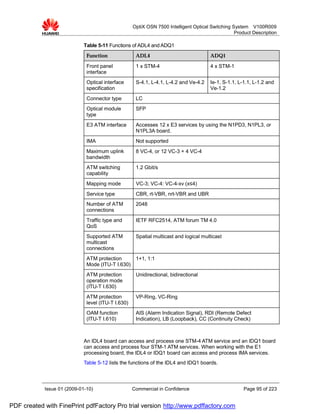
  • 39.
    OptiX OSN 7500Intelligent Optical Switching System V100R009 Product Description l WDM processing unit l SDH cross-connect matrix unit l Synchronous timing unit l SCC unit l Overhead processing unit l Power interface unit l Auxiliary interface unit l Optical amplifier unit and dispersion compensation unit Figure 3-2 shows the system architecture of the OptiX OSN 7500. Figure 3-2 System architecture SDH/PDH/Ethernet/ ATM/DDN interface SDH interface PDH signal Cross-connect SDH signal board matrix STM-N optical Ethernet signal unit signal ATM signal DDN signal Interface unit Synchronous processing Auxiliary timing unit Overhead SCC unit unit 3.2 Cabinet The cabinet that complies with the ETSI standards is used for the OptiX OSN 7500. A power supply box is installed on the top of the cabinet to access –48 V or –60 V power. Figure 3-3 shows the outer view of an ETSI cabinet. Issue 01 (2009-01-10) Commercial in Confidence Page 39 of 223 PDF created with FinePrint pdfFactory Pro trial version http://www.pdffactory.com
  • 40.
    OptiX OSN 7500Intelligent Optical Switching System V100R009 Product Description Figure 3-3 Appearance of an ETSI cabinet T63E cabinet N63E cabinet 3.3 Subrack The subrack consists of slots and boards that can be configured. 3.3.1 Structure Issue 01 (2009-01-10) Commercial in Confidence Page 40 of 223 PDF created with FinePrint pdfFactory Pro trial version http://www.pdffactory.com
  • 41.
    OptiX OSN 7500Intelligent Optical Switching System V100R009 Product Description The OptiX OSN 7500 subrack has a two-layer structure. The subrack consists of the processing board area, interface board area, fan area, and fiber routing area. 3.3.2 Slot Allocation The OptiX OSN 7500 subrack has two layers. The upper layer has 20 slots and the lower layer has 18 slots. 3.3.1 Structure The OptiX OSN 7500 subrack has a two-layer structure. The subrack consists of the processing board area, interface board area, fan area, and fiber routing area. Figure 3-8 shows the structure of the OptiX OSN 7500 subrack Figure 3-4 Structure of the OptiX OSN 7500 subrack Upper layer processing board area Fiber routing area Interface board area Fan area Lower layer processing Fiber routing area board area H W D The functions of the areas are as follows: l Upper layer processing board area and lower layer processing board area: These areas house the processing boards of the OptiX OSN 7500. l Interface board area: This area houses the interface boards of the OptiX OSN 7500. l Fan area: This area houses three fan modules, which dissipate heat generated by the equipment. l Fiber routing area: This area houses the fiber jumpers in the subrack. Issue 01 (2009-01-10) Commercial in Confidence Page 41 of 223 PDF created with FinePrint pdfFactory Pro trial version http://www.pdffactory.com
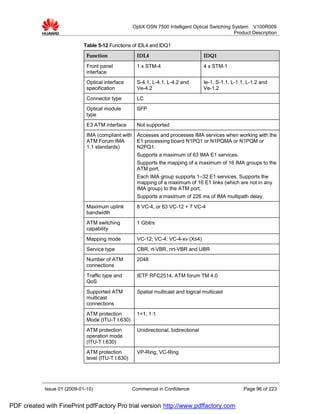
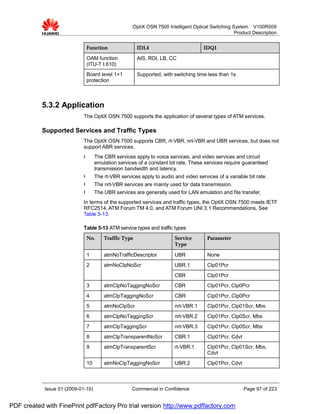
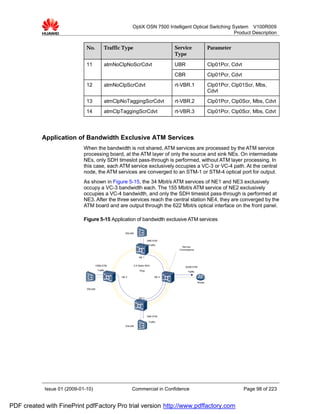
  • 42.
    OptiX OSN 7500Intelligent Optical Switching System V100R009 Product Description The interface board is also called the access board or transit board. The interface board provides physical interfaces for optical signals and electrical signals, and transmits the optical signals or electrical signals to the corresponding processing board. 3.3.2 Slot Allocation The OptiX OSN 7500 subrack has two layers. The upper layer has 20 slots and the lower layer has 18 slots. Figure 3-9 shows the slot layout of the OptiX OSN 7500 subrack. Figure 3-5 Slot layout of the OptiX OSN 7500 subrack S L S LS LS LS SL S S S S S S S SLOT S S S S S L L OL OL OL LO L L L L L L L L L L L L 32 O T O T O TO TO OTO O O O O O O O O O O O PIU(A) T T 1 T 1T 1T T1T T T T T T T T T T T T 1 4 2 52 62 72 28 2 2 2 2 2 3 3 3 3 3 3 3 9 0 1 2 3 4 5 6 7 8 9 0 1 4 5 6 7 8 SLOT S S 33 GSCC(A) GSCC(B) PIU(B) C C EOW AUX Fiber routing SLOT 39 FAN SLOT 40 FAN SLOT 41 FAN S S S S S S S S S S S S S S S S S S L L L L L L L L L L L L L L L L L L O O O O O O O O O O O O O O O O O O T T T T T T T T T T T T T T T T T T 1 2 3 4 5 6 7 8 9 1 1 1 1 1 1 1 1 1 0 1 2 3 4 5 6 7 8 XCS(A) XCS(B) Fiber routing Fiber routing (A): Active (B): S tandby Slot Area for Interface Boards l Slots for the service interface boards: slots 19–22 and 35–38. l Slot for the orderwire interface board: slot 23. l Slot for the auxiliary interface board: slot 34. Slot Area for Processing Boards l Slots for the service processing boards: slots 1–8, 11–18 and 26–31. l Slots for the cross-connect and timing boards: slots 9–10. l Slots for the PIU boards: slots 32–33. Issue 01 (2009-01-10) Commercial in Confidence Page 42 of 223 PDF created with FinePrint pdfFactory Pro trial version http://www.pdffactory.com
  • 43.
    OptiX OSN 7500Intelligent Optical Switching System V100R009 Product Description l Slots for the system control and communication (SCC) boards: slots 24–25. Mapping Relation Between Slots for Interface Boards and Slots for Processing Boards Table 3-2 lists the mapping relation between slots for the interface boards and slots for the processing boards. Table 3-1 Mapping relation between slots for the interface boards and slots for the processing boards Slots for Processing Boards Slots for Interface Boards Slot 2 Slots 19–20 Slot 3 Slots 21–22 Slot 17 Slots 35–36 Slot 18 Slots 37–38 Paired Slots If the overhead bytes pass through the backplane bus between two slots, the two slots are paired slots. When an NE is configured with an orderwire phone or realizes the service protection in DPS mode, the two boards that form a ring must be inserted in the paired slots. Table 3-3 lists the paired slots. Table 3-2 Paired slots Slot Paired Slot Slot 1 Slot 18 Slot 2 Slot 17 Slot 3 Slot 16 Slot 4 Slot 15 Slot 5 Slot 14 Slot 6 Slot 13 Slot 7 Slot 12 Slot 8 Slot 11 Slot 26 Slot 27 Slot 28 Slot 29 Slot 30 Slot 31 Issue 01 (2009-01-10) Commercial in Confidence Page 43 of 223 PDF created with FinePrint pdfFactory Pro trial version http://www.pdffactory.com
  • 44.
    OptiX OSN 7500Intelligent Optical Switching System V100R009 Product Description 3.4 Boards The equipment supports different types of boards. 3.4.1 Classification of the Boards The boards are classified into SDH boards, PDH boards, data boards, WDM boards, and auxiliary boards according to the functions of the boards. 3.4.2 Cross-Connect and System Control Boards The OptiX OSN 7500 supports several cross-connect and system control boards. 3.4.3 SDH Processing Boards The OptiX OSN 7500 supports the SDH processing boards. 3.4.4 PDH Processing Boards The OptiX OSN 7500 supports the PDH processing boards. 3.4.5 Data Processing Boards The OptiX OSN 7500 supports data processing boards. 3.4.6 WDM Boards The OptiX OSN 7500 supports WDM processing boards. 3.4.7 Microwave Boards The OptiX OSN 7500 supports Microwave boards. 3.4.8 Optical Booster Amplifier Boards The OptiX OSN 7500 supports several optical booster amplifier boards. 3.4.9 Other Boards The OptiX OSN 7500 supports the power boards and auxiliary boards. 3.4.1 Classification of the Boards The boards are classified into SDH boards, PDH boards, data boards, WDM boards, and auxiliary boards according to the functions of the boards. SDH Boards The OptiX OSN 7500 supports the SDH boards that operate at the STM-64, STM-16, STM-4, and STM-1 rates. Table 3-4 lists the SDH boards that the OptiX OSN 7500 supports. Table 3-3 SDH boards that the OptiX OSN 7500 supports Board Description Board Description N1SL64 1xSTM-64 optical N1SLQ4, 4xSTM-4 optical interface board N2SLQ4, and interface board N1SLQ4A Issue 01 (2009-01-10) Commercial in Confidence Page 44 of 223 PDF created with FinePrint pdfFactory Pro trial version http://www.pdffactory.com
  • 45.
    OptiX OSN 7500Intelligent Optical Switching System V100R009 Product Description Board Description Board Description T2SL64 1xSTM-64 optical N1SLD4, 2xSTM-4 optical interface board N2SLD4, and interface board N1SLD4A T2SL64A 1xSTM-64 optical N1SLT1 and 12xSTM-1 optical interface board N3SLT1 interface board N1SF64 and 1xSTM-64 optical N1SLQ1, 4xSTM-1 optical N1SF64A interface board (with N2SLQ1, and interface board the forward error N1SLQ1A correction (FEC) function) N1SLD64 2xSTM-64 optical N1SL1, N2SL1, 1xSTM-1 optical interface board and N1SL1A interface board N1SL16, 1xSTM-16 optical N1SLH1 and 16xSTM-1 signal N2SL16, and interface board N1SLH1A processing board N3SL16 N1SL16A, 1xSTM-16 optical N1SEP1 2xSTM-1 line N2SL16A, and interface board processing board N3SL16A when the interfaces are available on the front panel 8xSTM-1 line processing board when the interfaces are available on the corresponding interface board N1SLQ16 and 4xSTM-16 optical N2SLO1 and 8xSTM-1 optical N2SLQ16 interface board N3SLO1 interface board N1SF16 1xSTM-16 optical N3SLN 1xSTM-16/STM-4/S interface board (with TM-1 optical the out-band FEC interface board function) N1SLO16 8xSTM-16 optical N3SLD41 2xSTM-4/STM-1 interface board optical interface board N1SL4, N2SL4, 1xSTM-4 optical N3SLQ41 4xSTM-4/STM-1 and N1SL4A interface board optical interface board PDH Boards The OptiX OSN 7500 supports the PDH boards that operate at different rates and have different impedances. Issue 01 (2009-01-10) Commercial in Confidence Page 45 of 223 PDF created with FinePrint pdfFactory Pro trial version http://www.pdffactory.com
  • 46.
    OptiX OSN 7500Intelligent Optical Switching System V100R009 Product Description Table 3-5 lists the PDH boards that the OptiX OSN 7500 supports. Table 3-4 PDH boards that the OptiX OSN 7500 supports Board Description Board Description N1PQ1 and 63xE1 service processing N1PD3 6xE3/T3 service N2PQ1 board and processing board N2PD3 N1PQM and 63xE1/T1 service N2PQ3 12xE3/T3 service N1PQMA processing board processing board N1PL3 and 3xE3/T3 service N1DX1 DDN service accessing N2PL3 processing board and converging board N1PL3A 3xE3/T3 service N1DXA DDN service converging and processing board (The and processing board N2PL3A interfaces are available on the front panel.) N2SPQ4 4xE4/STM-1 electrical - - processing board Data Boards The OptiX OSN 7500 supports the data boards that provide the transparent transmission function, switching function, or RPR function. Table 3-6 lists the data boards that the OptiX OSN 7500 supports. Table 3-5 Data boards that the OptiX OSN 7500 supports Board Description Board Description N1EFT8 8xFE or 16xFE transparent N1EMS4 4xGE and 16xFE transmission board transparent transmission and converging board N1EFT8A 8xFE transparent N1EMS2 2xGE and 16xFE transmission board transparent transmission and converging board N1EGT2 2xGE transparent N1EGS4, 4xGE switching and and transmission board N3EGS4, processing board N2EGT2 and N4EGS4 N2EFS0, 8xFE switching and N2EGR2 2xGE ring processing N4EFS0, processing board board and N5EFS0 N1EFS0A 16xFE switching and N2EMR0 12xFE and 1xGE ring processing board processing board Issue 01 (2009-01-10) Commercial in Confidence Page 46 of 223 PDF created with FinePrint pdfFactory Pro trial version http://www.pdffactory.com
  • 47.
    OptiX OSN 7500Intelligent Optical Switching System V100R009 Product Description Board Description Board Description N1EFS4, 4xFE switching and N1ADL4 1xSTM-4 ATM service N2EFS4, processing board processing board and N3EFS4 N2EGS2 2xGE switching and N1ADQ1 4xSTM-1 ATM service and processing board processing board N3EGS2 N1MST4 4-port multi-service N1IDL4 1xSTM-4 ATM service transparent transmission processing board board N1EAS2 2-port 10xGE Layer 2 N1IDQ1 4xSTM-1 ATM service switching and processing processing board board Interface Boards and Switching and Bridging Boards The OptiX OSN 7500 supports optical interface boards, electrical interface boards, and switching and bridging boards. Table 3-7 lists the interface boards and switching and bridging boards that the OptiX OSN 7500 supports. Table 3-6 Interface boards and switching and bridging boards that the OptiX OSN 7500 supports Board Description Board Description N1EU08 8xSTM-1 electrical interface N1D12S 32xE1/T1 switching board access board (120 ohms) N1OU08 8xSTM-1 optical interface N1D12B 32xE1/T1 access board board (LC) (120 ohms) N2OU08 8xSTM-1 optical interface N1EFF8 8x100M Ethernet optical board (SC) and interface board N1EFF8A N1D75S 32xE1 switching access N1ETF8 8x100M Ethernet twisted board (75 ohms) and pair interface board N1ETF8A N1MU04 4xE4/STM-1 electrical N1ETS8 8x10/100M Ethernet interface board twisted pair interface switching board N1D34S 6xE3/T3 switching access N1DM12 DDN service interface board board Issue 01 (2009-01-10) Commercial in Confidence Page 47 of 223 PDF created with FinePrint pdfFactory Pro trial version http://www.pdffactory.com
  • 48.
    OptiX OSN 7500Intelligent Optical Switching System V100R009 Product Description Board Description Board Description N1C34S 3xE3/T3 switching access N1TSB8 8-channel electrical board interface protection switching board Cross-Connect Boards and System Control Boards The OptiX OSN 7500 supports multiple system control boards and cross-connect boards that have different cross-connect capacities. Table 3-8 lists the cross-connect boards and system control boards that the OptiX OSN 7500 supports. Table 3-7 Cross-connect boards and system control boards that the OptiX OSN 7500 supports Board Description Board Description T1GXCSA General T2SXCSA Super cross-connect and cross-connect and synchronous timing synchronous timing board board T1EXCSAa Enhanced T1IXCSA Infinite cross-connect cross-connect and and synchronous timing synchronous timing board board T2UXCSA Ultra cross-connect N2GSCC, Intelligent system control and synchronous N3GSCC, and communication timing board N4GSCC, and board N5GSCC T1SXCSA Super - - cross-connect and synchronous timing board a: The T1EXCSA cannot work with the line boards of series N2 (except for the N2SLQ16). The T2SL64 is not delivered any longer and can be replaced with the T2SL64A. It is recommended that you use the T2SL64A with the T1EXCSA. Auxiliary Boards The OptiX OSN 7500 supports auxiliary boards such as the system auxiliary interface board and fan board. Table 3-9 lists the auxiliary boards that the OptiX OSN 7500 supports. Issue 01 (2009-01-10) Commercial in Confidence Page 48 of 223 PDF created with FinePrint pdfFactory Pro trial version http://www.pdffactory.com
  • 49.
    OptiX OSN 7500Intelligent Optical Switching System V100R009 Product Description Table 3-8 Auxiliary boards that the OptiX OSN 7500 supports Board Description T1EOW Orderwire processing board T1AUX System auxiliary interface board N1FANA Fan board (high power) WDM Boards The OptiX OSN 7500 supports WDM boards such as the optical add/drop multiplexing board and optical amplifier board. Table 3-10 lists the WDM boards that the OptiX OSN 7500 supports. Table 3-9 WDM boards that the OptiX OSN 7500 supports Board Description Board Description TN11CMR2 2-channel optical N1MR2C 2-channel optical add/drop multiplexing add/drop multiplexing board board TN11CMR4 4-channel optical N1LWX Arbitrary bit rate add/drop multiplexing wavelength conversion board board TN11MR2 2-channel optical TN11OBU1 Optical booster amplifier add/drop multiplexing board board TN11MR4 4-channel optical N1FIB Filter isolating board add/drop multiplexing board N1MR2A 2-channel optical - - add/drop multiplexing board Microwave Boards The OptiX OSN 7500 supports microwave boards such as the microwave IF board and microwave power board. Table 3-11 lists the microwave boards that the OptiX OSN 7500 supports. Table 3-10 Microwave boards that the OptiX OSN 7500 supports Board Description N1IFSD1 Dual-port IF board Issue 01 (2009-01-10) Commercial in Confidence Page 49 of 223 PDF created with FinePrint pdfFactory Pro trial version http://www.pdffactory.com
  • 50.
    OptiX OSN 7500Intelligent Optical Switching System V100R009 Product Description Board Description N1RPWR 6-channel ODU power board Optical Amplifier Boards and Dispersion Compensation Boards The OptiX OSN 7500 supports multiple optical amplifier boards and dispersion compensation boards. Table 3-12 lists the optical amplifier boards and dispersion compensation boards that the OptiX OSN 7500 supports. Table 3-11 Optical amplifier boards and dispersion compensation boards that the OptiX OSN 7500 supports Board Description Board Description N1BPA and Optical booster and N1COA, 61COA, and Case-shaped N2BPA pre-amplifier board 62COA optical amplifier N1BA2 Optical booster N1DCU and N2DCU Dispersion amplifier board compensation board N1RPC01 Forward Raman N1RPC02 Backward Raman driving board driving board (external) (external) Power Boards The OptiX OSN 7500 supports power boards such as the UPM and power interface board. Table 3-13 lists the power boards that the OptiX OSN 7500 supports. Table 3-12 Power boards that the OptiX OSN 7500 supports Board Description UPM Uninterruptible power module T1PIU Power interface board 3.4.2 Cross-Connect and System Control Boards The OptiX OSN 7500 supports several cross-connect and system control boards. Table 3-14 lists the cross-connect and system control boards and their valid slots in the OptiX OSN 7500. Issue 01 (2009-01-10) Commercial in Confidence Page 50 of 223 PDF created with FinePrint pdfFactory Pro trial version http://www.pdffactory.com
  • 51.
    OptiX OSN 7500Intelligent Optical Switching System V100R009 Product Description Table 3-13 Cross-connect and system control boards and their valid slots in the OptiX OSN 7500 Board Full Name Valid Slots T1GXCSA General cross-connect and Slots 9 and 10 synchronous timing board T1EXCSA Enhanced cross-connect and Slots 9 and 10 synchronous timing board T2UXCSA Ultra cross-connect and Slots 9 and 10 synchronous timing board T1SXCSA Super cross-connect and Slots 9 and 10 synchronous timing board T1IXCSA Infinite cross-connect and Slots 9 and 10 synchronous timing board N2GSCC, System control and Slots 24 and 25 N3GSCC, communication board N4GSCC, N5GSCC 3.4.3 SDH Processing Boards The OptiX OSN 7500 supports the SDH processing boards. Table 3-15 lists the SDH processing boards, their valid slots and their interface in the OptiX OSN 7500. Table 3-14 SDH processing boards, their valid slots and their interface in the OptiX OSN 7500 Board Valid Slots Interfacing Interface Type Connector Mode T2SL64, Valid slots when the cross-connect Interfaces I-64.1, I-64.2, LC T2SL64A capacity is 240 Gbit/s: slots 3–8, available on the S-64.2b, 11–16 and 26–31 front panel L-64.2b, Valid slots when the cross-connect Le-64.2, capacity is 360 Gbit/s: slots 1–8, Ls-64.2, 11–18 and 26–31 V-64.2b Issue 01 (2009-01-10) Commercial in Confidence Page 51 of 223 PDF created with FinePrint pdfFactory Pro trial version http://www.pdffactory.com
  • 52.
    OptiX OSN 7500Intelligent Optical Switching System V100R009 Product Description Board Valid Slots Interfacing Interface Type Connector Mode N1SLD64 If the cross-connect capacity is 240 Interfaces I-64.1, S-64.2b LC Gbit/s, these slots are unavailable. available on the Valid slots when the cross-connect front panel capacity is 360 Gbit/s: slots 7–8, 11–12 and 30–31 N1SL64 Slots 4–8, 11–16 and 26–31 Interfaces I-64.1, I-64.2, LC available on the S-64.2b, front panel L-64.2b, Le-64.2, Ls-64.2, V-64.2b N1SF64 Slots 4–8, 11–16 and 26–31 Interfaces Ue-64.2c, LC available on the Ue-64.2d, front panel Ue-64.2e N1SF64A Slots 4–8, 11–16 and 26–31 Interfaces Ue-64.2c, LC available on the Ue-64.2d, front panel Ue-64.2e N1SF16 Valid slots when the cross-connect Interfaces Ue-16.2c, LC capacity is 240 Gbit/s: slots 3–8, available on the Ue-16.2d 11–16 and 26–31 front panel Valid slots when the cross-connect capacity is 360 Gbit/s: slots 1–8, 11–18 and 26–31 N1SL16, Valid slots when the cross-connect Interfaces L-16.2, LC N2SL16, capacity is 240 Gbit/s: slots 3–8, available on the L-16.2Je, N3SL16 11–16 and 26–31 front panel V-16.2Je, Valid slots when the cross-connect U-16.2Je capacity is 360 Gbit/s: slots 1–8, 11–18 and 26–31 N1SLD16 Slots 1–8, 11–18 and 26–31 Interfaces I-16, S-16.1, LC available on the L-16.1, L-16.2 front panel N1SLO16 If the cross-connect capacity is 240 Interfaces I-16, S-16.1, LC Gbit/s, these slots are unavailable. available on the L-16.1, L-16.2 Valid slots when the cross-connect front panel capacity is 360 Gbit/s: slots 7–8, 11–12 and 30–31 N1SL16A Valid slots when the cross-connect Interfaces I-16, S-16.1, LC , capacity is 240 Gbit/s: slots 3–8, available on the L-16.1, L-16.2 N2SL16A 11–16 and 26–31 front panel Valid slots when the cross-connect capacity is 360 Gbit/s: slots 1–8, 11–18 and 26–31 Issue 01 (2009-01-10) Commercial in Confidence Page 52 of 223 PDF created with FinePrint pdfFactory Pro trial version http://www.pdffactory.com
  • 53.
    OptiX OSN 7500Intelligent Optical Switching System V100R009 Product Description Board Valid Slots Interfacing Interface Type Connector Mode N1SLQ16 Valid slots when the cross-connect Interfaces I-16, S-16.1, LC , capacity is 240 Gbit/s: slots 1–2 and available on the L-16.1, L-16.2 N2SLQ16 17–18 (for the board housed in any front panel of slots 1–2 and 17–18, two optical interfaces can be configured), and slots 3–8, 11–16 and 26–31 (for the board housed in any of slots 3–8, 11–16 and 26–31, four optical interfaces can be configured) Valid slots when the cross-connect capacity is 360 Gbit/s: slots 1–8, 11–18 and 26–31 (for the board housed in any of slots 1–8, 11–18 and 26–31, four optical interfaces can be configured) N1SLQ4, Valid slots when the cross-connect Interfaces I-4, S-4.1, L-4.1, LC N1SLQ4 capacity is 240 Gbit/s: slots 1–2 and available on the L-4.2, Ve-4.2 A, 17–18 (for the board housed in any front panel N2SLQ4 of slots 1–2 and 17–18, two optical interfaces can be configured), or slots 3–8, 11–16 and 26–31 (for the board housed in any of slots 3–8, 11–16 and 26–31, four optical interfaces can be configured) Valid slots when the cross-connect capacity is 360 Gbit/s: slots 1–8, 11–18 and 26–31 (for the board housed in any of slots 1–8, 11–18 and 26–31, four optical interfaces can be configured) N3SLD41 Slots 1–8, 11–18 and 26–31 Interfaces I-1/I-4, LC , available on the S-1.1/S-4.1, N3SLQ41 front panel L-1.1/L-4.1, L-1.2/L-4.2, Le-1.2/Le-4.2 N1SLD4, Slots 1–8, 11–18 and 26–31 Interfaces I-4, S-4.1, L-4.1, LC N1SLD4A available on the L-4.2, Ve-4.2 , N2SLD4 front panel N1SL4, Slots 1–8, 11–18 and 26–31 Interfaces I-4, S-4.1, L-4.1, LC N1SL4A, available on the L-4.2, Ve-4.2 N2SL4 front panel Issue 01 (2009-01-10) Commercial in Confidence Page 53 of 223 PDF created with FinePrint pdfFactory Pro trial version http://www.pdffactory.com
  • 54.
    OptiX OSN 7500Intelligent Optical Switching System V100R009 Product Description Board Valid Slots Interfacing Interface Type Connector Mode N3SLN Slots 1–8, 11–18 and 26–31 Interfaces I-1/I-4, LC available on the S-1.1/S-4.1, front panel L-1.1/L-4.1, L-1.2/L-4.2, Le-1.2/Le-4.2, I-16, S-16.1, L-16.1, L-16.2, Le-16.2 N1SLQ1, Slots 1–8, 11–18 and 26–31 Interfaces I-1, Ie-1, S-1.1, LC N1SLQ1 available on the L-1.1, L-1.2, A front panel Ve-1.2 N2SLQ1 Slots 1–8, 11–18 and 26–31 Interfaces I-1, S-1.1, L-1.1, LC available on the L-1.2, Ve-1.2 front panel N1SLH1, Slots 2–3 and 17–18 Interfaces S-1.1 optical LC N1SLH1A available on the interface a 8 x STM-1 line processing board N1OU08 Interfaces S-1.1 optical SC available on the interface 8 x STM-1 line processing board N2OU08 Interfaces 75-ohm STM-1 SMB available on the electrical 8 x STM-1 line interface processing board N1EU08 N2SLO1 Slots 1–8, 11–18 and 26–31 Interfaces I-1.1, S-1.1, LC available on the L-1.1, L-1.2, front panel Ve-1.2 N3SLO1 Slots 1–8, 11–18 and 26–31 Interfaces I-1.1, S-1.1, LC available on the L-1.1, L-1.2, front panel Ve-1.2 Issue 01 (2009-01-10) Commercial in Confidence Page 54 of 223 PDF created with FinePrint pdfFactory Pro trial version http://www.pdffactory.com
  • 55.
    OptiX OSN 7500Intelligent Optical Switching System V100R009 Product Description Board Valid Slots Interfacing Interface Type Connector Mode N1SLT1 Valid slots when the cross-connect Interfaces S-1.1 LC capacity is 240 Gbit/s: slots 1–2 and available on the 17–18 (for the board housed in any front panel of slots 1–2 and 17–18, eight optical interfaces can be configured), and slots 3–8, 11–16 and 26–31 (for the board housed in any of slots 3–8, 11–16 and 26–31, 12 optical interfaces can be configured) Valid slots when the cross-connect capacity is 360 Gbit/s: slots 1–8, 11–18 and 26–31 (for the board housed in any of slots 1–8, 11–18 and 26–31, 12 optical interfaces can be configured) N3SLT1 Valid slots when the cross-connect Interfaces S-1.1 LC capacity is 240 Gbit/s: slots 1–8 , available on the 11–18 and 26–31 front panel Valid slots when the cross-connect capacity is 360 Gbit/s: slots 1–8 , 11–18 and 26–31 N1SL1, Slots 1–8, 11–18 and 26–31 Interfaces I-1, S-1.1, L-1.1, LC N1SL1A, available on the L-1.2, Ve-1.2 N2SL1 front panel N1SEP1a Slots 2–3 and 17–18 Interfaces I-1, Ie-1, S-1.1 LC available on the 8 x STM-1 line processing board N1OU08 Interfaces I-1, Ie-1, S-1.1 SC available on the 8 x STM-1 line processing board N2OU08 Interfaces 75-ohm STM-1 SMB available on the electrical 8 x STM-1 line interface processing board N1EU08 N1SEP1b Slots 1–3 and 17–18 Interfaces 75-ohm STM-1 SMB available on the electrical front panel interface Issue 01 (2009-01-10) Commercial in Confidence Page 55 of 223 PDF created with FinePrint pdfFactory Pro trial version http://www.pdffactory.com
  • 56.
    OptiX OSN 7500Intelligent Optical Switching System V100R009 Product Description Board Valid Slots Interfacing Interface Type Connector Mode a: The N1SLH1, N1SLH1A and N1SEP can be used with the N1TSB8 board to realize the TPS protection. b: The N1SEP1 and N1SEP are boards of the same type. If they are used with the interface board, they are displayed as "N1SEP" on the T2000. If the interfaces on their front panels are used, they are displayed as "N1SEP1" on the T2000. 3.4.4 PDH Processing Boards The OptiX OSN 7500 supports the PDH processing boards. Table 3-16 lists the PDH processing boards, their valid slots, and their interfaces in the OptiX OSN 7500. Table 3-16 lists the PDH interface boards and their valid slots in the OptiX OSN 7500. Table 3-15 PDH processing boards, their valid slots, and their interfaces in the OptiX OSN 7500 Board Valid Slot Interfacing Mode Interface Type Connector N2SPQ4 Slots 2–3 and Interfaces available on the 4-port 75-ohm E4/STM-1 SMB 17–18 electrical interface board N1MU04 electrical interface N1PD3a, Slot 2–3 and Interfaces available on the 6-port 75-ohm E3/T3 SMB N2PD3 17–18 electrical interface switching board electrical interface N1D34S N1PL3a, Slot 2–3 and Interfaces available on the 3-port 75-ohm E3/T3 SMB N2PL3 17–18 electrical interface switching board electrical interface N1C34S N1PL3A, Slot 1–8, Interfaces available on the front 75-ohm E3/T3 SMB N2PL3A 11–18 and panel electrical interface 26–31 N2PQ3 Slot 2–3 and Interfaces available on the 6-port 75-ohm E3/T3 SMB 17–18 electrical interface switching board electrical interface N1D34S N1PQ1A, Slot 1–3 and Interfaces available on the 32-port 75-ohm E1 interface DB44 N2PQ1A 17–18 electrical interface switching board N1D75S N1PQ1B, Slot 1–3 and Interfaces available on the 32-port 120-ohm E1 DB44 N2PQ1B 17–18 electrical interface switching board interface N1D12S N1PQM, Slot 1–3 and Interfaces available on the 32-port 120-ohm E1 DB44 N1PQMA 17–18 electrical interface switching board interface and N1D12S and N1D12B 100-ohm T1 interface N1DX1 Slots 1–3 and Interfaces available on the N x 64 RS449, EIA530, DB28, EIA530-A, V.35, Issue 01 (2009-01-10) Commercial in Confidence Page 56 of 223 PDF created with FinePrint pdfFactory Pro trial version http://www.pdffactory.com
  • 57.
    OptiX OSN 7500Intelligent Optical Switching System V100R009 Product Description Board Valid Slot Interfacing Mode Interface Type Connector 17–18 kbit/s interface board N1DM12 V.24, X.21, Framed DB44 E1 a: The N1PD3, N2PD3, N1PL3, N2PL3, and N2PQ3 boards can work with the N1TSB8 board to realize the TPS protection. Table 3-16 PDH interface boards and their valid slots in the OptiX OSN 7500 Board Valid Slot N1DXA Slots 1–8, 11–18 and 26–31 N1DM12 Slots 19–22 and 35–38 N1TSB8 Slots 37 and 38 N1MU04 Slots 19, 21, 35 and 37 N1D75S Slots 19–22 and 35–38 N1D12S Slots 19–22 and 35–38 N1D12B Slots 19–22 and 35–38 N1C34S Slots 19, 21, 35 and 37 N1D34S Slots 19–22 and 35–38 3.4.5 Data Processing Boards The OptiX OSN 7500 supports data processing boards. Table 3-18 lists the data processing boards, their valid slots, and their interfaces in the OptiX OSN 7500. Table 3-19 lists the data interface boards and their valid slots in the OptiX OSN 7500. Table 3-17 Data processing boards, their valid slots, and their interfaces in the OptiX OSN 7500 Valid Slot Interface Board Interfacing Mode Type Connector N2EGS2 Valid slots when the cross-connect Interfaces available on 1000BAS LC capacity is 240 Gbit/s: slots 1–2 and the front panel E-SX/LX/ 17–18 (1.25 Gbit/s), or slots 3–8, ZX 11–16 and 26–31 (2.5 Gbit/s) Valid slots when the cross-connect capacity is 360 Gbit/s: slots 1–8, 11–18 and 26–31 (2.5 Gbit/s) N3EGS2 Valid slots when the cross-connect Interfaces available on 1000BAS LC capacity is 240 Gbit/s: slots 1–8, the front panel E-SX/LX/ Issue 01 (2009-01-10) Commercial in Confidence Page 57 of 223 PDF created with FinePrint pdfFactory Pro trial version http://www.pdffactory.com
  • 58.
    OptiX OSN 7500Intelligent Optical Switching System V100R009 Product Description Valid Slot Interface Board Interfacing Mode Type Connector 11–18 and 26–31 (2.5 Gbit/s) ZX Valid slots when the cross-connect capacity is 360 Gbit/s: slots 1–8, 11–18 and 26–31 (2.5 Gbit/s) N1EFS0A Slots 2–3 and 17–18 (2.5 Gbit/s) Interfaces available on 10/100BA RJ-45 the 8-port 10/100M SE-TX Ethernet twisted pair interface board N1ETF8 Interfaces available on 100BASE LC the 8-port Ethernet -FX optical interface board N1EFF8 N2EFS0, Slots 2–3 and 17–18 (1.25 Gbit/s) Interfaces available on 10/100BA RJ-45 N4EFS0a the 8-port 10/100M SE-TX Ethernet twisted pair interface board N1ETF8 Interfaces available on 100BASE LC the 8-port Ethernet -FX optical interface board N1EFF8 N5EFS0 Slots 2–3 and 17–18 (1.25 Gbit/s) Interfaces available on 10/100BA RJ-45 the 8-port 10/100M SE-TX Ethernet twisted pair interface board N1ETF8A Interfaces available on 100BASE LC the 8-port Ethernet -FX optical interface board N1EFF8A N1EFS4 Slots 1–8, 11–18 and 26–31 (622 Interfaces available on 10/100BA RJ-45 Mbit/s) the front panel SE-TX N3EFS4 Slots 1–8, 11–18 and 26–31 Interfaces available on 10/100BA RJ-45 the front panel SE-TX N1EGT2 Valid slots when the cross-connect Interfaces available on 1000BAS LC capacity is 240 Gbit/s: slots 1–2 and the front panel E-SX/LX/ 17–18 (1.25 Gbit/s), or slots 3–8, ZX 11–16 and 26–31 (2.5 Gbit/s) Valid slots when the cross-connect capacity is 360 Gbit/s: slots 1–8, 11–18 and 26–31 (2.5 Gbit/s) N2EGT2 Valid slots when the cross-connect Interfaces available on 1000BAS LC capacity is 240 Gbit/s: slots 1–8, the front panel E-SX/LX/ 11–18 and 26–31 (2.5 Gbit/s) ZX Valid slots when the cross-connect Issue 01 (2009-01-10) Commercial in Confidence Page 58 of 223 PDF created with FinePrint pdfFactory Pro trial version http://www.pdffactory.com
  • 59.
    OptiX OSN 7500Intelligent Optical Switching System V100R009 Product Description Valid Slot Interface Board Interfacing Mode Type Connector capacity is 360 Gbit/s: slots 1–8, 11–18 and 26–31 (2.5 Gbit/s) N1EFT8b Slots 1–3 and 17–18 (622 Mbit/s) Interfaces available on 10/100BA RJ-45 the front panel SE-TX Slots 2–3 and 17–18 (1.25 Gbit/s) Interfaces available on 10/100BA RJ-45 the 8-port Ethernet SE-TX, twisted pair interface 100BASE board N1ETF8 -FX Interfaces available on 10/100BA LC the 8-port Ethernet SE-TX, optical interface board 100BASE N1EFF8 -FX N1EFT8A Slots 1–8, 11–18 and 26–31 (622 Interfaces available on 10/100BA RJ-45 Mbit/s) the front panel SE-TX N2EMR0 Valid slots when the cross-connect Interfaces available on 10/100BA RJ-45 capacity is 240 Gbit/s: slots 2 and the 8-port 10/100M SE-TX, 17–18 (1.25 Gbit/s), or slot 3 (2.5 Ethernet twisted pair 1000BAS Gbit/s) interface board N1ETF8 E-SX/LX/ Valid slots when the cross-connect ZX capacity is 360 Gbit/s: slots 2–3 and Interfaces available on 10/100BA LC 17–18 (2.5 Gbit/s) the 8-port Ethernet SE-TX, optical interface board 1000BAS N1EFF8 E-SX/LX/ ZX Valid slots when the cross-connect Interfaces available on 10/100BA RJ-45, LC capacity is 240 Gbit/s: slots 1–2 and the front panel SE-TX, 17–18 (1.25 Gbit/s), or slot 3 (2.5 1000BAS Gbit/s) E-SX/LX/ Valid slots when the cross-connect ZX capacity is 360 Gbit/s: slots 1–3 and 17–18 (2.5 Gbit/s) N2EGR2 Valid slots when the cross-connect Interfaces available on 1000BAS LC capacity is 240 Gbit/s: slots 1–2 and the front panel E-SX/LX/ 17–18 (1.25 Gbit/s), or slots 3–8, ZX 11–16 and 26–31 (2.5 Gbit/s) Valid slots when the cross-connect capacity is 360 Gbit/s: slots 1–8, 11–18 and 26–31 (2.5 Gbit/s) N1EMS4 Valid slots when the cross-connect Interfaces available on 1000BAS LC capacity is 240 Gbit/s: slots 1–2 and the front panel E-SX/LX/ 17–18 (1.25 Gbit/s), or slot 3 (2.5 ZX Gbit/s) Valid slots when the cross-connect capacity is 360 Gbit/s: slots 1–3 and Issue 01 (2009-01-10) Commercial in Confidence Page 59 of 223 PDF created with FinePrint pdfFactory Pro trial version http://www.pdffactory.com
  • 60.
    OptiX OSN 7500Intelligent Optical Switching System V100R009 Product Description Valid Slot Interface Board Interfacing Mode Type Connector 17–18 (2.5 Gbit/s) Valid slots when the cross-connect Interfaces available on 10/100BA RJ-45 capacity is 240 Gbit/s: slots 2 and the 8-port Ethernet SE-TX, 17–18 (1.25 Gbit/s), or slot 3 (2.5 twisted pair interface 100BASE Gbit/s) board N1ETF8 -FX, Valid slots when the cross-connect 1000BAS capacity is 360 Gbit/s: slots 2–3 and E-SX/LX/ 17–18 (2.5 Gbit/s) ZX Interfaces available on 10/100BA LC the 8-port Ethernet SE-TX, optical interface board 100BASE N1EFF8 -FX, 1000BAS E-SX/LX/ ZX N1EMS2 Valid slots when the cross-connect Interfaces available on 1000BAS LC capacity is 240 Gbit/s: slots 1–8, the front panel E-SX/LX/ 11–18 and 26–31 (2.5 Gbit/s) ZX Valid slots when the cross-connect capacity is 360 Gbit/s: slots 1–8, 11–18 and 26–31 (2.5 Gbit/s) Valid slots when the cross-connect Interfaces available on 10/100BA RJ-45 capacity is 240 Gbit/s: slots 2–3 and the 8-port Ethernet SE-TX, 17–18 (2.5 Gbit/s) twisted pair interface 100BASE Valid slots when the cross-connect board N1ETF8 -FX, capacity is 360 Gbit/s: slots 2–3 and 1000BAS 17–18 (2.5 Gbit/s) E-SX/LX/ ZX Interfaces available on 10/100BA LC the 8-port Ethernet SE-TX, optical interface board 100BASE N1EFF8 -FX, 1000BAS E-SX/LX/ ZX N1EGS4, Valid slots when the cross-connect Interfaces available on 1000BAS LC N3EGS4, capacity is 240 Gbit/s: slots 1–2 and the front panel E-SX/LX/ N4EGS4 17–18 (1.25 Gbit/s), or slots 3–8, ZX 11–16 and 26–31 (2.5 Gbit/s) Valid slots when the cross-connect capacity is 360 Gbit/s: slots 1–8, 11–18 and 26–31 (2.5 Gbit/s) N1EAS2 Valid slots when the cross-connect Interfaces available on 10GBAS LC capacity is 240 Gbit/s: slots 3–8, the front panel E-LW/LR 11–16 and 26–31 (10 Gbit/s) Valid slots when the cross-connect Issue 01 (2009-01-10) Commercial in Confidence Page 60 of 223 PDF created with FinePrint pdfFactory Pro trial version http://www.pdffactory.com
  • 61.
    OptiX OSN 7500Intelligent Optical Switching System V100R009 Product Description Valid Slot Interface Board Interfacing Mode Type Connector capacity is 360 Gbit/s: slots 1–8, 11–18 and 26–31 (10 Gbit/s) N1ADL4 Slots 1–8, 11–18 and 26–31 (1.25 Interfaces available on S-4.1, LC Gbit/s) the front panel L-4.1, L-4.2, Ve-4.2 N1ADQ1 Slots 1–8, 11–18 and 26–31 (1.25 Interfaces available on Ie-1, LC Gbit/s) the front panel S-1.1, L-1.1, L-1.2, Ve-1.2 N1IDL4 Slots 1–8, 11–18 and 26–31 (1.25 Interfaces available on S-4.1, LC Gbit/s) the front panel L-4.1, L-4.2, Ve-4.2 N1IDQ1 Slots 1–8, 11–18 and 26–31 (1.25 Interfaces available on Ie-1, LC Gbit/s) the front panel S-1.1, L-1.1, L-1.2, Ve-1.2 N1MST4 Valid slots when the cross-connect Interfaces available on X3.296/( LC capacity is 240 Gbit/s: slots 1–2 and the front panel DVB-ASI) 17–18 (1.25 Gbit/s), or slots 3–8, EN50083 11–16 and 26–31 (2.5 Gbit/s) -9, Valid slots when the cross-connect 200-M5-S capacity is 360 Gbit/s: slots 1–8, N-I, 11–18 and 26–31 (2.5 Gbit/s) 200-SM-L C-I a: The N2EFS0, N4EFS0 and N5EFS0 can be used with the N1ETS8 to realize the TPS protection. b: The N1EFT8 provides eight FE electrical interfaces on the front panel. The N1EFT8 can be used with the N1ETF8 to process 16-port FE electrical signals. The N1EFT8 can be used with the N1EFF8 to process eight FE electrical signals and eight FE optical signals. Table 3-18 Data interface boards and their valid slots in the OptiX OSN 7500 Board Valid Slot N1ETF8, N1ETF8A Slots 19–22 and 35–38 N1EFF8, N1EFF8A Slots 19–22 and 35–38 3.4.6 WDM Boards The OptiX OSN 7500 supports WDM processing boards. Issue 01 (2009-01-10) Commercial in Confidence Page 61 of 223 PDF created with FinePrint pdfFactory Pro trial version http://www.pdffactory.com
  • 62.
    OptiX OSN 7500Intelligent Optical Switching System V100R009 Product Description Table 3-20 lists the WDM boards, their valid slots and their interface in the OptiX OSN 7500. Table 3-19 WDM boards, their valid slots and their interface in the OptiX OSN 7500 Board Valid Slots Interfacing Mode Connector N1MR2A Slots 1–8, 11–18 Interfaces available on LC and 26–31 the front panel N1MR2C Slots 19–22 and Interfaces available on LC 35–38 the front panel N1LWX Slots 1–8, 11–18 Interfaces available on LC and 26–31 the front panel TN11MR2 Slots 1–8, 11–18 Interfaces available on LC and 26–31 the front panel TN11MR4 Slots 1–8, 11–18 Interfaces available on LC and 26–31 the front panel TN11CMR2 Slots 1–8, 11–18 Interfaces available on LC and 26–31 the front panel TN11CMR4 Slots 1–8, 11–18 Interfaces available on LC and 26–31 the front panel 3.4.7 Microwave Boards The OptiX OSN 7500 supports Microwave boards. Table 3-21 list the WDM boards, their valid and their interface slots for the OptiX OSN 7500. Table 3-20 Microwave boards, their valid slots and their interface for the OptiX OSN 7500 Board Valid Slot Interfacing Mode Connector N1IFSD1 Slots 1–8, 11–18 and Interfaces available on IF 26–31 the front panel N1RPWR Slots 1–8, 11–18 and - Power supply 26–31 interface 3.4.8 Optical Booster Amplifier Boards The OptiX OSN 7500 supports several optical booster amplifier boards. Table 3-22 lists the optical booster amplifier boards, their valid slots and their interface in the OptiX OSN 7500. Issue 01 (2009-01-10) Commercial in Confidence Page 62 of 223 PDF created with FinePrint pdfFactory Pro trial version http://www.pdffactory.com
  • 63.
    OptiX OSN 7500Intelligent Optical Switching System V100R009 Product Description Table 3-21 Optical booster amplifier boards, their valid slots and their interface in the OptiX OSN 7500 Board Valid Slots Interfacing Mode Connector N1BA2 Slots 1–8, 11–18 and Interfaces available on the LC 26–31 front panel N1BPA, Slots 1–8, 11–18 and Interfaces available on the LC N2BPA 26–31 front panel N1DCU, Slots 1–8, 11–18 and Interfaces available on the LC N2DCU 26–31 front panel 61COA, Slots 101 and 102 Interfaces available on the SC N1COAa front panel 62COAa Slots 101 and 102 Interfaces available on the SC, E2000 front panel ROPa Slot 103 Interfaces available on the LC front panel N1RPC0 Slot 104 Interfaces available on the LSH/APC, 1 front panel LC/PC N1RPC0 Slot 105 Interfaces available on the LSH/APC, 2 front panel LC/PC a: The slots for the COA and ROP displayed on the T2000 are logical slots and not physical slots. 3.4.9 Other Boards The OptiX OSN 7500 supports the power boards and auxiliary boards. Table 3-23 lists the mapping relation between the valid slots and connectors of the power boards and auxiliary boards supported by the OptiX OSN 7500. Table 3-22 Mapping relation between the valid slots and connectors of the power boards and auxiliary boards supported by the OptiX OSN 7500 Board Valid Slots Connector T1AUX Slot 34 SMB, RJ-45 T1EOW Slot 23 SMB, RJ-45 T1PIU Slots 32 and 33 Power supply interface N1FANA Slots 39–41 - UPMa Slot 50 - a: The UPM is in case shape. On the T2000, it is displayed as CAU board seated in the logical slot 50. Issue 01 (2009-01-10) Commercial in Confidence Page 63 of 223 PDF created with FinePrint pdfFactory Pro trial version http://www.pdffactory.com
  • 64.
    OptiX OSN 7500Intelligent Optical Switching System V100R009 Product Description Issue 01 (2009-01-10) Commercial in Confidence Page 64 of 223 PDF created with FinePrint pdfFactory Pro trial version http://www.pdffactory.com
  • 65.
    OptiX OSN 7500Intelligent Optical Switching System V100R009 Product Description 4 Software Architecture 4.1 Overview The software system is of a modular design. Each module provides specific functions and works with other modules. The entire software is distributed in three modules including board software, NE software and NM system. The software resides respectively on functional boards, the SCC, and NM computer. Hierarchical structure ensures that it is highly reliable and efficient. Each layer performs specific functions and provides service for the upper layer. The system software architecture is shown in Figure 4-1. In the diagram, all modules are NE software except "Network Management System" and "Board Software". The ASON software is also contained in the NE software. Figure 4-1 Software architecture Network Management System NE software ASON software High Level Communication Module Real-time Network side Module Database multi-task Management operating Equipment Management Module system Module Communication Module Board Software Issue 01 (2009-01-10) Commercial in Confidence Page 65 of 223 PDF created with FinePrint pdfFactory Pro trial version http://www.pdffactory.com
  • 66.
    OptiX OSN 7500Intelligent Optical Switching System V100R009 Product Description 4.2 Communication Protocols Complete protocol stack and messages of Qx interface are described in ITU-T G.773, Q.811 and Q.812. Qx interface is mainly used to connect mediation device (MD), Q adaptation (QA) and NE (NE) equipment through local communication network (LCN). At present, QA is provided by NE management layer. MD and operating system (OS) are provided by NM layer. They are connected to each other through Qx interface. According to the Recommendations, Qx interface provided by the system is developed on the basis of TCP/IP connectionless network layer service (CLNS1) protocol stack. In addition, to support remote access of the NM through Modem, IP layer uses serial line internet protocol (SLIP). 4.3 Board Software The board software runs on each board and it manages, monitors and controls the operation of the board. It receives the command issued from the NE software and reports the board status to the NE software through performance events and alarm. The specific functions include: l Alarm management l Performance management l Configuration management l Communication management It directly controls the functional circuits in corresponding boards and implements ITU-T compliant specific functions of the NE. 4.4 NE Software The NE software manages, monitors and controls the board operations in the NE. In addition, the NE software functions as a communication service unit between the T2000 and the boards, so that the T2000 can control and manage the NE. According to ITU-T M.3010, NE software is at unit management layer in telecom management network, performing NE function (NEF), partial mediation function (MF) and OS function at network unit layer. Data communication function (DCF) provides communication channel between NE and other equipment (including NM and other NEs). l Real-time multi-task operating system l The NE software offers real-time multi-task operating system to manage public resources and support application programs. Issue 01 (2009-01-10) Commercial in Confidence Page 66 of 223 PDF created with FinePrint pdfFactory Pro trial version http://www.pdffactory.com
  • 67.
    OptiX OSN 7500Intelligent Optical Switching System V100R009 Product Description l It isolates the application programs from the processor and provides an application program execution environment, which is independent of the processor hardware. l Communication module l The communication module is the interface module between NE software and board software. l According to related protocol, communication function between the NE software and the board software is for information exchange and maintenance of the equipment. l Through the communication, board maintenance and operation commands from the NE software are sent to the boards. On the other hand, the state, alarm and performance events of the board are reported to the NE software. l Network Side (NS) Module l The NS module is between the communication module and the equipment management module. It converts the data format between the user operation side (at the application layer) and the NE equipment management layer, and provides security control for the NE layer. l Functionally, the NS module is divided into the following three submodules: − Qx interface module − Command line interface module − Security management module l Equipment management module l The equipment management module is the core of the NE software for the NE management. It includes administrator and agent. l Administrator can send NM operation commands and receive events. l Agent can respond to the NM operation commands sent by the administrator, implement the operations of the managed object, and send up events according to the change of status of the managed object. l High-level communication module l The high-level communication module exchanges management information among NEs and between the NM system and the NE. l It consists of network communication module, serial communication module and ECC communication module. l Database management module l The database management module is a part of the NE software. l It includes two independent parts: data and program. l The data are organized in the form of database, including network database, alarm database, performance database and equipment database. l The program manages and accesses the data in the database. 4.5 Network Management System The NM system implements a unified management over the optical transmission network, and maintains all OSN, SDH, Metro, DWDM NE equipment in the network. Issue 01 (2009-01-10) Commercial in Confidence Page 67 of 223 PDF created with FinePrint pdfFactory Pro trial version http://www.pdffactory.com
  • 68.
    OptiX OSN 7500Intelligent Optical Switching System V100R009 Product Description In compliance with ITU-T Recommendations, it is an NM system that integrates standard management information model as well as object-oriented management technology. It exchanges information with the NE software through the communication module to monitor and manage the network equipment. The NM software runs on a workstation or PC, managing the equipment and the transmission network to help to operate, maintain and manage the transmission equipment. The management functions of the NM software include: l Alarm management: collects, prompts, filters, browses, acknowledges, checks, clears, and counts in real time; fulfills alarm insertion, alarm correlation analysis and fault diagnosis. l Performance management: sets performance monitoring; browses, analyzes and prints performance data; forecasts medium-term and long-term performance; and resets performance register. l Configuration management: configures and manages interfaces, clocks, services, trails, subnets and time. l Security management: provides NM user management, NE user management, NE login management, NE login lockout, NE setting lockout and local craft terminal (LCT) access control of the equipment. l Maintenance management: provides loopback, board resetting, automatic laser shutdown (ALS) and optical fiber power detection, and collects equipment data to help the maintenance personnel in troubleshooting. l Querying service alarm: queries the current real alarms on the service path; determines the connectivity or degrade status of the service, according to the current alarm; analyzes the faulty node and locates the faulty board. l Detecting the MS protection channel: detects the VC-4 channel alarms on the VC-4 channel that maps the MS protection channel. 4.6 ASON Software According to the ITU-T Recommendations, an automatically switched optical network (ASON) includes three planes: control plane, management plane, and transport plane. The management plane refers to an upper layer management system such as the T2000. The transport plane refers to a traditional SDH network. The control plane is where the ASON software is applied, and uses the LMP (link management protocol), OSPF-TE (open shortest path first- traffic engineering), and RSVP-TE (reservation protocol-traffic engineering) protocols. Figure 4-2 shows the ASON software architecture. The ASON software mainly includes the link management module, the signaling module, the routing module, and the cross-connection management module. Issue 01 (2009-01-10) Commercial in Confidence Page 68 of 223 PDF created with FinePrint pdfFactory Pro trial version http://www.pdffactory.com
  • 69.
    OptiX OSN 7500Intelligent Optical Switching System V100R009 Product Description Figure 4-2 ASON software architecture AOSN software T2000 Signaling module NE software Cross-connection management module Routing module LMP link management module Link Management Module By using the LMP protocol, the link management module provides the following functions: l Create and maintain control channels. l Verify member links and TE links. Signaling Module By using the RSVP-TE protocol, the signaling module provides the following functions: l Set up or interrupt service connections according to user requests. l Synchronize and restore services on the basis of service status changes. Routing Module By using the OSPF-TE protocol, the routing module provides the following functions: l Collect and flood the TE link information. l Collect and flood the control link information of the control plane. l Compute service trails and control the routing. Cross-Connection Management Module The cross-connection management module provides the following functions: l Create and delete cross-connections. l Report link status, alarms, and other relevant information. Issue 01 (2009-01-10) Commercial in Confidence Page 69 of 223 PDF created with FinePrint pdfFactory Pro trial version http://www.pdffactory.com
  • 70.
    OptiX OSN 7500Intelligent Optical Switching System V100R009 Product Description 5 Data Features 5.1 Ethernet Features This section describes the functions, application and protection of the Ethernet features of the OptiX OSN 7500. 5.1.1 Functions The OptiX OSN 7500 provides many Ethernet boards to meet different Ethernet service requirements. 5.1.2 Application The OptiX OSN 7500 has the Ethernet access function integrated on the SDH transmission platform. 5.1.3 Protection OptiX OSN 7500 provides layered protection on Ethernet services. 5.1.1 Functions The OptiX OSN 7500 provides many Ethernet boards to meet different Ethernet service requirements. Table 5-1, Table 5-2, Table 5-3, Table 5-4, Table 5-5, Table 5-6 and Table 5-7 list the Ethernet boards that provide the switching function. Table 5-8 lists the Ethernet boards that provide the transparent transmission function. Table 5-1 Function list of EFS4 Function N1EFS4 N2EFS4, N3EFS4 Interface 4 FE 4 FE Interface type 10Base-T, 100Base-TX Interface board None None Service frame format In compliance with Ethernet II, IEEE 802.3, IEEE 802.1 q/p JUMBO frame Supported, 9600 bytes Issue 01 (2009-01-10) Commercial in Confidence Page 70 of 223 PDF created with FinePrint pdfFactory Pro trial version http://www.pdffactory.com
  • 71.
    OptiX OSN 7500Intelligent Optical Switching System V100R009 Product Description Function N1EFS4 N2EFS4, N3EFS4 Uplink bandwidth 4 VC-4 8 VC-4 Mapping mode VC-12: VC-12-xv (x≤63); VC-3: VC-3-xv (x≤12) Number of VCTRUNKs 12 24 Ethernet private line Supported (EPL) Ethernet virtual private Supported line (EVPL) Ethernet private LAN Supported (EPLAN) Ethernet virtual private Not supported LAN (EVPLAN) Static MPLS label MartinioE label supported Stack VLAN Supported VLAN Supports VLAN, in compliance with IEEE 802.1q/p RSTP Supported IGMP Snooping Supported Encapsulation GFP-F (Frame–Mapped GFP) Link state pass Supports P2P LPT Supports P2P and P2MP LPT through (LPT) Link capacity In compliance with ITU-T G.7042 adjustment scheme (LCAS) Committed access rate Supported (The granularity is 64 kbit/s.) (CAR) Intra-board link Not supported Supported aggregation Flow control In compliance with IEEE 802.3x Test frame Supported Ethernet OAM Not supported Supported, in compliance with IEEE 802.1ag and 802.3ah Ethernet performance Supported monitoring NSF Function Not supported Supported RMON Supported Issue 01 (2009-01-10) Commercial in Confidence Page 71 of 223 PDF created with FinePrint pdfFactory Pro trial version http://www.pdffactory.com
  • 72.
    OptiX OSN 7500Intelligent Optical Switching System V100R009 Product Description Table 5-2 Function list of EFS0 and EFS0A Function N2EFS0 N1EFS0A N4EFS0 N5EFS0 Interface 8 FE 16 FE 8 FE 8 FE Interface type 10Base-T, 100Base-TX, 100Base-FX Interface board N1ETS8 N1ETF8, N1ETS8 N1ETS8 (used with N1EFF8 (used with (used with TSB8 to TSB8 to TSB8 to realize 1:1 realize 1:1 realize 1:1 TPS), TPS), TPS), N1ETF8, N1ETF8, N1ETF8, N1EFF8 N1EFF8 N1EFF8, N1ETF8A, N1EFF8A Service frame format In compliance with Ethernet II, IEEE 802.3, IEEE 802.1 q/p JUMBO frame Supported, 9600 bytes Uplink bandwidth 8 VC-4 16 VC-4 8 VC-4 8 VC-4 Mapping mode VC-12: VC-12-xv (x≤63); VC-3: VC-3-xv (x≤12) Number of 24 32 24 24 VCTRUNKs Ethernet private line Supported (EPL) Ethernet virtual Supported private line (EVPL) Ethernet private LAN Supported (EPLAN) Ethernet virtual Not supported private LAN (EVPLAN) Static MPLS label MartinioE label supported Stack VLAN Supported VLAN Supports VLAN, in compliance with IEEE 802.1q/p RSTP Supported IGMP Snooping Supported Encapsulation GFP-F, GFP-F GFP-F, GFP-F LAPS, HDLC LAPS, HDLC Link state pass Supports P2P Supports Supports Supports through (LPT) LPT P2P and P2P and P2P and P2MP LPT P2MP LPT P2MP LPT Issue 01 (2009-01-10) Commercial in Confidence Page 72 of 223 PDF created with FinePrint pdfFactory Pro trial version http://www.pdffactory.com
  • 73.
    OptiX OSN 7500Intelligent Optical Switching System V100R009 Product Description Function N2EFS0 N1EFS0A N4EFS0 N5EFS0 Link capacity In compliance with ITU-T G.7042 adjustment scheme (LCAS) Committed access Supported (The granularity is 64 kbit/s.) rate (CAR) Intra-board link Supported Supported Supported Supported aggregation Flow control In compliance with IEEE 802.3x Test frame Supported Ethernet OAM Not supported Supported, Supported, Supported, in in in compliance compliance compliance with IEEE with IEEE with IEEE 802.1ag and 802.1ag and 802.1ag and IEEE 802.3ah IEEE 802.3ah 802.3ah Ethernet Supported performance monitoring NSF Function Not supported Not Supported Not supported supported RMON Supported Table 5-3 Function list of EGS2 Function N2EGS2 N3EGS2 Interface 2 GE Interface type 1000Base-SX, 1000Base-LX, 1000Base-ZX Interface board None Service frame format In compliance with Ethernet II, IEEE 802.3, IEEE 802.1q/p JUMBO frame Supported, 9600 bytes Uplink bandwidth 16 VC-4 Mapping mode VC-12: VC-12-xv (x≤63); VC-3: VC-3-xv (x≤12) Number of VCTRUNKs 48 EPL Supported EVPL Supported Issue 01 (2009-01-10) Commercial in Confidence Page 73 of 223 PDF created with FinePrint pdfFactory Pro trial version http://www.pdffactory.com
  • 74.
    OptiX OSN 7500Intelligent Optical Switching System V100R009 Product Description Function N2EGS2 N3EGS2 EPLAN Supported EVPLAN Not supported Static MPLS label MartinioE label supported Stack VLAN Supported VLAN Supports VLAN, in compliance with IEEE 802.1q/p RSTP Supported IGMP Snooping Supported Encapsulation GFP-F LPT Supports P2P LPT Supports P2P and P2MP LPT LCAS In compliance with ITU-T G.7042 CAR Supported (The granularity is 64 kbit/s.) QoS traffic classification Supports port flow, port+VLAN flow and port+VLAN+PRI flow. CoS Supported Shaping Not supported Not supported Flow control In compliance with IEEE 802.3x Test frame Supported Ethernet performance Supported monitoring Ethernet OAM Not supported Supported RMON Supported Link aggregation Supports manual link Supports manual link aggregation aggregation Table 5-4 Function list of EGS4 Function N1EGS4 N3EGS4 N4EGS4 Interface 4 x GE Interface type 1000Base-SX, 1000Base-LX, 1000Base-ZX Interface board None Service frame In compliance with Ethernet II, IEEE 802.3, IEEE 802.1q/p format JUMBO frame Supported, 9216 bytes Issue 01 (2009-01-10) Commercial in Confidence Page 74 of 223 PDF created with FinePrint pdfFactory Pro trial version http://www.pdffactory.com
  • 75.
    OptiX OSN 7500Intelligent Optical Switching System V100R009 Product Description Function N1EGS4 N3EGS4 N4EGS4 Uplink bandwidth 16 VC-4 Mapping mode VC-12: VC-12-xv (x≤64); VC-3: VC-3-xv (x≤24); VC-4: VC-4-xv (x≤8) Number of 64 VCTRUNKs EPL Supported EVPL Supports VLAN-based and QinQ-based EVPL services. EPLAN Supported EVPLAN Supported Static MPLS label Not supported VLAN Supports VLAN and QinQ, in compliance with IEEE 802.1q/p. RSTP Supported IGMP Snooping Supported Encapsulation GFP-F, LAPS, HDLC LPT Supports P2P and Supports P2P Supports P2P and P2MP LPT and P2MP LPT P2MP LPT LCAS In compliance with ITU-T G.7042 BPS Supported PPS Supported CAR Supported (The granularity is 64 kbit/s.) QoS traffic Supports port flow, port+VLAN flow and port+SVLAN flow. classification CoS Supported Shaping Supported Flow control Supports flow control based on GE port, in compliance with IEEE 802.3x Ethernet Supported performance monitoring Ethernet OAM Supported, in compliance with IEEE 802.1ag and 802.3ah Test frame Supported Link aggregation Supports manual link aggregation, static link aggregation and distributed link aggregation. Issue 01 (2009-01-10) Commercial in Confidence Page 75 of 223 PDF created with FinePrint pdfFactory Pro trial version http://www.pdffactory.com
  • 76.
    OptiX OSN 7500Intelligent Optical Switching System V100R009 Product Description Table 5-5 Function list of EMS2 Function N1EMS2 Interface 2 GE and 16 FE Interface type 1000Base-SX, 1000Base-LX, 1000Base-ZX, 10Base-T, 100Base-TX, 100Base-FX Interface board Supports 2 x GE if the N1EMS2 board is not used with an interface board. Supports 2 x GE and 16 x FE if the N1EMS2 board is used with interface boards N1ETF8 or N1EFF8. Service frame In compliance with Ethernet II, IEEE 802.3, IEEE 802.1q/p format JUMBO frame Supported, 9600 bytes Uplink bandwidth 16 VC-4 Mapping mode VC-12: VC-12-xv (x≤63); VC-3: VC-3-xv (x≤12) Number of 48 VCTRUNKs EPL Supported EVPL Supports VLAN-based services. EPLAN Supported EVPLAN Not supported Static MPLS Not supported label VLAN Supports VLAN, in compliance with IEEE 802.1q/p. RSTP Supported IGMP Snooping Supported Encapsulation GFP-F LPT Supports P2P and P2MP LPT LCAS In compliance with ITU-T G.7042 BPS/PPS Not supported CAR Supported (The granularity is 64 kbit/s.) QoS traffic Supports port flow, port+VLAN flow and port+VLAN+PRI flow. classification CoS Supported Shaping Not supported Flow control Supports flow control based on GE/FE port, in compliance with IEEE 802.3x. Issue 01 (2009-01-10) Commercial in Confidence Page 76 of 223 PDF created with FinePrint pdfFactory Pro trial version http://www.pdffactory.com
  • 77.
    OptiX OSN 7500Intelligent Optical Switching System V100R009 Product Description Function N1EMS2 Ethernet Supported performance monitoring Ethernet OAM Supported, in compliance with IEEE 802.1ag and 802.3ah Test frame Supported Link aggregation Supports manual link aggregation Table 5-6 Function list of EMS4 Function N1EMS4 Interface 4 GE and 16 FE Interface type 1000Base-SX, 1000Base-LX, 1000Base-ZX, 10Base-T, 100Base-TX, 100Base-FX Interface board Supports 4 x GE if the N1EMS4 board is not used with an interface board. Supports 4 x GE and 16 x FE if the N1EMS4 board is used with interface boards N1ETF8 or N1EFF8. Service frame In compliance with Ethernet II, IEEE 802.3, IEEE 802.1q/p format JUMBO frame Supported, 9216 bytes Uplink bandwidth 16 VC-4 Mapping mode VC-12: VC-12-xv (x≤64); VC-3: VC-3-xv (x≤24); VC-4: VC-4-xv (x≤8) Number of 64 VCTRUNKs EPL Supported EVPL Supports VLAN-based and QinQ-based EVPL services. EPLAN Supported EVPLAN Supported Static MPLS Not supported label VLAN Supports VLAN and QinQ, in compliance with IEEE 802.1q/p. RSTP Supported IGMP Snooping Supported Encapsulation GFP-F, LAPS, HDLC LPT Supports P2P and P2MP LPT Issue 01 (2009-01-10) Commercial in Confidence Page 77 of 223 PDF created with FinePrint pdfFactory Pro trial version http://www.pdffactory.com
  • 78.
    OptiX OSN 7500Intelligent Optical Switching System V100R009 Product Description Function N1EMS4 LCAS In compliance with ITU-T G.7042 BPS/PPS Supported CAR Supported (The granularity is 64 kbit/s.) QoS traffic Supports port flow, port+VLAN flow and port+SVLAN flow. classification CoS Supported Shaping Supported Flow control Supports flow control based on GE/FE port, in compliance with IEEE 802.3x Ethernet Supported performance monitoring Ethernet OAM Supported, in compliance with IEEE 802.1ag and 802.3ah Test frame Supported Link aggregation Supports manual link aggregation, static link aggregation and distributed link aggregation. Table 5-7 Function list of EAS2 Function N1EAS2 Interface 2 x 10GE Interface type 10GBASE-LW, 10GBASE-LR Interface board None Service frame format In compliance with Ethernet II, IEEE 802.3, IEEE 802.1q/p JUMBO frame Supported, 9600 bytes Maximum uplink 64 VC-4 bandwidth Mapping mode Virtual concatenation: VC-3: VC-3-xv (x≤24); VC-4: VC-4-xv (x≤8) Contiguous concatenations: VC-4-4C Number of 24 VCTRUNKs EPL Supported EVPL Supports VLAN-based and QinQ-based EVPL services. Issue 01 (2009-01-10) Commercial in Confidence Page 78 of 223 PDF created with FinePrint pdfFactory Pro trial version http://www.pdffactory.com
  • 79.
    OptiX OSN 7500Intelligent Optical Switching System V100R009 Product Description Function N1EAS2 EPLAN Supported EVPLAN Supported Static MPLS Label Not supported VLAN Supports VLAN and QinQ, in compliance with IEEE 802.1q/p. RSTP Supported IGMP Snooping Supported Encapsulation GFP-F LPT Supports P2P and P2MP LPT LCAS In compliance with ITU-T G.7042 CAR Supported (The granularity is 64 kbit/s.) QoS traffic Supports port flow, PORT+VLAN flow, PORT+SVLAN flow classification and PORT+SVLAN+CVLAN flow CoS Supported Shaping Supported Flow control In compliance with IEEE 802.3x Ethernet performance Supported monitoring Ethernet OAM Supported, in compliance with IEEE 802.1ag Test frame Supported Link aggregation Supports manual link aggregation, static link aggregation, and distributed link aggregation. Table 5-8 Function list of EGT2, EFT8 and EFT8A Function N1EGT2, N2EGT2 N1EFT8 N1EFT8A Interface 2 GE 16 FE 8 FE Interface type 1000Base-SX, 10Base-T, 10Base-T, 1000Base-LX, 100Base-TX, 100Base-TX 1000Base-ZX 100Base-FX Issue 01 (2009-01-10) Commercial in Confidence Page 79 of 223 PDF created with FinePrint pdfFactory Pro trial version http://www.pdffactory.com
  • 80.
    OptiX OSN 7500Intelligent Optical Switching System V100R009 Product Description Function N1EGT2, N2EGT2 N1EFT8 N1EFT8A Interface board None Supports 8 x FE if None the N1EFT8 board is not used with an interface board. Supports 16 x FE if the N1EFT8 board is used with interface boards N1ETF8 and N1EFF8. Service frame In compliance with Ethernet II, IEEE 802.3, IEEE 802.1qTAG format JUMBO frame Supported, 9600 Supported by the latter four ports, 9600 bytes bytes Uplink 16 VC-4 8 VC-4 4 VC-4 bandwidth Mapping mode VC-3: VC-3-xv VC-12: VC-12-xv VC-12: VC-12-xv (x≤24); VC-4: (x≤63); VC-3: (x≤63); VC-3: VC-4-xv (x≤8) VC-3-xv (x≤3) VC-3-xv (x≤3) Number of 2 16 8 VCTRUNKs Ethernet Only EPL supported; EVPL, EPLAN and EVPLAN not supported service types MPLS Not supported VLAN Transparent transmission Encapsulation GFP-F, LAPS, HDLC LPT Supports P2P LPT LCAS In compliance with ITU-T G.7042 CAR Not supported Flow control In compliance with IEEE 802.3x Test frame Supported Ethernet OAM Supported 802.1ag Not supported Not supported Ethernet Supported performance monitoring Issue 01 (2009-01-10) Commercial in Confidence Page 80 of 223 PDF created with FinePrint pdfFactory Pro trial version http://www.pdffactory.com
  • 81.
    OptiX OSN 7500Intelligent Optical Switching System V100R009 Product Description 5.1.2 Application The OptiX OSN 7500 has the Ethernet access function integrated on the SDH transmission platform. The OptiX OSN 7500 supports the following types of Ethernet services: l EPL Service l EVPL Service l EPLAN Service l EVPLAN Service EPL Service The EPL implements the point-to-point transparent transmission of Ethernet services. As shown in Figure 5-1, the Ethernet services of different NEs are transmitted to the destination node through their respective VCTRUNKs. The Ethernet services are also protected by the SDH self-healing ring (SHR). This ensures the secure and reliable transmission of services. Figure 5-1 EPL service based on port B B PORT2 VCTRUNK2 VCTRUNK2 PORT2 PORT1 VCTRUNK 1 VCTRUNK 1 POTR1 A A NE 1 NE 2 OptiX OSN Enterprise equipment user EVPL Service The OptiX OSN 7500 adopts two ways to support EVPL services. l Port-shared EVPL services. The services are isolated by VLAN tags and share a bandwidth. As shown in Figure 5-2, traffic classification is performed for the Ethernet service according to VLAN ID, to distinguish different VLANs from different departments of Companie A. The two traffics are transmitted in respective VCTRUNKs. Issue 01 (2009-01-10) Commercial in Confidence Page 81 of 223 PDF created with FinePrint pdfFactory Pro trial version http://www.pdffactory.com
  • 82.
    OptiX OSN 7500Intelligent Optical Switching System V100R009 Product Description Figure 5-2 Port-shared EVPL services Headquarters of Department 1 company A VCTRUNK1 VLAN100 VLAN100 PORT1 VCTRUNK2 VLAN200 VLAN200 PORT1 PORT2 Department 2 NE 1 NE 2 OptiX OSN Enterprise equipment user l VCTRUNK-shared EVPL services. OptiX OSN 7500 adopts three ways to realize convergence and distribution of EVPL services. − EVPL services based on VLAN ID, as shown in Figure 5-3. − EVPL services based on MPLS, as shown in Figure 5-4. − EVPL services based on QinQ, as shown in Figure 5-5. Figure 5-3 EVPL service based on VLAN ID B B' VLAN200 VLAN200 VCTRUNK VLAN100 VLAN100 A PORT 1 PORT2 PORT2 PORT 1 A' NE 1 NE 2 Cyber cafe OptiX OSN Community user equipment user Issue 01 (2009-01-10) Commercial in Confidence Page 82 of 223 PDF created with FinePrint pdfFactory Pro trial version http://www.pdffactory.com
  • 83.
    OptiX OSN 7500Intelligent Optical Switching System V100R009 Product Description Figure 5-4 EVPL service based on MPLS Add label Strip label PE P P PE PORT2 PORT2 Department B Department B ` VCTRUNK1 Department Department A A PORT1 PORT1 NE 1 NE 2 Branch 1 Branch 2 OptiX OSN Company A equipment Figure 5-5 EVPL service based on QinQ Add label Strip label C-Aware S-Aware S-Aware C-Aware Department PORT2 PORT2 Department B ` B VCTRUNK1 Department Department A PORT1 PORT1 A NE 1 NE 2 Branch 1 Branch 2 Company A OptiX OSN equipment EPLAN Service Through the EPLAN service, NEs can communicate with each other and dynamically share a bandwidth, the OptiX OSN 7500 adopts virtual bridge (VB) to support Layer 2 switching of Ethernet data. This is referred to as the EPLAN service. Each NE in the system can create one or several VBs. Each VB establishes a media access control (MAC) address table. The system updates the table by self-learning. The data packets are transmitted over the mapping VCTRUNK according to the destination MAC address, as shown in Figure 5-6. Issue 01 (2009-01-10) Commercial in Confidence Page 83 of 223 PDF created with FinePrint pdfFactory Pro trial version http://www.pdffactory.com
  • 84.
    OptiX OSN 7500Intelligent Optical Switching System V100R009 Product Description Figure 5-6 EPLAN service PORT1 VB VCTRUNK1 Port 1 NE3 1 Department 3 of company A VCTRUNK2 VB PORT1 PORT1 VB VCTRUNK1 VCTRUNK1 Port 1 Port 1 NE 1 NE 2 Department 1 of Department 2 of company A company A Access OptiX OSN Company A point equipment EVPLAN Service The EVPLAN services can dynamically share the bandwidth and the data packets in the same VLAN are isolated from each other. When the data services with the same VLAN ID are accessed into the same NE and dynamically share the bandwidth, the EVPLAN service can meet the service requirements. As shown in Figure 5-7, the Ethernet processing boards of the OptiX OSN 7500 adopt VB+S-VLAN filter table to support the EVPLAN services. Issue 01 (2009-01-10) Commercial in Confidence Page 84 of 223 PDF created with FinePrint pdfFactory Pro trial version http://www.pdffactory.com
  • 85.
    OptiX OSN 7500Intelligent Optical Switching System V100R009 Product Description Figure 5-7 EVPLAN service PORT2 PORT1 VCTRUNK2 VCTRUNK1 Department 3 of company B VB C-Aware Department 3 S-Aware S-Aware of company A Port 1 NE3 Port 2 VCTRUNK1 S-Aware VCTRUNK2 C-Aware S-Aware PORT2 VB PORT2 PORT1 LSP LSP VB PORT1 C-Aware NE 1 NE 2 Port 2 Port 1 Port 1 Port 2 Department 2 of company B Department 1 Department 2 of company A Department 1 of company A of company B Acess OptiX OSN Company A Company B point equipment 5.1.3 Protection OptiX OSN 7500 provides layered protection on Ethernet services. The optical transmission layer supports MSP, SNCP, SNCMP and SNCTP. The protection schemes supported at the Ethernet service layer are as follows: l LCAS l The LCAS enables the configuration of system capacity, the increase and decrease of the concatenated VC quantity, the dynamic change of bearer bandwidth (services are not damaged during the dynamic change) and protects and restores failed members. l For details, refer to . l STP/RSTP l The Ethernet boards support the spanning tree protocol (STP) and the rapid spanning tree protocol (RSTP). When the STP or the RSTP is started, it logically modifies the network topology to prevent a broadcast storm. The STP or the RSTP realizes link protection by restructuring the topology. l For details, refer to STP and RSTP. l Tributary protection switching (TPS) l The TPS provides equipment level protection for tributary services. When a protected board becomes faulty, its services are switched to the protection board. This ensures a reliable operation of the equipment. l For details, refer to 7.1.1 TPS Protection. l Board protection switching (BPS) l The BPS is a board-based protection scheme that requires an active board and a standby board. When the active board detects a link down failure of any port, or Issue 01 (2009-01-10) Commercial in Confidence Page 85 of 223 PDF created with FinePrint pdfFactory Pro trial version http://www.pdffactory.com
  • 86.
    OptiX OSN 7500Intelligent Optical Switching System V100R009 Product Description detects a board hardware failure, the cross-connect board switches all the services from the active board to the standby board to realize the service protection. l For details, refer to BPS. l Port protection switching (PPS) l The PPS is a port-based protection scheme that requires an active board and a standby board. When the active board detects a link down failure of any port, or detects a board hardware failure, the cross-connect board switches the services of one or more affected ports to the standby boards. In this case, a protection switching for the entire board is not necessary. l For details, refer to PPS. l Link aggregation group (LAG) l A link aggregation group (LAG) bundles multiple links that are connected to the same equipment, to increase the bandwidth and improve the link reliability. An LAG can be regarded as one link. l For details, refer to LAG. l DLAG l The DLAG requires two boards. One board is the working board and the other is the protection board. l During switching, only the affected ports are switched and the other ports are not switched. The equipment configured with the DLAG should be connected to the equipment where the LACP is running. When any intermediate node is between two equipment sets where the DLAG is configured, the intermediated node should support the transparent transmission of the protocol packets. l The DLAG can be of modes: revertive or non-revertive. l For details, refer to DLAG. l LPT l The link state pass through (LPT) is a link-based protection scheme. In a network, when the active and standby ports between routers belong to different links, the LPT function is available for protection. When the working link becomes faulty, the LPT function shuts down the local port so that the opposite router knows that the working link is abnormal. As a result, services are switched from the active port to the standby port. Thus, these services are protected. l For details, refer to LPT. MSP, SNCP, SNCMP and SNCTP At the optical transmission layer, Ethernet services can be protected by the MSP, SNCP, SNCMP and SNCTP schemes. For details, refer to 7.2.2 MSP Ring and 7.2.3 SNCP. 5.2 RPR Features The RPR of the OptiX OSN 7500 is suitable for the ring topology. The RPR can quickly recover Ethernet services from a fiber cut or a link failure. The main features of the RPR are as follows: Issue 01 (2009-01-10) Commercial in Confidence Page 86 of 223 PDF created with FinePrint pdfFactory Pro trial version http://www.pdffactory.com
  • 87.
    OptiX OSN 7500Intelligent Optical Switching System V100R009 Product Description l Provide the topology auto-discovery function to reflect the network status in real time. l Support fairness algorithm by configurable weight and support five service levels. l Support a maximum of 255 nodes in the ring network and support stripping at the destination node. l Solve the fairness and congestion control problems. l Provide RPR protection. The RPR defined by IEEE 802.17 uses a dual-ring topology in which the two rings are in reverse directions, as shown in Figure 5-8. The outer ring and the inner ring transmit data packets and control packets. Hence, this increases the bandwidth utilization. The control packets on the inner ring carry the control information on the outer ring, and the control packets on the outer ring carry the control information on the inner ring. The two rings protect each other. Figure 5-8 RPR ring Node 1 Outer ring data Outer ring control Node 2 2.5 Gbit/s RPR Node 4 Inner ring data Inner ring control Node 3 5.2.1 Functions The RPR functions provide the basic functions, service class, topology auto-discovery, spatial reuse and fairness algorithm. 5.2.2 Application The RPR boards support the application of RPR features in EVPL and EVPLAN services. 5.2.3 Protection The RPR services of the OptiX OSN 7500 are protected by various protection schemes. Issue 01 (2009-01-10) Commercial in Confidence Page 87 of 223 PDF created with FinePrint pdfFactory Pro trial version http://www.pdffactory.com
  • 88.
    OptiX OSN 7500Intelligent Optical Switching System V100R009 Product Description 5.2.2 Functions The RPR functions provide the basic functions, service class, topology auto-discovery, spatial reuse and fairness algorithm. Basic Functions The N2EMR0 and N2EGR2 boards of the OptiX OSN 7500 support the RPR features defined by IEEE 802.17. Table 5-9 lists the basic functions of the RPR boards. Table 5-9 Function list of RPR boards Function N2EMR0 N2EGR2 Interface 1 GE and 12 FE 2 GE Service frame format Ethernet II, IEEE 802.3, IEEE 802.1QTAG JUMBO frame Supported, 9600 bytes Maximum uplink 16 VC-4 (2.5 Gbit/s) bandwidth Mapping granularity VC-3: VC-3-xv (x≤2); VC-4: VC-4-xv (x≤8) EVPL Supported EVPLAN Supported Static MPLS label MartinioE label supported Stack VLAN Supported VLAN Supports 4096 VLAN tags, and the adding, deleting, and exchange of VLAN tags; compliant with IEEE 802.1q. Spanning tree Supports RSTP and STP. IGMP Snooping Supported RPR protection Supports the steering, wrapping, wrapping+steering protection schemes, with the protection switching time being less than 50 ms. Encapsulation GFP-F, compliant with ITU-T G.7041.LAPS, compliant with ITU-T X.86. LCAS Supported, compliant with ITU-T G.7042 CAR Supported (The granularity is 64 kbit/s.) Flow control Supported, compliant with IEEE 802.3X QoS traffic Supports traffic classification based on PORT, classification PORT+VLAN ID, PORT+VLAN ID+VLAN PRI. Intra-board link Supported aggregation Issue 01 (2009-01-10) Commercial in Confidence Page 88 of 223 PDF created with FinePrint pdfFactory Pro trial version http://www.pdffactory.com
  • 89.
    OptiX OSN 7500Intelligent Optical Switching System V100R009 Product Description Function N2EMR0 N2EGR2 Weighted fairness Supported algorithm Topology Supported auto-discovery Maximum number of 255 nodes Service class Five classes: A0, A1, B_CIR, B_EIR, and C Service Class The user data has three classes, which are A, B and C. On an RPR ring, Class A is further divided into the A0 and A1 subclasses. Class B is also divided into the B_CIR (committed information rate) and B_EIR (excess information rate) subclasses. Table 5-10 lists the differences among these classes. Table 5-10 RPR service class Class Subclass Bandwidth Jitter Fairness Application Algorithm A A0 Pre-allocated, Low Irrelevant Real-time irreclaimable services A1 Pre-allocated, Low Irrelevant Real-time reclaimable services B B_CIR Pre-allocated, Mediu Irrelevant Near real-time reclaimable m services B_EIR Preemptible, not High Relevant Near real-time pre-allocated services C C Preemptible, not High Relevant Best effort pre-allocated transmission Topology Auto-Discovery The topology auto-discovery protocol provides an accurate and reliable method to quickly discover the topologies and their changes, for all the nodes in a ring network. Hence, the topology auto-discovery realizes the plug and play feature for the RPR. To increase or decrease the total bandwidth of an RPR, you can use the LCAS function, which realizes the dynamic increase and decrease of bandwidth without affecting the existing services. Issue 01 (2009-01-10) Commercial in Confidence Page 89 of 223 PDF created with FinePrint pdfFactory Pro trial version http://www.pdffactory.com
  • 90.
    OptiX OSN 7500Intelligent Optical Switching System V100R009 Product Description Spatial Reuse On an RPR, the stripping of unicast frames at the destination node realizes the spatial reuse for ring bandwidth. As shown in Figure 5-9, the bandwidth of a single ring is 1.25 Gbit/s. Traffic 1 sent from Node 1 to Node 4 is stripped from the ring at the destination Node 4, and thus the bandwidth behind Node 4 is left unused. In this case, Node 4 is able to send traffic to Node 3 at a 1.25 Gbit/s bandwidth. In this way, the bandwidth utilization is improved. Figure 5-9 Spatial reuse Node 1 Traffic 1 1.25 Gbit/s Node 2 Dual-ring Node 4 2.5 Gbit/s RPR Traffic 2 Bandwidth of single ring is 1.25 Gbit/s 1.25Gbit/s Node 3 Fairness Algorithm The outer ring and the inner ring of an RPR support independent weighted fairness algorithm. The fairness algorithm ensures the fair access of lower-class B_EIR and C services. The weight in the fairness algorithm is configurable so that different nodes can have different access rates. Weights need to be set for a node on the outer ring and the inner ring separately. In the case of preemptible bandwidth, these two weights decide the bandwidth at which the node transmits lower-class services on the inner ring and the outer ring. As shown in Figure 5-10, the weights of Nodes 2, 3 and 4 on the outer ring are 1. On the outer ring, assume that the preemptible bandwidth that is available for lower-class services is 1.2 Gbit/s. In this case, the fairness algorithm allocates 400 Mbit/s each for the lower-class services transmitted from Nodes 2, 3 and 4 to Node 1. Figure 5-11 shows a fairness algorithm with different weights, that is, the weights of Nodes 2, 3 and 4 on the outer ring are 1, 3 and 2 respectively. In this case, the fairness algorithm allocates 200 Mbit/s, 600 Mbit/s, and 400 Mbit/s bandwidths for the lower-class services transmitted from Nodes 2, 3 and 4 to Node 1. Issue 01 (2009-01-10) Commercial in Confidence Page 90 of 223 PDF created with FinePrint pdfFactory Pro trial version http://www.pdffactory.com
  • 91.
    OptiX OSN 7500Intelligent Optical Switching System V100R009 Product Description Figure 5-10 Fairness algorithm when the weight is 1 Node Weight 3 Node2 1 2 Node3 Node 2 1 Node4 1 Node 3 Node 1 1 Dual-ring 2.5 Gbit/s RPR Node 4 Node 6 Traffic Bandwidth 1 400 Mbit/s Node 5 2 400 Mbit/s 3 400 Mbit/s Figure 5-11 Fairness algorithm when the weights are different Node Weight 3 Node2 1 2 Node3 Node 2 3 Node4 2 Node 3 Node 1 1 Dual-ring 2.5 Gbit/s RPR Node 4 Node 6 Traffic Bandwidth 1 400 Mbit/s Node 5 2 600 Mbit/s 3 200 Mbit/s 5.2.3 Application The RPR boards support the application of RPR features in EVPL and EVPLAN services. EVPL Service The EVPL service supports traffic classification based on port or port+VLAN, and encapsulates and forwards the traffic in the MPLS MartinioE format. Figure 5-12 illustrates the accessing, forwarding and stripping of a unidirectional EVPL service. Node 2 adds the Tunnel and VC labels into the packet, and sends the Issue 01 (2009-01-10) Commercial in Confidence Page 91 of 223 PDF created with FinePrint pdfFactory Pro trial version http://www.pdffactory.com
  • 92.
    OptiX OSN 7500Intelligent Optical Switching System V100R009 Product Description packet onto the RPR. Node 3 forwards the packet to the destination Node 4, which then strips the packet. Figure 5-13 illustrates the EVPL service convergence, in which the traffic classification is based on port+VLAN so that multiple services can be converged at the GE port of Node 1. Figure 5-12 EVPL service accessing, forwarding and stripping Node 1 Dual-ring 2.5 Gbit/s RPR FE/GE FE/GE Node 2 Node 4 Action Stripping LSP Tunnel 100 Node 3 Action Insertion VC 100 Tunnel 100 VC 100 Destination Node 4 Action Forwarding Figure 5-13 EVPL service convergence VLAN 2 VLAN 3 Traffic Tunnel VC Destination Port1+VLAN 2 200 200 Node 2 Port1+VLAN 3 300 300 Node 3 Port1+VLAN 4 400 400 Node 4 VLAN 4 GE Node 1 FE FE Node 2 Node 4 VLAN 2 VLAN 4 Dual-ring 2.5 Gbit/s RPR Node 3 FE VLAN 3 EVPLAN Service The EVPLAN service supports traffic classification based on port or port+VLAN, and encapsulates and forwards the traffic in the stack VLAN format. The EVPLAN service is realized by creating virtual bridges (VBs) in the board. The VB supports the self-learning of source MAC addresses and the configuration of static MAC routes. Issue 01 (2009-01-10) Commercial in Confidence Page 92 of 223 PDF created with FinePrint pdfFactory Pro trial version http://www.pdffactory.com
  • 93.
    OptiX OSN 7500Intelligent Optical Switching System V100R009 Product Description Figure 5-14 shows an example of the EVPLAN service. Port rpr1 is where the packets are accessed onto the RPR. By address self-learning, the VB of each node determines the forwarding port and the destination node of the packets. At Node 1, if the destination MAC address of the packets is A1, the packets are forwarded through Port 1. If the destination address is A2, the packets are forwarded through Port 2. If the destination address is B1, B2 or C1, the packets are forwarded onto the RPR through Port rpr1, added with a stack VLAN tag whose value is 100. Node 2 forwards packets in the same way. Figure 5-14 RPR EVPLAN service A1 A2 MAC forwarding table of node 1 MAC Port stack VLAN Port 2 A1 port 1 none Port 1 A2 port 2 none B1 rpr1 100 Node 1 B2 rpr1 100 B1 C1 rpr1 100 Dual-ring A2 2.5 Gbit/s RPR Port 1 Node 2 Node 4 Port 2 B2 MAC forwarding table of node 2 Node 3 MAC Port stack VLAN A1 rpr1 100 A2 rpr1 100 B1 port 1 none Port 1 B2 port 2 none C1 rpr1 100 C1 5.2.4 Protection The RPR services of the OptiX OSN 7500 are protected by various protection schemes. The protection schemes of the RPR services include: l Wrapping, steering and wrapping+steering l When a failure is detected on the ring, the wrapping function performs an automatic loopback at the nodes that are adjacent to the failure point, to connect the inner ring and the outer ring. The protection switching time is less than 50 ms. The advantages of this protection scheme are enhanced protection speed and minimal loss of data, and the disadvantage is the waste of bandwidth. l In the steering protection, switching is not performed at the failure point. Instead, the source node sends the traffic to the destination node through a new route that is generated by the topology auto-discovery protocol. If the number of nodes on the ring is less than 16, the steering protection switching time is less than 50 ms. The advantage of this protection scheme is that it does not waste bandwidth. The disadvantage is that, when the network scale is large, the protection switching speed is low, and some data is discarded before a new route is generated. l In the wrapping+steering protection, when a failure is detected on the ring, the ring first performs a wrapping switching to ensure the switching speed and decrease the packet loss. After the topology auto-discovery protocol generates a Issue 01 (2009-01-10) Commercial in Confidence Page 93 of 223 PDF created with FinePrint pdfFactory Pro trial version http://www.pdffactory.com
  • 94.
    OptiX OSN 7500Intelligent Optical Switching System V100R009 Product Description new ring topology, the ring performs the steering protection so that the traffic is sent to the destination through the best route. This reduces the waste of bandwidth. l For details, refer to RPR. l LCAS l The LCAS function adds and reduces the bandwidth dynamically, and protects the bandwidth. l For details, refer to LCAS. l RSTP l The RPR boards support the rapid spanning tree protocol (RSTP). The RSTP realizes link protection by restructuring the topology. When the RSTP is started, it logically modifies the network topology to prevent a broadcast storm. l For details, refer to STP and RSTP. l Optical transmission layer protections, such as MSP, SNCP, SNCMP, and SNCTP l At the optical transmission layer, Ethernet services can be protected when the MSP, SNCP, SNCMP, or SNCTP scheme is used. l For details, refer to 7.2.1 Linear MSP, 7.2.2 MSP Ring and 7.2.3 SNCP. 5.3 ATM Features This section describes the functions, application and protection of the ATM features of the OptiX OSN 7500. 5.3.1 Functions The OptiX OSN 7500 provides four types of ATM processing boards, which are ADL4, ADQ1, IDL4 and IDQ1. The IDL4 and IDQ1 boards support the IMA function. 5.3.2 Application The OptiX OSN 7500 supports the application of several types of ATM services. 5.3.3 Protection The ATM services of the OptiX OSN 7500 are protected at several layers. 5.3.1 Functions The OptiX OSN 7500 provides four types of ATM processing boards, which are ADL4, ADQ1, IDL4 and IDQ1. The IDL4 and IDQ1 boards support the IMA function. An ADL4 board can access and process one STM-4 ATM service and an ADQ1 board can access and process four STM-1 ATM services. When working with the N1PL3/N1PL3A/N1PD3 board, the ADL4 or ADQ1 board can access and process E3 ATM services. Table 5-11 lists the functions of the ADL4 and ADQ1 boards. Issue 01 (2009-01-10) Commercial in Confidence Page 94 of 223 PDF created with FinePrint pdfFactory Pro trial version http://www.pdffactory.com
  • 95.
    OptiX OSN 7500Intelligent Optical Switching System V100R009 Product Description Table 5-11 Functions of ADL4 and ADQ1 Function ADL4 ADQ1 Front panel 1 x STM-4 4 x STM-1 interface Optical interface S-4.1, L-4.1, L-4.2 and Ve-4.2 Ie-1, S-1.1, L-1.1, L-1.2 and specification Ve-1.2 Connector type LC Optical module SFP type E3 ATM interface Accesses 12 x E3 services by using the N1PD3, N1PL3, or N1PL3A board. IMA Not supported Maximum uplink 8 VC-4, or 12 VC-3 + 4 VC-4 bandwidth ATM switching 1.2 Gbit/s capability Mapping mode VC-3; VC-4: VC-4-xv (x≤4) Service type CBR, rt-VBR, nrt-VBR and UBR Number of ATM 2048 connections Traffic type and IETF RFC2514, ATM forum TM 4.0 QoS Supported ATM Spatial multicast and logical multicast multicast connections ATM protection 1+1, 1:1 Mode (ITU-T I.630) ATM protection Unidirectional, bidirectional operation mode (ITU-T I.630) ATM protection VP-Ring, VC-Ring level (ITU-T I.630) OAM function AIS (Alarm Indication Signal), RDI (Remote Defect (ITU-T I.610) Indication), LB (Loopback), CC (Continuity Check) An IDL4 board can access and process one STM-4 ATM service and an IDQ1 board can access and process four STM-1 ATM services. When working with the E1 processing board, the IDL4 or IDQ1 board can access and process IMA services. Table 5-12 lists the functions of the IDL4 and IDQ1 boards. Issue 01 (2009-01-10) Commercial in Confidence Page 95 of 223 PDF created with FinePrint pdfFactory Pro trial version http://www.pdffactory.com
  • 96.
    OptiX OSN 7500Intelligent Optical Switching System V100R009 Product Description Table 5-12 Functions of IDL4 and IDQ1 Function IDL4 IDQ1 Front panel 1 x STM-4 4 x STM-1 interface Optical interface S-4.1, L-4.1, L-4.2 and Ie-1, S-1.1, L-1.1, L-1.2 and specification Ve-4.2 Ve-1.2 Connector type LC Optical module SFP type E3 ATM interface Not supported IMA (compliant with Accesses and processes IMA services when working with the ATM Forum IMA E1 processing board N1PQ1 or N1PQMA or N1PQM or 1.1 standards) N2PQ1. Supports a maximum of 63 IMA E1 services. Supports the mapping of a maximum of 16 IMA groups to the ATM port. Each IMA group supports 1–32 E1 services. Supports the mapping of a maximum of 16 E1 links (which are not in any IMA group) to the ATM port. Supports a maximum of 226 ms of IMA multipath delay. Maximum uplink 8 VC-4, or 63 VC-12 + 7 VC-4 bandwidth ATM switching 1 Gbit/s capability Mapping mode VC-12; VC-4: VC-4-xv (X≤4) Service type CBR, rt-VBR, nrt-VBR and UBR Number of ATM 2048 connections Traffic type and IETF RFC2514, ATM forum TM 4.0 QoS Supported ATM Spatial multicast and logical multicast multicast connections ATM protection 1+1, 1:1 Mode (ITU-T I.630) ATM protection Unidirectional, bidirectional operation mode (ITU-T I.630) ATM protection VP-Ring, VC-Ring level (ITU-T I.630) Issue 01 (2009-01-10) Commercial in Confidence Page 96 of 223 PDF created with FinePrint pdfFactory Pro trial version http://www.pdffactory.com
  • 97.
    OptiX OSN 7500Intelligent Optical Switching System V100R009 Product Description Function IDL4 IDQ1 OAM function AIS, RDI, LB, CC (ITU-T I.610) Board level 1+1 Supported, with switching time less than 1s protection 5.3.2 Application The OptiX OSN 7500 supports the application of several types of ATM services. Supported Services and Traffic Types The OptiX OSN 7500 supports CBR, rt-VBR, nrt-VBR and UBR services, but does not support ABR services. l The CBR services apply to voice services, and video services and circuit emulation services of a constant bit rate. These services require guaranteed transmission bandwidth and latency. l The rt-VBR services apply to audio and video services of a variable bit rate. l The nrt-VBR services are mainly used for data transmission. l The UBR services are generally used for LAN emulation and file transfer. In terms of the supported services and traffic types, the OptiX OSN 7500 meets IETF RFC2514, ATM Forum TM 4.0, and ATM Forum UNI 3.1 Recommendations. See Table 5-13. Table 5-13 ATM service types and traffic types No. Traffic Type Service Parameter Type 1 atmNoTrafficDescriptor UBR None 2 atmNoClpNoScr UBR.1 Clp01Pcr CBR Clp01Pcr 3 atmClpNoTaggingNoScr CBR Clp01Pcr, Clp0Pcr 4 atmClpTaggingNoScr CBR Clp01Pcr, Clp0Pcr 5 atmNoClpScr nrt-VBR.1 Clp01Pcr, Clp01Scr, Mbs 6 atmClpNoTaggingScr nrt-VBR.2 Clp01Pcr, Clp0Scr, Mbs 7 atmClpTaggingScr nrt-VBR.3 Clp01Pcr, Clp0Scr, Mbs 8 atmClpTransparentNoScr CBR.1 Clp01Pcr, Cdvt 9 atmClpTransparentScr rt-VBR.1 Clp01Pcr, Clp01Scr, Mbs, Cdvt 10 atmNoClpTaggingNoScr UBR.2 Clp01Pcr, Cdvt Issue 01 (2009-01-10) Commercial in Confidence Page 97 of 223 PDF created with FinePrint pdfFactory Pro trial version http://www.pdffactory.com
  • 98.
    OptiX OSN 7500Intelligent Optical Switching System V100R009 Product Description No. Traffic Type Service Parameter Type 11 atmNoClpNoScrCdvt UBR Clp01Pcr, Cdvt CBR Clp01Pcr, Cdvt 12 atmNoClpScrCdvt rt-VBR.1 Clp01Pcr, Clp01Scr, Mbs, Cdvt 13 atmClpNoTaggingScrCdvt rt-VBR.2 Clp01Pcr, Clp0Scr, Mbs, Cdvt 14 atmClpTaggingScrCdvt rt-VBR.3 Clp01Pcr, Clp0Scr, Mbs, Cdvt Application of Bandwidth Exclusive ATM Services When the bandwidth is not shared, ATM services are processed by the ATM service processing board, at the ATM layer of only the source and sink NEs. On intermediate NEs, only SDH timeslot pass-through is performed, without ATM layer processing. In this case, each ATM service exclusively occupies a VC-3 or VC-4 path. At the central node, the ATM services are converged to an STM-1 or STM-4 optical port for output. As shown in Figure 5-15, the 34 Mbit/s ATM services of NE1 and NE3 exclusively occupy a VC-3 bandwidth each. The 155 Mbit/s ATM service of NE2 exclusively occupies a VC-4 bandwidth, and only the SDH timeslot pass-through is performed at NE3. After the three services reach the central station NE4, they are converged by the ATM board and are output through the 622 Mbit/s optical interface on the front panel. Figure 5-15 Application of bandwidth exclusive ATM services DSLAM 34M ATM Traffic Service Convergence NE 1 155M ATM 2.5 Gbit/s SDH 622M ATM Traffic Ring Traffic NE 2 NE 4 Router DSLAM NE 3 34M ATM Traffic DSLAM Issue 01 (2009-01-10) Commercial in Confidence Page 98 of 223 PDF created with FinePrint pdfFactory Pro trial version http://www.pdffactory.com
  • 99.
    OptiX OSN 7500Intelligent Optical Switching System V100R009 Product Description Application of Bandwidth Shared ATM Services The VR-Ring and VC-Ring realize the bandwidth sharing and the statistical multiplexing for ATM services. The ATM services on each NE share the same VC (VC-3, VC-4, or VC-4-xv) path and are processed at the ATM layer of all NEs. As shown in Figure 5-16, NE1 accesses E3 ATM traffic from the tributary board and sends it to the ATM board for ATM switching and protection configuration (1+1 or 1:1). Then, after the traffic is encapsulated into VC-4-xv, it is sent to the line by the cross-connect board. NE2 accesses STM-1 ATM traffic from the optical interface, and then performs the ATM switching and protection configuration. At the same time, the ATM traffic from NE1 is dropped at NE2 for ATM layer processing. Then, the locally accessed traffic and the traffic from the upstream are encapsulated into the same VC-4-xv and sent to the downstream NE. The processing at NE3 and NE4 is similar. One VP-Ring/VC-Ring has a maximum bandwidth of 300 Mbit/s. Figure 5-16 VP-Ring/VC-Ring DSLAM The ATM traffic from NE1 is dropped to the NE2,and then sent to VP/VC-Ring 34M ATM after converged with local service. NE 1 Traffic 155M ATM Traffic NE 4 Router VC4-Xv VP/VC-Ring NE 2 622M ATM DSLAM Traffic NE 3 34M ATM Traffic DSLAM Application of IMA Services The inverse multiplexing for ATM (IMA) technology is used to demultiplex an ATM integrated cell flow into several lower rate links. At the other end, the lower rate links are multiplexed to recover the original integrated cell flow. The IMA technology is applicable when ATM cells are transmitted through an interface of the E1 rate or other rates. The IMA technology only provides a path, and does not process service types and ATM cells. The signals at the ATM layer and a higher layer are transparently transmitted. Figure 5-17 illustrates the IMA service networking. Issue 01 (2009-01-10) Commercial in Confidence Page 99 of 223 PDF created with FinePrint pdfFactory Pro trial version http://www.pdffactory.com
  • 100.
    OptiX OSN 7500Intelligent Optical Switching System V100R009 Product Description Figure 5-17 IMA service networking RNC NE1 T2000 40km 25km NE2 NE4 NodeB 1 STM-16 two-fiber bidirectional MSP ring NodeB 4 35km 30km NE3 NodeB 2 NodeB 3 5.3.3 Protection The ATM services of the OptiX OSN 7500 are protected at several layers. The protections that are available are as follows: l ATM layer protections l The ATM layer protections are classified in different ways. You can select a combination of the following protection types as required, for example, 1+1 bidirectional non-revertive protection. l For details, refer to ATM/IMA. l Optical transmission layer protections, such as MSP, SNCP, SNCMP, and SNCTP l The ATM service is also protected by the self-healing network at the optical transmission layer, where the protection schemes include MSP, SNCP, SNCMP, and SNCTP. You can set the hold-off time for the ATM protection switching. In this way, when network impairment occurs, the MSP, SNCP , SNCMP or SNCTP at the optical transmission layer performs the switching first, thus achieving the protection of the working ATM service (in this case, the protection switching at the ATM layer is not performed). l For details, refer to 7.2.1 Linear MSP, 7.2.2 MSP Ring and 7.2.3 SNCP. l 1+1 board level protection for IMA boards l The IDQ1 and IDL4 boards support the 1+1 board level protection. l For details, refer to ATM/IMA. 5.4 DDN Features This section describes the functions and application of the DDN features of the OptiX OSN 7500. Issue 01 (2009-01-10) Commercial in Confidence Page 100 of 223 PDF created with FinePrint pdfFactory Pro trial version http://www.pdffactory.com
  • 101.
    OptiX OSN 7500Intelligent Optical Switching System V100R009 Product Description 5.4.1 Functions The OptiX OSN 7500 uses the N1DX1/N1DXA processing boards and the N1DM12 interface board to access and process DDN services. 5.4.2 Application When the DDN service access and convergence board is configured in the OptiX OSN 7500, the SDH network is able to access and groom DDN services. 5.4.3 Protection The OptiX OSN 7500 provides TPS protection for DDN services. 5.4.1 Functions The OptiX OSN 7500 uses the N1DX1/N1DXA processing boards and the N1DM12 interface board to access and process DDN services. Table 5-14 lists the functions and features of the DDN. Table 5-14 Functions and features of DDN Board Feature Description Processing Processes eight N x 64 kbit/s and eight framed E1 services, capability and cross-connects 48 x 64 kbit/s and 63 x 64 kbit/s signals at the system side. Bandwidth at SDH 48 x E1,and 63 x E1. side Interface N x 64 bit/s interface: RS449, EIA530, EIA530-A, V.35, V.24 specifications and X.21.Framed E1 interface: CRC4 and non-CRC4. Interface 75 ohms or 120 ohms. impedance Connector type The connectors are on the DM12 board. The DB28 connector is used for N x 64 bit/s signals, and the DB44 connector is used for framed E1 signals. Protection Supports 1:N(N≤4) TPS protection with the switching time being less than 50 ms. Loopback Supports inloop and outloop for all the ports. PRBS self-test Supported. Alarm and A large number of alarms and performance events are performance provided to facilitate the equipment management and maintenance. 5.4.2 Application When the DDN service access and convergence board is configured in the OptiX OSN 7500, the SDH network is able to access and groom DDN services. Issue 01 (2009-01-10) Commercial in Confidence Page 101 of 223 PDF created with FinePrint pdfFactory Pro trial version http://www.pdffactory.com
  • 102.
    OptiX OSN 7500Intelligent Optical Switching System V100R009 Product Description The N1DX1 and the N1DXA boards are mainly used for the following functions, so various services such as RS449, EIA530, EIA530-A, V.35, V.24, X.21 and framed E1 can be accessed to a transmission network. l Point-to-point transmission for video conferences and routers l Point-to-multipoint transmission for video conferences and routers l Multipoint-to-multipoint transmission for video conferences and routers l Access and convergence of multipoint routers The N1DX1 and N1DXA boards are applicable to DDN private networks for small-sized and medium-sized enterprises, government agencies, and banking and security service halls. Figure 5-18 DDN networking and application NE1 Branch of 4 x 64k Headquarters company A 4 x 64k of company A NG-SDH NE2 NE4 Branch of Frame E1 Headquarters company B Frame E1 of company B NE3 OptiX NE Enterprise user As shown in Figure 5-18, point-to-point transmission of Nx64 kbit/s services can be performed between the headquarters and branches of Company A, and point-to-point transmission of framed E1 services can be performed between the headquarters and branches of Company B. The Nx64 kbit/s services of Company A and framed E1 services of Company B can also be transmitted in hybrid mode over the NG-SDH network. For details, see the Planning Guide. 5.4.3 Protection The OptiX OSN 7500 provides TPS protection for DDN services. In TPS protection, when any working board is faulty or not in position, the DDN services are switched to the protection board. This ensures the reliable operation of the equipment. The OptiX OSN 7500 supports one group of 1:N (N≤4) TPS protection for the N1DX1 boards. Issue 01 (2009-01-10) Commercial in Confidence Page 102 of 223 PDF created with FinePrint pdfFactory Pro trial version http://www.pdffactory.com
  • 103.
    OptiX OSN 7500Intelligent Optical Switching System V100R009 Product Description 5.5 SAN Features The OptiX OSN 7500 provides a multiservice transparent transmission processing board, N1MST4, to access and transparently transmit FC, FICON, ESCON and DVB-ASI services. The detailed description of the N1MST4 board is as follows: l The N1MST4 board provides four independent multiservice access ports. All the port connectors are of the LC (SFP) type. l Using all the four ports, the N1MST4 board supports 4 x FC (FC100/FICON and FC200) services, with the total bandwidth of not more than 2.5 Gbit/s. The board also supports the full-rate transmission of FC services, which means that one FC200 (2125 Mbit/s) service or two FC100 services are supported. l The first and second ports support the distance extension function at the SDH side. FC100 (1062.5 Mbit/s )supports 3000 km, and FC200 supports 1500 km. l The first and second ports support the distance extension function at the client side. FC100 supports 40 km, and FC200 supports 20 km. l Using all the four ports, the N1MST4 board supports 4 x ESCON (200 Mbit/s)or 4 x DVB-ASI (270 Mbit/s) services. l All services are encapsulated in the GFP-T format, which is compliant with ITU-T G.7041. All services are mapped into VC-4 or VC-4-xc (x=4, 8, or 16). Issue 01 (2009-01-10) Commercial in Confidence Page 103 of 223 PDF created with FinePrint pdfFactory Pro trial version http://www.pdffactory.com
  • 104.
    OptiX OSN 7500Intelligent Optical Switching System V100R009 Product Description 6 ASON Features 6.1 Automatic Discovery of the Topologies The automatic discovery of the topologies includes the automatic discovery of the control links and TE links. 6.1.1 Auto-Discovery of Control Links The ASON network automatically discovers the control links through the OSPF-TE protocol. 6.1.2 Auto-Discovery of TE Links The ASON network spreads the TE links to the entire network through the OSPF-TE protocol. 6.1.1 Auto-Discovery of Control Links The ASON network automatically discovers the control links through the OSPF-TE protocol. When the fiber connection is complete in an ASON network, each ASON NE uses the OSPF protocol to discover the control links and then floods the information about its own control links to the entire network. See Figure 6-1. As a result, each NE obtains the information of the control links in the entire network and also obtains the information about the network-wide control topology. The following figure shows the details. Each ASON NE then computes the shortest route to any ASON NE and writes these routes into the route forwarding table, which is used for the signaling RSVP to transmit and receive packets. Issue 01 (2009-01-10) Commercial in Confidence Page 104 of 223 PDF created with FinePrint pdfFactory Pro trial version http://www.pdffactory.com
  • 105.
    OptiX OSN 7500Intelligent Optical Switching System V100R009 Product Description Figure 6-1 Auto-discovery of control links ASON Domain When the fiber connection in the entire network is complete, ASON NEs automatically discover the network-wide control topology and report the topology information to the management system for real-time display. See Figure 6-2. Figure 6-2 Management of control topology R1 R4 R2 R3 : ASON NE : User equipment Issue 01 (2009-01-10) Commercial in Confidence Page 105 of 223 PDF created with FinePrint pdfFactory Pro trial version http://www.pdffactory.com
  • 106.
    OptiX OSN 7500Intelligent Optical Switching System V100R009 Product Description 6.1.2 Auto-Discovery of TE Links The ASON network spreads the TE links to the entire network through the OSPF-TE protocol. After an ASON NE creates a control channel between neighboring NEs through LMP, the TE link verification can be started. Each ASON NE floods its own TE links to the entire network through OSPF-TE. Each NE then gets the network-wide TE links, that is, the network-wide resource topology. ASON software detects change in the resource topology in real time, including the deletion and addition of links, and the change in the link parameters, and then reports the change to T2000, which performs a real-time refresh. As shown in Figure 6-3, if one TE link is cut, the NM updates the resource topology displayed on the NM in real time. Figure 6-3 TE link auto-discovery R1 R4 R2 R3 : ASON NE : User equipment 6.2 End-to-End Service Configuration The ASON network supports end-to-end service configuration, which is very convenient. The ASON supports both SDH permanent connections and end-to-end ASON services. To configure an ASON service, you only need to specify its source node, sink node, bandwidth requirement, and protection level. Service routing and cross-connection at intermediate nodes are all automatically completed by the Issue 01 (2009-01-10) Commercial in Confidence Page 106 of 223 PDF created with FinePrint pdfFactory Pro trial version http://www.pdffactory.com
  • 107.
    OptiX OSN 7500Intelligent Optical Switching System V100R009 Product Description network. You can also set explicit node, excluded node, explicit link and excluded link to constrain the service routing. Compared with the service configuration of SDH networks, it fully utilizes the routing and signaling functions of the ASON NEs and thus it is convenient to configure services. For example, consider the configuration of a 155 Mbit/s ASON service between A and I in Figure 6-4. The network automatically finds the A-D-E-I route and configures cross-connection at nodes A, D, E and I. Although there is more than one route from A to I, the network calculates the best route according to the configured algorithm. It is assumed that A-D-E-I is the best route. The service is created as follows: l Choose the bandwidth granularity. l Choose the server level. l Choose the source node. l Choose the sink node. l Create the service. Figure 6-4 End-to-end service configuration R1 R4 E I D F C A B H G R3 R2 : ASON NE : User equipment 6.3 Mesh Networking Protection and Restoration The ASON provides mesh networking protection to enhance service survivability and network security. As a main networking mode of ASON, mesh features high flexibility and scalability. Compared with the traditional SDH networking mode, the mesh networking does not need to reserve 50% bandwidth. Thus, it can save bandwidth resources to satisfy increasingly large bandwidth demand. In addition, this networking mode also provides more than one recovery route for each services so it can best utilize the network resources and enhance the network security. Issue 01 (2009-01-10) Commercial in Confidence Page 107 of 223 PDF created with FinePrint pdfFactory Pro trial version http://www.pdffactory.com
  • 108.
    OptiX OSN 7500Intelligent Optical Switching System V100R009 Product Description As shown in Figure 6-5, when the C-G link fails, to restore the service, the network calculates another route from D to H and creates a new LSP to transmit the service. Figure 6-5 Trail restoration R1 E R4 I D F A C B H G R2 R3 : ASON NE : User equipment 6.4 ASON Clock Tracing ASON NEs support both the traditional clock tracing mode and the ASON clock tracing mode. In an ASON domain, some or all ASON NEs can be set with the ASON clock tracing mode. In this way, these ASON NEs form an ASON clock subnet. In an ASON clock subnet, each ASON NE automatically traces the best clock source. The clock is then automatically traced and switched. In this way, clock interlock is avoided. In addition, the clock configuration is simplified. For an ASON domain with many ASON NEs, several ASON clock subnets should be created if more than 20 ASON NEs are on the clock tracing link in a clock subnet. Each ASON clock subnet generates its own clock tracing relation to trace the primary source in the local subnet. In each ASON clock subnet, the change of primary source and link does not affect the clock tracing relation in other ASON clock subnets. Generally, one ASON clock subnet is created in one ASON domain. Advantages of the ASON Clock Tracing The ASON clock tracing has the following advantages. l Simple configuration: For one ASON clock subnet, only the primary clock need be created to realize auto-tracing and auto-switching of the clock. l Auto-tracing and auto-switching: In an ASON clock subnet, the clock has the auto-tracing and auto-switching features. l The ASON tracing avoids the clock interlock. Issue 01 (2009-01-10) Commercial in Confidence Page 108 of 223 PDF created with FinePrint pdfFactory Pro trial version http://www.pdffactory.com
  • 109.
    OptiX OSN 7500Intelligent Optical Switching System V100R009 Product Description Clock Protection Protocol To realize the ASON clock tracing, all ASON NEs within the ASON clock subnet must start the standard SSM protocol. Primary Reference Clock Source Within the ASON clock subnet, the ASON software automatically sets the clock tracing relation. At the edge of an ASON clock subnet, the external clock source, or internal clock source of edge NEs should be manually set as the primary reference clock source for the ASON clock subnet. The following clock sources can be set as the primary clock reference source. l Line clock source l External clock source l Internal clock source of edge NEs For one ASON clock subnet, several primary reference clock sources can be set. The ASON clock subnet, however, traces only one of these primary reference clock sources. The other clock sources back up the traced clock source. When the selected primary reference clock source fails, the entire subnet automatically traces another backup primary reference clock source. In this way, a new clock tracing tree is established. A priority should be set for the primary reference clock source. As shown in Figure 6-6, in an ASON clock subnet, primary and secondary clock sources are configured at NE A and NE B respectively. Other ASON NEs in the ASON clock subnet automatically create clock tracing trees by computation. In this way, the entire subnet traces the primary BITS and all clocks in the subnet keep synchronous. When the primary BITS fails, each ASON NE creates the clock tracing tree by re-computation. In this way, the entire subnet traces the secondary BITS and all clocks in the subnet keep synchronous. Figure 6-6 ASON clock subnet BITS BITS Primary base clock source B Standby base clock source A :ASON NE : BITS Issue 01 (2009-01-10) Commercial in Confidence Page 109 of 223 PDF created with FinePrint pdfFactory Pro trial version http://www.pdffactory.com
  • 110.
    OptiX OSN 7500Intelligent Optical Switching System V100R009 Product Description Interfacing Mode By default, the ASON software automatically creates the clock tracing tree according to the network topology. In this way, each ASON NE then can automatically trace an available clock source. If necessary, set the interfacing mode of some optical interfaces to the clock quality not detected mode to adjust the clock tracing tree. In this way, these optical interfaces are excluded from the options of the clock tracing sources for ASON NEs. Regeneration Source A regeneration source is a device used to regenerate clock signals. If an NE is configured with such a device, the system tracing clock of the NE is strengthened and the quality of the out-link clock is increased. During the computation for creating the clock tracing tree, the clock signals strengthened by the regeneration source are selected with priority. For configuration of the regeneration source, 2M input and output interfaces are used. An NE receives the upstream clock signals and outputs them to the regeneration device. The regenerated clock signals then return to the NE through the 2M input interface. The clock then works as the system tracing clock for the NE. In this way, clock signals are strengthened and the line clock signals output from the NE are also strengthened. Clock Tracing Relation in the ASON Clock Subnet The clock tracing relation in the ASON clock subnet is as follows: l The ASON clock subnet take priority to trace the primary source of the highest clock quality. l If multiple primary reference clock sources are of the same quality, the ASON clock subnet traces the primary reference clock source of the highest priority. l If multiple primary reference clock sources are of the same quality and priority, the ASON clock subnet traces the clock source in the trail with the least hops to generate multiple clock tracing trees. In this way, too long clock tracing trail is avoided. l If all the primary reference clock sources are invalid, the ASON clock subnet traces the internal clock source with the smallest node ID. Thus, clocks in the entire network are synchronized. Hybrid Network of the ASON Clock Subnet and Traditional Clock Subnet If the traditional clock subnet works in the SSM disabled mode, you should configure the quality and priority of the primary reference clock source in the ASON clock subnet. If the traditional clock network works in the standard SSM mode, you should configure only the quality of the primary reference clock source in the ASON clock subnet. If the traditional clock subnet works in the extended SSM mode, you should only modify the subnet to the standard SSM mode, and then form a hybrid network with the ASON clock subnet. Issue 01 (2009-01-10) Commercial in Confidence Page 110 of 223 PDF created with FinePrint pdfFactory Pro trial version http://www.pdffactory.com
  • 111.
    OptiX OSN 7500Intelligent Optical Switching System V100R009 Product Description Modifying the Traditional ASON Subnet to the ASON Clock Subnet If the ASON NE is working in the traditional clock tracing mode and in the SSM disabled mode, you should create the ASON clock subnet and configure the quality and priority of the primary reference clock source. If the ASON NE is working in the traditional clock tracing mode and in the standard SSM mode, you should directly create the ASON clock subnet and configure the priority of the primary reference clock source. If the ASON NE is working in the traditional clock tracing mode and in the extended SSM mode, you should modify the extended SSM mode to the standard SSM mode. Then you should create the ASON clock subnet and configure the priority of the primary reference clock source. 6.5 SLA The ASON network can provide services of different QoS to different clients. The service level agreement (SLA) is used to classify services according to the service protection, as listed in Table 6-1. Table 6-1 Service level Service Protection and Implementation Switching and Restoration Scheme Means Rerouting Time Diamond Protection and SNCP and Switching time < 50ms service restoration rerouting Rerouting time < 2 s Gold Protection and MSP and rerouting Switching time < 50ms service restoration Rerouting time < 2 s Silver Restoration Rerouting Rerouting time < 2 s service Copper No protection - - service No restoration Iron Preemptable MSP - service Table 6-2 lists details of the TE links used by ASON services. Issue 01 (2009-01-10) Commercial in Confidence Page 111 of 223 PDF created with FinePrint pdfFactory Pro trial version http://www.pdffactory.com
  • 112.
    OptiX OSN 7500Intelligent Optical Switching System V100R009 Product Description Table 6-2 TE links used by ASON services Service Level Working Protection Non-Protection Resource of TE Resource of TE Resource of TE Link Link Link Diam Service Not used Not used Used ond creation servi ce Service Not used Used when the Used with the rerouting resource is not priority enough Service Not used Not used Used optimization Gold Service Used with the Not used Used when the servi creation priority resource is not ce enough Service Used with the Used when the Used when the rerouting priority resource is not resource is not enough enough Service Used with the Not used Used when the optimization priority resource is not enough Silve Service Not used Not used Used r creation servi ce Service Not used Used when the Used with the rerouting resource is not priority enough Service Not used Not used Used optimization Cop Service Not used Not used Used per creation servi ce Service Not used Not used Used optimization Iron Service Not used Used with the Used when the servi creation priority resource is not ce enough Service Not used Used with the Used when the optimization priority resource is not enough Issue 01 (2009-01-10) Commercial in Confidence Page 112 of 223 PDF created with FinePrint pdfFactory Pro trial version http://www.pdffactory.com
  • 113.
    OptiX OSN 7500Intelligent Optical Switching System V100R009 Product Description 6.6 Diamond Services Diamond services have the best protection ability. When there are enough resources in the network, diamond services provide a permanent 1+1 protection. Diamond services are applicable to voice and data services, VIP private line, such as banking, security and aviation. A diamond service is a service with 1+1 protection from the source node to the sink node. It is also called a 1+1 service. For a diamond service, there are two different LSPs available between the source node and the sink node. The two LSPs should be as separate as possible. One is the working LSP and the other is the protection LSP. The same service is transmitted to the working LSP and the protection LSP at the same time. If the working LSP is normal, the sink node receives the service from the working LSP; otherwise, from the protection LSP. Figure 6-7 shows a diamond service. Figure 6-7 Diamond Services Working LSP R1 R4 E I D F A C B H G R2 R3 Protection LSP :ASON NE :User equipment There are three types of diamond services. l Permanent 1+1 diamond service: rerouting is triggered once an LSP fails. l Rerouting 1+1 diamond service: rerouting is triggered only when both LSPs fail. l Non-rerouting diamond service: rerouting is never triggered. Table 6-3 lists the attributes of the permanent 1+1 diamond service. Table 6-4 lists the attributes of the rerouting 1+1 diamond service. Table 6-5 lists the attributes of the non-rerouting 1+1 diamond service. Issue 01 (2009-01-10) Commercial in Confidence Page 113 of 223 PDF created with FinePrint pdfFactory Pro trial version http://www.pdffactory.com
  • 114.
    OptiX OSN 7500Intelligent Optical Switching System V100R009 Product Description Table 6-3 Attributes of the permanent 1+1 diamond services Attribute Permanent 1+1 Diamond Service Requirements for Sufficient non-protection resources are available between creation the source node and the sink node. Protection and l If the resources are sufficient, two LSPs are always restoration available for a permanent 1+1 diamond service. One is the active LSP and the other is the standby LSP. l If the resources are not sufficient, one LSP can still be reserved for a permanent 1+1 diamond service to ensure the service survivability. Rerouting l Supports rerouting lockout. l Supports rerouting priority. l Supports three rerouting policies: − Use existing trails whenever possible − Do not use existing trails whenever possible − Best route Revertive Supports Automatically Revertive, Non-Revertive, and Scheduled revertive. l After the automatically revertive diamond service is rerouted, the service is automatically reverted to the original path if the fault in the original path is rectified. l After the scheduled revertive diamond service is rerouted, the user can set the service to be reverted to the original path at a specific future time (ranging from 10 minutes to 30 days) on the NMS if the fault in the original path is rectified. l After the non-revertive diamond service is rerouted, the service is not reverted to the original route after the fault is rectified. Service migration l Supports migration between diamond services and permanent SNCP connections. l Supports migration between diamond services and gold services. l Supports migration between diamond services and silver services. l Supports migration between diamond services and copper services. Service switching Supports manual switching. Service optimization Supports service optimization. Service association Does not support service association. ASON server trail Support diamond ASON server trails. Issue 01 (2009-01-10) Commercial in Confidence Page 114 of 223 PDF created with FinePrint pdfFactory Pro trial version http://www.pdffactory.com
  • 115.
    OptiX OSN 7500Intelligent Optical Switching System V100R009 Product Description Attribute Permanent 1+1 Diamond Service Alarms to trigger R_LOS, R_LOF, B2_EXC, B2_SD, MS_AIS, MS_RDI, rerouting AU_AIS, B3_EXC (can be set), B3_SD (can be set) Table 6-4 Attributes of the rerouting 1+1 diamond service Attribute Rerouting 1+1 Diamond Service Requirements Sufficient non-protection resources are available between the for creation source node and the sink node Protection and l When the standby LSP fails, services are not switched. restoration Rerouting is not triggered. l When the active LSP fails, services are switched to the standby LSP for transmission. Rerouting is not triggered. l When both the active and the standby LSPs fail, rerouting is triggered to create a new LSP to restore services. Rerouting l Supports rerouting lockout. l Supports rerouting priority. l Supports three rerouting policies: − Use existing trails whenever possible − Do not use existing trails whenever possible − Best route Revertive Supports Automatically Revertive, Non-Revertive, and Scheduled revertive. l After the automatically revertive diamond service is rerouted, the service is automatically reverted to the original path if the fault in the original path is rectified. l After the scheduled revertive diamond service is rerouted, the user can set the service to be reverted to the original path at a specific future time (ranging from 10 minutes to 30 days) on the NMS if the fault in the original path is rectified. l After the non-revertive diamond service is rerouted, the service is not reverted to the original route after the fault is rectified. Service l Supports migration between diamond services and permanent migration SNCP connections. l Supports migration between diamond services and gold services. l Supports migration between diamond services and silver services. l Supports migration between diamond services and copper services. Service Supports manual switching. switching Issue 01 (2009-01-10) Commercial in Confidence Page 115 of 223 PDF created with FinePrint pdfFactory Pro trial version http://www.pdffactory.com
  • 116.
    OptiX OSN 7500Intelligent Optical Switching System V100R009 Product Description Attribute Rerouting 1+1 Diamond Service Service Supports service optimization. optimization Service Does not support service association. association ASON server Support diamond ASON server trails. trail Alarms to R_LOS, R_LOF, B2_EXC, B2_SD, MS_AIS, MS_RDI, AU_AIS, trigger B3_EXC (can be set), B3_SD (can be set) rerouting Table 6-5 Attributes of the non-rerouting 1+1 diamond service Attribute Non-rerouting 1+1 diamond service Requirements Sufficient non-protection resources are available between the for creation source node and the sink node Protection and l When the active LSP fails, services are switched to the standby restoration LSP for transmission. Rerouting is not triggered. l When the standby LSP fails, services are not switched. Rerouting is not triggered. l When both the active and the standby LSPs fail, rerouting is not triggered. Service l Supports migration between diamond services and permanent migration SNCP connections. l Supports migration between diamond services and gold services. l Supports migration between diamond services and silver services. l Supports migration between diamond services and copper services. Service Supports manual switching. switching Service Supports service optimization. optimization Service Does not support service association. association ASON server Support diamond ASON server trails. trail Issue 01 (2009-01-10) Commercial in Confidence Page 116 of 223 PDF created with FinePrint pdfFactory Pro trial version http://www.pdffactory.com
  • 117.
    OptiX OSN 7500Intelligent Optical Switching System V100R009 Product Description 6.7 Gold Services Gold services are applicable to voice and significant data services. Compared with diamond services, gold services have greater bandwidth utilization. A gold service needs only one LSP. This LSP must use working resource of TE links or non-protection resource of TE links. When a fiber on the path of a gold service is cut, the ASON triggers MSP switching to protect the service at first. If the multiplex section protection fails, the ASON triggers rerouting to restore the service. As shown in Figure 6-8, a gold service can be configured from A to I. Figure 6-8 Gold services R4 R1 E MSP I D F MSP C A B MSP H G R2 R3 :ASON NE :User equipment Table 6-6 lists the attributes of gold services. Table 6-6 Attributes of gold services Attribute Gold Service Requirements for Sufficient working resources or non-protection resources creation are available between the source node and the sink node. Issue 01 (2009-01-10) Commercial in Confidence Page 117 of 223 PDF created with FinePrint pdfFactory Pro trial version http://www.pdffactory.com
  • 118.
    OptiX OSN 7500Intelligent Optical Switching System V100R009 Product Description Multiplex section l Supports using the working resources of a 1:1 linear protection multiplex section protection chain to create gold services. l Supports using the working resources of a 1+1 linear multiplex section protection chain to create gold services. l Supports using the working resources of a 1:N linear multiplex section protection chain to create gold services. l Supports using the working resources of a two-fiber bidirectional multiplex section protection ring to create gold services. l Supports using the working resources of a four-fiber bidirectional multiplex section protection ring to create gold services. Protection and When a fiber is cut for the first time, MS switching is restoration performed to protect services. When MS switching fails, rerouting is then triggered to restore services. Rerouting l Supports rerouting lockout. l Supports rerouting priority. l Supports three rerouting policies: − Use existing trails whenever possible − Do not use existing trails whenever possible − Best route Revertive Supports Automatically Revertive, Non-Revertive, and Scheduled revertive. l After the automatically revertive gold service is rerouted, the service is automatically reverted to the original path if the fault in the original path is rectified. l After the scheduled revertive gold service is rerouted, the user can set the service to be reverted to the original path at a specific future time (ranging from 10 minutes to 30 days) on the NMS if the fault in the original path is rectified. l After the non-revertive gold service is rerouted, the service is not reverted to the original route after the fault is rectified. Preset restoring trail Supports setting the preset restoring trail. Issue 01 (2009-01-10) Commercial in Confidence Page 118 of 223 PDF created with FinePrint pdfFactory Pro trial version http://www.pdffactory.com
  • 119.
    OptiX OSN 7500Intelligent Optical Switching System V100R009 Product Description Service migration l Supports migration between permanent connections and gold services. l Supports migration between gold services and diamond services. l Supports migration between gold services and silver services. l Supports migration between gold services and copper services. Service switching Supports manual switching. Service optimization Supports service optimization. ASON server trail Supports gold ASON server trails. Alarms to trigger R_LOS, R_LOF, B2_EXC, B2_SD, MS_AIS, MS_RDI, rerouting AU_AIS, B3_EXC (can be set), B3_SD (can be set) 6.8 Silver Services Silver services, the revertive time is hundreds of milliseconds to several seconds. The silver level service is suitable for those data or internet services that have low real-time requirement. Silver services are also called rerouting services. When an LSP failure, the ASON triggers rerouting to restore the service. If there are not enough resources, service may be interrupted. As shown in Figure 6-9, A-B-G-H-I is a silver service trail. If the fiber between B and G is cut, the ASON triggers rerouting from A to create a new LSP that does not pass the cut fiber. Hence, services are protected. Issue 01 (2009-01-10) Commercial in Confidence Page 119 of 223 PDF created with FinePrint pdfFactory Pro trial version http://www.pdffactory.com
  • 120.
    OptiX OSN 7500Intelligent Optical Switching System V100R009 Product Description Figure 6-9 A silver service E R1 R4 E LSP after rerouting I D F A C B H G R2 R3 Original LSP : ASON NE : User equipment Table 6-7 lists the attributes of silver services. Table 6-7 Attributes of silver services Attribute Silver Services Requirements for Sufficient non-protection resources are available creation between the source node and the sink node. Service restoration When the original LSP fails, rerouting is triggered to create a new LSP to restore services. Rerouting l Supports rerouting lockout. l Supports rerouting priority. l Supports three rerouting policies: − Use existing trails whenever possible − Do not use existing trails whenever possible − Best route Issue 01 (2009-01-10) Commercial in Confidence Page 120 of 223 PDF created with FinePrint pdfFactory Pro trial version http://www.pdffactory.com
  • 121.
    OptiX OSN 7500Intelligent Optical Switching System V100R009 Product Description Revertive Supports Automatically Revertive, Non-Revertive, and Scheduled revertive. l After the automatically revertive silver service is rerouted, the service is automatically reverted to the original path if the fault in the original path is rectified. l After the scheduled revertive silver service is rerouted, the user can set the service to be reverted to the original path at a specific future time (ranging from 10 minutes to 30 days) on the NMS if the fault in the original path is rectified. l After the non-revertive silver service is rerouted, the service is not reverted to the original route after the fault is rectified. Preset restoring trail Supports setting the preset restoring trail. Shared mesh Supports setting the shared mesh restoration trial for restoration trail revertive silver trials. Service migration l Supports migration between permanent connections and silver services. l Supports migration between diamond services and silver services. l Supports migration between gold services and silver services. l Supports migration between silver services and copper services. Service optimization l Supports service optimization. l If a revertive silver service reroutes, it cannot be optimized before reverting to its original route. Service association Supports service association. ASON server trail Supports silver ASON server trails. Alarms to trigger R_LOS, R_LOF, B2_EXC, B2_SD, MS_AIS, MS_RDI, rerouting AU_AIS, B3_EXC (can be set), B3_SD (can be set) 6.9 Copper Services The copper services are seldom used. Generally, temporary services, such as the abrupt services in holidays, are configured as copper services. Copper services are also called non-protection services. If an LSP fails, services do not reroute and are interrupted. Table 6-8 lists the attributes of copper services. Issue 01 (2009-01-10) Commercial in Confidence Page 121 of 223 PDF created with FinePrint pdfFactory Pro trial version http://www.pdffactory.com
  • 122.
    OptiX OSN 7500Intelligent Optical Switching System V100R009 Product Description Table 6-8 Attributes of copper services Attribute Silver Service Requirements for Sufficient non-protection resources are available between the creation source node and the sink node. Service Does not support rerouting. restoration Service migration l Supports migration between copper services and traditional services. l Supports migration between copper services and diamond services. l Supports migration between copper services and gold services. l Supports migration between copper services and silver services. Service Supports service optimization. optimization Service Supports service association. association ASON server Supports ASON server trails. trail 6.10 Iron Services The iron services are also seldom used. Generally, temporary services are configured as iron services. For example, when service volume soars, during holidays, the services can be configured as iron services to fully use the bandwidth resources. An iron service is also called a preemptable service. Iron services apply non-protection resources or protection resources of the TE link to create LSPs. When an LSP fails, services are interrupted and rerouting is not triggered. l When the iron service uses the protection resources of the TE link, if the MS switching occurs, the iron service is preempted and the service is interrupted. After the MS is recovered, the iron service is restored. The interruption, preemption and restoration of the iron service are all reported to the T2000. l When the iron service uses the non-protection resources, if the network resources are insufficient, the iron service may be preempted by the rerouted silver service or diamond service. Thus, the service is interrupted. Table 6-9 lists the attributes of iron service. Issue 01 (2009-01-10) Commercial in Confidence Page 122 of 223 PDF created with FinePrint pdfFactory Pro trial version http://www.pdffactory.com
  • 123.
    OptiX OSN 7500Intelligent Optical Switching System V100R009 Product Description Table 6-9 Attributes of iron services Attribute Iron Service Requirements Sufficient protection resources or non-protection resources are for creation available between the source node and the sink node. Multiplex To create iron services, the following resources can be used: section l Protection resources of 1:1 linear MSP protection l Protection resources of 1:N linear MSP l Protection resources of two-fiber bidirectional MSP l Protection resources of four-fiber bidirectional MSP Service Does not support rerouting. restoration Service Supports migration between iron services and extra permanent migration connections. Service Supports service optimization. optimization 6.11 Tunnels Tunnels are mainly used to carry VC-12 or VC-3 services. Tunnels are also called as ASON server trails. When lower order services are to be created, first create a VC-4 tunnel. The protection level for the tunnel can be diamond, gold, silver or copper. Then, use the management system to complete the configuration of the lower order service. See Figure 6-10. Issue 01 (2009-01-10) Commercial in Confidence Page 123 of 223 PDF created with FinePrint pdfFactory Pro trial version http://www.pdffactory.com
  • 124.
    OptiX OSN 7500Intelligent Optical Switching System V100R009 Product Description Figure 6-10 Tunnel VC4 tunnel VC12 service R4 R1 R3 R2 : ASON NE ASON domain : User equipment The configuration of a tunnel is different from that of the above-mentioned service types. Its cross-connection from the tributary board to the line board can only be configured manually. As shown in Figure 6-11, there is a tunnel between NE1 and NE2 which can be a diamond ASON server trail, a gold ASON server trail, silver ASON server trail or copper ASON server trail. During service creation, the ASON automatically chooses the line boards of NE1 and NE2 and the timeslots of the line boards. After creating tunnels, you must manually create and delete the lower order cross-connection from the tributary board to the line board. During rerouting or optimization of the tunnels, however, the cross-connections at the source and sink nodes automatically switch to the new ports. In addition, the end-to-end tunnel and lower order service can be created. Figure 6-11 Lower cross-connection VC12 ASON server trail VC12 NE1 VC4 NE2 Cross- connection VC12 Tributary unit Line unit Issue 01 (2009-01-10) Commercial in Confidence Page 124 of 223 PDF created with FinePrint pdfFactory Pro trial version http://www.pdffactory.com
  • 125.
    OptiX OSN 7500Intelligent Optical Switching System V100R009 Product Description Table 6-10 lists the attributes of tunnels. Table 6-10 Attributes of tunnels Attribute Diamond Gold Tunnel Silver Tunnel Copper Tunnel Tunnel Requirem Same as Same as gold Same as silver Same as ents for diamond services services copper creation services services Service Same as Same as gold Same as silver Does not restoratio diamond services services support n services rerouting Rerouting l Supports l Supports l Supports Does not rerouting rerouting rerouting support lockout. lockout. lockout. rerouting l Supports l Supports l Supports rerouting rerouting rerouting priority. priority. priority. Revertive Supported Supported Supported Not supported Pre-config Supported Supported Supported Not supported uration of restoring route Service Not supported Not supported Supported Supported associatio n Service l Supports migration between tunnel services and permanent migration connections. l Supports migration between diamond tunnels and gold tunnels. l Supports migration between diamond tunnels and silver tunnels. l Supports migration between diamond tunnels and copper tunnels. l Supports migration between silver tunnels and copper tunnels. l Supports migration between gold tunnels and silver tunnels. l Supports migration between gold tunnels and copper tunnels. Service Supports service optimization. optimizati on Tunnel VC-4 level Issue 01 (2009-01-10) Commercial in Confidence Page 125 of 223 PDF created with FinePrint pdfFactory Pro trial version http://www.pdffactory.com
  • 126.
    OptiX OSN 7500Intelligent Optical Switching System V100R009 Product Description 6.12 Service Association The service association can be used to associate the same service accessed from different points into the ASON network. Service association involves associating two ASON services that have different routes. During the rerouting or optimization of either service, the rerouting service avoids the route of the associated service. Service association is mainly used for services (dual-source) accessed from two points. As shown in Figure 6-12, D-E-I and A-B-G-H are two associated LSPs. When the fiber between B and G is cut, the rerouting of the A-B-G-H LSP avoids the D-E-I LSP. Figure 6-12 Service association R1 R4 E I 1+ protection 1 D F 1+ protection 1 A C B H G R2 R3 : ASON NE : User equipment Table 6-11 lists the attributes of service association. Table 6-11 Attributes of service association Attribute Service Association Service creation Supports the creation of the associated services with the same source node. Service Supports optimization of associated services. optimization Rerouting When one service reroutes, it avoids the route of the associated service. Issue 01 (2009-01-10) Commercial in Confidence Page 126 of 223 PDF created with FinePrint pdfFactory Pro trial version http://www.pdffactory.com
  • 127.
    OptiX OSN 7500Intelligent Optical Switching System V100R009 Product Description Attribute Service Association Service type l Supports the association of two silver services. l Supports association of two copper services. l Supports the association of a silver service and a copper service. l Supports the association of two silver tunnels. l Supports the association of two copper tunnels. l Supports the association of a silver tunnel and a copper tunnel. 6.13 Service Optimization After the topology changes several times, the ASON may have less satisfactory routes and thus requires service optimization. Service optimization involves creating a new LSP, switching the optimized service to the new LSP, and deleting the original LSP to change and optimize the service without disrupting the service. Of course, the service route can be restricted during the service optimization. LSP optimization has the following features. l Only manual optimization is supported. l The optimization does not change the protection level of the optimized service. l During optimization, rerouting, downgrade/upgrade, or deleting operations are not allowed. l During creation, rerouting, downgrading/upgrading, starting or deleting operations, optimization is not allowed. l The following service types support optimization: diamond, gold, silver, copper and tunnel services. 6.14 Service Migration OptiX GCP supports the conversion between ASON services, and between ASON services and traditional services. The service conversion is in-service conversion, which would not interrupt the services. Service Migration between ASON Trails and Permanent Connections Currently, Huawei's OptiX GCP supports: l Migration between diamond services and permanent SNCP connections l Migration between gold services and permanent connections l Migration between silver services and permanent connections l Migration between copper services and permanent connections l Migration between iron services and permanent connections l Migration between tunnel services and server trail. Issue 01 (2009-01-10) Commercial in Confidence Page 127 of 223 PDF created with FinePrint pdfFactory Pro trial version http://www.pdffactory.com
  • 128.
    OptiX OSN 7500Intelligent Optical Switching System V100R009 Product Description Service Migration between ASON Trails Currently, Huawei's OptiX GCP supports: l Migration between a diamond, a gold, silver, copper service l Migration between a diamond, a gold, silver, copper tunnels 6.15 Reverting Services to Original Routes After many changes in an ASON network, service routes may differ from the original routes. You can revert all service to the original routes. Generally, the route during ASON service creation is the original route of the ASON service. If the original route recovers after rerouting of the ASON services, the services can be adjusted to the original route manually. 6.16 Preset Restoring Trail Customers may require that the services route to a specified trail in the case of trail failure. To this end, the OptiX GCP provides the function of presetting the trail for restoration. This function helps increase the controllability of service routing. The OptiX GCP supports setting a preset restoring trail for a diamond/silver/gold ASON trail. When the ASON trail reroutes, the service is restored to the preset restoring trail firstly. 6.17 Shared Mesh Restoration Trail For a revertive silver service, a restoration trail can be reserved. In the case of rerouting, the silver service reroutes to the reserved restoration trail. Such a restoration trail is called a shared mesh restoration trail. When a service configured with the shared mesh restoration trail reroutes, the service uses the resources on this trail with priority. If all resources on the shared mesh restoration trail are usable, these resources are used for service restoration. If only partial resources on the shared mesh restoration trail are usable, these resources are used with priority for computation of a restoration trail. The other resources may be faulty or used by other services that share the trail. As shown in Figure 6-13, the shared mesh restoration trail for two revertive silver services share the TE link and timeslots between G and H. When the revertive silver service 1 (A-B-C) reroutes, the service directly reroutes to the shared mesh restoration trail 1 (A-G-H-C). When the revertive silver service 2 (D-E-F) reroutes, the service directly reroutes to the shared mesh restoration trail 2 (D-G-H-F). If both silver services reroute, only one of them can reroute to the shared mesh restoration trail, for the two restoration trails share the TE link and timeslots between G and H. Issue 01 (2009-01-10) Commercial in Confidence Page 128 of 223 PDF created with FinePrint pdfFactory Pro trial version http://www.pdffactory.com
  • 129.
    OptiX OSN 7500Intelligent Optical Switching System V100R009 Product Description Figure 6-13 Shared mesh restoration trail Revertive silver service 1 A B C Share MESH restoration trail 1 G H Share MESH restoration trail 2 D E F Revertive silver service 2 Features of the Shared Mesh Restoration Trail The shared mesh restoration trail has the following features. l Only the revertive silver service can be configured with the shared mesh restoration trail. l A shared mesh restoration trail cannot be set to concatenation services at different levels. l For a silver service configured with the shared mesh restoration trail, the revertive attribute cannot be changed. l The resources on a shared mesh restoration trail can only be the unprotected resources of TE links. l For a silver service configured with the shared mesh restoration trail, do not set the preset restoration trail. Differences Between Shared Mesh Restoration Trail and Preset Restoration Trail The shared mesh restoration trail and the preset restoration trail have the following differences. l For a preset restoration trail, only route information of the trail is recorded and no resources are actually reserved. In this way, the resources for a preset restoration trail may be used by other services. When the service reroutes, the preset restoration trail cannot be used. l For a shared mesh restoration trail, resources are actually reserved. The reserved resources cannot be used by other services. In this way, services can be restored with the best effort. In addition, to increase the resource utilization, the shared mesh restoration trails for different services can share some resources. Issue 01 (2009-01-10) Commercial in Confidence Page 129 of 223 PDF created with FinePrint pdfFactory Pro trial version http://www.pdffactory.com
  • 130.
    OptiX OSN 7500Intelligent Optical Switching System V100R009 Product Description 6.18 Shared Risk Link Group In the ASON network, the SRLG needs to be set when a group of optical fibers are in one cable. The SRLG is the shared risk link group. Fibers in the same optical cable have the same risks, that is, when the cable is cut, all fibers are cut. Hence, an ASON service should not be rerouted to another link that has the same risk. Hence, the SRLG needs to be correctly set for the links sharing the same risk in the network so as to avoid that the LSP after rerouting of the ASON services and the faulty link share the same risk and to shorten the service restoration time during ASON service rerouting. You can change the SRLG attribute. 6.19 Amalgamation of ASON and LCAS The ASON supports amalgamation of ASON and LCAS. LCAS LCAS is Link Capacity Adjustment Scheme. With LCAS enabled, the bandwidth of VCTRUNK can be adjusted dynamically without affecting services. As shown in Figure 6-14, VCTRUNK1 is bound with four VC4s, with two transmitted over path 1 and two over path 2. If the VC4 in path 1 fails, the two VC4s in path 2 will transmit all Ethernet service without affecting the service of VCTRUNK1. You can add VC4 on either path if necessary. Figure 6-14 LCAS (different path) Path 1 VCTRUNK1 Router A Router B NE1 NE2 Path 2 If these VC4s are transmitted over a path, adding/deleting VC4 will not affect the service. As shown in Figure 6-15, VCTRUNK1 is bound with four VC4s. If the first VC4 fails, the Ethernet service remains unaffected. Issue 01 (2009-01-10) Commercial in Confidence Page 130 of 223 PDF created with FinePrint pdfFactory Pro trial version http://www.pdffactory.com
  • 131.
    OptiX OSN 7500Intelligent Optical Switching System V100R009 Product Description Figure 6-15 LCAS (same path) VCTRUNK1 Router A Router B NE1 NE2 ASON Trail Group An ASON trail group associates all member trails for the same LCAS service within one LSP group. These member trails then can be added, deleted or modified. To provide virtual services with the error tolerance ability, these member trails must be as separate as possible. Each ASON trail group is identified by an ID. The ASON NE allocates an ID to each ASON trail group. The member trails within an ASON trail share the same source and sink. The trails must also be as separated as possible. Issue 01 (2009-01-10) Commercial in Confidence Page 131 of 223 PDF created with FinePrint pdfFactory Pro trial version http://www.pdffactory.com
  • 132.
    OptiX OSN 7500Intelligent Optical Switching System V100R009 Product Description 7 Protection 7.1 Equipment Level Protection The equipment level protection includes TPS protection, 1+1 protection for boards and 1+1 protection for power supplies. 7.1.1 TPS Protection The equipment supports TPS protection of many service types. 7.1.2 1+1 Hot Backup for the Cross-Connect and Timing Units With the 1+1 protection for the cross-connect and timing units, the equipment can run in a safe manner. 7.1.3 1+1 Hot Backup for the SCC Unit With the 1+1 protection for the SCC unit, the equipment can run in a secure manner. 7.1.4 1+1 Protection for Ethernet Boards The Ethernet boards support the 1+1 BPS, PPS and DLAG protection schemes. 7.1.5 1+1 Protection for ATM Boards The N1IDL4 and N1IDQ1 boards of the OptiX OSN 7500 support board-level 1+1 protection. 7.1.6 Protection for the Microwave Boards The OptiX OSN 7500 provides the microwave boards that support the 1+1 HSB/FD/SD protection and the N+1 (N≤3) protection. 7.1.7 1+1 Hot Backup for the Power Interface Unit The equipment supports 1+1 backup for the PIU. 7.1.8 Protection for the Wavelength Conversion Unit The WDM board that supports the 1+1 protection is the N1LWX. 7.1.9 Intelligent Fans Intelligent fans can automatically adjust the rotating speed according to the temperature of the equipment. 7.1.10 1:N Protection for the +3.3 V Board Power Supply Issue 01 (2009-01-10) Commercial in Confidence Page 132 of 223 PDF created with FinePrint pdfFactory Pro trial version http://www.pdffactory.com
  • 133.
    OptiX OSN 7500Intelligent Optical Switching System V100R009 Product Description The equipment supports 1:N protection for the +3.3 V board power supply. With this protection, the board can be supplied with power in a reliable manner. 7.1.11 Board Protection Schemes Under Abnormal Conditions The protection schemes under abnormal conditions include undervoltage protection and overvoltage protection. 7.1.1 TPS Protection The equipment supports TPS protection of many service types. Table 7-1 lists the supported TPS protection schemes and boards. Table 7-2 lists the TPS protection parameters. Table 7-1 TPS protection schemes and supported boards Service Protection Supported Boards Revertive Mode Type Scheme E1/T1 One 1:N N1PQM, N1PQMA, Revertive protection (N ≤ N1PQ1, N2PQ1a 4) E3/T3/E4/S One 1:N N1PD3, N1PL3, TM-1 protection (N ≤ N2SPQ4, N2PQ3, 3) N2PD3, N2PL3, N1SEP1 Ethernet One 1:1 N2EFS0, N4EFS0, protection N5EFS0, N1EFS0A DDN One 1:N N1DX1 protection (N ≤ 4) a: The N1PQ1 and N2PQ1 boards do not support T1 services. Table 7-2 TPS protection parameters Parameter Description Priority 1–X: X is equal to the number of working boards. Priority 1 is the highest priority. Switching type Forced switching, manual switching, lockout of switching, and automatic switching. Switching condition Any of the following conditions triggers the switching: l The clock of the working board is lost. l The working board is offline. l The working board is cold reset. l The hardware of the working board fails. l A switching command is issued. Issue 01 (2009-01-10) Commercial in Confidence Page 133 of 223 PDF created with FinePrint pdfFactory Pro trial version http://www.pdffactory.com
  • 134.
    OptiX OSN 7500Intelligent Optical Switching System V100R009 Product Description Parameter Description Switching time ≤ 50 ms Revertive mode Revertive WTR time 300s to 720s. The WTR time of 600s is recommended. 7.1.2 1+1 Hot Backup for the Cross-Connect and Timing Units With the 1+1 protection for the cross-connect and timing units, the equipment can run in a safe manner. For the OptiX OSN 7500, the cross-connect and timing units are integrated in the cross-connect and timing board. The cross-connect and timing board adopts a 1+1 hot backup mechanism so that the cross-connect and timing units are protected. Table 7-3 lists the 1+1 hot backup parameters of the cross-connect and timing units. Table 7-3 1+1 hot backup parameters of the cross-connect and timing units Parameter Description Slots for working Slot 9 and slot 10 and protection boards Switching condition Any of the following conditions triggers the switching: l The working board is offline. l The working board is cold reset. l The board is warm reset and the switching protocol is triggered. l The hardware of the working board fails. l A switching command is issued. Revertive mode Non-revertive. After successful switching, the original protection board becomes the working board, and the original working board becomes the protection board. 7.1.3 1+1 Hot Backup for the SCC Unit With the 1+1 protection for the SCC unit, the equipment can run in a secure manner. For the OptiX OSN 7500, the GSCC board provides the system control and communication (SCC) functions. The active and standby GSCC boards form a 1+1 hot backup mechanism. When the active GSCC is working, the standby GSCC is in the protection state. Table 7-4 lists the 1+1 hot backup parameters of the SCC unit. Issue 01 (2009-01-10) Commercial in Confidence Page 134 of 223 PDF created with FinePrint pdfFactory Pro trial version http://www.pdffactory.com
  • 135.
    OptiX OSN 7500Intelligent Optical Switching System V100R009 Product Description Table 7-4 1+1 hot backup parameters of the SCC unit Parameter Description Slots for working Slot 24 and slot 25 and protection boards Switching condition Any of the following conditions triggers the switching: l The working board is offline. l The working board is under a cold reset. l The hardware of the working board fails. l A switching command is issued. Revertive mode Non-revertive. After successful switching, the original protection board becomes the working board, and the original working board becomes the protection board. 7.1.4 1+1 Protection for Ethernet Boards The Ethernet boards support the 1+1 BPS, PPS and DLAG protection schemes. The N1EMS4, N1EGS4 N3EGS4 and N4EGS4 boards support the 1+1 BPS, PPS and DLAG protection. The N1EAS2 board only supports the DLAG protection. Table 7-5 lists the 1+1 protection parameters for Ethernet boards. Table 7-5 1+1 protection parameters of Ethernet boards Parameter BPS, PPS DLAG Slots for The bandwidth of the protection board is not less than the bandwidth working and of the working board. protection boards Switching Any of the following conditions Any of the following conditions condition triggers the switching: triggers the switching: l The port status of the working l The port to be protected on the board is Link Down. working board is in the Link l The clock of the working board Down state. is lost. l The clock of the working board l The hardware of the working is lost. board fails. l The hardware of the working l The working board is off line. board fails. l A switching command is l The working board is off line. issued. l The working board fails to transmit and receive packets, but the protection board transmits and receives packets Issue 01 (2009-01-10) Commercial in Confidence Page 135 of 223 PDF created with FinePrint pdfFactory Pro trial version http://www.pdffactory.com
  • 136.
    OptiX OSN 7500Intelligent Optical Switching System V100R009 Product Description Parameter BPS, PPS DLAG successfully. Switching ≤ 350 ms In full duplex mode: ≤ 4 s time In auto-negotiation mode: ≤ 500 ms Revertive Non-revertive mode l Revertive (default) mode l Non-revertive When a protection group needs to perform the BPS or PPS or DLAG protection switching, the following conditions must be met. l The equipment interconnected with the protection group must have the same working mode as the protection group. l The transmit end and the receive end should be connected directly through optical fibers or network cables. No intermediate equipment should be present between the two ends. l The working mode should not be modified. Otherwise, the protection group becomes abnormal. The equipment cannot detect the modification of the working mode at the receive end of the protection group. 7.1.5 1+1 Protection for ATM Boards The N1IDL4 and N1IDQ1 boards of the OptiX OSN 7500 support board-level 1+1 protection. The N1IDQ1 and N1IDL4 boards support the DPS. When the DPS needs to be configured. Table 7-6 lists the 1+1 protection parameters of ATM boards. Table 7-6 1+1 protection parameters of ATM boards Parameter Description Slots for working and Configured as required. protection boards Issue 01 (2009-01-10) Commercial in Confidence Page 136 of 223 PDF created with FinePrint pdfFactory Pro trial version http://www.pdffactory.com
  • 137.
    OptiX OSN 7500Intelligent Optical Switching System V100R009 Product Description Parameter Description Switching condition Any of the following conditions triggers the switching: l A manual switching command is issued. l The working board is offline. l The working board is under a cold reset. l The power supply of the working board fails. l The clock of the working board fails. l The hardware of the working board fails. Revertive mode Non-revertive Switching time ≤ 50 ms 7.1.6 Protection for the Microwave Boards The OptiX OSN 7500 provides the microwave boards that support the 1+1 HSB/FD/SD protection and the N+1 (N≤3) protection. Table 7-7 1+1 HSB/FD/SD protection for the microwave boards Parameter Description Switching condition (the The hardware of the IF board or the IF unit is switching occurs if one condition faulty. is met) The hardware of the ODU is faulty. POWER_FAIL VOLT_LOS (IF board) RADIO_TSL_HIGH RADIO_TSL_LOW RADIO_RSL_HIGH IF_INPWR_ABN CONFIG_NOSUPPORT R_LOC R_LOF R_LOS MW_LOF MW_RDI The board is offline. Switching time ≤500 ms Revertive mode Revertive WTR time 300–720 seconds (generally, set it to 600 seconds) Issue 01 (2009-01-10) Commercial in Confidence Page 137 of 223 PDF created with FinePrint pdfFactory Pro trial version http://www.pdffactory.com
  • 138.
    OptiX OSN 7500Intelligent Optical Switching System V100R009 Product Description Table 7-8 N+1 protection for the microwave boards Parameter Description Switching condition (the R_LOS switching occurs if one condition R_LOF is met) R_LOC MS_AIS B2_EXC B2_SD(Optional condition) MW_LOF The board is offline. Switching time ≤50 ms Revertive mode Revertive WTR time 300–720 seconds (generally, set it to 600 seconds) 7.1.7 1+1 Hot Backup for the Power Interface Unit The equipment supports 1+1 backup for the PIU. The OptiX OSN 7500 can access two –48 V DC power supplies by using two T1PIU boards. These two power supplies provide a mutual backup for each other. When either of them fails, the other power supply provides a backup to ensure normal operation of the equipment. 7.1.8 Protection for the Wavelength Conversion Unit The WDM board that supports the 1+1 protection is the N1LWX. In the OptiX OSN 7500, the arbitrary bit rate wavelength conversion unit N1LWX has two types: One is single fed and single receiving, and the other is dual fed and selective receiving. A dual fed and selective receiving N1LWX board supports intra-board protection, and one board of this type can realize optical channel protection. The single fed and single receiving LWX boards support inter-board protection, that is, 1+1 inter-board hot backup protection. Table 7-9 lists the 1+1 inter-board protection parameters of the N1LWX board. Table 7-9 1+1 inter-board protection parameters of N1LWX Parameter Description Slots for working and Configurable as required. protection boards Issue 01 (2009-01-10) Commercial in Confidence Page 138 of 223 PDF created with FinePrint pdfFactory Pro trial version http://www.pdffactory.com
  • 139.
    OptiX OSN 7500Intelligent Optical Switching System V100R009 Product Description Parameter Description Switching condition Any of the following conditions triggers the switching: l The hardware of the working board fails. l A switching command is issued. Revertive mode Non-revertive Switching time ≤ 50 ms 7.1.9 Intelligent Fans Intelligent fans can automatically adjust the rotating speed according to the temperature of the equipment. The OptiX OSN 7500 uses three intelligent fan modules to realize heat dissipation. The power supplies of the three fan modules are of mutual backup. The intelligent fans provide the functions of intelligent speed regulation and failure detection. When one fan module becomes faulty, the other fan modules operate at the full speed. The running status of the fans is indicated by the corresponding indicators on the front panel of the fan module. 7.1.10 1:N Protection for the +3.3 V Board Power Supply The equipment supports 1:N protection for the +3.3 V board power supply. With this protection, the board can be supplied with power in a reliable manner. The OptiX OSN 7500 provides reliable power backup for the +3.3 V power supply of other boards, including the SCC and service boards by using the power backup unit on the T1AUX board. When the power supply of a board fails, the backup power supply immediately provides backup to ensure the normal operation of the board. 7.1.11 Board Protection Schemes Under Abnormal Conditions The protection schemes under abnormal conditions include undervoltage protection and overvoltage protection. Power-Down Protection During Software Loading The verification function is provided for applications and data. After software loading is interrupted, the basic input/output system (BIOS) does not boot any applications or data that are not successfully or completely loaded. Instead, the BIOS waits for the loading to be resumed, until the software is successfully and completely loaded. Overvoltage or Undervoltage Protection for Power Supply The power board provides a lightning protection component to effectively avoid the damage that may be caused by transient high voltages such as lightning. When a board is in undervoltage, the board automatically resets its CPU so that the software can re-initialize the chip. Issue 01 (2009-01-10) Commercial in Confidence Page 139 of 223 PDF created with FinePrint pdfFactory Pro trial version http://www.pdffactory.com
  • 140.
    OptiX OSN 7500Intelligent Optical Switching System V100R009 Product Description The software provides mirroring protection for key registers whose abnormality can affect services. In this case, when the value of such a register is changed due to unstable voltages, the value can be restored to normal. When a board is in undervoltage, the power system also automatically turns off the power supply on the main loop so that the system is protected. Board Temperature Detection Temperature detection circuits are built in boards (for example, the cross-connect and timing board) that generates a large amount of heat. When the board detects a high temperature, an alarm is generated to prompt the maintenance personnel about cleaning the fans. 7.2 Network Level Protection The network level protection includes MSP protection, SNCP protection and DNI protection. 7.2.1 Linear MSP The linear MSP supported by the equipment are 1+1 single-ended switching, 1+1 dual-ended switching and 1:N dual-ended switching MSP. 7.2.2 MSP Ring The MSP rings supported by the equipment are four-fiber MSP ring and two-fiber MSP ring. 7.2.3 SNCP The subnet connection protection schemes are SNCP, SNCMP and SNCTP. 7.2.4 DNI The DNI network topology protection scheme effectively enhances the reliability of inter-ring services. The DNI realizes the protection of services between two rings, which are networked by the equipment from different vendors and adopt different protection schemes. The DNI provides protection in the case of fiber failure and node failure. 7.2.5 Fiber-Shared Virtual Trail Protection When the fiber-shared virtual trail protection is used, an STM-64, STM-16, STM-4 or even STM-1 optical channel is logically divided into several lower order or higher order channels. These channels are then connected to other links at the channel layer to form rings. In the case of the rings at the channel layer, protection schemes such as the MSP, SNCP and non-protection can be set accordingly. 7.2.6 Optical-Path-Shared MSP In the optical-path-shared MSP scheme, an optical interface can be configured into multiple MSP groups, so multiple MSP rings can share the same fiber and optical interface. 7.2.7 RPR Protection The RPR protection schemes are Wrapping and Steering. Issue 01 (2009-01-10) Commercial in Confidence Page 140 of 223 PDF created with FinePrint pdfFactory Pro trial version http://www.pdffactory.com
  • 141.
    OptiX OSN 7500Intelligent Optical Switching System V100R009 Product Description 7.2.8 VP-Ring/VC-Ring Protection The protection scheme at the ATM layer is VP-Ring/VC-Ring. 7.2.1 Linear MSP The linear MSP supported by the equipment are 1+1 single-ended switching, 1+1 dual-ended switching and 1:N dual-ended switching MSP. The linear MSP is mainly used in a chain network. The OptiX OSN 7500 provides 1+1 and 1:N (N≤14) protection schemes, and supports a maximum of 120 linear MSPs. In the 1:N protection scheme, extra services are supported to be transmitted on the protection system. The switching time of linear MSP is less than 50 ms, as required in ITU-T G.841. For details, refer to the OptiX OSN 7500 Intelligent Optical Switching System Planning Guidelines. 7.2.2 MSP Ring The MSP rings supported by the equipment are four-fiber MSP ring and two-fiber MSP ring. The OptiX OSN 7500 supports the hybrid application of two-fiber and four-fiber MSP rings, with the switching time less than 50 ms, as required in ITU-T G.841. Table 7-10 lists the maximum number of MSP rings supported by the OptiX OSN 7500. Table 7-10 Maximum number of MSP rings supported by the OptiX OSN 7500 Protection Scheme Maximum Number of MSP Rings Supported STM-64 four-fiber MSP ring 7 STM-64 two-fiber MSP ring 14 STM-16 four-fiber MSP ring 22 STM-16 two-fiber MSP ring 40 The MSP supported by the OptiX OSN 7500 has the following features. Adjustable MS Bandwidth The MS bandwidth refers to the number of VC-4s used by an MSP ring or chain. In the case of the MSP, the OptiX OSN 7500 supports the bandwidth adjustment by VC-4 without interrupting services. For an STM-64 bidirectional MSP ring, the MS bandwidth ranges from one VC-4 to 32 VC-4s. Issue 01 (2009-01-10) Commercial in Confidence Page 141 of 223 PDF created with FinePrint pdfFactory Pro trial version http://www.pdffactory.com
  • 142.
    OptiX OSN 7500Intelligent Optical Switching System V100R009 Product Description Upgradeable MS Bandwidth The The OptiX OSN 7500 supports in-service upgrade of the MS bandwidth without interrupting services. For example, an STM-4 MSP ring can be upgraded to an STM-16 MSP ring without interrupting services. Two Sets of K Bytes at the Multiplex Section For STM-16 and STM-64 optical interfaces, the OptiX OSN 7500 is able to process two sets of K bytes at the multiplex section. In this case, two MSP rings can be set up in one optical interface. MS Squelching The OptiX OSN 7500 supports the squelching of misconnected services at the VC-4 level. In an MSP ring, each protection timeslot is shared by different spans or occupied by extra traffic. When there is no extra traffic in the ring, and a multipoint failure causes a node to be isolated from the ring, traffics that occupy the same timeslot may try to preempt this timeslot. As a result, the misconnection of services occurs. When extra traffic is transmitted in the protection path, the traffic on the working path may preempt the protection timeslot that is being used by extra traffic, even if only one point fails in the ring. As a result, the misconnection also occurs. To prevent service misconnection, each OptiX OSN 7500 node sets up a detailed list of connections. Each node knows the source and the sink of any AU-4. With the automatic protection switching (APS) commands, each node can detect in advance the possibility of misconnection. By inserting the AU-AIS alarm, each node then discards these services that may be misconnected. The equipment supports the function of querying the MSP squelching. After the MS protocol module triggers the MS squelching function and delivers the squelching status information to a line board, the cross-connect board initiates a command to query the current MS squelching status of the handshake detection board. Then, the cross-connect board compares the squelching status with the relevant information stored on the cross-connect board. If the squelching status is inconsistent with each other, the cross-connect board issues a command to correct the MS squelching status. 7.2.3 SNCP The subnet connection protection schemes are SNCP, SNCMP and SNCTP. The OptiX OSN 7500 supports the SNCP, SNCMP, and SNCTP of the VC-12, VC-3, VC-4, and AU-3 services. SNCP The OptiX OSN 7500 supports the end-to-end conversion between an unprotected trail and an SNCP-protected trail. See Figure 7-1. Issue 01 (2009-01-10) Commercial in Confidence Page 142 of 223 PDF created with FinePrint pdfFactory Pro trial version http://www.pdffactory.com
  • 143.
    OptiX OSN 7500Intelligent Optical Switching System V100R009 Product Description Figure 7-1 End-to-end conversion between an unprotected trail and an SNCP-protected trail The unprotected trail NE2 NE6 NE1 NE3 NE5 NE7 NE4 NE8 Convert to an unprotected trail Convert to an SNCP-protected trail The working trail NE2 NE6 NE1 NE3 NE5 NE7 NE4 NE8 The protction trail The SNCP function of the OptiX OSN 7500 is compliant with ITU-T G.841 and G.842. The OptiX OSN 7500 supports a maximum of 8064 SNCP protection pairs. In the trail management window of the T2000, you can convert an exiting unprotected trail to an SNCP-protected trail. In the opposite way, you can also convert an SNCP-protected trail to an unprotected trail. In addition, the following trail-level operations are supported: l Manual switching to protection path l Manual switching to working path l Forced switching to protection path l Forced switching to working path l Wait-to-restore (WTR) time setting l Revertive mode setting SNCMP The SNCMP is an N+1 (which means multiple protection paths protect a working path) protection scheme. The SNCMP is different from the SNCP in that the SNCP is a 1+1 protection scheme. The SNCMP of the OptiX OSN 7500 support a maximum of 3+1 multichannel SNCP schemes. In addition, it supports a maximum of 1008 SNCMP protection groups. The SNCMP provides multiple protection paths for a service. In this case, the service protection is implemented by a mechanism of multiple fed at the source and selective receiving at the sink. The SNCMP is supplementary to the SNCP. Issue 01 (2009-01-10) Commercial in Confidence Page 143 of 223 PDF created with FinePrint pdfFactory Pro trial version http://www.pdffactory.com
  • 144.
    OptiX OSN 7500Intelligent Optical Switching System V100R009 Product Description Figure 7-2 illustrates the principle of multipath protection. The source broadcasts services to multiple paths, and the sink determines which service to receive according to the service priority and then the service quality. When services are correctly received on both the working and protection paths, the sink selects the service from the working path. Figure 7-2 Principle of multipath protection A B Working Protection 1 Source Sink Intermediate Protection 2 subnetworks Protection 3 In the SNCMP networking shown in Figure 7-3, two protection paths protect a working path, and Protection 2 is a protection path that uses microwave as the transmission media. Under normal conditions, NE3 receives the service from the working path. Figure 7-3 SNCMP networking NE 3 NE 4 NE 2 Microware Protection 1 NE 1 Working Radio Protection 2 Microware Radio When the transmission between NE1 and NE2 becomes faulty, as shown in Figure 7-4, NE3 receives the service from the higher priority protection path Protection 1. Issue 01 (2009-01-10) Commercial in Confidence Page 144 of 223 PDF created with FinePrint pdfFactory Pro trial version http://www.pdffactory.com
  • 145.
    OptiX OSN 7500Intelligent Optical Switching System V100R009 Product Description Figure 7-4 SNCMP service route in the case of single point failure NE 3 NE 4 NE 2 Microware Protection 1 NE 1 Working Radio Protection 2 Microware Radio When the transmissions between NE1 and NE2, and between NE1 and NE4, both become faulty, as shown in Figure 7-5, NE3 receives the service from the second protection path Protection 2. Figure 7-5 SNCMP service route in the case of multipoint failure NE 3 NE 4 NE 2 Working Microware Protection 1 NE 1 Radio Protection 2 Microware Radio SNCTP The SNCTP provides protection paths at the VC-4 level. When the working path is faulty, all its services can be switched to the protection path. The OptiX OSN 7500 supports a maximum of 896 SNCTP groups. The SNCTP is different from the SNCP in that the SNCTP checks the status of only the entire VC-4 path, and such a check is irrelevant to the levels of services in the path. When the working path is faulty, relevant higher order alarms are raised, and then all services in the working path are switched to the protection path. If the fault is relevant only to lower order services, lower order alarms are raised, and the switching does not occur. Issue 01 (2009-01-10) Commercial in Confidence Page 145 of 223 PDF created with FinePrint pdfFactory Pro trial version http://www.pdffactory.com
  • 146.
    OptiX OSN 7500Intelligent Optical Switching System V100R009 Product Description 7.2.4 DNI The DNI network topology protection scheme effectively enhances the reliability of inter-ring services. The DNI realizes the protection of services between two rings, which are networked by the equipment from different vendors and adopt different protection schemes. The DNI provides protection in the case of fiber failure and node failure. The OptiX OSN 7500 supports the DNI protection, which is compliant with the ITU-T G.842. The DNI provides protection for services between the following rings: l Two SNCP rings l An SNCP ring and an MSP ring l Two MSP rings Figure 7-6 illustrates a DNI protection of two SNCP rings. Figure 7-6 DNI protection of two SNCP rings NE A SNCP Ring 1 NE C NE D NE E NE F SNCP Ring 2 NE G Selecting Point Forward Working Routing Reverse Working Routing When any of the following faults occurs, the inter-ring services can be protected. l A fiber cut occurs on SNCP Ring 1. l A fiber cut occurs on SNCP Ring 2. l A fiber cut occurs on the two SNCP rings. l NE C (primary node) or NE D (secondary node) is faulty. l NE E (primary node) or NE F (secondary node) is faulty. l NE C and NE E are faulty. l NE D and NE F are faulty. Issue 01 (2009-01-10) Commercial in Confidence Page 146 of 223 PDF created with FinePrint pdfFactory Pro trial version http://www.pdffactory.com
  • 147.
    OptiX OSN 7500Intelligent Optical Switching System V100R009 Product Description The primary node and the secondary node protect each other. When one node is faulty, inter-ring services are not affected. 7.2.5 Fiber-Shared Virtual Trail Protection When the fiber-shared virtual trail protection is used, an STM-64, STM-16, STM-4 or even STM-1 optical channel is logically divided into several lower order or higher order channels. These channels are then connected to other links at the channel layer to form rings. In the case of the rings at the channel layer, protection schemes such as the MSP, SNCP and non-protection can be set accordingly. Figure 7-7 shows the fiber-shared virtual trail protection. Figure 7-7 Fiber-shared virtual trail protection STM-64 STM-64 STM-16 STM-16 SNCP MSP 7.2.6 Optical-Path-Shared MSP In the optical-path-shared MSP scheme, an optical interface can be configured into multiple MSP groups, so multiple MSP rings can share the same fiber and optical interface. A prerequisite for this function is that the optical interface board must be able to process multiple sets of independent K bytes. The T2SL64, T2SL64A, N1SL64, N1SLD64, N1SL16, N1SLO16, N2SL16, N1SF16, N3SL16, N1SF64, and N1SF64A boards of the OptiX OSN 7500 support the configuration of shared optical paths. An STM-64 or STM-16 optical interface supports a maximum of two sets of K bytes. Up to two MSP rings can be created for an optical interface if the SF64 and SL64 boards support STM-64 optical interfaces. The two sets of K bytes are separately located in the first and seventeenth VC-4s. Up to two MSP rings can be created for an optical interface if the SF16 and SL16 boards support STM-16 optical interfaces. The two sets of K bytes are separately located in the first and fifth VC-4s. Figure 7-8 shows the networking of two-fiber optical-path-shared MSP supported by the OptiX OSN 7500. Issue 01 (2009-01-10) Commercial in Confidence Page 147 of 223 PDF created with FinePrint pdfFactory Pro trial version http://www.pdffactory.com
  • 148.
    OptiX OSN 7500Intelligent Optical Switching System V100R009 Product Description Figure 7-8 Optical-path-shared MSP STM-4/16 STM-4/16 STM-4/16 Optical-path- shared MSP ring STM-16/64 STM-4/16 Optical-path- shared MSP ring STM-4/16 STM-4/16 For example, two lower-rate west line units share one higher-rate east line unit, as shown in Figure 7-9. Figure 7-9 One higher-rate line shared by two lower-rate lines MSP ring 1 STM-16 STM-64 MSP ring 2 STM-16 The OptiX OSN 7500 also supports the line units at the same rate to form a shared protection group in two directions, as shown in Figure 7-10. In this case, the west STM-16 line units can only add part of their VC-4s into the MSP ring protection group. Figure 7-10 One line shared by two lines at the same rate MSP ring 1 STM-16 STM-16 MSP ring 2 STM-16 Issue 01 (2009-01-10) Commercial in Confidence Page 148 of 223 PDF created with FinePrint pdfFactory Pro trial version http://www.pdffactory.com
  • 149.
    OptiX OSN 7500Intelligent Optical Switching System V100R009 Product Description 7.2.7 RPR Protection The RPR protection schemes are Wrapping and Steering. Figure 7-11 shows a bidirectional RPR that is of a reverse dual-ring structure. The outer ring and the inner ring both transmit data packets and control packets. The control packets on the inner ring carry the control information of the data packets on the outer ring, and the control packets on the outer ring carry the control information of the data packets on the inner ring. The RPR has the following advantage: On the RPR, every node assumes that the packets added to the ring will finally reach their destination, regardless of which path is used. A node can only perform three types of operations on the packets, that is, insertion (adding a new packet onto the ring), forwarding (forwarding the packet), and stripping (dropping the packet locally). Compared with a mesh network, an Ethernet ring considerably decreases the communication traffic among nodes. This is because a mesh network determines the forwarding port on the basis of every single packet. Figure 7-11 Example of bidirectional RPR Node 4 Outer ring Inner ring Node 3 Node 5 RPR Node 1 Node 2 In the case of a fiber cut, the RPR provides the wrapping and steering functions for packets. The wrapping function connects the inner ring and the outer ring at the two nodes that are adjacent to the fiber cut point. See Figure 7-12. Issue 01 (2009-01-10) Commercial in Confidence Page 149 of 223 PDF created with FinePrint pdfFactory Pro trial version http://www.pdffactory.com
  • 150.
    OptiX OSN 7500Intelligent Optical Switching System V100R009 Product Description Figure 7-12 RPR wrapping protection Node 4 Outer ring Inner ring Node 3 Node 5 RPR Node 2 Node 1 Wapping The steering function reversely transmits packets from the transmit node in the case of a fiber cut. See Figure 7-13. Figure 7-13 RPR steering protection Node 4 Outer ring Inner ring Node 3 Node 5 RPR Node 1 Node 2 Steering In both protection schemes, the packets can reach their destination in a reverse direction, and the service failure time is less than 50 ms. During the protection switching, the wrapping function is usually performed first. After the new topology and the new service trail are created, the steering function is then performed. Such a mechanism ensures that packets are not lost during the protection switching, and that the protection switching time is decreased. 7.2.8 VP-Ring/VC-Ring Protection The protection scheme at the ATM layer is VP-Ring/VC-Ring. Issue 01 (2009-01-10) Commercial in Confidence Page 150 of 223 PDF created with FinePrint pdfFactory Pro trial version http://www.pdffactory.com
  • 151.
    OptiX OSN 7500Intelligent Optical Switching System V100R009 Product Description Figure 7-14 shows the principle of VP-Ring/VC-Ring protection at the ATM layer. The VP-Ring/VC-Ring protection scheme reserves the protection resources, and can be applied on any physical topology. The reserved protection resources include routes and bandwidths. Figure 7-14 VP-Ring/VC-Ring protection NE2 Working path ATM ATM service service NE1 Protection path NE3 NE4 The OptiX OSN 7500 provides protection for virtual paths (VPs) and virtual channels (VCs), and protects ATM services through a dual fed and selective receiving mechanism. Two connections (VP/VC), which represent the working path and the protection path, are set up at the source node NE1 and the sink node NE3. In normal conditions, the receive end selects the service from the working path. When the primary ring becomes faulty, the receive end detects the failure and triggers the protection. In this way, the receive end selects the service from the protection path, and thus the ATM service is protected. Issue 01 (2009-01-10) Commercial in Confidence Page 151 of 223 PDF created with FinePrint pdfFactory Pro trial version http://www.pdffactory.com
  • 152.
    OptiX OSN 7500Intelligent Optical Switching System V100R009 Product Description 8 OAM 8.1 Operation and Maintenance The cabinet, boards and functions of the OptiX OSN 7500 are designed according to the customer requirements to facilitate the operation and maintenance of the equipment. Hence, the OptiX OSN 7500 provides powerful equipment maintenance capability for customers. Alarm and Performance Management l In the case of an emergency, the GSCC board generates audible and visual alarms to prompt the network administrators to take proper measures. l The AUX board provides 16 alarm input interfaces, four alarm output interfaces, four output interfaces for cabinet alarm indicators, and alarm concatenation interfaces to facilitate operation and maintenance of the equipment. l Each board provides running and alarm indicators to help the network administrators to locate and rectify faults quickly. l Alarm storms can be suppressed. If the number of reported alarms exceeds 1000, the NE reports that excessive alarms are generated. Then, the board does not report excessive alarms. l The NG-SDH equipment supports the alarm muting function. You can mute an alarm by pressing the key on the GSCC board or by using the NM interface. l The connectivity of the network cable between NEs can be automatically monitored. After detecting any faults, they automatically report the relevant alarms. l The working temperature of certain boards can be queried. l When an MSP switching or a TPS switching occurs, the state of an alarm or of a performance event is not changed in the working path. Thus, the service administrator focuses on the service state only. ALS Function The OptiX OSN 7500 provides the automatic laser shutdown (ALS) function for the SDH and Ethernet single-mode optical interfaces. l When a fiber that connects two optical interfaces is cut, an R-LOS alarm is generated at the optical interface of the local end. If the R_LOS alarm lasts for 500 ms, the laser of the transmit optical interface at the local end is automatically Issue 01 (2009-01-10) Commercial in Confidence Page 152 of 223 PDF created with FinePrint pdfFactory Pro trial version http://www.pdffactory.com
  • 153.
    OptiX OSN 7500Intelligent Optical Switching System V100R009 Product Description shut down. By default, the laser pulse is generated at a 60-second interval and lasts for 2s every time. l After the fiber connection is restored, the optical interface at the opposite end detects the laser pulse generated from the local end. The laser of the optical interface at the opposite end then continuously launches laser beams. After receiving the laser beams launched by the opposite end, the laser of the local end then also continuously launches the laser beams. As a result, the two optical interfaces can communicate with each other and the R-LOS alarm is cleared. Optical Power Management l The OptiX OSN 7500 supports in-service detection of the optical power of SDH and Ethernet optical interfaces. l The OptiX OSN 7500 provides the function to query the parameters of the SDH optical module. The parameters that can be queried include the optical interface type, fiber mode (single-mode or multi-mode), transmission distance, transmission rate, and wavelength. l The optical interface board uses the pluggable optical module. Users can choose single-mode or multi-mode optical modules according to the requirement, which facilitates the maintenance. l The optical power threshold of the boards can be queried. Multiple Maintenance Methods l The OptiX OSN 7500 provides the orderwire phone function for management personnel at different node sites to communicate with each other. l The T2000 can be used to dynamically monitor the equipment running status and alarms of each equipment in a network. l The in-service upgrade of the board software and the in-service loading of NE software are supported. The board software and the FPGA can be remotely loaded with the error-proof loading and resumable loading functions. l The OptiX OSN 7500 supports the remote maintenance function. When the equipment becomes faulty, the maintenance personnel can use the public phone network to remotely maintain the OptiX OSN 7500 system. l The N1PQ1, N1PQM, N1PQMA, N2PQ1 line boards and cross-connect boards support the PRBS test and the remote bit error test. l The OptiX OSN 7500 provides the press-to-collect function for fault data. This function reduces the data collection time before service restoration. By using this function, the user is able to selectively collect fault data, and to manually cancel the collection according to the requirement. l The OptiX OSN 7500 provides the board version replacement function. This helps to replace the board of an old version with the board of a new version. After the replacement, the configuration and service status of the board of a new version are the same as the configuration and service status of the board of a old version old. l Ethernet boards provide the OAM function. This function is used to automatically detect faults in Ethernet, and to help locate and isolate these faults. l The alarms of the services can be queried. l The connectivity status of the services can be determined. l The faulty node can be analyzed. Issue 01 (2009-01-10) Commercial in Confidence Page 153 of 223 PDF created with FinePrint pdfFactory Pro trial version http://www.pdffactory.com
  • 154.
    OptiX OSN 7500Intelligent Optical Switching System V100R009 Product Description l The power consumption of the equipment and boards can be queried and controlled. After being inserted, the board does not work if the total power consumption of the boards exceeds the power consumption threshold of the equipment. l The port status can be queried. l The operation logs can be queried. The operations and maintenance activities can be traced to determine the fault causes and the accident responsibilities. l The enabling state of detecting the alarms in the MSP protection path can be queried. l The daylight saving time can be set. The daylight saving time is adjusted according to the daylight saving time in the country. 8.2 Network Management The OptiX OSN 7500 is uniformly managed by the OptiX iManager T2000 transmission network management system. The T2000 manages the OSN, SDH, Metro and DWDM equipment in the entire network. In compliance with ITU-T Recommendations, the T2000 adopts a standard management information model and the object-oriented management technology. The T2000 exchanges information with the NE software through the communication module, to implement monitoring and management over the network equipment. The OptiX OSN 7500 supports the simple network management protocol (SNMP), which solves the uniform NMS problem for the networking of equipment from different vendors. Issue 01 (2009-01-10) Commercial in Confidence Page 154 of 223 PDF created with FinePrint pdfFactory Pro trial version http://www.pdffactory.com
  • 155.
    OptiX OSN 7500Intelligent Optical Switching System V100R009 Product Description 9 Security Management 9.1 Authentication Management Considering the security, only the legal user can log in to the NE after authentication. l NE login management: You can successfully log in to the NE only by entering a valid user name and a valid password. l NE user switching: On a client, only one user is allowed to operate the NE each time. For this reason, if multiple users intend to operate the same NE simultaneously, they need to be switched to ensure that the data is unique. l Forcibly making other users exit from the NE: To avoid errors caused by simultaneous configuration by multiple users, or to prevent other users from illegally logging in to the NE, one user can forcibly make other users who are at lower level exit from the NE. l NE login locking: After the locking function is enabled, a user whose level is lower than that of the current user is not allowed to log in to the NE. l NE setting locking: You can lock the settings of functional modules of the NE to prevent other users from operating the locked modules. l Query the online NE users. 9.2 Authorization Management Proper authority assignment to different NE users can ensure the successful operations performed by each user and the security of the NE system. l NE user management: − According to the operation authorities, NE users are divided into five levels, which involve monitoring level, operation level, maintenance level, system level, and debugging level in an ascending order. − According to the T2000, NE users are classified into LCT NE users, EMS NE users, CMD NE users, and general NE users. − Create NE users, assign authorities, or specify a user flag. − Modify the user name, change the password, modify the operation authority, or change the user flag. − Delete NE users. Issue 01 (2009-01-10) Commercial in Confidence Page 155 of 223 PDF created with FinePrint pdfFactory Pro trial version http://www.pdffactory.com
  • 156.
    OptiX OSN 7500Intelligent Optical Switching System V100R009 Product Description l NE user group management: − According to the operation authority, by default, NE user groups are divided into administrator group, super administrator group, operator group, monitoring personnel group, and maintenance personnel group. − Modify the group of a user. 9.3 Network Security Management Safe data transmission between the T2000 and NEs is the prerequisite for the T2000 to effectively manage the NEs. l The T2000 communicates with NEs through the security socket layer (SSL) protocol. Therefore, the data is complete and safe. l Set the ACL rule to filter the received IP packets, control the data traffic in the network, and to avoid malicious attack. According to the system security level, the ACL rule is divided into basic ACL and advanced ACL. − For an NE that requires lower security level, you can set the basic ACL rule only to check the source address of the IP packets only. − For an NE that requires higher security level, you can set the advanced ACL rule. In this case, the NE checks the source address, sink address, source port, sink port, and protocol type of the received IP packets. − If both the advanced and the basic ACL rules are available, the NE adopts the advanced ACL rule to check the packets. − Query the ACL rule. − Modify the ACL rule. − Delete the ACL rule. l An NE can access the T2000 by using any of the following methods: − Access over the Ethernet network. By default, an NE allows the T2000 to access it over the Ethernet network. − Access through the serial interface. − Access through the OAM port. − Access through the COM port. Owing to the security, after an NE is initialized or downloads data, by default, the COM access function is disabled. The COM access function can be enabled when necessary. l Control the access to NEs by using LCT: If the T2000-LCT needs to be used to manage NEs, you can enable the LCT access authority allowed by the NE on the T2000. l When the T2000 communicates with an NE, confidential data (such as user name and password) is encrypted. 9.4 System Security Management Considering the security, the system provides some security policies, which must be executed forcibly. l Query or set the Warning Screen information of the NE. Issue 01 (2009-01-10) Commercial in Confidence Page 156 of 223 PDF created with FinePrint pdfFactory Pro trial version http://www.pdffactory.com
  • 157.
    OptiX OSN 7500Intelligent Optical Switching System V100R009 Product Description l Query and set the Warning Screen switch of the NE to decide whether to report an alarm after a user logs in to the NE. l Query or set the earliest expiry time and the latest expiry time of the password. l Query or set the maximum number of illegal login attempts. l Query or set the maximum number of overdue password attempts. l Query or set the password uniqueness. 9.5 Log Management The OptiX OSN 7500 provides log management functions. 9.5.1 NE Security Log Management The NE security logs record the operations performed by all the NE users and the operation results. By querying these logs, the administrator can trace and review the operations. 9.5.2 Syslog Management The system log service (Syslog service) is used for the security management on an NE. For unified control by maintenance engineers, all types of information are transmitted to the log server in the format complying with the system log (Syslog) protocol. 9.5.1 NE Security Log Management The NE security logs record the operations performed by all the NE users and the operation results. By querying these logs, the administrator can trace and review the operations. l Query the security logs of the NE. l Set forwarding NE logs to the Syslog Server. 9.5.2 Syslog Management The system log service (Syslog service) is used for the security management on an NE. For unified control by maintenance engineers, all types of information are transmitted to the log server in the format complying with the system log (Syslog) protocol. The OptiX OSN 7500 supports: l Enabling and disabling of Syslog protocol l Setting of Syslog protocol transmit modes: UDP (by default) and TCP l Adding and deletion of Syslog servers l Coexisting of multiple Syslog servers and the sending of logs to multiple servers at the same time l Reporting of alarms upon the communication disconnection between the Syslog server and the NE Figure 9-1 shows how the Syslog protocol is transmitted in a network. To ensure the security of system logs, make sure that at least two system log servers are available in a network. Normally, IP protocol is used for the communication between the NE and Issue 01 (2009-01-10) Commercial in Confidence Page 157 of 223 PDF created with FinePrint pdfFactory Pro trial version http://www.pdffactory.com
  • 158.
    OptiX OSN 7500Intelligent Optical Switching System V100R009 Product Description the system log servers. The communication between NEs can be realized through several methods, for example, ECC mode or IP over DCC mode. Figure 9-1 Schematic diagram of Syslog protocol transmitting NE B NMS NE A NE C (client) (client) ECC/ IP OVER DCC TCP/IP real time Syslog Server B security log Syslog Server A NE D Normally, a system log server is a workstation or server that is dedicated to storing the system logs of all NEs in a network. A forwarding gateway NE receives the system logs of other NEs and forwards the logs to the system log server. In Figure 9-1, NE A and NE C are forwarding gateway NEs. When IP protocol is adopted on each NE for communication, every NE can directly communicate with the two system log servers through the IP protocol. Hence, configure the IP addresses and port numbers on the NE, and the system is able to transmit the NE logs to the two Syslog servers through the auto addressing function of IP protocol. No forwarding gateway NE is required. When ECC mode is adopted on each NE for communication, the NE that does not directly connect to the Syslog servers cannot communicate with the servers. The logs of the NE must be transmitted to a gateway NE that directly communicates with the Syslog servers through ECC. Then, the logs are forwarded to the Syslog servers by the gateway NE. Hence, the forwarding gateway NE must be configured, for example, configure NE A as the forwarding gateway NE for NE D. For detailed Syslog configuration procedures, refer to the OptiX OSN 7500 Optical Switching System Configuration Guide. Issue 01 (2009-01-10) Commercial in Confidence Page 158 of 223 PDF created with FinePrint pdfFactory Pro trial version http://www.pdffactory.com
  • 159.
    OptiX OSN 7500Intelligent Optical Switching System V100R009 Product Description 10 Technical Specifications 10.1 Overall Specifications of the Equipment The overall specifications of the equipment include the specifications of the cabinet, specifications of the subrack, power supply parameters, timeslot numbering, laser safety class, timing and synchronization performance, transmission performance, protection performance, and environmental specification. 10.1.1 Specifications of the Cabinet The technical specifications of the cabinet include the dimensions, weight, and number of permitted subracks. 10.1.2 Specifications of the Subrack The technical specifications of the subrack include the dimensions, weight, and maximum power consumption. 10.1.3 Power Supply Parameters The equipment supports the access of the –48 V or –60 V DC power. 10.1.4 Timeslot Numbering The equipment supports two TU-12 numbering schemes. 10.1.5 Laser Safety Class The safety class of the laser on each board is Class 1, Class 4, or Class 1M. 10.1.6 Timing and Synchronization Performance The timing and synchronization performance complies with ITU-T G.813. 10.1.7 Transmission Performance The transmission performance complies with ITU-T standards. 10.1.8 Protection Performance The protection performance complies with the ITU-T G.841 requirements. 10.1.9 Electromagnetic Compatibility Issue 01 (2009-01-10) Commercial in Confidence Page 159 of 223 PDF created with FinePrint pdfFactory Pro trial version http://www.pdffactory.com
  • 160.
    OptiX OSN 7500Intelligent Optical Switching System V100R009 Product Description The OptiX OSN 7500 is designed according to the ETS 300 386 and ETS 300 127 standards stipulated by the ETSI. The equipment has passed the electromagnetic compatibility (EMC) related tests. 10.1.10 Environmental Specification The equipment requires proper environment for normal operation. 10.1.1 Specifications of the Cabinet The technical specifications of the cabinet include the dimensions, weight, and number of permitted subracks. Table 10-1 lists the technical specifications of the ETSI cabinet. Table 10-1 Technical specifications of the ETSI cabinet Dimensions (mm) Weight (kg) Number of Permitted Subracks 600 (W) x 300 (D) x 2000 55 1 (H) (T63E) 600 (W) x 300 (D) x 2000 42 1 (H) (N63E) 600 (W) x 600 (D) x 2000 79 1 (H) 600 (W) x 300 (D) x 2200 60 2 (H) (T63E) 600 (W) x 300 (D) x 2200 45 2 (H) (N63E) 600 (W) x 600 (D) x 2200 84 2 (H) 600 (W) x 300 (D) x 2600 70 2 (H) (T63E) 600 (W) x 600 (D) x 2600 94 2 (H) 10.1.2 Specifications of the Subrack The technical specifications of the subrack include the dimensions, weight, and maximum power consumption. Table 10-2 lists the dimensions and weight of the OptiX OSN 7500 subrack. Table 10-2 Dimensions and weight of the OptiX OSN 7500 subrack Dimensions (mm) Weight (kg) 496.4 (W) x 295 (D) x 756.7 (H) 30 (net weight of the subrack that Issue 01 (2009-01-10) Commercial in Confidence Page 160 of 223 PDF created with FinePrint pdfFactory Pro trial version http://www.pdffactory.com
  • 161.
    OptiX OSN 7500Intelligent Optical Switching System V100R009 Product Description Dimensions (mm) Weight (kg) is not installed with boards) Table 10-3 lists the maximum power consumption of the OptiX OSN 7500 subrack. Table 10-3 Maximum power consumption of the OptiX OSN 7500 subrack Maximum Power Consumption Fuse Capacity 1000 W 32 A 10.1.3 Power Supply Parameters The equipment supports the access of the –48 V or –60 V DC power. Table 10-4 lists the power supply parameters. Table 10-4 Power supply parameters Item Specification Power supply mode DC power supply Nominal voltage –48 V or –60 V Voltage range –38.4 V to –57.6 V or –48 V to –72 V Maximum power 1000 W consumption Maximum current 25 A 10.1.4 Timeslot Numbering The equipment supports two TU-12 numbering schemes. Table 10-5 and Table 10-6 describe the two TU-12 numbering schemes of the OptiX OSN 7500. Table 10-5 TU-12 numbering in a VC-4 (scheme I) TUG2 TUG2 TUG2 TUG TUG TUG TUG (7-1) (7-2) (7-3) (7-4) (7-5) (7-6) (7-7) TU-3 1 2 3 4 5 6 7 8 9 1 1 1 1 1 1 1 1 1 1 2 2 (3-1) 0 1 2 3 4 5 6 7 8 9 0 1 TU-3 2 2 2 2 2 2 2 2 3 3 3 3 3 3 3 3 3 3 4 4 4 (3-2) 2 3 4 5 6 7 8 9 0 1 2 3 4 5 6 7 8 9 0 1 2 TU-3 4 4 4 4 4 4 4 5 5 5 5 5 5 5 5 5 5 6 6 6 6 Issue 01 (2009-01-10) Commercial in Confidence Page 161 of 223 PDF created with FinePrint pdfFactory Pro trial version http://www.pdffactory.com
  • 162.
    OptiX OSN 7500Intelligent Optical Switching System V100R009 Product Description TUG2 TUG2 TUG2 TUG TUG TUG TUG (7-1) (7-2) (7-3) (7-4) (7-5) (7-6) (7-7) (3-3) 3 4 5 6 7 8 9 0 1 2 3 4 5 6 7 8 9 0 1 2 3 Table 10-6 TU-12 numbering in a VC-4 (scheme II) TUG2 TUG2 TUG2 TUG2 TUG2 TUG2 TUG2 (7-1) (7-2) (7-3) (7-4) (7-5) (7-6) (7-7) TU-3 1 2 4 4 2 4 7 2 4 1 3 5 1 3 5 1 3 5 1 4 6 (3-1) 2 3 5 6 8 9 0 1 2 3 4 5 6 7 8 9 0 1 TU-3 2 2 4 5 2 4 8 2 5 1 3 5 1 3 5 1 3 5 2 4 6 (3-2) 3 4 6 7 9 0 1 2 3 4 5 6 7 8 9 0 1 2 TU-3 3 2 4 6 2 4 9 3 5 1 3 5 1 3 5 1 3 6 2 4 6 (3-3) 4 5 7 8 0 1 2 3 4 5 6 7 8 9 0 1 2 3 10.1.5 Laser Safety Class The safety class of the laser on each board is Class 1, Class 4, or Class 1M. Table 10-7 lists the safety classes of the lasers on the boards. Table 10-7 Laser safety class Laser Safety Board Class Class 1 N1SL64, T2SL64, T2SL64A, N1SF64, N1SF64A, N1SLD64, N1SL16, N2SL16, N3SL16, N1SL16A, N2SL16A, N1SLO16, N1SLQ16, N2SLQ16, N1SF16, N1SL4, N1SL4A, N2SL4, N3SLO1, N3SLN, N3SLQ41, N3SLD41, N3SL41, N1SLQ4, N1SLQ4A, N2SLQ4, N1SLD4, N1SLD4A, N2SLD4, N1SLT1, N3SLT1, N1SLQ1, N1SLQ1A, N2SLQ1, N1SL1, N1SL1A, N2SL1, N1SLH1, N1SLH1A, N2SLO1, N1EGT2, N2EGT2, N2EGS2, N3EGS2, N1EMS4, N1EGS4, N3EGS4, N4EGS4, N1EAS2, N2EGR2, N2EMR0, N1ADL4, N1ADQ1, N1IDL4, N1IDQ1, N1MST4, N1OU08, N2OU08, N1EFF8 Class 4 N1RPC01, N1RPC02 Class 1M BA2, BPA, 61COA, N1COA, 62COA, N1FIB, ROP, N1MR2A, N1MR2C, N1LWX, TN11OBU1, TN11MR2, TN11MR4, TN11CMR2, TN11CMR4, N1IFSD1 10.1.6 Timing and Synchronization Performance The timing and synchronization performance complies with ITU-T G.813. Issue 01 (2009-01-10) Commercial in Confidence Page 162 of 223 PDF created with FinePrint pdfFactory Pro trial version http://www.pdffactory.com
  • 163.
    OptiX OSN 7500Intelligent Optical Switching System V100R009 Product Description Table 10-8 lists the timing and synchronization performance. Table 10-8 Timing and synchronization performance Performance Description Output Jitter ITU-T G.813 compliant Output Frequency in Free-Run Mode ITU-T G.813 compliant Long-Term Phase Variation in Locked Mode ITU-T G.813 compliant 10.1.7 Transmission Performance The transmission performance complies with ITU-T standards. Table 10-9 lists the transmission performance. Table 10-9 Transmission performance Performance Description Jitter at STM-N Interface Compliant with ITU-T G.813/G.825 Jitter at PDH Interface Compliant with ITU-T G.823/G.783 Bit Error Compliant with ITU-T G.826 10.1.8 Protection Performance The protection performance complies with the ITU-T G.841 requirements. Linear MSP Table 10-10 lists the linear MSP parameters. Table 10-10 Linear MSP parameters Protection Revertive Switching Switching Default Switching Type Mode Protocol Time WTR Condition Time 1+1 Non-revert Not ≤ 50 ms - Any of the single-ended ive required following switching conditions triggers the 1+1 Revertive Not ≤ 50 ms 600s switching: single-ended required switching l R_LOS l R_LOF 1+1 Non-revert APS ≤ 50 ms - l MS_AIS dual-ended ive protocol switching l B2_EXC B2_SD Issue 01 (2009-01-10) Commercial in Confidence Page 163 of 223 PDF created with FinePrint pdfFactory Pro trial version http://www.pdffactory.com
  • 164.
    OptiX OSN 7500Intelligent Optical Switching System V100R009 Product Description Protection Revertive Switching Switching Default Switching Type Mode Protocol Time WTR Condition Time 1+1 Revertive APS ≤ 50 ms 600s dual-ended protocol switching 1:N (N≤14) Revertive APS ≤ 50 ms 600s dual-ended protocol switching MSP Ring Table 10-11 lists the MSP ring parameters. Table 10-11 MSP ring parameters Protection Revertiv Switching Mode Switchi Default Switching Type e Mode ng WTR Condition Time Time Two-fiber Revertive l Forced ≤ 50 ms 600s Any of the bidirectiona switching following l MSP l Manual conditions switching triggers the switching: l Exercise switching l R_LOS l R_LOF Two-fiber Revertive l Forced ≤ 50 ms 600s unidirection switching l MS_AIS al MSP l Manual l B2_EXC switching l B2_SD l Exercise l Forced switching switching l Manual Four-fiber Revertive l Forced ≤ 50 ms 600s switching bidirectiona switching - ring l MSP l Exercise l Manual switching switching - ring l Exercise switching - ring l Forced switching - span l Manual switching - span l Exercise switching - span Issue 01 (2009-01-10) Commercial in Confidence Page 164 of 223 PDF created with FinePrint pdfFactory Pro trial version http://www.pdffactory.com
  • 165.
    OptiX OSN 7500Intelligent Optical Switching System V100R009 Product Description SNCP Table 10-12 lists the SNCP parameters. Table 10-12 SNCP parameters Protectio Revertive Switching Default Switching Conditions n Type Mode Time WTR Time SNCP Revertive ≤50 ms 600s Any of the following alarms triggers the switching of VC4 Non-rever ≤50 ms - level SNCP: tive l R_LOS l R_LOF l R_LOC l MS_AIS l B2_EXC l AU_AIS l AU_LOP l B3_EXC (Optional) l B3_SD (Optional) l HP_UNEQ (Optional) l HP_TIM (Optional) Any of the following alarms triggers the switching of VC3 level SNCP: l TU_LOP l TU_AIS l B3_EXC (Optional) l B3_SD (Optional) Any of the following alarms triggers the switching of VC12 level SNCP: l TU_LOP l TU_AIS l BIP_EXC (Optional) l BIP_SD (Optional) 10.1.9 Electromagnetic Compatibility The OptiX OSN 7500 is designed according to the ETS 300 386 and ETS 300 127 standards stipulated by the ETSI. The equipment has passed the electromagnetic compatibility (EMC) related tests. Table 10-13 lists the passed EMC-related test specifications. Issue 01 (2009-01-10) Commercial in Confidence Page 165 of 223 PDF created with FinePrint pdfFactory Pro trial version http://www.pdffactory.com
  • 166.
    OptiX OSN 7500Intelligent Optical Switching System V100R009 Product Description Table 10-13 EMC test results Item Standard Radiated emission CISPR22 Class AEN55022 Class A Conducted emission for DC ports CISPR22 Class A EN55022 Class A Conducted emission for signal CISPR22 Class A ports EN55022 Class A Immunity to radiated ETSI EN 300 386 V1.3.3 electromagnetic field IEC 61000-4-3(80 MHz–2700 MHz: 10 V/m) Immunity to electrostatic ETSI EN 300 386 V1.3.3 discharge IEC 61000-4-2 (air discharge: ±8 kV; contact discharge: ±6 kV) Immunity to electrical fast ETSI EN 300 386 V1.3.3 transient bursts for DC ports IEC 61000-4-4 (±1 kV) Immunity to electrical fast ETSI EN 300 386 V1.3.2 transient bursts for signal ports IEC 61000-4-4 (±1 kV) Immunity to surges for DC ports ETSI EN 300 386 V1.3.3 IEC 61000-4-5 (line to line: ±1 kV, line to ground: ±2 kV) Immunity to surges for signal ETSI EN 300 386 V1.3.3 ports IEC 61000-4-5 (±1 kV) Immunity to continuous ETSI EN 300 386 V1.3.3 conducted interference for DC IEC 61000-4-6 (10 V) ports Immunity to continuous ETSI EN 300 386 V1.3.3 conducted interference for signal IEC 61000-4-6 (10 V) ports Immunity to continuous voltage ETSI EN 300 386 V1.3.3 dips and short interruption and IEC 61000-4-29 voltage variation for DC power port 10.1.10 Environmental Specification The equipment requires proper environment for normal operation. The equipment can operate normally in a long term in the environment defined in Table 10-14. Issue 01 (2009-01-10) Commercial in Confidence Page 166 of 223 PDF created with FinePrint pdfFactory Pro trial version http://www.pdffactory.com
  • 167.
    OptiX OSN 7500Intelligent Optical Switching System V100R009 Product Description Table 10-14 Environment specifications for long-term operation Specifications Description Altitude ≤ 4000 m Air pressure 70 kPa to 106 kPa Temperature 0 to 45 Relative humidity 10% to 90% Anti-seismic Compliant with ETS300-019-2-3-AMD performance 10.2 Parameters Specified for the Optical Interfaces This topic lists the parameters specified for the STM-1 optical interfaces, STM-4 optical interfaces, STM-16 optical interfaces, STM-64 optical interfaces, colored optical interfaces, Ethernet optical interfaces, and ATM optical interfaces. This topic also provides information on wavelength allocation. 10.2.1 STM-1 Optical Interfaces This topic lists the parameters specified for the STM-1 optical interfaces. 10.2.2 STM-4 Optical Interfaces This topic lists the parameters specified for the STM-4 optical interfaces. 10.2.3 STM-16 Optical Interfaces This topic lists the parameters specified for the STM-16 optical interfaces. 10.2.4 STM-64 Optical Interfaces This topic lists the parameters specified for the STM-64 optical interfaces. 10.2.5 Colored Optical Interfaces This topic lists the parameters specified for the colored optical interfaces of the OptiX OSN 7500. 10.2.6 Wavelength Allocation This topic provides information on wavelength allocation of the OptiX OSN 7500. 10.2.7 Ethernet Optical Interfaces This topic lists the parameters specified for the Ethernet optical interfaces of the OptiX OSN 7500. 10.2.8 ATM Optical Interfaces This topic lists the parameters specified for the STM-1 and STM-4 ATM optical interfaces. Issue 01 (2009-01-10) Commercial in Confidence Page 167 of 223 PDF created with FinePrint pdfFactory Pro trial version http://www.pdffactory.com
  • 168.
    OptiX OSN 7500Intelligent Optical Switching System V100R009 Product Description 10.2.1 STM-1 Optical Interfaces This topic lists the parameters specified for the STM-1 optical interfaces. Table 10-15 lists the parameters specified for the STM-1 optical interfaces of the OptiX OSN 7500. Table 10-15 Parameters specified for the STM-1 optical interfaces of the OptiX OSN 7500 Parameter Value Nominal bit rate 155520 kbit/s Application code I-1 Ie-1 S-1.1 L-1.1 L-1.2 Ve-1.2 Transmission 0 to 2 0 to 2 2 to 20 20 to 60 60 to 80 80 to distance (km) 100 Operating 1260 to 1260 to 1261 to 1263 to 1480 to 1480 to wavelength range 1360 1360 1360 1360 1580 1580 (nm) Type of fiber Single-mode LC Launched optical –15 to –19 to –15 to –5 to 0 –5 to 0 –3 to 0 power range (dBm) –8 –14 –8 Receiver sensitivity –23 –31 –28 –34 –34 –34 (dBm) Minimum overload –8 –14 –8 –10 –10 –10 (dBm) Minimum extinction 8.2 10 8.2 10 10 10 ratio (dB) 10.2.2 STM-4 Optical Interfaces This topic lists the parameters specified for the STM-4 optical interfaces. Table 10-16 lists the parameters specified for the STM-4 optical interfaces of the OptiX OSN 7500. Table 10-16 Parameters specified for the STM-4 optical interfaces of the OptiX OSN 7500 Parameter Value Nominal bit rate 622080 kbit/s Application code I-4 S-4.1 L-4.1 L-4.2 Ve-4.2 Transmission distance 0 to 2 2 to 20 20 to 50 50 to 80 80 to (km) 100 Issue 01 (2009-01-10) Commercial in Confidence Page 168 of 223 PDF created with FinePrint pdfFactory Pro trial version http://www.pdffactory.com
  • 169.
    OptiX OSN 7500Intelligent Optical Switching System V100R009 Product Description Parameter Value Operating wavelength 1261 to 1274 to 1280 to 1480 to 1480 to range (nm) 1360 1356 1335 1580 1580 Type of fiber Single-mode LC Launched optical power –15 to –8 –15 to –3 to 2 –3 to 2 –3 to 2 range (dBm) –8 Receiver sensitivity (dBm) –23 –28 –28 –28 –34 Minimum overload (dBm) –8 –8 –8 –8 –13 Minimum extinction ratio 8.2 8.2 10 10 10.5 (dB) 10.2.3 STM-16 Optical Interfaces This topic lists the parameters specified for the STM-16 optical interfaces. Table 10-17 lists the parameters specified for the STM-16 optical interfaces of the OptiX OSN 7500. Table 10-17 Parameters specified for the STM-16 optical interfaces of the OptiX OSN 7500 Parameter Value Nominal bit 2488320 kbit/s rate Application I-16 S-16.1 L-16.1 L-16.2 L-16.2J V-16.2J U-16.2J code e e (BA) e (BA+PA ) Transmission 0 to 2 2 to 25 25 to 50 to 80 to 105 to 145 to distance (km) 50 80 105 145 200 Operating 1266 1260 to 1280 to 1500 1530 to 1530 to 1550.12 wavelength to 1360 1335 to 1560 1565 range (nm) 1360 1580 Type of fiber Single-mode LC Issue 01 (2009-01-10) Commercial in Confidence Page 169 of 223 PDF created with FinePrint pdfFactory Pro trial version http://www.pdffactory.com
  • 170.
    OptiX OSN 7500Intelligent Optical Switching System V100R009 Product Description Parameter Value Launched –10 –5 to 0 –2 to –2 to 5 to +7 Without Without optical power to –3 +3 +3 the the BA range (dBm) booster or amplifie pre-amp r (BA): lifier –2 to (PA): –2 +3 to +3 With With the the BA: BA: 15 13 to to 18 15 Receiver –18 –18 –27 –28 –28 –28 Without sensitivity the BA (dBm) or PA: –28 With the PA: –32 Minimum –3 0 –9 –9 –9 –9 Without overload the BA (dBm) or PA: –9 With the PA: –10 Dispersion 12 - - 1200 2000 2800 3400 tolerance to (ps/nm) 1600 Minimum 8.2 8.2 8.2 8.2 8.2 8.2 8.2 extinction ratio (dB) Table 10-18 lists the parameters specified for the STM-16 (FEC) optical interfaces of the OptiX OSN 7500. Table 10-18 Parameters specified for the STM-16 (FEC) optical interfaces of the OptiX OSN 7500 Parameter Value Nominal bit rate 2666057 kbit/s Application code Ue-16.2c Ue-16.2d Ue-16.2f a Meaning of the code FEC + BA (14 FEC + BA (17 FEC + BA (17 dB) + dB) + PA dB) + PA RA + PA Operating wavelength 1550.12 1550.12 1550.12 range (nm) Issue 01 (2009-01-10) Commercial in Confidence Page 170 of 223 PDF created with FinePrint pdfFactory Pro trial version http://www.pdffactory.com
  • 171.
    OptiX OSN 7500Intelligent Optical Switching System V100R009 Product Description Parameter Value Type of fiber Single-mode LC Launched optical power Without the Without the Without the BA, RA, range (dBm) BA or PA: –5 BA or PA: –5 or PA: –5 to –1 to –1 to –1 With the BA: With the BA: With the BA: 15 to 13 to 15 13 to 15 18 Receiver sensitivity (dBm) Without the Without the Without the BA, RA, BA or PA: BA or PA: or PA: –27.5 –27.5 –27.5 With the PA: With the PA: With the PA: –42 –37 –37 Minimum overload (dBm)b –10 –10 –10 Minimum extinction ratio 10 10 10 (dB)c a: The numbers in the brackets indicate the corresponding parameter values. For example, "BA (14 dB)" indicates that the optical power amplified by the BA is 14 dBm. "FEC + BA + PA" indicates that the specifications of the optical interface are measured when the FEC, BA, and PA are used. b: The parameter values are only for the PA. c: The parameter values are only for the optical modules. The parameter values of the amplifier are not provided. 10.2.4 STM-64 Optical Interfaces This topic lists the parameters specified for the STM-64 optical interfaces. Table 10-19 lists the parameters specified for the STM-64 optical interfaces of the OptiX OSN 7500. Table 10-19 Parameters specified for the STM-64 optical interfaces of the OptiX OSN 7500 Parameter Value Nominal bit 9953280 kbit/s rate Application I-64.1 I-64.2 S-64.2 L-64.2 Le-64. Ls-64. V-64.2b code b b (BA) 2 2 (BA+PA+ DCU) Transmission 0 to 2 0 to 2 to 35 35 to 35 to 55 to 80 to 152 distance (km) 25 80 55 75 Issue 01 (2009-01-10) Commercial in Confidence Page 171 of 223 PDF created with FinePrint pdfFactory Pro trial version http://www.pdffactory.com
  • 172.
    OptiX OSN 7500Intelligent Optical Switching System V100R009 Product Description Parameter Value Operating 1290 1530 1530 1530 1530 1530 1550.12 wavelength to to to to to to range (nm) 1330 1565 1565 1565 1565 1565 Type of fiber Single-mode LC Launched –6 to –5 to –1 to Withou 2 to 4 4 to 7 Without optical power –1 –1 +2 t the the BA, range (dBm) BA: –4 PA, or to +2 DCU: –4 to –1 With With the the BA: BA: 13 to 13 to 15 15 Receiver –11 –14 –14 –14 –21 –21 Without sensitivity the BA, (dBm) PA, or DCU: –14 With the PA: –26 Minimum –1 –1 –1 –1 –8 –8 –1 overload (dBm) Dispersion 6.6 500 800 1600 1200 1600 2040 (with tolerance the DCU) (ps/nm) Minimum 6 8.2 8.2 8.2 8.2 8.2 8.2 extinction ratio (dB) Table 10-20 lists the parameters specified for the STM-64 (FEC) optical interfaces of the OptiX OSN 7500. Table 10-20 Parameters specified for the STM-64 (FEC) optical interfaces of the OptiX OSN 7500 Parameter Value Nominal bit rate 10709225 kbit/s Application code Ue-64.2c Ue-64.2d Ue-64.2e Meaning of the FEC + BA (14 dB) FEC + BA (17 dB) + FEC + BA (17 dB) codea + PA + DCU (60 + PA + DCU (80 x 2) + RA + PA + DCU 80)c (60 x 3) Issue 01 (2009-01-10) Commercial in Confidence Page 172 of 223 PDF created with FinePrint pdfFactory Pro trial version http://www.pdffactory.com
  • 173.
    OptiX OSN 7500Intelligent Optical Switching System V100R009 Product Description Parameter Value Operating 1550.12 1550.12 1550.12 wavelength range (nm) Type of fiber Single-mode LC Launched optical –4 to –1 –4 to –1 –4 to –1 power range (dBm)b Receiver –14 –14 –14 sensitivity (dBm)b Minimum –1 –1 –1 overload (dBm)b Minimum 10 10 10 extinction ratio (dB)b Dispersion 800 800 800 tolerance (ps/nm)b a: The numbers in the brackets indicate the corresponding parameter values. For example, "BA (14 dB)" indicates that the optical power amplified by the BA is 14 dBm. "FEC + BA + PA + RA" indicates that the specifications of the optical interface are measured when the FEC, BA, PA, and Raman amplifier (RA) are used. b: The parameter values are only for the optical modules. The parameter values of the amplifier and dispersion compensation unit (DCU) are not provided. c: The parameter values indicate the distances that correspond to different dispersion compensation values. 10.2.5 Colored Optical Interfaces This topic lists the parameters specified for the colored optical interfaces of the OptiX OSN 7500. Table 10-21 lists the parameters specified for the colored optical interfaces of the OptiX OSN 7500. Table 10-21 Parameters specified for the colored optical interfaces of the OptiX OSN 7500 Parameter Value Nominal bit rate 2488320 kbit/s 2666057 9953280 10709225 kbit/s kbit/s kbit/s Dispersion-limite 170 640 640 40 40 d distance (km) Issue 01 (2009-01-10) Commercial in Confidence Page 173 of 223 PDF created with FinePrint pdfFactory Pro trial version http://www.pdffactory.com
  • 174.
    OptiX OSN 7500Intelligent Optical Switching System V100R009 Product Description Parameter Value Launched –2 to –5 to –1 –5 to –1 –4 to –1 –4 to –1 optical power +3 range (dBm) Receiver –28 –28 –28 –14 –14 sensitivity (dBm) Minimum –9 –9 –9 –1 –1 overload (dBm) Maximum 3400 12800 12800 800 800 allowed dispersion (ps/nm) Minimum 8.2 10 10 10 10 extinction ratio (dB) Optical Without the FEC: With the Without the With the signal-to-noise 21 FEC: 16 FEC: 26 FEC: 20 ratio (OSNR) (dB) Without the Without the FEC: 21 FEC: 26 10.2.6 Wavelength Allocation This topic provides information on wavelength allocation of the OptiX OSN 7500. The STM-16 and STM-64 optical interfaces of the OptiX OSN 7500 support the output of the wavelengths that comply with ITU-T G.694.1. The output wavelengths can be directly added to the WDM system. Table 10-22 provides the wavelength allocation information of the STM-16 and STM-64 optical interfaces. Table 10-22 Wavelength allocation information of the STM-16 and STM-64 optical interfaces No. Frequency Wavelength No. Frequency Wavelength (THz) (nm) (THz) (nm) 1 192.1 1560.61 21 194.1 1544.53 2 192.2 1559.79 22 194.2 1543.73 3 192.3 1558.98 23 194.3 1542.94 4 192.4 1558.17 24 194.4 1542.14 5 192.5 1557.36 25 194.5 1541.35 6 192.6 1556.56 26 194.6 1540.56 7 192.7 1555.75 27 194.7 1539.77 8 192.8 1554.94 28 194.8 1538.98 Issue 01 (2009-01-10) Commercial in Confidence Page 174 of 223 PDF created with FinePrint pdfFactory Pro trial version http://www.pdffactory.com
  • 175.
    OptiX OSN 7500Intelligent Optical Switching System V100R009 Product Description No. Frequency Wavelength No. Frequency Wavelength (THz) (nm) (THz) (nm) 9 192.9 1554.13 29 194.9 1538.19 10 193.0 1553.33 30 195.0 1537.40 11 193.1 1552.52 31 195.1 1536.61 12 193.2 1551.72 32 195.2 1535.82 13 193.3 1550.92 33 195.3 1535.04 14 193.4 1550.12 34 195.4 1534.25 15 193.5 1549.32 35 195.5 1533.47 16 193.6 1548.51 36 195.6 1532.68 17 193.7 1547.72 37 195.7 1531.90 18 193.8 1546.92 38 195.8 1531.12 19 193.9 1546.12 39 195.9 1530.33 20 194.0 1545.32 40 196.0 1529.55 10.2.7 Ethernet Optical Interfaces This topic lists the parameters specified for the Ethernet optical interfaces of the OptiX OSN 7500. The characteristics of the 10-Gigabit Ethernet optical interfaces of the OptiX OSN 7500 comply with IEEE 802.3ae. The characteristics of the Gigabit Ethernet optical interfaces of the OptiX OSN 7500 comply with IEEE 802.3z. The characteristics of the 100 Mbit/s Ethernet optical interfaces of the OptiX OSN 7500 comply with IEEE 802.3u. Table 10-23 lists the parameters specified for the Ethernet optical interfaces. Table 10-23 Parameters specified for the Ethernet optical interfaces of the OptiX OSN 7500 Type of Type Launched Operatin Minimu Receiver Minimu Interface of Optical g m Sensitivit m Fiber Power Wavelen Overload y (dBm) Extinctio (dBm) gth (dBm) n Ratio Range (dB) (nm) 1000BAS Single- –2 to +5 1500 to –3 –22 9 E-ZX (80 mode 1580 km) LC 1000BAS Single- –4.5 to 0 1275 to –3 –23 9 E-VX (40 mode 1350 km) LC Issue 01 (2009-01-10) Commercial in Confidence Page 175 of 223 PDF created with FinePrint pdfFactory Pro trial version http://www.pdffactory.com
  • 176.
    OptiX OSN 7500Intelligent Optical Switching System V100R009 Product Description Type of Type Launched Operatin Minimu Receiver Minimu Interface of Optical g m Sensitivit m Fiber Power Wavelen Overload y (dBm) Extinctio (dBm) gth (dBm) n Ratio Range (dB) (nm) 1000BAS Single- –9 to –3 1270 to –3 –19 9 E-LX (10 mode 1355 km) LC 1000BAS Multi- –9.5 to 0 770 to 0 –17 9 E-SX mode 860 (0.5 km) LC 100BAS Single- –15 to –8 1261 to –7 –28 10 E-FX (15 mode 1360 km) LC 100BAS Single- –19 to –14 1270 to –14 –30 10 E-FX (2 mode 1380 km) LC 10GBAS Single- -6 to -1 1260 to 0.5 -12.6 3.5 E-LR mode 1355 (LAN) LC 10GBAS Single- -6 to -1 1260 to 0.5 -12.6 3.5 E-LW mode 1355 (WAN) LC 10.2.8 ATM Optical Interfaces This topic lists the parameters specified for the STM-1 and STM-4 ATM optical interfaces. Table 10-24 lists the parameters specified for the STM-1 ATM optical interfaces of the OptiX OSN 7500. Table 10-25 lists the parameters specified for the STM-4 ATM optical interfaces of the OptiX OSN 7500. Table 10-24 Parameters specified for the STM-1 ATM optical interfaces of the OptiX OSN 7500 Parameter Value Nominal bit rate 155520 kbit/s Application code Ie-1 S-1.1 L-1.1 L-1.2 Ve-1.2 Transmission distance 0 to 2 2 to 20 20 to 60 60 to 80 80 to 100 (km) Issue 01 (2009-01-10) Commercial in Confidence Page 176 of 223 PDF created with FinePrint pdfFactory Pro trial version http://www.pdffactory.com
  • 177.
    OptiX OSN 7500Intelligent Optical Switching System V100R009 Product Description Parameter Value Operating wavelength 1260 to 1261 to 1263 to 1480 to 1480 to range (nm) 1360 1360 1360 1580 1580 Type of fiber Single-mode LC Launched optical –19 to –15 to –8 –5 to 0 –5 to 0 –3 to 0 power range (dBm) –14 Receiver sensitivity –31 –28 –34 –34 –34 (dBm) Minimum overload –14 –8 –10 –10 –10 (dBm) Minimum extinction 10 8.2 10 10 10 ratio (dB) Table 10-25 Parameters specified for the STM-4 ATM optical interfaces of the OptiX OSN 7500 Parameter Value Nominal bit rate 622080 kbit/s Application code S-4.1 L-4.1 L-4.2 Ve-4.2 Transmission 2 to 20 20 to 50 50 to 80 80 to 100 distance (km) Operating wavelength 1274 to 1356 1280 to 1480 to 1480 to 1580 range (nm) 1335 1580 Type of fiber Single-mode LC Launched optical -15 to -8 -3 to +2 -3 to +2 -3 to +2 power range (dBm) Receiver sensitivity –28 –28 –28 –34 (dBm) Minimum overload –8 –8 –8 –13 (dBm) Minimum extinction 8.2 10 10 10.5 ratio (dB) 10.3 Parameters Specified for the Electrical Interfaces This topic lists the parameters specified for the PDH electrical interfaces and DDN electrical interfaces. Issue 01 (2009-01-10) Commercial in Confidence Page 177 of 223 PDF created with FinePrint pdfFactory Pro trial version http://www.pdffactory.com
  • 178.
    OptiX OSN 7500Intelligent Optical Switching System V100R009 Product Description 10.3.1 PDH Electrical Interfaces This topic lists the parameters specified for the PDH electrical interfaces. 10.3.2 DDN Electrical Interfaces This topic lists the parameters specified for the DDN electrical interfaces. 10.3.1 PDH Electrical Interfaces This topic lists the parameters specified for the PDH electrical interfaces. Table 10-26 lists the parameters specified for the PDH electrical interfaces of the OptiX OSN 7500. Table 10-26 Parameters specified for the PDH electrical interfaces Type of 1544 2048 34368 44736 139264 155520 Electrical kbit/s kbit/s kbit/s kbit/s kbit/s kbit/s Interface Line code B8ZS, HDB3 HDB3 B3ZS CMI CMI pattern AMI Signal bit rate Complies with Complies with ITU-T G.703. at the output ITU-T G.703. interface Allowed frequency deviation at the input interface Allowed attenuation at the input interface Input jitter tolerance 10.3.2 DDN Electrical Interfaces This topic lists the parameters specified for the DDN electrical interfaces. Table 10-27 lists the parameters specified for the DDN electrical interfaces. Table 10-27 Parameters specified for the DDN electrical interfaces Type of Description Standard Interface Framed E1 Framed E1 The physical and electrical characteristics of interface signal the interface comply with ITU-T G.703. The frame structure of the interface complies with ITU-T G.704. Issue 01 (2009-01-10) Commercial in Confidence Page 178 of 223 PDF created with FinePrint pdfFactory Pro trial version http://www.pdffactory.com
  • 179.
    OptiX OSN 7500Intelligent Optical Switching System V100R009 Product Description Type of Description Standard Interface Nx64 kbit/s V.35 interface Complies with ITU-T V.35. interface V.24 interface Complies with ITU-T V.24. X.21 interface Complies with ITU-T X.21. RS-449 Complies with EIA RS-449 (RS-423A and interface RS-422A). RS-530 Complies with EIA RS-530. interface RS-530A Complies with EIA RS-530A. interface 10.4 Parameters Specified for the Auxiliary Interfaces This topic lists the parameters specified for the clock interfaces, 64 kbit/s interfaces, RS-232 interfaces, RS-422 interfaces, and orderwire phone interfaces. 10.4.1 Clock Interface Specifications The specifications of the clock interface comply with ITU-T G.703. 10.4.2 64 kbit/s Interface Specifications The specifications of the 64 kbit/s interface comply with ITU-T G.703. 10.4.3 RS-232 Interface Specifications The specifications of the RS-232 interface comply with EIA RS-232. 10.4.4 RS-422 Interface Specifications The specifications of the RS-422 interface comply with EIA RS-422. 10.4.5 Orderwire Phone Interface Specifications The specifications of the orerwire phone interface comply with ITU-T. 10.4.1 Clock Interface Specifications The specifications of the clock interface comply with ITU-T G.703. The specifications of the clock interface are listed as Table 10-28. Table 10-28 Specifications of the clock interface Specifications Description Output frequency Compliant with G.813 accuracy Issue 01 (2009-01-10) Commercial in Confidence Page 179 of 223 PDF created with FinePrint pdfFactory Pro trial version http://www.pdffactory.com
  • 180.
    OptiX OSN 7500Intelligent Optical Switching System V100R009 Product Description Specifications Description Output jitter 0.05 UIpp 10.4.2 64 kbit/s Interface Specifications The specifications of the 64 kbit/s interface comply with ITU-T G.703. The specifications of the 64 kbit/s interface are listed as Table 10-29. Table 10-29 Specifications of the 64 kbit/s interface Specifications Description Bit rate 64 kbit/s Timing signals From RX Coding style Compliant with ITU-T G.703 Compliant Compliant with ITU-T G.703 Output interface characteristics Compliant with ITU-T G.703 Incoming interface characteristics Compliant with ITU-T G.703 10.4.3 RS-232 Interface Specifications The specifications of the RS-232 interface comply with EIA RS-232. The specifications of the RS-232 interface are listed as Table 10-30. Table 10-30 Specifications of the RS-232 interface Specifications Description Bit rate ≤19.2 kbit/s Mode RS-232 Tx & Rx data only Electrical levels ±5V–±15V 10.4.4 RS-422 Interface Specifications The specifications of the RS-422 interface comply with EIA RS-422. The specifications of the RS-422 interface are listed as Table 10-31. Issue 01 (2009-01-10) Commercial in Confidence Page 180 of 223 PDF created with FinePrint pdfFactory Pro trial version http://www.pdffactory.com
  • 181.
    OptiX OSN 7500Intelligent Optical Switching System V100R009 Product Description Table 10-31 Specifications of the RS-422 interface Specifications Description Bit rate ≤19.2 kbit/s Mode RS-422 Tx & Rx data only Electrical levels ±2.0V 10.4.5 Orderwire Phone Interface Specifications The specifications of the orerwire phone interface comply with ITU-T. The specifications of the orerwire phone interface are listed as Table 10-32. Table 10-32 Specifications of the orerwire phone interface Specifications Description Speech channel interface Impedance 600 ohms Bandwidth 300 Hz–3400 Hz Operating current 18 mA Input gain –4/0/0 dB Output gain 0/–7/0 dB Signalling DTMF compliant with ITU-T Rec. Q.23 Analog EOW extension Impedance 600 ohms Bandwidth 300 Hz–3400 Hz Tx level –3.5 dBr ± 1 dBr Rx level –3.5 dBr ± 1 dBr 10.5 Microwave RF Performance This topic describes the radio work mode, frequency band, receiver sensitivity, transceiver performance, distortion sensitivity, IF performance, baseband signal processing performance of the modem, and link reliability. 10.5.1 Radio Work Modes The OptiX OSN equipment supports various work modes bases on TU/SDH microwave frames. Issue 01 (2009-01-10) Commercial in Confidence Page 181 of 223 PDF created with FinePrint pdfFactory Pro trial version http://www.pdffactory.com
  • 182.
    OptiX OSN 7500Intelligent Optical Switching System V100R009 Product Description 10.5.2 Frequency Band Different types of ODUs support different frequency bands. 10.5.3 Receiver Sensitivity Different working modes and working frequencies have different receiver sensitivities. 10.5.4 Transceiver Performance Different types of ODUs have different transceiver performances. 10.5.5 Anti-Multipath Fading Performance The fading performance indicates the capability of the OptiX OSN equipment for fighting against multipath fading. 10.5.6 IF Performance The IF performance indicates the performances of the IF signals and ODU O&M signals. 10.5.7 Baseband Signal Processing Performance of the Modem The baseband signal processing performance of the modem indicates the performances of the FEC encoding mode and adaptive time-domain equalizer for baseband signals. 10.5.8 Equipment Reliability The 1+0 non-protection configuration and 1+1 protection configuration have different link reliabilities. 10.5.1 Radio Work Modes The OptiX OSN equipment supports various work modes bases on TU/SDH microwave frames. Table 10-33 Radio work modes Service Capacity Modulation Scheme Channel Spacing (MHz) 4E1 QPSK 7 4E1 16QAM 3.5 8E1 QPSK 14 (13.75) 8E1 16QAM 7 16E1 QPSK 28 (27.5) 16E1 16QAM 14 (13.75) STM-1 128QAM 28 22E1 32QAM 14 (13.75) 26E1 64QAM 14 (13.75) 32E1 128QAM 14 (13.75) Issue 01 (2009-01-10) Commercial in Confidence Page 182 of 223 PDF created with FinePrint pdfFactory Pro trial version http://www.pdffactory.com
  • 183.
    OptiX OSN 7500Intelligent Optical Switching System V100R009 Product Description Service Capacity Modulation Scheme Channel Spacing (MHz) 35E1 16QAM 28 (27.5) 44E1 32QAM 28 (27.5) 53E1 64QAM 28 (27.5) l The channel spacings 13.75 MHz and 27.5 MHz are applied to the 18 GHz frequency band. l The channel spacings listed in the table are the minimum channel spacings supported by the OptiX RTN 600. The channel spacings larger than the values are also supported. 10.5.2 Frequency Band Different types of ODUs support different frequency bands. The OptiX OSN equipment supports two types of ODUs, that is, standard power ODU (SP ODU) and high power ODU (HP ODU). The following three table respectively list the frequency information on three types of ODUs, that is, SP ODU, SPA ODU, and HP ODU. Table 10-34 Frequency Band (SP ODU) Frequency Frequency Range (GHz) T/R Spacing (MHz) Band 7 GHz 7.093–7.897 154, 160, 161, 168, 196, 245 8 GHz 7.731–8.496 119, 126, 266, 311.32 11 GHz 10.675–11.745 490, 500, 530 13 GHz 12.751–13.248 266 15 GHz 14.403–15.348 315, 322, 420, 490, 728 18 GHz 17.685–19.710 1008, 1010, 1560 23 GHz 21.200–23.618 1008, 1200, 1232 26 GHz 24.549–26.453 1008 38 GHz 37.044–39.452 1260 Table 10-35 Frequency Band (SPA ODU) Frequency Frequency Range (GHz) T/R Spacing (MHz) Band 6 GHz 5.850–6.425 (L6) 252.04, 300 (L6) 6.425–7.125 (U6) 340 (U6) 7 GHz 7.093–7.897 154, 161, 168, 196, 245 Issue 01 (2009-01-10) Commercial in Confidence Page 183 of 223 PDF created with FinePrint pdfFactory Pro trial version http://www.pdffactory.com
  • 184.
    OptiX OSN 7500Intelligent Optical Switching System V100R009 Product Description Frequency Frequency Range (GHz) T/R Spacing (MHz) Band 8 GHz 8.279–8.496 119, 126, 266, 311.32 11 GHz 10.700–11.700 490, 500, 530 13 GHz 12.751–13.248 266 15 GHz 14.400–15.358 420, 490 18 GHz 17.685–19.710 1008, 1010 23 GHz 21.200–23.618 1008, 1232 Table 10-36 Frequency Band (HP ODU) Frequency Frequency Range (GHz) T/R Spacing (MHz) Band 7 GHz 7.093–7.897 154, 160, 161, 168, 196, 245 8 GHz 7.731–8.497 119, 126, 151.614, 208, 266, 311.32 11 GHz 10.675–11.745 490, 500, 530 13 GHz 12.751–13.248 266 15 GHz 14.400–15.358 315, 322, 420, 475, 490, 640, 644, 728 18 GHz 17.685–19.710 1008, 1010, 1560 23 GHz 21.200–23.618 1008, 1200, 1232 26 GHz 24.250–26.453 800, 1008 32 GHz 31.815–33.383 812 38 GHz 37.044–40.105 700, 1260 10.5.3 Receiver Sensitivity Different working modes and working frequencies have different receiver sensitivities. Issue 01 (2009-01-10) Commercial in Confidence Page 184 of 223 PDF created with FinePrint pdfFactory Pro trial version http://www.pdffactory.com
  • 185.
    OptiX OSN 7500Intelligent Optical Switching System V100R009 Product Description l For a guaranteed value, remove 3 dB from the typical value. l As listed in the following three tables, the radio work modes corresponding to the receiver sensitivity use the microwave frame structure based on TU or STM-1. Table 10-37 Typical values of the receiver sensitivity (i) Item Performance 4xE1 8xE1 16xE1 QPSK 16QAM QPSK 16QAM QPSK 16QAM RSL@BER=10–6 (dBm) @6GHz –91.5 –87.5 –88.5 –84.5 –85.5 –81.5 @7GHz –91.5 –87.5 –88.5 –84.5 –85.5 –81.5 @8GHz –91.5 –87.5 –88.5 –84.5 –85.5 –81.5 @11GHz –91.0 –87.0 –88.0 –84.0 –85.0 –81.0 @13GHz –91.0 –87.0 –88.0 –84.0 –85.0 –81.0 @15GHz –91.0 –87.0 –88.0 –84.0 –85.0 –81.0 @18GHz –91.0 –87.0 –88.0 –84.0 –85.0 –81.0 @23GHz –90.5 –86.5 –87.5 –83.5 –84.5 –80.5 @26GHz –90.0 –86.0 –87.0 –83.0 –84.0 –80.0 @32GHz –89.0 –85.0 –86.0 –82.0 –83.0 –79.0 @38GHz –88.5 –84.5 –85.5 –81.5 –82.5 –78.5 Table 10-38 Typical values of the receiver sensitivity (ii) Item Performance 22xE1 26xE1 32xE1 35xE1 44xE1 53xE1 32QAM 64QAM 128QAM 16QAM 32QAM 64QAM –6 RSL@BER=10 (dBm) @6GHz –80.5 –76.5 –73.0 –79.0 –77.5 –73.5 @7GHz –80.5 –76.5 –73.0 –79.0 –77.5 –73.5 @8GHz –80.5 –76.5 –73.0 –79.0 –77.5 –73.5 @11GHz –80.0 –76.0 –72.5 –78.5 –77.0 –73.0 @13GHz –80.0 –76.0 –72.5 –78.5 –77.0 –73.0 @15GHz –80.0 –76.0 –72.5 –78.5 –77.0 –73.0 Issue 01 (2009-01-10) Commercial in Confidence Page 185 of 223 PDF created with FinePrint pdfFactory Pro trial version http://www.pdffactory.com
  • 186.
    OptiX OSN 7500Intelligent Optical Switching System V100R009 Product Description Item Performance 22xE1 26xE1 32xE1 35xE1 44xE1 53xE1 32QAM 64QAM 128QAM 16QAM 32QAM 64QAM @18GHz –80.0 –76.0 –72.5 –78.5 –77.0 –73.0 @23GHz –79.5 –75.5 –72.0 –78.0 –76.5 –72.5 @26GHz –79.0 –75.0 –71.5 –77.5 –76.0 –72.0 @32GHz –78.0 –74.0 –70.5 –76.5 –75.0 –71.0 @38GHz –77.5 –73.5 –70.0 –76.0 –74.5 –70.5 Table 10-39 Typical values of the receiver sensitivity (iii) Item Performance STM-1 128QAM RSL@BER=10–6 (dBm) @6GHz –69.5 @7GHz –69.5 @8GHz –69.5 @11GHz –69.0 @13GHz –69.0 @15GHz –69.0 @18GHz –69.0 @23GHz –68.5 @26GHz –68.0 @32GHz –67.0 @38GHz –66.5 10.5.4 Transceiver Performance Different types of ODUs have different transceiver performances. The following three table lists the transceiver performances of three types of ODUs, that is, SP ODU, SPA ODU, and HP ODU. Issue 01 (2009-01-10) Commercial in Confidence Page 186 of 223 PDF created with FinePrint pdfFactory Pro trial version http://www.pdffactory.com
  • 187.
    OptiX OSN 7500Intelligent Optical Switching System V100R009 Product Description Table 10-40 Transceiver Performance (SP ODU) Item Performance QPSK 16QAM/32QAM 64QAM/128QAM Nominal maximum transmit power (dBm) @7GHz 25.5 21.0 15.0 @8GHz 25.5 21.0 15.0 @11GHz 24.5 20 14 @13GHz 24.5 20 14 @15GHz 24.5 20 14 @18GHz 24 20 14 @23GHz 22.5 19 13 @26GHz 22 18 12 @38GHz 20.5 16 10 Nominal –4 minimum transmit power (dBm) Nominal –20 maximum receive power (dBm) Frequency ±5 stability (ppm) Table 10-41 Transceiver Performance (SPA ODU) Item Performance QPSK 16QAM/32QAM 64QAM/128QAM Nominal maximum transmit power (dBm) @6GHz 26.5 24.0 23.0 @7GHz 25.5 21.5 20.0 @8GHz 25.5 21.5 20.0 @11GHz 24.5 22 18 @13GHz 24.5 20 18 @15GHz 24.5 20 18 @18GHz 22.5 19 17 Issue 01 (2009-01-10) Commercial in Confidence Page 187 of 223 PDF created with FinePrint pdfFactory Pro trial version http://www.pdffactory.com
  • 188.
    OptiX OSN 7500Intelligent Optical Switching System V100R009 Product Description Item Performance QPSK 16QAM/32QAM 64QAM/128QAM @23GHz 22.5 19 16 Nominal minimum 0 transmit power (dBm) Nominal –20 maximum receive power (dBm) Frequency ±5 stability (ppm) Table 10-42 Transceiver Performance (HP ODU) Item Performance QPSK 16QAM/32QAM 64QAM/128QAM Nominal maximum transmit power (dBm) @7GHz 30 28 24 @8GHz 30 28 24 @11GHz 28 26 21 @13GHz 26 23 18 @15GHz 26 23 18 @18GHz 25.5 22 17 @23GHz 25 22 17 @26GHz 25 22 17 @32GHz 23 21 16 @38GHz 23 20 16 Nominal minimum transmit power (dBm) @7GHz 9 @8GHz 9 @11GHz 6 @13GHz 3 @15GHz 3 @18GHz 2 Issue 01 (2009-01-10) Commercial in Confidence Page 188 of 223 PDF created with FinePrint pdfFactory Pro trial version http://www.pdffactory.com
  • 189.
    OptiX OSN 7500Intelligent Optical Switching System V100R009 Product Description Item Performance QPSK 16QAM/32QAM 64QAM/128QAM @23GHz 2 @26GHz 2 @32GHz 1 @38GHz 1 Nominal –20 maximum receive power (dBm) Frequency ±5 stability (ppm) 10.5.5 Anti-Multipath Fading Performance The fading performance indicates the capability of the OptiX OSN equipment for fighting against multipath fading. Table 10-43 Anti-multipath fading performance Item Performance STM-1/128QAM W-curve See Figure 10-1. STM-1/128QAM W-curve 51 dB. Figure 10-1 W-curve Issue 01 (2009-01-10) Commercial in Confidence Page 189 of 223 PDF created with FinePrint pdfFactory Pro trial version http://www.pdffactory.com
  • 190.
    OptiX OSN 7500Intelligent Optical Switching System V100R009 Product Description 10.5.6 IF Performance The IF performance indicates the performances of the IF signals and ODU O&M signals. Table 10-44 IF performance Item Performance IF signal Transmit frequency of the IF board (MHz) 350 Receive frequency of the IF board (MHz) 140 Impedance (ohm) 50 ODU O&M signal Modulation scheme ASK Transmit frequency of the IF board (MHz) 5.5 Receive frequency of the IF board (MHz) 10 10.5.7 Baseband Signal Processing Performance of the Modem The baseband signal processing performance of the modem indicates the performances of the FEC encoding mode and adaptive time-domain equalizer for baseband signals. Table 10-45 Baseband signal processing performance of the modem Item Performance Encoding mode l Reed-Solomon (RS) encoding for PDH signals l Trellis-coded modulation (TCM) and RS two-level encoding for SDH signals Adaptive Consisting of the 24-tap feed forward equalizer filter and the time-domain 3-tap decision feedback equalizer. equalizer for baseband signals 10.5.8 Equipment Reliability The 1+0 non-protection configuration and 1+1 protection configuration have different link reliabilities. Issue 01 (2009-01-10) Commercial in Confidence Page 190 of 223 PDF created with FinePrint pdfFactory Pro trial version http://www.pdffactory.com
  • 191.
    OptiX OSN 7500Intelligent Optical Switching System V100R009 Product Description Table 10-46 Link reliability per hop Item Performance 1+0 Non-protection 1+1 Protection Configuration Configuration MTBF (h) 14.71x10⁴ 71.43x10⁴ MTTR (h) 1 1 Availability 99.99932% 99.99986% 10.6 Safety Certification The OptiX OSN 7500 has received several safety certifications. Table 10-47 lists the safety certifications that the OptiX OSN 7500 has received. Table 10-47 Safety certifications that the OptiX OSN 7500 has received Item Standard EMC CISPR22 Class A CISPR24 EN55022 Class A EN50024 ETSI EN 300 386 Class A ETSI ES 201 468 CFR 47 FCC Part 15 Class A ICES 003 Class A AS/NZS CISPR22 Class A GB9254 Class A VCCI Class A Safety IEC 60950-1 IEC/EN41003 EN 60950-1 UL 60950-1 CSA C22.2 No 60950-1 AS/NZS 60950-1 BS EN 60950-1 IS 13252 GB4943 Issue 01 (2009-01-10) Commercial in Confidence Page 191 of 223 PDF created with FinePrint pdfFactory Pro trial version http://www.pdffactory.com
  • 192.
    OptiX OSN 7500Intelligent Optical Switching System V100R009 Product Description Item Standard Laser safety FDA rules 21 CFR 1040.10 and 1040.11 IEC60825-1 IEC60825-2 EN60825-1 EN60825-2 GB7247 Health ICNIRP Guideline 1999-519-EC EN 50385 OET Bulletin 65 IEEE Std C95.1 Environment protection RoHS 10.7 Environmental Conditions The OptiX OSN 7500 requires a different environment during storage, transportation, and operation. This topic lists the environmental conditions. The following international standards are used as the reference for specifying the environmental conditions: l ETS (European Telecommunication Standards) 300 019-1-3: Class 3.2 Partly temperature-controlled location l NEBS GR-63-CORE: Network Equipment-Building System (NEBS) Requirements: Physical Protection 10.7.1 Environment for Storage The OptiX OSN 7500 requires a proper environment for storage. 10.7.2 Environment for Transportation The OptiX OSN 7500 requires a proper environment for transportation. 10.7.3 Environment for Operation The OptiX OSN 7500 requires a proper environment for operation. 10.7.1 Environment for Storage The OptiX OSN 7500 requires a proper environment for storage. Climatic Conditions Table 10-48 lists the climatic conditions for storage. Issue 01 (2009-01-10) Commercial in Confidence Page 192 of 223 PDF created with FinePrint pdfFactory Pro trial version http://www.pdffactory.com
  • 193.
    OptiX OSN 7500Intelligent Optical Switching System V100R009 Product Description Table 10-48 Climatic conditions for storage Item Range Altitude ≤ 4000 m Air pressure 70 kPa to 106 kPa Air temperature –40 to +70 Rate of change of temperature ≤1 /min Relative humidity 5% to 100% Solar radiation ≤ 1120 W/s2 Heat radiation ≤ 600 W/s2 Movement of surrounding air ≤ 30 m/s Waterproof Requirements Generally, the equipment on the customer site must be stored indoors. There should be no water on the floor or water entering the equipment cartons. The equipment should be placed away from places where there are possibilities of water leakage such as near the auto fire-fighting facilities and heating facilities. If the equipment is stored outdoors, ensure that the following conditions are met: l The cartons must be intact. l Take rainproof measures to prevent water from entering the cartons. l There should be no water on the ground where the cartons are placed. l The cartons must be free from direct exposure to sunlight. Biological Conditions l Prevent the growth of microbes such as mould and fungus. l Prevent the presence of rodents and other animals. Air Cleanness l The air must be free from explosive, electric-conductive, magnetic-conductive, or corrosive dust. l The density of the mechanically active substances must meet the requirements specified in Table 10-49. Table 10-49 Requirements for the density of the mechanically active substances during storage Mechanically Active Substance Content Dust (suspension) ≤ 5.00 mg/m3 Dust (sedimentation) ≤ 20.0 mg/m2·h Issue 01 (2009-01-10) Commercial in Confidence Page 193 of 223 PDF created with FinePrint pdfFactory Pro trial version http://www.pdffactory.com
  • 194.
    OptiX OSN 7500Intelligent Optical Switching System V100R009 Product Description Mechanically Active Substance Content Sand ≤ 300 mg/m3 l The density of the chemically active substances must meet the requirements specified in Table 10-50. Table 10-50 Requirements for the density of the chemically active substances during storage Chemically Active Substance Content SO2 ≤ 0.30 mg/m3 H2S ≤ 0.10 mg/m3 NO2 ≤ 0.50 mg/m3 NH3 ≤ 1.00 mg/m3 Cl2 ≤ 0.10 mg/m3 HCl ≤ 0.10 mg/m3 HF ≤ 0.01 mg/m3 O3 ≤ 0.05 mg/m3 Mechanical Stress Table 10-51 lists the requirements for mechanical stress during storage. Table 10-51 Requirements for mechanical stress during storage Item Sub-Item Range Random Acceleration - 0.02 m2/s3 - vibration spectral density Frequency 5 Hz to 20 10 Hz to 50 50 Hz to Hz Hz 100 Hz dB/oct +12 - -12 10.7.2 Environment for Transportation The OptiX OSN 7500 requires a proper environment for transportation. Climatic Conditions Table 10-52 lists the climatic conditions for transportation. Issue 01 (2009-01-10) Commercial in Confidence Page 194 of 223 PDF created with FinePrint pdfFactory Pro trial version http://www.pdffactory.com
  • 195.
    OptiX OSN 7500Intelligent Optical Switching System V100R009 Product Description Table 10-52 Climatic conditions for transportation Item Range Altitude ≤ 4000 m Air pressure 70 kPa to 106 kPa Air temperature –40 to +70 Rate of change of temperature ≤ 1 /min Relative humidity 5% to 100% Solar radiation ≤ 1120 W/s2 Heat radiation ≤ 600 W/s2 Movement of surrounding air ≤ 30 m/s Waterproof Requirements Ensure that the following conditions are met when transporting the equipment: l The cartons must be intact. l Take rainproof measures to prevent water from entering the cartons. l There should be no water in the transportation tool. Biological Conditions l Prevent the growth of microbes such as mould and fungus. l Prevent the presence of rodents and other animals. Air Cleanness l The air must be free from explosive, electric-conductive, magnetic-conductive, or corrosive dust. l The density of the mechanically active substances must meet the requirements specified in Table 10-53. Table 10-53 Requirements for the density of the mechanically active substances during transportation Mechanically Active Substance Content Dust (suspension) No requirement Dust (sedimentation) ≤ 3.0 mg/m2·h Sand ≤ 100 mg/m3 l The density of the chemically active substances must meet the requirements specified in Table 10-54. Issue 01 (2009-01-10) Commercial in Confidence Page 195 of 223 PDF created with FinePrint pdfFactory Pro trial version http://www.pdffactory.com
  • 196.
    OptiX OSN 7500Intelligent Optical Switching System V100R009 Product Description Table 10-54 Requirements for the density of the chemically active substances during transportation Chemically Active Substance Content SO2 ≤ 1.00 mg/m3 H2S ≤ 0.50 mg/m3 NO2 ≤ 1.00 mg/m3 NH3 ≤ 3.00 mg/m3 Cl2 - HCl ≤ 0.50 mg/m3 HF ≤ 0.03 mg/m3 O3 ≤ 0.10 mg/m3 Mechanical Stress Table 10-55 lists the requirements for mechanical stress during transportation. Table 10-55 Requirements for mechanical stress during transportation Item Sub-Item Range Random Acceleration spectral 1 m2/s3 –3 dBA vibration density Frequency range 5 Hz to 20 Hz 20 Hz to 200 Hz Shock Response spectrum I 100 m/s2, 11 ms, 100 times on each (sample weight > 50 kg) surface Response spectrum II 180 m/s2, 6 ms, 100 times on each (sample weight ≤ 50 kg) surface Fall-off Weight (kg) < 10 Height (m) 1.0 Weight (kg) < 15 Height (m) 1.0 Weight (kg) < 20 Height (m) 0.8 Weight (kg) < 30 Height (m) 0.6 Weight (kg) < 40 Height (m) 0.5 Weight (kg) < 50 Issue 01 (2009-01-10) Commercial in Confidence Page 196 of 223 PDF created with FinePrint pdfFactory Pro trial version http://www.pdffactory.com
  • 197.
    OptiX OSN 7500Intelligent Optical Switching System V100R009 Product Description Item Sub-Item Range Height (m) 0.4 Weight (kg) < 100 Height (m) 0.3 Weight (kg) > 100 Height (m) 0.1 NOTE The shock response spectrum is the maximum acceleration response curve generated by the equipment that is spurred by a specified shock. Static load is the pressure from the top, which the equipment with the package can endure when the equipment is placed in a specific manner. 10.7.3 Environment for Operation The OptiX OSN 7500 requires a proper environment for operation. Climatic Conditions Table 10-56 and Table 10-57 list the climatic conditions when the OptiX OSN 7500 operates. Table 10-56 Requirements for temperature and humidity Temperature Relative Humidity Long-term Short-term working Long-term Short-term working working conditions working conditions conditions conditions 0 to 45 –5 to +55 10% to 90% 5% to 95% NOTE The temperature and humidity values are tested in a place that is 1.5 m above the floor and 0.4 m in front of the equipment. Short-term working conditions mean that the continuous working time of the equipment does not exceed 96 hours, and that the accumulated working time every year does not exceed 15 days. Table 10-57 Other climatic conditions Item Range Altitude ≤ 4000 m Air pressure 70 kPa to 106 kPa Rate of change of temperature ≤ 30 /h Solar radiation ≤ 700 W/s2 Heat radiation ≤ 600 W/s2 Issue 01 (2009-01-10) Commercial in Confidence Page 197 of 223 PDF created with FinePrint pdfFactory Pro trial version http://www.pdffactory.com
  • 198.
    OptiX OSN 7500Intelligent Optical Switching System V100R009 Product Description Item Range Movement of surrounding air ≤ 5 m/s Biological Conditions l Prevent the growth of microbes such as mould and fungus. l Prevent the presence of rodents and other animals. Air Cleanness l The air must be free from explosive, electric-conductive, magnetic-conductive, or corrosive dust. l The density of the mechanically active substances must meet the requirements specified in Table 10-58. Table 10-58 Requirements for the density of the mechanically active substances during operation Mechanically Active Content Substance Dust particle ≤ 3 x 10⁵ particles/m 3 Dust (suspension) ≤ 0.2 mg/m3 Dust (sedimentation) ≤ 1.5 mg/m2·h Sand ≤ 20 mg/m3 l The density of the chemically active substances must meet the requirements specified in Table 10-59. Table 10-59 Requirements for the density of the chemically active substances during operation Chemically Active Content Substance SO2 ≤ 0.30 mg/m3 H2S ≤ 0.10 mg/m3 NH3 ≤ 1.00 mg/m3 Cl2 ≤ 0.10 mg/m3 HCl ≤ 0.10 mg/m3 HF ≤ 0.01 mg/m3 O3 ≤ 0.05 mg/m3 NOX ≤ 0.50 mg/m3 Issue 01 (2009-01-10) Commercial in Confidence Page 198 of 223 PDF created with FinePrint pdfFactory Pro trial version http://www.pdffactory.com
  • 199.
    OptiX OSN 7500Intelligent Optical Switching System V100R009 Product Description Mechanical Stress Table 10-60 lists the requirements for mechanical stress during operation. Table 10-60 Requirements for mechanical stress during operation Item Sub-Item Range Sinusoidal Velocity ≤ 5 mm/s - vibration Acceleration - ≤ 2 m/s2 Frequency range 5 Hz to 62 Hz 62 Hz to 200 Hz Shock Shock response Half-sin wave, 30 m/s2, 11 ms, three times spectrum II on each surface Static load 0 kPa NOTE The shock response spectrum is the maximum acceleration response curve generated by the equipment that is spurred by a specified shock. Static load is the pressure from the top, which the equipment with the package can endure when the equipment is placed in a specific manner. 10.8 Power Consumption and Weight of Each Board Different boards have different power consumption and weight. Table 10-61 lists the power consumption and weight of each board. Table 10-61 Power consumption and weight of each board Board Power Weig Board Power Weight Consumption ht Consumption (kg) (W) (kg) (W) SDH boards T2SL64 30 1.1 T2SL64A 40 1.1 N1SL64 22 1.1 N1SLD64 41 1.2 N1SF64 23 1.1 N1SF16 26 1.1 N1SF64A 33 1.1 N1SL16A 20 1.1 and N2SL16A N3SL16 22 1.1 N1SLQ16 21 0.9 N2SLQ16 38 1.3 N1SL4A 17 1.0 N1SL16 20 1.1 N1SLD4A 17 1.0 and N2SL16 Issue 01 (2009-01-10) Commercial in Confidence Page 199 of 223 PDF created with FinePrint pdfFactory Pro trial version http://www.pdffactory.com
  • 200.
    OptiX OSN 7500Intelligent Optical Switching System V100R009 Product Description Board Power Weig Board Power Weight Consumption ht Consumption (kg) (W) (kg) (W) N1SLO16 38 1.0 N1SLQ4A 17 1.0 N1SL4 and 15 1.0 N1SL1A 17 1.0 N2SL4 N1SLD4 15 1.0 N1SLN 12 0.6 and N2SLD4 N1SLQ4 16 1.0 N3SLD41 13 0.6 and N2SLQ4 N1SL1 and 14 1.0 N3SLQ41 14 0.6 N2SL1 N1SLQ1 15 1.0 N1SLQ1A 17 1.0 and N2SLQ1 N2SLO1 26 1.1 N1SLT1 15 1.2 N3SLO1 24 1.2 N3SLT1 25 1.3 N1SLH1 22 1.0 N1SEP1 17 1.0 and N1SEP N1SLH1A 21 1.0 N1RPC01 110 4.0 N1RPC02 70 4.2 - - - PDH boards N1PD3 19 1.1 N2PQ3 13 0.9 N2PD3 12 0.9 N1PQ1 19 1.0 N1PL3 and 15 1.0 N2PQ1 13 1.0 N1PL3A N2PL3 and 12 0.9 N1PQM 22 1.0 N2PL3A N2SPQ4 24 0.9 N1PQMA 21 1.0 N1DX1 15 (before the 1.0 N1DXA 10 0.8 tributary protection switching (TPS)); 31 (after the TPS) Interface boards and switching and bridging boards N1MU04 2 0.4 N1C34S 0 (before the 0.3 Issue 01 (2009-01-10) Commercial in Confidence Page 200 of 223 PDF created with FinePrint pdfFactory Pro trial version http://www.pdffactory.com
  • 201.
    OptiX OSN 7500Intelligent Optical Switching System V100R009 Product Description Board Weig Board Power Weight ht Consumption (kg) (kg) (W) TPS); 2 (after the TPS) N1EU08 11 0.4 N1D12B 0 0.3 N1OU08 6 0.4 N1D12S 0 (before the 0.4 and TPS); 9 (after the N2OU08 TPS) N1D34S 0 (before the 0.4 N1D75S 0 (before the 0.4 TPS); 2 (after TPS); 6 (after the the TPS) TPS) N1TSB8 0 (before the 0.3 N1DM12 0 (before the 0.5 TPS); 5 (after TPS); 8 (after the the TPS) TPS) N1ETF8 2 0.4 N1ETS8 0 (before the 0.4 TPS); 3 (after the TPS) N1EFF8 6 0.4 - - - Data boards N1EAS2 70 1.2 N1ADL4 41 0.9 N1EFS4 30 1.0 N1ADQ1 41 1.0 N3EFS4 22 1.1 N1IDL4 41 1.0 N1EMS2 40 (with the 0.8 N1EMS4 65 (with the 1.1 electrical electrical interface board); interface board); 54 (with the 75 (with the optical interface optical interface board) board) N2EGS2 43 1.0 N1IDQ1 41 1.0 N3EGS2 25 1.0 N1MST4 26 0.9 N1EGT2 29 0.9 N2EGT2 15 0.9 N1EGS4 70 1.1 N1EFT8 22 1.0 and and N3EGS4 N1EFT8A N4EGS4 43 0.7 N2EFS0 35 1.0 and N4EFS0 N2EGR2 40 1.1 N1EFS0A 33 (with the 1.1 electrical interface board); 44 (with the Issue 01 (2009-01-10) Commercial in Confidence Page 201 of 223 PDF created with FinePrint pdfFactory Pro trial version http://www.pdffactory.com
  • 202.
    OptiX OSN 7500Intelligent Optical Switching System V100R009 Product Description Board Power Weig Board Power Weight Consumption ht Consumption (kg) (W) (kg) (W) optical interface board) N2EMR0 50 1.2 N5EFS0 26 (with the 0.6 electrical interface board); 32 (with the optical interface board) Cross-connect boards and system control boards N2GSCC 20 0.9 T1SXCSA 96 2.2 and N3GSCC N4GSCC 19 1.0 T2UXCSA 69 2.1 N5GSCC 10 0.9 T1IXCSA 140 2.4 T1GXCSA 41 1.8 T1EXCSA 53 1.9 Other boards TN11MR2 0.2 0.9 BA2 20 1.0 TN11MR4 0.2 0.9 N1BPA 20 1.0 N1MR2A 0 1.0 N2BPA 11 1.2 N1MR2C 0 1.0 61COA 10 3.5 and N1COA TN11CMR 0.2 0.8 62COA 75 8 2 TN11CMR 0.2 0.9 T1AUX 3 0.4 4 TN11OBU 16 1.3 N1FANA 19 1.5 1 N1LWX 30 1.1 T1PIU 8 1.3 N1IFSD1 27 1.1 N1RPWR 45 1.4 Issue 01 (2009-01-10) Commercial in Confidence Page 202 of 223 PDF created with FinePrint pdfFactory Pro trial version http://www.pdffactory.com
  • 203.
    OptiX OSN 7500Intelligent Optical Switching System V100R009 Product Description 11 Compliant Standards 11.1 ITU-T Recommendations The OptiX OSN 7500 complies with the ITU-T recommendations. Table 11-1 ITU-T recommendations Recommendation Description G.652 Characteristics of a single-mode optical fiber cable G.655 Characteristics of a non-zero dispersion-shifted single-mode optical fiber and cable G.661 Definition and test methods for the relevant generic parameters of optical fiber amplifiers G.662 Generic characteristics of optical fiber amplifier devices and sub-systems G.663 Application related aspects of optical fiber amplifier devices and sub-systems G.671 Transmission characteristics of optical components and subsystems G.691 Optical interfaces for single channel STM-64 and other SDH systems with optical amplifiers G.692 Optical interfaces for multichannel systems with optical amplifiers G.694.1 Spectral grids for WDM applications: DWDM frequency grid G.694.2 Spectral grids for WDM applications: CWDM wavelength grid G.702 Digital hierarchy bit rates G.703 Physical/electrical characteristic of hierarchical digital interfaces Issue 01 (2009-01-10) Commercial in Confidence Page 203 of 223 PDF created with FinePrint pdfFactory Pro trial version http://www.pdffactory.com
  • 204.
    OptiX OSN 7500Intelligent Optical Switching System V100R009 Product Description Recommendation Description G.704 Synchronous frame structures used at 1544, 6312, 2048, 8448 and 44736kbit/s hierarchical levels G.7041 Generic framing procedure (GFP) G.7042 Link capacity adjustment scheme (LCAS) G.707 Network node interface for the synchronous digital hierarchy (SDH) G.709 Interfaces for the Optical Transport Network (OTN) G.773 Protocol suites for Q-interfaces for management of transmission systems G.774 1-5 Synchronous Digital Hierarchy (SDH) management information model for the network element view G.775 Loss of signal (LOS) and alarm indication signal (AIS) defect detection and clearance criteria G.783 Characteristics of Synchronous Digital Hierarchy (SDH) equipment functional blocks G.784 Synchronous Digital Hierarchy (SDH) management G.803 Architectures of transport networks based on the Synchronous Digital Hierarchy (SDH) G.811 Timing characteristics of primary reference clocks G.812 Timing requirements of slave clocks suitable for use as node clocks in synchronization networks G.813 Timing characteristics of SDH equipment slave clocks (SEC) G.823 The control of jitter and wander within digital networks which are based on the 2048kbit/s hierarchy G.824 The control of jitter and wander within digital networks which are based on the 1544kbit/s hierarchy G.825 The control of jitter and wander within digital networks which are based on the Synchronous Digital Hierarchy (SDH) G.826 Error performance parameters and objectives for international, constant bit rate digital paths at or above the primary rate G.831 Management capabilities of transport networks based on the Synchronous Digital Hierarchy (SDH) G.841 Types and characteristics of SDH network protection architectures G.842 Cooperation of the SDH network protection structures Issue 01 (2009-01-10) Commercial in Confidence Page 204 of 223 PDF created with FinePrint pdfFactory Pro trial version http://www.pdffactory.com
  • 205.
    OptiX OSN 7500Intelligent Optical Switching System V100R009 Product Description Recommendation Description G.957 Optical interfaces of equipments and systems relating to the synchronous digital hierarchy G.958 Digital line systems based on the synchronous digital hierarchy for use on optical fiber cables I.121 Broadband aspects of ISDN I.150 B-ISDN asynchronous transfer mode functional characteristics I.311 B-ISDN general network aspects I.321 B-ISDN operation and maintenance principles and functions I.361 B-ISDN ATM layer specification I.630 ATM protection switching M.3010 Principles for a telecommunication management network Q.811 Lower layer protocol profiles for the Q3-interface Q.812 Upper layer protocol profiles for the Q3-interface V.24 List of definitions for interchange circuits between data terminal equipment (DTE) and data circuit-terminating equipment (DCE) V.35 Data transmission at 48 kilobits per second using 60-108 kHz group band circuits V.28 Electrical characteristics for unbalanced double-current interchange circuits X.21 Use on public data networks of Data Terminal Equipment (DTE) which is designed for interfacing to synchronous V-Series modems X.86 Ethernet over LAPS 11.2 IEEE Standards The OptiX OSN 7500 complies with the IEEE standards. Table 11-2 IEEE standards Standard Description IEEE 802.17 Resilient packet ring access method and physical layer specifications Issue 01 (2009-01-10) Commercial in Confidence Page 205 of 223 PDF created with FinePrint pdfFactory Pro trial version http://www.pdffactory.com
  • 206.
    OptiX OSN 7500Intelligent Optical Switching System V100R009 Product Description Standard Description IEEE 802.1ad Virtual bridged local area networks — Amendment 4: Provider bridges IEEE 802.1ag Connectivity fault management IEEE 802.1d Media access control (MAC) bridges IEEE 802.1q Virtual bridged local area networks IEEE 802.3 Carrier sense multiple access with collision detection (CSMA/CD) access method and physical layer specification IEEE 802.3ad Aggregation of multiple link segments IEEE 802.3ae Media access control (MAC) parameters, physical layer, and management parameters for 10 Gb/s operation IEEE 802.3ah Carrier sense multiple access with collision detection (CSMA/CD) access method and physical layer specifications IEEE 802.3u Media access control (MAC) parameters, physical layer, medium attachment units, and repeater for 100 Mb/s operation, type 100Base-T IEEE 802.3x Standards for local and metropolitan area networks: specification for 802.3 full duplex operation IEEE 802.3z Media access control (MAC) parameters, physical layer, repeater and management parameters for 1000 Mb/s operation IEEE 1588 Defines precise synchronization of clocks in measurement and control systems implemented with technologies 11.3 IETF Standards The OptiX OSN 7500 complies with the IETF standards. Table 11-3 IETF standards Standard Description RFC 2615 (1999) PPP (Point-to-Point Protocol) over SONET/SDH RFC 1662 (1994) PPP in HDLC-like Framing RFC 1661 (1994) The Point-to-Point Protocol (PPP) RFC 1990 The PPP Multilink Protocol (MP) RFC 2514 Definitions of textual conventions and OBJECT-IDENTITIES for ATM management Issue 01 (2009-01-10) Commercial in Confidence Page 206 of 223 PDF created with FinePrint pdfFactory Pro trial version http://www.pdffactory.com
  • 207.
    OptiX OSN 7500Intelligent Optical Switching System V100R009 Product Description Standard Description RFC 3031 Multiprotocol Label Switching (MPLS) Architecture RFC 3032 MPLS Label Stack Encoding 11.4 ANSI Standards The OptiX OSN 7500 complies with the ANSI related standards. Table 11-4 ANSI related standards Standard Description ANSI X3.296 SBCON (ESCON): FICON ANSI X3.230 Fiber channel - physical and signaling interface (FC-PH) 11.5 Environment Related Standards The OptiX OSN 7500 complies with the environment related standards. Table 11-5 Environment related standards Standard Description IEC 60068-2 Basic environmental testing procedures IEC 60068-3-3 Environmental testing - Part 3: Background information - Subpart 3: Guidance. Seismic test methods for equipments IEC 60721-2-6 Environmental conditions appearing in nature - Earthquake vibration IEC 60721-3-1 Classification of environmental conditions - Part 3: Classification of groups of environmental parameters and their severities - Section 1: Storage IEC 60721-3-3 Classification of environmental conditions - Part 3: Classification of groups of environmental parameters and their severities - Section 3: Stationary use at weatherprotected locations ETS 300 019-1-1 Weatherprotected, not temperature-controlled storage locations ETS 300 019-1-3 Partly temperature-controlled location NEBS Network equipment-building system (NEBS) requirements: GR-63-CORE Physical protection Issue 01 (2009-01-10) Commercial in Confidence Page 207 of 223 PDF created with FinePrint pdfFactory Pro trial version http://www.pdffactory.com
  • 208.
    OptiX OSN 7500Intelligent Optical Switching System V100R009 Product Description 11.6 EMC Standards The OptiX OSN 7500 complies with the EMC related standards. Table 11-6 EMC related standards Standard Description IEC 61000-4-2 Electromagnetic compatibility-Part4-2: Testing and EN 61000-4-2 measurement techniques-Electrostatic discharge immunity test IEC 61000-4-3 Electromagnetic compatibility (EMC)-Part 4-3: Testing and EN 61000-4-3 measurement techniques-Radiated, radio-frequency, electromagnetic field immunity test IEC 61000-4-4 Electromagnetic compatibility (EMC)-Part 4-4: Testing and EN 61000-4-4 measurement techniques-Electrical fast transient/burst immunity test IEC 61000-4-5 Electromagnetic compatibility (EMC)-Part 4-5: Testing and EN 61000-4-5 measurement techniques-Surge immunity test IEC 61000-4-6 Electromagnetic compatibility (EMC)-Part 4-6: Testing and EN 61000-4-6 measurement techniques-Immunity to conducted disturbances, induced by radio-frequency fields IEC 61000-4-29 Electromagnetic compatibility (EMC)-Part 4-29: Testing EN 61000-4-29 and measurement techniques-Voltage dips, shot interruptions and voltage variations on d.c. input power port immunity tests CISPR 22/EN 55022 Information technology equipment-Radio disturbance characteristics-Limits and methods of measurement CISPR 24/EN 55024 Information technology equipment-immunity charateristics-Limits and methods of measurement ETSI EN 300386 Electromagnetic compatibility and radio spectrum matters (ERM); Telecommunication network equipment; ElectroMagnetic compatibility (EMC) requirements ETSI EN 201468 Elecromagnetic compatibility and radio spectrum matters (ERM); Additional electromagnetic compatibility (EMC) telecommunications equipment for enhanced availability of service in specific applications ETSI EN 300132-2 Power supply interface at the input totelecommunications equipment; Part 2: Operated by direct current (dc) 11.7 Safety Compliance Standards The OptiX OSN 7500 complies with the safety compliance related standards. Issue 01 (2009-01-10) Commercial in Confidence Page 208 of 223 PDF created with FinePrint pdfFactory Pro trial version http://www.pdffactory.com
  • 209.
    OptiX OSN 7500Intelligent Optical Switching System V100R009 Product Description Table 11-7 Safety compliance related standards Standard Description EN 60950 Information technology equipment - safety IEC 950 Safety of information technology equipment including electrical business equipment CAN/CSA-C22.2 Audio, video and similar electronic equipment No 1-M94 CAN/CSA-C22.2 Safety of information technology equipment No 950-95 73/23/EEC Low voltage directive UL 60950-1 Safety of information technology equipment IEC 60529 Degrees of protection provided by enclosures (IP Code) 11.8 Protection Standards The OptiX OSN 7500 complies with the protection related standards. Table 11-8 Protection related standards Standard Description IEC 61024-1 Protection of structures against lightning IEC 61312-1 Protection against lightning electromagnetic impulse part I: general principles IEC 61000-4-5 Electromagnetic compatibility (EMC)- Part 4: Testing and measurement techniques - Section 5: Surge immunity test ITU-T K.11 Principles of protection against overvoltage and overcurrents ITU-T K.20 Resistibility of telecommunication switching equipment to overvoltages and overcurrents ITU-T K.27 Bonding configurations and earthing inside a telecommunication building ITU-T K.41 Resistibility of internal interfaces of telecommunication centres to surge overvoltages 11.9 ASON Standards The OptiX OSN 7500 complies with the ASON related standards. Issue 01 (2009-01-10) Commercial in Confidence Page 209 of 223 PDF created with FinePrint pdfFactory Pro trial version http://www.pdffactory.com
  • 210.
    OptiX OSN 7500Intelligent Optical Switching System V100R009 Product Description Table 11-9 ASON related standards Standard Description G.807 Requirements for automatic switched transport networks (ASTN) G.8080 Architecture for the automatically switched optical network (ASON) G.7712 Architecture and specification of data communication network G.7713 Distributed call and connection management (DCM) based on PNNI G.7714 Protocol for automatic discovery in SDH and OTN networks G.7715 ASON routing architecture and requirements for link state protocols G.7716 Control plane initial establishment, reconfiguration and recovery G.7717 Connection admission control G.7718 Framework for ASON management RFC 3471 Signaling functional description (GMPLS) 11.10 Microwave Standards The OptiX OSN 7500 complies with the microwave related standards. Table 11-10 Microwave related standards Standard Description ITU-R F.384-7 Radio-frequency channel arrangements for medium and high capacity analogue or digital radio-relay systems operating in the upper 6 GHz band ITU-R F.383-6 Radio-frequency channel arrangements for high capacity radio-relay systems operating in the lower 6 GHz band ITU-R F.385-8 Radio-frequency channel arrangements for fixed wireless systems operating in the 7 GHz band ITU-R F.386-6 Radio-frequency channel arrangements for medium and high capacity analogue or digital radio-relay systems operating in the 8 GHz band ITU-R F.387-9 Radio-frequency channel arrangements for radio-relay systems operating in the 11 GHz band Issue 01 (2009-01-10) Commercial in Confidence Page 210 of 223 PDF created with FinePrint pdfFactory Pro trial version http://www.pdffactory.com
  • 211.
    OptiX OSN 7500Intelligent Optical Switching System V100R009 Product Description Standard Description ITU-R F.497-6 Radio-frequency channel arrangements for radio-relay systems operating in the 13 GHz frequency band ITU-R F.636-3 Radio-frequency channel arrangements for radio-relay systems operating in the 15 GHz band ITU-R F.595-8 Radio-frequency channel arrangements for fixed wireless systems operating in the 18 GHz frequency band ITU-R F.637-3 Radio-frequency channel arrangements for radio-relay systems operating in the 23 GHz band ITU-R F.748-3 Radio-frequency channel arrangements for radio-relay systems operating in the 25, 26 and 28 GHz bands ITU-R F.749-2 Radio-frequency arrangements for systems of the fixed service operating in the 38 GHz band ITU-R F.1191-1 Bandwidths and unwanted emissions of digital radio-relay 1 systems ITU-R Unwanted emissions in the spurious domain SM.329-10 ETSI EN 302 Fixed Radio Systems; Characteristics and requirements for 217-1 V1.1.4 point-to-point equipment and antennas; Part 1: Overview and system-independent common characteristics ETSI EN 302 Fixed Radio Systems; Characteristics and requirements for 217-2-1 V1.1.3 point-to-point equipment and antennas; Part 2-1: System-dependent requirements for digital systems operating in frequency bands where frequency co-ordination is applied ETSI EN 302 Fixed Radio Systems; Characteristics and requirements 217-2-2 V1.1.3 forpoint-to-point equipment and antennas; Part 2-2: Harmonized EN covering essential requirements of Article 3.2 of R&TTE Directive for digital systems operating in frequency bands where frequency co-ordination is applied ETSI EN 302 Fixed Radio Systems; Characteristics and requirements 217-3 V1.1.3 forpoint-to-point equipment and antennas; Part 3: Harmonized EN covering essential requirements of Article 3.2 of R&TTE Directive for equipment operating in frequency bands where no frequency co-ordination is applied ETSI EN 302 Fixed Radio Systems; Characteristics and requirements for 217-4-1 V1.1.3 point-to-point equipment and antennas; Part 4-1: System-dependent requirements for antennas ETSI EN 302 Fixed Radio Systems; Characteristics and requirements for 217-4-2 V1.2.1 point-to-point equipment and antennas; Part 4-2: Harmonized EN covering essential requirements of Article 3.2 of R&TTE Directive for antennas Issue 01 (2009-01-10) Commercial in Confidence Page 211 of 223 PDF created with FinePrint pdfFactory Pro trial version http://www.pdffactory.com
  • 212.
    OptiX OSN 7500Intelligent Optical Switching System V100R009 Product Description Standard Description ETSI EN 301 Fixed Radio Systems; Conformance testing; Part 1: 126-1 V1.1.2 Point-to-Point equipment - Definitions, general requirements and test procedures ETSI EN 301 Fixed Radio Systems; Conformance testing; Part 3-1: 126-3-1 V1.1.2 Point-to-Point antennas; Definitions, general requirements and test procedures ETSI EN 301 Fixed Radio Systems; Point-to-point and Multipoint Systems; 390 V1.2.1 Spurious emissions and receiver immunity limits atequipment/antenna port of Digital Fixed Radio Systems iec Hollow metallic waveguides Part 2: Relevant specifications for 60153-2-1974 ordinary rectangular waveguides iec Flanges for waveguides Part 2: Relevant specifications for 60154-2-1980 flanges for ordinary rectangular waveguides Issue 01 (2009-01-10) Commercial in Confidence Page 212 of 223 PDF created with FinePrint pdfFactory Pro trial version http://www.pdffactory.com
  • 213.
    OptiX OSN 7500Intelligent Optical Switching System V100R009 Product Description 12 Glossary This chapter lists the glossary used in this manual. 1+1 protection A 1+1 protection architecture has one normal traffic signal, one working SNC/trail, one protection SNC/trail and a permanent bridge. 1:N protection A 1:N protection architecture has N normal traffic signals, N working SNCs/trails and one protection SNC/trail. It may have one extra traffic signal. 10BASE-T 10Base-T is a transmission medium specified by IEEE 802.3i that carries information at rates up to 10Mbps in baseband form using unshielded twisted pair (UTP) conductors with low cost Level 3 or better UTP wiring up to 100 meters (328 ft.). 10BaseT uses RJ45 connectors and sometimes 50-pin AMP connectors to a patch panel. 100BASE-T IEEE 802.3 Physical Layer specification for a 100 Mb/s CSMA/CD local area network. 100Base-TX IEEE 802.3 Physical Layer specification for a 100 Mb/s CSMA/CD local area network over two pairs of Category 5 unshielded twisted-pair (UTP) or shielded twisted-pair (STP) wire. 3R Regeneration, Retiming, and Reshaping. A ADM A communications device that multiplexes (combines) several signals for transmission over a single medium. A demultiplexor completes the process by separating multiplexed signals from a transmission line.Frequently a multiplexor and demultiplexor are combined into a single device capable of processing both outgoing and incoming signals. Alarm A means of alerting the operator that a specified abnormal condition exists. Issue 01 (2009-01-10) Commercial in Confidence Page 213 of 223 PDF created with FinePrint pdfFactory Pro trial version http://www.pdffactory.com
  • 214.
    OptiX OSN 7500Intelligent Optical Switching System V100R009 Product Description ALS A technique (procedure) to automatically shutdown the output power of laser transmitters and optical amplifiers to avoid exposure to hazardous levels. ATM Asynchronous transfer mode (ATM) is a high-performance, cell-oriented switching and multiplexing technology that utilizes fixed-length packets to carry different types of traffic. ATM is a technology that will enable carriers to capitalize on a number of revenue opportunities through multiple ATM classes of services; high-speed local-area network (LAN) interconnection; voice, video, and future multimedia applications in business markets in the short term; and in community and residential markets in the longer term.. B Bandwidth The range of frequencies a circuit will respond to or pass through. It may also be the difference between the highest and lowest frequencies of a signal. C Concatenation The process of summing the bandwidth of a number of smaller containers into a larger bandwidth container. Two versions exist: contiguous concatenation and virtual concatenation. Control plane The control plane performs the call control and connection control functions. Through signalling, the control plane sets up and releases connections, and may restore a connection in case of a failure. The control plane also performs other functions in support of call and connection control, such as routing information dissemination. CoS Characteristics of a service such as described by service identity, virtual network, link capability requirements, QoS and traffic threshold parameters. D DNI DNI provides an alternative physical interconnection point, between the rings, in case of an interconnection failure scenario. E Encapsulation The technique used by layered protocols in which a layer adds header information to the protocol data unit (PDU) from the layer above. As an example, in Internet terminology, a packet would contain a header from the physical layer, followed by a header from the network layer (IP), followed by a header from the transport layer (TCP), followed by the application protocol data. Issue 01 (2009-01-10) Commercial in Confidence Page 214 of 223 PDF created with FinePrint pdfFactory Pro trial version http://www.pdffactory.com
  • 215.
    OptiX OSN 7500Intelligent Optical Switching System V100R009 Product Description EPL A point-to-point interconnection between two UNIs without SDH bandwidth sharing. Transport bandwidth is never shared between different customers. Ethernet The IEEE 802.3 standard for contention networks. Ethernet uses a bus or star topology and relies on the form of access known as Carrier Sense Multiple Access with Collision Detection (CSMA/CD) to regulate communication line traffic. Network nodes are linked by coaxial cable, by fiber-optic cable, or by twisted-pair wiring. Data is transmitted in variable-length frames containing delivery and control information and up to 1,500 bytes of data. The Ethernet standard provides for baseband transmission at 10 megabits (10 million bits) per second and is available in various forms, including those known as Thin Ethernet, Thick Ethernet, 10Base2, 10Base5, 10BaseF, and 10BaseT. The IEEE standard dubbed 802.3z, or Gigabit Ethernet, operates at 10 times 100 Mbps speed. ETSI ETSI standards-setting body in Europe. Also the standards body responsible for GSM. EVPL A service that is both a line service and a virtual private service. Extra traffic The traffic that is carried over the protection channels when that capacity is not used for the protection of working traffic. Extra traffic is not protected. F Fairness To ensure that all the stations can share the bandwidth fairly in algorithm the event of congestion or overload, RPR presents a special fair algorithm for fair bandwidth sharing and allocation. FEC forward error correction (FEC) is a system of error control for data transmission, whereby the sender adds redundant data to its messages, which allows the receiver to detect and correct errors (within some bound) without the need to ask the sender for additional data. The advantage of forward error correction is that retransmission of data can often be avoided, at the cost of higher bandwidth requirements on average, and is therefore applied in situations where retransmissions are relatively costly or impossible. Fiber jumper Fiber that is used for connections between the subrack and the ODF, and for connections between subracks or inside a subrack. Forced switch An action when the network operator forces the network to use the protection resources instead of the working resources, or vice-versa, regardless of the state of the resources. Frame In data transmission, the sequence of contiguous bits delimited by, and including, beginning and ending flag sequences. Issue 01 (2009-01-10) Commercial in Confidence Page 215 of 223 PDF created with FinePrint pdfFactory Pro trial version http://www.pdffactory.com
  • 216.
    OptiX OSN 7500Intelligent Optical Switching System V100R009 Product Description I IMA Short for inverse multiplexing over ATM. IMA is a physical layer technology in which a high-speed stream of ATM cells is broken up and transmitted across multiple T1/E1 links, then is reconstructed back into the original ATM cell order at the destination. IMA is first standardized (v1.0) by the ATM Forum in1997, and updated (v1.1) in 1999. IMA group IMA group refers to physical links grouped to form a higher-bandwidth logical link, whose rate is approximately the sum of the individual link rates. Intelligent An Intelligent Network service is a sophisticated Network telecommunication service. Its creation and its operation are Service facilitated by telecommunication network architecture, based on Intelligent Network (IN) concept. J Jitter The variation in the time taken for packets to be delivered to an endpoint or network entity. L Loopback A troubleshooting technique that returns a transmitted signal to its source so that the signal or message can be analyzed for errors. M Manual When the protection path is normal and there is no request of a Switching higher level switching, the service is manually switched from the working path to the protection path, to test whether the network still has the protection capability. Map A procedure by which tributaries are adapted into Virtual Containers at the boundary of an SDH network. MSP The function performed to provide capability for switching a signal between and including two MST functions, from a "working" to a "protection" channel. Multiplexer An equipment which combines a number of tributary channels onto a fewer number of aggregate bearer channels, the relationship between the tributary and aggregate channels being fixed. O ODU The ODU is the outdoor part of the OptiX RTN 600 system. It performs frequency conversion and amplification for RF signals. Issue 01 (2009-01-10) Commercial in Confidence Page 216 of 223 PDF created with FinePrint pdfFactory Pro trial version http://www.pdffactory.com
  • 217.
    OptiX OSN 7500Intelligent Optical Switching System V100R009 Product Description Optical Devices or subsystems in which optical signals can be amplified Amplifier by means of the stimulated emission taking place in an suitable active medium. Orderwire Orderwire is able to provide voice communication for operators or maintenance engineers at different workstation. P Paired slots A pair of slots whose overhead can be processed by the bus on the backplane. For the two boards in the paired slots, the inter-board cross-connection can be directly configured, and the cross-connect grooming of services can be realized without the cross-connect board. R Ring network A ring network is a network topology in which each node connects to exactly two other nodes, forming a circular pathway for signals. RPR Resilient packet ring (RPR) technology is optimized for robust and efficient packet networking over a fiber ring topology. It has resilient mechanisms such as dynamic bandwidth allocation through fairness algorithm, space multiplexing, and wrap protection. RPR nodes are connected in a ring topology by two fibers, each transmitting in the opposite direction. RPR networks delivers data, voice, and video services through packets. S SNCP A working subnetwork connection is replaced by a protection subnetwork connection if the working subnetwork connection fails, or if its performance falls below a required level. SLA The contract between a service provider and the customer that specifies the level of service that will be provided. T TCM A method used to monitor bit errors. If a VC-4 passes through several networks, the bit errors of each section can be monitored through TCM. TCP/IP A suite of communications protocols used to connect hosts on the Internet. TCP/IP uses several protocols, the two main ones being TCP and IP. Timeslot Continuously repeating interval of time or a time period in which two devices are able to interconnect. TPS In the optical transmission system, tributary protection switching (TPS) refers to the protection switching of tributary signals. Issue 01 (2009-01-10) Commercial in Confidence Page 217 of 223 PDF created with FinePrint pdfFactory Pro trial version http://www.pdffactory.com
  • 218.
    OptiX OSN 7500Intelligent Optical Switching System V100R009 Product Description Transport plane The transport plane provides bidirectional or unidirectional transfer of user information, from one location to another. It can also provide transfer of some control and network management information. The transport plane is layered; it is equivalent to the transport network defined in ITU-T Rec. G.805. V VC Virtual concatenation is the primary enhancement to voice optimized SONET, in order to support the transport of variable bit data streams. W WTR A period of time that must elapse before a - from a fault recovered - trail/connection can be used again to transport the normal traffic signal and/or to select the normal traffic signal from. Issue 01 (2009-01-10) Commercial in Confidence Page 218 of 223 PDF created with FinePrint pdfFactory Pro trial version http://www.pdffactory.com
  • 219.
    OptiX OSN 7500Intelligent Optical Switching System V100R009 Product Description 13 Acronyms and Abbreviations This chapter lists the acronyms and abbreviations used in this manual. A ABR Available Bit Rate ADM Add/Drop Multiplexer AMI Alternate Mark Inversion APS Automatic Protection Switching ASON Automatically Switched Optical Network ATM Asynchronous Transfer Mode ATPC Automatic Transmit Power Control B BITS Building Integrated Timing Supply System BPA Optical Booster & Pre-amplifier Unit C CAR Committed Access Rate CBR Constant Bit Rate CC Continuity Check CF Compact Flash CMI Coded Mark Inversion CR-LDP Constrained Route Label Distribution Protocol CSPF Constrained Shortest Path First D DCC Data Communication Channels DCE Data Circuit-terminal Equipment DDN Digital Data Network Issue 01 (2009-01-10) Commercial in Confidence Page 219 of 223 PDF created with FinePrint pdfFactory Pro trial version http://www.pdffactory.com
  • 220.
    OptiX OSN 7500Intelligent Optical Switching System V100R009 Product Description DVB-ASI Digital Video Broadcast-Asynchronous Serial Interface DWDM Dense Wavelength Division Multiplexing E ECC Embedded Control Channel EMC Electromagnetic Compatibility EPL Ethernet Private Line EPLAN Ethernet Private LAN ESCON Enterprise Systems Connection ETS European Telecommunication Standards ETSI European Telecommunications Standards Institute EVPL Ethernet Virtual Private Line EVPLAN Ethernet Virtual Private LAN F FC Fiber Channel FE Fast Ethernet FEC Forward Error Correction FICON Fiber Connection FPGA Field Programmable Gate Array G GE Gigabit Ethernet GFP Generic Framing Procedure GMPLS General Multiprotocol Label Switching H HDB3 High Density Bipolar of order 3 code HDLC High level Data Link Control I IEC International Electrotechnical Commission IEEE Institute of Electrical and Electronics Engineers IETF Internet Engineering Task Force IF Intermediate Frequency IGMP Internet Group Management Protocol IMA Inverse Multiplexing for ATM Issue 01 (2009-01-10) Commercial in Confidence Page 220 of 223 PDF created with FinePrint pdfFactory Pro trial version http://www.pdffactory.com
  • 221.
    OptiX OSN 7500Intelligent Optical Switching System V100R009 Product Description ITU-T International Telecommunication Union - Telecommunication Standardization Sector L LACP Link Aggregation Control Protocol LAN Local Area Network; Local Area Network LAPS Link Access Procedure-SDH LB Loopback LCAS Link Capacity Adjustment Scheme LCT Local Craft Terminal LPT Link State Path Through LSP Label Switch Path M MAC Media Access Control MADM Multi Add/Drop Multiplexer MCF Message Communication Function MLM Multi-Longitudinal Mode (laser) MPLS Multiprotocol Label Switching MSP Multiplex Section Protection N NEBS Network Equipment-Building System nrt-VBR Non-Real Time Variable Bite rate NS Network Side NSF Non-interrupted Service Forwarding O OADM Optical Add/drop Multiplexer OAM Operation, Administration and Maintenance OAM&P Operation, Administration, Maintenance and Provision ODU Outdoor Unit OSP OptiX Software Platform OTM Optical Terminal Multiplexer P PDH Plesiochronous Digital Hierarchy PE Provider Edge Issue 01 (2009-01-10) Commercial in Confidence Page 221 of 223 PDF created with FinePrint pdfFactory Pro trial version http://www.pdffactory.com
  • 222.
    OptiX OSN 7500Intelligent Optical Switching System V100R009 Product Description PPP Point-to-Point Protocol Q QoS Quality of Service R RPR Resilient Packet Ring RSTP Rapid Span Tree Protocol rt-VBR Real Time Variable Bite rate RSVP-TE Resource Reservation Setup Protocol with Traffic-Engineering Extensions S SDH Synchronous Digital Hierarchy SFP Small Form Pluggable SLA Service Level Agreement SLM Single-Longitudinal Mode (laser) SNCP Subnetwork Connection Protection SNCMP Subnetwork Connection Multi-protection SNCTP Subnetwork Connection Tunnel Protection STP Spanning Tree Protocol T TCM Tandem Connection Monitoring TPS Tributary Protection Switching U UBR Unspecified Bit Rate UPM Uninterrupted Power Modules V VC Virtual Channel VCC Virtual Channel Connection VLAN Virtual Local Area Network VP Virtual Path VPC Virtual Path Connection VPN Virtual Private Network W WDM Wavelength Division Multiplexing Issue 01 (2009-01-10) Commercial in Confidence Page 222 of 223 PDF created with FinePrint pdfFactory Pro trial version http://www.pdffactory.com
  • 223.
    OptiX OSN 7500Intelligent Optical Switching System V100R009 Product Description WTR Wait-to-Restore Issue 01 (2009-01-10) Commercial in Confidence Page 223 of 223 PDF created with FinePrint pdfFactory Pro trial version http://www.pdffactory.com