OPHTALMIA NEONATORUM
Introduction
• Definition- inflammation of the conjunctiva in the first
28 days of life.
• Also known as Neonatal Conjunctivitis.
• Neonatal conjunctivitis, also known as ophthalmia
neonatorum, is a form of conjunctivitis and a type of
neonatal infection contracted by newborns during
delivery. The baby's eyes are contaminated during
passage through the birth canal from a mother infected
with either Neisseria gonorrhoeae or Chlamydia
trachomatis
Epidemiology
• Before introduction of silver nitrate eye drops in the late 19th
century, approximately 10% to 15% of newborns developed
bacterial conjunctivitis.
• Current incidence varies by the availability of obstetric care.
– Annual rates of gonococcal and chlamydial conjunctivitis
per 1,000 live births are approximately 0.3 and 5,
respectively, in the United States but are ten times greater
in parts of Africa & india.
– The risk of corneal complications from ophthalmia
neonatorum is higher among the poor.
– Between 1,000 and 4,000 infants are blinded each year.
Predisposing Factors
• Organisms in vagina shed during delivery
• Premature rupture of membranes
• Long delivery
• Few tears and low levels of IgA
• Trauma to epithelial barrier
• Prophylaxis (silver nitrate)
Types…
Aseptic –
• Chemical conjunctivitis mostly
• Silver nitrate - prophylaxis of infectious
conjunctivitis
- Crede’s method of prophylaxis
• not as common anymore because of the use of
erythromycin ointment.
Septic-
• Bacterial, chlamydial (the most common cause), and
viral infections are major causes
• Acquired by passage through birth canal
Etiology
• Chemical or Microbial
–Chemical
Silver nitrate
– surface-active chemical, facilitating
agglutinate gonococci and inactivating
them.
– toxic to the conjunctiva,
– potentially causing a sterile neonatal
conjunctivitis.
Etiology…
• Microbial
Chlamydia trachomatis
• the most common infectious cause
• 4-10% pregnant women infected
• Infants whose mothers have untreated chlamydial
infections antepartum have a 30% to 40% chance of
developing chlamydial neonatal conjunctivitis
postpartum.
• reservoir- maternal cervix or urethra
Etiology…
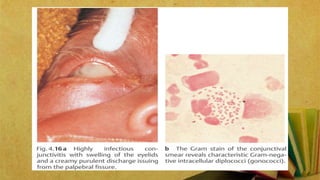
• Neisseria gonorrhea
• have the ability to penetrate intact epithelial
cells, and once inside the cell, they divide
rapidly.
• the most dangerous and virulent infectious
cause
• must be absolutely excluded in every case
• serious consequences
Etiology…
Other bacteria
–Staphylococcus aureus, Streptococcus
pneumoniae, Streptococcus viridans, and
Staphylococcus epidermidis.
–Escherichia coli, Klebsiella pneumoniae,
Serratia marcescens, and Proteus, Enterobacter,
and Pseudomonas species
Clinical
• Difficult to know cause on clinical ground only
• Significant overlap in presentation
• Main findings are erythema, chemosis &
purulent eye discharge
• Therefore Lab studies are Important
Clinical…
Incubation Period
– Chemical conjunctivitis (silver nitrate)- 1st day of life- disappear spontaneously in 2-4 days
– Gonococcal- 3-5 days or later
– Chlamydial- 5-14 days
– Other bacteria- longer
– Herpetic- within 2wks
Clinical…
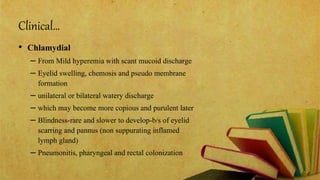
• Chlamydial
– From Mild hyperemia with scant mucoid discharge
– Eyelid swelling, chemosis and pseudo membrane
formation
– unilateral or bilateral watery discharge
– which may become more copious and purulent later
– Blindness-rare and slower to develop-b/s of eyelid
scarring and pannus (non suppurating inflamed
lymph gland)
– Pneumonitis, pharyngeal and rectal colonization
Treatment
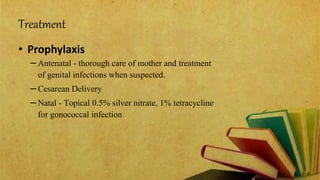
• Prophylaxis
–Antenatal - thorough care of mother and treatment
of genital infections when suspected.
–Cesarean Delivery
–Natal - Topical 0.5% silver nitrate, 1% tetracycline
for gonococcal infection
Treatment…
• Treatment prior to laboratory
results
– Topical erythromycin ointment and
– IV or IM third-generation
cephalosporin (ceftriaxone 30-
50mg/kg/d IV or IM. Max 125mg)
Treatment…
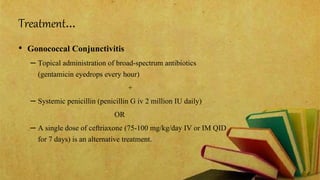
• Gonococcal Conjunctivitis
– Topical administration of broad-spectrum antibiotics
(gentamicin eyedrops every hour)
+
– Systemic penicillin (penicillin G iv 2 million IU daily)
OR
– A single dose of ceftriaxone (75-100 mg/kg/day IV or IM QID
for 7 days) is an alternative treatment.
Treatment…
• Chlamydial Conjunctivitis
– Topical erythromycin eyedrops (5x/day)
+
– Oral erythromycin (50 mg/kg/d divided QID)
Since the efficacy of systemic erythromycin therapy is
approximately 80%, a second course sometimes is
required.
Neonatal Jaundice
(Hyperbilirubinemia)
• Definition: Hyperbilirubinemia refers to an excessive level of accumulated bilirubin in the
blood and is characterized by jaundice, a yellowish discoloration of the skin, sclerae,
mucous membranes and nails.
• Neonatal Jaundice(also called Newborn jaundice) is a condition marked by high levels of
bilirubin in the blood.
NJ - 19
Neonatal Jaundice
• Visible form of bilirubinemia
–Newborn skin >5 mg / dl
• Occurs in 60% of term and 80% of preterm neonates
• However, significant jaundice occurs in 6 % of term babies
• 6-10% require phototherapy/ other therapeutic options.
Clinical assessment of jaundice
(Kramer’s staging)
Area of body Bilirubin levels
mg/dl (*17=umol)
Face Zone-1: 4-6
Upper trunk Zone-2: 6-8
Lower trunk & thighs
Arms and lower legs Zone-3: 8-12
Palms & soles Zone-4 :12-14
Zone-5 :>15
Physiological jaundice
Characteristics
• Appears after 24-72 hours
• Maximum intensity by 3th-5th day in term & 7th day in preterm
• Serum level less than 15 mg / dl
• Clinically not detectable after 14 days
• Disappears without any treatment
Pathological jaundice
• Appears within 24 hours of age
• Increase of bilirubin > 5 mg / dl / day
• Serum bilirubin > 15 mg / dl
• Jaundice persisting after 14 days
• Stool clay / white colored and urine staining clothes yellow
• Direct bilirubin> 2 mg / dl
Causes of jaundice
Appearing within 24 hours of age
• Hemolytic disease of NB : Rh, ABO
• Infections: TORCH, malaria, bacterial
• G6PD deficiency
Causes of jaundice
Appearing between 24-72 hours of life
• Physiological
• Sepsis
• Polycythemia
• Intraventricular hemorrhage
• Increased entero-hepatic circulation
Causes of jaundice
After 72 hours of age
• Sepsis
• Cephalhaematoma
• Neonatal hepatitis
• Extra-hepatic biliary atresia
• Breast milk jaundice
• Metabolic disorders (G6PD).
Risk factors for jaundice
JAUNDICE
• J - jaundice within first 24 hrs of life
• A - a sibling who was jaundiced as neonate
• U - unrecognized hemolysis
• N – non-optimal sucking/nursing
• D - deficiency of G6PD
• I - infection
• C – cephalhematoma /bruising
• E - East Asian/North Indian
Therapeutic Management
• Purposes: reduce level of serum bilirubin and prevent bilirubin toxicity
• Prevention of hyperbilirubinemia: early feeds, adequate hydration
• Reduction of bilirubin levels: phototherapy, exchange transfusion,
• Drugs Use of Phenobarbital promote liver enzymes and protein synthesis.
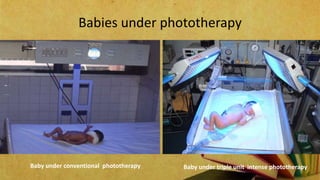
Babies under phototherapy
Baby under conventional phototherapy Baby under triple unit intense phototherapy
Thank You!

ophthalmianeonatrum

  • 1.
    OPHTALMIA NEONATORUM Introduction • Definition-inflammation of the conjunctiva in the first 28 days of life. • Also known as Neonatal Conjunctivitis. • Neonatal conjunctivitis, also known as ophthalmia neonatorum, is a form of conjunctivitis and a type of neonatal infection contracted by newborns during delivery. The baby's eyes are contaminated during passage through the birth canal from a mother infected with either Neisseria gonorrhoeae or Chlamydia trachomatis
  • 2.
    Epidemiology • Before introductionof silver nitrate eye drops in the late 19th century, approximately 10% to 15% of newborns developed bacterial conjunctivitis. • Current incidence varies by the availability of obstetric care. – Annual rates of gonococcal and chlamydial conjunctivitis per 1,000 live births are approximately 0.3 and 5, respectively, in the United States but are ten times greater in parts of Africa & india. – The risk of corneal complications from ophthalmia neonatorum is higher among the poor. – Between 1,000 and 4,000 infants are blinded each year.
  • 3.
    Predisposing Factors • Organismsin vagina shed during delivery • Premature rupture of membranes • Long delivery • Few tears and low levels of IgA • Trauma to epithelial barrier • Prophylaxis (silver nitrate)
  • 4.
    Types… Aseptic – • Chemicalconjunctivitis mostly • Silver nitrate - prophylaxis of infectious conjunctivitis - Crede’s method of prophylaxis • not as common anymore because of the use of erythromycin ointment. Septic- • Bacterial, chlamydial (the most common cause), and viral infections are major causes • Acquired by passage through birth canal
  • 5.
    Etiology • Chemical orMicrobial –Chemical Silver nitrate – surface-active chemical, facilitating agglutinate gonococci and inactivating them. – toxic to the conjunctiva, – potentially causing a sterile neonatal conjunctivitis.
  • 6.
    Etiology… • Microbial Chlamydia trachomatis •the most common infectious cause • 4-10% pregnant women infected • Infants whose mothers have untreated chlamydial infections antepartum have a 30% to 40% chance of developing chlamydial neonatal conjunctivitis postpartum. • reservoir- maternal cervix or urethra
  • 7.
    Etiology… • Neisseria gonorrhea •have the ability to penetrate intact epithelial cells, and once inside the cell, they divide rapidly. • the most dangerous and virulent infectious cause • must be absolutely excluded in every case • serious consequences
  • 8.
    Etiology… Other bacteria –Staphylococcus aureus,Streptococcus pneumoniae, Streptococcus viridans, and Staphylococcus epidermidis. –Escherichia coli, Klebsiella pneumoniae, Serratia marcescens, and Proteus, Enterobacter, and Pseudomonas species
  • 9.
    Clinical • Difficult toknow cause on clinical ground only • Significant overlap in presentation • Main findings are erythema, chemosis & purulent eye discharge • Therefore Lab studies are Important
  • 10.
    Clinical… Incubation Period – Chemicalconjunctivitis (silver nitrate)- 1st day of life- disappear spontaneously in 2-4 days – Gonococcal- 3-5 days or later – Chlamydial- 5-14 days – Other bacteria- longer – Herpetic- within 2wks
  • 12.
    Clinical… • Chlamydial – FromMild hyperemia with scant mucoid discharge – Eyelid swelling, chemosis and pseudo membrane formation – unilateral or bilateral watery discharge – which may become more copious and purulent later – Blindness-rare and slower to develop-b/s of eyelid scarring and pannus (non suppurating inflamed lymph gland) – Pneumonitis, pharyngeal and rectal colonization
  • 13.
    Treatment • Prophylaxis –Antenatal -thorough care of mother and treatment of genital infections when suspected. –Cesarean Delivery –Natal - Topical 0.5% silver nitrate, 1% tetracycline for gonococcal infection
  • 14.
    Treatment… • Treatment priorto laboratory results – Topical erythromycin ointment and – IV or IM third-generation cephalosporin (ceftriaxone 30- 50mg/kg/d IV or IM. Max 125mg)
  • 15.
    Treatment… • Gonococcal Conjunctivitis –Topical administration of broad-spectrum antibiotics (gentamicin eyedrops every hour) + – Systemic penicillin (penicillin G iv 2 million IU daily) OR – A single dose of ceftriaxone (75-100 mg/kg/day IV or IM QID for 7 days) is an alternative treatment.
  • 16.
    Treatment… • Chlamydial Conjunctivitis –Topical erythromycin eyedrops (5x/day) + – Oral erythromycin (50 mg/kg/d divided QID) Since the efficacy of systemic erythromycin therapy is approximately 80%, a second course sometimes is required.
  • 18.
    Neonatal Jaundice (Hyperbilirubinemia) • Definition:Hyperbilirubinemia refers to an excessive level of accumulated bilirubin in the blood and is characterized by jaundice, a yellowish discoloration of the skin, sclerae, mucous membranes and nails. • Neonatal Jaundice(also called Newborn jaundice) is a condition marked by high levels of bilirubin in the blood.
  • 19.
  • 20.
    Neonatal Jaundice • Visibleform of bilirubinemia –Newborn skin >5 mg / dl • Occurs in 60% of term and 80% of preterm neonates • However, significant jaundice occurs in 6 % of term babies • 6-10% require phototherapy/ other therapeutic options.
  • 21.
    Clinical assessment ofjaundice (Kramer’s staging) Area of body Bilirubin levels mg/dl (*17=umol) Face Zone-1: 4-6 Upper trunk Zone-2: 6-8 Lower trunk & thighs Arms and lower legs Zone-3: 8-12 Palms & soles Zone-4 :12-14 Zone-5 :>15
  • 22.
    Physiological jaundice Characteristics • Appearsafter 24-72 hours • Maximum intensity by 3th-5th day in term & 7th day in preterm • Serum level less than 15 mg / dl • Clinically not detectable after 14 days • Disappears without any treatment
  • 23.
    Pathological jaundice • Appearswithin 24 hours of age • Increase of bilirubin > 5 mg / dl / day • Serum bilirubin > 15 mg / dl • Jaundice persisting after 14 days • Stool clay / white colored and urine staining clothes yellow • Direct bilirubin> 2 mg / dl
  • 24.
    Causes of jaundice Appearingwithin 24 hours of age • Hemolytic disease of NB : Rh, ABO • Infections: TORCH, malaria, bacterial • G6PD deficiency
  • 25.
    Causes of jaundice Appearingbetween 24-72 hours of life • Physiological • Sepsis • Polycythemia • Intraventricular hemorrhage • Increased entero-hepatic circulation
  • 26.
    Causes of jaundice After72 hours of age • Sepsis • Cephalhaematoma • Neonatal hepatitis • Extra-hepatic biliary atresia • Breast milk jaundice • Metabolic disorders (G6PD).
  • 27.
    Risk factors forjaundice JAUNDICE • J - jaundice within first 24 hrs of life • A - a sibling who was jaundiced as neonate • U - unrecognized hemolysis • N – non-optimal sucking/nursing • D - deficiency of G6PD • I - infection • C – cephalhematoma /bruising • E - East Asian/North Indian
  • 28.
    Therapeutic Management • Purposes:reduce level of serum bilirubin and prevent bilirubin toxicity • Prevention of hyperbilirubinemia: early feeds, adequate hydration • Reduction of bilirubin levels: phototherapy, exchange transfusion, • Drugs Use of Phenobarbital promote liver enzymes and protein synthesis.
  • 29.
    Babies under phototherapy Babyunder conventional phototherapy Baby under triple unit intense phototherapy
  • 30.