INSTITUTE - UIE
Departmentof Engineering Foundations
Bachelor of Engineering (Computer Science & Engineering)
Subject Name: Logical Thinking & Problem Solving
Code:25CSH-107
Academic Session 2025-26
ODD Semester Jul-Dec 2025
Unit No. 1 Chapter No. 2 Lecture No.8
Topic : Working with Operators
Faculty Name-Dr. Sheenam
E_Code - E6717 Designation-Assistant Professor
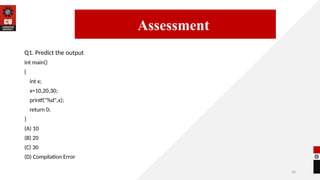
2.
2
Logical Thinking
& Problem
Solving
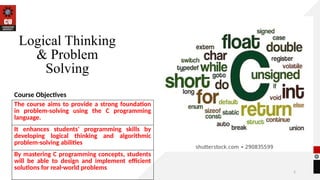
CourseObjectives
The course aims to provide a strong foundation
in problem-solving using the C programming
language.
It enhances students' programming skills by
developing logical thinking and algorithmic
problem-solving abilities
By mastering C programming concepts, students
will be able to design and implement efficient
solutions for real-world problems
3.
3
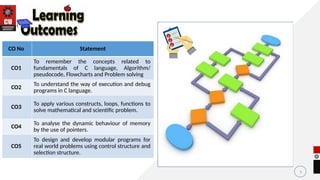
Course Outcomes
CO NoStatement
CO1
To remember the concepts related to
fundamentals of C language, Algorithm/
pseudocode, Flowcharts and Problem solving
CO2
To understand the way of execution and debug
programs in C language.
CO3
To apply various constructs, loops, functions to
solve mathematical and scientific problem.
CO4
To analyse the dynamic behaviour of memory
by the use of pointers.
CO5
To design and develop modular programs for
real world problems using control structure and
selection structure.
4.
4
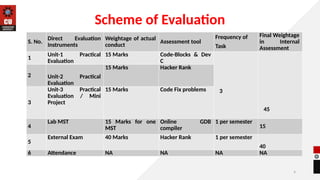
Scheme of Evaluation
S.No.
Direct Evaluation
Instruments
Weightage of actual
conduct
Assessment tool
Frequency of
Task
Final Weightage
in Internal
Assessment
1
Unit-1 Practical
Evaluation
15 Marks Code-Blocks & Dev
C
3
45
2 Unit-2 Practical
Evaluation
15 Marks Hacker Rank
3
Unit-3 Practical
Evaluation / Mini
Project
15 Marks Code Fix problems
4
Lab MST 15 Marks for one
MST
Online GDB
compiler
1 per semester
15
5
External Exam 40 Marks Hacker Rank 1 per semester
40
6 Attendance NA NA NA NA
6
• An operatoris a symbol that tells the compiler to perform certain mathematical
or logical manipulations.
• Operators are used in program to manipulate data and variables. The data items
that operators act upon are called operands.
• Some operators require two operands, while others act upon only one operand.
The operators are classified into unary, binary and ternary depending on whether
they operate on one, two or three operands respectively.
14/09/2025
Operators
7.
7
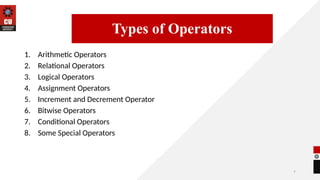
1. Arithmetic Operators
2.Relational Operators
3. Logical Operators
4. Assignment Operators
5. Increment and Decrement Operator
6. Bitwise Operators
7. Conditional Operators
8. Some Special Operators
14/09/2025
Types of Operators
8.
8
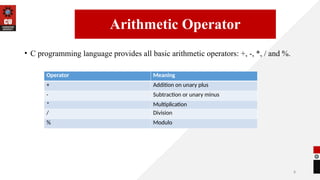
• C programminglanguage provides all basic arithmetic operators: +, -, *, / and %.
14/09/2025
Arithmetic Operator
Operator Meaning
+ Addition on unary plus
- Subtraction or unary minus
* Multiplication
/ Division
% Modulo
9.
9
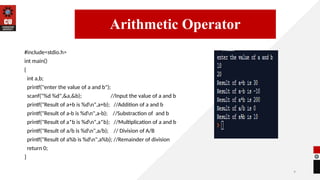
#include<stdio.h>
int main()
{
int a,b;
printf("enterthe value of a and b");
scanf("%d %d",&a,&b); //Input the value of a and b
printf("Result of a+b is %dn",a+b); //Addition of a and b
printf("Result of a-b is %dn",a-b); //Substraction of and b
printf("Result of a*b is %dn",a*b); //Multiplication of a and b
printf("Result of a/b is %dn",a/b); // Division of A/B
printf("Result of a%b is %dn",a%b); //Remainder of division
return 0;
}
14/09/2025
Arithmetic Operator
10.
10
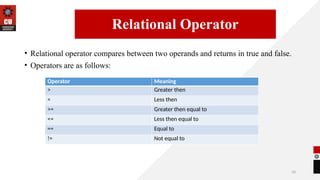
• Relational operatorcompares between two operands and returns in true and false.
• Operators are as follows:
14/09/2025
Relational Operator
Operator Meaning
> Greater then
< Less then
>= Greater then equal to
<= Less then equal to
== Equal to
!= Not equal to
11.
11
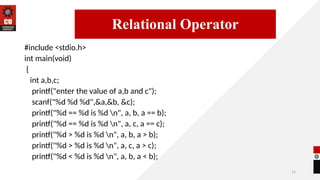
#include <stdio.h>
int main(void)
{
inta,b,c;
printf("enter the value of a,b and c");
scanf("%d %d %d",&a,&b, &c);
printf("%d == %d is %d n", a, b, a == b);
printf("%d == %d is %d n", a, c, a == c);
printf("%d > %d is %d n", a, b, a > b);
printf("%d > %d is %d n", a, c, a > c);
printf("%d < %d is %d n", a, b, a < b);
14/09/2025
Relational Operator
12.
12
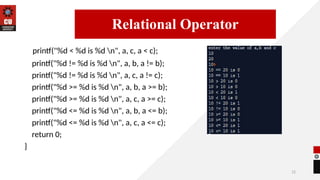
printf("%d < %dis %d n", a, c, a < c);
printf("%d != %d is %d n", a, b, a != b);
printf("%d != %d is %d n", a, c, a != c);
printf("%d >= %d is %d n", a, b, a >= b);
printf("%d >= %d is %d n", a, c, a >= c);
printf("%d <= %d is %d n", a, b, a <= b);
printf("%d <= %d is %d n", a, c, a <= c);
return 0;
}
14/09/2025
Relational Operator
13.
13
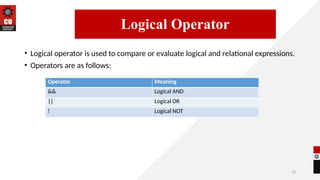
• Logical operatoris used to compare or evaluate logical and relational expressions.
• Operators are as follows:
14/09/2025
Logical Operator
Operator Meaning
&& Logical AND
|| Logical OR
! Logical NOT
14.
14
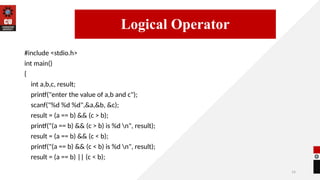
#include <stdio.h>
int main()
{
inta,b,c, result;
printf("enter the value of a,b and c");
scanf("%d %d %d",&a,&b, &c);
result = (a == b) && (c > b);
printf("(a == b) && (c > b) is %d n", result);
result = (a == b) && (c < b);
printf("(a == b) && (c < b) is %d n", result);
result = (a == b) || (c < b);
14/09/2025
Logical Operator
15.
15
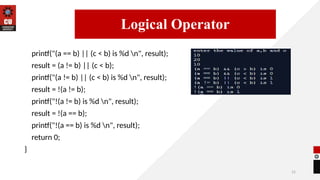
printf("(a == b)|| (c < b) is %d n", result);
result = (a != b) || (c < b);
printf("(a != b) || (c < b) is %d n", result);
result = !(a != b);
printf("!(a != b) is %d n", result);
result = !(a == b);
printf("!(a == b) is %d n", result);
return 0;
}
14/09/2025
Logical Operator
16.
16
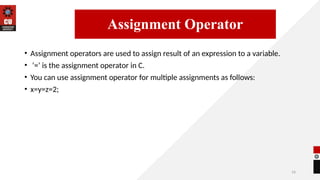
• Assignment operatorsare used to assign result of an expression to a variable.
• ‘=’ is the assignment operator in C.
• You can use assignment operator for multiple assignments as follows:
• x=y=z=2;
14/09/2025
Assignment Operator
17.
17
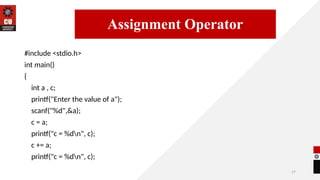
#include <stdio.h>
int main()
{
inta , c;
printf("Enter the value of a");
scanf("%d",&a);
c = a;
printf("c = %dn", c);
c += a;
printf("c = %dn", c);
14/09/2025
Assignment Operator
18.
18
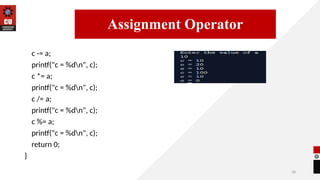
c -= a;
printf("c= %dn", c);
c *= a;
printf("c = %dn", c);
c /= a;
printf("c = %dn", c);
c %= a;
printf("c = %dn", c);
return 0;
}
14/09/2025
Assignment Operator
19.
19
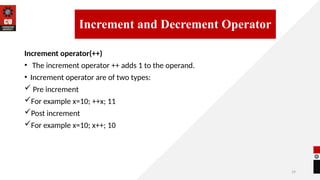
Increment operator(++)
• Theincrement operator ++ adds 1 to the operand.
• Increment operator are of two types:
Pre increment
For example x=10; ++x; 11
Post increment
For example x=10; x++; 10
14/09/2025
Increment and Decrement Operator
20.
20
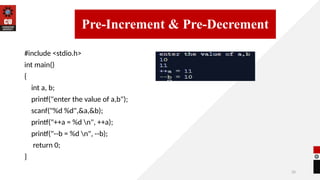
#include <stdio.h>
int main()
{
inta, b;
printf("enter the value of a,b");
scanf("%d %d",&a,&b);
printf("++a = %d n", ++a);
printf("--b = %d n", --b);
return 0;
}
14/09/2025
Pre-Increment & Pre-Decrement
21.
21
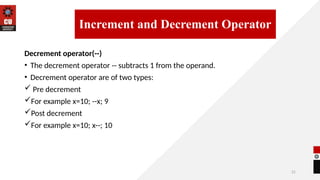
Decrement operator(--)
• Thedecrement operator -- subtracts 1 from the operand.
• Decrement operator are of two types:
Pre decrement
For example x=10; --x; 9
Post decrement
For example x=10; x--; 10
14/09/2025
Increment and Decrement Operator
22.
22
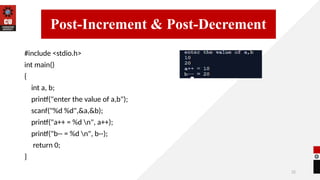
#include <stdio.h>
int main()
{
inta, b;
printf("enter the value of a,b");
scanf("%d %d",&a,&b);
printf("a++ = %d n", a++);
printf("b-- = %d n", b--);
return 0;
}
14/09/2025
Post-Increment & Post-Decrement
23.
23
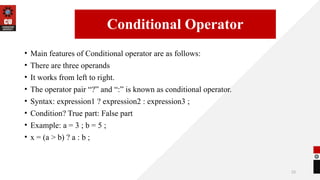
• Main featuresof Conditional operator are as follows:
• There are three operands
• It works from left to right.
• The operator pair “?” and “:” is known as conditional operator.
• Syntax: expression1 ? expression2 : expression3 ;
• Condition? True part: False part
• Example: a = 3 ; b = 5 ;
• x = (a > b) ? a : b ;
14/09/2025
Conditional Operator
24.
24
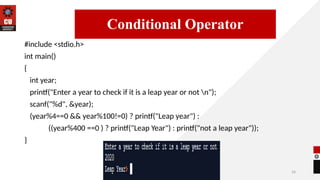
#include <stdio.h>
int main()
{
intyear;
printf("Enter a year to check if it is a leap year or not n");
scanf("%d", &year);
(year%4==0 && year%100!=0) ? printf("Leap year") :
((year%400 ==0 ) ? printf("Leap Year") : printf("not a leap year"));
}
14/09/2025
Conditional Operator
25.
25
Use conditionaloperator to find greatest among three numbers
14/09/2025
Conditional Operator
26.
26
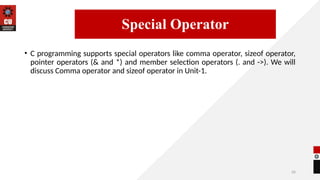
• C programmingsupports special operators like comma operator, sizeof operator,
pointer operators (& and *) and member selection operators (. and ->). We will
discuss Comma operator and sizeof operator in Unit-1.
14/09/2025
Special Operator
27.
27
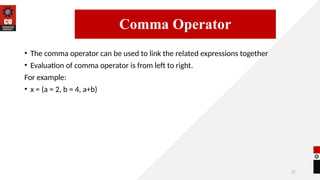
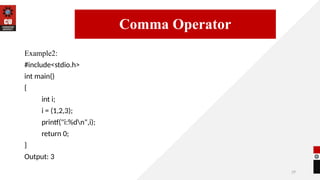
• The commaoperator can be used to link the related expressions together
• Evaluation of comma operator is from left to right.
For example:
• x = (a = 2, b = 4, a+b)
14/09/2025
Comma Operator
30
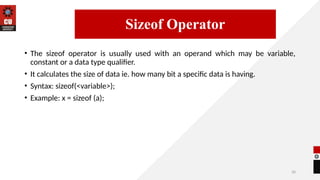
• The sizeofoperator is usually used with an operand which may be variable,
constant or a data type qualifier.
• It calculates the size of data ie. how many bit a specific data is having.
• Syntax: sizeof(<variable>);
• Example: x = sizeof (a);
14/09/2025
Sizeof Operator
31.
31
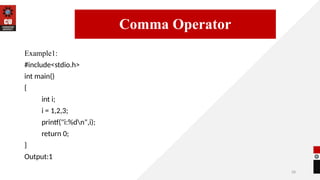
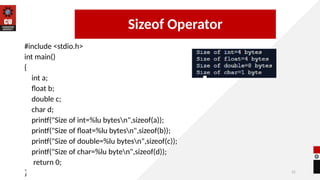
#include <stdio.h>
int main()
{
inta;
float b;
double c;
char d;
printf("Size of int=%lu bytesn",sizeof(a));
printf("Size of float=%lu bytesn",sizeof(b));
printf("Size of double=%lu bytesn",sizeof(c));
printf("Size of char=%lu byten",sizeof(d));
return 0;
}
14/09/2025
Sizeof Operator
32.
Summary
Important points toremember:
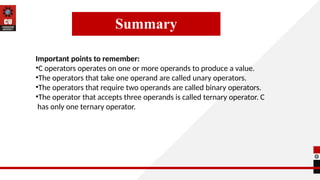
•C operators operates on one or more operands to produce a value.
•The operators that take one operand are called unary operators.
•The operators that require two operands are called binary operators.
•The operator that accepts three operands is called ternary operator. C
has only one ternary operator.
33.
33
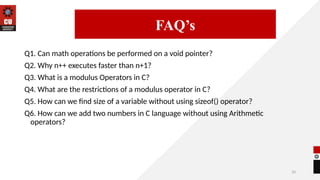
Q1. Can mathoperations be performed on a void pointer?
Q2. Why n++ executes faster than n+1?
Q3. What is a modulus Operators in C?
Q4. What are the restrictions of a modulus operator in C?
Q5. How can we find size of a variable without using sizeof() operator?
Q6. How can we add two numbers in C language without using Arithmetic
operators?
14/09/2025
FAQ’s
35
Q2. [Postfix] operatorhas the highest precedence.
Q3. What will be the output of the C program?
#include<stdio.h>
int main()
{
int x = 2;
(x & 1) ? printf("true") : printf("false");
return 0;
}
A. Compilation error
B. true
C. false
D. Runtime error
14/09/2025
Assessment
36.
36
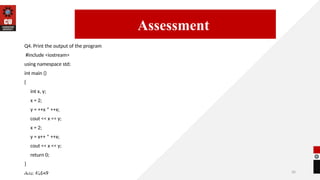
Q4. Print theoutput of the program
#include <iostream>
using namespace std;
int main ()
{
int x, y;
x = 2;
y = ++x * ++x;
cout << x << y;
x = 2;
y = x++ * ++x;
cout << x << y;
return 0;
}
Ans: 41649
14/09/2025
Assessment
37.
37
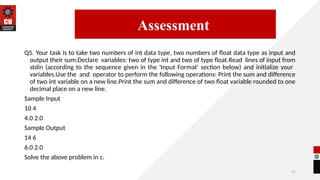
Q5. Your taskis to take two numbers of int data type, two numbers of float data type as input and
output their sum:Declare variables: two of type int and two of type float.Read lines of input from
stdin (according to the sequence given in the 'Input Format' section below) and initialize your
variables.Use the and operator to perform the following operations: Print the sum and difference
of two int variable on a new line.Print the sum and difference of two float variable rounded to one
decimal place on a new line.
Sample Input
10 4
4.0 2.0
Sample Output
14 6
6.0 2.0
Solve the above problem in c.
14/09/2025
Assessment
38.
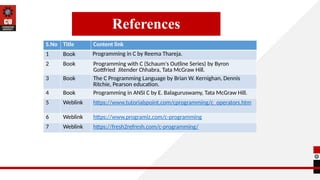
References
S.No Title Contentlink
1 Book Programming in C by Reema Thareja.
2 Book Programming with C (Schaum's Outline Series) by Byron
Gottfried Jitender Chhabra, Tata McGraw Hill.
3 Book The C Programming Language by Brian W. Kernighan, Dennis
Ritchie, Pearson education.
4 Book Programming in ANSI C by E. Balaguruswamy, Tata McGraw Hill.
5 Weblink https://www.tutorialspoint.com/cprogramming/c_operators.htm
6 Weblink https://www.programiz.com/c-programming
7 Weblink https://fresh2refresh.com/c-programming/
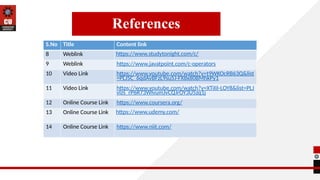
39.
References
S.No Title Contentlink
8 Weblink https://www.studytonight.com/c/
9 Weblink https://www.javatpoint.com/c-operators
10 Video Link https://www.youtube.com/watch?v=t9WKOcRB63Q&list
=PLJ5C_6qdAvBFzL9su5J-FX8x80BMhkPy1
11 Video Link https://www.youtube.com/watch?v=XTiIiI-LOY8&list=PLJ
vIzs_rP6R73WlvumJvCQJrOY3U5zq1j
12 Online Course Link https://www.coursera.org/
13 Online Course Link https://www.udemy.com/
14 Online Course Link https://www.niit.com/
#5 Computer in the diagram is 3rd generation computer. The period of third generation was from 1965-1971. The computers of third generation used Integrated Circuits (ICs) in place of transistors. A single IC has many transistors, resistors, and capacitors along with the associated circuitry. The main features of third generation are −
IC used
More reliable in comparison to previous two generations
Smaller size
Generated less heat
Faster
Lesser maintenance
Costly
AC required
Consumed lesser electricity
Supported high-level language
![35
Q2. [Postfix] operator has the highest precedence.
Q3. What will be the output of the C program?
#include<stdio.h>
int main()
{
int x = 2;
(x & 1) ? printf("true") : printf("false");
return 0;
}
A. Compilation error
B. true
C. false
D. Runtime error
14/09/2025
Assessment](https://image.slidesharecdn.com/7operators-250914164316-19c65e71/85/7-Operators-in-c-programming-language-pptx-35-320.jpg)




![谷歌留痕技术教程[ 𝙩𝙤𝙥 𝟮𝟯𝟯. 𝙘 𝙤𝙢 ]](https://cdn.slidesharecdn.com/ss_thumbnails/top233-260130173900-2eb784f9-thumbnail.jpg?width=640&height=640&fit=bounds)


