Dept. of MBA, Sanjivani COE, Kopargaon
OPERATIONS MANAGEMENT
Master Production Scheduling
Presented By:
Dr. Sanjit Singh
Sanjivani College of Engineering, Kopargaon
Department of MBA
Dept. of MBA, Sanjivani COE, Kopargaon
Planning and Control
 Planning and control – A set of tactical and
execution-level business activities that
includes master scheduling, material
requirements planning, and some form of
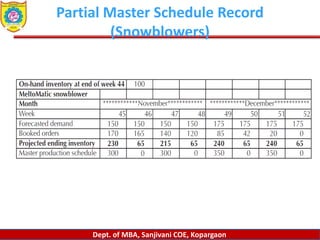
production activity control and vendor order
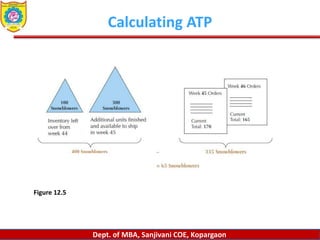
management.
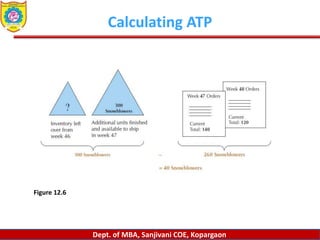
Dept. of MBA, Sanjivani COE, Kopargaon
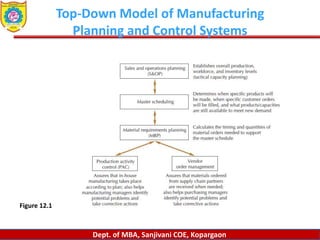
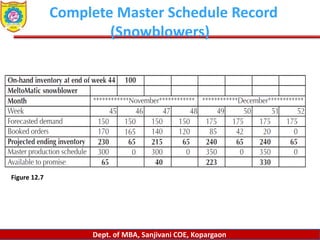
Top-Down Model of Manufacturing
Planning and Control Systems
Figure 12.1
Dept. of MBA, Sanjivani COE, Kopargaon
Master Scheduling
 Master Scheduling – A detailed planning process that
tracks production output and matches this output to
actual customer orders.
 Controls the timing and quantity of production for
products or product families.
 Serves as the primary interface point for actual customer
orders.
 Coordinates forecasted demand and actual orders with
production activity.
 Serves as a tool for agreement between marketing and
operations (but at a different level than S&OP).
Dept. of MBA, Sanjivani COE, Kopargaon
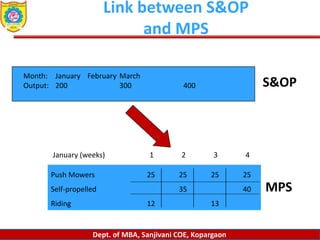
Link between S&OP
and MPS
Month: January February March
Output: 200 300 400
Push Mowers 25 25 25 25
Self-propelled 35 40
Riding 12 13
January (weeks) 1 2 3 4
S&OP
MPS
Dept. of MBA, Sanjivani COE, Kopargaon
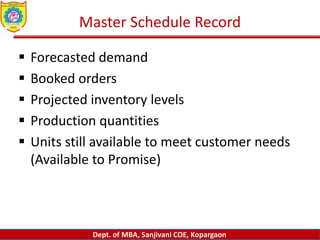
Master Schedule Record
 Forecasted demand
 Booked orders
 Projected inventory levels
 Production quantities
 Units still available to meet customer needs
(Available to Promise)
Dept. of MBA, Sanjivani COE, Kopargaon
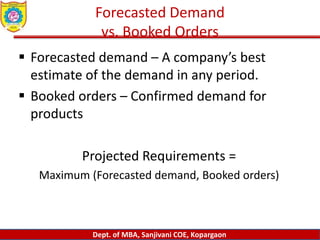
Forecasted Demand
vs. Booked Orders
 Forecasted demand – A company’s best
estimate of the demand in any period.
 Booked orders – Confirmed demand for
products
Projected Requirements =
Maximum (Forecasted demand, Booked orders)
Dept. of MBA, Sanjivani COE, Kopargaon
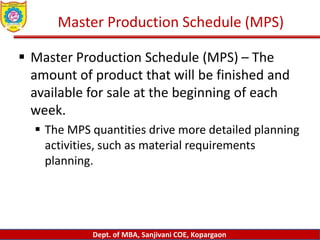
Master Production Schedule (MPS)
 Master Production Schedule (MPS) – The
amount of product that will be finished and
available for sale at the beginning of each
week.
 The MPS quantities drive more detailed planning
activities, such as material requirements
planning.
Dept. of MBA, Sanjivani COE, Kopargaon
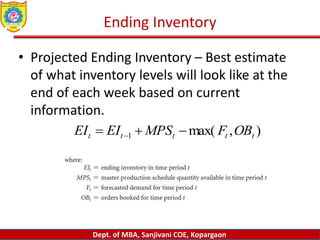
Ending Inventory
• Projected Ending Inventory – Best estimate
of what inventory levels will look like at the
end of each week based on current
information.
)
,
max(
1 t
t
t
t
t OB
F
MPS
EI
EI 

 
Dept. of MBA, Sanjivani COE, Kopargaon
Available to Promise (ATP)
 Available to Promise – A field in the master schedule
record that indicates the number of units that are
available for sale each week, given those that have
already been promised to customers.
Dept. of MBA, Sanjivani COE, Kopargaon
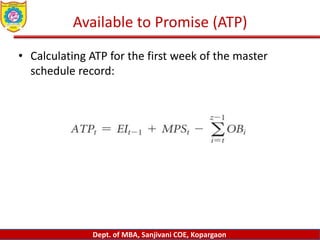
Available to Promise (ATP)
• Calculating ATP for the first week of the master
schedule record:
Dept. of MBA, Sanjivani COE, Kopargaon
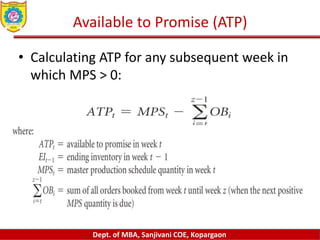
Available to Promise (ATP)
• Calculating ATP for any subsequent week in
which MPS > 0:
Dept. of MBA, Sanjivani COE, Kopargaon
Partial Master Schedule Record
(Snowblowers)
Dept. of MBA, Sanjivani COE, Kopargaon
Calculating ATP
Figure 12.5
Dept. of MBA, Sanjivani COE, Kopargaon
Calculating ATP
Figure 12.6
Dept. of MBA, Sanjivani COE, Kopargaon
Complete Master Schedule Record
(Snowblowers)
Figure 12.7
Dept. of MBA, Sanjivani COE, Kopargaon
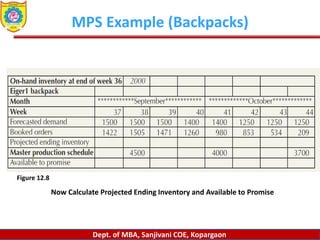
MPS Example (Backpacks)
Now Calculate Projected Ending Inventory and Available to Promise
Figure 12.8
Dept. of MBA, Sanjivani COE, Kopargaon
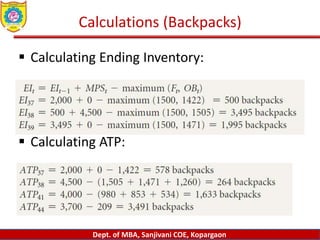
Calculations (Backpacks)
 Calculating Ending Inventory:
 Calculating ATP:
Dept. of MBA, Sanjivani COE, Kopargaon
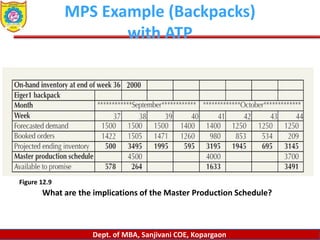
MPS Example (Backpacks)
with ATP
What are the implications of the Master Production Schedule?
Figure 12.9

OPERATIONS MANAGEMENT - Master Production Scheduling

  • 1.
    Dept. of MBA,Sanjivani COE, Kopargaon OPERATIONS MANAGEMENT Master Production Scheduling Presented By: Dr. Sanjit Singh Sanjivani College of Engineering, Kopargaon Department of MBA
  • 2.
    Dept. of MBA,Sanjivani COE, Kopargaon Planning and Control  Planning and control – A set of tactical and execution-level business activities that includes master scheduling, material requirements planning, and some form of production activity control and vendor order management.
  • 3.
    Dept. of MBA,Sanjivani COE, Kopargaon Top-Down Model of Manufacturing Planning and Control Systems Figure 12.1
  • 4.
    Dept. of MBA,Sanjivani COE, Kopargaon Master Scheduling  Master Scheduling – A detailed planning process that tracks production output and matches this output to actual customer orders.  Controls the timing and quantity of production for products or product families.  Serves as the primary interface point for actual customer orders.  Coordinates forecasted demand and actual orders with production activity.  Serves as a tool for agreement between marketing and operations (but at a different level than S&OP).
  • 5.
    Dept. of MBA,Sanjivani COE, Kopargaon Link between S&OP and MPS Month: January February March Output: 200 300 400 Push Mowers 25 25 25 25 Self-propelled 35 40 Riding 12 13 January (weeks) 1 2 3 4 S&OP MPS
  • 6.
    Dept. of MBA,Sanjivani COE, Kopargaon Master Schedule Record  Forecasted demand  Booked orders  Projected inventory levels  Production quantities  Units still available to meet customer needs (Available to Promise)
  • 7.
    Dept. of MBA,Sanjivani COE, Kopargaon Forecasted Demand vs. Booked Orders  Forecasted demand – A company’s best estimate of the demand in any period.  Booked orders – Confirmed demand for products Projected Requirements = Maximum (Forecasted demand, Booked orders)
  • 8.
    Dept. of MBA,Sanjivani COE, Kopargaon Master Production Schedule (MPS)  Master Production Schedule (MPS) – The amount of product that will be finished and available for sale at the beginning of each week.  The MPS quantities drive more detailed planning activities, such as material requirements planning.
  • 9.
    Dept. of MBA,Sanjivani COE, Kopargaon Ending Inventory • Projected Ending Inventory – Best estimate of what inventory levels will look like at the end of each week based on current information. ) , max( 1 t t t t t OB F MPS EI EI    
  • 10.
    Dept. of MBA,Sanjivani COE, Kopargaon Available to Promise (ATP)  Available to Promise – A field in the master schedule record that indicates the number of units that are available for sale each week, given those that have already been promised to customers.
  • 11.
    Dept. of MBA,Sanjivani COE, Kopargaon Available to Promise (ATP) • Calculating ATP for the first week of the master schedule record:
  • 12.
    Dept. of MBA,Sanjivani COE, Kopargaon Available to Promise (ATP) • Calculating ATP for any subsequent week in which MPS > 0:
  • 13.
    Dept. of MBA,Sanjivani COE, Kopargaon Partial Master Schedule Record (Snowblowers)
  • 14.
    Dept. of MBA,Sanjivani COE, Kopargaon Calculating ATP Figure 12.5
  • 15.
    Dept. of MBA,Sanjivani COE, Kopargaon Calculating ATP Figure 12.6
  • 16.
    Dept. of MBA,Sanjivani COE, Kopargaon Complete Master Schedule Record (Snowblowers) Figure 12.7
  • 17.
    Dept. of MBA,Sanjivani COE, Kopargaon MPS Example (Backpacks) Now Calculate Projected Ending Inventory and Available to Promise Figure 12.8
  • 18.
    Dept. of MBA,Sanjivani COE, Kopargaon Calculations (Backpacks)  Calculating Ending Inventory:  Calculating ATP:
  • 19.
    Dept. of MBA,Sanjivani COE, Kopargaon MPS Example (Backpacks) with ATP What are the implications of the Master Production Schedule? Figure 12.9