Dept. of MBA, Sanjivani COE, Kopargaon
204 OPERATIONS MANAGEMENT
Unit-II - Operations Processes
Presented By:
Dr. Sanjit Singh
Sanjivani College of Engineering, Kopargaon
Department of MBA
Dept. of MBA, Sanjivani COE, Kopargaon
Process Characteristics in Operations
Dept. of MBA, Sanjivani COE, Kopargaon
Factors Influencing Process Choices
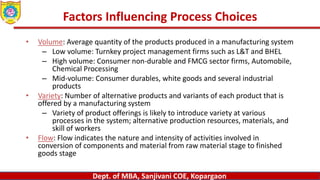
• Volume: Average quantity of the products produced in a manufacturing system
– Low volume: Turnkey project management firms such as L&T and BHEL
– High volume: Consumer non-durable and FMCG sector firms, Automobile,
Chemical Processing
– Mid-volume: Consumer durables, white goods and several industrial
products
• Variety: Number of alternative products and variants of each product that is
offered by a manufacturing system
– Variety of product offerings is likely to introduce variety at various
processes in the system; alternative production resources, materials, and
skill of workers
• Flow: Flow indicates the nature and intensity of activities involved in
conversion of components and material from raw material stage to finished
goods stage
Dept. of MBA, Sanjivani COE, Kopargaon
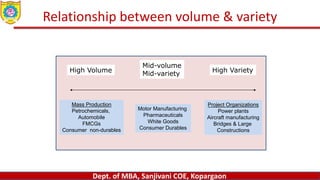
Relationship between volume & variety
High Volume High Variety
Mass Production
Petrochemicals,
Automobile
FMCGs
Consumer non-durables
Project Organizations
Power plants
Aircraft manufacturing
Bridges & Large
Constructions
Motor Manufacturing
Pharmaceuticals
White Goods
Consumer Durables
Mid-volume
Mid-variety
Dept. of MBA, Sanjivani COE, Kopargaon
Processes & Operations Systems
Available Alternatives
• Process characteristics are largely determined by
the flow of products in the operating system
• Three types of flows occur in operating systems:
– Continuous
– Intermittent
– Jumbled
Dept. of MBA, Sanjivani COE, Kopargaon
Continuous Flow System
• Characterized by a streamlined flow of products in the operating system
• Conversion process begins with input of raw material at one end, progresses
through the system in an orderly fashion to finally become finished goods at
the final stage
• Production process is sequential and the required resources are organized in
stages
– Examples:
• several chemical processing industries such as manufacture of
petrochemicals, steel, pharmaceutical, cement and glass
• In a discrete manufacturing industry high volume production of very
few varieties (such as electrical bulbs or spark plugs)
Dept. of MBA, Sanjivani COE, Kopargaon
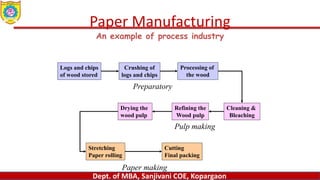
Paper Manufacturing
An example of process industry
Logs and chips
of wood stored
Crushing of
logs and chips
Processing of
the wood
Cleaning &
Bleaching
Refining the
Wood pulp
Drying the
wood pulp
Stretching
Paper rolling
Cutting
Final packing
Paper making
Pulp making
Preparatory
Dept. of MBA, Sanjivani COE, Kopargaon
Process Industry
Distinctive features
• There should be balance of capacity between all the stages in the manufacturing
process to maintain an even flow of the material from the raw material stage to
finished goods
• Productivity of the system is directly related to the flow rate (or throughput) of the
product
• Requires huge capital investments, as incremental addition at a later stage not
possible. High productivity implies lower cost of production and vice versa.
• Need to make continuous process improvements and capacity de-bottlenecking to
maximize the flow rate in the system
• Failure of any intermediate stage in the system will have an adverse effect on the
cost
Dept. of MBA, Sanjivani COE, Kopargaon
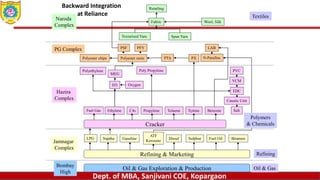
Oil & Gas Exploration & Production
Refining & Marketing
LPG Naptha Gasoline
ATF
Kerosene
Diesel Sulphur Fuel Oil Bitumen
Cracker
Fuel Gas Ethylene C4s Propylene Toluene Xylene Benzene Salt
Caustic Unit
EDC
VCM
PVC
Poly Propylene
MEG
EO Oxygen
Polyethylene
LAB
N-Parafins
PFY
PSF
Polyester resin
Polyester chips
Texturised Yarn Spun Yarn
Fabric Wool, Silk
Retailing
Textiles
Polymers
& Chemicals
Refining
Oil & Gas
PG Complex
PTA PX
Hazira
Complex
Jamnagar
Complex
Bombay
High
Naroda
Complex
Backward Integration
at Reliance
Dept. of MBA, Sanjivani COE, Kopargaon
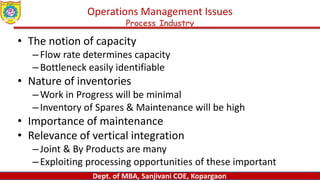
Operations Management Issues
Process Industry
• The notion of capacity
–Flow rate determines capacity
–Bottleneck easily identifiable
• Nature of inventories
–Work in Progress will be minimal
–Inventory of Spares & Maintenance will be high
• Importance of maintenance
• Relevance of vertical integration
–Joint & By Products are many
–Exploiting processing opportunities of these important
Dept. of MBA, Sanjivani COE, Kopargaon
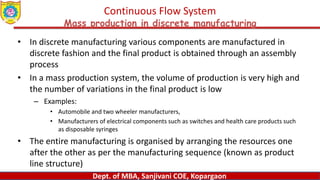
Continuous Flow System
Mass production in discrete manufacturing
• In discrete manufacturing various components are manufactured in
discrete fashion and the final product is obtained through an assembly
process
• In a mass production system, the volume of production is very high and
the number of variations in the final product is low
– Examples:
• Automobile and two wheeler manufacturers,
• Manufacturers of electrical components such as switches and health care products such
as disposable syringes
• The entire manufacturing is organised by arranging the resources one
after the other as per the manufacturing sequence (known as product
line structure)
Dept. of MBA, Sanjivani COE, Kopargaon
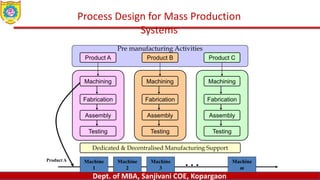
Process Design for Mass Production
Systems
Pre manufacturing Activities
Machining
Fabrication
Assembly
Testing
Dedicated & Decentralised Manufacturing Support
Machining
Fabrication
Assembly
Testing
Machining
Fabrication
Assembly
Testing
Product A Product B Product C
Machine
1
Machine
2
Machine
3
Machine
m
. . .
Product A
Dept. of MBA, Sanjivani COE, Kopargaon
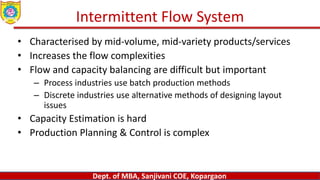
Intermittent Flow System
• Characterised by mid-volume, mid-variety products/services
• Increases the flow complexities
• Flow and capacity balancing are difficult but important
– Process industries use batch production methods
– Discrete industries use alternative methods of designing layout
issues
• Capacity Estimation is hard
• Production Planning & Control is complex
Dept. of MBA, Sanjivani COE, Kopargaon
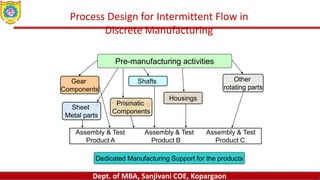
Pre-manufacturing activities
Gear
Components
Prismatic
Components
Other
rotating parts
Sheet
Metal parts
Housings
Shafts
Assembly & Test Assembly & Test Assembly & Test
Product A Product B Product C
Dedicated Manufacturing Support for the products
Process Design for Intermittent Flow in
Discrete Manufacturing
Dept. of MBA, Sanjivani COE, Kopargaon
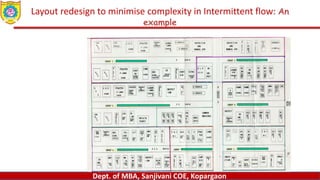
Layout redesign to minimise complexity in Intermittent flow: An
example
Dept. of MBA, Sanjivani COE, Kopargaon
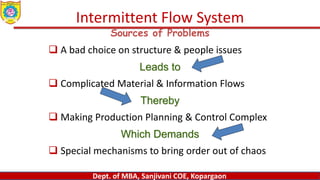
Intermittent Flow System
Sources of Problems
 A bad choice on structure & people issues
Leads to
 Complicated Material & Information Flows
Thereby
 Making Production Planning & Control Complex
Which Demands
 Special mechanisms to bring order out of chaos
Dept. of MBA, Sanjivani COE, Kopargaon
Special Mechanisms
To bring order out of Chaos
• Lot of paper work
• Enormous supervision/Co-ordination
• Progress Chasing/Expedition
All these finally result in
• Long Lead Times/Poor Delivery Reliability
• Excess and Unwanted Inventory
• High Overhead/High Cost
Dept. of MBA, Sanjivani COE, Kopargaon
Jumbled Flow System
• Occurs on account of non-standard and complex flow patterns
characteristic in certain systems
– Highly customised items
– customer orders for one or a few
• Examples
– turnkey project executor such as BHEL or L&T
– customised manufacturing systems such as PCB fabricators, sheet
metal fabricators, tool room operators and printing and publishing
• Operational complexity arising out of jumbled flow is high
• Discrete manufacturing with Jumbled flow uses a Job Shop structure
Dept. of MBA, Sanjivani COE, Kopargaon
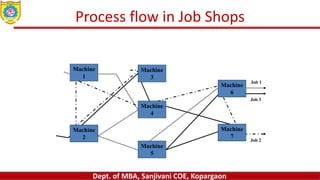
Process flow in Job Shops
Machine
1
Machine
2
Machine
3
Machine
6
Machine
5
Machine
4
Machine
7
Job 1
Job 2
Job 3
Dept. of MBA, Sanjivani COE, Kopargaon
Jumbled Flow System
• Complex issue is capacity management
– Considerable time is lost due to repeated setup of processes
• Due to jumbled flow, crisscrossing of jobs in the system results
in poor visibility.
– Problems are often hidden and build up of work in process
inventory takes place
• Cost accounting and estimation systems are crucial as there is
a constant need to quote for specific customer orders
Dept. of MBA, Sanjivani COE, Kopargaon
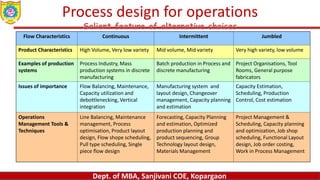
Process design for operations
Salient feature of alternative choices
Flow Characteristics Continuous Intermittent Jumbled
Product Characteristics High Volume, Very low variety Mid volume, Mid variety Very high variety, low volume
Examples of production
systems
Process Industry, Mass
production systems in discrete
manufacturing
Batch production in Process and
discrete manufacturing
Project Organisations, Tool
Rooms, General purpose
fabricators
Issues of importance Flow Balancing, Maintenance,
Capacity utilization and
debottlenecking, Vertical
integration
Manufacturing system and
layout design, Changeover
management, Capacity planning
and estimation
Capacity Estimation,
Scheduling, Production
Control, Cost estimation
Operations
Management Tools &
Techniques
Line Balancing, Maintenance
management, Process
optimisation, Product layout
design, Flow shope scheduling,
Pull type scheduling, Single
piece flow design
Forecasting, Capacity Planning
and estimation, Optimized
production planning and
product sequencing, Group
Technology layout design,
Materials Management
Project Management &
Scheduling, Capacity planning
and optimization, Job shop
scheduling, Functional Layout
design, Job order costing,
Work in Process Management
Dept. of MBA, Sanjivani COE, Kopargaon
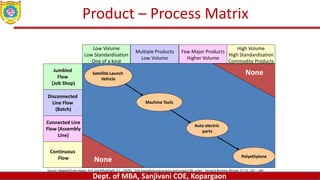
Product – Process Matrix
Low Volume
Low Standardisation
One of a kind
Multiple Products
Low Volume
Few Major Products
Higher Volume
High Volume
High Standardisation
Commodity Products
Continuous
Flow
Connected Line
Flow (Assembly
Line)
Disconnected
Line Flow
(Batch)
Jumbled
Flow
(Job Shop)
Satellite Launch
Vehicle
Machine Tools
Auto electric
parts
Polyethylene
None
None
Source: Adapted from Hayes, R.H. and Wheelright, S.C., (1979), “Link manufacturing process and product life cycles”, Harvard Business Review, 57 (1), 133 – 140.
Dept. of MBA, Sanjivani COE, Kopargaon
Layout Planning
• Layout planning in manufacturing & service organisations
– deals with physical arrangement of various resources that are
available in the system
– with an objective to improve the performance of the operating
system
• Benefits of good layout design
– Jobs in a manufacturing system travel lesser distance
– Customers spend less time in service systems
– Costs & Lead time come down
– Improved quality
Dept. of MBA, Sanjivani COE, Kopargaon
Types of Layout
• Process Layout
– arrangement of resources on the basis of the process characteristics of the resources
available
• Product Layout
– order in which the resources are placed follow exactly the visitation sequence dictated
by a product
• Group Technology (GT) Layout
– seeks to exploit commonality in manufacturing and uses this as the basis for grouping
components and resources
• Fixed Position Layout
– emphasis is not so much on optimum position of resources required for the process,
since the product itself largely dictates this; the focus is on gaining better control of
material flow and reducing delays
Dept. of MBA, Sanjivani COE, Kopargaon
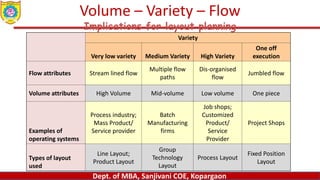
Volume – Variety – Flow
Implications for layout planning
Variety
Very low variety Medium Variety High Variety
One off
execution
Flow attributes Stream lined flow
Multiple flow
paths
Dis-organised
flow
Jumbled flow
Volume attributes High Volume Mid-volume Low volume One piece
Examples of
operating systems
Process industry;
Mass Product/
Service provider
Batch
Manufacturing
firms
Job shops;
Customized
Product/
Service
Provider
Project Shops
Types of layout
used
Line Layout;
Product Layout
Group
Technology
Layout
Process Layout
Fixed Position
Layout
Dept. of MBA, Sanjivani COE, Kopargaon
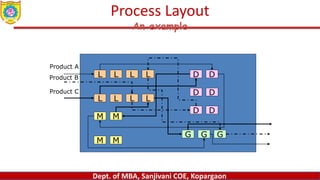
Process Layout
An example
L L L L
M M
M M
D D
D D
D D
G G G
L L L L
Product A
Product C
Product B
Dept. of MBA, Sanjivani COE, Kopargaon
L L
M
D G
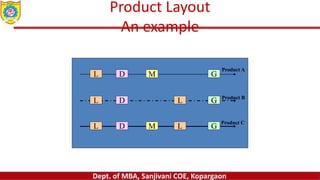
Product Layout
An example
L M
D G
L L
D G
Product C
Product A
Product B
Dept. of MBA, Sanjivani COE, Kopargaon
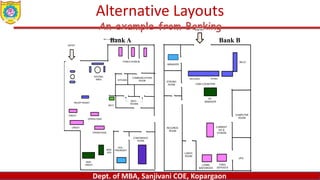
Alternative Layouts
An example from Banking
RECEPTIONIST
FOREX DIVISION
VICE -
PRESIDENT
CONFERENCE
ROOM
REST -
ROOMS
KITCHEN
WAITING
AREA
MGR.
OPS
MGR.
CREDIT
SECY.
ENTRY
LAYOUT - INDUSIND BANK
APPENDIX 3 A
COMMUNICATIONS
ROOM
OPERATIONS
OPERATIONS
CREDIT
CREDIT
ENTRY
MANAGER
CASH COUNTERS
BILLS
STRONG
ROOM
RECORDS
ROOM
DY.
MANAGER
CURRENT
A/C &
OTHERS
LUNCH
ROOM
LOANS
&ADVANCES
FIXED
DEPOSITS
UPS
COMPUTER
ROOM
RECEIVING PAYING
LAYOUT - STATE BANK OF
MYSORE
APPENDIX
3 B
ENTRY
MANAGER
CASH COUNTERS
BILLS
STRONG
ROOM
RECORDS
ROOM
DY.
MANAGER
CURRENT
A/C &
OTHERS
LUNCH
ROOM
LOANS FIXED
UPS
COMPUTER
ROOM
RECEIVING PAYING
LAYOUT - STATE BANK OF
MYSORE
APPENDIX
3 B
Bank A Bank B
Dept. of MBA, Sanjivani COE, Kopargaon
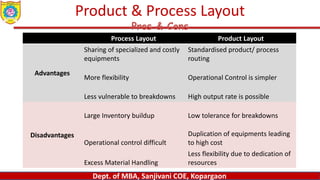
Product & Process Layout
Pros & Cons
Process Layout Product Layout
Advantages
Sharing of specialized and costly
equipments
Standardised product/ process
routing
More flexibility Operational Control is simpler
Less vulnerable to breakdowns High output rate is possible
Disadvantages
Large Inventory buildup Low tolerance for breakdowns
Operational control difficult
Duplication of equipments leading
to high cost
Excess Material Handling
Less flexibility due to dedication of
resources
Dept. of MBA, Sanjivani COE, Kopargaon
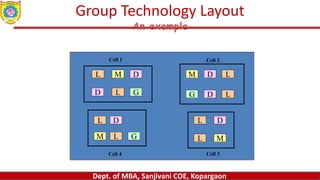
Group Technology Layout
An example
L
L
L
L
M
M
M M
D D
D D
D D
G G
G
L
L
L
L
Cell 1 Cell 2
Cell 3
Cell 4
Dept. of MBA, Sanjivani COE, Kopargaon
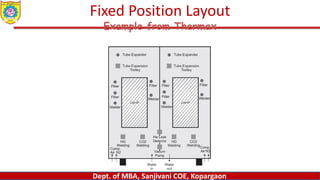
Fixed Position Layout
Example from Thermax

OM_Unit 2.pptx

  • 1.
    Dept. of MBA,Sanjivani COE, Kopargaon 204 OPERATIONS MANAGEMENT Unit-II - Operations Processes Presented By: Dr. Sanjit Singh Sanjivani College of Engineering, Kopargaon Department of MBA
  • 2.
    Dept. of MBA,Sanjivani COE, Kopargaon Process Characteristics in Operations
  • 3.
    Dept. of MBA,Sanjivani COE, Kopargaon Factors Influencing Process Choices • Volume: Average quantity of the products produced in a manufacturing system – Low volume: Turnkey project management firms such as L&T and BHEL – High volume: Consumer non-durable and FMCG sector firms, Automobile, Chemical Processing – Mid-volume: Consumer durables, white goods and several industrial products • Variety: Number of alternative products and variants of each product that is offered by a manufacturing system – Variety of product offerings is likely to introduce variety at various processes in the system; alternative production resources, materials, and skill of workers • Flow: Flow indicates the nature and intensity of activities involved in conversion of components and material from raw material stage to finished goods stage
  • 4.
    Dept. of MBA,Sanjivani COE, Kopargaon Relationship between volume & variety High Volume High Variety Mass Production Petrochemicals, Automobile FMCGs Consumer non-durables Project Organizations Power plants Aircraft manufacturing Bridges & Large Constructions Motor Manufacturing Pharmaceuticals White Goods Consumer Durables Mid-volume Mid-variety
  • 5.
    Dept. of MBA,Sanjivani COE, Kopargaon Processes & Operations Systems Available Alternatives • Process characteristics are largely determined by the flow of products in the operating system • Three types of flows occur in operating systems: – Continuous – Intermittent – Jumbled
  • 6.
    Dept. of MBA,Sanjivani COE, Kopargaon Continuous Flow System • Characterized by a streamlined flow of products in the operating system • Conversion process begins with input of raw material at one end, progresses through the system in an orderly fashion to finally become finished goods at the final stage • Production process is sequential and the required resources are organized in stages – Examples: • several chemical processing industries such as manufacture of petrochemicals, steel, pharmaceutical, cement and glass • In a discrete manufacturing industry high volume production of very few varieties (such as electrical bulbs or spark plugs)
  • 7.
    Dept. of MBA,Sanjivani COE, Kopargaon Paper Manufacturing An example of process industry Logs and chips of wood stored Crushing of logs and chips Processing of the wood Cleaning & Bleaching Refining the Wood pulp Drying the wood pulp Stretching Paper rolling Cutting Final packing Paper making Pulp making Preparatory
  • 8.
    Dept. of MBA,Sanjivani COE, Kopargaon Process Industry Distinctive features • There should be balance of capacity between all the stages in the manufacturing process to maintain an even flow of the material from the raw material stage to finished goods • Productivity of the system is directly related to the flow rate (or throughput) of the product • Requires huge capital investments, as incremental addition at a later stage not possible. High productivity implies lower cost of production and vice versa. • Need to make continuous process improvements and capacity de-bottlenecking to maximize the flow rate in the system • Failure of any intermediate stage in the system will have an adverse effect on the cost
  • 9.
    Dept. of MBA,Sanjivani COE, Kopargaon Oil & Gas Exploration & Production Refining & Marketing LPG Naptha Gasoline ATF Kerosene Diesel Sulphur Fuel Oil Bitumen Cracker Fuel Gas Ethylene C4s Propylene Toluene Xylene Benzene Salt Caustic Unit EDC VCM PVC Poly Propylene MEG EO Oxygen Polyethylene LAB N-Parafins PFY PSF Polyester resin Polyester chips Texturised Yarn Spun Yarn Fabric Wool, Silk Retailing Textiles Polymers & Chemicals Refining Oil & Gas PG Complex PTA PX Hazira Complex Jamnagar Complex Bombay High Naroda Complex Backward Integration at Reliance
  • 10.
    Dept. of MBA,Sanjivani COE, Kopargaon Operations Management Issues Process Industry • The notion of capacity –Flow rate determines capacity –Bottleneck easily identifiable • Nature of inventories –Work in Progress will be minimal –Inventory of Spares & Maintenance will be high • Importance of maintenance • Relevance of vertical integration –Joint & By Products are many –Exploiting processing opportunities of these important
  • 11.
    Dept. of MBA,Sanjivani COE, Kopargaon Continuous Flow System Mass production in discrete manufacturing • In discrete manufacturing various components are manufactured in discrete fashion and the final product is obtained through an assembly process • In a mass production system, the volume of production is very high and the number of variations in the final product is low – Examples: • Automobile and two wheeler manufacturers, • Manufacturers of electrical components such as switches and health care products such as disposable syringes • The entire manufacturing is organised by arranging the resources one after the other as per the manufacturing sequence (known as product line structure)
  • 12.
    Dept. of MBA,Sanjivani COE, Kopargaon Process Design for Mass Production Systems Pre manufacturing Activities Machining Fabrication Assembly Testing Dedicated & Decentralised Manufacturing Support Machining Fabrication Assembly Testing Machining Fabrication Assembly Testing Product A Product B Product C Machine 1 Machine 2 Machine 3 Machine m . . . Product A
  • 13.
    Dept. of MBA,Sanjivani COE, Kopargaon Intermittent Flow System • Characterised by mid-volume, mid-variety products/services • Increases the flow complexities • Flow and capacity balancing are difficult but important – Process industries use batch production methods – Discrete industries use alternative methods of designing layout issues • Capacity Estimation is hard • Production Planning & Control is complex
  • 14.
    Dept. of MBA,Sanjivani COE, Kopargaon Pre-manufacturing activities Gear Components Prismatic Components Other rotating parts Sheet Metal parts Housings Shafts Assembly & Test Assembly & Test Assembly & Test Product A Product B Product C Dedicated Manufacturing Support for the products Process Design for Intermittent Flow in Discrete Manufacturing
  • 15.
    Dept. of MBA,Sanjivani COE, Kopargaon Layout redesign to minimise complexity in Intermittent flow: An example
  • 16.
    Dept. of MBA,Sanjivani COE, Kopargaon Intermittent Flow System Sources of Problems  A bad choice on structure & people issues Leads to  Complicated Material & Information Flows Thereby  Making Production Planning & Control Complex Which Demands  Special mechanisms to bring order out of chaos
  • 17.
    Dept. of MBA,Sanjivani COE, Kopargaon Special Mechanisms To bring order out of Chaos • Lot of paper work • Enormous supervision/Co-ordination • Progress Chasing/Expedition All these finally result in • Long Lead Times/Poor Delivery Reliability • Excess and Unwanted Inventory • High Overhead/High Cost
  • 18.
    Dept. of MBA,Sanjivani COE, Kopargaon Jumbled Flow System • Occurs on account of non-standard and complex flow patterns characteristic in certain systems – Highly customised items – customer orders for one or a few • Examples – turnkey project executor such as BHEL or L&T – customised manufacturing systems such as PCB fabricators, sheet metal fabricators, tool room operators and printing and publishing • Operational complexity arising out of jumbled flow is high • Discrete manufacturing with Jumbled flow uses a Job Shop structure
  • 19.
    Dept. of MBA,Sanjivani COE, Kopargaon Process flow in Job Shops Machine 1 Machine 2 Machine 3 Machine 6 Machine 5 Machine 4 Machine 7 Job 1 Job 2 Job 3
  • 20.
    Dept. of MBA,Sanjivani COE, Kopargaon Jumbled Flow System • Complex issue is capacity management – Considerable time is lost due to repeated setup of processes • Due to jumbled flow, crisscrossing of jobs in the system results in poor visibility. – Problems are often hidden and build up of work in process inventory takes place • Cost accounting and estimation systems are crucial as there is a constant need to quote for specific customer orders
  • 21.
    Dept. of MBA,Sanjivani COE, Kopargaon Process design for operations Salient feature of alternative choices Flow Characteristics Continuous Intermittent Jumbled Product Characteristics High Volume, Very low variety Mid volume, Mid variety Very high variety, low volume Examples of production systems Process Industry, Mass production systems in discrete manufacturing Batch production in Process and discrete manufacturing Project Organisations, Tool Rooms, General purpose fabricators Issues of importance Flow Balancing, Maintenance, Capacity utilization and debottlenecking, Vertical integration Manufacturing system and layout design, Changeover management, Capacity planning and estimation Capacity Estimation, Scheduling, Production Control, Cost estimation Operations Management Tools & Techniques Line Balancing, Maintenance management, Process optimisation, Product layout design, Flow shope scheduling, Pull type scheduling, Single piece flow design Forecasting, Capacity Planning and estimation, Optimized production planning and product sequencing, Group Technology layout design, Materials Management Project Management & Scheduling, Capacity planning and optimization, Job shop scheduling, Functional Layout design, Job order costing, Work in Process Management
  • 22.
    Dept. of MBA,Sanjivani COE, Kopargaon Product – Process Matrix Low Volume Low Standardisation One of a kind Multiple Products Low Volume Few Major Products Higher Volume High Volume High Standardisation Commodity Products Continuous Flow Connected Line Flow (Assembly Line) Disconnected Line Flow (Batch) Jumbled Flow (Job Shop) Satellite Launch Vehicle Machine Tools Auto electric parts Polyethylene None None Source: Adapted from Hayes, R.H. and Wheelright, S.C., (1979), “Link manufacturing process and product life cycles”, Harvard Business Review, 57 (1), 133 – 140.
  • 23.
    Dept. of MBA,Sanjivani COE, Kopargaon Layout Planning • Layout planning in manufacturing & service organisations – deals with physical arrangement of various resources that are available in the system – with an objective to improve the performance of the operating system • Benefits of good layout design – Jobs in a manufacturing system travel lesser distance – Customers spend less time in service systems – Costs & Lead time come down – Improved quality
  • 24.
    Dept. of MBA,Sanjivani COE, Kopargaon Types of Layout • Process Layout – arrangement of resources on the basis of the process characteristics of the resources available • Product Layout – order in which the resources are placed follow exactly the visitation sequence dictated by a product • Group Technology (GT) Layout – seeks to exploit commonality in manufacturing and uses this as the basis for grouping components and resources • Fixed Position Layout – emphasis is not so much on optimum position of resources required for the process, since the product itself largely dictates this; the focus is on gaining better control of material flow and reducing delays
  • 25.
    Dept. of MBA,Sanjivani COE, Kopargaon Volume – Variety – Flow Implications for layout planning Variety Very low variety Medium Variety High Variety One off execution Flow attributes Stream lined flow Multiple flow paths Dis-organised flow Jumbled flow Volume attributes High Volume Mid-volume Low volume One piece Examples of operating systems Process industry; Mass Product/ Service provider Batch Manufacturing firms Job shops; Customized Product/ Service Provider Project Shops Types of layout used Line Layout; Product Layout Group Technology Layout Process Layout Fixed Position Layout
  • 26.
    Dept. of MBA,Sanjivani COE, Kopargaon Process Layout An example L L L L M M M M D D D D D D G G G L L L L Product A Product C Product B
  • 27.
    Dept. of MBA,Sanjivani COE, Kopargaon L L M D G Product Layout An example L M D G L L D G Product C Product A Product B
  • 28.
    Dept. of MBA,Sanjivani COE, Kopargaon Alternative Layouts An example from Banking RECEPTIONIST FOREX DIVISION VICE - PRESIDENT CONFERENCE ROOM REST - ROOMS KITCHEN WAITING AREA MGR. OPS MGR. CREDIT SECY. ENTRY LAYOUT - INDUSIND BANK APPENDIX 3 A COMMUNICATIONS ROOM OPERATIONS OPERATIONS CREDIT CREDIT ENTRY MANAGER CASH COUNTERS BILLS STRONG ROOM RECORDS ROOM DY. MANAGER CURRENT A/C & OTHERS LUNCH ROOM LOANS &ADVANCES FIXED DEPOSITS UPS COMPUTER ROOM RECEIVING PAYING LAYOUT - STATE BANK OF MYSORE APPENDIX 3 B ENTRY MANAGER CASH COUNTERS BILLS STRONG ROOM RECORDS ROOM DY. MANAGER CURRENT A/C & OTHERS LUNCH ROOM LOANS FIXED UPS COMPUTER ROOM RECEIVING PAYING LAYOUT - STATE BANK OF MYSORE APPENDIX 3 B Bank A Bank B
  • 29.
    Dept. of MBA,Sanjivani COE, Kopargaon Product & Process Layout Pros & Cons Process Layout Product Layout Advantages Sharing of specialized and costly equipments Standardised product/ process routing More flexibility Operational Control is simpler Less vulnerable to breakdowns High output rate is possible Disadvantages Large Inventory buildup Low tolerance for breakdowns Operational control difficult Duplication of equipments leading to high cost Excess Material Handling Less flexibility due to dedication of resources
  • 30.
    Dept. of MBA,Sanjivani COE, Kopargaon Group Technology Layout An example L L L L M M M M D D D D D D G G G L L L L Cell 1 Cell 2 Cell 3 Cell 4
  • 31.
    Dept. of MBA,Sanjivani COE, Kopargaon Fixed Position Layout Example from Thermax