Solve the Insight Puzzle & See the Entire Picture !


          Operational business intelligence in supply chain planning


                                                                Johan Blomme
                                                      Business Intelligence Manager, AMP

                                                                     email
                                                             johan.blomme@ampnet.be
Agenda


 Meeting the demand economy
 Trends in business intelligence
 Predicting out of stocks with real-time P.O.S.-data
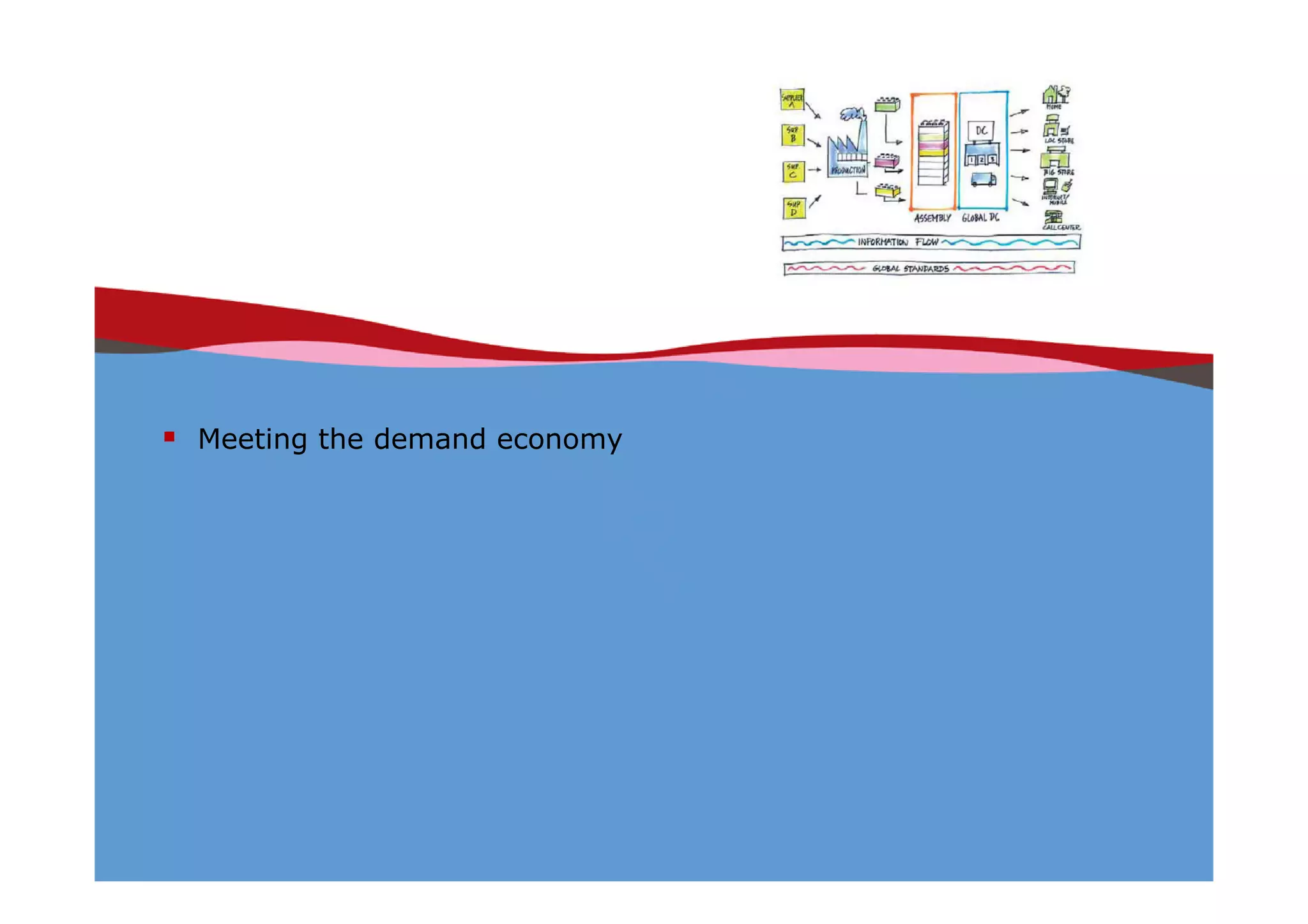
Meeting the demand economy
Copyright © IRI, 2005. Confidential and proprietary.
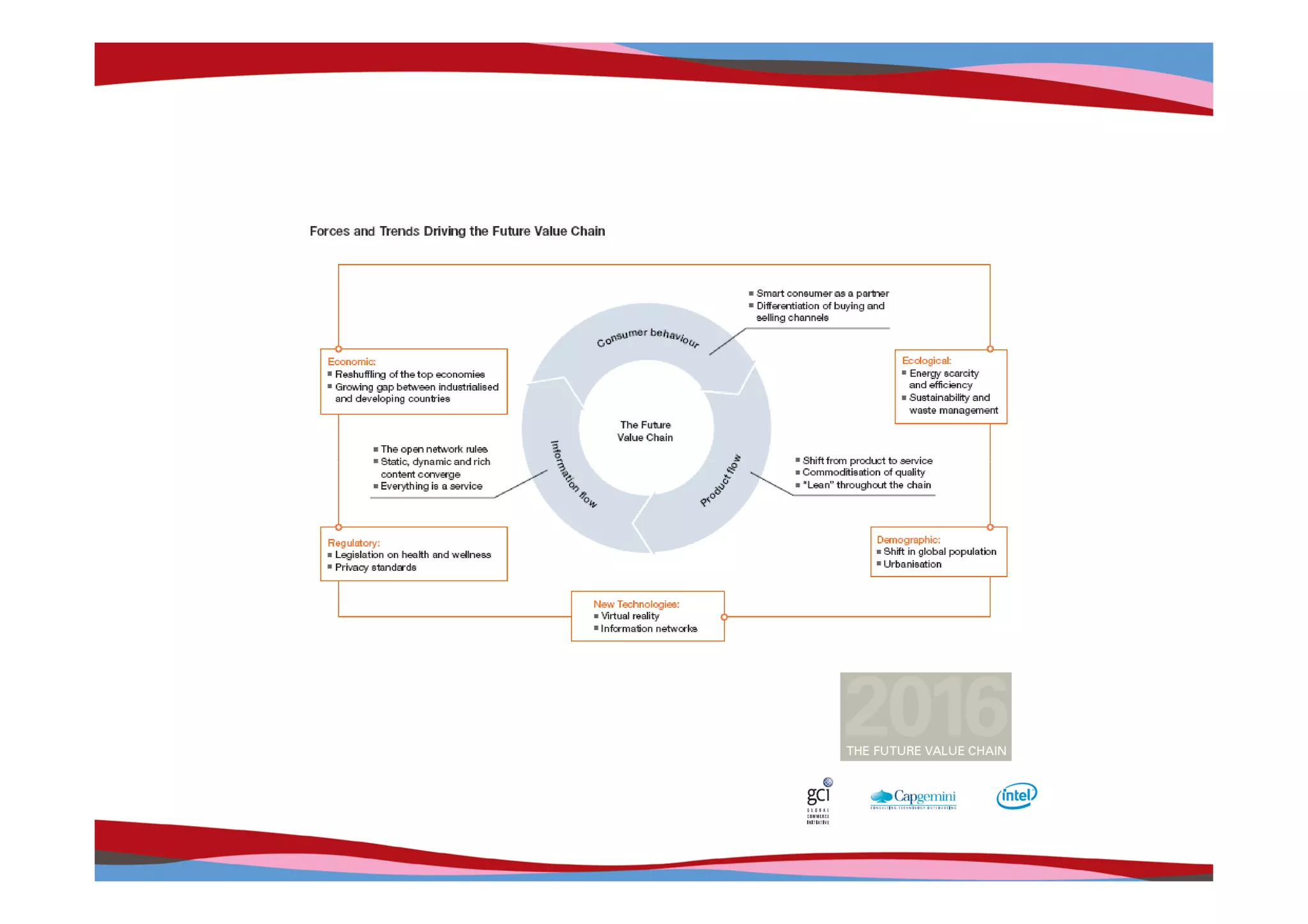
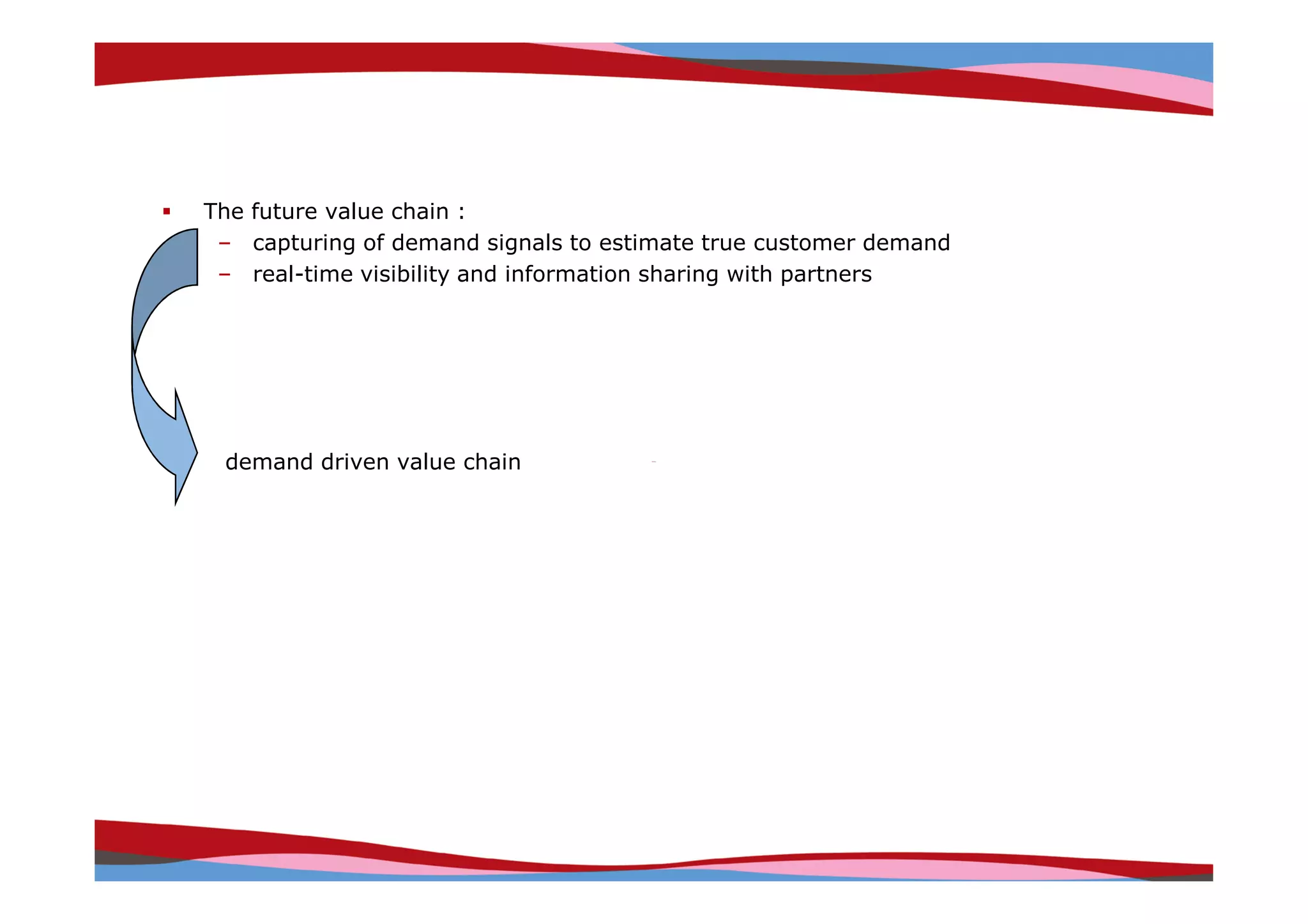
The future value chain :
 – capturing of demand signals to estimate true customer demand
 – real-time visibility and information sharing with partners


 demand driven value chain


                                                            Copyright © IRI, 2005. Confidential and proprietary.
Trends in business intelligence
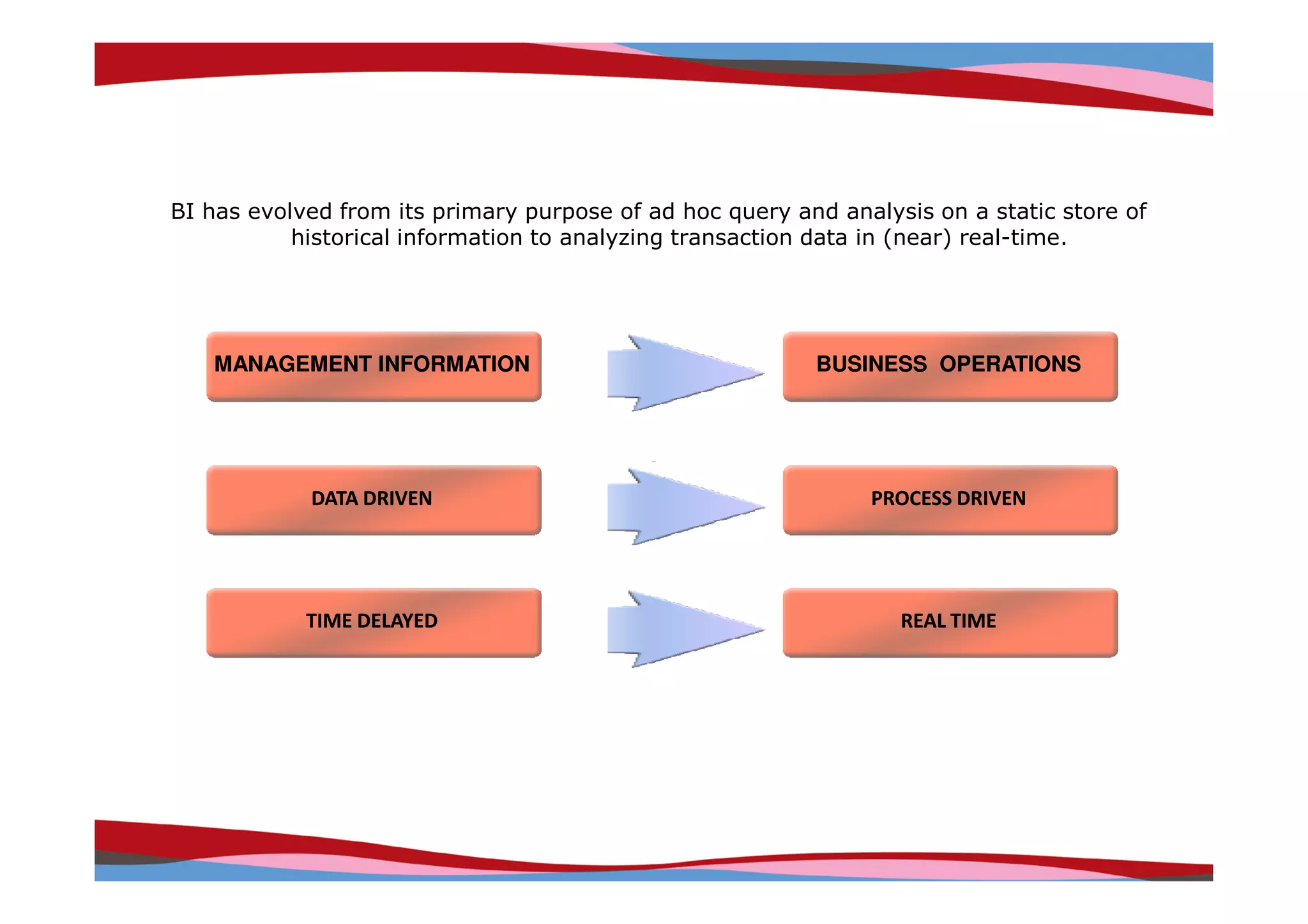
BI has evolved from its primary purpose of ad hoc query and analysis on a static store of
           historical information to analyzing transaction data in (near) real-time.


   MANAGEMENT INFORMATION                                 BUSINESS OPERATIONS


            DATA DRIVEN                                        PROCESS DRIVEN


            TIME DELAYED                                          REAL TIME


                                                                    Copyright © IRI, 2005. Confidential and proprietary.
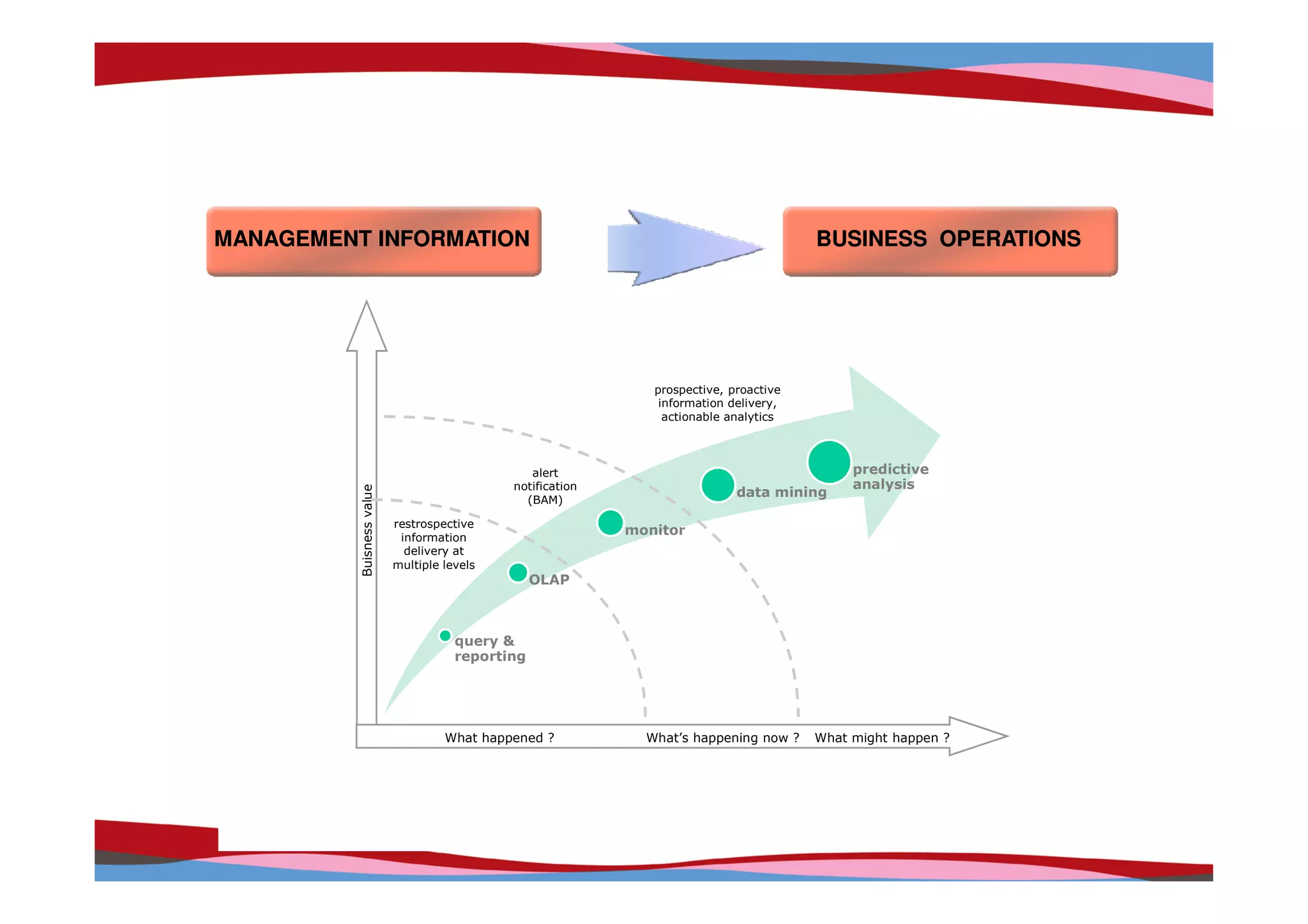
MANAGEMENT INFORMATION                                                                  BUSINESS OPERATIONS


                                                               prospective, proactive
                                                                information delivery,
                                                                 actionable analytics


                                                alert                                        predictive
                                             notification                                    analysis
          Buisness value


                                                                             data mining
                                               (BAM)

                           restrospective
                            information
                                                            monitor
                             delivery at
                           multiple levels
                                                  OLAP


                                      query &
                                      reporting


                                    What happened ?           What’s happening now ?    What might happen ?


                                                                                                       Copyright © IRI, 2005. Confidential and proprietary.
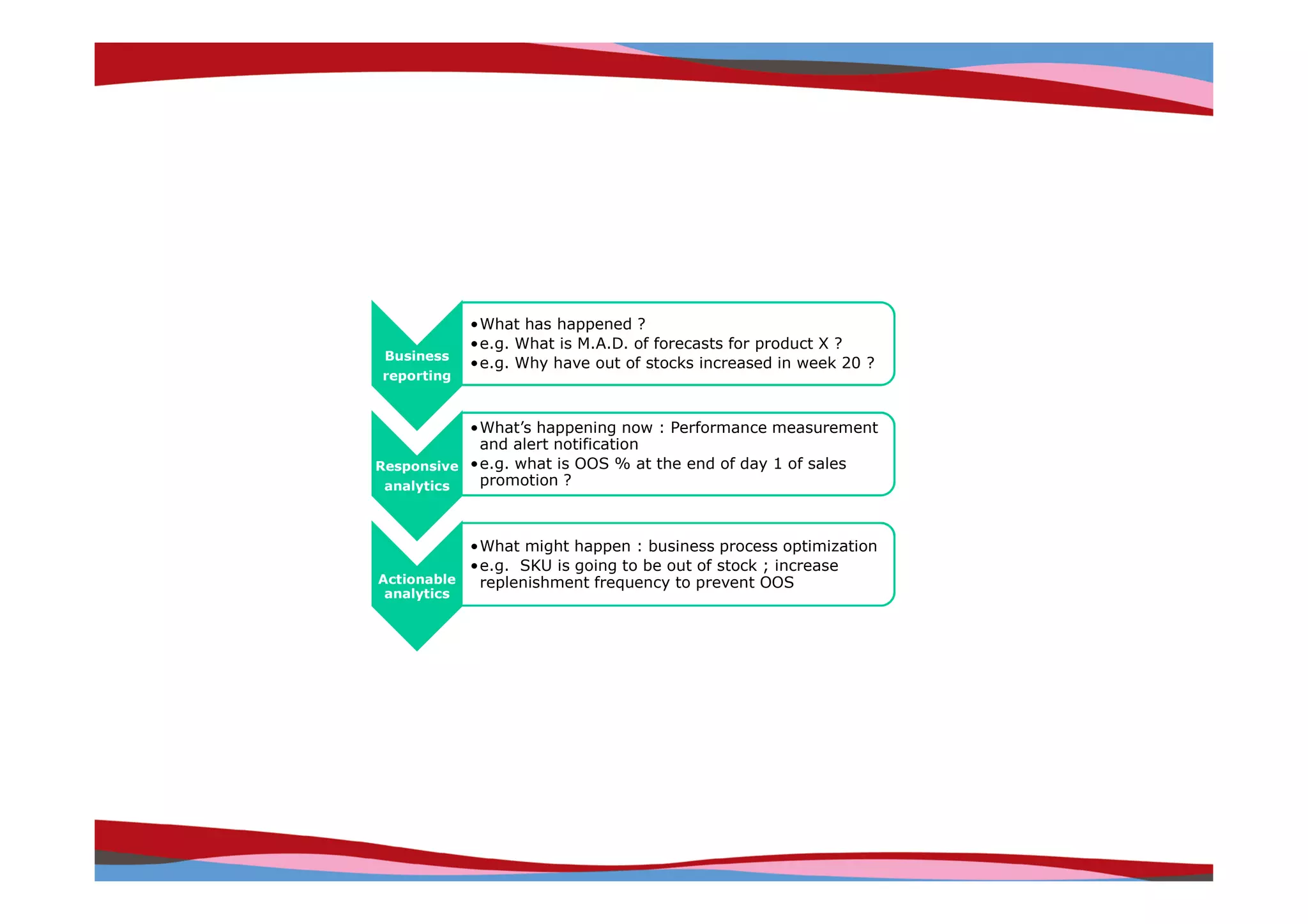
•What has happened ?
             •e.g. What is M.A.D. of forecasts for product X ?
 Business
             •e.g. Why have out of stocks increased in week 20 ?
reporting


           •What’s happening now : Performance measurement
            and alert notification
Responsive •e.g. what is OOS % at the end of day 1 of sales
 analytics  promotion ?


           •What might happen : business process optimization
           •e.g. SKU is going to be out of stock ; increase
Actionable  replenishment frequency to prevent OOS
 analytics


                                                                   Copyright © IRI, 2005. Confidential and proprietary.
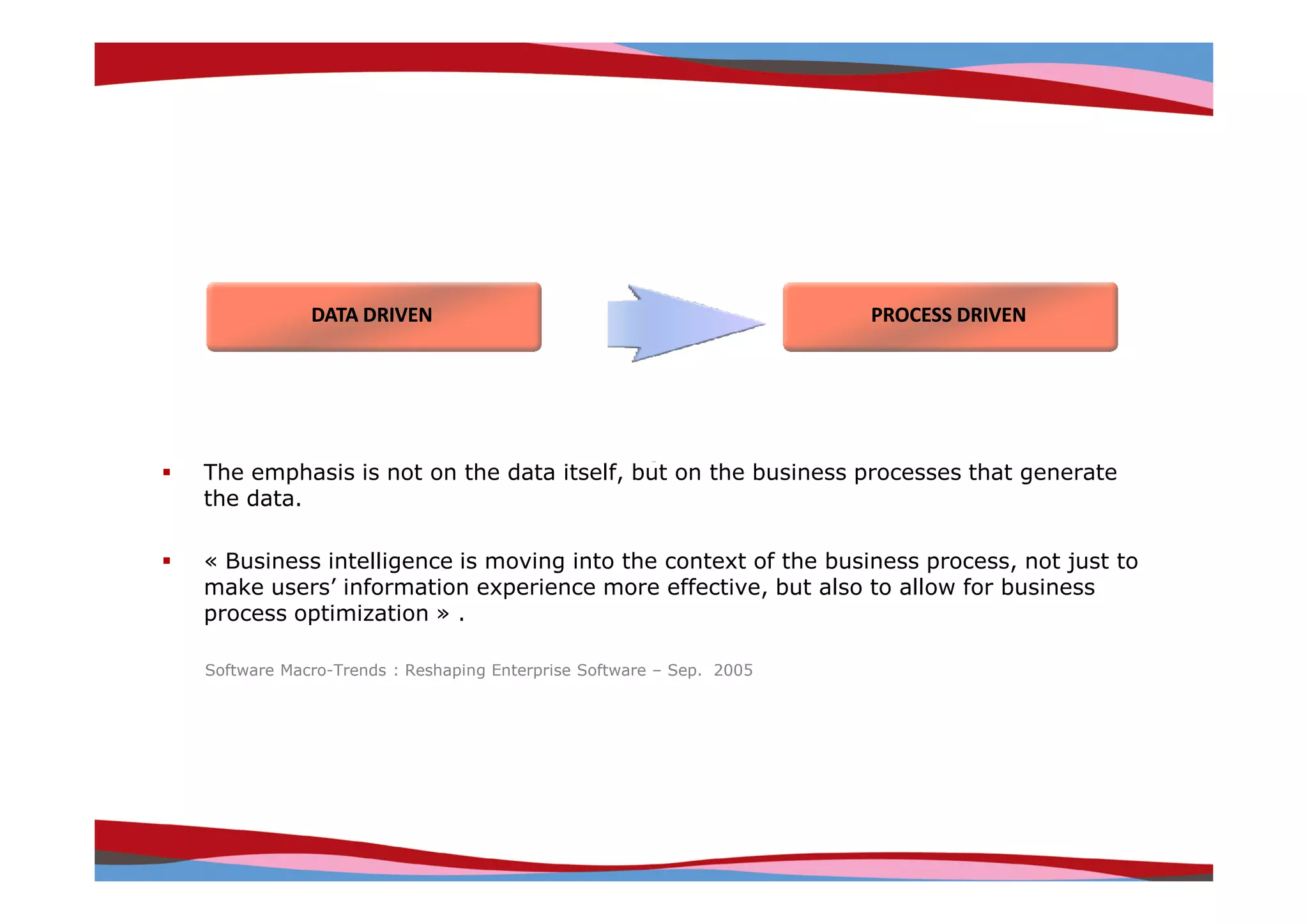
DATA DRIVEN                                             PROCESS DRIVEN


The emphasis is not on the data itself, but on the business processes that generate
the data.

« Business intelligence is moving into the context of the business process, not just to
make users’ information experience more effective, but also to allow for business
process optimization » .

Software Macro-Trends : Reshaping Enterprise Software – Sep. 2005


                                                                        Copyright © IRI, 2005. Confidential and proprietary.
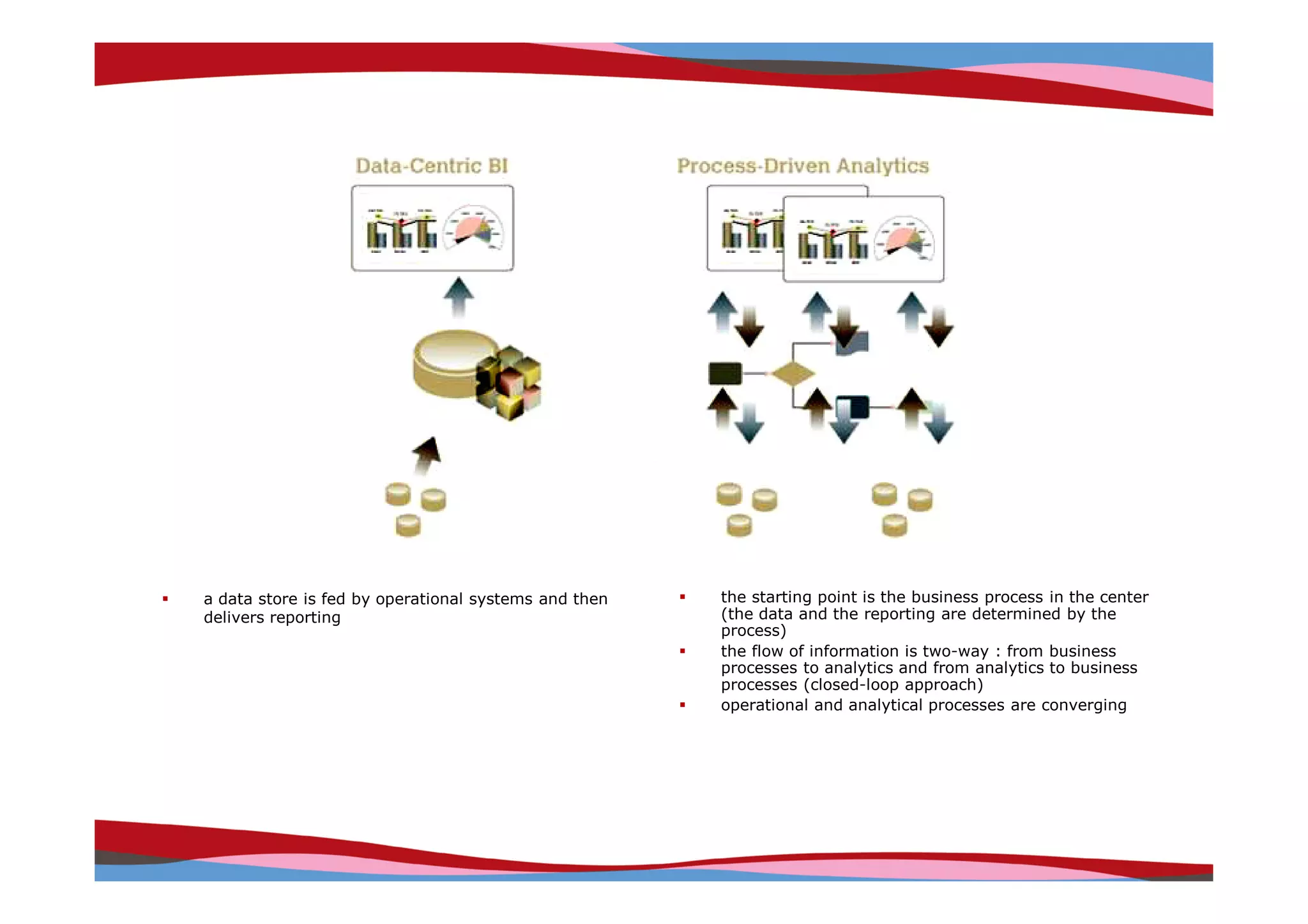
a data store is fed by operational systems and then   the starting point is the business process in the center
delivers reporting                                    (the data and the reporting are determined by the
                                                      process)
                                                      the flow of information is two-way : from business
                                                      processes to analytics and from analytics to business
                                                      processes (closed-loop approach)
                                                      operational and analytical processes are converging


                                                                                Copyright © IRI, 2005. Confidential and proprietary.
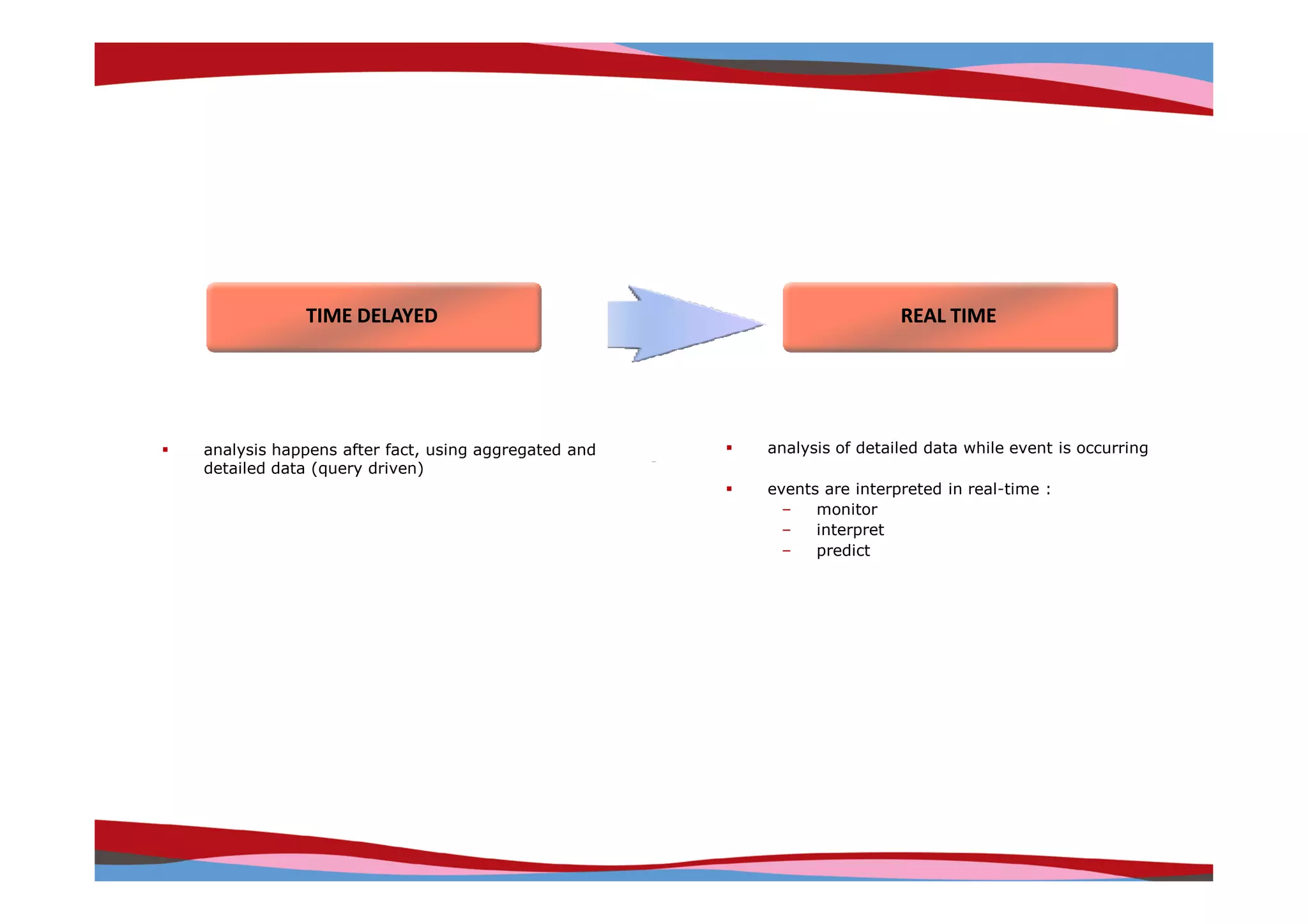
TIME DELAYED                                             REAL TIME


analysis happens after fact, using aggregated and   analysis of detailed data while event is occurring
detailed data (query driven)
                                                    events are interpreted in real-time :
                                                      –   monitor
                                                      –   interpret
                                                      –   predict


                                                                        Copyright © IRI, 2005. Confidential and proprietary.
Predicting out of stocks with real-time P.O.S.-data
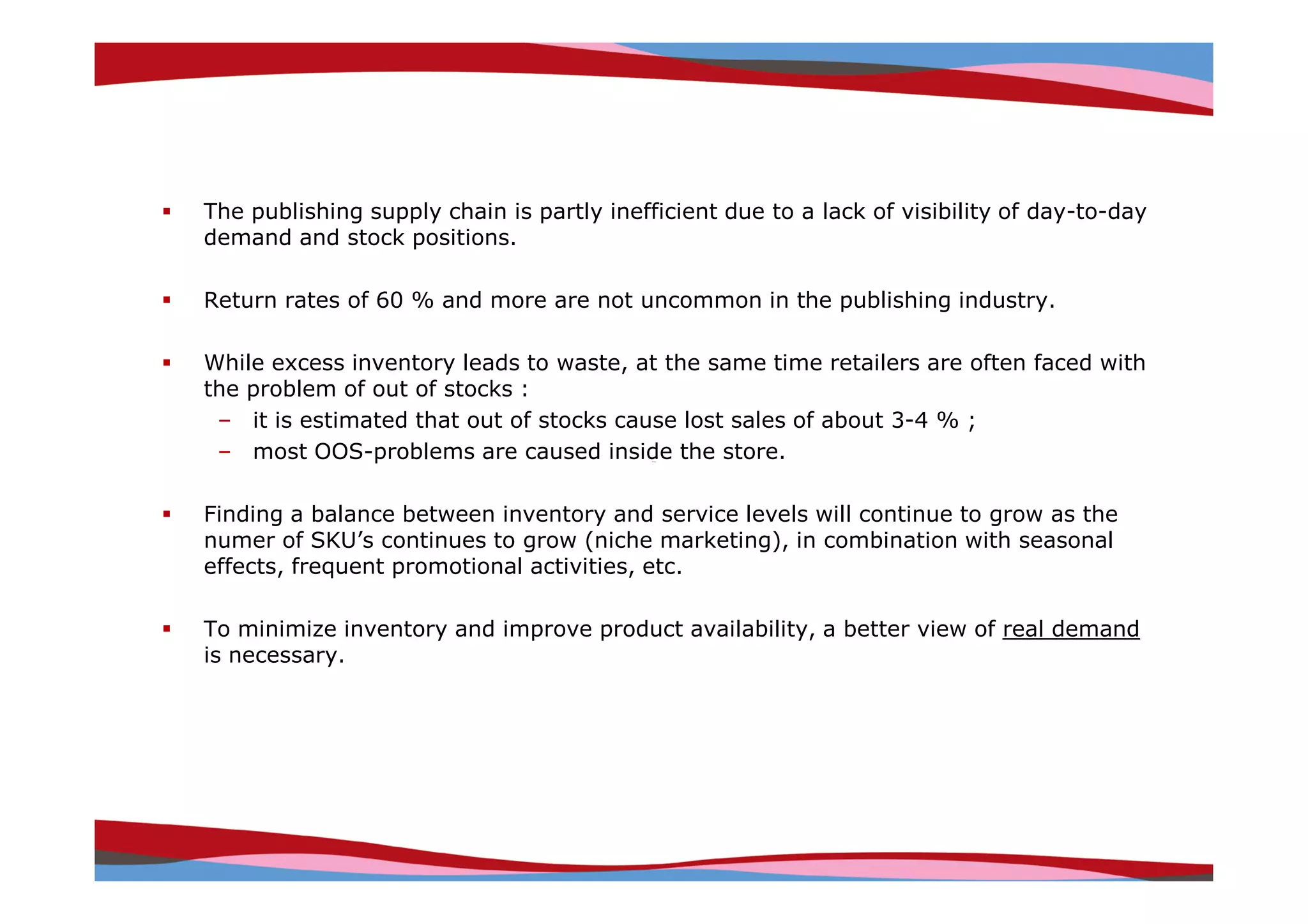
Publisher                   Distributor                     Newsstand


 Product Flow                         demand Patterns (bullwhip effect !)

 Information Flow


   Fragmented and inefficient due to poor flow of information
                                   1


                                                                Copyright © IRI, 2005. Confidential and proprietary.
The publishing supply chain is partly inefficient due to a lack of visibility of day-to-day
demand and stock positions.

Return rates of 60 % and more are not uncommon in the publishing industry.

While excess inventory leads to waste, at the same time retailers are often faced with
the problem of out of stocks :
 – it is estimated that out of stocks cause lost sales of about 3-4 % ;
 – most OOS-problems are caused inside the store.

Finding a balance between inventory and service levels will continue to grow as the
numer of SKU’s continues to grow (niche marketing), in combination with seasonal
effects, frequent promotional activities, etc.

To minimize inventory and improve product availability, a better view of real demand
is necessary.


                                                                     Copyright © IRI, 2005. Confidential and proprietary.
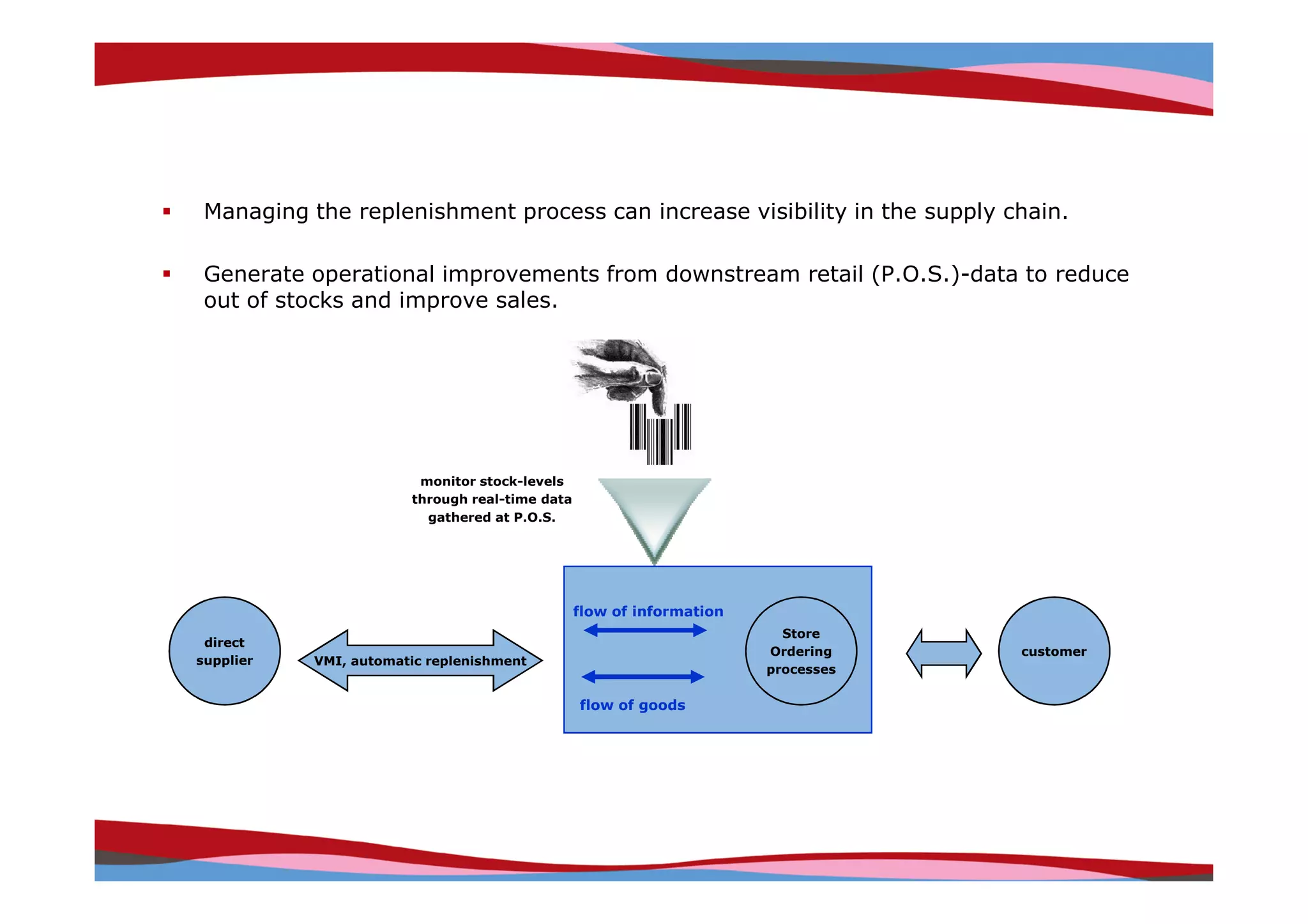
Managing the replenishment process can increase visibility in the supply chain.

 Generate operational improvements from downstream retail (P.O.S.)-data to reduce
 out of stocks and improve sales.


                        monitor stock-levels
                       through real-time data
                         gathered at P.O.S.


                                                flow of information
                                                                        Store
 direct
                                                                      Ordering                      customer
supplier   VMI, automatic replenishment
                                                                      processes

                                                flow of goods


                                                                                  Copyright © IRI, 2005. Confidential and proprietary.
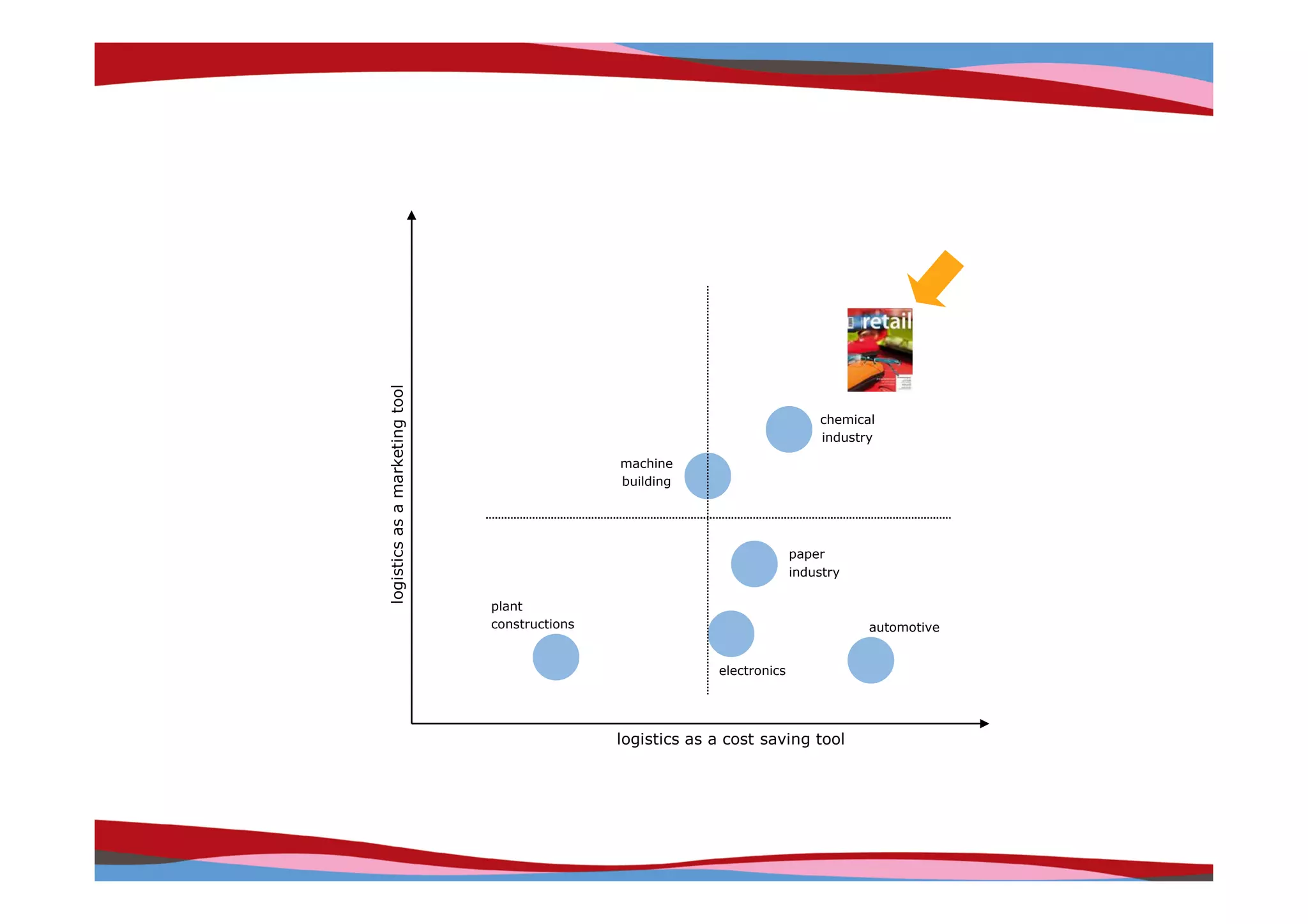
logistics as a marketing tool


                                logistics as a marketing tool
                                                                                                               chemical
                                                                                                               industry

                                                                                machine
                                                                                building


                                                                                                           paper
                                                                                                           industry

                                                                plant
                                                                constructions                                         automotive


                                                                                             electronics


                                                                                logistics as a cost saving tool
                                                                      logistics as a cost saving tool


                                                                                                                              Copyright © IRI, 2005. Confidential and proprietary.
In order to develop replenishment models, we need evidence
about the relationship between performance variables (e.g. inventory levels, out of stock)
             and contextual variables (e.g. store and product characteristics)


                                       ?
                What is the power of P.O.S. real-time data
                         to predict out of stock ?


                                                                     Copyright © IRI, 2005. Confidential and proprietary.
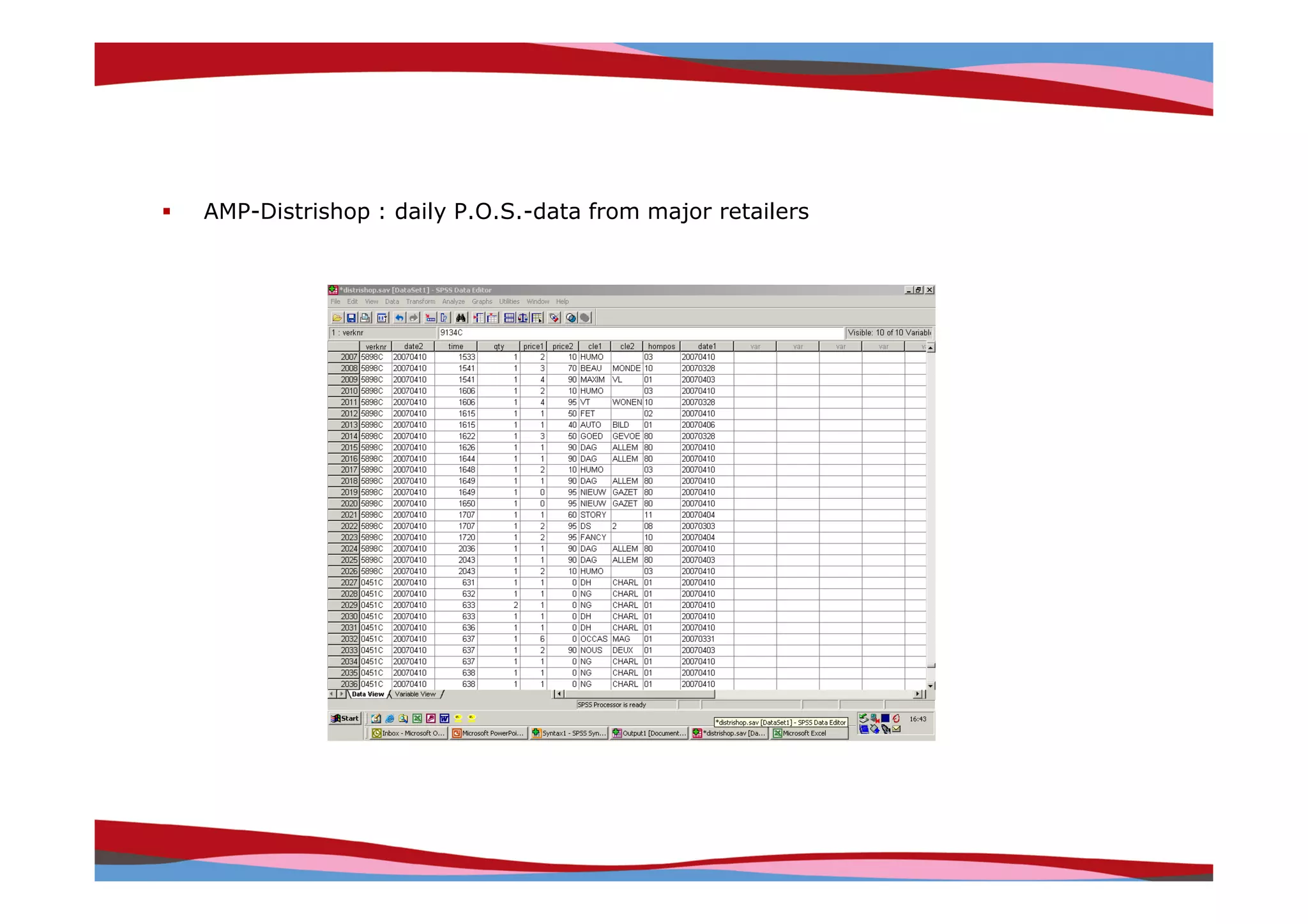
AMP-Distrishop : daily P.O.S.-data from major retailers


                                                          Copyright © IRI, 2005. Confidential and proprietary.
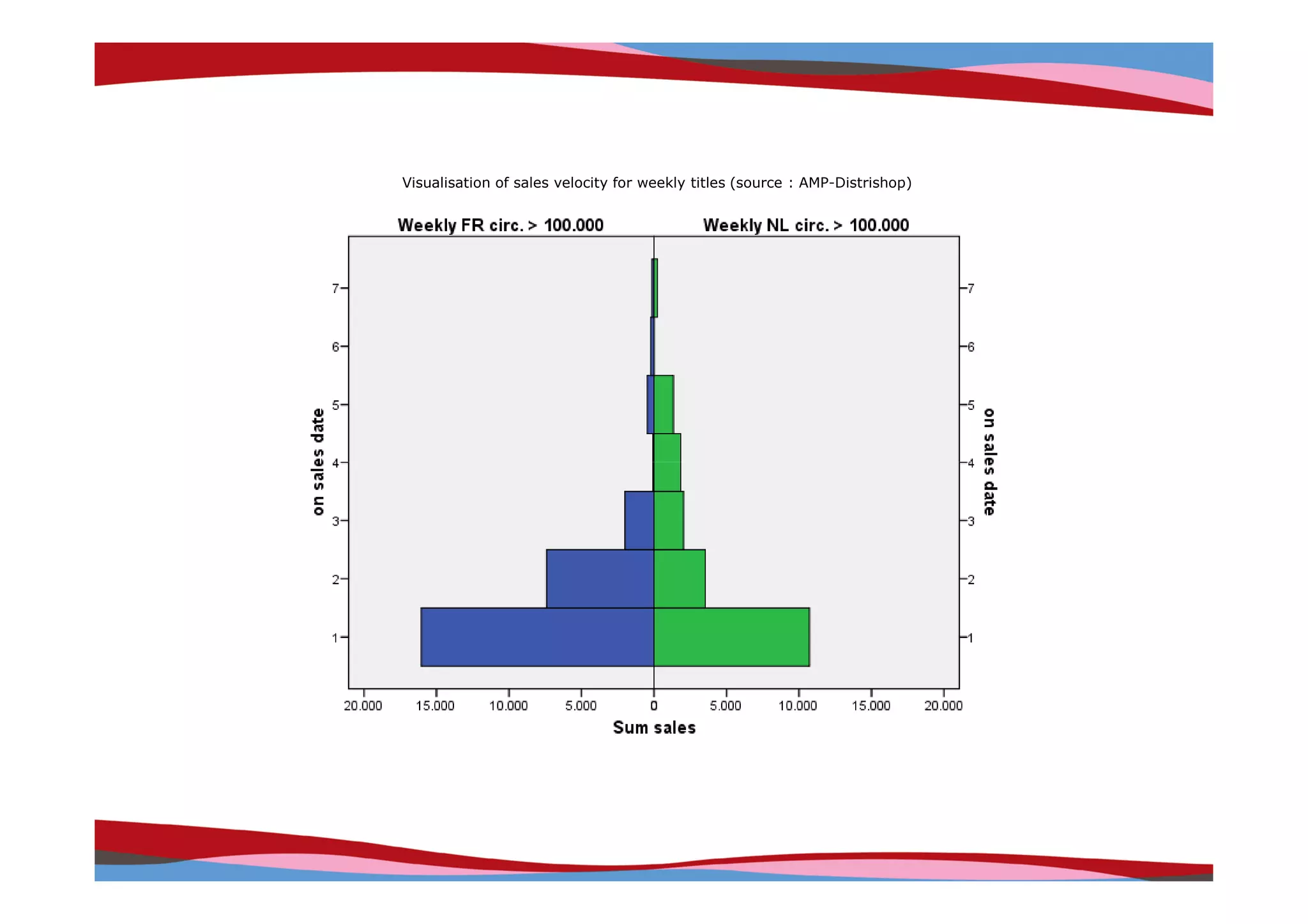
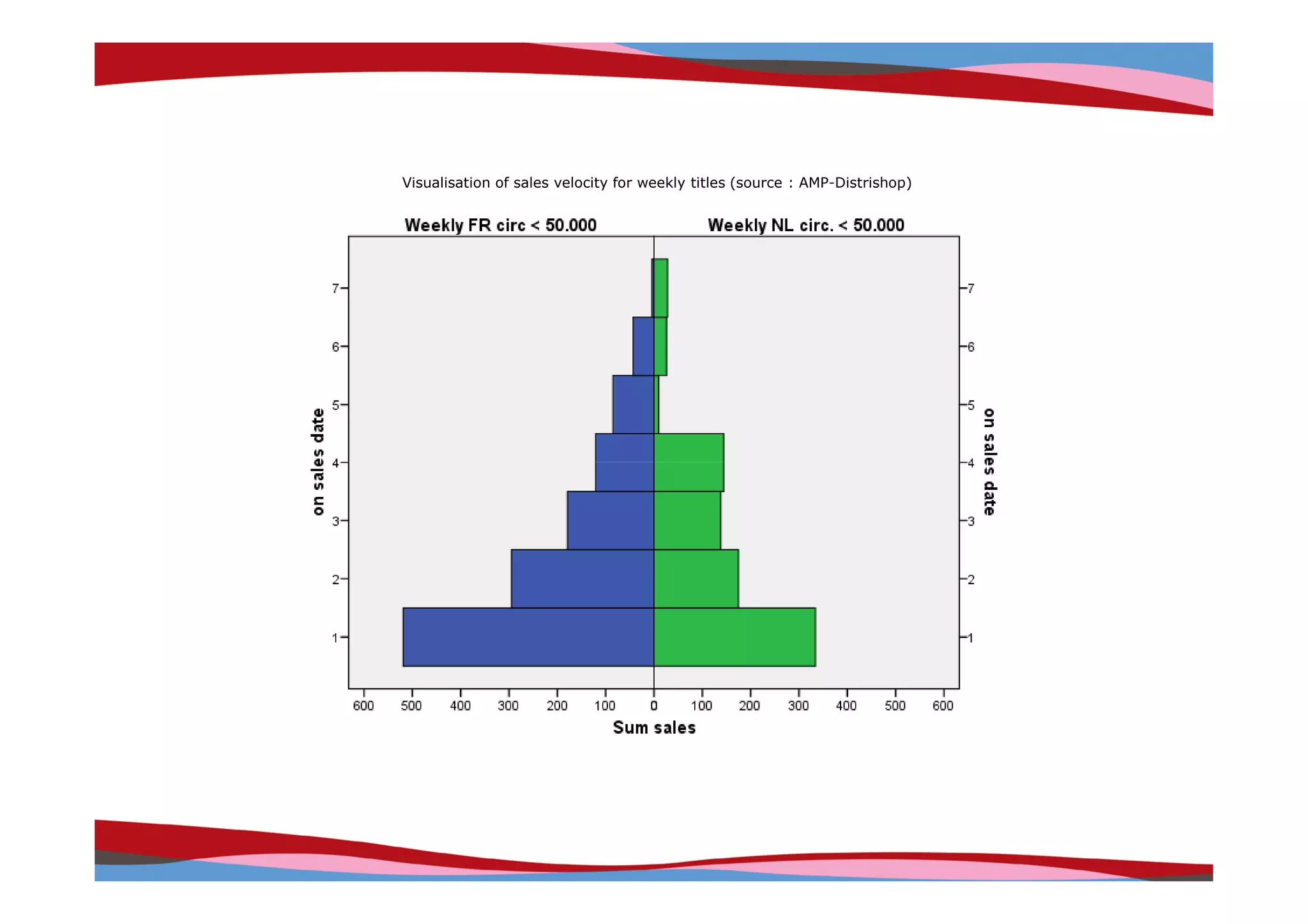
Visualisation of sales velocity for weekly titles (source : AMP-Distrishop)


                                                                              Copyright © IRI, 2005. Confidential and proprietary.
Visualisation of sales velocity for weekly titles (source : AMP-Distrishop)


                                                                              Copyright © IRI, 2005. Confidential and proprietary.
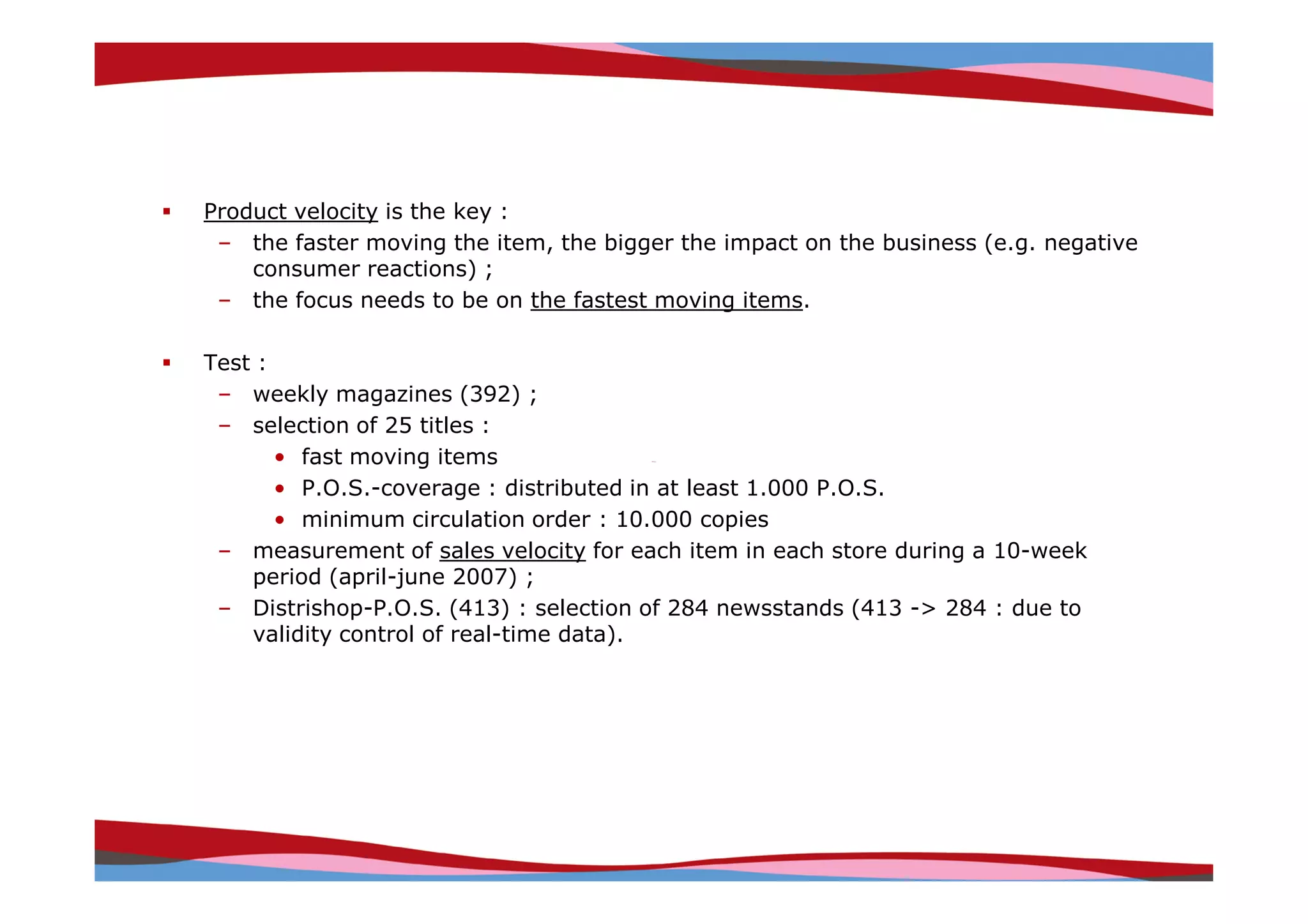
Product velocity is the key :
 – the faster moving the item, the bigger the impact on the business (e.g. negative
    consumer reactions) ;
 – the focus needs to be on the fastest moving items.

Test :
 – weekly magazines (392) ;
 – selection of 25 titles :
       • fast moving items
       • P.O.S.-coverage : distributed in at least 1.000 P.O.S.
       • minimum circulation order : 10.000 copies
 – measurement of sales velocity for each item in each store during a 10-week
    period (april-june 2007) ;
 – Distrishop-P.O.S. (413) : selection of 284 newsstands (413 -> 284 : due to
    validity control of real-time data).


                                                                Copyright © IRI, 2005. Confidential and proprietary.
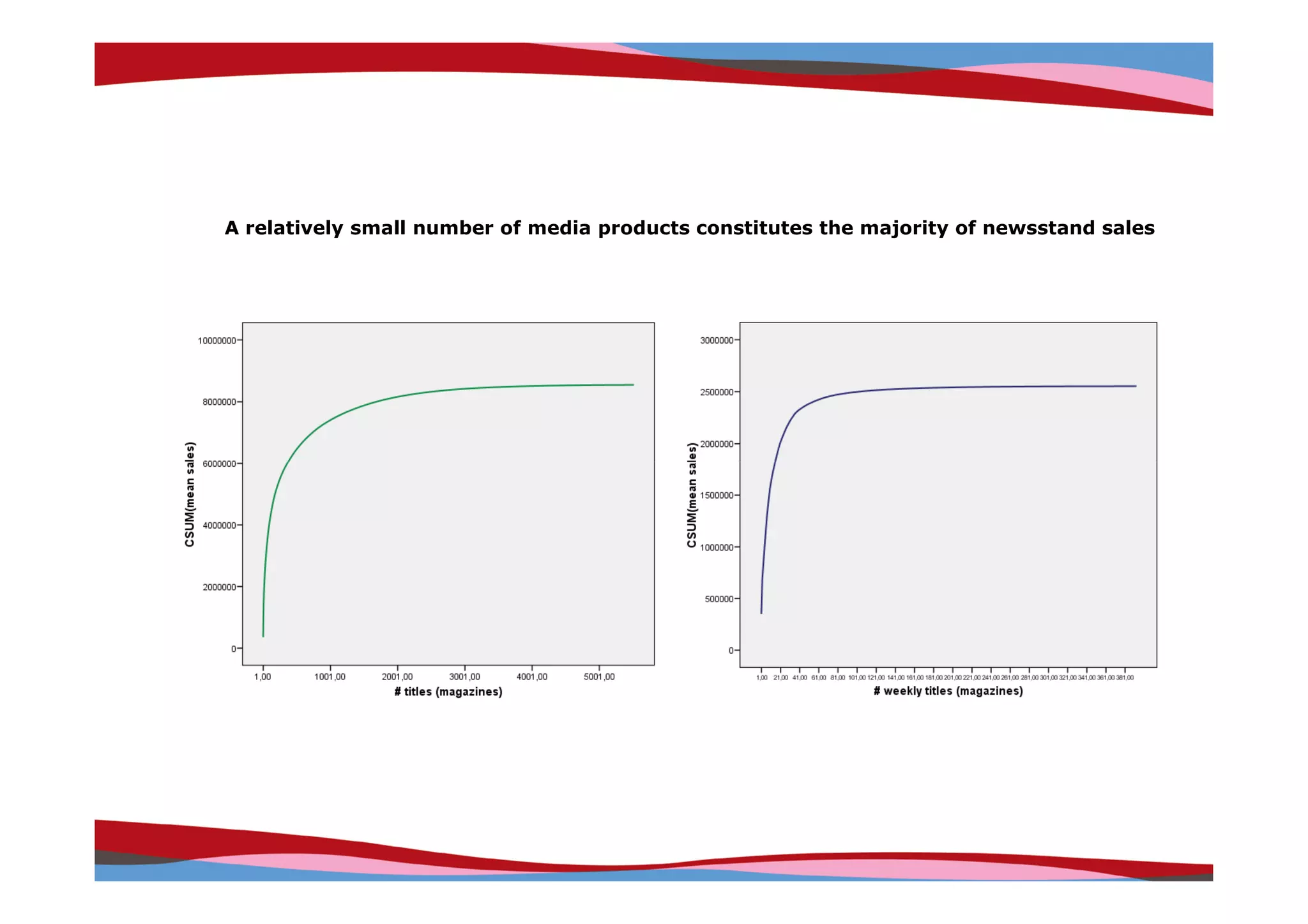
A relatively small number of media products constitutes the majority of newsstand sales


                                                                 Copyright © IRI, 2005. Confidential and proprietary.
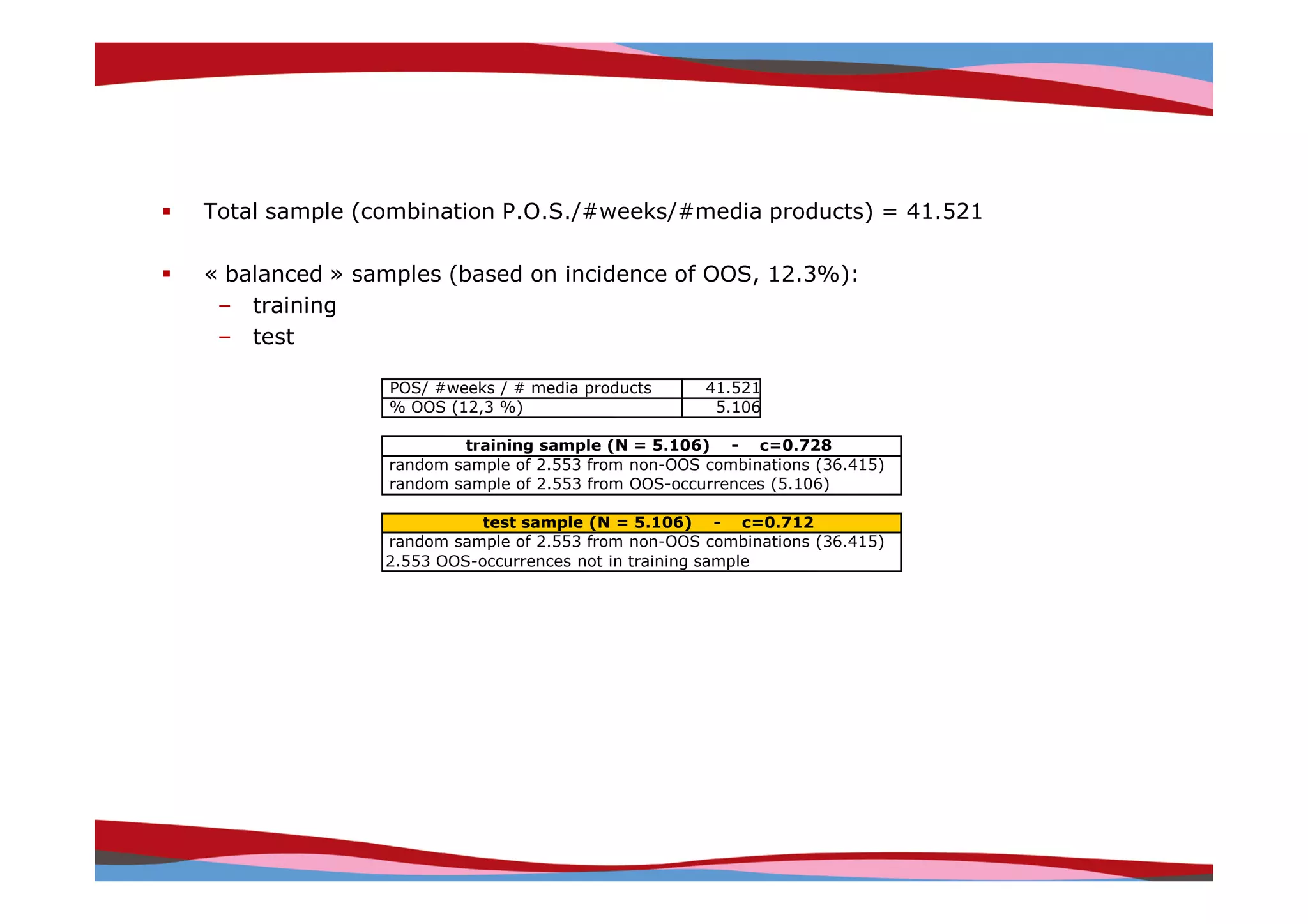
Total sample (combination P.O.S./#weeks/#media products) = 41.521

« balanced » samples (based on incidence of OOS, 12.3%):
 – training
 – test

               POS/ #weeks / # media products      41.521
               % OOS (12,3 %)                       5.106

                       training sample (N = 5.106) - c=0.728
               random sample of 2.553 from non-OOS combinations (36.415)
               random sample of 2.553 from OOS-occurrences (5.106)

                          test sample (N = 5.106) - c=0.712
               random sample of 2.553 from non-OOS combinations (36.415)
               2.553 OOS-occurrences not in training sample


                                                                           Copyright © IRI, 2005. Confidential and proprietary.
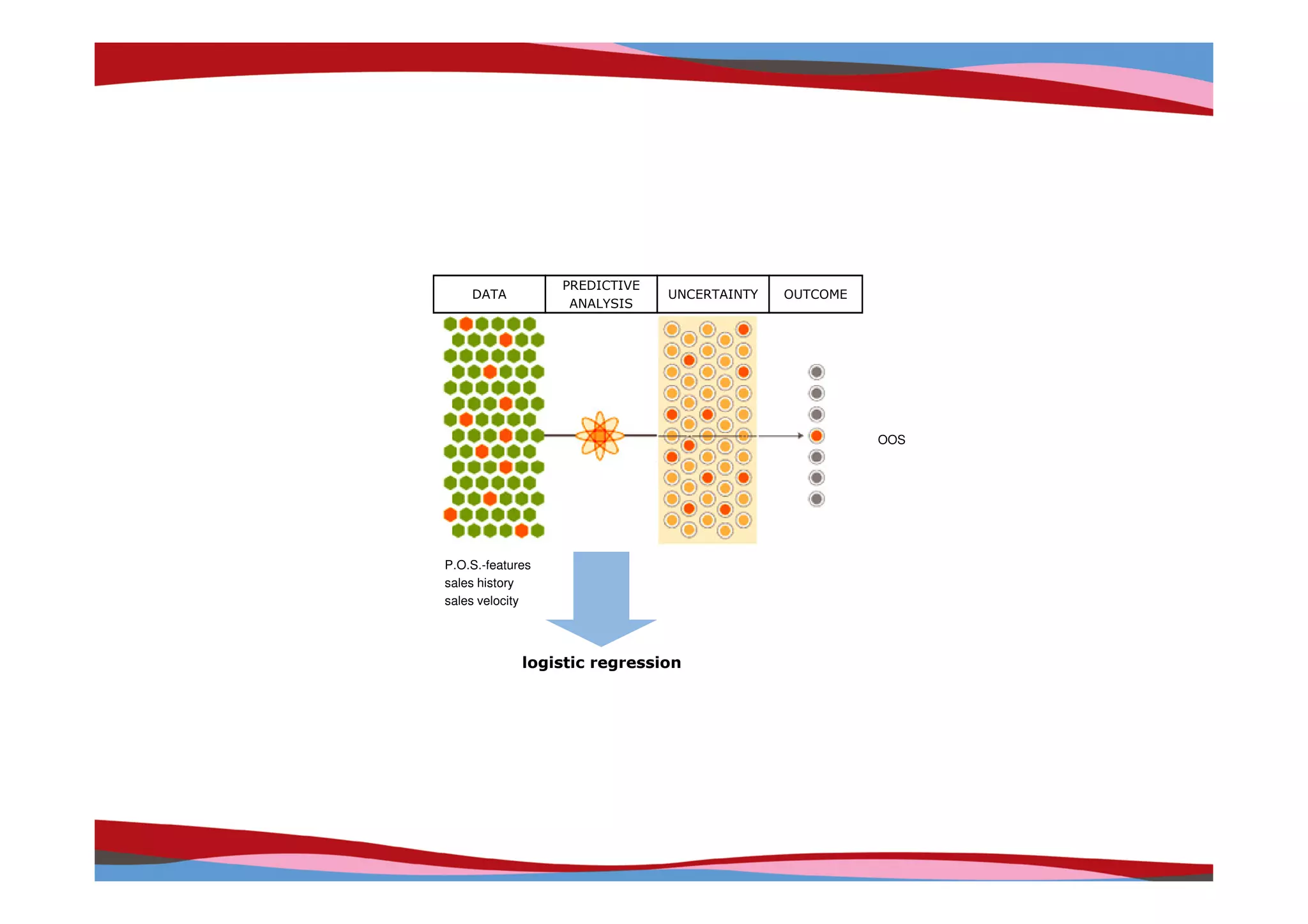
PREDICTIVE
    DATA                       UNCERTAINTY   OUTCOME
                   ANALYSIS


                                                       OOS


P.O.S.-features
sales history
sales velocity


             logistic regression


                                                             Copyright © IRI, 2005. Confidential and proprietary.
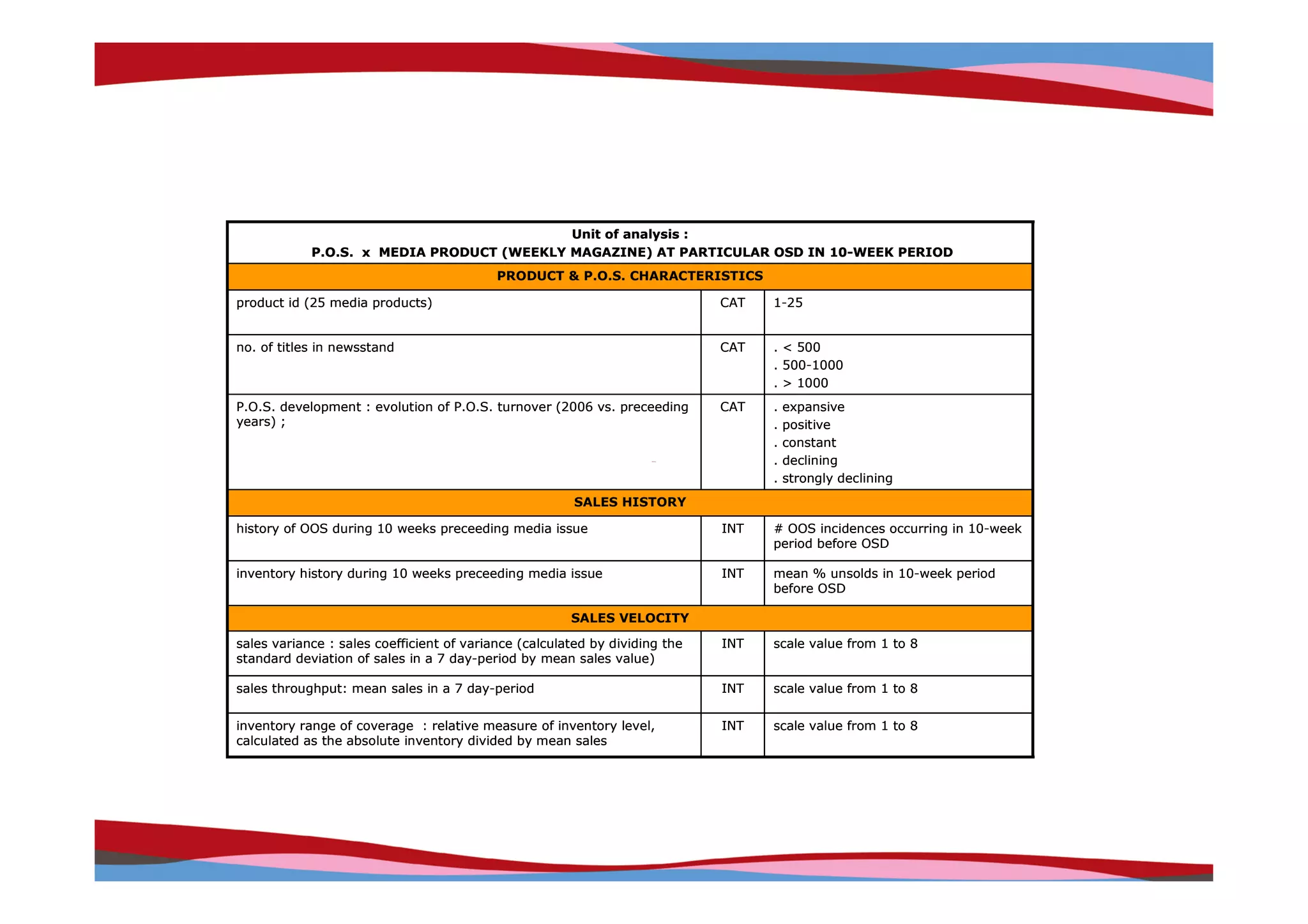
Unit of analysis :
            P.O.S. x MEDIA PRODUCT (WEEKLY MAGAZINE) AT PARTICULAR OSD IN 10-WEEK PERIOD
                                           PRODUCT & P.O.S. CHARACTERISTICS

product id (25 media products)                                               CAT   1-25


no. of titles in newsstand                                                   CAT   . < 500
                                                                                   . 500-1000
                                                                                   . > 1000
P.O.S. development : evolution of P.O.S. turnover (2006 vs. preceeding       CAT   .   expansive
years) ;                                                                           .   positive
                                                                                   .   constant
                                                                                   .   declining
                                                                                   .   strongly declining
                                                        SALES HISTORY

history of OOS during 10 weeks preceeding media issue                        INT   # OOS incidences occurring in 10-week
                                                                                   period before OSD

inventory history during 10 weeks preceeding media issue                     INT   mean % unsolds in 10-week period
                                                                                   before OSD

                                                       SALES VELOCITY

sales variance : sales coefficient of variance (calculated by dividing the   INT   scale value from 1 to 8
standard deviation of sales in a 7 day-period by mean sales value)

sales throughput: mean sales in a 7 day-period                               INT   scale value from 1 to 8

inventory range of coverage : relative measure of inventory level,           INT   scale value from 1 to 8
calculated as the absolute inventory divided by mean sales


                                                                                                             Copyright © IRI, 2005. Confidential and proprietary.
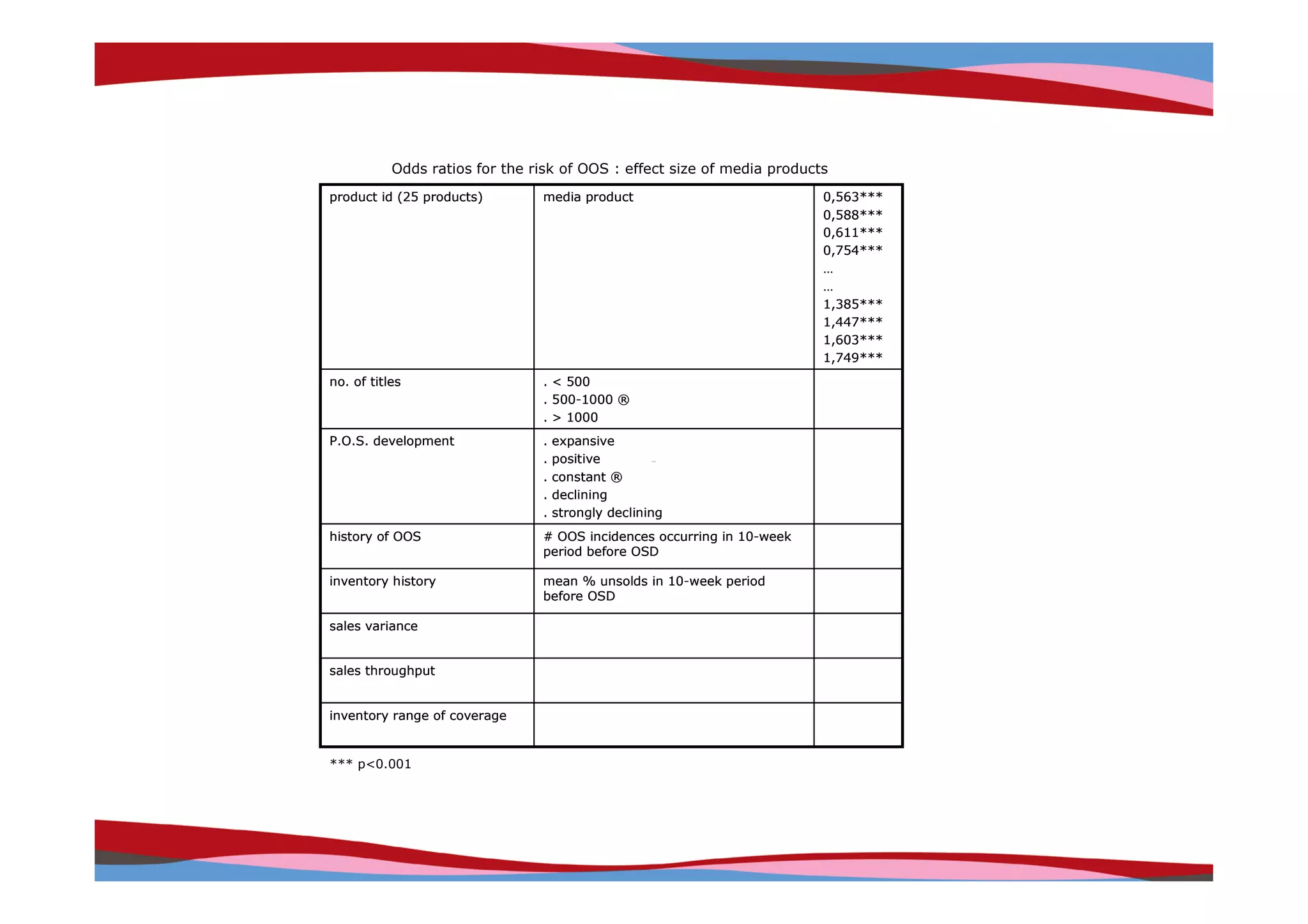
Odds ratios for the risk of OOS : effect size of media products
product id (25 products)        media product                            0,563***
                                                                         0,588***
                                                                         0,611***
                                                                         0,754***
                                                                         …
                                                                         …
                                                                         1,385***
                                                                         1,447***
                                                                         1,603***
                                                                         1,749***
no. of titles                   . < 500
                                . 500-1000 ®
                                . > 1000
P.O.S. development              .   expansive
                                .   positive
                                .   constant ®
                                .   declining
                                .   strongly declining
history of OOS                  # OOS incidences occurring in 10-week
                                period before OSD

inventory history               mean % unsolds in 10-week period
                                before OSD

sales variance


sales throughput


inventory range of coverage


*** p<0.001


                                                                                    Copyright © IRI, 2005. Confidential and proprietary.
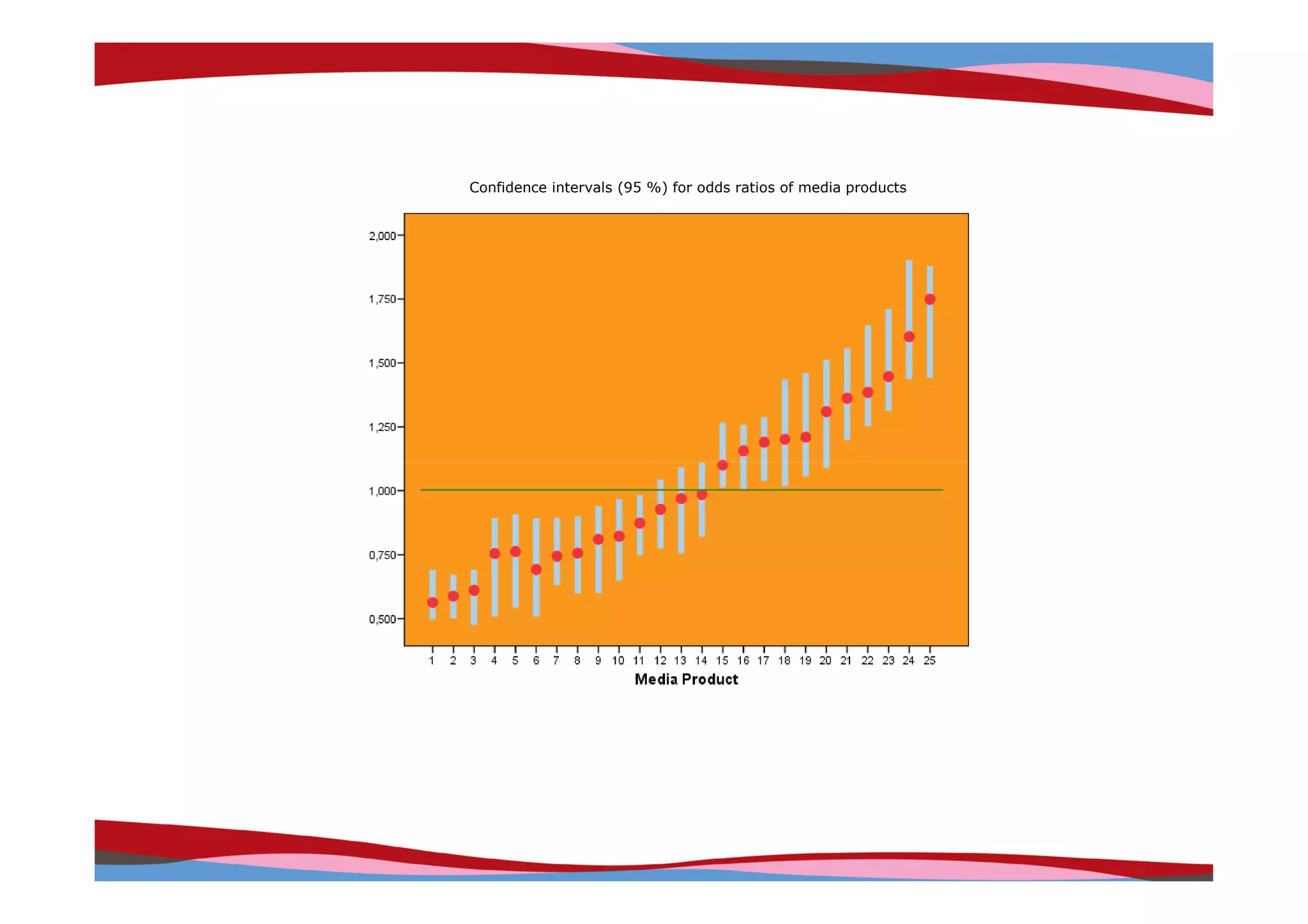
Confidence intervals (95 %) for odds ratios of media products


                                                                Copyright © IRI, 2005. Confidential and proprietary.
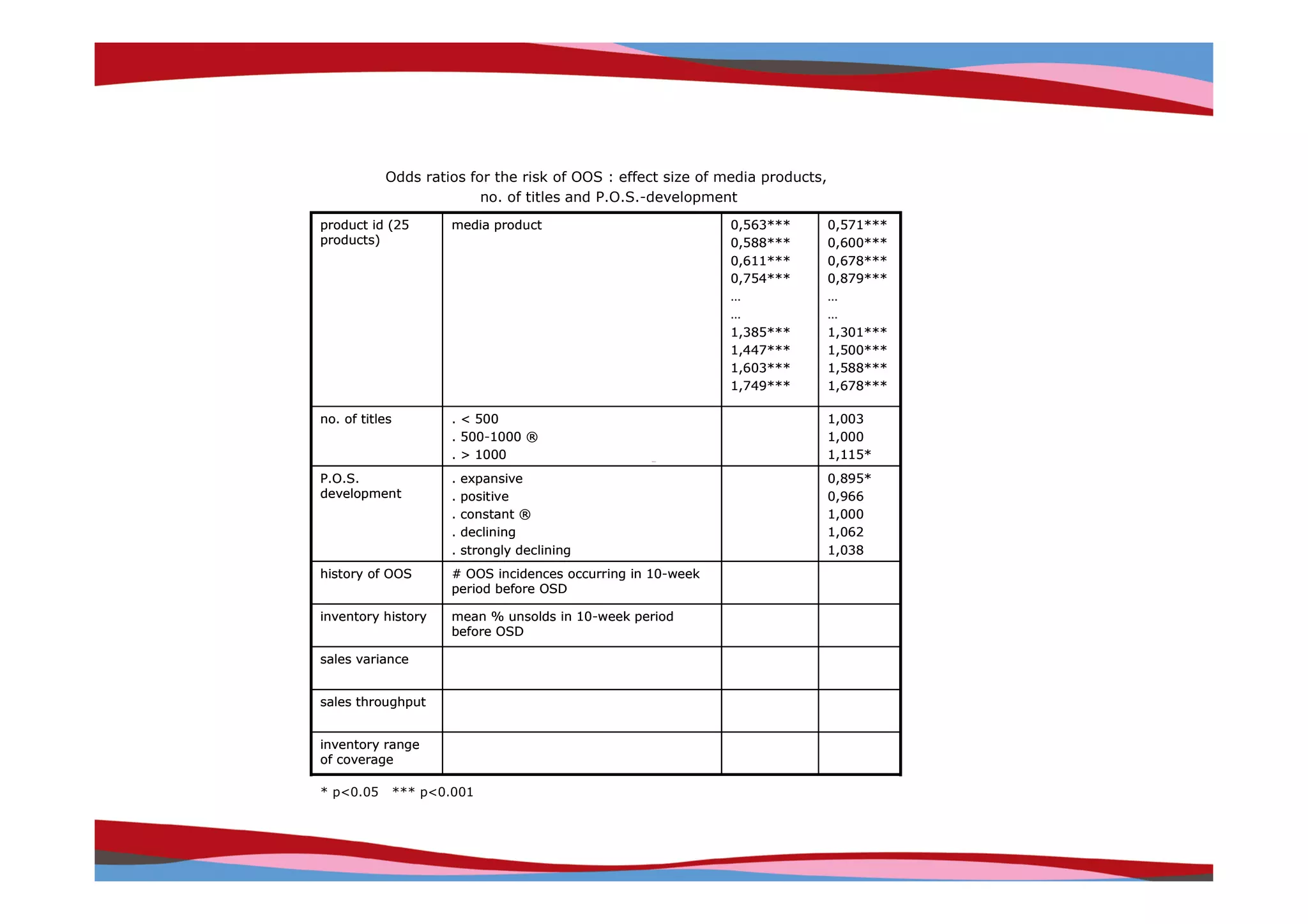
Odds ratios for the risk of OOS : effect size of media products,
                         no. of titles and P.O.S.-development
product id (25          media product                           0,563***      0,571***
products)                                                       0,588***      0,600***
                                                                0,611***      0,678***
                                                                0,754***      0,879***
                                                                …             …
                                                                …             …
                                                                1,385***      1,301***
                                                                1,447***      1,500***
                                                                1,603***      1,588***
                                                                1,749***      1,678***

no. of titles           . < 500                                               1,003
                        . 500-1000 ®                                          1,000
                        . > 1000                                              1,115*
P.O.S.                  .   expansive                                         0,895*
development             .   positive                                          0,966
                        .   constant ®                                        1,000
                        .   declining                                         1,062
                        .   strongly declining                                1,038
history of OOS          # OOS incidences occurring in 10-week
                        period before OSD

inventory history       mean % unsolds in 10-week period
                        before OSD

sales variance


sales throughput


inventory range
of coverage

* p<0.05        *** p<0.001


                                                                                         Copyright © IRI, 2005. Confidential and proprietary.
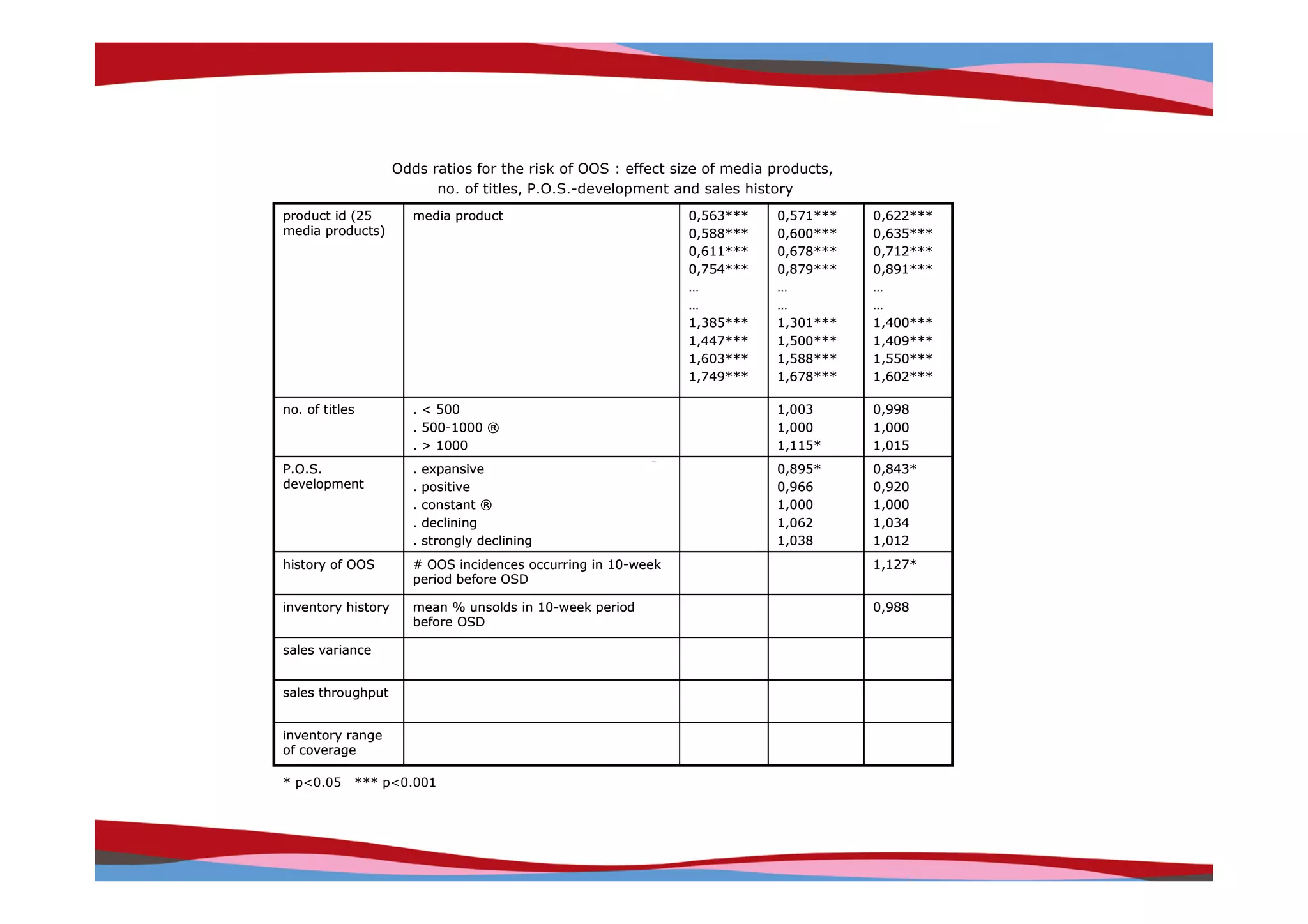
Odds ratios for the risk of OOS : effect size of media products,
                           no. of titles, P.O.S.-development and sales history
product id (25          media product                           0,563***    0,571***    0,622***
media products)                                                 0,588***    0,600***    0,635***
                                                                0,611***    0,678***    0,712***
                                                                0,754***    0,879***    0,891***
                                                                …           …           …
                                                                …           …           …
                                                                1,385***    1,301***    1,400***
                                                                1,447***    1,500***    1,409***
                                                                1,603***    1,588***    1,550***
                                                                1,749***    1,678***    1,602***

no. of titles           . < 500                                             1,003       0,998
                        . 500-1000 ®                                        1,000       1,000
                        . > 1000                                            1,115*      1,015
P.O.S.                  .   expansive                                       0,895*      0,843*
development             .   positive                                        0,966       0,920
                        .   constant ®                                      1,000       1,000
                        .   declining                                       1,062       1,034
                        .   strongly declining                              1,038       1,012
history of OOS          # OOS incidences occurring in 10-week                           1,127*
                        period before OSD

inventory history       mean % unsolds in 10-week period                                0,988
                        before OSD

sales variance


sales throughput


inventory range
of coverage

* p<0.05        *** p<0.001


                                                                                                 Copyright © IRI, 2005. Confidential and proprietary.
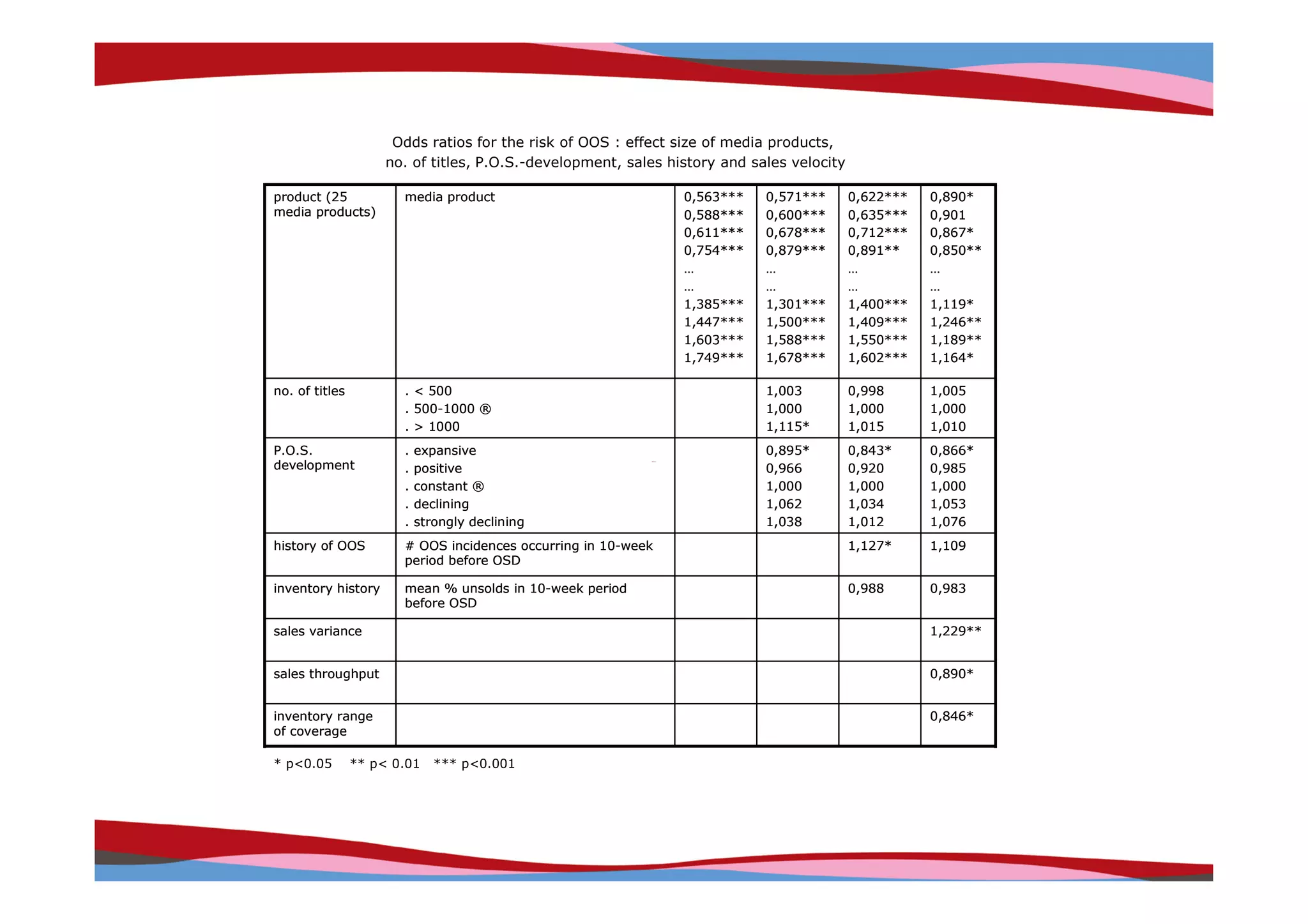
Odds ratios for the risk of OOS : effect size of media products,
                     no. of titles, P.O.S.-development, sales history and sales velocity

product (25            media product                            0,563***    0,571***       0,622***   0,890*
media products)                                                 0,588***    0,600***       0,635***   0,901
                                                                0,611***    0,678***       0,712***   0,867*
                                                                0,754***    0,879***       0,891**    0,850**
                                                                …           …              …          …
                                                                …           …              …          …
                                                                1,385***    1,301***       1,400***   1,119*
                                                                1,447***    1,500***       1,409***   1,246**
                                                                1,603***    1,588***       1,550***   1,189**
                                                                1,749***    1,678***       1,602***   1,164*

no. of titles          . < 500                                              1,003          0,998      1,005
                       . 500-1000 ®                                         1,000          1,000      1,000
                       . > 1000                                             1,115*         1,015      1,010
P.O.S.                 .   expansive                                        0,895*         0,843*     0,866*
development            .   positive                                         0,966          0,920      0,985
                       .   constant ®                                       1,000          1,000      1,000
                       .   declining                                        1,062          1,034      1,053
                       .   strongly declining                               1,038          1,012      1,076
history of OOS         # OOS incidences occurring in 10-week                               1,127*     1,109
                       period before OSD

inventory history      mean % unsolds in 10-week period                                    0,988      0,983
                       before OSD

sales variance                                                                                        1,229**


sales throughput                                                                                      0,890*


inventory range                                                                                       0,846*
of coverage

* p<0.05        ** p< 0.01    *** p<0.001


                                                                                                      Copyright © IRI, 2005. Confidential and proprietary.
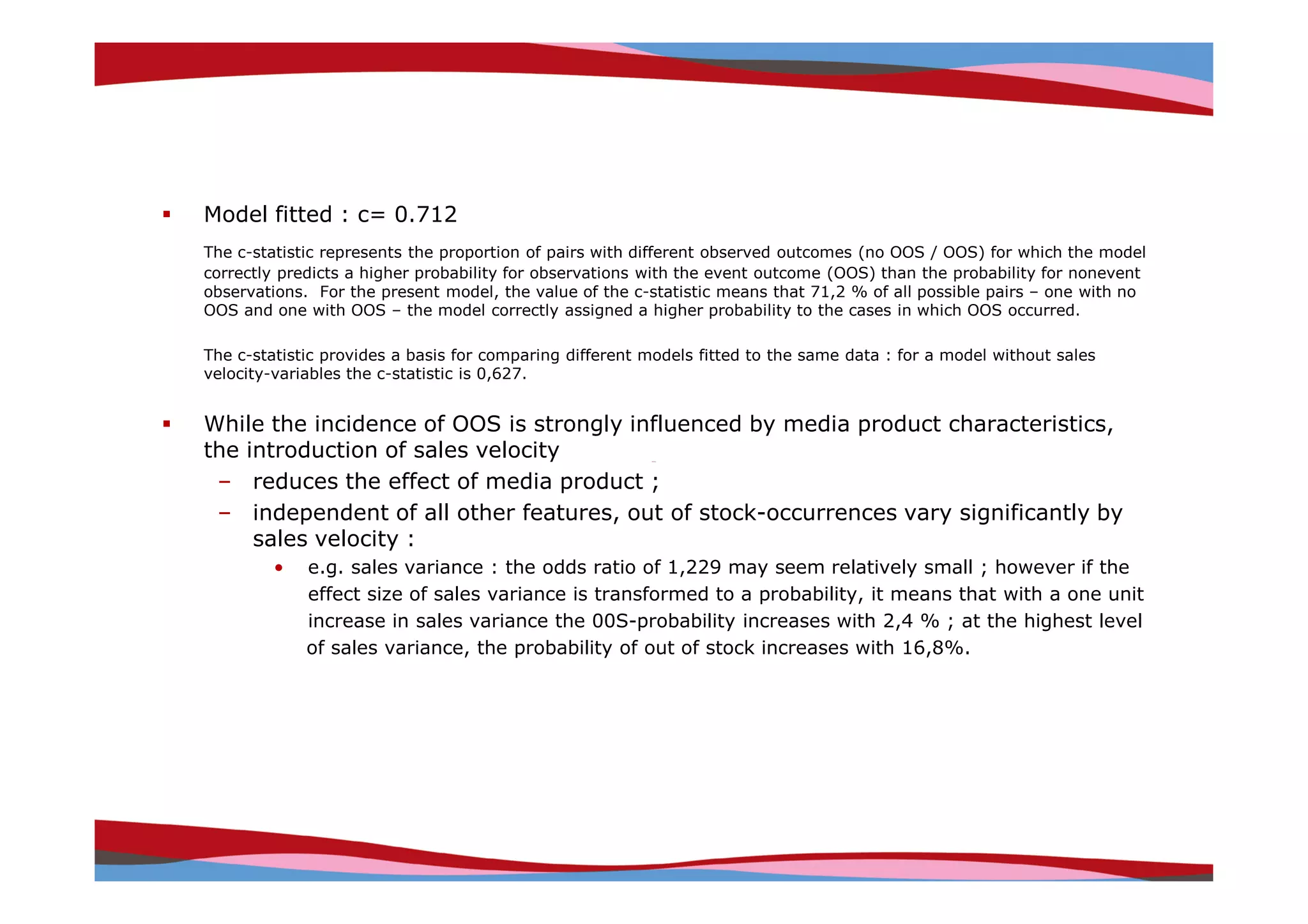
Model fitted : c= 0.712
The c-statistic represents the proportion of pairs with different observed outcomes (no OOS / OOS) for which the model
correctly predicts a higher probability for observations with the event outcome (OOS) than the probability for nonevent
observations. For the present model, the value of the c-statistic means that 71,2 % of all possible pairs – one with no
OOS and one with OOS – the model correctly assigned a higher probability to the cases in which OOS occurred.

The c-statistic provides a basis for comparing different models fitted to the same data : for a model without sales
velocity-variables the c-statistic is 0,627.


While the incidence of OOS is strongly influenced by media product characteristics,
the introduction of sales velocity
 – reduces the effect of media product ;
 – independent of all other features, out of stock-occurrences vary significantly by
     sales velocity :
         •   e.g. sales variance : the odds ratio of 1,229 may seem relatively small ; however if the
             effect size of sales variance is transformed to a probability, it means that with a one unit
             increase in sales variance the 00S-probability increases with 2,4 % ; at the highest level
             of sales variance, the probability of out of stock increases with 16,8%.


                                                                                             Copyright © IRI, 2005. Confidential and proprietary.
Conclusion

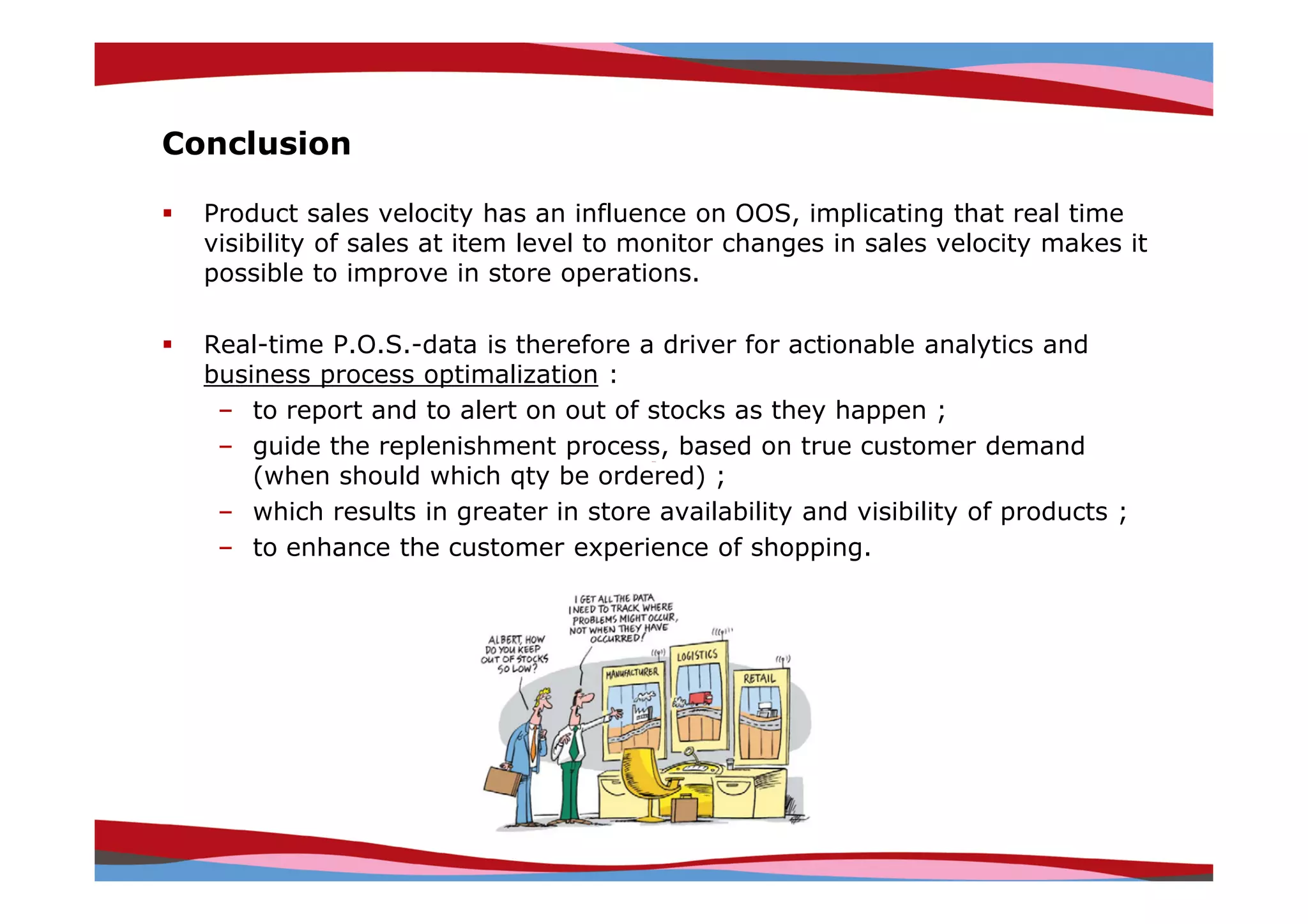
  Product sales velocity has an influence on OOS, implicating that real time
  visibility of sales at item level to monitor changes in sales velocity makes it
  possible to improve in store operations.

  Real-time P.O.S.-data is therefore a driver for actionable analytics and
  business process optimalization :
   – to report and to alert on out of stocks as they happen ;
   – guide the replenishment process, based on true customer demand
      (when should which qty be ordered) ;
   – which results in greater in store availability and visibility of products ;
   – to enhance the customer experience of shopping.


                                                              Copyright © IRI, 2005. Confidential and proprietary.
Recommendations for future analysis

  data accuracy

  operationalization of products characteristics (e.g. promotional events)

  further examination of store characteristics, e.g. SKU-density

  development of forecast models based on history data and real-time data :

        • setup of rules-driven stock management decisions : detection of regular cycles (normal
          performance varies by hour of the day, day of the week, …) and exceptions on regular
          cycles
        • setup of individual (P.O.S.-) profiles : an increase in the velocity of sales may trigger an
          alert for a P.O.S., but not for a different newsstand


                                                                               Copyright © IRI, 2005. Confidential and proprietary.

Operational B I In Supply Chain Planning

  • 1.
    Solve the InsightPuzzle & See the Entire Picture ! Operational business intelligence in supply chain planning Johan Blomme Business Intelligence Manager, AMP email johan.blomme@ampnet.be
  • 2.
    Agenda Meeting thedemand economy Trends in business intelligence Predicting out of stocks with real-time P.O.S.-data
  • 3.
  • 4.
    Copyright © IRI,2005. Confidential and proprietary.
  • 5.
    The future valuechain : – capturing of demand signals to estimate true customer demand – real-time visibility and information sharing with partners demand driven value chain Copyright © IRI, 2005. Confidential and proprietary.
  • 6.
    Trends in businessintelligence
  • 7.
    BI has evolvedfrom its primary purpose of ad hoc query and analysis on a static store of historical information to analyzing transaction data in (near) real-time. MANAGEMENT INFORMATION BUSINESS OPERATIONS DATA DRIVEN PROCESS DRIVEN TIME DELAYED REAL TIME Copyright © IRI, 2005. Confidential and proprietary.
  • 8.
    MANAGEMENT INFORMATION BUSINESS OPERATIONS prospective, proactive information delivery, actionable analytics alert predictive notification analysis Buisness value data mining (BAM) restrospective information monitor delivery at multiple levels OLAP query & reporting What happened ? What’s happening now ? What might happen ? Copyright © IRI, 2005. Confidential and proprietary.
  • 9.
    •What has happened? •e.g. What is M.A.D. of forecasts for product X ? Business •e.g. Why have out of stocks increased in week 20 ? reporting •What’s happening now : Performance measurement and alert notification Responsive •e.g. what is OOS % at the end of day 1 of sales analytics promotion ? •What might happen : business process optimization •e.g. SKU is going to be out of stock ; increase Actionable replenishment frequency to prevent OOS analytics Copyright © IRI, 2005. Confidential and proprietary.
  • 10.
    DATA DRIVEN PROCESS DRIVEN The emphasis is not on the data itself, but on the business processes that generate the data. « Business intelligence is moving into the context of the business process, not just to make users’ information experience more effective, but also to allow for business process optimization » . Software Macro-Trends : Reshaping Enterprise Software – Sep. 2005 Copyright © IRI, 2005. Confidential and proprietary.
  • 11.
    a data storeis fed by operational systems and then the starting point is the business process in the center delivers reporting (the data and the reporting are determined by the process) the flow of information is two-way : from business processes to analytics and from analytics to business processes (closed-loop approach) operational and analytical processes are converging Copyright © IRI, 2005. Confidential and proprietary.
  • 12.
    TIME DELAYED REAL TIME analysis happens after fact, using aggregated and analysis of detailed data while event is occurring detailed data (query driven) events are interpreted in real-time : – monitor – interpret – predict Copyright © IRI, 2005. Confidential and proprietary.
  • 13.
    Predicting out ofstocks with real-time P.O.S.-data
  • 14.
    Publisher Distributor Newsstand Product Flow demand Patterns (bullwhip effect !) Information Flow Fragmented and inefficient due to poor flow of information 1 Copyright © IRI, 2005. Confidential and proprietary.
  • 15.
    The publishing supplychain is partly inefficient due to a lack of visibility of day-to-day demand and stock positions. Return rates of 60 % and more are not uncommon in the publishing industry. While excess inventory leads to waste, at the same time retailers are often faced with the problem of out of stocks : – it is estimated that out of stocks cause lost sales of about 3-4 % ; – most OOS-problems are caused inside the store. Finding a balance between inventory and service levels will continue to grow as the numer of SKU’s continues to grow (niche marketing), in combination with seasonal effects, frequent promotional activities, etc. To minimize inventory and improve product availability, a better view of real demand is necessary. Copyright © IRI, 2005. Confidential and proprietary.
  • 16.
    Managing the replenishmentprocess can increase visibility in the supply chain. Generate operational improvements from downstream retail (P.O.S.)-data to reduce out of stocks and improve sales. monitor stock-levels through real-time data gathered at P.O.S. flow of information Store direct Ordering customer supplier VMI, automatic replenishment processes flow of goods Copyright © IRI, 2005. Confidential and proprietary.
  • 17.
    logistics as amarketing tool logistics as a marketing tool chemical industry machine building paper industry plant constructions automotive electronics logistics as a cost saving tool logistics as a cost saving tool Copyright © IRI, 2005. Confidential and proprietary.
  • 18.
    In order todevelop replenishment models, we need evidence about the relationship between performance variables (e.g. inventory levels, out of stock) and contextual variables (e.g. store and product characteristics) ? What is the power of P.O.S. real-time data to predict out of stock ? Copyright © IRI, 2005. Confidential and proprietary.
  • 19.
    AMP-Distrishop : dailyP.O.S.-data from major retailers Copyright © IRI, 2005. Confidential and proprietary.
  • 20.
    Visualisation of salesvelocity for weekly titles (source : AMP-Distrishop) Copyright © IRI, 2005. Confidential and proprietary.
  • 21.
    Visualisation of salesvelocity for weekly titles (source : AMP-Distrishop) Copyright © IRI, 2005. Confidential and proprietary.
  • 22.
    Product velocity isthe key : – the faster moving the item, the bigger the impact on the business (e.g. negative consumer reactions) ; – the focus needs to be on the fastest moving items. Test : – weekly magazines (392) ; – selection of 25 titles : • fast moving items • P.O.S.-coverage : distributed in at least 1.000 P.O.S. • minimum circulation order : 10.000 copies – measurement of sales velocity for each item in each store during a 10-week period (april-june 2007) ; – Distrishop-P.O.S. (413) : selection of 284 newsstands (413 -> 284 : due to validity control of real-time data). Copyright © IRI, 2005. Confidential and proprietary.
  • 23.
    A relatively smallnumber of media products constitutes the majority of newsstand sales Copyright © IRI, 2005. Confidential and proprietary.
  • 24.
    Total sample (combinationP.O.S./#weeks/#media products) = 41.521 « balanced » samples (based on incidence of OOS, 12.3%): – training – test POS/ #weeks / # media products 41.521 % OOS (12,3 %) 5.106 training sample (N = 5.106) - c=0.728 random sample of 2.553 from non-OOS combinations (36.415) random sample of 2.553 from OOS-occurrences (5.106) test sample (N = 5.106) - c=0.712 random sample of 2.553 from non-OOS combinations (36.415) 2.553 OOS-occurrences not in training sample Copyright © IRI, 2005. Confidential and proprietary.
  • 25.
    PREDICTIVE DATA UNCERTAINTY OUTCOME ANALYSIS OOS P.O.S.-features sales history sales velocity logistic regression Copyright © IRI, 2005. Confidential and proprietary.
  • 26.
    Unit of analysis: P.O.S. x MEDIA PRODUCT (WEEKLY MAGAZINE) AT PARTICULAR OSD IN 10-WEEK PERIOD PRODUCT & P.O.S. CHARACTERISTICS product id (25 media products) CAT 1-25 no. of titles in newsstand CAT . < 500 . 500-1000 . > 1000 P.O.S. development : evolution of P.O.S. turnover (2006 vs. preceeding CAT . expansive years) ; . positive . constant . declining . strongly declining SALES HISTORY history of OOS during 10 weeks preceeding media issue INT # OOS incidences occurring in 10-week period before OSD inventory history during 10 weeks preceeding media issue INT mean % unsolds in 10-week period before OSD SALES VELOCITY sales variance : sales coefficient of variance (calculated by dividing the INT scale value from 1 to 8 standard deviation of sales in a 7 day-period by mean sales value) sales throughput: mean sales in a 7 day-period INT scale value from 1 to 8 inventory range of coverage : relative measure of inventory level, INT scale value from 1 to 8 calculated as the absolute inventory divided by mean sales Copyright © IRI, 2005. Confidential and proprietary.
  • 27.
    Odds ratios forthe risk of OOS : effect size of media products product id (25 products) media product 0,563*** 0,588*** 0,611*** 0,754*** … … 1,385*** 1,447*** 1,603*** 1,749*** no. of titles . < 500 . 500-1000 ® . > 1000 P.O.S. development . expansive . positive . constant ® . declining . strongly declining history of OOS # OOS incidences occurring in 10-week period before OSD inventory history mean % unsolds in 10-week period before OSD sales variance sales throughput inventory range of coverage *** p<0.001 Copyright © IRI, 2005. Confidential and proprietary.
  • 28.
    Confidence intervals (95%) for odds ratios of media products Copyright © IRI, 2005. Confidential and proprietary.
  • 29.
    Odds ratios forthe risk of OOS : effect size of media products, no. of titles and P.O.S.-development product id (25 media product 0,563*** 0,571*** products) 0,588*** 0,600*** 0,611*** 0,678*** 0,754*** 0,879*** … … … … 1,385*** 1,301*** 1,447*** 1,500*** 1,603*** 1,588*** 1,749*** 1,678*** no. of titles . < 500 1,003 . 500-1000 ® 1,000 . > 1000 1,115* P.O.S. . expansive 0,895* development . positive 0,966 . constant ® 1,000 . declining 1,062 . strongly declining 1,038 history of OOS # OOS incidences occurring in 10-week period before OSD inventory history mean % unsolds in 10-week period before OSD sales variance sales throughput inventory range of coverage * p<0.05 *** p<0.001 Copyright © IRI, 2005. Confidential and proprietary.
  • 30.
    Odds ratios forthe risk of OOS : effect size of media products, no. of titles, P.O.S.-development and sales history product id (25 media product 0,563*** 0,571*** 0,622*** media products) 0,588*** 0,600*** 0,635*** 0,611*** 0,678*** 0,712*** 0,754*** 0,879*** 0,891*** … … … … … … 1,385*** 1,301*** 1,400*** 1,447*** 1,500*** 1,409*** 1,603*** 1,588*** 1,550*** 1,749*** 1,678*** 1,602*** no. of titles . < 500 1,003 0,998 . 500-1000 ® 1,000 1,000 . > 1000 1,115* 1,015 P.O.S. . expansive 0,895* 0,843* development . positive 0,966 0,920 . constant ® 1,000 1,000 . declining 1,062 1,034 . strongly declining 1,038 1,012 history of OOS # OOS incidences occurring in 10-week 1,127* period before OSD inventory history mean % unsolds in 10-week period 0,988 before OSD sales variance sales throughput inventory range of coverage * p<0.05 *** p<0.001 Copyright © IRI, 2005. Confidential and proprietary.
  • 31.
    Odds ratios forthe risk of OOS : effect size of media products, no. of titles, P.O.S.-development, sales history and sales velocity product (25 media product 0,563*** 0,571*** 0,622*** 0,890* media products) 0,588*** 0,600*** 0,635*** 0,901 0,611*** 0,678*** 0,712*** 0,867* 0,754*** 0,879*** 0,891** 0,850** … … … … … … … … 1,385*** 1,301*** 1,400*** 1,119* 1,447*** 1,500*** 1,409*** 1,246** 1,603*** 1,588*** 1,550*** 1,189** 1,749*** 1,678*** 1,602*** 1,164* no. of titles . < 500 1,003 0,998 1,005 . 500-1000 ® 1,000 1,000 1,000 . > 1000 1,115* 1,015 1,010 P.O.S. . expansive 0,895* 0,843* 0,866* development . positive 0,966 0,920 0,985 . constant ® 1,000 1,000 1,000 . declining 1,062 1,034 1,053 . strongly declining 1,038 1,012 1,076 history of OOS # OOS incidences occurring in 10-week 1,127* 1,109 period before OSD inventory history mean % unsolds in 10-week period 0,988 0,983 before OSD sales variance 1,229** sales throughput 0,890* inventory range 0,846* of coverage * p<0.05 ** p< 0.01 *** p<0.001 Copyright © IRI, 2005. Confidential and proprietary.
  • 32.
    Model fitted :c= 0.712 The c-statistic represents the proportion of pairs with different observed outcomes (no OOS / OOS) for which the model correctly predicts a higher probability for observations with the event outcome (OOS) than the probability for nonevent observations. For the present model, the value of the c-statistic means that 71,2 % of all possible pairs – one with no OOS and one with OOS – the model correctly assigned a higher probability to the cases in which OOS occurred. The c-statistic provides a basis for comparing different models fitted to the same data : for a model without sales velocity-variables the c-statistic is 0,627. While the incidence of OOS is strongly influenced by media product characteristics, the introduction of sales velocity – reduces the effect of media product ; – independent of all other features, out of stock-occurrences vary significantly by sales velocity : • e.g. sales variance : the odds ratio of 1,229 may seem relatively small ; however if the effect size of sales variance is transformed to a probability, it means that with a one unit increase in sales variance the 00S-probability increases with 2,4 % ; at the highest level of sales variance, the probability of out of stock increases with 16,8%. Copyright © IRI, 2005. Confidential and proprietary.
  • 33.
    Conclusion Productsales velocity has an influence on OOS, implicating that real time visibility of sales at item level to monitor changes in sales velocity makes it possible to improve in store operations. Real-time P.O.S.-data is therefore a driver for actionable analytics and business process optimalization : – to report and to alert on out of stocks as they happen ; – guide the replenishment process, based on true customer demand (when should which qty be ordered) ; – which results in greater in store availability and visibility of products ; – to enhance the customer experience of shopping. Copyright © IRI, 2005. Confidential and proprietary.
  • 34.
    Recommendations for futureanalysis data accuracy operationalization of products characteristics (e.g. promotional events) further examination of store characteristics, e.g. SKU-density development of forecast models based on history data and real-time data : • setup of rules-driven stock management decisions : detection of regular cycles (normal performance varies by hour of the day, day of the week, …) and exceptions on regular cycles • setup of individual (P.O.S.-) profiles : an increase in the velocity of sales may trigger an alert for a P.O.S., but not for a different newsstand Copyright © IRI, 2005. Confidential and proprietary.