Presented by
Kaivan Parikh
 Introduction
 ComputerSystemSecurity
– InternetSecurity
– RemoteSharing
– Software Installation
 OperatingSystemSecurity
– AccessControl
– Supervision
– ResourceAllocation
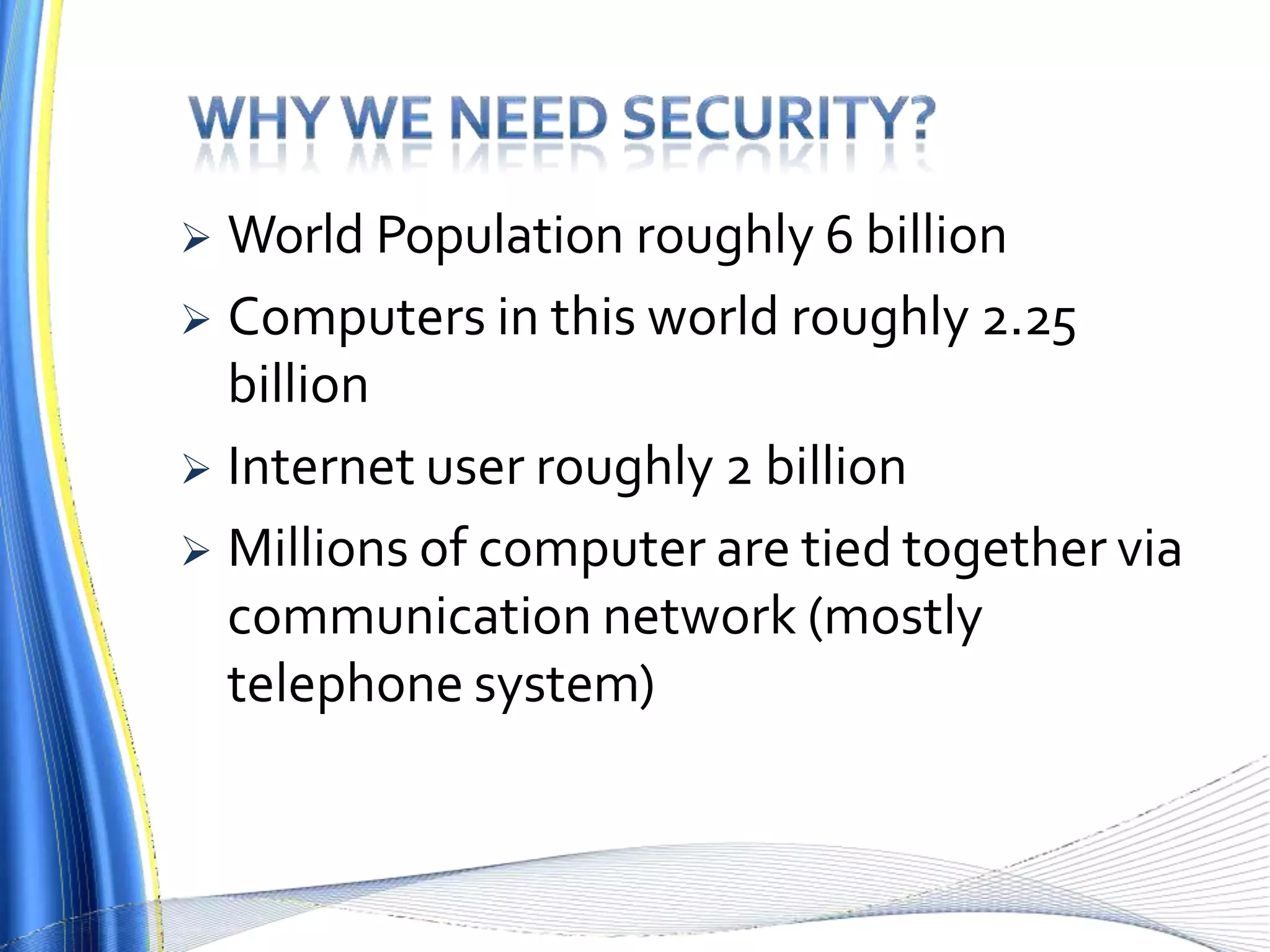
 World Population roughly 6 billion
 Computers in this world roughly 2.25
billion
 Internet user roughly 2 billion
 Millions of computer are tied together via
communication network (mostly
telephone system)
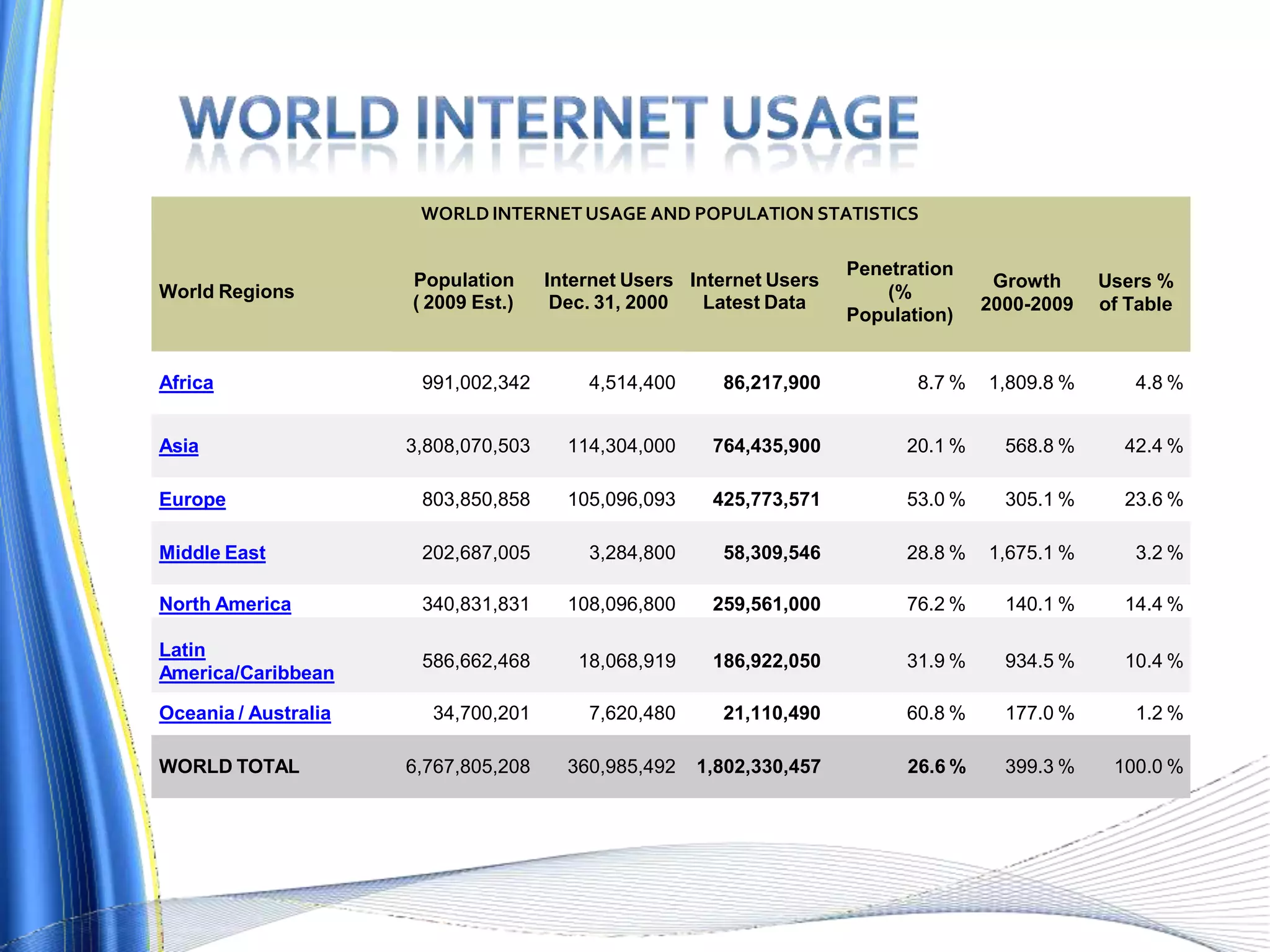
WORLDINTERNET USAGE AND POPULATION STATISTICS
World Regions
Population Internet Users Internet Users
( 2009 Est.) Dec. 31, 2000 Latest Data
Penetration
(%
Population)
Growth
2000-2009
Users %
of Table
Africa 991,002,342 4,514,400 86,217,900 8.7 % 1,809.8 % 4.8 %
Asia 3,808,070,503 114,304,000 764,435,900 20.1 % 568.8 % 42.4 %
Europe 803,850,858 105,096,093 425,773,571 53.0 % 305.1 % 23.6 %
Middle East 202,687,005 3,284,800 58,309,546 28.8 % 1,675.1 % 3.2 %
North America 340,831,831 108,096,800 259,561,000 76.2 % 140.1 % 14.4 %
Latin
America/Caribbean
586,662,468 18,068,919 186,922,050 31.9 % 934.5 % 10.4 %
Oceania / Australia 34,700,201 7,620,480 21,110,490 60.8 % 177.0 % 1.2 %
WORLD TOTAL 6,767,805,208 360,985,492 1,802,330,457 26.6 % 399.3 % 100.0 %
 ExternalSecurity (InterfaceSecurity)
– PhysicalSecurity
– Operational Security
• Classifications
• Division of Responsibilities
 InternalSecurity
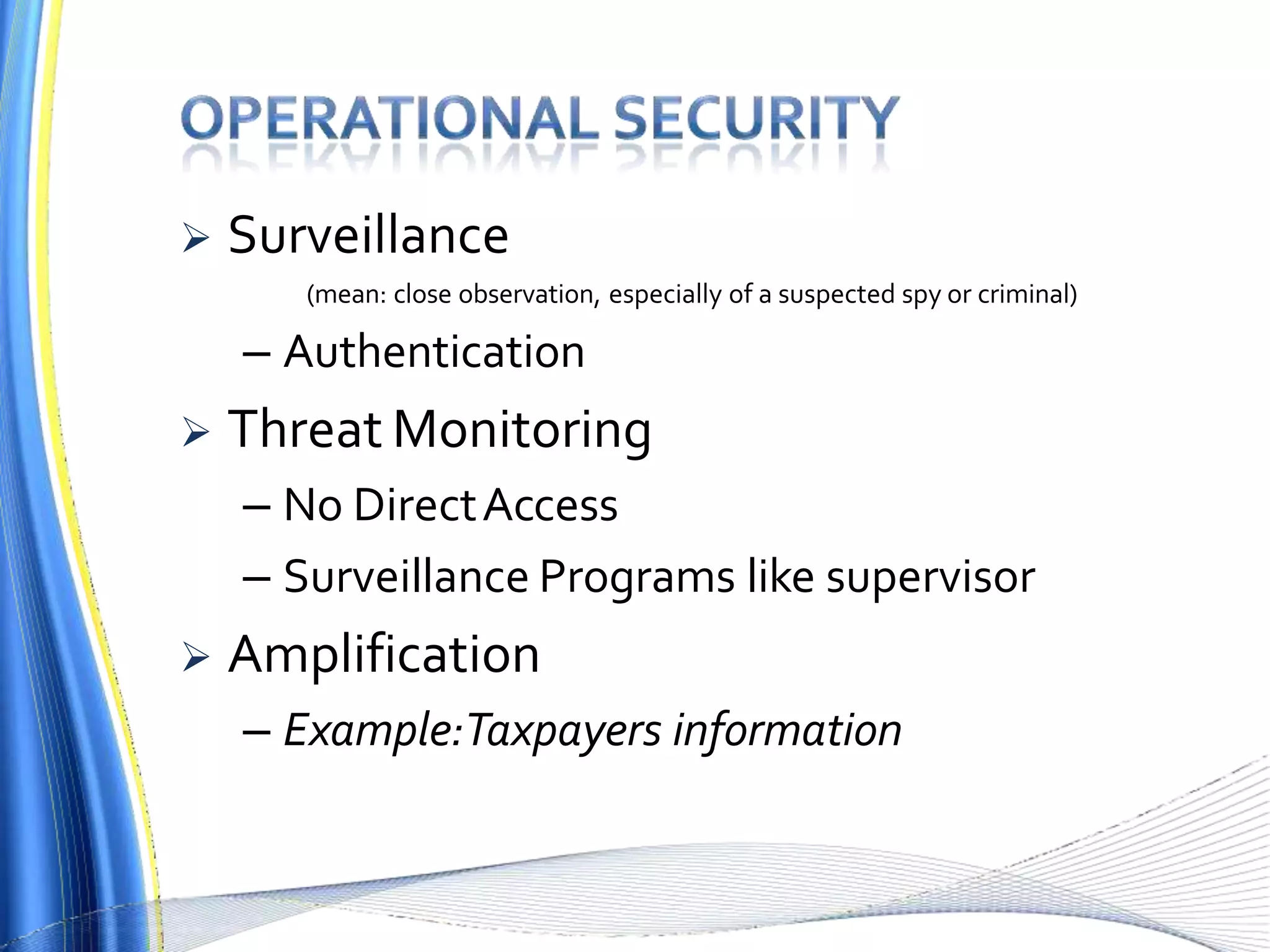
 Surveillance
(mean: close observation, especially of a suspected spy or criminal)
– Authentication
 Threat Monitoring
– No DirectAccess
– Surveillance Programs like supervisor
 Amplification
– Example:Taxpayers information
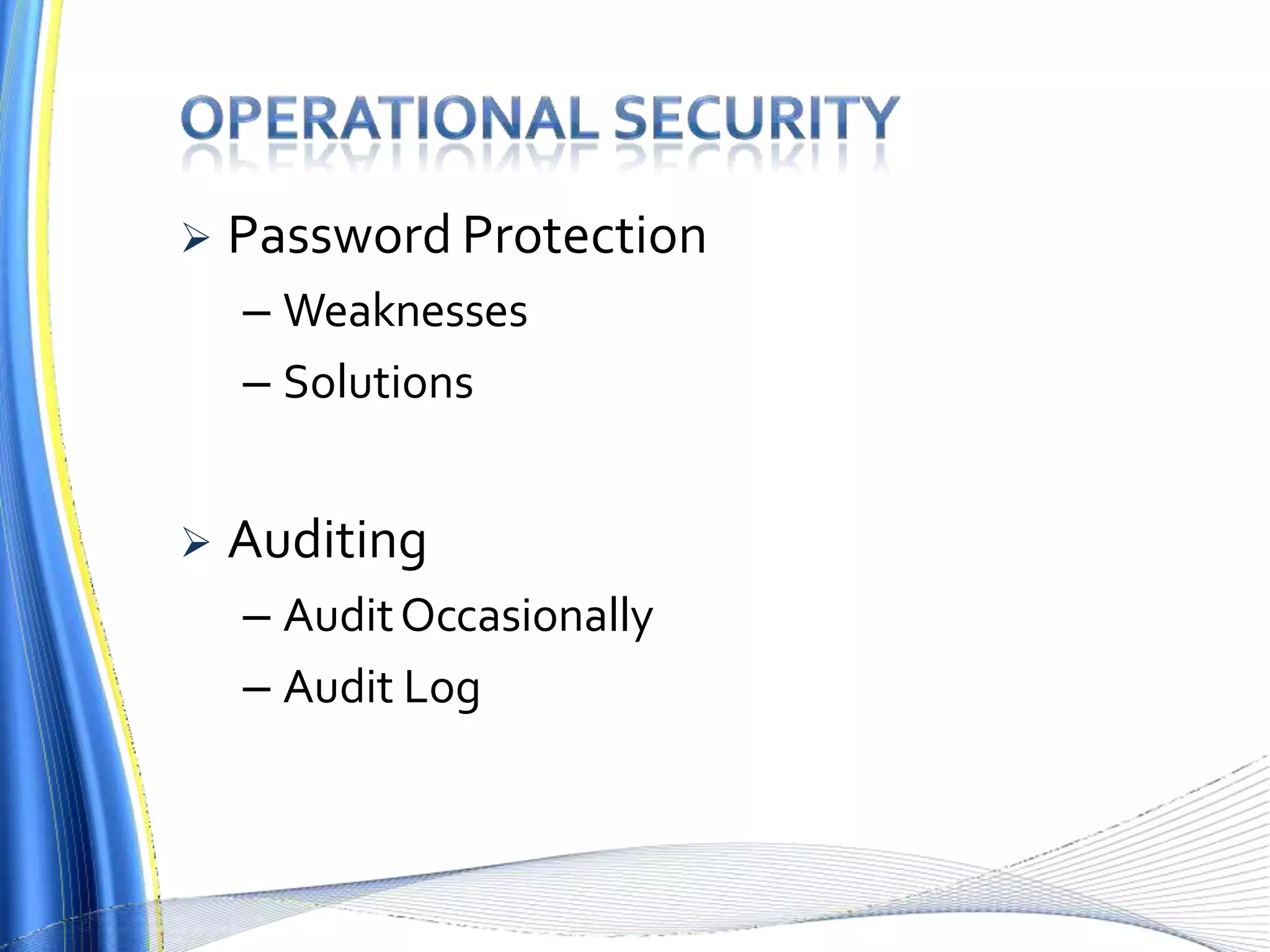
 Password Protection
– Weaknesses
– Solutions
 Auditing
– AuditOccasionally
– Audit Log
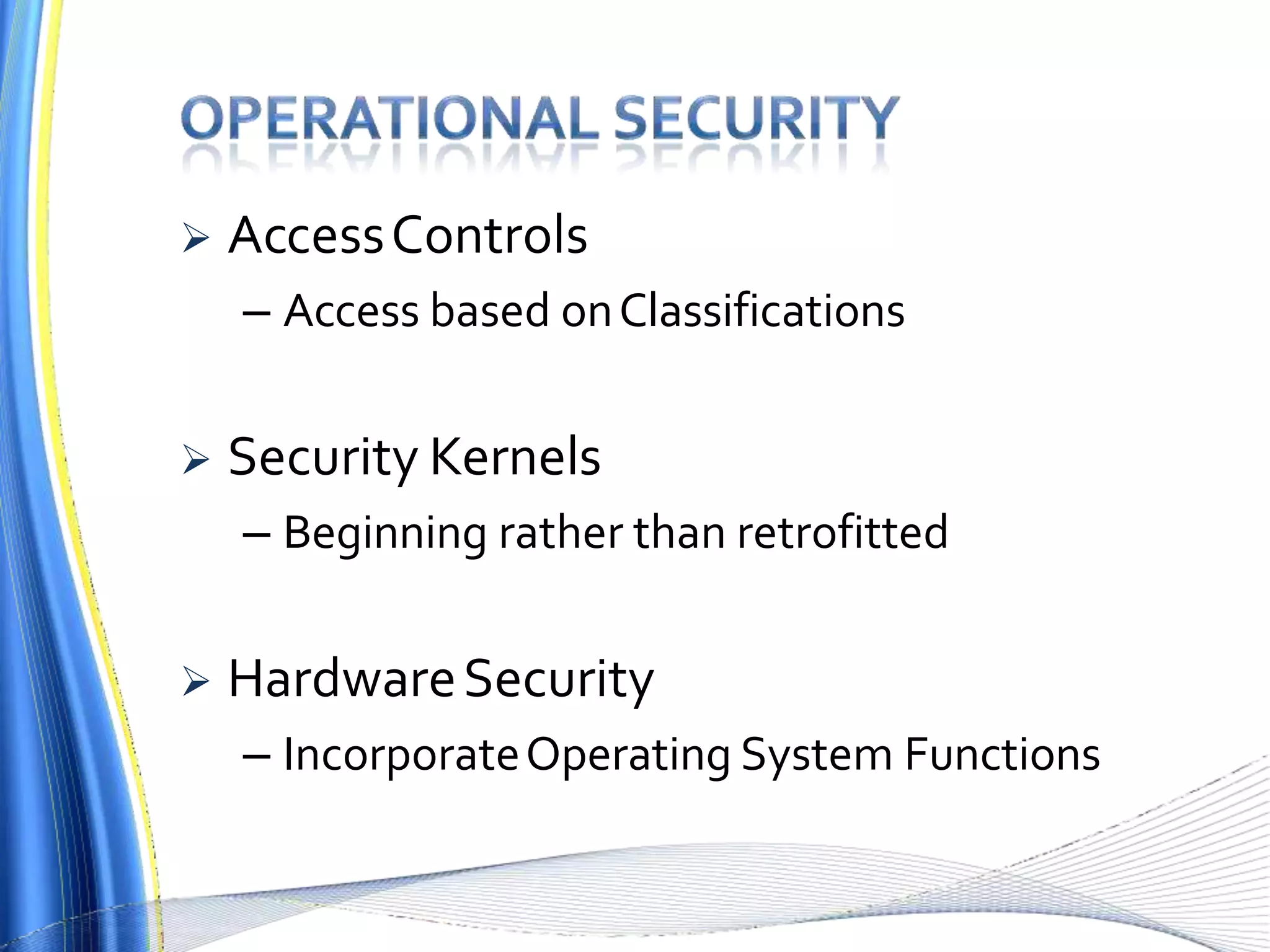
 AccessControls
– Access based onClassifications
 Security Kernels
– Beginning rather than retrofitted
 HardwareSecurity
– IncorporateOperating System Functions
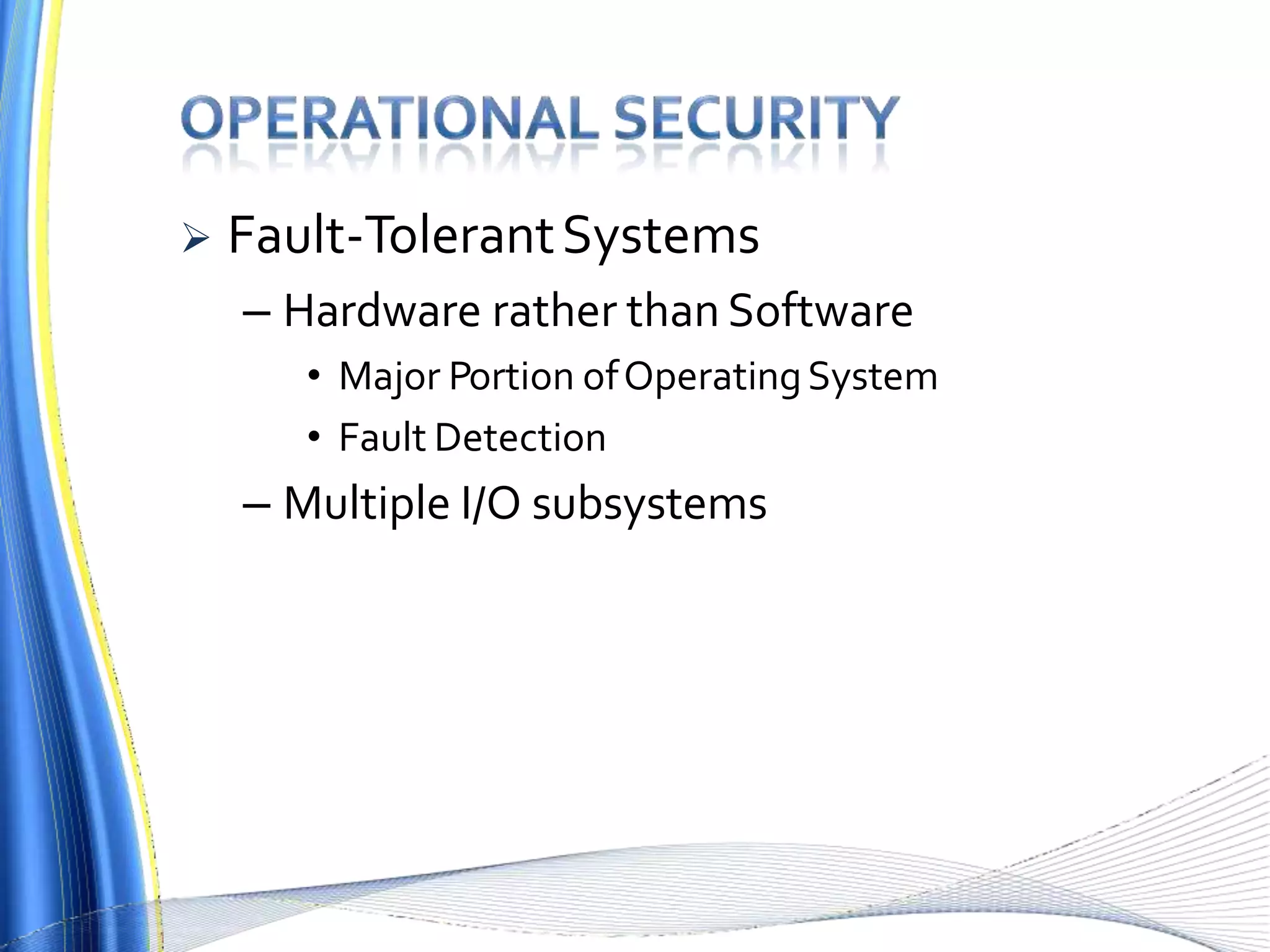
 Fault-TolerantSystems
– Hardware rather than Software
• Major Portion ofOperatingSystem
• Fault Detection
– Multiple I/O subsystems
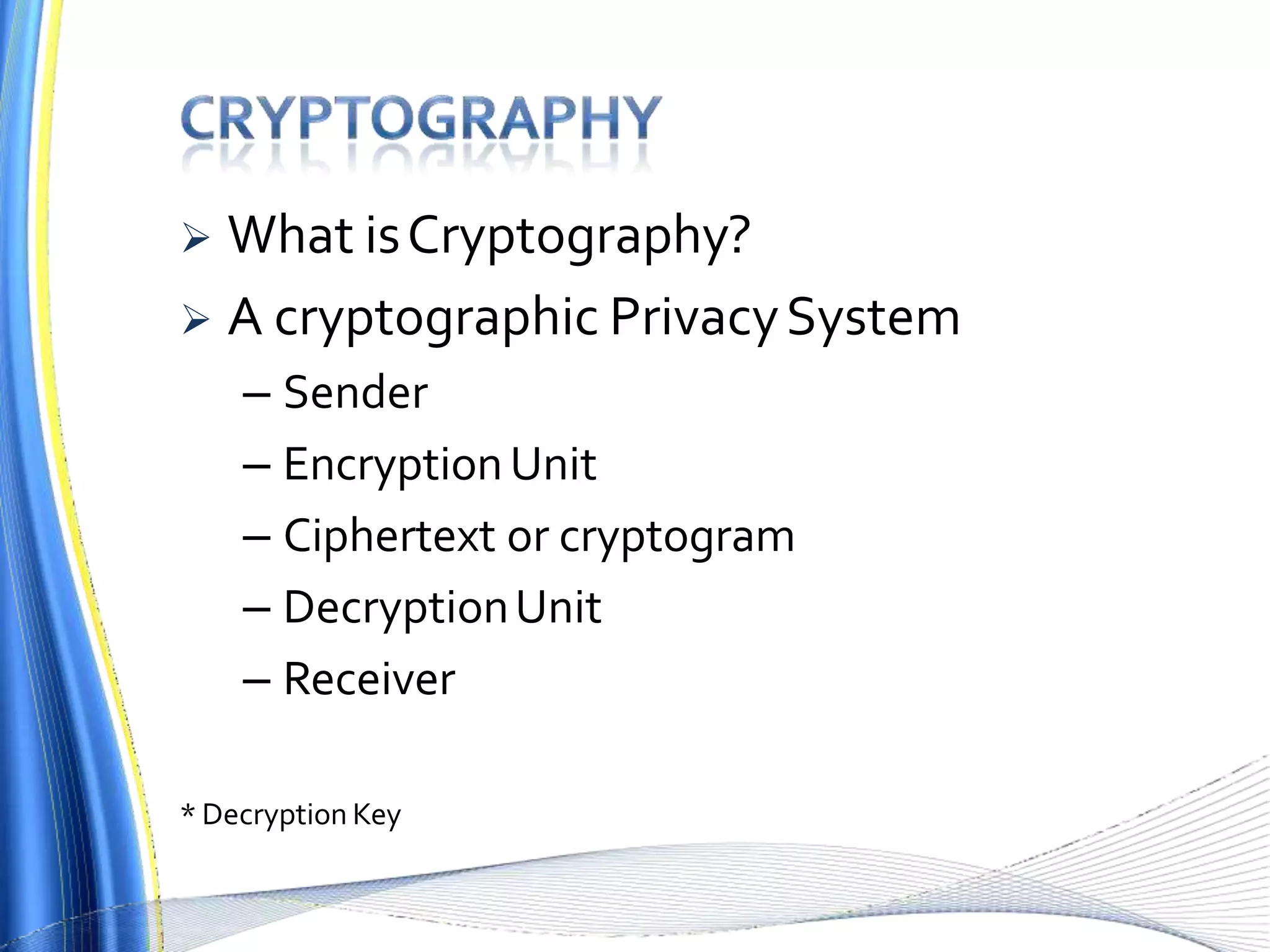
 What isCryptography?
 A cryptographic PrivacySystem
– Sender
– EncryptionUnit
– Ciphertext or cryptogram
– DecryptionUnit
– Receiver
* Decryption Key
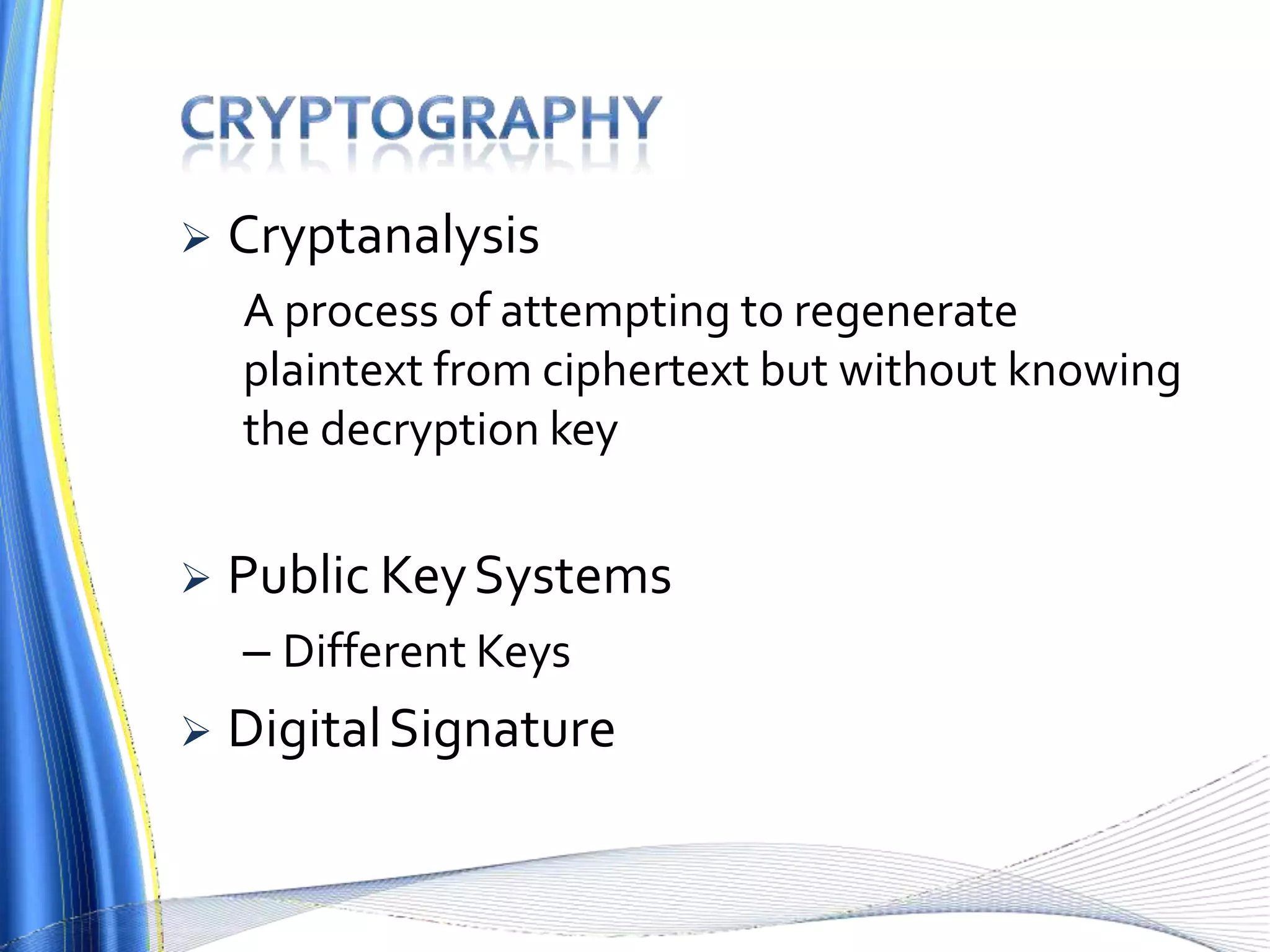
 Cryptanalysis
A process of attempting to regenerate
plaintext from ciphertext but without knowing
the decryption key
 Public KeySystems
– Different Keys
 DigitalSignature
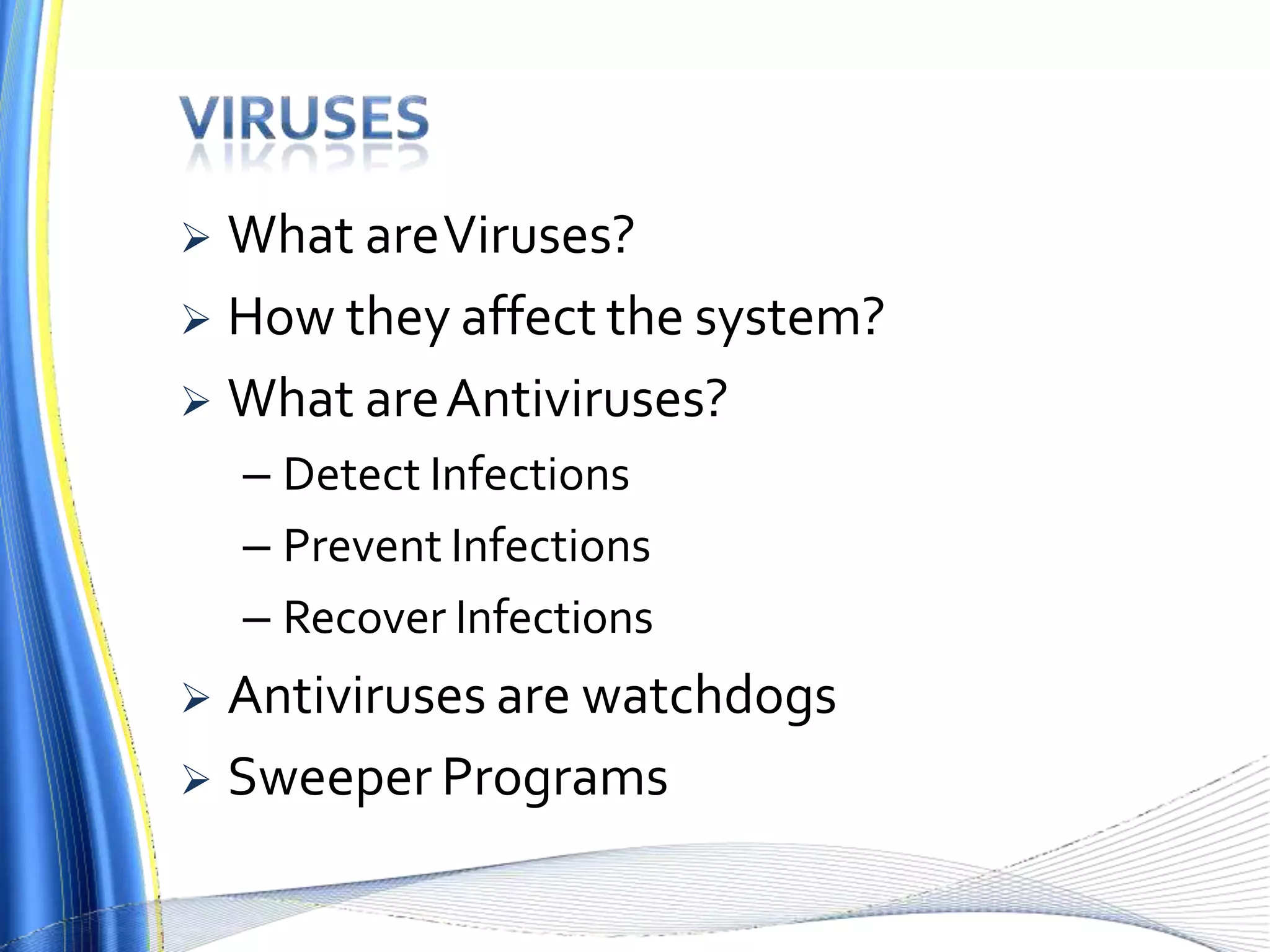
 What areViruses?
 How they affect the system?
 What areAntiviruses?
– Detect Infections
– Prevent Infections
– Recover Infections
 Antiviruses are watchdogs
 Sweeper Programs
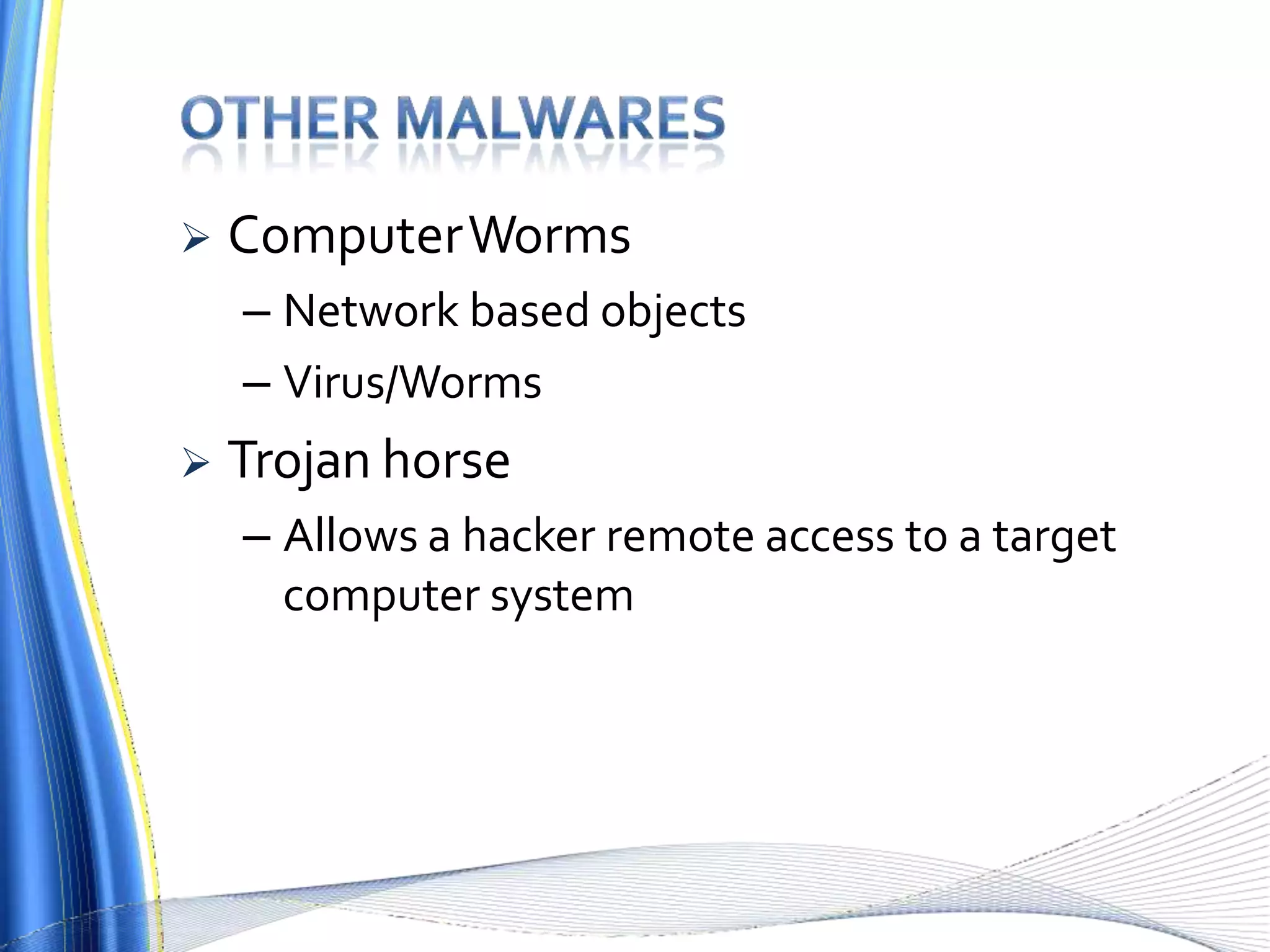
 ComputerWorms
– Network based objects
– Virus/Worms
 Trojan horse
– Allows a hacker remote access to a target
computer system
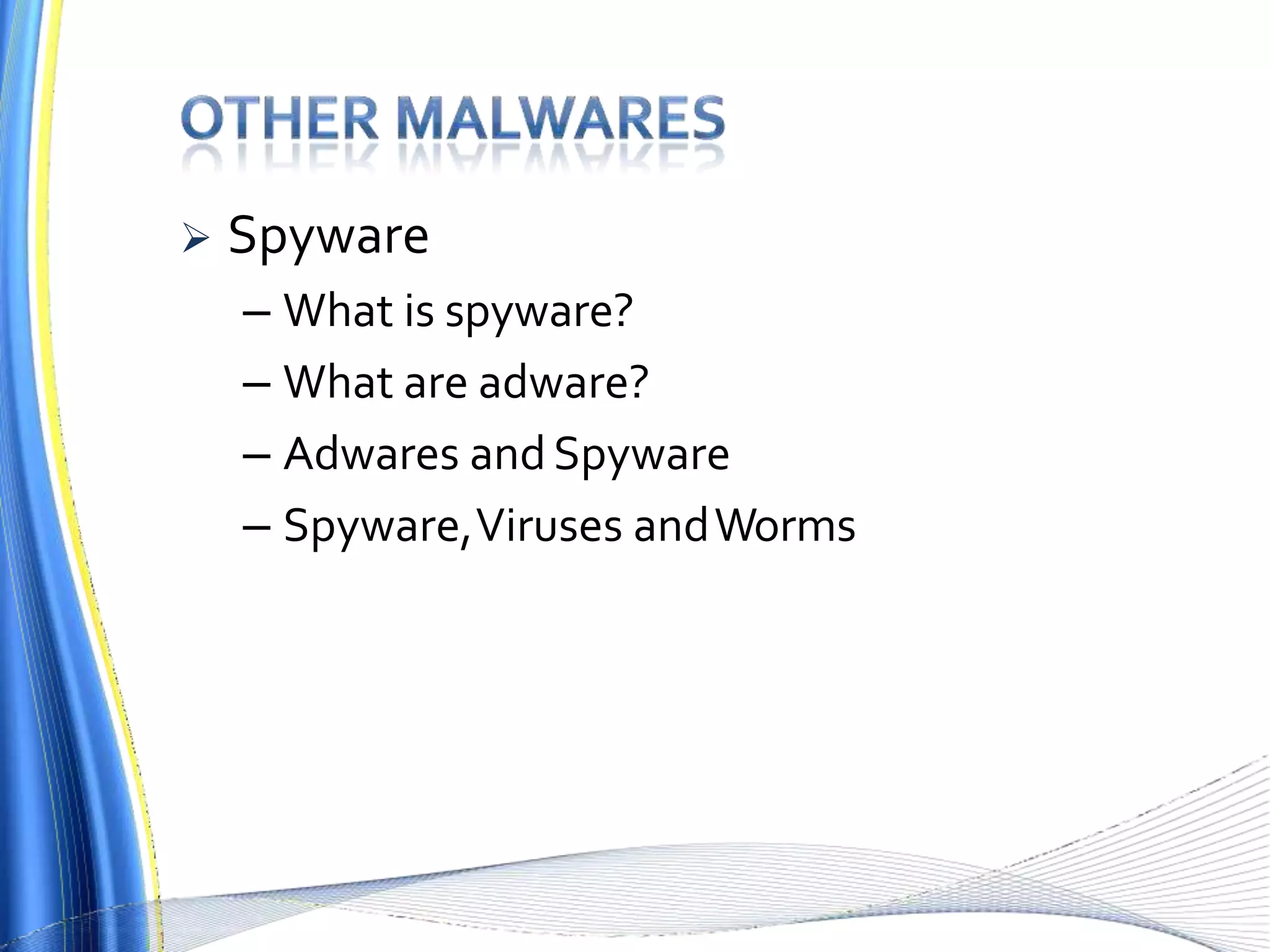
 Spyware
– What is spyware?
– What are adware?
– Adwares andSpyware
– Spyware,Viruses andWorms
 CoolWebSearch, a group of programs, takes advantage of Internet Explorer vulnerabilities.
The package directs traffic to advertisements on Web sites including coolwebsearch.com. It
displays pop-up ads, rewrites search engine results, and alters the infected computer's hosts
file to direct DNS lookups to these sites.
 HuntBar, aka WinTools or Adware.Websearch, was installed by an ActiveX drive-by download
at affiliate Web sites, or by advertisements displayed by other spyware programs—an example
of how spyware can install more spyware. These programs add toolbars to IE, track aggregate
browsing behavior, redirect affiliate references, and display advertisements.
 MyWebSearch (of Fun Web Products) has a plugin that displays a search toolbar near the top of
a browser window, and it spies to report user search-habits. MyWebSearch is notable for
installing over 210 computer settings, such as over 210 MS Windows registry
keys/values.[39][40] Beyond the browser plugin, it has settings to affect Outlook, email, HTML,
XML, etc. Although tools exist to remove MyWebSearch, it can be hand-deleted in 1 hour, by
users familiar with using Regedit to find and delete keys/values (named with "MyWebSearch").
After reboot, the browser returns to the prior display appearance.
 WeatherStudio has a plugin that displays a window-panel near the bottom of a browser
window. The official website notes that it is easy to remove (uninstall) WeatherStudio from a
computer, using its own uninstall-program, such as under C:Program FilesWeatherStudio.
Once WeatherStudio is removed, a browser returns to the prior display appearance, without
the need to modify the browser settings.
 Internet Optimizer, also known as DyFuCa, redirects Internet Explorer error pages to
advertising. When users follow a broken link or enter an erroneous URL, they see a page of
advertisements. However, because password-protected Web sites (HTTP Basic authentication)
use the same mechanism as HTTP errors, Internet Optimizer makes it impossible for the user to
access password-protected sites.
 Zango (formerly 180 Solutions) transmits detailed information to advertisers about the Web
sites which users visit. It also alters HTTP requests for affiliate advertisements linked from a
Web site, so that the advertisements make unearned profit for the 180 Solutions company. It
opens pop-up ads that cover over the Web sites of competing companies (as seen in their
[ZangoEndUser LicenseAgreement]).
 Zlob trojan, or just Zlob, downloads itself to a computer via an ActiveX codec and reports
information back to Control Server[citation needed]. Some information can be the search-
history, the Websites visited, and even keystrokes.[citation needed] More recently, Zlob has
been known to hijack routers set to defaults.
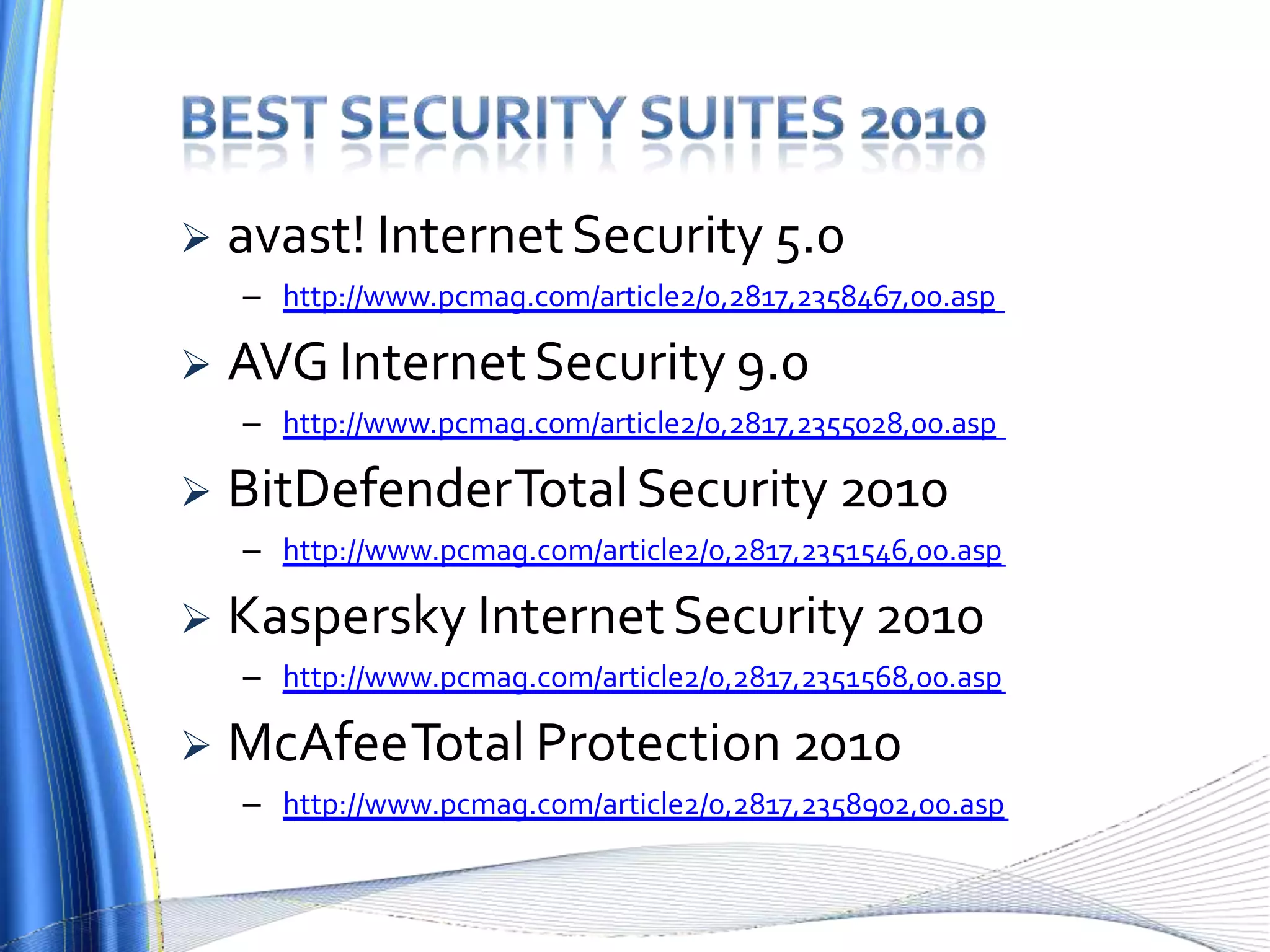
 avast! InternetSecurity 5.0
– http://www.pcmag.com/article2/0,2817,2358467,00.asp
 AVG InternetSecurity 9.0
– http://www.pcmag.com/article2/0,2817,2355028,00.asp
 BitDefenderTotalSecurity 2010
– http://www.pcmag.com/article2/0,2817,2351546,00.asp
 Kaspersky InternetSecurity 2010
– http://www.pcmag.com/article2/0,2817,2351568,00.asp
 McAfeeTotal Protection 2010
– http://www.pcmag.com/article2/0,2817,2358902,00.asp
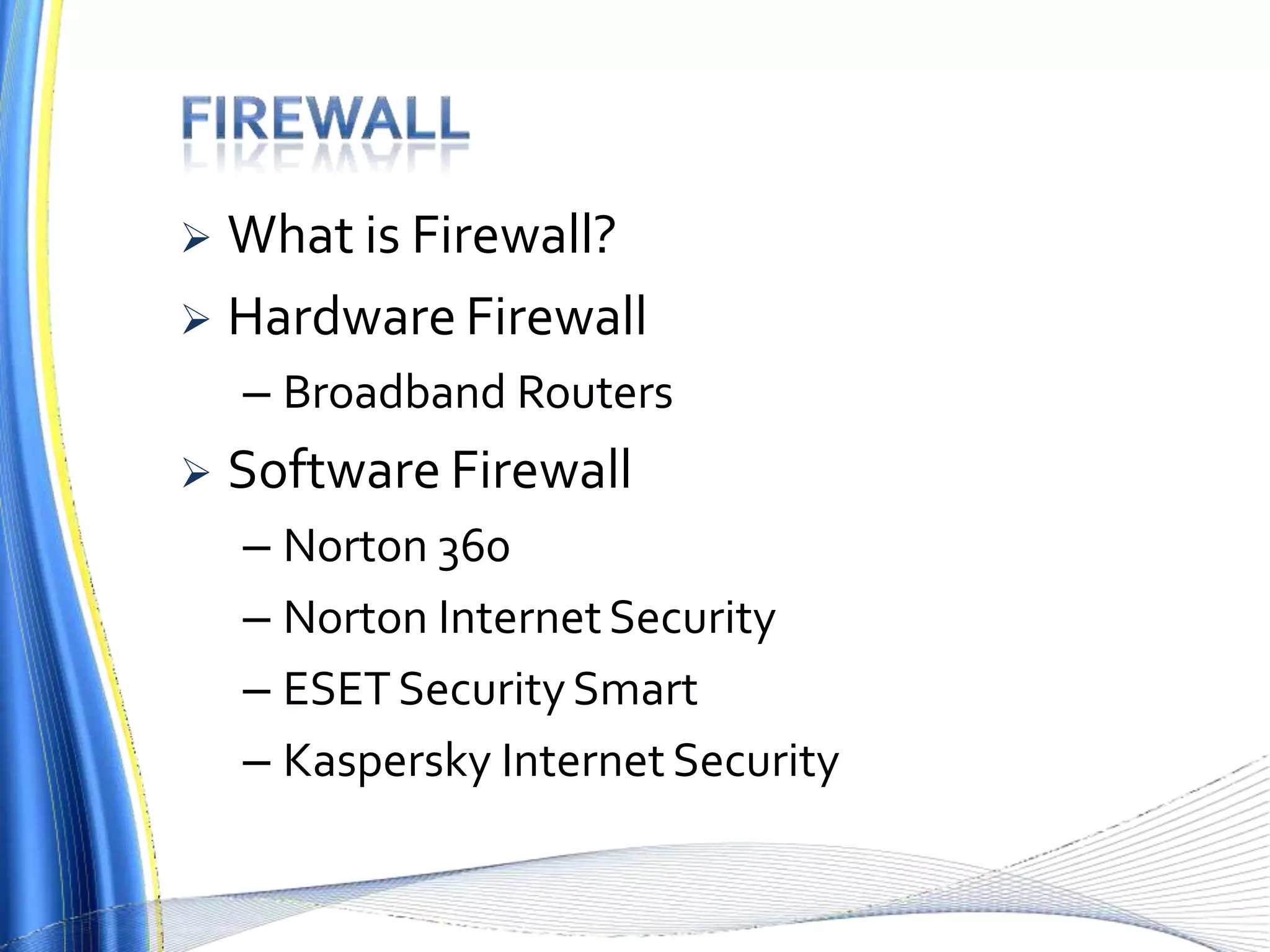
 What is Firewall?
 Hardware Firewall
– Broadband Routers
 Software Firewall
– Norton 360
– Norton InternetSecurity
– ESETSecuritySmart
– Kaspersky InternetSecurity
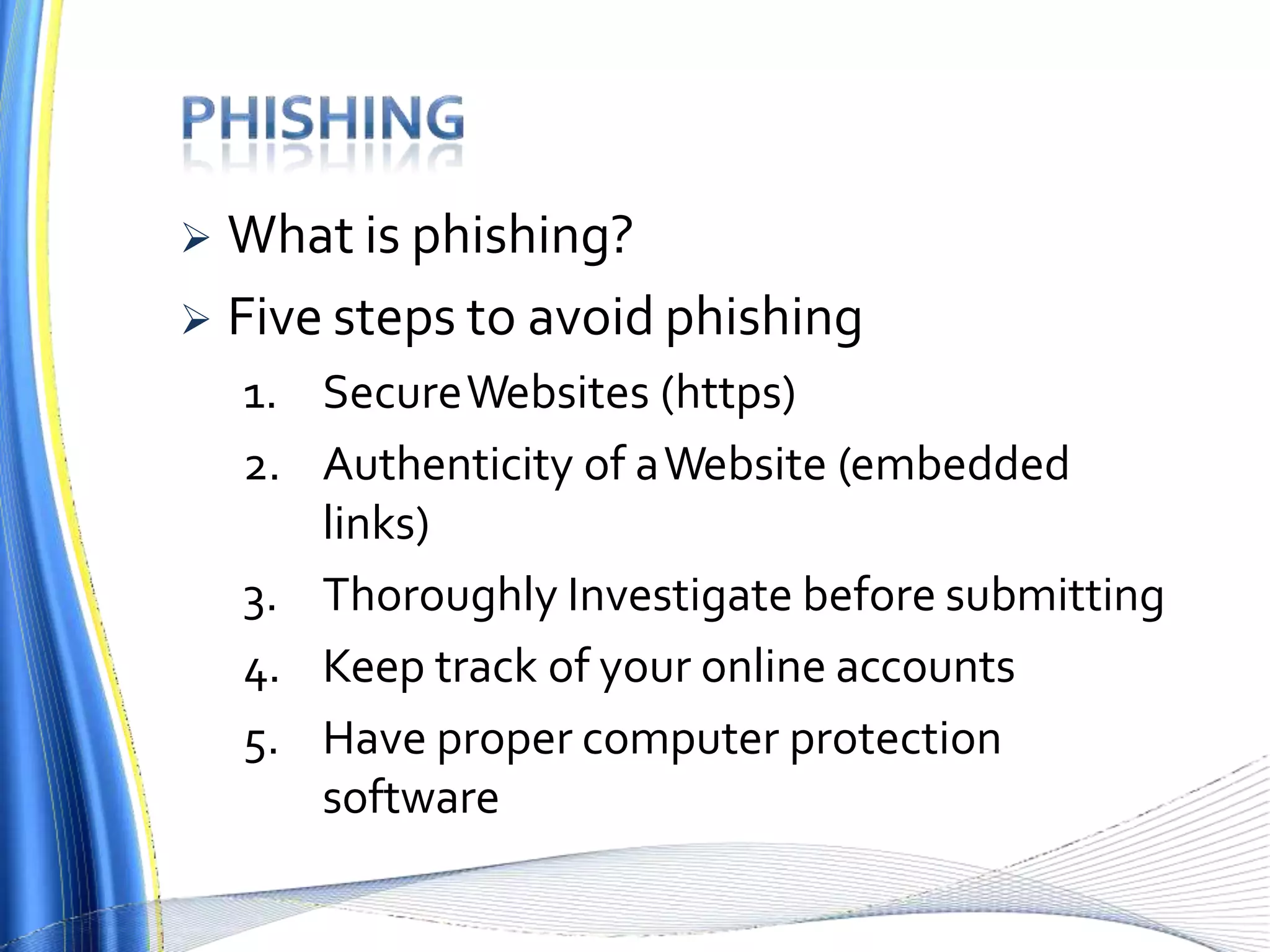
 What is phishing?
 Five steps to avoid phishing
1. SecureWebsites (https)
2. Authenticity of aWebsite (embedded
links)
3. Thoroughly Investigate before submitting
4. Keep track of your online accounts
5. Have proper computer protection
software
 Day by day usage of computer systems
 Hacking risks
 Need of protection software
 And after that, keep you eyes open when
using internet or transmitting something
on the network
 http://howstuffworks.com/
 http://pcmag.com/
 http://net-security.org/
 http://wikipedia.org/
 OperatingSystems by HM Deitel
 OperatingSystemsConcepts by Abraham
Silberschatz, Peter B.Galvin

operatingsystemsecurity-130717170639-phpapp01.pptx

  • 1.
  • 2.
     Introduction  ComputerSystemSecurity –InternetSecurity – RemoteSharing – Software Installation  OperatingSystemSecurity – AccessControl – Supervision – ResourceAllocation
  • 3.
     World Populationroughly 6 billion  Computers in this world roughly 2.25 billion  Internet user roughly 2 billion  Millions of computer are tied together via communication network (mostly telephone system)
  • 4.
    WORLDINTERNET USAGE ANDPOPULATION STATISTICS World Regions Population Internet Users Internet Users ( 2009 Est.) Dec. 31, 2000 Latest Data Penetration (% Population) Growth 2000-2009 Users % of Table Africa 991,002,342 4,514,400 86,217,900 8.7 % 1,809.8 % 4.8 % Asia 3,808,070,503 114,304,000 764,435,900 20.1 % 568.8 % 42.4 % Europe 803,850,858 105,096,093 425,773,571 53.0 % 305.1 % 23.6 % Middle East 202,687,005 3,284,800 58,309,546 28.8 % 1,675.1 % 3.2 % North America 340,831,831 108,096,800 259,561,000 76.2 % 140.1 % 14.4 % Latin America/Caribbean 586,662,468 18,068,919 186,922,050 31.9 % 934.5 % 10.4 % Oceania / Australia 34,700,201 7,620,480 21,110,490 60.8 % 177.0 % 1.2 % WORLD TOTAL 6,767,805,208 360,985,492 1,802,330,457 26.6 % 399.3 % 100.0 %
  • 5.
     ExternalSecurity (InterfaceSecurity) –PhysicalSecurity – Operational Security • Classifications • Division of Responsibilities  InternalSecurity
  • 6.
     Surveillance (mean: closeobservation, especially of a suspected spy or criminal) – Authentication  Threat Monitoring – No DirectAccess – Surveillance Programs like supervisor  Amplification – Example:Taxpayers information
  • 7.
     Password Protection –Weaknesses – Solutions  Auditing – AuditOccasionally – Audit Log
  • 8.
     AccessControls – Accessbased onClassifications  Security Kernels – Beginning rather than retrofitted  HardwareSecurity – IncorporateOperating System Functions
  • 9.
     Fault-TolerantSystems – Hardwarerather than Software • Major Portion ofOperatingSystem • Fault Detection – Multiple I/O subsystems
  • 10.
     What isCryptography? A cryptographic PrivacySystem – Sender – EncryptionUnit – Ciphertext or cryptogram – DecryptionUnit – Receiver * Decryption Key
  • 11.
     Cryptanalysis A processof attempting to regenerate plaintext from ciphertext but without knowing the decryption key  Public KeySystems – Different Keys  DigitalSignature
  • 12.
     What areViruses? How they affect the system?  What areAntiviruses? – Detect Infections – Prevent Infections – Recover Infections  Antiviruses are watchdogs  Sweeper Programs
  • 13.
     ComputerWorms – Networkbased objects – Virus/Worms  Trojan horse – Allows a hacker remote access to a target computer system
  • 14.
     Spyware – Whatis spyware? – What are adware? – Adwares andSpyware – Spyware,Viruses andWorms
  • 15.
     CoolWebSearch, agroup of programs, takes advantage of Internet Explorer vulnerabilities. The package directs traffic to advertisements on Web sites including coolwebsearch.com. It displays pop-up ads, rewrites search engine results, and alters the infected computer's hosts file to direct DNS lookups to these sites.  HuntBar, aka WinTools or Adware.Websearch, was installed by an ActiveX drive-by download at affiliate Web sites, or by advertisements displayed by other spyware programs—an example of how spyware can install more spyware. These programs add toolbars to IE, track aggregate browsing behavior, redirect affiliate references, and display advertisements.  MyWebSearch (of Fun Web Products) has a plugin that displays a search toolbar near the top of a browser window, and it spies to report user search-habits. MyWebSearch is notable for installing over 210 computer settings, such as over 210 MS Windows registry keys/values.[39][40] Beyond the browser plugin, it has settings to affect Outlook, email, HTML, XML, etc. Although tools exist to remove MyWebSearch, it can be hand-deleted in 1 hour, by users familiar with using Regedit to find and delete keys/values (named with "MyWebSearch"). After reboot, the browser returns to the prior display appearance.  WeatherStudio has a plugin that displays a window-panel near the bottom of a browser window. The official website notes that it is easy to remove (uninstall) WeatherStudio from a computer, using its own uninstall-program, such as under C:Program FilesWeatherStudio. Once WeatherStudio is removed, a browser returns to the prior display appearance, without the need to modify the browser settings.
  • 16.
     Internet Optimizer,also known as DyFuCa, redirects Internet Explorer error pages to advertising. When users follow a broken link or enter an erroneous URL, they see a page of advertisements. However, because password-protected Web sites (HTTP Basic authentication) use the same mechanism as HTTP errors, Internet Optimizer makes it impossible for the user to access password-protected sites.  Zango (formerly 180 Solutions) transmits detailed information to advertisers about the Web sites which users visit. It also alters HTTP requests for affiliate advertisements linked from a Web site, so that the advertisements make unearned profit for the 180 Solutions company. It opens pop-up ads that cover over the Web sites of competing companies (as seen in their [ZangoEndUser LicenseAgreement]).  Zlob trojan, or just Zlob, downloads itself to a computer via an ActiveX codec and reports information back to Control Server[citation needed]. Some information can be the search- history, the Websites visited, and even keystrokes.[citation needed] More recently, Zlob has been known to hijack routers set to defaults.
  • 17.
     avast! InternetSecurity5.0 – http://www.pcmag.com/article2/0,2817,2358467,00.asp  AVG InternetSecurity 9.0 – http://www.pcmag.com/article2/0,2817,2355028,00.asp  BitDefenderTotalSecurity 2010 – http://www.pcmag.com/article2/0,2817,2351546,00.asp  Kaspersky InternetSecurity 2010 – http://www.pcmag.com/article2/0,2817,2351568,00.asp  McAfeeTotal Protection 2010 – http://www.pcmag.com/article2/0,2817,2358902,00.asp
  • 18.
     What isFirewall?  Hardware Firewall – Broadband Routers  Software Firewall – Norton 360 – Norton InternetSecurity – ESETSecuritySmart – Kaspersky InternetSecurity
  • 19.
     What isphishing?  Five steps to avoid phishing 1. SecureWebsites (https) 2. Authenticity of aWebsite (embedded links) 3. Thoroughly Investigate before submitting 4. Keep track of your online accounts 5. Have proper computer protection software
  • 20.
     Day byday usage of computer systems  Hacking risks  Need of protection software  And after that, keep you eyes open when using internet or transmitting something on the network
  • 21.
     http://howstuffworks.com/  http://pcmag.com/ http://net-security.org/  http://wikipedia.org/  OperatingSystems by HM Deitel  OperatingSystemsConcepts by Abraham Silberschatz, Peter B.Galvin