Prof. B. I. KhodanpurProf. B. I. Khodanpur
HOD – Dept. of CSEHOD – Dept. of CSE
R. V. College of Engineering.R. V. College of Engineering.
EmailID:EmailID:   bi.khodanpur@gmail.combi.khodanpur@gmail.com
Subject: Operating Systems (For EDUSAT)
Common Paper for BA / B.Com / B.Sc
Code: CS-54
Application Software
(contd…):
Spreadsheets: The spreadsheet packages are
designed to use numbers and formulas to do
calculations with ease. Examples of spreadsheets
include:
 Budgets
 Payrolls
 Grade Calculations
 Address Lists
The most commonly used spreadsheet programs are
Microsoft Excel and Lotus 123.
Application Software
(contd…):
Graphic Presentations: The presentation
programs can be easier using overhead
projectors. Other uses include:
 Slide Shows
 Repeating Computer Presentations on a
computer monitor
 Using Sound and animation in slide shows
The most recognized graphic presentation programs are
Microsoft PowerPoint and Harvard Graphics.
Application Software
(contd…):
Database Management System (DBMS):
 A DBMS is a software tool that allows multiple users to
store, access, and process data into useful information.
 Database programs are designed for these types of
applications:
 Membership lists
 Student lists
 Grade reports
 Instructor schedules
All of these have to be maintained so you can find what
you need quickly and accurately.
 Example:Microsoft Access, dBASE, Oracle.
Contents
 Today's Topic: Introduction to Operating Systems
 We will learnWe will learn
1.1. What is Operating System?What is Operating System?
2.2. What OS does?What OS does?
3.3. Structure of OSStructure of OS
4.4. Evolution of OSEvolution of OS
 Batch Processing, Multiprogramming, TimeBatch Processing, Multiprogramming, Time
sharing systemssharing systems
5.5. Operating System FunctionsOperating System Functions
6.6. Main Funtions of OSMain Funtions of OS
7.7. Types of OSTypes of OS
 Single User, Multi User systemsSingle User, Multi User systems
Operating SystemsOperating Systems
What is OS?
 Operating System is a software, which makes a
computer to actually work.
 It is the software the enables all the programs we use.
 The OS organizes and controls the hardware.
 OS acts as an interface between the application
programs and the machine hardware.
 Examples: Windows, Linux, Unix and Mac OS, etc.,
What OS does?
An operating system performs basic tasks such as,
 controlling and allocating memory,
 prioritizing system requests,
 controlling input and output devices,
 facilitating networking and
 managing file systems.
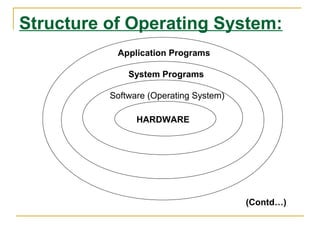
Structure of Operating System:
Application Programs
System Programs
Software (Operating System)
HARDWARE
(Contd…)
Structure of Operating System
(Contd…):
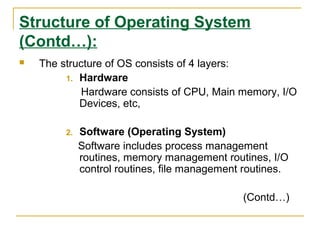
 The structure of OS consists of 4 layers:
1. Hardware
Hardware consists of CPU, Main memory, I/O
Devices, etc,
2. Software (Operating System)
Software includes process management
routines, memory management routines, I/O
control routines, file management routines.
(Contd…)
Structure of Operating System
(Contd…):
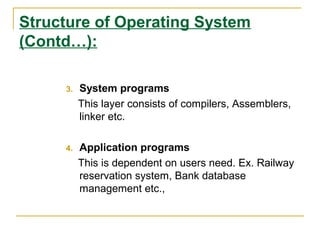
3. System programs
This layer consists of compilers, Assemblers,
linker etc.
4. Application programs
This is dependent on users need. Ex. Railway
reservation system, Bank database
management etc.,
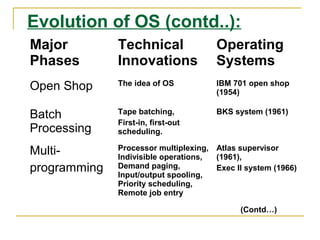
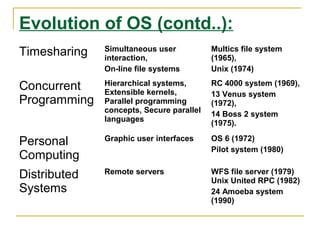
Evolution of OS:
 The evolution of operating systems went through seven
major phases.
 Six of them significantly changed the ways in which
users accessed computers through the open shop, batch
processing, multiprogramming, timesharing, personal
computing, and distributed systems.
 In the seventh phase the foundations of concurrent
programming were developed and demonstrated in
model operating systems.
(Contd…)
Evolution of OS (contd..):
Major
Phases
Technical
Innovations
Operating
Systems
Open Shop The idea of OS IBM 701 open shop
(1954)
Batch
Processing
Tape batching,
First-in, first-out
scheduling.
BKS system (1961)
Multi-
programming
Processor multiplexing,
Indivisible operations,
Demand paging,
Input/output spooling,
Priority scheduling,
Remote job entry
Atlas supervisor
(1961),
Exec II system (1966)
(Contd…)
Evolution of OS (contd..):
Timesharing Simultaneous user
interaction,
On-line file systems
Multics file system
(1965),
Unix (1974)
Concurrent
Programming
Hierarchical systems,
Extensible kernels,
Parallel programming
concepts, Secure parallel
languages
RC 4000 system (1969),
13 Venus system
(1972),
14 Boss 2 system
(1975).
Personal
Computing
Graphic user interfaces OS 6 (1972)
Pilot system (1980)
Distributed
Systems
Remote servers WFS file server (1979)
Unix United RPC (1982)
24 Amoeba system
(1990)
Batch Processing:
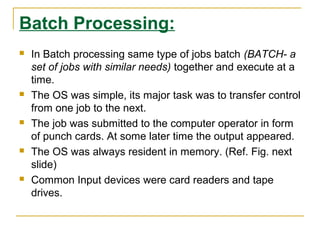
 In Batch processing same type of jobs batch (BATCH- a
set of jobs with similar needs) together and execute at a
time.
 The OS was simple, its major task was to transfer control
from one job to the next.
 The job was submitted to the computer operator in form
of punch cards. At some later time the output appeared.
 The OS was always resident in memory. (Ref. Fig. next
slide)
 Common Input devices were card readers and tape
drives.
Batch Processing (Contd…):
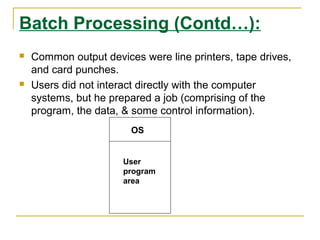
 Common output devices were line printers, tape drives,
and card punches.
 Users did not interact directly with the computer
systems, but he prepared a job (comprising of the
program, the data, & some control information).
OS
User
program
area
Multiprogramming:
 Multiprogramming is a technique to execute number of
programs simultaneously by a single processor.
 In Multiprogramming, number of processes reside in
main memory at a time.
 The OS picks and begins to executes one of the jobs in
the main memory.
 If any I/O wait happened in a process, then CPU
switches from that job to another job.
 Hence CPU in not idle at any time.
Multiprogramming (Contd…):
OS
Job 1
Job 2
Job 3
Job 4
Job 5
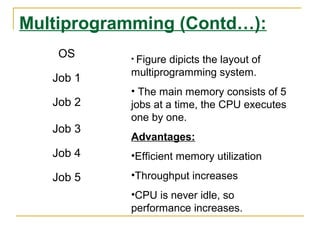
• Figure dipicts the layout of
multiprogramming system.
• The main memory consists of 5
jobs at a time, the CPU executes
one by one.
Advantages:
•Efficient memory utilization
•Throughput increases
•CPU is never idle, so
performance increases.
Time Sharing Systems:
 Time sharing, or multitasking, is a logical extension of
multiprogramming.
 Multiple jobs are executed by switching the CPU
between them.
 In this, the CPU time is shared by different processes, so
it is called as “Time sharing Systems”.
 Time slice is defined by the OS, for sharing CPU time
between processes.
 Examples: Multics, Unix, etc.,
Operating Systems functions:
 The main functions of operating systems are:
1. Program creation
2. Program execution
3. Input/Output operations
4. Error detection
5. Resource allocation
6. Accounting
7. protection
Types of OS:
Operating System can also be classified as,-
 Single User Systems
 Multi User Systems
Single User Systems:
 Provides a platform for only one user at a
time.
 They are popularly associated with Desk Top
operating system which run on standalone
systems where no user accounts are
required.
 Example: DOS
Multi-User Systems:
 Provides regulated access for a number of users by
maintaining a database of known users.
 Refers to computer systems that support two or more
simultaneous users.
 Another term for multi-user is time sharing.
 Ex: All mainframes and are multi-user systems.
 Example: Unix

Operating systems11 9-07

  • 1.
    Prof. B. I.KhodanpurProf. B. I. Khodanpur HOD – Dept. of CSEHOD – Dept. of CSE R. V. College of Engineering.R. V. College of Engineering. EmailID:EmailID:   bi.khodanpur@gmail.combi.khodanpur@gmail.com Subject: Operating Systems (For EDUSAT) Common Paper for BA / B.Com / B.Sc Code: CS-54
  • 2.
    Application Software (contd…): Spreadsheets: Thespreadsheet packages are designed to use numbers and formulas to do calculations with ease. Examples of spreadsheets include:  Budgets  Payrolls  Grade Calculations  Address Lists The most commonly used spreadsheet programs are Microsoft Excel and Lotus 123.
  • 3.
    Application Software (contd…): Graphic Presentations:The presentation programs can be easier using overhead projectors. Other uses include:  Slide Shows  Repeating Computer Presentations on a computer monitor  Using Sound and animation in slide shows The most recognized graphic presentation programs are Microsoft PowerPoint and Harvard Graphics.
  • 4.
    Application Software (contd…): Database ManagementSystem (DBMS):  A DBMS is a software tool that allows multiple users to store, access, and process data into useful information.  Database programs are designed for these types of applications:  Membership lists  Student lists  Grade reports  Instructor schedules All of these have to be maintained so you can find what you need quickly and accurately.  Example:Microsoft Access, dBASE, Oracle.
  • 5.
    Contents  Today's Topic:Introduction to Operating Systems  We will learnWe will learn 1.1. What is Operating System?What is Operating System? 2.2. What OS does?What OS does? 3.3. Structure of OSStructure of OS 4.4. Evolution of OSEvolution of OS  Batch Processing, Multiprogramming, TimeBatch Processing, Multiprogramming, Time sharing systemssharing systems 5.5. Operating System FunctionsOperating System Functions 6.6. Main Funtions of OSMain Funtions of OS 7.7. Types of OSTypes of OS  Single User, Multi User systemsSingle User, Multi User systems
  • 6.
  • 7.
    What is OS? Operating System is a software, which makes a computer to actually work.  It is the software the enables all the programs we use.  The OS organizes and controls the hardware.  OS acts as an interface between the application programs and the machine hardware.  Examples: Windows, Linux, Unix and Mac OS, etc.,
  • 8.
    What OS does? Anoperating system performs basic tasks such as,  controlling and allocating memory,  prioritizing system requests,  controlling input and output devices,  facilitating networking and  managing file systems.
  • 9.
    Structure of OperatingSystem: Application Programs System Programs Software (Operating System) HARDWARE (Contd…)
  • 10.
    Structure of OperatingSystem (Contd…):  The structure of OS consists of 4 layers: 1. Hardware Hardware consists of CPU, Main memory, I/O Devices, etc, 2. Software (Operating System) Software includes process management routines, memory management routines, I/O control routines, file management routines. (Contd…)
  • 11.
    Structure of OperatingSystem (Contd…): 3. System programs This layer consists of compilers, Assemblers, linker etc. 4. Application programs This is dependent on users need. Ex. Railway reservation system, Bank database management etc.,
  • 12.
    Evolution of OS: The evolution of operating systems went through seven major phases.  Six of them significantly changed the ways in which users accessed computers through the open shop, batch processing, multiprogramming, timesharing, personal computing, and distributed systems.  In the seventh phase the foundations of concurrent programming were developed and demonstrated in model operating systems. (Contd…)
  • 13.
    Evolution of OS(contd..): Major Phases Technical Innovations Operating Systems Open Shop The idea of OS IBM 701 open shop (1954) Batch Processing Tape batching, First-in, first-out scheduling. BKS system (1961) Multi- programming Processor multiplexing, Indivisible operations, Demand paging, Input/output spooling, Priority scheduling, Remote job entry Atlas supervisor (1961), Exec II system (1966) (Contd…)
  • 14.
    Evolution of OS(contd..): Timesharing Simultaneous user interaction, On-line file systems Multics file system (1965), Unix (1974) Concurrent Programming Hierarchical systems, Extensible kernels, Parallel programming concepts, Secure parallel languages RC 4000 system (1969), 13 Venus system (1972), 14 Boss 2 system (1975). Personal Computing Graphic user interfaces OS 6 (1972) Pilot system (1980) Distributed Systems Remote servers WFS file server (1979) Unix United RPC (1982) 24 Amoeba system (1990)
  • 15.
    Batch Processing:  InBatch processing same type of jobs batch (BATCH- a set of jobs with similar needs) together and execute at a time.  The OS was simple, its major task was to transfer control from one job to the next.  The job was submitted to the computer operator in form of punch cards. At some later time the output appeared.  The OS was always resident in memory. (Ref. Fig. next slide)  Common Input devices were card readers and tape drives.
  • 16.
    Batch Processing (Contd…): Common output devices were line printers, tape drives, and card punches.  Users did not interact directly with the computer systems, but he prepared a job (comprising of the program, the data, & some control information). OS User program area
  • 17.
    Multiprogramming:  Multiprogramming isa technique to execute number of programs simultaneously by a single processor.  In Multiprogramming, number of processes reside in main memory at a time.  The OS picks and begins to executes one of the jobs in the main memory.  If any I/O wait happened in a process, then CPU switches from that job to another job.  Hence CPU in not idle at any time.
  • 18.
    Multiprogramming (Contd…): OS Job 1 Job2 Job 3 Job 4 Job 5 • Figure dipicts the layout of multiprogramming system. • The main memory consists of 5 jobs at a time, the CPU executes one by one. Advantages: •Efficient memory utilization •Throughput increases •CPU is never idle, so performance increases.
  • 19.
    Time Sharing Systems: Time sharing, or multitasking, is a logical extension of multiprogramming.  Multiple jobs are executed by switching the CPU between them.  In this, the CPU time is shared by different processes, so it is called as “Time sharing Systems”.  Time slice is defined by the OS, for sharing CPU time between processes.  Examples: Multics, Unix, etc.,
  • 20.
    Operating Systems functions: The main functions of operating systems are: 1. Program creation 2. Program execution 3. Input/Output operations 4. Error detection 5. Resource allocation 6. Accounting 7. protection
  • 21.
    Types of OS: OperatingSystem can also be classified as,-  Single User Systems  Multi User Systems
  • 22.
    Single User Systems: Provides a platform for only one user at a time.  They are popularly associated with Desk Top operating system which run on standalone systems where no user accounts are required.  Example: DOS
  • 23.
    Multi-User Systems:  Providesregulated access for a number of users by maintaining a database of known users.  Refers to computer systems that support two or more simultaneous users.  Another term for multi-user is time sharing.  Ex: All mainframes and are multi-user systems.  Example: Unix