Operating Costing
Cost Accounting (Bcom Sem -4)
Commerce
Gokul College of Commerce and
management
OPERATING COSTING
BY:_
Asst.Prof Gianchandani Damini H
What is operating costing?
• Operating costing method is one designed to ascertain
and control the costs of the undertakings which do not
produce products but which render services
• Also known as service costing
• Operation costing is the cost of rendering services
• It is the cost of producing and maintaining a service
• Industries using operating costing do not produce
tangible poducts ; but useful service is rendered; for
eg-transport services, utility services like hospitals,
canteens etc, distribution services like supply of
electricity, gas etc.
Service Costing
Service or operating cost is the cost of providing service. The
term service costing is applied to describe the system used to
find the cost of performing a service such as transport, gas or
electricity.
• Services rendered to customers are of unique and
standardised type
• Distinction between fixed cost and variable cost is of special
importance as the scale of operations considerably affects the
cost per unit of service rendered
• A large chunk of total capital invested in fixed assets and
relatively less working capital is required
• The method of costing is different from that used in connection
with production and difference lies mainly in the manner of
accumulating the cost data and finally in its allocation to cost
units
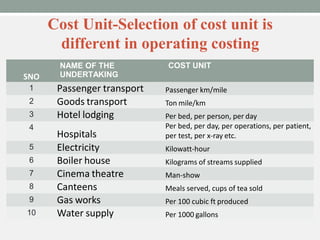
Cost Unit-Selection of cost unit is
different in operating costing
SNO
NAME OF THE
UNDERTAKING
COST UNIT
1 Passenger transport Passenger km/mile
2 Goods transport Ton mile/km
3 Hotel lodging Per bed, per person, per day
4
Hospitals
Per bed, per day, per operations, per patient,
per test, per x-ray etc.
5 Electricity Kilowatt-hour
6 Boiler house Kilograms of streams supplied
7 Cinema theatre Man-show
8 Canteens Meals served, cups of tea sold
9 Gas works Per 100 cubic ft produced
10 Water supply Per 1000 gallons
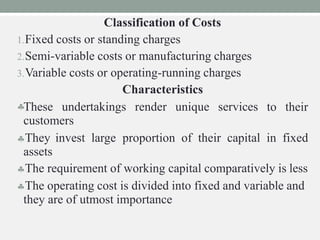
to their
Classification of Costs
1.Fixed costs or standing charges
2.Semi-variable costs or manufacturing charges
3.Variable costs or operating-running charges
Characteristics
These undertakings render unique services
customers
They invest large proportion of their capital in fixed
assets
The requirement of working capital comparatively is less
The operating cost is divided into fixed and variable and
they are of utmost importance
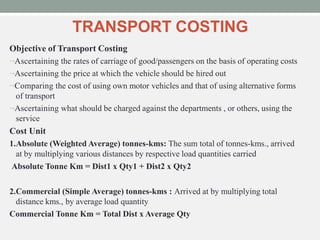
TRANSPORT COSTING
Objective of Transport Costing
Ascertaining the rates of carriage of good/passengers on the basis of operating costs
Ascertaining the price at which the vehicle should be hired out
Comparing the cost of using own motor vehicles and that of using alternative forms
of transport
Ascertaining what should be charged against the departments , or others, using the
service
Cost Unit
1.Absolute (Weighted Average) tonnes-kms: The sum total of tonnes-kms., arrived
at by multiplying various distances by respective load quantities carried
Absolute Tonne Km = Dist1 x Qty1 + Dist2 x Qty2
2.Commercial (Simple Average) tonnes-kms : Arrived at by multiplying total
distance kms., by average load quantity
Commercial Tonne Km = Total Dist x Average Qty
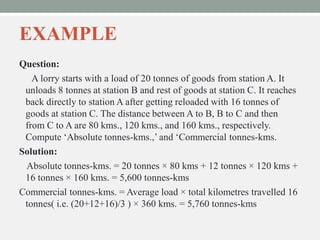
EXAMPLE
Question:
A lorry starts with a load of 20 tonnes of goods from station A. It
unloads 8 tonnes at station B and rest of goods at station C. It reaches
back directly to station A after getting reloaded with 16 tonnes of
goods at station C. The distance between A to B, B to C and then
from C to A are 80 kms., 120 kms., and 160 kms., respectively.
Compute ‘Absolute tonnes-kms.,’ and ‘Commercial tonnes-kms.
Solution:
Absolute tonnes-kms. = 20 tonnes × 80 kms + 12 tonnes × 120 kms +
16 tonnes × 160 kms. = 5,600 tonnes-kms
Commercial tonnes-kms. = Average load × total kilometres travelled 16
tonnes( i.e. (20+12+16)/3 ) × 360 kms. = 5,760 tonnes-kms
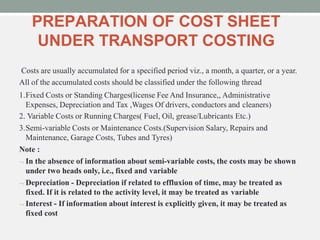
PREPARATION OF COST SHEET
UNDER TRANSPORT COSTING
Costs are usually accumulated for a specified period viz., a month, a quarter, or a year.
All of the accumulated costs should be classified under the following thread
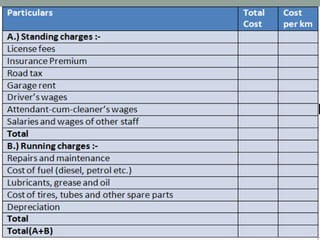
1.Fixed Costs or Standing Charges(license Fee And Insurance,, Administrative
Expenses, Depreciation and Tax ,Wages Of drivers, conductors and cleaners)
2. Variable Costs or Running Charges( Fuel, Oil, grease/Lubricants Etc.)
3.Semi-variable Costs or Maintenance Costs.(Supervision Salary, Repairs and
Maintenance, Garage Costs, Tubes and Tyres)
Note :
 In the absence of information about semi-variable costs, the costs may be shown
under two heads only, i.e., fixed and variable
 Depreciation - Depreciation if related to effluxion of time, may be treated as
fixed. If it is related to the activity level, it may be treated as variable
 Interest - If information about interest is explicitly given, it may be treated as
fixed cost
EXAMPLE
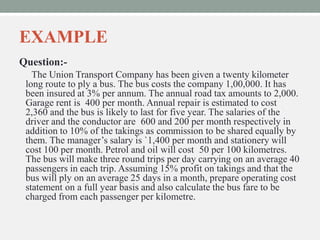
Question:-
The Union Transport Company has been given a twenty kilometer
long route to ply a bus. The bus costs the company 1,00,000. It has
been insured at 3% per annum. The annual road tax amounts to 2,000.
Garage rent is 400 per month. Annual repair is estimated to cost
2,360 and the bus is likely to last for five year. The salaries of the
driver and the conductor are 600 and 200 per month respectively in
addition to 10% of the takings as commission to be shared equally by
them. The manager’s salary is `1,400 per month and stationery will
cost 100 per month. Petrol and oil will cost 50 per 100 kilometres.
The bus will make three round trips per day carrying on an average 40
passengers in each trip. Assuming 15% profit on takings and that the
bus will ply on an average 25 days in a month, prepare operating cost
statement on a full year basis and also calculate the bus fare to be
charged from each passenger per kilometre.
SOLUTION
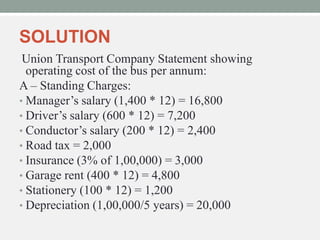
Union Transport Company Statement showing
operating cost of the bus per annum:
A – Standing Charges:
• Manager’s salary (1,400 * 12) = 16,800
• Driver’s salary (600 * 12) = 7,200
• Conductor’s salary (200 * 12) = 2,400
• Road tax = 2,000
• Insurance (3% of 1,00,000) = 3,000
• Garage rent (400 * 12) = 4,800
• Stationery (100 * 12) = 1,200
• Depreciation (1,00,000/5 years) = 20,000
CONTINUED…
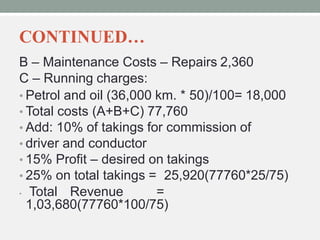
B – Maintenance Costs – Repairs 2,360
C – Running charges:
• Petrol and oil (36,000 km. * 50)/100= 18,000
• Total costs (A+B+C) 77,760
• Add: 10% of takings for commission of
• driver and conductor
• 15% Profit – desired on takings
• 25% on total takings = 25,920(77760*25/75)
• Total Revenue =
1,03,680(77760*100/75)
CONTINUED…
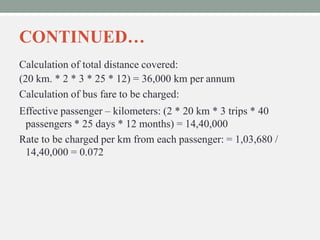
Calculation of total distance covered:
(20 km. * 2 * 3 * 25 * 12) = 36,000 km per annum
Calculation of bus fare to be charged:
Effective passenger – kilometers: (2 * 20 km * 3 trips * 40
passengers * 25 days * 12 months) = 14,40,000
Rate to be charged per km from each passenger: = 1,03,680 /
14,40,000 = 0.072
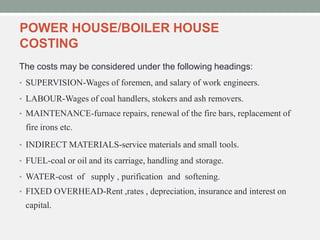
POWER HOUSE/BOILER HOUSE
COSTING
The costs may be considered under the following headings:
• SUPERVISION-Wages of foremen, and salary of work engineers.
• LABOUR-Wages of coal handlers, stokers and ash removers.
• MAINTENANCE-furnace repairs, renewal of the fire bars, replacement of
fire irons etc.
• INDIRECT MATERIALS-service materials and small tools.
• FUEL-coal or oil and its carriage, handling and storage.
• WATER-cost of supply , purification and softening.
• FIXED OVERHEAD-Rent ,rates , depreciation, insurance and interest on
capital.
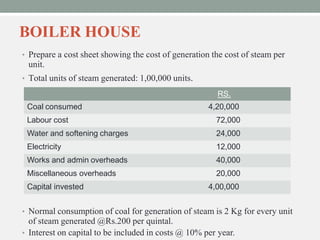
BOILER HOUSE
• Prepare a cost sheet showing the cost of generation the cost of steam per
unit.
• Total units of steam generated: 1,00,000 units.
RS.
Coal consumed 4,20,000
Labour cost 72,000
Water and softening charges 24,000
Electricity 12,000
Works and admin overheads 40,000
Miscellaneous overheads 20,000
Capital invested 4,00,000
• Normal consumption of coal for generation of steam is 2 Kg for every unit
of steam generated @Rs.200 per quintal.
• Interest on capital to be included in costs @ 10% per year.
SOLUTION:
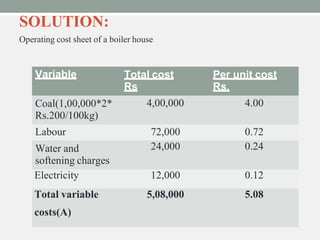
Operating cost sheet of a boiler house
Variable Total cost
Rs
Per unit cost
Rs.
Coal(1,00,000*2*
Rs.200/100kg)
4,00,000 4.00
Labour 72,000 0.72
Water and
softening charges
24,000 0.24
Electricity 12,000 0.12
Total variable 5,08,000 5.08
costs(A)
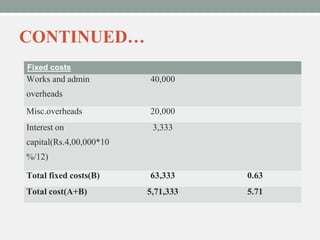
CONTINUED…
Fixed costs
Works and admin
overheads
40,000
Misc.overheads 20,000
Interest on
capital(Rs.4,00,000*10
%/12)
3,333
Total fixed costs(B) 63,333 0.63
Total cost(A+B) 5,71,333 5.71
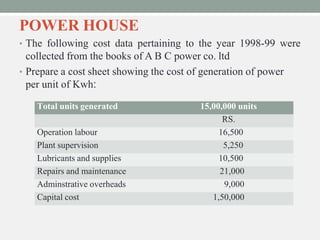
POWER HOUSE
• The following cost data pertaining to the year 1998-99 were
collected from the books of A B C power co. ltd
• Prepare a cost sheet showing the cost of generation of power
per unit of Kwh:
Total units generated 15,00,000 units
RS.
Operation labour 16,500
Plant supervision 5,250
Lubricants and supplies 10,500
Repairs and maintenance 21,000
Adminstrative overheads 9,000
Capital cost 1,50,000
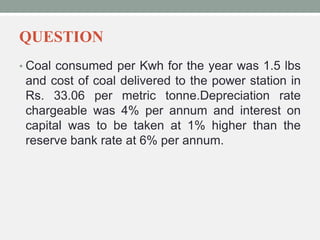
QUESTION
• Coal consumed per Kwh for the year was 1.5 lbs
and cost of coal delivered to the power station in
Rs. 33.06 per metric tonne.Depreciation rate
chargeable was 4% per annum and interest on
capital was to be taken at 1% higher than the
reserve bank rate at 6% per annum.
SOLUTION:
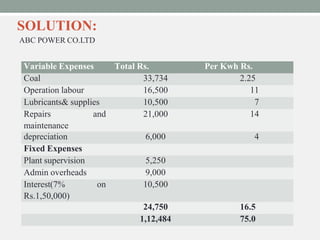
ABC POWER CO.LTD
Variable Expenses Total Rs. Per Kwh Rs.
Coal 33,734 2.25
Operation labour 16,500 11
Lubricants& supplies 10,500 7
Repairs and
maintenance
21,000 14
depreciation 6,000 4
Fixed Expenses
Plant supervision 5,250
Admin overheads 9,000
Interest(7% on
Rs.1,50,000)
10,500
24,750 16.5
1,12,484 75.0
CONTINUED…
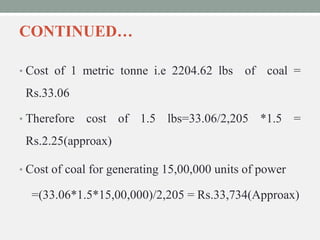
• Cost of 1 metric tonne i.e 2204.62 lbs of coal =
Rs.33.06
• Therefore cost of 1.5 lbs=33.06/2,205 *1.5 =
Rs.2.25(approax)
• Cost of coal for generating 15,00,000 units of power
=(33.06*1.5*15,00,000)/2,205 = Rs.33,734(Approax)
OPERATION COST OF A MOVIETHEATRE
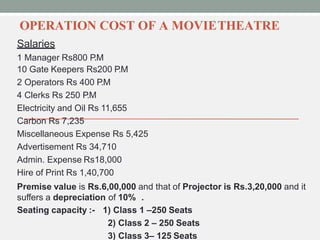
Salaries
1 Manager Rs800 P.M
10 Gate Keepers Rs200 P.M
2 Operators Rs 400 P.M
4 Clerks Rs 250 P.M
Electricity and Oil Rs 11,655
Carbon Rs 7,235
Miscellaneous Expense Rs 5,425
Advertisement Rs 34,710
Admin. Expense Rs18,000
Hire of Print Rs 1,40,700
Premise value is Rs.6,00,000 and that of Projector is Rs.3,20,000 and it
suffers a depreciation of 10% .
Seating capacity :- 1) Class 1 –250 Seats
2) Class 2 – 250 Seats
3) Class 3– 125 Seats
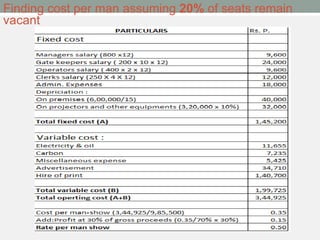
Finding cost per man assuming 20% of seats remain
vacant
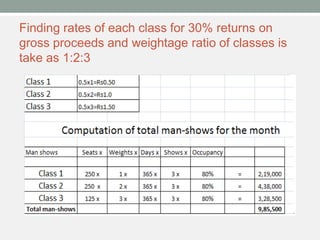
Finding rates of each class for 30% returns on
gross proceeds and weightage ratio of classes is
take as 1:2:3
COSTING OF EDUCATIONAL
INSTITUTIONS
• It’s a type of costing that involves determining the per
student cost that is to be charged.
• Due to varying students, lot of factors have to kept
dynamic and based on which total cost is to be
determined.
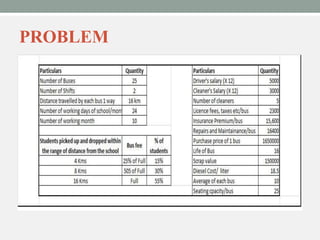
PROBLEM
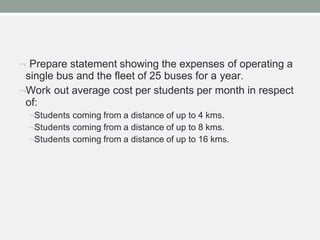
 Prepare statement showing the expenses of operating a
single bus and the fleet of 25 buses for a year.
Work out average cost per students per month in respect
of:
Students coming from a distance of up to 4 kms.
Students coming from a distance of up to 8 kms.
Students coming from a distance of up to 16 kms.
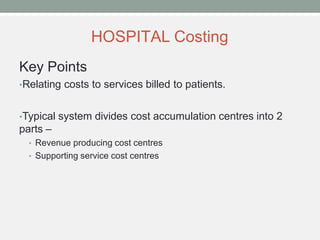
HOSPITAL Costing
Key Points
•Relating costs to services billed to patients.
•Typical system divides cost accumulation centres into 2
parts –
• Revenue producing cost centres
• Supporting service cost centres
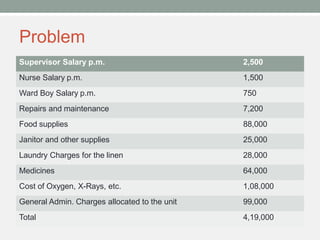
Problem
Supervisor Salary p.m. 2,500
Nurse Salary p.m. 1,500
Ward Boy Salary p.m. 750
Repairs and maintenance 7,200
Food supplies 88,000
Janitor and other supplies 25,000
Laundry Charges for the linen 28,000
Medicines 64,000
Cost of Oxygen, X-Rays, etc. 1,08,000
General Admin. Charges allocated to the unit 99,000
Total 4,19,000
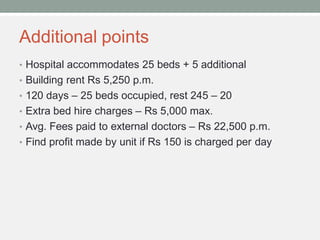
Additional points
• Hospital accommodates 25 beds + 5 additional
• Building rent Rs 5,250 p.m.
• 120 days – 25 beds occupied, rest 245 – 20
• Extra bed hire charges – Rs 5,000 max.
• Avg. Fees paid to external doctors – Rs 22,500 p.m.
• Find profit made by unit if Rs 150 is charged per day
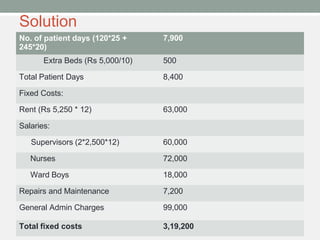
Solution
No. of patient days (120*25 +
245*20)
7,900
Extra Beds (Rs 5,000/10) 500
Total Patient Days 8,400
Fixed Costs:
Rent (Rs 5,250 * 12) 63,000
Salaries:
Supervisors (2*2,500*12) 60,000
Nurses 72,000
Ward Boys 18,000
Repairs and Maintenance 7,200
General Admin Charges 99,000
Total fixed costs 3,19,200
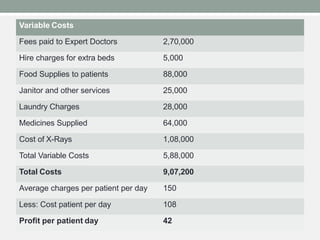
Variable Costs
Fees paid to Expert Doctors 2,70,000
Hire charges for extra beds 5,000
Food Supplies to patients 88,000
Janitor and other services 25,000
Laundry Charges 28,000
Medicines Supplied 64,000
Cost of X-Rays 1,08,000
Total Variable Costs 5,88,000
Total Costs 9,07,200
Average charges per patient per day 150
Less: Cost patient per day 108
Profit per patient day 42
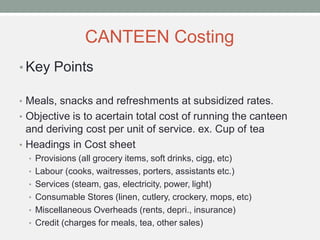
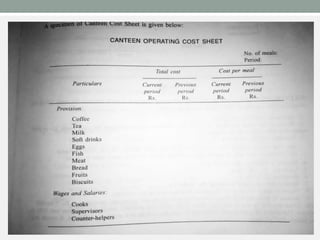
CANTEEN Costing
• Key Points
• Meals, snacks and refreshments at subsidized rates.
• Objective is to acertain total cost of running the canteen
and deriving cost per unit of service. ex. Cup of tea
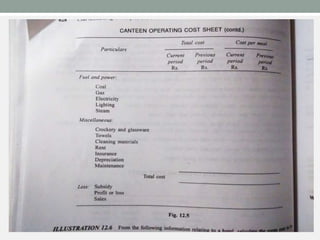
• Headings in Cost sheet
• Provisions (all grocery items, soft drinks, cigg, etc)
• Labour (cooks, waitresses, porters, assistants etc.)
• Services (steam, gas, electricity, power, light)
• Consumable Stores (linen, cutlery, crockery, mops, etc)
• Miscellaneous Overheads (rents, depri., insurance)
• Credit (charges for meals, tea, other sales)
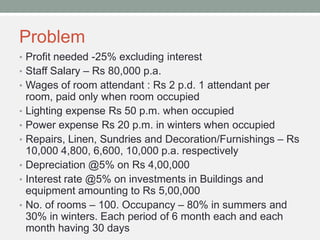
Problem
• Profit needed -25% excluding interest
• Staff Salary – Rs 80,000 p.a.
• Wages of room attendant : Rs 2 p.d. 1 attendant per
room, paid only when room occupied
• Lighting expense Rs 50 p.m. when occupied
• Power expense Rs 20 p.m. in winters when occupied
• Repairs, Linen, Sundries and Decoration/Furnishings – Rs
10,000 4,800, 6,600, 10,000 p.a. respectively
• Depreciation @5% on Rs 4,00,000
• Interest rate @5% on investments in Buildings and
equipment amounting to Rs 5,00,000
• No. of rooms – 100. Occupancy – 80% in summers and
30% in winters. Each period of 6 month each and each
month having 30 days
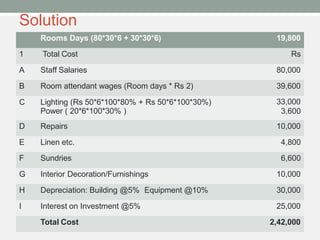
Solution
Rooms Days (80*30*6 + 30*30*6) 19,800
1 Total Cost Rs
A Staff Salaries 80,000
B Room attendant wages (Room days * Rs 2) 39,600
C Lighting (Rs 50*6*100*80% + Rs 50*6*100*30%)
Power ( 20*6*100*30% )
33,000
3,600
D Repairs 10,000
E Linen etc. 4,800
F Sundries 6,600
G Interior Decoration/Furnishings 10,000
H Depreciation: Building @5% Equipment @10% 30,000
I Interest on Investment @5% 25,000
Total Cost 2,42,000
Continued…
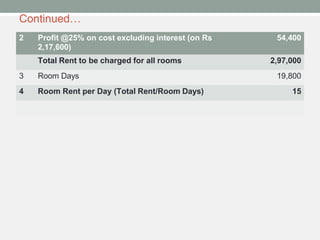
2 Profit @25% on cost excluding interest (on Rs 54,400
2,17,600)
Total Rent to be charged for all rooms 2,97,000
3 Room Days 19,800
4 Room Rent per Day (Total Rent/Room Days) 15

Operating costing

  • 1.
    Operating Costing Cost Accounting(Bcom Sem -4) Commerce Gokul College of Commerce and management
  • 2.
  • 3.
    What is operatingcosting? • Operating costing method is one designed to ascertain and control the costs of the undertakings which do not produce products but which render services • Also known as service costing • Operation costing is the cost of rendering services • It is the cost of producing and maintaining a service • Industries using operating costing do not produce tangible poducts ; but useful service is rendered; for eg-transport services, utility services like hospitals, canteens etc, distribution services like supply of electricity, gas etc.
  • 4.
    Service Costing Service oroperating cost is the cost of providing service. The term service costing is applied to describe the system used to find the cost of performing a service such as transport, gas or electricity. • Services rendered to customers are of unique and standardised type • Distinction between fixed cost and variable cost is of special importance as the scale of operations considerably affects the cost per unit of service rendered • A large chunk of total capital invested in fixed assets and relatively less working capital is required • The method of costing is different from that used in connection with production and difference lies mainly in the manner of accumulating the cost data and finally in its allocation to cost units
  • 5.
    Cost Unit-Selection ofcost unit is different in operating costing SNO NAME OF THE UNDERTAKING COST UNIT 1 Passenger transport Passenger km/mile 2 Goods transport Ton mile/km 3 Hotel lodging Per bed, per person, per day 4 Hospitals Per bed, per day, per operations, per patient, per test, per x-ray etc. 5 Electricity Kilowatt-hour 6 Boiler house Kilograms of streams supplied 7 Cinema theatre Man-show 8 Canteens Meals served, cups of tea sold 9 Gas works Per 100 cubic ft produced 10 Water supply Per 1000 gallons
  • 6.
    to their Classification ofCosts 1.Fixed costs or standing charges 2.Semi-variable costs or manufacturing charges 3.Variable costs or operating-running charges Characteristics These undertakings render unique services customers They invest large proportion of their capital in fixed assets The requirement of working capital comparatively is less The operating cost is divided into fixed and variable and they are of utmost importance
  • 7.
    TRANSPORT COSTING Objective ofTransport Costing Ascertaining the rates of carriage of good/passengers on the basis of operating costs Ascertaining the price at which the vehicle should be hired out Comparing the cost of using own motor vehicles and that of using alternative forms of transport Ascertaining what should be charged against the departments , or others, using the service Cost Unit 1.Absolute (Weighted Average) tonnes-kms: The sum total of tonnes-kms., arrived at by multiplying various distances by respective load quantities carried Absolute Tonne Km = Dist1 x Qty1 + Dist2 x Qty2 2.Commercial (Simple Average) tonnes-kms : Arrived at by multiplying total distance kms., by average load quantity Commercial Tonne Km = Total Dist x Average Qty
  • 8.
    EXAMPLE Question: A lorry startswith a load of 20 tonnes of goods from station A. It unloads 8 tonnes at station B and rest of goods at station C. It reaches back directly to station A after getting reloaded with 16 tonnes of goods at station C. The distance between A to B, B to C and then from C to A are 80 kms., 120 kms., and 160 kms., respectively. Compute ‘Absolute tonnes-kms.,’ and ‘Commercial tonnes-kms. Solution: Absolute tonnes-kms. = 20 tonnes × 80 kms + 12 tonnes × 120 kms + 16 tonnes × 160 kms. = 5,600 tonnes-kms Commercial tonnes-kms. = Average load × total kilometres travelled 16 tonnes( i.e. (20+12+16)/3 ) × 360 kms. = 5,760 tonnes-kms
  • 9.
    PREPARATION OF COSTSHEET UNDER TRANSPORT COSTING Costs are usually accumulated for a specified period viz., a month, a quarter, or a year. All of the accumulated costs should be classified under the following thread 1.Fixed Costs or Standing Charges(license Fee And Insurance,, Administrative Expenses, Depreciation and Tax ,Wages Of drivers, conductors and cleaners) 2. Variable Costs or Running Charges( Fuel, Oil, grease/Lubricants Etc.) 3.Semi-variable Costs or Maintenance Costs.(Supervision Salary, Repairs and Maintenance, Garage Costs, Tubes and Tyres) Note :  In the absence of information about semi-variable costs, the costs may be shown under two heads only, i.e., fixed and variable  Depreciation - Depreciation if related to effluxion of time, may be treated as fixed. If it is related to the activity level, it may be treated as variable  Interest - If information about interest is explicitly given, it may be treated as fixed cost
  • 11.
    EXAMPLE Question:- The Union TransportCompany has been given a twenty kilometer long route to ply a bus. The bus costs the company 1,00,000. It has been insured at 3% per annum. The annual road tax amounts to 2,000. Garage rent is 400 per month. Annual repair is estimated to cost 2,360 and the bus is likely to last for five year. The salaries of the driver and the conductor are 600 and 200 per month respectively in addition to 10% of the takings as commission to be shared equally by them. The manager’s salary is `1,400 per month and stationery will cost 100 per month. Petrol and oil will cost 50 per 100 kilometres. The bus will make three round trips per day carrying on an average 40 passengers in each trip. Assuming 15% profit on takings and that the bus will ply on an average 25 days in a month, prepare operating cost statement on a full year basis and also calculate the bus fare to be charged from each passenger per kilometre.
  • 12.
    SOLUTION Union Transport CompanyStatement showing operating cost of the bus per annum: A – Standing Charges: • Manager’s salary (1,400 * 12) = 16,800 • Driver’s salary (600 * 12) = 7,200 • Conductor’s salary (200 * 12) = 2,400 • Road tax = 2,000 • Insurance (3% of 1,00,000) = 3,000 • Garage rent (400 * 12) = 4,800 • Stationery (100 * 12) = 1,200 • Depreciation (1,00,000/5 years) = 20,000
  • 13.
    CONTINUED… B – MaintenanceCosts – Repairs 2,360 C – Running charges: • Petrol and oil (36,000 km. * 50)/100= 18,000 • Total costs (A+B+C) 77,760 • Add: 10% of takings for commission of • driver and conductor • 15% Profit – desired on takings • 25% on total takings = 25,920(77760*25/75) • Total Revenue = 1,03,680(77760*100/75)
  • 14.
    CONTINUED… Calculation of totaldistance covered: (20 km. * 2 * 3 * 25 * 12) = 36,000 km per annum Calculation of bus fare to be charged: Effective passenger – kilometers: (2 * 20 km * 3 trips * 40 passengers * 25 days * 12 months) = 14,40,000 Rate to be charged per km from each passenger: = 1,03,680 / 14,40,000 = 0.072
  • 15.
    POWER HOUSE/BOILER HOUSE COSTING Thecosts may be considered under the following headings: • SUPERVISION-Wages of foremen, and salary of work engineers. • LABOUR-Wages of coal handlers, stokers and ash removers. • MAINTENANCE-furnace repairs, renewal of the fire bars, replacement of fire irons etc. • INDIRECT MATERIALS-service materials and small tools. • FUEL-coal or oil and its carriage, handling and storage. • WATER-cost of supply , purification and softening. • FIXED OVERHEAD-Rent ,rates , depreciation, insurance and interest on capital.
  • 16.
    BOILER HOUSE • Preparea cost sheet showing the cost of generation the cost of steam per unit. • Total units of steam generated: 1,00,000 units. RS. Coal consumed 4,20,000 Labour cost 72,000 Water and softening charges 24,000 Electricity 12,000 Works and admin overheads 40,000 Miscellaneous overheads 20,000 Capital invested 4,00,000 • Normal consumption of coal for generation of steam is 2 Kg for every unit of steam generated @Rs.200 per quintal. • Interest on capital to be included in costs @ 10% per year.
  • 17.
    SOLUTION: Operating cost sheetof a boiler house Variable Total cost Rs Per unit cost Rs. Coal(1,00,000*2* Rs.200/100kg) 4,00,000 4.00 Labour 72,000 0.72 Water and softening charges 24,000 0.24 Electricity 12,000 0.12 Total variable 5,08,000 5.08 costs(A)
  • 18.
    CONTINUED… Fixed costs Works andadmin overheads 40,000 Misc.overheads 20,000 Interest on capital(Rs.4,00,000*10 %/12) 3,333 Total fixed costs(B) 63,333 0.63 Total cost(A+B) 5,71,333 5.71
  • 19.
    POWER HOUSE • Thefollowing cost data pertaining to the year 1998-99 were collected from the books of A B C power co. ltd • Prepare a cost sheet showing the cost of generation of power per unit of Kwh: Total units generated 15,00,000 units RS. Operation labour 16,500 Plant supervision 5,250 Lubricants and supplies 10,500 Repairs and maintenance 21,000 Adminstrative overheads 9,000 Capital cost 1,50,000
  • 20.
    QUESTION • Coal consumedper Kwh for the year was 1.5 lbs and cost of coal delivered to the power station in Rs. 33.06 per metric tonne.Depreciation rate chargeable was 4% per annum and interest on capital was to be taken at 1% higher than the reserve bank rate at 6% per annum.
  • 21.
    SOLUTION: ABC POWER CO.LTD VariableExpenses Total Rs. Per Kwh Rs. Coal 33,734 2.25 Operation labour 16,500 11 Lubricants& supplies 10,500 7 Repairs and maintenance 21,000 14 depreciation 6,000 4 Fixed Expenses Plant supervision 5,250 Admin overheads 9,000 Interest(7% on Rs.1,50,000) 10,500 24,750 16.5 1,12,484 75.0
  • 22.
    CONTINUED… • Cost of1 metric tonne i.e 2204.62 lbs of coal = Rs.33.06 • Therefore cost of 1.5 lbs=33.06/2,205 *1.5 = Rs.2.25(approax) • Cost of coal for generating 15,00,000 units of power =(33.06*1.5*15,00,000)/2,205 = Rs.33,734(Approax)
  • 23.
    OPERATION COST OFA MOVIETHEATRE Salaries 1 Manager Rs800 P.M 10 Gate Keepers Rs200 P.M 2 Operators Rs 400 P.M 4 Clerks Rs 250 P.M Electricity and Oil Rs 11,655 Carbon Rs 7,235 Miscellaneous Expense Rs 5,425 Advertisement Rs 34,710 Admin. Expense Rs18,000 Hire of Print Rs 1,40,700 Premise value is Rs.6,00,000 and that of Projector is Rs.3,20,000 and it suffers a depreciation of 10% . Seating capacity :- 1) Class 1 –250 Seats 2) Class 2 – 250 Seats 3) Class 3– 125 Seats
  • 24.
    Finding cost perman assuming 20% of seats remain vacant
  • 25.
    Finding rates ofeach class for 30% returns on gross proceeds and weightage ratio of classes is take as 1:2:3
  • 26.
    COSTING OF EDUCATIONAL INSTITUTIONS •It’s a type of costing that involves determining the per student cost that is to be charged. • Due to varying students, lot of factors have to kept dynamic and based on which total cost is to be determined.
  • 27.
  • 28.
     Prepare statementshowing the expenses of operating a single bus and the fleet of 25 buses for a year. Work out average cost per students per month in respect of: Students coming from a distance of up to 4 kms. Students coming from a distance of up to 8 kms. Students coming from a distance of up to 16 kms.
  • 29.
    HOSPITAL Costing Key Points •Relatingcosts to services billed to patients. •Typical system divides cost accumulation centres into 2 parts – • Revenue producing cost centres • Supporting service cost centres
  • 30.
    Problem Supervisor Salary p.m.2,500 Nurse Salary p.m. 1,500 Ward Boy Salary p.m. 750 Repairs and maintenance 7,200 Food supplies 88,000 Janitor and other supplies 25,000 Laundry Charges for the linen 28,000 Medicines 64,000 Cost of Oxygen, X-Rays, etc. 1,08,000 General Admin. Charges allocated to the unit 99,000 Total 4,19,000
  • 31.
    Additional points • Hospitalaccommodates 25 beds + 5 additional • Building rent Rs 5,250 p.m. • 120 days – 25 beds occupied, rest 245 – 20 • Extra bed hire charges – Rs 5,000 max. • Avg. Fees paid to external doctors – Rs 22,500 p.m. • Find profit made by unit if Rs 150 is charged per day
  • 32.
    Solution No. of patientdays (120*25 + 245*20) 7,900 Extra Beds (Rs 5,000/10) 500 Total Patient Days 8,400 Fixed Costs: Rent (Rs 5,250 * 12) 63,000 Salaries: Supervisors (2*2,500*12) 60,000 Nurses 72,000 Ward Boys 18,000 Repairs and Maintenance 7,200 General Admin Charges 99,000 Total fixed costs 3,19,200
  • 33.
    Variable Costs Fees paidto Expert Doctors 2,70,000 Hire charges for extra beds 5,000 Food Supplies to patients 88,000 Janitor and other services 25,000 Laundry Charges 28,000 Medicines Supplied 64,000 Cost of X-Rays 1,08,000 Total Variable Costs 5,88,000 Total Costs 9,07,200 Average charges per patient per day 150 Less: Cost patient per day 108 Profit per patient day 42
  • 34.
    CANTEEN Costing • KeyPoints • Meals, snacks and refreshments at subsidized rates. • Objective is to acertain total cost of running the canteen and deriving cost per unit of service. ex. Cup of tea • Headings in Cost sheet • Provisions (all grocery items, soft drinks, cigg, etc) • Labour (cooks, waitresses, porters, assistants etc.) • Services (steam, gas, electricity, power, light) • Consumable Stores (linen, cutlery, crockery, mops, etc) • Miscellaneous Overheads (rents, depri., insurance) • Credit (charges for meals, tea, other sales)
  • 37.
    Problem • Profit needed-25% excluding interest • Staff Salary – Rs 80,000 p.a. • Wages of room attendant : Rs 2 p.d. 1 attendant per room, paid only when room occupied • Lighting expense Rs 50 p.m. when occupied • Power expense Rs 20 p.m. in winters when occupied • Repairs, Linen, Sundries and Decoration/Furnishings – Rs 10,000 4,800, 6,600, 10,000 p.a. respectively • Depreciation @5% on Rs 4,00,000 • Interest rate @5% on investments in Buildings and equipment amounting to Rs 5,00,000 • No. of rooms – 100. Occupancy – 80% in summers and 30% in winters. Each period of 6 month each and each month having 30 days
  • 38.
    Solution Rooms Days (80*30*6+ 30*30*6) 19,800 1 Total Cost Rs A Staff Salaries 80,000 B Room attendant wages (Room days * Rs 2) 39,600 C Lighting (Rs 50*6*100*80% + Rs 50*6*100*30%) Power ( 20*6*100*30% ) 33,000 3,600 D Repairs 10,000 E Linen etc. 4,800 F Sundries 6,600 G Interior Decoration/Furnishings 10,000 H Depreciation: Building @5% Equipment @10% 30,000 I Interest on Investment @5% 25,000 Total Cost 2,42,000
  • 39.
    Continued… 2 Profit @25%on cost excluding interest (on Rs 54,400 2,17,600) Total Rent to be charged for all rooms 2,97,000 3 Room Days 19,800 4 Room Rent per Day (Total Rent/Room Days) 15