Security and openSUSE
securing the tumbleweed
Marcus Meißner
Technical Project Manager Security
meissner@suse.de
2
Overview
• The Team
• Security after releases
• Security before releases
‒ Before check-in
‒ Automations
3
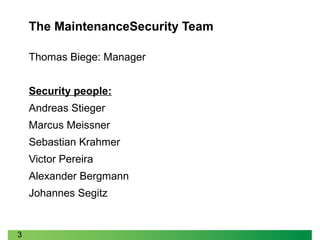
The MaintenanceSecurity Team
Thomas Biege: Manager
Security people:
Andreas Stieger
Marcus Meissner
Sebastian Krahmer
Victor Pereira
Alexander Bergmann
Johannes Segitz
4
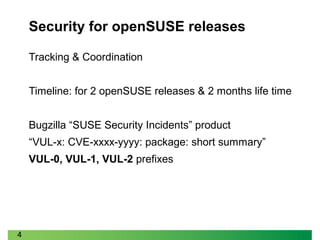
Security for openSUSE releases
Tracking & Coordination
Timeline: for 2 openSUSE releases & 2 months life time
Bugzilla “SUSE Security Incidents” product
“VUL-x: CVE-xxxx-yyyy: package: short summary”
VUL-0, VUL-1, VUL-2 prefixes
5
Security for Tumbleweed
Multiple parts:
• Fixing security issues – usually by maintenance
update
• Reviewing all the new things
• New technologies and automatisms
6
Reviews
• Users used for privilege seperation
• Root can do everything
• Lots of helper methods user → root
• Desktop user should not be root by default
→ We need to review all transition paths
7
Allowing new DBUS and PAM modules
rpmlint direct checks:
• DBUS services
• PAM module files
• (New users and groups)
Open a bug for Security (Category Security, or assign
to security-team@suse.de), use AUDIT-0 tag
8
Policykit policies access rights to DBUS services
Various access checking rights:
• No, Yes, auth_admin, auth_self
Depending on context:
• active session, inactive session, other users.
Handled in polkit-default-privs package, checked by
rpmlint.
Open an AUDIT-0 bug if shown in rpmlint output.
Allowing new policykit rules
9
Approving new setuid/setgid things
brp-permissions finds:
• New setuid binaries
• New setgid/setuid directories
• World writable directories
Approval handled in permissions package, also via
AUDIT-0 bugs.
.spec files need adjustments to add setting / verification
of permissions.
10
Starting daemons by default
Systemd uses “presets” for auto starting services on
boot.
These presets live in systemd-presets-branding-
openSUSE
Maintained by the security team, we review the
submitrequests.
Goal: keep set minimal
11
Auditing – no magic silver bullet
• Manual work
• Needs experience
• Helper tools
• 1 – 2 per week/engineer
• Look at specific parts only
12
Automation and technologies
Security technologies for improving system security
Integration criteria:
• Status
• Number of false positives / negatives
• Ease of integration to Tumbleweed
• Performance & Usability
13
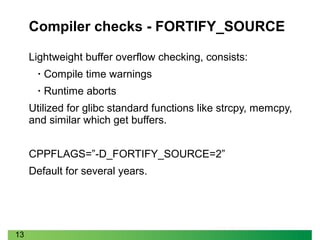
Compiler checks - FORTIFY_SOURCE
Lightweight buffer overflow checking, consists:
• Compile time warnings
• Runtime aborts
Utilized for glibc standard functions like strcpy, memcpy,
and similar which get buffers.
CPPFLAGS=”-D_FORTIFY_SOURCE=2”
Default for several years.
14
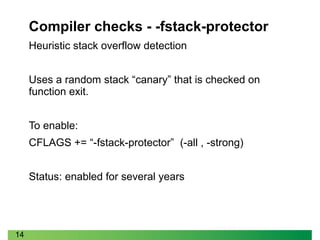
Compiler checks - -fstack-protector
Heuristic stack overflow detection
Uses a random stack “canary” that is checked on
function exit.
To enable:
CFLAGS += “-fstack-protector” (-all , -strong)
Status: enabled for several years
15
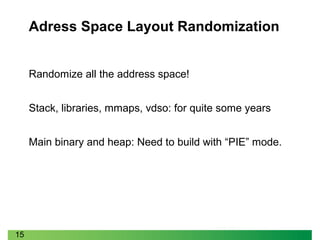
Adress Space Layout Randomization
Randomize all the address space!
Stack, libraries, mmaps, vdso: for quite some years
Main binary and heap: Need to build with “PIE” mode.
16
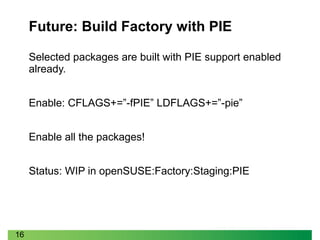
Future: Build Factory with PIE
Selected packages are built with PIE support enabled
already.
Enable: CFLAGS+=”-fPIE” LDFLAGS+=”-pie”
Enable all the packages!
Status: WIP in openSUSE:Factory:Staging:PIE
17
Apparmor and SELinux
Apparmor:
• Well integrated for years
• Suited only for server scenarios
SELinux
• Tools present
• No well working policies at this time
• complex
18
Future: Enable Address Sanitizer
Newer compilers have “Sanitizer” modules for dynamic
runtime checking modes.
AddressSanitizer: Reliable array overflow checking.
Enable: CFLAGS+=”-fsanitize=address”
Status: Evaluated by Victor Pereira
19
Future: Other sanitizers
• ThreadSanitizer: -fsanitize=thread
New with GCC 5:
• UndefinedBehaviourSanitizer (-fsanitize= … )
‒ Float-divide-by-zero
‒ Float-cast-overflow
‒ Bounds
‒ Alignment
‒ Object-size
‒ Vptr
• Pointer Bounds Checker (-fcheck-pointer-bounds)
20
Fuzzers - AFL
AFL (American Fuzzy Lop)
Developer tool, not for common usage
Optimized for speed of execution and enhancing coverage
Fuzzing sample:
• Fileformats
• Other direct data input (even TLS)
21
How can you help?
• Install online updates!
• If you see something security related, speak up.
‒ (if it has a CVE id we probably know it already though)
• Program securely
• Help fix security issues for openSUSE!

opensuse conference 2015: security processes and technologies for Tumbleweed

  • 1.
    Security and openSUSE securingthe tumbleweed Marcus Meißner Technical Project Manager Security meissner@suse.de
  • 2.
    2 Overview • The Team •Security after releases • Security before releases ‒ Before check-in ‒ Automations
  • 3.
    3 The MaintenanceSecurity Team ThomasBiege: Manager Security people: Andreas Stieger Marcus Meissner Sebastian Krahmer Victor Pereira Alexander Bergmann Johannes Segitz
  • 4.
    4 Security for openSUSEreleases Tracking & Coordination Timeline: for 2 openSUSE releases & 2 months life time Bugzilla “SUSE Security Incidents” product “VUL-x: CVE-xxxx-yyyy: package: short summary” VUL-0, VUL-1, VUL-2 prefixes
  • 5.
    5 Security for Tumbleweed Multipleparts: • Fixing security issues – usually by maintenance update • Reviewing all the new things • New technologies and automatisms
  • 6.
    6 Reviews • Users usedfor privilege seperation • Root can do everything • Lots of helper methods user → root • Desktop user should not be root by default → We need to review all transition paths
  • 7.
    7 Allowing new DBUSand PAM modules rpmlint direct checks: • DBUS services • PAM module files • (New users and groups) Open a bug for Security (Category Security, or assign to security-team@suse.de), use AUDIT-0 tag
  • 8.
    8 Policykit policies accessrights to DBUS services Various access checking rights: • No, Yes, auth_admin, auth_self Depending on context: • active session, inactive session, other users. Handled in polkit-default-privs package, checked by rpmlint. Open an AUDIT-0 bug if shown in rpmlint output. Allowing new policykit rules
  • 9.
    9 Approving new setuid/setgidthings brp-permissions finds: • New setuid binaries • New setgid/setuid directories • World writable directories Approval handled in permissions package, also via AUDIT-0 bugs. .spec files need adjustments to add setting / verification of permissions.
  • 10.
    10 Starting daemons bydefault Systemd uses “presets” for auto starting services on boot. These presets live in systemd-presets-branding- openSUSE Maintained by the security team, we review the submitrequests. Goal: keep set minimal
  • 11.
    11 Auditing – nomagic silver bullet • Manual work • Needs experience • Helper tools • 1 – 2 per week/engineer • Look at specific parts only
  • 12.
    12 Automation and technologies Securitytechnologies for improving system security Integration criteria: • Status • Number of false positives / negatives • Ease of integration to Tumbleweed • Performance & Usability
  • 13.
    13 Compiler checks -FORTIFY_SOURCE Lightweight buffer overflow checking, consists: • Compile time warnings • Runtime aborts Utilized for glibc standard functions like strcpy, memcpy, and similar which get buffers. CPPFLAGS=”-D_FORTIFY_SOURCE=2” Default for several years.
  • 14.
    14 Compiler checks --fstack-protector Heuristic stack overflow detection Uses a random stack “canary” that is checked on function exit. To enable: CFLAGS += “-fstack-protector” (-all , -strong) Status: enabled for several years
  • 15.
    15 Adress Space LayoutRandomization Randomize all the address space! Stack, libraries, mmaps, vdso: for quite some years Main binary and heap: Need to build with “PIE” mode.
  • 16.
    16 Future: Build Factorywith PIE Selected packages are built with PIE support enabled already. Enable: CFLAGS+=”-fPIE” LDFLAGS+=”-pie” Enable all the packages! Status: WIP in openSUSE:Factory:Staging:PIE
  • 17.
    17 Apparmor and SELinux Apparmor: •Well integrated for years • Suited only for server scenarios SELinux • Tools present • No well working policies at this time • complex
  • 18.
    18 Future: Enable AddressSanitizer Newer compilers have “Sanitizer” modules for dynamic runtime checking modes. AddressSanitizer: Reliable array overflow checking. Enable: CFLAGS+=”-fsanitize=address” Status: Evaluated by Victor Pereira
  • 19.
    19 Future: Other sanitizers •ThreadSanitizer: -fsanitize=thread New with GCC 5: • UndefinedBehaviourSanitizer (-fsanitize= … ) ‒ Float-divide-by-zero ‒ Float-cast-overflow ‒ Bounds ‒ Alignment ‒ Object-size ‒ Vptr • Pointer Bounds Checker (-fcheck-pointer-bounds)
  • 20.
    20 Fuzzers - AFL AFL(American Fuzzy Lop) Developer tool, not for common usage Optimized for speed of execution and enhancing coverage Fuzzing sample: • Fileformats • Other direct data input (even TLS)
  • 21.
    21 How can youhelp? • Install online updates! • If you see something security related, speak up. ‒ (if it has a CVE id we probably know it already though) • Program securely • Help fix security issues for openSUSE!