


Building a Private Cloud to Efficiently
Handle 40 Billion Requests / Day
October 28th, 2015
Pierre Gohon | Sr. Site Reliability Engineer | pierre.gohon@tubemogul.com
Pierre Grandin | Sr. Site Reliability Engineer | pierre.grandin@tubemogul.com
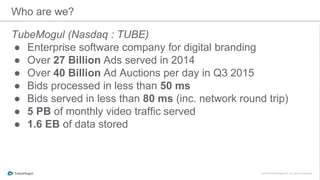
Who are we?
TubeMogul (Nasdaq : TUBE)
● Enterprise software company for digital branding
● Over 27 Billion Ads served in 2014
● Over 40 Billion Ad Auctions per day in Q3 2015
● Bids processed in less than 50 ms
● Bids served in less than 80 ms (inc. network round trip)
● 5 PB of monthly video traffic served
● 1.6 EB of data stored
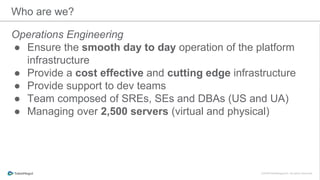
Who are we?
Operations Engineering
● Ensure the smooth day to day operation of the platform
infrastructure
● Provide a cost effective and cutting edge infrastructure
● Provide support to dev teams
● Team composed of SREs, SEs and DBAs (US and UA)
● Managing over 2,500 servers (virtual and physical)
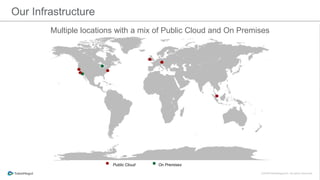
Our Infrastructure
Public Cloud On Premises
Multiple locations with a mix of Public Cloud and On Premises
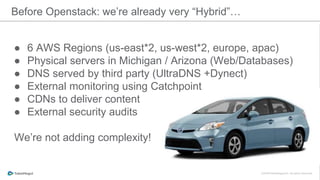
● 6 AWS Regions (us-east*2, us-west*2, europe, apac)
● Physical servers in Michigan / Arizona (Web/Databases)
● DNS served by third party (UltraDNS +Dynect)
● External monitoring using Catchpoint
● CDNs to deliver content
● External security audits
We’re not adding complexity!
Before Openstack: we’re already very “Hybrid”…
Why?
● Own your infrastructure stack
● Physical proximity matters (reduced/controlled latency)
● Better infrastructure planning
● Technological transparency
● … $$ !
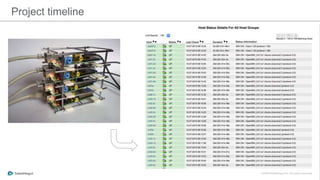
Project timeline
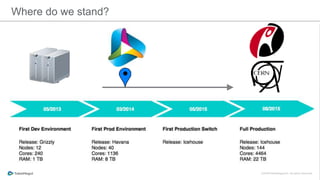
Where do we stand?
● DIY ?
○ Small OPS team
■ 12 members in two timezones
■ 3 only dedicated to OpenStack
○ New challenges
■ Internal training
■ Little external support (really ?) vs AWS
■ Manage data centers (Servers, Network, …)
OpenStack challenges - Operational aspect
● Are applications AWS dependent ?
○ Internal ops tools
○ Developer’s applications
○ AWS S3, DynamoDB, SNS, SQS, SES, SWF
● Convert developers to the project : we need their support
● OpenStack release cycle (when shall we update to latest
version?)
● OpenStack really needed components ?
● How far do we go (S3 replacement ? Network control ?
Hardware control ?)
OpenStack challenges - Application migration aspect
● Managing our own ASN / IPs (v4/v6)
● Choose “best for needs” transit providers (tier 1)
● Better control routes to/from our endpoints
● Allow dedicated AWS connections / others
● Allow direct peerings to ad networks
● Want to be accountable for networking issues
● Cost control
How? Networking - External connectivity
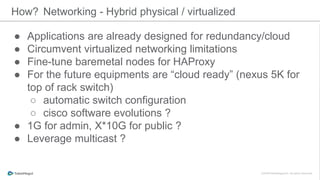
● Applications are already designed for redundancy/cloud
● Circumvent virtualized networking limitations
● Fine-tune baremetal nodes for HAProxy
● For the future equipments are “cloud ready” (nexus 5K for
top of rack switch)
○ automatic switch configuration
○ cisco software evolutions ?
● 1G for admin, X*10G for public ?
● Leverage multicast ?
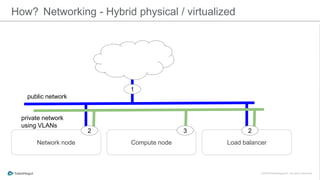
How? Networking - Hybrid physical / virtualized
Network node Compute node Load balancer
public network
private network
using VLANs
1
2 3 2
How? Networking - RTT
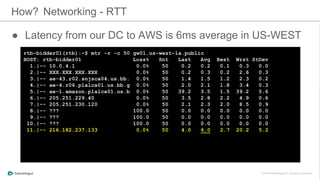
● Latency from our DC to AWS is 6ms average in US-WEST
rtb-bidder01(rtb):~$ mtr -r -c 50 gw01.us-west-1a.public
HOST: rtb-bidder01 Loss% Snt Last Avg Best Wrst StDev
1.|-- 10.0.4.1 0.0% 50 0.2 0.2 0.1 0.3 0.0
2.|-- XXX.XXX.XXX.XXX 0.0% 50 0.2 0.3 0.2 2.6 0.3
3.|-- ae-43.r02.snjsca04.us.bb. 0.0% 50 1.4 1.5 1.2 2.3 0.2
4.|-- ae-4.r06.plalca01.us.bb.g 0.0% 50 2.0 2.1 1.8 3.4 0.3
5.|-- ae-1.amazon.plalca01.us.b 0.0% 50 39.2 3.5 1.5 39.2 5.6
6.|-- 205.251.229.40 0.0% 50 3.5 2.8 2.2 4.9 0.6
7.|-- 205.251.230.120 0.0% 50 2.1 2.3 2.0 8.5 0.9
8.|-- ??? 100.0 50 0.0 0.0 0.0 0.0 0.0
9.|-- ??? 100.0 50 0.0 0.0 0.0 0.0 0.0
10.|-- ??? 100.0 50 0.0 0.0 0.0 0.0 0.0
11.|-- 216.182.237.133 0.0% 50 4.0 6.0 2.7 20.2 5.2
● If you are not building a multi-thousand hypervisors cloud,
you don’t need it to be complex
● Simplifies day-to-day operations
● Home made puppet catalog
○ because less lines of code
○ because of the learning curve
○ because need to tweak settings (ulimit?)
● No need for horizon
● No need for shared storage
How? Keep it simple
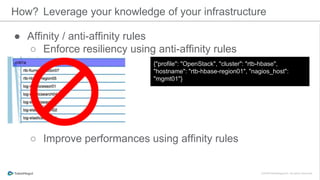
● Affinity / anti-affinity rules
○ Enforce resiliency using anti-affinity rules
○ Improve performances using affinity rules
How? Leverage your knowledge of your infrastructure
{"profile": "OpenStack", "cluster": "rtb-hbase",
"hostname": "rtb-hbase-region01", "nagios_host":
"mgmt01"}
How?
Treat your infrastructure as any other
engineering project
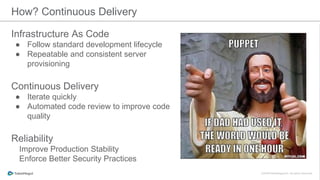
Infrastructure As Code
● Follow standard development lifecycle
● Repeatable and consistent server
provisioning
Continuous Delivery
● Iterate quickly
● Automated code review to improve code
quality
Reliability
Improve Production Stability
Enforce Better Security Practices
How? Continuous Delivery
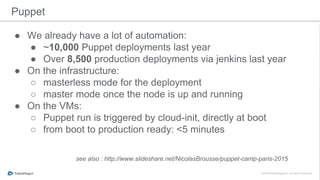
● We already have a lot of automation:
● ~10,000 Puppet deployments last year
● Over 8,500 production deployments via jenkins last year
● On the infrastructure:
○ masterless mode for the deployment
○ master mode once the node is up and running
● On the VMs:
○ Puppet run is triggered by cloud-init, directly at boot
○ from boot to production ready: <5 minutes
Puppet
see also : http://www.slideshare.net/NicolasBrousse/puppet-camp-paris-2015
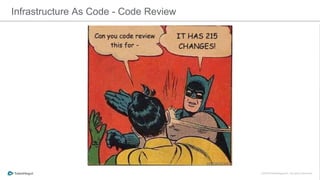
Infrastructure As Code - Code Review
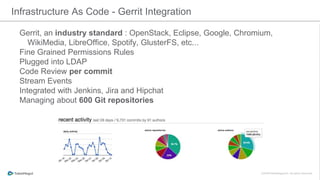
Gerrit, an industry standard : OpenStack, Eclipse, Google, Chromium,
WikiMedia, LibreOffice, Spotify, GlusterFS, etc...
Fine Grained Permissions Rules
Plugged into LDAP
Code Review per commit
Stream Events
Integrated with Jenkins, Jira and Hipchat
Managing about 600 Git repositories
Infrastructure As Code - Gerrit Integration
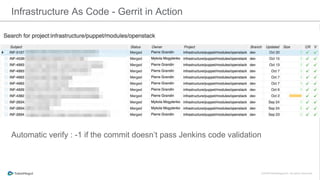
Infrastructure As Code - Gerrit in Action
Automatic verify : -1 if the commit doesn’t pass Jenkins code validation
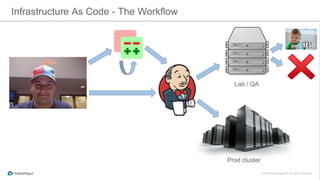
Infrastructure As Code - The Workflow
Lab / QA
Prod cluster
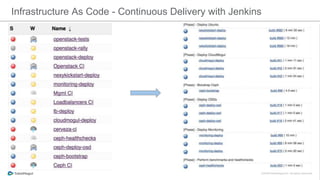
Infrastructure As Code - Continuous Delivery with Jenkins
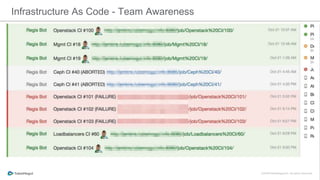
Infrastructure As Code - Team Awareness
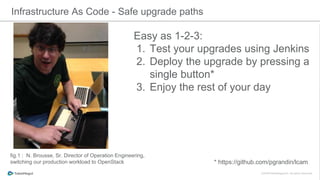
Infrastructure As Code - Safe upgrade paths
Easy as 1-2-3:
1. Test your upgrades using Jenkins
2. Deploy the upgrade by pressing a
single button*
3. Enjoy the rest of your day
* https://github.com/pgrandin/lcam
fig.1 : N. Brousse, Sr. Director of Operation Engineering,
switching our production workload to OpenStack
Get ready for production :
Monitor everything
Monitor as much as you can ?
● Existing monitoring (Nagios, Graphite) still in use
● Specific checks for OpenStack
○ check component API : performance /
availability / operability
○ check resources : ports, failed instances
● Monitoring capacity metrics for all hardware
● SNMP traps for network equipment
● Monitoring is just an extension of our existing
monitoring in AWS
Monitoring auto-discovery
● New OpenStack node is automatically monitored
○ automatically / upon request
○ nagios detects new hosts (API query)
○ nagios applies component related check by role
○ graphing is also automatically updated
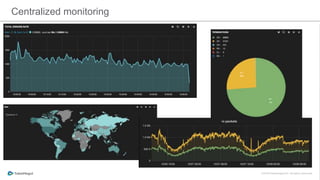
Centralized monitoring
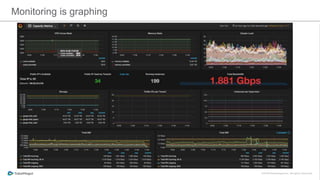
Monitoring is graphing
A look in the rearview mirror
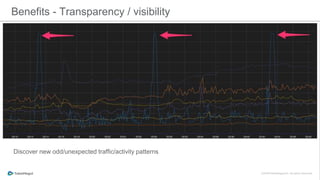
Benefits - Transparency / visibility
Discover new odd/unexpected traffic/activity patterns
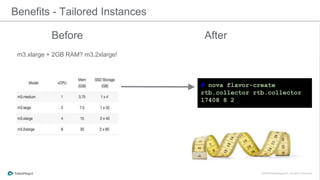
Benefits - Tailored Instances
Before After
m3.xlarge + 2GB RAM? m3.2xlarge!
# nova flavor-create
rtb.collector rtb.collector
17408 8 2
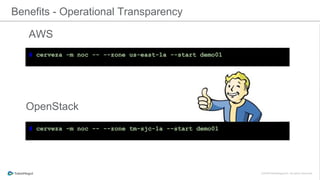
Benefits - Operational Transparency
AWS
OpenStack
# cerveza -m noc -- --zone tm-sjc-1a --start demo01
# cerveza -m noc -- --zone us-east-1a --start demo01
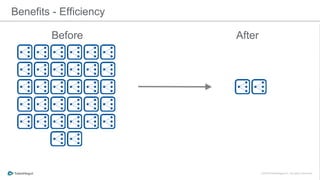
Benefits - Efficiency
Before After
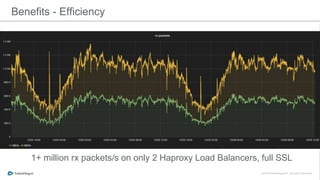
Benefits - Efficiency
1+ million rx packets/s on only 2 Haproxy Load Balancers, full SSL
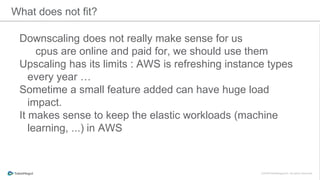
What does not fit?
Downscaling does not really make sense for us
cpus are online and paid for, we should use them
Upscaling has its limits : AWS is refreshing instance types
every year …
Sometime a small feature added can have huge load
impact.
It makes sense to keep the elastic workloads (machine
learning, ...) in AWS
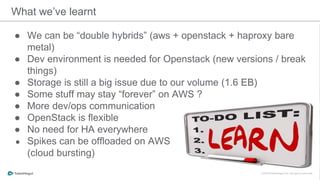
● We can be “double hybrids” (aws + openstack + haproxy bare
metal)
● Dev environment is needed for Openstack (new versions / break
things)
● Storage is still a big issue due to our volume (1.6 EB)
● Some stuff may stay “forever” on AWS ?
● More dev/ops communication
● OpenStack is flexible
● No need for HA everywhere
● Spikes can be offloaded on AWS
(cloud bursting)
What we’ve learnt
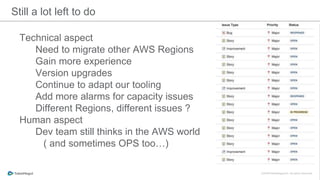
Still a lot left to do
Technical aspect
Need to migrate other AWS Regions
Gain more experience
Version upgrades
Continue to adapt our tooling
Add more alarms for capacity issues
Different Regions, different issues ?
Human aspect
Dev team still thinks in the AWS world
( and sometimes OPS too…)
- Ad serving in production since 2015-05
- Bidding traffic in production since 2015-09
- 100% uptime since pre-production (2015-03)
Cost of operation for our current production workload:
- Reduced by a factor of two, including OpEx cost!
Aftermath
Questions?
Pierre Gohon
Pierre Grandin
@pierregohon
@p_grandin

Openstack Summit Tokyo 2015 - Building a private cloud to efficiently handle 40 billion requests per day

  • 1.
    Building a PrivateCloud to Efficiently Handle 40 Billion Requests / Day October 28th, 2015 Pierre Gohon | Sr. Site Reliability Engineer | pierre.gohon@tubemogul.com Pierre Grandin | Sr. Site Reliability Engineer | pierre.grandin@tubemogul.com
  • 2.
    Who are we? TubeMogul(Nasdaq : TUBE) ● Enterprise software company for digital branding ● Over 27 Billion Ads served in 2014 ● Over 40 Billion Ad Auctions per day in Q3 2015 ● Bids processed in less than 50 ms ● Bids served in less than 80 ms (inc. network round trip) ● 5 PB of monthly video traffic served ● 1.6 EB of data stored
  • 3.
    Who are we? OperationsEngineering ● Ensure the smooth day to day operation of the platform infrastructure ● Provide a cost effective and cutting edge infrastructure ● Provide support to dev teams ● Team composed of SREs, SEs and DBAs (US and UA) ● Managing over 2,500 servers (virtual and physical)
  • 4.
    Our Infrastructure Public CloudOn Premises Multiple locations with a mix of Public Cloud and On Premises
  • 5.
    ● 6 AWSRegions (us-east*2, us-west*2, europe, apac) ● Physical servers in Michigan / Arizona (Web/Databases) ● DNS served by third party (UltraDNS +Dynect) ● External monitoring using Catchpoint ● CDNs to deliver content ● External security audits We’re not adding complexity! Before Openstack: we’re already very “Hybrid”…
  • 6.
    Why? ● Own yourinfrastructure stack ● Physical proximity matters (reduced/controlled latency) ● Better infrastructure planning ● Technological transparency ● … $$ !
  • 7.
  • 8.
  • 9.
    ● DIY ? ○Small OPS team ■ 12 members in two timezones ■ 3 only dedicated to OpenStack ○ New challenges ■ Internal training ■ Little external support (really ?) vs AWS ■ Manage data centers (Servers, Network, …) OpenStack challenges - Operational aspect
  • 10.
    ● Are applicationsAWS dependent ? ○ Internal ops tools ○ Developer’s applications ○ AWS S3, DynamoDB, SNS, SQS, SES, SWF ● Convert developers to the project : we need their support ● OpenStack release cycle (when shall we update to latest version?) ● OpenStack really needed components ? ● How far do we go (S3 replacement ? Network control ? Hardware control ?) OpenStack challenges - Application migration aspect
  • 11.
    ● Managing ourown ASN / IPs (v4/v6) ● Choose “best for needs” transit providers (tier 1) ● Better control routes to/from our endpoints ● Allow dedicated AWS connections / others ● Allow direct peerings to ad networks ● Want to be accountable for networking issues ● Cost control How? Networking - External connectivity
  • 12.
    ● Applications arealready designed for redundancy/cloud ● Circumvent virtualized networking limitations ● Fine-tune baremetal nodes for HAProxy ● For the future equipments are “cloud ready” (nexus 5K for top of rack switch) ○ automatic switch configuration ○ cisco software evolutions ? ● 1G for admin, X*10G for public ? ● Leverage multicast ? How? Networking - Hybrid physical / virtualized
  • 13.
    How? Networking -Hybrid physical / virtualized Network node Compute node Load balancer public network private network using VLANs 1 2 3 2
  • 14.
    How? Networking -RTT ● Latency from our DC to AWS is 6ms average in US-WEST rtb-bidder01(rtb):~$ mtr -r -c 50 gw01.us-west-1a.public HOST: rtb-bidder01 Loss% Snt Last Avg Best Wrst StDev 1.|-- 10.0.4.1 0.0% 50 0.2 0.2 0.1 0.3 0.0 2.|-- XXX.XXX.XXX.XXX 0.0% 50 0.2 0.3 0.2 2.6 0.3 3.|-- ae-43.r02.snjsca04.us.bb. 0.0% 50 1.4 1.5 1.2 2.3 0.2 4.|-- ae-4.r06.plalca01.us.bb.g 0.0% 50 2.0 2.1 1.8 3.4 0.3 5.|-- ae-1.amazon.plalca01.us.b 0.0% 50 39.2 3.5 1.5 39.2 5.6 6.|-- 205.251.229.40 0.0% 50 3.5 2.8 2.2 4.9 0.6 7.|-- 205.251.230.120 0.0% 50 2.1 2.3 2.0 8.5 0.9 8.|-- ??? 100.0 50 0.0 0.0 0.0 0.0 0.0 9.|-- ??? 100.0 50 0.0 0.0 0.0 0.0 0.0 10.|-- ??? 100.0 50 0.0 0.0 0.0 0.0 0.0 11.|-- 216.182.237.133 0.0% 50 4.0 6.0 2.7 20.2 5.2
  • 15.
    ● If youare not building a multi-thousand hypervisors cloud, you don’t need it to be complex ● Simplifies day-to-day operations ● Home made puppet catalog ○ because less lines of code ○ because of the learning curve ○ because need to tweak settings (ulimit?) ● No need for horizon ● No need for shared storage How? Keep it simple
  • 16.
    ● Affinity /anti-affinity rules ○ Enforce resiliency using anti-affinity rules ○ Improve performances using affinity rules How? Leverage your knowledge of your infrastructure {"profile": "OpenStack", "cluster": "rtb-hbase", "hostname": "rtb-hbase-region01", "nagios_host": "mgmt01"}
  • 17.
    How? Treat your infrastructureas any other engineering project
  • 18.
    Infrastructure As Code ●Follow standard development lifecycle ● Repeatable and consistent server provisioning Continuous Delivery ● Iterate quickly ● Automated code review to improve code quality Reliability Improve Production Stability Enforce Better Security Practices How? Continuous Delivery
  • 19.
    ● We alreadyhave a lot of automation: ● ~10,000 Puppet deployments last year ● Over 8,500 production deployments via jenkins last year ● On the infrastructure: ○ masterless mode for the deployment ○ master mode once the node is up and running ● On the VMs: ○ Puppet run is triggered by cloud-init, directly at boot ○ from boot to production ready: <5 minutes Puppet see also : http://www.slideshare.net/NicolasBrousse/puppet-camp-paris-2015
  • 20.
  • 21.
    Gerrit, an industrystandard : OpenStack, Eclipse, Google, Chromium, WikiMedia, LibreOffice, Spotify, GlusterFS, etc... Fine Grained Permissions Rules Plugged into LDAP Code Review per commit Stream Events Integrated with Jenkins, Jira and Hipchat Managing about 600 Git repositories Infrastructure As Code - Gerrit Integration
  • 22.
    Infrastructure As Code- Gerrit in Action Automatic verify : -1 if the commit doesn’t pass Jenkins code validation
  • 23.
    Infrastructure As Code- The Workflow Lab / QA Prod cluster
  • 24.
    Infrastructure As Code- Continuous Delivery with Jenkins
  • 25.
    Infrastructure As Code- Team Awareness
  • 26.
    Infrastructure As Code- Safe upgrade paths Easy as 1-2-3: 1. Test your upgrades using Jenkins 2. Deploy the upgrade by pressing a single button* 3. Enjoy the rest of your day * https://github.com/pgrandin/lcam fig.1 : N. Brousse, Sr. Director of Operation Engineering, switching our production workload to OpenStack
  • 27.
    Get ready forproduction : Monitor everything
  • 28.
    Monitor as muchas you can ? ● Existing monitoring (Nagios, Graphite) still in use ● Specific checks for OpenStack ○ check component API : performance / availability / operability ○ check resources : ports, failed instances ● Monitoring capacity metrics for all hardware ● SNMP traps for network equipment ● Monitoring is just an extension of our existing monitoring in AWS
  • 29.
    Monitoring auto-discovery ● NewOpenStack node is automatically monitored ○ automatically / upon request ○ nagios detects new hosts (API query) ○ nagios applies component related check by role ○ graphing is also automatically updated
  • 30.
  • 31.
  • 32.
    A look inthe rearview mirror
  • 33.
    Benefits - Transparency/ visibility Discover new odd/unexpected traffic/activity patterns
  • 34.
    Benefits - TailoredInstances Before After m3.xlarge + 2GB RAM? m3.2xlarge! # nova flavor-create rtb.collector rtb.collector 17408 8 2
  • 35.
    Benefits - OperationalTransparency AWS OpenStack # cerveza -m noc -- --zone tm-sjc-1a --start demo01 # cerveza -m noc -- --zone us-east-1a --start demo01
  • 36.
  • 37.
    Benefits - Efficiency 1+million rx packets/s on only 2 Haproxy Load Balancers, full SSL
  • 38.
    What does notfit? Downscaling does not really make sense for us cpus are online and paid for, we should use them Upscaling has its limits : AWS is refreshing instance types every year … Sometime a small feature added can have huge load impact. It makes sense to keep the elastic workloads (machine learning, ...) in AWS
  • 39.
    ● We canbe “double hybrids” (aws + openstack + haproxy bare metal) ● Dev environment is needed for Openstack (new versions / break things) ● Storage is still a big issue due to our volume (1.6 EB) ● Some stuff may stay “forever” on AWS ? ● More dev/ops communication ● OpenStack is flexible ● No need for HA everywhere ● Spikes can be offloaded on AWS (cloud bursting) What we’ve learnt
  • 40.
    Still a lotleft to do Technical aspect Need to migrate other AWS Regions Gain more experience Version upgrades Continue to adapt our tooling Add more alarms for capacity issues Different Regions, different issues ? Human aspect Dev team still thinks in the AWS world ( and sometimes OPS too…)
  • 41.
    - Ad servingin production since 2015-05 - Bidding traffic in production since 2015-09 - 100% uptime since pre-production (2015-03) Cost of operation for our current production workload: - Reduced by a factor of two, including OpEx cost! Aftermath
  • 42.
  • 43.