Stay Productive While Slicing Up the
Monolith
Markus Eisele
@myfear
Classical Architectures?
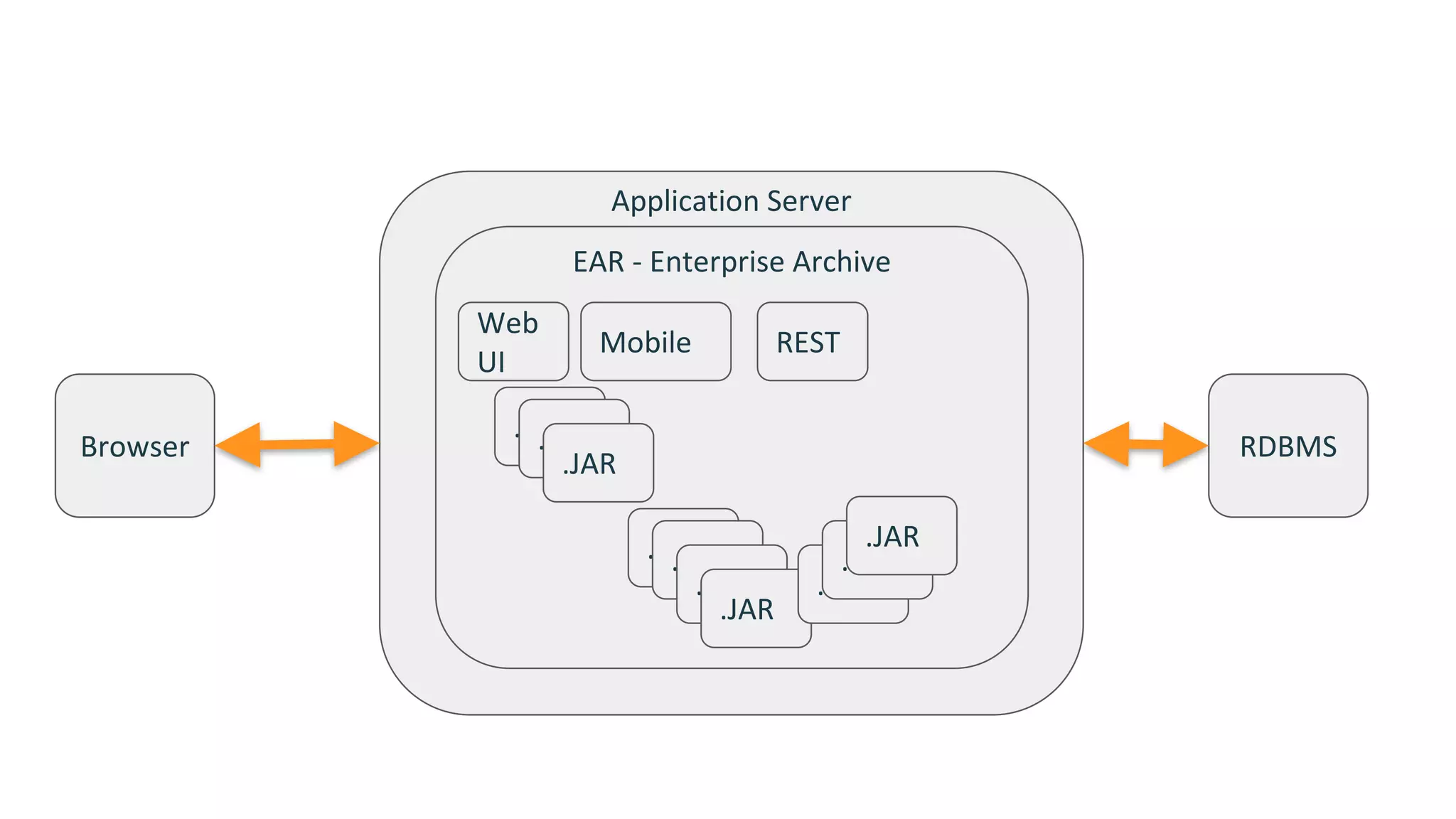
Application	Server
EAR	- Enterprise	Archive
RESTMobile
Web
UI
.JAR.JAR
.JAR
.JAR.JAR
.JAR
.JAR
.JAR
.JAR
.JAR
Browser RDBMS
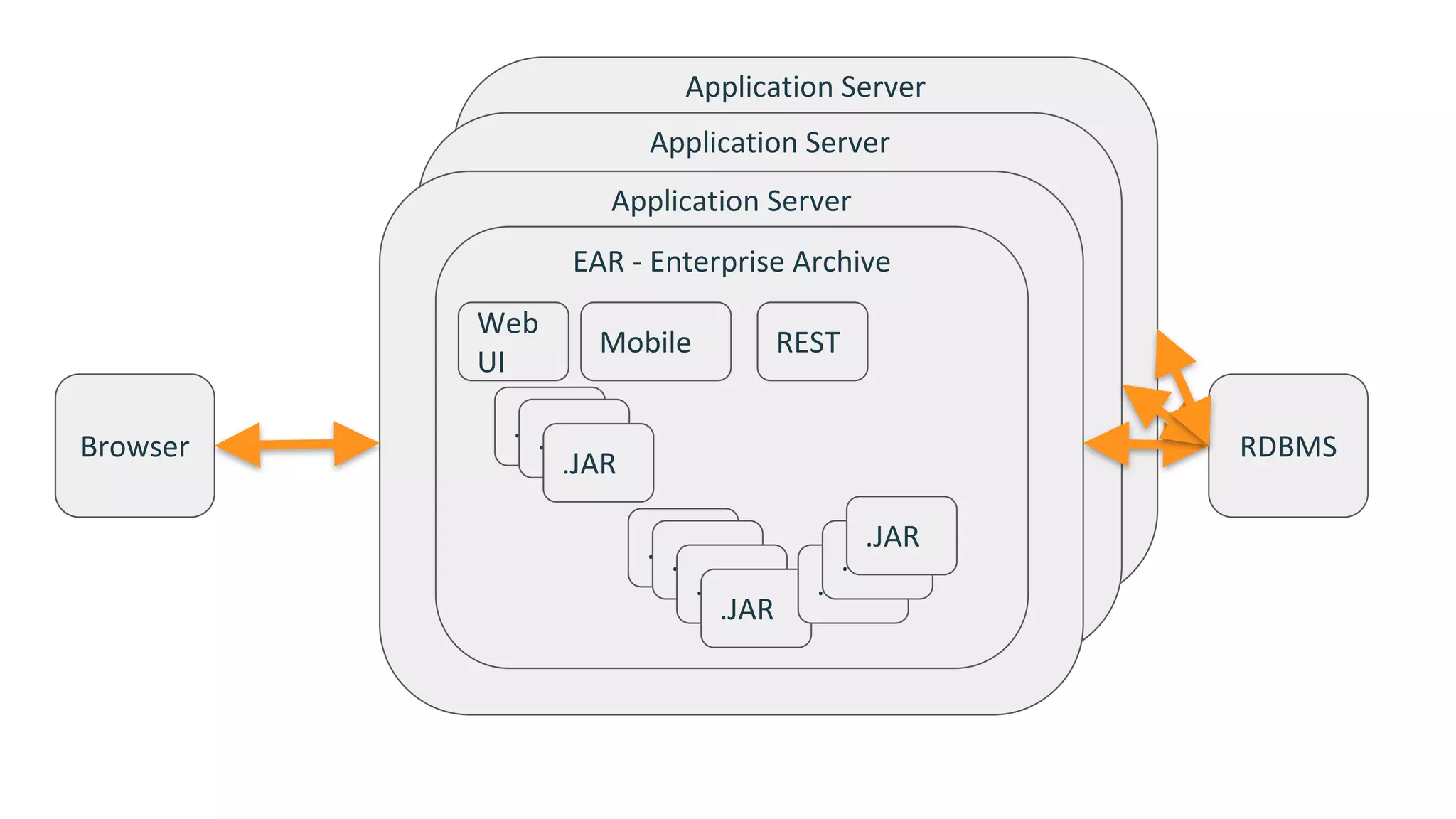
Application	Server
Application	Server
Application	Server
EAR	- Enterprise	Archive
RESTMobile
Web
UI
.JAR.JAR
.JAR
.JAR.JAR
.JAR
.JAR
.JAR
.JAR
.JAR
Browser RDBMS
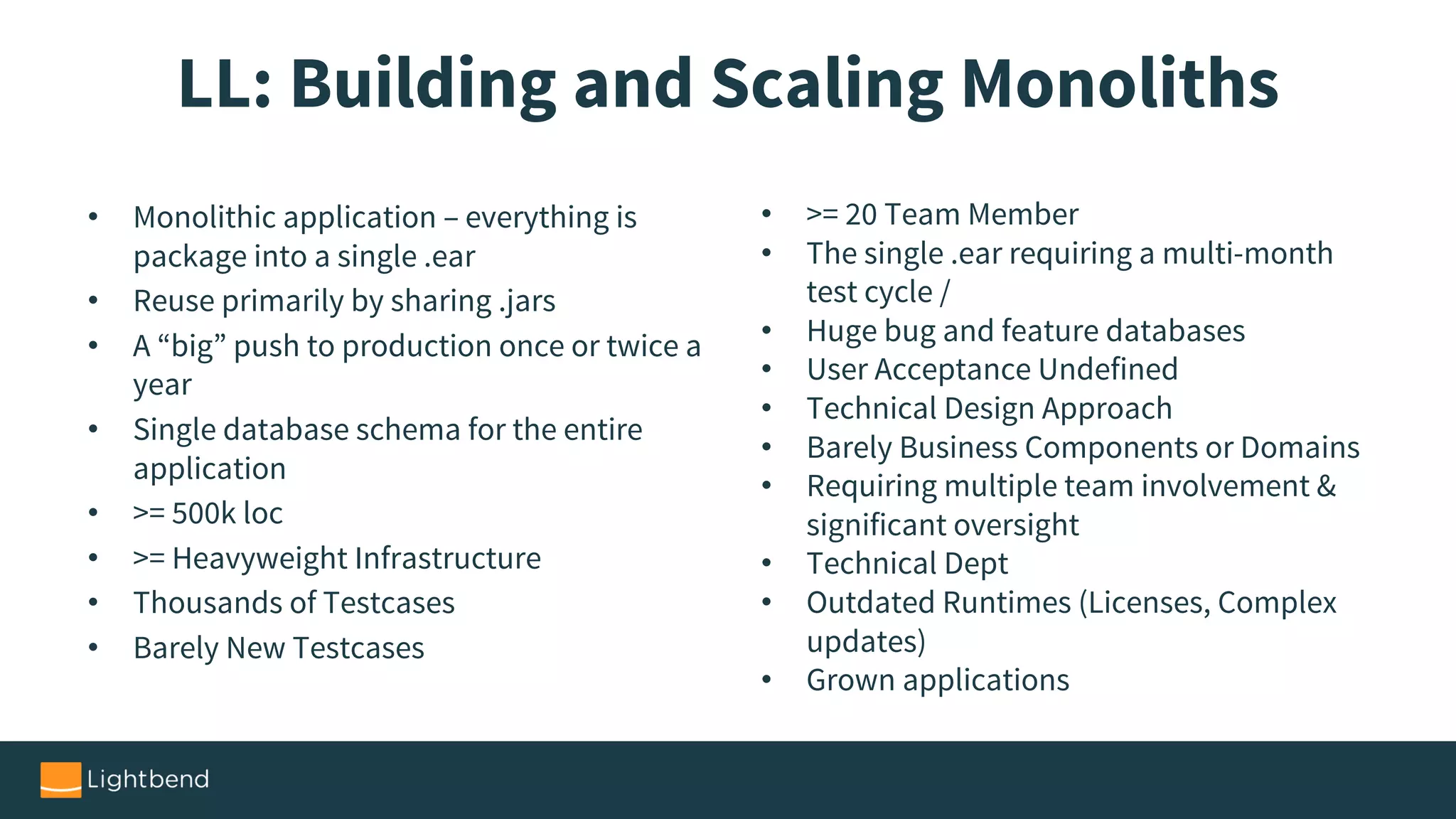
LL: Building and Scaling Monoliths
• Monolithic application – everything is
package into a single .ear
• Reuse primarily by sharing .jars
• A “big” push to production once or twice a
year
• Single database schema for the entire
application
• >= 500k loc
• >= Heavyweight Infrastructure
• Thousands of Testcases
• Barely New Testcases
• >= 20 Team Member
• The single .ear requiring a multi-month
test cycle /
• Huge bug and feature databases
• User Acceptance Undefined
• Technical Design Approach
• Barely Business Components or Domains
• Requiring multiple team involvement &
significant oversight
• Technical Dept
• Outdated Runtimes (Licenses, Complex
updates)
• Grown applications
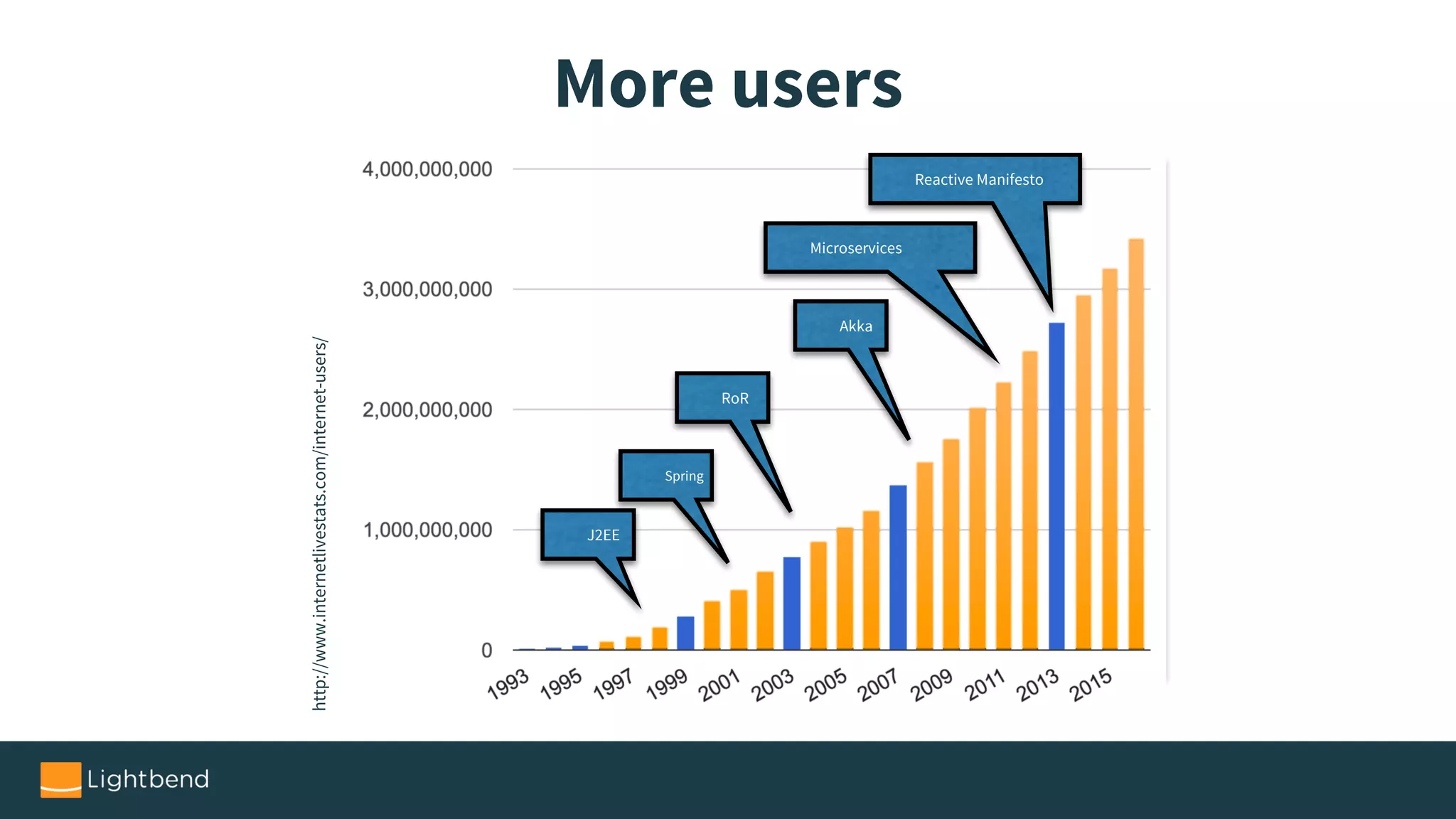
More users
http://www.internetlivestats.com/internet-users/
J2EE
Spring
RoR
Akka
Reactive Manifesto
Microservices
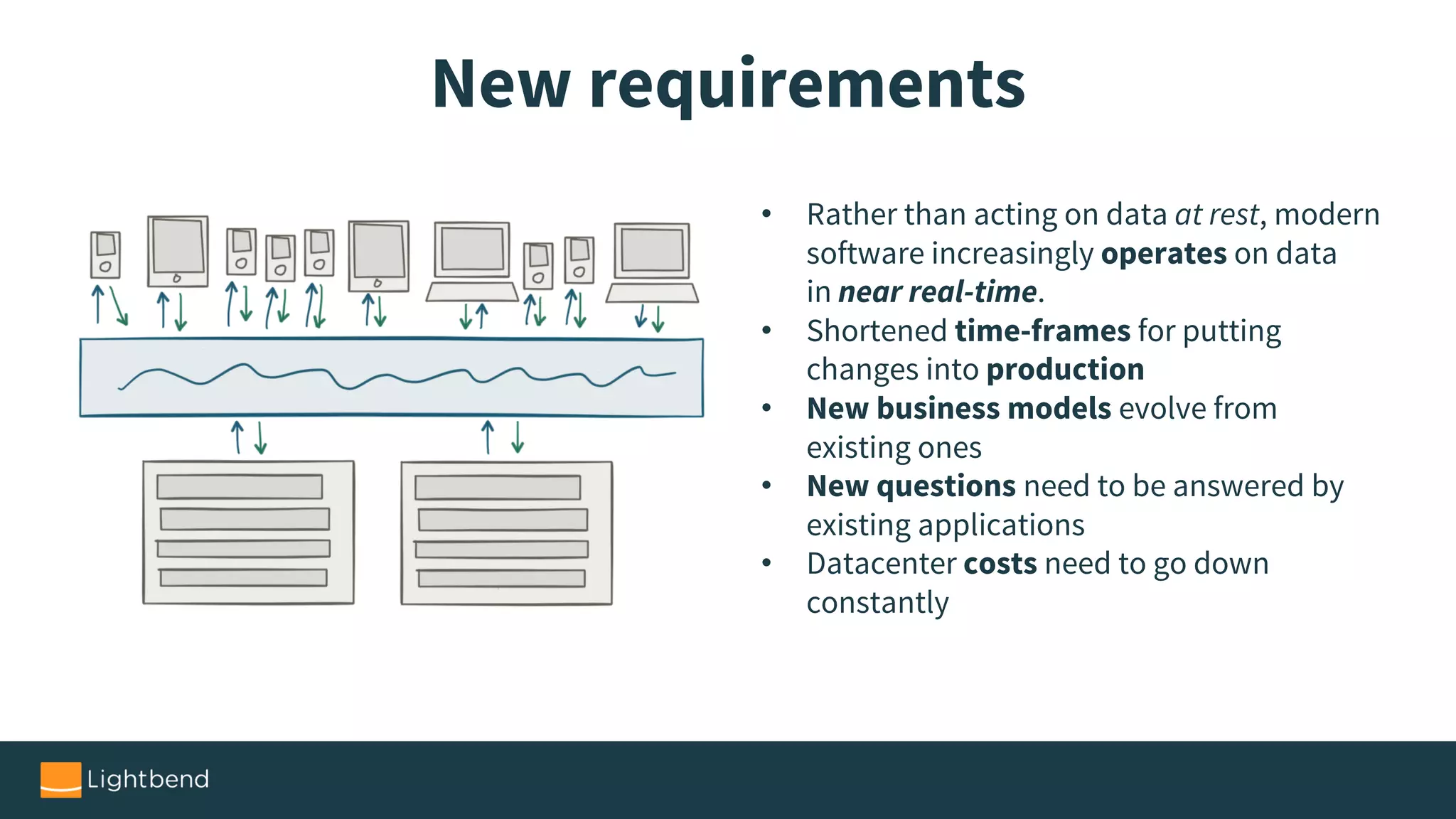
New requirements
• Rather than acting on data at rest, modern
software increasingly operates on data
in near real-time.
• Shortened time-frames for putting
changes into production
• New business models evolve from
existing ones
• New questions need to be answered by
existing applications
• Datacenter costs need to go down
constantly
> Traditional application architectures
and platforms are obsolete.
-- Gartner
Modernization!
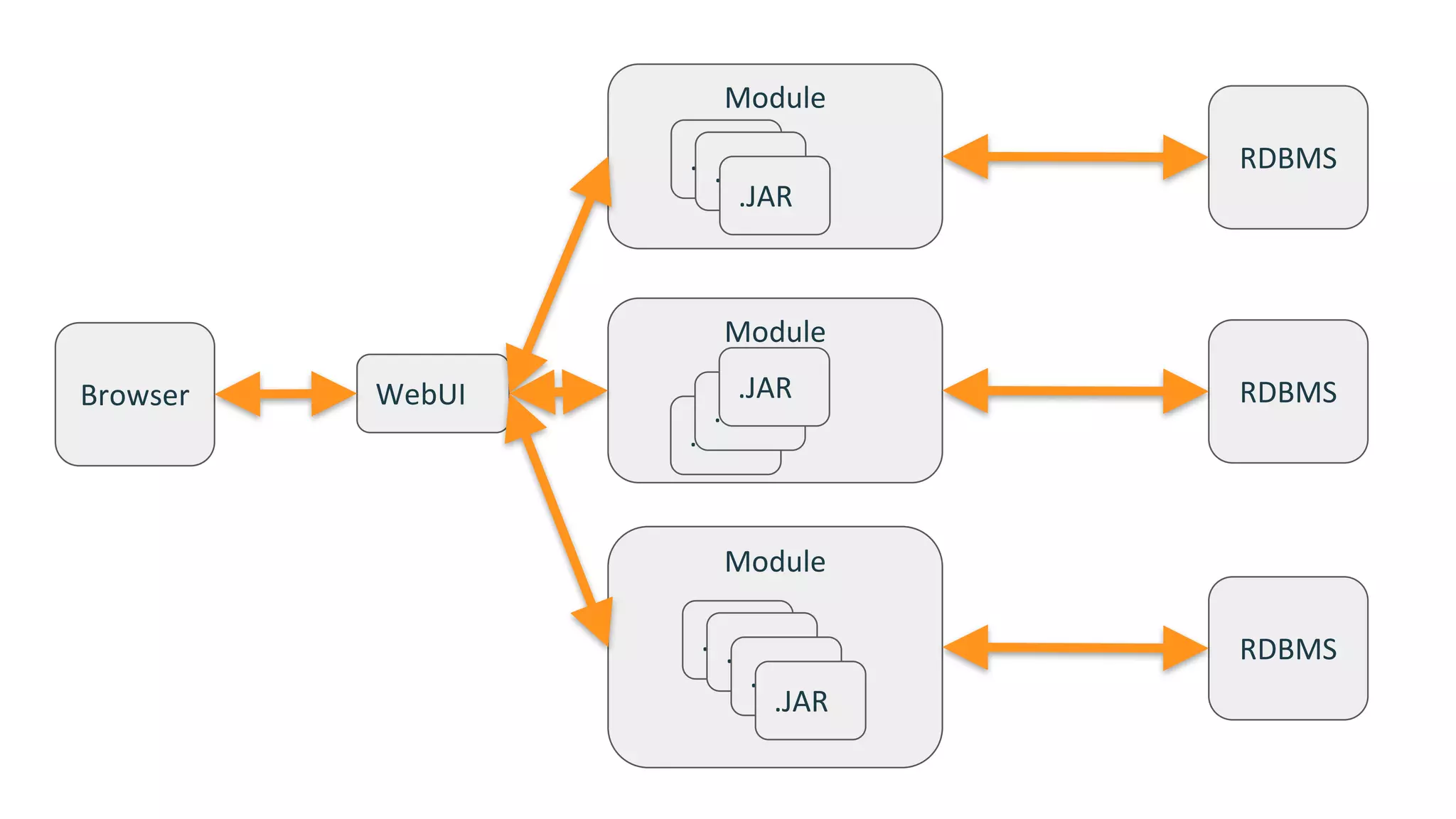
Module
Module
Module
WebUI
.JAR.JAR
.JAR
.JAR.JAR
.JAR
.JAR
.JAR
.JAR
.JARBrowser RDBMS
RDBMS
RDBMS
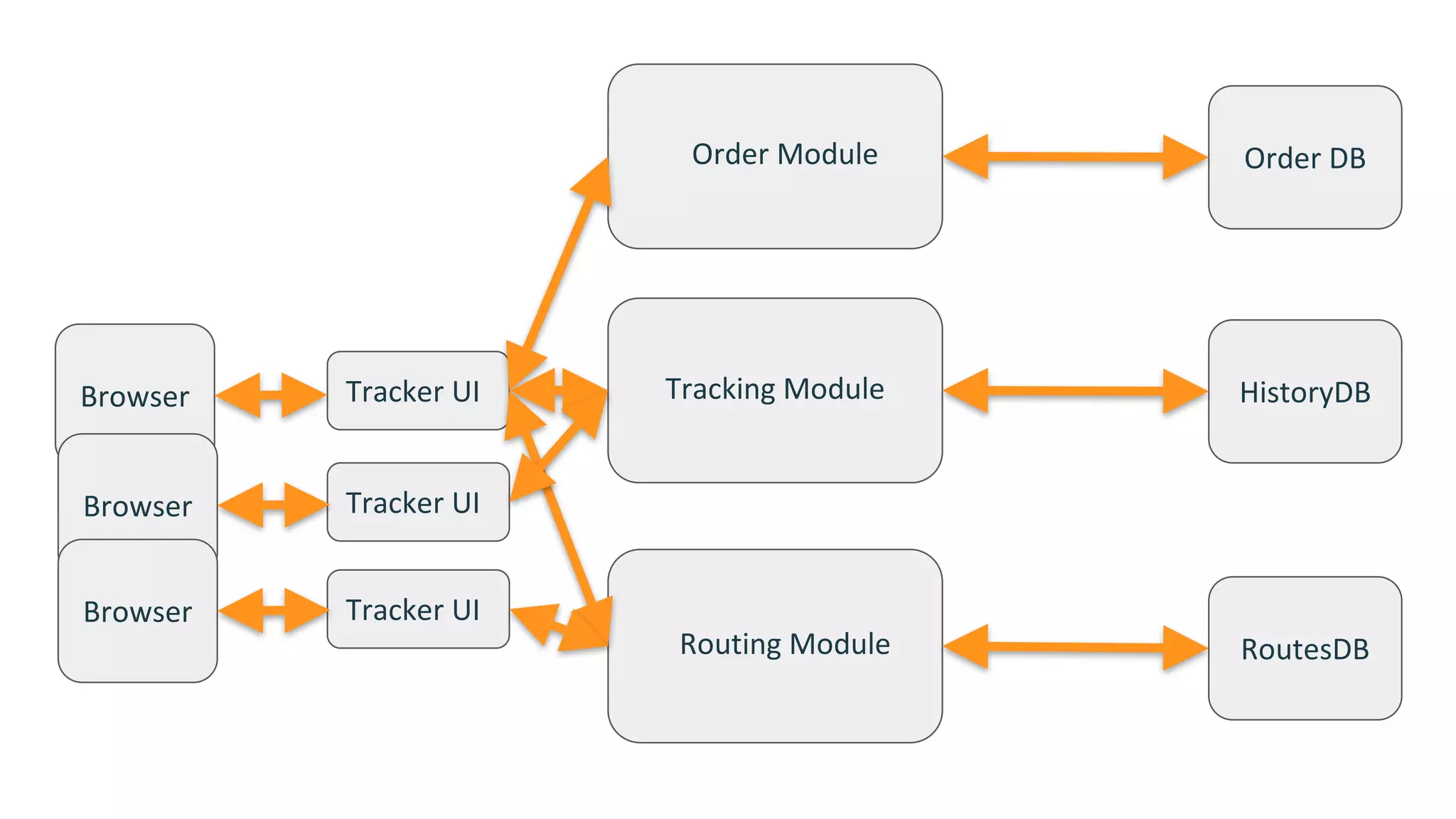
Routing	Module
Tracking	Module
Order	Module
Tracker	UIBrowser HistoryDB
Order	DB
RoutesDB
Tracker	UI
Tracker	UI
Browser
Browser
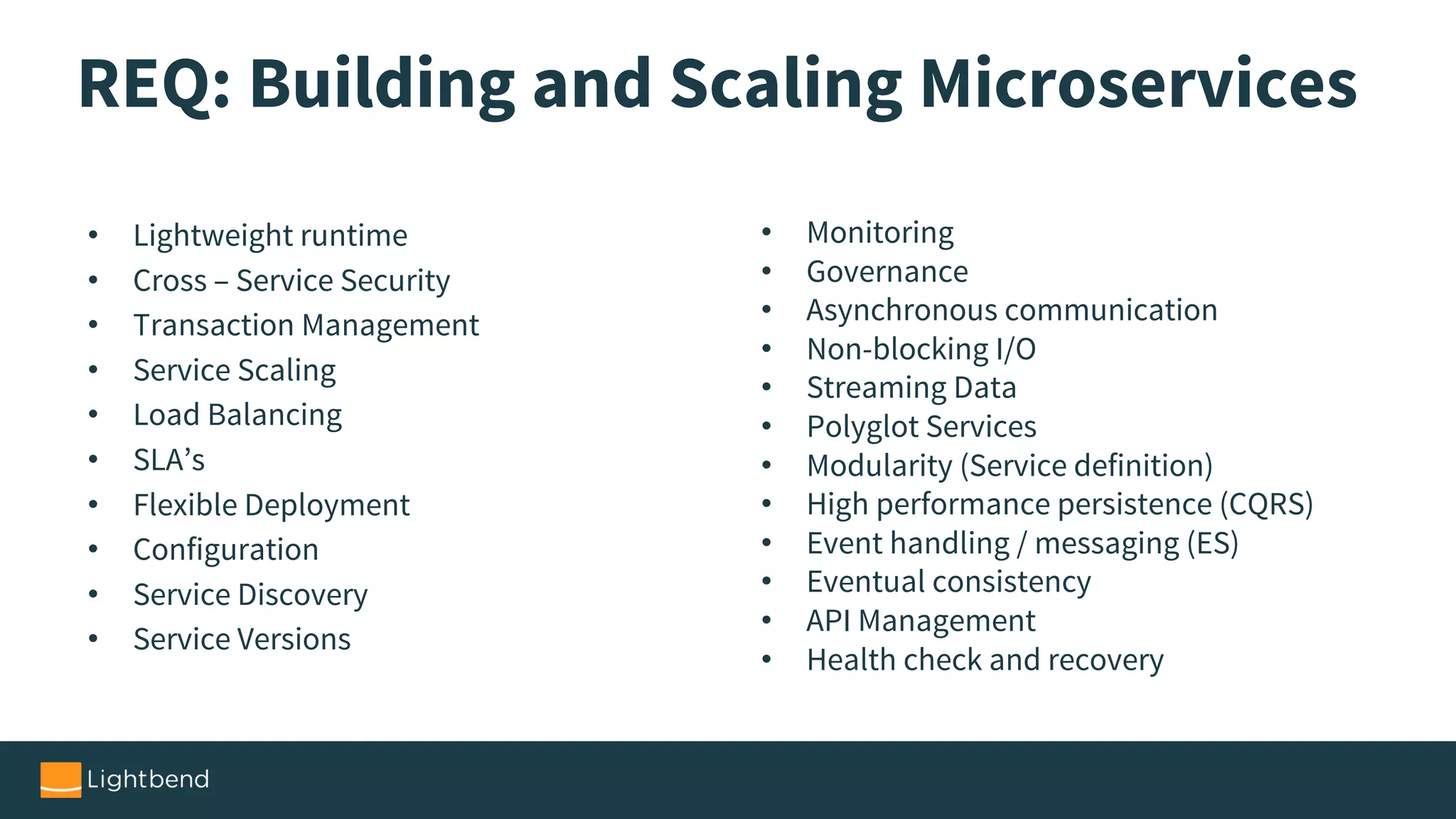
REQ: Building and Scaling Microservices
• Lightweight runtime
• Cross – Service Security
• Transaction Management
• Service Scaling
• Load Balancing
• SLA’s
• Flexible Deployment
• Configuration
• Service Discovery
• Service Versions
• Monitoring
• Governance
• Asynchronous communication
• Non-blocking I/O
• Streaming Data
• Polyglot Services
• Modularity (Service definition)
• High performance persistence (CQRS)
• Event handling / messaging (ES)
• Eventual consistency
• API Management
• Health check and recovery
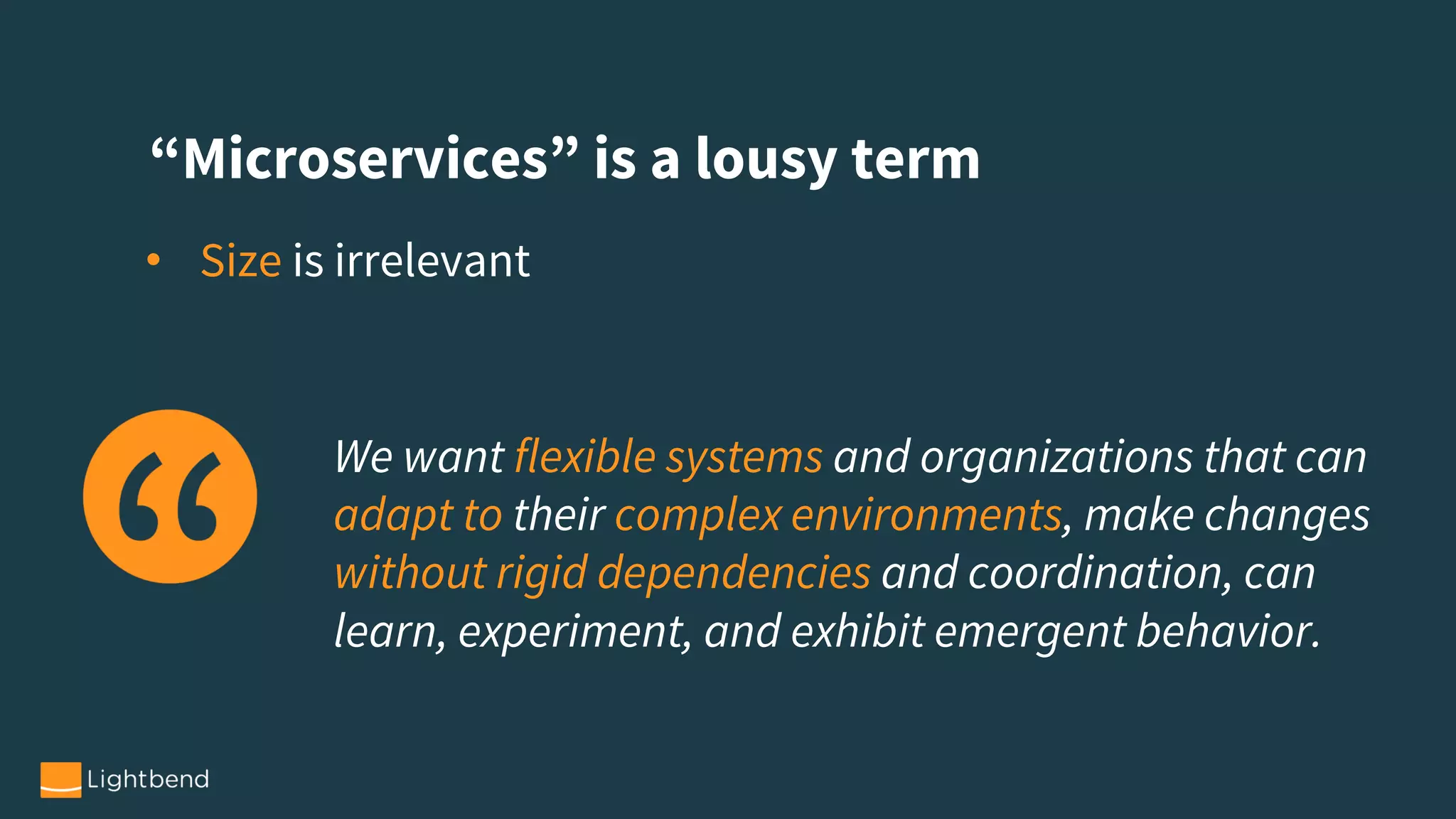
“Microservices” is a lousy term
• Size is irrelevant
We want flexible systems and organizations that can
adapt to their complex environments, make changes
without rigid dependencies and coordination, can
learn, experiment, and exhibit emergent behavior.
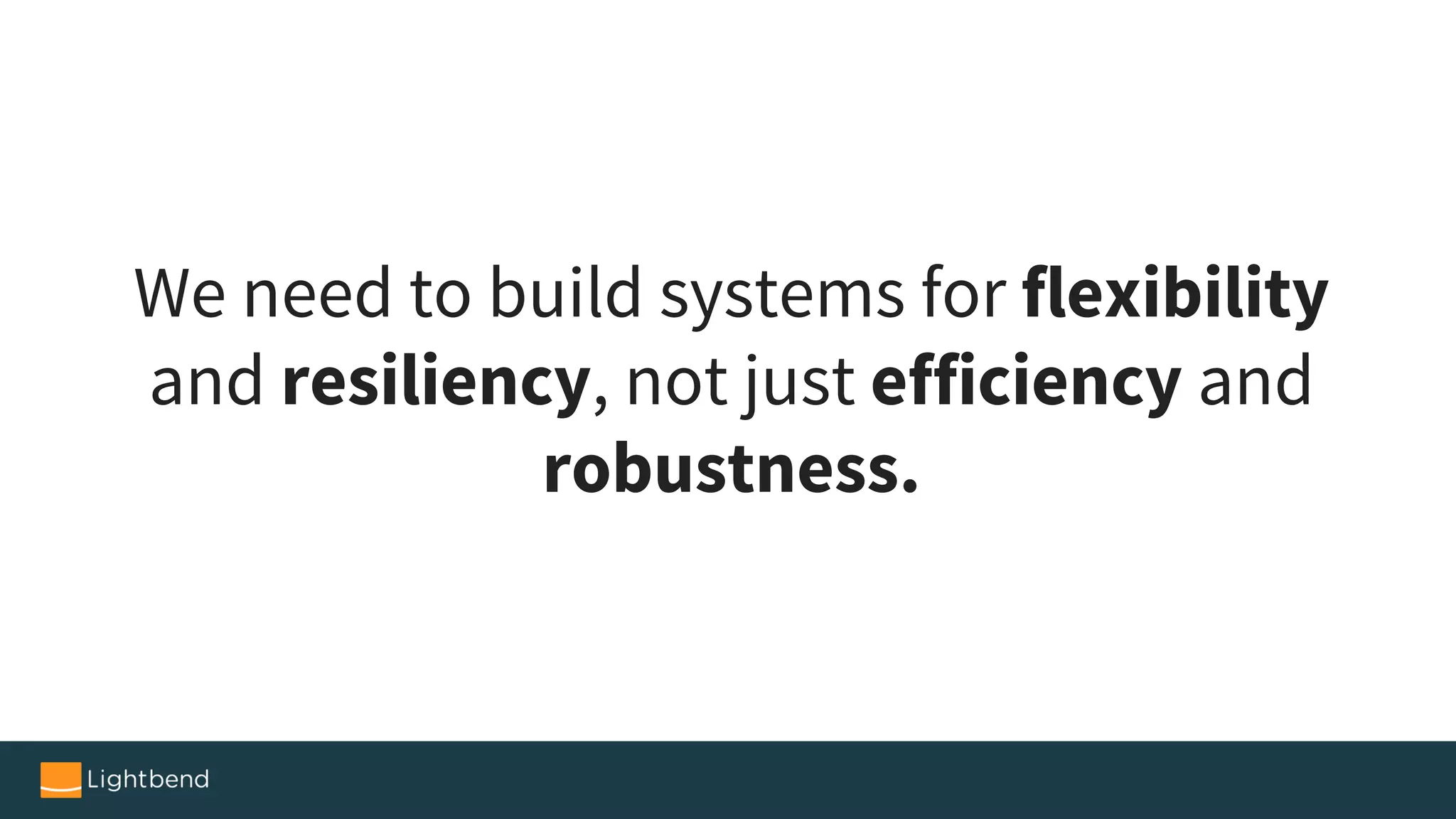
We need to build systems for flexibility
and resiliency, not just efficiency and
robustness.
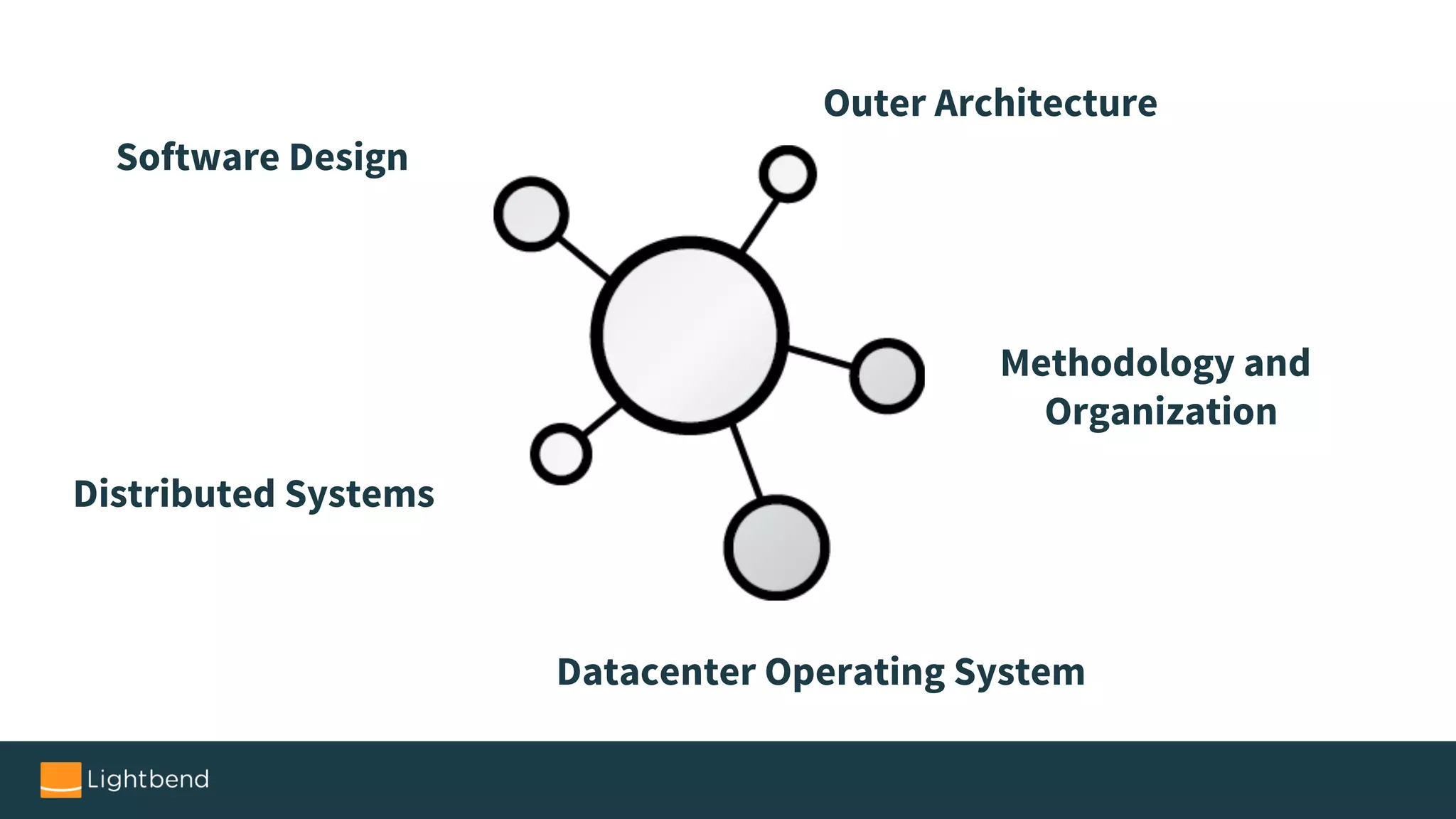
Software Design
Outer Architecture
Methodology and
Organization
Distributed Systems
Datacenter Operating System
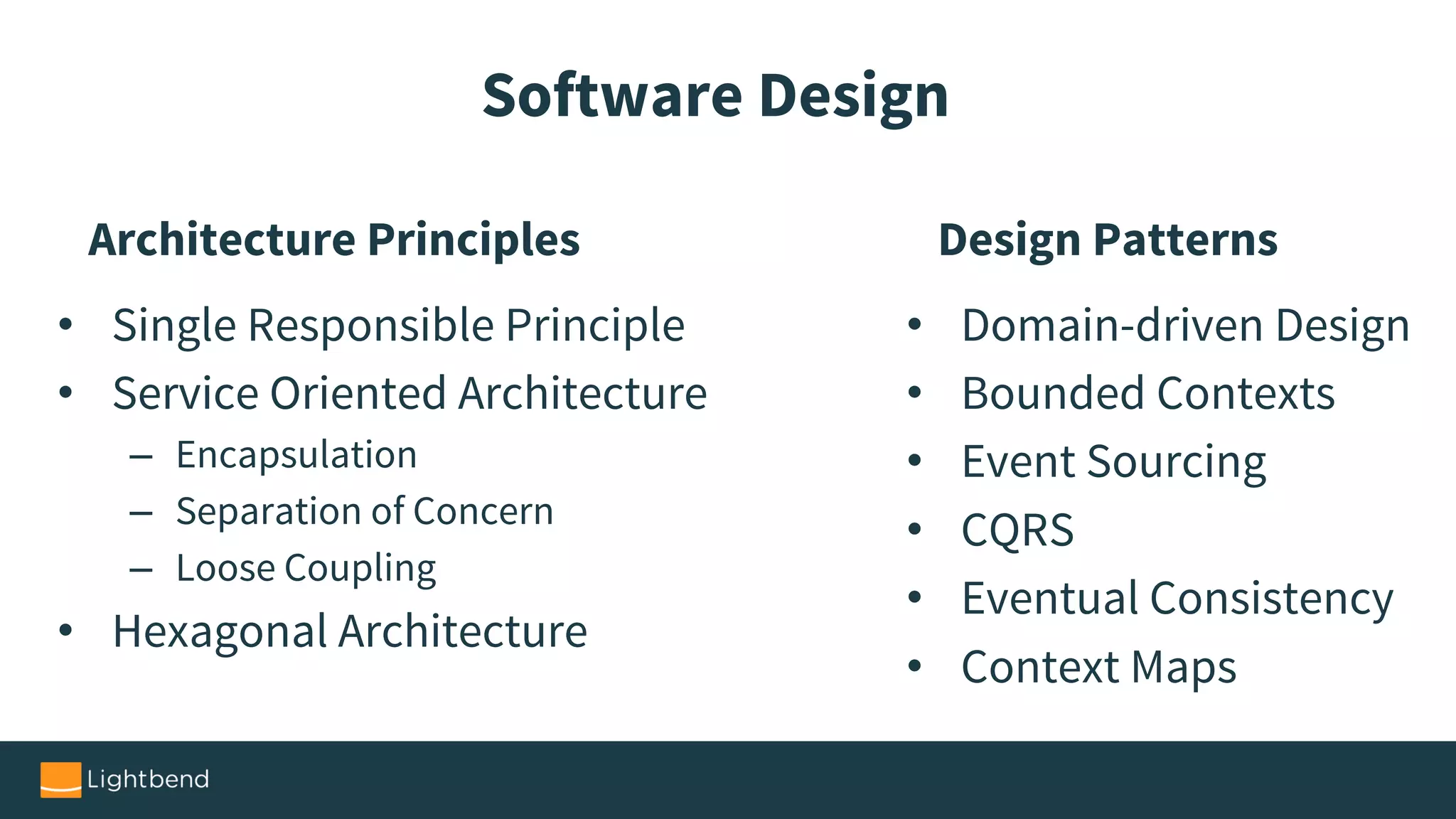
Software Design
Architecture Principles
• Single Responsible Principle
• Service Oriented Architecture
– Encapsulation
– Separation of Concern
– Loose Coupling
• Hexagonal Architecture
Design Patterns
• Domain-driven Design
• Bounded Contexts
• Event Sourcing
• CQRS
• Eventual Consistency
• Context Maps
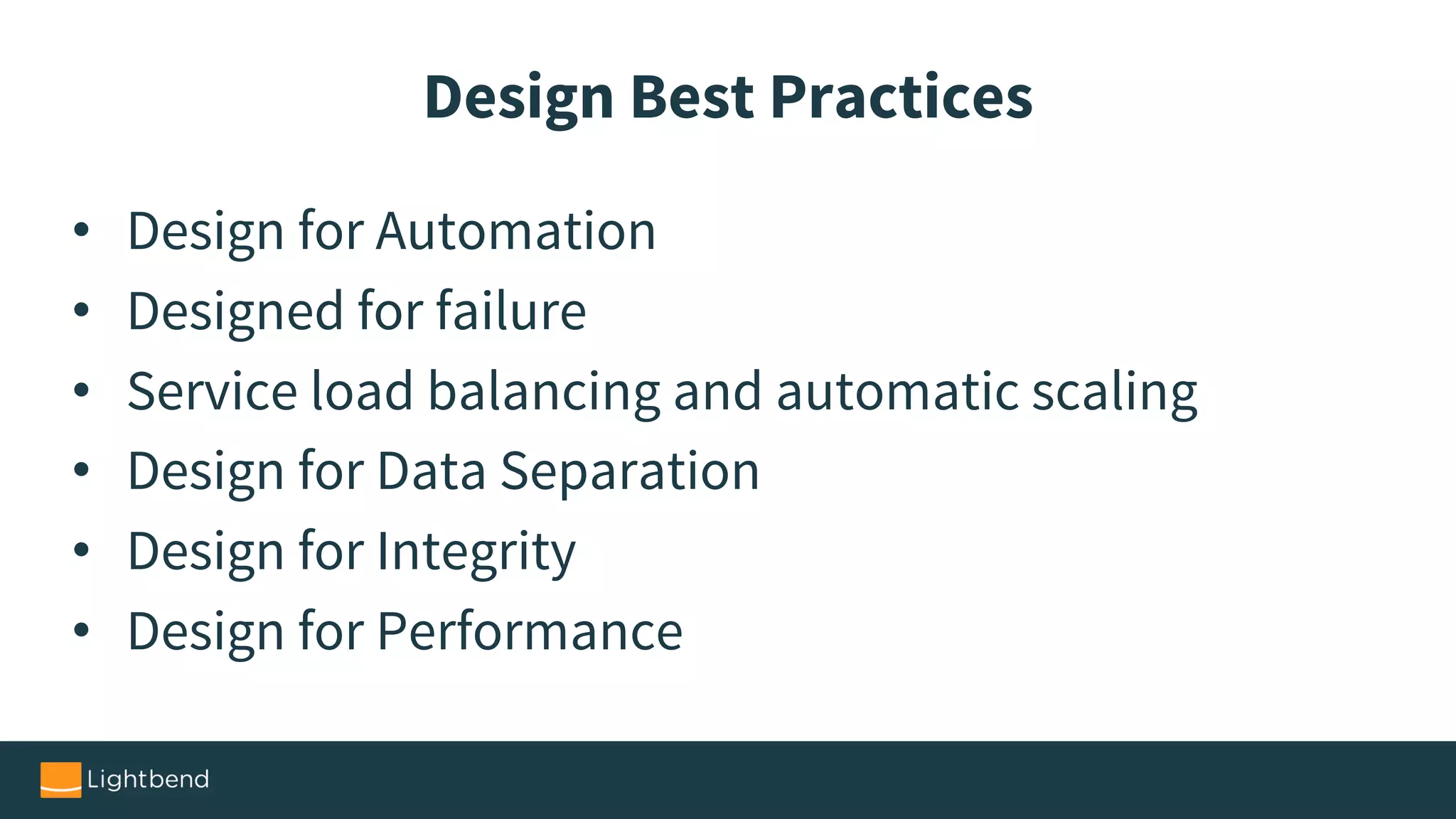
Design Best Practices
• Design for Automation
• Designed for failure
• Service load balancing and automatic scaling
• Design for Data Separation
• Design for Integrity
• Design for Performance
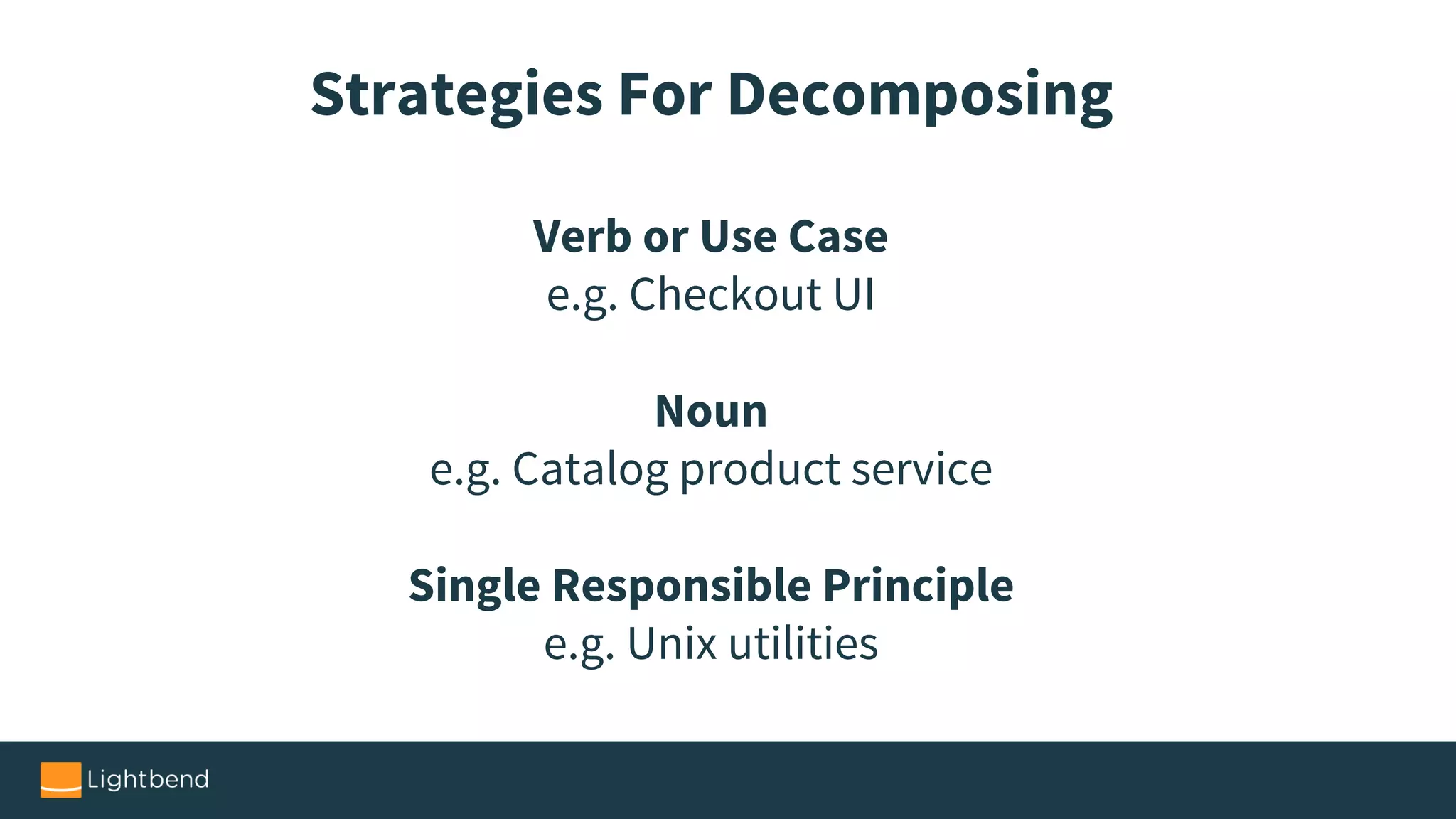
Strategies For Decomposing
Verb or Use Case
e.g. Checkout UI
Noun
e.g. Catalog product service
Single Responsible Principle
e.g. Unix utilities
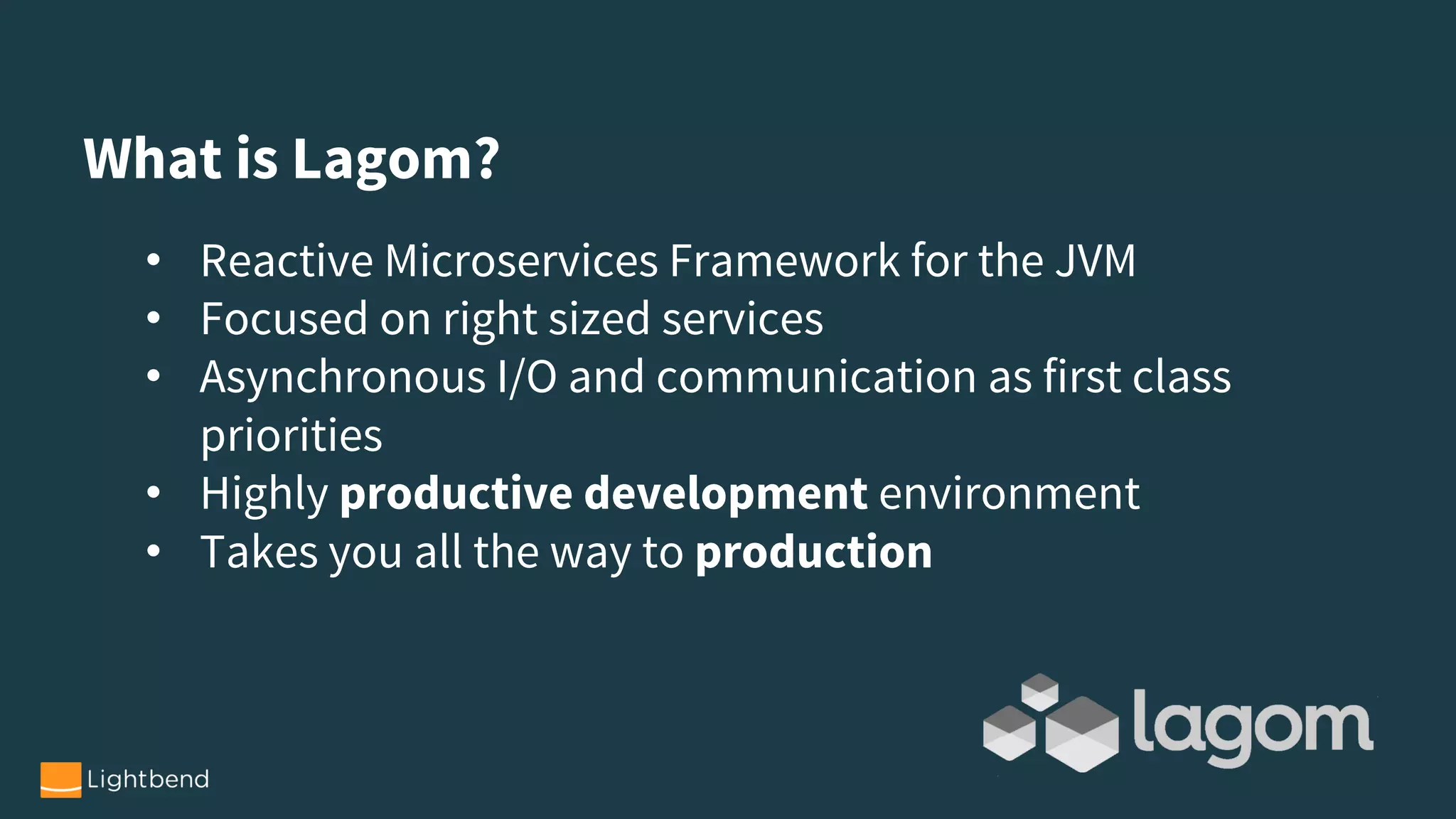
• Reactive Microservices Framework for the JVM
• Focused on right sized services
• Asynchronous I/O and communication as first class
priorities
• Highly productive development environment
• Takes you all the way to production
What is Lagom?
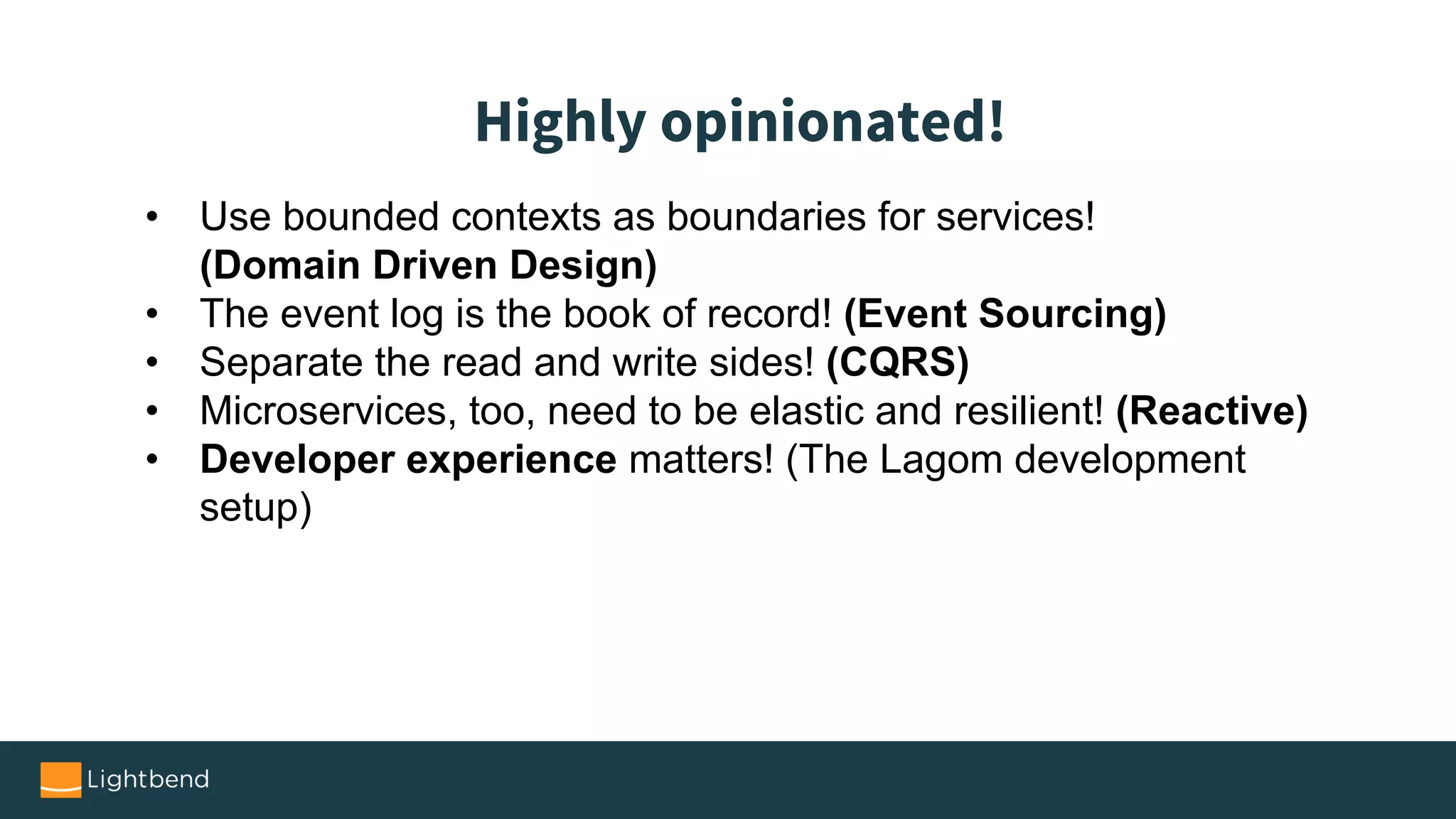
• Use bounded contexts as boundaries for services!
(Domain Driven Design)
• The event log is the book of record! (Event Sourcing)
• Separate the read and write sides! (CQRS)
• Microservices, too, need to be elastic and resilient! (Reactive)
• Developer experience matters! (The Lagom development
setup)
Highly opinionated!
• Service API
• Persistence API
• Development environment
• Production environment
The parts
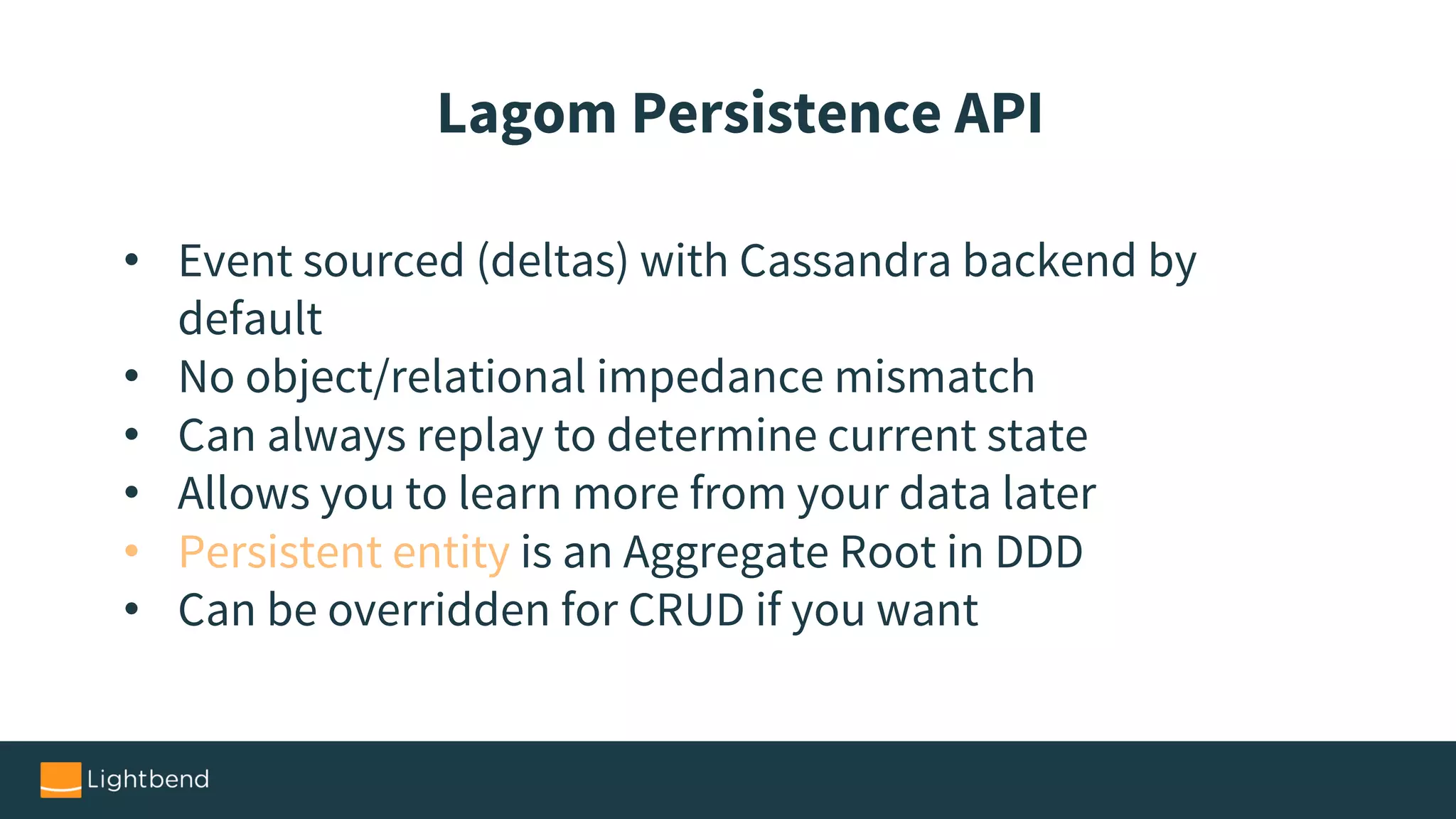
• Event sourced (deltas) with Cassandra backend by
default
• No object/relational impedance mismatch
• Can always replay to determine current state
• Allows you to learn more from your data later
• Persistent entity is an Aggregate Root in DDD
• Can be overridden for CRUD if you want
Lagom Persistence API
Getting started.
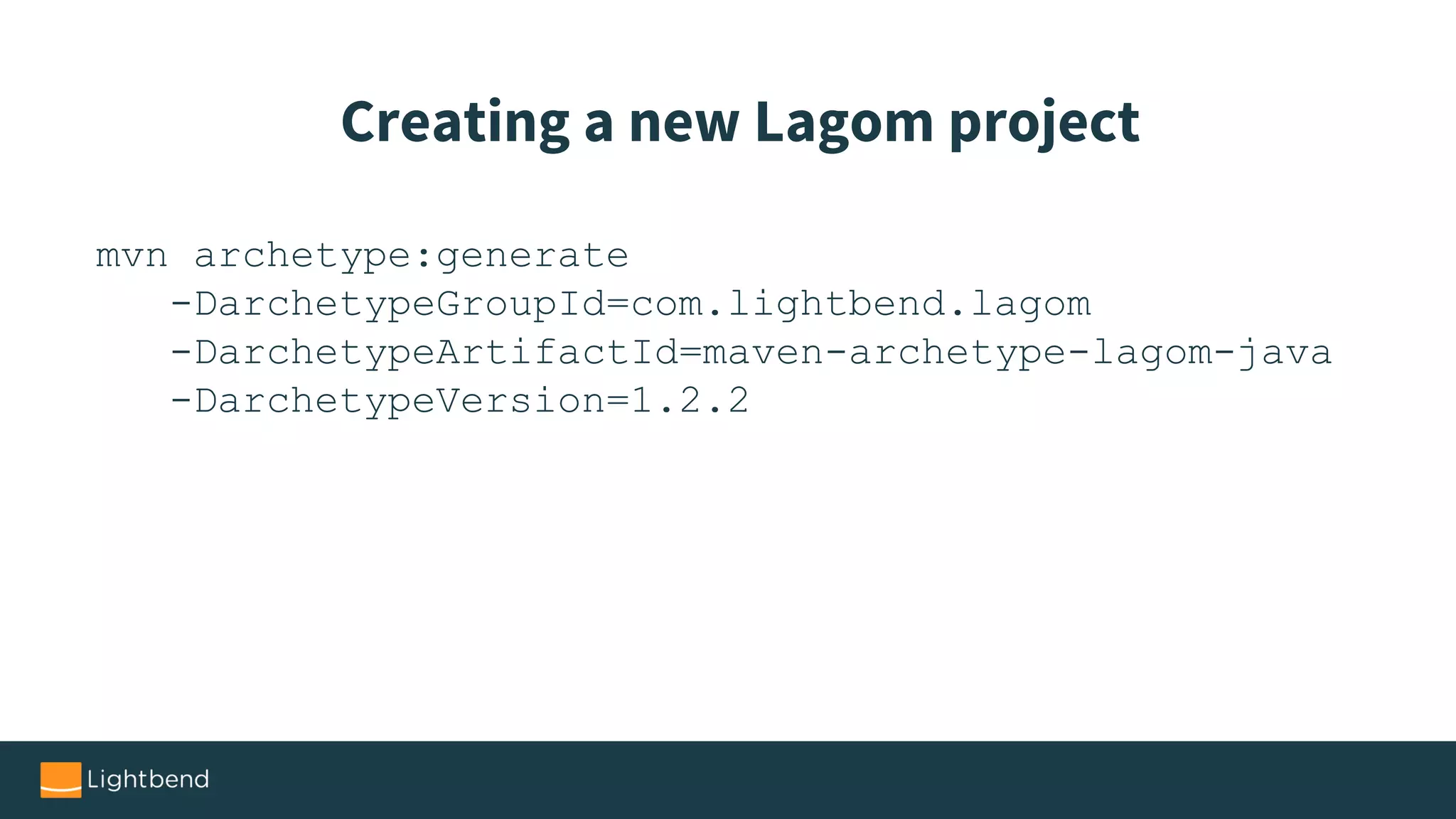
mvn archetype:generate
-DarchetypeGroupId=com.lightbend.lagom
-DarchetypeArtifactId=maven-archetype-lagom-java
-DarchetypeVersion=1.2.2
Creating a new Lagom project
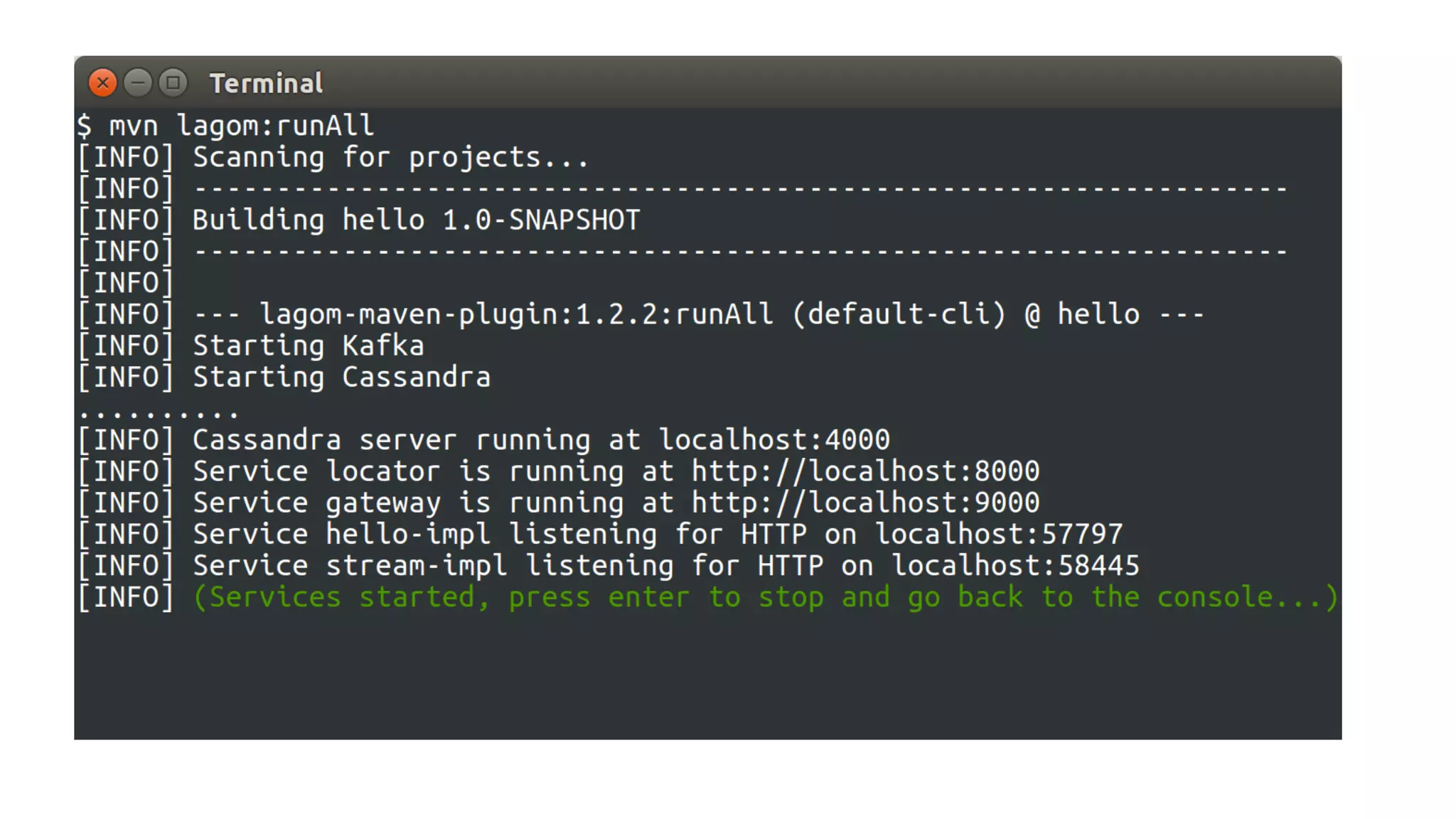
$ cd my-first-system
$ mvn lagom:runAll ...
[info] Starting embedded Cassandra server
..........
[info] Cassandra server running at 127.0.0.1:4000
[info] Service locator is running at
http://localhost:8000
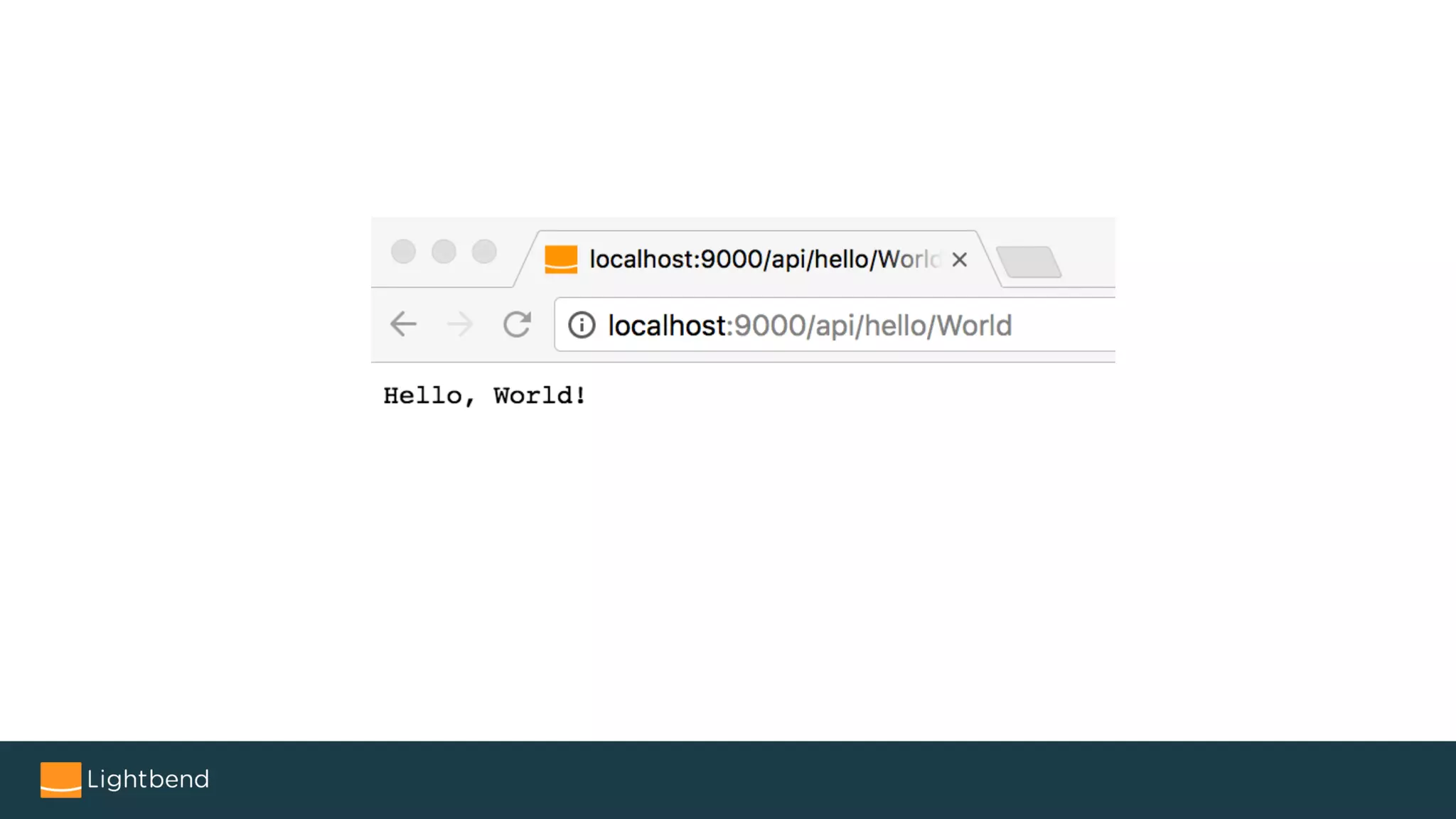
[info] Service gateway is running at
http://localhost:9000
..........
[info] Service helloworld-impl listening for HTTP on
0:0:0:0:0:0:0:0:24266
[info] Service hellostream-impl listening for HTTP on
0:0:0:0:0:0:0:0:26230 (Services started, press enter
to stop and go back to the console...)
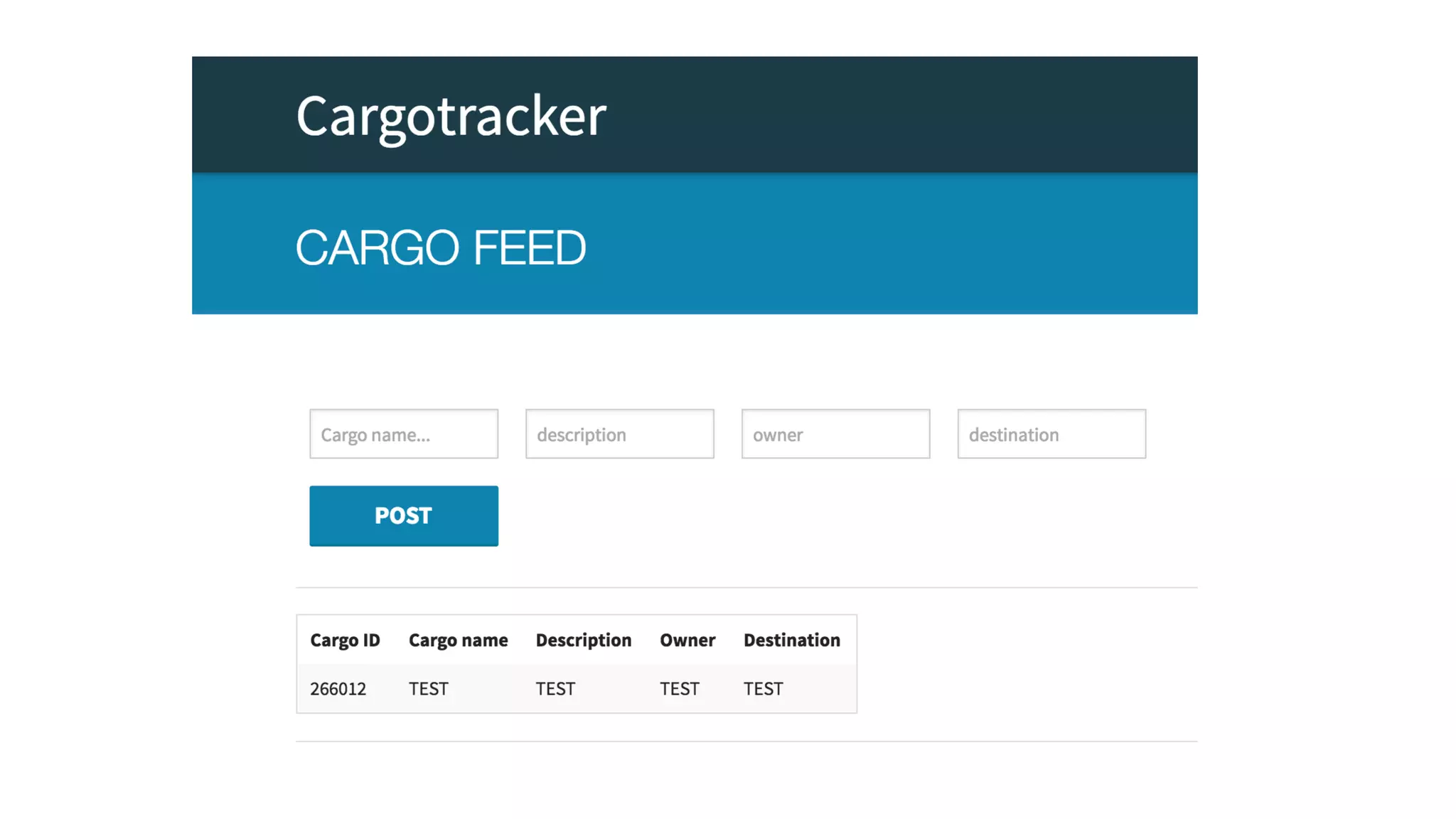
The somewhat bigger example!
Cargo	Tracker
https://github.com/lagom/activator-lagom-cargotracker
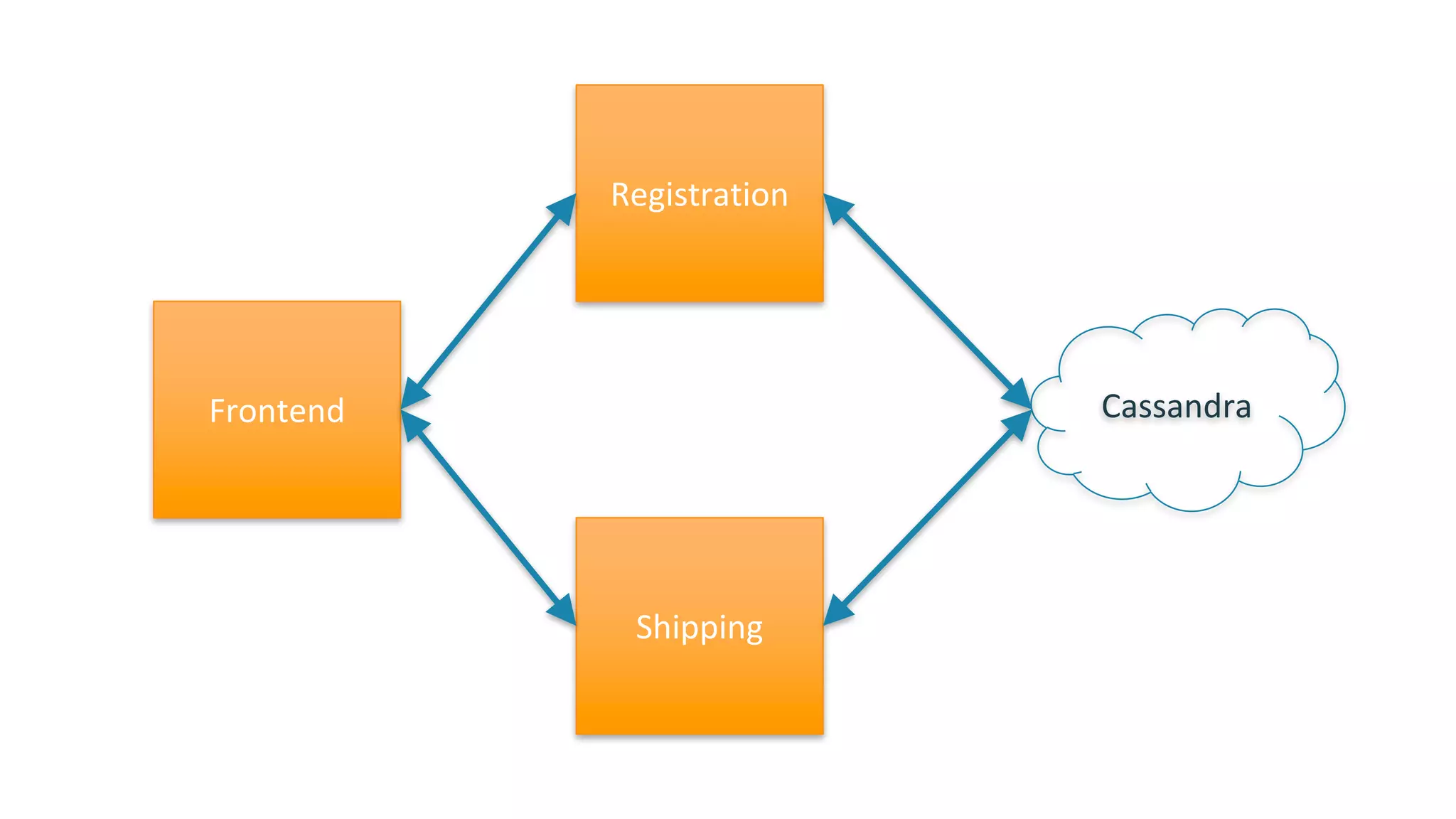
Registration
Shipping
Frontend Cassandra
Now that we have our
bundles, how do we get
into production?
• Lagom doesn’t prescribe any particular production
environment, however out of the box support is
provided for Lightbend ConductR.
• Zookeper based version:
https://github.com/jboner/lagom-service-locator-
zookeeper
• Consul based version:
https://github.com/jboner/lagom-service-locator-consul
Out of the box support for ConductR but..
>sbt bundle:dist
...
[info] Your package is ready in
/Users/myfear/lagom-cargotracker/front-
end/target/universal/front-end-1.0-
SNAPSHOT.zip
Create Service bundles via sbt
• Creating a bundle configuration file, bundle.conf
• Creating a start script
• Creating a Maven assembly plugin descriptor to create
the bundle zip
• Binding the Maven assembly plugin and
Lagom renameConductRBundle goals to your projects
lifecycle
Create Service Bundles with Maven
http://www.lagomframework.com/documentation/1.3.x/java/ConductR.html
Next Steps! Download and try Lagom!
Project Site:
http://www.lightbend.com/lagom
GitHub Repo:
https://github.com/lagom
Documentation:
http://www.lagomframework.com/documentation/1.3.x/java/Home.html
Example:
https://github.com/typesafehub/activator-lagom-java
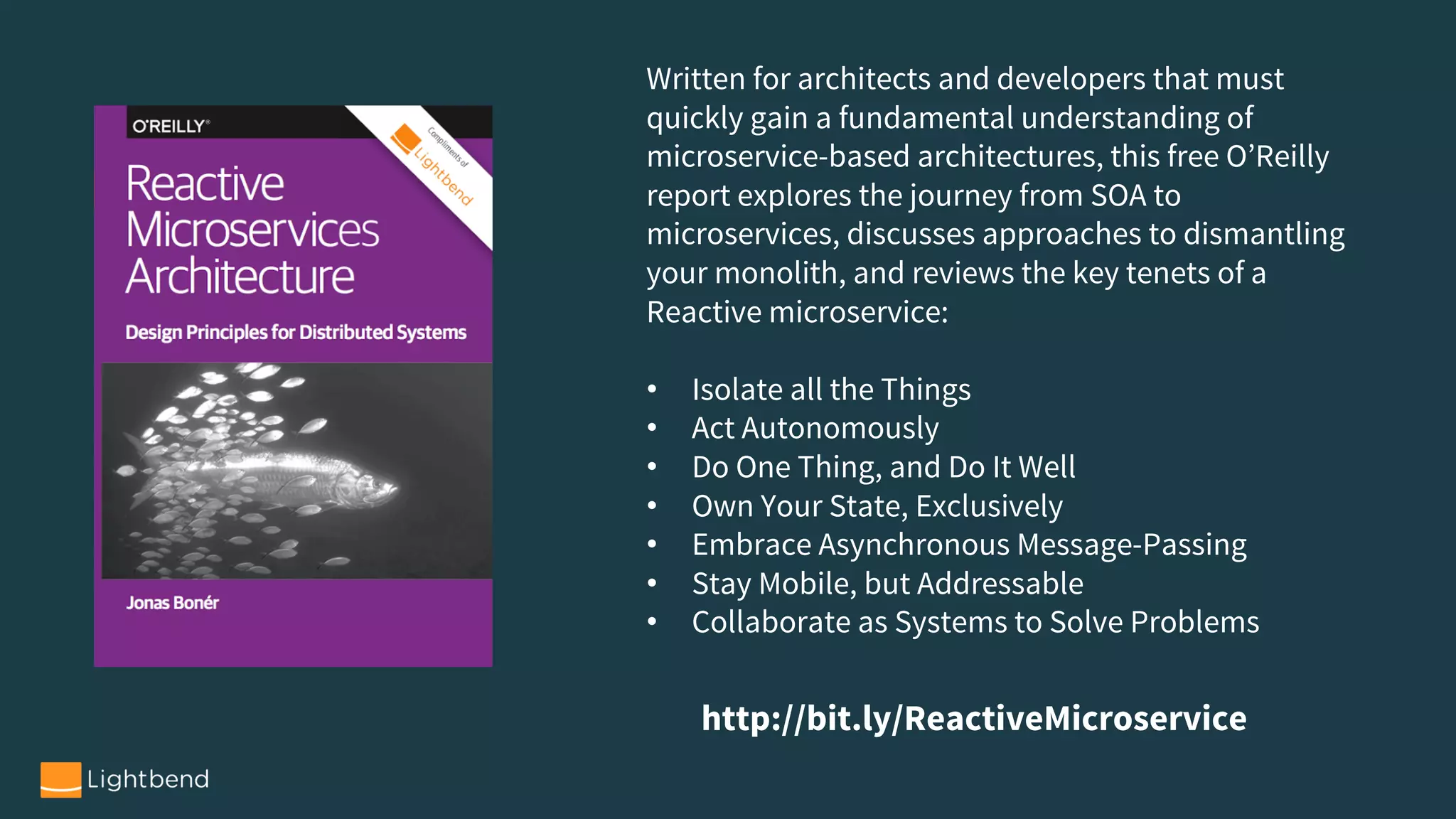
Written for architects and developers that must
quickly gain a fundamental understanding of
microservice-based architectures, this free O’Reilly
report explores the journey from SOA to
microservices, discusses approaches to dismantling
your monolith, and reviews the key tenets of a
Reactive microservice:
• Isolate all the Things
• Act Autonomously
• Do One Thing, and Do It Well
• Own Your State, Exclusively
• Embrace Asynchronous Message-Passing
• Stay Mobile, but Addressable
• Collaborate as Systems to Solve Problems
http://bit.ly/ReactiveMicroservice
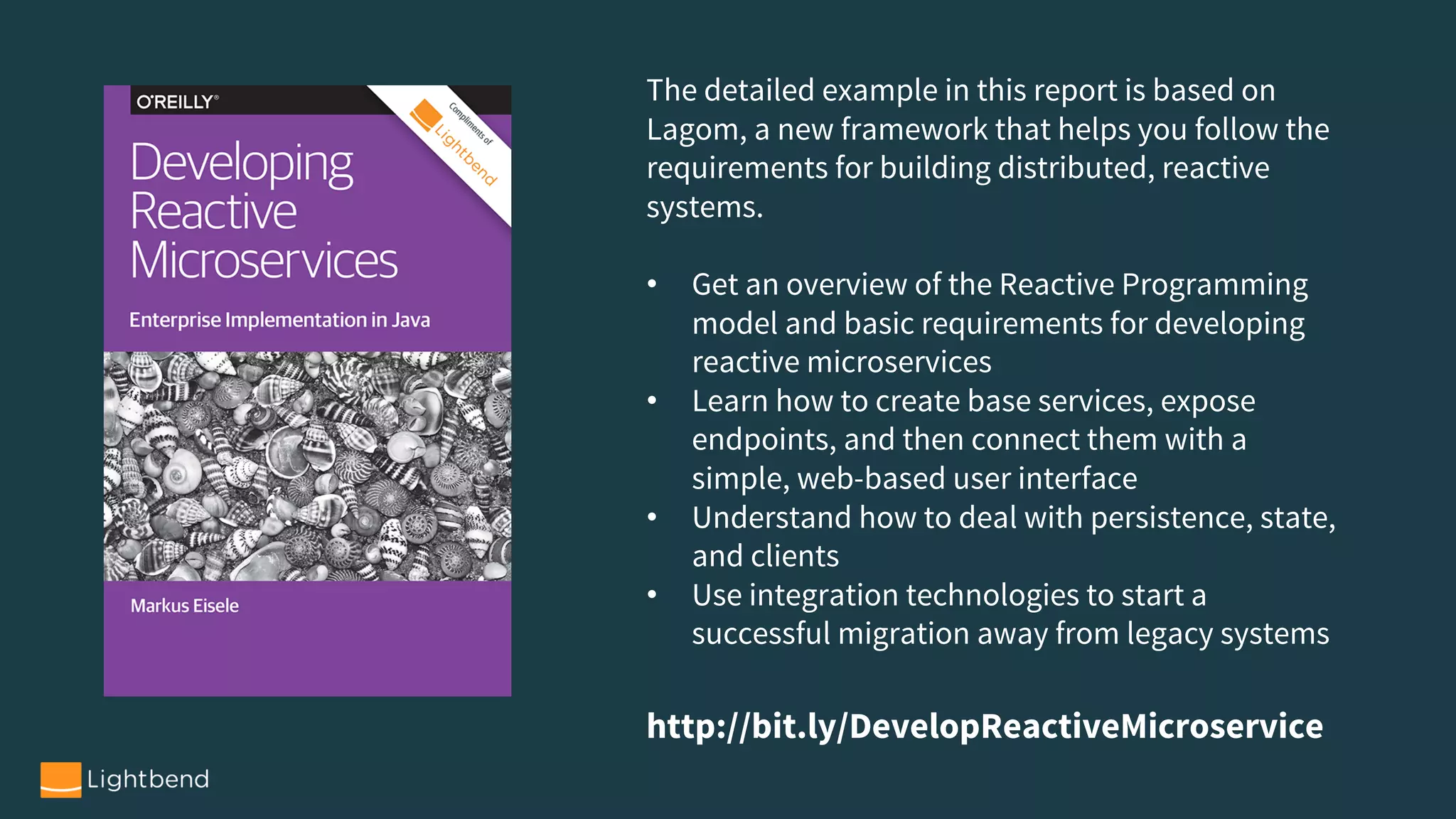
The detailed example in this report is based on
Lagom, a new framework that helps you follow the
requirements for building distributed, reactive
systems.
• Get an overview of the Reactive Programming
model and basic requirements for developing
reactive microservices
• Learn how to create base services, expose
endpoints, and then connect them with a
simple, web-based user interface
• Understand how to deal with persistence, state,
and clients
• Use integration technologies to start a
successful migration away from legacy systems
http://bit.ly/DevelopReactiveMicroservice

Stay productive while slicing up the monolith

  • 1.
    Stay Productive WhileSlicing Up the Monolith Markus Eisele
  • 2.
  • 3.
  • 4.
  • 5.
  • 6.
    LL: Building andScaling Monoliths • Monolithic application – everything is package into a single .ear • Reuse primarily by sharing .jars • A “big” push to production once or twice a year • Single database schema for the entire application • >= 500k loc • >= Heavyweight Infrastructure • Thousands of Testcases • Barely New Testcases • >= 20 Team Member • The single .ear requiring a multi-month test cycle / • Huge bug and feature databases • User Acceptance Undefined • Technical Design Approach • Barely Business Components or Domains • Requiring multiple team involvement & significant oversight • Technical Dept • Outdated Runtimes (Licenses, Complex updates) • Grown applications
  • 7.
  • 8.
    New requirements • Ratherthan acting on data at rest, modern software increasingly operates on data in near real-time. • Shortened time-frames for putting changes into production • New business models evolve from existing ones • New questions need to be answered by existing applications • Datacenter costs need to go down constantly
  • 9.
    > Traditional applicationarchitectures and platforms are obsolete. -- Gartner
  • 10.
  • 11.
  • 12.
  • 13.
    REQ: Building andScaling Microservices • Lightweight runtime • Cross – Service Security • Transaction Management • Service Scaling • Load Balancing • SLA’s • Flexible Deployment • Configuration • Service Discovery • Service Versions • Monitoring • Governance • Asynchronous communication • Non-blocking I/O • Streaming Data • Polyglot Services • Modularity (Service definition) • High performance persistence (CQRS) • Event handling / messaging (ES) • Eventual consistency • API Management • Health check and recovery
  • 14.
    “Microservices” is alousy term • Size is irrelevant We want flexible systems and organizations that can adapt to their complex environments, make changes without rigid dependencies and coordination, can learn, experiment, and exhibit emergent behavior.
  • 15.
    We need tobuild systems for flexibility and resiliency, not just efficiency and robustness.
  • 16.
    Software Design Outer Architecture Methodologyand Organization Distributed Systems Datacenter Operating System
  • 17.
    Software Design Architecture Principles •Single Responsible Principle • Service Oriented Architecture – Encapsulation – Separation of Concern – Loose Coupling • Hexagonal Architecture Design Patterns • Domain-driven Design • Bounded Contexts • Event Sourcing • CQRS • Eventual Consistency • Context Maps
  • 18.
    Design Best Practices •Design for Automation • Designed for failure • Service load balancing and automatic scaling • Design for Data Separation • Design for Integrity • Design for Performance
  • 19.
    Strategies For Decomposing Verbor Use Case e.g. Checkout UI Noun e.g. Catalog product service Single Responsible Principle e.g. Unix utilities
  • 20.
    • Reactive MicroservicesFramework for the JVM • Focused on right sized services • Asynchronous I/O and communication as first class priorities • Highly productive development environment • Takes you all the way to production What is Lagom?
  • 21.
    • Use boundedcontexts as boundaries for services! (Domain Driven Design) • The event log is the book of record! (Event Sourcing) • Separate the read and write sides! (CQRS) • Microservices, too, need to be elastic and resilient! (Reactive) • Developer experience matters! (The Lagom development setup) Highly opinionated!
  • 22.
    • Service API •Persistence API • Development environment • Production environment The parts
  • 23.
    • Event sourced(deltas) with Cassandra backend by default • No object/relational impedance mismatch • Can always replay to determine current state • Allows you to learn more from your data later • Persistent entity is an Aggregate Root in DDD • Can be overridden for CRUD if you want Lagom Persistence API
  • 25.
  • 26.
  • 28.
    $ cd my-first-system $mvn lagom:runAll ... [info] Starting embedded Cassandra server .......... [info] Cassandra server running at 127.0.0.1:4000 [info] Service locator is running at http://localhost:8000 [info] Service gateway is running at http://localhost:9000 .......... [info] Service helloworld-impl listening for HTTP on 0:0:0:0:0:0:0:0:24266 [info] Service hellostream-impl listening for HTTP on 0:0:0:0:0:0:0:0:26230 (Services started, press enter to stop and go back to the console...)
  • 30.
  • 31.
  • 32.
  • 34.
    Now that wehave our bundles, how do we get into production?
  • 35.
    • Lagom doesn’tprescribe any particular production environment, however out of the box support is provided for Lightbend ConductR. • Zookeper based version: https://github.com/jboner/lagom-service-locator- zookeeper • Consul based version: https://github.com/jboner/lagom-service-locator-consul Out of the box support for ConductR but..
  • 36.
    >sbt bundle:dist ... [info] Yourpackage is ready in /Users/myfear/lagom-cargotracker/front- end/target/universal/front-end-1.0- SNAPSHOT.zip Create Service bundles via sbt
  • 37.
    • Creating abundle configuration file, bundle.conf • Creating a start script • Creating a Maven assembly plugin descriptor to create the bundle zip • Binding the Maven assembly plugin and Lagom renameConductRBundle goals to your projects lifecycle Create Service Bundles with Maven http://www.lagomframework.com/documentation/1.3.x/java/ConductR.html
  • 40.
    Next Steps! Downloadand try Lagom! Project Site: http://www.lightbend.com/lagom GitHub Repo: https://github.com/lagom Documentation: http://www.lagomframework.com/documentation/1.3.x/java/Home.html Example: https://github.com/typesafehub/activator-lagom-java
  • 41.
    Written for architectsand developers that must quickly gain a fundamental understanding of microservice-based architectures, this free O’Reilly report explores the journey from SOA to microservices, discusses approaches to dismantling your monolith, and reviews the key tenets of a Reactive microservice: • Isolate all the Things • Act Autonomously • Do One Thing, and Do It Well • Own Your State, Exclusively • Embrace Asynchronous Message-Passing • Stay Mobile, but Addressable • Collaborate as Systems to Solve Problems http://bit.ly/ReactiveMicroservice
  • 42.
    The detailed examplein this report is based on Lagom, a new framework that helps you follow the requirements for building distributed, reactive systems. • Get an overview of the Reactive Programming model and basic requirements for developing reactive microservices • Learn how to create base services, expose endpoints, and then connect them with a simple, web-based user interface • Understand how to deal with persistence, state, and clients • Use integration technologies to start a successful migration away from legacy systems http://bit.ly/DevelopReactiveMicroservice