OpenShift/Kuryr
Bridging the infrastructure gap
Vikas Choudhary
Antoni Segura Puimedon
Luis Tomás Bolívar
Hybrid workloads
One infrastructure
Already demoed
❏ Connectivity
❏ Pod <-> Pod
❏ Pod <-> VM
❏ Neutron ovs hybrid mode
❏ ManageIQ integration
❏ Pod networking shows up under Networks -> Network Port
Enter OpenShift
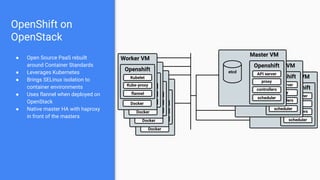
● Open Source PaaS rebuilt
around Container Standards
● Leverages Kubernetes
● Brings SELinux isolation to
container environments
● Uses flannel when deployed on
OpenStack
● Native master HA with haproxy
in front of the masters
OpenShift on
OpenStack
Getting it all together
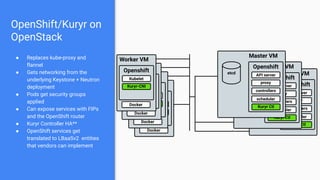
● Replaces kube-proxy and
flannel
● Gets networking from the
underlying Keystone + Neutron
deployment
● Pods get security groups
applied
● Can expose services with FIPs
and the OpenShift router
● Kuryr Controller HA**
● OpenShift services get
translated to LBaaSv2 entities
that vendors can implement
OpenShift/Kuryr on
OpenStack
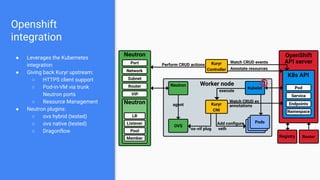
Openshift
integration
● Leverages the Kubernetes
integration
● Giving back Kuryr upstream:
○ HTTPS client support
○ Pod-in-VM via trunk
Neutron ports
○ Resource Management
● Neutron plugins:
○ ovs hybrid (tested)
○ ovs native (tested)
○ Dragonflow
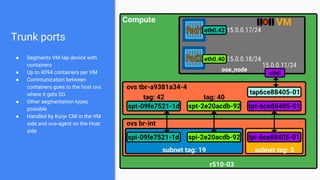
Trunk ports
● Segments VM tap device with
containers
● Up to 4094 containers per VM
● Communication between
containers goes to the host ovs
where it gets SG
● Other segmentation types
possible
● Handled by Kuryr CNI in the VM
side and ovs-agent on the Host
side
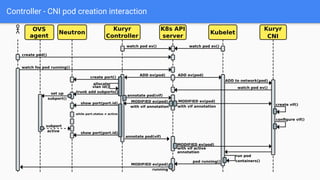
Controller - CNI pod creation interaction
Services
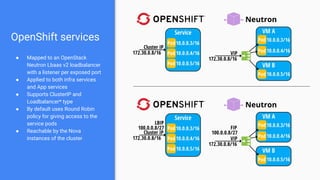
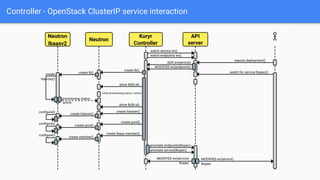
OpenShift services
● Mapped to an OpenStack
Neutron Lbaas v2 loadbalancer
with a listener per exposed port
● Applied to both infra services
and App services
● Supports ClusterIP and
Loadbalancer* type
● By default uses Round Robin
policy for giving access to the
service pods
● Reachable by the Nova
instances of the cluster
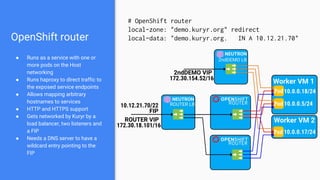
OpenShift router
● Runs as a service with one or
more pods on the Host
networking
● Runs haproxy to direct traffic to
the exposed service endpoints
● Allows mapping arbitrary
hostnames to services
● HTTP and HTTPS support
● Gets networked by Kuryr by a
load balancer, two listeners and
a FIP
● Needs a DNS server to have a
wildcard entry pointing to the
FIP
# OpenShift router
local-zone: "demo.kuryr.org" redirect
local-data: "demo.kuryr.org. IN A 10.12.21.70"
Controller - OpenStack ClusterIP service interaction
Demo
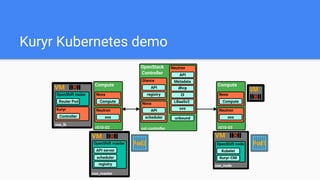
Kuryr Kubernetes demo
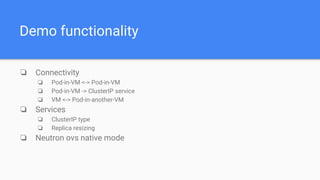
Demo functionality
❏ Connectivity
❏ Pod-in-VM <-> Pod-in-VM
❏ Pod-in-VM -> ClusterIP service
❏ VM <-> Pod-in-another-VM
❏ Services
❏ ClusterIP type
❏ Replica resizing
❏ Neutron ovs native mode
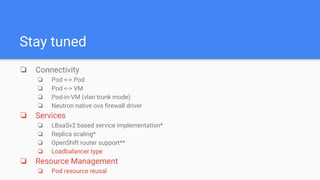
Stay tuned
❏ Connectivity
❏ Pod <-> Pod
❏ Pod <-> VM
❏ Pod-in-VM (vlan trunk mode)
❏ Neutron native ovs firewall driver
❏ Services
❏ LBaaSv2 based service implementation*
❏ Replica scaling*
❏ OpenShift router support**
❏ Loadbalancer type
❏ Resource Management
❏ Pod resource reusal
Stay tuned (2/2)
❏ HA
❏ Active - Passive Controller
❏ Multi homed
❏ Pods with multiple Neutron networks
❏ Pods with dpdk
❏ Ironic integration
Q&A

OpenShift on OpenStack with Kuryr

  • 1.
    OpenShift/Kuryr Bridging the infrastructuregap Vikas Choudhary Antoni Segura Puimedon Luis Tomás Bolívar
  • 2.
  • 3.
    Already demoed ❏ Connectivity ❏Pod <-> Pod ❏ Pod <-> VM ❏ Neutron ovs hybrid mode ❏ ManageIQ integration ❏ Pod networking shows up under Networks -> Network Port
  • 4.
  • 5.
    ● Open SourcePaaS rebuilt around Container Standards ● Leverages Kubernetes ● Brings SELinux isolation to container environments ● Uses flannel when deployed on OpenStack ● Native master HA with haproxy in front of the masters OpenShift on OpenStack
  • 6.
  • 7.
    ● Replaces kube-proxyand flannel ● Gets networking from the underlying Keystone + Neutron deployment ● Pods get security groups applied ● Can expose services with FIPs and the OpenShift router ● Kuryr Controller HA** ● OpenShift services get translated to LBaaSv2 entities that vendors can implement OpenShift/Kuryr on OpenStack
  • 8.
    Openshift integration ● Leverages theKubernetes integration ● Giving back Kuryr upstream: ○ HTTPS client support ○ Pod-in-VM via trunk Neutron ports ○ Resource Management ● Neutron plugins: ○ ovs hybrid (tested) ○ ovs native (tested) ○ Dragonflow
  • 9.
    Trunk ports ● SegmentsVM tap device with containers ● Up to 4094 containers per VM ● Communication between containers goes to the host ovs where it gets SG ● Other segmentation types possible ● Handled by Kuryr CNI in the VM side and ovs-agent on the Host side
  • 10.
    Controller - CNIpod creation interaction
  • 11.
  • 12.
    OpenShift services ● Mappedto an OpenStack Neutron Lbaas v2 loadbalancer with a listener per exposed port ● Applied to both infra services and App services ● Supports ClusterIP and Loadbalancer* type ● By default uses Round Robin policy for giving access to the service pods ● Reachable by the Nova instances of the cluster
  • 13.
    OpenShift router ● Runsas a service with one or more pods on the Host networking ● Runs haproxy to direct traffic to the exposed service endpoints ● Allows mapping arbitrary hostnames to services ● HTTP and HTTPS support ● Gets networked by Kuryr by a load balancer, two listeners and a FIP ● Needs a DNS server to have a wildcard entry pointing to the FIP # OpenShift router local-zone: "demo.kuryr.org" redirect local-data: "demo.kuryr.org. IN A 10.12.21.70"
  • 14.
    Controller - OpenStackClusterIP service interaction
  • 15.
  • 16.
  • 17.
    Demo functionality ❏ Connectivity ❏Pod-in-VM <-> Pod-in-VM ❏ Pod-in-VM -> ClusterIP service ❏ VM <-> Pod-in-another-VM ❏ Services ❏ ClusterIP type ❏ Replica resizing ❏ Neutron ovs native mode
  • 18.
    Stay tuned ❏ Connectivity ❏Pod <-> Pod ❏ Pod <-> VM ❏ Pod-in-VM (vlan trunk mode) ❏ Neutron native ovs firewall driver ❏ Services ❏ LBaaSv2 based service implementation* ❏ Replica scaling* ❏ OpenShift router support** ❏ Loadbalancer type ❏ Resource Management ❏ Pod resource reusal
  • 19.
    Stay tuned (2/2) ❏HA ❏ Active - Passive Controller ❏ Multi homed ❏ Pods with multiple Neutron networks ❏ Pods with dpdk ❏ Ironic integration
  • 20.