Meeting Objectives: To share experiences, tools and approaches in using data to inform decision-making. To identify common challenges to using data to inform decisions. To identify priorities for advancing data use. To develop a community of practice.
Why Now? The Importance of Evidence-based Decision-making Tara Nutley & Scott Moreland MEASURE Evaluation From Data to Impact: Using Data for Results Symposium Arusha, Tanzania January  28, 2009
Setting the Stage Context Response Challenge Changing the paradigm
Context HIV epidemic Resurgence of TB Continued prevalence of malaria Pockets of stalled fertility decline Population burden Shortage of health care workers
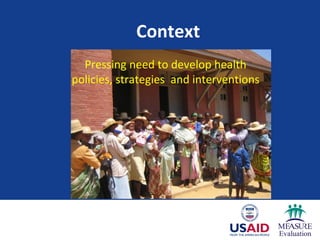
Context Pressing need to develop health policies, strategies  and interventions
Context Increased financial investments for service delivery Increased accountability requirements Improved national HMIS Increased demand for evaluation and other research New technologies
Evidence-based Decision Making Process
Level of Dissatisfaction that Policy is Based on Scientific Evidence
Challenges Integrated HMIS still not fully functioning Little or no communication between data producers and data users Low capacity to collect, analyze & interpret data Limited or no culture of data use  Data collection and use not a priority
Response Development of international frameworks that put data use at the center National commitment Project  and organizational commitment
  Changing the Paradigm of Data Demand and Information Use   Business  Unusual
The “traditional way” Top-down approach  Data collected with little or no regard to its use Limited stakeholder involvement
The ‘traditional steps” Gather data Analyze data Prepare report Disseminate the report [Stakeholders]
A New Paradigm Decisions identified first, then what data are needed  Transparency Stakeholder involvement
The new paradigm steps Identify decision  [Stakeholders] identify relevant data  [Stakeholders] gather data analyze & discuss results  [Stakeholders] make decisions  [Stakeholders]
There is no single “right way” to use data to support decisions Multiple stakeholders Multiple and/or conflicting goals Different ways to measure success Ambiguous interpretation of what the data mean
Decisions are influenced by factors other than information and data. Power and influence of sectional interests; Corruption; Political, cultural or religious ideology; Arbitrariness; Anecdote
What can we do? Help to insure that data collected are relevant to decisions  Facilitate the involvement of stakeholders in the identification of data needs Insure that decision-makers and stakeholders have access to that information
Decisions, decisions….  Problem identification and advocacy Policy making Strategizing and planning Program management
Remember…. The ultimate goal is not to gain information, but to improve action.

Opening Presentation Tara Why Now Final

  • 1.
    Meeting Objectives: Toshare experiences, tools and approaches in using data to inform decision-making. To identify common challenges to using data to inform decisions. To identify priorities for advancing data use. To develop a community of practice.
  • 2.
    Why Now? TheImportance of Evidence-based Decision-making Tara Nutley & Scott Moreland MEASURE Evaluation From Data to Impact: Using Data for Results Symposium Arusha, Tanzania January 28, 2009
  • 3.
    Setting the StageContext Response Challenge Changing the paradigm
  • 4.
    Context HIV epidemicResurgence of TB Continued prevalence of malaria Pockets of stalled fertility decline Population burden Shortage of health care workers
  • 5.
    Context HIV epidemicResurgence of TB Continued prevalence of malaria Pockets of stalled fertility decline Population burden Shortage of health care workers
  • 6.
    Context HIV epidemicResurgence of TB Continued prevalence of malaria Pockets of stalled fertility decline Population burden Shortage of health care workers
  • 7.
    Context HIV epidemicResurgence of TB Continued prevalence of malaria Pockets of stalled fertility decline Population burden Shortage of health care workers
  • 8.
    Context HIV epidemicResurgence of TB Continued prevalence of malaria Pockets of stalled fertility decline Population burden Shortage of health care workers
  • 9.
    Context HIV epidemicResurgence of TB Continued prevalence of malaria Pockets of stalled fertility decline Population burden Shortage of health care workers
  • 10.
    Context HIV epidemicResurgence of TB Continued prevalence of malaria Pockets of stalled fertility decline Population burden Shortage of health care workers
  • 11.
    Context Pressing needto develop health policies, strategies and interventions
  • 12.
    Context Increased financialinvestments for service delivery Increased accountability requirements Improved national HMIS Increased demand for evaluation and other research New technologies
  • 13.
  • 14.
    Level of Dissatisfactionthat Policy is Based on Scientific Evidence
  • 15.
    Challenges Integrated HMISstill not fully functioning Little or no communication between data producers and data users Low capacity to collect, analyze & interpret data Limited or no culture of data use Data collection and use not a priority
  • 16.
    Response Development ofinternational frameworks that put data use at the center National commitment Project and organizational commitment
  • 17.
    Changingthe Paradigm of Data Demand and Information Use Business Unusual
  • 18.
    The “traditional way”Top-down approach Data collected with little or no regard to its use Limited stakeholder involvement
  • 19.
    The ‘traditional steps”Gather data Analyze data Prepare report Disseminate the report [Stakeholders]
  • 20.
    A New ParadigmDecisions identified first, then what data are needed Transparency Stakeholder involvement
  • 21.
    The new paradigmsteps Identify decision [Stakeholders] identify relevant data [Stakeholders] gather data analyze & discuss results [Stakeholders] make decisions [Stakeholders]
  • 22.
    There is nosingle “right way” to use data to support decisions Multiple stakeholders Multiple and/or conflicting goals Different ways to measure success Ambiguous interpretation of what the data mean
  • 23.
    Decisions are influencedby factors other than information and data. Power and influence of sectional interests; Corruption; Political, cultural or religious ideology; Arbitrariness; Anecdote
  • 24.
    What can wedo? Help to insure that data collected are relevant to decisions Facilitate the involvement of stakeholders in the identification of data needs Insure that decision-makers and stakeholders have access to that information
  • 25.
    Decisions, decisions…. Problem identification and advocacy Policy making Strategizing and planning Program management
  • 26.
    Remember…. The ultimategoal is not to gain information, but to improve action.

Editor's Notes

  • #2 In order to continue the dialogue and exchange on this topic beyond symposium. Notice board by coffee break area: What additional information and or support do you need to improve your and/or your organizations ability to base decisions on data? Identifying decisions Linking data and decisions Accessing data Data analysis and interpretation Communicating data to program managers and policy makers Identifying and overcoming barriers to using info