Introduction to NOSQL And Cassandra @rantav  @outbrain
SQL is good Rich language Easy to use and integrate Rich toolset  Many vendors The promise:  ACID Atomicity Consistency Isolation Durability
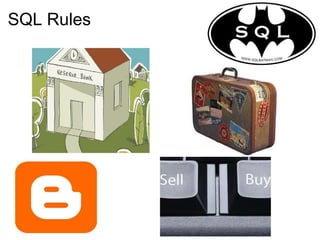
SQL Rules
BUT
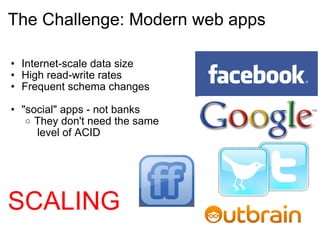
The Challenge: Modern web apps Internet-scale data size High read-write rates Frequent schema changes "social" apps - not banks They don't need the same  level of ACID  SCALING
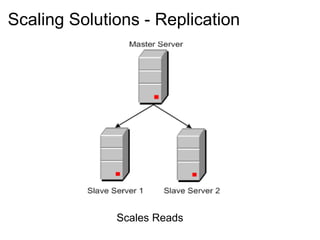
Scaling Solutions - Replication Scales Reads
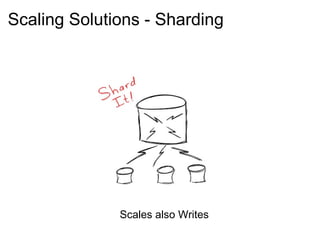
Scaling Solutions - Sharding Scales also Writes
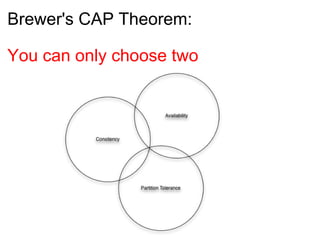
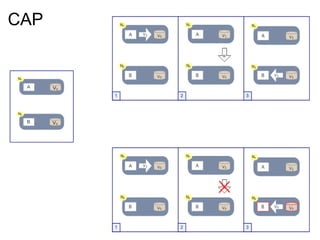
Brewer's CAP Theorem:  You can only choose two
CAP
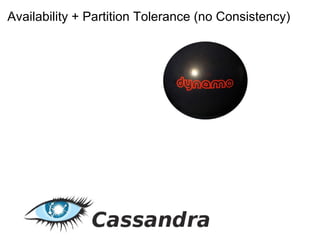
Availability + Partition Tolerance (no Consistency)
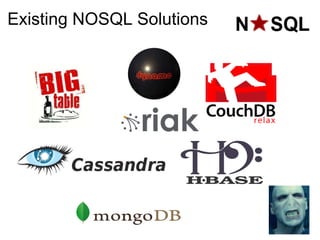
Existing NOSQL Solutions
Taxonomy of NOSQL data stores Document Oriented CouchDB, MongoDB, Lotus Notes, SimpleDB, Orient Key-Value Voldemort, Dynamo, Riak (sort of), Redis, Tokyo  Column Cassandra, HBase, BigTable Graph Databases   Neo4J, FlockDB, DEX, AlegroGraph http://en.wikipedia.org/wiki/NoSQL
  Developed at facebook Follows the  BigTable Data Model  - column oriented Follows the  Dynamo Eventual Consistency  model Opensourced at Apache Implemented in Java
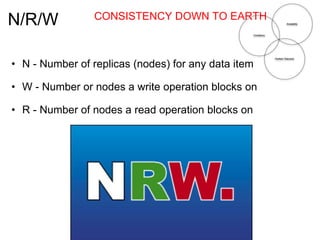
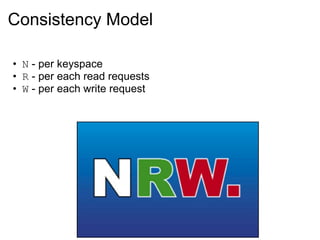
N/R/W N - Number of replicas (nodes) for any data item W - Number or nodes a write operation blocks on R - Number of nodes a read operation blocks on CONSISTENCY DOWN TO EARTH
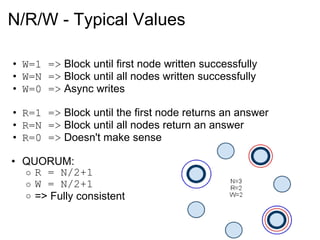
N/R/W - Typical Values W=1 =>  Block until first node written successfully W=N =>  Block until all nodes written successfully W=0 =>  Async writes R=1 =>  Block until the first node returns an answer R=N =>  Block until all nodes return an answer R=0 =>  Doesn't make sense QUORUM: R = N/2+1 W = N/2+1 => Fully consistent
Data Model - Forget SQL Do you know SQL?
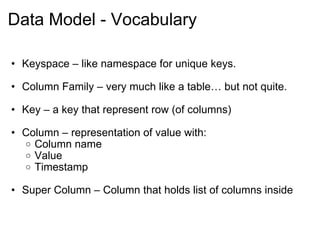
Data Model - Vocabulary Keyspace – like namespace for unique keys. Column Family – very much like a table… but not quite. Key – a key that represent row (of columns) Column – representation of value with: Column name Value Timestamp Super Column – Column that holds list of columns inside
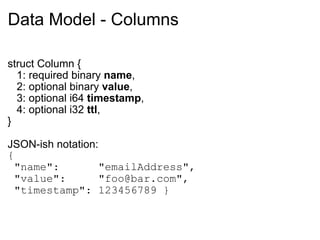
Data Model - Columns struct Column {     1: required binary  name ,     2: optional binary  value ,     3: optional i64  timestamp ,     4: optional i32  ttl , } JSON-ish notation: {    "name":      "emailAddress",    "value":     "foo@bar.com",    "timestamp": 123456789 }
Data Model - Column Family Similar to SQL tables Has many columns Has many rows
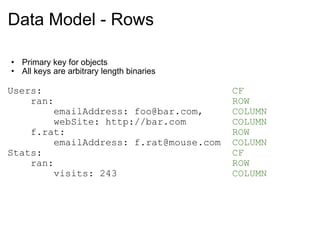
Data Model - Rows Primary key for objects All keys are arbitrary length binaries Users:                                  CF      ran:                                ROW          emailAddress: foo@bar.com,      COLUMN          webSite: http://bar.com         COLUMN      f.rat:                              ROW          emailAddress: f.rat@mouse.com   COLUMN Stats:                                  CF      ran:                                ROW          visits: 243                     COLUMN
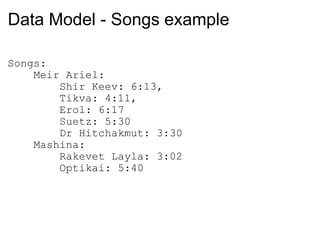
Data Model - Songs example Songs:       Meir Ariel:           Shir Keev: 6:13,           Tikva: 4:11,          Erol: 6:17          Suetz: 5:30          Dr Hitchakmut: 3:30      Mashina:          Rakevet Layla: 3:02          Optikai: 5:40
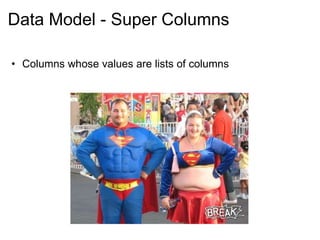
Data Model - Super Columns Columns whose values are lists of columns
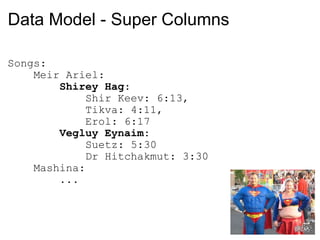
Data Model - Super Columns Songs:       Meir Ariel:          Shirey Hag :              Shir Keev: 6:13,               Tikva: 4:11,              Erol: 6:17          Vegluy Eynaim :               Suetz: 5:30              Dr Hitchakmut: 3:30      Mashina:          ...
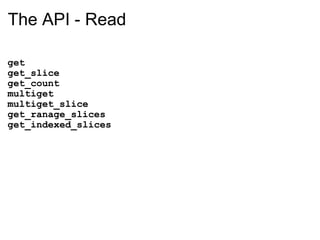
The API - Read get get_slice get_count multiget multiget_slice get_ranage_slices get_indexed_slices
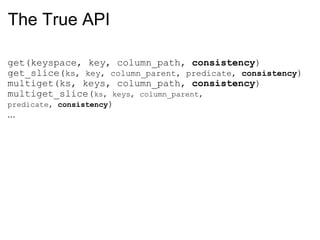
The True API get(keyspace, key, column_path,  consistency ) get_slice( ks, key, column_parent, predicate,  consistency ) multiget(ks, keys, column_path,  consistency ) multiget_slice( ks, keys, column_parent, predicate,  consistency ) ...
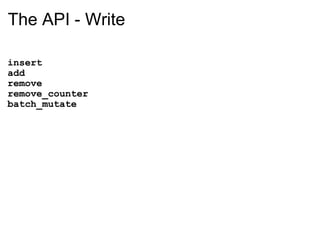
The API - Write insert add remove remove_counter batch_mutate
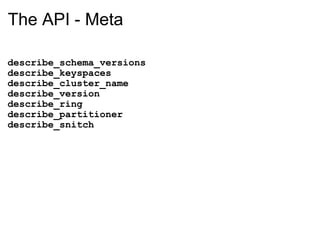
The API - Meta describe_schema_versions describe_keyspaces describe_cluster_name describe_version describe_ring describe_partitioner describe_snitch
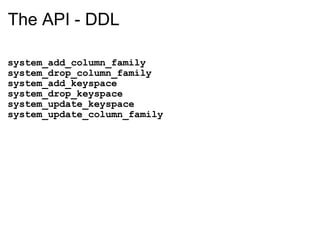
The API - DDL system_add_column_family system_drop_column_family system_add_keyspace system_drop_keyspace system_update_keyspace system_update_column_family
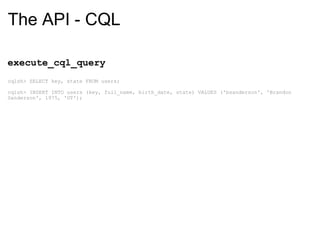
The API - CQL execute_cql_query cqlsh> SELECT key, state FROM users; cqlsh> INSERT INTO users (key, full_name, birth_date, state) VALUES ('bsanderson', 'Brandon Sanderson', 1975, 'UT');
Consistency Model N  - per keyspace R  - per each read requests W  - per each write request
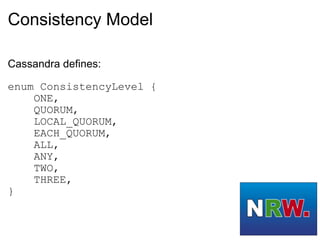
Consistency Model Cassandra defines: enum ConsistencyLevel {      ONE,      QUORUM,      LOCAL_QUORUM,      EACH_QUORUM,      ALL,      ANY,      TWO,      THREE, }
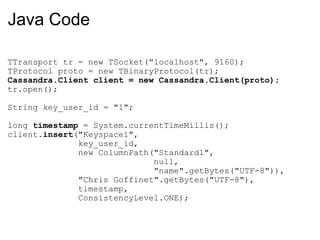
Java Code TTransport tr = new TSocket("localhost", 9160);  TProtocol proto = new TBinaryProtocol(tr);  Cassandra.Client client = new Cassandra.Client(proto);  tr.open();  String key_user_id = "1";  long  timestamp  = System.currentTimeMillis();  client. insert ("Keyspace1",                 key_user_id,                 new ColumnPath("Standard1",                                null,                               "name".getBytes("UTF-8")),                 "Chris Goffinet".getBytes("UTF-8"),                timestamp,                 ConsistencyLevel.ONE); 
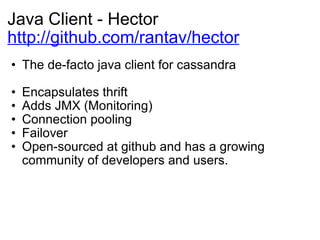
Java Client - Hector http://github.com/rantav/hector The de-facto java client for cassandra Encapsulates thrift Adds JMX (Monitoring) Connection pooling Failover Open-sourced at github and has a growing community of developers and users.
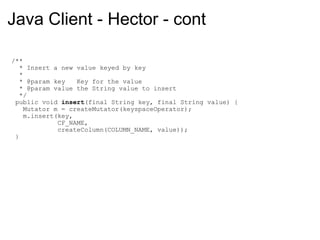
Java Client - Hector - cont   /**     * Insert a new value keyed by key     *     * @param key   Key for the value     * @param value the String value to insert     */    public void  insert (final String key, final String value) {      Mutator m = createMutator(keyspaceOperator);      m.insert(key,                CF_NAME,                createColumn(COLUMN_NAME, value));    }
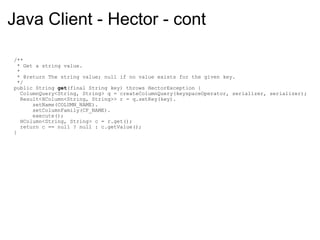
Java Client - Hector - cont    /**     * Get a string value.     *     * @return The string value; null if no value exists for the given key.     */    public String  get (final String key) throws HectorException {      ColumnQuery<String, String> q = createColumnQuery(keyspaceOperator, serializer, serializer);      Result<HColumn<String, String>> r = q.setKey(key).          setName(COLUMN_NAME).          setColumnFamily(CF_NAME).          execute();      HColumn<String, String> c = r.get();      return c == null ? null : c.getValue();    }
Extra If you're not snoring yet...
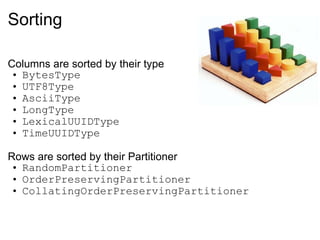
Sorting Columns are sorted by their type  BytesType  UTF8Type AsciiType LongType LexicalUUIDType TimeUUIDType Rows are sorted by their Partitioner RandomPartitioner OrderPreservingPartitioner CollatingOrderPreservingPartitioner
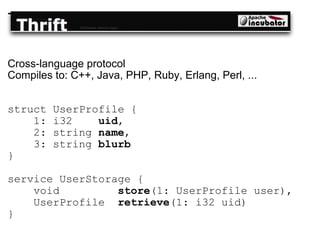
Thrift Cross-language protocol Compiles to: C++, Java, PHP, Ruby, Erlang, Perl, ... struct UserProfile {       1: i32     uid ,       2: string  name ,       3: string  blurb   }  service UserStorage {       void          store (1: UserProfile user),      UserProfile   retrieve (1: i32 uid)  }
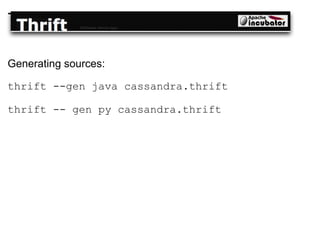
Thrift Generating sources: thrift --gen java cassandra.thrift thrift -- gen py cassandra.thrift
Internals
Agenda Background and history Architectural Layers Transport: Thrift Write Path (and sstables, memtables) Read Path Compactions Bloom Filters Gossip Deletions More...
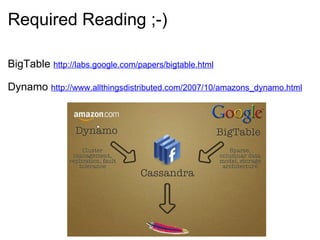
Required Reading ;-) BigTable  http://labs.google.com/papers/bigtable.html Dynamo  http://www.allthingsdistributed.com/2007/10/amazons_dynamo.html
From Dynamo: Symmetric p2p architecture Gossip based discovery and error detection Distributed key-value store Pluggable partitioning  Pluggable topology discovery Eventual consistent and Tunable per operation 
From BigTable Sparse Column oriented sparse array SSTable disk storage Append-only commit log Memtable (buffering and sorting) Immutable sstable files Compactions High write performance 
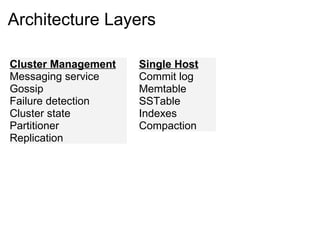
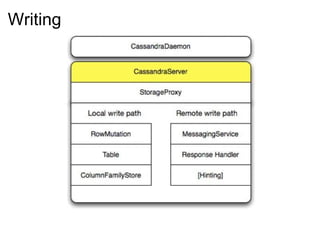
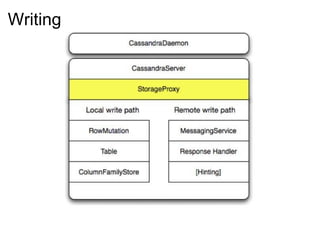
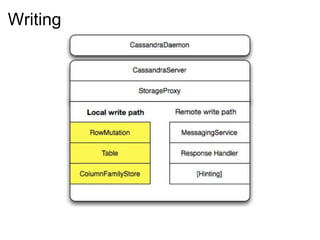
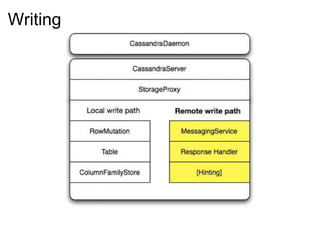
Architecture Layers Cluster Management Messaging service  Gossip  Failure detection  Cluster state  Partitioner  Replication  Single Host Commit log  Memtable  SSTable  Indexes  Compaction 
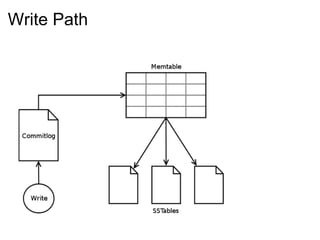
Write Path
Writing
Writing
Writing
Writing
Memtables In-memory representation of recently written data When the table is full, it's sorted and then flushed to disk -> sstable
SSTables Sorted Strings Tables Immutable On-disk Sorted by a string key In-memory index of elements Binary search (in memory) to find element location Bloom filter to reduce number of unneeded binary searches.
Write Properties No Locks in the critical path Always available to writes, even if there are failures. No reads No seeks  Fast  Atomic within a Row
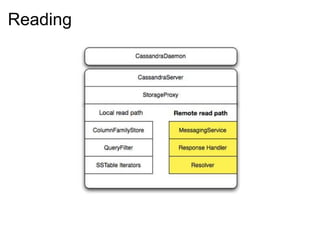
Read Path
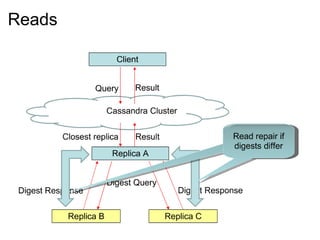
Reads
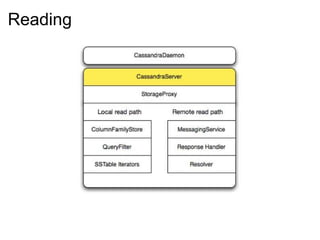
Reading
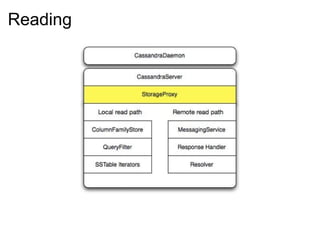
Reading
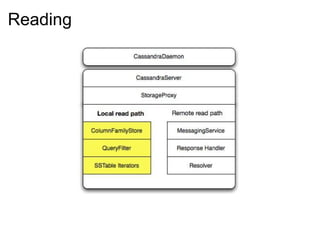
Reading
Reading
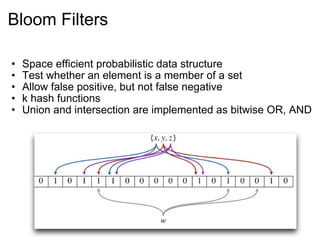
Bloom Filters Space efficient probabilistic data structure Test whether an element is a member of a set Allow false positive, but not false negative  k hash functions Union and intersection are implemented as bitwise OR, AND
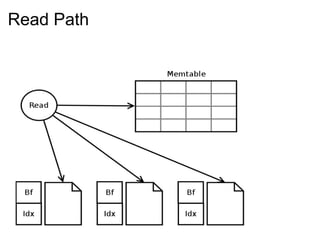
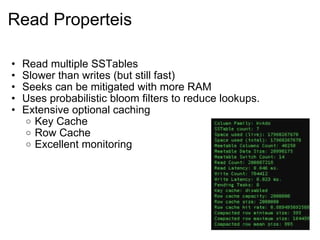
Read Properteis Read multiple SSTables  Slower than writes (but still fast)  Seeks can be mitigated with more RAM Uses probabilistic bloom filters to reduce lookups. Extensive optional caching Key Cache Row Cache Excellent monitoring
Compactions  
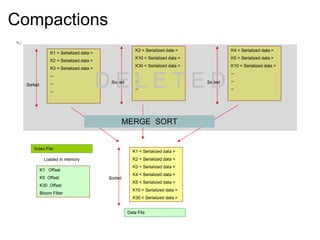
Compactions Merge keys  Combine columns  Discard tombstones Use bloom filters bitwise OR operation
Gossip p2p Enables seamless nodes addition. Rebalancing of keys Fast detection of nodes that goes down. Every node knows about all others - no master.
Deletions Deletion marker (tombstone) necessary to suppress data in older SSTables, until compaction  Read repair complicates things a little  Eventually consistent complicates things more  Solution: configurable delay before tombstone GC, after which tombstones are not repaired
Extra Long list of subjects SEDA (Staged Events Driven Architecture) Anti Entropy and Merkle Trees Hinted Handoff repair on read
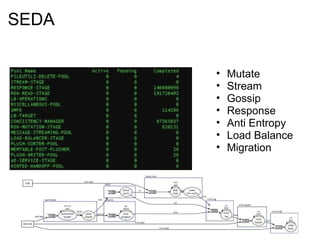
SEDA Mutate Stream Gossip Response Anti Entropy Load Balance Migration 
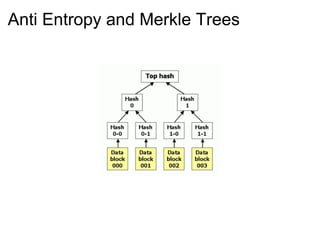
Anti Entropy and Merkle Trees
Hinted Handoff
References http://horicky.blogspot.com/2009/11/nosql-patterns.html http://s3.amazonaws.com/AllThingsDistributed/sosp/amazon-dynamo-sosp2007.pdf http://labs.google.com/papers/bigtable.html http://bret.appspot.com/entry/how-friendfeed-uses-mysql http://www.julianbrowne.com/article/viewer/brewers-cap-theorem http://www.allthingsdistributed.com/2008/12/eventually_consistent.html http://wiki.apache.org/cassandra/DataModel http://incubator.apache.org/thrift/ http://www.eecs.harvard.edu/~mdw/papers/quals-seda.pdf

NOSQL and Cassandra

  • 1.
    Introduction to NOSQLAnd Cassandra @rantav  @outbrain
  • 2.
    SQL is goodRich language Easy to use and integrate Rich toolset  Many vendors The promise: ACID Atomicity Consistency Isolation Durability
  • 3.
  • 4.
  • 5.
    The Challenge: Modernweb apps Internet-scale data size High read-write rates Frequent schema changes &quot;social&quot; apps - not banks They don't need the same  level of ACID  SCALING
  • 6.
    Scaling Solutions -Replication Scales Reads
  • 7.
    Scaling Solutions -Sharding Scales also Writes
  • 8.
    Brewer's CAP Theorem: You can only choose two
  • 9.
  • 10.
    Availability + PartitionTolerance (no Consistency)
  • 11.
  • 12.
    Taxonomy of NOSQLdata stores Document Oriented CouchDB, MongoDB, Lotus Notes, SimpleDB, Orient Key-Value Voldemort, Dynamo, Riak (sort of), Redis, Tokyo  Column Cassandra, HBase, BigTable Graph Databases   Neo4J, FlockDB, DEX, AlegroGraph http://en.wikipedia.org/wiki/NoSQL
  • 13.
      Developed atfacebook Follows the BigTable Data Model - column oriented Follows the Dynamo Eventual Consistency model Opensourced at Apache Implemented in Java
  • 14.
    N/R/W N -Number of replicas (nodes) for any data item W - Number or nodes a write operation blocks on R - Number of nodes a read operation blocks on CONSISTENCY DOWN TO EARTH
  • 15.
    N/R/W - TypicalValues W=1 => Block until first node written successfully W=N => Block until all nodes written successfully W=0 => Async writes R=1 => Block until the first node returns an answer R=N => Block until all nodes return an answer R=0 => Doesn't make sense QUORUM: R = N/2+1 W = N/2+1 => Fully consistent
  • 16.
    Data Model -Forget SQL Do you know SQL?
  • 17.
    Data Model -Vocabulary Keyspace – like namespace for unique keys. Column Family – very much like a table… but not quite. Key – a key that represent row (of columns) Column – representation of value with: Column name Value Timestamp Super Column – Column that holds list of columns inside
  • 18.
    Data Model -Columns struct Column {     1: required binary name ,     2: optional binary value ,     3: optional i64 timestamp ,     4: optional i32 ttl , } JSON-ish notation: {    &quot;name&quot;:      &quot;emailAddress&quot;,    &quot;value&quot;:     &quot;foo@bar.com&quot;,    &quot;timestamp&quot;: 123456789 }
  • 19.
    Data Model -Column Family Similar to SQL tables Has many columns Has many rows
  • 20.
    Data Model -Rows Primary key for objects All keys are arbitrary length binaries Users:                                 CF      ran:                               ROW          emailAddress: foo@bar.com,      COLUMN          webSite: http://bar.com         COLUMN      f.rat:                              ROW          emailAddress: f.rat@mouse.com   COLUMN Stats:                                  CF      ran:                               ROW          visits: 243                     COLUMN
  • 21.
    Data Model -Songs example Songs:       Meir Ariel:           Shir Keev: 6:13,           Tikva: 4:11,          Erol: 6:17          Suetz: 5:30          Dr Hitchakmut: 3:30      Mashina:          Rakevet Layla: 3:02          Optikai: 5:40
  • 22.
    Data Model -Super Columns Columns whose values are lists of columns
  • 23.
    Data Model -Super Columns Songs:       Meir Ariel:          Shirey Hag :              Shir Keev: 6:13,               Tikva: 4:11,              Erol: 6:17          Vegluy Eynaim :               Suetz: 5:30              Dr Hitchakmut: 3:30      Mashina:          ...
  • 24.
    The API -Read get get_slice get_count multiget multiget_slice get_ranage_slices get_indexed_slices
  • 25.
    The True APIget(keyspace, key, column_path, consistency ) get_slice( ks, key, column_parent, predicate,  consistency ) multiget(ks, keys, column_path,  consistency ) multiget_slice( ks, keys, column_parent, predicate,  consistency ) ...
  • 26.
    The API -Write insert add remove remove_counter batch_mutate
  • 27.
    The API -Meta describe_schema_versions describe_keyspaces describe_cluster_name describe_version describe_ring describe_partitioner describe_snitch
  • 28.
    The API -DDL system_add_column_family system_drop_column_family system_add_keyspace system_drop_keyspace system_update_keyspace system_update_column_family
  • 29.
    The API -CQL execute_cql_query cqlsh> SELECT key, state FROM users; cqlsh> INSERT INTO users (key, full_name, birth_date, state) VALUES ('bsanderson', 'Brandon Sanderson', 1975, 'UT');
  • 30.
    Consistency Model N - per keyspace R - per each read requests W - per each write request
  • 31.
    Consistency Model Cassandradefines: enum ConsistencyLevel {     ONE,     QUORUM,     LOCAL_QUORUM,     EACH_QUORUM,     ALL,     ANY,     TWO,     THREE, }
  • 32.
    Java Code TTransporttr = new TSocket(&quot;localhost&quot;, 9160);  TProtocol proto = new TBinaryProtocol(tr);  Cassandra.Client client = new Cassandra.Client(proto);  tr.open();  String key_user_id = &quot;1&quot;;  long timestamp = System.currentTimeMillis();  client. insert (&quot;Keyspace1&quot;,                 key_user_id,                 new ColumnPath(&quot;Standard1&quot;,                                null,                               &quot;name&quot;.getBytes(&quot;UTF-8&quot;)),                 &quot;Chris Goffinet&quot;.getBytes(&quot;UTF-8&quot;),                timestamp,                 ConsistencyLevel.ONE); 
  • 33.
    Java Client -Hector http://github.com/rantav/hector The de-facto java client for cassandra Encapsulates thrift Adds JMX (Monitoring) Connection pooling Failover Open-sourced at github and has a growing community of developers and users.
  • 34.
    Java Client -Hector - cont   /**    * Insert a new value keyed by key    *    * @param key   Key for the value    * @param value the String value to insert    */    public void insert (final String key, final String value) {      Mutator m = createMutator(keyspaceOperator);      m.insert(key,               CF_NAME,               createColumn(COLUMN_NAME, value));    }
  • 35.
    Java Client -Hector - cont    /**    * Get a string value.    *    * @return The string value; null if no value exists for the given key.    */    public String get (final String key) throws HectorException {      ColumnQuery<String, String> q = createColumnQuery(keyspaceOperator, serializer, serializer);      Result<HColumn<String, String>> r = q.setKey(key).          setName(COLUMN_NAME).          setColumnFamily(CF_NAME).          execute();      HColumn<String, String> c = r.get();      return c == null ? null : c.getValue();    }
  • 36.
    Extra If you'renot snoring yet...
  • 37.
    Sorting Columns aresorted by their type  BytesType  UTF8Type AsciiType LongType LexicalUUIDType TimeUUIDType Rows are sorted by their Partitioner RandomPartitioner OrderPreservingPartitioner CollatingOrderPreservingPartitioner
  • 38.
    Thrift Cross-language protocolCompiles to: C++, Java, PHP, Ruby, Erlang, Perl, ... struct UserProfile {       1: i32     uid ,       2: string name ,       3: string blurb   }  service UserStorage {       void          store (1: UserProfile user),      UserProfile   retrieve (1: i32 uid)  }
  • 39.
    Thrift Generating sources:thrift --gen java cassandra.thrift thrift -- gen py cassandra.thrift
  • 40.
  • 41.
    Agenda Background andhistory Architectural Layers Transport: Thrift Write Path (and sstables, memtables) Read Path Compactions Bloom Filters Gossip Deletions More...
  • 42.
    Required Reading ;-)BigTable  http://labs.google.com/papers/bigtable.html Dynamo  http://www.allthingsdistributed.com/2007/10/amazons_dynamo.html
  • 43.
    From Dynamo: Symmetric p2p architectureGossip based discovery and error detection Distributed key-value store Pluggable partitioning  Pluggable topology discovery Eventual consistent and Tunable per operation 
  • 44.
    From BigTable SparseColumn oriented sparse array SSTable disk storage Append-only commit log Memtable (buffering and sorting) Immutable sstable files Compactions High write performance 
  • 45.
    Architecture Layers Cluster ManagementMessaging service  Gossip  Failure detection  Cluster state  Partitioner  Replication  Single Host Commit log  Memtable  SSTable  Indexes  Compaction 
  • 46.
  • 47.
  • 48.
  • 49.
  • 50.
  • 51.
    Memtables In-memory representationof recently written data When the table is full, it's sorted and then flushed to disk -> sstable
  • 52.
    SSTables Sorted StringsTables Immutable On-disk Sorted by a string key In-memory index of elements Binary search (in memory) to find element location Bloom filter to reduce number of unneeded binary searches.
  • 53.
    Write Properties NoLocks in the critical path Always available to writes, even if there are failures. No reads No seeks  Fast  Atomic within a Row
  • 54.
  • 55.
  • 56.
  • 57.
  • 58.
  • 59.
  • 60.
    Bloom Filters Spaceefficient probabilistic data structure Test whether an element is a member of a set Allow false positive, but not false negative  k hash functions Union and intersection are implemented as bitwise OR, AND
  • 61.
    Read Properteis Readmultiple SSTables  Slower than writes (but still fast)  Seeks can be mitigated with more RAM Uses probabilistic bloom filters to reduce lookups. Extensive optional caching Key Cache Row Cache Excellent monitoring
  • 62.
  • 63.
    Compactions Merge keys Combine columns  Discard tombstones Use bloom filters bitwise OR operation
  • 64.
    Gossip p2p Enablesseamless nodes addition. Rebalancing of keys Fast detection of nodes that goes down. Every node knows about all others - no master.
  • 65.
    Deletions Deletion marker(tombstone) necessary to suppress data in older SSTables, until compaction  Read repair complicates things a little  Eventually consistent complicates things more  Solution: configurable delay before tombstone GC, after which tombstones are not repaired
  • 66.
    Extra Long listof subjects SEDA (Staged Events Driven Architecture) Anti Entropy and Merkle Trees Hinted Handoff repair on read
  • 67.
    SEDA Mutate StreamGossip Response Anti Entropy Load Balance Migration 
  • 68.
    Anti Entropy andMerkle Trees
  • 69.
  • 70.
    References http://horicky.blogspot.com/2009/11/nosql-patterns.html http://s3.amazonaws.com/AllThingsDistributed/sosp/amazon-dynamo-sosp2007.pdfhttp://labs.google.com/papers/bigtable.html http://bret.appspot.com/entry/how-friendfeed-uses-mysql http://www.julianbrowne.com/article/viewer/brewers-cap-theorem http://www.allthingsdistributed.com/2008/12/eventually_consistent.html http://wiki.apache.org/cassandra/DataModel http://incubator.apache.org/thrift/ http://www.eecs.harvard.edu/~mdw/papers/quals-seda.pdf

Editor's Notes

  • #22 Columns may have dynamic names