


Practical Solutions
for Multicore Programming

Dr. Guy Korland
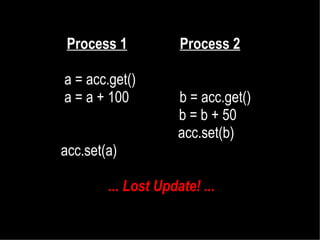
Process 1
a = acc.get()
a = a + 100

Process 2
b = acc.get()
b = b + 50
acc.set(b)

acc.set(a)
... Lost Update! ...
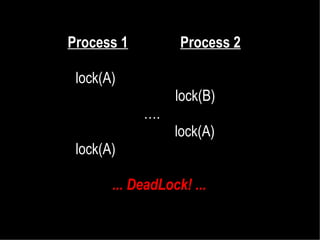
Process 1

Process 2

lock(A)
lock(B)
….
lock(A)
lock(A)
... DeadLock! ...
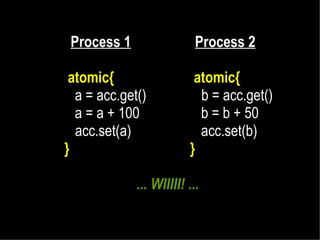
Process 1

Process 2

atomic{
a = acc.get()
a = a + 100
acc.set(a)
}

atomic{
b = acc.get()
b = b + 50
acc.set(b)
}

... WIIIII! ...
Intel TSX
if(_xbegin()==-1) {
if( !fallback_mutex.is_acquired() ) {
tions.
sums[mygroup] += data[i];e instruc
impl
} else {
d to s
e
_xabort(1);
● Limit
ll-back
fa
}
erency
Coh
uires
● _xend();
Req
Cache
} else {
ing on
●fallback_mutex.acquire();
Relay
sums[mygroup] += data[i];
fallback_mutex.release();
}
We still need
Software Transactional Memory
DSTM2

Maurice Herlihy et al, A flexible framework … [OOPSLA06]

@atomic public interface INode{
int getValue ();
void setValue (int value );
jects.
}
to Ob
d

imite
L
sive.
Factory<INode> factory ru
int = Thread.makeFactory(INode.class );
aries.
●
final INodeVery factory.create(); ort libr
node =
factory result = Thread.doIt(new Callable<Boolean>() {
’t supp e (fork).
n
● Does
public Boolean call nc
rma () {
return node.setValue(value);
perfo
● Bad
} });
●
JVSTM

João Cachopo and António Rito-Silva, Versioned boxes as the
basis for memory transactions [SCOOL05]

public class Account{
private VBox<Long> balance = new aries.
VBox<Long>();

}

rt libr
suppo
public @Atomic void withdraw(long amount) {
esn’t
● Do
e. - amount); hared fields
balance.put rusiv
int(balance.get() nce” s
● Less
}
nnou
to “A
● Need
Atom-Java

B. Hindman and D. Grossman. Atomicity via source-tosource
translation. [MSPC06]

public void update ( double value) {
Atomic {
ord.
w
commission += value; erved
a res
tion.
● Add
}
ompila ries.
pre-c
}
ibra
●
eed

N
ort l
’t supp sive.
n
● Does
s intru
n Les
● Eve
Deuce STM - API
G. Korland, N. Shavit and P. Felber, “Noninvasive Java
Concurrency with Deuce STM”, [MultiProg '10]

public class Bank{
rds.
ed wo
private double commission = 10;
serv

No re
ased.
nb
tion.
@Atomicnnotatio
mpila
● A
re co
pac1,-Account ac2,rdouble amount){
public void transaction( Account
ies.
d for
ee
● No n (amount + commission);lib
al ra ol
ac1.balance -=
xtern
ac2.balanceppamount;e
+= orts
rch to
● Su
resea
}
able –
d
● Exten
}
●
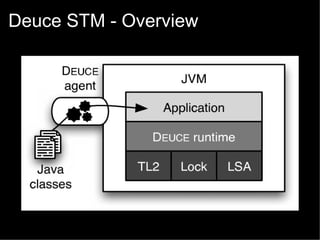
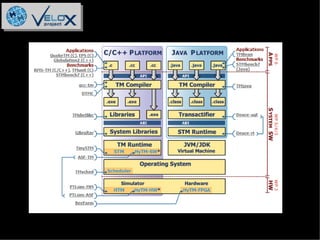
Deuce STM - Overview
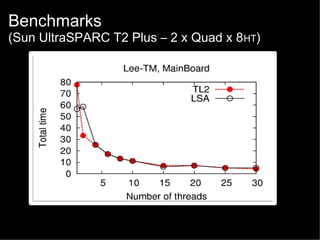
Benchmarks

(Sun UltraSPARC T2 Plus – 2 x Quad x 8 HT)
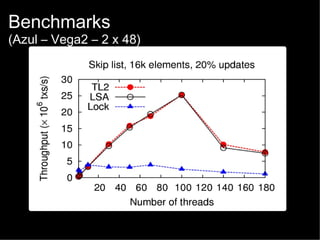
Benchmarks

(Azul – Vega2 – 2 x 48)
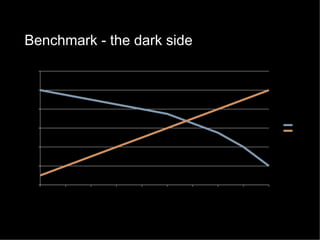
Benchmark - the dark side
1.2

1

0.8

0.6

0.4

0.2

0
1

2

3

4

5

6

7

8

9

10
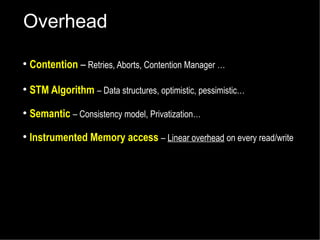
Overhead
●

Contention – Retries, Aborts, Contention Manager …

●

STM Algorithm – Data structures, optimistic, pessimistic…

●

Semantic – Consistency model, Privatization…

●

Instrumented Memory access – Linear overhead on every read/write
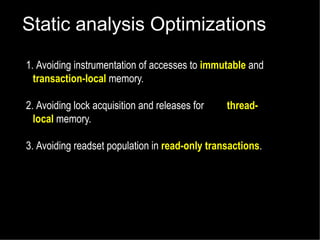
Static analysis Optimizations
1. Avoiding instrumentation of accesses to immutable and
transaction-local memory.
2. Avoiding lock acquisition and releases for
local memory.

thread-

3. Avoiding readset population in read-only transactions.
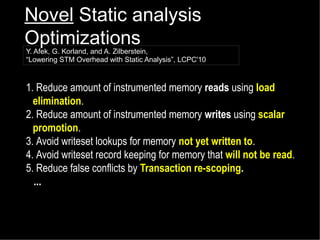
Novel Static analysis
Optimizations

Y. Afek, G. Korland, and A. Zilberstein,
“Lowering STM Overhead with Static Analysis”, LCPC'10

1. Reduce amount of instrumented memory reads using load
elimination.
2. Reduce amount of instrumented memory writes using scalar
promotion.
3. Avoid writeset lookups for memory not yet written to.
4. Avoid writeset record keeping for memory that will not be read.
5. Reduce false conflicts by Transaction re-scoping.
...
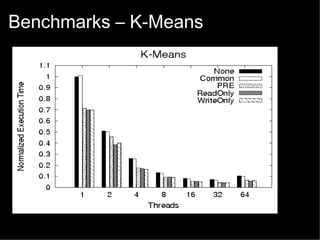
Benchmarks – K-Means
We still need
Fine-Grained
Concurrent Data Structures
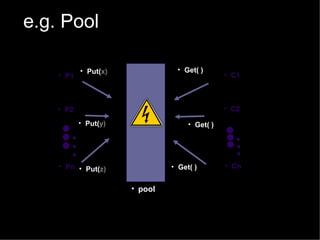
e.g. Pool
• P1

• Get( )

• Put(x)

• C2

• P2

•.
•.
•.

• C1

• Put(y)

• Get( )

• Pn • Put(z)

• Get( )

• pool

•.
•.
•.
• Cn
Java - pools
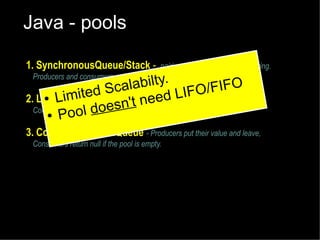
1. SynchronousQueue/Stack -

pairing up function without buffering.
Producers and consumers wait for one another

labilty.
/FIFO
Sca
LIFO and leave,
mited
● Li
2. LinkedBlockingQueuet- Producers put their value
' need
n
Consumers wait l does become available.
for a value to
● Poo

3. ConcurrentLinkedQueue - Producers put their value and leave,
Consumers return null if the pool is empty.
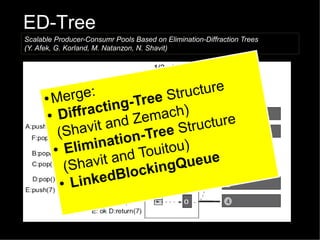
ED-Tree
Scalable Producer-Consumr Pools Based on Elimination-Diffraction Trees
(Y. Afek, G. Korland, M. Natanzon, N. Shavit)

:
ucture
● Merge
ee Str
ng-Tr
fracti
● Dif
ach)
d Zem
cture
an
havit
e Stru
(S
n-Tre
inatio
● Elim
itou)
nd Tou
ueue
a v it a
(Sh
kingQ
Bloc
ed
● Link
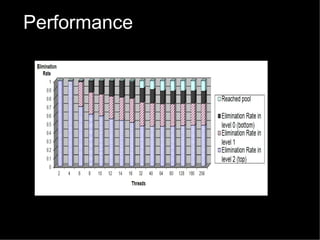
Performance
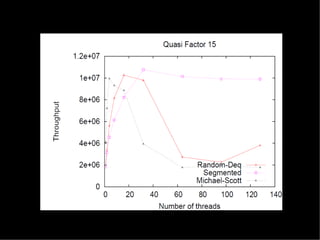
What about other cases?
Do we really need Linearizability?
Can we make it more formal?
The solution:
Relax the Linearizability Requirements
Y. Afek, G. Korland, and A. Yanovsky,
“Quasi-Linearizability: relaxed consistency for improved concurrency”,
OPODIS'10
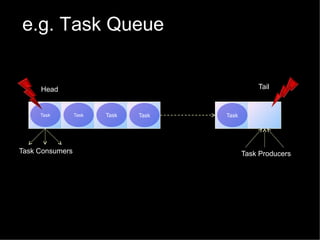
e.g. Task Queue
Tail

Head

Task

Task Consumers

Task

Task

Task

Task

Task Producers
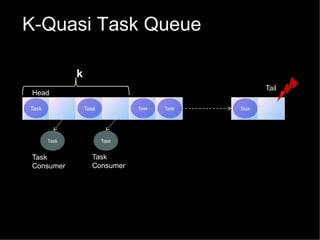
K-Quasi Task Queue
k
Tail

Head
Task

Task

Task

Task
Consumer

Task

Task

Task
Consumer

Task

Task
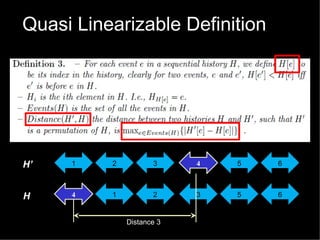
Quasi Linearizable Definition

H’

1

2

3

4

5

6

H

4

1

2

3

5

6

Distance 3
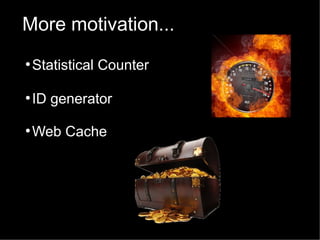
More motivation...
●

Statistical Counter

●

ID generator

●

Web Cache
Paractical Solutions for Multicore Programming

Paractical Solutions for Multicore Programming

  • 1.
    Practical Solutions for MulticoreProgramming Dr. Guy Korland
  • 4.
    Process 1 a =acc.get() a = a + 100 Process 2 b = acc.get() b = b + 50 acc.set(b) acc.set(a) ... Lost Update! ...
  • 5.
  • 7.
    Process 1 Process 2 atomic{ a= acc.get() a = a + 100 acc.set(a) } atomic{ b = acc.get() b = b + 50 acc.set(b) } ... WIIIII! ...
  • 9.
    Intel TSX if(_xbegin()==-1) { if(!fallback_mutex.is_acquired() ) { tions. sums[mygroup] += data[i];e instruc impl } else { d to s e _xabort(1); ● Limit ll-back fa } erency Coh uires ● _xend(); Req Cache } else { ing on ●fallback_mutex.acquire(); Relay sums[mygroup] += data[i]; fallback_mutex.release(); }
  • 11.
    We still need SoftwareTransactional Memory
  • 12.
    DSTM2 Maurice Herlihy etal, A flexible framework … [OOPSLA06] @atomic public interface INode{ int getValue (); void setValue (int value ); jects. } to Ob d imite L sive. Factory<INode> factory ru int = Thread.makeFactory(INode.class ); aries. ● final INodeVery factory.create(); ort libr node = factory result = Thread.doIt(new Callable<Boolean>() { ’t supp e (fork). n ● Does public Boolean call nc rma () { return node.setValue(value); perfo ● Bad } }); ●
  • 13.
    JVSTM João Cachopo and AntónioRito-Silva, Versioned boxes as the basis for memory transactions [SCOOL05] public class Account{ private VBox<Long> balance = new aries. VBox<Long>(); } rt libr suppo public @Atomic void withdraw(long amount) { esn’t ● Do e. - amount); hared fields balance.put rusiv int(balance.get() nce” s ● Less } nnou to “A ● Need
  • 14.
    Atom-Java B. Hindman andD. Grossman. Atomicity via source-tosource translation. [MSPC06] public void update ( double value) { Atomic { ord. w commission += value; erved a res tion. ● Add } ompila ries. pre-c } ibra ● eed N ort l ’t supp sive. n ● Does s intru n Les ● Eve
  • 15.
    Deuce STM -API G. Korland, N. Shavit and P. Felber, “Noninvasive Java Concurrency with Deuce STM”, [MultiProg '10] public class Bank{ rds. ed wo private double commission = 10; serv No re ased. nb tion. @Atomicnnotatio mpila ● A re co pac1,-Account ac2,rdouble amount){ public void transaction( Account ies. d for ee ● No n (amount + commission);lib al ra ol ac1.balance -= xtern ac2.balanceppamount;e += orts rch to ● Su resea } able – d ● Exten } ●
  • 16.
    Deuce STM -Overview
  • 17.
    Benchmarks (Sun UltraSPARC T2Plus – 2 x Quad x 8 HT)
  • 18.
  • 22.
    Benchmark - thedark side 1.2 1 0.8 0.6 0.4 0.2 0 1 2 3 4 5 6 7 8 9 10
  • 24.
    Overhead ● Contention – Retries,Aborts, Contention Manager … ● STM Algorithm – Data structures, optimistic, pessimistic… ● Semantic – Consistency model, Privatization… ● Instrumented Memory access – Linear overhead on every read/write
  • 25.
    Static analysis Optimizations 1.Avoiding instrumentation of accesses to immutable and transaction-local memory. 2. Avoiding lock acquisition and releases for local memory. thread- 3. Avoiding readset population in read-only transactions.
  • 26.
    Novel Static analysis Optimizations Y.Afek, G. Korland, and A. Zilberstein, “Lowering STM Overhead with Static Analysis”, LCPC'10 1. Reduce amount of instrumented memory reads using load elimination. 2. Reduce amount of instrumented memory writes using scalar promotion. 3. Avoid writeset lookups for memory not yet written to. 4. Avoid writeset record keeping for memory that will not be read. 5. Reduce false conflicts by Transaction re-scoping. ...
  • 27.
  • 30.
  • 31.
    e.g. Pool • P1 •Get( ) • Put(x) • C2 • P2 •. •. •. • C1 • Put(y) • Get( ) • Pn • Put(z) • Get( ) • pool •. •. •. • Cn
  • 32.
    Java - pools 1.SynchronousQueue/Stack - pairing up function without buffering. Producers and consumers wait for one another labilty. /FIFO Sca LIFO and leave, mited ● Li 2. LinkedBlockingQueuet- Producers put their value ' need n Consumers wait l does become available. for a value to ● Poo 3. ConcurrentLinkedQueue - Producers put their value and leave, Consumers return null if the pool is empty.
  • 33.
    ED-Tree Scalable Producer-Consumr PoolsBased on Elimination-Diffraction Trees (Y. Afek, G. Korland, M. Natanzon, N. Shavit) : ucture ● Merge ee Str ng-Tr fracti ● Dif ach) d Zem cture an havit e Stru (S n-Tre inatio ● Elim itou) nd Tou ueue a v it a (Sh kingQ Bloc ed ● Link
  • 34.
  • 36.
  • 37.
    Do we reallyneed Linearizability?
  • 38.
    Can we makeit more formal?
  • 39.
    The solution: Relax theLinearizability Requirements Y. Afek, G. Korland, and A. Yanovsky, “Quasi-Linearizability: relaxed consistency for improved concurrency”, OPODIS'10
  • 40.
    e.g. Task Queue Tail Head Task TaskConsumers Task Task Task Task Task Producers
  • 41.
  • 43.
  • 45.

Editor's Notes

  • #23 Circuit routing is the process of automatically producing an interconnection between electronic components. Lee&apos;s routing algorithm is attractive for parallelization since circuits consist of thousands of routes, each of which can potentially be routed concurrently.