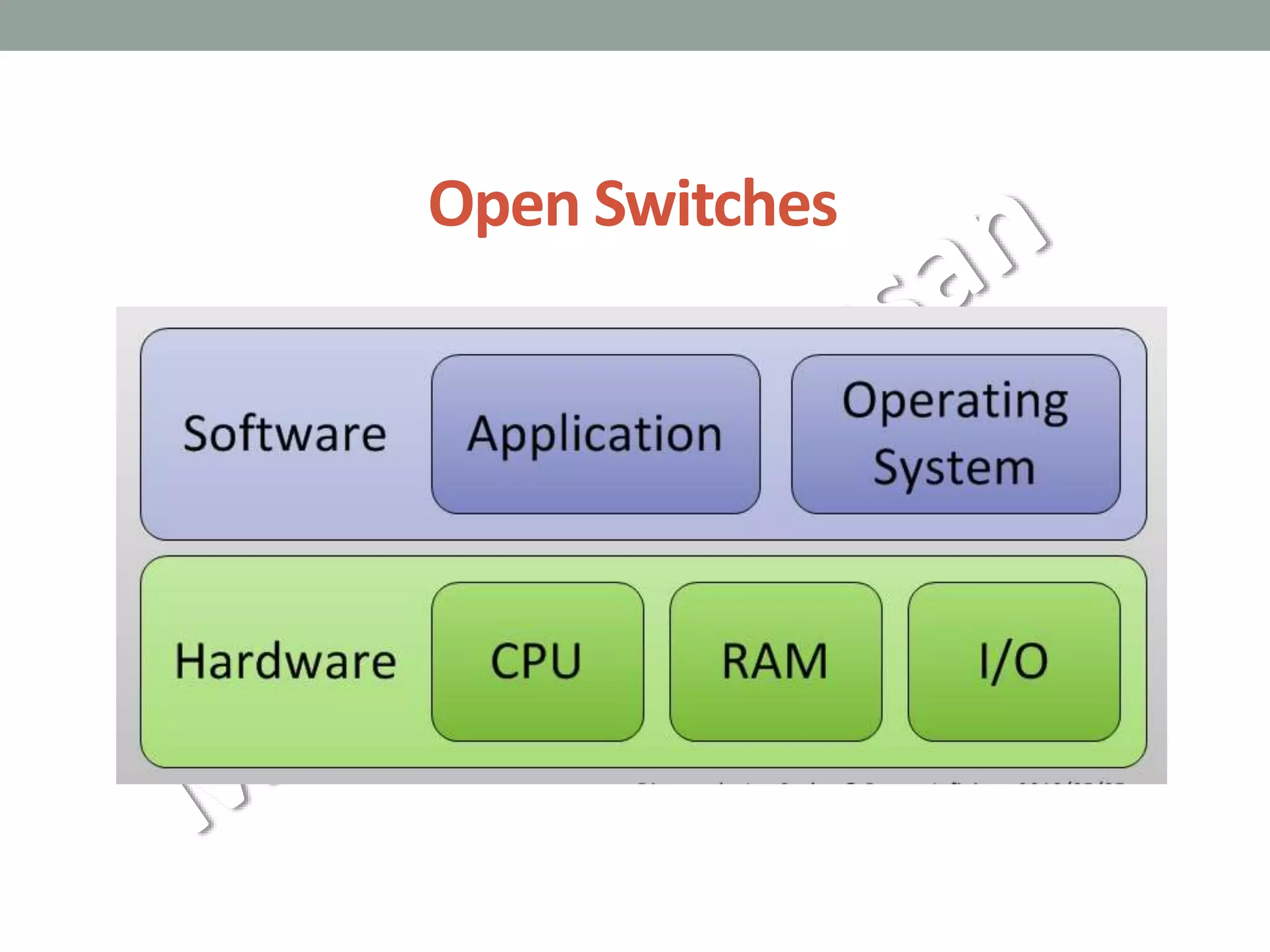
Open Switches
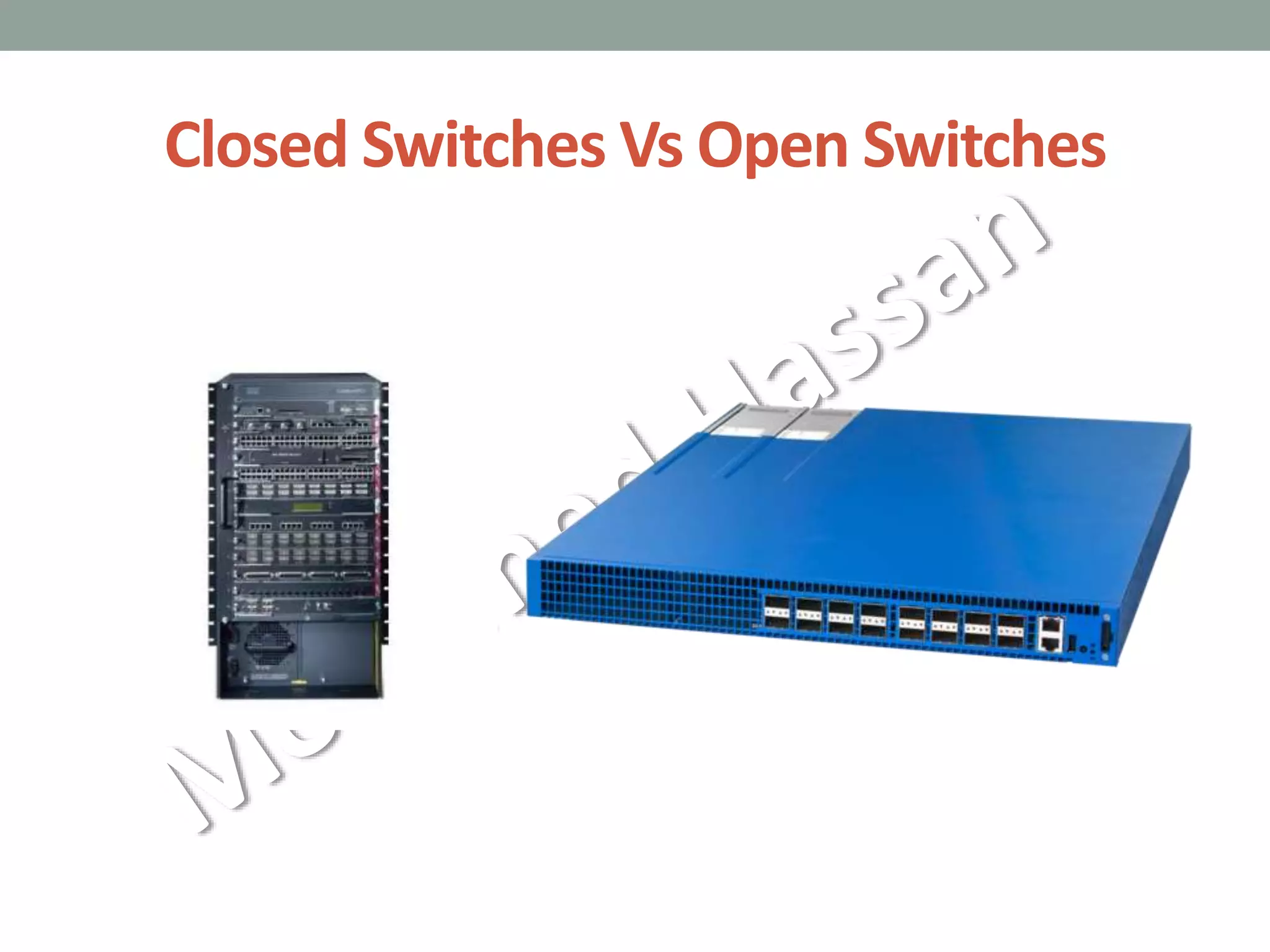
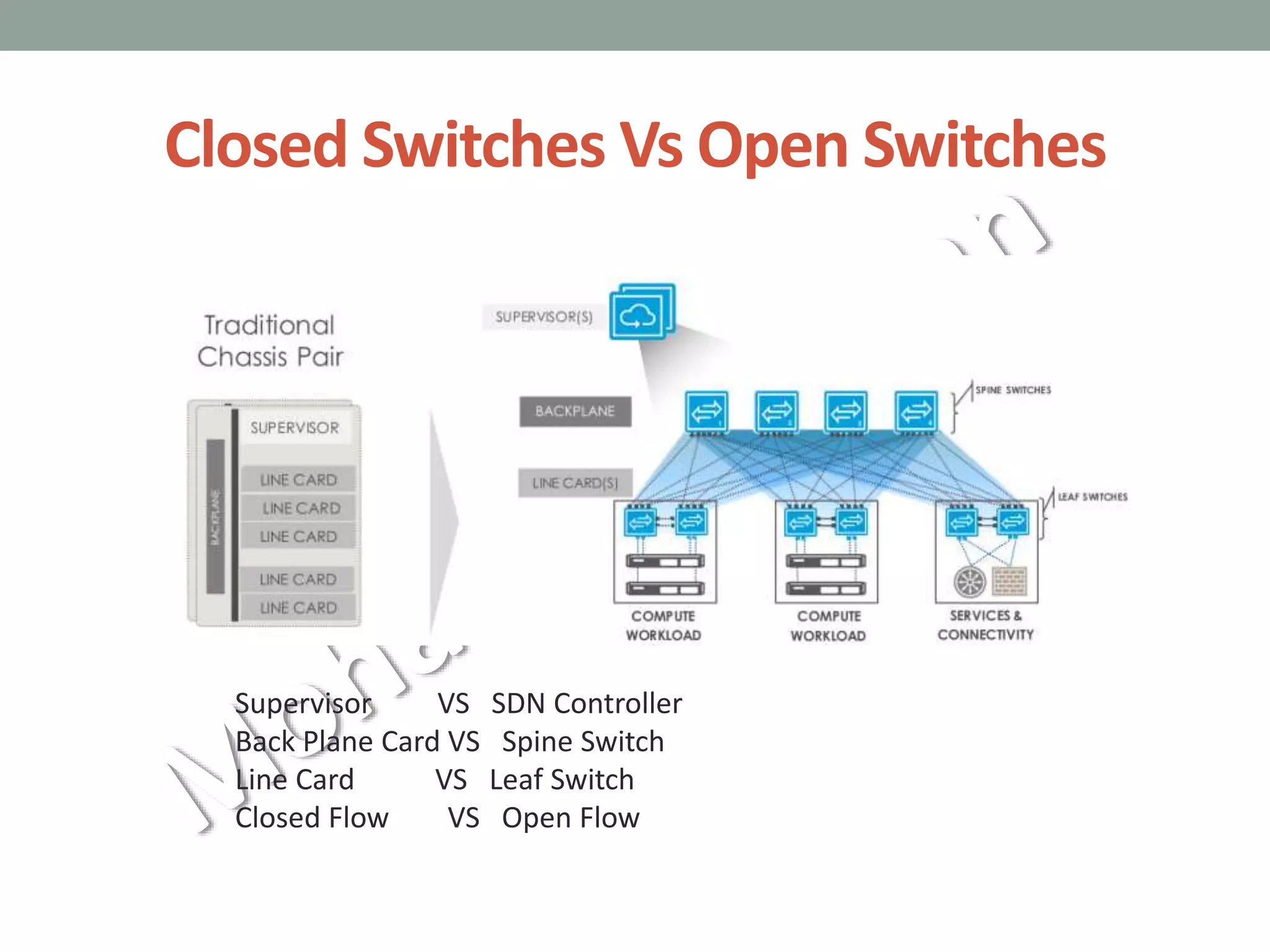
Closed Switches Vs Open Switches
Supervisor VS SDN Controller
Back Plane Card VS Spine Switch
Line Card VS Leaf Switch
Closed Flow VS Open Flow
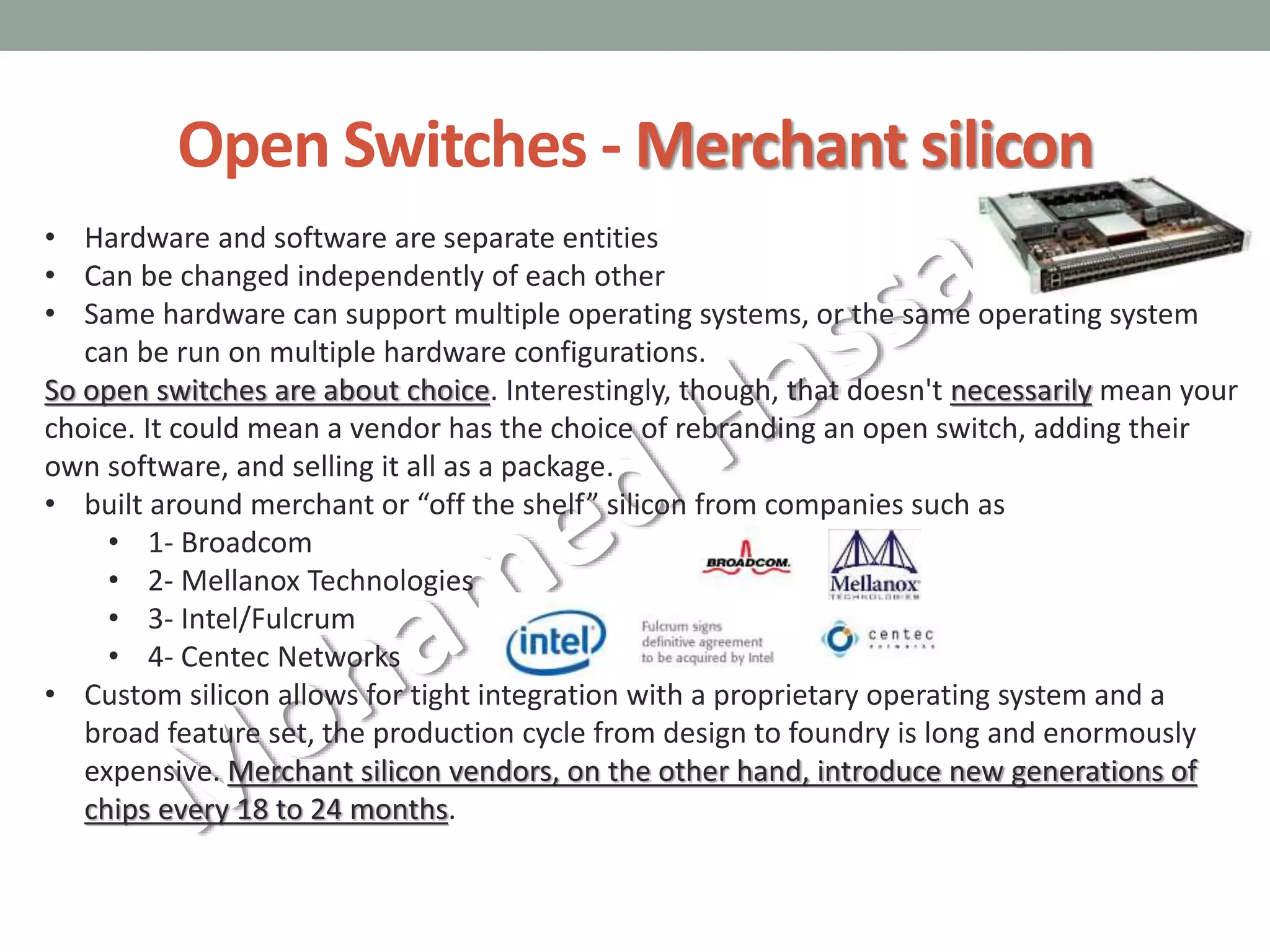
Open Switches - Merchant silicon
• Hardware and software are separate entities
• Can be changed independently of each other
• Same hardware can support multiple operating systems, or the same operating system
can be run on multiple hardware configurations.
So open switches are about choice. Interestingly, though, that doesn't necessarily mean your
choice. It could mean a vendor has the choice of rebranding an open switch, adding their
own software, and selling it all as a package.
• built around merchant or “off the shelf” silicon from companies such as
• 1- Broadcom
• 2- Mellanox Technologies
• 3- Intel/Fulcrum
• 4- Centec Networks
• Custom silicon allows for tight integration with a proprietary operating system and a
broad feature set, the production cycle from design to foundry is long and enormously
expensive. Merchant silicon vendors, on the other hand, introduce new generations of
chips every 18 to 24 months.
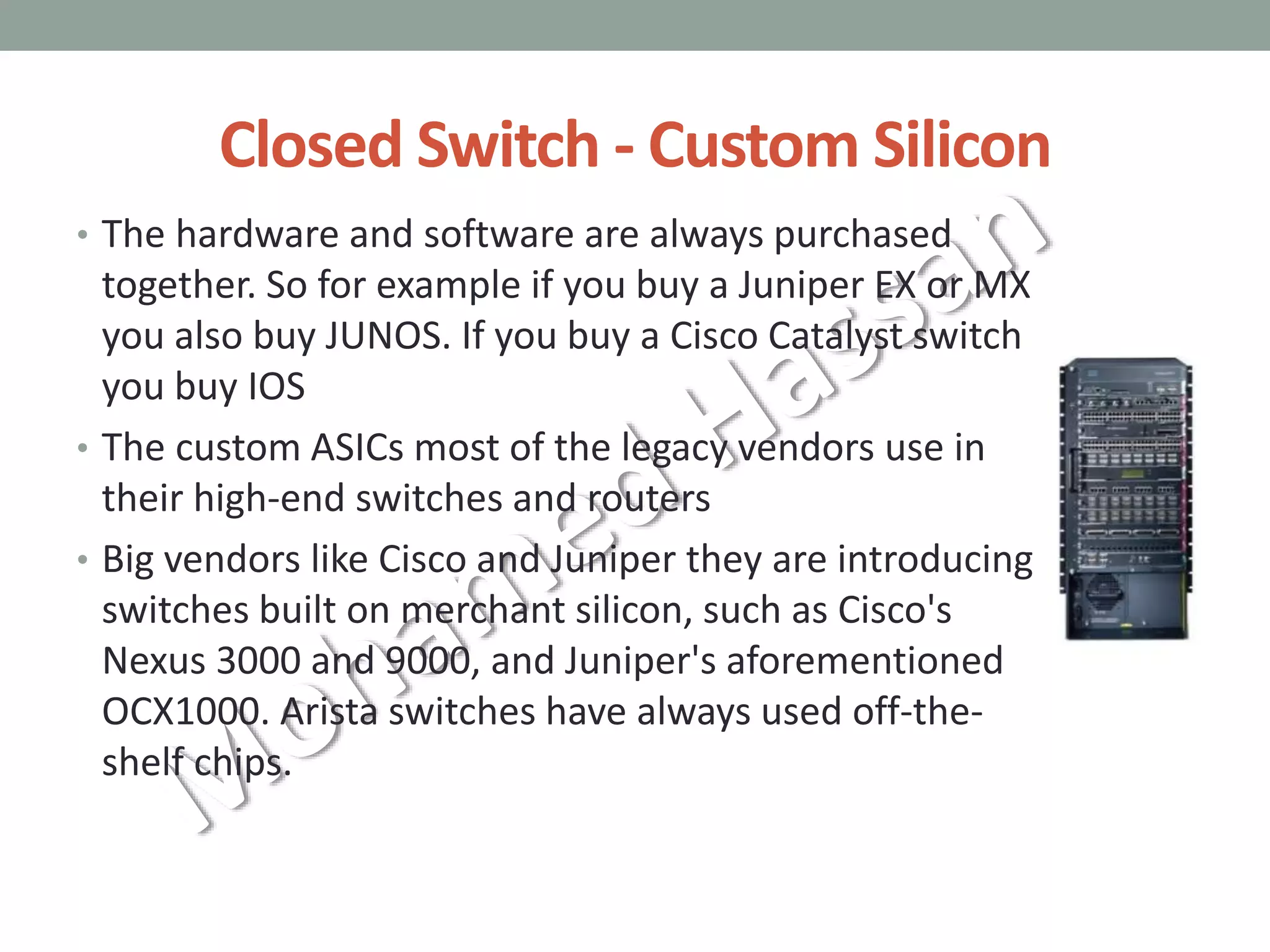
Closed Switch - Custom Silicon
• The hardware and software are always purchased
together. So for example if you buy a Juniper EX or MX
you also buy JUNOS. If you buy a Cisco Catalyst switch
you buy IOS
• The custom ASICs most of the legacy vendors use in
their high-end switches and routers
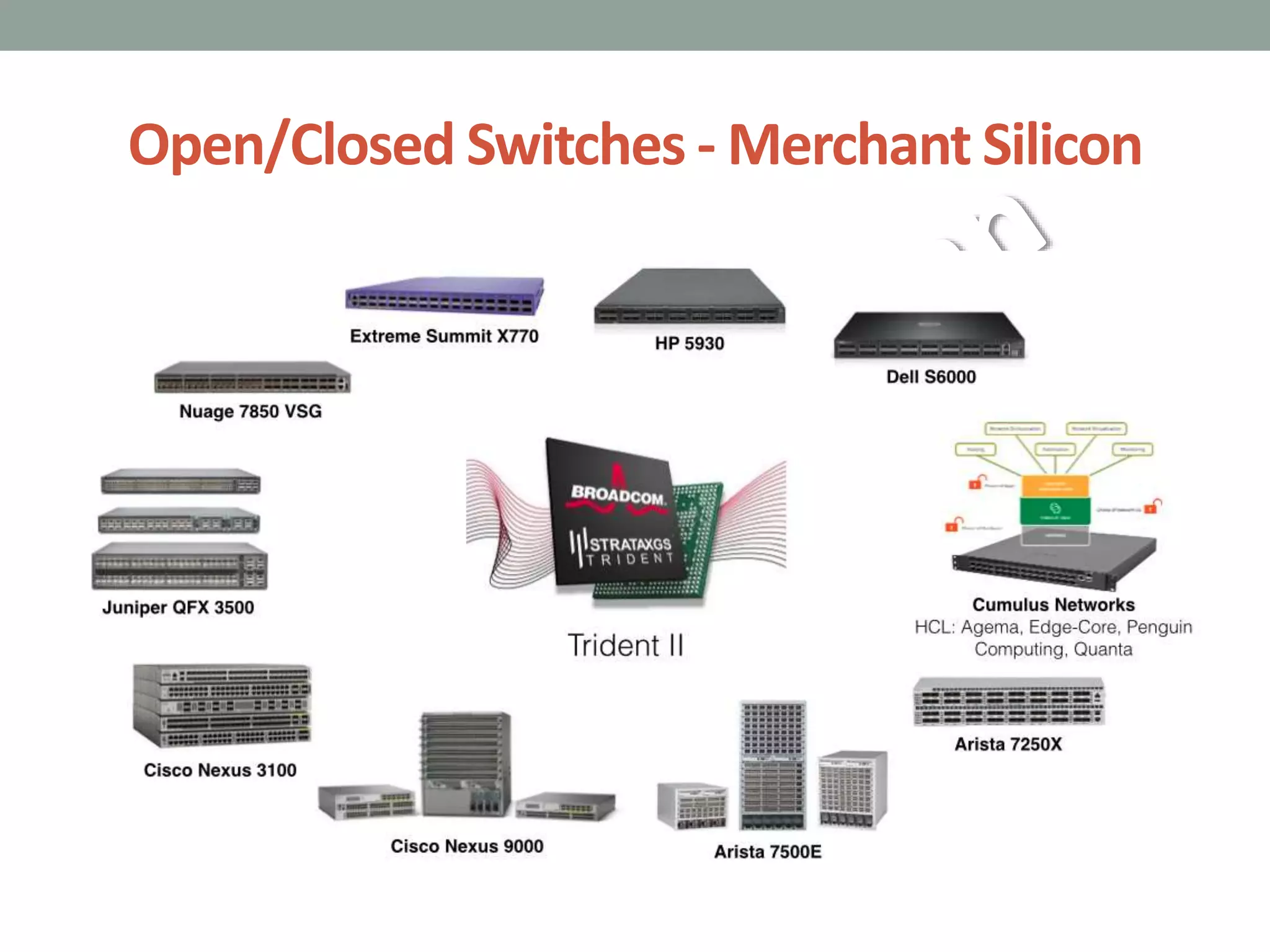
• Big vendors like Cisco and Juniper they are introducing
switches built on merchant silicon, such as Cisco's
Nexus 3000 and 9000, and Juniper's aforementioned
OCX1000. Arista switches have always used off-the-
shelf chips.
Open/Closed Switches - Merchant Silicon
Open Switch - Bare Metal Switches
• You buy the hardware, no brains included, all ready to be loaded with
the operating system of your choice.
• Note:- This is how we've been building servers . You choose the
applications you need to run, then you choose the operating system
that best supports the applications or best fits your operational
environment, and then you choose the hardware on which to run it
all.
• Bare metal manufacturers are primarily Taiwanese, and include such
companies as:
• Accton
• Quanta QCT
• Alpha Networks
• Delta Computer
Open Switch - Bare Metal Switches OS
• The bare metal switch comes with a boot loader called the “Open
Network Install Environment (ONIE)”, which allows you to load an
operating system onto the switch.
• There's a multitude of operating systems you can load, such as:
• Broadcom's FastPath (commercial software)
• Big Switch Networks' Switch Light (commercial software)
• Cumulus Networks' Cumulus Linux (commercial software)
• Pica8's PicOS (commercial software)
• Juniper Networks is making a move into the open switch community with
its OCX1100 (commercial software)
• Open Compute Project's Open Network Linux (ONL) - (open source -free -
underdevelopment) but right now ONL is an open-source development
platform on which to build practical operating systems, rather than a fully
cooked OS. It's a great foundation if you are a commercial developer or if
you want to tinker with coding your own OS in a lab, but it's not
something you can deploy in your production network by itself.
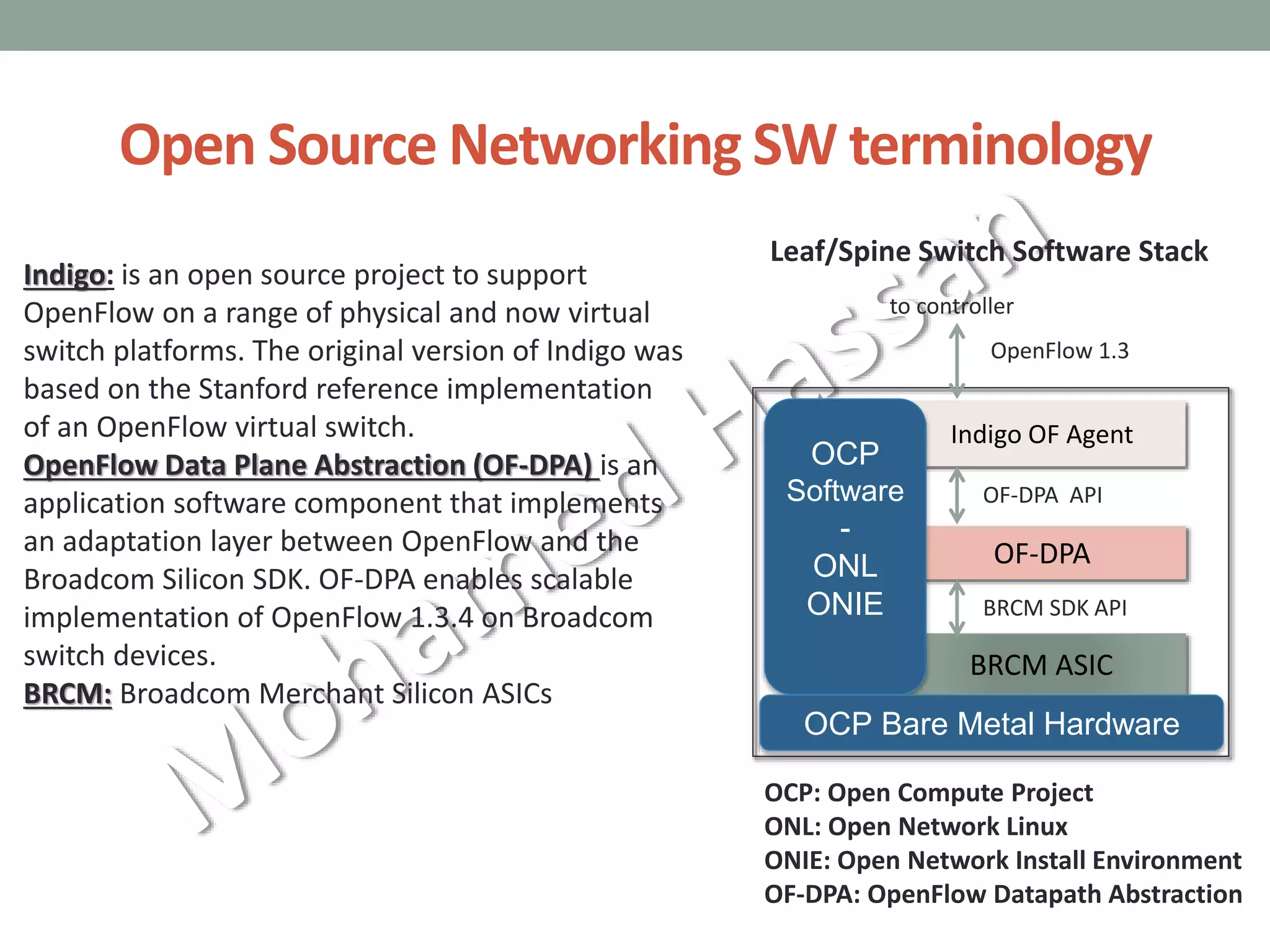
Open Source Networking SW terminology
BRCM ASIC
OF-DPA
Indigo OF Agent
OF-DPA API
OpenFlow 1.3
OCP: Open Compute Project
ONL: Open Network Linux
ONIE: Open Network Install Environment
OF-DPA: OpenFlow Datapath Abstraction
Leaf/Spine Switch Software Stack
to controller
OCP
Software
-
ONL
ONIE
OCP Bare Metal Hardware
BRCM SDK API
Indigo: is an open source project to support
OpenFlow on a range of physical and now virtual
switch platforms. The original version of Indigo was
based on the Stanford reference implementation
of an OpenFlow virtual switch.
OpenFlow Data Plane Abstraction (OF-DPA) is an
application software component that implements
an adaptation layer between OpenFlow and the
Broadcom Silicon SDK. OF-DPA enables scalable
implementation of OpenFlow 1.3.4 on Broadcom
switch devices.
BRCM: Broadcom Merchant Silicon ASICs
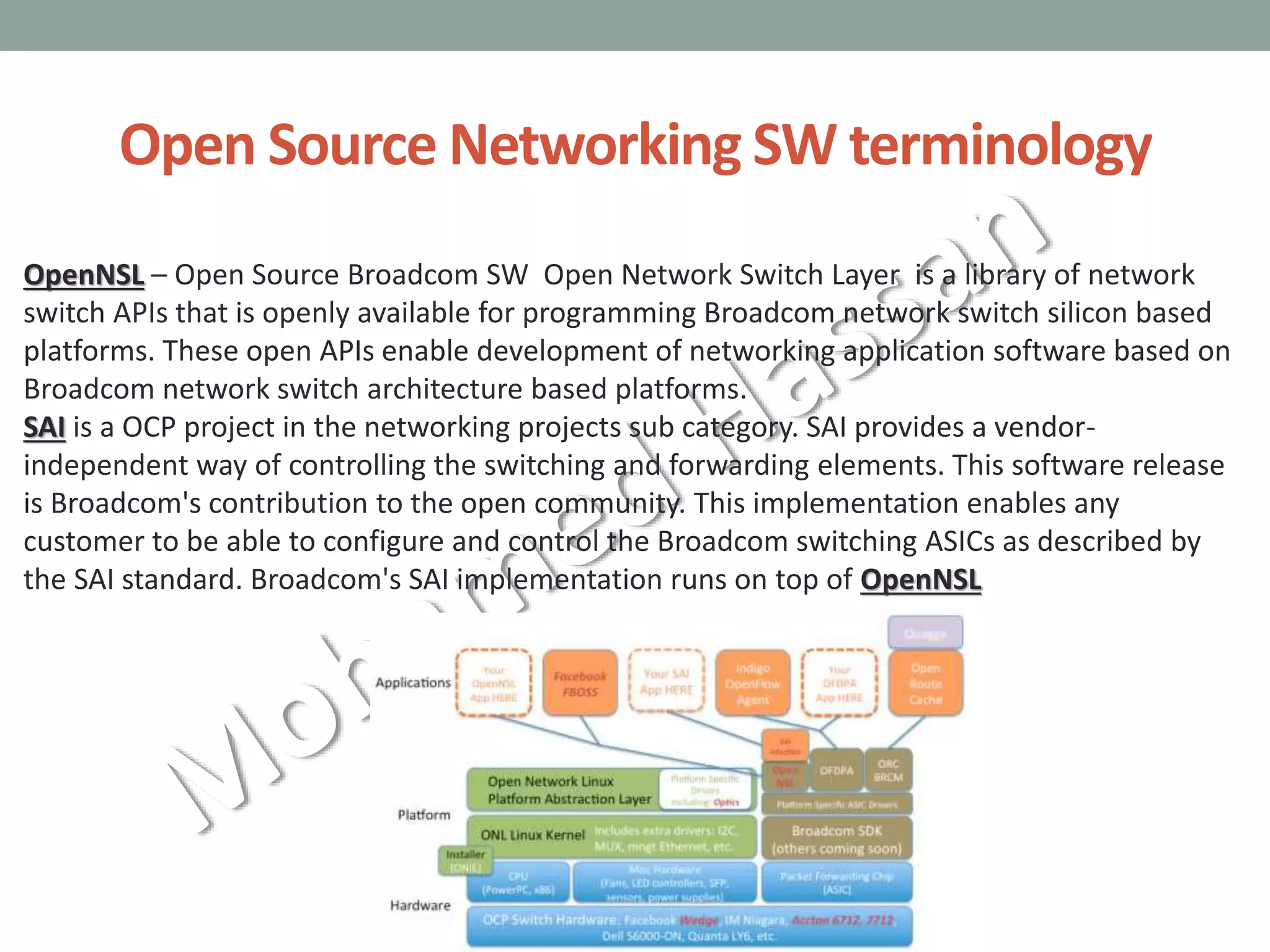
Open Source Networking SW terminology
OpenNSL – Open Source Broadcom SW Open Network Switch Layer is a library of network
switch APIs that is openly available for programming Broadcom network switch silicon based
platforms. These open APIs enable development of networking application software based on
Broadcom network switch architecture based platforms.
SAI is a OCP project in the networking projects sub category. SAI provides a vendor-
independent way of controlling the switching and forwarding elements. This software release
is Broadcom's contribution to the open community. This implementation enables any
customer to be able to configure and control the Broadcom switching ASICs as described by
the SAI standard. Broadcom's SAI implementation runs on top of OpenNSL
Open Source Networking SW terminology
What is P4 about and what is P4 not about?
P4 is a high-level programming language for expressing how packets are processed by the data
plane of any programmable packet processing device like switches, network interface
cards(NICs), network processing units(NPUs), field programmable gate arrays(FPGAs), software
switches, etc.
P4 programs describe the data plane behavior only. In addition to that, they allow the
programmer to generate the application programming interfaces (APIs) that the control plane
can use to communicate with or configure the data plane.
How does a P4-programmable switch differs from a traditional switch?
A P4-programmable switch differs from a traditional switch in two ways:
First, the switch’s data plane is no longer fixed. P4 programs describe the data plane
functionality. The data plane is configured at P4-to-target compile time. P4 itself is protocol
independent; it allows programmers to express a rich set of data plane behaviors.
Second, the control plane continues to interact with the data plane using the same channels;
however, the set of tables and other objects driving the behavior of the data plane is no longer
fixed, since those are derived from a specific P4 program. The P4 compiler generates the API
that the control plane uses to communicate with the data plane from the P4 program.
Open Source Networking SW terminology
What is the difference between P4 and OpenFlow?
P4 addresses a much more general problem than OpenFlow.
OpenFlow is designed for SDN networks in which we separate the control plane from the
forwarding plane. It assumes the switches have a fixed, well-known behavior, typically described
in the data sheet of a switch ASIC. OpenFlow gives us a way to populate a set of well-known
tables.
P4 is designed to program the behavior of any switch or router, whether it’s controlled locally
from a switch operating system, or remotely by an SDN controller. P4 let us control switches “top-
down” by first specifying their forwarding behavior, then populating the tables we’ve defined. In
P4, OpenFlow is one of many possible programs to describe what the forwarding plane does.
http://p4.org
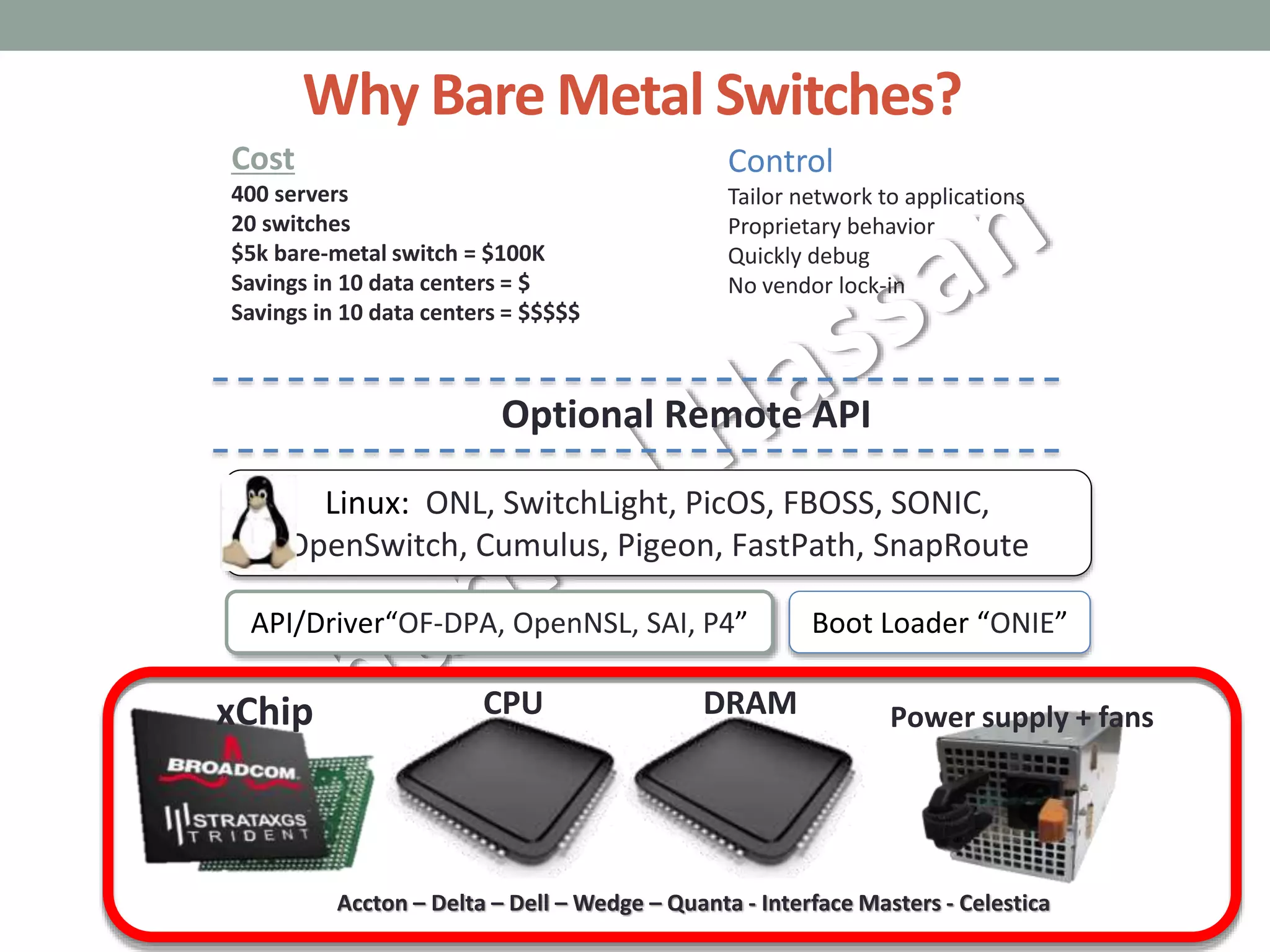
Why Bare Metal Switches?
DRAMCPU Power supply + fans
Linux: ONL, SwitchLight, PicOS, FBOSS, SONIC,
OpenSwitch, Cumulus, Pigeon, FastPath, SnapRoute
xChip
Optional Remote API
API/Driver“OF-DPA, OpenNSL, SAI, P4” Boot Loader “ONIE”
Accton – Delta – Dell – Wedge – Quanta - Interface Masters - Celestica
Cost
400 servers
20 switches
$5k bare-metal switch = $100K
Savings in 10 data centers = $
Savings in 10 data centers = $$$$$
Control
Tailor network to applications
Proprietary behavior
Quickly debug
No vendor lock-in
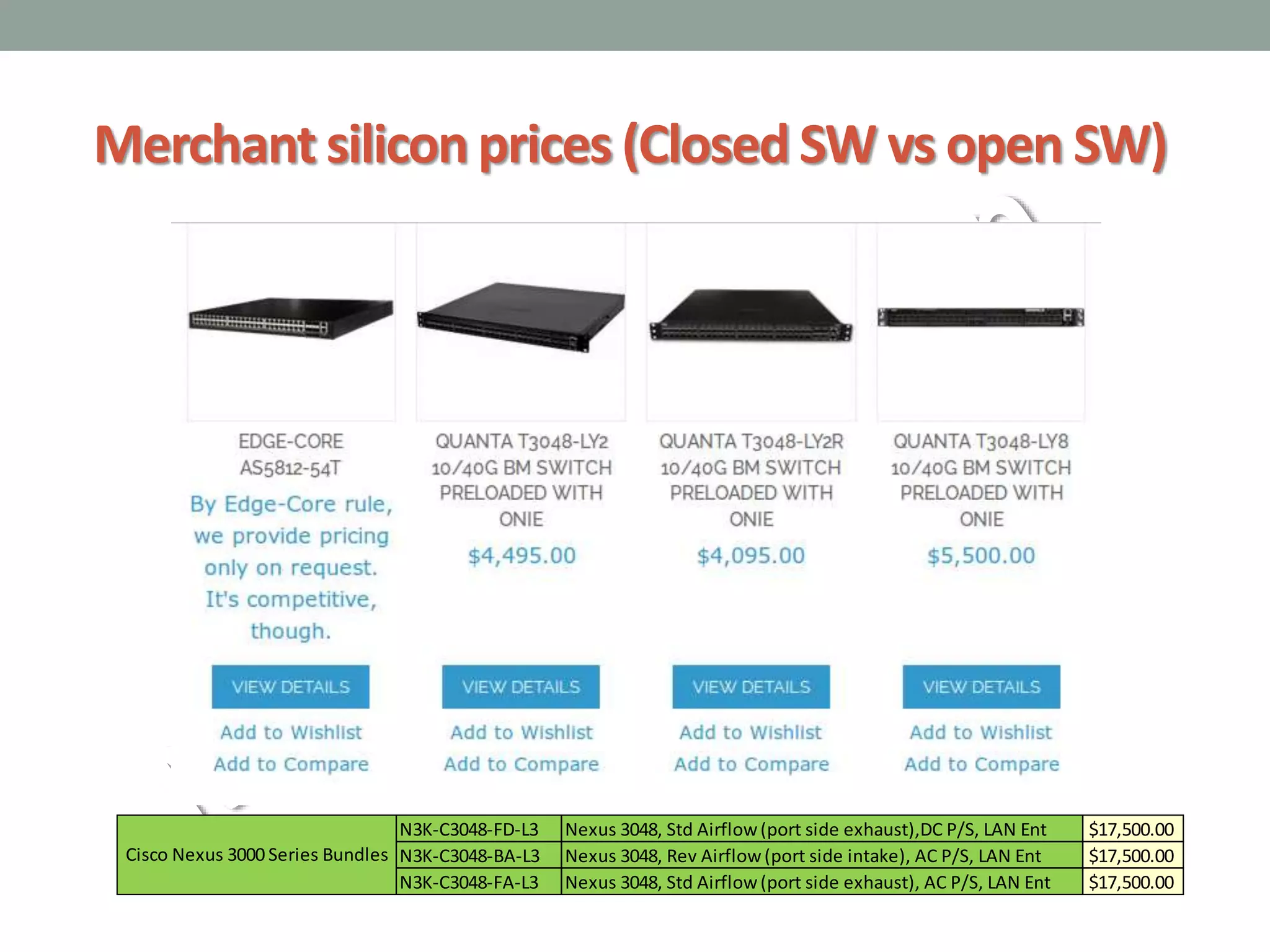
Merchant silicon prices (Closed SW vs open SW)
N3K-C3048-FD-L3 Nexus 3048, Std Airflow(port side exhaust),DC P/S, LAN Ent $17,500.00
N3K-C3048-BA-L3 Nexus 3048, Rev Airflow(port side intake), AC P/S, LAN Ent $17,500.00
N3K-C3048-FA-L3 Nexus 3048, Std Airflow(port side exhaust), AC P/S, LAN Ent $17,500.00
Cisco Nexus 3000 Series Bundles
White Box SDN Switch
Accton 6712
Leaf Switch
24 x 40G ports downlink to servers
via 4 X 10G breakout DAC
8 x 40G ports uplink to different spine switches
ECMP across all uplink ports
GE mgmt.
White Box SDN Switch
Accton 6712
Spine Switch
32 x 40G ports downlink to leaf switches
40G QSFP+/DAC
GE mgmt.
Open Hardware & Software Stacks
4 X 10G breakout DAC
QSFP to four SFP+ copper direct-attach breakout
cables are suitable for very short distances and
offer a very cost-effective way to connect within
racks and across adjacent racks. These breakout
cables connect to a 40G QSFP port of a switch on
one end and to four 10G SFP+ ports of a switch on
the other end. currently offered passive cables in
lengths of 0.5, 1, 2, 3, 4 and 5 meters and active
cables in lengths of 7 and 10 meters.
ECMP across all uplink ports
Equal-cost multi-path routing processing is a networking
feature that enables the Switch/Router to use up to four
equal-cost routes to the same destination. Without this
feature, if there are multiple equal-cost routes to the
same destination, the virtual router chooses one of those
routes from the routing table and adds it to its forwarding
table; it will not use any of the other routes unless there
is an outage in the chosen route.
Open Switch - White Box Switches
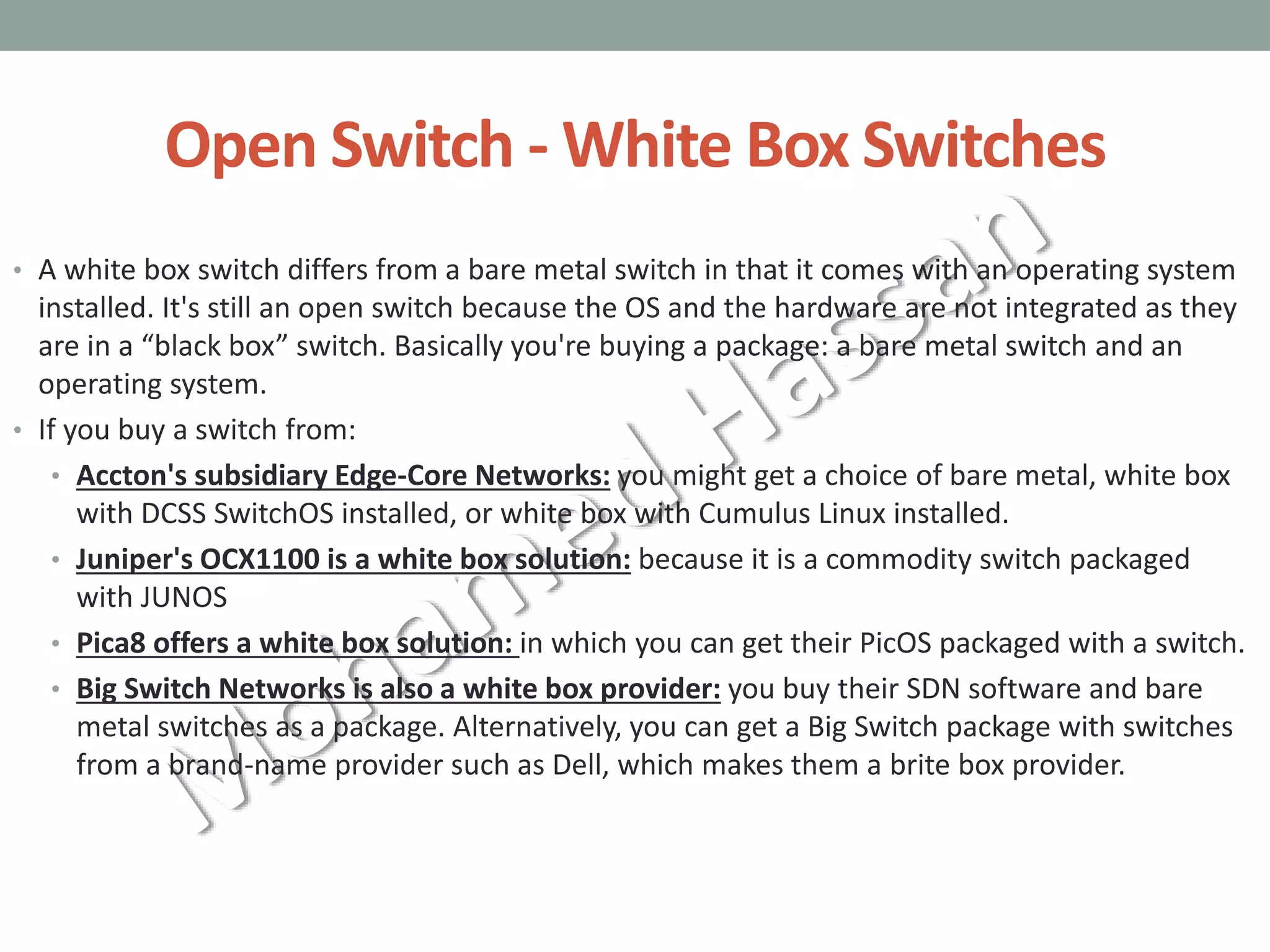
• A white box switch differs from a bare metal switch in that it comes with an operating system
installed. It's still an open switch because the OS and the hardware are not integrated as they
are in a “black box” switch. Basically you're buying a package: a bare metal switch and an
operating system.
• If you buy a switch from:
• Accton's subsidiary Edge-Core Networks: you might get a choice of bare metal, white box
with DCSS SwitchOS installed, or white box with Cumulus Linux installed.
• Juniper's OCX1100 is a white box solution: because it is a commodity switch packaged
with JUNOS
• Pica8 offers a white box solution: in which you can get their PicOS packaged with a switch.
• Big Switch Networks is also a white box provider: you buy their SDN software and bare
metal switches as a package. Alternatively, you can get a Big Switch package with switches
from a brand-name provider such as Dell, which makes them a brite box provider.
Open Switch - Brite Box Switches
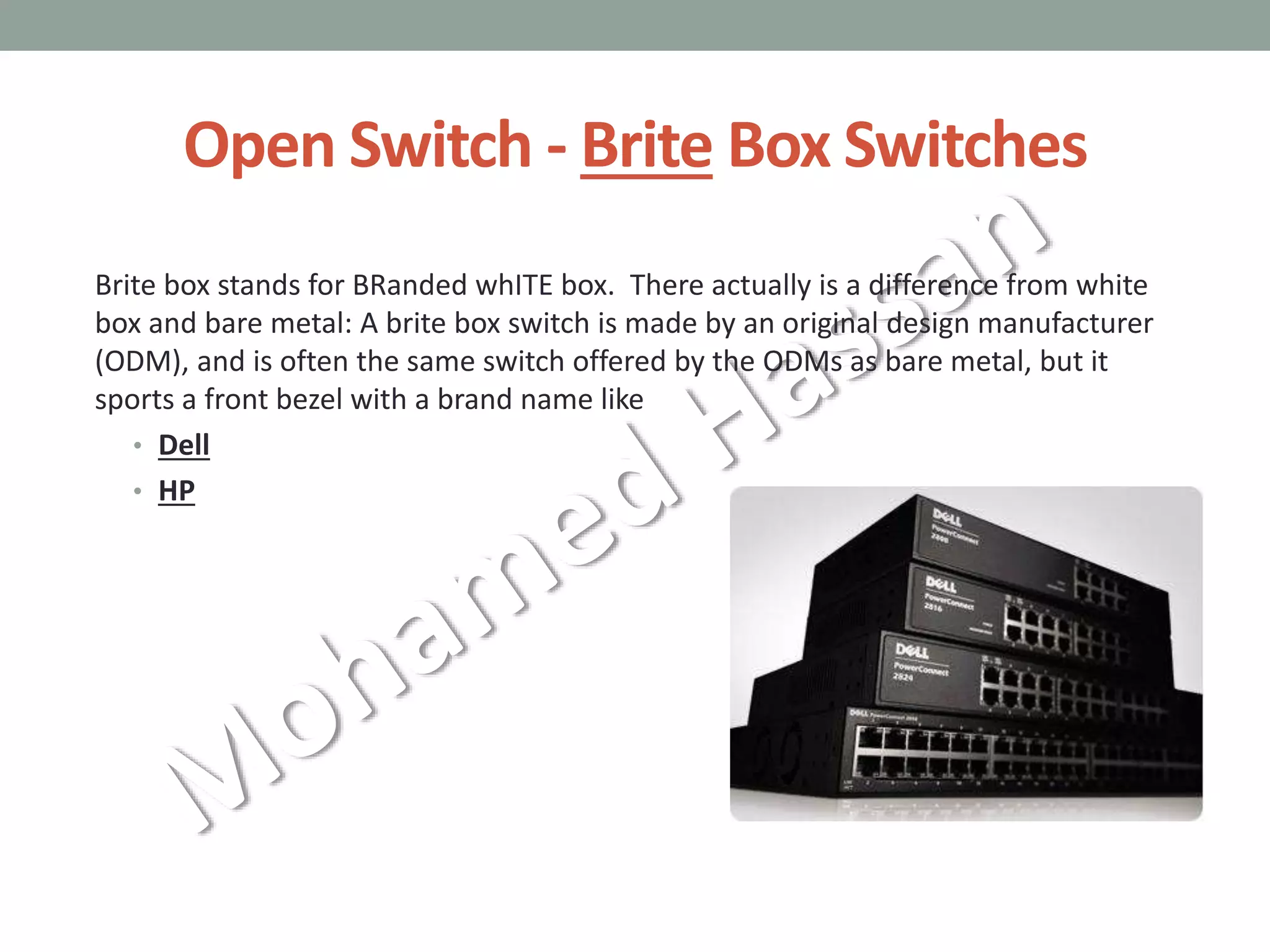
Brite box stands for BRanded whITE box. There actually is a difference from white
box and bare metal: A brite box switch is made by an original design manufacturer
(ODM), and is often the same switch offered by the ODMs as bare metal, but it
sports a front bezel with a brand name like
• Dell
• HP
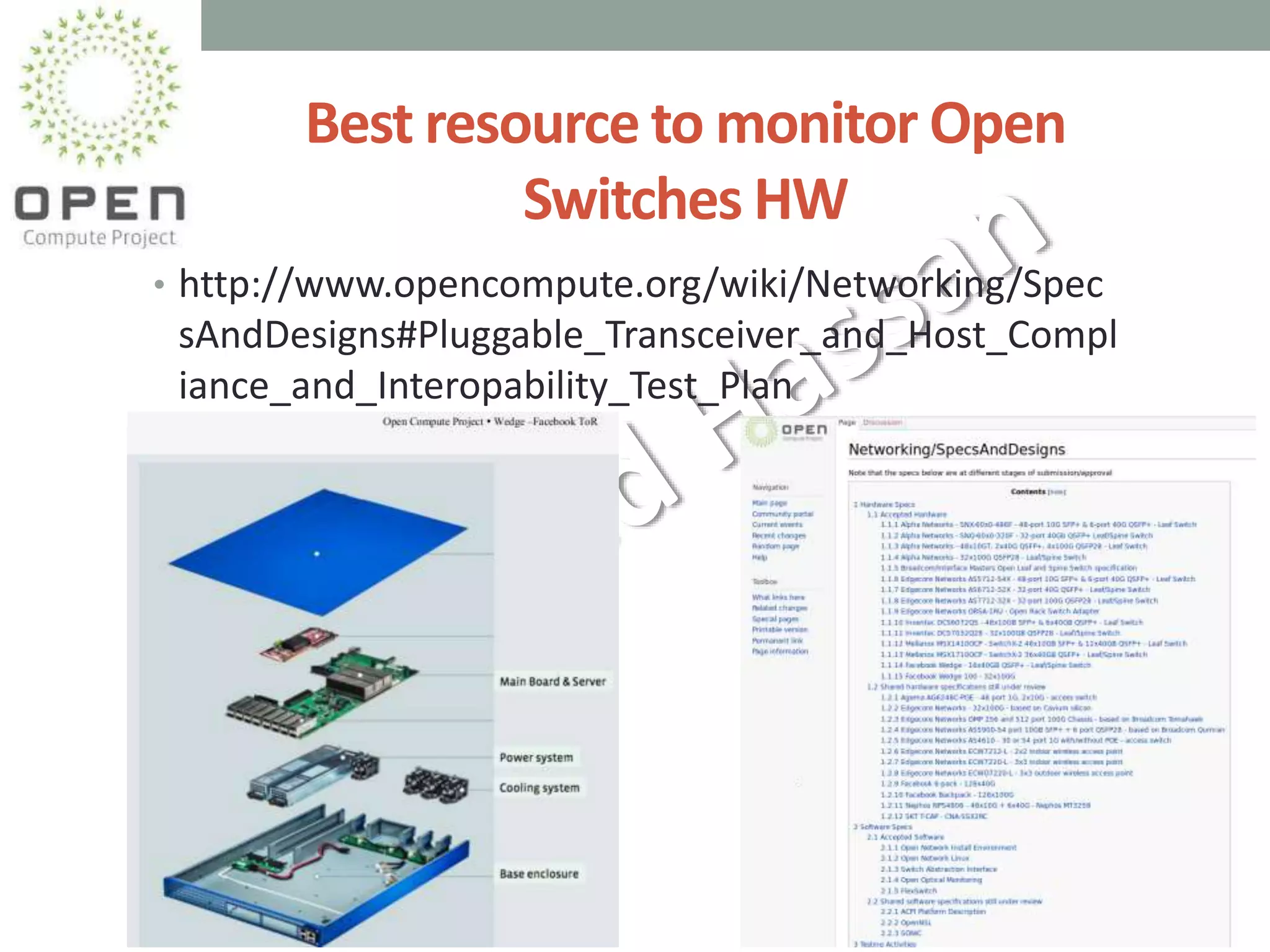
Best resource to monitor Open
Switches HW
• http://www.opencompute.org/wiki/Networking/Spec
sAndDesigns#Pluggable_Transceiver_and_Host_Compl
iance_and_Interopability_Test_Plan
Facebook Wedge - 16x40GB QSFP+ -
Leaf/Spine Switch
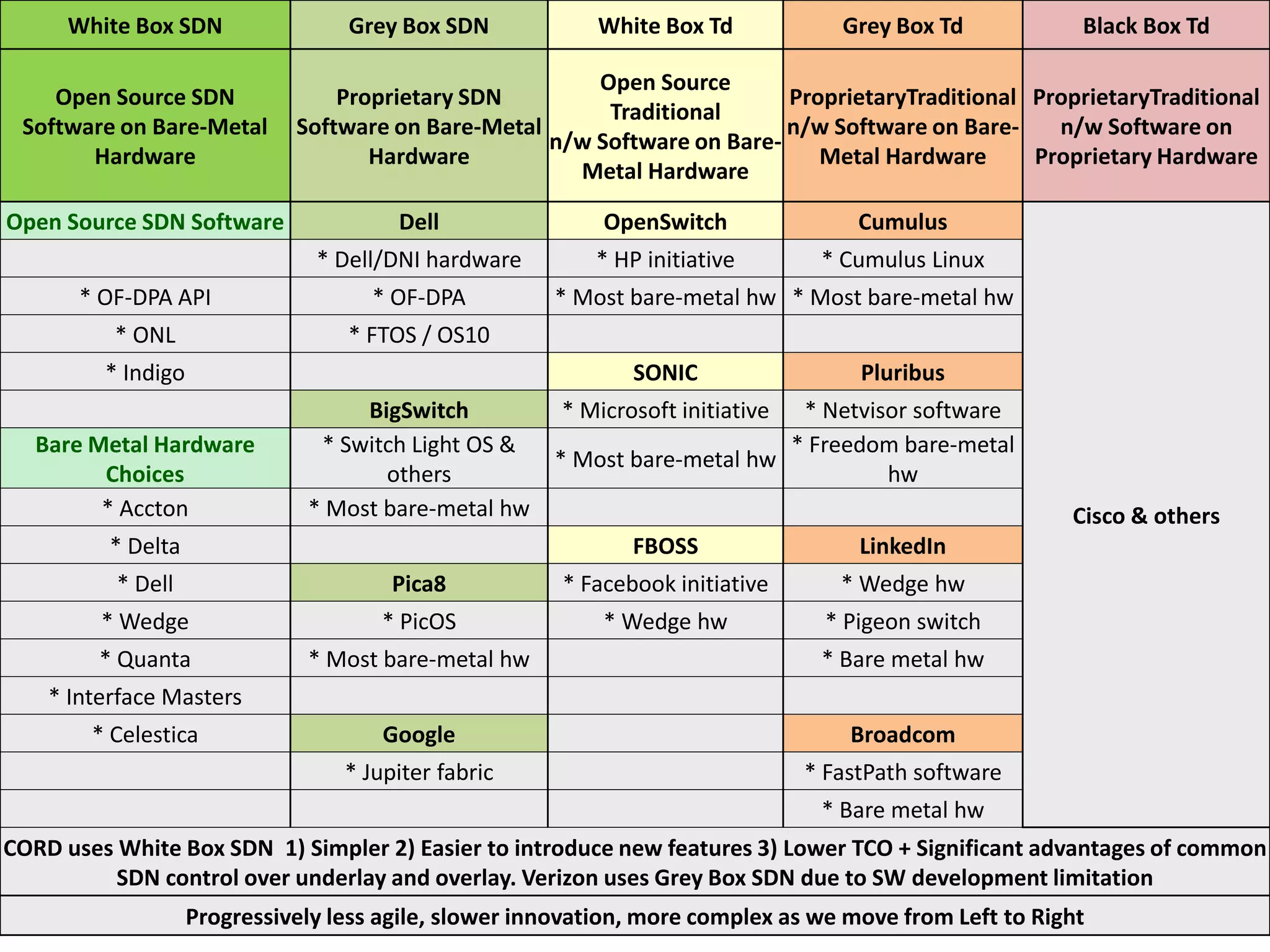
White Box SDN Grey Box SDN White Box Td Grey Box Td Black Box Td
Open Source SDN
Software on Bare-Metal
Hardware
Proprietary SDN
Software on Bare-Metal
Hardware
Open Source
Traditional
n/w Software on Bare-
Metal Hardware
ProprietaryTraditional
n/w Software on Bare-
Metal Hardware
ProprietaryTraditional
n/w Software on
Proprietary Hardware
Open Source SDN Software Dell OpenSwitch Cumulus
Cisco & others
* Dell/DNI hardware * HP initiative * Cumulus Linux
* OF-DPA API * OF-DPA * Most bare-metal hw * Most bare-metal hw
* ONL * FTOS / OS10
* Indigo SONIC Pluribus
BigSwitch * Microsoft initiative * Netvisor software
Bare Metal Hardware
Choices
* Switch Light OS &
others
* Most bare-metal hw
* Freedom bare-metal
hw
* Accton * Most bare-metal hw
* Delta FBOSS LinkedIn
* Dell Pica8 * Facebook initiative * Wedge hw
* Wedge * PicOS * Wedge hw * Pigeon switch
* Quanta * Most bare-metal hw * Bare metal hw
* Interface Masters
* Celestica Google Broadcom
* Jupiter fabric * FastPath software
* Bare metal hw
CORD uses White Box SDN 1) Simpler 2) Easier to introduce new features 3) Lower TCO + Significant advantages of common
SDN control over underlay and overlay. Verizon uses Grey Box SDN due to SW development limitation
Progressively less agile, slower innovation, more complex as we move from Left to Right

Open switches story mohamed hassan v4

  • 1.
  • 2.
    Closed Switches VsOpen Switches
  • 3.
    Closed Switches VsOpen Switches Supervisor VS SDN Controller Back Plane Card VS Spine Switch Line Card VS Leaf Switch Closed Flow VS Open Flow
  • 4.
    Open Switches -Merchant silicon • Hardware and software are separate entities • Can be changed independently of each other • Same hardware can support multiple operating systems, or the same operating system can be run on multiple hardware configurations. So open switches are about choice. Interestingly, though, that doesn't necessarily mean your choice. It could mean a vendor has the choice of rebranding an open switch, adding their own software, and selling it all as a package. • built around merchant or “off the shelf” silicon from companies such as • 1- Broadcom • 2- Mellanox Technologies • 3- Intel/Fulcrum • 4- Centec Networks • Custom silicon allows for tight integration with a proprietary operating system and a broad feature set, the production cycle from design to foundry is long and enormously expensive. Merchant silicon vendors, on the other hand, introduce new generations of chips every 18 to 24 months.
  • 5.
    Closed Switch -Custom Silicon • The hardware and software are always purchased together. So for example if you buy a Juniper EX or MX you also buy JUNOS. If you buy a Cisco Catalyst switch you buy IOS • The custom ASICs most of the legacy vendors use in their high-end switches and routers • Big vendors like Cisco and Juniper they are introducing switches built on merchant silicon, such as Cisco's Nexus 3000 and 9000, and Juniper's aforementioned OCX1000. Arista switches have always used off-the- shelf chips.
  • 6.
    Open/Closed Switches -Merchant Silicon
  • 7.
    Open Switch -Bare Metal Switches • You buy the hardware, no brains included, all ready to be loaded with the operating system of your choice. • Note:- This is how we've been building servers . You choose the applications you need to run, then you choose the operating system that best supports the applications or best fits your operational environment, and then you choose the hardware on which to run it all. • Bare metal manufacturers are primarily Taiwanese, and include such companies as: • Accton • Quanta QCT • Alpha Networks • Delta Computer
  • 8.
    Open Switch -Bare Metal Switches OS • The bare metal switch comes with a boot loader called the “Open Network Install Environment (ONIE)”, which allows you to load an operating system onto the switch. • There's a multitude of operating systems you can load, such as: • Broadcom's FastPath (commercial software) • Big Switch Networks' Switch Light (commercial software) • Cumulus Networks' Cumulus Linux (commercial software) • Pica8's PicOS (commercial software) • Juniper Networks is making a move into the open switch community with its OCX1100 (commercial software) • Open Compute Project's Open Network Linux (ONL) - (open source -free - underdevelopment) but right now ONL is an open-source development platform on which to build practical operating systems, rather than a fully cooked OS. It's a great foundation if you are a commercial developer or if you want to tinker with coding your own OS in a lab, but it's not something you can deploy in your production network by itself.
  • 9.
    Open Source NetworkingSW terminology BRCM ASIC OF-DPA Indigo OF Agent OF-DPA API OpenFlow 1.3 OCP: Open Compute Project ONL: Open Network Linux ONIE: Open Network Install Environment OF-DPA: OpenFlow Datapath Abstraction Leaf/Spine Switch Software Stack to controller OCP Software - ONL ONIE OCP Bare Metal Hardware BRCM SDK API Indigo: is an open source project to support OpenFlow on a range of physical and now virtual switch platforms. The original version of Indigo was based on the Stanford reference implementation of an OpenFlow virtual switch. OpenFlow Data Plane Abstraction (OF-DPA) is an application software component that implements an adaptation layer between OpenFlow and the Broadcom Silicon SDK. OF-DPA enables scalable implementation of OpenFlow 1.3.4 on Broadcom switch devices. BRCM: Broadcom Merchant Silicon ASICs
  • 10.
    Open Source NetworkingSW terminology OpenNSL – Open Source Broadcom SW Open Network Switch Layer is a library of network switch APIs that is openly available for programming Broadcom network switch silicon based platforms. These open APIs enable development of networking application software based on Broadcom network switch architecture based platforms. SAI is a OCP project in the networking projects sub category. SAI provides a vendor- independent way of controlling the switching and forwarding elements. This software release is Broadcom's contribution to the open community. This implementation enables any customer to be able to configure and control the Broadcom switching ASICs as described by the SAI standard. Broadcom's SAI implementation runs on top of OpenNSL
  • 11.
    Open Source NetworkingSW terminology What is P4 about and what is P4 not about? P4 is a high-level programming language for expressing how packets are processed by the data plane of any programmable packet processing device like switches, network interface cards(NICs), network processing units(NPUs), field programmable gate arrays(FPGAs), software switches, etc. P4 programs describe the data plane behavior only. In addition to that, they allow the programmer to generate the application programming interfaces (APIs) that the control plane can use to communicate with or configure the data plane. How does a P4-programmable switch differs from a traditional switch? A P4-programmable switch differs from a traditional switch in two ways: First, the switch’s data plane is no longer fixed. P4 programs describe the data plane functionality. The data plane is configured at P4-to-target compile time. P4 itself is protocol independent; it allows programmers to express a rich set of data plane behaviors. Second, the control plane continues to interact with the data plane using the same channels; however, the set of tables and other objects driving the behavior of the data plane is no longer fixed, since those are derived from a specific P4 program. The P4 compiler generates the API that the control plane uses to communicate with the data plane from the P4 program.
  • 12.
    Open Source NetworkingSW terminology What is the difference between P4 and OpenFlow? P4 addresses a much more general problem than OpenFlow. OpenFlow is designed for SDN networks in which we separate the control plane from the forwarding plane. It assumes the switches have a fixed, well-known behavior, typically described in the data sheet of a switch ASIC. OpenFlow gives us a way to populate a set of well-known tables. P4 is designed to program the behavior of any switch or router, whether it’s controlled locally from a switch operating system, or remotely by an SDN controller. P4 let us control switches “top- down” by first specifying their forwarding behavior, then populating the tables we’ve defined. In P4, OpenFlow is one of many possible programs to describe what the forwarding plane does. http://p4.org
  • 13.
    Why Bare MetalSwitches? DRAMCPU Power supply + fans Linux: ONL, SwitchLight, PicOS, FBOSS, SONIC, OpenSwitch, Cumulus, Pigeon, FastPath, SnapRoute xChip Optional Remote API API/Driver“OF-DPA, OpenNSL, SAI, P4” Boot Loader “ONIE” Accton – Delta – Dell – Wedge – Quanta - Interface Masters - Celestica Cost 400 servers 20 switches $5k bare-metal switch = $100K Savings in 10 data centers = $ Savings in 10 data centers = $$$$$ Control Tailor network to applications Proprietary behavior Quickly debug No vendor lock-in
  • 14.
    Merchant silicon prices(Closed SW vs open SW) N3K-C3048-FD-L3 Nexus 3048, Std Airflow(port side exhaust),DC P/S, LAN Ent $17,500.00 N3K-C3048-BA-L3 Nexus 3048, Rev Airflow(port side intake), AC P/S, LAN Ent $17,500.00 N3K-C3048-FA-L3 Nexus 3048, Std Airflow(port side exhaust), AC P/S, LAN Ent $17,500.00 Cisco Nexus 3000 Series Bundles
  • 15.
    White Box SDNSwitch Accton 6712 Leaf Switch 24 x 40G ports downlink to servers via 4 X 10G breakout DAC 8 x 40G ports uplink to different spine switches ECMP across all uplink ports GE mgmt. White Box SDN Switch Accton 6712 Spine Switch 32 x 40G ports downlink to leaf switches 40G QSFP+/DAC GE mgmt. Open Hardware & Software Stacks 4 X 10G breakout DAC QSFP to four SFP+ copper direct-attach breakout cables are suitable for very short distances and offer a very cost-effective way to connect within racks and across adjacent racks. These breakout cables connect to a 40G QSFP port of a switch on one end and to four 10G SFP+ ports of a switch on the other end. currently offered passive cables in lengths of 0.5, 1, 2, 3, 4 and 5 meters and active cables in lengths of 7 and 10 meters. ECMP across all uplink ports Equal-cost multi-path routing processing is a networking feature that enables the Switch/Router to use up to four equal-cost routes to the same destination. Without this feature, if there are multiple equal-cost routes to the same destination, the virtual router chooses one of those routes from the routing table and adds it to its forwarding table; it will not use any of the other routes unless there is an outage in the chosen route.
  • 16.
    Open Switch -White Box Switches • A white box switch differs from a bare metal switch in that it comes with an operating system installed. It's still an open switch because the OS and the hardware are not integrated as they are in a “black box” switch. Basically you're buying a package: a bare metal switch and an operating system. • If you buy a switch from: • Accton's subsidiary Edge-Core Networks: you might get a choice of bare metal, white box with DCSS SwitchOS installed, or white box with Cumulus Linux installed. • Juniper's OCX1100 is a white box solution: because it is a commodity switch packaged with JUNOS • Pica8 offers a white box solution: in which you can get their PicOS packaged with a switch. • Big Switch Networks is also a white box provider: you buy their SDN software and bare metal switches as a package. Alternatively, you can get a Big Switch package with switches from a brand-name provider such as Dell, which makes them a brite box provider.
  • 17.
    Open Switch -Brite Box Switches Brite box stands for BRanded whITE box. There actually is a difference from white box and bare metal: A brite box switch is made by an original design manufacturer (ODM), and is often the same switch offered by the ODMs as bare metal, but it sports a front bezel with a brand name like • Dell • HP
  • 18.
    Best resource tomonitor Open Switches HW • http://www.opencompute.org/wiki/Networking/Spec sAndDesigns#Pluggable_Transceiver_and_Host_Compl iance_and_Interopability_Test_Plan
  • 19.
    Facebook Wedge -16x40GB QSFP+ - Leaf/Spine Switch
  • 20.
    White Box SDNGrey Box SDN White Box Td Grey Box Td Black Box Td Open Source SDN Software on Bare-Metal Hardware Proprietary SDN Software on Bare-Metal Hardware Open Source Traditional n/w Software on Bare- Metal Hardware ProprietaryTraditional n/w Software on Bare- Metal Hardware ProprietaryTraditional n/w Software on Proprietary Hardware Open Source SDN Software Dell OpenSwitch Cumulus Cisco & others * Dell/DNI hardware * HP initiative * Cumulus Linux * OF-DPA API * OF-DPA * Most bare-metal hw * Most bare-metal hw * ONL * FTOS / OS10 * Indigo SONIC Pluribus BigSwitch * Microsoft initiative * Netvisor software Bare Metal Hardware Choices * Switch Light OS & others * Most bare-metal hw * Freedom bare-metal hw * Accton * Most bare-metal hw * Delta FBOSS LinkedIn * Dell Pica8 * Facebook initiative * Wedge hw * Wedge * PicOS * Wedge hw * Pigeon switch * Quanta * Most bare-metal hw * Bare metal hw * Interface Masters * Celestica Google Broadcom * Jupiter fabric * FastPath software * Bare metal hw CORD uses White Box SDN 1) Simpler 2) Easier to introduce new features 3) Lower TCO + Significant advantages of common SDN control over underlay and overlay. Verizon uses Grey Box SDN due to SW development limitation Progressively less agile, slower innovation, more complex as we move from Left to Right