Open	
  Source	
  in	
  Design	
  	
  
Threat	
  or	
  Necessity	
  for	
  Design	
  	
  
In	
  its	
  Role	
  for	
  Problem	
  Solving	
  and	
  Innova>on?	


Peter	
  Troxler,	
  Research	
  Professor	
  
Abstract	
  
•  Design	
  is	
  becoming	
  more	
  important	
  across	
  society,	
  and	
  with	
  it	
  design	
  as	
  a	
  
profession	
  and	
  professional	
  designers:	
  there	
  is	
  Design	
  Thinking	
  in	
  business,	
  Co-­‐
Design	
  in	
  the	
  public	
  sector;	
  and	
  design	
  is	
  geIng	
  a	
  place	
  in	
  research	
  and	
  educa>on.	
  
This	
  is	
  reflected	
  in	
  many	
  ini>a>ves,	
  of	
  which	
  PROUD	
  is	
  an	
  important	
  example.	
  The	
  
European	
  Design	
  Leadership	
  Board’s	
  recommenda>on	
  to	
  the	
  EU	
  reflects	
  these	
  
developments.	
  	
  
•  At	
  the	
  same	
  >me	
  there	
  are	
  socio-­‐technical	
  developments	
  that	
  build	
  on	
  the	
  
possibili>es	
  of	
  digital	
  and	
  In-­‐	
  ternet	
  technology	
  that	
  require	
  liRle	
  central	
  control	
  
and	
  allow	
  lateral	
  par>cipa>on	
  and	
  collabora>on.	
  Wiki-­‐	
  pedia,	
  social	
  media	
  and	
  
YouTube	
  are	
  a	
  few	
  examples	
  of	
  such	
  developments.	
  This	
  development	
  towards	
  
lateral	
  power	
  is	
  at	
  the	
  core	
  of	
  the	
  current	
  Third	
  Industrial	
  Revolu>on.	
  	
  
•  In	
  design,	
  the	
  no>on	
  of	
  ‘open	
  design’	
  has	
  emerged,	
  which	
  denotes	
  a	
  departure	
  
from	
  authori>es	
  of	
  de-­‐	
  sign	
  to	
  design	
  that	
  builds	
  upon	
  transparency,	
  collabora>on	
  
and	
  reusability	
  beyond	
  selected	
  and	
  selec>ve	
  membership.	
  In	
  my	
  talk	
  I	
  will	
  
inves>gate	
  whether	
  this	
  development	
  can	
  be	
  instrumental	
  to	
  co-­‐design,	
  
or	
  whether	
  co-­‐design	
  will	
  have	
  to	
  adopt	
  the	
  no>on	
  ‘open’	
  to	
  remain	
  relevant:	
  is	
  
‘open	
  design’	
  a	
  threat	
  to	
  design	
  in	
  its	
  role	
  of	
  problem	
  solving	
  and	
  innova>on	
  or	
  a	
  
necessity?	
  	
  
Outline	
  
1.  Design	
  is	
  becoming	
  more	
  important	
  
– Design	
  Thinking,	
  Co-­‐Design,	
  …	
  
2.  “Digital	
  Revolu>on”	
  	
  
– Wikipedia,	
  YouTube,	
  …	
  
3.  Co-­‐Design	
  vs.	
  Open	
  Design	
  
– AND,	
  OR,	
  XOR?	
  
1	
  Design	
  is	
  becoming	
  more	
  important.	
  
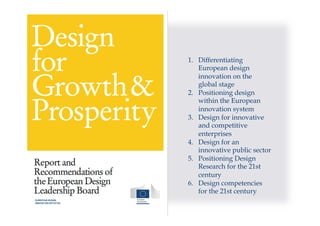
1.  Differentiating
European design
innovation on the
global stage
2.  Positioning design
within the European
innovation system
3.  Design for innovative
and competitive
enterprises
4.  Design for an
innovative public sector
5.  Positioning Design
Research for the 21st
century
6.  Design competencies
for the 21st century
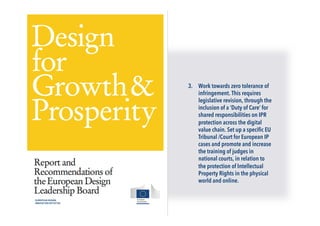
3.  Work towards zero tolerance of
infringement. This requires
legislative revision, through the
inclusion of a ‘Duty of Care’ for
shared responsibilities on IPR
protection across the digital
value chain. Set up a specific EU
Tribunal /Court for European IP
cases and promote and increase
the training of judges in
national courts, in relation to
the protection of Intellectual
Property Rights in the physical
world and online.
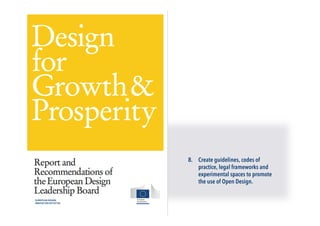
8.  Create guidelines, codes of
practice, legal frameworks and
experimental spaces to promote
the use of Open Design.
2	
  “Digital	
  Revolu>on”.	
  
“Digital	
  Revolu>on”	
  
There	
  are	
  a	
  few	
  problems	
  with	
  that	
  term	
  
•  Revolu>on	
  
– French,	
  Russian,	
  Industrial,	
  …	
  
•  Digital	
  
– everything	
  going	
  digital?	
  	
  
digital	
  invading	
  everything?	
  
…	
  
“Industrial	
  Revolu>on”	
  
There	
  are	
  a	
  few	
  problems	
  with	
  that	
  term,	
  too	
  
•  industrial	
  revolu>ons	
  
– stable	
  economies	
  
certainly	
  19th	
  century,	
  see	
  Polany,	
  The	
  Great	
  Transforma7on,	
  1944	
  
•  revolu>on	
  
– but	
  not	
  100	
  %	
  displacement	
  
or	
  was	
  that	
  really	
  a	
  characteris7c	
  of	
  poli7cal	
  revolu7ons?	
  
 12,800,000 	
  results	
  
	
  1,820,000 	
  blogs	
  
	
  17,300,000 	
  videos	
  
	
  519,000 	
  discussions	
  
	
  3,070,000 	
  books	
  
Industrial	
  Revolu>on	
  
•  Neil	
  Gershenfeld,	
  2005:	
  
Fab.	
  The	
  Coming	
  Revolu>on	
  on	
  Your	
  Desktop	
  
•  Jeremy	
  Rifin,	
  2011:	
  
The	
  Third	
  Industrial	
  Revolu>on.	
  How	
  Lateral	
  Power	
  is	
  
Transforming	
  Energy,	
  the	
  Economy,	
  and	
  the	
  World.	
  	
  
•  Chris	
  Anderson,	
  2012:	
  
Makers:	
  The	
  New	
  Industrial	
  Revolu>on	
  
•  Peter	
  Marsh,	
  2012:	
  
The	
  New	
  Industrial	
  Revolu>on:	
  Consumers,	
  
Globaliza>on	
  and	
  the	
  End	
  of	
  Mass	
  Produc>on	
  
Jeremy	
  Rifin	
  
1st	
  revolu>on	


Automa>c	
  
prin>ng	
  press	


Steam-­‐powered	
  
technology	


19th	
  century	
  
3rd	
  revolu>on	


Internet	


Renewable	
  
energy	


21st	
  century	
  
2nd	
  revolu>on	


Electrical	
  
communica>on	


Oil-­‐powered	
  
combus>on	
  
engine	


20th	
  century	
  
hRp://ec.europa.eu/avservices/video/player.cfm?sitelang=en&ref=85716	
  
Jeremy	
  Rifin	
  
[T]he	
  conven>onal	
  top-­‐down	
  organiza>on	
  of	
  society	


  that	
  characterized	
  much	
  of	
  the	
  economic,	
  social,	
  and	
  poli>cal	
  life	


  of	
  the	
  fossil-­‐fuel	
  based	
  industrial	
  revolu>ons	


  is	
  giving	
  way	
  to	
  distributed	
  and	
  collabora>ve	
  rela>onships	


  in	
  the	
  emerging	
  green	
  industrial	
  era.	
  	
  
We	
  are	
  in	
  the	
  midst	
  of	
  a	
  profound	
  shio	
  in	
  the	
  very	
  way	
  society	
  is	
  structured,	
  
	
  away	
  from	
  hierarchical	
  power	
  and	
  toward	
  lateral	
  power.	
  	
  
Ri>in	
  2011,	
  p.	
  36f.	
  
1st	
  revolu>on	


Automa>c	
  
prin>ng	
  press	


Steam-­‐powered	
  
technology	


19th	
  century	
  
3rd	
  revolu>on	


Internet	


Renewable	
  
energy	


21st	
  century	
  
2nd	
  revolu>on	


Electrical	
  
communica>on	


Oil-­‐powered	
  
combus>on	
  
engine	


20th	
  century	
  
©	
  2010	
  Kevin	
  Dooley,	
  cc-­‐by	
  
©	
  1968,	
  Elgin	
  County	
  Archives,	
  St.	
  Thomas	
  Times-­‐Journal	
  fonds	
  
©	
  2011	
  Waag	
  Society,	
  cc-­‐by-­‐nc-­‐nd	
  
1st	
  revolu>on	


Automa>c	
  
prin>ng	
  press	


Steam-­‐powered	
  
technology	


19th	
  century	
  
3rd	
  revolu>on	


Internet	


Renewable	
  
energy	


21st	
  century	
  
2nd	
  revolu>on	


Electrical	
  
communica>on	


Oil-­‐powered	
  
combus>on	
  
engine	


20th	
  century	
  
©	
  1907	
  E.A.	
  Thomson	
  
BuRe-­‐Silver	
  Bow	
  Public	
  Library	
  	
  
©	
  2009	
  mars_discovery_district,	
  cc-­‐by-­‐nc-­‐	
  sa	
  
©	
  2011	
  adafruit,	
  cc-­‐by-­‐nc-­‐sa	
  
•  Icon	
  
steam	
  engine	
  >	
  conveyor	
  belt	
  >	
  3D	
  printer	
  
•  Actor	
  
capitalist	
  >	
  management	
  consultant	
  >	
  maker	
  
•  Structure	
  
pa>archical	
  >	
  hierarchical	
  >	
  lateral	
  
•  Supply	
  Chain	
  
colonial	
  >	
  global	
  >	
  con>nental	
  /	
  regional	
  
•  Transport	
  
railway	
  >	
  automobile	
  &	
  air	
  travel	
  >	
  ???	
  
•  Ci>es	
  
crowded	
  inner	
  ci>es	
  >	
  suburbia	
  >	
  ???	
  
•  Social	
  
working	
  class	
  >	
  middle	
  class	
  >	
  ???	
  
•  Consump>on	
  
consume	
  >	
  mass	
  consump>on	
  >	
  prosumer	
  
•  Media	
  
newspaper	
  >	
  radio	
  >	
  social	
  media,	
  UGC?	
  
•  Encyclopedia	
  
Diderot	
  >	
  Britannica	
  >	
  Wikipedia	
  
•  Sooware	
  
electromechanical	
  (?)	
  >	
  proprietary	
  >	
  open	
  source?	
  
•  Design	
  
crao	
  >	
  design	
  >	
  open	
  design?	
  
crao	
  >	
  design	
  >	
  co-­‐design?	


3	
  Co-­‐Design	
  vs.	
  Open	
  Design	
  
P.	
  J.	
  Stappers,	
  et	
  al.	
  (2011).	
  Crea7on	
  &	
  Co:	
  User	
  Par7cipa7on	
  in	
  Design.	
  In:	
  van	
  Abel	
  et	
  al.	
  (eds.)	
  Open	
  Design	
  Now.	
  Amsterdam:	
  BIS.	
  
PJ	
  Stappers	
  &Co	
  
E.	
  B.	
  N.	
  Sanders	
  and	
  P.	
  J.	
  Stappers,	
  “Co-­‐crea7on	
  and	
  the	
  new	
  landscapes	
  of	
  design,”	
  CoDesign,	
  Mar.	
  2008.	
  
Open	
  Design	
  “Defini>on”	
  
Open Design is a design artifact project whose
source documentation is made publicly available so
that anyone can study, modify, distribute, make,
prototype and sell the artifact based on that
design.!
!
(…)!
!
Design also means the design process of developing
an Open Design project.Open Design does not refer to
and is not defined by a specific design process.
Most of the time the design process of an Open
Design project will not be documented and therefore
there is no need to publish this documentation.!
!
(…)!
h[ps://github.com/OpenDesign-­‐WorkingGroup/Open-­‐Design-­‐Defini7on/blob/master/open.design_defini7on/open.design.defini7on.md	
  
From	
  Open	
  Design	
  Now	
  
1.  Analogy	
  to	
  open	
  source	
  sooware	
  and	
  its	
  ‘low-­‐IP’	
  regime—freely	
  
accessible	
  blueprints	
  in	
  analogy	
  to	
  source	
  code,	
  and	
  the	
  four	
  freedoms	
  
of	
  open	
  source	
  sooware	
  (use,	
  modify,	
  share,	
  and	
  fork).	
  	
  
2.  Aspects	
  of	
  design	
  prac>ce—collabora>ve	
  crea>on	
  and	
  inquiry,	
  and	
  the	
  
disappearing	
  dis>nc>on	
  between	
  professionals	
  and	
  amateurs.	
  	
  
Open	
  design	
  promotes	
  the	
  unprecedented	
  sharing	
  of	
  knowledge	
  between	
  the	
  professional	
  
and	
  amateur	
  designer,	
  breaking	
  down	
  unnecessary	
  barriers.	
  (Atkinson)	
  	
  
Open	
  design	
  is	
  a	
  specific	
  approach	
  to	
  design,	
  in	
  which	
  a	
  group	
  of	
  intrinsically	
  mo7vated	
  
people	
  from	
  various	
  backgrounds	
  develop	
  design	
  opportuni7es	
  and	
  solu7ons	
  together	
  in	
  an	
  
open	
  community,	
  based	
  on	
  respect	
  for	
  each	
  other's	
  skills	
  and	
  exper7se.	
  (Humels).	
  	
  
3.  How	
  open	
  design	
  would	
  change	
  tradi>onal	
  ver>cal	
  value	
  chains	
  formed	
  
by	
  designer-­‐manufacturer-­‐distributor-­‐consumer	
  rela>onships	
  trough	
  
fabrica>on	
  on	
  demand	
  or	
  one	
  man	
  factories	
  
Rooted	
  in	
  informa7on	
  and	
  communica7on	
  technology,	
  [open	
  design]	
  gives	
  us	
  all	
  the	
  
instruments	
  to	
  become	
  the	
  one-­‐man	
  factory,	
  the	
  world	
  player	
  opera7ng	
  from	
  a	
  small	
  back	
  
room.	
  (S7kker)	
  
The	
  open	
  design	
  model	
  diminishes	
  the	
  tradi7onal	
  ver7cal	
  value	
  chain	
  that	
  is	
  formed	
  by	
  
designer-­‐manufacturer-­‐distributor-­‐consumer	
  rela7onships	
  and	
  offers	
  an	
  alterna7ve,	
  open	
  
web	
  of	
  direct	
  links	
  between	
  designers	
  and	
  consumers.	
  (Avital)	
  	
  
C!
D! U!
C!D!
U!
CUD!
DUC!
UDC!
The  Old  View" Co-­Creation" Open  Design"
C!
D! U!
The  Old  View"
C!D!
U!
Co-­Creation"
CUD!
DUC!
UDC!
Open  Design"
C!D!
U!
Co-­Creation"
?"C!
D! U!
The  Old  View"
CUD!
DUC!
UDC!
Open  Design"
1.  Differentiating
European design
innovation on the
global stage
2.  Positioning design
within the European
innovation system
3.  Design for innovative
and competitive
enterprises
4.  Design for an
innovative public sector
5.  Positioning Design
Research for the 21st
century
6.  Design competencies
for the 21st century
e 	
  peter@square-­‐1.eu	
  
t 	
  @trox	
  
s 	
  petertroxler	
  

Open Source in Design

  • 1.
    Open  Source  in  Design     Threat  or  Necessity  for  Design     In  its  Role  for  Problem  Solving  and  Innova>on?     Peter  Troxler,  Research  Professor  
  • 2.
    Abstract   •  Design  is  becoming  more  important  across  society,  and  with  it  design  as  a   profession  and  professional  designers:  there  is  Design  Thinking  in  business,  Co-­‐ Design  in  the  public  sector;  and  design  is  geIng  a  place  in  research  and  educa>on.   This  is  reflected  in  many  ini>a>ves,  of  which  PROUD  is  an  important  example.  The   European  Design  Leadership  Board’s  recommenda>on  to  the  EU  reflects  these   developments.     •  At  the  same  >me  there  are  socio-­‐technical  developments  that  build  on  the   possibili>es  of  digital  and  In-­‐  ternet  technology  that  require  liRle  central  control   and  allow  lateral  par>cipa>on  and  collabora>on.  Wiki-­‐  pedia,  social  media  and   YouTube  are  a  few  examples  of  such  developments.  This  development  towards   lateral  power  is  at  the  core  of  the  current  Third  Industrial  Revolu>on.     •  In  design,  the  no>on  of  ‘open  design’  has  emerged,  which  denotes  a  departure   from  authori>es  of  de-­‐  sign  to  design  that  builds  upon  transparency,  collabora>on   and  reusability  beyond  selected  and  selec>ve  membership.  In  my  talk  I  will   inves>gate  whether  this  development  can  be  instrumental  to  co-­‐design,   or  whether  co-­‐design  will  have  to  adopt  the  no>on  ‘open’  to  remain  relevant:  is   ‘open  design’  a  threat  to  design  in  its  role  of  problem  solving  and  innova>on  or  a   necessity?    
  • 3.
    Outline   1.  Design  is  becoming  more  important   – Design  Thinking,  Co-­‐Design,  …   2.  “Digital  Revolu>on”     – Wikipedia,  YouTube,  …   3.  Co-­‐Design  vs.  Open  Design   – AND,  OR,  XOR?  
  • 4.
    1  Design  is  becoming  more  important.  
  • 6.
    1.  Differentiating European design innovationon the global stage 2.  Positioning design within the European innovation system 3.  Design for innovative and competitive enterprises 4.  Design for an innovative public sector 5.  Positioning Design Research for the 21st century 6.  Design competencies for the 21st century
  • 7.
    3.  Work towardszero tolerance of infringement. This requires legislative revision, through the inclusion of a ‘Duty of Care’ for shared responsibilities on IPR protection across the digital value chain. Set up a specific EU Tribunal /Court for European IP cases and promote and increase the training of judges in national courts, in relation to the protection of Intellectual Property Rights in the physical world and online.
  • 8.
    8.  Create guidelines,codes of practice, legal frameworks and experimental spaces to promote the use of Open Design.
  • 9.
  • 10.
    “Digital  Revolu>on”   There  are  a  few  problems  with  that  term   •  Revolu>on   – French,  Russian,  Industrial,  …   •  Digital   – everything  going  digital?     digital  invading  everything?   …  
  • 11.
    “Industrial  Revolu>on”   There  are  a  few  problems  with  that  term,  too   •  industrial  revolu>ons   – stable  economies   certainly  19th  century,  see  Polany,  The  Great  Transforma7on,  1944   •  revolu>on   – but  not  100  %  displacement   or  was  that  really  a  characteris7c  of  poli7cal  revolu7ons?  
  • 12.
     12,800,000  results    1,820,000  blogs    17,300,000  videos    519,000  discussions    3,070,000  books  
  • 13.
    Industrial  Revolu>on   • Neil  Gershenfeld,  2005:   Fab.  The  Coming  Revolu>on  on  Your  Desktop   •  Jeremy  Rifin,  2011:   The  Third  Industrial  Revolu>on.  How  Lateral  Power  is   Transforming  Energy,  the  Economy,  and  the  World.     •  Chris  Anderson,  2012:   Makers:  The  New  Industrial  Revolu>on   •  Peter  Marsh,  2012:   The  New  Industrial  Revolu>on:  Consumers,   Globaliza>on  and  the  End  of  Mass  Produc>on  
  • 14.
    Jeremy  Rifin   1st  revolu>on     Automa>c   prin>ng  press     Steam-­‐powered   technology       19th  century   3rd  revolu>on     Internet       Renewable   energy       21st  century   2nd  revolu>on     Electrical   communica>on     Oil-­‐powered   combus>on   engine     20th  century  
  • 15.
  • 16.
    Jeremy  Rifin   [T]he  conven>onal  top-­‐down  organiza>on  of  society      that  characterized  much  of  the  economic,  social,  and  poli>cal  life        of  the  fossil-­‐fuel  based  industrial  revolu>ons      is  giving  way  to  distributed  and  collabora>ve  rela>onships        in  the  emerging  green  industrial  era.     We  are  in  the  midst  of  a  profound  shio  in  the  very  way  society  is  structured,    away  from  hierarchical  power  and  toward  lateral  power.     Ri>in  2011,  p.  36f.  
  • 17.
    1st  revolu>on     Automa>c   prin>ng  press     Steam-­‐powered   technology       19th  century   3rd  revolu>on     Internet       Renewable   energy       21st  century   2nd  revolu>on     Electrical   communica>on     Oil-­‐powered   combus>on   engine     20th  century   ©  2010  Kevin  Dooley,  cc-­‐by   ©  1968,  Elgin  County  Archives,  St.  Thomas  Times-­‐Journal  fonds   ©  2011  Waag  Society,  cc-­‐by-­‐nc-­‐nd  
  • 18.
    1st  revolu>on     Automa>c   prin>ng  press     Steam-­‐powered   technology       19th  century   3rd  revolu>on     Internet       Renewable   energy       21st  century   2nd  revolu>on     Electrical   communica>on     Oil-­‐powered   combus>on   engine     20th  century   ©  1907  E.A.  Thomson   BuRe-­‐Silver  Bow  Public  Library     ©  2009  mars_discovery_district,  cc-­‐by-­‐nc-­‐  sa   ©  2011  adafruit,  cc-­‐by-­‐nc-­‐sa  
  • 19.
    •  Icon   steam  engine  >  conveyor  belt  >  3D  printer   •  Actor   capitalist  >  management  consultant  >  maker   •  Structure   pa>archical  >  hierarchical  >  lateral   •  Supply  Chain   colonial  >  global  >  con>nental  /  regional  
  • 20.
    •  Transport   railway  >  automobile  &  air  travel  >  ???   •  Ci>es   crowded  inner  ci>es  >  suburbia  >  ???   •  Social   working  class  >  middle  class  >  ???   •  Consump>on   consume  >  mass  consump>on  >  prosumer  
  • 21.
    •  Media   newspaper  >  radio  >  social  media,  UGC?   •  Encyclopedia   Diderot  >  Britannica  >  Wikipedia   •  Sooware   electromechanical  (?)  >  proprietary  >  open  source?   •  Design   crao  >  design  >  open  design?   crao  >  design  >  co-­‐design?    
  • 22.
    3  Co-­‐Design  vs.  Open  Design  
  • 24.
    P.  J.  Stappers,  et  al.  (2011).  Crea7on  &  Co:  User  Par7cipa7on  in  Design.  In:  van  Abel  et  al.  (eds.)  Open  Design  Now.  Amsterdam:  BIS.  
  • 25.
    PJ  Stappers  &Co   E.  B.  N.  Sanders  and  P.  J.  Stappers,  “Co-­‐crea7on  and  the  new  landscapes  of  design,”  CoDesign,  Mar.  2008.  
  • 26.
    Open  Design  “Defini>on”   Open Design is a design artifact project whose source documentation is made publicly available so that anyone can study, modify, distribute, make, prototype and sell the artifact based on that design.! ! (…)! ! Design also means the design process of developing an Open Design project.Open Design does not refer to and is not defined by a specific design process. Most of the time the design process of an Open Design project will not be documented and therefore there is no need to publish this documentation.! ! (…)! h[ps://github.com/OpenDesign-­‐WorkingGroup/Open-­‐Design-­‐Defini7on/blob/master/open.design_defini7on/open.design.defini7on.md  
  • 27.
    From  Open  Design  Now   1.  Analogy  to  open  source  sooware  and  its  ‘low-­‐IP’  regime—freely   accessible  blueprints  in  analogy  to  source  code,  and  the  four  freedoms   of  open  source  sooware  (use,  modify,  share,  and  fork).     2.  Aspects  of  design  prac>ce—collabora>ve  crea>on  and  inquiry,  and  the   disappearing  dis>nc>on  between  professionals  and  amateurs.     Open  design  promotes  the  unprecedented  sharing  of  knowledge  between  the  professional   and  amateur  designer,  breaking  down  unnecessary  barriers.  (Atkinson)     Open  design  is  a  specific  approach  to  design,  in  which  a  group  of  intrinsically  mo7vated   people  from  various  backgrounds  develop  design  opportuni7es  and  solu7ons  together  in  an   open  community,  based  on  respect  for  each  other's  skills  and  exper7se.  (Humels).     3.  How  open  design  would  change  tradi>onal  ver>cal  value  chains  formed   by  designer-­‐manufacturer-­‐distributor-­‐consumer  rela>onships  trough   fabrica>on  on  demand  or  one  man  factories   Rooted  in  informa7on  and  communica7on  technology,  [open  design]  gives  us  all  the   instruments  to  become  the  one-­‐man  factory,  the  world  player  opera7ng  from  a  small  back   room.  (S7kker)   The  open  design  model  diminishes  the  tradi7onal  ver7cal  value  chain  that  is  formed  by   designer-­‐manufacturer-­‐distributor-­‐consumer  rela7onships  and  offers  an  alterna7ve,  open   web  of  direct  links  between  designers  and  consumers.  (Avital)    
  • 28.
    C! D! U! C!D! U! CUD! DUC! UDC! The  Old View" Co-­Creation" Open  Design"
  • 30.
    C! D! U! The  Old View" C!D! U! Co-­Creation" CUD! DUC! UDC! Open  Design"
  • 31.
    C!D! U! Co-­Creation" ?"C! D! U! The  Old View" CUD! DUC! UDC! Open  Design"
  • 32.
    1.  Differentiating European design innovationon the global stage 2.  Positioning design within the European innovation system 3.  Design for innovative and competitive enterprises 4.  Design for an innovative public sector 5.  Positioning Design Research for the 21st century 6.  Design competencies for the 21st century
  • 34.
    e  peter@square-­‐1.eu   t  @trox   s  petertroxler