



Open source business models
How do you make money giving stuff away, anyway?
Dave Neary
SDN/NFV Community Strategy, Red Hat
April 2017
Introductions
• Dave Neary
• SDN/NFV Community Strategy at
Red Hat
• 20 years in Free/Open Source
Software
• @nearyd on Twitter for live tweets
How do you make money?
Why do companies release code
as open source?
What is your goal?
“We want to create a community”
Why?
Reasons to create a community
• Market education – seed new technology
• Lead generation – want to grow sales
• Ecosystem enablement – provide a low-touch way for people to
integrate with your platform
• Portfolio leverage – seed market with core tech to up-sell
• Competitive hedge – first to market with open source, or undermining
proprietary competitor
• ...
Why do companies release code
as open source?
Economics 101: Supply and demand
Economics of Open Source
• Open Source drives licensing costs for software to zero
• “Cost” is not just money
• Maximise demand, mindshare
Economics 101: Substitutes
Open Source as a substitute
• Compelling open source projects undermine demand for proprietary
alternatives
• “Innovator's Dilemma” - difficult for proprietary companies to react
How do you make money?
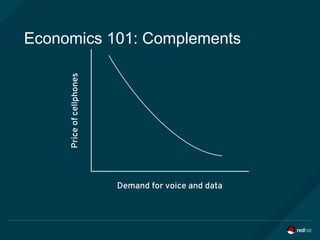
Economics 101: Complements
Complements of open source
• Services
• Software
• Hardware
• Documentation
• Advertising
• Support
• Consulting
• Training
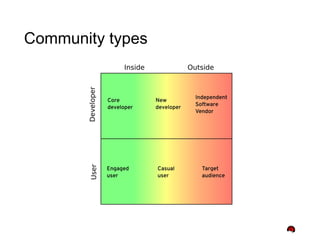
Community types
• User & Deployer communities
• Engaged user – Want to share experiences, help others advocate project
• Deployer/developer – Packagers, integrators, documentation, translation,
people who bridge code to user
• Core developer communities
• Extension developer – plug-ins, extensions, integration with 3rd party
applications
• Core developer – Core code
Community types
Target audience
• Education
• What problems do I solve?
• How do I fit into what people know?
• Promotion
• Channels (blogs, conferences)
• Press and analyst relations
• Marketing message on website
• Download and install process
Example: Linux
• 1990s: Unix market fragmentation
• Late 1990s: Linux begins to disrupt – adopted by Oracle, IBM as
standard platform
• Linux use-cases expanded – HPC, embedded
• 2015: Operating system is a commodity
Example: Red Hat
• 1990s: Red Hat solves a pain point for early Linux users – how to install
and integrate many independent pieces of software
• Late 1990s: Oracle and others choose Red Hat Linux to standardise
packaging and delivery
• Early 2000s: Red Hat successfully leverages early adoption through
application certification and high standard of support to grow
subscription revenues
• 2015: Red Hat has $2bn in revenues, 70% from Linux business
Example: IBM
• Late 1990s: IBM invested in Apache and Linux
• Leverage Linux on IBM z Series, and Power64
• Grew huge services organisation around operationalisation of open
source in enterprise
Example: O'Reilly and Associates
• 1993: Began publishing books on open source (Perl, system
administration)
• 1999: Began running OSCON, the Open Source Convention
• Leading technical editor, event organiser
Example: Google
• Uses open source to run core business (advertising, search)
• Android – open source mobile platform – disrupted mobile OS market
(Symbian dominated) by enabling OEMs to modify core platform
• Built on open source Java platform
Remember: There is no open
source business model
Only people using open source as a development and/or
distribution model, and leveraging that market to sell
complementary goods
Thank you!
Image credit: opensource.com
Dave Neary <dneary@redhat.com>
SDN/NFV Community Strategy

Open source business models

  • 1.
    Open source businessmodels How do you make money giving stuff away, anyway? Dave Neary SDN/NFV Community Strategy, Red Hat April 2017
  • 2.
    Introductions • Dave Neary •SDN/NFV Community Strategy at Red Hat • 20 years in Free/Open Source Software • @nearyd on Twitter for live tweets
  • 3.
    How do youmake money?
  • 5.
    Why do companiesrelease code as open source?
  • 6.
  • 7.
    “We want tocreate a community” Why?
  • 8.
    Reasons to createa community • Market education – seed new technology • Lead generation – want to grow sales • Ecosystem enablement – provide a low-touch way for people to integrate with your platform • Portfolio leverage – seed market with core tech to up-sell • Competitive hedge – first to market with open source, or undermining proprietary competitor • ...
  • 9.
    Why do companiesrelease code as open source?
  • 10.
  • 11.
    Economics of OpenSource • Open Source drives licensing costs for software to zero • “Cost” is not just money • Maximise demand, mindshare
  • 12.
  • 13.
    Open Source asa substitute • Compelling open source projects undermine demand for proprietary alternatives • “Innovator's Dilemma” - difficult for proprietary companies to react
  • 14.
    How do youmake money?
  • 15.
  • 16.
    Complements of opensource • Services • Software • Hardware • Documentation • Advertising • Support • Consulting • Training
  • 17.
    Community types • User& Deployer communities • Engaged user – Want to share experiences, help others advocate project • Deployer/developer – Packagers, integrators, documentation, translation, people who bridge code to user • Core developer communities • Extension developer – plug-ins, extensions, integration with 3rd party applications • Core developer – Core code
  • 18.
  • 19.
    Target audience • Education •What problems do I solve? • How do I fit into what people know? • Promotion • Channels (blogs, conferences) • Press and analyst relations • Marketing message on website • Download and install process
  • 20.
    Example: Linux • 1990s:Unix market fragmentation • Late 1990s: Linux begins to disrupt – adopted by Oracle, IBM as standard platform • Linux use-cases expanded – HPC, embedded • 2015: Operating system is a commodity
  • 21.
    Example: Red Hat •1990s: Red Hat solves a pain point for early Linux users – how to install and integrate many independent pieces of software • Late 1990s: Oracle and others choose Red Hat Linux to standardise packaging and delivery • Early 2000s: Red Hat successfully leverages early adoption through application certification and high standard of support to grow subscription revenues • 2015: Red Hat has $2bn in revenues, 70% from Linux business
  • 22.
    Example: IBM • Late1990s: IBM invested in Apache and Linux • Leverage Linux on IBM z Series, and Power64 • Grew huge services organisation around operationalisation of open source in enterprise
  • 23.
    Example: O'Reilly andAssociates • 1993: Began publishing books on open source (Perl, system administration) • 1999: Began running OSCON, the Open Source Convention • Leading technical editor, event organiser
  • 24.
    Example: Google • Usesopen source to run core business (advertising, search) • Android – open source mobile platform – disrupted mobile OS market (Symbian dominated) by enabling OEMs to modify core platform • Built on open source Java platform
  • 25.
    Remember: There isno open source business model Only people using open source as a development and/or distribution model, and leveraging that market to sell complementary goods
  • 26.
    Thank you! Image credit:opensource.com Dave Neary <dneary@redhat.com> SDN/NFV Community Strategy