
DevOps Practice- Exec Level Briefing
Ravi Tadwalkar’s Point of View
• DevOps Practice
• DevOps Assessment Model
• DevOps Assessment Deliverables
• Key Takeaways
2
Contents
DevOps Practice
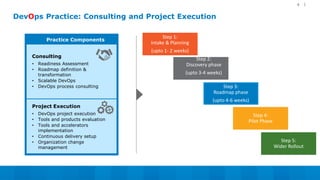
DevOps Practice: Consulting and Project Execution
Practice Components
Consulting
• Readiness Assessment
• Roadmap definition &
transformation
• Scalable DevOps
• DevOps process consulting
Project Execution
• DevOps project execution
• Tools and products evaluation
• Tools and accelerators
implementation
• Continuous delivery setup
• Organization change
management
4
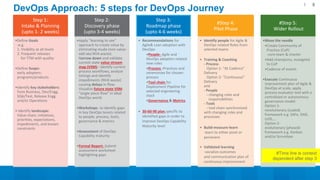
Step 1:
Intake & Planning
(upto 1- 2 weeks)
Step 2:
Discovery phase
(upto 3-4 weeks)
Step 3:
Roadmap phase
(upto 4-6 weeks)
Step 4:
Pilot Phase
Step 5:
Wider Rollout
Step 1:
Intake & Planning
(upto 1- 2 weeks)
•Define Goals
-e.g.
1. Visibility at all levels
2. Frequent releases
for TTM with quality
•Define Scope:
early adopters-
programs/products
•Identify key stakeholders:
from Business, Dev/Engg,
SQA/Test, Release Engg
and/or Operations
• Identify landscape:
Value chain, initiatives,
priorities, expectations,
impediments, and known
constraints
Step 2:
Discovery phase
(upto 3-4 weeks)
•Apply "learning to see”
approach to create value by
eliminating muda (non-value-
add aka NVA waste).
Narrow down and validate
current state value stream
map (VSM)– identify current
process workflows, analyze
timings and identify
impediments (NVA waste)
causing delays in flow.
Visualize future state VSM-
“single piece flow” in ideal
DevOps world.
•Workshops- to identify gaps
in key DevOps tenets related
to people, process, tools,
governance & metrics
•Assessment of DevOps
Capability maturity
•Formal Report- Submit
assessment worksheet
highlighting gaps
Step 3:
Roadmap phase
(upto 4-6 weeks)
• Recommendations for
Agile& Lean adoption with
DevOps-
•People- Agile and
DevOps adoption related
new roles
•Process -Practices and
ceremonies for chosen
process
•Tool chain for
Deployment Pipeline for
selected engineering
stack
•Governance & Metrics
• 30-60-90 plan specific to
identified gaps in order to
improve DevOps Capability
Maturity level
#Step 4:
Pilot Phase
• Identify people for Agile &
DevOps related Roles from
selected teams
• Training & Coaching
- Process
Option 1- “At Cadence”
Delivery
Option 2- “Continuous”
Delivery
and
- People
- changing roles and
responsibilities
- Tools
- tool chain synchronized
with changing roles and
processes
• Build-measure-learn
-learn to either pivot or
persevere
• Validated learning
-socialize outcomes
and communication plan of
continuous improvement
#Step 5:
Wider Rollout
•Move the needle
•Create Community of
Practice (CoP)
-core team & charter
•Add champions, evangelist
to CoP
•Cadence of events
•Execute Continuous
improvement plan of Agile &
DevOps at scale, apply
process evaluator tool with a
centralized or autonomous
governance model:
Option 1-
revolutionary (scaled)
framework e.g. SAFe, DAD,
LeSS,…
Option 2-
evolutionary (phased)
framework e.g. Kanban
and/or Scrumban
5
DevOps Approach: 5 steps for DevOps Journey
#Time line is context
dependent after step 3
DevOps Assessment Model
6
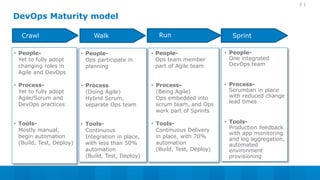
DevOps Maturity model
7
• People-
Yet to fully adopt
changing roles in
Agile and DevOps
• Process-
Yet to fully adopt
Agile/Scrum and
DevOps practices
• Tools-
Mostly manual,
begin automation
(Build, Test, Deploy)
• People-
Ops participate in
planning
• Process
(Doing Agile)
Hybrid Scrum,
separate Ops team
• Tools-
Continuous
Integration in place,
with less than 50%
automation
(Build, Test, Deploy)
• People-
Ops team member
part of Agile team
• Process-
(Being Agile)
Ops embedded into
scrum team, and Ops
work part of Sprints
• Tools-
Continuous Delivery
in place, with 70%
automation
(Build, Test, Deploy)
Crawl Walk Run Sprint
• People-
One integrated
DevOps team
• Process-
Scrumban in place
with reduced change
lead times
• Tools-
Production feedback
with app monitoring
and log aggregation,
automated
environment
provisioning
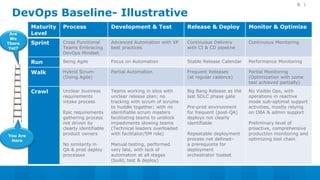
DevOps Baseline- Illustrative
Maturity
Level
Process Development & Test Release & Deploy Monitor & Optimize
Sprint Cross Functional
Teams Embracing
DevOps Mindset
Advanced Automation with XP
best practices
Continuous Delivery
with CI & CD pipeline
Continuous Monitoring
Run Being Agile Focus on Automation Stable Release Calendar Performance Monitoring
Walk Hybrid Scrum
(Doing Agile)
Partial Automation Frequent Releases
(at regular cadence)
Partial Monitoring
(Optimization with some
tool achieved partially)
Crawl Unclear business
requirements
intake process
Epic requirements
gathering process
not driven by
clearly identifiable
product owners
No similarity in
QA & prod deploy
processes
Teams working in silos with
unclear release plan; no
tracking with scrum of scrums
to huddle together; with no
identifiable scrum masters
facilitating teams to unblock
impediments slowing teams
(Technical leaders overloaded
with facilitator/SM role)
Manual testing, performed
very late, with lack of
automation at all stages
(build, test & deploy)
Big Bang Release as the
last SDLC phase gate
Pre-prod environment
for frequent (post-QA)
deploys not clearly
identifiable
Repeatable deployment
process not defined–
a prerequisite for
deployment
orchestrator toolset
No Visible Ops, with
operations in reactive
mode sub-optimal support
activities, mostly relying
on DBA & admin support
Preliminary level of
proactive, comprehensive
production monitoring and
optimizing tool chain
You Are
Here
8
Are
We
There
Yet?
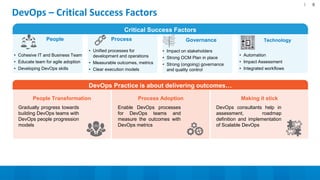
DevOps – Critical Success Factors
People
• Cohesive IT and Business Team
• Educate team for agile adoption
• Developing DevOps skills
People Transformation Process Adoption Making it stick
Gradually progress towards
building DevOps teams with
DevOps people progression
models
Enable DevOps processes
for DevOps teams and
measure the outcomes with
DevOps metrics
DevOps consultants help in
assessment, roadmap
definition and implementation
of Scalable DevOps
Critical Success Factors
DevOps Practice is about delivering outcomes…
• Unified processes for
development and operations
• Measurable outcomes, metrics
• Clear execution models
Process
• Impact on stakeholders
• Strong OCM Plan in place
• Strong (ongoing) governance
and quality control
Governance Technology
• Automation
• Impact Assessment
• Integrated workflows
9
10
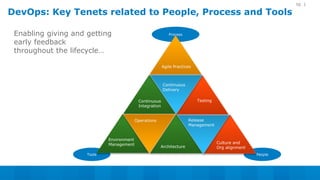
DevOps: Key Tenets related to People, Process and Tools
Tools People
Enabling giving and getting
early feedback
throughout the lifecycle…
Process
Continuous
Delivery
Agile Practices
Continuous
Integration
Testing
Environment
Management
Operations
Architecture
Release
Management
Culture and
Org alignment
11
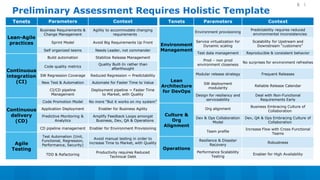
Tenets Parameters Context
Lean-Agile
practices
Business Requirements &
Change Management
Agility to accommodate changing
requirements
Sprint Model Avoid Big Requirements Up Front
Self organized teams Needs Leader, not commander
Continuous
integration
(CI)
Build automation Stabilize Release Management
Code quality metrics
Quality Built-In rather than
afterthought
SW Regression Coverage Reduced Regression ~ Predictability
New Test & Automation Automate for Faster Time to Value
CI/CD pipeline
Management
Deployment pipeline ~ Faster Time
to Market, with Quality
Continuous
delivery
(CD)
Code Promotion Model No more “But it works on my system”
Application Deployment Enabler for Business Agility
Predictive Monitoring &
Analytics
Amplify Feedback Loops amongst
Business, Dev, QA & Operations
CD pipeline management Enabler for Environment Provisioning
Agile
Testing
Test Automation (Unit,
Functional, Regression,
Performance, Security)
Avoid manual testing in order to
increase Time to Market, with Quality
TDD & Refactoring
Productivity requires Reduced
Technical Debt
Tenets Parameters Context
Environment
Management
Environment provisioning
Predictability requires reduced
environmental inconsistencies
Service virtualization for
Dynamic scaling
Scalability for Upstream and
Downstream “customers”
Test data management Reproducible & consistent behavior
Prod – non prod
environment closeness
No surprises for environment refreshes
Lean
Architecture
for DevOps
Modular release strategy Frequent Releases
SW deployment
modularity
Reliable Release Calendar
Design for resiliency and
serviceability
Deal with Non-Functional
Requirements Early
Culture &
Org
Alignment
Org alignment
Business Embracing Culture of
Collaboration
Dev & Ops Collaboration
Model
Dev, QA & Ops Embracing Culture of
Collaboration
Team profile
Increase Flow with Cross-Functional
Teams
Operations
Resilience & Disaster
Recovery
Robustness
Performance Scalability
Testing
Enabler for High Availability
Preliminary Assessment Requires Holistic Template
8
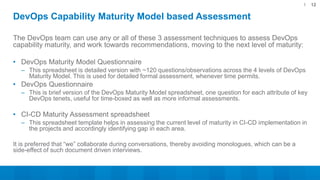
The DevOps team can use any or all of these 3 assessment techniques to assess DevOps
capability maturity, and work towards recommendations, moving to the next level of maturity:
• DevOps Maturity Model Questionnaire
– This spreadsheet is detailed version with ~120 questions/observations across the 4 levels of DevOps
Maturity Model. This is used for detailed formal assessment, whenever time permits.
• DevOps Questionnaire
– This is brief version of the DevOps Maturity Model spreadsheet, one question for each attribute of key
DevOps tenets, useful for time-boxed as well as more informal assessments.
• CI-CD Maturity Assessment spreadsheet
– This spreadsheet template helps in assessing the current level of maturity in CI-CD implementation in
the projects and accordingly identifying gap in each area.
It is preferred that “we” collaborate during conversations, thereby avoiding monologues, which can be a
side-effect of such document driven interviews.
12
DevOps Capability Maturity Model based Assessment
DevOps Assessment Deliverables
13
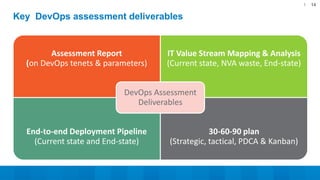
Assessment Report
(on DevOps tenets & parameters)
IT Value Stream Mapping & Analysis
(Current state, NVA waste, End-state)
End-to-end Deployment Pipeline
(Current state and End-state)
30-60-90 plan
(Strategic, tactical, PDCA & Kanban)
DevOps Assessment
Deliverables
14
Key DevOps assessment deliverables
Key Takeaways
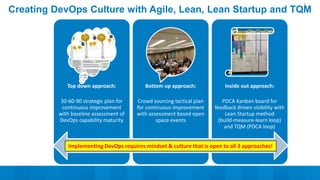
Creating DevOps Culture with Agile, Lean, Lean Startup and TQM
Top down approach:
30-60-90 strategic plan for
continuous improvement
with baseline assessment of
DevOps capability maturity
Bottom up approach:
Crowd sourcing tactical plan
for continuous improvement
with assessment based open
space events
Inside out approach:
PDCA Kanban board for
feedback driven visibility with
Lean Startup method
(build-measure-learn loop)
and TQM (PDCA loop)
Implementing DevOps requires mindset & culture that is open to all 3 approaches!
• DevOps is all about giving & getting feedback across stakeholders in the
IT value stream & business
• DevOps doesn't come in one box.. It’s a journey.. Goal is important
• DevOps is more than tooling .. It involves ways of working, process, and
culture
17
Summary
Thank you

DevOps- exec level briefing

  • 1.
    DevOps Practice- ExecLevel Briefing Ravi Tadwalkar’s Point of View
  • 2.
    • DevOps Practice •DevOps Assessment Model • DevOps Assessment Deliverables • Key Takeaways 2 Contents
  • 3.
  • 4.
    DevOps Practice: Consultingand Project Execution Practice Components Consulting • Readiness Assessment • Roadmap definition & transformation • Scalable DevOps • DevOps process consulting Project Execution • DevOps project execution • Tools and products evaluation • Tools and accelerators implementation • Continuous delivery setup • Organization change management 4 Step 1: Intake & Planning (upto 1- 2 weeks) Step 2: Discovery phase (upto 3-4 weeks) Step 3: Roadmap phase (upto 4-6 weeks) Step 4: Pilot Phase Step 5: Wider Rollout
  • 5.
    Step 1: Intake &Planning (upto 1- 2 weeks) •Define Goals -e.g. 1. Visibility at all levels 2. Frequent releases for TTM with quality •Define Scope: early adopters- programs/products •Identify key stakeholders: from Business, Dev/Engg, SQA/Test, Release Engg and/or Operations • Identify landscape: Value chain, initiatives, priorities, expectations, impediments, and known constraints Step 2: Discovery phase (upto 3-4 weeks) •Apply "learning to see” approach to create value by eliminating muda (non-value- add aka NVA waste). Narrow down and validate current state value stream map (VSM)– identify current process workflows, analyze timings and identify impediments (NVA waste) causing delays in flow. Visualize future state VSM- “single piece flow” in ideal DevOps world. •Workshops- to identify gaps in key DevOps tenets related to people, process, tools, governance & metrics •Assessment of DevOps Capability maturity •Formal Report- Submit assessment worksheet highlighting gaps Step 3: Roadmap phase (upto 4-6 weeks) • Recommendations for Agile& Lean adoption with DevOps- •People- Agile and DevOps adoption related new roles •Process -Practices and ceremonies for chosen process •Tool chain for Deployment Pipeline for selected engineering stack •Governance & Metrics • 30-60-90 plan specific to identified gaps in order to improve DevOps Capability Maturity level #Step 4: Pilot Phase • Identify people for Agile & DevOps related Roles from selected teams • Training & Coaching - Process Option 1- “At Cadence” Delivery Option 2- “Continuous” Delivery and - People - changing roles and responsibilities - Tools - tool chain synchronized with changing roles and processes • Build-measure-learn -learn to either pivot or persevere • Validated learning -socialize outcomes and communication plan of continuous improvement #Step 5: Wider Rollout •Move the needle •Create Community of Practice (CoP) -core team & charter •Add champions, evangelist to CoP •Cadence of events •Execute Continuous improvement plan of Agile & DevOps at scale, apply process evaluator tool with a centralized or autonomous governance model: Option 1- revolutionary (scaled) framework e.g. SAFe, DAD, LeSS,… Option 2- evolutionary (phased) framework e.g. Kanban and/or Scrumban 5 DevOps Approach: 5 steps for DevOps Journey #Time line is context dependent after step 3
  • 6.
  • 7.
    DevOps Maturity model 7 •People- Yet to fully adopt changing roles in Agile and DevOps • Process- Yet to fully adopt Agile/Scrum and DevOps practices • Tools- Mostly manual, begin automation (Build, Test, Deploy) • People- Ops participate in planning • Process (Doing Agile) Hybrid Scrum, separate Ops team • Tools- Continuous Integration in place, with less than 50% automation (Build, Test, Deploy) • People- Ops team member part of Agile team • Process- (Being Agile) Ops embedded into scrum team, and Ops work part of Sprints • Tools- Continuous Delivery in place, with 70% automation (Build, Test, Deploy) Crawl Walk Run Sprint • People- One integrated DevOps team • Process- Scrumban in place with reduced change lead times • Tools- Production feedback with app monitoring and log aggregation, automated environment provisioning
  • 8.
    DevOps Baseline- Illustrative Maturity Level ProcessDevelopment & Test Release & Deploy Monitor & Optimize Sprint Cross Functional Teams Embracing DevOps Mindset Advanced Automation with XP best practices Continuous Delivery with CI & CD pipeline Continuous Monitoring Run Being Agile Focus on Automation Stable Release Calendar Performance Monitoring Walk Hybrid Scrum (Doing Agile) Partial Automation Frequent Releases (at regular cadence) Partial Monitoring (Optimization with some tool achieved partially) Crawl Unclear business requirements intake process Epic requirements gathering process not driven by clearly identifiable product owners No similarity in QA & prod deploy processes Teams working in silos with unclear release plan; no tracking with scrum of scrums to huddle together; with no identifiable scrum masters facilitating teams to unblock impediments slowing teams (Technical leaders overloaded with facilitator/SM role) Manual testing, performed very late, with lack of automation at all stages (build, test & deploy) Big Bang Release as the last SDLC phase gate Pre-prod environment for frequent (post-QA) deploys not clearly identifiable Repeatable deployment process not defined– a prerequisite for deployment orchestrator toolset No Visible Ops, with operations in reactive mode sub-optimal support activities, mostly relying on DBA & admin support Preliminary level of proactive, comprehensive production monitoring and optimizing tool chain You Are Here 8 Are We There Yet?
  • 9.
    DevOps – CriticalSuccess Factors People • Cohesive IT and Business Team • Educate team for agile adoption • Developing DevOps skills People Transformation Process Adoption Making it stick Gradually progress towards building DevOps teams with DevOps people progression models Enable DevOps processes for DevOps teams and measure the outcomes with DevOps metrics DevOps consultants help in assessment, roadmap definition and implementation of Scalable DevOps Critical Success Factors DevOps Practice is about delivering outcomes… • Unified processes for development and operations • Measurable outcomes, metrics • Clear execution models Process • Impact on stakeholders • Strong OCM Plan in place • Strong (ongoing) governance and quality control Governance Technology • Automation • Impact Assessment • Integrated workflows 9
  • 10.
    10 DevOps: Key Tenetsrelated to People, Process and Tools Tools People Enabling giving and getting early feedback throughout the lifecycle… Process Continuous Delivery Agile Practices Continuous Integration Testing Environment Management Operations Architecture Release Management Culture and Org alignment
  • 11.
    11 Tenets Parameters Context Lean-Agile practices BusinessRequirements & Change Management Agility to accommodate changing requirements Sprint Model Avoid Big Requirements Up Front Self organized teams Needs Leader, not commander Continuous integration (CI) Build automation Stabilize Release Management Code quality metrics Quality Built-In rather than afterthought SW Regression Coverage Reduced Regression ~ Predictability New Test & Automation Automate for Faster Time to Value CI/CD pipeline Management Deployment pipeline ~ Faster Time to Market, with Quality Continuous delivery (CD) Code Promotion Model No more “But it works on my system” Application Deployment Enabler for Business Agility Predictive Monitoring & Analytics Amplify Feedback Loops amongst Business, Dev, QA & Operations CD pipeline management Enabler for Environment Provisioning Agile Testing Test Automation (Unit, Functional, Regression, Performance, Security) Avoid manual testing in order to increase Time to Market, with Quality TDD & Refactoring Productivity requires Reduced Technical Debt Tenets Parameters Context Environment Management Environment provisioning Predictability requires reduced environmental inconsistencies Service virtualization for Dynamic scaling Scalability for Upstream and Downstream “customers” Test data management Reproducible & consistent behavior Prod – non prod environment closeness No surprises for environment refreshes Lean Architecture for DevOps Modular release strategy Frequent Releases SW deployment modularity Reliable Release Calendar Design for resiliency and serviceability Deal with Non-Functional Requirements Early Culture & Org Alignment Org alignment Business Embracing Culture of Collaboration Dev & Ops Collaboration Model Dev, QA & Ops Embracing Culture of Collaboration Team profile Increase Flow with Cross-Functional Teams Operations Resilience & Disaster Recovery Robustness Performance Scalability Testing Enabler for High Availability Preliminary Assessment Requires Holistic Template 8
  • 12.
    The DevOps teamcan use any or all of these 3 assessment techniques to assess DevOps capability maturity, and work towards recommendations, moving to the next level of maturity: • DevOps Maturity Model Questionnaire – This spreadsheet is detailed version with ~120 questions/observations across the 4 levels of DevOps Maturity Model. This is used for detailed formal assessment, whenever time permits. • DevOps Questionnaire – This is brief version of the DevOps Maturity Model spreadsheet, one question for each attribute of key DevOps tenets, useful for time-boxed as well as more informal assessments. • CI-CD Maturity Assessment spreadsheet – This spreadsheet template helps in assessing the current level of maturity in CI-CD implementation in the projects and accordingly identifying gap in each area. It is preferred that “we” collaborate during conversations, thereby avoiding monologues, which can be a side-effect of such document driven interviews. 12 DevOps Capability Maturity Model based Assessment
  • 13.
  • 14.
    Assessment Report (on DevOpstenets & parameters) IT Value Stream Mapping & Analysis (Current state, NVA waste, End-state) End-to-end Deployment Pipeline (Current state and End-state) 30-60-90 plan (Strategic, tactical, PDCA & Kanban) DevOps Assessment Deliverables 14 Key DevOps assessment deliverables
  • 15.
  • 16.
    Creating DevOps Culturewith Agile, Lean, Lean Startup and TQM Top down approach: 30-60-90 strategic plan for continuous improvement with baseline assessment of DevOps capability maturity Bottom up approach: Crowd sourcing tactical plan for continuous improvement with assessment based open space events Inside out approach: PDCA Kanban board for feedback driven visibility with Lean Startup method (build-measure-learn loop) and TQM (PDCA loop) Implementing DevOps requires mindset & culture that is open to all 3 approaches!
  • 17.
    • DevOps isall about giving & getting feedback across stakeholders in the IT value stream & business • DevOps doesn't come in one box.. It’s a journey.. Goal is important • DevOps is more than tooling .. It involves ways of working, process, and culture 17 Summary
  • 18.

Editor's Notes

  • #4 d) CI is starting of the DevOps but How can we make CI consumable by other groups?
  • #17 Implementing DevOps with agile, lean, lean startup and TQM 1. Top down approach: 30-60-90 planning 2. Bottom up approach: crowd sourcing with agile cafe event 3. Inside out approach: continuous improvement Kanban board with build-measure-learn and PDCA loops