ADVANTAGES &
DISADVANTAGES
• OPEN-SOURCE VS. PROPRIETARY SOFTWARE
• Operating Systems
• Apache & IIS
• Applications
March 2019
Fleurat Govori
CONTENT
• Open-Source vs. Proprietary Software
• Open-Source Software/OS
• Advantages
• Disadvantages
• Proprietary Software/OS
• Advantages
• Disadvantages
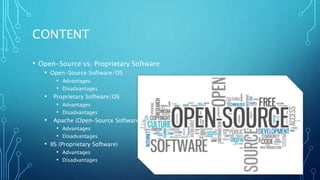
• Apache (Open-Source Software)
• Advantages
• Disadvantages
• IIS (Proprietary Software)
• Advantages
• Disadvantages
OPEN-SOURCE SOFTWARE/OS
OPEN-SOURCE SOFTWARE/OS -
ADVANTAGES
FREE TO TRY BEFORE YOU BUY
• Community open source is completely free to anyone to
download, including source code, for evaluation. Even
Commercial Open-Source vendors usually have a free version
of their software packages, which includes source code. In fact,
much open source software, especially OSs, are available as
“live” media, which means you need not actually install the
software but instead run it directly from a DVD or USB flash
drive.
OPEN-SOURCE SOFTWARE/OS -
ADVANTAGES
FREE SUPPORT
• Whether an open source package is being evaluated or
integrated commercially, it has the same global community of
users and developers available for asking questions and advice.
Support includes detailed documentation, forums, wikis,
newsgroups, email lists and live chat. None of this costs
anything except time.
OPEN-SOURCE SOFTWARE/OS -
ADVANTAGES
OPEN STANDARDS
• Open source communities are leery of proprietary standards,
preferring instead to adhere to open standards around
communication protocols and data formats. This aspect
meaningfully improves interoperability within and between
open source and proprietary software including OSs, which in
turn means a high level of interoperability for business and
customer applications as well.
OPEN-SOURCE SOFTWARE/OS -
ADVANTAGES
FEWER BUGS AND FASTER FIXES
• Because large open source software projects can literally have
millions of eyes examining the source code, there is a much
higher probability that more bugs are exposed compared to the
code from a proprietary vendor with a far smaller development
staff. Furthermore, open source communities are typically quick
to implement a fix or report a workaround. Additionally, since
the source code comes with the software, customers are free to
apply their own patches at will.
OPEN-SOURCE SOFTWARE/OS -
ADVANTAGES
BETTER SECURITY
• A side effect of the above point is that open source software is
more secure overall. Since the security of proprietary software
vendors depends to some extent on their source code being
opaque, it does not follow that security bugs are not present in
their software. It is more probable that the security holes have
simply not been found yet.
OPEN-SOURCE SOFTWARE/OS -
ADVANTAGES
AVOIDS VENDOR LOCK-IN
• Except in the case of COSS, there is minimal reliance on a
single vendor or group for continued improvements,
maintenance and support for open source software.
Additionally, since the open source community is distributed
and diverse, there is little risk that you will end up holding
orphaned software, which would be the case if the proprietary
vendor were to fold or abandon their project.
OPEN-SOURCE SOFTWARE/OS -
DISADVANTAGES
REDUCED COMPETITIVE ADVANTAGE
• If an enterprise is also a software vendor, then building
products on open source code affects the revenue model for
the enterprise’s software depending on the open source
licensing agreement. Also, an organization’s core competency
could be partially diluted if the value of the proprietary code
built on top of the open source platform is not enough to offset
the lowered barrier to entry of competitors that could build a
similar product on top of the same open source code.
OPEN-SOURCE SOFTWARE/OS -
DISADVANTAGES
MINIMAL SUPPORT LEVERAGE
• Large open source projects have a vast, supportive community
that provides documentation, tools and support systems to
back up users of the software. Free support is not always the
fastest support, however, especially if the enterprise is seeking
a solution to a thorny problem resulting from seemingly
random code bugs, design flaws or integration difficulties.
Larger enterprises with the ability to pay for top-tier support
packages can expect prompt and detailed attention that is
rarely available from open source communities.
OPEN-SOURCE SOFTWARE/OS -
DISADVANTAGES
USABILITY
• Open source projects, are complex packages of software that
are not as closely aimed at markets of unskilled end users as is
much proprietary software. Unskilled users will never look at
the source code let alone compile it. This aspect explains why
open source Apache Web Server is the leading deployment in
data centers, but desktop Linux has barely penetrated the PC
market where alternate, easy-to-use products already exist
that do not have to compete based on high performance
metrics.
OPEN-SOURCE SOFTWARE/OS -
DISADVANTAGES
INCREASED BUSINESS RISK
• Aside from Red Hat, large financially strong open source
software vendors are few and far between. Although great
products may come from smaller, more nimble companies,
there is a significantly higher risk that they will not be there
when you need them the most.
OPEN-SOURCE SOFTWARE/OS -
DISADVANTAGES
INCREASED BUSINESS RISK
• Aside from Red Hat, large financially strong open source
software vendors are few and far between. Although great
products may come from smaller, more nimble companies,
there is a significantly higher risk that they will not be there
when you need them the most.
PROPRIETARY SOFTWARE/OS
PROPRIETARY SOFTWARE/OS -
ADVANTAGES
USABILITY
• Commercial, proprietary products are typically designed with a
smaller scope of features and abilities. They are focused on a
narrower market of end users than those products developed
within open source communities. Commercial vendors’ users
may include developers utilizing a firm’s APIs and libraries, but
they are just as often to be composed of application users more
concerned with ease-of-use and functionality than how those
aspects are accomplished behind the screen.
PROPRIETARY SOFTWARE/OS -
ADVANTAGES
PRODUCT STABILITY
• Commercial, proprietary products are typically designed with a
smaller scope of features and abilities. They are focused on a
narrower market of end users than those products developed
within open source communities. Commercial vendors’ users
may include developers utilizing a firm’s APIs and libraries, but
they are just as often to be composed of application users more
concerned with ease-of-use and functionality than how those
aspects are accomplished behind the screen.
PROPRIETARY SOFTWARE/OS -
ADVANTAGES
OWNERSHIP
• A company building upon proprietary software may pay a
bigger fee for acquisition, but typically that acquisition includes
full rights to the ownership of their own software product and
the expectation that the vendor will promptly supply them with
updates, bug fixes and revised documentation as new product
versions are released.
PROPRIETARY SOFTWARE/OS -
ADVANTAGES
TAILORED SUPPORT
• Customer support packages from larger closed source vendors
are specifically designed and fine-tuned for their own products
over many years. Since the scope of their software is typically
narrower than that from open source projects, training and
after-sale support is more complete, accessible and succinct.
There is a huge difference between posing questions in an
online open source forum compared to receiving support
directly from technical reps or consultants from a proprietary
software firm, especially at integration time.
PROPRIETARY SOFTWARE/OS -
DISADVANTAGES
DEPENDENCY
• Customers of closed source software companies are more or
less at the whim of where their software supplier wants to take
them. They have minimal influence, unless they are their
number one customer, of influencing the vendor’s priorities,
timelines and pricing structure. To change vendors once their
software has become embedded within your enterprise is likely
to be prohibitively expensive.
PROPRIETARY SOFTWARE/OS -
DISADVANTAGES
SOFTWARE OPACITY
• By definition, the internals of closed source software are closed
to viewing. Users of this software are unable to modify the code
let alone debug it effectively. They are only able to supply error
codes, messages and dump stacks to the vendor and wait for a
fix if there is no existing workaround or patch. Such fixes may
not be anywhere near the top of their priority list. This opacity
also means that it is usually more difficult for customers to
make customizations or optimizations in their final product.
APACHE VS IIS
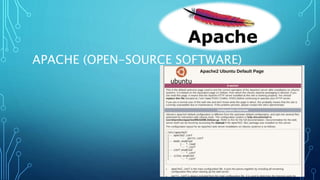
APACHE (OPEN-SOURCE SOFTWARE)
APACHE (OPEN-SOURCE SOFTWARE) -
ADVANTAGES
• It is free and open-source software that can be used on any
operating system, including Linux, Unix, Windows and Mac OS.
• Bug fixing and the development of new features is handled by the
developer community and managed by the Apache Software
Foundation, a nonprofit corporation which supports the Apache Web
server.
• Apache is a very feature-rich Web server. Features are introduced as
modules that extend the core functionality. Some of the modules
come with Apache itself, while others can be manually installed. Since
the code is open, anyone can create and publish a new module with
additional functionalities.
APACHE (OPEN-SOURCE SOFTWARE) -
DISADVANTAGES
• Although Apache Web server has generally good performance, it
consumes a lot of CPU and memory because of the two main reasons.
One reason is a big number of included features which are not being
used, while the other is the fact that it is a process-based server.
That means that each connection requires a separate thread.
• Sometimes a little hard to patch.
• If you're not careful with the settings, you can easily provide too
much information about your server to people you don't want to.
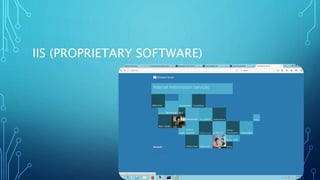
IIS (PROPRIETARY SOFTWARE)
IIS (PROPRIETARY SOFTWARE) -
ADVANTAGES
• The server itself is free, but it can run only on Windows operating
systems, thus incurring indirect licensing costs.
• Microsoft IIS handles has a good number of features. Similar to
Apache, features are included as extensions. However, IIS extensions
are developed only by Microsoft.
• According to some tests, IIS is faster than Apache. It consumes less
CPU, has better response time and can handle more requests per
second. However, it should be noted that the tests are not 100%
reliable, as they are usually running on a different software stacks (IIS
.NET, Apache PHP).
IIS (PROPRIETARY SOFTWARE) -
DISADVANTAGES
• IIS is a proprietary software, meaning that the code is closed and not
available to public. New features, bug fixes and support is provided
by Microsoft. Although the development is not as quick as with the
community support, it can be more reliable.
• Unlike Apache, IIS is installed on Windows operating systems and its
applications are using ASP.NET and MSSQL databases
• The performance of Microsoft IIS is always slightly behind more lean
web servers like Apache and NGINX.
APACHE VS IIS
PERFORMANCE TEST (SAMPLE)
• The test will measure the following parameters:
• Latency response time (in ms) — the time between sending the request and
receiving initial response
• Sample time (in ms) — the time needed to fully serve the request i.e. latency
+ response
• Measurements will be taken by using a popular benchmarking tool —
Apache JMeter. JMeter will be configured to run 20 connections spread over
10 seconds, i.e. 2 requests per second. Note that the result numbers should
be only compared between the Web servers and not viewed as absolute
numbers, as the number of simultaneous connections depends on the PC on
which Apache JMeter is running.
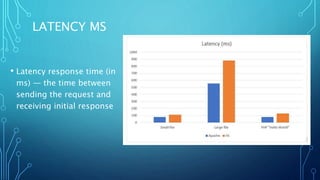
LATENCY MS
• Latency response time (in
ms) — the time between
sending the request and
receiving initial response
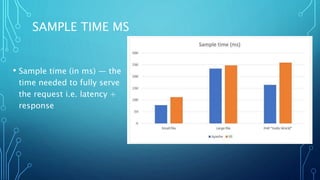
SAMPLE TIME MS
• Sample time (in ms) — the
time needed to fully serve
the request i.e. latency +
response
APACHE VS IIS
CONCLUSION
• In this test, Apache was significantly faster than IIS in both
latency and response time in all categories. For further
research, it would be interesting to run the same test on more
powerful hardware configuration. It would also be interesting to
compare the speed of a PHP 7 application on Apache 2 and
ASP.NET application on IIS 8.
ADVANTAGES (CONCLUSION)
IIS
• Easy to deploy and minimum time for
the first startup.
• Supports a large variety of web
technologies.
• Easy website and applications
management.
• The best integration with Microsoft
AD for user authentication.
• It is regularly patched.
APACHE
• Great handling of virtual hosts.
• Works extremely well with Perl/CGI
and the Mod-Perl module for fast and
reliable execution of server side
scripts.
• Handles serving up web pages well, a
true no muss, no fuss situation.
DISADVANTAGES (CONCLUSION)
IIS
• The performance of Microsoft IIS is always
slightly behind more lean web servers like
Apache and NGINX.
• Microsoft IIS is locked to the Windows
Operating System. For some components (SCCM
and WSUS) you are essentially forced to use IIS,
instead of a more open source Apache or Mono
solution.
• Security concerns over Windows IIS web servers.
While this isn't directly the fault of IIS, since
issues usually occur from vulnerabilities within
the Windows OS.
• IIS is closed source, which does remove
customizability and the ability for the
APACHE
• Sometimes a little hard to patch.
• If you're not careful with the settings, you can
easily provide too much information about your
server to people you don't want to.
• If you're not familiar with text configuration
files, it can get a little hairy, as there is no GUI
interface for setting it up.
REFERENCES
• http://www.optimusinfo.com/downloads/white-paper/open-
source-vs-proprietary-software-pros-and-cons.pdf
• https://www.trustradius.com/compare-products/iis-vs-
apache-web-server
• http://www.devx.com/webdev/performance-comparison-
apache-vs.-iis.html
“
”
THANK YOU FOR
YOUR
ATTENTION
Questions?

Advantages & Disadvantages (Open-Source vs. Proprietary Software)

  • 1.
    ADVANTAGES & DISADVANTAGES • OPEN-SOURCEVS. PROPRIETARY SOFTWARE • Operating Systems • Apache & IIS • Applications March 2019 Fleurat Govori
  • 2.
    CONTENT • Open-Source vs.Proprietary Software • Open-Source Software/OS • Advantages • Disadvantages • Proprietary Software/OS • Advantages • Disadvantages • Apache (Open-Source Software) • Advantages • Disadvantages • IIS (Proprietary Software) • Advantages • Disadvantages
  • 3.
  • 4.
    OPEN-SOURCE SOFTWARE/OS - ADVANTAGES FREETO TRY BEFORE YOU BUY • Community open source is completely free to anyone to download, including source code, for evaluation. Even Commercial Open-Source vendors usually have a free version of their software packages, which includes source code. In fact, much open source software, especially OSs, are available as “live” media, which means you need not actually install the software but instead run it directly from a DVD or USB flash drive.
  • 5.
    OPEN-SOURCE SOFTWARE/OS - ADVANTAGES FREESUPPORT • Whether an open source package is being evaluated or integrated commercially, it has the same global community of users and developers available for asking questions and advice. Support includes detailed documentation, forums, wikis, newsgroups, email lists and live chat. None of this costs anything except time.
  • 6.
    OPEN-SOURCE SOFTWARE/OS - ADVANTAGES OPENSTANDARDS • Open source communities are leery of proprietary standards, preferring instead to adhere to open standards around communication protocols and data formats. This aspect meaningfully improves interoperability within and between open source and proprietary software including OSs, which in turn means a high level of interoperability for business and customer applications as well.
  • 7.
    OPEN-SOURCE SOFTWARE/OS - ADVANTAGES FEWERBUGS AND FASTER FIXES • Because large open source software projects can literally have millions of eyes examining the source code, there is a much higher probability that more bugs are exposed compared to the code from a proprietary vendor with a far smaller development staff. Furthermore, open source communities are typically quick to implement a fix or report a workaround. Additionally, since the source code comes with the software, customers are free to apply their own patches at will.
  • 8.
    OPEN-SOURCE SOFTWARE/OS - ADVANTAGES BETTERSECURITY • A side effect of the above point is that open source software is more secure overall. Since the security of proprietary software vendors depends to some extent on their source code being opaque, it does not follow that security bugs are not present in their software. It is more probable that the security holes have simply not been found yet.
  • 9.
    OPEN-SOURCE SOFTWARE/OS - ADVANTAGES AVOIDSVENDOR LOCK-IN • Except in the case of COSS, there is minimal reliance on a single vendor or group for continued improvements, maintenance and support for open source software. Additionally, since the open source community is distributed and diverse, there is little risk that you will end up holding orphaned software, which would be the case if the proprietary vendor were to fold or abandon their project.
  • 10.
    OPEN-SOURCE SOFTWARE/OS - DISADVANTAGES REDUCEDCOMPETITIVE ADVANTAGE • If an enterprise is also a software vendor, then building products on open source code affects the revenue model for the enterprise’s software depending on the open source licensing agreement. Also, an organization’s core competency could be partially diluted if the value of the proprietary code built on top of the open source platform is not enough to offset the lowered barrier to entry of competitors that could build a similar product on top of the same open source code.
  • 11.
    OPEN-SOURCE SOFTWARE/OS - DISADVANTAGES MINIMALSUPPORT LEVERAGE • Large open source projects have a vast, supportive community that provides documentation, tools and support systems to back up users of the software. Free support is not always the fastest support, however, especially if the enterprise is seeking a solution to a thorny problem resulting from seemingly random code bugs, design flaws or integration difficulties. Larger enterprises with the ability to pay for top-tier support packages can expect prompt and detailed attention that is rarely available from open source communities.
  • 12.
    OPEN-SOURCE SOFTWARE/OS - DISADVANTAGES USABILITY •Open source projects, are complex packages of software that are not as closely aimed at markets of unskilled end users as is much proprietary software. Unskilled users will never look at the source code let alone compile it. This aspect explains why open source Apache Web Server is the leading deployment in data centers, but desktop Linux has barely penetrated the PC market where alternate, easy-to-use products already exist that do not have to compete based on high performance metrics.
  • 13.
    OPEN-SOURCE SOFTWARE/OS - DISADVANTAGES INCREASEDBUSINESS RISK • Aside from Red Hat, large financially strong open source software vendors are few and far between. Although great products may come from smaller, more nimble companies, there is a significantly higher risk that they will not be there when you need them the most.
  • 14.
    OPEN-SOURCE SOFTWARE/OS - DISADVANTAGES INCREASEDBUSINESS RISK • Aside from Red Hat, large financially strong open source software vendors are few and far between. Although great products may come from smaller, more nimble companies, there is a significantly higher risk that they will not be there when you need them the most.
  • 15.
  • 16.
    PROPRIETARY SOFTWARE/OS - ADVANTAGES USABILITY •Commercial, proprietary products are typically designed with a smaller scope of features and abilities. They are focused on a narrower market of end users than those products developed within open source communities. Commercial vendors’ users may include developers utilizing a firm’s APIs and libraries, but they are just as often to be composed of application users more concerned with ease-of-use and functionality than how those aspects are accomplished behind the screen.
  • 17.
    PROPRIETARY SOFTWARE/OS - ADVANTAGES PRODUCTSTABILITY • Commercial, proprietary products are typically designed with a smaller scope of features and abilities. They are focused on a narrower market of end users than those products developed within open source communities. Commercial vendors’ users may include developers utilizing a firm’s APIs and libraries, but they are just as often to be composed of application users more concerned with ease-of-use and functionality than how those aspects are accomplished behind the screen.
  • 18.
    PROPRIETARY SOFTWARE/OS - ADVANTAGES OWNERSHIP •A company building upon proprietary software may pay a bigger fee for acquisition, but typically that acquisition includes full rights to the ownership of their own software product and the expectation that the vendor will promptly supply them with updates, bug fixes and revised documentation as new product versions are released.
  • 19.
    PROPRIETARY SOFTWARE/OS - ADVANTAGES TAILOREDSUPPORT • Customer support packages from larger closed source vendors are specifically designed and fine-tuned for their own products over many years. Since the scope of their software is typically narrower than that from open source projects, training and after-sale support is more complete, accessible and succinct. There is a huge difference between posing questions in an online open source forum compared to receiving support directly from technical reps or consultants from a proprietary software firm, especially at integration time.
  • 20.
    PROPRIETARY SOFTWARE/OS - DISADVANTAGES DEPENDENCY •Customers of closed source software companies are more or less at the whim of where their software supplier wants to take them. They have minimal influence, unless they are their number one customer, of influencing the vendor’s priorities, timelines and pricing structure. To change vendors once their software has become embedded within your enterprise is likely to be prohibitively expensive.
  • 21.
    PROPRIETARY SOFTWARE/OS - DISADVANTAGES SOFTWAREOPACITY • By definition, the internals of closed source software are closed to viewing. Users of this software are unable to modify the code let alone debug it effectively. They are only able to supply error codes, messages and dump stacks to the vendor and wait for a fix if there is no existing workaround or patch. Such fixes may not be anywhere near the top of their priority list. This opacity also means that it is usually more difficult for customers to make customizations or optimizations in their final product.
  • 22.
  • 23.
  • 24.
    APACHE (OPEN-SOURCE SOFTWARE)- ADVANTAGES • It is free and open-source software that can be used on any operating system, including Linux, Unix, Windows and Mac OS. • Bug fixing and the development of new features is handled by the developer community and managed by the Apache Software Foundation, a nonprofit corporation which supports the Apache Web server. • Apache is a very feature-rich Web server. Features are introduced as modules that extend the core functionality. Some of the modules come with Apache itself, while others can be manually installed. Since the code is open, anyone can create and publish a new module with additional functionalities.
  • 25.
    APACHE (OPEN-SOURCE SOFTWARE)- DISADVANTAGES • Although Apache Web server has generally good performance, it consumes a lot of CPU and memory because of the two main reasons. One reason is a big number of included features which are not being used, while the other is the fact that it is a process-based server. That means that each connection requires a separate thread. • Sometimes a little hard to patch. • If you're not careful with the settings, you can easily provide too much information about your server to people you don't want to.
  • 26.
  • 27.
    IIS (PROPRIETARY SOFTWARE)- ADVANTAGES • The server itself is free, but it can run only on Windows operating systems, thus incurring indirect licensing costs. • Microsoft IIS handles has a good number of features. Similar to Apache, features are included as extensions. However, IIS extensions are developed only by Microsoft. • According to some tests, IIS is faster than Apache. It consumes less CPU, has better response time and can handle more requests per second. However, it should be noted that the tests are not 100% reliable, as they are usually running on a different software stacks (IIS .NET, Apache PHP).

  • 28.
    IIS (PROPRIETARY SOFTWARE)- DISADVANTAGES • IIS is a proprietary software, meaning that the code is closed and not available to public. New features, bug fixes and support is provided by Microsoft. Although the development is not as quick as with the community support, it can be more reliable. • Unlike Apache, IIS is installed on Windows operating systems and its applications are using ASP.NET and MSSQL databases • The performance of Microsoft IIS is always slightly behind more lean web servers like Apache and NGINX.
  • 29.
    APACHE VS IIS PERFORMANCETEST (SAMPLE) • The test will measure the following parameters: • Latency response time (in ms) — the time between sending the request and receiving initial response • Sample time (in ms) — the time needed to fully serve the request i.e. latency + response • Measurements will be taken by using a popular benchmarking tool — Apache JMeter. JMeter will be configured to run 20 connections spread over 10 seconds, i.e. 2 requests per second. Note that the result numbers should be only compared between the Web servers and not viewed as absolute numbers, as the number of simultaneous connections depends on the PC on which Apache JMeter is running.
  • 30.
    LATENCY MS • Latencyresponse time (in ms) — the time between sending the request and receiving initial response
  • 31.
    SAMPLE TIME MS •Sample time (in ms) — the time needed to fully serve the request i.e. latency + response
  • 32.
    APACHE VS IIS CONCLUSION •In this test, Apache was significantly faster than IIS in both latency and response time in all categories. For further research, it would be interesting to run the same test on more powerful hardware configuration. It would also be interesting to compare the speed of a PHP 7 application on Apache 2 and ASP.NET application on IIS 8.
  • 33.
    ADVANTAGES (CONCLUSION) IIS • Easyto deploy and minimum time for the first startup. • Supports a large variety of web technologies. • Easy website and applications management. • The best integration with Microsoft AD for user authentication. • It is regularly patched. APACHE • Great handling of virtual hosts. • Works extremely well with Perl/CGI and the Mod-Perl module for fast and reliable execution of server side scripts. • Handles serving up web pages well, a true no muss, no fuss situation.
  • 34.
    DISADVANTAGES (CONCLUSION) IIS • Theperformance of Microsoft IIS is always slightly behind more lean web servers like Apache and NGINX. • Microsoft IIS is locked to the Windows Operating System. For some components (SCCM and WSUS) you are essentially forced to use IIS, instead of a more open source Apache or Mono solution. • Security concerns over Windows IIS web servers. While this isn't directly the fault of IIS, since issues usually occur from vulnerabilities within the Windows OS. • IIS is closed source, which does remove customizability and the ability for the APACHE • Sometimes a little hard to patch. • If you're not careful with the settings, you can easily provide too much information about your server to people you don't want to. • If you're not familiar with text configuration files, it can get a little hairy, as there is no GUI interface for setting it up.
  • 35.
  • 36.