Making eTheses USEFUL
Peter Murray-Rust*,
University of Cambridge and OKF
ETD2014, Leicester, UK 2014-07-24
*Shuttleworth Fellow 2014-5
Overview
• We waste > 10,000,000,000 USD of eThesis value*
• Everyone else is becoming OPEN; not Universities
• What we CAN DO NOW: ContentMining
• What we SHOULD do: Open Notebook Science
• We don’t need commercial organisations to manage
theses.
• The time has come; We can do it now
*My numbers are DEBATABLE! Please add your thoughts to
http://pads.cottagelabs.com/p/etd2014 or tweet #etd2014
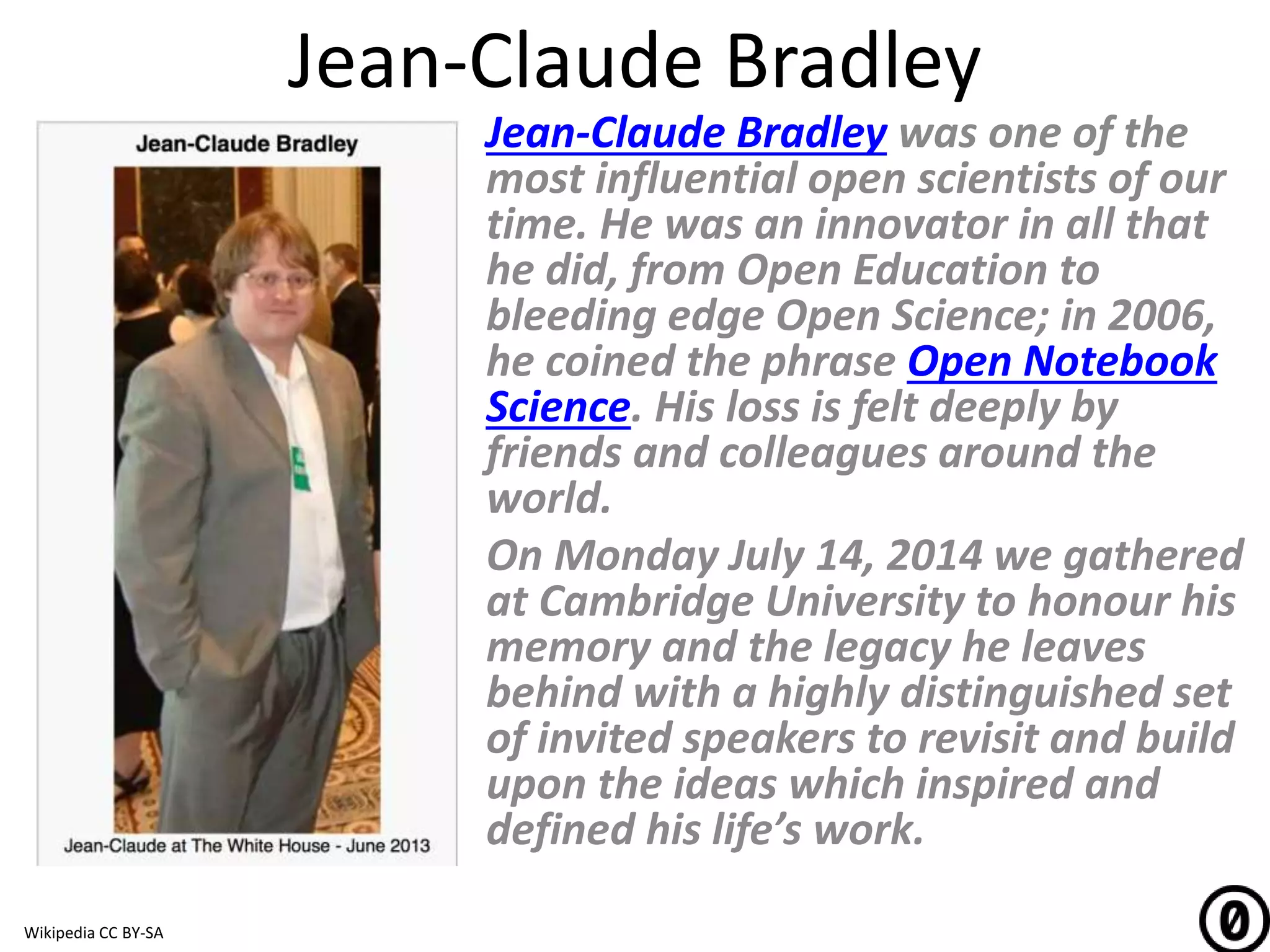
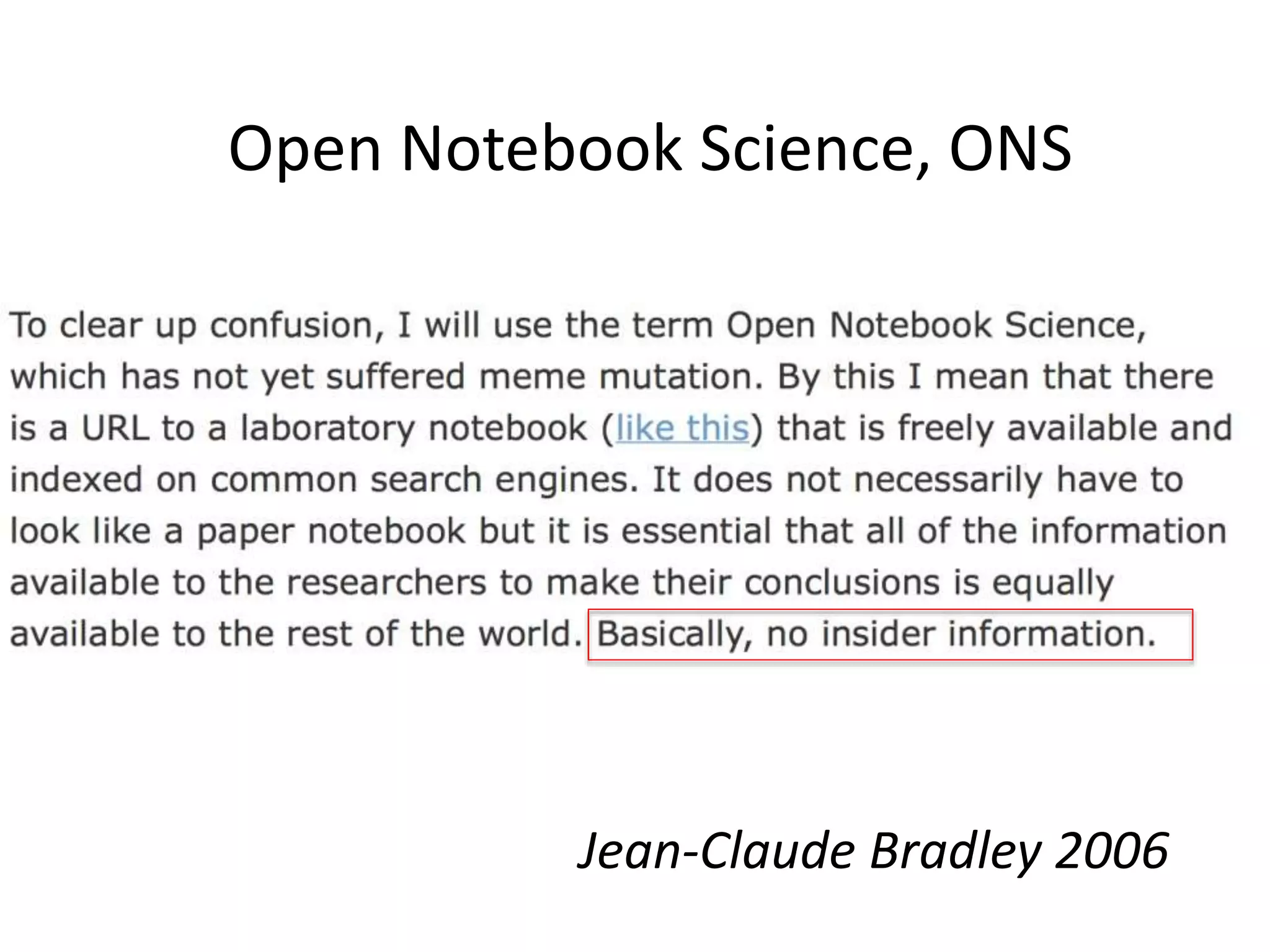
Jean-Claude Bradley
Jean-Claude Bradley was one of the
most influential open scientists of our
time. He was an innovator in all that
he did, from Open Education to
bleeding edge Open Science; in 2006,
he coined the phrase Open Notebook
Science. His loss is felt deeply by
friends and colleagues around the
world.
On Monday July 14, 2014 we gathered
at Cambridge University to honour his
memory and the legacy he leaves
behind with a highly distinguished set
of invited speakers to revisit and build
upon the ideas which inspired and
defined his life’s work.
Wikipedia CC BY-SA
The cost and value
The economic value of data
• I believe that we spend globally ca 400 billion
USD / yr on public research.
• The outputs include:
– Knowledge / papers / patents
– Organizations
– People
– Materials
– Data – many billions/year and much is lost
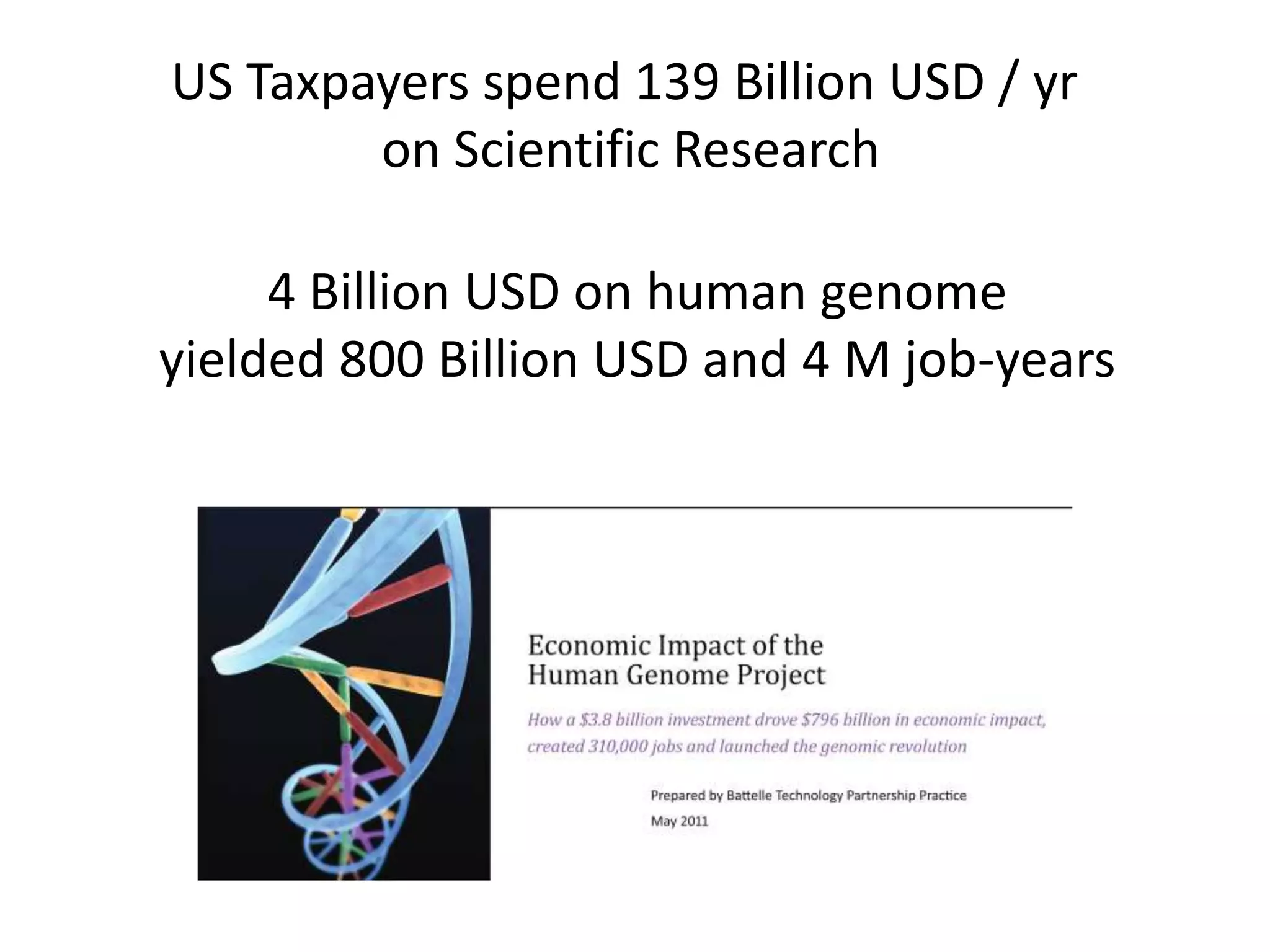
US Taxpayers spend 139 Billion USD / yr
on Scientific Research
4 Billion USD on human genome
yielded 800 Billion USD and 4 M job-years
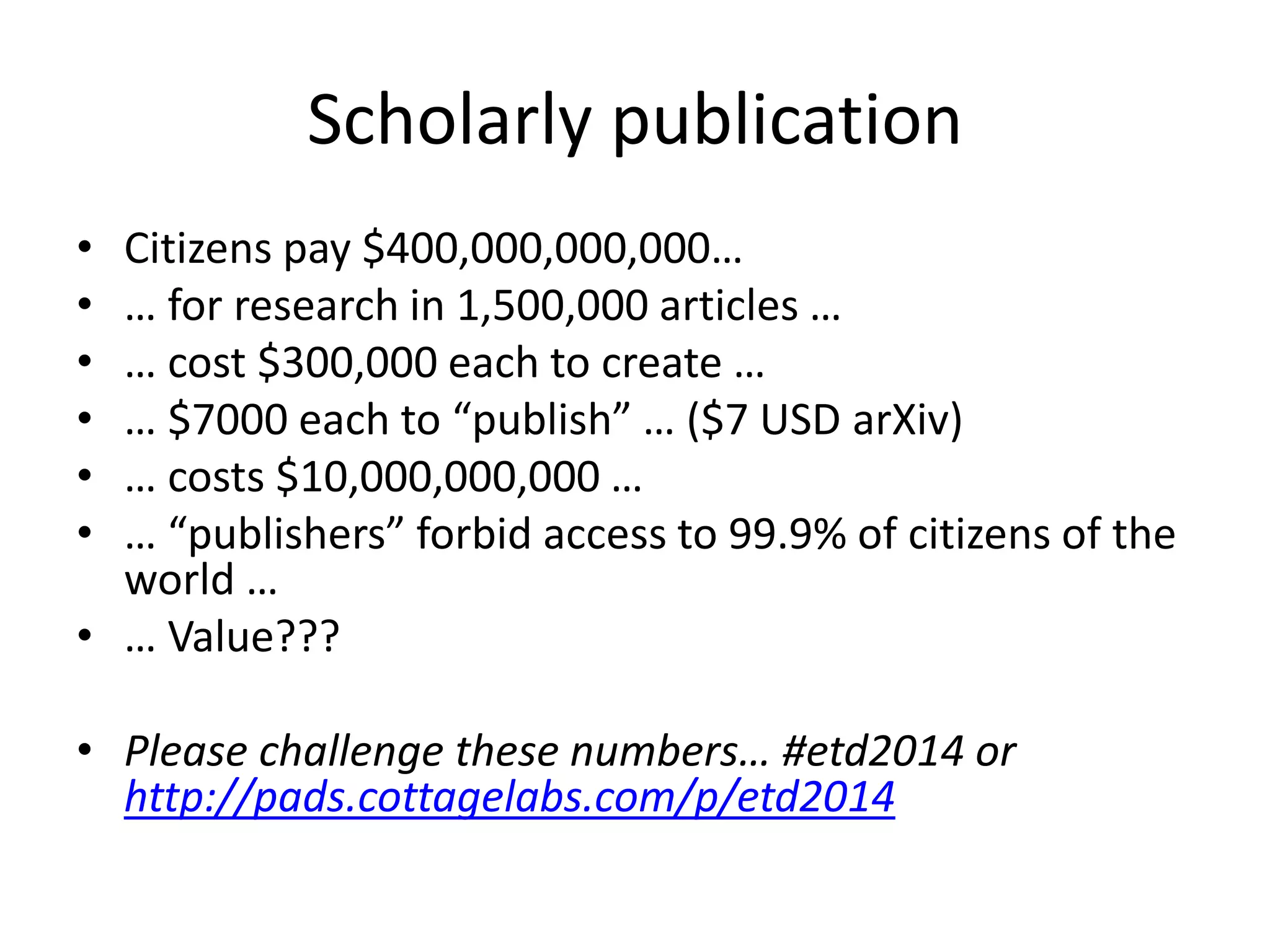
Scholarly publication
• Citizens pay $400,000,000,000…
• … for research in 1,500,000 articles …
• … cost $300,000 each to create …
• … $7000 each to “publish” … ($7 USD arXiv)
• … costs $10,000,000,000 …
• … “publishers” forbid access to 99.9% of citizens of the
world …
• … Value???
• Please challenge these numbers… #etd2014 or
http://pads.cottagelabs.com/p/etd2014
…three problems—flawed design, non-
publication, and poor reporting—together
meant >85% of research funds were wasted, a
global total loss >100 billion USD per year.
[Lancet 2009]
[Even more] waste clearly occurs after
publication: from poor access, poor
dissemination, and poor uptake of the findings
of research. [PLOS Medicine 2014-05-27]
Bad publication wastes science
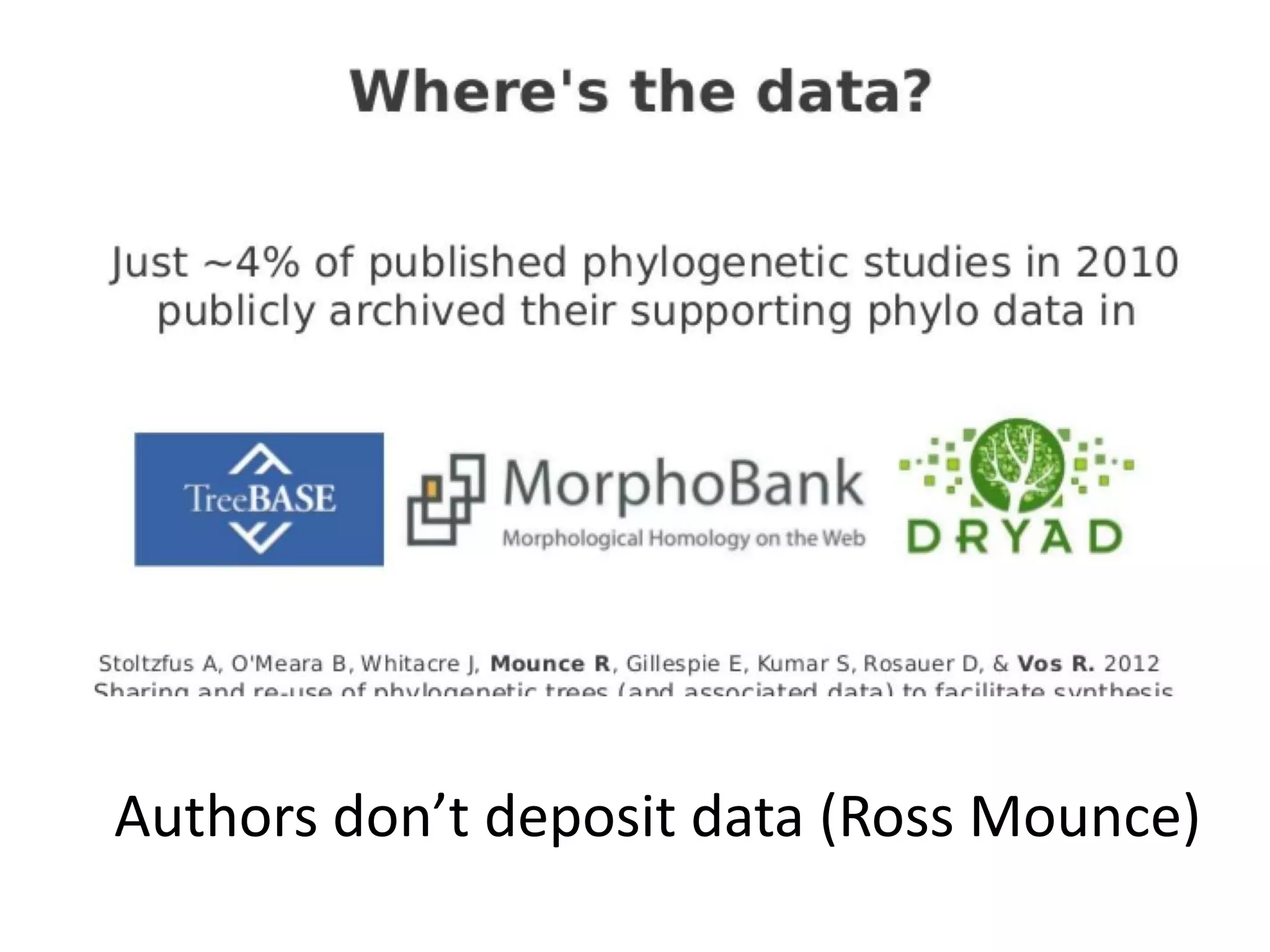
Authors don’t deposit data (Ross Mounce)
Where is the Digital Enlightenment?
• Science is done in C20th ways …
• …communicated in C19th ways …
• … losing the power of C21st
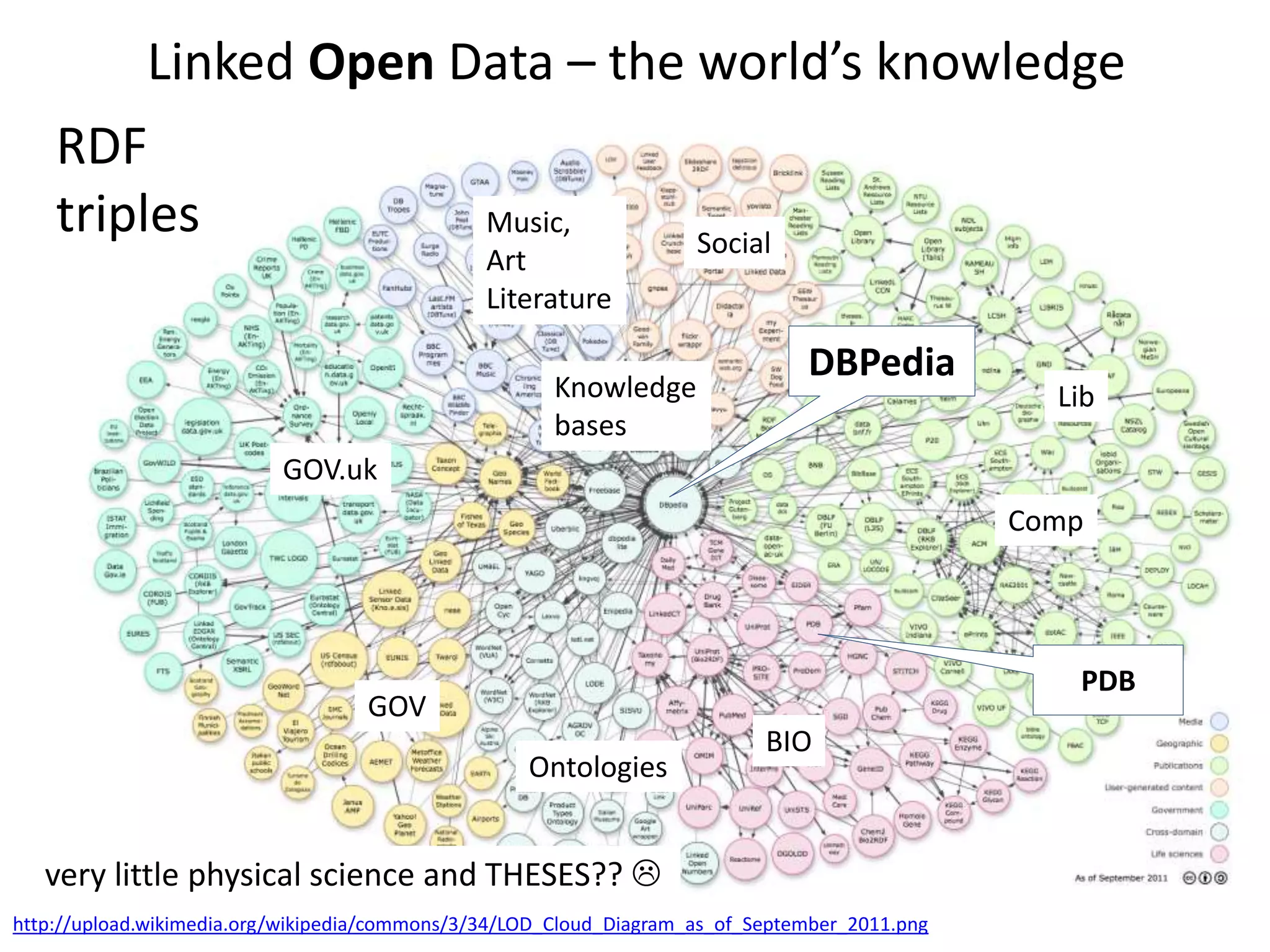
Linked Open Data – the world’s knowledge
very little physical science and THESES?? 
http://upload.wikimedia.org/wikipedia/commons/3/34/LOD_Cloud_Diagram_as_of_September_2011.png
DBPedia
BIO
Comp
Lib
PDB
Ontologies
GOV
GOV.uk
Music,
Art
Literature
Social
Knowledge
bases
RDF
triples
eTheses
• Citizens pay $20,000,000,000*…
• … for research in 200,000 science theses*…
• … cost $100,000 each to create* …
• … re-use ??? (near zero)
• … Value???
• *Please challenge these numbers…
• NOTE: we pay publishers $15,000,000,000 for
journals and APCs
“Free” and “Open”
• "Free software is a matter of liberty, not price.
’free speech', not 'free beer'”. (R M Stallman)
• “A piece of data or content is open if anyone is
free to use, reuse, and redistribute it”
(OKFN)http://opendefinition.org/
• “open” (access) has multiple incompatible “definitions”. Major split
is “human eyeballs” vs copying and machine “reusability”
• “Open” is a marketing term for publishers, who frequently (often
deliberately) do not grant full Openness.
“Gratis” vs “Libre”
Critical Historical Open Events
• Free Software Foundation (RMS,
1985) and Linux (Torvalds, 1991)
• The World Wide Web (TBL, 1991)
• The human genome (1990-2001)
The life of Aaron Swarz (1986-2013)
https://en.wikipedia.org/wiki/Bermuda_Principles
• Automatic release of sequence assemblies larger than 1
kb (preferably within 24 hours).
• Immediate publication of finished annotated
sequences.
• Aim to make the entire sequence freely available in the
public domain for both research and development in
order to maximise benefits to society.
http://www.budapestopenaccessinitiative.org/read
… an unprecedented public good. …
… completely free and unrestricted access to [peer-
reviewed literature] by all scientists, scholars, teachers,
students, and other curious minds. …
…Removing access barriers to this literature will
accelerate research, enrich education, share the
learning of the rich with the poor and the poor with
the rich, make this literature as useful as it can be, and
lay the foundation for uniting humanity in a common
intellectual conversation and quest for knowledge.
(Budapest Open Access Initiative, 2003)
Panton Principles for Open Data in
science(2010)
• PUBLISH YOUR DATA OPENLY
• …make an explicit and robust statement of your wishes.
• Use a recognized waiver or license that is appropriate for
data.
• open as defined by the Open Knowledge/Data Definition
(… NOT non-commercial)
• Explicit dedication of data … into the public domain via
PDDL or CCZero
Peter Murray-Rust, Cameron Neylon, Rufus Pollock, John
Wilbanks
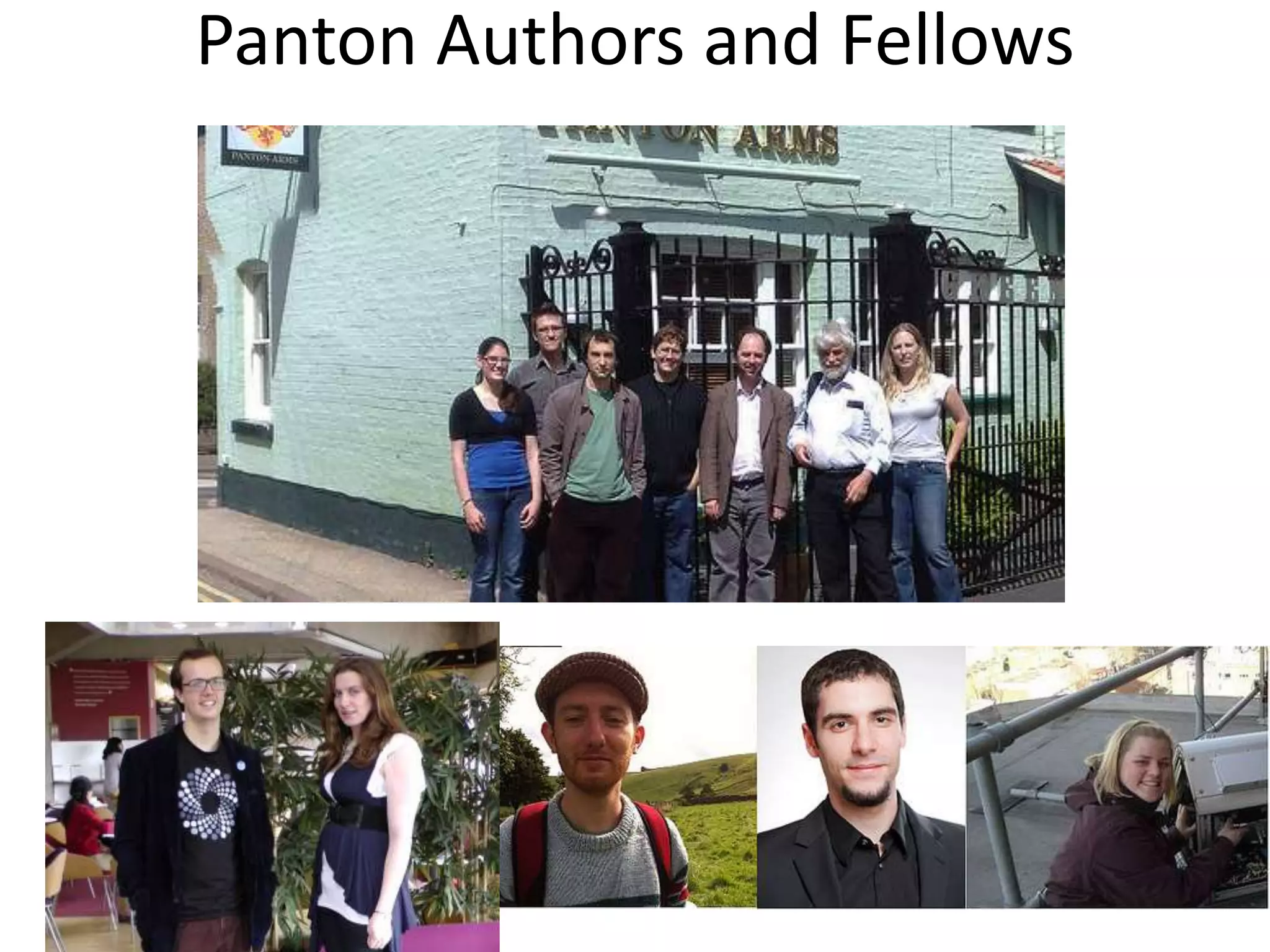
Panton Authors and Fellows
Problems of Commercial
Elsevier wants to control Open Data
[asked by Michelle Brook]
Mendeley
From Wikipedia, the free encyclopedia
• … a social media site used by many scientists
to store metadata …
• … purchased by Elsevier in 2013
• David Dobbs, in The New Yorker, described
motive as:
– to acquire its user data,
– to destroy or coöpt an open-science icon that
threatens its business model.
• PM-R: Mendeley can also Snoop and Control
New ways for Theses
• Content Mining
• Open Notebook Theses
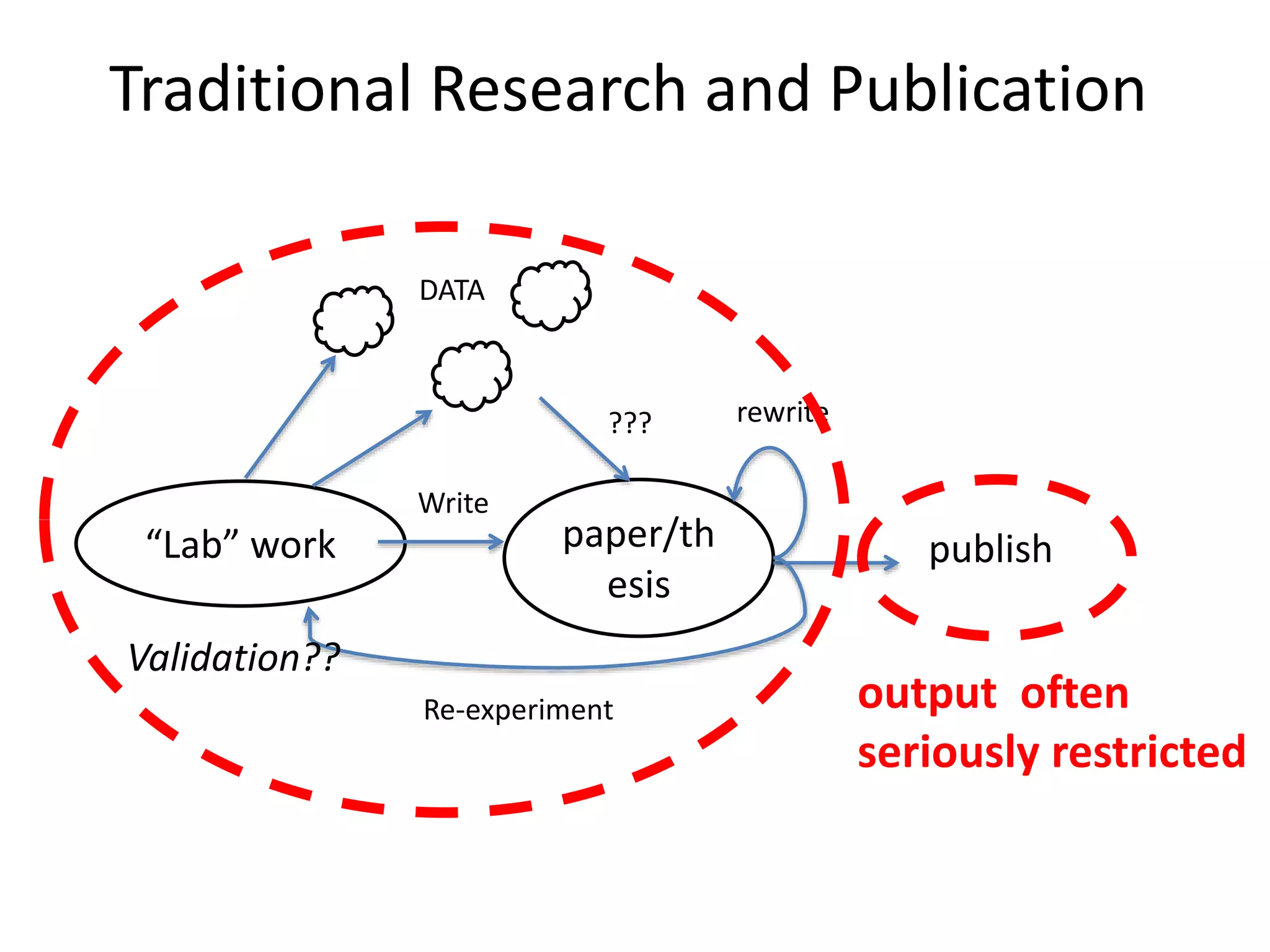
Traditional Research and Publication
“Lab” work paper/th
esis
Write
rewrite
Re-experiment
publish
???
Validation??
DATA
output often
seriously restricted
Content-Mining (TDM)
• Now COMPLETELY LEGAL IN UK since 2014-06-01 …
• … Whatever the publishers tell you. Do NOT sign their
APIs
• Contentmine.org …
• … sponsored by Shuttleworth Foundation …
• … to extract 100,000,000 facts from scientific literature
• And STM publishers are throwing millions to stop us
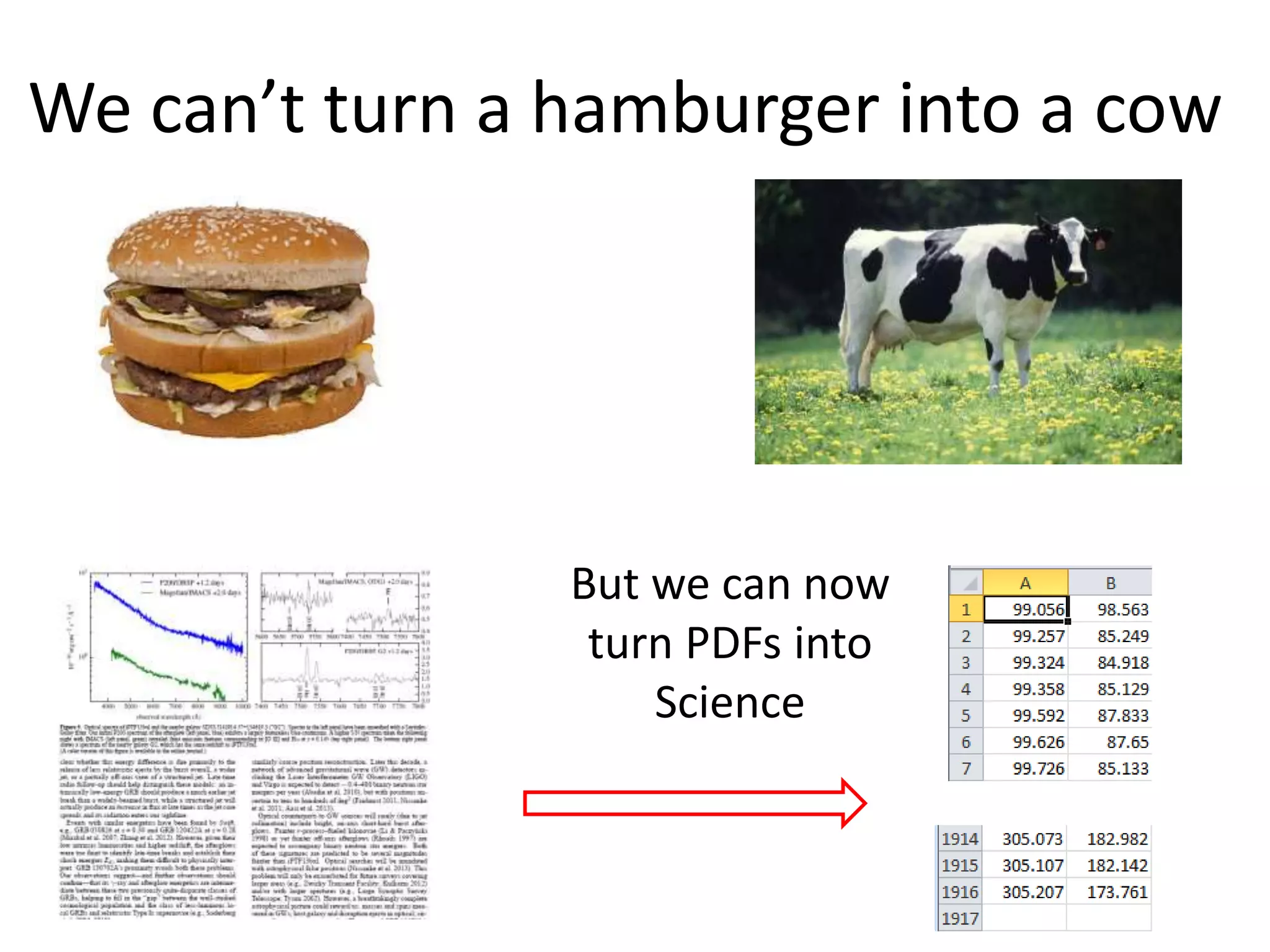
But we can now
turn PDFs into
Science
We can’t turn a hamburger into a cow
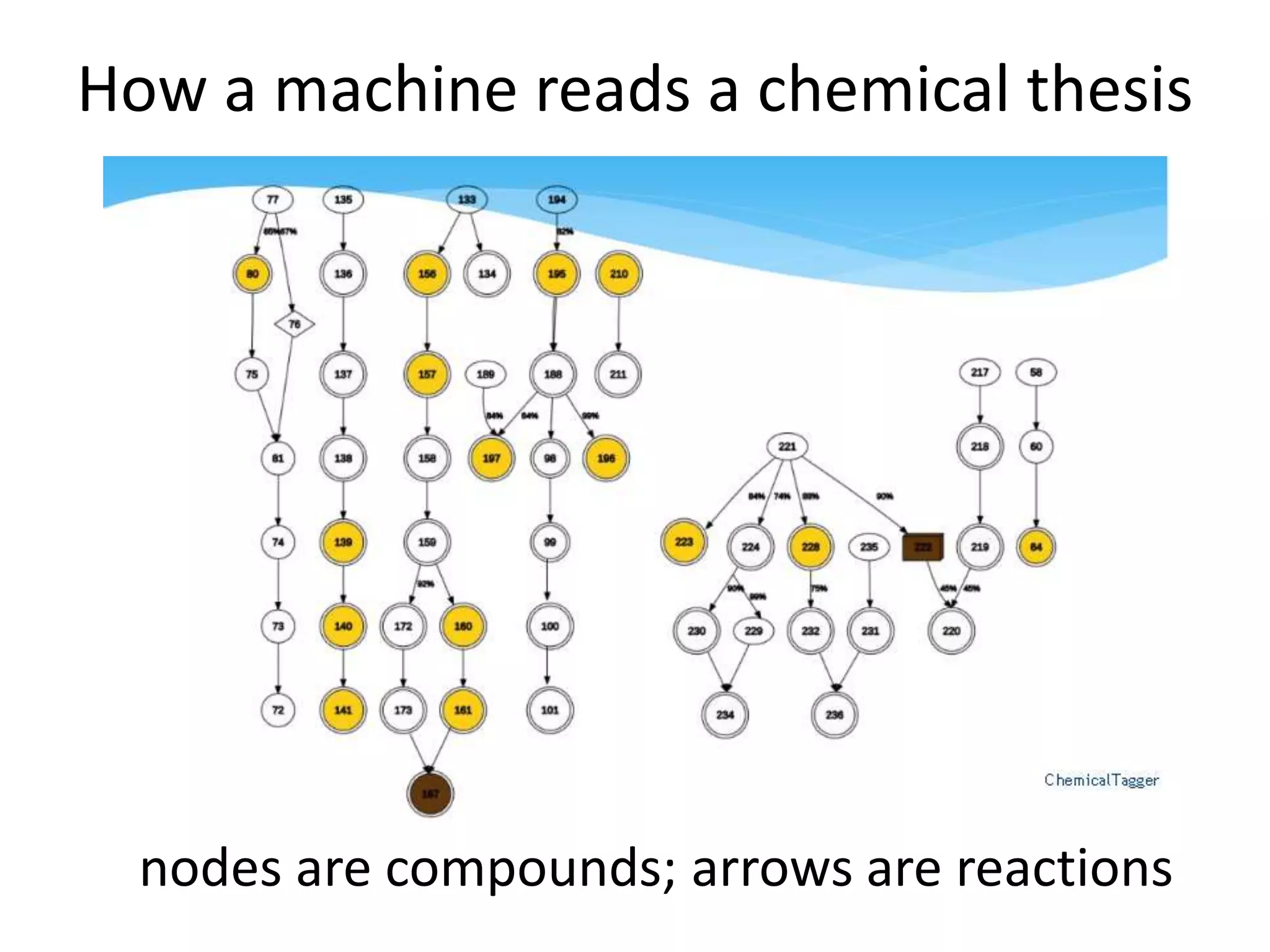
How a machine reads a chemical thesis
nodes are compounds; arrows are reactions
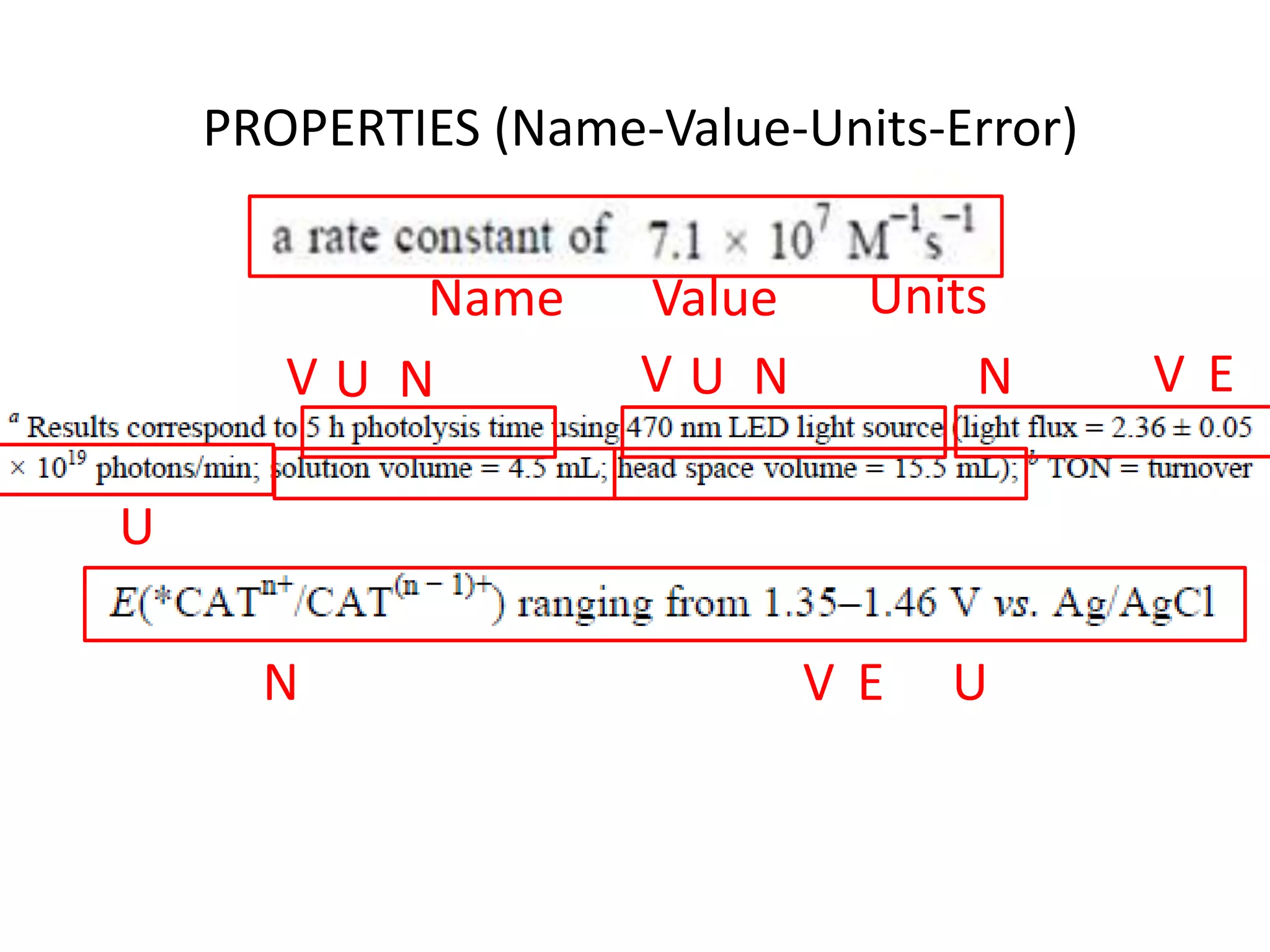
PROPERTIES (Name-Value-Units-Error)
Name Value Units
NV U NV U N V
U
N
E
V E U
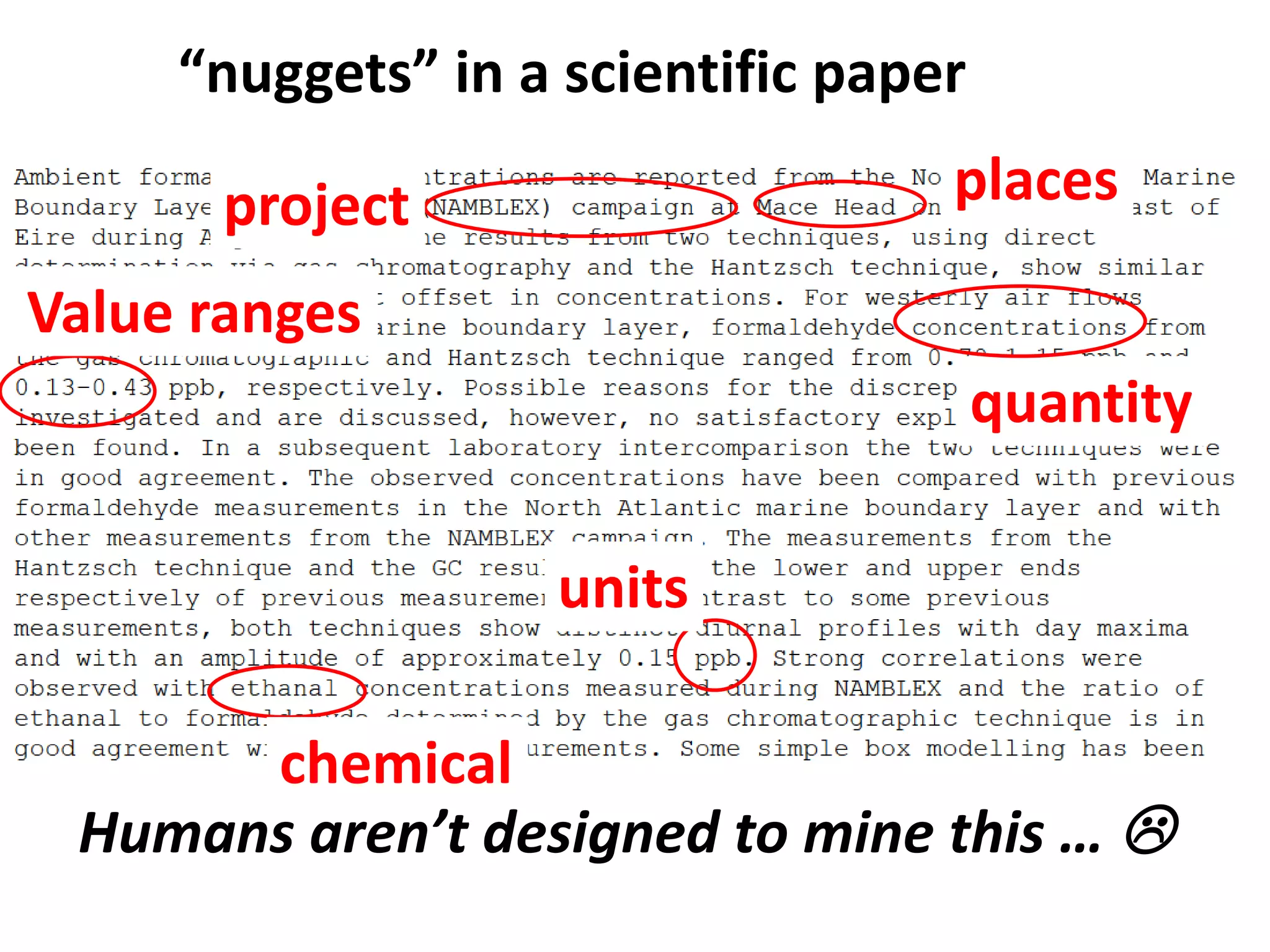
“nuggets” in a scientific paper
quantity
units
Value ranges
Humans aren’t designed to mine this … 
chemical
project places
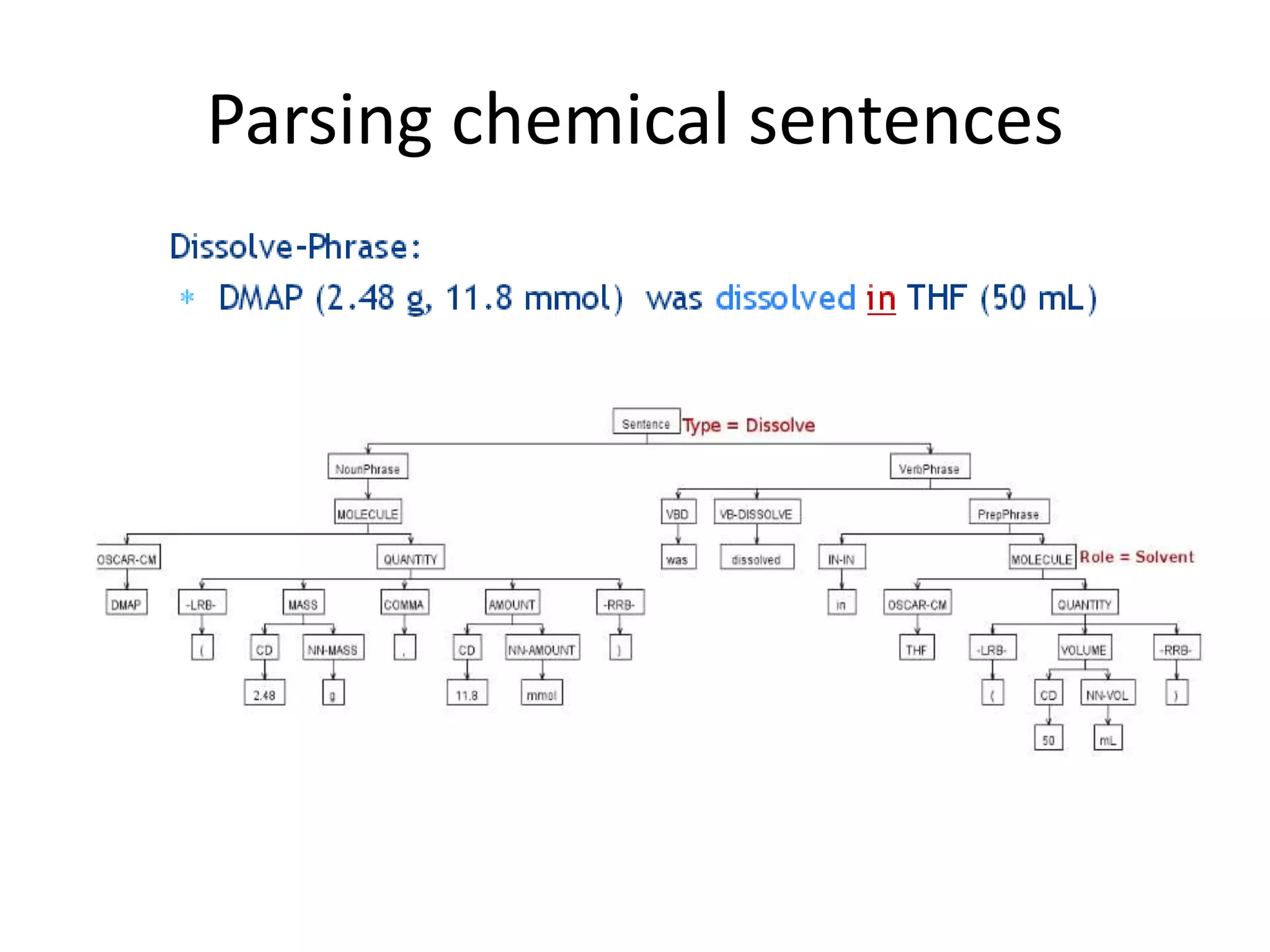
Natural Language Processing
Part of speech tagging (Wordnet, Brown Corpus, etc.)
Parsing chemical sentences
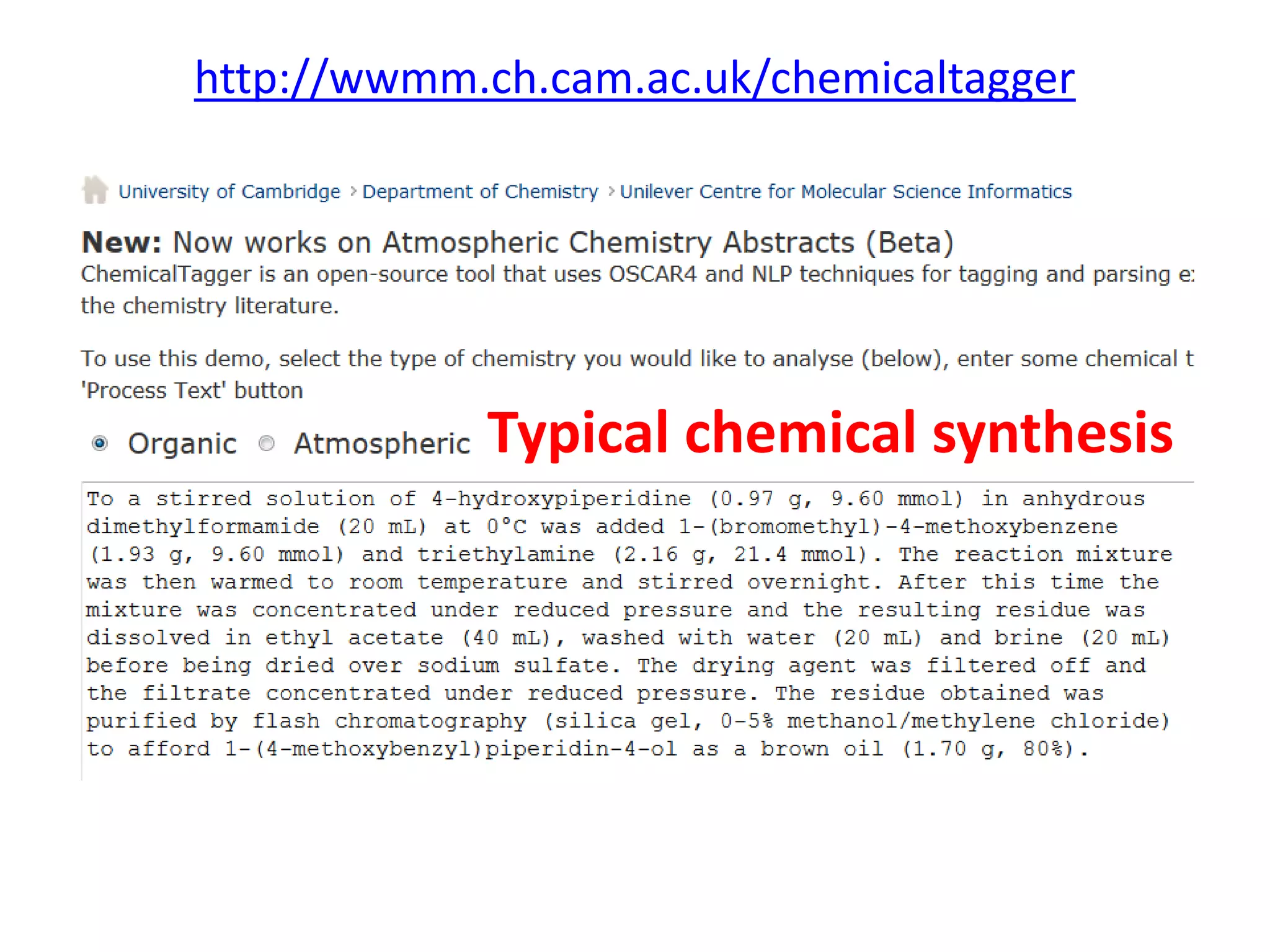
http://wwmm.ch.cam.ac.uk/chemicaltagger
• Typical
Typical chemical synthesis
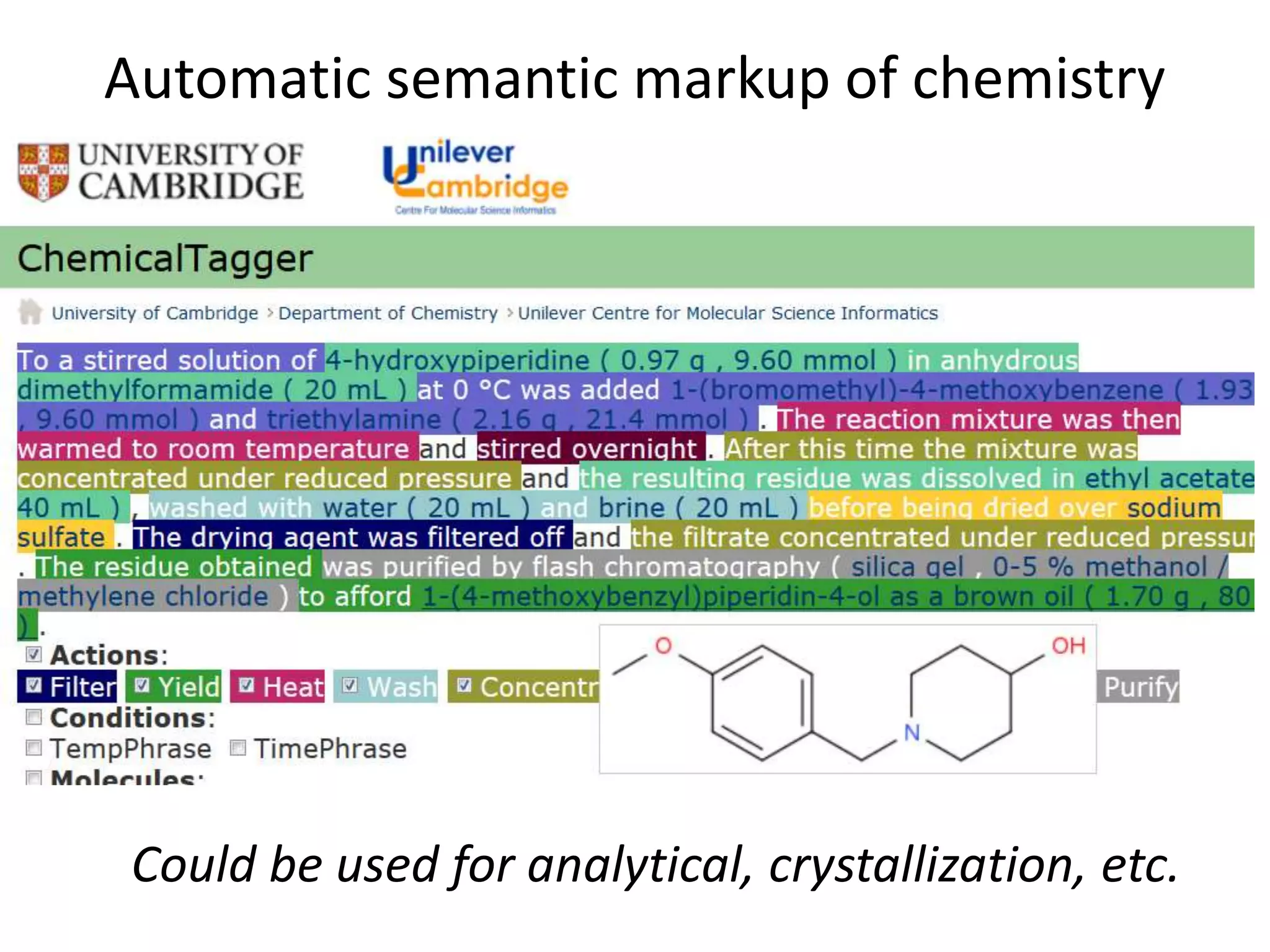
Automatic semantic markup of chemistry
Could be used for analytical, crystallization, etc.
Open Content Mining of FACTs
Machines can interpret chemical reactions
We have done 500,000 patents. There are >
3,000,000 reactions/year. Added value > 1B Eur.
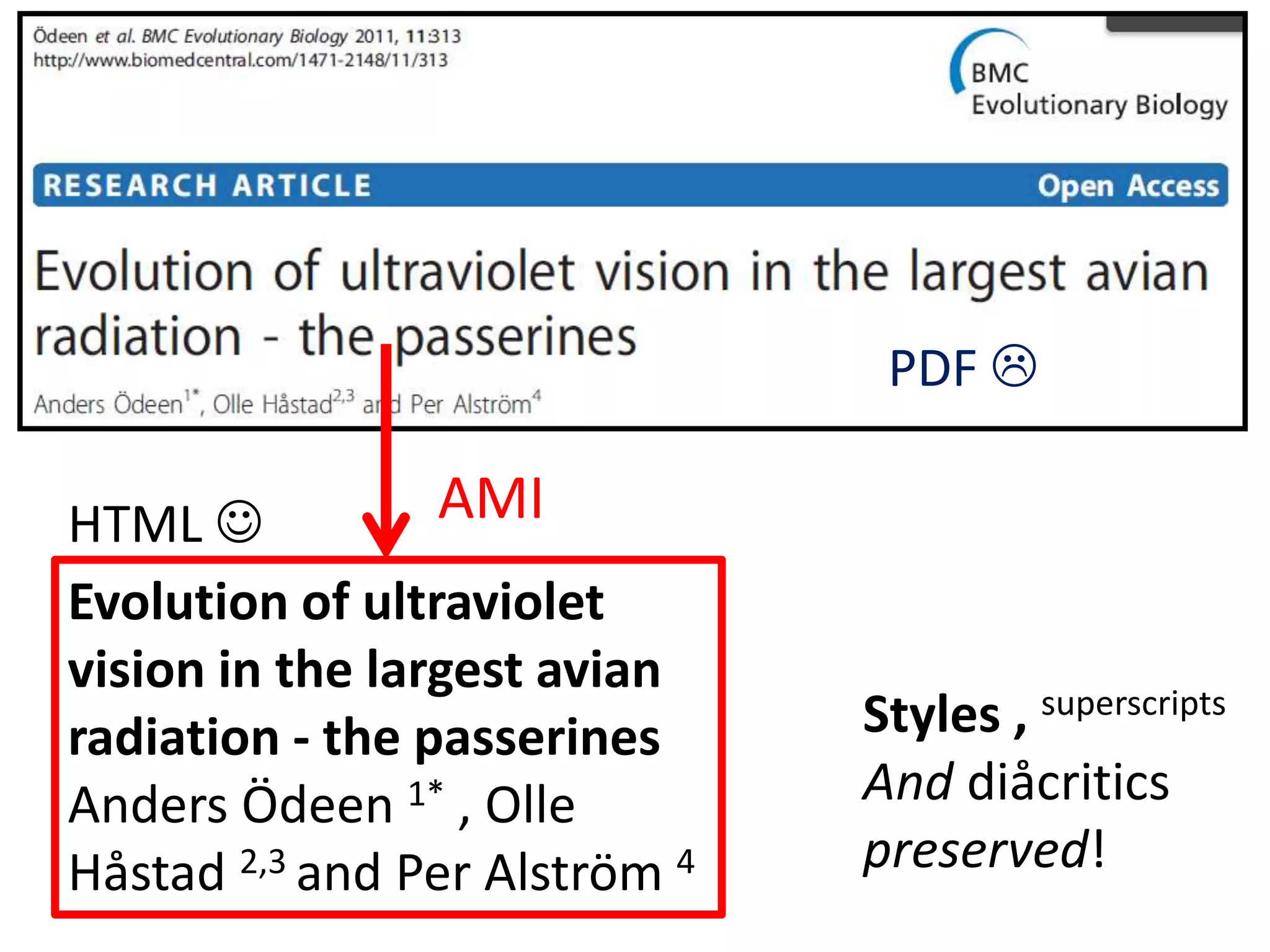
Evolution of ultraviolet
vision in the largest avian
radiation - the passerines
Anders Ödeen 1* , Olle
Håstad 2,3 and Per Alström 4
PDF 
HTML 
Styles , superscripts
And diåcritics
preserved!
AMI
PDF 
Turdus iliacus
Taeniopygia guttata
Serinus canaria
Lanius excubitor
Melopsittacus undulatus
Pavo cristatus
Sturnus vulgaris
Dolichonyx oryzivorus
Ficedula hypoleuca
Vaccinium myrtillus
Falco tinnunculus
Turdus
Pomatostomus
Leothrix
Amytornis
Acanthisitta
Orthonyx x 2
Malurus
Cnemophilus x 4
Philesturnus x 2
Motacilla x 2
Toxorhampus x 2
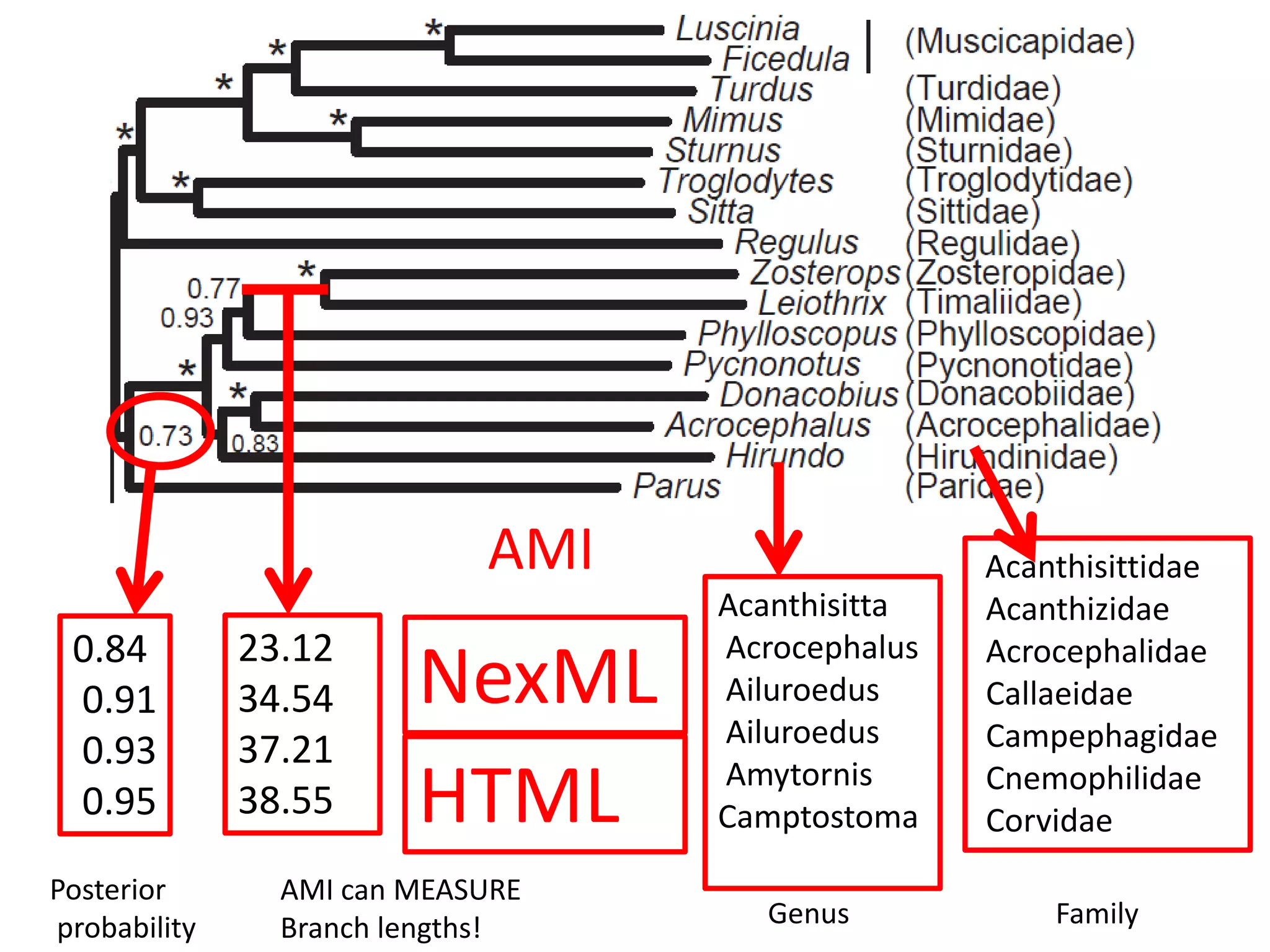
Typical phylo tree: 60 nodes, complex and miniscule annotation,
vertical text, hyphenation and valuable branch lengths. AMI extracts ALL
Acanthisittidae
Acanthizidae
Acrocephalidae
Callaeidae
Campephagidae
Cnemophilidae
Corvidae
0.84
0.91
0.93
0.95
Acanthisitta
Acrocephalus
Ailuroedus
Ailuroedus
Amytornis
Camptostoma
AMI
23.12
34.54
37.21
38.55
Posterior
probability
AMI can MEASURE
Branch lengths!
NexML
Genus Family
HTML
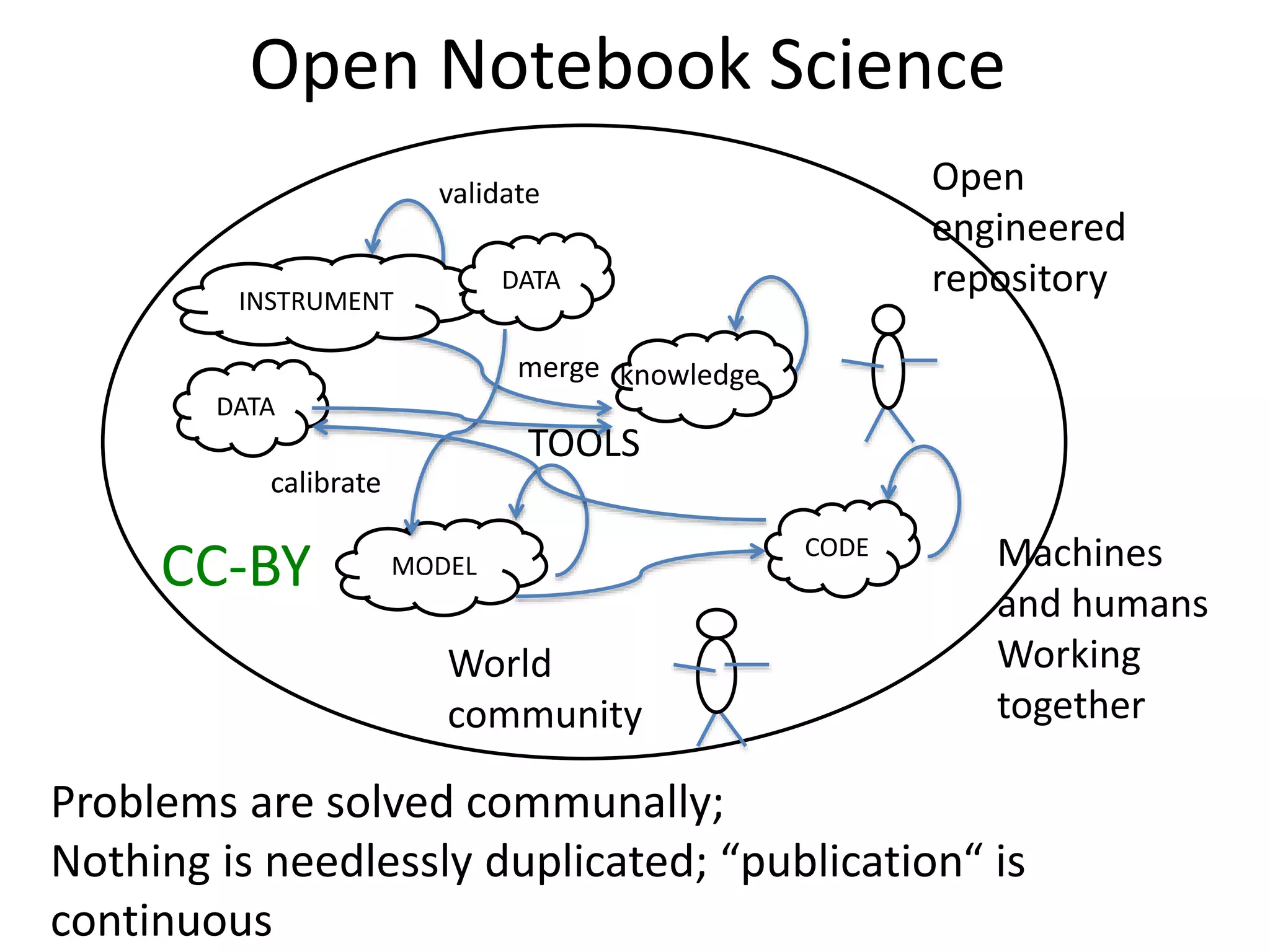
Open Notebook Science
• Graduate students understand it: do you?
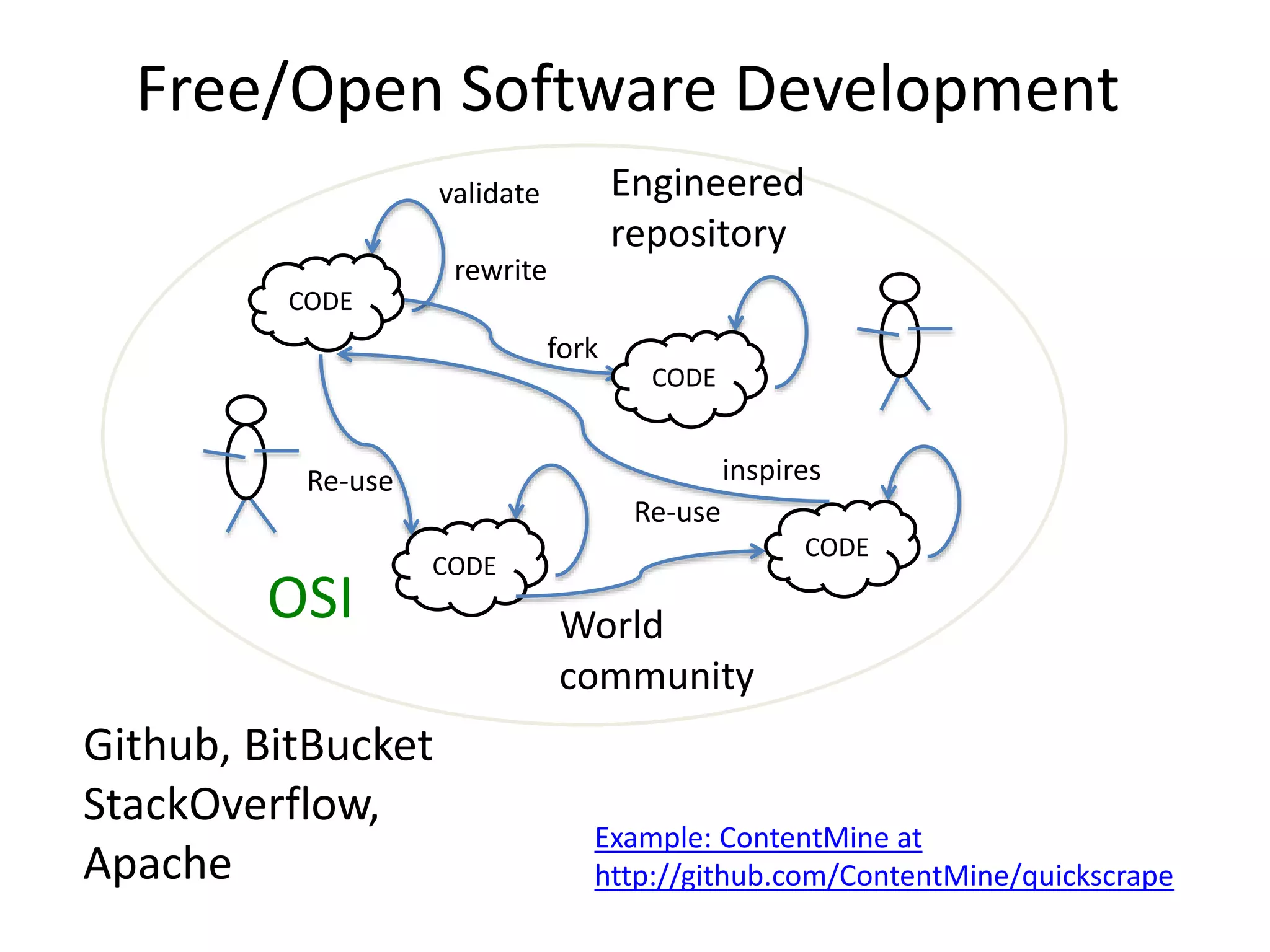
Free/Open Software Development
Engineered
repository
World
community
CODE
rewrite
validate
CODE
fork
CODE
Re-use
CODE
Re-use
Github, BitBucket
StackOverflow,
Apache
inspires
OSI
Example: ContentMine at
http://github.com/ContentMine/quickscrape
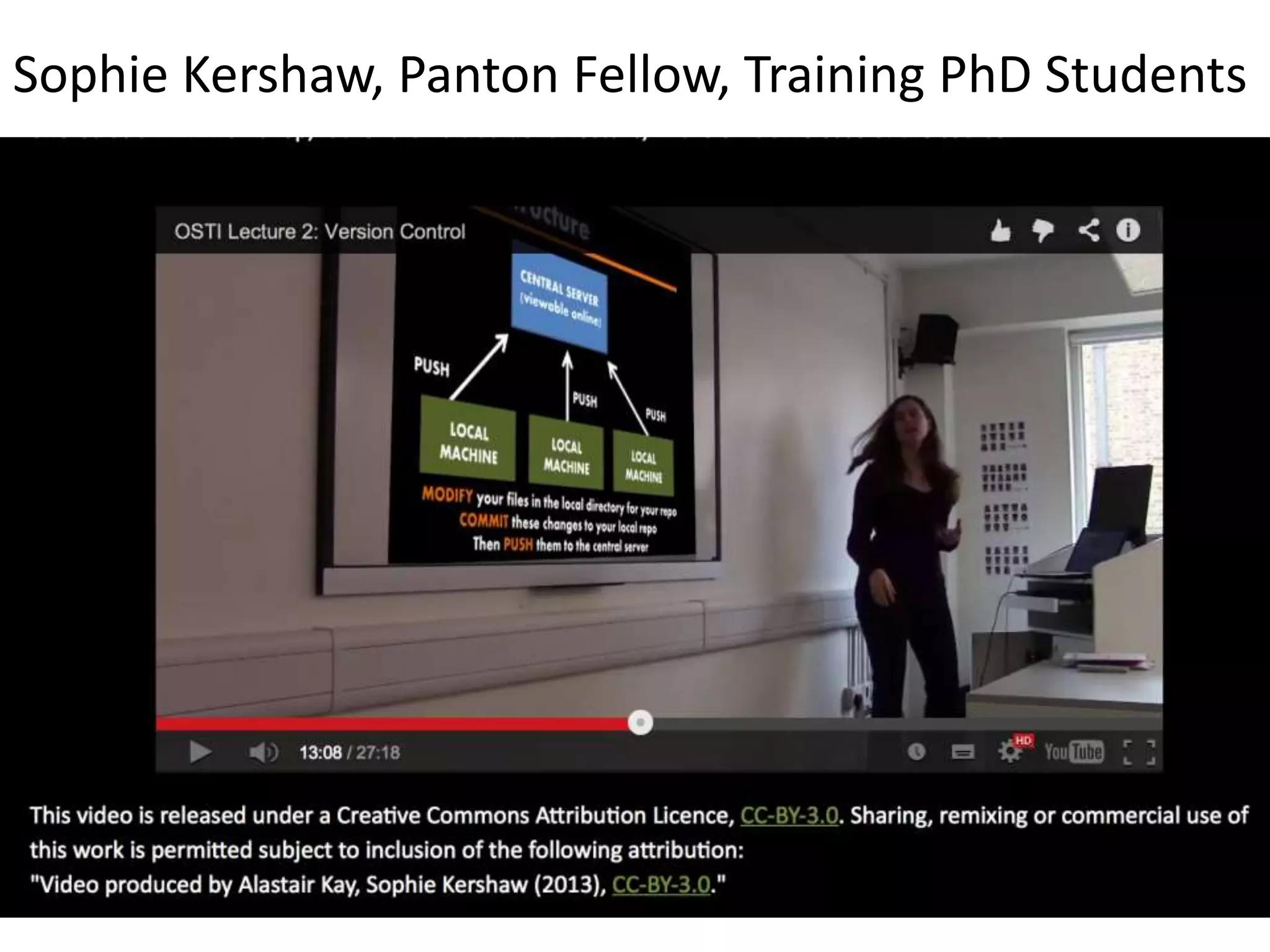
Sophie Kershaw, Panton Fellow, Training PhD Students
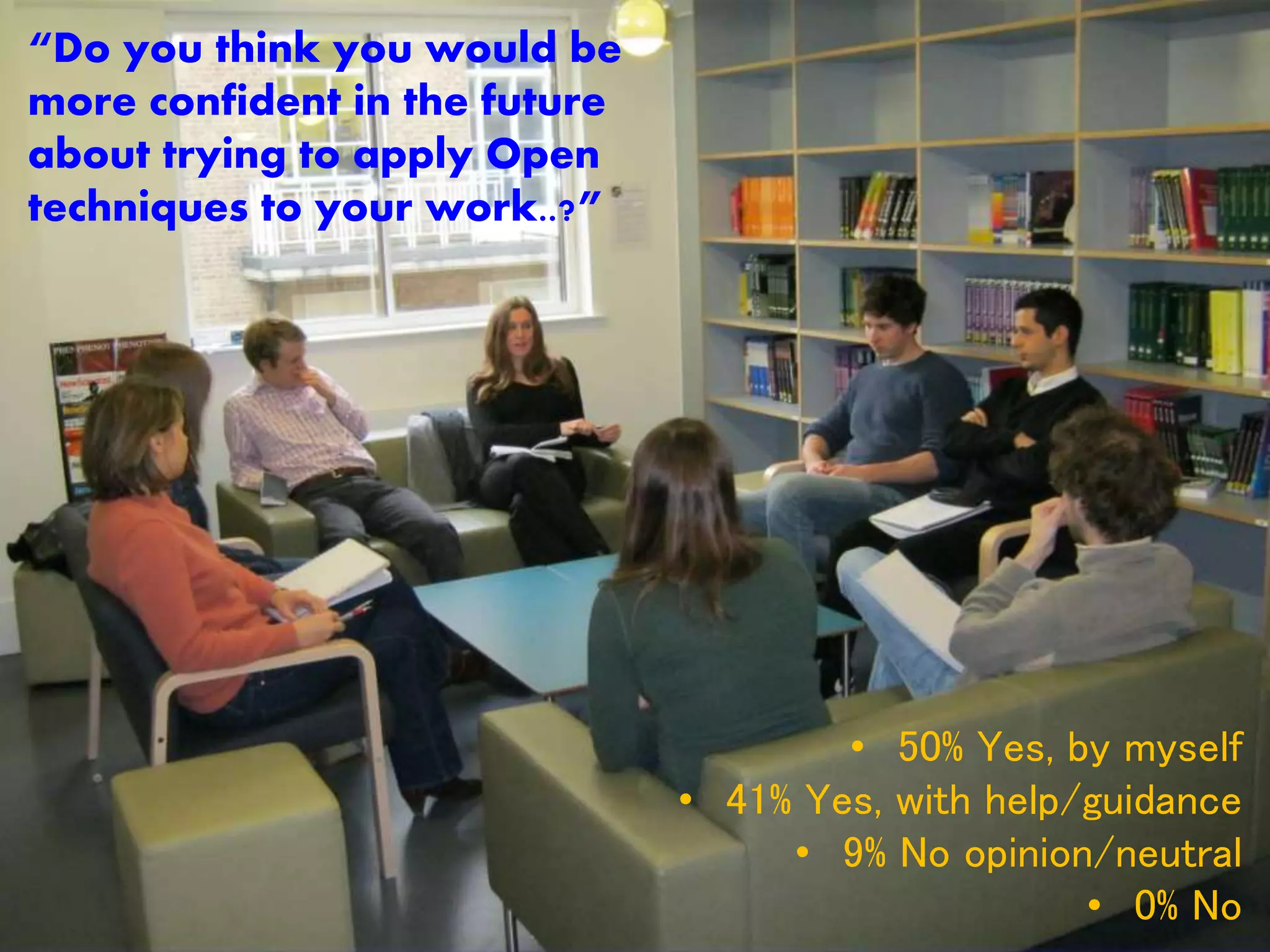
“Do you think you would be
more confident in the future
about trying to apply Open
techniques to your work..?”
• 50% Yes, by myself
• 41% Yes, with help/guidance
• 9% No opinion/neutral
• 0% No
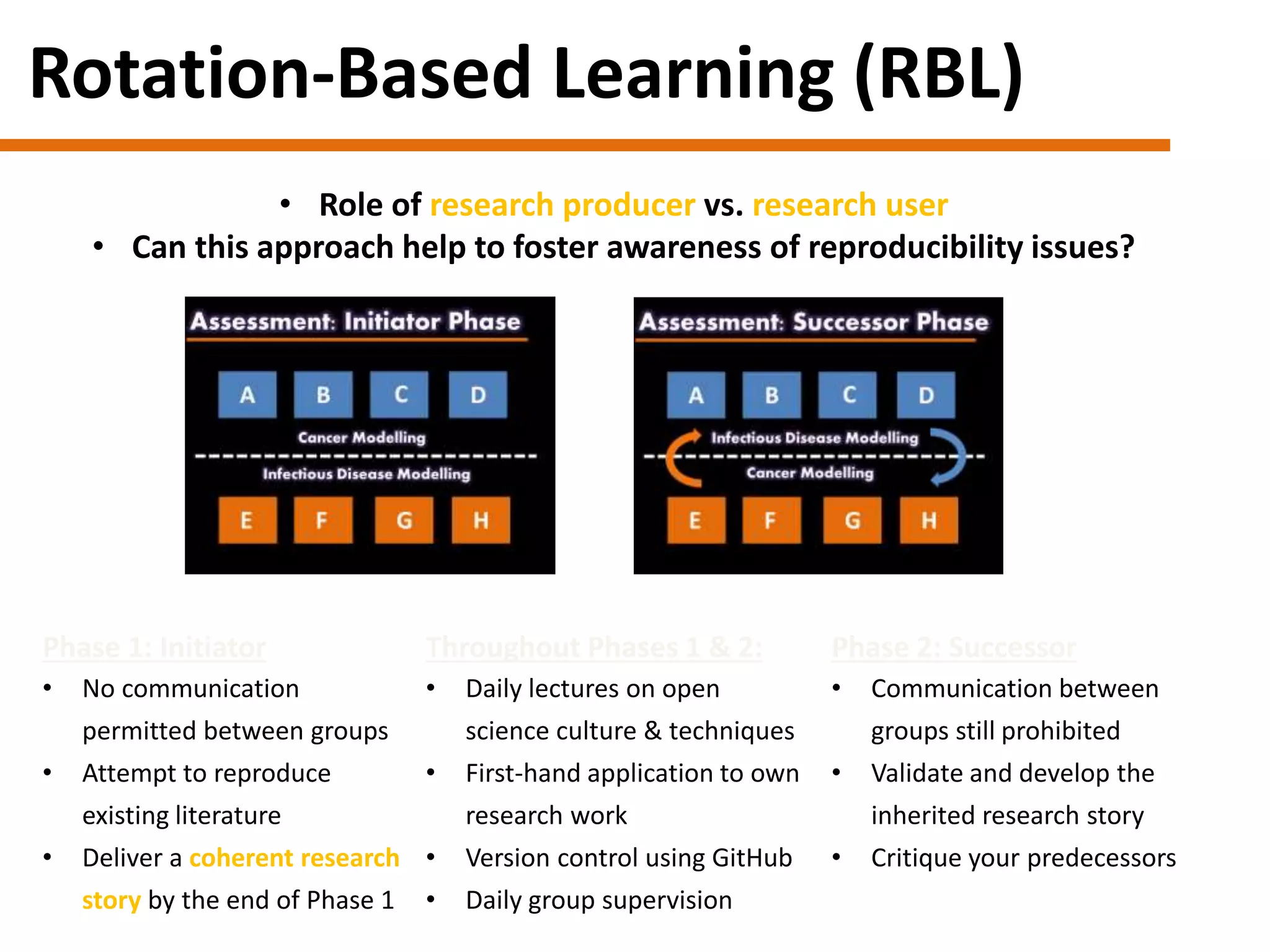
Rotation-Based Learning (RBL)
Phase 1: Initiator
• No communication
permitted between groups
• Attempt to reproduce
existing literature
• Deliver a coherent research
story by the end of Phase 1
Phase 2: Successor
• Communication between
groups still prohibited
• Validate and develop the
inherited research story
• Critique your predecessors
• Role of research producer vs. research user
• Can this approach help to foster awareness of reproducibility issues?
Throughout Phases 1 & 2:
• Daily lectures on open
science culture & techniques
• First-hand application to own
research work
• Version control using GitHub
• Daily group supervision
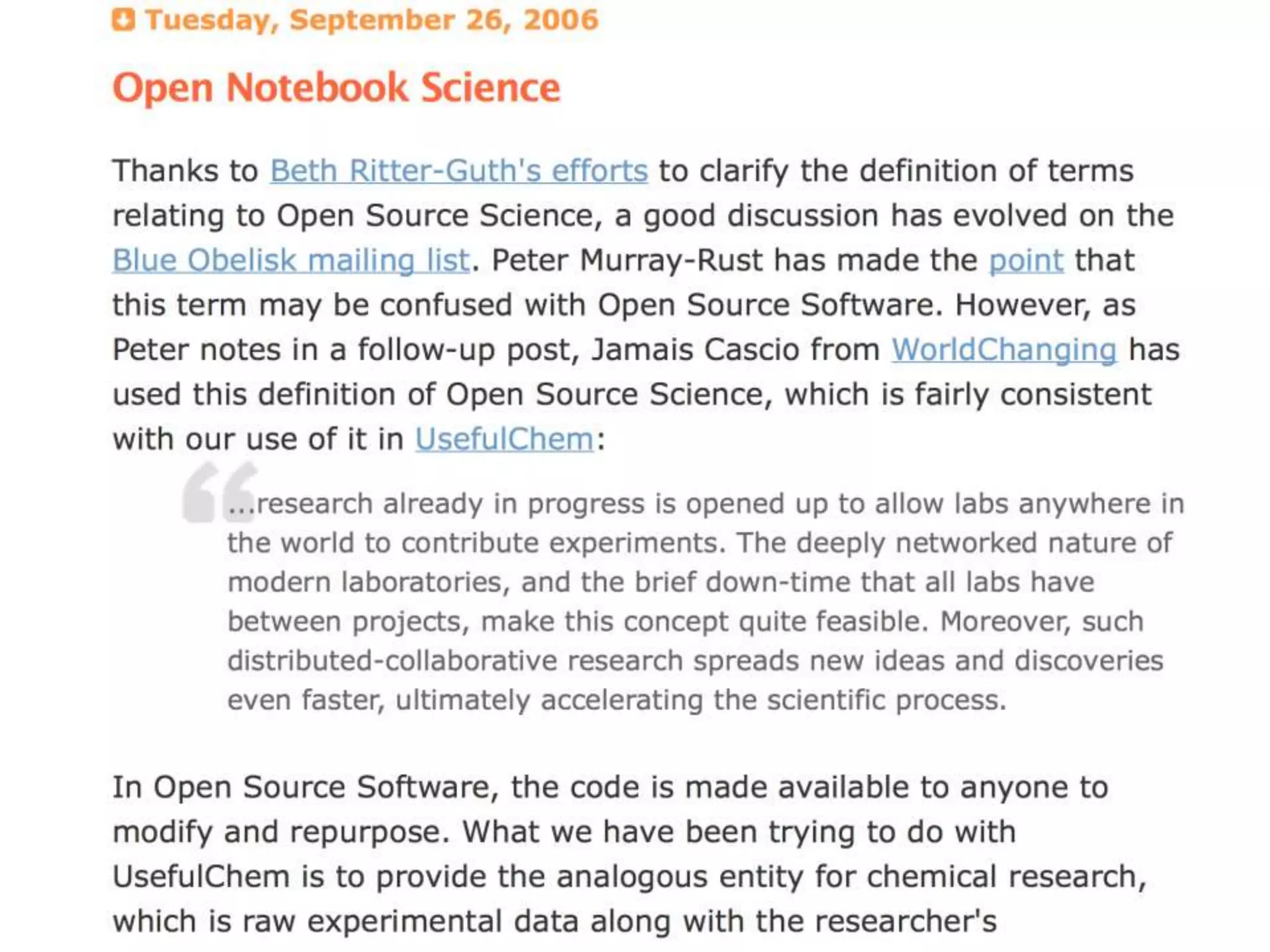
Open Source software inspires Open Science
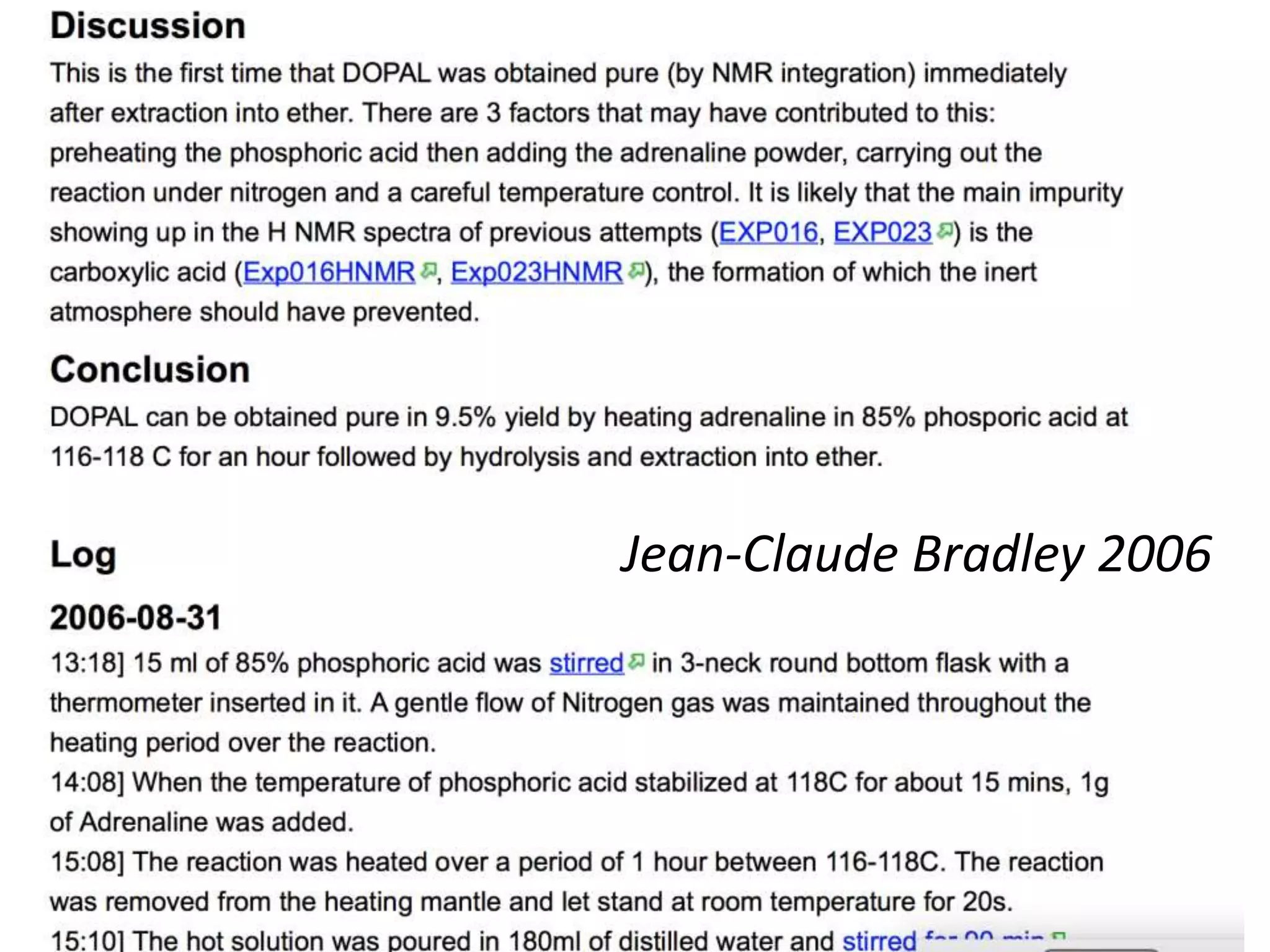
Jean-Claude Bradley 2006
Open Notebook Science, ONS
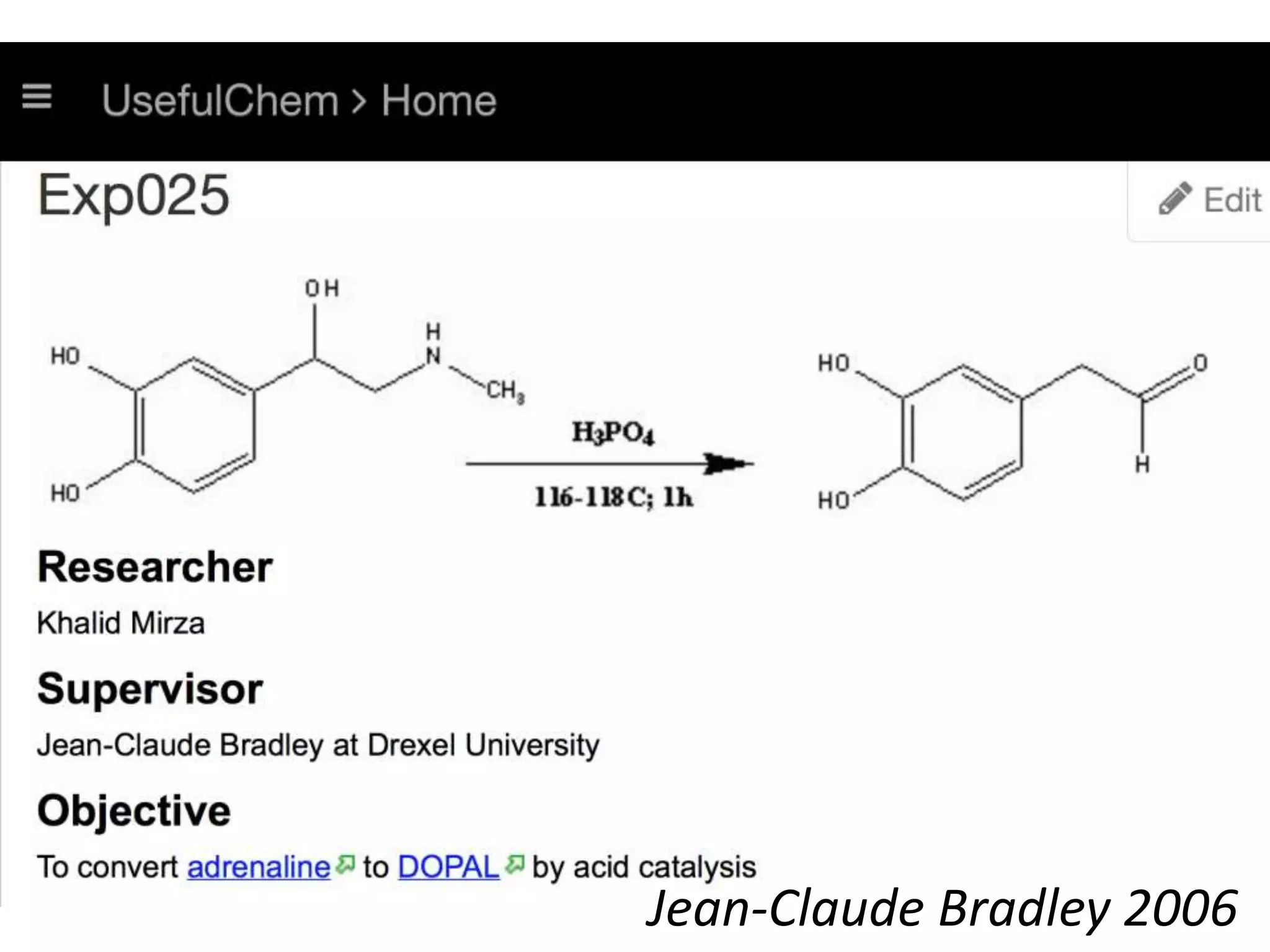
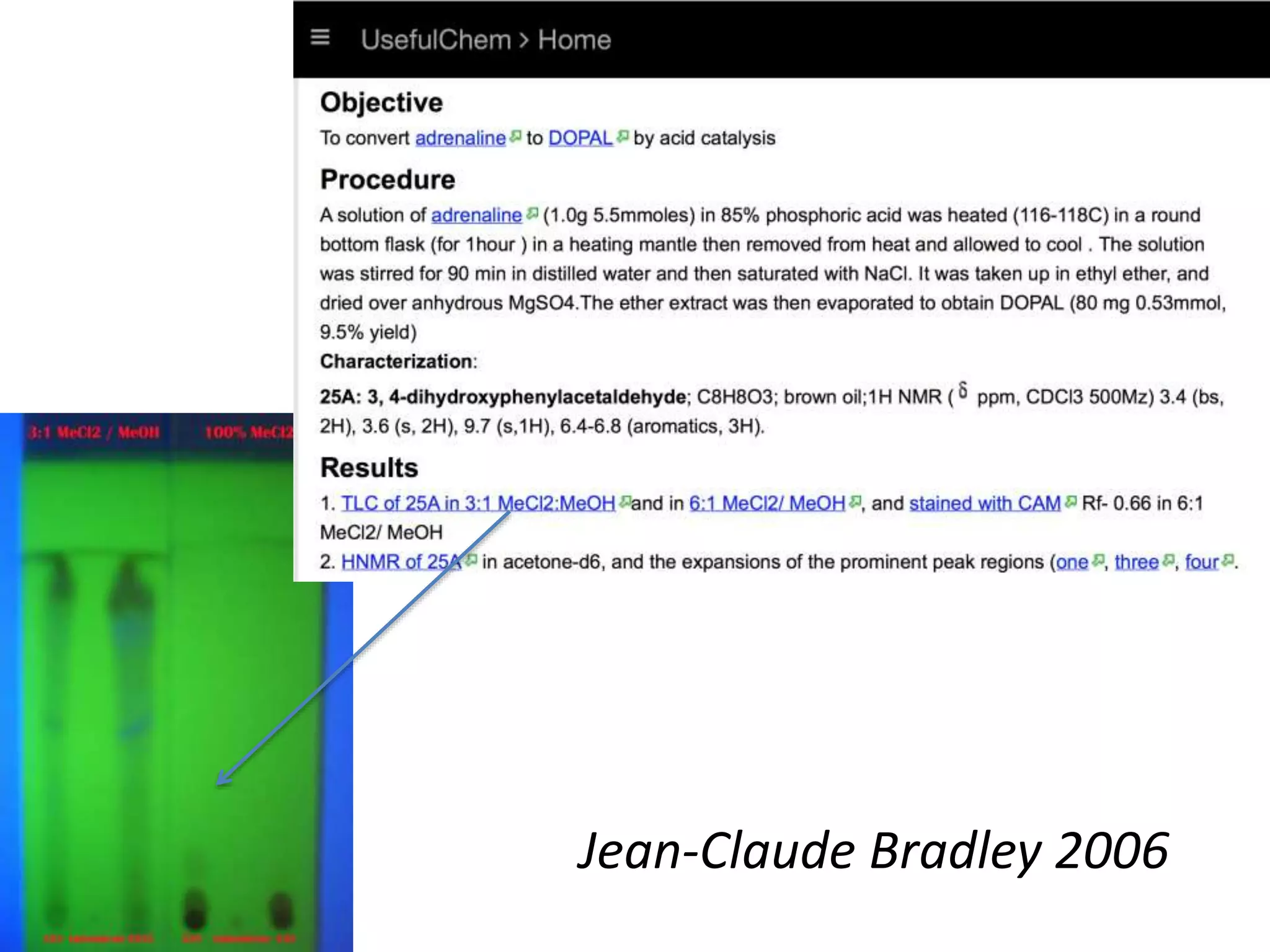
Jean-Claude Bradley 2006
http://michaelnielsen.org/blog/reinventing-
discovery/
http://en.wikipedia.org/wiki/Reinventing_Discovery
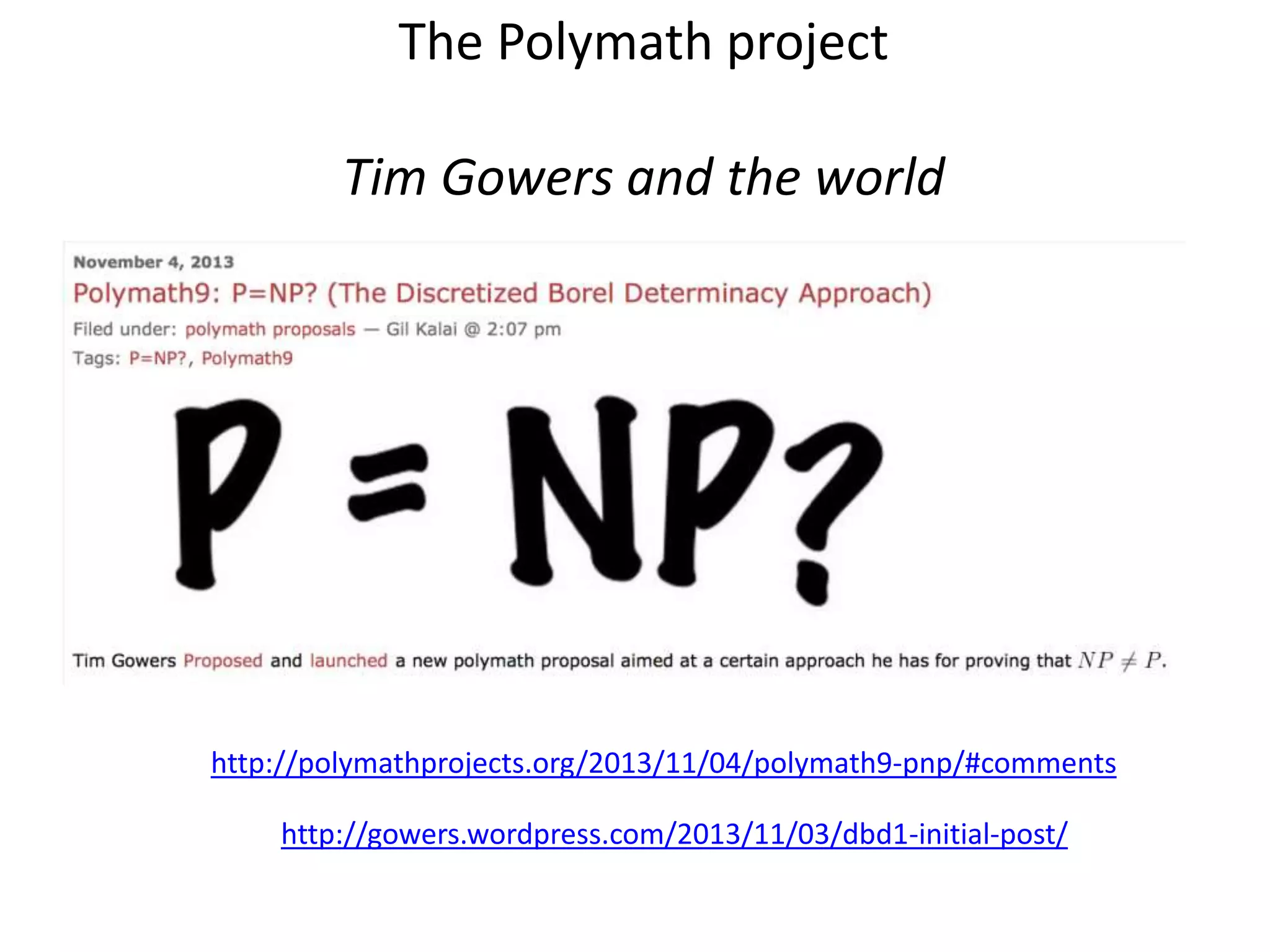
http://gowers.wordpress.com/2013/11/03/dbd1-initial-post/
http://polymathprojects.org/2013/11/04/polymath9-pnp/#comments
The Polymath project
Tim Gowers and the world
Jean-Claude Bradley 2006
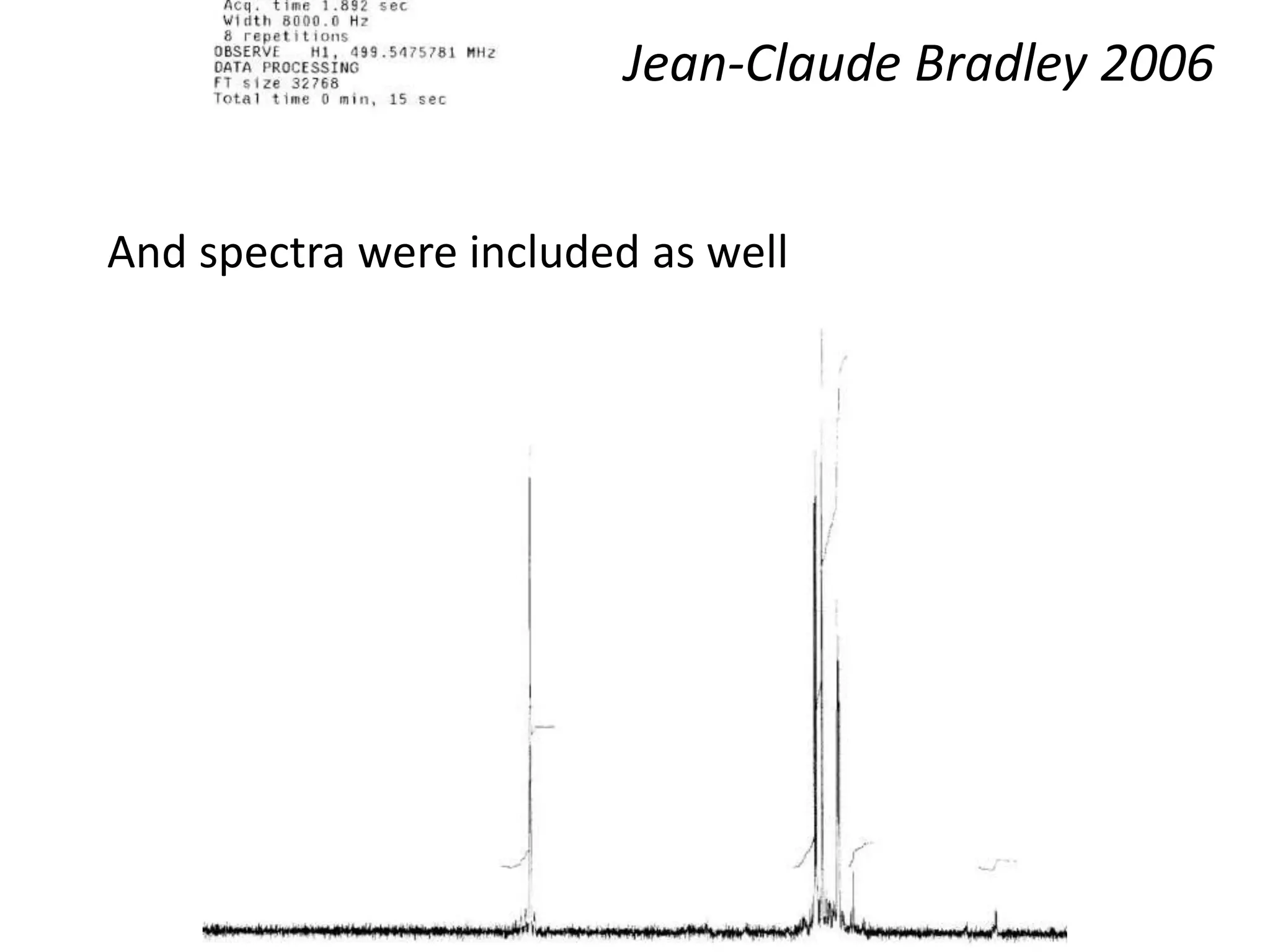
And spectra were included as well
Jean-Claude Bradley 2006
TOOLS
Open Notebook Science
Open
engineered
repository
World
community
INSTRUMENT
validate
merge
MODEL
CODE
DATA
DATA
knowledge
calibrate
Problems are solved communally;
Nothing is needlessly duplicated; “publication“ is
continuous
Machines
and humans
Working
together
CC-BY

Making Theses USEFUL

  • 1.
    Making eTheses USEFUL PeterMurray-Rust*, University of Cambridge and OKF ETD2014, Leicester, UK 2014-07-24 *Shuttleworth Fellow 2014-5
  • 2.
    Overview • We waste> 10,000,000,000 USD of eThesis value* • Everyone else is becoming OPEN; not Universities • What we CAN DO NOW: ContentMining • What we SHOULD do: Open Notebook Science • We don’t need commercial organisations to manage theses. • The time has come; We can do it now *My numbers are DEBATABLE! Please add your thoughts to http://pads.cottagelabs.com/p/etd2014 or tweet #etd2014
  • 3.
    Jean-Claude Bradley Jean-Claude Bradleywas one of the most influential open scientists of our time. He was an innovator in all that he did, from Open Education to bleeding edge Open Science; in 2006, he coined the phrase Open Notebook Science. His loss is felt deeply by friends and colleagues around the world. On Monday July 14, 2014 we gathered at Cambridge University to honour his memory and the legacy he leaves behind with a highly distinguished set of invited speakers to revisit and build upon the ideas which inspired and defined his life’s work. Wikipedia CC BY-SA
  • 4.
  • 5.
    The economic valueof data • I believe that we spend globally ca 400 billion USD / yr on public research. • The outputs include: – Knowledge / papers / patents – Organizations – People – Materials – Data – many billions/year and much is lost
  • 6.
    US Taxpayers spend139 Billion USD / yr on Scientific Research 4 Billion USD on human genome yielded 800 Billion USD and 4 M job-years
  • 7.
    Scholarly publication • Citizenspay $400,000,000,000… • … for research in 1,500,000 articles … • … cost $300,000 each to create … • … $7000 each to “publish” … ($7 USD arXiv) • … costs $10,000,000,000 … • … “publishers” forbid access to 99.9% of citizens of the world … • … Value??? • Please challenge these numbers… #etd2014 or http://pads.cottagelabs.com/p/etd2014
  • 8.
    …three problems—flawed design,non- publication, and poor reporting—together meant >85% of research funds were wasted, a global total loss >100 billion USD per year. [Lancet 2009] [Even more] waste clearly occurs after publication: from poor access, poor dissemination, and poor uptake of the findings of research. [PLOS Medicine 2014-05-27] Bad publication wastes science
  • 9.
    Authors don’t depositdata (Ross Mounce)
  • 10.
    Where is theDigital Enlightenment? • Science is done in C20th ways … • …communicated in C19th ways … • … losing the power of C21st
  • 11.
    Linked Open Data– the world’s knowledge very little physical science and THESES??  http://upload.wikimedia.org/wikipedia/commons/3/34/LOD_Cloud_Diagram_as_of_September_2011.png DBPedia BIO Comp Lib PDB Ontologies GOV GOV.uk Music, Art Literature Social Knowledge bases RDF triples
  • 12.
    eTheses • Citizens pay$20,000,000,000*… • … for research in 200,000 science theses*… • … cost $100,000 each to create* … • … re-use ??? (near zero) • … Value??? • *Please challenge these numbers… • NOTE: we pay publishers $15,000,000,000 for journals and APCs
  • 13.
    “Free” and “Open” •"Free software is a matter of liberty, not price. ’free speech', not 'free beer'”. (R M Stallman) • “A piece of data or content is open if anyone is free to use, reuse, and redistribute it” (OKFN)http://opendefinition.org/ • “open” (access) has multiple incompatible “definitions”. Major split is “human eyeballs” vs copying and machine “reusability” • “Open” is a marketing term for publishers, who frequently (often deliberately) do not grant full Openness. “Gratis” vs “Libre”
  • 14.
    Critical Historical OpenEvents • Free Software Foundation (RMS, 1985) and Linux (Torvalds, 1991) • The World Wide Web (TBL, 1991) • The human genome (1990-2001) The life of Aaron Swarz (1986-2013)
  • 15.
    https://en.wikipedia.org/wiki/Bermuda_Principles • Automatic releaseof sequence assemblies larger than 1 kb (preferably within 24 hours). • Immediate publication of finished annotated sequences. • Aim to make the entire sequence freely available in the public domain for both research and development in order to maximise benefits to society.
  • 16.
    http://www.budapestopenaccessinitiative.org/read … an unprecedentedpublic good. … … completely free and unrestricted access to [peer- reviewed literature] by all scientists, scholars, teachers, students, and other curious minds. … …Removing access barriers to this literature will accelerate research, enrich education, share the learning of the rich with the poor and the poor with the rich, make this literature as useful as it can be, and lay the foundation for uniting humanity in a common intellectual conversation and quest for knowledge. (Budapest Open Access Initiative, 2003)
  • 17.
    Panton Principles forOpen Data in science(2010) • PUBLISH YOUR DATA OPENLY • …make an explicit and robust statement of your wishes. • Use a recognized waiver or license that is appropriate for data. • open as defined by the Open Knowledge/Data Definition (… NOT non-commercial) • Explicit dedication of data … into the public domain via PDDL or CCZero Peter Murray-Rust, Cameron Neylon, Rufus Pollock, John Wilbanks
  • 18.
  • 19.
  • 20.
    Elsevier wants tocontrol Open Data [asked by Michelle Brook]
  • 21.
    Mendeley From Wikipedia, thefree encyclopedia • … a social media site used by many scientists to store metadata … • … purchased by Elsevier in 2013 • David Dobbs, in The New Yorker, described motive as: – to acquire its user data, – to destroy or coöpt an open-science icon that threatens its business model. • PM-R: Mendeley can also Snoop and Control
  • 22.
    New ways forTheses • Content Mining • Open Notebook Theses
  • 23.
    Traditional Research andPublication “Lab” work paper/th esis Write rewrite Re-experiment publish ??? Validation?? DATA output often seriously restricted
  • 24.
    Content-Mining (TDM) • NowCOMPLETELY LEGAL IN UK since 2014-06-01 … • … Whatever the publishers tell you. Do NOT sign their APIs • Contentmine.org … • … sponsored by Shuttleworth Foundation … • … to extract 100,000,000 facts from scientific literature • And STM publishers are throwing millions to stop us
  • 25.
    But we cannow turn PDFs into Science We can’t turn a hamburger into a cow
  • 26.
    How a machinereads a chemical thesis nodes are compounds; arrows are reactions
  • 27.
    PROPERTIES (Name-Value-Units-Error) Name ValueUnits NV U NV U N V U N E V E U
  • 28.
    “nuggets” in ascientific paper quantity units Value ranges Humans aren’t designed to mine this …  chemical project places
  • 29.
    Natural Language Processing Partof speech tagging (Wordnet, Brown Corpus, etc.)
  • 30.
  • 31.
  • 32.
    Automatic semantic markupof chemistry Could be used for analytical, crystallization, etc.
  • 33.
    Open Content Miningof FACTs Machines can interpret chemical reactions We have done 500,000 patents. There are > 3,000,000 reactions/year. Added value > 1B Eur.
  • 34.
    Evolution of ultraviolet visionin the largest avian radiation - the passerines Anders Ödeen 1* , Olle Håstad 2,3 and Per Alström 4 PDF  HTML  Styles , superscripts And diåcritics preserved! AMI
  • 35.
    PDF  Turdus iliacus Taeniopygiaguttata Serinus canaria Lanius excubitor Melopsittacus undulatus Pavo cristatus Sturnus vulgaris Dolichonyx oryzivorus Ficedula hypoleuca Vaccinium myrtillus Falco tinnunculus Turdus Pomatostomus Leothrix Amytornis Acanthisitta Orthonyx x 2 Malurus Cnemophilus x 4 Philesturnus x 2 Motacilla x 2 Toxorhampus x 2
  • 36.
    Typical phylo tree:60 nodes, complex and miniscule annotation, vertical text, hyphenation and valuable branch lengths. AMI extracts ALL
  • 37.
  • 38.
    Open Notebook Science •Graduate students understand it: do you?
  • 39.
    Free/Open Software Development Engineered repository World community CODE rewrite validate CODE fork CODE Re-use CODE Re-use Github,BitBucket StackOverflow, Apache inspires OSI Example: ContentMine at http://github.com/ContentMine/quickscrape
  • 40.
    Sophie Kershaw, PantonFellow, Training PhD Students
  • 41.
    “Do you thinkyou would be more confident in the future about trying to apply Open techniques to your work..?” • 50% Yes, by myself • 41% Yes, with help/guidance • 9% No opinion/neutral • 0% No
  • 42.
    Rotation-Based Learning (RBL) Phase1: Initiator • No communication permitted between groups • Attempt to reproduce existing literature • Deliver a coherent research story by the end of Phase 1 Phase 2: Successor • Communication between groups still prohibited • Validate and develop the inherited research story • Critique your predecessors • Role of research producer vs. research user • Can this approach help to foster awareness of reproducibility issues? Throughout Phases 1 & 2: • Daily lectures on open science culture & techniques • First-hand application to own research work • Version control using GitHub • Daily group supervision
  • 44.
    Open Source softwareinspires Open Science Jean-Claude Bradley 2006
  • 45.
    Open Notebook Science,ONS Jean-Claude Bradley 2006
  • 46.
  • 47.
  • 48.
  • 49.
  • 50.
  • 51.
    And spectra wereincluded as well Jean-Claude Bradley 2006
  • 52.
    TOOLS Open Notebook Science Open engineered repository World community INSTRUMENT validate merge MODEL CODE DATA DATA knowledge calibrate Problemsare solved communally; Nothing is needlessly duplicated; “publication“ is continuous Machines and humans Working together CC-BY

Editor's Notes

  • #2 Hi, I’m here to talk about AMI; a data extraction framework and tool. First, I just want highlight some of key contributors to the projects; Andy for his work on the ChemistryVisitor and Peter for the overall architecture. In this talk, I’m going to impress the importance of data in a specific format and its utility to automated machine processing. Then I’m going to demonstrate AMI’s architecture and the transformation of data as it flows through the process. I’m going to dwell a little on a core format used, Scalable Vector Graphics (SVG) before introducing the concept of visitors, which are pluggable context specific data extractors. Next, I’m going to introduce Andy’s ChemVisitor, for extracting semantic chemistry data, along with a few other visitors that can process non-chemistry specific data. Finally, I will demonstrate some uses of the ChemVisitor, within the realm of validation and metabolism.
  • #4 Hi, I’m here to talk about AMI; a data extraction framework and tool. First, I just want highlight some of key contributors to the projects; Andy for his work on the ChemistryVisitor and Peter for the overall architecture. In this talk, I’m going to impress the importance of data in a specific format and its utility to automated machine processing. Then I’m going to demonstrate AMI’s architecture and the transformation of data as it flows through the process. I’m going to dwell a little on a core format used, Scalable Vector Graphics (SVG) before introducing the concept of visitors, which are pluggable context specific data extractors. Next, I’m going to introduce Andy’s ChemVisitor, for extracting semantic chemistry data, along with a few other visitors that can process non-chemistry specific data. Finally, I will demonstrate some uses of the ChemVisitor, within the realm of validation and metabolism.