Open Data and its Potential
- reuse of public sector information


- Svein Ølnes, Vestlandsforsking, 13.04.2011
Outline
   About Vestforsk and myself

   Semantic technologies

   Linked (Open) Data
   Open Data

   Open Data -> LOD -> Sem. Techn.

   Relevant projects and resources

   Literature
                                      www.vestforsk.no
Vestlandsforsking
   ICT themes
       Semantic technologies, information structures ++
       Regional development, organizational changes with ICT

   ICT application areas
       Public sector (eGovernment, eHealth)
       Tourism sector (local, regional, national, int’national level)

   Vestforsk also does research in
       Climate change
       Transport and environment
       Sustainable tourism
       Renewable energy
                                                                 www.vestforsk.no
About me
   Vestforsk since 1996

   eGovernment
       Municipalities
       Government

   Semantic technologies

   Projects
       Norge.no (establishing in 1999/2000)
       MiSide (development of demonstrator in 2004)
       LivsIT/Los (2003 – to date)
       Evaluation of public websites (2001 – to date)
                                                         www.vestforsk.no
Naming things!


    [the famous cartoon by Gary Larson showing a man
     painting ’the cat’, ’the dog’, ’the house’ on his cat,
     dog, and house and explaining ”Now, this should
     clear up a few things around here!”]


                                                         www.vestforsk.no
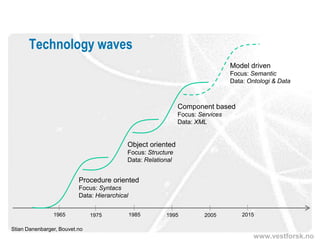
Technology waves
                                                                                Model driven
                                                                                Focus: Semantic
                                                                                Data: Ontologi & Data


                                                              Component based
                                                              Focus: Services
                                                              Data: XML


                                           Object oriented
                                           Focus: Structure
                                           Data: Relational


                          Procedure oriented
                          Focus: Syntacs
                          Data: Hierarchical


                1965           1975            1985     1995           2005         2015

Stian Danenbarger, Bouvet.no
                                                                                        www.vestforsk.no
The ontology spectrum

The ontology spectrum: From weak to strong semantics

      1. Vocabulary
             •   plain text documents/HTML pages – almost no semantic structure
      2. Controlled vocabularies (weak semantic structure)
             •   adding metadata to the information
      3. Taxonomies
             •   metadata and hierarchy
      4. Thesauri
             •   metadata, hierarchy and a limited set of relations (BT, NT, related to ...)
      5. Stronger semantic structures/ontologies
             •   metadata, [hierarchy], any relations


(Daconta et al.: “The Semantic Web”)

                                                                                 www.vestforsk.no
Semantic technologies
   AI tradition/Logics: Semantic web
       W3C as the standardization body

   Humanities/Library science: Topic Maps
       ISO-standard

   Light-weight, bottom-up: Microformats
       Not a standard yet, but might be as part of HTML5


                                                            www.vestforsk.no
Semantic Web
   ”Web of data”

   ”Web 3.0”

   ”Semantic web” coined by Tim Berners-Lee in mid 1990s

   The (in-)famous article ”The Semantic Web” in Scientific
    American 2001 (TBL, Jim Hendler, Ora Lassila)

   Wikipedia:
    However, the Semantic Web as originally envisioned, a system that
    enables machines to understand and respond to complex human
    requests based on their meaning, has remained largely unrealized and
    its critics have questioned its feasibility.
                                                           www.vestforsk.no
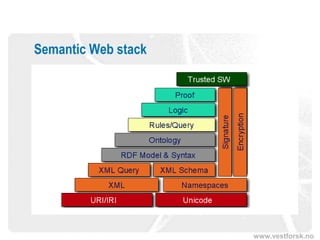
Semantic Web stack


                     www.vestforsk.no
Lessons learned from the HTML history?
    xhtml 1: HTML as XML

    xhtml 2: Get rid of html altogether

    ... it was a disaster!

    WHATWG TF – a rebellion inside W3C
         Web Apps 1.0

    .. eventually led to HTML5

    pragmatism won over idealism

Jeremy Keith: ”HTML5 for Web Designers”
                                           www.vestforsk.no
Semantic Web light
   Is the Semantic Web too complex?
       difficult to scale to the WWW
       more suitable for use within smaller domains

   Introducing ”Light-weight” SW:
       RDFa: RDF expressed as (x)HTML – part of HTML
       GRDDL: RDF data from XML/xHTML documents
       SKOS: Simple Knowledge Organization System – representation of
        ”classical” structures as taxonomies, thesauri in RDF
        •   organizing concepts with standard relations


   Linked (Open) Data


                                                                www.vestforsk.no
Topic Maps
   ISO standard from 2001 (present standard from 2003)
       ISO 13250:2003

   Strong Norwegian community
       small world wide community compared to SW

   Large uptake in portals, especially public portals

   ”Fight” between TM and SW
       Largely over, ”SW has won”
       Linked Data as a common ground for further development
       Focus has shifted from technology to utilizing data

                                                              www.vestforsk.no
Simple Topic Maps model


 3 Topic types: person, project and publication
 2 Association types: Project manager of, Author of, and Result of


                                                                     www.vestforsk.no
Topic Maps in use
   Some Topic Maps driven portals:
       uib.no
       vestforsk.no
       nofima.no
       regjeringen.no
       stortinget.no
       bergen.kommune.no


                                      www.vestforsk.no
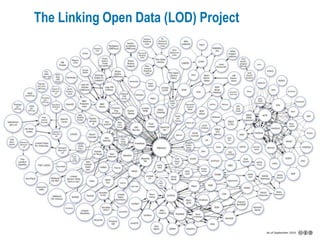
The Linking Open Data (LOD) Project


                                      www.vestforsk.no
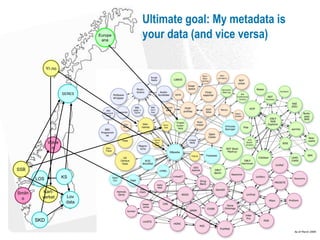
Ultimate goal: My metadata is
                              Europe
                               ana
                                       your data (and vice versa)

              Yr.no


                      SERES


              Volve
                n


SSB

        LOS           KS


Smiln      Kart-
 o        verket       Lov
                       data


        SKD


                                                             www.vestforsk.no
Linked (Open) Data
   using the Web to lower the barriers to linking data

   use of RDF to make typed statements

   Linked Data = Use the Web to make typed links between data
    from different sources
       Alex Wright: The Web That Wasn’t (Topic Maps 2008 Conf.)
       David Weinberger: Thank God! (Topic Maps 2008 Conf.)

   ”small pieces loosely joined”


                                                          www.vestforsk.no
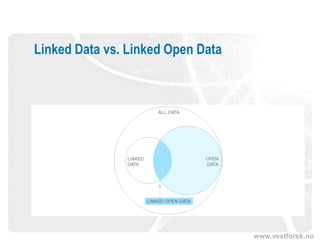
Linked Data vs. Linked Open Data


                                   www.vestforsk.no
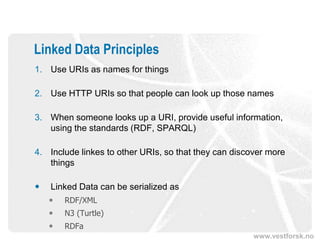
Linked Data Principles
1. Use URIs as names for things

2. Use HTTP URIs so that people can look up those names

3. When someone looks up a URI, provide useful information,
   using the standards (RDF, SPARQL)

4. Include linkes to other URIs, so that they can discover more
   things

   Linked Data can be serialized as
       RDF/XML
       N3 (Turtle)
       RDFa
                                                       www.vestforsk.no
Linked Open Data Star Scheme


Tim Berners-Lee/DERI – University of Galway
                                              www.vestforsk.no
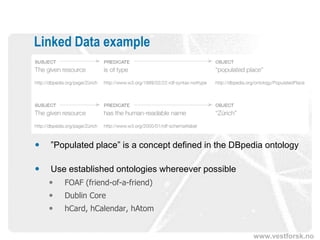
Linked Data example


   ”Populated place” is a concept defined in the DBpedia ontology

   Use established ontologies whereever possible
       FOAF (friend-of-a-friend)
       Dublin Core
       hCard, hCalendar, hAtom


                                                      www.vestforsk.no
Linked Data vs. Semantic Web
   The Semantic Web, or the Web of Data, is the ultimate goal

   Linked Data provides the means to reach that goal

   Linked Data helps build the Web of Data that later can be
    exploited by more advanced techn. such as intelligent agents

   (it has to be added that this is the proponents of the semantic
    web/intelligent agents claim)

   Tom Heath: ”Without Linked Data, no Semantic Web!
       Talis Nodalities no. 11


                                                         www.vestforsk.no
Open data
   In principle all data, but mostly public data because that is the
    easiest to start with

   PSI directive from EU an important enabler (also included in
    Offentleg-lova)

   data.norge.no

   data.norge.no from FAD to Difi
       and from blog to data repository (?)


                                                          www.vestforsk.no
Why open data?
1. Increase democratic control and political participation
          Empower citizens to exercise their democratic rights

2. Foster service and product innovation
          New opportunities for innovation generated by open government
           data

3. Strengthen law enforcement
          Especially the US and the UK strategies emphasize this


 Study published in the European Journal of ePractice, 2011

                                                                  www.vestforsk.no
“Open data and its enemies”
   Some pressure from FAD (recently expressed in ”Tildelings-
    brevet”), but slow movement in general
       cultural issues
       budget issues
       fear of loosing control
       transparency is seen as a threat

   Map data is some of the most important – Map Authorities are
    not willing to publish raw data


                                                      www.vestforsk.no
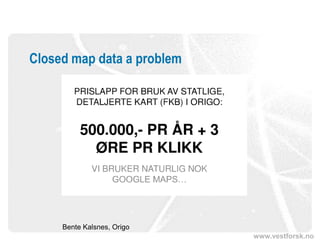
Closed map data a problem


     Bente Kalsnes, Origo
                            www.vestforsk.no
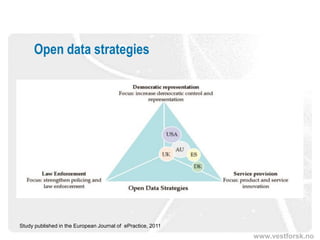
Open data strategies


Study published in the European Journal of ePractice, 2011

                                                             www.vestforsk.no
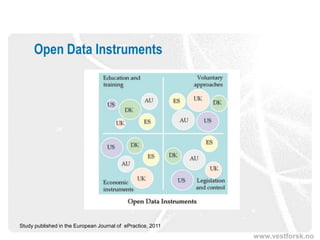
Open Data Instruments


Study published in the European Journal of ePractice, 2011

                                                             www.vestforsk.no
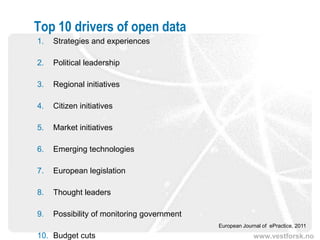
Top 10 drivers of open data
1.   Strategies and experiences

2.   Political leadership

3.   Regional initiatives

4.   Citizen initiatives

5.   Market initiatives

6.   Emerging technologies

7.   European legislation

8.   Thought leaders

9.   Possibility of monitoring government
                                            European Journal of ePractice, 2011
10. Budget cuts                                          www.vestforsk.no
Top 10 barriers to open data
1.   Closed government culture

2.   Privacy legislation

3.   Limited quality of data

4.   Limited user-friendliness/Info overload

5.   Lack of standardisation of open data

6.   Security threats

7.   Existing charging methods

8.   Uncertain economic impact

9.   Digital divide
                                               European Journal of ePractice, 2011
10. Network overload                                        www.vestforsk.no
data.norge.no
   Initiative from FAD started in 2010
    (I will take credit for the name! :)


   Mostly a blog

   Gradually building up a data repository

   From 01.05.2011 Difi will have the responsibility for
    data.norge.no


                                                            www.vestforsk.no
data.norge.no as of April 2011
1. Byantikvarens gule liste (xls)   8. N5000 (div. grafiske format
                                       + sosi/shape)
2. Einingsregisteret (rdf/xml)
                                    9. Statlege styre, råd og utval
3. Gardsmatrikkelen 1886 (xls)         (html)

4. Idrettsanlegg (csv)              10. Statsbudsjettet og nasjonal-
                                        budsjettet 2011 (xls, csv)
5. Kraftprisar (Tab-sep. tekst)
                                    11. Tenestemannsregisteret
                                        (csv)
6. Ladestasjonar (csv, ov2..)

                                    •   no.ckan.net lists 212
7. Los (ods)
                                        different data sources
                                                         www.vestforsk.no
7 tips for publishing linked open data
1.   Use standard Internet protocols for access (http)

2.   All objects need a unique identifier (URI)

3.   Avoid aggregation of data

4.   Structure metadata in a machine readable format (xml or xml/rdf/xtm)

5.   Use international character set (UTF-8)

6.   Use minimum Dublin Core as a standard way of describing metadata

7.   Think about linking to other data sources by preparing for Linked Data


                                                              www.vestforsk.no
Relevant projects from Vestforsk
   Sesam4 – Semantic technologies for SMEs

   Los – a navigator for public services

   Tourism concepts – a common vocabulary for the tourism industry

   Seminars on semantic technologies

   The WIMS’11 Conference


                                                          www.vestforsk.no
Sesam4
   VERDIKT project 2008 – 2011 (ended 31st of March this year)

   Use of semantic technologies in SMEs

   Provided a set of tools for SMEs (and others) to use for ”semantisizing”
    their data

   Demonstrated semantic technologies in two pilots:
       Tourism
       Business information


   NR, Vestlandsforsking, Esis, Computas, UNI Digital,
    Cyberwatcher, TextUrgy, Ovitas, IKT-Norge


                                                              www.vestforsk.no
Sesam4 – lessons learned
   Project planned in 2007

   A lot of things have happened since 2007

   Emerging of Linked Data

   Sesam4 gradually tuned in to LOD

   Too much focus, resources, and discussion (!) spent on ontologies!

   Light-weight approach saves time & money

   Valuable tools for semantic lifting and best practices remains
    available for anybody to use (most of the project in open
    source)
                                                            www.vestforsk.no
LOS – a navigator to public services
   LivsIT (1996 – 2004)
       Life situations

   Los (2005 - ??)
       Shared vocabulary for public services


   More than 1/3 of the municipalities in Norway use Los as a
    foundation of their web portal

   Difi is the responsible agency
       Los a success despite Difi’s lack of support and development
       Problem with uptake in Governmental bodies

   By using Los municipalities can share information with
                                                             www.vestforsk.no
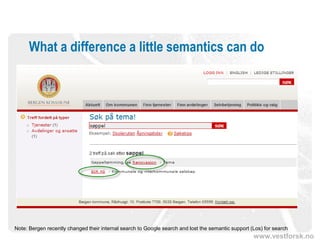
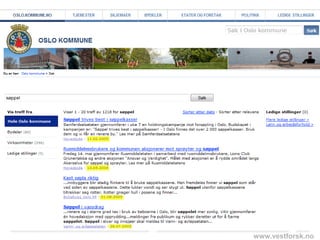
What a difference a little semantics can do


Note: Bergen recently changed their internal search to Google search and lost the semantic support (Los) for search
                                                                                                    www.vestforsk.no
What a difference a little semantics can do


                                         www.vestforsk.no
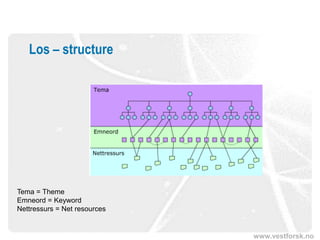
Los – structure


Tema = Theme
Emneord = Keyword
Nettressurs = Net resources


                              www.vestforsk.no
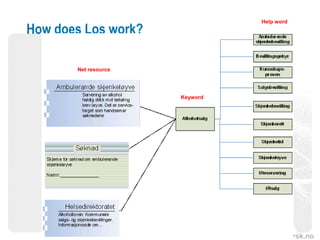
Help word
How does Los work?

       Net resource


                      Keyword


                                www.vestforsk.no
Tourism concepts
   Pre-project for the Norwegian tourism industry (VisitNorway, NCE
    Tourism)

   Advice on constructing a common vocabulary for tourism concepts

   Initiated by Anders Waage Nilsen in NCE Tourism/Fjord Norway
    (Anders now in MediArena)


                                                            www.vestforsk.no
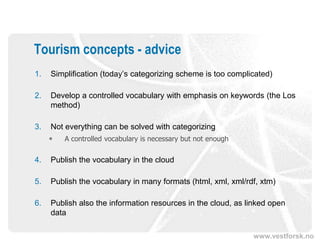
Tourism concepts - advice
1.   Simplification (today’s categorizing scheme is too complicated)

2.   Develop a controlled vocabulary with emphasis on keywords (the Los
     method)

3.   Not everything can be solved with categorizing
        A controlled vocabulary is necessary but not enough

4.   Publish the vocabulary in the cloud

5.   Publish the vocabulary in many formats (html, xml, xml/rdf, xtm)

6.   Publish also the information resources in the cloud, as linked open
     data

                                                               www.vestforsk.no
Seminars on semantic technologies
   Vestforsk initiated a series of seminars on semantic technologies as
    part of its 25th anniversary in 2010

   A total of 7-8 seminars will be held, 4 already arranged

   Streaming of all seminars, and archived for video on demand
       We also have project ”Kunnskap kryssar grenser”/”Access to Knowledge”
        where we focus on streaming and use of video


                                                                www.vestforsk.no
WIMS’11
   International Conference on Web Intelligence, Mining, and Semantics

   Sogndal, May 25 – 27

   Keynote speakers:
       Jim Hendler: The Semantic Web 10th Year Update (25.05)
       Peter Mika: Making Things Findable (26.05)
       Sören Auer: Creating Knowledge Out of Interlinked Data (26.05)
       Ashwin Ram: Open Social Learning Communities (27.05)
       Marko Grobelnik: Scalable Reasoning on Intensive Streams of Data (27.05)


   wims.vestforsk.no


                                                                         www.vestforsk.no
Some resources
   Vestforsk series of seminars on semantic technologies
       http://www.vestforsk.no/aktuelt/seminarserie-om-semantiske-teknologiar


   Linked Data – The Story So Far (Bizer, Heath, Berners-Lee)
       http://tomheath.com/papers/bizer-heath-berners-lee-ijswis-linked-data.pdf


   Linked Data vs. Linked Open Data
       http://datavisualization.ch/opinions/introduction-to-linked-data


   Linked Data – Evolving the Web into a Global Data Space (Heath, Bizer)
       http://linkeddatabook.com/editions/1.0/


   Introduction to Linked Open Data for Visualization Creators:
    http://datavisualization.ch/opinions/introduction-to-linked-data

   CKAN: The Data Hub
       http://ckan.net
                                                                           www.vestforsk.no
More resources
   Talis Nodalities:
    http://www.talis.com/nodalities

    Publishing Open Government Data (working draft)
        http://www.w3.org/TR/2009/WD-gov-data-20090908/

    Åpne data og journalistikk (Bente Kalsnes, Origo)
        http://www.slideshare.net/benteka/pne-data-og-journalistikk

    European Journal of ePractice
        http://www.epractice.eu/en/journal/issues

   Figshare: Sharing scientific data (http://figshare.com)
    http://blog.okfn.org/2011/03/02/introducing-figshare-a-new-way-to-share-open-
    scientific-data/
                                                                       www.vestforsk.no
Thank you for your attention!


 Contact information:
    Svein Ølnes – sol@vestforsk.no


                                      www.vestforsk.no

Open data and reuse of public information

  • 1.
    Open Data andits Potential - reuse of public sector information - Svein Ølnes, Vestlandsforsking, 13.04.2011
  • 2.
    Outline  About Vestforsk and myself  Semantic technologies  Linked (Open) Data  Open Data  Open Data -> LOD -> Sem. Techn.  Relevant projects and resources  Literature www.vestforsk.no
  • 3.
    Vestlandsforsking  ICT themes  Semantic technologies, information structures ++  Regional development, organizational changes with ICT  ICT application areas  Public sector (eGovernment, eHealth)  Tourism sector (local, regional, national, int’national level)  Vestforsk also does research in  Climate change  Transport and environment  Sustainable tourism  Renewable energy www.vestforsk.no
  • 4.
    About me  Vestforsk since 1996  eGovernment  Municipalities  Government  Semantic technologies  Projects  Norge.no (establishing in 1999/2000)  MiSide (development of demonstrator in 2004)  LivsIT/Los (2003 – to date)  Evaluation of public websites (2001 – to date) www.vestforsk.no
  • 5.
    Naming things!  [the famous cartoon by Gary Larson showing a man painting ’the cat’, ’the dog’, ’the house’ on his cat, dog, and house and explaining ”Now, this should clear up a few things around here!”] www.vestforsk.no
  • 6.
    Technology waves Model driven Focus: Semantic Data: Ontologi & Data Component based Focus: Services Data: XML Object oriented Focus: Structure Data: Relational Procedure oriented Focus: Syntacs Data: Hierarchical 1965 1975 1985 1995 2005 2015 Stian Danenbarger, Bouvet.no www.vestforsk.no
  • 7.
    The ontology spectrum Theontology spectrum: From weak to strong semantics 1. Vocabulary • plain text documents/HTML pages – almost no semantic structure 2. Controlled vocabularies (weak semantic structure) • adding metadata to the information 3. Taxonomies • metadata and hierarchy 4. Thesauri • metadata, hierarchy and a limited set of relations (BT, NT, related to ...) 5. Stronger semantic structures/ontologies • metadata, [hierarchy], any relations (Daconta et al.: “The Semantic Web”) www.vestforsk.no
  • 8.
    Semantic technologies  AI tradition/Logics: Semantic web  W3C as the standardization body  Humanities/Library science: Topic Maps  ISO-standard  Light-weight, bottom-up: Microformats  Not a standard yet, but might be as part of HTML5 www.vestforsk.no
  • 9.
    Semantic Web  ”Web of data”  ”Web 3.0”  ”Semantic web” coined by Tim Berners-Lee in mid 1990s  The (in-)famous article ”The Semantic Web” in Scientific American 2001 (TBL, Jim Hendler, Ora Lassila)  Wikipedia: However, the Semantic Web as originally envisioned, a system that enables machines to understand and respond to complex human requests based on their meaning, has remained largely unrealized and its critics have questioned its feasibility. www.vestforsk.no
  • 10.
    Semantic Web stack www.vestforsk.no
  • 11.
    Lessons learned fromthe HTML history?  xhtml 1: HTML as XML  xhtml 2: Get rid of html altogether  ... it was a disaster!  WHATWG TF – a rebellion inside W3C  Web Apps 1.0  .. eventually led to HTML5  pragmatism won over idealism Jeremy Keith: ”HTML5 for Web Designers” www.vestforsk.no
  • 12.
    Semantic Web light  Is the Semantic Web too complex?  difficult to scale to the WWW  more suitable for use within smaller domains  Introducing ”Light-weight” SW:  RDFa: RDF expressed as (x)HTML – part of HTML  GRDDL: RDF data from XML/xHTML documents  SKOS: Simple Knowledge Organization System – representation of ”classical” structures as taxonomies, thesauri in RDF • organizing concepts with standard relations  Linked (Open) Data www.vestforsk.no
  • 13.
    Topic Maps  ISO standard from 2001 (present standard from 2003)  ISO 13250:2003  Strong Norwegian community  small world wide community compared to SW  Large uptake in portals, especially public portals  ”Fight” between TM and SW  Largely over, ”SW has won”  Linked Data as a common ground for further development  Focus has shifted from technology to utilizing data www.vestforsk.no
  • 14.
    Simple Topic Mapsmodel 3 Topic types: person, project and publication 2 Association types: Project manager of, Author of, and Result of www.vestforsk.no
  • 15.
    Topic Maps inuse  Some Topic Maps driven portals:  uib.no  vestforsk.no  nofima.no  regjeringen.no  stortinget.no  bergen.kommune.no www.vestforsk.no
  • 16.
    The Linking OpenData (LOD) Project www.vestforsk.no
  • 17.
    Ultimate goal: Mymetadata is Europe ana your data (and vice versa) Yr.no SERES Volve n SSB LOS KS Smiln Kart- o verket Lov data SKD www.vestforsk.no
  • 18.
    Linked (Open) Data  using the Web to lower the barriers to linking data  use of RDF to make typed statements  Linked Data = Use the Web to make typed links between data from different sources  Alex Wright: The Web That Wasn’t (Topic Maps 2008 Conf.)  David Weinberger: Thank God! (Topic Maps 2008 Conf.)  ”small pieces loosely joined” www.vestforsk.no
  • 19.
    Linked Data vs.Linked Open Data www.vestforsk.no
  • 20.
    Linked Data Principles 1.Use URIs as names for things 2. Use HTTP URIs so that people can look up those names 3. When someone looks up a URI, provide useful information, using the standards (RDF, SPARQL) 4. Include linkes to other URIs, so that they can discover more things  Linked Data can be serialized as  RDF/XML  N3 (Turtle)  RDFa www.vestforsk.no
  • 21.
    Linked Open DataStar Scheme Tim Berners-Lee/DERI – University of Galway www.vestforsk.no
  • 22.
    Linked Data example  ”Populated place” is a concept defined in the DBpedia ontology  Use established ontologies whereever possible  FOAF (friend-of-a-friend)  Dublin Core  hCard, hCalendar, hAtom www.vestforsk.no
  • 23.
    Linked Data vs.Semantic Web  The Semantic Web, or the Web of Data, is the ultimate goal  Linked Data provides the means to reach that goal  Linked Data helps build the Web of Data that later can be exploited by more advanced techn. such as intelligent agents  (it has to be added that this is the proponents of the semantic web/intelligent agents claim)  Tom Heath: ”Without Linked Data, no Semantic Web!  Talis Nodalities no. 11 www.vestforsk.no
  • 24.
    Open data  In principle all data, but mostly public data because that is the easiest to start with  PSI directive from EU an important enabler (also included in Offentleg-lova)  data.norge.no  data.norge.no from FAD to Difi  and from blog to data repository (?) www.vestforsk.no
  • 25.
    Why open data? 1.Increase democratic control and political participation  Empower citizens to exercise their democratic rights 2. Foster service and product innovation  New opportunities for innovation generated by open government data 3. Strengthen law enforcement  Especially the US and the UK strategies emphasize this Study published in the European Journal of ePractice, 2011 www.vestforsk.no
  • 26.
    “Open data andits enemies”  Some pressure from FAD (recently expressed in ”Tildelings- brevet”), but slow movement in general  cultural issues  budget issues  fear of loosing control  transparency is seen as a threat  Map data is some of the most important – Map Authorities are not willing to publish raw data www.vestforsk.no
  • 27.
    Closed map dataa problem Bente Kalsnes, Origo www.vestforsk.no
  • 28.
    Open data strategies Studypublished in the European Journal of ePractice, 2011 www.vestforsk.no
  • 29.
    Open Data Instruments Studypublished in the European Journal of ePractice, 2011 www.vestforsk.no
  • 30.
    Top 10 driversof open data 1. Strategies and experiences 2. Political leadership 3. Regional initiatives 4. Citizen initiatives 5. Market initiatives 6. Emerging technologies 7. European legislation 8. Thought leaders 9. Possibility of monitoring government European Journal of ePractice, 2011 10. Budget cuts www.vestforsk.no
  • 31.
    Top 10 barriersto open data 1. Closed government culture 2. Privacy legislation 3. Limited quality of data 4. Limited user-friendliness/Info overload 5. Lack of standardisation of open data 6. Security threats 7. Existing charging methods 8. Uncertain economic impact 9. Digital divide European Journal of ePractice, 2011 10. Network overload www.vestforsk.no
  • 32.
    data.norge.no  Initiative from FAD started in 2010 (I will take credit for the name! :)  Mostly a blog  Gradually building up a data repository  From 01.05.2011 Difi will have the responsibility for data.norge.no www.vestforsk.no
  • 33.
    data.norge.no as ofApril 2011 1. Byantikvarens gule liste (xls) 8. N5000 (div. grafiske format + sosi/shape) 2. Einingsregisteret (rdf/xml) 9. Statlege styre, råd og utval 3. Gardsmatrikkelen 1886 (xls) (html) 4. Idrettsanlegg (csv) 10. Statsbudsjettet og nasjonal- budsjettet 2011 (xls, csv) 5. Kraftprisar (Tab-sep. tekst) 11. Tenestemannsregisteret (csv) 6. Ladestasjonar (csv, ov2..) • no.ckan.net lists 212 7. Los (ods) different data sources www.vestforsk.no
  • 34.
    7 tips forpublishing linked open data 1. Use standard Internet protocols for access (http) 2. All objects need a unique identifier (URI) 3. Avoid aggregation of data 4. Structure metadata in a machine readable format (xml or xml/rdf/xtm) 5. Use international character set (UTF-8) 6. Use minimum Dublin Core as a standard way of describing metadata 7. Think about linking to other data sources by preparing for Linked Data www.vestforsk.no
  • 35.
    Relevant projects fromVestforsk  Sesam4 – Semantic technologies for SMEs  Los – a navigator for public services  Tourism concepts – a common vocabulary for the tourism industry  Seminars on semantic technologies  The WIMS’11 Conference www.vestforsk.no
  • 36.
    Sesam4  VERDIKT project 2008 – 2011 (ended 31st of March this year)  Use of semantic technologies in SMEs  Provided a set of tools for SMEs (and others) to use for ”semantisizing” their data  Demonstrated semantic technologies in two pilots:  Tourism  Business information  NR, Vestlandsforsking, Esis, Computas, UNI Digital, Cyberwatcher, TextUrgy, Ovitas, IKT-Norge www.vestforsk.no
  • 37.
    Sesam4 – lessonslearned  Project planned in 2007  A lot of things have happened since 2007  Emerging of Linked Data  Sesam4 gradually tuned in to LOD  Too much focus, resources, and discussion (!) spent on ontologies!  Light-weight approach saves time & money  Valuable tools for semantic lifting and best practices remains available for anybody to use (most of the project in open source) www.vestforsk.no
  • 38.
    LOS – anavigator to public services  LivsIT (1996 – 2004)  Life situations  Los (2005 - ??)  Shared vocabulary for public services  More than 1/3 of the municipalities in Norway use Los as a foundation of their web portal  Difi is the responsible agency  Los a success despite Difi’s lack of support and development  Problem with uptake in Governmental bodies  By using Los municipalities can share information with www.vestforsk.no
  • 39.
    What a differencea little semantics can do Note: Bergen recently changed their internal search to Google search and lost the semantic support (Los) for search www.vestforsk.no
  • 40.
    What a differencea little semantics can do www.vestforsk.no
  • 41.
    Los – structure Tema= Theme Emneord = Keyword Nettressurs = Net resources www.vestforsk.no
  • 42.
    Help word How doesLos work? Net resource Keyword www.vestforsk.no
  • 43.
    Tourism concepts  Pre-project for the Norwegian tourism industry (VisitNorway, NCE Tourism)  Advice on constructing a common vocabulary for tourism concepts  Initiated by Anders Waage Nilsen in NCE Tourism/Fjord Norway (Anders now in MediArena) www.vestforsk.no
  • 44.
    Tourism concepts -advice 1. Simplification (today’s categorizing scheme is too complicated) 2. Develop a controlled vocabulary with emphasis on keywords (the Los method) 3. Not everything can be solved with categorizing  A controlled vocabulary is necessary but not enough 4. Publish the vocabulary in the cloud 5. Publish the vocabulary in many formats (html, xml, xml/rdf, xtm) 6. Publish also the information resources in the cloud, as linked open data www.vestforsk.no
  • 45.
    Seminars on semantictechnologies  Vestforsk initiated a series of seminars on semantic technologies as part of its 25th anniversary in 2010  A total of 7-8 seminars will be held, 4 already arranged  Streaming of all seminars, and archived for video on demand  We also have project ”Kunnskap kryssar grenser”/”Access to Knowledge” where we focus on streaming and use of video www.vestforsk.no
  • 46.
    WIMS’11  International Conference on Web Intelligence, Mining, and Semantics  Sogndal, May 25 – 27  Keynote speakers:  Jim Hendler: The Semantic Web 10th Year Update (25.05)  Peter Mika: Making Things Findable (26.05)  Sören Auer: Creating Knowledge Out of Interlinked Data (26.05)  Ashwin Ram: Open Social Learning Communities (27.05)  Marko Grobelnik: Scalable Reasoning on Intensive Streams of Data (27.05)  wims.vestforsk.no www.vestforsk.no
  • 47.
    Some resources  Vestforsk series of seminars on semantic technologies  http://www.vestforsk.no/aktuelt/seminarserie-om-semantiske-teknologiar  Linked Data – The Story So Far (Bizer, Heath, Berners-Lee)  http://tomheath.com/papers/bizer-heath-berners-lee-ijswis-linked-data.pdf  Linked Data vs. Linked Open Data  http://datavisualization.ch/opinions/introduction-to-linked-data  Linked Data – Evolving the Web into a Global Data Space (Heath, Bizer)  http://linkeddatabook.com/editions/1.0/  Introduction to Linked Open Data for Visualization Creators: http://datavisualization.ch/opinions/introduction-to-linked-data  CKAN: The Data Hub  http://ckan.net www.vestforsk.no
  • 48.
    More resources  Talis Nodalities: http://www.talis.com/nodalities  Publishing Open Government Data (working draft)  http://www.w3.org/TR/2009/WD-gov-data-20090908/  Åpne data og journalistikk (Bente Kalsnes, Origo)  http://www.slideshare.net/benteka/pne-data-og-journalistikk  European Journal of ePractice  http://www.epractice.eu/en/journal/issues  Figshare: Sharing scientific data (http://figshare.com) http://blog.okfn.org/2011/03/02/introducing-figshare-a-new-way-to-share-open- scientific-data/ www.vestforsk.no
  • 49.
    Thank you foryour attention!  Contact information:  Svein Ølnes – sol@vestforsk.no www.vestforsk.no