Open Cloud Computing Interface (OCCI)
2nd Trentino Cloud Computing Meetup — Trento
Augusto Ciuffoletti
University of Pisa
May 26, 2016
Open Cloud Computing Interface (OCCI)
Summary
• Why OCCI?
• See how simple it is
• Status and perspectives
Open Cloud Computing Interface (OCCI)
The problem: too many cloud interfaces
• Each provider has a different interface
• Hybrid, federated clouds need one for all
• Users fear lock-in
• An open standard for cloud interface
• OCCI is cloud IP
• Relationships with OASIS-TOSCA?
Open Cloud Computing Interface (OCCI)
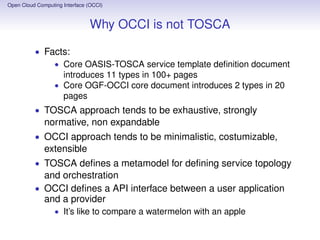
Why OCCI is not TOSCA
• Facts:
• Core OASIS-TOSCA service template definition document
introduces 11 types in 100+ pages
• Core OGF-OCCI core document introduces 2 types in 20
pages
• TOSCA approach tends to be exhaustive, strongly
normative, non expandable
• OCCI approach tends to be minimalistic, costumizable,
extensible
• TOSCA defines a metamodel for defining service topology
and orchestration
• OCCI defines a API interface between a user application
and a provider
• It’s like to compare a watermelon with an apple
Open Cloud Computing Interface (OCCI)
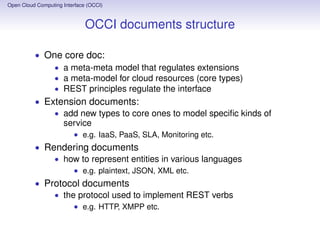
OCCI documents structure
• One core doc:
• a meta-meta model that regulates extensions
• a meta-model for cloud resources (core types)
• REST principles regulate the interface
• Extension documents:
• add new types to core ones to model specific kinds of
service
• e.g. IaaS, PaaS, SLA, Monitoring etc.
• Rendering documents
• how to represent entities in various languages
• e.g. plaintext, JSON, XML etc.
• Protocol documents
• the protocol used to implement REST verbs
• e.g. HTTP, XMPP etc.
Open Cloud Computing Interface (OCCI)
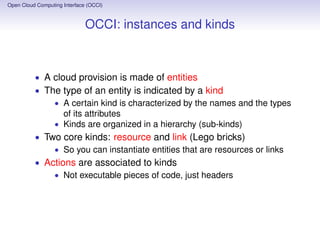
OCCI: instances and kinds
• A cloud provision is made of entities
• The type of an entity is indicated by a kind
• A certain kind is characterized by the names and the types
of its attributes
• Kinds are organized in a hierarchy (sub-kinds)
• Two core kinds: resource and link (Lego bricks)
• So you can instantiate entities that are resources or links
• Actions are associated to kinds
• Not executable pieces of code, just headers
Open Cloud Computing Interface (OCCI)
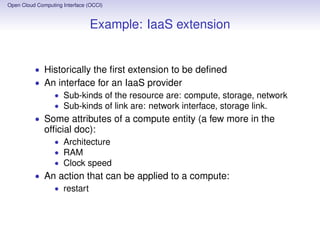
Example: IaaS extension
• Historically the first extension to be defined
• An interface for an IaaS provider
• Sub-kinds of the resource are: compute, storage, network
• Sub-kinds of link are: network interface, storage link.
• Some attributes of a compute entity (a few more in the
official doc):
• Architecture
• RAM
• Clock speed
• An action that can be applied to a compute:
• restart
Open Cloud Computing Interface (OCCI)
OCCI: mixins
• Mixins are not new: they exist in Simula, OO Lisp and
other languages
• It is a way to add new capabilities to a class, without
inheritance:
• a mixin is included, not inherited
• In OCCI a Mixin is an aggregate of attributes and actions,
similar to a kind
• A given mixin cannot be instantiated, but only associated
to an already instantiated entity
• Examples:
• an Ubuntu 16.04 mixin is used to declare that a compute
entity has this OS installed
• Mixins, Actions and Kinds are Categories in the meta-meta
model
That’s all for the core model
Open Cloud Computing Interface (OCCI)
OCCI: restfulness
• Each entity, type, mixin, action is referred with an URI
• The four REST verbs are used to manipulate entities:
• GET to obtain the definition of an entity
• PUT to create a new entity
• POST to add a subordinate entity in a collection
• DELETE to remove an entity
• Similar for collections of entities
Open Cloud Computing Interface (OCCI)
Extensibility
• 1st method: the provider creates new sub-classes
• Example: IaaS, one further class is a server (i.e. compute
resource kind), or a network link (i.e. network resource
kind), or a network interface (i.e. interface link kind)
• 2nd method: the provider creates new mixins to allow the
user to customize entities
Open Cloud Computing Interface (OCCI)
Status of release 1.2
• Minor differences with respect to 1.1 gathering
implementation experience
• Public comment period finished, now in final review by
OGF board
• Documents in the release
• Core Model (*)
• IaaS Extension
• PaaS Extension
• SLA Extension
• HTTP Protocol (*)
• Text Rendering (*)
• JSON Rendering (*)
• The (*) indicates that a compliant interface MUST support
the functionalities described in the document
• A release 2.0 in under way, though unscheduled
Open Cloud Computing Interface (OCCI)
Conclusions
• The OCCI interface is implemented in many languages
(Python, Java, Ruby, Erlang etc.)
• It is adapted to work with many cloud control engines
(OpenStack, OpenNebula, AWS and more)
• Adopted by the EGI cloud infrastructure
• My role: I designed an extension for cloud monitoring, now
an informational document, targeting the inclusion in OCCI
2.0.
Open Cloud Computing Interface (OCCI)
Further viewing and reading
• A presentation of the OGF chair during a NIST meeting
(from 35:00 to 52:00)
• see
http://www.nist.gov/itl/cloud/cloud_comp_webcast_viii.cfm
• Browse documents in the OCCI repository:
• https://redmine.ogf.org/projects/occi-wg/repository
• These slides on SlideShare:
• http://www.slideshare.net/AugustoCiuffoletti/open-cloud-
computing-interface-62384843

Open Cloud Computing Interface

  • 1.
    Open Cloud ComputingInterface (OCCI) Open Cloud Computing Interface (OCCI) 2nd Trentino Cloud Computing Meetup — Trento Augusto Ciuffoletti University of Pisa May 26, 2016 Open Cloud Computing Interface (OCCI) Summary • Why OCCI? • See how simple it is • Status and perspectives
  • 2.
    Open Cloud ComputingInterface (OCCI) The problem: too many cloud interfaces • Each provider has a different interface • Hybrid, federated clouds need one for all • Users fear lock-in • An open standard for cloud interface • OCCI is cloud IP • Relationships with OASIS-TOSCA? Open Cloud Computing Interface (OCCI) Why OCCI is not TOSCA • Facts: • Core OASIS-TOSCA service template definition document introduces 11 types in 100+ pages • Core OGF-OCCI core document introduces 2 types in 20 pages • TOSCA approach tends to be exhaustive, strongly normative, non expandable • OCCI approach tends to be minimalistic, costumizable, extensible • TOSCA defines a metamodel for defining service topology and orchestration • OCCI defines a API interface between a user application and a provider • It’s like to compare a watermelon with an apple
  • 3.
    Open Cloud ComputingInterface (OCCI) OCCI documents structure • One core doc: • a meta-meta model that regulates extensions • a meta-model for cloud resources (core types) • REST principles regulate the interface • Extension documents: • add new types to core ones to model specific kinds of service • e.g. IaaS, PaaS, SLA, Monitoring etc. • Rendering documents • how to represent entities in various languages • e.g. plaintext, JSON, XML etc. • Protocol documents • the protocol used to implement REST verbs • e.g. HTTP, XMPP etc. Open Cloud Computing Interface (OCCI) OCCI: instances and kinds • A cloud provision is made of entities • The type of an entity is indicated by a kind • A certain kind is characterized by the names and the types of its attributes • Kinds are organized in a hierarchy (sub-kinds) • Two core kinds: resource and link (Lego bricks) • So you can instantiate entities that are resources or links • Actions are associated to kinds • Not executable pieces of code, just headers
  • 4.
    Open Cloud ComputingInterface (OCCI) Example: IaaS extension • Historically the first extension to be defined • An interface for an IaaS provider • Sub-kinds of the resource are: compute, storage, network • Sub-kinds of link are: network interface, storage link. • Some attributes of a compute entity (a few more in the official doc): • Architecture • RAM • Clock speed • An action that can be applied to a compute: • restart Open Cloud Computing Interface (OCCI) OCCI: mixins • Mixins are not new: they exist in Simula, OO Lisp and other languages • It is a way to add new capabilities to a class, without inheritance: • a mixin is included, not inherited • In OCCI a Mixin is an aggregate of attributes and actions, similar to a kind • A given mixin cannot be instantiated, but only associated to an already instantiated entity • Examples: • an Ubuntu 16.04 mixin is used to declare that a compute entity has this OS installed • Mixins, Actions and Kinds are Categories in the meta-meta model That’s all for the core model
  • 5.
    Open Cloud ComputingInterface (OCCI) OCCI: restfulness • Each entity, type, mixin, action is referred with an URI • The four REST verbs are used to manipulate entities: • GET to obtain the definition of an entity • PUT to create a new entity • POST to add a subordinate entity in a collection • DELETE to remove an entity • Similar for collections of entities Open Cloud Computing Interface (OCCI) Extensibility • 1st method: the provider creates new sub-classes • Example: IaaS, one further class is a server (i.e. compute resource kind), or a network link (i.e. network resource kind), or a network interface (i.e. interface link kind) • 2nd method: the provider creates new mixins to allow the user to customize entities
  • 6.
    Open Cloud ComputingInterface (OCCI) Status of release 1.2 • Minor differences with respect to 1.1 gathering implementation experience • Public comment period finished, now in final review by OGF board • Documents in the release • Core Model (*) • IaaS Extension • PaaS Extension • SLA Extension • HTTP Protocol (*) • Text Rendering (*) • JSON Rendering (*) • The (*) indicates that a compliant interface MUST support the functionalities described in the document • A release 2.0 in under way, though unscheduled Open Cloud Computing Interface (OCCI) Conclusions • The OCCI interface is implemented in many languages (Python, Java, Ruby, Erlang etc.) • It is adapted to work with many cloud control engines (OpenStack, OpenNebula, AWS and more) • Adopted by the EGI cloud infrastructure • My role: I designed an extension for cloud monitoring, now an informational document, targeting the inclusion in OCCI 2.0.
  • 7.
    Open Cloud ComputingInterface (OCCI) Further viewing and reading • A presentation of the OGF chair during a NIST meeting (from 35:00 to 52:00) • see http://www.nist.gov/itl/cloud/cloud_comp_webcast_viii.cfm • Browse documents in the OCCI repository: • https://redmine.ogf.org/projects/occi-wg/repository • These slides on SlideShare: • http://www.slideshare.net/AugustoCiuffoletti/open-cloud- computing-interface-62384843