OPEN BUILDING TOOLKITS
Francesco Montagnana1
, Hiroshi Fukuta2
ABSTRACT: Timber frame structure systems using glued laminated timber have become a widespread construction
method for detached houses throughout Japan. SE-structure®
is one of these systems and for its integration of design-
prefabrication-installation-quality control and seismic design has been chosen for the construction of a pilot project in
Italy:. The SI (support/infill) system has been implemented with SE-structure®
system, in a European context. The
structure of the building was conceived as an example of system building based on an open system, applicable to
residential building.
KEYWORDS: open building, building system, system engineering, seismic design
1 INTRODUCTION12
The industrialization of house’s production in Japan,
particularly in the field of detached houses, which really
started in the 60’s is often said as the most advanced in
the world. Indeed various industrialized construction
methods, most of which were only experimental or had
only short lives in the actual market in other countries,
have been extensively applied in the house’s production
in Japan.
In residential wooden construction that still now
accounts for the largest share of detached houses, like so
much of its traditional culture, Japan has developed a
highly efficient technological adaptation of an age-old
building techniques where:
1. Design and construction were an organic part of
the same process;
2. Modular coordination was the key to customary
design and the building process;
3. Prefabrication of the parts was the basis of the
building process;
4. On site assembly was a rapid, precision
operation.
As the most time consuming part of the prefabrication
process was the cutting of mortise and tenon joinery
holding together the timber frame, the introduction of
industrially precut timber framing has become the
predominant house construction method.
Industrially precut frame-structures are manufactured by
on-site assembly of columns and beams and other
structural parts (i.e. shearing walls, floor panels), to
which non-structural outer-wall panels are attached to
form a shelter.
1
Francesco Montagnana, Studio di Architettura, Italy.
Email: francesco.montagnana@gmail.com
2
Hiroshi Fukuta, NCN Co. Ltd., 1-7-18 Konan, Minato-ku,
Tokyo, Japan. Email: fukuta@ncn-se.co.jp
In Chapter 2 we describe the features of SE-structure®
of
the above mentioned systems and remarkable for its
integration of design-prefabrication-installation-quality
control and seismic design.
In Chapter 3, SE-structure®
, chosen for the construction
of a pilot project in Italy where he SI (support/infill)
system has been implemented, in a European context.
In Chapter 4 describes how the structure of the building
was conceived as an example of system building based
on an open system, applicable to residential building.
In Chapter 5 conclusions are summarised.
2 SE-STRUCTURE SYSTEM
The SE-structure®
system has taken the traditional
Japanese method of building wooden frames to a higher
level.
Since 1997 up to now, using SE-structure®
, 18.000
buildings have been built in Japan by a network that
currently includes over 500 construction firms with a
consistent group of about 600 architects and engineers
duly trained to integrate it in their design. Seven licensed
pre-cut factories produce the glulam pillars, beams and
panels and a couple of factories delivers the metal
connectors.
The SE-structure®
hardware and software was developed
and patented from the early 90s by NCN (New
Constructor’s Network) of Tokyo, and dedicated to
structural design and to the manufacturing of
numerically controlled components. The same software
that conducts a 3D structural analysis, sends the data to
production once the structure has been verified in order
to ensure the maximum precision of all the elements.
1.1 GENERAL FEATURES
The “technology” or literally “construction method” of
the SE-structure®
system consists of structural glued
laminated wood, SE metal connectors hardware and
structural design.
Also, SE-structure®
is not just "technology" , but a
“system” encompassing activities from design to
inspection in an integrated flow, where one main
company oversees these activities in order to be
implemented correctly and safely by a "network" of
companies.
The structural design for SE-structure®
, is similar to that
of larger buildings. Structural calculation clearly shows
the strength in figures according to allowable stress
calculation method.
Moreover, the same software for structural design,
performs its three-dimensional analysis integrated to
CAD, to ensure the safety not just based on intuition or
experience. Note that this applies to Japan where, for
small residential buildings it’s still now possible to build
without structural design.
In order to ensure the accuracy of structural design, it is
essential to have a high level of precision in
manufacturing materials. For this purpose the main
company selects strong, stable quality and certified
resistance of high quality laminated structural glued
laminated wood.
In addition, whereas many traditional wooden houses
have defects at the cross-section junction, where there
was often a weakness, with originally developed metal
connectors for SE-structure®
, method it has become
possible to limit defects at the cross-section junction and
guarantee a consistent strength.
Furthermore, glued laminated wood and metal
connectors using SE-structure®
traceability is established
and managed to deliver a quality certificate. In the SE-
structure®
method system, the drawings are based on
structural calculation and design. Accordingly wood pre-
cut – construction –inspection are accurately performed,
so the building owners can live safely in houses that are
guaranteed for their safety. The main company has a
control system to ensure the supply of structural frames
design, construction and inspection.
With the SE-structure®
, we have a strict inspection and
construction management under the main company
supervision and only qualified registered construction
companies can operate through accurate drawings
supplied by the factory pre-cut. In addition, thanks to
this control system and to the evaluation of some
insurance companies, an insurance certificate is issued.
Thus SE-structure®
is a safe system composed of the
robust network of registered construction companies,
pre-cut factories and insurance companies.
These concepts are shown in Figure 1.
Figure 1 The main concepts of SE-structure®,
• Design: is performed according to a specific Design
Manual and the principles of Long life housing
Long life design;
• Structure: the main company controls safety by
means of a specialised structural calculation
software: SE-CAD;
• Materials: Traceability of materials; guarantee of
material;
• Precut: Structural design and manufacturing are
integrated in the same CAD-CAM integrated
information system;
• Construction: design and construction management
is supplied only by an SE-Structure®
‘s authorised
engineer/architect/technician; construction is carried
only by an SE-structure®
‘s registered contractor.
• Inspection: Structural performance report is
submitted to the owner. Information Sharing
Network;
2.2 JOINTS
One of the main features of the system is the use of
drifted pined joints with insert gusset plate provided with
lagscrewbolts (LSB).
Figure 2: SE-structure
®
detail of connection between: beams,
pillars and connectors
Figure 3 Assembly of glulam frame and metal connectors:
maximum height of a building 3 floors and 12m; maximum
span 6m; dimension of beams 120mm x 240-600mm; dimension
of pillars 120mm x 120mm (standard) or 120x240-360.
Figure 4 Assembly of shearing panels: material OSB or LVL
width 900-1000mm variable height; thickness 9-12 mm
Figure 5 Assembly of floor panels: material LVL dim 1000-
1000mm ; thickness 28 mm
Figure 6 Assembly of roof panels.
Figure 7: SE- structure metal connectors
2.3 FOUNDATIONS
SE-structure®
, foundations are designed in coordination
with the above structure and connected with steel bars.
As site-cast foundations are never entirely plum;
certainly they are much less precise than elements that
have been factory produced. Therefore, setting the
elements on foundations includes shim to achieve level.
2.4 GRIDS
Grids for SE-structure®
structural design and building
construction are established so that onsite and offsite
work might be coordinated. This is performed with
prefabrication of the glulam frame based on axial (not
modular) grids.
Eventual modular grids (for other components) allow for
dimensional coordination across elements offsite and
onsite. It is necessary, when intending to use extensive
prefabrication of components, to design the building
from the start on a reference grid related to the intended
model.
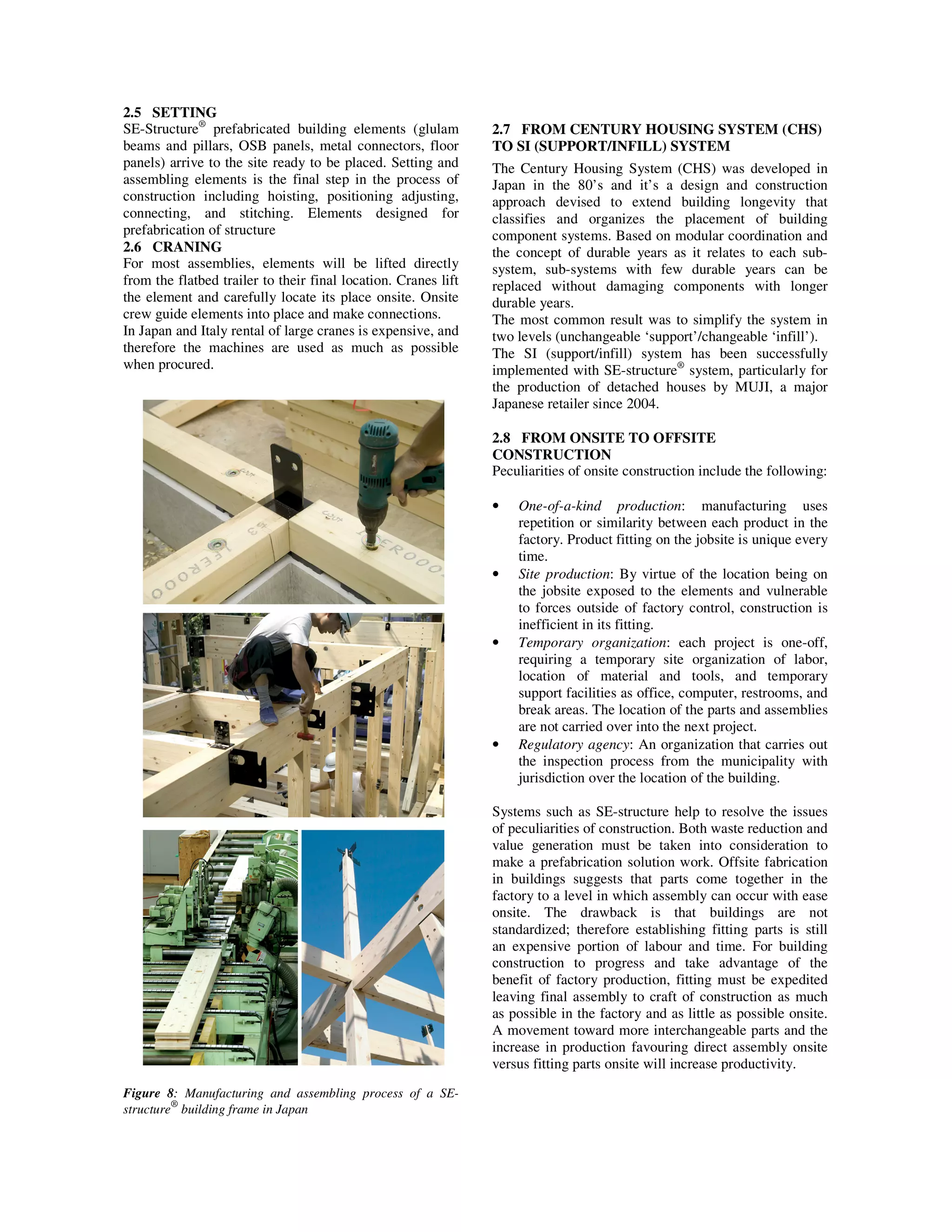
2.5 SETTING
SE-Structure®
prefabricated building elements (glulam
beams and pillars, OSB panels, metal connectors, floor
panels) arrive to the site ready to be placed. Setting and
assembling elements is the final step in the process of
construction including hoisting, positioning adjusting,
connecting, and stitching. Elements designed for
prefabrication of structure
2.6 CRANING
For most assemblies, elements will be lifted directly
from the flatbed trailer to their final location. Cranes lift
the element and carefully locate its place onsite. Onsite
crew guide elements into place and make connections.
In Japan and Italy rental of large cranes is expensive, and
therefore the machines are used as much as possible
when procured.
Figure 8: Manufacturing and assembling process of a SE-
structure®
building frame in Japan
2.7 FROM CENTURY HOUSING SYSTEM (CHS)
TO SI (SUPPORT/INFILL) SYSTEM
The Century Housing System (CHS) was developed in
Japan in the 80’s and it’s a design and construction
approach devised to extend building longevity that
classifies and organizes the placement of building
component systems. Based on modular coordination and
the concept of durable years as it relates to each sub-
system, sub-systems with few durable years can be
replaced without damaging components with longer
durable years.
The most common result was to simplify the system in
two levels (unchangeable ‘support’/changeable ‘infill’).
The SI (support/infill) system has been successfully
implemented with SE-structure®
system, particularly for
the production of detached houses by MUJI, a major
Japanese retailer since 2004.
2.8 FROM ONSITE TO OFFSITE
CONSTRUCTION
Peculiarities of onsite construction include the following:
• One-of-a-kind production: manufacturing uses
repetition or similarity between each product in the
factory. Product fitting on the jobsite is unique every
time.
• Site production: By virtue of the location being on
the jobsite exposed to the elements and vulnerable
to forces outside of factory control, construction is
inefficient in its fitting.
• Temporary organization: each project is one-off,
requiring a temporary site organization of labor,
location of material and tools, and temporary
support facilities as office, computer, restrooms, and
break areas. The location of the parts and assemblies
are not carried over into the next project.
• Regulatory agency: An organization that carries out
the inspection process from the municipality with
jurisdiction over the location of the building.
Systems such as SE-structure help to resolve the issues
of peculiarities of construction. Both waste reduction and
value generation must be taken into consideration to
make a prefabrication solution work. Offsite fabrication
in buildings suggests that parts come together in the
factory to a level in which assembly can occur with ease
onsite. The drawback is that buildings are not
standardized; therefore establishing fitting parts is still
an expensive portion of labour and time. For building
construction to progress and take advantage of the
benefit of factory production, fitting must be expedited
leaving final assembly to craft of construction as much
as possible in the factory and as little as possible onsite.
A movement toward more interchangeable parts and the
increase in production favouring direct assembly onsite
versus fitting parts onsite will increase productivity.
2.9 MASS CUSTOMIZATION
Figure 9: Building SE-structure® frames in Japan
As a mean to overcome the peculiarities of onsite
construction a number of mass customization feature are
implemented:
• Component-sharing modularity: same fundamental
components with appearance variability within each
discrete product (changing cladding options initially
from project to project)
• Component swapping modularity: same
configuration of appearance with ability to swap out
component function (changing cladding options
post-occupancy)
• Cut-to-fit modularity: varying length, width or
height of a product by cutting to size based on a
fixed module (standardized cladding that can be
increased or reduced in size in production)
• Mix modularity: a base structure that supports a
number of attachments, sometimes called “platform
design” (base frame to which numerous cladding
materials and systems can be attached)
• Bus modularity: a base structure that supports a
number of attachments, sometimes called “platform
design” (base frame to which numerous cladding
materials and systems can be attached)
3 DESIGNING AND BUILDING IN
ITALY
The project was divided into several stages with at first
an analysis and comparison between Japanese structural
design criteria and Eurocodes in Italy and Japan and later
the design of a residential complex consisting of three
semidetached houses.
Figure 10: Designing the first SE-structure® complex in Italy,
study models and structural model
Finally, a building that had been previously completely
engineered with a planning permission for the
construction in RC and brick has been, so to speak,
reengineered for the SE-structure®
system.
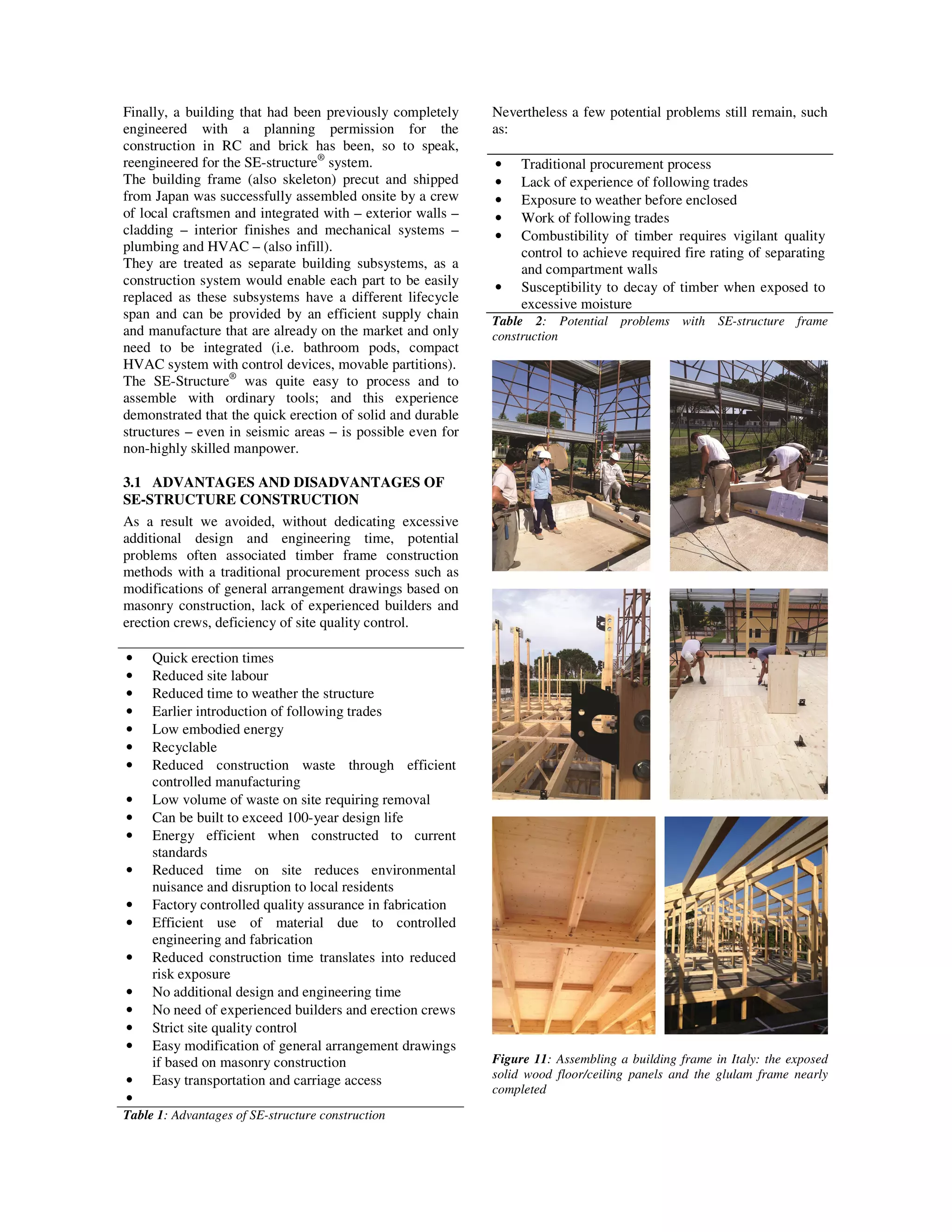
The building frame (also skeleton) precut and shipped
from Japan was successfully assembled onsite by a crew
of local craftsmen and integrated with – exterior walls –
cladding – interior finishes and mechanical systems –
plumbing and HVAC – (also infill).
They are treated as separate building subsystems, as a
construction system would enable each part to be easily
replaced as these subsystems have a different lifecycle
span and can be provided by an efficient supply chain
and manufacture that are already on the market and only
need to be integrated (i.e. bathroom pods, compact
HVAC system with control devices, movable partitions).
The SE-Structure®
was quite easy to process and to
assemble with ordinary tools; and this experience
demonstrated that the quick erection of solid and durable
structures – even in seismic areas – is possible even for
non-highly skilled manpower.
3.1 ADVANTAGES AND DISADVANTAGES OF
SE-STRUCTURE CONSTRUCTION
As a result we avoided, without dedicating excessive
additional design and engineering time, potential
problems often associated timber frame construction
methods with a traditional procurement process such as
modifications of general arrangement drawings based on
masonry construction, lack of experienced builders and
erection crews, deficiency of site quality control.
• Quick erection times
• Reduced site labour
• Reduced time to weather the structure
• Earlier introduction of following trades
• Low embodied energy
• Recyclable
• Reduced construction waste through efficient
controlled manufacturing
• Low volume of waste on site requiring removal
• Can be built to exceed 100-year design life
• Energy efficient when constructed to current
standards
• Reduced time on site reduces environmental
nuisance and disruption to local residents
• Factory controlled quality assurance in fabrication
• Efficient use of material due to controlled
engineering and fabrication
• Reduced construction time translates into reduced
risk exposure
• No additional design and engineering time
• No need of experienced builders and erection crews
• Strict site quality control
• Easy modification of general arrangement drawings
if based on masonry construction
• Easy transportation and carriage access
•
Table 1: Advantages of SE-structure construction
Nevertheless a few potential problems still remain, such
as:
• Traditional procurement process
• Lack of experience of following trades
• Exposure to weather before enclosed
• Work of following trades
• Combustibility of timber requires vigilant quality
control to achieve required fire rating of separating
and compartment walls
• Susceptibility to decay of timber when exposed to
excessive moisture
Table 2: Potential problems with SE-structure frame
construction
Figure 11: Assembling a building frame in Italy: the exposed
solid wood floor/ceiling panels and the glulam frame nearly
completed
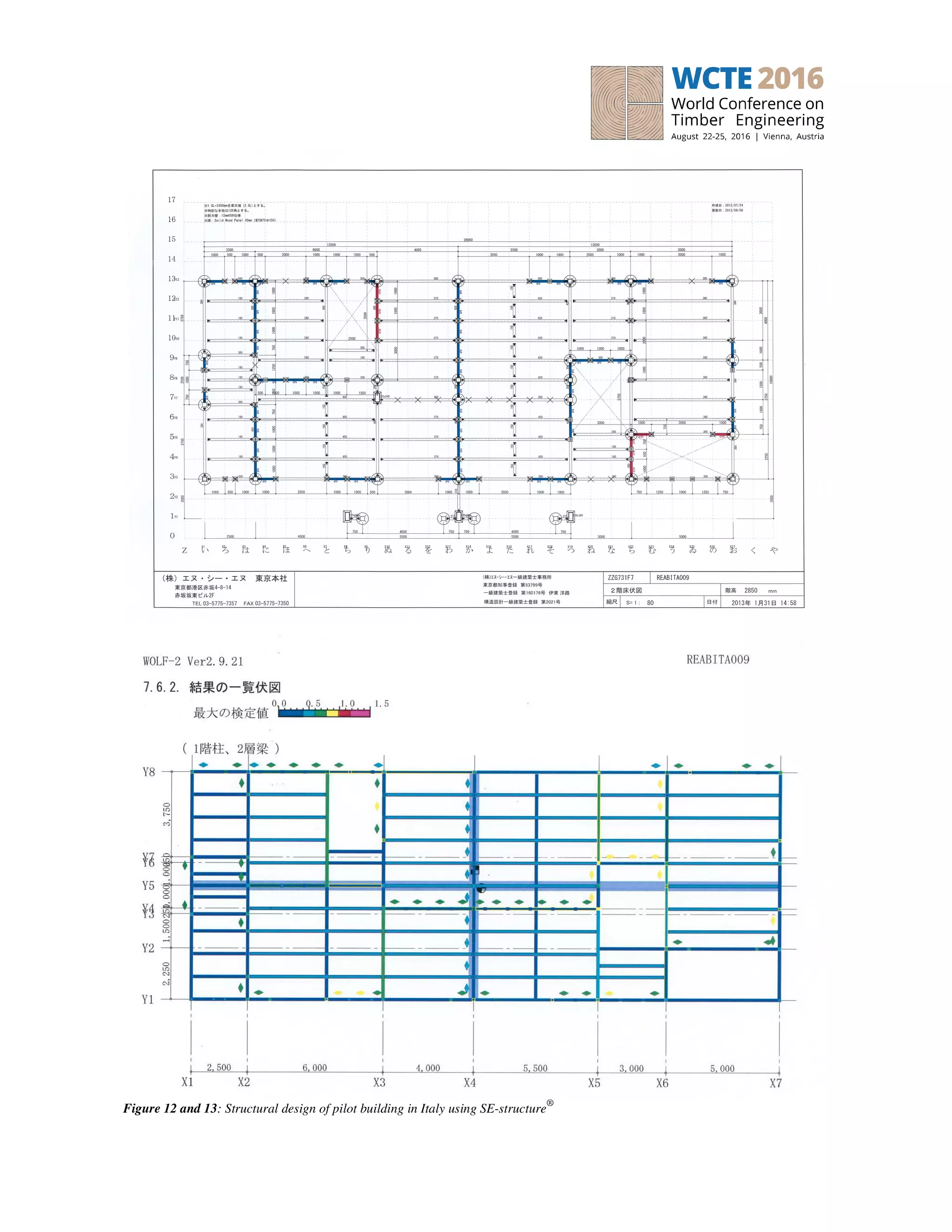
Figure 12 and 13: Structural design of pilot building in Italy using SE-structure
®
4 OPEN BUILDING TOOLKITS
The combination of timber frame structures, using glued
laminated timber such as SE-structure and discrete
subsystems in what can be defined “Open building
toolkits”, shows how to bring some of the salient
features of efficient manufacturing and industrial design
to the construction sector. This should allow for
significant savings in construction and maintenance
costs, fewer errors and rework, more choices and value
to the customer, new product and services that can be
configured and assembled in mobile factories, at
construction sites, etc.
Therefore it could be fruitful to:
1. Improve the speed, scale and quality of housing
supply. Particularly the ease to switch between
different footprints and site shapes, flexible
plans, easy integration with the cladding
system.
2. Use resources more effectively by separating
the construction of houses into the building
frame, exterior wall, interior finishes and
mechanical systems and dividing a construction
system in which each part is as replaceable as
its durability of life. To apply the integrated
building technology to housing.
3. Make it possible to design diverse residential
units that are adapted to the occupants’
lifestyles and demands through a structural
system, which provides freedom in designing
exterior walls and organizing layouts, and
systematic dimensional coordination.
In the 1950’ and 60’ many systems buildings were built
in the world, but recently few people mentions about
building systems. It is one of the reasons that systems
building supplied many monotonous buildings. However
we are convinced that we can obtain diverse attractive
buildings by assembling building subsystems. The
architect must become skilful in combining building
subsystems. Systematic design with planning grid is
defective for that. The building was designed, using open
building subsystems. The structure of this building was
conceived as an example of a system building based on
an open system, applicable to residential buildings.
In the project, the building frame – skeleton – , exterior
walls – cladding, interior finishes – infill – and
mechanical systems – plumbing – were treated as
separate building subsystems, and a construction system
was devised that would enable each part to be easily
replaced or moved as its durability or life. The
mechanical equipments installed in houses are becoming
ever more advanced and interfacing with the building
frame and interior finishes in increasingly complex
ways. However, they must be made and installed in such
a way that they can be properly inspected and replaced
because mechanical systems and interior finishes differ
in durability from the building frame.
Based on that experience, a scheme in which the
mechanical systems and the building were separated was
devised. A systems-building approach, using a grid and
dimensional coordination, was taken, and the result can
be called systems housing.
The building frame is a structure of columns and beams.
Modular coordination consistent with systems building is
practiced throughout the building in order to promote
efficient design and production by diverse teams
working in parallel. Modular coordination functioned
quite effectively because the building frame, exterior
finishes and interior finishes were designed at different
stages. Grid planning was also an important means of
exchanging information in the process of designing with
the participation of prospective occupants. For that
reason, grids and dimensions that are commonly used
were selected for the interior finishes.
4.1 CONSTRUCTION SYSTEM FOR FREE
PLANNING
Each unit is freely designed within a building frame that
consists of timber columns, beams and floor panels but
includes no walls (with the exception of shearing
panels). The construction system was devised so as to
give architects freedom to locating the exterior walls and
organizing the layout. Systematic dimensional
coordination make it possible to provide diverse unit
designs adapted to the lifestyles and demands of
occupants.
Figure 14: Free planning
The design of the units could begin after the building
frame and the residential building had been designed and
continue while the building frame is constructed. This
procedure is based on a housing construction method
called the two-stage supply method, which assumes the
participation of the occupants. Independent coordinators
make adjustments between the design of each unit and
the design of the building as a whole. Most coordination
work is a matter of interpreting the rules of design.
Figure 15: Flexibility in time
Diversity means both variation in plan at the time of
construction and sufficient flexibility to be able to adapt
to later changes in lifestyle. This project is intended to
improve the life of the housing as a whole by making it
possible to freely remodel the units in response to
changes in lifestyle of family composition. The building
frame must also be able to adapt to advances in
mechanical equipment, and the high floor height make it
possible.
4.2 WIRING AND PLUMBING
The standard floor level for a unit is set at 240mm above
the floor of the building frame, and the resulting space is
used for pipes. The floor is built by a special method that
improves the insulation of percussive sounds. Using.
them before they wear out. Improving the replaceability
of equipment parts and pipes lengthens the life of the
entire house. The sanitary systems can therefore be
freely located, and there is greater flexibility when
undertaking remodelling work. The structural plan and
the plan of the mechanical systems are coordinated so
that pipes and ducts do not need to pass through walls,
floors, and beams of the building frame.
Figure 16: Wiring and plumbing
4.3 BATHROOM PODS
Bathroom pods cost about the same as site built
bathrooms on a direct cost basis but can result in 26%
savings due to faster construction and reduced defects-
list. Using bathroom Pods lowers construction costs by
reducing construction time, improving quality, and
eliminating the bathroom defects list. With traditional
building, a multitude of trades need to be organized to
realize the bathroom design. This requires a high degree
of supervision and management on site to ensure correct
sequencing and quality of work from plumbers,
electricians, tilers, floor layers, sealant applicators,
decorators, glaziers, carpenters and other specialists.
Figure 17: Bathroom pods
4.4 WINDOWS
Every component has been figured out; whereas usually
windows are essentially stapled into place from the
exterior, these windows are installed with adjustable
fasteners so that the window can be levelled perfectly
and at the end of its useful life can be removed and
replaced – from the inside.
Figure 18: Adjustable fastener for easy installation and
removal of windows
4.5 COMPACT HEATING/COOLING/WATER
Most people understand the advantage of building a very
energy-efficient house - lower energy costs and
reduction of fossil fuel use. Another advantage in
building tight, energy-efficient homes is they need
smaller heating and cooling systems than houses with air
seeping in because the structure isn't tightly sealed.
However, when a house is built with minimal air
leakage, it is essential to have an excellent ventilation
system to maintain a healthy environment inside.
Figure 19: All-in-one heating/cooling/water system
All-in-one systems combine all the functions of an
HVAC system in one unit. These heat pumps, which
functions as a ventilation system with heat recovery, also
includes space heating and cooling and provides the
household's hot water supply. This type of system is
compact, provides healthy indoor air, and reduces energy
costs.
5 CONCLUSIONS
This kind of building systems could be instrumental in
speeding up the delivery of new housing and making it
affordable to people of all ages and incomes, including
the self-employed. The typology is timber frame and
core residential – adapting a tried and tested
development model from such system buildings. By
excluding internal fit-outs, the cost (to the
developer/house-builder) of building new homes could
be reduced by roughly up to 40%, and the duration of
construction be reduced by 25% – delivering faster,
cheaper housing. Just as importantly, this typology gave
users more autonomy in creating homes they really
wanted.
SE-structure®
timber frame system and core residential is
built in two phases:
Phase 1 includes the external envelope, party walls
between flats, cores and common areas only;
Phase 2 includes all internal fit outs, and is undertaken
by the home owner.
The developer/housebuilder delivers flats which are
‘ready to camp in’: they satisfy Building Regulations
including thermal/acoustic insulation and fire
regulations, and are fit to live in from day one. This
provides maximum flexibility for new owners: those
short of money can fit-out their flats over time,
according to their finances; keen DIYers can choose to
do much of the fit-out themselves, which will also keep
costs down; and those short of time can choose to have
the entire fit-out carried out by small contractors whom
they appoint. It also means maximum flexibility in
layouts: a single buyer might start off with a huge studio
flat, adding partitions to create more rooms as and when
needed – for example, when starting a family or to rent
out a spare room.
ACKNOWLEDGEMENTS
We wold like to thank: NCN Co. of Tokyo for their
continuous support;
Yuji Shimizu and Takayuki Miyoshi that designed the
first building complex in Italy including three semi-
detached houses and coordinated all the initial phases of
contacts between Japan and Italy to transfer SE-structure
technology in an European context.
REFERENCES
[1] Coaldrake W.H.: Componenti nuovi, assemblaggi
antichi (New Components, Ancient Assemblages)
p.68-71 (p.120-121) in Casabella 608-609, January
February 1994.
[2] The Building Standard Law of Japan, Supervised by
Building Guidance Division & Urban Building
Division, Housing Bureau, The Ministry of Land,
Infrastructure, Transport and Tourism (MLIT)
National Institute for Land and Infrastructure
Management of MLIT Technical Guidance by
Building Research Institute, Edited/Published by
The Building Center of Japan, May 2009.
[3] NCN Co. Tokyo, SE-Structure®
Manuals vs. 2.0,
2012.
[4] M. Hook, ”Customer Value in Lean Prefabrication
of Housing Considering both Construction and
Manufacturing”, Proceeding of IGLC-14 July 2006,
Santiago, Chile.
[5] Schmidt, R. III; Eguchi, T.; Austin, S.. Lessons from
Japan: A Look at Century Housing System in DSM
2010: Proceedings of the 12th International DSM
Conference, Cambridge, UK, 22.-23.07.2010
[6] D. Schodek, M. Bechthold, J.K. Griggs, K. Kao, and
M. Steinberg, Digital design and Manufactoring:
CAD/CAM Applications in Architecture and Design,
Hoboken: John Wiley & Sons, Inc. 2004

Open Building Toolkits

  • 1.
    OPEN BUILDING TOOLKITS FrancescoMontagnana1 , Hiroshi Fukuta2 ABSTRACT: Timber frame structure systems using glued laminated timber have become a widespread construction method for detached houses throughout Japan. SE-structure® is one of these systems and for its integration of design- prefabrication-installation-quality control and seismic design has been chosen for the construction of a pilot project in Italy:. The SI (support/infill) system has been implemented with SE-structure® system, in a European context. The structure of the building was conceived as an example of system building based on an open system, applicable to residential building. KEYWORDS: open building, building system, system engineering, seismic design 1 INTRODUCTION12 The industrialization of house’s production in Japan, particularly in the field of detached houses, which really started in the 60’s is often said as the most advanced in the world. Indeed various industrialized construction methods, most of which were only experimental or had only short lives in the actual market in other countries, have been extensively applied in the house’s production in Japan. In residential wooden construction that still now accounts for the largest share of detached houses, like so much of its traditional culture, Japan has developed a highly efficient technological adaptation of an age-old building techniques where: 1. Design and construction were an organic part of the same process; 2. Modular coordination was the key to customary design and the building process; 3. Prefabrication of the parts was the basis of the building process; 4. On site assembly was a rapid, precision operation. As the most time consuming part of the prefabrication process was the cutting of mortise and tenon joinery holding together the timber frame, the introduction of industrially precut timber framing has become the predominant house construction method. Industrially precut frame-structures are manufactured by on-site assembly of columns and beams and other structural parts (i.e. shearing walls, floor panels), to which non-structural outer-wall panels are attached to form a shelter. 1 Francesco Montagnana, Studio di Architettura, Italy. Email: francesco.montagnana@gmail.com 2 Hiroshi Fukuta, NCN Co. Ltd., 1-7-18 Konan, Minato-ku, Tokyo, Japan. Email: fukuta@ncn-se.co.jp In Chapter 2 we describe the features of SE-structure® of the above mentioned systems and remarkable for its integration of design-prefabrication-installation-quality control and seismic design. In Chapter 3, SE-structure® , chosen for the construction of a pilot project in Italy where he SI (support/infill) system has been implemented, in a European context. In Chapter 4 describes how the structure of the building was conceived as an example of system building based on an open system, applicable to residential building. In Chapter 5 conclusions are summarised. 2 SE-STRUCTURE SYSTEM The SE-structure® system has taken the traditional Japanese method of building wooden frames to a higher level. Since 1997 up to now, using SE-structure® , 18.000 buildings have been built in Japan by a network that currently includes over 500 construction firms with a consistent group of about 600 architects and engineers duly trained to integrate it in their design. Seven licensed pre-cut factories produce the glulam pillars, beams and panels and a couple of factories delivers the metal connectors. The SE-structure® hardware and software was developed and patented from the early 90s by NCN (New Constructor’s Network) of Tokyo, and dedicated to structural design and to the manufacturing of numerically controlled components. The same software that conducts a 3D structural analysis, sends the data to production once the structure has been verified in order to ensure the maximum precision of all the elements. 1.1 GENERAL FEATURES The “technology” or literally “construction method” of the SE-structure® system consists of structural glued laminated wood, SE metal connectors hardware and structural design.
  • 2.
    Also, SE-structure® is notjust "technology" , but a “system” encompassing activities from design to inspection in an integrated flow, where one main company oversees these activities in order to be implemented correctly and safely by a "network" of companies. The structural design for SE-structure® , is similar to that of larger buildings. Structural calculation clearly shows the strength in figures according to allowable stress calculation method. Moreover, the same software for structural design, performs its three-dimensional analysis integrated to CAD, to ensure the safety not just based on intuition or experience. Note that this applies to Japan where, for small residential buildings it’s still now possible to build without structural design. In order to ensure the accuracy of structural design, it is essential to have a high level of precision in manufacturing materials. For this purpose the main company selects strong, stable quality and certified resistance of high quality laminated structural glued laminated wood. In addition, whereas many traditional wooden houses have defects at the cross-section junction, where there was often a weakness, with originally developed metal connectors for SE-structure® , method it has become possible to limit defects at the cross-section junction and guarantee a consistent strength. Furthermore, glued laminated wood and metal connectors using SE-structure® traceability is established and managed to deliver a quality certificate. In the SE- structure® method system, the drawings are based on structural calculation and design. Accordingly wood pre- cut – construction –inspection are accurately performed, so the building owners can live safely in houses that are guaranteed for their safety. The main company has a control system to ensure the supply of structural frames design, construction and inspection. With the SE-structure® , we have a strict inspection and construction management under the main company supervision and only qualified registered construction companies can operate through accurate drawings supplied by the factory pre-cut. In addition, thanks to this control system and to the evaluation of some insurance companies, an insurance certificate is issued. Thus SE-structure® is a safe system composed of the robust network of registered construction companies, pre-cut factories and insurance companies. These concepts are shown in Figure 1. Figure 1 The main concepts of SE-structure®, • Design: is performed according to a specific Design Manual and the principles of Long life housing Long life design; • Structure: the main company controls safety by means of a specialised structural calculation software: SE-CAD; • Materials: Traceability of materials; guarantee of material; • Precut: Structural design and manufacturing are integrated in the same CAD-CAM integrated information system; • Construction: design and construction management is supplied only by an SE-Structure® ‘s authorised engineer/architect/technician; construction is carried only by an SE-structure® ‘s registered contractor. • Inspection: Structural performance report is submitted to the owner. Information Sharing Network; 2.2 JOINTS One of the main features of the system is the use of drifted pined joints with insert gusset plate provided with lagscrewbolts (LSB). Figure 2: SE-structure ® detail of connection between: beams, pillars and connectors
  • 3.
    Figure 3 Assemblyof glulam frame and metal connectors: maximum height of a building 3 floors and 12m; maximum span 6m; dimension of beams 120mm x 240-600mm; dimension of pillars 120mm x 120mm (standard) or 120x240-360. Figure 4 Assembly of shearing panels: material OSB or LVL width 900-1000mm variable height; thickness 9-12 mm Figure 5 Assembly of floor panels: material LVL dim 1000- 1000mm ; thickness 28 mm Figure 6 Assembly of roof panels. Figure 7: SE- structure metal connectors 2.3 FOUNDATIONS SE-structure® , foundations are designed in coordination with the above structure and connected with steel bars. As site-cast foundations are never entirely plum; certainly they are much less precise than elements that have been factory produced. Therefore, setting the elements on foundations includes shim to achieve level. 2.4 GRIDS Grids for SE-structure® structural design and building construction are established so that onsite and offsite work might be coordinated. This is performed with prefabrication of the glulam frame based on axial (not modular) grids. Eventual modular grids (for other components) allow for dimensional coordination across elements offsite and onsite. It is necessary, when intending to use extensive prefabrication of components, to design the building from the start on a reference grid related to the intended model.
  • 4.
    2.5 SETTING SE-Structure® prefabricated buildingelements (glulam beams and pillars, OSB panels, metal connectors, floor panels) arrive to the site ready to be placed. Setting and assembling elements is the final step in the process of construction including hoisting, positioning adjusting, connecting, and stitching. Elements designed for prefabrication of structure 2.6 CRANING For most assemblies, elements will be lifted directly from the flatbed trailer to their final location. Cranes lift the element and carefully locate its place onsite. Onsite crew guide elements into place and make connections. In Japan and Italy rental of large cranes is expensive, and therefore the machines are used as much as possible when procured. Figure 8: Manufacturing and assembling process of a SE- structure® building frame in Japan 2.7 FROM CENTURY HOUSING SYSTEM (CHS) TO SI (SUPPORT/INFILL) SYSTEM The Century Housing System (CHS) was developed in Japan in the 80’s and it’s a design and construction approach devised to extend building longevity that classifies and organizes the placement of building component systems. Based on modular coordination and the concept of durable years as it relates to each sub- system, sub-systems with few durable years can be replaced without damaging components with longer durable years. The most common result was to simplify the system in two levels (unchangeable ‘support’/changeable ‘infill’). The SI (support/infill) system has been successfully implemented with SE-structure® system, particularly for the production of detached houses by MUJI, a major Japanese retailer since 2004. 2.8 FROM ONSITE TO OFFSITE CONSTRUCTION Peculiarities of onsite construction include the following: • One-of-a-kind production: manufacturing uses repetition or similarity between each product in the factory. Product fitting on the jobsite is unique every time. • Site production: By virtue of the location being on the jobsite exposed to the elements and vulnerable to forces outside of factory control, construction is inefficient in its fitting. • Temporary organization: each project is one-off, requiring a temporary site organization of labor, location of material and tools, and temporary support facilities as office, computer, restrooms, and break areas. The location of the parts and assemblies are not carried over into the next project. • Regulatory agency: An organization that carries out the inspection process from the municipality with jurisdiction over the location of the building. Systems such as SE-structure help to resolve the issues of peculiarities of construction. Both waste reduction and value generation must be taken into consideration to make a prefabrication solution work. Offsite fabrication in buildings suggests that parts come together in the factory to a level in which assembly can occur with ease onsite. The drawback is that buildings are not standardized; therefore establishing fitting parts is still an expensive portion of labour and time. For building construction to progress and take advantage of the benefit of factory production, fitting must be expedited leaving final assembly to craft of construction as much as possible in the factory and as little as possible onsite. A movement toward more interchangeable parts and the increase in production favouring direct assembly onsite versus fitting parts onsite will increase productivity.
  • 5.
    2.9 MASS CUSTOMIZATION Figure9: Building SE-structure® frames in Japan As a mean to overcome the peculiarities of onsite construction a number of mass customization feature are implemented: • Component-sharing modularity: same fundamental components with appearance variability within each discrete product (changing cladding options initially from project to project) • Component swapping modularity: same configuration of appearance with ability to swap out component function (changing cladding options post-occupancy) • Cut-to-fit modularity: varying length, width or height of a product by cutting to size based on a fixed module (standardized cladding that can be increased or reduced in size in production) • Mix modularity: a base structure that supports a number of attachments, sometimes called “platform design” (base frame to which numerous cladding materials and systems can be attached) • Bus modularity: a base structure that supports a number of attachments, sometimes called “platform design” (base frame to which numerous cladding materials and systems can be attached) 3 DESIGNING AND BUILDING IN ITALY The project was divided into several stages with at first an analysis and comparison between Japanese structural design criteria and Eurocodes in Italy and Japan and later the design of a residential complex consisting of three semidetached houses. Figure 10: Designing the first SE-structure® complex in Italy, study models and structural model
  • 6.
    Finally, a buildingthat had been previously completely engineered with a planning permission for the construction in RC and brick has been, so to speak, reengineered for the SE-structure® system. The building frame (also skeleton) precut and shipped from Japan was successfully assembled onsite by a crew of local craftsmen and integrated with – exterior walls – cladding – interior finishes and mechanical systems – plumbing and HVAC – (also infill). They are treated as separate building subsystems, as a construction system would enable each part to be easily replaced as these subsystems have a different lifecycle span and can be provided by an efficient supply chain and manufacture that are already on the market and only need to be integrated (i.e. bathroom pods, compact HVAC system with control devices, movable partitions). The SE-Structure® was quite easy to process and to assemble with ordinary tools; and this experience demonstrated that the quick erection of solid and durable structures – even in seismic areas – is possible even for non-highly skilled manpower. 3.1 ADVANTAGES AND DISADVANTAGES OF SE-STRUCTURE CONSTRUCTION As a result we avoided, without dedicating excessive additional design and engineering time, potential problems often associated timber frame construction methods with a traditional procurement process such as modifications of general arrangement drawings based on masonry construction, lack of experienced builders and erection crews, deficiency of site quality control. • Quick erection times • Reduced site labour • Reduced time to weather the structure • Earlier introduction of following trades • Low embodied energy • Recyclable • Reduced construction waste through efficient controlled manufacturing • Low volume of waste on site requiring removal • Can be built to exceed 100-year design life • Energy efficient when constructed to current standards • Reduced time on site reduces environmental nuisance and disruption to local residents • Factory controlled quality assurance in fabrication • Efficient use of material due to controlled engineering and fabrication • Reduced construction time translates into reduced risk exposure • No additional design and engineering time • No need of experienced builders and erection crews • Strict site quality control • Easy modification of general arrangement drawings if based on masonry construction • Easy transportation and carriage access • Table 1: Advantages of SE-structure construction Nevertheless a few potential problems still remain, such as: • Traditional procurement process • Lack of experience of following trades • Exposure to weather before enclosed • Work of following trades • Combustibility of timber requires vigilant quality control to achieve required fire rating of separating and compartment walls • Susceptibility to decay of timber when exposed to excessive moisture Table 2: Potential problems with SE-structure frame construction Figure 11: Assembling a building frame in Italy: the exposed solid wood floor/ceiling panels and the glulam frame nearly completed
  • 7.
    Figure 12 and13: Structural design of pilot building in Italy using SE-structure ®
  • 8.
    4 OPEN BUILDINGTOOLKITS The combination of timber frame structures, using glued laminated timber such as SE-structure and discrete subsystems in what can be defined “Open building toolkits”, shows how to bring some of the salient features of efficient manufacturing and industrial design to the construction sector. This should allow for significant savings in construction and maintenance costs, fewer errors and rework, more choices and value to the customer, new product and services that can be configured and assembled in mobile factories, at construction sites, etc. Therefore it could be fruitful to: 1. Improve the speed, scale and quality of housing supply. Particularly the ease to switch between different footprints and site shapes, flexible plans, easy integration with the cladding system. 2. Use resources more effectively by separating the construction of houses into the building frame, exterior wall, interior finishes and mechanical systems and dividing a construction system in which each part is as replaceable as its durability of life. To apply the integrated building technology to housing. 3. Make it possible to design diverse residential units that are adapted to the occupants’ lifestyles and demands through a structural system, which provides freedom in designing exterior walls and organizing layouts, and systematic dimensional coordination. In the 1950’ and 60’ many systems buildings were built in the world, but recently few people mentions about building systems. It is one of the reasons that systems building supplied many monotonous buildings. However we are convinced that we can obtain diverse attractive buildings by assembling building subsystems. The architect must become skilful in combining building subsystems. Systematic design with planning grid is defective for that. The building was designed, using open building subsystems. The structure of this building was conceived as an example of a system building based on an open system, applicable to residential buildings. In the project, the building frame – skeleton – , exterior walls – cladding, interior finishes – infill – and mechanical systems – plumbing – were treated as separate building subsystems, and a construction system was devised that would enable each part to be easily replaced or moved as its durability or life. The mechanical equipments installed in houses are becoming ever more advanced and interfacing with the building frame and interior finishes in increasingly complex ways. However, they must be made and installed in such a way that they can be properly inspected and replaced because mechanical systems and interior finishes differ in durability from the building frame. Based on that experience, a scheme in which the mechanical systems and the building were separated was devised. A systems-building approach, using a grid and dimensional coordination, was taken, and the result can be called systems housing. The building frame is a structure of columns and beams. Modular coordination consistent with systems building is practiced throughout the building in order to promote efficient design and production by diverse teams working in parallel. Modular coordination functioned quite effectively because the building frame, exterior finishes and interior finishes were designed at different stages. Grid planning was also an important means of exchanging information in the process of designing with the participation of prospective occupants. For that reason, grids and dimensions that are commonly used were selected for the interior finishes. 4.1 CONSTRUCTION SYSTEM FOR FREE PLANNING Each unit is freely designed within a building frame that consists of timber columns, beams and floor panels but includes no walls (with the exception of shearing panels). The construction system was devised so as to give architects freedom to locating the exterior walls and organizing the layout. Systematic dimensional coordination make it possible to provide diverse unit designs adapted to the lifestyles and demands of occupants. Figure 14: Free planning The design of the units could begin after the building frame and the residential building had been designed and continue while the building frame is constructed. This procedure is based on a housing construction method called the two-stage supply method, which assumes the participation of the occupants. Independent coordinators make adjustments between the design of each unit and the design of the building as a whole. Most coordination work is a matter of interpreting the rules of design.
  • 9.
    Figure 15: Flexibilityin time Diversity means both variation in plan at the time of construction and sufficient flexibility to be able to adapt to later changes in lifestyle. This project is intended to improve the life of the housing as a whole by making it possible to freely remodel the units in response to changes in lifestyle of family composition. The building frame must also be able to adapt to advances in mechanical equipment, and the high floor height make it possible. 4.2 WIRING AND PLUMBING The standard floor level for a unit is set at 240mm above the floor of the building frame, and the resulting space is used for pipes. The floor is built by a special method that improves the insulation of percussive sounds. Using. them before they wear out. Improving the replaceability of equipment parts and pipes lengthens the life of the entire house. The sanitary systems can therefore be freely located, and there is greater flexibility when undertaking remodelling work. The structural plan and the plan of the mechanical systems are coordinated so that pipes and ducts do not need to pass through walls, floors, and beams of the building frame. Figure 16: Wiring and plumbing 4.3 BATHROOM PODS Bathroom pods cost about the same as site built bathrooms on a direct cost basis but can result in 26% savings due to faster construction and reduced defects- list. Using bathroom Pods lowers construction costs by reducing construction time, improving quality, and eliminating the bathroom defects list. With traditional building, a multitude of trades need to be organized to realize the bathroom design. This requires a high degree of supervision and management on site to ensure correct sequencing and quality of work from plumbers, electricians, tilers, floor layers, sealant applicators, decorators, glaziers, carpenters and other specialists. Figure 17: Bathroom pods 4.4 WINDOWS Every component has been figured out; whereas usually windows are essentially stapled into place from the exterior, these windows are installed with adjustable fasteners so that the window can be levelled perfectly and at the end of its useful life can be removed and replaced – from the inside. Figure 18: Adjustable fastener for easy installation and removal of windows 4.5 COMPACT HEATING/COOLING/WATER Most people understand the advantage of building a very energy-efficient house - lower energy costs and reduction of fossil fuel use. Another advantage in building tight, energy-efficient homes is they need smaller heating and cooling systems than houses with air seeping in because the structure isn't tightly sealed. However, when a house is built with minimal air leakage, it is essential to have an excellent ventilation system to maintain a healthy environment inside. Figure 19: All-in-one heating/cooling/water system
  • 10.
    All-in-one systems combineall the functions of an HVAC system in one unit. These heat pumps, which functions as a ventilation system with heat recovery, also includes space heating and cooling and provides the household's hot water supply. This type of system is compact, provides healthy indoor air, and reduces energy costs. 5 CONCLUSIONS This kind of building systems could be instrumental in speeding up the delivery of new housing and making it affordable to people of all ages and incomes, including the self-employed. The typology is timber frame and core residential – adapting a tried and tested development model from such system buildings. By excluding internal fit-outs, the cost (to the developer/house-builder) of building new homes could be reduced by roughly up to 40%, and the duration of construction be reduced by 25% – delivering faster, cheaper housing. Just as importantly, this typology gave users more autonomy in creating homes they really wanted. SE-structure® timber frame system and core residential is built in two phases: Phase 1 includes the external envelope, party walls between flats, cores and common areas only; Phase 2 includes all internal fit outs, and is undertaken by the home owner. The developer/housebuilder delivers flats which are ‘ready to camp in’: they satisfy Building Regulations including thermal/acoustic insulation and fire regulations, and are fit to live in from day one. This provides maximum flexibility for new owners: those short of money can fit-out their flats over time, according to their finances; keen DIYers can choose to do much of the fit-out themselves, which will also keep costs down; and those short of time can choose to have the entire fit-out carried out by small contractors whom they appoint. It also means maximum flexibility in layouts: a single buyer might start off with a huge studio flat, adding partitions to create more rooms as and when needed – for example, when starting a family or to rent out a spare room. ACKNOWLEDGEMENTS We wold like to thank: NCN Co. of Tokyo for their continuous support; Yuji Shimizu and Takayuki Miyoshi that designed the first building complex in Italy including three semi- detached houses and coordinated all the initial phases of contacts between Japan and Italy to transfer SE-structure technology in an European context. REFERENCES [1] Coaldrake W.H.: Componenti nuovi, assemblaggi antichi (New Components, Ancient Assemblages) p.68-71 (p.120-121) in Casabella 608-609, January February 1994. [2] The Building Standard Law of Japan, Supervised by Building Guidance Division & Urban Building Division, Housing Bureau, The Ministry of Land, Infrastructure, Transport and Tourism (MLIT) National Institute for Land and Infrastructure Management of MLIT Technical Guidance by Building Research Institute, Edited/Published by The Building Center of Japan, May 2009. [3] NCN Co. Tokyo, SE-Structure® Manuals vs. 2.0, 2012. [4] M. Hook, ”Customer Value in Lean Prefabrication of Housing Considering both Construction and Manufacturing”, Proceeding of IGLC-14 July 2006, Santiago, Chile. [5] Schmidt, R. III; Eguchi, T.; Austin, S.. Lessons from Japan: A Look at Century Housing System in DSM 2010: Proceedings of the 12th International DSM Conference, Cambridge, UK, 22.-23.07.2010 [6] D. Schodek, M. Bechthold, J.K. Griggs, K. Kao, and M. Steinberg, Digital design and Manufactoring: CAD/CAM Applications in Architecture and Design, Hoboken: John Wiley & Sons, Inc. 2004