- T E J A N D A T T A N I
- 2 0 1 7 1 0 5 4
- P G P 1 7
ONGC HPCL MERGER
History of PSU M&A
 Failure of Air India-Indian Airlines merger.
 In past in 2008 ONGC incurred a deal worth near to
$2 bn to buy out Imperial energy, a russian
company.
 A case of Coal India whose production has increased
in the recent years otherwise was responsible for the
crippling shortage of coal in the country.
 ONGC taking over MRPL with more than 70% stake
from aditya birla group was a successful deal.
ONGC
 A Maharatna company
 Largest E&P company of the nation.
 Integrated company having stake in refining, power,
LNG , petrochemicals and also in overseas
exploration.
 Revenue:- INR 1,25,785 crores and
PAT:- INR 20,498 crores.
HPCL
 2 nd Largest Oil Marketing Company in India with
strong petrochemical vertical.
 Refining Capacity of 15.8 MMTPA standalone
 Vast network of ~15,000 retail outlets with Sales of
over 36 MMT in FY18.
 India’s No.1 Lube Marketer : 603 TMT
 Revenue:- INR 2,43,226.66
PAT:- INR 6,357.07
 GRM - 7.40
Introduction
 In July 2017, the Union Cabinet gave its in-principle
approval for acquisition of oil marketer HPCL by
state-run explorer ONGC by the sale of the govt's
51.1% stake in HPCL to ONGC estimated around Rs
35000 crores.
 The move was crucial in terms of achieving the
divestment target of the government and to create an
integrated oil and gas company.
Initial Plan
 Government was planning a merger between ONGC
and HPCL to make the former, an integrated oil
company. This idea was dropped owing to
differences in the work culture of the two entities.
But HPCL will remain an independent entity and
would work as a subsidiary of ONGC.
 After the merger the ONGC would become the third
largest refiner and would be the second integrated oil
and gas company of India after Reliance.
Why not BPCL ?
 BPCL is India’s second largest oil and gas PSU in terms
of crude refining. On the other hand HPCL is the third largest.
In order to acquire any of these companies, ONGC has to buy at
least 51% stake.
 BPCL | 2nd largest | Market Cap: Rs. 1,01,738 crores | Govt’s
desired stake: 54.93% | equals to Rs. 55,885 crores |
 HPCL | 3rd largest | Market Cap: Rs. 54,797 crores | Govt’s
desired stake: 51.11% | equals to Rs. 28,006 crores |
 Since BPCL is too expensive for ONGC to acquire, it is going
for HPCL.
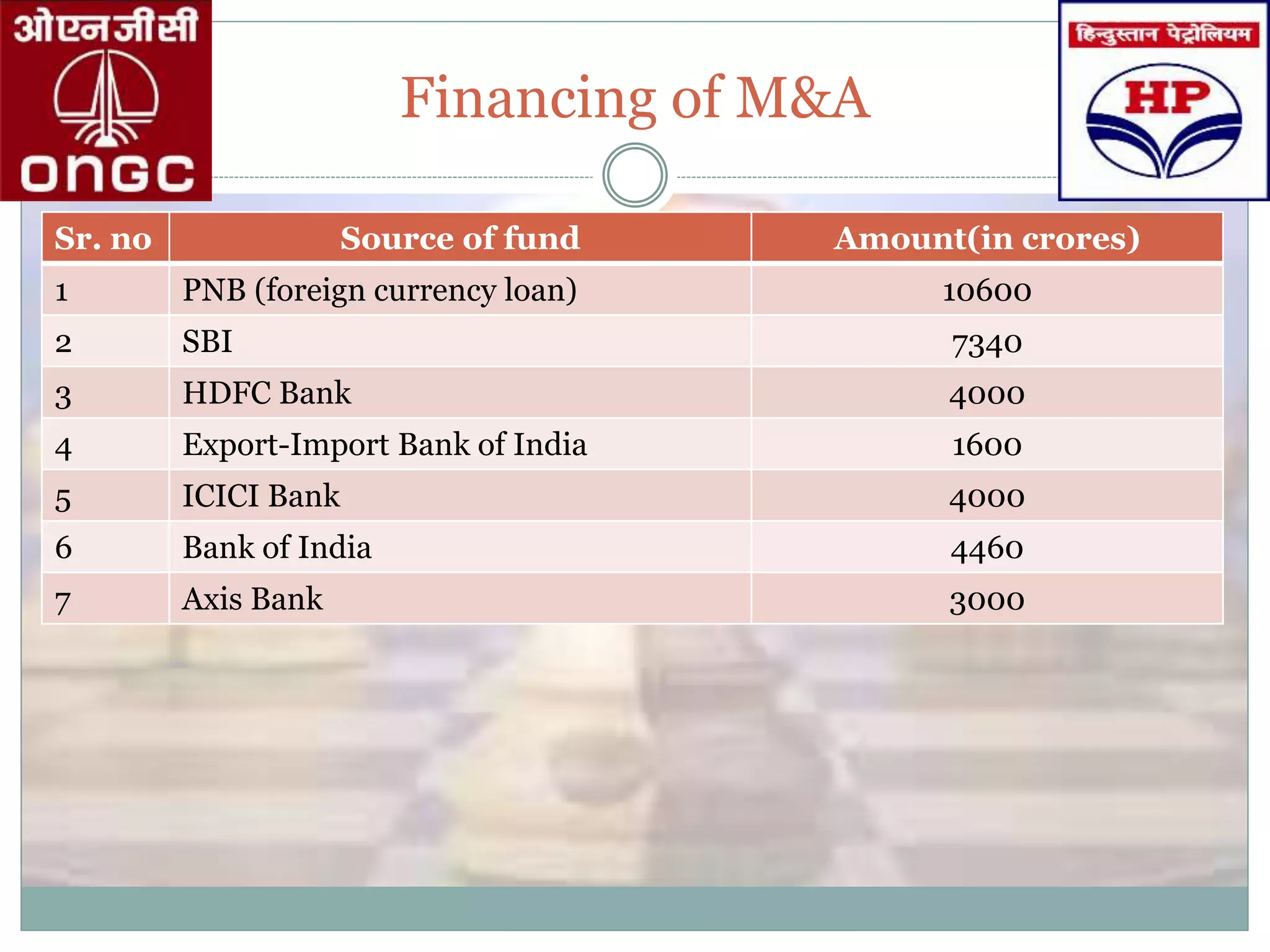
Financing of M&A
Sr. no Source of fund Amount(in crores)
1 PNB (foreign currency loan) 10600
2 SBI 7340
3 HDFC Bank 4000
4 Export-Import Bank of India 1600
5 ICICI Bank 4000
6 Bank of India 4460
7 Axis Bank 3000
Benefits of merger
 Provide financial muscle and management bandwidth to hold its own
in the highly competitive arena of global energy asset shopping.
 It’ll be able to compete with international and domestic oil
companies.
 Bigger scale and balance sheet size could give ONGC better bargaining
power and access to big capital to bag mega deals.
 By creating the single conglomerate spanning the entire value chain of
hydrocarbon, ONGC can be substantially de-risked.
 As an integrated oil company, it’ll add more value to the economy.
 Also, an integrated company will be better placed to weather events
such as a crude oil price rout.
Impact on ONGC
 OVL mostly raises fund at lower cost by utilizing the debt
free balance sheet of ONGC but after the ONGC-HPCL
merger it might be tough for OVL to raise cheaper funds
due to the debts of the ONGC.
 ONGC require it to borrow to finance the deal, and could
reduce its capacity for asset acquisitions, at least in the
near future.
 The takeover would benefit the ONGC when the
international crude oil prices are lower.
 As an Maiden government Integrated oil and gas
company of the country it would be able to compete with
foreign players and could enhance it’s global
recognization.
Impact on HPCL
 Easy access to feedstock.
 Benefits when international crude oil prices are
higher.
 Increase credibility due to the strong financial
back up of ONGC.
Impact on Indian Oil
and Gas Industry
 ONGC would be able to compete with domestic private
players like RIL , Cairn and also the foreign players who
are going to invest in Indian oil and gas industry.
 Possibility of dampening competition within the country
and reducing the choice for customers in areas such as
fuel retailing if more M&A takes place in future.
 Could be result into job cuts in the oil and gas industry.
 Considering the changing global industry scenario, where
India is emerging as one of the most attractive retail
markets for its private players as well as foreign oil
giants, a decision in haste could turn the move counter
productive.
Global Scenario
 Exxon Mobil, ConocoPhillips, Royal Dutch Shell, BP,
Grazprom, Rosneft, Sinopec, China Petroleum are all
results of mergers.
 Venezuela is the only exception or else even China and
Russia has even half a dozen of national oil companies.
 Empirical evidence shows that one behemoth as a
monopoly always becomes inefficient over a period of
time and leads to poor productivity
 Most of these oil giants, except a few big ones in the US
and Europe, are currently state owned.
Analyzing ONGC HPCL merger deal

Analyzing ONGC HPCL merger deal

  • 1.
    - T EJ A N D A T T A N I - 2 0 1 7 1 0 5 4 - P G P 1 7 ONGC HPCL MERGER
  • 2.
    History of PSUM&A  Failure of Air India-Indian Airlines merger.  In past in 2008 ONGC incurred a deal worth near to $2 bn to buy out Imperial energy, a russian company.  A case of Coal India whose production has increased in the recent years otherwise was responsible for the crippling shortage of coal in the country.  ONGC taking over MRPL with more than 70% stake from aditya birla group was a successful deal.
  • 3.
    ONGC  A Maharatnacompany  Largest E&P company of the nation.  Integrated company having stake in refining, power, LNG , petrochemicals and also in overseas exploration.  Revenue:- INR 1,25,785 crores and PAT:- INR 20,498 crores.
  • 4.
    HPCL  2 ndLargest Oil Marketing Company in India with strong petrochemical vertical.  Refining Capacity of 15.8 MMTPA standalone  Vast network of ~15,000 retail outlets with Sales of over 36 MMT in FY18.  India’s No.1 Lube Marketer : 603 TMT  Revenue:- INR 2,43,226.66 PAT:- INR 6,357.07  GRM - 7.40
  • 5.
    Introduction  In July2017, the Union Cabinet gave its in-principle approval for acquisition of oil marketer HPCL by state-run explorer ONGC by the sale of the govt's 51.1% stake in HPCL to ONGC estimated around Rs 35000 crores.  The move was crucial in terms of achieving the divestment target of the government and to create an integrated oil and gas company.
  • 6.
    Initial Plan  Governmentwas planning a merger between ONGC and HPCL to make the former, an integrated oil company. This idea was dropped owing to differences in the work culture of the two entities. But HPCL will remain an independent entity and would work as a subsidiary of ONGC.  After the merger the ONGC would become the third largest refiner and would be the second integrated oil and gas company of India after Reliance.
  • 7.
    Why not BPCL?  BPCL is India’s second largest oil and gas PSU in terms of crude refining. On the other hand HPCL is the third largest. In order to acquire any of these companies, ONGC has to buy at least 51% stake.  BPCL | 2nd largest | Market Cap: Rs. 1,01,738 crores | Govt’s desired stake: 54.93% | equals to Rs. 55,885 crores |  HPCL | 3rd largest | Market Cap: Rs. 54,797 crores | Govt’s desired stake: 51.11% | equals to Rs. 28,006 crores |  Since BPCL is too expensive for ONGC to acquire, it is going for HPCL.
  • 8.
    Financing of M&A Sr.no Source of fund Amount(in crores) 1 PNB (foreign currency loan) 10600 2 SBI 7340 3 HDFC Bank 4000 4 Export-Import Bank of India 1600 5 ICICI Bank 4000 6 Bank of India 4460 7 Axis Bank 3000
  • 9.
    Benefits of merger Provide financial muscle and management bandwidth to hold its own in the highly competitive arena of global energy asset shopping.  It’ll be able to compete with international and domestic oil companies.  Bigger scale and balance sheet size could give ONGC better bargaining power and access to big capital to bag mega deals.  By creating the single conglomerate spanning the entire value chain of hydrocarbon, ONGC can be substantially de-risked.  As an integrated oil company, it’ll add more value to the economy.  Also, an integrated company will be better placed to weather events such as a crude oil price rout.
  • 10.
    Impact on ONGC OVL mostly raises fund at lower cost by utilizing the debt free balance sheet of ONGC but after the ONGC-HPCL merger it might be tough for OVL to raise cheaper funds due to the debts of the ONGC.  ONGC require it to borrow to finance the deal, and could reduce its capacity for asset acquisitions, at least in the near future.  The takeover would benefit the ONGC when the international crude oil prices are lower.  As an Maiden government Integrated oil and gas company of the country it would be able to compete with foreign players and could enhance it’s global recognization.
  • 11.
    Impact on HPCL Easy access to feedstock.  Benefits when international crude oil prices are higher.  Increase credibility due to the strong financial back up of ONGC.
  • 12.
    Impact on IndianOil and Gas Industry  ONGC would be able to compete with domestic private players like RIL , Cairn and also the foreign players who are going to invest in Indian oil and gas industry.  Possibility of dampening competition within the country and reducing the choice for customers in areas such as fuel retailing if more M&A takes place in future.  Could be result into job cuts in the oil and gas industry.  Considering the changing global industry scenario, where India is emerging as one of the most attractive retail markets for its private players as well as foreign oil giants, a decision in haste could turn the move counter productive.
  • 13.
    Global Scenario  ExxonMobil, ConocoPhillips, Royal Dutch Shell, BP, Grazprom, Rosneft, Sinopec, China Petroleum are all results of mergers.  Venezuela is the only exception or else even China and Russia has even half a dozen of national oil companies.  Empirical evidence shows that one behemoth as a monopoly always becomes inefficient over a period of time and leads to poor productivity  Most of these oil giants, except a few big ones in the US and Europe, are currently state owned.