International Research Journal of Engineering and Technology (IRJET) e-ISSN: 2395-0056
Volume: 10 Issue: 04 | Apr 2023 www.irjet.net p-ISSN: 2395-0072
© 2023, IRJET | Impact Factor value: 8.226 | ISO 9001:2008 Certified Journal | Page 942
Autonomous Driving Scene Parsing
Neha Gupta1, Mohan Krishna Gupta2, Manan Mehrotra3, Prakhar Arora4, Rajul Bhatnagar5
1Assistant Professor of Computer Science and Engineering, MIT College, Uttar Pradesh, India
2Student of Computer Science and Engineering, MIT College, Uttar Pradesh, India
3Student of Computer Science and Engineering, MIT College, Uttar Pradesh, India
4Student of Computer Science and Engineering, MIT College, Uttar Pradesh, India
5Student of Computer Science and Engineering, MIT College, Uttar Pradesh, India
---------------------------------------------------------------------***---------------------------------------------------------------------
Abstract - In this research paper, we give the semantic
segmentation of driving scenes in unconstrained conditions.
The focus of previous approaches has been on constrained
environments but we focus on the unconstrainedenvironment
of Indian roads. We have used IndianDrivingDataset(IDD[5])
which consists of 182 drive sequences on Indian roads. To
perform semantic segmentation, wehaveused U-Net[6] model
which is completely convolutional neural network, we have
made some slight adjustments in the architecture for our
purposes.
Key Words: Deep learning, classification, convolutional
neural networks, semantic segmentation, OpenCV.
1.INTRODUCTION
utonomous Driving depends on information that has
been processed from several sensors that are
positioned above the car. These sensors enable the
vehicle sense its surroundings, comprehend traffic
scenes, and manage its motions, acting as its sense of
hearing and sight. High-resolution cameras, radar,
and Light Imaging Recognition and Ranging (LiDAR) are the
main types of sensors used to classify objects using feature
extraction and measure their distance from other objects
using radio waves and illumination in order to create a
three-dimensional (3D) image of the object. Environment.
Several types of extra sensors,suchasinfrared,sonar,micro-
radar, ultrasonic, and short-range sensors, have been fitted
for autonomous vehicles to prevent collision with road
obstacles. Similartothis,autonomousvehiclesemployvision
sensors to enable them to comprehend the visual
components of their environment. Lane detection, traffic
light and road sign analysis, pedestrian and vehicle
detection, among other visual display and understanding
problems, are all part of autonomous driving. By gathering
this data, automated vehicle behaviours like lane changes,
braking, and turning manoeuvres can be better and safer
instructed.
(a) Instance Segmentation (b) Semantic Segmentation
Examples of segmented images for an autonomous vehicle
to aid in scene analysis include (a) an instance segmentation
exemplar where variousobjectsfromnearlyidentical classes
are segmented into variouscolourswiththeirown boundary
pixels, and (b) a semantic segmentation example where
objects are illustrated with a single colour without any
distinction.
Vision sensor data is arguably regarded as the most
reliable source of information among those gathered for
vehicle decision-making. As a result, this field of study has
received much research and application in Intelligent
Transportation Systems (ITS), primarily from the
perspectives of machine learning and deep convolutional
neural networks (CNN). By iteratively collecting model
characteristics from the input image and optimizingly
achieving better representations, deep CNNs are neural
networks with a variety of functional layers for image
processing. Similar techniques are utilisedforsceneanalysis
from vision data, where deep CNN is used to real-time
photos, for example, to determine where a pedestrian is and
how far away it is from an autonomousvehicle.Incontrastto
this streamlined overview of computer-generated
landscapes, the complicated models that are now being
proposed are capable of generating multiple labels like
pedestrians and vehicles as well as the localization.
2. LITERATURE REVIEW
To understand the development of autonomous driving
research in recent years, it is necessary to organise a
literature reviewtounderstandthevariousapplicationareas
by which autonomous driving has developed, as well as to
recognise research gaps. Thus, the research process,
approaches and findings of the literature review are
introduced in the next sections.
A
International Research Journal of Engineering and Technology (IRJET) e-ISSN: 2395-0056
Volume: 10 Issue: 04 | Apr 2023 www.irjet.net p-ISSN: 2395-0072
© 2023, IRJET | Impact Factor value: 8.226 | ISO 9001:2008 Certified Journal | Page 943
2.1. Xinyu Huang, Xinjing Cheng, “The
ApolloScape Dataset for Autonomous Driving”
They offer a huge, detailed dataset of street maps in this
project. This dataset includes video sequence with instance-
level annotations, 2D/3D annotation and location
information, various annotatedlanemarkings,andscenarios
that are more sophisticated than those in previousdatasets..
In the future, we'll start by increasing our dataset to one
million labeled video frames with a wider range of weather,
such snow, rain, and fog. In ordertoproducedepthmapsand
panoramic photos in the near future,wealsointendtoattach
stereo cameras and a panoramic camera system.For moving
objects, the present version still lacks detailed information.
For both stationary backgrounds and moving objects, they
would like to produce full depth information..
2.2. Juan Rosenzweig, Michael Bartl, “A Review
and Analysis of Literature on Autonomous
Driving”
Autonomous vehicles are already within reach; for instance,
Audi and Mercedes (Bartl, 2014) declared that their highly
automated features were virtuallyreadyforproduction.Asa
mirror of the news report, we can gradually see how this
innovation manages to enter our daily lives, with examples
such as cars taking a blind man for tacos in 2013,coast-to-
coast excursions in 2016 (CNN), an Italy-to-China trip in
2014 (Broggi, et al.), and 6 million miles previously covered
by Google (Urmson , 2015). However, despite being largely
ready, the major competitors in the race, including Audi,
Bentley, Chevrolet, Ford, Automakers, Volvo, Lexus, Lincon,
Lamborghini, Nissan, Tesla, and Volvo, are attempting to
integrate it gradually into their vehicles.
2.3. MarkusHofmarcher& ThomasUnterthiner,
“Visual Scene Understanding for Autonomous
Driving Using Semantic Segmentation”
In comparison to the ENet segmentation network, a popular
network architecture for effectivesemantic segmentationon
embedded devices, they ratedthenetwork favourably.There
are comparable, more recent architectures, but none have
been compared.
They presented a tiered approach, where only specific
components are educated in an end-to-end manner, as a
supplement to full deep learning, which lacks explainability.
A human specialist with thorough understanding of the
system may decipher the definition of intermediate nodes,
which are outputs through onelayerandinputstoanother. A
potent method that offersa reduceddimensional abstraction
of incoming video signals is semantic segmentation.
2.4. Manikandan Thiyagarajan, “Self-Driving
Car”
This project focuses on making improvements in pedestrian
safety and commuting , drastically reducing accidents and
human mistakes through continuous system learning
because self-driving cars are the primary advancement in
the automatable industry in the future. This initiative will
revolutionise how people with disabilities and blind people
who can drive themselves are transported. Mobile
applications can be created using our solution as the
foundation, allowing users to summon a vehicle through an
app and, once the law is passed, manufacture a completely
autonomous vehicle .
2.5. Girish Varma, Anbumani Subramanian,
Anoop Namboodiri, Manmohan Chandraker,
“IDD[5]: A Dataset for Exploring Problems of
Autonomous Navigation in Unconstrained
Environment”
They provide as a fresh dataset for researching issues with
autonomous navigation in unstructured driving situations.
They point out a number of flaws in the current data sets,
including the inability to discriminate between safe and
harmful roadside regions, the need for more labels for cars,
and a label hierarchy that lessens ambiguity. They examine
the dataset's class imbalance and label statistics. With
relation to previous semanticsegmentationdatasets,wealso
look at the domain discrepancy properties. Our semantic
segmentation datasets are more diverse than other datasets
since they were collected in India, where there are
disparities in background categories and road user looks.
This not only presents intriguing challenges to the state of
the art in semantic segmentation, but it also represents the
first attempt to address problems linked to autonomous
driving to our knowledge.
2.6. Olaf Ronneberger, Philipp Fischer, and
Thomas Brox, “U-Net[6]: Convolutional
Networks for Biomedical Image Segmentation.
The u-net[6] architecture performs exceptionally well in a
variety of biomedical segmentation applications. It just
requires a small number of annotated photos and has a very
manageable training time of only eight hours on an NVidia
Titan GPU because of data augmentation using elastic
deformations (5GB). Depending on Caffe and a trained
network, we offer a whole implementation. We are surethat
many such jobs can be completed with ease using the u-
net[6] design.
International Research Journal of Engineering and Technology (IRJET) e-ISSN: 2395-0056
Volume: 10 Issue: 04 | Apr 2023 www.irjet.net p-ISSN: 2395-0072
© 2023, IRJET | Impact Factor value: 8.226 | ISO 9001:2008 Certified Journal | Page 944
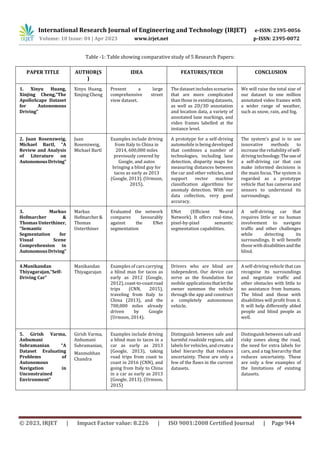
Table -1: Table showing comparative study of 5 Research Papers:
PAPER TITLE AUTHOR(S
)
IDEA FEATURES/TECH CONCLUSION
1. Xinyu Huang,
Xinjing Cheng,“The
ApolloScape Dataset
for Autonomous
Driving”
Xinyu Huang,
Xinjing Cheng
Present a large
comprehensive street
view dataset.
The dataset includes scenarios
that are more complicated
than those in existing datasets,
as well as 2D/3D annotation
and location data, a variety of
annotated lane markings, and
video frames labelled at the
instance level.
We will raise the total size of
our dataset to one million
annotated video frames with
a wider range of weather,
such as snow, rain, and fog.
2. Juan Rosenzweig,
Michael Bartl, “A
Review and Analysis
of Literature on
AutonomousDriving”
Juan
Rosenzweig,
Michael Bartl
Examples include driving
from Italy to China in
2014, 600,000 miles
previously covered by
Google, and autos
bringing a blind guy for
tacos as early as 2013
(Google, 2013). (Urmson,
2015).
A prototype for a self-driving
automobile is being developed
that combines a number of
technologies, including lane
detection, disparity maps for
measuring distances between
the car and other vehicles, and
support vector machine
classification algorithms for
anomaly detection. With our
data collection, very good
accuracy.
The system's goal is to use
innovative methods to
increase the reliability of self-
driving technology.The useof
a self-driving car that can
make informed decisions is
the main focus. The system is
regarded as a prototype
vehicle that has cameras and
sensors to understand its
surroundings.
3. Markus
Hofmarcher &
Thomas Unterthiner,
“Semantic
Segmentation for
Visual Scene
Comprehension in
AutonomousDriving”
Markus
Hofmarcher&
Thomas
Unterthiner
Evaluated the network
compares favourably
against the ENet
segmentation
ENet (Efficient Neural
Network). It offers real-time,
pixel-by-pixel semantic
segmentation capabilities.
A self-driving car that
requires little or no human
involvement to navigate
traffic and other challenges
while detecting its
surroundings. It will benefit
those with disabilitiesandthe
blind.
4.Manikandan
Thiyagarajan,“Self-
Driving Car”
Manikandan
Thiyagarajan
Examples of cars carrying
a blind man for tacos as
early as 2012 (Google,
2012),coast-to-coastroad
trips (CNN, 2015),
traveling from Italy to
China (2013), and the
700,000 miles already
driven by Google
(Urmson, 2014).
Drivers who are blind are
independent. Our device can
serve as the foundation for
mobile applicationsthatletthe
owner summon the vehicle
through the app and construct
a completely autonomous
vehicle.
A self-driving vehicle thatcan
recognise its surroundings
and negotiate traffic and
other obstacles with little to
no assistance from humans.
The blind and those with
disabilities will profit from it.
It will help differently abled
people and blind people as
well.
5. Girish Varma,
Anbumani
Subramanian “A
Dataset Evaluating
Problems of
Autonomous
Navigation in
Unconstrained
Environment”
Girish Varma,
Anbumani
Subramanian,
Manmohhan
Chandra
Examples include driving
a blind man to tacos in a
car as early as 2013
(Google, 2013), taking
road trips from coast to
coast in 2016 (CNN), and
going from Italy to China
in a car as early as 2013
(Google, 2013). (Urmson,
2015)
Distinguish between safe and
harmful roadside regions, add
labels for vehicles, andcreatea
label hierarchy that reduces
uncertainty. These are only a
few of the flaws in the current
datasets.
Distinguish between safe and
risky zones along the road,
the need for extra labels for
cars, and a tag hierarchy that
reduces uncertainty. These
are only a few examples of
the limitations of existing
datasets.
International Research Journal of Engineering and Technology (IRJET) e-ISSN: 2395-0056
Volume: 10 Issue: 04 | Apr 2023 www.irjet.net p-ISSN: 2395-0072
© 2023, IRJET | Impact Factor value: 8.226 | ISO 9001:2008 Certified Journal | Page 945
Fig. Semantic Segmentation
3. PROBLEM STATEMENT
The challenging robotic taskof autonomous driving requires
vision, planning, and execution in a situation that is always
going ahead. This process requires precision for safety
reasons. Semantic segmentation provides pixel-accurate
detection of objects in a driving scene. Most of the work has
been done on the structured conditions as there are lot of
data sets available for structured conditions. But the
environment of Indian road is unconstrained and it is
unstructured. Most of the datasetsavailablearenotonIndian
roads they are more structured comparedtothescenarioson
Indian roads. So, in order to handle these unconstrained
conditions, we have utilized Indian Driving Dataset. Past
approaches have not completely utilized this dataset.
A dataset called IDD[5] consists of 11,000 photos with 33
classes that were gathered from 180 driving situations on
Indian roadways. This dataset offers the information needed
for an unrestricted environment, and it can be utilised for
semantic segmentation as well as item recognition. The
collection includes road scenes that were recorded in
Bangalore, Hyderabad, and the surrounding areas of these
cities. While some of the photographs are 720p, the majority
are 1080p.
4. PRESENTLY AVAILABLE SOLUTIONS
Modern developments in machine learning and computer
vision have permit advancements inautonomousnavigation.
Although, most of the already present research addresses on
European driving situations, while very less progress has
been madefortheIndiandrivingsituations..Ourcontribution
points to achieve a complete spatial understanding for the
Indian driving situations. Our central focus on semantic
segmentation.
The topic of automated vehicles has advancedsignificantlyin
recent years, attractinga great deal of interestandbranching
out into numerous sub-fields that address every facet of a
self-driving vehicle. Vehicle-to-vehicle communication,
energy storage systems,sensors,safetyequipment,andmore
are a few examples. Among these is the difficult Computer
Vision (CV) task of "scene understanding," which deals with
the processing of unprocessed environmental data to
produce a representation of the scene in front of the car that
International Research Journal of Engineering and Technology (IRJET) e-ISSN: 2395-0056
Volume: 10 Issue: 04 | Apr 2023 www.irjet.net p-ISSN: 2395-0072
© 2023, IRJET | Impact Factor value: 8.226 | ISO 9001:2008 Certified Journal | Page 946
permits later interaction with the surrounding environment.
Scene understanding involves interpretingthescenethathas
been viewed using a network of sensors to perceive, analyse,
and develop the scene. It includes a range of difficult tasks,
including image classification and more complex ones like
object identification and semantic segmentation . The first
task entails giving the input image a global label; however,
because diverse items in the environment must be located, it
has limited application in an autonomous vehicle scenario.
The second assignment gives a more thorough description,
finds all things that have been identified, and classifies them.
The final assignment, which is the most difficult, is for giving
each pixel in the input image a class. This challenge provides
a detailedsemanticdescription,sounderstandingthesceneis
the primary objective of the pre-processor, which calls for
sophisticated machine learning architectures.
5. CONCLUSION
Not Satisfied with the previous approaches which tend to
focus on constrained conditions. This drives us to focus on
unconstrained conditions using IDD[5] dataset.
For Semantic Segmentation, we have used U-Net[6]. It was
introduced in 2015 by Olaf Ronneberger,PhilippFischer,and
Thomas Brox. It is a fully convolutional architecture. It
comprises encoder and decoder. We have implemented the
architecture in PyTorch. We have slightly modified this
architecture,after every two layers of convolutionallayerwe
have added a Batch Normalization layer and later ReLU
activation. Instead of up-conv layer, wehave used Transpose
Convolutional layers. Also, we have used padding to ensure
that output of every layer in encoder is of same size as in
corresponding input of decoder layer.
ACKNOWLEDGEMENT
Our mentor Assistant Professor Mrs. Neha Gupta has my
warmest gratitude for her encouragement and assistance
throughout the review paper. We learned about recent
developments in thissubject.We owe her a debtofgratitude.
After completing this review paper, we have gained a great
deal of confidence.
REFERENCES
[1] Xinyu Huang, Xinjing Cheng, Qichuan Geng, ““The
ApolloScape Dataset for Autonomous Driving”.
[2] Juan Rosenzweig, Michael Bartl, “A Review and Analysis
of Literature on Autonomous Driving” in THE MAKING-
OF INNOVATION, E-JOURNAL makingofinnovation.com,
OCTOBER 2015.
[3] Markus Hofmarcher & Thomas Unterthiner, “Visual
Scene Understanding for Autonomous Driving Using
Semantic Segmentation” in LIT AI Lab & Institute for
Machine Learning, Johannes Kepler University Linz, A-
4040 Linz, Austria.
[4] Manikandan Thiyagarajan, “Self-Driving Car” in
International Journal of Psychosocial Rehabilitation ·
April 2020.
[5] Girish Varma, Anbumani Subramanian, Anoop
Namboodiri, Manmohan Chandraker, “DD:ADatasetfor
Exploring Problems of Autonomous Navigation in
Unconstrained Environment”
http://idd.insaan.iiit.ac.in/.
[6] Olaf Ronneberger, PhilippFischer,andThomasBrox,“U-
Net: Convolutional Networks for Biomedical Image
Segmentation.

Autonomous Driving Scene Parsing

  • 1.
    International Research Journalof Engineering and Technology (IRJET) e-ISSN: 2395-0056 Volume: 10 Issue: 04 | Apr 2023 www.irjet.net p-ISSN: 2395-0072 © 2023, IRJET | Impact Factor value: 8.226 | ISO 9001:2008 Certified Journal | Page 942 Autonomous Driving Scene Parsing Neha Gupta1, Mohan Krishna Gupta2, Manan Mehrotra3, Prakhar Arora4, Rajul Bhatnagar5 1Assistant Professor of Computer Science and Engineering, MIT College, Uttar Pradesh, India 2Student of Computer Science and Engineering, MIT College, Uttar Pradesh, India 3Student of Computer Science and Engineering, MIT College, Uttar Pradesh, India 4Student of Computer Science and Engineering, MIT College, Uttar Pradesh, India 5Student of Computer Science and Engineering, MIT College, Uttar Pradesh, India ---------------------------------------------------------------------***--------------------------------------------------------------------- Abstract - In this research paper, we give the semantic segmentation of driving scenes in unconstrained conditions. The focus of previous approaches has been on constrained environments but we focus on the unconstrainedenvironment of Indian roads. We have used IndianDrivingDataset(IDD[5]) which consists of 182 drive sequences on Indian roads. To perform semantic segmentation, wehaveused U-Net[6] model which is completely convolutional neural network, we have made some slight adjustments in the architecture for our purposes. Key Words: Deep learning, classification, convolutional neural networks, semantic segmentation, OpenCV. 1.INTRODUCTION utonomous Driving depends on information that has been processed from several sensors that are positioned above the car. These sensors enable the vehicle sense its surroundings, comprehend traffic scenes, and manage its motions, acting as its sense of hearing and sight. High-resolution cameras, radar, and Light Imaging Recognition and Ranging (LiDAR) are the main types of sensors used to classify objects using feature extraction and measure their distance from other objects using radio waves and illumination in order to create a three-dimensional (3D) image of the object. Environment. Several types of extra sensors,suchasinfrared,sonar,micro- radar, ultrasonic, and short-range sensors, have been fitted for autonomous vehicles to prevent collision with road obstacles. Similartothis,autonomousvehiclesemployvision sensors to enable them to comprehend the visual components of their environment. Lane detection, traffic light and road sign analysis, pedestrian and vehicle detection, among other visual display and understanding problems, are all part of autonomous driving. By gathering this data, automated vehicle behaviours like lane changes, braking, and turning manoeuvres can be better and safer instructed. (a) Instance Segmentation (b) Semantic Segmentation Examples of segmented images for an autonomous vehicle to aid in scene analysis include (a) an instance segmentation exemplar where variousobjectsfromnearlyidentical classes are segmented into variouscolourswiththeirown boundary pixels, and (b) a semantic segmentation example where objects are illustrated with a single colour without any distinction. Vision sensor data is arguably regarded as the most reliable source of information among those gathered for vehicle decision-making. As a result, this field of study has received much research and application in Intelligent Transportation Systems (ITS), primarily from the perspectives of machine learning and deep convolutional neural networks (CNN). By iteratively collecting model characteristics from the input image and optimizingly achieving better representations, deep CNNs are neural networks with a variety of functional layers for image processing. Similar techniques are utilisedforsceneanalysis from vision data, where deep CNN is used to real-time photos, for example, to determine where a pedestrian is and how far away it is from an autonomousvehicle.Incontrastto this streamlined overview of computer-generated landscapes, the complicated models that are now being proposed are capable of generating multiple labels like pedestrians and vehicles as well as the localization. 2. LITERATURE REVIEW To understand the development of autonomous driving research in recent years, it is necessary to organise a literature reviewtounderstandthevariousapplicationareas by which autonomous driving has developed, as well as to recognise research gaps. Thus, the research process, approaches and findings of the literature review are introduced in the next sections. A
  • 2.
    International Research Journalof Engineering and Technology (IRJET) e-ISSN: 2395-0056 Volume: 10 Issue: 04 | Apr 2023 www.irjet.net p-ISSN: 2395-0072 © 2023, IRJET | Impact Factor value: 8.226 | ISO 9001:2008 Certified Journal | Page 943 2.1. Xinyu Huang, Xinjing Cheng, “The ApolloScape Dataset for Autonomous Driving” They offer a huge, detailed dataset of street maps in this project. This dataset includes video sequence with instance- level annotations, 2D/3D annotation and location information, various annotatedlanemarkings,andscenarios that are more sophisticated than those in previousdatasets.. In the future, we'll start by increasing our dataset to one million labeled video frames with a wider range of weather, such snow, rain, and fog. In ordertoproducedepthmapsand panoramic photos in the near future,wealsointendtoattach stereo cameras and a panoramic camera system.For moving objects, the present version still lacks detailed information. For both stationary backgrounds and moving objects, they would like to produce full depth information.. 2.2. Juan Rosenzweig, Michael Bartl, “A Review and Analysis of Literature on Autonomous Driving” Autonomous vehicles are already within reach; for instance, Audi and Mercedes (Bartl, 2014) declared that their highly automated features were virtuallyreadyforproduction.Asa mirror of the news report, we can gradually see how this innovation manages to enter our daily lives, with examples such as cars taking a blind man for tacos in 2013,coast-to- coast excursions in 2016 (CNN), an Italy-to-China trip in 2014 (Broggi, et al.), and 6 million miles previously covered by Google (Urmson , 2015). However, despite being largely ready, the major competitors in the race, including Audi, Bentley, Chevrolet, Ford, Automakers, Volvo, Lexus, Lincon, Lamborghini, Nissan, Tesla, and Volvo, are attempting to integrate it gradually into their vehicles. 2.3. MarkusHofmarcher& ThomasUnterthiner, “Visual Scene Understanding for Autonomous Driving Using Semantic Segmentation” In comparison to the ENet segmentation network, a popular network architecture for effectivesemantic segmentationon embedded devices, they ratedthenetwork favourably.There are comparable, more recent architectures, but none have been compared. They presented a tiered approach, where only specific components are educated in an end-to-end manner, as a supplement to full deep learning, which lacks explainability. A human specialist with thorough understanding of the system may decipher the definition of intermediate nodes, which are outputs through onelayerandinputstoanother. A potent method that offersa reduceddimensional abstraction of incoming video signals is semantic segmentation. 2.4. Manikandan Thiyagarajan, “Self-Driving Car” This project focuses on making improvements in pedestrian safety and commuting , drastically reducing accidents and human mistakes through continuous system learning because self-driving cars are the primary advancement in the automatable industry in the future. This initiative will revolutionise how people with disabilities and blind people who can drive themselves are transported. Mobile applications can be created using our solution as the foundation, allowing users to summon a vehicle through an app and, once the law is passed, manufacture a completely autonomous vehicle . 2.5. Girish Varma, Anbumani Subramanian, Anoop Namboodiri, Manmohan Chandraker, “IDD[5]: A Dataset for Exploring Problems of Autonomous Navigation in Unconstrained Environment” They provide as a fresh dataset for researching issues with autonomous navigation in unstructured driving situations. They point out a number of flaws in the current data sets, including the inability to discriminate between safe and harmful roadside regions, the need for more labels for cars, and a label hierarchy that lessens ambiguity. They examine the dataset's class imbalance and label statistics. With relation to previous semanticsegmentationdatasets,wealso look at the domain discrepancy properties. Our semantic segmentation datasets are more diverse than other datasets since they were collected in India, where there are disparities in background categories and road user looks. This not only presents intriguing challenges to the state of the art in semantic segmentation, but it also represents the first attempt to address problems linked to autonomous driving to our knowledge. 2.6. Olaf Ronneberger, Philipp Fischer, and Thomas Brox, “U-Net[6]: Convolutional Networks for Biomedical Image Segmentation. The u-net[6] architecture performs exceptionally well in a variety of biomedical segmentation applications. It just requires a small number of annotated photos and has a very manageable training time of only eight hours on an NVidia Titan GPU because of data augmentation using elastic deformations (5GB). Depending on Caffe and a trained network, we offer a whole implementation. We are surethat many such jobs can be completed with ease using the u- net[6] design.
  • 3.
    International Research Journalof Engineering and Technology (IRJET) e-ISSN: 2395-0056 Volume: 10 Issue: 04 | Apr 2023 www.irjet.net p-ISSN: 2395-0072 © 2023, IRJET | Impact Factor value: 8.226 | ISO 9001:2008 Certified Journal | Page 944 Table -1: Table showing comparative study of 5 Research Papers: PAPER TITLE AUTHOR(S ) IDEA FEATURES/TECH CONCLUSION 1. Xinyu Huang, Xinjing Cheng,“The ApolloScape Dataset for Autonomous Driving” Xinyu Huang, Xinjing Cheng Present a large comprehensive street view dataset. The dataset includes scenarios that are more complicated than those in existing datasets, as well as 2D/3D annotation and location data, a variety of annotated lane markings, and video frames labelled at the instance level. We will raise the total size of our dataset to one million annotated video frames with a wider range of weather, such as snow, rain, and fog. 2. Juan Rosenzweig, Michael Bartl, “A Review and Analysis of Literature on AutonomousDriving” Juan Rosenzweig, Michael Bartl Examples include driving from Italy to China in 2014, 600,000 miles previously covered by Google, and autos bringing a blind guy for tacos as early as 2013 (Google, 2013). (Urmson, 2015). A prototype for a self-driving automobile is being developed that combines a number of technologies, including lane detection, disparity maps for measuring distances between the car and other vehicles, and support vector machine classification algorithms for anomaly detection. With our data collection, very good accuracy. The system's goal is to use innovative methods to increase the reliability of self- driving technology.The useof a self-driving car that can make informed decisions is the main focus. The system is regarded as a prototype vehicle that has cameras and sensors to understand its surroundings. 3. Markus Hofmarcher & Thomas Unterthiner, “Semantic Segmentation for Visual Scene Comprehension in AutonomousDriving” Markus Hofmarcher& Thomas Unterthiner Evaluated the network compares favourably against the ENet segmentation ENet (Efficient Neural Network). It offers real-time, pixel-by-pixel semantic segmentation capabilities. A self-driving car that requires little or no human involvement to navigate traffic and other challenges while detecting its surroundings. It will benefit those with disabilitiesandthe blind. 4.Manikandan Thiyagarajan,“Self- Driving Car” Manikandan Thiyagarajan Examples of cars carrying a blind man for tacos as early as 2012 (Google, 2012),coast-to-coastroad trips (CNN, 2015), traveling from Italy to China (2013), and the 700,000 miles already driven by Google (Urmson, 2014). Drivers who are blind are independent. Our device can serve as the foundation for mobile applicationsthatletthe owner summon the vehicle through the app and construct a completely autonomous vehicle. A self-driving vehicle thatcan recognise its surroundings and negotiate traffic and other obstacles with little to no assistance from humans. The blind and those with disabilities will profit from it. It will help differently abled people and blind people as well. 5. Girish Varma, Anbumani Subramanian “A Dataset Evaluating Problems of Autonomous Navigation in Unconstrained Environment” Girish Varma, Anbumani Subramanian, Manmohhan Chandra Examples include driving a blind man to tacos in a car as early as 2013 (Google, 2013), taking road trips from coast to coast in 2016 (CNN), and going from Italy to China in a car as early as 2013 (Google, 2013). (Urmson, 2015) Distinguish between safe and harmful roadside regions, add labels for vehicles, andcreatea label hierarchy that reduces uncertainty. These are only a few of the flaws in the current datasets. Distinguish between safe and risky zones along the road, the need for extra labels for cars, and a tag hierarchy that reduces uncertainty. These are only a few examples of the limitations of existing datasets.
  • 4.
    International Research Journalof Engineering and Technology (IRJET) e-ISSN: 2395-0056 Volume: 10 Issue: 04 | Apr 2023 www.irjet.net p-ISSN: 2395-0072 © 2023, IRJET | Impact Factor value: 8.226 | ISO 9001:2008 Certified Journal | Page 945 Fig. Semantic Segmentation 3. PROBLEM STATEMENT The challenging robotic taskof autonomous driving requires vision, planning, and execution in a situation that is always going ahead. This process requires precision for safety reasons. Semantic segmentation provides pixel-accurate detection of objects in a driving scene. Most of the work has been done on the structured conditions as there are lot of data sets available for structured conditions. But the environment of Indian road is unconstrained and it is unstructured. Most of the datasetsavailablearenotonIndian roads they are more structured comparedtothescenarioson Indian roads. So, in order to handle these unconstrained conditions, we have utilized Indian Driving Dataset. Past approaches have not completely utilized this dataset. A dataset called IDD[5] consists of 11,000 photos with 33 classes that were gathered from 180 driving situations on Indian roadways. This dataset offers the information needed for an unrestricted environment, and it can be utilised for semantic segmentation as well as item recognition. The collection includes road scenes that were recorded in Bangalore, Hyderabad, and the surrounding areas of these cities. While some of the photographs are 720p, the majority are 1080p. 4. PRESENTLY AVAILABLE SOLUTIONS Modern developments in machine learning and computer vision have permit advancements inautonomousnavigation. Although, most of the already present research addresses on European driving situations, while very less progress has been madefortheIndiandrivingsituations..Ourcontribution points to achieve a complete spatial understanding for the Indian driving situations. Our central focus on semantic segmentation. The topic of automated vehicles has advancedsignificantlyin recent years, attractinga great deal of interestandbranching out into numerous sub-fields that address every facet of a self-driving vehicle. Vehicle-to-vehicle communication, energy storage systems,sensors,safetyequipment,andmore are a few examples. Among these is the difficult Computer Vision (CV) task of "scene understanding," which deals with the processing of unprocessed environmental data to produce a representation of the scene in front of the car that
  • 5.
    International Research Journalof Engineering and Technology (IRJET) e-ISSN: 2395-0056 Volume: 10 Issue: 04 | Apr 2023 www.irjet.net p-ISSN: 2395-0072 © 2023, IRJET | Impact Factor value: 8.226 | ISO 9001:2008 Certified Journal | Page 946 permits later interaction with the surrounding environment. Scene understanding involves interpretingthescenethathas been viewed using a network of sensors to perceive, analyse, and develop the scene. It includes a range of difficult tasks, including image classification and more complex ones like object identification and semantic segmentation . The first task entails giving the input image a global label; however, because diverse items in the environment must be located, it has limited application in an autonomous vehicle scenario. The second assignment gives a more thorough description, finds all things that have been identified, and classifies them. The final assignment, which is the most difficult, is for giving each pixel in the input image a class. This challenge provides a detailedsemanticdescription,sounderstandingthesceneis the primary objective of the pre-processor, which calls for sophisticated machine learning architectures. 5. CONCLUSION Not Satisfied with the previous approaches which tend to focus on constrained conditions. This drives us to focus on unconstrained conditions using IDD[5] dataset. For Semantic Segmentation, we have used U-Net[6]. It was introduced in 2015 by Olaf Ronneberger,PhilippFischer,and Thomas Brox. It is a fully convolutional architecture. It comprises encoder and decoder. We have implemented the architecture in PyTorch. We have slightly modified this architecture,after every two layers of convolutionallayerwe have added a Batch Normalization layer and later ReLU activation. Instead of up-conv layer, wehave used Transpose Convolutional layers. Also, we have used padding to ensure that output of every layer in encoder is of same size as in corresponding input of decoder layer. ACKNOWLEDGEMENT Our mentor Assistant Professor Mrs. Neha Gupta has my warmest gratitude for her encouragement and assistance throughout the review paper. We learned about recent developments in thissubject.We owe her a debtofgratitude. After completing this review paper, we have gained a great deal of confidence. REFERENCES [1] Xinyu Huang, Xinjing Cheng, Qichuan Geng, ““The ApolloScape Dataset for Autonomous Driving”. [2] Juan Rosenzweig, Michael Bartl, “A Review and Analysis of Literature on Autonomous Driving” in THE MAKING- OF INNOVATION, E-JOURNAL makingofinnovation.com, OCTOBER 2015. [3] Markus Hofmarcher & Thomas Unterthiner, “Visual Scene Understanding for Autonomous Driving Using Semantic Segmentation” in LIT AI Lab & Institute for Machine Learning, Johannes Kepler University Linz, A- 4040 Linz, Austria. [4] Manikandan Thiyagarajan, “Self-Driving Car” in International Journal of Psychosocial Rehabilitation · April 2020. [5] Girish Varma, Anbumani Subramanian, Anoop Namboodiri, Manmohan Chandraker, “DD:ADatasetfor Exploring Problems of Autonomous Navigation in Unconstrained Environment” http://idd.insaan.iiit.ac.in/. [6] Olaf Ronneberger, PhilippFischer,andThomasBrox,“U- Net: Convolutional Networks for Biomedical Image Segmentation.