




ECI Proprietary
OPENFLOW 2.0
THE FUTURE OF
SDN
Hayim Porat
CTO
ECI Proprietary 2
AGENDA
• Background
• Problem statement
• Proposes solution
• Use cases
• Summary
ECI Proprietary 3
STATE OF OPENFLOW
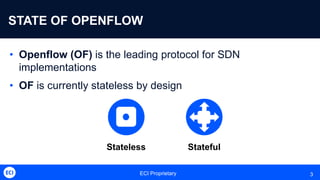
• Openflow (OF) is the leading protocol for SDN
implementations
• OF is currently stateless by design
Stateless Stateful
ECI Proprietary 4
PROBLEM STATEMENT
• OF fails to provide good solution to some
popular use cases that are based on
tasteful frame-by-frame decision:
̶ APS (Automatic protection switching)
̶ Load balancing
̶ Bandwidth capping
• No notion of a flow as a set of
interrelated ingress and egress
traffic streams
• No notion of flow context, e.g.
User, Originating VM
• No ability to generate frames
(e.g. CCMs, 1588, etc.)
ECI Proprietary 5
PROPOSED
SOLUTION
Transform OF
to true Stateful
SDN
ECI Proprietary 6
PROPOSED SOLUTION
• Add Stateful flow table, context, frame
generation and states to OF
• Offload flow and state processing to the FE
• Extend OF with new flow table type
“Stateful”
• Associate “Stateful” table with a set of
programmable state machines
• Extend OF to enable association
and programming of state machines
• Controller retains global
network view
ECI Proprietary 7
STATE MACHINES
0: iconst_2
1: istore_1
2: iload_1
3: sipush 1000
6: if_icmpge 44
9: iconst_2
10: istore_2
SM_j...
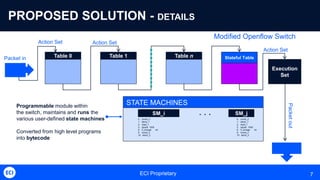
PROPOSED SOLUTION - DETAILS
Table 0 Table 1 Table n Stateful Table
Execution
Set
Action Set Action Set
Action Set
Packetout
Packet in
Programmable module within
the switch, maintains and runs the
various user-defined state machines
Converted from high level programs
into bytecode
Modified Openflow Switch
0: iconst_2
1: istore_1
2: iload_1
3: sipush 1000
6: if_icmpge 44
9: iconst_2
10: istore_2
SM_i
ECI Proprietary 8
HOW TO MAKE IT
REALLY OPEN?
ECI Proprietary 9
CREATING A VENDOR AGNOSTIC SOLUTION
 Deciding on a one way to develop state machines /applications could be
problematic
 Same goes for deciding on one single way to implement in the switches
 On the other hand, loose definitions would lead to interoperability
problems
̶ Same problems that hurdled OF in the first place
ECI Proprietary 10
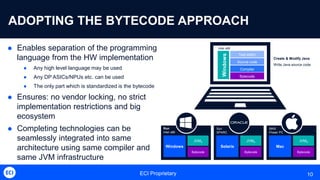
ADOPTING THE BYTECODE APPROACH
 Enables separation of the programming
language from the HW implementation
 Any high level language may be used
 Any DP ASICs/NPUs etc. can be used
 The only part which is standardized is the bytecode
 Ensures: no vendor locking, no strict
implementation restrictions and big
ecosystem
 Completing technologies can be
seamlessly integrated into same
architecture using same compiler and
same JVM infrastructure
Write Java source code
Windows
Text editor
Source code
Compiler
Bytecode
Intel x86
Create & Modify Java
Bytecode
JVMA
Windows
Run
Intel x86
Bytecode
JVMA
Solaris
Sun
SPARC
Bytecode
JVMA
Mac
MAS
Power PC
ECI Proprietary 11
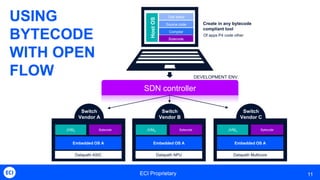
Create in any bytecode
compliant tool
SDN controller
USING
BYTECODE
WITH OPEN
FLOW DEVELOPMENT ENV.
HostOS
Text editor
Source code
Compiler
Bytecode
Of apps P4 code other
BytecodeJVMA
Datapath Multicore
Embedded OS A
Switch
Vendor C
BytecodeJVMA
Datapath NPU
Embedded OS A
Switch
Vendor B
BytecodeJVMA
Datapath ASIC
Embedded OS A
Switch
Vendor A
ECI Proprietary 12
USE CASES
ECI Proprietary 13
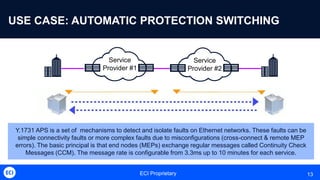
USE CASE: AUTOMATIC PROTECTION SWITCHING
Y.1731 APS is a set of mechanisms to detect and isolate faults on Ethernet networks. These faults can be
simple connectivity faults or more complex faults due to misconfigurations (cross-connect & remote MEP
errors). The basic principal is that end nodes (MEPs) exchange regular messages called Continuity Check
Messages (CCM). The message rate is configurable from 3.3ms up to 10 minutes for each service.
Service
Provider #1
Service
Provider #2
ECI Proprietary 14
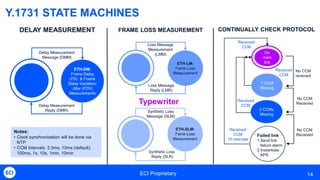
Y.1731 STATE MACHINES
DELAY MEASUREMENT
ETH-SLM:
Fame Loss
Measurement
Synthetic Loss
Message (SLM)
Synthetic Loss
Reply (SLR)
ETH-LM:
Fame Loss
Measurement
Loss Message
Measurement
(LMM)
Loss Message
Reply (LMR)
FRAME LOSS MEASUREMENT CONTINUALLY CHECK PROTOCOL
ETH-DM:
Frame Delay
(FD) & Frame
Delay Variation/
Jitter (FDV)
Measurements
Delay Measurement
Message (DMM)
Delay Measurement
Reply (DMR)
Notes:
• Clock synchronization will be done via
NTP
• CCM intervals: 3.3ms, 10ms (default),
100ms, 1s, 10s, 1min, 10min
Typewriter
On
main
link
1 CCM
Missing
2 CCMs
Missing
No CCM
received
No CCM
Received
No CCM
Received
Received
CCM
Received
CCM
Received
CCM
10 intervals
Received
CCM
Failed link
1.Send link
failure alarm
2.Instantiate
APS
ECI Proprietary
SDN App
OF Switch
Host D
AccessSwitch
CCM Generator
Y.1731
OpenFlow
SDN Controller
DBCEP
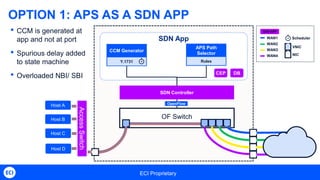
OPTION 1: APS AS A SDN APP
• CCM is generated at
app and not at port
• Spurious delay added
to state machine
• Overloaded NBI/ SBI
Host C
Host B
Host A
APS Path
Selector
Rules
WAN1
WAN2
WAN3
WAN4
SDN APP
VNIC
NIC
Scheduler
ECI Proprietary
Standard Switch
SDN App
OF Switch
Host D
AccessSwitch
Y.1731
DB
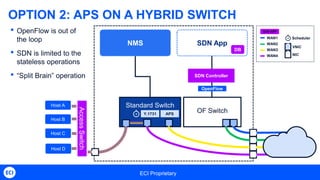
OPTION 2: APS ON A HYBRID SWITCH
• OpenFlow is out of
the loop
• SDN is limited to the
stateless operations
• “Split Brain” operation
Host C
Host B
Host A
WAN1
WAN2
WAN3
WAN4
SDN APP
VNIC
NIC
Scheduler
NMS
SDN Controller
OpenFlow
APS
ECI Proprietary
SDN App
OF Switch
Host D
AccessSwitch
CCM GeneratorY.1731
DBCEP
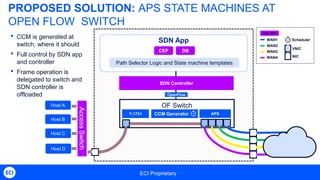
PROPOSED SOLUTION: APS STATE MACHINES AT
OPEN FLOW SWITCH
• CCM is generated at
switch, where it should
• Full control by SDN app
and controller
• Frame operation is
delegated to switch and
SDN controller is
offloaded
Host C
Host B
Host A
WAN1
WAN2
WAN3
WAN4
SDN APP
VNIC
NIC
Scheduler
Path Selector Logic and State machine templates
SDN Controller
OpenFlow
APS
ECI Proprietary 18
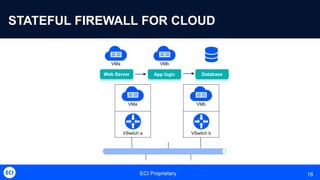
STATEFUL FIREWALL FOR CLOUD
VMa VMb
Web Server App logic Database
VMa
VSwitch a
VMb
VSwitch b
ECI Proprietary 19
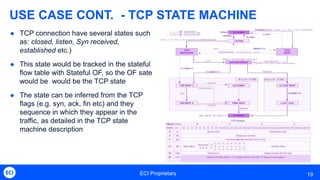
USE CASE CONT. - TCP STATE MACHINE
 TCP connection have several states such
as: closed, listen, Syn received,
established etc.)
 This state would be tracked in the stateful
flow table with Stateful OF, so the OF sate
would be would be the TCP state
 The state can be inferred from the TCP
flags (e.g. syn, ack, fin etc) and they
sequence in which they appear in the
traffic, as detailed in the TCP state
machine description
ECI Proprietary 20
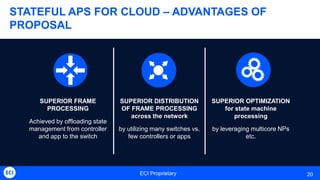
SUPERIOR FRAME
PROCESSING
Achieved by offloading state
management from controller
and app to the switch
SUPERIOR DISTRIBUTION
OF FRAME PROCESSING
across the network
by utilizing many switches vs.
few controllers or apps
SUPERIOR OPTIMIZATION
for state machine
processing
by leveraging multicore NPs
etc.
STATEFUL APS FOR CLOUD – ADVANTAGES OF
PROPOSAL
ECI Proprietary 21
FREQUENTLY
ASKED
QUESTIONS
ECI Proprietary 22
WHY WAS IT NOT
IMPLEMENTED
UNTIL NOW?
 Actually the openflow specification does
include state machine specifications for
two use cases: LAG and Link protection
 These use cases had been
“baked” into the protocol without
further programmability
 Our suggestion is to make
the OF specification truly
programmable
ECI Proprietary 23
HOWEVER, IS STILL SDN?
Lets check the proposed solution using
criteria for SDN as stipulated by ONF:
Directly programmable
Agile
Centrally managed
Programmatically configured
Open standards-based
and vendor-neutral

+
+




ECI Proprietary 24
WILL IT FRAGMENT THE OPENFLOW SWITCH
IMPLEMENTATION?
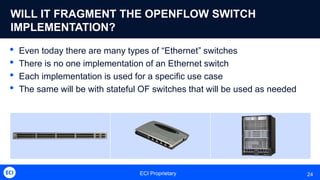
• Even today there are many types of “Ethernet” switches
• There is no one implementation of an Ethernet switch
• Each implementation is used for a specific use case
• The same will be with stateful OF switches that will be used as needed
ECI Proprietary
THANK YOU!
25

ECI OpenFlow 2.0 the Future of SDN

  • 1.
    ECI Proprietary OPENFLOW 2.0 THEFUTURE OF SDN Hayim Porat CTO
  • 2.
    ECI Proprietary 2 AGENDA •Background • Problem statement • Proposes solution • Use cases • Summary
  • 3.
    ECI Proprietary 3 STATEOF OPENFLOW • Openflow (OF) is the leading protocol for SDN implementations • OF is currently stateless by design Stateless Stateful
  • 4.
    ECI Proprietary 4 PROBLEMSTATEMENT • OF fails to provide good solution to some popular use cases that are based on tasteful frame-by-frame decision: ̶ APS (Automatic protection switching) ̶ Load balancing ̶ Bandwidth capping • No notion of a flow as a set of interrelated ingress and egress traffic streams • No notion of flow context, e.g. User, Originating VM • No ability to generate frames (e.g. CCMs, 1588, etc.)
  • 5.
  • 6.
    ECI Proprietary 6 PROPOSEDSOLUTION • Add Stateful flow table, context, frame generation and states to OF • Offload flow and state processing to the FE • Extend OF with new flow table type “Stateful” • Associate “Stateful” table with a set of programmable state machines • Extend OF to enable association and programming of state machines • Controller retains global network view
  • 7.
    ECI Proprietary 7 STATEMACHINES 0: iconst_2 1: istore_1 2: iload_1 3: sipush 1000 6: if_icmpge 44 9: iconst_2 10: istore_2 SM_j... PROPOSED SOLUTION - DETAILS Table 0 Table 1 Table n Stateful Table Execution Set Action Set Action Set Action Set Packetout Packet in Programmable module within the switch, maintains and runs the various user-defined state machines Converted from high level programs into bytecode Modified Openflow Switch 0: iconst_2 1: istore_1 2: iload_1 3: sipush 1000 6: if_icmpge 44 9: iconst_2 10: istore_2 SM_i
  • 8.
    ECI Proprietary 8 HOWTO MAKE IT REALLY OPEN?
  • 9.
    ECI Proprietary 9 CREATINGA VENDOR AGNOSTIC SOLUTION  Deciding on a one way to develop state machines /applications could be problematic  Same goes for deciding on one single way to implement in the switches  On the other hand, loose definitions would lead to interoperability problems ̶ Same problems that hurdled OF in the first place
  • 10.
    ECI Proprietary 10 ADOPTINGTHE BYTECODE APPROACH  Enables separation of the programming language from the HW implementation  Any high level language may be used  Any DP ASICs/NPUs etc. can be used  The only part which is standardized is the bytecode  Ensures: no vendor locking, no strict implementation restrictions and big ecosystem  Completing technologies can be seamlessly integrated into same architecture using same compiler and same JVM infrastructure Write Java source code Windows Text editor Source code Compiler Bytecode Intel x86 Create & Modify Java Bytecode JVMA Windows Run Intel x86 Bytecode JVMA Solaris Sun SPARC Bytecode JVMA Mac MAS Power PC
  • 11.
    ECI Proprietary 11 Createin any bytecode compliant tool SDN controller USING BYTECODE WITH OPEN FLOW DEVELOPMENT ENV. HostOS Text editor Source code Compiler Bytecode Of apps P4 code other BytecodeJVMA Datapath Multicore Embedded OS A Switch Vendor C BytecodeJVMA Datapath NPU Embedded OS A Switch Vendor B BytecodeJVMA Datapath ASIC Embedded OS A Switch Vendor A
  • 12.
  • 13.
    ECI Proprietary 13 USECASE: AUTOMATIC PROTECTION SWITCHING Y.1731 APS is a set of mechanisms to detect and isolate faults on Ethernet networks. These faults can be simple connectivity faults or more complex faults due to misconfigurations (cross-connect & remote MEP errors). The basic principal is that end nodes (MEPs) exchange regular messages called Continuity Check Messages (CCM). The message rate is configurable from 3.3ms up to 10 minutes for each service. Service Provider #1 Service Provider #2
  • 14.
    ECI Proprietary 14 Y.1731STATE MACHINES DELAY MEASUREMENT ETH-SLM: Fame Loss Measurement Synthetic Loss Message (SLM) Synthetic Loss Reply (SLR) ETH-LM: Fame Loss Measurement Loss Message Measurement (LMM) Loss Message Reply (LMR) FRAME LOSS MEASUREMENT CONTINUALLY CHECK PROTOCOL ETH-DM: Frame Delay (FD) & Frame Delay Variation/ Jitter (FDV) Measurements Delay Measurement Message (DMM) Delay Measurement Reply (DMR) Notes: • Clock synchronization will be done via NTP • CCM intervals: 3.3ms, 10ms (default), 100ms, 1s, 10s, 1min, 10min Typewriter On main link 1 CCM Missing 2 CCMs Missing No CCM received No CCM Received No CCM Received Received CCM Received CCM Received CCM 10 intervals Received CCM Failed link 1.Send link failure alarm 2.Instantiate APS
  • 15.
    ECI Proprietary SDN App OFSwitch Host D AccessSwitch CCM Generator Y.1731 OpenFlow SDN Controller DBCEP OPTION 1: APS AS A SDN APP • CCM is generated at app and not at port • Spurious delay added to state machine • Overloaded NBI/ SBI Host C Host B Host A APS Path Selector Rules WAN1 WAN2 WAN3 WAN4 SDN APP VNIC NIC Scheduler
  • 16.
    ECI Proprietary Standard Switch SDNApp OF Switch Host D AccessSwitch Y.1731 DB OPTION 2: APS ON A HYBRID SWITCH • OpenFlow is out of the loop • SDN is limited to the stateless operations • “Split Brain” operation Host C Host B Host A WAN1 WAN2 WAN3 WAN4 SDN APP VNIC NIC Scheduler NMS SDN Controller OpenFlow APS
  • 17.
    ECI Proprietary SDN App OFSwitch Host D AccessSwitch CCM GeneratorY.1731 DBCEP PROPOSED SOLUTION: APS STATE MACHINES AT OPEN FLOW SWITCH • CCM is generated at switch, where it should • Full control by SDN app and controller • Frame operation is delegated to switch and SDN controller is offloaded Host C Host B Host A WAN1 WAN2 WAN3 WAN4 SDN APP VNIC NIC Scheduler Path Selector Logic and State machine templates SDN Controller OpenFlow APS
  • 18.
    ECI Proprietary 18 STATEFULFIREWALL FOR CLOUD VMa VMb Web Server App logic Database VMa VSwitch a VMb VSwitch b
  • 19.
    ECI Proprietary 19 USECASE CONT. - TCP STATE MACHINE  TCP connection have several states such as: closed, listen, Syn received, established etc.)  This state would be tracked in the stateful flow table with Stateful OF, so the OF sate would be would be the TCP state  The state can be inferred from the TCP flags (e.g. syn, ack, fin etc) and they sequence in which they appear in the traffic, as detailed in the TCP state machine description
  • 20.
    ECI Proprietary 20 SUPERIORFRAME PROCESSING Achieved by offloading state management from controller and app to the switch SUPERIOR DISTRIBUTION OF FRAME PROCESSING across the network by utilizing many switches vs. few controllers or apps SUPERIOR OPTIMIZATION for state machine processing by leveraging multicore NPs etc. STATEFUL APS FOR CLOUD – ADVANTAGES OF PROPOSAL
  • 21.
  • 22.
    ECI Proprietary 22 WHYWAS IT NOT IMPLEMENTED UNTIL NOW?  Actually the openflow specification does include state machine specifications for two use cases: LAG and Link protection  These use cases had been “baked” into the protocol without further programmability  Our suggestion is to make the OF specification truly programmable
  • 23.
    ECI Proprietary 23 HOWEVER,IS STILL SDN? Lets check the proposed solution using criteria for SDN as stipulated by ONF: Directly programmable Agile Centrally managed Programmatically configured Open standards-based and vendor-neutral  + +    
  • 24.
    ECI Proprietary 24 WILLIT FRAGMENT THE OPENFLOW SWITCH IMPLEMENTATION? • Even today there are many types of “Ethernet” switches • There is no one implementation of an Ethernet switch • Each implementation is used for a specific use case • The same will be with stateful OF switches that will be used as needed
  • 25.

Editor's Notes

  • #4 Stateless operations mean that the match and actions on frames are based only on information included in the frame’s header. Stateful operations also take into account any information derived from states or history
  • #11 The Bytcode approach enables separation of the programming language from the HW implementation This means that any high level language may be used to create the state machines This also means that any DP ASICs/NPUs etc. can be used with no restrictions The only part which is standardized is the bytcode, and that has been perfected by Java for a long time Using this approach, the is no vendor locking, no strict implementation restrictions and big ecosystem This also means that completing technologies like P4 can be seamlessly integrated into same architecture using same compiler and same JVM infra
  • #19 Consider the following example: A common cloud application is a web application which is composed of three tiers: Web server App Logic Database For security reason Webserver may initiate connection to the AppLogic but AppLogic may not initiate connection to the web server. In a standard openflow implementation of a stateless firewall we can put a rule that when a first frame is coming from VMa with destination to VMb, we will allow it on both directions and when a first frame comes from VMb to VMa , we will not allow it For security reason we would only want to allow traffic from VMb to VMa only when the TCP connection status is “established” The problem with a stateless firewall occurs when we allow the traffic from VMa to VMb on both directions regardless of the state of the TCP connection, as VMb may communicate with VMa, after the session TCP session had ended