Visit ebookmass.com todownload the full version and
explore more ebook or textbook
Network Algorithmics 2nd Edition Varghese
_____ Click the link below to download _____
https://ebookmass.com/product/network-algorithmics-2nd-
edition-varghese/
Explore and download more ebook or textbook at ebookmass.com
2.
Here are somerecommended products that we believe you will be
interested in. You can click the link to download.
Network Algorithmics George Varghese
https://ebookmass.com/product/network-algorithmics-george-varghese/
Network Algorithmics: An Interdisciplinary Approach to
Designing Fast Networked Devices George Varghese & Jun Xu
https://ebookmass.com/product/network-algorithmics-an-
interdisciplinary-approach-to-designing-fast-networked-devices-george-
varghese-jun-xu/
The Sage Handbook of Social Network Analysis, 2e 2nd
Edition John Mclevey
https://ebookmass.com/product/the-sage-handbook-of-social-network-
analysis-2e-2nd-edition-john-mclevey/
Using And Administering Linux: Volume 3 Zero To SysAdmin:
Network Services (2nd ed.) 2nd Edition David Both
https://ebookmass.com/product/using-and-administering-linux-
volume-3-zero-to-sysadmin-network-services-2nd-ed-2nd-edition-david-
both/
3.
Network+ Guide toNetworks 8th Edition West
https://ebookmass.com/product/network-guide-to-networks-8th-edition-
west/
Computer Network Security 1st Edition Ali Sadiqui
https://ebookmass.com/product/computer-network-security-1st-edition-
ali-sadiqui/
The Illustrated Network: How TCP/IP Works in a Modern
Network Walter Goralski
https://ebookmass.com/product/the-illustrated-network-how-tcp-ip-
works-in-a-modern-network-walter-goralski/
PyTorch Recipes: A Problem-Solution Approach to Build,
Train and Deploy Neural Network Models, 2nd Edition
Pradeepta Mishra
https://ebookmass.com/product/pytorch-recipes-a-problem-solution-
approach-to-build-train-and-deploy-neural-network-models-2nd-edition-
pradeepta-mishra/
Concise Guide to Numerical Algorithmics: The Foundations
and Spirit of Scientific Computing John Lawrence Nazareth
https://ebookmass.com/product/concise-guide-to-numerical-algorithmics-
the-foundations-and-spirit-of-scientific-computing-john-lawrence-
nazareth/
6.
Network Algorithmics
An InterdisciplinaryApproach to
Designing Fast Networked Devices
SECOND EDITION
George Varghese
UCLA Department of Computer Science, Los Angeles, CA, United States
Jun Xu
School of Computer Science, Georgia Institute of Technology, Atlanta, GA,
United States
8.
Table of Contents
Coverimage
Title page
Copyright
Dedication
Preface to the second edition
Preface
Audience
What this book is about
Organization of the book
Features
Usage
Why this book was written
Acknowledgments
9.
15 principles usedto overcome network bottlenecks
Part 1: The rules of the game
Introduction
Chapter 1: Introducing network algorithmics
Abstract
1.1. The problem: network bottlenecks
1.2. The techniques: network algorithmics
1.3. Exercise
Chapter 2: Network implementation models
Abstract
2.1. Protocols
2.2. Hardware
2.3. Network device architectures
2.4. Operating systems
2.5. Summary
2.6. Exercises
References
Chapter 3: Fifteen implementation principles
10.
Abstract
3.1. Motivating theuse of principles—updating ternary content-
addressable memories
3.2. Algorithms versus algorithmics
3.3. Fifteen implementation principles—categorization and
description
3.4. Design versus implementation principles
3.5. Caveats
3.6. Summary
3.7. Exercises
References
Chapter 4: Principles in action
Abstract
4.1. Buffer validation of application device channels
4.2. Scheduler for asynchronous transfer mode flow control
4.3. Route computation using Dijkstra's algorithm
4.4. Ethernet monitor using bridge hardware
4.5. Demultiplexing in the x-kernel
4.6. Tries with node compression
4.7. Packet filtering in routers
11.
4.8. Avoiding fragmentationof LSPs
4.9. Policing traffic patterns
4.10. Identifying a resource hog
4.11. Getting rid of the TCP open connection list
4.12. Acknowledgment withholding
4.13. Incrementally reading a large database
4.14. Binary search of long identifiers
4.15. Video conferencing via asynchronous transfer mode
References
Part 2: Playing with endnodes
Introduction
Chapter 5: Copying data
Abstract
5.1. Why data copies
5.2. Reducing copying via local restructuring
5.3. Avoiding copying using remote DMA
5.4. Broadening to file systems
5.5. Broadening beyond copies
5.6. Broadening beyond data manipulations
12.
5.7. Conclusions
5.8. Exercises
References
Chapter6: Transferring control
Abstract
6.1. Why control overhead?
6.2. Avoiding scheduling overhead in networking code
6.3. Avoiding context-switching overhead in applications
6.4. Scalable I/O Notification
6.5. Avoiding system calls or Kernel Bypass
6.6. Radical Restructuring of Operating Systems
6.7. Reducing interrupts
6.8. Conclusions
6.9. Exercises
References
Chapter 7: Maintaining timers
Abstract
7.1. Why timers?
7.2. Model and performance measures
13.
7.3. Simplest timerschemes
7.4. Timing wheels
7.5. Hashed wheels
7.6. Hierarchical wheels
7.7. BSD implementation
7.8. Google Carousel implementation
7.9. Obtaining finer granularity timers
7.10. Conclusions
7.11. Exercises
References
Chapter 8: Demultiplexing
Abstract
8.1. Opportunities and challenges of early demultiplexing
8.2. Goals
8.3. CMU/Stanford packet filter: pioneering packet filters
8.4. Berkeley packet filter: enabling high-performance
monitoring
8.5. Pathfinder: factoring out common checks
8.6. Dynamic packet filter: compilers to the rescue
8.7. Conclusions
14.
8.8. Exercises
References
Chapter 9:Protocol processing
Abstract
9.1. Buffer management
9.2. Cyclic redundancy checks and checksums
9.3. Generic protocol processing
9.4. Reassembly
9.5. Conclusions
9.6. Exercises
References
Part 3: Playing with routers
Introduction
Chapter 10: Exact-match lookups
Abstract
10.1. Challenge 1: Ethernet under fire
10.2. Challenge 2: wire speed forwarding
10.3. Challenge 3: scaling lookups to higher speeds
10.4. Summary
15.
Visit https://ebookmass.com todayto explore
a vast collection of ebooks across various
genres, available in popular formats like
PDF, EPUB, and MOBI, fully compatible with
all devices. Enjoy a seamless reading
experience and effortlessly download high-
quality materials in just a few simple steps.
Plus, don’t miss out on exciting offers that
let you access a wealth of knowledge at the
best prices!
16.
10.5. Exercise
References
Chapter 11:Prefix-match lookups
Abstract
11.1. Introduction to prefix lookups
11.2. Finessing lookups
11.3. Non-algorithmic techniques for prefix matching
11.4. Unibit tries
11.5. Multibit tries
11.6. Level-compressed (LC) tries
11.7. Lulea-compressed tries
11.8. Tree bitmap
11.9. Binary search on ranges
11.10. Binary search on ranges with Initial Lookup Table
11.11. Binary search on prefix lengths
11.12. Linear search on prefix lengths with hardware assist
11.13. Memory allocation in compressed schemes
11.14. Fixed Function Lookup-chip models
11.15. Programmable Lookup Chips and P4
17.
11.16. Conclusions
11.17. Exercises
References
Chapter12: Packet classification
Abstract
12.1. Why packet classification?
12.2. Packet-classification problem
12.3. Requirements and metrics
12.4. Simple solutions
12.5. Two-dimensional schemes
12.6. Approaches to general rule sets
12.7. Extending two-dimensional schemes
12.8. Using divide-and-conquer
12.9. Bit vector linear search
12.10. Cross-producting
12.11. Equivalenced cross-producting
12.12. Decision tree approaches
12.13. Hybrid algorithms
12.14. Conclusions
18.
12.15. Exercises
References
Chapter 13:Switching
Abstract
13.1. Router versus telephone switches
13.2. Shared-memory switches
13.3. Router history: from buses to crossbars
13.4. The take-a-ticket crossbar scheduler
13.5. Head-of-line blocking
13.6. Avoiding HOL blocking via output queuing
13.7. Avoiding HOL blocking via virtual output queuing
13.8. Input-queued switching as a bipartite matching problem
13.9. Parallel iterative matching (PIM)
13.10. Avoiding randomization with iSLIP
13.11. Computing near-optimal matchings via learning
13.12. Sample-and-compare: a stunningly simple adaptive
algorithm
13.13. SERENA: an improved adaptive algorithm
13.14. The queue-proportional sampling strategy
13.15. QPS implementation
19.
13.16. Small-batch QPSand sliding-window QPS
13.17. Combined input and output queueing
13.18. Scaling to larger and faster switches
13.19. Scaling to faster link speeds
13.20. Conclusions
13.21. Exercises
References
Chapter 14: Scheduling packets
Abstract
14.1. Motivation for quality of service
14.2. Random early detection
14.3. Approximate fair dropping
14.4. Token bucket policing
14.5. Multiple outbound queues and priority
14.6. A quick detour into reservation protocols
14.7. Providing bandwidth guarantees
14.8. Schedulers that provide delay guarantees
14.9. Generalized processor sharing
14.10. Weighted fair queueing
20.
14.11. Worst-case fairweighed fair queueing
14.12. The data structure and algorithm for efficient GPS clock
tracking
14.13. Implementing WFQ and WF2Q
14.14. Quick fair queueing (QFQ)
14.15. Towards programmable packet scheduling
14.16. Scalable fair queuing
14.17. Summary
14.18. Exercises
References
Chapter 15: Routers as distributed systems
Abstract
15.1. Internal flow control
15.2. Internal Link Striping
15.3. Distributed Memory
15.4. Asynchronous updates
15.5. Conclusions
15.6. Exercises
References
Part 4: Endgame
21.
Introduction
Chapter 16: Measuringnetwork traffic
Abstract
16.1. Why measurement is hard
16.2. Reducing SRAM width using DRAM backing store
16.3. A randomized counter scheme
16.4. Maintain active counters using BRICK
16.5. Extending BRICK for maintaining associated states
16.6. Reducing counter width using approximate counting
16.7. Reducing counters using threshold aggregation
16.8. Reducing counters using flow counting
16.9. Reducing processing using sampled NetFlow
16.10. Reducing reporting using sampled charging
16.11. Correlating measurements using trajectory sampling
16.12. A concerted approach to accounting
16.13. Computing traffic matrices
16.14. Sting as an example of passive measurement
16.15. Generating better traffic logs via data streaming
16.16. Counting the number of distinct flows
22.
16.17. Detection ofheavy hitters
16.18. Estimation of flow-size distribution
16.19. The Tug-of-War algorithm for estimating F2
16.20. Conclusion
16.21. Exercises
References
Chapter 17: Network security
Abstract
17.1. Searching for multiple strings in packet payloads
17.2. Approximate string matching
17.3. IP traceback via probabilistic marking
17.4. IP traceback via logging
17.5. Detecting worms
17.6. EarlyBird system for worm detection
17.7. Carousel: scalable logging for intrusion prevention
systems
17.8. Conclusion
17.9. Exercises
References
23.
Chapter 18: Conclusions
Abstract
18.1.What this book has been about
18.2. What network algorithmics is about
18.3. Network algorithmics and real products
18.4. Network algorithmics: back to the future
18.5. The inner life of a networking device
References
Appendix A: Detailed models
A.1. TCP and IP
A.2. Hardware models
A.3. Switching theory
A.4. The interconnection network Zoo
References
References
References
Index
herein. In usingsuch information or methods they should be
mindful of their own safety and the safety of others, including
parties for whom they have a professional responsibility.
To the fullest extent of the law, neither the Publisher nor the
authors, contributors, or editors, assume any liability for any injury
and/or damage to persons or property as a matter of products
liability, negligence or otherwise, or from any use or operation of
any methods, products, instructions, or ideas contained in the
material herein.
ISBN: 978-0-12-809927-8
For information on all Morgan Kaufmann and Elsevier
publications visit our website at https://www.elsevier.com/books-
and-journals
Publisher: Mara Conner
Editorial Project Manager: Lindsay C. Lawrence
Production Project Manager: Manchu Mohan
Cover Designer: Matthew Limbert
Typeset by VTeX
26.
Visit https://ebookmass.com todayto explore
a vast collection of ebooks across various
genres, available in popular formats like
PDF, EPUB, and MOBI, fully compatible with
all devices. Enjoy a seamless reading
experience and effortlessly download high-
quality materials in just a few simple steps.
Plus, don’t miss out on exciting offers that
let you access a wealth of knowledge at the
best prices!
This ebook isfor the use of anyone anywhere in the United States
and most other parts of the world at no cost and with almost no
restrictions whatsoever. You may copy it, give it away or re-use it
under the terms of the Project Gutenberg License included with this
ebook or online at www.gutenberg.org. If you are not located in the
United States, you will have to check the laws of the country where
you are located before using this eBook.
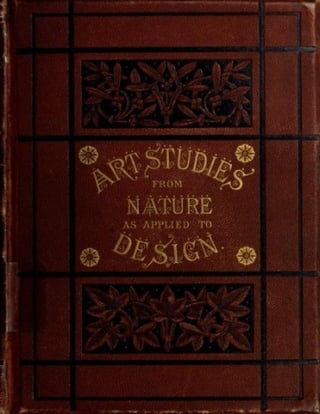
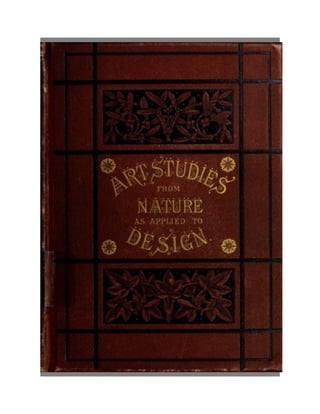
Title: Art-Studies from Nature, as Applied to Design
Author: F. Edward Hulme
James Glaisher
Robert Hunt
active 1851-1872 Samuel Joseph Mackie
Release date: November 28, 2016 [eBook #53624]
Most recently updated: October 23, 2024
Language: English
Credits: Produced by Chuck Greif and the Online Distributed
Proofreading Team at http://www.pgdp.net (This file was
produced from images available at The Internet Archive)
*** START OF THE PROJECT GUTENBERG EBOOK ART-STUDIES
FROM NATURE, AS APPLIED TO DESIGN ***
33.
Contents.
(In certain versionsof this etext [in
certain browsers] clicking on the
image will bring up a larger
version.)
(etext transcriber's note)
ART-STUDIES FROM
NATURE,
As applied to Design:
FOR THE USE OF
ARCHITECTS, DESIGNERS, AND MANUFACTURERS.
COMPRISED IN FOUR PAPERS BY
F. E. HULME, F.L.S., F.S.A.;
J. GLAISHER, F.R.S.;
S. J. MACKIE, F.G.S., F.S.A.;
ROBERT HUNT, F.R.S.
Reprinted from the Art-Journal.
WITH NUMEROUS ILLUSTRATIONS ON WOOD.
LONDON:
34.
VIRTUE & CO.,26, IVY LANE, PATERNOSTER ROW.
1872.
LONDON:
PRINTED BY VIRTUE AND CO.,
CITY ROAD.
35.
PREFACE.
ATURE may bestudied in many aspects; her wealth of service and
beauty is freely open to all who seek; and while the man of science,
by patient study and assiduous toil, may learn something of her
mystery, and gather from her not unwilling hands rich treasure of
knowledge for the benefit of humanity (for without the midnight watch and
the elaborate calculation of the astronomer navigation would yet be in its
infancy; without the enthusiasm of the botanist as he toils in the tropic
forest the virtues of many a healing plant would be unknown; without the
keen perception of the geologist the miner’s task would be in vain), so the
man of art in no less degree may find in her study richest elements of
beauty, loveliest suggestions of colour, forms of infinite grace. A delight in
the study of Nature, a desire to realise something of its grandeur, is a source
of unbounded pleasure to its possessor, for to him no walk can be a
weariness, no season of the year dreary, no soil so sterile as to be barren of
interest:—
“The meanest flow’ret of the vale,
The simplest note that swells the gale,
The common sun, the air, the skies,
To him are opening Paradise.”
The lichen on the rock, the wayside grass, the many-coloured fungi, are no
less full of beauty than the forms that more ordinarily attract attention, and
are no less worthy of study. “The works of the Lord are great, sought out of
all them that have pleasure therein;” and Nature has ever to the devout
mind, from its own inherent beauty and its testimony to Him its creator and
sustainer, been a study of the deepest interest. Some who glance over these
opening remarks before entering upon the search for such material in the
body of the book as may seem available for their immediate purpose, may
consider that this view of the subject is unpractical; but we would remind
such that all art, pictorial, sculptural, decorative, or what not, is only noble
and worthy of the name so far as it affords food for thought in the spectator,
and testifies to thought in the artist, and that the nobility of the work is in
direct proportion to such evidence of inner life. Art that is æsthetic and
36.
sensuous, though pleasingto the eye, must ever in the nature of things hold
a subordinate place to that art which is symbolic, to those forms in which an
inner meaning may be traced; and though one work of art may perhaps
necessarily contain less of this reflected thought than another, yet this
proposition we think will hold good, that no work of art that does not in
some way testify to this can be altogether satisfactory, for while pleasing for
a time to the eye, it yet leaves the mind unsatisfied: the reverse will equally
hold good, and we may safely repeat that in proportion to the thought
bestowed and expressed by the artist will be the enjoyment and profit to be
derived by others from it. The true artist will not consider with how small
expenditure of trouble he may attain his end; he will, on the contrary, have a
heart full of sympathy with all that is beautiful. This will become a wealth
of knowledge, will prove a precious possession to himself, and the result
must be visible in his work, and stamp it with Promethean fire. To the artist
then who is worthy of the name, nothing can be too petty for regard,
nothing that the Creator has pronounced “very good” too insignificant for
notice; for in Nature beauty is scattered with a lavish hand, and the fungus
that passes through all the stages of its existence during a summer’s night,
and the snow-flake still more transient in its duration—
“Frail, but a work divine:
Made so fairily well,
So exquisitely minute,
A miracle of design”—
have a charm of their own no less than the higher forms, while to give but
one other example from the many that present themselves, the Foraminifera
—animal remains met with in chalk cliffs—though only visible with high
microscopic power, have the curves of their shells as graceful, designs as
varied, markings as intricate, as perhaps any other natural objects
whatsoever. We therefore appreciate the quaint fancy, the studied thought of
the designer who in some old glass that we have noticed at Ockham
Church, in Surrey, while making some of his quarry designs of columbine,
rose, and other lovely forms, chose for one of them a little fungus
surrounded by cup moss, and springing from the turf; frail creatures of a
day, meet emblems—like the withering grass, the fading flower—of the
short estate of man, the transience of all his glory.
37.
In the endeavourto suggest something of these humbler types of beauty
to the artist, the designer, the architect, and the manufacturer, the following
papers have been collected from the pages of the Art-Journal, the periodical
in which they originally appeared, and after careful revision by their several
writers, have been published in this detached form, in order that they may
be still more commonly accessible.
The first article is an endeavour on the part of the author to indicate
something of the profusion of beautiful form that may be met with in our
hedges and skirting our roadsides, to point out the source from whence the
mediæval artists gathered their inspiration, and to plead for its greater use
by their successors, that by a like loving appreciation we too may create
like forms of beauty.
The second essay deals with marine forms of vegetable life, and dwells
on the immense variety of form that may be met with in the sea-weeds that
surround our shores, and the applicability of many of the species to the
varied purposes of the designer. It is curious that these wonderful forms
should not have been employed more largely in the decorative work of any
people. With the exception of the singularly waved and bossed foliage seen
in the stone carving and metal-work of the later years of the Decorated
period of Gothic, and which may possibly have been originally suggested
by the Fucus vesiculosus, one of our commonest shore weeds, we know of
no instance of their introduction into ornamental art. Hence here at once a
wide field is open to the designer, and this essay cannot fail to be full of
valuable material.
As the first and second articles have striven to illustrate the beautiful
forms that inhabit the land and the sea respectively, so the third article,
leaving
“The deep’s untrampled floor
With green and purple sea-weeds strewn,”
and the more familiar forms of earth, deals with those delicate forms of the
air, the flakes of falling snow, and points out the immense variety of
graceful forms afforded by their crystals.
Symmetry and geometry are both so commonly met with in ornamental
art, and are also so conspicuously present in the forms of snow crystals, that
the application of those forms to design cannot fail to follow when once
38.
their beauties arebrought under the notice of the designer and
manufacturer.
Symmetry shows itself in a general beauty of proportion, and balance of
masses in a composition; or, in the more limited sense in which we now use
the word, in the likeness of one half or part to another in the unit of design.
We speak of a design being bi-symmetrical or tri-symmetrical, or if it goes
beyond this, as in snow crystals and in many other cases where the
ornament may be bounded by a circle, it is termed multi-symmetrical. Bi-
symmetrical arrangements will be found most appropriate for the decoration
of upright surfaces, as wall-papers or curtains, which will always be seen
one way, while multi-symmetrical star-like forms are more suitable for
floor-cloth or carpet patterns, because a star-like pattern on the floor looks
equally well from all parts of the room; while a design having its halves
merely alike can only be viewed to advantage from one point. It is curious
to observe that in Nature the rule seems to be that the lower forms shall be
multi-symmetrical, made up of several similar parts, while the higher forms
of life are bi-symmetrical: thus in the first class we get snow crystals, sea-
anemones, star-fishes; and in the second, the more advanced forms of
animal life—insects, birds, quadrupeds, and man himself. There are
numerous exceptions, however, to this: thus we have flowers multi-
symmetrical, and their leaves only alike in their halves, though undoubtedly
the flower, in view of its functions in vegetable physiology, and also from
the ornamentist’s stand-point, cannot be considered lower in the scale of
creation than the leaf. The charm produced by the mere repetition of parts
may be well seen in the kaleidoscope, where a series of irregular pieces of
glass develop into various ornamental forms, owing to their symmetrical
arrangement and radiation from one centre—an effect still more clearly and
beautifully seen in the crystals of snow, where the unit is itself of pleasing
form.
The influence of geometry upon design has in almost all periods of art
been very marked—in some styles, as the Early English Gothic, and the
Italian of the thirteenth century, much more so than in others; but in no style
is it altogether ignored. Whether we study the examples of decorative art
produced in our midst, the result of modern skill; or turn to the remains of
Egyptian and Assyrian ornament, the brain-work and handiwork of men
who toiled thousands of years ago, or whether we contrast the delicacy of
much of our English work with the rude carving or pottery of the South Sea
39.
Islander, we stillcannot fail to notice that amidst much that is very marked
and distinctive in comparing one period with another, or the handiwork of
one race or nation with another, this one great principle of the adaptation of
geometry to ornament is exhibited more or less prominently in all. Where a
sense of flatness is desirable, as in designs for floor-coverings—as mosaic,
tile-work, carpeting, &c.—the use of geometrical forms appears especially
appropriate, since the feeling of flatness is easily obtainable, and yet,
accompanying this essential feature, almost any degree of complexity and
richness of effect. These remarks upon the use of geometry must, however,
be considered to apply more especially to the simpler kinds of design, to
those intended to fill but a subordinate place. As we rise higher, geometry,
though still valuable in the setting out and defining of leading lines and
masses, gives place to higher forms, those based on animal or vegetable
life. In a fourteenth-century diaper the part we admire is not the geometric
basis of the design, but the delicate filling in of oak or maple, buttercup or
ivy, though we unconsciously admire this the more on account of the
enclosing straight lines—lines that we should at once miss if they were
removed as superfluous.
The fourth essay of our series deals with the suggestive ornamental
forms so freely met with in organic remains. As in the previous essay we
found in the clouds above forms of beauty well adapted for our needs as
ornamentists, so in this one we delve beneath the surface of our earth, and
again have the lesson impressed upon us, that in every situation forms of
beauty abound, that the world is full of suggestive material for the student
of ornamental art, and that in what at first sight appears a barren and
profitless waste, fresh proof is given of the universal reign of law, order,
and beauty throughout the whole range of creation. These four essays, then,
should prove a welcome addition to the ornamentist’s store of material,
since (though no book-work can take the place of actual observation) they
may at least suggest to him other forms, and cause him to turn his attention
in fresh directions. With this hope, then, we conclude, trusting that our
efforts thus to illustrate in some degree the wealth of Nature may not have
been altogether in vain.
F. E. H.
CONTENTS.
40.
I
PAGE
THE ADAPTABILITY OFOUR NATIVE PLANTS TO THE
PURPOSES OF ORNAMENTAL ART. By F. Edward Hulme,
F.L.S., F.S.A. 1
II
SEA-WEEDS AS OBJECTS OF DESIGN. By S. J. Mackie,
F.G.S., F.S.A. 91
III
THE CRYSTALS OF SNOW AS APPLIED TO THE
PURPOSES OF DESIGN. By James Glaisher, F.R.S. 133
IV
THE SYMMETRICAL AND ORNAMENTAL FORMS OF
ORGANIC REMAINS. By Robert Hunt, F.R.S. 177
41.
I.
THE ADAPTABILITY OFOUR NATIVE PLANTS TO THE PURPOSES
OF ORNAMENTAL ART.
By EDWARD HULME, F.L.S., F.S.A.
N this series of papers it will be our desire to direct the attention of
the architect, manufacturer, and designer, to some of the beautiful
forms of nature, which, though easily accessible, seem to have
scarcely received the consideration they deserve; to give a brief account of
the habits, peculiarities, and localities of the plants as they come before us;
to cite from time to time examples, either English or foreign, of their use in
the ornament of the past; and generally to add such details as may directly
or indirectly tend to create an interest in the plant in question. We find, on
looking back at the past history and practice of ornamental art, in the midst
of many marked differences of style, one principle very generally observed
—the use in the ornament of any given country of the plants familiar to the
people. Hence, the Egyptians exclusively used in their ornament the plants
of their own land; we see the palm branch, the papyrus, and the beautiful
lily of the Nile constantly recurring. We find the Greeks and Romans
employing the acanthus, olive, and vine; the Japanese, the light and graceful
bamboo; and in our own Gothic styles and those of the Continent—French,
German, or Spanish—we meet with more or less conventionalised
representations in the carvings, paintings, illuminations, fabrics for dress,
hangings, &c., of the familiar forms of our hedgerows, streams, and
meadows, such as the wild rose, oak, maple, iris, buttercup, and many
others. It is then with the desire to awaken our decorators to the fact, that
beautiful as the Greek anthemion and other allied forms are, they by no
means represent the limit available in ornamental art, that the following
papers have been prepared, since we are persuaded that if once the
inexhaustible riches of nature were sought after by our architects, and their
beauties brought before the eyes of the people in their work, architecture
42.
would thus betaking one long step nearer to the sympathies and
appreciation of many to whom it is now a matter of indifference. The works
of a few of our leading architects owe at least some of their beauty to their
recognition of this truth; and we would desire, while acknowledging the
services rendered to architecture by such men as Pugin, Collings, Street,
and Gilbert Scott, to add our mite to the revival going on around us.
Botany, or the study of plants (Gr. botane, a plant), is capable of many
subdivisions: thus we have one department which, from its dealing with the
vital functions of the plant, we term physiology (Gr. physis, nature—logos,
science); another which, from its more especially dealing with the
organization and structure of the plant, is called organography, or structural
botany; while a third great division, systematic botany, derives its name
from its teaching how the multifarious forms of vegetable life may yet be
classified into genera, and these again into orders and species from certain
points of resemblance in the plants thus classed together. Botany, in itself a
science in the ordinary use of the term, may, however, render valuable
service to art; and it is this phase of the subject which we more especially
propose to develop, treating only of the more exclusively scientific points
so far as we find them necessary for our present purpose; and in this we
think we are fully justified, for though numbers of excellent works are
accessible to the student who desires to study botany as a science, but few
fully recognise its importance in a modified form to the art-student, and
more especially to the designer. To the ornamentist a knowledge of the laws
of plant growth is of really the same importance as the study of anatomy to
the figure-painter or sculptor, and the absence of this knowledge is to the
initiated, in either case, as readily detected. Many who are now content to
forego this precise knowledge are no doubt partly debarred by the
technicalities which meet them at every sentence in ordinary botanical
works. Bearing in mind, therefore, the special requirements of our readers,
we shall endeavour to avoid as far as possible the use of terms which,
though scientifically valuable, and in fact essential to correct and true
description, are not such as we may reasonably assume our readers, without
special botanical study, to be familiar with. A knowledge of these terms is,
however, very desirable, since their conciseness renders them valuable, and
more especially, also, because many excellent works, which it will be of
advantage to the student to consult, largely employ them. We trust that in
the few cases where such terms are in the present work introduced, a clear
43.
explanation of theirforce and utility will be found to accompany them; we
shall also, as a further assistance, add the source from whence the term is
derived, wherever the introduction will tend to throw additional light on the
meaning of the word.
As we cannot hope, in the limited space at our command, to supply
every requirement, give every detail, or bring forward more than a few of
the more common plants, the present work must be considered rather as a
suggestive list of the more striking plants which, from their ornamental
characteristics, will, we trust, be found of service to designers, than an
exhaustive catalogue. It is very far indeed from being a complete list.
To render the work as practically useful as possible, we add to each plant
mentioned the names of some standard books in which reliable drawings of
the plant in question may be found; for though nature should always, if
possible, be consulted, it may not at all times be within the power of the
student to do so, owing to press of work, the season of the year, and many
other disturbing causes.
The following books are thus referred to, the illustrations in them being
of a trustworthy character. After the name of each book is the abbreviation
used in the present work when it is necessary to quote it:—
The Flora Londinensis of Curtis. First Edition F. L.
Medical Botany. Woodville. First Edition M. B.
Medical Botany. Stephenson and Churchill. First EditionS. C.
Illustrations of Natural Orders of Plants. E. Twining T. N. O.
English Botany. Sowerby. Third Edition E. B.
Vegetable World. Figuier V. W.
School Botany. Lindley S. B.
Woodlands, Heaths, and Hedges. Coleman W. H. H.
Grammar of Ornament. Owen Jones G. O.
The first five on this list have coloured plates. To these we may be allowed
to add Plant Form (P. F.), a work prepared by the author for the especial use
of designers.
The plants described in the following pages are, to facilitate reference,
arranged in regular alphabetical sequence, according to their English names,
since most of my readers will more readily recognise a plant by its familiar
44.
title than byits botanical appellation. Thousands are familiar with the little
daisy who would never recognise it in any description headed Bellis
perennis. At the same time, we in every case give the scientific
nomenclature as well, since in most works you may desire to consult, that
will be of greater prominence than the one used colloquially. A difficulty
here arises from the fact that several of our English flowers have numerous
synonyms given to them; we have, however, chosen the name which we
believe to be most commonly used, referring also to the others in the course
of our remarks on the plant.
In the introduction of vegetable growth into any ornamental
composition, we must be careful to remember that what is wanted is not so
much a direct imitation of nature, which after all can only be faulty at the
best, as a due adaptation of the natural form to the purpose of our design—a
recognition of the impossibility of a close copy of nature, together with a
feeling of its undesirableness even if it could be accomplished. Our
representations must therefore be more or less conventional: in a flower-
painting we naturally expect to see a direct transcript of nature, while in
decorative art a direct transcript offends us.
“In the multitude of counsellors there is safety;” we will, therefore, here
quote some few passages from the works of those whom we think we can
all agree are entitled to speak with authority and to be heard with respect.
Ruskin, in speaking on this subject, says,—“All noble ornamentation is the
expression of man’s delight in God’s work;” and again, “Ornamentation
should be natural, that is to say, should in some degree express or adopt the
beauty of natural objects; it does not hence follow that it should be an exact
imitation of, or endeavour to supersede, God’s work; it may consist only in
a partial adoption of, and compliance with, the usual forms of natural
things, without at all going to the point of imitation, and it is possible that
the point of imitation may be closely reached by ornaments which
nevertheless are entirely unfit for their place, and are the signs only of a
degraded ambition and an ignorant dexterity. Bad decorators err as easily on
the side of imitating nature as of forgetting her, and the question of the
exact degree in which imitation should be attempted under given
circumstances is one of the most subtle and difficult in the whole range of
criticism.” Wornum thus defines the difference between naturalism and
conventionalism: “A natural treatment implies natural imitation and
arrangement, but an ornamental treatment does not necessarily exclude
45.
imitation in theparts, as, for instance, a scroll may be composed of strictly
natural parts, but as no plant would grow in an exactly spiral direction, the
scroll form constitutes the ornamental or conventional arrangement; we
may, however, have conventionalism of details as well as conventionalism
of arrangement.” Hudson says,—“There is a great difference between the
terms applied and adapted; they, in fact, express the wrong and the right use
of vegetable forms. All natural forms require certain modifications to adapt
them for other than their own natural situations, and it is the neglect of this,
and the simple application of these forms without adapting them, which
constitute a false principle.” Dresser thus illustrates the difference: “Mere
imitation is not ornamentation, and is no more art in the higher sense of the
term than writing is itself literature. Vegetable nature treated conventionally
will not be found to be far removed from truth, but will be merely a natural
form, or a series of natural forms, neither marred by blights nor disturbed
by winds, adapted to the fulfilment of a special purpose, and suited to a
particular position—for the most perfect examples of what is usually
termed conventionalised nature are those which express the intention of
nature, if we may thus speak, or are manifestations of natural objects as
undisturbed by surrounding influences and unmarred by casualties.” In the
same way we might bring forward passages from the works of Owen Jones,
Sir Gardiner Wilkinson, and many others, in illustration of our remarks;
enough, however, has, we trust, been brought forward to confirm the
position taken up.
We will now, without further prelude, proceed to the brief consideration
of the few representative plants we have selected for our remarks.
The Agrimony. This plant, the Agrimonia Eupatoria of botanists, and
the Agremoine of old writers, is ordinarily met with in hedgerows and waste
places by the roadside. The flowers are bright yellow, and are arranged in
what is termed botanically a spike (Lat. spica, an ear of corn; when the
flowers grow in succession direct from a central stem). The leaves are very
ornamental in character, the central line giving off large side leaflets, and
the intermediate spaces being filled by smaller ones. The edges of all the
leaves are deeply serrate (Lat. serra, a saw; notched like the teeth of a saw).
Very suitable and suggestive for lace or wall-papers, where a somewhat
delicate form with a decidedly upright mode of growth is desirable.
Drawings of the plant may be seen in S. B. 126; E. B. 417; F. L. vol. v. 32;
46.
and M. B.258. The natural plant will be found in flower during July and
August.
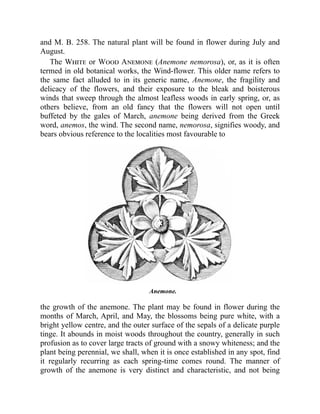
The White or Wood Anemone (Anemone nemorosa), or, as it is often
termed in old botanical works, the Wind-flower. This older name refers to
the same fact alluded to in its generic name, Anemone, the fragility and
delicacy of the flowers, and their exposure to the bleak and boisterous
winds that sweep through the almost leafless woods in early spring, or, as
others believe, from an old fancy that the flowers will not open until
buffeted by the gales of March, anemone being derived from the Greek
word, anemos, the wind. The second name, nemorosa, signifies woody, and
bears obvious reference to the localities most favourable to
Anemone.
the growth of the anemone. The plant may be found in flower during the
months of March, April, and May, the blossoms being pure white, with a
bright yellow centre, and the outer surface of the sepals of a delicate purple
tinge. It abounds in moist woods throughout the country, generally in such
profusion as to cover large tracts of ground with a snowy whiteness; and the
plant being perennial, we shall, when it is once established in any spot, find
it regularly recurring as each spring-time comes round. The manner of
growth of the anemone is very distinct and characteristic, and not being
47.
subject to anyvariation, cannot well be modified in the employment of the
plant in ornamental art without destroying its individuality, as from the
single stem thrown up from the ground three equal-sized leaves, identical in
form, are produced from a point about six inches from the soil, and the stalk
is then continued for about the same distance again before bearing at its
summit its single flower; each and every plant, therefore, consists of a
central stem, a terminal flower, and about midway up the stem a group of
three leaves. This rigid law, though extremely beautiful in itself, and
admirably adapted for treatment for some ornamental purposes, may,
perhaps, somewhat restrict its use in decorative art. We are not aware of any
examples of its employment in past art. In our illustration, the plan of the
plant, the view with which we are most familiar, as we see it in its natural
position, is shown, having the single central flower, and below it the three
leaves radiating from the stem. It will be found that this strong individuality
of growth more especially adapts itself to the trefoil, or any other form
based on the figure three.[A] The garden-anemone (A. coronaria) is an
allied species of the same family, modified by cultivation: in its wild state it
is a native of the South of Europe.
The Arrow-head (Sagittaria sagittifolia), one of our most beautiful
aquatic plants, must be so well known to our readers that any lengthened
description of it will be superfluous. Its generic, specific, and English
names all alike point out its leading characteristic, the beautiful arrow-
headed shape of its leaves;—sagitta, Lat., an arrow. The calyx and corolla
are each composed of three parts, the petals being a brilliant white, with a
pale pink irregular blotch at their bases. The forms of the flowers, fruit, and
leaves are all equally adapted for decorative purposes, though it does not
appear to have received in the past the attention which its merits might very
fairly claim, the only instances of its application in ornamental art with
which we are acquainted being in a running band of ornament round a
tomb, fourteenth century, in the cloisters, Burgos. The flowers are
incorrectly represented in that example as having four petals, but the
general effect is, nevertheless, very good. See E. B. 1436 and P. F. 72 for
drawings of the natural plant.
The Arum (Arum maculatum) is a plant of very common occurrence
throughout England, though rarely to be found either in Scotland or Ireland.
It may be met with in shady groves and thickets, and nestled among the
long grass and other herbage upon our hedge-banks. The plant will be found
48.
Arrow-head.
in flower duringApril and May; but from the mode of
growth, and also from the pale green colour of the spathe
surrounding the central organs, it is by no means
conspicuous among the surrounding foliage. The upper
portion of the central body or spadix—that part of it which
is seen in our illustration—is generally of a dark crimson
colour. The plant is far more likely to attract attention in the
autumn and winter than during its season of flowering, as
towards the close of the year the leaves of the arum die away, and the
hedgerows also being stripped of the greater part of their
Arum.
foliage, we notice the brilliant scarlet berries of the present plant rising in a
dense mass to the height of some three or four inches from the ground. If
the fresh root of the plant be tasted, it excites a burning and pricking
sensation in the mouth that will remain for several hours; and if sliced and
applied to the skin, it will frequently produce blisters. This virulence,
however, like the acrimonious principle met with in the leaves, yields to the
influence of heat, and in former times an excellent starch was prepared from
the root. In the writings of the old medical authors and poets we meet with
49.
the wild arumunder a great variety of names, many of them, through the
lapse of time and from disuse, being now meaningless to us; such, for
example, as abron, janus, barba-aron, calf’s-foot, ramp, and wake-robin. A
very common name for the plant at the present day with country children is
lords-and-ladies; and an equally familiar name, both with children and also
in descriptions of the plant in botanical works, is the cuckoo-pint: this may
possibly allude to the slight resemblance of the enclosing spathe to a
measure for liquids. Another old name for the plant is the starchwort, in
obvious allusion to its domestic use. Like most other plants, it was held by
the medical practitioners of the Middle Ages to possess very considerable
and valuable remedial qualities. A small portion of the leaf, either dried or
in the green state, was esteemed a sure remedy for the plague or any poison.
“The water wherein the root hath been boiled, dropped into the eyes,
cleanseth them from any film or mists which begin to hinder the sight,” or
under circumstances to which the writer delicately hints, “when, by some
chance, they become black and blue.” Though the bold, simple forms of the
flower and bud and the rich arrow-headed shape of the leaves appear, in an
especial manner, to fit it for valuable service in ornamental art, it has been
but very rarely thus employed. Illustrations of the natural growth of the
plant will be found in F. L. vol. ii. 63; S. C. 22; and P. F. 41.
The Avens (Geum urbanum), belonging to the same natural order,
Rosaceæ, as the tormentil and wood-strawberry, possesses also the same
peculiarity of flower, the petals being five in number, while the calyx is
composed of five large segments, alternating with five others of a much
smaller size. The root is very astringent in its nature, and of sufficient value
to be included in the Materia Medica. The avens may be generally found
growing in hedges and woods, flowering during June and July, and attaining
to a height of from one to two feet. The leaves are very ornamental in
character, and will, equally with the flowers, prove of valuable service to
the designer. For illustrations of the growth of the plant refer to F. L. vol. ii.
36, and P. F. 81.
Bedstraw (Galium verum). This is also known as cheese rennet, gallion,
and maid-hair. The word bedstraw is in allusion to the former use of the
dried plant as a cheap material in forming beds. The name cheese-rennet is
derived from a bygone employment of the plant for curdling milk: we see
this same use of the plant referred to in the generic term Galium, that name
being derived from the Greek word for milk. Gallion is evidently a
50.
Avens.
herbalist’s corruption ofGalium, while the fourth
name, maid-hair, has obvious reference to the
lightness and delicacy of the plant. The minute
yellow flowers grow in dense heads of blossom,
while the leaves are in whorls, that is to say, several
starting from the same level, and thus growing in a
succession of rings round the stems. The number of
the leaves in a ring is very variable; from eight to
twelve is, however, the usual number. Dry banks
are the ordinary habitat of the plant. It will be found
in flower throughout June, July, and August. Its
lightness and graceful mode of growth admirably fit it for the purposes of
the designer. For illustrations of the bedstraw refer to E. B. 648, or F. L. vol.
vi. 13. The old herb-doctors, ever ready to find or make a medicinal use,
speak in high commendation of the present plant for its reputed efficacy in
relieving pains from burns, inward wounds, &c., while “a decoction of the
herb is good to bathe the feet of travellers and lacquies, whose long running
causeth weariness and stiffness in their sinews.”
Bindweed.
The Bindweed, botanically known as the Calystegia sepium, is one of
our most familiar plants; large surfaces of our hedgerows (Lat. sepe, a
hedge) being covered by its graceful leaves and tubular flowers. It is a
curious fact that, though abundant throughout England and Ireland, it is
51.
very local inScotland. The so-called convolvulus major of the garden is the
Ipomæa purpurea, a species very widely spread over the tropical and
temperate regions of the earth. Many of the family possess active medicinal
qualities, and preparations from them are found in the Pharmacopœia. The
English species also were at one time thus employed; but Gerarde, the great
medical botanist of Queen Elizabeth’s reign, will not admit that they
possess any virtue at all, but rather the contrary. “They are not fit for
medicine, and unprofitable weeds, and hurtful to each thing that groweth
next them, and were only administered by runnegate physick-mongers,
quacksalvers, old women leeches, abusers of physick, and deceivers of
people.” For study of the natural appearance of the flower we would refer
you, if you are unable to meet with the plant itself, to E. B. 924; S. C. 2; T.
N. O. 97; G. O. 99; and P. F. 76.
Bitter-sweet. The Bitter-sweet (Solanum Dulcamara) is so called from
the bitter flavour of the stems when first tasted, a flavour which is speedily
followed by a peculiar sweetness somewhat resembling liquorice root. In
not only the familiar English name, but the specific botanical appellation as
well, we see this peculiarity of the plant referred to, Dulcamara having the
same meaning as bitter-sweet. The continental names have also this curious
reference in them, the plant in France being called Douce-amère; in Italy,
Dulcamara; in Spain, Amaradulcis; and in Germany, Bittersusstangel. The
plant is frequently called woody nightshade, while the old herbalists, in
addition to the names already given, call it felonwort. Solanum is derived
from solamen, in reference to the soothing effect of some species of the
Solanaceæ. The bitter-sweet has small flowers of a deep purple colour, the
petals being very much reflexed. The berries are of a deep red when ripe,
but change considerably in their colour before reaching maturity; thus on
the same bunch we may frequently see green, yellow, orange, and crimson
fruit. Thirty of these berries administered to a large dog killed it in less than
three hours. Refer to E. B. 930; F. L. vol. i. 14; M. B. 33; S. C. 17; T. N. O.
100; and P. F. 19, for illustrations of the natural growth of the plant. This
shrub is frequently confounded with the deadly nightshade, from the slight
similarity of name; but there is no other point of resemblance. The two
plants are totally distinct. The woody nightshade, though common in most
parts of England, is comparatively scarce in Scotland and Ireland. It is a
hedgerow plant, flowering during June, July, and August. A variety with
white flowers is sometimes met with.
52.
Borage.
The Black-thorn orSloe (Prunus spinosa) is curious and suggestive
from an ornamentist’s point of view, from the flowers, unlike most other
plants, appearing in profusion before the leaves are developed. We see a
plant strongly resembling the black-thorn very largely used in their
ornament by the Japanese, a plant with numerous spreading branches,
leafless, but thickly clustered with flowers. The black-thorn may commonly
be met with in coppices and hedgerows, the blossoms appearing in March
or April, and the rich purple fruit in August. The name sloe is derived from
the Anglo-Saxon sla, and refers to the extreme acidity of the tempting-
looking fruit. The natural growth may be seen on reference to E. B. 408, or
M. B. 84. The black-thorn possesses a certain value ornamentally, as being,
like the primrose and snowdrop, a characteristic flower of the spring.
“Flowers, as the changing seasons roll along,
Still wait on earth, and added beauties lend;
Around the smiling Spring a lovely throng
With eager rivalry her steps attend;
Others with Summer’s brighter glories blend;
Some grace mild Autumn’s more majestic mien;
While some few lingering blooms the brow befriend
Of hoary Winter, and with grace serene
Enwreath the king of storms with mercy’s tender sheen.”
Barton.
The Borage (Borago officinalis), though widely
distributed, is by no means a common plant; and
though mentioned by several old writers, must be
considered as but a doubtful native. The generic
name has been corrupted from two Latin words,
cor, the heart, and ago, I act, from a belief, as old as
the time of Pliny, in its exhilarating effects; hence
the old saying, Ego borago gaudia semper ago, “I
borage give always courage.” The borage, like the
comfrey and forget-me-not, belongs to the order
Boraginaceæ, and, in common with most of the
species of that order, is marked by the gyrate or scorpoid arrangement of its
flowers, the stem being coiled round like the mainspring of a watch. It may
be met with occasionally in the ornament of the past—its large and striking-
looking stellate (Latin, stella, a star) flowers, and the general growth of the
53.
plant, being admirablyadapted to the purposes of design. As an example we
may instance the MS. Hours of Henry VII. in the British Museum, where
the borage is introduced upon a golden ground on one of the pages.
Drawings of this plant will be found in E. B. 1114; M. B. 217; T. N. O. 98;
and P. F. 36.
In studying the application of natural vegetable forms to the various
requirements of ornamental art—such, for instance, as the employment of
bold, vigorous plants to stone or wood carving, and the more graceful and
delicate growths to such fabrics as muslin and lace—we speedily find that
in some cases we are unable to treat the whole of the plant we have selected
for our purpose, owing to the limitations placed upon us by the
requirements of the work, the exigencies of manufacture, or the nature of
the materials in which our design is to be embodied. In some cases the
flowers are too small in detail, or in the general mass, to accord well from
the ornamentist’s point of view with the foliage of the plant; the white
bryony (Bryonia dioica), for instance, though excellently adapted for
muslins, could not in its flowering stage be satisfactorily treated for
stonework on this account, though the foliage by itself is admirably suited
for such purpose. In other instances we find the case reversed, the flower
being large and beautiful in form, and the leaves unsuited, either from their
insignificant size or want of beauty, to the purpose of the ornamentist; thus,
while the leaves of the stonecrop (Sedum acre) are, from their minuteness,
scarcely available for the purposes of design, the stellate flower is
exceedingly beautiful in form, and admirably adapted for diapering and
many other uses, when isolated from the rest of the plant. Where both leaf
and flower are from their beauty and relative scale equally adapted for art-
treatment, we are still, when circumstances require it, quite justified in
employing either the one or the other by itself: where a monochrome
arrangement is necessary, the leaves alone may, for example, be used;
where a central radiate form, the flower may be introduced. The rosette or
patera, so freely introduced both in ancient and mediæval art, is an example
of this use of isolated floral forms.
The Bramble or Blackberry (Rubus fruticosus), a more familiar plant
than the last, has, so far as we are aware, been but little used in ornamental
art, though the Rubus idæus, or wild raspberry, may occasionally be seen in
MSS. of the sixteenth century. The generic name is highly expressive of the
prickly nature of the plant, being derived from an old Celtic verb, reub, to
54.
lacerate or tearaway; while its English name, bramble, attests its
indigenous nature, descending as it does from the Anglo-Saxon name for it,
bremel. The stems, ordinarily of a pale purple colour and with a grey bloom
upon them, are pentangular in section, the numerous prickles almost
entirely confined to the ridges formed by the angles, and not occurring in
the intermediate furrows; the leaves generally with five deeply serrated
leaflets, a rich green on the upper surface, and covered with close white
down on the lower; the petals of the blossom varying from pure white or
delicate pink to a deep red; and the fruit of a rich crimson, so intense in
colour as to appear almost black. The mode of growth
Blackberry.
admirably fits it for the service of the designer, the leaves being very
ornamental in form, and the long trailing stems admitting of great freedom
of curve, while for its use in decorative art a further great recommendation
exists in the power of representing the plant under several phases of growth
without violating natural truth, as at one and the same time we find the
opening bud, the fully-expanded flower, and the fruit of all sizes and stages
of development, varying in colour from green, light red, and crimson, to
deep purplish black in its progress to maturity. We thus gain great variety of
form, and also, when admissible, of colour. The bramble appears to be of
especial value in ornament where large surfaces require to be covered by
55.
forms at oncesuitable in scale, interesting in their details, and varied in
their character; hence it would seem admirably adapted to muslins and lace,
though, so far as we have had opportunity of observation, it has not been
thus employed. Reliable drawings of the blackberry will be found in W. H.
H., Plate E, Fig. 1.; in T. N. O. 51; G. O. 96; and P. F. 57.
Some plants, beautiful in themselves, possess an increased importance in
the eyes of the followers of ornamental art, from their being used
heraldically; such, for example, are the rose, the shamrock, the broom, and
the thistle. Broom (Sarothamnus scoparius) is thus used as the badge of the
Scottish clan Forbes, and, as all readers of history will remember, was also
chosen as the device of the Plantagenets. A very good example of its use in
past art—though scarcely, from its being found in a Tudor monument,
having any heraldic meaning—will be seen in a glass quarry in Henry VII.’s
Chapel. Sarothamnus is derived from two Greek verbs, signifying a shrub,
and to sweep. The English name has the same force of meaning. In an old
work we have consulted, the author deems it useless to go into a long
account of the plant, so well known was it in his time from this domestic
use:—“To spend time in writing a description hereof is altogether needless,
it being so generally used by all the good housewives almost throughout
this land to sweep their houses with, and, therefore, very well known to all
sorts of people.” The broom may ordinarily be found on sandy commons,
railway banks, and dry hillsides. The large yellow pea-shaped flowers
appear in great profusion throughout May and June, and are succeeded in
due course by the black seed-pods. The plant grows from three to six feet
high, and when covered with its brilliant blossoms is a very striking object.
Leaves very inconspicuous. Drawings of this very beautiful plant may be
seen on referring to S. B. 121; E. B. 329; M. B. 89; F. L. vol. v. 31; S. C. 67;
T. N. O. 49.
Bulbous Crowfoot. We have selected the present plant (Ranunculus
bulbosus) as a good representative of the numerous species of plants
familiarly termed buttercups, partly because it is the most striking in effect,
partly because it is the one that will most readily be met with under
ordinary circumstances; for while its fine flowers and beautifully-cut leaves
render it singularly well suited to the purposes of ornament, the abundance
of it in every meadow throughout the country places it within the reach of
all who would desire to adapt it to any artistic purpose. From the
commonness of the plant, and its general distribution throughout England, it
56.
has received manyother names: goldknob, goldcup, baffiner, troil-flower,
polt, kingcup, buttercup, butter-flower, cuckoo-bud, are all synonyms. The
term Ranunculus is derived from rana, a frog, many of the species being
found in wet, swampy places; while the specific name, bulbosus, alludes to
the bulb-like swelling of the lower part of the stem in this particular species.
The name crowfoot has been given to the plant from the radiating character
of the segments of the leaf, spreading as they do like the divisions of a
bird’s foot; while the use of the word buttercup points to the old belief that
the rich yellowness of spring butter is owing to the eating of this plant by
the cows; the effect must rather, however, be ascribed to the tender grass, as
any one who will take the trouble to notice the fact will find that cows in a
meadow will, as far as possible, avoid the buttercups. The leaves of the
bulbous crowfoot, like, with one exception, those of the rest of the family,
are very acrid, and will, if applied to the skin, speedily blister it. The plant
will be found in flower throughout the spring and summer: a variety is
sometimes met with having cream-coloured flowers. The crowfoot is one of
the favourite plants in the ornament of the Decorated period of Gothic.
Representations of the natural plant may be seen on consulting E. B. 35, or
F. L. vol. i. 38; refer also to “Water Crowfoot” in the present work, page 84.
Celandine (Chelidonium majus). The Celandine, though, so far as we
are aware, not to be met with in ornamental art, is a plant in every way
fitted for the purposes of the designer, whether we consider the form of the
flower, of the pods which succeed the blossoms, or the rich outline of the
leaf. The inflorescence is umbellate (Lat. umbella, an umbrella), that is to
say, all the flower-stalks start from the same point in the stem, as in the case
of the hemlock, the cowslip, flowering rush, and many other plants.
Chelidonium is derived from the Greek word chelidon, a swallow, from an
old belief that the plant came into flower on the arrival of those birds, and
withered when they took their departure; hence in old writings we
frequently find the Celandine termed swallow-wort. The plant will
commonly be found in waste places, and more especially near human
habitations. It attains to a height of about two feet, and flowers throughout
May, June, July, and August. Consult S. B. 95; E. B. 67; M. B. 263; S. C.
86, for drawings of the natural growth of the celandine.
The Cinquefoil (Potentilla reptans). This graceful little plant may
generally be met with in abundance, a very favourite habitat being in the
low grass and coarse herbage we so frequently find skirting the pathways in
57.
country districts. Whenit has once taken root upon any favourable spot, it
speedily throws out long running stems, which, in turn, develop roots from
the points whence the leaves spring; in a very short space of time a large
extent of ground is covered with a dense mass of the plant, and, from its
habit of rooting at each joint, it is with great difficulty eradicated, since if
one root alone be overlooked, the labour spent will speedily prove to have
been but of little more than temporary use. Regarding the cinquefoil,
however, rather from the stand-point of the ornamentist than of the
agriculturist, we are struck by the beauty of its growth, the forms of the
individual parts, and the general fitness of the plant for employment in
Decorative art. The familiar name cinquefoil clearly alludes to the division
of the leaves into five conspicuous leaflets, though when the plant is
growing under exceptionably favourable circumstances these are very
frequently seven in number. The generic name is derived from the Latin
potens, powerful, and refers to the strong medicinal qualities possessed by
some of the species of Potentilla. The root of the tormentil (P. tormentilla),
an allied species, is very powerfully astringent; it has occasionally been
substituted for oak-bark in tanning, and with equal success, the leather
being found to be in
58.
Cinquefoil.
no way inferiorin quality. The properties possessed by the roots of the
cinquefoil are very similar, but, from being less powerful in their operation,
are now rarely used, their value being naturally greater at a time when
stronger foreign astringents were not so readily procurable. Tormentil root
is still, however, retained in the Pharmacopœia. The distinctive specific
name of the present plant, reptans, has evident allusion to the marked
feature in its growth already referred to, being derived from the Latin
reptare, to creep. We are not aware of any examples of the use of the
cinquefoil in the art of any past period, though from the size and beauty of
form of the leaves and blossoms, and from the grace and freedom of the
curves of which the main stem is capable, it appears to be well adapted to
ornamental art. Refer to E. B. 432; F. L. vol. i. 37; M. B. 59; and P. F. 46,
for the natural growth.
Cockle. This, though now so frequently met with in the midst of the
corn, being in fact so common as to be classed amongst the farmer’s pests,
59.
is not anindigenous plant; it has, however, been established so long that it
may very fairly be comprehended in our list. The botanical name of the
plant is Lychnis githago. The whole plant is closely covered with soft hairs,
giving it a woolly appearance. The large purple flowers are very
conspicuous, and have a curious effect, from the segments of the calyx
being so much longer than the petals of the corolla. (Calyx, Gr., a cup, the
outer and generally green portions of a flower, the protecting member for
the delicate organs within the flower. When the calyx is cut up into several
divisions each segment is termed a sepal. Corolla, the floral ring next
within the calyx, ordinarily of a brilliant colour, the part which, for instance,
in a rose is pink: this, though sometimes in one piece, as in a blue-bell, is
ordinarily, as in the buttercup, composed of several similar members; these
are called petals.) The cockle will be found in flower during the months of
June, July, and August. Though admirably adapted for service in ornamental
art, the only example we can quote occurs in a sixteenth-century MS., a
missal, in the British Museum: the treatment is very naturalistic. Drawings
of the plant will be found in F. L. vol. iii. 27; E. B. 215.
Columbine (Aquilegia vulgaris), one of our most beautiful wild flowers,
derives, like the broom, an additional importance to the ornamentist from its
heraldic associations, the columbine being adopted as a badge by the House
of Lancaster, and also by the Derby family at a time when every important
house adopted some such symbol. The petals bear a strong resemblance to
birds; hence Aquilegia is derived from the Latin aquila, an eagle, while the
English name is derived from Lat. columba, a dove. An old English name
for the plant is culverwort, culfre being the Anglo-Saxon word for pigeon. It
will be found in hedges and thickets, thriving more especially where the soil
is calcareous. Both the flower and leaf are very rich in character, and well
suited for the requirements of ornamental art. Examples may be seen in the
church of Shearbourne, Dorset, and in the spandrels of the canopy of a brass
in Exeter Cathedral, in memory of Sir Peter Courteney, one of the adherents
of the Lancastrian king, Henry IV. The columbine is a favourite flower in
cottage-gardens, and may be much more generally thus met with than as a
wild plant. It is in flower from May to July. A very beautiful gradation of
form is seen in the leaves, the lower ones being of a very complex form,
while the upper ones are very simple in outline. Refer to E. B. 46, V. W.
367, for drawings.
60.
The Comfrey (Symphytumofficinale). This plant may be very
commonly found by the sides of streams, ditches, and other moist
Comfrey.
situations. The corolla of the flower is generally of a yellowish white, but a
variety having purple flowers is not uncommon in many localities; we have
seen it, for instance, growing in profusion on the banks of the East Yar,
between Brading and Sandown, in the Isle of Wight. The generic name,
Symphytum is derived from a Greek verb signifying to unite, from an old
belief in the efficacy of the Comfrey in the healing of wounds. A very
marked peculiarity in the growth of the plant is the circinate, or, as it is
frequently termed, scorpoid arrangement of the flowers, from a supposed
resemblance between the spiral form of the inflorescence and the tail of the
scorpion; hence, in the same way, scorpion-grass is one of the old English
names of the familiar forget-me-not, a plant belonging to the same natural
order, the Boraginaceæ, and having the same peculiarity of growth. We
need scarcely say that in the Middle Ages the favourite dogma that each
plant had its undoubted value as a remedial agent, and generally by its form
61.
Welcome to ourwebsite – the ideal destination for book lovers and
knowledge seekers. With a mission to inspire endlessly, we offer a
vast collection of books, ranging from classic literary works to
specialized publications, self-development books, and children's
literature. Each book is a new journey of discovery, expanding
knowledge and enriching the soul of the reade
Our website is not just a platform for buying books, but a bridge
connecting readers to the timeless values of culture and wisdom. With
an elegant, user-friendly interface and an intelligent search system,
we are committed to providing a quick and convenient shopping
experience. Additionally, our special promotions and home delivery
services ensure that you save time and fully enjoy the joy of reading.
Let us accompany you on the journey of exploring knowledge and
personal growth!
ebookmass.com


























![This ebook is for the use of anyone anywhere in the United States
and most other parts of the world at no cost and with almost no
restrictions whatsoever. You may copy it, give it away or re-use it
under the terms of the Project Gutenberg License included with this
ebook or online at www.gutenberg.org. If you are not located in the
United States, you will have to check the laws of the country where
you are located before using this eBook.
Title: Art-Studies from Nature, as Applied to Design
Author: F. Edward Hulme
James Glaisher
Robert Hunt
active 1851-1872 Samuel Joseph Mackie
Release date: November 28, 2016 [eBook #53624]
Most recently updated: October 23, 2024
Language: English
Credits: Produced by Chuck Greif and the Online Distributed
Proofreading Team at http://www.pgdp.net (This file was
produced from images available at The Internet Archive)
*** START OF THE PROJECT GUTENBERG EBOOK ART-STUDIES
FROM NATURE, AS APPLIED TO DESIGN ***](https://image.slidesharecdn.com/30866-250312040735-06f8bca6/85/Network-Algorithmics-2nd-Edition-Varghese-32-320.jpg)
![Contents.
(In certain versions of this etext [in
certain browsers] clicking on the
image will bring up a larger
version.)
(etext transcriber's note)
ART-STUDIES FROM
NATURE,
As applied to Design:
FOR THE USE OF
ARCHITECTS, DESIGNERS, AND MANUFACTURERS.
COMPRISED IN FOUR PAPERS BY
F. E. HULME, F.L.S., F.S.A.;
J. GLAISHER, F.R.S.;
S. J. MACKIE, F.G.S., F.S.A.;
ROBERT HUNT, F.R.S.
Reprinted from the Art-Journal.
WITH NUMEROUS ILLUSTRATIONS ON WOOD.
LONDON:](https://image.slidesharecdn.com/30866-250312040735-06f8bca6/85/Network-Algorithmics-2nd-Edition-Varghese-33-320.jpg)

![subject to any variation, cannot well be modified in the employment of the
plant in ornamental art without destroying its individuality, as from the
single stem thrown up from the ground three equal-sized leaves, identical in
form, are produced from a point about six inches from the soil, and the stalk
is then continued for about the same distance again before bearing at its
summit its single flower; each and every plant, therefore, consists of a
central stem, a terminal flower, and about midway up the stem a group of
three leaves. This rigid law, though extremely beautiful in itself, and
admirably adapted for treatment for some ornamental purposes, may,
perhaps, somewhat restrict its use in decorative art. We are not aware of any
examples of its employment in past art. In our illustration, the plan of the
plant, the view with which we are most familiar, as we see it in its natural
position, is shown, having the single central flower, and below it the three
leaves radiating from the stem. It will be found that this strong individuality
of growth more especially adapts itself to the trefoil, or any other form
based on the figure three.[A] The garden-anemone (A. coronaria) is an
allied species of the same family, modified by cultivation: in its wild state it
is a native of the South of Europe.
The Arrow-head (Sagittaria sagittifolia), one of our most beautiful
aquatic plants, must be so well known to our readers that any lengthened
description of it will be superfluous. Its generic, specific, and English
names all alike point out its leading characteristic, the beautiful arrow-
headed shape of its leaves;—sagitta, Lat., an arrow. The calyx and corolla
are each composed of three parts, the petals being a brilliant white, with a
pale pink irregular blotch at their bases. The forms of the flowers, fruit, and
leaves are all equally adapted for decorative purposes, though it does not
appear to have received in the past the attention which its merits might very
fairly claim, the only instances of its application in ornamental art with
which we are acquainted being in a running band of ornament round a
tomb, fourteenth century, in the cloisters, Burgos. The flowers are
incorrectly represented in that example as having four petals, but the
general effect is, nevertheless, very good. See E. B. 1436 and P. F. 72 for
drawings of the natural plant.
The Arum (Arum maculatum) is a plant of very common occurrence
throughout England, though rarely to be found either in Scotland or Ireland.
It may be met with in shady groves and thickets, and nestled among the
long grass and other herbage upon our hedge-banks. The plant will be found](https://image.slidesharecdn.com/30866-250312040735-06f8bca6/85/Network-Algorithmics-2nd-Edition-Varghese-47-320.jpg)
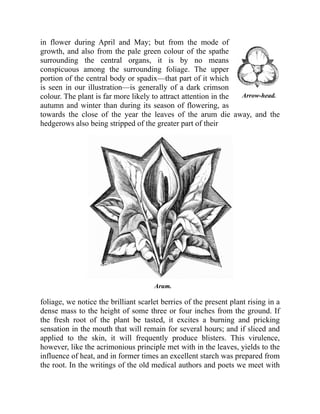
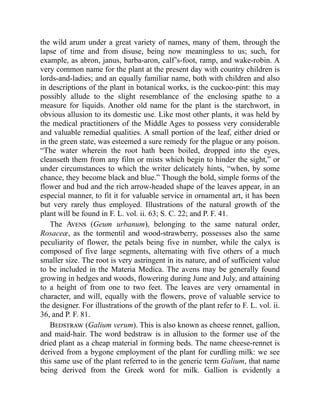
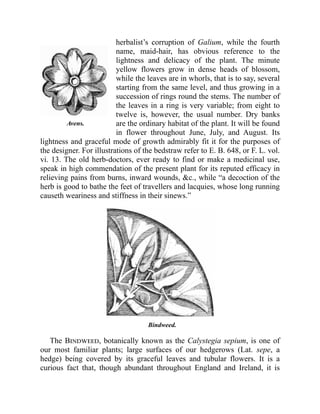
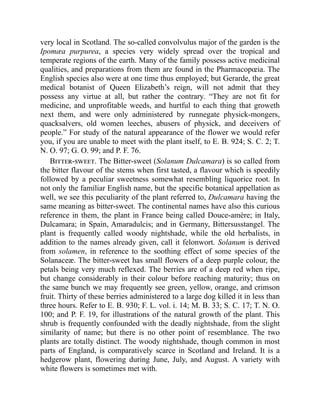
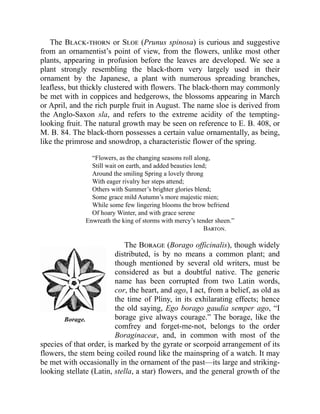
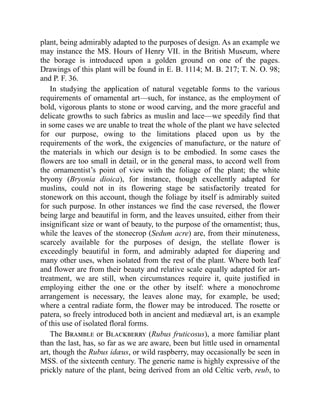
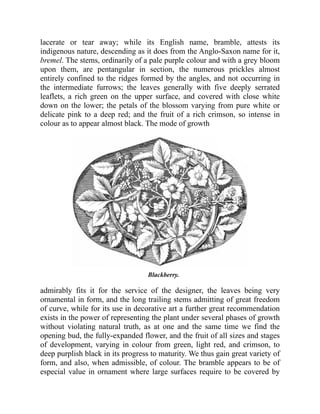
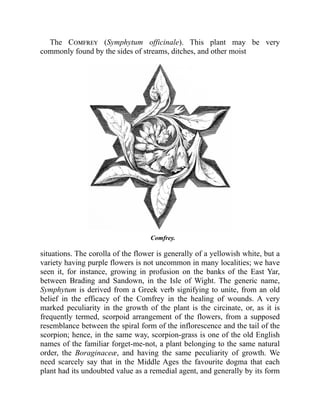



![01_-_W01L01_-_Introduction[1].pp free tx](https://cdn.slidesharecdn.com/ss_thumbnails/01-w01l01-introduction1-240627064011-cf787583-thumbnail.jpg?width=640&height=640&fit=bounds)


