The right blend? Using online
resources to support
postgraduate dissertation
students by Dr Paul Reilly
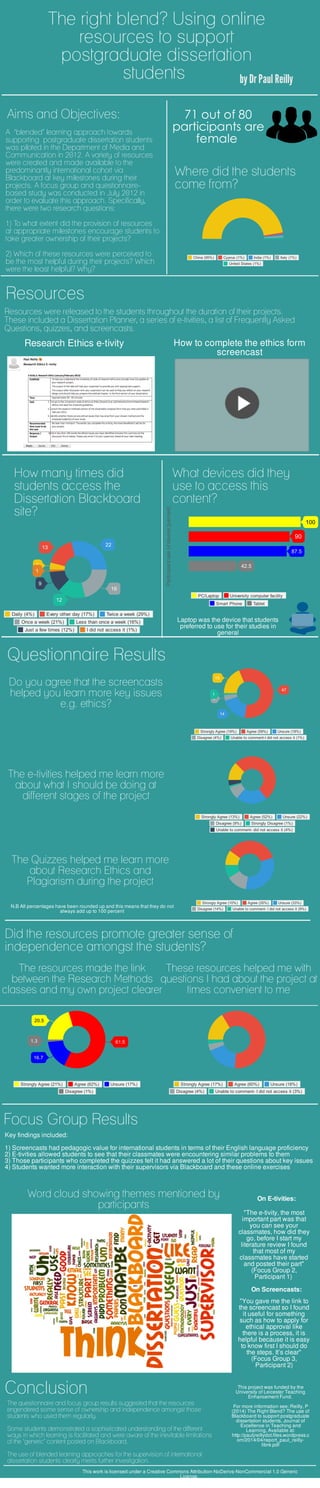
A ‘blended’ learning approach towards
supporting postgraduate dissertation students
was piloted in the Department of Media and
Communication in 2012. A variety of resources
were created and made available to the
predominantly international cohort via
Blackboard at key milestones during their
projects. A focus group and questionnaire-
based study was conducted in July 2012 in
order to evaluate this approach. Specifically,
there were two research questions:
1) To what extent did the provision of resources
at appropriate milestones encourage students to
take greater ownership of their projects?
2) Which of these resources were perceived to
be the most helpful during their projects? Which
were the least helpful? Why?
Aims and Objectives:
Where did the students
come from?
China (95%) Cyprus (1%) India (1%) Italy (1%)
United States (1%)
71 out of 80
participants are
female
Resources were released to the students throughout the duration of their projects.
These included a Dissertation Planner, a series of e-tivities, a list of Frequently Asked
Questions, quizzes, and screencasts.
Resources
How to complete the ethics form
screencast
Research Ethics e-tivity
PC/Laptop University computer facility
Smart Phone Tablet
100
90
87.5
42.5
Participantuseofdevice(percent)
What devices did they
use to access this
content?
Daily (4%) Every other day (17%) Twice a week (29%)
Once a week (21%) Less than once a week (16%)
Just a few times (12%) I did not access it (1%)
3
13 22
16
12
9
1
How many times did
students access the
Dissertation Blackboard
site?
Laptop was the device that students
preferred to use for their studies in
general
Do you agree that the screencasts
helped you learn more key issues
e.g. ethics?
Questionnaire Results
Strongly Agree (13%) Agree (52%) Unsure (22%)
Disagree (9%) Strongly Disagree (1%)
Unable to comment- did not access it (4%)
Strongly Agree (10%) Agree (35%) Unsure (33%)
Disagree (14%) Unable to comment- I did not access it (9%)
Strongly Agree (19%) Agree (59%) Unsure (18%)
Disagree (4%) Unable to comment-I did not access it (1%)
15
47
14
3
1
The e-tivities helped me learn more
about what I should be doing at
different stages of the project
The Quizzes helped me learn more
about Research Ethics and
Plagiarism during the project
N.B All percentages have been rounded up and this means that they do not
always add up to 100 percent
The resources made the link
between the Research Methods
classes and my own project clearer
These resources helped me with
questions I had about the project at
times convenient to me
Strongly Agree (21%) Agree (62%) Unsure (17%)
Disagree (1%)
20.5
61.5
16.7
1.3
Strongly Agree (17%) Agree (60%) Unsure (18%)
Disagree (4%) Unable to comment- I did not access it (3%)
Did the resources promote greater sense of
independence amongst the students?
Focus Group Results
Word cloud showing themes mentioned by
participants
Key findings included:
1) Screencasts had pedagogic value for international students in terms of their English language proficiency
2) E-tivities allowed students to see that their classmates were encountering similar problems to them
3) Those participants who completed the quizzes felt it had answered a lot of their questions about key issues
4) Students wanted more interaction with their supervisors via Blackboard and these online exercises
"The e-tivity, the most
important part was that
you can see your
classmates, how did they
go, before I start my
literature review I found
that most of my
classmates have started
and posted their part"
(Focus Group 2,
Participant 1)
"You gave me the link to
the screencast so I found
it useful for something
such as how to apply for
ethical approval like
there is a process, it is
helpful because it is easy
to know first I should do
the steps. It’s clear"
(Focus Group 3,
Participant 2)
On E-tivities:
On Screencasts:
The questionnaire and focus group results suggested that the resources
engendered some sense of ownership and independence amongst those
students who used them regularly.
Some students demonstrated a sophisticated understanding of the different
ways in which learning is facilitated and were aware of the inevitable limitations
of the ‘generic’ content posted on Blackboard.
The use of blended learning approaches for the supervision of international
dissertation students clearly merits further investigation.
Conclusion This project was funded by the
University of Leicester Teaching
Enhancement Fund.
For more information see: Reilly, P
(2014) The Right Blend? The use of
Blackboard to support postgraduate
dissertation students, Journal of
Excellence in Teaching and
Learning, Available at:
http://pauljreillydot.files.wordpress.c
om/2014/04/report_paul_reilly-
libre.pdf
This work is licensed under a Creative Commons Attribution-NoDerivs-NonCommercial 1.0 Generic
License.

ONLINE RESOURCES TO SUPPORT DISSERTATION STUDENTS

  • 1.
    The right blend?Using online resources to support postgraduate dissertation students by Dr Paul Reilly A ‘blended’ learning approach towards supporting postgraduate dissertation students was piloted in the Department of Media and Communication in 2012. A variety of resources were created and made available to the predominantly international cohort via Blackboard at key milestones during their projects. A focus group and questionnaire- based study was conducted in July 2012 in order to evaluate this approach. Specifically, there were two research questions: 1) To what extent did the provision of resources at appropriate milestones encourage students to take greater ownership of their projects? 2) Which of these resources were perceived to be the most helpful during their projects? Which were the least helpful? Why? Aims and Objectives: Where did the students come from? China (95%) Cyprus (1%) India (1%) Italy (1%) United States (1%) 71 out of 80 participants are female Resources were released to the students throughout the duration of their projects. These included a Dissertation Planner, a series of e-tivities, a list of Frequently Asked Questions, quizzes, and screencasts. Resources How to complete the ethics form screencast Research Ethics e-tivity PC/Laptop University computer facility Smart Phone Tablet 100 90 87.5 42.5 Participantuseofdevice(percent) What devices did they use to access this content? Daily (4%) Every other day (17%) Twice a week (29%) Once a week (21%) Less than once a week (16%) Just a few times (12%) I did not access it (1%) 3 13 22 16 12 9 1 How many times did students access the Dissertation Blackboard site? Laptop was the device that students preferred to use for their studies in general Do you agree that the screencasts helped you learn more key issues e.g. ethics? Questionnaire Results Strongly Agree (13%) Agree (52%) Unsure (22%) Disagree (9%) Strongly Disagree (1%) Unable to comment- did not access it (4%) Strongly Agree (10%) Agree (35%) Unsure (33%) Disagree (14%) Unable to comment- I did not access it (9%) Strongly Agree (19%) Agree (59%) Unsure (18%) Disagree (4%) Unable to comment-I did not access it (1%) 15 47 14 3 1 The e-tivities helped me learn more about what I should be doing at different stages of the project The Quizzes helped me learn more about Research Ethics and Plagiarism during the project N.B All percentages have been rounded up and this means that they do not always add up to 100 percent The resources made the link between the Research Methods classes and my own project clearer These resources helped me with questions I had about the project at times convenient to me Strongly Agree (21%) Agree (62%) Unsure (17%) Disagree (1%) 20.5 61.5 16.7 1.3 Strongly Agree (17%) Agree (60%) Unsure (18%) Disagree (4%) Unable to comment- I did not access it (3%) Did the resources promote greater sense of independence amongst the students? Focus Group Results Word cloud showing themes mentioned by participants Key findings included: 1) Screencasts had pedagogic value for international students in terms of their English language proficiency 2) E-tivities allowed students to see that their classmates were encountering similar problems to them 3) Those participants who completed the quizzes felt it had answered a lot of their questions about key issues 4) Students wanted more interaction with their supervisors via Blackboard and these online exercises "The e-tivity, the most important part was that you can see your classmates, how did they go, before I start my literature review I found that most of my classmates have started and posted their part" (Focus Group 2, Participant 1) "You gave me the link to the screencast so I found it useful for something such as how to apply for ethical approval like there is a process, it is helpful because it is easy to know first I should do the steps. It’s clear" (Focus Group 3, Participant 2) On E-tivities: On Screencasts: The questionnaire and focus group results suggested that the resources engendered some sense of ownership and independence amongst those students who used them regularly. Some students demonstrated a sophisticated understanding of the different ways in which learning is facilitated and were aware of the inevitable limitations of the ‘generic’ content posted on Blackboard. The use of blended learning approaches for the supervision of international dissertation students clearly merits further investigation. Conclusion This project was funded by the University of Leicester Teaching Enhancement Fund. For more information see: Reilly, P (2014) The Right Blend? The use of Blackboard to support postgraduate dissertation students, Journal of Excellence in Teaching and Learning, Available at: http://pauljreillydot.files.wordpress.c om/2014/04/report_paul_reilly- libre.pdf This work is licensed under a Creative Commons Attribution-NoDerivs-NonCommercial 1.0 Generic License.