Evaluating the effectiveness of Skype as a tool for promoting internationalisation of the nursing curriculum Melanie Stephens and Dawn Hennefer School of Nursing & Midwifery University of Salford
The project focus was to gain an insight into the effectiveness of Skype as a medium for student support whilst on international placements and for use within action learning sets to enhance the international experience of the students/staff in the curriculum through virtual mobility   Project aim
To evaluate the effectiveness of Skype as a medium of communication between students/staff within different countries  To evaluate the effectiveness of Skype as a support mechanism for students/staff undertaking an international placement To explore the use of Skype as a tool to enhance the international experience of students/staff both physical and virtual  Outcomes
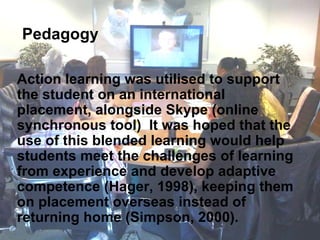
Action learning was utilised to support the student on an international placement, alongside Skype (online synchronous tool)  It was hoped that the use of this blended learning would help students meet the challenges of learning from experience and develop adaptive competence (Hager, 1998), keeping them on placement overseas instead of returning home (Simpson, 2000).   Pedagogy
Methodology Action Research Purposive sample Data generation Thematic analysis
Action research Cyclic Ontology Epistemology Social purpose Methodology
Purposive  Sample 22 participants (18 on international  placements  4 at home)  Student nurses in 3rd year of programme  for Degree and diploma  programme from three branches adult, child  mental health  Undertaking international placements in  America, Australia, Cyprus,  Finland, Germany, Ghana, Slovakia and  Spain  12 lecturers involved – personal tutors,  international link lecturers and action  learning set facilitators.
Data Generation Two fold approach was taken: One online individual questionnaire. Comprised of 15 questions, 6 questions were to identify  the demographic information and the rating of  information technology skills and the remaining 9  questions were to ask about the effectiveness of Skype  as a means of communication, support, and knowledge  transfer. Focus groups.  The narrative of these groups was recorded with  student permission so that information provided within  the session could be listened to within its relevant  context. (The online questionnaire was used as a framework)
The narrative of the qualitative data was analysed thematically using Braun and Clarke’s (2006) 6 stage model of analysis:  Becoming familiar with the data Creating initial codes Reflecting the participants words Searching for themes Reviewing themes Defining and naming themes and producing  the report  Thematic Analysis
Themes: Operational issues Pastoral care Academic support  Cultural and personal awareness development.  Thematic analysis
Operational issues: Training Ease of use Accessibility Usage Timing Netiquette Technological support Findings
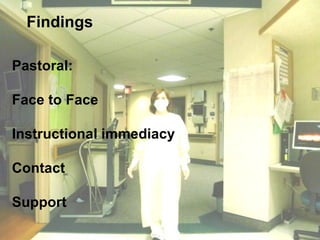
Findings Pastoral: Face to Face Instructional immediacy Contact Support
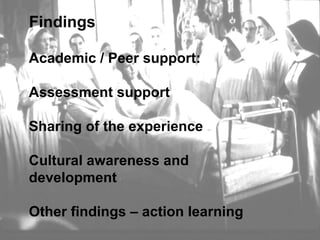
Academic / Peer support: Assessment support Sharing of the experience Cultural awareness and development  Other findings – action learning Findings
Discussion On reflection we should have considered evaluating the process using:- Salmon’s (2000) E -moderating Framework Laurillard’s (2000) Conversational Framework  The Community of Inquiry Framework (Garrison et al, 2000)
Community of Inquiry Framework Operational Issues  (Choy and Chi Ng, 2005, Pallof and Pratt, 2001, Volery and Lord, 2000). Pastoral Care / Academic and Peer support (Biggs, 2003, Hutchins, 2003, Sims, 2003, Ryan and Twimbell, 2000). Cultural Awareness  ( Duffy et al, 2005)  Curriculum development
Conclusion Skype therefore can be considered a useful medium of communication and support between staff and students in different countries, the added value is being able to see the face of the person who one is communicating with, providing extra non verbal communication signals to both recipients More work required to  aid the development of cultural awareness and understanding of their peers.
Recommendations So where to now? Next action research cycle to  evaluate internationalisation of  the nursing curricula To develop blog and Skype  training for all students on pre- registration nurse programmes  with at least one month practise.  Development of best practice  guidance for Skype use.

ECE Presentation Melanie Stephens and Dawn Hennefer

  • 1.
    Evaluating the effectivenessof Skype as a tool for promoting internationalisation of the nursing curriculum Melanie Stephens and Dawn Hennefer School of Nursing & Midwifery University of Salford
  • 2.
    The project focuswas to gain an insight into the effectiveness of Skype as a medium for student support whilst on international placements and for use within action learning sets to enhance the international experience of the students/staff in the curriculum through virtual mobility Project aim
  • 3.
    To evaluate theeffectiveness of Skype as a medium of communication between students/staff within different countries To evaluate the effectiveness of Skype as a support mechanism for students/staff undertaking an international placement To explore the use of Skype as a tool to enhance the international experience of students/staff both physical and virtual Outcomes
  • 4.
    Action learning wasutilised to support the student on an international placement, alongside Skype (online synchronous tool) It was hoped that the use of this blended learning would help students meet the challenges of learning from experience and develop adaptive competence (Hager, 1998), keeping them on placement overseas instead of returning home (Simpson, 2000). Pedagogy
  • 5.
    Methodology Action ResearchPurposive sample Data generation Thematic analysis
  • 6.
    Action research CyclicOntology Epistemology Social purpose Methodology
  • 7.
    Purposive Sample22 participants (18 on international placements 4 at home) Student nurses in 3rd year of programme for Degree and diploma programme from three branches adult, child mental health Undertaking international placements in America, Australia, Cyprus, Finland, Germany, Ghana, Slovakia and Spain 12 lecturers involved – personal tutors, international link lecturers and action learning set facilitators.
  • 8.
    Data Generation Twofold approach was taken: One online individual questionnaire. Comprised of 15 questions, 6 questions were to identify the demographic information and the rating of information technology skills and the remaining 9 questions were to ask about the effectiveness of Skype as a means of communication, support, and knowledge transfer. Focus groups. The narrative of these groups was recorded with student permission so that information provided within the session could be listened to within its relevant context. (The online questionnaire was used as a framework)
  • 9.
    The narrative ofthe qualitative data was analysed thematically using Braun and Clarke’s (2006) 6 stage model of analysis: Becoming familiar with the data Creating initial codes Reflecting the participants words Searching for themes Reviewing themes Defining and naming themes and producing the report Thematic Analysis
  • 10.
    Themes: Operational issuesPastoral care Academic support Cultural and personal awareness development. Thematic analysis
  • 11.
    Operational issues: TrainingEase of use Accessibility Usage Timing Netiquette Technological support Findings
  • 12.
    Findings Pastoral: Faceto Face Instructional immediacy Contact Support
  • 13.
    Academic / Peersupport: Assessment support Sharing of the experience Cultural awareness and development Other findings – action learning Findings
  • 14.
    Discussion On reflectionwe should have considered evaluating the process using:- Salmon’s (2000) E -moderating Framework Laurillard’s (2000) Conversational Framework The Community of Inquiry Framework (Garrison et al, 2000)
  • 15.
    Community of InquiryFramework Operational Issues (Choy and Chi Ng, 2005, Pallof and Pratt, 2001, Volery and Lord, 2000). Pastoral Care / Academic and Peer support (Biggs, 2003, Hutchins, 2003, Sims, 2003, Ryan and Twimbell, 2000). Cultural Awareness ( Duffy et al, 2005) Curriculum development
  • 16.
    Conclusion Skype thereforecan be considered a useful medium of communication and support between staff and students in different countries, the added value is being able to see the face of the person who one is communicating with, providing extra non verbal communication signals to both recipients More work required to aid the development of cultural awareness and understanding of their peers.
  • 17.
    Recommendations So whereto now? Next action research cycle to evaluate internationalisation of the nursing curricula To develop blog and Skype training for all students on pre- registration nurse programmes with at least one month practise. Development of best practice guidance for Skype use.