Online Program Evaluation

        LAURA BEDNAR
School Setting

 Large high school
  consisting of 3,200
  students
 Running out of
  classroom space, online
  course could be cost
  effective alternative
 Audience- high school
  students
Why Online?

 Students are starting to
  enroll in other Cyber
  Schools

 Having a Parkland
  School District Cyber
  School allows for
  Parkland Diploma
     Bonus, tax dollars stay
      within District
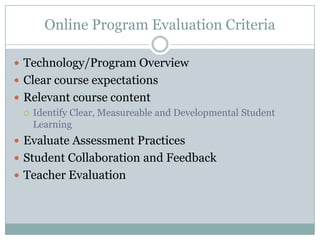
Online Program Evaluation Criteria

 Technology/Program Overview
 Clear course expectations
 Relevant course content
   Identify Clear, Measureable and Developmental Student
    Learning
 Evaluate Assessment Practices
 Student Collaboration and Feedback
 Teacher Evaluation
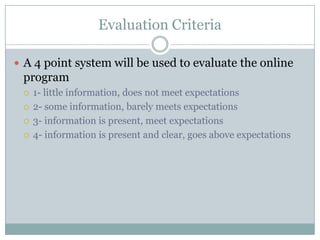
Evaluation Criteria

 A 4 point system will be used to evaluate the online
 program
    1- little information, does not meet expectations
    2- some information, barely meets expectations
    3- information is present, meet expectations
    4- information is present and clear, goes above expectations
Who Evaluates Program?

 All stakeholders will have
  a chance to evaluate
  program
     Teacher
     Students
     Parents
     Administrators
Technology/Program Overview

 Help is clearly listed and available for all students
 Technology tutorial is provided
 Course/program tutorial is provided
 Technology/Program expectations are clearly listed
Course Expectations

 Course syllabus is easy to find and understand
 Expectations of students are clearly written
 Course content and assignments are clearly listed
 Course is divided into easy to understand
  sections/modules
 Rubrics are provided for all assignments
 Professor contact information is easy to find
Relevant course content

 Modules/course sections present course content in
  variety of ways to meet various teaching styles
 Each unit has clear learning objectives
 All resources enhance the learning process
 All resources are directly linked to learning
  objectives
Evaluate Assessment Practices

 Assessments were aligned with learning objectives
 A variety of assessments were used to meet the needs
  of all learners
 Clear rubrics were found for every assessment
 Assessments are reliable and valid
Student Collaboration and Feedback

 Students are expected to maintain professional
  discussions
 Students will communicate effectively with group
  members
 Students will provide feedback to teacher about
  course
Teacher Evaluation

 Teacher will provide meaningful/timely feedback
  after every assessment
 Teacher will encourage effective student discussions
  and participation
 Teacher will evaluate course content once students
  have progressed and reviewed student feedback

Online program evaluation proposal

  • 1.
  • 2.
    School Setting  Largehigh school consisting of 3,200 students  Running out of classroom space, online course could be cost effective alternative  Audience- high school students
  • 3.
    Why Online?  Studentsare starting to enroll in other Cyber Schools  Having a Parkland School District Cyber School allows for Parkland Diploma  Bonus, tax dollars stay within District
  • 4.
    Online Program EvaluationCriteria  Technology/Program Overview  Clear course expectations  Relevant course content  Identify Clear, Measureable and Developmental Student Learning  Evaluate Assessment Practices  Student Collaboration and Feedback  Teacher Evaluation
  • 5.
    Evaluation Criteria  A4 point system will be used to evaluate the online program  1- little information, does not meet expectations  2- some information, barely meets expectations  3- information is present, meet expectations  4- information is present and clear, goes above expectations
  • 6.
    Who Evaluates Program? All stakeholders will have a chance to evaluate program  Teacher  Students  Parents  Administrators
  • 7.
    Technology/Program Overview  Helpis clearly listed and available for all students  Technology tutorial is provided  Course/program tutorial is provided  Technology/Program expectations are clearly listed
  • 8.
    Course Expectations  Coursesyllabus is easy to find and understand  Expectations of students are clearly written  Course content and assignments are clearly listed  Course is divided into easy to understand sections/modules  Rubrics are provided for all assignments  Professor contact information is easy to find
  • 9.
    Relevant course content Modules/course sections present course content in variety of ways to meet various teaching styles  Each unit has clear learning objectives  All resources enhance the learning process  All resources are directly linked to learning objectives
  • 10.
    Evaluate Assessment Practices Assessments were aligned with learning objectives  A variety of assessments were used to meet the needs of all learners  Clear rubrics were found for every assessment  Assessments are reliable and valid
  • 11.
    Student Collaboration andFeedback  Students are expected to maintain professional discussions  Students will communicate effectively with group members  Students will provide feedback to teacher about course
  • 12.
    Teacher Evaluation  Teacherwill provide meaningful/timely feedback after every assessment  Teacher will encourage effective student discussions and participation  Teacher will evaluate course content once students have progressed and reviewed student feedback