Online Course Evaluations:  The Student Experience Lana Henderson  [email_address] Mike Niebling  michael.niebling@gmail.com  Kelly Noah  [email_address] Amy Willis  [email_address] April 11, 2008
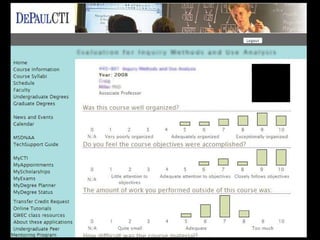
Introduction CTI is only school with online evaluations What can other schools learn from CTI students as evaluations move online?  Setup  Current CTI course structure Prior professors Schedule of the class Previous syllabi available Course evaluations filled out online Results posted for student viewing on CTI website
 
Participants and Methodology Student selection process Methodologies 15 Survey questions Quantifiable data  15 Interview questions  In-depth qualitative data
Existing Research:  Online vs. In-Class Evaluations Online evaluations take less class time Result in more open-ended comments And have less instructor influence But tend to have a lower response rate And less perception of anonymity
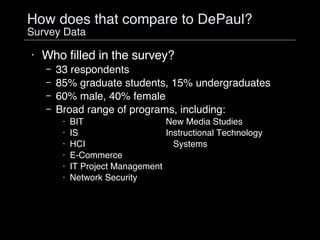
How does that compare to DePaul? Survey Data Who filled in the survey? 33 respondents 85% graduate students, 15% undergraduates 60% male, 40% female Broad range of programs, including: BIT New Media Studies IS Instructional Technology  HCI   Systems E-Commerce   IT Project Management Network Security
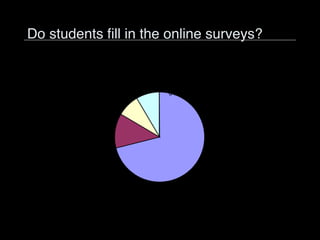
Do students fill in the online surveys?
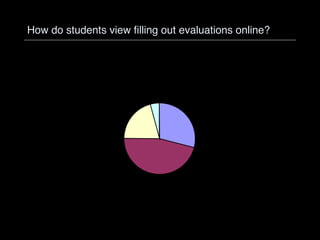
How do students view filling out evaluations online?
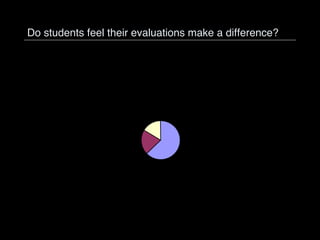
Do students feel their evaluations make a difference?
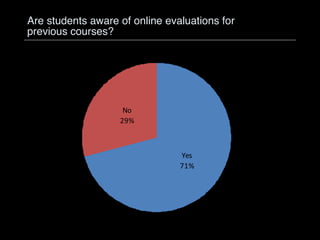
Are students aware of online evaluations for  previous courses?
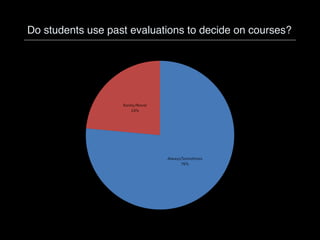
Do students use past evaluations to decide on courses?
In-Depth Student Interviews Ten interviews: 6 Male 7 Graduate 5 Unique majors, 3 HCI, 2 BIT  How do students perceive the evaluation process? Do students use past class evaluations to inform their future class decisions?
Giving Evaluations Online 6/10 liked filling out evaluations online Gives them a voice Grievances are recorded Good professors get their due But… Some questions may be too general to accomplish anything A few disgruntled students may make a professor look bad Students may not be honest in evaluations 8/10 Indicated they would be  more honest  or give a  more complete answer  filling out evaluations online
Consuming Past Course Evaluations Do students know past evaluations are online? Yes! Half regularly look at past evaluations Evaluations don’t hurt - but do they help? What other sources do students use to decide? Students are sensitive to poor design of  past evaluation data
Summary CTI’s online surveys handle the “upstream” flow of information well But suffer from problems which obstruct the “downstream” flow
Obstacles to “downstream” use Poor presentation of survey results Lack of qualitative feedback Inaccessibility of the evaluations Lack of relevant course options
Citations Dommeyer, C. J., Baum, P., Hanna, R. W., Chapman, K. S.  (2004).  Gathering faculty teaching evaluations by in-class and online surveys: their effects on response rates and evaluations.  Assessment & Evaluation in Higher Education , 29(5), 611-623. Dommeyer, C.J., Baum, P., Hanna, R. W.  (2002).  College students' attitudes towards methods of collecting teaching evaluations: in-class vs. online.  Journal of Education for Business , 78(1), 11-15. Layne, B. H., Decristoforo, J.R., McGinty, D.  (1999).  Electronic versus traditional student ratings of instruction.  Research in Higher Education , 40(2), 221-232.  Moss, J., Hendry, G.  (2002).  Use of electronic surveys in course evaluation.  British Journal of Educational Technology , 33(5), 583-592.

Online Evaluations: The Student Experience

  • 1.
    Online Course Evaluations: The Student Experience Lana Henderson [email_address] Mike Niebling michael.niebling@gmail.com Kelly Noah [email_address] Amy Willis [email_address] April 11, 2008
  • 2.
    Introduction CTI isonly school with online evaluations What can other schools learn from CTI students as evaluations move online? Setup Current CTI course structure Prior professors Schedule of the class Previous syllabi available Course evaluations filled out online Results posted for student viewing on CTI website
  • 3.
  • 4.
    Participants and MethodologyStudent selection process Methodologies 15 Survey questions Quantifiable data 15 Interview questions In-depth qualitative data
  • 5.
    Existing Research: Online vs. In-Class Evaluations Online evaluations take less class time Result in more open-ended comments And have less instructor influence But tend to have a lower response rate And less perception of anonymity
  • 6.
    How does thatcompare to DePaul? Survey Data Who filled in the survey? 33 respondents 85% graduate students, 15% undergraduates 60% male, 40% female Broad range of programs, including: BIT New Media Studies IS Instructional Technology HCI Systems E-Commerce IT Project Management Network Security
  • 7.
    Do students fillin the online surveys?
  • 8.
    How do studentsview filling out evaluations online?
  • 9.
    Do students feeltheir evaluations make a difference?
  • 10.
    Are students awareof online evaluations for previous courses?
  • 11.
    Do students usepast evaluations to decide on courses?
  • 12.
    In-Depth Student InterviewsTen interviews: 6 Male 7 Graduate 5 Unique majors, 3 HCI, 2 BIT How do students perceive the evaluation process? Do students use past class evaluations to inform their future class decisions?
  • 13.
    Giving Evaluations Online6/10 liked filling out evaluations online Gives them a voice Grievances are recorded Good professors get their due But… Some questions may be too general to accomplish anything A few disgruntled students may make a professor look bad Students may not be honest in evaluations 8/10 Indicated they would be more honest or give a more complete answer filling out evaluations online
  • 14.
    Consuming Past CourseEvaluations Do students know past evaluations are online? Yes! Half regularly look at past evaluations Evaluations don’t hurt - but do they help? What other sources do students use to decide? Students are sensitive to poor design of past evaluation data
  • 15.
    Summary CTI’s onlinesurveys handle the “upstream” flow of information well But suffer from problems which obstruct the “downstream” flow
  • 16.
    Obstacles to “downstream”use Poor presentation of survey results Lack of qualitative feedback Inaccessibility of the evaluations Lack of relevant course options
  • 17.
    Citations Dommeyer, C.J., Baum, P., Hanna, R. W., Chapman, K. S. (2004). Gathering faculty teaching evaluations by in-class and online surveys: their effects on response rates and evaluations. Assessment & Evaluation in Higher Education , 29(5), 611-623. Dommeyer, C.J., Baum, P., Hanna, R. W. (2002). College students' attitudes towards methods of collecting teaching evaluations: in-class vs. online. Journal of Education for Business , 78(1), 11-15. Layne, B. H., Decristoforo, J.R., McGinty, D. (1999). Electronic versus traditional student ratings of instruction. Research in Higher Education , 40(2), 221-232. Moss, J., Hendry, G. (2002). Use of electronic surveys in course evaluation. British Journal of Educational Technology , 33(5), 583-592.