Online Case Experience
Practice Case Answer Guide
1
Copyright
©
2020
by
Boston
Consulting
Group.
All
rights
reserved.
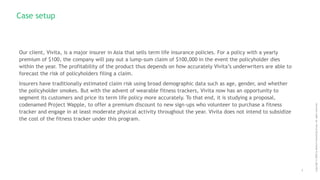
Our client, Vivita, is a major insurer in Asia that sells term life insurance policies. For a policy with a yearly
premium of $100, the company will pay out a lump-sum claim of $100,000 in the event the policyholder dies
within the year. The profitability of the product thus depends on how accurately Vivita’s underwriters are able to
forecast the risk of policyholders filing a claim.
Insurers have traditionally estimated claim risk using broad demographic data such as age, gender, and whether
the policyholder smokes. But with the advent of wearable fitness trackers, Vivita now has an opportunity to
segment its customers and price its term life policy more accurately. To that end, it is studying a proposal,
codenamed Project Wapple, to offer a premium discount to new sign-ups who volunteer to purchase a fitness
tracker and engage in at least moderate physical activity throughout the year. Vivita does not intend to subsidize
the cost of the fitness tracker under this program.
Case setup
2
Copyright
©
2020
by
Boston
Consulting
Group.
All
rights
reserved.
Question 1
What is the potential impact of such a program? Select all that apply from the following list of possible answers:
A. Decrease in average rate of claims for other insurers not offering a similar product
B. Decrease in frequency of customer interactions with Vivita
C. Decrease in volume of term life insurance policies sold by Vivita
D. Decrease in average rate of claims for Vivita’s term life insurance product
Explanation
Only Option D is likely to happen. Project Wapple would incentivize new sign-ups to exercise, which should
decrease the average rate of claims.
Other options are either wrong (effect is in opposite direction) or indeterminate.
3
Copyright
©
2020
by
Boston
Consulting
Group.
All
rights
reserved.
Question 2
To decide whether Vivita should implement Project Wapple, we first need to estimate the potential profit
impact due to better segmentation of the risk pool. For simplicity, let us focus on one set of term life insurance
customers: 30 to 35 year-old non-smoking males. Currently, Vivita sells this group a standard-priced policy
costing $100 per year that pays out $100,000 if the policyholder dies within that year. Project Wapple would
offer new sign-ups who volunteer for this program (called “opt-ins”) a 20% discount on premiums if they
purchase a fitness tracker and engage in at least moderate physical activity throughout the year. Premiums for
new sign-ups who “opt out” would remain unchanged.
Which five of the following would we need to forecast for the next year in order to estimate the potential
change in annual profit if Project Wapple were introduced, versus if it were not?
A. Total volumes (i.e., number of policies) sold if Project Wapple were not introduced
B. Likelihood of claims (averaged among opt-outs and opt-ins) under Project Wapple
C. Likelihood of claims for opt-outs
D. Average revenue per policy (averaged among opt-outs and opt-ins) under Project Wapple
E. Likelihood of claims for opt-ins
F. Average likelihood of claims if Project Wapple were not introduced
G. Increase in total volumes sold due to introduction of Project Wapple
4
Copyright
©
2020
by
Boston
Consulting
Group.
All
rights
reserved.
Question 2 (continued)
Explanation
To estimate the profit impact of Project Wapple, we need to calculate the annual profit before and after the
program is introduced.
Options (A) and (F) will allow us to calculate the profit (revenues – cost) before Wapple is introduced:
• Revenues = $100 x volume (A)
• Cost = $100,000 x claim rate (F) x volume (A)
For profit after Wapple is introduced:
• Revenues = new average price per policy (D) x new volume (A + G)
• Cost = $100,000 x new claim rate (B) x new volume (A + G)
Thus, the answer is (A), (B), (D), (F), and (G).
5
Copyright
©
2020
by
Boston
Consulting
Group.
All
rights
reserved.
Question 3
Based on the data provided below, please answer the subsequent four questions.
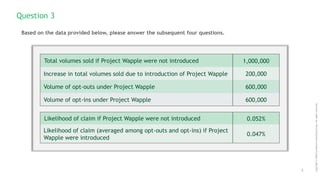
Total volumes sold if Project Wapple were not introduced 1,000,000
Increase in total volumes sold due to introduction of Project Wapple 200,000
Volume of opt-outs under Project Wapple 600,000
Volume of opt-ins under Project Wapple 600,000
Likelihood of claim if Project Wapple were not introduced 0.052%
Likelihood of claim (averaged among opt-outs and opt-ins) if Project
Wapple were introduced
0.047%
6
Copyright
©
2020
by
Boston
Consulting
Group.
All
rights
reserved.
Question 3 (continued)
3A) What is the estimated annual profit next year if Project Wapple is not introduced?
Answer: $48,000,000
Explanation
Applying the same logic as in the previous question, profit before Wapple is introduced:
= Revenues – Cost
= (Price per policy x Volume) – (Cost per policy x Volume)
= ($100 x 1,000,000) – (0.052% x $100,000 x 1,000,000)
= $48,000,000
7
Copyright
©
2020
by
Boston
Consulting
Group.
All
rights
reserved.
Question 3 (continued)
3B) What is the expected cost of claims if Project Wapple is introduced?
Answer: $56,400,000
Explanation
Expected cost of claims:
= New cost per policy x New volume
= (0.047% x $100,000) x (1,000,000 + 200,000)
= $56,400,000
8
Copyright
©
2020
by
Boston
Consulting
Group.
All
rights
reserved.
Question 3 (continued)
3C) What is the estimated revenue if Project Wapple is introduced?
Answer: $108,000,000
Explanation
To calculate revenue, we need to understand what the average price per policy is, weighted for the number of
opt-ins versus opt-outs. Since there are 600,000 opt-outs and 600,000 opt-ins, the weighted average price is
($100 x 600,000) + ($80 x 600,000) / (1,200,000) = $90
Therefore, the estimated revenue under Project Wapple:
= (Average price per policy under Wapple x New volume)
= $90 x 1,200,000
= $108,000,000
9
Copyright
©
2020
by
Boston
Consulting
Group.
All
rights
reserved.
Question 3 (continued)
3D) What is the estimated increase in annual profit next year if Project Wapple is introduced?
Answer: $3,600,000
Explanation
Estimated increase in profit under Project Wapple:
= (Revenues from Question 3C – Cost from Question 3B) - Profit from Question 3A
= ($108,000,000 – $56,400,000) - $48,000,000
= $3,600,000
10
Copyright
©
2020
by
Boston
Consulting
Group.
All
rights
reserved.
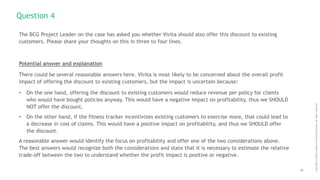
The BCG Project Leader on the case has asked you whether Vivita should also offer this discount to existing
customers. Please share your thoughts on this in three to four lines.
Potential answer and explanation
There could be several reasonable answers here. Vivita is most likely to be concerned about the overall profit
impact of offering the discount to existing customers, but the impact is uncertain because:
• On the one hand, offering the discount to existing customers would reduce revenue per policy for clients
who would have bought policies anyway. This would have a negative impact on profitability, thus we SHOULD
NOT offer the discount.
• On the other hand, if the fitness tracker incentivizes existing customers to exercise more, that could lead to
a decrease in cost of claims. This would have a positive impact on profitability, and thus we SHOULD offer
the discount.
A reasonable answer would identify the focus on profitability and offer one of the two considerations above.
The best answers would recognize both the considerations and state that it is necessary to estimate the relative
trade-off between the two to understand whether the profit impact is positive or negative.
Question 4
11
Copyright
©
2020
by
Boston
Consulting
Group.
All
rights
reserved.
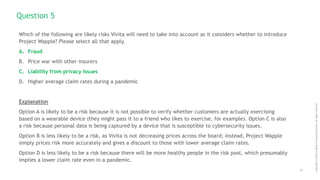
Which of the following are likely risks Vivita will need to take into account as it considers whether to introduce
Project Wapple? Please select all that apply.
A. Fraud
B. Price war with other insurers
C. Liability from privacy issues
D. Higher average claim rates during a pandemic
Explanation
Option A is likely to be a risk because it is not possible to verify whether customers are actually exercising
based on a wearable device (they might pass it to a friend who likes to exercise, for example). Option C is also
a risk because personal data is being captured by a device that is susceptible to cybersecurity issues.
Option B is less likely to be a risk, as Vivita is not decreasing prices across the board; instead, Project Wapple
simply prices risk more accurately and gives a discount to those with lower average claim rates.
Option D is less likely to be a risk because there will be more healthy people in the risk pool, which presumably
implies a lower claim rate even in a pandemic.
Question 5
12
Copyright
©
2020
by
Boston
Consulting
Group.
All
rights
reserved.
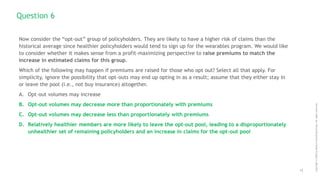
Now consider the “opt-out” group of policyholders. They are likely to have a higher risk of claims than the
historical average since healthier policyholders would tend to sign up for the wearables program. We would like
to consider whether it makes sense from a profit-maximizing perspective to raise premiums to match the
increase in estimated claims for this group.
Which of the following may happen if premiums are raised for those who opt out? Select all that apply. For
simplicity, ignore the possibility that opt-outs may end up opting in as a result; assume that they either stay in
or leave the pool (i.e., not buy insurance) altogether.
A. Opt-out volumes may increase
B. Opt-out volumes may decrease more than proportionately with premiums
C. Opt-out volumes may decrease less than proportionately with premiums
D. Relatively healthier members are more likely to leave the opt-out pool, leading to a disproportionately
unhealthier set of remaining policyholders and an increase in claims for the opt-out pool
Question 6
13
Copyright
©
2020
by
Boston
Consulting
Group.
All
rights
reserved.
Explanation
Option A is unlikely to be correct because if premiums are raised without anything else changing, volumes
should go down rather than up.
However, since the elasticity of demand is uncertain, both Option B and C are possible, as volumes may
decrease more or less in proportion to premiums, leading to a revenue gain or loss.
Option D is also correct, as those who need insurance more (because they are unhealthier) derive a higher value
on average from the insurance and are more likely to pay a higher price for it. Conversely, healthier customers
are more likely to leave when the price is raised.
Question 6 (continued)
14
Copyright
©
2020
by
Boston
Consulting
Group.
All
rights
reserved.
How would increasing opt-out premiums impact the absolute amount of profit generated from the opt-out
group? Pick one answer only.
A. We should expect profits generated from the opt-out group to increase
B. We should expect profits generated from the opt-out group to decrease
C. There is not enough information to determine
Explanation
The impact on profit is uncertain when price is raised, because the impact on profit per policy is uncertain (i.e.,
it is uncertain whether average claim costs will increase more or less than price – remember, the pool is likely
to become less healthy, so average claim costs will increase).
• If profit per policy decreases, then profit must decrease because volume also decreases.
• If profit per policy increases, then profit may increase or decrease depending on how much volume
decreases.
Question 7
15
Copyright
©
2020
by
Boston
Consulting
Group.
All
rights
reserved.
Now, assume that for every $10 increase in opt-out premiums, the average probability of claim in the opt-out
pool increases by 0.015%. In this case, how would increasing opt-out premiums impact the absolute amount of
profits generated from the opt-out group? Pick one answer only.
A. We should expect profits generated from the opt-out group to increase
B. We should expect profits generated from the opt-out group to decrease
C. There is not enough information to determine
Explanation
Unlike in Question 7, we know that profit per policy will decrease because:
• Average claim cost per policy increases by 0.015% x $100,000 = $15
• In contrast, revenue per policy increases by only $10
Therefore, profit per policy is expected to decrease by $5.
Since total profit = (Profit per policy) x Volume, and volume cannot increase if price increases, it follows that
total profit must also decrease.
Question 8
16
Copyright
©
2020
by
Boston
Consulting
Group.
All
rights
reserved.
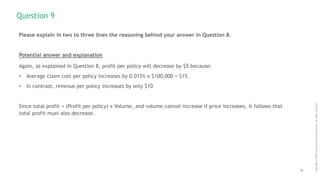
Please explain in two to three lines the reasoning behind your answer in Question 8.
Potential answer and explanation
Again, as explained in Question 8, profit per policy will decrease by $5 because:
• Average claim cost per policy increases by 0.015% x $100,000 = $15
• In contrast, revenue per policy increases by only $10
Since total profit = (Profit per policy) x Volume, and volume cannot increase if price increases, it follows that
total profit must also decrease.
Question 9
bcg.com

Online Case Practice BCG

  • 1.
  • 2.
    1 Copyright © 2020 by Boston Consulting Group. All rights reserved. Our client, Vivita,is a major insurer in Asia that sells term life insurance policies. For a policy with a yearly premium of $100, the company will pay out a lump-sum claim of $100,000 in the event the policyholder dies within the year. The profitability of the product thus depends on how accurately Vivita’s underwriters are able to forecast the risk of policyholders filing a claim. Insurers have traditionally estimated claim risk using broad demographic data such as age, gender, and whether the policyholder smokes. But with the advent of wearable fitness trackers, Vivita now has an opportunity to segment its customers and price its term life policy more accurately. To that end, it is studying a proposal, codenamed Project Wapple, to offer a premium discount to new sign-ups who volunteer to purchase a fitness tracker and engage in at least moderate physical activity throughout the year. Vivita does not intend to subsidize the cost of the fitness tracker under this program. Case setup
  • 3.
    2 Copyright © 2020 by Boston Consulting Group. All rights reserved. Question 1 What isthe potential impact of such a program? Select all that apply from the following list of possible answers: A. Decrease in average rate of claims for other insurers not offering a similar product B. Decrease in frequency of customer interactions with Vivita C. Decrease in volume of term life insurance policies sold by Vivita D. Decrease in average rate of claims for Vivita’s term life insurance product Explanation Only Option D is likely to happen. Project Wapple would incentivize new sign-ups to exercise, which should decrease the average rate of claims. Other options are either wrong (effect is in opposite direction) or indeterminate.
  • 4.
    3 Copyright © 2020 by Boston Consulting Group. All rights reserved. Question 2 To decidewhether Vivita should implement Project Wapple, we first need to estimate the potential profit impact due to better segmentation of the risk pool. For simplicity, let us focus on one set of term life insurance customers: 30 to 35 year-old non-smoking males. Currently, Vivita sells this group a standard-priced policy costing $100 per year that pays out $100,000 if the policyholder dies within that year. Project Wapple would offer new sign-ups who volunteer for this program (called “opt-ins”) a 20% discount on premiums if they purchase a fitness tracker and engage in at least moderate physical activity throughout the year. Premiums for new sign-ups who “opt out” would remain unchanged. Which five of the following would we need to forecast for the next year in order to estimate the potential change in annual profit if Project Wapple were introduced, versus if it were not? A. Total volumes (i.e., number of policies) sold if Project Wapple were not introduced B. Likelihood of claims (averaged among opt-outs and opt-ins) under Project Wapple C. Likelihood of claims for opt-outs D. Average revenue per policy (averaged among opt-outs and opt-ins) under Project Wapple E. Likelihood of claims for opt-ins F. Average likelihood of claims if Project Wapple were not introduced G. Increase in total volumes sold due to introduction of Project Wapple
  • 5.
    4 Copyright © 2020 by Boston Consulting Group. All rights reserved. Question 2 (continued) Explanation Toestimate the profit impact of Project Wapple, we need to calculate the annual profit before and after the program is introduced. Options (A) and (F) will allow us to calculate the profit (revenues – cost) before Wapple is introduced: • Revenues = $100 x volume (A) • Cost = $100,000 x claim rate (F) x volume (A) For profit after Wapple is introduced: • Revenues = new average price per policy (D) x new volume (A + G) • Cost = $100,000 x new claim rate (B) x new volume (A + G) Thus, the answer is (A), (B), (D), (F), and (G).
  • 6.
    5 Copyright © 2020 by Boston Consulting Group. All rights reserved. Question 3 Based onthe data provided below, please answer the subsequent four questions. Total volumes sold if Project Wapple were not introduced 1,000,000 Increase in total volumes sold due to introduction of Project Wapple 200,000 Volume of opt-outs under Project Wapple 600,000 Volume of opt-ins under Project Wapple 600,000 Likelihood of claim if Project Wapple were not introduced 0.052% Likelihood of claim (averaged among opt-outs and opt-ins) if Project Wapple were introduced 0.047%
  • 7.
    6 Copyright © 2020 by Boston Consulting Group. All rights reserved. Question 3 (continued) 3A)What is the estimated annual profit next year if Project Wapple is not introduced? Answer: $48,000,000 Explanation Applying the same logic as in the previous question, profit before Wapple is introduced: = Revenues – Cost = (Price per policy x Volume) – (Cost per policy x Volume) = ($100 x 1,000,000) – (0.052% x $100,000 x 1,000,000) = $48,000,000
  • 8.
    7 Copyright © 2020 by Boston Consulting Group. All rights reserved. Question 3 (continued) 3B)What is the expected cost of claims if Project Wapple is introduced? Answer: $56,400,000 Explanation Expected cost of claims: = New cost per policy x New volume = (0.047% x $100,000) x (1,000,000 + 200,000) = $56,400,000
  • 9.
    8 Copyright © 2020 by Boston Consulting Group. All rights reserved. Question 3 (continued) 3C)What is the estimated revenue if Project Wapple is introduced? Answer: $108,000,000 Explanation To calculate revenue, we need to understand what the average price per policy is, weighted for the number of opt-ins versus opt-outs. Since there are 600,000 opt-outs and 600,000 opt-ins, the weighted average price is ($100 x 600,000) + ($80 x 600,000) / (1,200,000) = $90 Therefore, the estimated revenue under Project Wapple: = (Average price per policy under Wapple x New volume) = $90 x 1,200,000 = $108,000,000
  • 10.
    9 Copyright © 2020 by Boston Consulting Group. All rights reserved. Question 3 (continued) 3D)What is the estimated increase in annual profit next year if Project Wapple is introduced? Answer: $3,600,000 Explanation Estimated increase in profit under Project Wapple: = (Revenues from Question 3C – Cost from Question 3B) - Profit from Question 3A = ($108,000,000 – $56,400,000) - $48,000,000 = $3,600,000
  • 11.
    10 Copyright © 2020 by Boston Consulting Group. All rights reserved. The BCG ProjectLeader on the case has asked you whether Vivita should also offer this discount to existing customers. Please share your thoughts on this in three to four lines. Potential answer and explanation There could be several reasonable answers here. Vivita is most likely to be concerned about the overall profit impact of offering the discount to existing customers, but the impact is uncertain because: • On the one hand, offering the discount to existing customers would reduce revenue per policy for clients who would have bought policies anyway. This would have a negative impact on profitability, thus we SHOULD NOT offer the discount. • On the other hand, if the fitness tracker incentivizes existing customers to exercise more, that could lead to a decrease in cost of claims. This would have a positive impact on profitability, and thus we SHOULD offer the discount. A reasonable answer would identify the focus on profitability and offer one of the two considerations above. The best answers would recognize both the considerations and state that it is necessary to estimate the relative trade-off between the two to understand whether the profit impact is positive or negative. Question 4
  • 12.
    11 Copyright © 2020 by Boston Consulting Group. All rights reserved. Which of thefollowing are likely risks Vivita will need to take into account as it considers whether to introduce Project Wapple? Please select all that apply. A. Fraud B. Price war with other insurers C. Liability from privacy issues D. Higher average claim rates during a pandemic Explanation Option A is likely to be a risk because it is not possible to verify whether customers are actually exercising based on a wearable device (they might pass it to a friend who likes to exercise, for example). Option C is also a risk because personal data is being captured by a device that is susceptible to cybersecurity issues. Option B is less likely to be a risk, as Vivita is not decreasing prices across the board; instead, Project Wapple simply prices risk more accurately and gives a discount to those with lower average claim rates. Option D is less likely to be a risk because there will be more healthy people in the risk pool, which presumably implies a lower claim rate even in a pandemic. Question 5
  • 13.
    12 Copyright © 2020 by Boston Consulting Group. All rights reserved. Now consider the“opt-out” group of policyholders. They are likely to have a higher risk of claims than the historical average since healthier policyholders would tend to sign up for the wearables program. We would like to consider whether it makes sense from a profit-maximizing perspective to raise premiums to match the increase in estimated claims for this group. Which of the following may happen if premiums are raised for those who opt out? Select all that apply. For simplicity, ignore the possibility that opt-outs may end up opting in as a result; assume that they either stay in or leave the pool (i.e., not buy insurance) altogether. A. Opt-out volumes may increase B. Opt-out volumes may decrease more than proportionately with premiums C. Opt-out volumes may decrease less than proportionately with premiums D. Relatively healthier members are more likely to leave the opt-out pool, leading to a disproportionately unhealthier set of remaining policyholders and an increase in claims for the opt-out pool Question 6
  • 14.
    13 Copyright © 2020 by Boston Consulting Group. All rights reserved. Explanation Option A isunlikely to be correct because if premiums are raised without anything else changing, volumes should go down rather than up. However, since the elasticity of demand is uncertain, both Option B and C are possible, as volumes may decrease more or less in proportion to premiums, leading to a revenue gain or loss. Option D is also correct, as those who need insurance more (because they are unhealthier) derive a higher value on average from the insurance and are more likely to pay a higher price for it. Conversely, healthier customers are more likely to leave when the price is raised. Question 6 (continued)
  • 15.
    14 Copyright © 2020 by Boston Consulting Group. All rights reserved. How would increasingopt-out premiums impact the absolute amount of profit generated from the opt-out group? Pick one answer only. A. We should expect profits generated from the opt-out group to increase B. We should expect profits generated from the opt-out group to decrease C. There is not enough information to determine Explanation The impact on profit is uncertain when price is raised, because the impact on profit per policy is uncertain (i.e., it is uncertain whether average claim costs will increase more or less than price – remember, the pool is likely to become less healthy, so average claim costs will increase). • If profit per policy decreases, then profit must decrease because volume also decreases. • If profit per policy increases, then profit may increase or decrease depending on how much volume decreases. Question 7
  • 16.
    15 Copyright © 2020 by Boston Consulting Group. All rights reserved. Now, assume thatfor every $10 increase in opt-out premiums, the average probability of claim in the opt-out pool increases by 0.015%. In this case, how would increasing opt-out premiums impact the absolute amount of profits generated from the opt-out group? Pick one answer only. A. We should expect profits generated from the opt-out group to increase B. We should expect profits generated from the opt-out group to decrease C. There is not enough information to determine Explanation Unlike in Question 7, we know that profit per policy will decrease because: • Average claim cost per policy increases by 0.015% x $100,000 = $15 • In contrast, revenue per policy increases by only $10 Therefore, profit per policy is expected to decrease by $5. Since total profit = (Profit per policy) x Volume, and volume cannot increase if price increases, it follows that total profit must also decrease. Question 8
  • 17.
    16 Copyright © 2020 by Boston Consulting Group. All rights reserved. Please explain intwo to three lines the reasoning behind your answer in Question 8. Potential answer and explanation Again, as explained in Question 8, profit per policy will decrease by $5 because: • Average claim cost per policy increases by 0.015% x $100,000 = $15 • In contrast, revenue per policy increases by only $10 Since total profit = (Profit per policy) x Volume, and volume cannot increase if price increases, it follows that total profit must also decrease. Question 9
  • 18.