PRESENTED BY:
Yashaswani Sharma
Oil and Natural Gas Corporation Limited is an Indian
multinational oil and gas company headquartered in
Dehradun, Uttarakhand, India. Wikipedia
Headquarters: Uttarakhand
CEO: Dinesh K Sarraf (Mar 1, 2014–)
Revenue: 1.394 trillion INR (2016, US$21 billion)
Founded: August 14, 1956
Owner: Government of India
Net income: 143 billion INR (US$2.1 billion, 2016)
Total equity: 42.78 billion INR (US$640 million)
Number of Employees – 32862 employees
ONGC was set up under the visionary leadership
of Pandit Jawahar Lal Nehru, going against the
wisdom of the multinational oil companies
operating in the country, who had almost
written India off as a “Hydrocarbon Barren”
country. Pandit Nehru reposed faith in Shri
Keshav Dev Malviya who laid the foundation of
ONGC in the form of Oil and Gas division, under
Geological Survey of India, in 1955. A few
months later, it was converted into an Oil and
Natural Gas Directorate.
 Creation of Oil and Natural Gas Commission
 Oil & Natural Gas Directorate upgraded to Oil and Natural
Gas Commission in 1956.
 Commission converted into a statutory body by Act of
Parliament in 1959 for planning, promoting, organising and
implementation of programme for development of
Petroleum resources in India.
 Hydrocarbon India Ltd. (HIL), precursor to ONGC Videsh Ltd.,
formed in 1965.
 Oil and Natural Gas Commission becomes Oil and Natural Gas
Corporation on 1st Feb.’1994.
 In 1997 ONGC is declared as one of the “Navratna” PSU.
 ONGC becomes a “Maharatna” PSU in 2010.
To be global leader in integrated energy business through
sustainable growth, knowledge excellence and exemplary
governance practices.
World Class
Dedicated to excellence by leveraging competitive advantages in
R&D and technology with involved people.
Imbibe high standards of business ethics and organizational
values.
Abiding commitment to safety, health and environment to
enrich quality of community life.
Foster a culture of trust, openness and mutual concern to make
working a stimulating and challenging experience for our
people.
Strive for customer delight through quality products and
services.
Integrated In Energy Business
Focus on domestic and international oil and gas exploration and
production business opportunities.
Provide value linkages in other sectors of energy business.
Create growth opportunities and maximize shareholder value.
Dominant Indian Leadership
Retain dominant position in Indian petroleum sector and
enhance India's energy availability.
ONGC is India’s Top Energy Company and ranks
20th among global energy majors (Platts).
ONGC ranks 14th in ‘Oil and Gas operations’ and
220th overall in Forbes Global 2000. Acclaimed for its
Corporate Governance practices, Transparency
International has ranked ONGC 26th among the biggest
publicly traded global giants.
Its wholly-owned subsidiary ONGC Videsh Limited
(OVL) is the biggest Indian multinational in the energy
space, participating in 36 oil and gas properties in 17
countries. ONGC subsidiary Mangalore Refinery and
Petrochemicals Limited (MRPL) is a Schedule ‘A’
Miniratna, with a single-location refining capacity of 15
million tons per annum.
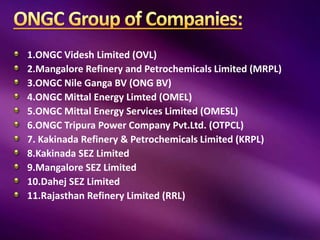
1.ONGC Videsh Limited (OVL)
2.Mangalore Refinery and Petrochemicals Limited (MRPL)
3.ONGC Nile Ganga BV (ONG BV)
4.ONGC Mittal Energy Limted (OMEL)
5.ONGC Mittal Energy Services Limited (OMESL)
6.ONGC Tripura Power Company Pvt.Ltd. (OTPCL)
7. Kakinada Refinery & Petrochemicals Limited (KRPL)
8.Kakinada SEZ Limited
9.Mangalore SEZ Limited
10.Dahej SEZ Limited
11.Rajasthan Refinery Limited (RRL)
Crude oil
Natural gas
Ethane
Superior Kerosene Oil
HSD
LPG
Motor Spirit
Aromatic Rich Naptha
13
Rajasthan Onshore
Western Onshore
Western Offshore
Assam Self
Tripura
Mahanadi Offshore
KG Offshore
KG Onshore
Cauvery Onshore
Cauvery Onshore
MRPL Refinery
Dahez SEZ,
OPAL
PETRONET
Kakinada SEZ
Jharia (CBM)
13
ONGC Videsh Limited(OVL) is the international
arm of ONGC. It was rechristened on 15 june
1989. it currently has 14 projects across 16
countries.
Presence of ONGC Videsh Ltd (OVL) in Latin
America.
Presence of ONGC Videsh Limited
(OVL) in Middle East
Presence of ONGC Videsh Limited
(OVL) in Africa
Presence of ONGC Videsh Limited (OVL) in CIS &
Far-East;
As a public sector enterprise, ONGC has a long and
cherished tradition of commendable initiatives,
institutionalized programmes and practices of
Corporate Social Responsibility which have played a
laudable role in the development of several
underdeveloped regions of the country. The vision of
sustainable growth drives both business decisions as
well as our Corporate Social Responsibility works.
The CSR initiatives of ONGC were marked by
unrelenting commitment to several large – scale key
projects identified under the 12 focus areas of ONGC
i.e.
1. Education including vocational
courses,
2. Health Care,
3. Entrepreneurship (self-help &
livelihood generation) schemes,
4. Infrastructure support near
ONGC operational areas,
5. Environment protection,
ecological conservation,
promotion,
6. Protection of heritage sites,
UNESCO heritage monuments
etc.
7. Promotion of artisans, craftsman,
musicians, artists etc. for
preservation of heritage, Art &
Culture,
8. Women’s Empowerment,
Girl Child Development,
Gender sensitive projects,
9. Water Management
including ground water
recharge,
10. Initiatives for Physically and
Mentally challenged,
11. Sponsorship of seminars,
conferences, workshops
etc.
12. Promoting Sports/sports
persons; supporting
agencies promoting sports
/ sports persons.
1) STRENGTHS
A) O.N.G.C LTD is perceived to be the leader in oil production industry.
B) O.N.G.C has a very efficient and professional management team.
C) O.N.G.C being an international company has sufficient resources
and capital to invest.
D) O.N.G.C has ISO-9001 & ISO 14001 registration.
2) WEAKNESSES
A) O.N.G.C facing difficulties to produce oil from aging reservoirs.
B) Ever changing laws.
C) Legal issues as it is controlled by petroleum ministry.
D) Employee management issue because huge number of employees.
3) OPPURTUNITY
A)Possible mergers with smaller companies.
B)Grow their hold in the energy market.
C)Expanding market to abroad with help of ONGC VIDESH LTD (OVL)
D) Increasing natural gas market for more sales.
E) Increasing in fuel/oil prices.
4)THREATS
A) Security of personnel & property especially crude oil continues to
be a cause of concern in certain area.
B) In some exploration Campaign Company involves high technology,
High investment and high risks.
Due mostly to the industry that ONGC is in, it’s hard for
there to be many new entrants.
The only real threat that might arise would be another
government funded Oil and Gas company. The reason
for this is that a government would not have as hard at
time raising funds and gaining access to resources.
There is really not much of a threat because there are
two main barriers to entry that would be stopping
potential threats. These would be very high capital
requirements as well as access to Cost disadvantages
independent of scale.
ONGC is a vertically integrated company that
really deals in all areas from finding the product
to refining the product to selling the product.
With this being said there is not much to worry
about the bargaining power of the suppliers.
Supplier power is high as the net margins are
strongly dependent on the price of the crude.
Not too critical for most companies as refining
operations are apart of the complete supply
chain, with the refining operations
supplying the product to the marketing compan
y. However in case of standalone companies
(which may no longer apply) long term
contracts have to be signed with the marketing
companies. The margins in such cases are
dependent on such long term contracts.
Another reason for this lack of bargaining power
is that as of right now there is not a real
alternative to Oil.
Although gas, solar power etc. exist as substitutes ,
none of the mare big enough to impact the
demand of the petroleum products.
As stated above there is not a real alternative to
oil at this time. It does not seem that at this time
there is a huge threat of this happening but it is
definitely a possibility that any player in the
market must beware of.
The rivalry in the industry was low till as the industry
was tightly regulated by the government. However, the
level competition has
increased with Reliance and other MNC becoming mor
e aggressive.
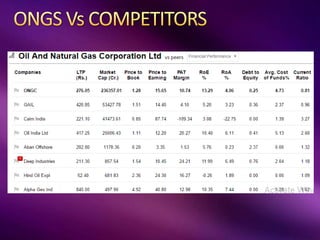
The largest competitors in this industry for ONGC are
Exxon Mobile and Royal Dutch Shell. ONGC is currently
in 14 different
companies whereas Exxon Mobile is in 20 different
countries. While Exxon may be a larger company now
ONGC is growing and is becoming a very important
global player.
http://economictimes.indiatimes.com/oil-and-natural-gas-corporation-
ltd/stocks/companyid-11599.cms
http://profit.ndtv.com/stock/oil-&-natural-gas-corporation-ltd_ongc
http://www.moneycontrol.com/financials/oilnaturalgascorporation/financial-
graphs/operating-profit-ebitda-percentage/ONG
http://www.ongcindia.com/wps/wcm/connect/ongcindia/home/csr
http://www.ongcindia.com/wps/wcm/connect/ongcindia/Home/Company/Vision-
Mission/
http://www.ongcindia.com/wps/wcm/connect/ongcindia/Home/Company/Board_of
_Directors/
Ongc final presentation

Ongc final presentation

  • 1.
  • 2.
    Oil and NaturalGas Corporation Limited is an Indian multinational oil and gas company headquartered in Dehradun, Uttarakhand, India. Wikipedia Headquarters: Uttarakhand CEO: Dinesh K Sarraf (Mar 1, 2014–) Revenue: 1.394 trillion INR (2016, US$21 billion) Founded: August 14, 1956 Owner: Government of India Net income: 143 billion INR (US$2.1 billion, 2016) Total equity: 42.78 billion INR (US$640 million) Number of Employees – 32862 employees
  • 3.
    ONGC was setup under the visionary leadership of Pandit Jawahar Lal Nehru, going against the wisdom of the multinational oil companies operating in the country, who had almost written India off as a “Hydrocarbon Barren” country. Pandit Nehru reposed faith in Shri Keshav Dev Malviya who laid the foundation of ONGC in the form of Oil and Gas division, under Geological Survey of India, in 1955. A few months later, it was converted into an Oil and Natural Gas Directorate.
  • 4.
     Creation ofOil and Natural Gas Commission  Oil & Natural Gas Directorate upgraded to Oil and Natural Gas Commission in 1956.  Commission converted into a statutory body by Act of Parliament in 1959 for planning, promoting, organising and implementation of programme for development of Petroleum resources in India.  Hydrocarbon India Ltd. (HIL), precursor to ONGC Videsh Ltd., formed in 1965.  Oil and Natural Gas Commission becomes Oil and Natural Gas Corporation on 1st Feb.’1994.  In 1997 ONGC is declared as one of the “Navratna” PSU.  ONGC becomes a “Maharatna” PSU in 2010.
  • 5.
    To be globalleader in integrated energy business through sustainable growth, knowledge excellence and exemplary governance practices. World Class Dedicated to excellence by leveraging competitive advantages in R&D and technology with involved people. Imbibe high standards of business ethics and organizational values. Abiding commitment to safety, health and environment to enrich quality of community life. Foster a culture of trust, openness and mutual concern to make working a stimulating and challenging experience for our people.
  • 6.
    Strive for customerdelight through quality products and services. Integrated In Energy Business Focus on domestic and international oil and gas exploration and production business opportunities. Provide value linkages in other sectors of energy business. Create growth opportunities and maximize shareholder value. Dominant Indian Leadership Retain dominant position in Indian petroleum sector and enhance India's energy availability.
  • 8.
    ONGC is India’sTop Energy Company and ranks 20th among global energy majors (Platts). ONGC ranks 14th in ‘Oil and Gas operations’ and 220th overall in Forbes Global 2000. Acclaimed for its Corporate Governance practices, Transparency International has ranked ONGC 26th among the biggest publicly traded global giants. Its wholly-owned subsidiary ONGC Videsh Limited (OVL) is the biggest Indian multinational in the energy space, participating in 36 oil and gas properties in 17 countries. ONGC subsidiary Mangalore Refinery and Petrochemicals Limited (MRPL) is a Schedule ‘A’ Miniratna, with a single-location refining capacity of 15 million tons per annum.
  • 11.
    1.ONGC Videsh Limited(OVL) 2.Mangalore Refinery and Petrochemicals Limited (MRPL) 3.ONGC Nile Ganga BV (ONG BV) 4.ONGC Mittal Energy Limted (OMEL) 5.ONGC Mittal Energy Services Limited (OMESL) 6.ONGC Tripura Power Company Pvt.Ltd. (OTPCL) 7. Kakinada Refinery & Petrochemicals Limited (KRPL) 8.Kakinada SEZ Limited 9.Mangalore SEZ Limited 10.Dahej SEZ Limited 11.Rajasthan Refinery Limited (RRL)
  • 12.
    Crude oil Natural gas Ethane SuperiorKerosene Oil HSD LPG Motor Spirit Aromatic Rich Naptha
  • 13.
    13 Rajasthan Onshore Western Onshore WesternOffshore Assam Self Tripura Mahanadi Offshore KG Offshore KG Onshore Cauvery Onshore Cauvery Onshore MRPL Refinery Dahez SEZ, OPAL PETRONET Kakinada SEZ Jharia (CBM) 13
  • 14.
    ONGC Videsh Limited(OVL)is the international arm of ONGC. It was rechristened on 15 june 1989. it currently has 14 projects across 16 countries. Presence of ONGC Videsh Ltd (OVL) in Latin America. Presence of ONGC Videsh Limited (OVL) in Middle East Presence of ONGC Videsh Limited (OVL) in Africa Presence of ONGC Videsh Limited (OVL) in CIS & Far-East;
  • 22.
    As a publicsector enterprise, ONGC has a long and cherished tradition of commendable initiatives, institutionalized programmes and practices of Corporate Social Responsibility which have played a laudable role in the development of several underdeveloped regions of the country. The vision of sustainable growth drives both business decisions as well as our Corporate Social Responsibility works. The CSR initiatives of ONGC were marked by unrelenting commitment to several large – scale key projects identified under the 12 focus areas of ONGC i.e.
  • 23.
    1. Education includingvocational courses, 2. Health Care, 3. Entrepreneurship (self-help & livelihood generation) schemes, 4. Infrastructure support near ONGC operational areas, 5. Environment protection, ecological conservation, promotion, 6. Protection of heritage sites, UNESCO heritage monuments etc. 7. Promotion of artisans, craftsman, musicians, artists etc. for preservation of heritage, Art & Culture, 8. Women’s Empowerment, Girl Child Development, Gender sensitive projects, 9. Water Management including ground water recharge, 10. Initiatives for Physically and Mentally challenged, 11. Sponsorship of seminars, conferences, workshops etc. 12. Promoting Sports/sports persons; supporting agencies promoting sports / sports persons.
  • 24.
    1) STRENGTHS A) O.N.G.CLTD is perceived to be the leader in oil production industry. B) O.N.G.C has a very efficient and professional management team. C) O.N.G.C being an international company has sufficient resources and capital to invest. D) O.N.G.C has ISO-9001 & ISO 14001 registration. 2) WEAKNESSES A) O.N.G.C facing difficulties to produce oil from aging reservoirs. B) Ever changing laws. C) Legal issues as it is controlled by petroleum ministry. D) Employee management issue because huge number of employees.
  • 25.
    3) OPPURTUNITY A)Possible mergerswith smaller companies. B)Grow their hold in the energy market. C)Expanding market to abroad with help of ONGC VIDESH LTD (OVL) D) Increasing natural gas market for more sales. E) Increasing in fuel/oil prices. 4)THREATS A) Security of personnel & property especially crude oil continues to be a cause of concern in certain area. B) In some exploration Campaign Company involves high technology, High investment and high risks.
  • 27.
    Due mostly tothe industry that ONGC is in, it’s hard for there to be many new entrants. The only real threat that might arise would be another government funded Oil and Gas company. The reason for this is that a government would not have as hard at time raising funds and gaining access to resources. There is really not much of a threat because there are two main barriers to entry that would be stopping potential threats. These would be very high capital requirements as well as access to Cost disadvantages independent of scale.
  • 28.
    ONGC is avertically integrated company that really deals in all areas from finding the product to refining the product to selling the product. With this being said there is not much to worry about the bargaining power of the suppliers. Supplier power is high as the net margins are strongly dependent on the price of the crude.
  • 29.
    Not too criticalfor most companies as refining operations are apart of the complete supply chain, with the refining operations supplying the product to the marketing compan y. However in case of standalone companies (which may no longer apply) long term contracts have to be signed with the marketing companies. The margins in such cases are dependent on such long term contracts. Another reason for this lack of bargaining power is that as of right now there is not a real alternative to Oil.
  • 30.
    Although gas, solarpower etc. exist as substitutes , none of the mare big enough to impact the demand of the petroleum products. As stated above there is not a real alternative to oil at this time. It does not seem that at this time there is a huge threat of this happening but it is definitely a possibility that any player in the market must beware of.
  • 31.
    The rivalry inthe industry was low till as the industry was tightly regulated by the government. However, the level competition has increased with Reliance and other MNC becoming mor e aggressive. The largest competitors in this industry for ONGC are Exxon Mobile and Royal Dutch Shell. ONGC is currently in 14 different companies whereas Exxon Mobile is in 20 different countries. While Exxon may be a larger company now ONGC is growing and is becoming a very important global player.
  • 32.

Editor's Notes