Time Series Databases
Dmitry Namiot
Lomonosov Moscow State University
dnamiot@gmail.com
Time Series
• Time series is just a sequence of data
elements.
• The typical use case is a set of
measurements made over a time interval.
• Much of the data generated by sensors, in
a machine to machine communication, in
Internet of Things area
• Survey of data persistence for time series
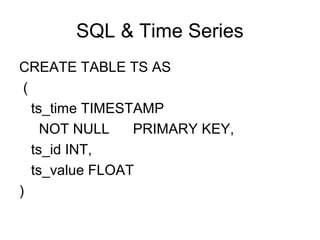
SQL & Time Series
CREATE TABLE TS AS
(
ts_time TIMESTAMP
NOT NULL PRIMARY KEY,
ts_id INT,
ts_value FLOAT
)
Specific of processing
• INSERT prevails
• UPDATE (DELETE, MODIFY) are
uncommon
• High-frequent INSERT operations (M2M,
IoT applications)
• Sliding window for processing
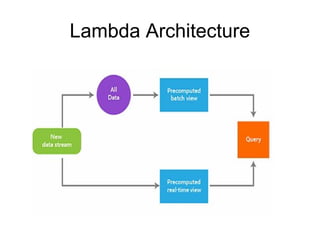
Lambda Architecture
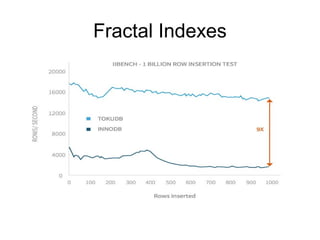
Fractal Indexes
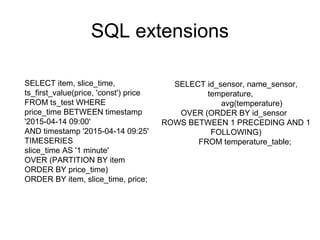
SQL extensions
SELECT item, slice_time,
ts_first_value(price, 'const') price
FROM ts_test WHERE
price_time BETWEEN timestamp
'2015-04-14 09:00'
AND timestamp '2015-04-14 09:25'
TIMESERIES
slice_time AS '1 minute'
OVER (PARTITION BY item
ORDER BY price_time)
ORDER BY item, slice_time, price;
SELECT id_sensor, name_sensor,
temperature,
avg(temperature)
OVER (ORDER BY id_sensor
ROWS BETWEEN 1 PRECEDING AND 1
FOLLOWING)
FROM temperature_table;
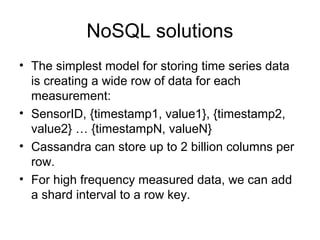
NoSQL solutions
• The simplest model for storing time series data
is creating a wide row of data for each
measurement:
• SensorID, {timestamp1, value1}, {timestamp2,
value2} … {timestampN, valueN}
• Cassandra can store up to 2 billion columns per
row.
• For high frequency measured data, we can add
a shard interval to a row key.
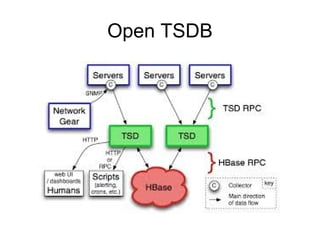
Open TSDB
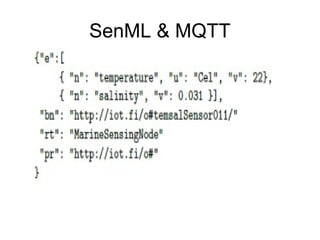
SenML & MQTT
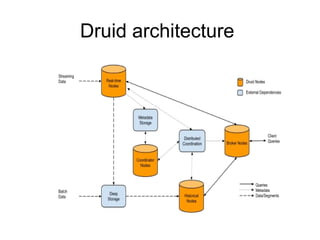
Druid architecture
More NoSQL systems
• Geras DB uses SenML
• SciDB’s native multi-dimensional array
data model is designed for ordered, highly
dimensional, multifaceted data
• BlinkDB supports a slightly constrained set
of SQL-style declarative queries
• InfluxDB is open-source, distributed, time
series database with no external
dependencies
SAP HANA
• series property aspect of tables;
• built-in Special SQL functions for working
with series data;
• analytic functions: special SQL functions
for analyzing series data;
• storage support: advanced techniques for
storing equidistant data using dictionary
encoding

On time-series databases

  • 1.
    Time Series Databases DmitryNamiot Lomonosov Moscow State University dnamiot@gmail.com
  • 2.
    Time Series • Timeseries is just a sequence of data elements. • The typical use case is a set of measurements made over a time interval. • Much of the data generated by sensors, in a machine to machine communication, in Internet of Things area • Survey of data persistence for time series
  • 3.
    SQL & TimeSeries CREATE TABLE TS AS ( ts_time TIMESTAMP NOT NULL PRIMARY KEY, ts_id INT, ts_value FLOAT )
  • 4.
    Specific of processing •INSERT prevails • UPDATE (DELETE, MODIFY) are uncommon • High-frequent INSERT operations (M2M, IoT applications) • Sliding window for processing
  • 5.
  • 6.
  • 7.
    SQL extensions SELECT item,slice_time, ts_first_value(price, 'const') price FROM ts_test WHERE price_time BETWEEN timestamp '2015-04-14 09:00' AND timestamp '2015-04-14 09:25' TIMESERIES slice_time AS '1 minute' OVER (PARTITION BY item ORDER BY price_time) ORDER BY item, slice_time, price; SELECT id_sensor, name_sensor, temperature, avg(temperature) OVER (ORDER BY id_sensor ROWS BETWEEN 1 PRECEDING AND 1 FOLLOWING) FROM temperature_table;
  • 8.
    NoSQL solutions • Thesimplest model for storing time series data is creating a wide row of data for each measurement: • SensorID, {timestamp1, value1}, {timestamp2, value2} … {timestampN, valueN} • Cassandra can store up to 2 billion columns per row. • For high frequency measured data, we can add a shard interval to a row key.
  • 9.
  • 10.
  • 11.
  • 12.
    More NoSQL systems •Geras DB uses SenML • SciDB’s native multi-dimensional array data model is designed for ordered, highly dimensional, multifaceted data • BlinkDB supports a slightly constrained set of SQL-style declarative queries • InfluxDB is open-source, distributed, time series database with no external dependencies
  • 13.
    SAP HANA • seriesproperty aspect of tables; • built-in Special SQL functions for working with series data; • analytic functions: special SQL functions for analyzing series data; • storage support: advanced techniques for storing equidistant data using dictionary encoding