Secure Distributed Healthcare Networks
for PCI DSS 3.0 and HIPAA Compliance
Accelerating Compliance and Simplifying Complex Networks
DISTRIBUTED HEALTHCARE NETWORKS have
grown in complexity over the last decade as
they expand network access and add more
security technologies to protect their networks.
The adoption of standards such as the Payment
Card Industry Data Security Standard (PCI
DSS) and HIPAA have also improved the overall
security of data in distributed healthcare
networks.
However, in light of many well-publicized data breaches and
required disclosure by the HIPAA Breach Notification Rule,
45 CFR §§ 164.400-414, it is clear that distributed healthcare
networks are still vulnerable to being compromised. This
paper will discuss some of the common challenges distributed
healthcare networks face in securing their medical office
buildings, home health operations, clinical settings, Cloudbased
applications and business associates. This paper will also provide
several specific ways Fortinet’s comprehensive product portfolio
can help secure and simplify distributed healthcare networks to
accelerate compliance with PCI DSS 3.0 and HIPAA combined.
THE EVOLVING NETWORK IN DISTRIBUTED
HEALTHCARE ENVIRONMENTS
Distributed healthcare networks have grown in complexity
over the last several years with the addition of numerous
networking technologies to meet changing business
requirements. These stand-alone technologies can create gaps in
policy enforcement caused by separate devices with separate rule
sets that lack central management. They can also overwhelm
small IT teams and drive up CapEx and OpEx costs, especially when
duplicated over dozens, hundreds or even thousands of locations.
PCI DSS 3.0 COMPLIANCE AND DISTRIBUTED
HEALTHCARE NETWORKS
The Payment Card Industry Data Security Standard (PCI
DSS) is a global standard for data security of cardholder data
that affects a very broad group of businesses including
Healthcare. It applies to all entities involved in processing of
payment cards, such as merchants, card issuers, processors,
and service providers, as well as those that process, transmit,
or store cardholder data. While PCI DSS has focused on retail
its HIPAA/HITECH requirements overlap when considering
required protections of Patient Health Information. There are
12 requirements within six control objectives in PCI DSS 3.0:
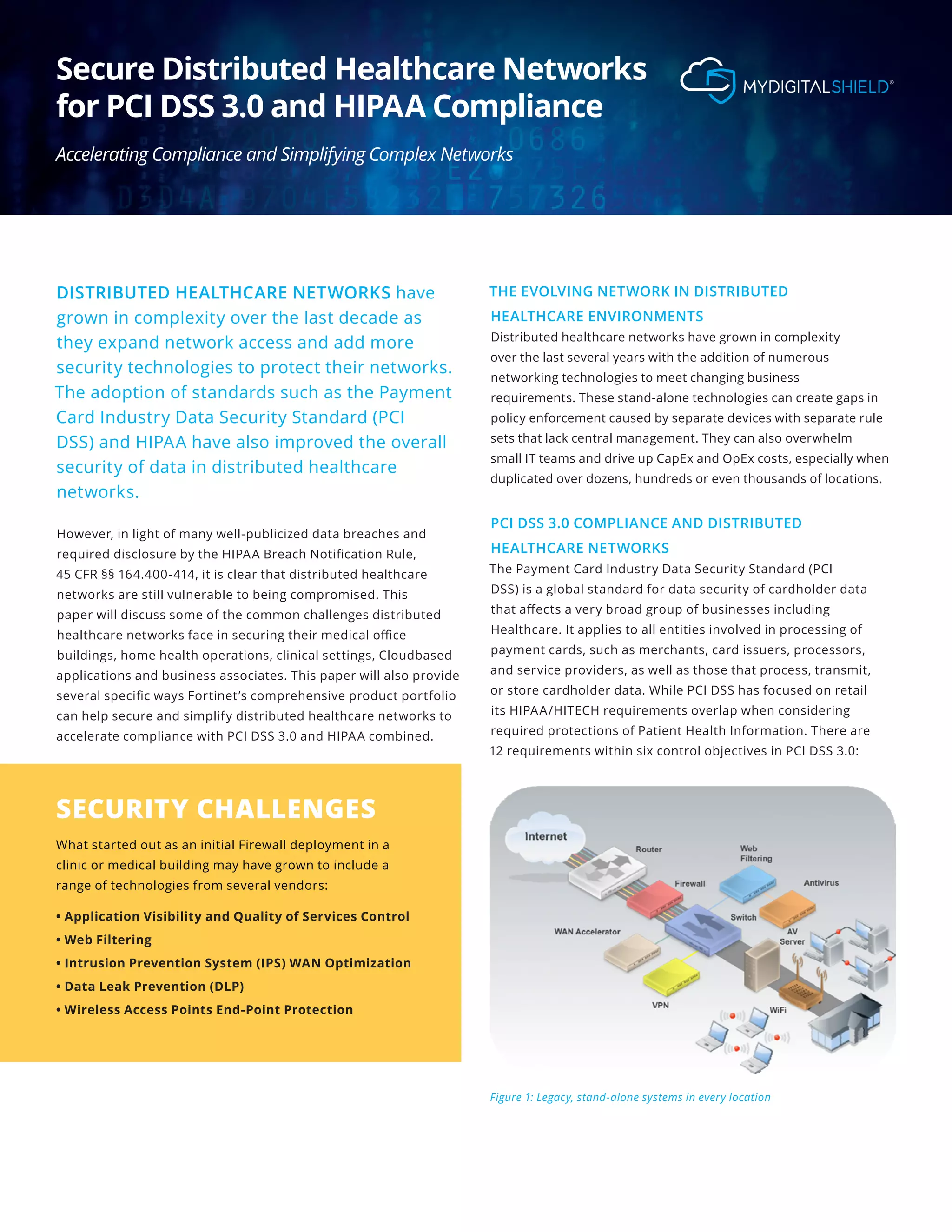
SECURITY CHALLENGES
What started out as an initial Firewall deployment in a
clinic or medical building may have grown to include a
range of technologies from several vendors:
• Application Visibility and Quality of Services Control
• Web Filtering
• Intrusion Prevention System (IPS) WAN Optimization
• Data Leak Prevention (DLP)
• Wireless Access Points End-Point Protection
Figure 1: Legacy, stand-alone systems in every location
2 Payment Card Industry Data Security Standard “Requirements and Security Assessment Procedures version 3.0”
www.pcisecuritystandards.org/documents/PCI_DSSv3.pdf
PCI DSS version 3.0, the current version of the standard, includes
many updates from the previous version of the requirements
to reflect the evolving networking and threat landscapes. The
intent of version 3.0 is to reduce confusion, misinterpretation,
and reinforce best practices, and the majority of the updates
are “Clarifications” or “Additional Guidance” to existing
requirements.2 The goal is to make PCI DSS compliance ‘Business
As Usual” and to be incorporated in everyday business practices
instead of being a periodic focus.
Version 3.0 includes several examples of best practices:
• Monitoring of security controls such as firewalls to ensure
effective operation
• Detecting and responding to any security control failures
• Reviewing changes to the environment (such as new
configurations or systems) in the context of PCI DSS scope
before completing the change, and updating security controls
appropriately
• Reviewing deployed hardware and software technologies
to confirm that they are still being supported by the vendor and
they meet the entity’s security requirements
NEW REQUIREMENTS
There are several new requirements that will affect distributed
healthcare networks in particular, due to their large number
of locations, wide range of hardware and software systems
deployed in those environments and use of managed services.
Some examples include:
New Requirement 2.4: Maintain an Inventory of System
Components that are in Scope for PCI DSS.
Organization are now required to maintain a list of all system
components (both hardware and software) including a
description of each component’s function, and interviewing
personnel to verify that the inventory is current.
New Requirement 5.1.2: For systems considered to be not
commonly affected by malicious software, perform periodic
evaluations to identify and evaluate evolving malware threats in
order to confirm whether such systems continue to not require
anti-virus software.
This requirement expands the requirement to include all
systems that could be affected by malware, which includes
open source and custom software, not just the critical systems
previously identified.
Requirement 8.5.1: Additional requirement for service
providers: Service providers with remote access to customer
premises (for example, for support of POS systems or servers)
must use a unique authentication credential (such as a password/
phrase) for each customer.
This requires service providers to use unique authentication
credentials for each customer, such as two-factor
authentication. The intent is to prevent multiple customers
from being compromised by a single set of credentials.
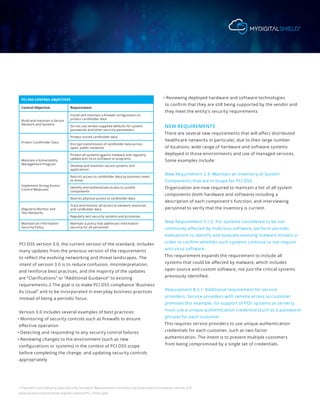
PCI DSS CONTROL OBJECTIVES
Control Objective Requirement
Build and maintain a Secure
Network and Systems
Install and maintain a firewall configuration to
protect cardholder data
Do not use vendor-supplied defaults for system
passwords and other security parameters
Protect Cardholder Data
Protect stored cardholder data
Encrypt transmission of cardholder data across
open, public networks
Maintain a Vulnerability
Management Program
Protect all systems against malware and regularly
update anti-virus software or programs
Develop and maintain secure systems and
applications
Implement Strong Access
Control Measures
Restrict access to cardholder data by business need-
to-know
Identify and authenticate access to system
components
Restrict physical access to cardholder data
Regularly Monitor and
Test Networks
Track and monitor all access to network resources
and cardholder data
Regularly test security systems and processes
Maintain an Information
Security Policy
Maintain a policy that addresses information
security for all personnel
LIMITATIONS OF LEGACY SECURITY SYSTEMS
The PCI core requirements cover controlled network isolation,
inbound/outbound traffic flows and DMZ implementation related
to defining and protecting the Cardholder Data Environment
(CDE) and in our opinion relate to protection of Patient Health
Information. Specific
functions include:
• Real-time perimeter anti-malware/anti-virus
• IPSec/VPN tunneling support
• Intrusion Detection/Prevention (IDS/IPS)
• Use of strong cryptography (SSL/IPSec)
• Default ‘deny-all’ settings
• Support of digital certificates and two-factor user
authentication
• Event monitoring
• Federated device management and reporting
• Network vulnerability analysis support
A legacy firewall cannot provide these services due to the lack of
required functions and/or the lack of performance, whether it is
at remote location like a store or distribution center, in a central
location like headquarters, or in a datacenter. Organizations
need the ability to deploy a single operating system with a range
of firewall personalities, both physical and virtual. In addition
to simplifying deployment and standardizing IT staff training, a
single flexible OS also enables the delivery of the appropriate
security and networking functions for a particular use case:
• At clinical and home health locations, a single all-inone service
to consolidate all of the security functions and eliminate the cost
and complexity of deploying multiple devices
• At medical office buildings, a high performance next generation
firewall to provide the core network security features
• At hospital and data center operations, a high performance
firewall to deliver core firewall functions.
MYDIGITALSHIELD’S NETWORK SECURITY SOLUTION
MDS Cloud based unified threat management system can help
organizations address the wide range of requirements of PCI
while minimizing implementation and operational costs.
MDS devices provide seamless integration of networking and
security in a single appliance with the most comprehensive
feature set of any consolidated network security device, including
Anti-Malware/Anti-Virus, Intrusion Prevention, Application
Control, SSL and IPsec VPN, and Web filtering. Customers can
deploy as much or as little technology as they want, based on
their specific requirements.
The MDS platform offers complete yet flexible network services and
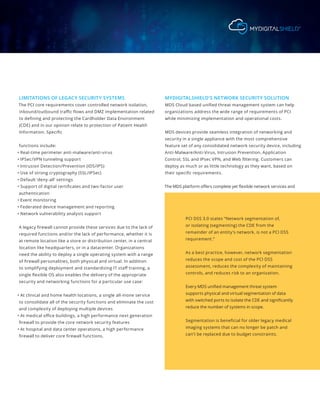
PCI DSS 3.0 states “Network segmentation of,
or isolating (segmenting) the CDE from the
remainder of an entity’s network, is not a PCI DSS
requirement.”
As a best practice, however, network segmentation
reduces the scope and cost of the PCI DSS
assessment, reduces the complexity of maintaining
controls, and reduces risk to an organization.
Every MDS unified management threat system
supports physical and virtual segmentation of data
with switched ports to isolate the CDE and significantly
reduce the number of systems in scope.
Segmentation is beneficial for older legacy medical
imaging systems that can no longer be patch and
can’t be replaced due to budget constraints.
threat protection that meets and exceeds the compliance requirement:
Firewall – Enables network segmentation using virtual domains,
VLANs and switched ports for traffic segmentation/isolation.
Prevents unauthorized access to critical resources
Intrusion Prevention System (IPS) – Detects and blocks
network intrusion and other hacks by cyber criminals
Application Control – Identifies and stops malicious application
activities while allowing only authorized applications
Web Filtering – Blocks visits to or content from malicious site
VPN – Encrypts and protects data transmitted across untrusted networks
Advance Threat Protection – Anti-Malware engine and
Sandbox integration prevents malicious code exploitation,
detects targeted and advance persistent threats
Data Leak Prevention (DLP) – Discovers and prevents
unauthorized transmission of sensitive data
Visibility & Monitoring – Provides monitoring, logging and
notification of incidents or suspicious activity that may indicate
an incident allowing organizations to quickly respond
Connectivity/Business Continuity – Every MDS Cloud-Link
device supports multiple connectivity options for business
continuity, such as broadband lines (e.g., DSL, Cable, T-1/T-3)in a
single device
WIRELESS SECURITY SOLUTION
In addition, every FortiGate device has an integrated Wireless
Controller, enabling organizations to consolidate wired and
wireless traffic and enforce polices consistently.
Administrators can plug in wireless access points directly into
a FortiGate device, which allows the FortiGate to eliminate the
need for a separate stand-alone wireless network and the
need to try to duplicate policies on separate network and
wireless security systems.
WIRELESS ACCESS POINTS
Requirement 11: Regularly test security systems and processes.
Requirement 11 contains several components related to
Wireless Access and the need to inventory Wireless Access
Points and detect Rogue Access Points.
MDS Cloud-Link Thin Wireless Access Points enable simple,
cost-effective, and secure Wireless Network Access. Cloud-Links
are an ideal solution for extending protection to the wireless
network. The integrated Wireless Controller within every
Cloud-Link device eliminates the majority of the cost of
deploying a wireless network.
With models designed for small clinics and home health
operations, distributed medical buildings, as well as highdensity
Hospital and Data Center locations, Cloud-Links allow
consistent enforcement of security policies across both wired
and wireless networks.
• Easy deployment of database activity monitoring/audit across
hundreds of databases via centralized policy management
• Provides Privilege change data for User Access management
and integration
• Out-of-the-box reports help meet security and PCI DSS and
HIPAA/HITECH compliance requirements
CENTRALIZED MANAGEMENT
Centralized Security Management, Logging, and Reporting
– MyDigitalShield MCM Portal
MyDigitalShield’s MCM portal allows you to centrally manage
any number of customer locations, from several to thousands,
including MDS Lite, MDS Standard, MDS Advanced and MDS Pro.
The MCM will soon offer a comprehensive suite of easily
customable reports allows you to quickly analyze and visualize
network threats, inefficiencies and usage. The MCM provides
a diversity of deployment types, growth flexibility, advanced
customization through APIs and simple licensing.
DELIVERING CONSTANT THREAT PROTECTION
The MDS Team continually updates our products to address the
latest threats. We deploy a variety of security filters for a variety
of products including traffic anomaly filters, vulnerabilitybased
filters, IP reputation, and signatures.
Given the speed with which new attacks are released to the
wild, it is imperative that organizations have protection in place
to guard against the latest attacks. MDS utilizes data centers
around the world located in secure, high availability locations,
automatically deliver updates to the MDS security platforms.
With the MDS Cloud-Link enabled and connected to our secure
portal, customers can rest assured that their security platforms
are performing optimally and protecting their corporate assets
with the latest security technology.
CONCLUSION
Today’s distributed healthcare networks are faced with the
daunting task of having to add new technology to their networks
in order to remain competitive while keeping sensitive data
flowing through those networks secure. PCI DSS and HIPAA are
the foundation of security in these networks, and require a wide
variety of mitigating controls be in place to protect cardholder
data and patient health Information.
My Digital Shield’s consolidated approach to network security
enables the FortiGate product family to provide unmatched
protection by delivering high performance and consolidated
security, for both wired and wireless networks in each remote
location or branch, as well as at the enterprise edge and in the
data center. This technology provides a comprehensive solution
to secure distributed healthcare networks and accelerate PCI and
HIPPA compliance.

OmniNet MDS HIPPA Compliance Info

  • 1.
    Secure Distributed HealthcareNetworks for PCI DSS 3.0 and HIPAA Compliance Accelerating Compliance and Simplifying Complex Networks DISTRIBUTED HEALTHCARE NETWORKS have grown in complexity over the last decade as they expand network access and add more security technologies to protect their networks. The adoption of standards such as the Payment Card Industry Data Security Standard (PCI DSS) and HIPAA have also improved the overall security of data in distributed healthcare networks. However, in light of many well-publicized data breaches and required disclosure by the HIPAA Breach Notification Rule, 45 CFR §§ 164.400-414, it is clear that distributed healthcare networks are still vulnerable to being compromised. This paper will discuss some of the common challenges distributed healthcare networks face in securing their medical office buildings, home health operations, clinical settings, Cloudbased applications and business associates. This paper will also provide several specific ways Fortinet’s comprehensive product portfolio can help secure and simplify distributed healthcare networks to accelerate compliance with PCI DSS 3.0 and HIPAA combined. THE EVOLVING NETWORK IN DISTRIBUTED HEALTHCARE ENVIRONMENTS Distributed healthcare networks have grown in complexity over the last several years with the addition of numerous networking technologies to meet changing business requirements. These stand-alone technologies can create gaps in policy enforcement caused by separate devices with separate rule sets that lack central management. They can also overwhelm small IT teams and drive up CapEx and OpEx costs, especially when duplicated over dozens, hundreds or even thousands of locations. PCI DSS 3.0 COMPLIANCE AND DISTRIBUTED HEALTHCARE NETWORKS The Payment Card Industry Data Security Standard (PCI DSS) is a global standard for data security of cardholder data that affects a very broad group of businesses including Healthcare. It applies to all entities involved in processing of payment cards, such as merchants, card issuers, processors, and service providers, as well as those that process, transmit, or store cardholder data. While PCI DSS has focused on retail its HIPAA/HITECH requirements overlap when considering required protections of Patient Health Information. There are 12 requirements within six control objectives in PCI DSS 3.0: SECURITY CHALLENGES What started out as an initial Firewall deployment in a clinic or medical building may have grown to include a range of technologies from several vendors: • Application Visibility and Quality of Services Control • Web Filtering • Intrusion Prevention System (IPS) WAN Optimization • Data Leak Prevention (DLP) • Wireless Access Points End-Point Protection Figure 1: Legacy, stand-alone systems in every location
  • 2.
    2 Payment CardIndustry Data Security Standard “Requirements and Security Assessment Procedures version 3.0” www.pcisecuritystandards.org/documents/PCI_DSSv3.pdf PCI DSS version 3.0, the current version of the standard, includes many updates from the previous version of the requirements to reflect the evolving networking and threat landscapes. The intent of version 3.0 is to reduce confusion, misinterpretation, and reinforce best practices, and the majority of the updates are “Clarifications” or “Additional Guidance” to existing requirements.2 The goal is to make PCI DSS compliance ‘Business As Usual” and to be incorporated in everyday business practices instead of being a periodic focus. Version 3.0 includes several examples of best practices: • Monitoring of security controls such as firewalls to ensure effective operation • Detecting and responding to any security control failures • Reviewing changes to the environment (such as new configurations or systems) in the context of PCI DSS scope before completing the change, and updating security controls appropriately • Reviewing deployed hardware and software technologies to confirm that they are still being supported by the vendor and they meet the entity’s security requirements NEW REQUIREMENTS There are several new requirements that will affect distributed healthcare networks in particular, due to their large number of locations, wide range of hardware and software systems deployed in those environments and use of managed services. Some examples include: New Requirement 2.4: Maintain an Inventory of System Components that are in Scope for PCI DSS. Organization are now required to maintain a list of all system components (both hardware and software) including a description of each component’s function, and interviewing personnel to verify that the inventory is current. New Requirement 5.1.2: For systems considered to be not commonly affected by malicious software, perform periodic evaluations to identify and evaluate evolving malware threats in order to confirm whether such systems continue to not require anti-virus software. This requirement expands the requirement to include all systems that could be affected by malware, which includes open source and custom software, not just the critical systems previously identified. Requirement 8.5.1: Additional requirement for service providers: Service providers with remote access to customer premises (for example, for support of POS systems or servers) must use a unique authentication credential (such as a password/ phrase) for each customer. This requires service providers to use unique authentication credentials for each customer, such as two-factor authentication. The intent is to prevent multiple customers from being compromised by a single set of credentials. PCI DSS CONTROL OBJECTIVES Control Objective Requirement Build and maintain a Secure Network and Systems Install and maintain a firewall configuration to protect cardholder data Do not use vendor-supplied defaults for system passwords and other security parameters Protect Cardholder Data Protect stored cardholder data Encrypt transmission of cardholder data across open, public networks Maintain a Vulnerability Management Program Protect all systems against malware and regularly update anti-virus software or programs Develop and maintain secure systems and applications Implement Strong Access Control Measures Restrict access to cardholder data by business need- to-know Identify and authenticate access to system components Restrict physical access to cardholder data Regularly Monitor and Test Networks Track and monitor all access to network resources and cardholder data Regularly test security systems and processes Maintain an Information Security Policy Maintain a policy that addresses information security for all personnel
  • 3.
    LIMITATIONS OF LEGACYSECURITY SYSTEMS The PCI core requirements cover controlled network isolation, inbound/outbound traffic flows and DMZ implementation related to defining and protecting the Cardholder Data Environment (CDE) and in our opinion relate to protection of Patient Health Information. Specific functions include: • Real-time perimeter anti-malware/anti-virus • IPSec/VPN tunneling support • Intrusion Detection/Prevention (IDS/IPS) • Use of strong cryptography (SSL/IPSec) • Default ‘deny-all’ settings • Support of digital certificates and two-factor user authentication • Event monitoring • Federated device management and reporting • Network vulnerability analysis support A legacy firewall cannot provide these services due to the lack of required functions and/or the lack of performance, whether it is at remote location like a store or distribution center, in a central location like headquarters, or in a datacenter. Organizations need the ability to deploy a single operating system with a range of firewall personalities, both physical and virtual. In addition to simplifying deployment and standardizing IT staff training, a single flexible OS also enables the delivery of the appropriate security and networking functions for a particular use case: • At clinical and home health locations, a single all-inone service to consolidate all of the security functions and eliminate the cost and complexity of deploying multiple devices • At medical office buildings, a high performance next generation firewall to provide the core network security features • At hospital and data center operations, a high performance firewall to deliver core firewall functions. MYDIGITALSHIELD’S NETWORK SECURITY SOLUTION MDS Cloud based unified threat management system can help organizations address the wide range of requirements of PCI while minimizing implementation and operational costs. MDS devices provide seamless integration of networking and security in a single appliance with the most comprehensive feature set of any consolidated network security device, including Anti-Malware/Anti-Virus, Intrusion Prevention, Application Control, SSL and IPsec VPN, and Web filtering. Customers can deploy as much or as little technology as they want, based on their specific requirements. The MDS platform offers complete yet flexible network services and PCI DSS 3.0 states “Network segmentation of, or isolating (segmenting) the CDE from the remainder of an entity’s network, is not a PCI DSS requirement.” As a best practice, however, network segmentation reduces the scope and cost of the PCI DSS assessment, reduces the complexity of maintaining controls, and reduces risk to an organization. Every MDS unified management threat system supports physical and virtual segmentation of data with switched ports to isolate the CDE and significantly reduce the number of systems in scope. Segmentation is beneficial for older legacy medical imaging systems that can no longer be patch and can’t be replaced due to budget constraints.
  • 4.
    threat protection thatmeets and exceeds the compliance requirement: Firewall – Enables network segmentation using virtual domains, VLANs and switched ports for traffic segmentation/isolation. Prevents unauthorized access to critical resources Intrusion Prevention System (IPS) – Detects and blocks network intrusion and other hacks by cyber criminals Application Control – Identifies and stops malicious application activities while allowing only authorized applications Web Filtering – Blocks visits to or content from malicious site VPN – Encrypts and protects data transmitted across untrusted networks Advance Threat Protection – Anti-Malware engine and Sandbox integration prevents malicious code exploitation, detects targeted and advance persistent threats Data Leak Prevention (DLP) – Discovers and prevents unauthorized transmission of sensitive data Visibility & Monitoring – Provides monitoring, logging and notification of incidents or suspicious activity that may indicate an incident allowing organizations to quickly respond Connectivity/Business Continuity – Every MDS Cloud-Link device supports multiple connectivity options for business continuity, such as broadband lines (e.g., DSL, Cable, T-1/T-3)in a single device WIRELESS SECURITY SOLUTION In addition, every FortiGate device has an integrated Wireless Controller, enabling organizations to consolidate wired and wireless traffic and enforce polices consistently. Administrators can plug in wireless access points directly into a FortiGate device, which allows the FortiGate to eliminate the need for a separate stand-alone wireless network and the need to try to duplicate policies on separate network and wireless security systems. WIRELESS ACCESS POINTS Requirement 11: Regularly test security systems and processes. Requirement 11 contains several components related to Wireless Access and the need to inventory Wireless Access Points and detect Rogue Access Points. MDS Cloud-Link Thin Wireless Access Points enable simple, cost-effective, and secure Wireless Network Access. Cloud-Links are an ideal solution for extending protection to the wireless network. The integrated Wireless Controller within every Cloud-Link device eliminates the majority of the cost of deploying a wireless network. With models designed for small clinics and home health operations, distributed medical buildings, as well as highdensity Hospital and Data Center locations, Cloud-Links allow consistent enforcement of security policies across both wired and wireless networks. • Easy deployment of database activity monitoring/audit across hundreds of databases via centralized policy management • Provides Privilege change data for User Access management and integration • Out-of-the-box reports help meet security and PCI DSS and HIPAA/HITECH compliance requirements
  • 5.
    CENTRALIZED MANAGEMENT Centralized SecurityManagement, Logging, and Reporting – MyDigitalShield MCM Portal MyDigitalShield’s MCM portal allows you to centrally manage any number of customer locations, from several to thousands, including MDS Lite, MDS Standard, MDS Advanced and MDS Pro. The MCM will soon offer a comprehensive suite of easily customable reports allows you to quickly analyze and visualize network threats, inefficiencies and usage. The MCM provides a diversity of deployment types, growth flexibility, advanced customization through APIs and simple licensing. DELIVERING CONSTANT THREAT PROTECTION The MDS Team continually updates our products to address the latest threats. We deploy a variety of security filters for a variety of products including traffic anomaly filters, vulnerabilitybased filters, IP reputation, and signatures. Given the speed with which new attacks are released to the wild, it is imperative that organizations have protection in place to guard against the latest attacks. MDS utilizes data centers around the world located in secure, high availability locations, automatically deliver updates to the MDS security platforms. With the MDS Cloud-Link enabled and connected to our secure portal, customers can rest assured that their security platforms are performing optimally and protecting their corporate assets with the latest security technology. CONCLUSION Today’s distributed healthcare networks are faced with the daunting task of having to add new technology to their networks in order to remain competitive while keeping sensitive data flowing through those networks secure. PCI DSS and HIPAA are the foundation of security in these networks, and require a wide variety of mitigating controls be in place to protect cardholder data and patient health Information. My Digital Shield’s consolidated approach to network security enables the FortiGate product family to provide unmatched protection by delivering high performance and consolidated security, for both wired and wireless networks in each remote location or branch, as well as at the enterprise edge and in the data center. This technology provides a comprehensive solution to secure distributed healthcare networks and accelerate PCI and HIPPA compliance.