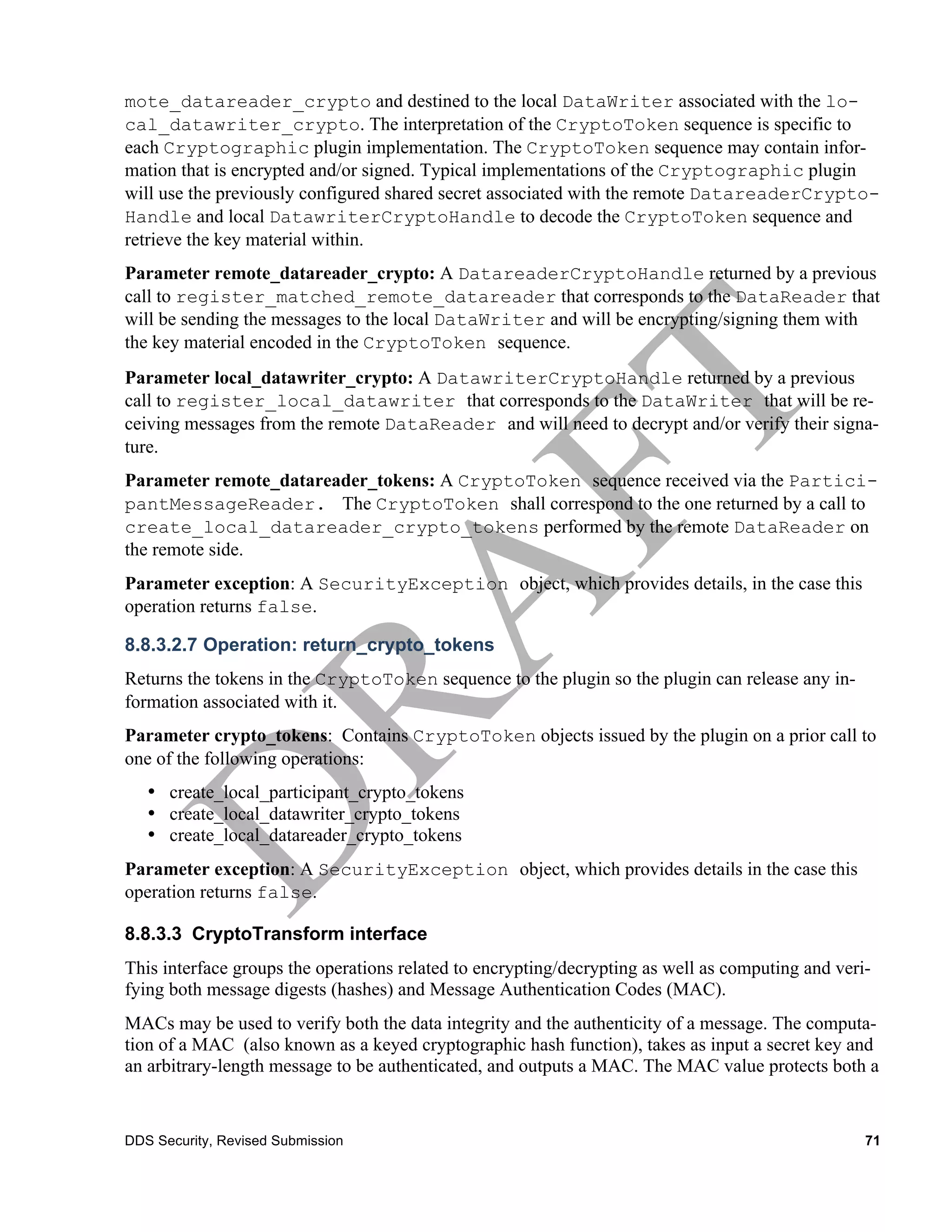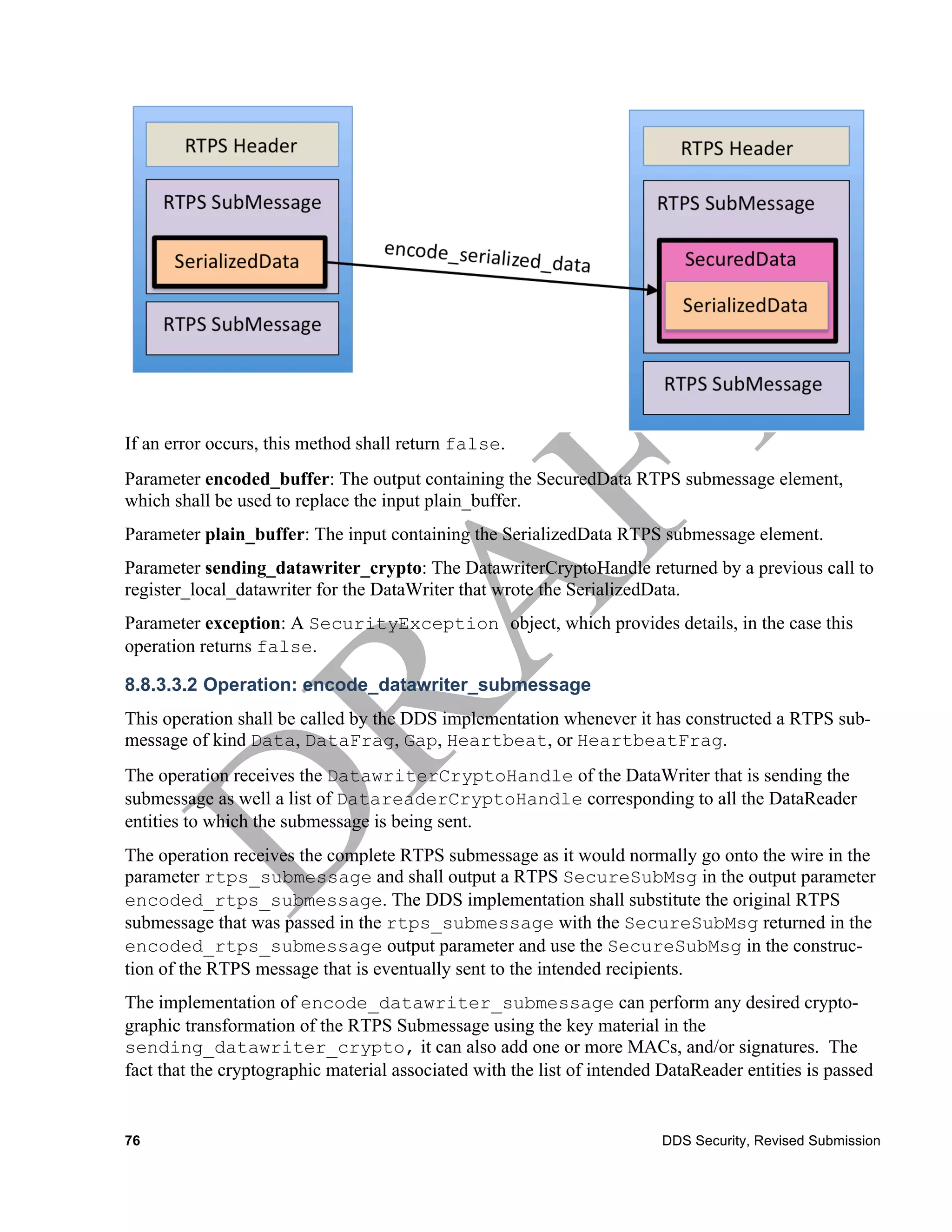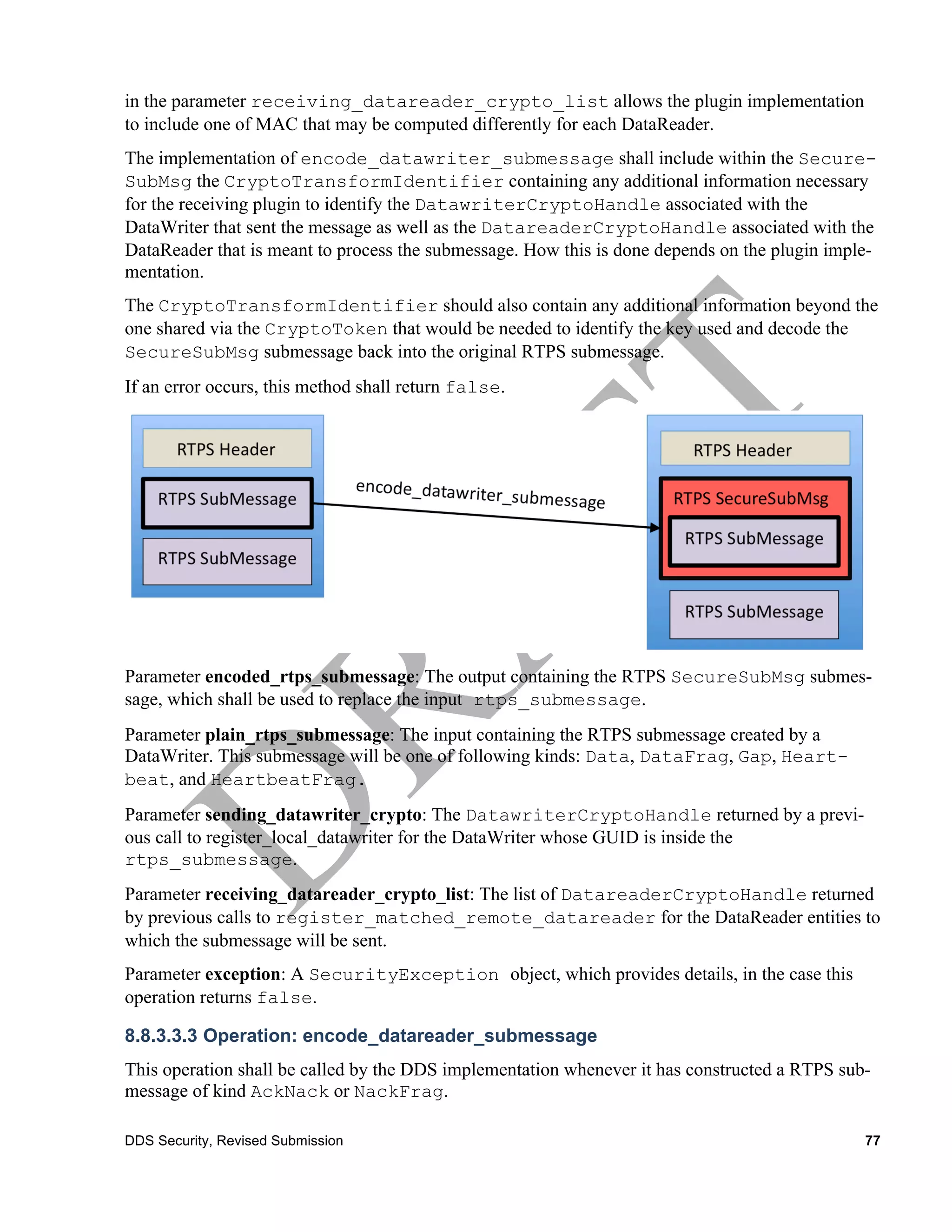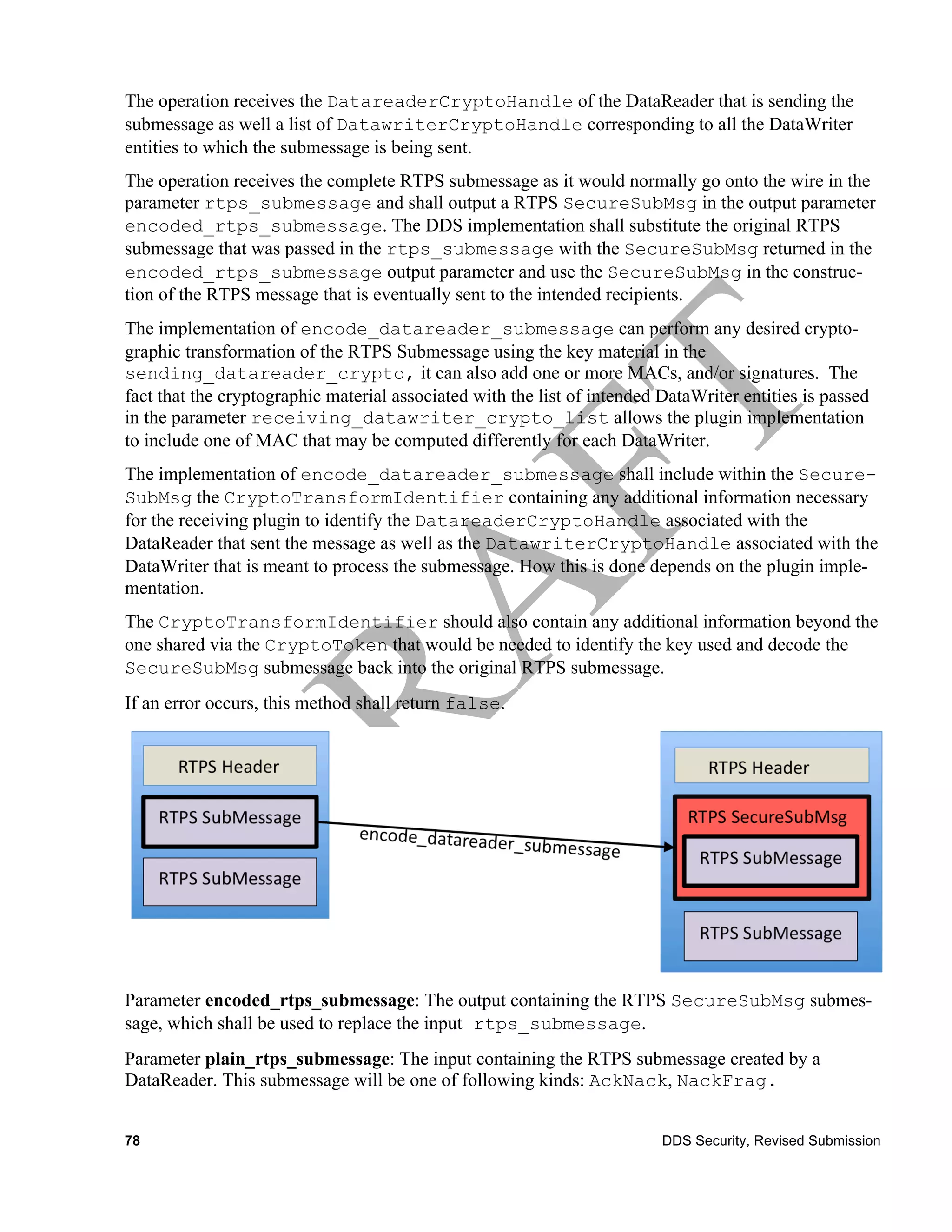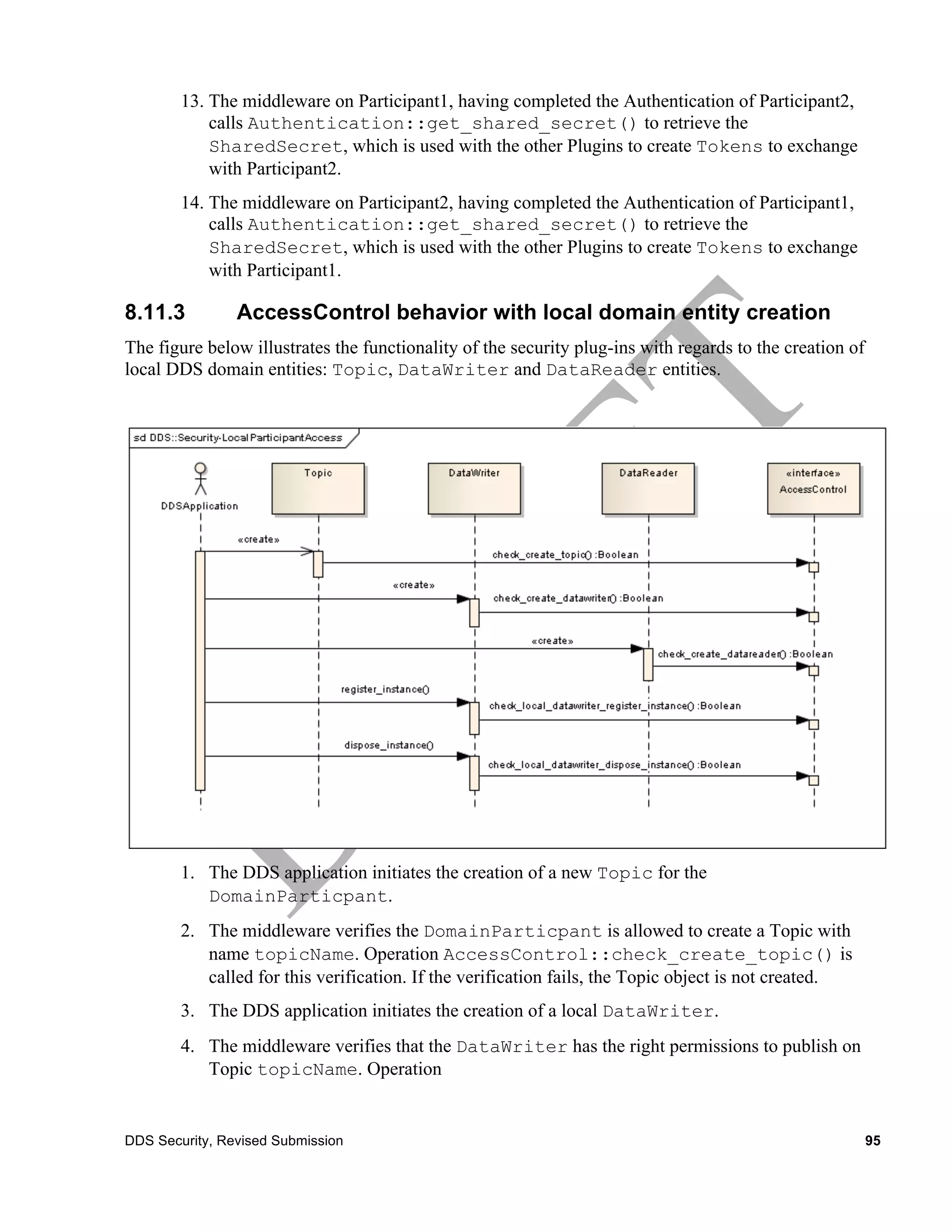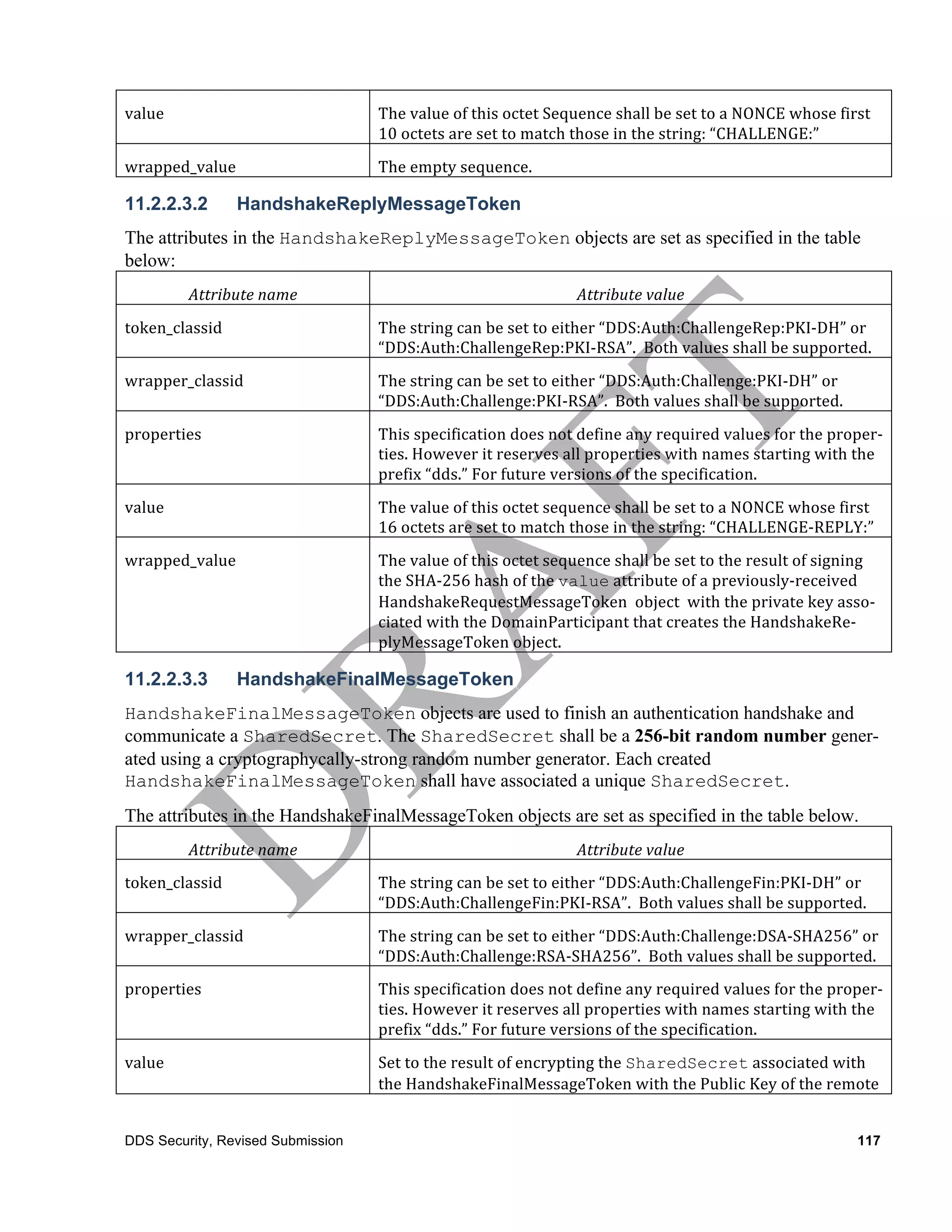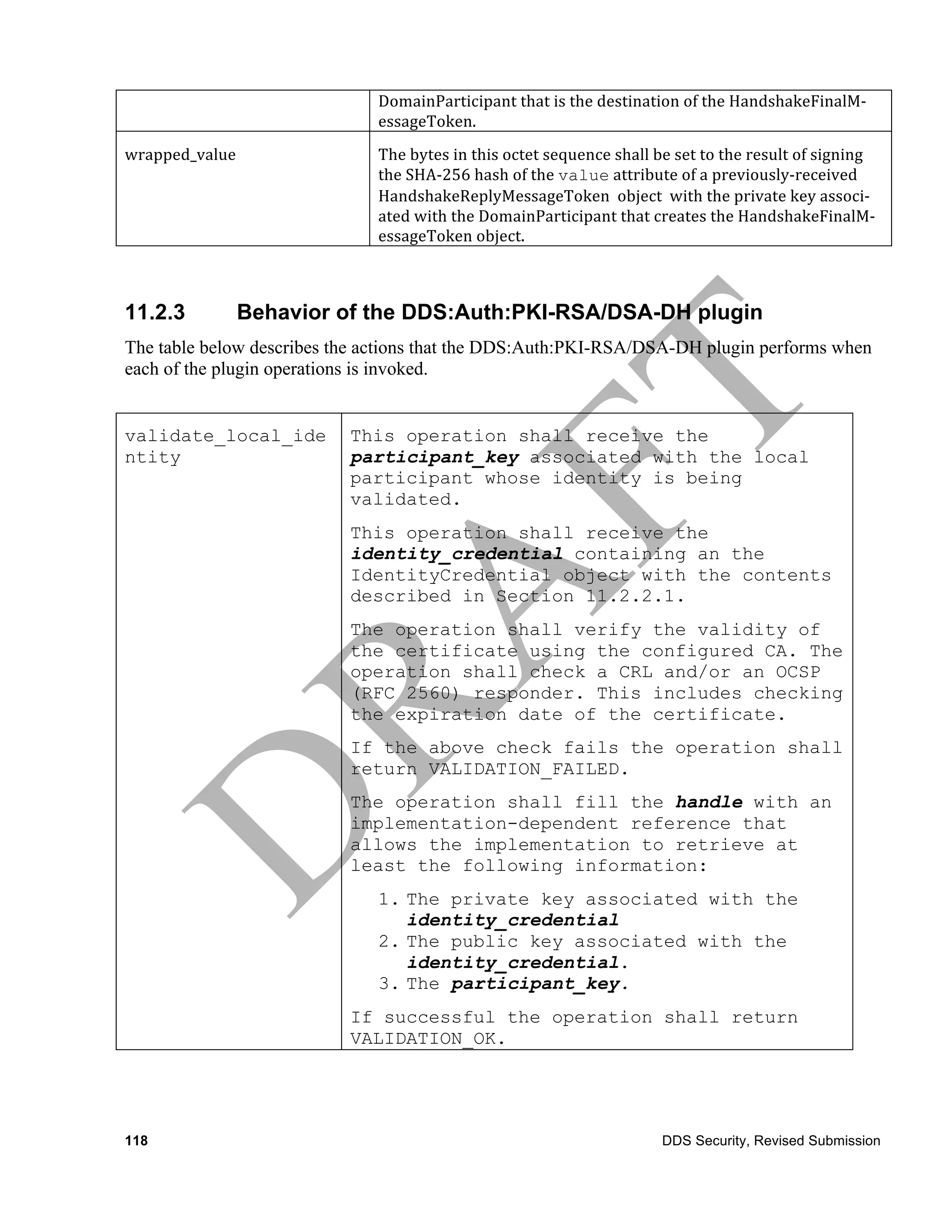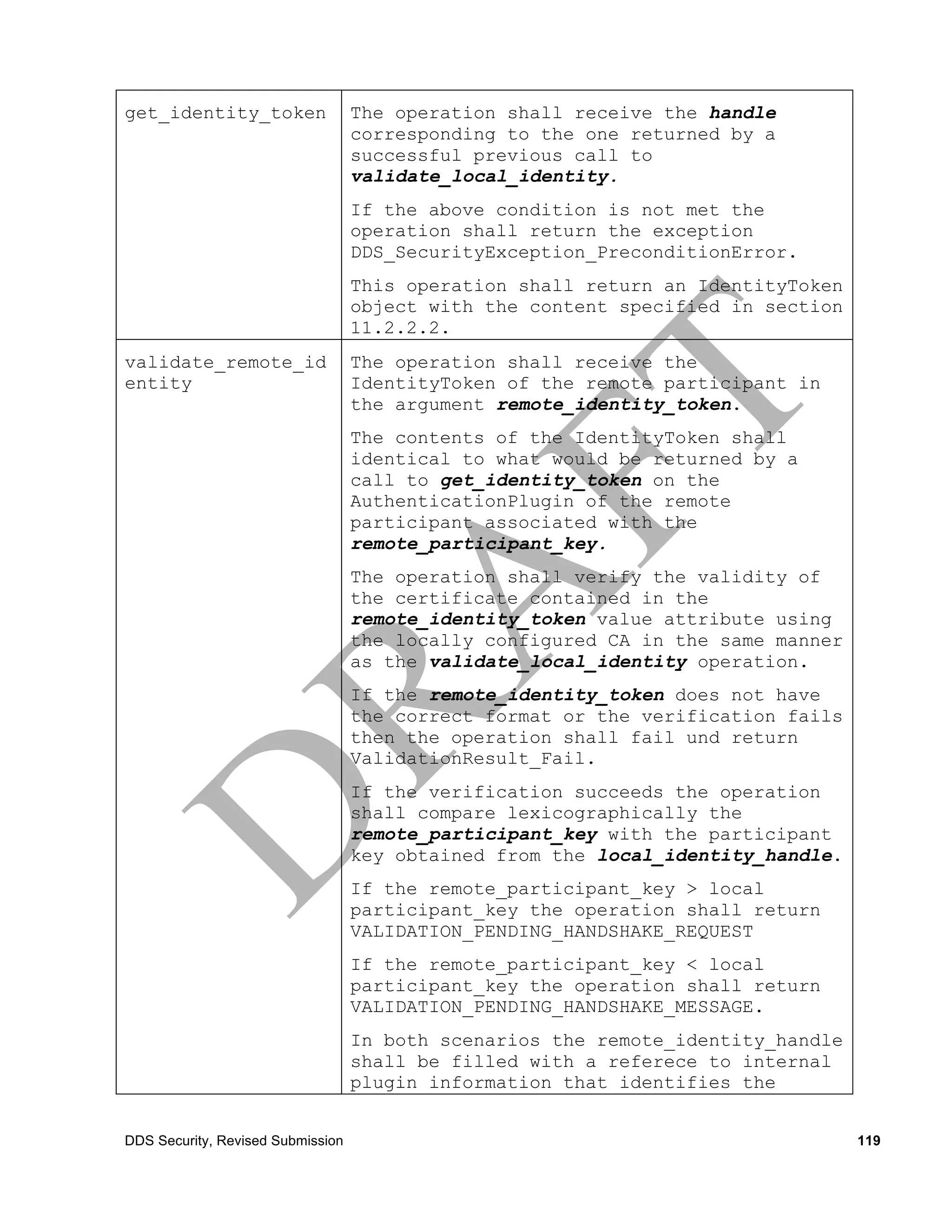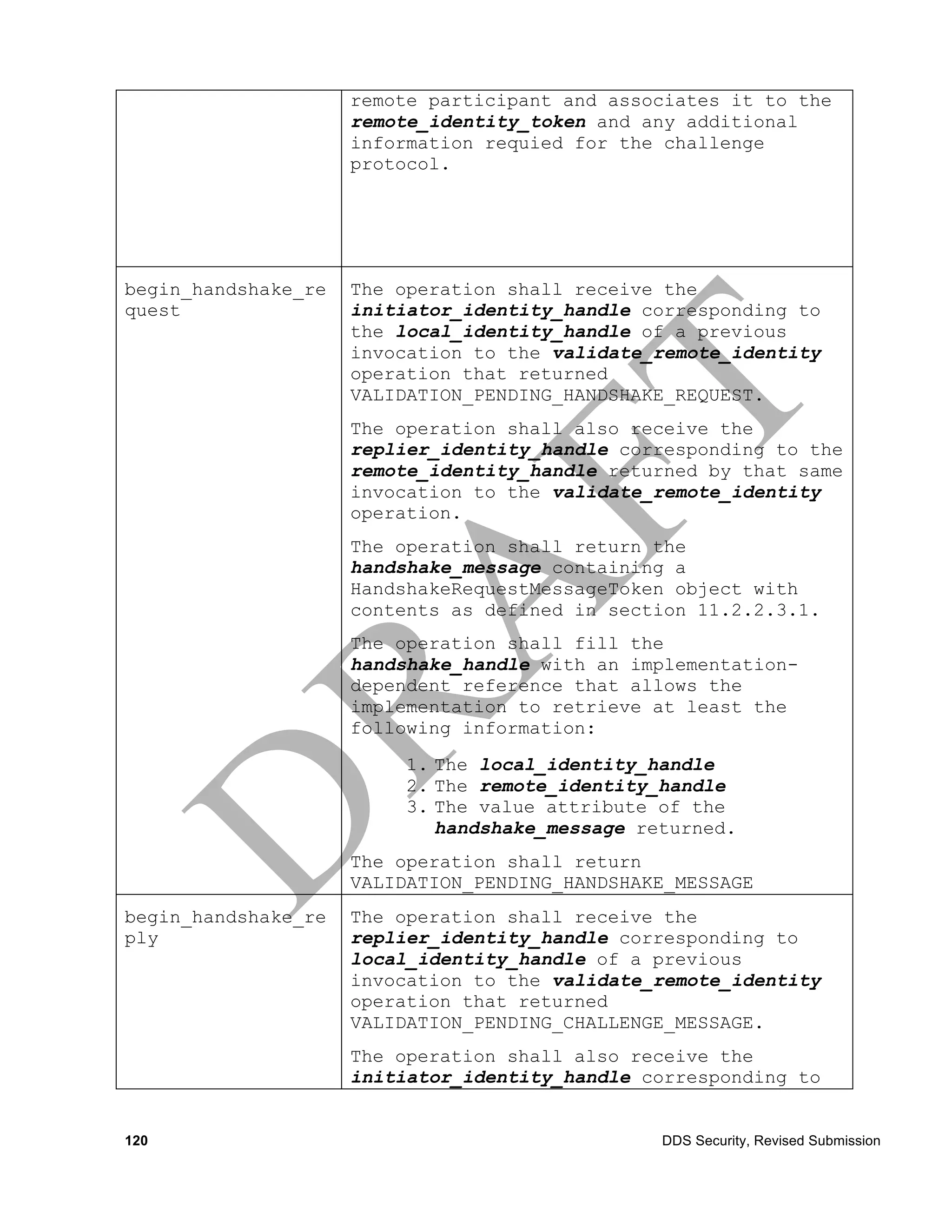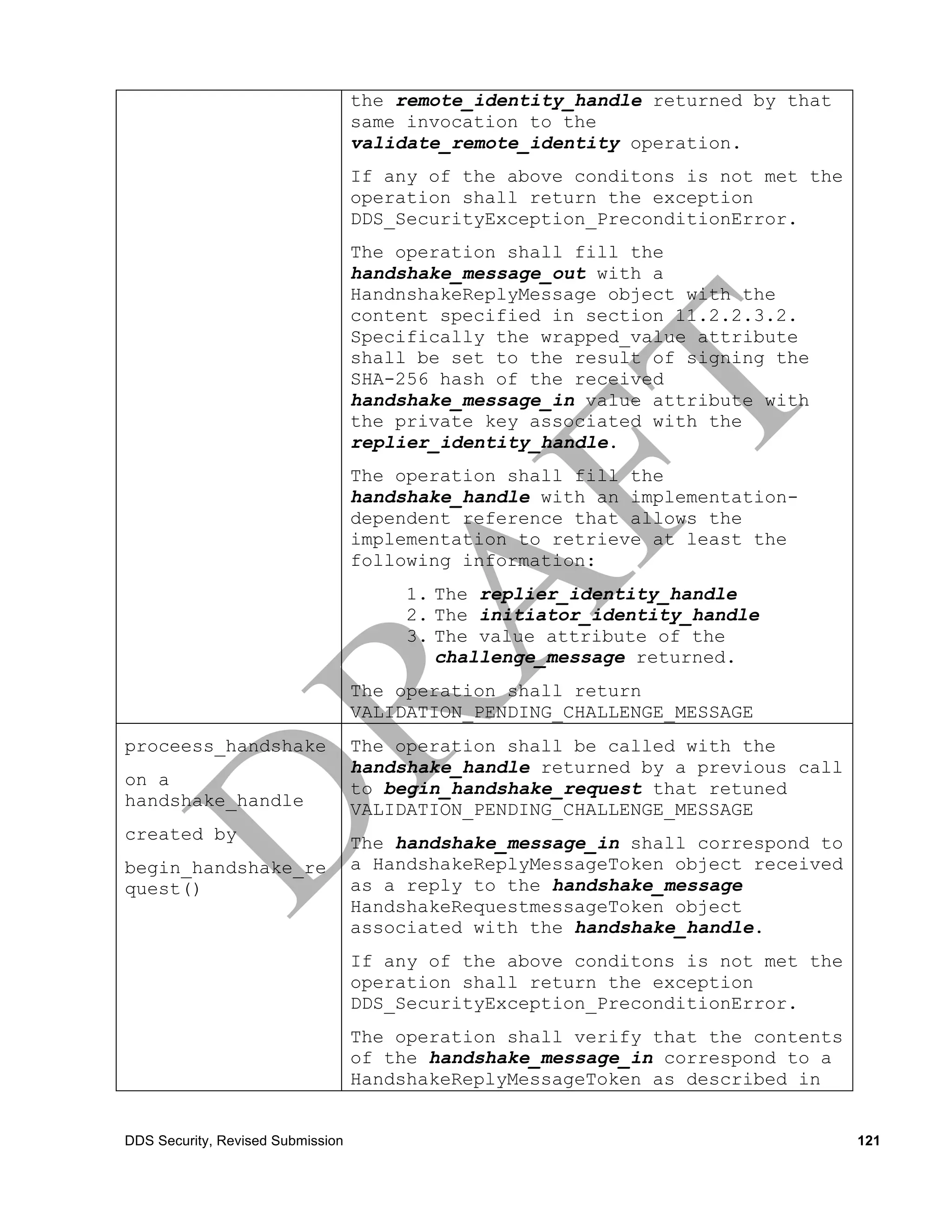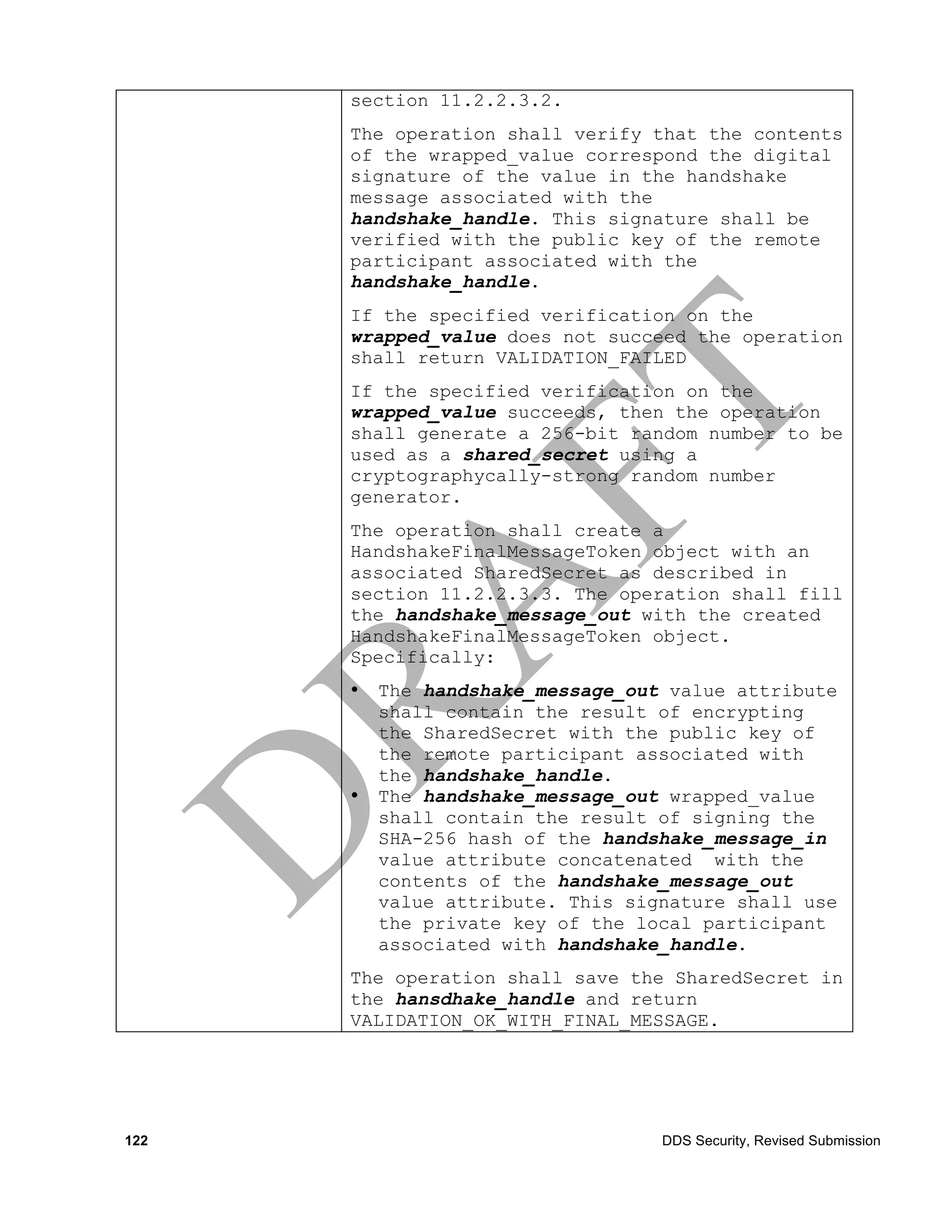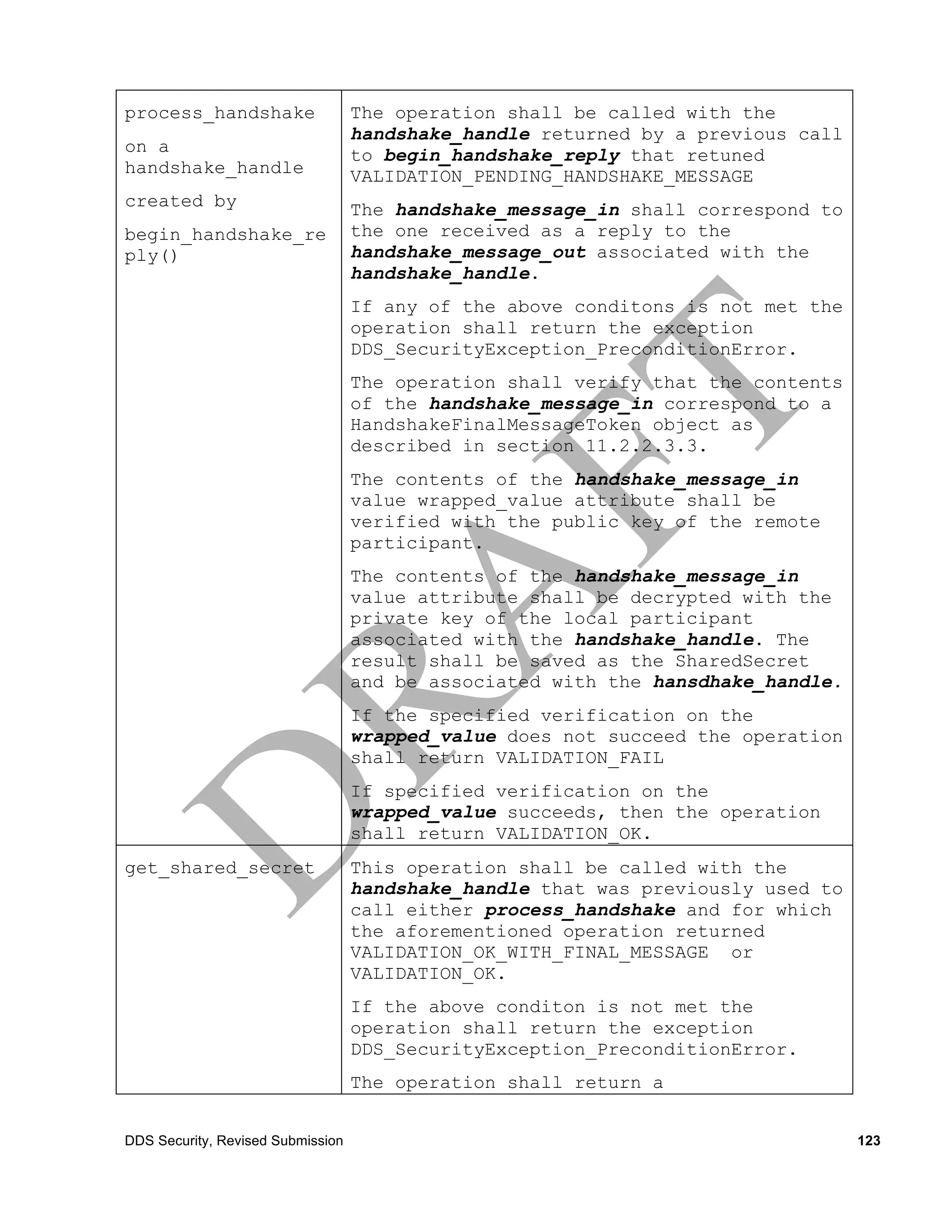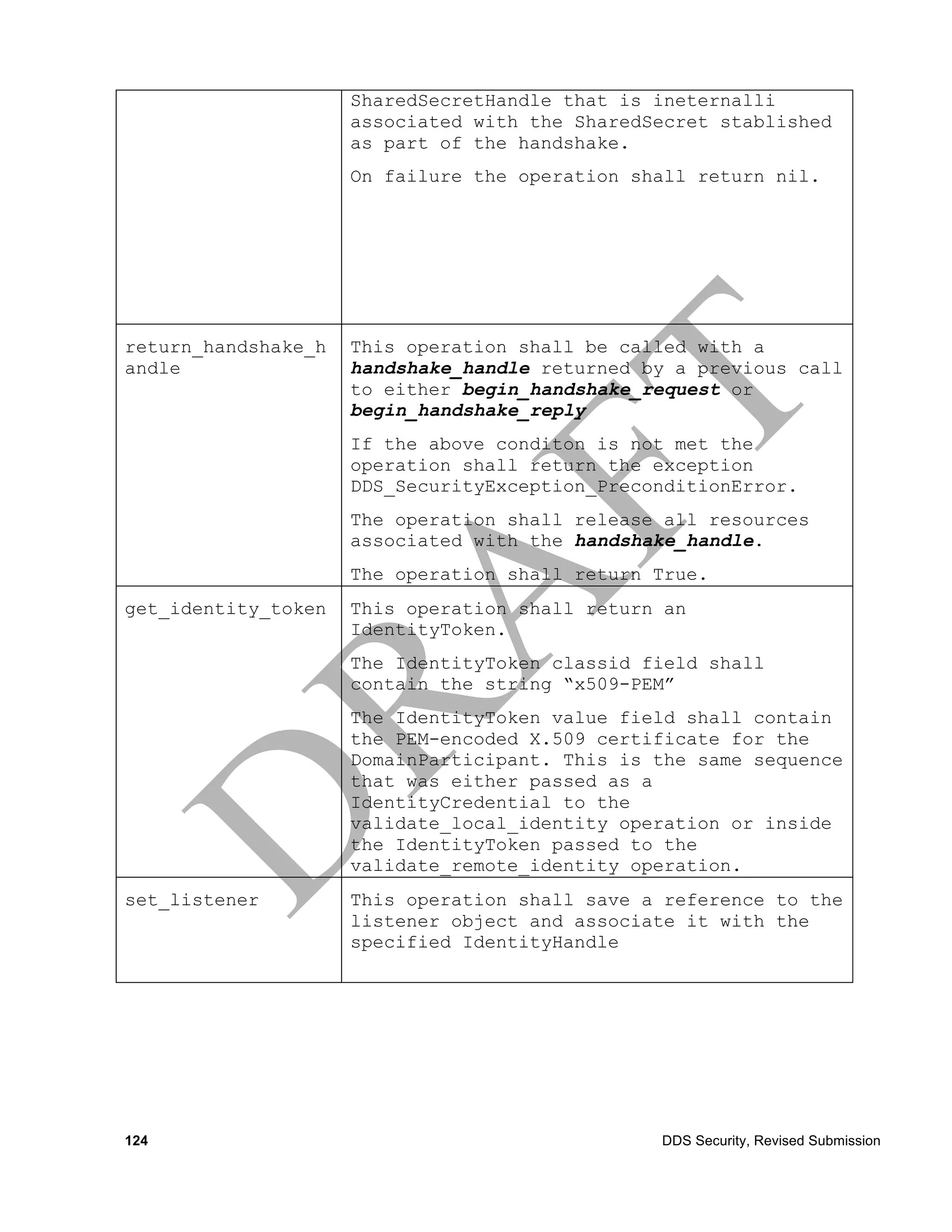





Date: March 2013 revised submission


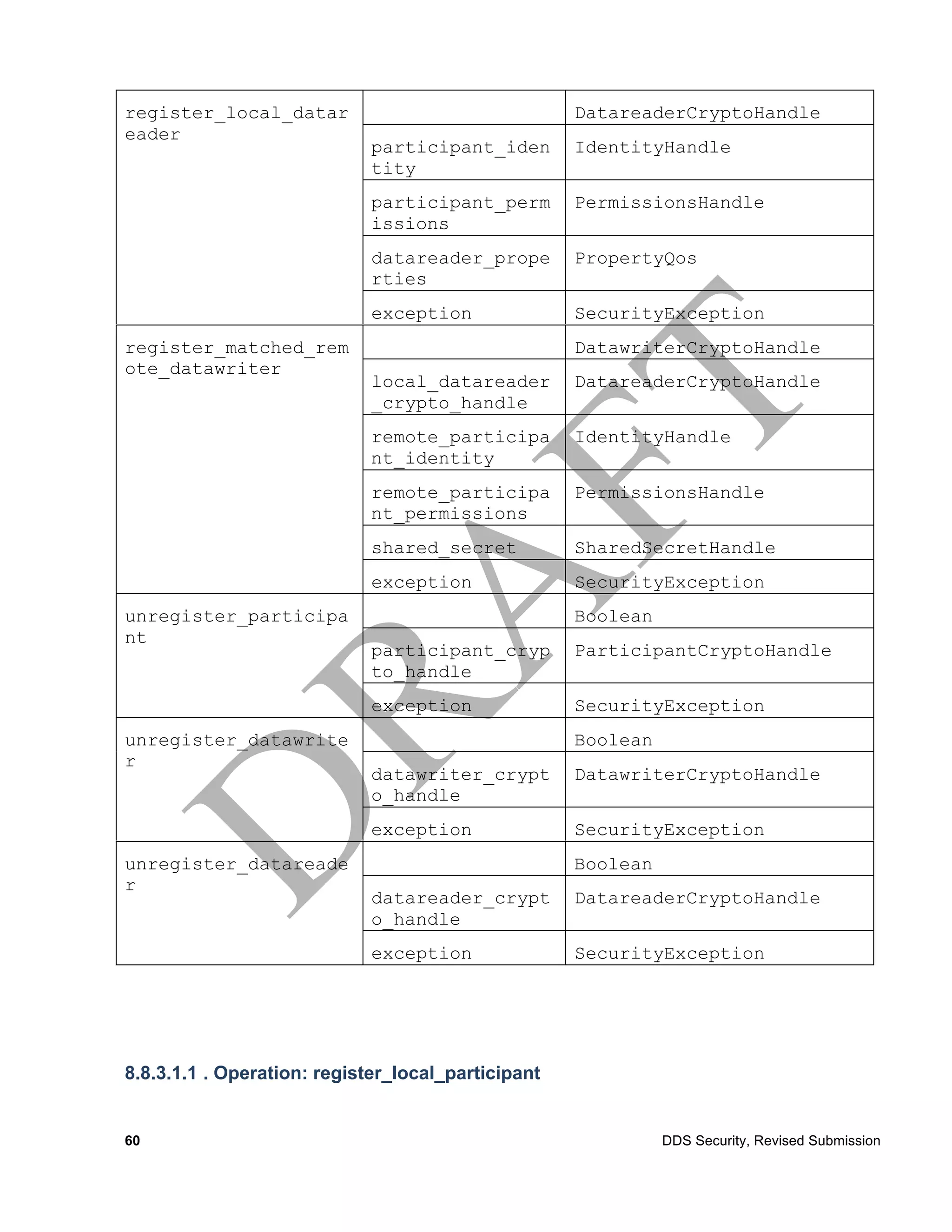
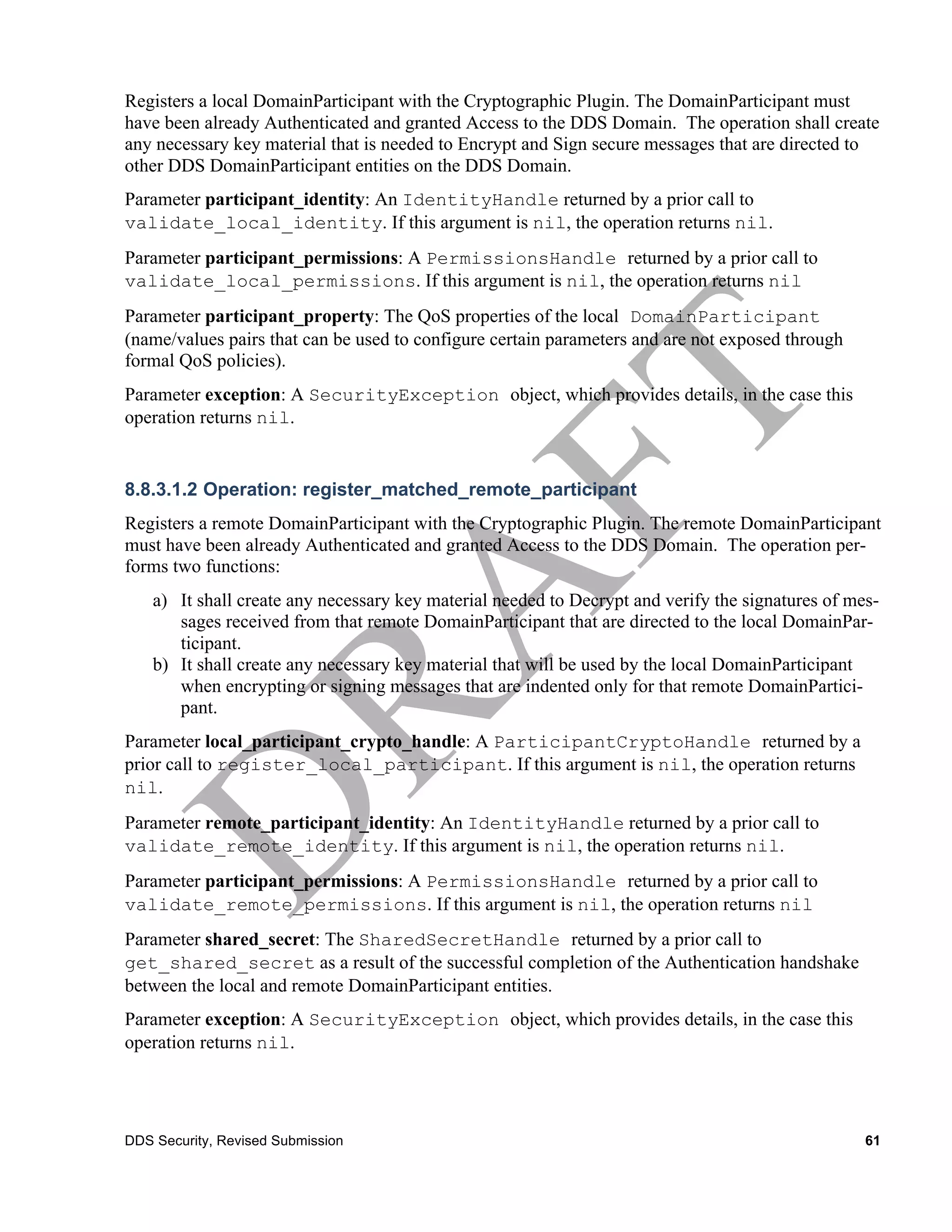
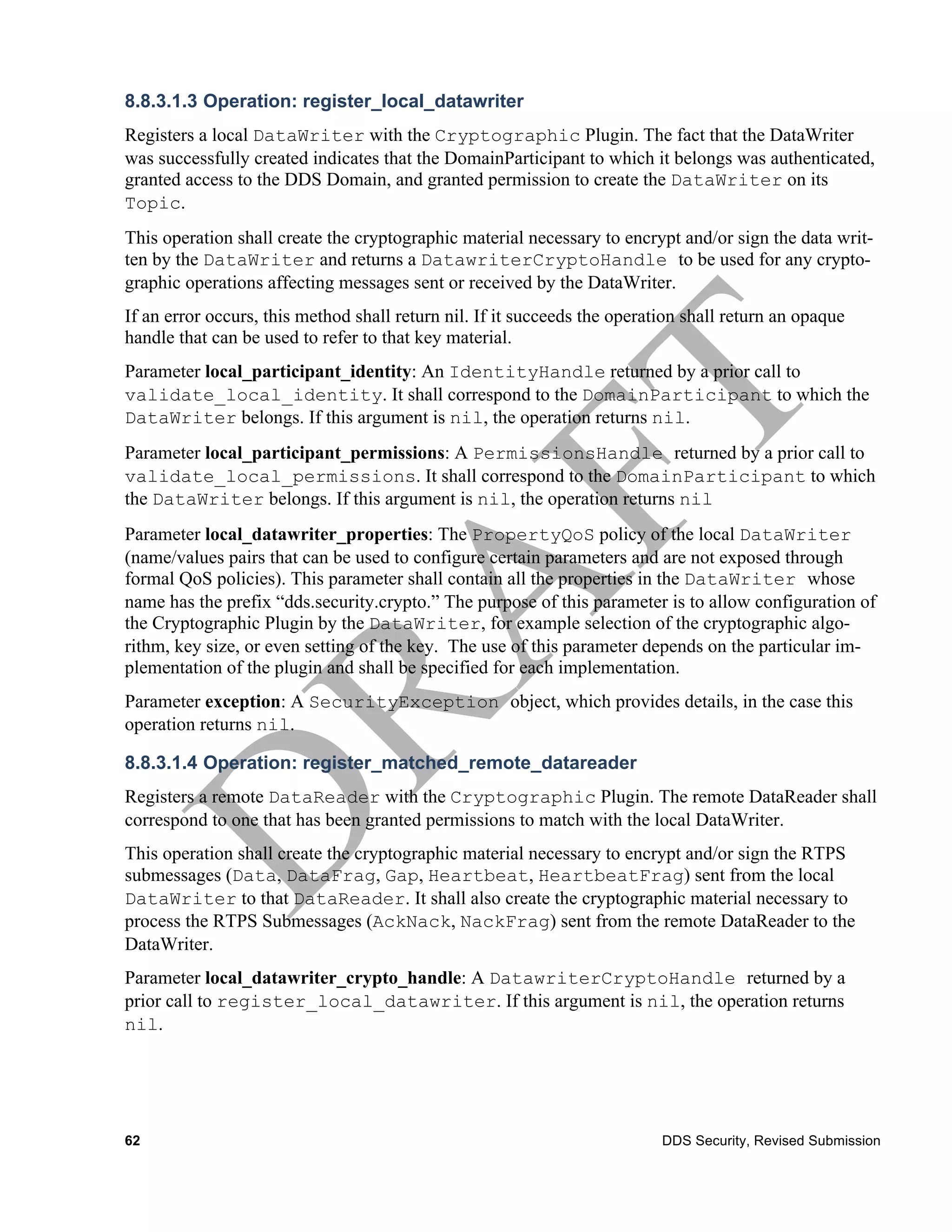
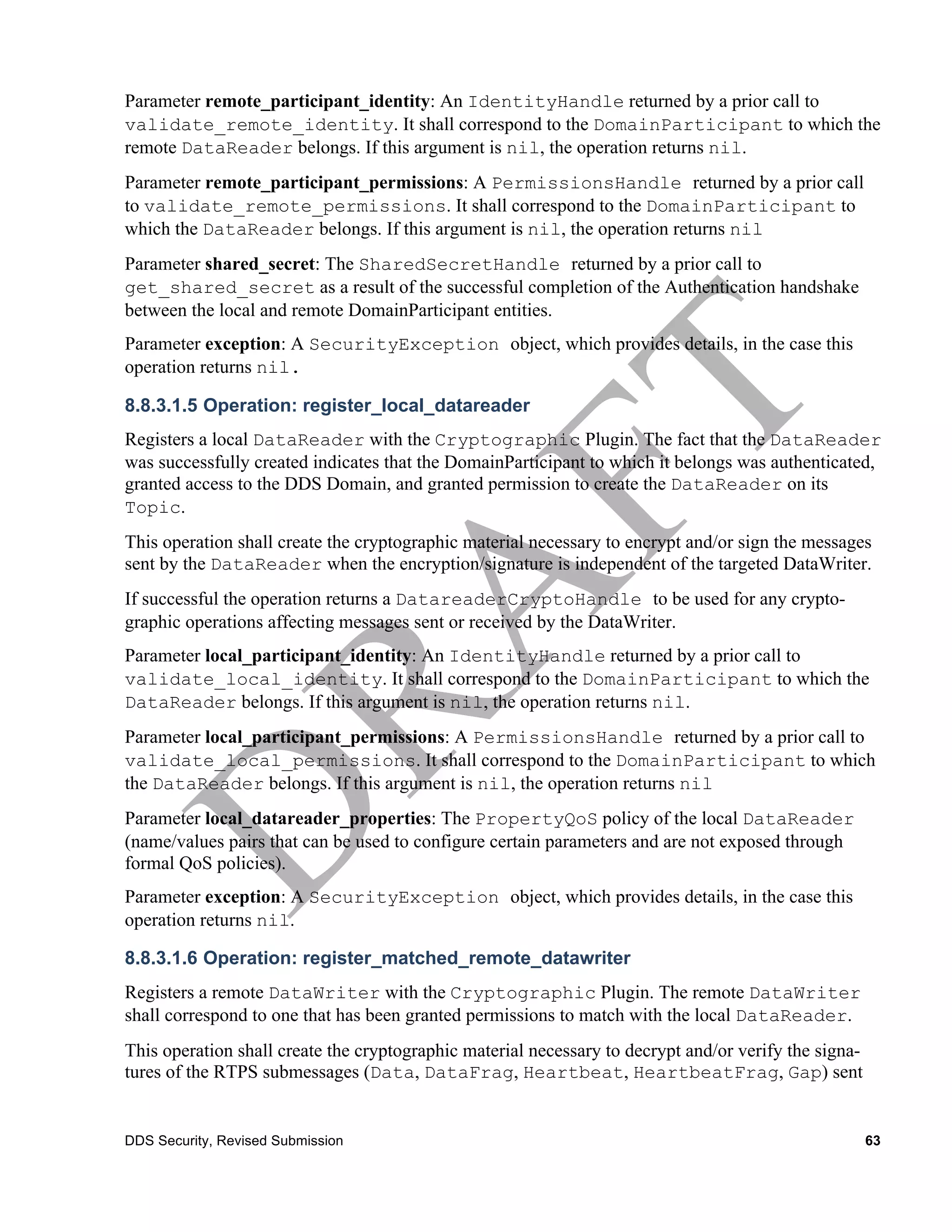
DDS Security


Joint Revised Submission


____________________________________________________
OMG Document: dds/2013-02-15
(March 2013 revised submission)

________________________________________________

Submission Contacts:
Gerardo Pardo-Castellote, Ph.D. (lead)
CTO, Real-Time Innovations, Inc.
gerardo@rti.com
Jaime Martin-Losa
CTO, eProsima.
jaime.martin@eprosima.com
Angelo Corsaro, Ph.D.
CTO, PrimsTech.
angelo.corsaro@prismtech.com
Copyright © 2011, Object Management Group, Inc. (OMG)
Copyright © 2010, Real-Time Innovations, Inc. (RTI)


                 USE OF SPECIFICATION - TERMS, CONDITIONS & NOTICES

The material in this document details an Object Management Group specification in accordance
with the terms, conditions and notices set forth below. This document does not represent a
commitment to implement any portion of this specification in any company's products. The
information contained in this document is subject to change without notice.


                                            LICENSES

The company listed above have granted to the Object Management Group, Inc. (OMG) a
nonexclusive, royalty-free, paid up, worldwide license to copy and distribute this document and
to modify this document and distribute copies of the modified version. Each of the copyright
holders listed above has agreed that no person shall be deemed to have infringed the copyright in
the included material of any such copyright holder by reason of having used the specification set
forth herein or having conformed any computer software to the specification.
Subject to all of the terms and conditions below, the owners of the copyright in this specification
hereby grant you a fully-paid up, non-exclusive, nontransferable, perpetual, worldwide license
(without the right to sublicense), to use this specification to create and distribute software and
special purpose specifications that are based upon this specification, and to use, copy, and
distribute this specification as provided under the Copyright Act; provided that: (1) both the
copyright notice identified above and this permission notice appear on any copies of this
specification; (2) the use of the specifications is for informational purposes and will not be
copied or posted on any network computer or broadcast in any media and will not be otherwise
resold or transferred for commercial purposes; and (3) no modifications are made to this
specification. This limited permission automatically terminates without notice if you breach any
of these terms or conditions. Upon termination, you will destroy immediately any copies of the
specifications in your possession or control.


                                            PATENTS
The attention of adopters is directed to the possibility that compliance with or adoption of OMG
specifications may require use of an invention covered by patent rights. OMG shall not be
responsible for identifying patents for which a license may be required by any OMG
specification, or for conducting legal inquiries into the legal validity or scope of those patents
that are brought to its attention. OMG specifications are prospective and advisory only.
Prospective users are responsible for protecting themselves against liability for infringement of
patents.
GENERAL USE RESTRICTIONS

Any unauthorized use of this specification may violate copyright laws, trademark laws, and
communications regulations and statutes. This document contains information, which is
protected by copyright. All Rights Reserved. No part of this work covered by copyright herein
may be reproduced or used in any form or by any means--graphic, electronic, or mechanical,
including photocopying, recording, taping, or information storage and retrieval systems--without
permission of the copyright owner.


                                 DISCLAIMER OF WARRANTY
WHILE THIS PUBLICATION IS BELIEVED TO BE ACCURATE, IT IS PROVIDED "AS
IS" AND MAY CONTAIN ERRORS OR MISPRINTS. THE OBJECT MANAGEMENT
GROUP AND THE COMPANIES LISTED ABOVE MAKE NO WARRANTY OF ANY
KIND, EXPRESS OR IMPLIED, WITH REGARD TO THIS PUBLICATION, INCLUDING
BUT NOT LIMITED TO ANY WARRANTY OF TITLE OR OWNERSHIP, IMPLIED
WARRANTY OF MERCHANTABILITY OR WARRANTY OF FITNESS FOR A
PARTICULAR PURPOSE OR USE. IN NO EVENT SHALL THE OBJECT MANAGEMENT
GROUP OR ANY OF THE COMPANIES LISTED ABOVE BE LIABLE FOR ERRORS
CONTAINED HEREIN OR FOR DIRECT, INDIRECT, INCIDENTAL, SPECIAL,
CONSEQUENTIAL, RELIANCE OR COVER DAMAGES, INCLUDING LOSS OF
PROFITS, REVENUE, DATA OR USE, INCURRED BY ANY USER OR ANY THIRD
PARTY IN CONNECTION WITH THE FURNISHING, PERFORMANCE, OR USE OF THIS
MATERIAL, EVEN IF ADVISED OF THE POSSIBILITY OF SUCH DAMAGES.
The entire risk as to the quality and performance of software developed using this specification is
borne by you. This disclaimer of warranty constitutes an essential part of the license granted to
you to use this specification.


                                 RESTRICTED RIGHTS LEGEND
Use, duplication or disclosure by the U.S. Government is subject to the restrictions set forth in
subparagraph (c) (1) (ii) of The Rights in Technical Data and Computer Software Clause at
DFARS 252.227-7013 or in subparagraph (c)(1) and (2) of the Commercial Computer Software -
Restricted Rights clauses at 48 C.F.R. 52.227-19 or as specified in 48 C.F.R. 227-7202-2 of the
DoD F.A.R. Supplement and its successors, or as specified in 48 C.F.R. 12.212 of the Federal
Acquisition Regulations and its successors, as applicable. The specification copyright owners are
as indicated above and may be contacted through the Object Management Group, 140 Kendrick
Street, Needham, MA 02494, U.S.A.


                                         TRADEMARKS

MDA®, Model Driven Architecture®, UML®, UML Cube logo®, OMG Logo®, CORBA® and
XMI® are registered trademarks of the Object Management Group, Inc., and Object
Management Group™, OMG™ , Unified Modeling Language™, Model Driven Architecture
Logo™, Model Driven Architecture Diagram™, CORBA logos™, XMI Logo™, CWM™,
CWM Logo™, IIOP™ , MOF™ , OMG Interface Definition Language (IDL)™ , and OMG
SysML™ are trademarks of the Object Management Group. All other products or company
names mentioned are used for identification purposes only, and may be trademarks of their
respective owners.


                                         COMPLIANCE
The copyright holders listed above acknowledge that the Object Management Group (acting
itself or through its designees) is and shall at all times be the sole entity that may authorize
developers, suppliers and sellers of computer software to use certification marks, trademarks or
other special designations to indicate compliance with these materials.
Software developed under the terms of this license may claim compliance or conformance with
this specification if and only if the software compliance is of a nature fully matching the
applicable compliance points as stated in the specification. Software developed only partially
matching the applicable compliance points may claim only that the software was based on this
specification, but may not claim compliance or conformance with this specification. In the event
that testing suites are implemented or approved by Object Management Group, Inc., software
developed using this specification may claim compliance or conformance with the specification
only if the software satisfactorily completes the testing suites.
OMG’s Issue Reporting Procedure

All OMG specifications are subject to continuous review and improvement. As part of this proc-
ess we encourage readers to report any ambiguities, inconsistencies, or inaccuracies they may
find by completing the Issue Reporting Form listed on the main web page http://www.omg.org,
under Documents, Report a Bug/Issue (http://www.omg.org/technology/agreement.)
Table of Contents
1	
   Response	
  Details .....................................................................................................................1	
  
   1.1	
   OMG	
  RFP	
  Response ....................................................................................................................... 1	
  
   1.2	
   Copyright	
  Waiver........................................................................................................................... 1	
  
   1.3	
   Contacts ........................................................................................................................................ 1	
  
   1.4	
   Problem	
  Statement ....................................................................................................................... 1	
  
   1.5	
   Overview	
  of	
  this	
  Specification ....................................................................................................... 2	
  
   1.6	
   Design	
  Rationale............................................................................................................................ 4	
  
   1.7	
   Statement	
  of	
  Proof	
  of	
  Concept ...................................................................................................... 4	
  
   1.8	
   Resolution	
  of	
  RFP	
  Requirements	
  and	
  Requests.............................................................................. 4	
  
   1.9	
   Responses	
  to	
  RFP	
  Issues	
  to	
  be	
  discussed........................................................................................ 4	
  
2	
   Scope ......................................................................................................................................6	
  
3	
   Conformance...........................................................................................................................6	
  
   3.1	
   Changes	
  to	
  Adopted	
  OMG	
  Specifications ....................................................................................... 6	
  
   3.2	
   Compliance	
  Levels ......................................................................................................................... 6	
  
4	
   Normative	
  References .............................................................................................................7	
  
5	
   Terms	
  and	
  Definitions .............................................................................................................7	
  
6	
   Symbols...................................................................................................................................7	
  
7	
   DDS	
  Security............................................................................................................................8	
  
   7.1	
   Security	
  Model .............................................................................................................................. 8	
  
       7.1.1	
   Threats ...........................................................................................................................................9	
  
   7.2	
   Securing	
  DDS	
  Messages ............................................................................................................... 12	
  
       7.2.1	
   RTPS	
  Background	
  (Non-­‐Normative) .............................................................................................12	
  
       7.2.2	
   Secure	
  RTPS	
  Messages .................................................................................................................14	
  
       7.2.3	
   Platform	
  Independent	
  Description...............................................................................................15	
  
       7.2.4	
   Mapping	
  to	
  UDP/IP	
  PSM ..............................................................................................................17	
  
8	
   Plug-­‐in	
  Architecture............................................................................................................... 18	
  
   8.1	
   Security	
  Exception ....................................................................................................................... 20	


DDS Security, Revised Submission                                                                                                                                       i
8.1.1	
   Operation:	
  init..........................................................................................................................21	
  

        8.1.2	
   Operation:	
  get_message .........................................................................................................21	
  

        8.1.3	
   Operation:	
  get_code ................................................................................................................21	
  

        8.1.4	
   Operation:	
  get_minor_code ..................................................................................................21	
  

     8.2	
   Property ...................................................................................................................................... 21	
  
     8.3	
   Credential.................................................................................................................................... 22	
  
        8.3.1	
   Attribute:	
  credential_classid ..........................................................................................23	
  

        8.3.2	
   Attribute:	
  properties .............................................................................................................23	
  
        8.3.3	
   Attribute:	
  value .........................................................................................................................23	
  

     8.4	
   Token .......................................................................................................................................... 23	
  
        8.4.1	
   Attribute:	
  token_classid ......................................................................................................24	
  

        8.4.2	
   Attribute:	
  wrapper_classid .................................................................................................24	
  

        8.4.3	
   Attribute:	
  properties .............................................................................................................24	
  
        8.4.4	
   Attribute:	
  value .........................................................................................................................25	
  

        8.4.5	
   Attribute:	
  wrapped_value ......................................................................................................25	
  

     8.5	
   DDS	
  support	
  for	
  plugin	
  message	
  exchange .................................................................................. 25	
  
        8.5.1	
   ParticipantMessageData	
  kinds	
  reserved	
  by	
  this	
  specification .....................................................26	
  
        8.5.2	
   Format	
  of	
  data	
  within	
  ParticipantMessageData ..........................................................................26	
  
     8.6	
   Authentication	
  Plug-­‐in................................................................................................................. 27	
  
        8.6.1	
   Background	
  (Non-­‐Normative) ......................................................................................................27	
  
        8.6.2	
   Authentication	
  Plug-­‐in	
  Model ......................................................................................................28	
  
     8.7	
   Access	
  Control	
  Plug-­‐In ................................................................................................................. 40	
  
        8.7.1	
   Background	
  (Non-­‐Normative) ......................................................................................................40	
  
        8.7.2	
   Access	
  Control	
  Plug-­‐in	
  Model.......................................................................................................41	
  
     8.8	
   Cryptographic	
  Plug-­‐in .................................................................................................................. 56	
  
        8.8.1	
   Cryptographic	
  Plug-­‐in	
  Model........................................................................................................56	
  
        8.8.2	
   Attribute:	
  transformation_kind_id.................................................................................58	
  

        8.8.3	
   Attribute:	
  transformation_key_id ...................................................................................58	
  

     8.9	
   The	
  Logging	
  Plugin....................................................................................................................... 86	
  
        8.9.1	
   Background	
  (Non-­‐Normative) ......................................................................................................86	


ii                                                                                                                   DDS Security, Revised Submission
8.9.2	
   Logging	
  Plug-­‐in	
  Model ..................................................................................................................86	
  
   8.10	
   Data	
  Tagging.............................................................................................................................. 89	
  
       8.10.1	
   Background	
  (Non-­‐Normative) ....................................................................................................89	
  
       8.10.2	
   Approach ....................................................................................................................................89	
  
       8.10.3	
   DataTagging	
  Model ....................................................................................................................89	
  
   8.11	
   Security	
  Plug-­‐ins’	
  Behavior ........................................................................................................ 91	
  
       8.11.1	
   Authentication	
  and	
  AccessControl	
  behavior	
  with	
  local	
  DomainParticipant ..............................91	
  
       8.11.2	
   Authentication	
  behavior	
  with	
  remote	
  DomainParticipant.........................................................92	
  
       8.11.3	
   AccessControl	
  behavior	
  with	
  local	
  domain	
  entity	
  creation........................................................95	
  
       8.11.4	
   AccessControl	
  behavior	
  with	
  remote	
  entity	
  discovery ..............................................................96	
  
       8.11.5	
   Security	
  Plugins	
  behavior	
  for	
  key	
  propagation...........................................................................98	
  
       8.11.6	
   Security	
  Plugins	
  behavior	
  for	
  encoding/decoding....................................................................102	
  
9	
   Builtin	
  Plugins ..................................................................................................................... 111	
  
   9.1	
   Requirements	
  and	
  priorities ...................................................................................................... 111	
  
       9.1.1	
   Performance	
  and	
  Scalability.......................................................................................................112	
  
       9.1.2	
   Robustness	
  and	
  Availability........................................................................................................113	
  
       9.1.3	
   Fitness	
  to	
  the	
  DDS	
  Data-­‐Centric	
  Model......................................................................................113	
  
       9.1.4	
   Leverage	
  and	
  reuse	
  of	
  existing	
  security	
  infrastructure	
  and	
  technologies..................................114	
  
       9.1.5	
   Ease	
  of	
  use	
  while	
  supporting	
  common	
  application	
  requirements .............................................114	
  
   9.2	
   Builtin	
  Authentication:	
  DDS:Auth:PKI-­‐RSA/DSA-­‐DH ................................................................... 114	
  
       9.2.1	
   Configuration..............................................................................................................................115	
  
       9.2.2	
   DDS:Auth:PKI-­‐RSA/DSA-­‐DH	
  Types ..............................................................................................115	
  
       9.2.3	
   Behavior	
  of	
  the	
  DDS:Auth:PKI-­‐RSA/DSA-­‐DH	
  plugin....................................................................118	
  
       9.2.4	
   Wire	
  protocol	
  implemented	
  by	
  the	
  DDS:Auth:PKI-­‐RSA/DSA-­‐DH	
  plugin.....................................125	
  
   9.3	
   Builtin	
  Access	
  Control	
  Plugin:	
  DDS:Access:PKI-­‐Signed-­‐XML-­‐Permissions .................................... 127	
  
       9.3.1	
   Configuration..............................................................................................................................127	
  
       9.3.2	
   DDS:Access:PKI-­‐Signed-­‐XML-­‐Permissions	
  Types ........................................................................131	
  
       9.3.3	
   Behavior	
  of	
  the	
  builtin	
  Access	
  Control	
  Plugin ............................................................................132	
  
   9.4	
   Builtin	
  Cryptographic	
  Plugin ...................................................................................................... 135	
  
       9.4.1	
   Configuration..............................................................................................................................136	


DDS Security, Revised Submission                                                                                                                                   iii
9.4.2	
   DDS:Crypto:AES-­‐CTR-­‐HMAC-­‐RSA/DSA-­‐DH	
  Types .......................................................................136	
  
        9.4.3	
   Behavior	
  of	
  the	
  DDS:Crypto:AES-­‐CTR-­‐HMAC-­‐RSA/DSA-­‐DH	
  Plugin .............................................140	
  
     9.5	
   Builtin	
  Logging	
  Plugin ................................................................................................................ 151	
  
References ................................................................................................................................ 151	


iv                                                                                                                DDS Security, Revised Submission
Preface

OMG
Founded in 1989, the Object Management Group, Inc. (OMG) is an open membership, not-for-profit
computer industry standards consortium that produces and maintains computer industry specifica-
tions for interoperable, portable, and reusable enterprise applications in distributed, heterogeneous
environments. Membership includes Information Technology vendors, end users, government agen-
cies, and academia.
OMG member companies write, adopt, and maintain its specifications following a mature, open
process. OMG’s specifications implement the Model Driven Architecture® (MDA®), maximizing
ROI through a full-lifecycle approach to enterprise integration that covers multiple operating sys-
tems, programming languages, middleware and networking infrastructures, and software develop-
ment environments. OMG’s specifications include: UML® (Unified Modeling Language™);
CORBA® (Common Object Request Broker Architecture); CWM™ (Common Warehouse Meta-
model); and industry-specific standards for dozens of vertical markets.
More information on the OMG is available at http://www.omg.org/.

OMG Specifications
As noted, OMG specifications address middleware, modeling and vertical domain frameworks. A
Specifications Catalog is available from the OMG website at:
http://www.omg.org/technology/documents/spec_catalog.htm
Specifications within the Catalog are organized by the following categories:

OMG Modeling Specifications
•   UML
•   MOF
•   XMI
•   CWM
•   Profile specifications

OMG Middleware Specifications
•   CORBA/IIOP
•   Data-Distribution Service (DDS) Specifications
•   IDL/Language Mappings


DDS Security, Revised Submission                                                                      v
•    Specialized CORBA specifications
•    CORBA Component Model (CCM)

Platform Specific Model and Interface Specifications
•    CORBAservices
•    CORBAfacilities
•    OMG Domain specifications
•    OMG Embedded Intelligence specifications
•    OMG Security specifications
All of OMG’s formal specifications may be downloaded without charge from our website. (Products
implementing OMG specifications are available from individual suppliers.) Copies of specifications,
available in PostScript and PDF format, may be obtained from the Specifications Catalog cited above
or by contacting the Object Management Group, Inc. at:


OMG Headquarters
140 Kendrick Street
Building A, Suite 300
Needham, MA 02494
USA
Tel: +1-781-444-0404
Fax: +1-781-444-0320
Email: pubs@omg.org
Certain OMG specifications are also available as ISO standards. Please consult http://www.iso.org.

Typographical Conventions
The type styles shown below are used in this document to distinguish programming statements from
ordinary English. However, these conventions are not used in tables or section headings where no
distinction is necessary.
Times/Times New Roman - 10 pt.: Standard body text
Helvetica/Arial - 10 pt. Bold: OMG Interface Definition Language (OMG IDL) and syntax
elements.
Courier - 10 pt. Bold: Programming language elements.
Helvetica/Arial - 10 pt: Exceptions
NOTE: Terms that appear in italics are defined in the glossary. Italic text also represents the name
of a document, specification, or other publication.


vi                                                                      DDS Security, Revised Submission
PART I - Introduction
 1 Response Details
 1.1 OMG RFP Response
 This specification is submitted in response to the DDS Security RFP issued in December 2010 with
 OMG document number mars/ /2010-12-37.

 1.2 Copyright Waiver
 “Each of the entities listed above: (i) grants to the Object Management Group, Inc. (OMG) a nonex-
 clusive, royalty-free, paid up, worldwide license to copy and distribute this document and to modify
 this document and distribute copies of the modified version, and (ii) grants to each member of the
 OMG a nonexclusive, royalty-free, paid up, worldwide license to make up to fifty (50) copies of this
 document for internal review purposes only and not for distribution, and (iii) has agreed that no per-
 son shall be deemed to have infringed the copyright in the included material of any such copyright
 holder by reason of having used any OMG specification that may be based hereon or having con-
 formed any computer software to such specification.”

 1.3 Contacts
     •   Real-Time Innovations – Gerardo Pardo-Castellote, Ph.D. gerardo.pardo@rti.com
     •   eProsima – Jaime Martin-Losa Jaime.martin@eprosima.com
     •   PrimsTech – Angelo Corsaro, Ph.D. Angelo.Corsaro@prismtech.com

 1.4 Problem Statement
 Current DDS Systems meet Information Assurance requirements by isolating DDS applications into
 a security enclave running at "system high". Inside the "protected domain" applications are author-
 ized to publish and subscribe to any data in the DDS Global Data Space. Once inside the protected
 domain applications are not authenticated; unless done at the application layer data and meta-data is
 sent unencrypted and it is not protected against tampering, data is often sent using multicast. Stated
 differently, the standard OMG DDS infrastructure provides no guarantees (other than those provided
 by the physical protection of the system) on confidentiality, pedigree, or integrity of the information.
 What is needed is a set of Information Assurance extensions to the DDS standard that provide the
 necessary support for Authentication, Authorization and Access Control, Confidentiality, Integrity,
 and Non-repudiation for all the data sent over DDS. Moreover, a Security Auditing capability is also
 necessary to evaluate the state of the global data space.
 One possible approach would be to enforce Mandatory Access Control (MAC) on all applications
 that join a DDS Global Data-Space, requiring them to be authenticated and have the necessary cre-


 DDS Security, Revised Submission                                                                       1
dentials. Beyond access to the DDS Global Data Space, the approach should provide finer-grain (e.g.
role-based or more generally, policy-based) access control to specific DDS Topics and perhaps even
to specific fields within DDS Topics. It should ensure confidentiality of the information, integrity,
pedigree, and non-repudiation. Finally, it should be able to handle the scalable publish-subscribe de-
ployment scenarios, specifically the one-to-many (multicast) distribution of encrypted information
and maintain the DDS real-time QoS in the distribution of information to multiple subscribers.
The required Security Architecture needs to be configurable (e.g. via newly added QoS polices) to
provide simple access to standard, interoperable, pre-defined security policies out-of-the box. At the
same time, the architecture should remain open and extensible (e.g. via “plug-in” SPIs) so that appli-
cation developers can integrate with pre-existing Identity Management Mechanisms, Authorization
Policy repositories, or cryptographic libraries, which might be program or project specific.

1.5 Overview of this Specification
This specification defines the Security Model and Service Plugin Interface (SPI) architecture for
compliant DDS implementations. The DDS Security Model is enforced by the invocation of these
SPIs by the DDS implementation. This specification also defines a set of built-in implementations of
these SPIs.
    •   The specified built-in SPI implementations enable both out-of-the box security and interoper-
        ability between compliant DDS applications.
    •   The use of SPIs allows DDS users to customize the behavior and technologies that the DDS
        implementations use for Information Assurance, specifically allowing customization of
        Authentication, Access Control, Encryption, Message Authentication, Digital Signing, Log-
        ging and Data Tagging.


2                                                                       DDS Security, Revised Submission
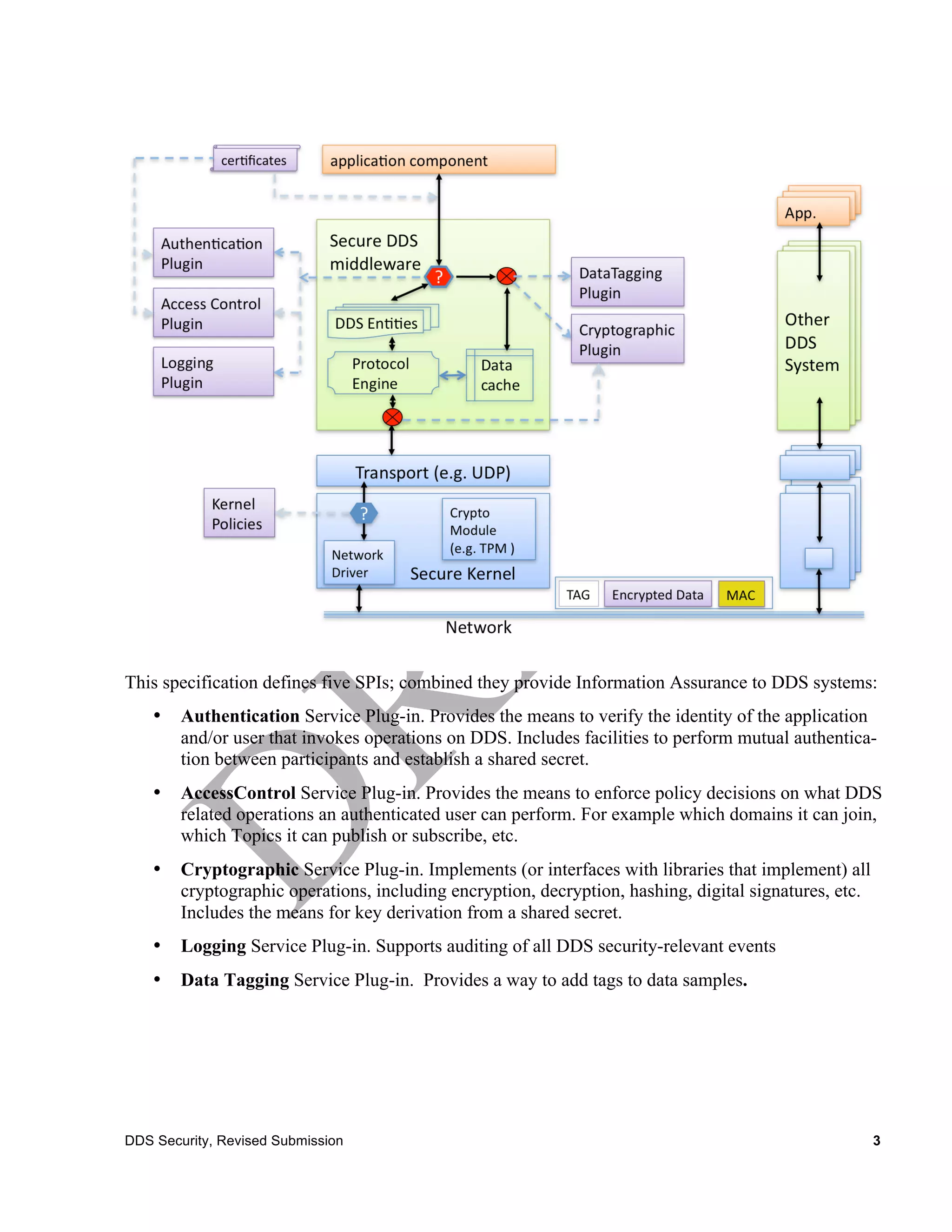
This specification defines five SPIs; combined they provide Information Assurance to DDS systems:
    •   Authentication Service Plug-in. Provides the means to verify the identity of the application
        and/or user that invokes operations on DDS. Includes facilities to perform mutual authentica-
        tion between participants and establish a shared secret.
    •   AccessControl Service Plug-in. Provides the means to enforce policy decisions on what DDS
        related operations an authenticated user can perform. For example which domains it can join,
        which Topics it can publish or subscribe, etc.
    •   Cryptographic Service Plug-in. Implements (or interfaces with libraries that implement) all
        cryptographic operations, including encryption, decryption, hashing, digital signatures, etc.
        Includes the means for key derivation from a shared secret.
    •   Logging Service Plug-in. Supports auditing of all DDS security-relevant events
    •   Data Tagging Service Plug-in. Provides a way to add tags to data samples.


DDS Security, Revised Submission                                                                        3
1.6 Design Rationale
1.7 Statement of Proof of Concept
1.8 Resolution of RFP Requirements and Requests
The specification resolves the following mandatory requirements:
Table 1. Mandatory RFP Requirements

Requirement   Description   Reference   Remarks

6.5.1
6.5.1
6.5.3
6.5.4
6.5.5
The proposed specification addresses the following optional requirements:
Table 2. Optional RFP Requirements

Requirement   Description   Reference   Remarks

6.6.1
6.6.2
6.6.3
6.6.4
6.6.5
6.6.6
6.6.7

6.6.8

1.9 Responses to RFP Issues to be discussed
The specification discusses the following issues:


4                                                                     DDS Security, Revised Submission
Table 3. RFP Issues to be Discussed

Issue   Description   Reference    Remarks

6.7.1
6.7.2
6.7.3
6.7.4
6.7.5


DDS Security, Revised Submission             5
PART II – PIM and Language PSMs
for DDS Security
 2 Scope
 This submission adds an additional “DDS Security Support” compliance point (“profile”) to the DDS
 Specification with the following scope:
     •   Authentication Plug-in
     •   Access Control Plug-in
     •   Data Tagging API
     •   Cryptography Plug-in
     •   Key Management Plug-in
     •   Logging Plug-in

 3 Conformance
 3.1 Changes to Adopted OMG Specifications
 This specification does not modify any existing adopted OMG specifications. It adds functionality on
 top of the current OMG specifications.
     •   DDS: This specification does not modify or invalidate any existing DDS profiles or compli-
         ance levels.
     •   RTPS: This specification depends on the definitions of CDR “parameter list” data structures
         specified by RTPS. It does not require any modifications to RTPS, however it impacts
         interoperability with existing DDS/RTPS implementations. In particular, DDS/RTPS imple-
         mentations that do not implement this specification will not interoperate with implementa-
         tions that do implement the mechanisms introduced by this proposal. The interoperability is
         still achieved if the security mechanisms are disabled.
     •   IDL: This specification does not modify any existing IDL-related compliance levels.

 3.2 Compliance Levels
 There is a single compliance level to this specification. This compliance level shall be considered a
 “DDS Security” Profile of the DDS Specification.


 6                                                                        DDS Security, Revised Submission
4 Normative References
RFC 2014


5 Terms and Definitions
For the purposes of this specification, the following terms and definitions apply.
Data-Centric Publish-Subscribe (DCPS)

The mandatory portion of the DDS specification used to provide the functionality required for an ap-
plication to publish and subscribe to the values of data objects.
Data Distribution Service (DDS)

An OMG distributed data communications specification that allows Quality of Service policies to be
specified for data timeliness and reliability. It is independent of implementation languages.
Information Assurance

The practice of managing risks related to the use, processing, storage, and transmission of informa-
tion or data and the systems and processes used for those purposes.
Authentication
Security measure designed to establish the identity of a transmission, message, or originator.

Access Control

Mechanism that enables an authority to control access to areas and resources in a given physical fa-
cility or computer-based information system.
Confidentiality

Assurance that information is not disclosed to unauthorized individuals, processes, or devices.

Integrity

Protection against unauthorized modification or destruction of information.
Non-Repudiation

Assurance the sender of data is provided with proof of delivery and the recipient is provided with
proof of the sender's identity, so neither can later deny having processed the data.

6 Symbols
PKI
HMAC


DDS Security, Revised Submission                                                                       7
This specification does not define any symbols or abbreviations.

7 DDS Security
7.1 Security Model
The Security Model for DDS must define the security principals (users of the system), the objects
that are being secured, and the operations on the objects that are to be restricted. DDS applications
share information on DDS Global Data Spaces (called DDS Domains) where the information is or-
ganized into Topics and accessed by means of read and write operations on data-instances of those
Topics.
Ultimately what is being secured is a specific DDS Global Data Space (domain) and within the do-
main the ability to access (read or write) information (specific Topic or even Topic-Instances) in the
DDS Global Data Space.
Securing DDS means providing
    •   Confidentiality of the data samples
    •   Integrity of data samples and the messages that contain them
    •   Authentication of DDS writers and readers
    •   Authorization of DDS writers and readers
    •   Non-repudiation of data
To provide secure access to the DDS Global Data Space applications that use DDS must first be
authenticated, such that the identity of the application (and potentially the user that interacts with it)
can be established. Once authentication has been obtained, the next step is to enforce access control
decisions that determine whether the application is allowed to perform specific actions. Examples of
actions are: joining a DDS Domain, defining a new Topic, reading, or writing a specific DDS Topic,
and even reading or writing specific Topic instances (as identified by the value of the key fields in
the data). Enforcement of the access control shall be supported by cryptographic techniques such that
information confidentiality and integrity can be maintained, which in turn requires an infrastructure
to manage and distribute the necessary cryptographic keys.


8                                                                          DDS Security, Revised Submission
7.1.1 Threats
In order to understand the decisions made in the design of the plugins it is important to understand
some of the specific threats impacting applications that use DDS and DDS Interoperability Protocol
(RTPS).
Most relevant are four categories of threats:
    1. Unauthorized subscription
    2. Unauthorized publication
    3. Tampering and replay
    4. Unauthorized access to data
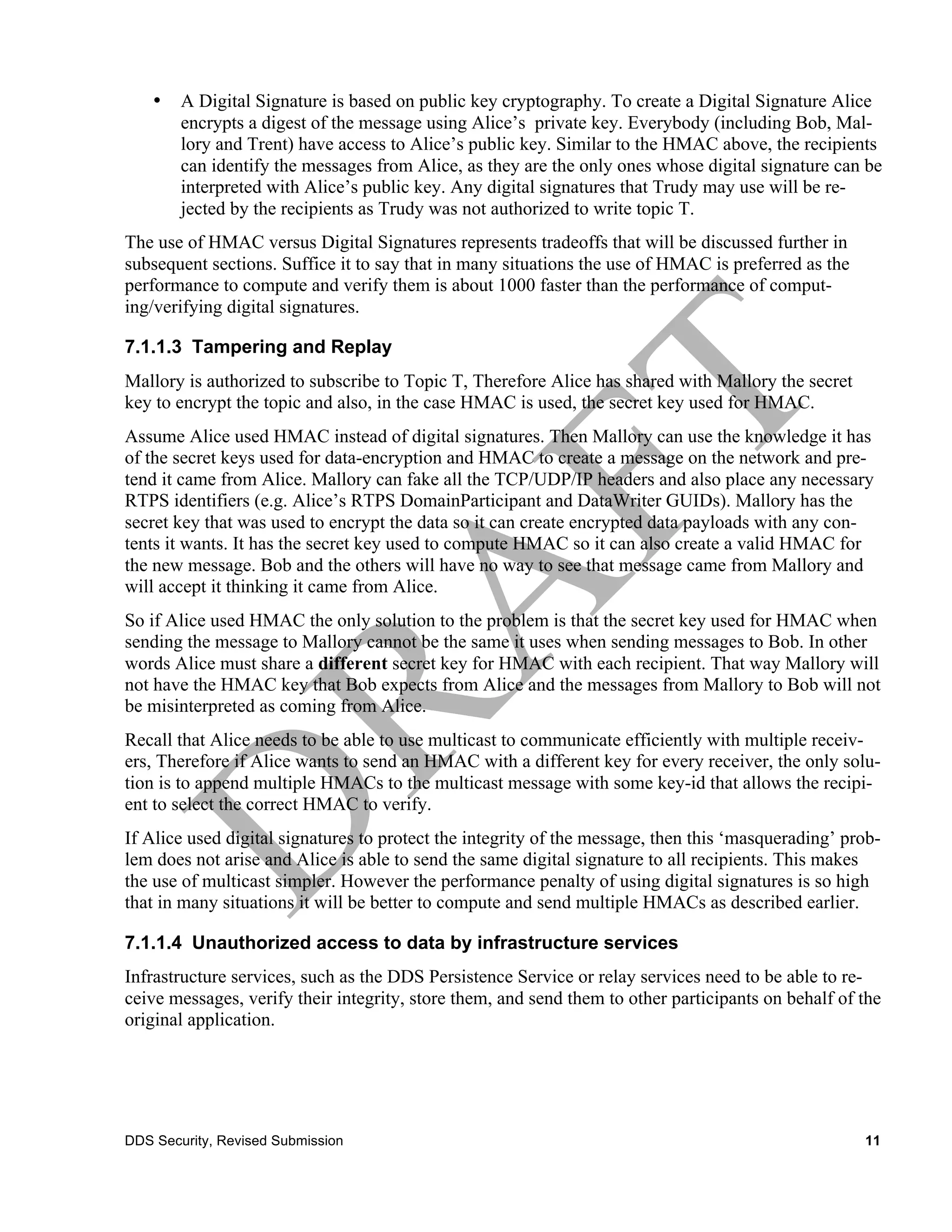
These threats are described in the context of a hypothetical communication scenario with 6 actors all
attached to the same network:
    •   Alice. A DDS DomainParticipant that is authorized to publish data on a Topic T.
    •   Bob. A DDS DomainParticipant that is authorized to subscribe to data on a Topic T.
    •   Eve. An eavesdropper. Someone that is not authorized to subscribe to data on Topic T.
        However Eve uses the fact that it is connected to the same network to try to see the data.
    •   Trudy. An intruder. A DomainParticipant that is not authorized to publish on Topic T.
        However Trudy uses the fact that it is connected to the same network to try to send data.
    •   Mallory. A Malicious DDS DomainParticipant. Mallory is authorized to subscribe to data on
        topic T but it is not authorized to publish on Topic T. However Mallory will try to use in-
        formation gained by subscribing to the data to publish in the network and try to convince Bob
        that she is a legitimate publisher.
    •   Trent. A Trusted service that needs to receive information on Topic T and also send it. For
        example, Trent can be a persistence service or a relay service. It is trusted to relay informa-
        tion without having malicious intent. However it is not trusted to see the content of the in-
        formation.


DDS Security, Revised Submission                                                                          9
7.1.1.1 Unauthorized Subscription
The DomainParticipant Eve is connected to the same network infrastructure and is able to observe
the network packets despite the fact that the messages are not intended to be sent to Eve. Many sce-
narios can lead to this situation. Eve could tap into a network switch or observe the communication
channels. Or in situations where Alice and Bob are communicating over multicast Eve could simply
subscribe to the same multicast address.
Protecting against Eve is reasonably simple. All that is required is for Alice to encrypt the data it
writes using a secret key that is only shared with authorized receivers such as Bob, Trent, and Mal-
lory.

7.1.1.2 Unauthorized Publication
The DomainParticipant Trudy is connected to the same network infrastructure and is able to inject
network packets with any data contents, headers and destination it wishes (e.g Alice). The network
infrastructure will route those packets to the indicated destination.
In order to protect against Trudy, Bob, Trent and Mallory need to realize that the data is not originat-
ing with Alice. They need to realize that the data is coming from someone not authorized to send
data on topic T and therefore reject (i.e. not process) the packet.
Protecting against Trudy is also reasonably simple. All that is required is for the protocol to require
that the messages include either a hash-based message authentication code (HMAC) or digital signa-
ture.
     •   An HMAC creates a message authentication code using a secret key that is shared with the
         intended recipients. Alice would only share the secret key with Bob, Mallory and Trent so
         that they recognize messages that originate in Alice. Since Trudy is not authorized to publish
         Topic T, Bob and the others will not recognize any HMACs that Trudy produces (i.e. they
         will not recognize Trudy’s key).


10                                                                        DDS Security, Revised Submission
•   A Digital Signature is based on public key cryptography. To create a Digital Signature Alice
        encrypts a digest of the message using Alice’s private key. Everybody (including Bob, Mal-
        lory and Trent) have access to Alice’s public key. Similar to the HMAC above, the recipients
        can identify the messages from Alice, as they are the only ones whose digital signature can be
        interpreted with Alice’s public key. Any digital signatures that Trudy may use will be re-
        jected by the recipients as Trudy was not authorized to write topic T.
The use of HMAC versus Digital Signatures represents tradeoffs that will be discussed further in
subsequent sections. Suffice it to say that in many situations the use of HMAC is preferred as the
performance to compute and verify them is about 1000 faster than the performance of comput-
ing/verifying digital signatures.

7.1.1.3 Tampering and Replay
Mallory is authorized to subscribe to Topic T, Therefore Alice has shared with Mallory the secret
key to encrypt the topic and also, in the case HMAC is used, the secret key used for HMAC.
Assume Alice used HMAC instead of digital signatures. Then Mallory can use the knowledge it has
of the secret keys used for data-encryption and HMAC to create a message on the network and pre-
tend it came from Alice. Mallory can fake all the TCP/UDP/IP headers and also place any necessary
RTPS identifiers (e.g. Alice’s RTPS DomainParticipant and DataWriter GUIDs). Mallory has the
secret key that was used to encrypt the data so it can create encrypted data payloads with any con-
tents it wants. It has the secret key used to compute HMAC so it can also create a valid HMAC for
the new message. Bob and the others will have no way to see that message came from Mallory and
will accept it thinking it came from Alice.
So if Alice used HMAC the only solution to the problem is that the secret key used for HMAC when
sending the message to Mallory cannot be the same it uses when sending messages to Bob. In other
words Alice must share a different secret key for HMAC with each recipient. That way Mallory will
not have the HMAC key that Bob expects from Alice and the messages from Mallory to Bob will not
be misinterpreted as coming from Alice.
Recall that Alice needs to be able to use multicast to communicate efficiently with multiple receiv-
ers, Therefore if Alice wants to send an HMAC with a different key for every receiver, the only solu-
tion is to append multiple HMACs to the multicast message with some key-id that allows the recipi-
ent to select the correct HMAC to verify.
If Alice used digital signatures to protect the integrity of the message, then this ‘masquerading’ prob-
lem does not arise and Alice is able to send the same digital signature to all recipients. This makes
the use of multicast simpler. However the performance penalty of using digital signatures is so high
that in many situations it will be better to compute and send multiple HMACs as described earlier.

7.1.1.4 Unauthorized access to data by infrastructure services
Infrastructure services, such as the DDS Persistence Service or relay services need to be able to re-
ceive messages, verify their integrity, store them, and send them to other participants on behalf of the
original application.


DDS Security, Revised Submission                                                                     11
These services can be trusted to not be malicious, however often it is not desirable to grant them the
privileges they would need to understand the contents of the data. They are allowed to store and for-
ward the data, but not to see inside the data.
Trent is an example of such service. To support deployment of these types of services it is necessary
that the security model supports the concept of having a participant, such as Trent, that is allowed to
receive, process, and relay RTPS messages, but is not allowed to see the contents of the data within
the message. In other words it can see the headers and sample information (writer GUID, sequence
numbers, keyhash and such) but not the message contents.
In order to support services like Trent, Alice needs to accept Trent as a valid destination to its mes-
sages on topic T and share with Trent only the secret key used to compute the HMAC for Trent, but
not the secret key used to encrypt the data itself. In addition Bob, Mallory and others need to accept
Trent as someone that is able to write on topic T, and moreover relay messages from Alice. This
means two things, (1) accept and interpret messages encrypted with Alice’s secret key and (2) allow
Trent to include in its sample information the information it got from Alice (writer GUID, sequence
number and anything else needed to properly process the relayed message).
Assume Alice used HMAC in the message sent to Trent. Trent will have received from Alice the se-
cret key needed to properly verify the HMAC. Trent will be able to store the messages, but lacking
the secret key used for encryption it will be unable to see the data. When it relays the message to
Bob, it will include the information that indicates the message originated in Alice and produce an
HMAC with its own secret HMAC key that it shared with Bob. Bob will receive the message, verify
the HMAC and then see it is a relayed message from Alice. Bob recognizes Trent is authorized to
relay messages so it will accept the sample information that relates to Alice and process the message
as if it had originated with Alice. In particular it will use Alice’s secret key to decrypt the data.
If Alice had used digital signatures then Trent has two choices. If the digital signature covers only
the data and the sample information it needs to relay from Alice it could then just relay the digital
signature as well. Otherwise it can strip that and put its own HMAC. Similar to before, Bob recog-
nizes that Trent is allowed to relay messages from Alice and will be able to properly verify and proc-
ess the message.

7.2 Securing DDS Messages
OMG DDS uses the Real-Time Publish-Subscribe (RTPS) on-the-wire protocol (also an OMG stan-
dard) for communicating data. The RTPS protocol includes specifications of how discovery is per-
formed, the meta-data sent during discovery, and all the protocol messages and handshakes required
ensuring reliability. RTPS also specifies how messages are put together.

7.2.1 RTPS Background (Non-Normative)
In a secure system where efficiency and message latency is also a consideration, it is necessary to
define exactly what needs to be secured. Some applications may require only the data payload to be
confidential and it is acceptable for the discovery information as well as the reliability meta-traffic
(HEARTBEATs, ACKs, NACKs, etc.) to be visible as long as it is protected from modification.
Other applications may want to keep the meta-data (sequence numbers, in-line QoS) and/or the reli-
ability traffic (ACKs, NACKs, HEARTBEATs) also confidential. In some cases the discovery in-
formation (who is publishing what and the QoS) may need to be kept confidential as well.


12                                                                       DDS Security, Revised Submission
To help clarify these requirements, this section explains the structure of the RTPS Message and the
different Submessages it may contain.


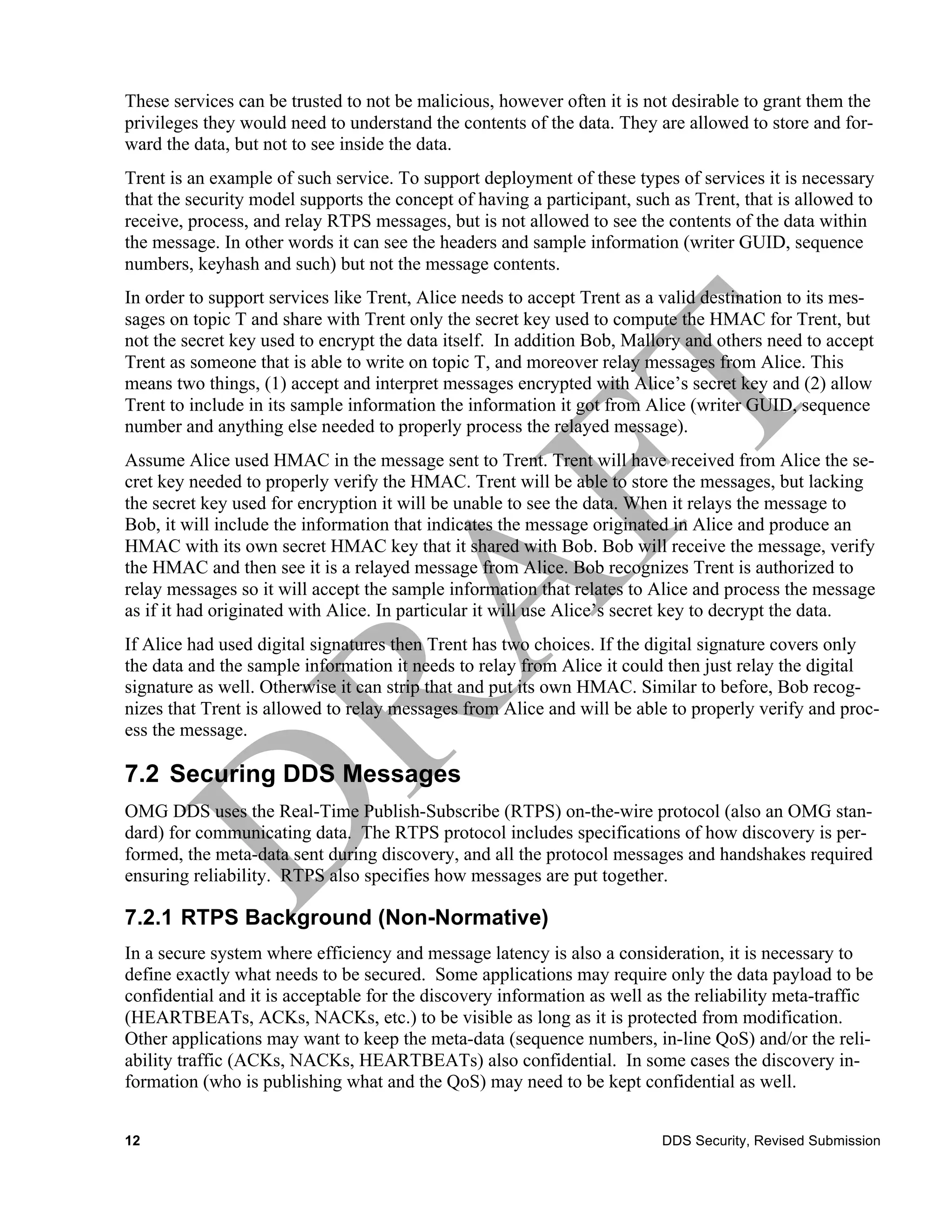
An RTPS Message is composed of a leading RTPS Header followed by a variable number of RTPS
Submessages. Each RTPS Submessage itself composed of a Sub-message Header fol-
lowed by a variable number of SubmessagElements. There are various kinds of
SubmessageElements to communicate thngs like sequence numbers, unique identifiers for
DataReaders and DataWriters, SerializedKeys or KeyHash of the application data, source time-
stamps, QoS, etc. There is one kind of SubmessageElement called SerializedData that is
used to carry the data sent by DDS Applications.
For the purpses of securing comminications we may distinguish three types of RTPS
Submessages:
   1. DataWriter Submesages. These are the RTPS submessages sent by a DataWriter to one or
      more DataReaders. These include the Data, DataFrag, Gap, Heartbeat, and
      HeartbeatFrag submessages.
   2. DataReader Submesages. These are the RTPS submessages sent by a DataReader to one or
      more DataWriters. These include the AckNack and the NackFrag submessages
   3. Interpreter Submesages. These are the RTPS submessages that are destined to the Message
      Interpereter and affect the interpretation of subsequents submessages. These include all the
      “Info” messages.


DDS Security, Revised Submission                                                                 13
The only RTPS Submessages that contain application data are the Data and DataFrag. The appli-
cation data is contained within the SerializedData submessage element. In addition to the
SerializedData these submessages contain sequence numbers, inline QoS, the Key Hash, iden-
tifiers of the originating DataWriter and destination DataReader, etc.
The KeyHash submessage element may only appear in the Data and DataFrag submessages.
Depending on the data-type associated with the DataWriter that wrote the data the KeyHash sub-
message contains either:
•    A serialized representation of the values of all the attributes that are declared as ‘key’ attributes
     in the associated data-type
•    Or else a MD5 hash computed over the aforementioned serialized key attributes.
Different RTPS Submessage within the same RTPS Message may originate on different
DataWriter or DataReader entities within the DomainParticipant that sent the RTPS Message.
It is also possible for a single RTPS Message to combine submessages that originated on different
DDS DomainParticipant entities this is done by preceding the set of RTPS Submessages that
originate from a common DomainParticipant with an InfoSource RTPS submessage.

7.2.2 Secure RTPS Messages
Section 7.1.1 identified the Threats addressed by the DDS Security Specification. Ito protect against
the “Authorized Subscription” threat it is necessary use encryption to protect the sensitive parts of
the RTPS message.
Depending on the application requirements it may be that the only thing that should be kept confi-
dential is the content of the application data, that is, the information contained in the “Serialized-
Data” RTPS submessage element. However, other applications may also consider the information
on on other RTPS SubmessageElements (e.g. sequence numbers, KeyHash, and unique writer/reader
identifiers) to be confidential. So the entire Data (or DataFrag) submessage may need to be en-
crypted. Similarly certain applications may consider other submessages such as Gap, AckNack,
Heartbeat, HeartbeatFrag, etc. to also be confidential.
For example, a Gap RTPS Submessage instructs a DataReader that a range of sequence num-
bers is no longer relevant. If an attacker can modify or forge a Gap message from a DataWriter
it can trick the DataReader into ignoring the data the DataWriter is sending.
To protect against the “Unauthorised Publication” and the “Tampering and Replay” threats it is nec-
essary that messages be signed using secure hashes or digital signatures. Depending on the applica-
tion it may be sufficient to sign only the application data (SerializedData submessage element),
the whole Submessage, and/or the whole RTPS Message.
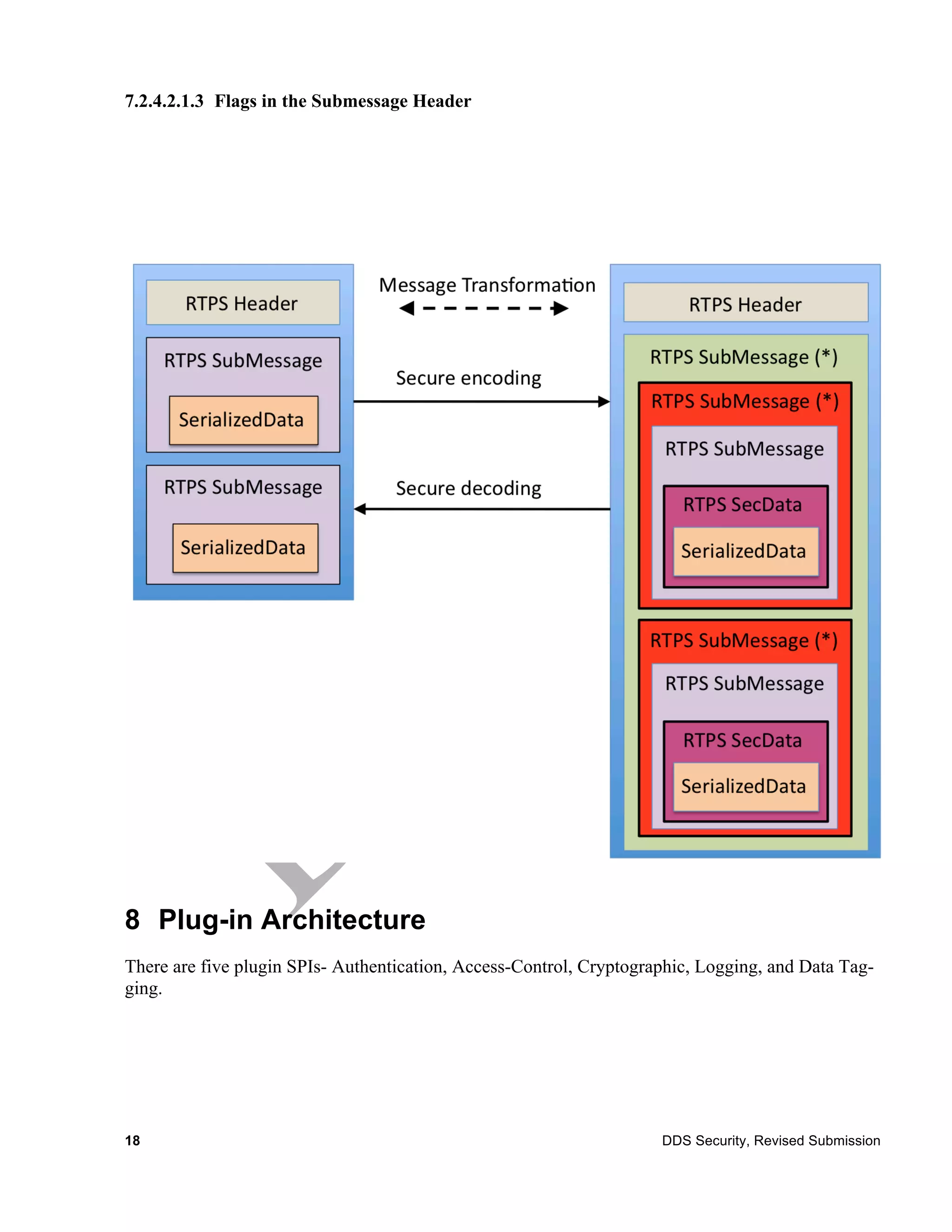
To support different deployment scenarios this specification uses a “message transformation”
mechanism that gives the Security Plugin Implementations fine-grain control over which parts of the
RTPS Message need to be encrypted and/or signed.
The Message Transformation performed by the Security Plugins transforms an RTPS Message into
another RTPS Message. The RTPS Header is preserved, however the remaining content in the


14                                                                           DDS Security, Revised Submission
RTPS Message may be encrypted, protected by a Secure Message Authentication Code (MAC),
and/or signed. The MAC and/or signature can also include the RTPS Header to protect its integrity.

7.2.3 Platform Independent Description
<NOTE: THIS SECTION IS STILL PRELIMINARY AND
INCOMPLETE>

7.2.3.1 RTPS Secure Submessage Elements
7.2.3.1.1 CryptoTransformIdentifier
7.2.3.1.2 SecuredData
7.2.3.1.3 EncodedPayload

7.2.3.2 RTPS Secure Submessages
This specification introduces a new RTPS Submessages that will be used to wrap other submessages
securing their content. The format of the these additional RTPS submessages complies with the for-
mat of all RTPS submessages, consisting of an RTPS Submessage Header followed by a set of RTPS
submessage elements.


DDS Security, Revised Submission                                                                 15
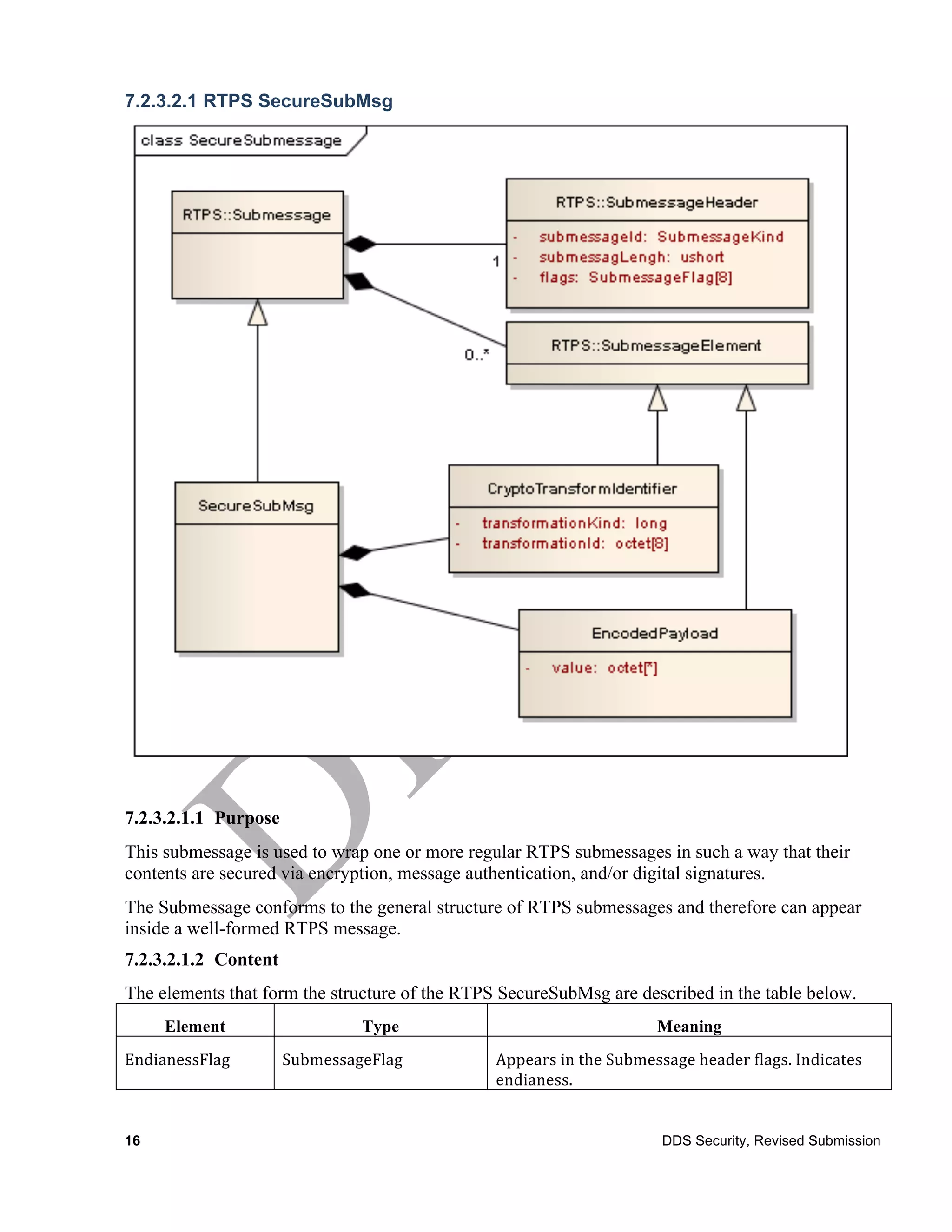
7.2.3.2.1 RTPS SecureSubMsg


7.2.3.2.1.1 Purpose
This submessage is used to wrap one or more regular RTPS submessages in such a way that their
contents are secured via encryption, message authentication, and/or digital signatures.
The Submessage conforms to the general structure of RTPS submessages and therefore can appear
inside a well-formed RTPS message.
7.2.3.2.1.2 Content
The elements that form the structure of the RTPS SecureSubMsg are described in the table below.
      Element	
                  Type	
                                       Meaning	
  
EndianessFlag	
       SubmessageFlag	
          Appears	
  in	
  the	
  Submessage	
  header	
  flags.	
  Indicates	
  
                                                endianess.	


16                                                                             DDS Security, Revised Submission
multisubmsgFlag	
         SubmessageFlag	
                    Indicates	
  the	
  submessage	
  contains	
  potentially	
  multi-­‐
                                                              ple	
  submessages	
  within
cryptoTransformId	
   CryptoTransformIdentifier	
   Identifies	
  the	
  kind	
  of	
  transformation	
  that	
  was	
  per-­‐
                                                    formed	
  in	
  the	
  message	
  and	
  provides	
  additional	
  in-­‐
                                                    formation	
  required	
  by	
  the	
  intended	
  recipients	
  to	
  de-­‐
                                                    code	
  and	
  verify	
  the	
  message
payload	
                 EncodedPayload	
                    Contains	
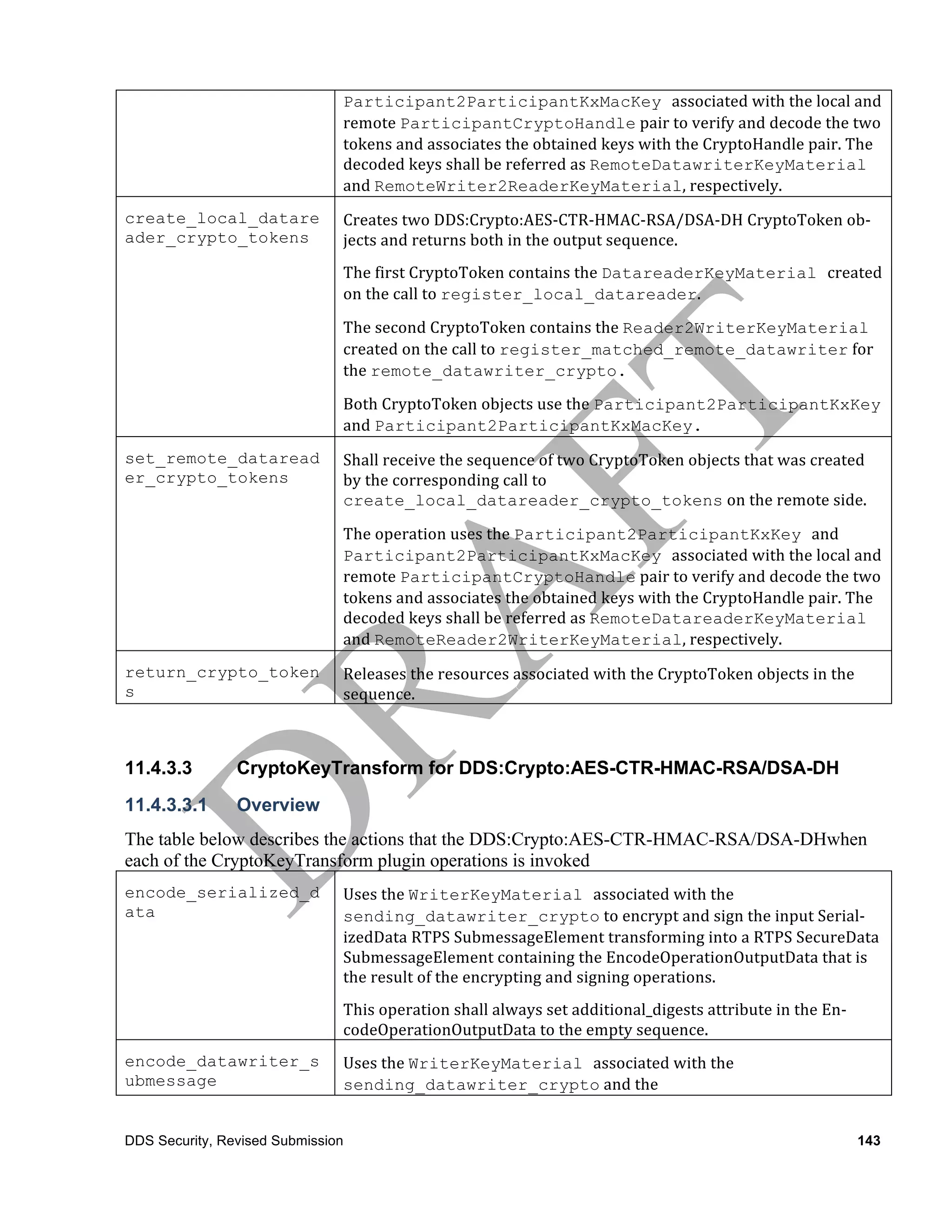
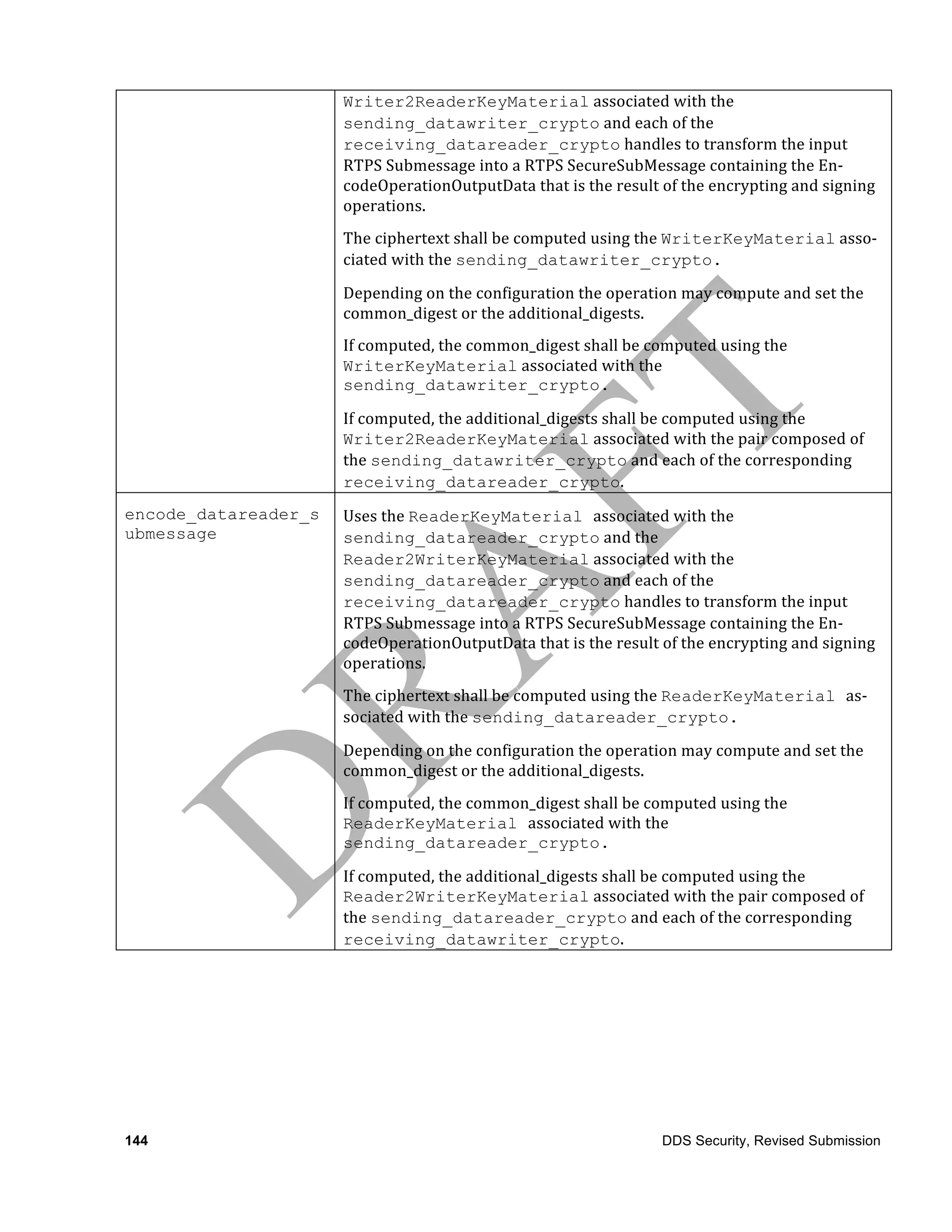
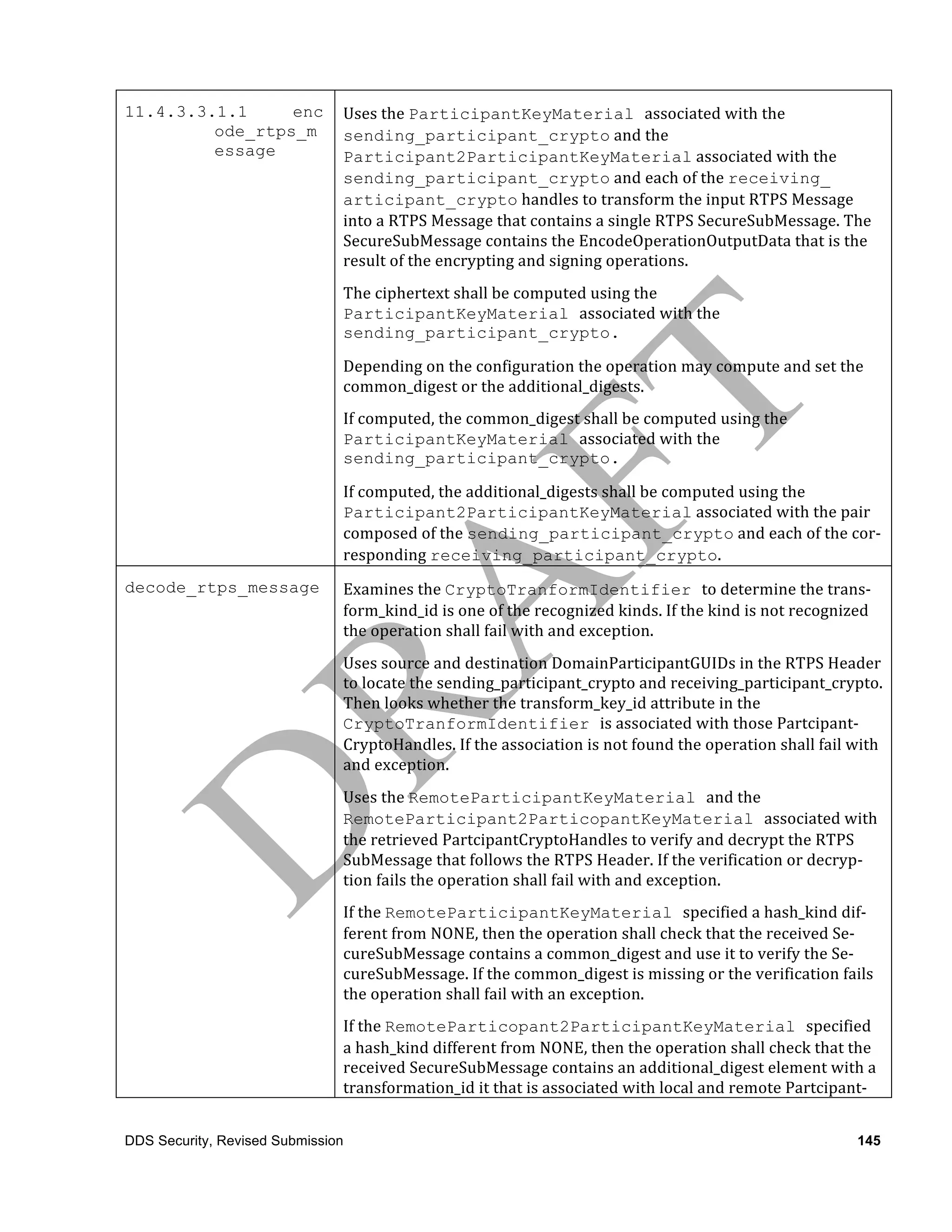
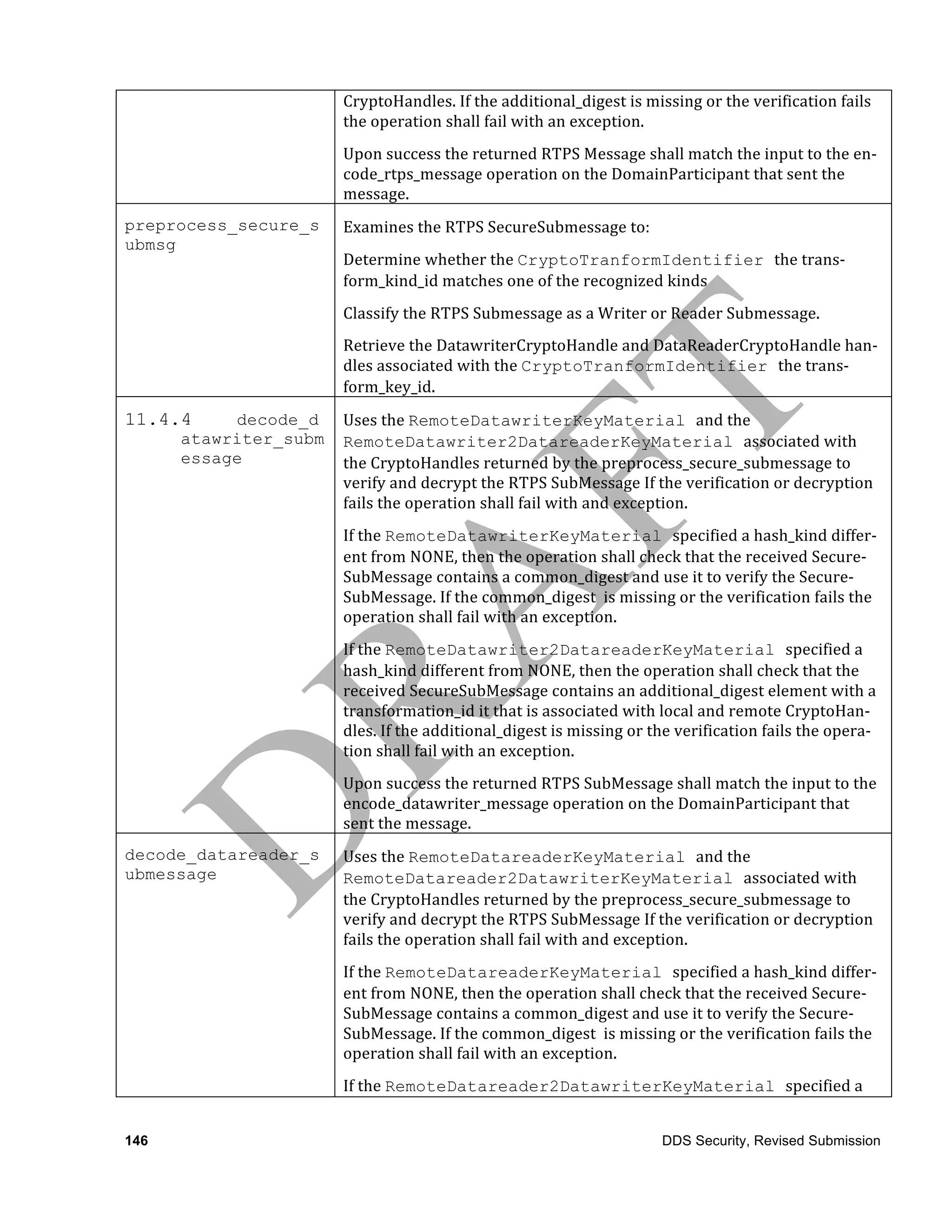
  the	
  result	
  of	
  transforming	
  the	
  original	
  mes-­‐
                                                              sage.	
  Depending	
  on	
  the	
  plugin	
  implementation	
  may	
  
                                                              contain	
  encrypted	
  content,	
  message	
  access	
  codes	
  
                                                              and/or	
  digital	
  signatures
7.2.3.2.1.3 Validity
The Submessage is invalid if the submessageLength in the Submessage header is too small.
7.2.3.2.1.4 Logical Interpretation
The SecureSubMsg provides a way to send secure content inside a legal RTPS submessage.
A SecureSubMsg may wrap a single RTPS Submessage, or a collection of RTPS submessages.
These two situations are distinguished by the value of the MultisubmsgFlag.
If the MultisubmsgFlag is false, then the SecureSubMsg contains a single RTPS submessage.
If the MultisubmsgFlag is true, then the SecureSubMsg may contain multiple RTPS submes-
sages. Whether it does or not will be determined by information inside the cryptoTransformId.
The specific mechanism depends on the encoding/transformation performed.

7.2.4 Mapping to UDP/IP PSM
<NOTE: THIS SECTION IS STILL PRELIMINARY AND
INCOMPLETE>
7.2.4.1 RTPS Secure Submessage Elements

7.2.4.1.1 CryptoTransformIdentifier
7.2.4.1.2 EncodedPayload
7.2.4.1.3 SecuredData

7.2.4.2 RTPS Secure Submessages
7.2.4.2.1 SecureSubMsg
7.2.4.2.1.1 Wire representation
7.2.4.2.1.2 Submessage Id
The SecureSubMsg shall have the submesageId set to the value 0x30.


DDS Security, Revised Submission                                                                                                       17
7.2.4.2.1.3 Flags in the Submessage Header


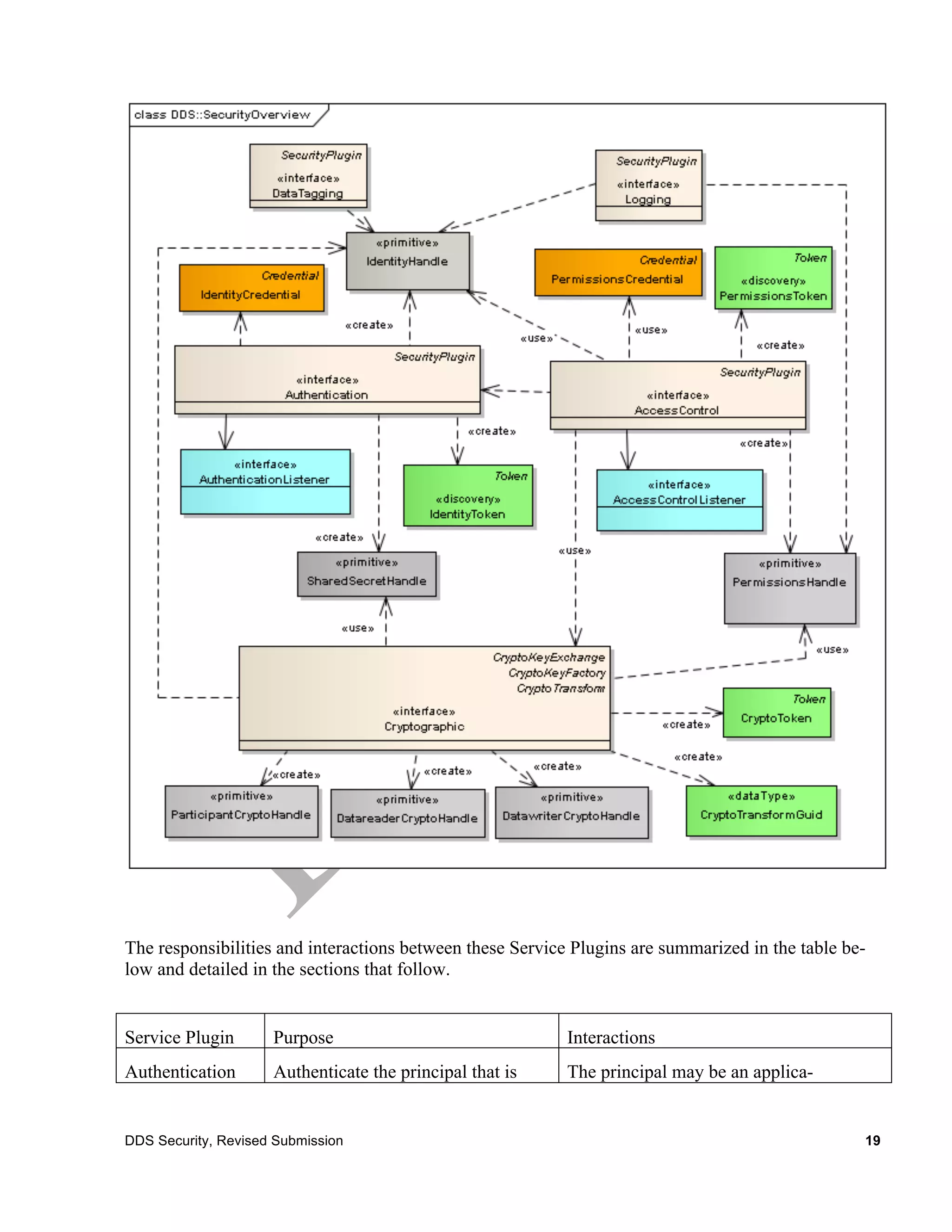
8 Plug-in Architecture
There are five plugin SPIs- Authentication, Access-Control, Cryptographic, Logging, and Data Tag-
ging.


18                                                                   DDS Security, Revised Submission
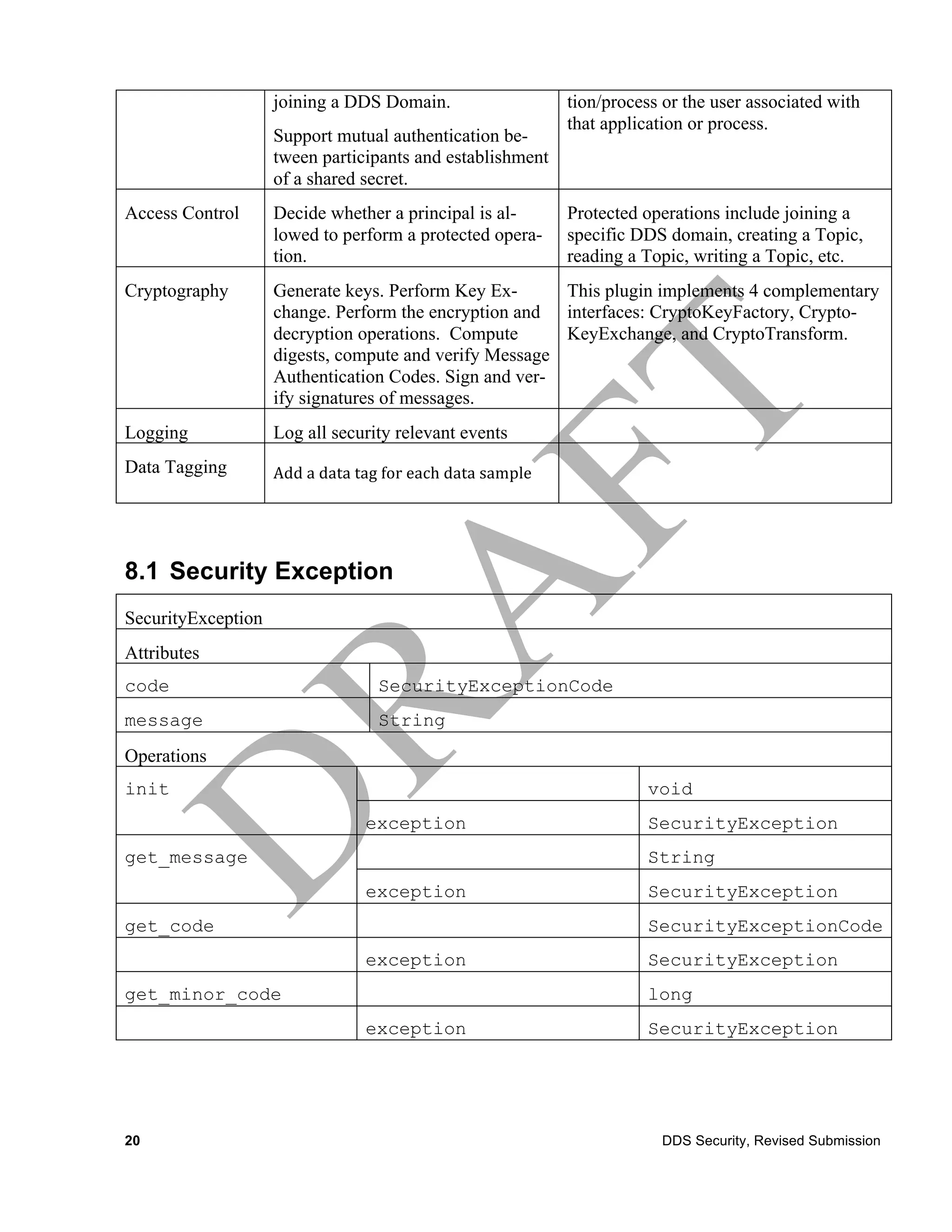
The responsibilities and interactions between these Service Plugins are summarized in the table be-
low and detailed in the sections that follow.


Service Plugin       Purpose                               Interactions
Authentication       Authenticate the principal that is    The principal may be an applica-


DDS Security, Revised Submission                                                                  19
joining a DDS Domain.                                          tion/process or the user associated with
                                                                                   that application or process.
                    Support mutual authentication be-
                    tween participants and establishment
                    of a shared secret.
Access Control      Decide whether a principal is al-                              Protected operations include joining a
                    lowed to perform a protected opera-                            specific DDS domain, creating a Topic,
                    tion.                                                          reading a Topic, writing a Topic, etc.
Cryptography        Generate keys. Perform Key Ex-      This plugin implements 4 complementary
                    change. Perform the encryption and interfaces: CryptoKeyFactory, Crypto-
                    decryption operations. Compute      KeyExchange, and CryptoTransform.
                    digests, compute and verify Message
                    Authentication Codes. Sign and ver-
                    ify signatures of messages.
Logging             Log all security relevant events
Data Tagging        Add	
  a	
  data	
  tag	
  for	
  each	
  data	
  sample	


8.1 Security Exception
SecurityException
Attributes
code                                        SecurityExceptionCode
message                                     String
Operations
init                                                                                          void
                                         exception                                            SecurityException
get_message                                                                                   String
                                         exception                                            SecurityException
get_code                                                                                      SecurityExceptionCode
                                         exception                                            SecurityException
get_minor_code                                                                                long
                                         exception                                            SecurityException


20                                                                                             DDS Security, Revised Submission
SecurityException objects are potentially returned from many of the calls in the plugins. They are
used to return an error code and message. Depending on the programming language used a Securi-
tyException may map to a programming-language exception or an output parameter to the function.

8.1.1 Operation: init
The operation	
  initializes	
  a	
  SecurityException.	
  Depending	
  on	
  the	
  programming	
  language	
  
used,	
  this	
  function	
  may	
  be	
  automatically	
  provided	
  by	
  the	
  constructor,	
  or	
  it	
  may	
  need	
  to	
  be	
  ex-­‐
plicitly	
  invoked.	
  

8.1.2 Operation: get_message
The	
  operation	
  returns	
  a	
  textual	
  message	
  associated	
  with	
  the	
  SecurityException, the mes-­‐
sage	
  provides	
  a	
  description	
  of	
  the	
  exception	
  in	
  human-­‐readable	
  form.	
  

8.1.3 Operation: get_code
The	
  operation	
  returns	
  the	
  code	
  associated	
  with	
  the	
  exception.	
  

8.1.4 Operation: get_minor_code
The	
  operation	
  returns	
  a	
  plugin-­‐dependent	
  code	
  associated	
  with	
  the	
  exception.

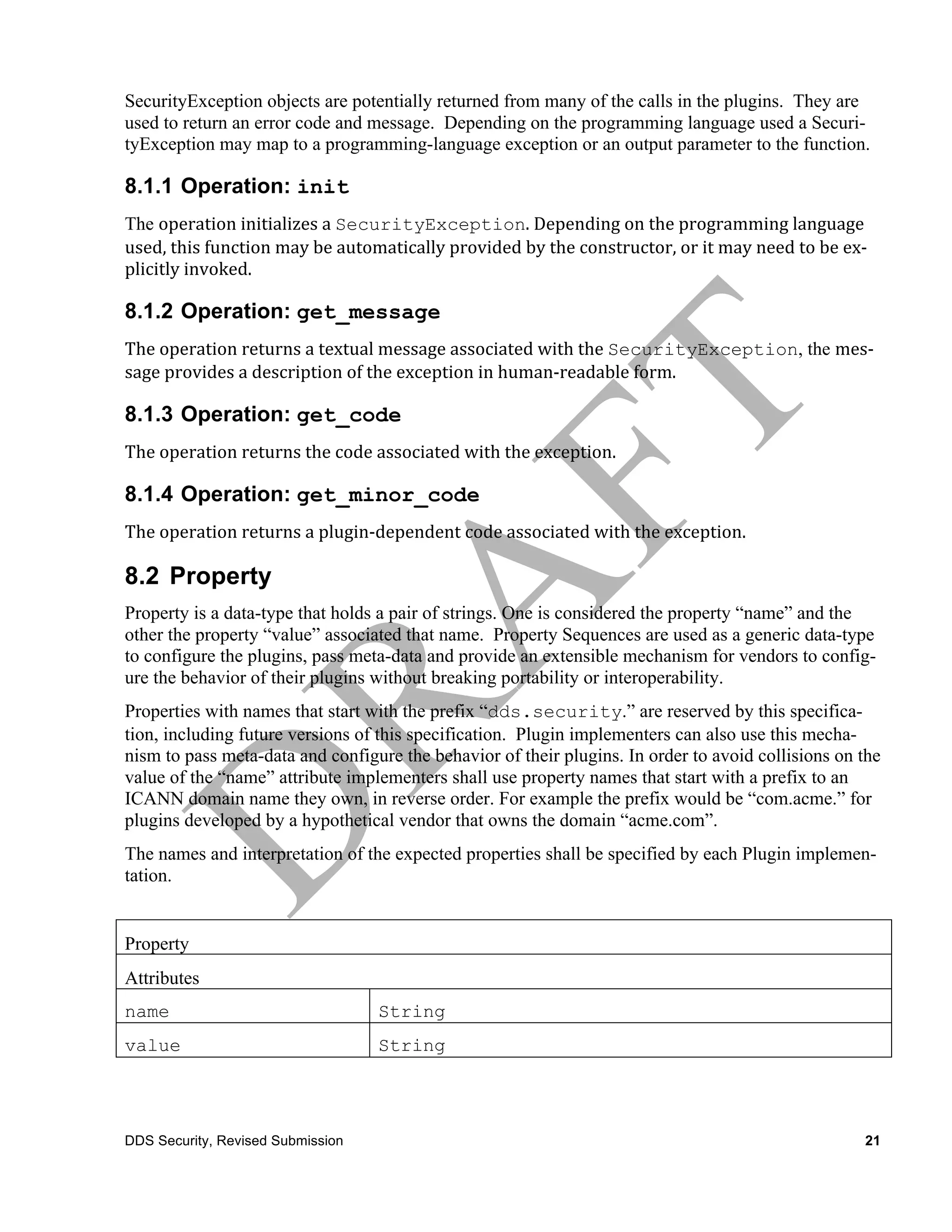
8.2 Property
Property is a data-type that holds a pair of strings. One is considered the property “name” and the
other the property “value” associated that name. Property Sequences are used as a generic data-type
to configure the plugins, pass meta-data and provide an extensible mechanism for vendors to config-
ure the behavior of their plugins without breaking portability or interoperability.
Properties with names that start with the prefix “dds.security.” are reserved by this specifica-
tion, including future versions of this specification. Plugin implementers can also use this mecha-
nism to pass meta-data and configure the behavior of their plugins. In order to avoid collisions on the
value of the “name” attribute implementers shall use property names that start with a prefix to an
ICANN domain name they own, in reverse order. For example the prefix would be “com.acme.” for
plugins developed by a hypothetical vendor that owns the domain “acme.com”.
The names and interpretation of the expected properties shall be specified by each Plugin implemen-
tation.


Property
Attributes
name                                             String
value                                            String


DDS Security, Revised Submission                                                                                                               21
8.3 Credential
Credentials provide a generic mechanism to pass information from DDS to the Security Plugins. This
information is used to identify that application that is running and its permissions. The Credentials
data-type provides a generic container for security credentials and certificates. The actual format and
interpretation of the credentials and how they are configured is specific to each implementation of
the Security Plugins and shall be specified by each Security Plugin.
Typical use of credentials would be signed certificates or signed permissions documents. Credentials
are only exchanged locally between the DDS implementation and the plugins linked to it and running
in the same process space. They are never sent between processes over network.
The structure of Credentials is defined for all plugin implementations. However the contents and in-
terpretation of the Credentials attributes shall be specified by each Plugin implementation.


Credential
Attributes
credential_classid                String
properties                        Property[]
value                             OctetSeq
There are several specializations of the Credential class. They all share the same format but are used
for different purposes this is modeled by defining specialized classes.


22                                                                       DDS Security, Revised Submission
8.3.1 Attribute: credential_classid
Identifies the kind of credential.	
  
Values of the credential_class_id with the prefix “dds.” are reserved for this specification, includ-
ing future versions of the specification. Implementers of this specification can use this attribute to
identify non-standard Credentials. In order to avoid collisions the credential_class_id they use shall
start with a prefix to an ICANN domain name they own, using the same rules specified in Section 8.2
for property names.

8.3.2 Attribute: properties
Tis attribute is a container for meta-data to be held in the Credential. The contents are specific to
each plugin implementation.

8.3.3 Attribute: value
This attribute is used to hold the data stored in the Credential. The contents are specific to each
plugin implementation.

8.4 Token
Tokens provide a generic mechanism to pass information between Security Plugins using DDS as the
transport. Token objects are meant for transmission over the network using DDS either embedded
within the BuiltinTopicData sent via discovery or alternatively via special Topics defines by this
specification.
The structure of Tokens is defined for all plugin implementations. However the contents and inter-
pretation of the Token attributes shall be specified by each Plugin implementation.


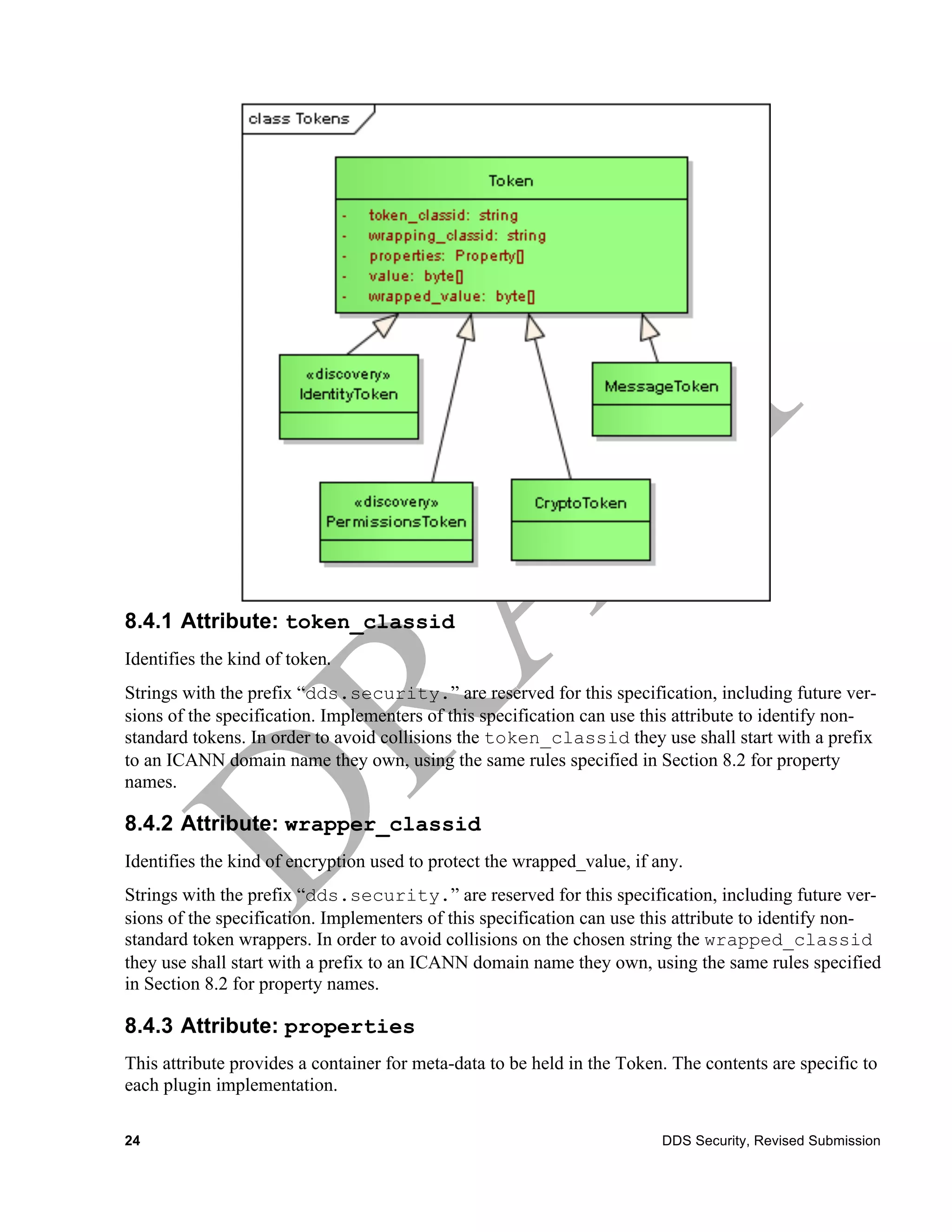
Token
Attributes
token_classid                            String
wrapper_classid                          String
properties                               Property[]
value                                    OctetSeq
wrapped_value                            OctetSeq
There are multiple specializations of the Token class. They all share the same format but are used for
different purposes this is modeled by defining specialized classes.


DDS Security, Revised Submission                                                                        23
8.4.1 Attribute: token_classid
Identifies the kind of token.	
  
Strings with the prefix “dds.security.” are reserved for this specification, including future ver-
sions of the specification. Implementers of this specification can use this attribute to identify non-
standard tokens. In order to avoid collisions the token_classid they use shall start with a prefix
to an ICANN domain name they own, using the same rules specified in Section 8.2 for property
names.

8.4.2 Attribute: wrapper_classid
Identifies the kind of encryption used to protect the wrapped_value, if any.
Strings with the prefix “dds.security.” are reserved for this specification, including future ver-
sions of the specification. Implementers of this specification can use this attribute to identify non-
standard token wrappers. In order to avoid collisions on the chosen string the wrapped_classid
they use shall start with a prefix to an ICANN domain name they own, using the same rules specified
in Section 8.2 for property names.

8.4.3 Attribute: properties
This attribute provides a container for meta-data to be held in the Token. The contents are specific to
each plugin implementation.

24                                                                       DDS Security, Revised Submission
8.4.4 Attribute: value
This attribute is used to hold the data stored in the token. The contents are specific to each plugin
implementation. The value attribute is intended to store data in ‘cleartext’. To store encrypted or
signed data the plugin implementation should use the wrapped_value attribute instead.

8.4.5 Attribute: wrapped_value
This attribute is used to hold the data stored in the token. The contents are specific to each plugin
implementation. The value attribute is intended to store ‘cryptographically protected’ data. The kind
of protection (e.g. encryption and/or signature) is indicated by the value of the wrapper_classid
attribute.

8.5 DDS support for plugin message exchange
In order to perform mutual authentication and key exchange between DDS Participants the security
plugins associated with those participants need to exchange messages.
DDS already has a mechanism for message exchange between the Participants. Exposing some of
these facilities to the Security Plugins would greatly simplify the implementation of the plugins,
which would be relieved from having to implement a separate messaging protocol.
The DDS interoperability wire protocol specifies the existence of two built-in end points BuiltinPar-
ticipantMessageWriter and BuiltinParticipantMessageReader (See section 9.6.2.1 of the DDS
Interoperability Protocol).
These endpoints were designed to be extensible and support the kind of message-exchanged needed
by the security plugins.
The messages exchanged by the BuiltinParticipantMessageWriter have the associated type Partici-
pantMessageData. This type is as defined by the DDS Interoperability Wire Protocol version 2.1)
and can be represented in IDL as:

typedef octet GuidPrefix_t[12];
typedef octet ParticipantMessageDataKind[4];
struct ParticipantMessageData {
    GuidPrefix_t participantGuidPrefix; //@Key
    ParticipantMessageDataKind    kind; //@Key
    sequence<octet> data;
};

The Interoperability Wire Protocol furthermore states that the messages sent by the BuiltinPartici-
pantMessageWriter shall always set the participantGuidPrefix to the GUID prefix of the originating
participant.
The ‘kind’ attribute is used to identify of different types of messages. The actual data is carried on
the ‘value’ octet sequence. Its content and format is specified for each value of the ‘kind’ attribute.


DDS Security, Revised Submission                                                                          25
8.5.1 Reserved values of ParticipantMessageDataKind
This specification, including future versions of this specification reserves ParticipantMes-
sageDataKind values in the range 0x00010000 to 0x0001FFFF, both included.
Within the above range, the range 0x00018000 to 0x0001FFFF is reserved for vendor-specific exten-
sions and shall not be used by this specification, including future versions of this specification.
The specification defines the following values for the ParticipantMessageDataKind:
#define    KIND_SECURITY_AUTH_HANDSHAKE                            {0x00,    0x01,    0x00,    0x01}
#define    KIND_SECURITY_PARTICIPANT_CRYPTO_TOKENS                 {0x00,    0x01,    0x00,    0x02}
#define    KIND_SECURITY_DATAWRITER_CRYPTO_TOKENS                  {0x00,    0x01,    0x00,    0x03}
#define    KIND_SECURITY_DATAREADER_CRYPTO_TOKENS                  {0x00,    0x01,    0x00,    0x04}

Additional values of the ParticipantMessageDataKind may be defined with each plugin implemen-
tation.

8.5.2 Format of data within ParticipantMessageData
Each value for the kind in ParticipantMessageData uses different schema to store data within the
data (octet sequence) attribute in the ParticipantMessageData.

8.5.2.1 Data for message kind KIND_SECURITY_AUTH_HANDSHAKE

If ParticipantMessageData kind is KIND_SECURITY_AUTH_HANDSHAKE the data attribute
contains the CDR big-endian serialization of the structure MessageToken defined by the IDL below:

struct Property {
    string<> name;
    string<> value;
};

struct Token {
    string<> token_classid;
    string<> wrapper_classid;
    sequence<Property> properties;
    sequence<octet> value;
};

struct MessageToken : Token {
};
struct CryptoToken : Token {
};

8.5.2.2 Data for message kind KIND_SECURITY_PARTICIPANT_CRYPTO_TOKENS

If ParticipantMessageData kind is KIND_SECURITY_
PARTICIPANT_CRYPTO_TOKENS the data attribute contains the CDR big-endian serialization of the
structure ParticipantCryptoTokenSMsg defined by the IDL below:

struct ParcicipantCryptoTokensMsg {


26                                                                       DDS Security, Revised Submission
octet sending_participant_guid[16];
      octet receiving_participant_guid[16];
      sequence<CryptoToken> crypto_tokens;
};

8.5.2.3 Data for message kind KIND_SECURITY_DATAWRITER_CRYPTO_TOKENS

If ParticipantMessageData kind is KIND_SECURITY_
DATAWRITER_CRYPTO_TOKENS the data attribute contains the CDR big-endian serialization of the
structure DatawriterCryptoTokensMsg defined by the IDL below:

struct DatawriterCryptoTokensMsg {
    octet datawriter_guid[16];
    octet readerwriter_guid[16];
 sequence<CryptoToken> crypto_tokens;
};

8.5.2.4 Data for message kind KIND_SECURITY_DATAREADER_CRYPTO_TOKENS

If ParticipantMessageData kind is KIND_SECURITY_
DATAWRITER_CRYPTO_TOKENS the data attribute contains the CDR big-endian serialization of the
structure DatareaderCryptoTokensMsg defined by the IDL below:

struct DatareaderCryptoTokensMsg {
    octet readerwriter_guid[16];
    octet datawriter_guid[16];
 sequence<CryptoToken> crypto_tokens;
};

8.6 Authentication Plug-in
The Authentication Plug-in SPI defines the types and operations necessary to support the authentica-
tion of DDS DomainParticipants.

8.6.1 Background (Non-Normative)
Without the security enhancements, any DDS DomainParticipant is allowed to join a DDS
Domain without authenticating. However, in the case of a secure DDS system, every DDS partici-
pant will be required to authenticate to avoid data contamination from unauthenticated participants.
The DDS protocol detects when participants enter the network through its native discovery mecha-
nism.
The discovery mechanism that registers participants with the DDS middleware is enhanced with an
authentication protocol. A participant that enables the authentication plug-in will only communicate
to another participant that has the authentication plug-in enabled.
The plugin SPI is designed to support multiple implementations which may require varying numbers
of message exchanges, which may be used to challenge the other side so it can determine it knows
the secrets, associated with its credential, and potentially establish shared secrets, which can then be
used to exchange session keys.


DDS Security, Revised Submission                                                                      27
8.6.2 Authentication Plug-in Model
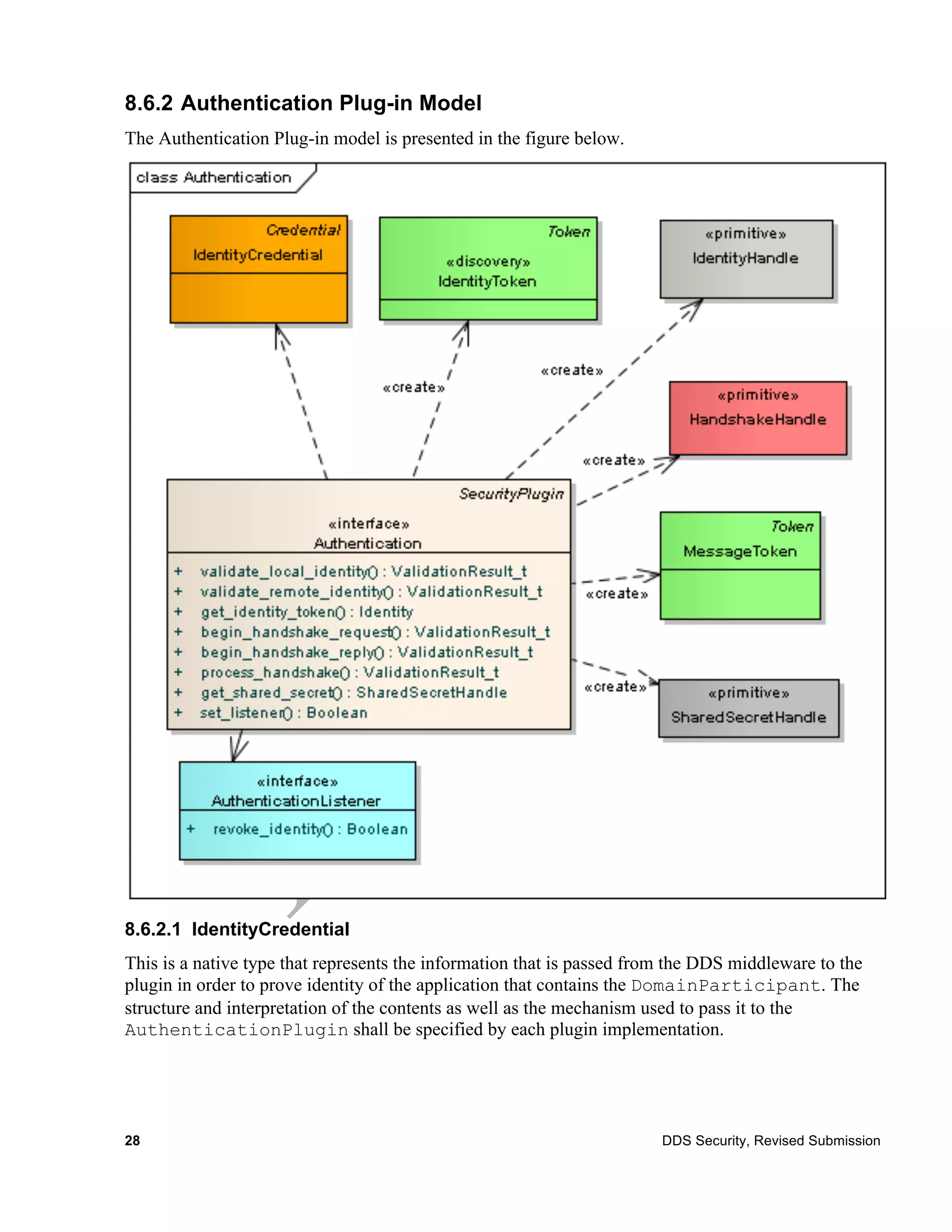
The Authentication Plug-in model is presented in the figure below.


8.6.2.1 IdentityCredential
This is a native type that represents the information that is passed from the DDS middleware to the
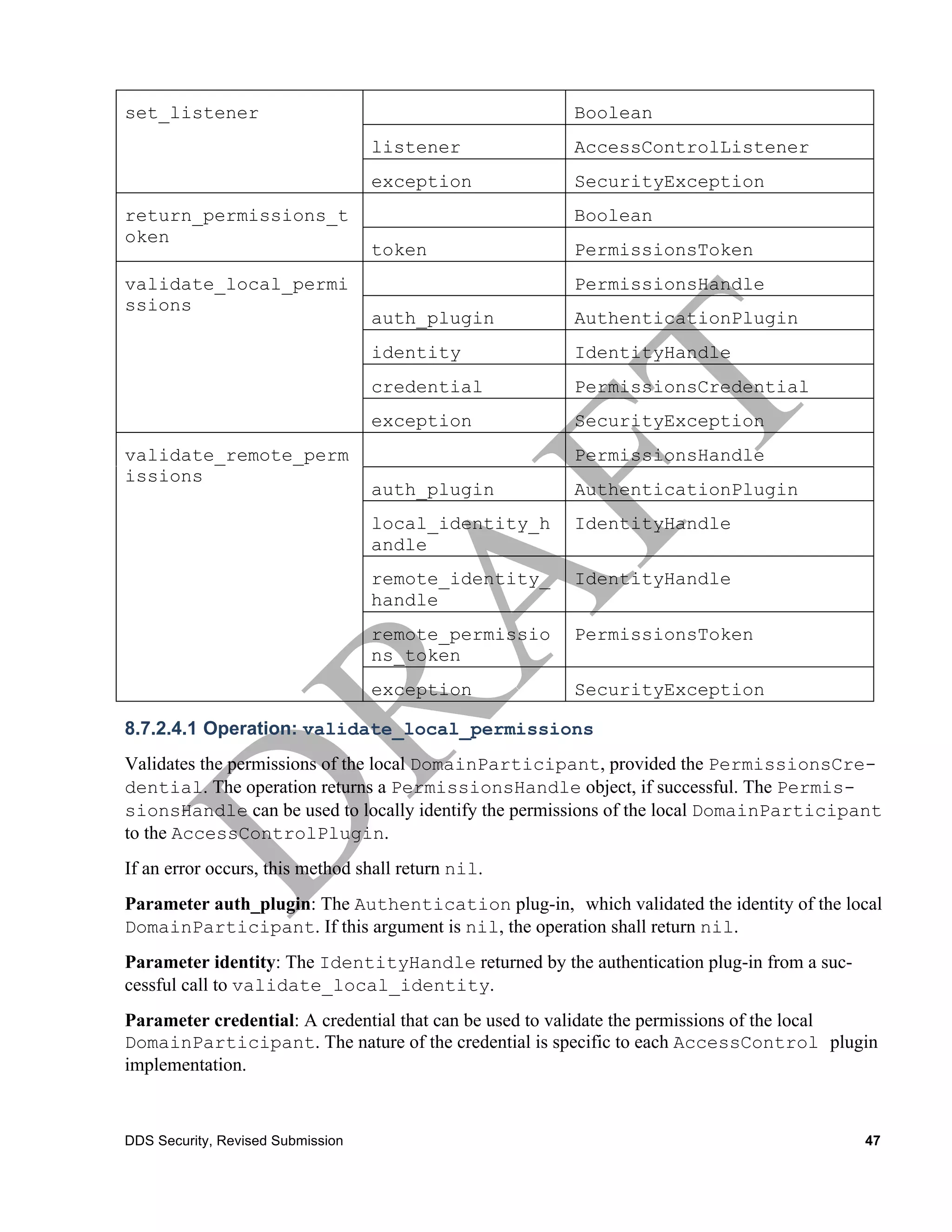
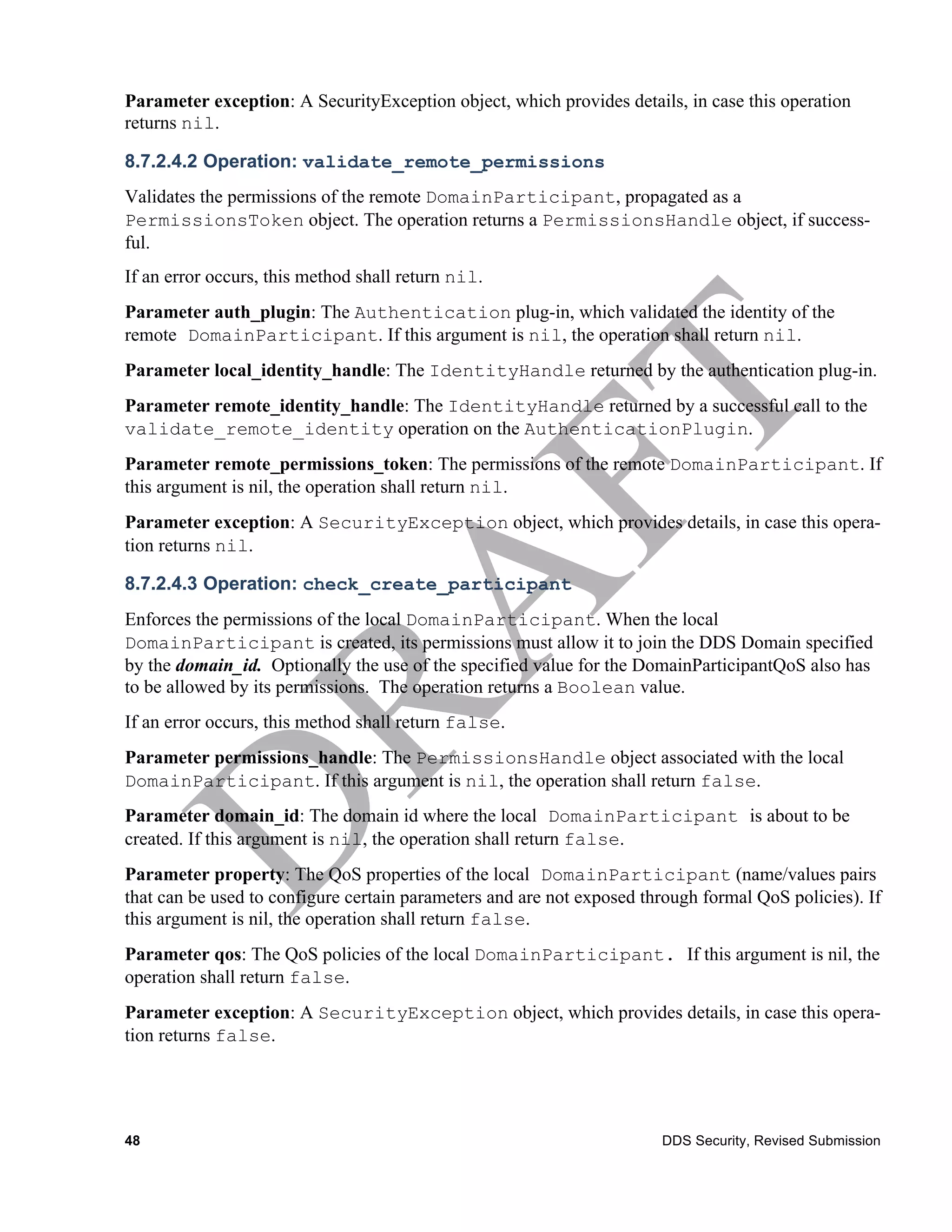
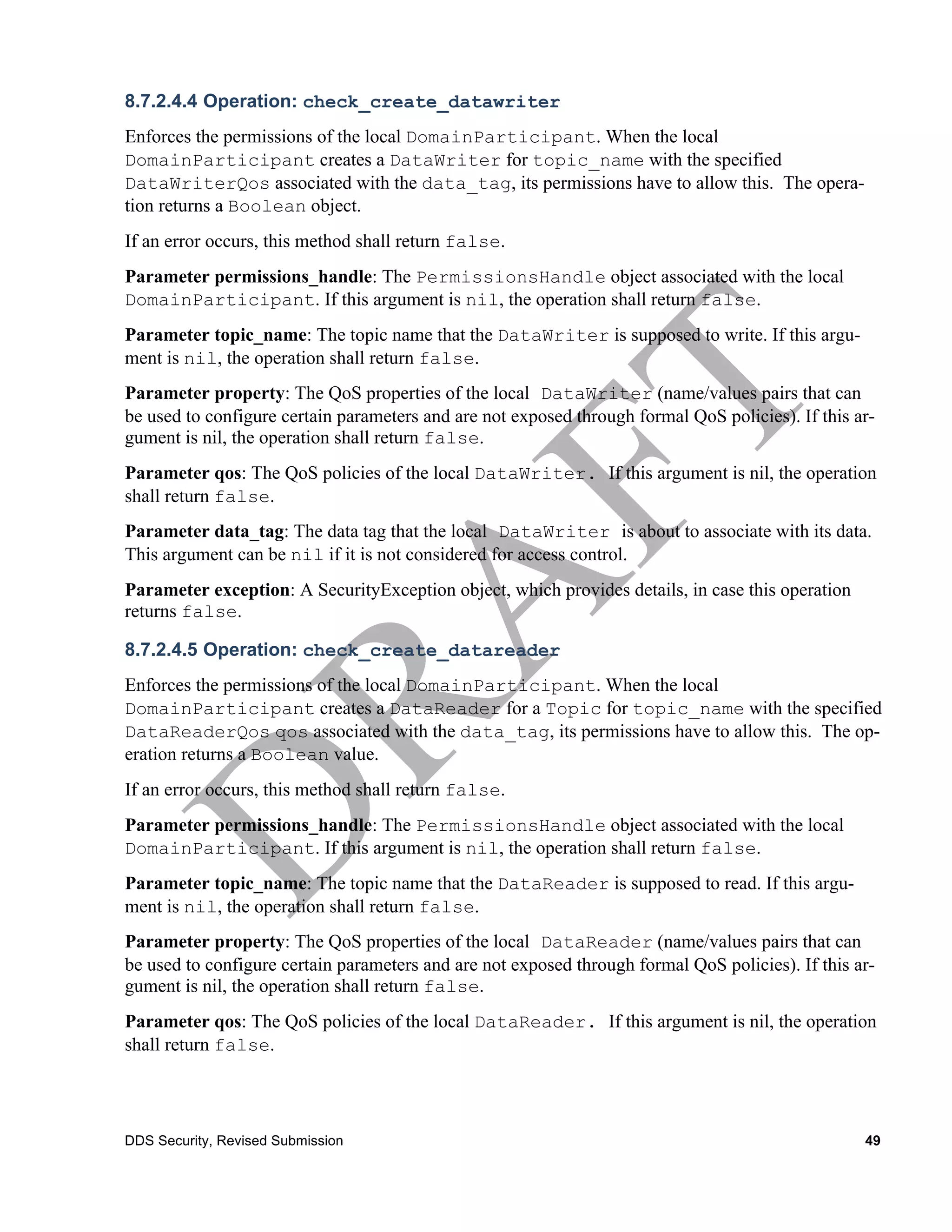
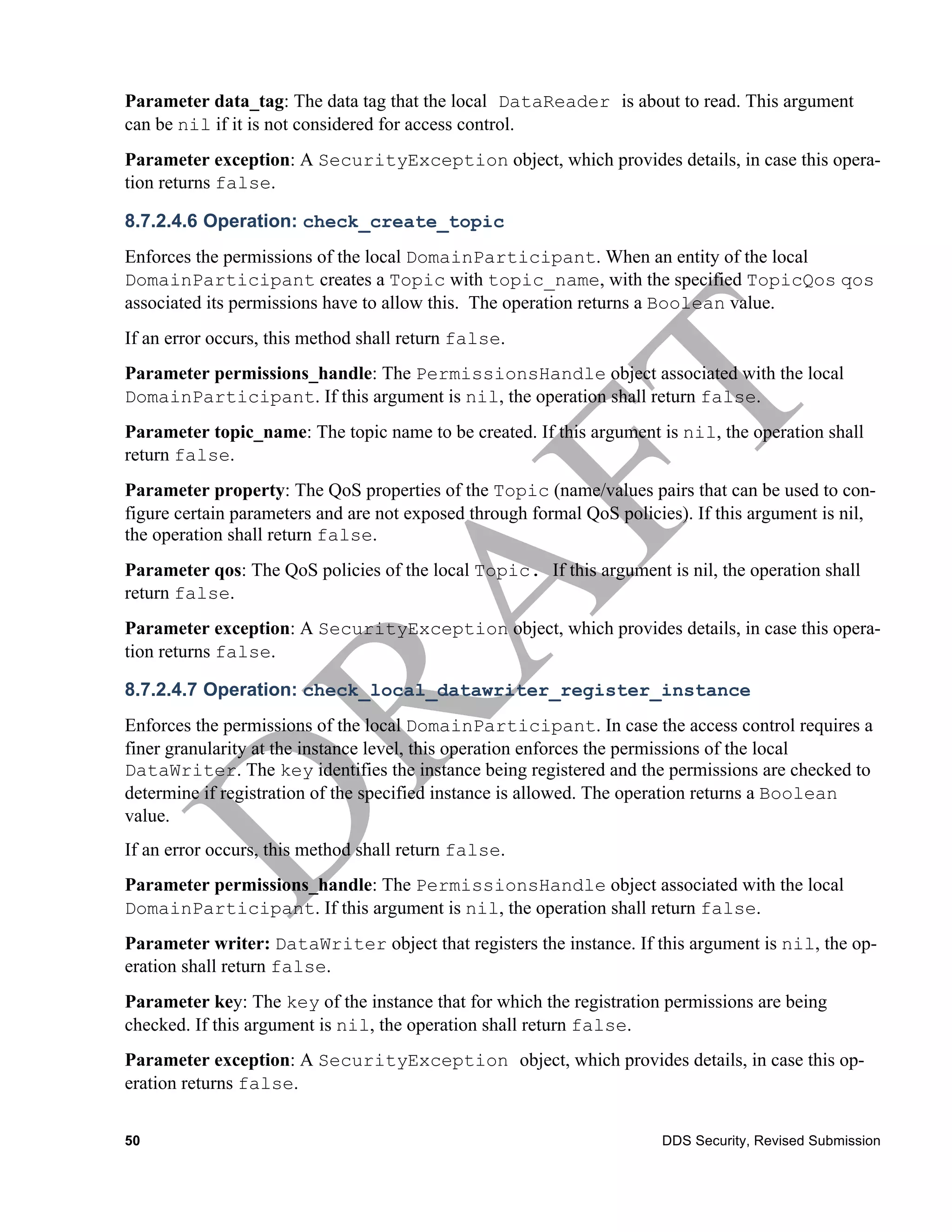
plugin in order to prove identity of the application that contains the DomainParticipant. The
structure and interpretation of the contents as well as the mechanism used to pass it to the
AuthenticationPlugin shall be specified by each plugin implementation.


28                                                                      DDS Security, Revised Submission
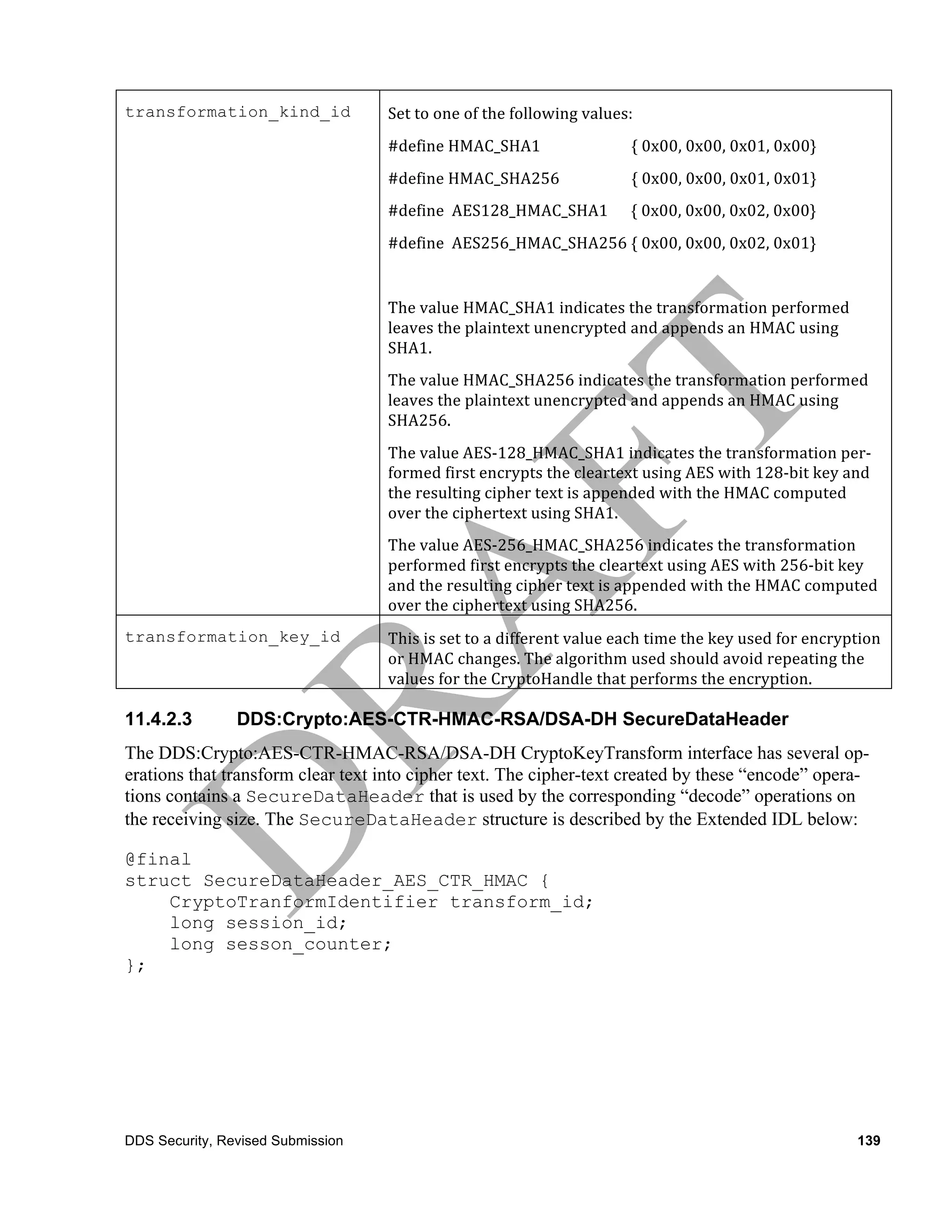
8.6.2.2 IdentityToken
An IdentityToken encodes the identity information for a DomainParticipant, in a manner
that can be externalized and propagated via discovery.

8.6.2.3 IdentityHandle
An IdentityHandle is an opaque local reference to internal state within the
AuthenticationPlugin, which uniquely identifies a DomainParticipant. It is under-
stood only by the AuthenticationPlugin and references the authentication state of the Partici-
pant. This object is returned by the AuthenticationPlugin as part of the validation of the
identity of a DomainParticipant and is used whenever a client of the
AuthenticationPlugin needs to refer to the identity of a previously identified
DomainParticipant.

8.6.2.4 HandshakeHandle
A HandshakeHandle is an opaque local reference used to refer to the internal state of a possible
mutual authentication or handshake protocol.

8.6.2.5 MessageToken
A MessageToken encodes plugin-specific information that the Authentication plugins associated
with two DomainParticipant entities exchange as part of the mutual authentication handshake. The
MessageToken are understood only by the AuthenticationPlugin implementations on ei-
ther side of the handshake. The MessageToken are sent and received by the DDS implementation
under the direction of the AuthenticationPlugins.

8.6.2.6 SharedSecretHandle
A SharedSecretHandle is an opaque local reference to internal state within the
AuthenticationPlugin containing a secret that is shared between the
AuthenticationPlugin implementation and the peer AuthenticationPlugin implemen-
tation associated with a remote DomainParticipant. It is understood only by the two
AuthenticationPlugin implementations that share the secret. The shared secret is used to en-
code Tokens, such as the CryptoToken, such that they can be exchanged between the two
DomainParticipants in a secure manner.


8.6.2.7 Authentication
This interface is the starting point for all the security mechanisms. When a DomainParticipant
is either locally created or discovered, it needs to be authenticated in order to be able to communicate
in a DDS Domain.
The interaction between the DDS implementation and the Authentication plugins has been designed
in a flexible manner so it is possible to support various authentication mechanisms, including those


DDS Security, Revised Submission                                                                     29
that require a handshake and/or perform mutual authentication between participants and establishes a
shared secret. This interaction is described in the state machine illustrated in the figure below.


Authentication
No Attributes
Operations
validate_local_ident                                                  ValidationResult_t
ity
                                out:                                  IdentityHandle


30                                                                     DDS Security, Revised Submission
local_identity_handle
                                   credential                IdentityCredential
                                   participant_key           Octet[16]
                                   exception                 SecurityException
get_identity_token                                           IdentityToken
                                   handle                    IdentityHandle
                                   exception                 SecurityException
validate_remote_iden                                         ValidationResult_t
tity
                                   out:                      IdentityHandle
                                   remote_identity_handle
                                   local_identity_handle     IdentityHandle
                                   remote_identity_token     IdentityToken
                                   remote_participant_key    Octet[16]
                                   exception                 SecurityException
begin_handshake_requ                                         ValidationResult_t
est
                                   out: handshake_handle     HandshakeHandle
                                   out: handshake_message    MessageToken
                                   initiator_identity_handl IdentityHandle
                                   e
                                   replier_identity_handle   IdentityHandle
                                   exception                 SecurityException
begin_handshake_repl                                         ValidationResult_t
y
                                   out: handshake_handle     HandshakeHandle
                                   out:                      MessageToken
                                   handshake_message_out
                                   handshake_message_in      MessageToken
                                   initiator_identity_handl IdentityHandle
                                   e
                                   replier_identity_handle   IdentityHandle
                                   exception                 SecurityException
process_handshake                                            ValidationResult_t


DDS Security, Revised Submission                                                  31
out:                                  MessageToken
                                handshake_message_out
                                handshake_message_in                  MessageToken
                                handshake_handle                      HandshakeHandle
                                exception                             SecurityException
get_shared_secret                                                     SharedSecretHandle
                                handshake_handle                      HandshakeHandle
                                exception                             SecurityException
set_listener                                                          Boolean
                                listener                              AuthenticationListen
                                                                      er
                                exception                             SecurityException
return_token                                                          Boolean
                                token                                 IdentityToken
                                exception                             SecurityException
return_handshake_han                                                  Boolean
dle
                                handshake_handle                      HandshakeHandle
                                exception                             SecurityException
return_identity_hand                                                  Boolean
le
                                identity_handle                       IdentityHandle
                                exception                             SecurityException
return_sharedsecret_                                                  Boolean
handle
                                sharedsecret_handle                   SharedSecretßHandle
                                exception                             SecurityException


8.6.2.7.1 Type: ValidationResult_t
Enumerates the possible return values of the validate_local_identity and validate_remote_identity
operations.
ValidationResult_t
VALIDATION_OK                                          Indicates the validation has
                                                       succeeded

32                                                                     DDS Security, Revised Submission
VALIDATION_FAILED                                        Indicates the validation has
                                                         failed
VALIDATION_PENDING_RETRY                                 Indicates that validation is
                                                         still proceeding. The
                                                         operation shall be retried at
                                                         a later point in time.
VALIDATION_PENDING_HANDSHAKE_REQUEST Indicates that validation of
                                     the submitted IdentityToken
                                     requires sending a handshake
                                     message. The DDS
                                     Implementation shall call the
                                     operation
                                     begin_handshake_request and
                                     send the MessageToken obtained
                                     from this call using the
                                     BuiltinParticipantMessageWriter.
VALIDATION_PENDING_HANDSHAKE_MESSAGE Indicates that validation is
                                     still pending. The DDS
                                     Implementation shall wait for
                                     a message on the
                                     BuiltinParticipantMessageReader and
                                     once this is received call
                                     process_handshake passing the
                                     infrmation received in that
                                     message.
VALIDATION_OK_FINAL_MESSAGE                              Indicates that validation has
                                                         succeeded but the DDS
                                                         Implementation shall send a
                                                         final message using the Builtin-
                                                         ParticipantMessageWriter.


8.6.2.7.2 Operation: validate_local_identity
Validates the identity of the local DomainParticipant, provided by an
IdentityCredential. The operation returns as an output parameter the IdentityHandle,
which can be used to locally identify the local Participant to the AuthenticationPlugin.
If an error occurs, this method shall return VALIDATION_FAILED.
The method shall return either VALIDATION_OK if the validation succeeds, or VALIDA-
TION_FAILED if it fails, or VALIDATION_PENDING_RETRY if the verification has not finished.
If VALIDATION_PENDING_RETRY is been returned, the operation shall be called again after a
configurable delay to check the status of verification. This shall continue until the operation returns

DDS Security, Revised Submission                                                                      33
either VALIDATION_OK if the validation succeeds, or VALIDATION_FAILED. This approach
allows non-blocking interactions with services whose verification may require invoking remote serv-
ices.
Parameter local_identity_handle: A handle that can be used to locally refer to the Authenticated
Participant in subsequent interactions with the AuthenticationPlugin. The nature of the han-
dle is specific to each AuthenticationPlugin implementation. The handle will only be mean-
ingful if the operation returns VALIDATION_OK.
Parameter credential: A credential that the AuthenticationPlugin implementation may use to vali-
date the identity of the local DomainParticipant. The nature and configuration of the credential
is specific to each AuthenticationPlugin implementation.
Parameter exception: A SecurityException object.
Return: The operation shall return
     • VALIDATION_OK if the validation was successful
     • VALIDATION_FAILED if it failed.
     • VALIDATION_PENDING_RETRY if verification has not completed, and the operation
       should be retried later.
8.6.2.7.3 Operation: validate_remote_identity
Initiates the process of validating the identity of the discovered remote DomainParticipant,
represented as an IdentityToken object. The operation returns the ValidationResult_t
indicating whether the validation succeeded, failed, or is pending a handshake. If the validation suc-
ceeds, an IdentityHandle object is returned which can be used to locally identify the remote
DomainParticipant to the AuthenticationPlugin.
If the validation can be performed solely with the information passed and it succeeds the operation
shall return VALIDATION_OK. If it can be performed with the information passed and it fails it
shall return VALIDATION_FAILED.
The validation of a remote participant might require the remote participant to perform a handshake.
In this situation the validate_remote_identity operation shall return VALIDA-
TION_PENDING_HANDSHAKE_REQUEST or VALIDA-
TION_PENDING_HANDSHAKE_MESSAGE.
If the operation returns VALIDATION_PENDING_HANDSHAKE_REQUEST, then the DDS im-
plementation shall call the operation begin_handshake_request to continue the validation
process.
If the operation returns VALIDATION_PENDING_HANDSHAKE_MESSAGE, then the DDS im-
plementation shall wait until it receives a handshake message from the remote participant identified
by the remote_participant_key. This message is received on the BuiltinParticipantMessageReader
and shall contain a participantGuidPrefix matching the remote_participant_key and a kind match-
ing KIND_SECURITY_AUTH_HANDSHAKE.
Upon receiving the above ParticipantMessageData message the DDS implementation shall interpret
the bytes inside the ParticipantMessageData data sequence as the CDR serialization of a
MessageToken and shall call the operation begin_handshake_reply passing the received
34                                                                       DDS Security, Revised Submission
MessageToken and shall call the operation begin_handshake_reply passing the received
MessageToken as the handshake_message_in.
If an error occurs, this method shall throw an exception.
Parameter remote_identity_token : A token received as part of
ParticipantBuiltinTopicData representing the identity of the remote
DomainParticipant.
Parameter local_identity_handle: A handle to the local DomainParticipant that is requesting
the remote participant to be validated. The local handle must have been obtained by an earlier call to
validate_local_identity.
Parameter (out) remote_identity_handle: A handle that can be used to locally refer to the remote
Authenticated Participant in subsequent interactions with the AuthenticationPlugin. The na-
ture of the remote_identity_handle is specific to each AuthenticationPlugin implementa-
tion. The handle will only be provided if the operation returns something other than VALIDA-
TION_FAILED.
Parameter exception: A SecurityException object.
Return: The operation shall return:
   • VALIDATION_OK if the validation was successful,
   • VALIDATION_FAILED if it failed,
   • VALIDATION_PENDING_HANDSHAKE_REQUEST if validation has not completed and
     the DDS implementation shall call begin_handshake_request, to continue the valida-
     tion.
   • VALIDATION_PENDING_HANDSHAKE_MESSAGE if validation has not completed and
     the DDS implementation shall wait for a message on the BuiltinParticipantMessageReader
     with the participantGuidPrefix matching the remote_participant_key and a kind matching
     KIND_SECURITY_AUTH_HANDSHAKE and then call the operation
     begin_handshake_reply, to continue the validation.
   • VALIDATION_PENDING RETRY if the validation has not completed and the operation
     should be called again at a later point in time to check the status of validation.
8.6.2.7.4 Operation: begin_handshake_request
This operation is used to initiate a handshake when the first handshake message must be generated. It
shall be called by the DDS middleware solely as a result of having a previous call to vali-
date_remote_identity returns VALIDATION_PENDING_HANDSHAKE_REQUEST.
This operation returns a MessageToken that shall be used to send a handshake to the remote partici-
pant identified by the replier_identity_handle.
The contents of the MessageToken are specified by the plugin implementation.
If an error occurs, this method shall throw an exception.
Parameter (out) handshake_handle: A handle returned by the Authentication Plugin used keep the
state of the handshake. It is passed to other operations in the Plugin


DDS Security, Revised Submission                                                                    35
Parameter (out) handshake_message: A Token containing a message to be sent using the Builtin-
ParticipantMessageWriter. The contents shall be specified by each plugin implementation.
Parameter initiator_identity_handle: Handle to the local participant that originated the handshake.
Parameter replier_identity_handle: Handle to the remote participant whose identity is being vali-
dated.
Parameter exception: A SecurityException object.
Return: The operation shall return:
     • VALIDATION_OK if the validation was successful,
     • VALIDATION_FAILED if it failed,
     • VALIDATION_PENDING_HANDSHAKE_MESSAGE if validation has not completed and
       the DDS implementation shall send the handshake_message_out using the BuiltinPartici-
       pantMessageWriter and then wait for a message on the BuiltinParticipantMessageReader
       with the participantGuidPrefix matching the remote_participant_key and a kind matching
       KIND_SECURITY_AUTH_HANDSHAKE and then call the operation
       begin_handshake_reply, to continue the validation.
     • VALIDATION_OK_FINAL_MESSAGE if the validation succeeded but the DDS implemen-
       tation shall send the returned handshake_message using the BuiltinParticipantMes-
       sageReader.
     • VALIDATION_PENDING RETRY if the validation has not completed and the operation
       should be called again at a later point in time to check the status of validation.
8.6.2.7.5 Operation: begin_handshake_reply
This operation is used to initiate a handshake when an initial handshake message has been received
from another participant. It shall be called by the DDS middleware solely as a result of having a pre-
vious call to validate_remote_identity returns VALIDA-
TION_PENDING_HANDSHAKE_MESSAGE and having also received a message on the Builtin-
ParticipantMessageReader with the participantGuidPrefix matching the GUID prefix of the par-
ticipant associated with the initiator_identity_handle and a kind matching
KIND_SECURITY_AUTH_HANDSHAKE.
This operation generates a handshake_message_out in response to a received hand-
shake_message_in. Depending on the return value of the function the DDS implementation shall
send the handshake_message_out using the BuiltinParticipantMessageWrite to the participant
identified by the initiator_identity_handle.
The contents of the handshake_message_out MessageToken are specified by the plugin implemen-
tation.
If an error occurs, this method shall throw an exception.
Parameter (out) handshake_handle: A handle returned by the Authentication Plugin used keep the
state of the handshake. It is passed to other operations in the Plugin
Parameter (out) handshake_message_out: A Token containing a message to be sent using the
BuiltinParticipantMessageWriter. The contents shall be specified by each plugin implementation.


36                                                                      DDS Security, Revised Submission
Parameter handshake_message_in: A Token containing a message received from the BuiltinPar-
ticipantMessageReader. The contents shall be specified by each plugin implementation.
Parameter initiator_identity_handle: Handle to the remote participant that originated the hand-
shake.
Parameter replier_identity_handle: Handle to the local participant that is initiating the handshake
response.
Parameter exception: A SecurityException object.
Return: The operation shall return:
   • VALIDATION_OK if the validation was successful,
   • VALIDATION_FAILED if it failed,
   • VALIDATION_PENDING_HANDSHAKE_MESSAGE if validation has not completed and
     the DDS implementation shall send the handshake_message_out using the BuiltinPartici-
     pantMessageWriter and then wait for a reply message on the BuiltinParticipantMes-
     sageReader from that remote participant. The messages exchanges shall have kind matching
     KIND_SECURITY_AUTH_HANDSHAKE
   • VALIDATION_OK_FINAL_MESSAGE if the validation succeeded but the DDS implemen-
     tation shall send the returned handshake_message_out using the BuiltinParticipantMes-
     sageReader.
   • VALIDATION_PENDING RETRY if the validation has not completed and the operation
     should be called again at a later point in time to check the status of validation.
8.6.2.7.6 Operation: process_handshake
This operation is used to continue a handshake. It shall be called by the DDS middleware solely as a
result of having a previous call to begin_handshake_request returns or begin_handshake_reply that
returned VALIDATION_PENDING_HANDSHAKE_MESSAGE and having also received a mes-
sage on the BuiltinParticipantMessageReader with the participantGuidPrefix matching the GUID
prefix of the participant associated with the initiator_identity_handle and a kind matching
KIND_SECURITY_AUTH_HANDSHAKE.
This operation generates a handshake_message_out in response to a received hand-
shake_message_in. Depending on the return value of the function the DDS implementation shall
send the handshake_message_out using the BuiltinParticipantMessageWriter to the participant
identified by the initiator_identity_handle.
The contents of the handshake_message_out MessageToken are specified by the plugin implemen-
tation.
If an error occurs, this method shall throw an exception.
Parameter (out) handshake_message_out: A Token containing a message to be sent using the
BuiltinParticipantMessageWriter. The contents shall be specified by each plugin implementation.
Parameter handshake_message_in: A Token containing a message received from the BuiltinPar-
ticipantMessageReader. The contents shall be specified by each plugin implementation.


DDS Security, Revised Submission                                                                  37
Parameter handshake_handle: Handle returned by a corresponding previous call to be-
gin_handshake_request or begin_handshake_reply.
Parameter exception: A SecurityException object.
Return: The operation shall return:
     • VALIDATION_OK if the validation was successful,
     • VALIDATION_FAILED if it failed,
     • VALIDATION_PENDING_HANDSHAKE_MESSAGE if validation has not completed and
       the DDS implementation shall send the handshake_message_out using the
       BuiltinParticipantMessageWriter and then wait for a reply message on the BuiltinPartici-
       pantMessageReader from that remote participant. The messages exchanges shall have kind
       matching KIND_SECURITY_AUTH_HANDSHAKE
     • VALIDATION_OK_FINAL_MESSAGE if the validation succeeded but the DDS implemen-
       tation shall send the returned handshake_message_out using the BuiltinParticipantMes-
       sageReader.
     • VALIDATION_PENDING RETRY if the validation has not completed and the operation
       should be called again at a later point in time to check the status of validation.
8.6.2.7.7 Operation: get_shared_secret
Retrieves the SharedSecretHandle resulting with a successfully completed handshake.
This operation shall be called by the DDS middleware after on each HandshakeHandle after the
handshake that uses that handle completes successfully, that is the last ‘handshake’ operation called
on that handle (begin_handshake_request, begin_handshake_reply, or
process_handshake) returns VALIDATION_OK or VALIDATION_OK_FINAL_MESSAGE.
The retrieved SharedSecretHandle shall be used by the DDS middleware in conjunction with
the CryptoKeyExchange interface of the Cryptographic Plugin to exchange cryptographic key
material with other DomainParticipant entities.
If an error occurs, this method shall return nil and/or throw and exception.
Parameter handshake_handle: Handle returned by a corresponding previous call to be-
gin_handshake_request or begin_handshake_reply, which has successfully completed the hand-
shake operations.
Parameter exception: A SecurityException object.

8.6.2.7.8 Operation: get_identity_token
Retrieves an IdentityToken used to represent on the network the identity of the Participant
identified by the specified IdentityHandle.
Parameter handle: The handle used to locally identify the Participant for which an IdentityTo-
ken is desired. The handle must have been returned by a successful call to validate_local_identity,
otherwise the operation shall throw a SecurityException.
Parameter exception: A SecurityException object.


38                                                                       DDS Security, Revised Submission
Return: If an error occurs, this method shall return nil, otherwise it shall return the
IdentityToken.

8.6.2.7.9 Operation: set_listener
Sets the AuthenticationListener that the AuthenticationPlugin will use to notify the
DDS middleware infrastructure of events relevant to the Authentication of DDS Participants.
If an error occurs, this method shall return false.
Parameter listener: An AuthenticationListener object to be attached to the
Authentication object. If this argument is nil it indicates that there shall be no listener.
Parameter exception: A SecurityException object, which provides details, in the case the
operation returns false.

8.6.2.7.10      Operation: return_token
Returns the IdentityToken object to the plugin so it can be disposed of.
Parameter token: An IdentityToken issued by the plugin on a prior call to get_identity_token.
Parameter exception: A SecurityException object, which provides details in the case this
operation returns false.

8.6.2.7.11      Operation: return_handshake_handle
Returns the HandshakeHandle object to the plugin so it can be disposed of.
Parameter handshake_handle: A HandshakeHandle issued by the plugin on a prior call to be-
gin_hadshake_requst or begin_handshake_reply.
Parameter exception: A SecurityException object, which provides details in the case this
operation returns false.

8.6.2.7.12      Operation: return_identity_handle
Returns the IdentityHandle object to the plugin so it can be disposed of.
Parameter identity_handle: An IdentityHandle issued by the plugin on a prior call to vali-
date_local_identity or validate_remote_identity.
Parameter exception: A SecurityException object, which provides details in the case this
operation returns false.

8.6.2.7.13      Operation: return_sharedsecret_handle
Returns the SharedSecretHandle object to the plugin so it can be disposed of.
Parameter sharedsecret_handle: An IdentityHandle issued by the plugin on a prior call to
get_shared_secret.


DDS Security, Revised Submission                                                               39
Parameter exception: A SecurityException object, which provides details in the case this
operation returns false.


8.6.2.8 AuthenticationListener
The AuthenticationListener provides the means for notifying the DDS middleware infra-
structure of events relevant to the Authentication of DDS Participants. For example, identity certifi-
cates can expire; hence, the AuthenticationListener is notified when a certificate has ex-
pired and revokes the identity.


AuthenticationListener
No Attributes
Operations
on_revoke_identity                                                          Boolean
                                                  plugin                    Authentication
                                                  handle                    IdentityHandle
                                                  exception                 SecurityException

8.6.2.8.1 Operation: on_revoke_identity
Revokes the identity of the participant identified by the IdentityHandle. The corresponding
Identity becomes invalid. As a result of this the DDS middleware shall terminate any communica-
tions whose Authorization depends on that handle.
If an error occurs, this method shall return false.
Parameter plugin: An Authentication plugin object that has this listener allocated.
Parameter handle: An IdentityHandle object that corresponds to the Identity of a DDS Par-
ticipant whose identity is being revoked.

8.7 Access Control Plug-In
The Access Control Plug-in API defines the types and operations necessary to support an access con-
trol mechanism for DDS DomainParticipants.

8.7.1 Background (Non-Normative)
Once a DomainParticipantis authenticated, its access rights need to be validated and enforced.
Often access rights are described using an access control matrix where the rows are subjects (i.e.,
users) and the columns are objects (i.e. resources), and a cell defines the access right that a given
subject has over a resource. Typical implementations provide either a column centric view (i.e. ac-
cess control lists) or a row centric view (i.e. set of capabilities stored with each subject). A row cen-

40                                                                         DDS Security, Revised Submission
tric approach is provided by the use of certificates, for authorization in this case. With the proposed
Access Control Plug-in SPI both approaches can be supported.
Before we can describe the access control plug-in SPI, we first need to define the access rights that
can be attached to a DomainParticipant. Every DDS application uses a
DomainParticipant to access or produce information on a Domain; hence the
DomainParticipant has to be allowed to run in a certain Domain. Moreover, a
DomainParticipant is responsible for creating DataReaders and DataWriters that
communicate over a certain Topic. Hence, a DomainParticipant has to have the right to cre-
ate a Topic, to publish through its DataWriters certain Topics and to subscribe through its
DataReaders to certain Topics. There is a very strong relationship between the access control
plug-in and the Cryptographic plug-in because encryption keys need to be generated for
DataWriters based on the DomainParticipant’s access rights.


8.7.2 Access Control Plug-in Model
The Access Control Plug-in model is presented in the figure below.


DDS Security, Revised Submission                                                                      41
8.7.2.1 PermissionsCredential
This is a native type that represents the information that is passed from the DDS middleware to the
plugin in order to prove the permissions the participant has. The structure and interpretation of the


42                                                                       DDS Security, Revised Submission
contents as well as the mechanism used to pass it to the AccessControlPlugin shall be speci-
fied by each plugin implementation.

8.7.2.2 PermissionsToken
A PermissionsToken encodes the permissions information for a DomainParticipant, in a
manner that can be externalized and propagated via discovery. Moreover, it optionally contains the
DataTag label that the DomainParticipant is allowed to attach to the data.

8.7.2.3 PermissionsHandle
A PermissionsHandle is an opaque local reference to internal state within the
AccessControlPlugin. It is understood only by the AccessControlPlugin and charac-
terizes the permissions associated with a specific DomainParticipant. This object is returned
by the AccessControlPlugin as part of the validation of the permissions of a
DomainParticipant and is used whenever a client of the AccessControlPlugin needs to
refer to the permissions of a previously validated DomainParticipant.


DDS Security, Revised Submission                                                                 43
8.7.2.4 AccessControl interface
AccessControl
No Attributes
Operations
check_create_partici                          Boolean
pant
                           permissions_hand   PermissionsHandle
                           le
                           domain_id          DomainId_t
                           property           PropertyQoSPolicy
                           qos                DomainParticipantQoS
                           exception          SecurityException
check_create_datawri                          Boolean
ter
                           permissions_hand   PermissionsHandle
                           le
                           domain_id          DomainId_t
                           topic_name         String
                           property           PropertyQoSPolicy
                           qos                DataWriterQoS
                           data_tag           DataTag
                           exception          SecurityException
check_create_datarea                          Boolean
der
                           permissions_hand   PermissionsHandle
                           le
                           domain_id          DomainId_t
                           topic_name         String
                           property           PropertyQoSPolicy
                           qos                DataReaderQoS
                           data_tag           DataTag
                           exception          SecurityException
check_create_topic                            Boolean
                           permissions_hand   PermissionsHandle

44                                                      DDS Security, Revised Submission
permissions_hand   PermissionsHandle
                                   le
                                   domain_id          DomainId_t
                                   topic_name         String
                                   property           PropertyQoSPolicy
                                   qos                TopicQoS
                                   exception          SecurityException
check_local_datawrit                                  Boolean
er_register_instance
                                   permissions_hand   PermissionsHandle
                                   le
                                   writer             DataWriter
                                   key                DynamicData
                                   exception          SecurityException
check_local_datawrit                                  Boolean
er_dispose_instance
                                   permissions_hand   PermissionsHandle
                                   le
                                   writer             DataWriter
                                   key                DynamicData
                                   exception          SecurityException
check_remote_partici                                  Boolean
pant
                                   permissions_hand   PermissionsHandle
                                   le
                                   domain_id          DomainId_t
                                   participant_data   ParticipantBuiltinTopicDa
                                                      ta
                                   exception          SecurityException
check_remote_datawri                                  Boolean
ter
                                   permissions_hand   PermissionsHandle
                                   le
                                   publication_data   PublicationBuiltinTopicDa
                                                      ta
                                   data_tag           DataTag
                                   exception          SecurityException
DDS Security, Revised Submission                                                  45
check_remote_datarea                      Boolean
der
                       permissions_hand   PermissionsHandle
                       le
                       subscription_dat   SubscriptionBuiltinTopicD
                       a                  ata
                       data_tag           DataTag
                       exception          SecurityException
check_remote_topic                        Boolean
                       permissions_hand   PermissionsHandle
                       le
                       topic_data         TopicBuiltinTopicData
                       exception          SecurityException
check_remote_datawri                      Boolean
ter_register_instanc
e                      permissions_hand   PermissionsHandle
                       le
                       reader             DataReader
                       publication_hand   InstanceHandle_t
                       le
                       key                DynamicData
                       instance_handle    InstanceHandle_t
                       exception          SecurityException
check_remote_datawri                      Boolean
ter_dispose_instance
                       permissions_hand   PermissionsHandle
                       le
                       reader             DataReader
                       publication_hand   InstanceHandle_t
                       le
                       key                DynamicData
                       exception          SecurityException
get_permissions_toke                      PermissionsToken
n
                       handle             PermissionsHandle
                       exception          SecurityException


46                                                  DDS Security, Revised Submission
set_listener                                          Boolean
                                   listener           AccessControlListener
                                   exception          SecurityException
return_permissions_t                                  Boolean
oken
                                   token              PermissionsToken
validate_local_permi                                  PermissionsHandle
ssions
                                   auth_plugin        AuthenticationPlugin
                                   identity           IdentityHandle
                                   credential         PermissionsCredential
                                   exception          SecurityException
validate_remote_perm                                  PermissionsHandle
issions
                                   auth_plugin        AuthenticationPlugin
                                   local_identity_h   IdentityHandle
                                   andle
                                   remote_identity_   IdentityHandle
                                   handle
                                   remote_permissio   PermissionsToken
                                   ns_token
                                   exception          SecurityException

8.7.2.4.1 Operation: validate_local_permissions
Validates the permissions of the local DomainParticipant, provided the PermissionsCre-
dential. The operation returns a PermissionsHandle object, if successful. The Permis-
sionsHandle can be used to locally identify the permissions of the local DomainParticipant
to the AccessControlPlugin.
If an error occurs, this method shall return nil.
Parameter auth_plugin: The Authentication plug-in, which validated the identity of the local
DomainParticipant. If this argument is nil, the operation shall return nil.
Parameter identity: The IdentityHandle returned by the authentication plug-in from a suc-
cessful call to validate_local_identity.
Parameter credential: A credential that can be used to validate the permissions of the local
DomainParticipant. The nature of the credential is specific to each AccessControl plugin
implementation.


DDS Security, Revised Submission                                                            47
Parameter exception: A SecurityException object, which provides details, in case this operation
returns nil.

8.7.2.4.2 Operation: validate_remote_permissions
Validates the permissions of the remote DomainParticipant, propagated as a
PermissionsToken object. The operation returns a PermissionsHandle object, if success-
ful.
If an error occurs, this method shall return nil.
Parameter auth_plugin: The Authentication plug-in, which validated the identity of the
remote DomainParticipant. If this argument is nil, the operation shall return nil.
Parameter local_identity_handle: The IdentityHandle returned by the authentication plug-in.
Parameter remote_identity_handle: The IdentityHandle returned by a successful call to the
validate_remote_identity operation on the AuthenticationPlugin.
Parameter remote_permissions_token: The permissions of the remote DomainParticipant. If
this argument is nil, the operation shall return nil.
Parameter exception: A SecurityException object, which provides details, in case this opera-
tion returns nil.

8.7.2.4.3 Operation: check_create_participant
Enforces the permissions of the local DomainParticipant. When the local
DomainParticipant is created, its permissions must allow it to join the DDS Domain specified
by the domain_id. Optionally the use of the specified value for the DomainParticipantQoS also has
to be allowed by its permissions. The operation returns a Boolean value.
If an error occurs, this method shall return false.
Parameter permissions_handle: The PermissionsHandle object associated with the local
DomainParticipant. If this argument is nil, the operation shall return false.
Parameter domain_id: The domain id where the local DomainParticipant is about to be
created. If this argument is nil, the operation shall return false.
Parameter property: The QoS properties of the local DomainParticipant (name/values pairs
that can be used to configure certain parameters and are not exposed through formal QoS policies). If
this argument is nil, the operation shall return false.
Parameter qos: The QoS policies of the local DomainParticipant. If this argument is nil, the
operation shall return false.
Parameter exception: A SecurityException object, which provides details, in case this opera-
tion returns false.


48                                                                     DDS Security, Revised Submission
8.7.2.4.4 Operation: check_create_datawriter
Enforces the permissions of the local DomainParticipant. When the local
DomainParticipant creates a DataWriter for topic_name with the specified
DataWriterQos associated with the data_tag, its permissions have to allow this. The opera-
tion returns a Boolean object.
If an error occurs, this method shall return false.
Parameter permissions_handle: The PermissionsHandle object associated with the local
DomainParticipant. If this argument is nil, the operation shall return false.
Parameter topic_name: The topic name that the DataWriter is supposed to write. If this argu-
ment is nil, the operation shall return false.
Parameter property: The QoS properties of the local DataWriter (name/values pairs that can
be used to configure certain parameters and are not exposed through formal QoS policies). If this ar-
gument is nil, the operation shall return false.
Parameter qos: The QoS policies of the local DataWriter. If this argument is nil, the operation
shall return false.
Parameter data_tag: The data tag that the local DataWriter is about to associate with its data.
This argument can be nil if it is not considered for access control.
Parameter exception: A SecurityException object, which provides details, in case this operation
returns false.

8.7.2.4.5 Operation: check_create_datareader
Enforces the permissions of the local DomainParticipant. When the local
DomainParticipant creates a DataReader for a Topic for topic_name with the specified
DataReaderQos qos associated with the data_tag, its permissions have to allow this. The op-
eration returns a Boolean value.
If an error occurs, this method shall return false.
Parameter permissions_handle: The PermissionsHandle object associated with the local
DomainParticipant. If this argument is nil, the operation shall return false.
Parameter topic_name: The topic name that the DataReader is supposed to read. If this argu-
ment is nil, the operation shall return false.
Parameter property: The QoS properties of the local DataReader (name/values pairs that can
be used to configure certain parameters and are not exposed through formal QoS policies). If this ar-
gument is nil, the operation shall return false.
Parameter qos: The QoS policies of the local DataReader. If this argument is nil, the operation
shall return false.


DDS Security, Revised Submission                                                                   49
Parameter data_tag: The data tag that the local DataReader is about to read. This argument
can be nil if it is not considered for access control.
Parameter exception: A SecurityException object, which provides details, in case this opera-
tion returns false.

8.7.2.4.6 Operation: check_create_topic
Enforces the permissions of the local DomainParticipant. When an entity of the local
DomainParticipant creates a Topic with topic_name, with the specified TopicQos qos
associated its permissions have to allow this. The operation returns a Boolean value.
If an error occurs, this method shall return false.
Parameter permissions_handle: The PermissionsHandle object associated with the local
DomainParticipant. If this argument is nil, the operation shall return false.
Parameter topic_name: The topic name to be created. If this argument is nil, the operation shall
return false.
Parameter property: The QoS properties of the Topic (name/values pairs that can be used to con-
figure certain parameters and are not exposed through formal QoS policies). If this argument is nil,
the operation shall return false.
Parameter qos: The QoS policies of the local Topic. If this argument is nil, the operation shall
return false.
Parameter exception: A SecurityException object, which provides details, in case this opera-
tion returns false.

8.7.2.4.7 Operation: check_local_datawriter_register_instance
Enforces the permissions of the local DomainParticipant. In case the access control requires a
finer granularity at the instance level, this operation enforces the permissions of the local
DataWriter. The key identifies the instance being registered and the permissions are checked to
determine if registration of the specified instance is allowed. The operation returns a Boolean
value.
If an error occurs, this method shall return false.
Parameter permissions_handle: The PermissionsHandle object associated with the local
DomainParticipant. If this argument is nil, the operation shall return false.
Parameter writer: DataWriter object that registers the instance. If this argument is nil, the op-
eration shall return false.
Parameter key: The key of the instance that for which the registration permissions are being
checked. If this argument is nil, the operation shall return false.
Parameter exception: A SecurityException object, which provides details, in case this op-
eration returns false.


50                                                                     DDS Security, Revised Submission
8.7.2.4.8 Operation: check_local_datawriter_dispose_instance
Enforces the permissions of the local DomainParticipant. In case the access control requires a
finer granularity at the instance level, this operation enforces the permissions of the local
DataWriter. The key has to match the permissions for disposing an instance. The operation re-
turns a Boolean object.
If an error occurs, this method shall return false.
Parameter permissions_handle: The PermissionsHandle object associated with the local
DomainParticipant. If this argument is nil, the operation shall return false.
Parameter writer: DataWriter object that registers the instance. If this argument is nil, the op-
eration shall return false.
Parameter key: The key identifies the instance being registered and the permissions are checked to
determine if disposal of the specified instance is allowed. If this argument is nil, the operation shall
return false.
Parameter exception: A SecurityException object, which provides details, in case this op-
eration returns nil.

8.7.2.4.9 Operation: check_remote_participant
Enforces the permissions of the remote DomainParticipant. When the remote
DomainParticipant is discovered, the domain_id and optionally the DomainParticipantQoS are
checked to verify that joining that DDS Domain and using that QoS is allowed by its permissions.
The operation returns a Boolean result.
If an error occurs, this method shall return false.
Parameter permissions_handle: The PermissionsHandle object associated with the remote
DomainParticipant. If this argument is nil, the operation shall return false.
Parameter domain_id: The domain id where the remote DomainParticipant is about to be
created. If this argument is nil, the operation shall return false.
Parameter participant_data: The ParticipantBuiltInTopicData object associated to the
remote DomainParticipant. If this argument is nil, the operation shall return false.
Parameter exception: A SecurityException object, which provides details, in case this opera-
tion returns nil.

8.7.2.4.10      Operation: check_remote_datawriter
Enforces the permissions of the remote DomainParticipant. When the remote
DomainParticipant publishes data on a certain topic, the topic_name and optionally the
DataWriterQoS extracted from the publication_data are verified to ensure that the remote
DataWriter’s permissions allow it to publish the DDS Topic using the specified Qos. The operation
returns a Boolean value.


DDS Security, Revised Submission                                                                      51
If an error occurs, this method shall return false.
Parameter permissions_handle: The PermissionsHandle object associated with the remote
DomainParticipant. If this argument is nil, the operation shall return false.
Parameter publication_data: The PublicationBuiltInTopicData object associated with the remote
DataWriter. If this argument is nil, the operation shall return false.
Parameter data_tag: The data tag that the remote DataWriter associates with its data. This ar-
gument can be nil if it is not considered for access control.
Parameter exception: A SecurityException object, which provides details, in case this opera-
tion returns false.

8.7.2.4.11     Operation: check_remote_datareader
Enforces the permissions of the remote DomainParticipant. When the remote
DomainParticipant subscribes to a certain DDS Topic, the topic_name and optionally the
DataReaderQoS extracted from the subscription_data are verified to ensure that the remote
DataReader’s permissions allow it to subscribe to the DDS Topic using the specified
DataReaderQos. The operation returns a Boolean value.
If an error occurs, this method shall return false.
Parameter permissions_handle: The PermissionsHandle object associated with the local
DomainParticipant. If this argument is nil, the operation shall return false.
Parameter subscription_data: The SubscriptionBuiltInTopicData object associated with the remote
DataReader. If this argument is nil, the operation shall return false.
Parameter data_tag: The data tag that the remote DataReader is about to read. This argument
can be nil if it is not considered for access control.
Parameter exception: A SecurityException object, which provides details, in case this operation
returns false.

8.7.2.4.12     Operation: check_remote_topic
Enforces the permissions of the remote DomainParticipant. When the remote
DomainParticipant creates a certain topic, the topic_name and optionally the TopicQoS ex-
tracted from the topic_data are verified to ensure the remote DomainParticipant permissions
allow it to create the DDS Topic with the specified QoS. The operation returns a Boolean value.
If an error occurs, this method shall return false.
Parameter permissions_handle: The PermissionsHandle object associated with the remote
DomainParticipant. If this argument is nil, the operation shall return false.
Parameter topic_data: The TopicBuiltInTopicData object associated with the Topic. If this ar-
gument is nil, the operation shall return false.


52                                                                    DDS Security, Revised Submission
Parameter exception: A SecurityException object, which provides details, in case this opera-
tion returns false.

8.7.2.4.13      Operation: check_remote_datawriter_register_instance
Enforces the permissions of the remote DomainParticipant. In case the access control requires
a finer granularity at the instance level, this operation enforces the permissions of the remote
DataWriter. The key has to match the permissions for registering an instance. The operation re-
turns a Boolean value.
If an error occurs, this method shall return false.
Parameter permissions_handle: The PermissionsHandle object associated with the remote
DomainParticipant. If this argument is nil, the operation shall return false.
Parameter reader: The local DataReader object that is matched to the remote Publication
that registered an instance.
Parameter publication handle: Handle that identifies the remote Publication.
Parameter key: The key of the instance that needs to match the permissions for registering an in-
stance. If this argument is nil, the operation shall return false.
Parameter exception: A SecurityException object, which provides details, in case this op-
eration returns false.

8.7.2.4.14      Operation: check_remote_datawriter_dispose_instance
Enforces the permissions of the remote DomainParticipant. In case the access control requires
a finer granularity at the instance level, this operation enforces the permissions of the remote
DataWriter. The key has to match the permissions for disposing an instance. The operation re-
turns a Boolean value.
If an error occurs, this method shall return false.
Parameter permissions_handle: The PermissionsHandle object associated with the remote
DomainParticipant. If this argument is nil, the operation shall return false.
Parameter reader: The local DataReader object that is matched to the Publication that disposed
an instance.
Parameter publication handle: Handle that identifies the remote Publication.
Parameter key: The key of the instance that needs to match the permissions for disposing an in-
stance. If this argument is nil, the operation shall return false.
Parameter exception: A SecurityException object, which provides details, in case this op-
eration returns false.


DDS Security, Revised Submission                                                                    53
8.7.2.4.15      Operation: get_permissions_token
Retrieves a PermissionsToken object that can be used to represent on the network the
DomainParticipant’s permissions, which are identified by the specified PermissionsHandle.
If an error occurs, this method shall return nil.
Parameter handle: The handle used to locally identify the permissions of the DomainParticipant for
which a PermissionsToken is desired. If this argument is nil, the operation shall return nil.
Parameter exception: A SecurityException object, which provides details, in case this op-
eration returns nil.

8.7.2.4.16      Operation: set_listener
Sets the listener for the AccessControl object.
If an error occurs, this method shall return false.
Parameter listener: An AccessControlListener object to be attached to the
AccessControl object. If this argument is nil, the operation returns false.
Parameter exception: A SecurityException object, which provides details, in the case this
operation returns false.

8.7.2.4.17      Operation: return_permissions_token
Returns the PermissionsToken to the plugin for disposal.
Parameter token: A PermissionsToken to be disposed of.

8.7.2.5 AccessControlListener interface
The purpose of the AccessControlListener is to be notified of all status changes for different
identities. For example, permissions can change; hence, the AccessControlListener is noti-
fied and enforces the new permissions.


AccessControlListener
No Attributes
Operations
on_revoke_permissions                                   Boolean
                                  plugin                AccessControl
                                  handle                PermissionsHandle


54                                                                   DDS Security, Revised Submission
8.7.2.5.1       Operation: on_revoke_permissions
DomainParticipants’ Permissions can be revoked/changed. This listener provides a callback
for permission revocation/changes.
If an error occurs, this method shall return false.
Parameter plugin: The correspondent AccessControl object.
Parameter handle: A PermissionsHandle object that corresponds to the Permissions of a DDS
Participant whose permissions are being revoked.


DDS Security, Revised Submission                                                            55
8.8 Cryptographic Plug-in
The Cryptographic Operations Plug-in API defines the types and operations necessary to support en-
cryption, digest, message authentication codes, authentication, and key exchange for DDS
DataWriters and DDS DataReaders.
Users of DDS may have specific cryptographic libraries they use for encryption as well as specific
requirements regarding the algorithms for digests, message authentication, and signing. In addition
applications may require having only some of those functions performed, or performed only for cer-
tain Topics and not for others. Therefore the plug-in API has to be general enough to allow flexible
configuration and deployment scenarios.

8.8.1 Cryptographic Plug-in Model
The Cryptographic Plug-in model is presented in the figure below. It combines related cryptographic
interfaces for key creation, key exchange, encryption, message authentication, hashing and signature.


56                                                                     DDS Security, Revised Submission
8.8.1.1 CryptoToken
This class represents a generic holder for key material. A CryptoToken object contains all the
information necessary to construct a set of keys to be used to encrypt and/or sign plain text trans-
forming it into cipher-text.
The format and interpretation of the CryptoToken depends on the implementation of the plugin.
Each plugin implementation shall fully define it such that applications are able to interoperate. In
general the CryptoToken will contain one or more keys and any other necessary material to per-
form the crypto-transformation and/or verification, such as, initialization vectors (IVs), salts, etc.

8.8.1.2 ParticipantCryptoHandle
The ParticipantCryptoHandle object is an opaque local reference that represents the Key
Material that is used to encrypt and sign whole RTPS Messages. It is used by the operations
encode_rtps_message and decode_rtps_message.

8.8.1.3 DatawriterCryptoHandle
The DatawriterCryptoHandle object is an opaque local reference that represents the Key Ma-
terial that is used to encrypt and sign RTPS Subsessage submessages sent from a DataWriter.
This includes the RTPS submessages Data, DataFrag, Gap, Heatbeat, and HearbeatFrag,
as well as the SerializedData submessage element that appears in the Data and DataFrag
submessages.
It is used by the operations encode_datawriter_submessage,
decode_datawriter_submessage, encode_serialized_data, and
decode_serialized_data.

8.8.1.4 DatareaderCryptoHandle
The DatareaderCryptoHandle object is an opaque local reference that represents the Key Ma-
terial that is used to encrypt and sign RTPS Submessages sent from a DataReader. This in-
cludes the RTPS Submessages AckNack and NackFrag.
It is used by the operations encode_datareader_submessage,
decode_datareader_submessage.

8.8.1.5 CryptoTransformIdentifier
The CryptoTranformIdentifier object used to uniquely identify the transformation applied
on the sending side (encoding) so that the receiver can locate the necessary key material to perform
the inverse transformation (decoding). The generation of CryptoTranformIdentifier is per-
formed by the Cryptographic plugin.
To enable interoperability and avoid mis-interpretation of the key material the structure of the
CryptoTranformIdentifier is defined for all Cryptographic plugin implementations.


DDS Security, Revised Submission                                                                       57
CryptoTransformIdentifier
Attributes
transformation_kind_id octet[4]
transformation_key_id                 octet[8]

8.8.2 Attribute: transformation_kind_id
Uniquely identifies the type of transformation.	
  
Values of transformation_kind_id having the first two octets set to zero are reserved by this
specification, including future versions of this specification.
Implementers can use the transformation_kind_id attribute to identify non-standard Trans-
formation Kinds. In order to avoid collisions the first two octets in the
transformation_kind_id shall be set to a registered RTPS VendorId [28]. The RTPS
VendorId used shall either be one reserved to the implementer of the Cryptographic Plugin, or else
the implementer of the Cryptographic Plugin shall secure permission from the registered owner of
the RTPS VendorId to use it.

8.8.3 Attribute: transformation_key_id
Uniquely identifies the key material used to perform a cryptographic transformation within the scope
of all transformations that could be performed by transformations belonging to that
transformation_kind_id.
In combination with the transformation_kind_id the transformation_key_id attrib-
ute allows the receiver to select the proper key material to decrypt/verify a message that has been
encrypted and/or signed. The use of this attribute allows a receiver to be robust to dynamic changes
in keys and key material in the sense that it can identify the correct key or at least detect that it does
not have the necessary keys and key material.
The values of the transformation_key_id are defined by the Cryptographic plugin imple-
mentation and only understood by it.

8.8.3.1 CryptoKeyFactory interface
This interface groups the operations related to the creation of keys used for encryption and digital
signing of both the data written by DDS applications and the RTPS submessage and message headers
used to do discovery and distribute the DDS data.


CryptoKeyFactory
No Attributes
Operations


58                                                                          DDS Security, Revised Submission
register_local_parti                                  ParticipantCryptoHandle
cipant
                                   participant_iden   IdentityHandle
                                   tity
                                   participant_perm   PermissionsHandle
                                   issions
                                   participant_prop   PropertyQos
                                   erties
                                   exception          SecurityException
register_matched_rem                                  ParticipantCryptoHandle
ote_participant
                                   local_participan   ParticipantCryptoHandle
                                   t_crypto_handle
                                   remote_participa   IdentityHandle
                                   nt_identity
                                   remote_participa   PermissionsHandle
                                   nt_permissions
                                   shared_secret      SharedSecretHandle
                                   exception          SecurityException
register_local_dataw                                  DatawriterCryptoHandle
riter
                                   participant_iden   IdentityHandle
                                   tity
                                   participant_perm   PermissionsHandle
                                   issions
                                   datawriter_prope   PropertyQos
                                   rties
                                   exception          SecurityException
register_matched_rem                                  DatareaderCryptoHandle
ote_datareader
                                   local_datawriter   DatawriterCryptoHandle
                                   t_crypto_handle
                                   remote_participa   IdentityHandle
                                   nt_identity
                                   remote_participa   PermissionsHandle
                                   nt_permissions
                                   shared_secret      SharedSecretHandle
                                   exception          SecurityException

DDS Security, Revised Submission                                                59
register_local_datar                                DatareaderCryptoHandle
eader
                             participant_iden       IdentityHandle
                             tity
                             participant_perm       PermissionsHandle
                             issions
                             datareader_prope       PropertyQos
                             rties
                             exception              SecurityException
register_matched_rem                                DatawriterCryptoHandle
ote_datawriter
                             local_datareader       DatareaderCryptoHandle
                             _crypto_handle
                             remote_participa       IdentityHandle
                             nt_identity
                             remote_participa       PermissionsHandle
                             nt_permissions
                             shared_secret          SharedSecretHandle
                             exception              SecurityException
unregister_participa                                Boolean
nt
                             participant_cryp       ParticipantCryptoHandle
                             to_handle
                             exception              SecurityException
unregister_datawrite                                Boolean
r
                             datawriter_crypt       DatawriterCryptoHandle
                             o_handle
                             exception              SecurityException
unregister_datareade                                Boolean
r
                             datareader_crypt       DatareaderCryptoHandle
                             o_handle
                             exception              SecurityException


8.8.3.1.1 . Operation: register_local_participant


60                                                            DDS Security, Revised Submission
Registers a local DomainParticipant with the Cryptographic Plugin. The DomainParticipant must
have been already Authenticated and granted Access to the DDS Domain. The operation shall create
any necessary key material that is needed to Encrypt and Sign secure messages that are directed to
other DDS DomainParticipant entities on the DDS Domain.
Parameter participant_identity: An IdentityHandle returned by a prior call to
validate_local_identity. If this argument is nil, the operation returns nil.
Parameter participant_permissions: A PermissionsHandle returned by a prior call to
validate_local_permissions. If this argument is nil, the operation returns nil
Parameter participant_property: The QoS properties of the local DomainParticipant
(name/values pairs that can be used to configure certain parameters and are not exposed through
formal QoS policies).
Parameter exception: A SecurityException object, which provides details, in the case this
operation returns nil.


8.8.3.1.2 Operation: register_matched_remote_participant
Registers a remote DomainParticipant with the Cryptographic Plugin. The remote DomainParticipant
must have been already Authenticated and granted Access to the DDS Domain. The operation per-
forms two functions:
    a) It shall create any necessary key material needed to Decrypt and verify the signatures of mes-
       sages received from that remote DomainParticipant that are directed to the local DomainPar-
       ticipant.
    b) It shall create any necessary key material that will be used by the local DomainParticipant
       when encrypting or signing messages that are indented only for that remote DomainPartici-
       pant.
Parameter local_participant_crypto_handle: A ParticipantCryptoHandle returned by a
prior call to register_local_participant. If this argument is nil, the operation returns
nil.
Parameter remote_participant_identity: An IdentityHandle returned by a prior call to
validate_remote_identity. If this argument is nil, the operation returns nil.
Parameter participant_permissions: A PermissionsHandle returned by a prior call to
validate_remote_permissions. If this argument is nil, the operation returns nil
Parameter shared_secret: The SharedSecretHandle returned by a prior call to
get_shared_secret as a result of the successful completion of the Authentication handshake
between the local and remote DomainParticipant entities.
Parameter exception: A SecurityException object, which provides details, in the case this
operation returns nil.


DDS Security, Revised Submission                                                                   61
8.8.3.1.3 Operation: register_local_datawriter
Registers a local DataWriter with the Cryptographic Plugin. The fact that the DataWriter
was successfully created indicates that the DomainParticipant to which it belongs was authenticated,
granted access to the DDS Domain, and granted permission to create the DataWriter on its
Topic.
This operation shall create the cryptographic material necessary to encrypt and/or sign the data writ-
ten by the DataWriter and returns a DatawriterCryptoHandle to be used for any crypto-
graphic operations affecting messages sent or received by the DataWriter.
If an error occurs, this method shall return nil. If it succeeds the operation shall return an opaque
handle that can be used to refer to that key material.
Parameter local_participant_identity: An IdentityHandle returned by a prior call to
validate_local_identity. It shall correspond to the DomainParticipant to which the
DataWriter belongs. If this argument is nil, the operation returns nil.
Parameter local_participant_permissions: A PermissionsHandle returned by a prior call to
validate_local_permissions. It shall correspond to the DomainParticipant to which
the DataWriter belongs. If this argument is nil, the operation returns nil
Parameter local_datawriter_properties: The PropertyQoS policy of the local DataWriter
(name/values pairs that can be used to configure certain parameters and are not exposed through
formal QoS policies). This parameter shall contain all the properties in the DataWriter whose
name has the prefix “dds.security.crypto.” The purpose of this parameter is to allow configuration of
the Cryptographic Plugin by the DataWriter, for example selection of the cryptographic algo-
rithm, key size, or even setting of the key. The use of this parameter depends on the particular im-
plementation of the plugin and shall be specified for each implementation.
Parameter exception: A SecurityException object, which provides details, in the case this
operation returns nil.

8.8.3.1.4 Operation: register_matched_remote_datareader
Registers a remote DataReader with the Cryptographic Plugin. The remote DataReader shall
correspond to one that has been granted permissions to match with the local DataWriter.
This operation shall create the cryptographic material necessary to encrypt and/or sign the RTPS
submessages (Data, DataFrag, Gap, Heartbeat, HeartbeatFrag) sent from the local
DataWriter to that DataReader. It shall also create the cryptographic material necessary to
process the RTPS Submessages (AckNack, NackFrag) sent from the remote DataReader to the
DataWriter.
Parameter local_datawriter_crypto_handle: A DatawriterCryptoHandle returned by a
prior call to register_local_datawriter. If this argument is nil, the operation returns
nil.


62                                                                         DDS Security, Revised Submission
Parameter remote_participant_identity: An IdentityHandle returned by a prior call to
validate_remote_identity. It shall correspond to the DomainParticipant to which the
remote DataReader belongs. If this argument is nil, the operation returns nil.
Parameter remote_participant_permissions: A PermissionsHandle returned by a prior call
to validate_remote_permissions. It shall correspond to the DomainParticipant to
which the DataReader belongs. If this argument is nil, the operation returns nil
Parameter shared_secret: The SharedSecretHandle returned by a prior call to
get_shared_secret as a result of the successful completion of the Authentication handshake
between the local and remote DomainParticipant entities.
Parameter exception: A SecurityException object, which provides details, in the case this
operation returns nil.

8.8.3.1.5 Operation: register_local_datareader
Registers a local DataReader with the Cryptographic Plugin. The fact that the DataReader
was successfully created indicates that the DomainParticipant to which it belongs was authenticated,
granted access to the DDS Domain, and granted permission to create the DataReader on its
Topic.
This operation shall create the cryptographic material necessary to encrypt and/or sign the messages
sent by the DataReader when the encryption/signature is independent of the targeted DataWriter.
If successful the operation returns a DatareaderCryptoHandle to be used for any crypto-
graphic operations affecting messages sent or received by the DataWriter.
Parameter local_participant_identity: An IdentityHandle returned by a prior call to
validate_local_identity. It shall correspond to the DomainParticipant to which the
DataReader belongs. If this argument is nil, the operation returns nil.
Parameter local_participant_permissions: A PermissionsHandle returned by a prior call to
validate_local_permissions. It shall correspond to the DomainParticipant to which
the DataReader belongs. If this argument is nil, the operation returns nil
Parameter local_datareader_properties: The PropertyQoS policy of the local DataReader
(name/values pairs that can be used to configure certain parameters and are not exposed through
formal QoS policies).
Parameter exception: A SecurityException object, which provides details, in the case this
operation returns nil.

8.8.3.1.6 Operation: register_matched_remote_datawriter
Registers a remote DataWriter with the Cryptographic Plugin. The remote DataWriter
shall correspond to one that has been granted permissions to match with the local DataReader.
This operation shall create the cryptographic material necessary to decrypt and/or verify the signa-
tures of the RTPS submessages (Data, DataFrag, Heartbeat, HeartbeatFrag, Gap) sent


DDS Security, Revised Submission                                                                       63
from the remote DataWriter to the DataReader. The operation shall also create the crypto-
graphic material necessary to encrypt and/or sign the RTPS submessages (AckNack, NackFrag)
sent from the local DataReader to the remote DataWriter.
Parameter local_datawriter_crypto_handle: A DatawriterCryptoHandle returned by a
prior call to register_local_datawriter. If this argument is nil, the operation returns
nil.
Parameter remote_participant_identity: An IdentityHandle returned by a prior call to
validate_remote_identity. It shall correspond to the DomainParticipant to which the
remote DataWriter belongs. If this argument is nil, the operation returns nil.
Parameter remote_participant_permissions: A PermissionsHandle returned by a prior call
to validate_remote_permissions. It shall correspond to the DomainParticipant to
which the DataWriter belongs. If this argument is nil, the operation returns nil
Parameter shared_secret: The SharedSecretHandle returned by a prior call to
get_shared_secret as a result of the successful completion of the Authentication handshake
between the local and remote DomainParticipant entities.
Parameter exception: A SecurityException object, which provides details, in the case this
operation returns nil.

8.8.3.1.7 Operation: unregister_participant
Releases the resources that the Cryptographic plugin maintains associated with a DomainParticipant.
After calling this function the DDS Implementation shall not use the
participant_crypto_handle anymore.
The DDS Implementation shall call this function when it determines that there will be no further
communication with the DDS DomainParticipant associated with the
participant_crypto_handle. Specifically it shall be called when the application deletes a
local DomainParticipant and also when the DDS Discovery mechanism detects that a matched Do-
mainParticipant is no longer in the system.
Parameter participant_crypto_handle: A ParticipantCryptoHandle returned by a prior
call to register_local_participant, or
register_matched_remote_participant if this argument is nil, the operation returns
false.
Parameter exception: A SecurityException object, which provides details, in the case this
operation returns false.

8.8.3.1.8 Operation: unregister_datawriter
Releases the resources that the Cryptographic plugin maintains associated with a DataWriter. After
calling this function the DDS Implementation shall not use the datawriter_crypto_handle
anymore.


64                                                                     DDS Security, Revised Submission
The DDS Implementation shall call this function when it determines that there will be no further
communication with the DDS DataWriter associated with the datawriter_crypto_handle.
Specifically it shall be called when the application deletes a local DataWriter and also when the DDS
Discovery mechanism detects that a matched DataWriter is no longer in the system.
Parameter datawriter_crypto_handle: A ParticipantCryptoHandle returned by a prior call
to register_local_datawriter, or register_matched_remote_datawriter if this
argument is nil, the operation returns false.
Parameter exception: A SecurityException object, which provides details, in the case this
operation returns false.

8.8.3.1.9 Operation: unregister_datareader
Releases the resources that the Cryptographic plugin maintains associated with a DataReader. After
calling this function the DDS Implementation shall not use the datareader_crypto_handle
anymore.
The DDS Implementation shall call this function when it determines that there will be no further
communication with the DDS DataReader associated with the datareader_crypto_handle.
Specifically it shall be called when the application deletes a local DataReader and also when the
DDS Discovery mechanism detects that a matched DataReader is no longer in the system.
Parameter datareader_crypto_handle: A ParticipantCryptoHandle returned by a prior
call to register_local_datareader, or register_matched_remote_datareader if
this argument is nil, the operation returns false.
Parameter exception: A SecurityException object, which provides details, in the case this
operation returns false.

8.8.3.2 CryptoKeyExchange Interface
The key exchange interface manages the creation of keys and assist in the secure distribution of keys
and key material.
CryptoKeyExchange
No Attributes
Operations
create_local_partici                                        CryptoToken[]
pant_crypto_tokens
                                   local_participan         ParticipantCryptoHandle
                                   t_crypto
                                   remote_participa         ParticipantCryptoHandle
                                   nt_crypto
                                   exception                SecurityException
set_remote_participa                                        Boolean
nt_crypto_tokens

DDS Security, Revised Submission                                                                   65
set_remote_participa                      Boolean
nt_crypto_tokens
                       local_participan   ParticipantCryptoHandle
                       t_crypto
                       remote_participa   ParticipantCryptoHandle
                       nt_crypto
                       remote_participa   CryptoToken[]
                       nt_tokens
                       exception          SecurityException
create_local_datawri                      CryptoToken[]
ter_crypto_tokens
                       local_datawriter   DatawriterCryptoHandle
                       _crypto
                       remote_datareade   DatareaderCryptoHandle
                       r_crypto
                       exception          SecurityException
set_remote_datawrite                      Boolean
r_crypto_tokens
                       local_datareader   DatareaderCryptoHandle
                       _crypto
                       remote_datawrite   DatawriterCryptoHandle
                       r_crypto
                       remote_datawrite   CryptoToken[]
                       r_tokens
                       exception          SecurityException
create_local_datarea                      CryptoToken[]
der_crypto_tokens
                       local_datareader   DatareaderCryptoHandle
                       _crypto
                       remote_datawrite   DatawriterCryptoHandle
                       r_crypto
                       exception          SecurityException
set_remote_datareade                      Boolean
r_crypto_tokens
                       local_datawriter   DatawriterCryptoHandle
                       _crypto
                       remote_datareade   DatareaderCryptoHandle
                       r_crypto
                       remote_datawrite   CryptoToken[]
                       r_tokens
66                                                  DDS Security, Revised Submission
exception             SecurityException
return_crypto_tokens                                     Boolean
                                   crypto_tokens         CryptoToken[]
                                   exception             SecurityException


8.8.3.2.1 Operation: create_local_participant_crypto_tokens
This operation creates a sequence of CryptoToken tokens containing the information needed to
correctly interpret cipher text encoded using the local_participant_crypto. That is, the
CryptoToken sequence contains the information needed to decrypt any data encrypted using the
local_participant_crypto as well as verify any signatures produced using the
local_participant_crypto.
The returned CryptoToken sequence contains opaque data, which only the plugins understand.
The returned CryptoToken is intended for transmission in “clear text” to the remote Domain-
Participant associated with the remote_participant_crypto so that the remote Do-
mainParticipant has access to the necessary key material. For this reason the CryptoKeyEx-
change plugin implementation may encrypt the sensitive information inside the CryptoToken using
shared secrets and keys obtained from the remote_participant_crypto. The specific ways
in which this is done depend on the plugin implementation.
The DDS middleware implementation shall call this operation for each remote DomainPartici-
pant that matches a local DomainParticipant. The returned CryptoToken sequence shall
be sent inside by the DDS middleware to the remote DomainParticipant using the Partici-
pantMessageWriter with kind set to KIND_SECURITY_PARTICIPANT_CRYPTO_TOKENS
(see section 8.5).
Parameter local_participant_crypto: A ParticipantCryptoHandle returned by a previous
call to register_local_participant that corresponds to the DomainParticipant that
will be encrypting and signing messages.
Parameter remote_participant_crypto: A ParticipantCryptoHandle returned by a previ-
ous call to register_matched_remote_participant that corresponds to the Domain-
Participant that will be receiving the messages from the local DomainParticipant and
will be decrypting them and verifying their signature.
Parameter exception: A SecurityException object, which provides details, in the case this
operation returns nil.

8.8.3.2.2 Operation: set_remote_participant_crypto_tokens
This operation shall be called by the DDS implementation upon reception of a message on the Par-
ticipantMessageReader with kind set to
KIND_SECURITY_PARTICIPANT_CRYPTO_TOKEN (see section 8.5).


DDS Security, Revised Submission                                                               67
The operation configures the Cryptographic plugin with the key material necessary to interpret
messages encoded by the remote DomainParticipant associated with the re-
mote_participant_crypto and destined to the local DomainParticipant associated with
the local_participant_crypto. The interpretation of the CryptoToken sequence is spe-
cific to each Cryptographic plugin implementation. The CryptoToken sequence may contain
information that is encrypted and/or signed. Typical implementations of the Cryptographic
plugin will use the previously configured shared secret associated with the local and remote Par-
ticipantCryptoHandle to decode the CryptoToken sequence and retrieve the key material
within.
Parameter remote_participant_crypto: A ParticipantCryptoHandle returned by a previ-
ous call to register_matched_remote_participant that corresponds to the Domain-
Participant that will be sending the messages from the local DomainParticipant and will
be encrypting/signing them with the key material encoded in the CryptoToken sequence.
Parameter local_participant_crypto: A ParticipantCryptoHandle returned by a previous
call to register_local_participant that corresponds to the DomainParticipant that
will be receiving messages from the remote DomainParticipant and will need to decrypt and/or
verify their signature.
Parameter remote_participant_tokens: A CryptoToken sequence received via the Partici-
pantMessageReader. The CryptoToken shall correspond to the one returned by a call to
create_local_participant_crypto_tokens performed by the remote DomainPar-
ticipant on the remote side.
Parameter exception: A SecurityException object, which provides details, in the case this
operation returns false.

8.8.3.2.3 Operation: create_local_datawriter_crypto_tokens
This operation creates a CryptoToken sequence containing the information needed to correctly
interpret cipher text encoded using the local_datawriter_crypto. That is, the CryptoTo-
ken sequence contains that information needed to decrypt any data encrypted using the
local_datawriter_crypto as well as verify any signatures produced using the
local_datawriter_crypto.
The returned CryptoToken sequence contains opaque data, which only the plugins understand.
The returned CryptoToken sequence shall be sent to the remote DataReader associated with
the remote_datareader_crypto so that the remote DataReader has access to the necessary
key material. For this reason the CryptoKeyExchange plugin implementation may encrypt the
sensitive information inside the CryptoToken sequence using shared secrets and keys obtained
from the remote_datareader_crypto. The specific ways in which this is done depend on the
plugin implementation.
The DDS middleware implementation shall call this operation for each remote DataReader that
matches a local DataWriter. The returned CryptoToken sequence shall be sent by the DDS
middleware to the remote DataReader using the ParticipantMessageWriter with kind set


68                                                                  DDS Security, Revised Submission
to KIND_SECURITY_DATAWRITER_CRYPTO_TOKENS (see section 8.5). The returned Cryp-
toToken shall appear in the crypto_tokens attribute of the DatawriterCryptoTo-
kensMsg (see section 8.5.2.3). The datawriter_guid attribute shall be set to the RTPS GUID
of the local DataWriter and the datareader_guid attribute shall be set to the RTPS GUID
of the remote DataReader.
Parameter local_datawriter_crypto: A DatawriterCryptoHandle returned by a previous
call to register_local_datawriter that corresponds to the DataWriter that will be en-
crypting and signing messages.
Parameter remote_datareader_crypto: A DatareaderCryptoHandle returned by a previ-
ous call to register_matched_remote_datareader that corresponds to the DataReader
that will be receiving the messages from the local DataWriter and will be decrypting them and
verifying their signature.
Parameter exception: A SecurityException object, which provides details, in the case this
operation returns nil.

8.8.3.2.4 Operation: set_remote_datawriter_crypto_tokens
This operation shall be called by the DDS implementation upon reception of a message on the Par-
ticipantMessageReader with kind set to
KIND_SECURITY_DATAWRITER_CRYPTO_TOKENS (see section 8.5).
The operation configures the Cryptographic plugin with the key material necessary to interpret
messages encoded by the remote DataWriter associated with the re-
mote_datawriter_crypto and destined to the local DataReader associated with the lo-
cal_datareader_crypto. The interpretation of the CryptoToken sequence is specific to
each Cryptographic plugin implementation. The CryptoToken sequence may contain infor-
mation that is encrypted and/or signed. Typical implementations of the Cryptographic plugin
will use the previously configured shared secret associated with the remote DatawriterCrypto-
Handle and local DatareaderCryptoHandle to decode the CryptoToken sequence and
retrieve the key material within.
Parameter remote_datawriter_crypto: A DatawriterCryptoHandle returned by a previous
call to register_matched_remote_datawriter that corresponds to the DataWriter that
will be sending the messages to the local DataReader and will be encrypting/signing them with
the key material encoded in the CryptoToken.
Parameter local_datareader_crypto: A DatareaderCryptoHandle returned by a previous
call to register_local_datareader that corresponds to the DataReader that will be re-
ceiving messages from the remote DataWriter and will need to decrypt and/or verify their signa-
ture.
Parameter remote_datawriter_tokens: A CryptoToken sequence received via the Partici-
pantMessageReader. The CryptoToken shall correspond to the one returned by a call to
create_local_datawriter_crypto_tokens performed by the remote DataWriter on
the remote side.


DDS Security, Revised Submission                                                              69
Parameter exception: A SecurityException object, which provides details, in the case this
operation returns false.

8.8.3.2.5 Operation: create_local_datareader_crypto_tokens
This operation creates a CryptoToken sequence containing the information needed to correctly
interpret cipher text encoded using the local_datareader_crypto. That is, the CryptoTo-
ken sequence contains that information needed to decrypt any data encrypted using the
local_datareader_crypto as well as verify any signatures produced using the
local_datareader_crypto.
The returned CryptoToken sequence contains opaque data, which only the plugins understand.
The returned CryptoToken sequence shall be sent to the remote DataWriter associated with
the remote_datawriter_crypto so that the remote DataWriter has access to the necessary
key material. For this reason the CryptoKeyExchange plugin implementation may encrypt the
sensitive information inside the CryptoToken sequence using shared secrets and keys obtained
from the remote_datawriter_crypto. The specific ways in which this is done depend on the
plugin implementation.
The DDS middleware implementation shall call this operation for each remote DataWriter that
matches a local DataReader. The returned CryptoToken sequence shall be sent by the DDS
middleware to the remote DataWriter using the ParticipantMessageWriter with kind set
to KIND_SECURITY_DATAREADER_CRYPTO_TOKENS (see section 8.5). The returned Cryp-
toToken shall appear in the crypto_tokens attribute of the DatareaderCryptoTo-
kensMsg (see section 8.5.2.4). The datareader_guid attribute shall be set to the RTPS GUID
of the local DataReader and the datawriter_guid attribute shall be set to the RTPS GUID
of the remote DataWriter.
Parameter local_datareader_crypto: A DatareaderCryptoHandle returned by a previous
call to register_local_datareader that corresponds to the DataReader that will be en-
crypting and signing messages.
Parameter remote_datawriter_crypto: A DatawriterCryptoHandle returned by a previous
call to register_matched_remote_datawriter that corresponds to the DataWriter that
will be receiving the messages from the local DataReader and will be decrypting them and verify-
ing their signature.
Parameter exception: A SecurityException object, which provides details, in the case this
operation returns nil.

8.8.3.2.6 Operation: set_remote_datareader_crypto_tokens
This operation shall be called by the DDS implementation upon reception of a message on the Par-
ticipantMessageReader with kind set to
KIND_SECURITY_DATAREADER_CRYPTO_TOKENS (see section 8.5).
The operation configures the Cryptographic plugin with the key material necessary to interpret
messages encoded by the remote DataReader associated with the re-


70                                                                  DDS Security, Revised Submission
mote_datareader_crypto and destined to the local DataWriter associated with the lo-
cal_datawriter_crypto. The interpretation of the CryptoToken sequence is specific to
each Cryptographic plugin implementation. The CryptoToken sequence may contain infor-
mation that is encrypted and/or signed. Typical implementations of the Cryptographic plugin
will use the previously configured shared secret associated with the remote DatareaderCrypto-
Handle and local DatawriterCryptoHandle to decode the CryptoToken sequence and
retrieve the key material within.
Parameter remote_datareader_crypto: A DatareaderCryptoHandle returned by a previous
call to register_matched_remote_datareader that corresponds to the DataReader that
will be sending the messages to the local DataWriter and will be encrypting/signing them with
the key material encoded in the CryptoToken sequence.
Parameter local_datawriter_crypto: A DatawriterCryptoHandle returned by a previous
call to register_local_datawriter that corresponds to the DataWriter that will be re-
ceiving messages from the remote DataReader and will need to decrypt and/or verify their signa-
ture.
Parameter remote_datareader_tokens: A CryptoToken sequence received via the Partici-
pantMessageReader. The CryptoToken shall correspond to the one returned by a call to
create_local_datareader_crypto_tokens performed by the remote DataReader on
the remote side.
Parameter exception: A SecurityException object, which provides details, in the case this
operation returns false.

8.8.3.2.7 Operation: return_crypto_tokens
Returns the tokens in the CryptoToken sequence to the plugin so the plugin can release any in-
formation associated with it.
Parameter crypto_tokens: Contains CryptoToken objects issued by the plugin on a prior call to
one of the following operations:
   • create_local_participant_crypto_tokens
   • create_local_datawriter_crypto_tokens
   • create_local_datareader_crypto_tokens
Parameter exception: A SecurityException object, which provides details in the case this
operation returns false.

8.8.3.3 CryptoTransform interface
This interface groups the operations related to encrypting/decrypting as well as computing and veri-
fying both message digests (hashes) and Message Authentication Codes (MAC).
MACs may be used to verify both the data integrity and the authenticity of a message. The computa-
tion of a MAC (also known as a keyed cryptographic hash function), takes as input a secret key and
an arbitrary-length message to be authenticated, and outputs a MAC. The MAC value protects both a


DDS Security, Revised Submission                                                                   71
message's data integrity as well as its authenticity by allowing verifiers (who also possess the secret
key) to detect any changes to the message content.
A Hash-based Message Authentication Code (HMAC) is a specialized way to compute MACs.
While an implementation of the plugin is not forced to use HMAC, and could use other MAC algo-
rithms, the API is chosen such that plugins have the possibility to implement HMAC if they so
choose.
The operations in the CryptoTransform Plugin are defined to be quite generic, taking an input
byte array to transform and producing the transformed array of bytes as an output. The DDS imple-
mentation is only responsible for calling the operations in the CryptoTransform plugin at the appro-
priate times as it generates and processes the RTPS messages, substitute the input bytes with the
transformed bytes produced by the CryptoTransform operations, and proceed to generate/send
or process the RTPS message, with the replaced bytes, as it would have with the original one. The
decision of the kind of transformation to perform (encrypt and/or produce a digest and/or a MAC
and/or signature) is left to the plugin implementation.


CryptoTransform
No Attributes
Operations
encode_serialized_da                                          Boolean
ta
                                  Out:                        octet[]
                                  encoded_buffer
                                  plain_buffer                octet[]
                                  sending_datawrit            DatawriterCryptoHandle
                                  er_crypto
                                  Out: exception              SecurityException
encode_datawriter_su                                          Boolean
bmessage
                                  Out:                        octet[]
                                  encoded_rtps_sub
                                  message
                                  plain_rtps_subme            octet[]
                                  ssage
                                  sending_datawrit            DatawriterCryptoHandle
                                  er_crypto
                                  receiving_datare            DatareaderCryptoHandle[]
                                  ader_crypto_list
                                  exception                   SecurityException


72                                                                        DDS Security, Revised Submission
encode_datareader_su                                  Boolean
bmessage
                                   Out:               octet[]
                                   encoded_rtps_sub
                                   message
                                   plain_rtps_subme   octet[]
                                   ssage
                                   sending_dataread   DatareaderCryptoHandle
                                   er_crypto
                                   receiving_datawr   DatawriterCryptoHandle[]
                                   iter_crypto_list
                                   exception          SecurityException
encode_rtps_message                                   Boolean
                                   Out:               octet[]
                                   encoded_rtps_mes
                                   sage
                                   plain_rtps_messa   octet[]
                                   ge
                                   sending_crypto     ParticipantCryptoHandle
                                   receiving_crypto   ParticipantCryptoHandle[]
                                   _list
                                   exception          SecurityException
preprocess_secure_su                                  Boolean
bmsg
                                   Out:               DatawriterCryptoHandle
                                   datawriter_crypt
                                   o
                                   Out:               DatareaderCryptoHandle
                                   datareader_crypt
                                   o
                                   Out:               DDS_SecureSumessageCatego
                                   secure_submessag   ry_t
                                   e_category
                                   In:                octet[]
                                   encoded_rtps_sub
                                   message
                                   receiving_crypto   ParticipantCryptoHandle


DDS Security, Revised Submission                                                  73
sending_crypto     ParticipantCryptoHandle
                       exception          SecurityException
decode_serialized_da   Out:               octet[]
ta                     encoded_rtps_sub
                       message
                       plain_rtps_subme   octet[]
                       ssage
                       sending_datawrit   DatawriterCryptoHandle
                       er_crypto
                       receiving_datare   DatareaderCryptoHandle[]
                       ader_crypto_list
                       exception          SecurityException
                       exception          SecurityException
decode_datawriter_su                      Boolean
bmessage
                       Out:               octet[]
                       plain_rtps_subme
                       ssage
                       encoded_rtps_sub   octet[]
                       message
                       receiving_partic   ParticipantCryptoHandle
                       ipant_crypto
                       sending_particip   ParticipantCryptoHandle
                       ant_crypto
                       exception          SecurityException
decode_datareader_su                      Boolean
bmessage
                       Out:               octet[]
                       plain_rtps_messa
                       ge
                       encoded_rtps_mes   octet[]
                       sage
                       receiving_partic   ParticipantCryptoHandle
                       ipant_crypto
                       sending_particip   ParticipantCryptoHandle
                       ant_crypto
                       exception          SecurityException


74                                                  DDS Security, Revised Submission
decode_rtps_message                                         Boolean
                                   Out:                     octet[]
                                   plain_buffer
                                   encoded_buffer           octet[]
                                   receiving_crypto         ParticipantCryptoHandle
                                   sending_crypto           ParticipantCryptoHandle
                                   exception                SecurityException

8.8.3.3.1 Operation: encode_serialized_data
This operation shall be called by the DDS implementation as a result of the application calling the
write operation on the DataWriter that is associated with the DatawriterCryptoHandle specified in
the sending_datawriter_crypto parameter.
The operation receives the data written by the DataWriter in serialized form wrapped inside the
RTPS SerializedData submessage element and shall output a RTPS SecuredData submes-
sage.
The DDS implementation shall call this operation for all outgoing RTPS Submessages with submes-
sage kind Data and DataFrag. The DDS implementation shall substitute the SerializedData
submessage element within the aforementioned RTPS submessages with the SecuredData pro-
duced by this operation.
The implementation of encode_serialized_data can perform any desired cryptographic
transformation of the SerializedData using the key material in the
sending_datawriter_crypto, including encryption, addition of a MAC, and/or signature.
The SecuredData shall include within the CryptoTransformIdentifier any additional
information beyond the one shared via the CryptoToken that would be needed to identify the key
used and decode the SecuredData submessage element.


DDS Security, Revised Submission                                                                      75
If an error occurs, this method shall return false.
Parameter encoded_buffer: The output containing the SecuredData RTPS submessage element,
which shall be used to replace the input plain_buffer.
Parameter plain_buffer: The input containing the SerializedData RTPS submessage element.
Parameter sending_datawriter_crypto: The DatawriterCryptoHandle returned by a previous call to
register_local_datawriter for the DataWriter that wrote the SerializedData.
Parameter exception: A SecurityException object, which provides details, in the case this
operation returns false.

8.8.3.3.2 Operation: encode_datawriter_submessage
This operation shall be called by the DDS implementation whenever it has constructed a RTPS sub-
message of kind Data, DataFrag, Gap, Heartbeat, or HeartbeatFrag.
The operation receives the DatawriterCryptoHandle of the DataWriter that is sending the
submessage as well a list of DatareaderCryptoHandle corresponding to all the DataReader
entities to which the submessage is being sent.
The operation receives the complete RTPS submessage as it would normally go onto the wire in the
parameter rtps_submessage and shall output a RTPS SecureSubMsg in the output parameter
encoded_rtps_submessage. The DDS implementation shall substitute the original RTPS
submessage that was passed in the rtps_submessage with the SecureSubMsg returned in the
encoded_rtps_submessage output parameter and use the SecureSubMsg in the construc-
tion of the RTPS message that is eventually sent to the intended recipients.
The implementation of encode_datawriter_submessage can perform any desired crypto-
graphic transformation of the RTPS Submessage using the key material in the
sending_datawriter_crypto, it can also add one or more MACs, and/or signatures. The
fact that the cryptographic material associated with the list of intended DataReader entities is passed


76                                                                       DDS Security, Revised Submission
in the parameter receiving_datareader_crypto_list allows the plugin implementation
to include one of MAC that may be computed differently for each DataReader.
The implementation of encode_datawriter_submessage shall include within the Secure-
SubMsg the CryptoTransformIdentifier containing any additional information necessary
for the receiving plugin to identify the DatawriterCryptoHandle associated with the
DataWriter that sent the message as well as the DatareaderCryptoHandle associated with the
DataReader that is meant to process the submessage. How this is done depends on the plugin imple-
mentation.
The CryptoTransformIdentifier should also contain any additional information beyond the
one shared via the CryptoToken that would be needed to identify the key used and decode the
SecureSubMsg submessage back into the original RTPS submessage.
If an error occurs, this method shall return false.


Parameter encoded_rtps_submessage: The output containing the RTPS SecureSubMsg submes-
sage, which shall be used to replace the input rtps_submessage.
Parameter plain_rtps_submessage: The input containing the RTPS submessage created by a
DataWriter. This submessage will be one of following kinds: Data, DataFrag, Gap, Heart-
beat, and HeartbeatFrag.
Parameter sending_datawriter_crypto: The DatawriterCryptoHandle returned by a previ-
ous call to register_local_datawriter for the DataWriter whose GUID is inside the
rtps_submessage.
Parameter receiving_datareader_crypto_list: The list of DatareaderCryptoHandle returned
by previous calls to register_matched_remote_datareader for the DataReader entities to
which the submessage will be sent.
Parameter exception: A SecurityException object, which provides details, in the case this
operation returns false.

8.8.3.3.3 Operation: encode_datareader_submessage
This operation shall be called by the DDS implementation whenever it has constructed a RTPS sub-
message of kind AckNack or NackFrag.

DDS Security, Revised Submission                                                               77
The operation receives the DatareaderCryptoHandle of the DataReader that is sending the
submessage as well a list of DatawriterCryptoHandle corresponding to all the DataWriter
entities to which the submessage is being sent.
The operation receives the complete RTPS submessage as it would normally go onto the wire in the
parameter rtps_submessage and shall output a RTPS SecureSubMsg in the output parameter
encoded_rtps_submessage. The DDS implementation shall substitute the original RTPS
submessage that was passed in the rtps_submessage with the SecureSubMsg returned in the
encoded_rtps_submessage output parameter and use the SecureSubMsg in the construc-
tion of the RTPS message that is eventually sent to the intended recipients.
The implementation of encode_datareader_submessage can perform any desired crypto-
graphic transformation of the RTPS Submessage using the key material in the
sending_datareader_crypto, it can also add one or more MACs, and/or signatures. The
fact that the cryptographic material associated with the list of intended DataWriter entities is passed
in the parameter receiving_datawriter_crypto_list allows the plugin implementation
to include one of MAC that may be computed differently for each DataWriter.
The implementation of encode_datareader_submessage shall include within the Secure-
SubMsg the CryptoTransformIdentifier containing any additional information necessary
for the receiving plugin to identify the DatareaderCryptoHandle associated with the
DataReader that sent the message as well as the DatawriterCryptoHandle associated with the
DataWriter that is meant to process the submessage. How this is done depends on the plugin imple-
mentation.
The CryptoTransformIdentifier should also contain any additional information beyond the
one shared via the CryptoToken that would be needed to identify the key used and decode the
SecureSubMsg submessage back into the original RTPS submessage.
If an error occurs, this method shall return false.


Parameter encoded_rtps_submessage: The output containing the RTPS SecureSubMsg submes-
sage, which shall be used to replace the input rtps_submessage.
Parameter plain_rtps_submessage: The input containing the RTPS submessage created by a
DataReader. This submessage will be one of following kinds: AckNack, NackFrag.


78                                                                        DDS Security, Revised Submission
Parameter sending_datareader_crypto: The DatareaderCryptoHandle returned by a previ-
ous call to register_local_datareader for the DataReader whose GUID is inside the
rtps_submessage.
Parameter receiving_datawriter_crypto_list: The list of DatawriterCryptoHandle returned
by previous calls to register_matched_remote_datawriter for the DataWriter entities to
which the submessage will be sent.
Parameter exception: A SecurityException object, which provides details, in the case this
operation returns false.


8.8.3.3.4 Operation: encode_rtps_message
This operation shall be called by the DDS implementation whenever it has constructed a RTPS mes-
sage prior to sending it on the wire.
The operation receives the ParticipantCryptoHandle of the DomainParticipant that is send-
ing the submessage as well a list of ParticipantCryptoHandle corresponding to all the Do-
mainParticipant entities to which the submessage is being sent.
The operation receives the complete RTPS message as it would normally go onto the wire in the pa-
rameter rtps_message and shall output also an RTPS message containing a single Secure-
SubMsg in the output parameter encoded_rtps_message. The DDS implementation shall sub-
stitute the original RTPS message that was passed in the rtps_message with the en-
coded_rtps_message returned by this operation and proceed to send it to the intended recipi-
ents.
This operation may optionally not perform any transformation of the input RTPS message. In this
case the operation shall return false but not set the exception object. In this situation the DDS im-
plementation shall send the original RTPS message.
 If this operation performs any transformation of the original RTPS message it shall output an RTPS
Header followed by a single SecureSubMsg with the MultiSubmsgFlag (see section 7.2.3.2.1)
set to true.
The implementation of encode_rtps_message may perform any desired cryptographic trans-
formation of the RTPS Message using the key material in the
sending_participant_crypto, it can also add one or more MACs, and/or signatures. The
fact that the cryptographic material associated with the list of intended DataWriter entities is passed
in the parameter receiving_participant_crypto_list allows the plugin implementation
to include one of MAC that may be computed differently for each destination DomainParticipant.
The implementation of encode_ rtps_message shall include within the SecureSubMsg the
CryptoTransformIdentifier containing any additional information beyond the one shared
via the CryptoToken that would be needed to identify the key used and decode the Secure-
SubMsg submessage back into the original RTPS message.


DDS Security, Revised Submission                                                                     79
If an error occurs, this method shall return false and set the exception object.


Parameter encoded_rtps_message: The output containing the encoded RTPS message. The output
message shall contain the original RTPS Header followed by a single SecureSubMsg submessage
with the MultiSubmsgFlag set to true.
Parameter plain_rtps_message: The input containing the RTPS messages the DDS implementation
intended to send.
Parameter sending_participant_crypto: The ParticipantCryptoHandle returned by a previ-
ous call to register_local_participant for the DomainParticipant whose GUID is inside the RTPS
Header.
Parameter receiving_participant_crypto_list: The list of ParticipantCryptoHandle re-
turned by previous calls to register_matched_remote_participant for the DomainPar-
ticipant entities to which the message will be sent.
Parameter exception: A SecurityException object, which provides details, in the case this
operation returns false.

8.8.3.3.5 Operation: decode_rtps_message
This operation shall be called by the DDS implementation whenever it receives an RTPS message
prior to parsing it.
This operation shall reverse the transformation performed by the encode_rtps_message opera-
tion, decrypting the content if appropriate and verifying any MACs or digital signatures that were
produced by the encode_rtps_message operation.
This operation expects the RTPS Header to be followed by a single SecureSubMsg with the Mul-
tiSubmsgFlag (see section 7.2.3.2.1) set to true. If this is not the case the operation shall per-
form no transformation, return false, but not set the exception object. This situation is not considered


80                                                                       DDS Security, Revised Submission
an error. It simply indicates that the encode_rtps_message operation did not transform the
original RTPS message.


If an error occurs, this method shall return and exception.


Parameter plain_rtps_message: The output containing the decoded RTPS message. The output mes-
sage shall contain the original RTPS Header followed by a single SecureSubMsg submessage.
Parameter encoded_rtps_message: The input containing the encoded RTPS message the DDS im-
plementation received.
Parameter receiving_participant_crypto: The ParticipantCryptoHandle returned by previ-
ous calls to register_local_participant for the DomainParticipant entity that received the
RTPS message.
Parameter sending_participant_crypto: The ParticipantCryptoHandle returned by a previ-
ous call to register_matched_remote_participant for the DomainParticipant that sent
the RTPS message whose GUID is inside the RTPS Header.
Parameter exception: A SecurityException object, which provides details, in the case this
operation returns false.

8.8.3.3.6 Operation: preprocess_secure_submsg
This operation shall be called by the DDS implementation as a result a DomainParticipant receiving
a RTPS SecureSubMsg with the MultiSubmsgFlag (see section 7.2.3.2.1) set to false.
The purpose of the operation is to determine whether the secure submessage was produced as a result
of a call to encode_datawriter_submessage or a call to en-
code_datareader_submessage, and retrieve the appropriate DatawriterCryptoHandle
and DatareaderCryptoHandle needed to decode the submessage.

DDS Security, Revised Submission                                                                 81
If the operation returns successfully the DDS implementation shall call the appropriate decode opera-
tion based on the returned SecureSubmessageCategory:
     • If the returned SecureSubmessageCategory equals WRITERSUBMESSAGE, then the
       DDS Implementation shall call decode_datawriter_submessage.
     • If the returned SecureSubmessageCategory equals READERSUBMESSAGE, then the
       DDS Implementation shall call decode_datareader_submessage.
Parameter secure_submessage_category: Output SecureSubmessageCategory_t. It shall be
set to WRITERSUBMESSAGE if the SecureSubMsg was created by a call to en-
code_datawriter_submessage or set to READERSUBMESSAGE if the SecureSubMsg was
created by a call to encode_datareader_submessage. If none of these conditions apply the
operation shall return false.
Parameter datawriter_crypto: Output DatawriterCryptoHandle. The setting depends on the
retuned value of secure_submessage_category:
     • If secure_submessage_category is WRITERSUBMESSAGE the
       datawriter_crypto shall be the DatawriterCryptoHandle returned by a previous
       call to register_matched_remote_datawriter for the DataWriter that wrote the
       RTPS Submessage.
     • If secure_submessage_category is READERSUBMESSAGE the
       datawriter_crypto shall be the DatawriterCryptoHandle returned by a previous
       call to register_local_datawriter for the DataWriter that is the destination of the
       RTPS Submessage.
Parameter datareader_crypto: Output DatareaderCryptoHandle. The setting depends on the
retuned value of secure_submessage_category:
     • If secure_submessage_category is WRITERSUBMESSAGE the
       datareader_crypto shall be the DatareaderCryptoHandle returned by a previous
       call to register_local_datareader for the DataReader that is the destination of the
       RTPS Submessage.
     • If secure_submessage_category is READERSUBMESSAGE the
       datareader_crypto shall be the DatareaderCryptoHandle returned by a previous
       call to register_matched_remote_datareader for the DataReader that wrote the
       RTPS Submessage.
Parameter encoded_rtps_message: The input containing the received RTPS message.
Parameter receiving_participant_crypto: The ParticipantCryptoHandle returned by previ-
ous calls to register_local_participant for the DomainParticipant that received the RTPS
message.
Parameter sending_participant_crypto: The ParticipantCryptoHandle returned by a previ-
ous call to register_matched_remote_participant for the DomainParticipant whose
GUID is inside the RTPS Header.


82                                                                     DDS Security, Revised Submission
Parameter exception: A SecurityException object, which provides details, in the case this
operation returns false.

8.8.3.3.7 Operation: decode_datawriter_submessage
This operation shall be called by the DDS implementation as a result of receiving a Secure-
SubMsg with the MultiSubmsgFlag set to false whenever the preceding call to prepre-
cess_secure_submessage identified the SecureSubmessageCategory as WRIT-
ERSUBMESSAGE.
This operation shall reverse the transformation performed by the en-
code_datawriter_submessage operation, decrypting the content if appropriate and verifying
any MACs or digital signatures that were produced by the encode_datawriter_submessage
operation.
The DDS implementation shall substitute the RTPS SecureSubMsg submessage within the re-
ceived submessages with the RTPS Submessage produced by this operation.
If an error occurs, this method shall return false.


Parameter plain_rtps_submessage: The output containing the RTPS submessage created by a
DataWriter. This submessage will be one of following kinds: Data, DataFrag, Gap, Heart-
beat, and HeartbeatFrag.
Parameter encoded_rtps_submessage: The input containing the RTPS SecureSubMsg submes-
sage, which was created by a call to encode_datawriter_submessage.
Parameter receiving_datareader_crypto: The DatareaderCryptoHandle returned by the pre-
ceding call to prepreprocess_secure_submsg performed on the received SecureSubMsg.
It shall contain the DatareaderCryptoHandle corresponding to the DataReader that is receiv-
ing the RTPS Submessage.
Parameter sending_datawriter_crypto: The DatawriterCryptoHandle returned by the pre-
ceding call to prepreprocess_secure_submsg performed on the received SecureSubMsg.
It shall contain the DatawriterCryptoHandle corresponding to the DataWriter that is sending
the RTPS Submessage.


DDS Security, Revised Submission                                                              83
Parameter exception: A SecurityException object, which provides details, in the case this
operation returns false.

8.8.3.3.8 Operation: decode_datareader_submessage
This operation shall be called by the DDS implementation as a result of receiving a Secure-
SubMsg with the MultiSubmsgFlag set to false whenever the preceding call to prepre-
cess_secure_submessage identified the SecureSubmessageCategory as READER-
SUBMESSAGE.
This operation shall reverse the transformation performed by the en-
code_datareader_submessage operation, decrypting the content if appropriate and verifying
any MACs or digital signatures that were produced by the encode_datareader_submessage
operation.
The DDS implementation shall substitute the RTPS SecureSubMsg submessage within the re-
ceived submessages with the RTPS Submessage produced by this operation.
If an error occurs, this method shall return false.


Parameter plain_rtps_submessage: The output containing the RTPS submessage created by a
DataReader. This submessage will be one of following kinds: AckNack, NackFrag.
Parameter encoded_rtps_submessage: The input containing the RTPS SecureSubMsg submes-
sage, which was created by a call to encode_datareader_submessage.
Parameter receiving_datareader_crypto: The DatareaderCryptoHandle returned by the pre-
ceding call to prepreprocess_secure_submsg performed on the received SecureSubMsg.
It shall contain the DatareaderCryptoHandle corresponding to the DataReader that is receiv-
ing the RTPS Submessage.
Parameter sending_datawriter_crypto: The DatawriterCryptoHandle returned by the pre-
ceding call to prepreprocess_secure_submsg performed on the received SecureSubMsg.
It shall contain the DatawriterCryptoHandle corresponding to the DataWriter that is sending
the RTPS Submessage.


84                                                                DDS Security, Revised Submission
8.8.3.3.9 Operation: decode_serialized_data
This operation shall be called by the DDS implementation as a result a DataReader receiving a Data
or DataFrag submessage containing a SecuredData RTPS submessage element (instead of the
normal SerializedData).
The DDS implementation shall substitute the SecuredData submessage element within the re-
ceived submessages with the SerializedData produced by this operation.
The implementation of decode_serialized_data shall undo the cryptographic transformation
of the SerializedData that was performed by the corresponding call to en-
code_serialized_data on the DataWriter side. The DDS implementation shall use the avail-
able information on the remote DataWriter that wrote the message and the receiving DataReader to
locate the corresponding DatawriterCryptoHandle and DatareaderCryptoHandle and
pass them as parameters to the operation. In addition it shall use the CryptoTransformIdenti-
fier present in the SecuredData to verify that the correct key us available and obtain any addi-
tional data needed to decode the SecuredData.


If an error occurs, this method shall return false.
Parameter plain_buffer: The output containing the SerializedData RTPS submessage element,
which shall be used to replace the input plain_buffer.
Parameter encoded_buffer: The input containing the SecuredData RTPS submessage element.
Parameter receving_reader_crypto: The DatareaderCryptoHandle returned by a previous
call to register_local_datareader for the DataReader that received the Submessage
containing the SecuredData.
Parameter sending_datawriter_crypto: The DatawriterCryptoHandle returned by a previ-
ous call to register_matched_remote_datawriter for the DataWriter that wrote the
SecuredData.


DDS Security, Revised Submission                                                               85
Parameter exception: A SecurityException object, which provides details, in the case this op-
eration returns false.

8.9 The Logging Plugin
The Logging Control Plug-in API defines the types and operations necessary to support logging of
security events for a DDS DomainParticipant.

8.9.1 Background (Non-Normative)
The logging plug-in provides the capability to log all security events, both expected behavior and
security violations or errors. The goal is to create security logs that can be used in the case of an
audit of behavior. Each of the other security plug-ins will log events using the logging API.
The logger will add an ID to the log message that uniquely specifies the DomainParticipant. It also
adds a time-stamp to each log message.
The logging API has two options for collecting log data. The first is to log all events to a local file.
The second is to distribute log events securely over DDS.

8.9.2 Logging Plug-in Model
The logging model is shown in the figure below.


8.9.2.1 LogOptions
The LogOptions let the user control which level to log and where to log. The options must be set
before logging starts and may not be changed. This is to ensure that an attacker cannot temporarily
suspend logging while they violate security rules, and then start it up again. By default the log_level
is set to TRACE_LEVEL so that all log messages are recorded. The options specify if the messages
should be logged to a file, and if so the file name. The LogOptions also specify whether the mes-
sages should be distributed over DDS.


LogOptions
Attributes
log_level                          Long

86                                                                         DDS Security, Revised Submission
log_file                            String
distribute                          Boolean

8.9.2.1.1 Attribute: log_level
Specifies what level of log messages will be logged. Messages at or above the log_level are logged.
The levels are as follows, from high to low:
    •    FATAL_LEVEL – security error causing a shutdown or failure of the Domain Participant
    •    SEVERE_LEVEL – major security error or fault
    •    ERROR_LEVEL – minor security error or fault
    •    WARNING_LEVEL – undesirable or unexpected behavior
    •    NOTICE_LEVEL – important security event
    •    INFO_LEVEL – interesting security event
    •    DEBUG_LEVEL – detailed information on the flow of the security events
    •    TRACE_LEVEL – even more detailed information
8.9.2.1.2 Attribute: log_file
Specifies the full path to a local file for logging events. If the file already exists, the logger will ap-
pend log messages to the file. If it is NULL, then the logger will not log messages to a file.
8.9.2.1.3 Attribute: distribute
Specifies whether the log events should be distributed over DDS. If it is TRUE, then each log mes-
sage at or above the log_level is published as a DDS Topic.

8.9.2.2 Logger


Logger
No Attributes
Operations
set_log_options                                                 Boolean
                                   options                      LogOptions
                                   exception                    SecurityException
log                                                             void
                                   log_level                    long
                                   message                      String


DDS Security, Revised Submission                                                                          87
category                    String
                                  exception                   SecurityException
enable_logging                                                void
                                  exception                   SecurityException


8.9.2.2.1 Operation: set_log_options
Sets the options for the logger. This must be called before enable_logging; it is an error to set the
options after logging has been enabled.
If the options are not successfully set, then the method shall return false.
Parameter options: the LogOptions object with the required options
Parameter exception: A SecurityException object, which provides details, in the case this
operation returns false

8.9.2.2.2 Operation: log
Log a message. The logger will log the message if its log_level is at or above the level set in the
LogOptions. The Logger will add a unique Domain Participant ID consisting of the RTPS
app id and RTPS host id to the message. If it is sent out over DDS, then DDS will add a timestamp.
If it is logged locally, a timestamp will be added when it is logged.
Parameter log_level: The level of the log message. It must correspond to one of the levels defined
in 8.9.2.1.1.
Parameter message: The log message
Parameter category: A category for the log message. This can be used to specify which security
plugin generated the message.
Parameter exception: A SecurityException object that will return an exception if there is an
error with logging
8.9.2.2.3 Operation: enable_logging
Enables logging. After this method is called, any call to log shall log the messages according to the
options. After this method is called, the options may not be modified. This is to ensure that the log-
ger cannot be temporarily suspended to cover up an attack.
If the options are not successfully set, then the method shall return false.
Parameter options: the LogOptions object with the required options
Parameter exception: A SecurityException object, which provides details, in the case this
operation returns false


88                                                                        DDS Security, Revised Submission
8.10 Data Tagging
Data tagging is the ability to add a security label or tag to data. This is often used to specify a classi-
fication level of the data including information about its releasbility. In a DDS context, it could have
several uses:
    •   It can be used for access control – access control would be granted based on the tag
    •   It could be used for message prioritization
    •   It could not be used by the middleware, and instead used by the application or other service

8.10.1          Background (Non-Normative)
There are four different approaches to data tagging:
   • DataWriter tagging: data received from a certain DataWriter has the tag of the
     DataWriter. This solution does not require the tag to be added to each individual sample.
   • Data instance tagging: each instance of the data has a tag. This solution does not require the
     tag to be added to each individual sample.
   • Individual sample tagging: every DDS sample has its own tag attached.
   • Per-field sample tagging: very complex management of the tags.
This specification supports DataWriter tagging. This was considered the best choice as it meets
the majority of uses cases. It fits into the DDS paradigm, as the meta-data for all samples from a
DataWriter is the same. It is also the highest performance, as the tag only needs to be exchanged
once when the DataWriter is discovered, not sent with each sample.
This approach directly supports typical use cases where each application or DomainParticipant writes
data on a Topic with a common set of tags (e.g. all at the same specified security level). For use
cases where an application creates data at different classifications, that application can create multi-
ple DataWriters with different tags.

8.10.2          Approach
The DataWriter tag will be associated with every sample written by the DataWriter. Instead
of a plug-in, an API will be added to the DataWriter to add a tag, and to a DataReader to re-
trieve the tag. The tag itself will be a string. The description of the contents of a tag is outside the
scope of this specification.
The data tag will map to a specified property of the DataWriter. This means that the tag will be
communicated during DDS discovery as part of the meta-data. To ensure secure delivery of the tag,
the discovery data should be secured by securing the built-in DataWriter and DataReader.

8.10.3          DataTagging Model
The data tag will be added as a property QoS on the DataWriter with a name of “Secure_DDS_Tag”.
The property will be propagated over discovery.


DDS Security, Revised Submission                                                                         89
8.10.3.1        DataTag
The DataTag contains the tag for the data.


DataTag
Attributes
value                             <string>
Attribute: value
Specifies the contents of a tag. The description of the tag is open to the user. For example, it could
contain the classification, classification caveats, and releasability information. The tag could be
XML.

8.10.3.2        DataWriter Extension
An additional method would be added to the DataWriter to add a tag.


DataWriter
No Attributes
Operations
add_data_tag                                                 ReturnCode_t
                                 data_tag                    DataTag

8.10.3.2.1      Operation: add_data_tag
Adds a data tag to a DataWriter. Only one data tag may be added. If the function is called a sec-
ond time with a new tag, it shall return error.
If the tag is not successfully set, then the method shall return error.
Parameter data_tag: the DataTag object with the tag.

8.10.3.3        DataReader Extension
An additional method would be added to the DataReader to retrieve a tag.


DataReader
No Attributes
Operations
get_data_tag                                                 ReturnCode_t


90                                                                        DDS Security, Revised Submission
out: data_tag              DataTag
                                   publication_handle         InstanceHandle_t

8.10.3.3.1      Operation: get_data_tag
Gets the data tag for a sample. If there is no tag associated with the sample, it will return nil.
Parameter data_tag: the data_tag is an output of the method containing the tag.
Parameter publication_handle: this is the handle to the DataWriter that wrote the sample.
This handle can be found in the SampleInfo that is returned with the data as the result of a read
or take call.

8.11 Security Plug-ins’ Behavior
In the previous sections, the functionality and APIs of each plug-in have been described. This section
provides additional information on how the plug-ins are integrated with the middleware.

8.11.1    Authentication and AccessControl behavior with local
      DomainParticipant
The figure above illustrates the functionality of the security plug-ins with regards to a local
DomainParticipant.


DDS Security, Revised Submission                                                                     91
1. The DDS application initiates the creation of a local DomainParticpant.
       2. Given the identity information that the application provides, the middleware validates the
          identity of the local DomainParticipant by calling
          Authentication::validate_local_identity() operation. The Authentica-
          tion plug-in validates the identity of the local DomainParticipant and issues an
          IdentityHandle for the holder of the identity (DomainParticipant), which will
          be necessary for interacting with the access control plug-in. If the identity is not validated,
          the DomainParticipant is not created.
       3. The middleware validates the permissions of the local DomainParticipant by call-
          ing AccessControl::validate_local_permissions() operation. The Ac-
          cess Control plug-in validates the permissions of the local DomainParticipant, and
          issues a signed PermissionsHandle for the holder of the identity
          (DomainParticipant). If the permissions are not validated, the
          DomainParticipant object is not created.
       4. The middleware needs to first verify that the DomainParticpant is allowed on Do-
          main domainId. Operation
          AccessControl::check_create_participant() is called for this verifica-
          tion.
       5. The middleware calls get_identity_token() operation, which returns the
          IdentityToken object corresponding to the received IdentityHandle. The
          IdentityToken object is necessary for later for discovery propagation.
       6. The DomainParticipant’s identity information is propagated via discovery using the
          IdentityToken object returned at step 5.
       7. The middleware calls get_permissions_token() operation, which returns the
          PermissionsToken object corresponding to the received PermissionsHandle.
       8. The DomainParticipant’s permissions information is propagated via discovery us-
          ing the PermissionsToken object returned at step 7.

8.11.2         Authentication behavior with remote DomainParticipant
The figure below illustrates the functionality of the security plug-ins with regards to a remote
DomainParticipant.


92                                                                        DDS Security, Revised Submission
1. A remote DomainParticipant is discovered via the discovery protocol. The
           BuiltinParticipantTopicData contains the IdentityToken of the remote
           DomainParticipant.
        2. Given the identity information that the remote DomainParticipant propagated via
           discovery, the middleware validates the identity of the remote DomainParticipant
           by calling Authentication::validate_remote_identity() operation. The
           Authentication plug-in validates the identity of the remote DomainParticipant,
           which may involve additional handshakes on the network, and issues an
           IdentityHandle for the remote DomainParticipant with is needed for further
           operations that involve that DomainParticipant. If the identity is not validated or
           no identity information is propagated, the remote DomainParticipant is ignored.
           The operation returns PENDING_HANDSHAKE_REQUEST indicating further hand-
           shaking is necessary to complete the validation.
        3. The middleware calls Authentication::begin_handshake_request() to
           begin the requested handshake. The operation outputs a HandshakeHandle and a
           MessageToken (messageToken1) that the middleware must send to the remote Do-
           mainParticipant. The operation returns PENDING_HANDSHAKE_MESSAGE indicat-
           ing Authentication is not complete and an additional message is expected.


DDS Security, Revised Submission                                                             93
4. The middleware sends the MessageToken (messageToken1) to the remote participant
        using the BuiltinParticipantMessageWriter.
     5. The middleware on the Participant2 DomainParticipant receives the
        MessageToken (messageToken1) on the BuiltinParticipantMessageReader. The mid-
        dleware determines this is message originated from a remote DomainParticipant for
        which it had already called
        Authentication::validate_remote_identity() where the function had re-
        turned PENDING_HANDSHAKE_REPLY.
     6. The middleware calls Authentication::begin_handshake_reply() passing
        the received MessageToken (messageToken1). The Authentication plugin processes
        the MessageToken messageToken1 and outputs a MessageToken messageToken2 in re-
        sponse and a HandshakeHandle. The begin_handshake_reply returns PEND-
        ING_HANDSHAKE_MESSAGE, indicating Authentication is not complete and an addi-
        tional message is expected.
     7. The middleware sends the MessageToken (messageToken2) back to Participant1 using
        the BuiltinParticipantMessageWriter.
     8. The middleware on the Participant1 DomainParticipant receives the
        MessageToken (messageToken2) on the BuiltinParticipantMessageReader. The mid-
        dleware determines this is message originated from a remote DomainParticipant for
        which it had already called
        Authentication::validate_remote_identity() where the function had re-
        turned PENDING_HANDSHAKE_REQUEST.
     9. The middleware calls Authentication::process_handshake() passing the re-
        ceived MessageToken (messageToken2). The Authentication plugin processes the
        messageToken2, validates it is a valid reply to the messageToken1 it had sent and outputs
        the MessageToken messageToken3 in response. The process_handshake() re-
        turns OK_WITH_FINAL_MESSAGE, indicating Authentication is complete but mes-
        sageToken3 shall be sent Participant2.
     10. The middleware sends the MessageToken (messageToken3) to the remote participant
         using the BuiltinParticipantMessageWriter.
     11. The middleware on the Participant2 DomainParticipant receives the
         MessageToken (messageToken3) on the BuiltinParticipantMessageReader. The mid-
         dleware determines this is message originated from a remote DomainParticipant for
         which it had already called Authentication::begin_handshake_reply()
         where the function had returned PENDING_HANDSHAKE_MESSAGE.
     12. The middleware calls Authentication::process_handshake() passing the re-
         ceived MessageToken (messageToken3). The Authentication plugin processes the
         messageToken2, validates it is a valid reply to the messageToken2 it had sent and returns
         OK, indicating Authentication is complete and no more messages need to be sent or re-
         ceived.


94                                                                   DDS Security, Revised Submission
13. The middleware on Participant1, having completed the Authentication of Participant2,
            calls Authentication::get_shared_secret() to retrieve the
            SharedSecret, which is used with the other Plugins to create Tokens to exchange
            with Participant2.
        14. The middleware on Participant2, having completed the Authentication of Participant1,
            calls Authentication::get_shared_secret() to retrieve the
            SharedSecret, which is used with the other Plugins to create Tokens to exchange
            with Participant1.

8.11.3          AccessControl behavior with local domain entity creation
The figure below illustrates the functionality of the security plug-ins with regards to the creation of
local DDS domain entities: Topic, DataWriter and DataReader entities.


        1. The DDS application initiates the creation of a new Topic for the
           DomainParticpant.
        2. The middleware verifies the DomainParticpant is allowed to create a Topic with
           name topicName. Operation AccessControl::check_create_topic() is
           called for this verification. If the verification fails, the Topic object is not created.
        3. The DDS application initiates the creation of a local DataWriter.
        4. The middleware verifies that the DataWriter has the right permissions to publish on
           Topic topicName. Operation


DDS Security, Revised Submission                                                                          95
AccessControl::check_create_datawriter() is called for this verification.
           As an optional behavior, check_create_datawriter () can also verify if the
           DataWriter is allowed to tag data with dataTag. If the verification doesn’t succeed,
           the DataWriter is not created. As an optional behavior
           check_create_datawriter() can also check the QoS associated with the
           DataWriter and grant permissions taking that into consideration.
       5. The DDS application initiates the creation of a local DataReader.
       6. The middleware verifies that the DataReader has the right permissions to subscribe on
          Topic topicName. Operation
          AccessControl::check_create_datareader() is called for this verification.
          As an optional behavior, check_create_datareader() can also verify if the
          DataReader is allowed to receive data tagged with dataTag. If the verification
          doesn’t succeed, the DataReader is not created. As an optional behavior
          check_create_datareader() can also check the QoS associated with the
          DataReader and grant permissions taking that into consideration.
       7. The DDS application initiates the registration of an instance of the DataWriter.
       8. The middleware verifies that the DataWriter has the right permissions to register the
          instance. Operation
          AccessControl::check_local_datawriter_register_instance() is
          called for this verification. If the verification doesn’t succeed, the instance is not regis-
          tered.
       9. The DDS application initiates the disposal of an instance of the DataWriter.
       10. The middleware verifies that the DataWriter has the right permissions to dispose the
           instance. Operation
           AccessControl::check_local_datawriter_dispose_instance() is
           called for this verification. If the verification doesn’t succeed, the instance is not dis-
           posed.

8.11.4         AccessControl behavior with remote entity discovery
The figure below illustrates the functionality of the security plug-ins with regards to the discovery of
remote Topic, DataWriter and DataReader entities.


96                                                                        DDS Security, Revised Submission
1. A remote DomainParticipant (Participant2) is discovered via the discovery proto-
           col. The BuiltinParticipantTopicData contains the PermissionsToken of
           the remote DomainParticipant.
        2. The DDS implementation calls
           AccessControl::validate_remote_permissions() to validate the permis-
           sions of the remote DomainParticipant, passing the PermissionsToken ob-
           tained via discovery from the remote participant. This function returns a
           PermissionsHandle, which the middleware will then use whenever an access con-
           trol decision must be made for the remote DomainParticipant.
        3. The DDS implementation calls the operation
           AccessControl::check_remote_participant() to verify the remote
           DomainParticipant is allowed on Domain domainId, passing the
           PermissionsHandle. If the verification fails, the remote DomainParticipant is
           ignored.
        4. A new Topic created by the remote DomainParticipant (Participant2) is discovered.
        5. The middleware verifies that the remote DomainParticpant is allowed to create a
           Topic with name topicName. The operation
           AccessControl::check_remote_topic() is called for this verification. If the
           verification fails, the Topic is ignored.

DDS Security, Revised Submission                                                          97
6. A remote DataWriter is discovered via the discovery protocol.
       7. The middleware verifies that the remote DataWriter has the right permissions to pub-
          lish on Topic topicName. Operation
          AccessControl::check_remote_datawriter() is called for this verification.
          As an optional behavior, the same operation can also verify if the DataWriter is al-
          lowed to tag data with dataTag. If the verification doesn’t succeed, the DataWriter
          is ignored.
       8. A remote DataReader is discovered via the discovery protocol.
       9. The middleware verifies that the remote DataReader has the right permissions to sub-
          scribe on Topic topicName. Operation
          AccessControl::check_remote_datareader() is called for this verification.
          As an optional behavior, the same operation can also verify if the DataReader is al-
          lowed to receive tag data with dataTag. If the verification doesn’t succeed, the
          DataReader is ignored.
       10. The middleware receives a sample from a matched remote DataWriter with DDS In-
           stance NEW, indicating this is the first sample for that instance received by the
           DataReader.
       11. The middleware verifies that the remote DataWriter has the right permissions to regis-
           ter the instance. Operation
           AccessControl::check_remote_datawriter_register_instance() is
           called for this verification. If the verification doesn’t succeed, the sample is ignored.
       12. The middleware receives a sample from a matched remote DataWriter with DDS In-
           stance NOT_ALIVE_DISPOSED, indicating the remote DataWriter disposed an in-
           stance.
       13. The middleware verifies that the remote DataWriter has the right permissions to dis-
           pose the instance. The operation
           AccessControl::check_remote_datawriter_dispose_instance() is
           called for this verification. If the verification doesn’t succeed, the instance disposal is ig-
           nored.

8.11.5         Security Plugins behavior for key propagation
The figure below illustrates the functionality of the security plug-ins with regards to the discovery of
remote DomainParticipant, DataWriter and DataReader entities with the purpose of
propagating key material.


98                                                                         DDS Security, Revised Submission
8.11.5.1        Participant to Key Exchange with discovered Participant


        1. A remote DomainParticipant (Participant2) is discovered via the discovery proto-
           col. The remote DomainParticipant is authenticated and its permissions are
           checked as described in sections 8.11.2 and 8.11.4. This is not shown here. This resulted
           in the creation of an IdentityHandle, a PermissionsHandle, and a
           SharedSecretHandle for that remote DomainParticipant.
        2. The DDS implementation calls
           CryptoKeyFactory::register_matched_remote_participant() to
           store the association of the remote identity and the shared secret.
        3. The DDS implementation calls the operation
           CryptoKeyExchange::get_local_participant_crypto_token() to ob-
           tain a CriptoToken (cryptoTokenParticipant1ForParticipant2) to send to the remote
           DomainParticipant (Participant2). Depending on the implementation
           theCriptoToken returned by the CryptoKeyExchange might be secured with ma-
           terial derived from the SharedSecret to it can be sent without further protection by
           the DDS Implementation.
        4. The DDS inplementation sends the CryptoToken (cryptoTokenPartici-
           pant1ForParticipant2) to Participant2 using the BuiltinParticipantMessageWriter.
        5. The DDS implementation on Participant2 receives the CryptoToken and calls the op-
           eration
           CryptoKeyExchange::set_remote_participant_crypto_token()
           Token to register the CryptoToken with the remote DomainParticipant. This
           will enable the Cryptographic plugin on Participant2 to decode the data sent from Partici-
           pant1.


DDS Security, Revised Submission                                                                   99
8.11.5.2     DataWriter key exchange with discovered DataReader


      1. A remote DataReader (Reader2) is discovered via the discovery protocol by Partici-
         pant1. The permissions for the remote DomainParticipant (Participant2) to which
         Reader2 belongs are checked to ensure it is allowed to write the Topic as described in
         section 8.11.4. This part is not shown here.
      2. The DDS implementation retrieves the cryptographic handles related to the remote par-
         ticipant (IdentityHandle, a PermissionsHandle, and
         SharedSecretHandle) and calls
         CryptoKeyFactory::register_matched_remote_datareader() to store
         the association of the remote DataReader (Reader2), the remote
         DomainParticipant (Participant2) identity, and the shared secret.
      3. The DDS implementation calls the operation
         CryptoKeyExchange::get_local_datawriter_crypto_token() to ob-
         tain a CriptoToken (cryptoTokenWriter1ForReader2) to send to the remote
         DomainParticipant (Participant2). Depending on the implementation the
         CriptoToken returned by the CryptoKeyExchange might be secured with material
         derived from the SharedSecret so it can be sent without further protection by the
         DDS Implementation.
      4. The DDS implementation sends the CryptoToken (cryptoTokenWriter1ForReader2)
         to Participant2 using the BuiltinParticipantMessageWriter.
      5. The DDS implementation on Participant2 receives the CryptoToken and calls the op-
         eration CryptoKeyExchange::set_remote_datawriter_crypto_token()
         to register the CryptoToken with the remote DataWriter. This will enable the
         Cryptographic plugin on Participant2 to decode the data sent from Writer1.


100                                                                 DDS Security, Revised Submission
8.11.5.3        DataReader key exchange with discovered DataWriter


        1. A remote DataWriter (Writer1) is discovered via the discovery protocol by Partici-
           pant2. The permissions for the remote DomainParticipant (Participant1) to which
           Writer1 belongs are checked to ensure it is allowed to write the Topic as described in sec-
           tion 8.11.4. This part is not shown here.
        2. The DDS implementation retrieves the cryptographic handles related to the remote par-
           ticipant (IdentityHandle, a PermissionsHandle, and
           SharedSecretHandle) and calls
           CryptoKeyFactory::register_matched_remote_datawriter() to store
           the association of the remote DataWriter (Writer1), the remote
           DomainParticipant (Participant1) identity, and the shared secret.
        3. The DDS implementation calls the operation
           CryptoKeyExchange::get_local_datareader_crypto_token() to ob-
           tain a CriptoToken (cryptoTokenReader2ForWriter1) to send to the remote
           DomainParticipant (Participant1). Depending on the implementation the
           CriptoToken returned by the CryptoKeyExchange might be secured with material
           derived from the SharedSecret so it can be sent without further protection by the
           DDS Implementation.
        4. The DDS implementation sends the CryptoToken (cryptoTokenReader2ForWriter1)
           to Participant1 using the BuiltinParticipantMessageWriter.
        5. The DDS implementation on Participant1 receives the CryptoToken and calls the op-
           eration CryptoKeyExchange::set_remote_datareader_crypto_token()
           to register the CryptoToken with the remote DataReader. This will enable the
           Cryptographic plugin on Participant1 to decode the data sent from Reader2.


DDS Security, Revised Submission                                                                   101
8.11.6         Security Plugins behavior for encoding/decoding
This section describes the behavior of the DDS implementation related to the CryptoTransform inter-
face.
This specification does not mandate a specific DDS implementation in terms of the internal logic or
timing when the different operations in the CryptoTransform plugin are invoked. The sequence
charts below just express the requirements in terms of the operations that need to be called and their
interleaving. This specification only requires that by the time the RTPS message appears on the wire
the proper encoding operations have been executed first on each SerializedData submessage
element, then on the enclosing RTPS Submessage, and finally on the RTPS Message. Similarly
by the time a received RTPS Message is interpreted the proper decoding operations are executed on
the reverse order. First on the encoded RTPS Message, then on each SecureSubMsg, and finally
on each SecuredData submessage element.

8.11.6.1       Encoding/decoding of a single writer message on an RTPS message
The figure below illustrates the functionality of the security plug-ins with regards to encoding the
data, Submessages and RTPS messages in the situation where the intended RTPS Message contains
a single writer RTPS Submessage.


       1. The application writes data using a DataWriter belonging to Participant1. The DDS
          implementation serializes the data.


102                                                                     DDS Security, Revised Submission
2. The DDS implementation constructs the SerializedData RTPS submessage element
           and calls the operation CryptoTransform::encode_serialized_data().
           This operation creates a RTPS SecuredData that protects the SerializedData poten-
           tially encrypting it, adding a MAC and/or digital signature.
        3. This step is notional; the specific mechanism depends on the DDS Implementation. The
           DDS Implementation realizes it is time to send the data written by the DataWriter to a
           remote DataReader.
        4. The DDS implementation constructs the RTPS Data Submessage that it will send to the
           DataReader and calls
           CryptoTransform::encode_datawriter_submessage() to transform the
           original Data submessage to a SecureSubMsg. This same transformation would be
           applied to any DataWriter submessage (Data, Gap, Heartbeat, DataFrag,
           HeartbeatFrag). The encode_datawriter_submessage() receives as pa-
           rameters the DatawriterCryptoHandle of the DataWriter and a list of
           DatareaderCryptoHandle for all the DataReader entities to which the message
           will be sent. Using a list allows the same SecureSubMsg to be sent to all those
           DataReader entities.
        5. The DDS implementation constructs the RTPS Message it intends to send to the
           DataReader (or readers). It then calls
           CryptoTransform::encode_rtps_message() to transform the original RTPS
           Message into a new “encoded” RTPS Message with the same RTPS header and a single
           SecureSubMsg protecting the contents of the original RTPS Message. The
           encode_rtps_message() receives as parameters the
           ParticipantCryptoHandle of the sending DomainParticipant (Participant1)
           and a list of ParticipantCryptoHandle for all the DomainParticipant
           entities to which the message will be sent (Participant2). Using a list enables the
           DomainParticipant to send the same message (potentially over multicast) to all
           those DomainParticipant entities.
        6. The DDS implementation sends the new “encoded” RTPS Message obtained as a result of
           the previous step to Participant2.
        7. The DDS implementation on Participant2 receives the “encoded” RTPS Message. The
           DDS implementation parses the message and detects a RTPS SecureSubMsg with the
           MultiSubmsgFlag (see section 7.2.3.2.1) set to true. This indicates it shall call the
           CryptoTransform::decode_rtps_message() to transform the “encoded”
           RTPS Message into an RTPS Message that decodes the RTPS SecureSubMsg and
           proceed to parse that instead.
        8. The DDS implementation on Participant2 encounters parses the RTPS Message resulting
           from the previous step and encounters a RTPS SecureSubMsg with the Multi-
           SubmsgFlag (see section 7.2.3.2.1) set to false. This indicates it shall call
           CryptoTransform::prepare_rtps_submessage() to determine whether this
           is a Writer submessage or a Reader submessage and obtain the


DDS Security, Revised Submission                                                                103
DatawriterCryptoHandle and DatareaderCryptoHandle handles it needs
           to decode the message. This function determines it is a Writer submessage.
       9. The DDS implementation calls
          CryptoTransform::decode_datawriter_submessage() passing in the
          RTPS SecureSubMsg and obtains the original Data submessage that was the input to
          the encode_datawriter_submessage() on the DataWriter side. From the Data
          submessage the DDS implementation extracts the SecuredData submessage element.
          This operation takes as arguments the DatawriterCryptoHandle and
          DatareaderCryptoHandle obtained in the previous step.
       10. This step is notional; the specific mechanism depends on the DDS Implementation. The
           DDS Implementation realizes it is time to notify the DataReader and retrieve the actual
           data sent by the DataWriter.
       11. The DDS implementation calls
           CryptoTransform::decode_serialized_data() passing in the RTPS Se-
           curedData and obtains the original SerializedData submessage element was the
           input to the encode_serialized_data() on the DataWriter side. This operation
           takes as arguments the DatawriterCryptoHandle and
           DatareaderCryptoHandle obtained in the step 8.

8.11.6.2       Encoding/decoding of multiple writer messages on an RTPS message
The figure below illustrates the functionality of the security plug-ins in the situation where the in-
tended RTPS message contains a multiple DataWriter RTPS Submessages, which can repre-
sent multiple samples, from the same DataWriter or from multiple DataWriter entities as well as
a mix of Data, Heartbeat, Gap, and any other DataWriter RTPS Submessage as defined
in section 7.2.1.


104                                                                      DDS Security, Revised Submission
The steps followed to encode and decode multiple Writer Submessages within the same RTPS mes-
sage are very similar to the ones used for a single Writer message. The only difference is that on the
writer side can create multiple RTPS Submessages. In this case two Data Submessages and a Heart-
beat Submessage, transform each separately using the
CryptoTransform::encode_datawriter_submessage(), place them in the same
RTPS message and then transform the RTPS message containing all the resulting SecureSubMsg
submessages using CryptoTransform::encode_rtps_message().
The steps followed to decode the message would then be the inverse ones.
Note that the DataWriter entities that are sending the submessages and/or the DataReader entities
that are the destination of the different Submessages may be different. In this situation each call to
CryptoTransform::encode_serialized_data(),CryptoTransform::encode_d
atawriter_submessage(),CryptoTransform::decode_datawriter_submessag


DDS Security, Revised Submission                                                                    105
e(), and CryptoTransform::encode_serialized_data(), shall receive the proper
DatawriterCryptoHandle and DatareaderCryptoHandle handles.

8.11.6.3       Encoding/decoding of multiple reader messages on an RTPS message
The figure below illustrates the functionality of the security plug-ins in the situation where the in-
tended RTPS message contains multiple DataReader RTPS submessages from the same
DataReader or from multiple DataReader entities. These include AckNack and NackFrag
RTPS Submessages as defined in section 7.2.1.


       1. This step is notional; the specific mechanism depends on the DDS Implementation. The
          DDS Implementation on Participant2 realizes it is time to send an AckNack or
          NackFrag submessage from DataReader to a remote DataWriter.
       2. The DDS implementation constructs the AckNack (or any other DataReader RTPS
          Submessage) and calls the operation
          CryptoTransform::encode_datareader_submessage(). This operation
          creates a RTPS SecureSubMsg that protects the original Submessage potentially en-
          crypting it, adding a MAC and/or digital signature. This operation shall receive as pa-
          rameter the DatareaderCryptoHandle of the DataReader that sends the submes-
          sage and a list of DatawriterCryptoHandle handles of all the DataWriter enti-
          ties to which the Submessage will be sent.


106                                                                        DDS Security, Revised Submission
3. Step 2 may be repeated multiple times constructing various SecureSubMsg submes-
           sages from different DataReader RTPS Submessages. Different submessages
           may originate on different DataReader entities and/or be destined for different DataWriter
           entities. On each case the encode_datareader_submessage() operation shall re-
           ceive the DatareaderCryptoHandle and list of DatawriterCryptoHandle
           that correspond to the source and destinations of that particular Submessage.
        4. The DDS Implementation constructs the RTPS Message that contains the
           SecureSubMsg submessages obtained as a result of the previous steps. It shall then call
           CryptoTransform::encode_rtps_message(). To transform the “original”
           RTPS Message into another “encoded” RTPS Message containing a single
           SecureSubMsg with the MultiSubmsgFlag (see section 7.2.3.2.1) set to true.
        5. The DDS implementation sends the “encoded” RTPS Message to Participant1 (and any
           other destination DomainParticipant).
        6. The DDS implementation on Participant1 receives the “encoded” RTPS Message. The
           DDS implementation parses the message and detects a RTPS SecureSubMsg with the
           MultiSubmsgFlag (see section 7.2.3.2.1) set to true. This indicates it shall call the
           CryptoTransform::decode_rtps_message() to transform the “encoded”
           RTPS Message into an RTPS Message that decodes the RTPS SecureSubMsg and
           proceed to parse that instead.
        7. The DDS implementation on Participant1 encounters parses the RTPS Message resulting
           from the previous step and encounters a RTPS SecureSubMsg with the Multi-
           SubmsgFlag (see section 7.2.3.2.1) set to false. This indicates it shall call
           CryptoTransform::prepare_rtps_submessage() to determine whether this
           is a DataWriter submessage or a DataReader submessage and obtain the
           DatawriterCryptoHandle and DatareaderCryptoHandle handles it needs
           to decode the message. This function determines it is a DataReader submessage.
        8. The DDS implementation on Participant1 calls
           CryptoTransform::decode_datareader_submessage() passing in the
           RTPS SecureSubMsg and obtains the original AckNack (or proper DataReader
           Submessage) submessage that was the input to the
           encode_datareader_submessage() on the DataReader side (Participant2). This
           operation takes as arguments the DatawriterCryptoHandle and
           DatareaderCryptoHandle obtained in the previous step.
        9. This step is notional; the specific mechanism depends on the DDS Implementation. The
           DDS Implementation realizes it is time to notify the DataReader of the Acknowledgment,
           negative acknowledgment or whatever the DataReader Submessage indicated.
        10. Each SecureSubMsg encountered within the RTPS Message having the Multi-
            SubmsgFlag (see section 7.2.3.2.1) set to false is processed in this same way. The
            operation CryptoTransform::prepare_rtps_submessage() is first invoked
            and it this indicates it is a DataReader submessage the DDS Implementation shall call


DDS Security, Revised Submission                                                                 107
CryptoTransform::decode_datareader_submessage() on the submes-
           sage.

8.11.6.4       Encoding/decoding of reader and writer messages on an RTPS message
The figure below illustrates the functionality of the security plug-ins with regards to encoding the
data, Submessages and RTPS messages in the situation where the intended RTPS message contains
multiple RTPS Submessages which can represent a mix of different kinds of DataWriter and
DataReader submessages such as Data, Heartbeat, Gap, AckNack, NackFrag and any
other RTPS Submessage as defined in section 7.2.1.


       1. The application writes data using a DataWriter belonging to Participant1. The DDS
          implementation serializes the data.
       2. The DDS implementation constructs the SerializedData RTPS submessage element
          and calls the operation CryptoTransform::encode_serialized_data().
          This operation creates a RTPS SecuredData that protects the SerializedData poten-
          tially encrypting it, adding a MAC and/or digital signature.
       3. This step is notional; the specific mechanism depends on the DDS Implementation. The
          DDS Implementation realizes it is time to send the data written by the DataWriter to a
          remote DataReader.
       4. The DDS implementation constructs the RTPS Data Submessage that it will send to the
          DataReader and calls

108                                                                     DDS Security, Revised Submission
CryptoTransform::encode_datawriter_submessage() to transform the
            original Data submessage to a SecureSubMsg.
        5. This step is notional. The specifics will depend on the DDS Implementation. The DDS
           implementation decides it needs to send a Heartbeat submessage along with the Data
           submessage. It constructs the RTPS Heartbeat submessage and calls
           CryptoTransform::encode_datawriter_submessage() to transform the
           original Heartbeat submessage to a SecureSubMsg.
        6. This step is notional; the specific mechanism depends on the DDS Implementation. The
           DDS Implementation on Participant1 decides it also want to include an RTPS AckNack
           submessage from a DataReader that also belongs to Participant1 into the same RTPS
           Message because it is destined to the same Participant2.
        7. The DDS Implementation constructs the RTPS AckNack submessage and calls
           CryptoTransform::encode_datareader_submessage() to transform the
           original AckNack submessage to a SecureSubMsg.
        8. The DDS Implementation constructs the RTPS Message that contains the
           SecureSubMsg submessages obtained as a result of the previous steps. It shall then call
           CryptoTransform::encode_rtps_message(). To transform the “original”
           RTPS Message into another “encoded” RTPS Message containing a single
           SecureSubMsg with the MultiSubmsgFlag (see section 7.2.3.2.1) set to true.
        9. The DDS implementation sends the “encoded” RTPS Message to Participant2 (and any
           other destination DomainParticipant).
        10. The DDS implementation on Participant2 receives the “encoded” RTPS Message. The
            DDS implementation parses the message and detects a RTPS SecureSubMsg with the
            MultiSubmsgFlag (see section 7.2.3.2.1) set to true. This indicates it shall call the
            CryptoTransform::decode_rtps_message() to transform the “encoded”
            RTPS Message into an RTPS Message that decodes the RTPS SecureSubMsg and
            proceed to parse that instead.
        11. The DDS implementation on Participant2 encounters parses the RTPS Message resulting
            from the previous step and encounters a RTPS SecureSubMsg with the Multi-
            SubmsgFlag (see section 7.2.3.2.1) set to false. This indicates it shall call
            CryptoTransform::prepare_rtps_submessage() to determine whether this
            is a DataWriter submessage or a DataReader submessage and obtain the
            DatawriterCryptoHandle and DatareaderCryptoHandle handles it needs
            to decode the message. This function determines it is a DataWriter submessage.
        12. The DDS implementation on Participant1 calls
            CryptoTransform::decode_datawriter_submessage() passing in the
            RTPS SecureSubMsg and obtains the original Data submessage that was the input to
            the encode_datarwriter_submessage() on Participant1. This operation takes as
            arguments the DatawriterCryptoHandle and DatareaderCryptoHandle
            obtained in the previous step.


DDS Security, Revised Submission                                                               109
13. This step is notional; the specific mechanism depends on the DDS Implementation. The
          DDS Implementation realizes it is time to notify the DataReader of the arrival of data.
      14. The DDS implementation calls
          CryptoTransform::decode_serialized_data() passing in the RTPS Se-
          curedData and obtains the original SerializedData submessage element was the
          input to the encode_serialized_data() on the Participant1 side. This operation
          takes as arguments the DatawriterCryptoHandle and
          DatareaderCryptoHandle obtained in the step 11.
      15. Step 11 is repeated. It is again determined that the next SecureSubMsg is a
          DataWriter submessage and the proper DatawriterCryptoHandle and
          DatareaderCryptoHandle handles are retrieved.
      16. Step 12 is repeated,
          CryptoTransform::decode_datawriter_submessage() passing in the
          RTPS SecureSubMsg and it transforms it into the original Heartbeat submessage.
      17. This step is notional; the specific mechanism depends on the DDS Implementation. The
          DDS Implementation notifies DataReader of the Heartbeat.
      18. Step 11 is repeated. It is determined that the next SecureSubMsg is a DataReader
          submessage and the proper DatawriterCryptoHandle and
          DatareaderCryptoHandle handles are retrieved.
      19. The DDS implementation on Participant1 calls
          CryptoTransform::decode_datareader_submessage() passing in the
          RTPS SecureSubMsg and obtains the original AckNack submessage that was the in-
          put to the encode_datarwreader_submessage() on the Participant1. This opera-
          tion takes as arguments the DatawriterCryptoHandle and
          DatareaderCryptoHandle obtained in the previous step.
      20. This step is notional; the specific mechanism depends on the DDS Implementation. The
          DDS Implementation notifies DataWriter of the AckNack.


110                                                                   DDS Security, Revised Submission
9 Built-in Plugins
This specification defines the behavior and implementation of at least one built-in plugin of each
plugin kind. The built-in plugins provide out-of-the-box interoperability between implementations of
this specification.
The built-in plugins are summarized in the table below:


        SPI	
            Plugin Name	
                              Description	


Authentication	
   DDS:Auth:PKI-­‐RSA/DSA-­‐DH	
             Uses	
  PKI	
  with	
  a	
  pre-­‐configured	
  shared	
  Cer-­‐
                                                             tificate	
  Authority.	
  
                                                             RSA	
  or	
  DSA	
  and	
  Diffie-­‐Hellman	
  for	
  authenti-­‐
                                                             cation	
  and	
  key	
  exchange.	


AccessControl	
   10 DDS:Access:PKI-­‐Signed-­‐XML-­‐        Permissions document signed by shared
                         Permissions	
                       Certificate Authority	
  

Cryptography	
      11 DDS:Crypto:AES-­‐CTR-­‐HMAC-­‐        AES128 for encryption (in counter mode)	
  
                       RSA/DSA-­‐DH	
  
                                                             SHA1 and SHA256 for digest	
  
                                                             HMAC-SHA1 and HMAC-256 for MAC	
  
DataTagging	
       DDS:Tagging:DDS_Discovery	
              Send Tags via Endpoint Discovery	
  
Logging	
           DDS:Loging:DDS_LogTopic	
                Logs	
  security	
  events	
  to	
  a	
  dedicated	
  DDS	
  Log	
  
                                                             Topic	


11.1 Requirements and priorities
The selection of the built-in plugins was driven by several functional as well as non-functional re-
quirements.
Most DDS users surveyed consider the following functional requirements as essential to be provided
by the secure DDS middleware:
    •      Authentication of applications (DDS Domain Participants) joining a DDS Domain
    •      Access control of subscribing applications to specific data, at the Domain and Topic level
    •      Message integrity and authentication
    •      Encryption of the data sample using different encryption keys for different Topics


DDS Security, Revised Submission                                                                                            111
In addition to these essential needs, many users also required the secure DDS middleware should
provide for:
      •   Sending digitally signed data samples
      •   Sending data securely over multicast
      •   Tagging data
      •   Integration with open standard security plug-ins
Other functional requirements are considered useful but less common:
      •   Access control to certain samples within a Topic but not others, the access rights being
          granted according to the data-sample contents or the data-sample key
      •   Access control to certain attributes within a data sample but not others such that certain
          DataReader entities can only observe a subset of the attributes, which depends on their per-
          missions.
      •   Permissions that control which QoS might be used by a specific DDS Entity: DomainPartici-
          pant, Publisher, DataWriter, Subscriber, or DataReader.
The main non-functional requirements that informed the selection of the built-in plugins are
      •   Performance and Scalability
      •   Robustness and Availability
      •   Fit to the DDS Data-Centric Information Model
      •   Leverage and reuse of existing security infrastructure and technologies
      •   Ease of use while supporting common application requirements

11.1.1           Performance and Scalability
DDS is commonly deployed in systems that demand high-performance and need to scale to large
numbers of processes and computers. Different applications vary greatly in the number of processes,
Topics, and or data-objects belonging to each Topic.
The policy enforcement/decision points as well as the transformations (cipher, decipher, hash) per-
formed by the plugins should not adversely degrade system performance and scalability beyond what
is tolerable and strictly needed. In practice this means several things for the built-in plugins:
      •   The use of Asymmetric Key Cryptography shall be limited to the discovery and session-
          establishment phase (i.e. when a Participant discovers another Participant, a DataReader and
          matching DataWriter, and so on).
      •   The use of ciphers, HMACs, or digital signatures shall be selectable on a per stream (Topic)
          basis. In case of encryption, symmetric ciphers should be used for the application data.
      •   It shall be possible to provide integrity via HMAC techniques without also requiring the data
          to be ciphered.


112                                                                        DDS Security, Revised Submission
•   Multicast shall be supported even for ciphered data.

11.1.2          Robustness and Availability
DDS is deployed in mission critical systems, which must continue to operate 24/7 despite partial sys-
tem malfunction. It also operates in fielded environments where specific components or systems may
be subject to accidental failure or active attack. DDS itself provides a highly robust infrastructure
thanks to the way the communication model and protocols are defined as they can be (and commonly
are) implemented in a peer-to-peer fashion without any centralized services. For this reason many
DDS implementations have no single points of failure.
The built-in plugins should not negate these desirable properties present in the underlying DDS mid-
dleware infrastructure.
In practice this means that:
    •   Centralized policy decision points or services should be avoided.
    •   The individual DDS DomainParticipant components should be self-contained and have what
        they need to operate securely even in the presence of system partitions.
    •   Multi-party key agreement protocols shall be avoided as they become easily disrupted by dis-
        rupting one party.
    •   Security tokens and keys should be compartmentalized as much as possible such that com-
        promise of an application component is contained to that component itself. For example se-
        lection of a system-wide secret key for the whole Domain or even for a Topic should be
        avoided.

11.1.3          Fitness to the DDS Data-Centric Model
Application developers that use DDS think in terms of the data-centric elements that DDS provides.
That is, they think first and foremost about the Domains (global data spaces) the application must
join and the Topics that it needs to read and write. Therefore the built-in plugins should offer the
possibility to control access with this level of granularity.
Users of DDS also think about the data-objects (keyed instances) they read and write, the ability to
dispose instances, filter by content, set QoS, and so forth. While it may be useful to offer ways to
provide access controls to this as well, it was considered of lesser priority and potentially conflicting
with the goal of ease of configurability and maintainability.
The semantics of DDS communications require that individual samples can be consumed independ-
ently of each other. Depending on the QoS policy settings samples written by a single DataWriter
may be received and processed out of order relative to the order sent, or may be received with inter-
mediate gaps resulting from best-effort communication (if selected), or may be filtered by content,
time, or history, etc. For this reason any encryption and/or digital signature applied to a sample
should be able to be processed in isolation, without requiring the receiver to maintain a specific con-
text reconstructed from previous samples.


DDS Security, Revised Submission                                                                      113
11.1.4     Leverage and reuse of existing security infrastructure and
      technologies
To the extent possible it is desirable that the built-in plugins leverage and reuse existing IA technol-
ogy and tools. This not only reduces the barrier of entry for implementers of the specification, but
also more importantly enhances the quality of the result by allowing the use of proven, peer-
reviewed, and/or already certified approaches. The built-in plugins leverage existing standards and
tools for PKI, ciphers, hashing and digital signing. To the extent possible, ideas and approaches from
existing protocols for key management and secure multicast are also leveraged, although where ap-
propriate they have been adapted to the data-centric communications model of DDS and the DDS-
RTPS wire protocol.

11.1.5     Ease of use while supporting common application
      requirements
It is anticipated that specialized applications may need to develop their own security plugins to either
integrate existing security infrastructure or meet specialized requirements. Therefore the primary
consumers of the built-in plugins will be users that want to secure their systems but not have com-
plex needs or significant legacy components. Under these conditions ease of use is essential. A secu-
rity infrastructure that is too hard to configure or complex to understand or maintain is less likely to
be used, or may be used wrongly, resulting in systems that are less secure overall.
The built-in plugins balance rich functionality and ease of use, providing for the most common use
cases, in a manner that is easy to understand and use correctly.

11.2 Built-in Authentication: DDS:Auth:PKI-RSA/DSA-DH
This built-in authentication plugin is referred to as the “DDS:Auth:PKI-RSA/DSA-DH”.
The DDS:Auth:PKI-RSA/DSA-DH plugin implements authentication using a trusted
Certificate Authority (CA), it performs mutual authentication between discovered partici-
pants using the Digital Signature Algorithm (DSA) [4] and establishes a shared secret using Diffie-
Hellman (D-H) Key Agreement Method [5].
The CA could be an existing one. Or a new one could be created for the purpose of deploying appli-
cations on a DDS Domain. The nature or manner in which the CA is selected is not important be-
cause the way it is used enforces a shared recognition by all participating applications.
Prior to being enabled the DDS: Auth: PKI-RSA/DSA-DH plugin that is associated with each Do-
mainParticipant must be configured with three things:
      1. The X.509 Certificate that defines the Shared CA. This certificate contains the
         Public Key of the CA.
      2. The RSA Private Key of the DomainParticipant.
      3. An X.509 Certificate that chains up to the CA, that binds the RSA Public Key
         of the DomainParticipant to the distinguished name (subject name) for the
         DomainParticipant and any intermediate CA certificates required to build the chain


114                                                                       DDS Security, Revised Submission
11.2.1              Configuration
The specific format of the root CA certificate, the private key of the DomainParticipant, and the cer-
tificate for the DomainParticipant is not dictated by this specification. Implementations may use
standard formats for certificates and keys and configure them using an API, an extended QoS Policy,
or use a specially named domain participant property that is read by the DDS: Auth:PKI-RSA/DSA-
DH plugin.
Leaving unspecified the details of the DDS:Auth:PKI-RSA/DSA-DH plugin configuration does not
affect interoperability and might be required to accommodate different security concerns and plat-
forms (e.g. some platforms may provide specialized secure storage for holding private keys, others
may not support a file system, etc.).
Domain Participants should use Certificate Revocation Lists (CRLs) and/or OCSP to check for re-
voked certificates.

11.2.2              DDS:Auth:PKI-RSA/DSA-DH Types
<NOTE: THIS SECTION IS STILL PRELIMINARY AND
INCOMPLETE>
This section specifies the content and format of the Credentials and Tokens used by the
DDS:Auth:PKI-RSA/DSA-DH plugin.
The content of the Handle objects is not specified as it represents references to internal state that is
only understood by the plugin itself. The DDS Implementation only needs to hold a reference to the
retuned value from the plugin and pass it to the appropriate calls.

11.2.2.1            DDS:Auth:PKI-RSA/DSA-DH IdentityCredential
The DDS:Auth:PKI-RSA/DSA-DH plugin shall set the attributes of the IdentityCredential objects as
specified in the table below:


            Attribute name	
                                                Attribute value	
  
credential_classid	
               “DDS:Auth:X.509-­‐PEM”	
  
properties	
                       This	
  specification	
  does	
  not	
  define	
  any	
  required	
  values	
  for	
  the	
  proper-­‐
                                   ties.	
  However	
  it	
  reserves	
  all	
  properties	
  with	
  names	
  starting	
  with	
  the	
  
                                   prefix	
  “dds.”	
  For	
  future	
  versions	
  of	
  the	
  specification.	
  
                                   Specific	
  implementations	
  of	
  the	
  plugin	
  may	
  use	
  the	
  contents	
  of	
  this	
  
                                   attribute	
  to	
  configure	
  internal	
  behavior	
  as	
  long	
  as	
  the	
  externally	
  ob-­‐
                                   servable	
  behavior	
  complies	
  with	
  this	
  specification.
value	
                            Octet	
  sequence	
  containing	
  the	
  characters	
  in	
  the	
  PEM-­‐encoded	
  X.509	
  
                                   certificate	
  for	
  the	
  DomainParticipant	
  signed	
  by	
  the	
  shared	
  Certificate	
  
                                   Authority.	
  
private_value	
                    Octet	
  sequence	
  containing	
  the	
  characters	
  in	
  the	
  PEM-­‐encoded	
  RSA	


DDS Security, Revised Submission                                                                                                     115
Private	
  Key	
  associated	
  with	
  the	
  Public	
  Key,	
  which	
  was	
  signed	
  in	
  the	
  
                                    certificate	
  contained	
  in	
  the	
  value	
  attribute.	


11.2.2.2            DDS:Auth:PKI-RSA/DSA-DH IdentityToken
The DDS:Auth:PKI-RSA/DSA-DH plugin shall set the attributes of the IdentityToken object as
specified in the table below:


            Attribute	
  name	
                                              Attribute	
  value	
  
token_classid	
                     “DDS:Auth:X.509-­‐PEM”	
  
wrapper_classid	
                   The	
  empty	
  string	
  
properties	
                        This	
  specification	
  does	
  not	
  define	
  any	
  required	
  values	
  for	
  the	
  proper-­‐
                                    ties.	
  However	
  it	
  reserves	
  all	
  properties	
  with	
  names	
  starting	
  with	
  the	
  
                                    prefix	
  “dds.”	
  For	
  future	
  versions	
  of	
  the	
  specification.	
  
                                    Specific	
  implementations	
  of	
  the	
  plugin	
  may	
  use	
  the	
  contents	
  of	
  this	
  
                                    attribute	
  to	
  configure	
  internal	
  behavior	
  as	
  long	
  as	
  the	
  externally	
  ob-­‐
                                    servable	
  behavior	
  complies	
  with	
  this	
  specification.	
  
value	
                             Octet	
  sequence	
  containing	
  the	
  characters	
  in	
  the	
  PEM-­‐encoded	
  X.509	
  
                                    certificate	
  for	
  the	
  DomainParticipant	
  signed	
  by	
  the	
  shared	
  Certificate	
  
                                    Authority.	
  
wrapped_value	
                     The	
  empty	
  sequence.	


11.2.2.3            DDS:Auth:PKI-RSA/DSA-DH MessageToken
The DDS:Auth:PKI-RSA/DSA-DH plugin uses several MessageToken object formats:
•     HandshakeRequestMessageToken objects
•     HandshakeReplyMessgeToken objects
•     HandshakeFinalMessageToken objects
11.2.2.3.1          HandshakeRequestMessageToken objects
The attributes in HandshakeRequestMessageToken objects are set as specified in the table below:
            Attribute	
  name	
                                              Attribute	
  value	
  
token_classid	
                     The	
  string	
  can	
  be	
  set	
  to	
  either	
  “DDS:Auth:ChallengeReq:PKI-­‐DH”	
  or	
  
                                    “DDS:Auth:ChallengeReq:PKI-­‐RSA”.	
  	
  Both	
  values	
  shall	
  be	
  supported.	
  
wrapper_classid	
                   The	
  empty	
  string	
  
properties	
                        This	
  specification	
  does	
  not	
  define	
  any	
  required	
  values	
  for	
  the	
  proper-­‐
                                    ties.	
  However	
  it	
  reserves	
  all	
  properties	
  with	
  names	
  starting	
  with	
  the	
  
                                    prefix	
  “dds.”	
  For	
  future	
  versions	
  of	
  the	
  specification.


116                                                                                            DDS Security, Revised Submission
value	
                             The	
  value	
  of	
  this	
  octet	
  Sequence	
  shall	
  be	
  set	
  to	
  a	
  NONCE	
  whose	
  first	
  
                                    10	
  octets	
  are	
  set	
  to	
  match	
  those	
  in	
  the	
  string:	
  “CHALLENGE:”	
  
wrapped_value	
                     The	
  empty	
  sequence.	
  

11.2.2.3.2          HandshakeReplyMessageToken
The attributes in the HandshakeReplyMessageToken objects are set as specified in the table
below:
            Attribute	
  name	
                                                  Attribute	
  value	
  
token_classid	
                     The	
  string	
  can	
  be	
  set	
  to	
  either	
  “DDS:Auth:ChallengeRep:PKI-­‐DH”	
  or	
  
                                    “DDS:Auth:ChallengeRep:PKI-­‐RSA”.	
  	
  Both	
  values	
  shall	
  be	
  supported.	
  
wrapper_classid	
                   The	
  string	
  can	
  be	
  set	
  to	
  either	
  “DDS:Auth:Challenge:PKI-­‐DH”	
  or	
  
                                    “DDS:Auth:Challenge:PKI-­‐RSA”.	
  	
  Both	
  values	
  shall	
  be	
  supported.	
  
properties	
                        This	
  specification	
  does	
  not	
  define	
  any	
  required	
  values	
  for	
  the	
  proper-­‐
                                    ties.	
  However	
  it	
  reserves	
  all	
  properties	
  with	
  names	
  starting	
  with	
  the	
  
                                    prefix	
  “dds.”	
  For	
  future	
  versions	
  of	
  the	
  specification.
value	
                             The	
  value	
  of	
  this	
  octet	
  sequence	
  shall	
  be	
  set	
  to	
  a	
  NONCE	
  whose	
  first	
  
                                    16	
  octets	
  are	
  set	
  to	
  match	
  those	
  in	
  the	
  string:	
  “CHALLENGE-­‐REPLY:”	
  	
  
wrapped_value	
                     The	
  value	
  of	
  this	
  octet	
  sequence	
  shall	
  be	
  set	
  to	
  the	
  result	
  of	
  signing	
  
                                    the	
  SHA-­‐256	
  hash	
  of	
  the	
  value	
  attribute	
  of	
  a	
  previously-­‐received	
  
                                    HandshakeRequestMessageToken	
  	
  object	
  	
  with	
  the	
  private	
  key	
  asso-­‐
                                    ciated	
  with	
  the	
  DomainParticipant	
  that	
  creates	
  the	
  HandshakeRe-­‐
                                    plyMessageToken	
  object.

11.2.2.3.3          HandshakeFinalMessageToken
HandshakeFinalMessageToken objects are used to finish an authentication handshake and
communicate a SharedSecret. The SharedSecret shall be a 256-bit random number gener-
ated using a cryptographycally-strong random number generator. Each created
HandshakeFinalMessageToken shall have associated a unique SharedSecret.
The attributes in the HandshakeFinalMessageToken objects are set as specified in the table below.
            Attribute	
  name	
                                                  Attribute	
  value	
  
token_classid	
                     The	
  string	
  can	
  be	
  set	
  to	
  either	
  “DDS:Auth:ChallengeFin:PKI-­‐DH”	
  or	
  
                                    “DDS:Auth:ChallengeFin:PKI-­‐RSA”.	
  	
  Both	
  values	
  shall	
  be	
  supported.	
  
wrapper_classid	
                   The	
  string	
  can	
  be	
  set	
  to	
  either	
  “DDS:Auth:Challenge:DSA-­‐SHA256”	
  or	
  
                                    “DDS:Auth:Challenge:RSA-­‐SHA256”.	
  	
  Both	
  values	
  shall	
  be	
  supported.
properties	
                        This	
  specification	
  does	
  not	
  define	
  any	
  required	
  values	
  for	
  the	
  proper-­‐
                                    ties.	
  However	
  it	
  reserves	
  all	
  properties	
  with	
  names	
  starting	
  with	
  the	
  
                                    prefix	
  “dds.”	
  For	
  future	
  versions	
  of	
  the	
  specification.
value	
                             Set	
  to	
  the	
  result	
  of	
  encrypting	
  the	
  SharedSecret	
  associated	
  with	
  
                                    the	
  HandshakeFinalMessageToken	
  with	
  the	
  Public	
  Key	
  of	
  the	
  remote	


DDS Security, Revised Submission                                                                                                                117
DomainParticipant	
  that	
  is	
  the	
  destination	
  of	
  the	
  HandshakeFinalM-­‐
                              essageToken.
wrapped_value	
               The	
  bytes	
  in	
  this	
  octet	
  sequence	
  shall	
  be	
  set	
  to	
  the	
  result	
  of	
  signing	
  
                              the	
  SHA-­‐256	
  hash	
  of	
  the	
  value	
  attribute	
  of	
  a	
  previously-­‐received	
  
                              HandshakeReplyMessageToken	
  	
  object	
  	
  with	
  the	
  private	
  key	
  associ-­‐
                              ated	
  with	
  the	
  DomainParticipant	
  that	
  creates	
  the	
  HandshakeFinalM-­‐
                              essageToken	
  object.


11.2.3          Behavior of the DDS:Auth:PKI-RSA/DSA-DH plugin
The table below describes the actions that the DDS:Auth:PKI-RSA/DSA-DH plugin performs when
each of the plugin operations is invoked.


validate_local_ide         This operation shall receive the
ntity                      participant_key associated with the local
                           participant whose identity is being
                           validated.
                           This operation shall receive the
                           identity_credential containing an the
                           IdentityCredential object with the contents
                           described in Section 11.2.2.1.
                           The operation shall verify the validity of
                           the certificate using the configured CA. The
                           operation shall check a CRL and/or an OCSP
                           (RFC 2560) responder. This includes checking
                           the expiration date of the certificate.
                           If the above check fails the operation shall
                           return VALIDATION_FAILED.
                           The operation shall fill the handle with an
                           implementation-dependent reference that
                           allows the implementation to retrieve at
                           least the following information:
                              1. The private key associated with the
                                 identity_credential
                              2. The public key associated with the
                                 identity_credential.
                              3. The participant_key.
                           If successful the operation shall return
                           VALIDATION_OK.


118                                                                                           DDS Security, Revised Submission
get_identity_token                 The operation shall receive the handle
                                   corresponding to the one returned by a
                                   successful previous call to
                                   validate_local_identity.
                                   If the above condition is not met the
                                   operation shall return the exception
                                   DDS_SecurityException_PreconditionError.
                                   This operation shall return an IdentityToken
                                   object with the content specified in section
                                   11.2.2.2.
validate_remote_id                 The operation shall receive the
entity                             IdentityToken of the remote participant in
                                   the argument remote_identity_token.
                                   The contents of the IdentityToken shall
                                   identical to what would be returned by a
                                   call to get_identity_token on the
                                   AuthenticationPlugin of the remote
                                   participant associated with the
                                   remote_participant_key.
                                   The operation shall verify the validity of
                                   the certificate contained in the
                                   remote_identity_token value attribute using
                                   the locally configured CA in the same manner
                                   as the validate_local_identity operation.
                                   If the remote_identity_token does not have
                                   the correct format or the verification fails
                                   then the operation shall fail und return
                                   ValidationResult_Fail.
                                   If the verification succeeds the operation
                                   shall compare lexicographically the
                                   remote_participant_key with the participant
                                   key obtained from the local_identity_handle.
                                   If the remote_participant_key > local
                                   participant_key the operation shall return
                                   VALIDATION_PENDING_HANDSHAKE_REQUEST
                                   If the remote_participant_key < local
                                   participant_key the operation shall return
                                   VALIDATION_PENDING_HANDSHAKE_MESSAGE.
                                   In both scenarios the remote_identity_handle
                                   shall be filled with a referece to internal
                                   plugin information that identifies the


DDS Security, Revised Submission                                                  119
remote participant and associates it to the
                     remote_identity_token and any additional
                     information requied for the challenge
                     protocol.


begin_handshake_re   The operation shall receive the
quest                initiator_identity_handle corresponding to
                     the local_identity_handle of a previous
                     invocation to the validate_remote_identity
                     operation that returned
                     VALIDATION_PENDING_HANDSHAKE_REQUEST.
                     The operation shall also receive the
                     replier_identity_handle corresponding to the
                     remote_identity_handle returned by that same
                     invocation to the validate_remote_identity
                     operation.
                     The operation shall return the
                     handshake_message containing a
                     HandshakeRequestMessageToken object with
                     contents as defined in section 11.2.2.3.1.
                     The operation shall fill the
                     handshake_handle with an implementation-
                     dependent reference that allows the
                     implementation to retrieve at least the
                     following information:
                         1. The local_identity_handle
                         2. The remote_identity_handle
                         3. The value attribute of the
                            handshake_message returned.
                     The operation shall return
                     VALIDATION_PENDING_HANDSHAKE_MESSAGE
begin_handshake_re   The operation shall receive the
ply                  replier_identity_handle corresponding to
                     local_identity_handle of a previous
                     invocation to the validate_remote_identity
                     operation that returned
                     VALIDATION_PENDING_CHALLENGE_MESSAGE.
                     The operation shall also receive the
                     initiator_identity_handle corresponding to


120                                             DDS Security, Revised Submission
the remote_identity_handle returned by that
                                   same invocation to the
                                   validate_remote_identity operation.
                                   If any of the above conditons is not met the
                                   operation shall return the exception
                                   DDS_SecurityException_PreconditionError.
                                   The operation shall fill the
                                   handshake_message_out with a
                                   HandnshakeReplyMessage object with the
                                   content specified in section 11.2.2.3.2.
                                   Specifically the wrapped_value attribute
                                   shall be set to the result of signing the
                                   SHA-256 hash of the received
                                   handshake_message_in value attribute with
                                   the private key associated with the
                                   replier_identity_handle.
                                   The operation shall fill the
                                   handshake_handle with an implementation-
                                   dependent reference that allows the
                                   implementation to retrieve at least the
                                   following information:
                                       1. The replier_identity_handle
                                       2. The initiator_identity_handle
                                       3. The value attribute of the
                                          challenge_message returned.
                                   The operation shall return
                                   VALIDATION_PENDING_CHALLENGE_MESSAGE
proceess_handshake                 The operation shall be called with the
                                   handshake_handle returned by a previous call
on a                               to begin_handshake_request that retuned
handshake_handle                   VALIDATION_PENDING_CHALLENGE_MESSAGE
created by                         The handshake_message_in shall correspond to
begin_handshake_re                 a HandshakeReplyMessageToken object received
quest()                            as a reply to the handshake_message
                                   HandshakeRequestmessageToken object
                                   associated with the handshake_handle.
                                   If any of the above conditons is not met the
                                   operation shall return the exception
                                   DDS_SecurityException_PreconditionError.
                                   The operation shall verify that the contents
                                   of the handshake_message_in correspond to a
                                   HandshakeReplyMessageToken as described in


DDS Security, Revised Submission                                                  121
section 11.2.2.3.2.
      The operation shall verify that the contents
      of the wrapped_value correspond the digital
      signature of the value in the handshake
      message associated with the
      handshake_handle. This signature shall be
      verified with the public key of the remote
      participant associated with the
      handshake_handle.
      If the specified verification on the
      wrapped_value does not succeed the operation
      shall return VALIDATION_FAILED
      If the specified verification on the
      wrapped_value succeeds, then the operation
      shall generate a 256-bit random number to be
      used as a shared_secret using a
      cryptographycally-strong random number
      generator.
      The operation shall create a
      HandshakeFinalMessageToken object with an
      associated SharedSecret as described in
      section 11.2.2.3.3. The operation shall fill
      the handshake_message_out with the created
      HandshakeFinalMessageToken object.
      Specifically:
      •   The handshake_message_out value attribute
          shall contain the result of encrypting
          the SharedSecret with the public key of
          the remote participant associated with
          the handshake_handle.
      •   The handshake_message_out wrapped_value
          shall contain the result of signing the
          SHA-256 hash of the handshake_message_in
          value attribute concatenated with the
          contents of the handshake_message_out
          value attribute. This signature shall use
          the private key of the local participant
          associated with handshake_handle.
      The operation shall save the SharedSecret in
      the hansdhake_handle and return
      VALIDATION_OK_WITH_FINAL_MESSAGE.


122                                DDS Security, Revised Submission
process_handshake                  The operation shall be called with the
                                   handshake_handle returned by a previous call
on a                               to begin_handshake_reply that retuned
handshake_handle                   VALIDATION_PENDING_HANDSHAKE_MESSAGE
created by                         The handshake_message_in shall correspond to
begin_handshake_re                 the one received as a reply to the
ply()                              handshake_message_out associated with the
                                   handshake_handle.
                                   If any of the above conditons is not met the
                                   operation shall return the exception
                                   DDS_SecurityException_PreconditionError.
                                   The operation shall verify that the contents
                                   of the handshake_message_in correspond to a
                                   HandshakeFinalMessageToken object as
                                   described in section 11.2.2.3.3.
                                   The contents of the handshake_message_in
                                   value wrapped_value attribute shall be
                                   verified with the public key of the remote
                                   participant.
                                   The contents of the handshake_message_in
                                   value attribute shall be decrypted with the
                                   private key of the local participant
                                   associated with the handshake_handle. The
                                   result shall be saved as the SharedSecret
                                   and be associated with the hansdhake_handle.
                                   If the specified verification on the
                                   wrapped_value does not succeed the operation
                                   shall return VALIDATION_FAIL
                                   If specified verification on the
                                   wrapped_value succeeds, then the operation
                                   shall return VALIDATION_OK.
get_shared_secret                  This operation shall be called with the
                                   handshake_handle that was previously used to
                                   call either process_handshake and for which
                                   the aforementioned operation returned
                                   VALIDATION_OK_WITH_FINAL_MESSAGE or
                                   VALIDATION_OK.
                                   If the above conditon is not met the
                                   operation shall return the exception
                                   DDS_SecurityException_PreconditionError.
                                   The operation shall return a


DDS Security, Revised Submission                                                  123
SharedSecretHandle that is ineternalli
                     associated with the SharedSecret stablished
                     as part of the handshake.
                     On failure the operation shall return nil.


return_handshake_h   This operation shall be called with a
andle                handshake_handle returned by a previous call
                     to either begin_handshake_request or
                     begin_handshake_reply
                     If the above conditon is not met the
                     operation shall return the exception
                     DDS_SecurityException_PreconditionError.
                     The operation shall release all resources
                     associated with the handshake_handle.
                     The operation shall return True.
get_identity_token   This operation shall return an
                     IdentityToken.
                     The IdentityToken classid field shall
                     contain the string “x509-PEM”
                     The IdentityToken value field shall contain
                     the PEM-encoded X.509 certificate for the
                     DomainParticipant. This is the same sequence
                     that was either passed as a
                     IdentityCredential to the
                     validate_local_identity operation or inside
                     the IdentityToken passed to the
                     validate_remote_identity operation.
set_listener         This operation shall save a reference to the
                     listener object and associate it with the
                     specified IdentityHandle


124                                             DDS Security, Revised Submission
11.2.4     Wire protocol implemented by the DDS:Auth:PKI-RSA/DSA-
      DH plugin
The operations the Secure DDS implementation executes on the AuthenticationPlugin combined
with the behavior of the DDS:Auth:PKI-RSA/DSA-DH result on a efficient 3-message protocol that
performs mutual authentication and establishes a shared secret.
The rest of this section describes the resulting protocol.
The authentication protocol is symmetric, that is there are no client and server roles. But only one
DomainParticipant should initiate the protocol. To determine which of the two
DomainParticipant entities shall initiate the protocol, each DomainParticipant compares
its own GUID with that of the other DomainParticipant. The DomainParticipant with the
lower GUID (using lexicographical order) initiates the protocol.

11.2.4.1                 Terms and notation
The table below summarizes the terms used in the description of the protocol
              term	
                                                                     meaning	
  
Participant_A	
                    The	
  DomainParticipant	
  that	
  initiates	
  the	
  protocol.	
  
Participant_B	
                    The	
  DomainParticipant	
  that	
  does	
  not	
  initiate	
  the	
  protocol.	
  
PubK_A	
                           The	
  Public	
  Key	
  of	
  Participant_A	
  
PubK_B	
                           The	
  Public	
  Key	
  of	
  Participant_B	
  
PrivK_A	
                          The	
  Private	
  Key	
  of	
  Participant_A	
  
PrivK_B	
                          The	
  Private	
  Key	
  of	
  Participant_B	
  
Cert_A	
                           The	
  	
  Certificate	
  (signed	
  by	
  the	
  shared	
  CA)	
  of	
  Participant	
  A.	
  It	
  contains	
  PubK_A	
  
Cert_B	
                           The	
  	
  Certificate	
  (signed	
  by	
  the	
  shared	
  CA)	
  of	
  Participant	
  B.	
  It	
  contains	
  PubK_B	
  
Challenge_A	
                      The	
  challenge	
  created	
  by	
  Participant_A	
  by	
  calling	
  begin_handshake_request()	
  
                                   on	
  the	
  Authentication	
  Plugin.	
  Essentially	
  the	
  String	
  “CHALLENGE:”	
  concate-­‐
                                   nated	
  with	
  a	
  NONCE	
  
Challenge_B	
                      The	
  challenge	
  created	
  by	
  Participant_B	
  by	
  calling	
  begin_handshake_reply()	
  on	
  
                                   the	
  Authentication	
  Plugin.	
  Essentially	
  the	
  String	
  “CHALLENGE-­‐REPLY:”	
  con-­‐
                                   catenated	
  with	
  a	
  NONCE.	
  
SharedSecret	
                     A	
  cryptographically	
  strong	
  random	
  number	
  generated	
  with	
  the	
  purpose	
  of	
  
                                   establishing	
  a	
  shared	
  secret	
  between	
  Participant_A	
  and	
  Participant_B	
  

The table below summarizes the notation and transformation functions used in the description of the
protocol:


   Function	
  /	
  notation	
                                                           meaning	
  
Sign(data)	
                       Signs	
  the	
  ‘data’	
  argument	
  using	
  the	
  Private	
  Key.	
  

DDS Security, Revised Submission                                                                                                                       125
Encrypt(PubK,	
  data).	
                Encrypts	
  the	
  data	
  using	
  the	
  public	
  key	
  PubK	
  
Hash(data)	
                             Hashes	
  the	
  ‘data’	
  argument	
  	
  using	
  SHA-­‐256.	
  
data1	
  #	
  data2	
                    The	
  symbol	
  ‘#’	
  is	
  used	
  to	
  indicate	
  byte	
  concatenation	


11.2.4.2                    Protocol description
The table below describes the resulting 3-way protocol that establishes authentication and a shared
secret between Participant_A and Participant_B.


                              Participant	
  A	
                                                           Participant	
  B	
  
Is	
  configured	
  with	
  PrivK_A	
  ,	
  Cert_A	
  (and	
  thus	
            Is	
  configured	
  with	
  PrivK_B,	
  Cert_B	
  	
  (and	
  thus	
  
PubK_A	
  )	
                                                                   PubK_B)	
  
Receives	
  Cert_B	
  (and	
  thus	
  PubK_B)	
  via	
  Partici-­‐              Receives	
  Cert_A	
  (and	
  thus	
  PubK_A	
  )	
  via	
  Partici-­‐
pant	
  Discovery.	
  	
                                                        pant	
  Discovery.	
  	
  
Verifies	
  Cert_B	
  when	
  it	
  discovers	
  Participant_B	
                Verifies	
  Cert_A	
  when	
  it	
  discovers	
  Participant_A	


Generates	
  a	
  random	
  challenge_A	
  and	
  sends:	
  
MessageToken: (challenge_A)

	
                                                                              Generates	
  a	
  random	
  challenge_B	
  and	
  sends:	
  
                                                                                MessageToken: (
                                                                                         Sign(challenge_A),
                                                                                         challenge_B)


Verifies	
  Sign(challenge_A)against	
  PubK_B	
                                                                                                         	
  
Generates	
  SharedSecret	
  and	
  encrypts	
  it	
  using	
  
PubK_B,	
  resulting	
  on:	


  Encrypt(PubK_B, SharedSecret)

Hashes	
  challenge_B	
  concatenated	
  with	
  the	
  previ-­‐
ous	
  encrypted	
  shared	
  secret	
  
Signs	
  the	
  hash.	
  
Sends:	
  
MessageToken: (
       Encrypt(PubK_B, SharedSecret),


126                                                                                                              DDS Security, Revised Submission
Sign( Hash( challenge_B #
                      Encrypt(PubK_B,
                             SharedSecret))))

	
                                                    Verifies	
  the	
  signature	
  over	
  the	
  hash	
  and	
  de-­‐
                                                      crypts	
  the	
  SharedSecret.


11.3 Built-in Access Control Plugin: DDS:Access:PKI-Signed-
    XML-Permissions
This built-in Access Control plugin is referred to as the “DDS:Access:PKI-Signed-XML-
Permissions” plugin.
The DDS:Access:PKI-Signed-XML-Permissions implements the AccessControl Plugin API using a
permissions document signed by a shared Certificate Authority (CA).
The shared CA could be an existing one (including the same CA used for the Authentication Plugin),
or a new one could be created for the purpose of assigning permissions to the applications on a DDS
Domain. The nature or manner in which the CA is selected is not important because the way it is
used enforces a shared recognition by all participating applications.
Each DomainParticipant has associated an instance of the DDS:Access:PKI-Signed-XML-
Permissions plugin. Prior to being enabled the DDS:Access:PKI-Signed-XML-Permissions must be
configured with three things:
       1. The x.509 certificate that identifies the CA to be used for signing the Permissions Tokens.
          This certificate contains the Public Key of the shared CA.
       2. The DomainParticipant permissions document formatted as described in subsequent sections.
       3. The PermissionsToken, which contains the digital signature of the permissions document
          signed by the shared permissions CA.

11.3.1            Configuration
The way the DDS:Access:PKI-Signed-XML-Permissions is configured with self-signed x.509 cer-
tificate of the permissions CA is not specified. It can be done in an implementation dependent way.
The fact that this is not specified does not affect interoperability.

11.3.1.1          DomainParticipant permissions document
The permissions document is an XML document containing the permissions of the domain partici-
pant and binding them to the distinguished name of the DomainParticipant as defined in the
DDS:Auth:PKI-RSA/DSA-DH authentication plugin.
The format of this document defined using the following XSD.


DDS Security, Revised Submission                                                                                            127
<?xml	
  version="1.0"	
  encoding="utf-­‐16"?>	
  
<xs:schema	
  elementFormDefault="qualified"	
  attributeFormDefault="unqualified"	
  xml
ns:xs="http://www.w3.org/2001/XMLSchema">	


  </xs:element	
  name="permissions"	
  type="Permissions">	


  <xs:complexType	
  name="Permissions">	


  <xs:sequence	
  minOccurs="1"	
  maxOccurs="1">	


  <xs:element	
  name="validity"	
  type="Validity"	
  />	


  <xs:element	
  name="subject_name"	
  type="xs:string"	
  />	


  <xs:choice	
  minOccurs="1"	
  maxOccurs="1">	


  </xs:element	
  name="allow_with_exceptions"	
  minOccurs="0"	
  type="Al
lowedPermissions">	


  </xs:element	
  name="deny_with_exceptions"	
  minOccurs="0"	
  type="Den
iedPermissions">	


  </xs:choice>	


  </xs:element	
  name="extra_tags"	
  type="Tags"	
  minOccurs="0"	
  maxOccurs="
1">	


  </xs:sequence>	


  </xs:complexType>	


  <xs:complexType	
  name="Validity">	


  <xs:sequence	
  minOccurs="1"	
  maxOccurs="1">	


  <xs:element	
  name="not_before"	
  type="xs:string"	
  />	


  <xs:element	
  name="not_after"	
  type="xs:string"	
  />	


  </xs:sequence>	


  </xs:complexType>	


  <xs:complexType	
  name="AllowedPermissions">	


  <xs:sequence	
  minOccurs="1"	
  maxOccurs="1">	


  <xs:element	
  name="domain_id"	
  type="xs:string"	
  />	


  <xs:sequence	
  minOccurs="1"	
  maxOccurs="unbounded">	


  <xs:element	
  name="allow"	
  type="PermissionExpression"	
  />	


  <xs:element	
  name="exception"	
  type="PermissionExpression"	
  />	


  </xs:sequence>	


  </xs:sequence>	


  </xs:complexType>	


  <xs:complexType	
  name="DeniedPermissions">	


  <xs:sequence	
  minOccurs="1"	
  maxOccurs="1">	


  <xs:element	
  name="domain_id"	
  type="xs:string"	
  />	


  <xs:sequence	
  minOccurs="1"	
  maxOccurs="unbounded">	


  <xs:element	
  name="deny"	
  type="PermissionExpression"	
  />	


  <xs:element	
  name="exception"	
  type="PermissionExpression"	
  />	


  </xs:sequence>	


  </xs:sequence>	


  </xs:complexType>	


  <xs:complexType	
  name="PermissionExpression">	


  <xs:choice	
  minOccurs="0"	
  maxOccurs="unbounded">	


  </xs:element	
  name="publish"	
  minOccurs="0"	
  type="TopicExpression">	


  </xs:element	
  name="subscribe"	
  minOccurs="0"	
  type="TopicExpression">	


  </xs:choice>	


  </xs:complexType>	


  <xs:simpleType	
  name="TopicExpression">	


  </xs:restriction	
  base="xs:string">	


128                                                                                              DDS Security, Revised Submission


  </xs:simpleType>	


  <xs:complexType	
  name="Tags">	


  <xs:sequence	
  minOccurs="1"	
  maxOccurs="unbounded">	


  </xs:element	
  name="tag"	
  type="TagValue">	


  </xs:sequence>	


  </xs:complexType>	


  <xs:complexType	
  name="TagValue">	


  <xs:sequence	
  minOccurs="1"	
  maxOccurs="unbounded">	


  </xs:element	
  name="name"	
  type="xs:string">	


  </xs:element	
  name="value"	
  type="xs:string">	


  </xs:sequence>	


  </xs:complexType>	
  
</xs:schema>


The following is an example permissions document that complies with this format:
<?xml	
  version="1.0"	
  encoding="utf-­‐16"?>	
  
<permisions	
  xsi:noNamespaceSchemaLocation="omg_shared_ca_permissions.xsd"	


  xmlns:xsi="http://www.w3.org/2001/XMLSchema-­‐instance">	


  <validity>	


  <!-­‐-­‐	
  Format	
  is	
  YYYYMMDDHH	
  in	
  GMT-­‐-­‐>	


  <not_before>2012060113</not_before>	


  <not_after>2013060113</not_after>	


  </validity>	


  <subject_name>/C=US/ST=CA/L=Sunnyvale/O=ACME	
  Inc./OU=CTO	
  Office/CN=DDS	
  
Shapes	
  Demo/emailAddress=cto@acme.com</subject_name>	


  <allow_with_exceptions>	


  <domain_id>0</domain_id>	


  <allow>	


  <publish>Sq*</publish>	


  <subscribe>Circle</subscribe>	


  </allow>	


  <exception>	


  <publish>SquareExtra</publish>	


  </exception>	


  </allow_with_exceptions>	


  <extra_tags>	


  <tag>	


  <name>aTagName</name>	


  <value>aTagValue</value>	


  </tag>	


  </extra_tags>	
  
</permissions>


The XML permissions document consists of four sections:
     1. Validity Section (validity element)


DDS Security, Revised Submission                                                                        129
2. Subject name Section (subject_name element)
      3. Permissions Section (allow_with_exception or deny_with_exception elements)
      4. Extra Tags Section (extra_tags element)
The contents and delimiters of each section are described below.
11.3.1.1.1      Validity Section
This section is delimited by the XML element <validity>. The contents of this element reflect the
valid dates for the certificate. It contains both the starting date and the end date in GMT formatted as
YYYYMMDDHH.
11.3.1.1.2       Subject name Section
This section is delimited by the XML element <subject_name>. The contents of this element shall
be the x.509 subject name for the DomainParticipant as is given in its Authorization Certificate. The
x.509 name is a set of name-value pairs. In order for implementations of this specification to inter-
operate correctly the format of this name within the XML document must be uniquely defined. The
representation chosen is the same used by openssl to print subject names. That is each. The succes-
sive names-values appear in a single string, separated by the forward slash character ‘/’. Each name
separated from its assigned value by the character ‘=’.
For example:

/C=US/ST=CA/L=Sunnyvale/O=ACME Inc./OU=CTO Office/CN=DDS Shapes
Demo/emailAddress=cto@acme.com

11.3.1.1.3      Permissions Section
This section contains the permissions assigned to the DomainParticipant. It appears either as a set of
allowed permissions with exceptions inside the <allow_with_exceptions> element or as a set of de-
nied permissions with exceptions inside the <deny_with_exceptions> element.
Both allowed and denied permissions specify the DDS domain IDs to which they apply.
The allowed permissions are given in terms of a list of topic name expressions the participant is al-
lowed to publish as well as the list of topic name expressions it is allowed to subscribe to. In addition
to the allowed lists an exception list is also provided. A participant is allowed to publish a topic if the
topic name matches one of the expressions in the allowed publication list and does not match any of
the topic-name expressions in the exception publication list. Parallel logic applies to the determina-
tion of whether a participant is allowed to subscribe to a topic.
The denied permissions are given in terms of a list of topic name expressions the participant is not
allowed to publish as well as a list of topic name expressions it is not allowed to subscribe to. In ad-
dition to the denied lists an exception list is also provided. A participant is allowed to publish a topic
if the topic name either does not match one of the expressions in the denied publication list or if is a
match, then it also matches one of topic-name expressions in the exception list. The same logic ap-
plies to the determination of whether a participant is allowed to subscribe to a topic.


130                                                                         DDS Security, Revised Submission
11.3.1.1.4           Extra Tags Section
This section contains additional text matter that is signed in the certificate. It provides an extensibil-
ity mechanism where additional information that should be signed can appear.

11.3.2              DDS:Access:PKI-Signed-XML-Permissions Types
<NOTE: THIS SECTION IS STILL PRELIMINARY AND
INCOMPLETE>
This section specifies the content and format of the Credentials and Tokens used by the
DDS:Access:PKI-Signed-XML-Permissions plugin.

11.3.2.1            DDS:Access:PKI-Signed-XML-Permissions PermissionsCredential
The DDS:Access:PKI-Signed-XML-Permissions plugin shall set the attributes of the Permission-
sCredential objects as specified in the table below:


            Attribute	
  name	
                                              Attribute	
  value	
  
credential_classid	
                “DDS:Access:PKI-­‐Signed-­‐XML-­‐Permissions”	
  
properties	
                        This	
  specification	
  does	
  not	
  define	
  any	
  required	
  values	
  for	
  the	
  proper-­‐
                                    ties.	
  However	
  it	
  reserves	
  all	
  properties	
  with	
  names	
  starting	
  with	
  the	
  
                                    prefix	
  “dds.”	
  For	
  future	
  versions	
  of	
  the	
  specification.	
  
                                    Specific	
  implementations	
  of	
  the	
  plugin	
  may	
  use	
  the	
  contents	
  of	
  this	
  
                                    attribute	
  to	
  configure	
  internal	
  behavior	
  as	
  long	
  as	
  the	
  externally	
  ob-­‐
                                    servable	
  behavior	
  complies	
  with	
  this	
  specification.	
  
value	
                             Octet	
  sequence	
  containing	
  the	
  characters	
  in	
  the	
  PEM-­‐encoded	
  X.509	
  
                                    certificate	
  for	
  the	
  DomainParticipant	
  signed	
  by	
  the	
  shared	
  Certificate	
  
                                    Authority.	
  
private_value	
                     Octet	
  sequence	
  containing	
  the	
  characters	
  in	
  the	
  PEM-­‐encoded	
  RSA	
  
                                    Private	
  Key	
  associated	
  with	
  the	
  Public	
  Key	
  that	
  was	
  signed	
  in	
  the	
  
                                    certificate	
  contained	
  in	
  the	
  value	
  attribute.	


11.3.2.2            DDS:Access:PKI-Signed-XML-Permissions PermissionsToken
The DDS:Access:PKI-Signed-XML-Permissions plugin shall set the attributes of the Permission-
sToken object as specified in the table below:


            Attribute	
  name	
                                              Attribute	
  value	
  
token_classid	
                     “DDS:Access:PKI-­‐Signed-­‐XML-­‐Permissions”
wrapper_classid	
                   The	
  empty	
  string	


DDS Security, Revised Submission                                                                                                        131
properties	
                      This	
  specification	
  does	
  not	
  define	
  any	
  required	
  values	
  for	
  the	
  proper-­‐
                                  ties.	
  However	
  it	
  reserves	
  all	
  properties	
  with	
  names	
  starting	
  with	
  the	
  
                                  prefix	
  “dds.”	
  For	
  future	
  versions	
  of	
  the	
  specification.	
  
                                  Specific	
  implementations	
  of	
  the	
  plugin	
  may	
  use	
  the	
  contents	
  of	
  this	
  
                                  attribute	
  to	
  configure	
  internal	
  behavior	
  as	
  long	
  as	
  the	
  externally	
  ob-­‐
                                  servable	
  behavior	
  complies	
  with	
  this	
  specification.	
  
value	
                           Octet	
  sequence	
  containing	
  the	
  characters	
  in	
  the	
  PEM-­‐encoded	
  PKCS7	
  
                                  digital	
  signature	
  of	
  the	
  permissions	
  document.	
  	
  The	
  digital	
  signature	
  
                                  is	
  performed	
  by	
  the	
  permissions	
  CA	
  using	
  its	
  private	
  Key.	
  
wrapped_value	
                   The	
  empty	
  sequence.	
  

11.3.3           Behavior of the built-in Access Control Plugin
The DDS:Access:PKI-Signed-XML-Permissions shall be initialized to have access to the Permis-
sions CA 2048-bit RSA public key. As this is a built-in plugin the mechanism for initialization is im-
plementation dependent.
The table below describes the actions that the DDS:Access:PKI-Signed-XML-Permissions plugin
performs when each of the plugin operations is invoked.


check_create_participant                    This operation will use the
                                            permissions_handle to retrieve the
                                            cached Permissions Section.
                                            The operation will verify that the
                                            Permissions Section allows creating a
                                            participant in the specified domain_id.
check_create_datawriter                     This operation will use the
                                            permissions_handle to retrieve the
                                            cached Permissions Section.
                                            The operation will verify that the
                                            Permissions Section allows publishing
                                            the specified topic_name on the
                                            specified domain_id.
check_create_datareader                     This operation will use the
                                            permissions_handle to retrieve the
                                            cached Permissions Section.
                                            The operation will verify that the
                                            Permissions Section allows subscribing
                                            to the specified topic_name on the
                                            specified domain_id.
check_create_topic                          This operation will use the


132                                                                                         DDS Security, Revised Submission
permissions_handle to retrieve the
                                   cached Permissions Section.
                                   The operation will verify that the
                                   Permissions Section allows publishing or
                                   subscribing to the specified topic_name
                                   on the specified domain_id.
check_local_datawriter_re          This operation returns TRUE.
gister_instance
check_local_datawriter_di          This operation returns TRUE.
spose_instance
check_remote_participant           This operation will use the
                                   permissions_handle to retrieve the
                                   cached Permissions Section.
                                   The operation will verify that the
                                   Permissions Section allows creating a
                                   participant in the specified domain_id.
check_remote_datawriter            This operation will use the
                                   permissions_handle to retrieve the
                                   cached Permissions Section.
                                   The operation will verify that the
                                   Permissions Section allows publishing a
                                   the specified topic_name on the
                                   specified domain_id.
check_remote_datareader            This operation will use the
                                   permissions_handle to retrieve the
                                   cached Permissions Section.
                                   The operation will verify that the
                                   Permissions Section allows subscribing
                                   to the specified topic_name on the
                                   specified domain_id.
check_remote_topic                 This operation will use the
                                   permissions_handle to retrieve the
                                   cached Permissions Section.
                                   The operation will verify that the
                                   Permissions Section allows publishing or
                                   subscribing to the specified topic_name
                                   on the specified domain_id.
check_remote_datawriter_r          This operation returns TRUE.
egister_instance


DDS Security, Revised Submission                                            133
check_remote_datawriter_d   This operation returns TRUE.
ispose_instance


get_permissions_token       This operation shall return the
                            PermissionsToken formatted as described
                            in section 11.3.2.2.
set_listener                This operation shall save a reference to
                            the listener object and associate it
                            with the specified PermissionsHandle.
validate_local_permission   This operation will invoke the operation
s                           get_identity_token on the auth_plugin
                            that is passed as a parameter to obtain
                            the IdentityCredential associated with
                            the IdentityHandle and get the subject
                            name of the certificate given to the
                            domain participant.
                            The operation shall receive the
                            PermissionsCredential formatted as
                            described in section 11.3.2.1.
                            The operation shall check the subject
                            name in the PKCS7 documents and
                            determine that it matches the one from
                            the IdentityCredential.
                            The operation shall verify the digital
                            signature of the PKCS7 document by the
                            configured Permissions CA.
                            If all of these succeed the operation
                            shall cache the Permission Section from
                            the certificate and return an opaque
                            handle that the plugin can use to refer
                            to the saved information. Otherwise the
                            operation shall return an error.
validate_remote_permissio   This operation will invoke the operation
ns                          get_identity_token on the auth_plugin
                            passing the remote_identity_handle to
                            retrieve the IdentityToken for the
                            remote DomainParticipant.
                            The operation shall receive the
                            PermissionsToken which shall contain the
                            PKCS7 digitally-signed permissions
                            document.

134                                             DDS Security, Revised Submission
The operation shall check the subject
                                        name in the PKCS7 documents and
                                        determine that it matches the one from
                                        the IdentityToken of the remote
                                        DomainParticipant.
                                        The operation shall verify the digital
                                        signature of the PKCS7 document by the
                                        configured Permissions CA.
                                        If all of these succeed the operation
                                        shall cache the Permission Section from
                                        the PermissionsToken and return an
                                        opaque handle that the plugin can use to
                                        refer to the saved information.
                                        Otherwise the operation shall return an
                                        error.


11.4 Built-in Cryptographic Plugin
The built-in cryptographic plugin is referred to as “DDS:Crypto:AES-CTR-HMAC-RSA/DSA-DH”
plugin.
DDS:Crypto:AES-CTR-HMAC-RSA/DSA-DH provides data encryption services using Advanced
Encryption Standard (AES) in counter (CTR) mode. It supports two AES key size: 128 bits and 256
bits. It also provides hash-based message authentication (HMAC) services with two different hash-
ing functions: SHA256 and SHA1.
The approach followed is conceptually similar to that used for SRTP. However it has been enhanced
to be able to support additional scenarios, such as the presence of services like a DDS persistence
service or a data relay service, which are present in DDS-RTPS systems and not supported by RTP.
The algorithm used for data confidentiality is AES in CTR mode. While AES is a block cipher, the
use of counter mode effectively turns it into a stream cipher. It generates key-stream blocks that are
XORed with the plaintext blocks to get the ciphertext. Since the XOR operation is symmetric the
decryption operation is exactly the same. It is called counter mode because the key-stream blocks are
generated encrypting successive values of a "counter" with the key. This mode of operation requires
the SessionKey to be kept secret, however the counter does not need to be protected and can be any
function that creates a sequence that does not repeat in a long time, in particular it can be a simple
incrementing integer.


DDS Security, Revised Submission                                                                   135
The use of counter mode allows decryption of blocks in arbitrary order. All that is needed to decrypt
a block are the SessionKey and the counter. This is very important for DDS because a DataReader
may not receive all the samples written by a matched DataWriter. The use of ContentFilteredTopics
as well as QoS policies such as History (with KEEP_LAST kind), Reliability (with
BEST_EFFORTS kind), Lifespan, and TimeBasedFilter, among others, can result in a DataReader
receiving a subset of the samples written by a DataWriter.
The DDS:Crypto:AES-CTR-HMAC-RSA/DSA-DH plugin is also used to compute a Hash-based
Message Authentication Code (HMAC). The plugin supports two hashing algorithms to use with
HMAC-SHA256 and HMAC-SHA1. HMAC is defined by IETF RFC 2014 [19]. HMAC keys must
be at least as long as the block size of the underlying hash algorithm. The MAC may be computed
over the entire RTPS message, which can include multiple submessages, encrypted using different
AES keys or may be over particular submessages.

11.4.1         Configuration
The configuration of the DDS:Crypto:AES-CTR-HMAC-RSA/DSA-DH plugin not dictated by this
specification and therefore is implementation specific. Implementations may provide, for example,
an API, an extended QoS Policy, or use a specially named domain participant property. The require-
ment is that the different modes of operation should all be supported and configurable.

11.4.2         DDS:Crypto:AES-CTR-HMAC-RSA/DSA-DH Types
<NOTE: THIS SECTION IS STILL PRELIMINARY AND
INCOMPLETE>
The Cryptographic Plugin defines a set of generic data-types to be used to initialize the plugin and to
externalize the properties and material that must be shared with the applications that need to decode
the cipher material, verify signatures, etc.
Each plugin implementation defines the contents of these types in a manner appropriate for the algo-
rithms it uses. All “Handle” types are local opaque handles that are only understood by the local
plugin object that creates them. The remaining types shall be fully specified so that independent im-
plementations of DDS:Crypto:AES-CTR-HMAC-RSA/DSA-DH can interoperate.


136                                                                      DDS Security, Revised Submission
11.4.2.1            DDS:Crypto:AES-CTR-HMAC-RSA/DSA-DH CryptoToken
The DDS:Crypto:AES-CTR-HMAC-RSA/DSA-DH plugin shall set the attributes of the CryptoTo-
ken object as specified in the table below:


            Attribute	
  name	
                                              Attribute	
  value	
  
token_classid	
                     “DDS:Crypto:AES-­‐CTR-­‐HMAC”
wrapper_classid	
                   The	
  string	
  DDS:Crypto:AES256-­‐SHA256
properties	
                        This	
  specification	
  does	
  not	
  define	
  any	
  required	
  values	
  for	
  the	
  proper-­‐
                                    ties.	
  However	
  it	
  reserves	
  all	
  properties	
  with	
  names	
  starting	
  with	
  the	
  
                                    prefix	
  “dds.”	
  For	
  future	
  versions	
  of	
  the	
  specification.	
  
                                    Specific	
  implementations	
  of	
  the	
  plugin	
  may	
  use	
  the	
  contents	
  of	
  this	
  
                                    attribute	
  to	
  configure	
  internal	
  behavior	
  as	
  long	
  as	
  the	
  externally	
  ob-­‐
                                    servable	
  behavior	
  complies	
  with	
  this	
  specification.	
  
value	
                             A	
  sequence	
  of	
  octets	
  containing	
  the	
  result	
  of	
  encrypting	
  the	
  Extended	
  
                                    CDR	
  encapsulation	
  of	
  the	
  KeyMaterial_AES_CTR_HMAC	
  structure	
  
                                    whose	
  IDL	
  is	
  defined	
  below.	
  The	
  encryption	
  is	
  performed	
  using	
  the	
  
                                    key	
  KxKey	
  derived	
  from	
  the	
  SharedSecret	
  as	
  described	
  in	
  section	
  
                                    11.4.2.1.2.
wrapped_value	
                     A	
  sequence	
  of	
  octets	
  containing	
  the	
  HMAC	
  of	
  the	
  value	
  attribute.	
  
                                    The	
  HMAC	
  uses	
  the	
  MAC	
  key	
  KxMacKey	
  derived	
  from	
  the	
  SharedSe-­‐
                                    cret	
  as	
  described	
  in	
  section	
  11.4.2.1.2.

11.4.2.1.1          KeyMaterial_AES_CTR_HMAC structure
The contents and serialization of the KeyMaterial_AES_CTR_HMAC structure are described by the
Extended IDL below:

enum CipherKind {
   NONE   = 0,
   AES128 = 1,
   AES256 = 2
};
enum HashKind {
   NONE     = 0,
   SHA1     = 1,
   SHA256   = 2
};

@extensible
struct KeyMaterial_AES_CTR_HMAC {
    CipherKind cipher_kind;
    HashKind hash_kind;
    long master_key_id;


DDS Security, Revised Submission                                                                                                      137
sequence<octet, 32>                         master_key;
          sequence<octet, 32>                         initilization_vector;
          sequence<octet, 32>                         hmac_key_id;
};


11.4.2.1.2               Derivation of KxKey and KxMacKey from SharedSecret
The KxKey and KxMacKey are derived from the SharedKey using the formulas:
KxKey :=
     HMACsha256(SharedSecret, challenge_A # challenge_B # KxCookie)
KxMacKey :=
     HMACsha256(SharedSecret, challenge_A # challenge_B # KxMacCookie)


In the above formula the terms used shall have the meaning described in the table below:
                  term	
                                                                  meaning	
  
Challenge_A	
                           The	
  challenge	
  that	
  was	
  sent	
  in	
  the	
  value	
  attribute	
  of	
  the	
  HandshakeRe-­‐
                                        questMessageToken	
  as	
  part	
  of	
  the	
  Authentication	
  protocol
Challenge_B	
                           The	
  challenge	
  that	
  was	
  sent	
  in	
  the	
  value	
  attribute	
  of	
  the	
  HandshakeRe-­‐
                                        plyMessageToken	
  as	
  part	
  of	
  the	
  Authentication	
  protocol
SharedSecret	
                          The	
  shared	
  secret	
  that	
  was	
  sent	
  in	
  the	
  value	
  attribute	
  of	
  the	
  HandshakeFi-­‐
                                        nalMessageToken	
  as	
  part	
  of	
  the	
  Authentication	
  protocol.	
  Note	
  that	
  the	
  
                                        value	
  attribute	
  contained	
  the	
  SharedSecret	
  encrypted	
  with	
  the	
  Public	
  Key	
  
                                        of	
  the	
  remote	
  DomainParticipant	
  that	
  was	
  the	
  destination	
  of	
  the	
  Hand-­‐
                                        shakeFinalMessageToken.	
  The	
  SharedSecret	
  term	
  refers	
  to	
  the	
  un-­‐
                                        encrypted	
  value.
KxKeyCookie	
                           The	
  16	
  bytes	
  in	
  the	
  string	
  “key	
  exchange	
  key”
KxMacKeyCookie	
                        The	
  16	
  bytes	
  in	
  the	
  string	
  “key	
  exchange	
  mac”
data1	
  #	
  data2	
  #	
  data3	
     The	
  symbol	
  ‘#’	
  is	
  used	
  to	
  indicate	
  byte	
  concatenation	
  
HMACsha256(key,	
  data)                Computes	
  the	
  hash-­‐based	
  message	
  authentication	
  code	
  on	
  ‘data’	
  using	
  the	
  
                                        key	
  specified	
  as	
  first	
  argument	
  and	
  a	
  SHA256	
  hash	
  as	
  defined	
  in	
  [19].


11.4.2.2                 DDS:Crypto:AES-CTR-HMAC-RSA/DSA-DH CryptoTransformIdentifier
The DDS:Crypto:AES-CTR-HMAC-RSA/DSA-DH shall set the CryptoTransformIdentifier attrib-
utes as specified in the table below:
                    attribute	
                                                                   value	


138                                                                                                           DDS Security, Revised Submission
transformation_kind_id	
           Set	
  to	
  one	
  of	
  the	
  following	
  values:	
  
                                   #define	
  HMAC_SHA1	


  {	
  0x00,	
  0x00,	
  0x01,	
  0x00}	
  	
  
                                   #define	
  HMAC_SHA256	


  {	
  0x00,	
  0x00,	
  0x01,	
  0x01}	
  	
  
                                   #define	
  	
  AES128_HMAC_SHA1	


  {	
  0x00,	
  0x00,	
  0x02,	
  0x00}	
  
                                   #define	
  	
  AES256_HMAC_SHA256	
  {	
  0x00,	
  0x00,	
  0x02,	
  0x01}	


                                   The	
  value	
  HMAC_SHA1	
  indicates	
  the	
  transformation	
  performed	
  
                                   leaves	
  the	
  plaintext	
  unencrypted	
  and	
  appends	
  an	
  HMAC	
  using	
  
                                   SHA1.	
  	
  
                                   The	
  value	
  HMAC_SHA256	
  indicates	
  the	
  transformation	
  performed	
  
                                   leaves	
  the	
  plaintext	
  unencrypted	
  and	
  appends	
  an	
  HMAC	
  using	
  
                                   SHA256.	
  	
  
                                   The	
  value	
  AES-­‐128_HMAC_SHA1	
  indicates	
  the	
  transformation	
  per-­‐
                                   formed	
  first	
  encrypts	
  the	
  cleartext	
  using	
  AES	
  with	
  128-­‐bit	
  key	
  and	
  
                                   the	
  resulting	
  cipher	
  text	
  is	
  appended	
  with	
  the	
  HMAC	
  computed	
  
                                   over	
  the	
  ciphertext	
  using	
  SHA1.	
  	
  
                                   The	
  value	
  AES-­‐256_HMAC_SHA256	
  indicates	
  the	
  transformation	
  
                                   performed	
  first	
  encrypts	
  the	
  cleartext	
  using	
  AES	
  with	
  256-­‐bit	
  key	
  
                                   and	
  the	
  resulting	
  cipher	
  text	
  is	
  appended	
  with	
  the	
  HMAC	
  computed	
  
                                   over	
  the	
  ciphertext	
  using	
  SHA256.	
  
transformation_key_id	
            This	
  is	
  set	
  to	
  a	
  different	
  value	
  each	
  time	
  the	
  key	
  used	
  for	
  encryption	
  
                                   or	
  HMAC	
  changes.	
  The	
  algorithm	
  used	
  should	
  avoid	
  repeating	
  the	
  
                                   values	
  for	
  the	
  CryptoHandle	
  that	
  performs	
  the	
  encryption.

11.4.2.3        DDS:Crypto:AES-CTR-HMAC-RSA/DSA-DH SecureDataHeader
The DDS:Crypto:AES-CTR-HMAC-RSA/DSA-DH CryptoKeyTransform interface has several op-
erations that transform clear text into cipher text. The cipher-text created by these “encode” opera-
tions contains a SecureDataHeader that is used by the corresponding “decode” operations on
the receiving size. The SecureDataHeader structure is described by the Extended IDL below:

@final
struct SecureDataHeader_AES_CTR_HMAC {
    CryptoTranformIdentifier transform_id;
    long session_id;
    long sesson_counter;
};


DDS Security, Revised Submission                                                                                                                                                                       139
11.4.3     Behavior of the DDS:Crypto:AES-CTR-HMAC-RSA/DSA-DH
      Plugin
<NOTE: THIS SECTION IS STILL PRELIMINARY AND
INCOMPLETE>
This plugin implements three interfaces: CryptoKeyFactory, CryptoKeyExchange, and CryptoTrans-
form. Each is described separately.

11.4.3.1     CryptoKeyFactory for DDS:Crypto:AES-CTR-HMAC-RSA/DSA-DH
The table below describes the actions that the DDS:Crypto:AES-CTR-HMAC-RSA/DSA-DH when
each of the CryptoKeyFactory plugin operations is invoked.
register_local_pa          This	
  operation	
  shall	
  create	
  a	
  new	
  KeyMaterial_AES_CTR_HMAC
rticipant                  object and return a handle that can the plugin can use to access the cre-
                           ated object. We will refer to this object by the name:
                           ParticipantKeyMaterial.
                           The CipherKind and HashKind for the ParticipantKeyMaterial
                           object shall be configurable but the configuration mechanism is not
                           specified.	
  
register_matched_          This	
  operation	
  shall	
  associate	
  the	
  SharedSecret	
  received	
  as	
  an	
  ar-­‐
remote_participan          gument	
  with	
  the	
  local	
  and	
  remote	
  
t                          ParticipantCryptoHandle.
                           This	
  operation	
  shall	
  create	
  a	
  new	
  KeyMaterial_AES_CTR_HMAC
                           object and associate it with the local and remote
                           ParticipantCryptoHandle pair. We will refer to this object by
                           the name: Participant2ParticipantKeyMaterial.
                           The CipherKind for the ParticipantKeyMaterial object shall be
                           NONE. The HashKind shall be configurable but the configuration
                           mechanism is not specified.
                           The Participant2ParticipantKeyMaterial shall be used
                           when the local participant needs to produce a MAC that can only be
                           verified by that one matched remote participant.
                           This operation also creates the KxKey and the KxMacKey that derive
                           from the SharedSecret passed as a parameter and associate them with
                           the local and remote ParticipantCryptoHandle pair. We will
                           refer to these keys as Participant2ParticipantKxKey and
                           Participant2ParticipantKxMacKey, respectively.
register_local_da          This	
  operation	
  shall	
  create	
  a	
  new	
  KeyMaterial_AES_CTR_HMAC
tawriter                   object and returns a handle that can the plugin can use to access the cre-
                           ated object. We will refer to this object by the name:


140                                                                                  DDS Security, Revised Submission
WriterKeyMaterial.
                               The CipherKind and HashKind for the WriterKeyMaterial object
                               shall be configurable but the configuration mechanism is not specified.
                               It is possible for the configuration to result in both CipherKind and
                               HashKind having the value NONE.
register_matched_              This	
  operation	
  shall	
  create	
  a	
  new	
  KeyMaterial_AES_CTR_HMAC
remote_datareader              object and associate it with the local DatawriterCryptoHandle
                               and remote DatareaderCryptoHandle pair. We will refer to this
                               object by the name: Writer2ReaderKeyMaterial.
                               The CipherKind and HashKind for the
                               Writer2ReaderKeyMaterial object shall be NONE. The Hash-
                               Kind shall be configurable but the configuration mechanism is not
                               specified.
                               The Writer2ReaderKeyMaterial shall be used when the local
                               DataWriter needs to produce a MAC that can only be verified by that
                               one matched remote DataReader.	
  
register_local_da              This	
  operation	
  shall	
  create	
  a	
  new	
  KeyMaterial_AES_CTR_HMAC
tareader                       object and return a handle that can the plugin can use to access the cre-
                               ated object. We will refer to this object by the name:
                               ReaderKeyMaterial.
                               The CipherKind and HashKind for the ReaderKeyMaterial object
                               shall be configurable but the configuration mechanism is not specified.
                               It is possible for the configuration to result in both CipherKind and
                               HashKind having the value NONE.	
  
register_matched_              This	
  operation	
  shall	
  create	
  a	
  new	
  KeyMaterial_AES_CTR_HMAC
remote_datawriter              object and associate it with the local DatareaderCryptoHandle
                               and remote DatawriterCryptoHandle pair. We will refer to this
                               object by the name: Reader2WriterKeyMaterial.
                               The CipherKind and HashKind for the
                               Reader2WriterKeyMaterial object shall be NONE. The Hash-
                               Kind shall be configurable but the configuration mechanism is not
                               specified.
                               The Reader2WriterKeyMaterial shall be used when the local
                               DataReader needs to produce a MAC that can only be verified by that
                               one matched remote DataWriter.	
  
unregister_partic              Releases	
  any	
  resources	
  allocated	
  on	
  the	
  corresponding	
  call	
  to	
  regis-­‐
ipant                          ter_local_participant,	
  or	
  register_matched_remote_participant	
  

unregister_datawr              Releases	
  any	
  resources	
  allocated	
  on	
  the	
  corresponding	
  call	
  to	
  regis-­‐
iter                           ter_local_datawriter,	
  or	
  register_matched_remote_datawriter	


DDS Security, Revised Submission                                                                                                   141
unregister_datare         Releases	
  any	
  resources	
  allocated	
  on	
  the	
  corresponding	
  call	
  to	
  regis-­‐
ader                      ter_local_datareader,	
  or	
  register_matched_remote_datareader	
  

11.4.3.2    CryptoKeyExchange for DDS:Crypto:AES-CTR-HMAC-RSA/DSA-DH
The table below describes the actions that the DDS:Crypto:AES-CTR-HMAC-RSA/DSA-DH when
each of the CryptoKeyExchange plugin operations is invoked
create_local_partic       Creates	
  two	
  DDS:Crypto:AES-­‐CTR-­‐HMAC-­‐RSA/DSA-­‐DH	
  CryptoToken	
  ob-­‐
ipant_crypto_tokens	
     jects	
  and	
  returns	
  both	
  in	
  the	
  output	
  sequence.	
  
                          The	
  first	
  CryptoToken	
  contains	
  the	
  ParticipantKeyMaterial cre-­‐
                          ated	
  on	
  the	
  call	
  to	
  register_local_participant.	
  

                          The	
  second	
  CryptoToken	
  contains	
  the	
  
                          Participant2ParticipantKeyMaterial	
  created	
  on	
  the	
  call	
  to	
  
                          register_matched_remote_participant	
  for	
  the	
  
                          remote_participant_crypto.

                          Both	
  CryptoToken	
  objects	
  use	
  the	
  Participant2ParticipantKxKey
                          and	
  Participant2ParticipantKxMacKey.
set_remote_particip       Shall	
  receive	
  the	
  sequence	
  of	
  two	
  CryptoToken	
  objects	
  that	
  was	
  created	
  
ant_crypto_tokens	
       by	
  the	
  corresponding	
  call	
  to	
  
                          create_local_participant_crypto_tokens	
  on	
  the	
  remote	
  side.	
  

                          The	
  operation	
  uses	
  the	
  Participant2ParticipantKxKey and	
  
                          Participant2ParticipantKxMacKey associated	
  with	
  the	
  local	
  and	
  
                          remote	
  ParticipantCryptoHandle	
  pair	
  to	
  verify	
  and	
  decode	
  the	
  two	
  
                          tokens	
  and	
  associates	
  the	
  obtained	
  keys	
  with	
  the	
  CryptoHandle	
  pair.	
  The	
  
                          decoded	
  keys	
  shall	
  be	
  referred	
  as	
  RemoteParticipantKeyMaterial
                          and	
  RemoteParticipant2ParticipantKeyMaterial,	
  respec-­‐
                          tively.
create_local_datawr       Creates	
  two	
  DDS:Crypto:AES-­‐CTR-­‐HMAC-­‐RSA/DSA-­‐DH	
  CryptoToken	
  ob-­‐
iter_crypto_tokens	
      jects	
  and	
  returns	
  both	
  in	
  the	
  output	
  sequence.	
  
                          The	
  first	
  CryptoToken	
  contains	
  the	
  DatawriterKeyMaterial created	
  
                          on	
  the	
  call	
  to	
  register_local_datawriter.	
  

                          The	
  second	
  CryptoToken	
  contains	
  the	
  Writer2ReaderKeyMaterial	
  
                          created	
  on	
  the	
  call	
  to	
  register_matched_remote_datareader	
  for	
  
                          the	
  remote_datareader_crypto.

                          Both	
  CryptoToken	
  objects	
  use	
  the	
  Participant2ParticipantKxKey
                          and	
  Participant2ParticipantKxMacKey.	
  
set_remote_datawrit       Shall	
  receive	
  the	
  sequence	
  of	
  two	
  CryptoToken	
  objects	
  that	
  was	
  created	
  
er_crypto_tokens	
        by	
  the	
  corresponding	
  call	
  to	
  
                          create_local_datawriter_crypto_tokens	
  on	
  the	
  remote	
  side.	
  

                          The	
  operation	
  uses	
  the	
  Participant2ParticipantKxKey and	


142                                                                                     DDS Security, Revised Submission
Participant2ParticipantKxMacKey associated	
  with	
  the	
  local	
  and	
  
                               remote	
  ParticipantCryptoHandle	
  pair	
  to	
  verify	
  and	
  decode	
  the	
  two	
  
                               tokens	
  and	
  associates	
  the	
  obtained	
  keys	
  with	
  the	
  CryptoHandle	
  pair.	
  The	
  
                               decoded	
  keys	
  shall	
  be	
  referred	
  as	
  RemoteDatawriterKeyMaterial
                               and	
  RemoteWriter2ReaderKeyMaterial,	
  respectively.
create_local_datare            Creates	
  two	
  DDS:Crypto:AES-­‐CTR-­‐HMAC-­‐RSA/DSA-­‐DH	
  CryptoToken	
  ob-­‐
ader_crypto_tokens	
           jects	
  and	
  returns	
  both	
  in	
  the	
  output	
  sequence.	
  
                               The	
  first	
  CryptoToken	
  contains	
  the	
  DatareaderKeyMaterial created	
  
                               on	
  the	
  call	
  to	
  register_local_datareader.	
  

                               The	
  second	
  CryptoToken	
  contains	
  the	
  Reader2WriterKeyMaterial	
  
                               created	
  on	
  the	
  call	
  to	
  register_matched_remote_datawriter	
  for	
  
                               the	
  remote_datawriter_crypto.
                               Both	
  CryptoToken	
  objects	
  use	
  the	
  Participant2ParticipantKxKey
                               and	
  Participant2ParticipantKxMacKey.	
  
set_remote_dataread            Shall	
  receive	
  the	
  sequence	
  of	
  two	
  CryptoToken	
  objects	
  that	
  was	
  created	
  
er_crypto_tokens               by	
  the	
  corresponding	
  call	
  to	
  
                               create_local_datareader_crypto_tokens	
  on	
  the	
  remote	
  side.	
  

                               The	
  operation	
  uses	
  the	
  Participant2ParticipantKxKey and	
  
                               Participant2ParticipantKxMacKey associated	
  with	
  the	
  local	
  and	
  
                               remote	
  ParticipantCryptoHandle	
  pair	
  to	
  verify	
  and	
  decode	
  the	
  two	
  
                               tokens	
  and	
  associates	
  the	
  obtained	
  keys	
  with	
  the	
  CryptoHandle	
  pair.	
  The	
  
                               decoded	
  keys	
  shall	
  be	
  referred	
  as	
  RemoteDatareaderKeyMaterial
                               and	
  RemoteReader2WriterKeyMaterial,	
  respectively.
return_crypto_token            Releases	
  the	
  resources	
  associated	
  with	
  the	
  CryptoToken	
  objects	
  in	
  the	
  
s                              sequence.


11.4.3.3        CryptoKeyTransform for DDS:Crypto:AES-CTR-HMAC-RSA/DSA-DH
11.4.3.3.1      Overview
The table below describes the actions that the DDS:Crypto:AES-CTR-HMAC-RSA/DSA-DHwhen
each of the CryptoKeyTransform plugin operations is invoked
encode_serialized_d            Uses	
  the	
  WriterKeyMaterial associated	
  with	
  the	
  
ata	
                          sending_datawriter_crypto	
  to	
  encrypt	
  and	
  sign	
  the	
  input	
  Serial-­‐
                               izedData	
  RTPS	
  SubmessageElement	
  transforming	
  into	
  a	
  RTPS	
  SecureData	
  
                               SubmessageElement	
  containing	
  the	
  EncodeOperationOutputData	
  that	
  is	
  
                               the	
  result	
  of	
  the	
  encrypting	
  and	
  signing	
  operations.	
  
                               This	
  operation	
  shall	
  always	
  set	
  additional_digests	
  attribute	
  in	
  the	
  En-­‐
                               codeOperationOutputData	
  to	
  the	
  empty	
  sequence.
encode_datawriter_s            Uses	
  the	
  WriterKeyMaterial associated	
  with	
  the	
  
ubmessage	
                    sending_datawriter_crypto	
  and	
  the


DDS Security, Revised Submission                                                                                                      143
Writer2ReaderKeyMaterial	
  associated	
  with	
  the	
  
                      sending_datawriter_crypto	
  and	
  each	
  of	
  the	
  
                      receiving_datareader_crypto	
  handles	
  to	
  transform	
  the	
  input	
  
                      RTPS	
  Submessage	
  into	
  a	
  RTPS	
  SecureSubMessage	
  containing	
  the	
  En-­‐
                      codeOperationOutputData	
  that	
  is	
  the	
  result	
  of	
  the	
  encrypting	
  and	
  signing	
  
                      operations.	
  
                      The	
  ciphertext	
  shall	
  be	
  computed	
  using	
  the	
  WriterKeyMaterial	
  asso-­‐
                      ciated	
  with	
  the	
  sending_datawriter_crypto.	
  

                      Depending	
  on	
  the	
  configuration	
  the	
  operation	
  may	
  compute	
  and	
  set	
  the	
  
                      common_digest	
  or	
  the	
  additional_digests.	
  	
  
                      If	
  computed,	
  the	
  common_digest	
  shall	
  be	
  computed	
  using	
  the	
  
                      WriterKeyMaterial	
  associated	
  with	
  the	
  
                      sending_datawriter_crypto.	
  

                      If	
  computed,	
  the	
  additional_digests	
  shall	
  be	
  computed	
  using	
  the	
  
                      Writer2ReaderKeyMaterial	
  associated	
  with	
  the	
  pair	
  composed	
  of	
  
                      the	
  sending_datawriter_crypto	
  and	
  each	
  of	
  the	
  corresponding	
  
                      receiving_datareader_crypto.	
  	
  
encode_datareader_s   Uses	
  the	
  ReaderKeyMaterial associated	
  with	
  the	
  
ubmessage	
           sending_datareader_crypto	
  and	
  the
                      Reader2WriterKeyMaterial	
  associated	
  with	
  the	
  
                      sending_datareader_crypto	
  and	
  each	
  of	
  the	
  
                      receiving_datareader_crypto	
  handles	
  to	
  transform	
  the	
  input	
  
                      RTPS	
  Submessage	
  into	
  a	
  RTPS	
  SecureSubMessage	
  containing	
  the	
  En-­‐
                      codeOperationOutputData	
  that	
  is	
  the	
  result	
  of	
  the	
  encrypting	
  and	
  signing	
  
                      operations.	
  
                      The	
  ciphertext	
  shall	
  be	
  computed	
  using	
  the	
  ReaderKeyMaterial as-­‐
                      sociated	
  with	
  the	
  sending_datareader_crypto.	
  
                      Depending	
  on	
  the	
  configuration	
  the	
  operation	
  may	
  compute	
  and	
  set	
  the	
  
                      common_digest	
  or	
  the	
  additional_digests.	
  	
  
                      If	
  computed,	
  the	
  common_digest	
  shall	
  be	
  computed	
  using	
  the	
  
                      ReaderKeyMaterial associated	
  with	
  the	
  
                      sending_datareader_crypto.	
  

                      If	
  computed,	
  the	
  additional_digests	
  shall	
  be	
  computed	
  using	
  the	
  
                      Reader2WriterKeyMaterial	
  associated	
  with	
  the	
  pair	
  composed	
  of	
  
                      the	
  sending_datareader_crypto	
  and	
  each	
  of	
  the	
  corresponding	
  
                      receiving_datawriter_crypto.


144                                                                                 DDS Security, Revised Submission
11.4.3.3.1.1     enc           Uses	
  the	
  ParticipantKeyMaterial associated	
  with	
  the	
  
         ode_rtps_m            sending_participant_crypto	
  and	
  the
         essage                Participant2ParticipantKeyMaterial	
  associated	
  with	
  the	
  
                               sending_participant_crypto	
  and	
  each	
  of	
  the	
  receiving_
                               articipant_crypto	
  handles	
  to	
  transform	
  the	
  input	
  RTPS	
  Message	
  
                               into	
  a	
  RTPS	
  Message	
  that	
  contains	
  a	
  single	
  RTPS	
  SecureSubMessage.	
  The	
  
                               SecureSubMessage	
  contains	
  the	
  EncodeOperationOutputData	
  that	
  is	
  the	
  
                               result	
  of	
  the	
  encrypting	
  and	
  signing	
  operations.	
  
                               The	
  ciphertext	
  shall	
  be	
  computed	
  using	
  the	
  
                               ParticipantKeyMaterial associated	
  with	
  the	
  
                               sending_participant_crypto.	
  

                               Depending	
  on	
  the	
  configuration	
  the	
  operation	
  may	
  compute	
  and	
  set	
  the	
  
                               common_digest	
  or	
  the	
  additional_digests.	
  	
  
                               If	
  computed,	
  the	
  common_digest	
  shall	
  be	
  computed	
  using	
  the	
  
                               ParticipantKeyMaterial associated	
  with	
  the	
  
                               sending_participant_crypto.	
  

                               If	
  computed,	
  the	
  additional_digests	
  shall	
  be	
  computed	
  using	
  the	
  
                               Participant2ParticipantKeyMaterial	
  associated	
  with	
  the	
  pair	
  
                               composed	
  of	
  the	
  sending_participant_crypto	
  and	
  each	
  of	
  the	
  cor-­‐
                               responding	
  receiving_participant_crypto.
decode_rtps_message	
          Examines	
  the	
  CryptoTranformIdentifier to	
  determine	
  the	
  trans-­‐
                               form_kind_id	
  is	
  one	
  of	
  the	
  recognized	
  kinds.	
  If	
  the	
  kind	
  is	
  not	
  recognized	
  
                               the	
  operation	
  shall	
  fail	
  with	
  and	
  exception.	
  
                               Uses	
  source	
  and	
  destination	
  DomainParticipantGUIDs	
  in	
  the	
  RTPS	
  Header	
  
                               to	
  locate	
  the	
  sending_participant_crypto	
  and	
  receiving_participant_crypto.	
  
                               Then	
  looks	
  whether	
  the	
  transform_key_id	
  attribute	
  in	
  the	
  
                               CryptoTranformIdentifier is	
  associated	
  with	
  those	
  Partcipant-­‐
                               CryptoHandles.	
  If	
  the	
  association	
  is	
  not	
  found	
  the	
  operation	
  shall	
  fail	
  with	
  
                               and	
  exception.	
  
                               Uses	
  the	
  RemoteParticipantKeyMaterial and	
  the	
  
                               RemoteParticipant2ParticopantKeyMaterial associated	
  with	
  
                               the	
  retrieved	
  PartcipantCryptoHandles	
  to	
  verify	
  and	
  decrypt	
  the	
  RTPS	
  
                               SubMessage	
  that	
  follows	
  the	
  RTPS	
  Header.	
  If	
  the	
  verification	
  or	
  decryp-­‐
                               tion	
  fails	
  the	
  operation	
  shall	
  fail	
  with	
  and	
  exception.	
  
                               If	
  the	
  RemoteParticipantKeyMaterial specified	
  a	
  hash_kind	
  dif-­‐
                               ferent	
  from	
  NONE,	
  then	
  the	
  operation	
  shall	
  check	
  that	
  the	
  received	
  Se-­‐
                               cureSubMessage	
  contains	
  a	
  common_digest	
  and	
  use	
  it	
  to	
  verify	
  the	
  Se-­‐
                               cureSubMessage.	
  If	
  the	
  common_digest	
  is	
  missing	
  or	
  the	
  verification	
  fails	
  
                               the	
  operation	
  shall	
  fail	
  with	
  an	
  exception.	
  
                               If	
  the	
  RemoteParticopant2ParticipantKeyMaterial specified	
  
                               a	
  hash_kind	
  different	
  from	
  NONE,	
  then	
  the	
  operation	
  shall	
  check	
  that	
  the	
  
                               received	
  SecureSubMessage	
  contains	
  an	
  additional_digest	
  element	
  with	
  a	
  
                               transformation_id	
  it	
  that	
  is	
  associated	
  with	
  local	
  and	
  remote	
  Partcipant-­‐


DDS Security, Revised Submission                                                                                                             145
CryptoHandles.	
  If	
  the	
  additional_digest	
  is	
  missing	
  or	
  the	
  verification	
  fails	
  
                       the	
  operation	
  shall	
  fail	
  with	
  an	
  exception.	
  
                       Upon	
  success	
  the	
  returned	
  RTPS	
  Message	
  shall	
  match	
  the	
  input	
  to	
  the	
  en-­‐
                       code_rtps_message	
  operation	
  on	
  the	
  DomainParticipant	
  that	
  sent	
  the	
  
                       message.
preprocess_secure_s    Examines	
  the	
  RTPS	
  SecureSubmessage	
  to:	
  
ubmsg
                       Determine	
  whether	
  the	
  CryptoTranformIdentifier the	
  trans-­‐
                       form_kind_id	
  matches	
  one	
  of	
  the	
  recognized	
  kinds	
  
                       Classify	
  the	
  RTPS	
  Submessage	
  as	
  a	
  Writer	
  or	
  Reader	
  Submessage.	
  
                       Retrieve	
  the	
  DatawriterCryptoHandle	
  and	
  DataReaderCryptoHandle	
  han-­‐
                       dles	
  associated	
  with	
  the	
  CryptoTranformIdentifier the	
  trans-­‐
                       form_key_id.
11.4.4     decode_d    Uses	
  the	
  RemoteDatawriterKeyMaterial and	
  the	
  
      atawriter_subm   RemoteDatawriter2DatareaderKeyMaterial associated	
  with	
  
      essage           the	
  CryptoHandles	
  returned	
  by	
  the	
  preprocess_secure_submessage	
  to	
  
                       verify	
  and	
  decrypt	
  the	
  RTPS	
  SubMessage	
  If	
  the	
  verification	
  or	
  decryption	
  
                       fails	
  the	
  operation	
  shall	
  fail	
  with	
  and	
  exception.	
  
                       If	
  the	
  RemoteDatawriterKeyMaterial specified	
  a	
  hash_kind	
  differ-­‐
                       ent	
  from	
  NONE,	
  then	
  the	
  operation	
  shall	
  check	
  that	
  the	
  received	
  Secure-­‐
                       SubMessage	
  contains	
  a	
  common_digest	
  and	
  use	
  it	
  to	
  verify	
  the	
  Secure-­‐
                       SubMessage.	
  If	
  the	
  common_digest	
  	
  is	
  missing	
  or	
  the	
  verification	
  fails	
  the	
  
                       operation	
  shall	
  fail	
  with	
  an	
  exception.	
  
                       If	
  the	
  RemoteDatawriter2DatareaderKeyMaterial specified	
  a	
  
                       hash_kind	
  different	
  from	
  NONE,	
  then	
  the	
  operation	
  shall	
  check	
  that	
  the	
  
                       received	
  SecureSubMessage	
  contains	
  an	
  additional_digest	
  element	
  with	
  a	
  
                       transformation_id	
  it	
  that	
  is	
  associated	
  with	
  local	
  and	
  remote	
  CryptoHan-­‐
                       dles.	
  If	
  the	
  additional_digest	
  is	
  missing	
  or	
  the	
  verification	
  fails	
  the	
  opera-­‐
                       tion	
  shall	
  fail	
  with	
  an	
  exception.	
  
                       Upon	
  success	
  the	
  returned	
  RTPS	
  SubMessage	
  shall	
  match	
  the	
  input	
  to	
  the	
  
                       encode_datawriter_message	
  operation	
  on	
  the	
  DomainParticipant	
  that	
  
                       sent	
  the	
  message.
decode_datareader_s    Uses	
  the	
  RemoteDatareaderKeyMaterial and	
  the	
  
ubmessage              RemoteDatareader2DatawriterKeyMaterial associated	
  with	
  
                       the	
  CryptoHandles	
  returned	
  by	
  the	
  preprocess_secure_submessage	
  to	
  
                       verify	
  and	
  decrypt	
  the	
  RTPS	
  SubMessage	
  If	
  the	
  verification	
  or	
  decryption	
  
                       fails	
  the	
  operation	
  shall	
  fail	
  with	
  and	
  exception.	
  
                       If	
  the	
  RemoteDatareaderKeyMaterial specified	
  a	
  hash_kind	
  differ-­‐
                       ent	
  from	
  NONE,	
  then	
  the	
  operation	
  shall	
  check	
  that	
  the	
  received	
  Secure-­‐
                       SubMessage	
  contains	
  a	
  common_digest	
  and	
  use	
  it	
  to	
  verify	
  the	
  Secure-­‐
                       SubMessage.	
  If	
  the	
  common_digest	
  	
  is	
  missing	
  or	
  the	
  verification	
  fails	
  the	
  
                       operation	
  shall	
  fail	
  with	
  an	
  exception.	
  
                       If	
  the	
  RemoteDatareader2DatawriterKeyMaterial specified	
  a	


146                                                                                       DDS Security, Revised Submission
hash_kind	
  different	
  from	
  NONE,	
  then	
  the	
  operation	
  shall	
  check	
  that	
  the	
  
                                   received	
  SecureSubMessage	
  contains	
  an	
  additional_digest	
  element	
  with	
  a	
  
                                   transformation_id	
  it	
  that	
  is	
  associated	
  with	
  local	
  and	
  remote	
  CryptoHan-­‐
                                   dles.	
  If	
  the	
  additional_digest	
  is	
  missing	
  or	
  the	
  verification	
  fails	
  the	
  opera-­‐
                                   tion	
  shall	
  fail	
  with	
  an	
  exception.	
  
                                   Upon	
  success	
  the	
  returned	
  RTPS	
  SubMessage	
  shall	
  match	
  the	
  input	
  to	
  the	
  
                                   encode_datareader_message	
  operation	
  on	
  the	
  DomainParticipant	
  that	
  
                                   sent	
  the	
  message.
decode_serialized_d                Uses	
  writerGUID	
  and	
  the	
  readerGUID	
  in	
  the	
  RTPS	
  SubMessage	
  to	
  locate	
  
ata                                the	
  sending_datawriter_crypto	
  and	
  receiving_datareader_crypto.	
  Then	
  
                                   looks	
  whether	
  the	
  transform_key_id	
  attribute	
  in	
  the	
  
                                   CryptoTranformIdentifier in	
  the	
  SecureData	
  SubmessageElement	
  
                                   is	
  associated	
  with	
  those	
  CryptoHandles.	
  If	
  the	
  association	
  is	
  not	
  found	
  the	
  
                                   operation	
  shall	
  fail	
  with	
  and	
  exception.	
  
                                   Uses	
  the	
  RemoteDatawriterKeyMaterial associated	
  with	
  the	
  re-­‐
                                   trieved	
  CryptoHandles	
  to	
  verify	
  and	
  decrypt	
  the	
  RTPS	
  SecureData	
  Sub-­‐
                                   messageElement.	
  If	
  the	
  verification	
  or	
  decryption	
  fails	
  the	
  operation	
  shall	
  
                                   fail	
  with	
  and	
  exception.	
  
                                   If	
  the	
  RemoteDatawriterKeyMaterial specified	
  a	
  hash_kind	
  differ-­‐
                                   ent	
  from	
  NONE,	
  then	
  the	
  operation	
  shall	
  check	
  that	
  the	
  received	
  Secure-­‐
                                   Data	
  SubmessageElement	
  contains	
  a	
  common_digest	
  and	
  use	
  it	
  to	
  verify	
  
                                   the	
  SecureSubMessage.	
  If	
  the	
  common_digest	
  is	
  missing	
  or	
  the	
  verifica-­‐
                                   tion	
  fails	
  the	
  operation	
  shall	
  fail	
  with	
  an	
  exception.	


11.4.4.1.1              Encode/decode operation virtual machine
The logical operation of the Crypto-AES-CTR-HMAC-RSA/DSA-DH is described in terms of a vir-
tual machine as it performs the encrypt message digest operations. This is not intended to mandate
implementations should follow this approach literally, simply that the observable results for any
plaintext are the same as the virtual machine described here.
For any given cryptographic session the operation of the Crypto-AES-CTR-HMAC-RSA/DSA-DH
as it transforms plaintext into ciphertext can be described in terms of a virtual machine that maintains
the following state:


State	
  variable	
                        Type	
                                                Meaning	
  
MasterKey	
                                128	
  bit	
  array	
  for	
  AES128	
                The	
  master	
  key	
  from	
  which	
  ses-­‐
                                                                                                 sion	
  salts,	
  session	
  keys	
  and	
  ses-­‐
                                           256	
  bit	
  array	
  for	
  AES256	
                sion	
  hash	
  keys	
  are	
  derived	
  
MasterSalt	
                               128	
  bit	
  array	
  for	
  AES128	
                A	
  random	
  vector	
  used	
  in	
  connec-­‐
                                                                                                 tion	
  with	
  the	
  MasterKey	
  to	
  cre-­‐
                                           256	
  bit	
  array	
  for	
  AES256	
                ate	
  the	
  SessionKey	
  	
  
MasterHMACSalt	
                           128	
  bit	
  array	
  for	
  AES128	
                A	
  random	
  vector	
  used	
  in	
  connec-­‐

DDS Security, Revised Submission                                                                                                               147
tion	
  with	
  the	
  MasterKey	
  to	
  cre-­‐
                            256	
  bit	
  array	
  for	
  AES256	
     ate	
  the	
  SessionHashKey	
  
MasterSessionSalt	
         128	
  bit	
  array	
  for	
  AES128	
     A	
  random	
  vector	
  used	
  to	
  salt	
  the	
  
                                                                       derivation	
  of	
  the	
  SessionSalt	
  
                                                                       from	
  the	
  MasterKey	
  and	
  the	
  Ses-­‐
                                                                       sionId.	
  
MasterKeyId	
               32	
  bit	
  integer	
                     A	
  random	
  number	
  associated	
  
                                                                       with	
  the	
  master	
  key	
  when	
  it	
  is	
  
                                                                       first	
  created	
  used	
  to	
  tag	
  the	
  ci-­‐
                                                                       phertext	
  to	
  ensure	
  the	
  correct	
  
                                                                       key	
  is	
  being	
  used	
  during	
  decryp-­‐
                                                                       tion.	
  It	
  may	
  be	
  used	
  also	
  for	
  the	
  
                                                                       purposes	
  of	
  re-­‐keying.	
  	
  
SessionId	
                 32	
  bit	
  array	
                       An	
  incrementing	
  counter	
  used	
  to	
  
                                                                       create	
  the	
  current	
  SessionKey,	
  
                                                                       SessionSalt,	
  and	
  Ses-­‐
                                                                       sionHMACKey	
  from	
  the	
  Mas-­‐
                                                                       terKey	
  and	
  Master	
  salts.	
  
                                                                       The	
  SessionId	
  is	
  changed	
  each	
  
                                                                       time	
  a	
  new	
  SessionKey	
  is	
  needed	
  
                                                                       and	
  then	
  used	
  to	
  derive	
  the	
  new	
  
                                                                       SessionKey	
  and	
  SessionSalt	
  from	
  
                                                                       the	
  MasterKey.	
  
                                                                       Knowledge	
  of	
  the	
  MasterKey	
  ,	
  
                                                                       MasterSalt,	
  MasterHMACSalt,	
  
                                                                       and	
  the	
  SessionId	
  is	
  sufficient	
  to	
  
                                                                       create	
  the	
  SessionKey,	
  Session-­‐
                                                                       Salt,	
  and	
  SessionHMACKey.	
  
SessionSalt	
               128	
  bit	
  array	
  	
                  A	
  vector	
  constructed	
  from	
  the	
  
                                                                       MasterKey,	
  MasterSessionSalt	
  
                            	
                                         and	
  SessionId	
  used	
  in	
  connec-­‐
                                                                       tion	
  with	
  the	
  session	
  counter	
  to	
  
                                                                       construct	
  the	
  input	
  to	
  the	
  Block	
  
                                                                       Cipher.	
  
SessionKey	
                128	
  bit	
  array	
  for	
  AES128	
     The	
  current	
  key	
  used	
  for	
  creat-­‐
                                                                       ing	
  the	
  ciphertext.	
  
                            256	
  bit	
  array	
  for	
  AES256	
  
                                                                       It	
  is	
  constructed	
  from	
  the	
  Mas-­‐
                                                                       terKey,	
  MasterSalt,	
  and	
  Ses-­‐
                                                                       sionId	
  
SessionHMACKey	
            128	
  bit	
  array	
  for	
  AES128	
     The	
  current	
  key	
  used	
  to	
  compute	
  
                                                                       the	
  HMAC	
  performed	
  by	
  the	
  
                            256	
  bit	
  array	
  for	
  AES256	
     compute_digest	
  operation	
  
session_block_counter	
     64	
  bit	
  integer	
                     A	
  counter	
  that	
  counts	
  the	
  num-­‐
                                                                       ber	
  of	
  blocks	
  that	
  have	
  been	
  ci-­‐

148                                                                         DDS Security, Revised Submission
phered	
  with	
  the	
  current	
  Ses-­‐
                                                                       sionKey.	
  
max_blocks_per_session	
           64	
  bit	
  integer	
              A	
  configurable	
  property	
  that	
  lim-­‐
                                                                       its	
  the	
  number	
  of	
  blocks	
  that	
  can	
  
                                                                       be	
  ciphered	
  with	
  the	
  same	
  Ses-­‐
                                                                       sionKey.	
  If	
  the	
  ses-­‐
                                                                       sion_block_counter	
  exceeds	
  this	
  
                                                                       value	
  a	
  new	
  SessionKey,	
  Ses-­‐
                                                                       sionSalt,	
  and	
  SessionHMACKey	
  	
  
                                                                       are	
  computed	
  and	
  the	
  ses-­‐
                                                                       sion_block_counter	
  is	
  reset	
  to	
  
                                                                       zero.	


All the key material with a name that starts with “Master” corresponds to the
KeyMaterial_AES_CTR_HMAC objects that were created by the CryptoKeyFactory opera-
tions. This key material is not used directly to encrypt or compute MAC of the plaintext. Rather it is
used to create “Session” Key material by means of the algorithms described below. This has the
benefit that the ‘session’ keys used to secure the date stream data can be modified as needed to main-
tain the security if the stream without having to perform explicit rekey and key-exchange operations.
Note that by deriving the SessionHMACKey from the same MasterKey as the SessionKey we are
limiting the potential deployment scenarios in that if an application needs to receive data and validate
the digest to ensure it has not been tampered with, it has to also be given the key necessary to under-
stand the data. This may be too strong a requirement for applications such as the Persistence Service,
or a logging or forwarding service that need to simply forward data but may not have the right privi-
leges to understand its contents. To avoid this situation it would be necessary to separate the digest of
the data from the digest of the RTPS Submessage so that it becomes possible to give access to the
keys necessary to verify complete submessage integrity to a service without simultaneously giving
access to the keys necessary to verify data integrity and understand the data itself.
11.4.4.1.2      Computation of Session Keys and Salts
The SessionKey, SessionSalt, and SessionHMACKey are computed from the MasterKey, MasterSalt
and the SessionId:
SessionSalt := HMAC(MasterKey,"SessionSalt" + MasterSessionSalt + SessionId)
Truncated to 128 bits

SessionKey := HMAC(MasterKey,"SessionKey" + MasterSalt + SessionId)

SessionHMACKey := HMAC(MasterKey,"SessionHMACKey" + MasterHMACSalt + SessionId)

In the above expressions the symbol ‘+’ indicates concatenation.
11.4.4.1.3      Computation of ciphertext from plaintext
The ciphertext is computed from the plain text the SessionSalt as the NONCE for CTR mode.
The encryption Transforms the plaintext input into ciphertext by performing an encryption operation
using the AES algorithm in counter mode using the SessionKeys associated with the specified Key-
Handle. The encryption transformation is described in detail in the sections that follow.


DDS Security, Revised Submission                                                                                        149
The encryption operation increments the session counter associated with the KeyHandle by one for
each encrypted block
This operation may change the session key. This decision should be taken at the beginning as all ci-
phertext returned by an invocation of the operation must be encrypted with the same session key. If a
new session key is changed the SessionId must be changed in correspondence and session counter is
reset accordingly.
The resulting ciphertext is wrapped by a SecureDataHeader that indicates the sessionId and stat-
ing value for the counter.
The resulting block of bytes from the “encode” operations (encode_serialized_data, en-
code_datawriter_submessage, encode_datareader_submessage, and encode_rtps_message) is the Ex-
tended CDR encoding of the IDL for the EncodeOperationOutputData below:

@final
struct DigestResult {
    SecureDataHeader_AES_CTR_HMAC digest_header;
    sequence<octet> digest;
};


@final
struct EncodeOperationOutputData {
    SecureDataHeader_AES_CTR_HMAC secure_data_header;
    sequence<octet> ciphertext;
    sequence<octet> common_digest;
    sequence<Digest> additional_digests;
};

11.4.4.1.4    Computation of plaintext from ciphertext
The decrypt operation first checks that the CryptoTransformIdentifier attribute in the
SecureDataHeader_AES_CTR_HMAC has the proper transformation_kind_id and also
uses the CryptoTransformIdentifier transformation_key_id to locate MasterKey
and MasterSalt. In case of a re-key the CryptographicSessionHandle may be associated
with multiple MasterKeyId and this parameter allows selection of the correct one. If the
MasterKeyId is not found associated with the CryptographicSessionHandle the opera-
tion shall fail.
The session_id attribute within the SecureDataHeader_AES_CTR_HMAC is used to obtain the
proper SessionSalt and SessionKey. Note that this only requires a re-computation if it has
changed from the previously received SessionId for that CryptographicSessionHandle.
Given the SessionSalt and SessionKey the transformation performed to recover the plaintext
from the ciphertext is identical to the one performed to go plaintext to ciphertext
11.4.4.1.5    Computation of the message digest
The message digest is computed on the secure_data_header and the ciphertext.

150                                                                    DDS Security, Revised Submission
There are two types of digests that may appear.
•     The first stored in the common_digest uses the KeyMaterial described in the secure_data_header.
      This digest may be verified by all the receivers of the EncodeOperationOutputData.
•     The second type, stored in the additional_digests contains digests that use different SecureData-
      Header_AES_CTR_HMAC which appear explicitly in the DigestResult digest_header. These di-
      gests use keys that are only shared with some of the receivers of the EncodeOperationOutput-
      Data. In general each receiver will only have the keys necessary to verify one of these addi-
      tional_digests. The key material for these digest is derived from the
      RemoteParticipant2ParticipantKeyMaterial, the
      RemoteWriter2ReaderKeyMaterial, or the Re-
      moteReader2WriterKeyMaterial.
Depending on the selected algorithm the digest is computed as an HMAC-SHA256 or HMAC-
SHA1.

11.5 Built-in Logging Plugin
Built-in Logging Plugin

<NOTE: THIS SECTION IS MISSING>


References
[1]      DDS-RTPS: Data-Distribution Service Interoperability Wire Protocol version 1.0,
         http://www.omg.org/cgi-bin/doc?ptc/2006-08-02
[2]      Transport Layer Security, http://en.wikipedia.org/wiki/Transport_Layer_Security
[3]      IPSec, http://en.wikipedia.org/wiki/IPsec
[4]      DSA, FIPS PUB 186-3 Digital Signature Standard (DSS).
         http://csrc.nist.gov/publications/fips/fips186-3/fips_186-3.pdf
[5]      Diffie-Hellman (D-H) Key Agreement Method. IETF RFC 2631.
         http://tools.ietf.org/html/rfc2631
[6]      J. H. Catch et. al., “A Security Analysis of the CLIQUES Protocol Suite”,
         http://citeseerx.ist.psu.edu/viewdoc/summary?doi=10.1.1.2.8964
[7]      Erramilli, S.; Gadgil, S.; Natarajan, N., “Efficient assignment of multicast groups to pub-
         lish-subscribe information topics in tactical networks”, MILCOM 2008
[8]      “RFC 2094 - Group Key Management Protocol (GKMP) Architecture”,
         http://www.faqs.org/rfcs/rfc2094.html
[9]      Raghav Bhaskar, Daniel Augot, Cedric Adjih, Paul Muhlethaler and Saadi Boudjit, “AGDH
         (Asymmetric Group Diffie Hellman): An Efficient and Dynamic Group Key Agreement Pro-
         tocol for Ad hoc Networks”, Proceedings of New Technologies, Mobility and Security
         (NTMS) conference, Paris, France, May 2007
[10]     Qianhong Wu, Yi Mu, Willy Susilo, Bo Qin and Josep Domingo-Ferrer “Asymmetric Group
         Key Agreement”, EUROCRYPT 2009


DDS Security, Revised Submission                                                                   151
[11]   “Secure IP Multicast”,
       http://www.cisco.com/en/US/prod/collateral/iosswrel/ps6537/ps6552/prod_presentation0900a
       ecd80473105.pdf
[12]   Gerardo Pardo-Castellote. “Secure DDS: A Security Model suitable for NetCentric, Publish-
       Subscribe, and Data Distribution Systems”, RTESS, Washington DC, July 2007.
       http://www.omg.org/news/meetings/workshops/RT-2007/05-2_Pardo-Castellote-revised.pdf
[13]   Baugher, M., Weis, B., Hardjono, T. and H. Harney, "The Group Domain of Interpretation,
       RFC 3547, http://tools.ietf.org/html/rfc3547, July 2003.
[14]   P. Zimmerman, A. Johnston, and J. Callas, “ZRTP: Media Path Key Agreement for Secure
       RTP”, Internet-Draft, March 2009
[15]   F. Andreason, M. Baugher, and D. Wing, “Session description protocol (SDP) security de-
       scription for media streams,” RFC 4568, July 2006
[16]   D. Ignjatic, L. Dondeti, F. Audet, P. Lin, “MIKEY-RSA-R: An Additional Mode of Key Dis-
       tribution in Multimedia Internet KEYing (MIKEY)”, RFC 4738, November 2006.
[17]   M. Baugher, A. Rueegsegger, and S. Rowles, “GDOI Key Establishment for the STRP Data
       Security Protocol”, http://tools.ietf.org/id/draft-ietf-msec-gdoi-srtp-01.txt, June 2008.
[18]   Bruce Schneier (August 2005). "SHA-1 Broken". Retrieved 2009-01-09. "
[19]   H. Krawczyk, M. Bellare, and R.Canetti, “HMAC: Keyed-Hashing for Message Authentica-
       tion” IETF RFC 2104, http://tools.ietf.org/html/rfc2104
[20]   Bellare, Mihir (June 2006). "New Proofs for NMAC and HMAC: Security without Collision-
       Resistance". In Dwork, Cynthia. Advances in Cryptology – Crypto 2006 Proceedings. Lec-
       ture Notes in Computer Science 4117. Springer-Verlag.
[21]   S. Turner and L. Chen, “Updated Security Considerations for the MD5 Message-Digest and
       the HMAC-MD5 Algorithms” IETF RFC 6151, http://tools.ietf.org/html/rfc6151
[22]   Cisco, “Implementing Group Domain of Interpretation in a Dynamic Multipoint VPN”,
       http://www.cisco.com/en/US/prod/collateral/iosswrel/ps6537/ps6586/ps6660/ps6811/prod_w
       hite_paper0900aecd804c363f.html
[23]   CiscoIOS Secure Multicast,
       http://www.cisco.com/en/US/prod/collateral/iosswrel/ps6537/ps6552/prod_white_paper0900
       aecd8047191e.html
[24]   A. Mason. IPSec Overview Part Two: Modes and Transforms.
       http://www.ciscopress.com/articles/article.asp?p=25477
[25]   R. Canetti, P. Cheng, F. Giraud, D. Pendararkis, J. Rao, P. Rohatgi, and D. Saha, “An IPSec-
       based Host Architecture for Secure Internet Multicast”, Proceedings of the 7th Annual Net-
       work and Distributed Systems Security Symposium, San Diego, CA, 2000
[26]   T. Aurisch, and C. Karg, “Using the IPSec architecture for secure multicast communica-
       tions,” 8th International Command and Control Research and Technology Symposium
       (ICCRTS), Washington D.C., 2003
[27]   J. Zhang and C. Gunter. Application-aware secure multicast for power grid communications,
       International Journal of Security and Networks, Vol 6, No 1, 2011
[28]   List of reserved RTPS Vendor Ids. http://portals.omg.org/dds/content/page/dds-rtps-vendor-
       and-product-ids


152                                                                   DDS Security, Revised Submission

OMG DDS Security Specification - 4th revised submission document

  • 1.
    Date: March 2013revised submission DDS Security Joint Revised Submission ____________________________________________________ OMG Document: dds/2013-02-15 (March 2013 revised submission) ________________________________________________ Submission Contacts: Gerardo Pardo-Castellote, Ph.D. (lead) CTO, Real-Time Innovations, Inc. gerardo@rti.com Jaime Martin-Losa CTO, eProsima. jaime.martin@eprosima.com Angelo Corsaro, Ph.D. CTO, PrimsTech. angelo.corsaro@prismtech.com
  • 3.
    Copyright © 2011,Object Management Group, Inc. (OMG) Copyright © 2010, Real-Time Innovations, Inc. (RTI) USE OF SPECIFICATION - TERMS, CONDITIONS & NOTICES The material in this document details an Object Management Group specification in accordance with the terms, conditions and notices set forth below. This document does not represent a commitment to implement any portion of this specification in any company's products. The information contained in this document is subject to change without notice. LICENSES The company listed above have granted to the Object Management Group, Inc. (OMG) a nonexclusive, royalty-free, paid up, worldwide license to copy and distribute this document and to modify this document and distribute copies of the modified version. Each of the copyright holders listed above has agreed that no person shall be deemed to have infringed the copyright in the included material of any such copyright holder by reason of having used the specification set forth herein or having conformed any computer software to the specification. Subject to all of the terms and conditions below, the owners of the copyright in this specification hereby grant you a fully-paid up, non-exclusive, nontransferable, perpetual, worldwide license (without the right to sublicense), to use this specification to create and distribute software and special purpose specifications that are based upon this specification, and to use, copy, and distribute this specification as provided under the Copyright Act; provided that: (1) both the copyright notice identified above and this permission notice appear on any copies of this specification; (2) the use of the specifications is for informational purposes and will not be copied or posted on any network computer or broadcast in any media and will not be otherwise resold or transferred for commercial purposes; and (3) no modifications are made to this specification. This limited permission automatically terminates without notice if you breach any of these terms or conditions. Upon termination, you will destroy immediately any copies of the specifications in your possession or control. PATENTS The attention of adopters is directed to the possibility that compliance with or adoption of OMG specifications may require use of an invention covered by patent rights. OMG shall not be responsible for identifying patents for which a license may be required by any OMG specification, or for conducting legal inquiries into the legal validity or scope of those patents that are brought to its attention. OMG specifications are prospective and advisory only. Prospective users are responsible for protecting themselves against liability for infringement of patents.
  • 4.
    GENERAL USE RESTRICTIONS Anyunauthorized use of this specification may violate copyright laws, trademark laws, and communications regulations and statutes. This document contains information, which is protected by copyright. All Rights Reserved. No part of this work covered by copyright herein may be reproduced or used in any form or by any means--graphic, electronic, or mechanical, including photocopying, recording, taping, or information storage and retrieval systems--without permission of the copyright owner. DISCLAIMER OF WARRANTY WHILE THIS PUBLICATION IS BELIEVED TO BE ACCURATE, IT IS PROVIDED "AS IS" AND MAY CONTAIN ERRORS OR MISPRINTS. THE OBJECT MANAGEMENT GROUP AND THE COMPANIES LISTED ABOVE MAKE NO WARRANTY OF ANY KIND, EXPRESS OR IMPLIED, WITH REGARD TO THIS PUBLICATION, INCLUDING BUT NOT LIMITED TO ANY WARRANTY OF TITLE OR OWNERSHIP, IMPLIED WARRANTY OF MERCHANTABILITY OR WARRANTY OF FITNESS FOR A PARTICULAR PURPOSE OR USE. IN NO EVENT SHALL THE OBJECT MANAGEMENT GROUP OR ANY OF THE COMPANIES LISTED ABOVE BE LIABLE FOR ERRORS CONTAINED HEREIN OR FOR DIRECT, INDIRECT, INCIDENTAL, SPECIAL, CONSEQUENTIAL, RELIANCE OR COVER DAMAGES, INCLUDING LOSS OF PROFITS, REVENUE, DATA OR USE, INCURRED BY ANY USER OR ANY THIRD PARTY IN CONNECTION WITH THE FURNISHING, PERFORMANCE, OR USE OF THIS MATERIAL, EVEN IF ADVISED OF THE POSSIBILITY OF SUCH DAMAGES. The entire risk as to the quality and performance of software developed using this specification is borne by you. This disclaimer of warranty constitutes an essential part of the license granted to you to use this specification. RESTRICTED RIGHTS LEGEND Use, duplication or disclosure by the U.S. Government is subject to the restrictions set forth in subparagraph (c) (1) (ii) of The Rights in Technical Data and Computer Software Clause at DFARS 252.227-7013 or in subparagraph (c)(1) and (2) of the Commercial Computer Software - Restricted Rights clauses at 48 C.F.R. 52.227-19 or as specified in 48 C.F.R. 227-7202-2 of the DoD F.A.R. Supplement and its successors, or as specified in 48 C.F.R. 12.212 of the Federal Acquisition Regulations and its successors, as applicable. The specification copyright owners are as indicated above and may be contacted through the Object Management Group, 140 Kendrick Street, Needham, MA 02494, U.S.A. TRADEMARKS MDA®, Model Driven Architecture®, UML®, UML Cube logo®, OMG Logo®, CORBA® and XMI® are registered trademarks of the Object Management Group, Inc., and Object
  • 5.
    Management Group™, OMG™, Unified Modeling Language™, Model Driven Architecture Logo™, Model Driven Architecture Diagram™, CORBA logos™, XMI Logo™, CWM™, CWM Logo™, IIOP™ , MOF™ , OMG Interface Definition Language (IDL)™ , and OMG SysML™ are trademarks of the Object Management Group. All other products or company names mentioned are used for identification purposes only, and may be trademarks of their respective owners. COMPLIANCE The copyright holders listed above acknowledge that the Object Management Group (acting itself or through its designees) is and shall at all times be the sole entity that may authorize developers, suppliers and sellers of computer software to use certification marks, trademarks or other special designations to indicate compliance with these materials. Software developed under the terms of this license may claim compliance or conformance with this specification if and only if the software compliance is of a nature fully matching the applicable compliance points as stated in the specification. Software developed only partially matching the applicable compliance points may claim only that the software was based on this specification, but may not claim compliance or conformance with this specification. In the event that testing suites are implemented or approved by Object Management Group, Inc., software developed using this specification may claim compliance or conformance with the specification only if the software satisfactorily completes the testing suites.
  • 6.
    OMG’s Issue ReportingProcedure All OMG specifications are subject to continuous review and improvement. As part of this proc- ess we encourage readers to report any ambiguities, inconsistencies, or inaccuracies they may find by completing the Issue Reporting Form listed on the main web page http://www.omg.org, under Documents, Report a Bug/Issue (http://www.omg.org/technology/agreement.)
  • 7.
    Table of Contents 1   Response  Details .....................................................................................................................1   1.1   OMG  RFP  Response ....................................................................................................................... 1   1.2   Copyright  Waiver........................................................................................................................... 1   1.3   Contacts ........................................................................................................................................ 1   1.4   Problem  Statement ....................................................................................................................... 1   1.5   Overview  of  this  Specification ....................................................................................................... 2   1.6   Design  Rationale............................................................................................................................ 4   1.7   Statement  of  Proof  of  Concept ...................................................................................................... 4   1.8   Resolution  of  RFP  Requirements  and  Requests.............................................................................. 4   1.9   Responses  to  RFP  Issues  to  be  discussed........................................................................................ 4   2   Scope ......................................................................................................................................6   3   Conformance...........................................................................................................................6   3.1   Changes  to  Adopted  OMG  Specifications ....................................................................................... 6   3.2   Compliance  Levels ......................................................................................................................... 6   4   Normative  References .............................................................................................................7   5   Terms  and  Definitions .............................................................................................................7   6   Symbols...................................................................................................................................7   7   DDS  Security............................................................................................................................8   7.1   Security  Model .............................................................................................................................. 8   7.1.1   Threats ...........................................................................................................................................9   7.2   Securing  DDS  Messages ............................................................................................................... 12   7.2.1   RTPS  Background  (Non-­‐Normative) .............................................................................................12   7.2.2   Secure  RTPS  Messages .................................................................................................................14   7.2.3   Platform  Independent  Description...............................................................................................15   7.2.4   Mapping  to  UDP/IP  PSM ..............................................................................................................17   8   Plug-­‐in  Architecture............................................................................................................... 18   8.1   Security  Exception ....................................................................................................................... 20   DDS Security, Revised Submission i
  • 8.
    8.1.1   Operation:  init..........................................................................................................................21   8.1.2   Operation:  get_message .........................................................................................................21   8.1.3   Operation:  get_code ................................................................................................................21   8.1.4   Operation:  get_minor_code ..................................................................................................21   8.2   Property ...................................................................................................................................... 21   8.3   Credential.................................................................................................................................... 22   8.3.1   Attribute:  credential_classid ..........................................................................................23   8.3.2   Attribute:  properties .............................................................................................................23   8.3.3   Attribute:  value .........................................................................................................................23   8.4   Token .......................................................................................................................................... 23   8.4.1   Attribute:  token_classid ......................................................................................................24   8.4.2   Attribute:  wrapper_classid .................................................................................................24   8.4.3   Attribute:  properties .............................................................................................................24   8.4.4   Attribute:  value .........................................................................................................................25   8.4.5   Attribute:  wrapped_value ......................................................................................................25   8.5   DDS  support  for  plugin  message  exchange .................................................................................. 25   8.5.1   ParticipantMessageData  kinds  reserved  by  this  specification .....................................................26   8.5.2   Format  of  data  within  ParticipantMessageData ..........................................................................26   8.6   Authentication  Plug-­‐in................................................................................................................. 27   8.6.1   Background  (Non-­‐Normative) ......................................................................................................27   8.6.2   Authentication  Plug-­‐in  Model ......................................................................................................28   8.7   Access  Control  Plug-­‐In ................................................................................................................. 40   8.7.1   Background  (Non-­‐Normative) ......................................................................................................40   8.7.2   Access  Control  Plug-­‐in  Model.......................................................................................................41   8.8   Cryptographic  Plug-­‐in .................................................................................................................. 56   8.8.1   Cryptographic  Plug-­‐in  Model........................................................................................................56   8.8.2   Attribute:  transformation_kind_id.................................................................................58   8.8.3   Attribute:  transformation_key_id ...................................................................................58   8.9   The  Logging  Plugin....................................................................................................................... 86   8.9.1   Background  (Non-­‐Normative) ......................................................................................................86   ii DDS Security, Revised Submission
  • 9.
    8.9.2   Logging  Plug-­‐in  Model ..................................................................................................................86   8.10   Data  Tagging.............................................................................................................................. 89   8.10.1   Background  (Non-­‐Normative) ....................................................................................................89   8.10.2   Approach ....................................................................................................................................89   8.10.3   DataTagging  Model ....................................................................................................................89   8.11   Security  Plug-­‐ins’  Behavior ........................................................................................................ 91   8.11.1   Authentication  and  AccessControl  behavior  with  local  DomainParticipant ..............................91   8.11.2   Authentication  behavior  with  remote  DomainParticipant.........................................................92   8.11.3   AccessControl  behavior  with  local  domain  entity  creation........................................................95   8.11.4   AccessControl  behavior  with  remote  entity  discovery ..............................................................96   8.11.5   Security  Plugins  behavior  for  key  propagation...........................................................................98   8.11.6   Security  Plugins  behavior  for  encoding/decoding....................................................................102   9   Builtin  Plugins ..................................................................................................................... 111   9.1   Requirements  and  priorities ...................................................................................................... 111   9.1.1   Performance  and  Scalability.......................................................................................................112   9.1.2   Robustness  and  Availability........................................................................................................113   9.1.3   Fitness  to  the  DDS  Data-­‐Centric  Model......................................................................................113   9.1.4   Leverage  and  reuse  of  existing  security  infrastructure  and  technologies..................................114   9.1.5   Ease  of  use  while  supporting  common  application  requirements .............................................114   9.2   Builtin  Authentication:  DDS:Auth:PKI-­‐RSA/DSA-­‐DH ................................................................... 114   9.2.1   Configuration..............................................................................................................................115   9.2.2   DDS:Auth:PKI-­‐RSA/DSA-­‐DH  Types ..............................................................................................115   9.2.3   Behavior  of  the  DDS:Auth:PKI-­‐RSA/DSA-­‐DH  plugin....................................................................118   9.2.4   Wire  protocol  implemented  by  the  DDS:Auth:PKI-­‐RSA/DSA-­‐DH  plugin.....................................125   9.3   Builtin  Access  Control  Plugin:  DDS:Access:PKI-­‐Signed-­‐XML-­‐Permissions .................................... 127   9.3.1   Configuration..............................................................................................................................127   9.3.2   DDS:Access:PKI-­‐Signed-­‐XML-­‐Permissions  Types ........................................................................131   9.3.3   Behavior  of  the  builtin  Access  Control  Plugin ............................................................................132   9.4   Builtin  Cryptographic  Plugin ...................................................................................................... 135   9.4.1   Configuration..............................................................................................................................136   DDS Security, Revised Submission iii
  • 10.
    9.4.2   DDS:Crypto:AES-­‐CTR-­‐HMAC-­‐RSA/DSA-­‐DH  Types .......................................................................136   9.4.3   Behavior  of  the  DDS:Crypto:AES-­‐CTR-­‐HMAC-­‐RSA/DSA-­‐DH  Plugin .............................................140   9.5   Builtin  Logging  Plugin ................................................................................................................ 151   References ................................................................................................................................ 151   iv DDS Security, Revised Submission
  • 11.
    Preface OMG Founded in 1989,the Object Management Group, Inc. (OMG) is an open membership, not-for-profit computer industry standards consortium that produces and maintains computer industry specifica- tions for interoperable, portable, and reusable enterprise applications in distributed, heterogeneous environments. Membership includes Information Technology vendors, end users, government agen- cies, and academia. OMG member companies write, adopt, and maintain its specifications following a mature, open process. OMG’s specifications implement the Model Driven Architecture® (MDA®), maximizing ROI through a full-lifecycle approach to enterprise integration that covers multiple operating sys- tems, programming languages, middleware and networking infrastructures, and software develop- ment environments. OMG’s specifications include: UML® (Unified Modeling Language™); CORBA® (Common Object Request Broker Architecture); CWM™ (Common Warehouse Meta- model); and industry-specific standards for dozens of vertical markets. More information on the OMG is available at http://www.omg.org/. OMG Specifications As noted, OMG specifications address middleware, modeling and vertical domain frameworks. A Specifications Catalog is available from the OMG website at: http://www.omg.org/technology/documents/spec_catalog.htm Specifications within the Catalog are organized by the following categories: OMG Modeling Specifications • UML • MOF • XMI • CWM • Profile specifications OMG Middleware Specifications • CORBA/IIOP • Data-Distribution Service (DDS) Specifications • IDL/Language Mappings DDS Security, Revised Submission v
  • 12.
    Specialized CORBA specifications • CORBA Component Model (CCM) Platform Specific Model and Interface Specifications • CORBAservices • CORBAfacilities • OMG Domain specifications • OMG Embedded Intelligence specifications • OMG Security specifications All of OMG’s formal specifications may be downloaded without charge from our website. (Products implementing OMG specifications are available from individual suppliers.) Copies of specifications, available in PostScript and PDF format, may be obtained from the Specifications Catalog cited above or by contacting the Object Management Group, Inc. at: OMG Headquarters 140 Kendrick Street Building A, Suite 300 Needham, MA 02494 USA Tel: +1-781-444-0404 Fax: +1-781-444-0320 Email: pubs@omg.org Certain OMG specifications are also available as ISO standards. Please consult http://www.iso.org. Typographical Conventions The type styles shown below are used in this document to distinguish programming statements from ordinary English. However, these conventions are not used in tables or section headings where no distinction is necessary. Times/Times New Roman - 10 pt.: Standard body text Helvetica/Arial - 10 pt. Bold: OMG Interface Definition Language (OMG IDL) and syntax elements. Courier - 10 pt. Bold: Programming language elements. Helvetica/Arial - 10 pt: Exceptions NOTE: Terms that appear in italics are defined in the glossary. Italic text also represents the name of a document, specification, or other publication. vi DDS Security, Revised Submission
  • 13.
    PART I -Introduction 1 Response Details 1.1 OMG RFP Response This specification is submitted in response to the DDS Security RFP issued in December 2010 with OMG document number mars/ /2010-12-37. 1.2 Copyright Waiver “Each of the entities listed above: (i) grants to the Object Management Group, Inc. (OMG) a nonex- clusive, royalty-free, paid up, worldwide license to copy and distribute this document and to modify this document and distribute copies of the modified version, and (ii) grants to each member of the OMG a nonexclusive, royalty-free, paid up, worldwide license to make up to fifty (50) copies of this document for internal review purposes only and not for distribution, and (iii) has agreed that no per- son shall be deemed to have infringed the copyright in the included material of any such copyright holder by reason of having used any OMG specification that may be based hereon or having con- formed any computer software to such specification.” 1.3 Contacts • Real-Time Innovations – Gerardo Pardo-Castellote, Ph.D. gerardo.pardo@rti.com • eProsima – Jaime Martin-Losa Jaime.martin@eprosima.com • PrimsTech – Angelo Corsaro, Ph.D. Angelo.Corsaro@prismtech.com 1.4 Problem Statement Current DDS Systems meet Information Assurance requirements by isolating DDS applications into a security enclave running at "system high". Inside the "protected domain" applications are author- ized to publish and subscribe to any data in the DDS Global Data Space. Once inside the protected domain applications are not authenticated; unless done at the application layer data and meta-data is sent unencrypted and it is not protected against tampering, data is often sent using multicast. Stated differently, the standard OMG DDS infrastructure provides no guarantees (other than those provided by the physical protection of the system) on confidentiality, pedigree, or integrity of the information. What is needed is a set of Information Assurance extensions to the DDS standard that provide the necessary support for Authentication, Authorization and Access Control, Confidentiality, Integrity, and Non-repudiation for all the data sent over DDS. Moreover, a Security Auditing capability is also necessary to evaluate the state of the global data space. One possible approach would be to enforce Mandatory Access Control (MAC) on all applications that join a DDS Global Data-Space, requiring them to be authenticated and have the necessary cre- DDS Security, Revised Submission 1
  • 14.
    dentials. Beyond accessto the DDS Global Data Space, the approach should provide finer-grain (e.g. role-based or more generally, policy-based) access control to specific DDS Topics and perhaps even to specific fields within DDS Topics. It should ensure confidentiality of the information, integrity, pedigree, and non-repudiation. Finally, it should be able to handle the scalable publish-subscribe de- ployment scenarios, specifically the one-to-many (multicast) distribution of encrypted information and maintain the DDS real-time QoS in the distribution of information to multiple subscribers. The required Security Architecture needs to be configurable (e.g. via newly added QoS polices) to provide simple access to standard, interoperable, pre-defined security policies out-of-the box. At the same time, the architecture should remain open and extensible (e.g. via “plug-in” SPIs) so that appli- cation developers can integrate with pre-existing Identity Management Mechanisms, Authorization Policy repositories, or cryptographic libraries, which might be program or project specific. 1.5 Overview of this Specification This specification defines the Security Model and Service Plugin Interface (SPI) architecture for compliant DDS implementations. The DDS Security Model is enforced by the invocation of these SPIs by the DDS implementation. This specification also defines a set of built-in implementations of these SPIs. • The specified built-in SPI implementations enable both out-of-the box security and interoper- ability between compliant DDS applications. • The use of SPIs allows DDS users to customize the behavior and technologies that the DDS implementations use for Information Assurance, specifically allowing customization of Authentication, Access Control, Encryption, Message Authentication, Digital Signing, Log- ging and Data Tagging. 2 DDS Security, Revised Submission
  • 15.
    This specification definesfive SPIs; combined they provide Information Assurance to DDS systems: • Authentication Service Plug-in. Provides the means to verify the identity of the application and/or user that invokes operations on DDS. Includes facilities to perform mutual authentica- tion between participants and establish a shared secret. • AccessControl Service Plug-in. Provides the means to enforce policy decisions on what DDS related operations an authenticated user can perform. For example which domains it can join, which Topics it can publish or subscribe, etc. • Cryptographic Service Plug-in. Implements (or interfaces with libraries that implement) all cryptographic operations, including encryption, decryption, hashing, digital signatures, etc. Includes the means for key derivation from a shared secret. • Logging Service Plug-in. Supports auditing of all DDS security-relevant events • Data Tagging Service Plug-in. Provides a way to add tags to data samples. DDS Security, Revised Submission 3
  • 16.
    1.6 Design Rationale 1.7Statement of Proof of Concept 1.8 Resolution of RFP Requirements and Requests The specification resolves the following mandatory requirements: Table 1. Mandatory RFP Requirements Requirement Description Reference Remarks 6.5.1 6.5.1 6.5.3 6.5.4 6.5.5 The proposed specification addresses the following optional requirements: Table 2. Optional RFP Requirements Requirement Description Reference Remarks 6.6.1 6.6.2 6.6.3 6.6.4 6.6.5 6.6.6 6.6.7 6.6.8 1.9 Responses to RFP Issues to be discussed The specification discusses the following issues: 4 DDS Security, Revised Submission
  • 17.
    Table 3. RFPIssues to be Discussed Issue Description Reference Remarks 6.7.1 6.7.2 6.7.3 6.7.4 6.7.5 DDS Security, Revised Submission 5
  • 18.
    PART II –PIM and Language PSMs for DDS Security 2 Scope This submission adds an additional “DDS Security Support” compliance point (“profile”) to the DDS Specification with the following scope: • Authentication Plug-in • Access Control Plug-in • Data Tagging API • Cryptography Plug-in • Key Management Plug-in • Logging Plug-in 3 Conformance 3.1 Changes to Adopted OMG Specifications This specification does not modify any existing adopted OMG specifications. It adds functionality on top of the current OMG specifications. • DDS: This specification does not modify or invalidate any existing DDS profiles or compli- ance levels. • RTPS: This specification depends on the definitions of CDR “parameter list” data structures specified by RTPS. It does not require any modifications to RTPS, however it impacts interoperability with existing DDS/RTPS implementations. In particular, DDS/RTPS imple- mentations that do not implement this specification will not interoperate with implementa- tions that do implement the mechanisms introduced by this proposal. The interoperability is still achieved if the security mechanisms are disabled. • IDL: This specification does not modify any existing IDL-related compliance levels. 3.2 Compliance Levels There is a single compliance level to this specification. This compliance level shall be considered a “DDS Security” Profile of the DDS Specification. 6 DDS Security, Revised Submission
  • 19.
    4 Normative References RFC2014 5 Terms and Definitions For the purposes of this specification, the following terms and definitions apply. Data-Centric Publish-Subscribe (DCPS) The mandatory portion of the DDS specification used to provide the functionality required for an ap- plication to publish and subscribe to the values of data objects. Data Distribution Service (DDS) An OMG distributed data communications specification that allows Quality of Service policies to be specified for data timeliness and reliability. It is independent of implementation languages. Information Assurance The practice of managing risks related to the use, processing, storage, and transmission of informa- tion or data and the systems and processes used for those purposes. Authentication Security measure designed to establish the identity of a transmission, message, or originator. Access Control Mechanism that enables an authority to control access to areas and resources in a given physical fa- cility or computer-based information system. Confidentiality Assurance that information is not disclosed to unauthorized individuals, processes, or devices. Integrity Protection against unauthorized modification or destruction of information. Non-Repudiation Assurance the sender of data is provided with proof of delivery and the recipient is provided with proof of the sender's identity, so neither can later deny having processed the data. 6 Symbols PKI HMAC DDS Security, Revised Submission 7
  • 20.
    This specification doesnot define any symbols or abbreviations. 7 DDS Security 7.1 Security Model The Security Model for DDS must define the security principals (users of the system), the objects that are being secured, and the operations on the objects that are to be restricted. DDS applications share information on DDS Global Data Spaces (called DDS Domains) where the information is or- ganized into Topics and accessed by means of read and write operations on data-instances of those Topics. Ultimately what is being secured is a specific DDS Global Data Space (domain) and within the do- main the ability to access (read or write) information (specific Topic or even Topic-Instances) in the DDS Global Data Space. Securing DDS means providing • Confidentiality of the data samples • Integrity of data samples and the messages that contain them • Authentication of DDS writers and readers • Authorization of DDS writers and readers • Non-repudiation of data To provide secure access to the DDS Global Data Space applications that use DDS must first be authenticated, such that the identity of the application (and potentially the user that interacts with it) can be established. Once authentication has been obtained, the next step is to enforce access control decisions that determine whether the application is allowed to perform specific actions. Examples of actions are: joining a DDS Domain, defining a new Topic, reading, or writing a specific DDS Topic, and even reading or writing specific Topic instances (as identified by the value of the key fields in the data). Enforcement of the access control shall be supported by cryptographic techniques such that information confidentiality and integrity can be maintained, which in turn requires an infrastructure to manage and distribute the necessary cryptographic keys. 8 DDS Security, Revised Submission
  • 21.
    7.1.1 Threats In orderto understand the decisions made in the design of the plugins it is important to understand some of the specific threats impacting applications that use DDS and DDS Interoperability Protocol (RTPS). Most relevant are four categories of threats: 1. Unauthorized subscription 2. Unauthorized publication 3. Tampering and replay 4. Unauthorized access to data These threats are described in the context of a hypothetical communication scenario with 6 actors all attached to the same network: • Alice. A DDS DomainParticipant that is authorized to publish data on a Topic T. • Bob. A DDS DomainParticipant that is authorized to subscribe to data on a Topic T. • Eve. An eavesdropper. Someone that is not authorized to subscribe to data on Topic T. However Eve uses the fact that it is connected to the same network to try to see the data. • Trudy. An intruder. A DomainParticipant that is not authorized to publish on Topic T. However Trudy uses the fact that it is connected to the same network to try to send data. • Mallory. A Malicious DDS DomainParticipant. Mallory is authorized to subscribe to data on topic T but it is not authorized to publish on Topic T. However Mallory will try to use in- formation gained by subscribing to the data to publish in the network and try to convince Bob that she is a legitimate publisher. • Trent. A Trusted service that needs to receive information on Topic T and also send it. For example, Trent can be a persistence service or a relay service. It is trusted to relay informa- tion without having malicious intent. However it is not trusted to see the content of the in- formation. DDS Security, Revised Submission 9
  • 22.
    7.1.1.1 Unauthorized Subscription TheDomainParticipant Eve is connected to the same network infrastructure and is able to observe the network packets despite the fact that the messages are not intended to be sent to Eve. Many sce- narios can lead to this situation. Eve could tap into a network switch or observe the communication channels. Or in situations where Alice and Bob are communicating over multicast Eve could simply subscribe to the same multicast address. Protecting against Eve is reasonably simple. All that is required is for Alice to encrypt the data it writes using a secret key that is only shared with authorized receivers such as Bob, Trent, and Mal- lory. 7.1.1.2 Unauthorized Publication The DomainParticipant Trudy is connected to the same network infrastructure and is able to inject network packets with any data contents, headers and destination it wishes (e.g Alice). The network infrastructure will route those packets to the indicated destination. In order to protect against Trudy, Bob, Trent and Mallory need to realize that the data is not originat- ing with Alice. They need to realize that the data is coming from someone not authorized to send data on topic T and therefore reject (i.e. not process) the packet. Protecting against Trudy is also reasonably simple. All that is required is for the protocol to require that the messages include either a hash-based message authentication code (HMAC) or digital signa- ture. • An HMAC creates a message authentication code using a secret key that is shared with the intended recipients. Alice would only share the secret key with Bob, Mallory and Trent so that they recognize messages that originate in Alice. Since Trudy is not authorized to publish Topic T, Bob and the others will not recognize any HMACs that Trudy produces (i.e. they will not recognize Trudy’s key). 10 DDS Security, Revised Submission
  • 23.
    A Digital Signature is based on public key cryptography. To create a Digital Signature Alice encrypts a digest of the message using Alice’s private key. Everybody (including Bob, Mal- lory and Trent) have access to Alice’s public key. Similar to the HMAC above, the recipients can identify the messages from Alice, as they are the only ones whose digital signature can be interpreted with Alice’s public key. Any digital signatures that Trudy may use will be re- jected by the recipients as Trudy was not authorized to write topic T. The use of HMAC versus Digital Signatures represents tradeoffs that will be discussed further in subsequent sections. Suffice it to say that in many situations the use of HMAC is preferred as the performance to compute and verify them is about 1000 faster than the performance of comput- ing/verifying digital signatures. 7.1.1.3 Tampering and Replay Mallory is authorized to subscribe to Topic T, Therefore Alice has shared with Mallory the secret key to encrypt the topic and also, in the case HMAC is used, the secret key used for HMAC. Assume Alice used HMAC instead of digital signatures. Then Mallory can use the knowledge it has of the secret keys used for data-encryption and HMAC to create a message on the network and pre- tend it came from Alice. Mallory can fake all the TCP/UDP/IP headers and also place any necessary RTPS identifiers (e.g. Alice’s RTPS DomainParticipant and DataWriter GUIDs). Mallory has the secret key that was used to encrypt the data so it can create encrypted data payloads with any con- tents it wants. It has the secret key used to compute HMAC so it can also create a valid HMAC for the new message. Bob and the others will have no way to see that message came from Mallory and will accept it thinking it came from Alice. So if Alice used HMAC the only solution to the problem is that the secret key used for HMAC when sending the message to Mallory cannot be the same it uses when sending messages to Bob. In other words Alice must share a different secret key for HMAC with each recipient. That way Mallory will not have the HMAC key that Bob expects from Alice and the messages from Mallory to Bob will not be misinterpreted as coming from Alice. Recall that Alice needs to be able to use multicast to communicate efficiently with multiple receiv- ers, Therefore if Alice wants to send an HMAC with a different key for every receiver, the only solu- tion is to append multiple HMACs to the multicast message with some key-id that allows the recipi- ent to select the correct HMAC to verify. If Alice used digital signatures to protect the integrity of the message, then this ‘masquerading’ prob- lem does not arise and Alice is able to send the same digital signature to all recipients. This makes the use of multicast simpler. However the performance penalty of using digital signatures is so high that in many situations it will be better to compute and send multiple HMACs as described earlier. 7.1.1.4 Unauthorized access to data by infrastructure services Infrastructure services, such as the DDS Persistence Service or relay services need to be able to re- ceive messages, verify their integrity, store them, and send them to other participants on behalf of the original application. DDS Security, Revised Submission 11
  • 24.
    These services canbe trusted to not be malicious, however often it is not desirable to grant them the privileges they would need to understand the contents of the data. They are allowed to store and for- ward the data, but not to see inside the data. Trent is an example of such service. To support deployment of these types of services it is necessary that the security model supports the concept of having a participant, such as Trent, that is allowed to receive, process, and relay RTPS messages, but is not allowed to see the contents of the data within the message. In other words it can see the headers and sample information (writer GUID, sequence numbers, keyhash and such) but not the message contents. In order to support services like Trent, Alice needs to accept Trent as a valid destination to its mes- sages on topic T and share with Trent only the secret key used to compute the HMAC for Trent, but not the secret key used to encrypt the data itself. In addition Bob, Mallory and others need to accept Trent as someone that is able to write on topic T, and moreover relay messages from Alice. This means two things, (1) accept and interpret messages encrypted with Alice’s secret key and (2) allow Trent to include in its sample information the information it got from Alice (writer GUID, sequence number and anything else needed to properly process the relayed message). Assume Alice used HMAC in the message sent to Trent. Trent will have received from Alice the se- cret key needed to properly verify the HMAC. Trent will be able to store the messages, but lacking the secret key used for encryption it will be unable to see the data. When it relays the message to Bob, it will include the information that indicates the message originated in Alice and produce an HMAC with its own secret HMAC key that it shared with Bob. Bob will receive the message, verify the HMAC and then see it is a relayed message from Alice. Bob recognizes Trent is authorized to relay messages so it will accept the sample information that relates to Alice and process the message as if it had originated with Alice. In particular it will use Alice’s secret key to decrypt the data. If Alice had used digital signatures then Trent has two choices. If the digital signature covers only the data and the sample information it needs to relay from Alice it could then just relay the digital signature as well. Otherwise it can strip that and put its own HMAC. Similar to before, Bob recog- nizes that Trent is allowed to relay messages from Alice and will be able to properly verify and proc- ess the message. 7.2 Securing DDS Messages OMG DDS uses the Real-Time Publish-Subscribe (RTPS) on-the-wire protocol (also an OMG stan- dard) for communicating data. The RTPS protocol includes specifications of how discovery is per- formed, the meta-data sent during discovery, and all the protocol messages and handshakes required ensuring reliability. RTPS also specifies how messages are put together. 7.2.1 RTPS Background (Non-Normative) In a secure system where efficiency and message latency is also a consideration, it is necessary to define exactly what needs to be secured. Some applications may require only the data payload to be confidential and it is acceptable for the discovery information as well as the reliability meta-traffic (HEARTBEATs, ACKs, NACKs, etc.) to be visible as long as it is protected from modification. Other applications may want to keep the meta-data (sequence numbers, in-line QoS) and/or the reli- ability traffic (ACKs, NACKs, HEARTBEATs) also confidential. In some cases the discovery in- formation (who is publishing what and the QoS) may need to be kept confidential as well. 12 DDS Security, Revised Submission
  • 25.
    To help clarifythese requirements, this section explains the structure of the RTPS Message and the different Submessages it may contain. An RTPS Message is composed of a leading RTPS Header followed by a variable number of RTPS Submessages. Each RTPS Submessage itself composed of a Sub-message Header fol- lowed by a variable number of SubmessagElements. There are various kinds of SubmessageElements to communicate thngs like sequence numbers, unique identifiers for DataReaders and DataWriters, SerializedKeys or KeyHash of the application data, source time- stamps, QoS, etc. There is one kind of SubmessageElement called SerializedData that is used to carry the data sent by DDS Applications. For the purpses of securing comminications we may distinguish three types of RTPS Submessages: 1. DataWriter Submesages. These are the RTPS submessages sent by a DataWriter to one or more DataReaders. These include the Data, DataFrag, Gap, Heartbeat, and HeartbeatFrag submessages. 2. DataReader Submesages. These are the RTPS submessages sent by a DataReader to one or more DataWriters. These include the AckNack and the NackFrag submessages 3. Interpreter Submesages. These are the RTPS submessages that are destined to the Message Interpereter and affect the interpretation of subsequents submessages. These include all the “Info” messages. DDS Security, Revised Submission 13
  • 26.
    The only RTPSSubmessages that contain application data are the Data and DataFrag. The appli- cation data is contained within the SerializedData submessage element. In addition to the SerializedData these submessages contain sequence numbers, inline QoS, the Key Hash, iden- tifiers of the originating DataWriter and destination DataReader, etc. The KeyHash submessage element may only appear in the Data and DataFrag submessages. Depending on the data-type associated with the DataWriter that wrote the data the KeyHash sub- message contains either: • A serialized representation of the values of all the attributes that are declared as ‘key’ attributes in the associated data-type • Or else a MD5 hash computed over the aforementioned serialized key attributes. Different RTPS Submessage within the same RTPS Message may originate on different DataWriter or DataReader entities within the DomainParticipant that sent the RTPS Message. It is also possible for a single RTPS Message to combine submessages that originated on different DDS DomainParticipant entities this is done by preceding the set of RTPS Submessages that originate from a common DomainParticipant with an InfoSource RTPS submessage. 7.2.2 Secure RTPS Messages Section 7.1.1 identified the Threats addressed by the DDS Security Specification. Ito protect against the “Authorized Subscription” threat it is necessary use encryption to protect the sensitive parts of the RTPS message. Depending on the application requirements it may be that the only thing that should be kept confi- dential is the content of the application data, that is, the information contained in the “Serialized- Data” RTPS submessage element. However, other applications may also consider the information on on other RTPS SubmessageElements (e.g. sequence numbers, KeyHash, and unique writer/reader identifiers) to be confidential. So the entire Data (or DataFrag) submessage may need to be en- crypted. Similarly certain applications may consider other submessages such as Gap, AckNack, Heartbeat, HeartbeatFrag, etc. to also be confidential. For example, a Gap RTPS Submessage instructs a DataReader that a range of sequence num- bers is no longer relevant. If an attacker can modify or forge a Gap message from a DataWriter it can trick the DataReader into ignoring the data the DataWriter is sending. To protect against the “Unauthorised Publication” and the “Tampering and Replay” threats it is nec- essary that messages be signed using secure hashes or digital signatures. Depending on the applica- tion it may be sufficient to sign only the application data (SerializedData submessage element), the whole Submessage, and/or the whole RTPS Message. To support different deployment scenarios this specification uses a “message transformation” mechanism that gives the Security Plugin Implementations fine-grain control over which parts of the RTPS Message need to be encrypted and/or signed. The Message Transformation performed by the Security Plugins transforms an RTPS Message into another RTPS Message. The RTPS Header is preserved, however the remaining content in the 14 DDS Security, Revised Submission
  • 27.
    RTPS Message maybe encrypted, protected by a Secure Message Authentication Code (MAC), and/or signed. The MAC and/or signature can also include the RTPS Header to protect its integrity. 7.2.3 Platform Independent Description <NOTE: THIS SECTION IS STILL PRELIMINARY AND INCOMPLETE> 7.2.3.1 RTPS Secure Submessage Elements 7.2.3.1.1 CryptoTransformIdentifier 7.2.3.1.2 SecuredData 7.2.3.1.3 EncodedPayload 7.2.3.2 RTPS Secure Submessages This specification introduces a new RTPS Submessages that will be used to wrap other submessages securing their content. The format of the these additional RTPS submessages complies with the for- mat of all RTPS submessages, consisting of an RTPS Submessage Header followed by a set of RTPS submessage elements. DDS Security, Revised Submission 15
  • 28.
    7.2.3.2.1 RTPS SecureSubMsg 7.2.3.2.1.1Purpose This submessage is used to wrap one or more regular RTPS submessages in such a way that their contents are secured via encryption, message authentication, and/or digital signatures. The Submessage conforms to the general structure of RTPS submessages and therefore can appear inside a well-formed RTPS message. 7.2.3.2.1.2 Content The elements that form the structure of the RTPS SecureSubMsg are described in the table below. Element   Type   Meaning   EndianessFlag   SubmessageFlag   Appears  in  the  Submessage  header  flags.  Indicates   endianess.   16 DDS Security, Revised Submission
  • 29.
    multisubmsgFlag   SubmessageFlag   Indicates  the  submessage  contains  potentially  multi-­‐ ple  submessages  within cryptoTransformId   CryptoTransformIdentifier   Identifies  the  kind  of  transformation  that  was  per-­‐ formed  in  the  message  and  provides  additional  in-­‐ formation  required  by  the  intended  recipients  to  de-­‐ code  and  verify  the  message payload   EncodedPayload   Contains  the  result  of  transforming  the  original  mes-­‐ sage.  Depending  on  the  plugin  implementation  may   contain  encrypted  content,  message  access  codes   and/or  digital  signatures 7.2.3.2.1.3 Validity The Submessage is invalid if the submessageLength in the Submessage header is too small. 7.2.3.2.1.4 Logical Interpretation The SecureSubMsg provides a way to send secure content inside a legal RTPS submessage. A SecureSubMsg may wrap a single RTPS Submessage, or a collection of RTPS submessages. These two situations are distinguished by the value of the MultisubmsgFlag. If the MultisubmsgFlag is false, then the SecureSubMsg contains a single RTPS submessage. If the MultisubmsgFlag is true, then the SecureSubMsg may contain multiple RTPS submes- sages. Whether it does or not will be determined by information inside the cryptoTransformId. The specific mechanism depends on the encoding/transformation performed. 7.2.4 Mapping to UDP/IP PSM <NOTE: THIS SECTION IS STILL PRELIMINARY AND INCOMPLETE> 7.2.4.1 RTPS Secure Submessage Elements 7.2.4.1.1 CryptoTransformIdentifier 7.2.4.1.2 EncodedPayload 7.2.4.1.3 SecuredData 7.2.4.2 RTPS Secure Submessages 7.2.4.2.1 SecureSubMsg 7.2.4.2.1.1 Wire representation 7.2.4.2.1.2 Submessage Id The SecureSubMsg shall have the submesageId set to the value 0x30. DDS Security, Revised Submission 17
  • 30.
    7.2.4.2.1.3 Flags inthe Submessage Header 8 Plug-in Architecture There are five plugin SPIs- Authentication, Access-Control, Cryptographic, Logging, and Data Tag- ging. 18 DDS Security, Revised Submission
  • 31.
    The responsibilities andinteractions between these Service Plugins are summarized in the table be- low and detailed in the sections that follow. Service Plugin Purpose Interactions Authentication Authenticate the principal that is The principal may be an applica- DDS Security, Revised Submission 19
  • 32.
    joining a DDSDomain. tion/process or the user associated with that application or process. Support mutual authentication be- tween participants and establishment of a shared secret. Access Control Decide whether a principal is al- Protected operations include joining a lowed to perform a protected opera- specific DDS domain, creating a Topic, tion. reading a Topic, writing a Topic, etc. Cryptography Generate keys. Perform Key Ex- This plugin implements 4 complementary change. Perform the encryption and interfaces: CryptoKeyFactory, Crypto- decryption operations. Compute KeyExchange, and CryptoTransform. digests, compute and verify Message Authentication Codes. Sign and ver- ify signatures of messages. Logging Log all security relevant events Data Tagging Add  a  data  tag  for  each  data  sample   8.1 Security Exception SecurityException Attributes code SecurityExceptionCode message String Operations init void exception SecurityException get_message String exception SecurityException get_code SecurityExceptionCode exception SecurityException get_minor_code long exception SecurityException 20 DDS Security, Revised Submission
  • 33.
    SecurityException objects arepotentially returned from many of the calls in the plugins. They are used to return an error code and message. Depending on the programming language used a Securi- tyException may map to a programming-language exception or an output parameter to the function. 8.1.1 Operation: init The operation  initializes  a  SecurityException.  Depending  on  the  programming  language   used,  this  function  may  be  automatically  provided  by  the  constructor,  or  it  may  need  to  be  ex-­‐ plicitly  invoked.   8.1.2 Operation: get_message The  operation  returns  a  textual  message  associated  with  the  SecurityException, the mes-­‐ sage  provides  a  description  of  the  exception  in  human-­‐readable  form.   8.1.3 Operation: get_code The  operation  returns  the  code  associated  with  the  exception.   8.1.4 Operation: get_minor_code The  operation  returns  a  plugin-­‐dependent  code  associated  with  the  exception. 8.2 Property Property is a data-type that holds a pair of strings. One is considered the property “name” and the other the property “value” associated that name. Property Sequences are used as a generic data-type to configure the plugins, pass meta-data and provide an extensible mechanism for vendors to config- ure the behavior of their plugins without breaking portability or interoperability. Properties with names that start with the prefix “dds.security.” are reserved by this specifica- tion, including future versions of this specification. Plugin implementers can also use this mecha- nism to pass meta-data and configure the behavior of their plugins. In order to avoid collisions on the value of the “name” attribute implementers shall use property names that start with a prefix to an ICANN domain name they own, in reverse order. For example the prefix would be “com.acme.” for plugins developed by a hypothetical vendor that owns the domain “acme.com”. The names and interpretation of the expected properties shall be specified by each Plugin implemen- tation. Property Attributes name String value String DDS Security, Revised Submission 21
  • 34.
    8.3 Credential Credentials providea generic mechanism to pass information from DDS to the Security Plugins. This information is used to identify that application that is running and its permissions. The Credentials data-type provides a generic container for security credentials and certificates. The actual format and interpretation of the credentials and how they are configured is specific to each implementation of the Security Plugins and shall be specified by each Security Plugin. Typical use of credentials would be signed certificates or signed permissions documents. Credentials are only exchanged locally between the DDS implementation and the plugins linked to it and running in the same process space. They are never sent between processes over network. The structure of Credentials is defined for all plugin implementations. However the contents and in- terpretation of the Credentials attributes shall be specified by each Plugin implementation. Credential Attributes credential_classid String properties Property[] value OctetSeq There are several specializations of the Credential class. They all share the same format but are used for different purposes this is modeled by defining specialized classes. 22 DDS Security, Revised Submission
  • 35.
    8.3.1 Attribute: credential_classid Identifiesthe kind of credential.   Values of the credential_class_id with the prefix “dds.” are reserved for this specification, includ- ing future versions of the specification. Implementers of this specification can use this attribute to identify non-standard Credentials. In order to avoid collisions the credential_class_id they use shall start with a prefix to an ICANN domain name they own, using the same rules specified in Section 8.2 for property names. 8.3.2 Attribute: properties Tis attribute is a container for meta-data to be held in the Credential. The contents are specific to each plugin implementation. 8.3.3 Attribute: value This attribute is used to hold the data stored in the Credential. The contents are specific to each plugin implementation. 8.4 Token Tokens provide a generic mechanism to pass information between Security Plugins using DDS as the transport. Token objects are meant for transmission over the network using DDS either embedded within the BuiltinTopicData sent via discovery or alternatively via special Topics defines by this specification. The structure of Tokens is defined for all plugin implementations. However the contents and inter- pretation of the Token attributes shall be specified by each Plugin implementation. Token Attributes token_classid String wrapper_classid String properties Property[] value OctetSeq wrapped_value OctetSeq There are multiple specializations of the Token class. They all share the same format but are used for different purposes this is modeled by defining specialized classes. DDS Security, Revised Submission 23
  • 36.
    8.4.1 Attribute: token_classid Identifiesthe kind of token.   Strings with the prefix “dds.security.” are reserved for this specification, including future ver- sions of the specification. Implementers of this specification can use this attribute to identify non- standard tokens. In order to avoid collisions the token_classid they use shall start with a prefix to an ICANN domain name they own, using the same rules specified in Section 8.2 for property names. 8.4.2 Attribute: wrapper_classid Identifies the kind of encryption used to protect the wrapped_value, if any. Strings with the prefix “dds.security.” are reserved for this specification, including future ver- sions of the specification. Implementers of this specification can use this attribute to identify non- standard token wrappers. In order to avoid collisions on the chosen string the wrapped_classid they use shall start with a prefix to an ICANN domain name they own, using the same rules specified in Section 8.2 for property names. 8.4.3 Attribute: properties This attribute provides a container for meta-data to be held in the Token. The contents are specific to each plugin implementation. 24 DDS Security, Revised Submission
  • 37.
    8.4.4 Attribute: value Thisattribute is used to hold the data stored in the token. The contents are specific to each plugin implementation. The value attribute is intended to store data in ‘cleartext’. To store encrypted or signed data the plugin implementation should use the wrapped_value attribute instead. 8.4.5 Attribute: wrapped_value This attribute is used to hold the data stored in the token. The contents are specific to each plugin implementation. The value attribute is intended to store ‘cryptographically protected’ data. The kind of protection (e.g. encryption and/or signature) is indicated by the value of the wrapper_classid attribute. 8.5 DDS support for plugin message exchange In order to perform mutual authentication and key exchange between DDS Participants the security plugins associated with those participants need to exchange messages. DDS already has a mechanism for message exchange between the Participants. Exposing some of these facilities to the Security Plugins would greatly simplify the implementation of the plugins, which would be relieved from having to implement a separate messaging protocol. The DDS interoperability wire protocol specifies the existence of two built-in end points BuiltinPar- ticipantMessageWriter and BuiltinParticipantMessageReader (See section 9.6.2.1 of the DDS Interoperability Protocol). These endpoints were designed to be extensible and support the kind of message-exchanged needed by the security plugins. The messages exchanged by the BuiltinParticipantMessageWriter have the associated type Partici- pantMessageData. This type is as defined by the DDS Interoperability Wire Protocol version 2.1) and can be represented in IDL as: typedef octet GuidPrefix_t[12]; typedef octet ParticipantMessageDataKind[4]; struct ParticipantMessageData { GuidPrefix_t participantGuidPrefix; //@Key ParticipantMessageDataKind kind; //@Key sequence<octet> data; }; The Interoperability Wire Protocol furthermore states that the messages sent by the BuiltinPartici- pantMessageWriter shall always set the participantGuidPrefix to the GUID prefix of the originating participant. The ‘kind’ attribute is used to identify of different types of messages. The actual data is carried on the ‘value’ octet sequence. Its content and format is specified for each value of the ‘kind’ attribute. DDS Security, Revised Submission 25
  • 38.
    8.5.1 Reserved valuesof ParticipantMessageDataKind This specification, including future versions of this specification reserves ParticipantMes- sageDataKind values in the range 0x00010000 to 0x0001FFFF, both included. Within the above range, the range 0x00018000 to 0x0001FFFF is reserved for vendor-specific exten- sions and shall not be used by this specification, including future versions of this specification. The specification defines the following values for the ParticipantMessageDataKind: #define KIND_SECURITY_AUTH_HANDSHAKE {0x00, 0x01, 0x00, 0x01} #define KIND_SECURITY_PARTICIPANT_CRYPTO_TOKENS {0x00, 0x01, 0x00, 0x02} #define KIND_SECURITY_DATAWRITER_CRYPTO_TOKENS {0x00, 0x01, 0x00, 0x03} #define KIND_SECURITY_DATAREADER_CRYPTO_TOKENS {0x00, 0x01, 0x00, 0x04} Additional values of the ParticipantMessageDataKind may be defined with each plugin implemen- tation. 8.5.2 Format of data within ParticipantMessageData Each value for the kind in ParticipantMessageData uses different schema to store data within the data (octet sequence) attribute in the ParticipantMessageData. 8.5.2.1 Data for message kind KIND_SECURITY_AUTH_HANDSHAKE If ParticipantMessageData kind is KIND_SECURITY_AUTH_HANDSHAKE the data attribute contains the CDR big-endian serialization of the structure MessageToken defined by the IDL below: struct Property { string<> name; string<> value; }; struct Token { string<> token_classid; string<> wrapper_classid; sequence<Property> properties; sequence<octet> value; }; struct MessageToken : Token { }; struct CryptoToken : Token { }; 8.5.2.2 Data for message kind KIND_SECURITY_PARTICIPANT_CRYPTO_TOKENS If ParticipantMessageData kind is KIND_SECURITY_ PARTICIPANT_CRYPTO_TOKENS the data attribute contains the CDR big-endian serialization of the structure ParticipantCryptoTokenSMsg defined by the IDL below: struct ParcicipantCryptoTokensMsg { 26 DDS Security, Revised Submission
  • 39.
    octet sending_participant_guid[16]; octet receiving_participant_guid[16]; sequence<CryptoToken> crypto_tokens; }; 8.5.2.3 Data for message kind KIND_SECURITY_DATAWRITER_CRYPTO_TOKENS If ParticipantMessageData kind is KIND_SECURITY_ DATAWRITER_CRYPTO_TOKENS the data attribute contains the CDR big-endian serialization of the structure DatawriterCryptoTokensMsg defined by the IDL below: struct DatawriterCryptoTokensMsg { octet datawriter_guid[16]; octet readerwriter_guid[16]; sequence<CryptoToken> crypto_tokens; }; 8.5.2.4 Data for message kind KIND_SECURITY_DATAREADER_CRYPTO_TOKENS If ParticipantMessageData kind is KIND_SECURITY_ DATAWRITER_CRYPTO_TOKENS the data attribute contains the CDR big-endian serialization of the structure DatareaderCryptoTokensMsg defined by the IDL below: struct DatareaderCryptoTokensMsg { octet readerwriter_guid[16]; octet datawriter_guid[16]; sequence<CryptoToken> crypto_tokens; }; 8.6 Authentication Plug-in The Authentication Plug-in SPI defines the types and operations necessary to support the authentica- tion of DDS DomainParticipants. 8.6.1 Background (Non-Normative) Without the security enhancements, any DDS DomainParticipant is allowed to join a DDS Domain without authenticating. However, in the case of a secure DDS system, every DDS partici- pant will be required to authenticate to avoid data contamination from unauthenticated participants. The DDS protocol detects when participants enter the network through its native discovery mecha- nism. The discovery mechanism that registers participants with the DDS middleware is enhanced with an authentication protocol. A participant that enables the authentication plug-in will only communicate to another participant that has the authentication plug-in enabled. The plugin SPI is designed to support multiple implementations which may require varying numbers of message exchanges, which may be used to challenge the other side so it can determine it knows the secrets, associated with its credential, and potentially establish shared secrets, which can then be used to exchange session keys. DDS Security, Revised Submission 27
  • 40.
    8.6.2 Authentication Plug-inModel The Authentication Plug-in model is presented in the figure below. 8.6.2.1 IdentityCredential This is a native type that represents the information that is passed from the DDS middleware to the plugin in order to prove identity of the application that contains the DomainParticipant. The structure and interpretation of the contents as well as the mechanism used to pass it to the AuthenticationPlugin shall be specified by each plugin implementation. 28 DDS Security, Revised Submission
  • 41.
    8.6.2.2 IdentityToken An IdentityTokenencodes the identity information for a DomainParticipant, in a manner that can be externalized and propagated via discovery. 8.6.2.3 IdentityHandle An IdentityHandle is an opaque local reference to internal state within the AuthenticationPlugin, which uniquely identifies a DomainParticipant. It is under- stood only by the AuthenticationPlugin and references the authentication state of the Partici- pant. This object is returned by the AuthenticationPlugin as part of the validation of the identity of a DomainParticipant and is used whenever a client of the AuthenticationPlugin needs to refer to the identity of a previously identified DomainParticipant. 8.6.2.4 HandshakeHandle A HandshakeHandle is an opaque local reference used to refer to the internal state of a possible mutual authentication or handshake protocol. 8.6.2.5 MessageToken A MessageToken encodes plugin-specific information that the Authentication plugins associated with two DomainParticipant entities exchange as part of the mutual authentication handshake. The MessageToken are understood only by the AuthenticationPlugin implementations on ei- ther side of the handshake. The MessageToken are sent and received by the DDS implementation under the direction of the AuthenticationPlugins. 8.6.2.6 SharedSecretHandle A SharedSecretHandle is an opaque local reference to internal state within the AuthenticationPlugin containing a secret that is shared between the AuthenticationPlugin implementation and the peer AuthenticationPlugin implemen- tation associated with a remote DomainParticipant. It is understood only by the two AuthenticationPlugin implementations that share the secret. The shared secret is used to en- code Tokens, such as the CryptoToken, such that they can be exchanged between the two DomainParticipants in a secure manner. 8.6.2.7 Authentication This interface is the starting point for all the security mechanisms. When a DomainParticipant is either locally created or discovered, it needs to be authenticated in order to be able to communicate in a DDS Domain. The interaction between the DDS implementation and the Authentication plugins has been designed in a flexible manner so it is possible to support various authentication mechanisms, including those DDS Security, Revised Submission 29
  • 42.
    that require ahandshake and/or perform mutual authentication between participants and establishes a shared secret. This interaction is described in the state machine illustrated in the figure below. Authentication No Attributes Operations validate_local_ident ValidationResult_t ity out: IdentityHandle 30 DDS Security, Revised Submission
  • 43.
    local_identity_handle credential IdentityCredential participant_key Octet[16] exception SecurityException get_identity_token IdentityToken handle IdentityHandle exception SecurityException validate_remote_iden ValidationResult_t tity out: IdentityHandle remote_identity_handle local_identity_handle IdentityHandle remote_identity_token IdentityToken remote_participant_key Octet[16] exception SecurityException begin_handshake_requ ValidationResult_t est out: handshake_handle HandshakeHandle out: handshake_message MessageToken initiator_identity_handl IdentityHandle e replier_identity_handle IdentityHandle exception SecurityException begin_handshake_repl ValidationResult_t y out: handshake_handle HandshakeHandle out: MessageToken handshake_message_out handshake_message_in MessageToken initiator_identity_handl IdentityHandle e replier_identity_handle IdentityHandle exception SecurityException process_handshake ValidationResult_t DDS Security, Revised Submission 31
  • 44.
    out: MessageToken handshake_message_out handshake_message_in MessageToken handshake_handle HandshakeHandle exception SecurityException get_shared_secret SharedSecretHandle handshake_handle HandshakeHandle exception SecurityException set_listener Boolean listener AuthenticationListen er exception SecurityException return_token Boolean token IdentityToken exception SecurityException return_handshake_han Boolean dle handshake_handle HandshakeHandle exception SecurityException return_identity_hand Boolean le identity_handle IdentityHandle exception SecurityException return_sharedsecret_ Boolean handle sharedsecret_handle SharedSecretßHandle exception SecurityException 8.6.2.7.1 Type: ValidationResult_t Enumerates the possible return values of the validate_local_identity and validate_remote_identity operations. ValidationResult_t VALIDATION_OK Indicates the validation has succeeded 32 DDS Security, Revised Submission
  • 45.
    VALIDATION_FAILED Indicates the validation has failed VALIDATION_PENDING_RETRY Indicates that validation is still proceeding. The operation shall be retried at a later point in time. VALIDATION_PENDING_HANDSHAKE_REQUEST Indicates that validation of the submitted IdentityToken requires sending a handshake message. The DDS Implementation shall call the operation begin_handshake_request and send the MessageToken obtained from this call using the BuiltinParticipantMessageWriter. VALIDATION_PENDING_HANDSHAKE_MESSAGE Indicates that validation is still pending. The DDS Implementation shall wait for a message on the BuiltinParticipantMessageReader and once this is received call process_handshake passing the infrmation received in that message. VALIDATION_OK_FINAL_MESSAGE Indicates that validation has succeeded but the DDS Implementation shall send a final message using the Builtin- ParticipantMessageWriter. 8.6.2.7.2 Operation: validate_local_identity Validates the identity of the local DomainParticipant, provided by an IdentityCredential. The operation returns as an output parameter the IdentityHandle, which can be used to locally identify the local Participant to the AuthenticationPlugin. If an error occurs, this method shall return VALIDATION_FAILED. The method shall return either VALIDATION_OK if the validation succeeds, or VALIDA- TION_FAILED if it fails, or VALIDATION_PENDING_RETRY if the verification has not finished. If VALIDATION_PENDING_RETRY is been returned, the operation shall be called again after a configurable delay to check the status of verification. This shall continue until the operation returns DDS Security, Revised Submission 33
  • 46.
    either VALIDATION_OK ifthe validation succeeds, or VALIDATION_FAILED. This approach allows non-blocking interactions with services whose verification may require invoking remote serv- ices. Parameter local_identity_handle: A handle that can be used to locally refer to the Authenticated Participant in subsequent interactions with the AuthenticationPlugin. The nature of the han- dle is specific to each AuthenticationPlugin implementation. The handle will only be mean- ingful if the operation returns VALIDATION_OK. Parameter credential: A credential that the AuthenticationPlugin implementation may use to vali- date the identity of the local DomainParticipant. The nature and configuration of the credential is specific to each AuthenticationPlugin implementation. Parameter exception: A SecurityException object. Return: The operation shall return • VALIDATION_OK if the validation was successful • VALIDATION_FAILED if it failed. • VALIDATION_PENDING_RETRY if verification has not completed, and the operation should be retried later. 8.6.2.7.3 Operation: validate_remote_identity Initiates the process of validating the identity of the discovered remote DomainParticipant, represented as an IdentityToken object. The operation returns the ValidationResult_t indicating whether the validation succeeded, failed, or is pending a handshake. If the validation suc- ceeds, an IdentityHandle object is returned which can be used to locally identify the remote DomainParticipant to the AuthenticationPlugin. If the validation can be performed solely with the information passed and it succeeds the operation shall return VALIDATION_OK. If it can be performed with the information passed and it fails it shall return VALIDATION_FAILED. The validation of a remote participant might require the remote participant to perform a handshake. In this situation the validate_remote_identity operation shall return VALIDA- TION_PENDING_HANDSHAKE_REQUEST or VALIDA- TION_PENDING_HANDSHAKE_MESSAGE. If the operation returns VALIDATION_PENDING_HANDSHAKE_REQUEST, then the DDS im- plementation shall call the operation begin_handshake_request to continue the validation process. If the operation returns VALIDATION_PENDING_HANDSHAKE_MESSAGE, then the DDS im- plementation shall wait until it receives a handshake message from the remote participant identified by the remote_participant_key. This message is received on the BuiltinParticipantMessageReader and shall contain a participantGuidPrefix matching the remote_participant_key and a kind match- ing KIND_SECURITY_AUTH_HANDSHAKE. Upon receiving the above ParticipantMessageData message the DDS implementation shall interpret the bytes inside the ParticipantMessageData data sequence as the CDR serialization of a MessageToken and shall call the operation begin_handshake_reply passing the received 34 DDS Security, Revised Submission
  • 47.
    MessageToken and shallcall the operation begin_handshake_reply passing the received MessageToken as the handshake_message_in. If an error occurs, this method shall throw an exception. Parameter remote_identity_token : A token received as part of ParticipantBuiltinTopicData representing the identity of the remote DomainParticipant. Parameter local_identity_handle: A handle to the local DomainParticipant that is requesting the remote participant to be validated. The local handle must have been obtained by an earlier call to validate_local_identity. Parameter (out) remote_identity_handle: A handle that can be used to locally refer to the remote Authenticated Participant in subsequent interactions with the AuthenticationPlugin. The na- ture of the remote_identity_handle is specific to each AuthenticationPlugin implementa- tion. The handle will only be provided if the operation returns something other than VALIDA- TION_FAILED. Parameter exception: A SecurityException object. Return: The operation shall return: • VALIDATION_OK if the validation was successful, • VALIDATION_FAILED if it failed, • VALIDATION_PENDING_HANDSHAKE_REQUEST if validation has not completed and the DDS implementation shall call begin_handshake_request, to continue the valida- tion. • VALIDATION_PENDING_HANDSHAKE_MESSAGE if validation has not completed and the DDS implementation shall wait for a message on the BuiltinParticipantMessageReader with the participantGuidPrefix matching the remote_participant_key and a kind matching KIND_SECURITY_AUTH_HANDSHAKE and then call the operation begin_handshake_reply, to continue the validation. • VALIDATION_PENDING RETRY if the validation has not completed and the operation should be called again at a later point in time to check the status of validation. 8.6.2.7.4 Operation: begin_handshake_request This operation is used to initiate a handshake when the first handshake message must be generated. It shall be called by the DDS middleware solely as a result of having a previous call to vali- date_remote_identity returns VALIDATION_PENDING_HANDSHAKE_REQUEST. This operation returns a MessageToken that shall be used to send a handshake to the remote partici- pant identified by the replier_identity_handle. The contents of the MessageToken are specified by the plugin implementation. If an error occurs, this method shall throw an exception. Parameter (out) handshake_handle: A handle returned by the Authentication Plugin used keep the state of the handshake. It is passed to other operations in the Plugin DDS Security, Revised Submission 35
  • 48.
    Parameter (out) handshake_message:A Token containing a message to be sent using the Builtin- ParticipantMessageWriter. The contents shall be specified by each plugin implementation. Parameter initiator_identity_handle: Handle to the local participant that originated the handshake. Parameter replier_identity_handle: Handle to the remote participant whose identity is being vali- dated. Parameter exception: A SecurityException object. Return: The operation shall return: • VALIDATION_OK if the validation was successful, • VALIDATION_FAILED if it failed, • VALIDATION_PENDING_HANDSHAKE_MESSAGE if validation has not completed and the DDS implementation shall send the handshake_message_out using the BuiltinPartici- pantMessageWriter and then wait for a message on the BuiltinParticipantMessageReader with the participantGuidPrefix matching the remote_participant_key and a kind matching KIND_SECURITY_AUTH_HANDSHAKE and then call the operation begin_handshake_reply, to continue the validation. • VALIDATION_OK_FINAL_MESSAGE if the validation succeeded but the DDS implemen- tation shall send the returned handshake_message using the BuiltinParticipantMes- sageReader. • VALIDATION_PENDING RETRY if the validation has not completed and the operation should be called again at a later point in time to check the status of validation. 8.6.2.7.5 Operation: begin_handshake_reply This operation is used to initiate a handshake when an initial handshake message has been received from another participant. It shall be called by the DDS middleware solely as a result of having a pre- vious call to validate_remote_identity returns VALIDA- TION_PENDING_HANDSHAKE_MESSAGE and having also received a message on the Builtin- ParticipantMessageReader with the participantGuidPrefix matching the GUID prefix of the par- ticipant associated with the initiator_identity_handle and a kind matching KIND_SECURITY_AUTH_HANDSHAKE. This operation generates a handshake_message_out in response to a received hand- shake_message_in. Depending on the return value of the function the DDS implementation shall send the handshake_message_out using the BuiltinParticipantMessageWrite to the participant identified by the initiator_identity_handle. The contents of the handshake_message_out MessageToken are specified by the plugin implemen- tation. If an error occurs, this method shall throw an exception. Parameter (out) handshake_handle: A handle returned by the Authentication Plugin used keep the state of the handshake. It is passed to other operations in the Plugin Parameter (out) handshake_message_out: A Token containing a message to be sent using the BuiltinParticipantMessageWriter. The contents shall be specified by each plugin implementation. 36 DDS Security, Revised Submission
  • 49.
    Parameter handshake_message_in: AToken containing a message received from the BuiltinPar- ticipantMessageReader. The contents shall be specified by each plugin implementation. Parameter initiator_identity_handle: Handle to the remote participant that originated the hand- shake. Parameter replier_identity_handle: Handle to the local participant that is initiating the handshake response. Parameter exception: A SecurityException object. Return: The operation shall return: • VALIDATION_OK if the validation was successful, • VALIDATION_FAILED if it failed, • VALIDATION_PENDING_HANDSHAKE_MESSAGE if validation has not completed and the DDS implementation shall send the handshake_message_out using the BuiltinPartici- pantMessageWriter and then wait for a reply message on the BuiltinParticipantMes- sageReader from that remote participant. The messages exchanges shall have kind matching KIND_SECURITY_AUTH_HANDSHAKE • VALIDATION_OK_FINAL_MESSAGE if the validation succeeded but the DDS implemen- tation shall send the returned handshake_message_out using the BuiltinParticipantMes- sageReader. • VALIDATION_PENDING RETRY if the validation has not completed and the operation should be called again at a later point in time to check the status of validation. 8.6.2.7.6 Operation: process_handshake This operation is used to continue a handshake. It shall be called by the DDS middleware solely as a result of having a previous call to begin_handshake_request returns or begin_handshake_reply that returned VALIDATION_PENDING_HANDSHAKE_MESSAGE and having also received a mes- sage on the BuiltinParticipantMessageReader with the participantGuidPrefix matching the GUID prefix of the participant associated with the initiator_identity_handle and a kind matching KIND_SECURITY_AUTH_HANDSHAKE. This operation generates a handshake_message_out in response to a received hand- shake_message_in. Depending on the return value of the function the DDS implementation shall send the handshake_message_out using the BuiltinParticipantMessageWriter to the participant identified by the initiator_identity_handle. The contents of the handshake_message_out MessageToken are specified by the plugin implemen- tation. If an error occurs, this method shall throw an exception. Parameter (out) handshake_message_out: A Token containing a message to be sent using the BuiltinParticipantMessageWriter. The contents shall be specified by each plugin implementation. Parameter handshake_message_in: A Token containing a message received from the BuiltinPar- ticipantMessageReader. The contents shall be specified by each plugin implementation. DDS Security, Revised Submission 37
  • 50.
    Parameter handshake_handle: Handlereturned by a corresponding previous call to be- gin_handshake_request or begin_handshake_reply. Parameter exception: A SecurityException object. Return: The operation shall return: • VALIDATION_OK if the validation was successful, • VALIDATION_FAILED if it failed, • VALIDATION_PENDING_HANDSHAKE_MESSAGE if validation has not completed and the DDS implementation shall send the handshake_message_out using the BuiltinParticipantMessageWriter and then wait for a reply message on the BuiltinPartici- pantMessageReader from that remote participant. The messages exchanges shall have kind matching KIND_SECURITY_AUTH_HANDSHAKE • VALIDATION_OK_FINAL_MESSAGE if the validation succeeded but the DDS implemen- tation shall send the returned handshake_message_out using the BuiltinParticipantMes- sageReader. • VALIDATION_PENDING RETRY if the validation has not completed and the operation should be called again at a later point in time to check the status of validation. 8.6.2.7.7 Operation: get_shared_secret Retrieves the SharedSecretHandle resulting with a successfully completed handshake. This operation shall be called by the DDS middleware after on each HandshakeHandle after the handshake that uses that handle completes successfully, that is the last ‘handshake’ operation called on that handle (begin_handshake_request, begin_handshake_reply, or process_handshake) returns VALIDATION_OK or VALIDATION_OK_FINAL_MESSAGE. The retrieved SharedSecretHandle shall be used by the DDS middleware in conjunction with the CryptoKeyExchange interface of the Cryptographic Plugin to exchange cryptographic key material with other DomainParticipant entities. If an error occurs, this method shall return nil and/or throw and exception. Parameter handshake_handle: Handle returned by a corresponding previous call to be- gin_handshake_request or begin_handshake_reply, which has successfully completed the hand- shake operations. Parameter exception: A SecurityException object. 8.6.2.7.8 Operation: get_identity_token Retrieves an IdentityToken used to represent on the network the identity of the Participant identified by the specified IdentityHandle. Parameter handle: The handle used to locally identify the Participant for which an IdentityTo- ken is desired. The handle must have been returned by a successful call to validate_local_identity, otherwise the operation shall throw a SecurityException. Parameter exception: A SecurityException object. 38 DDS Security, Revised Submission
  • 51.
    Return: If anerror occurs, this method shall return nil, otherwise it shall return the IdentityToken. 8.6.2.7.9 Operation: set_listener Sets the AuthenticationListener that the AuthenticationPlugin will use to notify the DDS middleware infrastructure of events relevant to the Authentication of DDS Participants. If an error occurs, this method shall return false. Parameter listener: An AuthenticationListener object to be attached to the Authentication object. If this argument is nil it indicates that there shall be no listener. Parameter exception: A SecurityException object, which provides details, in the case the operation returns false. 8.6.2.7.10 Operation: return_token Returns the IdentityToken object to the plugin so it can be disposed of. Parameter token: An IdentityToken issued by the plugin on a prior call to get_identity_token. Parameter exception: A SecurityException object, which provides details in the case this operation returns false. 8.6.2.7.11 Operation: return_handshake_handle Returns the HandshakeHandle object to the plugin so it can be disposed of. Parameter handshake_handle: A HandshakeHandle issued by the plugin on a prior call to be- gin_hadshake_requst or begin_handshake_reply. Parameter exception: A SecurityException object, which provides details in the case this operation returns false. 8.6.2.7.12 Operation: return_identity_handle Returns the IdentityHandle object to the plugin so it can be disposed of. Parameter identity_handle: An IdentityHandle issued by the plugin on a prior call to vali- date_local_identity or validate_remote_identity. Parameter exception: A SecurityException object, which provides details in the case this operation returns false. 8.6.2.7.13 Operation: return_sharedsecret_handle Returns the SharedSecretHandle object to the plugin so it can be disposed of. Parameter sharedsecret_handle: An IdentityHandle issued by the plugin on a prior call to get_shared_secret. DDS Security, Revised Submission 39
  • 52.
    Parameter exception: ASecurityException object, which provides details in the case this operation returns false. 8.6.2.8 AuthenticationListener The AuthenticationListener provides the means for notifying the DDS middleware infra- structure of events relevant to the Authentication of DDS Participants. For example, identity certifi- cates can expire; hence, the AuthenticationListener is notified when a certificate has ex- pired and revokes the identity. AuthenticationListener No Attributes Operations on_revoke_identity Boolean plugin Authentication handle IdentityHandle exception SecurityException 8.6.2.8.1 Operation: on_revoke_identity Revokes the identity of the participant identified by the IdentityHandle. The corresponding Identity becomes invalid. As a result of this the DDS middleware shall terminate any communica- tions whose Authorization depends on that handle. If an error occurs, this method shall return false. Parameter plugin: An Authentication plugin object that has this listener allocated. Parameter handle: An IdentityHandle object that corresponds to the Identity of a DDS Par- ticipant whose identity is being revoked. 8.7 Access Control Plug-In The Access Control Plug-in API defines the types and operations necessary to support an access con- trol mechanism for DDS DomainParticipants. 8.7.1 Background (Non-Normative) Once a DomainParticipantis authenticated, its access rights need to be validated and enforced. Often access rights are described using an access control matrix where the rows are subjects (i.e., users) and the columns are objects (i.e. resources), and a cell defines the access right that a given subject has over a resource. Typical implementations provide either a column centric view (i.e. ac- cess control lists) or a row centric view (i.e. set of capabilities stored with each subject). A row cen- 40 DDS Security, Revised Submission
  • 53.
    tric approach isprovided by the use of certificates, for authorization in this case. With the proposed Access Control Plug-in SPI both approaches can be supported. Before we can describe the access control plug-in SPI, we first need to define the access rights that can be attached to a DomainParticipant. Every DDS application uses a DomainParticipant to access or produce information on a Domain; hence the DomainParticipant has to be allowed to run in a certain Domain. Moreover, a DomainParticipant is responsible for creating DataReaders and DataWriters that communicate over a certain Topic. Hence, a DomainParticipant has to have the right to cre- ate a Topic, to publish through its DataWriters certain Topics and to subscribe through its DataReaders to certain Topics. There is a very strong relationship between the access control plug-in and the Cryptographic plug-in because encryption keys need to be generated for DataWriters based on the DomainParticipant’s access rights. 8.7.2 Access Control Plug-in Model The Access Control Plug-in model is presented in the figure below. DDS Security, Revised Submission 41
  • 54.
    8.7.2.1 PermissionsCredential This isa native type that represents the information that is passed from the DDS middleware to the plugin in order to prove the permissions the participant has. The structure and interpretation of the 42 DDS Security, Revised Submission
  • 55.
    contents as wellas the mechanism used to pass it to the AccessControlPlugin shall be speci- fied by each plugin implementation. 8.7.2.2 PermissionsToken A PermissionsToken encodes the permissions information for a DomainParticipant, in a manner that can be externalized and propagated via discovery. Moreover, it optionally contains the DataTag label that the DomainParticipant is allowed to attach to the data. 8.7.2.3 PermissionsHandle A PermissionsHandle is an opaque local reference to internal state within the AccessControlPlugin. It is understood only by the AccessControlPlugin and charac- terizes the permissions associated with a specific DomainParticipant. This object is returned by the AccessControlPlugin as part of the validation of the permissions of a DomainParticipant and is used whenever a client of the AccessControlPlugin needs to refer to the permissions of a previously validated DomainParticipant. DDS Security, Revised Submission 43
  • 56.
    8.7.2.4 AccessControl interface AccessControl NoAttributes Operations check_create_partici Boolean pant permissions_hand PermissionsHandle le domain_id DomainId_t property PropertyQoSPolicy qos DomainParticipantQoS exception SecurityException check_create_datawri Boolean ter permissions_hand PermissionsHandle le domain_id DomainId_t topic_name String property PropertyQoSPolicy qos DataWriterQoS data_tag DataTag exception SecurityException check_create_datarea Boolean der permissions_hand PermissionsHandle le domain_id DomainId_t topic_name String property PropertyQoSPolicy qos DataReaderQoS data_tag DataTag exception SecurityException check_create_topic Boolean permissions_hand PermissionsHandle 44 DDS Security, Revised Submission
  • 57.
    permissions_hand PermissionsHandle le domain_id DomainId_t topic_name String property PropertyQoSPolicy qos TopicQoS exception SecurityException check_local_datawrit Boolean er_register_instance permissions_hand PermissionsHandle le writer DataWriter key DynamicData exception SecurityException check_local_datawrit Boolean er_dispose_instance permissions_hand PermissionsHandle le writer DataWriter key DynamicData exception SecurityException check_remote_partici Boolean pant permissions_hand PermissionsHandle le domain_id DomainId_t participant_data ParticipantBuiltinTopicDa ta exception SecurityException check_remote_datawri Boolean ter permissions_hand PermissionsHandle le publication_data PublicationBuiltinTopicDa ta data_tag DataTag exception SecurityException DDS Security, Revised Submission 45
  • 58.
    check_remote_datarea Boolean der permissions_hand PermissionsHandle le subscription_dat SubscriptionBuiltinTopicD a ata data_tag DataTag exception SecurityException check_remote_topic Boolean permissions_hand PermissionsHandle le topic_data TopicBuiltinTopicData exception SecurityException check_remote_datawri Boolean ter_register_instanc e permissions_hand PermissionsHandle le reader DataReader publication_hand InstanceHandle_t le key DynamicData instance_handle InstanceHandle_t exception SecurityException check_remote_datawri Boolean ter_dispose_instance permissions_hand PermissionsHandle le reader DataReader publication_hand InstanceHandle_t le key DynamicData exception SecurityException get_permissions_toke PermissionsToken n handle PermissionsHandle exception SecurityException 46 DDS Security, Revised Submission
  • 59.
    set_listener Boolean listener AccessControlListener exception SecurityException return_permissions_t Boolean oken token PermissionsToken validate_local_permi PermissionsHandle ssions auth_plugin AuthenticationPlugin identity IdentityHandle credential PermissionsCredential exception SecurityException validate_remote_perm PermissionsHandle issions auth_plugin AuthenticationPlugin local_identity_h IdentityHandle andle remote_identity_ IdentityHandle handle remote_permissio PermissionsToken ns_token exception SecurityException 8.7.2.4.1 Operation: validate_local_permissions Validates the permissions of the local DomainParticipant, provided the PermissionsCre- dential. The operation returns a PermissionsHandle object, if successful. The Permis- sionsHandle can be used to locally identify the permissions of the local DomainParticipant to the AccessControlPlugin. If an error occurs, this method shall return nil. Parameter auth_plugin: The Authentication plug-in, which validated the identity of the local DomainParticipant. If this argument is nil, the operation shall return nil. Parameter identity: The IdentityHandle returned by the authentication plug-in from a suc- cessful call to validate_local_identity. Parameter credential: A credential that can be used to validate the permissions of the local DomainParticipant. The nature of the credential is specific to each AccessControl plugin implementation. DDS Security, Revised Submission 47
  • 60.
    Parameter exception: ASecurityException object, which provides details, in case this operation returns nil. 8.7.2.4.2 Operation: validate_remote_permissions Validates the permissions of the remote DomainParticipant, propagated as a PermissionsToken object. The operation returns a PermissionsHandle object, if success- ful. If an error occurs, this method shall return nil. Parameter auth_plugin: The Authentication plug-in, which validated the identity of the remote DomainParticipant. If this argument is nil, the operation shall return nil. Parameter local_identity_handle: The IdentityHandle returned by the authentication plug-in. Parameter remote_identity_handle: The IdentityHandle returned by a successful call to the validate_remote_identity operation on the AuthenticationPlugin. Parameter remote_permissions_token: The permissions of the remote DomainParticipant. If this argument is nil, the operation shall return nil. Parameter exception: A SecurityException object, which provides details, in case this opera- tion returns nil. 8.7.2.4.3 Operation: check_create_participant Enforces the permissions of the local DomainParticipant. When the local DomainParticipant is created, its permissions must allow it to join the DDS Domain specified by the domain_id. Optionally the use of the specified value for the DomainParticipantQoS also has to be allowed by its permissions. The operation returns a Boolean value. If an error occurs, this method shall return false. Parameter permissions_handle: The PermissionsHandle object associated with the local DomainParticipant. If this argument is nil, the operation shall return false. Parameter domain_id: The domain id where the local DomainParticipant is about to be created. If this argument is nil, the operation shall return false. Parameter property: The QoS properties of the local DomainParticipant (name/values pairs that can be used to configure certain parameters and are not exposed through formal QoS policies). If this argument is nil, the operation shall return false. Parameter qos: The QoS policies of the local DomainParticipant. If this argument is nil, the operation shall return false. Parameter exception: A SecurityException object, which provides details, in case this opera- tion returns false. 48 DDS Security, Revised Submission
  • 61.
    8.7.2.4.4 Operation: check_create_datawriter Enforcesthe permissions of the local DomainParticipant. When the local DomainParticipant creates a DataWriter for topic_name with the specified DataWriterQos associated with the data_tag, its permissions have to allow this. The opera- tion returns a Boolean object. If an error occurs, this method shall return false. Parameter permissions_handle: The PermissionsHandle object associated with the local DomainParticipant. If this argument is nil, the operation shall return false. Parameter topic_name: The topic name that the DataWriter is supposed to write. If this argu- ment is nil, the operation shall return false. Parameter property: The QoS properties of the local DataWriter (name/values pairs that can be used to configure certain parameters and are not exposed through formal QoS policies). If this ar- gument is nil, the operation shall return false. Parameter qos: The QoS policies of the local DataWriter. If this argument is nil, the operation shall return false. Parameter data_tag: The data tag that the local DataWriter is about to associate with its data. This argument can be nil if it is not considered for access control. Parameter exception: A SecurityException object, which provides details, in case this operation returns false. 8.7.2.4.5 Operation: check_create_datareader Enforces the permissions of the local DomainParticipant. When the local DomainParticipant creates a DataReader for a Topic for topic_name with the specified DataReaderQos qos associated with the data_tag, its permissions have to allow this. The op- eration returns a Boolean value. If an error occurs, this method shall return false. Parameter permissions_handle: The PermissionsHandle object associated with the local DomainParticipant. If this argument is nil, the operation shall return false. Parameter topic_name: The topic name that the DataReader is supposed to read. If this argu- ment is nil, the operation shall return false. Parameter property: The QoS properties of the local DataReader (name/values pairs that can be used to configure certain parameters and are not exposed through formal QoS policies). If this ar- gument is nil, the operation shall return false. Parameter qos: The QoS policies of the local DataReader. If this argument is nil, the operation shall return false. DDS Security, Revised Submission 49
  • 62.
    Parameter data_tag: Thedata tag that the local DataReader is about to read. This argument can be nil if it is not considered for access control. Parameter exception: A SecurityException object, which provides details, in case this opera- tion returns false. 8.7.2.4.6 Operation: check_create_topic Enforces the permissions of the local DomainParticipant. When an entity of the local DomainParticipant creates a Topic with topic_name, with the specified TopicQos qos associated its permissions have to allow this. The operation returns a Boolean value. If an error occurs, this method shall return false. Parameter permissions_handle: The PermissionsHandle object associated with the local DomainParticipant. If this argument is nil, the operation shall return false. Parameter topic_name: The topic name to be created. If this argument is nil, the operation shall return false. Parameter property: The QoS properties of the Topic (name/values pairs that can be used to con- figure certain parameters and are not exposed through formal QoS policies). If this argument is nil, the operation shall return false. Parameter qos: The QoS policies of the local Topic. If this argument is nil, the operation shall return false. Parameter exception: A SecurityException object, which provides details, in case this opera- tion returns false. 8.7.2.4.7 Operation: check_local_datawriter_register_instance Enforces the permissions of the local DomainParticipant. In case the access control requires a finer granularity at the instance level, this operation enforces the permissions of the local DataWriter. The key identifies the instance being registered and the permissions are checked to determine if registration of the specified instance is allowed. The operation returns a Boolean value. If an error occurs, this method shall return false. Parameter permissions_handle: The PermissionsHandle object associated with the local DomainParticipant. If this argument is nil, the operation shall return false. Parameter writer: DataWriter object that registers the instance. If this argument is nil, the op- eration shall return false. Parameter key: The key of the instance that for which the registration permissions are being checked. If this argument is nil, the operation shall return false. Parameter exception: A SecurityException object, which provides details, in case this op- eration returns false. 50 DDS Security, Revised Submission
  • 63.
    8.7.2.4.8 Operation: check_local_datawriter_dispose_instance Enforcesthe permissions of the local DomainParticipant. In case the access control requires a finer granularity at the instance level, this operation enforces the permissions of the local DataWriter. The key has to match the permissions for disposing an instance. The operation re- turns a Boolean object. If an error occurs, this method shall return false. Parameter permissions_handle: The PermissionsHandle object associated with the local DomainParticipant. If this argument is nil, the operation shall return false. Parameter writer: DataWriter object that registers the instance. If this argument is nil, the op- eration shall return false. Parameter key: The key identifies the instance being registered and the permissions are checked to determine if disposal of the specified instance is allowed. If this argument is nil, the operation shall return false. Parameter exception: A SecurityException object, which provides details, in case this op- eration returns nil. 8.7.2.4.9 Operation: check_remote_participant Enforces the permissions of the remote DomainParticipant. When the remote DomainParticipant is discovered, the domain_id and optionally the DomainParticipantQoS are checked to verify that joining that DDS Domain and using that QoS is allowed by its permissions. The operation returns a Boolean result. If an error occurs, this method shall return false. Parameter permissions_handle: The PermissionsHandle object associated with the remote DomainParticipant. If this argument is nil, the operation shall return false. Parameter domain_id: The domain id where the remote DomainParticipant is about to be created. If this argument is nil, the operation shall return false. Parameter participant_data: The ParticipantBuiltInTopicData object associated to the remote DomainParticipant. If this argument is nil, the operation shall return false. Parameter exception: A SecurityException object, which provides details, in case this opera- tion returns nil. 8.7.2.4.10 Operation: check_remote_datawriter Enforces the permissions of the remote DomainParticipant. When the remote DomainParticipant publishes data on a certain topic, the topic_name and optionally the DataWriterQoS extracted from the publication_data are verified to ensure that the remote DataWriter’s permissions allow it to publish the DDS Topic using the specified Qos. The operation returns a Boolean value. DDS Security, Revised Submission 51
  • 64.
    If an erroroccurs, this method shall return false. Parameter permissions_handle: The PermissionsHandle object associated with the remote DomainParticipant. If this argument is nil, the operation shall return false. Parameter publication_data: The PublicationBuiltInTopicData object associated with the remote DataWriter. If this argument is nil, the operation shall return false. Parameter data_tag: The data tag that the remote DataWriter associates with its data. This ar- gument can be nil if it is not considered for access control. Parameter exception: A SecurityException object, which provides details, in case this opera- tion returns false. 8.7.2.4.11 Operation: check_remote_datareader Enforces the permissions of the remote DomainParticipant. When the remote DomainParticipant subscribes to a certain DDS Topic, the topic_name and optionally the DataReaderQoS extracted from the subscription_data are verified to ensure that the remote DataReader’s permissions allow it to subscribe to the DDS Topic using the specified DataReaderQos. The operation returns a Boolean value. If an error occurs, this method shall return false. Parameter permissions_handle: The PermissionsHandle object associated with the local DomainParticipant. If this argument is nil, the operation shall return false. Parameter subscription_data: The SubscriptionBuiltInTopicData object associated with the remote DataReader. If this argument is nil, the operation shall return false. Parameter data_tag: The data tag that the remote DataReader is about to read. This argument can be nil if it is not considered for access control. Parameter exception: A SecurityException object, which provides details, in case this operation returns false. 8.7.2.4.12 Operation: check_remote_topic Enforces the permissions of the remote DomainParticipant. When the remote DomainParticipant creates a certain topic, the topic_name and optionally the TopicQoS ex- tracted from the topic_data are verified to ensure the remote DomainParticipant permissions allow it to create the DDS Topic with the specified QoS. The operation returns a Boolean value. If an error occurs, this method shall return false. Parameter permissions_handle: The PermissionsHandle object associated with the remote DomainParticipant. If this argument is nil, the operation shall return false. Parameter topic_data: The TopicBuiltInTopicData object associated with the Topic. If this ar- gument is nil, the operation shall return false. 52 DDS Security, Revised Submission
  • 65.
    Parameter exception: ASecurityException object, which provides details, in case this opera- tion returns false. 8.7.2.4.13 Operation: check_remote_datawriter_register_instance Enforces the permissions of the remote DomainParticipant. In case the access control requires a finer granularity at the instance level, this operation enforces the permissions of the remote DataWriter. The key has to match the permissions for registering an instance. The operation re- turns a Boolean value. If an error occurs, this method shall return false. Parameter permissions_handle: The PermissionsHandle object associated with the remote DomainParticipant. If this argument is nil, the operation shall return false. Parameter reader: The local DataReader object that is matched to the remote Publication that registered an instance. Parameter publication handle: Handle that identifies the remote Publication. Parameter key: The key of the instance that needs to match the permissions for registering an in- stance. If this argument is nil, the operation shall return false. Parameter exception: A SecurityException object, which provides details, in case this op- eration returns false. 8.7.2.4.14 Operation: check_remote_datawriter_dispose_instance Enforces the permissions of the remote DomainParticipant. In case the access control requires a finer granularity at the instance level, this operation enforces the permissions of the remote DataWriter. The key has to match the permissions for disposing an instance. The operation re- turns a Boolean value. If an error occurs, this method shall return false. Parameter permissions_handle: The PermissionsHandle object associated with the remote DomainParticipant. If this argument is nil, the operation shall return false. Parameter reader: The local DataReader object that is matched to the Publication that disposed an instance. Parameter publication handle: Handle that identifies the remote Publication. Parameter key: The key of the instance that needs to match the permissions for disposing an in- stance. If this argument is nil, the operation shall return false. Parameter exception: A SecurityException object, which provides details, in case this op- eration returns false. DDS Security, Revised Submission 53
  • 66.
    8.7.2.4.15 Operation: get_permissions_token Retrieves a PermissionsToken object that can be used to represent on the network the DomainParticipant’s permissions, which are identified by the specified PermissionsHandle. If an error occurs, this method shall return nil. Parameter handle: The handle used to locally identify the permissions of the DomainParticipant for which a PermissionsToken is desired. If this argument is nil, the operation shall return nil. Parameter exception: A SecurityException object, which provides details, in case this op- eration returns nil. 8.7.2.4.16 Operation: set_listener Sets the listener for the AccessControl object. If an error occurs, this method shall return false. Parameter listener: An AccessControlListener object to be attached to the AccessControl object. If this argument is nil, the operation returns false. Parameter exception: A SecurityException object, which provides details, in the case this operation returns false. 8.7.2.4.17 Operation: return_permissions_token Returns the PermissionsToken to the plugin for disposal. Parameter token: A PermissionsToken to be disposed of. 8.7.2.5 AccessControlListener interface The purpose of the AccessControlListener is to be notified of all status changes for different identities. For example, permissions can change; hence, the AccessControlListener is noti- fied and enforces the new permissions. AccessControlListener No Attributes Operations on_revoke_permissions Boolean plugin AccessControl handle PermissionsHandle 54 DDS Security, Revised Submission
  • 67.
    8.7.2.5.1 Operation: on_revoke_permissions DomainParticipants’ Permissions can be revoked/changed. This listener provides a callback for permission revocation/changes. If an error occurs, this method shall return false. Parameter plugin: The correspondent AccessControl object. Parameter handle: A PermissionsHandle object that corresponds to the Permissions of a DDS Participant whose permissions are being revoked. DDS Security, Revised Submission 55
  • 68.
    8.8 Cryptographic Plug-in TheCryptographic Operations Plug-in API defines the types and operations necessary to support en- cryption, digest, message authentication codes, authentication, and key exchange for DDS DataWriters and DDS DataReaders. Users of DDS may have specific cryptographic libraries they use for encryption as well as specific requirements regarding the algorithms for digests, message authentication, and signing. In addition applications may require having only some of those functions performed, or performed only for cer- tain Topics and not for others. Therefore the plug-in API has to be general enough to allow flexible configuration and deployment scenarios. 8.8.1 Cryptographic Plug-in Model The Cryptographic Plug-in model is presented in the figure below. It combines related cryptographic interfaces for key creation, key exchange, encryption, message authentication, hashing and signature. 56 DDS Security, Revised Submission
  • 69.
    8.8.1.1 CryptoToken This classrepresents a generic holder for key material. A CryptoToken object contains all the information necessary to construct a set of keys to be used to encrypt and/or sign plain text trans- forming it into cipher-text. The format and interpretation of the CryptoToken depends on the implementation of the plugin. Each plugin implementation shall fully define it such that applications are able to interoperate. In general the CryptoToken will contain one or more keys and any other necessary material to per- form the crypto-transformation and/or verification, such as, initialization vectors (IVs), salts, etc. 8.8.1.2 ParticipantCryptoHandle The ParticipantCryptoHandle object is an opaque local reference that represents the Key Material that is used to encrypt and sign whole RTPS Messages. It is used by the operations encode_rtps_message and decode_rtps_message. 8.8.1.3 DatawriterCryptoHandle The DatawriterCryptoHandle object is an opaque local reference that represents the Key Ma- terial that is used to encrypt and sign RTPS Subsessage submessages sent from a DataWriter. This includes the RTPS submessages Data, DataFrag, Gap, Heatbeat, and HearbeatFrag, as well as the SerializedData submessage element that appears in the Data and DataFrag submessages. It is used by the operations encode_datawriter_submessage, decode_datawriter_submessage, encode_serialized_data, and decode_serialized_data. 8.8.1.4 DatareaderCryptoHandle The DatareaderCryptoHandle object is an opaque local reference that represents the Key Ma- terial that is used to encrypt and sign RTPS Submessages sent from a DataReader. This in- cludes the RTPS Submessages AckNack and NackFrag. It is used by the operations encode_datareader_submessage, decode_datareader_submessage. 8.8.1.5 CryptoTransformIdentifier The CryptoTranformIdentifier object used to uniquely identify the transformation applied on the sending side (encoding) so that the receiver can locate the necessary key material to perform the inverse transformation (decoding). The generation of CryptoTranformIdentifier is per- formed by the Cryptographic plugin. To enable interoperability and avoid mis-interpretation of the key material the structure of the CryptoTranformIdentifier is defined for all Cryptographic plugin implementations. DDS Security, Revised Submission 57
  • 70.
    CryptoTransformIdentifier Attributes transformation_kind_id octet[4] transformation_key_id octet[8] 8.8.2 Attribute: transformation_kind_id Uniquely identifies the type of transformation.   Values of transformation_kind_id having the first two octets set to zero are reserved by this specification, including future versions of this specification. Implementers can use the transformation_kind_id attribute to identify non-standard Trans- formation Kinds. In order to avoid collisions the first two octets in the transformation_kind_id shall be set to a registered RTPS VendorId [28]. The RTPS VendorId used shall either be one reserved to the implementer of the Cryptographic Plugin, or else the implementer of the Cryptographic Plugin shall secure permission from the registered owner of the RTPS VendorId to use it. 8.8.3 Attribute: transformation_key_id Uniquely identifies the key material used to perform a cryptographic transformation within the scope of all transformations that could be performed by transformations belonging to that transformation_kind_id. In combination with the transformation_kind_id the transformation_key_id attrib- ute allows the receiver to select the proper key material to decrypt/verify a message that has been encrypted and/or signed. The use of this attribute allows a receiver to be robust to dynamic changes in keys and key material in the sense that it can identify the correct key or at least detect that it does not have the necessary keys and key material. The values of the transformation_key_id are defined by the Cryptographic plugin imple- mentation and only understood by it. 8.8.3.1 CryptoKeyFactory interface This interface groups the operations related to the creation of keys used for encryption and digital signing of both the data written by DDS applications and the RTPS submessage and message headers used to do discovery and distribute the DDS data. CryptoKeyFactory No Attributes Operations 58 DDS Security, Revised Submission
  • 71.
    register_local_parti ParticipantCryptoHandle cipant participant_iden IdentityHandle tity participant_perm PermissionsHandle issions participant_prop PropertyQos erties exception SecurityException register_matched_rem ParticipantCryptoHandle ote_participant local_participan ParticipantCryptoHandle t_crypto_handle remote_participa IdentityHandle nt_identity remote_participa PermissionsHandle nt_permissions shared_secret SharedSecretHandle exception SecurityException register_local_dataw DatawriterCryptoHandle riter participant_iden IdentityHandle tity participant_perm PermissionsHandle issions datawriter_prope PropertyQos rties exception SecurityException register_matched_rem DatareaderCryptoHandle ote_datareader local_datawriter DatawriterCryptoHandle t_crypto_handle remote_participa IdentityHandle nt_identity remote_participa PermissionsHandle nt_permissions shared_secret SharedSecretHandle exception SecurityException DDS Security, Revised Submission 59
  • 72.
    register_local_datar DatareaderCryptoHandle eader participant_iden IdentityHandle tity participant_perm PermissionsHandle issions datareader_prope PropertyQos rties exception SecurityException register_matched_rem DatawriterCryptoHandle ote_datawriter local_datareader DatareaderCryptoHandle _crypto_handle remote_participa IdentityHandle nt_identity remote_participa PermissionsHandle nt_permissions shared_secret SharedSecretHandle exception SecurityException unregister_participa Boolean nt participant_cryp ParticipantCryptoHandle to_handle exception SecurityException unregister_datawrite Boolean r datawriter_crypt DatawriterCryptoHandle o_handle exception SecurityException unregister_datareade Boolean r datareader_crypt DatareaderCryptoHandle o_handle exception SecurityException 8.8.3.1.1 . Operation: register_local_participant 60 DDS Security, Revised Submission
  • 73.
    Registers a localDomainParticipant with the Cryptographic Plugin. The DomainParticipant must have been already Authenticated and granted Access to the DDS Domain. The operation shall create any necessary key material that is needed to Encrypt and Sign secure messages that are directed to other DDS DomainParticipant entities on the DDS Domain. Parameter participant_identity: An IdentityHandle returned by a prior call to validate_local_identity. If this argument is nil, the operation returns nil. Parameter participant_permissions: A PermissionsHandle returned by a prior call to validate_local_permissions. If this argument is nil, the operation returns nil Parameter participant_property: The QoS properties of the local DomainParticipant (name/values pairs that can be used to configure certain parameters and are not exposed through formal QoS policies). Parameter exception: A SecurityException object, which provides details, in the case this operation returns nil. 8.8.3.1.2 Operation: register_matched_remote_participant Registers a remote DomainParticipant with the Cryptographic Plugin. The remote DomainParticipant must have been already Authenticated and granted Access to the DDS Domain. The operation per- forms two functions: a) It shall create any necessary key material needed to Decrypt and verify the signatures of mes- sages received from that remote DomainParticipant that are directed to the local DomainPar- ticipant. b) It shall create any necessary key material that will be used by the local DomainParticipant when encrypting or signing messages that are indented only for that remote DomainPartici- pant. Parameter local_participant_crypto_handle: A ParticipantCryptoHandle returned by a prior call to register_local_participant. If this argument is nil, the operation returns nil. Parameter remote_participant_identity: An IdentityHandle returned by a prior call to validate_remote_identity. If this argument is nil, the operation returns nil. Parameter participant_permissions: A PermissionsHandle returned by a prior call to validate_remote_permissions. If this argument is nil, the operation returns nil Parameter shared_secret: The SharedSecretHandle returned by a prior call to get_shared_secret as a result of the successful completion of the Authentication handshake between the local and remote DomainParticipant entities. Parameter exception: A SecurityException object, which provides details, in the case this operation returns nil. DDS Security, Revised Submission 61
  • 74.
    8.8.3.1.3 Operation: register_local_datawriter Registersa local DataWriter with the Cryptographic Plugin. The fact that the DataWriter was successfully created indicates that the DomainParticipant to which it belongs was authenticated, granted access to the DDS Domain, and granted permission to create the DataWriter on its Topic. This operation shall create the cryptographic material necessary to encrypt and/or sign the data writ- ten by the DataWriter and returns a DatawriterCryptoHandle to be used for any crypto- graphic operations affecting messages sent or received by the DataWriter. If an error occurs, this method shall return nil. If it succeeds the operation shall return an opaque handle that can be used to refer to that key material. Parameter local_participant_identity: An IdentityHandle returned by a prior call to validate_local_identity. It shall correspond to the DomainParticipant to which the DataWriter belongs. If this argument is nil, the operation returns nil. Parameter local_participant_permissions: A PermissionsHandle returned by a prior call to validate_local_permissions. It shall correspond to the DomainParticipant to which the DataWriter belongs. If this argument is nil, the operation returns nil Parameter local_datawriter_properties: The PropertyQoS policy of the local DataWriter (name/values pairs that can be used to configure certain parameters and are not exposed through formal QoS policies). This parameter shall contain all the properties in the DataWriter whose name has the prefix “dds.security.crypto.” The purpose of this parameter is to allow configuration of the Cryptographic Plugin by the DataWriter, for example selection of the cryptographic algo- rithm, key size, or even setting of the key. The use of this parameter depends on the particular im- plementation of the plugin and shall be specified for each implementation. Parameter exception: A SecurityException object, which provides details, in the case this operation returns nil. 8.8.3.1.4 Operation: register_matched_remote_datareader Registers a remote DataReader with the Cryptographic Plugin. The remote DataReader shall correspond to one that has been granted permissions to match with the local DataWriter. This operation shall create the cryptographic material necessary to encrypt and/or sign the RTPS submessages (Data, DataFrag, Gap, Heartbeat, HeartbeatFrag) sent from the local DataWriter to that DataReader. It shall also create the cryptographic material necessary to process the RTPS Submessages (AckNack, NackFrag) sent from the remote DataReader to the DataWriter. Parameter local_datawriter_crypto_handle: A DatawriterCryptoHandle returned by a prior call to register_local_datawriter. If this argument is nil, the operation returns nil. 62 DDS Security, Revised Submission
  • 75.
    Parameter remote_participant_identity: AnIdentityHandle returned by a prior call to validate_remote_identity. It shall correspond to the DomainParticipant to which the remote DataReader belongs. If this argument is nil, the operation returns nil. Parameter remote_participant_permissions: A PermissionsHandle returned by a prior call to validate_remote_permissions. It shall correspond to the DomainParticipant to which the DataReader belongs. If this argument is nil, the operation returns nil Parameter shared_secret: The SharedSecretHandle returned by a prior call to get_shared_secret as a result of the successful completion of the Authentication handshake between the local and remote DomainParticipant entities. Parameter exception: A SecurityException object, which provides details, in the case this operation returns nil. 8.8.3.1.5 Operation: register_local_datareader Registers a local DataReader with the Cryptographic Plugin. The fact that the DataReader was successfully created indicates that the DomainParticipant to which it belongs was authenticated, granted access to the DDS Domain, and granted permission to create the DataReader on its Topic. This operation shall create the cryptographic material necessary to encrypt and/or sign the messages sent by the DataReader when the encryption/signature is independent of the targeted DataWriter. If successful the operation returns a DatareaderCryptoHandle to be used for any crypto- graphic operations affecting messages sent or received by the DataWriter. Parameter local_participant_identity: An IdentityHandle returned by a prior call to validate_local_identity. It shall correspond to the DomainParticipant to which the DataReader belongs. If this argument is nil, the operation returns nil. Parameter local_participant_permissions: A PermissionsHandle returned by a prior call to validate_local_permissions. It shall correspond to the DomainParticipant to which the DataReader belongs. If this argument is nil, the operation returns nil Parameter local_datareader_properties: The PropertyQoS policy of the local DataReader (name/values pairs that can be used to configure certain parameters and are not exposed through formal QoS policies). Parameter exception: A SecurityException object, which provides details, in the case this operation returns nil. 8.8.3.1.6 Operation: register_matched_remote_datawriter Registers a remote DataWriter with the Cryptographic Plugin. The remote DataWriter shall correspond to one that has been granted permissions to match with the local DataReader. This operation shall create the cryptographic material necessary to decrypt and/or verify the signa- tures of the RTPS submessages (Data, DataFrag, Heartbeat, HeartbeatFrag, Gap) sent DDS Security, Revised Submission 63
  • 76.
    from the remoteDataWriter to the DataReader. The operation shall also create the crypto- graphic material necessary to encrypt and/or sign the RTPS submessages (AckNack, NackFrag) sent from the local DataReader to the remote DataWriter. Parameter local_datawriter_crypto_handle: A DatawriterCryptoHandle returned by a prior call to register_local_datawriter. If this argument is nil, the operation returns nil. Parameter remote_participant_identity: An IdentityHandle returned by a prior call to validate_remote_identity. It shall correspond to the DomainParticipant to which the remote DataWriter belongs. If this argument is nil, the operation returns nil. Parameter remote_participant_permissions: A PermissionsHandle returned by a prior call to validate_remote_permissions. It shall correspond to the DomainParticipant to which the DataWriter belongs. If this argument is nil, the operation returns nil Parameter shared_secret: The SharedSecretHandle returned by a prior call to get_shared_secret as a result of the successful completion of the Authentication handshake between the local and remote DomainParticipant entities. Parameter exception: A SecurityException object, which provides details, in the case this operation returns nil. 8.8.3.1.7 Operation: unregister_participant Releases the resources that the Cryptographic plugin maintains associated with a DomainParticipant. After calling this function the DDS Implementation shall not use the participant_crypto_handle anymore. The DDS Implementation shall call this function when it determines that there will be no further communication with the DDS DomainParticipant associated with the participant_crypto_handle. Specifically it shall be called when the application deletes a local DomainParticipant and also when the DDS Discovery mechanism detects that a matched Do- mainParticipant is no longer in the system. Parameter participant_crypto_handle: A ParticipantCryptoHandle returned by a prior call to register_local_participant, or register_matched_remote_participant if this argument is nil, the operation returns false. Parameter exception: A SecurityException object, which provides details, in the case this operation returns false. 8.8.3.1.8 Operation: unregister_datawriter Releases the resources that the Cryptographic plugin maintains associated with a DataWriter. After calling this function the DDS Implementation shall not use the datawriter_crypto_handle anymore. 64 DDS Security, Revised Submission
  • 77.
    The DDS Implementationshall call this function when it determines that there will be no further communication with the DDS DataWriter associated with the datawriter_crypto_handle. Specifically it shall be called when the application deletes a local DataWriter and also when the DDS Discovery mechanism detects that a matched DataWriter is no longer in the system. Parameter datawriter_crypto_handle: A ParticipantCryptoHandle returned by a prior call to register_local_datawriter, or register_matched_remote_datawriter if this argument is nil, the operation returns false. Parameter exception: A SecurityException object, which provides details, in the case this operation returns false. 8.8.3.1.9 Operation: unregister_datareader Releases the resources that the Cryptographic plugin maintains associated with a DataReader. After calling this function the DDS Implementation shall not use the datareader_crypto_handle anymore. The DDS Implementation shall call this function when it determines that there will be no further communication with the DDS DataReader associated with the datareader_crypto_handle. Specifically it shall be called when the application deletes a local DataReader and also when the DDS Discovery mechanism detects that a matched DataReader is no longer in the system. Parameter datareader_crypto_handle: A ParticipantCryptoHandle returned by a prior call to register_local_datareader, or register_matched_remote_datareader if this argument is nil, the operation returns false. Parameter exception: A SecurityException object, which provides details, in the case this operation returns false. 8.8.3.2 CryptoKeyExchange Interface The key exchange interface manages the creation of keys and assist in the secure distribution of keys and key material. CryptoKeyExchange No Attributes Operations create_local_partici CryptoToken[] pant_crypto_tokens local_participan ParticipantCryptoHandle t_crypto remote_participa ParticipantCryptoHandle nt_crypto exception SecurityException set_remote_participa Boolean nt_crypto_tokens DDS Security, Revised Submission 65
  • 78.
    set_remote_participa Boolean nt_crypto_tokens local_participan ParticipantCryptoHandle t_crypto remote_participa ParticipantCryptoHandle nt_crypto remote_participa CryptoToken[] nt_tokens exception SecurityException create_local_datawri CryptoToken[] ter_crypto_tokens local_datawriter DatawriterCryptoHandle _crypto remote_datareade DatareaderCryptoHandle r_crypto exception SecurityException set_remote_datawrite Boolean r_crypto_tokens local_datareader DatareaderCryptoHandle _crypto remote_datawrite DatawriterCryptoHandle r_crypto remote_datawrite CryptoToken[] r_tokens exception SecurityException create_local_datarea CryptoToken[] der_crypto_tokens local_datareader DatareaderCryptoHandle _crypto remote_datawrite DatawriterCryptoHandle r_crypto exception SecurityException set_remote_datareade Boolean r_crypto_tokens local_datawriter DatawriterCryptoHandle _crypto remote_datareade DatareaderCryptoHandle r_crypto remote_datawrite CryptoToken[] r_tokens 66 DDS Security, Revised Submission
  • 79.
    exception SecurityException return_crypto_tokens Boolean crypto_tokens CryptoToken[] exception SecurityException 8.8.3.2.1 Operation: create_local_participant_crypto_tokens This operation creates a sequence of CryptoToken tokens containing the information needed to correctly interpret cipher text encoded using the local_participant_crypto. That is, the CryptoToken sequence contains the information needed to decrypt any data encrypted using the local_participant_crypto as well as verify any signatures produced using the local_participant_crypto. The returned CryptoToken sequence contains opaque data, which only the plugins understand. The returned CryptoToken is intended for transmission in “clear text” to the remote Domain- Participant associated with the remote_participant_crypto so that the remote Do- mainParticipant has access to the necessary key material. For this reason the CryptoKeyEx- change plugin implementation may encrypt the sensitive information inside the CryptoToken using shared secrets and keys obtained from the remote_participant_crypto. The specific ways in which this is done depend on the plugin implementation. The DDS middleware implementation shall call this operation for each remote DomainPartici- pant that matches a local DomainParticipant. The returned CryptoToken sequence shall be sent inside by the DDS middleware to the remote DomainParticipant using the Partici- pantMessageWriter with kind set to KIND_SECURITY_PARTICIPANT_CRYPTO_TOKENS (see section 8.5). Parameter local_participant_crypto: A ParticipantCryptoHandle returned by a previous call to register_local_participant that corresponds to the DomainParticipant that will be encrypting and signing messages. Parameter remote_participant_crypto: A ParticipantCryptoHandle returned by a previ- ous call to register_matched_remote_participant that corresponds to the Domain- Participant that will be receiving the messages from the local DomainParticipant and will be decrypting them and verifying their signature. Parameter exception: A SecurityException object, which provides details, in the case this operation returns nil. 8.8.3.2.2 Operation: set_remote_participant_crypto_tokens This operation shall be called by the DDS implementation upon reception of a message on the Par- ticipantMessageReader with kind set to KIND_SECURITY_PARTICIPANT_CRYPTO_TOKEN (see section 8.5). DDS Security, Revised Submission 67
  • 80.
    The operation configuresthe Cryptographic plugin with the key material necessary to interpret messages encoded by the remote DomainParticipant associated with the re- mote_participant_crypto and destined to the local DomainParticipant associated with the local_participant_crypto. The interpretation of the CryptoToken sequence is spe- cific to each Cryptographic plugin implementation. The CryptoToken sequence may contain information that is encrypted and/or signed. Typical implementations of the Cryptographic plugin will use the previously configured shared secret associated with the local and remote Par- ticipantCryptoHandle to decode the CryptoToken sequence and retrieve the key material within. Parameter remote_participant_crypto: A ParticipantCryptoHandle returned by a previ- ous call to register_matched_remote_participant that corresponds to the Domain- Participant that will be sending the messages from the local DomainParticipant and will be encrypting/signing them with the key material encoded in the CryptoToken sequence. Parameter local_participant_crypto: A ParticipantCryptoHandle returned by a previous call to register_local_participant that corresponds to the DomainParticipant that will be receiving messages from the remote DomainParticipant and will need to decrypt and/or verify their signature. Parameter remote_participant_tokens: A CryptoToken sequence received via the Partici- pantMessageReader. The CryptoToken shall correspond to the one returned by a call to create_local_participant_crypto_tokens performed by the remote DomainPar- ticipant on the remote side. Parameter exception: A SecurityException object, which provides details, in the case this operation returns false. 8.8.3.2.3 Operation: create_local_datawriter_crypto_tokens This operation creates a CryptoToken sequence containing the information needed to correctly interpret cipher text encoded using the local_datawriter_crypto. That is, the CryptoTo- ken sequence contains that information needed to decrypt any data encrypted using the local_datawriter_crypto as well as verify any signatures produced using the local_datawriter_crypto. The returned CryptoToken sequence contains opaque data, which only the plugins understand. The returned CryptoToken sequence shall be sent to the remote DataReader associated with the remote_datareader_crypto so that the remote DataReader has access to the necessary key material. For this reason the CryptoKeyExchange plugin implementation may encrypt the sensitive information inside the CryptoToken sequence using shared secrets and keys obtained from the remote_datareader_crypto. The specific ways in which this is done depend on the plugin implementation. The DDS middleware implementation shall call this operation for each remote DataReader that matches a local DataWriter. The returned CryptoToken sequence shall be sent by the DDS middleware to the remote DataReader using the ParticipantMessageWriter with kind set 68 DDS Security, Revised Submission
  • 81.
    to KIND_SECURITY_DATAWRITER_CRYPTO_TOKENS (seesection 8.5). The returned Cryp- toToken shall appear in the crypto_tokens attribute of the DatawriterCryptoTo- kensMsg (see section 8.5.2.3). The datawriter_guid attribute shall be set to the RTPS GUID of the local DataWriter and the datareader_guid attribute shall be set to the RTPS GUID of the remote DataReader. Parameter local_datawriter_crypto: A DatawriterCryptoHandle returned by a previous call to register_local_datawriter that corresponds to the DataWriter that will be en- crypting and signing messages. Parameter remote_datareader_crypto: A DatareaderCryptoHandle returned by a previ- ous call to register_matched_remote_datareader that corresponds to the DataReader that will be receiving the messages from the local DataWriter and will be decrypting them and verifying their signature. Parameter exception: A SecurityException object, which provides details, in the case this operation returns nil. 8.8.3.2.4 Operation: set_remote_datawriter_crypto_tokens This operation shall be called by the DDS implementation upon reception of a message on the Par- ticipantMessageReader with kind set to KIND_SECURITY_DATAWRITER_CRYPTO_TOKENS (see section 8.5). The operation configures the Cryptographic plugin with the key material necessary to interpret messages encoded by the remote DataWriter associated with the re- mote_datawriter_crypto and destined to the local DataReader associated with the lo- cal_datareader_crypto. The interpretation of the CryptoToken sequence is specific to each Cryptographic plugin implementation. The CryptoToken sequence may contain infor- mation that is encrypted and/or signed. Typical implementations of the Cryptographic plugin will use the previously configured shared secret associated with the remote DatawriterCrypto- Handle and local DatareaderCryptoHandle to decode the CryptoToken sequence and retrieve the key material within. Parameter remote_datawriter_crypto: A DatawriterCryptoHandle returned by a previous call to register_matched_remote_datawriter that corresponds to the DataWriter that will be sending the messages to the local DataReader and will be encrypting/signing them with the key material encoded in the CryptoToken. Parameter local_datareader_crypto: A DatareaderCryptoHandle returned by a previous call to register_local_datareader that corresponds to the DataReader that will be re- ceiving messages from the remote DataWriter and will need to decrypt and/or verify their signa- ture. Parameter remote_datawriter_tokens: A CryptoToken sequence received via the Partici- pantMessageReader. The CryptoToken shall correspond to the one returned by a call to create_local_datawriter_crypto_tokens performed by the remote DataWriter on the remote side. DDS Security, Revised Submission 69
  • 82.
    Parameter exception: ASecurityException object, which provides details, in the case this operation returns false. 8.8.3.2.5 Operation: create_local_datareader_crypto_tokens This operation creates a CryptoToken sequence containing the information needed to correctly interpret cipher text encoded using the local_datareader_crypto. That is, the CryptoTo- ken sequence contains that information needed to decrypt any data encrypted using the local_datareader_crypto as well as verify any signatures produced using the local_datareader_crypto. The returned CryptoToken sequence contains opaque data, which only the plugins understand. The returned CryptoToken sequence shall be sent to the remote DataWriter associated with the remote_datawriter_crypto so that the remote DataWriter has access to the necessary key material. For this reason the CryptoKeyExchange plugin implementation may encrypt the sensitive information inside the CryptoToken sequence using shared secrets and keys obtained from the remote_datawriter_crypto. The specific ways in which this is done depend on the plugin implementation. The DDS middleware implementation shall call this operation for each remote DataWriter that matches a local DataReader. The returned CryptoToken sequence shall be sent by the DDS middleware to the remote DataWriter using the ParticipantMessageWriter with kind set to KIND_SECURITY_DATAREADER_CRYPTO_TOKENS (see section 8.5). The returned Cryp- toToken shall appear in the crypto_tokens attribute of the DatareaderCryptoTo- kensMsg (see section 8.5.2.4). The datareader_guid attribute shall be set to the RTPS GUID of the local DataReader and the datawriter_guid attribute shall be set to the RTPS GUID of the remote DataWriter. Parameter local_datareader_crypto: A DatareaderCryptoHandle returned by a previous call to register_local_datareader that corresponds to the DataReader that will be en- crypting and signing messages. Parameter remote_datawriter_crypto: A DatawriterCryptoHandle returned by a previous call to register_matched_remote_datawriter that corresponds to the DataWriter that will be receiving the messages from the local DataReader and will be decrypting them and verify- ing their signature. Parameter exception: A SecurityException object, which provides details, in the case this operation returns nil. 8.8.3.2.6 Operation: set_remote_datareader_crypto_tokens This operation shall be called by the DDS implementation upon reception of a message on the Par- ticipantMessageReader with kind set to KIND_SECURITY_DATAREADER_CRYPTO_TOKENS (see section 8.5). The operation configures the Cryptographic plugin with the key material necessary to interpret messages encoded by the remote DataReader associated with the re- 70 DDS Security, Revised Submission
  • 83.
    mote_datareader_crypto and destinedto the local DataWriter associated with the lo- cal_datawriter_crypto. The interpretation of the CryptoToken sequence is specific to each Cryptographic plugin implementation. The CryptoToken sequence may contain infor- mation that is encrypted and/or signed. Typical implementations of the Cryptographic plugin will use the previously configured shared secret associated with the remote DatareaderCrypto- Handle and local DatawriterCryptoHandle to decode the CryptoToken sequence and retrieve the key material within. Parameter remote_datareader_crypto: A DatareaderCryptoHandle returned by a previous call to register_matched_remote_datareader that corresponds to the DataReader that will be sending the messages to the local DataWriter and will be encrypting/signing them with the key material encoded in the CryptoToken sequence. Parameter local_datawriter_crypto: A DatawriterCryptoHandle returned by a previous call to register_local_datawriter that corresponds to the DataWriter that will be re- ceiving messages from the remote DataReader and will need to decrypt and/or verify their signa- ture. Parameter remote_datareader_tokens: A CryptoToken sequence received via the Partici- pantMessageReader. The CryptoToken shall correspond to the one returned by a call to create_local_datareader_crypto_tokens performed by the remote DataReader on the remote side. Parameter exception: A SecurityException object, which provides details, in the case this operation returns false. 8.8.3.2.7 Operation: return_crypto_tokens Returns the tokens in the CryptoToken sequence to the plugin so the plugin can release any in- formation associated with it. Parameter crypto_tokens: Contains CryptoToken objects issued by the plugin on a prior call to one of the following operations: • create_local_participant_crypto_tokens • create_local_datawriter_crypto_tokens • create_local_datareader_crypto_tokens Parameter exception: A SecurityException object, which provides details in the case this operation returns false. 8.8.3.3 CryptoTransform interface This interface groups the operations related to encrypting/decrypting as well as computing and veri- fying both message digests (hashes) and Message Authentication Codes (MAC). MACs may be used to verify both the data integrity and the authenticity of a message. The computa- tion of a MAC (also known as a keyed cryptographic hash function), takes as input a secret key and an arbitrary-length message to be authenticated, and outputs a MAC. The MAC value protects both a DDS Security, Revised Submission 71
  • 84.
    message's data integrityas well as its authenticity by allowing verifiers (who also possess the secret key) to detect any changes to the message content. A Hash-based Message Authentication Code (HMAC) is a specialized way to compute MACs. While an implementation of the plugin is not forced to use HMAC, and could use other MAC algo- rithms, the API is chosen such that plugins have the possibility to implement HMAC if they so choose. The operations in the CryptoTransform Plugin are defined to be quite generic, taking an input byte array to transform and producing the transformed array of bytes as an output. The DDS imple- mentation is only responsible for calling the operations in the CryptoTransform plugin at the appro- priate times as it generates and processes the RTPS messages, substitute the input bytes with the transformed bytes produced by the CryptoTransform operations, and proceed to generate/send or process the RTPS message, with the replaced bytes, as it would have with the original one. The decision of the kind of transformation to perform (encrypt and/or produce a digest and/or a MAC and/or signature) is left to the plugin implementation. CryptoTransform No Attributes Operations encode_serialized_da Boolean ta Out: octet[] encoded_buffer plain_buffer octet[] sending_datawrit DatawriterCryptoHandle er_crypto Out: exception SecurityException encode_datawriter_su Boolean bmessage Out: octet[] encoded_rtps_sub message plain_rtps_subme octet[] ssage sending_datawrit DatawriterCryptoHandle er_crypto receiving_datare DatareaderCryptoHandle[] ader_crypto_list exception SecurityException 72 DDS Security, Revised Submission
  • 85.
    encode_datareader_su Boolean bmessage Out: octet[] encoded_rtps_sub message plain_rtps_subme octet[] ssage sending_dataread DatareaderCryptoHandle er_crypto receiving_datawr DatawriterCryptoHandle[] iter_crypto_list exception SecurityException encode_rtps_message Boolean Out: octet[] encoded_rtps_mes sage plain_rtps_messa octet[] ge sending_crypto ParticipantCryptoHandle receiving_crypto ParticipantCryptoHandle[] _list exception SecurityException preprocess_secure_su Boolean bmsg Out: DatawriterCryptoHandle datawriter_crypt o Out: DatareaderCryptoHandle datareader_crypt o Out: DDS_SecureSumessageCatego secure_submessag ry_t e_category In: octet[] encoded_rtps_sub message receiving_crypto ParticipantCryptoHandle DDS Security, Revised Submission 73
  • 86.
    sending_crypto ParticipantCryptoHandle exception SecurityException decode_serialized_da Out: octet[] ta encoded_rtps_sub message plain_rtps_subme octet[] ssage sending_datawrit DatawriterCryptoHandle er_crypto receiving_datare DatareaderCryptoHandle[] ader_crypto_list exception SecurityException exception SecurityException decode_datawriter_su Boolean bmessage Out: octet[] plain_rtps_subme ssage encoded_rtps_sub octet[] message receiving_partic ParticipantCryptoHandle ipant_crypto sending_particip ParticipantCryptoHandle ant_crypto exception SecurityException decode_datareader_su Boolean bmessage Out: octet[] plain_rtps_messa ge encoded_rtps_mes octet[] sage receiving_partic ParticipantCryptoHandle ipant_crypto sending_particip ParticipantCryptoHandle ant_crypto exception SecurityException 74 DDS Security, Revised Submission
  • 87.
    decode_rtps_message Boolean Out: octet[] plain_buffer encoded_buffer octet[] receiving_crypto ParticipantCryptoHandle sending_crypto ParticipantCryptoHandle exception SecurityException 8.8.3.3.1 Operation: encode_serialized_data This operation shall be called by the DDS implementation as a result of the application calling the write operation on the DataWriter that is associated with the DatawriterCryptoHandle specified in the sending_datawriter_crypto parameter. The operation receives the data written by the DataWriter in serialized form wrapped inside the RTPS SerializedData submessage element and shall output a RTPS SecuredData submes- sage. The DDS implementation shall call this operation for all outgoing RTPS Submessages with submes- sage kind Data and DataFrag. The DDS implementation shall substitute the SerializedData submessage element within the aforementioned RTPS submessages with the SecuredData pro- duced by this operation. The implementation of encode_serialized_data can perform any desired cryptographic transformation of the SerializedData using the key material in the sending_datawriter_crypto, including encryption, addition of a MAC, and/or signature. The SecuredData shall include within the CryptoTransformIdentifier any additional information beyond the one shared via the CryptoToken that would be needed to identify the key used and decode the SecuredData submessage element. DDS Security, Revised Submission 75
  • 88.
    If an erroroccurs, this method shall return false. Parameter encoded_buffer: The output containing the SecuredData RTPS submessage element, which shall be used to replace the input plain_buffer. Parameter plain_buffer: The input containing the SerializedData RTPS submessage element. Parameter sending_datawriter_crypto: The DatawriterCryptoHandle returned by a previous call to register_local_datawriter for the DataWriter that wrote the SerializedData. Parameter exception: A SecurityException object, which provides details, in the case this operation returns false. 8.8.3.3.2 Operation: encode_datawriter_submessage This operation shall be called by the DDS implementation whenever it has constructed a RTPS sub- message of kind Data, DataFrag, Gap, Heartbeat, or HeartbeatFrag. The operation receives the DatawriterCryptoHandle of the DataWriter that is sending the submessage as well a list of DatareaderCryptoHandle corresponding to all the DataReader entities to which the submessage is being sent. The operation receives the complete RTPS submessage as it would normally go onto the wire in the parameter rtps_submessage and shall output a RTPS SecureSubMsg in the output parameter encoded_rtps_submessage. The DDS implementation shall substitute the original RTPS submessage that was passed in the rtps_submessage with the SecureSubMsg returned in the encoded_rtps_submessage output parameter and use the SecureSubMsg in the construc- tion of the RTPS message that is eventually sent to the intended recipients. The implementation of encode_datawriter_submessage can perform any desired crypto- graphic transformation of the RTPS Submessage using the key material in the sending_datawriter_crypto, it can also add one or more MACs, and/or signatures. The fact that the cryptographic material associated with the list of intended DataReader entities is passed 76 DDS Security, Revised Submission
  • 89.
    in the parameterreceiving_datareader_crypto_list allows the plugin implementation to include one of MAC that may be computed differently for each DataReader. The implementation of encode_datawriter_submessage shall include within the Secure- SubMsg the CryptoTransformIdentifier containing any additional information necessary for the receiving plugin to identify the DatawriterCryptoHandle associated with the DataWriter that sent the message as well as the DatareaderCryptoHandle associated with the DataReader that is meant to process the submessage. How this is done depends on the plugin imple- mentation. The CryptoTransformIdentifier should also contain any additional information beyond the one shared via the CryptoToken that would be needed to identify the key used and decode the SecureSubMsg submessage back into the original RTPS submessage. If an error occurs, this method shall return false. Parameter encoded_rtps_submessage: The output containing the RTPS SecureSubMsg submes- sage, which shall be used to replace the input rtps_submessage. Parameter plain_rtps_submessage: The input containing the RTPS submessage created by a DataWriter. This submessage will be one of following kinds: Data, DataFrag, Gap, Heart- beat, and HeartbeatFrag. Parameter sending_datawriter_crypto: The DatawriterCryptoHandle returned by a previ- ous call to register_local_datawriter for the DataWriter whose GUID is inside the rtps_submessage. Parameter receiving_datareader_crypto_list: The list of DatareaderCryptoHandle returned by previous calls to register_matched_remote_datareader for the DataReader entities to which the submessage will be sent. Parameter exception: A SecurityException object, which provides details, in the case this operation returns false. 8.8.3.3.3 Operation: encode_datareader_submessage This operation shall be called by the DDS implementation whenever it has constructed a RTPS sub- message of kind AckNack or NackFrag. DDS Security, Revised Submission 77
  • 90.
    The operation receivesthe DatareaderCryptoHandle of the DataReader that is sending the submessage as well a list of DatawriterCryptoHandle corresponding to all the DataWriter entities to which the submessage is being sent. The operation receives the complete RTPS submessage as it would normally go onto the wire in the parameter rtps_submessage and shall output a RTPS SecureSubMsg in the output parameter encoded_rtps_submessage. The DDS implementation shall substitute the original RTPS submessage that was passed in the rtps_submessage with the SecureSubMsg returned in the encoded_rtps_submessage output parameter and use the SecureSubMsg in the construc- tion of the RTPS message that is eventually sent to the intended recipients. The implementation of encode_datareader_submessage can perform any desired crypto- graphic transformation of the RTPS Submessage using the key material in the sending_datareader_crypto, it can also add one or more MACs, and/or signatures. The fact that the cryptographic material associated with the list of intended DataWriter entities is passed in the parameter receiving_datawriter_crypto_list allows the plugin implementation to include one of MAC that may be computed differently for each DataWriter. The implementation of encode_datareader_submessage shall include within the Secure- SubMsg the CryptoTransformIdentifier containing any additional information necessary for the receiving plugin to identify the DatareaderCryptoHandle associated with the DataReader that sent the message as well as the DatawriterCryptoHandle associated with the DataWriter that is meant to process the submessage. How this is done depends on the plugin imple- mentation. The CryptoTransformIdentifier should also contain any additional information beyond the one shared via the CryptoToken that would be needed to identify the key used and decode the SecureSubMsg submessage back into the original RTPS submessage. If an error occurs, this method shall return false. Parameter encoded_rtps_submessage: The output containing the RTPS SecureSubMsg submes- sage, which shall be used to replace the input rtps_submessage. Parameter plain_rtps_submessage: The input containing the RTPS submessage created by a DataReader. This submessage will be one of following kinds: AckNack, NackFrag. 78 DDS Security, Revised Submission
  • 91.
    Parameter sending_datareader_crypto: TheDatareaderCryptoHandle returned by a previ- ous call to register_local_datareader for the DataReader whose GUID is inside the rtps_submessage. Parameter receiving_datawriter_crypto_list: The list of DatawriterCryptoHandle returned by previous calls to register_matched_remote_datawriter for the DataWriter entities to which the submessage will be sent. Parameter exception: A SecurityException object, which provides details, in the case this operation returns false. 8.8.3.3.4 Operation: encode_rtps_message This operation shall be called by the DDS implementation whenever it has constructed a RTPS mes- sage prior to sending it on the wire. The operation receives the ParticipantCryptoHandle of the DomainParticipant that is send- ing the submessage as well a list of ParticipantCryptoHandle corresponding to all the Do- mainParticipant entities to which the submessage is being sent. The operation receives the complete RTPS message as it would normally go onto the wire in the pa- rameter rtps_message and shall output also an RTPS message containing a single Secure- SubMsg in the output parameter encoded_rtps_message. The DDS implementation shall sub- stitute the original RTPS message that was passed in the rtps_message with the en- coded_rtps_message returned by this operation and proceed to send it to the intended recipi- ents. This operation may optionally not perform any transformation of the input RTPS message. In this case the operation shall return false but not set the exception object. In this situation the DDS im- plementation shall send the original RTPS message. If this operation performs any transformation of the original RTPS message it shall output an RTPS Header followed by a single SecureSubMsg with the MultiSubmsgFlag (see section 7.2.3.2.1) set to true. The implementation of encode_rtps_message may perform any desired cryptographic trans- formation of the RTPS Message using the key material in the sending_participant_crypto, it can also add one or more MACs, and/or signatures. The fact that the cryptographic material associated with the list of intended DataWriter entities is passed in the parameter receiving_participant_crypto_list allows the plugin implementation to include one of MAC that may be computed differently for each destination DomainParticipant. The implementation of encode_ rtps_message shall include within the SecureSubMsg the CryptoTransformIdentifier containing any additional information beyond the one shared via the CryptoToken that would be needed to identify the key used and decode the Secure- SubMsg submessage back into the original RTPS message. DDS Security, Revised Submission 79
  • 92.
    If an erroroccurs, this method shall return false and set the exception object. Parameter encoded_rtps_message: The output containing the encoded RTPS message. The output message shall contain the original RTPS Header followed by a single SecureSubMsg submessage with the MultiSubmsgFlag set to true. Parameter plain_rtps_message: The input containing the RTPS messages the DDS implementation intended to send. Parameter sending_participant_crypto: The ParticipantCryptoHandle returned by a previ- ous call to register_local_participant for the DomainParticipant whose GUID is inside the RTPS Header. Parameter receiving_participant_crypto_list: The list of ParticipantCryptoHandle re- turned by previous calls to register_matched_remote_participant for the DomainPar- ticipant entities to which the message will be sent. Parameter exception: A SecurityException object, which provides details, in the case this operation returns false. 8.8.3.3.5 Operation: decode_rtps_message This operation shall be called by the DDS implementation whenever it receives an RTPS message prior to parsing it. This operation shall reverse the transformation performed by the encode_rtps_message opera- tion, decrypting the content if appropriate and verifying any MACs or digital signatures that were produced by the encode_rtps_message operation. This operation expects the RTPS Header to be followed by a single SecureSubMsg with the Mul- tiSubmsgFlag (see section 7.2.3.2.1) set to true. If this is not the case the operation shall per- form no transformation, return false, but not set the exception object. This situation is not considered 80 DDS Security, Revised Submission
  • 93.
    an error. Itsimply indicates that the encode_rtps_message operation did not transform the original RTPS message. If an error occurs, this method shall return and exception. Parameter plain_rtps_message: The output containing the decoded RTPS message. The output mes- sage shall contain the original RTPS Header followed by a single SecureSubMsg submessage. Parameter encoded_rtps_message: The input containing the encoded RTPS message the DDS im- plementation received. Parameter receiving_participant_crypto: The ParticipantCryptoHandle returned by previ- ous calls to register_local_participant for the DomainParticipant entity that received the RTPS message. Parameter sending_participant_crypto: The ParticipantCryptoHandle returned by a previ- ous call to register_matched_remote_participant for the DomainParticipant that sent the RTPS message whose GUID is inside the RTPS Header. Parameter exception: A SecurityException object, which provides details, in the case this operation returns false. 8.8.3.3.6 Operation: preprocess_secure_submsg This operation shall be called by the DDS implementation as a result a DomainParticipant receiving a RTPS SecureSubMsg with the MultiSubmsgFlag (see section 7.2.3.2.1) set to false. The purpose of the operation is to determine whether the secure submessage was produced as a result of a call to encode_datawriter_submessage or a call to en- code_datareader_submessage, and retrieve the appropriate DatawriterCryptoHandle and DatareaderCryptoHandle needed to decode the submessage. DDS Security, Revised Submission 81
  • 94.
    If the operationreturns successfully the DDS implementation shall call the appropriate decode opera- tion based on the returned SecureSubmessageCategory: • If the returned SecureSubmessageCategory equals WRITERSUBMESSAGE, then the DDS Implementation shall call decode_datawriter_submessage. • If the returned SecureSubmessageCategory equals READERSUBMESSAGE, then the DDS Implementation shall call decode_datareader_submessage. Parameter secure_submessage_category: Output SecureSubmessageCategory_t. It shall be set to WRITERSUBMESSAGE if the SecureSubMsg was created by a call to en- code_datawriter_submessage or set to READERSUBMESSAGE if the SecureSubMsg was created by a call to encode_datareader_submessage. If none of these conditions apply the operation shall return false. Parameter datawriter_crypto: Output DatawriterCryptoHandle. The setting depends on the retuned value of secure_submessage_category: • If secure_submessage_category is WRITERSUBMESSAGE the datawriter_crypto shall be the DatawriterCryptoHandle returned by a previous call to register_matched_remote_datawriter for the DataWriter that wrote the RTPS Submessage. • If secure_submessage_category is READERSUBMESSAGE the datawriter_crypto shall be the DatawriterCryptoHandle returned by a previous call to register_local_datawriter for the DataWriter that is the destination of the RTPS Submessage. Parameter datareader_crypto: Output DatareaderCryptoHandle. The setting depends on the retuned value of secure_submessage_category: • If secure_submessage_category is WRITERSUBMESSAGE the datareader_crypto shall be the DatareaderCryptoHandle returned by a previous call to register_local_datareader for the DataReader that is the destination of the RTPS Submessage. • If secure_submessage_category is READERSUBMESSAGE the datareader_crypto shall be the DatareaderCryptoHandle returned by a previous call to register_matched_remote_datareader for the DataReader that wrote the RTPS Submessage. Parameter encoded_rtps_message: The input containing the received RTPS message. Parameter receiving_participant_crypto: The ParticipantCryptoHandle returned by previ- ous calls to register_local_participant for the DomainParticipant that received the RTPS message. Parameter sending_participant_crypto: The ParticipantCryptoHandle returned by a previ- ous call to register_matched_remote_participant for the DomainParticipant whose GUID is inside the RTPS Header. 82 DDS Security, Revised Submission
  • 95.
    Parameter exception: ASecurityException object, which provides details, in the case this operation returns false. 8.8.3.3.7 Operation: decode_datawriter_submessage This operation shall be called by the DDS implementation as a result of receiving a Secure- SubMsg with the MultiSubmsgFlag set to false whenever the preceding call to prepre- cess_secure_submessage identified the SecureSubmessageCategory as WRIT- ERSUBMESSAGE. This operation shall reverse the transformation performed by the en- code_datawriter_submessage operation, decrypting the content if appropriate and verifying any MACs or digital signatures that were produced by the encode_datawriter_submessage operation. The DDS implementation shall substitute the RTPS SecureSubMsg submessage within the re- ceived submessages with the RTPS Submessage produced by this operation. If an error occurs, this method shall return false. Parameter plain_rtps_submessage: The output containing the RTPS submessage created by a DataWriter. This submessage will be one of following kinds: Data, DataFrag, Gap, Heart- beat, and HeartbeatFrag. Parameter encoded_rtps_submessage: The input containing the RTPS SecureSubMsg submes- sage, which was created by a call to encode_datawriter_submessage. Parameter receiving_datareader_crypto: The DatareaderCryptoHandle returned by the pre- ceding call to prepreprocess_secure_submsg performed on the received SecureSubMsg. It shall contain the DatareaderCryptoHandle corresponding to the DataReader that is receiv- ing the RTPS Submessage. Parameter sending_datawriter_crypto: The DatawriterCryptoHandle returned by the pre- ceding call to prepreprocess_secure_submsg performed on the received SecureSubMsg. It shall contain the DatawriterCryptoHandle corresponding to the DataWriter that is sending the RTPS Submessage. DDS Security, Revised Submission 83
  • 96.
    Parameter exception: ASecurityException object, which provides details, in the case this operation returns false. 8.8.3.3.8 Operation: decode_datareader_submessage This operation shall be called by the DDS implementation as a result of receiving a Secure- SubMsg with the MultiSubmsgFlag set to false whenever the preceding call to prepre- cess_secure_submessage identified the SecureSubmessageCategory as READER- SUBMESSAGE. This operation shall reverse the transformation performed by the en- code_datareader_submessage operation, decrypting the content if appropriate and verifying any MACs or digital signatures that were produced by the encode_datareader_submessage operation. The DDS implementation shall substitute the RTPS SecureSubMsg submessage within the re- ceived submessages with the RTPS Submessage produced by this operation. If an error occurs, this method shall return false. Parameter plain_rtps_submessage: The output containing the RTPS submessage created by a DataReader. This submessage will be one of following kinds: AckNack, NackFrag. Parameter encoded_rtps_submessage: The input containing the RTPS SecureSubMsg submes- sage, which was created by a call to encode_datareader_submessage. Parameter receiving_datareader_crypto: The DatareaderCryptoHandle returned by the pre- ceding call to prepreprocess_secure_submsg performed on the received SecureSubMsg. It shall contain the DatareaderCryptoHandle corresponding to the DataReader that is receiv- ing the RTPS Submessage. Parameter sending_datawriter_crypto: The DatawriterCryptoHandle returned by the pre- ceding call to prepreprocess_secure_submsg performed on the received SecureSubMsg. It shall contain the DatawriterCryptoHandle corresponding to the DataWriter that is sending the RTPS Submessage. 84 DDS Security, Revised Submission
  • 97.
    8.8.3.3.9 Operation: decode_serialized_data Thisoperation shall be called by the DDS implementation as a result a DataReader receiving a Data or DataFrag submessage containing a SecuredData RTPS submessage element (instead of the normal SerializedData). The DDS implementation shall substitute the SecuredData submessage element within the re- ceived submessages with the SerializedData produced by this operation. The implementation of decode_serialized_data shall undo the cryptographic transformation of the SerializedData that was performed by the corresponding call to en- code_serialized_data on the DataWriter side. The DDS implementation shall use the avail- able information on the remote DataWriter that wrote the message and the receiving DataReader to locate the corresponding DatawriterCryptoHandle and DatareaderCryptoHandle and pass them as parameters to the operation. In addition it shall use the CryptoTransformIdenti- fier present in the SecuredData to verify that the correct key us available and obtain any addi- tional data needed to decode the SecuredData. If an error occurs, this method shall return false. Parameter plain_buffer: The output containing the SerializedData RTPS submessage element, which shall be used to replace the input plain_buffer. Parameter encoded_buffer: The input containing the SecuredData RTPS submessage element. Parameter receving_reader_crypto: The DatareaderCryptoHandle returned by a previous call to register_local_datareader for the DataReader that received the Submessage containing the SecuredData. Parameter sending_datawriter_crypto: The DatawriterCryptoHandle returned by a previ- ous call to register_matched_remote_datawriter for the DataWriter that wrote the SecuredData. DDS Security, Revised Submission 85
  • 98.
    Parameter exception: ASecurityException object, which provides details, in the case this op- eration returns false. 8.9 The Logging Plugin The Logging Control Plug-in API defines the types and operations necessary to support logging of security events for a DDS DomainParticipant. 8.9.1 Background (Non-Normative) The logging plug-in provides the capability to log all security events, both expected behavior and security violations or errors. The goal is to create security logs that can be used in the case of an audit of behavior. Each of the other security plug-ins will log events using the logging API. The logger will add an ID to the log message that uniquely specifies the DomainParticipant. It also adds a time-stamp to each log message. The logging API has two options for collecting log data. The first is to log all events to a local file. The second is to distribute log events securely over DDS. 8.9.2 Logging Plug-in Model The logging model is shown in the figure below. 8.9.2.1 LogOptions The LogOptions let the user control which level to log and where to log. The options must be set before logging starts and may not be changed. This is to ensure that an attacker cannot temporarily suspend logging while they violate security rules, and then start it up again. By default the log_level is set to TRACE_LEVEL so that all log messages are recorded. The options specify if the messages should be logged to a file, and if so the file name. The LogOptions also specify whether the mes- sages should be distributed over DDS. LogOptions Attributes log_level Long 86 DDS Security, Revised Submission
  • 99.
    log_file String distribute Boolean 8.9.2.1.1 Attribute: log_level Specifies what level of log messages will be logged. Messages at or above the log_level are logged. The levels are as follows, from high to low: • FATAL_LEVEL – security error causing a shutdown or failure of the Domain Participant • SEVERE_LEVEL – major security error or fault • ERROR_LEVEL – minor security error or fault • WARNING_LEVEL – undesirable or unexpected behavior • NOTICE_LEVEL – important security event • INFO_LEVEL – interesting security event • DEBUG_LEVEL – detailed information on the flow of the security events • TRACE_LEVEL – even more detailed information 8.9.2.1.2 Attribute: log_file Specifies the full path to a local file for logging events. If the file already exists, the logger will ap- pend log messages to the file. If it is NULL, then the logger will not log messages to a file. 8.9.2.1.3 Attribute: distribute Specifies whether the log events should be distributed over DDS. If it is TRUE, then each log mes- sage at or above the log_level is published as a DDS Topic. 8.9.2.2 Logger Logger No Attributes Operations set_log_options Boolean options LogOptions exception SecurityException log void log_level long message String DDS Security, Revised Submission 87
  • 100.
    category String exception SecurityException enable_logging void exception SecurityException 8.9.2.2.1 Operation: set_log_options Sets the options for the logger. This must be called before enable_logging; it is an error to set the options after logging has been enabled. If the options are not successfully set, then the method shall return false. Parameter options: the LogOptions object with the required options Parameter exception: A SecurityException object, which provides details, in the case this operation returns false 8.9.2.2.2 Operation: log Log a message. The logger will log the message if its log_level is at or above the level set in the LogOptions. The Logger will add a unique Domain Participant ID consisting of the RTPS app id and RTPS host id to the message. If it is sent out over DDS, then DDS will add a timestamp. If it is logged locally, a timestamp will be added when it is logged. Parameter log_level: The level of the log message. It must correspond to one of the levels defined in 8.9.2.1.1. Parameter message: The log message Parameter category: A category for the log message. This can be used to specify which security plugin generated the message. Parameter exception: A SecurityException object that will return an exception if there is an error with logging 8.9.2.2.3 Operation: enable_logging Enables logging. After this method is called, any call to log shall log the messages according to the options. After this method is called, the options may not be modified. This is to ensure that the log- ger cannot be temporarily suspended to cover up an attack. If the options are not successfully set, then the method shall return false. Parameter options: the LogOptions object with the required options Parameter exception: A SecurityException object, which provides details, in the case this operation returns false 88 DDS Security, Revised Submission
  • 101.
    8.10 Data Tagging Datatagging is the ability to add a security label or tag to data. This is often used to specify a classi- fication level of the data including information about its releasbility. In a DDS context, it could have several uses: • It can be used for access control – access control would be granted based on the tag • It could be used for message prioritization • It could not be used by the middleware, and instead used by the application or other service 8.10.1 Background (Non-Normative) There are four different approaches to data tagging: • DataWriter tagging: data received from a certain DataWriter has the tag of the DataWriter. This solution does not require the tag to be added to each individual sample. • Data instance tagging: each instance of the data has a tag. This solution does not require the tag to be added to each individual sample. • Individual sample tagging: every DDS sample has its own tag attached. • Per-field sample tagging: very complex management of the tags. This specification supports DataWriter tagging. This was considered the best choice as it meets the majority of uses cases. It fits into the DDS paradigm, as the meta-data for all samples from a DataWriter is the same. It is also the highest performance, as the tag only needs to be exchanged once when the DataWriter is discovered, not sent with each sample. This approach directly supports typical use cases where each application or DomainParticipant writes data on a Topic with a common set of tags (e.g. all at the same specified security level). For use cases where an application creates data at different classifications, that application can create multi- ple DataWriters with different tags. 8.10.2 Approach The DataWriter tag will be associated with every sample written by the DataWriter. Instead of a plug-in, an API will be added to the DataWriter to add a tag, and to a DataReader to re- trieve the tag. The tag itself will be a string. The description of the contents of a tag is outside the scope of this specification. The data tag will map to a specified property of the DataWriter. This means that the tag will be communicated during DDS discovery as part of the meta-data. To ensure secure delivery of the tag, the discovery data should be secured by securing the built-in DataWriter and DataReader. 8.10.3 DataTagging Model The data tag will be added as a property QoS on the DataWriter with a name of “Secure_DDS_Tag”. The property will be propagated over discovery. DDS Security, Revised Submission 89
  • 102.
    8.10.3.1 DataTag The DataTag contains the tag for the data. DataTag Attributes value <string> Attribute: value Specifies the contents of a tag. The description of the tag is open to the user. For example, it could contain the classification, classification caveats, and releasability information. The tag could be XML. 8.10.3.2 DataWriter Extension An additional method would be added to the DataWriter to add a tag. DataWriter No Attributes Operations add_data_tag ReturnCode_t data_tag DataTag 8.10.3.2.1 Operation: add_data_tag Adds a data tag to a DataWriter. Only one data tag may be added. If the function is called a sec- ond time with a new tag, it shall return error. If the tag is not successfully set, then the method shall return error. Parameter data_tag: the DataTag object with the tag. 8.10.3.3 DataReader Extension An additional method would be added to the DataReader to retrieve a tag. DataReader No Attributes Operations get_data_tag ReturnCode_t 90 DDS Security, Revised Submission
  • 103.
    out: data_tag DataTag publication_handle InstanceHandle_t 8.10.3.3.1 Operation: get_data_tag Gets the data tag for a sample. If there is no tag associated with the sample, it will return nil. Parameter data_tag: the data_tag is an output of the method containing the tag. Parameter publication_handle: this is the handle to the DataWriter that wrote the sample. This handle can be found in the SampleInfo that is returned with the data as the result of a read or take call. 8.11 Security Plug-ins’ Behavior In the previous sections, the functionality and APIs of each plug-in have been described. This section provides additional information on how the plug-ins are integrated with the middleware. 8.11.1 Authentication and AccessControl behavior with local DomainParticipant The figure above illustrates the functionality of the security plug-ins with regards to a local DomainParticipant. DDS Security, Revised Submission 91
  • 104.
    1. The DDSapplication initiates the creation of a local DomainParticpant. 2. Given the identity information that the application provides, the middleware validates the identity of the local DomainParticipant by calling Authentication::validate_local_identity() operation. The Authentica- tion plug-in validates the identity of the local DomainParticipant and issues an IdentityHandle for the holder of the identity (DomainParticipant), which will be necessary for interacting with the access control plug-in. If the identity is not validated, the DomainParticipant is not created. 3. The middleware validates the permissions of the local DomainParticipant by call- ing AccessControl::validate_local_permissions() operation. The Ac- cess Control plug-in validates the permissions of the local DomainParticipant, and issues a signed PermissionsHandle for the holder of the identity (DomainParticipant). If the permissions are not validated, the DomainParticipant object is not created. 4. The middleware needs to first verify that the DomainParticpant is allowed on Do- main domainId. Operation AccessControl::check_create_participant() is called for this verifica- tion. 5. The middleware calls get_identity_token() operation, which returns the IdentityToken object corresponding to the received IdentityHandle. The IdentityToken object is necessary for later for discovery propagation. 6. The DomainParticipant’s identity information is propagated via discovery using the IdentityToken object returned at step 5. 7. The middleware calls get_permissions_token() operation, which returns the PermissionsToken object corresponding to the received PermissionsHandle. 8. The DomainParticipant’s permissions information is propagated via discovery us- ing the PermissionsToken object returned at step 7. 8.11.2 Authentication behavior with remote DomainParticipant The figure below illustrates the functionality of the security plug-ins with regards to a remote DomainParticipant. 92 DDS Security, Revised Submission
  • 105.
    1. A remoteDomainParticipant is discovered via the discovery protocol. The BuiltinParticipantTopicData contains the IdentityToken of the remote DomainParticipant. 2. Given the identity information that the remote DomainParticipant propagated via discovery, the middleware validates the identity of the remote DomainParticipant by calling Authentication::validate_remote_identity() operation. The Authentication plug-in validates the identity of the remote DomainParticipant, which may involve additional handshakes on the network, and issues an IdentityHandle for the remote DomainParticipant with is needed for further operations that involve that DomainParticipant. If the identity is not validated or no identity information is propagated, the remote DomainParticipant is ignored. The operation returns PENDING_HANDSHAKE_REQUEST indicating further hand- shaking is necessary to complete the validation. 3. The middleware calls Authentication::begin_handshake_request() to begin the requested handshake. The operation outputs a HandshakeHandle and a MessageToken (messageToken1) that the middleware must send to the remote Do- mainParticipant. The operation returns PENDING_HANDSHAKE_MESSAGE indicat- ing Authentication is not complete and an additional message is expected. DDS Security, Revised Submission 93
  • 106.
    4. The middlewaresends the MessageToken (messageToken1) to the remote participant using the BuiltinParticipantMessageWriter. 5. The middleware on the Participant2 DomainParticipant receives the MessageToken (messageToken1) on the BuiltinParticipantMessageReader. The mid- dleware determines this is message originated from a remote DomainParticipant for which it had already called Authentication::validate_remote_identity() where the function had re- turned PENDING_HANDSHAKE_REPLY. 6. The middleware calls Authentication::begin_handshake_reply() passing the received MessageToken (messageToken1). The Authentication plugin processes the MessageToken messageToken1 and outputs a MessageToken messageToken2 in re- sponse and a HandshakeHandle. The begin_handshake_reply returns PEND- ING_HANDSHAKE_MESSAGE, indicating Authentication is not complete and an addi- tional message is expected. 7. The middleware sends the MessageToken (messageToken2) back to Participant1 using the BuiltinParticipantMessageWriter. 8. The middleware on the Participant1 DomainParticipant receives the MessageToken (messageToken2) on the BuiltinParticipantMessageReader. The mid- dleware determines this is message originated from a remote DomainParticipant for which it had already called Authentication::validate_remote_identity() where the function had re- turned PENDING_HANDSHAKE_REQUEST. 9. The middleware calls Authentication::process_handshake() passing the re- ceived MessageToken (messageToken2). The Authentication plugin processes the messageToken2, validates it is a valid reply to the messageToken1 it had sent and outputs the MessageToken messageToken3 in response. The process_handshake() re- turns OK_WITH_FINAL_MESSAGE, indicating Authentication is complete but mes- sageToken3 shall be sent Participant2. 10. The middleware sends the MessageToken (messageToken3) to the remote participant using the BuiltinParticipantMessageWriter. 11. The middleware on the Participant2 DomainParticipant receives the MessageToken (messageToken3) on the BuiltinParticipantMessageReader. The mid- dleware determines this is message originated from a remote DomainParticipant for which it had already called Authentication::begin_handshake_reply() where the function had returned PENDING_HANDSHAKE_MESSAGE. 12. The middleware calls Authentication::process_handshake() passing the re- ceived MessageToken (messageToken3). The Authentication plugin processes the messageToken2, validates it is a valid reply to the messageToken2 it had sent and returns OK, indicating Authentication is complete and no more messages need to be sent or re- ceived. 94 DDS Security, Revised Submission
  • 107.
    13. The middlewareon Participant1, having completed the Authentication of Participant2, calls Authentication::get_shared_secret() to retrieve the SharedSecret, which is used with the other Plugins to create Tokens to exchange with Participant2. 14. The middleware on Participant2, having completed the Authentication of Participant1, calls Authentication::get_shared_secret() to retrieve the SharedSecret, which is used with the other Plugins to create Tokens to exchange with Participant1. 8.11.3 AccessControl behavior with local domain entity creation The figure below illustrates the functionality of the security plug-ins with regards to the creation of local DDS domain entities: Topic, DataWriter and DataReader entities. 1. The DDS application initiates the creation of a new Topic for the DomainParticpant. 2. The middleware verifies the DomainParticpant is allowed to create a Topic with name topicName. Operation AccessControl::check_create_topic() is called for this verification. If the verification fails, the Topic object is not created. 3. The DDS application initiates the creation of a local DataWriter. 4. The middleware verifies that the DataWriter has the right permissions to publish on Topic topicName. Operation DDS Security, Revised Submission 95
  • 108.
    AccessControl::check_create_datawriter() is calledfor this verification. As an optional behavior, check_create_datawriter () can also verify if the DataWriter is allowed to tag data with dataTag. If the verification doesn’t succeed, the DataWriter is not created. As an optional behavior check_create_datawriter() can also check the QoS associated with the DataWriter and grant permissions taking that into consideration. 5. The DDS application initiates the creation of a local DataReader. 6. The middleware verifies that the DataReader has the right permissions to subscribe on Topic topicName. Operation AccessControl::check_create_datareader() is called for this verification. As an optional behavior, check_create_datareader() can also verify if the DataReader is allowed to receive data tagged with dataTag. If the verification doesn’t succeed, the DataReader is not created. As an optional behavior check_create_datareader() can also check the QoS associated with the DataReader and grant permissions taking that into consideration. 7. The DDS application initiates the registration of an instance of the DataWriter. 8. The middleware verifies that the DataWriter has the right permissions to register the instance. Operation AccessControl::check_local_datawriter_register_instance() is called for this verification. If the verification doesn’t succeed, the instance is not regis- tered. 9. The DDS application initiates the disposal of an instance of the DataWriter. 10. The middleware verifies that the DataWriter has the right permissions to dispose the instance. Operation AccessControl::check_local_datawriter_dispose_instance() is called for this verification. If the verification doesn’t succeed, the instance is not dis- posed. 8.11.4 AccessControl behavior with remote entity discovery The figure below illustrates the functionality of the security plug-ins with regards to the discovery of remote Topic, DataWriter and DataReader entities. 96 DDS Security, Revised Submission
  • 109.
    1. A remoteDomainParticipant (Participant2) is discovered via the discovery proto- col. The BuiltinParticipantTopicData contains the PermissionsToken of the remote DomainParticipant. 2. The DDS implementation calls AccessControl::validate_remote_permissions() to validate the permis- sions of the remote DomainParticipant, passing the PermissionsToken ob- tained via discovery from the remote participant. This function returns a PermissionsHandle, which the middleware will then use whenever an access con- trol decision must be made for the remote DomainParticipant. 3. The DDS implementation calls the operation AccessControl::check_remote_participant() to verify the remote DomainParticipant is allowed on Domain domainId, passing the PermissionsHandle. If the verification fails, the remote DomainParticipant is ignored. 4. A new Topic created by the remote DomainParticipant (Participant2) is discovered. 5. The middleware verifies that the remote DomainParticpant is allowed to create a Topic with name topicName. The operation AccessControl::check_remote_topic() is called for this verification. If the verification fails, the Topic is ignored. DDS Security, Revised Submission 97
  • 110.
    6. A remoteDataWriter is discovered via the discovery protocol. 7. The middleware verifies that the remote DataWriter has the right permissions to pub- lish on Topic topicName. Operation AccessControl::check_remote_datawriter() is called for this verification. As an optional behavior, the same operation can also verify if the DataWriter is al- lowed to tag data with dataTag. If the verification doesn’t succeed, the DataWriter is ignored. 8. A remote DataReader is discovered via the discovery protocol. 9. The middleware verifies that the remote DataReader has the right permissions to sub- scribe on Topic topicName. Operation AccessControl::check_remote_datareader() is called for this verification. As an optional behavior, the same operation can also verify if the DataReader is al- lowed to receive tag data with dataTag. If the verification doesn’t succeed, the DataReader is ignored. 10. The middleware receives a sample from a matched remote DataWriter with DDS In- stance NEW, indicating this is the first sample for that instance received by the DataReader. 11. The middleware verifies that the remote DataWriter has the right permissions to regis- ter the instance. Operation AccessControl::check_remote_datawriter_register_instance() is called for this verification. If the verification doesn’t succeed, the sample is ignored. 12. The middleware receives a sample from a matched remote DataWriter with DDS In- stance NOT_ALIVE_DISPOSED, indicating the remote DataWriter disposed an in- stance. 13. The middleware verifies that the remote DataWriter has the right permissions to dis- pose the instance. The operation AccessControl::check_remote_datawriter_dispose_instance() is called for this verification. If the verification doesn’t succeed, the instance disposal is ig- nored. 8.11.5 Security Plugins behavior for key propagation The figure below illustrates the functionality of the security plug-ins with regards to the discovery of remote DomainParticipant, DataWriter and DataReader entities with the purpose of propagating key material. 98 DDS Security, Revised Submission
  • 111.
    8.11.5.1 Participant to Key Exchange with discovered Participant 1. A remote DomainParticipant (Participant2) is discovered via the discovery proto- col. The remote DomainParticipant is authenticated and its permissions are checked as described in sections 8.11.2 and 8.11.4. This is not shown here. This resulted in the creation of an IdentityHandle, a PermissionsHandle, and a SharedSecretHandle for that remote DomainParticipant. 2. The DDS implementation calls CryptoKeyFactory::register_matched_remote_participant() to store the association of the remote identity and the shared secret. 3. The DDS implementation calls the operation CryptoKeyExchange::get_local_participant_crypto_token() to ob- tain a CriptoToken (cryptoTokenParticipant1ForParticipant2) to send to the remote DomainParticipant (Participant2). Depending on the implementation theCriptoToken returned by the CryptoKeyExchange might be secured with ma- terial derived from the SharedSecret to it can be sent without further protection by the DDS Implementation. 4. The DDS inplementation sends the CryptoToken (cryptoTokenPartici- pant1ForParticipant2) to Participant2 using the BuiltinParticipantMessageWriter. 5. The DDS implementation on Participant2 receives the CryptoToken and calls the op- eration CryptoKeyExchange::set_remote_participant_crypto_token() Token to register the CryptoToken with the remote DomainParticipant. This will enable the Cryptographic plugin on Participant2 to decode the data sent from Partici- pant1. DDS Security, Revised Submission 99
  • 112.
    8.11.5.2 DataWriter key exchange with discovered DataReader 1. A remote DataReader (Reader2) is discovered via the discovery protocol by Partici- pant1. The permissions for the remote DomainParticipant (Participant2) to which Reader2 belongs are checked to ensure it is allowed to write the Topic as described in section 8.11.4. This part is not shown here. 2. The DDS implementation retrieves the cryptographic handles related to the remote par- ticipant (IdentityHandle, a PermissionsHandle, and SharedSecretHandle) and calls CryptoKeyFactory::register_matched_remote_datareader() to store the association of the remote DataReader (Reader2), the remote DomainParticipant (Participant2) identity, and the shared secret. 3. The DDS implementation calls the operation CryptoKeyExchange::get_local_datawriter_crypto_token() to ob- tain a CriptoToken (cryptoTokenWriter1ForReader2) to send to the remote DomainParticipant (Participant2). Depending on the implementation the CriptoToken returned by the CryptoKeyExchange might be secured with material derived from the SharedSecret so it can be sent without further protection by the DDS Implementation. 4. The DDS implementation sends the CryptoToken (cryptoTokenWriter1ForReader2) to Participant2 using the BuiltinParticipantMessageWriter. 5. The DDS implementation on Participant2 receives the CryptoToken and calls the op- eration CryptoKeyExchange::set_remote_datawriter_crypto_token() to register the CryptoToken with the remote DataWriter. This will enable the Cryptographic plugin on Participant2 to decode the data sent from Writer1. 100 DDS Security, Revised Submission
  • 113.
    8.11.5.3 DataReader key exchange with discovered DataWriter 1. A remote DataWriter (Writer1) is discovered via the discovery protocol by Partici- pant2. The permissions for the remote DomainParticipant (Participant1) to which Writer1 belongs are checked to ensure it is allowed to write the Topic as described in sec- tion 8.11.4. This part is not shown here. 2. The DDS implementation retrieves the cryptographic handles related to the remote par- ticipant (IdentityHandle, a PermissionsHandle, and SharedSecretHandle) and calls CryptoKeyFactory::register_matched_remote_datawriter() to store the association of the remote DataWriter (Writer1), the remote DomainParticipant (Participant1) identity, and the shared secret. 3. The DDS implementation calls the operation CryptoKeyExchange::get_local_datareader_crypto_token() to ob- tain a CriptoToken (cryptoTokenReader2ForWriter1) to send to the remote DomainParticipant (Participant1). Depending on the implementation the CriptoToken returned by the CryptoKeyExchange might be secured with material derived from the SharedSecret so it can be sent without further protection by the DDS Implementation. 4. The DDS implementation sends the CryptoToken (cryptoTokenReader2ForWriter1) to Participant1 using the BuiltinParticipantMessageWriter. 5. The DDS implementation on Participant1 receives the CryptoToken and calls the op- eration CryptoKeyExchange::set_remote_datareader_crypto_token() to register the CryptoToken with the remote DataReader. This will enable the Cryptographic plugin on Participant1 to decode the data sent from Reader2. DDS Security, Revised Submission 101
  • 114.
    8.11.6 Security Plugins behavior for encoding/decoding This section describes the behavior of the DDS implementation related to the CryptoTransform inter- face. This specification does not mandate a specific DDS implementation in terms of the internal logic or timing when the different operations in the CryptoTransform plugin are invoked. The sequence charts below just express the requirements in terms of the operations that need to be called and their interleaving. This specification only requires that by the time the RTPS message appears on the wire the proper encoding operations have been executed first on each SerializedData submessage element, then on the enclosing RTPS Submessage, and finally on the RTPS Message. Similarly by the time a received RTPS Message is interpreted the proper decoding operations are executed on the reverse order. First on the encoded RTPS Message, then on each SecureSubMsg, and finally on each SecuredData submessage element. 8.11.6.1 Encoding/decoding of a single writer message on an RTPS message The figure below illustrates the functionality of the security plug-ins with regards to encoding the data, Submessages and RTPS messages in the situation where the intended RTPS Message contains a single writer RTPS Submessage. 1. The application writes data using a DataWriter belonging to Participant1. The DDS implementation serializes the data. 102 DDS Security, Revised Submission
  • 115.
    2. The DDSimplementation constructs the SerializedData RTPS submessage element and calls the operation CryptoTransform::encode_serialized_data(). This operation creates a RTPS SecuredData that protects the SerializedData poten- tially encrypting it, adding a MAC and/or digital signature. 3. This step is notional; the specific mechanism depends on the DDS Implementation. The DDS Implementation realizes it is time to send the data written by the DataWriter to a remote DataReader. 4. The DDS implementation constructs the RTPS Data Submessage that it will send to the DataReader and calls CryptoTransform::encode_datawriter_submessage() to transform the original Data submessage to a SecureSubMsg. This same transformation would be applied to any DataWriter submessage (Data, Gap, Heartbeat, DataFrag, HeartbeatFrag). The encode_datawriter_submessage() receives as pa- rameters the DatawriterCryptoHandle of the DataWriter and a list of DatareaderCryptoHandle for all the DataReader entities to which the message will be sent. Using a list allows the same SecureSubMsg to be sent to all those DataReader entities. 5. The DDS implementation constructs the RTPS Message it intends to send to the DataReader (or readers). It then calls CryptoTransform::encode_rtps_message() to transform the original RTPS Message into a new “encoded” RTPS Message with the same RTPS header and a single SecureSubMsg protecting the contents of the original RTPS Message. The encode_rtps_message() receives as parameters the ParticipantCryptoHandle of the sending DomainParticipant (Participant1) and a list of ParticipantCryptoHandle for all the DomainParticipant entities to which the message will be sent (Participant2). Using a list enables the DomainParticipant to send the same message (potentially over multicast) to all those DomainParticipant entities. 6. The DDS implementation sends the new “encoded” RTPS Message obtained as a result of the previous step to Participant2. 7. The DDS implementation on Participant2 receives the “encoded” RTPS Message. The DDS implementation parses the message and detects a RTPS SecureSubMsg with the MultiSubmsgFlag (see section 7.2.3.2.1) set to true. This indicates it shall call the CryptoTransform::decode_rtps_message() to transform the “encoded” RTPS Message into an RTPS Message that decodes the RTPS SecureSubMsg and proceed to parse that instead. 8. The DDS implementation on Participant2 encounters parses the RTPS Message resulting from the previous step and encounters a RTPS SecureSubMsg with the Multi- SubmsgFlag (see section 7.2.3.2.1) set to false. This indicates it shall call CryptoTransform::prepare_rtps_submessage() to determine whether this is a Writer submessage or a Reader submessage and obtain the DDS Security, Revised Submission 103
  • 116.
    DatawriterCryptoHandle and DatareaderCryptoHandlehandles it needs to decode the message. This function determines it is a Writer submessage. 9. The DDS implementation calls CryptoTransform::decode_datawriter_submessage() passing in the RTPS SecureSubMsg and obtains the original Data submessage that was the input to the encode_datawriter_submessage() on the DataWriter side. From the Data submessage the DDS implementation extracts the SecuredData submessage element. This operation takes as arguments the DatawriterCryptoHandle and DatareaderCryptoHandle obtained in the previous step. 10. This step is notional; the specific mechanism depends on the DDS Implementation. The DDS Implementation realizes it is time to notify the DataReader and retrieve the actual data sent by the DataWriter. 11. The DDS implementation calls CryptoTransform::decode_serialized_data() passing in the RTPS Se- curedData and obtains the original SerializedData submessage element was the input to the encode_serialized_data() on the DataWriter side. This operation takes as arguments the DatawriterCryptoHandle and DatareaderCryptoHandle obtained in the step 8. 8.11.6.2 Encoding/decoding of multiple writer messages on an RTPS message The figure below illustrates the functionality of the security plug-ins in the situation where the in- tended RTPS message contains a multiple DataWriter RTPS Submessages, which can repre- sent multiple samples, from the same DataWriter or from multiple DataWriter entities as well as a mix of Data, Heartbeat, Gap, and any other DataWriter RTPS Submessage as defined in section 7.2.1. 104 DDS Security, Revised Submission
  • 117.
    The steps followedto encode and decode multiple Writer Submessages within the same RTPS mes- sage are very similar to the ones used for a single Writer message. The only difference is that on the writer side can create multiple RTPS Submessages. In this case two Data Submessages and a Heart- beat Submessage, transform each separately using the CryptoTransform::encode_datawriter_submessage(), place them in the same RTPS message and then transform the RTPS message containing all the resulting SecureSubMsg submessages using CryptoTransform::encode_rtps_message(). The steps followed to decode the message would then be the inverse ones. Note that the DataWriter entities that are sending the submessages and/or the DataReader entities that are the destination of the different Submessages may be different. In this situation each call to CryptoTransform::encode_serialized_data(),CryptoTransform::encode_d atawriter_submessage(),CryptoTransform::decode_datawriter_submessag DDS Security, Revised Submission 105
  • 118.
    e(), and CryptoTransform::encode_serialized_data(),shall receive the proper DatawriterCryptoHandle and DatareaderCryptoHandle handles. 8.11.6.3 Encoding/decoding of multiple reader messages on an RTPS message The figure below illustrates the functionality of the security plug-ins in the situation where the in- tended RTPS message contains multiple DataReader RTPS submessages from the same DataReader or from multiple DataReader entities. These include AckNack and NackFrag RTPS Submessages as defined in section 7.2.1. 1. This step is notional; the specific mechanism depends on the DDS Implementation. The DDS Implementation on Participant2 realizes it is time to send an AckNack or NackFrag submessage from DataReader to a remote DataWriter. 2. The DDS implementation constructs the AckNack (or any other DataReader RTPS Submessage) and calls the operation CryptoTransform::encode_datareader_submessage(). This operation creates a RTPS SecureSubMsg that protects the original Submessage potentially en- crypting it, adding a MAC and/or digital signature. This operation shall receive as pa- rameter the DatareaderCryptoHandle of the DataReader that sends the submes- sage and a list of DatawriterCryptoHandle handles of all the DataWriter enti- ties to which the Submessage will be sent. 106 DDS Security, Revised Submission
  • 119.
    3. Step 2may be repeated multiple times constructing various SecureSubMsg submes- sages from different DataReader RTPS Submessages. Different submessages may originate on different DataReader entities and/or be destined for different DataWriter entities. On each case the encode_datareader_submessage() operation shall re- ceive the DatareaderCryptoHandle and list of DatawriterCryptoHandle that correspond to the source and destinations of that particular Submessage. 4. The DDS Implementation constructs the RTPS Message that contains the SecureSubMsg submessages obtained as a result of the previous steps. It shall then call CryptoTransform::encode_rtps_message(). To transform the “original” RTPS Message into another “encoded” RTPS Message containing a single SecureSubMsg with the MultiSubmsgFlag (see section 7.2.3.2.1) set to true. 5. The DDS implementation sends the “encoded” RTPS Message to Participant1 (and any other destination DomainParticipant). 6. The DDS implementation on Participant1 receives the “encoded” RTPS Message. The DDS implementation parses the message and detects a RTPS SecureSubMsg with the MultiSubmsgFlag (see section 7.2.3.2.1) set to true. This indicates it shall call the CryptoTransform::decode_rtps_message() to transform the “encoded” RTPS Message into an RTPS Message that decodes the RTPS SecureSubMsg and proceed to parse that instead. 7. The DDS implementation on Participant1 encounters parses the RTPS Message resulting from the previous step and encounters a RTPS SecureSubMsg with the Multi- SubmsgFlag (see section 7.2.3.2.1) set to false. This indicates it shall call CryptoTransform::prepare_rtps_submessage() to determine whether this is a DataWriter submessage or a DataReader submessage and obtain the DatawriterCryptoHandle and DatareaderCryptoHandle handles it needs to decode the message. This function determines it is a DataReader submessage. 8. The DDS implementation on Participant1 calls CryptoTransform::decode_datareader_submessage() passing in the RTPS SecureSubMsg and obtains the original AckNack (or proper DataReader Submessage) submessage that was the input to the encode_datareader_submessage() on the DataReader side (Participant2). This operation takes as arguments the DatawriterCryptoHandle and DatareaderCryptoHandle obtained in the previous step. 9. This step is notional; the specific mechanism depends on the DDS Implementation. The DDS Implementation realizes it is time to notify the DataReader of the Acknowledgment, negative acknowledgment or whatever the DataReader Submessage indicated. 10. Each SecureSubMsg encountered within the RTPS Message having the Multi- SubmsgFlag (see section 7.2.3.2.1) set to false is processed in this same way. The operation CryptoTransform::prepare_rtps_submessage() is first invoked and it this indicates it is a DataReader submessage the DDS Implementation shall call DDS Security, Revised Submission 107
  • 120.
    CryptoTransform::decode_datareader_submessage() on thesubmes- sage. 8.11.6.4 Encoding/decoding of reader and writer messages on an RTPS message The figure below illustrates the functionality of the security plug-ins with regards to encoding the data, Submessages and RTPS messages in the situation where the intended RTPS message contains multiple RTPS Submessages which can represent a mix of different kinds of DataWriter and DataReader submessages such as Data, Heartbeat, Gap, AckNack, NackFrag and any other RTPS Submessage as defined in section 7.2.1. 1. The application writes data using a DataWriter belonging to Participant1. The DDS implementation serializes the data. 2. The DDS implementation constructs the SerializedData RTPS submessage element and calls the operation CryptoTransform::encode_serialized_data(). This operation creates a RTPS SecuredData that protects the SerializedData poten- tially encrypting it, adding a MAC and/or digital signature. 3. This step is notional; the specific mechanism depends on the DDS Implementation. The DDS Implementation realizes it is time to send the data written by the DataWriter to a remote DataReader. 4. The DDS implementation constructs the RTPS Data Submessage that it will send to the DataReader and calls 108 DDS Security, Revised Submission
  • 121.
    CryptoTransform::encode_datawriter_submessage() to transformthe original Data submessage to a SecureSubMsg. 5. This step is notional. The specifics will depend on the DDS Implementation. The DDS implementation decides it needs to send a Heartbeat submessage along with the Data submessage. It constructs the RTPS Heartbeat submessage and calls CryptoTransform::encode_datawriter_submessage() to transform the original Heartbeat submessage to a SecureSubMsg. 6. This step is notional; the specific mechanism depends on the DDS Implementation. The DDS Implementation on Participant1 decides it also want to include an RTPS AckNack submessage from a DataReader that also belongs to Participant1 into the same RTPS Message because it is destined to the same Participant2. 7. The DDS Implementation constructs the RTPS AckNack submessage and calls CryptoTransform::encode_datareader_submessage() to transform the original AckNack submessage to a SecureSubMsg. 8. The DDS Implementation constructs the RTPS Message that contains the SecureSubMsg submessages obtained as a result of the previous steps. It shall then call CryptoTransform::encode_rtps_message(). To transform the “original” RTPS Message into another “encoded” RTPS Message containing a single SecureSubMsg with the MultiSubmsgFlag (see section 7.2.3.2.1) set to true. 9. The DDS implementation sends the “encoded” RTPS Message to Participant2 (and any other destination DomainParticipant). 10. The DDS implementation on Participant2 receives the “encoded” RTPS Message. The DDS implementation parses the message and detects a RTPS SecureSubMsg with the MultiSubmsgFlag (see section 7.2.3.2.1) set to true. This indicates it shall call the CryptoTransform::decode_rtps_message() to transform the “encoded” RTPS Message into an RTPS Message that decodes the RTPS SecureSubMsg and proceed to parse that instead. 11. The DDS implementation on Participant2 encounters parses the RTPS Message resulting from the previous step and encounters a RTPS SecureSubMsg with the Multi- SubmsgFlag (see section 7.2.3.2.1) set to false. This indicates it shall call CryptoTransform::prepare_rtps_submessage() to determine whether this is a DataWriter submessage or a DataReader submessage and obtain the DatawriterCryptoHandle and DatareaderCryptoHandle handles it needs to decode the message. This function determines it is a DataWriter submessage. 12. The DDS implementation on Participant1 calls CryptoTransform::decode_datawriter_submessage() passing in the RTPS SecureSubMsg and obtains the original Data submessage that was the input to the encode_datarwriter_submessage() on Participant1. This operation takes as arguments the DatawriterCryptoHandle and DatareaderCryptoHandle obtained in the previous step. DDS Security, Revised Submission 109
  • 122.
    13. This stepis notional; the specific mechanism depends on the DDS Implementation. The DDS Implementation realizes it is time to notify the DataReader of the arrival of data. 14. The DDS implementation calls CryptoTransform::decode_serialized_data() passing in the RTPS Se- curedData and obtains the original SerializedData submessage element was the input to the encode_serialized_data() on the Participant1 side. This operation takes as arguments the DatawriterCryptoHandle and DatareaderCryptoHandle obtained in the step 11. 15. Step 11 is repeated. It is again determined that the next SecureSubMsg is a DataWriter submessage and the proper DatawriterCryptoHandle and DatareaderCryptoHandle handles are retrieved. 16. Step 12 is repeated, CryptoTransform::decode_datawriter_submessage() passing in the RTPS SecureSubMsg and it transforms it into the original Heartbeat submessage. 17. This step is notional; the specific mechanism depends on the DDS Implementation. The DDS Implementation notifies DataReader of the Heartbeat. 18. Step 11 is repeated. It is determined that the next SecureSubMsg is a DataReader submessage and the proper DatawriterCryptoHandle and DatareaderCryptoHandle handles are retrieved. 19. The DDS implementation on Participant1 calls CryptoTransform::decode_datareader_submessage() passing in the RTPS SecureSubMsg and obtains the original AckNack submessage that was the in- put to the encode_datarwreader_submessage() on the Participant1. This opera- tion takes as arguments the DatawriterCryptoHandle and DatareaderCryptoHandle obtained in the previous step. 20. This step is notional; the specific mechanism depends on the DDS Implementation. The DDS Implementation notifies DataWriter of the AckNack. 110 DDS Security, Revised Submission
  • 123.
    9 Built-in Plugins Thisspecification defines the behavior and implementation of at least one built-in plugin of each plugin kind. The built-in plugins provide out-of-the-box interoperability between implementations of this specification. The built-in plugins are summarized in the table below: SPI   Plugin Name   Description   Authentication   DDS:Auth:PKI-­‐RSA/DSA-­‐DH   Uses  PKI  with  a  pre-­‐configured  shared  Cer-­‐ tificate  Authority.   RSA  or  DSA  and  Diffie-­‐Hellman  for  authenti-­‐ cation  and  key  exchange.     AccessControl   10 DDS:Access:PKI-­‐Signed-­‐XML-­‐ Permissions document signed by shared Permissions   Certificate Authority   Cryptography   11 DDS:Crypto:AES-­‐CTR-­‐HMAC-­‐ AES128 for encryption (in counter mode)   RSA/DSA-­‐DH   SHA1 and SHA256 for digest   HMAC-SHA1 and HMAC-256 for MAC   DataTagging   DDS:Tagging:DDS_Discovery   Send Tags via Endpoint Discovery   Logging   DDS:Loging:DDS_LogTopic   Logs  security  events  to  a  dedicated  DDS  Log   Topic   11.1 Requirements and priorities The selection of the built-in plugins was driven by several functional as well as non-functional re- quirements. Most DDS users surveyed consider the following functional requirements as essential to be provided by the secure DDS middleware: • Authentication of applications (DDS Domain Participants) joining a DDS Domain • Access control of subscribing applications to specific data, at the Domain and Topic level • Message integrity and authentication • Encryption of the data sample using different encryption keys for different Topics DDS Security, Revised Submission 111
  • 124.
    In addition tothese essential needs, many users also required the secure DDS middleware should provide for: • Sending digitally signed data samples • Sending data securely over multicast • Tagging data • Integration with open standard security plug-ins Other functional requirements are considered useful but less common: • Access control to certain samples within a Topic but not others, the access rights being granted according to the data-sample contents or the data-sample key • Access control to certain attributes within a data sample but not others such that certain DataReader entities can only observe a subset of the attributes, which depends on their per- missions. • Permissions that control which QoS might be used by a specific DDS Entity: DomainPartici- pant, Publisher, DataWriter, Subscriber, or DataReader. The main non-functional requirements that informed the selection of the built-in plugins are • Performance and Scalability • Robustness and Availability • Fit to the DDS Data-Centric Information Model • Leverage and reuse of existing security infrastructure and technologies • Ease of use while supporting common application requirements 11.1.1 Performance and Scalability DDS is commonly deployed in systems that demand high-performance and need to scale to large numbers of processes and computers. Different applications vary greatly in the number of processes, Topics, and or data-objects belonging to each Topic. The policy enforcement/decision points as well as the transformations (cipher, decipher, hash) per- formed by the plugins should not adversely degrade system performance and scalability beyond what is tolerable and strictly needed. In practice this means several things for the built-in plugins: • The use of Asymmetric Key Cryptography shall be limited to the discovery and session- establishment phase (i.e. when a Participant discovers another Participant, a DataReader and matching DataWriter, and so on). • The use of ciphers, HMACs, or digital signatures shall be selectable on a per stream (Topic) basis. In case of encryption, symmetric ciphers should be used for the application data. • It shall be possible to provide integrity via HMAC techniques without also requiring the data to be ciphered. 112 DDS Security, Revised Submission
  • 125.
    Multicast shall be supported even for ciphered data. 11.1.2 Robustness and Availability DDS is deployed in mission critical systems, which must continue to operate 24/7 despite partial sys- tem malfunction. It also operates in fielded environments where specific components or systems may be subject to accidental failure or active attack. DDS itself provides a highly robust infrastructure thanks to the way the communication model and protocols are defined as they can be (and commonly are) implemented in a peer-to-peer fashion without any centralized services. For this reason many DDS implementations have no single points of failure. The built-in plugins should not negate these desirable properties present in the underlying DDS mid- dleware infrastructure. In practice this means that: • Centralized policy decision points or services should be avoided. • The individual DDS DomainParticipant components should be self-contained and have what they need to operate securely even in the presence of system partitions. • Multi-party key agreement protocols shall be avoided as they become easily disrupted by dis- rupting one party. • Security tokens and keys should be compartmentalized as much as possible such that com- promise of an application component is contained to that component itself. For example se- lection of a system-wide secret key for the whole Domain or even for a Topic should be avoided. 11.1.3 Fitness to the DDS Data-Centric Model Application developers that use DDS think in terms of the data-centric elements that DDS provides. That is, they think first and foremost about the Domains (global data spaces) the application must join and the Topics that it needs to read and write. Therefore the built-in plugins should offer the possibility to control access with this level of granularity. Users of DDS also think about the data-objects (keyed instances) they read and write, the ability to dispose instances, filter by content, set QoS, and so forth. While it may be useful to offer ways to provide access controls to this as well, it was considered of lesser priority and potentially conflicting with the goal of ease of configurability and maintainability. The semantics of DDS communications require that individual samples can be consumed independ- ently of each other. Depending on the QoS policy settings samples written by a single DataWriter may be received and processed out of order relative to the order sent, or may be received with inter- mediate gaps resulting from best-effort communication (if selected), or may be filtered by content, time, or history, etc. For this reason any encryption and/or digital signature applied to a sample should be able to be processed in isolation, without requiring the receiver to maintain a specific con- text reconstructed from previous samples. DDS Security, Revised Submission 113
  • 126.
    11.1.4 Leverage and reuse of existing security infrastructure and technologies To the extent possible it is desirable that the built-in plugins leverage and reuse existing IA technol- ogy and tools. This not only reduces the barrier of entry for implementers of the specification, but also more importantly enhances the quality of the result by allowing the use of proven, peer- reviewed, and/or already certified approaches. The built-in plugins leverage existing standards and tools for PKI, ciphers, hashing and digital signing. To the extent possible, ideas and approaches from existing protocols for key management and secure multicast are also leveraged, although where ap- propriate they have been adapted to the data-centric communications model of DDS and the DDS- RTPS wire protocol. 11.1.5 Ease of use while supporting common application requirements It is anticipated that specialized applications may need to develop their own security plugins to either integrate existing security infrastructure or meet specialized requirements. Therefore the primary consumers of the built-in plugins will be users that want to secure their systems but not have com- plex needs or significant legacy components. Under these conditions ease of use is essential. A secu- rity infrastructure that is too hard to configure or complex to understand or maintain is less likely to be used, or may be used wrongly, resulting in systems that are less secure overall. The built-in plugins balance rich functionality and ease of use, providing for the most common use cases, in a manner that is easy to understand and use correctly. 11.2 Built-in Authentication: DDS:Auth:PKI-RSA/DSA-DH This built-in authentication plugin is referred to as the “DDS:Auth:PKI-RSA/DSA-DH”. The DDS:Auth:PKI-RSA/DSA-DH plugin implements authentication using a trusted Certificate Authority (CA), it performs mutual authentication between discovered partici- pants using the Digital Signature Algorithm (DSA) [4] and establishes a shared secret using Diffie- Hellman (D-H) Key Agreement Method [5]. The CA could be an existing one. Or a new one could be created for the purpose of deploying appli- cations on a DDS Domain. The nature or manner in which the CA is selected is not important be- cause the way it is used enforces a shared recognition by all participating applications. Prior to being enabled the DDS: Auth: PKI-RSA/DSA-DH plugin that is associated with each Do- mainParticipant must be configured with three things: 1. The X.509 Certificate that defines the Shared CA. This certificate contains the Public Key of the CA. 2. The RSA Private Key of the DomainParticipant. 3. An X.509 Certificate that chains up to the CA, that binds the RSA Public Key of the DomainParticipant to the distinguished name (subject name) for the DomainParticipant and any intermediate CA certificates required to build the chain 114 DDS Security, Revised Submission
  • 127.
    11.2.1 Configuration The specific format of the root CA certificate, the private key of the DomainParticipant, and the cer- tificate for the DomainParticipant is not dictated by this specification. Implementations may use standard formats for certificates and keys and configure them using an API, an extended QoS Policy, or use a specially named domain participant property that is read by the DDS: Auth:PKI-RSA/DSA- DH plugin. Leaving unspecified the details of the DDS:Auth:PKI-RSA/DSA-DH plugin configuration does not affect interoperability and might be required to accommodate different security concerns and plat- forms (e.g. some platforms may provide specialized secure storage for holding private keys, others may not support a file system, etc.). Domain Participants should use Certificate Revocation Lists (CRLs) and/or OCSP to check for re- voked certificates. 11.2.2 DDS:Auth:PKI-RSA/DSA-DH Types <NOTE: THIS SECTION IS STILL PRELIMINARY AND INCOMPLETE> This section specifies the content and format of the Credentials and Tokens used by the DDS:Auth:PKI-RSA/DSA-DH plugin. The content of the Handle objects is not specified as it represents references to internal state that is only understood by the plugin itself. The DDS Implementation only needs to hold a reference to the retuned value from the plugin and pass it to the appropriate calls. 11.2.2.1 DDS:Auth:PKI-RSA/DSA-DH IdentityCredential The DDS:Auth:PKI-RSA/DSA-DH plugin shall set the attributes of the IdentityCredential objects as specified in the table below: Attribute name   Attribute value   credential_classid   “DDS:Auth:X.509-­‐PEM”   properties   This  specification  does  not  define  any  required  values  for  the  proper-­‐ ties.  However  it  reserves  all  properties  with  names  starting  with  the   prefix  “dds.”  For  future  versions  of  the  specification.   Specific  implementations  of  the  plugin  may  use  the  contents  of  this   attribute  to  configure  internal  behavior  as  long  as  the  externally  ob-­‐ servable  behavior  complies  with  this  specification. value   Octet  sequence  containing  the  characters  in  the  PEM-­‐encoded  X.509   certificate  for  the  DomainParticipant  signed  by  the  shared  Certificate   Authority.   private_value   Octet  sequence  containing  the  characters  in  the  PEM-­‐encoded  RSA   DDS Security, Revised Submission 115
  • 128.
    Private  Key  associated  with  the  Public  Key,  which  was  signed  in  the   certificate  contained  in  the  value  attribute.   11.2.2.2 DDS:Auth:PKI-RSA/DSA-DH IdentityToken The DDS:Auth:PKI-RSA/DSA-DH plugin shall set the attributes of the IdentityToken object as specified in the table below: Attribute  name   Attribute  value   token_classid   “DDS:Auth:X.509-­‐PEM”   wrapper_classid   The  empty  string   properties   This  specification  does  not  define  any  required  values  for  the  proper-­‐ ties.  However  it  reserves  all  properties  with  names  starting  with  the   prefix  “dds.”  For  future  versions  of  the  specification.   Specific  implementations  of  the  plugin  may  use  the  contents  of  this   attribute  to  configure  internal  behavior  as  long  as  the  externally  ob-­‐ servable  behavior  complies  with  this  specification.   value   Octet  sequence  containing  the  characters  in  the  PEM-­‐encoded  X.509   certificate  for  the  DomainParticipant  signed  by  the  shared  Certificate   Authority.   wrapped_value   The  empty  sequence.   11.2.2.3 DDS:Auth:PKI-RSA/DSA-DH MessageToken The DDS:Auth:PKI-RSA/DSA-DH plugin uses several MessageToken object formats: • HandshakeRequestMessageToken objects • HandshakeReplyMessgeToken objects • HandshakeFinalMessageToken objects 11.2.2.3.1 HandshakeRequestMessageToken objects The attributes in HandshakeRequestMessageToken objects are set as specified in the table below: Attribute  name   Attribute  value   token_classid   The  string  can  be  set  to  either  “DDS:Auth:ChallengeReq:PKI-­‐DH”  or   “DDS:Auth:ChallengeReq:PKI-­‐RSA”.    Both  values  shall  be  supported.   wrapper_classid   The  empty  string   properties   This  specification  does  not  define  any  required  values  for  the  proper-­‐ ties.  However  it  reserves  all  properties  with  names  starting  with  the   prefix  “dds.”  For  future  versions  of  the  specification. 116 DDS Security, Revised Submission
  • 129.
    value   The  value  of  this  octet  Sequence  shall  be  set  to  a  NONCE  whose  first   10  octets  are  set  to  match  those  in  the  string:  “CHALLENGE:”   wrapped_value   The  empty  sequence.   11.2.2.3.2 HandshakeReplyMessageToken The attributes in the HandshakeReplyMessageToken objects are set as specified in the table below: Attribute  name   Attribute  value   token_classid   The  string  can  be  set  to  either  “DDS:Auth:ChallengeRep:PKI-­‐DH”  or   “DDS:Auth:ChallengeRep:PKI-­‐RSA”.    Both  values  shall  be  supported.   wrapper_classid   The  string  can  be  set  to  either  “DDS:Auth:Challenge:PKI-­‐DH”  or   “DDS:Auth:Challenge:PKI-­‐RSA”.    Both  values  shall  be  supported.   properties   This  specification  does  not  define  any  required  values  for  the  proper-­‐ ties.  However  it  reserves  all  properties  with  names  starting  with  the   prefix  “dds.”  For  future  versions  of  the  specification. value   The  value  of  this  octet  sequence  shall  be  set  to  a  NONCE  whose  first   16  octets  are  set  to  match  those  in  the  string:  “CHALLENGE-­‐REPLY:”     wrapped_value   The  value  of  this  octet  sequence  shall  be  set  to  the  result  of  signing   the  SHA-­‐256  hash  of  the  value  attribute  of  a  previously-­‐received   HandshakeRequestMessageToken    object    with  the  private  key  asso-­‐ ciated  with  the  DomainParticipant  that  creates  the  HandshakeRe-­‐ plyMessageToken  object. 11.2.2.3.3 HandshakeFinalMessageToken HandshakeFinalMessageToken objects are used to finish an authentication handshake and communicate a SharedSecret. The SharedSecret shall be a 256-bit random number gener- ated using a cryptographycally-strong random number generator. Each created HandshakeFinalMessageToken shall have associated a unique SharedSecret. The attributes in the HandshakeFinalMessageToken objects are set as specified in the table below. Attribute  name   Attribute  value   token_classid   The  string  can  be  set  to  either  “DDS:Auth:ChallengeFin:PKI-­‐DH”  or   “DDS:Auth:ChallengeFin:PKI-­‐RSA”.    Both  values  shall  be  supported.   wrapper_classid   The  string  can  be  set  to  either  “DDS:Auth:Challenge:DSA-­‐SHA256”  or   “DDS:Auth:Challenge:RSA-­‐SHA256”.    Both  values  shall  be  supported. properties   This  specification  does  not  define  any  required  values  for  the  proper-­‐ ties.  However  it  reserves  all  properties  with  names  starting  with  the   prefix  “dds.”  For  future  versions  of  the  specification. value   Set  to  the  result  of  encrypting  the  SharedSecret  associated  with   the  HandshakeFinalMessageToken  with  the  Public  Key  of  the  remote   DDS Security, Revised Submission 117
  • 130.
    DomainParticipant  that  is  the  destination  of  the  HandshakeFinalM-­‐ essageToken. wrapped_value   The  bytes  in  this  octet  sequence  shall  be  set  to  the  result  of  signing   the  SHA-­‐256  hash  of  the  value  attribute  of  a  previously-­‐received   HandshakeReplyMessageToken    object    with  the  private  key  associ-­‐ ated  with  the  DomainParticipant  that  creates  the  HandshakeFinalM-­‐ essageToken  object. 11.2.3 Behavior of the DDS:Auth:PKI-RSA/DSA-DH plugin The table below describes the actions that the DDS:Auth:PKI-RSA/DSA-DH plugin performs when each of the plugin operations is invoked. validate_local_ide This operation shall receive the ntity participant_key associated with the local participant whose identity is being validated. This operation shall receive the identity_credential containing an the IdentityCredential object with the contents described in Section 11.2.2.1. The operation shall verify the validity of the certificate using the configured CA. The operation shall check a CRL and/or an OCSP (RFC 2560) responder. This includes checking the expiration date of the certificate. If the above check fails the operation shall return VALIDATION_FAILED. The operation shall fill the handle with an implementation-dependent reference that allows the implementation to retrieve at least the following information: 1. The private key associated with the identity_credential 2. The public key associated with the identity_credential. 3. The participant_key. If successful the operation shall return VALIDATION_OK. 118 DDS Security, Revised Submission
  • 131.
    get_identity_token The operation shall receive the handle corresponding to the one returned by a successful previous call to validate_local_identity. If the above condition is not met the operation shall return the exception DDS_SecurityException_PreconditionError. This operation shall return an IdentityToken object with the content specified in section 11.2.2.2. validate_remote_id The operation shall receive the entity IdentityToken of the remote participant in the argument remote_identity_token. The contents of the IdentityToken shall identical to what would be returned by a call to get_identity_token on the AuthenticationPlugin of the remote participant associated with the remote_participant_key. The operation shall verify the validity of the certificate contained in the remote_identity_token value attribute using the locally configured CA in the same manner as the validate_local_identity operation. If the remote_identity_token does not have the correct format or the verification fails then the operation shall fail und return ValidationResult_Fail. If the verification succeeds the operation shall compare lexicographically the remote_participant_key with the participant key obtained from the local_identity_handle. If the remote_participant_key > local participant_key the operation shall return VALIDATION_PENDING_HANDSHAKE_REQUEST If the remote_participant_key < local participant_key the operation shall return VALIDATION_PENDING_HANDSHAKE_MESSAGE. In both scenarios the remote_identity_handle shall be filled with a referece to internal plugin information that identifies the DDS Security, Revised Submission 119
  • 132.
    remote participant andassociates it to the remote_identity_token and any additional information requied for the challenge protocol. begin_handshake_re The operation shall receive the quest initiator_identity_handle corresponding to the local_identity_handle of a previous invocation to the validate_remote_identity operation that returned VALIDATION_PENDING_HANDSHAKE_REQUEST. The operation shall also receive the replier_identity_handle corresponding to the remote_identity_handle returned by that same invocation to the validate_remote_identity operation. The operation shall return the handshake_message containing a HandshakeRequestMessageToken object with contents as defined in section 11.2.2.3.1. The operation shall fill the handshake_handle with an implementation- dependent reference that allows the implementation to retrieve at least the following information: 1. The local_identity_handle 2. The remote_identity_handle 3. The value attribute of the handshake_message returned. The operation shall return VALIDATION_PENDING_HANDSHAKE_MESSAGE begin_handshake_re The operation shall receive the ply replier_identity_handle corresponding to local_identity_handle of a previous invocation to the validate_remote_identity operation that returned VALIDATION_PENDING_CHALLENGE_MESSAGE. The operation shall also receive the initiator_identity_handle corresponding to 120 DDS Security, Revised Submission
  • 133.
    the remote_identity_handle returnedby that same invocation to the validate_remote_identity operation. If any of the above conditons is not met the operation shall return the exception DDS_SecurityException_PreconditionError. The operation shall fill the handshake_message_out with a HandnshakeReplyMessage object with the content specified in section 11.2.2.3.2. Specifically the wrapped_value attribute shall be set to the result of signing the SHA-256 hash of the received handshake_message_in value attribute with the private key associated with the replier_identity_handle. The operation shall fill the handshake_handle with an implementation- dependent reference that allows the implementation to retrieve at least the following information: 1. The replier_identity_handle 2. The initiator_identity_handle 3. The value attribute of the challenge_message returned. The operation shall return VALIDATION_PENDING_CHALLENGE_MESSAGE proceess_handshake The operation shall be called with the handshake_handle returned by a previous call on a to begin_handshake_request that retuned handshake_handle VALIDATION_PENDING_CHALLENGE_MESSAGE created by The handshake_message_in shall correspond to begin_handshake_re a HandshakeReplyMessageToken object received quest() as a reply to the handshake_message HandshakeRequestmessageToken object associated with the handshake_handle. If any of the above conditons is not met the operation shall return the exception DDS_SecurityException_PreconditionError. The operation shall verify that the contents of the handshake_message_in correspond to a HandshakeReplyMessageToken as described in DDS Security, Revised Submission 121
  • 134.
    section 11.2.2.3.2. The operation shall verify that the contents of the wrapped_value correspond the digital signature of the value in the handshake message associated with the handshake_handle. This signature shall be verified with the public key of the remote participant associated with the handshake_handle. If the specified verification on the wrapped_value does not succeed the operation shall return VALIDATION_FAILED If the specified verification on the wrapped_value succeeds, then the operation shall generate a 256-bit random number to be used as a shared_secret using a cryptographycally-strong random number generator. The operation shall create a HandshakeFinalMessageToken object with an associated SharedSecret as described in section 11.2.2.3.3. The operation shall fill the handshake_message_out with the created HandshakeFinalMessageToken object. Specifically: • The handshake_message_out value attribute shall contain the result of encrypting the SharedSecret with the public key of the remote participant associated with the handshake_handle. • The handshake_message_out wrapped_value shall contain the result of signing the SHA-256 hash of the handshake_message_in value attribute concatenated with the contents of the handshake_message_out value attribute. This signature shall use the private key of the local participant associated with handshake_handle. The operation shall save the SharedSecret in the hansdhake_handle and return VALIDATION_OK_WITH_FINAL_MESSAGE. 122 DDS Security, Revised Submission
  • 135.
    process_handshake The operation shall be called with the handshake_handle returned by a previous call on a to begin_handshake_reply that retuned handshake_handle VALIDATION_PENDING_HANDSHAKE_MESSAGE created by The handshake_message_in shall correspond to begin_handshake_re the one received as a reply to the ply() handshake_message_out associated with the handshake_handle. If any of the above conditons is not met the operation shall return the exception DDS_SecurityException_PreconditionError. The operation shall verify that the contents of the handshake_message_in correspond to a HandshakeFinalMessageToken object as described in section 11.2.2.3.3. The contents of the handshake_message_in value wrapped_value attribute shall be verified with the public key of the remote participant. The contents of the handshake_message_in value attribute shall be decrypted with the private key of the local participant associated with the handshake_handle. The result shall be saved as the SharedSecret and be associated with the hansdhake_handle. If the specified verification on the wrapped_value does not succeed the operation shall return VALIDATION_FAIL If specified verification on the wrapped_value succeeds, then the operation shall return VALIDATION_OK. get_shared_secret This operation shall be called with the handshake_handle that was previously used to call either process_handshake and for which the aforementioned operation returned VALIDATION_OK_WITH_FINAL_MESSAGE or VALIDATION_OK. If the above conditon is not met the operation shall return the exception DDS_SecurityException_PreconditionError. The operation shall return a DDS Security, Revised Submission 123
  • 136.
    SharedSecretHandle that isineternalli associated with the SharedSecret stablished as part of the handshake. On failure the operation shall return nil. return_handshake_h This operation shall be called with a andle handshake_handle returned by a previous call to either begin_handshake_request or begin_handshake_reply If the above conditon is not met the operation shall return the exception DDS_SecurityException_PreconditionError. The operation shall release all resources associated with the handshake_handle. The operation shall return True. get_identity_token This operation shall return an IdentityToken. The IdentityToken classid field shall contain the string “x509-PEM” The IdentityToken value field shall contain the PEM-encoded X.509 certificate for the DomainParticipant. This is the same sequence that was either passed as a IdentityCredential to the validate_local_identity operation or inside the IdentityToken passed to the validate_remote_identity operation. set_listener This operation shall save a reference to the listener object and associate it with the specified IdentityHandle 124 DDS Security, Revised Submission
  • 137.
    11.2.4 Wire protocol implemented by the DDS:Auth:PKI-RSA/DSA- DH plugin The operations the Secure DDS implementation executes on the AuthenticationPlugin combined with the behavior of the DDS:Auth:PKI-RSA/DSA-DH result on a efficient 3-message protocol that performs mutual authentication and establishes a shared secret. The rest of this section describes the resulting protocol. The authentication protocol is symmetric, that is there are no client and server roles. But only one DomainParticipant should initiate the protocol. To determine which of the two DomainParticipant entities shall initiate the protocol, each DomainParticipant compares its own GUID with that of the other DomainParticipant. The DomainParticipant with the lower GUID (using lexicographical order) initiates the protocol. 11.2.4.1 Terms and notation The table below summarizes the terms used in the description of the protocol term   meaning   Participant_A   The  DomainParticipant  that  initiates  the  protocol.   Participant_B   The  DomainParticipant  that  does  not  initiate  the  protocol.   PubK_A   The  Public  Key  of  Participant_A   PubK_B   The  Public  Key  of  Participant_B   PrivK_A   The  Private  Key  of  Participant_A   PrivK_B   The  Private  Key  of  Participant_B   Cert_A   The    Certificate  (signed  by  the  shared  CA)  of  Participant  A.  It  contains  PubK_A   Cert_B   The    Certificate  (signed  by  the  shared  CA)  of  Participant  B.  It  contains  PubK_B   Challenge_A   The  challenge  created  by  Participant_A  by  calling  begin_handshake_request()   on  the  Authentication  Plugin.  Essentially  the  String  “CHALLENGE:”  concate-­‐ nated  with  a  NONCE   Challenge_B   The  challenge  created  by  Participant_B  by  calling  begin_handshake_reply()  on   the  Authentication  Plugin.  Essentially  the  String  “CHALLENGE-­‐REPLY:”  con-­‐ catenated  with  a  NONCE.   SharedSecret   A  cryptographically  strong  random  number  generated  with  the  purpose  of   establishing  a  shared  secret  between  Participant_A  and  Participant_B   The table below summarizes the notation and transformation functions used in the description of the protocol: Function  /  notation   meaning   Sign(data)   Signs  the  ‘data’  argument  using  the  Private  Key.   DDS Security, Revised Submission 125
  • 138.
    Encrypt(PubK,  data).   Encrypts  the  data  using  the  public  key  PubK   Hash(data)   Hashes  the  ‘data’  argument    using  SHA-­‐256.   data1  #  data2   The  symbol  ‘#’  is  used  to  indicate  byte  concatenation   11.2.4.2 Protocol description The table below describes the resulting 3-way protocol that establishes authentication and a shared secret between Participant_A and Participant_B. Participant  A   Participant  B   Is  configured  with  PrivK_A  ,  Cert_A  (and  thus   Is  configured  with  PrivK_B,  Cert_B    (and  thus   PubK_A  )   PubK_B)   Receives  Cert_B  (and  thus  PubK_B)  via  Partici-­‐ Receives  Cert_A  (and  thus  PubK_A  )  via  Partici-­‐ pant  Discovery.     pant  Discovery.     Verifies  Cert_B  when  it  discovers  Participant_B   Verifies  Cert_A  when  it  discovers  Participant_A       Generates  a  random  challenge_A  and  sends:   MessageToken: (challenge_A)   Generates  a  random  challenge_B  and  sends:   MessageToken: ( Sign(challenge_A), challenge_B)   Verifies  Sign(challenge_A)against  PubK_B     Generates  SharedSecret  and  encrypts  it  using   PubK_B,  resulting  on:            Encrypt(PubK_B, SharedSecret) Hashes  challenge_B  concatenated  with  the  previ-­‐ ous  encrypted  shared  secret   Signs  the  hash.   Sends:   MessageToken: ( Encrypt(PubK_B, SharedSecret), 126 DDS Security, Revised Submission
  • 139.
    Sign( Hash( challenge_B# Encrypt(PubK_B, SharedSecret))))   Verifies  the  signature  over  the  hash  and  de-­‐ crypts  the  SharedSecret. 11.3 Built-in Access Control Plugin: DDS:Access:PKI-Signed- XML-Permissions This built-in Access Control plugin is referred to as the “DDS:Access:PKI-Signed-XML- Permissions” plugin. The DDS:Access:PKI-Signed-XML-Permissions implements the AccessControl Plugin API using a permissions document signed by a shared Certificate Authority (CA). The shared CA could be an existing one (including the same CA used for the Authentication Plugin), or a new one could be created for the purpose of assigning permissions to the applications on a DDS Domain. The nature or manner in which the CA is selected is not important because the way it is used enforces a shared recognition by all participating applications. Each DomainParticipant has associated an instance of the DDS:Access:PKI-Signed-XML- Permissions plugin. Prior to being enabled the DDS:Access:PKI-Signed-XML-Permissions must be configured with three things: 1. The x.509 certificate that identifies the CA to be used for signing the Permissions Tokens. This certificate contains the Public Key of the shared CA. 2. The DomainParticipant permissions document formatted as described in subsequent sections. 3. The PermissionsToken, which contains the digital signature of the permissions document signed by the shared permissions CA. 11.3.1 Configuration The way the DDS:Access:PKI-Signed-XML-Permissions is configured with self-signed x.509 cer- tificate of the permissions CA is not specified. It can be done in an implementation dependent way. The fact that this is not specified does not affect interoperability. 11.3.1.1 DomainParticipant permissions document The permissions document is an XML document containing the permissions of the domain partici- pant and binding them to the distinguished name of the DomainParticipant as defined in the DDS:Auth:PKI-RSA/DSA-DH authentication plugin. The format of this document defined using the following XSD. DDS Security, Revised Submission 127
  • 140.
    <?xml  version="1.0"  encoding="utf-­‐16"?>   <xs:schema  elementFormDefault="qualified"  attributeFormDefault="unqualified"  xml ns:xs="http://www.w3.org/2001/XMLSchema">          </xs:element  name="permissions"  type="Permissions">          <xs:complexType  name="Permissions">                  <xs:sequence  minOccurs="1"  maxOccurs="1">                          <xs:element  name="validity"  type="Validity"  />                          <xs:element  name="subject_name"  type="xs:string"  />                          <xs:choice  minOccurs="1"  maxOccurs="1">                                  </xs:element  name="allow_with_exceptions"  minOccurs="0"  type="Al lowedPermissions">                                  </xs:element  name="deny_with_exceptions"  minOccurs="0"  type="Den iedPermissions">                          </xs:choice>                          </xs:element  name="extra_tags"  type="Tags"  minOccurs="0"  maxOccurs=" 1">                  </xs:sequence>          </xs:complexType>          <xs:complexType  name="Validity">                  <xs:sequence  minOccurs="1"  maxOccurs="1">                          <xs:element  name="not_before"  type="xs:string"  />                          <xs:element  name="not_after"  type="xs:string"  />                  </xs:sequence>          </xs:complexType>          <xs:complexType  name="AllowedPermissions">                  <xs:sequence  minOccurs="1"  maxOccurs="1">                          <xs:element  name="domain_id"  type="xs:string"  />                          <xs:sequence  minOccurs="1"  maxOccurs="unbounded">                                  <xs:element  name="allow"  type="PermissionExpression"  />                                  <xs:element  name="exception"  type="PermissionExpression"  />                          </xs:sequence>                  </xs:sequence>          </xs:complexType>          <xs:complexType  name="DeniedPermissions">                  <xs:sequence  minOccurs="1"  maxOccurs="1">                          <xs:element  name="domain_id"  type="xs:string"  />                          <xs:sequence  minOccurs="1"  maxOccurs="unbounded">                                  <xs:element  name="deny"  type="PermissionExpression"  />                                  <xs:element  name="exception"  type="PermissionExpression"  />                          </xs:sequence>                  </xs:sequence>          </xs:complexType>          <xs:complexType  name="PermissionExpression">                  <xs:choice  minOccurs="0"  maxOccurs="unbounded">                          </xs:element  name="publish"  minOccurs="0"  type="TopicExpression">                          </xs:element  name="subscribe"  minOccurs="0"  type="TopicExpression">                  </xs:choice>          </xs:complexType>          <xs:simpleType  name="TopicExpression">                  </xs:restriction  base="xs:string">   128 DDS Security, Revised Submission
  • 141.
           </xs:simpleType>          <xs:complexType  name="Tags">                  <xs:sequence  minOccurs="1"  maxOccurs="unbounded">                          </xs:element  name="tag"  type="TagValue">                  </xs:sequence>          </xs:complexType>          <xs:complexType  name="TagValue">                  <xs:sequence  minOccurs="1"  maxOccurs="unbounded">                          </xs:element  name="name"  type="xs:string">                          </xs:element  name="value"  type="xs:string">                  </xs:sequence>          </xs:complexType>   </xs:schema> The following is an example permissions document that complies with this format: <?xml  version="1.0"  encoding="utf-­‐16"?>   <permisions  xsi:noNamespaceSchemaLocation="omg_shared_ca_permissions.xsd"      xmlns:xsi="http://www.w3.org/2001/XMLSchema-­‐instance">          <validity>                  <!-­‐-­‐  Format  is  YYYYMMDDHH  in  GMT-­‐-­‐>                  <not_before>2012060113</not_before>                  <not_after>2013060113</not_after>          </validity>          <subject_name>/C=US/ST=CA/L=Sunnyvale/O=ACME  Inc./OU=CTO  Office/CN=DDS   Shapes  Demo/emailAddress=cto@acme.com</subject_name>          <allow_with_exceptions>                  <domain_id>0</domain_id>                  <allow>                          <publish>Sq*</publish>                          <subscribe>Circle</subscribe>                  </allow>                  <exception>                          <publish>SquareExtra</publish>                  </exception>          </allow_with_exceptions>          <extra_tags>                  <tag>                          <name>aTagName</name>                          <value>aTagValue</value>                  </tag>          </extra_tags>   </permissions> The XML permissions document consists of four sections: 1. Validity Section (validity element) DDS Security, Revised Submission 129
  • 142.
    2. Subject nameSection (subject_name element) 3. Permissions Section (allow_with_exception or deny_with_exception elements) 4. Extra Tags Section (extra_tags element) The contents and delimiters of each section are described below. 11.3.1.1.1 Validity Section This section is delimited by the XML element <validity>. The contents of this element reflect the valid dates for the certificate. It contains both the starting date and the end date in GMT formatted as YYYYMMDDHH. 11.3.1.1.2 Subject name Section This section is delimited by the XML element <subject_name>. The contents of this element shall be the x.509 subject name for the DomainParticipant as is given in its Authorization Certificate. The x.509 name is a set of name-value pairs. In order for implementations of this specification to inter- operate correctly the format of this name within the XML document must be uniquely defined. The representation chosen is the same used by openssl to print subject names. That is each. The succes- sive names-values appear in a single string, separated by the forward slash character ‘/’. Each name separated from its assigned value by the character ‘=’. For example: /C=US/ST=CA/L=Sunnyvale/O=ACME Inc./OU=CTO Office/CN=DDS Shapes Demo/emailAddress=cto@acme.com 11.3.1.1.3 Permissions Section This section contains the permissions assigned to the DomainParticipant. It appears either as a set of allowed permissions with exceptions inside the <allow_with_exceptions> element or as a set of de- nied permissions with exceptions inside the <deny_with_exceptions> element. Both allowed and denied permissions specify the DDS domain IDs to which they apply. The allowed permissions are given in terms of a list of topic name expressions the participant is al- lowed to publish as well as the list of topic name expressions it is allowed to subscribe to. In addition to the allowed lists an exception list is also provided. A participant is allowed to publish a topic if the topic name matches one of the expressions in the allowed publication list and does not match any of the topic-name expressions in the exception publication list. Parallel logic applies to the determina- tion of whether a participant is allowed to subscribe to a topic. The denied permissions are given in terms of a list of topic name expressions the participant is not allowed to publish as well as a list of topic name expressions it is not allowed to subscribe to. In ad- dition to the denied lists an exception list is also provided. A participant is allowed to publish a topic if the topic name either does not match one of the expressions in the denied publication list or if is a match, then it also matches one of topic-name expressions in the exception list. The same logic ap- plies to the determination of whether a participant is allowed to subscribe to a topic. 130 DDS Security, Revised Submission
  • 143.
    11.3.1.1.4 Extra Tags Section This section contains additional text matter that is signed in the certificate. It provides an extensibil- ity mechanism where additional information that should be signed can appear. 11.3.2 DDS:Access:PKI-Signed-XML-Permissions Types <NOTE: THIS SECTION IS STILL PRELIMINARY AND INCOMPLETE> This section specifies the content and format of the Credentials and Tokens used by the DDS:Access:PKI-Signed-XML-Permissions plugin. 11.3.2.1 DDS:Access:PKI-Signed-XML-Permissions PermissionsCredential The DDS:Access:PKI-Signed-XML-Permissions plugin shall set the attributes of the Permission- sCredential objects as specified in the table below: Attribute  name   Attribute  value   credential_classid   “DDS:Access:PKI-­‐Signed-­‐XML-­‐Permissions”   properties   This  specification  does  not  define  any  required  values  for  the  proper-­‐ ties.  However  it  reserves  all  properties  with  names  starting  with  the   prefix  “dds.”  For  future  versions  of  the  specification.   Specific  implementations  of  the  plugin  may  use  the  contents  of  this   attribute  to  configure  internal  behavior  as  long  as  the  externally  ob-­‐ servable  behavior  complies  with  this  specification.   value   Octet  sequence  containing  the  characters  in  the  PEM-­‐encoded  X.509   certificate  for  the  DomainParticipant  signed  by  the  shared  Certificate   Authority.   private_value   Octet  sequence  containing  the  characters  in  the  PEM-­‐encoded  RSA   Private  Key  associated  with  the  Public  Key  that  was  signed  in  the   certificate  contained  in  the  value  attribute.   11.3.2.2 DDS:Access:PKI-Signed-XML-Permissions PermissionsToken The DDS:Access:PKI-Signed-XML-Permissions plugin shall set the attributes of the Permission- sToken object as specified in the table below: Attribute  name   Attribute  value   token_classid   “DDS:Access:PKI-­‐Signed-­‐XML-­‐Permissions” wrapper_classid   The  empty  string   DDS Security, Revised Submission 131
  • 144.
    properties   This  specification  does  not  define  any  required  values  for  the  proper-­‐ ties.  However  it  reserves  all  properties  with  names  starting  with  the   prefix  “dds.”  For  future  versions  of  the  specification.   Specific  implementations  of  the  plugin  may  use  the  contents  of  this   attribute  to  configure  internal  behavior  as  long  as  the  externally  ob-­‐ servable  behavior  complies  with  this  specification.   value   Octet  sequence  containing  the  characters  in  the  PEM-­‐encoded  PKCS7   digital  signature  of  the  permissions  document.    The  digital  signature   is  performed  by  the  permissions  CA  using  its  private  Key.   wrapped_value   The  empty  sequence.   11.3.3 Behavior of the built-in Access Control Plugin The DDS:Access:PKI-Signed-XML-Permissions shall be initialized to have access to the Permis- sions CA 2048-bit RSA public key. As this is a built-in plugin the mechanism for initialization is im- plementation dependent. The table below describes the actions that the DDS:Access:PKI-Signed-XML-Permissions plugin performs when each of the plugin operations is invoked. check_create_participant This operation will use the permissions_handle to retrieve the cached Permissions Section. The operation will verify that the Permissions Section allows creating a participant in the specified domain_id. check_create_datawriter This operation will use the permissions_handle to retrieve the cached Permissions Section. The operation will verify that the Permissions Section allows publishing the specified topic_name on the specified domain_id. check_create_datareader This operation will use the permissions_handle to retrieve the cached Permissions Section. The operation will verify that the Permissions Section allows subscribing to the specified topic_name on the specified domain_id. check_create_topic This operation will use the 132 DDS Security, Revised Submission
  • 145.
    permissions_handle to retrievethe cached Permissions Section. The operation will verify that the Permissions Section allows publishing or subscribing to the specified topic_name on the specified domain_id. check_local_datawriter_re This operation returns TRUE. gister_instance check_local_datawriter_di This operation returns TRUE. spose_instance check_remote_participant This operation will use the permissions_handle to retrieve the cached Permissions Section. The operation will verify that the Permissions Section allows creating a participant in the specified domain_id. check_remote_datawriter This operation will use the permissions_handle to retrieve the cached Permissions Section. The operation will verify that the Permissions Section allows publishing a the specified topic_name on the specified domain_id. check_remote_datareader This operation will use the permissions_handle to retrieve the cached Permissions Section. The operation will verify that the Permissions Section allows subscribing to the specified topic_name on the specified domain_id. check_remote_topic This operation will use the permissions_handle to retrieve the cached Permissions Section. The operation will verify that the Permissions Section allows publishing or subscribing to the specified topic_name on the specified domain_id. check_remote_datawriter_r This operation returns TRUE. egister_instance DDS Security, Revised Submission 133
  • 146.
    check_remote_datawriter_d This operation returns TRUE. ispose_instance get_permissions_token This operation shall return the PermissionsToken formatted as described in section 11.3.2.2. set_listener This operation shall save a reference to the listener object and associate it with the specified PermissionsHandle. validate_local_permission This operation will invoke the operation s get_identity_token on the auth_plugin that is passed as a parameter to obtain the IdentityCredential associated with the IdentityHandle and get the subject name of the certificate given to the domain participant. The operation shall receive the PermissionsCredential formatted as described in section 11.3.2.1. The operation shall check the subject name in the PKCS7 documents and determine that it matches the one from the IdentityCredential. The operation shall verify the digital signature of the PKCS7 document by the configured Permissions CA. If all of these succeed the operation shall cache the Permission Section from the certificate and return an opaque handle that the plugin can use to refer to the saved information. Otherwise the operation shall return an error. validate_remote_permissio This operation will invoke the operation ns get_identity_token on the auth_plugin passing the remote_identity_handle to retrieve the IdentityToken for the remote DomainParticipant. The operation shall receive the PermissionsToken which shall contain the PKCS7 digitally-signed permissions document. 134 DDS Security, Revised Submission
  • 147.
    The operation shallcheck the subject name in the PKCS7 documents and determine that it matches the one from the IdentityToken of the remote DomainParticipant. The operation shall verify the digital signature of the PKCS7 document by the configured Permissions CA. If all of these succeed the operation shall cache the Permission Section from the PermissionsToken and return an opaque handle that the plugin can use to refer to the saved information. Otherwise the operation shall return an error. 11.4 Built-in Cryptographic Plugin The built-in cryptographic plugin is referred to as “DDS:Crypto:AES-CTR-HMAC-RSA/DSA-DH” plugin. DDS:Crypto:AES-CTR-HMAC-RSA/DSA-DH provides data encryption services using Advanced Encryption Standard (AES) in counter (CTR) mode. It supports two AES key size: 128 bits and 256 bits. It also provides hash-based message authentication (HMAC) services with two different hash- ing functions: SHA256 and SHA1. The approach followed is conceptually similar to that used for SRTP. However it has been enhanced to be able to support additional scenarios, such as the presence of services like a DDS persistence service or a data relay service, which are present in DDS-RTPS systems and not supported by RTP. The algorithm used for data confidentiality is AES in CTR mode. While AES is a block cipher, the use of counter mode effectively turns it into a stream cipher. It generates key-stream blocks that are XORed with the plaintext blocks to get the ciphertext. Since the XOR operation is symmetric the decryption operation is exactly the same. It is called counter mode because the key-stream blocks are generated encrypting successive values of a "counter" with the key. This mode of operation requires the SessionKey to be kept secret, however the counter does not need to be protected and can be any function that creates a sequence that does not repeat in a long time, in particular it can be a simple incrementing integer. DDS Security, Revised Submission 135
  • 148.
    The use ofcounter mode allows decryption of blocks in arbitrary order. All that is needed to decrypt a block are the SessionKey and the counter. This is very important for DDS because a DataReader may not receive all the samples written by a matched DataWriter. The use of ContentFilteredTopics as well as QoS policies such as History (with KEEP_LAST kind), Reliability (with BEST_EFFORTS kind), Lifespan, and TimeBasedFilter, among others, can result in a DataReader receiving a subset of the samples written by a DataWriter. The DDS:Crypto:AES-CTR-HMAC-RSA/DSA-DH plugin is also used to compute a Hash-based Message Authentication Code (HMAC). The plugin supports two hashing algorithms to use with HMAC-SHA256 and HMAC-SHA1. HMAC is defined by IETF RFC 2014 [19]. HMAC keys must be at least as long as the block size of the underlying hash algorithm. The MAC may be computed over the entire RTPS message, which can include multiple submessages, encrypted using different AES keys or may be over particular submessages. 11.4.1 Configuration The configuration of the DDS:Crypto:AES-CTR-HMAC-RSA/DSA-DH plugin not dictated by this specification and therefore is implementation specific. Implementations may provide, for example, an API, an extended QoS Policy, or use a specially named domain participant property. The require- ment is that the different modes of operation should all be supported and configurable. 11.4.2 DDS:Crypto:AES-CTR-HMAC-RSA/DSA-DH Types <NOTE: THIS SECTION IS STILL PRELIMINARY AND INCOMPLETE> The Cryptographic Plugin defines a set of generic data-types to be used to initialize the plugin and to externalize the properties and material that must be shared with the applications that need to decode the cipher material, verify signatures, etc. Each plugin implementation defines the contents of these types in a manner appropriate for the algo- rithms it uses. All “Handle” types are local opaque handles that are only understood by the local plugin object that creates them. The remaining types shall be fully specified so that independent im- plementations of DDS:Crypto:AES-CTR-HMAC-RSA/DSA-DH can interoperate. 136 DDS Security, Revised Submission
  • 149.
    11.4.2.1 DDS:Crypto:AES-CTR-HMAC-RSA/DSA-DH CryptoToken The DDS:Crypto:AES-CTR-HMAC-RSA/DSA-DH plugin shall set the attributes of the CryptoTo- ken object as specified in the table below: Attribute  name   Attribute  value   token_classid   “DDS:Crypto:AES-­‐CTR-­‐HMAC” wrapper_classid   The  string  DDS:Crypto:AES256-­‐SHA256 properties   This  specification  does  not  define  any  required  values  for  the  proper-­‐ ties.  However  it  reserves  all  properties  with  names  starting  with  the   prefix  “dds.”  For  future  versions  of  the  specification.   Specific  implementations  of  the  plugin  may  use  the  contents  of  this   attribute  to  configure  internal  behavior  as  long  as  the  externally  ob-­‐ servable  behavior  complies  with  this  specification.   value   A  sequence  of  octets  containing  the  result  of  encrypting  the  Extended   CDR  encapsulation  of  the  KeyMaterial_AES_CTR_HMAC  structure   whose  IDL  is  defined  below.  The  encryption  is  performed  using  the   key  KxKey  derived  from  the  SharedSecret  as  described  in  section   11.4.2.1.2. wrapped_value   A  sequence  of  octets  containing  the  HMAC  of  the  value  attribute.   The  HMAC  uses  the  MAC  key  KxMacKey  derived  from  the  SharedSe-­‐ cret  as  described  in  section  11.4.2.1.2. 11.4.2.1.1 KeyMaterial_AES_CTR_HMAC structure The contents and serialization of the KeyMaterial_AES_CTR_HMAC structure are described by the Extended IDL below: enum CipherKind { NONE = 0, AES128 = 1, AES256 = 2 }; enum HashKind { NONE = 0, SHA1 = 1, SHA256 = 2 }; @extensible struct KeyMaterial_AES_CTR_HMAC { CipherKind cipher_kind; HashKind hash_kind; long master_key_id; DDS Security, Revised Submission 137
  • 150.
    sequence<octet, 32> master_key; sequence<octet, 32> initilization_vector; sequence<octet, 32> hmac_key_id; }; 11.4.2.1.2 Derivation of KxKey and KxMacKey from SharedSecret The KxKey and KxMacKey are derived from the SharedKey using the formulas: KxKey := HMACsha256(SharedSecret, challenge_A # challenge_B # KxCookie) KxMacKey := HMACsha256(SharedSecret, challenge_A # challenge_B # KxMacCookie) In the above formula the terms used shall have the meaning described in the table below: term   meaning   Challenge_A   The  challenge  that  was  sent  in  the  value  attribute  of  the  HandshakeRe-­‐ questMessageToken  as  part  of  the  Authentication  protocol Challenge_B   The  challenge  that  was  sent  in  the  value  attribute  of  the  HandshakeRe-­‐ plyMessageToken  as  part  of  the  Authentication  protocol SharedSecret   The  shared  secret  that  was  sent  in  the  value  attribute  of  the  HandshakeFi-­‐ nalMessageToken  as  part  of  the  Authentication  protocol.  Note  that  the   value  attribute  contained  the  SharedSecret  encrypted  with  the  Public  Key   of  the  remote  DomainParticipant  that  was  the  destination  of  the  Hand-­‐ shakeFinalMessageToken.  The  SharedSecret  term  refers  to  the  un-­‐ encrypted  value. KxKeyCookie   The  16  bytes  in  the  string  “key  exchange  key” KxMacKeyCookie   The  16  bytes  in  the  string  “key  exchange  mac” data1  #  data2  #  data3   The  symbol  ‘#’  is  used  to  indicate  byte  concatenation   HMACsha256(key,  data) Computes  the  hash-­‐based  message  authentication  code  on  ‘data’  using  the   key  specified  as  first  argument  and  a  SHA256  hash  as  defined  in  [19]. 11.4.2.2 DDS:Crypto:AES-CTR-HMAC-RSA/DSA-DH CryptoTransformIdentifier The DDS:Crypto:AES-CTR-HMAC-RSA/DSA-DH shall set the CryptoTransformIdentifier attrib- utes as specified in the table below: attribute   value   138 DDS Security, Revised Submission
  • 151.
    transformation_kind_id   Set  to  one  of  the  following  values:   #define  HMAC_SHA1                                                {  0x00,  0x00,  0x01,  0x00}     #define  HMAC_SHA256                                      {  0x00,  0x00,  0x01,  0x01}     #define    AES128_HMAC_SHA1            {  0x00,  0x00,  0x02,  0x00}   #define    AES256_HMAC_SHA256  {  0x00,  0x00,  0x02,  0x01}     The  value  HMAC_SHA1  indicates  the  transformation  performed   leaves  the  plaintext  unencrypted  and  appends  an  HMAC  using   SHA1.     The  value  HMAC_SHA256  indicates  the  transformation  performed   leaves  the  plaintext  unencrypted  and  appends  an  HMAC  using   SHA256.     The  value  AES-­‐128_HMAC_SHA1  indicates  the  transformation  per-­‐ formed  first  encrypts  the  cleartext  using  AES  with  128-­‐bit  key  and   the  resulting  cipher  text  is  appended  with  the  HMAC  computed   over  the  ciphertext  using  SHA1.     The  value  AES-­‐256_HMAC_SHA256  indicates  the  transformation   performed  first  encrypts  the  cleartext  using  AES  with  256-­‐bit  key   and  the  resulting  cipher  text  is  appended  with  the  HMAC  computed   over  the  ciphertext  using  SHA256.   transformation_key_id   This  is  set  to  a  different  value  each  time  the  key  used  for  encryption   or  HMAC  changes.  The  algorithm  used  should  avoid  repeating  the   values  for  the  CryptoHandle  that  performs  the  encryption. 11.4.2.3 DDS:Crypto:AES-CTR-HMAC-RSA/DSA-DH SecureDataHeader The DDS:Crypto:AES-CTR-HMAC-RSA/DSA-DH CryptoKeyTransform interface has several op- erations that transform clear text into cipher text. The cipher-text created by these “encode” opera- tions contains a SecureDataHeader that is used by the corresponding “decode” operations on the receiving size. The SecureDataHeader structure is described by the Extended IDL below: @final struct SecureDataHeader_AES_CTR_HMAC { CryptoTranformIdentifier transform_id; long session_id; long sesson_counter; }; DDS Security, Revised Submission 139
  • 152.
    11.4.3 Behavior of the DDS:Crypto:AES-CTR-HMAC-RSA/DSA-DH Plugin <NOTE: THIS SECTION IS STILL PRELIMINARY AND INCOMPLETE> This plugin implements three interfaces: CryptoKeyFactory, CryptoKeyExchange, and CryptoTrans- form. Each is described separately. 11.4.3.1 CryptoKeyFactory for DDS:Crypto:AES-CTR-HMAC-RSA/DSA-DH The table below describes the actions that the DDS:Crypto:AES-CTR-HMAC-RSA/DSA-DH when each of the CryptoKeyFactory plugin operations is invoked. register_local_pa This  operation  shall  create  a  new  KeyMaterial_AES_CTR_HMAC rticipant object and return a handle that can the plugin can use to access the cre- ated object. We will refer to this object by the name: ParticipantKeyMaterial. The CipherKind and HashKind for the ParticipantKeyMaterial object shall be configurable but the configuration mechanism is not specified.   register_matched_ This  operation  shall  associate  the  SharedSecret  received  as  an  ar-­‐ remote_participan gument  with  the  local  and  remote   t ParticipantCryptoHandle. This  operation  shall  create  a  new  KeyMaterial_AES_CTR_HMAC object and associate it with the local and remote ParticipantCryptoHandle pair. We will refer to this object by the name: Participant2ParticipantKeyMaterial. The CipherKind for the ParticipantKeyMaterial object shall be NONE. The HashKind shall be configurable but the configuration mechanism is not specified. The Participant2ParticipantKeyMaterial shall be used when the local participant needs to produce a MAC that can only be verified by that one matched remote participant. This operation also creates the KxKey and the KxMacKey that derive from the SharedSecret passed as a parameter and associate them with the local and remote ParticipantCryptoHandle pair. We will refer to these keys as Participant2ParticipantKxKey and Participant2ParticipantKxMacKey, respectively. register_local_da This  operation  shall  create  a  new  KeyMaterial_AES_CTR_HMAC tawriter object and returns a handle that can the plugin can use to access the cre- ated object. We will refer to this object by the name: 140 DDS Security, Revised Submission
  • 153.
    WriterKeyMaterial. The CipherKind and HashKind for the WriterKeyMaterial object shall be configurable but the configuration mechanism is not specified. It is possible for the configuration to result in both CipherKind and HashKind having the value NONE. register_matched_ This  operation  shall  create  a  new  KeyMaterial_AES_CTR_HMAC remote_datareader object and associate it with the local DatawriterCryptoHandle and remote DatareaderCryptoHandle pair. We will refer to this object by the name: Writer2ReaderKeyMaterial. The CipherKind and HashKind for the Writer2ReaderKeyMaterial object shall be NONE. The Hash- Kind shall be configurable but the configuration mechanism is not specified. The Writer2ReaderKeyMaterial shall be used when the local DataWriter needs to produce a MAC that can only be verified by that one matched remote DataReader.   register_local_da This  operation  shall  create  a  new  KeyMaterial_AES_CTR_HMAC tareader object and return a handle that can the plugin can use to access the cre- ated object. We will refer to this object by the name: ReaderKeyMaterial. The CipherKind and HashKind for the ReaderKeyMaterial object shall be configurable but the configuration mechanism is not specified. It is possible for the configuration to result in both CipherKind and HashKind having the value NONE.   register_matched_ This  operation  shall  create  a  new  KeyMaterial_AES_CTR_HMAC remote_datawriter object and associate it with the local DatareaderCryptoHandle and remote DatawriterCryptoHandle pair. We will refer to this object by the name: Reader2WriterKeyMaterial. The CipherKind and HashKind for the Reader2WriterKeyMaterial object shall be NONE. The Hash- Kind shall be configurable but the configuration mechanism is not specified. The Reader2WriterKeyMaterial shall be used when the local DataReader needs to produce a MAC that can only be verified by that one matched remote DataWriter.   unregister_partic Releases  any  resources  allocated  on  the  corresponding  call  to  regis-­‐ ipant ter_local_participant,  or  register_matched_remote_participant   unregister_datawr Releases  any  resources  allocated  on  the  corresponding  call  to  regis-­‐ iter ter_local_datawriter,  or  register_matched_remote_datawriter   DDS Security, Revised Submission 141
  • 154.
    unregister_datare Releases  any  resources  allocated  on  the  corresponding  call  to  regis-­‐ ader ter_local_datareader,  or  register_matched_remote_datareader   11.4.3.2 CryptoKeyExchange for DDS:Crypto:AES-CTR-HMAC-RSA/DSA-DH The table below describes the actions that the DDS:Crypto:AES-CTR-HMAC-RSA/DSA-DH when each of the CryptoKeyExchange plugin operations is invoked create_local_partic Creates  two  DDS:Crypto:AES-­‐CTR-­‐HMAC-­‐RSA/DSA-­‐DH  CryptoToken  ob-­‐ ipant_crypto_tokens   jects  and  returns  both  in  the  output  sequence.   The  first  CryptoToken  contains  the  ParticipantKeyMaterial cre-­‐ ated  on  the  call  to  register_local_participant.   The  second  CryptoToken  contains  the   Participant2ParticipantKeyMaterial  created  on  the  call  to   register_matched_remote_participant  for  the   remote_participant_crypto. Both  CryptoToken  objects  use  the  Participant2ParticipantKxKey and  Participant2ParticipantKxMacKey. set_remote_particip Shall  receive  the  sequence  of  two  CryptoToken  objects  that  was  created   ant_crypto_tokens   by  the  corresponding  call  to   create_local_participant_crypto_tokens  on  the  remote  side.   The  operation  uses  the  Participant2ParticipantKxKey and   Participant2ParticipantKxMacKey associated  with  the  local  and   remote  ParticipantCryptoHandle  pair  to  verify  and  decode  the  two   tokens  and  associates  the  obtained  keys  with  the  CryptoHandle  pair.  The   decoded  keys  shall  be  referred  as  RemoteParticipantKeyMaterial and  RemoteParticipant2ParticipantKeyMaterial,  respec-­‐ tively. create_local_datawr Creates  two  DDS:Crypto:AES-­‐CTR-­‐HMAC-­‐RSA/DSA-­‐DH  CryptoToken  ob-­‐ iter_crypto_tokens   jects  and  returns  both  in  the  output  sequence.   The  first  CryptoToken  contains  the  DatawriterKeyMaterial created   on  the  call  to  register_local_datawriter.   The  second  CryptoToken  contains  the  Writer2ReaderKeyMaterial   created  on  the  call  to  register_matched_remote_datareader  for   the  remote_datareader_crypto. Both  CryptoToken  objects  use  the  Participant2ParticipantKxKey and  Participant2ParticipantKxMacKey.   set_remote_datawrit Shall  receive  the  sequence  of  two  CryptoToken  objects  that  was  created   er_crypto_tokens   by  the  corresponding  call  to   create_local_datawriter_crypto_tokens  on  the  remote  side.   The  operation  uses  the  Participant2ParticipantKxKey and   142 DDS Security, Revised Submission
  • 155.
    Participant2ParticipantKxMacKey associated  with  the  local  and   remote  ParticipantCryptoHandle  pair  to  verify  and  decode  the  two   tokens  and  associates  the  obtained  keys  with  the  CryptoHandle  pair.  The   decoded  keys  shall  be  referred  as  RemoteDatawriterKeyMaterial and  RemoteWriter2ReaderKeyMaterial,  respectively. create_local_datare Creates  two  DDS:Crypto:AES-­‐CTR-­‐HMAC-­‐RSA/DSA-­‐DH  CryptoToken  ob-­‐ ader_crypto_tokens   jects  and  returns  both  in  the  output  sequence.   The  first  CryptoToken  contains  the  DatareaderKeyMaterial created   on  the  call  to  register_local_datareader.   The  second  CryptoToken  contains  the  Reader2WriterKeyMaterial   created  on  the  call  to  register_matched_remote_datawriter  for   the  remote_datawriter_crypto. Both  CryptoToken  objects  use  the  Participant2ParticipantKxKey and  Participant2ParticipantKxMacKey.   set_remote_dataread Shall  receive  the  sequence  of  two  CryptoToken  objects  that  was  created   er_crypto_tokens by  the  corresponding  call  to   create_local_datareader_crypto_tokens  on  the  remote  side.   The  operation  uses  the  Participant2ParticipantKxKey and   Participant2ParticipantKxMacKey associated  with  the  local  and   remote  ParticipantCryptoHandle  pair  to  verify  and  decode  the  two   tokens  and  associates  the  obtained  keys  with  the  CryptoHandle  pair.  The   decoded  keys  shall  be  referred  as  RemoteDatareaderKeyMaterial and  RemoteReader2WriterKeyMaterial,  respectively. return_crypto_token Releases  the  resources  associated  with  the  CryptoToken  objects  in  the   s sequence. 11.4.3.3 CryptoKeyTransform for DDS:Crypto:AES-CTR-HMAC-RSA/DSA-DH 11.4.3.3.1 Overview The table below describes the actions that the DDS:Crypto:AES-CTR-HMAC-RSA/DSA-DHwhen each of the CryptoKeyTransform plugin operations is invoked encode_serialized_d Uses  the  WriterKeyMaterial associated  with  the   ata   sending_datawriter_crypto  to  encrypt  and  sign  the  input  Serial-­‐ izedData  RTPS  SubmessageElement  transforming  into  a  RTPS  SecureData   SubmessageElement  containing  the  EncodeOperationOutputData  that  is   the  result  of  the  encrypting  and  signing  operations.   This  operation  shall  always  set  additional_digests  attribute  in  the  En-­‐ codeOperationOutputData  to  the  empty  sequence. encode_datawriter_s Uses  the  WriterKeyMaterial associated  with  the   ubmessage   sending_datawriter_crypto  and  the DDS Security, Revised Submission 143
  • 156.
    Writer2ReaderKeyMaterial  associated  with  the   sending_datawriter_crypto  and  each  of  the   receiving_datareader_crypto  handles  to  transform  the  input   RTPS  Submessage  into  a  RTPS  SecureSubMessage  containing  the  En-­‐ codeOperationOutputData  that  is  the  result  of  the  encrypting  and  signing   operations.   The  ciphertext  shall  be  computed  using  the  WriterKeyMaterial  asso-­‐ ciated  with  the  sending_datawriter_crypto.   Depending  on  the  configuration  the  operation  may  compute  and  set  the   common_digest  or  the  additional_digests.     If  computed,  the  common_digest  shall  be  computed  using  the   WriterKeyMaterial  associated  with  the   sending_datawriter_crypto.   If  computed,  the  additional_digests  shall  be  computed  using  the   Writer2ReaderKeyMaterial  associated  with  the  pair  composed  of   the  sending_datawriter_crypto  and  each  of  the  corresponding   receiving_datareader_crypto.     encode_datareader_s Uses  the  ReaderKeyMaterial associated  with  the   ubmessage   sending_datareader_crypto  and  the Reader2WriterKeyMaterial  associated  with  the   sending_datareader_crypto  and  each  of  the   receiving_datareader_crypto  handles  to  transform  the  input   RTPS  Submessage  into  a  RTPS  SecureSubMessage  containing  the  En-­‐ codeOperationOutputData  that  is  the  result  of  the  encrypting  and  signing   operations.   The  ciphertext  shall  be  computed  using  the  ReaderKeyMaterial as-­‐ sociated  with  the  sending_datareader_crypto.   Depending  on  the  configuration  the  operation  may  compute  and  set  the   common_digest  or  the  additional_digests.     If  computed,  the  common_digest  shall  be  computed  using  the   ReaderKeyMaterial associated  with  the   sending_datareader_crypto.   If  computed,  the  additional_digests  shall  be  computed  using  the   Reader2WriterKeyMaterial  associated  with  the  pair  composed  of   the  sending_datareader_crypto  and  each  of  the  corresponding   receiving_datawriter_crypto. 144 DDS Security, Revised Submission
  • 157.
    11.4.3.3.1.1 enc Uses  the  ParticipantKeyMaterial associated  with  the   ode_rtps_m sending_participant_crypto  and  the essage Participant2ParticipantKeyMaterial  associated  with  the   sending_participant_crypto  and  each  of  the  receiving_ articipant_crypto  handles  to  transform  the  input  RTPS  Message   into  a  RTPS  Message  that  contains  a  single  RTPS  SecureSubMessage.  The   SecureSubMessage  contains  the  EncodeOperationOutputData  that  is  the   result  of  the  encrypting  and  signing  operations.   The  ciphertext  shall  be  computed  using  the   ParticipantKeyMaterial associated  with  the   sending_participant_crypto.   Depending  on  the  configuration  the  operation  may  compute  and  set  the   common_digest  or  the  additional_digests.     If  computed,  the  common_digest  shall  be  computed  using  the   ParticipantKeyMaterial associated  with  the   sending_participant_crypto.   If  computed,  the  additional_digests  shall  be  computed  using  the   Participant2ParticipantKeyMaterial  associated  with  the  pair   composed  of  the  sending_participant_crypto  and  each  of  the  cor-­‐ responding  receiving_participant_crypto. decode_rtps_message   Examines  the  CryptoTranformIdentifier to  determine  the  trans-­‐ form_kind_id  is  one  of  the  recognized  kinds.  If  the  kind  is  not  recognized   the  operation  shall  fail  with  and  exception.   Uses  source  and  destination  DomainParticipantGUIDs  in  the  RTPS  Header   to  locate  the  sending_participant_crypto  and  receiving_participant_crypto.   Then  looks  whether  the  transform_key_id  attribute  in  the   CryptoTranformIdentifier is  associated  with  those  Partcipant-­‐ CryptoHandles.  If  the  association  is  not  found  the  operation  shall  fail  with   and  exception.   Uses  the  RemoteParticipantKeyMaterial and  the   RemoteParticipant2ParticopantKeyMaterial associated  with   the  retrieved  PartcipantCryptoHandles  to  verify  and  decrypt  the  RTPS   SubMessage  that  follows  the  RTPS  Header.  If  the  verification  or  decryp-­‐ tion  fails  the  operation  shall  fail  with  and  exception.   If  the  RemoteParticipantKeyMaterial specified  a  hash_kind  dif-­‐ ferent  from  NONE,  then  the  operation  shall  check  that  the  received  Se-­‐ cureSubMessage  contains  a  common_digest  and  use  it  to  verify  the  Se-­‐ cureSubMessage.  If  the  common_digest  is  missing  or  the  verification  fails   the  operation  shall  fail  with  an  exception.   If  the  RemoteParticopant2ParticipantKeyMaterial specified   a  hash_kind  different  from  NONE,  then  the  operation  shall  check  that  the   received  SecureSubMessage  contains  an  additional_digest  element  with  a   transformation_id  it  that  is  associated  with  local  and  remote  Partcipant-­‐ DDS Security, Revised Submission 145
  • 158.
    CryptoHandles.  If  the  additional_digest  is  missing  or  the  verification  fails   the  operation  shall  fail  with  an  exception.   Upon  success  the  returned  RTPS  Message  shall  match  the  input  to  the  en-­‐ code_rtps_message  operation  on  the  DomainParticipant  that  sent  the   message. preprocess_secure_s Examines  the  RTPS  SecureSubmessage  to:   ubmsg Determine  whether  the  CryptoTranformIdentifier the  trans-­‐ form_kind_id  matches  one  of  the  recognized  kinds   Classify  the  RTPS  Submessage  as  a  Writer  or  Reader  Submessage.   Retrieve  the  DatawriterCryptoHandle  and  DataReaderCryptoHandle  han-­‐ dles  associated  with  the  CryptoTranformIdentifier the  trans-­‐ form_key_id. 11.4.4 decode_d Uses  the  RemoteDatawriterKeyMaterial and  the   atawriter_subm RemoteDatawriter2DatareaderKeyMaterial associated  with   essage the  CryptoHandles  returned  by  the  preprocess_secure_submessage  to   verify  and  decrypt  the  RTPS  SubMessage  If  the  verification  or  decryption   fails  the  operation  shall  fail  with  and  exception.   If  the  RemoteDatawriterKeyMaterial specified  a  hash_kind  differ-­‐ ent  from  NONE,  then  the  operation  shall  check  that  the  received  Secure-­‐ SubMessage  contains  a  common_digest  and  use  it  to  verify  the  Secure-­‐ SubMessage.  If  the  common_digest    is  missing  or  the  verification  fails  the   operation  shall  fail  with  an  exception.   If  the  RemoteDatawriter2DatareaderKeyMaterial specified  a   hash_kind  different  from  NONE,  then  the  operation  shall  check  that  the   received  SecureSubMessage  contains  an  additional_digest  element  with  a   transformation_id  it  that  is  associated  with  local  and  remote  CryptoHan-­‐ dles.  If  the  additional_digest  is  missing  or  the  verification  fails  the  opera-­‐ tion  shall  fail  with  an  exception.   Upon  success  the  returned  RTPS  SubMessage  shall  match  the  input  to  the   encode_datawriter_message  operation  on  the  DomainParticipant  that   sent  the  message. decode_datareader_s Uses  the  RemoteDatareaderKeyMaterial and  the   ubmessage RemoteDatareader2DatawriterKeyMaterial associated  with   the  CryptoHandles  returned  by  the  preprocess_secure_submessage  to   verify  and  decrypt  the  RTPS  SubMessage  If  the  verification  or  decryption   fails  the  operation  shall  fail  with  and  exception.   If  the  RemoteDatareaderKeyMaterial specified  a  hash_kind  differ-­‐ ent  from  NONE,  then  the  operation  shall  check  that  the  received  Secure-­‐ SubMessage  contains  a  common_digest  and  use  it  to  verify  the  Secure-­‐ SubMessage.  If  the  common_digest    is  missing  or  the  verification  fails  the   operation  shall  fail  with  an  exception.   If  the  RemoteDatareader2DatawriterKeyMaterial specified  a   146 DDS Security, Revised Submission
  • 159.
    hash_kind  different  from  NONE,  then  the  operation  shall  check  that  the   received  SecureSubMessage  contains  an  additional_digest  element  with  a   transformation_id  it  that  is  associated  with  local  and  remote  CryptoHan-­‐ dles.  If  the  additional_digest  is  missing  or  the  verification  fails  the  opera-­‐ tion  shall  fail  with  an  exception.   Upon  success  the  returned  RTPS  SubMessage  shall  match  the  input  to  the   encode_datareader_message  operation  on  the  DomainParticipant  that   sent  the  message. decode_serialized_d Uses  writerGUID  and  the  readerGUID  in  the  RTPS  SubMessage  to  locate   ata the  sending_datawriter_crypto  and  receiving_datareader_crypto.  Then   looks  whether  the  transform_key_id  attribute  in  the   CryptoTranformIdentifier in  the  SecureData  SubmessageElement   is  associated  with  those  CryptoHandles.  If  the  association  is  not  found  the   operation  shall  fail  with  and  exception.   Uses  the  RemoteDatawriterKeyMaterial associated  with  the  re-­‐ trieved  CryptoHandles  to  verify  and  decrypt  the  RTPS  SecureData  Sub-­‐ messageElement.  If  the  verification  or  decryption  fails  the  operation  shall   fail  with  and  exception.   If  the  RemoteDatawriterKeyMaterial specified  a  hash_kind  differ-­‐ ent  from  NONE,  then  the  operation  shall  check  that  the  received  Secure-­‐ Data  SubmessageElement  contains  a  common_digest  and  use  it  to  verify   the  SecureSubMessage.  If  the  common_digest  is  missing  or  the  verifica-­‐ tion  fails  the  operation  shall  fail  with  an  exception.   11.4.4.1.1 Encode/decode operation virtual machine The logical operation of the Crypto-AES-CTR-HMAC-RSA/DSA-DH is described in terms of a vir- tual machine as it performs the encrypt message digest operations. This is not intended to mandate implementations should follow this approach literally, simply that the observable results for any plaintext are the same as the virtual machine described here. For any given cryptographic session the operation of the Crypto-AES-CTR-HMAC-RSA/DSA-DH as it transforms plaintext into ciphertext can be described in terms of a virtual machine that maintains the following state: State  variable   Type   Meaning   MasterKey   128  bit  array  for  AES128   The  master  key  from  which  ses-­‐ sion  salts,  session  keys  and  ses-­‐ 256  bit  array  for  AES256   sion  hash  keys  are  derived   MasterSalt   128  bit  array  for  AES128   A  random  vector  used  in  connec-­‐ tion  with  the  MasterKey  to  cre-­‐ 256  bit  array  for  AES256   ate  the  SessionKey     MasterHMACSalt   128  bit  array  for  AES128   A  random  vector  used  in  connec-­‐ DDS Security, Revised Submission 147
  • 160.
    tion  with  the  MasterKey  to  cre-­‐ 256  bit  array  for  AES256   ate  the  SessionHashKey   MasterSessionSalt   128  bit  array  for  AES128   A  random  vector  used  to  salt  the   derivation  of  the  SessionSalt   from  the  MasterKey  and  the  Ses-­‐ sionId.   MasterKeyId   32  bit  integer   A  random  number  associated   with  the  master  key  when  it  is   first  created  used  to  tag  the  ci-­‐ phertext  to  ensure  the  correct   key  is  being  used  during  decryp-­‐ tion.  It  may  be  used  also  for  the   purposes  of  re-­‐keying.     SessionId   32  bit  array   An  incrementing  counter  used  to   create  the  current  SessionKey,   SessionSalt,  and  Ses-­‐ sionHMACKey  from  the  Mas-­‐ terKey  and  Master  salts.   The  SessionId  is  changed  each   time  a  new  SessionKey  is  needed   and  then  used  to  derive  the  new   SessionKey  and  SessionSalt  from   the  MasterKey.   Knowledge  of  the  MasterKey  ,   MasterSalt,  MasterHMACSalt,   and  the  SessionId  is  sufficient  to   create  the  SessionKey,  Session-­‐ Salt,  and  SessionHMACKey.   SessionSalt   128  bit  array     A  vector  constructed  from  the   MasterKey,  MasterSessionSalt     and  SessionId  used  in  connec-­‐ tion  with  the  session  counter  to   construct  the  input  to  the  Block   Cipher.   SessionKey   128  bit  array  for  AES128   The  current  key  used  for  creat-­‐ ing  the  ciphertext.   256  bit  array  for  AES256   It  is  constructed  from  the  Mas-­‐ terKey,  MasterSalt,  and  Ses-­‐ sionId   SessionHMACKey   128  bit  array  for  AES128   The  current  key  used  to  compute   the  HMAC  performed  by  the   256  bit  array  for  AES256   compute_digest  operation   session_block_counter   64  bit  integer   A  counter  that  counts  the  num-­‐ ber  of  blocks  that  have  been  ci-­‐ 148 DDS Security, Revised Submission
  • 161.
    phered  with  the  current  Ses-­‐ sionKey.   max_blocks_per_session   64  bit  integer   A  configurable  property  that  lim-­‐ its  the  number  of  blocks  that  can   be  ciphered  with  the  same  Ses-­‐ sionKey.  If  the  ses-­‐ sion_block_counter  exceeds  this   value  a  new  SessionKey,  Ses-­‐ sionSalt,  and  SessionHMACKey     are  computed  and  the  ses-­‐ sion_block_counter  is  reset  to   zero.     All the key material with a name that starts with “Master” corresponds to the KeyMaterial_AES_CTR_HMAC objects that were created by the CryptoKeyFactory opera- tions. This key material is not used directly to encrypt or compute MAC of the plaintext. Rather it is used to create “Session” Key material by means of the algorithms described below. This has the benefit that the ‘session’ keys used to secure the date stream data can be modified as needed to main- tain the security if the stream without having to perform explicit rekey and key-exchange operations. Note that by deriving the SessionHMACKey from the same MasterKey as the SessionKey we are limiting the potential deployment scenarios in that if an application needs to receive data and validate the digest to ensure it has not been tampered with, it has to also be given the key necessary to under- stand the data. This may be too strong a requirement for applications such as the Persistence Service, or a logging or forwarding service that need to simply forward data but may not have the right privi- leges to understand its contents. To avoid this situation it would be necessary to separate the digest of the data from the digest of the RTPS Submessage so that it becomes possible to give access to the keys necessary to verify complete submessage integrity to a service without simultaneously giving access to the keys necessary to verify data integrity and understand the data itself. 11.4.4.1.2 Computation of Session Keys and Salts The SessionKey, SessionSalt, and SessionHMACKey are computed from the MasterKey, MasterSalt and the SessionId: SessionSalt := HMAC(MasterKey,"SessionSalt" + MasterSessionSalt + SessionId) Truncated to 128 bits SessionKey := HMAC(MasterKey,"SessionKey" + MasterSalt + SessionId) SessionHMACKey := HMAC(MasterKey,"SessionHMACKey" + MasterHMACSalt + SessionId) In the above expressions the symbol ‘+’ indicates concatenation. 11.4.4.1.3 Computation of ciphertext from plaintext The ciphertext is computed from the plain text the SessionSalt as the NONCE for CTR mode. The encryption Transforms the plaintext input into ciphertext by performing an encryption operation using the AES algorithm in counter mode using the SessionKeys associated with the specified Key- Handle. The encryption transformation is described in detail in the sections that follow. DDS Security, Revised Submission 149
  • 162.
    The encryption operationincrements the session counter associated with the KeyHandle by one for each encrypted block This operation may change the session key. This decision should be taken at the beginning as all ci- phertext returned by an invocation of the operation must be encrypted with the same session key. If a new session key is changed the SessionId must be changed in correspondence and session counter is reset accordingly. The resulting ciphertext is wrapped by a SecureDataHeader that indicates the sessionId and stat- ing value for the counter. The resulting block of bytes from the “encode” operations (encode_serialized_data, en- code_datawriter_submessage, encode_datareader_submessage, and encode_rtps_message) is the Ex- tended CDR encoding of the IDL for the EncodeOperationOutputData below: @final struct DigestResult { SecureDataHeader_AES_CTR_HMAC digest_header; sequence<octet> digest; }; @final struct EncodeOperationOutputData { SecureDataHeader_AES_CTR_HMAC secure_data_header; sequence<octet> ciphertext; sequence<octet> common_digest; sequence<Digest> additional_digests; }; 11.4.4.1.4 Computation of plaintext from ciphertext The decrypt operation first checks that the CryptoTransformIdentifier attribute in the SecureDataHeader_AES_CTR_HMAC has the proper transformation_kind_id and also uses the CryptoTransformIdentifier transformation_key_id to locate MasterKey and MasterSalt. In case of a re-key the CryptographicSessionHandle may be associated with multiple MasterKeyId and this parameter allows selection of the correct one. If the MasterKeyId is not found associated with the CryptographicSessionHandle the opera- tion shall fail. The session_id attribute within the SecureDataHeader_AES_CTR_HMAC is used to obtain the proper SessionSalt and SessionKey. Note that this only requires a re-computation if it has changed from the previously received SessionId for that CryptographicSessionHandle. Given the SessionSalt and SessionKey the transformation performed to recover the plaintext from the ciphertext is identical to the one performed to go plaintext to ciphertext 11.4.4.1.5 Computation of the message digest The message digest is computed on the secure_data_header and the ciphertext. 150 DDS Security, Revised Submission
  • 163.
    There are twotypes of digests that may appear. • The first stored in the common_digest uses the KeyMaterial described in the secure_data_header. This digest may be verified by all the receivers of the EncodeOperationOutputData. • The second type, stored in the additional_digests contains digests that use different SecureData- Header_AES_CTR_HMAC which appear explicitly in the DigestResult digest_header. These di- gests use keys that are only shared with some of the receivers of the EncodeOperationOutput- Data. In general each receiver will only have the keys necessary to verify one of these addi- tional_digests. The key material for these digest is derived from the RemoteParticipant2ParticipantKeyMaterial, the RemoteWriter2ReaderKeyMaterial, or the Re- moteReader2WriterKeyMaterial. Depending on the selected algorithm the digest is computed as an HMAC-SHA256 or HMAC- SHA1. 11.5 Built-in Logging Plugin Built-in Logging Plugin <NOTE: THIS SECTION IS MISSING> References [1] DDS-RTPS: Data-Distribution Service Interoperability Wire Protocol version 1.0, http://www.omg.org/cgi-bin/doc?ptc/2006-08-02 [2] Transport Layer Security, http://en.wikipedia.org/wiki/Transport_Layer_Security [3] IPSec, http://en.wikipedia.org/wiki/IPsec [4] DSA, FIPS PUB 186-3 Digital Signature Standard (DSS). http://csrc.nist.gov/publications/fips/fips186-3/fips_186-3.pdf [5] Diffie-Hellman (D-H) Key Agreement Method. IETF RFC 2631. http://tools.ietf.org/html/rfc2631 [6] J. H. Catch et. al., “A Security Analysis of the CLIQUES Protocol Suite”, http://citeseerx.ist.psu.edu/viewdoc/summary?doi=10.1.1.2.8964 [7] Erramilli, S.; Gadgil, S.; Natarajan, N., “Efficient assignment of multicast groups to pub- lish-subscribe information topics in tactical networks”, MILCOM 2008 [8] “RFC 2094 - Group Key Management Protocol (GKMP) Architecture”, http://www.faqs.org/rfcs/rfc2094.html [9] Raghav Bhaskar, Daniel Augot, Cedric Adjih, Paul Muhlethaler and Saadi Boudjit, “AGDH (Asymmetric Group Diffie Hellman): An Efficient and Dynamic Group Key Agreement Pro- tocol for Ad hoc Networks”, Proceedings of New Technologies, Mobility and Security (NTMS) conference, Paris, France, May 2007 [10] Qianhong Wu, Yi Mu, Willy Susilo, Bo Qin and Josep Domingo-Ferrer “Asymmetric Group Key Agreement”, EUROCRYPT 2009 DDS Security, Revised Submission 151
  • 164.
    [11] “Secure IP Multicast”, http://www.cisco.com/en/US/prod/collateral/iosswrel/ps6537/ps6552/prod_presentation0900a ecd80473105.pdf [12] Gerardo Pardo-Castellote. “Secure DDS: A Security Model suitable for NetCentric, Publish- Subscribe, and Data Distribution Systems”, RTESS, Washington DC, July 2007. http://www.omg.org/news/meetings/workshops/RT-2007/05-2_Pardo-Castellote-revised.pdf [13] Baugher, M., Weis, B., Hardjono, T. and H. Harney, "The Group Domain of Interpretation, RFC 3547, http://tools.ietf.org/html/rfc3547, July 2003. [14] P. Zimmerman, A. Johnston, and J. Callas, “ZRTP: Media Path Key Agreement for Secure RTP”, Internet-Draft, March 2009 [15] F. Andreason, M. Baugher, and D. Wing, “Session description protocol (SDP) security de- scription for media streams,” RFC 4568, July 2006 [16] D. Ignjatic, L. Dondeti, F. Audet, P. Lin, “MIKEY-RSA-R: An Additional Mode of Key Dis- tribution in Multimedia Internet KEYing (MIKEY)”, RFC 4738, November 2006. [17] M. Baugher, A. Rueegsegger, and S. Rowles, “GDOI Key Establishment for the STRP Data Security Protocol”, http://tools.ietf.org/id/draft-ietf-msec-gdoi-srtp-01.txt, June 2008. [18] Bruce Schneier (August 2005). "SHA-1 Broken". Retrieved 2009-01-09. " [19] H. Krawczyk, M. Bellare, and R.Canetti, “HMAC: Keyed-Hashing for Message Authentica- tion” IETF RFC 2104, http://tools.ietf.org/html/rfc2104 [20] Bellare, Mihir (June 2006). "New Proofs for NMAC and HMAC: Security without Collision- Resistance". In Dwork, Cynthia. Advances in Cryptology – Crypto 2006 Proceedings. Lec- ture Notes in Computer Science 4117. Springer-Verlag. [21] S. Turner and L. Chen, “Updated Security Considerations for the MD5 Message-Digest and the HMAC-MD5 Algorithms” IETF RFC 6151, http://tools.ietf.org/html/rfc6151 [22] Cisco, “Implementing Group Domain of Interpretation in a Dynamic Multipoint VPN”, http://www.cisco.com/en/US/prod/collateral/iosswrel/ps6537/ps6586/ps6660/ps6811/prod_w hite_paper0900aecd804c363f.html [23] CiscoIOS Secure Multicast, http://www.cisco.com/en/US/prod/collateral/iosswrel/ps6537/ps6552/prod_white_paper0900 aecd8047191e.html [24] A. Mason. IPSec Overview Part Two: Modes and Transforms. http://www.ciscopress.com/articles/article.asp?p=25477 [25] R. Canetti, P. Cheng, F. Giraud, D. Pendararkis, J. Rao, P. Rohatgi, and D. Saha, “An IPSec- based Host Architecture for Secure Internet Multicast”, Proceedings of the 7th Annual Net- work and Distributed Systems Security Symposium, San Diego, CA, 2000 [26] T. Aurisch, and C. Karg, “Using the IPSec architecture for secure multicast communica- tions,” 8th International Command and Control Research and Technology Symposium (ICCRTS), Washington D.C., 2003 [27] J. Zhang and C. Gunter. Application-aware secure multicast for power grid communications, International Journal of Security and Networks, Vol 6, No 1, 2011 [28] List of reserved RTPS Vendor Ids. http://portals.omg.org/dds/content/page/dds-rtps-vendor- and-product-ids 152 DDS Security, Revised Submission