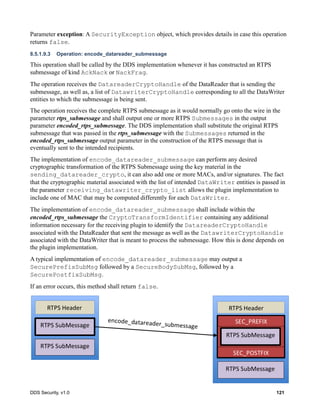
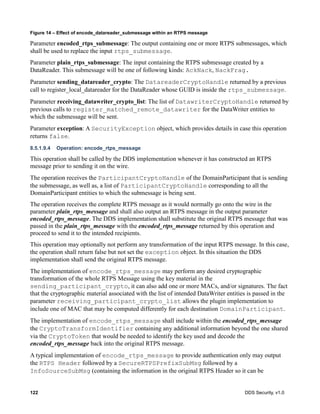
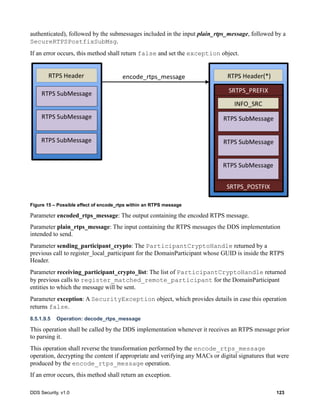
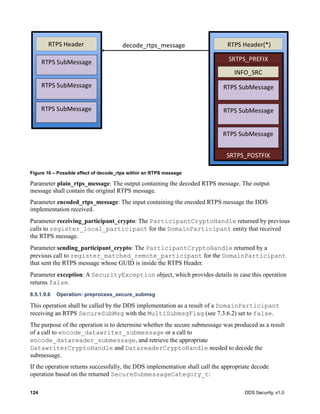
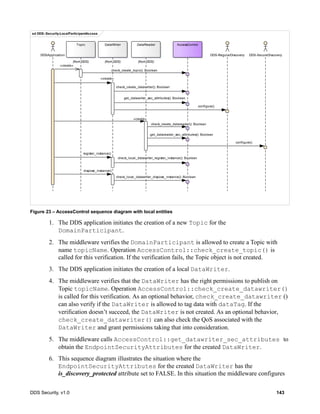
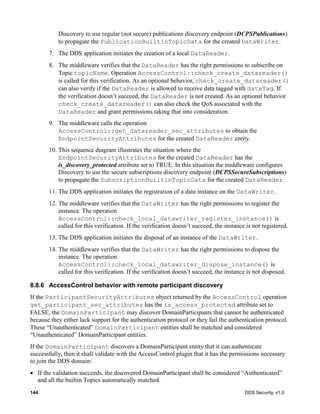
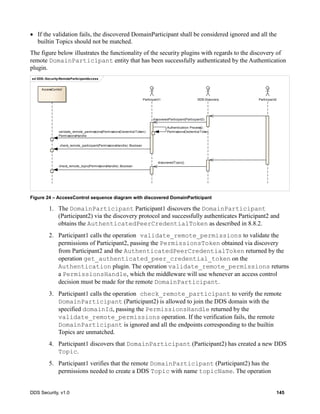
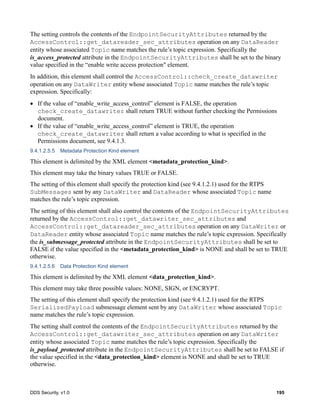
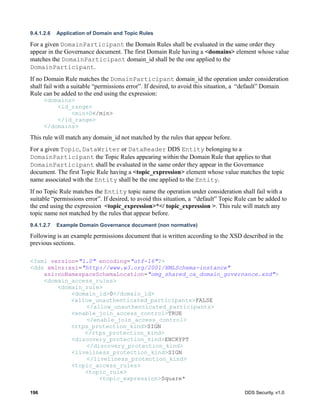
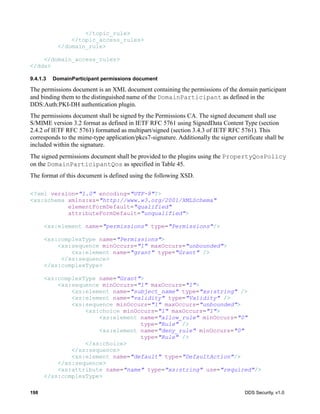
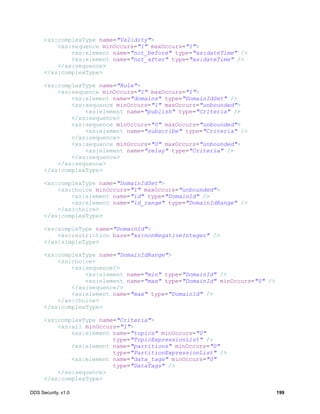
Date: September 2016
DDS Security
Version 1.0
OMG Document Number: formal/2016-08-01
Standard document URL: http://www.omg.org/spec/DDS-SECURITY/1.0
Machine Consumable Files:
Normative:
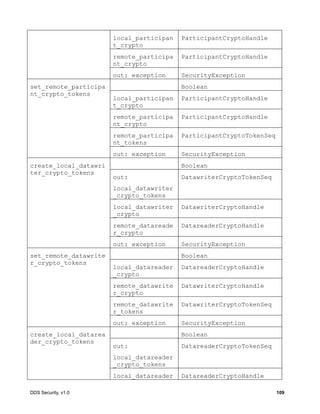
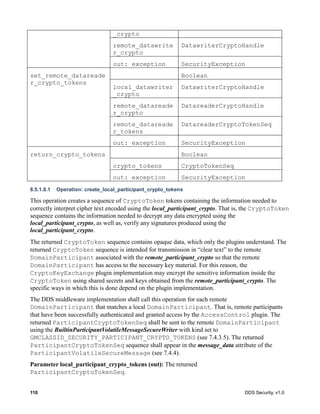
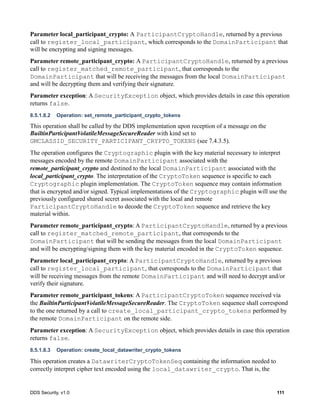
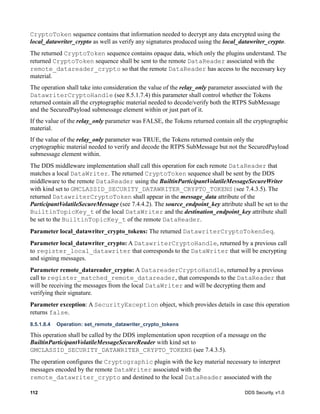
http://www.omg.org/spec/DDS-SECURITY/20160303/dds_security_plugins.idl
http://www.omg.org/spec/DDS-SECURITY/20160303/omg_shared_ca_governance.xsd
http://www.omg.org/spec/DDS-SECURITY/20160303/omg_shared_ca_permissions.xsd
http://www.omg.org/spec/DDS-SECURITY/20160303/dds_security_plugins_model.xmi
Non-normative:
http://www.omg.org/spec/DDS-SECURITY/20160303/omg_shared_ca_governance_example.xml
http://www.omg.org/spec/DDS-SECURITY/20160303/omg_shared_ca_permissions_example.xml
http://www.omg.org/spec/DDS-SECURITY/20160303/dds_security_plugins_model.eap
IPR mode: Non-Assert
Copyright © 2014-16, Object Management Group, Inc. (OMG)
Copyright © 2014-16, PrismTech.
Copyright © 2014-16, Real-Time Innovations, Inc. (RTI)
USE OF SPECIFICATION - TERMS, CONDITIONS & NOTICES
The material in this document details an Object Management Group specification in accordance with the terms, conditions
and notices set forth below. This document does not represent a commitment to implement any portion of this specification
in any company's products. The information contained in this document is subject to change without notice.
LICENSES
The companies listed above have granted to the Object Management Group, Inc. (OMG) a nonexclusive, royalty-free, paid
up, worldwide license to copy and distribute this document and to modify this document and distribute copies of the
modified version. Each of the copyright holders listed above has agreed that no person shall be deemed to have infringed
the copyright in the included material of any such copyright holder by reason of having used the specification set forth
herein or having conformed any computer software to the specification.
Subject to all of the terms and conditions below, the owners of the copyright in this specification hereby grant you a fully-
paid up, non-exclusive, nontransferable, perpetual, worldwide license (without the right to sublicense), to use this
specification to create and distribute software and special purpose specifications that are based upon this specification, and
to use, copy, and distribute this specification as provided under the Copyright Act; provided that: (1) both the copyright
notice identified above and this permission notice appear on any copies of this specification; (2) the use of the
specifications is for informational purposes and will not be copied or posted on any network computer or broadcast in any
media and will not be otherwise resold or transferred for commercial purposes; and (3) no modifications are made to this
specification. This limited permission automatically terminates without notice if you breach any of these terms or
conditions. Upon termination, you will destroy immediately any copies of the specifications in your possession or control.
PATENTS
The attention of adopters is directed to the possibility that compliance with or adoption of OMG specifications may require
use of an invention covered by patent rights. OMG shall not be responsible for identifying patents for which a license may
be required by any OMG specification, or for conducting legal inquiries into the legal validity or scope of those patents that
are brought to its attention. OMG specifications are prospective and advisory only. Prospective users are responsible for
protecting themselves against liability for infringement of patents.
GENERAL USE RESTRICTIONS
Any unauthorized use of this specification may violate copyright laws, trademark laws, and communications regulations
and statutes. This document contains information which is protected by copyright. All Rights Reserved. No part of this
work covered by copyright herein may be reproduced or used in any form or by any means--graphic, electronic, or
mechanical, including photocopying, recording, taping, or information storage and retrieval systems--without permission of
the copyright owner.
DISCLAIMER OF WARRANTY
WHILE THIS PUBLICATION IS BELIEVED TO BE ACCURATE, IT IS PROVIDED "AS IS" AND MAY CONTAIN
ERRORS OR MISPRINTS. THE OBJECT MANAGEMENT GROUP AND THE COMPANIES LISTED ABOVE
MAKE NO WARRANTY OF ANY KIND, EXPRESS OR IMPLIED, WITH REGARD TO THIS PUBLICATION,
INCLUDING BUT NOT LIMITED TO ANY WARRANTY OF TITLE OR OWNERSHIP, IMPLIED WARRANTY OF
MERCHANTABILITY OR WARRANTY OF FITNESS FOR A PARTICULAR PURPOSE OR USE.
IN NO EVENT SHALL THE OBJECT MANAGEMENT GROUP OR ANY OF THE COMPANIES LISTED ABOVE
BE LIABLE FOR ERRORS CONTAINED HEREIN OR FOR DIRECT, INDIRECT, INCIDENTAL, SPECIAL,
CONSEQUENTIAL, RELIANCE OR COVER DAMAGES, INCLUDING LOSS OF PROFITS, REVENUE, DATA OR
USE, INCURRED BY ANY USER OR ANY THIRD PARTY IN CONNECTION WITH THE FURNISHING,
PERFORMANCE, OR USE OF THIS MATERIAL, EVEN IF ADVISED OF THE POSSIBILITY OF SUCH DAMAGES.
The entire risk as to the quality and performance of software developed using this specification is borne by you. This
disclaimer of warranty constitutes an essential part of the license granted to you to use this specification.
RESTRICTED RIGHTS LEGEND
Use, duplication or disclosure by the U.S. Government is subject to the restrictions set forth in subparagraph (c) (1) (ii) of
The Rights in Technical Data and Computer Software Clause at DFARS 252.227-7013 or in subparagraph (c)(1) and (2) of
the Commercial Computer Software - Restricted Rights clauses at 48 C.F.R. 52.227-19 or as specified in 48 C.F.R. 227-
7202-2 of the DoD F.A.R. Supplement and its successors, or as specified in 48 C.F.R. 12.212 of the Federal Acquisition
Regulations and its successors, as applicable. The specification copyright owners are as indicated above and may be
contacted through the Object Management Group, 109 Highland Avenue, Needham, MA 02494, U.S.A.
TRADEMARKS
CORBA®, CORBA logos®, FIBO®, Financial Industry Business Ontology®, FINANCIAL INSTRUMENT GLOBAL
IDENTIFIER®, IIOP®, IMM®, Model Driven Architecture®, MDA®, Object Management Group®, OMG®, OMG
Logo®, SoaML®, SOAML®, SysML®, UAF®, Unified Modeling Language®, UML®, UML Cube Logo®, VSIPL®, and
XMI® are registered trademarks of the Object Management Group, Inc.
For a complete list of trademarks, see: http://www.omg.org/legal/tm_list.htm. All other products or company names
mentioned are used for identification purposes only, and may be trademarks of their respective owners.
COMPLIANCE
The copyright holders listed above acknowledge that the Object Management Group (acting itself or through its designees)
is and shall at all times be the sole entity that may authorize developers, suppliers and sellers of computer software to use
certification marks, trademarks or other special designations to indicate compliance with these materials.
Software developed under the terms of this license may claim compliance or conformance with this specification if and
only if the software compliance is of a nature fully matching the applicable compliance points as stated in the specification.
Software developed only partially matching the applicable compliance points may claim only that the software was based
on this specification, but may not claim compliance or conformance with this specification. In the event that testing suites
are implemented or approved by Object Management Group, Inc., software developed using this specification may claim
compliance or conformance with the specification only if the software satisfactorily completes the testing suites.
OMG’s Issue Reporting Procedure
All OMG specifications are subject to continuous review and improvement. As part of this process we
encourage readers to report any ambiguities, inconsistencies, or inaccuracies they may find by
completing the Issue Reporting Form listed on the main web page http://www.omg.org, under
Documents, Report a Bug/Issue.
DDS Security, v1.0 i
Table of Contents
Preface ..........................................................................................................................................ix
1 Scope........................................................................................................................................1
1.1 General.......................................................................................................................................... 1
1.2 Overview of this Specification ........................................................................................................ 1
2 Conformance.............................................................................................................................3
2.1 Conformance points....................................................................................................................... 3
2.2 Builtin plugin interoperability (mandatory)..................................................................................... 3
2.3 Plugin framework (mandatory):...................................................................................................... 3
2.4 Plugin Language APIs (optional):..................................................................................................... 3
2.5 Logging and Tagging profile (optional): ........................................................................................... 4
3 Normative References ...............................................................................................................5
4 Terms and Definitions................................................................................................................7
5 Symbols ..................................................................................................................................11
6 Additional Information............................................................................................................13
6.1 Changes to Adopted OMG Specifications ...................................................................................... 13
6.2 Acknowledgments ....................................................................................................................... 13
7 Support for DDS Security .........................................................................................................15
7.1 Security Model............................................................................................................................. 15
7.1.1 Threats ............................................................................................................................................. 15
7.2 Types used by DDS Security.......................................................................................................... 18
7.2.1 Property_t........................................................................................................................................ 18
7.2.2 BinaryProperty_t.............................................................................................................................. 19
7.2.3 DataHolder....................................................................................................................................... 20
7.2.4 Token................................................................................................................................................ 21
7.2.5 PropertyQosPolicy, DomainParticipantQos, DataWriterQos, and DataReaderQos ......................... 23
7.2.6 ParticipantGenericMessage ............................................................................................................. 23
7.2.7 Additional DDS Return Code: NOT_ALLOWED_BY_SEC ................................................................... 24
7.3 Securing DDS Messages on the Wire............................................................................................. 24
ii DDS Security, v1.0
7.3.1 RTPS Background (Non-Normative)................................................................................................. 24
7.3.2 Secure RTPS Messages..................................................................................................................... 26
7.3.3 Constraints of the DomainParticipant BuiltinTopicKey_t (GUID)..................................................... 27
7.3.4 Mandatory use of the KeyHash for encrypted messages ................................................................ 27
7.3.5 Immutability of Publisher Partition Qos in combination with non-volatile Durability kind............. 28
7.3.6 Platform Independent Description .................................................................................................. 28
7.3.7 Mapping to UDP/IP PSM .................................................................................................................. 36
7.4 DDS Support for Security Plugin Information Exchange.................................................................. 41
7.4.1 Secure builtin Discovery Topics........................................................................................................ 41
7.4.2 New ParticipantMessageSecure builtin Topic.................................................................................. 47
7.4.3 New ParticipantStatelessMessage builtin Topic............................................................................... 47
7.4.4 New ParticipantVolatileMessageSecure builtin Topic...................................................................... 50
7.4.5 Definition of the “Builtin Secure Endpoints” ................................................................................... 54
8 Plugin Architecture..................................................................................................................55
8.1 Introduction................................................................................................................................. 55
8.1.1 Service Plugin Interface Overview ................................................................................................... 55
8.1.2 Plugin Instantiation .......................................................................................................................... 56
8.2 Common Types ............................................................................................................................ 57
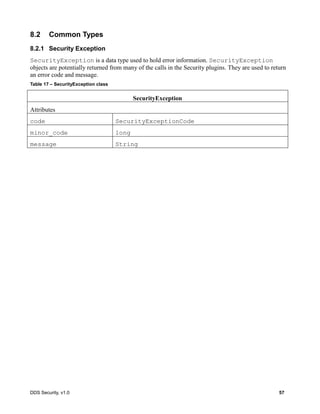
8.2.1 Security Exception............................................................................................................................ 57
8.3 Authentication Plugin................................................................................................................... 58
8.3.1 Background (Non-Normative).......................................................................................................... 58
8.3.2 Authentication Plugin Model ........................................................................................................... 58
8.4 Access Control Plugin ................................................................................................................... 76
8.4.1 Background (Non-Normative).......................................................................................................... 76
8.4.2 AccessControl Plugin Model............................................................................................................. 76
8.5 Cryptographic Plugin.................................................................................................................... 99
8.5.1 Cryptographic Plugin Model............................................................................................................. 99
8.6 The Logging Plugin ......................................................................................................................129
8.6.1 Background (Non-Normative)........................................................................................................ 129
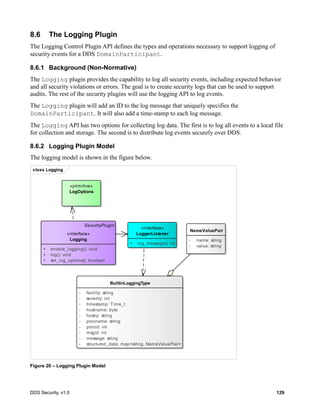
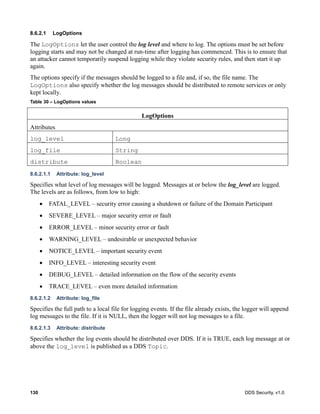
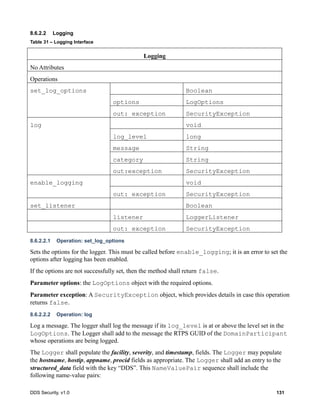
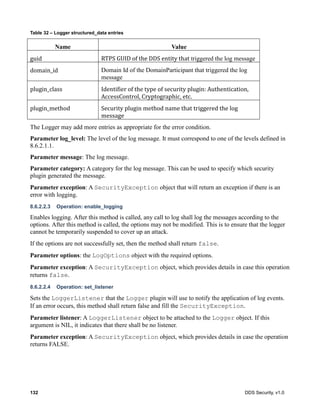
8.6.2 Logging Plugin Model..................................................................................................................... 129
8.7 Data Tagging ...............................................................................................................................133
8.7.1 Background (Non-Normative)........................................................................................................ 133
DDS Security, v1.0 iii
8.7.2 DataTagging Model ........................................................................................................................ 133
8.7.3 DataTagging Types.......................................................................................................................... 133
8.8 Security Plugins Behavior ............................................................................................................134
8.8.1 Authentication and AccessControl behavior with local DomainParticipant.................................. 134
8.8.2 Authentication behavior with discovered DomainParticipant....................................................... 136
8.8.3 DDS Entities impacted by the AccessControl operations............................................................... 139
8.8.4 AccessControl behavior with local participant creation ................................................................ 142
8.8.5 AccessControl behavior with local domain entity creation ........................................................... 142
8.8.6 AccessControl behavior with remote participant discovery.......................................................... 144
8.8.7 AccessControl behavior with remote domain entity discovery..................................................... 146
8.8.8 Cryptographic Plugin key generation behavior.............................................................................. 149
8.8.9 Cryptographic Plugin key exchange behavior ................................................................................ 151
8.8.10 Cryptographic Plugins encoding/decoding behavior................................................................... 156
9 Builtin Plugins .......................................................................................................................165
9.1 Introduction................................................................................................................................165
9.2 Requirements and Priorities (Non-Normative) .............................................................................165
9.2.1 Performance and Scalability........................................................................................................... 166
9.2.2 Robustness and Availability............................................................................................................ 166
9.2.3 Fitness to the DDS Data-Centric Model ......................................................................................... 167
9.2.4 Leverage and Reuse of Existing Security Infrastructure and Technologies.................................... 167
9.2.5 Ease-of-Use while Supporting Common Application Requirements.............................................. 167
9.3 Builtin Authentication: DDS:Auth:PKI-DH.....................................................................................168
9.3.1 Configuration ................................................................................................................................. 168
9.3.2 DDS:Auth:PKI-DH Types ................................................................................................................. 170
9.3.3 DDS:Auth:PKI-DH plugin behavior.................................................................................................. 176
9.3.4 DDS:Auth:PKI-DH plugin authentication protocol.......................................................................... 182
9.4 Builtin Access Control: DDS:Access:Permissions ...........................................................................186
9.4.1 Configuration ................................................................................................................................. 186
9.4.2 DDS:Access:Permissions Types....................................................................................................... 208
9.4.3 DDS:Access:Permissions plugin behavior....................................................................................... 209
9.5 Builtin Crypto: DDS:Crypto:AES-GCM-GMAC ................................................................................214
9.5.1 Configuration ................................................................................................................................. 216
iv DDS Security, v1.0
9.5.2 DDS:Crypto:AES-GCM-GMAC Types............................................................................................... 216
9.5.3 DDS:Crypto:AES-GCM-GMAC plugin behavior............................................................................... 221
9.6 Builtin Logging Plugin..................................................................................................................242
9.6.1 DDS:Logging:DDS_LogTopic plugin behavior ................................................................................. 243
10 Plugin Language Bindings ....................................................................................................245
10.1 Introduction..............................................................................................................................245
10.2 IDL representation of the plugin interfaces.................................................................................245
10.3 C language representation of the plugin interfaces.....................................................................245
10.4 C++ classic representation of the plugin interfaces .....................................................................246
10.5 Java classic................................................................................................................................246
10.6 C++11 representation of the plugin interfaces ............................................................................246
10.7 Java modern aligned with the DDS-JAVA5+ PSM.........................................................................246
Annex A - References ..................................................................................................................247
DDS Security, v1.0 v
Tables
Table 1 – Property_t class....................................................................................................................... 19
Table 2 – BinaryProperty_t class............................................................................................................ 20
Table 3 – DataHolder class..................................................................................................................... 21
Table 4 – SecureSubMsg class................................................................................................................ 31
Table 5 – SecurePrefixSubMsg class...................................................................................................... 32
Table 6 – SecurePostfixSubMsg class .................................................................................................... 34
Table 7 – SecureRTPSPrefixSubMsg class ............................................................................................ 35
Table 8 – SecurePostfixSubMsg class .................................................................................................... 36
Table 9 – EntityId values for secure builtin data writers and data readers ............................................. 37
Table 10 – Additional parameter IDs in ParticipantBuiltinTopicData.................................................... 43
Table 11 – Mapping of the additional builtin endpoints added by DDS security to the
availableBuiltinEndpoints............................................................................................................... 44
Table 12 – Additional parameter IDs in PublicationBuiltinTopicDataSecure........................................ 45
Table 13 – Additional parameter IDs in SubscriptionBuiltinTopicDataSecure...................................... 46
Table 14 – Non-default Qos policies for BuiltinParticipantVolatileMessageSecureWriter.................... 51
Table 15 – Non-default Qos policies for BuiltinParticipantVolatileMessageSecureReader................... 51
Table 16 – Purpose of each Security Plugin ........................................................................................... 56
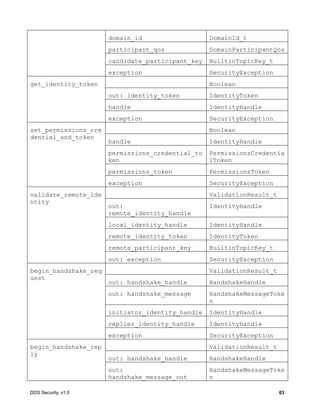
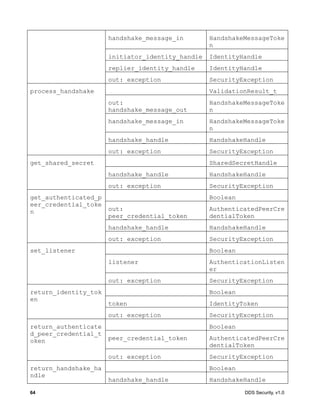
Table 18 – Authentication plugin interface............................................................................................. 62
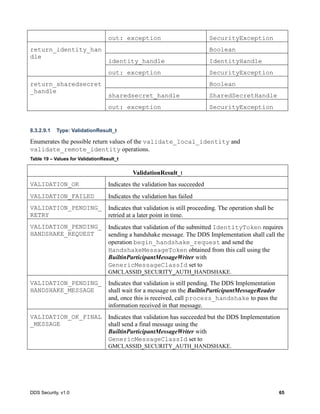
Table 19 – Values for ValidationResult_t................................................................................................ 65
Table 20 – Authentication listener class ................................................................................................. 75
Table 21 – Description of the ParticipantSecurityAttributes.................................................................. 78
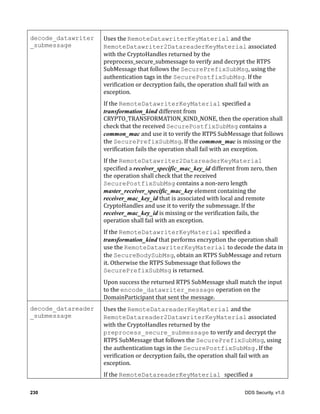
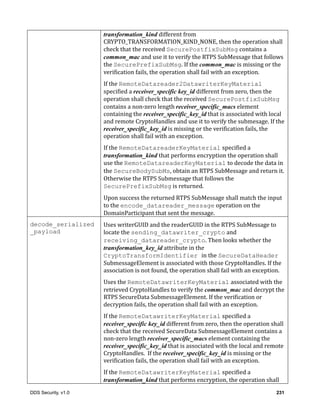
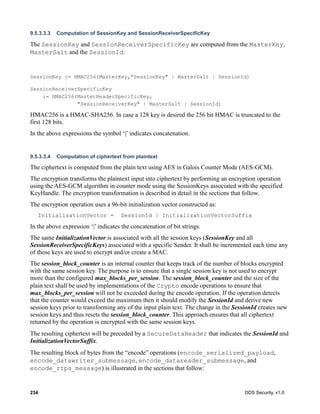
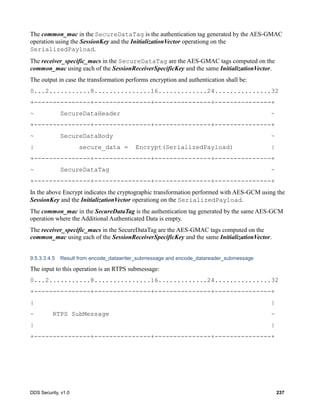
Table 22 – Description of the EndpointSecurityAttributes..................................................................... 80
Table 23 – AccessControl Interface........................................................................................................ 81
Table 24 – AccessControlListener interface ........................................................................................... 97
Table 25 – CryptoTransformIdentifier class......................................................................................... 101
Table 26 – SecureSubmessageCategory_t ............................................................................................ 101
Table 27 – CryptoKeyFactory Interface ............................................................................................... 102
Table 28 – CryptoKeyExchange Interface............................................................................................ 108
Table 29 – CryptoTransform interface.................................................................................................. 115
Table 30 – LogOptions values .............................................................................................................. 130
vi DDS Security, v1.0
Table 32 – Logger structured_data entries............................................................................................ 132
Table 33 – Impact of Access Control Operations to the DDS Builtin and Application-defined Entities
...................................................................................................................................................... 140
Table 34 – Summary of the Builtin Plugins.......................................................................................... 165
Table 35 – Properties used to configure the builtin Authentication plugin .......................................... 168
Table 36 – IdentityToken class for the builtin Authentication plugin................................................... 171
Table 37 – AuthenticatedPeerCredentialToken class for the builtin Authentication plugin ................. 171
Table 38 – HandshakeRequestMessageToken for the builtin Authentication plugin ........................... 172
Table 39 – HandshakeReplyMessageToken for the builtin Authentication plugin .............................. 173
Table 40 – HandshakeFinalMessageToken for the builtin Authentication plugin................................ 175
Table 41 – Actions undertaken by the operations of the builtin Authentication plugin........................ 176
Table 42 – Terms used in the description of the builtin authentication protocol.................................. 182
Table 43 – Notation of the operations/transformations used in the description of the builtin
authentication protocol ................................................................................................................. 184
Table 44 – Description of built-in authentication protocol................................................................... 184
Table 45 – Properties used to configure the builtin AccessControl plugin........................................... 186
Table 46 PermissionsCredentialToken class for the builtin AccessControl plugin .............................. 208
Table 47 PermissionsToken class for the builtin AccessControl plugin............................................... 209
Table 48 – Actions undertaken by the operations of the bulitin AccessControl plugin........................ 209
Table 49 – AES-GCM transformation inputs ....................................................................................... 215
Table 50 – AES-GCM trasnsformation outputs.................................................................................... 215
Table 51 – CryptoToken class for the builtin Cryptographic plugin .................................................... 216
Table 52 – KeyMaterial_AES_GCM_GMAC for BuiltinParticipantVolatileMessageSecureWriter and
BuiltinParticipantVolatileMessageSecureReader ......................................................................... 218
Table 53 – Terms used in KxKey and KxMacKey derivation formula for the builtin Cryptographic
plugin ............................................................................................................................................ 218
Table 54 – CryptoTransformIdentifier class for the builtin Cryptographic plugin............................... 219
Table 55 – Actions undertaken by the operations of the builtin Cryptographic CryptoKeyFactory plugin
...................................................................................................................................................... 222
Table 56 – Actions undertaken by the operations of the builtin Cryptographic CryptoKeyExchange
plugin ............................................................................................................................................ 223
Table 57 – Actions undertaken by the operations of the builtin Cryptographic CryptoKeyTransform
plugin ............................................................................................................................................ 225
DDS Security, v1.0 vii
Table 58 – Terms used in Key Computation and cryptographic transformations formulas for the builtin
cryptographic plugin..................................................................................................................... 232
Table 59 – Actions undertaken by the operations of the builtin Logging plugin.................................. 243
Figures
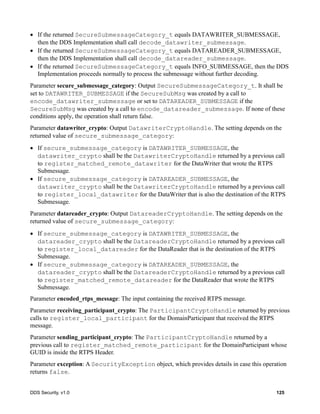
Figure 1 – Overall architecture for DDS Security.................................................................................... 1
Figure 2 – Threat actors.......................................................................................................................... 16
Figure 3 – Token Model.......................................................................................................................... 22
Figure 4 – RTPS message structure........................................................................................................ 25
Figure 5 – Secure Submessage and Secured Payload Model ................................................................. 30
Figure 6 – RTPS message transformations............................................................................................. 33
Figure 7 – Plugin Architecture Model .................................................................................................... 55
Figure 8 – Authentication plugin model ................................................................................................. 59
Figure 9 – Authentication plugin interaction state machine ................................................................... 61
Figure 10 – AccessControl Plugin Model............................................................................................... 77
Figure 11 – Cryptographic Plugin Model............................................................................................... 99
Figure 12 – Effect of encode_serialized_payload within an RTPS message........................................ 119
Figure 13 – Effect of encode_datawriter_submessage within an RTPS message ................................ 120
Figure 14 – Effect of encode_datareader_submessage within an RTPS message................................ 122
Figure 15 – Possible effect of encode_rtps within an RTPS message.................................................. 123
Figure 16 – Possible effect of decode_rtps within an RTPS message.................................................. 124
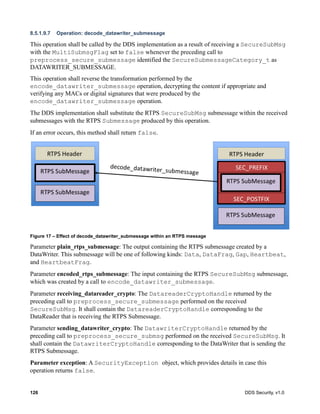
Figure 17 – Effect of decode_datawriter_submessage within an RTPS message ................................ 126
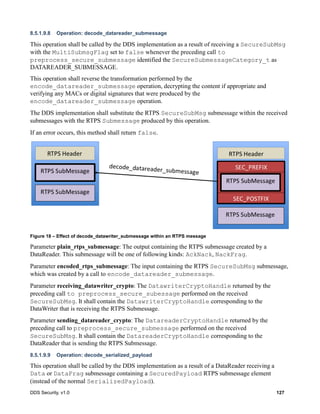
Figure 18 – Effect of decode_datawriter_submessage within an RTPS message ................................ 127
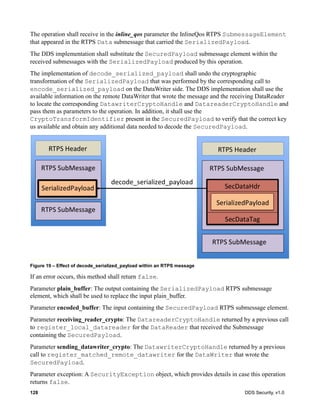
Figure 19 – Effect of decode_serialized_payload within an RTPS message........................................ 128
Figure 20 – Logging Plugin Model ...................................................................................................... 129
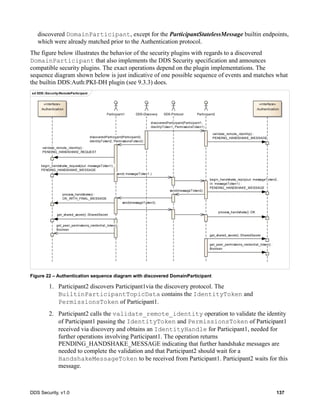
Figure 22 – Authentication sequence diagram with discovered DomainParticipant............................ 137
Figure 23 – AccessControl sequence diagram with local entities ........................................................ 143
Figure 24 – AccessControl sequence diagram with discovered DomainParticipant ............................ 145
Figure 25 – AccessControl sequence diagram with discovered entities when
is_access_protected==FALSE ...................................................................................................... 147
viii DDS Security, v1.0
Figure 26 – AccessControl sequence diagram with discovered entities when
is_access_protected==TRUE........................................................................................................ 148
Figure 27 – Cryptographic KeyExchange plugin sequence diagram with discovered DomainParticipant
...................................................................................................................................................... 152
Figure 28 – Cryptographic KeyExchange plugin sequence diagram with discovered DataReader ..... 154
Figure 29 – Cryptographic KeyExchange plugin sequence diagram with discovered DataWriter ...... 155
Figure 30 – Cryptographic CryptoTransform plugin sequence diagram for encoding/decoding a single
DataWriter submessage ................................................................................................................ 157
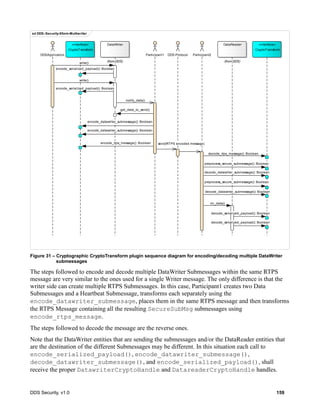
Figure 31 – Cryptographic CryptoTransform plugin sequence diagram for encoding/decoding multiple
DataWriter submessages............................................................................................................... 159
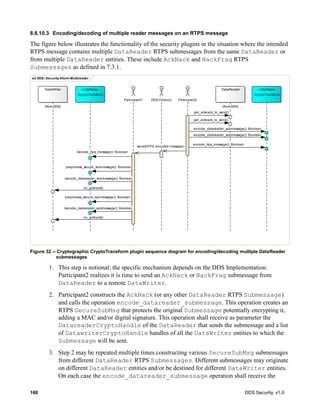
Figure 32 -- Cryptographic CryptoTransform plugin sequence diagram for encoding/decoding multiple
DataReader submessages.............................................................................................................. 160
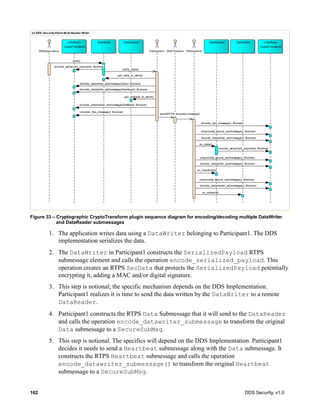
Figure 33 – Cryptographic CryptoTransform plugin sequence diagram for encoding/decoding multiple
DataWriter and DataReader submessages .................................................................................... 162
DDS Security, v1.0 ix
Preface
About the Object Management Group
OMG
Founded in 1989, the Object Management Group, Inc. (OMG) is an open membership, not-for-profit
computer industry standards consortium that produces and maintains computer industry
specifications for interoperable, portable and reusable enterprise applications in distributed,
heterogeneous environments. Membership includes Information Technology vendors, end users,
government agencies and academia.
OMG member companies write, adopt, and maintain its specifications following a mature, open
process. OMG's specifications implement the Model Driven Architecture® (MDA®), maximizing
ROI through a full-lifecycle approach to enterprise integration that covers multiple operating
systems, programming languages, middleware and networking infrastructures, and software
development environments. OMG’s specifications include: UML® (Unified Modeling Language™);
CORBA® (Common Object Request Broker Architecture); CWM™ (Common Warehouse
Metamodel); and industry-specific standards for dozens of vertical markets.
More information on the OMG is available at http://www.omg.org/.
OMG Specifications
As noted, OMG specifications address middleware, modeling, and vertical domain frameworks. A
listing of all OMG Specifications is available from the OMG website at:
http://www.omg.org/spec/index.htm
Specifications are organized by the following categories:
Business Modeling Specifications
Middleware Specifications
• CORBA/IIOP
• Data Distribution Services
• Specialized CORBA
IDL/Language Mapping Specifications
Modeling and Metadata Specifications
• UML, MOF, CWM, XMI
• UML Profile
Modernization Specifications
Platform Independent Model (PIM), Platform Specific Model (PSM), Interface Specifications
• CORBAServices
• CORBAFacilities
x DDS Security, v1.0
OMG Domain Specifications
CORBA Embedded Intelligence Specifications
CORBA Security Specifications
All of OMG’s formal specifications may be downloaded without charge from our website. (Products
implementing OMG specifications are available from individual suppliers.) Copies of specifications,
available in PostScript and PDF format, may be obtained from the Specifications Catalog cited above
or by contacting the Object Management Group, Inc. at:
OMG Headquarters
109 Highland Avenue
Needham, MA 02494
USA
Tel: +1-781-444-0404
Fax: +1-781-444-0320
Email: pubs@omg.org
Certain OMG specifications are also available as ISO standards. Please consult http://www.iso.org.
Issues
The reader is encouraged to report any technical or editing issues/problems with this specification by
completing the Issue Reporting Form listed on the main web page http://www.omg.org under
Documents, Report a Bug/Issue.
DDS Security, v1.0 1
1 Scope
1.1 General
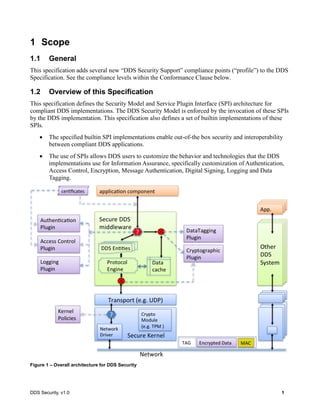
This specification adds several new “DDS Security Support” compliance points (“profile”) to the DDS
Specification. See the compliance levels within the Conformance Clause below.
1.2 Overview of this Specification
This specification defines the Security Model and Service Plugin Interface (SPI) architecture for
compliant DDS implementations. The DDS Security Model is enforced by the invocation of these SPIs
by the DDS implementation. This specification also defines a set of builtin implementations of these
SPIs.
The specified builtin SPI implementations enable out-of-the box security and interoperability
between compliant DDS applications.
The use of SPIs allows DDS users to customize the behavior and technologies that the DDS
implementations use for Information Assurance, specifically customization of Authentication,
Access Control, Encryption, Message Authentication, Digital Signing, Logging and Data
Tagging.
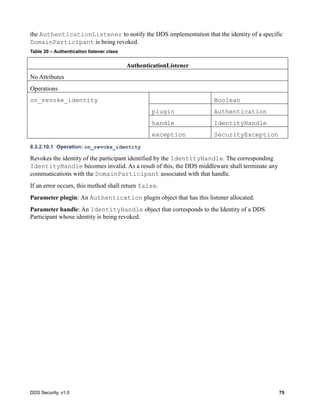
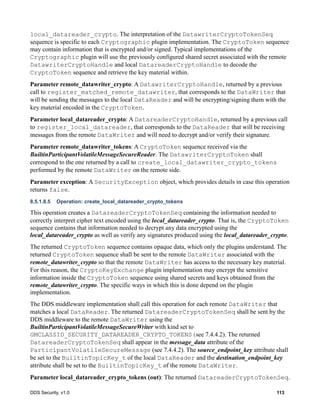
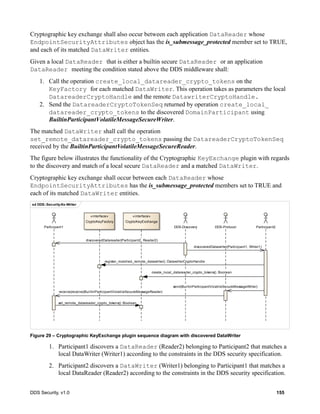
Figure 1 – Overall architecture for DDS Security
2 DDS Security, v1.0
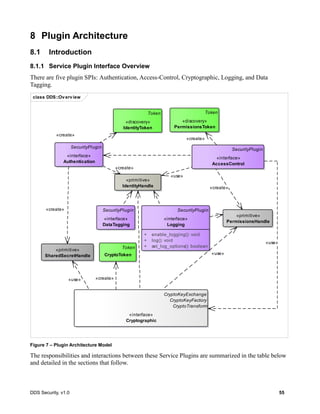
This specification defines five SPIs that when combined together provide Information Assurance to
DDS systems:
Authentication Service Plugin. Provides the means to verify the identity of the application
and/or user that invokes operations on DDS. Includes facilities to perform mutual
authentication between participants and establish a shared secret.
AccessControl Service Plugin. Provides the means to enforce policy decisions on what DDS
related operations an authenticated user can perform. For example, which domains it can join,
which Topics it can publish or subscribe to, etc.
Cryptographic Service Plugin. Implements (or interfaces with libraries that implement) all
cryptographic operations including encryption, decryption, hashing, digital signatures, etc. This
includes the means to derive keys from a shared secret.
Logging Service Plugin. Supports auditing of all DDS security-relevant events
Data Tagging Service Plugin. Provides a way to add tags to data samples.
DDS Security, v1.0 3
2 Conformance
2.1 Conformance points
This specification defines the following conformance points:
(1) Builtin plugin interoperability (mandatory)
(2) Plugin framework (mandatory)
(3) Plugin language APIs (optional)
(4) Logging and Tagging (optional)
Conformance with the “DDS Security” specification requires conformance with all the mandatory
conformance points.
2.2 Builtin plugin interoperability (mandatory)
This point provides interoperability with all the builtin plugins with the exception of the Logging
plugin. Conformance to this point requires conformance to:
Clause 7 (the security model and the support for interoperability between DDS Security
implementations).
The configuration of the plugins and the observable wire-protocol behavior specified in Clause 9
(the builtin-plugins), except for sub clause 9.6. This conformance point does not require
implementation of the APIs between the DDS implementation and the plugins.
2.3 Plugin framework (mandatory):
This point provides the architectural framework and abstract APIs needed to develop new security
plugins and “plug them” into a DDS middleware implementation. Plugins developed using this
framework are portable between conforming DDS implementations. However portability for a specific
programming language also requires conformance to the specific language API (see 2.4).
Conformance to this point requires conformance to:
Clause 7 (the security model and the support for interoperability between DDS Security
implementations).
Clause 8 (the plugin model) with the exception of 8.6 and 8.7 (Logging and Data Tagging plugins).
The conformance to the plugin model is at the UML level; it does not mandate a particular language
mapping.
Clause 9, the builtin-plugins, except for 9.6 (Builtin Logging Plugin).
In addition it requires the conforming DDS implementation to provide a public API to insert the
plugins that conform to the aforementioned sections.
2.4 Plugin Language APIs (optional):
These conformance points provide portability across compliant DDS implementations of the security
plugins developed using a specific programming language.
Conformance to any of the language portability points requires conformance to the (mandatory) plugin
architecture framework point.
4 DDS Security, v1.0
These are 5 “plugin language API” points, each corresponding to a different programming language
used to implement the plugins.
Each language point is a separate independent conformance point. Conformance with the “plugin
language API” point requires conformance with at least one of the 5 language APIs enumerated below:
C Plugin APIs. Conformance to sub clauses 10.2 and 10.3
C++ classic Plugin APIs. Conformance to sub clauses 10.2 and 10.4
Java classic Plugin APIs. Conformance to sub clauses 10.2 and 10.5
C++11 Plugin APIs. Conformance to sub clauses 10.2 and 10.6
Java5+ Plugin APIs. Conformance to sub clauses 10.2 and 10.7.
2.5 Logging and Tagging profile (optional):
This point adds support for logging and tagging. Conformance to this point requires conformance to
sub clauses 8.6, 8.7, and 9.6.
DDS Security, v1.0 5
3 Normative References
DDS: Data-Distribution Service for Real-Time Systems version 1.4.
http://www.omg.org/spec/DDS/1.4
DDS-RTPS: Data-Distribution Service Interoperability Wire Protocol version 2.2,
http://www.omg.org/spec/DDS-RTPS/2.2/
DDS-XTYPES: Extensible and Dynamic Topic-Types for DDS version 1.1
http://www.omg.org/spec/DDS-XTypes/1.1/
OMG-IDL: Interface Definition Language (IDL) version 3.5 http://www.omg.org/spec/IDL35/
HMAC: Keyed-Hashing for Message Authentication. H. Krawczyk, M. Bellare, and R.Canetti,
IETF RFC 2104, http://tools.ietf.org/html/rfc2104
PKCS #7: Cryptographic Message Syntax Version 1.5. IETF RFC 2315.
http://tools.ietf.org/html/rfc2315
Public-Key Cryptography Standards (PKCS) #1: RSA Cryptography Specifications Version 2.1.
IETF RFC 3447. https://tools.ietf.org/html/rfc3447
6 DDS Security, v1.0
DDS Security, v1.0 7
4 Terms and Definitions
For the purposes of this specification, the following terms and definitions apply:
Access Control
Mechanism that enables an authority to control access to areas and resources in a given physical
facility or computer-based information system.
Authentication
Security measure(s) designed to establish the identity of a transmission, message, or originator.
Authorization
Access privileges that are granted to an entity; conveying an “official” sanction to perform a security
function or activity.
Ciphertext
Data in its encrypted or signed form.
Certification authority
The entity in a Public Key Infrastructure (PKI) that is responsible for issuing certificates, and exacting
compliance to a PKI policy.
Confidentiality
Assurance that information is not disclosed to unauthorized individuals, processes, or devices.
Cryptographic algorithm
A well-defined computational procedure that takes variable inputs, including a cryptographic key and
produces an output.
Cryptographic key
A parameter used in conjunction with a cryptographic algorithm that operates in such a way that
another agent with knowledge of the key can reproduce or reverse the operation, while an agent
without knowledge of the key cannot.
Examples include:
1. The transformation of plaintext data into ciphertext.
2. The transformation of ciphertext data into plaintext.
3. The computation of a digital signature from data.
4. The verification of a digital signature.
5. The computation of a message authentication code from data.
6. The verification of a message authentication code from data and a received authentication
code.
Data-Centric Publish-Subscribe (DCPS)
The mandatory portion of the DDS specification used to provide the functionality required for an
application to publish and subscribe to the values of data objects.
8 DDS Security, v1.0
Data Distribution Service (DDS)
An OMG distributed data communications specification that allows Quality of Service policies to be
specified for data timeliness and reliability. It is independent of the implementation language.
Digital signature
The result of a cryptographic transformation of data that, when properly implemented with supporting
infrastructure and policy, provides the services of:
1. origin authentication
2. data integrity
3. signer non-repudiation
Extended IDL
Extended Interface Definition Language (IDL) used to describe data types in a way that can be
represented in a machine neutral format for network communications. This syntax was introduced as
part of the DDS-XTYPES specification [3].
Hashing algorithm
A one-way algorithm that maps an input byte buffer of arbitrary length to an output fixed-length byte
array in such a way that:
(a) Given the output it is computationally infeasible to determine the input.
(b) It is computationally infeasible to find any two distinct inputs that map to the same output.
Information Assurance
The practice of managing risks related to the use, processing, storage, and transmission of information
or data and the systems and processes used for those purposes.
Integrity
Protection against unauthorized modification or destruction of information.
Key management
The handling of cryptographic material (e.g., keys, Initialization Vectors) during their entire life cycle
of the keys from creation to destruction.
Message authentication code (MAC)
A cryptographic hashing algorithm on data that uses a symmetric key to detect both accidental and
intentional modifications of data.
Non-Repudiation
Assurance that the sender of data is provided with proof of delivery and the recipient is provided with
proof of the sender's identity, so neither can later deny having received or processed the data.
Public key
A cryptographic key used with a public key cryptographic algorithm that is uniquely associated with an
entity and that may be made public. The public key is associated with a private key. The public key
may be known by anyone and, depending on the algorithm, may be used to:
DDS Security, v1.0 9
1. Verify a digital signature that is signed by the corresponding private key,
2. Encrypt data that can be decrypted by the corresponding private key, or
3. Compute a piece of shared data.
Public key certificate
A set of data that uniquely identifies an entity, contains the entity's public key and possibly other
information, and is digitally signed by a trusted party, thereby binding the public key to the entity.
Public key cryptographic algorithm
A cryptographic algorithm that uses two related keys, a public key and a private key. The two keys
have the property that determining the private key from the public key is computationally infeasible.
Public Key Infrastructure
A framework that is established to issue, maintain and revoke public key certificates.
10 DDS Security, v1.0
DDS Security, v1.0 11
5 Symbols
This specification does not define any symbols or abbreviations.
12 DDS Security, v1.0
DDS Security, v1.0 13
6 Additional Information
6.1 Changes to Adopted OMG Specifications
This specification does not modify any existing adopted OMG specifications. It reuses and/or adds
functionality on top of the current set of OMG specifications.
DDS: This specification does not modify or invalidate any existing DDS profiles or compliance
levels. It extends some of the DDS builtin Topics to carry additional information in a
compatible way with existing implementations of DDS.
DDS-RTPS: This specification does not require any modifications to RTPS; however, it may
impact interoperability with existing DDS-RTPS implementations. In particular, DDS-RTPS
implementations that do not implement the DDS Security specification will have limited
interoperability with implementations that do implement the mechanisms introduced by this
specification. Interoperability is limited to systems configured to allow “unauthorized”
DomainParticipant entities and within those systems, only to Topics configured to be
“unprotected.”
DDS-XTYPES: This specification depends on the IDL syntax introduced by and the Extended
CDR encoding defined in the DDS-XTYPES specification. It does not require any
modifications of DDS-XTYPES.
OMG IDL: This specification does not modify any existing IDL-related compliance levels.
6.2 Acknowledgments
The following individials and companies submitted content that was incorporated into this
specification:
Submitting contributors:
(lead) Gerardo Pardo-Castellote, Ph.D., Real-Time Innovations. gerardo.pardo AT rti.com
Jaime Martin-Losa, eProsima JaimeMartin AT eprosima.com
Angelo Corsaro, Ph.D., PrismTech. angelo.corsaro AT prismtech.com
Supporting contributors:
Char Wales, MITRE charwing AT mitre.org
Clark Tucker, Twin Oaks Computing, Inc. ctucker AT twinoakscomputing.com
Finalization Task Force members and participants:
(chair) Gerardo Pardo-Castellote, Ph.D., Real-Time Innovations. gerardo.pardo AT rti.com
Clark Tucker, Twin Oaks Computing, Inc. ctucker AT twinoakscomputing.com
Jaime Martin-Losa, eProsima JaimeMartin AT eprosima.com
Virginie Watine, THALES, virginie.watine AT thalesgroup.com
Cyril Dangerville, THALES, cyril.dangerville AT thalesgroup.com
14 DDS Security, v1.0
Angelo Corsaro, Ph.D., PrismTech. angelo.corsaro AT prismtech.com
Julien Enoch, PrismTech, julien.enoch AT prismtech.com
Jaime Martin-Losa, eProsima JaimeMartin AT eprosima.com
Ricardo Gonzalez, eProsime, RicardoGonzalez AT eprosima.com
Gilles Bessens, Kongsberg Gallium, gilles.bessens AT kongsberggallium.com
Charles Fudge, NSWC Dalghren, charles.fudge AT navy.mil
Ron Townsen, General Dynamics AIS, Ronald.Townsen AT gd-ais.com
DDS Security, v1.0 15
7 Support for DDS Security
7.1 Security Model
The Security Model for DDS defines the security principals (users of the system), the objects that are
being secured, and the operations on the objects that are to be restricted. DDS applications share
information on DDS Global Data Spaces (called DDS Domains) where the information is organized
into Topics and accessed by means of read and write operations on data-instances of those Topics.
Ultimately what is being secured is a specific DDS Global Data Space (domain) and, within the
domain, the ability to access (read or write) information (specific Topic or even data-object instances
within the Topic) in the DDS Global Data Space.
Securing DDS means providing:
Confidentiality of the data samples
Integrity of the data samples and the messages that contain them
Authentication of DDS writers and readers
Authorization of DDS writers and readers
Non-repudiation of data
To provide secure access to the DDS Global Data Space, applications that use DDS must first be
authenticated, so that the identity of the application (and potentially the user that interacts with it) can
be established. Once authentication has been obtained, the next step is to enforce access control
decisions that determine whether the application is allowed to perform specific actions. Examples of
actions are: joining a DDS Domain, defining a new Topic, reading or writing a specific DDS Topic,
and even reading or writing specific Topic instances (as identified by the values of key fields in the
data). Enforcement of access control shall be supported by cryptographic techniques so that
information confidentiality and integrity can be maintained, which in turn requires an infrastructure to
manage and distribute the necessary cryptographic keys.
7.1.1 Threats
In order to understand the decisions made in the design of the plugins, it is important to understand
some of the specific threats impacting applications that use DDS and DDS Interoperability Wire
Protocol (RTPS).
Most relevant are four categories of threats:
1. Unauthorized subscription
2. Unauthorized publication
3. Tampering and replay
4. Unauthorized access to data
These threats are described in the context of a hypothetical communication scenario with six actors all
attached to the same network:
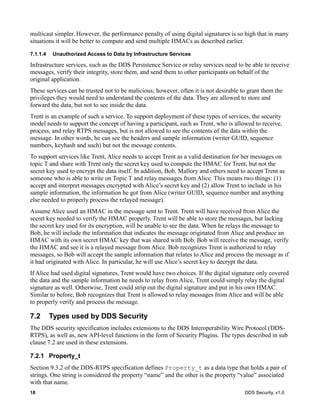
Alice. A DDS DomainParticipant who is authorized to publish data on a Topic T.
16 DDS Security, v1.0
Bob. A DDS DomainParticipant who is authorized to subscribe to data on a Topic T.
Eve. An eavesdropper. Someone who is not authorized to subscribe to data on Topic T.
However Eve uses the fact that she is connected to the same network to try to see the data.
Trudy. An intruder. A DomainParticipant who is not authorized to publish on Topic T.
However, Trudy uses the fact that she is connected to the same network to try to send data.
Mallory. A malicious DDS DomainParticipant. Mallory is authorized to subscribe to data on
Topic T but she is not authorized to publish on Topic T. However, Mallory will try to use
information gained by subscribing to the data to publish in the network and try to convince Bob
that she is a legitimate publisher.
Trent. A trusted service who needs to receive and send information on Topic T. For example,
Trent can be a persistence service or a relay service. He is trusted to relay information without
having malicious intent. However he is not trusted to see the content of the information.
Figure 2 – Threat actors
7.1.1.1 Unauthorized Subscription
The DomainParticipant Eve is connected to the same network infrastructure as the rest of the agents
and is able to observe the network packets despite the fact that the messages are not intended to be sent
to Eve. Many scenarios can lead to this situation. Eve could tap into a network switch or observe the
communication channels. Alternatively, in situations where Alice and Bob are communicating over
multicast, Eve could simply subscribe to the same multicast address.
Protecting against Eve is reasonably simple. All that is required is for Alice to encrypt the data she
writes using a secret key that is only shared with authorized receivers such as Bob, Trent, and Mallory.
7.1.1.2 Unauthorized Publication
The DomainParticipant Trudy is connected to the same network infrastructure as the rest of the agents
and is able to inject network packets with any data contents, headers and destination she wishes (e.g.,
Bob). The network infrastructure will route those packets to the indicated destination.
DDS Security, v1.0 17
To protect against Trudy, Bob, Trent and Mallory need to realize that the data is not originating from
Alice. They need to realize that the data is coming from someone not authorized to send data on Topic
T and therefore reject (i.e., not process) the packet.
Protecting against Trudy is also reasonably simple. All that is required is for the protocol to require that
the messages include either a hash-based message authentication code (HMAC) or digital signature.
An HMAC creates a message authentication code using a secret key that is shared with the
intended recipients. Alice would only share the secret key with Bob, Mallory and Trent so that
they can recognize messages that originate from Alice. Since Trudy is not authorized to publish
Topic T, Bob and the others will not recognize any HMACs Trudy produces (i.e., they will not
recognize Trudy’s key).
A digital signature is based on public key cryptography. To create a digital signature, Alice
encrypts a digest of the message using Alice’s private key. Everybody (including Bob, Mallory
and Trent) has access to Alice’s public key. Similar to the HMAC above, the recipients can
identify messages from Alice, as they are the only ones whose digital signature can be
interpreted with Alice’s public key. Any digital signatures Trudy may use will be rejected by the
recipients, as Trudy is not authorized to write Topic T.
The use of HMACs versus digital signatures presents tradeoffs that will be discussed further in
subsequent sections. Suffice it to say that in many situations the use of HMACs is preferred because
the performance to compute and verify them is about 1000 times faster than the performance of
computing/verifying digital signatures.
7.1.1.3 Tampering and Replay
Mallory is authorized to subscribe to Topic T. Therefore Alice has shared with Mallory the secret key
to encrypt the topic and also, if an HMAC is used, the secret key used for the HMAC.
Assume Alice used HMACs instead of digital signatures. Then Mallory can use her knowledge of the
secret keys used for data encryption and the HMACs to create a message on the network and pretend it
came from Alice. Mallory can fake all the TCP/UDP/IP headers and any necessary RTPS identifiers
(e.g., Alice’s RTPS DomainParticipant and DataWriter GUIDs). Mallory has the secret key that was
used to encrypt the data so she can create encrypted data payloads with any contents she wants. She
has the secret key used to compute HMACs so she can also create a valid HMAC for the new message.
Bob and the others will have no way to see that message came from Mallory and will accept it,
thinking it came from Alice.
So if Alice used an HMAC, the only solution to the problem is that the secret key used for the HMAC
when sending the message to Mallory cannot be the same as the key used for the HMAC when sending
messages to Bob. In other words, Alice must share a different secret key for the HMAC with each
recipient. Then Mallory will not have the HMAC key that Bob expects from Alice and the messages
from Mallory to Bob will not be misinterpreted as coming from Alice.
Recall that Alice needs to be able to use multicast to communicate efficiently with multiple receivers.
Therefore, if Alice wants to send an HMAC with a different key for every receiver, the only solution is
to append multiple HMACs to the multicast message with some key-id that allows the recipient to
select the correct HMAC to verify.
If Alice uses digital signatures to protect the integrity of the message, then this ‘masquerading’
problem does not arise and Alice can send the same digital signature to all recipients. This makes using
18 DDS Security, v1.0
multicast simpler. However, the performance penalty of using digital signatures is so high that in many
situations it will be better to compute and send multiple HMACs as described earlier.
7.1.1.4 Unauthorized Access to Data by Infrastructure Services
Infrastructure services, such as the DDS Persistence Service or relay services need to be able to receive
messages, verify their integrity, store them, and send them to other participants on behalf of the
original application.
These services can be trusted not to be malicious; however, often it is not desirable to grant them the
privileges they would need to understand the contents of the data. They are allowed to store and
forward the data, but not to see inside the data.
Trent is an example of such a service. To support deployment of these types of services, the security
model needs to support the concept of having a participant, such as Trent, who is allowed to receive,
process, and relay RTPS messages, but is not allowed to see the contents of the data within the
message. In other words, he can see the headers and sample information (writer GUID, sequence
numbers, keyhash and such) but not the message contents.
To support services like Trent, Alice needs to accept Trent as a valid destination for her messages on
topic T and share with Trent only the secret key used to compute the HMAC for Trent, but not the
secret key used to encrypt the data itself. In addition, Bob, Mallory and others need to accept Trent as
someone who is able to write on Topic T and relay messages from Alice. This means two things: (1)
accept and interpret messages encrypted with Alice’s secret key and (2) allow Trent to include in his
sample information, the information he got from Alice (writer GUID, sequence number and anything
else needed to properly process the relayed message).
Assume Alice used an HMAC in the message sent to Trent. Trent will have received from Alice the
secret key needed to verify the HMAC properly. Trent will be able to store the messages, but lacking
the secret key used for its encryption, will be unable to see the data. When he relays the message to
Bob, he will include the information that indicates the message originated from Alice and produce an
HMAC with its own secret HMAC key that was shared with Bob. Bob will receive the message, verify
the HMAC and see it is a relayed message from Alice. Bob recognizes Trent is authorized to relay
messages, so Bob will accept the sample information that relates to Alice and process the message as if
it had originated with Alice. In particular, he will use Alice’s secret key to decrypt the data.
If Alice had used digital signatures, Trent would have two choices. If the digital signature only covered
the data and the sample information he needs to relay from Alice, Trent could simply relay the digital
signature as well. Otherwise, Trent could strip out the digital signature and put in his own HMAC.
Similar to before, Bob recognizes that Trent is allowed to relay messages from Alice and will be able
to properly verify and process the message.
7.2 Types used by DDS Security
The DDS security specification includes extensions to the DDS Interoperability Wire Protocol (DDS-
RTPS), as well as, new API-level functions in the form of Security Plugins. The types described in sub
clause 7.2 are used in these extensions.
7.2.1 Property_t
Section 9.3.2 of the DDS-RTPS specification defines Property_t as a data type that holds a pair of
strings. One string is considered the property “name” and the other is the property “value” associated
with that name.
DDS Security, v1.0 19
The DDS Security specification extends the DDS-RTPS definition of Property_t to contain the
additional boolean attribute “propagate” used to indicate whether a property is intended for local use
only or should be propagated by DDS discovery.
The DDS-Security specification uses Property_t sequences as a generic data type to configure the
security plugins, pass metadata and provide an extensible mechanism for vendors to configure the
behavior of their plugins without breaking portability or interoperability.
Property_t objects with names that start with the prefix “dds.sec.” are reserved by this
specification, including future versions of this specification. Plugin implementers can also use this
mechanism to pass metadata and configure the behavior of their plugins. In order to avoid collisions
with the value of the “name” attribute, implementers shall use property names that start with a prefix to
an ICANN domain name they own, in reverse order. For example, the prefix would be “com.acme.”
for plugins developed by a hypothetical vendor that owns the domain “acme.com”.
The names and interpretation of the expected properties shall be specified by each plugin
implementation.
Table 1 – Property_t class
Property_t
Attributes
name String
value String
propagate Boolean
7.2.1.1 IDL Representation for Property_t
The Property_t type may be used for information exchange over the network. When a
Property_t is sent over the network it shall be serialized using Extended CDR format according to
the Extended IDL representation [3] below.
@Extensibility (EXTENSIBLE_EXTENSIBILITY)
struct Property_t {
string name;
string value;
@non-serialized boolean propagate;
};
typedef sequence< Property_t > PropertySeq;
7.2.2 BinaryProperty_t
BinaryProperty_t is a data type that holds a string and an octet sequence. The string is
considered the property “name” and the octet sequence the property “value” associated with that name.
Sequences of BinaryProperty_t are used as a generic data type to configure the plugins, pass
metadata and provide an extensible mechanism for vendors to configure the behavior of their plugins
without breaking portability or interoperability.
20 DDS Security, v1.0
BinaryProperty_t also contains the boolean attribute “propagate”. Similar to Property_t
this attribute is used to indicate weather the corresponding binary property is intended for local use
only or shall be propagated by DDS discovery.
BinaryProperty_t objects with a “name” attribute that start with the prefix “dds.sec.” are
reserved by this specification, including future versions of this specification.
Plugin implementers may use this mechanism to pass metadata and configure the behavior of their
plugins. In order to avoid collisions with the value of the “name”, attribute implementers shall use
property names that start with a prefix to an ICANN domain name they own, in reverse order. For
example, the prefix would be “com.acme.” for plugins developed by a hypothetical vendor that owns
the domain “acme.com”.
The valid values of the “name” attribute and the interpretation of the associated “value” shall be
specified by each plugin implementation.
Table 2 – BinaryProperty_t class
BinaryProperty_t
Attributes
name String
value OctetSeq
propagate Boolean
7.2.2.1 IDL Representation for BinaryProperty_t
The BinaryProperty_t type may be used for information exchange over the network. When a
BinaryProperty_t is sent over the network, it shall be serialized using Extended CDR format
according to the Extended IDL representation [3] below.
@Extensibility (EXTENSIBLE_EXTENSIBILITY)
struct BinaryProperty_t {
string name;
OctetSeq value;
@non-serialized boolean propagate;
};
typedef sequence< BinaryProperty_t > BinaryPropertySeq;
7.2.3 DataHolder
DataHolder is a data type used to hold generic data. It contains various attributes used to store data
of different types and formats. DataHolder appears as a building block for other types, such as
Token and GenericMessageData.
DDS Security, v1.0 21
Table 3 – DataHolder class
DataHolder
Attributes
class_id String
properties PropertySeq
binary_properties BinaryPropertySeq
7.2.3.1 IDL representation for DataHolder
The DataHolder type may be used for information exchange over the network. When a
DataHolder is sent over the network, it shall be serialized using Extended CDR format according to
the Extended IDL representation [3] below.
@Extensibility (EXTENSIBLE_EXTENSIBILITY)
struct DataHolder {
string class_id;
PropertySeq properties;
BinaryPropertySeq binary_properties;
};
typedef sequence<DataHolder> DataHolderSeq;
7.2.4 Token
The Token class provides a generic mechanism to pass information between security plugins using
DDS as the transport. Token objects are meant for transmission over the network using DDS either
embedded within the builtin topics sent via DDS discovery or via special DDS Topic entities defined in
this specification.
The Token class is structurally identical to the DataHolder class and therefore has the same
structure for all plugin implementations. However, the contents and interpretation of the Token
objects shall be specified by each plugin implementation.
There are multiple specializations of the Token class. They all share the same format, but are used for
different purposes. This is modeled by defining specialized classes.
22 DDS Security, v1.0
Figure 3 – Token Model
7.2.4.1 Attribute: class_id
When used as a Token class, the class_id attribute in the DataHolder identifies the kind of Token.
Strings with the prefix “dds.sec.” are reserved for this specification, including future versions of
the specification. Implementers of this specification can use this attribute to identify non-standard
tokens. In order to avoid collisions, the class_id they use shall start with a prefix to an ICANN domain
name they own, using the same rules specified in 7.2.1 for property names.
7.2.4.2 IDL Representation for Token and Specialized Classes
The Token class is used to hold information exchanged over the network. When a Token is sent over
the network, it shall be serialized using Extended CDR format according to the Extended IDL
representation below:
typedef DataHolder Token;
typedef Token HandshakeMessageToken;
typedef Token IdentityToken;
typedef Token PermissionsToken;
typedef Token AuthenticatedPeerCredentialToken;
typedef Token PermissionsCredentialToken;
typedef Token CryptoToken;
typedef Token ParticipantCryptoToken;
typedef Token DatawriterCryptoToken;
typedef Token DatareaderCryptoToken;
typedef sequence<HandshakeMessageToken> HandshakeMessageTokenSeq;
typedef sequence<CryptoToken> CryptoTokenSeq;
typedef CryptoTokenSeq ParticipantCryptoTokenSeq;
class Tokens
CryptoToken
Token
«discovery»
IdentityToken
«discovery»
PermissionsToken
MessageTokenPermissionsCredentialToken
DataHolder
- class_id: string
- string_properties: Property[]
- binary_properties: BinaryProperty[]
- string_values: string[]
- binary_value1: byte[]
- binary_value2: byte[]
- longlong_values: LongLong[]
DDS Security, v1.0 23
typedef CryptoTokenSeq DatawriterCryptoTokenSeq;
typedef CryptoTokenSeq DatareaderCryptoTokenSeq;
7.2.5 PropertyQosPolicy, DomainParticipantQos, DataWriterQos, and DataReaderQos
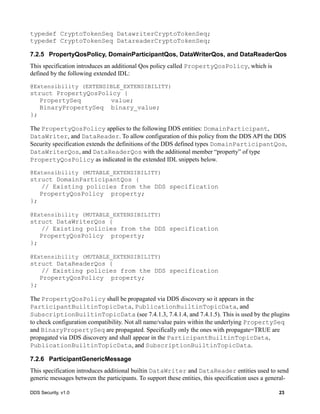
This specification introduces an additional Qos policy called PropertyQosPolicy, which is
defined by the following extended IDL:
@Extensibility (EXTENSIBLE_EXTENSIBILITY)
struct PropertyQosPolicy {
PropertySeq value;
BinaryPropertySeq binary_value;
};
The PropertyQosPolicy applies to the following DDS entities: DomainParticipant,
DataWriter, and DataReader. To allow configuration of this policy from the DDS API the DDS
Security specification extends the definitions of the DDS defined types DomainParticipantQos,
DataWriterQos, and DataReaderQos with the additional member “property” of type
PropertyQosPolicy as indicated in the extended IDL snippets below.
@Extensibility (MUTABLE_EXTENSIBILITY)
struct DomainParticipantQos {
// Existing policies from the DDS specification
PropertyQosPolicy property;
};
@Extensibility (MUTABLE_EXTENSIBILITY)
struct DataWriterQos {
// Existing policies from the DDS specification
PropertyQosPolicy property;
};
@Extensibility (MUTABLE_EXTENSIBILITY)
struct DataReaderQos {
// Existing policies from the DDS specification
PropertyQosPolicy property;
};
The PropertyQosPolicy shall be propagated via DDS discovery so it appears in the
ParticipantBuiltinTopicData, PublicationBuiltinTopicData, and
SubscriptionBuiltinTopicData (see 7.4.1.3, 7.4.1.4, and 7.4.1.5). This is used by the plugins
to check configuration compatibility. Not all name/value pairs within the underlying PropertySeq
and BinaryPropertySeq are propagated. Specifically only the ones with propagate=TRUE are
propagated via DDS discovery and shall appear in the ParticipantBuiltinTopicData,
PublicationBuiltinTopicData, and SubscriptionBuiltinTopicData.
7.2.6 ParticipantGenericMessage
This specification introduces additional builtin DataWriter and DataReader entities used to send
generic messages between the participants. To support these entities, this specification uses a general-
24 DDS Security, v1.0
purpose data type called ParticipantGenericMessage, which is defined by the following
extended IDL:
typedef octet[16] BuiltinTopicKey_t;
@Extensibility (EXTENSIBLE_EXTENSIBILITY)
struct MessageIdentity {
BuiltinTopicKey_t source_guid;
long long sequence_number;
};
typedef string<> GenericMessageClassId;
@Extensibility (EXTENSIBLE_EXTENSIBILITY)
struct ParticipantGenericMessage {
/* target for the request. Can be GUID_UNKNOWN */
MessageIdentity message_identity;
MessageIdentity related_message_identity;
BuiltinTopicKey_t destination_participant_key;
BuiltinTopicKey_t destination_endpoint_key;
BuiltinTopicKey_t source_endpoint_key;
GenericMessageClassId message_class_id;
DataHolderSeq message_data;
};
7.2.7 Additional DDS Return Code: NOT_ALLOWED_BY_SEC
The DDS specification defines a set of return codes that may be returned by the operations on the DDS
API (see sub clause 7.1.1 of the DDS specification).
The DDS Security specification add an additional return code NOT_ALLOWED_BY_SEC, which
shall be returned by any operation on the DDS API that fails because the security plugins do not allow
it.
7.3 Securing DDS Messages on the Wire
OMG DDS uses the Real-Time Publish-Subscribe (RTPS) on-the-wire protocol [2] for communicating
data. The RTPS protocol includes specifications on how discovery is performed, the metadata sent
during discovery, and all the protocol messages and handshakes required to ensure reliability. RTPS
also specifies how messages are put together.
7.3.1 RTPS Background (Non-Normative)
In a secure system where efficiency and message latency are also considerations, it is necessary to
define exactly what needs to be secured. Some applications may require only the data payload to be
confidential and it is acceptable for the discovery information, as well as, the reliability meta-traffic
(HEARTBEATs, ACKs, NACKs, etc.) to be visible, as long as it is protected from modification. Other
applications may also want to keep the metadata (sequence numbers, in-line QoS) and/or the reliability
traffic (ACKs, NACKs, HEARTBEATs) confidential. In some cases, the discovery information (who is
publishing what and its QoS) may need to be kept confidential as well.
DDS Security, v1.0 25
To help clarify these requirements, sub clause 7.3.1 explains the structure of the RTPS Message and
the different Submessages it may contain.
Figure 4 – RTPS message structure
An RTPS Message is composed of a leading RTPS Header followed by a variable number of RTPS
Submessages. Each RTPS Submessage is composed of a SubmessageHeader followed by a
variable number of SubmessagElements. There are various kinds of SubmessageElements to
communicate things like sequence numbers, unique identifiers for DataReader and DataWriter entities,
SerializedKeys or KeyHash of the application data, source timestamps, QoS, etc. There is one kind of
SubmessageElement called SerializedPayload that is used to carry the data sent by DDS
applications.
For the purposes of securing communications we distinguish three types of RTPS Submessages:
1. DataWriter Submessages. These are the RTPS submessages sent by a DataWriter to one or
more DataReader entities. These include the Data, DataFrag, Gap, Heartbeat, and
HeartbeatFrag submessages.
2. DataReader Submessages. These are the RTPS submessages sent by a DataReader to one or
more DataWriter entities. These include the AckNack and NackFrag submessages.
3. Interpreter Submessages. These are the RTPS submessages that are destined to the Message
Interpreter and affect the interpretation of subsequent submessages. These include all the
“Info” messages.
26 DDS Security, v1.0
The only RTPS submessages that contain application data are the Data and DataFrag. The
application data is contained within the SerializedPayload submessage element. In addition to
the SerializedPayload these submessages contain sequence numbers, inline QoS, the Key Hash,
identifiers of the originating DataWriter and destination DataReader, etc.
The Data, and DataFrag submessages contain a ParameterList submessage element called
inlineQos (see section 8.3.7 of the DDS-RTPS specification version 2.2). The inlineQos holds
metadata associated with the submessage. It is encoded as a ParameterList (see section 9.4.2.11
of the DDS-RTPS specification version 2.2). ParameterList is a list of {paramaterId, length,
value} tuples terminated by a sentinel. One of these parameters is the KeyHash.
The KeyHash parameter may only appear in the Data and DataFrag submessages. Depending on
the data type associated with the DataWriter that wrote the data, the KeyHash parameter contains
either:
A serialized representation of the values of all the attributes declared as ‘key’ attributes in the
associated data type, or
An MD5 hash computed over the aforementioned serialized key attributes.
Different RTPS Submessage within the same RTPS Message may originate on different
DataWriter or DataReader entities within the DomainParticipant that sent the RTPS message.
It is also possible for a single RTPS Message to combine submessages that originated on different
DDS DomainParticipant entities. This is done by preceding the set of RTPS Submessages that
originate from a common DomainParticipant with an InfoSource RTPS submessage.
7.3.2 Secure RTPS Messages
Sub clause 7.1.1 identified the threats addressed by the DDS Security specification. To protect against
the “Unauthorized Subscription” threat it is necessary to use encryption to protect the sensitive parts of
the RTPS message.
Depending on the application requirements, it may be that the only thing that should be kept
confidential is the content of the application data; that is, the information contained in the
SerializedPayload RTPS submessage element. However, other applications may also consider
the information in other RTPS SubmessageElements (e.g., sequence numbers, KeyHash, and
unique writer/reader identifiers) to be confidential. So the entire Data (or DataFrag) submessage
may need to be encrypted. Similarly, certain applications may consider other submessages such as
Gap, AckNack, Heartbeat, HeartbeatFrag, etc. also to be confidential.
For example, a Gap RTPS Submessage instructs a DataReader that a range of sequence numbers
is no longer relevant. If an attacker can modify or forge a Gap message from a DataWriter, it can
trick the DataReader into ignoring the data that the DataWriter is sending.
To protect against “Unauthorized Publication” and “Tampering and Replay” threats, messages must be
signed using secure hashes or digital signatures. Depending on the application, it may be sufficient to
sign only the application data (SerializedPayload submessage element), the whole
Submessage, and/or the whole RTPS Message.
DDS Security, v1.0 27
To support different deployment scenarios, this specification uses a “message transformation”
mechanism that gives the Security Plugin Implementations fine-grain control over which parts of the
RTPS Message need to be encrypted and/or signed.
The Message Transformation performed by the Security Plugins transforms an RTPS Message into
another RTPS Message. A new RTPS Header may be added and the content of the original RTPS
Message may be encrypted, protected by a Secure Message Authentication Code (MAC), and/or
signed. The MAC and/or signature can also include the RTPS Header to protect its integrity.
7.3.3 Constraints of the DomainParticipant BuiltinTopicKey_t (GUID)
The DDS and the DDS Interoperability Wire Protocol specifications state that DDS
DomainParticipant entities are identified by a unique 16-byte GUID.
This DomainParticipant GUID is communicated as part of DDS Discovery in the
ParticipantBuiltinTopicData in the attribute participant_key of type
BuiltinTopicKey_t defined as:
typedef octet BuiltinTopicKey_t[16];
Allowing a DomainParticipant to select its GUID arbitrarily would allow hostile applications to
perform a “squatter” attack, whereby a DomainParticipant with a valid certificate could
announce itself into the DDS Domain with the GUID of some other DomainParticipant. Once
authenticated the “squatter” DomainParticipant would preclude the real DomainParticipant	
from	being	discovered,	because	its	GUID	would	be	detected	as	a	duplicate of the already existing
one.
To prevent the aforementioned “squatter” attack, this specification constrains the GUID that can be
chosen by a DomainParticipant, so that it is tied to the Identity of the DomainParticipant.
This is enforced by the Authentication plugin.
7.3.4 Mandatory use of the KeyHash for encrypted messages
The RTPS Data and DataFrag submessages can optionally contain the KeyHash as an inline Qos
(see sub clause 9.6.3.3, titled “KeyHash (PID_KEY_HASH)”) of the DDS-RTPS specification version
2.3. In this sub clause it is specified that when present, the key hash shall be computed either as the
serialized key or as an MD5 on the serialized key.
The key values are logically part of the data and therefore in situations where the data is considered
sensitive the key should also be considered sensitive.
For this reason the DDS Security specification imposes additional constraints in the use of the key
hash. These constraints apply only to the Data or DataFrag RTPS SubMessages where the
SerializedPayload SubmessageElement is encrypted by the operation
encode_serialized_payload of the CryptoTransform plugin:
(1) The KeyHash shall be included in the Inline Qos.
(2) The KeyHash shall be computed as the 128 bit MD5 Digest (IETF RFC 1321) applied to the
CDR Big- Endian encapsulation of all the Key fields in sequence. Unlike the rule stated in sub
clause 9.6.3.3 of the DDS specification, the MD5 hash shall be used regardless of the
maximum-size of the serialized key.
28 DDS Security, v1.0
These rules accomplish two objectives:
(1) Avoid leaking the value of the key fields in situations where the data is considered sensitive
and therefore appears encrypted within the Data or DataFrag submessages.
(2) Enable the operation of infrastructure services without needed to leak to them the value of the
key fields (see 7.1.1.4).
Note that the use of the MD5 hashing function for these purposes does not introduce significant
vulnerabilities. While MD5 is considered broken as far as resistance to collisions (being able to find
two inputs that result in an identical unspecified hash) there are still no known practical preimage
attacks on MD5 (being able to find the input that resulted on a given hash).
7.3.5 Immutability of Publisher Partition Qos in combination with non-volatile
Durability kind
The DDS specification allows the PartitionQos policy of a Publisher to be changed after the
Publisher has been enabled. See sub clause 7.1.3 titled “Supported QoS) of the DDS 1.2
specification.
The DDS Security specification restricts this situation.
The DDS implementation shall not allow a Publisher to change PartitionQos policy after the
Publisher has been enabled if it contains any DataWriter that meets the following two criteria:
(1) The DataWriter either encrypts the SerializedPayload submessage element or
encrypts the Data or DataFrag submessage elements.
(2) The DataWriter has the DurabilityQos policy kind set to something other than
VOLATILE.
This rule prevents data that was published while the DataWriter had associated a set of
Partitions from being sent to DataReaders that were not matching before the Partition
change and match after the Partition is changed.
7.3.6 Platform Independent Description
7.3.6.1 RTPS Secure Submessage Elements
This specification introduces new RTPS SubmessageElements that may appear inside RTPS
Submessages.
7.3.6.1.1 CryptoTransformIdentifier
The CryptoTransformIdentifier submessage element identifies the kind of cryptographic
transformation that was performed in an RTPS Submessage or an RTPS SubmessageElement
and also provides a unique identifier of the key material used for the cryptographic transformation.
The way in which attributes in the CryptoTransformIdentifier are set shall be specified for
each Cryptographic plugin implementation. However, all Cryptographic plugin implementations shall
be set in a way that allows the operations preprocess_secure_submsg,
decode_datareader_submessage, decode_datawriter_submessage, and
decode_serialized_payload to uniquely recognize the cryptographic material they shall use
to decode the message, or recognize that they do not have the necessary key material.
DDS Security, v1.0 29
7.3.6.1.2 SecureDataBody
The SecureDataBody submessage element is used to wrap a SerializedPayload, an RTPS
Submessage, or a complete RTPS Message. It is the result of applying one of the encoding
transformations on the CryptoTransform plugin.
The specific format of this shall be defined by each Cryptographic plugin implementation.
7.3.6.1.3 SecureDataHeader
The SecureDataHeader submessage element is used as prefix to wrap a SerializedPayload,
an RTPS Submessage, or a complete RTPS Message. It is the result of applying one of the encoding
transformations on the CryptoTransform plugin.
The leading bytes in the SecureDataHeader shall encode the
CryptoTransformIdentifier. Therefore, the transformationKind is guaranteed to be the first
element within the SecureDataHeader. The specific format of this shall be defined by each
Cryptographic plugin implementation.
7.3.6.1.4 SecureDataTag
The SecureDataTag submessage element is used as postfix to wrap a SerializedPayload, an
RTPS Submessage, or a complete RTPS Message. It is the result of applying one of the encoding
transformations on the CryptoTransform plugin.
The specific format of this shall be defined by each Cryptographic plugin implementation.
7.3.6.2 RTPS Submessage: SecureSubMsg
This specification introduces a new RTPS submessage: SecureSubMsg. The format of the
SecureSubMsg complies with the RTPS SubMessage format mandated in the RTPS specification.
It consists of the RTPS SubmessageHeader followed by a set of RTPS SubmessageElement
elements.
Since the SecureSubMsg conforms to the general structure of RTPS submessages, it can appear
inside a well-formed RTPS message.
30 DDS Security, v1.0
Figure 5 – Secure Submessage and Secured Payload Model
7.3.6.2.1 Purpose
The SecureSubMsg submessage is used to wrap one or more regular RTPS submessages in such a
way that their contents are secured via encryption, message authentication, and/or digital signatures.
7.3.6.2.2 Content
The elements that form the structure of the RTPS SecureSubMsg are described in the table below.
class SecureSubmessages
RTPS::SubmessageHeader
- submessageId: SubmessageKind
- submessagLengh: ushort
- flags: SubmessageFlag[8]
SecureBodySubMsg
RTPS::Submessage
«interface»
CryptoTransformIdentifier
- transformationKind: long
- transformationId: octet[8]
SecureDataBody
RTPS::SubmessageElement
SecurePrefixSubMsg
SecurePostfixSubMsg
SecureRTPSPrefixSubMsg
SecureRTPSPostfixSubMsg
SecureDataHeader
- transformationId: CryptoTransformIdentifier
- value: octet[*]
SecureDataTag
- common_mac: char[]
- receiver_specific_macs: ReceiverSpecificMAC[]
1
0..*
«use»
«use»
DDS Security, v1.0 31
Table 4 – SecureSubMsg class
Element Type Meaning
SEC_SUB_MSG SubmessageKind The	presence	of	this	field	is	common	
to	RTPS	submessages.	It	identifies	
the	kind	of	submessage.
The	value	indicates	it	is	a	
SecureSubMsg
submessageLength ushort The	presence	of	this	field	is	common	
to	RTPS	submessages.	It	identifies	
the	length	of	the	submessage.
EndianessFlag SubmessageFlag Appears	in	the	Submessage	header	
flags.	Indicates	endianess.
sec_body SecureDataBody Contains	the	result	of	transforming	
the	original	message.	Depending	on	
the	plugin	implementation	and	
configuration,	it	may	contain	
encrypted	content,	message	access	
codes,	and/or	digital	signatures
7.3.6.2.3 Validity
The RTPS Submessage is invalid if the submessageLength in the Submessage header is too small.
7.3.6.2.4 Logical Interpretation
The SecureSubMsg provides a way to secure content inside a legal RTPS submessage.
A SecureSubMsg may wrap a single RTPS Submessage or a whole RTPS Message.
7.3.6.3 RTPS Submessage: SecurePrefixSubMsg
This specification introduces the RTPS submessage: SecurePrefixSubMsg. The format of the
SecurePrefixSubMsg complies with the RTPS SubMessage format mandated in the RTPS
specification. It consists of the RTPS SubmessageHeader followed by a set of RTPS
SubmessageElement elements.
7.3.6.3.1 Purpose
The SecurePrefixSubMsg submessage is used as prefix to wrap an RTPS submessage in such a
way that its contents are secured via encryption, message authentication, and/or digital signatures.
7.3.6.3.2 Content
The elements that form the structure of the RTPS SecurePrefixSubMsg are described in the table
below.
32 DDS Security, v1.0
Table 5 – SecurePrefixSubMsg class
Element Type Meaning
SEC_PREFIX SubmessageKind The	presence	of	this	field	is	common	to	RTPS	
submessages.	It	identifies	the	kind	of	
submessage.
The	value	indicates	it	is	a	SecurePrefixSubMsg
submessageLength ushort The	presence	of	this	field	is	common	to	RTPS	
submessages.	It	identifies	the	length	of	the	
submessage.
EndianessFlag SubmessageFlag Appears	in	the	Submessage	header	flags.	
Indicates	endianess.
transformation_id CryptoTransformIdentifier Identfies	the	kind	of	transformation	performed	
on	the	RTPS	Sububmessage	that	follows	it.
plugin_sec_header octet[] Provides	further	information	on	the	
transformation	performed.	The	contents	are	
specific	to	the	Plugin	Implementation	and	the	
value	of	the	transformation_id
7.3.6.3.3 Validity
The RTPS Submessage is invalid if the submessageLength in the Submessage header is too small.
7.3.6.3.4 Logical Interpretation
The SecurePrefixSubMsg provides a way to prefix secure content inside a legal RTPS
submessage.
A SecurePrefixSubMsg shall be followed by a single RTPS Submessage which itself shall be
followed by a SecurePostfixSubMsg.
DDS Security, v1.0 33
Figure 6 – RTPS message transformations
7.3.6.4 RTPS Submessage: SecurePostfixSubMsg
This specification introduces the RTPS submessage: SecurePostfixSubMsg. The format of the
SecurePostfixSubMsg complies with the RTPS SubMessage format mandated in the RTPS
specification. As such it consists of the RTPS SubmessageHeader followed by a set of RTPS
SubmessageElement elements.
7.3.6.4.1 Purpose
The SecurePostfixSubMsg submessage is used to authenticate the RTPS Submessage that
preceeds it.
7.3.6.4.2 Content
The elements that form the structure of the RTPS SecurePostfixSubMsg are described in the
table below.
34 DDS Security, v1.0
Table 6 – SecurePostfixSubMsg class
Element Type Meaning
SEC_POSTFIX SubmessageKind The	presence	of	this	field	is	common	to	RTPS	
submessages.	It	identifies	the	kind	of	submessage.
The	value	indicates	it	is	a	SecurePostfixSubMsg.
submessageLength ushort The	presence	of	this	field	is	common	to	RTPS	
submessages.	It	identifies	the	length	of	the	
submessage.
EndianessFlag SubmessageFlag Appears	in	the	Submessage	header	flags.	Indicates	
endianess.
plugin_sec_tag octet[] Provides	information	on	the	results	of	the	
transformation	performed,	typically	a	list	of	
authentication	tags.	The	contents	are	specific	to	the	
Plugin	Implementation	and	the	value	of	the	
transformation_id	contained	on	the	related	
SecurePrefixSubMsg.
7.3.6.4.3 Validity
The RTPS Submessage is invalid if the submessageLength in the Submessage header is too small.
The RTPS Submessage is invalid if there is no SecurePrefixSubMsg. Immediately before the
RTPS submessage that preceeds the SecurePostfixSubMsg. This SecurePrefixSubMsg is
referred to as the related the SecurePrefixSubMsg.
7.3.6.4.4 Logical Interpretation
The SecurePostfixSubMsg provides a way to authenticate the validity and origin of the RTPS
SubMessage that preceeds the SecurePrefixSubMsg. The Cryptographic transformation applied is
identified in the related SecurePrefixSubMsg.
7.3.6.5 RTPS Submessage: SecureRTPSPrefixSubMsg
This specification introduces the RTPS submessage: SecureRTPSPrefixSubMsg. The format of
the SecurePrefixSubMsg complies with the RTPS SubMessage format mandated in the RTPS
specification. It consists of the RTPS SubmessageHeader followed by a set of RTPS
SubmessageElement elements.
7.3.6.5.1 Purpose
The SecureRTPSPrefixSubMsg submessage is used as prefix to wrap a complete RTPS message
in such a way that its contents are secured via encryption, message authentication, and/or digital
signatures.
7.3.6.5.2 Content
The elements that form the structure of the RTPS SecureRTPSPrefixSubMsg are described in the
table below.
DDS Security, v1.0 35
Table 7 – SecureRTPSPrefixSubMsg class
Element Type Meaning
SRTPS_PREFIX SubmessageKind The	presence	of	this	field	is	common	to	RTPS	
submessages.	It	identifies	the	kind	of	
submessage.
The	value	indicates	it	is	a	
SecureRTPSPrefixSubMsg.
submessageLength ushort The	presence	of	this	field	is	common	to	RTPS	
submessages.	It	identifies	the	length	of	the	
submessage.
EndianessFlag SubmessageFlag Appears	in	the	Submessage	header	flags.	
Indicates	endianess.
transformation_id CryptoTransformIdentifier Identfies	the	kind	of	transformation	performed	
on	the	RTPS	Subumessages	that	follow	up	to	
the	SRTPS_POSTFIX	submessage.
plugin_sec_header octet[] Provides	further	information	on	the	
transformation	performed.	The	contents	are	
specific	to	the	Plugin	Implementation	and	the	
value	of	the	transformation_id.
7.3.6.5.3 Validity
The RTPS Submessage is invalid if the submessageLength in the Submessage header is too small.
The SecureRTPSPrefixSubMsg shall immediately follow the RTPS Header.
7.3.6.5.4 Logical Interpretation
The SecureRTPSPrefixSubMsg provides a way to prefix a list of RTPS Submessages so that they
can be secured.
A SecureRTPSPrefixSubMsg shall be followed by a list of RTPS Submessages which
themselves shall be followed by a SecureRTPSPostfixSubMsg.
7.3.6.6 RTPS Submessage: SecureRTPSPostfixSubMsg
This specification introduces the RTPS submessage: SecureRTPSPostfixSubMsg. The format of
the SecureRTPSPostfixSubMsg complies with the RTPS SubMessage format mandated in the
RTPS specification. As such it consists of the RTPS SubmessageHeader followed by a set of RTPS
SubmessageElement elements.
7.3.6.6.1 Purpose
The SecureRTPSPostfixSubMsg submessage is used to authenticate the RTPS Submessages that
appear between the preceeding SecureRTPSPostfixSubMsg and the
SecureRTPSPostfixSubMsg.
36 DDS Security, v1.0
7.3.6.6.2 Content
The elements that form the structure of the SecureRTPSPostfixSubMsg are described in the table
below.
Table 8 – SecurePostfixSubMsg class
Element Type Meaning
SRTPS_POSTFIX SubmessageKind The	presence	of	this	field	is	common	to	RTPS	
submessages.	It	identifies	the	kind	of	
submessage.
The	value	indicates	it	is	a	
SecureRTPSPostfixSubMsg.
submessageLength ushort The	presence	of	this	field	is	common	to	RTPS	
submessages.	It	identifies	the	length	of	the	
submessage.
EndianessFlag SubmessageFlag Appears	in	the	Submessage	header	flags.	
Indicates	endianess.
plugin_sec_tag octet[] Provides	information	on	the	results	of	the	
transformation	performed,	typically	a	list	of	
authentication	tags.	The	contents	are	specific	
to	the	Plugin	Implementation	and	the	value	of	
the	transformation_id	contained	on	the	related	
SecureRTPSPrefixSubMsg.
7.3.6.6.3 Validity
The RTPS Submessage is invalid if the submessageLength in the Submessage header is too small.
The RTPS SecureRTPSPostfixSubMsg is invalid if there is no SecureRTPSPrefixSubMsg
following the RTPS Header. This SecureRTPSPrefixSubMsg is referred to as the related
SecureRTPSPrefixSubMsg.
7.3.6.6.4 Logical Interpretation
The SecureRTPSPostfixSubMsg provides a way to authenticate the validity and origin of the list
of RTPS Submessages between the related SecureRTPSPrefixSubMsg and the
SecureRTPSPrefixSubMsg. The Cryptographic transformation applied is identified in the related
SecureRTPSPrefixSubMsg.
7.3.7 Mapping to UDP/IP PSM
The DDS-RTPS specification defines the RTPS protocol in terms of a platform-independent model
(PIM) and then maps it to a UDP/IP transport PSM (see clause 9, “Platform Specific Model (PSM):
UDP/IP” of the DDS-RTPS specification [2]).
Sub clause 7.3.7 does the same thing for the new RTPS submessage elements and submessages
introduced by the DDS Security specification.
DDS Security, v1.0 37
7.3.7.1 Mapping of the EntityIds for the Builtin DataWriters and DataReaders
Sub clause 7.4 defines a set of builtin Topics and corresponding DataWriter and DataReader entities
that shall be present on all compliant implementations of the DDS Security specification. The
corresponding EntityIds used when these endpoints are used on the UDP/IP PSM are given in the table
below.
Table 9 – EntityId values for secure builtin data writers and data readers
Entity EntityId_t name EntityId_t value
SEDPbuiltinPublicationsSecure
Writer
ENTITYID_SEDP_BUILTIN_PUBLICATIO
NS_SECURE_WRITER	
{{ff,	00,	03},	c2}
SEDPbuiltinPublicationsSecure
Reader
ENTITYID_SEDP_BUILTIN_PUBLICATIO
NS_SECURE_READER	
{{ff,	00,	03},	c7}
SEDPbuiltinSubscriptionsSecur
eWriter
ENTITYID_SEDP_BUILTIN_SUBSCRIPTI
ONS_SECURE_WRITER	
{{ff,	00,	04},	c2}
SEDPbuiltinSubscriptionsSecur
eReader
ENTITYID_	SEDP_BUILTIN_	
SUBSCRIPTIONS_SECURE_READER
{{ff,	00,	04},	c7}
BuiltinParticipantMessageSecu
reWriter
ENTITYID_P2P_BUILTIN_PARTICIPANT_
MESSAGE_SECURE_WRITER
{{ff,	02,	00},	c2}
BuiltinParticipantMessageSecu
reReader
ENTITYID_P2P_BUILTIN_PARTICIPANT_
MESSAGE_SECURE_READER	
{{ff,	02,	00},	c7}
BuiltinParticipantStatelessMes
sageWriter
ENTITYID_P2P_BUILTIN_PARTICIPANT_
STATELESS_WRITER	
{{00,	02,	01},	c3}
BuiltinParticipantStatelessMes
sageReader
ENTITYID_P2P_BUILTIN_PARTICIPANT_
STATELESS_READER
{{00,	02,	01},	c4}
BuiltinParticipantVolatileMess
ageSecureWriter
ENTITYID_P2P_BUILTIN_PARTICIPANT_
VOLATILE_SECURE_WRITER	
{{ff,	02,	02},	c3}
BuiltinParticipantVolatileMess
ageSecureReader
ENTITYID_P2P_BUILTIN_PARTICIPANT_
VOLATILE_SECURE_READER
{{ff,	02,	02},	c4}
7.3.7.2 Mapping of the CryptoTransformIdentifier Type
The UDP/IP PSM maps the CryptoTransformIdentifier to the following extended IDL
structure:
@Extensibility(FINAL_EXTENSIBILITY)
struct CryptoTransformIdentifier {
octet transformation_kind[4];
38 DDS Security, v1.0
octet transformation_key_id[4];
};
7.3.7.3 Mapping of the SecureDataHeader SubmessageElement
A SecureDataHeader SubmessageElement contains the information that identifies a
cryptographic transformation. The SecuredDataHeader shall start with the
CryptoTransformIdentifier and be followed by a plugin-specific plugin_sec_header
returned by the encoding transformation.
The UDP/IP wire representation for the SecuredDataHeader shall be:
0...2...........8...............16.............24...............32
+---------------+---------------+---------------+---------------+
| octet transformation_kind[4] |
+---------------+---------------+---------------+---------------+
| |
+ octet transformation_key_id[4] +
| |
+---------------+---------------+---------------+---------------+
| |
~ octet plugin_sec_header[] ~
| |
+---------------+---------------+---------------+---------------+
7.3.7.4 Mapping of the SecureDataTag SubmessageElement
A SecureDataTag SubmessageElement contains the information that authenticates the result
of a cryptographic transformation. The SecuredDataTag contains a plugin-specific plugin_sec_tag
returned by the encoding transformation.
The UDP/IP wire representation for the SecureDataTag shall be:
0...2...........8...............16.............24...............32
+---------------+---------------+---------------+---------------+
| |
~ octet plugin_sec_tag[] ~
| |
+---------------+---------------+---------------+---------------+
7.3.7.5 SecureBodySubMsg Submessage
7.3.7.5.1 Wire Representation
The UDP/IP wire representation for the SecureBodySubMsg shall be:
DDS Security, v1.0 39
0...2...........8...............16.............24...............32
+---------------+---------------+---------------+---------------+
| SecureSubMsgId|X|X|X|X|X|X|X|E| octetsToNextHeader |
+---------------+---------------+---------------+---------------+
| |
+ SecuredPayload payload +
| |
+---------------+---------------+---------------+---------------+
7.3.7.5.2 Submessage Id
The SecureBodySubMsg shall have the submessageId set to the value 0x30.
7.3.7.5.3 Flags in the Submessage Header
The SecureBodySubMsg only uses the EndiannessFlag.
7.3.7.6 SecurePrefixSubMsg Submessage
7.3.7.6.1 Wire Representation
The UDP/IP wire representation for the SecurePrefixSubMsg shall be:
0...2...........8...............16.............24...............32
+---------------+---------------+---------------+---------------+
| SEC_PREFIX |X|X|X|X|X|X|X|E| octetsToNextHeader |
+---------------+---------------+---------------+---------------+
| |
+ SecureDataHeader sec_data_header +
| |
+---------------+---------------+---------------+---------------+
7.3.7.6.2 Submessage Id
The SecurePrefixSubMsg shall have the submessageId set to the value 0x31 and referred by the
symbolic name SEC_PREFIX.
7.3.7.6.3 Flags in the Submessage Header
The SecurePrefixSubMsg only uses the EndiannessFlag.
7.3.7.7 SecurePostfixSubMsg Submessage
7.3.7.7.1 Wire Representation
The UDP/IP wire representation for the SecurePostfixSubMsg shall be:
40 DDS Security, v1.0
0...2...........8...............16.............24...............32
+---------------+---------------+---------------+---------------+
| SEC_POSTFIX |X|X|X|X|X|X|X|E| octetsToNextHeader |
+---------------+---------------+---------------+---------------+
| |
+ SecureDataTag sec_data_tag +
| |
+---------------+---------------+---------------+---------------+
7.3.7.7.2 Submessage Id
The SecurePostfixSubMsg shall have the submessageId set to the value 0x32 and referred by the
symbolic name SEC_POSTFIX.
7.3.7.7.3 Flags in the Submessage Header
The SecurePostfixSubMsg only uses the EndiannessFlag.
7.3.7.8 SecureRTPSPrefixSubMsg Submessage
7.3.7.8.1 Wire Representation
The UDP/IP wire representation for the SecureRTPSPrefixSubMsg shall be:
0...2...........8...............16.............24...............32
+---------------+---------------+---------------+---------------+
| SRTPS_PREFIX |X|X|X|X|X|X|X|E| octetsToNextHeader |
+---------------+---------------+---------------+---------------+
| |
+ SecureDataHeader sec_data_header +
| |
+---------------+---------------+---------------+---------------+
7.3.7.8.2 Submessage Id
The SecureRTPSPrefixSubMsg shall have the submessageId set to the value 0x33 and referred
by the symbolic name SRTPS_PREFIX.
7.3.7.8.3 Flags in the Submessage Header
The SecureRTPSPrefixSubMsg only uses the EndiannessFlag.
7.3.7.9 SecureRTPSPostfixSubMsg Submessage
7.3.7.9.1 Wire Representation
The UDP/IP wire representation for the SecureRTPSPostfixSubMsg shall be:
DDS Security, v1.0 41
0...2...........8...............16.............24...............32
+---------------+---------------+---------------+---------------+
| SRTPS_POSTFIX |X|X|X|X|X|X|X|E| octetsToNextHeader |
+---------------+---------------+---------------+---------------+
| |
+ SecureDataTag sec_data_tag +
| |
+---------------+---------------+---------------+---------------+
7.3.7.9.2 Submessage Id
The SecureRTPSPostfixSubMsg shall have the submessageId set to the value 0x34 and referred
by the symbolic name SRTPS_POSTFIX.
7.3.7.9.3 Flags in the Submessage Header
The SecureRTPSPostfixSubMsg only uses the EndiannessFlag.
7.4 DDS Support for Security Plugin Information Exchange
In order to perform their function, the security plugins associated with different DDS
DomainParticipant entities need to exchange information representing things such as Identity
and Permissions of the DomainParticipant entities, authentication challenge messages, tokens
representing key material, etc.
DDS already has several mechanisms for information exchange between DomainParticipant
entities. Notably the builtin DataWriter and DataReader entities used by the Simple Discovery
Protocol (see sub clause 8.5 of the DDS Interoperability Wire Protocol [2]) and the
BuiltinParticipantMessageWriter and BuiltinParticipantMessageReader (see sub clause 9.6.2.1 of the
DDS Interoperability Wire Protocol [2]).
Where possible, this specification tries to reuse and extend existing DDS concepts and facilities so that
they can fulfill the needs of the security plugins, rather than defining entirely new ones. This way, the
Security Plugin implementation can be simplified and it does not have to implement a separate
messaging protocol.
7.4.1 Secure builtin Discovery Topics
7.4.1.1 Background (Non-Normative)
DDS discovery information is sent using builtin DDS DataReaders and DataWriters. These are
regular DDS DataReaders and DataWriters, except they are always present in the system and
their Topic names, associated data types, QoS, and RTPS EntityIds are all specified as part of the
DDS and RTPS specifications, so they do not need to be discovered.
The DDS specification defines three discovery builtin Topic entities: the DCPSParticipants used to
discover the presence of DomainParticipants, the DCPSPublications used to discover
DataWriters, and the DCPSSubscriptions used to discover DataReaders (see sub clause 8.5 of
the DDS Interoperability Wire Protocol [2]).
42 DDS Security, v1.0
Much of the discovery information could be considered sensitive in secure DDS systems. Knowledge
of things like the Topic names that an application is publishing or subscribing to could reveal
sensitive information about the nature of the application. In addition, the integrity of the discovery
information needs to be protected against tampering, since it could cause erroneous behaviors or
malfunctions.
One possible approach to protecting discovery information would be to require that the discovery
builtin Topic entities always be protected via encryption and message authentication. However, this
would entail the problems explained below.
The DCPSParticipants builtin Topic is used to bootstrap the system, detect the presence of
DomainParticipant entities, and kick off subsequent information exchanges and handshakes. It
contains the bare minimum information needed to establish protocol communications (addresses, port
numbers, version number, vendor IDs, etc.). If this Topic were protected, the Secure DDS system
would have to create an alternative mechanism to bootstrap detection of other participants and gather
the same information—which needs to happen prior to being able to perform mutual authentication and
exchange of key material. This mechanism would, in essence, duplicate the information in the
DCPSParticipants builtin Topic. Therefore, it makes little sense to protect the DCPSParticipants
builtin Topic. A better approach is to augment the information sent using the DCPSParticipants
builtin Topic with any additional data the Secure DDS system needs for bootstrapping
communications (see 7.4.1.3).
Secure DDS systems need to co-exist in the same network and, in some cases, interoperate with non-
secure DDS systems. There may be systems built using implementations compliant with the DDS
Security specification, which do not need to protect their information. Or there may be systems
implemented with legacy DDS implementations that do not support DDS Security. In this situation, the
fact that a secure DDS implementation is present on the network should not impact the otherwise
correct behavior of the non-secure DDS systems. In addition, even in secure systems not all Topics are
necessarily sensitive, so it is desirable to provide ways to configure a DDS Secure system to have
Topics that are “unprotected” and be able to communicate with non-secure DDS systems on those
“unprotected” Topics.
To allow co-existence and interoperability between secure DDS systems and DDS systems that do not
implement DDS security, secure DDS systems must retain the same builtin Topics as the regular DDS
systems (with the same GUIDs, topics names, QoS, and behavior). Therefore, to protect the discovery
and liveliness information of Topics that are considered sensitive, Secure DDS needs to use additional
builtin discovery Topics protected by the DDS security mechanisms.
7.4.1.2 Extending the Data Types used by DDS Discovery
The DDS Interoperability Wire Protocol specifies the serialization of the data types used for the
discovery of builtin Topics (ParticipantBuiltinTopicData, PublicationBuiltinTopicData, and
SubscriptionBuiltinTopicData) using a representation called a ParameterList. Although this
description precedes the DDS-XTYPES specification, the serialization format matches the Extended
CDR representation defined in DDS-XTYPES for data types declared with MUTABLE extensibility.
This allows the data type associated with discovery topics to be extended without breaking
interoperability.
Given that DDS-XTYPES formalized the ParameterList serialization approach, first defined in the
DDS Interoperability and renamed it to “Extended CDR,” this specification will use the DDS
Extensible Types notation to define the data types associated with the builtin Topics. This does not
DDS Security, v1.0 43
imply that compliance to the DDS-XTYPES is required to comply with DDS Security. All that is
required is to serialize the specific data types defined here according to the format described in the
DDS-XTYPES specification.
7.4.1.3 Extension to RTPS Standard DCPSParticipants Builtin Topic
The DDS specification specifies the existence of the DCPSParticipants builtin Topic and a
corresponding builtin DataWriter and DataReader to communicate this Topic. These
endpoints are used to discover DomainParticipant entities.
The data type associated with the DCPSParticipants builtin Topic is ParticipantBuiltinTopicData,
defined in sub clause 7.1.5 of the DDS specification [1].
The DDS Interoperability Wire Protocol specifies the serialization of ParticipantBuiltinTopicData.
The format used is what the DDS Interoperability Wire Protocol calls a ParameterList whereby each
member of the ParticipantBuiltinTopicData is serialized using CDR but preceded in the stream by the
serialization of a short ParameterID identifying the member, followed by another short containing the
length of the serialized member, followed by the serialized member. See sub clause 8.3.5.9 of the DDS
Interoperability Wire Protocol [2]. This serialization format allows the ParticipantBuiltinTopicData to
be extended without breaking interoperability.
This DDS Security specification adds several new members to the ParticipantBuiltinTopicData
structure. The member types and the ParameterIDs used for the serialization are described below.
Table 10 – Additional parameter IDs in ParticipantBuiltinTopicData
Member	name Member	type Parameter	ID	name Parameter	ID	value
identity_token IdentityToken
(see	7.2.4)
PID_IDENTITY_TOKEN 0x1001
permissions_token PermissionsToken
(see	7.2.4)
PID_PERMISSIONS_TOKEN 0x1002
property PropertyQosPolicy PID_PROPERTY_LIST
(See	Table	9.12	of	DDS-
RTPS)
0x0059
(See	Table	9.12	of	
DDS-RTPS)
@extensibility(MUTABLE_EXTENSIBILITY)
struct ParticipantBuiltinTopicDataSecure: ParticipantBuiltinTopicData {
@ID(0x1001) IdentityToken identity_token;
@ID(0x1002) PermissionsToken permissions_token;
};
Only the Property_t and BinaryProperty_t elements having the propagate member set to
TRUE are serialized. Furthermore as indicated by the @non-serialized annotation the
serialization of the Property_t and BinaryProperty_t elements shall omit the serialization of
the propagate member. That is they are serialized as if the type definition did not contain the
propagate member. This is consistent with the data-type definition for Property_t specific in the DDS-
RTPS specification (see Table 9.12 of DDS-RTPS). Even if it is not present in the serialized data, the
receiver will set the propagate member to TRUE.
44 DDS Security, v1.0
Note that according to DDS-RTPS the PID_PROPERTY_LIST is associated with a single
PropertySeq rather than the PropertyQosPolicy, which is a structure that contains two
sequences. This does not cause any interoperability problems because the containing
ParticipantBuiltinTopicData has mutable extensibility.
The DDS Interoperability Wire Protocol specifies that the ParticipantBuiltinTopicData shall contain
the attribute called availableBuiltinEndpoints that is used to announce the builtin endpoints that are
available in the DomainParticipant. See clause 8.5.3.2 of the DDS Interoperability Wire Protocol
[2]. The type for this attribute is an array of BuiltinEndpointSet_t. For the UDP/IP PSM the
BuiltinEndpointSet_t is mapped to a bitmap represented as type long. Each builtin endpoint is
represented as a bit in this bitmap with the bit values defined in Table 9.4 (clause 9.3.2) of the DDS
Interoperability Wire Protocol [2].
This DDS Security specification reserves additional bits to indicate the presence of the corresponding
built-in end points listed in clause 7.4.5. These bits shall be set on the availableBuiltinEndpoints. The
bit that encodes the presence of each individual endpoint is defined in Table 11 below.
Table 11 – Mapping of the additional builtin endpoints added by DDS security to the availableBuiltinEndpoints
Builtin	Endpoint Bit	in	the	ParticipantBuiltinTopicData	
availableBuiltinEndpoints	
SEDPbuiltinPublicationsSecureWriter
SEDPbuiltinPublicationsSecureReader
See	clause	7.4.1.4
(0x00000001	<<	16)
(0x00000001	<<	17)
SEDPbuiltinSubscriptionsSecureWriter
SEDPbuiltinSubscriptionsSecureReader
See	clause	7.4.1.5
(0x00000001	<<	18)
(0x00000001	<<	19)
BuiltinParticipantMessageSecureWriter
BuiltinParticipantMessageSecureReader
See	clause	7.4.2
(0x00000001	<<	20)
(0x00000001	<<	21)
BuiltinParticipantStatelessMessageWriter
BuiltinParticipantStatelessMessageReader
See	clause	7.4.3
(0x00000001	<<	22)
(0x00000001	<<	23)
BuiltinParticipantVolatileMessageSecureWriter
BuiltinParticipantVolatileMessageSecureReader
See	clause	7.4.4
(0x00000001	<<	24)
(0x00000001	<<	25)
DDS Security, v1.0 45
7.4.1.4 New DCPSPublicationsSecure Builtin Topic
The DDS specification specifies the existence of the DCPSPublications builtin Topic with topic
name “DCPSPublications” and corresponding builtin DataWriter and DataReader entities to
communicate on this Topic. These endpoints are used to discover non-builtin DataWriter entities.
The data type associated with the DCPSPublications Topic is PublicationBuiltinTopicData, defined
in sub clause 7.1.5 of the DDS specification.
Implementations of the DDS Security shall use that same DCPSPublications Topic to communicate
the DataWriter information for Topic entities that are not considered sensitive.
Implementations of the DDS Security specification shall have an additional builtin Topic referred to
as DCPSPublicationsSecure and associated builtin DataReader and DataWriter entities to
communicate the DataWriter information for Topic entities that are considered sensitive.
The determination of which Topic entities are considered sensitive shall be specified by the
AccessControl plugin.
The Topic name for the DCPSPublicationsSecure Topic shall be “DCPSPublicationsSecure”.
The data type associated with the DCPSPublicationsSecure Topic shall be
PublicationBuiltinTopicDataSecure, defined to be the same as the PublicationBuiltinTopicData
structure used by the DCPSPublications Topic, except the structure has the additional member
data_tags with the data type and ParameterIds described below.
Table 12 – Additional parameter IDs in PublicationBuiltinTopicDataSecure
Member	name Member	type Parameter	ID	name Parameter	ID	value
data_tags DataTags PID_DATA_TAGS 0x1003
struct Tag {
string name;
string value;
};
typedef sequence<Tag> TagSeq;
struct DataTags {
TagSeq tags;
};
@extensibility(MUTABLE_EXTENSIBILITY)
struct PublicationBuiltinTopicDataSecure: PublicationBuiltinTopicData {
@ID(0x1003) DataTags data_tags;
};
The QoS associated with the DCPSPublicationsSecure Topic shall be the same as for the
DCPSPublications Topic.
The builtin DataWriter for the DCPSPublicationsSecure Topic shall be referred to as the
SEDPbuiltinPublicationsSecureWriter. The builtin DataReader for the DCPSPublicationsSecure
Topic shall be referred to as the SEDPbuiltinPublicationsSecureReader.
46 DDS Security, v1.0
The RTPS EntityId_t associated with the SEDPbuiltinPublicationsSecureWriter and
SEDPbuiltinPublicationsSecureReader shall be as specified in 7.4.5.
7.4.1.5 New DCPSSubscriptionsSecure Builtin Topic
The DDS specification specifies the existence of the DCPSSubscriptions builtin Topic with Topic
name “DCPSSubscriptions” and corresponding builtin DataWriter and DataReader entities to
communicate on this Topic. These endpoints are used to discover non-builtin DataReader entities.
The data type associated with the DCPSSubscriptions is SubscriptionBuiltinTopicData is defined in
sub clause 7.1.5 of the DDS specification.
Implementations of the DDS Security specification shall use that same DCPSSubscriptions Topic to
send the DataReader information for Topic entities that are not considered sensitive. The
existence and configuration of Topic entities as non-sensitive shall be specified by the
AccessControl plugin.
Implementations of the DDS Security specification shall have an additional builtin Topic referred to
as DCPSSubscriptionsSecure and associated builtin DataReader and DataWriter entities to
communicate the DataReader information for Topic entities that are considered sensitive.
The determination of which Topic entities are considered sensitive shall be specified by the
AccessControl plugin.
The data type associated with the DCPSSubscriptionsSecure Topic shall be
SubscriptionBuiltinTopicDataSecure defined to be the same as the SubscriptionBuiltinTopicData
structure used by the DCPSSubscriptions Topic, except the structure has the additional member
data_tags with the data type and ParameterIds described below.
Table 13 – Additional parameter IDs in SubscriptionBuiltinTopicDataSecure
Member	name Member	type Parameter	ID	name Parameter	ID	value
data_tags DataTags PID_DATA_TAGS 0x1003
@extensibility(MUTABLE_EXTENSIBILITY)
struct SubscriptionBuiltinTopicDataSecure: SubscriptionBuiltinTopicData {
@ID(0x1003) DataTags data_tags;
};
The QoS associated with the DCPSSubscriptionsSecure Topic shall be the same as for the
DCPSSubscriptions Topic.
The builtin DataWriter for the DCPSSubscriptionsSecure Topic shall be referred to as the
SEDPbuiltinSubscriptionsSecureWriter. The builtin DataReader for the DCPSPublicationsSecure
Topic shall be referred to as the SEDPbuiltinSubscriptionsSecureReader.
The RTPS EntityId_t associated with the SEDPbuiltinSubscriptionsSecureWriter and
SEDPbuiltinSubscriptionsSecureReader shall be as specified in 7.4.5.
DDS Security, v1.0 47
7.4.2 New ParticipantMessageSecure builtin Topic
The DDS Interoperability Wire Protocol specifies the BuiltinParticipantMessageWriter and
BuiltinParticipantMessageReader (see sub clauses 8.4.13 and 9.6.2.1 of the DDS Interoperability
Wire Protocol[2]). These entities are used to send information related to the LIVELINESS QoS. This
information could be considered sensitive and therefore secure DDS systems need to provide an
alternative protected way to send liveliness information.
The data type associated with these endpoints is ParticipantMessageData defined in sub clause 9.6.2.1
of the DDS Interoperability Wire Protocol specification [2].
To support coexistence and interoperability with non-secure DDS applications, implementations of the
DDS Security specification shall use the same standard BuiltinParticipantMessageWriter and
BuiltinParticipantMessageReader to communicate liveliness information on Topic entities that are
not considered sensitive.
Implementations of the DDS Security specification shall have an additional
ParticipantMessageSecure builtin Topic and associated builtin DataReader and DataWriter
entities to communicate the liveliness information for Topic entities that are considered sensitive.
The data type associated with the ParticipantMessageSecure Topic shall be the same as the
ParticipantMessageData structure.
The QoS associated with the ParticipantMessageSecure Topic shall be the same as for the
ParticipantMessageSecure Topic as defined in sub clause 8.4.13 of the DDS Interoperability Wire
Protocol [2].
The builtin DataWriter for the ParticipantMessageSecure Topic shall be referred to as the
BuiltinParticipantMessageSecureWriter. The builtin DataReader for the
ParticipantMessageSecure Topic shall be referred to as the
BuiltinParticipantMessageSecureReader.
The RTPS EntityId_t associated with the BuiltinParticipantMessageSecureWriter and
BuiltinParticipantMessageSecureReader shall be as specified in 7.4.5.
7.4.3 New ParticipantStatelessMessage builtin Topic
To perform mutual authentication between DDS DomainParticipant entities, the security plugins
associated with those participants need to be able to send directed messages to each other. As described
in 7.4.3.1 below, the mechanisms provided by existing DDS builtin Topic entities are not adequate
for this purpose. For this reason, this specification introduces a new ParticipantStatelessMessage
builtin Topic and corresponding builtin DataReader and DataWriter entities to read and write
the Topic.
7.4.3.1 Background: Sequence Number Attacks (non normative)
DDS has a builtin mechanism for participant-to-participant messaging: the
BuiltinParticipantMessageWriter and BuiltinParticipantMessageReader (see sub clause 9.6.2.1 of the
DDS Interoperability Wire Protocol [2]). However this mechanism cannot be used for mutual
authentication because it relies on the RTPS reliability protocol and suffers from the sequence-number
prediction vulnerability present in unsecured reliable protocols:
48 DDS Security, v1.0
The RTPS reliable protocol allows a DataWriter to send to a DataReader Heartbeat
messages that advance the first available sequence number associated with the DataWriter. A
DataReader receiving a Heartbeat from a DataWriter will advance its first available
sequence number for that DataWriter and ignore any future messages it receives with sequence
numbers lower than the first available sequence number for the DataWriter. The reliable
DataReader will also ignore duplicate messages for that same sequence number.
The behavior of the reliability protocol would allow a malicious application to prevent other
applications from communicating by sending Heartbeats pretending to be from other
DomainParticipants that contain large values of the first available sequence number. All the
malicious application needs to do is learn the GUIDs of other applications, which can be done from
observing the initial discovery messages on the wire, and use that information to create fake
Heartbeats.
Stated differently: prior to performing mutual authentication and key exchange, the applications cannot
rely on the use of encryption and message access codes to protect the integrity of the messages.
Therefore, during this time window, they are vulnerable to this kind of sequence-number attack. This
attack is present in most reliable protocols. Stream-oriented protocols such as TCP are also vulnerable
to sequence-number-prediction attacks but they make it more difficult by using a random initial
sequence number on each new connection and discarding messages with sequence numbers outside the
window. This is something that RTPS cannot do given the data-centric semantics of the protocol.
In order to avoid this vulnerability, the Security plugins must exchange messages using writers and
readers sufficiently robust to sequence number prediction attacks. The RTPS protocol specifies
endpoints that meet this requirement: the RTPS StatelessWriter and StatelessReader (see
8.4.7.2 and 8.4.10.2 of the DDS Interoperability Wire Protocol [2]) but there are no DDS builtin
endpoints that provide access to this underlying RTPS functionality.
7.4.3.2 BuiltinParticipantStatelessMessageWriter and BuiltinParticipantStatelessMessageReader
The DDS Security specification defines two builtin Endpoints: the
BuiltinParticipantStatelessMessageWriter and the BuiltinParticipantStatelessMessageReader. These
two endpoints shall be present in compliant implementations of this specification. These endpoints are
used to write and read the builtin ParticipantStatelessMessage Topic.
The BuiltinParticipantStatelessMessageWriter is an RTPS Best-Effort StatelessWriter (see sub
clause 8.4.7.2 of the DDS Interoperability Wire Protocol [2]).
The BuiltinParticipantStatelessMessageReader is an RTPS Best-Effort StatelessReader (see
sub clause 8.4.10.2 of the DDS Interoperability Wire Protocol [2]).
The data type associated with these endpoints is ParticipantStatelessMessage defined
below (see also 7.2.5):
typedef ParticipantStatelessMessage ParticipantGenericMessage;
The RTPS EntityId_t associated with the BuiltinParticipantStatelessMessageWriter and
BuiltinParticipantStatelessMessageReader shall be as specified in 7.4.5.
DDS Security, v1.0 49
7.4.3.3 Contents of the ParticipantStatelessMessage
The ParticipantStatelessMessage is intended as a holder of information that is sent point-
to-point from a DomainParticipant to another.
The message_identity uniquely identifies each individual ParticipantStatelessMessage:
The source_guid field within the message_identity shall be set to match the
BuiltinTopicKey_t of the BuiltinParticipantStatelessMessageWriter that writes the message.
The sequence_number field within the message_identity shall start with the value set to one and be
incremented for each different message sent by the BuiltinParticipantStatelessMessageWriter.
The related_message_identity uniquely identifies another ParticipantStatelessMessage that
is related to the message being processed. It shall be set to either the tuple {GUID_UNKNOWN, 0} if
the message is not related to any other message, or else set to match the message_identity of the
related ParticipantStatelessMessage.
The destination_participant_key shall contain either the value GUID_UNKNOWN (see sub clause
9.3.1.5 of the DDS Interoperability Wire Protocol [2]) or else the BuiltinTopicKey_t of the
destination DomainParticipant.
The destination_endpoint_key provides a mechanism to specify finer granularity on the intended
recipient of a message beyond the granularity provided by the destination_participant_key. It can
contain either GUID_UNKNOWN or else the GUID of a specific endpoint within destination
DomainParticipant. The targeted endpoint is the one whose Endpoint (DataWriter or
DataReader) BuiltinTopic_t matches the destination_endpoint_key.
The contents message_data depend on the value of the message_class_id and are defined in this
specification in the sub clause that introduces each one of the pre-defined values of the
GenericMessageClassId. See 7.4.3.5 and 7.4.3.6.
7.4.3.4 Destination of the ParticipantStatelessMessage
If the destination_participant_key member is not set to GUID_UNKNOWN, the message written is
intended only for the BuiltinParticipantStatelessMessageReader belonging to the
DomainParticipant with a matching Participant Key.
This is equivalent to saying that the BuiltinParticipantStatelessMessageReader has an implied content
filter with the logical expression:
“destination_participant_key == GUID_UNKNOWN
|| destination_participant_key == BuiltinParticipantStatelessMessageReader.participant.key”
Implementations of the specification can use this content filter or some other mechanism as long as the
resulting behavior is equivalent to having this content filter.
If the destination_endpoint_key member is not set to GUID_UNKNOWN, the message written targets
the specific endpoint within the destination DomainParticipant with a matching Endpoint Key.
7.4.3.5 Reserved values of ParticipantStatelessMessage GenericMessageClassId
This specification, including future versions of this specification reserves GenericMessageClassId
values that start with the prefix “dds.sec.” (without quotes) .
50 DDS Security, v1.0
The specification defines and uses the following specific values for the GenericMessageClassId:
#define GMCLASSID_SECURITY_AUTH_HANDSHAKE 
“dds.sec.auth”
Additional values of the GenericMessageClassId may be defined with each plugin implementation.
7.4.3.6 Format of data within ParticipantStatelessMessage
Each value for the GenericMessageClassId uses different schema to store data within the
generic attributes in the message_data.
7.4.3.6.1 Data for message class GMCLASSID_SECURITY_AUTH_HANDSHAKE
If GenericMessageClassId is GMCLASSID_SECURITY_AUTH_HANDSHAKE the
message_data attribute shall contain the HandshakeMessageTokenSeq containing one element.
The specific contents of the HandshakeMessageToken element shall be defined by the
Authentication Plugin.
The destination_participant_key shall be set to the BuiltinTopicKey_t of the destination
DomainParticipant.
The destination_endpoint_key shall be set to GUID_UNKNOWN. This indicates that there is no
specific endpoint targeted by this message: It is intended for the whole DomainParticipant.
The source_endpoint_key shall be set to GUID_UNKNOWN.
7.4.4 New ParticipantVolatileMessageSecure builtin Topic
7.4.4.1 Background (Non-Normative)
In order to perform key exchange between DDS DomainParticipant entities, the security plugins
associated with those participants need to be able to send directed messages to each other using a
reliable and secure channel. These messages are intended only for Participants that are currently in the
system and therefore need a DURABILITY Qos of kind VOLATILE.
The existing mechanisms provided by DDS are not adequate for this purpose:
The new ParticipantStatelessMessage is not suitable because it is a stateless best-effort channel not
protected by the security mechanisms in this specification and therefore requires the message data
to be explicitly encrypted and signed prior to being given to the
ParticipantStatelessMessageWriter.
The new ParticipantMessageSecure is not suitable because its QoS has DURABILITY kind
TRANSIENT_LOCAL (see sub clause 8.4.13 of the DDS Interoperability Wire Protocol [2]) rather
than the required DURABILITY kind VOLATILE.
For this reason, implementations of the DDS Security specification shall have an additional builtin
Topic ParticipantVolatileMessageSecure and corresponding builtin DataReader and
DataWriter entities to read and write the Topic.
DDS Security, v1.0 51
7.4.4.2 BuiltinParticipantVolatileMessageSecureWriter and
BuiltinParticipantVolatileMessageSecureReader
The DDS Security specification defines two new builtin Endpoints: The
BuiltinParticipantVolatileMessageSecureWriter and the
BuiltinParticipantVolatileMessageSecureReader. These two endpoints shall be present in compliant
implementations of this specification. These endpoints are used to write and read the builtin
ParticipantVolatileSecureMessage Topic.
The BuiltinParticipantVolatileMessageSecureWriter is an RTPS Reliable StatefulWriter (see sub
clause 8.4.9.2 of the DDS Interoperability Wire Protocol [2]). The DDS DataWriter Qos associated
with the DataWriter shall be as defined in the table below. Any policies that are not shown in the
table shall be set corresponding to the DDS defaults.
Table 14 – Non-default Qos policies for BuiltinParticipantVolatileMessageSecureWriter
DataWriter	Qos	policy Policy	Value
RELIABILITY kind=	RELIABLE
HISTORY kind=	KEEP_ALL
DURABILITY kind=	VOLATILE
The BuiltinParticipantVolatileMessageSecureReader is an RTPS Reliable StatefulReader (see sub
clause 8.4.11.2 of the DDS Interoperability Wire Protocol [2]). The DDS DataReader Qos
associated with the DataReader shall be as defined in the table below. Any policies that are not
shown in the table shall be set corresponding to the DDS defaults.
Table 15 – Non-default Qos policies for BuiltinParticipantVolatileMessageSecureReader
DataReader	Qos	policy Policy	Value
RELIABILITY kind=	RELIABLE
HISTORY kind=	KEEP_ALL
DURABILITY kind=	VOLATILE
The data type associated with these endpoints is ParticipantVolatileSecureMessage
defined as:
typedef ParticipantVolatileSecureMessage ParticipantGenericMessage;
The RTPS EntityId_t associated with the BuiltinParticipantVolatileMessageSecureWriter and
BuiltinParticipantVolatileMessageSecureReader shall be as specified in 7.4.5.
7.4.4.3 Contents of the ParticipantVolatileSecureMessage
The ParticipantVolatileSecureMessage is intended as a holder of secure information that
is sent point-to-point from a DomainParticipant to another.
The destination_participant_key shall contain either the value GUID_UNKNOWN (see sub clause
9.3.1.5 of the DDS Interoperability Wire Protocol [2] or else the BuiltinTopicKey_t of the
destination DomainParticipant.
52 DDS Security, v1.0
The message_identity uniquely identifies each individual
ParticipantVolatileSecureMessage:
The source_guid field within the message_identity shall be set to match the
BuiltinTopicKey_t of the BuiltinParticipantVolatileMessageSecureWriter that writes the
message.
The sequence_number field within the message_identity shall start with the value set to one and be
incremented for each different message sent by the
BuiltinParticipantVolatileMessageSecureWriter.
The related_message_identity uniquely identifies another
ParticipantVolatileSecureMessage that is related to the message being processed. It shall
be set to either the tuple {GUID_UNKNOWN, 0} if the message is not related to any other message, or
else set to match the message_identity of the related ParticipantVolatileSecureMessage.
The contents message_data depend on the value of the message_class_id and are defined in this
specification in the sub clause that introduces each one of the defined values of the
GenericMessageClassId, see 7.4.4.5.
7.4.4.4 Destination of the ParticipantVolatileSecureMessage
If the destination_participant_key member is not set to GUID_UNKNOWN, the message written is
intended only for the BuiltinParticipantVolatileMessageSecureReader belonging to the
DomainParticipant with a matching Participant Key.
This is equivalent to saying that the BuiltinParticipantVolatileMessageSecureReader has an implied
content filter with the logical expression:
“destination_participant_key == GUID_UNKNOWN
|| destination_participant_key == BuiltinParticipantVolatileMessageSecureReader.participant.key”
Implementations of the specification can use this content filter or some other mechanism as long as the
resulting behavior is equivalent to having this filter.
If the destination_endpoint_key member is not set to GUID_UNKNOWN the message written targets
a specific endpoint within the destination DomainParticipant. The targeted endpoint is the one whose
Endpoint Key (DataWriter or DataReader BuiltinTopic_t) matches the destination_endpoint_key. This
attribute provides a mechanism to specify finer granularity on the intended recipient of a message
beyond the granularity provided by the destination_participant_key.
7.4.4.5 Reserved values of ParticipantVolatileSecureMessage GenericMessageClassId
This specification, including future versions of this specification reserves GenericMessageClassId
values that start with the prefix “dds.sec.” (without the quotes) .
The specification defines and uses the following specific values for the GenericMessageClassId:
#define GMCLASSID_SECURITY_PARTICIPANT_CRYPTO_TOKENS 
”dds.sec.participant_crypto_tokens”
#define GMCLASSID_SECURITY_DATAWRITER_CRYPTO_TOKENS 
”dds.sec.datawriter_crypto_tokens”
#define GMCLASSID_SECURITY_DATAREADER_CRYPTO_TOKENS 
”dds.sec.datareader_crypto_tokens”
DDS Security, v1.0 53
Additional values of the GenericMessageClassId may be defined with each plugin implementation.
7.4.4.6 Format of data within ParticipantVolatileSecureMessage
Each value for the GenericMessageClassId uses different schema to store data within the
generic attributes in the message_data.
7.4.4.6.1 Data for message class GMCLASS_SECURITY_PARTICIPANT_CRYPTO_TOKENS
If GenericMessageClassId is GMCLASSID_SECURITY_PARTICIPANT_CRYPTO_TOKENS,
the message_data attribute shall contain the ParticipantCryptoTokenSeq.
This message is intended to send cryptographic material from one DomainParticipant to another
when the cryptographic material applies to the whole DomainParticipant and not a specific
DataReader or DataWriter within.
The concrete contents of the ParticipantCryptoTokenSeq shall be defined by the
Cryptographic Plugin (CryptoKeyFactory).
The destination_participant_key shall be set to the BuiltinTopicKey_t of the destination
DomainParticipant.
The destination_endpoint_key shall be set to GUID_UNKNOWN. This indicates that there is no
specific endpoint targeted by this message: It is intended for the whole DomainParticipant.
The source_endpoint_key shall be set to GUID_UNKNOWN.
7.4.4.6.2 Data for message class GMCLASSID_SECURITY_DATAWRITER_CRYPTO_TOKENS
If GenericMessageClassId is GMCLASSID_SECURITY_DATAWRITER_CRYPTO_TOKENS,
the message_data shall contain the DatawriterCryptoTokenSeq.
This message is intended to send cryptographic material from one DataWriter to a DataReader
whom it wishes to send information to. The cryptographic material applies to a specific ‘sending’
DataWriter and it is constructed for a specific ‘receiving’ DataReader. This may be used to send
the crypto keys used by a DataWriter to encrypt data and sign the data it sends to a DataReader.
The concrete contents of the DatawriterCryptoTokenSeq shall be defined by the Cryptographic
Plugin (CryptoKeyFactory).
The destination_endpoint_key shall be set to the BuiltinTopicKey_t of the DataReader that
should receive the CryptoToken values in the message.
The source_endpoint_key shall be set to the BuiltinTopicKey_t of the DataWriter that will
be using the CryptoToken values to encode the data it sends to the DataReader.
7.4.4.6.3 Data for message class GMCLASSID_SECURITY_DATAREADER_CRYPTO_TOKENS
If GenericMessageClassId is GMCLASSID_SECURITY_DATAWRITER_CRYPTO_TOKENS,
the message_data attribute shall contain the DatareaderCryptoTokenSeq.
This message is intended to send cryptographic material from one DataReader to a DataWriter
whom it wishes to send information to. The cryptographic material applies to a specific ‘sending’
DataReader and it is constructed for a specific ‘receiving’ DataWriter. This may be used to send
54 DDS Security, v1.0
the crypto keys used by a DataReader to encrypt data and sign the ACKNACK messages it sends to
a DataWriter.
The concrete contents of the DatareaderCryptoTokenSeq shall be defined by the Cryptographic
Plugin (CryptoKeyFactory).
The destination_endpoint_key shall be set to the BuiltinTopicKey_t of the DataWriter that
should receive the CryptoToken values in the message.
The source_endpoint_key shall be set to the BuiltinTopicKey_t of the DataReader that will
be using the CryptoToken values to encode the data it sends to the DataWriter.
7.4.5 Definition of the “Builtin Secure Endpoints”
The complete list of builtin Endpoints that are protected by the security mechanism introduced in the
DDS Security specification is: SEDPbuiltinPublicationsSecureWriter,
SEDPbuiltinPublicationsSecureReader, SEDPbuiltinSubscriptionsSecureWriter,
SEDPbuiltinSubscriptionsSecureReader, BuiltinParticipantMessageSecureWriter,
BuiltinParticipantMessageSecureReader, BuiltinParticipantVolatileMessageSecureWriter, and
BuiltinParticipantVolatileMessageSecureReader.
This list shall be referred to as the builtin secure endpoints.
DDS Security, v1.0 55
8 Plugin Architecture
8.1 Introduction
8.1.1 Service Plugin Interface Overview
There are five plugin SPIs: Authentication, Access-Control, Cryptographic, Logging, and Data
Tagging.
Figure 7 – Plugin Architecture Model
The responsibilities and interactions between these Service Plugins are summarized in the table below
and detailed in the sections that follow.
class DDS::Overview
Token
«discovery»
IdentityToken
SecurityPlugin
«interface»
AccessControl
SecurityPlugin
«interface»
Authentication
«primitive»
PermissionsHandle
«primitive»
IdentityHandle
SecurityPlugin
«interface»
Logging
+ enable_logging(): void
+ log(): void
+ set_log_options(): boolean
Token
«discovery»
PermissionsToken
Token
CryptoToken
SecurityPlugin
«interface»
DataTagging
«primitive»
SharedSecretHandle
CryptoKeyExchange
CryptoKeyFactory
CryptoTransform
«interface»
Cryptographic
«create»
«use»
«create»
«create»
«create»
«create»
«use»
«use» «create»
«use»
56 DDS Security, v1.0
Table 16 – Purpose of each Security Plugin
Service Plugin Purpose Interactions
Authentication Authenticate the principal that is
joining a DDS Domain.
Support mutual authentication
between participants and establish a
shared secret.
The principal may be an
application/process or the user associated
with that application or process.
AccessControl Decide whether a principal is
allowed to perform a protected
operation.
Protected operations include joining a
specific DDS domain, creating a Topic,
reading a Topic, writing a Topic, etc.
Cryptography Generate keys. Perform Key
Exchange. Perform the encryption
and decryption operations. Compute
digests, compute and verify
Message Authentication Codes.
Sign and verify signatures of
messages.
This plugin implements 3
complementary interfaces:
CryptoKeyFactory, CryptoKeyExchange,
and CryptoTransform.
Logging Log all security relevant events. This plugin is accessible to all other
plugins such that they can log the
relevant events.
DataTagging Add	a	data	tag	for	each	data	sample.
8.1.2 Plugin Instantiation
The Security Plugins shall be configurable separately for each DomainParticipant even when
multiple DomainParticipants are constructed within the same Operating System Process and share the
same Address Space.
A collection of the 5 SPIs intended to be used with the same DomainParticipant is referred to as
a DDS-Security Plugin Suite.
The mechanism used to instantiate the security Service Plugins and associate them with each
DomainParticipant is not defined by the DDS-Security specification.
Implementations of this specification may use vendor-specific configurations to facilitate linking the
Plugin Suite, including providing dynamic loading and linking facilities as well as initializing the
Plugin Suite.
Likewise implementations of this specification may use vendor-specific configurations to bind a Plugin
Suite to the DomainParticipant. However it is required for the Plugin Suite to be initialized and
bound by the time the DomainParticipant is enabled. Therefore this process shall complete either
during the DomainParticipantFactory create_domain_participant or else during the
DomainParticipant enable operations defined in [1]. Note that some of the Plugin Suite
Authentication and AccessControl operations shall also be called during
create_domain_participant or during enable.
DDS Security, v1.0 57
8.2 Common Types
8.2.1 Security Exception
SecurityException is a data type used to hold error information. SecurityException
objects are potentially returned from many of the calls in the Security plugins. They are used to return
an error code and message.
Table 17 – SecurityException class
SecurityException
Attributes
code SecurityExceptionCode
minor_code long
message String
58 DDS Security, v1.0
8.3 Authentication Plugin
The Authentication Plugin SPI defines the types and operations necessary to support the authentication
of DDS DomainParticipants.
8.3.1 Background (Non-Normative)
Without the security enhancements, any DDS DomainParticipant is allowed to join a DDS
Domain without authenticating. However, in the case of a secure DDS system, every DDS participant
will be required to authenticate to avoid data contamination from unauthenticated participants.
The DDS protocol uses its native discovery mechanism to detect when participants enter the DDS
Domain.
The discovery mechanism that registers participants with the DDS middleware is enhanced with an
authentication protocol. For protected DDS Domains a DomainParticipant that enables the
authentication plugin will only communicate with another DomainParticipant that has the
authentication plugin enabled.
The plugin SPI is designed to support multiple implementations with varying numbers of message
exchanges. The message exchanges may be used by two DomainParticipant entities to challenge each
other so that their identity can be authenticated. Often a shared secret is also derived from a successful
authentication message exchange. The shared secret can be used to exchange cryptographic materal in
support of encryption and message authentication.
8.3.2 Authentication Plugin Model
The Authentication Plugin model is presented in the figure below.
DDS Security, v1.0 59
Figure 8 – Authentication plugin model
8.3.2.1 IdentityToken
An IdentityToken contains summary information on the identity of a DomainParticipant in
a manner that can be externalized and propagated via DDS discovery. The specific content of the
IdentityToken shall be defined by each Authentication plugin specialization. The intent is
to provide only summary information on the permissions or derived information such as a hash.
8.3.2.2 IdentityHandle
An IdentityHandle is an opaque local reference to internal state within the Authentication
plugin, which uniquely identifies a DomainParticipant. It is understood only by the
Authentication plugin and references the authentication state of the DomainParticipant.
This object is returned by the Authentication plugin as part of the validation of the identity of a
DomainParticipant and is used whenever a client of the Authentication plugin needs to
refer to the identity of a previously identified DomainParticipant.
class Authentication
SecurityPlugin
«interface»
Authentication
+ validate_local_identity(): ValidationResult_t
+ get_identity_token(): Boolean
+ set_permissions_credential_and_token(): Boolean
+ validate_remote_identity(): ValidationResult_t
+ begin_handshake_request(): ValidationResult_t
+ begin_handshake_reply(): ValidationResult_t
+ process_handshake(): ValidationResult_t
+ get_shared_secret(): SharedSecretHandle
+ get_peer_permissions_credential_token(): Boolean
+ set_listener(): Boolean
+ return_identity_token(): Boolean
+ return_peer_permissions_credential_token(): Boolean
+ return_handshake_handle(): Boolean
+ return_identity_handle(): Boolean
+ return_sharedsecret_handle(): Boolean
«primitive»
IdentityHandle
«interface»
AuthenticationListener
+ revoke_identity(): Boolean
Token
«discovery»
IdentityToken
Token
MessageToken
«primitive»
HandshakeHandle
«primitive»
SharedSecretHandle
Token
PermissionsCredentialToken
Property
«create»
«create»
«use»
«create»
«use»
«create»
«create»
60 DDS Security, v1.0
8.3.2.3 HandshakeHandle
A HandshakeHandle is an opaque local reference used to refer to the internal state of a possible
mutual authentication or handshake protocol.
8.3.2.4 HandshakeMessageToken
A HandshakeMessageToken encodes plugin-specific information that the Authentication plugins
associated with two DomainParticipant entities exchange as part of the mutual authentication
handshake. The HandshakeMessageToken is understood only by the
AuthenticationPlugin implementations on either side of the handshake. The
HandshakeMessageToken is sent and received by the DDS implementation under the direction of
the AuthenticationPlugins.
8.3.2.5 AuthenticatedPeerCredentialToken
An AuthenticatedPeerCredentialToken encodes plugin-specific information that the
Authentication plugin obtains from a remote DomainParticipant during the authentication process that
is of interest to the AccessControlPlugin. This information is accessible via the operation
get_authenticated_peer_credential_token.
8.3.2.6 SharedSecretHandle
A SharedSecretHandle is an opaque local reference to internal state within the
AuthenticationPlugin containing a secret that is shared between the
AuthenticationPlugin implementation and the peer AuthenticationPlugin
implementation associated with a remote DomainParticipant. It is understood only by the two
AuthenticationPlugin implementations that share the secret. The shared secret is used to
encode Tokens, such as the CryptoToken, such that they can be exchanged between the two
DomainParticipants in a secure manner.
8.3.2.7 Authentication
This interface is the starting point for all the security mechanisms. When a DomainParticipant
is either locally created or discovered, it needs to be authenticated in order to be able to communicate
in a DDS Domain.
The interaction between the DDS implementation and the Authentication plugin has been designed in a
flexible manner so it is possible to support various authentication mechanisms, including those that
require a handshake and/or perform mutual authentication between participants. It also supports
establishing a shared secret. This interaction is described in the state machine illustrated in the figure
below.
DDS Security, v1.0 61
Figure 9 – Authentication plugin interaction state machine
8.3.2.7.1 Reliability of the Authentication Handshake
In order to be sufficiently robust to avert sequence number attacks (7.4.3.1), the Authentication
Handshake uses the BuiltinParticipantStatelessMessageWriter and
BuiltinParticipantStatelessMessageReader endpoints (7.4.3) with GenericMessageClassId set
to GMCLASSID_SECURITY_AUTH_HANDSHAKE (7.4.3.5). These stateless endpoints send
messages best-effort without paying attention to any sequence number information to remove
duplicates or attempt ordered delivery. Despite this, the Authentication Handshake needs to be able to
withstand the message loss that may occur on the network.
In order to operate robustly in the presence of message loss and sequence number attacks DDS
Security implementations shall follow the rules below:
1. The DDS security implementation shall pass to the AuthenticationPlugin any message received
by the BuiltinParticipantStatelessMessageReader that has a GenericMessageClassId
set to GMCLASSID_SECURITY_AUTH_HANDSHAKE.
2. Any time the state-machine indicates that a message shall be sent using the
BuiltinParticipantStatelessMessageWriter and a reply message needs to be received by the
stm AuthBehavior
HandshakeInit
HandshakeInitReply
Choice
Initialized
EntryPoint
Validation_OK
Validation_Failed
HandshakeMessageSend
Choice
HandshakeCompletedOK
HandshakeMessageWait
HandshakeInitMessageWait
HandshakeFinalMessage
HandshakeMessageReceived
[VALIDATION_FAILED]
begin_handshake_reply()
[VALIDATION_PENDING_HANDSHAKE_REQUEST] [VALIDATION_PENDING_HANDSHAKE_MESSAGE]
[VALIDATION_OK] [VALIDATION_FAILED]
validate_remote_identity()
begin_handshake_request()
DDS::send_message()
process_handshake()
[VALIDATION_OK]
[VALIDATION_PENDING_HANDSHAKE_MESSAGE]
[VALIDATION_OK_WITH_FINAL_MESSAGE]
get_shared_secret()
DDS::receive_message()
DDS::send_message()
validate_local_identity()
62 DDS Security, v1.0
BuiltinParticipantStatelessMessageReader, the DDS implementation shall cache the message
that was sent and set a timer. If a correct reply message is not received when the timer expires,
the state-machine shall send the same message again. This process shall be repeated multiple
times until a correct message is received.
3. Whenever a message is sent using the BuiltinParticipantStatelessMessageWriter, a reply
message is received by the BuiltinParticipantStatelessMessageReader. The reply is then
passed to the AuthenticationPlugin. If the plugin operation returns VALIDATION_NOT_OK,
the implementation transitions back to the previous state that caused the message to be sent and
resends the same message.
Rule #2 makes authentication robust to message loss.
Rule #3 makes authentication robust to an attacker trying to disrupt an authentication exchange by
sending bad replies.
Example application of rule #2: Assume the DDS implementation transitioned to the
HandshakeMessageSend state, sent the message M1 and is now in the HandshakeMessageWait state
waiting for the reply. If no reply is received within an implementation-specific retry-time, the same
message M1 shall be sent again and the process repeated until either a reply is received or an
implementation-specific timeout elapses (or a maximum number of retries is reached).
Example application of rule #3: Assume the DDS implementation transitioned to the
HandshakeMessageSend state, sent the message M2, transitions to HandshakeMessageWait, receives
the reply, transitions to HandshakeMessageReceived, calls process_handshake() and the operation
returns VALIDATION_NOT_OK. In this situation the DDS implementation shall transition back to
HandshakeMessageSend and resent M2 again.
8.3.2.8 Unauthenticated DomainParticipant entities
The term “Unauthenticated” DomainParticipant entity refers to a discovered
DomainParticipant that cannot be authenticated by the Authentication plugin. This can be either
because they lack support for the Authentication plugin being used, have incompatible plugins,
or simply fail the authentication protocol.
8.3.2.9 Authentication plugin interface
The Authentication plugin shall have the operations shown in the table below.
Table 18 – Authentication plugin interface
Authentication
No Attributes
Operations
validate_local_iden
tity
ValidationResult_t
out:
local_identity_handle
IdentityHandle
out:
adjusted_participant_key
BuiltinTopicKey_t
DDS Security, v1.0 63
domain_id DomainId_t
participant_qos DomainParticipantQos
candidate_participant_key BuiltinTopicKey_t
exception SecurityException
get_identity_token Boolean
out: identity_token IdentityToken
handle IdentityHandle
exception SecurityException
set_permissions_cre
dential_and_token
Boolean
handle IdentityHandle
permissions_credential_to
ken
PermissionsCredentia
lToken
permissions_token PermissionsToken
exception SecurityException
validate_remote_ide
ntity
ValidationResult_t
out:
remote_identity_handle
IdentityHandle
local_identity_handle IdentityHandle
remote_identity_token IdentityToken
remote_participant_key BuiltinTopicKey_t
out: exception SecurityException
begin_handshake_req
uest
ValidationResult_t
out: handshake_handle HandshakeHandle
out: handshake_message HandshakeMessageToke
n
initiator_identity_handle IdentityHandle
replier_identity_handle IdentityHandle
exception SecurityException
begin_handshake_rep
ly
ValidationResult_t
out: handshake_handle HandshakeHandle
out:
handshake_message_out
HandshakeMessageToke
n
64 DDS Security, v1.0
handshake_message_in HandshakeMessageToke
n
initiator_identity_handle IdentityHandle
replier_identity_handle IdentityHandle
out: exception SecurityException
process_handshake ValidationResult_t
out:
handshake_message_out
HandshakeMessageToke
n
handshake_message_in HandshakeMessageToke
n
handshake_handle HandshakeHandle
out: exception SecurityException
get_shared_secret SharedSecretHandle
handshake_handle HandshakeHandle
out: exception SecurityException
get_authenticated_p
eer_credential_toke
n
Boolean
out:
peer_credential_token
AuthenticatedPeerCre
dentialToken
handshake_handle HandshakeHandle
out: exception SecurityException
set_listener Boolean
listener AuthenticationListen
er
out: exception SecurityException
return_identity_tok
en
Boolean
token IdentityToken
out: exception SecurityException
return_authenticate
d_peer_credential_t
oken
Boolean
peer_credential_token AuthenticatedPeerCre
dentialToken
out: exception SecurityException
return_handshake_ha
ndle
Boolean
handshake_handle HandshakeHandle
DDS Security, v1.0 65
out: exception SecurityException
return_identity_han
dle
Boolean
identity_handle IdentityHandle
out: exception SecurityException
return_sharedsecret
_handle
Boolean
sharedsecret_handle SharedSecretHandle
out: exception SecurityException
8.3.2.9.1 Type: ValidationResult_t
Enumerates the possible return values of the validate_local_identity and
validate_remote_identity operations.
Table 19 – Values for ValidationResult_t
ValidationResult_t
VALIDATION_OK Indicates the validation has succeeded
VALIDATION_FAILED Indicates the validation has failed
VALIDATION_PENDING_
RETRY
Indicates that validation is still proceeding. The operation shall be
retried at a later point in time.
VALIDATION_PENDING_
HANDSHAKE_REQUEST
Indicates that validation of the submitted IdentityToken requires
sending a handshake message. The DDS Implementation shall call the
operation begin_handshake_request and send the
HandshakeMessageToken obtained from this call using the
BuiltinParticipantMessageWriter with
GenericMessageClassId set to
GMCLASSID_SECURITY_AUTH_HANDSHAKE.
VALIDATION_PENDING_
HANDSHAKE_MESSAGE
Indicates that validation is still pending. The DDS Implementation
shall wait for a message on the BuiltinParticipantMessageReader
and, once this is received, call process_handshake to pass the
information received in that message.
VALIDATION_OK_FINAL
_MESSAGE
Indicates that validation has succeeded but the DDS Implementation
shall send a final message using the
BuiltinParticipantMessageWriter with
GenericMessageClassId set to
GMCLASSID_SECURITY_AUTH_HANDSHAKE.
66 DDS Security, v1.0
8.3.2.9.2 Operation: validate_local_identity
Validates the identity of the local DomainParticipant. The operation returns as an output
parameter the IdentityHandle, which can be used to locally identify the local Participant to the
Authentication Plugin.
In addition to validating the identity, this operation also returns the DomainParticipant
BuiltinTopicKey_t that shall be used by the DDS implementation to uniquely identify the
DomainParticipant on the network.
This operation shall be called before the DomainParticipant is enabled. It shall be called either
by the implementation of DomainParticipantFactory create_domain_participant or
DomainParticipant enable [1].
If an error occurs, this method shall return VALIDATION_FAILED and fill the
SecurityException.
The method shall return either VALIDATION_OK if the validation succeeds, or
VALIDATION_FAILED if it fails, or VALIDATION_PENDING_RETRY if the verification has not
finished.
If VALIDATION_PENDING_RETRY has been returned, the operation shall be called again after a
configurable delay to check the status of verification. This shall continue until the operation returns
either VALIDATION_OK (if the validation succeeds), or VALIDATION_FAILED. This approach
allows non-blocking interactions with services whose verification may require invoking remote
services.
Parameter (out) local_identity_handle: A handle that can be used to locally refer to the
Authenticated Participant in subsequent interactions with the Authentication plugin. The nature
of the handle is specific to each Authentication plugin implementation. The handle will only be
meaningful if the operation returns VALIDATION_OK.
Parameter (out) adjusted_participant_key: The BuiltinTopicKey_t that the DDS
implementation shall use to uniquely identify the DomainParticipant on the network. The
returned adjusted_participant_key shall be the one that eventually appears in the participant_key
attribute of the ParticipantBuiltinTopicData sent via discovery.
Parameter domain_id: The DDS Domain Id of the DomainParticipant.
Parameter participant_qos: The DomainParticipantQos of the DomainParticipant.
Parameter candidate_participant_key: The BuiltinTopicKey_t that the DDS implementation
would have used to uniquely identify the DomainParticipant if the Security plugins were not
enabled.
Parameter exception: A SecurityException object.
Return: The operation shall return
VALIDATION_OK if the validation was successful.
VALIDATION_FAILED if it failed.
VALIDATION_PENDING_RETRY if verification has not completed and the operation should be
retried later.
DDS Security, v1.0 67
8.3.2.9.3 Operation: validate_remote_identity
Initiates the process of validating the identity of the discovered remote DomainParticipant,
represented as an IdentityToken object. The operation returns the ValidationResult_t
indicating whether the validation succeeded, failed, or is pending a handshake. If the validation
succeeds, an IdentityHandle object is returned, which can be used to locally identify the remote
DomainParticipant to the Authentication plugin.
If the validation can be performed with the information passed and succeeds, the operation shall return
VALIDATION_OK. If it can be performed with the information passed and it fails, it shall return
VALIDATION_FAILED.
The validation of a remote participant might require the remote participant to perform a handshake. In
this situation, the validate_remote_identity operation shall return
VALIDATION_PENDING_HANDSHAKE_REQUEST or
VALIDATION_PENDING_HANDSHAKE_MESSAGE.
If the operation returns VALIDATION_PENDING_HANDSHAKE_REQUEST, then the DDS
implementation shall call the operation begin_handshake_request to continue the validation
process.
If the operation returns VALIDATION_PENDING_HANDSHAKE_MESSAGE, then the DDS
implementation shall wait until it receives a ParticipantStatelessMessage from the remote
participant identified by the remote_participant_key using the contents described in 8.3.2.9.5 and then
call the operation begin_handshake_reply.
If an error occurs, this method shall return VALIDATION_FAILED and fill the
SecurityException.
Parameter remote_identity_token : A token received as part of
ParticipantBuiltinTopicData, representing the identity of the remote
DomainParticipant.
Parameter local_identity_handle: A handle to the local DomainParticipant requesting the
remote participant to be validated. The local handle shall be the result of an earlier call to
validate_local_identity.
Parameter (out) remote_identity_handle: A handle that can be used to locally refer to the remote
Authenticated Participant in subsequent interactions with the AuthenticationPlugin. The nature
of the remote_identity_handle is specific to each AuthenticationPlugin implementation. The
handle will only be provided if the operation returns something other than VALIDATION_FAILED.
Parameter exception: A SecurityException object.
Return: The operation shall return:
VALIDATION_OK if the validation was successful.
VALIDATION_FAILED if it failed.
VALIDATION_PENDING_HANDSHAKE_REQUEST if validation has not completed. If this is
returned, the DDS implementation shall call begin_handshake_request, to continue the
validation.
VALIDATION_PENDING_HANDSHAKE_MESSAGE if validation has not completed. If this is
returned, the DDS implementation shall wait for a message on the
68 DDS Security, v1.0
BuiltinParticipantMessageReader with the message_identity containing a source_guid that
matches the remote_participant_key and a message_class_id set to
GMCLASSID_SECURITY_AUTH_HANDSHAKE.
VALIDATION_PENDING RETRY if the validation has not completed. If this is returned, the
operation should be called again at a later point in time to check the validation status.
8.3.2.9.4 Operation: begin_handshake_request
This operation is used to initiate a handshake. It shall be called by the DDS middleware solely as a
result of having a previous call to validate_remote_identity returning
VALIDATION_PENDING_HANDSHAKE_REQUEST.
This operation returns a HandshakeMessageToken that shall be used to send a handshake to the
remote participant identified by the replier_identity_handle.
The contents of the HandshakeMessageToken are specified by the plugin implementation.
If an error occurs, this method shall return VALIDATION_FAILED and fill the
SecurityException.
Parameter (out) handshake_handle: A handle returned by the Authentication plugin used to
keep the state of the handshake. It is passed to other operations in the Authentication plugin.
Parameter (out) handshake_message_token: A HandshakeMessageToken to be sent using the
BuiltinParticipantMessageWriter. The contents shall be specified by each plugin implementation.
Parameter initiator_identity_handle: Handle to the local participant that originated the handshake.
Parameter replier_identity_handle: Handle to the remote participant whose identity is being
validated.
Parameter exception: A SecurityException object.
Return: The operation shall return:
VALIDATION_OK if the validation was successful.
VALIDATION_FAILED if it failed.
VALIDATION_PENDING_HANDSHAKE_MESSAGE if validation has not completed. If this is
returned, the DDS implementation shall send the handshake_message_out using the
BuiltinParticipantMessageWriter and then wait for the reply message on the
BuiltinParticipantMessageReader. The DDS implementation shall set the
ParticipantStatelessMessage participantGuidPrefix message_class_id to
GMCLASSID_SECURITY_AUTH_HANDSHAKE and fill the message_data with the
handshake_message HandshakeMessageToken and set the destination_participant_key to
match the DDS BuiltinTopicKey_t of the destination DomainParticipant. When the
reply message is received the DDS implementation shall call the operation
begin_handshake_reply, to continue the validation.
VALIDATION_OK_FINAL_MESSAGE if the validation succeeded. If this is returned, the DDS
implementation shall send the returned handshake_message using the
BuiltinParticipantMessageReader.
VALIDATION_PENDING RETRY if the validation has not completed. If this is returned, the DDS
implementation shall call the operation again at a later point in time to check the validation status.
DDS Security, v1.0 69
In the cases where the return code indicates that a message shall be sent using the
BuiltinParticipantMessageWriter, the DDS implementation shall set the
ParticipantStatelessMessage as follows:
The message_class_id shall be set to GMCLASSID_SECURITY_AUTH_HANDSHAKE.
The destination_participant_key shall be set to match the DDS BuiltinTopicKey_t of the
destination DomainParticipant.
The message_identity shall be set to have the source_guid matching the DDS
BuiltinTopicKey_t of the DomainParticipant that is sending the message and the
sequence_number to the value in the previous message sent by the
BuiltinParticipantMessageWriter, incremented by one.
The related_message_identity shall be set with source_guid as GUID_UNKNOWN and
sequence_number to zero.
The message_data shall be filled with the CDR serialization of the handshake_message
HandshakeMessageToken.
8.3.2.9.5 Operation: begin_handshake_reply
This operation shall be invoked by the DDS implementation in reaction to the reception of the initial
handshake message that originated on a DomainParticipant that called the
begin_handshake_request operation. It shall be called by the DDS implementation solely as a
result of having a previous call to validate_remote_identity returns
VALIDATION_PENDING_HANDSHAKE_MESSAGE and having received a message on the
BuiltinParticipantMessageReader with attributes set as follows:
message_class_id GMCLASSID_SECURITY_AUTH_HANDSHAKE
message_identity source_guid matching the BuiltinTopicKey_t of the
DomainParticipant associated with the initiator_identity_handle
destination_participant_key matching the BuiltinTopicKey_t of the receiving
DomainParticipant
This operation generates a handshake_message_out in response to a received
handshake_message_in. Depending on the return value of the operation, the DDS implementation
shall send the handshake_message_out using the BuiltinParticipantMessageWriter to the participant
identified by the initiator_identity_handle.
The contents of the handshake_message_out HandshakeMessageToken are specified by the
plugin implementation.
If an error occurs, this method shall return VALIDATION_FAILED and fill the
SecurityException.
Parameter (out) handshake_handle: A handle returned by the Authentication Plugin used to keep the
state of the handshake. It is passed to other operations in the Plugin.
Parameter (out) handshake_message_out: A HandshakeMessageToken containing a message
to be sent using the BuiltinParticipantMessageWriter. The contents shall be specified by each plugin
implementation.
70 DDS Security, v1.0
Parameter handshake_message_in: A HandshakeMessageToken containing a message received
from the BuiltinParticipantMessageReader. The contents shall be specified by each plugin
implementation.
Parameter initiator_identity_handle: Handle to the remote participant that originated the handshake.
Parameter replier_identity_handle: Handle to the local participant that is initiating the handshake
response.
Parameter exception: A SecurityException object.
Return: The operation shall return:
VALIDATION_OK if the validation was successful.
VALIDATION_FAILED if it failed.
VALIDATION_PENDING_HANDSHAKE_MESSAGE if validation has not completed. If this is
returned, the DDS implementation shall send the handshake_message_out using the
BuiltinParticipantMessageWriter and then wait for a reply message on the
BuiltinParticipantMessageReader from that remote DomainParticipant.
VALIDATION_OK_FINAL_MESSAGE if the validation succeeded. If this is returned, the DDS
implementation shall send the returned handshake_message_out using the
BuiltinParticipantMessageWriter.
VALIDATION_PENDING RETRY if the validation has not completed. If this is returned, the DDS
implementation shall call the operation again at a later point in time to check the validation status.
In cases where the return code indicates that a message shall be sent using the
BuiltinParticipantMessageWriter, the DDS implementation shall set the
ParticipantStatelessMessage as follows:
The message_class_id shall be set to GMCLASSID_SECURITY_AUTH_HANDSHAKE.
The destination_participant_key shall be set to match the DDS BuiltinTopicKey_t of the
destination DomainParticipant.
The message_identity shall be set to have the source_guid matching the DDS
BuiltinTopicKey_t of the DomainParticipant that is sending the message and the
sequence_number to the value in the previous message sent by the
BuiltinParticipantMessageWriter, incremented by one.
The related_message_identity shall be set to match the message_identity of the
ParticipantStatelessMessage received that triggered the execution of the
begin_handshake_reply operation.
The message_data shall be filled with the CDR serialization of the handshake_message_out
HandshakeMessageToken.
8.3.2.9.6 Operation: process_handshake
This operation is used to continue a handshake. It shall be called by the DDS middleware solely as a
result of having a previous call to begin_handshake_request or begin_handshake_reply that returned
VALIDATION_PENDING_HANDSHAKE_MESSAGE and having also received a
ParticipantStatelessMessage on the BuiltinParticipantMessageReader with attributes set
as follows:
message_class_id GMCLASSID_SECURITY_AUTH_HANDSHAKE
DDS Security, v1.0 71
message_identity source_guid matching the BuiltinTopicKey_t of the peer
DomainParticipant associated with the handshake_handle
related_message_identity matching the message_identity of the last
ParticipantStatelessMessage sent to the peer DomainParticipant associated with the
handshake_handle.
destination_participant_key matching the BuiltinTopicKey_t of the receiving
DomainParticipant.
This operation generates a handshake_message_out HandshakeMessageToken in response to a
received handshake_message_in HandshakeMessageToken. Depending on the return value of
the function the DDS implementation shall send the handshake_message_out using the
BuiltinParticipantMessageWriter to the peer participant identified by the handshake_handle.
The contents of the handshake_message_out HandshakeMessageToken are specified by the
plugin implementation.
If an error occurs, this method shall return VALIDATION_FAILED and fill the
SecurityException.
Parameter (out) handshake_message_out: A HandshakeMessageToken containing the
message_data that should be placed in a ParticipantStatelessMessage to be sent using the
BuiltinParticipantMessageWriter. The contents shall be specified by each plugin implementation.
Parameter handshake_message_in: The HandshakeMessageToken contained in the
message_data attribute of the ParticipantStatelessMessage received. The interpretation of
the contents shall be specified by each plugin implementation.
Parameter handshake_handle: Handle returned by a corresponding previous call to
begin_handshake_request or begin_handshake_reply.
Parameter exception: A SecurityException object.
Return: The operation shall return:
VALIDATION_OK if the validation was successful.
VALIDATION_FAILED if it failed.
VALIDATION_PENDING_HANDSHAKE_MESSAGE if validation has not completed. If this is
returned, the DDS implementation shall send an ParticipantStatelessMessage
continuing the returned handshake_message_out using the BuiltinParticipantMessageWriter and
then wait for a reply message on the BuiltinParticipantMessageReader from that remote
DomainParticipant.
VALIDATION_OK_FINAL_MESSAGE if the validation succeeded. If this is returned, the DDS
implementation shall send a ParticipantStatelessMessage containing the returned
handshake_message_out using the BuiltinParticipantMessageWriter but not wait for any replies.
VALIDATION_PENDING RETRY if the validation has not completed. If this is returned, the DDS
implementation shall call the operation again at a later point in time to check the validation status.
In the cases where the return code indicates that a ParticipantStatelessMessage shall be
sent using the BuiltinParticipantMessageWriter the DDS implementation shall set the fields of the
ParticipantStatelessMessage as follows:
The message_class_id shall be set to GMCLASSID_SECURITY_AUTH_HANDSHAKE.
72 DDS Security, v1.0
The destination_participant_key shall be set to match the DDS BuiltinTopicKey_t of the
destination DomainParticipant.
The message_identity shall be set to have the source_guid matching the DDS
BuiltinTopicKey_t of the DomainParticipant that is sending the message and the
sequence_number to the value in the previous message sent by the
BuiltinParticipantMessageWriter, incremented by one.
The related_message_identity shall be set to match the message_identity of the
ParticipantStatelessMessage received that triggered the execution of the
begin_handshake_reply operation.
The message_data shall be filled with the CDR serialization of the handshake_message_out
HandshakeMessageToken.
8.3.2.9.7 Operation: get_shared_secret
Retrieves the SharedSecretHandle resulting with a successfully completed handshake.
This operation shall be called by the DDS middleware on each HandshakeHandle after the
handshake that uses that handle completes successfully, that is after the last ‘handshake’ operation
called on that handle (begin_handshake_request, begin_handshake_reply, or
process_handshake) returns VALIDATION_OK or VALIDATION_OK_FINAL_MESSAGE.
The retrieved SharedSecretHandle shall be used by the DDS middleware in conjunction with the
CryptoKeyExchange interface of the Cryptographic Plugin to exchange cryptographic key
material with other DomainParticipant entities.
If an error occurs, this method shall return the NILHandle and fill the SecurityException.
Parameter handshake_handle: Handle returned by a corresponding previous call to
begin_handshake_request or begin_handshake_reply, which has successfully completed the
handshake operations.
Parameter exception: A SecurityException object.
8.3.2.9.8 Operation: get_authenticated_peer_ credential_token
Retrieves the AuthenticatedPeerCredentialToken resulting with a successfully completed
authentication of a discovered DomainParticipant.
This operation shall be called by the DDS middleware on each HandshakeHandle after the
handshake that uses that handle completes successfully, that is after the last ‘handshake’ operation
called on that handle (begin_handshake_request, begin_handshake_reply, or
process_handshake) returns VALIDATION_OK or VALIDATION_OK_FINAL_MESSAGE.
If an error occurs, this method shall return false and fill the SecurityException.
Parameter peer_credential_token (out): A placeholder for the returned
AuthenticatedPeerCredentialToken.
Parameter handshake_handle: HandshakeHandle returned by a corresponding previous call to
begin_handshake_request or begin_handshake_reply, which has successfully
completed the handshake operations.
Parameter exception: A SecurityException object.
DDS Security, v1.0 73
8.3.2.9.9 Operation: get_identity_token
Retrieves an IdentityToken used to represent on the network the identity of the
DomainParticipant identified by the specified IdentityHandle.
Parameter identity_token (out): The returned IdentityToken.
Parameter handle: The handle used to locally identify the DomainParticipant for which an
IdentityToken is desired. The handle must have been returned by a successful call to
validate_local_identity, otherwise the operation shall return false and fill the
SecurityException.
Parameter exception: A SecurityException object.
Return: If an error occurs, this method shall return false and fill the SecurityException.
otherwise it shall return the IdentityToken.
8.3.2.9.10 Operation: set_permissions_credential_and_token
Associates the PermissionsCredentialToken (see 8.4.2.2) returned by the AccessControl
plugin operation get_permissions_credential_token with the local
DomainParticipant identified by the IdentityHandle.
This operation shall be called by the middleware after calling validate_local_identity and
prior to any calls to validate_remote_identity.
Parameter handle: The handle used to locally identify the DomainParticipant whose
PermissionsCredential is being supplied. The handle must have been returned by a successful
call to validate_local_identity, otherwise the operation shall return false and fill the
SecurityException.
Parameter permissions_credential_token: The PermissionsCredentialToken associated
with the DomainParticipant identified by the IdentityHandle. The
permissions_credential_token must have been returned by a successful call to
get_permissions_credential_token, on the AccessControl plugin. Otherwise the
operation shall return false and fill the SecurityException.
Parameter exception: A SecurityException object.
Return: If an error occurs, this method shall return false, otherwise it shall return true.
8.3.2.9.11 Operation: set_listener
Sets the AuthenticationListener that the Authentication plugin will use to notify the
DDS middleware infrastructure of events relevant to the Authentication of DDS Participants.
If an error occurs, this method shall return false and fill the SecurityException.
Parameter listener: An AuthenticationListener object to be attached to the
Authentication object. If this argument is nil, it indicates that there shall be no listener.
Parameter exception: A SecurityException object, which provides details in case the operation
returns false.
74 DDS Security, v1.0
8.3.2.9.12 Operation: return_identity_token
Returns the IdentityToken object to the plugin so it can be disposed of.
Parameter token: An IdentityToken issued by the plugin on a prior call to
get_identity_token.
Parameter exception: A SecurityException object, which provides details in the case this
operation returns false.
8.3.2.9.13 Operation: return_authenticated_peer_credential_token
Returns the AuthenticatedPeerCredentialToken object to the plugin so it can be disposed
of.
Parameter peer_credential_token: An AuthenticatedPeerCredentialToken issued by the
plugin on a prior call to get_authenticated_peer_credential_token.
Parameter exception: A SecurityException object, which provides details in the case this
operation returns false.
8.3.2.9.14 Operation: return_handshake_handle
Returns the HandshakeHandle object to the plugin so it can be disposed of.
Parameter handshake_handle: A HandshakeHandle issued by the plugin on a prior call to
begin_handshake_request or begin_handshake_reply.
Parameter exception: A SecurityException object, which provides details in the case this
operation returns false.
8.3.2.9.15 Operation: return_identity_handle
Returns the IdentityHandle object to the plugin so it can be disposed of.
Parameter identity_handle: An IdentityHandle issued by the plugin on a prior call to
validate_local_identity or validate_remote_identity.
Parameter exception: A SecurityException object, which provides details in the case this
operation returns false.
8.3.2.9.16 Operation: return_sharedsecret_handle
Returns the SharedSecretHandle object to the plugin so it can be disposed of.
Parameter sharedsecret_handle: An IdentityHandle issued by the plugin on a prior call to
get_shared_secret.
Parameter exception: A SecurityException object, which provides details in the case this
operation returns false.
8.3.2.10 AuthenticationListener
The AuthenticationListener provides the means for notifying the DDS middleware
infrastructure of events relevant to the authentication of DDS DomainParticipant entities. For
example, identity certificates can expire; in this situation, the AuthenticationPlugin shall call
DDS Security, v1.0 75
the AuthenticationListener to notify the DDS implementation that the identity of a specific
DomainParticipant is being revoked.
Table 20 – Authentication listener class
AuthenticationListener
No Attributes
Operations
on_revoke_identity Boolean
plugin Authentication
handle IdentityHandle
exception SecurityException
8.3.2.10.1 Operation: on_revoke_identity
Revokes the identity of the participant identified by the IdentityHandle. The corresponding
IdentityHandle becomes invalid. As a result of this, the DDS middleware shall terminate any
communications with the DomainParticipant associated with that handle.
If an error occurs, this method shall return false.
Parameter plugin: An Authentication plugin object that has this listener allocated.
Parameter handle: An IdentityHandle object that corresponds to the Identity of a DDS
Participant whose identity is being revoked.
76 DDS Security, v1.0
8.4 Access Control Plugin
The Access Control Plugin API defines the types and operations necessary to support an access control
mechanism for DDS DomainParticipants.
8.4.1 Background (Non-Normative)
Once a DomainParticipant is authenticated, its permissions need to be validated and enforced.
Permissions or access rights are often described using an access control matrix where the rows are
subjects (i.e., users), the columns are objects (i.e., resources), and a cell defines the access rights that a
given subject has over a resource. Typical implementations provide either a column-centric view (i.e.,
access control lists) or a row-centric view (i.e., a set of capabilities stored with each subject). With the
proposed AccessControl SPI, both approaches can be supported.
Before we can describe the access control plugin SPI, we need to define the permissions that can be
attached to a DomainParticipant. Every DDS application uses a DomainParticipant to
access or produce information on a Domain; hence the DomainParticipant has to be allowed to
run in a certain Domain. Moreover, a DomainParticipant is responsible for creating
DataReaders and DataWriters that communicate over a certain Topic. Hence, a
DomainParticipant has to have the permissions needed to create a Topic, to publish through its
DataWriters certain Topics, and to subscribe via its DataReaders to certain Topics. There
is a very strong relationship between the AccessControl plugin and the Cryptographic plugin
because encryption keys need to be generated for DataWriters based on the
DomainParticipant’s permissions.
8.4.2 AccessControl Plugin Model
The AccessControl plugin model is presented in the figure below.
DDS Security, v1.0 77
Figure 10 – AccessControl Plugin Model
8.4.2.1 PermissionsToken
A PermissionsToken contains summary information on the permissions for a
DomainParticipant in a manner that can be externalized and propagated over DDS discovery.
The specific content of the PermissionsToken shall be defined by each
AccessControlPlugin specialization. The intent is to provide only summary information on the
permissions or derived information such as a hash.
8.4.2.2 PermissionsCredentialToken
A PermissionsCredentialToken encodes the permissions and access information for a
DomainParticipant in a manner that can be externalized and sent over the network. The
PermissionsCredential is used by the AccessControl plugin to verify the permissions of a
class AccessControl
SecurityPlugin
«interface»
AccessControl
+ validate_local_permissions(): PermissionsHandle
+ validate_remote_permissions(): PermissionsHandle
+ check_create_participant(): Boolean
+ check_create_datawriter(): Boolean
+ check_create_datareader(): Boolean
+ check_create_topic(): Boolean
+ check_local_datawriter_register_instance(): Boolean
+ check_local_datawriter_dispose_instance(): Boolean
+ check_remote_participant(): Boolean
+ check_remote_datawriter(): Boolean
+ check_remote_datareader(): Boolean
+ check_remote_topic(): Boolean
+ check_local_datawriter_match(): Boolean
+ check_local_datareader_match(): Boolean
+ check_remote_datawriter_register_instance(): Boolean
+ check_remote_datawriter_dispose_instance(): Boolean
+ get_permissions_token(): Boolean
+ get_permissions_credential_token(): Boolean
+ get_participant_sec_attributes(): Boolean
+ get_datawriter_sec_attributes(): Boolean
+ get_datareader_sec_attributes(): Boolean
+ set_listener(): Boolean
+ return_permissions_token(): Boolean
+ return_permissions_credential_token(): Boolean
«primitive»
PermissionsHandle
«interface»
AccessControlListener
+ revoke_persimissions(): Boolean
Token
«discovery»
PermissionsToken
«primitive»
IdentityHandle
ParticipantSecurityAttributes
+ is_access_protected: Boolean
+ is_rtps_protected: Boolean
EndpointSecurityAttributes
+ ia_access_protected: Boolean
+ is_discovery_protected: Boolean
+ is_submessage_protected: Boolean
+ is_payload_protected: Boolean
Property
«create»
«create»
«create»«use»
«create»
78 DDS Security, v1.0
peer DomainParticipant and perform all the access-control decisions related to that peer
DomainParticipant, including determining whether it can join a domain, match specific local
DataWriters or DataReaders, etc.
The PermissionsCredentialToken is intended for dissemination during the authentication
handshake. The specific content of the PermissionsCredentialToken shall be defined by each
AccessControl plugin specialization and it may not be used by some AccessControl plugin
specializations.
8.4.2.3 PermissionsHandle
A PermissionsHandle is an opaque local reference to internal state within the AccessControl
plugin. It is understood only by the AccessControl plugin and characterizes the permissions
associated with a specific DomainParticipant. This object is returned by the AccessControl
plugin as part of the validation of the permissions of a DomainParticipant and is used whenever
a client of the AccessControl plugin needs to refer to the permissions of a previously validated
DomainParticipant.
8.4.2.4 ParticipantSecurityAttributes
The ParticipantSecurityAttributes describe how the middleware should protect the
DomainParticipant. This is a structured type whose members are described in the table below:
Table 21 – Description of the ParticipantSecurityAttributes
Member Type Meaning
allow_unauthenticated_
participants
Boolean Indicates	whether	the	matching	of	the	DomainParticipant	
with	a	remote	DomainParticipant	requires	successful	
authentication	.
If	allow_unauthenticated_participants	is	TRUE,	the	
DomainParticipant	shall	allow	matching	other	
DomainParticipants—even	if	the	remote	
DomainParticipant	cannot	authenticate.
If	allow_unauthenticated_participants	is	FALSE,	the	
DomainParticipant	shall	enforce	the	authentication	of	
remote	DomainParticipants	and	disallow	matching	those	
that	cannot	be	successfully	authenticated.
is_access_protected Boolean Indicates	whether	the	matching	of	the	DomainParticipant	
with	a	remote	DomainParticipant	requires	authorization	
by	the	AccessControl	plugin.
If	is_access_protected	is	FALSE,	the	DomainParticipant	
shall	allow	matching	of	a	remote	DomainParticipant	
without	checking	authorization	with	the	AccessControl	
plugin.
If	is_access_protected	is	TRUE,	the	DomainParticipant	shall	
check	that	the	remote	DomainParticipant	is	authorized	to
DDS Security, v1.0 79
join	the	Domain	by	calling	the	operations	in	the	
AccessControl	plugin.	Only	remote	DomainParticipants	
for	which	authorization	is	successful	are	allowed	match	
the	local	DomainParticipant.
is_rtps_protected Boolean Indicates	whether	the	whole	RTPS	Message	needs	to	be	
transformed	by	the	CryptoTransform	operation	
encode_rtps_message.
If	is_rtps_protected	is	TRUE	then:
(1)	The	DDS	middleware	shall	call	the	operations	on	the	
CryptoKeyFactory	for	the	DomainParticipant.	
(2)	The	DDS	middleware	shall	call	the	operations	on	the	
CryptoKeyExchange	for	matched	DomainParticipants	that	
have	been	authenticated.
(3)	The	RTPS	messages	sent	by	the	DomainParticipant	to	
matched	DomainParticipants	that	have	been	
authenticated	shall	be	transformed	using	the	
CryptoTransform	operation	encode_rtps_message	and	the	
messages	received	from	the	matched	authenticated	
DomainParticipants	shall	be	transformed	using	the	
CryptoTransform	operation	decode_rtps_message.
If	is_rtps_protected	is	FALSE	then	the	above	actions	shall	
not	be	taken.
ac_participant_properti
es
Propert
ySeq
Additional	properties	to	add	to	the	participant_properties	
parameter	passed	to	the	CryptoKeyFactory	operation	
register_local_participant.		See	8.5.1.7.1.
The	returned	ac_participant_properties	and	their	
interpretation	shall	be	specified	by	each	plugin	
implementation.
8.4.2.5 EndpointSecurityAttributes
The EndpointSecurityAttributes describe how the middleware shall protect the Entity. This
is a structured type, whose members are described in the table below:
80 DDS Security, v1.0
Table 22 – Description of the EndpointSecurityAttributes
Member Type Meaning
is_access_protected Boolean Indicates	if	the	access	to	the	Entity	by	a	matching	
Entity	is	protected.
If	is_access_protected	is	FALSE,	the	entity	shall	be	
matched	without	further	access-control	mechanisms	
imposed	on	remote	entities	that	match	it.	Otherwise	
the	entity	match	shall	be	checked	using	the	
AccessControl	plugin	operations.
is_discovery_protected Boolean Indicates	the	discovery	information	for	the	entity	shall	
be	sent	using	a	secure	builtin	discovery	topics	or	the	
regular	builtin	discovery	topics:
If	is_discovery_protected	is	TRUE	then	discovery	
information	for	that	entity	shall	be	sent	using	the	
SEDPbuiltinPublicationsSecureWriter	
SEDPbuiltinSubscriptionsSecureWriter.
If	is_discovery_protected	is	FALSE	then	discovery	
information	for	that	entity	shall	be	sent	using	the	
SEDPbuiltinPublicationsWriter	or	
SEDPbuiltinSubscriptionsWriter.
is_submessage_protected Boolean Indicates	the	DDS	middleware	shall	call	the	operations	
on	the	CryptoKeyFactory,	CryptoKeyExchange,	and	
CryptoTransform	for	the	entity:
If	is_submessage_protected	is	TRUE,	then	the	
CryptoKeyFactory,	CryptoKeyExchange	operations	
shall	be	called	for	that	entity	to	create	the	associated	
cryptographic	material	and	send	it	to	the	matched	
entities.	
If	is_submessage_protected	is	FALSE,	then	the	
CryptoKeyFactory,	CryptoKeyExchange	and	
CryptoTransform	operations	are	called	only	if	
is_payload_protected	is	TRUE.	
If	is_submessage_protected	is	TRUE	and	the	entity	is	a	
DataWriter,	the	submessages	sent	by	the	DataWriter	
shall	be	transformed	using	the	CryptoTransform	
operation	encode_datawriter_submessage	and	the	
messages	received	from	the	matched	DataReaders	
shall	be	transformed	using	the	CryptoTransform	
operation	decode_datareader_submessage.
	If	is_submessage_protected	is	TRUE	and	the	entity	is	a	
DataReader,	the	submessages	sent	by	the	DataReader
DDS Security, v1.0 81
shall	be	transformed	using	the	CryptoTransform	
operation	encode_datareader_submessage	and	the	
messages	received	from	the	matched	DataWriters	shall	
be	transformed	using	the	CryptoTransform	operation	
decode_datawriter_submessage.
is_payload_protected Boolean Indicates	the	DDS	middleware	shall	call	the	operations	
on	the	CryptoKeyFactory,	CryptoKeyExchange,	and	
CryptoTransform	for	the	entity.	
If	is_payload_protected	is	TRUE,	then	the	
CryptoKeyFactory,	CryptoKeyExchange	operations	
shall	be	called	for	that	entitity	to	create	the	associated	
cryptographic	material	and	send	it	to	the	matched	
entities.	
If	is_payload_protected	is	FALSE,	then	the	
CryptoKeyFactory,	CryptoKeyExchange	and	
CryptoTransform	operations	are	called	only	if	
is_payload_protected	is	TRUE.	
If	is_ payload_protected	is	TRUE	and	the	entity	is	a	
DataWriter,	the	serialized	data	sent	by	the	DataWriter	
shall	be	transformed	by	calling	
encode_serialized_payload.
If	is_ payload_protected	is	TRUE	and	the	entity	is	a	
DataReader,	the	serialized	data	received	by	the	
DataReader	shall	be	transformed	by	calling	
decode_serialized_payload
ac_endpoint_properties PropertySeq Additional	properties	to	add	to	the	
datawriter_properties	or	datareader_properties	passed	to	
the	CryptoKeyFactory	operations	
register_local_datawriter	and	
register_local_datareader.
The	returned	ac_endpoint_properties	and	their	
interpretation	shall	be	specified	by	each	plugin	
implementation.
8.4.2.6 AccessControl interface
Table 23 – AccessControl Interface
AccessControl
No Attributes
Operations
82 DDS Security, v1.0
validate_local_permi
ssions
PermissionsHandle
auth_plugin AuthenticationPlugin
identity IdentityHandle
domain_id DomainId_t
participant_qos DomainParticipantQos
out: exception SecurityException
validate_remote_perm
issions
PermissionsHandle
auth_plugin AuthenticationPlugin
local_identity_
handle
IdentityHandle
remote_identity
_handle
IdentityHandle
remote_permissi
ons_token
PermissionsToken
remote_credenti
al_token
AuthenticatedPeerCredentia
lToken
out: exception SecurityException
check_create_partici
pant
Boolean
permissions_han
dle
PermissionsHandle
domain_id DomainId_t
qos DomainParticipantQoS
out: exception SecurityException
check_create_datawri
ter
Boolean
permissions_han
dle
PermissionsHandle
domain_id DomainId_t
topic_name String
qos DataWriterQoS
partition PartitionQosPolicy
data_tag DataTag
out: exception SecurityException
check_create_datarea Boolean
DDS Security, v1.0 83
der
permissions_han
dle
PermissionsHandle
domain_id DomainId_t
topic_name String
qos DataReaderQoS
partition PartitionQosPolicy
data_tag DataTag
out: exception SecurityException
check_create_topic Boolean
permissions_han
dle
PermissionsHandle
domain_id DomainId_t
topic_name String
qos TopicQoS
out: exception SecurityException
check_local_datawrit
er_register_instance
Boolean
permissions_han
dle
PermissionsHandle
writer DataWriter
key DynamicData
out: exception SecurityException
check_local_datawrit
er_dispose_instance
Boolean
permissions_han
dle
PermissionsHandle
writer DataWriter
key DynamicData
out: exception SecurityException
check_remote_partici
pant
Boolean
permissions_han
dle
PermissionsHandle
domain_id DomainId_t
participant_dat
a
ParticipantBuiltinTopicDat
aSecure
84 DDS Security, v1.0
out: exception SecurityException
check_remote_datawri
ter
Boolean
permissions_han
dle
PermissionsHandle
domain_id DomainId_t
publication_dat
a
PublicationBuiltinTopicDat
aSecure
out: exception SecurityException
check_remote_datarea
der
Boolean
permissions_han
dle
PermissionsHandle
domain_id DomainId_t
subscription_da
ta
SubscriptionBuiltinTopicDa
taSecure
out: relay_only Boolean
out: exception SecurityException
check_remote_topic Boolean
permissions_han
dle
PermissionsHandle
DomainId_t domain_id
topic_data TopicBuiltinTopicData
out: exception SecurityException
check_local_datawrit
er_match
Boolean
writer_permissi
ons_handle
PermissionsHandle
reader_permissi
ons_handle
PermissionsHandle
publisher_parti
tion
PartitionQosPolicy
writer_data_tag DataTag
reader_data_tag DataTag
out: exception SecurityException
check_local_dataread Boolean
DDS Security, v1.0 85
er_match
reader_permissi
ons_handle
PermissionsHandle
writer_permissi
ons_handle
PermissionsHandle
subscriber_part
ition
PartitionQosPolicy
reader_data_tag DataTag
writer_data_tag DataTag
out: exception SecurityException
check_remote_datawri
ter_register_instanc
e
Boolean
permissions_han
dle
PermissionsHandle
reader DataReader
publication_han
dle
InstanceHandle_t
key DynamicData
instance_handle InstanceHandle_t
out: exception SecurityException
check_remote_datawri
ter_dispose_instance
Boolean
permissions_han
dle
PermissionsHandle
reader DataReader
publication_han
dle
InstanceHandle_t
key DynamicData
out: exception SecurityException
get_permissions_toke
n
PermissionsToken
handle PermissionsHandle
exception SecurityException
get_permissions_cred
ential_token
PermissionsCredentialToken
handle PermissionsHandle
out: exception SecurityException
set_listener Boolean
86 DDS Security, v1.0
listener AccessControlListener
out: exception SecurityException
return_permissions_t
oken
Boolean
token PermissionsToken
out: exception SecurityException
return_permissions_c
redential_token
Boolean
permissions_cre
dential_token
PermissionsCredentialToken
out: exception SecurityException
get_participant_sec_
attributes
Boolean
permissions_han
dle
PermissionsHandle
out: attributes ParticipantSecurityAttribu
tes
out: exception SecurityException
get_datawriter_sec_a
ttributes
Boolean
permissions_han
dle
PermissionsHandle
topic_name string
partition PartitionQosPolicy
data_tag DataTagQosPolicy
out: attributes EndpointSecurityAttributes
out: exception SecurityException
get_datareader_sec_a
ttributes
Boolean
permissions_han
dle
PermissionsHandle
topic_name string
partition PartitionQosPolicy
data_tag DataTagQosPolicy
out: attributes EndpointSecurityAttributes
out: exception SecurityException
DDS Security, v1.0 87
8.4.2.6.1 Operation: validate_local_permissions
Validates the permissions of the local DomainParticipant. The operation returns a
PermissionsHandle object, if successful. The PermissionsHandle can be used to locally
identify the permissions of the local DomainParticipant to the AccessControl plugin.
This operation shall be called before the DomainParticipant is enabled. It shall be called either
by the implementation of DomainParticipantFactory create_domain_participant or
DomainParticipant enable [1].
If an error occurs, this method shall return HandleNIL.
Parameter auth_plugin: The Authentication plugin, which validated the identity of the local
DomainParticipant. If this argument is nil, the operation shall return HandleNIL.
Parameter identity: The IdentityHandle returned by the authentication plugin from a successful
call to validate_local_identity.
Parameter domain_id: The DDS Domain Id of the DomainParticipant.
Parameter participant_qos: The DomainParticipantQos of the DomainParticipant.
Parameter exception: A SecurityException object, which provides details, in case this operation
returns HandleNIL.
8.4.2.6.2 Operation: validate_remote_permissions
Validates the permissions of the previously authenticated remote DomainParticipant, given the
PermissionsToken object received via DDS discovery and the
PermissionsCredentialToken obtained as part of the authentication process. The operation
returns a PermissionsHandle object, if successful.
If an error occurs, this method shall return HandleNIL.
Parameter auth_plugin: The Authentication plugin, which validated the identity of the remote
DomainParticipant. If this argument is nil, the operation shall return HandleNIL.
Parameter local_identity_handle: The IdentityHandle returned by the authentication plugin.
Parameter remote_identity_handle: The IdentityHandle returned by a successful call to the
validate_remote_identity operation on the Authentication plugin.
Parameter remote_permissions_token: The PermissionsToken of the remote
DomainParticipant received via DDS discovery inside the permissions_token member of the
ParticipantBuiltinTopicData. See 7.4.1.3.
Parameter remote_credential_token: The AuthenticatedPeerCredentialToken of the
remote DomainParticipant returned by the operation
get_authenticated_peer_credential_token on the Authentication plugin.
Parameter exception: A SecurityException object, which provides details, in case this
operation returns HandleNIL.
88 DDS Security, v1.0
8.4.2.6.3 Operation: check_create_participant
Enforces the permissions of the local DomainParticipant. When the local
DomainParticipant is created, its permissions must allow it to join the DDS Domain specified
by the domain_id. Optionally the use of the specified value for the DomainParticipantQoS must
also be allowed by its permissions. The operation returns a Boolean value.
This operation shall be called before the DomainParticipant is enabled. It shall be called either
by the implementation of DomainParticipantFactory create_domain_participant or
DomainParticipant enable [1].
If an error occurs, this method shall return false.
Parameter permissions_handle: The PermissionsHandle object associated with the local
DomainParticipant. If this argument is nil, the operation shall return false.
Parameter domain_id: The domain id where the local DomainParticipant is about to be
created. If this argument is nil, the operation shall return false.
Parameter qos: The QoS policies of the local DomainParticipant. If this argument is nil, the
operation shall return false.
Parameter exception: A SecurityException object, which provides details in case this operation
returns false.
8.4.2.6.4 Operation: check_create_datawriter
Enforces the permissions of the local DomainParticipant. When the local
DomainParticipant creates a DataWriter for topic_name with the specified
DataWriterQos associated with the data_tag, its permissions must allow this. The operation
returns a Boolean object.
If an error occurs, this method shall return false.
Parameter permissions_handle: The PermissionsHandle object associated with the local
DomainParticipant. If this argument is nil, the operation shall return false.
Parameter domain_id: The DomainId_t of the local DomainParticipant to which the local
DataWriter will belong.
Parameter topic_name: The topic name that the DataWriter is supposed to write. If this argument
is nil, the operation shall return false.
Parameter qos: The QoS policies of the local DataWriter. If this argument is nil, the operation
shall return false.
Parameter partition: The PartitionQosPolicy of the local Publisher to which the
DataWriter will belong.
Parameter data_tag: The data tags that the local DataWriter is requesting to be associated with its
data. This argument can be nil if it is not considered for access control.
Parameter exception: A SecurityException object, which provides details in case this operation
returns false.
DDS Security, v1.0 89
8.4.2.6.5 Operation: check_create_datareader
Enforces the permissions of the local DomainParticipant. When the local
DomainParticipant creates a DataReader for a Topic for topic_name with the specified
DataReaderQos qos associated with the data_tag, its permissions must allow this. The operation
returns a Boolean value.
If an error occurs, this method shall return false.
Parameter permissions_handle: The PermissionsHandle object associated with the local
DomainParticipant. If this argument is nil, the operation shall return false.
Parameter domain_id: The DomainId_t of the local DomainParticipant to which the local
DataReader will belong.
Parameter topic_name: The topic name that the DataReader is supposed to read. If this argument
is nil, the operation shall return false.
Parameter qos: The QoS policies of the local DataReader. If this argument is nil, the operation
shall return false.
Parameter partition: The PartitionQosPolicy of the local Subscriber to which the
DataReader will belong.
Parameter data_tag: The data tags that the local DataReader is requesting read access to. This
argument can be nil if it is not considered for access control.
Parameter exception: A SecurityException object, which provides details in case this operation
returns false.
8.4.2.6.6 Operation: check_create_topic
Enforces the permissions of the local DomainParticipant. When an entity of the local
DomainParticipant creates a Topic with topic_name and TopicQos qos its permissions
must allow this. The operation returns a Boolean value.
If an error occurs, this method shall return false.
Parameter permissions_handle: The PermissionsHandle object associated with the local
DomainParticipant. If this argument is nil, the operation shall return false.
Parameter domain_id: The DomainId_t of the local DomainParticipant that creates the
Topic.
Parameter topic_name: The topic name to be created. If this argument is nil, the operation shall
return false.
Parameter qos: The QoS policies of the local Topic. If this argument is nil, the operation shall return
false.
Parameter exception: A SecurityException object, which provides details in case this operation
returns false.
90 DDS Security, v1.0
8.4.2.6.7 Operation: check_local_datawriter_register_instance
Enforces the permissions of the local DomainParticipant. In case the access control requires a
finer granularity at the instance level, this operation enforces the permissions of the local
DataWriter. The key identifies the instance being registered and permissions are checked to
determine if registration of the specified instance is allowed. The operation returns a Boolean value.
If an error occurs, this method shall return false.
Parameter permissions_handle: The PermissionsHandle object associated with the local
DomainParticipant. If this argument is nil, the operation shall return false.
Parameter writer: DataWriter object that registers the instance. If this argument is nil, the
operation shall return false.
Parameter key: The key of the instance for which the registration permissions are being checked. If
this argument is nil, the operation shall return false.
Parameter exception: A SecurityException object, which provides details in case this operation
returns false.
8.4.2.6.8 Operation: check_local_datawriter_dispose_instance
Enforces the permissions of the local DomainParticipant. In case the access control requires a
finer granularity at the instance level, this operation enforces the permissions of the local
DataWriter. The key has to match the permissions for disposing an instance. The operation returns
a Boolean object.
If an error occurs, this method shall return false.
Parameter permissions_handle: The PermissionsHandle object associated with the local
DomainParticipant. If this argument is nil, the operation shall return false.
Parameter writer: DataWriter object that registers the instance. If this argument is nil, the
operation shall return false.
Parameter key: The key identifies the instance being registered and the permissions are checked to
determine if disposal of the specified instance is allowed. If this argument is nil, the operation shall
return false.
Parameter exception: A SecurityException object, which provides details in case this operation
returns nil.
8.4.2.6.9 Operation: check_remote_participant
Enforces the permissions of the remote DomainParticipant. When the remote
DomainParticipant is discovered, the domain_id and, optionally, the
DomainParticipantQoS are checked to verify that joining that DDS Domain and using that QoS
is allowed by its permissions. The operation returns a Boolean result.
If an error occurs, this method shall return false.
Parameter permissions_handle: The PermissionsHandle object associated with the remote
DomainParticipant. If this argument is nil, the operation shall return false.
DDS Security, v1.0 91
Parameter domain_id: The domain id where the remote DomainParticipant is about to be
created. If this argument is nil, the operation shall return false.
Parameter participant_data: The ParticipantBuiltInTopicDataSecure object associated
with the remote DomainParticipant. If this argument is nil, the operation shall return false.
Parameter exception: A SecurityException object, which provides details in case this operation
returns nil.
8.4.2.6.10 Operation: check_remote_datawriter
Enforces the permissions of a remote DomainParticipant.
This operation shall be called by a DomainParticipant prior to matching a local DataReader
belonging to that DomainParticipant with a DataWriter belonging to a different (peer)
DomainParticipant.
This operation shall also be called whenever a DomainParticipant detects a QoS change for a
DataWriter belonging to a different (peer) DomainParticipant that is matched with a local
DataReader.
This operation verifies that the peer DomainParticipant has the permissions necessary to publish
data on the DDS Topic with name topic_name using the DataWriterQoS that appears in
publication_data. The operation returns a Boolean value.
If an error occurs, this method shall return false.
Parameter permissions_handle: The PermissionsHandle object associated with the remote
DomainParticipant. If this argument is nil, the operation shall return false.
Parameter domain_id: The domain id of the DomainParticipant to which the remote
DataWriter belongs.
Parameter publication_data: The PublicationBuiltInTopicDataSecure object associated
with the remote DataWriter. If this argument is nil, the operation shall return false.
Parameter exception: A SecurityException object, which provides details in case this operation
returns false.
8.4.2.6.11 Operation: check_remote_datareader
Enforces the permissions of a remote DomainParticipant.
This operation shall be called by a DomainParticipant prior to matching a local DataWriter
belonging to that DomainParticipant with a DataReader belonging to a different (peer)
DomainParticipant.
This operation shall also be called whenever a DomainParticipant detects a QoS change for a
DataReader belonging to a different (peer) DomainParticipant that is matched with a local
DataWriter.
This operation verifies that the peer DomainParticipant has the permissions necessary to
subscribe to data on the DDS Topic with name topic_name using the DataReaderQoS that
92 DDS Security, v1.0
appears in subscription_data. The operation returns a Boolean value and also sets the relay_only
output parameter.
If the operation returns true, the DDS middleware shall allow the local DataWriter to match with
the remote DataReader, if it returns false, it shall not allow it.
If the operation returns true, the relay_only parameter shall be remembered by the DDS middleware
and passed to the register_matched_remote_datareader operation on the
CryptoKeyFactory.
If an error occurs, this method shall return false.
Parameter permissions_handle: The PermissionsHandle object associated with the local
DomainParticipant. If this argument is nil, the operation shall return false.
Parameter domain_id: The domain id of the DomainParticipant to which the remote
DataReader belongs.
Parameter subscription_data: The SubscriptionBuiltInTopicDataSecure object
associated with the remote DataReader. If this argument is nil, the operation shall return false.
Parameter (out) relay_only: Boolean indicating whether the permissions of the remote
DataReader are restricted to relaying the information (understanding sequence numbers and other
SubmessageHeader information) but not decoding the data itself. This parameter is only
meaningful if the operation returns true.
Parameter exception: A SecurityException object, which provides details in case this operation
returns false.
8.4.2.6.12 Operation: check_remote_topic
Enforces the permissions of the remote DomainParticipant. When the remote
DomainParticipant creates a certain topic, the topic_name and optionally the TopicQoS
extracted from the topic_data are verified to ensure the remote DomainParticipant permissions
allow it to create the DDS Topic with the specified QoS. The operation returns a Boolean value.
If an error occurs, this method shall return false.
Parameter permissions_handle: The PermissionsHandle object associated with the remote
DomainParticipant. If this argument is nil, the operation shall return false.
Parameter topic_data: The TopicBuiltInTopicData object associated with the Topic. If this
argument is nil, the operation shall return false.
Parameter exception: A SecurityException object, which provides details in case this operation
returns false.
8.4.2.6.13 Operation: check_local_datawriter_match
Provides the means for the AccessControl plugin to enforce access control rules that are based on
the DataTag associated with DataWriter and a matching DataReader.
The operation shall be called for any local DataWriter that matches a DataReader. The
operation shall be called after the operation check_local_datawriter has been called on the
DDS Security, v1.0 93
local DataWriter and either check_local_datareader or check_remote_datareader
has been called on the DataReader.
This operation shall also be called when a local DataWriter, matched with a DataReader,
detects a change on the Qos of the DataReader.
The operation shall be called only if the aforementioned calls to check_local_datawriter and
check_local_datareader or check_remote_datareader are returned successfully.
The operation returns a Boolean value. If an error occurs, this method shall return false and the
SecurityException filled.
Parameter writer_permissions_handle: The PermissionsHandle object associated with the
DomainParticipant that contains the local DataWriter. If this argument is nil, the operation
shall return false.
Parameter reader_permissions_handle: The PermissionsHandle object associated with the
remote DomainParticipant. If this argument is nil, the operation shall return false.
Parameter publisher_partition: The PartitionQosPolicy of the Publisher that contains the
local DataWriter.
Parameter writer_data_tag: The DataTag associated with the local DataWriter.
Parameter reader_data_tag: The DataTag associated with the matched DataReader.
Parameter exception: A SecurityException object, which provides details in case this operation
returns false.
8.4.2.6.14 Operation: check_local_datareader_match
Provides the means for the AccessControl plugin to enforce access control rules that are based on
the DataTag associated with a DataReader and a matching DataWriter.
The operation shall be called for any local DataReader that matches a DataWriter. The
operation shall be called after the operation check_local_datareader has been called on the
local DataReader and either check_local_datawriter or check_remote_datawriter
has been called on the DataWriter.
This operation shall also be called when a local DataReader, matched with a DataWriter, detects
a change on the Qos of the DataWriter.
The operation shall be called only if the aforementioned calls to check_local_datareader and
check_local_datawriter or check_remote_datawriter are returned successfully.
The operation returns a Boolean value. If an error occurs, this method shall return false and the
SecurityException filled.
Parameter writer_permissions_handle: The PermissionsHandle object associated with the
DomainParticipant that contains the local DataReader. If this argument is nil, the operation
shall return false.
94 DDS Security, v1.0
Parameter reader_permissions_handle: The PermissionsHandle object associated with the
remote DomainParticipant. If this argument is nil, the operation shall return false.
Parameter subscriber_partition: The PartitionQosPolicy of the Subscriber that contains
the local DataReader.
Parameter writer_data_tag: The DataTag associated with the local DataWriter.
Parameter reader_data_tag: The DataTag associated with the matched DataReader.
Parameter exception: A SecurityException object, which provides details in case this operation
returns false.
8.4.2.6.15 Operation: check_remote_datawriter_register_instance
Enforces the permissions of the remote DomainParticipant. In case the access control requires a
finer granularity at the instance level, this operation enforces the permissions of the remote
DataWriter. The key has to match the permissions for registering an instance. The operation
returns a Boolean value.
If an error occurs, this method shall return false.
Parameter permissions_handle: The PermissionsHandle object associated with the remote
DomainParticipant. If this argument is nil, the operation shall return false.
Parameter reader: The local DataReader object that is matched to the remote DataWriter that
registered an instance.
Parameter publication handle: Handle that identifies the remote DataWriter.
Parameter key: The key of the instance that needs to match the permissions for registering an
instance. If this argument is nil, the operation shall return false.
Parameter exception: A SecurityException object, which provides details in case this operation
returns false.
8.4.2.6.16 Operation: check_remote_datawriter_dispose_instance
Enforces the permissions of the remote DomainParticipant. In case the access control requires a
finer granularity at the instance level, this operation enforces the permissions of the remote
DataWriter. The key has to match the permissions for disposing an instance. The operation returns
a Boolean value.
If an error occurs, this method shall return false.
Parameter permissions_handle: The PermissionsHandle object associated with the remote
DomainParticipant. If this argument is nil, the operation shall return false.
Parameter reader: The local DataReader object that is matched to the Publication that disposed an
instance.
Parameter publication handle: Handle that identifies the remote Publication.
Parameter key: The key of the instance that needs to match the permissions for disposing an
instance. If this argument is nil, the operation shall return false.
DDS Security, v1.0 95
Parameter exception: A SecurityException object, which provides details in case this operation
returns false.
8.4.2.6.17 Operation: get_permissions_token
Retrieves a PermissionsToken object. The PermissionsToken is propagated via DDS
discovery to summarize the permissions of the DomainParticipant identified by the specified
PermissionsHandle.
If an error occurs, this method shall return false.
Parameter permissions_token (out): The returned PermissionsToken.
Parameter handle: The handle used to locally identify the permissions of the DomainParticipant for
which a PermissionsToken is desired. If this argument is nil, the operation shall return nil.
Parameter exception: A SecurityException object, which provides details in case this operation
returns false.
8.4.2.6.18 Operation: get_permissions_credential_token
Retrieves a PermissionsCredentialToken object that can be used to represent on the network
the permissions of the DomainParticipant identified by the specified PermissionsHandle.
If an error occurs, this method shall return false.
Parameter permissions_credential_token (out): The returned
PermissionsCredentialToken.
Parameter handle: The PermissionsHandle used to locally identify the permissions of the
DomainParticipant for which a PermissionsCredentialToken is desired. If this
argument is nil, the operation shall return nil.
Parameter exception: A SecurityException object, which provides details in case this operation
returns false.
8.4.2.6.19 Operation: set_listener
Sets the listener for the AccessControl plugin.
If an error occurs, this method shall return false.
Parameter listener: An AccessControlListener object to be attached to the
AccessControl plugin. If this argument is nil, the operation returns false.
Parameter exception: A SecurityException object, which provides details in case this operation
returns false.
8.4.2.6.20 Operation: return_permissions_token
Returns the PermissionsToken to the plugin for disposal.
Parameter token: A PermissionsToken to be disposed of. It should correspond to the
PermissionsToken returned by a prior call to get_permissions_token on the same plugin.
96 DDS Security, v1.0
Parameter exception: A SecurityException object, which provides details in case this operation
returns false.
8.4.2.6.21 Operation: return_permissions_credential_token
Returns the PermissionsCredentialToken to the plugin for disposal.
Parameter permissions_credential_token: A PermissionsCredentialToken to be disposed
of. It should correspond to the PermissionsCredentialToken returned by a prior call to
get_permissions_credential_token on the same plugin.
Parameter exception: A SecurityException object, which provides details in case this operation
returns false.
8.4.2.6.22 Operation: get_participant_sec_attributes
Retrieves the ParticipantSecurityAttributes, which describe how the DDS middleware
should enforce the security and integrity of the information produced and consumed via the
DomainParticipant.
This operation shall be called by the DDS middleware as part of the creation or enabling of the DDS
DomainParticipant.
If an error occurs, this method shall return false.
Parameter permissions_handle: The PermissionsHandle object associated with the local
DomainParticipant. If this argument is nil, the operation shall return false.
Parameter (out) attributes: The returned ParticipantSecurityAttributes.
Parameter exception: A SecurityException object, which provides details in case this operation
returns false.
8.4.2.6.23 Operation: get_datarwriter_sec_attributes
Retrieves the EndpointSecurityAttributes, which describes how the DDS middleware
should enforce the security and integrity of the information related to the DDS DataWriter
endpoint.
This operation shall be called by the DDS middleware as part of the creation or enabling of a DDS
DataWriter. The operation shall be called after calling check_create_datawriter.
If an error occurs, this method shall return false.
Parameter permissions_handle: The PermissionsHandle object associated with the local
DomainParticipant. If this argument is nil, the operation shall return false.
Parameter topic_name: The name of the Topic associated with the DataWriter. If this argument
is nil, the operation shall return false.
Parameter partition: The PartitionQosPolicy of the local Publisher to which the
DataWriter belongs.
Parameter data_tag: The DataTagQosPolicy associated with the DataWriter. This argument
can be nil.
DDS Security, v1.0 97
Parameter (out) attributes: The returned EndpointSecurityAttributes.
Parameter exception: A SecurityException object, which provides details in case this operation
returns false.
8.4.2.6.24 Operation: get_datareader_sec_attributes
Retrieves the EndpointSecurityAttributes, which describes how the DDS middleware
should enforce the security and integrity of the information related to the DDS DataReader
endpoint.
This operation shall be called by the DDS middleware as part of the creation or enabling of a DDS
DataReader. The operation shall be called after calling check_create_datareader.
If an error occurs, this method shall return false.
Parameter permissions_handle: The PermissionsHandle object associated with the local
DomainParticipant. If this argument is nil, the operation shall return false.
Parameter topic_name: The name of the Topic associated with the DataReader. If this argument
is nil, the operation shall return false.
Parameter partition: The PartitionQosPolicy of the local Subscriber to which the
DataReader belongs.
Parameter data_tag: The data tag associated with the DataReader. This argument can be nil.
Parameter (out) attributes: The returned EndpointSecurityAttributes.
Parameter exception: A SecurityException object, which provides details in case this operation
returns false.
8.4.2.7 AccessControlListener interface
The purpose of the AccessControlListener is to be notified of all status changes for different
identities. For example, permissions can change; hence, the AccessControlListener is notified
and enforces the new permissions.
Table 24 – AccessControlListener interface
AccessControlListener
No Attributes
Operations
on_revoke_permissions Boolean
plugin AccessControl
handle PermissionsHandle
8.4.2.7.1 Operation: on_revoke_permissions
DomainParticipants’ Permissions can be revoked/changed. This listener provides a callback for
permission revocation/changes.
98 DDS Security, v1.0
If an error occurs, this method shall return false.
Parameter plugin: The correspondent AccessControl object.
Parameter handle: A PermissionsHandle object that corresponds to the Permissions of a DDS
Participant whose permissions are being revoked.
DDS Security, v1.0 99
8.5 Cryptographic Plugin
The Cryptographic plugin defines the types and operations necessary to support encryption,
digest, message authentication codes, and key exchange for DDS DomainParticipants,
DataWriters and DDS DataReaders.
Users of DDS may have specific cryptographic libraries they use for encryption, as well as, specific
requirements regarding the algorithms for digests, message authentication, and signing. In addition,
applications may require having only some of those functions performed, or performed only for certain
DDS Topics and not for others. Therefore, the plugin API has to be general enough to allow flexible
configuration and deployment scenarios.
8.5.1 Cryptographic Plugin Model
The Cryptographic plugin model is presented in the figure below. It combines related
cryptographic interfaces for key creation, key exchange, encryption, message authentication, hashing,
and signature.
Figure 11 – Cryptographic Plugin Model
class Cryptographic
«interface»
Cryptographic
«interface»
CryptoKeyFactory
+ register_local_participant(): ParticipantCryptoHandle
+ register_matched_remote_participant(): ParticipantCryptoHandle
+ register_local_datawriter(): DatawriterCryptoHandle
+ register_matched_remote_datareader(): DatareaderCryptoHandle
+ register_local_datareader(): DatareaderCryptoHandle
+ register_matched_remote_datawriter(): DatawriterCryptoHandle
+ unregister_participant(): Boolean
+ unregister_datawriter(): Boolean
+ unregister_datareader(): Boolean
«primitive»
ParticipantCryptoHandle
«primitive»
DatawriterCryptoHandle
«primitive»
DatareaderCryptoHandle
«interface»
CryptoKeyExchange
+ create_local_participant_crypto_tokens(): Boolean
+ set_remote_participant_crypto_tokens(): Boolean
+ create_local_datawriter_crypto_tokens(): Boolean
+ set_remote_datawriter_crypto_tokens(): Boolean
+ create_local_datareader_crypto_tokens(): Boolean
+ set_remote_datareader_crypto_tokens(): Boolean
+ return_cypto_tokens(): Boolean
«interface»
CryptoTransform
+ encode_serialized_payload(): Boolean
+ encode_datawriter_submessage(): Boolean
+ encode_datareader_submessage(): Boolean
+ encode_rtps_message(): Boolean
+ decode_rtps_message(): Boolean
+ preprocess_secure_submessage(): Boolean
+ decode_datawriter_submessage(): Boolean
+ decode_datareader_submessage(): Boolean
+ decode_serialized_payload(): Boolean
Token
CryptoToken
«primitive»
IdentityHandle
«primitive»
PermissionsHandle
«dataType»
CryptoTransformIdentifier
- transformation_kind_id: octet[4]
- transformation_key_id: octet[4]
«primitive»
SharedSecretHandle
Property
SubmessageElement
SecureDataTag
- common_mac: char[]
- receiver_specific_macs: ReceiverSpecificMAC[]
«use»
100 DDS Security, v1.0
8.5.1.1 CryptoToken
This class represents a generic holder for key material. A CryptoToken object contains all the
information necessary to construct a set of keys to be used to encrypt and/or sign plain text
transforming it into cipher-text or to reverse those operations.
The format and interpretation of the CryptoToken depends on the implementation of the
Cryptographic plugin. Each plugin implementation shall fully define itself, so that applications are able
to interoperate. In general, the CryptoToken will contain one or more keys and any other necessary
material to perform crypto-transformation and/or verification, such as, initialization vectors (IVs),
salts, etc.
8.5.1.2 ParticipantCryptoHandle
The ParticipantCryptoHandle object is an opaque local reference that represents the key
material used to encrypt and sign whole RTPS Messages. It is used by the operations
encode_rtps_message and decode_rtps_message.
8.5.1.3 DatawriterCryptoHandle
The DatawriterCryptoHandle object is an opaque local reference that represents the key
material used to encrypt and sign RTPS submessages sent from a DataWriter. This includes the RTPS
submessages Data, DataFrag, Gap, Heartbeat, and HeartbeatFrag, as well as, the
SerializedPayload submessage element that appears in the Data and DataFrag submessages.
It is used by the operations encode_datawriter_submessage,
decode_datawriter_submessage, encode_serialized_payload, and
decode_serialized_payload.
8.5.1.4 DatareaderCryptoHandle
The DatareaderCryptoHandle object is an opaque local reference that represents the key
material used to encrypt and sign RTPS Submessages sent from a DataReader. This includes the
RTPS Submessages AckNack and NackFrag.
It is used by the operations encode_datareader_submessage,
decode_datareader_submessage.
8.5.1.5 CryptoTransformIdentifier
The CryptoTransformIdentifier object used to uniquely identify the transformation applied
on the sending side (encoding) so that the receiver can locate the necessary key material to perform the
inverse transformation (decoding). The generation of CryptoTransformIdentifier is
performed by the Cryptographic plugin.
To enable interoperability and avoid misinterpretation of the key material, the structure of the
CryptoTransformIdentifier is defined for all Cryptographic plugin implementations as
follows:
typedef octet CryptoTransformKind[4];
typedef octet CryptoTransformKeyId[4];
struct CryptoTransformIdentifier {
CryptoTransformKind transformation_kind;
DDS Security, v1.0 101
CryptoTransformKeyId transformation_key_id;
};
Table 25 – CryptoTransformIdentifier class
CryptoTransformIdentifier
Attributes
transformation_kind CryptoTransformKind
transformation_key_id CryptoTransformKeyId
8.5.1.5.1 Attribute: transformation_kind
Uniquely identifies the type of cryptographic transformation.
Values of transformation_kind having the first two octets set to zero are reserved by this
specification, including future versions of this specification.
Implementers can use the transformation_kind attribute to identify non-standard cryptographic
transformations. In order to avoid collisions, the first two octets in the transformation_kind
shall be set to a registered RTPS VendorId [36]. The RTPS VendorId used shall either be one
reserved to the implementer of the Cryptographic Plugin, or else the implementer of the
Cryptographic Plugin shall secure permission from the registered owner of the RTPS
VendorId to use it.
8.5.1.5.2 Attribute: transformation_key_id
Uniquely identifies the key material used to perform a cryptographic transformation within the scope
of all Cryptographic Plugin transformations performed by the DDS DomainParticipant that
creates the key material.
In combination with the sending DomainParticipant GUID, the transformation_key_id
attribute allows the receiver to select the proper key material to decrypt/verify a message that has been
encrypted and/or signed. The use of this attribute allows a receiver to be robust to dynamic changes in
keys and key material in the sense that it can identify the correct key or at least detect that it does not
have the necessary keys and key material.
The values of the transformation_key_id are defined by the Cryptographic plugin
implementation and understood only by that plugin.
8.5.1.6 SecureSubmessageCategory_t
Enumerates the possible categories of RTPS submessages.
Table 26 – SecureSubmessageCategory_t
SecureSubmessageCategory_t
INFO_SUBMESSAGE Indicates an RTPS Info submessage: InfoSource, InfoDestination, or
InfoTimestamp.
DATAWRITER_SUMBES
SAGE
Indicates an RTPS submessage that was sent from a DataWriter: Data,
DataFrag, HeartBeat, Gap.
102 DDS Security, v1.0
DATAREADER_SUMBES
SAGE
Indicates an RTPS submessage that was sent from a DataReader:
AckNack, NackFrag.
8.5.1.7 CryptoKeyFactory interface
This interface groups the operations related to the creation of keys used for encryption and digital
signing of both the data written by DDS applications and the RTPS submessage and message headers,
used to implement the discovery protocol, distribute the DDS data, implement the reliability protocol,
etc.
Table 27 – CryptoKeyFactory Interface
CryptoKeyFactory
No Attributes
Operations
register_local_partic
ipant
ParticipantCryptoHandle
participant_ide
ntity
IdentityHandle
participant_per
missions
PermissionsHandle
participant_pro
perties
PropertySeq
out: exception SecurityException
register_matched_remo
te_participant
ParticipantCryptoHandle
local_participa
nt_crypto_handl
e
ParticipantCryptoHandle
remote_particip
ant_identity
IdentityHandle
remote_particip
ant_permissions
PermissionsHandle
shared_secret SharedSecretHandle
out: exception SecurityException
register_local_datawr
iter
DatawriterCryptoHandle
participant_cry
pto
ParticipantCryptoHandle
datawriter_prop
erties
PropertySeq
DDS Security, v1.0 103
out: exception SecurityException
register_matched_remo
te_datareader
DatareaderCryptoHandle
local_datawrite
r_crypto_handle
DatawriterCryptoHandle
remote_particip
ant_crypto
ParticipantCryptoHandle
shared_secret SharedSecretHandle
relay_only Boolean
out: exception SecurityException
register_local_datare
ader
DatareaderCryptoHandle
participant_cry
pto
ParticipantCryptoHandle
datareader_prop
erties
PropertySeq
out: exception SecurityException
register_matched_remo
te_datawriter
DatawriterCryptoHandle
local_datareade
r_crypto_handle
DatareaderCryptoHandle
remote_particip
ant_crypt
ParticipantCryptoHandle
shared_secret SharedSecretHandle
out: exception SecurityException
unregister_participan
t
Boolean
participant_cry
pto_handle
ParticipantCryptoHandle
out: exception SecurityException
unregister_datawriter Boolean
datawriter_cryp
to_handle
DatawriterCryptoHandle
out: exception SecurityException
unregister_datareader Boolean
datareader_cryp
to_handle
DatareaderCryptoHandle
104 DDS Security, v1.0
8.5.1.7.1 Operation: register_local_participant
Registers a local DomainParticipant with the Cryptographic Plugin. The
DomainParticipant must have been already authenticated and granted access to the DDS
Domain. The operation shall create any necessary key material that is needed to Encrypt and Sign
secure messages that are directed to other DDS DomainParticipant entities on the DDS Domain.
Parameter participant_identity: An IdentityHandle returned by a prior call to
validate_local_identity. If this argument is nil, the operation returns HandleNIL.
Parameter participant_permissions: A PermissionsHandle returned by a prior call to
validate_local_permissions. If this argument is nil, the operation returns HandleNIL.
Parameter participant_properties: This parameter shall combine the PropertyQosPolicy of the
local DomainParticipant with the ac_participant_properties in the
ParticipantSecurityAttributes returned by the AccessControl
get_participant_sec_attributes operation. In addition to the properties in the ac_
participant_properties, the participant_properties shall include all the properties in the
PropertyQosPolicy whose name has the prefix “dds.sec.crypto.” The purpose of this
parameter is to allow configuration of the Cryptographic Plugin by the DomainParticipant,
e.g., selection of the cryptographic algorithm, key size, or even setting of the key. The use of this
parameter depends on the particular implementation of the plugin and shall be specified for each
implementation. Properties not understood by the plugin implementation shall be silently ignored.
Parameter exception: A SecurityException object, which provides details in case this operation
returns HandleNIL.
8.5.1.7.2 Operation: register_matched_remote_participant
Registers a remote DomainParticipant with the Cryptographic Plugin. The remote
DomainParticipant must have been already Authenticated and granted Access to the DDS
Domain. The operation performs two functions:
1. It shall create any necessary key material needed to decrypt and verify the signatures of
messages received from that remote DomainParticipant and directed to the local
DomainParticipant.
2. It shall create any necessary key material that will be used by the local DomainParticipant
when encrypting or signing messages that are intended only for that remote
DomainParticipant.
Parameter local_participant_crypto_handle: A ParticipantCryptoHandle returned by a prior
call to register_local_participant. If this argument is nil, the operation returns false.
Parameter remote_participant_identity: An IdentityHandle returned by a prior call to
validate_remote_identity. If this argument is nil, the operation returns nil.
Parameter participant_permissions: A PermissionsHandle returned by a prior call to
validate_remote_permissions. If this argument is nil, the operation returns nil
out: exception SecurityException
DDS Security, v1.0 105
Parameter shared_secret: The SharedSecretHandle returned by a prior call to
get_shared_secret as a result of the successful completion of the Authentication handshake
between the local and remote DomainParticipant entities.
Parameter exception: A SecurityException object, which provides details in case this operation
returns false.
8.5.1.7.3 Operation: register_local_datawriter
Registers a local DataWriter with the Cryptographic Plugin. The fact that the DataWriter
was successfully created indicates that the DomainParticipant to which it belongs was
authenticated, granted access to the DDS Domain, and granted permission to create the DataWriter
on its Topic.
This operation shall create the cryptographic material necessary to encrypt and/or sign the data written
by the DataWriter and returns a DatawriterCryptoHandle to be used for any cryptographic
operations affecting messages sent or received by the DataWriter.
If an error occurs, this method shall return false. If it succeeds, the operation shall return an opaque
handle that can be used to refer to that key material.
Parameter participant_crypto: A ParticipantCryptoHandle returned by a prior call to
register_local_participant. It shall correspond to the ParticipantCryptoHandle
of the DomainParticipant to which the DataWriter belongs. If this argument is nil, the
operation returns false.
Parameter local_datawriter_properties: This parameter shall combine PropertyQosPolicy of
the local DataWriter with the ac_endpoint_properties in the
EndpointSecurityAttributes returned by the AccessControl
get_datawriter_sec_attributes operation. In addition to the properties in the
ac_endpoint_properties, the local_datawriter_properties shall include all the properties in the
PropertyQosPolicy whose name has the prefix “dds.sec.crypto.” The purpose of this
parameter is to allow configuration of the Cryptographic Plugin by the DataWriter, e.g.,
selection of the cryptographic algorithm, key size, or even setting of the key. The use of this parameter
depends on the particular implementation of the plugin and shall be specified for each implementation.
Properties not understood by the plugin implementation shall be silently ignored.
Parameter exception: A SecurityException object, which provides details in case this operation
returns false.
8.5.1.7.4 Operation: register_matched_remote_datareader
Registers a remote DataReader with the Cryptographic Plugin. The remote DataReader
shall correspond to one that has been granted permissions to match with the local DataWriter.
This operation shall create the cryptographic material necessary to encrypt and/or sign the RTPS
submessages (Data, DataFrag, Gap, Heartbeat, HeartbeatFrag) sent from the local
DataWriter to that DataReader. It shall also create the cryptographic material necessary to
process RTPS Submessages (AckNack, NackFrag) sent from the remote DataReader to the
DataWriter.
106 DDS Security, v1.0
The operation shall associate the value of the relay_only parameter with the returned
DatawriterCryptoHandle. This information shall be used in the generation of the KeyToken
objects to be sent to the DataReader.
Parameter local_datawriter_crypto_handle: A DatawriterCryptoHandle returned by a prior
call to register_local_datawriter. If this argument is nil, the operation returns
HandleNIL.
Parameter remote_participant_crypto: A ParticipantCryptoHandle returned by a prior call
to register_matched_remote_participant. It shall correspond to the
ParticipantCryptoHandle of the DomainParticipant to which the remote DataReader
belongs. If this argument is nil, the operation returns HandleNIL.
Parameter shared_secret: The SharedSecretHandle returned by a prior call to
get_shared_secret as a result of the successful completion of the Authentication handshake
between the local and remote DomainParticipant entities.
Parameter relay_only: Boolean indicating whether the cryptographic material to be generated for the
remote DataReader shall contain everything, or only the material necessary to relay (store and
forward) the information (i.e., understand the SubmessageHeader) without being able to decode
the data itself (i.e., decode the SecureData).
Parameter exception: A SecurityException object, which provides details in case this operation
returns HandleNIL.
8.5.1.7.5 Operation: register_local_datareader
Registers a local DataReader with the Cryptographic Plugin. The fact that the DataReader
was successfully created indicates that the DomainParticipant to which it belongs was
authenticated, granted access to the DDS Domain, and granted permission to create the DataReader
on its Topic.
This operation shall create the cryptographic material necessary to encrypt and/or sign the messages
sent by the DataReader when the encryption/signature is independent of the targeted
DataWriter.
If successful, the operation returns a DatareaderCryptoHandle to be used for any cryptographic
operations affecting messages sent or received by the DataWriter.
Parameter participant_crypto: A ParticipantCryptoHandle returned by a prior call to
register_local_participant. It shall correspond to the ParticipantCryptoHandle
of the DomainParticipant to which the DataReader belongs. If this argument is nil, the
operation returns HandleNIL.
Parameter local_datareader_properties: This parameter shall combine PropertyQosPolicy of
the local DataReader with the ac_endpoint_properties in the
EndpointSecurityAttributes returned by the AccessControl
get_datareader_sec_attributes operation. In addition to the properties in the
ac_endpoint_properties, the local_datareader_properties shall include all the properties in the
PropertyQosPolicy whose name has the prefix “dds.sec.crypto.” The purpose of this
parameter is to allow configuration of the Cryptographic Plugin by the DataReader, e.g.,
DDS Security, v1.0 107
selection of the cryptographic algorithm, key size, or even setting of the key. The use of this parameter
depends on the particular implementation of the plugin and shall be specified for each implementation.
Properties not understood by the plugin implementation shall be silently ignored.
Parameter exception: A SecurityException object, which provides details in case this operation
returns HandleNIL.
8.5.1.7.6 Operation: register_matched_remote_datawriter
Registers a remote DataWriter with the Cryptographic Plugin. The remote DataWriter
shall correspond to one that has been granted permissions to match with the local DataReader.
This operation shall create the cryptographic material necessary to decrypt and/or verify the signatures
of the RTPS submessages (Data, DataFrag, Heartbeat, HeartbeatFrag, Gap) sent from the
remote DataWriter to the DataReader. The operation shall also create the cryptographic material
necessary to encrypt and/or sign the RTPS submessages (AckNack, NackFrag) sent from the local
DataReader to the remote DataWriter.
Parameter local_datareader_crypto_handle: A DatareaderCryptoHandle returned by a prior
call to register_local_datareader. If this argument is nil, the operation returns nil.
Parameter remote_participant_crypto: A ParticipantCryptoHandle returned by a prior call
to register_matched_remote_participant. It shall correspond to the
ParticipantCryptoHandle of the DomainParticipant to which the remote
DataWriter belongs. If this argument is nil, the operation returns nil.
Parameter shared_secret: The SharedSecretHandle returned by a prior call to
get_shared_secret as a result of the successful completion of the Authentication handshake
between the local and remote DomainParticipant entities.
Parameter exception: A SecurityException object, which provides details in case this operation
returns HandleNIL.
8.5.1.7.7 Operation: unregister_participant
Releases the resources, associated with a DomainParticipant that the Cryptographic plugin
maintains. After calling this function, the DDS Implementation shall not use the
participant_crypto_handle anymore.
The DDS Implementation shall call this function when it determines that there will be no further
communication with the DDS DomainParticipant associated with the
participant_crypto_handle. Specifically, it shall be called when the application deletes a
local DomainParticipant and also when the DDS Discovery mechanism detects that a matched
DomainParticipant is no longer in the system.
Parameter participant_crypto_handle: A ParticipantCryptoHandle returned by a prior call
to register_local_participant, or register_matched_remote_participant if
this argument is nil, the operation returns false.
Parameter exception: A SecurityException object, which provides details in case this operation
returns false.
108 DDS Security, v1.0
8.5.1.7.8 Operation: unregister_datawriter
Releases the resources, associated with a DataWriter that the Cryptographic plugin maintains. After
calling this function, the DDS Implementation shall not use the datawriter_crypto_handle
anymore.
The DDS Implementation shall call this function when it determines that there will be no further
communication with the DDS DataWriter associated with the datawriter_crypto_handle.
Specifically it shall be called when the application deletes a local DataWriter and also when the
DDS Discovery mechanism detects that a matched DataWriter is no longer in the system.
Parameter datawriter_crypto_handle: A ParticipantCryptoHandle returned by a prior call to
register_local_datawriter, or register_matched_remote_datawriter if this
argument is nil, the operation returns false.
Parameter exception: A SecurityException object, which provides details in case this operation
returns false.
8.5.1.7.9 Operation: unregister_datareader
Releases the resources, associated with a DataReader, that the Cryptographic plugin maintains.
After calling this function, the DDS Implementation shall not use the
datareader_crypto_handle anymore.
The DDS Implementation shall call this function when it determines that there will be no further
communication with the DDS DataReader associated with the datareader_crypto_handle.
Specifically it shall be called when the application deletes a local DataReader and also when the
DDS Discovery mechanism detects that a matched DataReader is no longer in the system.
Parameter datareader_crypto_handle: A ParticipantCryptoHandle returned by a prior call to
register_local_datareader, or register_matched_remote_datareader if this
argument is nil, the operation returns false.
Parameter exception: A SecurityException object, which provides details in case this operation
returns false.
8.5.1.8 CryptoKeyExchange Interface
The key exchange interface manages the creation of keys and assist in the secure distribution of keys
and key material.
Table 28 – CryptoKeyExchange Interface
CryptoKeyExchange
No Attributes
Operations
create_local_partici
pant_crypto_tokens
Boolean
out:
local_participan
t_crypto_tokens
ParticipantCryptoTokenSeq
DDS Security, v1.0 109
local_participan
t_crypto
ParticipantCryptoHandle
remote_participa
nt_crypto
ParticipantCryptoHandle
out: exception SecurityException
set_remote_participa
nt_crypto_tokens
Boolean
local_participan
t_crypto
ParticipantCryptoHandle
remote_participa
nt_crypto
ParticipantCryptoHandle
remote_participa
nt_tokens
ParticipantCryptoTokenSeq
out: exception SecurityException
create_local_datawri
ter_crypto_tokens
Boolean
out:
local_datawriter
_crypto_tokens
DatawriterCryptoTokenSeq
local_datawriter
_crypto
DatawriterCryptoHandle
remote_datareade
r_crypto
DatareaderCryptoHandle
out: exception SecurityException
set_remote_datawrite
r_crypto_tokens
Boolean
local_datareader
_crypto
DatareaderCryptoHandle
remote_datawrite
r_crypto
DatawriterCryptoHandle
remote_datawrite
r_tokens
DatawriterCryptoTokenSeq
out: exception SecurityException
create_local_datarea
der_crypto_tokens
Boolean
out:
local_datareader
_crypto_tokens
DatareaderCryptoTokenSeq
local_datareader DatareaderCryptoHandle
110 DDS Security, v1.0
8.5.1.8.1 Operation: create_local_participant_crypto_tokens
This operation creates a sequence of CryptoToken tokens containing the information needed to
correctly interpret cipher text encoded using the local_participant_crypto. That is, the CryptoToken
sequence contains the information needed to decrypt any data encrypted using the
local_participant_crypto, as well as, verify any signatures produced using the
local_participant_crypto.
The returned CryptoToken sequence contains opaque data, which only the plugins understand. The
returned CryptoToken sequence is intended for transmission in “clear text” to the remote
DomainParticipant associated with the remote_participant_crypto so that the remote
DomainParticipant has access to the necessary key material. For this reason, the
CryptoKeyExchange plugin implementation may encrypt the sensitive information inside the
CryptoToken using shared secrets and keys obtained from the remote_participant_crypto. The
specific ways in which this is done depend on the plugin implementation.
The DDS middleware implementation shall call this operation for each remote
DomainParticipant that matches a local DomainParticipant. That is, remote participants
that have been successfully authenticated and granted access by the AccessControl plugin. The
returned ParticipantCryptoTokenSeq shall be sent to the remote DomainParticipant
using the BuiltinParticipantVolatileMessageSecureWriter with kind set to
GMCLASSID_SECURITY_PARTICIPANT_CRYPTO_TOKENS (see 7.4.3.5). The returned
ParticipantCryptoTokenSeq sequence shall appear in the message_data attribute of the
ParticipantVolatileSecureMessage (see 7.4.4).
Parameter local_participant_crypto_tokens (out): The returned
ParticipantCryptoTokenSeq.
_crypto
remote_datawrite
r_crypto
DatawriterCryptoHandle
out: exception SecurityException
set_remote_datareade
r_crypto_tokens
Boolean
local_datawriter
_crypto
DatawriterCryptoHandle
remote_datareade
r_crypto
DatareaderCryptoHandle
remote_datareade
r_tokens
DatareaderCryptoTokenSeq
out: exception SecurityException
return_crypto_tokens Boolean
crypto_tokens CryptoTokenSeq
out: exception SecurityException
DDS Security, v1.0 111
Parameter local_participant_crypto: A ParticipantCryptoHandle, returned by a previous
call to register_local_participant, which corresponds to the DomainParticipant that
will be encrypting and signing messages.
Parameter remote_participant_crypto: A ParticipantCryptoHandle, returned by a previous
call to register_matched_remote_participant, that corresponds to the
DomainParticipant that will be receiving the messages from the local DomainParticipant
and will be decrypting them and verifying their signature.
Parameter exception: A SecurityException object, which provides details in case this operation
returns false.
8.5.1.8.2 Operation: set_remote_participant_crypto_tokens
This operation shall be called by the DDS implementation upon reception of a message on the
BuiltinParticipantVolatileMessageSecureReader with kind set to
GMCLASSID_SECURITY_PARTICIPANT_CRYPTO_TOKENS (see 7.4.3.5).
The operation configures the Cryptographic plugin with the key material necessary to interpret
messages encoded by the remote DomainParticipant associated with the
remote_participant_crypto and destined to the local DomainParticipant associated with the
local_participant_crypto. The interpretation of the CryptoToken sequence is specific to each
Cryptographic plugin implementation. The CryptoToken sequence may contain information
that is encrypted and/or signed. Typical implementations of the Cryptographic plugin will use the
previously configured shared secret associated with the local and remote
ParticipantCryptoHandle to decode the CryptoToken sequence and retrieve the key
material within.
Parameter remote_participant_crypto: A ParticipantCryptoHandle, returned by a previous
call to register_matched_remote_participant, that corresponds to the
DomainParticipant that will be sending the messages from the local DomainParticipant
and will be encrypting/signing them with the key material encoded in the CryptoToken sequence.
Parameter local_participant_crypto: A ParticipantCryptoHandle, returned by a previous
call to register_local_participant, that corresponds to the DomainParticipant that
will be receiving messages from the remote DomainParticipant and will need to decrypt and/or
verify their signature.
Parameter remote_participant_tokens: A ParticipantCryptoToken sequence received via
the BuiltinParticipantVolatileMessageSecureReader. The CryptoToken sequence shall correspond
to the one returned by a call to create_local_participant_crypto_tokens performed by
the remote DomainParticipant on the remote side.
Parameter exception: A SecurityException object, which provides details in case this operation
returns false.
8.5.1.8.3 Operation: create_local_datawriter_crypto_tokens
This operation creates a DatawriterCryptoTokenSeq containing the information needed to
correctly interpret cipher text encoded using the local_datawriter_crypto. That is, the
112 DDS Security, v1.0
CryptoToken sequence contains that information needed to decrypt any data encrypted using the
local_datawriter_crypto as well as verify any signatures produced using the local_datawriter_crypto.
The returned CryptoToken sequence contains opaque data, which only the plugins understand. The
returned CryptoToken sequence shall be sent to the remote DataReader associated with the
remote_datareader_crypto so that the remote DataReader has access to the necessary key
material.
The operation shall take into consideration the value of the relay_only parameter associated with the
DatawriterCryptoHandle (see 8.5.1.7.4) this parameter shall control whether the Tokens
returned contain all the cryptographic material needed to decode/verify both the RTPS SubMessage
and the SecuredPayload submessage element within or just part of it.
If the value of the relay_only parameter was FALSE, the Tokens returned contain all the cryptographic
material.
If the value of the relay_only parameter was TRUE, the Tokens returned contain only the
cryptographic material needed to verify and decode the RTPS SubMessage but not the SecuredPayload
submessage element within.
The DDS middleware implementation shall call this operation for each remote DataReader that
matches a local DataWriter. The returned CryptoToken sequence shall be sent by the DDS
middleware to the remote DataReader using the BuiltinParticipantVolatileMessageSecureWriter
with kind set to GMCLASSID_SECURITY_DATAWRITER_CRYPTO_TOKENS(see 7.4.3.5). The
returned DatawriterCryptoToken shall appear in the message_data attribute of the
ParticipantVolatileSecureMessage (see 7.4.4.2). The source_endpoint_key attribute shall be set to the
BuiltinTopicKey_t of the local DataWriter and the destination_endpoint_key attribute shall
be set to the BuiltinTopicKey_t of the remote DataReader.
Parameter local_datawriter_crypto_tokens: The returned DatawriterCryptoTokenSeq.
Parameter local_datawriter_crypto: A DatawriterCryptoHandle, returned by a previous call
to register_local_datawriter that corresponds to the DataWriter that will be encrypting
and signing messages.
Parameter remote_datareader_crypto: A DatareaderCryptoHandle, returned by a previous
call to register_matched_remote_datareader, that corresponds to the DataReader that
will be receiving the messages from the local DataWriter and will be decrypting them and
verifying their signature.
Parameter exception: A SecurityException object, which provides details in case this operation
returns false.
8.5.1.8.4 Operation: set_remote_datawriter_crypto_tokens
This operation shall be called by the DDS implementation upon reception of a message on the
BuiltinParticipantVolatileMessageSecureReader with kind set to
GMCLASSID_SECURITY_DATAWRITER_CRYPTO_TOKENS (see 7.4.3.5).
The operation configures the Cryptographic plugin with the key material necessary to interpret
messages encoded by the remote DataWriter associated with the
remote_datawriter_crypto and destined to the local DataReader associated with the
DDS Security, v1.0 113
local_datareader_crypto. The interpretation of the DatawriterCryptoTokenSeq
sequence is specific to each Cryptographic plugin implementation. The CryptoToken sequence
may contain information that is encrypted and/or signed. Typical implementations of the
Cryptographic plugin will use the previously configured shared secret associated with the remote
DatawriterCryptoHandle and local DatareaderCryptoHandle to decode the
CryptoToken sequence and retrieve the key material within.
Parameter remote_datawriter_crypto: A DatawriterCryptoHandle, returned by a previous
call to register_matched_remote_datawriter, that corresponds to the DataWriter that
will be sending the messages to the local DataReader and will be encrypting/signing them with the
key material encoded in the CryptoToken.
Parameter local_datareader_crypto: A DatareaderCryptoHandle, returned by a previous call
to register_local_datareader, that corresponds to the DataReader that will be receiving
messages from the remote DataWriter and will need to decrypt and/or verify their signature.
Parameter remote_datawriter_tokens: A CryptoToken sequence received via the
BuiltinParticipantVolatileMessageSecureReader. The DatawriterCryptoToken shall
correspond to the one returned by a call to create_local_datawriter_crypto_tokens
performed by the remote DataWriter on the remote side.
Parameter exception: A SecurityException object, which provides details in case this operation
returns false.
8.5.1.8.5 Operation: create_local_datareader_crypto_tokens
This operation creates a DatareaderCryptoTokenSeq containing the information needed to
correctly interpret cipher text encoded using the local_datareader_crypto. That is, the CryptoToken
sequence contains that information needed to decrypt any data encrypted using the
local_datareader_crypto as well as verify any signatures produced using the local_datareader_crypto.
The returned CryptoToken sequence contains opaque data, which only the plugins understand. The
returned CryptoToken sequence shall be sent to the remote DataWriter associated with the
remote_datawriter_crypto so that the remote DataWriter has access to the necessary key material.
For this reason, the CryptoKeyExchange plugin implementation may encrypt the sensitive
information inside the CryptoToken sequence using shared secrets and keys obtained from the
remote_datawriter_crypto. The specific ways in which this is done depend on the plugin
implementation.
The DDS middleware implementation shall call this operation for each remote DataWriter that
matches a local DataReader. The returned DatareaderCryptoTokenSeq shall be sent by the
DDS middleware to the remote DataWriter using the
BuiltinParticipantVolatileMessageSecureWriter with kind set to
GMCLASSID_SECURITY_DATAREADER_CRYPTO_TOKENS(see 7.4.4.2). The returned
DatareaderCryptoTokenSeq shall appear in the message_data attribute of the
ParticipantVolatileSecureMessage (see 7.4.4.2). The source_endpoint_key attribute shall
be set to the BuiltinTopicKey_t of the local DataReader and the destination_endpoint_key
attribute shall be set to the BuiltinTopicKey_t of the remote DataWriter.
Parameter local_datareader_crypto_tokens (out): The returned DatareaderCryptoTokenSeq.
114 DDS Security, v1.0
Parameter local_datareader_crypto: A DatareaderCryptoHandle, returned by a previous call
to register_local_datareader, that corresponds to the DataReader that will be encrypting
and signing messages.
Parameter remote_datawriter_crypto: A DatawriterCryptoHandle, returned by a previous
call to register_matched_remote_datawriter, that corresponds to the DataWriter that
will be receiving the messages from the local DataReader and will be decrypting them and
verifying their signature.
Parameter exception: A SecurityException object, which provides details in case this operation
returns false.
8.5.1.8.6 Operation: set_remote_datareader_crypto_tokens
This operation shall be called by the DDS implementation upon reception of a message on the
BuiltinParticipantVolatileMessageSecureReader with kind set to
GMCLASSID_SECURITY_DATAREADER_CRYPTO_TOKENS(see 7.4.4.2).
The operation configures the Cryptographic plugin with the key material necessary to interpret
messages encoded by the remote DataReader associated with the remote_datareader_crypto and
destined to the local DataWriter associated with the local_datawriter_crypto. The interpretation of
the DatareaderCryptoTokenSeq is specific to each Cryptographic plugin implementation.
The CryptoToken sequence may contain information that is encrypted and/or signed. Typical
implementations of the Cryptographic plugin will use the previously configured shared secret
associated with the remote DatareaderCryptoHandle and local
DatawriterCryptoHandle to decode the CryptoToken sequence and retrieve the key material
within.
Parameter remote_datareader_crypto: A DatareaderCryptoHandle, returned by a previous
call to register_matched_remote_datareader, that corresponds to the DataReader that
will be sending the messages to the local DataWriter and will be encrypting/signing them with the
key material encoded in the CryptoToken sequence.
Parameter local_datawriter_crypto: A DatawriterCryptoHandle returned by a previous call
to register_local_datawriter, that corresponds to the DataWriter that will be receiving
messages from the remote DataReader and will need to decrypt and/or verify their signature.
Parameter remote_datareader_tokens: A CryptoToken sequence received via the
BuiltinParticipantVolatileMessageSecureReader. The DatareaderCryptoToken shall
correspond to the one returned by a call to create_local_datareader_crypto_tokens
performed by the remote DataReader on the remote side.
Parameter exception: A SecurityException object, which provides details in case this operation
returns false.
8.5.1.8.7 Operation: return_crypto_tokens
Returns the tokens in the CryptoToken sequence to the plugin so the plugin can release any
information associated with it.
Parameter crypto_tokens: Contains CryptoToken objects issued by the plugin on a prior call to
one of the following operations:
DDS Security, v1.0 115
create_local_participant_crypto_tokens
create_local_datawriter_crypto_tokens
create_local_datareader_crypto_tokens
Parameter exception: A SecurityException object, which provides details in case this operation
returns false.
8.5.1.9 CryptoTransform interface
This interface groups the operations related to encrypting/decrypting, as well as, computing and
verifying both message digests (hashes) and Message Authentication Codes (MAC).
MACs may be used to verify both the (data) integrity and the authenticity of a message. The
computation of a MAC (also known as a keyed cryptographic hash function), takes as input a secret
key and an arbitrary-length message to be authenticated, and outputs a MAC. The MAC value protects
both a message's data integrity, as well as, its authenticity by allowing verifiers (who also possess the
secret key) to detect any changes to the message content.
A Hash-based Message Authentication Code (HMAC) is a specialized way to compute MACs. While
an implementation of the plugin is not forced to use HMAC, and could use other MAC algorithms, the
API is chosen such that plugins can implement HMAC if they so choose.
The operations in the CryptoTransform Plugin are defined to be quite generic, taking an input
byte array to transform and producing the transformed array of bytes as an output. The DDS
implementation is only responsible for calling the operations in the CryptoTransform plugin at the
appropriate times as it generates and processes the RTPS messages, substitutes the input bytes with the
transformed bytes produced by the CryptoTransform operations, and proceeds to generate/send or
process the RTPS message as normal but with the replaced bytes. The decision of the kind of
transformation to perform (encrypt and/or produce a digest and/or a MAC and/or signature) is left to
the plugin implementation.
Table 29 – CryptoTransform interface
CryptoTransform
No Attributes
Operations
encode_serialized_pa
yload
Boolean
out:
encoded_buffer
octet[]
out:
extra_inline_qos
octet[]
plain_buffer octet[]
sending_datawrit
er_crypto
DatawriterCryptoHandle
out: exception SecurityException
116 DDS Security, v1.0
encode_datawriter_su
bmessage
Boolean
out:
encoded_rtps_sub
message
octet[]
plain_rtps_subme
ssage
octet[]
sending_datawrit
er_crypto
DatawriterCryptoHandle
receiving_datare
ader_crypto_list
DatareaderCryptoHandle[]
out: exception SecurityException
encode_datareader_su
bmessage
Boolean
out:
encoded_rtps_sub
message
octet[]
plain_rtps_subme
ssage
octet[]
sending_dataread
er_crypto
DatareaderCryptoHandle
receiving_datawr
iter_crypto_list
DatawriterCryptoHandle[]
out: exception SecurityException
encode_rtps_message Boolean
out:
encoded_rtps_mes
sage
octet[]
plain_rtps_messa
ge
octet[]
sending_crypto ParticipantCryptoHandle
receiving_crypto
_list
ParticipantCryptoHandle[]
out: exception SecurityException
decode_rtps_message Boolean
out:
plain_buffer
octet[]
encoded_buffer octet[]
DDS Security, v1.0 117
receiving_crypto ParticipantCryptoHandle
sending_crypto ParticipantCryptoHandle
out: exception SecurityException
preprocess_secure_su
bmsg
Boolean
out:
datawriter_crypt
o
DatawriterCryptoHandle
out:
datareader_crypt
o
DatareaderCryptoHandle
out:
secure_submessag
e_category
DDS_SecureSumessageCatego
ry_t
in:
encoded_rtps_sub
message
octet[]
receiving_crypto ParticipantCryptoHandle
sending_crypto ParticipantCryptoHandle
out: exception SecurityException
decode_datawriter_su
bmessage
Boolean
out:
plain_rtps_subme
ssage
octet[]
encoded_rtps_sub
message
octet[]
receiving_datare
ader_crypto
DatareaderCryptoHandle
sending_datawrit
er_crypto
DatawriterCryptoHandle
out: exception SecurityException
decode_datareader_su
bmessage
Boolean
out:
plain_rtps_subme
ssage
octet[]
encoded_rtps_sub
message
octet[]
118 DDS Security, v1.0
8.5.1.9.1 Operation: encode_serialized_payload
This operation shall be called by the DDS implementation as a result of the application calling the
write operation on the DataWriter associated with the DatawriterCryptoHandle specified in the
sending_datawriter_crypto parameter.
The operation receives the data written by the DataWriter in serialized form wrapped inside the
RTPS SerializedPayload submessage element and shall output an RTPS SecuredPayload
submessage element and a extra_inline_qos containing InlineQos formatted as a ParameterList,
see section 7.3.1.
If the returned extra_inline_qos is not empty, the parameters contained shall be added to the list of
inlineQos parameters present in the (Data or DataFrag) submessage. If the (Data or DataFrag)
submessage did not already have an inlineQos, then the inlineQos submessage element shall be added
and the submessage flags modified accordingly.
The DDS implementation shall call this operation for all outgoing RTPS Submessages with
submessage kind Data and DataFrag. The DDS implementation shall substitute the
SerializedPayload submessage element within the aforementioned RTPS submessages with the
SecuredPayload produced by this operation.
The implementation of encode_serialized_payload can perform any desired cryptographic
transformation of the SerializedPayload using the key material in the
sending_datawriter_crypto, including encryption, addition of a MAC, and/or signature. The
encode_serialized_payload shall include in the extra_inline_qos or the SecuredPayload
the CryptoTransformIdentifier and the additional information needed to identify the key
used and decode the SecuredPayload submessage element.
receiving_datawr
iter_crypto
DatawriterCryptoHandle
sending_dataread
er_crypto
DatareaderCryptoHandle
out: exception SecurityException
decode_serialized_pa
yload
Boolean
out:
plain_buffer
octet[]
encoded_buffer octet[]
inline_qos octet[]
receiving_datare
ader_crypto
DatareaderCryptoHandle
sending_datawrit
er_crypto
DatawriterCryptoHandle
out: exception SecurityException
DDS Security, v1.0 119
Figure 12 – Effect of encode_serialized_payload within an RTPS message
If an error occurs, this method shall return false.
Parameter encoded_buffer: The output containing the SecuredPayload RTPS submessage element,
which shall be used to replace the input plain_buffer.
Parameter extra_inline_qos: The output containing additional parameters to be added to the inlineQos
ParamaterList in the submessage.
Parameter plain_buffer: The input containing the SerializedPayload RTPS submessage
element.
Parameter sending_datawriter_crypto: The DatawriterCryptoHandle returned by a previous
call to register_local_datawriter for the DataWriter that wrote the
SerializedPayload.
Parameter exception: A SecurityException object, which provides details in case this operation
returns false.
8.5.1.9.2 Operation: encode_datawriter_submessage
This operation shall be called by the DDS implementation whenever it has constructed an RTPS
submessage of kind Data, DataFrag, Gap, Heartbeat, or HeartbeatFrag.
The operation receives the DatawriterCryptoHandle of the DataWriter that is sending the
submessage, as well as, a list of DatareaderCryptoHandle corresponding to all the
DataReader entities to which the submessage is being sent.
The operation receives the complete RTPS submessage as it would normally go onto the wire in the
parameter rtps_submessage and shall output one or more RTPS Submessages in the output
parameter encoded_rtps_submessage. The DDS implementation shall substitute the original RTPS
submessage that was passed in the rtps_submessage with the RTPS Submessages returned in the
120 DDS Security, v1.0
encoded_rtps_submessage output parameter in the construction of the RTPS message that is
eventually sent to the intended recipients.
The implementation of encode_datawriter_submessage can perform any desired
cryptographic transformation of the RTPS Submessage using the key material in the
sending_datawriter_crypto; it can also add one or more MACs and/or signatures. The fact that the
cryptographic material associated with the list of intended DataReader entities is passed in the
parameter receiving_datareader_crypto_list allows the plugin implementation to include MACs that
may be computed differently for each DataReader.
The implementation of encode_datawriter_submessage shall include, within the RTPS
Submessages, the CryptoTransformIdentifier containing any additional information
necessary for the receiving plugin to identify the DatawriterCryptoHandle associated with the
DataWriter that sent the message, as well as, the DatareaderCryptoHandle associated with the
DataReader that is meant to process the submessage. How this is done depends on the plugin
implementation.
A typical implementation of encode_datawriter_submessage may output a
SecurePrefixSubMsg followed by a SecureBodySubMsg, followed by a
SecurePostfixSubMsg.
If an error occurs, this method shall return false.
Figure 13 – Effect of encode_datawriter_submessage within an RTPS message
Parameter encoded_rtps_submessage: The output containing one or more RTPS submessages, which
shall be used to replace the input rtps_submessage.
Parameter plain_rtps_submessage: The input containing the RTPS submessage created by a
DataWriter. This submessage will be one of following kinds: Data, DataFrag, Gap, Heartbeat,
and HeartbeatFrag.
Parameter sending_datawriter_crypto: The DatawriterCryptoHandle returned by a previous
call to register_local_datawriter for the DataWriter whose GUID is inside the rtps_submessage.
Parameter receiving_datareader_crypto_list: The list of DatareaderCryptoHandle returned by
previous calls to register_matched_remote_datareader for the DataReader entities to
which the submessage will be sent.
DDS Security, v1.0 121
Parameter exception: A SecurityException object, which provides details in case this operation
returns false.
8.5.1.9.3 Operation: encode_datareader_submessage
This operation shall be called by the DDS implementation whenever it has constructed an RTPS
submessage of kind AckNack or NackFrag.
The operation receives the DatareaderCryptoHandle of the DataReader that is sending the
submessage, as well as, a list of DatawriterCryptoHandle corresponding to all the DataWriter
entities to which the submessage is being sent.
The operation receives the complete RTPS submessage as it would normally go onto the wire in the
parameter rtps_submessage and shall output one or more RTPS Submessages in the output
parameter encoded_rtps_submessage. The DDS implementation shall substitute the original RTPS
submessage that was passed in the rtps_submessage with the Submessages returned in the
encoded_rtps_submessage output parameter in the construction of the RTPS message that is
eventually sent to the intended recipients.
The implementation of encode_datareader_submessage can perform any desired
cryptographic transformation of the RTPS Submessage using the key material in the
sending_datareader_crypto, it can also add one or more MACs, and/or signatures. The fact
that the cryptographic material associated with the list of intended DataWriter entities is passed in
the parameter receiving_datawriter_crypto_list allows the plugin implementation to
include one of MAC that may be computed differently for each DataWriter.
The implementation of encode_datareader_submessage shall include within the
encoded_rtps_submessage the CryptoTransformIdentifier containing any additional
information necessary for the receiving plugin to identify the DatareaderCryptoHandle
associated with the DataReader that sent the message as well as the DatawriterCryptoHandle
associated with the DataWriter that is meant to process the submessage. How this is done depends on
the plugin implementation.
A typical implementation of encode_datareader_submessage may output a
SecurePrefixSubMsg followed by a SecureBodySubMsg, followed by a
SecurePostfixSubMsg.
If an error occurs, this method shall return false.
122 DDS Security, v1.0
Figure 14 – Effect of encode_datareader_submessage within an RTPS message
Parameter encoded_rtps_submessage: The output containing one or more RTPS submessages, which
shall be used to replace the input rtps_submessage.
Parameter plain_rtps_submessage: The input containing the RTPS submessage created by a
DataReader. This submessage will be one of following kinds: AckNack, NackFrag.
Parameter sending_datareader_crypto: The DatareaderCryptoHandle returned by a previous
call to register_local_datareader for the DataReader whose GUID is inside the rtps_submessage.
Parameter receiving_datawriter_crypto_list: The list of DatawriterCryptoHandle returned by
previous calls to register_matched_remote_datawriter for the DataWriter entities to
which the submessage will be sent.
Parameter exception: A SecurityException object, which provides details in case this operation
returns false.
8.5.1.9.4 Operation: encode_rtps_message
This operation shall be called by the DDS implementation whenever it has constructed an RTPS
message prior to sending it on the wire.
The operation receives the ParticipantCryptoHandle of the DomainParticipant that is sending
the submessage, as well as, a list of ParticipantCryptoHandle corresponding to all the
DomainParticipant entities to which the submessage is being sent.
The operation receives the complete RTPS message as it would normally go onto the wire in the
parameter plain_rtps_message and shall also output an RTPS message in the output parameter
encoded_rtps_message. The DDS implementation shall substitute the original RTPS message that was
passed in the plain_rtps_message with the encoded_rtps_message returned by this operation and
proceed to send it to the intended recipients.
This operation may optionally not perform any transformation of the input RTPS message. In this case,
the operation shall return false but not set the exception object. In this situation the DDS
implementation shall send the original RTPS message.
The implementation of encode_rtps_message may perform any desired cryptographic
transformation of the whole RTPS Message using the key material in the
sending_participant_crypto, it can also add one or more MACs, and/or signatures. The fact
that the cryptographic material associated with the list of intended DataWriter entities is passed in the
parameter receiving_participant_crypto_list allows the plugin implementation to
include one of MAC that may be computed differently for each destination DomainParticipant.
The implementation of encode_rtps_message shall include within the encoded_rtps_message
the CryptoTransformIdentifier containing any additional information beyond the one shared
via the CryptoToken that would be needed to identify the key used and decode the
encoded_rtps_message back into the original RTPS message.
A typical implementation of encode_rtps_message to provide authentication only may output
the RTPS Header followed by a SecureRTPSPrefixSubMsg followed by a
InfoSourceSubMsg (containing the information in the original RTPS Header so it can be
DDS Security, v1.0 123
authenticated), followed by the submessages included in the input plain_rtps_message, followed by a
SecureRTPSPostfixSubMsg.
If an error occurs, this method shall return false and set the exception object.
Figure 15 – Possible effect of encode_rtps within an RTPS message
Parameter encoded_rtps_message: The output containing the encoded RTPS message.
Parameter plain_rtps_message: The input containing the RTPS messages the DDS implementation
intended to send.
Parameter sending_participant_crypto: The ParticipantCryptoHandle returned by a
previous call to register_local_participant for the DomainParticipant whose GUID is inside the RTPS
Header.
Parameter receiving_participant_crypto_list: The list of ParticipantCryptoHandle returned
by previous calls to register_matched_remote_participant for the DomainParticipant
entities to which the message will be sent.
Parameter exception: A SecurityException object, which provides details in case this operation
returns false.
8.5.1.9.5 Operation: decode_rtps_message
This operation shall be called by the DDS implementation whenever it receives an RTPS message prior
to parsing it.
This operation shall reverse the transformation performed by the encode_rtps_message
operation, decrypting the content if appropriate and verifying any MACs or digital signatures that were
produced by the encode_rtps_message operation.
If an error occurs, this method shall return an exception.
124 DDS Security, v1.0
Figure 16 – Possible effect of decode_rtps within an RTPS message
Parameter plain_rtps_message: The output containing the decoded RTPS message. The output
message shall contain the original RTPS message.
Parameter encoded_rtps_message: The input containing the encoded RTPS message the DDS
implementation received.
Parameter receiving_participant_crypto: The ParticipantCryptoHandle returned by previous
calls to register_local_participant for the DomainParticipant entity that received
the RTPS message.
Parameter sending_participant_crypto: The ParticipantCryptoHandle returned by a
previous call to register_matched_remote_participant for the DomainParticipant
that sent the RTPS message whose GUID is inside the RTPS Header.
Parameter exception: A SecurityException object, which provides details in case this operation
returns false.
8.5.1.9.6 Operation: preprocess_secure_submsg
This operation shall be called by the DDS implementation as a result of a DomainParticipant
receiving an RTPS SecureSubMsg with the MultiSubmsgFlag (see 7.3.6.2) set to false.
The purpose of the operation is to determine whether the secure submessage was produced as a result
of a call to encode_datawriter_submessage or a call to
encode_datareader_submessage, and retrieve the appropriate
DatawriterCryptoHandle and DatareaderCryptoHandle needed to decode the
submessage.
If the operation returns successfully, the DDS implementation shall call the appropriate decode
operation based on the returned SecureSubmessageCategory_t:
DDS Security, v1.0 125
If the returned SecureSubmessageCategory_t equals DATAWRITER_SUBMESSAGE,
then the DDS Implementation shall call decode_datawriter_submessage.
If the returned SecureSubmessageCategory_t equals DATAREADER_SUBMESSAGE,
then the DDS Implementation shall call decode_datareader_submessage.
If the returned SecureSubmessageCategory_t equals INFO_SUBMESSAGE, then the DDS
Implementation proceeds normally to process the submessage without further decoding.
Parameter secure_submessage_category: Output SecureSubmessageCategory_t. It shall be
set to DATAWRITER_SUBMESSAGE if the SecureSubMsg was created by a call to
encode_datawriter_submessage or set to DATAREADER_SUBMESSAGE if the
SecureSubMsg was created by a call to encode_datareader_submessage. If none of these
conditions apply, the operation shall return false.
Parameter datawriter_crypto: Output DatawriterCryptoHandle. The setting depends on the
returned value of secure_submessage_category:
If secure_submessage_category is DATAWRITER_SUBMESSAGE, the
datawriter_crypto shall be the DatawriterCryptoHandle returned by a previous call
to register_matched_remote_datawriter for the DataWriter that wrote the RTPS
Submessage.
If secure_submessage_category is DATAREADER_SUBMESSAGE, the
datawriter_crypto shall be the DatawriterCryptoHandle returned by a previous call
to register_local_datawriter for the DataWriter that is also the destination of the RTPS
Submessage.
Parameter datareader_crypto: Output DatareaderCryptoHandle. The setting depends on the
returned value of secure_submessage_category:
If secure_submessage_category is DATAWRITER_SUBMESSAGE, the
datareader_crypto shall be the DatareaderCryptoHandle returned by a previous call
to register_local_datareader for the DataReader that is the destination of the RTPS
Submessage.
If secure_submessage_category is DATAREADER_SUBMESSAGE, the
datareader_crypto shall be the DatareaderCryptoHandle returned by a previous call
to register_matched_remote_datareader for the DataReader that wrote the RTPS
Submessage.
Parameter encoded_rtps_message: The input containing the received RTPS message.
Parameter receiving_participant_crypto: The ParticipantCryptoHandle returned by previous
calls to register_local_participant for the DomainParticipant that received the RTPS
message.
Parameter sending_participant_crypto: The ParticipantCryptoHandle returned by a
previous call to register_matched_remote_participant for the DomainParticipant whose
GUID is inside the RTPS Header.
Parameter exception: A SecurityException object, which provides details in case this operation
returns false.
126 DDS Security, v1.0
8.5.1.9.7 Operation: decode_datawriter_submessage
This operation shall be called by the DDS implementation as a result of receiving a SecureSubMsg
with the MultiSubmsgFlag set to false whenever the preceding call to
preprocess_secure_submessage identified the SecureSubmessageCategory_t as
DATAWRITER_SUBMESSAGE.
This operation shall reverse the transformation performed by the
encode_datawriter_submessage operation, decrypting the content if appropriate and
verifying any MACs or digital signatures that were produced by the
encode_datawriter_submessage operation.
The DDS implementation shall substitute the RTPS SecureSubMsg submessage within the received
submessages with the RTPS Submessage produced by this operation.
If an error occurs, this method shall return false.
Figure 17 – Effect of decode_datawriter_submessage within an RTPS message
Parameter plain_rtps_submessage: The output containing the RTPS submessage created by a
DataWriter. This submessage will be one of following kinds: Data, DataFrag, Gap, Heartbeat,
and HeartbeatFrag.
Parameter encoded_rtps_submessage: The input containing the RTPS SecureSubMsg submessage,
which was created by a call to encode_datawriter_submessage.
Parameter receiving_datareader_crypto: The DatareaderCryptoHandle returned by the
preceding call to preprocess_secure_submessage performed on the received
SecureSubMsg. It shall contain the DatareaderCryptoHandle corresponding to the
DataReader that is receiving the RTPS Submessage.
Parameter sending_datawriter_crypto: The DatawriterCryptoHandle returned by the
preceding call to preprocess_secure_submsg performed on the received SecureSubMsg. It
shall contain the DatawriterCryptoHandle corresponding to the DataWriter that is sending the
RTPS Submessage.
Parameter exception: A SecurityException object, which provides details in case this
operation returns false.
DDS Security, v1.0 127
8.5.1.9.8 Operation: decode_datareader_submessage
This operation shall be called by the DDS implementation as a result of receiving a SecureSubMsg
with the MultiSubmsgFlag set to false whenever the preceding call to
preprocess_secure_submessage identified the SecureSubmessageCategory_t as
DATAREADER_SUBMESSAGE.
This operation shall reverse the transformation performed by the
encode_datareader_submessage operation, decrypting the content if appropriate and
verifying any MACs or digital signatures that were produced by the
encode_datareader_submessage operation.
The DDS implementation shall substitute the RTPS SecureSubMsg submessage within the received
submessages with the RTPS Submessage produced by this operation.
If an error occurs, this method shall return false.
Figure 18 – Effect of decode_datawriter_submessage within an RTPS message
Parameter plain_rtps_submessage: The output containing the RTPS submessage created by a
DataReader. This submessage will be one of following kinds: AckNack, NackFrag.
Parameter encoded_rtps_submessage: The input containing the RTPS SecureSubMsg submessage,
which was created by a call to encode_datareader_submessage.
Parameter receiving_datawriter_crypto: The DatawriterCryptoHandle returned by the
preceding call to preprocess_secure_subessage performed on the received
SecureSubMsg. It shall contain the DatawriterCryptoHandle corresponding to the
DataWriter that is receiving the RTPS Submessage.
Parameter sending_datareader_crypto: The DatareaderCryptoHandle returned by the
preceding call to preprocess_secure_submessage performed on the received
SecureSubMsg. It shall contain the DatareaderCryptoHandle corresponding to the
DataReader that is sending the RTPS Submessage.
8.5.1.9.9 Operation: decode_serialized_payload
This operation shall be called by the DDS implementation as a result of a DataReader receiving a
Data or DataFrag submessage containing a SecuredPayload RTPS submessage element
(instead of the normal SerializedPayload).
128 DDS Security, v1.0
The operation shall receive in the inline_qos parameter the InlineQos RTPS SubmessageElement
that appeared in the RTPS Data submessage that carried the SerializedPayload.
The DDS implementation shall substitute the SecuredPayload submessage element within the
received submessages with the SerializedPayload produced by this operation.
The implementation of decode_serialized_payload shall undo the cryptographic
transformation of the SerializedPayload that was performed by the corresponding call to
encode_serialized_payload on the DataWriter side. The DDS implementation shall use the
available information on the remote DataWriter that wrote the message and the receiving DataReader
to locate the corresponding DatawriterCryptoHandle and DatareaderCryptoHandle and
pass them as parameters to the operation. In addition, it shall use the
CryptoTransformIdentifier present in the SecuredPayload to verify that the correct key
us available and obtain any additional data needed to decode the SecuredPayload.
Figure 19 – Effect of decode_serialized_payload within an RTPS message
If an error occurs, this method shall return false.
Parameter plain_buffer: The output containing the SerializedPayload RTPS submessage
element, which shall be used to replace the input plain_buffer.
Parameter encoded_buffer: The input containing the SecuredPayload RTPS submessage element.
Parameter receiving_reader_crypto: The DatareaderCryptoHandle returned by a previous call
to register_local_datareader for the DataReader that received the Submessage
containing the SecuredPayload.
Parameter sending_datawriter_crypto: The DatawriterCryptoHandle returned by a previous
call to register_matched_remote_datawriter for the DataWriter that wrote the
SecuredPayload.
Parameter exception: A SecurityException object, which provides details in case this operation
returns false.
DDS Security, v1.0 129
8.6 The Logging Plugin
The Logging Control Plugin API defines the types and operations necessary to support logging of
security events for a DDS DomainParticipant.
8.6.1 Background (Non-Normative)
The Logging plugin provides the capability to log all security events, including expected behavior
and all security violations or errors. The goal is to create security logs that can be used to support
audits. The rest of the security plugins will use the logging API to log events.
The Logging plugin will add an ID to the log message that uniquely specifies the
DomainParticipant. It will also add a time-stamp to each log message.
The Logging API has two options for collecting log data. The first is to log all events to a local file
for collection and storage. The second is to distribute log events securely over DDS.
8.6.2 Logging Plugin Model
The logging model is shown in the figure below.
Figure 20 – Logging Plugin Model
class Logging
SecurityPlugin
«interface»
Logging
+ enable_logging(): void
+ log(): void
+ set_log_options(): boolean
«primitive»
LogOptions
«interface»
LoggerListener
+ log_message(): int
BuiltinLoggingType
- facility: string
- severity: int
- timestamp: Time_t
- hostname: byte
- hostip: string
- procname: string
- procid: int
- msgid: int
- message: string
- structured_data: map<string, NameValuePair>
NameValuePair
- name: string
- value: string
130 DDS Security, v1.0
8.6.2.1 LogOptions
The LogOptions let the user control the log level and where to log. The options must be set before
logging starts and may not be changed at run-time after logging has commenced. This is to ensure that
an attacker cannot temporarily suspend logging while they violate security rules, and then start it up
again.
The options specify if the messages should be logged to a file and, if so, the file name. The
LogOptions also specify whether the log messages should be distributed to remote services or only
kept locally.
Table 30 – LogOptions values
LogOptions
Attributes
log_level Long
log_file String
distribute Boolean
8.6.2.1.1 Attribute: log_level
Specifies what level of log messages will be logged. Messages at or below the log_level are logged.
The levels are as follows, from low to high:
FATAL_LEVEL – security error causing a shutdown or failure of the Domain Participant
SEVERE_LEVEL – major security error or fault
ERROR_LEVEL – minor security error or fault
WARNING_LEVEL – undesirable or unexpected behavior
NOTICE_LEVEL – important security event
INFO_LEVEL – interesting security event
DEBUG_LEVEL – detailed information on the flow of the security events
TRACE_LEVEL – even more detailed information
8.6.2.1.2 Attribute: log_file
Specifies the full path to a local file for logging events. If the file already exists, the logger will append
log messages to the file. If it is NULL, then the logger will not log messages to a file.
8.6.2.1.3 Attribute: distribute
Specifies whether the log events should be distributed over DDS. If it is TRUE, each log message at or
above the log_level is published as a DDS Topic.
DDS Security, v1.0 131
8.6.2.2 Logging
Table 31 – Logging Interface
8.6.2.2.1 Operation: set_log_options
Sets the options for the logger. This must be called before enable_logging; it is an error to set the
options after logging has been enabled.
If the options are not successfully set, then the method shall return false.
Parameter options: the LogOptions object with the required options.
Parameter exception: A SecurityException object, which provides details in case this operation
returns false.
8.6.2.2.2 Operation: log
Log a message. The logger shall log the message if its log_level is at or above the level set in the
LogOptions. The Logger shall add to the message the RTPS GUID of the DomainParticipant
whose operations are being logged.
The Logger shall populate the facility, severity, and timestamp, fields. The Logger may populate
the hostname, hostip, appname, procid fields as appropriate. The Logger shall add an entry to the
structured_data field with the key “DDS”. This NameValuePair sequence shall include the
following name-value pairs:
Logging
No Attributes
Operations
set_log_options Boolean
options LogOptions
out: exception SecurityException
log void
log_level long
message String
category String
out:exception SecurityException
enable_logging void
out: exception SecurityException
set_listener Boolean
listener LoggerListener
out: exception SecurityException
132 DDS Security, v1.0
Table 32 – Logger structured_data entries
Name Value
guid RTPS	GUID	of	the	DDS	entity	that	triggered the log message	
domain_id Domain Id of the DomainParticipant that triggered the log
message
plugin_class Identifier	of	the	type	of	security	plugin:	Authentication,	
AccessControl,	Cryptographic,	etc.
plugin_method Security	plugin	method	name	that	triggered	the	log	
message
The Logger may add more entries as appropriate for the error condition.
Parameter log_level: The level of the log message. It must correspond to one of the levels defined in
8.6.2.1.1.
Parameter message: The log message.
Parameter category: A category for the log message. This can be used to specify which security
plugin generated the message.
Parameter exception: A SecurityException object that will return an exception if there is an
error with logging.
8.6.2.2.3 Operation: enable_logging
Enables logging. After this method is called, any call to log shall log the messages according to the
options. After this method is called, the options may not be modified. This is to ensure that the logger
cannot be temporarily suspended to cover up an attack.
If the options are not successfully set, then the method shall return false.
Parameter options: the LogOptions object with the required options.
Parameter exception: A SecurityException object, which provides details in case this operation
returns false.
8.6.2.2.4 Operation: set_listener
Sets the LoggerListener that the Logger plugin will use to notify the application of log events.
If an error occurs, this method shall return false and fill the SecurityException.
Parameter listener: A LoggerListener object to be attached to the Logger object. If this
argument is NIL, it indicates that there shall be no listener.
Parameter exception: A SecurityException object, which provides details in case the operation
returns FALSE.
DDS Security, v1.0 133
8.7 Data Tagging
Data tagging is the ability to add a security label or tag to data. This is often used to specify a
classification level of the data including information about its releasability. In a DDS context, it could
have several uses:
It can be used for access control – access control would be granted based on the tag.
It could be used for message prioritization.
It could not be used by the middleware, and instead used by the application or other service.
8.7.1 Background (Non-Normative)
There are four different approaches to data tagging:
1. DataWriter tagging: data received from a certain DataWriter has the tag of the
DataWriter. This solution does not require the tag to be added to each individual sample.
2. Data instance tagging: each instance of the data has a tag. This solution does not require the tag to
be added to each individual sample.
3. Individual sample tagging: every DDS sample has its own tag attached.
4. Per-field sample tagging: very complex management of the tags.
This specification supports DataWriter tagging. This was considered the best choice as it meets the
majority of uses cases. It fits into the DDS paradigm, as the metadata for all samples from a
DataWriter is the same. It is also the highest performance, as the tag only needs to be exchanged
once when the DataWriter is discovered, not sent with each sample.
This approach directly supports typical use cases where each application or DomainParticipant
writes data on a Topic with a common set of tags (e.g., all at the same specified security level). For
use cases where an application creates data at different classifications, that application can create
multiple DataWriters with different tags.
8.7.2 DataTagging Model
The DataWriter tag will be associated with every sample written by the DataWriter. The
DataWriter DataTag is implemented as an immutable DataWriterQos. The DataWriter
DataTag shall be propagated via in the PublicationBuiltinTopicData as part of the DDS
discovery protocol.
The DataReader DataTag is implemented as an immutable DataReaderQos. The DataReader
DataTag shall be propagated via in the SubscriptionBuiltinTopicData as part of the DDS
discovery protocol.
8.7.3 DataTagging Types
The following data types are used for the DataTag included as part of both DataReader and DataWriter
Qos.
typedef DataTags DataTagQosPolicy;
134 DDS Security, v1.0
8.8 Security Plugins Behavior
In the previous sub clauses, the functionality and APIs of each plugin have been described. This sub
clause provides additional information on how the plugins are integrated with the middleware.
8.8.1 Authentication and AccessControl behavior with local DomainParticipant
The figure below illustrates the functionality of the security plugins with regards to a local
DomainParticipant.
In this sub clause the term “DDS application” refers to the application code that calls the DDS API.
The term “DDS middleware” refers to a DDS Implementation that complies with the DDS Security
specification.
Figure 21 – Authentication and AccessControl sequence diagram with local DomainParticipant
This behavior sequence is triggered when the DDS application initiates the creation of a local
DomainParticipant by calling the create_participant operation on the
DomainParticipantFactory. The following are mandatory steps that the DDS middleware
shall perform prior to creating the DomainParticipant. The steps need not occur exactly as
described as long as the observable behavior matches the one described below.
The DDS middleware shall validate the identity of the application attempting to create the
DomainParticipant by calling the Authentication::validate_local_identity
sd DDS::Security-Participant
Authentication
DDS-DiscoveryDDSApplication
Participant AccessControl
«create»
validate_local_identity() :ValidationResult_t
validate_local_permissions() :PermissionsHandle
check_create_participant() :Boolean
get_identity_token() :Boolean
get_permissions_token() :Boolean
get_permissions_credential_token() :Boolean
set_permissions_credential_and_token() :Boolean
get_participant_sec_attributes() :Boolean
configure( IdentityToken, PermissionsToken )
DDS Security, v1.0 135
operation, passing the domain_id, the DomainParticipantQos, and a
candidate_participant_key. The Authentication plugin validates the identity of the local
DomainParticipant and returns an IdentityHandle for the holder of the identity
(DomainParticipant), which will be necessary for interacting with the access control plugin. The
validate_local_identity operation also returns an adjusted_participant_key. If the identity is
not successfully validated, the DDS middleware shall not create the DomainParticipant and the
create_participant operation shall return NIL and set the return code to
NOT_ALLOWED_BY_SEC.
1. The DDS middleware shall validate that the DDS application has the necessary permissions
to join DDS domains by calling the
AccessControl::validate_local_permissions operation. The Access
Control plugin shall validate the permissions and issue a signed PermissionsHandle
for the holder of the identity (DomainParticipant). If the permissions are not
validated, the DomainParticipant shall not be created, the create_participant
operation shall return NIL and set the return code to NOT_ALLOWED_BY_SEC.
2. The DDS middleware shall verify that the DDS application has the necessary permissions
to join the specific Domain identified by the domainId by calling the operation
AccessControl::check_create_participant. If this operation returns FALSE,
the DomainParticipant shall not be created, the create_participant operation
shall return NIL and set the return code to NOT_ALLOWED_BY_SEC.
3. The DDS middleware shall call the get_identity_token operation to obtain the
IdentityToken object corresponding to the received IdentityHandle. The
IdentityToken object shall be placed in the ParticipantBuiltinTopicData sent via
discovery, see 7.4.1.3.
4. The middleware shall call the get_permissions_token operation on the
AccessControl plugin to obtain the PermissionsToken object corresponding to the
received PermissionsHandle. The PermissionsToken shall be placed in the
ParticipantBuiltinTopicData sent via discovery, see 7.4.1.3.
5. The middleware calls the get_permissions_credential_token operation on
the AccessControl plugin, which returns the PermissionsCredentialToken
object corresponding to the received PermissionsHandle. The
PermissionsCredentialToken object is necessary to configure the
Authentication plugin.
6. The middleware calls the set_permissions_credential_and_token operation
on the Authentication plugin such that it can be sent during the authentication
handshake.
7. The middleware calls the get_participant_sec_attributes operation on the
AccessControl plugin to obtain the ParticipantSecurityAttributes such
that it knows how to handle remote participants that fail to authenticate.
8. The DomainParticipant’s IdentityToken and PermissionsToken are used to
configure DDS discovery such that they are propagated inside the identity_token and the
permissions_token members of the ParticipantBuiltinTopicData. This operation is internal
136 DDS Security, v1.0
to the DDS implementation and therefore this API is not specified by the DDS Security
specification. It is mentioned here to provide guidance to implementers.
8.8.2 Authentication behavior with discovered DomainParticipant
Depending on the ParticipantSecurityAttributes returned by the AccessControl
operation get_participant_sec_attributes the DomainParticipant may allow
remote DomainParticipants that lack the ability to authenticate (e.g., do not implement DDS
Security) to match.
8.8.2.1 Behavior when allow_unauthenticated_participants is set to TRUE
If the ParticipantSecurityAttributes returned by the operation
get_participant_sec_attributes has the member
allow_unauthenticated_participants set to TRUE, the DomainParticipant shall
allow matching remote DomainParticipant entities that are not able to authenticate. Specifically:
Discovered DomainParticipant entities that do not implement the DDS Security specification
or do not contain compatible Security Plugins shall be matched without the
DomainParticipant attempting to authenticate them and shall be treated as “Unauthenticated”
DomainParticipant entities.
Discovered DomainParticipant entities that do implement the DDS Security specification and
declare compatible Security Plugins but fail the Authentication protocol shall be matched and
treated as “Unauthenticated” DomainParticipants entities.
For any matched “Unauthenticated” DomainParticipant entities, the DomainParticipant
shall match only the regular builtin Endpoints (ParticipantMessage, DCPSParticipants,
DCPSPublications, DCPSSubscriptions) and not the builtin secure Endpoints (see 7.4.5 for the
complete list).
For any matched authenticated DomainParticipant entities, the DomainParticipant
shall match all the builtin endpoints.
8.8.2.2 Behavior when allow_unauthenticated_participants is set to FALSE
If the ParticipantSecurityAttributes has the member
allow_unauthenticated_participants set to FALSE, the DomainParticipant shall
reject remote DomainParticipant entities that are not able to authenticate. Specifically:
Discovered DomainParticipant entities that do not implement the DDS Security specification
or do not contain compatible Security Plugins shall be rejected without the
DomainParticipant attempting to authenticate them.
Discovered DomainParticipant entities that do implement the DDS Security specification,
declare compatible Security Plugins but fail the Authentication protocol shall be rejected.
Discovered DomainParticipant entities that do implement the DDS Security specification and
declare compatible Security Plugins automatically "match" the ParticipantStatelessMessage builtin
endpoints to allow the authentication handshake to proceed.
Discovered DomainParticipant entities that do implement the DDS Security specification,
declare compatible Security Plugins, and pass the Authentication protocol successfully shall be
matched and the DomainParticipant shall also match all the builtin endpoints of the
DDS Security, v1.0 137
discovered DomainParticipant, except for the ParticipantStatelessMessage builtin endpoints,
which were already matched prior to the Authentication protocol.
The figure below illustrates the behavior of the security plugins with regards to a discovered
DomainParticipant that also implements the DDS Security specification and announces
compatible security plugins. The exact operations depend on the plugin implementations. The
sequence diagram shown below is just indicative of one possible sequence of events and matches what
the builtin DDS:Auth:PKI-DH plugin (see 9.3.3) does.
Figure 22 – Authentication sequence diagram with discovered DomainParticipant
1. Participant2 discovers Participant1via the discovery protocol. The
BuiltinParticipantTopicData contains the IdentityToken and
PermissionsToken of Participant1.
2. Participant2 calls the validate_remote_identity operation to validate the identity
of Participant1 passing the IdentityToken and PermissionsToken of Participant1
received via discovery and obtains an IdentityHandle for Participant1, needed for
further operations involving Participant1. The operation returns
PENDING_HANDSHAKE_MESSAGE indicating that further handshake messages are
needed to complete the validation and that Participant2 should wait for a
HandshakeMessageToken to be received from Participant1. Participant2 waits for this
message.
sd DDS::Security-RemoteParticipant
DDS-DiscoveryParticipant1 Participant2DDS-Protocol
«interface»
:Authentication
«interface»
:Authentication
discoveredParticipant(Participant1,
IdentityToken1, PermissionsToken1)
validate_remote_identity() :
PENDING_HANDSHAKE_MESSAGEdiscoveredParticipant(Participant2,
IdentityToken2, PermissionsToken2)
validate_remote_identity() :
PENDING_HANDSHAKE_REQUEST
begin_handshake_request(out: messageToken1) :
PENDING_HANDSHAKE_MESSAGE
send( messageToken1 )
begin_handshake_reply(out: messageToken2,
in: messageToken1) :
PENDING_HANDSHAKE_MESSAGE
send(messageToken2)
process_handshake() :
OK_WITH_FINAL_MESSAGE
send(messageToken3)
process_handshake() :OK
get_shared_secret() :SharedSecret
get_peer_permissions_credential_token() :
Boolean
get_shared_secret() :SharedSecret
get_peer_permissions_credential_token() :
Boolean
138 DDS Security, v1.0
3. Participant1 discovers Participant2 via the DDS discovery protocol. The
BuiltinParticipantTopicData contains the IdentityToken and
PermissionsToken of Participant2.
4. Participant1 calls the operation validate_remote_identity to validate the identity
of Participant2 passing the IdentityToken and PermissionsToken of Participant2
received via discovery and obtains an IdentityHandle for Participant2, needed for
further operations involving Participant2. The operation returns
PENDING_HANDSHAKE_REQUEST indicating further handshake messages are needed
and Participant1 should initiate the handshake.
5. Participant1 calls begin_handshake_request to begin the requested handshake. The
operation outputs a HandshakeHandle and a HandshakeMessageToken
(messageToken1). The operation returns PENDING_HANDSHAKE_MESSAGE
indicating authentication is not complete and the returned messageToken1 needs to be sent
to Participant2 and a reply should be expected.
6. Participant1 sends the HandshakeMessageToken (messageToken1) to Participant2
using the BuiltinParticipantMessageWriter.
7. Participant2 receives the HandshakeMessageToken (messageToken1) on the
BuiltinParticipantMessageReader. Participant2 determines the message originated from a
remote DomainParticipant (Participant1) for which it had already called
validate_remote_identity where the function had returned
PENDING_HANDSHAKE_REPLY.
8. Participant2 calls begin_handshake_reply passing the received
HandshakeMessageToken (messageToken1). The Authentication plugin
processes the HandshakeMessageToken (messageToken1) and outputs a
HandshakeMessageToken (messageToken2) in response and a HandshakeHandle.
The operation begin_handshake_reply returns
PENDING_HANDSHAKE_MESSAGE, indicating authentication is not complete and an
additional message needs to be received.
9. Participant2 sends the HandshakeMessageToken (messageToken2) back to
Participant1 using the BuiltinParticipantMessageWriter.
10. Participant1 receives the HandshakeMessageToken (messageToken2) on the
BuiltinParticipantMessageReader. Participant1 determines this message originated from a
remote DomainParticipant (Participant2) for which it had already called
validate_remote_identity where the function had returned
PENDING_HANDSHAKE_REQUEST.
11. Participant1 calls process_handshake passing the received
HandshakeMessageToken (messageToken2). The Authentication plugin processes
messageToken2, verifies it is a valid reply to the messageToken1 it had sent and outputs the
HandshakeMessageToken messageToken3 in response. The process_handshake
operation returns OK_WITH_FINAL_MESSAGE, indicating authentication is complete
but the returned HandshakeMessageToken (messageToken3) must be sent to
Participant2.
DDS Security, v1.0 139
12. Participant1 sends the HandshakeMessageToken (messageToken3) to Participant2
using the BuiltinParticipantMessageWriter.
13. Participant2 receives the HandshakeMessageToken (messageToken3) on the
BuiltinParticipantMessageReader. Participant2 determines this message originated from a
remote DomainParticipant (Participant1) for which it had already called the
operation begin_handshake_reply where the call had returned
PENDING_HANDSHAKE_MESSAGE.
14. Participant2 calls the process_handshake operation, passing the received
HandshakeMessageToken (messageToken3). The Authentication plugin processes the
messageToken2, verifies it is a valid reply to the messageToken2 it had sent and returns
OK, indicating authentication is complete and no more messages need to be sent or
received.
15. Participant1, having completed the authentication of Participant2, calls the operation
get_shared_secret to retrieve the SharedSecret, which is used with the other
Plugins to create Tokens to exchange with Participant2.
16. Participant1, having completed the authentication of Participant2, calls the operation
get_authenticated_peer_credential_token to retrieve the
AuthenticatedPeerCredentialToken associated with Participant2, which is
used with the AccessControl plugin to determine the permissions that Participant1 will
grant to Participant2.
17. Participant2, having completed the authentication of Participant1, calls the operation
get_shared_secret to retrieve the SharedSecret, which is used with the other
Plugins to create Tokens to exchange with Participant1.
18. Participant2, having completed the Authentication of Participant1, calls the operation
get_authenticated_peer_credential_token to retrieve the
AuthenticatedPeerCredentialToken associated with Participant2 which is used
with the AccessControl plugins to determine the permissions that Participant2 will
grant to Participant1.
8.8.3 DDS Entities impacted by the AccessControl operations
There are six types of DDS Entities: DomainParticipant, Topic, Publisher,
Subscriber, DataReader, and DataWriter. All these except the DomainParticipant are
defined as the DDS Domain Entities (subclause 2.2.2.1.2 of DDS [1]).
The Domain Entities created by a DomainParticipant can be grouped into four categories:
DDS-RTPS Protocol [2] Builtin Entities. These are domain entities used to read and write the
four builtin Topics: DCPSParticipants, DCPSTopics, DCPSPublications,
DCPSSubscriptions.
Builtin Secure Entities. These are the Domain Entities related to the Builtin Secure
Endpoints defined in Section 7.4.5. These Entities are used to read and write the four
builtin secure topics: DCPSPublicationsSecure, DCPSSubscriptionsSecure,
ParticipantMessageSecure, and ParticipantVolatileMessageSecure.
140 DDS Security, v1.0
Other builtin Entities defined by the DDS-Security specification not included in the
“Builtin Secure Endpoints”. These are the BuiltinParticipantStatelessMessageWriter and the
BuiltinParticipantStatelessMessageReader.
Application-defined Entities. These are any non-builtin Domain Entities.
The AccessControl plugin shall impact only the Builtin Secure Entities and the application-
defined Entities. It shall not impact the builtin entities defined by the DDS-RTPS Protocol
specification nor the BuiltinParticipantStatelessMessageWriter or the
BuiltinParticipantStatelessMessageReader.
AccessControl plugin operations can be grouped into 5 groups:
1. Group1. Operations related to DomainParticipant. These are: validate_local_permissions,
validate_remote_permissions, check_create_participant, get_permissions_token,
get_permissions_credential_token, set_listener, return_permissions_token,
return_permissions_credential_token, get_participant_sec_attributes.
2. Group2. Operations related to the creation of local Domain Entities. These are:
check_create_topic, check_create_datawriter, check_create_datareader,
get_datawriter_sec_attributes, get_datareader_sec_attributes.
3. Group3. Operations related to write activities of local Domain Entities. These are:
check_local_datawriter_register_instance and check_local_datawriter_dispose_instance.
4. Group4. Operations related to discovery and match of remote Domain Entities. These are:
check_remote_topic, check_remote_datawriter, check_remote_datareader,
check_local_datawriter_match, and check_local_datareader_match.
5. Group5. Operations related to the write activities of remote Domain Entities. These are:
check_remote_datawriter_register_instance and check_remote_datawriter_dispose_instance.
Table 33 below summarizes the DDS Entities affected by each operation group.
Table 33 – Impact of Access Control Operations to the DDS Builtin and Application-defined Entities
Entity	
Category
Entity Impact	by	AccessControl	operation	in	group
Group1 Group2 Group3 Group4 Group5
DomainPar
ticipant
	All	created Yes No No No No
DDS-RTPS	
Protocol	
Builtin	
Entities	
See	RTPS	Protocol	
specification	[2]	
Yes,	
indirectly
No No No No
Builtin	
Secure	
SEDPbuiltinPublicat
ionsSecureWriter
SEDPbuiltinPublicat
ionsSecureReader
SEDPbuiltinSubscrip
tionsSecureWriter
SEDPbuiltinSubscrip
Yes,	
indirectly
Only	
get_datawriter_
sec_attributes	
No No No
DDS Security, v1.0 141
Entities tionsSecureReader
BuiltinParticipantM
essageSecureWriter
BuiltinParticipantM
essageSecureReader
BuiltinParticipantVo
latileMessageSecure
Writer
BuiltinParticipantVo
latileMessageSecure
Reader
and
get_datareader_
sec_attributes
Other	
builtin	
Entities	
defined	by	
DDS-
Security	
BuiltinParticipantSt
atelessMessageWrit
er
BuiltinParticipantSt
atelessMessageRead
er
Yes,	
indirectly
No No No No
Application
-defined	
Domain	
Entities
Publisher,	
Subscriber
Yes,	
indirectly
Yes,	indirectly No Yes,	
indirectly
No
Topic,
DataWriter,
DataReader
Yes,	
indirectly
Yes Yes Yes Yes
The DomainParticipant entities are only impacted by AccessControl plugin operations in
Group1. The DomainParticipant is not created unless allowed by the AccessControl plugin.
Also the matching of a remote DomainParticipant must be allowed by the AccessControl
plugin. The full interaction is described in subclauses 8.8.1 and 8.8.6.
The DDS-RTPS Builtin Entities are impacted indirectly by AccessControl plugin operations in
Group1 in the sense that if the sense that the creation of the Entities is dependent on the successful
creation of the local DomainParticipant which is controlled by the Group1 operations. Likewise
the match of the remote entities is dependent on the successful match of a remote
DomainParticipant, which is also controlled by the Group1 operations.
The DDS-RTPS Builtin Entities shall not be impacted by any of the operations in Group2, Group3,
Group4, or Group5.
The Secure Builtin Entities are impacted indirectly by AccessControl plugin operations in Group1
in the same way as the DDS-RTPS Builtin Entities.
The Secure Builtin Entities are impacted only by the get_datawriter_sec_attributes and
get_datareader_sec_attributes operations in Group2. They shall not be impacted by any
other Group2 operations. This means that the Secure Builtin Entities shall be created unconditionally
when the DomainParticipant is created. During the creation process of DataWriter entities the
142 DDS Security, v1.0
get_datawriter_sec_attributes shall be called and likewise during the creation process of
DataReader entities the get_datareader_sec_attributes shall be called. The purpose of
calling these get_xxx_sec_attributes operations is to obtain the information necessary to call
the Cryptographic plugin operations on these endpoints.
The BuiltinParticipantStatelessMessageWriter and BuiltinParticipantStatelessMessageReader are
only indirectly impacted by the Group2 operations in that they are tied to the successful creation of the
DomainParticipant. They are not impacted by the successful match of remote entities not any
other AccessControl plugin operations in any Group. DDS Secure implementations shall create
these endpoints unconditionally for all created DomainParticipant. Being stateless these
endpoints are not “matched” to remote endpoints in the sense of being aware and maintaining the state
and presence of the remote endpoints. Nevertheless they are able to send exchange information in a
stateless, best-efforts manner.
The Application-defined Publisher and Subscriber Entities are impacted indirectly by
AccessControl plugin operations in Group1 only by the fact that they depend on the successful
creation of the DomainParticipant. They are impacted indirectly by operations in Group2 by the
fact that the PartitionQos settings of the Publisher (or Subscriber) may cause the
AccessControl plugin to prevent the creation of DataWriter (or DataReader) entities
belonging to them. Likewise they are impacted indirectly by operations in Group4 in that the
PartitionQos settings of the remote Publisher (or Subscriber) may cause the
AccessControl plugin to prevent matching of remote DataWriter (or DataReader)
entities. They are not impacted by operations in Group3 or Group5.
The Application-defined Topic, DataWriter and DataReader entities are impacted indirectly by
AccessControl plugin operations in Group1 the same way the The DDS-RTPS Builtin Entities are.
These Entities are impacted by the AccessControl plugin operations in Group2, Group3,
Group4, and Group5. This is described in subclauses 8.8.5 and 8.8.7.
8.8.4 AccessControl behavior with local participant creation
The functionality of the AccesControl plugin with regards to the creation of local DDS
DomainParticipant entities was illustrated in Figure 21 and described in 8.8.1. Subclause 8.8.1
covered Authentication and AccessControl plugin behavior simultanepusly because these
two plugins interact with each other.
8.8.5 AccessControl behavior with local domain entity creation
The figure below illustrates the functionality of the security plugins with regards to the creation of
local DDS domain entities: Topic, DataWriter, and DataReader entities.
DDS Security, v1.0 143
Figure 23 – AccessControl sequence diagram with local entities
1. The DDS application initiates the creation of a new Topic for the
DomainParticipant.
2. The middleware verifies the DomainParticipant is allowed to create a Topic with
name topicName. Operation AccessControl::check_create_topic() is
called for this verification. If the verification fails, the Topic object is not created.
3. The DDS application initiates the creation of a local DataWriter.
4. The middleware verifies that the DataWriter has the right permissions to publish on
Topic topicName. Operation AccessControl::check_create_datawriter()
is called for this verification. As an optional behavior, check_create_datawriter ()
can also verify if the DataWriter is allowed to tag data with dataTag. If the
verification doesn’t succeed, the DataWriter is not created. As an optional behavior,
check_create_datawriter() can also check the QoS associated with the
DataWriter and grant permissions taking that into consideration.
5. The middleware calls AccessControl::get_datawriter_sec_attributes to
obtain the EndpointSecurityAttributes for the created DataWriter.
6. This sequence diagram illustrates the situation where the
EndpointSecurityAttributes for the created DataWriter has the
is_discovery_protected attribute set to FALSE. In this situation the middleware configures
sd DDS::Security-LocalParticipantAccess
DDSApplication
DataWriter
(from DDS)
DataReader
(from DDS)
AccessControlTopic
(from DDS)
DDS-SecureDiscoveryDDS-RegularDiscovery
configure()
register_instance()
check_create_topic(): Boolean
«create»
check_create_datawriter(): Boolean
«create»
check_local_datawriter_dispose_instance(): Boolean
get_datareader_sec_attributes(): Boolean
dispose_instance()
get_datawriter_sec_attributes(): Boolean
check_local_datawriter_register_instance(): Boolean
check_create_datareader(): Boolean
configure()
«create»
144 DDS Security, v1.0
Discovery to use regular (not secure) publications discovery endpoint (DCPSPublications)
to propagate the PublicationBuiltinTopicData for the created DataWriter.
7. The DDS application initiates the creation of a local DataReader.
8. The middleware verifies that the DataReader has the right permissions to subscribe on
Topic topicName. Operation AccessControl::check_create_datareader()
is called for this verification. As an optional behavior, check_create_datareader()
can also verify if the DataReader is allowed to receive data tagged with dataTag. If
the verification doesn’t succeed, the DataReader is not created. As an optional behavior
check_create_datareader() can also check the QoS associated with the
DataReader and grant permissions taking that into consideration.
9. The middleware calls the operation
AccessControl::get_datareader_sec_attributes to obtain the
EndpointSecurityAttributes for the created DataReader entity.
10. This sequence diagram illustrates the situation where the
EndpointSecurityAttributes for the created DataReader has the
is_discovery_protected attribute set to TRUE. In this situation the middleware configures
Discovery to use the secure subscriptions discovery endpoint (DCPSSecureSubscriptions)
to propagate the SubscriptionBuiltinTopicData for the created DataReader.
11. The DDS application initiates the registration of a data instance on the DataWriter.
12. The middleware verifies that the DataWriter has the right permissions to register the
instance. The operation
AccessControl::check_local_datawriter_register_instance() is
called for this verification. If the verification doesn’t succeed, the instance is not registered.
13. The DDS application initiates the disposal of an instance of the DataWriter.
14. The middleware verifies that the DataWriter has the right permissions to dispose the
instance. The operation
AccessControl::check_local_datawriter_dispose_instance() is
called for this verification. If the verification doesn’t succeed, the instance is not disposed.
8.8.6 AccessControl behavior with remote participant discovery
If the ParticipantSecurityAttributes object returned by the AccessControl operation
get_participant_sec_attributes has the is_access_protected attribute set to
FALSE, the DomainParticipant may discover DomainParticipants that cannot be authenticated
because they either lack support for the authentication protocol or they fail the authentication protocol.
These “Unauthenticated” DomainParticipant entities shall be matched and considered
“Unauthenticated” DomainParticipant entities.
If the DomainParticipant discovers a DomainParticipant entity that it can authenticate
successfully, then it shall validate with the AccessControl plugin that it has the permissions necessary
to join the DDS domain:
If the validation succeeds, the discovered DomainParticipant shall be considered “Authenticated”
and all the builtin Topics automatically matched.
DDS Security, v1.0 145
If the validation fails, the discovered DomainParticipant shall be considered ignored and all the
builtin Topics should not be matched.
The figure below illustrates the functionality of the security plugins with regards to the discovery of
remote DomainParticipant entity that has been successfully authenticated by the Authentication
plugin.
Figure 24 – AccessControl sequence diagram with discovered DomainParticipant
1. The DomainParticipant Participant1 discovers the DomainParticipant
(Participant2) via the discovery protocol and successfully authenticates Participant2 and
obtains the AuthenticatedPeerCredentialToken as described in 8.8.2.
2. Participant1 calls the operation validate_remote_permissions to validate the
permissions of Participant2, passing the PermissionsToken obtained via discovery
from Participant2 and the AuthenticatedPeerCredentialToken returned by the
operation get_authenticated_peer_credential_token on the
Authentication plugin. The operation validate_remote_permissions returns
a PermissionsHandle, which the middleware will use whenever an access control
decision must be made for the remote DomainParticipant.
3. Participant1 calls the operation check_remote_participant to verify the remote
DomainParticipant (Participant2) is allowed to join the DDS domain with the
specified domainId, passing the PermissionsHandle returned by the
validate_remote_permissions operation. If the verification fails, the remote
DomainParticipant is ignored and all the endpoints corresponding to the builtin
Topics are unmatched.
4. Participant1 discovers that DomainParticipant (Participant2) has created a new DDS
Topic.
5. Participant1 verifies that the remote DomainParticipant (Participant2) has the
permissions needed to create a DDS Topic with name topicName. The operation
sd DDS::Security-RemoteParticipantAccess
Participant1
AccessControl
DDS-Discovery Participant2
discoveredParticipant(Participant2)
Authentication Process() :
PermissionsCredentialTokenvalidate_remote_permissions(PermissionsCredentialToken) :
PermissionsHandle
check_remote_participant(PermissionsHandle) :Boolean
discoveredTopic()
check_remote_topic(PermissionsHandle) :Boolean
146 DDS Security, v1.0
check_remote_topic is called for this verification. If the verification fails, the
discovered Topic is ignored.
8.8.7 AccessControl behavior with remote domain entity discovery
This sub clause describes the functionality of the AccessControl plugin relative to the discovery of
remote domain entities, that is, Topic, DataWriter, and DataReader entities.
If the ParticipantSecurityAttributes object returned by the AccessControl operation
get_participant_sec_attributes has the is_access_protected attribute set to
FALSE, the DomainParticipant may have matched a remote “Unauthenticated”
DomainParticipant, i.e., a DomainParticipant that has not authenticated successfully and
may therefore discover endpoints via the regular (non-secure) discovery endpoints from an
“Unauthenticated” DomainParticipant.
8.8.7.1 AccessControl behavior with discovered endpoints from “Unauthenticated” DomainParticipant
If the DomainParticipant discovers endpoints from an “Unauthenticated”
DomainParticipant it shall:
Match automatically the local DataWriter endpoints for whom the
EndpointSecurityAttributes object returned by the operation
get_datawriter_sec_attributes have the attribute is_access_protected set to FALSE.
Match automatically the local DataReader endpoints for whom the
EndpointSecurityAttributes object returned by the operation
get_datareader_sec_attributes have the attribute is_access_protected set to FALSE.
Do not match automatically the remaining local endpoints for whom the
EndpointSecurityAttributes have the attribute is_access_protected set to TRUE.
Note that, as specified in 8.8.2.2, a DomainParticipant for whom the
ParticipantSecurityAttributes object returned by the AccessControl operation
get_participant_sec_attributes has the is_access_protected attribute set to
TRUE, cannot be matched with an “Unauthenticated” DomainParticipant and therefore cannot
discover any endpoints from an “Unauthenticated” DomainParticipant.
8.8.7.2 AccessControl behavior with discovered endpoints from “Authenticated” DomainParticipant
If the DomainParticipant discovers endpoints from an “authenticated” DomainParticipant
it shall:
Match automatically the local endpoints for whom the EndpointSecurityAttributes
object returned by the operation get_datawriter_sec_attributes or
get_datareader_sec_attributes has the is_access_protected attribute set to FALSE.
Perform the AccessControl checks for discovered endpoints that would match local endpoints for
whom the is_access_protected attribute is set to TRUE, and only match the discovered endpoints
for whom the access control checks succeed.
DDS Security, v1.0 147
The figure below illustrates the behavior relative to discovered endpoints coming from an
“Authenticated” DomainParticipant that would match local endpoints for whom the
is_access_protected attribute set to FALSE.
Figure 25 – AccessControl sequence diagram with discovered entities when is_access_protected==FALSE
1. DataReader1 discovers via the discovery protocol that a remote DataWriter
(DataWriter2) on a Topic with name topicName. The DataReader1 shall not call any
operations on the AccessControl plugin and shall proceed to match DataWriter2
subject to the matching criteria specified in the DDS and DDS-XTypes specifications.
check_remote_datawriter to verify that Participant2 has the permissions needed to
publish the DDS Topic with name topicName.
2. DataReader1 receives a Sample from DataWriter2 with DDS ViewState NEW,
indicating this is the first sample for that instance received by the DataReader. This
sample shall be processed according to the DDS specification without any calls to the
AccessControl plugin.
3. DataReader1 receives a Sample from DataWriter2 with DDS InstanceState
NOT_ALIVE_DISPOSED, indicating the remote DataWriter disposed an instance. This
sample shall be processed according to the DDS specification without any calls to the
AccessControl plugin.
4. DataReader1 receives a Sample from DataWriter2 with DDS ViewState NOT_NEW.
DataReader1 shall operate according to the DDS and DDS-RTPS specifications without
any calls to the AccessControl plugin.
5. DataReader1 receives an RTPS HeartBeat message or an RTPS Gap message from
DataWriter2. In both these cases DataReader1 shall operate according to the DDS and
DDS-RTPS specifications without any calls to the AccessControl plugin.
sd DDS::Security-RemoteEndpoint-UnprotectedAccess
AccessControl
DDS-Discovery DDS-ProtocolDataReader1 DataWriter1
E ntities with
is_ access_ protected = FALS E
discoveredDatawriter()
newInstance()
disposedInstance()
Sample()
RTPS_Heartbeat_Gap()
discoveredDatareader()
RTPS_AckNack()
148 DDS Security, v1.0
6. DataWriter1 discovers via the discovery protocol that a remote DataReader
(DataReader2) on a Topic with name topicName. DataWriter1 shall not call any
operations on the AccessControl plugin and shall match DataReader2 subject to the
matching criteria specified in the DDS and DDS-XTypes specifications.
7. DataWriter1 receives an RTPS AckNack message from DataReader2. DataWriter1 shall
operate according to the DDS and DDS-RTPS specifications without any calls to the
AccessControl plugin.
The figure below illustrates the behavior relative to discovered endpoints coming from an
“Authenticated” DomainParticipant that would match local endpoints for whom the
is_access_protected attribute set to TRUE.
Figure 26 – AccessControl sequence diagram with discovered entities when is_access_protected==TRUE
1. DataReader1 discovers via the discovery protocol a remote DataWriter (DataWriter2)
on a Topic with name topicName that matches the DataReader1 Topic topicName.
2. DataReader1 shall call the operation check_remote_datawriter to verify that
Participant2 (the DomainParticipant to whom DataWriter2 belongs) has the
permissions needed to publish the DDS Topic with name topicName. As an optional
behavior, the same operation can also verify if the DataWriter2 is allowed to tag data with
dataTag that are associated with it.
1. If the verification doesn’t succeed, the DataWriter2 is ignored.
2. If the verification succeeds, DataReader1 shall proceed to match DataWriter2 subject to
the matching criteria specified in the DDS and DDS-XTypes specifications.
3. DataReader1 receives a Sample from DataWriter2 with DDS ViewState NEW, indicating
this is the first sample for that instance received by the DataReader. This sample shall be
sd DDS::Security-RemoteEndpoint-ProtectedAccess
AccessControl
DDS-Discovery DDS-ProtocolDataReader2 DataWriter2
E ntities with
is_ access_ protected=T RUE
discoveredDatawriter()
check_remote_datawriter() :Boolean
newInstance()check_remote_datawriter_register_instance() :Boolean
disposedInstance()check_remote_datawriter_dispose_instance() :Boolean
Sample()
RTPS_Heartbeat_Gap()
discoveredDatareader()
check_remote_datareader() :Boolean
RTPS_AckNack()
DDS Security, v1.0 149
processed according to the DDS specification without any calls to the AccessControl
plugin.
4. DataReader1 shall call the operation
check_remote_datawriter_register_instance to verify that Participant2
has the permissions needed to register the instance. If the verification doesn’t succeed, the
sample shall be ignored.
5. DataReader1 receives a Sample from DataWriter2 with DDS InstanceState
NOT_ALIVE_DISPOSED, indicating the remote DataWriter disposed an instance.
6. DataReader1 shall call the operation
check_remote_datawriter_dispose_instance to verify that Participant2 has
the permissions needed to dispose the instance. If the verification doesn’t succeed, the
instance disposal shall be ignored.
7. DataReader1 receives a Sample from DataWriter2 with DDS ViewState NOT_NEW,
indicating this DataReader1 already received samples on that instance. This sample shall be
processed according to the DDS specification without any calls to the AccessControl
plugin.
8. DataReader1 receives an RTPS HeartBeat message or an RTPS Gap message from
DataWriter2. In both these cases DataReader1 shall operate according to the DDS and
DDS-RTPS specifications without any calls to the AccessControl plugin.
9. DataWriter1 discovers via the discovery protocol a remote DataReader (DataReader2)
on a Topic with name topicName that matches the DataReader1 Topic topicName.
10. DataWriter1 shall call the operation check_remote_datareader to verify that
Participant2 (the DomainParticipant to whom DataReader2 belongs) has the permissions
needed to subscribe the DDS Topic with name topicName. As an optional behavior, the
same operation can also verify if the DataReader2 is allowed to read data with dataTag
that are associated with DataWriter1.
1. If the verification doesn’t succeed, DataReader2 is ignored.
2. If the verification succeeds, DataWriter1 shall proceed to match DataReader2 subject to
the matching criteria specified in the DDS and DDS-XTypes specifications.
11. DataWriter1 receives an RTPS AckNack message from DataReader2. DataWriter1 shall
operate according to the DDS and DDS-RTPS specifications without any calls to the
AccessControl plugin.
8.8.8 Cryptographic Plugin key generation behavior
Key Generation is potentially needed for:
The DomainParticipant as a whole
Each DomainParticipant match pair
Each builtin secure endpoint (DataWriter or DataReader)
Each builtin secure endpoint match pair
Each application secure endpoint (DataWriter or DataReader)
Each application secure endpoint match pair
8.8.8.1 Key generation for the BuiltinParticipantVolatileMessageSecureWriter and
BuiltinParticipantVolatileMessageSecureReader
The BuiltinParticipantVolatileMessageSecureWriter and
BuiltinParticipantVolatileMessageSecureReader endpoints are special in that they are the ones used
150 DDS Security, v1.0
to securely send the Crypto Tokens. Therefore the key material needed to secure this channel has to be
derivable from the SharedSecret without having access to Crypto Tokens returned by the
create_local_datawriter_crypto_tokens or
create_local_datareader_crypto_tokens. Effectively this means the key material used
for key-exchange is always derived from the SharedSecret.
For the BuiltinParticipantVolatileMessageSecureWriter the creation of the key material necessary to
communicate with a matched BuiltinParticipantVolatileMessageSecureReader shall complete during
the operation register_matched_remote_datareader and the DDS middleware shall not
call the operation create_local_datawriter_crypto_tokens or the operation
set_remote_datareader_crypto_tokens on the CryptoKeyExchange.
For the BuiltinParticipantVolatileMessageSecureReader the creation of the key material necessary to
communicate with a matched BuiltinParticipantVolatileMessageSecureWriter shall complete during
the operation register_matched_remote_datawriter and the DDS middleware shall not
call the operation create_local_datareader_crypto_tokens or the operation
set_remote_datawriter_crypto_tokens on the CryptoKeyExchange.
The DDS implementation shall add a property with name “dds.sec.builtin_endpoint_name” and
value “BuiltinParticipantVolatileMessageSecureWriter” to the Property_t passed to the operation
register_local_datawriter when it registers the
BuiltinParticipantVolatileMessageSecureWriter with the CryptoKeyFactory.
The DDS implementation shall add a property with name “dds.sec.builtin_endpoint_name” and
value “BuiltinParticipantVolatileMessageSecureReader” to the Property_t passed to the operation
register_local_datareader when it registers the
BuiltinParticipantVolatileMessageSecureReader with the CryptoKeyFactory.
Setting the Property_t as described above allows the CryptoKeyFactory to recognize the
BuiltinParticipantVolatileMessageSecureWriter and the
BuiltinParticipantVolatileMessageSecureReader.
8.8.8.2 Key generation for the DomainParticipant
For each local DomainParticipant that is successfully created the DDS implementation shall call
the operation register_local_participant on the KeyFactory.
For each discovered DomainParticipant that has successfully authenticated and has been
matched to the local DomainParticipant the DDS middleware shall call the operation
register_matched_remote_participant on the KeyFactory. Note that this operation
takes as one parameter the SharedSecret obtained from the Authentication plugin.
8.8.8.3 Key generation for the builtin endpoints
For each DataWriter belonging to list of “Builtin Secure Endpoints”, see 7.4.5, with the exception
of the BuiltinParticipantVolatileMessageSecureWriter, the DDS middleware shall call the operation
register_local_datawriter on the KeyFactory to obtain the
DatawriterCryptoHandle for the builtin DataWriter.
For each DataReader belonging to list of “Builtin Secure Endpoints”, see 7.4.5, with the exception
of the BuiltinParticipantVolatileMessageSecureReader, the DDS middleware shall call the operation
DDS Security, v1.0 151
register_local_datareader on the KeyFactory to obtain the
DatareaderCryptoHandle for the corresponding builtin DataReader.
For each discovered DomainParticipant that has successfully authenticated and has been
matched to the local DomainParticipant the DDS middleware shall:
1. Call the operation KeyFactory::register_matched_remote_datawriter for each
local DataWriter belonging to the “Builtin Secure Endpoints” passing it the local
DataWriter and the corresponding remote DataReader belonging to the “Builtin Secure
Endpoints” of the discovered DomainParticipant.
2. Call the operation KeyFactory::register_matched_remote_datareader for each
local DataReader belonging to the “Builtin Secure Endpoints” passing it the local
DataReader , the corresponding remote DataWriter belonging to the “Builtin Secure
Endpoints” of the discovered DomainParticipant, and the SharedSecret obtained
from the Authentication plugin.
8.8.8.4 Key generation for the application-defined endpoints
Recall that for each application-defined (non-builtin) DataWriter and DataReader successfully
created by the DDS Application the DDS middleware has an associated
EndpointSecurityAttributes object which is the one returned by the
AccessControl::get_datawriter_sec_attributes or
AccessControl::get_datareader_sec_attributes.
For each non-builtin DataWriter for whom the associated EndpointSecurityAttributes
object has either the member is_submessage_protected or the member is_payload_protected set to
TRUE, the DDS middleware shall:
1. Call the operation register_local_datawriter on the KeyFactory to obtain the
DatawriterCryptoHandle for the DataWriter.
2. Call the operation register_matched_remote_datareader for each discovered
DataReader that matches the DataWriter.
For each non-builtin DataReader for whom the associated EndpointSecurityAttributes
object has either the member is_submessage_protected or the member is_payload_protected set to
TRUE, the DDS middleware shall:
1. Call the operation register_local_datareader on the KeyFactory to obtain the
DatareaderCryptoHandle for the DataReader.
2. Call the operation register_matched_remote_datawriter for each discovered
DataWriter that matches the DataReader.
8.8.9 Cryptographic Plugin key exchange behavior
Cryptographic key exchange is potentially needed for:
Each DomainParticipant match pair.
Each builtin secure endpoint match pair.
Each application secure endpoint match pair.
152 DDS Security, v1.0
8.8.9.1 Key Exchange with discovered DomainParticipant
Cryptographic key exchange shall occur between each DomainParticipant and each discovered
DomainParticipant that has successfully authenticated. This key exchange propagates the key
material related to encoding/signing/decoding/verifying the whole RTPS message. In other words the
key material needed to support the CryptoTransform operations encode_rtps_message and
decode_rtps_message.
Given a local DomainParticipant the DDS middleware shall:
1. Call the operation create_local_participant_crypto_tokens on the
KeyFactory for each discovered DomainParticipant that has successfully
authenticated and has been matched to the local DomainParticipant. This operation takes
as parameters the local and remote ParticipantCryptoHandle.
2. Send the ParticipantCryptoTokenSeq returned by operation
create_local_participant_crypto_tokens to the discovered
DomainParticipant using BuiltinParticipantVolatileMessageSecureWriter.
The discovered DomainParticipant shall call the operation
set_remote_participant_crypto_tokens passing the
ParticipantCryptoTokenSeq received by the
BuiltinParticipantVolatileMessageSecureReader.
The figure below illustrates the functionality of the Cryptographic KeyExchange plugins with regards
to the discovery and match of an authenticated remote DomainParticipant entity.
Figure 27 – Cryptographic KeyExchange plugin sequence diagram with discovered DomainParticipant
1. Participant2 discovers the DomainParticipant (Participant1) via the DDS discovery
protocol. This sequence is not described here as it equivalent to the sequence that
Participant1 performs when it discovers Participant2.
sd DDS::Security-Kx-Participant
DDS-Discovery DDS-ProtocolParticipant1 Participant2
«interface»
:CryptoKeyExchange
«interface»
CryptoKeyFactory
«interface»
:CryptoKeyExchange
discoveredParticipant(Participant1)
discoveredParticipant(Participant2)
register_matched_remote_participant() :ParticipantCryptoHandle
create_local_participant_crypto_tokens()
:Boolean
send(BuiltinParticipantVolatileMessageSecureWriter)
receive(BuiltinParticipantVolatileMessageSecureReader)
set_remote_participant_crypto_tokens() :
Boolean
DDS Security, v1.0 153
2. Participant1 discovers the DomainParticipant (Participant2) via the DDS discovery
protocol. Participant2 is authenticated and its permissions are checked as described in 8.8.2
and 8.8.6. This is not repeated here. The authentication and permissions checking resulted
in the creation of an IdentityHandle, a PermissionsHandle, and a
SharedSecretHandle for Participant2.
3. Participant1 calls the operation register_matched_remote_participant on the
Cryptographic plugin (CryptoKeyFactory interface) to store the association of the
remote identity and the SharedSecret.
4. Participant1 calls the operation create_local_participant_crypto_tokens
on the Cryptographic plugin (CryptoKeyExchange interface) to obtain a collection
of CriptoToken (cryptoTokensParticipant1ForParticipant2) to send to the remote
DomainParticipant (Participant2).
5. Participant1 sends the collection of CryptoToken objects
(cryptoTokensParticipant1ForParticipant2) to Participant2 using the
BuiltinParticipantVolatileMessageSecureWriter.
6. Participant2 receives the CryptoToken objects
(cryptoTokensParticipant1ForParticipant2) and calls the operation
set_remote_participant_crypto_tokens()to register the CryptoToken
sequence with the DomainParticipant. This will enable the Cryptographic plugin
on Participant2 to decode and verify MACs on the RTPS messages sent by Participant1 to
Participant2.
8.8.9.2 Key Exchange with remote DataReader
Cryptographic key exchange shall occur between each builtin secure DataWriter and the matched
builtin secure DataReader entities of authenticated matched DomainParticipant entities, see
7.4.5, with the exception of the BuiltinParticipantVolatileMessageSecureReader.
Cryptographic key exchange shall also occur between each application DataWriter whose
EndpointSecurityAttributes object has either the is_submessage_protected or the
is_payload_protected members set to TRUE, and each of its matched DataReader entities.
Given a local DataWriter that is either a builtin secure DataWriter or an application
DataWriter meeting the condition stated above the DDS middleware shall:
1. Call the operation create_local_datawriter_crypto_tokens on the
KeyFactory for each matched DataReader. This operation takes as parameters the local
DatawriterCryptoHandle and the remote DatareaderCryptoHandle.
2. Send the DatawriterCryptoTokenSeq returned by operation create_local_
datawriter_crypto_tokens to the discovered DomainParticipant using
BuiltinParticipantVolatileMessageSecureWriter.
The matched DataReader shall call the operation
set_remote_datawriter_crypto_tokens passing the DatawriterCryptoTokenSeq
received by the BuiltinParticipantVolatileMessageSecureReader.
154 DDS Security, v1.0
The figure below illustrates the functionality of the Cryptographic KeyExchange plugin with regards
to the discovery and match of a local secure DataWriter and a matched DataReader.
Figure 28 – Cryptographic KeyExchange plugin sequence diagram with discovered DataReader
1. Participant2 discovers a DataWriter (Writer1) belonging to Participant1 that matches a
local DataReader (Reader2) according to the constraints in the DDS security specification.
2. Participant1 discovers a DataReader (Reader2) belonging to Participant2 that matches a
local DataWriter (Writer1) according to the constraints in the DDS security specification.
3. Participant1 calls the operation register_matched_remote_datareader as
stated in 8.8.8.
4. Participant1 calls the operation create_local_datawriter_crypto_tokens on
the CryptoKeyExchange to obtain a collection of CriptoToken objects
(cryptoTokensWriter1ForReader2).
5. Participant1 sends the collection of CryptoToken objects
(cryptoTokensWriter1ForReader2) to Participant2 using the
BuiltinParticipantVolatileMessageSecureWriter.
6. Participant2 receives the CryptoToken objects (cryptoTokensWriter1ForReader2) and
calls the operation set_remote_ datawriter_crypto_tokens()to register the
CryptoToken sequence with the DataWriter (Writer1). This will enable the
Cryptographic plugin on Participant2 to decode and verify MACs on the RTPS
submessages and data payloads sent from Writer1to Reader2.
8.8.9.3 Key Exchange with remote DataWriter
Cryptographic key exchange shall occur between each builtin secure DataReader and the matched
builtin secure DataWriter entities of authenticated matched DomainParticipant entities, see
7.4.5, with the exception of the BuiltinParticipantVolatileMessageSecureReader.
sd DDS::Security-Kx-Reader
Participant1 DDS-Discovery DDS-Protocol Participant2
«interface»
CryptoKeyExchange
«interface»
CryptoKeyFactory
discoveredDatawriter(Participant1, Writer1)
discoveredDatareader(Participant2, Reader2)
register_matched_remote_datareader() :DatareaderCryptoHandle
create_local_datawriter_crypto_tokens() :Boolean
send(BuiltinParticipantVolatileSecureMessage ) receive(BuiltinParticipantVolatileSecureMessage )
set_remote_datawriter_crypto_tokens() :Boolean
DDS Security, v1.0 155
Cryptographic key exchange shall also occur between each application DataReader whose
EndpointSecurityAttributes object has the is_submessage_protected member set to TRUE,
and each of its matched DataWriter entities.
Given a local DataReader that is either a builtin secure DataReader or an application
DataReader meeting the condition stated above the DDS middleware shall:
1. Call the operation create_local_datareader_crypto_tokens on the
KeyFactory for each matched DataWriter. This operation takes as parameters the local
DatareaderCryptoHandle and the remote DatawriterCryptoHandle.
2. Send the DatareaderCryptoTokenSeq returned by operation create_local_
datareader_crypto_tokens to the discovered DomainParticipant using
BuiltinParticipantVolatileMessageSecureWriter.
The matched DataWriter shall call the operation
set_remote_datareader_crypto_tokens passing the DatareaderCryptoTokenSeq
received by the BuiltinParticipantVolatileMessageSecureReader.
The figure below illustrates the functionality of the Cryptographic KeyExchange plugin with regards
to the discovery and match of a local secure DataReader and a matched DataWriter.
Cryptographic key exchange shall occur between each DataReader whose
EndpointSecurityAttributes has the is_submessage_protected members set to TRUE and
each of its matched DataWriter entities.
Figure 29 – Cryptographic KeyExchange plugin sequence diagram with discovered DataWriter
1. Participant1 discovers a DataReader (Reader2) belonging to Participant2 that matches a
local DataWriter (Writer1) according to the constraints in the DDS security specification.
2. Participant2 discovers a DataWriter (Writer1) belonging to Participant1 that matches a
local DataReader (Reader2) according to the constraints in the DDS security specification.
sd DDS::Security-Kx-Writer
Participant1 DDS-Discovery DDS-Protocol Participant2
«interface»
CryptoKeyExchange
«interface»
CryptoKeyFactory
discoveredDatareader(Participant2, Reader2)
discoveredDatawriter(Participant1, Writer1)
register_matched_remote_datawriter() :DatawriterCryptoHandle
create_local_datareader_crypto_tokens() :Boolean
send(BuiltinParticipantVolatileSecureMessageWriter)
receive(receive(BuiltinParticipantVolatileSecureMessageReader)
set_remote_datareader_crypto_tokens() :Boolean
156 DDS Security, v1.0
3. Participant2 calls the operation register_matched_remote_datawriter as stated
in 8.8.8.
4. Participant2 calls the operation create_local_datareader_crypto_tokens on
the CryptoKeyExchange to obtain a collection of CriptoToken objects
(cryptoTokensReader2ForWriter1).
5. Participant2 sends the collection of CryptoToken objects
(cryptoTokensReader2ForWriter1) to Participant1 using the
BuiltinParticipantVolatileMessageSecureWriter.
6. Participant1 receives the CryptoToken objects (cryptoTokensReader2ForWriter1) and
calls the operation set_remote_ datareader_crypto_tokens()to register the
CryptoToken sequence with the DataWriter (Writer1). This will enable the
Cryptographic plugin on Participant1 to decode and verify MACs on the RTPS
submessages sent from Reader2 to Writer1.
8.8.10 Cryptographic Plugins encoding/decoding behavior
This sub clause describes the behavior of the DDS implementation related to the
CryptoTransform interface.
This specification does not mandate a specific DDS implementation in terms of the internal logic or
timing when the different operations in the CryptoTransform plugin are invoked. The sequence
charts below just express the requirements in terms of the operations that need to be called and their
interleaving. This specification only requires that by the time the RTPS message appears on the wire
the proper encoding operations have been executed first on each SerializedPayload submessage
element, then on the enclosing RTPS Submessage, and finally on the RTPS Message. Similarly by
the time a received RTPS Message is interpreted the proper decoding operations are executed on the
reverse order. First on the encoded RTPS Message, then on each SecureSubMsg, and finally on
each SecuredPayload submessage element.
8.8.10.1 Encoding/decoding of a single writer message on an RTPS message
The figure below illustrates the functionality of the security plugins with regards to encoding the data,
Submessages and RTPS messages in the situation where the intended RTPS Message contains a
single writer RTPS Submessage.
DDS Security, v1.0 157
Figure 30 – Cryptographic CryptoTransform plugin sequence diagram for encoding/decoding a single DataWriter
submessage
1. The application writes data using a DataWriter belonging to Participant1. The DDS
implementation serializes the data.
2. The DataWriter in Participant1 constructs the SerializedPayload RTPS
submessage element and calls the operation encode_serialized_payload. This
operation creates an RTPS SecData that protects the SerializedPayload potentially
encrypting it, adding a MAC and/or digital signature.
3. This step is notional; the specific mechanism depends on the DDS Implementation.
Participant1 realizes it is time to send the data written by the DataWriter to a remote
DataReader in Participant2.
4. Participant1 constructs the RTPS Data Submessage to send to the DataReader and calls the
operation encode_datawriter_submessage to transform the original Data
submessage to a SecureSubMsg. This same transformation would be applied to any
DataWriter submessage (Data, Gap, Heartbeat, DataFrag, HeartbeatFrag).
The encode_datawriter_submessage receives as parameters the
DatawriterCryptoHandle of the DataWriter and a list of
DatareaderCryptoHandle for all the DataReader entities to which the message
will be sent. Using a list allows the same SecureSubMsg to be sent to all those
DataReader entities.
5. Participant1 constructs the RTPS Message it intends to send to the DataReader (or
readers). It then calls encode_rtps_message to transform the original RTPS Message
sd DDS::Security-Xform-Writer
DDSApplication
«interface»
:CryptoTransform
DDS-Protocol Participant2
DataWriter
(from DDS)
Participant1
DataReader
(from DDS)
«interface»
:CryptoTransform
notify_data()
decode_rtps_message(): Boolean
preprocess_secure_submessage(): Boolean
decode_serialized_payload(): Boolean
encode_serialized_payload(): Boolean
encode_rtps_message(): Boolean
decode_datawriter_submessage(): Boolean
encode_datawriter_submessage(): Boolean
on_data()
send(RTPS encoded message)
write()
158 DDS Security, v1.0
into a new “encoded” RTPS Message with the same RTPS header and a single
SecureSubMsg protecting the contents of the original RTPS Message. The
encode_rtps_message receives as parameters the ParticipantCryptoHandle
of the sending DomainParticipant (Participant1) and a list of
ParticipantCryptoHandle for all the DomainParticipant entities to which the
message will be sent (Participant2). Using a list enables the DomainParticipant to
send the same message (potentially over multicast) to all those DomainParticipant
entities.
6. Participant1 sends the new “encoded” RTPS Message obtained as a result of the previous
step to Participant2.
7. Participant2 receives the “encoded” RTPS Message. Participant2 parses the message and
detects an RTPS SecureSubMsg with the MultiSubmsgFlag (see 7.3.6.2) set to
true. This indicates it shall call the operation decode_rtps_message to transform the
“encoded” RTPS Message into an RTPS Message that decodes the RTPS SecureSubMsg
and proceed to parse that instead.
8. Participant2 parses the RTPS Message resulting from the previous step and encounters an
RTPS SecureSubMsg with the MultiSubmsgFlag (see 7.3.6.2) set to false. This
indicates it shall call the operation prepare_rtps_submessage to determine whether
this is a Writer submessage or a Reader submessage and obtain the
DatawriterCryptoHandle and DatareaderCryptoHandle handles it needs to
decode the message. This function determines it is a Writer submessage.
9. Participant2 calls the operation decode_datawriter_submessage passing in the
RTPS SecureSubMsg and obtains the original Data submessage that was the input to
the encode_datawriter_submessage on the DataWriter side. From the Data
submessage the DDS implementation extracts the SecuredPayload submessage
element. This operation takes as arguments the DatawriterCryptoHandle and
DatareaderCryptoHandle obtained in the previous step.
10. This step is notional; the specific mechanism depends on the DDS Implementation.
Participant2 realizes it is time to notify the DataReader and retrieve the actual data sent by
the DataWriter.
11. Participant2 calls decode_serialized_payload passing in the RTPS
SecuredPayload and obtains the original SerializedPayload submessage
element was the input to the encode_serialized_payload on the DataWriter side.
This operation takes as arguments the DatawriterCryptoHandle and
DatareaderCryptoHandle obtained in step 8.
8.8.10.2 Encoding/decoding of multiple writer messages on an RTPS message
The figure below illustrates the functionality of the security plugins in the situation where the intended
RTPS message contains a multiple DataWriter RTPS Submessages, which can represent
multiple samples, from the same DataWriter or from multiple DataWriter entities, as well as, a mix
of Data, Heartbeat, Gap, and any other DataWriter RTPS Submessage as defined in 7.3.1.
DDS Security, v1.0 159
Figure 31 – Cryptographic CryptoTransform plugin sequence diagram for encoding/decoding multiple DataWriter
submessages
The steps followed to encode and decode multiple DataWriter Submessages within the same RTPS
message are very similar to the ones used for a single Writer message. The only difference is that the
writer side can create multiple RTPS Submessages. In this case, Participant1 creates two Data
Submessages and a Heartbeat Submessage, transforms each separately using the
encode_datawriter_submessage, places them in the same RTPS message and then transforms
the RTPS Message containing all the resulting SecureSubMsg submessages using
encode_rtps_message.
The steps followed to decode the message are the reverse ones.
Note that the DataWriter entities that are sending the submessages and/or the DataReader entities that
are the destination of the different Submessages may be different. In this situation each call to
encode_serialized_payload(), encode_datawriter_submessage(),
decode_datawriter_submessage(), and encode_serialized_payload(), shall
receive the proper DatawriterCryptoHandle and DatareaderCryptoHandle handles.
sd DDS::Security-Xform-Multiwriter
DDSApplication
«interface»
:CryptoTransform
DDS-Protocol Participant2
DataWriter
(from DDS)
Participant1
DataReader
(from DDS)
«interface»
:CryptoTransform
preprocess_secure_submessage(): Boolean
encode_rtps_message(): Boolean
encode_serialized_payload(): Boolean
write()
encode_datawriter_submessage(): Boolean
decode_serialized_payload(): Boolean
decode_datawriter_submessage(): Boolean
write()
decode_datawriter_submessage(): Boolean
decode_rtps_message(): Boolean
encode_serialized_payload(): Boolean
notify_data()
send(RTPS encoded message)
decode_serialized_payload(): Boolean
encode_datawriter_submessage(): Boolean
on_data()
get_data_to_send()
preprocess_secure_submessage(): Boolean
160 DDS Security, v1.0
8.8.10.3 Encoding/decoding of multiple reader messages on an RTPS message
The figure below illustrates the functionality of the security plugins in the situation where the intended
RTPS message contains multiple DataReader RTPS submessages from the same DataReader or
from multiple DataReader entities. These include AckNack and NackFrag RTPS
Submessages as defined in 7.3.1.
Figure 32 -- Cryptographic CryptoTransform plugin sequence diagram for encoding/decoding multiple DataReader
submessages
1. This step is notional; the specific mechanism depends on the DDS Implementation.
Participant2 realizes it is time to send an AckNack or NackFrag submessage from
DataReader to a remote DataWriter.
2. Participant2 constructs the AckNack (or any other DataReader RTPS Submessage)
and calls the operation encode_datareader_submessage. This operation creates an
RTPS SecureSubMsg that protects the original Submessage potentially encrypting it,
adding a MAC and/or digital signature. This operation shall receive as parameter the
DatareaderCryptoHandle of the DataReader that sends the submessage and a list
of DatawriterCryptoHandle handles of all the DataWriter entities to which the
Submessage will be sent.
3. Step 2 may be repeated multiple times constructing various SecureSubMsg submessages
from different DataReader RTPS Submessages. Different submessages may originate
on different DataReader entities and/or be destined for different DataWriter entities.
On each case the encode_datareader_submessage operation shall receive the
sd DDS::Security-Xform-Multireader
DataReader
(from DDS)
DataWriter
(from DDS)
«interface»
:CryptoTransform
DDS-ProtocolParticipant1 Participant2
«interface»
:CryptoTransform
get_acknack_to_send()
decode_datareader_submessage(): Boolean
on_acknack()
encode_rtps_message(): Boolean
encode_datareader_submessage(): Boolean
get_acknack_to_send()
on_acknack()
decode_rtps_message(): Boolean
preprocess_secure_submessage(): Boolean
send(RTPS encoded message)
decode_datareader_submessage(): Boolean
encode_datareader_submessage(): Boolean
preprocess_secure_submessage(): Boolean
DDS Security, v1.0 161
DatareaderCryptoHandle and list of DatawriterCryptoHandle that
correspond to the source and destinations of that particular Submessage.
4. Participant2 constructs the RTPS Message that contains the SecureSubMsg submessages
obtained as a result of the previous steps. It shall then call encode_rtps_message to
transform the “original” RTPS Message into another “encoded” RTPS Message containing
a single SecureSubMsg with the MultiSubmsgFlag (see 7.3.6.2) set to true.
5. Participant2 sends the “encoded” RTPS Message to Participant1 (and any other
destination DomainParticipant).
6. Participant1 receives the “encoded” RTPS Message. The DDS implementation parses the
message and detects an RTPS SecureSubMsg with the MultiSubmsgFlag (see
7.3.6.2) set to true. This indicates it shall call the decode_rtps_message() to
transform the “encoded” RTPS Message into an RTPS Message that decodes the RTPS
SecureSubMsg and proceed to parse that instead.
7. Participant1 parses the RTPS Message resulting from the previous step and encounters an
RTPS SecureSubMsg with the MultiSubmsgFlag (see 7.3.6.2) set to false. This
indicates it shall call prepare_rtps_submessage to determine whether this is a
DataWriter submessage or a DataReader submessage and obtain the
DatawriterCryptoHandle and DatareaderCryptoHandle handles it needs to
decode the message. This function determines it is a DataReader submessage.
8. Participant1 calls decode_datareader_submessage passing in the RTPS
SecureSubMsg and obtains the original AckNack (or proper DataReader Submessage)
submessage that was the input to the encode_datareader_submessage() on the
DataReader side (Participant2). This operation takes as arguments the
DatawriterCryptoHandle and DatareaderCryptoHandle obtained in the
previous step.
9. This step is notional; the specific mechanism depends on the DDS Implementation.
Participant1 realizes it is time to notify the DataReader of the Acknowledgment, negative
acknowledgment or whatever the DataReader Submessage indicated.
10. Each SecureSubMsg encountered within the RTPS Message having the
MultiSubmsgFlag (see 7.3.6.2) set to false is processed in this same way. The
operation prepare_rtps_submessage is first invoked and it indicates it is a
DataReader submessage Participant1 shall call
decode_datareader_submessage() on the submessage.
8.8.10.4 Encoding/decoding of reader and writer messages on an RTPS message
The figure below illustrates the functionality of the security plugins with regards to encoding the data,
Submessages and RTPS messages in the situation where the intended RTPS message contains multiple
RTPS Submessages which can represent a mix of different kinds of DataWriter and DataReader
submessages such as Data, Heartbeat, Gap, AckNack, NackFrag and any other RTPS
Submessage as defined in 7.3.1.
162 DDS Security, v1.0
Figure 33 – Cryptographic CryptoTransform plugin sequence diagram for encoding/decoding multiple DataWriter
and DataReader submessages
1. The application writes data using a DataWriter belonging to Participant1. The DDS
implementation serializes the data.
2. The DataWriter in Participant1 constructs the SerializedPayload RTPS
submessage element and calls the operation encode_serialized_payload. This
operation creates an RTPS SecData that protects the SerializedPayload potentially
encrypting it, adding a MAC and/or digital signature.
3. This step is notional; the specific mechanism depends on the DDS Implementation.
Participant1 realizes it is time to send the data written by the DataWriter to a remote
DataReader.
4. Participant1 constructs the RTPS Data Submessage that it will send to the DataReader
and calls the operation encode_datawriter_submessage to transform the original
Data submessage to a SecureSubMsg.
5. This step is notional. The specifics will depend on the DDS Implementation. Participant1
decides it needs to send a Heartbeat submessage along with the Data submessage. It
constructs the RTPS Heartbeat submessage and calls the operation
encode_datawriter_submessage() to transform the original Heartbeat
submessage to a SecureSubMsg.
sd DDS::Security-Xform-Multi-Reader-Writer
DDSApplication
«interface»
:CryptoTransform
DDS-Protocol Participant2Participant1
:DataReader:DataWriter :DataWriter:DataReader «interface»
:CryptoTransform
encode_rtps_message(): Boolean
decode_datareader_submessage(): Boolean
get_acknack_to_send()
decode_datawriter_submessage(Heartbeat): Boolean
on_heartbeat()
encode_serialized_payload(): Boolean
get_data_to_send()
decode_datawriter_submessage(): Boolean
encode_serialized_payload(): Boolean
decode_rtps_message(): Boolean
send(RTPS encoded message)
on_acknack()
encode_datareader_submessage(AckNack): Boolean
preprocess_secure_submessage(): Boolean
decode_datawriter_submessage(Data): Boolean
decode_datawriter_submessage(): Boolean
on_data()
notify_data()
preprocess_secure_submessage(): Boolean
write()
DDS Security, v1.0 163
6. This step is notional. The specific mechanism depends on the DDS Implementation.
Participant1 decides it also wants to include an RTPS AckNack submessage from a
DataReader that also belongs to Participant1 into the same RTPS Message because it is
destined to the same Participant2.
7. Participant1 constructs the RTPS AckNack submessage and calls
encode_datareader_submessage to transform the original AckNack submessage
to a SecureSubMsg.
8. Participant1 constructs the RTPS Message that contains the SecureSubMsg submessages
obtained as a result of the previous steps. It shall then call encode_rtps_message. To
transform the “original” RTPS Message into another “encoded” RTPS Message containing
a single SecureSubMsg with the MultiSubmsgFlag (see 7.3.6.2) set to true.
9. Participant1 sends the “encoded” RTPS Message to Participant2 (and any other
destination DomainParticipant).
10. Participant2 receives the “encoded” RTPS Message. Participant2 parses the message and
detects an RTPS SecureSubMsg with the MultiSubmsgFlag (see 7.3.6.2) set to
true. This indicates it shall call the decode_rtps_message to transform the
“encoded” RTPS Message into an RTPS Message that decodes the RTPS SecureSubMsg
and proceed to parse that instead.
11. Participant2 parses the RTPS Message resulting from the previous step and encounters an
RTPS SecureSubMsg with the MultiSubmsgFlag (see 7.3.6.2) set to false. This
indicates it shall call prepare_rtps_submessage to determine whether this is a
DataWriter submessage or a DataReader submessage and obtain the
DatawriterCryptoHandle and DatareaderCryptoHandle handles it needs to
decode the message. This function determines it is a DataWriter submessage.
12. Participant1 calls the operation decode_datawriter_submessage passing in the
RTPS SecureSubMsg and obtains the original Data submessage that was the input to
the encode_datawriter_submessage on Participant1. This operation takes as
arguments the DatawriterCryptoHandle and DatareaderCryptoHandle
obtained in the previous step.
13. This step is notional; the specific mechanism depends on the DDS Implementation. The
Participant2 realizes it is time to notify the DataReader of the arrival of data.
14. Participant2 calls decode_serialized_payload passing in the RTPS
SecuredPayload and obtains the original SerializedPayload submessage
element was the input to the encode_serialized_payload on the Participant1 side.
This operation takes as arguments the DatawriterCryptoHandle and
DatareaderCryptoHandle obtained in the step 11.
15. Step 11 is repeated. It is again determined that the next SecureSubMsg is a
DataWriter submessage and the proper DatawriterCryptoHandle and
DatareaderCryptoHandle handles are retrieved.
164 DDS Security, v1.0
16. Step 12 is repeated. Participant2 calls decode_datawriter_submessage passing in
the RTPS SecureSubMsg and it transforms it into the original Heartbeat
submessage.
17. This step is notional; the specific mechanism depends on the DDS Implementation.
Participant2 notifies DataReader of the Heartbeat.
18. Step 11 is repeated. It is determined that the next SecureSubMsg is a DataReader
submessage and the proper DatawriterCryptoHandle and
DatareaderCryptoHandle handles are retrieved.
19. Participant2 calls decode_datareader_submessage passing in the RTPS
SecureSubMsg and obtains the original AckNack submessage that was the input to the
encode_datareader_submessage on Participant1. This operation takes as
arguments the DatawriterCryptoHandle and DatareaderCryptoHandle
obtained in the previous step.
20. This step is notional; the specific mechanism depends on the DDS Implementation.
Participant2 notifies DataWriter of the AckNack.
DDS Security, v1.0 165
9 Builtin Plugins
9.1 Introduction
This specification defines the behavior and implementation of at least one builtin plugin for each kind
of plugin. The builtin plugins provide out-of-the-box interoperability between implementations of this
specification.
The builtin plugins are summarized in the table below:
Table 34 – Summary of the Builtin Plugins
SPI Plugin Name Description
Authentication DDS:Auth:PKI-DH Uses	PKI	with	a	pre-configured	shared	Certificate	
Authority.
RSA	or	DSA	and	Diffie-Hellman	for	authentication	and	
key	exchange.	
AccessControl DDS:Access:Permissions Permissions document signed by shared Certificate
Authority
Cryptography DDS:Crypto:AES-GCM-
GMAC
AES-GCM (AES using Galois Counter Mode) for
encryption.
AES-GMAC for message authentication.
DataTagging DDS:Tagging:DDS_Discovery Send Tags via Endpoint Discovery
Logging DDS:Logging:DDS_LogTopic Logs	security	events	to	a	dedicated	DDS	Log	Topic
9.2 Requirements and Priorities (Non-Normative)
The selection of the builtin plugins was driven by several functional, as well as, non-functional
requirements, as described below.
Most DDS users surveyed consider the following functional requirements as essential elements of a
secure DDS middleware:
Authentication of applications (DDS Domain Participants) joining a DDS Domain.
Access control of applications subscribing to specific data at the Domain and Topic level.
Message integrity and authentication.
Encryption of a data sample using different encryption keys for different Topics.
In addition to these essential needs, many users also required that secure DDS middleware should
provide for:
Sending digitally signed data samples.
Sending data securely over multicast.
Tagging data.
166 DDS Security, v1.0
Integrating with open standard security plugins.
Other functional requirements which are considered useful but less common were:
Access control to certain samples within a Topic but not others, with access rights being
granted according to the data-sample contents or the data-sample key.
Access control to certain attributes within a data sample but not others, such that certain
DataReader entities can only observe a subset of the attributes as defined by their permissions.
Permissions that control which QoS might be used by a specific DDS Entity:
DomainParticipant, Publisher, DataWriter, Subscriber, or DataReader.
The primary non-functional requirements that informed the selection of the builtin plugins are:
Performance and Scalability.
Robustness and Availability.
Fit to the DDS Data-Centric Information Model.
Leverage and reuse of existing security infrastructure and technologies.
Ease of use while supporting common application requirements.
9.2.1 Performance and Scalability
DDS is commonly deployed in systems that demand high performance and need to scale to large
numbers of processes and computers. Different applications vary greatly in the number of processes,
Topics, and/or data-objects belonging to each Topic.
The policy enforcement/decision points as well as the transformations (cipher, decipher, hash)
performed by the plugins should not adversely degrade system performance and scalability beyond
what is tolerable and strictly needed. In practice this means several things for the builtin plugins:
The use of Asymmetric Key Cryptography shall be limited to the discovery, authentication,
session and shared-secret establishment phase (i.e., when a Participant discovers another
Participant, a DataReader and matching DataWriter). To the extent possible it shall not be used
in the critical path of data distribution.
The use of ciphers, HMACs, or digital signatures shall be selectable on a per stream (Topic)
basis. In case of encryption, symmetric ciphers should be used for the application data.
It shall be possible to provide integrity via HMAC techniques without also requiring the data to
be ciphered.
Multicast shall be supported even for ciphered data.
9.2.2 Robustness and Availability
DDS is deployed in mission-critical systems, which must continue to operate 24/7 despite partial
system malfunction. DDS also operates in fielded environments where specific components or systems
may be subject to accidental failure or active attack. DDS provides a highly robust infrastructure due to
the way the communication model and protocols are defined as they can be (and commonly are)
implemented in a peer-to-peer fashion without any centralized services. For this reason, many DDS
implementations have no single points of failure.
DDS Security, v1.0 167
The builtin plugins should not negate these desirable properties present in the underlying DDS
middleware infrastructure.
In practice, this means that:
Centralized policy decision points or services should be avoided.
The individual DDS DomainParticipant components should be self-contained and have what
they need to operate securely even in the presence of system partitions.
Multi-party key agreement protocols shall be avoided because they can be easily disrupted by
disrupting just one party.
Security tokens and keys should be compartmentalized as much as possible such that
compromise of an application component is contained to that component itself. For example,
selection of a system-wide secret key for the whole Domain or even for a Topic should be
avoided.
9.2.3 Fitness to the DDS Data-Centric Model
Application developers that use DDS think in terms of the data-centric elements that DDS provides.
That is, they think first and foremost about the Domains (global data spaces) the application must join
and the Topics that the application needs to read and write. Therefore, the builtin plugins should offer
the possibility to control access with this level of granularity.
Users of DDS also think about the data objects (keyed instances) they read and write, the ability to
dispose instances, filter by content, set QoS, and so forth. While it may be useful to offer ways to
provide access controls to this as well, it was considered of lesser priority and potentially conflicting
with the goal of ease of configurability and maintainability.
The semantics of DDS communications require that individual samples can be consumed
independently of each other. Depending on the QoS policy settings samples written by a single
DataWriter may be received and processed out of order relative to the order sent, or may be received
with intermediate gaps resulting from best-effort communication (if selected), or may be filtered by
content, time, or history, etc. For this reason, any encryption and/or digital signature applied to a
sample should be able to be processed in isolation, without requiring the receiver to maintain a specific
context reconstructed from previous samples.
9.2.4 Leverage and Reuse of Existing Security Infrastructure and Technologies
To the extent possible, it is desirable that the builtin plugins leverage and reuse existing IA technology
and tools. This not only reduces the barrier of entry for implementers of the specification, but also
more importantly enhances the quality of the result by allowing the use of proven, peer-reviewed,
and/or already certified approaches. The builtin plugins leverage existing standards and tools for PKI,
ciphers, hashing and digital signing. To the extent possible, ideas and approaches from existing
protocols for key management and secure multicast are also leveraged, although where appropriate
they have been adapted to the data-centric communications model of DDS and the DDS-RTPS wire
protocol.
9.2.5 Ease-of-Use while Supporting Common Application Requirements
It is anticipated that specialized applications may need to develop their own security plugins to either
integrate existing security infrastructure or meet specialized requirements. Therefore the primary
168 DDS Security, v1.0
consumers of the builtin plugins will be users who want to secure their systems but not have complex
needs or significant legacy components. Under these conditions, ease-of-use is essential. A security
infrastructure that is too hard to configure or too complex to understand or maintain is less likely to be
used, or may be used wrongly, resulting in systems that are less secure overall.
The builtin plugins balance rich functionality and ease-of-use, providing for the most common use
cases, in a manner that is easy to understand and use correctly.
9.3 Builtin Authentication: DDS:Auth:PKI-DH
This builtin authentication plugin is referred to as the “DDS:Auth:PKI-DH”.
The DDS:Auth:PKI-DH plugin implements authentication using a trusted Certificate
Authority (CA). It performs mutual authentication between discovered participants using the RSA
or ECDSA Digital Signature Algorithms [11] and establishes a shared secret using Diffie-Hellman
(DH) or Elliptic Curve Diffie-Hellman (ECDH) Key Agreement Methods [12].
The CA could be an existing one. Or a new one could be created for the purpose of deploying
applications on a DDS Domain. The nature or manner in which the CA is selected is not important
because the way it is used enforces a shared recognition by all participating applications.
Prior to a DomainParticipant being enabled the DDS:Auth:PKI-DH plugin associated with the
DomainParticipant must be configured with three things:
1. The X.509 Certificate that defines the Shared Identity CA. This certificate
contains the Public Key of the CA.
2. The Private Key of the DomainParticipant.
3. An X.509 Certificate that chains up to the Shared Identity CA, that binds the
Public Key of the DomainParticipant to the Distinguished Name (subject name)
for the DomainParticipant.
9.3.1 Configuration
The builtin authentication plugin shall be configured using the PropertyQosPolicy of the
DomainParticipantQos. The specific properties used are described in Table 35 below.
Table 35 – Properties used to configure the builtin Authentication plugin
Property Name
(all properties have
“dds.sec.auth” prefix)
Property Value
(all these properties shall have propagate set to FALSE)
URI syntax follows IETF RFC 3986.
URI “data” schema follows IETF RFC 2397
URI “pkcs11” schema follows IETF RFC 7512
Vendors may support additional schemas
identity_ca URI	to	the	X509	certificate	[39]	of	the	Identity	CA.	
Supported	URI	schemes:		file,	data,	pkcs11	
The	file	and	data	schemas	shall	refer	to	a	X.509	v3	certificate	(see	X.509	
v3	ITU-T	Recommendation	X.509	(2005)	[39])	in	PEM	format.
Examples:
DDS Security, v1.0 169
file:identity_ca.pem
file:/home/myuser/identity_ca.pem
data:,-----BEGIN	CERTIFICATE-----
MIIC3DCCAcQCCQCWE5x+Z	…	PhovK0mp2ohhRLYI0ZiyYQ==
-----END	CERTIFICATE-----
pkcs11:object=MyIdentityCACert;type=cert
private_key URI	to	access	the	private	Private	Key	for	the	DomainParticipant
Supported	URI	schemes:		file,	data,	pkcs11	
pkcs11	URI	follows	IETF	RFC	7512	“The	PKCS	#11	URI	Scheme”
Examples:
file:identity_ca_private_key.pem
file:/home/myuser/identity_ca_private_key.pem
file:identity_ca_private_key.pem?password=OpenSesame
data:,-----BEGIN	RSA	PRIVATE	KEY-----
MIIEpAIBAAKCAQEA3HIh...AOBaaqSV37XBUJg==
-----END	RSA	PRIVATE	KEY-----
pkcs11:object=MyParticipantPrivateKey;type=private?pin-
value=OpenSesame
password A	password	used	to	decrypt	the	private_key.
The	value	of	the	password	property	shall	be	interpreted	as	the	Base64	
encoding	of	the	AES-128	key	that	shall	be	used	to	decrypt	the	private_key	
using	AES128-CBC.	
If	the	password	property	is	not	present,	then	the	value	supplied	in	the	
private_key	property	must	contain	the	unencrypted	private	key.
The	password	property	is	only	used	if	the	private_key	is	provided	with	a	
“file:”	or	a	“data:”	URI.	It	does	not	apply	to	private	keys	supplied	with	the	
“pkcs11:”	URI.
identity_certificate URI	to	a	X509	certificate	signed	by	the	IdentityCA	in	PEM	format	
containing	the	signed	public	key	for	the	DomainParticipant
Supported	URI	schemes:		file,	data,	pkcs11	
Examples:
file:participant1_identity_cert.pem
data:,-----BEGIN	CERTIFICATE-----
MIIDjjCCAnYCCQDCEu9...6rmT87dhTo=
-----END	CERTIFICATE-----
pkcs11:object=MyParticipantIdentityCert;type=cert
170 DDS Security, v1.0
9.3.1.1 Identity CA Certificate
The certificate used to configure the public key of the Identity CA.
The certificate shall be the X.509 v3 Certificate [39]	of the issuer of the Identity Certificates in section
9.3.1.3. The certificate can be self-signed if it is a root CA or signed by some other CA public key if it
is a subordinate CA. Regardless of this the Public Key in the Certificate shall be accepted as the one
for the Identity CA trusted to sign DomainParticipant Identity Certificates, see 9.3.1.3.
The public key of the CA shall be either a 2048-bit RSA key [44] or else a 256-bit Elliptic Curve Key
for the prime256v1 curve [41], also known as the NIST P-256 curve [42].
The Identity CA Certificate shall be provided to the plugins using the PropertyQosPolicy on the
DomainParticipantQos as specified in Table 35.
9.3.1.2 Private Key
The Private Key associated with the DomainParticipant. It may be either a 2048-bit RSA private
key or a 256-bit Elliptic Curve Key for use with the prime256v1 curve [41].
The Private Key shall be provided to the plugins using the PropertyQosPolicy on the
DomainParticipantQos as specified in Table 35.
9.3.1.3 Identity Certificate
An X.509 v3 Certificate [39]	that chains up to the Identity CA (see 9.3.1.1). The Identity Certificate
binds the Public Key of the DomainParticipant to the Distinguished Name (subject name) for the
DomainParticipant.
9.3.2 DDS:Auth:PKI-DH Types
This sub clause specifies the content and format of the Credential and Token objects used by the
DDS:Auth:PKI-DH plugin.
Credential and Token attributes left unspecified in this specification shall be understood to not
have any required values in this specification. These attributes shall be handled according to the
following rules:
Plugin implementations may place data in these attributes as long as they also include a property
attribute that allows the implementation to unambiguously detect the presence and interpret these
attributes.
Attributes that are not understood shall be ignored.
Property_t and BinaryProperty_t names shall comply with the rules defined in 7.2.1 and
7.2.2, respectively.
The content of the Handle objects is not specified as it represents references to internal state that is
only understood by the plugin itself. The DDS Implementation only needs to hold a reference to the
returned Handle objects returned by the plugin operations and pass these Handle references to other
operations.
9.3.2.1 DDS:Auth:PKI-DH IdentityToken
The DDS:Auth:PKI-DH plugin shall set the attributes of the IdentityToken object as specified in
the table below:
DDS Security, v1.0 171
Table 36 – IdentityToken class for the builtin Authentication plugin
Attribute	name Attribute	value
class_id “DDS:Auth:PKI-DH:1.0”
properties
(The presence of each of
properties is optional)
name value
dds.cert.sn The	subject	name	of	the	Identity	
Certificate.
dds.cert.algo 	“RSA-2048”	or	“EC-prime256v1”
dds.ca.sn The	subject	name	of	the	Identity	CA	
Certificate.
dds.ca.algo “RSA-2048”	or	“EC-prime256v1”
9.3.2.2 DDS:Auth:PKI-DH AuthenticatedPeerCredentialToken
The DDS:Auth:PKI-DH plugin shall set the attributes of the
AuthenticatedPeerCredentialToken object as specified in the table below:
Table 37 – AuthenticatedPeerCredentialToken class for the builtin Authentication plugin
Attribute	name Attribute	value
class_id “DDS:Auth:PKI-DH:1.0”
properties name value
c.id Contents	of	the	certificate	signed	by	IdentityCA	that	was	received	
from	the	peer	DomainParticipant	as	part	of	the	authentication	
process.
Corresponds	to	the	property	with	the	same	name	received	in	the	
HandskaheRequestMessageToken	or	
HandskaheReplyMessageToken.	
c.perm Contents	of	the	permissions	document	signed	by	the	PermissionCA	
that	that	was	received	from	the	peer	DomainParticipant	as	part	of	
the	authentication	process.
Corresponds	to	the	property	with	the	same	name	received	in	the	
HandskaheRequestMessageToken	or	
HandskaheReplyMessageToken.
9.3.2.3 DDS:Auth:PKI-DH HandshakeMessageToken
The DDS:Auth:PKI-DH plugin uses several HandshakeMessageToken object formats:
HandshakeRequestMessageToken objects
HandshakeReplyMessageToken objects
HandshakeFinalMessageToken objects
172 DDS Security, v1.0
9.3.2.3.1 HandshakeRequestMessageToken objects
The attributes in HandshakeRequestMessageToken objects shall be set as specified in the table
below. References to the DomainParticipant within the table refer to the
DomainParticipant that is creating the HandshakeRequestMessageToken.
Table 38 – HandshakeRequestMessageToken for the builtin Authentication plugin
Attribute	name Attribute	value
class_id “DDS:Auth:PKI-DH:1.0+Req”
binary_properties name value
c.id Contents	of	the	certificate	signed	by	IdentityCA	that	was	
configured	using	the	Participant	PropertyQosPolicy	with	
name	“dds.sec.auth.identity_certificate”
c.perm Contents	of	the	permissions	document	signed	by	the	
PermissionCA	that	was	configured	using	the	Participant	
PropertyQosPolicy	with	name	“dds.sec.access.permissions”
c.pdata The	CDR	Big	Endian	Serialization	of	the	
ParticipantBultinTopicData
c.dsign_algo Digital	signature	algorithm	identifier.
Either	“RSASSA-PSS-SHA256”	or	“ECDSA-SHA256”
c.kagree_algo Key	agreement	algorithm	identifier.
Either		“DH+MODP-2048-256”	or	“ECDH+prime256v1-
CEUM”
hash_c1 SHA-256	hash	of	the	CDR	Big	Endian	serialization	of	a	
BinaryPropertySeq	object	containing	all	the	properties	
above	that	start	with	“c.”	placed	in	the	same	order	as	they	
appear	above.
Inclusion	of	the	hash_c1	property	is	optional.	Its	only	
purpose	is	to	facilitate	troubleshoot	interoperability	
problems.
dh1 The	CDR	Big	Endian	Serialization	of	a	Diffie-Hellman	Public	
Key	chosen	by	the	Participant.	This	will	be	used	for	key	
agreement.
challenge1 A	Random	Challenge	generated	by	the	Participant,	
compliant	with	the	recommendations	of	Section	3.2.1	of	
FIPS-196	[46]
Plugin implementations may add extra properties as long as the names comply with the rules defined in
in 7.2.1. Plugin implementations shall ignore any properties they do not understand.
DDS Security, v1.0 173
If the Participant Identity uses a RSA Public Key, then the c.dsign_algo shall be “RSASSA-PSS-
SHA256”.
If the Participant Identity uses a EC Public Key, then the c.dsign_algo shall be “ECDSA-SHA256”.
9.3.2.3.2 HandshakeReplyMessageToken
The attributes in the HandshakeReplyMessageToken objects are set as specified in the table
below. References to the DomainParticipant within the table refer to the
DomainParticipant that is creating the HandshakeReplyMessageToken.
Table 39 – HandshakeReplyMessageToken for the builtin Authentication plugin
Attribute	name Attribute	value
class_id “DDS:Auth:PKI-DH:1.0+Reply”
binary_properties name value
c.id Contents	of	the	certificate	signed	by	IdentityCA	that	was	
configured	using	the	Participant	PropertyQosPolicy	with	
name	“dds.sec.auth.identity_certificate”
c.perm Contents	of	the	permissions	document	signed	by	the	
PermissionCA	that	was	configured	using	the	Participant	
PropertyQosPolicy	with	name	“dds.sec.access.permissions”
c.pdata The	CDR	Big	Endian	Serialization	of	the	
ParticipantBultinTopicData
c.dsign_algo Digital	signature	algorithm	identifier.
Either	“RSASSA-PSS-SHA256”	or	“ECDSA-SHA256”
c.kagree_algo Key	agreement	algorithm	identifier.
Either		“DH+MODP-2048-256”	or	“ECDH+prime256v1-
CEUM”
hash_c2 SHA-256	hash	of	the	CDR	Big	Endian	serialization	of	a	
BinaryPropertySeq	object	containing	all	the	properties	
above	that	start	with	“c.”	placed	in	the	same	order	as	they	
appear	above.
Inclusion	of	the	hash_c2	property	is	optional.	Its	only	
purpose	is	to	facilitate	troubleshoot	interoperability	
problems.
dh2 The	CDR	Big	Endian	Serialization	of	a	Diffie-Hellman	Public	
Key	chosen	by	the	Participant.	This	will	be	used	to	establish	
the	shared	secret.
hash_c1 The	value	of	the	related	HandshakeRequestMessageToken	
property	hash_c1.	
Inclusion	of	the	hash_c1	property	is	optional.	Its	only
174 DDS Security, v1.0
purpose	is	to	facilitate	troubleshoot	interoperability	
problems.
dh1 The	value	of	the	related	HandshakeRequestMessageToken	
property	dh1.	
Inclusion	of	the	dh1	property	is	optional.	Its	only	purpose	
is	to	facilitate	troubleshoot	interoperability	problems.
challenge1 Value	of	the	related	HandshakeRequestMessageToken	
property	challenge1.
challenge2 A	Random	Challenge	generated	by	the	Participant,	
compliant	with	the	recommendations	of	Section	3.2.1	of	
FIPS-196	[46].
signature The	Digital	Signature	of	the	CDR	Big	Endian	serialization	of	
a	BinaryPropertySeq	object	containing	the	properties:	
hash_c2,	challenge2,	dh2,	challenge1,	dh1,	and	hash_c1,	
placed	in	that	order.
All	the	aforementioned	properties	shall	appear	within	the	
signature	even	if	some	of	the	optional	properties	do	not	
appear	separately	as	properties	in	the	
HandshakeReplyMessageToken.
Plugin implementations may add extra properties as long as the names comply with the rules defined in
7.4.3.5. Plugin implementations shall ignore any properties they do not understand.
If the value of the c. kagree_algo property is “DH+MODP-2048-256”, then:
The Diffie-Hellman Public Key shall be for the 2048-bit MODP Group with 256-bit Prime
Order Subgroup, see IETF RFC 5114 [47], section 2.3.
The Key Agreement Algorithm shall be the “dhEphem, C(2e, 0s, FFC DH) Scheme” defined
in section 6.1.2.1 of NIST Special Publication 800-56A Revision 2 [48].
Non-normative note: The OpenSSL 1.0.2 operation DH_get_2048_256() retrieves the parameters for
the 2048-bit MODP Group with 256-bit Prime Order Subgroup.
If the value of the c.kagree_algo property is “ECDH+prime256v1-CEUM”, then:
The Diffie-Hellman Public Key shall be for the NIST’s EC Curve P-256 as defined in appendix
D of FIPS 186-4 [42] also known as prime256v1 in ANSI X9.62-2005 [41].
The Key Agreement Algorithm shall be the “(Cofactor) Ephemeral Unified Model, C(2e, 0s,
ECC CDH)” defined in section 6.1.2.2 of NIST Special Publication 800-56A Revision 2 [48].
See also section 3.1 “Ephemeral Unified Model” of NIST Suite B Implementer’s Guide to
NIST SP 800-56A [49].
The digital signature shall be computed using the Private Key associated with the DomainParticipant,
which corresponds to the Public Key that appears in the Identity Certificate.
DDS Security, v1.0 175
If the Participant Private Key is a RSA key, then:
The value of the c.dsign_algo property shall be “RSASSA-PSS-SHA256”.
The digital signature shall be computed using the RSASSA-PSS algorithm specified in PKCS
#1 (IETF 3447) RSA Cryptography Specifications Version 2.1 [44], using SHA256 as hash
function, and MGF1 with SHA256 (mgf1sha256) as mask generation function.
If the Participant Private Key is an EC key, then:
The value of the c.dsign_algo shall be “ECDSA-SHA256”.
The digital signature shall be computed using the ECDSA-SHA256 algorithm specified in
ANSI X9.62-2005 [41].
9.3.2.3.3 HandshakeFinalMessageToken
HandshakeFinalMessageToken objects are used to finish an authentication handshake and
communicate a SharedSecret. References to the DomainParticipant within the table refer to
the DomainParticipant that is creating the HandshakeFinalMessageToken.
The SharedSecret shall be a 256-bit random number generated using a cryptographically-strong
random number generator. Each created HandshakeFinalMessageToken shall have associated a
unique SharedSecret.
The attributes in the HandshakeFinalMessageToken objects shall be set as specified in the table
below.
Table 40 – HandshakeFinalMessageToken for the builtin Authentication plugin
Attribute	name Attribute	value
class_id 	“DDS:Auth:PKI-DH:1.0+Final”.
binary_properties name value
hash_c1 The	value	of	the	related	HandshakeRequestMessageToken	
property	hash_c1.	
Inclusion	of	the	hash_c1	property	is	optional.	Its	only	purpose	
is	to	facilitate	troubleshoot	interoperability	problems.
hash_c2 The	value	of	the	related	HandshakeReplyMessageToken	
property	hash_c2.	
Inclusion	of	the	hash_c2	property	is	optional.	Its	only	purpose	
is	to	facilitate	troubleshoot	interoperability	problems.
dh1 The	value	of	the	related	HandshakeRequestMessageToken	
property	dh1.	
Inclusion	of	the	dh1	property	is	optional.	Its	only	purpose	is	to	
facilitate	troubleshoot	interoperability	problems.
dh2 The	value	of	the	related	HandshakeReplyMessageToken	
property	dh2.
176 DDS Security, v1.0
Inclusion	of	the	dh2	property	is	optional.	Its	only	purpose	is	to	
facilitate	troubleshoot	interoperability	problems.	|
challenge1 Value	of	HandshakeRequestMessageToken	property	
challenge1
challenge2 Value	of	HandshakeReplyMessageToken	property		challenge2
signature The	Digital	Signature	of	the	CDR	Big	Endian	serialization	of	a	
BinaryPropertySeq	object	containing	the	properties:	hash_c1,	
challenge1,	dh1,	challenge2,	dh2,	and	hash_c2,	placed	in	that	
order.
All	the	aforementioned	properties	shall	appear	within	the	
signature	even	if	some	of	the	optional	properties	do	not	appear	
separately	as	properties	in	the	HandshakeFinalMessageToken.
The Diffie Hellman public key shall be for the same algorithm and Domain Parameters that were used
for the HandshakeRequestMessageToken key received as value of the dh2 property. The
parameters and algorithm shall be determined based on the value of the
HandshakeRequestMessageToken parameter with key c.kagree_algo. In other words, it is the
Participant that creates the HandshakeRequestMessageToken the one that controls the key
agreement algorithm used.
The digital signature shall be computed using the Private Key associated with the DomainParticipant,
which corresponds to the Public Key that appears in the Identity Certificate.
If the Participant Private Key is a RSA key, then the digital signature shall be computed using the
RSASSA-PSS algorithm specified in PKCS #1 (IETF 3447) RSA Cryptography Specifications Version
2.1 [44], using SHA256 as hash function, and MGF1 with SHA256 (mgf1sha256) as mask generation
function.
If the Participant Participant Private Key is an EC key, then the digital signature shall be computed
using the ECDSA-SHA256 algorithm specified in ANSI X9.62-2005 [41].
9.3.3 DDS:Auth:PKI-DH plugin behavior
The table below describes the actions that the DDS:Auth:PKI-DH plugin performs when each of the
plugin operations is invoked.
Table 41 – Actions undertaken by the operations of the builtin Authentication plugin
validate_local_ide
ntity
This operation shall receive the participant_key associated with
the local DomainParticipant whose identity is being
validated.
The operation shall receive the DomainParticipantQos
with a PropertyQosPolicy containing the properties defined
in section 9.3.1.
The operation shall verify the validity of the X509 certificate
associated with the property named
dds.sec.auth.identity_certificate using the CA configured by the
DDS Security, v1.0 177
dds.sec.auth.identity_ca property.. The operation shall check a
CRL and/or an OCSP (RFC 2560) responder. This includes
checking the expiration date of the certificate.
If the above check fails the operation shall return
VALIDATION_FAILED.
The operation shall fill the handle with an implementation-
dependent reference that allows the implementation to retrieve at
least the following information:
1. The private key associated with the identity_credential
2. The public key associated with the identity_credential
3. The participant_key
The operation shall return the 16-byte adjusted_participant_key
computed as follows:
The first bit (bit 0) shall be set to 1.
The 47 bits following the first bit (bits 1 to 47) shall be set to
the 47 first bits of the SHA-256 hash of the SubjectName
appearing on the identity_credential.
The following 48 bits (bits 48 to 95) shall be set to the first 48
bits of the SHA-256 hash of the candidate_participant_key.
The remaining 32 bits (bits 96 to 127) shall be set identical to
the corresponding bits in the candidate_participant_key.
If successful, the operation shall return VALIDATION_OK.
get_identity_token The operation shall receive the handle corresponding to the one
returned by a successful previous call to validate_local_identity.
If the above condition is not met the operation shall return the
exception DDS_SecurityException_PreconditionError.
This operation shall return an IdentityToken object with the
content specified in 9.3.2.1.
set_permissions_cr
edential_and_token
This operation shall store the
PermissionsCredentialToken and the
PermissionsToken internally to the plugin and associate
them with the DomainParticipant represented by the
IdentityHandle.
validate_remote_id
entity
The operation shall receive the IdentityToken of the remote
participant in the argument remote_identity_token.
The contents of the IdentityToken shall be identical to what
would be returned by a call to get_identity_token on the
Authentication plugin of the remote
DomainParticipant associated with the
remote_participant_key.
178 DDS Security, v1.0
The operation shall compare lexicographically the
remote_participant_key with the participant key obtained from
the local_identity_handle.
If the remote_participant_key > local participant_key, the
operation shall return
VALIDATION_PENDING_HANDSHAKE_REQUEST.
If the remote_participant_key < local participant_key, the
operation shall return
VALIDATION_PENDING_HANDSHAKE_MESSAGE.
In both scenarios the remote_identity_handle shall be filled with
a reference to internal plugin information that identifies the
remote participant and associates it to the remote_identity_token
and any additional information required for the challenge
protocol.
begin_handshake_re
quest
The operation shall receive the initiator_identity_handle
corresponding to the local_identity_handle of a previous
invocation to the validate_remote_identity operation that returned
VALIDATION_PENDING_HANDSHAKE_REQUEST.
The operation shall also receive the replier_identity_handle
corresponding to the remote_identity_handle returned by that
same invocation to the validate_remote_identity operation.
The operation shall return the handshake_message containing a
HandshakeRequestMessageToken object with contents as
defined in 9.3.2.3.1.
The operation shall fill the handshake_handle with an
implementation-dependent reference that allows the
implementation to retrieve at least the following information:
1. The local_identity_handle
2. The remote_identity_handle
3. The value attribute of the handshake_message
returned
The operation shall return
VALIDATION_PENDING_HANDSHAKE_MESSAGE.
begin_handshake_re
ply
The operation shall receive the replier_identity_handle
corresponding to local_identity_handle of a previous invocation
to the validate_remote_identity operation that returned
VALIDATION_PENDING_CHALLENGE_MESSAGE.
The operation shall also receive the initiator_identity_handle
corresponding to the remote_identity_handle returned by that
same invocation to the validate_remote_identity
operation.
DDS Security, v1.0 179
If any of the above conditions is not met, the operation shall
return the exception DDS_SecurityException_PreconditionError.
The operation shall verify the validity of the
IdentityCredential contained in the property named
“c.id” found in the handshake_message_in
HandshakeRequestMessageToken. This verification shall
be done using the locally configured CA in the same manner as
the validate_local_identity operation.
If the handshake_message_in does not contain the
aforementioned property or the verification fails, then the
operation shall fail and return ValidationResult_Fail.
The operation shall verify that the first bit of the participant_key
of the ParticipantBuiltinTopic data inside the “c.pdata” is set
to 1 and that the following 47 bits match the first 47 bits of the
SHA-256 hash of the SubjectName appearing in the
IdentityCredential. If this verification fails, the operation
shall fail and return ValidationResult_Fail.
The operation shall fill the handshake_message_out with a
HandshakeReplyMessageToken object with the content
specified in 9.3.2.3.2.
The operation shall fill the handshake_handle with an
implementation-dependent reference that allows the
implementation to retrieve at least the following information:
1. The replier_identity_handle
2. The initiator_identity_handle
3. The value attribute of the challenge_message returned
4. The property with name “dds.sec.permissions” found
within the handshake_message_in if present
The operation shall return
VALIDATION_PENDING_CHALLENGE_MESSAGE.
process_handshake
on a handshake_handle
created by
begin_handshake_re
quest
The operation shall be called with the handshake_handle
returned by a previous call to begin_handshake_request that
returned VALIDATION_PENDING_CHALLENGE_MESSAGE.
The handshake_message_in shall correspond to a
HandshakeReplyMessageToken object received as a reply
to the handshake_message
HandshakeRequestMessageToken object associated with
the handshake_handle.
If any of the above conditons is not met, the operation shall return
the exception DDS_SecurityException_PreconditionError.
The operation shall verify that the contents of the
180 DDS Security, v1.0
handshake_message_in correspond to a
HandshakeReplyMessageToken as described in 9.3.2.3.2.
The operation shall verify the validity of the
IdentityCredential contained in the property named
“c.id” found in the handshake_message_in
HandshakeReplyMessageToken. This verification shall be
done using the locally configured CA in the same manner as the
validate_local_identity operation.
If the handshake_message_in does not contain the
aforementioned property or the verification fails, then the
operation shall fail and return ValidationResult_Fail.
The operation shall check that the challenge1 matches the one
that was sent on the HandshakeRequestMessageToken.
The operation shall validate the digital signature in the
“signature” property, according to the algorithm described in
section 9.3.2.3.2.
If the specified checks do not succeed, the operation shall return
VALIDATION_FAILED.
The operation shall create a
HandshakeFinalMessageToken object as described in
9.3.2.3.3. The operation shall fill the handshake_message_out
with the created HandshakeFinalMessageToken object.
The operation shall store the value of property with name
“dds.sec.” found within the handshake_message_in, if
present and associate it with the handshake_handle as the
PermissionsCertificate of remote
DomainParticipant.
The operation shall use the Diffie Hellman Public Key in the
“dh2” property in combination with the Diffie Hellman Private
Key it used to compute the
HandshakeFinalMessageToken “dh1” property to
compute the shared secret. The algorithm shall be as described in
section 9.3.2.3.2.
On success the operation shall return
VALIDATION_OK_WITH_FINAL_MESSAGE.
process_handshake
on a handshake_handle
created by
begin_handshake_re
ply
The operation shall be called with the handshake_handle
returned by a previous call to begin_handshake_reply that
returned
VALIDATION_PENDING_HANDSHAKE_MESSAGE.
The handshake_message_in shall correspond to the one received
as a reply to the handshake_message_out associated with the
DDS Security, v1.0 181
handshake_handle.
If any of the above conditions is not met, the operation shall
return the exception DDS_SecurityException_PreconditionError.
The operation shall verify that the contents of the
handshake_message_in correspond to a
HandshakeFinalMessageToken object as described in
9.3.2.3.3.
The operation shall check that the challenge1 and challenge2
match the ones that were sent on the
HandshakeReplyMessageToken.
The operation shall validate the digital signature in the
“signature” property, according to the expected contents and
algorithm described in section 9.3.2.3.3.
The operation shall use the Diffie Hellman Public Key in the
“dh1” property in combination with the Diffie Hellman Private
Key it used to compute the
HandshakeReplyMessageToken “dh2” property to
compute the shared secret. The algorithm shall be as described in
section 9.3.2.3.2.
On success the operation shall return VALIDATION_OK.
get_shared_secret This operation shall be called with the handshake_handle that
was previously used to call either process_handshake and for
which the aforementioned operation returned
VALIDATION_OK_WITH_FINAL_MESSAGE or
VALIDATION_OK.
If the above conditon is not met, the operation shall return the
exception DDS_SecurityException_PreconditionError.
The operation shall return a SharedSecretHandle that is
internally associated with the SharedSecret established as part of
the handshake.
On failure the operation shall return nil.
get_authenticated_
peer_credential_to
ken
This operation shall be called with the handshake_handle that
was previously used to call either process_handshake and for
which the aforementioned operation returned
VALIDATION_OK_WITH_FINAL_MESSAGE or
VALIDATION_OK.
If the above conditon is not met, the operation shall return the
exception DDS_SecurityException_PreconditionError.
The operation shall return the
AuthenticatedPeerCredentialToken of the peer
DomainParticipant associated with the handshake_handle.
182 DDS Security, v1.0
If the DomainParticipant initiated the handshake, then the
peer AuthenticatedPeerCredentialToken is
constructed from the HandshakeReplyMessageToken,
otherwise it is constructed from the
HandshakeRequestMessageToken. See section 9.3.2.2.
On failure the operation shall return nil.
set_listener This operation shall save a reference to the listener object and
associate it with the specified IdentityHandle.
return_identity_to
ken
This operation shall behave as specified in 8.3.2.9.12.
return_peer_permis
sions_credential_t
oken
This operation shall behave as specified in 8.3.2.9.13.
return_handshake_h
andle
This operation shall behave as specified in 8.3.2.9.14.
return_identity_ha
ndle
This operation shall behave as specified in 8.3.2.9.15.
return_sharedsecre
t_handle
This operation shall behave as specified in 8.3.2.9.16.
9.3.4 DDS:Auth:PKI-DH plugin authentication protocol
The operations the Secure DDS implementation executes on the Authentication plugin combined
with the behavior of the DDS:Auth:PKI-DH result in an efficient 3-message protocol that performs
mutual authentication and establishes a shared secret.
The rest of this sub clause describes the resulting protocol.
The authentication protocol is symmetric, that is there are no client and server roles. But only one
DomainParticipant should initiate the protocol. To determine which of the two
DomainParticipant entities shall initiate the protocol, each DomainParticipant compares
its own GUID with that of the other DomainParticipant. The DomainParticipant with the lower
GUID (using lexicographical order) initiates the protocol.
9.3.4.1 Terms and notation
The table below summarizes the terms used in the description of the protocol.
Table 42 – Terms used in the description of the builtin authentication protocol
DDS Security, v1.0 183
Term Meaning
Participant1 The	DomainParticipant	that	initiates	the	handshake	protocol.
It	calls	begin_handshake_request,	sends	the	
HandshakeRequestMessageToken,	receives	the	
HandshakeReplyMessageToken,	and	sends	the	
HandshakeFinalMessageToken).
Participant2 The	DomainParticipant	that	does	not	initiate	the	handshake	protocol.
It	calls	begin_handshake_reply,	receives	the	
HandshakeRequestMessageToken	,	sends	the	
HandshakeReplyMessageToken,	and	receives	the	
HandshakeFinalMessageToken).
PubK_1 The	Public	Key	of	Participant1.
PubK_2 The	Public	Key	of	Participant2.
PrivK_1 The	Private	Key	of	Participant1.
PrivK_2 The	Private	Key	of	Participant2.
Cert1 The	IdentityCertificate	(signed	by	the	shared	CA)	of	
Participant	A.	It	contains	PubK_1.
Cert2 The	IdentityCertificate	(signed	by	the	shared	CA)	of	
Participant	2.	It	contains	PubK_2.
Perm1 Permissions	document	of	Participant1	(signed	by	Permissions	CA).
Perm2 Permissions	document	of	Participant2	(signed	by	Permissions	CA).
Pdata1 ParticipantBultinTopicData	of	Participant1.
Pdata2 ParticipantBultinTopicData	of	Participant2.
Dsign_algo1 Token	identifying	the	Digital	Signature	Algorithm	for	Participant1.
Dsign_algo2 Token	identifying	the	Digital	Signature	Algorithm	for	Participant2.
Kagree_algo1 Token	identifying	the	Key	Agreement	Algorithm	selected	by	
Participant1	that	shall	be	used	to	establish	the	shared	secret.
Kagree_algo2 Token	identifying	the	Key	Agreement	Algorithm	used	by	Participant2.	
It	shall	be	set	to	match	the	one	received	from	Participant1	in	
Kagree_algo1and	used	to	establish	the	shared	secret.
Challenge1 The	challenge	created	by	Participant1.	
Challenge2 The	challenge	created	by	Participant2.	
DH1 Diffie-Hellman	Public	Key	generated	by	Participant1.
184 DDS Security, v1.0
DH2 Diffie-Hellman	Public	Key	generated	by	Participant2.
SharedSecret The	shared	secret	computed	combining	DH1	and	DH2	with	the	DH	
secret	key	each	participant	has.
C1 A	shortcut	for	the	list:	Cert1,	Perm1,	Pdata1,	Dsign_algo1,	Kagree_algo1.
C2 A	shortcut	for	the	list:	Cert2,	Perm2,	Pdata2,	Dsign_algo2,	Kagree_algo2.
The table below summarizes the notation and transformation functions used in the description of the
protocol:
Table 43 – Notation of the operations/transformations used in the description of the builtin authentication protocol
Function	/	notation meaning
Sign(data) Signs	the	‘data’	argument	using	the	Participant	Private	Key.
Hash(data) Hashes	the	‘data’	argument	using	SHA-256.
data1	|	data2 The	symbol	‘|’	is	used	to	indicate	byte	concatenation.
9.3.4.2 Protocol description
The table below describes the resulting 3-way protocol that establishes authentication and a shared
secret between Participant_A and Participant_B.
Table 44 – Description of built-in authentication protocol
Participant	A Participant	B
Is	configured	with	PrivK_1	and	C1	where
C1	=	Cert1, Perm1, Pdata1, Dsign_algo1,
Kagree_algo1
Generates	a	random	Challenge1.
Generates	DH1.
Sends:
HandshakeRequestMessageToken:
(C1, Hash(C1), Challenge1, DH1)
Note:	In	the	above	message	Hash(C1)	may	be	
omitted.
Is	configured	with	PrivK_2	and	C2	where
C2	=	Cert2, Perm2, Pdata2, Dsign_algo2,
Kagree_algo2
Receives	
HandshakeRequestMessageToken
Verifies	Cert1	with	the	configured		Identity	CA
Verifies	Hash(C1)
Generates	a	random	Challenge2
DDS Security, v1.0 185
Generates	DH2
Sends:
HandshakeReplyMessageToken:
(C2, Hash(C2),
Challenge1, Challenge2,
DH2, Hash(C1), DH1,
Sign(Hash(C2) | Challenge2
| DH2 | Challenge1 | DH1
| Hash(C1)) )
Note:	In	the	above	message	Hash(C2)	,	
Hash(C1)	and	DH1	may	be	omitted	outside	the	
signature.
Receives	HandshakeReplyMessageToken
Verifies	Cert2	with	the	configured	Identity	CA
Verifies	signature against	PubK2
Computes	shared	secret	from	DH2	and	the	DH	
private	key	used	for	DH1
Sends:
HandshakeFinalMessageToken:
( Hash(C1), Hash(C2), DH1, DH2,
Challenge1, Challenge2,
Sign( Hash(C1) | Challenge1 | DH1
| Challenge2 | DH2
| Hash(C2)) )
Note:	In	the	above	message	Hash(C1)	,	Hash(C2),	
DH1,	and	DH2	may	be	omitted	outside	the	
signature.
Receives	
HandshakeFinalMessageToken
Checks	Hash(C1)	matches	the	
HandshakeRequestMessageToken
Verifies	the	signature	in	
HandshakeFinalMessageToken
against	PubK_1
Computes	shared	secret	from	DH1	and	the	DH	
private	key	used	for	DH2
186 DDS Security, v1.0
9.4 Builtin Access Control: DDS:Access:Permissions
This builtin AccessControl plugin is referred to as the “DDS:Access:Permissions” plugin.
The DDS:Access:Permissions implements the AccessControl plugin API using a permissions
document signed by a shared Certificate Authority (CA).
The shared CA could be an existing one (including the same CA used for the Authentication
plugin), or a new one could be created for the purpose of assigning permissions to the applications on a
DDS Domain. The nature or manner in which the CA is selected is not important because the way it is
used enforces a shared recognition by all participating applications.
Each DomainParticipant has an associated instance of the DDS:Access:Permissions plugin.
9.4.1 Configuration
The DDS:Access:Permissions plugin is configured with three documents:
The Permissions CA certificate
The Domain governance signed by the Permissions CA
The DomainParticipant permissions signed by the Permissions CA
The configuration of the builtin access control plugin shall be done using the PropertyQosPolicy
of the DomainParticipantQos. The specific properties used are described in Table 45 below.
Table 45 – Properties used to configure the builtin AccessControl plugin
Property Name
(all properties have
“dds.sec.access” prefix)
Property Value
(all these properties shall have propagate set to FALSE)
URI syntax follows IETF RFC 3986.
URI “data” schema follows IETF RFC 2397
Vendors may support additional schemas
permissions_ca URI	to	a	X509	certificate	for	the	PermissionsCA	in	PEM	format.
Supported	URI	schemes:		file,	data,	pkcs11	
The	file	and	data	schemas	shall	refer	to	a	X.509	v3	certificate	(see	X.509	
v3	ITU-T	Recommendation	X.509	(2005)	[39])	in	PEM	format.
Examples:	
file:permissions_ca.pem
file:/home/myuser/	permissions_ca.pem
data:,-----BEGIN	CERTIFICATE-----
MIIC3DCCAcQCCQCWE5x+Z	…	PhovK0mp2ohhRLYI0ZiyYQ==
-----END	CERTIFICATE-----
pkcs11:object= MyPermissionsCACert;type=cert
governance URI	to	the	shared	Governance	Document	signed	by	the	Permissions	CA	in	
S/MIME	format
URI	schemes:		file,	data	
Example	file	URIs:
DDS Security, v1.0 187
file:governance.smime
file:/home/myuser/governance.smime
Example	data	URI:	
data:,MIME-Version:	1.0
Content-Type:	multipart/signed;	protocol="application/x-pkcs7-
signature";	micalg="sha-256";	boundary="----
F9A8A198D6F08E1285A292ADF14DD04F"
This	is	an	S/MIME	signed	message
------F9A8A198D6F08E1285A292ADF14DD04F
<?xml	version="1.0"	encoding="UTF-8"?>
<dds	xmlns:xsi="http://www.w3.org/2001/XMLSchema-instance"	
xsi:noNamespaceSchemaLocation="omg_shared_ca_governance.xsd">
				<domain_access_rules>
...
				</domain_access_rules>
</dds>
…
------F9A8A198D6F08E1285A292ADF14DD04F
Content-Type:	application/x-pkcs7-signature;	name="smime.p7s"
Content-Transfer-Encoding:	base64
Content-Disposition:	attachment;	filename="smime.p7s"
MIIDuAYJKoZIhv	...al5s=
------F9A8A198D6F08E1285A292ADF14DD04F—
permissions URI	to	the	DomainParticipant	permissions	document	signed	by	the	
Permissions	CA	in	S/MIME	format
URI	schemes:		file,	data	
Example	file	URIs:	
file:participant1_permissions.smime
file:/home/myuser/participant1_permissions.smime
	
9.4.1.1 Permissions CA Certificate
This is a X.509 certificate that contains the Public Key of the CA that will be used to sign the Domain
Governance and Domain Permissions document. The certificate can be self-signed or signed by some
other CA. Regardless of this the Public Key in the Certificate shall be trusted to sign the
aforementioned Governance and Permissions documents (see 9.4.1.2 and 9.4.1.3).
The Permissions CA Certificate shall be provided to the plugins using the PropertyQosPolicy on
the DomainParticipantQos as specified in Table 45.
9.4.1.2 Domain Governance Document
The domain governance document is an XML document that specifies how the domain should be
secured.
188 DDS Security, v1.0
The domain governance document shall be signed by the Permissions CA. The signed document shall
use S/MIME version 3.2 format as defined in IETF RFC 5761 using SignedData Content Type (section
2.4.2 of IETF RFC 5761) formatted as multipart/signed (section 3.4.3 of IETF RFC 5761). This
corresponds to the mime-type application/pkcs7-signature. Additionally the signer certificate shall be
included within the signature.
The signed governance document shall be provided to the plugins using the PropertyQosPolicy
on the DomainParticipantQos as specified in Table 45.
The governance document specifies which DDS domain IDs shall be protected and the details of the
protection. Specifically this document configures the following aspects that apply to the whole domain:
Whether the discovery information should be protected and the kind of protection: only message
authentication codes (MACs) or encryption followed by MAC.
Whether the whole RTPS message should be protected and the kind of protection. This is in
addition to any protection that may occur for individual submessages and for submessage data
payloads.
Whether the liveliness messages should be protected.
Whether a discovered DomainParticipant that cannot authenticate or fail the authentication should
be allowed to join the domain and see any discovery data that are configured as ‘unprotected’ and
any Topics that are configured as ‘unprotected’.
Whether any discovered DomainParticipant that authenticates successfully should be allowed to
join the domain and see the discovery data without checking the access control policies.
In addition, the domain governance document specifies how the information on specific Topics within
the domain should be treated. Specifically:
Whether the discovery information on specific Topics should be sent using the secure (protected)
discovery writers or using the regular (unprotected) discovery writers.
Whether read access to the Topic should be open to all or restricted to the DomainParticipants that
have the proper permissions.
Whether write access to the Topic should be open to all or restricted to the DomainParticipants that
have the proper permissions.
Whether the metadata information sent on the Topic (sequence numbers, heartbeats, key hashes,
gaps, acknowledgment messages, etc.) should be protected and the kind of protection (MAC or
Encrypt+MAC).
Whether the payload data sent on the Topic (serialized application level data) should be protected
and the kind of protection (MAC or Encrypt+MAC).
9.4.1.2.1 Protection Kinds
The domain governance document provides a means for the application to configure the kinds of
cryptographic transformation applied to the complete RTPS Message, certain RTPS SubMessages, and
the SerializedPayload RTPS submessage element that appears within the Data and DataFrag
submessages.
The configuration allows specification of three protection levels: NONE, SIGN, ENCRYPT.
NONE indicates no cryptographic transformation is applied.
SIGN indicates the cryptographic transformation shall be purely a message authentication code
(MAC), that is, no encryption is performed. Therefore the resulting
DDS Security, v1.0 189
CryptoTransformIdentifier for the output of the "encode" transformations shall have the
transformation_kind attribute set to the CRYPTO_TRANSFORMATION_KIND variants
AES_128_GMAC or AES_256_GMAC.
ENCRYPT indicates the cryptographic transformation shall be an encryption followed by a message
authentication code (MAC) computed on the ciphertext, also known as Encrypt-then-MAC. Therefore
the resulting CryptoTransformIdentifier for the output of the "encode" transformations shall
have the transformation_kind attribute set to the CRYPTO_TRANSFORMATION_KIND variants
AES_128_GCM or AES_256_GCM.
9.4.1.2.2 Domain Governance document format
The format of this document defined using the following XSD:
<?xml version="1.0" encoding="UTF-8"?>
<xs:schema xmlns:xs="http://www.w3.org/2001/XMLSchema"
elementFormDefault="qualified" attributeFormDefault="unqualified">
<xs:element name="dds" type="DomainAccessRulesNode" />
<xs:complexType name="DomainAccessRulesNode">
<xs:sequence minOccurs="1" maxOccurs="1">
<xs:element name="domain_access_rules"
type="DomainAccessRules" />
</xs:sequence>
</xs:complexType>
<xs:complexType name="DomainAccessRules">
<xs:sequence minOccurs="1" maxOccurs="unbounded">
<xs:element name="domain_rule" type="DomainRule" />
</xs:sequence>
</xs:complexType>
<xs:complexType name="DomainRule">
<xs:sequence minOccurs="1" maxOccurs="1">
<xs:element name="domains" type="DomainIdSet" />
<xs:element name="allow_unauthenticated_participants"
type="xs:boolean" />
<xs:element name="enable_join_access_control"
type="xs:boolean" />
<xs:element name="discovery_protection_kind"
type="ProtectionKind" />
<xs:element name="liveliness_protection_kind"
type="ProtectionKind" />
<xs:element name="rtps_protection_kind"
type="ProtectionKind" />
<xs:element name="topic_access_rules"
type="TopicAccessRules" />
</xs:sequence>
</xs:complexType>
<xs:complexType name="DomainIdSet">
<xs:choice minOccurs="1" maxOccurs="unbounded">
190 DDS Security, v1.0
<xs:element name="id" type="DomainId" />
<xs:element name="id_range" type="DomainIdRange" />
</xs:choice>
</xs:complexType>
<xs:simpleType name="DomainId">
<xs:restriction base="xs:nonNegativeInteger" />
</xs:simpleType>
<xs:complexType name="DomainIdRange">
<xs:choice>
<xs:sequence/>
<xs:element name="min" type="DomainId" />
<xs:element name="max" type="DomainId" minOccurs="0" />
</xs:sequence/>
<xs:element name="max" type="DomainId" />
</xs:choice>
</xs:complexType>
<xs:simpleType name="ProtectionKind">
<xs:restriction base="xs:string">
<xs:enumeration value="ENCRYPT" />
<xs:enumeration value="SIGN" />
<xs:enumeration value="NONE" />
</xs:restriction>
</xs:simpleType>
<!-- DDSSEC-130 -->
<xs:complexType name="TopicAccessRules">
<xs:sequence minOccurs="1" maxOccurs="unbounded">
<xs:element name="topic_rule" type="TopicRule" />
</xs:sequence>
</xs:complexType>
<xs:complexType name="TopicRule">
<xs:sequence minOccurs="1" maxOccurs="1">
<xs:element name="topic_expression" type="TopicExpression" />
<xs:element name="enable_discovery_protection"
type="xs:boolean" />
<xs:element name="enable_read_access_control"
type="xs:boolean" />
<xs:element name="enable_write_access_control"
type="xs:boolean" />
<xs:element name="metadata_protection_kind"
type="ProtectionKind" />
<xs:element name="data_protection_kind"
type="ProtectionKind" />
</xs:sequence>
</xs:complexType>
<xs:simpleType name="TopicExpression">
<xs:restriction base="xs:string" />
</xs:simpleType>
</xs:schema>
DDS Security, v1.0 191
9.4.1.2.3 Domain Access Rules Section
The XML domain governance document is delimited by the <dds> XML element tag and contains a
single domain access rules Section delimited by the <domain_access_rules> XML element tag.
The domain access rules Section contains a set of domain rules each delimited by the
<domain_rule> XML element tag.
9.4.1.2.4 Domain Rules
Each domain rule appears within the domain access rules Section delimited by the <domain_rule>
XML element tag.
Each domain rule contains the following elements and sections:
1. Domain id element
2. Discovery Protection Kind element
3. Liveliness Protection Kind element
4. Allow Unauthenticated Join element
5. Enable Join Access Control element
6. Topic Access Rules Section, containing topic rules
The contents and delimiters of each Section are described below.
The domain rules shall be evaluated in the same order as they appear in the document. A rule only
applies to a particular DomainParticipant if the domain Section matches the DDS domain_id to
which the DomainParticipant belongs. If multiple rules match, the first rule that matches is the
only one that applies.
9.4.1.2.4.1 Domains element
This element is delimited by the XML element <domain_id>.
The value in this element identifies the collection of DDS domain_id values to which the rule
applies.
The <domains> element can contain a single domain ID, for example:
<domains>
<id>0</id>
</domains>
Or it can contain a range of domain IDs, for example:
<domains>
<id_range>
<min>10</min>
<max>20</max>
</id_range>
</domains>
Or it can contain a list of domain IDs and domain ID ranges, for example:
<domains>
<id>0</id>
<id_range>
192 DDS Security, v1.0
<min>10</min>
<max>20</max>
</id_range>
<id>25</id>
<id>27</id>
<id_range>
<min>40</min>
<max>55</max>
</id_range>
</domains>
9.4.1.2.4.2 Allow Unauthenticated Participants element
This element is delimited by the XML element <allow_unauthenticated_participants>.
This element may take the binary values TRUE or FALSE.
If the value is set to FALSE, the ParticipantSecurityAttributes returned by the
get_participant_sec_attributes operation on the AccessControl shall have the
allow_unauthenticated_participants member set to FALSE.
If the value is set to TRUE, the ParticipantSecurityAttributes returned by the
get_participant_sec_attributes operation on the AccessControl shall have the
allow_unauthenticated_participants member set to TRUE.
9.4.1.2.4.3 Enable Join Access Control element
This element is delimited by the XML element <enable_join_access_control>.
This element may take the binary values TRUE or FALSE.
If the value is set to FALSE, the ParticipantSecurityAttributes returned by the
get_participant_sec_attributes operation on the AccessControl shall have the
is_access_protected member set to FALSE.
If the value is set to TRUE, the ParticipantSecurityAttributes returned by the
get_participant_sec_attributes operation on the AccessControl shall have the
is_access_protected member set to TRUE.
9.4.1.2.4.4 Discovery Protection Kind element
This element is delimited by the XML element <discovery_protection_kind>.
The discovery protection element specifies the protection kind (see 9.4.1.2.1) used for the secure
builtin DataWriter and DataReader entities used for discovery:
SEDPbuiltinPublicationsSecureWriter, SEDPbuiltinSubscriptionsSecureWriter,
SEDPbuiltinPublicationsSecureReader, SEDPbuiltinSubscriptionsSecureReader.
The discovery protection kind element may take three possible values: NONE, SIGN, or ENCRYPT.
The resulting behavior for the aforementioned builtin discovery secure entities shall be as specified in
9.4.1.2.1 with regards to the RTPS SubMessages.
The builtin endpoints shall never apply cryptographic transformations to the SecuredPayload
submessage element.
DDS Security, v1.0 193
9.4.1.2.4.5 Liveliness Protection Kind element
This element is delimited by the XML element <liveliness_protection_kind>.
The liveliness protection element specifies the protection kind (see 9.4.1.2.1) used for builtin
DataWriter and DataReader associated with the ParticipantMessageSecure builtin Topic (see
7.4.2): BuiltinParticipantMessageSecureWriter and BuiltinParticipantMessageSecureReader.
The discovery protection kind element may take three possible values: NONE, SIGN, or ENCRYPT.
The resulting behavior for the aforementioned builtin secure entities shall be as specified in 9.4.1.2.1.
9.4.1.2.4.6 RTPS Protection Kind element
This element is delimited by the XML element <rtps_protection_kind>.
The RTPS protection kind element specifies the protection kind (see 9.4.1.2.1) used for the whole
RTPS message.
The RTPS protection kind element may take three possible values: NONE, SIGN, or ENCRYPT. The
resulting behavior for the RTPS message cryptographic transformation shall be as specified in
9.4.1.2.1.
This setting controls the contents of the ParticipantSecurityAttributes returned by the
AccessControl::get_participant_sec_attributes operation on the
DomainParticipant. Specifically the is_rtps_protected attribute in the
ParticipantSecurityAttributes shall be set to FALSE if and only if the value of the
<rtps_protection_kind> element is NONE.
9.4.1.2.4.7 Topic Access Rules Section
This element is delimited by the XML element <topic_access_rules> and contains a sequence of topic
rule elements.
9.4.1.2.5 Topic Rule Section
This element is delimited by the XML element <topic_rule> and appears within the domain rule
Section.
Each topic rule Section contains the following elements:
1. Topic expression
2. Enable Discovery protection
3. Enable Read Access Control element
4. Enable Write Access Control element
5. Metadata protection Kind
6. Data protection Kind
The contents and delimiters of each Section are described below.
The topic expression element within the rules selects a set of Topic names. The rule applies to any
DataReader or DataWriter associated with a Topic whose name matches the Topic expression name.
194 DDS Security, v1.0
The topic access rules shall be evaluated in the same order as they appear within the
<topic_access_rules> Section. If multiple rules match the first rule that matches is the only one that
applies.
9.4.1.2.5.1 Topic expression element
This element is delimited by the XML element <topic_expression>.
The value in this element identifies the set of DDS Topic names to which the rule applies. The rule
will apply to any DataReader or DataWriter associated with a Topic whose name matches the
value.
The Topic name expression syntax and matching shall use the syntax and rules of the POSIX
fnmatch() function as specified in POSIX 1003.2-1992, Section B.6 [38].
9.4.1.2.5.2 Enable Discovery protection element
This element is delimited by the XML element <enable_discovery_protection>.
This element may take the binary values TRUE or FALSE.
The setting controls the contents of the EndpointSecurityAttributes returned by the
AccessControl::get_datawriter_sec_attributes or
AccessControl::get_datareader_sec_attributes operation on an endpoint whose
associated Topic name matches the rule’s topic expression. Specifically the is_discovery_protected
attribute in the EndpointSecurityAttributes shall be set to the binary value specified in the
“enable discovery protection" element.
9.4.1.2.5.3 Enable Read Access Control element
This element is delimited by the XML element <enable_read_access_control>.
This element may take the binary values TRUE or FALSE.
The setting shall control the contents of the EndpointSecurityAttributes returned by the
AccessControl::get_datawriter_sec_attributes operation on any DataWriter
entity whose associated Topic name matches the rule’s topic expression. Specifically the
is_access_protected attribute in the EndpointSecurityAttributes shall be set to the binary
value specified in the “enable read access protection" element.
In addition, this element shall control the AccessControl::check_create_datareader
operation on any DataReader entity whose associated Topic name matches the rule’s topic
expression. Specifically:
If the value of “enable_read_access_control” element is FALSE, the operation
check_create_datareader shall return TRUE without further checking the Permissions
document.
If the value of “enable_read_access_control” element is TRUE, the operation
check_create_datareader shall return a value according to what is specified in the
Permissions document, see 9.4.1.3.
9.4.1.2.5.4 Enable Write Access Control element
This element is delimited by the XML element <enable_write_access_control>.
This element may take the binary values TRUE or FALSE.
DDS Security, v1.0 195
The setting controls the contents of the EndpointSecurityAttributes returned by the
AccessControl::get_datareader_sec_attributes operation on any DataReader
entity whose associated Topic name matches the rule’s topic expression. Specifically the
is_access_protected attribute in the EndpointSecurityAttributes shall be set to the binary
value specified in the “enable write access protection" element.
In addition, this element shall control the AccessControl::check_create_datawriter
operation on any DataWriter entity whose associated Topic name matches the rule’s topic
expression. Specifically:
If the value of “enable_write_access_control” element is FALSE, the operation
check_create_datawriter shall return TRUE without further checking the Permissions
document.
If the value of “enable_write_access_control” element is TRUE, the operation
check_create_datawriter shall return a value according to what is specified in the
Permissions document, see 9.4.1.3.
9.4.1.2.5.5 Metadata Protection Kind element
This element is delimited by the XML element <metadata_protection_kind>.
This element may take the binary values TRUE or FALSE.
The setting of this element shall specify the protection kind (see 9.4.1.2.1) used for the RTPS
SubMessages sent by any DataWriter and DataReader whose associated Topic name
matches the rule’s topic expression.
The setting of this element shall also control the contents of the EndpointSecurityAttributes
returned by the AccessControl::get_datawriter_sec_attributes and
AccessControl::get_datareader_sec_attributes operation on any DataWriter or
DataReader entity whose associated Topic name matches the rule’s topic expression. Specifically
the is_submessage_protected attribute in the EndpointSecurityAttributes shall be set to
FALSE if the value specified in the <metadata_protection_kind> is NONE and shall be set to TRUE
otherwise.
9.4.1.2.5.6 Data Protection Kind element
This element is delimited by the XML element <data_protection_kind>.
This element may take three possible values: NONE, SIGN, or ENCRYPT.
The setting of this element shall specify the protection kind (see 9.4.1.2.1) used for the RTPS
SerializedPayload submessage element sent by any DataWriter whose associated Topic
name matches the rule’s topic expression.
The setting shall control the contents of the EndpointSecurityAttributes returned by the
AccessControl::get_datawriter_sec_attributes operation on any DataWriter
entity whose associated Topic name matches the rule’s topic expression. Specifically the
is_payload_protected attribute in the EndpointSecurityAttributes shall be set to FALSE if
the value specified in the <data_protection_kind> element is NONE and shall be set to TRUE
otherwise.
196 DDS Security, v1.0
9.4.1.2.6 Application of Domain and Topic Rules
For a given DomainParticipant the Domain Rules shall be evaluated in the same order they
appear in the Governance document. The first Domain Rule having a <domains> element whose value
matches the DomainParticipant domain_id shall be the one applied to the
DomainParticipant.
If no Domain Rule matches the DomainParticipant domain_id the operation under consideration
shall fail with a suitable “permissions error”. If desired, to avoid this situation, a “default” Domain
Rule can be added to the end using the expression:
<domains>
<id_range>
<min>0</min>
</id_range>
</domains>
This rule will match any domain_id not matched by the rules that appear before.
For a given Topic, DataWriter or DataReader DDS Entity belonging to a
DomainParticipant the Topic Rules appearing within the Domain Rule that applies to that
DomainParticipant shall be evaluated in the same order they appear in the Governance
document. The first Topic Rule having a <topic_expression> element whose value matches the topic
name associated with the Entity shall be the one applied to the Entity.
If no Topic Rule matches the Entity topic name the operation under consideration shall fail with a
suitable “permissions error”. If desired, to avoid this situation, a “default” Topic Rule can be added to
the end using the expression <topic_expression>*</ topic_expression >. This rule will match any
topic name not matched by the rules that appear before.
9.4.1.2.7 Example Domain Governance document (non normative)
Following is an example permissions document that is written according to the XSD described in the
previous sections.
<?xml version="1.0" encoding="utf-16"?>
<dds xmlns:xsi="http://www.w3.org/2001/XMLSchema-instance"
xsi:noNamespaceSchemaLocation="omg_shared_ca_domain_governance.xsd">
<domain_access_rules>
<domain_rule>
<domain_id>0</domain_id>
<allow_unauthenticated_participants>FALSE
</allow_unauthenticated_participants>
<enable_join_access_control>TRUE
</enable_join_access_control>
<rtps_protection_kind>SIGN
</rtps_protection_kind>
<discovery_protection_kind>ENCRYPT
</discovery_protection_kind>
<liveliness_protection_kind>SIGN
</liveliness_protection_kind>
<topic_access_rules>
<topic_rule>
<topic_expression>Square*
DDS Security, v1.0 197
</topic_expression>
<enable_discovery_protection>TRUE
</enable_discovery_protection>
<enable_read_access_control>TRUE
</enable_read_access_control>
<enable_write_access_control>TRUE
</enable_write_access_control>
<metadata_protection_kind>ENCRYPT
</metadata_protection_kind>
<data_protection_kind>ENCRYPT
</data_protection_kind>
</topic_rule>
<topic_rule>
<topic_expression>Circle</topic_expression>
<enable_discovery_protection>TRUE
</enable_discovery_protection>
<enable_read_access_control>FALSE
</enable_read_access_control>
<enable_write_access_control>TRUE
</enable_write_access_control>
<metadata_protection_kind>ENCRYPT
</metadata_protection_kind>
<data_protection_kind>ENCRYPT
</data_protection_kind>
</topic_rule>
<topic_rule>
<topic_expression>Triangle
</topic_expression>
<enable_discovery_protection>FALSE
</enable_discovery_protection>
<enable_read_access_control>FALSE
</enable_read_access_control>
<enable_write_access_control>TRUE
</enable_write_access_control>
<metadata_protection_kind>NONE
</metadata_protection_kind>
<data_protection_kind>NONE
</data_protection_kind>
</topic_rule>
<topic_rule>
<topic_expression>*</topic_expression>
<enable_discovery_protection>TRUE
</enable_discovery_protection>
<enable_read_access_control>TRUE
</enable_read_access_control>
<enable_write_access_control>TRUE
</enable_write_access_control>
<metadata_protection_kind>ENCRYPT
</metadata_protection_kind>
<data_protection_kind>ENCRYPT
</data_protection_kind>
198 DDS Security, v1.0
</topic_rule>
</topic_access_rules>
</domain_rule>
</domain_access_rules>
</dds>
9.4.1.3 DomainParticipant permissions document
The permissions document is an XML document containing the permissions of the domain participant
and binding them to the distinguished name of the DomainParticipant as defined in the
DDS:Auth:PKI-DH authentication plugin.
The permissions document shall be signed by the Permissions CA. The signed document shall use
S/MIME version 3.2 format as defined in IETF RFC 5761 using SignedData Content Type (section
2.4.2 of IETF RFC 5761) formatted as multipart/signed (section 3.4.3 of IETF RFC 5761). This
corresponds to the mime-type application/pkcs7-signature. Additionally the signer certificate shall be
included within the signature.
The signed permissions document shall be provided to the plugins using the PropertyQosPolicy
on the DomainParticipantQos as specified in Table 45.
The format of this document is defined using the following XSD.
<?xml version="1.0" encoding="UTF-8"?>
<xs:schema xmlns:xs="http://www.w3.org/2001/XMLSchema"
elementFormDefault="qualified"
attributeFormDefault="unqualified">
<xs:element name="permissions" type="Permissions"/>
<xs:complexType name="Permissions">
<xs:sequence minOccurs="1" maxOccurs="unbounded">
<xs:element name="grant" type="Grant" />
</xs:sequence>
</xs:complexType>
<xs:complexType name="Grant">
<xs:sequence minOccurs="1" maxOccurs="1">
<xs:element name="subject_name" type="xs:string" />
<xs:element name="validity" type="Validity" />
<xs:sequence minOccurs="1" maxOccurs="unbounded">
<xs:choice minOccurs="1" maxOccurs="1">
<xs:element name="allow_rule" minOccurs="0"
type="Rule" />
<xs:element name="deny_rule" minOccurs="0"
type="Rule" />
</xs:choice>
</xs:sequence>
<xs:element name="default" type="DefaultAction"/>
</xs:sequence>
<xs:attribute name="name" type="xs:string" use="required"/>
</xs:complexType>
DDS Security, v1.0 199
<xs:complexType name="Validity">
<xs:sequence minOccurs="1" maxOccurs="1">
<xs:element name="not_before" type="xs:dateTime" />
<xs:element name="not_after" type="xs:dateTime" />
</xs:sequence>
</xs:complexType>
<xs:complexType name="Rule">
<xs:sequence minOccurs="1" maxOccurs="1">
<xs:element name="domains" type="DomainIdSet" />
<xs:sequence minOccurs="1" maxOccurs="unbounded">
<xs:element name="publish" type="Criteria" />
</xs:sequence>
<xs:sequence minOccurs="0" maxOccurs="unbounded">
<xs:element name="subscribe" type="Criteria" />
</xs:sequence>
<xs:sequence minOccurs="0" maxOccurs="unbounded">
<xs:element name="relay" type="Criteria" />
</xs:sequence>
</xs:sequence>
</xs:complexType>
<xs:complexType name="DomainIdSet">
<xs:choice minOccurs="1" maxOccurs="unbounded">
<xs:element name="id" type="DomainId" />
<xs:element name="id_range" type="DomainIdRange" />
</xs:choice>
</xs:complexType>
<xs:simpleType name="DomainId">
<xs:restriction base="xs:nonNegativeInteger" />
</xs:simpleType>
<xs:complexType name="DomainIdRange">
<xs:choice>
<xs:sequence/>
<xs:element name="min" type="DomainId" />
<xs:element name="max" type="DomainId" minOccurs="0" />
</xs:sequence/>
<xs:element name="max" type="DomainId" />
</xs:choice>
</xs:complexType>
<xs:complexType name="Criteria">
<xs:all minOccurs="1">
<xs:element name="topics" minOccurs="0"
type="TopicExpressionList" />
<xs:element name="partitions" minOccurs="0"
type="PartitionExpressionList" />
<xs:element name="data_tags" minOccurs="0"
type="DataTags" />
</xs:sequence>
</xs:complexType>
200 DDS Security, v1.0
<xs:complexType name="TopicExpressionList">
<xs:sequence minOccurs="1" maxOccurs="unbounded">
<xs:element name="topic" type="TopicExpression" />
</xs:sequence>
</xs:complexType>
<xs:complexType name="PartitionExpressionList">
<xs:sequence minOccurs="1" maxOccurs="unbounded">
<xs:element name="partition" type="PartitionExpression" />
</xs:sequence>
</xs:complexType>
<xs:simpleType name="TopicExpression">
<xs:restriction base="xs:string"/>
</xs:simpleType>
<xs:simpleType name="PartitionExpression">
<xs:restriction base="xs:string"/>
</xs:simpleType>
<xs:complexType name="DataTags">
<xs:sequence minOccurs="1" maxOccurs="unbounded">
<xs:element name="tag" type="TagNameValuePair"/>
</xs:sequence>
</xs:complexType>
<xs:complexType name="TagNameValuePair">
<xs:sequence minOccurs="1" maxOccurs="unbounded">
<xs:element name="name" type="xs:string"/>
<xs:element name="value" type="xs:string"/>
</xs:sequence>
</xs:complexType>
<xs:simpleType name="DefaultAction">
<xs:restriction base="xs:string">
<xs:enumeration value="ALLOW"/>
<xs:enumeration value="DENY"/>
</xs:restriction>
</xs:simpleType>
</xs:schema>
9.4.1.3.1 Permissions Section
The XML permissions document contains a permissions Section. This is the portion of the XML
document delimited by the <permissions> XML element tag.
The permissions Section contains a set of grant sections.
9.4.1.3.2 Grant Section
The grant sections appear within the permissions Section delimited by the <grant> XML element tag.
DDS Security, v1.0 201
Each grant Section contains three sections:
1. Subject name Section (subject_name element)
2. Validity Section (validity element)
3. Rules Section (allow, deny and default elements)
The contents and delimiters of each Section are described below.
9.4.1.3.2.1 Subject name Section
This Section is delimited by the XML element <subject_name>.
The subject name Section identifies the DomainParticipant to which the permissions apply. Each
subject name can only appear in a single <permissions> Section within the XML Permissions
document.
The contents of the <subject_name> element shall be the x.509 subject name for the
DomainParticipant as is given in its Authorization Certificate. A permissions Section with a
subject name that does not match the subject name given in the corresponding Authorization certificate
shall be ignored.
The X.509 subject name is a set of name-value pairs. The format of x.509 subject name shall be the
string representation of the X.509 certificate Subject name as defined in IETF RFC 4514 "Lightweight
Directory Access Protocol (LDAP): String Representation of Distinguished Names" [51].
For example:
<subject_name>emailAddress=cto@acme.com, CN=DDS Shapes Demo, OU=CTO Office,
O=ACME Inc., L=Sunnyvale, ST=CA, C=US</subject_name>
9.4.1.3.2.2 Validity Section
This Section is delimited by the XML element <validity>. The contents of this element reflect the
valid dates for the permissions. It contains both the starting date and the end date in GMT formatted as
YYYYMMDDHH.
A permissions Section with a validity date that falls outside the current date at which the permissions
are being evaluated shall be ignored.
9.4.1.3.2.3 Rules Section
This Section contains the permissions assigned to the DomainParticipant. It is described as a set
of rules.
The rules are applied in the same order that appear in the document. If the criteria for the rule matches
the domain_id join and/or publish or subscribe operation that is being attempted, then the allow or
deny decision is applied. If the criteria for a rule does not match the operation being attempted, the
evaluation shall proceed to the next rule. If all rules have been examined without a match, then the
decision specified by the “default” rule is applied. The default rule, if present, must appear after all
allow and deny rules. If the default rule is not present, the implied default decision is DENY.
202 DDS Security, v1.0
The matching criteria for each rule specify the domain_id, topics (published and subscribed), the
partitions (published and subscribed), and the data-tags associated with the DataWriter and
DataReader.
For the grant to match there shall be a match of the topics, partitions, and data-tags criteria. This is
interpreted as an AND of each of the criteria. For a specific criterion to match (e.g., <topics>) it is
enough that one of the topic expressions listed matches (i.e., an OR of the expressions with the
<topics> section).
9.4.1.3.2.3.1 Format of the allow rules
Allow rules appear inside the <allow_rule> XML Element. Each rule contains the domain IDs to
which the rule applies, and the topic names that are allowed to be published and subscribed within
those domains.
9.4.1.3.2.3.1.1 Domains Section
This Section is delimited by the XML element <domain_id>.
The value in this element identifies the collection of DDS domain_id values to which the rule applies.
The syntax is the same as for the domain section of the Governance document. See subclause
9.4.1.2.4.1.
For example:
<domains>
<id>0</id>
</domains>
9.4.1.3.2.3.1.2 Publish Section
This Section defines the Topic names that the rule allows to be published.
The publish Section shall be delimited by the <publish> XML Element.
The topic names appear in the Section delimited by the <topics> XML element. Topic names may be
given explicitly or by means of Topic name expressions. Each topic name or topic-name expression
appears separately in a <topic> sub-element within the <topics> element.
The Topic name expression syntax and matching shall use the syntax and rules of the POSIX fnmatch()
function as specified in POSIX 1003.2-1992, Section B.6 [38].
The publish Section may also include one or more sections delimited by the <partitions> XML
Element. The <partition> XML Elements contain the DDS Partition names where it is allowed to
publish the specified Topic names. Partition names may be given explicitly or by means of Partition
name expressions. Each partition name or partition-name expression appears separately in a
<partition> sub-element within the <partitions> element.
The Partition name expression syntax and matching shall use the syntax and rules of the POSIX
fnmatch() function as specified in POSIX 1003.2-1992, Section B.6 [38]. If there is no <partitions>
Section then the rule allows publishing only in the "empty string" partition. See PARTITION
QosPolicy entry in Qos Policies table of section 2.2.3 (Supported Qos) of the DDS Specification
version 1.4.
DDS Security, v1.0 203
The publish Section may also include one or more sections delimited by the <data_tags> XML
Element. The <data_tags> XML Elements contain a set of tags that shall be associated with the
DataWriter that publishes the data on the Topic names allowed by the rule.
Example1:
<publish>
<topics>
<topic>Circle1</topic>
</topics>
</publish>
Example2:
<publish>
<topics>
<topic>Square</topic>
</topics>
<partitions>
<partition>A_partition</partition>
</partitions>
</publish>
Example3:
<publish>
<topics>
<topic>Cir*</topic>
</topics>
<data_tags>
<tag>
<name>aTagName1</name>
<value>aTagValue1</value>
</tag>
</data_tags>
</publish>
9.4.1.3.2.3.1.3 Subscribe Section
This Section defines the Topic names that the rule allows to be subscribed.
The subscribe Section shall be delimited by the <subscribe> XML Element.
The topic names appear in the Section delimited by the <topics> XML element. Topic names may be
given explicitly or by means of Topic name expressions. Each topic name or topic-name expression
appears separately in a <topic> sub-element within the <topics> element.
The Topic name expression syntax and matching shall use the syntax and rules of the POSIX fnmatch()
function as specified in POSIX 1003.2-1992, Section B.6 [38].
The subscribe Section may also include one or more sections delimited by the <partitions> XML
Element. The <partition> XML Elements contain the DDS Partition names where it is allowed to
subscribe to the specified Topic names. Partition names may be given explicitly or by means of
Partition name expressions. Each partition name or partition-name expression appears separately in a
<partition> sub-element within the <partitions> element.
204 DDS Security, v1.0
The Partition name expression syntax and matching shall use the syntax and rules of the POSIX
fnmatch() function as specified in POSIX 1003.2-1992, Section B.6 [38]. If there is no <partitions>
Section, then the rule allows subscribing only in the "empty string" partition. See PARTITION
QosPolicy entry in Qos Policies table of section 2.2.3 (Supported Qos) of the DDS Specification
version 1.4.
The subscribe Section may also include one or more sections delimited by the <data_tags> XML
Element. The <data_tags> XML Elements contain a set of tags that shall be associated with the
DataReader that subscribes the data on the Topic names allowed by the rule.
Example1:
<subscribe>
<topics>
<topic>Circle1</topic>
</topics>
</subscribe>
Example2:
<subscribe>
<topics>
<topic>Square</topic>
</topics>
<partitions>
<partition>A_partition</partition>
</partitions>
</subscribe>
Example3:
<subscribe>
<topics>
<topic>Cir*</topic>
<topics>
<data_tags>
<tag>
<name>aTagName1</name>
<value>aTagValue1</value>
</tag>
</data_tags>
</subscribe>
9.4.1.3.2.3.1.4 Example allow rule
<allow_rule>
<domains>
<id>0</id>
</domains>
<publish>
<topics>
<topic>Cir*</topic>
</topics>
<data_tags>
DDS Security, v1.0 205
<tag>
<name>aTagName1</name>
<value>aTagValue1</value>
</tag>
</data_tags>
</publish>
<subscribe>
<topics>
<topic>Sq*</topic>
</topics>
<data_tags>
<tag>
<name>aTagName1</name>
<value>aTagValue1</value>
</tag>
<tag>
<name>aTagName2</name>
<value>aTagValue2</value>
</tag>
</data_tags>
</subscribe>
<subscribe>
<topics>
<topic>Triangle</topic>
</topics>
<partitions>
<partition>P*</partition>
</partitions>
</subscribe>
</allow_rule>
9.4.1.3.2.3.2 Format for deny rules
Deny rules appear inside the <deny_rule> XML Element. Each rule contains the domain IDs to which
the rule applies, and the topic names that are denied to be published and subscribed within those
domains.
Deny rules have the same format as the allow rules. The only difference is how they are interpreted. If
the criteria in the deny rule matches the operation being performed, then the decision is to deny the
operation.
9.4.1.3.2.3.2.1 Example deny rule
<deny_rule>
<domains>
<id>0</id>
</domains>
<publish>
<topics>
<topic>Circle1</topic>
</topics>
</publish>
<publish>
<topics>
206 DDS Security, v1.0
<topic>Square</topic>
</topics>
<partitions>
<partition>A_partition</partition>
</partitions>
</publish>
<subscribe>
<topics>
<topic>Square1</topic>
</topics>
</subscribe>
<subscribe>
<topics>
<topic>Tr*</topic>
</topics>
<partitions>
<partition>P1*</partition>
</partitions>
</subscribe>
</deny_rule>
9.4.1.4 DomainParticipant example permissions document (non normative)
Following is an example permissions document that is written according to the XSD described in the
previous sections.
<?xml version="1.0" encoding="utf-16"?>
<permissions xmlns:xsi="http://www.w3.org/2001/XMLSchema-instance"
xsi:noNamespaceSchemaLocation="omg_shared_ca_permissions.xsd">
<grant name="ShapesPermission">
<subject_name>emailAddress=cto@acme.com, CN=DDS Shapes Demo, OU=CTO
Office, O=ACME Inc., L=Sunnyvale, ST=CA, C=US</subject_name>
<validity>
<!-- Format is YYYYMMDDHH in GMT -->
<not_before>2013060113</not_before>
<not_after>2014060113</not_after>
</validity>
<deny_rule>
<domains>
<id>0</id>
</domains>
<publish>
<topics>
<topic>Circle1</topic>
</topics>
</publish>
<publish>
<topics>
<topic>Square</topic>
</topics>
DDS Security, v1.0 207
<partitions>
<partition>A_partition</partition>
</partitions>
</publish>
<subscribe>
<topics>
<topic>Square1</topic>
</topics>
</subscribe>
<subscribe>
<topics>
<topic>Tr*</topic>
</topics>
<partitions>
<partition>P1*</partition>
</partitions>
</subscribe>
</deny_rule>
<allow_rule>
<domains>
<id>0</id>
</domains>
<publish>
<topics>
<topic>Cir*</topic>
</topics>
<data_tags>
<tag>
<name>aTagName1</name>
<value>aTagValue1</value>
</tag>
</data_tags>
</publish>
<subscribe>
<topics>
<topic>Sq*</topic>
</topics>
<data_tags>
<tag>
<name>aTagName1</name>
<value>aTagValue1</value>
</tag>
<tag>
<name>aTagName2</name>
<value>aTagValue2</value>
</tag>
</data_tags>
</subscribe>
<subscribe>
<topics>
<topic>Triangle</topic>
</topics>
<partitions>
208 DDS Security, v1.0
<partition>P*</partition>
</partitions>
</subscribe>
<relay>
<topics>
<topic>*</topic>
</topics>
<partitions>
<partition>aPartitionName</partition>
</partitions>
</relay>
</allow_rule>
<default>DENY</default>
</grant>
</permissions>
9.4.2 DDS:Access:Permissions Types
This sub clause specifies the content and format of the Credential and Token objects used by the
DDS:Access:Permissions plugin.
9.4.2.1 DDS:Access:Permissions PermissionsCredentialToken
The DDS:Access:Permissions plugin shall set the attributes of the
PermissionsCredentialToken object as specified in the table below.
Table 46 PermissionsCredentialToken class for the builtin AccessControl plugin
Attribute	name Attribute	value
class_id “DDS:Access:PermissionsCredential”
properties name value
dds.perm.cert Contents	of	the	permissions	document	
signed	by	the	PermissionCA	that	was	
configured	using	the	Participant	
PropertyQosPolicy	with	name	
“dds.sec.access.permissions”
9.4.2.2 DDS:Access:Permissions PermissionsToken
The DDS:Access:Permissions plugin shall set the attributes of the PermissionsToken object as
specified in the table below:
DDS Security, v1.0 209
Table 47 PermissionsToken class for the builtin AccessControl plugin
Attribute	name Attribute	value
class_id “DDS:Access:Permissions”
properties
(The presence of each of these
properties is optional)
name value
dds.perm_ca.sn The	subject	name	of	Permissions	CA
dds.perm_ca.algo “RSA-2048”	or	“EC-prime256v1”
9.4.3 DDS:Access:Permissions plugin behavior
The DDS:Access:Permissions shall be initialized to have access to the Permissions CA 2048-bit RSA
public key. As this is a builtin plugin the mechanism for initialization is implementation dependent.
The table below describes the actions that the DDS:Access:Permissions plugin performs when each of
the plugin operations is invoked.
Table 48 – Actions undertaken by the operations of the bulitin AccessControl plugin
check_create_participant This operation shall use the permissions_handle to retrieve
the cached Permissions and Governance information.
If the Governance specifies any topics on the
DomainParticipant domain_id with
enable_read_access_control set to FALSE or with
enable_write_access_control set to FALSE, then the
operation shall succeed and return TRUE.
If the Permissions document contains a Grant for the
DomainParticipant and the Grant contains an allow
rule on the DomainParticipant domain_id, then the
operation shall succeed and return TRUE.
Otherwise the operation shall return FALSE.
check_create_datawriter This operation shall use the permissions_handle to retrieve
the cached Permissions and Governance information.
If the Governance specifies a topic or topic-expression on
the DomainParticipant domain_id matching the
DataWriter topic with enable_write_access_control set
to FALSE, then the operation shall succeed and return
TRUE.
If the Permissions document contains a Grant for the
DomainParticipant allowing it to publish the Topic
with specified topic_name on all the Publisher’s
PartitionQosPolicy names and with all the tags in the
DataWriter DataTagQosPolicy, then the operation
shall succeed and return TRUE.
210 DDS Security, v1.0
Otherwise the operation shall return FALSE.
check_create_datareader This operation shall use the permissions_handle to retrieve
the cached Permissions and Governance information.
If the Governance specifies a topic or topic-expression on
the DomainParticipant domain_id matching the
DataReader topic with enable_read_access_control set
to FALSE, then the operation shall succeed and return
TRUE.
If the Permissions document contains a Grant for the
DomainParticipant allowing it to subscribe the
Topic with specified topic_name on all the
Subscriber’s PartitionQosPolicy names and with
all the tags in the DataReader DataTagQosPolicy,
then the operation shall succeed and return TRUE.
Otherwise the operation shall return FALSE.
check_create_topic This operation shall use the permissions_handle to retrieve
the cached Permissions and Governance information.
If the Governance specifies a topic or topic-expression on
the DomainParticipant domain_id matching the
Topic name with enable_read_access_control set to
FALSE or with enable_write_access_control set to FALSE,
then the operation shall succeed and return TRUE.
If the Permissions document contains a Grant for the
DomainParticipant allowing it to publish the Topic
with specified topic_name, then the operation shall succeed
and return TRUE.
If the Permissions document contains a Grant for the
DomainParticipant allowing it to subscribe the
Topic with specified topic_name, then the operation shall
succeed and return TRUE.
Otherwise the operation shall return FALSE.
check_local_datawriter_re
gister_instance
This operation shall return TRUE.
check_local_datawriter_di
spose_instance
This operation shall return TRUE.
check_remote_participant This operation shall use the permissions_handle to retrieve
the cached remote DomainParticipant Permissions
and Governance information.
If the Governance specifies any topics on the
DDS Security, v1.0 211
DomainParticipant domain_id with
enable_read_access_control set to FALSE or with
enable_write_access_control set to FALSE, then the
operation shall succeed and return TRUE.
If the Permissions document contains a Grant for the remote
DomainParticipant and the Grant contains an allow
rule on the DomainParticipant domain_id, then the
operation shall succeed and return TRUE.
Otherwise the operation shall return FALSE.
check_remote_datawriter This operation shall use the permissions_handle to retrieve
the cached remote DomainParticipant Permissions
and Governance information.
If the Governance specifies a topic or topic-expression on
the DomainParticipant domain_id matching the
remote DataWriter topic with
enable_write_access_control set to FALSE, then the
operation shall succeed and return TRUE.
If the remote DomainParticipant Permissions
document contains a Grant allowing it to publish the
DataWriter’s topic_name on all the remote
Publisher’s PartitionQosPolicy names and with
all the tags in the remote DataWriter
DataTagQosPolicy, then the operation shall succeed
and return TRUE.
Otherwise the operation shall return FALSE.
check_remote_datareader This operation shall use the permissions_handle to retrieve
the cached remote DomainParticipant Permissions
and Governance information.
If the Governance specifies a topic or topic-expression on
the DomainParticipant domain_id matching the
remote DataReader topic with
enable_read_access_control set to FALSE, then the
operation shall succeed, set the ‘allow_relay_only’ output
parameter to FALSE, and return TRUE.
If the Permissions document contains a Grant for the remote
DomainParticipant allowing it to subscribe the
DataReader’s topic_name on all the Subscriber’s
PartitionQosPolicy names and with all the tags in the
DataReader DataTagQosPolicy, then the operation
shall succeed, set the ‘allow_relay_only’ output parameter to
FALSE, and return TRUE.
If the Permissions document contains a Grant for the remote
212 DDS Security, v1.0
DomainParticipant allowing it to ‘relay’ the
DataReader’s topic_name, the operation shall return
TRUE and also set the ‘allow_relay_only’ output parameter
to TRUE.
Otherwise the operation shall return FALSE.
check_remote_topic This operation shall use the permissions_handle to retrieve
the cached remote DomainParticipant Permissions
and Governance information.
If the Governance specifies a topic or topic-expression on
the DomainParticipant domain_id matching the
Topic name with enable_read_access_control set to
FALSE or with enable_write_access_control set to FALSE,
then the operation shall succeed and return TRUE.
If the Permissions document contains a Grant for the
DomainParticipant allowing it to publish the Topic
with specified topic_name, then the operation shall succeed
and return TRUE.
If the Permissions document contains a Grant for the
DomainParticipant allowing it to subscribe the
Topic with specified topic_name, then the operation shall
succeed and return TRUE.
Otherwise the operation shall return FALSE.
check_local_datawriter_ma
tch
This operation shall return TRUE.
check_local_datareader_ma
tch
This operation shall return TRUE.
check_remote_datawriter_r
egister_instance
This operation shall return TRUE.
check_remote_datawriter_d
ispose_instance
This operation shall return TRUE.
get_permissions_token This operation shall return the PermissionsToken
formatted as described in 9.4.2.2.
get_permissions_credentia
l_token
This operation shall return the PermissionsToken
formatted as described in 9.4.2.1
set_listener This operation shall save a reference to the listener object
and associate it with the specified PermissionsHandle.
return_permissions_token This operation shall behave as specified in 8.4.2.6.20
DDS Security, v1.0 213
return_permissions_creden
tial_token
This operation shall behave as specified in 8.4.2.6.21
validate_local_permission
s
This operation shall receive the DomainId and
DomainParticipantQos from which it can access the
Identity Certificate, Signed Domain Governance and Signed
Permissions document.
The operation shall check the subject name in the Identity
Certificate matches the one from the Signed Permissions
document.
The operation shall verify the signature of the Signed
Domain Governance and Signed Permissions document by
the configured Permissions CA.
If all of these succeed, the operation shall cache the
Permissions (see 9.4.1.3.1) from the certificate and return an
opaque handle that the plugin can use to refer to the saved
information. Otherwise the operation shall return an error.
validate_remote_permissio
ns
This operation shall invoke the operation
get_authenticated_peer_credential_token
on the auth_plugin passing the remote_identity_handle to
retrieve the AuthenticatedPeerCredentialToken
(see 9.3.2.2) for the remote DomainParticipant.
The AuthenticatedPeerCredentialToken
contains both the Identity Certificate and the Signed
Permissions Document obtained from the remote
DomainParticipant during the Authentication.
The operation shall check the subject name in the Signed
Permissions Document matches the one in the Identity
Certificate.
The operation shall verify the signature of the Signed
Permissions Document by the configured Permissions CA.
If all of these succeed, the operation shall cache the
Permission Section from the Signed Permissions Document
and return an opaque handle that the plugin can use to refer
to the saved information. Otherwise the operation shall
return an error.
get_participant_sec_attri
butes
This operation shall use the permissions_handle to retrieve
the cached Permissions and Governance information.
Based on the Governance document rules for the
DomainParticipant domain_id the operation shall fill
the attributes output parameter. The fields of the
ParticipantSecurityAttributes attributes shall
214 DDS Security, v1.0
be set according to the following rules:
If the Governance document has the element
allow_unauthenticated_participants set to FALSE, the
attributes field allow_unauthenticated_participants shall be
set to FALSE. Otherwise the field shall be set to TRUE.
If the Governance document has the element
enable_join_access_control set to FALSE, the attributes
field is_access_protected shall be set to FALSE. Otherwise
the field shall be set to TRUE.
If the Governance document has the element
rtps_protection_kind set to NONE, the attributes field
is_rtps_protected shall be set to FALSE. Otherwise the field
shall be set to TRUE.
9.5 Builtin Crypto: DDS:Crypto:AES-GCM-GMAC
The builtin Cryptographic plugin is referred to as “DDS:Crypto:AES-GCM-GMAC” plugin.
DDS:Crypto:AES-GCM-GMAC provides authenticated encryption using Advanced Encryption
Standard (AES) in Galois Counter Mode (AES-GCM) [45]. It supports two AES key sizes: 128 bits
and 256 bits. It may also provide additional reader-specific message authentication codes (MACs)
using Galois MAC (AES-GMAC) [45].
The definition of the AES-GCM and AES-GMAC transformations shall be as specified in NIST SP
800-38D [45] specialized to 128-bit and 256-bit AES keys with 96-bit Initialization Vector. The most
relevant aspects are summarized below.
The AES-GCM authenticated encryption operation is a transformation that takes the four inputs and
produces two outputs, symbolically:
C, T = AES-GCM(K, P, AAD, IV)
The AES-GCM inputs are described in Table 49 below.
DDS Security, v1.0 215
Table 49 – AES-GCM transformation inputs
Input	 Description
K The	128-bit	key	to	be	used	with	the	AES-128	block	cipher
or	the	256-bit	key	to	be	used	with	the	AES-256	block	cipher.
P The	plaintext.	This	is	the	data	to	encrypt	and	authenticate.
It	may	be	empty	in	case	we	only	want	to	authenticate	data.
AAD Additional	Autenticated	Data.
This	is	data	beyond	the	plaintext	that	will	only	be	authenticated.	I.e.	it	is	not	
encrypted.
IV Initialization	Vector.
This	is	a	96-bit	NONCE	that	shall	not	be	repeated	for	the	same	key.
The AES-GCM transformation outputs are described in Table 50 below.
Table 50 – AES-GCM trasnsformation outputs
Input	 Description
C Ciphertext.
This	is	the	encryption	of	the	plaintext	“P”.
T Authentication	Tag.
This	is	a	Message	Authentication	Code	(MAC)	that	provides	authentication	for	
the	Ciphertext	(C)	and	the	Additional	Authenticated	Data	(AAD).
AES-GCM uses AES in counter mode with a specific incrementing function called “inc32” used to
generate the counter blocks. As recommended in section 5.2.1.1 of NIST SP 800-38D [45] the counter
blocks shall be created from the 96-bit Initialization Vector as follows:
The initial value of the 128-bit counter block is a 128-bit string containing the IV as the leading
96 bits and zeros the remaining right-most 32 bits.
Incremental values of the 128-bit counter block used to encrypt each block are obtained using
the “inc32” function which increments the right-most 32 bits of the string, regarded as the
binary representation of a big-endian integer, modulo 2^32. The inc32 operation does not touch
the leading 96 bits.
The AES-GMAC transformation is defined as the special case where the plaintext “P” is empty (zero
length). This transformation produces only an AuthenticationTag (Message Authentication Code) on
the AAD data:
T = AES-GMAC(K, AAD, IV) = AES-GCM(K, “”, AAD, IV)
The use of (Galois) counter mode allows authenticated decryption of blocks in arbitrary order. All that
is needed to decrypt and validate the authentication tag are the Key and the Initialization Vector. This is
216 DDS Security, v1.0
very important for DDS because a DataReader may not receive all the samples written by a
matched DataWriter. The use of DDS ContentFilteredTopics as well as DDS QoS policies
such as History (with KEEP_LAST kind), Reliability (with BEST_EFFORTS kind),
Lifespan, and TimeBasedFilter, among others, can result in a DataReader receiving a
subset of the samples written by a DataWriter.
The AES-GCM transformation produces both the ciphertext and a message authentication code (MAC)
using the same secret key. This is sufficient to protext the plaintext and ensure integrity. However there
are situations where multiple MACs are required. For example when a DataWriter shares the same Key
with multiple DataReaders and, in spite of this, the DataWriter needs to ensure message origin
authentication. In this situation the DataWriter should create a separate “reader-specific key” used only
for authentication and append additional reader-specific MACs, each computed with one of the reader-
specific keys.
9.5.1 Configuration
The DDS:Crypto:AES-GCM-GMAC plugin requires no additional configuration as part of this
specification. However this specification reserves all PropertyQos names with the prefix
“dds.sec.crypto.” for use in future revisions of this specification.
9.5.2 DDS:Crypto:AES-GCM-GMAC Types
The Cryptographic plugin defines a set of generic data types to be used to initialize the plugin and
to externalize the properties and material that must be shared with the applications that need to decode
the cipher material, verify signatures, etc.
Each plugin implementation defines the contents of these types in a manner appropriate for the
algorithms it uses. All “Handle” types are local opaque handles that are only understood by the local
plugin objects that create or use them. The remaining types shall be fully specified so that independent
implementations of DDS:Crypto:AES-GCM-GMAC can interoperate.
9.5.2.1 DDS:Crypto:AES-GCM-GMAC CryptoToken
The DDS:Crypto:AES-GCM-GMAC plugin shall set the attributes of the CryptoToken object as
specified in the table below:
Table 51 – CryptoToken class for the builtin Cryptographic plugin
Attribute	name Attribute	value
class_id “DDS:Crypto:AES_GCM_GMAC”
binary_properties name	 value
dds.cryp.keymat The	result	of	encrypting	the	CDR	Serialization	of	the	
KeyMaterial_AES_GCM_GMAC	structure	defined	
below.	
The	encryption	uses	the	logic	of	the	
encode_serialized_payload	operation,	so	the	serialized	
KeyMaterial	is	first	placed	inside	a	SerializedPayload	
submessage	element	and	the	output	contains	the	
SecureDataHeader,	SecureDataBody,	and	SecureDataTag.
DDS Security, v1.0 217
The	encryption	uses	the	KxKey	material	derived	from	the	
SharedSecret	as	described	in	9.5.2.1.2.
9.5.2.1.1 KeyMaterial_AES_GCM_GMAC structure
The contents and serialization of the KeyMaterial_AES_GCM_GMAC structure are described by
the Extended IDL below.
Note: The types CryptoTransformationKind and CryptoTransformKeyId were defined
in section 8.5.1.5
/* Valid values for CryptoTransformKind */
/* No encryption, no authentication tag */
#define CRYPTO_TRANSFORMATION_KIND_NONE {0, 0, 0, 0}
/* No encryption.
One AES128-GMAC authentication tag using the sender_key
Zero or more AES128-GMAC auth. tags with receiver specfic keys */
#define CRYPTO_TRANSFORMATION_KIND_AES128_GMAC {0, 0, 0, 1}
/* Authenticated Encryption using AES-128 in Galois Counter Mode
(GCM) using the sender key.
The authentication tag using the sender_key obtained from GCM
Zero or more AES128-GMAC auth. tags with receiver specfic keys */
#define CRYPTO_TRANSFORMATION_KIND_AES128_GCM {0, 0, 0, 2}
/* No encryption.
One AES256-GMAC authentication tag using the sender_key
Zero or more AES256-GMAC auth. tags with receiver specfic keys */
#define CRYPTO_TRANSFORMATION_KIND_AES256_GMAC {0, 0, 0, 3}
/* Authenticated Encryption using AES-256 in Galois Counter Mode
(GCM) using the sender key.
The authentication tag using the sender_key obtained from GCM
Zero or more AES256-GMAC auth. tags with receiver specfic keys */
#define CRYPTO_TRANSFORMATION_KIND_AES256_GCM {0, 0, 0, 4}
//@Extensibility(FINAL_EXTENSIBILITY)
struct KeyMaterial_AES_GCM_GMAC {
CryptoTransformKind transformation_kind;
sequence<octet, 32> master_salt;
CryptoTransformKeyId sender_key_id;
sequence<octet, 32> master_sender_key;
CryptoTransformKeyId receiver_specific_key_id;
sequence<octet, 32> master_receiver_specific_key;
};
218 DDS Security, v1.0
A zero value for receiver_specific_key_id indicates there is no receiver-specific authentication tags and
shall occur if and only if the length of the master_receiver_specific_key is also zero.
9.5.2.1.2 Key material used by the BuiltinParticipantVolatileMessageSecureWriter and
BuiltinParticipantVolatileMessageSecureReader
The Key Material used by the BuiltinParticipantVolatileMessageSecureWriter and
BuiltinParticipantVolatileMessageSecureReader shall be derived from the SharedSecret obtained
as part of the authentication process. The attributes of the KeyMaterial_AES_GCM_GMAC shall be
set as described in Table 52 below. This uses HMAC-Based Key Derivation (HKDF) recommended in
IETF RFC 5869 [50].
Table 52 – KeyMaterial_AES_GCM_GMAC for BuiltinParticipantVolatileMessageSecureWriter and
BuiltinParticipantVolatileMessageSecureReader
Attribute	name Attribute	value
transformation_kind CRYPTO_TRANSFORMATION_KIND_AES128_GCM	or
CRYPTO_TRANSFORMATION_KIND_AES256_GCM
master_salt HMACsha256 ( sha256(Challenge1 | KxSaltCookie | Challenge2) ,
SharedSecret)
The parameters to the above functions are defined in Table	53.
In the case where transformation_kind is
CRYPTO_TRANSFORMATION_KIND_AES128_GCM this is
truncated to the first 128 bits.
sender_key_id 0
master_sender_key HMACsha256	(	sha256(Challenge2	|	KxKeyCookie		|	Challenge1)	,	
SharedSecret	)
The parameters to the above functions are defined in Table	53.
In	the	case	where	transformation_kind	is	
CRYPTO_TRANSFORMATION_KIND_AES128_GCM	this is truncated
to the first 128 bits.
receiver_specific_key_id 0
master_receiver_specific_key Zero-length	sequence
Table 53 – Terms used in KxKey and KxMacKey derivation formula for the builtin Cryptographic plugin
Term Meaning
Challenge1 The	challenge	that	was	sent	in	the	challenge1	attribute	of	the	
HandshakeRequestMessageToken	as	part	of	the	Authentication	
protocol.
This	information	shall	be	accessible	from	the	
SharedSecretHandle.
DDS Security, v1.0 219
Challenge2 The	challenge	that	was	sent	in	the	challenge2	attribute	of	the	
HandshakeReplyMessageToken	as	part	of	the	Authentication	
protocol.
This	information	shall	be	accessible	from	the	
SharedSecretHandle.
SharedSecret The	shared	secret	established	as	part	of	the	key	agreement	protocol.
This	information	shall	be	accessible	from	the	
SharedSecretHandle.
KxKeyCookie The	16	bytes	in	the	string	“key	exchange	key”
KxSaltCookie The	16	bytes	in	the	string	“keyexchange	salt”
data1	|	data2	|	data3 The	symbol	‘|’	is	used	to	indicate	byte	string	concatenation
HMACsha256(key,	data) Computes	the	hash-based	message	authentication	code	on	‘data’	
using	the	key	specified	as	first	argument	and	a	SHA256	hash	as	
defined	in	[27].
9.5.2.2 DDS:Crypto:AES-GCM-GMAC CryptoTransformIdentifier
The DDS:Crypto:AES-GCM-GMAC shall set the CryptoTransformIdentifier attributes as
specified in the table below:
Table 54 – CryptoTransformIdentifier class for the builtin Cryptographic plugin
Attribute Value
transformation_kind Set	to	one	of	the	following	values	(see	section	9.5.2.1.1):
CRYPTO_TRANSFORMATION_KIND_NONE
CRYPTO_TRANSFORMATION_KIND_AES128_GMAC
CRYPTO_TRANSFORMATION_KIND_AES128_GCM
CRYPTO_TRANSFORMATION_KIND_AES256_GMAC
CRYPTO_TRANSFORMATION_KIND_AES256_GCM
The	variants	containing	AES128	in	their	name	indicate	that	
the	encryption	and/or	authentication	use	AES	with	128-bit	
key	as	the	underlaying	cryptographic	engine.		These	variants	
shall	have	master_sender_key	with	16	octets	in	length	and	
master_receiver_specific_key	with	either	zero	or	16	octets	in	
length.
The	variants	containing	AES256	in	their	name	indicate	that	
the	encryption	and/or	authentication	use	AES	with	256-bit	
key	as	the	underlaying	cryptographic	engine.	These	variants	
shall	have	master_sender_key	with	32	octets	in	length	and	
master_receiver_specific_key	with	either	zero	or	32	octets	in	
length.
220 DDS Security, v1.0
The	variants	with	name	ending	with	GCM	indicate	that	the	
transformation	is	the	standard	authenticated	encryption	
operation	known	as	AES-GCM	(AES	using	Galois	Counter	
Mode)	where	the	plaintext	is	encrypted	and	followed	by	an	
authentication	tag	computed	using	the	same	secret	key.	These	
variants	may	contain	zero	or	more	receiver-specific	
authentication	tags.	If	receiver_specific_key_id	is	set	to	zero	
there	shall	be	no	receiver-specific	tags	otherwise	there	shall	
be	one	or	more	receiver-specific	tags.
The	variants	ending	in	GMAC	indicate	that	there	is	no	
encryption	(i.e.,	the	ciphertext	matches	the	input	plaintext)	and	
there	is	an	authentication	tag	computed	using	the	sender	key	
that	is	shared	with	all	the	readers.	These	variants	may	contain	
zero	or	more	receiver-specific	authentication	tags.	If	
receiver_specific_key_id	is	set	to	zero	there	shall	be	no	
receiver-specific	tags	otherwise	there	shall	be	one	or	more	
receiver-specific	tags.
transformation_key_id This	is	set	to	a	different	value	each	time	new	Key	Material	is	
produced	by	a	DomainParticipant.	The	algorithm	used	is	
implementation	specific	but	it	shall	avoid	repeating	the	values	
for	the	same	DomainParticipant.
9.5.2.3 DDS:Crypto:AES-GCM-GMAC SecureDataHeader
The DDS:Crypto:AES-GCM-GMAC CryptoTransform interface has several operations that
transform plain text into cipher text. The cipher-text created by these “encode” operations
contains a SecureDataHeader that is interpreted by the corresponding “decode” operations on the
receiving side. The SecureDataHeader structure is described by the Extended IDL below:
@Extensibility(FINAL_EXTENSIBILITY)
struct SecureDataHeader {
CryptoTransformIdentifier transform_identifier;
octet session_id[4];
octet initialization_vector_suffix[8];
};
As indicated by the IDL above, the plugin_sec_header attribute introduced in section 7.3.6.3 consists
of the session_id and the initialization_vector_suffix.
The transformation_indentifier combined with the identity of the sending DomainParticipant
uniquely identifies the KeyMaterial used to transform the plaintext into the cipher text.
The session_id combined with the KeyMaterial uniquely identifies the cryptographic keys used for
the encryption and MAC operations.
The initialization_vector_suffix combined with the session_id uniquely identifies the
Initialization Vector used as part of the AES-GCM and AES-GMAC transformations.
DDS Security, v1.0 221
9.5.2.4 DDS:Crypto:AES-GCM-GMAC SecureDataBody
The DDS:Crypto:AES-GCM-GMAC CryptoTransform interface has operations that transform
plaintext into cipher text. The cipher-text created by some of these “encode” operations contains a
SecureDataBody submessage element (see 7.3.6.1) that is interpreted by the corresponding
“decode” operations on the receiving side.
The SecureDataBody structure is described by the Extended IDL below:
@Extensibility(FINAL_EXTENSIBILITY)
struct SecureDataBody {
sequence<octet> secure_data;
};
The SecureDataBody structure shall be serialized using Big Endian serialization (a.k.a. network
byte order).
9.5.2.5 DDS:Crypto:AES-GCM-GMAC SecureDataTag
The DDS:Crypto:AES-GCM-GMAC CryptoTransform interface has several operations that
transform plaintext into cipher text. The cipher-text created by these “encode” operations contains a
SecureDataTag that is interpreted by the corresponding “decode” operations on the receiving side.
The SecureDataTag structure is described by the Extended IDL below:
@Extensibility(FINAL_EXTENSIBILITY)
struct ReceiverSpecificMAC {
CryptoTransformKeyId receiver_mac_key_id;
octet receiver_mac[16];
};
@Extensibility(FINAL_EXTENSIBILITY)
struct SecureDataTag {
octet common_mac[16];
sequence<ReceiverSpecificMAC> receiver_specific_macs;
};
As indicated by the IDL above, the plugin_sec_tag attribute introduced in section 7.3.6.4 consists of
the common_mac and the receiver_specific_macs.
The receiver-specific Message Authentication Codes (MACs) are computed with a secret key that the
sender shares only with one receiver. The receiver-specific MACs provide message origin
authentication to the receiver even when the sender is communicating with multiple receivers via
multicast and shares the same encryption key will all of them.
9.5.3 DDS:Crypto:AES-GCM-GMAC plugin behavior
This plugin implements three interfaces: CryptoKeyFactory, CryptoKeyExchange, and
CryptoTransform. Each is described separately.
222 DDS Security, v1.0
9.5.3.1 CryptoKeyFactory for DDS:Crypto:AES-GCM-GMAC
The table below describes the actions that the DDS:Crypto:AES-GCM-GMAC when each of the
CryptoKeyFactory plugin operations is invoked.
Table 55 – Actions undertaken by the operations of the builtin Cryptographic CryptoKeyFactory plugin
register_local_pa
rticipant
This	operation	shall	create	a	new	KeyMaterial_AES_GCM_GMAC
object and return a handle that the plugin can use to access the created
object. We will refer to this object by the name:
ParticipantKeyMaterial.
The transformation_kind for the ParticipantKeyMaterial
object shall be configurable but the configuration mechanism is not
specified.
register_matched_
remote_participan
t
This	operation	shall	associate	the	SharedSecret	received	as	an	
argument	with	the	local	and	remote	
ParticipantCryptoHandle.
This	operation	shall	create	a	new	KeyMaterial_AES_GCM_GMAC
object and associate it with the local and remote
ParticipantCryptoHandle pair. We will refer to this object by
the name: Participant2ParticipantKeyMaterial.
The transformation_kind, master_salt, and master_sender_key shall
match those of the ParticipantKeyMaterial.
The Participant2ParticipantKeyMaterial shall be used to
authenticate the RTPS messages.
This operation also creates a	KeyMaterial_AES_GCM_GMAC object
derived from the SharedSecret passed as a parameter. This key
material shall be associated with the local and remote
ParticipantCryptoHandle pair. We will refer to this key
material as the Participant2ParticipantKxKeyMaterial.
It is used to exchange key material between DomainParticipant
entities.
register_local_da
tawriter
This	operation	shall	create	a	new	KeyMaterial_AES_GCM_GMAC
object and returns a handle that the plugin can use to access the created
object. We will refer to this object by the name:
WriterKeyMaterial.
The transformation_kindfor the WriterKeyMaterial object shall
be configurable but the configuration mechanism is not specified.
register_matched_
remote_datareader
This	operation	shall	create	a	new	KeyMaterial_AES_GCM_GMAC
object and associate it with the local DatawriterCryptoHandle
and remote DatareaderCryptoHandle pair. We will refer to this
object by the name: Writer2ReaderKeyMaterial.
DDS Security, v1.0 223
The transformation_kind, master_salt, and master_sender_key for the
Writer2ReaderKeyMaterial object shall match those in the
DataWriter WriterKeyMaterial.
The Writer2ReaderKeyMaterial shall be sent to the remote
DataReader such that it can process the CryptoTransform encoded
from the DataWriter.
register_local_da
tareader
This	operation	shall	create	a	new	KeyMaterial_AES_GCM_GMAC
object and return a handle that the plugin can use to access the created
object. We will refer to this object by the name:
ReaderKeyMaterial.
The transformation_kindfor the ReaderKeyMaterial object shall
be configurable but the configuration mechanism is not specified.
register_matched_
remote_datawriter
This	operation	shall	create	a	new	KeyMaterial_AES_GCM_GMAC
object and associate it with the local DatareaderCryptoHandle
and remote DatawriterCryptoHandle pair. We will refer to this
object by the name: Reader2WriterKeyMaterial.
The transformation_kind, master_salt, and master_sender_key for the
Reader2WriterKeyMaterial object shall match those in the
DataReader ReaderKeyMaterial.
The Reader2WriterKeyMaterial shall be sent to the remote
DataWriter such that it can process the ciphetext from the
DataReader.
unregister_partic
ipant
Releases	any	resources	allocated	on	the	corresponding	call	to	
register_local_participant,	or	
register_matched_remote_participant.
unregister_datawr
iter
Releases	any	resources	allocated	on	the	corresponding	call	to	
register_local_datawriter,	or	
register_matched_remote_datawriter.
unregister_datare
ader
Releases	any	resources	allocated	on	the	corresponding	call	to	
register_local_datareader,	or	
register_matched_remote_datareader.
9.5.3.2 CryptoKeyExchange for DDS:Crypto:AES-GCM-GMAC
The table below describes the actions that the DDS:Crypto:AES-GCM-GMAC when each of the
CryptoKeyExchange plugin operations is invoked.
Table 56 – Actions undertaken by the operations of the builtin Cryptographic CryptoKeyExchange plugin
create_local_part
icipant_crypto_to
kens
Creates	a	DDS:Crypto:AES-GCM-GMAC	CryptoToken	object	and	
returns	it	in	the	output	sequence.
The	CryptoToken	contains	the
224 DDS Security, v1.0
Participant2ParticipantKeyMaterial	created	on	the	call	
to	register_matched_remote_participant	for	the	
remote_participant_crypto.
The	CryptoToken	object	shall	be	protected	by	the	
Participant2ParticipantKxKey.	
set_remote_partic
ipant_crypto_toke
ns
Shall	receive	the	sequence	containing	one	CryptoToken	object	
that	was	created	by	the	corresponding	call	to	
create_local_participant_crypto_tokens	on	the	
remote	side.
The	operation	uses	the	Participant2ParticipantKxKey
associated	with	the	local	and	remote	
ParticipantCryptoHandle	pair	to	verify	and	decode	the	token	
and	associates	the	obtained	key	material	with	the	CryptoHandle	
pair.	The	decoded	key	material	shall	be	referred	as	
RemoteParticipant2ParticipantKeyMaterial.
create_local_data
writer_crypto_tok
ens
Creates	a	DDS:Crypto:AES-GCM-GMAC	CryptoToken	object	and	
returns	it	in	the	output	sequence.
The	CryptoToken	contains	the	Writer2ReaderKeyMaterial	
created	on	the	call	to	
register_matched_remote_datareader	for	the	
remote_datareader_crypto.
The	CryptoToken	object	shall	be	protected	by	the	
Participant2ParticipantKxKey.
set_remote_datawr
iter_crypto_token
s
Shall	receive	the	sequence	containing	one	CryptoToken	object	
that	was	created	by	the	corresponding	call	to	
create_local_datawriter_crypto_tokens	on	the	remote	
side.
The	operation	uses	the	Participant2ParticipantKxKey
associated	with	the	local	and	remote	
ParticipantCryptoHandle	pair	to	verify	and	decode	the		
token	and	associates	the	obtained	key	material	with	the	
CryptoHandle	pair.	The	decoded	key	material	shall	be	referred	as	
RemoteWriter2ReaderKeyMaterial.
create_local_data
reader_crypto_tok
ens
Creates	a	DDS:Crypto:AES-GCM-GMAC	CryptoToken	object	and	
returns	it	in	the	output	sequence.
The	CryptoToken	contains	the	Reader2WriterKeyMaterial	
created	on	the	call	to	
register_matched_remote_datawriter	for	the	
remote_datawriter_crypto.
The	CryptoToken	object	shall	be	protected	by	the
DDS Security, v1.0 225
Participant2ParticipantKxKey.
set_remote_datare
ader_crypto_token
s
Shall	receive	the	sequence	containing	one	CryptoToken	object	
that	was	created	by	the	corresponding	call	to	
create_local_datareader_crypto_tokens	on	the	remote	
side.
The	operation	uses	the	Participant2ParticipantKxKey
associated	with	the	local	and	remote	
ParticipantCryptoHandle	pair	to	verify	and	decode	the	token	
and	associates	the	obtained	keys	with	the	CryptoHandle	pair.	
The	decoded	key	material	shall	be	referred	as	
RemoteReader2WriterKeyMaterial.
return_crypto_tok
ens
Releases	the	resources	associated	with	the	CryptoToken	objects	
in	the	sequence.
9.5.3.3 CryptoKeyTransform for DDS:Crypto:AES-GCM-GMAC
9.5.3.3.1 Overview
The table below describes the actions that the DDS:Crypto:AES-GCM-GMAC when each of the
CryptoKeyTransform plugin operations is invoked.
Table 57 – Actions undertaken by the operations of the builtin Cryptographic CryptoKeyTransform plugin
encode_serialized
_payload
Uses	the	WriterKeyMaterial associated	with	the	
sending_datawriter_crypto	to	encrypt	and/or	sign	the	
input	SerializedPayload	RTPS	SubmessageElement	(see	
7.3.1).
If	the	transformation_kind	indicates	that	encryption	is	performed,	
then	the	output	shall	be	the	three		RTPS	Submessage	elements:	
SecureDataHeader,	SecureDataBody,	and	SecureDataTag	(see	
7.3.6.1).	
If	the	transformation_kind	indicates	that	only	authentication	is	
performed,	then	the	output	shall	be	the	three		RTPS	Submessage	
elements:	SecureDataHeader,	SerializedPayload,	and	
SecureDataTag.		Where	SerializedPayload	is	the	serialized	payload	
passed	as	an	input	to	the	operation.
This	operation	shall	always	set	the	receiver_specific_macs	attribute	
in	the	SecureDataTag	to	the	empty	sequence.
encode_datawriter
_submessage
Uses	the	WriterKeyMaterial associated	with	the	
sending_datawriter_crypto	and	the
Writer2ReaderKeyMaterial	associated	with	the	
sending_datawriter_crypto	and	each	of	the	
receiving_datareader_crypto	handles	to	encrypt	and/or
226 DDS Security, v1.0
sign	the	input	RTPS	Submessage.
If	the	transformation_kind	indicates	that	encryption	is	performed,	
then	the	output	shall	be	the	three		RTPS	Submessages:	
SecurePrefixSubMsg,	SecureBodySubMsg,	and	
SecurePostfixSubMsg.		See	7.3.7.6,	7.3.7.5,	and	7.3.7.7.
If	the	transformation_kind	indicates	that	only	authentication	is	
performed,	then	the	output	shall	be	the	three		RTPS	Submessages:	
SecurePrefixSubMsg,	InputSubmessage,	and	
SecurePostfixSubMsg.		Where	InputSubmessage	indicates	
the	submessage	that	was	passed	as	input	to	the	operation.
The	transformations	shall	be	computed	using	the	
WriterKeyMaterial	associated	with	the	
sending_datawriter_crypto.
Depending	on	the	configuration	the	operation	may	compute	and	set	
the	common_mac	and	the	receiver_specific_macs	attributes	within	
the	SecurePostfixSubMsg.	
The	common_mac	shall	be	computed	using	the	
WriterKeyMaterial	associated	with	the	
sending_datawriter_crypto.
If	computed,	the	receiver_specific_macs	shall	be	computed	using	the	
Writer2ReaderKeyMaterial	associated	with	the	pair	
composed	of	the	sending_datawriter_crypto	and	each	of	the	
corresponding	receiving_datareader_crypto.	
encode_datareader
_submessage
Uses	the	ReaderKeyMaterial associated	with	the	
sending_datareader_crypto	and	the
Reader2WriterKeyMaterial	associated	with	the	
sending_datareader_crypto	and	each	of	the	
receiving_datareader_crypto	handles	to	encrypt	and/or	
sign	the	input	RTPS	Submessage.
If	the	transformation_kind	indicates	that	encryption	is	performed,	
then	the	output	shall	be	the	three		RTPS	Submessages:	
SecurePrefixSubMsg,	SecureBodySubMsg,	and	
SecurePostfixSubMsg.	See	7.3.7.6,	7.3.7.5,	and	7.3.7.7.
If	the	transformation_kind	indicates	that	only	authentication	is	
performed,	then	the	output	shall	be	the	three		RTPS	Submessages:	
SecurePrefixSubMsg,	InputSubmessage,	and	
SecurePostfixSubMsg.		Where	InputSubmessage	indicates	
the	submessage	that	was	passed	as	input	to	the	operation.
The	transformations		shall	be	computed	using	the	
ReaderKeyMaterial associated	with	the	
sending_datareader_crypto.
DDS Security, v1.0 227
Depending	on	the	configuration	the	operation	may	compute	and	set	
the	common_digest	or	the	additional_digests.	
The	common_mac	shall	be	computed	using	the	
ReaderKeyMaterial associated	with	the	
sending_datareader_crypto.
If	computed,	the	receiver_specific_macs	shall	be	computed	using	the	
Reader2WriterKeyMaterial	associated	with	the	pair	
composed	of	the	sending_datareader_crypto	and	each	of	the	
corresponding	receiving_datawriter_crypto.
228 DDS Security, v1.0
encode_rtps_messa
ge
Transforms	the	input	RTPS	Message	into	an	output	RTPS	Message	
that	contains	the	original	RTPS	Header	followed	by	the	
SecureRTPSPrefixSubMsg, one	or	more	RTPS	SubMessages,	
and	the	SecureRTPSPostfixSubMsg.
The transformation uses the ParticipantKeyMaterial
associated	with	the	sending_participant_crypto and
Participant2ParticipantKeyMaterial and	each	of	the	
receiving_participant_crypto	handles.
Let		RTPSMessage{RTPSHdr-> InfoSourceSubMsg}	
represent	the	input	RTPS	Message	transformed	so	that	the	RTPS	
Header	is	replaced	with	an	RTPS	InfoSourceSubMsg	containing	the	
same	information	as	the	RTPS	Header	and	the	remaining	
submessages	remain	the	same.
If	the	transformation_kind	indicates	that	encryption	is	performed,	
then	the	output	shall	be	the	three		RTPS	Submessages:	
SecureRTPSPrefixSubMsg,	SecureBodySubMsg,	and	
SecureRTPSPostfixSubMsg.	
The	SecureBodySubMsg	shall	contain	the	result	of	encrypting	the	
RTPSMessage{RTPSHdr-> InfoSourceSubMsg}.
The	SecureRTPSPostfixSubMsg	shall	contain	the	
authentication	tags	computed	on	the	SecureBodySubMsg.
If	the	transformation_kind	indicates	that	only	authentication	is	
performed	then	the	output	shall	be	the	RTPS	Submessages:	
SecureRTPSPostfixSubMsg,	RTPSMessage{RTPSHdr->
InfoSourceSubMsg},	and	SecureRTPSPostfixSubMsg.		
The	SecureRTPSPostfixSubMsg	shall	contain	the	
authentication	tags	computed	on	the	SecurePrefixSubMsg,	
RTPSMessage{RTPSHdr-> InfoSourceSubMsg}.
Depending	on	the	configuration	the	operation	may	contain	only	the	
common_mac	and	a	non-zero	length	receiver_specific_macs.	
The	common_mac		shall	be	computed	using	the	
ParticipantKeyMaterial associated	with	the	
sending_participant_crypto.
If	present,	the	receiver_specific_macs	shall	be	computed	using	the	
Participant2ParticipantKeyMaterial	associated	with	the	
pair	composed	of	the	sending_participant_crypto	and	each	
of	the	corresponding	receiving_participant_crypto.
decode_rtps_messa
ge
Examines	the	SecureRTPSPrefixSubMsg to	determine	the	
transformation_kind	is	one	of	the	recognized	kinds.	If	the	kind	is	not
DDS Security, v1.0 229
recognized,	the	operation	shall	fail	with	an	exception.
Uses	source	and	destination	DomainParticipant	GUIDs	in	the	
RTPS	Header	to	locate	the sending_participant_crypto	
and	receiving_participant_crypto.	Then	looks	whether	
the	transformation_key_id	attribute	in	the	
CryptoTransformIdentifier is	associated	with	those	
ParticipantCryptoHandles.	If	the	association	is	not	found	
the	operation	shall	fail	with	an	exception.
Uses	the	RemoteParticipantKeyMaterial and	the	
RemoteParticipant2ParticopantKeyMaterial associated	
with	the	retrieved	ParticipantCryptoHandles	to	validate	the	
authentication	tags	containe	in	the	
SecureRTPSPostfixSubMsg.	If	the	verification	fails	the	
operation	shall	fail	with	an	exception.
Upon	success	the	returned	RTPS	Message	shall	match	the	input	to	
the	encode_rtps_message	operation	on	the	DomainParticipant	
that	sent	the	message.
preprocess_secure
_submsg
Examines	the	RTPS	SecureSubmessage	to:
1. Determine whether the CryptoTransformIdentifier
the transformation_kind matches one of the recognized
kinds.
2. Classify the RTPS Submessage as a Writer or Reader
Submessage.
3. Retrieve the DatawriterCryptoHandle and
DataReaderCryptoHandle handles associated with the
CryptoTransformIdentifier transformation_key_id.
230 DDS Security, v1.0
decode_datawriter
_submessage
Uses	the	RemoteDatawriterKeyMaterial and	the	
RemoteDatawriter2DatareaderKeyMaterial associated	
with	the	CryptoHandles	returned	by	the	
preprocess_secure_submessage	to	verify	and	decrypt	the	RTPS	
SubMessage	that	follows	the	SecurePrefixSubMsg,	using	the	
authentication	tags	in	the SecurePostfixSubMsg.	If	the	
verification	or	decryption	fails,	the	operation	shall	fail	with	an	
exception.
If	the	RemoteDatawriterKeyMaterial specified	a	
transformation_kind	different	from	
CRYPTO_TRANSFORMATION_KIND_NONE,	then	the	operation	shall	
check	that	the	received	SecurePostfixSubMsg	contains	a	
common_mac	and	use	it	to	verify	the	RTPS	SubMessage	that	follows	
the	SecurePrefixSubMsg.	If	the	common_mac	is	missing	or	the	
verification	fails	the	operation	shall	fail	with	an	exception.
If	the	RemoteDatawriter2DatareaderKeyMaterial
specified	a	receiver_specific_mac_key_id	different	from	zero,	then	
the	operation	shall	check	that	the	received	
SecurePostfixSubMsg	contains	a	non-zero	length	
master_receiver_specific_mac_key	element	containing	the	
receiver_mac_key_id	that	is	associated	with	local	and	remote	
CryptoHandles	and	use	it	to	verify	the	submessage.	If	the	
receiver_mac_key_id	is	missing	or	the	verification	fails,	the	
operation	shall	fail	with	an	exception.
If	the	RemoteDatawriterKeyMaterial specified	a	
transformation_kind	that	performs	encryption	the	operation	shall	
use	the	RemoteDatawriterKeyMaterial to	decode	the	data	in	
the	SecureBodySubMsg,	obtain	an	RTPS	SubMessage	and	return	
it.	Otherwise	the	RTPS	Submessage	that	follows	the	
SecurePrefixSubMsg	is	returned.
Upon	success	the	returned	RTPS	SubMessage	shall	match	the	input	
to	the	encode_datawriter_message	operation	on	the	
DomainParticipant	that	sent	the	message.
decode_datareader
_submessage
Uses	the	RemoteDatareaderKeyMaterial and	the	
RemoteDatareader2DatawriterKeyMaterial associated	
with	the	CryptoHandles	returned	by	the	
preprocess_secure_submessage	to	verify	and	decrypt	the	
RTPS	SubMessage	that	follows	the	SecurePrefixSubMsg,	using	
the	authentication	tags	in	the SecurePostfixSubMsg.If	the	
verification	or	decryption	fails,	the	operation	shall	fail	with	an	
exception.
If	the	RemoteDatareaderKeyMaterial specified	a
DDS Security, v1.0 231
transformation_kind	different	from	
CRYPTO_TRANSFORMATION_KIND_NONE,	then	the	operation	shall	
check	that	the	received	SecurePostfixSubMsg	contains	a	
common_mac	and	use	it	to	verify	the	RTPS	SubMessage	that	follows	
the	SecurePrefixSubMsg.	If	the	common_mac	is	missing	or	the	
verification	fails,	the	operation	shall	fail	with	an	exception.
If	the	RemoteDatareader2DatawriterKeyMaterial
specified	a	receiver_specific key_id	different	from	zero,	then	the	
operation	shall	check	that	the	received	SecurePostfixSubMsg	
contains	a	non-zero	length	receiver_specific_macs	element	
containing	the	receiver_specific_key_id	that	is	associated	with	local	
and	remote	CryptoHandles	and	use	it	to	verify	the	submesage.	If	the	
receiver_specific_key_id	is	missing	or	the	verification	fails,	the	
operation	shall	fail	with	an	exception.
If	the	RemoteDatareaderKeyMaterial specified	a	
transformation_kind	that	performs	encryption	the	operation	shall	
use	the	RemoteDatareaderKeyMaterial to	decode	the	data	in	
the	SecureBodySubMs,	obtain	an	RTPS	SubMessage	and	return	it.	
Otherwise	the	RTPS	Submessage	that	follows	the	
SecurePrefixSubMsg	is	returned.
Upon	success	the	returned	RTPS	SubMessage	shall	match	the	input	
to	the	encode_datareader_message	operation	on	the	
DomainParticipant	that	sent	the	message.
decode_serialized
_payload
Uses	writerGUID	and	the	readerGUID	in	the	RTPS	SubMessage	to	
locate	the	sending_datawriter_crypto	and	
receiving_datareader_crypto.	Then	looks	whether	the	
transformation_key_id	attribute	in	the	
CryptoTransformIdentifier in	the	SecureDataHeader	
SubmessageElement	is	associated	with	those	CryptoHandles.	If	the	
association	is	not	found,	the	operation	shall	fail	with	an	exception.
Uses	the	RemoteDatawriterKeyMaterial associated	with	the	
retrieved	CryptoHandles	to	verify	the	common_mac	and	decrypt	the	
RTPS	SecureData	SubmessageElement.	If	the	verification	or	
decryption	fails,	the	operation	shall	fail	with	an	exception.
If	the	RemoteDatawriterKeyMaterial specified	a	
receiver_specific key_id	different	from	zero,	then	the	operation	shall	
check	that	the	received	SecureData	SubmessageElement	contains	a	
non-zero	length	receiver_specific_macs	element	containing	the	
receiver_specific_key_id	that	is	associated	with	the	local	and	remote	
CryptoHandles.		If	the	receiver_specific_key_id	is	missing	or	the	
verification	fails,	the	operation	shall	fail	with	an	exception.
If	the	RemoteDatawriterKeyMaterial specified	a	
transformation_kind	that	performs	encryption,	the	operation	shall
232 DDS Security, v1.0
use	the	RemoteDatawriterKeyMaterial to	decode	the	data	in	
the	SecureDataBody,	obtain	a	SerializedPayload	and	
return	it.	Otherwise	the	RTPS	Submessage	Element	that	follows	the	
SecureDataHeader	is	returned	as	SerializedPayload.
Upon	success	the	returned	RTPS	SerializedPayload	shall	
match	the	input	to	the	encode_serialized_data	operation	on	
the	DomainParticipant	that	sent	the	message.
9.5.3.3.2 Encode/decode operation virtual machine
The logical operation of the DDS:Crypto:AES-GCM-GMAC is described in terms of a virtual machine
as it performs the encrypt message digest operations. This is not intended to mandate implementations
should follow this approach literally, simply that the observable results for any plaintext are the same
as the virtual machine described here.
For any given cryptographic session the operation of the DDS:Crypto:AES-GCM-GMAC transforms
plaintext into ciphertext can be described in terms of a virtual machine that maintains the following
state:
Table 58 – Terms used in Key Computation and cryptographic transformations formulas for the builtin
cryptographic plugin
State	variable Type Meaning
MasterKey 128	bit	array	for	AES128
256	bit	array	for	AES256
The	master	key	from	which	session	
salts,	session	keys	and	session	hash	
keys	are	derived.
MasterSalt 128	bit	array	for	AES128
256	bit	array	for	AES256
A	random	vector	used	in	connection	
with	the	MasterKey	to	create	the	
SessionKey.
MasterKeyId octet[4] A	NONCE	value	associated	with	the	
master	key	when	it	is	first	created	used	
to	tag	the	ciphertext	to	ensure	the	
correct	key	is	being	used	during	
decryption.	It	may	be	used	also	for	the	
purposes	of	re-keying.	
MasterReaderSpecificKey 128	bit	array	for	AES128
256	bit	array	for	AES256
The	master	key	from	which	
SessionReceiverSpecificKey	keys	are	
derived.
InitializationVectorSuffix octet[8] An	initially	random	NONCE	used	to	
create	the	Initialization	Vector	needed	
by	the	cryptographic	operations.	This	
value	shall	be	changed	each	time	an	
encryption	or	MAC	operation	is	
performed	using	the	same	key.
DDS Security, v1.0 233
SessionId octet[4] An	initially	random	value	used	to	create	
the	current	SessionKey,	and	
SessionReceiverSpecificKey	from	the	
MasterKey,	MasterReceiverSpecificKey,	
and	Master	salts.
The	SessionId	is	incremented	each	time	
a	new	SessionKey	is	needed	and	then	
used	to	derive	the	new	SessionKey	and	
SessionReceiverSpecificKey	from	the	
MasterKey	and	
MasterReceiverSpecificKey.
Knowledge	of	the	MasterKey,	
MasterSalt,	and	the	SessionId	is	
sufficient	to	create	the	SessionKey.
Knowledge	of	the	
MasterReceiverSpecificKey,	MasterSalt,	
and	the	SessionId	is	sufficient	to	create	
the	SessionReceiverSpecificKey.
SessionKey 128	bit	array	for	AES128
256	bit	array	for	AES256
The	current	key	used	for	creating	the	
ciphertext	and/or	the	common_mac.
It	is	constructed	from	the	MasterKey,	
MasterSalt,	and	SessionId.
SessionReceiverSpecificKey 128	bit	array	for	AES128
256	bit	array	for	AES256
The	current	key	used	for	creating	the	
receiver_specific_mac.
session_block_counter 64	bit	integer A	counter	that	counts	the	number	of	
blocks	that	have	been	ciphered	with	the	
current	SessionKey.
max_blocks_per_session 64	bit	integer A	configurable	property	that	limits	the	
number	of	blocks	that	can	be	ciphered	
with	the	same	SessionKey.	If	the	
session_block_counter	exceeds	this	
value	a	new	SessionKey,	SessionSalt,	
and	SessionHMACKey	are	computed	
and	the	session_block_counter	is	reset	
to	zero.	
All the key material with a name that starts with “Master” corresponds to the
KeyMaterial_AES_GCM_GMAC objects that were created by the CryptoKeyFactory
operations. This key material is not used directly to encrypt or compute MAC of the plaintext. Rather it
is used to create “Session” Key material by means of the algorithms described below. This has the
benefit that the ‘session’ keys used to secure the data stream data can be modified as needed to
maintain the security of the stream without having to perform explicit rekey and key-exchange
operations.
234 DDS Security, v1.0
9.5.3.3.3 Computation of SessionKey and SessionReceiverSpecificKey
The SessionKey and SessionReceiverSpecificKey are computed from the MasterKey,
MasterSalt and the SessionId:
SessionKey := HMAC256(MasterKey,"SessionKey" | MasterSalt | SessionId)
SessionReceiverSpecificKey
:= HMAC256(MasterReaderSpecificKey,
"SessionReceiverKey" | MasterSalt | SessionId)
HMAC256 is a HMAC-SHA256. In case a 128 key is desired the 256 bit HMAC is truncated to the
first 128 bits.
In the above expressions the symbol ‘|’ indicates concatenation.
9.5.3.3.4 Computation of ciphertext from plaintext
The ciphertext is computed from the plain text using AES in Galois Counter Mode (AES-GCM).
The encryption transforms the plaintext input into ciphertext by performing an encryption operation
using the AES-GCM algorithm in counter mode using the SessionKeys associated with the specified
KeyHandle. The encryption transformation is described in detail in the sections that follow.
The encryption operation uses a 96-bit initialization vector constructed as:
InitializationVector = SessionId | InitializationVectorSuffix
In the above expression ‘|’ indicates the concatenation of bit strings.
The same InitializationVector is associated with all the session keys (SessionKey and all
SessionReceiverSpecificKeys) associated with a specific Sender. It shall be incremented each time any
of those keys are used to encrypt and/or create a MAC.
The session_block_counter is an internal counter that keeps track of the number of blocks encrypted
with the same session key. The purpose is to ensure that a single session key is not used to encrypt
more than the configured max_blocks_per_session. The session_block_counter and the size of the
plain text shall be used by implementations of the Crypto encode operations to ensure that
max_blocks_per_session will not be exceeded during the encode operation. If the operation detects
that the counter would exceed the maximum then it should modify the SessionId and derive new
session keys prior to transforming any of the input plain text. The change in the SessionId creates new
session keys and thus resets the session_block_counter. This approach ensures that all ciphertext
returned by the operation is encrypted with the same session keys.
The resulting ciphertext will be preceded by a SecureDataHeader that indicates the SessionId and
InitializationVectorSuffix.
The resulting block of bytes from the “encode” operations (encode_serialized_payload,
encode_datawriter_submessage, encode_datareader_submessage, and
encode_rtps_message) is illustrated in the sections that follow:
DDS Security, v1.0 235
9.5.3.3.4.1 Format of the SecureDataHeader Submessage Element
The SecureDataHeader submessage element generated by the DDS:Crypto:AES-GCM-GMAC
shall take the form:
0...2...........8...............16.............24...............32
+---------------+---------------+---------------+---------------+
+ SecureDataHeader: +
+ CryptoTransformIdentifier transformation_id +
| octet[4] transformation_id.transformation_kind |
| octet[4] transformation_id.transformation_key_id |
+ - - - - - - - - - - - - - - - - - - - - - - - - - - - +
+ plugin_sec_prefix: +
| octet[4] plugin_sec_prefix.session_id |
~ octet[8] plugin_sec_prefix.init_vector_suffix ~
+---------------+---------------+---------------+---------------+
9.5.3.3.4.2 Format of the SecureDataBody Submessage Element
The SecureDataBody submessage element generated by the DDS:Crypto:AES-GCM-GMAC shall
take the form:
0...2...........8...............16.............24...............32
+---------------+---------------+---------------+---------------+
+ SecureDataBody: +
| long secure_data.length = N |
+ - - - - - - - - - - - - - - - - - - - - - - - - - - - - +
| sec_data[0] | sec_data[1] | sec_data[2] | sec_data[3] |
~ . . . ~
| sec_data[N-4] | sec_data[N-3] | sec_data[N-2] | sec_data[N-1] |
+---------------+---------------+---------------+---------------+
Note that the built cipher operations have 16-byte block-size and add padding when needed. Therefore
the secure data.length (“N”) will always be a multiple of 16.
Note that as specified in subclause 9.5.2.4 the secure data.length shall be serialized using Big Endian
representation.
9.5.3.3.4.3 Format of the SecureDataTag Submessage Element
The SecureDataTag submessage element generated by the DDS:Crypto:AES-GCM-GMAC shall
take the form:
236 DDS Security, v1.0
0...2...........8...............16.............24...............32
+---------------+---------------+---------------+---------------+
+ SecureDataTag ( = plugin_sec_tag): +
~ octet[16] plugin_sec_tag.common_mac ~
+ - - - - - - - - - - - - - - - - - - - - - - - - - - - +
+ plugin_sec_tag.receiver_specific_macs: +
| long plugin_sec_tag.receiver_specific_macs.length = N |
| - - - - - - - - - - - - - - - - - - - - - - - - - - - - |
| octet[4] receiver_specific_macs[0].receiver_mac_key_id |
~ octet[16] receiver_specific_macs[0].receiver_mac ~
+ - - - - - - - - - - - - - - - - - - - - - - - - - - +
+ . . . +
+ - - - - - - - - - - - - - - - - - - - - - - - - - - +
| octet[4] receiver_specific_macs[N-1].receiver_mac_key_id|
~ octet[16] receiver_specific_macs[N-1].receiver_mac ~
+---------------+---------------+---------------+---------------+
9.5.3.3.4.4 Result from encode_serialized_payload
The input to this operation is a SerializedPayload submessage element:
0...2...........8...............16.............24...............32
+---------------+---------------+---------------+---------------+
~ SerializedPayload ~
+---------------+---------------+---------------+---------------+
The output in case the transformation performs authentication only shall be:
0...2...........8...............16.............24...............32
+---------------+---------------+---------------+---------------+
~ SecureDataHeader ~
+---------------+---------------+---------------+---------------+
~ SerializedPayload (unchanged from input) ~
+---------------+---------------+---------------+---------------+
~ SecureDataTag ~
+---------------+---------------+---------------+---------------+
DDS Security, v1.0 237
The common_mac in the SecureDataTag is the authentication tag generated by the AES-GMAC
operation using the SessionKey and the InitializationVector operationg on the
SerializedPayload.
The receiver_specific_macs in the SecureDataTag are the AES-GMAC tags computed on the
common_mac using each of the SessionReceiverSpecificKey and the same InitializationVector.
The output in case the transformation performs encryption and authentication shall be:
0...2...........8...............16.............24...............32
+---------------+---------------+---------------+---------------+
~ SecureDataHeader ~
+---------------+---------------+---------------+---------------+
~ SecureDataBody ~
| secure_data = Encrypt(SerializedPayload) |
+---------------+---------------+---------------+---------------+
~ SecureDataTag ~
+---------------+---------------+---------------+---------------+
In the above Encrypt indicates the cryptographic transformation performed with AES-GCM using the
SessionKey and the InitializationVector operationg on the SerializedPayload.
The common_mac in the SecureDataTag is the authentication tag generated by the same AES-GCM
operation where the Additional Authenticated Data is empty.
The receiver_specific_macs in the SecureDataTag are the AES-GMAC tags computed on the
common_mac using each of the SessionReceiverSpecificKey and the same InitializationVector.
9.5.3.3.4.5 Result from encode_datawriter_submessage and encode_datareader_submessage
The input to this operation is an RTPS submessage:
0...2...........8...............16.............24...............32
+---------------+---------------+---------------+---------------+
| |
~ RTPS SubMessage ~
| |
+---------------+---------------+---------------+---------------+
238 DDS Security, v1.0
The output in case the transformation performs authentication only shall be:
0...2...........8...............16.............24...............32
+---------------+---------------+---------------+---------------+
| SEC_PREFIX | (flags) E| short octetsToNextSubMsg |
+---------------+---------------+---------------+---------------+
~ SecureDataHeader ~
+---------------+---------------+---------------+---------------+
+---------------+---------------+---------------+---------------+
| |
~ RTPS SubMessage (unchanged from input) ~
| |
+---------------+---------------+---------------+---------------+
+---------------+---------------+---------------+---------------+
| SEC_POSTFIX | (flags) E| short octetsToNextSubMsg |
+---------------+---------------+---------------+---------------+
~ SecureDataTag ~
+---------------+---------------+---------------+---------------+
The common_mac in the SecureDataTag is the authentication tag generated by the AES-GMAC
operation using the SessionKey and the InitializationVector operationg on the RTPS Submessage.
The receiver_specific_macs in the SecureDataTag are the AES-GMAC tags computed on the
common_mac using each of the SessionReceiverSpecificKey and the same InitializationVector.
DDS Security, v1.0 239
The output in case the transformation performs encryption and authentication shall be:
0...2...........8...............16.............24...............32
+---------------+---------------+---------------+---------------+
| SEC_PREFIX | (flags) E| short octetsToNextSubMsg |
+---------------+---------------+---------------+---------------+
~ SecureDataHeader ~
+---------------+---------------+---------------+---------------+
+---------------+---------------+---------------+---------------+
| SEC_SUB_MSG | (flags) E| short octetsToNextSubMsg |
+---------------+---------------+---------------+---------------+
~ SecureDataBody ~
| secure_data = Encrypt( RTPS SubMsg ) |
+---------------+---------------+---------------+---------------+
+---------------+---------------+---------------+---------------+
| SEC_POSTFIX | (flags) E| short octetsToNextSubMsg |
+---------------+---------------+---------------+---------------+
~ SecureDataTag ~
+---------------+---------------+---------------+---------------+
In the above Encrypt indicates the cryptographic transformation performed with AES-GCM using the
SessionKey and the InitializationVector operating on the input RTPS Submessage.
The common_mac in the SecureDataTag is the authentication tag generated by the same AES-GCM
operation where the Additional Authenticated Data is the 4-byte (SEC_SUB_MSG)
SubmessageHeader that preceeds the SecureDataBody.
The receiver_specific_macs in the SecureDataTag are the AES-GMAC tags computed on the
common_mac using each of the SessionReceiverSpecificKey and the same InitializationVector.
240 DDS Security, v1.0
9.5.3.3.4.6 Result from encode_rtps_message
The input to this operation is an RTPS message:
+---------------+---------------+---------------+---------------+
~ RTPSHdr ~
+---------------+---------------+---------------+---------------+
~ SubMsg1 submessage ~
+---------------+---------------+---------------+---------------+
~ SubMsg2 submessage ~
+---------------+---------------+---------------+---------------+
| . . . |
+---------------+---------------+---------------+---------------+
~ SubMsgN submessage ~
+---------------+---------------+---------------+---------------+
The output in case the transformation performs authentication only shall be:
0...2...........8...............16.............24...............32
+---------------+---------------+---------------+---------------+
~ RTPSHdr (unchanged from input) ~
+---------------+---------------+---------------+---------------+
+---------------+---------------+---------------+---------------+
| SRTPS_PREFIX | (flags) E| short octetsToNextSubMsg |
+---------------+---------------+---------------+---------------+
~ SecureDataHeader ~
+---------------+---------------+---------------+---------------+
+---------------+---------------+---------------+---------------+
~ RTPSMessage{ RTPSHdr -> InfoSourceSubMsg } ~
+---------------+---------------+---------------+---------------+
+---------------+---------------+---------------+---------------+
| SRTPS_POSTFIX | flags E| short octetsToNextSubMsg |
+---------------+---------------+---------------+---------------+
~ SecureDataTag ~
+---------------+---------------+---------------+---------------+
DDS Security, v1.0 241
The common_mac in the SecureDataTag is the authentication tag generated by the AES-GMAC
operation using the SessionKey and the InitializationVector operationg on the RTPSMessage{
RTPSHdr -> InfoSourceSubMsg}.
RTPSMessage{ RTPSHdr -> InfoSourceSubMsg}. Represents the original RTPS Message
where the RTPS Header is repaced with an InfoSourceSubMsg with equivalent content.
The receiver_specific_macs in the SecureDataTag are the AES-GMAC tags computed on the
common_mac using each of the SessionReceiverSpecificKey and the same InitializationVector.
The output in case the transformation performs encryption and authentication shall be:
+---------------+---------------+---------------+---------------+
~ RTPSHdr (unchanged from input) ~
+---------------+---------------+---------------+---------------+
+---------------+---------------+---------------+---------------+
| SRTPS_PREFIX | (flags) E| short octetsToNextSubMsg |
+---------------+---------------+---------------+---------------+
~ SecureDataHeader ~
+---------------+---------------+---------------+---------------+
+---------------+---------------+---------------+---------------+
| SEC_SUB_MSG | (flags) E| short octetsToNextSubMsg |
+---------------+---------------+---------------+---------------+
~ SecureDataBody ~
| secure_data = |
| Encrypt( RTPSMessage{RTPSHdr -> InfoSourceSubMsg} ) |
+---------------+---------------+---------------+---------------+
+---------------+---------------+---------------+---------------+
| SRTPS_POSTFIX | flags E| short octetsToNextSubMsg |
+---------------+---------------+---------------+---------------+
~ SecureDataTag ~
+---------------+---------------+---------------+---------------+
In the above Encrypt indicates the cryptographic transformation performed with AES-GCM using the
SessionKey and the InitializationVector operationg on the RTPSMessage{ RTPSHdr ->
InfoSourceSubMsg}.
The common_mac in the SecureDataTag is the authentication tag generated by the same AES-GCM
operation where the Additional Authenticated Data is the 4-byte (SEC_SUB_MSG)
SubmessageHeader that preceeds the SecureDataBody.
242 DDS Security, v1.0
The receiver_specific_macs in the SecureDataTag are the AES-GMAC tags computed on the
common_mac using each of the SessionReceiverSpecificKey and the same InitializationVector.
9.5.3.3.5 Computation of plaintext from ciphertext
The decrypt operation first checks that the CryptoTransformIdentifier attribute in the
SecureDataHeader has the proper transformation_kind and also uses the
CryptoTransformIdentifier transformation_key_id to locate the MasterKey, and
MasterSalt. In case of a re-key the CryptographicSessionHandle may be associated with
multiple MasterKeyId and this parameter allows selection of the correct one. If the MasterKeyId
is not found associated with the CryptographicSessionHandle the operation shall fail.
The session_id attribute within the SecureDataHeader is used to obtain the proper
SessionReceiverSpecificKeys and SessionKey. Note that this only requires a re-
computation if it has changed from the previously received SessionId for that
CryptographicSessionHandle.
Given the InitializationVector from the SecureDataHeader and the SessionKey the
transformation performed to recover the plaintext from the ciphertext is identical to the one performed
to go plaintext to ciphertext.
9.5.3.3.6 Computation of the message authentication codes
The message digest is computed on the secure_data_header and the ciphertext.
There are two types of message authentication codes (MACs) that may appear.
The first stored in the common_mac uses the SessionKey. This MAC may be verified by all the
receivers of the message.
The second type, stored in the receiver_specific_macs contains MACs that use different
SessionReceiverSpecificKey whose CryptoTransformIdentifier appears explicitly in the
receiver_specific_macs. These MACs use receiver-specific keys that are shared with only one
receiver. The key material for these MACs is derived from the
RemoteParticipant2ParticipantKeyMaterial, the
RemoteWriter2ReaderKeyMaterial, or the RemoteReader2WriterKeyMaterial.
9.6 Builtin Logging Plugin
The builtin Logging Plugin is known as the DDS:Logging:DDS_LogTopic.
The DDS:Logging:DDS_LogTopic implements logging by publishing information to a DDS Topic
BuiltinLoggingTopic defined below.
The BuiltinLoggingTopic shall have the Topic name “DDS:Security:LogTopic”.
The BuiltinLoggingTopic shall have the Type BuiltinLoggingType defined in the IDL
below:
enum LoggingLevel {
EMERGENCY_LEVEL, // System is unusable. Should not continue use.
ALERT_LEVEL, // Should be corrected immediately
CRITICAL_LEVEL, // A failure in primary application.
ERROR_LEVEL, // General error conditions
DDS Security, v1.0 243
WARNING_LEVEL, // May indicate future error if action not taken.
NOTICE_LEVEL, // Unusual, but nor erroneous event or condition.
INFORMATIONAL_LEVEL, // Normal operational. Requires no action.
DEBUG_LEVEL
};
struct NameValuePair {
string name;
string value;
}; //@extensibility(FINAL_EXTENSIBILITY)
typedef sequence<NameValurPair> NameValuePairSeq;
struct BuiltinLoggingType {
octet facility; // Set to 0x10. Indicates sec/auth msgs
LoggingLevel severity;
Time_t timestamp; // Since epoch 1970-01-01 00:00:00 +0000 (UTC)
string hostname; // IP host name of originator
string hostip; // IP address of originator
string appname; // Identify the device or application
string procid; // Process name/ID for syslog system
string msgid; // Identify the type of message
string message; // Free-form message
// Note that certain string keys (SD-IDs) are reserved by IANA
map<string, NameValuePairSeq> structured_data;
};//@extensibility(FINAL_EXTENSIBILITY)
Knowledge of the BuiltinLoggingTopic shall be builtin into the DDS:Auth:PKI-DH
AccessControl plugin and it shall be treated according to the following topic rule:
<topic_rule>
<topic_expression> DDS:Security:LogTopic</topic_expression>
<enable_discovery_protection>FALSE</enable_discovery_protection>
<enable_read_access_control>TRUE</enable_read_access_control>
<enable_write_access_control>FALSE</enable_write_access_control>
<metadata_protection_kind>SIGN</metadata_protection_kind>
<data_protection_kind>ENCRYPT</data_protection_kind>
</topic_rule>
The above rule states that any DomainParticipant with permission necessary to join the DDS
Domain shall be allowed to write the BuiltinLoggingTopic but in order to read the
BuiltinLoggingTopic the DomainParticipant needs to have a grant for the
BuiltinLoggingTopic in its permissions document.
9.6.1 DDS:Logging:DDS_LogTopic plugin behavior
The table below describes the actions that the DDS:Logging:DDS_LogTopic plugin performs when
each of the plugin operations is invoked.
Table 59 – Actions undertaken by the operations of the builtin Logging plugin
244 DDS Security, v1.0
set_log_options Controls the configuration of the plugin. The LogOptions
parameter shall be used to take the actions described below:
If the distribute parameter is set to TRUE, the
DDS:Logging:DDS_LogTopic shall create a DataWriter
to send the BuiltinLoggingTopic if it is FALSE, it
shall not.
The plugin shall open a file with the name indicated in the
log_file parameter.
The plugin shall remember the value of the log_level so that
it can be used during the log operation.
log This operation shall check if logging was enabled by a prior
call to enable_logging and if not it shall return without
performing any action.
If logging was enabled, it shall behave as described below:
The operation shall compare the value of the the log_level
parameter with the value saved during the
set_log_options operation.
If the log_level parameter value is greater than the one saved
by the set_log_options operation, the operation shall
return without performing any action.
If the log_level parameter value is less than or equal to the
one saved, the log operation shall perform two actions:
It shall append a string representation of the parameters
passed to the log operation to the end of the file opened
by the set_log_options operation.
If the value of the distribute option was set on the call to
set_log_options, the plugin shall fill an object of
type BuiltinLoggingType with the values passed
as arguments to the log operation and publish it using
the DataWriter associated with the
BuiltinLoggingTopic created by the
set_log_options operation.
enable_logging This operation shall save the fact that logging was enabled
such that the information can be used by the log operation.
set_listener This operation shall save a reference to the LoggerListener
such that the listener is be notified each time a log message
is produced.
DDS Security, v1.0 245
10 Plugin Language Bindings
10.1 Introduction
Clause 8 defines the plugin interfaces in a programming-language independent manner using UML.
Using the terminology of the DDS specification this UML definition could be considered a Platform
Independent Model (PIM) for the plugin interfaces. The mapping to each specific programming
languages platform could therefore be considered a Platform Specific Model (PSM) for that
programming language.
The mapping of the plugin interfaces to specific programming languages is defined by first defining
the interfaces using OMG-IDL version 3.5 with the additional syntax defined in the DDS-XTYPES
specification and subsequently applying the IDL to language mapping to the target language.
IDL Types lacking the DDS-XTYPES @Extensibility annotation shall be interpreted as having
the extensibility kind EXTENSIBLE_EXTENSIBILITY. This matches the DDS-XTYPES
specification implied extensibility of un-annotated types.
For consistency with the DDS specification, the DDS security specification defines language bindings
to each of the language PSMs specified for DDS, namely:
C as derived from the IDL to C mapping
C++ classic, as derived from the IDL to C++ mapping
Java classic, as derived from the IDL to Java mapping
C++ modern, aligned with the DDS-STDC++ specification, this is derived from the IDL to C++11
mapping
Java modern with the DDS-JAVA5+ specification
10.2 IDL representation of the plugin interfaces
For consistency in the resulting APIs, the mapping from the plugin interfaces defined in clause 8 and
the OMG IDL follows the same PIM to PSM mapping rules as the OMG DDS specification (see sub
clause 7.2.2 of the DDS specification version 1.2 [1]). A relevant subset of these rules is repeated here.
In these rules “PIM” refers to the UML description of the interfaces in clause 8 and PSM refers to the
OMG-IDL description of the interfaces that appears in the associated dds_security.idl file.
The PIM to PSM mapping maps the UML interfaces and classes into IDL interfaces. Plain data
types are mapped into structures.
‘Out’ parameters in the PIM are conventionally mapped to ‘inout’ parameters in the PSM in order
to minimize the memory allocation performed by the Service and allow for more efficient
implementations. The intended meaning is that the caller of such an operation should provide an
object to serve as a “container” and that the operation will then “fill in” the state of that objects
appropriately.
The resulting IDL representation of the plugin interfaces appears in the file dds_security.idl which
shall be considered part of the DDS Security specification.
10.3 C language representation of the plugin interfaces
The C language representation of the plugin interfaces shall be obtained applying the IDL to C
mapping [5] to the dds_security.idl file.
246 DDS Security, v1.0
10.4 C++ classic representation of the plugin interfaces
The C++ classic (without the use of the C++ standard library) language representation of the plugin
interfaces shall be obtained using the IDL2C++ mapping [7] to the dds_security.idl file.
10.5 Java classic
The Java classic language representation of the plugin interfaces shall be obtained using the IDL2Java
mapping [6] to the dds_security.idl file.
10.6 C++11 representation of the plugin interfaces
This representation is aligned with the DDS-STDC++ PSM.
The C++ classic language representation of the plugin interfaces shall be obtained using the
IDL2C++11 mapping [8] to the dds_security.idl file with the following exceptions:
1. The IDL module DDS shall be mapped to the C++ namespace dds so it matches the namespace
used by the DDS-STD-C++ PSM.
2. The mapping shall not use any C++11-only feature of the language or the library (e.g., move
constructors, noexcept, override, std::array).
3. Arrays shall map to the dds::core::array template defined in the DDS-STD-C++ PSM.
4. The enumerations shall map to the dds::core::safe_enum template defined in the DDS-STD-
C++ PSM.
5. The IDL DynamicData native type shall be mapped to the C++ type
dds::code::xtypes::DynamicData defined in the DDS-STDC++ PSM.
10.7 Java modern aligned with the DDS-JAVA5+ PSM
The Java classic language representation of the plugin interfaces shall be obtained using the IDL2Java
mapping [6] to the dds_security.idl file with the following exceptions:
1. The IDL module DDS shall be mapped to the Java namespace org.omg.dds so it matches the
namespace used by the DDS-JAVA5+ PSM.
2. The IDL DynamicData native type shall be mapped to the type
org.omg.dds.type.dynamic.DynamicData defined in the DDS-JAVA5+ PSM.
DDS Security, v1.0 247
Annex A - References
[1] DDS: Data-Distribution Service for Real-Time Systems version 1,2.
http://www.omg.org/spec/DDS/1.2/
[2] DDS-RTPS: Data-Distribution Service Interoperability Wire Protocol version 2.1,
http://www.omg.org/spec/DDS-RTPS/2.1/
[3] DDS-XTYPES: Extensible and Dynamic Topic-Types for DDS version 1.0
http://www.omg.org/spec/DDS-XTypes/
[4] OMG-IDL: Interface Definition Language (IDL) version 3.5 http://www.omg.org/spec/IDL35/
[5] IDL2C: IDL to C Language Mapping, Version 1.0. http://www.omg.org/spec/C/1.0/
[6] IDL2Java: IDL To Java Language Mapping, Version 1.3 http://www.omg.org/spec/I2JAV/1.3/
[7] IDL2C++: IDL to C++ Language Mapping (CPP), Version 1.3
http://www.omg.org/spec/CPP/1.3/PDF
[8] IDL2C++11: IDL To C++11 Language Mapping http://www.omg.org/spec/CPP11/
[9] Transport Layer Security, http://en.wikipedia.org/wiki/Transport_Layer_Security
[10] IPSec, http://en.wikipedia.org/wiki/IPsec
[11] DSA, FIPS PUB 186-4 Digital Signature Standard (DSS).
http://nvlpubs.nist.gov/nistpubs/FIPS/NIST.FIPS.186-4.pdf
[12] Diffie-Hellman (D-H) Key Agreement Method. IETF RFC 2631.
http://tools.ietf.org/html/rfc2631
[13] J. H. Catch et. al., “A Security Analysis of the CLIQUES Protocol Suite”,
http://citeseerx.ist.psu.edu/viewdoc/summary?doi=10.1.1.2.8964
[14] Erramilli, S.; Gadgil, S.; Natarajan, N., “Efficient assignment of multicast groups to publish-
subscribe information topics in tactical networks”, MILCOM 2008
[15] “RFC 2094 - Group Key Management Protocol (GKMP) Architecture”,
http://www.faqs.org/rfcs/rfc2094.html
[16] Raghav Bhaskar, Daniel Augot, Cedric Adjih, Paul Muhlethaler and Saadi Boudjit, “AGDH
(Asymmetric Group Diffie Hellman): An Efficient and Dynamic Group Key Agreement
Protocol for Ad hoc Networks”, Proceedings of New Technologies, Mobility and Security
(NTMS) conference, Paris, France, May 2007
[17] Qianhong Wu, Yi Mu, Willy Susilo, Bo Qin and Josep Domingo-Ferrer “Asymmetric Group
Key Agreement”, EUROCRYPT 2009
[18] “Secure IP Multicast”,
http://www.cisco.com/en/US/prod/collateral/iosswrel/ps6537/ps6552/prod_presentation0900ae
cd80473105.pdf
[19] Gerardo Pardo-Castellote. “Secure DDS: A Security Model suitable for NetCentric, Publish-
Subscribe, and Data Distribution Systems”, RTESS, Washington DC, July 2007.
http://www.omg.org/news/meetings/workshops/RT-2007/05-2_Pardo-Castellote-revised.pdf
[20] M. Baugher, D. McGrew, M. Naslund, E. Carrara, K. Norrman, “The Secure Real-time
Transport Protocol (SRTP)” IETF RFC 3711, http://tools.ietf.org/html/rfc3711
[21] Baugher, M., Weis, B., Hardjono, T. and H. Harney, "The Group Domain of Interpretation,”
IETF RFC 3547, http://tools.ietf.org/html/rfc3547, July 2003.
[22] P. Zimmerman, A. Johnston, and J. Callas, “ZRTP: Media Path Key Agreement for Secure
RTP”, Internet-Draft, March 2009
[23] F. Andreason, M. Baugher, and D. Wing, “Session description protocol (SDP) security
description for media streams,” IETF RFC 4568, July 2006
[24] D. Ignjatic, L. Dondeti, F. Audet, P. Lin, “MIKEY-RSA-R: An Additional Mode of Key
Distribution in Multimedia Internet KEYing (MIKEY)”, RFC 4738, November 2006.
248 DDS Security, v1.0
[25] M. Baugher, A. Rueegsegger, and S. Rowles, “GDOI Key Establishment for the STRP Data
Security Protocol”, http://tools.ietf.org/id/draft-ietf-msec-gdoi-srtp-01.txt, June 2008.
[26] Bruce Schneier (August 2005). "SHA-1 Broken". Retrieved 2009-01-09. "
[27] H. Krawczyk, M. Bellare, and R.Canetti, “HMAC: Keyed-Hashing for Message
Authentication” IETF RFC 2104, http://tools.ietf.org/html/rfc2104
[28] Bellare, Mihir (June 2006). "New Proofs for NMAC and HMAC: Security without Collision-
Resistance". In Dwork, Cynthia. Advances in Cryptology – Crypto 2006 Proceedings. Lecture
Notes in Computer Science 4117. Springer-Verlag.
[29] S. Turner and L. Chen, “Updated Security Considerations for the MD5 Message-Digest and the
HMAC-MD5 Algorithms” IETF RFC 6151, http://tools.ietf.org/html/rfc6151
[30] Cisco, “Implementing Group Domain of Interpretation in a Dynamic Multipoint VPN”,
http://www.cisco.com/en/US/prod/collateral/iosswrel/ps6537/ps6586/ps6660/ps6811/prod_whit
e_paper0900aecd804c363f.html
[31] CiscoIOS Secure Multicast,
http://www.cisco.com/en/US/prod/collateral/iosswrel/ps6537/ps6552/prod_white_paper0900ae
cd8047191e.html
[32] A. Mason. IPSec Overview Part Two: Modes and Transforms.
http://www.ciscopress.com/articles/article.asp?p=25477
[33] R. Canetti, P. Cheng, F. Giraud, D. Pendararkis, J. Rao, P. Rohatgi, and D. Saha, “An IPSec-
based Host Architecture for Secure Internet Multicast”, Proceedings of the 7th
Annual Network
and Distributed Systems Security Symposium, San Diego, CA, 2000
[34] T. Aurisch, and C. Karg, “Using the IPSec architecture for secure multicast communications,”
8th
International Command and Control Research and Technology Symposium (ICCRTS),
Washington D.C., 2003
[35] J. Zhang and C. Gunter. Application-aware secure multicast for power grid communications,
International Journal of Security and Networks, Vol 6, No 1, 2011
[36] List of reserved RTPS Vendor Ids. http://portals.omg.org/dds/content/page/dds-rtps-vendor-
and-product-ids
[37] PKCS #7: Cryptographic Message Syntax Version 1.5. IETF RFC 2315.
http://tools.ietf.org/html/rfc2315
[38] File expression matching syntax for fnmatch() ; POSIX fnmatch API (IEEE 1003.2-1992
Section B.6)
[39] X.509 v3. ITU-T Recommendation X.509 (2005) | ISO/IEC 9594-8:2005, Information
technology - Open Systems Interconnection - The Directory: Public-key and attribute
certificate frameworks. http://www.itu.int/itu-t/recommendations/rec.aspx?rec=X.509
[40] IETF RFC 5280: Internet X.509 Public Key Infrastructure Certificate and Certificate
Revocation List (CRL) Profile, https://tools.ietf.org/html/rfc5280
[41] ANSI X9.62. ANSI, "Public Key Cryptography For The Financial Services Industry: The
Elliptic Curve Digital Signature Algorithm (ECDSA)", ANSI X9.62, 2005
[42] FIPS 186-4: FIBS Digital Signature Standard (DSS).
http://nvlpubs.nist.gov/nistpubs/FIPS/NIST.FIPS.186-4.pdf
[43] PKCS#8: Asymmetric Key Packages. IETF RFC 5958. https://tools.ietf.org/html/rfc5958
[44] PKCS#1: Public-Key Cryptography Standards: RSA Cryptography Specifications Version 2.1
https://tools.ietf.org/html/rfc3447
[45] [NIST SP 800-38D] Recommendation for Block Cipher Modes of Operation: Galois/Counter
Mode (GCM) and GMAC http://csrc.nist.gov/publications/nistpubs/800-38D/SP-800-38D.pdf
[46] FIPS 196 Entity Authentication Using Public Key Cryptography
http://csrc.nist.gov/publications/fips/fips196/fips196.pdf
DDS Security, v1.0 249
[47] IETF RFC 5114 “Additional Diffie-Hellman Groups for Use with IETF
Standards” https://tools.ietf.org/html/rfc5114.
[48] [NIST SP 800-56Ar2] NIST Special Publication 800-56A Revision 2. Recommendation for
Pair-Wise Key Establishment Schemes Using Discrete Logarithm Cryptography
http://nvlpubs.nist.gov/nistpubs/SpecialPublications/NIST.SP.800-56Ar2.pdf
[49] NIST Suite B Implementer’s Guide to NIST SP 800-56A
https://www.nsa.gov/ia/_files/SuiteB_Implementer_G-113808.pdf
[50] IETF RFC 5869 HMAC-based Extract-and-Expand Key Derivation Function (HKDF)
https://tools.ietf.org/html/rfc5869
[51] IETF RFC 4514 "Lightweight Directory Access Protocol (LDAP): String Representation of
Distinguished Names" https://tools.ietf.org/html/rfc4514

DDS Security Specification version 1.0

  • 1.
    Date: September 2016 DDSSecurity Version 1.0 OMG Document Number: formal/2016-08-01 Standard document URL: http://www.omg.org/spec/DDS-SECURITY/1.0 Machine Consumable Files: Normative: http://www.omg.org/spec/DDS-SECURITY/20160303/dds_security_plugins.idl http://www.omg.org/spec/DDS-SECURITY/20160303/omg_shared_ca_governance.xsd http://www.omg.org/spec/DDS-SECURITY/20160303/omg_shared_ca_permissions.xsd http://www.omg.org/spec/DDS-SECURITY/20160303/dds_security_plugins_model.xmi Non-normative: http://www.omg.org/spec/DDS-SECURITY/20160303/omg_shared_ca_governance_example.xml http://www.omg.org/spec/DDS-SECURITY/20160303/omg_shared_ca_permissions_example.xml http://www.omg.org/spec/DDS-SECURITY/20160303/dds_security_plugins_model.eap IPR mode: Non-Assert
  • 2.
    Copyright © 2014-16,Object Management Group, Inc. (OMG) Copyright © 2014-16, PrismTech. Copyright © 2014-16, Real-Time Innovations, Inc. (RTI) USE OF SPECIFICATION - TERMS, CONDITIONS & NOTICES The material in this document details an Object Management Group specification in accordance with the terms, conditions and notices set forth below. This document does not represent a commitment to implement any portion of this specification in any company's products. The information contained in this document is subject to change without notice. LICENSES The companies listed above have granted to the Object Management Group, Inc. (OMG) a nonexclusive, royalty-free, paid up, worldwide license to copy and distribute this document and to modify this document and distribute copies of the modified version. Each of the copyright holders listed above has agreed that no person shall be deemed to have infringed the copyright in the included material of any such copyright holder by reason of having used the specification set forth herein or having conformed any computer software to the specification. Subject to all of the terms and conditions below, the owners of the copyright in this specification hereby grant you a fully- paid up, non-exclusive, nontransferable, perpetual, worldwide license (without the right to sublicense), to use this specification to create and distribute software and special purpose specifications that are based upon this specification, and to use, copy, and distribute this specification as provided under the Copyright Act; provided that: (1) both the copyright notice identified above and this permission notice appear on any copies of this specification; (2) the use of the specifications is for informational purposes and will not be copied or posted on any network computer or broadcast in any media and will not be otherwise resold or transferred for commercial purposes; and (3) no modifications are made to this specification. This limited permission automatically terminates without notice if you breach any of these terms or conditions. Upon termination, you will destroy immediately any copies of the specifications in your possession or control. PATENTS The attention of adopters is directed to the possibility that compliance with or adoption of OMG specifications may require use of an invention covered by patent rights. OMG shall not be responsible for identifying patents for which a license may be required by any OMG specification, or for conducting legal inquiries into the legal validity or scope of those patents that are brought to its attention. OMG specifications are prospective and advisory only. Prospective users are responsible for protecting themselves against liability for infringement of patents. GENERAL USE RESTRICTIONS Any unauthorized use of this specification may violate copyright laws, trademark laws, and communications regulations and statutes. This document contains information which is protected by copyright. All Rights Reserved. No part of this work covered by copyright herein may be reproduced or used in any form or by any means--graphic, electronic, or mechanical, including photocopying, recording, taping, or information storage and retrieval systems--without permission of the copyright owner. DISCLAIMER OF WARRANTY WHILE THIS PUBLICATION IS BELIEVED TO BE ACCURATE, IT IS PROVIDED "AS IS" AND MAY CONTAIN ERRORS OR MISPRINTS. THE OBJECT MANAGEMENT GROUP AND THE COMPANIES LISTED ABOVE MAKE NO WARRANTY OF ANY KIND, EXPRESS OR IMPLIED, WITH REGARD TO THIS PUBLICATION, INCLUDING BUT NOT LIMITED TO ANY WARRANTY OF TITLE OR OWNERSHIP, IMPLIED WARRANTY OF MERCHANTABILITY OR WARRANTY OF FITNESS FOR A PARTICULAR PURPOSE OR USE. IN NO EVENT SHALL THE OBJECT MANAGEMENT GROUP OR ANY OF THE COMPANIES LISTED ABOVE BE LIABLE FOR ERRORS CONTAINED HEREIN OR FOR DIRECT, INDIRECT, INCIDENTAL, SPECIAL, CONSEQUENTIAL, RELIANCE OR COVER DAMAGES, INCLUDING LOSS OF PROFITS, REVENUE, DATA OR USE, INCURRED BY ANY USER OR ANY THIRD PARTY IN CONNECTION WITH THE FURNISHING,
  • 3.
    PERFORMANCE, OR USEOF THIS MATERIAL, EVEN IF ADVISED OF THE POSSIBILITY OF SUCH DAMAGES. The entire risk as to the quality and performance of software developed using this specification is borne by you. This disclaimer of warranty constitutes an essential part of the license granted to you to use this specification. RESTRICTED RIGHTS LEGEND Use, duplication or disclosure by the U.S. Government is subject to the restrictions set forth in subparagraph (c) (1) (ii) of The Rights in Technical Data and Computer Software Clause at DFARS 252.227-7013 or in subparagraph (c)(1) and (2) of the Commercial Computer Software - Restricted Rights clauses at 48 C.F.R. 52.227-19 or as specified in 48 C.F.R. 227- 7202-2 of the DoD F.A.R. Supplement and its successors, or as specified in 48 C.F.R. 12.212 of the Federal Acquisition Regulations and its successors, as applicable. The specification copyright owners are as indicated above and may be contacted through the Object Management Group, 109 Highland Avenue, Needham, MA 02494, U.S.A. TRADEMARKS CORBA®, CORBA logos®, FIBO®, Financial Industry Business Ontology®, FINANCIAL INSTRUMENT GLOBAL IDENTIFIER®, IIOP®, IMM®, Model Driven Architecture®, MDA®, Object Management Group®, OMG®, OMG Logo®, SoaML®, SOAML®, SysML®, UAF®, Unified Modeling Language®, UML®, UML Cube Logo®, VSIPL®, and XMI® are registered trademarks of the Object Management Group, Inc. For a complete list of trademarks, see: http://www.omg.org/legal/tm_list.htm. All other products or company names mentioned are used for identification purposes only, and may be trademarks of their respective owners. COMPLIANCE The copyright holders listed above acknowledge that the Object Management Group (acting itself or through its designees) is and shall at all times be the sole entity that may authorize developers, suppliers and sellers of computer software to use certification marks, trademarks or other special designations to indicate compliance with these materials. Software developed under the terms of this license may claim compliance or conformance with this specification if and only if the software compliance is of a nature fully matching the applicable compliance points as stated in the specification. Software developed only partially matching the applicable compliance points may claim only that the software was based on this specification, but may not claim compliance or conformance with this specification. In the event that testing suites are implemented or approved by Object Management Group, Inc., software developed using this specification may claim compliance or conformance with the specification only if the software satisfactorily completes the testing suites.
  • 4.
    OMG’s Issue ReportingProcedure All OMG specifications are subject to continuous review and improvement. As part of this process we encourage readers to report any ambiguities, inconsistencies, or inaccuracies they may find by completing the Issue Reporting Form listed on the main web page http://www.omg.org, under Documents, Report a Bug/Issue.
  • 5.
    DDS Security, v1.0i Table of Contents Preface ..........................................................................................................................................ix 1 Scope........................................................................................................................................1 1.1 General.......................................................................................................................................... 1 1.2 Overview of this Specification ........................................................................................................ 1 2 Conformance.............................................................................................................................3 2.1 Conformance points....................................................................................................................... 3 2.2 Builtin plugin interoperability (mandatory)..................................................................................... 3 2.3 Plugin framework (mandatory):...................................................................................................... 3 2.4 Plugin Language APIs (optional):..................................................................................................... 3 2.5 Logging and Tagging profile (optional): ........................................................................................... 4 3 Normative References ...............................................................................................................5 4 Terms and Definitions................................................................................................................7 5 Symbols ..................................................................................................................................11 6 Additional Information............................................................................................................13 6.1 Changes to Adopted OMG Specifications ...................................................................................... 13 6.2 Acknowledgments ....................................................................................................................... 13 7 Support for DDS Security .........................................................................................................15 7.1 Security Model............................................................................................................................. 15 7.1.1 Threats ............................................................................................................................................. 15 7.2 Types used by DDS Security.......................................................................................................... 18 7.2.1 Property_t........................................................................................................................................ 18 7.2.2 BinaryProperty_t.............................................................................................................................. 19 7.2.3 DataHolder....................................................................................................................................... 20 7.2.4 Token................................................................................................................................................ 21 7.2.5 PropertyQosPolicy, DomainParticipantQos, DataWriterQos, and DataReaderQos ......................... 23 7.2.6 ParticipantGenericMessage ............................................................................................................. 23 7.2.7 Additional DDS Return Code: NOT_ALLOWED_BY_SEC ................................................................... 24 7.3 Securing DDS Messages on the Wire............................................................................................. 24
  • 6.
    ii DDS Security,v1.0 7.3.1 RTPS Background (Non-Normative)................................................................................................. 24 7.3.2 Secure RTPS Messages..................................................................................................................... 26 7.3.3 Constraints of the DomainParticipant BuiltinTopicKey_t (GUID)..................................................... 27 7.3.4 Mandatory use of the KeyHash for encrypted messages ................................................................ 27 7.3.5 Immutability of Publisher Partition Qos in combination with non-volatile Durability kind............. 28 7.3.6 Platform Independent Description .................................................................................................. 28 7.3.7 Mapping to UDP/IP PSM .................................................................................................................. 36 7.4 DDS Support for Security Plugin Information Exchange.................................................................. 41 7.4.1 Secure builtin Discovery Topics........................................................................................................ 41 7.4.2 New ParticipantMessageSecure builtin Topic.................................................................................. 47 7.4.3 New ParticipantStatelessMessage builtin Topic............................................................................... 47 7.4.4 New ParticipantVolatileMessageSecure builtin Topic...................................................................... 50 7.4.5 Definition of the “Builtin Secure Endpoints” ................................................................................... 54 8 Plugin Architecture..................................................................................................................55 8.1 Introduction................................................................................................................................. 55 8.1.1 Service Plugin Interface Overview ................................................................................................... 55 8.1.2 Plugin Instantiation .......................................................................................................................... 56 8.2 Common Types ............................................................................................................................ 57 8.2.1 Security Exception............................................................................................................................ 57 8.3 Authentication Plugin................................................................................................................... 58 8.3.1 Background (Non-Normative).......................................................................................................... 58 8.3.2 Authentication Plugin Model ........................................................................................................... 58 8.4 Access Control Plugin ................................................................................................................... 76 8.4.1 Background (Non-Normative).......................................................................................................... 76 8.4.2 AccessControl Plugin Model............................................................................................................. 76 8.5 Cryptographic Plugin.................................................................................................................... 99 8.5.1 Cryptographic Plugin Model............................................................................................................. 99 8.6 The Logging Plugin ......................................................................................................................129 8.6.1 Background (Non-Normative)........................................................................................................ 129 8.6.2 Logging Plugin Model..................................................................................................................... 129 8.7 Data Tagging ...............................................................................................................................133 8.7.1 Background (Non-Normative)........................................................................................................ 133
  • 7.
    DDS Security, v1.0iii 8.7.2 DataTagging Model ........................................................................................................................ 133 8.7.3 DataTagging Types.......................................................................................................................... 133 8.8 Security Plugins Behavior ............................................................................................................134 8.8.1 Authentication and AccessControl behavior with local DomainParticipant.................................. 134 8.8.2 Authentication behavior with discovered DomainParticipant....................................................... 136 8.8.3 DDS Entities impacted by the AccessControl operations............................................................... 139 8.8.4 AccessControl behavior with local participant creation ................................................................ 142 8.8.5 AccessControl behavior with local domain entity creation ........................................................... 142 8.8.6 AccessControl behavior with remote participant discovery.......................................................... 144 8.8.7 AccessControl behavior with remote domain entity discovery..................................................... 146 8.8.8 Cryptographic Plugin key generation behavior.............................................................................. 149 8.8.9 Cryptographic Plugin key exchange behavior ................................................................................ 151 8.8.10 Cryptographic Plugins encoding/decoding behavior................................................................... 156 9 Builtin Plugins .......................................................................................................................165 9.1 Introduction................................................................................................................................165 9.2 Requirements and Priorities (Non-Normative) .............................................................................165 9.2.1 Performance and Scalability........................................................................................................... 166 9.2.2 Robustness and Availability............................................................................................................ 166 9.2.3 Fitness to the DDS Data-Centric Model ......................................................................................... 167 9.2.4 Leverage and Reuse of Existing Security Infrastructure and Technologies.................................... 167 9.2.5 Ease-of-Use while Supporting Common Application Requirements.............................................. 167 9.3 Builtin Authentication: DDS:Auth:PKI-DH.....................................................................................168 9.3.1 Configuration ................................................................................................................................. 168 9.3.2 DDS:Auth:PKI-DH Types ................................................................................................................. 170 9.3.3 DDS:Auth:PKI-DH plugin behavior.................................................................................................. 176 9.3.4 DDS:Auth:PKI-DH plugin authentication protocol.......................................................................... 182 9.4 Builtin Access Control: DDS:Access:Permissions ...........................................................................186 9.4.1 Configuration ................................................................................................................................. 186 9.4.2 DDS:Access:Permissions Types....................................................................................................... 208 9.4.3 DDS:Access:Permissions plugin behavior....................................................................................... 209 9.5 Builtin Crypto: DDS:Crypto:AES-GCM-GMAC ................................................................................214 9.5.1 Configuration ................................................................................................................................. 216
  • 8.
    iv DDS Security,v1.0 9.5.2 DDS:Crypto:AES-GCM-GMAC Types............................................................................................... 216 9.5.3 DDS:Crypto:AES-GCM-GMAC plugin behavior............................................................................... 221 9.6 Builtin Logging Plugin..................................................................................................................242 9.6.1 DDS:Logging:DDS_LogTopic plugin behavior ................................................................................. 243 10 Plugin Language Bindings ....................................................................................................245 10.1 Introduction..............................................................................................................................245 10.2 IDL representation of the plugin interfaces.................................................................................245 10.3 C language representation of the plugin interfaces.....................................................................245 10.4 C++ classic representation of the plugin interfaces .....................................................................246 10.5 Java classic................................................................................................................................246 10.6 C++11 representation of the plugin interfaces ............................................................................246 10.7 Java modern aligned with the DDS-JAVA5+ PSM.........................................................................246 Annex A - References ..................................................................................................................247
  • 9.
    DDS Security, v1.0v Tables Table 1 – Property_t class....................................................................................................................... 19 Table 2 – BinaryProperty_t class............................................................................................................ 20 Table 3 – DataHolder class..................................................................................................................... 21 Table 4 – SecureSubMsg class................................................................................................................ 31 Table 5 – SecurePrefixSubMsg class...................................................................................................... 32 Table 6 – SecurePostfixSubMsg class .................................................................................................... 34 Table 7 – SecureRTPSPrefixSubMsg class ............................................................................................ 35 Table 8 – SecurePostfixSubMsg class .................................................................................................... 36 Table 9 – EntityId values for secure builtin data writers and data readers ............................................. 37 Table 10 – Additional parameter IDs in ParticipantBuiltinTopicData.................................................... 43 Table 11 – Mapping of the additional builtin endpoints added by DDS security to the availableBuiltinEndpoints............................................................................................................... 44 Table 12 – Additional parameter IDs in PublicationBuiltinTopicDataSecure........................................ 45 Table 13 – Additional parameter IDs in SubscriptionBuiltinTopicDataSecure...................................... 46 Table 14 – Non-default Qos policies for BuiltinParticipantVolatileMessageSecureWriter.................... 51 Table 15 – Non-default Qos policies for BuiltinParticipantVolatileMessageSecureReader................... 51 Table 16 – Purpose of each Security Plugin ........................................................................................... 56 Table 18 – Authentication plugin interface............................................................................................. 62 Table 19 – Values for ValidationResult_t................................................................................................ 65 Table 20 – Authentication listener class ................................................................................................. 75 Table 21 – Description of the ParticipantSecurityAttributes.................................................................. 78 Table 22 – Description of the EndpointSecurityAttributes..................................................................... 80 Table 23 – AccessControl Interface........................................................................................................ 81 Table 24 – AccessControlListener interface ........................................................................................... 97 Table 25 – CryptoTransformIdentifier class......................................................................................... 101 Table 26 – SecureSubmessageCategory_t ............................................................................................ 101 Table 27 – CryptoKeyFactory Interface ............................................................................................... 102 Table 28 – CryptoKeyExchange Interface............................................................................................ 108 Table 29 – CryptoTransform interface.................................................................................................. 115 Table 30 – LogOptions values .............................................................................................................. 130
  • 10.
    vi DDS Security,v1.0 Table 32 – Logger structured_data entries............................................................................................ 132 Table 33 – Impact of Access Control Operations to the DDS Builtin and Application-defined Entities ...................................................................................................................................................... 140 Table 34 – Summary of the Builtin Plugins.......................................................................................... 165 Table 35 – Properties used to configure the builtin Authentication plugin .......................................... 168 Table 36 – IdentityToken class for the builtin Authentication plugin................................................... 171 Table 37 – AuthenticatedPeerCredentialToken class for the builtin Authentication plugin ................. 171 Table 38 – HandshakeRequestMessageToken for the builtin Authentication plugin ........................... 172 Table 39 – HandshakeReplyMessageToken for the builtin Authentication plugin .............................. 173 Table 40 – HandshakeFinalMessageToken for the builtin Authentication plugin................................ 175 Table 41 – Actions undertaken by the operations of the builtin Authentication plugin........................ 176 Table 42 – Terms used in the description of the builtin authentication protocol.................................. 182 Table 43 – Notation of the operations/transformations used in the description of the builtin authentication protocol ................................................................................................................. 184 Table 44 – Description of built-in authentication protocol................................................................... 184 Table 45 – Properties used to configure the builtin AccessControl plugin........................................... 186 Table 46 PermissionsCredentialToken class for the builtin AccessControl plugin .............................. 208 Table 47 PermissionsToken class for the builtin AccessControl plugin............................................... 209 Table 48 – Actions undertaken by the operations of the bulitin AccessControl plugin........................ 209 Table 49 – AES-GCM transformation inputs ....................................................................................... 215 Table 50 – AES-GCM trasnsformation outputs.................................................................................... 215 Table 51 – CryptoToken class for the builtin Cryptographic plugin .................................................... 216 Table 52 – KeyMaterial_AES_GCM_GMAC for BuiltinParticipantVolatileMessageSecureWriter and BuiltinParticipantVolatileMessageSecureReader ......................................................................... 218 Table 53 – Terms used in KxKey and KxMacKey derivation formula for the builtin Cryptographic plugin ............................................................................................................................................ 218 Table 54 – CryptoTransformIdentifier class for the builtin Cryptographic plugin............................... 219 Table 55 – Actions undertaken by the operations of the builtin Cryptographic CryptoKeyFactory plugin ...................................................................................................................................................... 222 Table 56 – Actions undertaken by the operations of the builtin Cryptographic CryptoKeyExchange plugin ............................................................................................................................................ 223 Table 57 – Actions undertaken by the operations of the builtin Cryptographic CryptoKeyTransform plugin ............................................................................................................................................ 225
  • 11.
    DDS Security, v1.0vii Table 58 – Terms used in Key Computation and cryptographic transformations formulas for the builtin cryptographic plugin..................................................................................................................... 232 Table 59 – Actions undertaken by the operations of the builtin Logging plugin.................................. 243 Figures Figure 1 – Overall architecture for DDS Security.................................................................................... 1 Figure 2 – Threat actors.......................................................................................................................... 16 Figure 3 – Token Model.......................................................................................................................... 22 Figure 4 – RTPS message structure........................................................................................................ 25 Figure 5 – Secure Submessage and Secured Payload Model ................................................................. 30 Figure 6 – RTPS message transformations............................................................................................. 33 Figure 7 – Plugin Architecture Model .................................................................................................... 55 Figure 8 – Authentication plugin model ................................................................................................. 59 Figure 9 – Authentication plugin interaction state machine ................................................................... 61 Figure 10 – AccessControl Plugin Model............................................................................................... 77 Figure 11 – Cryptographic Plugin Model............................................................................................... 99 Figure 12 – Effect of encode_serialized_payload within an RTPS message........................................ 119 Figure 13 – Effect of encode_datawriter_submessage within an RTPS message ................................ 120 Figure 14 – Effect of encode_datareader_submessage within an RTPS message................................ 122 Figure 15 – Possible effect of encode_rtps within an RTPS message.................................................. 123 Figure 16 – Possible effect of decode_rtps within an RTPS message.................................................. 124 Figure 17 – Effect of decode_datawriter_submessage within an RTPS message ................................ 126 Figure 18 – Effect of decode_datawriter_submessage within an RTPS message ................................ 127 Figure 19 – Effect of decode_serialized_payload within an RTPS message........................................ 128 Figure 20 – Logging Plugin Model ...................................................................................................... 129 Figure 22 – Authentication sequence diagram with discovered DomainParticipant............................ 137 Figure 23 – AccessControl sequence diagram with local entities ........................................................ 143 Figure 24 – AccessControl sequence diagram with discovered DomainParticipant ............................ 145 Figure 25 – AccessControl sequence diagram with discovered entities when is_access_protected==FALSE ...................................................................................................... 147
  • 12.
    viii DDS Security,v1.0 Figure 26 – AccessControl sequence diagram with discovered entities when is_access_protected==TRUE........................................................................................................ 148 Figure 27 – Cryptographic KeyExchange plugin sequence diagram with discovered DomainParticipant ...................................................................................................................................................... 152 Figure 28 – Cryptographic KeyExchange plugin sequence diagram with discovered DataReader ..... 154 Figure 29 – Cryptographic KeyExchange plugin sequence diagram with discovered DataWriter ...... 155 Figure 30 – Cryptographic CryptoTransform plugin sequence diagram for encoding/decoding a single DataWriter submessage ................................................................................................................ 157 Figure 31 – Cryptographic CryptoTransform plugin sequence diagram for encoding/decoding multiple DataWriter submessages............................................................................................................... 159 Figure 32 -- Cryptographic CryptoTransform plugin sequence diagram for encoding/decoding multiple DataReader submessages.............................................................................................................. 160 Figure 33 – Cryptographic CryptoTransform plugin sequence diagram for encoding/decoding multiple DataWriter and DataReader submessages .................................................................................... 162
  • 13.
    DDS Security, v1.0ix Preface About the Object Management Group OMG Founded in 1989, the Object Management Group, Inc. (OMG) is an open membership, not-for-profit computer industry standards consortium that produces and maintains computer industry specifications for interoperable, portable and reusable enterprise applications in distributed, heterogeneous environments. Membership includes Information Technology vendors, end users, government agencies and academia. OMG member companies write, adopt, and maintain its specifications following a mature, open process. OMG's specifications implement the Model Driven Architecture® (MDA®), maximizing ROI through a full-lifecycle approach to enterprise integration that covers multiple operating systems, programming languages, middleware and networking infrastructures, and software development environments. OMG’s specifications include: UML® (Unified Modeling Language™); CORBA® (Common Object Request Broker Architecture); CWM™ (Common Warehouse Metamodel); and industry-specific standards for dozens of vertical markets. More information on the OMG is available at http://www.omg.org/. OMG Specifications As noted, OMG specifications address middleware, modeling, and vertical domain frameworks. A listing of all OMG Specifications is available from the OMG website at: http://www.omg.org/spec/index.htm Specifications are organized by the following categories: Business Modeling Specifications Middleware Specifications • CORBA/IIOP • Data Distribution Services • Specialized CORBA IDL/Language Mapping Specifications Modeling and Metadata Specifications • UML, MOF, CWM, XMI • UML Profile Modernization Specifications Platform Independent Model (PIM), Platform Specific Model (PSM), Interface Specifications • CORBAServices • CORBAFacilities
  • 14.
    x DDS Security,v1.0 OMG Domain Specifications CORBA Embedded Intelligence Specifications CORBA Security Specifications All of OMG’s formal specifications may be downloaded without charge from our website. (Products implementing OMG specifications are available from individual suppliers.) Copies of specifications, available in PostScript and PDF format, may be obtained from the Specifications Catalog cited above or by contacting the Object Management Group, Inc. at: OMG Headquarters 109 Highland Avenue Needham, MA 02494 USA Tel: +1-781-444-0404 Fax: +1-781-444-0320 Email: pubs@omg.org Certain OMG specifications are also available as ISO standards. Please consult http://www.iso.org. Issues The reader is encouraged to report any technical or editing issues/problems with this specification by completing the Issue Reporting Form listed on the main web page http://www.omg.org under Documents, Report a Bug/Issue.
  • 15.
    DDS Security, v1.01 1 Scope 1.1 General This specification adds several new “DDS Security Support” compliance points (“profile”) to the DDS Specification. See the compliance levels within the Conformance Clause below. 1.2 Overview of this Specification This specification defines the Security Model and Service Plugin Interface (SPI) architecture for compliant DDS implementations. The DDS Security Model is enforced by the invocation of these SPIs by the DDS implementation. This specification also defines a set of builtin implementations of these SPIs. The specified builtin SPI implementations enable out-of-the box security and interoperability between compliant DDS applications. The use of SPIs allows DDS users to customize the behavior and technologies that the DDS implementations use for Information Assurance, specifically customization of Authentication, Access Control, Encryption, Message Authentication, Digital Signing, Logging and Data Tagging. Figure 1 – Overall architecture for DDS Security
  • 16.
    2 DDS Security,v1.0 This specification defines five SPIs that when combined together provide Information Assurance to DDS systems: Authentication Service Plugin. Provides the means to verify the identity of the application and/or user that invokes operations on DDS. Includes facilities to perform mutual authentication between participants and establish a shared secret. AccessControl Service Plugin. Provides the means to enforce policy decisions on what DDS related operations an authenticated user can perform. For example, which domains it can join, which Topics it can publish or subscribe to, etc. Cryptographic Service Plugin. Implements (or interfaces with libraries that implement) all cryptographic operations including encryption, decryption, hashing, digital signatures, etc. This includes the means to derive keys from a shared secret. Logging Service Plugin. Supports auditing of all DDS security-relevant events Data Tagging Service Plugin. Provides a way to add tags to data samples.
  • 17.
    DDS Security, v1.03 2 Conformance 2.1 Conformance points This specification defines the following conformance points: (1) Builtin plugin interoperability (mandatory) (2) Plugin framework (mandatory) (3) Plugin language APIs (optional) (4) Logging and Tagging (optional) Conformance with the “DDS Security” specification requires conformance with all the mandatory conformance points. 2.2 Builtin plugin interoperability (mandatory) This point provides interoperability with all the builtin plugins with the exception of the Logging plugin. Conformance to this point requires conformance to: Clause 7 (the security model and the support for interoperability between DDS Security implementations). The configuration of the plugins and the observable wire-protocol behavior specified in Clause 9 (the builtin-plugins), except for sub clause 9.6. This conformance point does not require implementation of the APIs between the DDS implementation and the plugins. 2.3 Plugin framework (mandatory): This point provides the architectural framework and abstract APIs needed to develop new security plugins and “plug them” into a DDS middleware implementation. Plugins developed using this framework are portable between conforming DDS implementations. However portability for a specific programming language also requires conformance to the specific language API (see 2.4). Conformance to this point requires conformance to: Clause 7 (the security model and the support for interoperability between DDS Security implementations). Clause 8 (the plugin model) with the exception of 8.6 and 8.7 (Logging and Data Tagging plugins). The conformance to the plugin model is at the UML level; it does not mandate a particular language mapping. Clause 9, the builtin-plugins, except for 9.6 (Builtin Logging Plugin). In addition it requires the conforming DDS implementation to provide a public API to insert the plugins that conform to the aforementioned sections. 2.4 Plugin Language APIs (optional): These conformance points provide portability across compliant DDS implementations of the security plugins developed using a specific programming language. Conformance to any of the language portability points requires conformance to the (mandatory) plugin architecture framework point.
  • 18.
    4 DDS Security,v1.0 These are 5 “plugin language API” points, each corresponding to a different programming language used to implement the plugins. Each language point is a separate independent conformance point. Conformance with the “plugin language API” point requires conformance with at least one of the 5 language APIs enumerated below: C Plugin APIs. Conformance to sub clauses 10.2 and 10.3 C++ classic Plugin APIs. Conformance to sub clauses 10.2 and 10.4 Java classic Plugin APIs. Conformance to sub clauses 10.2 and 10.5 C++11 Plugin APIs. Conformance to sub clauses 10.2 and 10.6 Java5+ Plugin APIs. Conformance to sub clauses 10.2 and 10.7. 2.5 Logging and Tagging profile (optional): This point adds support for logging and tagging. Conformance to this point requires conformance to sub clauses 8.6, 8.7, and 9.6.
  • 19.
    DDS Security, v1.05 3 Normative References DDS: Data-Distribution Service for Real-Time Systems version 1.4. http://www.omg.org/spec/DDS/1.4 DDS-RTPS: Data-Distribution Service Interoperability Wire Protocol version 2.2, http://www.omg.org/spec/DDS-RTPS/2.2/ DDS-XTYPES: Extensible and Dynamic Topic-Types for DDS version 1.1 http://www.omg.org/spec/DDS-XTypes/1.1/ OMG-IDL: Interface Definition Language (IDL) version 3.5 http://www.omg.org/spec/IDL35/ HMAC: Keyed-Hashing for Message Authentication. H. Krawczyk, M. Bellare, and R.Canetti, IETF RFC 2104, http://tools.ietf.org/html/rfc2104 PKCS #7: Cryptographic Message Syntax Version 1.5. IETF RFC 2315. http://tools.ietf.org/html/rfc2315 Public-Key Cryptography Standards (PKCS) #1: RSA Cryptography Specifications Version 2.1. IETF RFC 3447. https://tools.ietf.org/html/rfc3447
  • 20.
  • 21.
    DDS Security, v1.07 4 Terms and Definitions For the purposes of this specification, the following terms and definitions apply: Access Control Mechanism that enables an authority to control access to areas and resources in a given physical facility or computer-based information system. Authentication Security measure(s) designed to establish the identity of a transmission, message, or originator. Authorization Access privileges that are granted to an entity; conveying an “official” sanction to perform a security function or activity. Ciphertext Data in its encrypted or signed form. Certification authority The entity in a Public Key Infrastructure (PKI) that is responsible for issuing certificates, and exacting compliance to a PKI policy. Confidentiality Assurance that information is not disclosed to unauthorized individuals, processes, or devices. Cryptographic algorithm A well-defined computational procedure that takes variable inputs, including a cryptographic key and produces an output. Cryptographic key A parameter used in conjunction with a cryptographic algorithm that operates in such a way that another agent with knowledge of the key can reproduce or reverse the operation, while an agent without knowledge of the key cannot. Examples include: 1. The transformation of plaintext data into ciphertext. 2. The transformation of ciphertext data into plaintext. 3. The computation of a digital signature from data. 4. The verification of a digital signature. 5. The computation of a message authentication code from data. 6. The verification of a message authentication code from data and a received authentication code. Data-Centric Publish-Subscribe (DCPS) The mandatory portion of the DDS specification used to provide the functionality required for an application to publish and subscribe to the values of data objects.
  • 22.
    8 DDS Security,v1.0 Data Distribution Service (DDS) An OMG distributed data communications specification that allows Quality of Service policies to be specified for data timeliness and reliability. It is independent of the implementation language. Digital signature The result of a cryptographic transformation of data that, when properly implemented with supporting infrastructure and policy, provides the services of: 1. origin authentication 2. data integrity 3. signer non-repudiation Extended IDL Extended Interface Definition Language (IDL) used to describe data types in a way that can be represented in a machine neutral format for network communications. This syntax was introduced as part of the DDS-XTYPES specification [3]. Hashing algorithm A one-way algorithm that maps an input byte buffer of arbitrary length to an output fixed-length byte array in such a way that: (a) Given the output it is computationally infeasible to determine the input. (b) It is computationally infeasible to find any two distinct inputs that map to the same output. Information Assurance The practice of managing risks related to the use, processing, storage, and transmission of information or data and the systems and processes used for those purposes. Integrity Protection against unauthorized modification or destruction of information. Key management The handling of cryptographic material (e.g., keys, Initialization Vectors) during their entire life cycle of the keys from creation to destruction. Message authentication code (MAC) A cryptographic hashing algorithm on data that uses a symmetric key to detect both accidental and intentional modifications of data. Non-Repudiation Assurance that the sender of data is provided with proof of delivery and the recipient is provided with proof of the sender's identity, so neither can later deny having received or processed the data. Public key A cryptographic key used with a public key cryptographic algorithm that is uniquely associated with an entity and that may be made public. The public key is associated with a private key. The public key may be known by anyone and, depending on the algorithm, may be used to:
  • 23.
    DDS Security, v1.09 1. Verify a digital signature that is signed by the corresponding private key, 2. Encrypt data that can be decrypted by the corresponding private key, or 3. Compute a piece of shared data. Public key certificate A set of data that uniquely identifies an entity, contains the entity's public key and possibly other information, and is digitally signed by a trusted party, thereby binding the public key to the entity. Public key cryptographic algorithm A cryptographic algorithm that uses two related keys, a public key and a private key. The two keys have the property that determining the private key from the public key is computationally infeasible. Public Key Infrastructure A framework that is established to issue, maintain and revoke public key certificates.
  • 24.
  • 25.
    DDS Security, v1.011 5 Symbols This specification does not define any symbols or abbreviations.
  • 26.
  • 27.
    DDS Security, v1.013 6 Additional Information 6.1 Changes to Adopted OMG Specifications This specification does not modify any existing adopted OMG specifications. It reuses and/or adds functionality on top of the current set of OMG specifications. DDS: This specification does not modify or invalidate any existing DDS profiles or compliance levels. It extends some of the DDS builtin Topics to carry additional information in a compatible way with existing implementations of DDS. DDS-RTPS: This specification does not require any modifications to RTPS; however, it may impact interoperability with existing DDS-RTPS implementations. In particular, DDS-RTPS implementations that do not implement the DDS Security specification will have limited interoperability with implementations that do implement the mechanisms introduced by this specification. Interoperability is limited to systems configured to allow “unauthorized” DomainParticipant entities and within those systems, only to Topics configured to be “unprotected.” DDS-XTYPES: This specification depends on the IDL syntax introduced by and the Extended CDR encoding defined in the DDS-XTYPES specification. It does not require any modifications of DDS-XTYPES. OMG IDL: This specification does not modify any existing IDL-related compliance levels. 6.2 Acknowledgments The following individials and companies submitted content that was incorporated into this specification: Submitting contributors: (lead) Gerardo Pardo-Castellote, Ph.D., Real-Time Innovations. gerardo.pardo AT rti.com Jaime Martin-Losa, eProsima JaimeMartin AT eprosima.com Angelo Corsaro, Ph.D., PrismTech. angelo.corsaro AT prismtech.com Supporting contributors: Char Wales, MITRE charwing AT mitre.org Clark Tucker, Twin Oaks Computing, Inc. ctucker AT twinoakscomputing.com Finalization Task Force members and participants: (chair) Gerardo Pardo-Castellote, Ph.D., Real-Time Innovations. gerardo.pardo AT rti.com Clark Tucker, Twin Oaks Computing, Inc. ctucker AT twinoakscomputing.com Jaime Martin-Losa, eProsima JaimeMartin AT eprosima.com Virginie Watine, THALES, virginie.watine AT thalesgroup.com Cyril Dangerville, THALES, cyril.dangerville AT thalesgroup.com
  • 28.
    14 DDS Security,v1.0 Angelo Corsaro, Ph.D., PrismTech. angelo.corsaro AT prismtech.com Julien Enoch, PrismTech, julien.enoch AT prismtech.com Jaime Martin-Losa, eProsima JaimeMartin AT eprosima.com Ricardo Gonzalez, eProsime, RicardoGonzalez AT eprosima.com Gilles Bessens, Kongsberg Gallium, gilles.bessens AT kongsberggallium.com Charles Fudge, NSWC Dalghren, charles.fudge AT navy.mil Ron Townsen, General Dynamics AIS, Ronald.Townsen AT gd-ais.com
  • 29.
    DDS Security, v1.015 7 Support for DDS Security 7.1 Security Model The Security Model for DDS defines the security principals (users of the system), the objects that are being secured, and the operations on the objects that are to be restricted. DDS applications share information on DDS Global Data Spaces (called DDS Domains) where the information is organized into Topics and accessed by means of read and write operations on data-instances of those Topics. Ultimately what is being secured is a specific DDS Global Data Space (domain) and, within the domain, the ability to access (read or write) information (specific Topic or even data-object instances within the Topic) in the DDS Global Data Space. Securing DDS means providing: Confidentiality of the data samples Integrity of the data samples and the messages that contain them Authentication of DDS writers and readers Authorization of DDS writers and readers Non-repudiation of data To provide secure access to the DDS Global Data Space, applications that use DDS must first be authenticated, so that the identity of the application (and potentially the user that interacts with it) can be established. Once authentication has been obtained, the next step is to enforce access control decisions that determine whether the application is allowed to perform specific actions. Examples of actions are: joining a DDS Domain, defining a new Topic, reading or writing a specific DDS Topic, and even reading or writing specific Topic instances (as identified by the values of key fields in the data). Enforcement of access control shall be supported by cryptographic techniques so that information confidentiality and integrity can be maintained, which in turn requires an infrastructure to manage and distribute the necessary cryptographic keys. 7.1.1 Threats In order to understand the decisions made in the design of the plugins, it is important to understand some of the specific threats impacting applications that use DDS and DDS Interoperability Wire Protocol (RTPS). Most relevant are four categories of threats: 1. Unauthorized subscription 2. Unauthorized publication 3. Tampering and replay 4. Unauthorized access to data These threats are described in the context of a hypothetical communication scenario with six actors all attached to the same network: Alice. A DDS DomainParticipant who is authorized to publish data on a Topic T.
  • 30.
    16 DDS Security,v1.0 Bob. A DDS DomainParticipant who is authorized to subscribe to data on a Topic T. Eve. An eavesdropper. Someone who is not authorized to subscribe to data on Topic T. However Eve uses the fact that she is connected to the same network to try to see the data. Trudy. An intruder. A DomainParticipant who is not authorized to publish on Topic T. However, Trudy uses the fact that she is connected to the same network to try to send data. Mallory. A malicious DDS DomainParticipant. Mallory is authorized to subscribe to data on Topic T but she is not authorized to publish on Topic T. However, Mallory will try to use information gained by subscribing to the data to publish in the network and try to convince Bob that she is a legitimate publisher. Trent. A trusted service who needs to receive and send information on Topic T. For example, Trent can be a persistence service or a relay service. He is trusted to relay information without having malicious intent. However he is not trusted to see the content of the information. Figure 2 – Threat actors 7.1.1.1 Unauthorized Subscription The DomainParticipant Eve is connected to the same network infrastructure as the rest of the agents and is able to observe the network packets despite the fact that the messages are not intended to be sent to Eve. Many scenarios can lead to this situation. Eve could tap into a network switch or observe the communication channels. Alternatively, in situations where Alice and Bob are communicating over multicast, Eve could simply subscribe to the same multicast address. Protecting against Eve is reasonably simple. All that is required is for Alice to encrypt the data she writes using a secret key that is only shared with authorized receivers such as Bob, Trent, and Mallory. 7.1.1.2 Unauthorized Publication The DomainParticipant Trudy is connected to the same network infrastructure as the rest of the agents and is able to inject network packets with any data contents, headers and destination she wishes (e.g., Bob). The network infrastructure will route those packets to the indicated destination.
  • 31.
    DDS Security, v1.017 To protect against Trudy, Bob, Trent and Mallory need to realize that the data is not originating from Alice. They need to realize that the data is coming from someone not authorized to send data on Topic T and therefore reject (i.e., not process) the packet. Protecting against Trudy is also reasonably simple. All that is required is for the protocol to require that the messages include either a hash-based message authentication code (HMAC) or digital signature. An HMAC creates a message authentication code using a secret key that is shared with the intended recipients. Alice would only share the secret key with Bob, Mallory and Trent so that they can recognize messages that originate from Alice. Since Trudy is not authorized to publish Topic T, Bob and the others will not recognize any HMACs Trudy produces (i.e., they will not recognize Trudy’s key). A digital signature is based on public key cryptography. To create a digital signature, Alice encrypts a digest of the message using Alice’s private key. Everybody (including Bob, Mallory and Trent) has access to Alice’s public key. Similar to the HMAC above, the recipients can identify messages from Alice, as they are the only ones whose digital signature can be interpreted with Alice’s public key. Any digital signatures Trudy may use will be rejected by the recipients, as Trudy is not authorized to write Topic T. The use of HMACs versus digital signatures presents tradeoffs that will be discussed further in subsequent sections. Suffice it to say that in many situations the use of HMACs is preferred because the performance to compute and verify them is about 1000 times faster than the performance of computing/verifying digital signatures. 7.1.1.3 Tampering and Replay Mallory is authorized to subscribe to Topic T. Therefore Alice has shared with Mallory the secret key to encrypt the topic and also, if an HMAC is used, the secret key used for the HMAC. Assume Alice used HMACs instead of digital signatures. Then Mallory can use her knowledge of the secret keys used for data encryption and the HMACs to create a message on the network and pretend it came from Alice. Mallory can fake all the TCP/UDP/IP headers and any necessary RTPS identifiers (e.g., Alice’s RTPS DomainParticipant and DataWriter GUIDs). Mallory has the secret key that was used to encrypt the data so she can create encrypted data payloads with any contents she wants. She has the secret key used to compute HMACs so she can also create a valid HMAC for the new message. Bob and the others will have no way to see that message came from Mallory and will accept it, thinking it came from Alice. So if Alice used an HMAC, the only solution to the problem is that the secret key used for the HMAC when sending the message to Mallory cannot be the same as the key used for the HMAC when sending messages to Bob. In other words, Alice must share a different secret key for the HMAC with each recipient. Then Mallory will not have the HMAC key that Bob expects from Alice and the messages from Mallory to Bob will not be misinterpreted as coming from Alice. Recall that Alice needs to be able to use multicast to communicate efficiently with multiple receivers. Therefore, if Alice wants to send an HMAC with a different key for every receiver, the only solution is to append multiple HMACs to the multicast message with some key-id that allows the recipient to select the correct HMAC to verify. If Alice uses digital signatures to protect the integrity of the message, then this ‘masquerading’ problem does not arise and Alice can send the same digital signature to all recipients. This makes using
  • 32.
    18 DDS Security,v1.0 multicast simpler. However, the performance penalty of using digital signatures is so high that in many situations it will be better to compute and send multiple HMACs as described earlier. 7.1.1.4 Unauthorized Access to Data by Infrastructure Services Infrastructure services, such as the DDS Persistence Service or relay services need to be able to receive messages, verify their integrity, store them, and send them to other participants on behalf of the original application. These services can be trusted not to be malicious; however, often it is not desirable to grant them the privileges they would need to understand the contents of the data. They are allowed to store and forward the data, but not to see inside the data. Trent is an example of such a service. To support deployment of these types of services, the security model needs to support the concept of having a participant, such as Trent, who is allowed to receive, process, and relay RTPS messages, but is not allowed to see the contents of the data within the message. In other words, he can see the headers and sample information (writer GUID, sequence numbers, keyhash and such) but not the message contents. To support services like Trent, Alice needs to accept Trent as a valid destination for her messages on topic T and share with Trent only the secret key used to compute the HMAC for Trent, but not the secret key used to encrypt the data itself. In addition, Bob, Mallory and others need to accept Trent as someone who is able to write on Topic T and relay messages from Alice. This means two things: (1) accept and interpret messages encrypted with Alice’s secret key and (2) allow Trent to include in his sample information, the information he got from Alice (writer GUID, sequence number and anything else needed to properly process the relayed message). Assume Alice used an HMAC in the message sent to Trent. Trent will have received from Alice the secret key needed to verify the HMAC properly. Trent will be able to store the messages, but lacking the secret key used for its encryption, will be unable to see the data. When he relays the message to Bob, he will include the information that indicates the message originated from Alice and produce an HMAC with its own secret HMAC key that was shared with Bob. Bob will receive the message, verify the HMAC and see it is a relayed message from Alice. Bob recognizes Trent is authorized to relay messages, so Bob will accept the sample information that relates to Alice and process the message as if it had originated with Alice. In particular, he will use Alice’s secret key to decrypt the data. If Alice had used digital signatures, Trent would have two choices. If the digital signature only covered the data and the sample information he needs to relay from Alice, Trent could simply relay the digital signature as well. Otherwise, Trent could strip out the digital signature and put in his own HMAC. Similar to before, Bob recognizes that Trent is allowed to relay messages from Alice and will be able to properly verify and process the message. 7.2 Types used by DDS Security The DDS security specification includes extensions to the DDS Interoperability Wire Protocol (DDS- RTPS), as well as, new API-level functions in the form of Security Plugins. The types described in sub clause 7.2 are used in these extensions. 7.2.1 Property_t Section 9.3.2 of the DDS-RTPS specification defines Property_t as a data type that holds a pair of strings. One string is considered the property “name” and the other is the property “value” associated with that name.
  • 33.
    DDS Security, v1.019 The DDS Security specification extends the DDS-RTPS definition of Property_t to contain the additional boolean attribute “propagate” used to indicate whether a property is intended for local use only or should be propagated by DDS discovery. The DDS-Security specification uses Property_t sequences as a generic data type to configure the security plugins, pass metadata and provide an extensible mechanism for vendors to configure the behavior of their plugins without breaking portability or interoperability. Property_t objects with names that start with the prefix “dds.sec.” are reserved by this specification, including future versions of this specification. Plugin implementers can also use this mechanism to pass metadata and configure the behavior of their plugins. In order to avoid collisions with the value of the “name” attribute, implementers shall use property names that start with a prefix to an ICANN domain name they own, in reverse order. For example, the prefix would be “com.acme.” for plugins developed by a hypothetical vendor that owns the domain “acme.com”. The names and interpretation of the expected properties shall be specified by each plugin implementation. Table 1 – Property_t class Property_t Attributes name String value String propagate Boolean 7.2.1.1 IDL Representation for Property_t The Property_t type may be used for information exchange over the network. When a Property_t is sent over the network it shall be serialized using Extended CDR format according to the Extended IDL representation [3] below. @Extensibility (EXTENSIBLE_EXTENSIBILITY) struct Property_t { string name; string value; @non-serialized boolean propagate; }; typedef sequence< Property_t > PropertySeq; 7.2.2 BinaryProperty_t BinaryProperty_t is a data type that holds a string and an octet sequence. The string is considered the property “name” and the octet sequence the property “value” associated with that name. Sequences of BinaryProperty_t are used as a generic data type to configure the plugins, pass metadata and provide an extensible mechanism for vendors to configure the behavior of their plugins without breaking portability or interoperability.
  • 34.
    20 DDS Security,v1.0 BinaryProperty_t also contains the boolean attribute “propagate”. Similar to Property_t this attribute is used to indicate weather the corresponding binary property is intended for local use only or shall be propagated by DDS discovery. BinaryProperty_t objects with a “name” attribute that start with the prefix “dds.sec.” are reserved by this specification, including future versions of this specification. Plugin implementers may use this mechanism to pass metadata and configure the behavior of their plugins. In order to avoid collisions with the value of the “name”, attribute implementers shall use property names that start with a prefix to an ICANN domain name they own, in reverse order. For example, the prefix would be “com.acme.” for plugins developed by a hypothetical vendor that owns the domain “acme.com”. The valid values of the “name” attribute and the interpretation of the associated “value” shall be specified by each plugin implementation. Table 2 – BinaryProperty_t class BinaryProperty_t Attributes name String value OctetSeq propagate Boolean 7.2.2.1 IDL Representation for BinaryProperty_t The BinaryProperty_t type may be used for information exchange over the network. When a BinaryProperty_t is sent over the network, it shall be serialized using Extended CDR format according to the Extended IDL representation [3] below. @Extensibility (EXTENSIBLE_EXTENSIBILITY) struct BinaryProperty_t { string name; OctetSeq value; @non-serialized boolean propagate; }; typedef sequence< BinaryProperty_t > BinaryPropertySeq; 7.2.3 DataHolder DataHolder is a data type used to hold generic data. It contains various attributes used to store data of different types and formats. DataHolder appears as a building block for other types, such as Token and GenericMessageData.
  • 35.
    DDS Security, v1.021 Table 3 – DataHolder class DataHolder Attributes class_id String properties PropertySeq binary_properties BinaryPropertySeq 7.2.3.1 IDL representation for DataHolder The DataHolder type may be used for information exchange over the network. When a DataHolder is sent over the network, it shall be serialized using Extended CDR format according to the Extended IDL representation [3] below. @Extensibility (EXTENSIBLE_EXTENSIBILITY) struct DataHolder { string class_id; PropertySeq properties; BinaryPropertySeq binary_properties; }; typedef sequence<DataHolder> DataHolderSeq; 7.2.4 Token The Token class provides a generic mechanism to pass information between security plugins using DDS as the transport. Token objects are meant for transmission over the network using DDS either embedded within the builtin topics sent via DDS discovery or via special DDS Topic entities defined in this specification. The Token class is structurally identical to the DataHolder class and therefore has the same structure for all plugin implementations. However, the contents and interpretation of the Token objects shall be specified by each plugin implementation. There are multiple specializations of the Token class. They all share the same format, but are used for different purposes. This is modeled by defining specialized classes.
  • 36.
    22 DDS Security,v1.0 Figure 3 – Token Model 7.2.4.1 Attribute: class_id When used as a Token class, the class_id attribute in the DataHolder identifies the kind of Token. Strings with the prefix “dds.sec.” are reserved for this specification, including future versions of the specification. Implementers of this specification can use this attribute to identify non-standard tokens. In order to avoid collisions, the class_id they use shall start with a prefix to an ICANN domain name they own, using the same rules specified in 7.2.1 for property names. 7.2.4.2 IDL Representation for Token and Specialized Classes The Token class is used to hold information exchanged over the network. When a Token is sent over the network, it shall be serialized using Extended CDR format according to the Extended IDL representation below: typedef DataHolder Token; typedef Token HandshakeMessageToken; typedef Token IdentityToken; typedef Token PermissionsToken; typedef Token AuthenticatedPeerCredentialToken; typedef Token PermissionsCredentialToken; typedef Token CryptoToken; typedef Token ParticipantCryptoToken; typedef Token DatawriterCryptoToken; typedef Token DatareaderCryptoToken; typedef sequence<HandshakeMessageToken> HandshakeMessageTokenSeq; typedef sequence<CryptoToken> CryptoTokenSeq; typedef CryptoTokenSeq ParticipantCryptoTokenSeq; class Tokens CryptoToken Token «discovery» IdentityToken «discovery» PermissionsToken MessageTokenPermissionsCredentialToken DataHolder - class_id: string - string_properties: Property[] - binary_properties: BinaryProperty[] - string_values: string[] - binary_value1: byte[] - binary_value2: byte[] - longlong_values: LongLong[]
  • 37.
    DDS Security, v1.023 typedef CryptoTokenSeq DatawriterCryptoTokenSeq; typedef CryptoTokenSeq DatareaderCryptoTokenSeq; 7.2.5 PropertyQosPolicy, DomainParticipantQos, DataWriterQos, and DataReaderQos This specification introduces an additional Qos policy called PropertyQosPolicy, which is defined by the following extended IDL: @Extensibility (EXTENSIBLE_EXTENSIBILITY) struct PropertyQosPolicy { PropertySeq value; BinaryPropertySeq binary_value; }; The PropertyQosPolicy applies to the following DDS entities: DomainParticipant, DataWriter, and DataReader. To allow configuration of this policy from the DDS API the DDS Security specification extends the definitions of the DDS defined types DomainParticipantQos, DataWriterQos, and DataReaderQos with the additional member “property” of type PropertyQosPolicy as indicated in the extended IDL snippets below. @Extensibility (MUTABLE_EXTENSIBILITY) struct DomainParticipantQos { // Existing policies from the DDS specification PropertyQosPolicy property; }; @Extensibility (MUTABLE_EXTENSIBILITY) struct DataWriterQos { // Existing policies from the DDS specification PropertyQosPolicy property; }; @Extensibility (MUTABLE_EXTENSIBILITY) struct DataReaderQos { // Existing policies from the DDS specification PropertyQosPolicy property; }; The PropertyQosPolicy shall be propagated via DDS discovery so it appears in the ParticipantBuiltinTopicData, PublicationBuiltinTopicData, and SubscriptionBuiltinTopicData (see 7.4.1.3, 7.4.1.4, and 7.4.1.5). This is used by the plugins to check configuration compatibility. Not all name/value pairs within the underlying PropertySeq and BinaryPropertySeq are propagated. Specifically only the ones with propagate=TRUE are propagated via DDS discovery and shall appear in the ParticipantBuiltinTopicData, PublicationBuiltinTopicData, and SubscriptionBuiltinTopicData. 7.2.6 ParticipantGenericMessage This specification introduces additional builtin DataWriter and DataReader entities used to send generic messages between the participants. To support these entities, this specification uses a general-
  • 38.
    24 DDS Security,v1.0 purpose data type called ParticipantGenericMessage, which is defined by the following extended IDL: typedef octet[16] BuiltinTopicKey_t; @Extensibility (EXTENSIBLE_EXTENSIBILITY) struct MessageIdentity { BuiltinTopicKey_t source_guid; long long sequence_number; }; typedef string<> GenericMessageClassId; @Extensibility (EXTENSIBLE_EXTENSIBILITY) struct ParticipantGenericMessage { /* target for the request. Can be GUID_UNKNOWN */ MessageIdentity message_identity; MessageIdentity related_message_identity; BuiltinTopicKey_t destination_participant_key; BuiltinTopicKey_t destination_endpoint_key; BuiltinTopicKey_t source_endpoint_key; GenericMessageClassId message_class_id; DataHolderSeq message_data; }; 7.2.7 Additional DDS Return Code: NOT_ALLOWED_BY_SEC The DDS specification defines a set of return codes that may be returned by the operations on the DDS API (see sub clause 7.1.1 of the DDS specification). The DDS Security specification add an additional return code NOT_ALLOWED_BY_SEC, which shall be returned by any operation on the DDS API that fails because the security plugins do not allow it. 7.3 Securing DDS Messages on the Wire OMG DDS uses the Real-Time Publish-Subscribe (RTPS) on-the-wire protocol [2] for communicating data. The RTPS protocol includes specifications on how discovery is performed, the metadata sent during discovery, and all the protocol messages and handshakes required to ensure reliability. RTPS also specifies how messages are put together. 7.3.1 RTPS Background (Non-Normative) In a secure system where efficiency and message latency are also considerations, it is necessary to define exactly what needs to be secured. Some applications may require only the data payload to be confidential and it is acceptable for the discovery information, as well as, the reliability meta-traffic (HEARTBEATs, ACKs, NACKs, etc.) to be visible, as long as it is protected from modification. Other applications may also want to keep the metadata (sequence numbers, in-line QoS) and/or the reliability traffic (ACKs, NACKs, HEARTBEATs) confidential. In some cases, the discovery information (who is publishing what and its QoS) may need to be kept confidential as well.
  • 39.
    DDS Security, v1.025 To help clarify these requirements, sub clause 7.3.1 explains the structure of the RTPS Message and the different Submessages it may contain. Figure 4 – RTPS message structure An RTPS Message is composed of a leading RTPS Header followed by a variable number of RTPS Submessages. Each RTPS Submessage is composed of a SubmessageHeader followed by a variable number of SubmessagElements. There are various kinds of SubmessageElements to communicate things like sequence numbers, unique identifiers for DataReader and DataWriter entities, SerializedKeys or KeyHash of the application data, source timestamps, QoS, etc. There is one kind of SubmessageElement called SerializedPayload that is used to carry the data sent by DDS applications. For the purposes of securing communications we distinguish three types of RTPS Submessages: 1. DataWriter Submessages. These are the RTPS submessages sent by a DataWriter to one or more DataReader entities. These include the Data, DataFrag, Gap, Heartbeat, and HeartbeatFrag submessages. 2. DataReader Submessages. These are the RTPS submessages sent by a DataReader to one or more DataWriter entities. These include the AckNack and NackFrag submessages. 3. Interpreter Submessages. These are the RTPS submessages that are destined to the Message Interpreter and affect the interpretation of subsequent submessages. These include all the “Info” messages.
  • 40.
    26 DDS Security,v1.0 The only RTPS submessages that contain application data are the Data and DataFrag. The application data is contained within the SerializedPayload submessage element. In addition to the SerializedPayload these submessages contain sequence numbers, inline QoS, the Key Hash, identifiers of the originating DataWriter and destination DataReader, etc. The Data, and DataFrag submessages contain a ParameterList submessage element called inlineQos (see section 8.3.7 of the DDS-RTPS specification version 2.2). The inlineQos holds metadata associated with the submessage. It is encoded as a ParameterList (see section 9.4.2.11 of the DDS-RTPS specification version 2.2). ParameterList is a list of {paramaterId, length, value} tuples terminated by a sentinel. One of these parameters is the KeyHash. The KeyHash parameter may only appear in the Data and DataFrag submessages. Depending on the data type associated with the DataWriter that wrote the data, the KeyHash parameter contains either: A serialized representation of the values of all the attributes declared as ‘key’ attributes in the associated data type, or An MD5 hash computed over the aforementioned serialized key attributes. Different RTPS Submessage within the same RTPS Message may originate on different DataWriter or DataReader entities within the DomainParticipant that sent the RTPS message. It is also possible for a single RTPS Message to combine submessages that originated on different DDS DomainParticipant entities. This is done by preceding the set of RTPS Submessages that originate from a common DomainParticipant with an InfoSource RTPS submessage. 7.3.2 Secure RTPS Messages Sub clause 7.1.1 identified the threats addressed by the DDS Security specification. To protect against the “Unauthorized Subscription” threat it is necessary to use encryption to protect the sensitive parts of the RTPS message. Depending on the application requirements, it may be that the only thing that should be kept confidential is the content of the application data; that is, the information contained in the SerializedPayload RTPS submessage element. However, other applications may also consider the information in other RTPS SubmessageElements (e.g., sequence numbers, KeyHash, and unique writer/reader identifiers) to be confidential. So the entire Data (or DataFrag) submessage may need to be encrypted. Similarly, certain applications may consider other submessages such as Gap, AckNack, Heartbeat, HeartbeatFrag, etc. also to be confidential. For example, a Gap RTPS Submessage instructs a DataReader that a range of sequence numbers is no longer relevant. If an attacker can modify or forge a Gap message from a DataWriter, it can trick the DataReader into ignoring the data that the DataWriter is sending. To protect against “Unauthorized Publication” and “Tampering and Replay” threats, messages must be signed using secure hashes or digital signatures. Depending on the application, it may be sufficient to sign only the application data (SerializedPayload submessage element), the whole Submessage, and/or the whole RTPS Message.
  • 41.
    DDS Security, v1.027 To support different deployment scenarios, this specification uses a “message transformation” mechanism that gives the Security Plugin Implementations fine-grain control over which parts of the RTPS Message need to be encrypted and/or signed. The Message Transformation performed by the Security Plugins transforms an RTPS Message into another RTPS Message. A new RTPS Header may be added and the content of the original RTPS Message may be encrypted, protected by a Secure Message Authentication Code (MAC), and/or signed. The MAC and/or signature can also include the RTPS Header to protect its integrity. 7.3.3 Constraints of the DomainParticipant BuiltinTopicKey_t (GUID) The DDS and the DDS Interoperability Wire Protocol specifications state that DDS DomainParticipant entities are identified by a unique 16-byte GUID. This DomainParticipant GUID is communicated as part of DDS Discovery in the ParticipantBuiltinTopicData in the attribute participant_key of type BuiltinTopicKey_t defined as: typedef octet BuiltinTopicKey_t[16]; Allowing a DomainParticipant to select its GUID arbitrarily would allow hostile applications to perform a “squatter” attack, whereby a DomainParticipant with a valid certificate could announce itself into the DDS Domain with the GUID of some other DomainParticipant. Once authenticated the “squatter” DomainParticipant would preclude the real DomainParticipant from being discovered, because its GUID would be detected as a duplicate of the already existing one. To prevent the aforementioned “squatter” attack, this specification constrains the GUID that can be chosen by a DomainParticipant, so that it is tied to the Identity of the DomainParticipant. This is enforced by the Authentication plugin. 7.3.4 Mandatory use of the KeyHash for encrypted messages The RTPS Data and DataFrag submessages can optionally contain the KeyHash as an inline Qos (see sub clause 9.6.3.3, titled “KeyHash (PID_KEY_HASH)”) of the DDS-RTPS specification version 2.3. In this sub clause it is specified that when present, the key hash shall be computed either as the serialized key or as an MD5 on the serialized key. The key values are logically part of the data and therefore in situations where the data is considered sensitive the key should also be considered sensitive. For this reason the DDS Security specification imposes additional constraints in the use of the key hash. These constraints apply only to the Data or DataFrag RTPS SubMessages where the SerializedPayload SubmessageElement is encrypted by the operation encode_serialized_payload of the CryptoTransform plugin: (1) The KeyHash shall be included in the Inline Qos. (2) The KeyHash shall be computed as the 128 bit MD5 Digest (IETF RFC 1321) applied to the CDR Big- Endian encapsulation of all the Key fields in sequence. Unlike the rule stated in sub clause 9.6.3.3 of the DDS specification, the MD5 hash shall be used regardless of the maximum-size of the serialized key.
  • 42.
    28 DDS Security,v1.0 These rules accomplish two objectives: (1) Avoid leaking the value of the key fields in situations where the data is considered sensitive and therefore appears encrypted within the Data or DataFrag submessages. (2) Enable the operation of infrastructure services without needed to leak to them the value of the key fields (see 7.1.1.4). Note that the use of the MD5 hashing function for these purposes does not introduce significant vulnerabilities. While MD5 is considered broken as far as resistance to collisions (being able to find two inputs that result in an identical unspecified hash) there are still no known practical preimage attacks on MD5 (being able to find the input that resulted on a given hash). 7.3.5 Immutability of Publisher Partition Qos in combination with non-volatile Durability kind The DDS specification allows the PartitionQos policy of a Publisher to be changed after the Publisher has been enabled. See sub clause 7.1.3 titled “Supported QoS) of the DDS 1.2 specification. The DDS Security specification restricts this situation. The DDS implementation shall not allow a Publisher to change PartitionQos policy after the Publisher has been enabled if it contains any DataWriter that meets the following two criteria: (1) The DataWriter either encrypts the SerializedPayload submessage element or encrypts the Data or DataFrag submessage elements. (2) The DataWriter has the DurabilityQos policy kind set to something other than VOLATILE. This rule prevents data that was published while the DataWriter had associated a set of Partitions from being sent to DataReaders that were not matching before the Partition change and match after the Partition is changed. 7.3.6 Platform Independent Description 7.3.6.1 RTPS Secure Submessage Elements This specification introduces new RTPS SubmessageElements that may appear inside RTPS Submessages. 7.3.6.1.1 CryptoTransformIdentifier The CryptoTransformIdentifier submessage element identifies the kind of cryptographic transformation that was performed in an RTPS Submessage or an RTPS SubmessageElement and also provides a unique identifier of the key material used for the cryptographic transformation. The way in which attributes in the CryptoTransformIdentifier are set shall be specified for each Cryptographic plugin implementation. However, all Cryptographic plugin implementations shall be set in a way that allows the operations preprocess_secure_submsg, decode_datareader_submessage, decode_datawriter_submessage, and decode_serialized_payload to uniquely recognize the cryptographic material they shall use to decode the message, or recognize that they do not have the necessary key material.
  • 43.
    DDS Security, v1.029 7.3.6.1.2 SecureDataBody The SecureDataBody submessage element is used to wrap a SerializedPayload, an RTPS Submessage, or a complete RTPS Message. It is the result of applying one of the encoding transformations on the CryptoTransform plugin. The specific format of this shall be defined by each Cryptographic plugin implementation. 7.3.6.1.3 SecureDataHeader The SecureDataHeader submessage element is used as prefix to wrap a SerializedPayload, an RTPS Submessage, or a complete RTPS Message. It is the result of applying one of the encoding transformations on the CryptoTransform plugin. The leading bytes in the SecureDataHeader shall encode the CryptoTransformIdentifier. Therefore, the transformationKind is guaranteed to be the first element within the SecureDataHeader. The specific format of this shall be defined by each Cryptographic plugin implementation. 7.3.6.1.4 SecureDataTag The SecureDataTag submessage element is used as postfix to wrap a SerializedPayload, an RTPS Submessage, or a complete RTPS Message. It is the result of applying one of the encoding transformations on the CryptoTransform plugin. The specific format of this shall be defined by each Cryptographic plugin implementation. 7.3.6.2 RTPS Submessage: SecureSubMsg This specification introduces a new RTPS submessage: SecureSubMsg. The format of the SecureSubMsg complies with the RTPS SubMessage format mandated in the RTPS specification. It consists of the RTPS SubmessageHeader followed by a set of RTPS SubmessageElement elements. Since the SecureSubMsg conforms to the general structure of RTPS submessages, it can appear inside a well-formed RTPS message.
  • 44.
    30 DDS Security,v1.0 Figure 5 – Secure Submessage and Secured Payload Model 7.3.6.2.1 Purpose The SecureSubMsg submessage is used to wrap one or more regular RTPS submessages in such a way that their contents are secured via encryption, message authentication, and/or digital signatures. 7.3.6.2.2 Content The elements that form the structure of the RTPS SecureSubMsg are described in the table below. class SecureSubmessages RTPS::SubmessageHeader - submessageId: SubmessageKind - submessagLengh: ushort - flags: SubmessageFlag[8] SecureBodySubMsg RTPS::Submessage «interface» CryptoTransformIdentifier - transformationKind: long - transformationId: octet[8] SecureDataBody RTPS::SubmessageElement SecurePrefixSubMsg SecurePostfixSubMsg SecureRTPSPrefixSubMsg SecureRTPSPostfixSubMsg SecureDataHeader - transformationId: CryptoTransformIdentifier - value: octet[*] SecureDataTag - common_mac: char[] - receiver_specific_macs: ReceiverSpecificMAC[] 1 0..* «use» «use»
  • 45.
    DDS Security, v1.031 Table 4 – SecureSubMsg class Element Type Meaning SEC_SUB_MSG SubmessageKind The presence of this field is common to RTPS submessages. It identifies the kind of submessage. The value indicates it is a SecureSubMsg submessageLength ushort The presence of this field is common to RTPS submessages. It identifies the length of the submessage. EndianessFlag SubmessageFlag Appears in the Submessage header flags. Indicates endianess. sec_body SecureDataBody Contains the result of transforming the original message. Depending on the plugin implementation and configuration, it may contain encrypted content, message access codes, and/or digital signatures 7.3.6.2.3 Validity The RTPS Submessage is invalid if the submessageLength in the Submessage header is too small. 7.3.6.2.4 Logical Interpretation The SecureSubMsg provides a way to secure content inside a legal RTPS submessage. A SecureSubMsg may wrap a single RTPS Submessage or a whole RTPS Message. 7.3.6.3 RTPS Submessage: SecurePrefixSubMsg This specification introduces the RTPS submessage: SecurePrefixSubMsg. The format of the SecurePrefixSubMsg complies with the RTPS SubMessage format mandated in the RTPS specification. It consists of the RTPS SubmessageHeader followed by a set of RTPS SubmessageElement elements. 7.3.6.3.1 Purpose The SecurePrefixSubMsg submessage is used as prefix to wrap an RTPS submessage in such a way that its contents are secured via encryption, message authentication, and/or digital signatures. 7.3.6.3.2 Content The elements that form the structure of the RTPS SecurePrefixSubMsg are described in the table below.
  • 46.
    32 DDS Security,v1.0 Table 5 – SecurePrefixSubMsg class Element Type Meaning SEC_PREFIX SubmessageKind The presence of this field is common to RTPS submessages. It identifies the kind of submessage. The value indicates it is a SecurePrefixSubMsg submessageLength ushort The presence of this field is common to RTPS submessages. It identifies the length of the submessage. EndianessFlag SubmessageFlag Appears in the Submessage header flags. Indicates endianess. transformation_id CryptoTransformIdentifier Identfies the kind of transformation performed on the RTPS Sububmessage that follows it. plugin_sec_header octet[] Provides further information on the transformation performed. The contents are specific to the Plugin Implementation and the value of the transformation_id 7.3.6.3.3 Validity The RTPS Submessage is invalid if the submessageLength in the Submessage header is too small. 7.3.6.3.4 Logical Interpretation The SecurePrefixSubMsg provides a way to prefix secure content inside a legal RTPS submessage. A SecurePrefixSubMsg shall be followed by a single RTPS Submessage which itself shall be followed by a SecurePostfixSubMsg.
  • 47.
    DDS Security, v1.033 Figure 6 – RTPS message transformations 7.3.6.4 RTPS Submessage: SecurePostfixSubMsg This specification introduces the RTPS submessage: SecurePostfixSubMsg. The format of the SecurePostfixSubMsg complies with the RTPS SubMessage format mandated in the RTPS specification. As such it consists of the RTPS SubmessageHeader followed by a set of RTPS SubmessageElement elements. 7.3.6.4.1 Purpose The SecurePostfixSubMsg submessage is used to authenticate the RTPS Submessage that preceeds it. 7.3.6.4.2 Content The elements that form the structure of the RTPS SecurePostfixSubMsg are described in the table below.
  • 48.
    34 DDS Security,v1.0 Table 6 – SecurePostfixSubMsg class Element Type Meaning SEC_POSTFIX SubmessageKind The presence of this field is common to RTPS submessages. It identifies the kind of submessage. The value indicates it is a SecurePostfixSubMsg. submessageLength ushort The presence of this field is common to RTPS submessages. It identifies the length of the submessage. EndianessFlag SubmessageFlag Appears in the Submessage header flags. Indicates endianess. plugin_sec_tag octet[] Provides information on the results of the transformation performed, typically a list of authentication tags. The contents are specific to the Plugin Implementation and the value of the transformation_id contained on the related SecurePrefixSubMsg. 7.3.6.4.3 Validity The RTPS Submessage is invalid if the submessageLength in the Submessage header is too small. The RTPS Submessage is invalid if there is no SecurePrefixSubMsg. Immediately before the RTPS submessage that preceeds the SecurePostfixSubMsg. This SecurePrefixSubMsg is referred to as the related the SecurePrefixSubMsg. 7.3.6.4.4 Logical Interpretation The SecurePostfixSubMsg provides a way to authenticate the validity and origin of the RTPS SubMessage that preceeds the SecurePrefixSubMsg. The Cryptographic transformation applied is identified in the related SecurePrefixSubMsg. 7.3.6.5 RTPS Submessage: SecureRTPSPrefixSubMsg This specification introduces the RTPS submessage: SecureRTPSPrefixSubMsg. The format of the SecurePrefixSubMsg complies with the RTPS SubMessage format mandated in the RTPS specification. It consists of the RTPS SubmessageHeader followed by a set of RTPS SubmessageElement elements. 7.3.6.5.1 Purpose The SecureRTPSPrefixSubMsg submessage is used as prefix to wrap a complete RTPS message in such a way that its contents are secured via encryption, message authentication, and/or digital signatures. 7.3.6.5.2 Content The elements that form the structure of the RTPS SecureRTPSPrefixSubMsg are described in the table below.
  • 49.
    DDS Security, v1.035 Table 7 – SecureRTPSPrefixSubMsg class Element Type Meaning SRTPS_PREFIX SubmessageKind The presence of this field is common to RTPS submessages. It identifies the kind of submessage. The value indicates it is a SecureRTPSPrefixSubMsg. submessageLength ushort The presence of this field is common to RTPS submessages. It identifies the length of the submessage. EndianessFlag SubmessageFlag Appears in the Submessage header flags. Indicates endianess. transformation_id CryptoTransformIdentifier Identfies the kind of transformation performed on the RTPS Subumessages that follow up to the SRTPS_POSTFIX submessage. plugin_sec_header octet[] Provides further information on the transformation performed. The contents are specific to the Plugin Implementation and the value of the transformation_id. 7.3.6.5.3 Validity The RTPS Submessage is invalid if the submessageLength in the Submessage header is too small. The SecureRTPSPrefixSubMsg shall immediately follow the RTPS Header. 7.3.6.5.4 Logical Interpretation The SecureRTPSPrefixSubMsg provides a way to prefix a list of RTPS Submessages so that they can be secured. A SecureRTPSPrefixSubMsg shall be followed by a list of RTPS Submessages which themselves shall be followed by a SecureRTPSPostfixSubMsg. 7.3.6.6 RTPS Submessage: SecureRTPSPostfixSubMsg This specification introduces the RTPS submessage: SecureRTPSPostfixSubMsg. The format of the SecureRTPSPostfixSubMsg complies with the RTPS SubMessage format mandated in the RTPS specification. As such it consists of the RTPS SubmessageHeader followed by a set of RTPS SubmessageElement elements. 7.3.6.6.1 Purpose The SecureRTPSPostfixSubMsg submessage is used to authenticate the RTPS Submessages that appear between the preceeding SecureRTPSPostfixSubMsg and the SecureRTPSPostfixSubMsg.
  • 50.
    36 DDS Security,v1.0 7.3.6.6.2 Content The elements that form the structure of the SecureRTPSPostfixSubMsg are described in the table below. Table 8 – SecurePostfixSubMsg class Element Type Meaning SRTPS_POSTFIX SubmessageKind The presence of this field is common to RTPS submessages. It identifies the kind of submessage. The value indicates it is a SecureRTPSPostfixSubMsg. submessageLength ushort The presence of this field is common to RTPS submessages. It identifies the length of the submessage. EndianessFlag SubmessageFlag Appears in the Submessage header flags. Indicates endianess. plugin_sec_tag octet[] Provides information on the results of the transformation performed, typically a list of authentication tags. The contents are specific to the Plugin Implementation and the value of the transformation_id contained on the related SecureRTPSPrefixSubMsg. 7.3.6.6.3 Validity The RTPS Submessage is invalid if the submessageLength in the Submessage header is too small. The RTPS SecureRTPSPostfixSubMsg is invalid if there is no SecureRTPSPrefixSubMsg following the RTPS Header. This SecureRTPSPrefixSubMsg is referred to as the related SecureRTPSPrefixSubMsg. 7.3.6.6.4 Logical Interpretation The SecureRTPSPostfixSubMsg provides a way to authenticate the validity and origin of the list of RTPS Submessages between the related SecureRTPSPrefixSubMsg and the SecureRTPSPrefixSubMsg. The Cryptographic transformation applied is identified in the related SecureRTPSPrefixSubMsg. 7.3.7 Mapping to UDP/IP PSM The DDS-RTPS specification defines the RTPS protocol in terms of a platform-independent model (PIM) and then maps it to a UDP/IP transport PSM (see clause 9, “Platform Specific Model (PSM): UDP/IP” of the DDS-RTPS specification [2]). Sub clause 7.3.7 does the same thing for the new RTPS submessage elements and submessages introduced by the DDS Security specification.
  • 51.
    DDS Security, v1.037 7.3.7.1 Mapping of the EntityIds for the Builtin DataWriters and DataReaders Sub clause 7.4 defines a set of builtin Topics and corresponding DataWriter and DataReader entities that shall be present on all compliant implementations of the DDS Security specification. The corresponding EntityIds used when these endpoints are used on the UDP/IP PSM are given in the table below. Table 9 – EntityId values for secure builtin data writers and data readers Entity EntityId_t name EntityId_t value SEDPbuiltinPublicationsSecure Writer ENTITYID_SEDP_BUILTIN_PUBLICATIO NS_SECURE_WRITER {{ff, 00, 03}, c2} SEDPbuiltinPublicationsSecure Reader ENTITYID_SEDP_BUILTIN_PUBLICATIO NS_SECURE_READER {{ff, 00, 03}, c7} SEDPbuiltinSubscriptionsSecur eWriter ENTITYID_SEDP_BUILTIN_SUBSCRIPTI ONS_SECURE_WRITER {{ff, 00, 04}, c2} SEDPbuiltinSubscriptionsSecur eReader ENTITYID_ SEDP_BUILTIN_ SUBSCRIPTIONS_SECURE_READER {{ff, 00, 04}, c7} BuiltinParticipantMessageSecu reWriter ENTITYID_P2P_BUILTIN_PARTICIPANT_ MESSAGE_SECURE_WRITER {{ff, 02, 00}, c2} BuiltinParticipantMessageSecu reReader ENTITYID_P2P_BUILTIN_PARTICIPANT_ MESSAGE_SECURE_READER {{ff, 02, 00}, c7} BuiltinParticipantStatelessMes sageWriter ENTITYID_P2P_BUILTIN_PARTICIPANT_ STATELESS_WRITER {{00, 02, 01}, c3} BuiltinParticipantStatelessMes sageReader ENTITYID_P2P_BUILTIN_PARTICIPANT_ STATELESS_READER {{00, 02, 01}, c4} BuiltinParticipantVolatileMess ageSecureWriter ENTITYID_P2P_BUILTIN_PARTICIPANT_ VOLATILE_SECURE_WRITER {{ff, 02, 02}, c3} BuiltinParticipantVolatileMess ageSecureReader ENTITYID_P2P_BUILTIN_PARTICIPANT_ VOLATILE_SECURE_READER {{ff, 02, 02}, c4} 7.3.7.2 Mapping of the CryptoTransformIdentifier Type The UDP/IP PSM maps the CryptoTransformIdentifier to the following extended IDL structure: @Extensibility(FINAL_EXTENSIBILITY) struct CryptoTransformIdentifier { octet transformation_kind[4];
  • 52.
    38 DDS Security,v1.0 octet transformation_key_id[4]; }; 7.3.7.3 Mapping of the SecureDataHeader SubmessageElement A SecureDataHeader SubmessageElement contains the information that identifies a cryptographic transformation. The SecuredDataHeader shall start with the CryptoTransformIdentifier and be followed by a plugin-specific plugin_sec_header returned by the encoding transformation. The UDP/IP wire representation for the SecuredDataHeader shall be: 0...2...........8...............16.............24...............32 +---------------+---------------+---------------+---------------+ | octet transformation_kind[4] | +---------------+---------------+---------------+---------------+ | | + octet transformation_key_id[4] + | | +---------------+---------------+---------------+---------------+ | | ~ octet plugin_sec_header[] ~ | | +---------------+---------------+---------------+---------------+ 7.3.7.4 Mapping of the SecureDataTag SubmessageElement A SecureDataTag SubmessageElement contains the information that authenticates the result of a cryptographic transformation. The SecuredDataTag contains a plugin-specific plugin_sec_tag returned by the encoding transformation. The UDP/IP wire representation for the SecureDataTag shall be: 0...2...........8...............16.............24...............32 +---------------+---------------+---------------+---------------+ | | ~ octet plugin_sec_tag[] ~ | | +---------------+---------------+---------------+---------------+ 7.3.7.5 SecureBodySubMsg Submessage 7.3.7.5.1 Wire Representation The UDP/IP wire representation for the SecureBodySubMsg shall be:
  • 53.
    DDS Security, v1.039 0...2...........8...............16.............24...............32 +---------------+---------------+---------------+---------------+ | SecureSubMsgId|X|X|X|X|X|X|X|E| octetsToNextHeader | +---------------+---------------+---------------+---------------+ | | + SecuredPayload payload + | | +---------------+---------------+---------------+---------------+ 7.3.7.5.2 Submessage Id The SecureBodySubMsg shall have the submessageId set to the value 0x30. 7.3.7.5.3 Flags in the Submessage Header The SecureBodySubMsg only uses the EndiannessFlag. 7.3.7.6 SecurePrefixSubMsg Submessage 7.3.7.6.1 Wire Representation The UDP/IP wire representation for the SecurePrefixSubMsg shall be: 0...2...........8...............16.............24...............32 +---------------+---------------+---------------+---------------+ | SEC_PREFIX |X|X|X|X|X|X|X|E| octetsToNextHeader | +---------------+---------------+---------------+---------------+ | | + SecureDataHeader sec_data_header + | | +---------------+---------------+---------------+---------------+ 7.3.7.6.2 Submessage Id The SecurePrefixSubMsg shall have the submessageId set to the value 0x31 and referred by the symbolic name SEC_PREFIX. 7.3.7.6.3 Flags in the Submessage Header The SecurePrefixSubMsg only uses the EndiannessFlag. 7.3.7.7 SecurePostfixSubMsg Submessage 7.3.7.7.1 Wire Representation The UDP/IP wire representation for the SecurePostfixSubMsg shall be:
  • 54.
    40 DDS Security,v1.0 0...2...........8...............16.............24...............32 +---------------+---------------+---------------+---------------+ | SEC_POSTFIX |X|X|X|X|X|X|X|E| octetsToNextHeader | +---------------+---------------+---------------+---------------+ | | + SecureDataTag sec_data_tag + | | +---------------+---------------+---------------+---------------+ 7.3.7.7.2 Submessage Id The SecurePostfixSubMsg shall have the submessageId set to the value 0x32 and referred by the symbolic name SEC_POSTFIX. 7.3.7.7.3 Flags in the Submessage Header The SecurePostfixSubMsg only uses the EndiannessFlag. 7.3.7.8 SecureRTPSPrefixSubMsg Submessage 7.3.7.8.1 Wire Representation The UDP/IP wire representation for the SecureRTPSPrefixSubMsg shall be: 0...2...........8...............16.............24...............32 +---------------+---------------+---------------+---------------+ | SRTPS_PREFIX |X|X|X|X|X|X|X|E| octetsToNextHeader | +---------------+---------------+---------------+---------------+ | | + SecureDataHeader sec_data_header + | | +---------------+---------------+---------------+---------------+ 7.3.7.8.2 Submessage Id The SecureRTPSPrefixSubMsg shall have the submessageId set to the value 0x33 and referred by the symbolic name SRTPS_PREFIX. 7.3.7.8.3 Flags in the Submessage Header The SecureRTPSPrefixSubMsg only uses the EndiannessFlag. 7.3.7.9 SecureRTPSPostfixSubMsg Submessage 7.3.7.9.1 Wire Representation The UDP/IP wire representation for the SecureRTPSPostfixSubMsg shall be:
  • 55.
    DDS Security, v1.041 0...2...........8...............16.............24...............32 +---------------+---------------+---------------+---------------+ | SRTPS_POSTFIX |X|X|X|X|X|X|X|E| octetsToNextHeader | +---------------+---------------+---------------+---------------+ | | + SecureDataTag sec_data_tag + | | +---------------+---------------+---------------+---------------+ 7.3.7.9.2 Submessage Id The SecureRTPSPostfixSubMsg shall have the submessageId set to the value 0x34 and referred by the symbolic name SRTPS_POSTFIX. 7.3.7.9.3 Flags in the Submessage Header The SecureRTPSPostfixSubMsg only uses the EndiannessFlag. 7.4 DDS Support for Security Plugin Information Exchange In order to perform their function, the security plugins associated with different DDS DomainParticipant entities need to exchange information representing things such as Identity and Permissions of the DomainParticipant entities, authentication challenge messages, tokens representing key material, etc. DDS already has several mechanisms for information exchange between DomainParticipant entities. Notably the builtin DataWriter and DataReader entities used by the Simple Discovery Protocol (see sub clause 8.5 of the DDS Interoperability Wire Protocol [2]) and the BuiltinParticipantMessageWriter and BuiltinParticipantMessageReader (see sub clause 9.6.2.1 of the DDS Interoperability Wire Protocol [2]). Where possible, this specification tries to reuse and extend existing DDS concepts and facilities so that they can fulfill the needs of the security plugins, rather than defining entirely new ones. This way, the Security Plugin implementation can be simplified and it does not have to implement a separate messaging protocol. 7.4.1 Secure builtin Discovery Topics 7.4.1.1 Background (Non-Normative) DDS discovery information is sent using builtin DDS DataReaders and DataWriters. These are regular DDS DataReaders and DataWriters, except they are always present in the system and their Topic names, associated data types, QoS, and RTPS EntityIds are all specified as part of the DDS and RTPS specifications, so they do not need to be discovered. The DDS specification defines three discovery builtin Topic entities: the DCPSParticipants used to discover the presence of DomainParticipants, the DCPSPublications used to discover DataWriters, and the DCPSSubscriptions used to discover DataReaders (see sub clause 8.5 of the DDS Interoperability Wire Protocol [2]).
  • 56.
    42 DDS Security,v1.0 Much of the discovery information could be considered sensitive in secure DDS systems. Knowledge of things like the Topic names that an application is publishing or subscribing to could reveal sensitive information about the nature of the application. In addition, the integrity of the discovery information needs to be protected against tampering, since it could cause erroneous behaviors or malfunctions. One possible approach to protecting discovery information would be to require that the discovery builtin Topic entities always be protected via encryption and message authentication. However, this would entail the problems explained below. The DCPSParticipants builtin Topic is used to bootstrap the system, detect the presence of DomainParticipant entities, and kick off subsequent information exchanges and handshakes. It contains the bare minimum information needed to establish protocol communications (addresses, port numbers, version number, vendor IDs, etc.). If this Topic were protected, the Secure DDS system would have to create an alternative mechanism to bootstrap detection of other participants and gather the same information—which needs to happen prior to being able to perform mutual authentication and exchange of key material. This mechanism would, in essence, duplicate the information in the DCPSParticipants builtin Topic. Therefore, it makes little sense to protect the DCPSParticipants builtin Topic. A better approach is to augment the information sent using the DCPSParticipants builtin Topic with any additional data the Secure DDS system needs for bootstrapping communications (see 7.4.1.3). Secure DDS systems need to co-exist in the same network and, in some cases, interoperate with non- secure DDS systems. There may be systems built using implementations compliant with the DDS Security specification, which do not need to protect their information. Or there may be systems implemented with legacy DDS implementations that do not support DDS Security. In this situation, the fact that a secure DDS implementation is present on the network should not impact the otherwise correct behavior of the non-secure DDS systems. In addition, even in secure systems not all Topics are necessarily sensitive, so it is desirable to provide ways to configure a DDS Secure system to have Topics that are “unprotected” and be able to communicate with non-secure DDS systems on those “unprotected” Topics. To allow co-existence and interoperability between secure DDS systems and DDS systems that do not implement DDS security, secure DDS systems must retain the same builtin Topics as the regular DDS systems (with the same GUIDs, topics names, QoS, and behavior). Therefore, to protect the discovery and liveliness information of Topics that are considered sensitive, Secure DDS needs to use additional builtin discovery Topics protected by the DDS security mechanisms. 7.4.1.2 Extending the Data Types used by DDS Discovery The DDS Interoperability Wire Protocol specifies the serialization of the data types used for the discovery of builtin Topics (ParticipantBuiltinTopicData, PublicationBuiltinTopicData, and SubscriptionBuiltinTopicData) using a representation called a ParameterList. Although this description precedes the DDS-XTYPES specification, the serialization format matches the Extended CDR representation defined in DDS-XTYPES for data types declared with MUTABLE extensibility. This allows the data type associated with discovery topics to be extended without breaking interoperability. Given that DDS-XTYPES formalized the ParameterList serialization approach, first defined in the DDS Interoperability and renamed it to “Extended CDR,” this specification will use the DDS Extensible Types notation to define the data types associated with the builtin Topics. This does not
  • 57.
    DDS Security, v1.043 imply that compliance to the DDS-XTYPES is required to comply with DDS Security. All that is required is to serialize the specific data types defined here according to the format described in the DDS-XTYPES specification. 7.4.1.3 Extension to RTPS Standard DCPSParticipants Builtin Topic The DDS specification specifies the existence of the DCPSParticipants builtin Topic and a corresponding builtin DataWriter and DataReader to communicate this Topic. These endpoints are used to discover DomainParticipant entities. The data type associated with the DCPSParticipants builtin Topic is ParticipantBuiltinTopicData, defined in sub clause 7.1.5 of the DDS specification [1]. The DDS Interoperability Wire Protocol specifies the serialization of ParticipantBuiltinTopicData. The format used is what the DDS Interoperability Wire Protocol calls a ParameterList whereby each member of the ParticipantBuiltinTopicData is serialized using CDR but preceded in the stream by the serialization of a short ParameterID identifying the member, followed by another short containing the length of the serialized member, followed by the serialized member. See sub clause 8.3.5.9 of the DDS Interoperability Wire Protocol [2]. This serialization format allows the ParticipantBuiltinTopicData to be extended without breaking interoperability. This DDS Security specification adds several new members to the ParticipantBuiltinTopicData structure. The member types and the ParameterIDs used for the serialization are described below. Table 10 – Additional parameter IDs in ParticipantBuiltinTopicData Member name Member type Parameter ID name Parameter ID value identity_token IdentityToken (see 7.2.4) PID_IDENTITY_TOKEN 0x1001 permissions_token PermissionsToken (see 7.2.4) PID_PERMISSIONS_TOKEN 0x1002 property PropertyQosPolicy PID_PROPERTY_LIST (See Table 9.12 of DDS- RTPS) 0x0059 (See Table 9.12 of DDS-RTPS) @extensibility(MUTABLE_EXTENSIBILITY) struct ParticipantBuiltinTopicDataSecure: ParticipantBuiltinTopicData { @ID(0x1001) IdentityToken identity_token; @ID(0x1002) PermissionsToken permissions_token; }; Only the Property_t and BinaryProperty_t elements having the propagate member set to TRUE are serialized. Furthermore as indicated by the @non-serialized annotation the serialization of the Property_t and BinaryProperty_t elements shall omit the serialization of the propagate member. That is they are serialized as if the type definition did not contain the propagate member. This is consistent with the data-type definition for Property_t specific in the DDS- RTPS specification (see Table 9.12 of DDS-RTPS). Even if it is not present in the serialized data, the receiver will set the propagate member to TRUE.
  • 58.
    44 DDS Security,v1.0 Note that according to DDS-RTPS the PID_PROPERTY_LIST is associated with a single PropertySeq rather than the PropertyQosPolicy, which is a structure that contains two sequences. This does not cause any interoperability problems because the containing ParticipantBuiltinTopicData has mutable extensibility. The DDS Interoperability Wire Protocol specifies that the ParticipantBuiltinTopicData shall contain the attribute called availableBuiltinEndpoints that is used to announce the builtin endpoints that are available in the DomainParticipant. See clause 8.5.3.2 of the DDS Interoperability Wire Protocol [2]. The type for this attribute is an array of BuiltinEndpointSet_t. For the UDP/IP PSM the BuiltinEndpointSet_t is mapped to a bitmap represented as type long. Each builtin endpoint is represented as a bit in this bitmap with the bit values defined in Table 9.4 (clause 9.3.2) of the DDS Interoperability Wire Protocol [2]. This DDS Security specification reserves additional bits to indicate the presence of the corresponding built-in end points listed in clause 7.4.5. These bits shall be set on the availableBuiltinEndpoints. The bit that encodes the presence of each individual endpoint is defined in Table 11 below. Table 11 – Mapping of the additional builtin endpoints added by DDS security to the availableBuiltinEndpoints Builtin Endpoint Bit in the ParticipantBuiltinTopicData availableBuiltinEndpoints SEDPbuiltinPublicationsSecureWriter SEDPbuiltinPublicationsSecureReader See clause 7.4.1.4 (0x00000001 << 16) (0x00000001 << 17) SEDPbuiltinSubscriptionsSecureWriter SEDPbuiltinSubscriptionsSecureReader See clause 7.4.1.5 (0x00000001 << 18) (0x00000001 << 19) BuiltinParticipantMessageSecureWriter BuiltinParticipantMessageSecureReader See clause 7.4.2 (0x00000001 << 20) (0x00000001 << 21) BuiltinParticipantStatelessMessageWriter BuiltinParticipantStatelessMessageReader See clause 7.4.3 (0x00000001 << 22) (0x00000001 << 23) BuiltinParticipantVolatileMessageSecureWriter BuiltinParticipantVolatileMessageSecureReader See clause 7.4.4 (0x00000001 << 24) (0x00000001 << 25)
  • 59.
    DDS Security, v1.045 7.4.1.4 New DCPSPublicationsSecure Builtin Topic The DDS specification specifies the existence of the DCPSPublications builtin Topic with topic name “DCPSPublications” and corresponding builtin DataWriter and DataReader entities to communicate on this Topic. These endpoints are used to discover non-builtin DataWriter entities. The data type associated with the DCPSPublications Topic is PublicationBuiltinTopicData, defined in sub clause 7.1.5 of the DDS specification. Implementations of the DDS Security shall use that same DCPSPublications Topic to communicate the DataWriter information for Topic entities that are not considered sensitive. Implementations of the DDS Security specification shall have an additional builtin Topic referred to as DCPSPublicationsSecure and associated builtin DataReader and DataWriter entities to communicate the DataWriter information for Topic entities that are considered sensitive. The determination of which Topic entities are considered sensitive shall be specified by the AccessControl plugin. The Topic name for the DCPSPublicationsSecure Topic shall be “DCPSPublicationsSecure”. The data type associated with the DCPSPublicationsSecure Topic shall be PublicationBuiltinTopicDataSecure, defined to be the same as the PublicationBuiltinTopicData structure used by the DCPSPublications Topic, except the structure has the additional member data_tags with the data type and ParameterIds described below. Table 12 – Additional parameter IDs in PublicationBuiltinTopicDataSecure Member name Member type Parameter ID name Parameter ID value data_tags DataTags PID_DATA_TAGS 0x1003 struct Tag { string name; string value; }; typedef sequence<Tag> TagSeq; struct DataTags { TagSeq tags; }; @extensibility(MUTABLE_EXTENSIBILITY) struct PublicationBuiltinTopicDataSecure: PublicationBuiltinTopicData { @ID(0x1003) DataTags data_tags; }; The QoS associated with the DCPSPublicationsSecure Topic shall be the same as for the DCPSPublications Topic. The builtin DataWriter for the DCPSPublicationsSecure Topic shall be referred to as the SEDPbuiltinPublicationsSecureWriter. The builtin DataReader for the DCPSPublicationsSecure Topic shall be referred to as the SEDPbuiltinPublicationsSecureReader.
  • 60.
    46 DDS Security,v1.0 The RTPS EntityId_t associated with the SEDPbuiltinPublicationsSecureWriter and SEDPbuiltinPublicationsSecureReader shall be as specified in 7.4.5. 7.4.1.5 New DCPSSubscriptionsSecure Builtin Topic The DDS specification specifies the existence of the DCPSSubscriptions builtin Topic with Topic name “DCPSSubscriptions” and corresponding builtin DataWriter and DataReader entities to communicate on this Topic. These endpoints are used to discover non-builtin DataReader entities. The data type associated with the DCPSSubscriptions is SubscriptionBuiltinTopicData is defined in sub clause 7.1.5 of the DDS specification. Implementations of the DDS Security specification shall use that same DCPSSubscriptions Topic to send the DataReader information for Topic entities that are not considered sensitive. The existence and configuration of Topic entities as non-sensitive shall be specified by the AccessControl plugin. Implementations of the DDS Security specification shall have an additional builtin Topic referred to as DCPSSubscriptionsSecure and associated builtin DataReader and DataWriter entities to communicate the DataReader information for Topic entities that are considered sensitive. The determination of which Topic entities are considered sensitive shall be specified by the AccessControl plugin. The data type associated with the DCPSSubscriptionsSecure Topic shall be SubscriptionBuiltinTopicDataSecure defined to be the same as the SubscriptionBuiltinTopicData structure used by the DCPSSubscriptions Topic, except the structure has the additional member data_tags with the data type and ParameterIds described below. Table 13 – Additional parameter IDs in SubscriptionBuiltinTopicDataSecure Member name Member type Parameter ID name Parameter ID value data_tags DataTags PID_DATA_TAGS 0x1003 @extensibility(MUTABLE_EXTENSIBILITY) struct SubscriptionBuiltinTopicDataSecure: SubscriptionBuiltinTopicData { @ID(0x1003) DataTags data_tags; }; The QoS associated with the DCPSSubscriptionsSecure Topic shall be the same as for the DCPSSubscriptions Topic. The builtin DataWriter for the DCPSSubscriptionsSecure Topic shall be referred to as the SEDPbuiltinSubscriptionsSecureWriter. The builtin DataReader for the DCPSPublicationsSecure Topic shall be referred to as the SEDPbuiltinSubscriptionsSecureReader. The RTPS EntityId_t associated with the SEDPbuiltinSubscriptionsSecureWriter and SEDPbuiltinSubscriptionsSecureReader shall be as specified in 7.4.5.
  • 61.
    DDS Security, v1.047 7.4.2 New ParticipantMessageSecure builtin Topic The DDS Interoperability Wire Protocol specifies the BuiltinParticipantMessageWriter and BuiltinParticipantMessageReader (see sub clauses 8.4.13 and 9.6.2.1 of the DDS Interoperability Wire Protocol[2]). These entities are used to send information related to the LIVELINESS QoS. This information could be considered sensitive and therefore secure DDS systems need to provide an alternative protected way to send liveliness information. The data type associated with these endpoints is ParticipantMessageData defined in sub clause 9.6.2.1 of the DDS Interoperability Wire Protocol specification [2]. To support coexistence and interoperability with non-secure DDS applications, implementations of the DDS Security specification shall use the same standard BuiltinParticipantMessageWriter and BuiltinParticipantMessageReader to communicate liveliness information on Topic entities that are not considered sensitive. Implementations of the DDS Security specification shall have an additional ParticipantMessageSecure builtin Topic and associated builtin DataReader and DataWriter entities to communicate the liveliness information for Topic entities that are considered sensitive. The data type associated with the ParticipantMessageSecure Topic shall be the same as the ParticipantMessageData structure. The QoS associated with the ParticipantMessageSecure Topic shall be the same as for the ParticipantMessageSecure Topic as defined in sub clause 8.4.13 of the DDS Interoperability Wire Protocol [2]. The builtin DataWriter for the ParticipantMessageSecure Topic shall be referred to as the BuiltinParticipantMessageSecureWriter. The builtin DataReader for the ParticipantMessageSecure Topic shall be referred to as the BuiltinParticipantMessageSecureReader. The RTPS EntityId_t associated with the BuiltinParticipantMessageSecureWriter and BuiltinParticipantMessageSecureReader shall be as specified in 7.4.5. 7.4.3 New ParticipantStatelessMessage builtin Topic To perform mutual authentication between DDS DomainParticipant entities, the security plugins associated with those participants need to be able to send directed messages to each other. As described in 7.4.3.1 below, the mechanisms provided by existing DDS builtin Topic entities are not adequate for this purpose. For this reason, this specification introduces a new ParticipantStatelessMessage builtin Topic and corresponding builtin DataReader and DataWriter entities to read and write the Topic. 7.4.3.1 Background: Sequence Number Attacks (non normative) DDS has a builtin mechanism for participant-to-participant messaging: the BuiltinParticipantMessageWriter and BuiltinParticipantMessageReader (see sub clause 9.6.2.1 of the DDS Interoperability Wire Protocol [2]). However this mechanism cannot be used for mutual authentication because it relies on the RTPS reliability protocol and suffers from the sequence-number prediction vulnerability present in unsecured reliable protocols:
  • 62.
    48 DDS Security,v1.0 The RTPS reliable protocol allows a DataWriter to send to a DataReader Heartbeat messages that advance the first available sequence number associated with the DataWriter. A DataReader receiving a Heartbeat from a DataWriter will advance its first available sequence number for that DataWriter and ignore any future messages it receives with sequence numbers lower than the first available sequence number for the DataWriter. The reliable DataReader will also ignore duplicate messages for that same sequence number. The behavior of the reliability protocol would allow a malicious application to prevent other applications from communicating by sending Heartbeats pretending to be from other DomainParticipants that contain large values of the first available sequence number. All the malicious application needs to do is learn the GUIDs of other applications, which can be done from observing the initial discovery messages on the wire, and use that information to create fake Heartbeats. Stated differently: prior to performing mutual authentication and key exchange, the applications cannot rely on the use of encryption and message access codes to protect the integrity of the messages. Therefore, during this time window, they are vulnerable to this kind of sequence-number attack. This attack is present in most reliable protocols. Stream-oriented protocols such as TCP are also vulnerable to sequence-number-prediction attacks but they make it more difficult by using a random initial sequence number on each new connection and discarding messages with sequence numbers outside the window. This is something that RTPS cannot do given the data-centric semantics of the protocol. In order to avoid this vulnerability, the Security plugins must exchange messages using writers and readers sufficiently robust to sequence number prediction attacks. The RTPS protocol specifies endpoints that meet this requirement: the RTPS StatelessWriter and StatelessReader (see 8.4.7.2 and 8.4.10.2 of the DDS Interoperability Wire Protocol [2]) but there are no DDS builtin endpoints that provide access to this underlying RTPS functionality. 7.4.3.2 BuiltinParticipantStatelessMessageWriter and BuiltinParticipantStatelessMessageReader The DDS Security specification defines two builtin Endpoints: the BuiltinParticipantStatelessMessageWriter and the BuiltinParticipantStatelessMessageReader. These two endpoints shall be present in compliant implementations of this specification. These endpoints are used to write and read the builtin ParticipantStatelessMessage Topic. The BuiltinParticipantStatelessMessageWriter is an RTPS Best-Effort StatelessWriter (see sub clause 8.4.7.2 of the DDS Interoperability Wire Protocol [2]). The BuiltinParticipantStatelessMessageReader is an RTPS Best-Effort StatelessReader (see sub clause 8.4.10.2 of the DDS Interoperability Wire Protocol [2]). The data type associated with these endpoints is ParticipantStatelessMessage defined below (see also 7.2.5): typedef ParticipantStatelessMessage ParticipantGenericMessage; The RTPS EntityId_t associated with the BuiltinParticipantStatelessMessageWriter and BuiltinParticipantStatelessMessageReader shall be as specified in 7.4.5.
  • 63.
    DDS Security, v1.049 7.4.3.3 Contents of the ParticipantStatelessMessage The ParticipantStatelessMessage is intended as a holder of information that is sent point- to-point from a DomainParticipant to another. The message_identity uniquely identifies each individual ParticipantStatelessMessage: The source_guid field within the message_identity shall be set to match the BuiltinTopicKey_t of the BuiltinParticipantStatelessMessageWriter that writes the message. The sequence_number field within the message_identity shall start with the value set to one and be incremented for each different message sent by the BuiltinParticipantStatelessMessageWriter. The related_message_identity uniquely identifies another ParticipantStatelessMessage that is related to the message being processed. It shall be set to either the tuple {GUID_UNKNOWN, 0} if the message is not related to any other message, or else set to match the message_identity of the related ParticipantStatelessMessage. The destination_participant_key shall contain either the value GUID_UNKNOWN (see sub clause 9.3.1.5 of the DDS Interoperability Wire Protocol [2]) or else the BuiltinTopicKey_t of the destination DomainParticipant. The destination_endpoint_key provides a mechanism to specify finer granularity on the intended recipient of a message beyond the granularity provided by the destination_participant_key. It can contain either GUID_UNKNOWN or else the GUID of a specific endpoint within destination DomainParticipant. The targeted endpoint is the one whose Endpoint (DataWriter or DataReader) BuiltinTopic_t matches the destination_endpoint_key. The contents message_data depend on the value of the message_class_id and are defined in this specification in the sub clause that introduces each one of the pre-defined values of the GenericMessageClassId. See 7.4.3.5 and 7.4.3.6. 7.4.3.4 Destination of the ParticipantStatelessMessage If the destination_participant_key member is not set to GUID_UNKNOWN, the message written is intended only for the BuiltinParticipantStatelessMessageReader belonging to the DomainParticipant with a matching Participant Key. This is equivalent to saying that the BuiltinParticipantStatelessMessageReader has an implied content filter with the logical expression: “destination_participant_key == GUID_UNKNOWN || destination_participant_key == BuiltinParticipantStatelessMessageReader.participant.key” Implementations of the specification can use this content filter or some other mechanism as long as the resulting behavior is equivalent to having this content filter. If the destination_endpoint_key member is not set to GUID_UNKNOWN, the message written targets the specific endpoint within the destination DomainParticipant with a matching Endpoint Key. 7.4.3.5 Reserved values of ParticipantStatelessMessage GenericMessageClassId This specification, including future versions of this specification reserves GenericMessageClassId values that start with the prefix “dds.sec.” (without quotes) .
  • 64.
    50 DDS Security,v1.0 The specification defines and uses the following specific values for the GenericMessageClassId: #define GMCLASSID_SECURITY_AUTH_HANDSHAKE “dds.sec.auth” Additional values of the GenericMessageClassId may be defined with each plugin implementation. 7.4.3.6 Format of data within ParticipantStatelessMessage Each value for the GenericMessageClassId uses different schema to store data within the generic attributes in the message_data. 7.4.3.6.1 Data for message class GMCLASSID_SECURITY_AUTH_HANDSHAKE If GenericMessageClassId is GMCLASSID_SECURITY_AUTH_HANDSHAKE the message_data attribute shall contain the HandshakeMessageTokenSeq containing one element. The specific contents of the HandshakeMessageToken element shall be defined by the Authentication Plugin. The destination_participant_key shall be set to the BuiltinTopicKey_t of the destination DomainParticipant. The destination_endpoint_key shall be set to GUID_UNKNOWN. This indicates that there is no specific endpoint targeted by this message: It is intended for the whole DomainParticipant. The source_endpoint_key shall be set to GUID_UNKNOWN. 7.4.4 New ParticipantVolatileMessageSecure builtin Topic 7.4.4.1 Background (Non-Normative) In order to perform key exchange between DDS DomainParticipant entities, the security plugins associated with those participants need to be able to send directed messages to each other using a reliable and secure channel. These messages are intended only for Participants that are currently in the system and therefore need a DURABILITY Qos of kind VOLATILE. The existing mechanisms provided by DDS are not adequate for this purpose: The new ParticipantStatelessMessage is not suitable because it is a stateless best-effort channel not protected by the security mechanisms in this specification and therefore requires the message data to be explicitly encrypted and signed prior to being given to the ParticipantStatelessMessageWriter. The new ParticipantMessageSecure is not suitable because its QoS has DURABILITY kind TRANSIENT_LOCAL (see sub clause 8.4.13 of the DDS Interoperability Wire Protocol [2]) rather than the required DURABILITY kind VOLATILE. For this reason, implementations of the DDS Security specification shall have an additional builtin Topic ParticipantVolatileMessageSecure and corresponding builtin DataReader and DataWriter entities to read and write the Topic.
  • 65.
    DDS Security, v1.051 7.4.4.2 BuiltinParticipantVolatileMessageSecureWriter and BuiltinParticipantVolatileMessageSecureReader The DDS Security specification defines two new builtin Endpoints: The BuiltinParticipantVolatileMessageSecureWriter and the BuiltinParticipantVolatileMessageSecureReader. These two endpoints shall be present in compliant implementations of this specification. These endpoints are used to write and read the builtin ParticipantVolatileSecureMessage Topic. The BuiltinParticipantVolatileMessageSecureWriter is an RTPS Reliable StatefulWriter (see sub clause 8.4.9.2 of the DDS Interoperability Wire Protocol [2]). The DDS DataWriter Qos associated with the DataWriter shall be as defined in the table below. Any policies that are not shown in the table shall be set corresponding to the DDS defaults. Table 14 – Non-default Qos policies for BuiltinParticipantVolatileMessageSecureWriter DataWriter Qos policy Policy Value RELIABILITY kind= RELIABLE HISTORY kind= KEEP_ALL DURABILITY kind= VOLATILE The BuiltinParticipantVolatileMessageSecureReader is an RTPS Reliable StatefulReader (see sub clause 8.4.11.2 of the DDS Interoperability Wire Protocol [2]). The DDS DataReader Qos associated with the DataReader shall be as defined in the table below. Any policies that are not shown in the table shall be set corresponding to the DDS defaults. Table 15 – Non-default Qos policies for BuiltinParticipantVolatileMessageSecureReader DataReader Qos policy Policy Value RELIABILITY kind= RELIABLE HISTORY kind= KEEP_ALL DURABILITY kind= VOLATILE The data type associated with these endpoints is ParticipantVolatileSecureMessage defined as: typedef ParticipantVolatileSecureMessage ParticipantGenericMessage; The RTPS EntityId_t associated with the BuiltinParticipantVolatileMessageSecureWriter and BuiltinParticipantVolatileMessageSecureReader shall be as specified in 7.4.5. 7.4.4.3 Contents of the ParticipantVolatileSecureMessage The ParticipantVolatileSecureMessage is intended as a holder of secure information that is sent point-to-point from a DomainParticipant to another. The destination_participant_key shall contain either the value GUID_UNKNOWN (see sub clause 9.3.1.5 of the DDS Interoperability Wire Protocol [2] or else the BuiltinTopicKey_t of the destination DomainParticipant.
  • 66.
    52 DDS Security,v1.0 The message_identity uniquely identifies each individual ParticipantVolatileSecureMessage: The source_guid field within the message_identity shall be set to match the BuiltinTopicKey_t of the BuiltinParticipantVolatileMessageSecureWriter that writes the message. The sequence_number field within the message_identity shall start with the value set to one and be incremented for each different message sent by the BuiltinParticipantVolatileMessageSecureWriter. The related_message_identity uniquely identifies another ParticipantVolatileSecureMessage that is related to the message being processed. It shall be set to either the tuple {GUID_UNKNOWN, 0} if the message is not related to any other message, or else set to match the message_identity of the related ParticipantVolatileSecureMessage. The contents message_data depend on the value of the message_class_id and are defined in this specification in the sub clause that introduces each one of the defined values of the GenericMessageClassId, see 7.4.4.5. 7.4.4.4 Destination of the ParticipantVolatileSecureMessage If the destination_participant_key member is not set to GUID_UNKNOWN, the message written is intended only for the BuiltinParticipantVolatileMessageSecureReader belonging to the DomainParticipant with a matching Participant Key. This is equivalent to saying that the BuiltinParticipantVolatileMessageSecureReader has an implied content filter with the logical expression: “destination_participant_key == GUID_UNKNOWN || destination_participant_key == BuiltinParticipantVolatileMessageSecureReader.participant.key” Implementations of the specification can use this content filter or some other mechanism as long as the resulting behavior is equivalent to having this filter. If the destination_endpoint_key member is not set to GUID_UNKNOWN the message written targets a specific endpoint within the destination DomainParticipant. The targeted endpoint is the one whose Endpoint Key (DataWriter or DataReader BuiltinTopic_t) matches the destination_endpoint_key. This attribute provides a mechanism to specify finer granularity on the intended recipient of a message beyond the granularity provided by the destination_participant_key. 7.4.4.5 Reserved values of ParticipantVolatileSecureMessage GenericMessageClassId This specification, including future versions of this specification reserves GenericMessageClassId values that start with the prefix “dds.sec.” (without the quotes) . The specification defines and uses the following specific values for the GenericMessageClassId: #define GMCLASSID_SECURITY_PARTICIPANT_CRYPTO_TOKENS ”dds.sec.participant_crypto_tokens” #define GMCLASSID_SECURITY_DATAWRITER_CRYPTO_TOKENS ”dds.sec.datawriter_crypto_tokens” #define GMCLASSID_SECURITY_DATAREADER_CRYPTO_TOKENS ”dds.sec.datareader_crypto_tokens”
  • 67.
    DDS Security, v1.053 Additional values of the GenericMessageClassId may be defined with each plugin implementation. 7.4.4.6 Format of data within ParticipantVolatileSecureMessage Each value for the GenericMessageClassId uses different schema to store data within the generic attributes in the message_data. 7.4.4.6.1 Data for message class GMCLASS_SECURITY_PARTICIPANT_CRYPTO_TOKENS If GenericMessageClassId is GMCLASSID_SECURITY_PARTICIPANT_CRYPTO_TOKENS, the message_data attribute shall contain the ParticipantCryptoTokenSeq. This message is intended to send cryptographic material from one DomainParticipant to another when the cryptographic material applies to the whole DomainParticipant and not a specific DataReader or DataWriter within. The concrete contents of the ParticipantCryptoTokenSeq shall be defined by the Cryptographic Plugin (CryptoKeyFactory). The destination_participant_key shall be set to the BuiltinTopicKey_t of the destination DomainParticipant. The destination_endpoint_key shall be set to GUID_UNKNOWN. This indicates that there is no specific endpoint targeted by this message: It is intended for the whole DomainParticipant. The source_endpoint_key shall be set to GUID_UNKNOWN. 7.4.4.6.2 Data for message class GMCLASSID_SECURITY_DATAWRITER_CRYPTO_TOKENS If GenericMessageClassId is GMCLASSID_SECURITY_DATAWRITER_CRYPTO_TOKENS, the message_data shall contain the DatawriterCryptoTokenSeq. This message is intended to send cryptographic material from one DataWriter to a DataReader whom it wishes to send information to. The cryptographic material applies to a specific ‘sending’ DataWriter and it is constructed for a specific ‘receiving’ DataReader. This may be used to send the crypto keys used by a DataWriter to encrypt data and sign the data it sends to a DataReader. The concrete contents of the DatawriterCryptoTokenSeq shall be defined by the Cryptographic Plugin (CryptoKeyFactory). The destination_endpoint_key shall be set to the BuiltinTopicKey_t of the DataReader that should receive the CryptoToken values in the message. The source_endpoint_key shall be set to the BuiltinTopicKey_t of the DataWriter that will be using the CryptoToken values to encode the data it sends to the DataReader. 7.4.4.6.3 Data for message class GMCLASSID_SECURITY_DATAREADER_CRYPTO_TOKENS If GenericMessageClassId is GMCLASSID_SECURITY_DATAWRITER_CRYPTO_TOKENS, the message_data attribute shall contain the DatareaderCryptoTokenSeq. This message is intended to send cryptographic material from one DataReader to a DataWriter whom it wishes to send information to. The cryptographic material applies to a specific ‘sending’ DataReader and it is constructed for a specific ‘receiving’ DataWriter. This may be used to send
  • 68.
    54 DDS Security,v1.0 the crypto keys used by a DataReader to encrypt data and sign the ACKNACK messages it sends to a DataWriter. The concrete contents of the DatareaderCryptoTokenSeq shall be defined by the Cryptographic Plugin (CryptoKeyFactory). The destination_endpoint_key shall be set to the BuiltinTopicKey_t of the DataWriter that should receive the CryptoToken values in the message. The source_endpoint_key shall be set to the BuiltinTopicKey_t of the DataReader that will be using the CryptoToken values to encode the data it sends to the DataWriter. 7.4.5 Definition of the “Builtin Secure Endpoints” The complete list of builtin Endpoints that are protected by the security mechanism introduced in the DDS Security specification is: SEDPbuiltinPublicationsSecureWriter, SEDPbuiltinPublicationsSecureReader, SEDPbuiltinSubscriptionsSecureWriter, SEDPbuiltinSubscriptionsSecureReader, BuiltinParticipantMessageSecureWriter, BuiltinParticipantMessageSecureReader, BuiltinParticipantVolatileMessageSecureWriter, and BuiltinParticipantVolatileMessageSecureReader. This list shall be referred to as the builtin secure endpoints.
  • 69.
    DDS Security, v1.055 8 Plugin Architecture 8.1 Introduction 8.1.1 Service Plugin Interface Overview There are five plugin SPIs: Authentication, Access-Control, Cryptographic, Logging, and Data Tagging. Figure 7 – Plugin Architecture Model The responsibilities and interactions between these Service Plugins are summarized in the table below and detailed in the sections that follow. class DDS::Overview Token «discovery» IdentityToken SecurityPlugin «interface» AccessControl SecurityPlugin «interface» Authentication «primitive» PermissionsHandle «primitive» IdentityHandle SecurityPlugin «interface» Logging + enable_logging(): void + log(): void + set_log_options(): boolean Token «discovery» PermissionsToken Token CryptoToken SecurityPlugin «interface» DataTagging «primitive» SharedSecretHandle CryptoKeyExchange CryptoKeyFactory CryptoTransform «interface» Cryptographic «create» «use» «create» «create» «create» «create» «use» «use» «create» «use»
  • 70.
    56 DDS Security,v1.0 Table 16 – Purpose of each Security Plugin Service Plugin Purpose Interactions Authentication Authenticate the principal that is joining a DDS Domain. Support mutual authentication between participants and establish a shared secret. The principal may be an application/process or the user associated with that application or process. AccessControl Decide whether a principal is allowed to perform a protected operation. Protected operations include joining a specific DDS domain, creating a Topic, reading a Topic, writing a Topic, etc. Cryptography Generate keys. Perform Key Exchange. Perform the encryption and decryption operations. Compute digests, compute and verify Message Authentication Codes. Sign and verify signatures of messages. This plugin implements 3 complementary interfaces: CryptoKeyFactory, CryptoKeyExchange, and CryptoTransform. Logging Log all security relevant events. This plugin is accessible to all other plugins such that they can log the relevant events. DataTagging Add a data tag for each data sample. 8.1.2 Plugin Instantiation The Security Plugins shall be configurable separately for each DomainParticipant even when multiple DomainParticipants are constructed within the same Operating System Process and share the same Address Space. A collection of the 5 SPIs intended to be used with the same DomainParticipant is referred to as a DDS-Security Plugin Suite. The mechanism used to instantiate the security Service Plugins and associate them with each DomainParticipant is not defined by the DDS-Security specification. Implementations of this specification may use vendor-specific configurations to facilitate linking the Plugin Suite, including providing dynamic loading and linking facilities as well as initializing the Plugin Suite. Likewise implementations of this specification may use vendor-specific configurations to bind a Plugin Suite to the DomainParticipant. However it is required for the Plugin Suite to be initialized and bound by the time the DomainParticipant is enabled. Therefore this process shall complete either during the DomainParticipantFactory create_domain_participant or else during the DomainParticipant enable operations defined in [1]. Note that some of the Plugin Suite Authentication and AccessControl operations shall also be called during create_domain_participant or during enable.
  • 71.
    DDS Security, v1.057 8.2 Common Types 8.2.1 Security Exception SecurityException is a data type used to hold error information. SecurityException objects are potentially returned from many of the calls in the Security plugins. They are used to return an error code and message. Table 17 – SecurityException class SecurityException Attributes code SecurityExceptionCode minor_code long message String
  • 72.
    58 DDS Security,v1.0 8.3 Authentication Plugin The Authentication Plugin SPI defines the types and operations necessary to support the authentication of DDS DomainParticipants. 8.3.1 Background (Non-Normative) Without the security enhancements, any DDS DomainParticipant is allowed to join a DDS Domain without authenticating. However, in the case of a secure DDS system, every DDS participant will be required to authenticate to avoid data contamination from unauthenticated participants. The DDS protocol uses its native discovery mechanism to detect when participants enter the DDS Domain. The discovery mechanism that registers participants with the DDS middleware is enhanced with an authentication protocol. For protected DDS Domains a DomainParticipant that enables the authentication plugin will only communicate with another DomainParticipant that has the authentication plugin enabled. The plugin SPI is designed to support multiple implementations with varying numbers of message exchanges. The message exchanges may be used by two DomainParticipant entities to challenge each other so that their identity can be authenticated. Often a shared secret is also derived from a successful authentication message exchange. The shared secret can be used to exchange cryptographic materal in support of encryption and message authentication. 8.3.2 Authentication Plugin Model The Authentication Plugin model is presented in the figure below.
  • 73.
    DDS Security, v1.059 Figure 8 – Authentication plugin model 8.3.2.1 IdentityToken An IdentityToken contains summary information on the identity of a DomainParticipant in a manner that can be externalized and propagated via DDS discovery. The specific content of the IdentityToken shall be defined by each Authentication plugin specialization. The intent is to provide only summary information on the permissions or derived information such as a hash. 8.3.2.2 IdentityHandle An IdentityHandle is an opaque local reference to internal state within the Authentication plugin, which uniquely identifies a DomainParticipant. It is understood only by the Authentication plugin and references the authentication state of the DomainParticipant. This object is returned by the Authentication plugin as part of the validation of the identity of a DomainParticipant and is used whenever a client of the Authentication plugin needs to refer to the identity of a previously identified DomainParticipant. class Authentication SecurityPlugin «interface» Authentication + validate_local_identity(): ValidationResult_t + get_identity_token(): Boolean + set_permissions_credential_and_token(): Boolean + validate_remote_identity(): ValidationResult_t + begin_handshake_request(): ValidationResult_t + begin_handshake_reply(): ValidationResult_t + process_handshake(): ValidationResult_t + get_shared_secret(): SharedSecretHandle + get_peer_permissions_credential_token(): Boolean + set_listener(): Boolean + return_identity_token(): Boolean + return_peer_permissions_credential_token(): Boolean + return_handshake_handle(): Boolean + return_identity_handle(): Boolean + return_sharedsecret_handle(): Boolean «primitive» IdentityHandle «interface» AuthenticationListener + revoke_identity(): Boolean Token «discovery» IdentityToken Token MessageToken «primitive» HandshakeHandle «primitive» SharedSecretHandle Token PermissionsCredentialToken Property «create» «create» «use» «create» «use» «create» «create»
  • 74.
    60 DDS Security,v1.0 8.3.2.3 HandshakeHandle A HandshakeHandle is an opaque local reference used to refer to the internal state of a possible mutual authentication or handshake protocol. 8.3.2.4 HandshakeMessageToken A HandshakeMessageToken encodes plugin-specific information that the Authentication plugins associated with two DomainParticipant entities exchange as part of the mutual authentication handshake. The HandshakeMessageToken is understood only by the AuthenticationPlugin implementations on either side of the handshake. The HandshakeMessageToken is sent and received by the DDS implementation under the direction of the AuthenticationPlugins. 8.3.2.5 AuthenticatedPeerCredentialToken An AuthenticatedPeerCredentialToken encodes plugin-specific information that the Authentication plugin obtains from a remote DomainParticipant during the authentication process that is of interest to the AccessControlPlugin. This information is accessible via the operation get_authenticated_peer_credential_token. 8.3.2.6 SharedSecretHandle A SharedSecretHandle is an opaque local reference to internal state within the AuthenticationPlugin containing a secret that is shared between the AuthenticationPlugin implementation and the peer AuthenticationPlugin implementation associated with a remote DomainParticipant. It is understood only by the two AuthenticationPlugin implementations that share the secret. The shared secret is used to encode Tokens, such as the CryptoToken, such that they can be exchanged between the two DomainParticipants in a secure manner. 8.3.2.7 Authentication This interface is the starting point for all the security mechanisms. When a DomainParticipant is either locally created or discovered, it needs to be authenticated in order to be able to communicate in a DDS Domain. The interaction between the DDS implementation and the Authentication plugin has been designed in a flexible manner so it is possible to support various authentication mechanisms, including those that require a handshake and/or perform mutual authentication between participants. It also supports establishing a shared secret. This interaction is described in the state machine illustrated in the figure below.
  • 75.
    DDS Security, v1.061 Figure 9 – Authentication plugin interaction state machine 8.3.2.7.1 Reliability of the Authentication Handshake In order to be sufficiently robust to avert sequence number attacks (7.4.3.1), the Authentication Handshake uses the BuiltinParticipantStatelessMessageWriter and BuiltinParticipantStatelessMessageReader endpoints (7.4.3) with GenericMessageClassId set to GMCLASSID_SECURITY_AUTH_HANDSHAKE (7.4.3.5). These stateless endpoints send messages best-effort without paying attention to any sequence number information to remove duplicates or attempt ordered delivery. Despite this, the Authentication Handshake needs to be able to withstand the message loss that may occur on the network. In order to operate robustly in the presence of message loss and sequence number attacks DDS Security implementations shall follow the rules below: 1. The DDS security implementation shall pass to the AuthenticationPlugin any message received by the BuiltinParticipantStatelessMessageReader that has a GenericMessageClassId set to GMCLASSID_SECURITY_AUTH_HANDSHAKE. 2. Any time the state-machine indicates that a message shall be sent using the BuiltinParticipantStatelessMessageWriter and a reply message needs to be received by the stm AuthBehavior HandshakeInit HandshakeInitReply Choice Initialized EntryPoint Validation_OK Validation_Failed HandshakeMessageSend Choice HandshakeCompletedOK HandshakeMessageWait HandshakeInitMessageWait HandshakeFinalMessage HandshakeMessageReceived [VALIDATION_FAILED] begin_handshake_reply() [VALIDATION_PENDING_HANDSHAKE_REQUEST] [VALIDATION_PENDING_HANDSHAKE_MESSAGE] [VALIDATION_OK] [VALIDATION_FAILED] validate_remote_identity() begin_handshake_request() DDS::send_message() process_handshake() [VALIDATION_OK] [VALIDATION_PENDING_HANDSHAKE_MESSAGE] [VALIDATION_OK_WITH_FINAL_MESSAGE] get_shared_secret() DDS::receive_message() DDS::receive_message() DDS::send_message() validate_local_identity()
  • 76.
    62 DDS Security,v1.0 BuiltinParticipantStatelessMessageReader, the DDS implementation shall cache the message that was sent and set a timer. If a correct reply message is not received when the timer expires, the state-machine shall send the same message again. This process shall be repeated multiple times until a correct message is received. 3. Whenever a message is sent using the BuiltinParticipantStatelessMessageWriter, a reply message is received by the BuiltinParticipantStatelessMessageReader. The reply is then passed to the AuthenticationPlugin. If the plugin operation returns VALIDATION_NOT_OK, the implementation transitions back to the previous state that caused the message to be sent and resends the same message. Rule #2 makes authentication robust to message loss. Rule #3 makes authentication robust to an attacker trying to disrupt an authentication exchange by sending bad replies. Example application of rule #2: Assume the DDS implementation transitioned to the HandshakeMessageSend state, sent the message M1 and is now in the HandshakeMessageWait state waiting for the reply. If no reply is received within an implementation-specific retry-time, the same message M1 shall be sent again and the process repeated until either a reply is received or an implementation-specific timeout elapses (or a maximum number of retries is reached). Example application of rule #3: Assume the DDS implementation transitioned to the HandshakeMessageSend state, sent the message M2, transitions to HandshakeMessageWait, receives the reply, transitions to HandshakeMessageReceived, calls process_handshake() and the operation returns VALIDATION_NOT_OK. In this situation the DDS implementation shall transition back to HandshakeMessageSend and resent M2 again. 8.3.2.8 Unauthenticated DomainParticipant entities The term “Unauthenticated” DomainParticipant entity refers to a discovered DomainParticipant that cannot be authenticated by the Authentication plugin. This can be either because they lack support for the Authentication plugin being used, have incompatible plugins, or simply fail the authentication protocol. 8.3.2.9 Authentication plugin interface The Authentication plugin shall have the operations shown in the table below. Table 18 – Authentication plugin interface Authentication No Attributes Operations validate_local_iden tity ValidationResult_t out: local_identity_handle IdentityHandle out: adjusted_participant_key BuiltinTopicKey_t
  • 77.
    DDS Security, v1.063 domain_id DomainId_t participant_qos DomainParticipantQos candidate_participant_key BuiltinTopicKey_t exception SecurityException get_identity_token Boolean out: identity_token IdentityToken handle IdentityHandle exception SecurityException set_permissions_cre dential_and_token Boolean handle IdentityHandle permissions_credential_to ken PermissionsCredentia lToken permissions_token PermissionsToken exception SecurityException validate_remote_ide ntity ValidationResult_t out: remote_identity_handle IdentityHandle local_identity_handle IdentityHandle remote_identity_token IdentityToken remote_participant_key BuiltinTopicKey_t out: exception SecurityException begin_handshake_req uest ValidationResult_t out: handshake_handle HandshakeHandle out: handshake_message HandshakeMessageToke n initiator_identity_handle IdentityHandle replier_identity_handle IdentityHandle exception SecurityException begin_handshake_rep ly ValidationResult_t out: handshake_handle HandshakeHandle out: handshake_message_out HandshakeMessageToke n
  • 78.
    64 DDS Security,v1.0 handshake_message_in HandshakeMessageToke n initiator_identity_handle IdentityHandle replier_identity_handle IdentityHandle out: exception SecurityException process_handshake ValidationResult_t out: handshake_message_out HandshakeMessageToke n handshake_message_in HandshakeMessageToke n handshake_handle HandshakeHandle out: exception SecurityException get_shared_secret SharedSecretHandle handshake_handle HandshakeHandle out: exception SecurityException get_authenticated_p eer_credential_toke n Boolean out: peer_credential_token AuthenticatedPeerCre dentialToken handshake_handle HandshakeHandle out: exception SecurityException set_listener Boolean listener AuthenticationListen er out: exception SecurityException return_identity_tok en Boolean token IdentityToken out: exception SecurityException return_authenticate d_peer_credential_t oken Boolean peer_credential_token AuthenticatedPeerCre dentialToken out: exception SecurityException return_handshake_ha ndle Boolean handshake_handle HandshakeHandle
  • 79.
    DDS Security, v1.065 out: exception SecurityException return_identity_han dle Boolean identity_handle IdentityHandle out: exception SecurityException return_sharedsecret _handle Boolean sharedsecret_handle SharedSecretHandle out: exception SecurityException 8.3.2.9.1 Type: ValidationResult_t Enumerates the possible return values of the validate_local_identity and validate_remote_identity operations. Table 19 – Values for ValidationResult_t ValidationResult_t VALIDATION_OK Indicates the validation has succeeded VALIDATION_FAILED Indicates the validation has failed VALIDATION_PENDING_ RETRY Indicates that validation is still proceeding. The operation shall be retried at a later point in time. VALIDATION_PENDING_ HANDSHAKE_REQUEST Indicates that validation of the submitted IdentityToken requires sending a handshake message. The DDS Implementation shall call the operation begin_handshake_request and send the HandshakeMessageToken obtained from this call using the BuiltinParticipantMessageWriter with GenericMessageClassId set to GMCLASSID_SECURITY_AUTH_HANDSHAKE. VALIDATION_PENDING_ HANDSHAKE_MESSAGE Indicates that validation is still pending. The DDS Implementation shall wait for a message on the BuiltinParticipantMessageReader and, once this is received, call process_handshake to pass the information received in that message. VALIDATION_OK_FINAL _MESSAGE Indicates that validation has succeeded but the DDS Implementation shall send a final message using the BuiltinParticipantMessageWriter with GenericMessageClassId set to GMCLASSID_SECURITY_AUTH_HANDSHAKE.
  • 80.
    66 DDS Security,v1.0 8.3.2.9.2 Operation: validate_local_identity Validates the identity of the local DomainParticipant. The operation returns as an output parameter the IdentityHandle, which can be used to locally identify the local Participant to the Authentication Plugin. In addition to validating the identity, this operation also returns the DomainParticipant BuiltinTopicKey_t that shall be used by the DDS implementation to uniquely identify the DomainParticipant on the network. This operation shall be called before the DomainParticipant is enabled. It shall be called either by the implementation of DomainParticipantFactory create_domain_participant or DomainParticipant enable [1]. If an error occurs, this method shall return VALIDATION_FAILED and fill the SecurityException. The method shall return either VALIDATION_OK if the validation succeeds, or VALIDATION_FAILED if it fails, or VALIDATION_PENDING_RETRY if the verification has not finished. If VALIDATION_PENDING_RETRY has been returned, the operation shall be called again after a configurable delay to check the status of verification. This shall continue until the operation returns either VALIDATION_OK (if the validation succeeds), or VALIDATION_FAILED. This approach allows non-blocking interactions with services whose verification may require invoking remote services. Parameter (out) local_identity_handle: A handle that can be used to locally refer to the Authenticated Participant in subsequent interactions with the Authentication plugin. The nature of the handle is specific to each Authentication plugin implementation. The handle will only be meaningful if the operation returns VALIDATION_OK. Parameter (out) adjusted_participant_key: The BuiltinTopicKey_t that the DDS implementation shall use to uniquely identify the DomainParticipant on the network. The returned adjusted_participant_key shall be the one that eventually appears in the participant_key attribute of the ParticipantBuiltinTopicData sent via discovery. Parameter domain_id: The DDS Domain Id of the DomainParticipant. Parameter participant_qos: The DomainParticipantQos of the DomainParticipant. Parameter candidate_participant_key: The BuiltinTopicKey_t that the DDS implementation would have used to uniquely identify the DomainParticipant if the Security plugins were not enabled. Parameter exception: A SecurityException object. Return: The operation shall return VALIDATION_OK if the validation was successful. VALIDATION_FAILED if it failed. VALIDATION_PENDING_RETRY if verification has not completed and the operation should be retried later.
  • 81.
    DDS Security, v1.067 8.3.2.9.3 Operation: validate_remote_identity Initiates the process of validating the identity of the discovered remote DomainParticipant, represented as an IdentityToken object. The operation returns the ValidationResult_t indicating whether the validation succeeded, failed, or is pending a handshake. If the validation succeeds, an IdentityHandle object is returned, which can be used to locally identify the remote DomainParticipant to the Authentication plugin. If the validation can be performed with the information passed and succeeds, the operation shall return VALIDATION_OK. If it can be performed with the information passed and it fails, it shall return VALIDATION_FAILED. The validation of a remote participant might require the remote participant to perform a handshake. In this situation, the validate_remote_identity operation shall return VALIDATION_PENDING_HANDSHAKE_REQUEST or VALIDATION_PENDING_HANDSHAKE_MESSAGE. If the operation returns VALIDATION_PENDING_HANDSHAKE_REQUEST, then the DDS implementation shall call the operation begin_handshake_request to continue the validation process. If the operation returns VALIDATION_PENDING_HANDSHAKE_MESSAGE, then the DDS implementation shall wait until it receives a ParticipantStatelessMessage from the remote participant identified by the remote_participant_key using the contents described in 8.3.2.9.5 and then call the operation begin_handshake_reply. If an error occurs, this method shall return VALIDATION_FAILED and fill the SecurityException. Parameter remote_identity_token : A token received as part of ParticipantBuiltinTopicData, representing the identity of the remote DomainParticipant. Parameter local_identity_handle: A handle to the local DomainParticipant requesting the remote participant to be validated. The local handle shall be the result of an earlier call to validate_local_identity. Parameter (out) remote_identity_handle: A handle that can be used to locally refer to the remote Authenticated Participant in subsequent interactions with the AuthenticationPlugin. The nature of the remote_identity_handle is specific to each AuthenticationPlugin implementation. The handle will only be provided if the operation returns something other than VALIDATION_FAILED. Parameter exception: A SecurityException object. Return: The operation shall return: VALIDATION_OK if the validation was successful. VALIDATION_FAILED if it failed. VALIDATION_PENDING_HANDSHAKE_REQUEST if validation has not completed. If this is returned, the DDS implementation shall call begin_handshake_request, to continue the validation. VALIDATION_PENDING_HANDSHAKE_MESSAGE if validation has not completed. If this is returned, the DDS implementation shall wait for a message on the
  • 82.
    68 DDS Security,v1.0 BuiltinParticipantMessageReader with the message_identity containing a source_guid that matches the remote_participant_key and a message_class_id set to GMCLASSID_SECURITY_AUTH_HANDSHAKE. VALIDATION_PENDING RETRY if the validation has not completed. If this is returned, the operation should be called again at a later point in time to check the validation status. 8.3.2.9.4 Operation: begin_handshake_request This operation is used to initiate a handshake. It shall be called by the DDS middleware solely as a result of having a previous call to validate_remote_identity returning VALIDATION_PENDING_HANDSHAKE_REQUEST. This operation returns a HandshakeMessageToken that shall be used to send a handshake to the remote participant identified by the replier_identity_handle. The contents of the HandshakeMessageToken are specified by the plugin implementation. If an error occurs, this method shall return VALIDATION_FAILED and fill the SecurityException. Parameter (out) handshake_handle: A handle returned by the Authentication plugin used to keep the state of the handshake. It is passed to other operations in the Authentication plugin. Parameter (out) handshake_message_token: A HandshakeMessageToken to be sent using the BuiltinParticipantMessageWriter. The contents shall be specified by each plugin implementation. Parameter initiator_identity_handle: Handle to the local participant that originated the handshake. Parameter replier_identity_handle: Handle to the remote participant whose identity is being validated. Parameter exception: A SecurityException object. Return: The operation shall return: VALIDATION_OK if the validation was successful. VALIDATION_FAILED if it failed. VALIDATION_PENDING_HANDSHAKE_MESSAGE if validation has not completed. If this is returned, the DDS implementation shall send the handshake_message_out using the BuiltinParticipantMessageWriter and then wait for the reply message on the BuiltinParticipantMessageReader. The DDS implementation shall set the ParticipantStatelessMessage participantGuidPrefix message_class_id to GMCLASSID_SECURITY_AUTH_HANDSHAKE and fill the message_data with the handshake_message HandshakeMessageToken and set the destination_participant_key to match the DDS BuiltinTopicKey_t of the destination DomainParticipant. When the reply message is received the DDS implementation shall call the operation begin_handshake_reply, to continue the validation. VALIDATION_OK_FINAL_MESSAGE if the validation succeeded. If this is returned, the DDS implementation shall send the returned handshake_message using the BuiltinParticipantMessageReader. VALIDATION_PENDING RETRY if the validation has not completed. If this is returned, the DDS implementation shall call the operation again at a later point in time to check the validation status.
  • 83.
    DDS Security, v1.069 In the cases where the return code indicates that a message shall be sent using the BuiltinParticipantMessageWriter, the DDS implementation shall set the ParticipantStatelessMessage as follows: The message_class_id shall be set to GMCLASSID_SECURITY_AUTH_HANDSHAKE. The destination_participant_key shall be set to match the DDS BuiltinTopicKey_t of the destination DomainParticipant. The message_identity shall be set to have the source_guid matching the DDS BuiltinTopicKey_t of the DomainParticipant that is sending the message and the sequence_number to the value in the previous message sent by the BuiltinParticipantMessageWriter, incremented by one. The related_message_identity shall be set with source_guid as GUID_UNKNOWN and sequence_number to zero. The message_data shall be filled with the CDR serialization of the handshake_message HandshakeMessageToken. 8.3.2.9.5 Operation: begin_handshake_reply This operation shall be invoked by the DDS implementation in reaction to the reception of the initial handshake message that originated on a DomainParticipant that called the begin_handshake_request operation. It shall be called by the DDS implementation solely as a result of having a previous call to validate_remote_identity returns VALIDATION_PENDING_HANDSHAKE_MESSAGE and having received a message on the BuiltinParticipantMessageReader with attributes set as follows: message_class_id GMCLASSID_SECURITY_AUTH_HANDSHAKE message_identity source_guid matching the BuiltinTopicKey_t of the DomainParticipant associated with the initiator_identity_handle destination_participant_key matching the BuiltinTopicKey_t of the receiving DomainParticipant This operation generates a handshake_message_out in response to a received handshake_message_in. Depending on the return value of the operation, the DDS implementation shall send the handshake_message_out using the BuiltinParticipantMessageWriter to the participant identified by the initiator_identity_handle. The contents of the handshake_message_out HandshakeMessageToken are specified by the plugin implementation. If an error occurs, this method shall return VALIDATION_FAILED and fill the SecurityException. Parameter (out) handshake_handle: A handle returned by the Authentication Plugin used to keep the state of the handshake. It is passed to other operations in the Plugin. Parameter (out) handshake_message_out: A HandshakeMessageToken containing a message to be sent using the BuiltinParticipantMessageWriter. The contents shall be specified by each plugin implementation.
  • 84.
    70 DDS Security,v1.0 Parameter handshake_message_in: A HandshakeMessageToken containing a message received from the BuiltinParticipantMessageReader. The contents shall be specified by each plugin implementation. Parameter initiator_identity_handle: Handle to the remote participant that originated the handshake. Parameter replier_identity_handle: Handle to the local participant that is initiating the handshake response. Parameter exception: A SecurityException object. Return: The operation shall return: VALIDATION_OK if the validation was successful. VALIDATION_FAILED if it failed. VALIDATION_PENDING_HANDSHAKE_MESSAGE if validation has not completed. If this is returned, the DDS implementation shall send the handshake_message_out using the BuiltinParticipantMessageWriter and then wait for a reply message on the BuiltinParticipantMessageReader from that remote DomainParticipant. VALIDATION_OK_FINAL_MESSAGE if the validation succeeded. If this is returned, the DDS implementation shall send the returned handshake_message_out using the BuiltinParticipantMessageWriter. VALIDATION_PENDING RETRY if the validation has not completed. If this is returned, the DDS implementation shall call the operation again at a later point in time to check the validation status. In cases where the return code indicates that a message shall be sent using the BuiltinParticipantMessageWriter, the DDS implementation shall set the ParticipantStatelessMessage as follows: The message_class_id shall be set to GMCLASSID_SECURITY_AUTH_HANDSHAKE. The destination_participant_key shall be set to match the DDS BuiltinTopicKey_t of the destination DomainParticipant. The message_identity shall be set to have the source_guid matching the DDS BuiltinTopicKey_t of the DomainParticipant that is sending the message and the sequence_number to the value in the previous message sent by the BuiltinParticipantMessageWriter, incremented by one. The related_message_identity shall be set to match the message_identity of the ParticipantStatelessMessage received that triggered the execution of the begin_handshake_reply operation. The message_data shall be filled with the CDR serialization of the handshake_message_out HandshakeMessageToken. 8.3.2.9.6 Operation: process_handshake This operation is used to continue a handshake. It shall be called by the DDS middleware solely as a result of having a previous call to begin_handshake_request or begin_handshake_reply that returned VALIDATION_PENDING_HANDSHAKE_MESSAGE and having also received a ParticipantStatelessMessage on the BuiltinParticipantMessageReader with attributes set as follows: message_class_id GMCLASSID_SECURITY_AUTH_HANDSHAKE
  • 85.
    DDS Security, v1.071 message_identity source_guid matching the BuiltinTopicKey_t of the peer DomainParticipant associated with the handshake_handle related_message_identity matching the message_identity of the last ParticipantStatelessMessage sent to the peer DomainParticipant associated with the handshake_handle. destination_participant_key matching the BuiltinTopicKey_t of the receiving DomainParticipant. This operation generates a handshake_message_out HandshakeMessageToken in response to a received handshake_message_in HandshakeMessageToken. Depending on the return value of the function the DDS implementation shall send the handshake_message_out using the BuiltinParticipantMessageWriter to the peer participant identified by the handshake_handle. The contents of the handshake_message_out HandshakeMessageToken are specified by the plugin implementation. If an error occurs, this method shall return VALIDATION_FAILED and fill the SecurityException. Parameter (out) handshake_message_out: A HandshakeMessageToken containing the message_data that should be placed in a ParticipantStatelessMessage to be sent using the BuiltinParticipantMessageWriter. The contents shall be specified by each plugin implementation. Parameter handshake_message_in: The HandshakeMessageToken contained in the message_data attribute of the ParticipantStatelessMessage received. The interpretation of the contents shall be specified by each plugin implementation. Parameter handshake_handle: Handle returned by a corresponding previous call to begin_handshake_request or begin_handshake_reply. Parameter exception: A SecurityException object. Return: The operation shall return: VALIDATION_OK if the validation was successful. VALIDATION_FAILED if it failed. VALIDATION_PENDING_HANDSHAKE_MESSAGE if validation has not completed. If this is returned, the DDS implementation shall send an ParticipantStatelessMessage continuing the returned handshake_message_out using the BuiltinParticipantMessageWriter and then wait for a reply message on the BuiltinParticipantMessageReader from that remote DomainParticipant. VALIDATION_OK_FINAL_MESSAGE if the validation succeeded. If this is returned, the DDS implementation shall send a ParticipantStatelessMessage containing the returned handshake_message_out using the BuiltinParticipantMessageWriter but not wait for any replies. VALIDATION_PENDING RETRY if the validation has not completed. If this is returned, the DDS implementation shall call the operation again at a later point in time to check the validation status. In the cases where the return code indicates that a ParticipantStatelessMessage shall be sent using the BuiltinParticipantMessageWriter the DDS implementation shall set the fields of the ParticipantStatelessMessage as follows: The message_class_id shall be set to GMCLASSID_SECURITY_AUTH_HANDSHAKE.
  • 86.
    72 DDS Security,v1.0 The destination_participant_key shall be set to match the DDS BuiltinTopicKey_t of the destination DomainParticipant. The message_identity shall be set to have the source_guid matching the DDS BuiltinTopicKey_t of the DomainParticipant that is sending the message and the sequence_number to the value in the previous message sent by the BuiltinParticipantMessageWriter, incremented by one. The related_message_identity shall be set to match the message_identity of the ParticipantStatelessMessage received that triggered the execution of the begin_handshake_reply operation. The message_data shall be filled with the CDR serialization of the handshake_message_out HandshakeMessageToken. 8.3.2.9.7 Operation: get_shared_secret Retrieves the SharedSecretHandle resulting with a successfully completed handshake. This operation shall be called by the DDS middleware on each HandshakeHandle after the handshake that uses that handle completes successfully, that is after the last ‘handshake’ operation called on that handle (begin_handshake_request, begin_handshake_reply, or process_handshake) returns VALIDATION_OK or VALIDATION_OK_FINAL_MESSAGE. The retrieved SharedSecretHandle shall be used by the DDS middleware in conjunction with the CryptoKeyExchange interface of the Cryptographic Plugin to exchange cryptographic key material with other DomainParticipant entities. If an error occurs, this method shall return the NILHandle and fill the SecurityException. Parameter handshake_handle: Handle returned by a corresponding previous call to begin_handshake_request or begin_handshake_reply, which has successfully completed the handshake operations. Parameter exception: A SecurityException object. 8.3.2.9.8 Operation: get_authenticated_peer_ credential_token Retrieves the AuthenticatedPeerCredentialToken resulting with a successfully completed authentication of a discovered DomainParticipant. This operation shall be called by the DDS middleware on each HandshakeHandle after the handshake that uses that handle completes successfully, that is after the last ‘handshake’ operation called on that handle (begin_handshake_request, begin_handshake_reply, or process_handshake) returns VALIDATION_OK or VALIDATION_OK_FINAL_MESSAGE. If an error occurs, this method shall return false and fill the SecurityException. Parameter peer_credential_token (out): A placeholder for the returned AuthenticatedPeerCredentialToken. Parameter handshake_handle: HandshakeHandle returned by a corresponding previous call to begin_handshake_request or begin_handshake_reply, which has successfully completed the handshake operations. Parameter exception: A SecurityException object.
  • 87.
    DDS Security, v1.073 8.3.2.9.9 Operation: get_identity_token Retrieves an IdentityToken used to represent on the network the identity of the DomainParticipant identified by the specified IdentityHandle. Parameter identity_token (out): The returned IdentityToken. Parameter handle: The handle used to locally identify the DomainParticipant for which an IdentityToken is desired. The handle must have been returned by a successful call to validate_local_identity, otherwise the operation shall return false and fill the SecurityException. Parameter exception: A SecurityException object. Return: If an error occurs, this method shall return false and fill the SecurityException. otherwise it shall return the IdentityToken. 8.3.2.9.10 Operation: set_permissions_credential_and_token Associates the PermissionsCredentialToken (see 8.4.2.2) returned by the AccessControl plugin operation get_permissions_credential_token with the local DomainParticipant identified by the IdentityHandle. This operation shall be called by the middleware after calling validate_local_identity and prior to any calls to validate_remote_identity. Parameter handle: The handle used to locally identify the DomainParticipant whose PermissionsCredential is being supplied. The handle must have been returned by a successful call to validate_local_identity, otherwise the operation shall return false and fill the SecurityException. Parameter permissions_credential_token: The PermissionsCredentialToken associated with the DomainParticipant identified by the IdentityHandle. The permissions_credential_token must have been returned by a successful call to get_permissions_credential_token, on the AccessControl plugin. Otherwise the operation shall return false and fill the SecurityException. Parameter exception: A SecurityException object. Return: If an error occurs, this method shall return false, otherwise it shall return true. 8.3.2.9.11 Operation: set_listener Sets the AuthenticationListener that the Authentication plugin will use to notify the DDS middleware infrastructure of events relevant to the Authentication of DDS Participants. If an error occurs, this method shall return false and fill the SecurityException. Parameter listener: An AuthenticationListener object to be attached to the Authentication object. If this argument is nil, it indicates that there shall be no listener. Parameter exception: A SecurityException object, which provides details in case the operation returns false.
  • 88.
    74 DDS Security,v1.0 8.3.2.9.12 Operation: return_identity_token Returns the IdentityToken object to the plugin so it can be disposed of. Parameter token: An IdentityToken issued by the plugin on a prior call to get_identity_token. Parameter exception: A SecurityException object, which provides details in the case this operation returns false. 8.3.2.9.13 Operation: return_authenticated_peer_credential_token Returns the AuthenticatedPeerCredentialToken object to the plugin so it can be disposed of. Parameter peer_credential_token: An AuthenticatedPeerCredentialToken issued by the plugin on a prior call to get_authenticated_peer_credential_token. Parameter exception: A SecurityException object, which provides details in the case this operation returns false. 8.3.2.9.14 Operation: return_handshake_handle Returns the HandshakeHandle object to the plugin so it can be disposed of. Parameter handshake_handle: A HandshakeHandle issued by the plugin on a prior call to begin_handshake_request or begin_handshake_reply. Parameter exception: A SecurityException object, which provides details in the case this operation returns false. 8.3.2.9.15 Operation: return_identity_handle Returns the IdentityHandle object to the plugin so it can be disposed of. Parameter identity_handle: An IdentityHandle issued by the plugin on a prior call to validate_local_identity or validate_remote_identity. Parameter exception: A SecurityException object, which provides details in the case this operation returns false. 8.3.2.9.16 Operation: return_sharedsecret_handle Returns the SharedSecretHandle object to the plugin so it can be disposed of. Parameter sharedsecret_handle: An IdentityHandle issued by the plugin on a prior call to get_shared_secret. Parameter exception: A SecurityException object, which provides details in the case this operation returns false. 8.3.2.10 AuthenticationListener The AuthenticationListener provides the means for notifying the DDS middleware infrastructure of events relevant to the authentication of DDS DomainParticipant entities. For example, identity certificates can expire; in this situation, the AuthenticationPlugin shall call
  • 89.
    DDS Security, v1.075 the AuthenticationListener to notify the DDS implementation that the identity of a specific DomainParticipant is being revoked. Table 20 – Authentication listener class AuthenticationListener No Attributes Operations on_revoke_identity Boolean plugin Authentication handle IdentityHandle exception SecurityException 8.3.2.10.1 Operation: on_revoke_identity Revokes the identity of the participant identified by the IdentityHandle. The corresponding IdentityHandle becomes invalid. As a result of this, the DDS middleware shall terminate any communications with the DomainParticipant associated with that handle. If an error occurs, this method shall return false. Parameter plugin: An Authentication plugin object that has this listener allocated. Parameter handle: An IdentityHandle object that corresponds to the Identity of a DDS Participant whose identity is being revoked.
  • 90.
    76 DDS Security,v1.0 8.4 Access Control Plugin The Access Control Plugin API defines the types and operations necessary to support an access control mechanism for DDS DomainParticipants. 8.4.1 Background (Non-Normative) Once a DomainParticipant is authenticated, its permissions need to be validated and enforced. Permissions or access rights are often described using an access control matrix where the rows are subjects (i.e., users), the columns are objects (i.e., resources), and a cell defines the access rights that a given subject has over a resource. Typical implementations provide either a column-centric view (i.e., access control lists) or a row-centric view (i.e., a set of capabilities stored with each subject). With the proposed AccessControl SPI, both approaches can be supported. Before we can describe the access control plugin SPI, we need to define the permissions that can be attached to a DomainParticipant. Every DDS application uses a DomainParticipant to access or produce information on a Domain; hence the DomainParticipant has to be allowed to run in a certain Domain. Moreover, a DomainParticipant is responsible for creating DataReaders and DataWriters that communicate over a certain Topic. Hence, a DomainParticipant has to have the permissions needed to create a Topic, to publish through its DataWriters certain Topics, and to subscribe via its DataReaders to certain Topics. There is a very strong relationship between the AccessControl plugin and the Cryptographic plugin because encryption keys need to be generated for DataWriters based on the DomainParticipant’s permissions. 8.4.2 AccessControl Plugin Model The AccessControl plugin model is presented in the figure below.
  • 91.
    DDS Security, v1.077 Figure 10 – AccessControl Plugin Model 8.4.2.1 PermissionsToken A PermissionsToken contains summary information on the permissions for a DomainParticipant in a manner that can be externalized and propagated over DDS discovery. The specific content of the PermissionsToken shall be defined by each AccessControlPlugin specialization. The intent is to provide only summary information on the permissions or derived information such as a hash. 8.4.2.2 PermissionsCredentialToken A PermissionsCredentialToken encodes the permissions and access information for a DomainParticipant in a manner that can be externalized and sent over the network. The PermissionsCredential is used by the AccessControl plugin to verify the permissions of a class AccessControl SecurityPlugin «interface» AccessControl + validate_local_permissions(): PermissionsHandle + validate_remote_permissions(): PermissionsHandle + check_create_participant(): Boolean + check_create_datawriter(): Boolean + check_create_datareader(): Boolean + check_create_topic(): Boolean + check_local_datawriter_register_instance(): Boolean + check_local_datawriter_dispose_instance(): Boolean + check_remote_participant(): Boolean + check_remote_datawriter(): Boolean + check_remote_datareader(): Boolean + check_remote_topic(): Boolean + check_local_datawriter_match(): Boolean + check_local_datareader_match(): Boolean + check_remote_datawriter_register_instance(): Boolean + check_remote_datawriter_dispose_instance(): Boolean + get_permissions_token(): Boolean + get_permissions_credential_token(): Boolean + get_participant_sec_attributes(): Boolean + get_datawriter_sec_attributes(): Boolean + get_datareader_sec_attributes(): Boolean + set_listener(): Boolean + return_permissions_token(): Boolean + return_permissions_credential_token(): Boolean «primitive» PermissionsHandle «interface» AccessControlListener + revoke_persimissions(): Boolean Token «discovery» PermissionsToken «primitive» IdentityHandle ParticipantSecurityAttributes + is_access_protected: Boolean + is_rtps_protected: Boolean EndpointSecurityAttributes + ia_access_protected: Boolean + is_discovery_protected: Boolean + is_submessage_protected: Boolean + is_payload_protected: Boolean Property «create» «create» «create»«use» «create»
  • 92.
    78 DDS Security,v1.0 peer DomainParticipant and perform all the access-control decisions related to that peer DomainParticipant, including determining whether it can join a domain, match specific local DataWriters or DataReaders, etc. The PermissionsCredentialToken is intended for dissemination during the authentication handshake. The specific content of the PermissionsCredentialToken shall be defined by each AccessControl plugin specialization and it may not be used by some AccessControl plugin specializations. 8.4.2.3 PermissionsHandle A PermissionsHandle is an opaque local reference to internal state within the AccessControl plugin. It is understood only by the AccessControl plugin and characterizes the permissions associated with a specific DomainParticipant. This object is returned by the AccessControl plugin as part of the validation of the permissions of a DomainParticipant and is used whenever a client of the AccessControl plugin needs to refer to the permissions of a previously validated DomainParticipant. 8.4.2.4 ParticipantSecurityAttributes The ParticipantSecurityAttributes describe how the middleware should protect the DomainParticipant. This is a structured type whose members are described in the table below: Table 21 – Description of the ParticipantSecurityAttributes Member Type Meaning allow_unauthenticated_ participants Boolean Indicates whether the matching of the DomainParticipant with a remote DomainParticipant requires successful authentication . If allow_unauthenticated_participants is TRUE, the DomainParticipant shall allow matching other DomainParticipants—even if the remote DomainParticipant cannot authenticate. If allow_unauthenticated_participants is FALSE, the DomainParticipant shall enforce the authentication of remote DomainParticipants and disallow matching those that cannot be successfully authenticated. is_access_protected Boolean Indicates whether the matching of the DomainParticipant with a remote DomainParticipant requires authorization by the AccessControl plugin. If is_access_protected is FALSE, the DomainParticipant shall allow matching of a remote DomainParticipant without checking authorization with the AccessControl plugin. If is_access_protected is TRUE, the DomainParticipant shall check that the remote DomainParticipant is authorized to
  • 93.
    DDS Security, v1.079 join the Domain by calling the operations in the AccessControl plugin. Only remote DomainParticipants for which authorization is successful are allowed match the local DomainParticipant. is_rtps_protected Boolean Indicates whether the whole RTPS Message needs to be transformed by the CryptoTransform operation encode_rtps_message. If is_rtps_protected is TRUE then: (1) The DDS middleware shall call the operations on the CryptoKeyFactory for the DomainParticipant. (2) The DDS middleware shall call the operations on the CryptoKeyExchange for matched DomainParticipants that have been authenticated. (3) The RTPS messages sent by the DomainParticipant to matched DomainParticipants that have been authenticated shall be transformed using the CryptoTransform operation encode_rtps_message and the messages received from the matched authenticated DomainParticipants shall be transformed using the CryptoTransform operation decode_rtps_message. If is_rtps_protected is FALSE then the above actions shall not be taken. ac_participant_properti es Propert ySeq Additional properties to add to the participant_properties parameter passed to the CryptoKeyFactory operation register_local_participant. See 8.5.1.7.1. The returned ac_participant_properties and their interpretation shall be specified by each plugin implementation. 8.4.2.5 EndpointSecurityAttributes The EndpointSecurityAttributes describe how the middleware shall protect the Entity. This is a structured type, whose members are described in the table below:
  • 94.
    80 DDS Security,v1.0 Table 22 – Description of the EndpointSecurityAttributes Member Type Meaning is_access_protected Boolean Indicates if the access to the Entity by a matching Entity is protected. If is_access_protected is FALSE, the entity shall be matched without further access-control mechanisms imposed on remote entities that match it. Otherwise the entity match shall be checked using the AccessControl plugin operations. is_discovery_protected Boolean Indicates the discovery information for the entity shall be sent using a secure builtin discovery topics or the regular builtin discovery topics: If is_discovery_protected is TRUE then discovery information for that entity shall be sent using the SEDPbuiltinPublicationsSecureWriter SEDPbuiltinSubscriptionsSecureWriter. If is_discovery_protected is FALSE then discovery information for that entity shall be sent using the SEDPbuiltinPublicationsWriter or SEDPbuiltinSubscriptionsWriter. is_submessage_protected Boolean Indicates the DDS middleware shall call the operations on the CryptoKeyFactory, CryptoKeyExchange, and CryptoTransform for the entity: If is_submessage_protected is TRUE, then the CryptoKeyFactory, CryptoKeyExchange operations shall be called for that entity to create the associated cryptographic material and send it to the matched entities. If is_submessage_protected is FALSE, then the CryptoKeyFactory, CryptoKeyExchange and CryptoTransform operations are called only if is_payload_protected is TRUE. If is_submessage_protected is TRUE and the entity is a DataWriter, the submessages sent by the DataWriter shall be transformed using the CryptoTransform operation encode_datawriter_submessage and the messages received from the matched DataReaders shall be transformed using the CryptoTransform operation decode_datareader_submessage. If is_submessage_protected is TRUE and the entity is a DataReader, the submessages sent by the DataReader
  • 95.
    DDS Security, v1.081 shall be transformed using the CryptoTransform operation encode_datareader_submessage and the messages received from the matched DataWriters shall be transformed using the CryptoTransform operation decode_datawriter_submessage. is_payload_protected Boolean Indicates the DDS middleware shall call the operations on the CryptoKeyFactory, CryptoKeyExchange, and CryptoTransform for the entity. If is_payload_protected is TRUE, then the CryptoKeyFactory, CryptoKeyExchange operations shall be called for that entitity to create the associated cryptographic material and send it to the matched entities. If is_payload_protected is FALSE, then the CryptoKeyFactory, CryptoKeyExchange and CryptoTransform operations are called only if is_payload_protected is TRUE. If is_ payload_protected is TRUE and the entity is a DataWriter, the serialized data sent by the DataWriter shall be transformed by calling encode_serialized_payload. If is_ payload_protected is TRUE and the entity is a DataReader, the serialized data received by the DataReader shall be transformed by calling decode_serialized_payload ac_endpoint_properties PropertySeq Additional properties to add to the datawriter_properties or datareader_properties passed to the CryptoKeyFactory operations register_local_datawriter and register_local_datareader. The returned ac_endpoint_properties and their interpretation shall be specified by each plugin implementation. 8.4.2.6 AccessControl interface Table 23 – AccessControl Interface AccessControl No Attributes Operations
  • 96.
    82 DDS Security,v1.0 validate_local_permi ssions PermissionsHandle auth_plugin AuthenticationPlugin identity IdentityHandle domain_id DomainId_t participant_qos DomainParticipantQos out: exception SecurityException validate_remote_perm issions PermissionsHandle auth_plugin AuthenticationPlugin local_identity_ handle IdentityHandle remote_identity _handle IdentityHandle remote_permissi ons_token PermissionsToken remote_credenti al_token AuthenticatedPeerCredentia lToken out: exception SecurityException check_create_partici pant Boolean permissions_han dle PermissionsHandle domain_id DomainId_t qos DomainParticipantQoS out: exception SecurityException check_create_datawri ter Boolean permissions_han dle PermissionsHandle domain_id DomainId_t topic_name String qos DataWriterQoS partition PartitionQosPolicy data_tag DataTag out: exception SecurityException check_create_datarea Boolean
  • 97.
    DDS Security, v1.083 der permissions_han dle PermissionsHandle domain_id DomainId_t topic_name String qos DataReaderQoS partition PartitionQosPolicy data_tag DataTag out: exception SecurityException check_create_topic Boolean permissions_han dle PermissionsHandle domain_id DomainId_t topic_name String qos TopicQoS out: exception SecurityException check_local_datawrit er_register_instance Boolean permissions_han dle PermissionsHandle writer DataWriter key DynamicData out: exception SecurityException check_local_datawrit er_dispose_instance Boolean permissions_han dle PermissionsHandle writer DataWriter key DynamicData out: exception SecurityException check_remote_partici pant Boolean permissions_han dle PermissionsHandle domain_id DomainId_t participant_dat a ParticipantBuiltinTopicDat aSecure
  • 98.
    84 DDS Security,v1.0 out: exception SecurityException check_remote_datawri ter Boolean permissions_han dle PermissionsHandle domain_id DomainId_t publication_dat a PublicationBuiltinTopicDat aSecure out: exception SecurityException check_remote_datarea der Boolean permissions_han dle PermissionsHandle domain_id DomainId_t subscription_da ta SubscriptionBuiltinTopicDa taSecure out: relay_only Boolean out: exception SecurityException check_remote_topic Boolean permissions_han dle PermissionsHandle DomainId_t domain_id topic_data TopicBuiltinTopicData out: exception SecurityException check_local_datawrit er_match Boolean writer_permissi ons_handle PermissionsHandle reader_permissi ons_handle PermissionsHandle publisher_parti tion PartitionQosPolicy writer_data_tag DataTag reader_data_tag DataTag out: exception SecurityException check_local_dataread Boolean
  • 99.
    DDS Security, v1.085 er_match reader_permissi ons_handle PermissionsHandle writer_permissi ons_handle PermissionsHandle subscriber_part ition PartitionQosPolicy reader_data_tag DataTag writer_data_tag DataTag out: exception SecurityException check_remote_datawri ter_register_instanc e Boolean permissions_han dle PermissionsHandle reader DataReader publication_han dle InstanceHandle_t key DynamicData instance_handle InstanceHandle_t out: exception SecurityException check_remote_datawri ter_dispose_instance Boolean permissions_han dle PermissionsHandle reader DataReader publication_han dle InstanceHandle_t key DynamicData out: exception SecurityException get_permissions_toke n PermissionsToken handle PermissionsHandle exception SecurityException get_permissions_cred ential_token PermissionsCredentialToken handle PermissionsHandle out: exception SecurityException set_listener Boolean
  • 100.
    86 DDS Security,v1.0 listener AccessControlListener out: exception SecurityException return_permissions_t oken Boolean token PermissionsToken out: exception SecurityException return_permissions_c redential_token Boolean permissions_cre dential_token PermissionsCredentialToken out: exception SecurityException get_participant_sec_ attributes Boolean permissions_han dle PermissionsHandle out: attributes ParticipantSecurityAttribu tes out: exception SecurityException get_datawriter_sec_a ttributes Boolean permissions_han dle PermissionsHandle topic_name string partition PartitionQosPolicy data_tag DataTagQosPolicy out: attributes EndpointSecurityAttributes out: exception SecurityException get_datareader_sec_a ttributes Boolean permissions_han dle PermissionsHandle topic_name string partition PartitionQosPolicy data_tag DataTagQosPolicy out: attributes EndpointSecurityAttributes out: exception SecurityException
  • 101.
    DDS Security, v1.087 8.4.2.6.1 Operation: validate_local_permissions Validates the permissions of the local DomainParticipant. The operation returns a PermissionsHandle object, if successful. The PermissionsHandle can be used to locally identify the permissions of the local DomainParticipant to the AccessControl plugin. This operation shall be called before the DomainParticipant is enabled. It shall be called either by the implementation of DomainParticipantFactory create_domain_participant or DomainParticipant enable [1]. If an error occurs, this method shall return HandleNIL. Parameter auth_plugin: The Authentication plugin, which validated the identity of the local DomainParticipant. If this argument is nil, the operation shall return HandleNIL. Parameter identity: The IdentityHandle returned by the authentication plugin from a successful call to validate_local_identity. Parameter domain_id: The DDS Domain Id of the DomainParticipant. Parameter participant_qos: The DomainParticipantQos of the DomainParticipant. Parameter exception: A SecurityException object, which provides details, in case this operation returns HandleNIL. 8.4.2.6.2 Operation: validate_remote_permissions Validates the permissions of the previously authenticated remote DomainParticipant, given the PermissionsToken object received via DDS discovery and the PermissionsCredentialToken obtained as part of the authentication process. The operation returns a PermissionsHandle object, if successful. If an error occurs, this method shall return HandleNIL. Parameter auth_plugin: The Authentication plugin, which validated the identity of the remote DomainParticipant. If this argument is nil, the operation shall return HandleNIL. Parameter local_identity_handle: The IdentityHandle returned by the authentication plugin. Parameter remote_identity_handle: The IdentityHandle returned by a successful call to the validate_remote_identity operation on the Authentication plugin. Parameter remote_permissions_token: The PermissionsToken of the remote DomainParticipant received via DDS discovery inside the permissions_token member of the ParticipantBuiltinTopicData. See 7.4.1.3. Parameter remote_credential_token: The AuthenticatedPeerCredentialToken of the remote DomainParticipant returned by the operation get_authenticated_peer_credential_token on the Authentication plugin. Parameter exception: A SecurityException object, which provides details, in case this operation returns HandleNIL.
  • 102.
    88 DDS Security,v1.0 8.4.2.6.3 Operation: check_create_participant Enforces the permissions of the local DomainParticipant. When the local DomainParticipant is created, its permissions must allow it to join the DDS Domain specified by the domain_id. Optionally the use of the specified value for the DomainParticipantQoS must also be allowed by its permissions. The operation returns a Boolean value. This operation shall be called before the DomainParticipant is enabled. It shall be called either by the implementation of DomainParticipantFactory create_domain_participant or DomainParticipant enable [1]. If an error occurs, this method shall return false. Parameter permissions_handle: The PermissionsHandle object associated with the local DomainParticipant. If this argument is nil, the operation shall return false. Parameter domain_id: The domain id where the local DomainParticipant is about to be created. If this argument is nil, the operation shall return false. Parameter qos: The QoS policies of the local DomainParticipant. If this argument is nil, the operation shall return false. Parameter exception: A SecurityException object, which provides details in case this operation returns false. 8.4.2.6.4 Operation: check_create_datawriter Enforces the permissions of the local DomainParticipant. When the local DomainParticipant creates a DataWriter for topic_name with the specified DataWriterQos associated with the data_tag, its permissions must allow this. The operation returns a Boolean object. If an error occurs, this method shall return false. Parameter permissions_handle: The PermissionsHandle object associated with the local DomainParticipant. If this argument is nil, the operation shall return false. Parameter domain_id: The DomainId_t of the local DomainParticipant to which the local DataWriter will belong. Parameter topic_name: The topic name that the DataWriter is supposed to write. If this argument is nil, the operation shall return false. Parameter qos: The QoS policies of the local DataWriter. If this argument is nil, the operation shall return false. Parameter partition: The PartitionQosPolicy of the local Publisher to which the DataWriter will belong. Parameter data_tag: The data tags that the local DataWriter is requesting to be associated with its data. This argument can be nil if it is not considered for access control. Parameter exception: A SecurityException object, which provides details in case this operation returns false.
  • 103.
    DDS Security, v1.089 8.4.2.6.5 Operation: check_create_datareader Enforces the permissions of the local DomainParticipant. When the local DomainParticipant creates a DataReader for a Topic for topic_name with the specified DataReaderQos qos associated with the data_tag, its permissions must allow this. The operation returns a Boolean value. If an error occurs, this method shall return false. Parameter permissions_handle: The PermissionsHandle object associated with the local DomainParticipant. If this argument is nil, the operation shall return false. Parameter domain_id: The DomainId_t of the local DomainParticipant to which the local DataReader will belong. Parameter topic_name: The topic name that the DataReader is supposed to read. If this argument is nil, the operation shall return false. Parameter qos: The QoS policies of the local DataReader. If this argument is nil, the operation shall return false. Parameter partition: The PartitionQosPolicy of the local Subscriber to which the DataReader will belong. Parameter data_tag: The data tags that the local DataReader is requesting read access to. This argument can be nil if it is not considered for access control. Parameter exception: A SecurityException object, which provides details in case this operation returns false. 8.4.2.6.6 Operation: check_create_topic Enforces the permissions of the local DomainParticipant. When an entity of the local DomainParticipant creates a Topic with topic_name and TopicQos qos its permissions must allow this. The operation returns a Boolean value. If an error occurs, this method shall return false. Parameter permissions_handle: The PermissionsHandle object associated with the local DomainParticipant. If this argument is nil, the operation shall return false. Parameter domain_id: The DomainId_t of the local DomainParticipant that creates the Topic. Parameter topic_name: The topic name to be created. If this argument is nil, the operation shall return false. Parameter qos: The QoS policies of the local Topic. If this argument is nil, the operation shall return false. Parameter exception: A SecurityException object, which provides details in case this operation returns false.
  • 104.
    90 DDS Security,v1.0 8.4.2.6.7 Operation: check_local_datawriter_register_instance Enforces the permissions of the local DomainParticipant. In case the access control requires a finer granularity at the instance level, this operation enforces the permissions of the local DataWriter. The key identifies the instance being registered and permissions are checked to determine if registration of the specified instance is allowed. The operation returns a Boolean value. If an error occurs, this method shall return false. Parameter permissions_handle: The PermissionsHandle object associated with the local DomainParticipant. If this argument is nil, the operation shall return false. Parameter writer: DataWriter object that registers the instance. If this argument is nil, the operation shall return false. Parameter key: The key of the instance for which the registration permissions are being checked. If this argument is nil, the operation shall return false. Parameter exception: A SecurityException object, which provides details in case this operation returns false. 8.4.2.6.8 Operation: check_local_datawriter_dispose_instance Enforces the permissions of the local DomainParticipant. In case the access control requires a finer granularity at the instance level, this operation enforces the permissions of the local DataWriter. The key has to match the permissions for disposing an instance. The operation returns a Boolean object. If an error occurs, this method shall return false. Parameter permissions_handle: The PermissionsHandle object associated with the local DomainParticipant. If this argument is nil, the operation shall return false. Parameter writer: DataWriter object that registers the instance. If this argument is nil, the operation shall return false. Parameter key: The key identifies the instance being registered and the permissions are checked to determine if disposal of the specified instance is allowed. If this argument is nil, the operation shall return false. Parameter exception: A SecurityException object, which provides details in case this operation returns nil. 8.4.2.6.9 Operation: check_remote_participant Enforces the permissions of the remote DomainParticipant. When the remote DomainParticipant is discovered, the domain_id and, optionally, the DomainParticipantQoS are checked to verify that joining that DDS Domain and using that QoS is allowed by its permissions. The operation returns a Boolean result. If an error occurs, this method shall return false. Parameter permissions_handle: The PermissionsHandle object associated with the remote DomainParticipant. If this argument is nil, the operation shall return false.
  • 105.
    DDS Security, v1.091 Parameter domain_id: The domain id where the remote DomainParticipant is about to be created. If this argument is nil, the operation shall return false. Parameter participant_data: The ParticipantBuiltInTopicDataSecure object associated with the remote DomainParticipant. If this argument is nil, the operation shall return false. Parameter exception: A SecurityException object, which provides details in case this operation returns nil. 8.4.2.6.10 Operation: check_remote_datawriter Enforces the permissions of a remote DomainParticipant. This operation shall be called by a DomainParticipant prior to matching a local DataReader belonging to that DomainParticipant with a DataWriter belonging to a different (peer) DomainParticipant. This operation shall also be called whenever a DomainParticipant detects a QoS change for a DataWriter belonging to a different (peer) DomainParticipant that is matched with a local DataReader. This operation verifies that the peer DomainParticipant has the permissions necessary to publish data on the DDS Topic with name topic_name using the DataWriterQoS that appears in publication_data. The operation returns a Boolean value. If an error occurs, this method shall return false. Parameter permissions_handle: The PermissionsHandle object associated with the remote DomainParticipant. If this argument is nil, the operation shall return false. Parameter domain_id: The domain id of the DomainParticipant to which the remote DataWriter belongs. Parameter publication_data: The PublicationBuiltInTopicDataSecure object associated with the remote DataWriter. If this argument is nil, the operation shall return false. Parameter exception: A SecurityException object, which provides details in case this operation returns false. 8.4.2.6.11 Operation: check_remote_datareader Enforces the permissions of a remote DomainParticipant. This operation shall be called by a DomainParticipant prior to matching a local DataWriter belonging to that DomainParticipant with a DataReader belonging to a different (peer) DomainParticipant. This operation shall also be called whenever a DomainParticipant detects a QoS change for a DataReader belonging to a different (peer) DomainParticipant that is matched with a local DataWriter. This operation verifies that the peer DomainParticipant has the permissions necessary to subscribe to data on the DDS Topic with name topic_name using the DataReaderQoS that
  • 106.
    92 DDS Security,v1.0 appears in subscription_data. The operation returns a Boolean value and also sets the relay_only output parameter. If the operation returns true, the DDS middleware shall allow the local DataWriter to match with the remote DataReader, if it returns false, it shall not allow it. If the operation returns true, the relay_only parameter shall be remembered by the DDS middleware and passed to the register_matched_remote_datareader operation on the CryptoKeyFactory. If an error occurs, this method shall return false. Parameter permissions_handle: The PermissionsHandle object associated with the local DomainParticipant. If this argument is nil, the operation shall return false. Parameter domain_id: The domain id of the DomainParticipant to which the remote DataReader belongs. Parameter subscription_data: The SubscriptionBuiltInTopicDataSecure object associated with the remote DataReader. If this argument is nil, the operation shall return false. Parameter (out) relay_only: Boolean indicating whether the permissions of the remote DataReader are restricted to relaying the information (understanding sequence numbers and other SubmessageHeader information) but not decoding the data itself. This parameter is only meaningful if the operation returns true. Parameter exception: A SecurityException object, which provides details in case this operation returns false. 8.4.2.6.12 Operation: check_remote_topic Enforces the permissions of the remote DomainParticipant. When the remote DomainParticipant creates a certain topic, the topic_name and optionally the TopicQoS extracted from the topic_data are verified to ensure the remote DomainParticipant permissions allow it to create the DDS Topic with the specified QoS. The operation returns a Boolean value. If an error occurs, this method shall return false. Parameter permissions_handle: The PermissionsHandle object associated with the remote DomainParticipant. If this argument is nil, the operation shall return false. Parameter topic_data: The TopicBuiltInTopicData object associated with the Topic. If this argument is nil, the operation shall return false. Parameter exception: A SecurityException object, which provides details in case this operation returns false. 8.4.2.6.13 Operation: check_local_datawriter_match Provides the means for the AccessControl plugin to enforce access control rules that are based on the DataTag associated with DataWriter and a matching DataReader. The operation shall be called for any local DataWriter that matches a DataReader. The operation shall be called after the operation check_local_datawriter has been called on the
  • 107.
    DDS Security, v1.093 local DataWriter and either check_local_datareader or check_remote_datareader has been called on the DataReader. This operation shall also be called when a local DataWriter, matched with a DataReader, detects a change on the Qos of the DataReader. The operation shall be called only if the aforementioned calls to check_local_datawriter and check_local_datareader or check_remote_datareader are returned successfully. The operation returns a Boolean value. If an error occurs, this method shall return false and the SecurityException filled. Parameter writer_permissions_handle: The PermissionsHandle object associated with the DomainParticipant that contains the local DataWriter. If this argument is nil, the operation shall return false. Parameter reader_permissions_handle: The PermissionsHandle object associated with the remote DomainParticipant. If this argument is nil, the operation shall return false. Parameter publisher_partition: The PartitionQosPolicy of the Publisher that contains the local DataWriter. Parameter writer_data_tag: The DataTag associated with the local DataWriter. Parameter reader_data_tag: The DataTag associated with the matched DataReader. Parameter exception: A SecurityException object, which provides details in case this operation returns false. 8.4.2.6.14 Operation: check_local_datareader_match Provides the means for the AccessControl plugin to enforce access control rules that are based on the DataTag associated with a DataReader and a matching DataWriter. The operation shall be called for any local DataReader that matches a DataWriter. The operation shall be called after the operation check_local_datareader has been called on the local DataReader and either check_local_datawriter or check_remote_datawriter has been called on the DataWriter. This operation shall also be called when a local DataReader, matched with a DataWriter, detects a change on the Qos of the DataWriter. The operation shall be called only if the aforementioned calls to check_local_datareader and check_local_datawriter or check_remote_datawriter are returned successfully. The operation returns a Boolean value. If an error occurs, this method shall return false and the SecurityException filled. Parameter writer_permissions_handle: The PermissionsHandle object associated with the DomainParticipant that contains the local DataReader. If this argument is nil, the operation shall return false.
  • 108.
    94 DDS Security,v1.0 Parameter reader_permissions_handle: The PermissionsHandle object associated with the remote DomainParticipant. If this argument is nil, the operation shall return false. Parameter subscriber_partition: The PartitionQosPolicy of the Subscriber that contains the local DataReader. Parameter writer_data_tag: The DataTag associated with the local DataWriter. Parameter reader_data_tag: The DataTag associated with the matched DataReader. Parameter exception: A SecurityException object, which provides details in case this operation returns false. 8.4.2.6.15 Operation: check_remote_datawriter_register_instance Enforces the permissions of the remote DomainParticipant. In case the access control requires a finer granularity at the instance level, this operation enforces the permissions of the remote DataWriter. The key has to match the permissions for registering an instance. The operation returns a Boolean value. If an error occurs, this method shall return false. Parameter permissions_handle: The PermissionsHandle object associated with the remote DomainParticipant. If this argument is nil, the operation shall return false. Parameter reader: The local DataReader object that is matched to the remote DataWriter that registered an instance. Parameter publication handle: Handle that identifies the remote DataWriter. Parameter key: The key of the instance that needs to match the permissions for registering an instance. If this argument is nil, the operation shall return false. Parameter exception: A SecurityException object, which provides details in case this operation returns false. 8.4.2.6.16 Operation: check_remote_datawriter_dispose_instance Enforces the permissions of the remote DomainParticipant. In case the access control requires a finer granularity at the instance level, this operation enforces the permissions of the remote DataWriter. The key has to match the permissions for disposing an instance. The operation returns a Boolean value. If an error occurs, this method shall return false. Parameter permissions_handle: The PermissionsHandle object associated with the remote DomainParticipant. If this argument is nil, the operation shall return false. Parameter reader: The local DataReader object that is matched to the Publication that disposed an instance. Parameter publication handle: Handle that identifies the remote Publication. Parameter key: The key of the instance that needs to match the permissions for disposing an instance. If this argument is nil, the operation shall return false.
  • 109.
    DDS Security, v1.095 Parameter exception: A SecurityException object, which provides details in case this operation returns false. 8.4.2.6.17 Operation: get_permissions_token Retrieves a PermissionsToken object. The PermissionsToken is propagated via DDS discovery to summarize the permissions of the DomainParticipant identified by the specified PermissionsHandle. If an error occurs, this method shall return false. Parameter permissions_token (out): The returned PermissionsToken. Parameter handle: The handle used to locally identify the permissions of the DomainParticipant for which a PermissionsToken is desired. If this argument is nil, the operation shall return nil. Parameter exception: A SecurityException object, which provides details in case this operation returns false. 8.4.2.6.18 Operation: get_permissions_credential_token Retrieves a PermissionsCredentialToken object that can be used to represent on the network the permissions of the DomainParticipant identified by the specified PermissionsHandle. If an error occurs, this method shall return false. Parameter permissions_credential_token (out): The returned PermissionsCredentialToken. Parameter handle: The PermissionsHandle used to locally identify the permissions of the DomainParticipant for which a PermissionsCredentialToken is desired. If this argument is nil, the operation shall return nil. Parameter exception: A SecurityException object, which provides details in case this operation returns false. 8.4.2.6.19 Operation: set_listener Sets the listener for the AccessControl plugin. If an error occurs, this method shall return false. Parameter listener: An AccessControlListener object to be attached to the AccessControl plugin. If this argument is nil, the operation returns false. Parameter exception: A SecurityException object, which provides details in case this operation returns false. 8.4.2.6.20 Operation: return_permissions_token Returns the PermissionsToken to the plugin for disposal. Parameter token: A PermissionsToken to be disposed of. It should correspond to the PermissionsToken returned by a prior call to get_permissions_token on the same plugin.
  • 110.
    96 DDS Security,v1.0 Parameter exception: A SecurityException object, which provides details in case this operation returns false. 8.4.2.6.21 Operation: return_permissions_credential_token Returns the PermissionsCredentialToken to the plugin for disposal. Parameter permissions_credential_token: A PermissionsCredentialToken to be disposed of. It should correspond to the PermissionsCredentialToken returned by a prior call to get_permissions_credential_token on the same plugin. Parameter exception: A SecurityException object, which provides details in case this operation returns false. 8.4.2.6.22 Operation: get_participant_sec_attributes Retrieves the ParticipantSecurityAttributes, which describe how the DDS middleware should enforce the security and integrity of the information produced and consumed via the DomainParticipant. This operation shall be called by the DDS middleware as part of the creation or enabling of the DDS DomainParticipant. If an error occurs, this method shall return false. Parameter permissions_handle: The PermissionsHandle object associated with the local DomainParticipant. If this argument is nil, the operation shall return false. Parameter (out) attributes: The returned ParticipantSecurityAttributes. Parameter exception: A SecurityException object, which provides details in case this operation returns false. 8.4.2.6.23 Operation: get_datarwriter_sec_attributes Retrieves the EndpointSecurityAttributes, which describes how the DDS middleware should enforce the security and integrity of the information related to the DDS DataWriter endpoint. This operation shall be called by the DDS middleware as part of the creation or enabling of a DDS DataWriter. The operation shall be called after calling check_create_datawriter. If an error occurs, this method shall return false. Parameter permissions_handle: The PermissionsHandle object associated with the local DomainParticipant. If this argument is nil, the operation shall return false. Parameter topic_name: The name of the Topic associated with the DataWriter. If this argument is nil, the operation shall return false. Parameter partition: The PartitionQosPolicy of the local Publisher to which the DataWriter belongs. Parameter data_tag: The DataTagQosPolicy associated with the DataWriter. This argument can be nil.
  • 111.
    DDS Security, v1.097 Parameter (out) attributes: The returned EndpointSecurityAttributes. Parameter exception: A SecurityException object, which provides details in case this operation returns false. 8.4.2.6.24 Operation: get_datareader_sec_attributes Retrieves the EndpointSecurityAttributes, which describes how the DDS middleware should enforce the security and integrity of the information related to the DDS DataReader endpoint. This operation shall be called by the DDS middleware as part of the creation or enabling of a DDS DataReader. The operation shall be called after calling check_create_datareader. If an error occurs, this method shall return false. Parameter permissions_handle: The PermissionsHandle object associated with the local DomainParticipant. If this argument is nil, the operation shall return false. Parameter topic_name: The name of the Topic associated with the DataReader. If this argument is nil, the operation shall return false. Parameter partition: The PartitionQosPolicy of the local Subscriber to which the DataReader belongs. Parameter data_tag: The data tag associated with the DataReader. This argument can be nil. Parameter (out) attributes: The returned EndpointSecurityAttributes. Parameter exception: A SecurityException object, which provides details in case this operation returns false. 8.4.2.7 AccessControlListener interface The purpose of the AccessControlListener is to be notified of all status changes for different identities. For example, permissions can change; hence, the AccessControlListener is notified and enforces the new permissions. Table 24 – AccessControlListener interface AccessControlListener No Attributes Operations on_revoke_permissions Boolean plugin AccessControl handle PermissionsHandle 8.4.2.7.1 Operation: on_revoke_permissions DomainParticipants’ Permissions can be revoked/changed. This listener provides a callback for permission revocation/changes.
  • 112.
    98 DDS Security,v1.0 If an error occurs, this method shall return false. Parameter plugin: The correspondent AccessControl object. Parameter handle: A PermissionsHandle object that corresponds to the Permissions of a DDS Participant whose permissions are being revoked.
  • 113.
    DDS Security, v1.099 8.5 Cryptographic Plugin The Cryptographic plugin defines the types and operations necessary to support encryption, digest, message authentication codes, and key exchange for DDS DomainParticipants, DataWriters and DDS DataReaders. Users of DDS may have specific cryptographic libraries they use for encryption, as well as, specific requirements regarding the algorithms for digests, message authentication, and signing. In addition, applications may require having only some of those functions performed, or performed only for certain DDS Topics and not for others. Therefore, the plugin API has to be general enough to allow flexible configuration and deployment scenarios. 8.5.1 Cryptographic Plugin Model The Cryptographic plugin model is presented in the figure below. It combines related cryptographic interfaces for key creation, key exchange, encryption, message authentication, hashing, and signature. Figure 11 – Cryptographic Plugin Model class Cryptographic «interface» Cryptographic «interface» CryptoKeyFactory + register_local_participant(): ParticipantCryptoHandle + register_matched_remote_participant(): ParticipantCryptoHandle + register_local_datawriter(): DatawriterCryptoHandle + register_matched_remote_datareader(): DatareaderCryptoHandle + register_local_datareader(): DatareaderCryptoHandle + register_matched_remote_datawriter(): DatawriterCryptoHandle + unregister_participant(): Boolean + unregister_datawriter(): Boolean + unregister_datareader(): Boolean «primitive» ParticipantCryptoHandle «primitive» DatawriterCryptoHandle «primitive» DatareaderCryptoHandle «interface» CryptoKeyExchange + create_local_participant_crypto_tokens(): Boolean + set_remote_participant_crypto_tokens(): Boolean + create_local_datawriter_crypto_tokens(): Boolean + set_remote_datawriter_crypto_tokens(): Boolean + create_local_datareader_crypto_tokens(): Boolean + set_remote_datareader_crypto_tokens(): Boolean + return_cypto_tokens(): Boolean «interface» CryptoTransform + encode_serialized_payload(): Boolean + encode_datawriter_submessage(): Boolean + encode_datareader_submessage(): Boolean + encode_rtps_message(): Boolean + decode_rtps_message(): Boolean + preprocess_secure_submessage(): Boolean + decode_datawriter_submessage(): Boolean + decode_datareader_submessage(): Boolean + decode_serialized_payload(): Boolean Token CryptoToken «primitive» IdentityHandle «primitive» PermissionsHandle «dataType» CryptoTransformIdentifier - transformation_kind_id: octet[4] - transformation_key_id: octet[4] «primitive» SharedSecretHandle Property SubmessageElement SecureDataTag - common_mac: char[] - receiver_specific_macs: ReceiverSpecificMAC[] «use»
  • 114.
    100 DDS Security,v1.0 8.5.1.1 CryptoToken This class represents a generic holder for key material. A CryptoToken object contains all the information necessary to construct a set of keys to be used to encrypt and/or sign plain text transforming it into cipher-text or to reverse those operations. The format and interpretation of the CryptoToken depends on the implementation of the Cryptographic plugin. Each plugin implementation shall fully define itself, so that applications are able to interoperate. In general, the CryptoToken will contain one or more keys and any other necessary material to perform crypto-transformation and/or verification, such as, initialization vectors (IVs), salts, etc. 8.5.1.2 ParticipantCryptoHandle The ParticipantCryptoHandle object is an opaque local reference that represents the key material used to encrypt and sign whole RTPS Messages. It is used by the operations encode_rtps_message and decode_rtps_message. 8.5.1.3 DatawriterCryptoHandle The DatawriterCryptoHandle object is an opaque local reference that represents the key material used to encrypt and sign RTPS submessages sent from a DataWriter. This includes the RTPS submessages Data, DataFrag, Gap, Heartbeat, and HeartbeatFrag, as well as, the SerializedPayload submessage element that appears in the Data and DataFrag submessages. It is used by the operations encode_datawriter_submessage, decode_datawriter_submessage, encode_serialized_payload, and decode_serialized_payload. 8.5.1.4 DatareaderCryptoHandle The DatareaderCryptoHandle object is an opaque local reference that represents the key material used to encrypt and sign RTPS Submessages sent from a DataReader. This includes the RTPS Submessages AckNack and NackFrag. It is used by the operations encode_datareader_submessage, decode_datareader_submessage. 8.5.1.5 CryptoTransformIdentifier The CryptoTransformIdentifier object used to uniquely identify the transformation applied on the sending side (encoding) so that the receiver can locate the necessary key material to perform the inverse transformation (decoding). The generation of CryptoTransformIdentifier is performed by the Cryptographic plugin. To enable interoperability and avoid misinterpretation of the key material, the structure of the CryptoTransformIdentifier is defined for all Cryptographic plugin implementations as follows: typedef octet CryptoTransformKind[4]; typedef octet CryptoTransformKeyId[4]; struct CryptoTransformIdentifier { CryptoTransformKind transformation_kind;
  • 115.
    DDS Security, v1.0101 CryptoTransformKeyId transformation_key_id; }; Table 25 – CryptoTransformIdentifier class CryptoTransformIdentifier Attributes transformation_kind CryptoTransformKind transformation_key_id CryptoTransformKeyId 8.5.1.5.1 Attribute: transformation_kind Uniquely identifies the type of cryptographic transformation. Values of transformation_kind having the first two octets set to zero are reserved by this specification, including future versions of this specification. Implementers can use the transformation_kind attribute to identify non-standard cryptographic transformations. In order to avoid collisions, the first two octets in the transformation_kind shall be set to a registered RTPS VendorId [36]. The RTPS VendorId used shall either be one reserved to the implementer of the Cryptographic Plugin, or else the implementer of the Cryptographic Plugin shall secure permission from the registered owner of the RTPS VendorId to use it. 8.5.1.5.2 Attribute: transformation_key_id Uniquely identifies the key material used to perform a cryptographic transformation within the scope of all Cryptographic Plugin transformations performed by the DDS DomainParticipant that creates the key material. In combination with the sending DomainParticipant GUID, the transformation_key_id attribute allows the receiver to select the proper key material to decrypt/verify a message that has been encrypted and/or signed. The use of this attribute allows a receiver to be robust to dynamic changes in keys and key material in the sense that it can identify the correct key or at least detect that it does not have the necessary keys and key material. The values of the transformation_key_id are defined by the Cryptographic plugin implementation and understood only by that plugin. 8.5.1.6 SecureSubmessageCategory_t Enumerates the possible categories of RTPS submessages. Table 26 – SecureSubmessageCategory_t SecureSubmessageCategory_t INFO_SUBMESSAGE Indicates an RTPS Info submessage: InfoSource, InfoDestination, or InfoTimestamp. DATAWRITER_SUMBES SAGE Indicates an RTPS submessage that was sent from a DataWriter: Data, DataFrag, HeartBeat, Gap.
  • 116.
    102 DDS Security,v1.0 DATAREADER_SUMBES SAGE Indicates an RTPS submessage that was sent from a DataReader: AckNack, NackFrag. 8.5.1.7 CryptoKeyFactory interface This interface groups the operations related to the creation of keys used for encryption and digital signing of both the data written by DDS applications and the RTPS submessage and message headers, used to implement the discovery protocol, distribute the DDS data, implement the reliability protocol, etc. Table 27 – CryptoKeyFactory Interface CryptoKeyFactory No Attributes Operations register_local_partic ipant ParticipantCryptoHandle participant_ide ntity IdentityHandle participant_per missions PermissionsHandle participant_pro perties PropertySeq out: exception SecurityException register_matched_remo te_participant ParticipantCryptoHandle local_participa nt_crypto_handl e ParticipantCryptoHandle remote_particip ant_identity IdentityHandle remote_particip ant_permissions PermissionsHandle shared_secret SharedSecretHandle out: exception SecurityException register_local_datawr iter DatawriterCryptoHandle participant_cry pto ParticipantCryptoHandle datawriter_prop erties PropertySeq
  • 117.
    DDS Security, v1.0103 out: exception SecurityException register_matched_remo te_datareader DatareaderCryptoHandle local_datawrite r_crypto_handle DatawriterCryptoHandle remote_particip ant_crypto ParticipantCryptoHandle shared_secret SharedSecretHandle relay_only Boolean out: exception SecurityException register_local_datare ader DatareaderCryptoHandle participant_cry pto ParticipantCryptoHandle datareader_prop erties PropertySeq out: exception SecurityException register_matched_remo te_datawriter DatawriterCryptoHandle local_datareade r_crypto_handle DatareaderCryptoHandle remote_particip ant_crypt ParticipantCryptoHandle shared_secret SharedSecretHandle out: exception SecurityException unregister_participan t Boolean participant_cry pto_handle ParticipantCryptoHandle out: exception SecurityException unregister_datawriter Boolean datawriter_cryp to_handle DatawriterCryptoHandle out: exception SecurityException unregister_datareader Boolean datareader_cryp to_handle DatareaderCryptoHandle
  • 118.
    104 DDS Security,v1.0 8.5.1.7.1 Operation: register_local_participant Registers a local DomainParticipant with the Cryptographic Plugin. The DomainParticipant must have been already authenticated and granted access to the DDS Domain. The operation shall create any necessary key material that is needed to Encrypt and Sign secure messages that are directed to other DDS DomainParticipant entities on the DDS Domain. Parameter participant_identity: An IdentityHandle returned by a prior call to validate_local_identity. If this argument is nil, the operation returns HandleNIL. Parameter participant_permissions: A PermissionsHandle returned by a prior call to validate_local_permissions. If this argument is nil, the operation returns HandleNIL. Parameter participant_properties: This parameter shall combine the PropertyQosPolicy of the local DomainParticipant with the ac_participant_properties in the ParticipantSecurityAttributes returned by the AccessControl get_participant_sec_attributes operation. In addition to the properties in the ac_ participant_properties, the participant_properties shall include all the properties in the PropertyQosPolicy whose name has the prefix “dds.sec.crypto.” The purpose of this parameter is to allow configuration of the Cryptographic Plugin by the DomainParticipant, e.g., selection of the cryptographic algorithm, key size, or even setting of the key. The use of this parameter depends on the particular implementation of the plugin and shall be specified for each implementation. Properties not understood by the plugin implementation shall be silently ignored. Parameter exception: A SecurityException object, which provides details in case this operation returns HandleNIL. 8.5.1.7.2 Operation: register_matched_remote_participant Registers a remote DomainParticipant with the Cryptographic Plugin. The remote DomainParticipant must have been already Authenticated and granted Access to the DDS Domain. The operation performs two functions: 1. It shall create any necessary key material needed to decrypt and verify the signatures of messages received from that remote DomainParticipant and directed to the local DomainParticipant. 2. It shall create any necessary key material that will be used by the local DomainParticipant when encrypting or signing messages that are intended only for that remote DomainParticipant. Parameter local_participant_crypto_handle: A ParticipantCryptoHandle returned by a prior call to register_local_participant. If this argument is nil, the operation returns false. Parameter remote_participant_identity: An IdentityHandle returned by a prior call to validate_remote_identity. If this argument is nil, the operation returns nil. Parameter participant_permissions: A PermissionsHandle returned by a prior call to validate_remote_permissions. If this argument is nil, the operation returns nil out: exception SecurityException
  • 119.
    DDS Security, v1.0105 Parameter shared_secret: The SharedSecretHandle returned by a prior call to get_shared_secret as a result of the successful completion of the Authentication handshake between the local and remote DomainParticipant entities. Parameter exception: A SecurityException object, which provides details in case this operation returns false. 8.5.1.7.3 Operation: register_local_datawriter Registers a local DataWriter with the Cryptographic Plugin. The fact that the DataWriter was successfully created indicates that the DomainParticipant to which it belongs was authenticated, granted access to the DDS Domain, and granted permission to create the DataWriter on its Topic. This operation shall create the cryptographic material necessary to encrypt and/or sign the data written by the DataWriter and returns a DatawriterCryptoHandle to be used for any cryptographic operations affecting messages sent or received by the DataWriter. If an error occurs, this method shall return false. If it succeeds, the operation shall return an opaque handle that can be used to refer to that key material. Parameter participant_crypto: A ParticipantCryptoHandle returned by a prior call to register_local_participant. It shall correspond to the ParticipantCryptoHandle of the DomainParticipant to which the DataWriter belongs. If this argument is nil, the operation returns false. Parameter local_datawriter_properties: This parameter shall combine PropertyQosPolicy of the local DataWriter with the ac_endpoint_properties in the EndpointSecurityAttributes returned by the AccessControl get_datawriter_sec_attributes operation. In addition to the properties in the ac_endpoint_properties, the local_datawriter_properties shall include all the properties in the PropertyQosPolicy whose name has the prefix “dds.sec.crypto.” The purpose of this parameter is to allow configuration of the Cryptographic Plugin by the DataWriter, e.g., selection of the cryptographic algorithm, key size, or even setting of the key. The use of this parameter depends on the particular implementation of the plugin and shall be specified for each implementation. Properties not understood by the plugin implementation shall be silently ignored. Parameter exception: A SecurityException object, which provides details in case this operation returns false. 8.5.1.7.4 Operation: register_matched_remote_datareader Registers a remote DataReader with the Cryptographic Plugin. The remote DataReader shall correspond to one that has been granted permissions to match with the local DataWriter. This operation shall create the cryptographic material necessary to encrypt and/or sign the RTPS submessages (Data, DataFrag, Gap, Heartbeat, HeartbeatFrag) sent from the local DataWriter to that DataReader. It shall also create the cryptographic material necessary to process RTPS Submessages (AckNack, NackFrag) sent from the remote DataReader to the DataWriter.
  • 120.
    106 DDS Security,v1.0 The operation shall associate the value of the relay_only parameter with the returned DatawriterCryptoHandle. This information shall be used in the generation of the KeyToken objects to be sent to the DataReader. Parameter local_datawriter_crypto_handle: A DatawriterCryptoHandle returned by a prior call to register_local_datawriter. If this argument is nil, the operation returns HandleNIL. Parameter remote_participant_crypto: A ParticipantCryptoHandle returned by a prior call to register_matched_remote_participant. It shall correspond to the ParticipantCryptoHandle of the DomainParticipant to which the remote DataReader belongs. If this argument is nil, the operation returns HandleNIL. Parameter shared_secret: The SharedSecretHandle returned by a prior call to get_shared_secret as a result of the successful completion of the Authentication handshake between the local and remote DomainParticipant entities. Parameter relay_only: Boolean indicating whether the cryptographic material to be generated for the remote DataReader shall contain everything, or only the material necessary to relay (store and forward) the information (i.e., understand the SubmessageHeader) without being able to decode the data itself (i.e., decode the SecureData). Parameter exception: A SecurityException object, which provides details in case this operation returns HandleNIL. 8.5.1.7.5 Operation: register_local_datareader Registers a local DataReader with the Cryptographic Plugin. The fact that the DataReader was successfully created indicates that the DomainParticipant to which it belongs was authenticated, granted access to the DDS Domain, and granted permission to create the DataReader on its Topic. This operation shall create the cryptographic material necessary to encrypt and/or sign the messages sent by the DataReader when the encryption/signature is independent of the targeted DataWriter. If successful, the operation returns a DatareaderCryptoHandle to be used for any cryptographic operations affecting messages sent or received by the DataWriter. Parameter participant_crypto: A ParticipantCryptoHandle returned by a prior call to register_local_participant. It shall correspond to the ParticipantCryptoHandle of the DomainParticipant to which the DataReader belongs. If this argument is nil, the operation returns HandleNIL. Parameter local_datareader_properties: This parameter shall combine PropertyQosPolicy of the local DataReader with the ac_endpoint_properties in the EndpointSecurityAttributes returned by the AccessControl get_datareader_sec_attributes operation. In addition to the properties in the ac_endpoint_properties, the local_datareader_properties shall include all the properties in the PropertyQosPolicy whose name has the prefix “dds.sec.crypto.” The purpose of this parameter is to allow configuration of the Cryptographic Plugin by the DataReader, e.g.,
  • 121.
    DDS Security, v1.0107 selection of the cryptographic algorithm, key size, or even setting of the key. The use of this parameter depends on the particular implementation of the plugin and shall be specified for each implementation. Properties not understood by the plugin implementation shall be silently ignored. Parameter exception: A SecurityException object, which provides details in case this operation returns HandleNIL. 8.5.1.7.6 Operation: register_matched_remote_datawriter Registers a remote DataWriter with the Cryptographic Plugin. The remote DataWriter shall correspond to one that has been granted permissions to match with the local DataReader. This operation shall create the cryptographic material necessary to decrypt and/or verify the signatures of the RTPS submessages (Data, DataFrag, Heartbeat, HeartbeatFrag, Gap) sent from the remote DataWriter to the DataReader. The operation shall also create the cryptographic material necessary to encrypt and/or sign the RTPS submessages (AckNack, NackFrag) sent from the local DataReader to the remote DataWriter. Parameter local_datareader_crypto_handle: A DatareaderCryptoHandle returned by a prior call to register_local_datareader. If this argument is nil, the operation returns nil. Parameter remote_participant_crypto: A ParticipantCryptoHandle returned by a prior call to register_matched_remote_participant. It shall correspond to the ParticipantCryptoHandle of the DomainParticipant to which the remote DataWriter belongs. If this argument is nil, the operation returns nil. Parameter shared_secret: The SharedSecretHandle returned by a prior call to get_shared_secret as a result of the successful completion of the Authentication handshake between the local and remote DomainParticipant entities. Parameter exception: A SecurityException object, which provides details in case this operation returns HandleNIL. 8.5.1.7.7 Operation: unregister_participant Releases the resources, associated with a DomainParticipant that the Cryptographic plugin maintains. After calling this function, the DDS Implementation shall not use the participant_crypto_handle anymore. The DDS Implementation shall call this function when it determines that there will be no further communication with the DDS DomainParticipant associated with the participant_crypto_handle. Specifically, it shall be called when the application deletes a local DomainParticipant and also when the DDS Discovery mechanism detects that a matched DomainParticipant is no longer in the system. Parameter participant_crypto_handle: A ParticipantCryptoHandle returned by a prior call to register_local_participant, or register_matched_remote_participant if this argument is nil, the operation returns false. Parameter exception: A SecurityException object, which provides details in case this operation returns false.
  • 122.
    108 DDS Security,v1.0 8.5.1.7.8 Operation: unregister_datawriter Releases the resources, associated with a DataWriter that the Cryptographic plugin maintains. After calling this function, the DDS Implementation shall not use the datawriter_crypto_handle anymore. The DDS Implementation shall call this function when it determines that there will be no further communication with the DDS DataWriter associated with the datawriter_crypto_handle. Specifically it shall be called when the application deletes a local DataWriter and also when the DDS Discovery mechanism detects that a matched DataWriter is no longer in the system. Parameter datawriter_crypto_handle: A ParticipantCryptoHandle returned by a prior call to register_local_datawriter, or register_matched_remote_datawriter if this argument is nil, the operation returns false. Parameter exception: A SecurityException object, which provides details in case this operation returns false. 8.5.1.7.9 Operation: unregister_datareader Releases the resources, associated with a DataReader, that the Cryptographic plugin maintains. After calling this function, the DDS Implementation shall not use the datareader_crypto_handle anymore. The DDS Implementation shall call this function when it determines that there will be no further communication with the DDS DataReader associated with the datareader_crypto_handle. Specifically it shall be called when the application deletes a local DataReader and also when the DDS Discovery mechanism detects that a matched DataReader is no longer in the system. Parameter datareader_crypto_handle: A ParticipantCryptoHandle returned by a prior call to register_local_datareader, or register_matched_remote_datareader if this argument is nil, the operation returns false. Parameter exception: A SecurityException object, which provides details in case this operation returns false. 8.5.1.8 CryptoKeyExchange Interface The key exchange interface manages the creation of keys and assist in the secure distribution of keys and key material. Table 28 – CryptoKeyExchange Interface CryptoKeyExchange No Attributes Operations create_local_partici pant_crypto_tokens Boolean out: local_participan t_crypto_tokens ParticipantCryptoTokenSeq
  • 123.
    DDS Security, v1.0109 local_participan t_crypto ParticipantCryptoHandle remote_participa nt_crypto ParticipantCryptoHandle out: exception SecurityException set_remote_participa nt_crypto_tokens Boolean local_participan t_crypto ParticipantCryptoHandle remote_participa nt_crypto ParticipantCryptoHandle remote_participa nt_tokens ParticipantCryptoTokenSeq out: exception SecurityException create_local_datawri ter_crypto_tokens Boolean out: local_datawriter _crypto_tokens DatawriterCryptoTokenSeq local_datawriter _crypto DatawriterCryptoHandle remote_datareade r_crypto DatareaderCryptoHandle out: exception SecurityException set_remote_datawrite r_crypto_tokens Boolean local_datareader _crypto DatareaderCryptoHandle remote_datawrite r_crypto DatawriterCryptoHandle remote_datawrite r_tokens DatawriterCryptoTokenSeq out: exception SecurityException create_local_datarea der_crypto_tokens Boolean out: local_datareader _crypto_tokens DatareaderCryptoTokenSeq local_datareader DatareaderCryptoHandle
  • 124.
    110 DDS Security,v1.0 8.5.1.8.1 Operation: create_local_participant_crypto_tokens This operation creates a sequence of CryptoToken tokens containing the information needed to correctly interpret cipher text encoded using the local_participant_crypto. That is, the CryptoToken sequence contains the information needed to decrypt any data encrypted using the local_participant_crypto, as well as, verify any signatures produced using the local_participant_crypto. The returned CryptoToken sequence contains opaque data, which only the plugins understand. The returned CryptoToken sequence is intended for transmission in “clear text” to the remote DomainParticipant associated with the remote_participant_crypto so that the remote DomainParticipant has access to the necessary key material. For this reason, the CryptoKeyExchange plugin implementation may encrypt the sensitive information inside the CryptoToken using shared secrets and keys obtained from the remote_participant_crypto. The specific ways in which this is done depend on the plugin implementation. The DDS middleware implementation shall call this operation for each remote DomainParticipant that matches a local DomainParticipant. That is, remote participants that have been successfully authenticated and granted access by the AccessControl plugin. The returned ParticipantCryptoTokenSeq shall be sent to the remote DomainParticipant using the BuiltinParticipantVolatileMessageSecureWriter with kind set to GMCLASSID_SECURITY_PARTICIPANT_CRYPTO_TOKENS (see 7.4.3.5). The returned ParticipantCryptoTokenSeq sequence shall appear in the message_data attribute of the ParticipantVolatileSecureMessage (see 7.4.4). Parameter local_participant_crypto_tokens (out): The returned ParticipantCryptoTokenSeq. _crypto remote_datawrite r_crypto DatawriterCryptoHandle out: exception SecurityException set_remote_datareade r_crypto_tokens Boolean local_datawriter _crypto DatawriterCryptoHandle remote_datareade r_crypto DatareaderCryptoHandle remote_datareade r_tokens DatareaderCryptoTokenSeq out: exception SecurityException return_crypto_tokens Boolean crypto_tokens CryptoTokenSeq out: exception SecurityException
  • 125.
    DDS Security, v1.0111 Parameter local_participant_crypto: A ParticipantCryptoHandle, returned by a previous call to register_local_participant, which corresponds to the DomainParticipant that will be encrypting and signing messages. Parameter remote_participant_crypto: A ParticipantCryptoHandle, returned by a previous call to register_matched_remote_participant, that corresponds to the DomainParticipant that will be receiving the messages from the local DomainParticipant and will be decrypting them and verifying their signature. Parameter exception: A SecurityException object, which provides details in case this operation returns false. 8.5.1.8.2 Operation: set_remote_participant_crypto_tokens This operation shall be called by the DDS implementation upon reception of a message on the BuiltinParticipantVolatileMessageSecureReader with kind set to GMCLASSID_SECURITY_PARTICIPANT_CRYPTO_TOKENS (see 7.4.3.5). The operation configures the Cryptographic plugin with the key material necessary to interpret messages encoded by the remote DomainParticipant associated with the remote_participant_crypto and destined to the local DomainParticipant associated with the local_participant_crypto. The interpretation of the CryptoToken sequence is specific to each Cryptographic plugin implementation. The CryptoToken sequence may contain information that is encrypted and/or signed. Typical implementations of the Cryptographic plugin will use the previously configured shared secret associated with the local and remote ParticipantCryptoHandle to decode the CryptoToken sequence and retrieve the key material within. Parameter remote_participant_crypto: A ParticipantCryptoHandle, returned by a previous call to register_matched_remote_participant, that corresponds to the DomainParticipant that will be sending the messages from the local DomainParticipant and will be encrypting/signing them with the key material encoded in the CryptoToken sequence. Parameter local_participant_crypto: A ParticipantCryptoHandle, returned by a previous call to register_local_participant, that corresponds to the DomainParticipant that will be receiving messages from the remote DomainParticipant and will need to decrypt and/or verify their signature. Parameter remote_participant_tokens: A ParticipantCryptoToken sequence received via the BuiltinParticipantVolatileMessageSecureReader. The CryptoToken sequence shall correspond to the one returned by a call to create_local_participant_crypto_tokens performed by the remote DomainParticipant on the remote side. Parameter exception: A SecurityException object, which provides details in case this operation returns false. 8.5.1.8.3 Operation: create_local_datawriter_crypto_tokens This operation creates a DatawriterCryptoTokenSeq containing the information needed to correctly interpret cipher text encoded using the local_datawriter_crypto. That is, the
  • 126.
    112 DDS Security,v1.0 CryptoToken sequence contains that information needed to decrypt any data encrypted using the local_datawriter_crypto as well as verify any signatures produced using the local_datawriter_crypto. The returned CryptoToken sequence contains opaque data, which only the plugins understand. The returned CryptoToken sequence shall be sent to the remote DataReader associated with the remote_datareader_crypto so that the remote DataReader has access to the necessary key material. The operation shall take into consideration the value of the relay_only parameter associated with the DatawriterCryptoHandle (see 8.5.1.7.4) this parameter shall control whether the Tokens returned contain all the cryptographic material needed to decode/verify both the RTPS SubMessage and the SecuredPayload submessage element within or just part of it. If the value of the relay_only parameter was FALSE, the Tokens returned contain all the cryptographic material. If the value of the relay_only parameter was TRUE, the Tokens returned contain only the cryptographic material needed to verify and decode the RTPS SubMessage but not the SecuredPayload submessage element within. The DDS middleware implementation shall call this operation for each remote DataReader that matches a local DataWriter. The returned CryptoToken sequence shall be sent by the DDS middleware to the remote DataReader using the BuiltinParticipantVolatileMessageSecureWriter with kind set to GMCLASSID_SECURITY_DATAWRITER_CRYPTO_TOKENS(see 7.4.3.5). The returned DatawriterCryptoToken shall appear in the message_data attribute of the ParticipantVolatileSecureMessage (see 7.4.4.2). The source_endpoint_key attribute shall be set to the BuiltinTopicKey_t of the local DataWriter and the destination_endpoint_key attribute shall be set to the BuiltinTopicKey_t of the remote DataReader. Parameter local_datawriter_crypto_tokens: The returned DatawriterCryptoTokenSeq. Parameter local_datawriter_crypto: A DatawriterCryptoHandle, returned by a previous call to register_local_datawriter that corresponds to the DataWriter that will be encrypting and signing messages. Parameter remote_datareader_crypto: A DatareaderCryptoHandle, returned by a previous call to register_matched_remote_datareader, that corresponds to the DataReader that will be receiving the messages from the local DataWriter and will be decrypting them and verifying their signature. Parameter exception: A SecurityException object, which provides details in case this operation returns false. 8.5.1.8.4 Operation: set_remote_datawriter_crypto_tokens This operation shall be called by the DDS implementation upon reception of a message on the BuiltinParticipantVolatileMessageSecureReader with kind set to GMCLASSID_SECURITY_DATAWRITER_CRYPTO_TOKENS (see 7.4.3.5). The operation configures the Cryptographic plugin with the key material necessary to interpret messages encoded by the remote DataWriter associated with the remote_datawriter_crypto and destined to the local DataReader associated with the
  • 127.
    DDS Security, v1.0113 local_datareader_crypto. The interpretation of the DatawriterCryptoTokenSeq sequence is specific to each Cryptographic plugin implementation. The CryptoToken sequence may contain information that is encrypted and/or signed. Typical implementations of the Cryptographic plugin will use the previously configured shared secret associated with the remote DatawriterCryptoHandle and local DatareaderCryptoHandle to decode the CryptoToken sequence and retrieve the key material within. Parameter remote_datawriter_crypto: A DatawriterCryptoHandle, returned by a previous call to register_matched_remote_datawriter, that corresponds to the DataWriter that will be sending the messages to the local DataReader and will be encrypting/signing them with the key material encoded in the CryptoToken. Parameter local_datareader_crypto: A DatareaderCryptoHandle, returned by a previous call to register_local_datareader, that corresponds to the DataReader that will be receiving messages from the remote DataWriter and will need to decrypt and/or verify their signature. Parameter remote_datawriter_tokens: A CryptoToken sequence received via the BuiltinParticipantVolatileMessageSecureReader. The DatawriterCryptoToken shall correspond to the one returned by a call to create_local_datawriter_crypto_tokens performed by the remote DataWriter on the remote side. Parameter exception: A SecurityException object, which provides details in case this operation returns false. 8.5.1.8.5 Operation: create_local_datareader_crypto_tokens This operation creates a DatareaderCryptoTokenSeq containing the information needed to correctly interpret cipher text encoded using the local_datareader_crypto. That is, the CryptoToken sequence contains that information needed to decrypt any data encrypted using the local_datareader_crypto as well as verify any signatures produced using the local_datareader_crypto. The returned CryptoToken sequence contains opaque data, which only the plugins understand. The returned CryptoToken sequence shall be sent to the remote DataWriter associated with the remote_datawriter_crypto so that the remote DataWriter has access to the necessary key material. For this reason, the CryptoKeyExchange plugin implementation may encrypt the sensitive information inside the CryptoToken sequence using shared secrets and keys obtained from the remote_datawriter_crypto. The specific ways in which this is done depend on the plugin implementation. The DDS middleware implementation shall call this operation for each remote DataWriter that matches a local DataReader. The returned DatareaderCryptoTokenSeq shall be sent by the DDS middleware to the remote DataWriter using the BuiltinParticipantVolatileMessageSecureWriter with kind set to GMCLASSID_SECURITY_DATAREADER_CRYPTO_TOKENS(see 7.4.4.2). The returned DatareaderCryptoTokenSeq shall appear in the message_data attribute of the ParticipantVolatileSecureMessage (see 7.4.4.2). The source_endpoint_key attribute shall be set to the BuiltinTopicKey_t of the local DataReader and the destination_endpoint_key attribute shall be set to the BuiltinTopicKey_t of the remote DataWriter. Parameter local_datareader_crypto_tokens (out): The returned DatareaderCryptoTokenSeq.
  • 128.
    114 DDS Security,v1.0 Parameter local_datareader_crypto: A DatareaderCryptoHandle, returned by a previous call to register_local_datareader, that corresponds to the DataReader that will be encrypting and signing messages. Parameter remote_datawriter_crypto: A DatawriterCryptoHandle, returned by a previous call to register_matched_remote_datawriter, that corresponds to the DataWriter that will be receiving the messages from the local DataReader and will be decrypting them and verifying their signature. Parameter exception: A SecurityException object, which provides details in case this operation returns false. 8.5.1.8.6 Operation: set_remote_datareader_crypto_tokens This operation shall be called by the DDS implementation upon reception of a message on the BuiltinParticipantVolatileMessageSecureReader with kind set to GMCLASSID_SECURITY_DATAREADER_CRYPTO_TOKENS(see 7.4.4.2). The operation configures the Cryptographic plugin with the key material necessary to interpret messages encoded by the remote DataReader associated with the remote_datareader_crypto and destined to the local DataWriter associated with the local_datawriter_crypto. The interpretation of the DatareaderCryptoTokenSeq is specific to each Cryptographic plugin implementation. The CryptoToken sequence may contain information that is encrypted and/or signed. Typical implementations of the Cryptographic plugin will use the previously configured shared secret associated with the remote DatareaderCryptoHandle and local DatawriterCryptoHandle to decode the CryptoToken sequence and retrieve the key material within. Parameter remote_datareader_crypto: A DatareaderCryptoHandle, returned by a previous call to register_matched_remote_datareader, that corresponds to the DataReader that will be sending the messages to the local DataWriter and will be encrypting/signing them with the key material encoded in the CryptoToken sequence. Parameter local_datawriter_crypto: A DatawriterCryptoHandle returned by a previous call to register_local_datawriter, that corresponds to the DataWriter that will be receiving messages from the remote DataReader and will need to decrypt and/or verify their signature. Parameter remote_datareader_tokens: A CryptoToken sequence received via the BuiltinParticipantVolatileMessageSecureReader. The DatareaderCryptoToken shall correspond to the one returned by a call to create_local_datareader_crypto_tokens performed by the remote DataReader on the remote side. Parameter exception: A SecurityException object, which provides details in case this operation returns false. 8.5.1.8.7 Operation: return_crypto_tokens Returns the tokens in the CryptoToken sequence to the plugin so the plugin can release any information associated with it. Parameter crypto_tokens: Contains CryptoToken objects issued by the plugin on a prior call to one of the following operations:
  • 129.
    DDS Security, v1.0115 create_local_participant_crypto_tokens create_local_datawriter_crypto_tokens create_local_datareader_crypto_tokens Parameter exception: A SecurityException object, which provides details in case this operation returns false. 8.5.1.9 CryptoTransform interface This interface groups the operations related to encrypting/decrypting, as well as, computing and verifying both message digests (hashes) and Message Authentication Codes (MAC). MACs may be used to verify both the (data) integrity and the authenticity of a message. The computation of a MAC (also known as a keyed cryptographic hash function), takes as input a secret key and an arbitrary-length message to be authenticated, and outputs a MAC. The MAC value protects both a message's data integrity, as well as, its authenticity by allowing verifiers (who also possess the secret key) to detect any changes to the message content. A Hash-based Message Authentication Code (HMAC) is a specialized way to compute MACs. While an implementation of the plugin is not forced to use HMAC, and could use other MAC algorithms, the API is chosen such that plugins can implement HMAC if they so choose. The operations in the CryptoTransform Plugin are defined to be quite generic, taking an input byte array to transform and producing the transformed array of bytes as an output. The DDS implementation is only responsible for calling the operations in the CryptoTransform plugin at the appropriate times as it generates and processes the RTPS messages, substitutes the input bytes with the transformed bytes produced by the CryptoTransform operations, and proceeds to generate/send or process the RTPS message as normal but with the replaced bytes. The decision of the kind of transformation to perform (encrypt and/or produce a digest and/or a MAC and/or signature) is left to the plugin implementation. Table 29 – CryptoTransform interface CryptoTransform No Attributes Operations encode_serialized_pa yload Boolean out: encoded_buffer octet[] out: extra_inline_qos octet[] plain_buffer octet[] sending_datawrit er_crypto DatawriterCryptoHandle out: exception SecurityException
  • 130.
    116 DDS Security,v1.0 encode_datawriter_su bmessage Boolean out: encoded_rtps_sub message octet[] plain_rtps_subme ssage octet[] sending_datawrit er_crypto DatawriterCryptoHandle receiving_datare ader_crypto_list DatareaderCryptoHandle[] out: exception SecurityException encode_datareader_su bmessage Boolean out: encoded_rtps_sub message octet[] plain_rtps_subme ssage octet[] sending_dataread er_crypto DatareaderCryptoHandle receiving_datawr iter_crypto_list DatawriterCryptoHandle[] out: exception SecurityException encode_rtps_message Boolean out: encoded_rtps_mes sage octet[] plain_rtps_messa ge octet[] sending_crypto ParticipantCryptoHandle receiving_crypto _list ParticipantCryptoHandle[] out: exception SecurityException decode_rtps_message Boolean out: plain_buffer octet[] encoded_buffer octet[]
  • 131.
    DDS Security, v1.0117 receiving_crypto ParticipantCryptoHandle sending_crypto ParticipantCryptoHandle out: exception SecurityException preprocess_secure_su bmsg Boolean out: datawriter_crypt o DatawriterCryptoHandle out: datareader_crypt o DatareaderCryptoHandle out: secure_submessag e_category DDS_SecureSumessageCatego ry_t in: encoded_rtps_sub message octet[] receiving_crypto ParticipantCryptoHandle sending_crypto ParticipantCryptoHandle out: exception SecurityException decode_datawriter_su bmessage Boolean out: plain_rtps_subme ssage octet[] encoded_rtps_sub message octet[] receiving_datare ader_crypto DatareaderCryptoHandle sending_datawrit er_crypto DatawriterCryptoHandle out: exception SecurityException decode_datareader_su bmessage Boolean out: plain_rtps_subme ssage octet[] encoded_rtps_sub message octet[]
  • 132.
    118 DDS Security,v1.0 8.5.1.9.1 Operation: encode_serialized_payload This operation shall be called by the DDS implementation as a result of the application calling the write operation on the DataWriter associated with the DatawriterCryptoHandle specified in the sending_datawriter_crypto parameter. The operation receives the data written by the DataWriter in serialized form wrapped inside the RTPS SerializedPayload submessage element and shall output an RTPS SecuredPayload submessage element and a extra_inline_qos containing InlineQos formatted as a ParameterList, see section 7.3.1. If the returned extra_inline_qos is not empty, the parameters contained shall be added to the list of inlineQos parameters present in the (Data or DataFrag) submessage. If the (Data or DataFrag) submessage did not already have an inlineQos, then the inlineQos submessage element shall be added and the submessage flags modified accordingly. The DDS implementation shall call this operation for all outgoing RTPS Submessages with submessage kind Data and DataFrag. The DDS implementation shall substitute the SerializedPayload submessage element within the aforementioned RTPS submessages with the SecuredPayload produced by this operation. The implementation of encode_serialized_payload can perform any desired cryptographic transformation of the SerializedPayload using the key material in the sending_datawriter_crypto, including encryption, addition of a MAC, and/or signature. The encode_serialized_payload shall include in the extra_inline_qos or the SecuredPayload the CryptoTransformIdentifier and the additional information needed to identify the key used and decode the SecuredPayload submessage element. receiving_datawr iter_crypto DatawriterCryptoHandle sending_dataread er_crypto DatareaderCryptoHandle out: exception SecurityException decode_serialized_pa yload Boolean out: plain_buffer octet[] encoded_buffer octet[] inline_qos octet[] receiving_datare ader_crypto DatareaderCryptoHandle sending_datawrit er_crypto DatawriterCryptoHandle out: exception SecurityException
  • 133.
    DDS Security, v1.0119 Figure 12 – Effect of encode_serialized_payload within an RTPS message If an error occurs, this method shall return false. Parameter encoded_buffer: The output containing the SecuredPayload RTPS submessage element, which shall be used to replace the input plain_buffer. Parameter extra_inline_qos: The output containing additional parameters to be added to the inlineQos ParamaterList in the submessage. Parameter plain_buffer: The input containing the SerializedPayload RTPS submessage element. Parameter sending_datawriter_crypto: The DatawriterCryptoHandle returned by a previous call to register_local_datawriter for the DataWriter that wrote the SerializedPayload. Parameter exception: A SecurityException object, which provides details in case this operation returns false. 8.5.1.9.2 Operation: encode_datawriter_submessage This operation shall be called by the DDS implementation whenever it has constructed an RTPS submessage of kind Data, DataFrag, Gap, Heartbeat, or HeartbeatFrag. The operation receives the DatawriterCryptoHandle of the DataWriter that is sending the submessage, as well as, a list of DatareaderCryptoHandle corresponding to all the DataReader entities to which the submessage is being sent. The operation receives the complete RTPS submessage as it would normally go onto the wire in the parameter rtps_submessage and shall output one or more RTPS Submessages in the output parameter encoded_rtps_submessage. The DDS implementation shall substitute the original RTPS submessage that was passed in the rtps_submessage with the RTPS Submessages returned in the
  • 134.
    120 DDS Security,v1.0 encoded_rtps_submessage output parameter in the construction of the RTPS message that is eventually sent to the intended recipients. The implementation of encode_datawriter_submessage can perform any desired cryptographic transformation of the RTPS Submessage using the key material in the sending_datawriter_crypto; it can also add one or more MACs and/or signatures. The fact that the cryptographic material associated with the list of intended DataReader entities is passed in the parameter receiving_datareader_crypto_list allows the plugin implementation to include MACs that may be computed differently for each DataReader. The implementation of encode_datawriter_submessage shall include, within the RTPS Submessages, the CryptoTransformIdentifier containing any additional information necessary for the receiving plugin to identify the DatawriterCryptoHandle associated with the DataWriter that sent the message, as well as, the DatareaderCryptoHandle associated with the DataReader that is meant to process the submessage. How this is done depends on the plugin implementation. A typical implementation of encode_datawriter_submessage may output a SecurePrefixSubMsg followed by a SecureBodySubMsg, followed by a SecurePostfixSubMsg. If an error occurs, this method shall return false. Figure 13 – Effect of encode_datawriter_submessage within an RTPS message Parameter encoded_rtps_submessage: The output containing one or more RTPS submessages, which shall be used to replace the input rtps_submessage. Parameter plain_rtps_submessage: The input containing the RTPS submessage created by a DataWriter. This submessage will be one of following kinds: Data, DataFrag, Gap, Heartbeat, and HeartbeatFrag. Parameter sending_datawriter_crypto: The DatawriterCryptoHandle returned by a previous call to register_local_datawriter for the DataWriter whose GUID is inside the rtps_submessage. Parameter receiving_datareader_crypto_list: The list of DatareaderCryptoHandle returned by previous calls to register_matched_remote_datareader for the DataReader entities to which the submessage will be sent.
  • 135.
    DDS Security, v1.0121 Parameter exception: A SecurityException object, which provides details in case this operation returns false. 8.5.1.9.3 Operation: encode_datareader_submessage This operation shall be called by the DDS implementation whenever it has constructed an RTPS submessage of kind AckNack or NackFrag. The operation receives the DatareaderCryptoHandle of the DataReader that is sending the submessage, as well as, a list of DatawriterCryptoHandle corresponding to all the DataWriter entities to which the submessage is being sent. The operation receives the complete RTPS submessage as it would normally go onto the wire in the parameter rtps_submessage and shall output one or more RTPS Submessages in the output parameter encoded_rtps_submessage. The DDS implementation shall substitute the original RTPS submessage that was passed in the rtps_submessage with the Submessages returned in the encoded_rtps_submessage output parameter in the construction of the RTPS message that is eventually sent to the intended recipients. The implementation of encode_datareader_submessage can perform any desired cryptographic transformation of the RTPS Submessage using the key material in the sending_datareader_crypto, it can also add one or more MACs, and/or signatures. The fact that the cryptographic material associated with the list of intended DataWriter entities is passed in the parameter receiving_datawriter_crypto_list allows the plugin implementation to include one of MAC that may be computed differently for each DataWriter. The implementation of encode_datareader_submessage shall include within the encoded_rtps_submessage the CryptoTransformIdentifier containing any additional information necessary for the receiving plugin to identify the DatareaderCryptoHandle associated with the DataReader that sent the message as well as the DatawriterCryptoHandle associated with the DataWriter that is meant to process the submessage. How this is done depends on the plugin implementation. A typical implementation of encode_datareader_submessage may output a SecurePrefixSubMsg followed by a SecureBodySubMsg, followed by a SecurePostfixSubMsg. If an error occurs, this method shall return false.
  • 136.
    122 DDS Security,v1.0 Figure 14 – Effect of encode_datareader_submessage within an RTPS message Parameter encoded_rtps_submessage: The output containing one or more RTPS submessages, which shall be used to replace the input rtps_submessage. Parameter plain_rtps_submessage: The input containing the RTPS submessage created by a DataReader. This submessage will be one of following kinds: AckNack, NackFrag. Parameter sending_datareader_crypto: The DatareaderCryptoHandle returned by a previous call to register_local_datareader for the DataReader whose GUID is inside the rtps_submessage. Parameter receiving_datawriter_crypto_list: The list of DatawriterCryptoHandle returned by previous calls to register_matched_remote_datawriter for the DataWriter entities to which the submessage will be sent. Parameter exception: A SecurityException object, which provides details in case this operation returns false. 8.5.1.9.4 Operation: encode_rtps_message This operation shall be called by the DDS implementation whenever it has constructed an RTPS message prior to sending it on the wire. The operation receives the ParticipantCryptoHandle of the DomainParticipant that is sending the submessage, as well as, a list of ParticipantCryptoHandle corresponding to all the DomainParticipant entities to which the submessage is being sent. The operation receives the complete RTPS message as it would normally go onto the wire in the parameter plain_rtps_message and shall also output an RTPS message in the output parameter encoded_rtps_message. The DDS implementation shall substitute the original RTPS message that was passed in the plain_rtps_message with the encoded_rtps_message returned by this operation and proceed to send it to the intended recipients. This operation may optionally not perform any transformation of the input RTPS message. In this case, the operation shall return false but not set the exception object. In this situation the DDS implementation shall send the original RTPS message. The implementation of encode_rtps_message may perform any desired cryptographic transformation of the whole RTPS Message using the key material in the sending_participant_crypto, it can also add one or more MACs, and/or signatures. The fact that the cryptographic material associated with the list of intended DataWriter entities is passed in the parameter receiving_participant_crypto_list allows the plugin implementation to include one of MAC that may be computed differently for each destination DomainParticipant. The implementation of encode_rtps_message shall include within the encoded_rtps_message the CryptoTransformIdentifier containing any additional information beyond the one shared via the CryptoToken that would be needed to identify the key used and decode the encoded_rtps_message back into the original RTPS message. A typical implementation of encode_rtps_message to provide authentication only may output the RTPS Header followed by a SecureRTPSPrefixSubMsg followed by a InfoSourceSubMsg (containing the information in the original RTPS Header so it can be
  • 137.
    DDS Security, v1.0123 authenticated), followed by the submessages included in the input plain_rtps_message, followed by a SecureRTPSPostfixSubMsg. If an error occurs, this method shall return false and set the exception object. Figure 15 – Possible effect of encode_rtps within an RTPS message Parameter encoded_rtps_message: The output containing the encoded RTPS message. Parameter plain_rtps_message: The input containing the RTPS messages the DDS implementation intended to send. Parameter sending_participant_crypto: The ParticipantCryptoHandle returned by a previous call to register_local_participant for the DomainParticipant whose GUID is inside the RTPS Header. Parameter receiving_participant_crypto_list: The list of ParticipantCryptoHandle returned by previous calls to register_matched_remote_participant for the DomainParticipant entities to which the message will be sent. Parameter exception: A SecurityException object, which provides details in case this operation returns false. 8.5.1.9.5 Operation: decode_rtps_message This operation shall be called by the DDS implementation whenever it receives an RTPS message prior to parsing it. This operation shall reverse the transformation performed by the encode_rtps_message operation, decrypting the content if appropriate and verifying any MACs or digital signatures that were produced by the encode_rtps_message operation. If an error occurs, this method shall return an exception.
  • 138.
    124 DDS Security,v1.0 Figure 16 – Possible effect of decode_rtps within an RTPS message Parameter plain_rtps_message: The output containing the decoded RTPS message. The output message shall contain the original RTPS message. Parameter encoded_rtps_message: The input containing the encoded RTPS message the DDS implementation received. Parameter receiving_participant_crypto: The ParticipantCryptoHandle returned by previous calls to register_local_participant for the DomainParticipant entity that received the RTPS message. Parameter sending_participant_crypto: The ParticipantCryptoHandle returned by a previous call to register_matched_remote_participant for the DomainParticipant that sent the RTPS message whose GUID is inside the RTPS Header. Parameter exception: A SecurityException object, which provides details in case this operation returns false. 8.5.1.9.6 Operation: preprocess_secure_submsg This operation shall be called by the DDS implementation as a result of a DomainParticipant receiving an RTPS SecureSubMsg with the MultiSubmsgFlag (see 7.3.6.2) set to false. The purpose of the operation is to determine whether the secure submessage was produced as a result of a call to encode_datawriter_submessage or a call to encode_datareader_submessage, and retrieve the appropriate DatawriterCryptoHandle and DatareaderCryptoHandle needed to decode the submessage. If the operation returns successfully, the DDS implementation shall call the appropriate decode operation based on the returned SecureSubmessageCategory_t:
  • 139.
    DDS Security, v1.0125 If the returned SecureSubmessageCategory_t equals DATAWRITER_SUBMESSAGE, then the DDS Implementation shall call decode_datawriter_submessage. If the returned SecureSubmessageCategory_t equals DATAREADER_SUBMESSAGE, then the DDS Implementation shall call decode_datareader_submessage. If the returned SecureSubmessageCategory_t equals INFO_SUBMESSAGE, then the DDS Implementation proceeds normally to process the submessage without further decoding. Parameter secure_submessage_category: Output SecureSubmessageCategory_t. It shall be set to DATAWRITER_SUBMESSAGE if the SecureSubMsg was created by a call to encode_datawriter_submessage or set to DATAREADER_SUBMESSAGE if the SecureSubMsg was created by a call to encode_datareader_submessage. If none of these conditions apply, the operation shall return false. Parameter datawriter_crypto: Output DatawriterCryptoHandle. The setting depends on the returned value of secure_submessage_category: If secure_submessage_category is DATAWRITER_SUBMESSAGE, the datawriter_crypto shall be the DatawriterCryptoHandle returned by a previous call to register_matched_remote_datawriter for the DataWriter that wrote the RTPS Submessage. If secure_submessage_category is DATAREADER_SUBMESSAGE, the datawriter_crypto shall be the DatawriterCryptoHandle returned by a previous call to register_local_datawriter for the DataWriter that is also the destination of the RTPS Submessage. Parameter datareader_crypto: Output DatareaderCryptoHandle. The setting depends on the returned value of secure_submessage_category: If secure_submessage_category is DATAWRITER_SUBMESSAGE, the datareader_crypto shall be the DatareaderCryptoHandle returned by a previous call to register_local_datareader for the DataReader that is the destination of the RTPS Submessage. If secure_submessage_category is DATAREADER_SUBMESSAGE, the datareader_crypto shall be the DatareaderCryptoHandle returned by a previous call to register_matched_remote_datareader for the DataReader that wrote the RTPS Submessage. Parameter encoded_rtps_message: The input containing the received RTPS message. Parameter receiving_participant_crypto: The ParticipantCryptoHandle returned by previous calls to register_local_participant for the DomainParticipant that received the RTPS message. Parameter sending_participant_crypto: The ParticipantCryptoHandle returned by a previous call to register_matched_remote_participant for the DomainParticipant whose GUID is inside the RTPS Header. Parameter exception: A SecurityException object, which provides details in case this operation returns false.
  • 140.
    126 DDS Security,v1.0 8.5.1.9.7 Operation: decode_datawriter_submessage This operation shall be called by the DDS implementation as a result of receiving a SecureSubMsg with the MultiSubmsgFlag set to false whenever the preceding call to preprocess_secure_submessage identified the SecureSubmessageCategory_t as DATAWRITER_SUBMESSAGE. This operation shall reverse the transformation performed by the encode_datawriter_submessage operation, decrypting the content if appropriate and verifying any MACs or digital signatures that were produced by the encode_datawriter_submessage operation. The DDS implementation shall substitute the RTPS SecureSubMsg submessage within the received submessages with the RTPS Submessage produced by this operation. If an error occurs, this method shall return false. Figure 17 – Effect of decode_datawriter_submessage within an RTPS message Parameter plain_rtps_submessage: The output containing the RTPS submessage created by a DataWriter. This submessage will be one of following kinds: Data, DataFrag, Gap, Heartbeat, and HeartbeatFrag. Parameter encoded_rtps_submessage: The input containing the RTPS SecureSubMsg submessage, which was created by a call to encode_datawriter_submessage. Parameter receiving_datareader_crypto: The DatareaderCryptoHandle returned by the preceding call to preprocess_secure_submessage performed on the received SecureSubMsg. It shall contain the DatareaderCryptoHandle corresponding to the DataReader that is receiving the RTPS Submessage. Parameter sending_datawriter_crypto: The DatawriterCryptoHandle returned by the preceding call to preprocess_secure_submsg performed on the received SecureSubMsg. It shall contain the DatawriterCryptoHandle corresponding to the DataWriter that is sending the RTPS Submessage. Parameter exception: A SecurityException object, which provides details in case this operation returns false.
  • 141.
    DDS Security, v1.0127 8.5.1.9.8 Operation: decode_datareader_submessage This operation shall be called by the DDS implementation as a result of receiving a SecureSubMsg with the MultiSubmsgFlag set to false whenever the preceding call to preprocess_secure_submessage identified the SecureSubmessageCategory_t as DATAREADER_SUBMESSAGE. This operation shall reverse the transformation performed by the encode_datareader_submessage operation, decrypting the content if appropriate and verifying any MACs or digital signatures that were produced by the encode_datareader_submessage operation. The DDS implementation shall substitute the RTPS SecureSubMsg submessage within the received submessages with the RTPS Submessage produced by this operation. If an error occurs, this method shall return false. Figure 18 – Effect of decode_datawriter_submessage within an RTPS message Parameter plain_rtps_submessage: The output containing the RTPS submessage created by a DataReader. This submessage will be one of following kinds: AckNack, NackFrag. Parameter encoded_rtps_submessage: The input containing the RTPS SecureSubMsg submessage, which was created by a call to encode_datareader_submessage. Parameter receiving_datawriter_crypto: The DatawriterCryptoHandle returned by the preceding call to preprocess_secure_subessage performed on the received SecureSubMsg. It shall contain the DatawriterCryptoHandle corresponding to the DataWriter that is receiving the RTPS Submessage. Parameter sending_datareader_crypto: The DatareaderCryptoHandle returned by the preceding call to preprocess_secure_submessage performed on the received SecureSubMsg. It shall contain the DatareaderCryptoHandle corresponding to the DataReader that is sending the RTPS Submessage. 8.5.1.9.9 Operation: decode_serialized_payload This operation shall be called by the DDS implementation as a result of a DataReader receiving a Data or DataFrag submessage containing a SecuredPayload RTPS submessage element (instead of the normal SerializedPayload).
  • 142.
    128 DDS Security,v1.0 The operation shall receive in the inline_qos parameter the InlineQos RTPS SubmessageElement that appeared in the RTPS Data submessage that carried the SerializedPayload. The DDS implementation shall substitute the SecuredPayload submessage element within the received submessages with the SerializedPayload produced by this operation. The implementation of decode_serialized_payload shall undo the cryptographic transformation of the SerializedPayload that was performed by the corresponding call to encode_serialized_payload on the DataWriter side. The DDS implementation shall use the available information on the remote DataWriter that wrote the message and the receiving DataReader to locate the corresponding DatawriterCryptoHandle and DatareaderCryptoHandle and pass them as parameters to the operation. In addition, it shall use the CryptoTransformIdentifier present in the SecuredPayload to verify that the correct key us available and obtain any additional data needed to decode the SecuredPayload. Figure 19 – Effect of decode_serialized_payload within an RTPS message If an error occurs, this method shall return false. Parameter plain_buffer: The output containing the SerializedPayload RTPS submessage element, which shall be used to replace the input plain_buffer. Parameter encoded_buffer: The input containing the SecuredPayload RTPS submessage element. Parameter receiving_reader_crypto: The DatareaderCryptoHandle returned by a previous call to register_local_datareader for the DataReader that received the Submessage containing the SecuredPayload. Parameter sending_datawriter_crypto: The DatawriterCryptoHandle returned by a previous call to register_matched_remote_datawriter for the DataWriter that wrote the SecuredPayload. Parameter exception: A SecurityException object, which provides details in case this operation returns false.
  • 143.
    DDS Security, v1.0129 8.6 The Logging Plugin The Logging Control Plugin API defines the types and operations necessary to support logging of security events for a DDS DomainParticipant. 8.6.1 Background (Non-Normative) The Logging plugin provides the capability to log all security events, including expected behavior and all security violations or errors. The goal is to create security logs that can be used to support audits. The rest of the security plugins will use the logging API to log events. The Logging plugin will add an ID to the log message that uniquely specifies the DomainParticipant. It will also add a time-stamp to each log message. The Logging API has two options for collecting log data. The first is to log all events to a local file for collection and storage. The second is to distribute log events securely over DDS. 8.6.2 Logging Plugin Model The logging model is shown in the figure below. Figure 20 – Logging Plugin Model class Logging SecurityPlugin «interface» Logging + enable_logging(): void + log(): void + set_log_options(): boolean «primitive» LogOptions «interface» LoggerListener + log_message(): int BuiltinLoggingType - facility: string - severity: int - timestamp: Time_t - hostname: byte - hostip: string - procname: string - procid: int - msgid: int - message: string - structured_data: map<string, NameValuePair> NameValuePair - name: string - value: string
  • 144.
    130 DDS Security,v1.0 8.6.2.1 LogOptions The LogOptions let the user control the log level and where to log. The options must be set before logging starts and may not be changed at run-time after logging has commenced. This is to ensure that an attacker cannot temporarily suspend logging while they violate security rules, and then start it up again. The options specify if the messages should be logged to a file and, if so, the file name. The LogOptions also specify whether the log messages should be distributed to remote services or only kept locally. Table 30 – LogOptions values LogOptions Attributes log_level Long log_file String distribute Boolean 8.6.2.1.1 Attribute: log_level Specifies what level of log messages will be logged. Messages at or below the log_level are logged. The levels are as follows, from low to high: FATAL_LEVEL – security error causing a shutdown or failure of the Domain Participant SEVERE_LEVEL – major security error or fault ERROR_LEVEL – minor security error or fault WARNING_LEVEL – undesirable or unexpected behavior NOTICE_LEVEL – important security event INFO_LEVEL – interesting security event DEBUG_LEVEL – detailed information on the flow of the security events TRACE_LEVEL – even more detailed information 8.6.2.1.2 Attribute: log_file Specifies the full path to a local file for logging events. If the file already exists, the logger will append log messages to the file. If it is NULL, then the logger will not log messages to a file. 8.6.2.1.3 Attribute: distribute Specifies whether the log events should be distributed over DDS. If it is TRUE, each log message at or above the log_level is published as a DDS Topic.
  • 145.
    DDS Security, v1.0131 8.6.2.2 Logging Table 31 – Logging Interface 8.6.2.2.1 Operation: set_log_options Sets the options for the logger. This must be called before enable_logging; it is an error to set the options after logging has been enabled. If the options are not successfully set, then the method shall return false. Parameter options: the LogOptions object with the required options. Parameter exception: A SecurityException object, which provides details in case this operation returns false. 8.6.2.2.2 Operation: log Log a message. The logger shall log the message if its log_level is at or above the level set in the LogOptions. The Logger shall add to the message the RTPS GUID of the DomainParticipant whose operations are being logged. The Logger shall populate the facility, severity, and timestamp, fields. The Logger may populate the hostname, hostip, appname, procid fields as appropriate. The Logger shall add an entry to the structured_data field with the key “DDS”. This NameValuePair sequence shall include the following name-value pairs: Logging No Attributes Operations set_log_options Boolean options LogOptions out: exception SecurityException log void log_level long message String category String out:exception SecurityException enable_logging void out: exception SecurityException set_listener Boolean listener LoggerListener out: exception SecurityException
  • 146.
    132 DDS Security,v1.0 Table 32 – Logger structured_data entries Name Value guid RTPS GUID of the DDS entity that triggered the log message domain_id Domain Id of the DomainParticipant that triggered the log message plugin_class Identifier of the type of security plugin: Authentication, AccessControl, Cryptographic, etc. plugin_method Security plugin method name that triggered the log message The Logger may add more entries as appropriate for the error condition. Parameter log_level: The level of the log message. It must correspond to one of the levels defined in 8.6.2.1.1. Parameter message: The log message. Parameter category: A category for the log message. This can be used to specify which security plugin generated the message. Parameter exception: A SecurityException object that will return an exception if there is an error with logging. 8.6.2.2.3 Operation: enable_logging Enables logging. After this method is called, any call to log shall log the messages according to the options. After this method is called, the options may not be modified. This is to ensure that the logger cannot be temporarily suspended to cover up an attack. If the options are not successfully set, then the method shall return false. Parameter options: the LogOptions object with the required options. Parameter exception: A SecurityException object, which provides details in case this operation returns false. 8.6.2.2.4 Operation: set_listener Sets the LoggerListener that the Logger plugin will use to notify the application of log events. If an error occurs, this method shall return false and fill the SecurityException. Parameter listener: A LoggerListener object to be attached to the Logger object. If this argument is NIL, it indicates that there shall be no listener. Parameter exception: A SecurityException object, which provides details in case the operation returns FALSE.
  • 147.
    DDS Security, v1.0133 8.7 Data Tagging Data tagging is the ability to add a security label or tag to data. This is often used to specify a classification level of the data including information about its releasability. In a DDS context, it could have several uses: It can be used for access control – access control would be granted based on the tag. It could be used for message prioritization. It could not be used by the middleware, and instead used by the application or other service. 8.7.1 Background (Non-Normative) There are four different approaches to data tagging: 1. DataWriter tagging: data received from a certain DataWriter has the tag of the DataWriter. This solution does not require the tag to be added to each individual sample. 2. Data instance tagging: each instance of the data has a tag. This solution does not require the tag to be added to each individual sample. 3. Individual sample tagging: every DDS sample has its own tag attached. 4. Per-field sample tagging: very complex management of the tags. This specification supports DataWriter tagging. This was considered the best choice as it meets the majority of uses cases. It fits into the DDS paradigm, as the metadata for all samples from a DataWriter is the same. It is also the highest performance, as the tag only needs to be exchanged once when the DataWriter is discovered, not sent with each sample. This approach directly supports typical use cases where each application or DomainParticipant writes data on a Topic with a common set of tags (e.g., all at the same specified security level). For use cases where an application creates data at different classifications, that application can create multiple DataWriters with different tags. 8.7.2 DataTagging Model The DataWriter tag will be associated with every sample written by the DataWriter. The DataWriter DataTag is implemented as an immutable DataWriterQos. The DataWriter DataTag shall be propagated via in the PublicationBuiltinTopicData as part of the DDS discovery protocol. The DataReader DataTag is implemented as an immutable DataReaderQos. The DataReader DataTag shall be propagated via in the SubscriptionBuiltinTopicData as part of the DDS discovery protocol. 8.7.3 DataTagging Types The following data types are used for the DataTag included as part of both DataReader and DataWriter Qos. typedef DataTags DataTagQosPolicy;
  • 148.
    134 DDS Security,v1.0 8.8 Security Plugins Behavior In the previous sub clauses, the functionality and APIs of each plugin have been described. This sub clause provides additional information on how the plugins are integrated with the middleware. 8.8.1 Authentication and AccessControl behavior with local DomainParticipant The figure below illustrates the functionality of the security plugins with regards to a local DomainParticipant. In this sub clause the term “DDS application” refers to the application code that calls the DDS API. The term “DDS middleware” refers to a DDS Implementation that complies with the DDS Security specification. Figure 21 – Authentication and AccessControl sequence diagram with local DomainParticipant This behavior sequence is triggered when the DDS application initiates the creation of a local DomainParticipant by calling the create_participant operation on the DomainParticipantFactory. The following are mandatory steps that the DDS middleware shall perform prior to creating the DomainParticipant. The steps need not occur exactly as described as long as the observable behavior matches the one described below. The DDS middleware shall validate the identity of the application attempting to create the DomainParticipant by calling the Authentication::validate_local_identity sd DDS::Security-Participant Authentication DDS-DiscoveryDDSApplication Participant AccessControl «create» validate_local_identity() :ValidationResult_t validate_local_permissions() :PermissionsHandle check_create_participant() :Boolean get_identity_token() :Boolean get_permissions_token() :Boolean get_permissions_credential_token() :Boolean set_permissions_credential_and_token() :Boolean get_participant_sec_attributes() :Boolean configure( IdentityToken, PermissionsToken )
  • 149.
    DDS Security, v1.0135 operation, passing the domain_id, the DomainParticipantQos, and a candidate_participant_key. The Authentication plugin validates the identity of the local DomainParticipant and returns an IdentityHandle for the holder of the identity (DomainParticipant), which will be necessary for interacting with the access control plugin. The validate_local_identity operation also returns an adjusted_participant_key. If the identity is not successfully validated, the DDS middleware shall not create the DomainParticipant and the create_participant operation shall return NIL and set the return code to NOT_ALLOWED_BY_SEC. 1. The DDS middleware shall validate that the DDS application has the necessary permissions to join DDS domains by calling the AccessControl::validate_local_permissions operation. The Access Control plugin shall validate the permissions and issue a signed PermissionsHandle for the holder of the identity (DomainParticipant). If the permissions are not validated, the DomainParticipant shall not be created, the create_participant operation shall return NIL and set the return code to NOT_ALLOWED_BY_SEC. 2. The DDS middleware shall verify that the DDS application has the necessary permissions to join the specific Domain identified by the domainId by calling the operation AccessControl::check_create_participant. If this operation returns FALSE, the DomainParticipant shall not be created, the create_participant operation shall return NIL and set the return code to NOT_ALLOWED_BY_SEC. 3. The DDS middleware shall call the get_identity_token operation to obtain the IdentityToken object corresponding to the received IdentityHandle. The IdentityToken object shall be placed in the ParticipantBuiltinTopicData sent via discovery, see 7.4.1.3. 4. The middleware shall call the get_permissions_token operation on the AccessControl plugin to obtain the PermissionsToken object corresponding to the received PermissionsHandle. The PermissionsToken shall be placed in the ParticipantBuiltinTopicData sent via discovery, see 7.4.1.3. 5. The middleware calls the get_permissions_credential_token operation on the AccessControl plugin, which returns the PermissionsCredentialToken object corresponding to the received PermissionsHandle. The PermissionsCredentialToken object is necessary to configure the Authentication plugin. 6. The middleware calls the set_permissions_credential_and_token operation on the Authentication plugin such that it can be sent during the authentication handshake. 7. The middleware calls the get_participant_sec_attributes operation on the AccessControl plugin to obtain the ParticipantSecurityAttributes such that it knows how to handle remote participants that fail to authenticate. 8. The DomainParticipant’s IdentityToken and PermissionsToken are used to configure DDS discovery such that they are propagated inside the identity_token and the permissions_token members of the ParticipantBuiltinTopicData. This operation is internal
  • 150.
    136 DDS Security,v1.0 to the DDS implementation and therefore this API is not specified by the DDS Security specification. It is mentioned here to provide guidance to implementers. 8.8.2 Authentication behavior with discovered DomainParticipant Depending on the ParticipantSecurityAttributes returned by the AccessControl operation get_participant_sec_attributes the DomainParticipant may allow remote DomainParticipants that lack the ability to authenticate (e.g., do not implement DDS Security) to match. 8.8.2.1 Behavior when allow_unauthenticated_participants is set to TRUE If the ParticipantSecurityAttributes returned by the operation get_participant_sec_attributes has the member allow_unauthenticated_participants set to TRUE, the DomainParticipant shall allow matching remote DomainParticipant entities that are not able to authenticate. Specifically: Discovered DomainParticipant entities that do not implement the DDS Security specification or do not contain compatible Security Plugins shall be matched without the DomainParticipant attempting to authenticate them and shall be treated as “Unauthenticated” DomainParticipant entities. Discovered DomainParticipant entities that do implement the DDS Security specification and declare compatible Security Plugins but fail the Authentication protocol shall be matched and treated as “Unauthenticated” DomainParticipants entities. For any matched “Unauthenticated” DomainParticipant entities, the DomainParticipant shall match only the regular builtin Endpoints (ParticipantMessage, DCPSParticipants, DCPSPublications, DCPSSubscriptions) and not the builtin secure Endpoints (see 7.4.5 for the complete list). For any matched authenticated DomainParticipant entities, the DomainParticipant shall match all the builtin endpoints. 8.8.2.2 Behavior when allow_unauthenticated_participants is set to FALSE If the ParticipantSecurityAttributes has the member allow_unauthenticated_participants set to FALSE, the DomainParticipant shall reject remote DomainParticipant entities that are not able to authenticate. Specifically: Discovered DomainParticipant entities that do not implement the DDS Security specification or do not contain compatible Security Plugins shall be rejected without the DomainParticipant attempting to authenticate them. Discovered DomainParticipant entities that do implement the DDS Security specification, declare compatible Security Plugins but fail the Authentication protocol shall be rejected. Discovered DomainParticipant entities that do implement the DDS Security specification and declare compatible Security Plugins automatically "match" the ParticipantStatelessMessage builtin endpoints to allow the authentication handshake to proceed. Discovered DomainParticipant entities that do implement the DDS Security specification, declare compatible Security Plugins, and pass the Authentication protocol successfully shall be matched and the DomainParticipant shall also match all the builtin endpoints of the
  • 151.
    DDS Security, v1.0137 discovered DomainParticipant, except for the ParticipantStatelessMessage builtin endpoints, which were already matched prior to the Authentication protocol. The figure below illustrates the behavior of the security plugins with regards to a discovered DomainParticipant that also implements the DDS Security specification and announces compatible security plugins. The exact operations depend on the plugin implementations. The sequence diagram shown below is just indicative of one possible sequence of events and matches what the builtin DDS:Auth:PKI-DH plugin (see 9.3.3) does. Figure 22 – Authentication sequence diagram with discovered DomainParticipant 1. Participant2 discovers Participant1via the discovery protocol. The BuiltinParticipantTopicData contains the IdentityToken and PermissionsToken of Participant1. 2. Participant2 calls the validate_remote_identity operation to validate the identity of Participant1 passing the IdentityToken and PermissionsToken of Participant1 received via discovery and obtains an IdentityHandle for Participant1, needed for further operations involving Participant1. The operation returns PENDING_HANDSHAKE_MESSAGE indicating that further handshake messages are needed to complete the validation and that Participant2 should wait for a HandshakeMessageToken to be received from Participant1. Participant2 waits for this message. sd DDS::Security-RemoteParticipant DDS-DiscoveryParticipant1 Participant2DDS-Protocol «interface» :Authentication «interface» :Authentication discoveredParticipant(Participant1, IdentityToken1, PermissionsToken1) validate_remote_identity() : PENDING_HANDSHAKE_MESSAGEdiscoveredParticipant(Participant2, IdentityToken2, PermissionsToken2) validate_remote_identity() : PENDING_HANDSHAKE_REQUEST begin_handshake_request(out: messageToken1) : PENDING_HANDSHAKE_MESSAGE send( messageToken1 ) begin_handshake_reply(out: messageToken2, in: messageToken1) : PENDING_HANDSHAKE_MESSAGE send(messageToken2) process_handshake() : OK_WITH_FINAL_MESSAGE send(messageToken3) process_handshake() :OK get_shared_secret() :SharedSecret get_peer_permissions_credential_token() : Boolean get_shared_secret() :SharedSecret get_peer_permissions_credential_token() : Boolean
  • 152.
    138 DDS Security,v1.0 3. Participant1 discovers Participant2 via the DDS discovery protocol. The BuiltinParticipantTopicData contains the IdentityToken and PermissionsToken of Participant2. 4. Participant1 calls the operation validate_remote_identity to validate the identity of Participant2 passing the IdentityToken and PermissionsToken of Participant2 received via discovery and obtains an IdentityHandle for Participant2, needed for further operations involving Participant2. The operation returns PENDING_HANDSHAKE_REQUEST indicating further handshake messages are needed and Participant1 should initiate the handshake. 5. Participant1 calls begin_handshake_request to begin the requested handshake. The operation outputs a HandshakeHandle and a HandshakeMessageToken (messageToken1). The operation returns PENDING_HANDSHAKE_MESSAGE indicating authentication is not complete and the returned messageToken1 needs to be sent to Participant2 and a reply should be expected. 6. Participant1 sends the HandshakeMessageToken (messageToken1) to Participant2 using the BuiltinParticipantMessageWriter. 7. Participant2 receives the HandshakeMessageToken (messageToken1) on the BuiltinParticipantMessageReader. Participant2 determines the message originated from a remote DomainParticipant (Participant1) for which it had already called validate_remote_identity where the function had returned PENDING_HANDSHAKE_REPLY. 8. Participant2 calls begin_handshake_reply passing the received HandshakeMessageToken (messageToken1). The Authentication plugin processes the HandshakeMessageToken (messageToken1) and outputs a HandshakeMessageToken (messageToken2) in response and a HandshakeHandle. The operation begin_handshake_reply returns PENDING_HANDSHAKE_MESSAGE, indicating authentication is not complete and an additional message needs to be received. 9. Participant2 sends the HandshakeMessageToken (messageToken2) back to Participant1 using the BuiltinParticipantMessageWriter. 10. Participant1 receives the HandshakeMessageToken (messageToken2) on the BuiltinParticipantMessageReader. Participant1 determines this message originated from a remote DomainParticipant (Participant2) for which it had already called validate_remote_identity where the function had returned PENDING_HANDSHAKE_REQUEST. 11. Participant1 calls process_handshake passing the received HandshakeMessageToken (messageToken2). The Authentication plugin processes messageToken2, verifies it is a valid reply to the messageToken1 it had sent and outputs the HandshakeMessageToken messageToken3 in response. The process_handshake operation returns OK_WITH_FINAL_MESSAGE, indicating authentication is complete but the returned HandshakeMessageToken (messageToken3) must be sent to Participant2.
  • 153.
    DDS Security, v1.0139 12. Participant1 sends the HandshakeMessageToken (messageToken3) to Participant2 using the BuiltinParticipantMessageWriter. 13. Participant2 receives the HandshakeMessageToken (messageToken3) on the BuiltinParticipantMessageReader. Participant2 determines this message originated from a remote DomainParticipant (Participant1) for which it had already called the operation begin_handshake_reply where the call had returned PENDING_HANDSHAKE_MESSAGE. 14. Participant2 calls the process_handshake operation, passing the received HandshakeMessageToken (messageToken3). The Authentication plugin processes the messageToken2, verifies it is a valid reply to the messageToken2 it had sent and returns OK, indicating authentication is complete and no more messages need to be sent or received. 15. Participant1, having completed the authentication of Participant2, calls the operation get_shared_secret to retrieve the SharedSecret, which is used with the other Plugins to create Tokens to exchange with Participant2. 16. Participant1, having completed the authentication of Participant2, calls the operation get_authenticated_peer_credential_token to retrieve the AuthenticatedPeerCredentialToken associated with Participant2, which is used with the AccessControl plugin to determine the permissions that Participant1 will grant to Participant2. 17. Participant2, having completed the authentication of Participant1, calls the operation get_shared_secret to retrieve the SharedSecret, which is used with the other Plugins to create Tokens to exchange with Participant1. 18. Participant2, having completed the Authentication of Participant1, calls the operation get_authenticated_peer_credential_token to retrieve the AuthenticatedPeerCredentialToken associated with Participant2 which is used with the AccessControl plugins to determine the permissions that Participant2 will grant to Participant1. 8.8.3 DDS Entities impacted by the AccessControl operations There are six types of DDS Entities: DomainParticipant, Topic, Publisher, Subscriber, DataReader, and DataWriter. All these except the DomainParticipant are defined as the DDS Domain Entities (subclause 2.2.2.1.2 of DDS [1]). The Domain Entities created by a DomainParticipant can be grouped into four categories: DDS-RTPS Protocol [2] Builtin Entities. These are domain entities used to read and write the four builtin Topics: DCPSParticipants, DCPSTopics, DCPSPublications, DCPSSubscriptions. Builtin Secure Entities. These are the Domain Entities related to the Builtin Secure Endpoints defined in Section 7.4.5. These Entities are used to read and write the four builtin secure topics: DCPSPublicationsSecure, DCPSSubscriptionsSecure, ParticipantMessageSecure, and ParticipantVolatileMessageSecure.
  • 154.
    140 DDS Security,v1.0 Other builtin Entities defined by the DDS-Security specification not included in the “Builtin Secure Endpoints”. These are the BuiltinParticipantStatelessMessageWriter and the BuiltinParticipantStatelessMessageReader. Application-defined Entities. These are any non-builtin Domain Entities. The AccessControl plugin shall impact only the Builtin Secure Entities and the application- defined Entities. It shall not impact the builtin entities defined by the DDS-RTPS Protocol specification nor the BuiltinParticipantStatelessMessageWriter or the BuiltinParticipantStatelessMessageReader. AccessControl plugin operations can be grouped into 5 groups: 1. Group1. Operations related to DomainParticipant. These are: validate_local_permissions, validate_remote_permissions, check_create_participant, get_permissions_token, get_permissions_credential_token, set_listener, return_permissions_token, return_permissions_credential_token, get_participant_sec_attributes. 2. Group2. Operations related to the creation of local Domain Entities. These are: check_create_topic, check_create_datawriter, check_create_datareader, get_datawriter_sec_attributes, get_datareader_sec_attributes. 3. Group3. Operations related to write activities of local Domain Entities. These are: check_local_datawriter_register_instance and check_local_datawriter_dispose_instance. 4. Group4. Operations related to discovery and match of remote Domain Entities. These are: check_remote_topic, check_remote_datawriter, check_remote_datareader, check_local_datawriter_match, and check_local_datareader_match. 5. Group5. Operations related to the write activities of remote Domain Entities. These are: check_remote_datawriter_register_instance and check_remote_datawriter_dispose_instance. Table 33 below summarizes the DDS Entities affected by each operation group. Table 33 – Impact of Access Control Operations to the DDS Builtin and Application-defined Entities Entity Category Entity Impact by AccessControl operation in group Group1 Group2 Group3 Group4 Group5 DomainPar ticipant All created Yes No No No No DDS-RTPS Protocol Builtin Entities See RTPS Protocol specification [2] Yes, indirectly No No No No Builtin Secure SEDPbuiltinPublicat ionsSecureWriter SEDPbuiltinPublicat ionsSecureReader SEDPbuiltinSubscrip tionsSecureWriter SEDPbuiltinSubscrip Yes, indirectly Only get_datawriter_ sec_attributes No No No
  • 155.
    DDS Security, v1.0141 Entities tionsSecureReader BuiltinParticipantM essageSecureWriter BuiltinParticipantM essageSecureReader BuiltinParticipantVo latileMessageSecure Writer BuiltinParticipantVo latileMessageSecure Reader and get_datareader_ sec_attributes Other builtin Entities defined by DDS- Security BuiltinParticipantSt atelessMessageWrit er BuiltinParticipantSt atelessMessageRead er Yes, indirectly No No No No Application -defined Domain Entities Publisher, Subscriber Yes, indirectly Yes, indirectly No Yes, indirectly No Topic, DataWriter, DataReader Yes, indirectly Yes Yes Yes Yes The DomainParticipant entities are only impacted by AccessControl plugin operations in Group1. The DomainParticipant is not created unless allowed by the AccessControl plugin. Also the matching of a remote DomainParticipant must be allowed by the AccessControl plugin. The full interaction is described in subclauses 8.8.1 and 8.8.6. The DDS-RTPS Builtin Entities are impacted indirectly by AccessControl plugin operations in Group1 in the sense that if the sense that the creation of the Entities is dependent on the successful creation of the local DomainParticipant which is controlled by the Group1 operations. Likewise the match of the remote entities is dependent on the successful match of a remote DomainParticipant, which is also controlled by the Group1 operations. The DDS-RTPS Builtin Entities shall not be impacted by any of the operations in Group2, Group3, Group4, or Group5. The Secure Builtin Entities are impacted indirectly by AccessControl plugin operations in Group1 in the same way as the DDS-RTPS Builtin Entities. The Secure Builtin Entities are impacted only by the get_datawriter_sec_attributes and get_datareader_sec_attributes operations in Group2. They shall not be impacted by any other Group2 operations. This means that the Secure Builtin Entities shall be created unconditionally when the DomainParticipant is created. During the creation process of DataWriter entities the
  • 156.
    142 DDS Security,v1.0 get_datawriter_sec_attributes shall be called and likewise during the creation process of DataReader entities the get_datareader_sec_attributes shall be called. The purpose of calling these get_xxx_sec_attributes operations is to obtain the information necessary to call the Cryptographic plugin operations on these endpoints. The BuiltinParticipantStatelessMessageWriter and BuiltinParticipantStatelessMessageReader are only indirectly impacted by the Group2 operations in that they are tied to the successful creation of the DomainParticipant. They are not impacted by the successful match of remote entities not any other AccessControl plugin operations in any Group. DDS Secure implementations shall create these endpoints unconditionally for all created DomainParticipant. Being stateless these endpoints are not “matched” to remote endpoints in the sense of being aware and maintaining the state and presence of the remote endpoints. Nevertheless they are able to send exchange information in a stateless, best-efforts manner. The Application-defined Publisher and Subscriber Entities are impacted indirectly by AccessControl plugin operations in Group1 only by the fact that they depend on the successful creation of the DomainParticipant. They are impacted indirectly by operations in Group2 by the fact that the PartitionQos settings of the Publisher (or Subscriber) may cause the AccessControl plugin to prevent the creation of DataWriter (or DataReader) entities belonging to them. Likewise they are impacted indirectly by operations in Group4 in that the PartitionQos settings of the remote Publisher (or Subscriber) may cause the AccessControl plugin to prevent matching of remote DataWriter (or DataReader) entities. They are not impacted by operations in Group3 or Group5. The Application-defined Topic, DataWriter and DataReader entities are impacted indirectly by AccessControl plugin operations in Group1 the same way the The DDS-RTPS Builtin Entities are. These Entities are impacted by the AccessControl plugin operations in Group2, Group3, Group4, and Group5. This is described in subclauses 8.8.5 and 8.8.7. 8.8.4 AccessControl behavior with local participant creation The functionality of the AccesControl plugin with regards to the creation of local DDS DomainParticipant entities was illustrated in Figure 21 and described in 8.8.1. Subclause 8.8.1 covered Authentication and AccessControl plugin behavior simultanepusly because these two plugins interact with each other. 8.8.5 AccessControl behavior with local domain entity creation The figure below illustrates the functionality of the security plugins with regards to the creation of local DDS domain entities: Topic, DataWriter, and DataReader entities.
  • 157.
    DDS Security, v1.0143 Figure 23 – AccessControl sequence diagram with local entities 1. The DDS application initiates the creation of a new Topic for the DomainParticipant. 2. The middleware verifies the DomainParticipant is allowed to create a Topic with name topicName. Operation AccessControl::check_create_topic() is called for this verification. If the verification fails, the Topic object is not created. 3. The DDS application initiates the creation of a local DataWriter. 4. The middleware verifies that the DataWriter has the right permissions to publish on Topic topicName. Operation AccessControl::check_create_datawriter() is called for this verification. As an optional behavior, check_create_datawriter () can also verify if the DataWriter is allowed to tag data with dataTag. If the verification doesn’t succeed, the DataWriter is not created. As an optional behavior, check_create_datawriter() can also check the QoS associated with the DataWriter and grant permissions taking that into consideration. 5. The middleware calls AccessControl::get_datawriter_sec_attributes to obtain the EndpointSecurityAttributes for the created DataWriter. 6. This sequence diagram illustrates the situation where the EndpointSecurityAttributes for the created DataWriter has the is_discovery_protected attribute set to FALSE. In this situation the middleware configures sd DDS::Security-LocalParticipantAccess DDSApplication DataWriter (from DDS) DataReader (from DDS) AccessControlTopic (from DDS) DDS-SecureDiscoveryDDS-RegularDiscovery configure() register_instance() check_create_topic(): Boolean «create» check_create_datawriter(): Boolean «create» check_local_datawriter_dispose_instance(): Boolean get_datareader_sec_attributes(): Boolean dispose_instance() get_datawriter_sec_attributes(): Boolean check_local_datawriter_register_instance(): Boolean check_create_datareader(): Boolean configure() «create»
  • 158.
    144 DDS Security,v1.0 Discovery to use regular (not secure) publications discovery endpoint (DCPSPublications) to propagate the PublicationBuiltinTopicData for the created DataWriter. 7. The DDS application initiates the creation of a local DataReader. 8. The middleware verifies that the DataReader has the right permissions to subscribe on Topic topicName. Operation AccessControl::check_create_datareader() is called for this verification. As an optional behavior, check_create_datareader() can also verify if the DataReader is allowed to receive data tagged with dataTag. If the verification doesn’t succeed, the DataReader is not created. As an optional behavior check_create_datareader() can also check the QoS associated with the DataReader and grant permissions taking that into consideration. 9. The middleware calls the operation AccessControl::get_datareader_sec_attributes to obtain the EndpointSecurityAttributes for the created DataReader entity. 10. This sequence diagram illustrates the situation where the EndpointSecurityAttributes for the created DataReader has the is_discovery_protected attribute set to TRUE. In this situation the middleware configures Discovery to use the secure subscriptions discovery endpoint (DCPSSecureSubscriptions) to propagate the SubscriptionBuiltinTopicData for the created DataReader. 11. The DDS application initiates the registration of a data instance on the DataWriter. 12. The middleware verifies that the DataWriter has the right permissions to register the instance. The operation AccessControl::check_local_datawriter_register_instance() is called for this verification. If the verification doesn’t succeed, the instance is not registered. 13. The DDS application initiates the disposal of an instance of the DataWriter. 14. The middleware verifies that the DataWriter has the right permissions to dispose the instance. The operation AccessControl::check_local_datawriter_dispose_instance() is called for this verification. If the verification doesn’t succeed, the instance is not disposed. 8.8.6 AccessControl behavior with remote participant discovery If the ParticipantSecurityAttributes object returned by the AccessControl operation get_participant_sec_attributes has the is_access_protected attribute set to FALSE, the DomainParticipant may discover DomainParticipants that cannot be authenticated because they either lack support for the authentication protocol or they fail the authentication protocol. These “Unauthenticated” DomainParticipant entities shall be matched and considered “Unauthenticated” DomainParticipant entities. If the DomainParticipant discovers a DomainParticipant entity that it can authenticate successfully, then it shall validate with the AccessControl plugin that it has the permissions necessary to join the DDS domain: If the validation succeeds, the discovered DomainParticipant shall be considered “Authenticated” and all the builtin Topics automatically matched.
  • 159.
    DDS Security, v1.0145 If the validation fails, the discovered DomainParticipant shall be considered ignored and all the builtin Topics should not be matched. The figure below illustrates the functionality of the security plugins with regards to the discovery of remote DomainParticipant entity that has been successfully authenticated by the Authentication plugin. Figure 24 – AccessControl sequence diagram with discovered DomainParticipant 1. The DomainParticipant Participant1 discovers the DomainParticipant (Participant2) via the discovery protocol and successfully authenticates Participant2 and obtains the AuthenticatedPeerCredentialToken as described in 8.8.2. 2. Participant1 calls the operation validate_remote_permissions to validate the permissions of Participant2, passing the PermissionsToken obtained via discovery from Participant2 and the AuthenticatedPeerCredentialToken returned by the operation get_authenticated_peer_credential_token on the Authentication plugin. The operation validate_remote_permissions returns a PermissionsHandle, which the middleware will use whenever an access control decision must be made for the remote DomainParticipant. 3. Participant1 calls the operation check_remote_participant to verify the remote DomainParticipant (Participant2) is allowed to join the DDS domain with the specified domainId, passing the PermissionsHandle returned by the validate_remote_permissions operation. If the verification fails, the remote DomainParticipant is ignored and all the endpoints corresponding to the builtin Topics are unmatched. 4. Participant1 discovers that DomainParticipant (Participant2) has created a new DDS Topic. 5. Participant1 verifies that the remote DomainParticipant (Participant2) has the permissions needed to create a DDS Topic with name topicName. The operation sd DDS::Security-RemoteParticipantAccess Participant1 AccessControl DDS-Discovery Participant2 discoveredParticipant(Participant2) Authentication Process() : PermissionsCredentialTokenvalidate_remote_permissions(PermissionsCredentialToken) : PermissionsHandle check_remote_participant(PermissionsHandle) :Boolean discoveredTopic() check_remote_topic(PermissionsHandle) :Boolean
  • 160.
    146 DDS Security,v1.0 check_remote_topic is called for this verification. If the verification fails, the discovered Topic is ignored. 8.8.7 AccessControl behavior with remote domain entity discovery This sub clause describes the functionality of the AccessControl plugin relative to the discovery of remote domain entities, that is, Topic, DataWriter, and DataReader entities. If the ParticipantSecurityAttributes object returned by the AccessControl operation get_participant_sec_attributes has the is_access_protected attribute set to FALSE, the DomainParticipant may have matched a remote “Unauthenticated” DomainParticipant, i.e., a DomainParticipant that has not authenticated successfully and may therefore discover endpoints via the regular (non-secure) discovery endpoints from an “Unauthenticated” DomainParticipant. 8.8.7.1 AccessControl behavior with discovered endpoints from “Unauthenticated” DomainParticipant If the DomainParticipant discovers endpoints from an “Unauthenticated” DomainParticipant it shall: Match automatically the local DataWriter endpoints for whom the EndpointSecurityAttributes object returned by the operation get_datawriter_sec_attributes have the attribute is_access_protected set to FALSE. Match automatically the local DataReader endpoints for whom the EndpointSecurityAttributes object returned by the operation get_datareader_sec_attributes have the attribute is_access_protected set to FALSE. Do not match automatically the remaining local endpoints for whom the EndpointSecurityAttributes have the attribute is_access_protected set to TRUE. Note that, as specified in 8.8.2.2, a DomainParticipant for whom the ParticipantSecurityAttributes object returned by the AccessControl operation get_participant_sec_attributes has the is_access_protected attribute set to TRUE, cannot be matched with an “Unauthenticated” DomainParticipant and therefore cannot discover any endpoints from an “Unauthenticated” DomainParticipant. 8.8.7.2 AccessControl behavior with discovered endpoints from “Authenticated” DomainParticipant If the DomainParticipant discovers endpoints from an “authenticated” DomainParticipant it shall: Match automatically the local endpoints for whom the EndpointSecurityAttributes object returned by the operation get_datawriter_sec_attributes or get_datareader_sec_attributes has the is_access_protected attribute set to FALSE. Perform the AccessControl checks for discovered endpoints that would match local endpoints for whom the is_access_protected attribute is set to TRUE, and only match the discovered endpoints for whom the access control checks succeed.
  • 161.
    DDS Security, v1.0147 The figure below illustrates the behavior relative to discovered endpoints coming from an “Authenticated” DomainParticipant that would match local endpoints for whom the is_access_protected attribute set to FALSE. Figure 25 – AccessControl sequence diagram with discovered entities when is_access_protected==FALSE 1. DataReader1 discovers via the discovery protocol that a remote DataWriter (DataWriter2) on a Topic with name topicName. The DataReader1 shall not call any operations on the AccessControl plugin and shall proceed to match DataWriter2 subject to the matching criteria specified in the DDS and DDS-XTypes specifications. check_remote_datawriter to verify that Participant2 has the permissions needed to publish the DDS Topic with name topicName. 2. DataReader1 receives a Sample from DataWriter2 with DDS ViewState NEW, indicating this is the first sample for that instance received by the DataReader. This sample shall be processed according to the DDS specification without any calls to the AccessControl plugin. 3. DataReader1 receives a Sample from DataWriter2 with DDS InstanceState NOT_ALIVE_DISPOSED, indicating the remote DataWriter disposed an instance. This sample shall be processed according to the DDS specification without any calls to the AccessControl plugin. 4. DataReader1 receives a Sample from DataWriter2 with DDS ViewState NOT_NEW. DataReader1 shall operate according to the DDS and DDS-RTPS specifications without any calls to the AccessControl plugin. 5. DataReader1 receives an RTPS HeartBeat message or an RTPS Gap message from DataWriter2. In both these cases DataReader1 shall operate according to the DDS and DDS-RTPS specifications without any calls to the AccessControl plugin. sd DDS::Security-RemoteEndpoint-UnprotectedAccess AccessControl DDS-Discovery DDS-ProtocolDataReader1 DataWriter1 E ntities with is_ access_ protected = FALS E discoveredDatawriter() newInstance() disposedInstance() Sample() RTPS_Heartbeat_Gap() discoveredDatareader() RTPS_AckNack()
  • 162.
    148 DDS Security,v1.0 6. DataWriter1 discovers via the discovery protocol that a remote DataReader (DataReader2) on a Topic with name topicName. DataWriter1 shall not call any operations on the AccessControl plugin and shall match DataReader2 subject to the matching criteria specified in the DDS and DDS-XTypes specifications. 7. DataWriter1 receives an RTPS AckNack message from DataReader2. DataWriter1 shall operate according to the DDS and DDS-RTPS specifications without any calls to the AccessControl plugin. The figure below illustrates the behavior relative to discovered endpoints coming from an “Authenticated” DomainParticipant that would match local endpoints for whom the is_access_protected attribute set to TRUE. Figure 26 – AccessControl sequence diagram with discovered entities when is_access_protected==TRUE 1. DataReader1 discovers via the discovery protocol a remote DataWriter (DataWriter2) on a Topic with name topicName that matches the DataReader1 Topic topicName. 2. DataReader1 shall call the operation check_remote_datawriter to verify that Participant2 (the DomainParticipant to whom DataWriter2 belongs) has the permissions needed to publish the DDS Topic with name topicName. As an optional behavior, the same operation can also verify if the DataWriter2 is allowed to tag data with dataTag that are associated with it. 1. If the verification doesn’t succeed, the DataWriter2 is ignored. 2. If the verification succeeds, DataReader1 shall proceed to match DataWriter2 subject to the matching criteria specified in the DDS and DDS-XTypes specifications. 3. DataReader1 receives a Sample from DataWriter2 with DDS ViewState NEW, indicating this is the first sample for that instance received by the DataReader. This sample shall be sd DDS::Security-RemoteEndpoint-ProtectedAccess AccessControl DDS-Discovery DDS-ProtocolDataReader2 DataWriter2 E ntities with is_ access_ protected=T RUE discoveredDatawriter() check_remote_datawriter() :Boolean newInstance()check_remote_datawriter_register_instance() :Boolean disposedInstance()check_remote_datawriter_dispose_instance() :Boolean Sample() RTPS_Heartbeat_Gap() discoveredDatareader() check_remote_datareader() :Boolean RTPS_AckNack()
  • 163.
    DDS Security, v1.0149 processed according to the DDS specification without any calls to the AccessControl plugin. 4. DataReader1 shall call the operation check_remote_datawriter_register_instance to verify that Participant2 has the permissions needed to register the instance. If the verification doesn’t succeed, the sample shall be ignored. 5. DataReader1 receives a Sample from DataWriter2 with DDS InstanceState NOT_ALIVE_DISPOSED, indicating the remote DataWriter disposed an instance. 6. DataReader1 shall call the operation check_remote_datawriter_dispose_instance to verify that Participant2 has the permissions needed to dispose the instance. If the verification doesn’t succeed, the instance disposal shall be ignored. 7. DataReader1 receives a Sample from DataWriter2 with DDS ViewState NOT_NEW, indicating this DataReader1 already received samples on that instance. This sample shall be processed according to the DDS specification without any calls to the AccessControl plugin. 8. DataReader1 receives an RTPS HeartBeat message or an RTPS Gap message from DataWriter2. In both these cases DataReader1 shall operate according to the DDS and DDS-RTPS specifications without any calls to the AccessControl plugin. 9. DataWriter1 discovers via the discovery protocol a remote DataReader (DataReader2) on a Topic with name topicName that matches the DataReader1 Topic topicName. 10. DataWriter1 shall call the operation check_remote_datareader to verify that Participant2 (the DomainParticipant to whom DataReader2 belongs) has the permissions needed to subscribe the DDS Topic with name topicName. As an optional behavior, the same operation can also verify if the DataReader2 is allowed to read data with dataTag that are associated with DataWriter1. 1. If the verification doesn’t succeed, DataReader2 is ignored. 2. If the verification succeeds, DataWriter1 shall proceed to match DataReader2 subject to the matching criteria specified in the DDS and DDS-XTypes specifications. 11. DataWriter1 receives an RTPS AckNack message from DataReader2. DataWriter1 shall operate according to the DDS and DDS-RTPS specifications without any calls to the AccessControl plugin. 8.8.8 Cryptographic Plugin key generation behavior Key Generation is potentially needed for: The DomainParticipant as a whole Each DomainParticipant match pair Each builtin secure endpoint (DataWriter or DataReader) Each builtin secure endpoint match pair Each application secure endpoint (DataWriter or DataReader) Each application secure endpoint match pair 8.8.8.1 Key generation for the BuiltinParticipantVolatileMessageSecureWriter and BuiltinParticipantVolatileMessageSecureReader The BuiltinParticipantVolatileMessageSecureWriter and BuiltinParticipantVolatileMessageSecureReader endpoints are special in that they are the ones used
  • 164.
    150 DDS Security,v1.0 to securely send the Crypto Tokens. Therefore the key material needed to secure this channel has to be derivable from the SharedSecret without having access to Crypto Tokens returned by the create_local_datawriter_crypto_tokens or create_local_datareader_crypto_tokens. Effectively this means the key material used for key-exchange is always derived from the SharedSecret. For the BuiltinParticipantVolatileMessageSecureWriter the creation of the key material necessary to communicate with a matched BuiltinParticipantVolatileMessageSecureReader shall complete during the operation register_matched_remote_datareader and the DDS middleware shall not call the operation create_local_datawriter_crypto_tokens or the operation set_remote_datareader_crypto_tokens on the CryptoKeyExchange. For the BuiltinParticipantVolatileMessageSecureReader the creation of the key material necessary to communicate with a matched BuiltinParticipantVolatileMessageSecureWriter shall complete during the operation register_matched_remote_datawriter and the DDS middleware shall not call the operation create_local_datareader_crypto_tokens or the operation set_remote_datawriter_crypto_tokens on the CryptoKeyExchange. The DDS implementation shall add a property with name “dds.sec.builtin_endpoint_name” and value “BuiltinParticipantVolatileMessageSecureWriter” to the Property_t passed to the operation register_local_datawriter when it registers the BuiltinParticipantVolatileMessageSecureWriter with the CryptoKeyFactory. The DDS implementation shall add a property with name “dds.sec.builtin_endpoint_name” and value “BuiltinParticipantVolatileMessageSecureReader” to the Property_t passed to the operation register_local_datareader when it registers the BuiltinParticipantVolatileMessageSecureReader with the CryptoKeyFactory. Setting the Property_t as described above allows the CryptoKeyFactory to recognize the BuiltinParticipantVolatileMessageSecureWriter and the BuiltinParticipantVolatileMessageSecureReader. 8.8.8.2 Key generation for the DomainParticipant For each local DomainParticipant that is successfully created the DDS implementation shall call the operation register_local_participant on the KeyFactory. For each discovered DomainParticipant that has successfully authenticated and has been matched to the local DomainParticipant the DDS middleware shall call the operation register_matched_remote_participant on the KeyFactory. Note that this operation takes as one parameter the SharedSecret obtained from the Authentication plugin. 8.8.8.3 Key generation for the builtin endpoints For each DataWriter belonging to list of “Builtin Secure Endpoints”, see 7.4.5, with the exception of the BuiltinParticipantVolatileMessageSecureWriter, the DDS middleware shall call the operation register_local_datawriter on the KeyFactory to obtain the DatawriterCryptoHandle for the builtin DataWriter. For each DataReader belonging to list of “Builtin Secure Endpoints”, see 7.4.5, with the exception of the BuiltinParticipantVolatileMessageSecureReader, the DDS middleware shall call the operation
  • 165.
    DDS Security, v1.0151 register_local_datareader on the KeyFactory to obtain the DatareaderCryptoHandle for the corresponding builtin DataReader. For each discovered DomainParticipant that has successfully authenticated and has been matched to the local DomainParticipant the DDS middleware shall: 1. Call the operation KeyFactory::register_matched_remote_datawriter for each local DataWriter belonging to the “Builtin Secure Endpoints” passing it the local DataWriter and the corresponding remote DataReader belonging to the “Builtin Secure Endpoints” of the discovered DomainParticipant. 2. Call the operation KeyFactory::register_matched_remote_datareader for each local DataReader belonging to the “Builtin Secure Endpoints” passing it the local DataReader , the corresponding remote DataWriter belonging to the “Builtin Secure Endpoints” of the discovered DomainParticipant, and the SharedSecret obtained from the Authentication plugin. 8.8.8.4 Key generation for the application-defined endpoints Recall that for each application-defined (non-builtin) DataWriter and DataReader successfully created by the DDS Application the DDS middleware has an associated EndpointSecurityAttributes object which is the one returned by the AccessControl::get_datawriter_sec_attributes or AccessControl::get_datareader_sec_attributes. For each non-builtin DataWriter for whom the associated EndpointSecurityAttributes object has either the member is_submessage_protected or the member is_payload_protected set to TRUE, the DDS middleware shall: 1. Call the operation register_local_datawriter on the KeyFactory to obtain the DatawriterCryptoHandle for the DataWriter. 2. Call the operation register_matched_remote_datareader for each discovered DataReader that matches the DataWriter. For each non-builtin DataReader for whom the associated EndpointSecurityAttributes object has either the member is_submessage_protected or the member is_payload_protected set to TRUE, the DDS middleware shall: 1. Call the operation register_local_datareader on the KeyFactory to obtain the DatareaderCryptoHandle for the DataReader. 2. Call the operation register_matched_remote_datawriter for each discovered DataWriter that matches the DataReader. 8.8.9 Cryptographic Plugin key exchange behavior Cryptographic key exchange is potentially needed for: Each DomainParticipant match pair. Each builtin secure endpoint match pair. Each application secure endpoint match pair.
  • 166.
    152 DDS Security,v1.0 8.8.9.1 Key Exchange with discovered DomainParticipant Cryptographic key exchange shall occur between each DomainParticipant and each discovered DomainParticipant that has successfully authenticated. This key exchange propagates the key material related to encoding/signing/decoding/verifying the whole RTPS message. In other words the key material needed to support the CryptoTransform operations encode_rtps_message and decode_rtps_message. Given a local DomainParticipant the DDS middleware shall: 1. Call the operation create_local_participant_crypto_tokens on the KeyFactory for each discovered DomainParticipant that has successfully authenticated and has been matched to the local DomainParticipant. This operation takes as parameters the local and remote ParticipantCryptoHandle. 2. Send the ParticipantCryptoTokenSeq returned by operation create_local_participant_crypto_tokens to the discovered DomainParticipant using BuiltinParticipantVolatileMessageSecureWriter. The discovered DomainParticipant shall call the operation set_remote_participant_crypto_tokens passing the ParticipantCryptoTokenSeq received by the BuiltinParticipantVolatileMessageSecureReader. The figure below illustrates the functionality of the Cryptographic KeyExchange plugins with regards to the discovery and match of an authenticated remote DomainParticipant entity. Figure 27 – Cryptographic KeyExchange plugin sequence diagram with discovered DomainParticipant 1. Participant2 discovers the DomainParticipant (Participant1) via the DDS discovery protocol. This sequence is not described here as it equivalent to the sequence that Participant1 performs when it discovers Participant2. sd DDS::Security-Kx-Participant DDS-Discovery DDS-ProtocolParticipant1 Participant2 «interface» :CryptoKeyExchange «interface» CryptoKeyFactory «interface» :CryptoKeyExchange discoveredParticipant(Participant1) discoveredParticipant(Participant2) register_matched_remote_participant() :ParticipantCryptoHandle create_local_participant_crypto_tokens() :Boolean send(BuiltinParticipantVolatileMessageSecureWriter) receive(BuiltinParticipantVolatileMessageSecureReader) set_remote_participant_crypto_tokens() : Boolean
  • 167.
    DDS Security, v1.0153 2. Participant1 discovers the DomainParticipant (Participant2) via the DDS discovery protocol. Participant2 is authenticated and its permissions are checked as described in 8.8.2 and 8.8.6. This is not repeated here. The authentication and permissions checking resulted in the creation of an IdentityHandle, a PermissionsHandle, and a SharedSecretHandle for Participant2. 3. Participant1 calls the operation register_matched_remote_participant on the Cryptographic plugin (CryptoKeyFactory interface) to store the association of the remote identity and the SharedSecret. 4. Participant1 calls the operation create_local_participant_crypto_tokens on the Cryptographic plugin (CryptoKeyExchange interface) to obtain a collection of CriptoToken (cryptoTokensParticipant1ForParticipant2) to send to the remote DomainParticipant (Participant2). 5. Participant1 sends the collection of CryptoToken objects (cryptoTokensParticipant1ForParticipant2) to Participant2 using the BuiltinParticipantVolatileMessageSecureWriter. 6. Participant2 receives the CryptoToken objects (cryptoTokensParticipant1ForParticipant2) and calls the operation set_remote_participant_crypto_tokens()to register the CryptoToken sequence with the DomainParticipant. This will enable the Cryptographic plugin on Participant2 to decode and verify MACs on the RTPS messages sent by Participant1 to Participant2. 8.8.9.2 Key Exchange with remote DataReader Cryptographic key exchange shall occur between each builtin secure DataWriter and the matched builtin secure DataReader entities of authenticated matched DomainParticipant entities, see 7.4.5, with the exception of the BuiltinParticipantVolatileMessageSecureReader. Cryptographic key exchange shall also occur between each application DataWriter whose EndpointSecurityAttributes object has either the is_submessage_protected or the is_payload_protected members set to TRUE, and each of its matched DataReader entities. Given a local DataWriter that is either a builtin secure DataWriter or an application DataWriter meeting the condition stated above the DDS middleware shall: 1. Call the operation create_local_datawriter_crypto_tokens on the KeyFactory for each matched DataReader. This operation takes as parameters the local DatawriterCryptoHandle and the remote DatareaderCryptoHandle. 2. Send the DatawriterCryptoTokenSeq returned by operation create_local_ datawriter_crypto_tokens to the discovered DomainParticipant using BuiltinParticipantVolatileMessageSecureWriter. The matched DataReader shall call the operation set_remote_datawriter_crypto_tokens passing the DatawriterCryptoTokenSeq received by the BuiltinParticipantVolatileMessageSecureReader.
  • 168.
    154 DDS Security,v1.0 The figure below illustrates the functionality of the Cryptographic KeyExchange plugin with regards to the discovery and match of a local secure DataWriter and a matched DataReader. Figure 28 – Cryptographic KeyExchange plugin sequence diagram with discovered DataReader 1. Participant2 discovers a DataWriter (Writer1) belonging to Participant1 that matches a local DataReader (Reader2) according to the constraints in the DDS security specification. 2. Participant1 discovers a DataReader (Reader2) belonging to Participant2 that matches a local DataWriter (Writer1) according to the constraints in the DDS security specification. 3. Participant1 calls the operation register_matched_remote_datareader as stated in 8.8.8. 4. Participant1 calls the operation create_local_datawriter_crypto_tokens on the CryptoKeyExchange to obtain a collection of CriptoToken objects (cryptoTokensWriter1ForReader2). 5. Participant1 sends the collection of CryptoToken objects (cryptoTokensWriter1ForReader2) to Participant2 using the BuiltinParticipantVolatileMessageSecureWriter. 6. Participant2 receives the CryptoToken objects (cryptoTokensWriter1ForReader2) and calls the operation set_remote_ datawriter_crypto_tokens()to register the CryptoToken sequence with the DataWriter (Writer1). This will enable the Cryptographic plugin on Participant2 to decode and verify MACs on the RTPS submessages and data payloads sent from Writer1to Reader2. 8.8.9.3 Key Exchange with remote DataWriter Cryptographic key exchange shall occur between each builtin secure DataReader and the matched builtin secure DataWriter entities of authenticated matched DomainParticipant entities, see 7.4.5, with the exception of the BuiltinParticipantVolatileMessageSecureReader. sd DDS::Security-Kx-Reader Participant1 DDS-Discovery DDS-Protocol Participant2 «interface» CryptoKeyExchange «interface» CryptoKeyFactory discoveredDatawriter(Participant1, Writer1) discoveredDatareader(Participant2, Reader2) register_matched_remote_datareader() :DatareaderCryptoHandle create_local_datawriter_crypto_tokens() :Boolean send(BuiltinParticipantVolatileSecureMessage ) receive(BuiltinParticipantVolatileSecureMessage ) set_remote_datawriter_crypto_tokens() :Boolean
  • 169.
    DDS Security, v1.0155 Cryptographic key exchange shall also occur between each application DataReader whose EndpointSecurityAttributes object has the is_submessage_protected member set to TRUE, and each of its matched DataWriter entities. Given a local DataReader that is either a builtin secure DataReader or an application DataReader meeting the condition stated above the DDS middleware shall: 1. Call the operation create_local_datareader_crypto_tokens on the KeyFactory for each matched DataWriter. This operation takes as parameters the local DatareaderCryptoHandle and the remote DatawriterCryptoHandle. 2. Send the DatareaderCryptoTokenSeq returned by operation create_local_ datareader_crypto_tokens to the discovered DomainParticipant using BuiltinParticipantVolatileMessageSecureWriter. The matched DataWriter shall call the operation set_remote_datareader_crypto_tokens passing the DatareaderCryptoTokenSeq received by the BuiltinParticipantVolatileMessageSecureReader. The figure below illustrates the functionality of the Cryptographic KeyExchange plugin with regards to the discovery and match of a local secure DataReader and a matched DataWriter. Cryptographic key exchange shall occur between each DataReader whose EndpointSecurityAttributes has the is_submessage_protected members set to TRUE and each of its matched DataWriter entities. Figure 29 – Cryptographic KeyExchange plugin sequence diagram with discovered DataWriter 1. Participant1 discovers a DataReader (Reader2) belonging to Participant2 that matches a local DataWriter (Writer1) according to the constraints in the DDS security specification. 2. Participant2 discovers a DataWriter (Writer1) belonging to Participant1 that matches a local DataReader (Reader2) according to the constraints in the DDS security specification. sd DDS::Security-Kx-Writer Participant1 DDS-Discovery DDS-Protocol Participant2 «interface» CryptoKeyExchange «interface» CryptoKeyFactory discoveredDatareader(Participant2, Reader2) discoveredDatawriter(Participant1, Writer1) register_matched_remote_datawriter() :DatawriterCryptoHandle create_local_datareader_crypto_tokens() :Boolean send(BuiltinParticipantVolatileSecureMessageWriter) receive(receive(BuiltinParticipantVolatileSecureMessageReader) set_remote_datareader_crypto_tokens() :Boolean
  • 170.
    156 DDS Security,v1.0 3. Participant2 calls the operation register_matched_remote_datawriter as stated in 8.8.8. 4. Participant2 calls the operation create_local_datareader_crypto_tokens on the CryptoKeyExchange to obtain a collection of CriptoToken objects (cryptoTokensReader2ForWriter1). 5. Participant2 sends the collection of CryptoToken objects (cryptoTokensReader2ForWriter1) to Participant1 using the BuiltinParticipantVolatileMessageSecureWriter. 6. Participant1 receives the CryptoToken objects (cryptoTokensReader2ForWriter1) and calls the operation set_remote_ datareader_crypto_tokens()to register the CryptoToken sequence with the DataWriter (Writer1). This will enable the Cryptographic plugin on Participant1 to decode and verify MACs on the RTPS submessages sent from Reader2 to Writer1. 8.8.10 Cryptographic Plugins encoding/decoding behavior This sub clause describes the behavior of the DDS implementation related to the CryptoTransform interface. This specification does not mandate a specific DDS implementation in terms of the internal logic or timing when the different operations in the CryptoTransform plugin are invoked. The sequence charts below just express the requirements in terms of the operations that need to be called and their interleaving. This specification only requires that by the time the RTPS message appears on the wire the proper encoding operations have been executed first on each SerializedPayload submessage element, then on the enclosing RTPS Submessage, and finally on the RTPS Message. Similarly by the time a received RTPS Message is interpreted the proper decoding operations are executed on the reverse order. First on the encoded RTPS Message, then on each SecureSubMsg, and finally on each SecuredPayload submessage element. 8.8.10.1 Encoding/decoding of a single writer message on an RTPS message The figure below illustrates the functionality of the security plugins with regards to encoding the data, Submessages and RTPS messages in the situation where the intended RTPS Message contains a single writer RTPS Submessage.
  • 171.
    DDS Security, v1.0157 Figure 30 – Cryptographic CryptoTransform plugin sequence diagram for encoding/decoding a single DataWriter submessage 1. The application writes data using a DataWriter belonging to Participant1. The DDS implementation serializes the data. 2. The DataWriter in Participant1 constructs the SerializedPayload RTPS submessage element and calls the operation encode_serialized_payload. This operation creates an RTPS SecData that protects the SerializedPayload potentially encrypting it, adding a MAC and/or digital signature. 3. This step is notional; the specific mechanism depends on the DDS Implementation. Participant1 realizes it is time to send the data written by the DataWriter to a remote DataReader in Participant2. 4. Participant1 constructs the RTPS Data Submessage to send to the DataReader and calls the operation encode_datawriter_submessage to transform the original Data submessage to a SecureSubMsg. This same transformation would be applied to any DataWriter submessage (Data, Gap, Heartbeat, DataFrag, HeartbeatFrag). The encode_datawriter_submessage receives as parameters the DatawriterCryptoHandle of the DataWriter and a list of DatareaderCryptoHandle for all the DataReader entities to which the message will be sent. Using a list allows the same SecureSubMsg to be sent to all those DataReader entities. 5. Participant1 constructs the RTPS Message it intends to send to the DataReader (or readers). It then calls encode_rtps_message to transform the original RTPS Message sd DDS::Security-Xform-Writer DDSApplication «interface» :CryptoTransform DDS-Protocol Participant2 DataWriter (from DDS) Participant1 DataReader (from DDS) «interface» :CryptoTransform notify_data() decode_rtps_message(): Boolean preprocess_secure_submessage(): Boolean decode_serialized_payload(): Boolean encode_serialized_payload(): Boolean encode_rtps_message(): Boolean decode_datawriter_submessage(): Boolean encode_datawriter_submessage(): Boolean on_data() send(RTPS encoded message) write()
  • 172.
    158 DDS Security,v1.0 into a new “encoded” RTPS Message with the same RTPS header and a single SecureSubMsg protecting the contents of the original RTPS Message. The encode_rtps_message receives as parameters the ParticipantCryptoHandle of the sending DomainParticipant (Participant1) and a list of ParticipantCryptoHandle for all the DomainParticipant entities to which the message will be sent (Participant2). Using a list enables the DomainParticipant to send the same message (potentially over multicast) to all those DomainParticipant entities. 6. Participant1 sends the new “encoded” RTPS Message obtained as a result of the previous step to Participant2. 7. Participant2 receives the “encoded” RTPS Message. Participant2 parses the message and detects an RTPS SecureSubMsg with the MultiSubmsgFlag (see 7.3.6.2) set to true. This indicates it shall call the operation decode_rtps_message to transform the “encoded” RTPS Message into an RTPS Message that decodes the RTPS SecureSubMsg and proceed to parse that instead. 8. Participant2 parses the RTPS Message resulting from the previous step and encounters an RTPS SecureSubMsg with the MultiSubmsgFlag (see 7.3.6.2) set to false. This indicates it shall call the operation prepare_rtps_submessage to determine whether this is a Writer submessage or a Reader submessage and obtain the DatawriterCryptoHandle and DatareaderCryptoHandle handles it needs to decode the message. This function determines it is a Writer submessage. 9. Participant2 calls the operation decode_datawriter_submessage passing in the RTPS SecureSubMsg and obtains the original Data submessage that was the input to the encode_datawriter_submessage on the DataWriter side. From the Data submessage the DDS implementation extracts the SecuredPayload submessage element. This operation takes as arguments the DatawriterCryptoHandle and DatareaderCryptoHandle obtained in the previous step. 10. This step is notional; the specific mechanism depends on the DDS Implementation. Participant2 realizes it is time to notify the DataReader and retrieve the actual data sent by the DataWriter. 11. Participant2 calls decode_serialized_payload passing in the RTPS SecuredPayload and obtains the original SerializedPayload submessage element was the input to the encode_serialized_payload on the DataWriter side. This operation takes as arguments the DatawriterCryptoHandle and DatareaderCryptoHandle obtained in step 8. 8.8.10.2 Encoding/decoding of multiple writer messages on an RTPS message The figure below illustrates the functionality of the security plugins in the situation where the intended RTPS message contains a multiple DataWriter RTPS Submessages, which can represent multiple samples, from the same DataWriter or from multiple DataWriter entities, as well as, a mix of Data, Heartbeat, Gap, and any other DataWriter RTPS Submessage as defined in 7.3.1.
  • 173.
    DDS Security, v1.0159 Figure 31 – Cryptographic CryptoTransform plugin sequence diagram for encoding/decoding multiple DataWriter submessages The steps followed to encode and decode multiple DataWriter Submessages within the same RTPS message are very similar to the ones used for a single Writer message. The only difference is that the writer side can create multiple RTPS Submessages. In this case, Participant1 creates two Data Submessages and a Heartbeat Submessage, transforms each separately using the encode_datawriter_submessage, places them in the same RTPS message and then transforms the RTPS Message containing all the resulting SecureSubMsg submessages using encode_rtps_message. The steps followed to decode the message are the reverse ones. Note that the DataWriter entities that are sending the submessages and/or the DataReader entities that are the destination of the different Submessages may be different. In this situation each call to encode_serialized_payload(), encode_datawriter_submessage(), decode_datawriter_submessage(), and encode_serialized_payload(), shall receive the proper DatawriterCryptoHandle and DatareaderCryptoHandle handles. sd DDS::Security-Xform-Multiwriter DDSApplication «interface» :CryptoTransform DDS-Protocol Participant2 DataWriter (from DDS) Participant1 DataReader (from DDS) «interface» :CryptoTransform preprocess_secure_submessage(): Boolean encode_rtps_message(): Boolean encode_serialized_payload(): Boolean write() encode_datawriter_submessage(): Boolean decode_serialized_payload(): Boolean decode_datawriter_submessage(): Boolean write() decode_datawriter_submessage(): Boolean decode_rtps_message(): Boolean encode_serialized_payload(): Boolean notify_data() send(RTPS encoded message) decode_serialized_payload(): Boolean encode_datawriter_submessage(): Boolean on_data() get_data_to_send() preprocess_secure_submessage(): Boolean
  • 174.
    160 DDS Security,v1.0 8.8.10.3 Encoding/decoding of multiple reader messages on an RTPS message The figure below illustrates the functionality of the security plugins in the situation where the intended RTPS message contains multiple DataReader RTPS submessages from the same DataReader or from multiple DataReader entities. These include AckNack and NackFrag RTPS Submessages as defined in 7.3.1. Figure 32 -- Cryptographic CryptoTransform plugin sequence diagram for encoding/decoding multiple DataReader submessages 1. This step is notional; the specific mechanism depends on the DDS Implementation. Participant2 realizes it is time to send an AckNack or NackFrag submessage from DataReader to a remote DataWriter. 2. Participant2 constructs the AckNack (or any other DataReader RTPS Submessage) and calls the operation encode_datareader_submessage. This operation creates an RTPS SecureSubMsg that protects the original Submessage potentially encrypting it, adding a MAC and/or digital signature. This operation shall receive as parameter the DatareaderCryptoHandle of the DataReader that sends the submessage and a list of DatawriterCryptoHandle handles of all the DataWriter entities to which the Submessage will be sent. 3. Step 2 may be repeated multiple times constructing various SecureSubMsg submessages from different DataReader RTPS Submessages. Different submessages may originate on different DataReader entities and/or be destined for different DataWriter entities. On each case the encode_datareader_submessage operation shall receive the sd DDS::Security-Xform-Multireader DataReader (from DDS) DataWriter (from DDS) «interface» :CryptoTransform DDS-ProtocolParticipant1 Participant2 «interface» :CryptoTransform get_acknack_to_send() decode_datareader_submessage(): Boolean on_acknack() encode_rtps_message(): Boolean encode_datareader_submessage(): Boolean get_acknack_to_send() on_acknack() decode_rtps_message(): Boolean preprocess_secure_submessage(): Boolean send(RTPS encoded message) decode_datareader_submessage(): Boolean encode_datareader_submessage(): Boolean preprocess_secure_submessage(): Boolean
  • 175.
    DDS Security, v1.0161 DatareaderCryptoHandle and list of DatawriterCryptoHandle that correspond to the source and destinations of that particular Submessage. 4. Participant2 constructs the RTPS Message that contains the SecureSubMsg submessages obtained as a result of the previous steps. It shall then call encode_rtps_message to transform the “original” RTPS Message into another “encoded” RTPS Message containing a single SecureSubMsg with the MultiSubmsgFlag (see 7.3.6.2) set to true. 5. Participant2 sends the “encoded” RTPS Message to Participant1 (and any other destination DomainParticipant). 6. Participant1 receives the “encoded” RTPS Message. The DDS implementation parses the message and detects an RTPS SecureSubMsg with the MultiSubmsgFlag (see 7.3.6.2) set to true. This indicates it shall call the decode_rtps_message() to transform the “encoded” RTPS Message into an RTPS Message that decodes the RTPS SecureSubMsg and proceed to parse that instead. 7. Participant1 parses the RTPS Message resulting from the previous step and encounters an RTPS SecureSubMsg with the MultiSubmsgFlag (see 7.3.6.2) set to false. This indicates it shall call prepare_rtps_submessage to determine whether this is a DataWriter submessage or a DataReader submessage and obtain the DatawriterCryptoHandle and DatareaderCryptoHandle handles it needs to decode the message. This function determines it is a DataReader submessage. 8. Participant1 calls decode_datareader_submessage passing in the RTPS SecureSubMsg and obtains the original AckNack (or proper DataReader Submessage) submessage that was the input to the encode_datareader_submessage() on the DataReader side (Participant2). This operation takes as arguments the DatawriterCryptoHandle and DatareaderCryptoHandle obtained in the previous step. 9. This step is notional; the specific mechanism depends on the DDS Implementation. Participant1 realizes it is time to notify the DataReader of the Acknowledgment, negative acknowledgment or whatever the DataReader Submessage indicated. 10. Each SecureSubMsg encountered within the RTPS Message having the MultiSubmsgFlag (see 7.3.6.2) set to false is processed in this same way. The operation prepare_rtps_submessage is first invoked and it indicates it is a DataReader submessage Participant1 shall call decode_datareader_submessage() on the submessage. 8.8.10.4 Encoding/decoding of reader and writer messages on an RTPS message The figure below illustrates the functionality of the security plugins with regards to encoding the data, Submessages and RTPS messages in the situation where the intended RTPS message contains multiple RTPS Submessages which can represent a mix of different kinds of DataWriter and DataReader submessages such as Data, Heartbeat, Gap, AckNack, NackFrag and any other RTPS Submessage as defined in 7.3.1.
  • 176.
    162 DDS Security,v1.0 Figure 33 – Cryptographic CryptoTransform plugin sequence diagram for encoding/decoding multiple DataWriter and DataReader submessages 1. The application writes data using a DataWriter belonging to Participant1. The DDS implementation serializes the data. 2. The DataWriter in Participant1 constructs the SerializedPayload RTPS submessage element and calls the operation encode_serialized_payload. This operation creates an RTPS SecData that protects the SerializedPayload potentially encrypting it, adding a MAC and/or digital signature. 3. This step is notional; the specific mechanism depends on the DDS Implementation. Participant1 realizes it is time to send the data written by the DataWriter to a remote DataReader. 4. Participant1 constructs the RTPS Data Submessage that it will send to the DataReader and calls the operation encode_datawriter_submessage to transform the original Data submessage to a SecureSubMsg. 5. This step is notional. The specifics will depend on the DDS Implementation. Participant1 decides it needs to send a Heartbeat submessage along with the Data submessage. It constructs the RTPS Heartbeat submessage and calls the operation encode_datawriter_submessage() to transform the original Heartbeat submessage to a SecureSubMsg. sd DDS::Security-Xform-Multi-Reader-Writer DDSApplication «interface» :CryptoTransform DDS-Protocol Participant2Participant1 :DataReader:DataWriter :DataWriter:DataReader «interface» :CryptoTransform encode_rtps_message(): Boolean decode_datareader_submessage(): Boolean get_acknack_to_send() decode_datawriter_submessage(Heartbeat): Boolean on_heartbeat() encode_serialized_payload(): Boolean get_data_to_send() decode_datawriter_submessage(): Boolean encode_serialized_payload(): Boolean decode_rtps_message(): Boolean send(RTPS encoded message) on_acknack() encode_datareader_submessage(AckNack): Boolean preprocess_secure_submessage(): Boolean preprocess_secure_submessage(): Boolean decode_datawriter_submessage(Data): Boolean decode_datawriter_submessage(): Boolean on_data() notify_data() preprocess_secure_submessage(): Boolean write()
  • 177.
    DDS Security, v1.0163 6. This step is notional. The specific mechanism depends on the DDS Implementation. Participant1 decides it also wants to include an RTPS AckNack submessage from a DataReader that also belongs to Participant1 into the same RTPS Message because it is destined to the same Participant2. 7. Participant1 constructs the RTPS AckNack submessage and calls encode_datareader_submessage to transform the original AckNack submessage to a SecureSubMsg. 8. Participant1 constructs the RTPS Message that contains the SecureSubMsg submessages obtained as a result of the previous steps. It shall then call encode_rtps_message. To transform the “original” RTPS Message into another “encoded” RTPS Message containing a single SecureSubMsg with the MultiSubmsgFlag (see 7.3.6.2) set to true. 9. Participant1 sends the “encoded” RTPS Message to Participant2 (and any other destination DomainParticipant). 10. Participant2 receives the “encoded” RTPS Message. Participant2 parses the message and detects an RTPS SecureSubMsg with the MultiSubmsgFlag (see 7.3.6.2) set to true. This indicates it shall call the decode_rtps_message to transform the “encoded” RTPS Message into an RTPS Message that decodes the RTPS SecureSubMsg and proceed to parse that instead. 11. Participant2 parses the RTPS Message resulting from the previous step and encounters an RTPS SecureSubMsg with the MultiSubmsgFlag (see 7.3.6.2) set to false. This indicates it shall call prepare_rtps_submessage to determine whether this is a DataWriter submessage or a DataReader submessage and obtain the DatawriterCryptoHandle and DatareaderCryptoHandle handles it needs to decode the message. This function determines it is a DataWriter submessage. 12. Participant1 calls the operation decode_datawriter_submessage passing in the RTPS SecureSubMsg and obtains the original Data submessage that was the input to the encode_datawriter_submessage on Participant1. This operation takes as arguments the DatawriterCryptoHandle and DatareaderCryptoHandle obtained in the previous step. 13. This step is notional; the specific mechanism depends on the DDS Implementation. The Participant2 realizes it is time to notify the DataReader of the arrival of data. 14. Participant2 calls decode_serialized_payload passing in the RTPS SecuredPayload and obtains the original SerializedPayload submessage element was the input to the encode_serialized_payload on the Participant1 side. This operation takes as arguments the DatawriterCryptoHandle and DatareaderCryptoHandle obtained in the step 11. 15. Step 11 is repeated. It is again determined that the next SecureSubMsg is a DataWriter submessage and the proper DatawriterCryptoHandle and DatareaderCryptoHandle handles are retrieved.
  • 178.
    164 DDS Security,v1.0 16. Step 12 is repeated. Participant2 calls decode_datawriter_submessage passing in the RTPS SecureSubMsg and it transforms it into the original Heartbeat submessage. 17. This step is notional; the specific mechanism depends on the DDS Implementation. Participant2 notifies DataReader of the Heartbeat. 18. Step 11 is repeated. It is determined that the next SecureSubMsg is a DataReader submessage and the proper DatawriterCryptoHandle and DatareaderCryptoHandle handles are retrieved. 19. Participant2 calls decode_datareader_submessage passing in the RTPS SecureSubMsg and obtains the original AckNack submessage that was the input to the encode_datareader_submessage on Participant1. This operation takes as arguments the DatawriterCryptoHandle and DatareaderCryptoHandle obtained in the previous step. 20. This step is notional; the specific mechanism depends on the DDS Implementation. Participant2 notifies DataWriter of the AckNack.
  • 179.
    DDS Security, v1.0165 9 Builtin Plugins 9.1 Introduction This specification defines the behavior and implementation of at least one builtin plugin for each kind of plugin. The builtin plugins provide out-of-the-box interoperability between implementations of this specification. The builtin plugins are summarized in the table below: Table 34 – Summary of the Builtin Plugins SPI Plugin Name Description Authentication DDS:Auth:PKI-DH Uses PKI with a pre-configured shared Certificate Authority. RSA or DSA and Diffie-Hellman for authentication and key exchange. AccessControl DDS:Access:Permissions Permissions document signed by shared Certificate Authority Cryptography DDS:Crypto:AES-GCM- GMAC AES-GCM (AES using Galois Counter Mode) for encryption. AES-GMAC for message authentication. DataTagging DDS:Tagging:DDS_Discovery Send Tags via Endpoint Discovery Logging DDS:Logging:DDS_LogTopic Logs security events to a dedicated DDS Log Topic 9.2 Requirements and Priorities (Non-Normative) The selection of the builtin plugins was driven by several functional, as well as, non-functional requirements, as described below. Most DDS users surveyed consider the following functional requirements as essential elements of a secure DDS middleware: Authentication of applications (DDS Domain Participants) joining a DDS Domain. Access control of applications subscribing to specific data at the Domain and Topic level. Message integrity and authentication. Encryption of a data sample using different encryption keys for different Topics. In addition to these essential needs, many users also required that secure DDS middleware should provide for: Sending digitally signed data samples. Sending data securely over multicast. Tagging data.
  • 180.
    166 DDS Security,v1.0 Integrating with open standard security plugins. Other functional requirements which are considered useful but less common were: Access control to certain samples within a Topic but not others, with access rights being granted according to the data-sample contents or the data-sample key. Access control to certain attributes within a data sample but not others, such that certain DataReader entities can only observe a subset of the attributes as defined by their permissions. Permissions that control which QoS might be used by a specific DDS Entity: DomainParticipant, Publisher, DataWriter, Subscriber, or DataReader. The primary non-functional requirements that informed the selection of the builtin plugins are: Performance and Scalability. Robustness and Availability. Fit to the DDS Data-Centric Information Model. Leverage and reuse of existing security infrastructure and technologies. Ease of use while supporting common application requirements. 9.2.1 Performance and Scalability DDS is commonly deployed in systems that demand high performance and need to scale to large numbers of processes and computers. Different applications vary greatly in the number of processes, Topics, and/or data-objects belonging to each Topic. The policy enforcement/decision points as well as the transformations (cipher, decipher, hash) performed by the plugins should not adversely degrade system performance and scalability beyond what is tolerable and strictly needed. In practice this means several things for the builtin plugins: The use of Asymmetric Key Cryptography shall be limited to the discovery, authentication, session and shared-secret establishment phase (i.e., when a Participant discovers another Participant, a DataReader and matching DataWriter). To the extent possible it shall not be used in the critical path of data distribution. The use of ciphers, HMACs, or digital signatures shall be selectable on a per stream (Topic) basis. In case of encryption, symmetric ciphers should be used for the application data. It shall be possible to provide integrity via HMAC techniques without also requiring the data to be ciphered. Multicast shall be supported even for ciphered data. 9.2.2 Robustness and Availability DDS is deployed in mission-critical systems, which must continue to operate 24/7 despite partial system malfunction. DDS also operates in fielded environments where specific components or systems may be subject to accidental failure or active attack. DDS provides a highly robust infrastructure due to the way the communication model and protocols are defined as they can be (and commonly are) implemented in a peer-to-peer fashion without any centralized services. For this reason, many DDS implementations have no single points of failure.
  • 181.
    DDS Security, v1.0167 The builtin plugins should not negate these desirable properties present in the underlying DDS middleware infrastructure. In practice, this means that: Centralized policy decision points or services should be avoided. The individual DDS DomainParticipant components should be self-contained and have what they need to operate securely even in the presence of system partitions. Multi-party key agreement protocols shall be avoided because they can be easily disrupted by disrupting just one party. Security tokens and keys should be compartmentalized as much as possible such that compromise of an application component is contained to that component itself. For example, selection of a system-wide secret key for the whole Domain or even for a Topic should be avoided. 9.2.3 Fitness to the DDS Data-Centric Model Application developers that use DDS think in terms of the data-centric elements that DDS provides. That is, they think first and foremost about the Domains (global data spaces) the application must join and the Topics that the application needs to read and write. Therefore, the builtin plugins should offer the possibility to control access with this level of granularity. Users of DDS also think about the data objects (keyed instances) they read and write, the ability to dispose instances, filter by content, set QoS, and so forth. While it may be useful to offer ways to provide access controls to this as well, it was considered of lesser priority and potentially conflicting with the goal of ease of configurability and maintainability. The semantics of DDS communications require that individual samples can be consumed independently of each other. Depending on the QoS policy settings samples written by a single DataWriter may be received and processed out of order relative to the order sent, or may be received with intermediate gaps resulting from best-effort communication (if selected), or may be filtered by content, time, or history, etc. For this reason, any encryption and/or digital signature applied to a sample should be able to be processed in isolation, without requiring the receiver to maintain a specific context reconstructed from previous samples. 9.2.4 Leverage and Reuse of Existing Security Infrastructure and Technologies To the extent possible, it is desirable that the builtin plugins leverage and reuse existing IA technology and tools. This not only reduces the barrier of entry for implementers of the specification, but also more importantly enhances the quality of the result by allowing the use of proven, peer-reviewed, and/or already certified approaches. The builtin plugins leverage existing standards and tools for PKI, ciphers, hashing and digital signing. To the extent possible, ideas and approaches from existing protocols for key management and secure multicast are also leveraged, although where appropriate they have been adapted to the data-centric communications model of DDS and the DDS-RTPS wire protocol. 9.2.5 Ease-of-Use while Supporting Common Application Requirements It is anticipated that specialized applications may need to develop their own security plugins to either integrate existing security infrastructure or meet specialized requirements. Therefore the primary
  • 182.
    168 DDS Security,v1.0 consumers of the builtin plugins will be users who want to secure their systems but not have complex needs or significant legacy components. Under these conditions, ease-of-use is essential. A security infrastructure that is too hard to configure or too complex to understand or maintain is less likely to be used, or may be used wrongly, resulting in systems that are less secure overall. The builtin plugins balance rich functionality and ease-of-use, providing for the most common use cases, in a manner that is easy to understand and use correctly. 9.3 Builtin Authentication: DDS:Auth:PKI-DH This builtin authentication plugin is referred to as the “DDS:Auth:PKI-DH”. The DDS:Auth:PKI-DH plugin implements authentication using a trusted Certificate Authority (CA). It performs mutual authentication between discovered participants using the RSA or ECDSA Digital Signature Algorithms [11] and establishes a shared secret using Diffie-Hellman (DH) or Elliptic Curve Diffie-Hellman (ECDH) Key Agreement Methods [12]. The CA could be an existing one. Or a new one could be created for the purpose of deploying applications on a DDS Domain. The nature or manner in which the CA is selected is not important because the way it is used enforces a shared recognition by all participating applications. Prior to a DomainParticipant being enabled the DDS:Auth:PKI-DH plugin associated with the DomainParticipant must be configured with three things: 1. The X.509 Certificate that defines the Shared Identity CA. This certificate contains the Public Key of the CA. 2. The Private Key of the DomainParticipant. 3. An X.509 Certificate that chains up to the Shared Identity CA, that binds the Public Key of the DomainParticipant to the Distinguished Name (subject name) for the DomainParticipant. 9.3.1 Configuration The builtin authentication plugin shall be configured using the PropertyQosPolicy of the DomainParticipantQos. The specific properties used are described in Table 35 below. Table 35 – Properties used to configure the builtin Authentication plugin Property Name (all properties have “dds.sec.auth” prefix) Property Value (all these properties shall have propagate set to FALSE) URI syntax follows IETF RFC 3986. URI “data” schema follows IETF RFC 2397 URI “pkcs11” schema follows IETF RFC 7512 Vendors may support additional schemas identity_ca URI to the X509 certificate [39] of the Identity CA. Supported URI schemes: file, data, pkcs11 The file and data schemas shall refer to a X.509 v3 certificate (see X.509 v3 ITU-T Recommendation X.509 (2005) [39]) in PEM format. Examples:
  • 183.
    DDS Security, v1.0169 file:identity_ca.pem file:/home/myuser/identity_ca.pem data:,-----BEGIN CERTIFICATE----- MIIC3DCCAcQCCQCWE5x+Z … PhovK0mp2ohhRLYI0ZiyYQ== -----END CERTIFICATE----- pkcs11:object=MyIdentityCACert;type=cert private_key URI to access the private Private Key for the DomainParticipant Supported URI schemes: file, data, pkcs11 pkcs11 URI follows IETF RFC 7512 “The PKCS #11 URI Scheme” Examples: file:identity_ca_private_key.pem file:/home/myuser/identity_ca_private_key.pem file:identity_ca_private_key.pem?password=OpenSesame data:,-----BEGIN RSA PRIVATE KEY----- MIIEpAIBAAKCAQEA3HIh...AOBaaqSV37XBUJg== -----END RSA PRIVATE KEY----- pkcs11:object=MyParticipantPrivateKey;type=private?pin- value=OpenSesame password A password used to decrypt the private_key. The value of the password property shall be interpreted as the Base64 encoding of the AES-128 key that shall be used to decrypt the private_key using AES128-CBC. If the password property is not present, then the value supplied in the private_key property must contain the unencrypted private key. The password property is only used if the private_key is provided with a “file:” or a “data:” URI. It does not apply to private keys supplied with the “pkcs11:” URI. identity_certificate URI to a X509 certificate signed by the IdentityCA in PEM format containing the signed public key for the DomainParticipant Supported URI schemes: file, data, pkcs11 Examples: file:participant1_identity_cert.pem data:,-----BEGIN CERTIFICATE----- MIIDjjCCAnYCCQDCEu9...6rmT87dhTo= -----END CERTIFICATE----- pkcs11:object=MyParticipantIdentityCert;type=cert
  • 184.
    170 DDS Security,v1.0 9.3.1.1 Identity CA Certificate The certificate used to configure the public key of the Identity CA. The certificate shall be the X.509 v3 Certificate [39] of the issuer of the Identity Certificates in section 9.3.1.3. The certificate can be self-signed if it is a root CA or signed by some other CA public key if it is a subordinate CA. Regardless of this the Public Key in the Certificate shall be accepted as the one for the Identity CA trusted to sign DomainParticipant Identity Certificates, see 9.3.1.3. The public key of the CA shall be either a 2048-bit RSA key [44] or else a 256-bit Elliptic Curve Key for the prime256v1 curve [41], also known as the NIST P-256 curve [42]. The Identity CA Certificate shall be provided to the plugins using the PropertyQosPolicy on the DomainParticipantQos as specified in Table 35. 9.3.1.2 Private Key The Private Key associated with the DomainParticipant. It may be either a 2048-bit RSA private key or a 256-bit Elliptic Curve Key for use with the prime256v1 curve [41]. The Private Key shall be provided to the plugins using the PropertyQosPolicy on the DomainParticipantQos as specified in Table 35. 9.3.1.3 Identity Certificate An X.509 v3 Certificate [39] that chains up to the Identity CA (see 9.3.1.1). The Identity Certificate binds the Public Key of the DomainParticipant to the Distinguished Name (subject name) for the DomainParticipant. 9.3.2 DDS:Auth:PKI-DH Types This sub clause specifies the content and format of the Credential and Token objects used by the DDS:Auth:PKI-DH plugin. Credential and Token attributes left unspecified in this specification shall be understood to not have any required values in this specification. These attributes shall be handled according to the following rules: Plugin implementations may place data in these attributes as long as they also include a property attribute that allows the implementation to unambiguously detect the presence and interpret these attributes. Attributes that are not understood shall be ignored. Property_t and BinaryProperty_t names shall comply with the rules defined in 7.2.1 and 7.2.2, respectively. The content of the Handle objects is not specified as it represents references to internal state that is only understood by the plugin itself. The DDS Implementation only needs to hold a reference to the returned Handle objects returned by the plugin operations and pass these Handle references to other operations. 9.3.2.1 DDS:Auth:PKI-DH IdentityToken The DDS:Auth:PKI-DH plugin shall set the attributes of the IdentityToken object as specified in the table below:
  • 185.
    DDS Security, v1.0171 Table 36 – IdentityToken class for the builtin Authentication plugin Attribute name Attribute value class_id “DDS:Auth:PKI-DH:1.0” properties (The presence of each of properties is optional) name value dds.cert.sn The subject name of the Identity Certificate. dds.cert.algo “RSA-2048” or “EC-prime256v1” dds.ca.sn The subject name of the Identity CA Certificate. dds.ca.algo “RSA-2048” or “EC-prime256v1” 9.3.2.2 DDS:Auth:PKI-DH AuthenticatedPeerCredentialToken The DDS:Auth:PKI-DH plugin shall set the attributes of the AuthenticatedPeerCredentialToken object as specified in the table below: Table 37 – AuthenticatedPeerCredentialToken class for the builtin Authentication plugin Attribute name Attribute value class_id “DDS:Auth:PKI-DH:1.0” properties name value c.id Contents of the certificate signed by IdentityCA that was received from the peer DomainParticipant as part of the authentication process. Corresponds to the property with the same name received in the HandskaheRequestMessageToken or HandskaheReplyMessageToken. c.perm Contents of the permissions document signed by the PermissionCA that that was received from the peer DomainParticipant as part of the authentication process. Corresponds to the property with the same name received in the HandskaheRequestMessageToken or HandskaheReplyMessageToken. 9.3.2.3 DDS:Auth:PKI-DH HandshakeMessageToken The DDS:Auth:PKI-DH plugin uses several HandshakeMessageToken object formats: HandshakeRequestMessageToken objects HandshakeReplyMessageToken objects HandshakeFinalMessageToken objects
  • 186.
    172 DDS Security,v1.0 9.3.2.3.1 HandshakeRequestMessageToken objects The attributes in HandshakeRequestMessageToken objects shall be set as specified in the table below. References to the DomainParticipant within the table refer to the DomainParticipant that is creating the HandshakeRequestMessageToken. Table 38 – HandshakeRequestMessageToken for the builtin Authentication plugin Attribute name Attribute value class_id “DDS:Auth:PKI-DH:1.0+Req” binary_properties name value c.id Contents of the certificate signed by IdentityCA that was configured using the Participant PropertyQosPolicy with name “dds.sec.auth.identity_certificate” c.perm Contents of the permissions document signed by the PermissionCA that was configured using the Participant PropertyQosPolicy with name “dds.sec.access.permissions” c.pdata The CDR Big Endian Serialization of the ParticipantBultinTopicData c.dsign_algo Digital signature algorithm identifier. Either “RSASSA-PSS-SHA256” or “ECDSA-SHA256” c.kagree_algo Key agreement algorithm identifier. Either “DH+MODP-2048-256” or “ECDH+prime256v1- CEUM” hash_c1 SHA-256 hash of the CDR Big Endian serialization of a BinaryPropertySeq object containing all the properties above that start with “c.” placed in the same order as they appear above. Inclusion of the hash_c1 property is optional. Its only purpose is to facilitate troubleshoot interoperability problems. dh1 The CDR Big Endian Serialization of a Diffie-Hellman Public Key chosen by the Participant. This will be used for key agreement. challenge1 A Random Challenge generated by the Participant, compliant with the recommendations of Section 3.2.1 of FIPS-196 [46] Plugin implementations may add extra properties as long as the names comply with the rules defined in in 7.2.1. Plugin implementations shall ignore any properties they do not understand.
  • 187.
    DDS Security, v1.0173 If the Participant Identity uses a RSA Public Key, then the c.dsign_algo shall be “RSASSA-PSS- SHA256”. If the Participant Identity uses a EC Public Key, then the c.dsign_algo shall be “ECDSA-SHA256”. 9.3.2.3.2 HandshakeReplyMessageToken The attributes in the HandshakeReplyMessageToken objects are set as specified in the table below. References to the DomainParticipant within the table refer to the DomainParticipant that is creating the HandshakeReplyMessageToken. Table 39 – HandshakeReplyMessageToken for the builtin Authentication plugin Attribute name Attribute value class_id “DDS:Auth:PKI-DH:1.0+Reply” binary_properties name value c.id Contents of the certificate signed by IdentityCA that was configured using the Participant PropertyQosPolicy with name “dds.sec.auth.identity_certificate” c.perm Contents of the permissions document signed by the PermissionCA that was configured using the Participant PropertyQosPolicy with name “dds.sec.access.permissions” c.pdata The CDR Big Endian Serialization of the ParticipantBultinTopicData c.dsign_algo Digital signature algorithm identifier. Either “RSASSA-PSS-SHA256” or “ECDSA-SHA256” c.kagree_algo Key agreement algorithm identifier. Either “DH+MODP-2048-256” or “ECDH+prime256v1- CEUM” hash_c2 SHA-256 hash of the CDR Big Endian serialization of a BinaryPropertySeq object containing all the properties above that start with “c.” placed in the same order as they appear above. Inclusion of the hash_c2 property is optional. Its only purpose is to facilitate troubleshoot interoperability problems. dh2 The CDR Big Endian Serialization of a Diffie-Hellman Public Key chosen by the Participant. This will be used to establish the shared secret. hash_c1 The value of the related HandshakeRequestMessageToken property hash_c1. Inclusion of the hash_c1 property is optional. Its only
  • 188.
    174 DDS Security,v1.0 purpose is to facilitate troubleshoot interoperability problems. dh1 The value of the related HandshakeRequestMessageToken property dh1. Inclusion of the dh1 property is optional. Its only purpose is to facilitate troubleshoot interoperability problems. challenge1 Value of the related HandshakeRequestMessageToken property challenge1. challenge2 A Random Challenge generated by the Participant, compliant with the recommendations of Section 3.2.1 of FIPS-196 [46]. signature The Digital Signature of the CDR Big Endian serialization of a BinaryPropertySeq object containing the properties: hash_c2, challenge2, dh2, challenge1, dh1, and hash_c1, placed in that order. All the aforementioned properties shall appear within the signature even if some of the optional properties do not appear separately as properties in the HandshakeReplyMessageToken. Plugin implementations may add extra properties as long as the names comply with the rules defined in 7.4.3.5. Plugin implementations shall ignore any properties they do not understand. If the value of the c. kagree_algo property is “DH+MODP-2048-256”, then: The Diffie-Hellman Public Key shall be for the 2048-bit MODP Group with 256-bit Prime Order Subgroup, see IETF RFC 5114 [47], section 2.3. The Key Agreement Algorithm shall be the “dhEphem, C(2e, 0s, FFC DH) Scheme” defined in section 6.1.2.1 of NIST Special Publication 800-56A Revision 2 [48]. Non-normative note: The OpenSSL 1.0.2 operation DH_get_2048_256() retrieves the parameters for the 2048-bit MODP Group with 256-bit Prime Order Subgroup. If the value of the c.kagree_algo property is “ECDH+prime256v1-CEUM”, then: The Diffie-Hellman Public Key shall be for the NIST’s EC Curve P-256 as defined in appendix D of FIPS 186-4 [42] also known as prime256v1 in ANSI X9.62-2005 [41]. The Key Agreement Algorithm shall be the “(Cofactor) Ephemeral Unified Model, C(2e, 0s, ECC CDH)” defined in section 6.1.2.2 of NIST Special Publication 800-56A Revision 2 [48]. See also section 3.1 “Ephemeral Unified Model” of NIST Suite B Implementer’s Guide to NIST SP 800-56A [49]. The digital signature shall be computed using the Private Key associated with the DomainParticipant, which corresponds to the Public Key that appears in the Identity Certificate.
  • 189.
    DDS Security, v1.0175 If the Participant Private Key is a RSA key, then: The value of the c.dsign_algo property shall be “RSASSA-PSS-SHA256”. The digital signature shall be computed using the RSASSA-PSS algorithm specified in PKCS #1 (IETF 3447) RSA Cryptography Specifications Version 2.1 [44], using SHA256 as hash function, and MGF1 with SHA256 (mgf1sha256) as mask generation function. If the Participant Private Key is an EC key, then: The value of the c.dsign_algo shall be “ECDSA-SHA256”. The digital signature shall be computed using the ECDSA-SHA256 algorithm specified in ANSI X9.62-2005 [41]. 9.3.2.3.3 HandshakeFinalMessageToken HandshakeFinalMessageToken objects are used to finish an authentication handshake and communicate a SharedSecret. References to the DomainParticipant within the table refer to the DomainParticipant that is creating the HandshakeFinalMessageToken. The SharedSecret shall be a 256-bit random number generated using a cryptographically-strong random number generator. Each created HandshakeFinalMessageToken shall have associated a unique SharedSecret. The attributes in the HandshakeFinalMessageToken objects shall be set as specified in the table below. Table 40 – HandshakeFinalMessageToken for the builtin Authentication plugin Attribute name Attribute value class_id “DDS:Auth:PKI-DH:1.0+Final”. binary_properties name value hash_c1 The value of the related HandshakeRequestMessageToken property hash_c1. Inclusion of the hash_c1 property is optional. Its only purpose is to facilitate troubleshoot interoperability problems. hash_c2 The value of the related HandshakeReplyMessageToken property hash_c2. Inclusion of the hash_c2 property is optional. Its only purpose is to facilitate troubleshoot interoperability problems. dh1 The value of the related HandshakeRequestMessageToken property dh1. Inclusion of the dh1 property is optional. Its only purpose is to facilitate troubleshoot interoperability problems. dh2 The value of the related HandshakeReplyMessageToken property dh2.
  • 190.
    176 DDS Security,v1.0 Inclusion of the dh2 property is optional. Its only purpose is to facilitate troubleshoot interoperability problems. | challenge1 Value of HandshakeRequestMessageToken property challenge1 challenge2 Value of HandshakeReplyMessageToken property challenge2 signature The Digital Signature of the CDR Big Endian serialization of a BinaryPropertySeq object containing the properties: hash_c1, challenge1, dh1, challenge2, dh2, and hash_c2, placed in that order. All the aforementioned properties shall appear within the signature even if some of the optional properties do not appear separately as properties in the HandshakeFinalMessageToken. The Diffie Hellman public key shall be for the same algorithm and Domain Parameters that were used for the HandshakeRequestMessageToken key received as value of the dh2 property. The parameters and algorithm shall be determined based on the value of the HandshakeRequestMessageToken parameter with key c.kagree_algo. In other words, it is the Participant that creates the HandshakeRequestMessageToken the one that controls the key agreement algorithm used. The digital signature shall be computed using the Private Key associated with the DomainParticipant, which corresponds to the Public Key that appears in the Identity Certificate. If the Participant Private Key is a RSA key, then the digital signature shall be computed using the RSASSA-PSS algorithm specified in PKCS #1 (IETF 3447) RSA Cryptography Specifications Version 2.1 [44], using SHA256 as hash function, and MGF1 with SHA256 (mgf1sha256) as mask generation function. If the Participant Participant Private Key is an EC key, then the digital signature shall be computed using the ECDSA-SHA256 algorithm specified in ANSI X9.62-2005 [41]. 9.3.3 DDS:Auth:PKI-DH plugin behavior The table below describes the actions that the DDS:Auth:PKI-DH plugin performs when each of the plugin operations is invoked. Table 41 – Actions undertaken by the operations of the builtin Authentication plugin validate_local_ide ntity This operation shall receive the participant_key associated with the local DomainParticipant whose identity is being validated. The operation shall receive the DomainParticipantQos with a PropertyQosPolicy containing the properties defined in section 9.3.1. The operation shall verify the validity of the X509 certificate associated with the property named dds.sec.auth.identity_certificate using the CA configured by the
  • 191.
    DDS Security, v1.0177 dds.sec.auth.identity_ca property.. The operation shall check a CRL and/or an OCSP (RFC 2560) responder. This includes checking the expiration date of the certificate. If the above check fails the operation shall return VALIDATION_FAILED. The operation shall fill the handle with an implementation- dependent reference that allows the implementation to retrieve at least the following information: 1. The private key associated with the identity_credential 2. The public key associated with the identity_credential 3. The participant_key The operation shall return the 16-byte adjusted_participant_key computed as follows: The first bit (bit 0) shall be set to 1. The 47 bits following the first bit (bits 1 to 47) shall be set to the 47 first bits of the SHA-256 hash of the SubjectName appearing on the identity_credential. The following 48 bits (bits 48 to 95) shall be set to the first 48 bits of the SHA-256 hash of the candidate_participant_key. The remaining 32 bits (bits 96 to 127) shall be set identical to the corresponding bits in the candidate_participant_key. If successful, the operation shall return VALIDATION_OK. get_identity_token The operation shall receive the handle corresponding to the one returned by a successful previous call to validate_local_identity. If the above condition is not met the operation shall return the exception DDS_SecurityException_PreconditionError. This operation shall return an IdentityToken object with the content specified in 9.3.2.1. set_permissions_cr edential_and_token This operation shall store the PermissionsCredentialToken and the PermissionsToken internally to the plugin and associate them with the DomainParticipant represented by the IdentityHandle. validate_remote_id entity The operation shall receive the IdentityToken of the remote participant in the argument remote_identity_token. The contents of the IdentityToken shall be identical to what would be returned by a call to get_identity_token on the Authentication plugin of the remote DomainParticipant associated with the remote_participant_key.
  • 192.
    178 DDS Security,v1.0 The operation shall compare lexicographically the remote_participant_key with the participant key obtained from the local_identity_handle. If the remote_participant_key > local participant_key, the operation shall return VALIDATION_PENDING_HANDSHAKE_REQUEST. If the remote_participant_key < local participant_key, the operation shall return VALIDATION_PENDING_HANDSHAKE_MESSAGE. In both scenarios the remote_identity_handle shall be filled with a reference to internal plugin information that identifies the remote participant and associates it to the remote_identity_token and any additional information required for the challenge protocol. begin_handshake_re quest The operation shall receive the initiator_identity_handle corresponding to the local_identity_handle of a previous invocation to the validate_remote_identity operation that returned VALIDATION_PENDING_HANDSHAKE_REQUEST. The operation shall also receive the replier_identity_handle corresponding to the remote_identity_handle returned by that same invocation to the validate_remote_identity operation. The operation shall return the handshake_message containing a HandshakeRequestMessageToken object with contents as defined in 9.3.2.3.1. The operation shall fill the handshake_handle with an implementation-dependent reference that allows the implementation to retrieve at least the following information: 1. The local_identity_handle 2. The remote_identity_handle 3. The value attribute of the handshake_message returned The operation shall return VALIDATION_PENDING_HANDSHAKE_MESSAGE. begin_handshake_re ply The operation shall receive the replier_identity_handle corresponding to local_identity_handle of a previous invocation to the validate_remote_identity operation that returned VALIDATION_PENDING_CHALLENGE_MESSAGE. The operation shall also receive the initiator_identity_handle corresponding to the remote_identity_handle returned by that same invocation to the validate_remote_identity operation.
  • 193.
    DDS Security, v1.0179 If any of the above conditions is not met, the operation shall return the exception DDS_SecurityException_PreconditionError. The operation shall verify the validity of the IdentityCredential contained in the property named “c.id” found in the handshake_message_in HandshakeRequestMessageToken. This verification shall be done using the locally configured CA in the same manner as the validate_local_identity operation. If the handshake_message_in does not contain the aforementioned property or the verification fails, then the operation shall fail and return ValidationResult_Fail. The operation shall verify that the first bit of the participant_key of the ParticipantBuiltinTopic data inside the “c.pdata” is set to 1 and that the following 47 bits match the first 47 bits of the SHA-256 hash of the SubjectName appearing in the IdentityCredential. If this verification fails, the operation shall fail and return ValidationResult_Fail. The operation shall fill the handshake_message_out with a HandshakeReplyMessageToken object with the content specified in 9.3.2.3.2. The operation shall fill the handshake_handle with an implementation-dependent reference that allows the implementation to retrieve at least the following information: 1. The replier_identity_handle 2. The initiator_identity_handle 3. The value attribute of the challenge_message returned 4. The property with name “dds.sec.permissions” found within the handshake_message_in if present The operation shall return VALIDATION_PENDING_CHALLENGE_MESSAGE. process_handshake on a handshake_handle created by begin_handshake_re quest The operation shall be called with the handshake_handle returned by a previous call to begin_handshake_request that returned VALIDATION_PENDING_CHALLENGE_MESSAGE. The handshake_message_in shall correspond to a HandshakeReplyMessageToken object received as a reply to the handshake_message HandshakeRequestMessageToken object associated with the handshake_handle. If any of the above conditons is not met, the operation shall return the exception DDS_SecurityException_PreconditionError. The operation shall verify that the contents of the
  • 194.
    180 DDS Security,v1.0 handshake_message_in correspond to a HandshakeReplyMessageToken as described in 9.3.2.3.2. The operation shall verify the validity of the IdentityCredential contained in the property named “c.id” found in the handshake_message_in HandshakeReplyMessageToken. This verification shall be done using the locally configured CA in the same manner as the validate_local_identity operation. If the handshake_message_in does not contain the aforementioned property or the verification fails, then the operation shall fail and return ValidationResult_Fail. The operation shall check that the challenge1 matches the one that was sent on the HandshakeRequestMessageToken. The operation shall validate the digital signature in the “signature” property, according to the algorithm described in section 9.3.2.3.2. If the specified checks do not succeed, the operation shall return VALIDATION_FAILED. The operation shall create a HandshakeFinalMessageToken object as described in 9.3.2.3.3. The operation shall fill the handshake_message_out with the created HandshakeFinalMessageToken object. The operation shall store the value of property with name “dds.sec.” found within the handshake_message_in, if present and associate it with the handshake_handle as the PermissionsCertificate of remote DomainParticipant. The operation shall use the Diffie Hellman Public Key in the “dh2” property in combination with the Diffie Hellman Private Key it used to compute the HandshakeFinalMessageToken “dh1” property to compute the shared secret. The algorithm shall be as described in section 9.3.2.3.2. On success the operation shall return VALIDATION_OK_WITH_FINAL_MESSAGE. process_handshake on a handshake_handle created by begin_handshake_re ply The operation shall be called with the handshake_handle returned by a previous call to begin_handshake_reply that returned VALIDATION_PENDING_HANDSHAKE_MESSAGE. The handshake_message_in shall correspond to the one received as a reply to the handshake_message_out associated with the
  • 195.
    DDS Security, v1.0181 handshake_handle. If any of the above conditions is not met, the operation shall return the exception DDS_SecurityException_PreconditionError. The operation shall verify that the contents of the handshake_message_in correspond to a HandshakeFinalMessageToken object as described in 9.3.2.3.3. The operation shall check that the challenge1 and challenge2 match the ones that were sent on the HandshakeReplyMessageToken. The operation shall validate the digital signature in the “signature” property, according to the expected contents and algorithm described in section 9.3.2.3.3. The operation shall use the Diffie Hellman Public Key in the “dh1” property in combination with the Diffie Hellman Private Key it used to compute the HandshakeReplyMessageToken “dh2” property to compute the shared secret. The algorithm shall be as described in section 9.3.2.3.2. On success the operation shall return VALIDATION_OK. get_shared_secret This operation shall be called with the handshake_handle that was previously used to call either process_handshake and for which the aforementioned operation returned VALIDATION_OK_WITH_FINAL_MESSAGE or VALIDATION_OK. If the above conditon is not met, the operation shall return the exception DDS_SecurityException_PreconditionError. The operation shall return a SharedSecretHandle that is internally associated with the SharedSecret established as part of the handshake. On failure the operation shall return nil. get_authenticated_ peer_credential_to ken This operation shall be called with the handshake_handle that was previously used to call either process_handshake and for which the aforementioned operation returned VALIDATION_OK_WITH_FINAL_MESSAGE or VALIDATION_OK. If the above conditon is not met, the operation shall return the exception DDS_SecurityException_PreconditionError. The operation shall return the AuthenticatedPeerCredentialToken of the peer DomainParticipant associated with the handshake_handle.
  • 196.
    182 DDS Security,v1.0 If the DomainParticipant initiated the handshake, then the peer AuthenticatedPeerCredentialToken is constructed from the HandshakeReplyMessageToken, otherwise it is constructed from the HandshakeRequestMessageToken. See section 9.3.2.2. On failure the operation shall return nil. set_listener This operation shall save a reference to the listener object and associate it with the specified IdentityHandle. return_identity_to ken This operation shall behave as specified in 8.3.2.9.12. return_peer_permis sions_credential_t oken This operation shall behave as specified in 8.3.2.9.13. return_handshake_h andle This operation shall behave as specified in 8.3.2.9.14. return_identity_ha ndle This operation shall behave as specified in 8.3.2.9.15. return_sharedsecre t_handle This operation shall behave as specified in 8.3.2.9.16. 9.3.4 DDS:Auth:PKI-DH plugin authentication protocol The operations the Secure DDS implementation executes on the Authentication plugin combined with the behavior of the DDS:Auth:PKI-DH result in an efficient 3-message protocol that performs mutual authentication and establishes a shared secret. The rest of this sub clause describes the resulting protocol. The authentication protocol is symmetric, that is there are no client and server roles. But only one DomainParticipant should initiate the protocol. To determine which of the two DomainParticipant entities shall initiate the protocol, each DomainParticipant compares its own GUID with that of the other DomainParticipant. The DomainParticipant with the lower GUID (using lexicographical order) initiates the protocol. 9.3.4.1 Terms and notation The table below summarizes the terms used in the description of the protocol. Table 42 – Terms used in the description of the builtin authentication protocol
  • 197.
    DDS Security, v1.0183 Term Meaning Participant1 The DomainParticipant that initiates the handshake protocol. It calls begin_handshake_request, sends the HandshakeRequestMessageToken, receives the HandshakeReplyMessageToken, and sends the HandshakeFinalMessageToken). Participant2 The DomainParticipant that does not initiate the handshake protocol. It calls begin_handshake_reply, receives the HandshakeRequestMessageToken , sends the HandshakeReplyMessageToken, and receives the HandshakeFinalMessageToken). PubK_1 The Public Key of Participant1. PubK_2 The Public Key of Participant2. PrivK_1 The Private Key of Participant1. PrivK_2 The Private Key of Participant2. Cert1 The IdentityCertificate (signed by the shared CA) of Participant A. It contains PubK_1. Cert2 The IdentityCertificate (signed by the shared CA) of Participant 2. It contains PubK_2. Perm1 Permissions document of Participant1 (signed by Permissions CA). Perm2 Permissions document of Participant2 (signed by Permissions CA). Pdata1 ParticipantBultinTopicData of Participant1. Pdata2 ParticipantBultinTopicData of Participant2. Dsign_algo1 Token identifying the Digital Signature Algorithm for Participant1. Dsign_algo2 Token identifying the Digital Signature Algorithm for Participant2. Kagree_algo1 Token identifying the Key Agreement Algorithm selected by Participant1 that shall be used to establish the shared secret. Kagree_algo2 Token identifying the Key Agreement Algorithm used by Participant2. It shall be set to match the one received from Participant1 in Kagree_algo1and used to establish the shared secret. Challenge1 The challenge created by Participant1. Challenge2 The challenge created by Participant2. DH1 Diffie-Hellman Public Key generated by Participant1.
  • 198.
    184 DDS Security,v1.0 DH2 Diffie-Hellman Public Key generated by Participant2. SharedSecret The shared secret computed combining DH1 and DH2 with the DH secret key each participant has. C1 A shortcut for the list: Cert1, Perm1, Pdata1, Dsign_algo1, Kagree_algo1. C2 A shortcut for the list: Cert2, Perm2, Pdata2, Dsign_algo2, Kagree_algo2. The table below summarizes the notation and transformation functions used in the description of the protocol: Table 43 – Notation of the operations/transformations used in the description of the builtin authentication protocol Function / notation meaning Sign(data) Signs the ‘data’ argument using the Participant Private Key. Hash(data) Hashes the ‘data’ argument using SHA-256. data1 | data2 The symbol ‘|’ is used to indicate byte concatenation. 9.3.4.2 Protocol description The table below describes the resulting 3-way protocol that establishes authentication and a shared secret between Participant_A and Participant_B. Table 44 – Description of built-in authentication protocol Participant A Participant B Is configured with PrivK_1 and C1 where C1 = Cert1, Perm1, Pdata1, Dsign_algo1, Kagree_algo1 Generates a random Challenge1. Generates DH1. Sends: HandshakeRequestMessageToken: (C1, Hash(C1), Challenge1, DH1) Note: In the above message Hash(C1) may be omitted. Is configured with PrivK_2 and C2 where C2 = Cert2, Perm2, Pdata2, Dsign_algo2, Kagree_algo2 Receives HandshakeRequestMessageToken Verifies Cert1 with the configured Identity CA Verifies Hash(C1) Generates a random Challenge2
  • 199.
    DDS Security, v1.0185 Generates DH2 Sends: HandshakeReplyMessageToken: (C2, Hash(C2), Challenge1, Challenge2, DH2, Hash(C1), DH1, Sign(Hash(C2) | Challenge2 | DH2 | Challenge1 | DH1 | Hash(C1)) ) Note: In the above message Hash(C2) , Hash(C1) and DH1 may be omitted outside the signature. Receives HandshakeReplyMessageToken Verifies Cert2 with the configured Identity CA Verifies signature against PubK2 Computes shared secret from DH2 and the DH private key used for DH1 Sends: HandshakeFinalMessageToken: ( Hash(C1), Hash(C2), DH1, DH2, Challenge1, Challenge2, Sign( Hash(C1) | Challenge1 | DH1 | Challenge2 | DH2 | Hash(C2)) ) Note: In the above message Hash(C1) , Hash(C2), DH1, and DH2 may be omitted outside the signature. Receives HandshakeFinalMessageToken Checks Hash(C1) matches the HandshakeRequestMessageToken Verifies the signature in HandshakeFinalMessageToken against PubK_1 Computes shared secret from DH1 and the DH private key used for DH2
  • 200.
    186 DDS Security,v1.0 9.4 Builtin Access Control: DDS:Access:Permissions This builtin AccessControl plugin is referred to as the “DDS:Access:Permissions” plugin. The DDS:Access:Permissions implements the AccessControl plugin API using a permissions document signed by a shared Certificate Authority (CA). The shared CA could be an existing one (including the same CA used for the Authentication plugin), or a new one could be created for the purpose of assigning permissions to the applications on a DDS Domain. The nature or manner in which the CA is selected is not important because the way it is used enforces a shared recognition by all participating applications. Each DomainParticipant has an associated instance of the DDS:Access:Permissions plugin. 9.4.1 Configuration The DDS:Access:Permissions plugin is configured with three documents: The Permissions CA certificate The Domain governance signed by the Permissions CA The DomainParticipant permissions signed by the Permissions CA The configuration of the builtin access control plugin shall be done using the PropertyQosPolicy of the DomainParticipantQos. The specific properties used are described in Table 45 below. Table 45 – Properties used to configure the builtin AccessControl plugin Property Name (all properties have “dds.sec.access” prefix) Property Value (all these properties shall have propagate set to FALSE) URI syntax follows IETF RFC 3986. URI “data” schema follows IETF RFC 2397 Vendors may support additional schemas permissions_ca URI to a X509 certificate for the PermissionsCA in PEM format. Supported URI schemes: file, data, pkcs11 The file and data schemas shall refer to a X.509 v3 certificate (see X.509 v3 ITU-T Recommendation X.509 (2005) [39]) in PEM format. Examples: file:permissions_ca.pem file:/home/myuser/ permissions_ca.pem data:,-----BEGIN CERTIFICATE----- MIIC3DCCAcQCCQCWE5x+Z … PhovK0mp2ohhRLYI0ZiyYQ== -----END CERTIFICATE----- pkcs11:object= MyPermissionsCACert;type=cert governance URI to the shared Governance Document signed by the Permissions CA in S/MIME format URI schemes: file, data Example file URIs:
  • 201.
    DDS Security, v1.0187 file:governance.smime file:/home/myuser/governance.smime Example data URI: data:,MIME-Version: 1.0 Content-Type: multipart/signed; protocol="application/x-pkcs7- signature"; micalg="sha-256"; boundary="---- F9A8A198D6F08E1285A292ADF14DD04F" This is an S/MIME signed message ------F9A8A198D6F08E1285A292ADF14DD04F <?xml version="1.0" encoding="UTF-8"?> <dds xmlns:xsi="http://www.w3.org/2001/XMLSchema-instance" xsi:noNamespaceSchemaLocation="omg_shared_ca_governance.xsd"> <domain_access_rules> ... </domain_access_rules> </dds> … ------F9A8A198D6F08E1285A292ADF14DD04F Content-Type: application/x-pkcs7-signature; name="smime.p7s" Content-Transfer-Encoding: base64 Content-Disposition: attachment; filename="smime.p7s" MIIDuAYJKoZIhv ...al5s= ------F9A8A198D6F08E1285A292ADF14DD04F— permissions URI to the DomainParticipant permissions document signed by the Permissions CA in S/MIME format URI schemes: file, data Example file URIs: file:participant1_permissions.smime file:/home/myuser/participant1_permissions.smime 9.4.1.1 Permissions CA Certificate This is a X.509 certificate that contains the Public Key of the CA that will be used to sign the Domain Governance and Domain Permissions document. The certificate can be self-signed or signed by some other CA. Regardless of this the Public Key in the Certificate shall be trusted to sign the aforementioned Governance and Permissions documents (see 9.4.1.2 and 9.4.1.3). The Permissions CA Certificate shall be provided to the plugins using the PropertyQosPolicy on the DomainParticipantQos as specified in Table 45. 9.4.1.2 Domain Governance Document The domain governance document is an XML document that specifies how the domain should be secured.
  • 202.
    188 DDS Security,v1.0 The domain governance document shall be signed by the Permissions CA. The signed document shall use S/MIME version 3.2 format as defined in IETF RFC 5761 using SignedData Content Type (section 2.4.2 of IETF RFC 5761) formatted as multipart/signed (section 3.4.3 of IETF RFC 5761). This corresponds to the mime-type application/pkcs7-signature. Additionally the signer certificate shall be included within the signature. The signed governance document shall be provided to the plugins using the PropertyQosPolicy on the DomainParticipantQos as specified in Table 45. The governance document specifies which DDS domain IDs shall be protected and the details of the protection. Specifically this document configures the following aspects that apply to the whole domain: Whether the discovery information should be protected and the kind of protection: only message authentication codes (MACs) or encryption followed by MAC. Whether the whole RTPS message should be protected and the kind of protection. This is in addition to any protection that may occur for individual submessages and for submessage data payloads. Whether the liveliness messages should be protected. Whether a discovered DomainParticipant that cannot authenticate or fail the authentication should be allowed to join the domain and see any discovery data that are configured as ‘unprotected’ and any Topics that are configured as ‘unprotected’. Whether any discovered DomainParticipant that authenticates successfully should be allowed to join the domain and see the discovery data without checking the access control policies. In addition, the domain governance document specifies how the information on specific Topics within the domain should be treated. Specifically: Whether the discovery information on specific Topics should be sent using the secure (protected) discovery writers or using the regular (unprotected) discovery writers. Whether read access to the Topic should be open to all or restricted to the DomainParticipants that have the proper permissions. Whether write access to the Topic should be open to all or restricted to the DomainParticipants that have the proper permissions. Whether the metadata information sent on the Topic (sequence numbers, heartbeats, key hashes, gaps, acknowledgment messages, etc.) should be protected and the kind of protection (MAC or Encrypt+MAC). Whether the payload data sent on the Topic (serialized application level data) should be protected and the kind of protection (MAC or Encrypt+MAC). 9.4.1.2.1 Protection Kinds The domain governance document provides a means for the application to configure the kinds of cryptographic transformation applied to the complete RTPS Message, certain RTPS SubMessages, and the SerializedPayload RTPS submessage element that appears within the Data and DataFrag submessages. The configuration allows specification of three protection levels: NONE, SIGN, ENCRYPT. NONE indicates no cryptographic transformation is applied. SIGN indicates the cryptographic transformation shall be purely a message authentication code (MAC), that is, no encryption is performed. Therefore the resulting
  • 203.
    DDS Security, v1.0189 CryptoTransformIdentifier for the output of the "encode" transformations shall have the transformation_kind attribute set to the CRYPTO_TRANSFORMATION_KIND variants AES_128_GMAC or AES_256_GMAC. ENCRYPT indicates the cryptographic transformation shall be an encryption followed by a message authentication code (MAC) computed on the ciphertext, also known as Encrypt-then-MAC. Therefore the resulting CryptoTransformIdentifier for the output of the "encode" transformations shall have the transformation_kind attribute set to the CRYPTO_TRANSFORMATION_KIND variants AES_128_GCM or AES_256_GCM. 9.4.1.2.2 Domain Governance document format The format of this document defined using the following XSD: <?xml version="1.0" encoding="UTF-8"?> <xs:schema xmlns:xs="http://www.w3.org/2001/XMLSchema" elementFormDefault="qualified" attributeFormDefault="unqualified"> <xs:element name="dds" type="DomainAccessRulesNode" /> <xs:complexType name="DomainAccessRulesNode"> <xs:sequence minOccurs="1" maxOccurs="1"> <xs:element name="domain_access_rules" type="DomainAccessRules" /> </xs:sequence> </xs:complexType> <xs:complexType name="DomainAccessRules"> <xs:sequence minOccurs="1" maxOccurs="unbounded"> <xs:element name="domain_rule" type="DomainRule" /> </xs:sequence> </xs:complexType> <xs:complexType name="DomainRule"> <xs:sequence minOccurs="1" maxOccurs="1"> <xs:element name="domains" type="DomainIdSet" /> <xs:element name="allow_unauthenticated_participants" type="xs:boolean" /> <xs:element name="enable_join_access_control" type="xs:boolean" /> <xs:element name="discovery_protection_kind" type="ProtectionKind" /> <xs:element name="liveliness_protection_kind" type="ProtectionKind" /> <xs:element name="rtps_protection_kind" type="ProtectionKind" /> <xs:element name="topic_access_rules" type="TopicAccessRules" /> </xs:sequence> </xs:complexType> <xs:complexType name="DomainIdSet"> <xs:choice minOccurs="1" maxOccurs="unbounded">
  • 204.
    190 DDS Security,v1.0 <xs:element name="id" type="DomainId" /> <xs:element name="id_range" type="DomainIdRange" /> </xs:choice> </xs:complexType> <xs:simpleType name="DomainId"> <xs:restriction base="xs:nonNegativeInteger" /> </xs:simpleType> <xs:complexType name="DomainIdRange"> <xs:choice> <xs:sequence/> <xs:element name="min" type="DomainId" /> <xs:element name="max" type="DomainId" minOccurs="0" /> </xs:sequence/> <xs:element name="max" type="DomainId" /> </xs:choice> </xs:complexType> <xs:simpleType name="ProtectionKind"> <xs:restriction base="xs:string"> <xs:enumeration value="ENCRYPT" /> <xs:enumeration value="SIGN" /> <xs:enumeration value="NONE" /> </xs:restriction> </xs:simpleType> <!-- DDSSEC-130 --> <xs:complexType name="TopicAccessRules"> <xs:sequence minOccurs="1" maxOccurs="unbounded"> <xs:element name="topic_rule" type="TopicRule" /> </xs:sequence> </xs:complexType> <xs:complexType name="TopicRule"> <xs:sequence minOccurs="1" maxOccurs="1"> <xs:element name="topic_expression" type="TopicExpression" /> <xs:element name="enable_discovery_protection" type="xs:boolean" /> <xs:element name="enable_read_access_control" type="xs:boolean" /> <xs:element name="enable_write_access_control" type="xs:boolean" /> <xs:element name="metadata_protection_kind" type="ProtectionKind" /> <xs:element name="data_protection_kind" type="ProtectionKind" /> </xs:sequence> </xs:complexType> <xs:simpleType name="TopicExpression"> <xs:restriction base="xs:string" /> </xs:simpleType> </xs:schema>
  • 205.
    DDS Security, v1.0191 9.4.1.2.3 Domain Access Rules Section The XML domain governance document is delimited by the <dds> XML element tag and contains a single domain access rules Section delimited by the <domain_access_rules> XML element tag. The domain access rules Section contains a set of domain rules each delimited by the <domain_rule> XML element tag. 9.4.1.2.4 Domain Rules Each domain rule appears within the domain access rules Section delimited by the <domain_rule> XML element tag. Each domain rule contains the following elements and sections: 1. Domain id element 2. Discovery Protection Kind element 3. Liveliness Protection Kind element 4. Allow Unauthenticated Join element 5. Enable Join Access Control element 6. Topic Access Rules Section, containing topic rules The contents and delimiters of each Section are described below. The domain rules shall be evaluated in the same order as they appear in the document. A rule only applies to a particular DomainParticipant if the domain Section matches the DDS domain_id to which the DomainParticipant belongs. If multiple rules match, the first rule that matches is the only one that applies. 9.4.1.2.4.1 Domains element This element is delimited by the XML element <domain_id>. The value in this element identifies the collection of DDS domain_id values to which the rule applies. The <domains> element can contain a single domain ID, for example: <domains> <id>0</id> </domains> Or it can contain a range of domain IDs, for example: <domains> <id_range> <min>10</min> <max>20</max> </id_range> </domains> Or it can contain a list of domain IDs and domain ID ranges, for example: <domains> <id>0</id> <id_range>
  • 206.
    192 DDS Security,v1.0 <min>10</min> <max>20</max> </id_range> <id>25</id> <id>27</id> <id_range> <min>40</min> <max>55</max> </id_range> </domains> 9.4.1.2.4.2 Allow Unauthenticated Participants element This element is delimited by the XML element <allow_unauthenticated_participants>. This element may take the binary values TRUE or FALSE. If the value is set to FALSE, the ParticipantSecurityAttributes returned by the get_participant_sec_attributes operation on the AccessControl shall have the allow_unauthenticated_participants member set to FALSE. If the value is set to TRUE, the ParticipantSecurityAttributes returned by the get_participant_sec_attributes operation on the AccessControl shall have the allow_unauthenticated_participants member set to TRUE. 9.4.1.2.4.3 Enable Join Access Control element This element is delimited by the XML element <enable_join_access_control>. This element may take the binary values TRUE or FALSE. If the value is set to FALSE, the ParticipantSecurityAttributes returned by the get_participant_sec_attributes operation on the AccessControl shall have the is_access_protected member set to FALSE. If the value is set to TRUE, the ParticipantSecurityAttributes returned by the get_participant_sec_attributes operation on the AccessControl shall have the is_access_protected member set to TRUE. 9.4.1.2.4.4 Discovery Protection Kind element This element is delimited by the XML element <discovery_protection_kind>. The discovery protection element specifies the protection kind (see 9.4.1.2.1) used for the secure builtin DataWriter and DataReader entities used for discovery: SEDPbuiltinPublicationsSecureWriter, SEDPbuiltinSubscriptionsSecureWriter, SEDPbuiltinPublicationsSecureReader, SEDPbuiltinSubscriptionsSecureReader. The discovery protection kind element may take three possible values: NONE, SIGN, or ENCRYPT. The resulting behavior for the aforementioned builtin discovery secure entities shall be as specified in 9.4.1.2.1 with regards to the RTPS SubMessages. The builtin endpoints shall never apply cryptographic transformations to the SecuredPayload submessage element.
  • 207.
    DDS Security, v1.0193 9.4.1.2.4.5 Liveliness Protection Kind element This element is delimited by the XML element <liveliness_protection_kind>. The liveliness protection element specifies the protection kind (see 9.4.1.2.1) used for builtin DataWriter and DataReader associated with the ParticipantMessageSecure builtin Topic (see 7.4.2): BuiltinParticipantMessageSecureWriter and BuiltinParticipantMessageSecureReader. The discovery protection kind element may take three possible values: NONE, SIGN, or ENCRYPT. The resulting behavior for the aforementioned builtin secure entities shall be as specified in 9.4.1.2.1. 9.4.1.2.4.6 RTPS Protection Kind element This element is delimited by the XML element <rtps_protection_kind>. The RTPS protection kind element specifies the protection kind (see 9.4.1.2.1) used for the whole RTPS message. The RTPS protection kind element may take three possible values: NONE, SIGN, or ENCRYPT. The resulting behavior for the RTPS message cryptographic transformation shall be as specified in 9.4.1.2.1. This setting controls the contents of the ParticipantSecurityAttributes returned by the AccessControl::get_participant_sec_attributes operation on the DomainParticipant. Specifically the is_rtps_protected attribute in the ParticipantSecurityAttributes shall be set to FALSE if and only if the value of the <rtps_protection_kind> element is NONE. 9.4.1.2.4.7 Topic Access Rules Section This element is delimited by the XML element <topic_access_rules> and contains a sequence of topic rule elements. 9.4.1.2.5 Topic Rule Section This element is delimited by the XML element <topic_rule> and appears within the domain rule Section. Each topic rule Section contains the following elements: 1. Topic expression 2. Enable Discovery protection 3. Enable Read Access Control element 4. Enable Write Access Control element 5. Metadata protection Kind 6. Data protection Kind The contents and delimiters of each Section are described below. The topic expression element within the rules selects a set of Topic names. The rule applies to any DataReader or DataWriter associated with a Topic whose name matches the Topic expression name.
  • 208.
    194 DDS Security,v1.0 The topic access rules shall be evaluated in the same order as they appear within the <topic_access_rules> Section. If multiple rules match the first rule that matches is the only one that applies. 9.4.1.2.5.1 Topic expression element This element is delimited by the XML element <topic_expression>. The value in this element identifies the set of DDS Topic names to which the rule applies. The rule will apply to any DataReader or DataWriter associated with a Topic whose name matches the value. The Topic name expression syntax and matching shall use the syntax and rules of the POSIX fnmatch() function as specified in POSIX 1003.2-1992, Section B.6 [38]. 9.4.1.2.5.2 Enable Discovery protection element This element is delimited by the XML element <enable_discovery_protection>. This element may take the binary values TRUE or FALSE. The setting controls the contents of the EndpointSecurityAttributes returned by the AccessControl::get_datawriter_sec_attributes or AccessControl::get_datareader_sec_attributes operation on an endpoint whose associated Topic name matches the rule’s topic expression. Specifically the is_discovery_protected attribute in the EndpointSecurityAttributes shall be set to the binary value specified in the “enable discovery protection" element. 9.4.1.2.5.3 Enable Read Access Control element This element is delimited by the XML element <enable_read_access_control>. This element may take the binary values TRUE or FALSE. The setting shall control the contents of the EndpointSecurityAttributes returned by the AccessControl::get_datawriter_sec_attributes operation on any DataWriter entity whose associated Topic name matches the rule’s topic expression. Specifically the is_access_protected attribute in the EndpointSecurityAttributes shall be set to the binary value specified in the “enable read access protection" element. In addition, this element shall control the AccessControl::check_create_datareader operation on any DataReader entity whose associated Topic name matches the rule’s topic expression. Specifically: If the value of “enable_read_access_control” element is FALSE, the operation check_create_datareader shall return TRUE without further checking the Permissions document. If the value of “enable_read_access_control” element is TRUE, the operation check_create_datareader shall return a value according to what is specified in the Permissions document, see 9.4.1.3. 9.4.1.2.5.4 Enable Write Access Control element This element is delimited by the XML element <enable_write_access_control>. This element may take the binary values TRUE or FALSE.
  • 209.
    DDS Security, v1.0195 The setting controls the contents of the EndpointSecurityAttributes returned by the AccessControl::get_datareader_sec_attributes operation on any DataReader entity whose associated Topic name matches the rule’s topic expression. Specifically the is_access_protected attribute in the EndpointSecurityAttributes shall be set to the binary value specified in the “enable write access protection" element. In addition, this element shall control the AccessControl::check_create_datawriter operation on any DataWriter entity whose associated Topic name matches the rule’s topic expression. Specifically: If the value of “enable_write_access_control” element is FALSE, the operation check_create_datawriter shall return TRUE without further checking the Permissions document. If the value of “enable_write_access_control” element is TRUE, the operation check_create_datawriter shall return a value according to what is specified in the Permissions document, see 9.4.1.3. 9.4.1.2.5.5 Metadata Protection Kind element This element is delimited by the XML element <metadata_protection_kind>. This element may take the binary values TRUE or FALSE. The setting of this element shall specify the protection kind (see 9.4.1.2.1) used for the RTPS SubMessages sent by any DataWriter and DataReader whose associated Topic name matches the rule’s topic expression. The setting of this element shall also control the contents of the EndpointSecurityAttributes returned by the AccessControl::get_datawriter_sec_attributes and AccessControl::get_datareader_sec_attributes operation on any DataWriter or DataReader entity whose associated Topic name matches the rule’s topic expression. Specifically the is_submessage_protected attribute in the EndpointSecurityAttributes shall be set to FALSE if the value specified in the <metadata_protection_kind> is NONE and shall be set to TRUE otherwise. 9.4.1.2.5.6 Data Protection Kind element This element is delimited by the XML element <data_protection_kind>. This element may take three possible values: NONE, SIGN, or ENCRYPT. The setting of this element shall specify the protection kind (see 9.4.1.2.1) used for the RTPS SerializedPayload submessage element sent by any DataWriter whose associated Topic name matches the rule’s topic expression. The setting shall control the contents of the EndpointSecurityAttributes returned by the AccessControl::get_datawriter_sec_attributes operation on any DataWriter entity whose associated Topic name matches the rule’s topic expression. Specifically the is_payload_protected attribute in the EndpointSecurityAttributes shall be set to FALSE if the value specified in the <data_protection_kind> element is NONE and shall be set to TRUE otherwise.
  • 210.
    196 DDS Security,v1.0 9.4.1.2.6 Application of Domain and Topic Rules For a given DomainParticipant the Domain Rules shall be evaluated in the same order they appear in the Governance document. The first Domain Rule having a <domains> element whose value matches the DomainParticipant domain_id shall be the one applied to the DomainParticipant. If no Domain Rule matches the DomainParticipant domain_id the operation under consideration shall fail with a suitable “permissions error”. If desired, to avoid this situation, a “default” Domain Rule can be added to the end using the expression: <domains> <id_range> <min>0</min> </id_range> </domains> This rule will match any domain_id not matched by the rules that appear before. For a given Topic, DataWriter or DataReader DDS Entity belonging to a DomainParticipant the Topic Rules appearing within the Domain Rule that applies to that DomainParticipant shall be evaluated in the same order they appear in the Governance document. The first Topic Rule having a <topic_expression> element whose value matches the topic name associated with the Entity shall be the one applied to the Entity. If no Topic Rule matches the Entity topic name the operation under consideration shall fail with a suitable “permissions error”. If desired, to avoid this situation, a “default” Topic Rule can be added to the end using the expression <topic_expression>*</ topic_expression >. This rule will match any topic name not matched by the rules that appear before. 9.4.1.2.7 Example Domain Governance document (non normative) Following is an example permissions document that is written according to the XSD described in the previous sections. <?xml version="1.0" encoding="utf-16"?> <dds xmlns:xsi="http://www.w3.org/2001/XMLSchema-instance" xsi:noNamespaceSchemaLocation="omg_shared_ca_domain_governance.xsd"> <domain_access_rules> <domain_rule> <domain_id>0</domain_id> <allow_unauthenticated_participants>FALSE </allow_unauthenticated_participants> <enable_join_access_control>TRUE </enable_join_access_control> <rtps_protection_kind>SIGN </rtps_protection_kind> <discovery_protection_kind>ENCRYPT </discovery_protection_kind> <liveliness_protection_kind>SIGN </liveliness_protection_kind> <topic_access_rules> <topic_rule> <topic_expression>Square*
  • 211.
    DDS Security, v1.0197 </topic_expression> <enable_discovery_protection>TRUE </enable_discovery_protection> <enable_read_access_control>TRUE </enable_read_access_control> <enable_write_access_control>TRUE </enable_write_access_control> <metadata_protection_kind>ENCRYPT </metadata_protection_kind> <data_protection_kind>ENCRYPT </data_protection_kind> </topic_rule> <topic_rule> <topic_expression>Circle</topic_expression> <enable_discovery_protection>TRUE </enable_discovery_protection> <enable_read_access_control>FALSE </enable_read_access_control> <enable_write_access_control>TRUE </enable_write_access_control> <metadata_protection_kind>ENCRYPT </metadata_protection_kind> <data_protection_kind>ENCRYPT </data_protection_kind> </topic_rule> <topic_rule> <topic_expression>Triangle </topic_expression> <enable_discovery_protection>FALSE </enable_discovery_protection> <enable_read_access_control>FALSE </enable_read_access_control> <enable_write_access_control>TRUE </enable_write_access_control> <metadata_protection_kind>NONE </metadata_protection_kind> <data_protection_kind>NONE </data_protection_kind> </topic_rule> <topic_rule> <topic_expression>*</topic_expression> <enable_discovery_protection>TRUE </enable_discovery_protection> <enable_read_access_control>TRUE </enable_read_access_control> <enable_write_access_control>TRUE </enable_write_access_control> <metadata_protection_kind>ENCRYPT </metadata_protection_kind> <data_protection_kind>ENCRYPT </data_protection_kind>
  • 212.
    198 DDS Security,v1.0 </topic_rule> </topic_access_rules> </domain_rule> </domain_access_rules> </dds> 9.4.1.3 DomainParticipant permissions document The permissions document is an XML document containing the permissions of the domain participant and binding them to the distinguished name of the DomainParticipant as defined in the DDS:Auth:PKI-DH authentication plugin. The permissions document shall be signed by the Permissions CA. The signed document shall use S/MIME version 3.2 format as defined in IETF RFC 5761 using SignedData Content Type (section 2.4.2 of IETF RFC 5761) formatted as multipart/signed (section 3.4.3 of IETF RFC 5761). This corresponds to the mime-type application/pkcs7-signature. Additionally the signer certificate shall be included within the signature. The signed permissions document shall be provided to the plugins using the PropertyQosPolicy on the DomainParticipantQos as specified in Table 45. The format of this document is defined using the following XSD. <?xml version="1.0" encoding="UTF-8"?> <xs:schema xmlns:xs="http://www.w3.org/2001/XMLSchema" elementFormDefault="qualified" attributeFormDefault="unqualified"> <xs:element name="permissions" type="Permissions"/> <xs:complexType name="Permissions"> <xs:sequence minOccurs="1" maxOccurs="unbounded"> <xs:element name="grant" type="Grant" /> </xs:sequence> </xs:complexType> <xs:complexType name="Grant"> <xs:sequence minOccurs="1" maxOccurs="1"> <xs:element name="subject_name" type="xs:string" /> <xs:element name="validity" type="Validity" /> <xs:sequence minOccurs="1" maxOccurs="unbounded"> <xs:choice minOccurs="1" maxOccurs="1"> <xs:element name="allow_rule" minOccurs="0" type="Rule" /> <xs:element name="deny_rule" minOccurs="0" type="Rule" /> </xs:choice> </xs:sequence> <xs:element name="default" type="DefaultAction"/> </xs:sequence> <xs:attribute name="name" type="xs:string" use="required"/> </xs:complexType>
  • 213.
    DDS Security, v1.0199 <xs:complexType name="Validity"> <xs:sequence minOccurs="1" maxOccurs="1"> <xs:element name="not_before" type="xs:dateTime" /> <xs:element name="not_after" type="xs:dateTime" /> </xs:sequence> </xs:complexType> <xs:complexType name="Rule"> <xs:sequence minOccurs="1" maxOccurs="1"> <xs:element name="domains" type="DomainIdSet" /> <xs:sequence minOccurs="1" maxOccurs="unbounded"> <xs:element name="publish" type="Criteria" /> </xs:sequence> <xs:sequence minOccurs="0" maxOccurs="unbounded"> <xs:element name="subscribe" type="Criteria" /> </xs:sequence> <xs:sequence minOccurs="0" maxOccurs="unbounded"> <xs:element name="relay" type="Criteria" /> </xs:sequence> </xs:sequence> </xs:complexType> <xs:complexType name="DomainIdSet"> <xs:choice minOccurs="1" maxOccurs="unbounded"> <xs:element name="id" type="DomainId" /> <xs:element name="id_range" type="DomainIdRange" /> </xs:choice> </xs:complexType> <xs:simpleType name="DomainId"> <xs:restriction base="xs:nonNegativeInteger" /> </xs:simpleType> <xs:complexType name="DomainIdRange"> <xs:choice> <xs:sequence/> <xs:element name="min" type="DomainId" /> <xs:element name="max" type="DomainId" minOccurs="0" /> </xs:sequence/> <xs:element name="max" type="DomainId" /> </xs:choice> </xs:complexType> <xs:complexType name="Criteria"> <xs:all minOccurs="1"> <xs:element name="topics" minOccurs="0" type="TopicExpressionList" /> <xs:element name="partitions" minOccurs="0" type="PartitionExpressionList" /> <xs:element name="data_tags" minOccurs="0" type="DataTags" /> </xs:sequence> </xs:complexType>
  • 214.
    200 DDS Security,v1.0 <xs:complexType name="TopicExpressionList"> <xs:sequence minOccurs="1" maxOccurs="unbounded"> <xs:element name="topic" type="TopicExpression" /> </xs:sequence> </xs:complexType> <xs:complexType name="PartitionExpressionList"> <xs:sequence minOccurs="1" maxOccurs="unbounded"> <xs:element name="partition" type="PartitionExpression" /> </xs:sequence> </xs:complexType> <xs:simpleType name="TopicExpression"> <xs:restriction base="xs:string"/> </xs:simpleType> <xs:simpleType name="PartitionExpression"> <xs:restriction base="xs:string"/> </xs:simpleType> <xs:complexType name="DataTags"> <xs:sequence minOccurs="1" maxOccurs="unbounded"> <xs:element name="tag" type="TagNameValuePair"/> </xs:sequence> </xs:complexType> <xs:complexType name="TagNameValuePair"> <xs:sequence minOccurs="1" maxOccurs="unbounded"> <xs:element name="name" type="xs:string"/> <xs:element name="value" type="xs:string"/> </xs:sequence> </xs:complexType> <xs:simpleType name="DefaultAction"> <xs:restriction base="xs:string"> <xs:enumeration value="ALLOW"/> <xs:enumeration value="DENY"/> </xs:restriction> </xs:simpleType> </xs:schema> 9.4.1.3.1 Permissions Section The XML permissions document contains a permissions Section. This is the portion of the XML document delimited by the <permissions> XML element tag. The permissions Section contains a set of grant sections. 9.4.1.3.2 Grant Section The grant sections appear within the permissions Section delimited by the <grant> XML element tag.
  • 215.
    DDS Security, v1.0201 Each grant Section contains three sections: 1. Subject name Section (subject_name element) 2. Validity Section (validity element) 3. Rules Section (allow, deny and default elements) The contents and delimiters of each Section are described below. 9.4.1.3.2.1 Subject name Section This Section is delimited by the XML element <subject_name>. The subject name Section identifies the DomainParticipant to which the permissions apply. Each subject name can only appear in a single <permissions> Section within the XML Permissions document. The contents of the <subject_name> element shall be the x.509 subject name for the DomainParticipant as is given in its Authorization Certificate. A permissions Section with a subject name that does not match the subject name given in the corresponding Authorization certificate shall be ignored. The X.509 subject name is a set of name-value pairs. The format of x.509 subject name shall be the string representation of the X.509 certificate Subject name as defined in IETF RFC 4514 "Lightweight Directory Access Protocol (LDAP): String Representation of Distinguished Names" [51]. For example: <subject_name>emailAddress=cto@acme.com, CN=DDS Shapes Demo, OU=CTO Office, O=ACME Inc., L=Sunnyvale, ST=CA, C=US</subject_name> 9.4.1.3.2.2 Validity Section This Section is delimited by the XML element <validity>. The contents of this element reflect the valid dates for the permissions. It contains both the starting date and the end date in GMT formatted as YYYYMMDDHH. A permissions Section with a validity date that falls outside the current date at which the permissions are being evaluated shall be ignored. 9.4.1.3.2.3 Rules Section This Section contains the permissions assigned to the DomainParticipant. It is described as a set of rules. The rules are applied in the same order that appear in the document. If the criteria for the rule matches the domain_id join and/or publish or subscribe operation that is being attempted, then the allow or deny decision is applied. If the criteria for a rule does not match the operation being attempted, the evaluation shall proceed to the next rule. If all rules have been examined without a match, then the decision specified by the “default” rule is applied. The default rule, if present, must appear after all allow and deny rules. If the default rule is not present, the implied default decision is DENY.
  • 216.
    202 DDS Security,v1.0 The matching criteria for each rule specify the domain_id, topics (published and subscribed), the partitions (published and subscribed), and the data-tags associated with the DataWriter and DataReader. For the grant to match there shall be a match of the topics, partitions, and data-tags criteria. This is interpreted as an AND of each of the criteria. For a specific criterion to match (e.g., <topics>) it is enough that one of the topic expressions listed matches (i.e., an OR of the expressions with the <topics> section). 9.4.1.3.2.3.1 Format of the allow rules Allow rules appear inside the <allow_rule> XML Element. Each rule contains the domain IDs to which the rule applies, and the topic names that are allowed to be published and subscribed within those domains. 9.4.1.3.2.3.1.1 Domains Section This Section is delimited by the XML element <domain_id>. The value in this element identifies the collection of DDS domain_id values to which the rule applies. The syntax is the same as for the domain section of the Governance document. See subclause 9.4.1.2.4.1. For example: <domains> <id>0</id> </domains> 9.4.1.3.2.3.1.2 Publish Section This Section defines the Topic names that the rule allows to be published. The publish Section shall be delimited by the <publish> XML Element. The topic names appear in the Section delimited by the <topics> XML element. Topic names may be given explicitly or by means of Topic name expressions. Each topic name or topic-name expression appears separately in a <topic> sub-element within the <topics> element. The Topic name expression syntax and matching shall use the syntax and rules of the POSIX fnmatch() function as specified in POSIX 1003.2-1992, Section B.6 [38]. The publish Section may also include one or more sections delimited by the <partitions> XML Element. The <partition> XML Elements contain the DDS Partition names where it is allowed to publish the specified Topic names. Partition names may be given explicitly or by means of Partition name expressions. Each partition name or partition-name expression appears separately in a <partition> sub-element within the <partitions> element. The Partition name expression syntax and matching shall use the syntax and rules of the POSIX fnmatch() function as specified in POSIX 1003.2-1992, Section B.6 [38]. If there is no <partitions> Section then the rule allows publishing only in the "empty string" partition. See PARTITION QosPolicy entry in Qos Policies table of section 2.2.3 (Supported Qos) of the DDS Specification version 1.4.
  • 217.
    DDS Security, v1.0203 The publish Section may also include one or more sections delimited by the <data_tags> XML Element. The <data_tags> XML Elements contain a set of tags that shall be associated with the DataWriter that publishes the data on the Topic names allowed by the rule. Example1: <publish> <topics> <topic>Circle1</topic> </topics> </publish> Example2: <publish> <topics> <topic>Square</topic> </topics> <partitions> <partition>A_partition</partition> </partitions> </publish> Example3: <publish> <topics> <topic>Cir*</topic> </topics> <data_tags> <tag> <name>aTagName1</name> <value>aTagValue1</value> </tag> </data_tags> </publish> 9.4.1.3.2.3.1.3 Subscribe Section This Section defines the Topic names that the rule allows to be subscribed. The subscribe Section shall be delimited by the <subscribe> XML Element. The topic names appear in the Section delimited by the <topics> XML element. Topic names may be given explicitly or by means of Topic name expressions. Each topic name or topic-name expression appears separately in a <topic> sub-element within the <topics> element. The Topic name expression syntax and matching shall use the syntax and rules of the POSIX fnmatch() function as specified in POSIX 1003.2-1992, Section B.6 [38]. The subscribe Section may also include one or more sections delimited by the <partitions> XML Element. The <partition> XML Elements contain the DDS Partition names where it is allowed to subscribe to the specified Topic names. Partition names may be given explicitly or by means of Partition name expressions. Each partition name or partition-name expression appears separately in a <partition> sub-element within the <partitions> element.
  • 218.
    204 DDS Security,v1.0 The Partition name expression syntax and matching shall use the syntax and rules of the POSIX fnmatch() function as specified in POSIX 1003.2-1992, Section B.6 [38]. If there is no <partitions> Section, then the rule allows subscribing only in the "empty string" partition. See PARTITION QosPolicy entry in Qos Policies table of section 2.2.3 (Supported Qos) of the DDS Specification version 1.4. The subscribe Section may also include one or more sections delimited by the <data_tags> XML Element. The <data_tags> XML Elements contain a set of tags that shall be associated with the DataReader that subscribes the data on the Topic names allowed by the rule. Example1: <subscribe> <topics> <topic>Circle1</topic> </topics> </subscribe> Example2: <subscribe> <topics> <topic>Square</topic> </topics> <partitions> <partition>A_partition</partition> </partitions> </subscribe> Example3: <subscribe> <topics> <topic>Cir*</topic> <topics> <data_tags> <tag> <name>aTagName1</name> <value>aTagValue1</value> </tag> </data_tags> </subscribe> 9.4.1.3.2.3.1.4 Example allow rule <allow_rule> <domains> <id>0</id> </domains> <publish> <topics> <topic>Cir*</topic> </topics> <data_tags>
  • 219.
    DDS Security, v1.0205 <tag> <name>aTagName1</name> <value>aTagValue1</value> </tag> </data_tags> </publish> <subscribe> <topics> <topic>Sq*</topic> </topics> <data_tags> <tag> <name>aTagName1</name> <value>aTagValue1</value> </tag> <tag> <name>aTagName2</name> <value>aTagValue2</value> </tag> </data_tags> </subscribe> <subscribe> <topics> <topic>Triangle</topic> </topics> <partitions> <partition>P*</partition> </partitions> </subscribe> </allow_rule> 9.4.1.3.2.3.2 Format for deny rules Deny rules appear inside the <deny_rule> XML Element. Each rule contains the domain IDs to which the rule applies, and the topic names that are denied to be published and subscribed within those domains. Deny rules have the same format as the allow rules. The only difference is how they are interpreted. If the criteria in the deny rule matches the operation being performed, then the decision is to deny the operation. 9.4.1.3.2.3.2.1 Example deny rule <deny_rule> <domains> <id>0</id> </domains> <publish> <topics> <topic>Circle1</topic> </topics> </publish> <publish> <topics>
  • 220.
    206 DDS Security,v1.0 <topic>Square</topic> </topics> <partitions> <partition>A_partition</partition> </partitions> </publish> <subscribe> <topics> <topic>Square1</topic> </topics> </subscribe> <subscribe> <topics> <topic>Tr*</topic> </topics> <partitions> <partition>P1*</partition> </partitions> </subscribe> </deny_rule> 9.4.1.4 DomainParticipant example permissions document (non normative) Following is an example permissions document that is written according to the XSD described in the previous sections. <?xml version="1.0" encoding="utf-16"?> <permissions xmlns:xsi="http://www.w3.org/2001/XMLSchema-instance" xsi:noNamespaceSchemaLocation="omg_shared_ca_permissions.xsd"> <grant name="ShapesPermission"> <subject_name>emailAddress=cto@acme.com, CN=DDS Shapes Demo, OU=CTO Office, O=ACME Inc., L=Sunnyvale, ST=CA, C=US</subject_name> <validity> <!-- Format is YYYYMMDDHH in GMT --> <not_before>2013060113</not_before> <not_after>2014060113</not_after> </validity> <deny_rule> <domains> <id>0</id> </domains> <publish> <topics> <topic>Circle1</topic> </topics> </publish> <publish> <topics> <topic>Square</topic> </topics>
  • 221.
    DDS Security, v1.0207 <partitions> <partition>A_partition</partition> </partitions> </publish> <subscribe> <topics> <topic>Square1</topic> </topics> </subscribe> <subscribe> <topics> <topic>Tr*</topic> </topics> <partitions> <partition>P1*</partition> </partitions> </subscribe> </deny_rule> <allow_rule> <domains> <id>0</id> </domains> <publish> <topics> <topic>Cir*</topic> </topics> <data_tags> <tag> <name>aTagName1</name> <value>aTagValue1</value> </tag> </data_tags> </publish> <subscribe> <topics> <topic>Sq*</topic> </topics> <data_tags> <tag> <name>aTagName1</name> <value>aTagValue1</value> </tag> <tag> <name>aTagName2</name> <value>aTagValue2</value> </tag> </data_tags> </subscribe> <subscribe> <topics> <topic>Triangle</topic> </topics> <partitions>
  • 222.
    208 DDS Security,v1.0 <partition>P*</partition> </partitions> </subscribe> <relay> <topics> <topic>*</topic> </topics> <partitions> <partition>aPartitionName</partition> </partitions> </relay> </allow_rule> <default>DENY</default> </grant> </permissions> 9.4.2 DDS:Access:Permissions Types This sub clause specifies the content and format of the Credential and Token objects used by the DDS:Access:Permissions plugin. 9.4.2.1 DDS:Access:Permissions PermissionsCredentialToken The DDS:Access:Permissions plugin shall set the attributes of the PermissionsCredentialToken object as specified in the table below. Table 46 PermissionsCredentialToken class for the builtin AccessControl plugin Attribute name Attribute value class_id “DDS:Access:PermissionsCredential” properties name value dds.perm.cert Contents of the permissions document signed by the PermissionCA that was configured using the Participant PropertyQosPolicy with name “dds.sec.access.permissions” 9.4.2.2 DDS:Access:Permissions PermissionsToken The DDS:Access:Permissions plugin shall set the attributes of the PermissionsToken object as specified in the table below:
  • 223.
    DDS Security, v1.0209 Table 47 PermissionsToken class for the builtin AccessControl plugin Attribute name Attribute value class_id “DDS:Access:Permissions” properties (The presence of each of these properties is optional) name value dds.perm_ca.sn The subject name of Permissions CA dds.perm_ca.algo “RSA-2048” or “EC-prime256v1” 9.4.3 DDS:Access:Permissions plugin behavior The DDS:Access:Permissions shall be initialized to have access to the Permissions CA 2048-bit RSA public key. As this is a builtin plugin the mechanism for initialization is implementation dependent. The table below describes the actions that the DDS:Access:Permissions plugin performs when each of the plugin operations is invoked. Table 48 – Actions undertaken by the operations of the bulitin AccessControl plugin check_create_participant This operation shall use the permissions_handle to retrieve the cached Permissions and Governance information. If the Governance specifies any topics on the DomainParticipant domain_id with enable_read_access_control set to FALSE or with enable_write_access_control set to FALSE, then the operation shall succeed and return TRUE. If the Permissions document contains a Grant for the DomainParticipant and the Grant contains an allow rule on the DomainParticipant domain_id, then the operation shall succeed and return TRUE. Otherwise the operation shall return FALSE. check_create_datawriter This operation shall use the permissions_handle to retrieve the cached Permissions and Governance information. If the Governance specifies a topic or topic-expression on the DomainParticipant domain_id matching the DataWriter topic with enable_write_access_control set to FALSE, then the operation shall succeed and return TRUE. If the Permissions document contains a Grant for the DomainParticipant allowing it to publish the Topic with specified topic_name on all the Publisher’s PartitionQosPolicy names and with all the tags in the DataWriter DataTagQosPolicy, then the operation shall succeed and return TRUE.
  • 224.
    210 DDS Security,v1.0 Otherwise the operation shall return FALSE. check_create_datareader This operation shall use the permissions_handle to retrieve the cached Permissions and Governance information. If the Governance specifies a topic or topic-expression on the DomainParticipant domain_id matching the DataReader topic with enable_read_access_control set to FALSE, then the operation shall succeed and return TRUE. If the Permissions document contains a Grant for the DomainParticipant allowing it to subscribe the Topic with specified topic_name on all the Subscriber’s PartitionQosPolicy names and with all the tags in the DataReader DataTagQosPolicy, then the operation shall succeed and return TRUE. Otherwise the operation shall return FALSE. check_create_topic This operation shall use the permissions_handle to retrieve the cached Permissions and Governance information. If the Governance specifies a topic or topic-expression on the DomainParticipant domain_id matching the Topic name with enable_read_access_control set to FALSE or with enable_write_access_control set to FALSE, then the operation shall succeed and return TRUE. If the Permissions document contains a Grant for the DomainParticipant allowing it to publish the Topic with specified topic_name, then the operation shall succeed and return TRUE. If the Permissions document contains a Grant for the DomainParticipant allowing it to subscribe the Topic with specified topic_name, then the operation shall succeed and return TRUE. Otherwise the operation shall return FALSE. check_local_datawriter_re gister_instance This operation shall return TRUE. check_local_datawriter_di spose_instance This operation shall return TRUE. check_remote_participant This operation shall use the permissions_handle to retrieve the cached remote DomainParticipant Permissions and Governance information. If the Governance specifies any topics on the
  • 225.
    DDS Security, v1.0211 DomainParticipant domain_id with enable_read_access_control set to FALSE or with enable_write_access_control set to FALSE, then the operation shall succeed and return TRUE. If the Permissions document contains a Grant for the remote DomainParticipant and the Grant contains an allow rule on the DomainParticipant domain_id, then the operation shall succeed and return TRUE. Otherwise the operation shall return FALSE. check_remote_datawriter This operation shall use the permissions_handle to retrieve the cached remote DomainParticipant Permissions and Governance information. If the Governance specifies a topic or topic-expression on the DomainParticipant domain_id matching the remote DataWriter topic with enable_write_access_control set to FALSE, then the operation shall succeed and return TRUE. If the remote DomainParticipant Permissions document contains a Grant allowing it to publish the DataWriter’s topic_name on all the remote Publisher’s PartitionQosPolicy names and with all the tags in the remote DataWriter DataTagQosPolicy, then the operation shall succeed and return TRUE. Otherwise the operation shall return FALSE. check_remote_datareader This operation shall use the permissions_handle to retrieve the cached remote DomainParticipant Permissions and Governance information. If the Governance specifies a topic or topic-expression on the DomainParticipant domain_id matching the remote DataReader topic with enable_read_access_control set to FALSE, then the operation shall succeed, set the ‘allow_relay_only’ output parameter to FALSE, and return TRUE. If the Permissions document contains a Grant for the remote DomainParticipant allowing it to subscribe the DataReader’s topic_name on all the Subscriber’s PartitionQosPolicy names and with all the tags in the DataReader DataTagQosPolicy, then the operation shall succeed, set the ‘allow_relay_only’ output parameter to FALSE, and return TRUE. If the Permissions document contains a Grant for the remote
  • 226.
    212 DDS Security,v1.0 DomainParticipant allowing it to ‘relay’ the DataReader’s topic_name, the operation shall return TRUE and also set the ‘allow_relay_only’ output parameter to TRUE. Otherwise the operation shall return FALSE. check_remote_topic This operation shall use the permissions_handle to retrieve the cached remote DomainParticipant Permissions and Governance information. If the Governance specifies a topic or topic-expression on the DomainParticipant domain_id matching the Topic name with enable_read_access_control set to FALSE or with enable_write_access_control set to FALSE, then the operation shall succeed and return TRUE. If the Permissions document contains a Grant for the DomainParticipant allowing it to publish the Topic with specified topic_name, then the operation shall succeed and return TRUE. If the Permissions document contains a Grant for the DomainParticipant allowing it to subscribe the Topic with specified topic_name, then the operation shall succeed and return TRUE. Otherwise the operation shall return FALSE. check_local_datawriter_ma tch This operation shall return TRUE. check_local_datareader_ma tch This operation shall return TRUE. check_remote_datawriter_r egister_instance This operation shall return TRUE. check_remote_datawriter_d ispose_instance This operation shall return TRUE. get_permissions_token This operation shall return the PermissionsToken formatted as described in 9.4.2.2. get_permissions_credentia l_token This operation shall return the PermissionsToken formatted as described in 9.4.2.1 set_listener This operation shall save a reference to the listener object and associate it with the specified PermissionsHandle. return_permissions_token This operation shall behave as specified in 8.4.2.6.20
  • 227.
    DDS Security, v1.0213 return_permissions_creden tial_token This operation shall behave as specified in 8.4.2.6.21 validate_local_permission s This operation shall receive the DomainId and DomainParticipantQos from which it can access the Identity Certificate, Signed Domain Governance and Signed Permissions document. The operation shall check the subject name in the Identity Certificate matches the one from the Signed Permissions document. The operation shall verify the signature of the Signed Domain Governance and Signed Permissions document by the configured Permissions CA. If all of these succeed, the operation shall cache the Permissions (see 9.4.1.3.1) from the certificate and return an opaque handle that the plugin can use to refer to the saved information. Otherwise the operation shall return an error. validate_remote_permissio ns This operation shall invoke the operation get_authenticated_peer_credential_token on the auth_plugin passing the remote_identity_handle to retrieve the AuthenticatedPeerCredentialToken (see 9.3.2.2) for the remote DomainParticipant. The AuthenticatedPeerCredentialToken contains both the Identity Certificate and the Signed Permissions Document obtained from the remote DomainParticipant during the Authentication. The operation shall check the subject name in the Signed Permissions Document matches the one in the Identity Certificate. The operation shall verify the signature of the Signed Permissions Document by the configured Permissions CA. If all of these succeed, the operation shall cache the Permission Section from the Signed Permissions Document and return an opaque handle that the plugin can use to refer to the saved information. Otherwise the operation shall return an error. get_participant_sec_attri butes This operation shall use the permissions_handle to retrieve the cached Permissions and Governance information. Based on the Governance document rules for the DomainParticipant domain_id the operation shall fill the attributes output parameter. The fields of the ParticipantSecurityAttributes attributes shall
  • 228.
    214 DDS Security,v1.0 be set according to the following rules: If the Governance document has the element allow_unauthenticated_participants set to FALSE, the attributes field allow_unauthenticated_participants shall be set to FALSE. Otherwise the field shall be set to TRUE. If the Governance document has the element enable_join_access_control set to FALSE, the attributes field is_access_protected shall be set to FALSE. Otherwise the field shall be set to TRUE. If the Governance document has the element rtps_protection_kind set to NONE, the attributes field is_rtps_protected shall be set to FALSE. Otherwise the field shall be set to TRUE. 9.5 Builtin Crypto: DDS:Crypto:AES-GCM-GMAC The builtin Cryptographic plugin is referred to as “DDS:Crypto:AES-GCM-GMAC” plugin. DDS:Crypto:AES-GCM-GMAC provides authenticated encryption using Advanced Encryption Standard (AES) in Galois Counter Mode (AES-GCM) [45]. It supports two AES key sizes: 128 bits and 256 bits. It may also provide additional reader-specific message authentication codes (MACs) using Galois MAC (AES-GMAC) [45]. The definition of the AES-GCM and AES-GMAC transformations shall be as specified in NIST SP 800-38D [45] specialized to 128-bit and 256-bit AES keys with 96-bit Initialization Vector. The most relevant aspects are summarized below. The AES-GCM authenticated encryption operation is a transformation that takes the four inputs and produces two outputs, symbolically: C, T = AES-GCM(K, P, AAD, IV) The AES-GCM inputs are described in Table 49 below.
  • 229.
    DDS Security, v1.0215 Table 49 – AES-GCM transformation inputs Input Description K The 128-bit key to be used with the AES-128 block cipher or the 256-bit key to be used with the AES-256 block cipher. P The plaintext. This is the data to encrypt and authenticate. It may be empty in case we only want to authenticate data. AAD Additional Autenticated Data. This is data beyond the plaintext that will only be authenticated. I.e. it is not encrypted. IV Initialization Vector. This is a 96-bit NONCE that shall not be repeated for the same key. The AES-GCM transformation outputs are described in Table 50 below. Table 50 – AES-GCM trasnsformation outputs Input Description C Ciphertext. This is the encryption of the plaintext “P”. T Authentication Tag. This is a Message Authentication Code (MAC) that provides authentication for the Ciphertext (C) and the Additional Authenticated Data (AAD). AES-GCM uses AES in counter mode with a specific incrementing function called “inc32” used to generate the counter blocks. As recommended in section 5.2.1.1 of NIST SP 800-38D [45] the counter blocks shall be created from the 96-bit Initialization Vector as follows: The initial value of the 128-bit counter block is a 128-bit string containing the IV as the leading 96 bits and zeros the remaining right-most 32 bits. Incremental values of the 128-bit counter block used to encrypt each block are obtained using the “inc32” function which increments the right-most 32 bits of the string, regarded as the binary representation of a big-endian integer, modulo 2^32. The inc32 operation does not touch the leading 96 bits. The AES-GMAC transformation is defined as the special case where the plaintext “P” is empty (zero length). This transformation produces only an AuthenticationTag (Message Authentication Code) on the AAD data: T = AES-GMAC(K, AAD, IV) = AES-GCM(K, “”, AAD, IV) The use of (Galois) counter mode allows authenticated decryption of blocks in arbitrary order. All that is needed to decrypt and validate the authentication tag are the Key and the Initialization Vector. This is
  • 230.
    216 DDS Security,v1.0 very important for DDS because a DataReader may not receive all the samples written by a matched DataWriter. The use of DDS ContentFilteredTopics as well as DDS QoS policies such as History (with KEEP_LAST kind), Reliability (with BEST_EFFORTS kind), Lifespan, and TimeBasedFilter, among others, can result in a DataReader receiving a subset of the samples written by a DataWriter. The AES-GCM transformation produces both the ciphertext and a message authentication code (MAC) using the same secret key. This is sufficient to protext the plaintext and ensure integrity. However there are situations where multiple MACs are required. For example when a DataWriter shares the same Key with multiple DataReaders and, in spite of this, the DataWriter needs to ensure message origin authentication. In this situation the DataWriter should create a separate “reader-specific key” used only for authentication and append additional reader-specific MACs, each computed with one of the reader- specific keys. 9.5.1 Configuration The DDS:Crypto:AES-GCM-GMAC plugin requires no additional configuration as part of this specification. However this specification reserves all PropertyQos names with the prefix “dds.sec.crypto.” for use in future revisions of this specification. 9.5.2 DDS:Crypto:AES-GCM-GMAC Types The Cryptographic plugin defines a set of generic data types to be used to initialize the plugin and to externalize the properties and material that must be shared with the applications that need to decode the cipher material, verify signatures, etc. Each plugin implementation defines the contents of these types in a manner appropriate for the algorithms it uses. All “Handle” types are local opaque handles that are only understood by the local plugin objects that create or use them. The remaining types shall be fully specified so that independent implementations of DDS:Crypto:AES-GCM-GMAC can interoperate. 9.5.2.1 DDS:Crypto:AES-GCM-GMAC CryptoToken The DDS:Crypto:AES-GCM-GMAC plugin shall set the attributes of the CryptoToken object as specified in the table below: Table 51 – CryptoToken class for the builtin Cryptographic plugin Attribute name Attribute value class_id “DDS:Crypto:AES_GCM_GMAC” binary_properties name value dds.cryp.keymat The result of encrypting the CDR Serialization of the KeyMaterial_AES_GCM_GMAC structure defined below. The encryption uses the logic of the encode_serialized_payload operation, so the serialized KeyMaterial is first placed inside a SerializedPayload submessage element and the output contains the SecureDataHeader, SecureDataBody, and SecureDataTag.
  • 231.
    DDS Security, v1.0217 The encryption uses the KxKey material derived from the SharedSecret as described in 9.5.2.1.2. 9.5.2.1.1 KeyMaterial_AES_GCM_GMAC structure The contents and serialization of the KeyMaterial_AES_GCM_GMAC structure are described by the Extended IDL below. Note: The types CryptoTransformationKind and CryptoTransformKeyId were defined in section 8.5.1.5 /* Valid values for CryptoTransformKind */ /* No encryption, no authentication tag */ #define CRYPTO_TRANSFORMATION_KIND_NONE {0, 0, 0, 0} /* No encryption. One AES128-GMAC authentication tag using the sender_key Zero or more AES128-GMAC auth. tags with receiver specfic keys */ #define CRYPTO_TRANSFORMATION_KIND_AES128_GMAC {0, 0, 0, 1} /* Authenticated Encryption using AES-128 in Galois Counter Mode (GCM) using the sender key. The authentication tag using the sender_key obtained from GCM Zero or more AES128-GMAC auth. tags with receiver specfic keys */ #define CRYPTO_TRANSFORMATION_KIND_AES128_GCM {0, 0, 0, 2} /* No encryption. One AES256-GMAC authentication tag using the sender_key Zero or more AES256-GMAC auth. tags with receiver specfic keys */ #define CRYPTO_TRANSFORMATION_KIND_AES256_GMAC {0, 0, 0, 3} /* Authenticated Encryption using AES-256 in Galois Counter Mode (GCM) using the sender key. The authentication tag using the sender_key obtained from GCM Zero or more AES256-GMAC auth. tags with receiver specfic keys */ #define CRYPTO_TRANSFORMATION_KIND_AES256_GCM {0, 0, 0, 4} //@Extensibility(FINAL_EXTENSIBILITY) struct KeyMaterial_AES_GCM_GMAC { CryptoTransformKind transformation_kind; sequence<octet, 32> master_salt; CryptoTransformKeyId sender_key_id; sequence<octet, 32> master_sender_key; CryptoTransformKeyId receiver_specific_key_id; sequence<octet, 32> master_receiver_specific_key; };
  • 232.
    218 DDS Security,v1.0 A zero value for receiver_specific_key_id indicates there is no receiver-specific authentication tags and shall occur if and only if the length of the master_receiver_specific_key is also zero. 9.5.2.1.2 Key material used by the BuiltinParticipantVolatileMessageSecureWriter and BuiltinParticipantVolatileMessageSecureReader The Key Material used by the BuiltinParticipantVolatileMessageSecureWriter and BuiltinParticipantVolatileMessageSecureReader shall be derived from the SharedSecret obtained as part of the authentication process. The attributes of the KeyMaterial_AES_GCM_GMAC shall be set as described in Table 52 below. This uses HMAC-Based Key Derivation (HKDF) recommended in IETF RFC 5869 [50]. Table 52 – KeyMaterial_AES_GCM_GMAC for BuiltinParticipantVolatileMessageSecureWriter and BuiltinParticipantVolatileMessageSecureReader Attribute name Attribute value transformation_kind CRYPTO_TRANSFORMATION_KIND_AES128_GCM or CRYPTO_TRANSFORMATION_KIND_AES256_GCM master_salt HMACsha256 ( sha256(Challenge1 | KxSaltCookie | Challenge2) , SharedSecret) The parameters to the above functions are defined in Table 53. In the case where transformation_kind is CRYPTO_TRANSFORMATION_KIND_AES128_GCM this is truncated to the first 128 bits. sender_key_id 0 master_sender_key HMACsha256 ( sha256(Challenge2 | KxKeyCookie | Challenge1) , SharedSecret ) The parameters to the above functions are defined in Table 53. In the case where transformation_kind is CRYPTO_TRANSFORMATION_KIND_AES128_GCM this is truncated to the first 128 bits. receiver_specific_key_id 0 master_receiver_specific_key Zero-length sequence Table 53 – Terms used in KxKey and KxMacKey derivation formula for the builtin Cryptographic plugin Term Meaning Challenge1 The challenge that was sent in the challenge1 attribute of the HandshakeRequestMessageToken as part of the Authentication protocol. This information shall be accessible from the SharedSecretHandle.
  • 233.
    DDS Security, v1.0219 Challenge2 The challenge that was sent in the challenge2 attribute of the HandshakeReplyMessageToken as part of the Authentication protocol. This information shall be accessible from the SharedSecretHandle. SharedSecret The shared secret established as part of the key agreement protocol. This information shall be accessible from the SharedSecretHandle. KxKeyCookie The 16 bytes in the string “key exchange key” KxSaltCookie The 16 bytes in the string “keyexchange salt” data1 | data2 | data3 The symbol ‘|’ is used to indicate byte string concatenation HMACsha256(key, data) Computes the hash-based message authentication code on ‘data’ using the key specified as first argument and a SHA256 hash as defined in [27]. 9.5.2.2 DDS:Crypto:AES-GCM-GMAC CryptoTransformIdentifier The DDS:Crypto:AES-GCM-GMAC shall set the CryptoTransformIdentifier attributes as specified in the table below: Table 54 – CryptoTransformIdentifier class for the builtin Cryptographic plugin Attribute Value transformation_kind Set to one of the following values (see section 9.5.2.1.1): CRYPTO_TRANSFORMATION_KIND_NONE CRYPTO_TRANSFORMATION_KIND_AES128_GMAC CRYPTO_TRANSFORMATION_KIND_AES128_GCM CRYPTO_TRANSFORMATION_KIND_AES256_GMAC CRYPTO_TRANSFORMATION_KIND_AES256_GCM The variants containing AES128 in their name indicate that the encryption and/or authentication use AES with 128-bit key as the underlaying cryptographic engine. These variants shall have master_sender_key with 16 octets in length and master_receiver_specific_key with either zero or 16 octets in length. The variants containing AES256 in their name indicate that the encryption and/or authentication use AES with 256-bit key as the underlaying cryptographic engine. These variants shall have master_sender_key with 32 octets in length and master_receiver_specific_key with either zero or 32 octets in length.
  • 234.
    220 DDS Security,v1.0 The variants with name ending with GCM indicate that the transformation is the standard authenticated encryption operation known as AES-GCM (AES using Galois Counter Mode) where the plaintext is encrypted and followed by an authentication tag computed using the same secret key. These variants may contain zero or more receiver-specific authentication tags. If receiver_specific_key_id is set to zero there shall be no receiver-specific tags otherwise there shall be one or more receiver-specific tags. The variants ending in GMAC indicate that there is no encryption (i.e., the ciphertext matches the input plaintext) and there is an authentication tag computed using the sender key that is shared with all the readers. These variants may contain zero or more receiver-specific authentication tags. If receiver_specific_key_id is set to zero there shall be no receiver-specific tags otherwise there shall be one or more receiver-specific tags. transformation_key_id This is set to a different value each time new Key Material is produced by a DomainParticipant. The algorithm used is implementation specific but it shall avoid repeating the values for the same DomainParticipant. 9.5.2.3 DDS:Crypto:AES-GCM-GMAC SecureDataHeader The DDS:Crypto:AES-GCM-GMAC CryptoTransform interface has several operations that transform plain text into cipher text. The cipher-text created by these “encode” operations contains a SecureDataHeader that is interpreted by the corresponding “decode” operations on the receiving side. The SecureDataHeader structure is described by the Extended IDL below: @Extensibility(FINAL_EXTENSIBILITY) struct SecureDataHeader { CryptoTransformIdentifier transform_identifier; octet session_id[4]; octet initialization_vector_suffix[8]; }; As indicated by the IDL above, the plugin_sec_header attribute introduced in section 7.3.6.3 consists of the session_id and the initialization_vector_suffix. The transformation_indentifier combined with the identity of the sending DomainParticipant uniquely identifies the KeyMaterial used to transform the plaintext into the cipher text. The session_id combined with the KeyMaterial uniquely identifies the cryptographic keys used for the encryption and MAC operations. The initialization_vector_suffix combined with the session_id uniquely identifies the Initialization Vector used as part of the AES-GCM and AES-GMAC transformations.
  • 235.
    DDS Security, v1.0221 9.5.2.4 DDS:Crypto:AES-GCM-GMAC SecureDataBody The DDS:Crypto:AES-GCM-GMAC CryptoTransform interface has operations that transform plaintext into cipher text. The cipher-text created by some of these “encode” operations contains a SecureDataBody submessage element (see 7.3.6.1) that is interpreted by the corresponding “decode” operations on the receiving side. The SecureDataBody structure is described by the Extended IDL below: @Extensibility(FINAL_EXTENSIBILITY) struct SecureDataBody { sequence<octet> secure_data; }; The SecureDataBody structure shall be serialized using Big Endian serialization (a.k.a. network byte order). 9.5.2.5 DDS:Crypto:AES-GCM-GMAC SecureDataTag The DDS:Crypto:AES-GCM-GMAC CryptoTransform interface has several operations that transform plaintext into cipher text. The cipher-text created by these “encode” operations contains a SecureDataTag that is interpreted by the corresponding “decode” operations on the receiving side. The SecureDataTag structure is described by the Extended IDL below: @Extensibility(FINAL_EXTENSIBILITY) struct ReceiverSpecificMAC { CryptoTransformKeyId receiver_mac_key_id; octet receiver_mac[16]; }; @Extensibility(FINAL_EXTENSIBILITY) struct SecureDataTag { octet common_mac[16]; sequence<ReceiverSpecificMAC> receiver_specific_macs; }; As indicated by the IDL above, the plugin_sec_tag attribute introduced in section 7.3.6.4 consists of the common_mac and the receiver_specific_macs. The receiver-specific Message Authentication Codes (MACs) are computed with a secret key that the sender shares only with one receiver. The receiver-specific MACs provide message origin authentication to the receiver even when the sender is communicating with multiple receivers via multicast and shares the same encryption key will all of them. 9.5.3 DDS:Crypto:AES-GCM-GMAC plugin behavior This plugin implements three interfaces: CryptoKeyFactory, CryptoKeyExchange, and CryptoTransform. Each is described separately.
  • 236.
    222 DDS Security,v1.0 9.5.3.1 CryptoKeyFactory for DDS:Crypto:AES-GCM-GMAC The table below describes the actions that the DDS:Crypto:AES-GCM-GMAC when each of the CryptoKeyFactory plugin operations is invoked. Table 55 – Actions undertaken by the operations of the builtin Cryptographic CryptoKeyFactory plugin register_local_pa rticipant This operation shall create a new KeyMaterial_AES_GCM_GMAC object and return a handle that the plugin can use to access the created object. We will refer to this object by the name: ParticipantKeyMaterial. The transformation_kind for the ParticipantKeyMaterial object shall be configurable but the configuration mechanism is not specified. register_matched_ remote_participan t This operation shall associate the SharedSecret received as an argument with the local and remote ParticipantCryptoHandle. This operation shall create a new KeyMaterial_AES_GCM_GMAC object and associate it with the local and remote ParticipantCryptoHandle pair. We will refer to this object by the name: Participant2ParticipantKeyMaterial. The transformation_kind, master_salt, and master_sender_key shall match those of the ParticipantKeyMaterial. The Participant2ParticipantKeyMaterial shall be used to authenticate the RTPS messages. This operation also creates a KeyMaterial_AES_GCM_GMAC object derived from the SharedSecret passed as a parameter. This key material shall be associated with the local and remote ParticipantCryptoHandle pair. We will refer to this key material as the Participant2ParticipantKxKeyMaterial. It is used to exchange key material between DomainParticipant entities. register_local_da tawriter This operation shall create a new KeyMaterial_AES_GCM_GMAC object and returns a handle that the plugin can use to access the created object. We will refer to this object by the name: WriterKeyMaterial. The transformation_kindfor the WriterKeyMaterial object shall be configurable but the configuration mechanism is not specified. register_matched_ remote_datareader This operation shall create a new KeyMaterial_AES_GCM_GMAC object and associate it with the local DatawriterCryptoHandle and remote DatareaderCryptoHandle pair. We will refer to this object by the name: Writer2ReaderKeyMaterial.
  • 237.
    DDS Security, v1.0223 The transformation_kind, master_salt, and master_sender_key for the Writer2ReaderKeyMaterial object shall match those in the DataWriter WriterKeyMaterial. The Writer2ReaderKeyMaterial shall be sent to the remote DataReader such that it can process the CryptoTransform encoded from the DataWriter. register_local_da tareader This operation shall create a new KeyMaterial_AES_GCM_GMAC object and return a handle that the plugin can use to access the created object. We will refer to this object by the name: ReaderKeyMaterial. The transformation_kindfor the ReaderKeyMaterial object shall be configurable but the configuration mechanism is not specified. register_matched_ remote_datawriter This operation shall create a new KeyMaterial_AES_GCM_GMAC object and associate it with the local DatareaderCryptoHandle and remote DatawriterCryptoHandle pair. We will refer to this object by the name: Reader2WriterKeyMaterial. The transformation_kind, master_salt, and master_sender_key for the Reader2WriterKeyMaterial object shall match those in the DataReader ReaderKeyMaterial. The Reader2WriterKeyMaterial shall be sent to the remote DataWriter such that it can process the ciphetext from the DataReader. unregister_partic ipant Releases any resources allocated on the corresponding call to register_local_participant, or register_matched_remote_participant. unregister_datawr iter Releases any resources allocated on the corresponding call to register_local_datawriter, or register_matched_remote_datawriter. unregister_datare ader Releases any resources allocated on the corresponding call to register_local_datareader, or register_matched_remote_datareader. 9.5.3.2 CryptoKeyExchange for DDS:Crypto:AES-GCM-GMAC The table below describes the actions that the DDS:Crypto:AES-GCM-GMAC when each of the CryptoKeyExchange plugin operations is invoked. Table 56 – Actions undertaken by the operations of the builtin Cryptographic CryptoKeyExchange plugin create_local_part icipant_crypto_to kens Creates a DDS:Crypto:AES-GCM-GMAC CryptoToken object and returns it in the output sequence. The CryptoToken contains the
  • 238.
    224 DDS Security,v1.0 Participant2ParticipantKeyMaterial created on the call to register_matched_remote_participant for the remote_participant_crypto. The CryptoToken object shall be protected by the Participant2ParticipantKxKey. set_remote_partic ipant_crypto_toke ns Shall receive the sequence containing one CryptoToken object that was created by the corresponding call to create_local_participant_crypto_tokens on the remote side. The operation uses the Participant2ParticipantKxKey associated with the local and remote ParticipantCryptoHandle pair to verify and decode the token and associates the obtained key material with the CryptoHandle pair. The decoded key material shall be referred as RemoteParticipant2ParticipantKeyMaterial. create_local_data writer_crypto_tok ens Creates a DDS:Crypto:AES-GCM-GMAC CryptoToken object and returns it in the output sequence. The CryptoToken contains the Writer2ReaderKeyMaterial created on the call to register_matched_remote_datareader for the remote_datareader_crypto. The CryptoToken object shall be protected by the Participant2ParticipantKxKey. set_remote_datawr iter_crypto_token s Shall receive the sequence containing one CryptoToken object that was created by the corresponding call to create_local_datawriter_crypto_tokens on the remote side. The operation uses the Participant2ParticipantKxKey associated with the local and remote ParticipantCryptoHandle pair to verify and decode the token and associates the obtained key material with the CryptoHandle pair. The decoded key material shall be referred as RemoteWriter2ReaderKeyMaterial. create_local_data reader_crypto_tok ens Creates a DDS:Crypto:AES-GCM-GMAC CryptoToken object and returns it in the output sequence. The CryptoToken contains the Reader2WriterKeyMaterial created on the call to register_matched_remote_datawriter for the remote_datawriter_crypto. The CryptoToken object shall be protected by the
  • 239.
    DDS Security, v1.0225 Participant2ParticipantKxKey. set_remote_datare ader_crypto_token s Shall receive the sequence containing one CryptoToken object that was created by the corresponding call to create_local_datareader_crypto_tokens on the remote side. The operation uses the Participant2ParticipantKxKey associated with the local and remote ParticipantCryptoHandle pair to verify and decode the token and associates the obtained keys with the CryptoHandle pair. The decoded key material shall be referred as RemoteReader2WriterKeyMaterial. return_crypto_tok ens Releases the resources associated with the CryptoToken objects in the sequence. 9.5.3.3 CryptoKeyTransform for DDS:Crypto:AES-GCM-GMAC 9.5.3.3.1 Overview The table below describes the actions that the DDS:Crypto:AES-GCM-GMAC when each of the CryptoKeyTransform plugin operations is invoked. Table 57 – Actions undertaken by the operations of the builtin Cryptographic CryptoKeyTransform plugin encode_serialized _payload Uses the WriterKeyMaterial associated with the sending_datawriter_crypto to encrypt and/or sign the input SerializedPayload RTPS SubmessageElement (see 7.3.1). If the transformation_kind indicates that encryption is performed, then the output shall be the three RTPS Submessage elements: SecureDataHeader, SecureDataBody, and SecureDataTag (see 7.3.6.1). If the transformation_kind indicates that only authentication is performed, then the output shall be the three RTPS Submessage elements: SecureDataHeader, SerializedPayload, and SecureDataTag. Where SerializedPayload is the serialized payload passed as an input to the operation. This operation shall always set the receiver_specific_macs attribute in the SecureDataTag to the empty sequence. encode_datawriter _submessage Uses the WriterKeyMaterial associated with the sending_datawriter_crypto and the Writer2ReaderKeyMaterial associated with the sending_datawriter_crypto and each of the receiving_datareader_crypto handles to encrypt and/or
  • 240.
    226 DDS Security,v1.0 sign the input RTPS Submessage. If the transformation_kind indicates that encryption is performed, then the output shall be the three RTPS Submessages: SecurePrefixSubMsg, SecureBodySubMsg, and SecurePostfixSubMsg. See 7.3.7.6, 7.3.7.5, and 7.3.7.7. If the transformation_kind indicates that only authentication is performed, then the output shall be the three RTPS Submessages: SecurePrefixSubMsg, InputSubmessage, and SecurePostfixSubMsg. Where InputSubmessage indicates the submessage that was passed as input to the operation. The transformations shall be computed using the WriterKeyMaterial associated with the sending_datawriter_crypto. Depending on the configuration the operation may compute and set the common_mac and the receiver_specific_macs attributes within the SecurePostfixSubMsg. The common_mac shall be computed using the WriterKeyMaterial associated with the sending_datawriter_crypto. If computed, the receiver_specific_macs shall be computed using the Writer2ReaderKeyMaterial associated with the pair composed of the sending_datawriter_crypto and each of the corresponding receiving_datareader_crypto. encode_datareader _submessage Uses the ReaderKeyMaterial associated with the sending_datareader_crypto and the Reader2WriterKeyMaterial associated with the sending_datareader_crypto and each of the receiving_datareader_crypto handles to encrypt and/or sign the input RTPS Submessage. If the transformation_kind indicates that encryption is performed, then the output shall be the three RTPS Submessages: SecurePrefixSubMsg, SecureBodySubMsg, and SecurePostfixSubMsg. See 7.3.7.6, 7.3.7.5, and 7.3.7.7. If the transformation_kind indicates that only authentication is performed, then the output shall be the three RTPS Submessages: SecurePrefixSubMsg, InputSubmessage, and SecurePostfixSubMsg. Where InputSubmessage indicates the submessage that was passed as input to the operation. The transformations shall be computed using the ReaderKeyMaterial associated with the sending_datareader_crypto.
  • 241.
    DDS Security, v1.0227 Depending on the configuration the operation may compute and set the common_digest or the additional_digests. The common_mac shall be computed using the ReaderKeyMaterial associated with the sending_datareader_crypto. If computed, the receiver_specific_macs shall be computed using the Reader2WriterKeyMaterial associated with the pair composed of the sending_datareader_crypto and each of the corresponding receiving_datawriter_crypto.
  • 242.
    228 DDS Security,v1.0 encode_rtps_messa ge Transforms the input RTPS Message into an output RTPS Message that contains the original RTPS Header followed by the SecureRTPSPrefixSubMsg, one or more RTPS SubMessages, and the SecureRTPSPostfixSubMsg. The transformation uses the ParticipantKeyMaterial associated with the sending_participant_crypto and Participant2ParticipantKeyMaterial and each of the receiving_participant_crypto handles. Let RTPSMessage{RTPSHdr-> InfoSourceSubMsg} represent the input RTPS Message transformed so that the RTPS Header is replaced with an RTPS InfoSourceSubMsg containing the same information as the RTPS Header and the remaining submessages remain the same. If the transformation_kind indicates that encryption is performed, then the output shall be the three RTPS Submessages: SecureRTPSPrefixSubMsg, SecureBodySubMsg, and SecureRTPSPostfixSubMsg. The SecureBodySubMsg shall contain the result of encrypting the RTPSMessage{RTPSHdr-> InfoSourceSubMsg}. The SecureRTPSPostfixSubMsg shall contain the authentication tags computed on the SecureBodySubMsg. If the transformation_kind indicates that only authentication is performed then the output shall be the RTPS Submessages: SecureRTPSPostfixSubMsg, RTPSMessage{RTPSHdr-> InfoSourceSubMsg}, and SecureRTPSPostfixSubMsg. The SecureRTPSPostfixSubMsg shall contain the authentication tags computed on the SecurePrefixSubMsg, RTPSMessage{RTPSHdr-> InfoSourceSubMsg}. Depending on the configuration the operation may contain only the common_mac and a non-zero length receiver_specific_macs. The common_mac shall be computed using the ParticipantKeyMaterial associated with the sending_participant_crypto. If present, the receiver_specific_macs shall be computed using the Participant2ParticipantKeyMaterial associated with the pair composed of the sending_participant_crypto and each of the corresponding receiving_participant_crypto. decode_rtps_messa ge Examines the SecureRTPSPrefixSubMsg to determine the transformation_kind is one of the recognized kinds. If the kind is not
  • 243.
    DDS Security, v1.0229 recognized, the operation shall fail with an exception. Uses source and destination DomainParticipant GUIDs in the RTPS Header to locate the sending_participant_crypto and receiving_participant_crypto. Then looks whether the transformation_key_id attribute in the CryptoTransformIdentifier is associated with those ParticipantCryptoHandles. If the association is not found the operation shall fail with an exception. Uses the RemoteParticipantKeyMaterial and the RemoteParticipant2ParticopantKeyMaterial associated with the retrieved ParticipantCryptoHandles to validate the authentication tags containe in the SecureRTPSPostfixSubMsg. If the verification fails the operation shall fail with an exception. Upon success the returned RTPS Message shall match the input to the encode_rtps_message operation on the DomainParticipant that sent the message. preprocess_secure _submsg Examines the RTPS SecureSubmessage to: 1. Determine whether the CryptoTransformIdentifier the transformation_kind matches one of the recognized kinds. 2. Classify the RTPS Submessage as a Writer or Reader Submessage. 3. Retrieve the DatawriterCryptoHandle and DataReaderCryptoHandle handles associated with the CryptoTransformIdentifier transformation_key_id.
  • 244.
    230 DDS Security,v1.0 decode_datawriter _submessage Uses the RemoteDatawriterKeyMaterial and the RemoteDatawriter2DatareaderKeyMaterial associated with the CryptoHandles returned by the preprocess_secure_submessage to verify and decrypt the RTPS SubMessage that follows the SecurePrefixSubMsg, using the authentication tags in the SecurePostfixSubMsg. If the verification or decryption fails, the operation shall fail with an exception. If the RemoteDatawriterKeyMaterial specified a transformation_kind different from CRYPTO_TRANSFORMATION_KIND_NONE, then the operation shall check that the received SecurePostfixSubMsg contains a common_mac and use it to verify the RTPS SubMessage that follows the SecurePrefixSubMsg. If the common_mac is missing or the verification fails the operation shall fail with an exception. If the RemoteDatawriter2DatareaderKeyMaterial specified a receiver_specific_mac_key_id different from zero, then the operation shall check that the received SecurePostfixSubMsg contains a non-zero length master_receiver_specific_mac_key element containing the receiver_mac_key_id that is associated with local and remote CryptoHandles and use it to verify the submessage. If the receiver_mac_key_id is missing or the verification fails, the operation shall fail with an exception. If the RemoteDatawriterKeyMaterial specified a transformation_kind that performs encryption the operation shall use the RemoteDatawriterKeyMaterial to decode the data in the SecureBodySubMsg, obtain an RTPS SubMessage and return it. Otherwise the RTPS Submessage that follows the SecurePrefixSubMsg is returned. Upon success the returned RTPS SubMessage shall match the input to the encode_datawriter_message operation on the DomainParticipant that sent the message. decode_datareader _submessage Uses the RemoteDatareaderKeyMaterial and the RemoteDatareader2DatawriterKeyMaterial associated with the CryptoHandles returned by the preprocess_secure_submessage to verify and decrypt the RTPS SubMessage that follows the SecurePrefixSubMsg, using the authentication tags in the SecurePostfixSubMsg.If the verification or decryption fails, the operation shall fail with an exception. If the RemoteDatareaderKeyMaterial specified a
  • 245.
    DDS Security, v1.0231 transformation_kind different from CRYPTO_TRANSFORMATION_KIND_NONE, then the operation shall check that the received SecurePostfixSubMsg contains a common_mac and use it to verify the RTPS SubMessage that follows the SecurePrefixSubMsg. If the common_mac is missing or the verification fails, the operation shall fail with an exception. If the RemoteDatareader2DatawriterKeyMaterial specified a receiver_specific key_id different from zero, then the operation shall check that the received SecurePostfixSubMsg contains a non-zero length receiver_specific_macs element containing the receiver_specific_key_id that is associated with local and remote CryptoHandles and use it to verify the submesage. If the receiver_specific_key_id is missing or the verification fails, the operation shall fail with an exception. If the RemoteDatareaderKeyMaterial specified a transformation_kind that performs encryption the operation shall use the RemoteDatareaderKeyMaterial to decode the data in the SecureBodySubMs, obtain an RTPS SubMessage and return it. Otherwise the RTPS Submessage that follows the SecurePrefixSubMsg is returned. Upon success the returned RTPS SubMessage shall match the input to the encode_datareader_message operation on the DomainParticipant that sent the message. decode_serialized _payload Uses writerGUID and the readerGUID in the RTPS SubMessage to locate the sending_datawriter_crypto and receiving_datareader_crypto. Then looks whether the transformation_key_id attribute in the CryptoTransformIdentifier in the SecureDataHeader SubmessageElement is associated with those CryptoHandles. If the association is not found, the operation shall fail with an exception. Uses the RemoteDatawriterKeyMaterial associated with the retrieved CryptoHandles to verify the common_mac and decrypt the RTPS SecureData SubmessageElement. If the verification or decryption fails, the operation shall fail with an exception. If the RemoteDatawriterKeyMaterial specified a receiver_specific key_id different from zero, then the operation shall check that the received SecureData SubmessageElement contains a non-zero length receiver_specific_macs element containing the receiver_specific_key_id that is associated with the local and remote CryptoHandles. If the receiver_specific_key_id is missing or the verification fails, the operation shall fail with an exception. If the RemoteDatawriterKeyMaterial specified a transformation_kind that performs encryption, the operation shall
  • 246.
    232 DDS Security,v1.0 use the RemoteDatawriterKeyMaterial to decode the data in the SecureDataBody, obtain a SerializedPayload and return it. Otherwise the RTPS Submessage Element that follows the SecureDataHeader is returned as SerializedPayload. Upon success the returned RTPS SerializedPayload shall match the input to the encode_serialized_data operation on the DomainParticipant that sent the message. 9.5.3.3.2 Encode/decode operation virtual machine The logical operation of the DDS:Crypto:AES-GCM-GMAC is described in terms of a virtual machine as it performs the encrypt message digest operations. This is not intended to mandate implementations should follow this approach literally, simply that the observable results for any plaintext are the same as the virtual machine described here. For any given cryptographic session the operation of the DDS:Crypto:AES-GCM-GMAC transforms plaintext into ciphertext can be described in terms of a virtual machine that maintains the following state: Table 58 – Terms used in Key Computation and cryptographic transformations formulas for the builtin cryptographic plugin State variable Type Meaning MasterKey 128 bit array for AES128 256 bit array for AES256 The master key from which session salts, session keys and session hash keys are derived. MasterSalt 128 bit array for AES128 256 bit array for AES256 A random vector used in connection with the MasterKey to create the SessionKey. MasterKeyId octet[4] A NONCE value associated with the master key when it is first created used to tag the ciphertext to ensure the correct key is being used during decryption. It may be used also for the purposes of re-keying. MasterReaderSpecificKey 128 bit array for AES128 256 bit array for AES256 The master key from which SessionReceiverSpecificKey keys are derived. InitializationVectorSuffix octet[8] An initially random NONCE used to create the Initialization Vector needed by the cryptographic operations. This value shall be changed each time an encryption or MAC operation is performed using the same key.
  • 247.
    DDS Security, v1.0233 SessionId octet[4] An initially random value used to create the current SessionKey, and SessionReceiverSpecificKey from the MasterKey, MasterReceiverSpecificKey, and Master salts. The SessionId is incremented each time a new SessionKey is needed and then used to derive the new SessionKey and SessionReceiverSpecificKey from the MasterKey and MasterReceiverSpecificKey. Knowledge of the MasterKey, MasterSalt, and the SessionId is sufficient to create the SessionKey. Knowledge of the MasterReceiverSpecificKey, MasterSalt, and the SessionId is sufficient to create the SessionReceiverSpecificKey. SessionKey 128 bit array for AES128 256 bit array for AES256 The current key used for creating the ciphertext and/or the common_mac. It is constructed from the MasterKey, MasterSalt, and SessionId. SessionReceiverSpecificKey 128 bit array for AES128 256 bit array for AES256 The current key used for creating the receiver_specific_mac. session_block_counter 64 bit integer A counter that counts the number of blocks that have been ciphered with the current SessionKey. max_blocks_per_session 64 bit integer A configurable property that limits the number of blocks that can be ciphered with the same SessionKey. If the session_block_counter exceeds this value a new SessionKey, SessionSalt, and SessionHMACKey are computed and the session_block_counter is reset to zero. All the key material with a name that starts with “Master” corresponds to the KeyMaterial_AES_GCM_GMAC objects that were created by the CryptoKeyFactory operations. This key material is not used directly to encrypt or compute MAC of the plaintext. Rather it is used to create “Session” Key material by means of the algorithms described below. This has the benefit that the ‘session’ keys used to secure the data stream data can be modified as needed to maintain the security of the stream without having to perform explicit rekey and key-exchange operations.
  • 248.
    234 DDS Security,v1.0 9.5.3.3.3 Computation of SessionKey and SessionReceiverSpecificKey The SessionKey and SessionReceiverSpecificKey are computed from the MasterKey, MasterSalt and the SessionId: SessionKey := HMAC256(MasterKey,"SessionKey" | MasterSalt | SessionId) SessionReceiverSpecificKey := HMAC256(MasterReaderSpecificKey, "SessionReceiverKey" | MasterSalt | SessionId) HMAC256 is a HMAC-SHA256. In case a 128 key is desired the 256 bit HMAC is truncated to the first 128 bits. In the above expressions the symbol ‘|’ indicates concatenation. 9.5.3.3.4 Computation of ciphertext from plaintext The ciphertext is computed from the plain text using AES in Galois Counter Mode (AES-GCM). The encryption transforms the plaintext input into ciphertext by performing an encryption operation using the AES-GCM algorithm in counter mode using the SessionKeys associated with the specified KeyHandle. The encryption transformation is described in detail in the sections that follow. The encryption operation uses a 96-bit initialization vector constructed as: InitializationVector = SessionId | InitializationVectorSuffix In the above expression ‘|’ indicates the concatenation of bit strings. The same InitializationVector is associated with all the session keys (SessionKey and all SessionReceiverSpecificKeys) associated with a specific Sender. It shall be incremented each time any of those keys are used to encrypt and/or create a MAC. The session_block_counter is an internal counter that keeps track of the number of blocks encrypted with the same session key. The purpose is to ensure that a single session key is not used to encrypt more than the configured max_blocks_per_session. The session_block_counter and the size of the plain text shall be used by implementations of the Crypto encode operations to ensure that max_blocks_per_session will not be exceeded during the encode operation. If the operation detects that the counter would exceed the maximum then it should modify the SessionId and derive new session keys prior to transforming any of the input plain text. The change in the SessionId creates new session keys and thus resets the session_block_counter. This approach ensures that all ciphertext returned by the operation is encrypted with the same session keys. The resulting ciphertext will be preceded by a SecureDataHeader that indicates the SessionId and InitializationVectorSuffix. The resulting block of bytes from the “encode” operations (encode_serialized_payload, encode_datawriter_submessage, encode_datareader_submessage, and encode_rtps_message) is illustrated in the sections that follow:
  • 249.
    DDS Security, v1.0235 9.5.3.3.4.1 Format of the SecureDataHeader Submessage Element The SecureDataHeader submessage element generated by the DDS:Crypto:AES-GCM-GMAC shall take the form: 0...2...........8...............16.............24...............32 +---------------+---------------+---------------+---------------+ + SecureDataHeader: + + CryptoTransformIdentifier transformation_id + | octet[4] transformation_id.transformation_kind | | octet[4] transformation_id.transformation_key_id | + - - - - - - - - - - - - - - - - - - - - - - - - - - - + + plugin_sec_prefix: + | octet[4] plugin_sec_prefix.session_id | ~ octet[8] plugin_sec_prefix.init_vector_suffix ~ +---------------+---------------+---------------+---------------+ 9.5.3.3.4.2 Format of the SecureDataBody Submessage Element The SecureDataBody submessage element generated by the DDS:Crypto:AES-GCM-GMAC shall take the form: 0...2...........8...............16.............24...............32 +---------------+---------------+---------------+---------------+ + SecureDataBody: + | long secure_data.length = N | + - - - - - - - - - - - - - - - - - - - - - - - - - - - - + | sec_data[0] | sec_data[1] | sec_data[2] | sec_data[3] | ~ . . . ~ | sec_data[N-4] | sec_data[N-3] | sec_data[N-2] | sec_data[N-1] | +---------------+---------------+---------------+---------------+ Note that the built cipher operations have 16-byte block-size and add padding when needed. Therefore the secure data.length (“N”) will always be a multiple of 16. Note that as specified in subclause 9.5.2.4 the secure data.length shall be serialized using Big Endian representation. 9.5.3.3.4.3 Format of the SecureDataTag Submessage Element The SecureDataTag submessage element generated by the DDS:Crypto:AES-GCM-GMAC shall take the form:
  • 250.
    236 DDS Security,v1.0 0...2...........8...............16.............24...............32 +---------------+---------------+---------------+---------------+ + SecureDataTag ( = plugin_sec_tag): + ~ octet[16] plugin_sec_tag.common_mac ~ + - - - - - - - - - - - - - - - - - - - - - - - - - - - + + plugin_sec_tag.receiver_specific_macs: + | long plugin_sec_tag.receiver_specific_macs.length = N | | - - - - - - - - - - - - - - - - - - - - - - - - - - - - | | octet[4] receiver_specific_macs[0].receiver_mac_key_id | ~ octet[16] receiver_specific_macs[0].receiver_mac ~ + - - - - - - - - - - - - - - - - - - - - - - - - - - + + . . . + + - - - - - - - - - - - - - - - - - - - - - - - - - - + | octet[4] receiver_specific_macs[N-1].receiver_mac_key_id| ~ octet[16] receiver_specific_macs[N-1].receiver_mac ~ +---------------+---------------+---------------+---------------+ 9.5.3.3.4.4 Result from encode_serialized_payload The input to this operation is a SerializedPayload submessage element: 0...2...........8...............16.............24...............32 +---------------+---------------+---------------+---------------+ ~ SerializedPayload ~ +---------------+---------------+---------------+---------------+ The output in case the transformation performs authentication only shall be: 0...2...........8...............16.............24...............32 +---------------+---------------+---------------+---------------+ ~ SecureDataHeader ~ +---------------+---------------+---------------+---------------+ ~ SerializedPayload (unchanged from input) ~ +---------------+---------------+---------------+---------------+ ~ SecureDataTag ~ +---------------+---------------+---------------+---------------+
  • 251.
    DDS Security, v1.0237 The common_mac in the SecureDataTag is the authentication tag generated by the AES-GMAC operation using the SessionKey and the InitializationVector operationg on the SerializedPayload. The receiver_specific_macs in the SecureDataTag are the AES-GMAC tags computed on the common_mac using each of the SessionReceiverSpecificKey and the same InitializationVector. The output in case the transformation performs encryption and authentication shall be: 0...2...........8...............16.............24...............32 +---------------+---------------+---------------+---------------+ ~ SecureDataHeader ~ +---------------+---------------+---------------+---------------+ ~ SecureDataBody ~ | secure_data = Encrypt(SerializedPayload) | +---------------+---------------+---------------+---------------+ ~ SecureDataTag ~ +---------------+---------------+---------------+---------------+ In the above Encrypt indicates the cryptographic transformation performed with AES-GCM using the SessionKey and the InitializationVector operationg on the SerializedPayload. The common_mac in the SecureDataTag is the authentication tag generated by the same AES-GCM operation where the Additional Authenticated Data is empty. The receiver_specific_macs in the SecureDataTag are the AES-GMAC tags computed on the common_mac using each of the SessionReceiverSpecificKey and the same InitializationVector. 9.5.3.3.4.5 Result from encode_datawriter_submessage and encode_datareader_submessage The input to this operation is an RTPS submessage: 0...2...........8...............16.............24...............32 +---------------+---------------+---------------+---------------+ | | ~ RTPS SubMessage ~ | | +---------------+---------------+---------------+---------------+
  • 252.
    238 DDS Security,v1.0 The output in case the transformation performs authentication only shall be: 0...2...........8...............16.............24...............32 +---------------+---------------+---------------+---------------+ | SEC_PREFIX | (flags) E| short octetsToNextSubMsg | +---------------+---------------+---------------+---------------+ ~ SecureDataHeader ~ +---------------+---------------+---------------+---------------+ +---------------+---------------+---------------+---------------+ | | ~ RTPS SubMessage (unchanged from input) ~ | | +---------------+---------------+---------------+---------------+ +---------------+---------------+---------------+---------------+ | SEC_POSTFIX | (flags) E| short octetsToNextSubMsg | +---------------+---------------+---------------+---------------+ ~ SecureDataTag ~ +---------------+---------------+---------------+---------------+ The common_mac in the SecureDataTag is the authentication tag generated by the AES-GMAC operation using the SessionKey and the InitializationVector operationg on the RTPS Submessage. The receiver_specific_macs in the SecureDataTag are the AES-GMAC tags computed on the common_mac using each of the SessionReceiverSpecificKey and the same InitializationVector.
  • 253.
    DDS Security, v1.0239 The output in case the transformation performs encryption and authentication shall be: 0...2...........8...............16.............24...............32 +---------------+---------------+---------------+---------------+ | SEC_PREFIX | (flags) E| short octetsToNextSubMsg | +---------------+---------------+---------------+---------------+ ~ SecureDataHeader ~ +---------------+---------------+---------------+---------------+ +---------------+---------------+---------------+---------------+ | SEC_SUB_MSG | (flags) E| short octetsToNextSubMsg | +---------------+---------------+---------------+---------------+ ~ SecureDataBody ~ | secure_data = Encrypt( RTPS SubMsg ) | +---------------+---------------+---------------+---------------+ +---------------+---------------+---------------+---------------+ | SEC_POSTFIX | (flags) E| short octetsToNextSubMsg | +---------------+---------------+---------------+---------------+ ~ SecureDataTag ~ +---------------+---------------+---------------+---------------+ In the above Encrypt indicates the cryptographic transformation performed with AES-GCM using the SessionKey and the InitializationVector operating on the input RTPS Submessage. The common_mac in the SecureDataTag is the authentication tag generated by the same AES-GCM operation where the Additional Authenticated Data is the 4-byte (SEC_SUB_MSG) SubmessageHeader that preceeds the SecureDataBody. The receiver_specific_macs in the SecureDataTag are the AES-GMAC tags computed on the common_mac using each of the SessionReceiverSpecificKey and the same InitializationVector.
  • 254.
    240 DDS Security,v1.0 9.5.3.3.4.6 Result from encode_rtps_message The input to this operation is an RTPS message: +---------------+---------------+---------------+---------------+ ~ RTPSHdr ~ +---------------+---------------+---------------+---------------+ ~ SubMsg1 submessage ~ +---------------+---------------+---------------+---------------+ ~ SubMsg2 submessage ~ +---------------+---------------+---------------+---------------+ | . . . | +---------------+---------------+---------------+---------------+ ~ SubMsgN submessage ~ +---------------+---------------+---------------+---------------+ The output in case the transformation performs authentication only shall be: 0...2...........8...............16.............24...............32 +---------------+---------------+---------------+---------------+ ~ RTPSHdr (unchanged from input) ~ +---------------+---------------+---------------+---------------+ +---------------+---------------+---------------+---------------+ | SRTPS_PREFIX | (flags) E| short octetsToNextSubMsg | +---------------+---------------+---------------+---------------+ ~ SecureDataHeader ~ +---------------+---------------+---------------+---------------+ +---------------+---------------+---------------+---------------+ ~ RTPSMessage{ RTPSHdr -> InfoSourceSubMsg } ~ +---------------+---------------+---------------+---------------+ +---------------+---------------+---------------+---------------+ | SRTPS_POSTFIX | flags E| short octetsToNextSubMsg | +---------------+---------------+---------------+---------------+ ~ SecureDataTag ~ +---------------+---------------+---------------+---------------+
  • 255.
    DDS Security, v1.0241 The common_mac in the SecureDataTag is the authentication tag generated by the AES-GMAC operation using the SessionKey and the InitializationVector operationg on the RTPSMessage{ RTPSHdr -> InfoSourceSubMsg}. RTPSMessage{ RTPSHdr -> InfoSourceSubMsg}. Represents the original RTPS Message where the RTPS Header is repaced with an InfoSourceSubMsg with equivalent content. The receiver_specific_macs in the SecureDataTag are the AES-GMAC tags computed on the common_mac using each of the SessionReceiverSpecificKey and the same InitializationVector. The output in case the transformation performs encryption and authentication shall be: +---------------+---------------+---------------+---------------+ ~ RTPSHdr (unchanged from input) ~ +---------------+---------------+---------------+---------------+ +---------------+---------------+---------------+---------------+ | SRTPS_PREFIX | (flags) E| short octetsToNextSubMsg | +---------------+---------------+---------------+---------------+ ~ SecureDataHeader ~ +---------------+---------------+---------------+---------------+ +---------------+---------------+---------------+---------------+ | SEC_SUB_MSG | (flags) E| short octetsToNextSubMsg | +---------------+---------------+---------------+---------------+ ~ SecureDataBody ~ | secure_data = | | Encrypt( RTPSMessage{RTPSHdr -> InfoSourceSubMsg} ) | +---------------+---------------+---------------+---------------+ +---------------+---------------+---------------+---------------+ | SRTPS_POSTFIX | flags E| short octetsToNextSubMsg | +---------------+---------------+---------------+---------------+ ~ SecureDataTag ~ +---------------+---------------+---------------+---------------+ In the above Encrypt indicates the cryptographic transformation performed with AES-GCM using the SessionKey and the InitializationVector operationg on the RTPSMessage{ RTPSHdr -> InfoSourceSubMsg}. The common_mac in the SecureDataTag is the authentication tag generated by the same AES-GCM operation where the Additional Authenticated Data is the 4-byte (SEC_SUB_MSG) SubmessageHeader that preceeds the SecureDataBody.
  • 256.
    242 DDS Security,v1.0 The receiver_specific_macs in the SecureDataTag are the AES-GMAC tags computed on the common_mac using each of the SessionReceiverSpecificKey and the same InitializationVector. 9.5.3.3.5 Computation of plaintext from ciphertext The decrypt operation first checks that the CryptoTransformIdentifier attribute in the SecureDataHeader has the proper transformation_kind and also uses the CryptoTransformIdentifier transformation_key_id to locate the MasterKey, and MasterSalt. In case of a re-key the CryptographicSessionHandle may be associated with multiple MasterKeyId and this parameter allows selection of the correct one. If the MasterKeyId is not found associated with the CryptographicSessionHandle the operation shall fail. The session_id attribute within the SecureDataHeader is used to obtain the proper SessionReceiverSpecificKeys and SessionKey. Note that this only requires a re- computation if it has changed from the previously received SessionId for that CryptographicSessionHandle. Given the InitializationVector from the SecureDataHeader and the SessionKey the transformation performed to recover the plaintext from the ciphertext is identical to the one performed to go plaintext to ciphertext. 9.5.3.3.6 Computation of the message authentication codes The message digest is computed on the secure_data_header and the ciphertext. There are two types of message authentication codes (MACs) that may appear. The first stored in the common_mac uses the SessionKey. This MAC may be verified by all the receivers of the message. The second type, stored in the receiver_specific_macs contains MACs that use different SessionReceiverSpecificKey whose CryptoTransformIdentifier appears explicitly in the receiver_specific_macs. These MACs use receiver-specific keys that are shared with only one receiver. The key material for these MACs is derived from the RemoteParticipant2ParticipantKeyMaterial, the RemoteWriter2ReaderKeyMaterial, or the RemoteReader2WriterKeyMaterial. 9.6 Builtin Logging Plugin The builtin Logging Plugin is known as the DDS:Logging:DDS_LogTopic. The DDS:Logging:DDS_LogTopic implements logging by publishing information to a DDS Topic BuiltinLoggingTopic defined below. The BuiltinLoggingTopic shall have the Topic name “DDS:Security:LogTopic”. The BuiltinLoggingTopic shall have the Type BuiltinLoggingType defined in the IDL below: enum LoggingLevel { EMERGENCY_LEVEL, // System is unusable. Should not continue use. ALERT_LEVEL, // Should be corrected immediately CRITICAL_LEVEL, // A failure in primary application. ERROR_LEVEL, // General error conditions
  • 257.
    DDS Security, v1.0243 WARNING_LEVEL, // May indicate future error if action not taken. NOTICE_LEVEL, // Unusual, but nor erroneous event or condition. INFORMATIONAL_LEVEL, // Normal operational. Requires no action. DEBUG_LEVEL }; struct NameValuePair { string name; string value; }; //@extensibility(FINAL_EXTENSIBILITY) typedef sequence<NameValurPair> NameValuePairSeq; struct BuiltinLoggingType { octet facility; // Set to 0x10. Indicates sec/auth msgs LoggingLevel severity; Time_t timestamp; // Since epoch 1970-01-01 00:00:00 +0000 (UTC) string hostname; // IP host name of originator string hostip; // IP address of originator string appname; // Identify the device or application string procid; // Process name/ID for syslog system string msgid; // Identify the type of message string message; // Free-form message // Note that certain string keys (SD-IDs) are reserved by IANA map<string, NameValuePairSeq> structured_data; };//@extensibility(FINAL_EXTENSIBILITY) Knowledge of the BuiltinLoggingTopic shall be builtin into the DDS:Auth:PKI-DH AccessControl plugin and it shall be treated according to the following topic rule: <topic_rule> <topic_expression> DDS:Security:LogTopic</topic_expression> <enable_discovery_protection>FALSE</enable_discovery_protection> <enable_read_access_control>TRUE</enable_read_access_control> <enable_write_access_control>FALSE</enable_write_access_control> <metadata_protection_kind>SIGN</metadata_protection_kind> <data_protection_kind>ENCRYPT</data_protection_kind> </topic_rule> The above rule states that any DomainParticipant with permission necessary to join the DDS Domain shall be allowed to write the BuiltinLoggingTopic but in order to read the BuiltinLoggingTopic the DomainParticipant needs to have a grant for the BuiltinLoggingTopic in its permissions document. 9.6.1 DDS:Logging:DDS_LogTopic plugin behavior The table below describes the actions that the DDS:Logging:DDS_LogTopic plugin performs when each of the plugin operations is invoked. Table 59 – Actions undertaken by the operations of the builtin Logging plugin
  • 258.
    244 DDS Security,v1.0 set_log_options Controls the configuration of the plugin. The LogOptions parameter shall be used to take the actions described below: If the distribute parameter is set to TRUE, the DDS:Logging:DDS_LogTopic shall create a DataWriter to send the BuiltinLoggingTopic if it is FALSE, it shall not. The plugin shall open a file with the name indicated in the log_file parameter. The plugin shall remember the value of the log_level so that it can be used during the log operation. log This operation shall check if logging was enabled by a prior call to enable_logging and if not it shall return without performing any action. If logging was enabled, it shall behave as described below: The operation shall compare the value of the the log_level parameter with the value saved during the set_log_options operation. If the log_level parameter value is greater than the one saved by the set_log_options operation, the operation shall return without performing any action. If the log_level parameter value is less than or equal to the one saved, the log operation shall perform two actions: It shall append a string representation of the parameters passed to the log operation to the end of the file opened by the set_log_options operation. If the value of the distribute option was set on the call to set_log_options, the plugin shall fill an object of type BuiltinLoggingType with the values passed as arguments to the log operation and publish it using the DataWriter associated with the BuiltinLoggingTopic created by the set_log_options operation. enable_logging This operation shall save the fact that logging was enabled such that the information can be used by the log operation. set_listener This operation shall save a reference to the LoggerListener such that the listener is be notified each time a log message is produced.
  • 259.
    DDS Security, v1.0245 10 Plugin Language Bindings 10.1 Introduction Clause 8 defines the plugin interfaces in a programming-language independent manner using UML. Using the terminology of the DDS specification this UML definition could be considered a Platform Independent Model (PIM) for the plugin interfaces. The mapping to each specific programming languages platform could therefore be considered a Platform Specific Model (PSM) for that programming language. The mapping of the plugin interfaces to specific programming languages is defined by first defining the interfaces using OMG-IDL version 3.5 with the additional syntax defined in the DDS-XTYPES specification and subsequently applying the IDL to language mapping to the target language. IDL Types lacking the DDS-XTYPES @Extensibility annotation shall be interpreted as having the extensibility kind EXTENSIBLE_EXTENSIBILITY. This matches the DDS-XTYPES specification implied extensibility of un-annotated types. For consistency with the DDS specification, the DDS security specification defines language bindings to each of the language PSMs specified for DDS, namely: C as derived from the IDL to C mapping C++ classic, as derived from the IDL to C++ mapping Java classic, as derived from the IDL to Java mapping C++ modern, aligned with the DDS-STDC++ specification, this is derived from the IDL to C++11 mapping Java modern with the DDS-JAVA5+ specification 10.2 IDL representation of the plugin interfaces For consistency in the resulting APIs, the mapping from the plugin interfaces defined in clause 8 and the OMG IDL follows the same PIM to PSM mapping rules as the OMG DDS specification (see sub clause 7.2.2 of the DDS specification version 1.2 [1]). A relevant subset of these rules is repeated here. In these rules “PIM” refers to the UML description of the interfaces in clause 8 and PSM refers to the OMG-IDL description of the interfaces that appears in the associated dds_security.idl file. The PIM to PSM mapping maps the UML interfaces and classes into IDL interfaces. Plain data types are mapped into structures. ‘Out’ parameters in the PIM are conventionally mapped to ‘inout’ parameters in the PSM in order to minimize the memory allocation performed by the Service and allow for more efficient implementations. The intended meaning is that the caller of such an operation should provide an object to serve as a “container” and that the operation will then “fill in” the state of that objects appropriately. The resulting IDL representation of the plugin interfaces appears in the file dds_security.idl which shall be considered part of the DDS Security specification. 10.3 C language representation of the plugin interfaces The C language representation of the plugin interfaces shall be obtained applying the IDL to C mapping [5] to the dds_security.idl file.
  • 260.
    246 DDS Security,v1.0 10.4 C++ classic representation of the plugin interfaces The C++ classic (without the use of the C++ standard library) language representation of the plugin interfaces shall be obtained using the IDL2C++ mapping [7] to the dds_security.idl file. 10.5 Java classic The Java classic language representation of the plugin interfaces shall be obtained using the IDL2Java mapping [6] to the dds_security.idl file. 10.6 C++11 representation of the plugin interfaces This representation is aligned with the DDS-STDC++ PSM. The C++ classic language representation of the plugin interfaces shall be obtained using the IDL2C++11 mapping [8] to the dds_security.idl file with the following exceptions: 1. The IDL module DDS shall be mapped to the C++ namespace dds so it matches the namespace used by the DDS-STD-C++ PSM. 2. The mapping shall not use any C++11-only feature of the language or the library (e.g., move constructors, noexcept, override, std::array). 3. Arrays shall map to the dds::core::array template defined in the DDS-STD-C++ PSM. 4. The enumerations shall map to the dds::core::safe_enum template defined in the DDS-STD- C++ PSM. 5. The IDL DynamicData native type shall be mapped to the C++ type dds::code::xtypes::DynamicData defined in the DDS-STDC++ PSM. 10.7 Java modern aligned with the DDS-JAVA5+ PSM The Java classic language representation of the plugin interfaces shall be obtained using the IDL2Java mapping [6] to the dds_security.idl file with the following exceptions: 1. The IDL module DDS shall be mapped to the Java namespace org.omg.dds so it matches the namespace used by the DDS-JAVA5+ PSM. 2. The IDL DynamicData native type shall be mapped to the type org.omg.dds.type.dynamic.DynamicData defined in the DDS-JAVA5+ PSM.
  • 261.
    DDS Security, v1.0247 Annex A - References [1] DDS: Data-Distribution Service for Real-Time Systems version 1,2. http://www.omg.org/spec/DDS/1.2/ [2] DDS-RTPS: Data-Distribution Service Interoperability Wire Protocol version 2.1, http://www.omg.org/spec/DDS-RTPS/2.1/ [3] DDS-XTYPES: Extensible and Dynamic Topic-Types for DDS version 1.0 http://www.omg.org/spec/DDS-XTypes/ [4] OMG-IDL: Interface Definition Language (IDL) version 3.5 http://www.omg.org/spec/IDL35/ [5] IDL2C: IDL to C Language Mapping, Version 1.0. http://www.omg.org/spec/C/1.0/ [6] IDL2Java: IDL To Java Language Mapping, Version 1.3 http://www.omg.org/spec/I2JAV/1.3/ [7] IDL2C++: IDL to C++ Language Mapping (CPP), Version 1.3 http://www.omg.org/spec/CPP/1.3/PDF [8] IDL2C++11: IDL To C++11 Language Mapping http://www.omg.org/spec/CPP11/ [9] Transport Layer Security, http://en.wikipedia.org/wiki/Transport_Layer_Security [10] IPSec, http://en.wikipedia.org/wiki/IPsec [11] DSA, FIPS PUB 186-4 Digital Signature Standard (DSS). http://nvlpubs.nist.gov/nistpubs/FIPS/NIST.FIPS.186-4.pdf [12] Diffie-Hellman (D-H) Key Agreement Method. IETF RFC 2631. http://tools.ietf.org/html/rfc2631 [13] J. H. Catch et. al., “A Security Analysis of the CLIQUES Protocol Suite”, http://citeseerx.ist.psu.edu/viewdoc/summary?doi=10.1.1.2.8964 [14] Erramilli, S.; Gadgil, S.; Natarajan, N., “Efficient assignment of multicast groups to publish- subscribe information topics in tactical networks”, MILCOM 2008 [15] “RFC 2094 - Group Key Management Protocol (GKMP) Architecture”, http://www.faqs.org/rfcs/rfc2094.html [16] Raghav Bhaskar, Daniel Augot, Cedric Adjih, Paul Muhlethaler and Saadi Boudjit, “AGDH (Asymmetric Group Diffie Hellman): An Efficient and Dynamic Group Key Agreement Protocol for Ad hoc Networks”, Proceedings of New Technologies, Mobility and Security (NTMS) conference, Paris, France, May 2007 [17] Qianhong Wu, Yi Mu, Willy Susilo, Bo Qin and Josep Domingo-Ferrer “Asymmetric Group Key Agreement”, EUROCRYPT 2009 [18] “Secure IP Multicast”, http://www.cisco.com/en/US/prod/collateral/iosswrel/ps6537/ps6552/prod_presentation0900ae cd80473105.pdf [19] Gerardo Pardo-Castellote. “Secure DDS: A Security Model suitable for NetCentric, Publish- Subscribe, and Data Distribution Systems”, RTESS, Washington DC, July 2007. http://www.omg.org/news/meetings/workshops/RT-2007/05-2_Pardo-Castellote-revised.pdf [20] M. Baugher, D. McGrew, M. Naslund, E. Carrara, K. Norrman, “The Secure Real-time Transport Protocol (SRTP)” IETF RFC 3711, http://tools.ietf.org/html/rfc3711 [21] Baugher, M., Weis, B., Hardjono, T. and H. Harney, "The Group Domain of Interpretation,” IETF RFC 3547, http://tools.ietf.org/html/rfc3547, July 2003. [22] P. Zimmerman, A. Johnston, and J. Callas, “ZRTP: Media Path Key Agreement for Secure RTP”, Internet-Draft, March 2009 [23] F. Andreason, M. Baugher, and D. Wing, “Session description protocol (SDP) security description for media streams,” IETF RFC 4568, July 2006 [24] D. Ignjatic, L. Dondeti, F. Audet, P. Lin, “MIKEY-RSA-R: An Additional Mode of Key Distribution in Multimedia Internet KEYing (MIKEY)”, RFC 4738, November 2006.
  • 262.
    248 DDS Security,v1.0 [25] M. Baugher, A. Rueegsegger, and S. Rowles, “GDOI Key Establishment for the STRP Data Security Protocol”, http://tools.ietf.org/id/draft-ietf-msec-gdoi-srtp-01.txt, June 2008. [26] Bruce Schneier (August 2005). "SHA-1 Broken". Retrieved 2009-01-09. " [27] H. Krawczyk, M. Bellare, and R.Canetti, “HMAC: Keyed-Hashing for Message Authentication” IETF RFC 2104, http://tools.ietf.org/html/rfc2104 [28] Bellare, Mihir (June 2006). "New Proofs for NMAC and HMAC: Security without Collision- Resistance". In Dwork, Cynthia. Advances in Cryptology – Crypto 2006 Proceedings. Lecture Notes in Computer Science 4117. Springer-Verlag. [29] S. Turner and L. Chen, “Updated Security Considerations for the MD5 Message-Digest and the HMAC-MD5 Algorithms” IETF RFC 6151, http://tools.ietf.org/html/rfc6151 [30] Cisco, “Implementing Group Domain of Interpretation in a Dynamic Multipoint VPN”, http://www.cisco.com/en/US/prod/collateral/iosswrel/ps6537/ps6586/ps6660/ps6811/prod_whit e_paper0900aecd804c363f.html [31] CiscoIOS Secure Multicast, http://www.cisco.com/en/US/prod/collateral/iosswrel/ps6537/ps6552/prod_white_paper0900ae cd8047191e.html [32] A. Mason. IPSec Overview Part Two: Modes and Transforms. http://www.ciscopress.com/articles/article.asp?p=25477 [33] R. Canetti, P. Cheng, F. Giraud, D. Pendararkis, J. Rao, P. Rohatgi, and D. Saha, “An IPSec- based Host Architecture for Secure Internet Multicast”, Proceedings of the 7th Annual Network and Distributed Systems Security Symposium, San Diego, CA, 2000 [34] T. Aurisch, and C. Karg, “Using the IPSec architecture for secure multicast communications,” 8th International Command and Control Research and Technology Symposium (ICCRTS), Washington D.C., 2003 [35] J. Zhang and C. Gunter. Application-aware secure multicast for power grid communications, International Journal of Security and Networks, Vol 6, No 1, 2011 [36] List of reserved RTPS Vendor Ids. http://portals.omg.org/dds/content/page/dds-rtps-vendor- and-product-ids [37] PKCS #7: Cryptographic Message Syntax Version 1.5. IETF RFC 2315. http://tools.ietf.org/html/rfc2315 [38] File expression matching syntax for fnmatch() ; POSIX fnmatch API (IEEE 1003.2-1992 Section B.6) [39] X.509 v3. ITU-T Recommendation X.509 (2005) | ISO/IEC 9594-8:2005, Information technology - Open Systems Interconnection - The Directory: Public-key and attribute certificate frameworks. http://www.itu.int/itu-t/recommendations/rec.aspx?rec=X.509 [40] IETF RFC 5280: Internet X.509 Public Key Infrastructure Certificate and Certificate Revocation List (CRL) Profile, https://tools.ietf.org/html/rfc5280 [41] ANSI X9.62. ANSI, "Public Key Cryptography For The Financial Services Industry: The Elliptic Curve Digital Signature Algorithm (ECDSA)", ANSI X9.62, 2005 [42] FIPS 186-4: FIBS Digital Signature Standard (DSS). http://nvlpubs.nist.gov/nistpubs/FIPS/NIST.FIPS.186-4.pdf [43] PKCS#8: Asymmetric Key Packages. IETF RFC 5958. https://tools.ietf.org/html/rfc5958 [44] PKCS#1: Public-Key Cryptography Standards: RSA Cryptography Specifications Version 2.1 https://tools.ietf.org/html/rfc3447 [45] [NIST SP 800-38D] Recommendation for Block Cipher Modes of Operation: Galois/Counter Mode (GCM) and GMAC http://csrc.nist.gov/publications/nistpubs/800-38D/SP-800-38D.pdf [46] FIPS 196 Entity Authentication Using Public Key Cryptography http://csrc.nist.gov/publications/fips/fips196/fips196.pdf
  • 263.
    DDS Security, v1.0249 [47] IETF RFC 5114 “Additional Diffie-Hellman Groups for Use with IETF Standards” https://tools.ietf.org/html/rfc5114. [48] [NIST SP 800-56Ar2] NIST Special Publication 800-56A Revision 2. Recommendation for Pair-Wise Key Establishment Schemes Using Discrete Logarithm Cryptography http://nvlpubs.nist.gov/nistpubs/SpecialPublications/NIST.SP.800-56Ar2.pdf [49] NIST Suite B Implementer’s Guide to NIST SP 800-56A https://www.nsa.gov/ia/_files/SuiteB_Implementer_G-113808.pdf [50] IETF RFC 5869 HMAC-based Extract-and-Expand Key Derivation Function (HKDF) https://tools.ietf.org/html/rfc5869 [51] IETF RFC 4514 "Lightweight Directory Access Protocol (LDAP): String Representation of Distinguished Names" https://tools.ietf.org/html/rfc4514