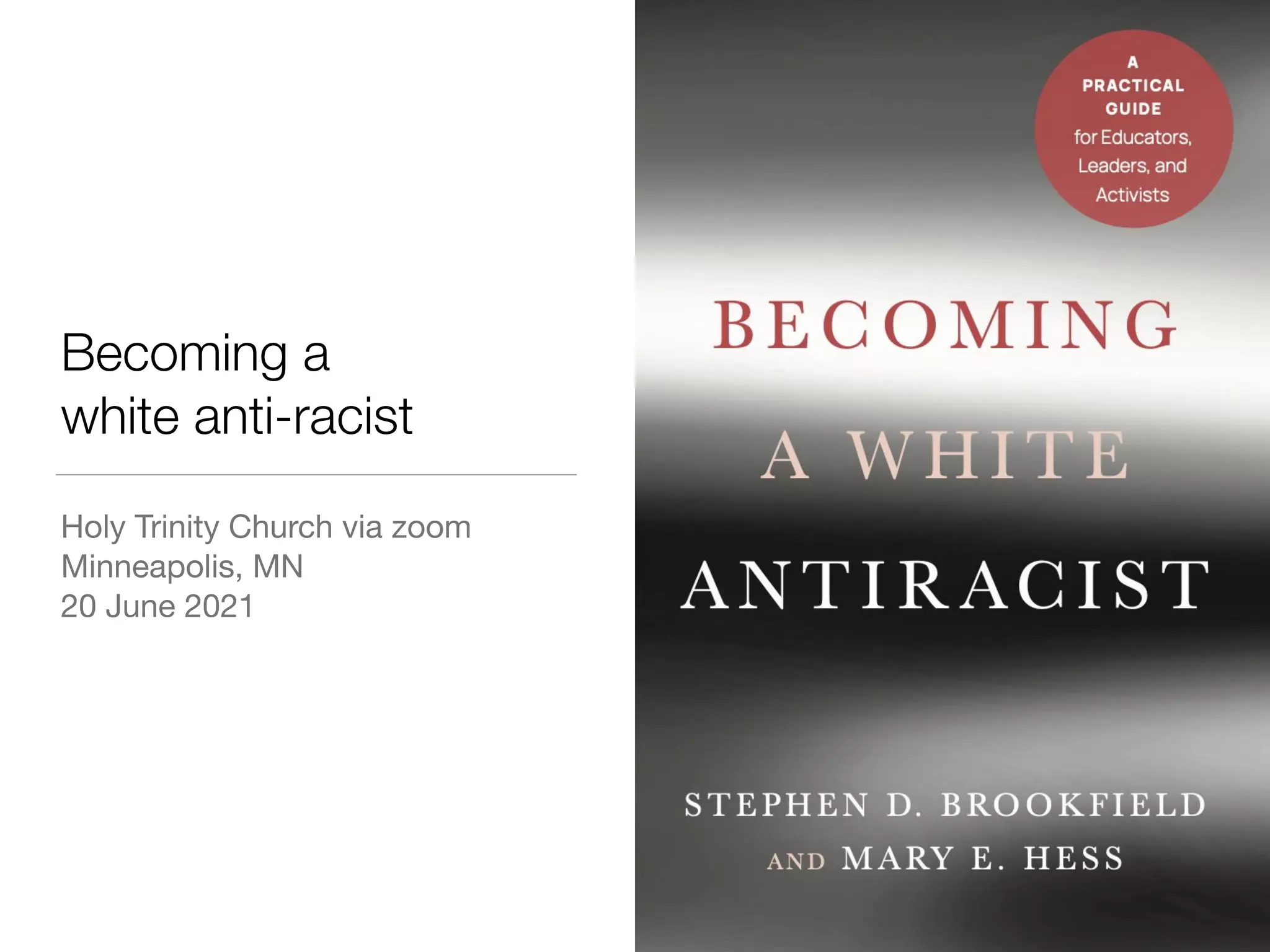
Becoming a


white anti-racist
Holy Trinity Church via zoom

Minneapolis, MN

20 June 2021
some ideas — and with hope, a conversation!
I want to start by thanking you — the whole of this
church and this neighborhood — for the hope and
love you have brought to the Twin Cities these past
many months.
you have taught us that…
• our God is a God of abundance


• mutual aid is not only possible but life-giving


• venturing beyond one’s comfort zones to meet one’s neighbors can
be liberating


• justice is a multi-layered journey


• as a white person, recognizing that racism is systemic and action
must be collective is key to transformation


• for white folk there are only two ways to do anti-racist work —
imperfectly or not at all
so what can I offer? a few further ideas…
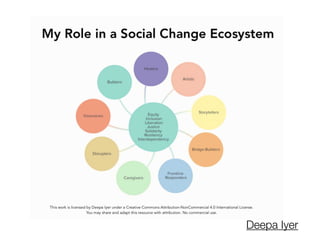
Deepa Iyer
civic engagement takes many forms
• informed and regular voting


• participation in government efforts such as the census


• attending public meetings


• public service as a government employee or in public of
fi
ce


• involvement with political parties and campaigns


• advocacy about particular issues


• volunteering for public-service organizations


• community organizing for social change


• nonviolent protest
ELCA social statement, 2020
what can that mean? where are we grounding
ourselves? what offers resilience and hope?
justice is three-fold in the Bible:
• Sedāqāh can be translated as “righteousness.” This not about determining
who is right and who is wrong, that task is God’s work and God’s alone.
Instead this word is about how we orient ourselves towards the whole
community.


• Shalom is the peace that comes along with and through justice, through
right relationship. Justice in this deep and holistic sense is about restoring
to community, putting things right, repairing and healing our
relationships with each other.


• Mishpat is a word which lays claim to the fundamental wholeness of the
world, and to what God does when that wholeness is ripped apart, torn by
neglect or violence or any violation of right relationship. Think of “rectifying”
justice or “restorative” justice. God intervenes to restore right
relationship, pursuing mishpat to bring God’s people back to God.
“Instead of patriarchal stories of domination, Jesus taught and embodied service,
reconciliation, and self-giving.


Instead of stories of violent revolution or revenge on the one hand or compliant
submission on the other, Jesus taught and modeled transformative nonviolent
resistance.


Instead of the puri
fi
cation stories of scapegoating or ethnic cleansing, Jesus
encountered and engaged the other with respect, welcome, neighborliness, and
mutuality.


Instead of inhabiting a competitive story of accumulation, Jesus advocated
stewardship, generosity, sharing, and a vision of abundance for all.


Instead of advocating escapist stories of isolation, Jesus sent his followers into the
world to be agents of positive change, like salt, light, and yeast.


And instead of leaving the oppressed in stories of victimization, Jesus empowered
them with a vision of faith, hope, and love that could change the world.”
[1] Brian D. McLaren and Gareth Higgins, The Seventh Story: Us, Them, & the End of Violence (Porch: 2018), 79.


Richard Rohr's daily meditation for January 13, 2021
"Teacher, which commandment in the law is the
greatest?" He said to him, "You shall love the Lord
your God with all your heart, and with all your soul,
and with all your mind.' This is the greatest and
fi
rst
commandment. And a second is like it: "You shall
love your neighbor as yourself.' On these two
commandments have all the law and the prophets."
Matthew 22:36-40 (NRSV)
“Lutherans conclude that life in society involves
honoring God’s two ways of rule: the right hand,
which channels God’s forgiveness and unmerited
love, and the left hand, which channels God’s love
into just governance on earth.”
ELCA statement
“Love without power is anemic and sentimental.


Power without love is reckless and abusive.”
MLK, Jr.
incarnate hope requires…
• breath!


• deep compassion (to be contrasted with mere sympathy,
or even empathy)


• CREATIVITY


• recognition that we need to heal from trauma and repair
and restore community
transformation rooted in hope will be…
• radical (both in dependence on God and in radical availability)


• embodied (called to be agents of of transformation … [which]
requires encounters with others who will stretch us and
change us)


• imaginative (transformation will be beyond what we can even
imagine, because hope and transformation are creative)


• relational (God’s ongoing relationship with us, inviting a
response, and our response in relationship with others creates
not only the possibilities but also the conditions for
transformation)
Cimperman, loc 644 of 3914
Here are some other ways people have found to
break open…
additional ways people engage this work:
• restorative actions (PCUSA)


• restorative justice circles (SPPS, InterfaithAction, Ramsey
County)


• community land trusts


• universal basic income


• political advocacy (JRLC, GreaterThanFear)


• neighborly conversation (pull out your rolodex!)
restorative justice
• “restorative justice is a proactive relational strategy to create a
culture of connectivity where all members of a community
thrive and feel valued. It includes: (1) storytelling and
relationship building, (2) truth-telling and accountability, and (3)
reparative action” (based on Fania Davis, loc 309 and loc 412)


• from crime and punishment to harm and needs, from shame
and blame to obligations and responsibility, from
separation and incarceration to engagement and
participation, from push out to push in (reminds me of “call
out” vs. “call in”


• restorative justice thrives through circle practices
A Circle expands forever


It covers all who wish to hold hands


And its size depends on each other


It is a vision of solidarity


It turns outwards to interact with the outside


And inward for self-critique


A circle expands forever


It is a vision of accountability


It grows as the other is moved to grow


A circle must have a centre


But a single dot does not make a Circle


One tree does not make a forest


A circle, a vision of cooperation, mutuality and care
Mercy Amba Oduyoye
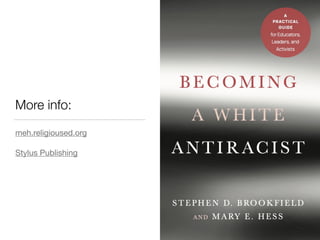
More info:
meh.religioused.org

Stylus Publishing

Becoming a white anti-racist

  • 1.
    Becoming a white anti-racist HolyTrinity Church via zoom Minneapolis, MN 20 June 2021
  • 2.
    some ideas —and with hope, a conversation!
  • 3.
    I want tostart by thanking you — the whole of this church and this neighborhood — for the hope and love you have brought to the Twin Cities these past many months.
  • 4.
    you have taughtus that… • our God is a God of abundance • mutual aid is not only possible but life-giving • venturing beyond one’s comfort zones to meet one’s neighbors can be liberating • justice is a multi-layered journey • as a white person, recognizing that racism is systemic and action must be collective is key to transformation • for white folk there are only two ways to do anti-racist work — imperfectly or not at all
  • 5.
    so what canI offer? a few further ideas…
  • 7.
  • 8.
    civic engagement takesmany forms • informed and regular voting • participation in government efforts such as the census • attending public meetings • public service as a government employee or in public of fi ce • involvement with political parties and campaigns • advocacy about particular issues • volunteering for public-service organizations • community organizing for social change • nonviolent protest ELCA social statement, 2020
  • 9.
    what can thatmean? where are we grounding ourselves? what offers resilience and hope?
  • 10.
    justice is three-foldin the Bible: • Sedāqāh can be translated as “righteousness.” This not about determining who is right and who is wrong, that task is God’s work and God’s alone. Instead this word is about how we orient ourselves towards the whole community. • Shalom is the peace that comes along with and through justice, through right relationship. Justice in this deep and holistic sense is about restoring to community, putting things right, repairing and healing our relationships with each other. • Mishpat is a word which lays claim to the fundamental wholeness of the world, and to what God does when that wholeness is ripped apart, torn by neglect or violence or any violation of right relationship. Think of “rectifying” justice or “restorative” justice. God intervenes to restore right relationship, pursuing mishpat to bring God’s people back to God.
  • 11.
    “Instead of patriarchalstories of domination, Jesus taught and embodied service, reconciliation, and self-giving. Instead of stories of violent revolution or revenge on the one hand or compliant submission on the other, Jesus taught and modeled transformative nonviolent resistance. Instead of the puri fi cation stories of scapegoating or ethnic cleansing, Jesus encountered and engaged the other with respect, welcome, neighborliness, and mutuality. Instead of inhabiting a competitive story of accumulation, Jesus advocated stewardship, generosity, sharing, and a vision of abundance for all. Instead of advocating escapist stories of isolation, Jesus sent his followers into the world to be agents of positive change, like salt, light, and yeast. And instead of leaving the oppressed in stories of victimization, Jesus empowered them with a vision of faith, hope, and love that could change the world.” [1] Brian D. McLaren and Gareth Higgins, The Seventh Story: Us, Them, & the End of Violence (Porch: 2018), 79. Richard Rohr's daily meditation for January 13, 2021
  • 12.
    "Teacher, which commandmentin the law is the greatest?" He said to him, "You shall love the Lord your God with all your heart, and with all your soul, and with all your mind.' This is the greatest and fi rst commandment. And a second is like it: "You shall love your neighbor as yourself.' On these two commandments have all the law and the prophets." Matthew 22:36-40 (NRSV)
  • 13.
    “Lutherans conclude thatlife in society involves honoring God’s two ways of rule: the right hand, which channels God’s forgiveness and unmerited love, and the left hand, which channels God’s love into just governance on earth.” ELCA statement
  • 14.
    “Love without poweris anemic and sentimental. 
 Power without love is reckless and abusive.” MLK, Jr.
  • 15.
    incarnate hope requires… •breath! • deep compassion (to be contrasted with mere sympathy, or even empathy) • CREATIVITY • recognition that we need to heal from trauma and repair and restore community
  • 16.
    transformation rooted inhope will be… • radical (both in dependence on God and in radical availability) • embodied (called to be agents of of transformation … [which] requires encounters with others who will stretch us and change us) • imaginative (transformation will be beyond what we can even imagine, because hope and transformation are creative) • relational (God’s ongoing relationship with us, inviting a response, and our response in relationship with others creates not only the possibilities but also the conditions for transformation) Cimperman, loc 644 of 3914
  • 17.
    Here are someother ways people have found to break open…
  • 18.
    additional ways peopleengage this work: • restorative actions (PCUSA) • restorative justice circles (SPPS, InterfaithAction, Ramsey County) • community land trusts • universal basic income • political advocacy (JRLC, GreaterThanFear) • neighborly conversation (pull out your rolodex!)
  • 19.
    restorative justice • “restorativejustice is a proactive relational strategy to create a culture of connectivity where all members of a community thrive and feel valued. It includes: (1) storytelling and relationship building, (2) truth-telling and accountability, and (3) reparative action” (based on Fania Davis, loc 309 and loc 412) • from crime and punishment to harm and needs, from shame and blame to obligations and responsibility, from separation and incarceration to engagement and participation, from push out to push in (reminds me of “call out” vs. “call in” • restorative justice thrives through circle practices
  • 20.
    A Circle expandsforever It covers all who wish to hold hands 
 And its size depends on each other 
 It is a vision of solidarity 
 It turns outwards to interact with the outside 
 And inward for self-critique 
 A circle expands forever 
 It is a vision of accountability 
 It grows as the other is moved to grow 
 A circle must have a centre 
 But a single dot does not make a Circle 
 One tree does not make a forest 
 A circle, a vision of cooperation, mutuality and care Mercy Amba Oduyoye
  • 21.