Oliver wants some more
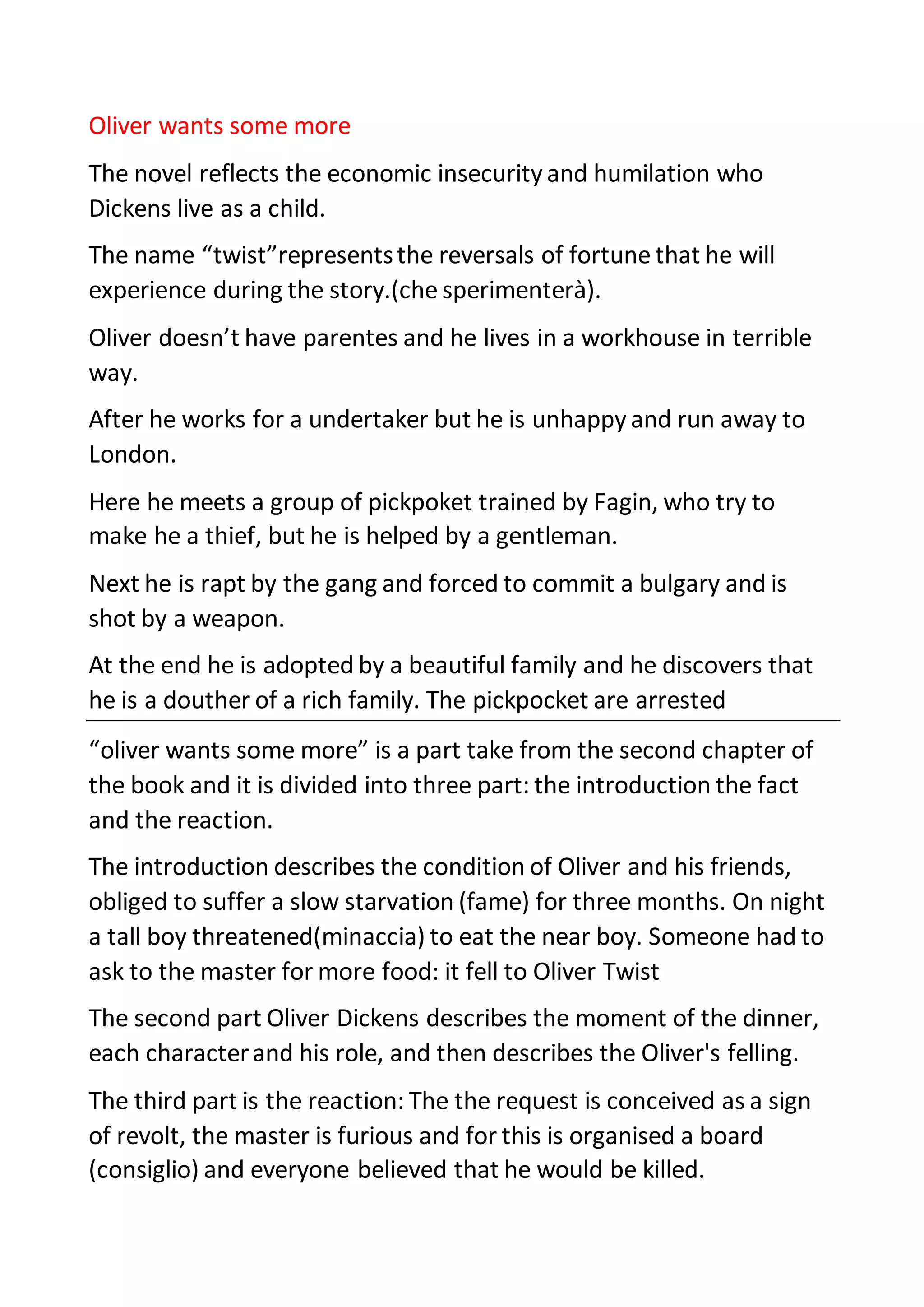
The novel reflects the economic insecurity and humilation who
Dickens live as a child.
The name “twist”representsthe reversals of fortune that he will
experience during the story.(che sperimenterà).
Oliver doesn’t have parentes and he lives in a workhouse in terrible
way.
After he works for a undertaker but he is unhappy and run away to
London.
Here he meets a group of pickpoket trained by Fagin, who try to
make he a thief, but he is helped by a gentleman.
Next he is rapt by the gang and forced to commit a bulgary and is
shot by a weapon.
At the end he is adopted by a beautiful family and he discovers that
he is a douther of a rich family. The pickpocket are arrested
“oliver wants some more” is a part take from the second chapter of
the book and it is divided into three part: the introduction the fact
and the reaction.
The introduction describes the condition of Oliver and his friends,
obliged to suffer a slow starvation (fame) for three months. On night
a tall boy threatened(minaccia) to eat the near boy. Someone had to
ask to the master for more food: it fell to Oliver Twist
The second part Oliver Dickens describes the moment of the dinner,
each characterand his role, and then describes the Oliver's felling.
The third part is the reaction: The the request is conceived as a sign
of revolt, the master is furious and for this is organised a board
(consiglio) and everyone believed that he would be killed.
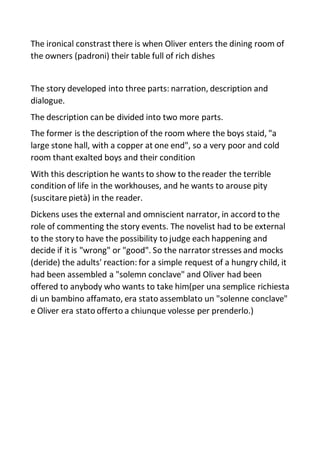
The ironical constrast there is when Oliver enters the dining room of
the owners (padroni) their table full of rich dishes
The story developed into three parts: narration, description and
dialogue.
The description can be divided into two more parts.
The former is the description of the room where the boys staid, "a
large stone hall, with a copper at one end", so a very poor and cold
room thant exalted boys and their condition
With this description he wants to show to the reader the terrible
condition of life in the workhouses, and he wants to arouse pity
(suscitare pietà) in the reader.
Dickens uses the external and omniscient narrator, in accord to the
role of commenting the story events. The novelist had to be external
to the story to have the possibility to judge each happening and
decide if it is "wrong" or "good". So the narrator stresses and mocks
(deride) the adults' reaction: for a simple request of a hungry child, it
had been assembled a "solemn conclave" and Oliver had been
offered to anybody who wants to take him(per una semplice richiesta
di un bambino affamato, era stato assemblato un "solenne conclave"
e Oliver era stato offerto a chiunque volesse per prenderlo.)

Oliver wants some more

  • 1.
    Oliver wants somemore The novel reflects the economic insecurity and humilation who Dickens live as a child. The name “twist”representsthe reversals of fortune that he will experience during the story.(che sperimenterà). Oliver doesn’t have parentes and he lives in a workhouse in terrible way. After he works for a undertaker but he is unhappy and run away to London. Here he meets a group of pickpoket trained by Fagin, who try to make he a thief, but he is helped by a gentleman. Next he is rapt by the gang and forced to commit a bulgary and is shot by a weapon. At the end he is adopted by a beautiful family and he discovers that he is a douther of a rich family. The pickpocket are arrested “oliver wants some more” is a part take from the second chapter of the book and it is divided into three part: the introduction the fact and the reaction. The introduction describes the condition of Oliver and his friends, obliged to suffer a slow starvation (fame) for three months. On night a tall boy threatened(minaccia) to eat the near boy. Someone had to ask to the master for more food: it fell to Oliver Twist The second part Oliver Dickens describes the moment of the dinner, each characterand his role, and then describes the Oliver's felling. The third part is the reaction: The the request is conceived as a sign of revolt, the master is furious and for this is organised a board (consiglio) and everyone believed that he would be killed.
  • 2.
    The ironical constrastthere is when Oliver enters the dining room of the owners (padroni) their table full of rich dishes The story developed into three parts: narration, description and dialogue. The description can be divided into two more parts. The former is the description of the room where the boys staid, "a large stone hall, with a copper at one end", so a very poor and cold room thant exalted boys and their condition With this description he wants to show to the reader the terrible condition of life in the workhouses, and he wants to arouse pity (suscitare pietà) in the reader. Dickens uses the external and omniscient narrator, in accord to the role of commenting the story events. The novelist had to be external to the story to have the possibility to judge each happening and decide if it is "wrong" or "good". So the narrator stresses and mocks (deride) the adults' reaction: for a simple request of a hungry child, it had been assembled a "solemn conclave" and Oliver had been offered to anybody who wants to take him(per una semplice richiesta di un bambino affamato, era stato assemblato un "solenne conclave" e Oliver era stato offerto a chiunque volesse per prenderlo.)