OLIVER TWISTA novelby Charles Dickens
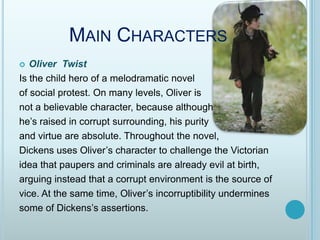
MainCharactersOliver  TwistIs the child hero of a melodramatic novelof social protest. On many levels, Oliver is not a believable character, because althoughhe’s raised in corrupt surrounding, his purity and virtue are absolute. Throughout the novel, Dickens uses Oliver’s character to challenge the Victorianidea that paupers and criminals are already evil at birth,arguing instead that a corrupt environment is the source ofvice. At the same time, Oliver’s incorruptibility underminessome of Dickens’s assertions.
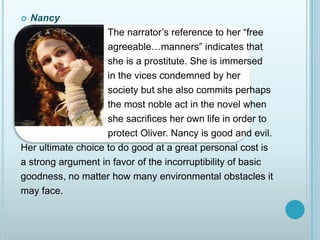
Nancy                                The narrator’s reference to her “free                                                      agreeable…manners” indicates that                                she is a prostitute. She is immersed                                in the vices condemned by her                                 society but she also commits perhaps                                the most noble act in the novel when                                she sacrifices her own life in order to                                protect Oliver. Nancy is good and evil.Her ultimate choice to do good at a great personal cost isa strong argument in favor of the incorruptibility of basicgoodness, no matter how many environmental obstacles itmay face.
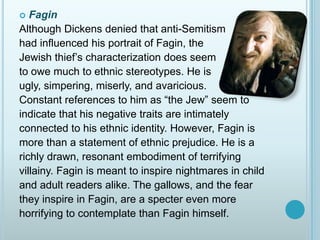
FaginAlthough Dickens denied that anti-Semitism had influenced his portrait of Fagin, the Jewish thief’s characterization does seem to owe much to ethnic stereotypes. He is ugly, simpering, miserly, and avaricious. Constant references to him as “the Jew” seem to indicate that his negative traits are intimately connected to his ethnic identity. However, Fagin is more than a statement of ethnic prejudice. He is a richly drawn, resonant embodiment of terrifying villainy. Fagin is meant to inspire nightmares in childand adult readers alike. The gallows, and the fearthey inspire in Fagin, are a specter even morehorrifying to contemplate than Fagin himself.
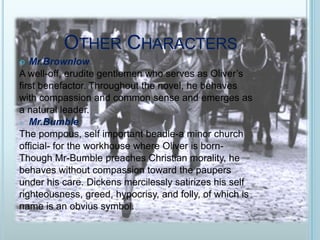
OtherCharactersMr.BrownlowA well-off, erudite gentlemen who serves as Oliver’sfirst benefactor. Throughout the novel, he behaveswith compassion and common sense and emerges asa natural leader.Mr.BumbleThe pompous, self important beadle-a minor churchofficial- for the workhouse where Oliver is born-Though Mr-Bumble preaches Christian morality, hebehaves without compassion toward the paupersunder his care. Dickens mercilessly satirizes his selfrighteousness, greed, hypocrisy, and folly, of which is name is an obvius symbol.
ThemesThe Failureof CharityThe FollyofIndividualismPurity in a Corrupt CityThe CountrysideIdealized
MotifsDisguised or MistakenIdentitiesHidden Family RelationshipsSurrogate Families
SymbolCharacters’ NamesBull’s-eyeLondon Bridge
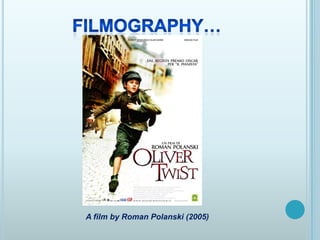
Filmography…A film by Roman Polanski (2005)

Oliver Twist

  • 1.
    OLIVER TWISTA novelbyCharles Dickens
  • 2.
    MainCharactersOliver TwistIsthe child hero of a melodramatic novelof social protest. On many levels, Oliver is not a believable character, because althoughhe’s raised in corrupt surrounding, his purity and virtue are absolute. Throughout the novel, Dickens uses Oliver’s character to challenge the Victorianidea that paupers and criminals are already evil at birth,arguing instead that a corrupt environment is the source ofvice. At the same time, Oliver’s incorruptibility underminessome of Dickens’s assertions.
  • 3.
    Nancy The narrator’s reference to her “free agreeable…manners” indicates that she is a prostitute. She is immersed in the vices condemned by her society but she also commits perhaps the most noble act in the novel when she sacrifices her own life in order to protect Oliver. Nancy is good and evil.Her ultimate choice to do good at a great personal cost isa strong argument in favor of the incorruptibility of basicgoodness, no matter how many environmental obstacles itmay face.
  • 4.
    FaginAlthough Dickens deniedthat anti-Semitism had influenced his portrait of Fagin, the Jewish thief’s characterization does seem to owe much to ethnic stereotypes. He is ugly, simpering, miserly, and avaricious. Constant references to him as “the Jew” seem to indicate that his negative traits are intimately connected to his ethnic identity. However, Fagin is more than a statement of ethnic prejudice. He is a richly drawn, resonant embodiment of terrifying villainy. Fagin is meant to inspire nightmares in childand adult readers alike. The gallows, and the fearthey inspire in Fagin, are a specter even morehorrifying to contemplate than Fagin himself.
  • 5.
    OtherCharactersMr.BrownlowA well-off, eruditegentlemen who serves as Oliver’sfirst benefactor. Throughout the novel, he behaveswith compassion and common sense and emerges asa natural leader.Mr.BumbleThe pompous, self important beadle-a minor churchofficial- for the workhouse where Oliver is born-Though Mr-Bumble preaches Christian morality, hebehaves without compassion toward the paupersunder his care. Dickens mercilessly satirizes his selfrighteousness, greed, hypocrisy, and folly, of which is name is an obvius symbol.
  • 6.
    ThemesThe Failureof CharityTheFollyofIndividualismPurity in a Corrupt CityThe CountrysideIdealized
  • 7.
    MotifsDisguised or MistakenIdentitiesHiddenFamily RelationshipsSurrogate Families
  • 8.
  • 9.
    Filmography…A film byRoman Polanski (2005)