Making it Matter: Supporting
education in the developing world
through open and linked data
Friends House, 16th May 2014
Marieke Guy
PRESENTED BY
Welcome everyone!
Today has been made possible by…
Commonwealth of Learning:
http://www.col.org
LinkedUp Project:
http://linkedup-project.eu
Open Knowledge
Promoting open knowledge in a digital age
●  A community-based, not-for-profit with projects and
partnerships throughout the world 
●  We build tools, apps and communities to create, use
and share open data and content - information that
everyone can use, share and build on
●  We believe that by creating an open knowledge
commons and developing tools and communities
around this we can make a significant contribution to
improving governance, research and the economy
●  Collaboration not control, empowerment not
exploitation, open not closed
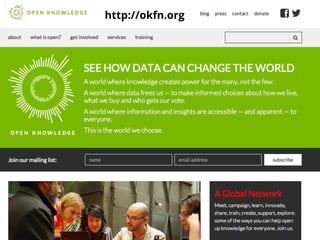
http://okfn.org
The Internet Audience
Some context…
By end 2014, the number of Internet users globally will have
reached almost 3 billion. Two-thirds of the world’s Internet
users are from the developing world. This corresponds to an
Internet-user penetration of 40 per cent globally, 78 per cent in
developed countries and 32 per cent in developing countries.
More than 90 per cent of the people who are not yet using the
Internet are from the developing world.
ITU (International Telecommunication Union) - the United Nations specialized
agency for information and communication technologies, May 2014
Making it Matter
So what does it have to do with us?
●  3 billion new minds online changes a landscape
●  The new users of the internet are disabled, disadvantaged,
disconnected and from developing countries
●  We have to engage with these users
●  This is where impact could be made
●  However, “users don’t care about technology and
technologists don’t care about use cases” (!)
●  But…the Web does not just connect machines, it connects
people.
●  So that’s what today is all about!
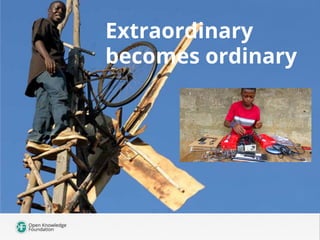
Extraordinary
becomes ordinary
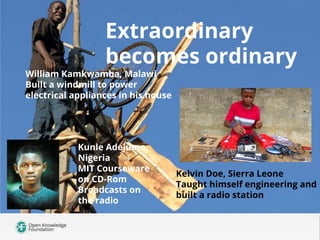
Extraordinary
becomes ordinary
Kelvin Doe, Sierra Leone
Taught himself engineering and
built a radio station
William Kamkwamba, Malawi
Built a windmill to power
electrical appliances in his house
Kunle Adejumo,
Nigeria
MIT Courseware
on CD-Rom
Broadcasts on
the radio
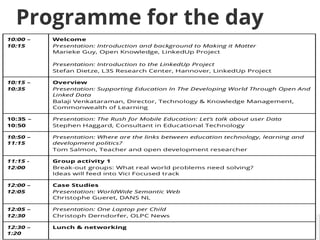
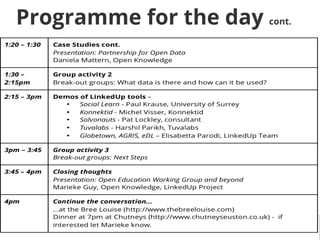
Programme for the day
Programme for the day cont.
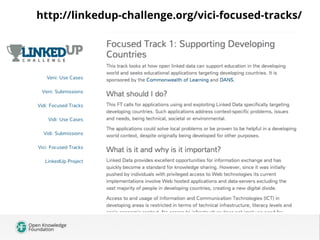
http://linkedup-challenge.org/vici-focused-tracks/
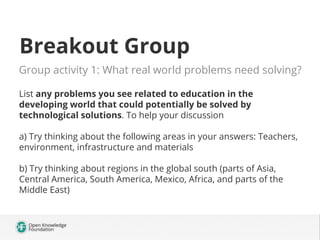
Breakout Group
Group activity 1: What real world problems need solving?
List any problems you see related to education in the
developing world that could potentially be solved by
technological solutions. To help your discussion
a) Try thinking about the following areas in your answers: Teachers,
environment, infrastructure and materials
b) Try thinking about regions in the global south (parts of Asia,
Central America, South America, Mexico, Africa, and parts of the
Middle East)
Breakout Group
Group activity 2: What data is there and how can it be used? 
List any data sets that currently exist that could be used and built
around. To help your discussion
a) Start by thinking very generally about data sets that would be helpful
(cross-sector, global) - start with the "best case scenario".
b) Now be more realistic and think about datasets you already know
about.
•  Are these data sets open? 
•  Are these data sets linked data?
•  Are they available in suitable formats? 
•  Are there elements missing?
•  How can they be used and built on?
Breakout Group
Group activity 3: Next Steps – what are we going to do?
Think about what you've heard about today and the people you've
met.  
a) Do you think bringing these communities together makes sense?
b) What can they work on together, where is there potential impact?
c) What ideas do you have for the next steps?
To help your discussion think about projects, initiatives, activities,
events, tools, connections etc.
The Open Education Working
Group and beyond
Friends House, 16th May 2014
Marieke Guy
PRESENTED BY
Why a Working Group?
Reasons for development of the group
●  We wanted to see open data in education pulled into the
wider debate around open education
●  Opportunity to bring together silos of activity: content and
OER, OEP, open policy, licensing, data, tools…
●  Allow us to collaborate with people across sectors and
globally – get the bigger picture
●  Where can open data in education lead? All possibilities still
exist
●  Community building compliments what we are doing
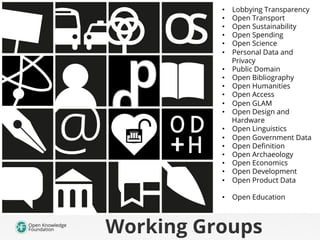
•  Lobbying Transparency
•  Open Transport
•  Open Sustainability
•  Open Spending
•  Open Science
•  Personal Data and
Privacy
•  Public Domain
•  Open Bibliography
•  Open Humanities
•  Open Access
•  Open GLAM
•  Open Design and
Hardware
•  Open Linguistics
•  Open Government Data
•  Open Definition
•  Open Archaeology
•  Open Economics
•  Open Development
•  Open Product Data
•  Open Education
Working Groups
Open
Education
Working
Group
…established to bring together
people and groups interested in
open education. Its goal is to
initiate global cross-sector and
cross-domain activity that
encompasses the various facets
of open education.
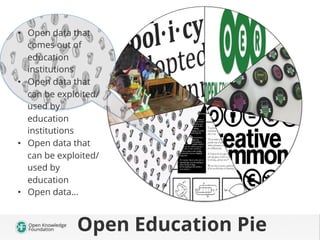
Open Education Pie
•  Open data that
comes out of
education
institutions
•  Open data that
can be exploited/
used by
education
institutions
•  Open data that
can be exploited/
used by
education
•  Open data…
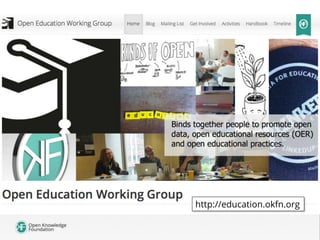
http://education.okfn.org
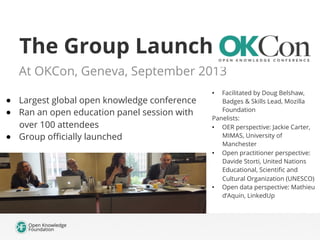
The Group Launch
At OKCon, Geneva, September 2013
●  Largest global open knowledge conference
●  Ran an open education panel session with
over 100 attendees
●  Group officially launched
•  Facilitated by Doug Belshaw,
Badges & Skills Lead, Mozilla
Foundation
Panelists:
•  OER perspective: Jackie Carter,
MIMAS, University of
Manchester
•  Open practitioner perspective:
Davide Storti, United Nations
Educational, Scientific and
Cultural Organization (UNESCO)
•  Open data perspective: Mathieu
d’Aquin, LinkedUp
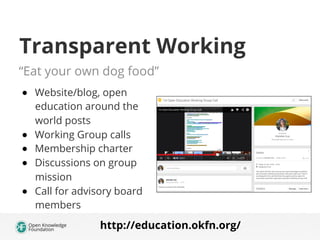
Transparent Working
“Eat your own dog food”
●  Website/blog, open
education around the
world posts
●  Working Group calls
●  Membership charter
●  Discussions on group
mission
●  Call for advisory board
members
http://education.okfn.org/
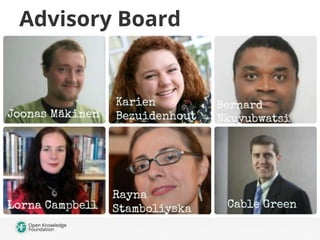
Advisory Board
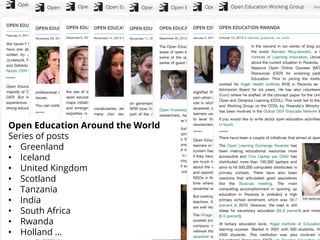
Open Education Around the World
Series of posts
•  Greenland
•  Iceland
•  United Kingdom
•  Scotland
•  Tanzania
•  India
•  South Africa
•  Rwanda
•  Holland …
General Activities
Areas of interest and ideas
●  Community building – making contact
●  Open Education timeline
●  OKFestival, July, Berlin – Open Education Maker Party
●  Support for LMRI initiatives, standards, platform for Open
Standards work
●  OER and small languages and cultures (multilingualism)
●  Open Education language – making it appropriate for all
●  Support for member activities e.g. Open Data Ireland
booksprint
●  Connections with local groups: Belgium, Finland, Brazil
Activities: Handbook
The Open Education Handbook
●  A collaboratively written living web document targeting
educational practitioners and the education community at
large
●  Coverage is broad and determined by authors
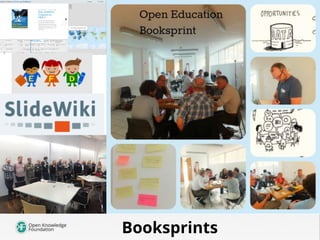
●  Kick-started at a series of booksprints and events
●  Available online for editing in Booktype, open source book
editing software
●  Translated in to Portuguese, set on Slidewiki
●  Future plans: glossary, universal style, definitions, synergies
between areas, flow, fact checking, more questions, front end
Booksprints
Plans for the Future
Growing organically…
●  Listening to the community and following up in directions
where they feel there is a gap and we can help
●  Linking with other organisations and initiatives
●  Creating a members group
●  Making myself redundant!!
You can:
●  Join our mailing list: http://education.okfn.org/mailing-list/
●  Email me: marieke.guy@okfn.org
Making it Matter: Supporting education in the developing world through open and linked data

Making it Matter: Supporting education in the developing world through open and linked data

  • 1.
    Making it Matter:Supporting education in the developing world through open and linked data Friends House, 16th May 2014 Marieke Guy PRESENTED BY
  • 2.
    Welcome everyone! Today hasbeen made possible by… Commonwealth of Learning: http://www.col.org LinkedUp Project: http://linkedup-project.eu
  • 4.
    Open Knowledge Promoting openknowledge in a digital age ●  A community-based, not-for-profit with projects and partnerships throughout the world  ●  We build tools, apps and communities to create, use and share open data and content - information that everyone can use, share and build on ●  We believe that by creating an open knowledge commons and developing tools and communities around this we can make a significant contribution to improving governance, research and the economy ●  Collaboration not control, empowerment not exploitation, open not closed
  • 5.
  • 6.
    The Internet Audience Somecontext… By end 2014, the number of Internet users globally will have reached almost 3 billion. Two-thirds of the world’s Internet users are from the developing world. This corresponds to an Internet-user penetration of 40 per cent globally, 78 per cent in developed countries and 32 per cent in developing countries. More than 90 per cent of the people who are not yet using the Internet are from the developing world. ITU (International Telecommunication Union) - the United Nations specialized agency for information and communication technologies, May 2014
  • 8.
    Making it Matter Sowhat does it have to do with us? ●  3 billion new minds online changes a landscape ●  The new users of the internet are disabled, disadvantaged, disconnected and from developing countries ●  We have to engage with these users ●  This is where impact could be made ●  However, “users don’t care about technology and technologists don’t care about use cases” (!) ●  But…the Web does not just connect machines, it connects people. ●  So that’s what today is all about!
  • 9.
  • 10.
    Extraordinary becomes ordinary Kelvin Doe,Sierra Leone Taught himself engineering and built a radio station William Kamkwamba, Malawi Built a windmill to power electrical appliances in his house Kunle Adejumo, Nigeria MIT Courseware on CD-Rom Broadcasts on the radio
  • 11.
  • 12.
  • 14.
  • 15.
    Breakout Group Group activity1: What real world problems need solving? List any problems you see related to education in the developing world that could potentially be solved by technological solutions. To help your discussion a) Try thinking about the following areas in your answers: Teachers, environment, infrastructure and materials b) Try thinking about regions in the global south (parts of Asia, Central America, South America, Mexico, Africa, and parts of the Middle East)
  • 16.
    Breakout Group Group activity2: What data is there and how can it be used?  List any data sets that currently exist that could be used and built around. To help your discussion a) Start by thinking very generally about data sets that would be helpful (cross-sector, global) - start with the "best case scenario". b) Now be more realistic and think about datasets you already know about. •  Are these data sets open?  •  Are these data sets linked data? •  Are they available in suitable formats?  •  Are there elements missing? •  How can they be used and built on?
  • 17.
    Breakout Group Group activity3: Next Steps – what are we going to do? Think about what you've heard about today and the people you've met.   a) Do you think bringing these communities together makes sense? b) What can they work on together, where is there potential impact? c) What ideas do you have for the next steps? To help your discussion think about projects, initiatives, activities, events, tools, connections etc.
  • 18.
    The Open EducationWorking Group and beyond Friends House, 16th May 2014 Marieke Guy PRESENTED BY
  • 19.
    Why a WorkingGroup? Reasons for development of the group ●  We wanted to see open data in education pulled into the wider debate around open education ●  Opportunity to bring together silos of activity: content and OER, OEP, open policy, licensing, data, tools… ●  Allow us to collaborate with people across sectors and globally – get the bigger picture ●  Where can open data in education lead? All possibilities still exist ●  Community building compliments what we are doing
  • 20.
    •  Lobbying Transparency • Open Transport •  Open Sustainability •  Open Spending •  Open Science •  Personal Data and Privacy •  Public Domain •  Open Bibliography •  Open Humanities •  Open Access •  Open GLAM •  Open Design and Hardware •  Open Linguistics •  Open Government Data •  Open Definition •  Open Archaeology •  Open Economics •  Open Development •  Open Product Data •  Open Education Working Groups
  • 21.
    Open Education Working Group …established to bringtogether people and groups interested in open education. Its goal is to initiate global cross-sector and cross-domain activity that encompasses the various facets of open education.
  • 22.
    Open Education Pie • Open data that comes out of education institutions •  Open data that can be exploited/ used by education institutions •  Open data that can be exploited/ used by education •  Open data…
  • 23.
  • 24.
    The Group Launch AtOKCon, Geneva, September 2013 ●  Largest global open knowledge conference ●  Ran an open education panel session with over 100 attendees ●  Group officially launched •  Facilitated by Doug Belshaw, Badges & Skills Lead, Mozilla Foundation Panelists: •  OER perspective: Jackie Carter, MIMAS, University of Manchester •  Open practitioner perspective: Davide Storti, United Nations Educational, Scientific and Cultural Organization (UNESCO) •  Open data perspective: Mathieu d’Aquin, LinkedUp
  • 25.
    Transparent Working “Eat yourown dog food” ●  Website/blog, open education around the world posts ●  Working Group calls ●  Membership charter ●  Discussions on group mission ●  Call for advisory board members http://education.okfn.org/
  • 26.
  • 27.
    Open Education Aroundthe World Series of posts •  Greenland •  Iceland •  United Kingdom •  Scotland •  Tanzania •  India •  South Africa •  Rwanda •  Holland …
  • 28.
    General Activities Areas ofinterest and ideas ●  Community building – making contact ●  Open Education timeline ●  OKFestival, July, Berlin – Open Education Maker Party ●  Support for LMRI initiatives, standards, platform for Open Standards work ●  OER and small languages and cultures (multilingualism) ●  Open Education language – making it appropriate for all ●  Support for member activities e.g. Open Data Ireland booksprint ●  Connections with local groups: Belgium, Finland, Brazil
  • 29.
    Activities: Handbook The OpenEducation Handbook ●  A collaboratively written living web document targeting educational practitioners and the education community at large ●  Coverage is broad and determined by authors ●  Kick-started at a series of booksprints and events ●  Available online for editing in Booktype, open source book editing software ●  Translated in to Portuguese, set on Slidewiki ●  Future plans: glossary, universal style, definitions, synergies between areas, flow, fact checking, more questions, front end
  • 30.
  • 31.
    Plans for theFuture Growing organically… ●  Listening to the community and following up in directions where they feel there is a gap and we can help ●  Linking with other organisations and initiatives ●  Creating a members group ●  Making myself redundant!! You can: ●  Join our mailing list: http://education.okfn.org/mailing-list/ ●  Email me: marieke.guy@okfn.org