Palm oil production

Oil palm is the most productive oil seed in the world. A single hectare of oil palm may yield 5,000
kilograms of crude oil, or nearly 6,000 liters of crude. Palm Oil an expeller-pressed food oil, obtained
from fresh fruit bunches (FFB) of oil palm cultivated in plantations. Palm oil is the second largest
edible oil and accounts for approximately 23 per cent of the world's fats and oil supply. Since 80 per
cent of palm produced is used in food - its nutritional properties are of extreme importance. For
comparison, soybeans and corn—crops often heralded as top biofuels sources—generate only 446 and
172 liters per hectare, respectively. Oil palm requires 7-11 times less land area than soybean, rapeseed
and sunflower to produce the same amount of oil.

Therefore, the use of palm oil for food and Biofuel has saved 97-159 million ha of land from being
deforested for cultivation with lower yielding oil crops. This has avoided 27-45 billion tonnes of carbon
dioxide (CO2-e) emissions. Oil palm also sequesters eight times more CO2 than soya bean. As a Biofuel,
the use of palm biodiesel results in 62-82% Life Cycle Analysis Greenhouse Gas (LCA GHG) reduction
when compared with fossil fuel.

Palm oil is available in about 15 different grades, ranging from crude to semi-refined, and refined,
crude fractionated, refined fractionated oil and refinery by-products. Crude Palm Oil (CPO), Crude
Palmolein, RBD (refined, bleached, deodorized) Palm Oil, RBD Palmolein and Crude Palm Kernel Oil
(CPKO) are the various edible forms of palm oil traded in the market.

Economic importance -Palm oil has major applications in food manufacturing and in the chemical,
cosmetic and pharmaceutical industries.
   • Palm oil olein and stearin are popularly used worldwide in making margarine, shortenings and
       confectionery, and in frying snack foods.
   • It also gives fried products a longer shelf life.

    •   It has non-edible applications that include the manufacture of soaps, biodegradable
        detergents, and in oleo chemical products such as fatty acids, and other derivatives for the
        manufacture of cosmetics, pharmaceuticals and industrial products.

Global Scenario -Palm oil dominates the global vegetable oil export trade. Malaysia and Indonesia are
the two largest producers of palm oil accounting for 35.7Mt of world production, or 87% in 2007/08.
Indonesia has nearly quadrupled output in the past decade from 5Mt in 1997/98 to around 18.3Mt in
2007/08 making it the largest producer of palm oil in the world. Low cost and high production values
have the oil competing with soybean imports in Asia. Important festivals with their communal meals in
China, India, Pakistan and Indonesia are strengthening edible oils consumption. In Europe, palm oil is
quickly becoming a primary substitute for rapeseed and in the U.S.; palm oil is finding its way into an
ever increasing amount of processed foods.

Domestic Scenario -India, which is one of the largest importer and consumer of edible oils in the
    World, imports nearly 5 million tons of palm oil annually (mainly from Malaysia and Indonesia).
    India imports crude palm oil mainly from Indonesia while from Malaysia it imports mostly refined,
    bleached and deodorised (RBD) palm olein.
Importance of Edible Oils in the Country’s Economy- Oilseeds and edible oils are two of the most
    sensitive essential commodities. India is one of the largest producers of oilseeds in the world and
    this sector occupies an important position in the agricultural economy and accounting for the
    estimated production of 28.21 million tons of nine cultivated oilseeds during the year 2007-08.
    India contributes about 6-7% of the world oilseeds production.    Export of oil meals, oilseeds and
minor oils has increased from 5.06 million tons in the financial year 2005-06 to 7.3 million tons in
    the financial year 2006-07. In terms of value, realization has gone up from Rs. 5514 crores to
    Rs.7997 crores. India accounted for about 6.4% of world oil meal export.


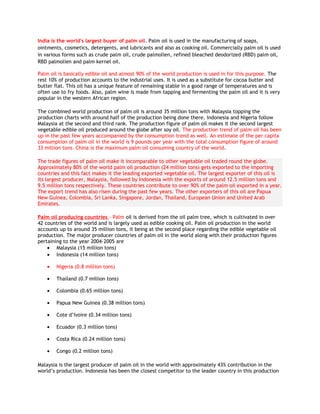
Type of Oils commonly in use in India- India is fortunate in having a wide range of oilseeds crops
grown in its different agro climatic zones. Groundnut, mustard/rapeseed, sesame, safflower, linseed,
nigerseed/castor are the major traditionally cultivated oilseeds. Soybean and sunflower have also
assumed importance in recent years. Coconut is most important amongst the plantation crops. Efforts
are being made to grow oil palm in Andhra Pradesh, Karnataka, Tamil Nadu in addition to Kerala and
Andaman & Nicobar Islands. Among the non-conventional oils, rice bran oil and cottonseed oil are the
most important. In addition, oilseeds of tree and forest origin, which grow mostly in tribal inhabited
areas, are also a significant source of oils. Figures pertaining to estimated production of major
cultivated oilseeds, availability of edible oils from all domestic sources and consumption of edible oils
(from Domestic and Import Sources) during the last few years are as under: ( In lakh Ton)

Oil Year(Nov-Oct.) Production of Net availability of edible oils    Consumption of Edible Oils
                   Oilseeds      from all domestic sources          (from domestic and import
                                                                    sources)
2000-2001              184.40                   54.99                         96.76
2001-2002              206.63                   61.46                          104.68
2002-2003              148.39                   46.64                          90.29
2003-2004              251.86                   71.40                          124.30
2004-2005              243.54                   72.47                          117.89
2005-2006              279.79                   83.16                          126.04
2006-2007              242.89                   73.70                          115.87

2007-2008              297.55                   86.54                          142.62


Consumption Pattern of Edible Oils in India - India is a vast country and inhabitants of several of its
regions have developed specific preference for certain oils largely depending upon the oils available in
the region. For example, people in the South and West prefer groundnut oil while those in the East and
North use mustard/rapeseed oil. Likewise several pockets in the South have a preference for coconut
and sesame oil. Inhabitants of northern plain are basically hard fat consumers and therefore, prefer
Vanaspati, a term used to denote a partially hydrogenated edible oil mixture.

Major Features of Edible Oil Economy - Approximately 60% of the palm oil we consume has been
further processed into a palm oil 'derivative' or blend; before it is incorporated into the products we
buy from the supermarket. Palm oil is 'split' into derivatives to produce a wide range of products

At the first stage it is split into liquid palm olein (80%) and solid palm stearin (20%). These might then
be blended with other oils, or undergo further processes such as interesterification, to create new oils
with different physical and chemical characteristics. These are used as ingredients within shortenings,
margarines for pastry and cakes, frying oils, coffee whitener and emulsifiers. To complicate things
further palm oil derivatives can themselves be ‘split’ a second time to produce ‘double fractionated’
palm olein, stearin etc. These are used in the production of a wide range of food products including
gravy granules, suet mixes, frying oils, pastry margarine, snack foods and toffee fat. Refined oil from
the palm kernel is used in beauty products. Palm kernel olein is used in confectionery, coatings and
margarines. Palm kernel stearin is used in confectionery.
India is the world's largest buyer of palm oil. Palm oil is used in the manufacturing of soaps,
ointments, cosmetics, detergents, and lubricants and also as cooking oil. Commercially palm oil is used
in various forms such as crude palm oil, crude palmolien, refined bleached deodorized (RBD) palm oil,
RBD palmolien and palm kernel oil.

Palm oil is basically edible oil and almost 90% of the world production is used in for this purpose. The
rest 10% of production accounts to the industrial uses. It is used as a substitute for cocoa butter and
butter flat. This oil has a unique feature of remaining stable in a good range of temperatures and is
often use to fry foods. Also, palm wine is made from tapping and fermenting the palm oil and it is very
popular in the western African region.

The combined world production of palm oil is around 35 million tons with Malaysia topping the
production charts with around half of the production being done there. Indonesia and Nigeria follow
Malaysia at the second and third rank. The production figure of palm oil makes it the second largest
vegetable edible oil produced around the globe after soy oil. The production trend of palm oil has been
up in the past few years accompanied by the consumption trend as well. An estimate of the per capita
consumption of palm oil in the world is 9 pounds per year with the total consumption figure of around
33 million tons. China is the maximum palm oil consuming country of the world.

The trade figures of palm oil make it incomparable to other vegetable oil traded round the globe.
Approximately 80% of the world palm oil production (24 million tons) gets exported to the importing
countries and this fact makes it the leading exported vegetable oil. The largest exporter of this oil is
its largest producer, Malaysia, followed by Indonesia with the exports of around 12.5 million tons and
9.5 million tons respectively. These countries contribute to over 90% of the palm oil exported in a year.
The export trend has also risen during the past few years. The other exporters of this oil are Papua
New Guinea, Colombia, Sri Lanka, Singapore, Jordan, Thailand, European Union and United Arab
Emirates.

Palm oil producing countries - Palm oil is derived from the oil palm tree, which is cultivated in over
42 countries of the world and is largely used as edible cooking oil. Palm oil production in the world
accounts up to around 35 million tons, it being at the second place regarding the edible vegetable oil
production. The major producer countries of palm oil in the world along with their production figures
pertaining to the year 2004-2005 are
    • Malaysia (15 million tons)
    • Indonesia (14 million tons)

    •   Nigeria (0.8 million tons)

    •   Thailand (0.7 million tons)

    •   Colombia (0.65 million tons)

    •   Papua New Guinea (0.38 million tons)

    •   Cote d’Ivoire (0.34 million tons)

    •   Ecuador (0.3 million tons)

    •   Costa Rica (0.24 million tons)

    •   Congo (0.2 million tons)

Malaysia is the largest producer of palm oil in the world with approximately 43% contribution in the
world’s production. Indonesia has been the closest competitor to the leader country in this production
context. It contributes to approximately 40% in the world figures. The world production has increased
with time and is still rising @ 7%. The same is the case with the area covered under the cultivation of
oil palm tree. This crop is cultivated in around 28 million acres of land over the world.

Production of palm oil in India - India holds a very small share of palm oil production in the world
figures. It hardly contributes to the world production and is not able to satisfy its domestic
consumption demand. It produces a mere 70000 tons of palm oil annually i.e. just 0.2% share in the
total worlds produce. The state having the maximum production of palm oil in India is Kerala as it
produces 20000 tons per year. Kerala, cultivating oil palm trees on around 12000 hectares of land, also
hold the maximum acreage with 10000 hectares pertaining to a public sector enterprise namely Oil
Palms India Ltd and the rest pertaining to the private sector. Godrej is the maximum oil palm
plantation company in India producing over 20000 tons per year. India has been looking forward to
increase its production a bit more to push it up to 3 Lakh tons in the year 2015 to 2020.

Indian palm oil market - India is basically a net importer of the palm oil. It never had a production
history in context of this oil. But it does have vast palm oil consumption and import background. India
produces around 70000 tons of palm oil annually which stands at approximately 0.2% share in the
world’s total production. Kerala is the largest palm producing state in India with 30% share in the total
production figures of the country. Among the companies indulged in the production of palm oil, Godrej
emerges as a leader with the same amount of production as Kerala.

Indian palm oil consumption hovers around 5 million tons, which is a much bigger quantity as compared
to the production figure. The country ranks 4th regarding its consumption level. It is not capable of
fulfilling the domestic consumption demand and that is why it has to rely on imports of the oil. The
major demand of palm oil arises from the food and cooking oil industries.

After China and European Union, India is the third largest importer of vegetable oils. Palm oil
contributes to around 48% of the total edible oils that are imported in the country. The countries
imports of palm oil reach up to 3.7 million tons that is same as the consumption figure. This means that
most of the countries demand is heavily dependent upon the countries import. Palm oil imports in the
country are controlled with the help of high import duties imposed by the government. The countries
from which palm oil is imported are Malaysia and Indonesia. The Indian palm oil market is largely
organized and is in the hands large refining companies.

Market Influencing Factors -

    •   World demand and supply fluctuations of the competitive edible oils
    •   Domestic demand and supply fluctuations of other oils and oilseeds

    •   Seasonal cycles, as April to December is the peak production period

    •   Import policies of the importing nations

Major trading centers of palm oil

Bursa Malaysian Derivatives (BMD) largest futures market for crude palm oil
Indonesia

Crude palm oil markets in India are

        1. Kandla (Gujarat)
        2. Mumbai (Maharashtra)
3. Kakinada (Andhra Pradesh)

           4. Chennai (Tamil Nadu)

           5. Vijayawada (Andhra Pradesh)

           6. Haldia (West Bengal)

           7. Indore (Madhya Pradesh)

Crude palm oil is also traded at the Indian commodity exchanges like National Commodity &
Derivatives Exchange ltd, Multi Commodity Exchange of India ltd and National Multi Commodity
Exchange Ltd.

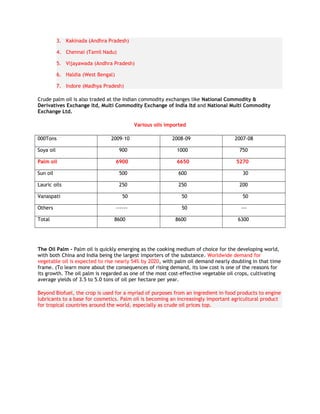
                                              Various oils imported

000Tons                         2009-10                      2008-09               2007-08

Soya oil                              900                      1000                  750

Palm oil                             6900                      6650                 5270

Sun oil                               500                      600                    30

Lauric oils                           250                      250                   200

Vanaspati                               50                       50                   50

Others                               ------                      50                   ---

Total                            8600                         8600                  6300


The Oil Palm - Palm oil is quickly emerging as the cooking medium of choice for the developing world,
with both China and India being the largest importers of the substance. Worldwide demand for
vegetable oil is expected to rise nearly 54% by 2020, with palm oil demand nearly doubling in that time
frame. (To learn more about the consequences of rising demand, its low cost is one of the reasons for
its growth. The oil palm is regarded as one of the most cost-effective vegetable oil crops, cultivating
average yields of 3.5 to 5.0 tons of oil per hectare per year.

Beyond Biofuel, the crop is used for a myriad of purposes from an ingredient in food products to engine
lubricants to a base for cosmetics. Palm oil is becoming an increasingly important agricultural product
for tropical countries around the world, especially as crude oil prices top.
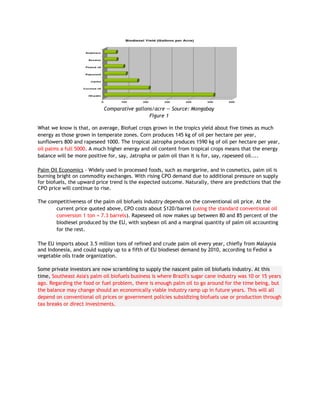
Comparative gallons/acre — Source: Mongabay
                                              Figure 1

What we know is that, on average, Biofuel crops grown in the tropics yield about five times as much
energy as those grown in temperate zones. Corn produces 145 kg of oil per hectare per year,
sunflowers 800 and rapeseed 1000. The tropical Jatropha produces 1590 kg of oil per hectare per year,
oil palms a full 5000. A much higher energy and oil content from tropical crops means that the energy
balance will be more positive for, say, Jatropha or palm oil than it is for, say, rapeseed oil....

Palm Oil Economics - Widely used in processed foods, such as margarine, and in cosmetics, palm oil is
burning bright on commodity exchanges. With rising CPO demand due to additional pressure on supply
for biofuels, the upward price trend is the expected outcome. Naturally, there are predictions that the
CPO price will continue to rise.

The competitiveness of the palm oil biofuels industry depends on the conventional oil price. At the
       current price quoted above, CPO costs about $120/barrel (using the standard conventional oil
       conversion 1 ton = 7.3 barrels). Rapeseed oil now makes up between 80 and 85 percent of the
       biodiesel produced by the EU, with soybean oil and a marginal quantity of palm oil accounting
       for the rest.

The EU imports about 3.5 million tons of refined and crude palm oil every year, chiefly from Malaysia
and Indonesia, and could supply up to a fifth of EU biodiesel demand by 2010, according to Fediol a
vegetable oils trade organization.

Some private investors are now scrambling to supply the nascent palm oil biofuels industry. At this
time, Southeast Asia's palm oil biofuels business is where Brazil's sugar cane industry was 10 or 15 years
ago. Regarding the food or fuel problem, there is enough palm oil to go around for the time being, but
the balance may change should an economically viable industry ramp up in future years. This will all
depend on conventional oil prices or government policies subsidizing biofuels use or production through
tax breaks or direct investments.
The Environmental Consequences - Even as Malaysia and Indonesia hope for a booming palm oil
       biodiesel export market, the EU is getting cold feet because of the destruction of Southeast
       Asia's forests. Indeed, the environmental news is very bad. Western countries see oil palm as a
       good source of Biofuel, a ‘clean’ alternative for fossil fuels. The European Union implements all
       kind of legislation for a large scale use of biofuels.

Export of palm oil to European countries is growing rapidly. However, more than 26% of all Indonesian
        oil palm concessions are on peat lands, and similar figures apply to Malaysia. It is estimated
        that production of one ton of palm oil will result in an average emission of 20 tons of CO2 from
        peat decomposition alone – not taking into account the emissions from fire and other CO2
        emissions during the production cycle. The Netherlands alone imported at least 400,000 tons
        of palm oil to meet its Kyoto target for 2005, thus actually increasing [its] greenhouse gas
        emissions.


The Sub-Saharan Africa is having 201.5 million hectares of potential land suitable for crops; this is 16
    times the total oil palm acreage in Indonesia and Malaysia, according to World Bank. If 1 million
    hectares of land is utilized on an annual basis for over two decades output could be to the tune of
    38 million tons from 1.9 million tons in 2010; FAO statistics say.
    This means Africa can turn out to be a net exporter from its current status as an importer of palm
    oil at 3 million tons in 2010. Liberia-based Golden Veroleum has signed a deal worth $1.6 billion
    with the government of Liberia for a 500,000 acre estate grab and Golden Agri Resources,
    Singapore's second largest palm oil firm, plans to invest in the company. But production cost can be
    a deterrent. For instance, mapping of land rights can incur huge expenses, adding to production
    costs that range between $600 and $800 for a ton of palm oil in Africa. This is when compared to
    around $300 in Asia, according to a Reuter’s survey. Labor may be cheap in Africa, but availability
    of skilled laborers is an issue. Climate is also a factor.
The World Bank Group announced the lifting of moratorium on its new investments in the palm oil
    sector and adopted a World Bank Group Framework and IFC Strategy to guide future engagement in
    the global palm oil sector. The new framework and strategy were developed following extensive
    consultations with a wide range of stakeholders including environmental and social NGOs, farmers,
    indigenous communities, private sector companies, and governments.
Feedback received affirmed that, when guided by rigorous environmental and social protections, the
    palm oil sector can be an important contributor to growth and economic development and to
    overcoming poverty.
FELDA Global Group, the world’s largest oil palm estate operator wants to replicate its home grown
    model of small hold cooperatives in Africa and help the Africans learn a trade in exchange of
    steady palm oil supplies.


Specific Palm projects assessed included Africa:
Ghana, Ivory Coast, Liberia, Sierra Leone, Nigeria, Cameroon, Congo, Kenya, Tanzania and Madagascar
have Oil Palm. There have been many abandoned plantations there over the years without a good track
record. Tied up in African politics is funding, where US investors / World Bank et al want to stick with
stable governments - leaving places like Ghana as a favorite. China is investing there in both industry
and farming anyway. Places like Belize, the Gulf side of Mexico, the Caribbean and Brazil offer much
opportunity - with Brazil the bright spot as noted by Yves Moyen. Again the keys are farm practices and
water, otherwise fertilizers used to ramp up production have other issues.

The Palm plantations in the Pacific Rim are in a perfect climate with some great potential.
   • Palm oil is today the most produced vegetable oil in the world
   • Oil palm produces more than 34% of the world's eight major vegetable oils on less than 5% of
       the total area under oils crops

    •   It requires the lowest fertilizer inputs per planted hectare

    •   Between 1995 and 2010 palm oil production is more than tripled and in the same period world
        demand for palm oil increased sharply

    •   Palm oil has been constantly more price competitive than soybean oil, sunflower oil and
        rapeseed oil

    •   In the past 15 years global palm oil production grew at a much faster rate (+209%) than the
        expansion of mature oil palm area (+167%)

    •   Fluctuations in palm oil production have virtually nothing to do with demand but are due to the
        yield cycle and extreme changes in rainfall

    •   The most suitable areas for cultivation are around ten degrees off the equator

    •   Ghana and Nigeria accounted for most of the production growth in Western Africa

    •   The main consumers are India and China

    •   The Port of Rotterdam is the leading trade hub for palm oil

Palm oil refineries should venture into more downstream value-added products to remain profitable.
“It is important to produce and export more value-added products as it would help increase margins
for refineries. “The price of refined products does not move in tandem with the commodity’s high
price. Therefore, with more value-added products produced such as margerine, soaps and cosmetics.

The oleo chemical industry in Southeast Asia is expected to enjoy robust growth in 2010-2012, fueled
by a short-term hike in demand from consumer markets and wider availability of raw materials such as
palm oil, palm kernel oil and coconut oil. Long-term growth is expected to be stimulated by growing
markets for green chemicals and uses in new applications.

On the other hand, the Asian oleo chemical industry faces the challenges posed by the slowdown in
global demand in export markets following the October 2008 economic crisis and increasing
competition from cash-rich plantations and petrochemical companies that are keen to get a slice of
the oleo chemical production pie.

In Southeast Asia, oleo chemical production is mainly centered on the manufacture of fatty acids,
fatty alcohols, methyl esters and refined glycerin. These then go into the end-user applications of
surfactants, soap and detergents, cosmetics and food emulsifiers. New applications driving growth are
in the areas of biolubricants, green chemicals, bioplastics and biopolymers.

Although export markets and the global oleo chemical industry experienced a slowdown in 2009 in the
aftermath of the crisis of October 2008, the first half of 2010 saw an improvement in demand for
Asian-based oleo chemicals.

INDUSTRY OUTLOOK - Fatty acid demand is expected to continue to be strong, fueled by growth in
consumer products such as cosmetics and plastics. Prices of fatty acids in Asia are dependent on
feedstock palm kernel, palm stearin and crude palm oil prices and tend to follow the price trends of
these raw materials.

The first half of 2010 saw prices of most fatty acid groups rising month-on-month, in tandem with
higher feedstock values. In the second half of the year, prices of most fatty acids are also expected to
remain firm as a result of higher projected feedstock values.

The total capacity output of fatty acids in southeast Asia is estimated to be 3.5m tons in 2010, with
oleo chemical production in Malaysia alone accounting for around 57% of that worldwide. Similarly,
fatty alcohol production is expected to grow at a rate of 5% in 2010 as demand for consumer products
such as detergents and industrial surfactants is expected to increase year on year. Prices have steadily
increased for both mid-cut and long-chain alcohols since January and reached a historical high for mid-
cut alcohols in August at levels above $2,000/ton (€1,531/ton) FOB (free on board) Southeast Asia.

NEW USES FOR REFINED GLYCERIN - In the refined glycerin space, growth is expected to be slower in
2010 but is predicted to pick up in 2011-2012, fueled by newer applications such as those of
epichlorohydrin (ECH), propylene glycol (PG) and other new applications currently under research,
including aromatic solvents and polymers.

2010 has also seen weaker demand for refined glycerin as a result of oversupply in the market. The
projected growth of the refined glycerin industry is around 5.8% in 2010. The estimated demand for
refined glycerin in 2010 is expected to be around 280,000 tons, while it is estimated that supply from
oleo chemical production including China, will be double demand, at 543,000 tons. Prices in the
second half of the year are expected to remain soft-to-stable as the weak demand situation is likely to
persist until the end of the year.

MALAYSIA BEATS INDONESIA - Although Indonesia is the world's largest producer of palm oil - the most
important feedstock for oleo chemical production - the country still trails behind Malaysia, the world's
second-largest producer in the production capacity of oleo chemicals by a factor of roughly two.

Indonesia owns a share of 12% of the world's 6m ton/year oleo chemical market. This equates to
approximately 720,000 tons/year. On the other hand, Malaysia supplies 18.6% of global oleo chemical
capacity, or 1.1m tons/year.

The success of Malaysia as a leader of oleo chemicals in Asia stems from the country's technological
capability to successfully process crude palm oil (CPO) into more than 120 types of downstream
products.

These are higher in value compared with Indonesia, which has the technology to produce only 10
types. Moreover, Indonesia's oleo chemical growth strategy focus is still centered on CPO production
with little government intervention and aid. Investment and growth in the sector is mainly left to the
private sector. Malaysia's oleo chemical industry continues to enjoy strong support from both the
government and private sectors. The Malaysian government also aids the development of the
downstream oleo chemical sector through the provision of stimulus packages. In contrast, the
Indonesian government has imposed an export tax of only 3% on CPO exports, leaving the development
of the oleo chemical industry entirely to private sector plantation owners. Most of these are more
interested in the profitable export of CPO, rather than investments into further downstream products
such as esters, methyl stearates and amides. Moreover, the Indonesian government also lacks the
funds to develop the oleo chemical industry, as well as to develop new plantations.

Around 48% of fatty alcohol consumption in Indonesia is for detergent and cleaning materials and 11%
goes into the production of antioxidants. Glycerin is used mainly in the production of soap, cosmetics
and pharmaceuticals, accounting for 37% of Indonesia's glycerin consumption. Other uses for glycerin in
the country are in the manufacture of alkyd resin and food products, both amounting to 24% of
glycerin consumption in the country.


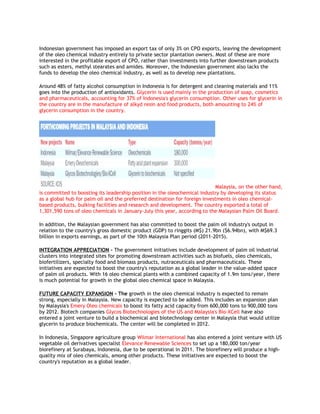
                                                                            Malaysia, on the other hand,
is committed to boosting its leadership position in the oleochemical industry by developing its status
as a global hub for palm oil and the preferred destination for foreign investments in oleo chemical-
based products, bulking facilities and research and development. The country exported a total of
1,301,590 tons of oleo chemicals in January-July this year, according to the Malaysian Palm Oil Board.

In addition, the Malaysian government has also committed to boost the palm oil industry's output in
relation to the country's gross domestic product (GDP) to ringgits (M$) 21.9bn ($6.94bn), with M$69.3
billion in exports earnings, as part of the 10th Malaysia Plan period (2011-2015).

INTEGRATION APPRECIATION - The government initiatives include development of palm oil industrial
clusters into integrated sites for promoting downstream activities such as biofuels, oleo chemicals,
biofertilizers, specialty food and biomass products, nutraceuticals and pharmaceuticals. These
initiatives are expected to boost the country's reputation as a global leader in the value-added space
of palm oil products. With 16 oleo chemical plants with a combined capacity of 1.9m tons/year, there
is much potential for growth in the global oleo chemical space in Malaysia.

FUTURE CAPACITY EXPANSION - The growth in the oleo chemical industry is expected to remain
strong, especially in Malaysia. New capacity is expected to be added. This includes an expansion plan
by Malaysia's Emery Oleo chemicals to boost its fatty acid capacity from 600,000 tons to 900,000 tons
by 2012. Biotech companies Glycos Biotechnologies of the US and Malaysia's Bio-XCell have also
entered a joint venture to build a biochemical and biotechnology center in Malaysia that would utilize
glycerin to produce biochemicals. The center will be completed in 2012.

In Indonesia, Singapore agriculture group Wilmar International has also entered a joint venture with US
vegetable oil derivatives specialist Elevance Renewable Sciences to set up a 180,000 ton/year
biorefinery at Surabaya, Indonesia, due to be operational in 2011. The biorefinery will produce a high-
quality mix of oleo chemicals, among other products. These initiatives are expected to boost the
country's reputation as a global leader.
Indonesia is the world's largest producer of the basic material, CPO. However, Indonesia is still lagging
far behind Malaysia in the development of oleo-chemical industry. Malaysia's production capacity for
oleo-chemicals is twice as large as that of Indonesia. Indonesia has only a 12% share of the world's oleo-
chemical market of six million tons per year as against Malaysia's 18.6%.

Malaysia's palm oil industry has succeeded in processing CPO to turn out more than 120 types of
downstream products, which are much higher in value. Indonesia has so far could produce only more
than 10 type. The Malaysian Palm Oil Board (MPOB), which is the governing body determining that
country's policy in oil palm industry is the agency behind that success.

Oleo-chemical industry is a strategic industry giving added value of more than 40% to the value
of CPO and PKO. Indonesia, however, has recorded significant increase in its oleo-chemical production
capacity in the past several years. There are a number of new players in the industry and old producers
have expanded their capacity. The new investment indicates that the industry is still attractive and it
is expected to continue to expand in the coming years with world's demand for oleo-chemicals growing
by around 5% a year.

Description of product - Oleo-chemical industry is an intermediate industry processing CPO and PKO to
produce intermediate products to feed downstream industry both in food and non food sectors. Among
the intermediate products are base oleo-chemicals (fatty acid, fatty alcohol, fatty amines, methyl
ester and glycerol). The products are used as feedstock for pharmaceuticals, toiletries and cosmetics.

Fatty acid could be used as basic material for various products but mainly soap and detergent. Based
on a survey by Eva Suyenti the largest consumers of fatty acid are soap and detergent producers,
followed by producers of oleo-chemical intermediate products and plastics. Most or 48% of fatty
alcohol consumption in the country is for detergent and cleaning materials and 11% for antioxidant.
Glycerin is used mainly as feedstock in the production of soap, cosmetics and pharmaceuticals,
together accounting for 37% of glycerin consumption in the country. Other groups of products using
glycerin as a basic material include alkyd resin and food products respectively accounting for 12 and 12
percent of the total consumption.

Oleo-chemical production capacity grows fast - The country's focus in palm oil industry is still on CPO
production. CPO is major export earner for Indonesia and has not made much headway in developing
industry to process CPO into higher value products. Malaysia has been far ahead of Indonesia in
developing its downstream palm oil industry producing oleo-chemicals. Oleo-chemical industry has
expanded in various other countries such as Malaysia, the Philippines, China, and India The industry has
grow fast in those countries to exceed the world's market requirement, that Indonesian industrialists
think that capacity expansion would not be feasible.

The producers of base oleo-chemicals are found mostly in Asia. The production of base oleo-chemicals
in Asia grows by around 7.1 % per year; in America the growth rate is 2.4 %, and in Europe it is 1.3 %.

The European Union announced their plan to form a joint venture on oleo chemical products, crude
    palm oil's derivative. Following the plan, the EU is likely to set up a partnership with Indonesia in
    downstream industries which focus mainly on agricultural products.


Palm oil is being processed to produce a wide variety of palm based derivatives and end products
    including oleo chemicals. Products such as activated carbons and filter aids are being used to purify
    the liquid solution before they are being further processed to produce higher value derivatives.
Palm based derivatives

Catalysts
Anti-Oxidants
Activated Clays
Activated Carbons
Filter Aids

Fractionated/Distillated Fatty
                                   • Stearic Acid
Acid
• Lauric Acid                      • Soap Chips
• Mystric Acid                     • Soap Noodles
• Refined Glycerin

Basic oleo chemicals are produced by splitting and further reactions of oils and fats: fatty acids,
    glycerin, fatty acid methyl esters, fatty alcohols and amines. The last two are included in the list
    of oleo chemical raw materials, primarily because of their importance in the preparations of
    further derivatives. The wide range of derivatives of oleo chemical raw materials such as fatty
    alcohol ethoxylates, fatty alcohol sulfates, fatty alcohol ether sulfates, quaternary ammonium
    compounds and soaps are summarized.


Oleo chemicals such as fatty alcohols and glycerin from oils and fats have equivalents on the basis of
    petrochemicals. Using the customary terminology, petrochemical products are referred to as
    “synthetics.” They are included in the present discussion because in the application of oleo
    chemical raw materials the origin of the material is often less important than the structure.


Oleo chemistry can be regarded as a mature branch of chemistry, with many applications for its
    products, but with few completely new fields. The challenge and the opportunities for oleo
    chemistry today lie in the changing economic and ecological conditions. Availability and price
    development of oils and fats are discussed with particular reference to European conditions, for
    these are the prerequisites if oleo chemicals are to be competitive and are to improve their
    chances in the marketplace.


The importance and development of the oleo chemical raw material fatty acids, fatty acid methyl
    esters, glycerin, fatty alcohols and amines are considered on the basis of historical data. In
    considering future developments of oleo chemicals, the capacity, demand and the possible
    influence of petro chemistry or crude oil is discussed.


The highly developed oleo chemical raw materials industry is a flexible supplier of medium-to long-
    chain fatty alkyl groups. These facts, together with the well organized supply lines for raw
    materials and the considerable potential of these renewable raw materials, could provide the
necessary conditions for the oleo chemical raw materials industry to fulfill its future tasks on a
   larger scale. This could arise, for example, due to the partial substitution of petrochemical
   surfactants, if this should become necessary as a result of developments in the price and
   availability of crude oil, or on grounds of ecological factors.


Even though the market for oleo chemicals in the EC is considered relatively mature, it has been forced
   to undergo changes in recent years to encompass new consumer demands, especially concerning
   the long-term environmental performance of the chemical ingredients.


   According to a new report by international market research publisher Frost & Sullivan, the oleo
   chemicals market in the EC was estimated to have been worth $2,785 million in 1993 and is
   predicted to reach $3,087 million by the end of the study period in 1999. Oleo chemicals,
   comprised of materials produced by the splitting of oils and gas and by other processes such as
   fractionation, hydrogenation and interesterification, traditionally include both fatty alcohols and
   fatty amines in the range of basic oleo chemicals, although they are primarily derivatives of fatty
   acid methyl esters and of fatty acids.


The market for chemical ingredients is dominated by fatty acids valued at $999 million in 1993 and
   forecast to reach $1,101 by 1999. Mostly - though not exclusively - the range of fatty acids
   comprises straight chain acids, with an even number of carbon atoms. Some acids containing odd
   numbers of carbon atoms have been identified, one example being C17 fatty acids found in
   tallow triglycerides.


   World production of fatty acids in 1993 amounted to 2.52 million tons, of which the EC countries
   consumed 908,000 tons. Even though the EC consumption figures have continued to grow,
   increasing imports have led to under-utilisation of European plants. The market for fatty alcohols,
   classified as detergent range and plasticizer range alcohols, was estimated to have been worth
   $709 million in 1993 and Frost & Sullivan expect this sector to rise to reach $794 million by the end
   of the study period in 1999.


   In the detergent range of alcohols, demand is expected to increase for the traditional alcohol-
   based surfactants, such as alcohol sulphates, ethoxylates, and ethoxysulphates and also for the
   newer surfactants such as alkyl polyglycosides which use fatty alcohol.


   "The alkyl polyglycosides, known as APG, could become a large volume end use of fatty alcohol
   within the decade." This is followed by fatty acid methyl esters, valued at $388 million in 1993 and
   predicted to reach $432 million by 1999. Currently 83.6 per cent of fatty acid methyl esters are
used in the production of fatty alcohol, with the balance going into other derivatives such as
   amides esters, lubricants and bio-diesel.


   The surfactants industry continues to be the greatest end-use area of application either directly or
   indirectly for most of the different oleo chemicals. Within the oleo chemical sector, the principal
   oils used are palm oil, palm kernel, coconut and tallow.
   Though palm oil has been well-established in Europe for several years, both as a frying medium as
   well as a port of the oil blends for margarine, consumption has increased significantly over the
   decade to reach 1.5 million tons in 1993. In terms of suppliers, the European market for basic oleo
   chemicals is dominated by Unichema and Henkel. By far the largest national market is Germany,
   estimated to have been worth $866.2 million in 1993 and forecast to reach $959.1 million by 1999.
   This is followed by France and the UK, valued at $496.9 million and 411.6 million respectively in
   1993. With oleo chemical sales of $501 million in 1993, Henkel can be regarded as a world leader
   in the production of natural alcohols and oleo chemicals used in the production of household
   detergents, shampoos and bathroom products.


Few ways in which oleo chemicals are used:
   •   Soaps and detergents: Industrial and domestic

   •   Health and personal care: Culture media, tabletting aids, shampoos, soaps, creams, lotions,
       make-up

   •   Food: Emulsifiers and specialties for bread, cakes and pastries, margarine, ice cream and
       confectionery

   •   Animal feed: Nutritional supplements, emulsifiers for calf milk replacers

   •   Electronics: Wire insulation, insulating varnishes, special-purpose plastic components

   •   Industrial lubricants: General and specialty lubricants, base oils for non-toxic biodegradable
       lubricants

   •   Leather: Softening, dressing, polishing and treating agents

   •   Metalworking and foundries: Cutting oils, coolants, buffing and polishing compounds

   •   Mining: Froth flotation of ores, surface-active agents for oil-well drilling muds

   •   Paints and coatings: Alkyd and other resins, drying oils, protective coatings

   •   Paper re-cycling: Removal of printing ink

   •   Plastics: Stabilisers, plasticisers, mould release agents, lubricants, anti-statics, antifogging aids,
       polymerisation emulsifiers

   •   Printing: Printing inks, paper coatings, photographic printing
•   Rubber production: Vulcanising agents, softeners, mould release agents

   •   Waxes: Ingredients in waxes and polishes

Oil Palm in Ghana - Plantations include the three major ones established by the government-owned
but foreign-assisted Ghana Oil Palm Development Co. (GOPDC) located around Kwae; the
government/privately owned Twifo Oil Palm Plantations Ltd. (TOPP) located around Twifo
Praso/Ntafrewaso; and the government/privately owned Benso Oil Palm Plantations Ltd. (BOPP)
located around Benso/Adum Banso.

Since about 1977, when they started, the three plantations have developed rapidly and contributed
significantly towards the expansion of Ghana’s oil-palm hectares from 18,000 to 103,000 between 1970
and 1990. This growth of 24 per cent per annum has resulted in the re-emergence of the palm as a
major commercial crop rivaling cocoa; has served as a basis for the fast-developing palm oil and other
agro-industrial processing industries; and rendered the country more than self-sufficient in palm-oil
production.

According to the FAO, oil palm plantations covered 304,000 hectares in 2002, while a Europaid
document describes the situation as follows: “In 2004, around 285,000 ha of oil palm was cultivated.
Smallholders cultivated nearly 88% of the total area under production but produced only 72% of the oil
palm fresh fruit bunch (FFB). The remaining 28% was produced by the private estates cultivating less
than 12% of the total area. The existing plantations operate on the basis of a nucleus estate with
associated smallholder schemes and independent out-growers. The out-growers own and cultivate oil
palm on their land, receive planting material and other inputs and technical advice from the companies
(usually on credit) to whom they are contractually obliged to sell their production.” The main
companies are now mostly foreign:

1) Ghana Oil Palm Development Co. (GOPDC), privatized in 1995. this is currently owned by three
Shareholders: Siat of Belgium, SSNIT of Ghana and ATMF, with Siat holding the majority shares.

2) In the Twifo Oil Palm Plantation Limited (TOPP) the major shareholders are Unilever and the
government of Ghana. The Estate is situated at Twifo Ntafrewaso/Twifo Mampong area. TOPP is one
of the largest producers of palm oil in Ghana.

3) The Benso Oil Palm Plantation Limited (BOPP) used to be a subsidiary of Unilever Ghana Limited
and was recently sold to Singapore-based Wilmar International.

4) Norwegian Palm Ghana Limited (NORPALM), based at Prestea in the Ahanta West District of the
Western Region. In 2000 this company took over the plantation from the former National Oil Palm
Limited.

The World Bank’s International Finance Corporation (IFC) says it “engaged extensively throughout the
supply chain in the palm oil sector, with investments in plantations”. In Ghana, IFC investments
amounted to US$ 12.5 million in 2007. More recently (2010), the media has informed about a “new
global strategy … being developed by experts from the World Bank Group and International Finance
Corporation (IFC). The strategy, to be ready in September 2010, is expected to quick-start a multi-
million dollar oil palm programme for policymakers and government and will focus on access to
financing, certification, land-use policy, technology transfer, and infrastructure development from the
farm to the port, as well as pricing mechanism and marketing.”

EuropAid –whose mission is to implement the European Commission’s external aid instruments- is also
active on this issue and has called for a consultancy to carry out “Feasibility Studies and Plans for
Establishment of Palm Oil Mills in Ghana.” The consultancy “will inform the formulation of further any
support required from Government, including the mobilization of adequate domestic and foreign
investment from the private sector into the establishment of Palm Oil mills and related industries.”

The EuropAid document mentions the “renewed global interest and demand in the crop in recent
years” as a biofuel and mentions, as an example, “the European Union’s target of reducing green house
emission by 20% by the year 2020 (partly through demanding that 10% of automobiles use bio-fuels)”
that “could lead to a surge in demand.”

The same document informs that the government intends “to develop 10,000 hectares of plantations in
the short-term and in the medium term over 100,000 hectares to support primary processing and the
manufacture and marketing of valued added products from palm and palm kernel oils. Over the long-
term, it is estimated that 300,000 hectares of oil palm plantation would have developed and an oleo-
chemical industry emerged.”

Physical Refinery: Lowest Capacity mill is approx 2.5TPH which works out to 50TPD. It should cost
about Rs 5 to 6 crore. Utilities, land etc would be additional.

Palm oils consist mainly of glycerides and, like other oils in their crude form, small and variable
portions of non-glyceride components as well. In order to render the oils to an edible form, some of
these non-glycerides need to be either removed or reduced to acceptable levels.

In term of solubility study – glycerides are of two broad types: oil insoluble and oil soluble. The
insoluble impurities consisting of fruit fibers, nut shells and free moisture mainly, are readily removed.
The oil soluble non-glycerides which include free fatty acids, phospholipids, trace metals, carotenoids,
tocopherols or tocotrienols, oxidation products and sterols are more difficult to remove and thus, the
oil needs to undergo various stages of refining. Not all of the above non-glyceride components are
undesirable. The tocopherols and tocotrienols not only help to protect the oil from oxidation, which is
detrimental to flavor and keep ability of the finished oil, but also have nutritional attributes, a- and b-
carotene, the major constituents of carotenoids, are precursors of vitamin A. The other impurities
generally are detrimental to the oil’s flavor, odor, and color and keep ability and thus influence the
oil’s usefulness.


The aim of refining is therefore to convert the crude oil to quality edible oil by removing objectionable
impurities to the desired levels in the most efficient manner. This also means that, where possible,
losses in the desirable component are kept minimal. The impurities which are contained in the crude
palm oil (CPO) are shown in table:


                     Substances                         Content
                    Free Fatty Acid (FFA)               3 - 5%
                    Gums (phospholipids,
                    phosphotides)                       300 ppm
                    Dirt                                0.01%
                    Shell                               Trace
                    Moisture and Impurities             0.15%
                    Trace metal                         0.50%
                    Oxidation Products                  Trace
Total Carotenoids                   500 - 1000 mg/ke

General speaking, the refining routes of palm oil is quite identical. There are two routes are taken to
process crude oil into refined oil; which are chemical (basic) refining and physical refining. The
methods differ basically in the way the fatty acids are removed from the oil. Physical refining, which
eliminates the need for an effluent plant for the soap stock, involves subjecting the oil to steam
distillation under higher temperature and vacuum for removal of the free fatty acids. The physical
refining is used to remove the free fatty acids. The refining of physical plant is practiced to subject the
oil to steam distillation.


Physical Refinery Process Description - The raw material which is used by physical plant is crude palm
oil (CPO) from the CPO storage tank. CPO is feed at the flow rate about 35-60 tons/hour. The initial
temperature of CPO is at 40 – 60°C. The feed is pumped through the heat recovery system, that is
plate heat exchanger to increase the temperature around 60 – 90°C. After that, there is about 20% of
the CPO feed to into the slurry and mix with the bleaching earth (6 – 12kg/ton CPO) to form slurry (CPO
+ Bleaching earth). The agitator inside the slurry tank will mixed the CPO and bleaching earth
completely. Then, the slurry will go into the bleacher.


At the same time, another 80% of the CPO is pumped through another plate heat exchanger (PHE) and
steam heater to increase the CPO temperature to 90 – 130°C (it is a desired temperature for the
reaction between CPO and phosphoric acid). Then, the CPO feed is pumped to static mixers and the
phosphoric acid is dosed at 0.35 – 0.45 kg/ton. Inside there, the intensive mixing is carried out with the
crude oil for precipitation up the gums. The precipitation of gums will ease the later filtration process,
avoid the scale formation in deodorizer and heating surface. The degumming CPO then will go into
bleacher.


In the bleacher, there are 20% slurry and 80% degummed CPO will mix together and the bleaching
process occur. The practice of bleaching involves the addition of bleaching earth to remove            any
undesirable impurities (all pigments, trace metals, oxidation products) from CPO and this improves the
initial taste, final flavor and oxidative stability of product. It also helps to overcome problems in
subsequent processing by adsorption of soap traces, pro-oxidant metal ions, decomposes peroxides,
color reduction, and adsorbs other minor impurities. The temperature inside the bleacher must be
around 100°C – 130°C to get the optimum bleaching process for 30 minutes of bleaching period. The
low pressure steam is purged into bleacher to agitate the concentrated slurry for a better bleaching
condition.


The slurry containing the oil and bleaching earth is then passed through the Niagara filter to give a
clean, free from bleaching earth particles oil. The temperature must be maintain at around 80 – 120°C
for good filtration process. In the Niagara filter, the slurry passes through the filter leaves and the
bleaching earth is trapped on the filter leaves. Actually, the bleaching earth must be clear from
Niagara filter after45minutes in operation to get a good filtration. Bleached palm oil (BPO) from
Niagara filter is then pumped into buffer tank as a temporary storage before further processing.


Usually, a second check filter, trap filter is used in series with the Niagara filter to double ensure that
no bleaching earth slips occur. The presence of bleaching earth fouls deodorizer, reduces the oxidative
stability of the product oil and acts as a catalyst for dimerizaition and polymerization activities. So,
the “blue test” is carried out for each batch of filtration to ensure the perfect filtration process. This
test indicates whether any leaking is occurring in Niagara filter or trap filter. Hence, any corrective
actions can be taken intermediately.


The BPO comes out from the filter and passes through another series of heat recovery system, Schmidt
plate heat exchanger and spiral (thermal oil: 250 – 305°C) heat exchanger to heat up the BPO from 80 –
120°C until 210 – 250°C. The hot BPO from spiral heat exchanger then proceeds to the next stage
where the free fatty acid content and the color are further reduced and more important, it is
deodorized to produce a product which is stable and bland in flavor.


In the pre-stripping and deodorizing column, deacidification and deodorization process happen
concurrently. Deodorization is a high temperature, high vacuum and steam distillation process. A
deodorizer operates in the following manner: (1) dearates the oil; (2) heat up the oil, (3) steam strips
the oil and (4) cools the oil before it leaves the system. All materials if contact are stainless steel.


In the column, the oil is generally heated to approximately 240 – 280°C under vacuum. A vacuum of
less than 10 torr is usually maintained by the use of ejectors and boosters. Heat bleaching of the oil
occurs at this temperature through the thermal destruction of the carotenoid pigments. The use of
direct steam ensures readily removal of residue free fatty acids, aldehydes and ketones which are
responsible for unacceptable odor and flavors. The lower molecular weight of vaporized fatty acids
rises up the column and pulls out by the vacuum system. The fatty acid vapor leaving the deodorizer
are condensed and collected in the fatty acid condenser as fatty acid. The fatty acids then is cooled in
the fatty acid cooler and discharged to the fatty acid storage tank with temperature around 60 – 80°C
as palm fatty acid distillate (PFAD), a by-product from refinery process.


The bottom product of the pre-stripper and deodorizer is Refined, Bleached, Deodorized Palm Oil
(RBDPO). The hot RBDPO (250 – 280°C) is pumped through Schmidt PHE to transfer its heat to incoming
BPO with lower temperature. Then, it passes through another trap filters to have the final oil polishing
(120 – 140°C) to prevent the earth traces from reaching the product tank. After that, the RBDPO will
pass through the RBDPO cooler and plate heat exchanger to transfer the heat to the CPO feed. The
RBDPO then is pumped to the storage with temperature 50 – 80°C.


Palm Fatty Acid Distillation Plant - The separation of liquid mixture into their several components is
one of the major processes of the chemical industries, and distillation is the most widely used method
of achieving this end: it is the key operation of the oil refinery. Though out the chemical industry the
demand for pure products, coupled with a relentless pursuit of greater efficiency, has necessitated
continued research into techniques of distillation. The distillation column is used in this purpose.


The distillation column which have to be designed with a larger range in capacity than any other types
of chemical engineering equipment, with single columns from 0.3 to 10m in diameter and from 3m to
upwards of 75m in height. The purpose of designing is to achieve the desired product quality at
minimum cost, but also to provide constant purity of product even though there may be some variation
in feed composition. The vertical cylindrical column provides in a compact form, with the minimum of
ground utilization, a large number of separate stages of vaporization and condensation.


In practice, distillation may be carried out by either of two principal methods. The first method is
based on the production of a vapor by boiling the liquid mixture to be separated and condensing the
vapors without allowing any liquid to return to the still. There is then no reflux. The second method is
based on the return of part of condensate to the still under such condition that this returning liquid is
brought into intimate contact with the vapor on their way to the condenser. Either of these methods
may be conducted as a continuous process or as a batch process.


PFAD Plant Description

a) Feed Raw Material                     - Palm Fatty Acid Distillate (PFAD)

b) i) Major Product Produced             - Distillate Fatty Acids (DFA)

  ii) By Product Produced                - Precut-Lighter Fatty Acid Component

                                         - Residue

 PFAD Process Description - The feed Palm Fatty Acid Distillate (PFAD) from storage tank with
temperature around 50 – 100°C will first passes through a heat exchanger network.

The temperature of PFAD will increase to approximately 200 –220°C. Then the hot feed will enters to
the Degasifier for separating some impurities and light fatty acid presented in the feed under vacuum
system. After that, the heavy components of fatty acid (C10, C12, C14, C16 & C18) come out from the
bottom of Degasifier will go into column C for more separation between light and heavy components of
fatty acids. Before that, there are three distillation column are used in distillation process. The
products of these 3 columns are as follow:


            o   Column A: Precut
            o   Column B: Distillate Fatty Acid (DFA)

            o   Column C: Residue


In column C, the feed with temperature 220 – 255°C will further heating by thermal oil boiler until
temperature become 240 – 300°C under vacuum system. The fatty acids will evaporate under the
vacuum condition and separation of light fatty acid and heavy fatty acid will occur. At the top of
column C, the light fatty acid (precut with lower carbon number <C16) from the evaporation become
vapor is continuously pulled out by the vacuum system. The precut then passed through the heat
exchangers and cooled down by the soft water and PFAD feed before going to storage.


At the same time, the heavy fatty acid from the bottom of Column C (C16 & C18) is pumped to Column
B for further separation. There is high temperature inside the column B which is supplied by thermal oil
reboiler (290 – 310°C) will contribute to the vaporization of fatty acids. Therefore the temperature will
increase (220 – 250°C) during the distillation process because of the higher boiling point of the fatty
acids feed. The light fatty acid (DFA) from the vaporization of fatty acid is pulled out by the vacuum
system into a reflux holder. When the refluks is overflow, the excess DFA is pumped to the heat
exchangers and cooled down by the soft water and the PFAD feed. The DFA then is further cooled down
in spiral heat exchanger (hot water/DFA) and plate heat exchanger (Cooling tower water/DFA) before
sending to storage at 60 – 90°C.


On the other hand, the bottom product of column B is residue, the heavy fatty acids component is
pumped to the heat exchanger (Residue/PFAD feed and Residue/Hot Water) before going to storage
tank. The uncompleted distillate will recycles back to column B for further separation.


Fractionation: Value added process? - The demand for liquid oils has increased in recent years,
mainly for salad and cooking uses and an important property for such oils is low cloud point, which is
the temperature at which turbidity appears when the oil is cooled under standard conditions. Liquids
oils with a low cloud point are desirable because of the widespread use of household refrigeration. In
order to cater for a wide range of markets, the refiners start to offer product which are “harder”
(Stearin) and “more liquid” (olein) than palm oil. These are accomplished trough a simple process of
fractionation which is based on two fundamental operations:


                           Crystallization
    Filtration


Fractionation of palm oil can be described as follow. The triglycerides found in the oil have different
melting points. At certain temperature, the lower melting temperature triglycerides will crystallize
into solid separating the oils into both liquid (Olein) and solid (Stearin) fraction. The fraction can then
be separated by filtration. It is worth mentioning that in palm oil fractionation, palm olein is the
premium product and the palm stearin is the discount product. Fractionation of palm oil into palm
olein and palm stearin is accomplished using two types of processes which are “Viz Dry” and
“Detergent Fractionation”.


Fractionation Plant Description


a) Feed Raw Material - Refined Bleached deodorised Palm Oil (RBDPO)

b) 1) Major Product Produced- Refined Bleached Deodorised Palm Olein (Olein)

2) By Product Produced - Refined Bleached Deodorised Stearin (Stearin)

Fractionation Process Description - The dry fractionation is used to separate the palm olein and palm
stearin from the RBDPO produced by physical treatment. The RBDPO is passed through the further
fractionation process to get various grade of palm olein and palm stearin. Usually, there are three
types of olein are produced: (1) normal grade olein, (2) super grade olein and (3) olein with cloud point
7 – 8°C.


Crystallization Process -Firstly, the RBDPO feed must pass the quality specification, colour<2.6R and
FFA< 0.075 is fed into the heat exchanger. The RBDPO feed is heated up by hot waters around 75°C.
After that the oil is kept homogenized at about 70°C in homogenizes before the start of crystallization.
The idea is to destroy any crystals present and to induce crystallization in a controlled manner in the
crystallizer.

After that, the oil is pumped to the crystallizer. The crystallization system is a batch type and is
equipped with special crystallizers operating alternatively. These crystallizers are made up of vertical
cylindrical vessel full of thermo-regulated water which submerged barrels containing the oil to be
fractionated: each of these barrels is fitted with a mechanical agitator. An automatic station controls
the temperature in the various crystallizers.


The crystallization process is carried out to remove the higher melting glycerides which cause liquid
oils to become cloudy and more viscous at low temperature. There are 3 factors (temperature, time
and agitation), have a fundamental importance on the formation and character of the crystal:


            o   The lowering of temperature causes, because of supersaturating the higher melting
                component to separate from a solution.
o   Agitation facilitates the formation of small crystals.

             o   Time with a gradual decrease in temperature and stillness, promotes the formation of
                 longer crystals.


The solution is pumped batch-wise into the crystallizer according to a pre-established programme. In
the crystallizer, the crystal formation and growth occurs as the oil is agitated and cooled sing chilled
water and cool water filled in the jackets or cooling coils of the crystallizer. Cooling can be governed
by controlling either the oil or water temperature.


Filtration Process - After the crystallization process, the slurry from buffer tank passes through the
filtration process for the physical separation between RBD palm stearin and RBD palm olein. Presently,
the membrane filter is used for this filtration. Another alternative for this purpose is by employing
drum filter for separation. The membrane filter is pressure filter where the filter pack comprising
alternatively plates and frames, or a series of chamber is compressed between one fixed and one
movable cover or bulk-head. The filter media are located between each individual element. Cake will
build up in the hollow space between the elements and fall out of the press when the filter pack is
opened. Composition of the filter pack is by means of electrically driven hydraulic system (75 bar),
which controls the entire mechanical parts of units, head plates, filter plates, plate shifting device
with the built in panel board.


Hydrogenation - Hydrogenation is the most widely used method of all the oil modification processes,
to reduce the degree of unsaturated in the fatty acid groups of the glycerides. It is a catalytic process
whereby the numbers of double bonds are reduced and by the same time isomerization of the residual
fatty acids is promoted. Liquid oils with unsaturated triglycerides are thus transformed into fats
containing a higher % age of saturated triglycerides: Hydrogenation is often called hardening of oils and
soft fats.


Catalytic hydrogenation, which has been known in fat technology since the beginning of this century, is
used increasingly for the preparation of ‘tailor-made’ fats. Depend on the condition of the reaction,
the basic reaction can be shown as follows:


                       H    H                                       H H


                           R - C = C - R + H2                   R- C – C – R     Hydrogenation


                                                                     H H
The complex system consists of three phases: liquid oil, gaseous hydrogen and solid catalyst. Hence
there are many different internal surfaces through which the hydrogen molecules have to pass until
they reach the double bonds of the unsaturated triglycerides adsorbed on the catalyst surface. As soon
as the unsaturated bonds are saturated, the triglyceride moves off the catalyst surface, thus enabling
the next unsaturated molecule to be adsorbed and processed.


The overall hydrogenation rage depends on the quality of the reactant involved, the degree of refining
of the oil to be hydrogenated, the activity and nature of the catalyst. In addition reaction parameters
such as hydrogen pressure, catalyst concentration, reaction temperature, stirring, etc have an
influence. In spite of these numerous reaction parameters that affecting the quality of the desired
product, fat-technologist has resolved the operating conditions required for the preparation of tailor-
made fats. This process is established mainly to add value to by byproducts from the refinery. The raw
materials are from refinery: Palm Fatty Acid Distillate (PFAD) and Refined Bleached Deodorized (RBD).
Basically, stearin is the main raw material for this plant.


Hydrogenation Process Description - There are various kind of oils used as the feed of this plant
depends on the market demands; there are DFA, PFAD, RBDSt, precut and split residue. Firstly, the
fatty acid feed from the storage tank (60 – 70°C) is pumped to the feed preheater. In the feed
preheater, the fatty acid feed is heated up by the hot hydrogenated FA from plant until 140 – 170°C,
before entering the reactor for hydrogenation process. Then, the hot feed is transferred to the reactor
autoclave for reaction. The reactor consisted of the nickel catalyst which plays an important role in
the reaction as follow:


1.     To avoid modifiers, such as sulphur, likely to give higher “trans” acid contents.
2.     Comparatively high temperature to accelerate reduction of poly-unsaturated without formation
     of saturates.
3.     Reduced the hydrogen gas pressure.
4.     Lowering the iodine value to improve stability and good yield of liquid oil when winterized.
5.     To remove materials responsible for clouding and solidification at low temperatures.


Biodiesel can be made from a variety of renewable sources, such as vegetable oils (soybeans or other
crops), recycled cooking grease, or animal fats. These feedstocks are used to manufacture a mixture of
chemicals called fatty acid methyl esters (biodiesel). The European Union is the world leader in the
production and consumption of biodiesel.

Production of Biofuels

Pam oil used for producing Biodiesel

Palm oil is the largest volume triglyceride resource in the world. As the name indicates, palm oil is
seed oil derived from the oil palm tree. Palm kernel oil is derived from the seed kernel, while palm oil
is recovered from the seed pulp. Palm oil is a material of interest for biodiesel production. Palm oil is
characterized by high (32-40%) palmitic acid and high (38-52%) oleic acid contents. The oil is semi-solid
at room temperatures. The ester product has to be winterized to meet pour point and cloud point
standards in temperate regions.


How Biodiesel differs from diesel

●Higher Density
●Lower Heating Value
●Less Sulphur Content
●Continuous Distillation Curve
●Similar or Higher Cetane Number
●Somewhat Lower Oxidation Stability (lower Iodine figure)
●Higher Lubricity ≠Viscosity
●Gelling at Low Temperatures
●Will Harm Certain Plastics and Paint Types
●Nitrogen and Oxygen Content (stochiometric air demand is lower)

Blending (bio-diesel)

Biodiesel can be blended with conventional diesel in any ratio. Biodiesel can be blended with
conventional diesel at either refinery, at intermediate storage depots or at refueling stations. In
Austria and Germany, pure biodiesel is being used as a fuel for agricultural tractors and road vehicles.
Another example is that in France 5% RME (rapeseed methyl ester) is blended in conventional diesel
fuel.

The blend level can be done as B2 to B5, which is essentially used for giving lubricity to the blend with
diesel fuel. B2 and B5 signify that the percentage of bio-diesel in the blend is 2% and 5% respectively.
B20 and B 100 are the remaining two most often used bio-diesel variants.
The major application segments for B100 include national parks, marine, underground mining, and off-
road vehicles.

The B20 was originally chosen as an optimum between reductions in exhaust emissions and fuel cost.
B20 provides about a 14% decrease in PM10 emissions, a 9% decrease in CO and a 7% decrease in
hydrocarbons, compared with diesel. But it also entails a 2% increase in NOx.
A key factor in favor of selection of B20 as an alternative fuel is that there is no investment required
for new infrastructure to switch to biodiesel.

The low-blend option, in the range of B2 to B5, is essentially the use of biodiesel as a diesel fuel
additive to enhance lubricity. Low-level blends will also reduce emissions although the reductions will
be proportional to the blend level so the reductions may be small. The B2 blend combines improved
lubricity performance with a minimal increase in fuel price.

Oil feed stocks have been and will remain important raw materials for specialty products like polymers,
biolubricants, biosurfactants, and emulsifiers, in addition to biodiesel. Palm oil production has gained
importance in the recent years, as it has many competitive advantages over other competing oils, such
as having low cost of production, high yield, and being free from trans-fatty acids. The consumption of
palm oil has increased rapidly in the past years, owing to its multiple uses in both food industry as well
as non-food sectors.


Most biodiesel plants use the conventional sodium hydroxide/sodium methoxide-based
transesterification process, which requires highly priced refined oil feedstock. Although palm oil is one
of the more competitive feedstocks for biodiesel production, it can be expensive because its price is
linked to that of crude petroleum (Fry, 2010). However, during the refining of palm oil, a lower-value
by-product known as palm fatty acid distillate (PFAD) is generated in the fatty acid stripping and
deodorization stages. PFAD is potentially a valuable, low-cost feedstock for the production of
biodiesel. It also makes the much-debated “food vs. fuel” argument a non-issue as PFAD is generally
sold as a source of industrial fatty acids for non-food applications. It has also been used as a fuel in
power plants and industrial boilers.

Malaysia and Indonesia are the largest producers of palm oil. In 2009, Malaysia and Indonesia produced
about 17.5 and 20.9 million metric tons of crude palm oil, respectively (Mielke, 2010). In Malaysia,
most of the crude palm oil is refined locally for export to overseas markets, mainly for food
applications. Almost 700,000 metric tons (MT) of PFAD were produced in Malaysia as a by-product of
the refining process (MPOB, 2010).

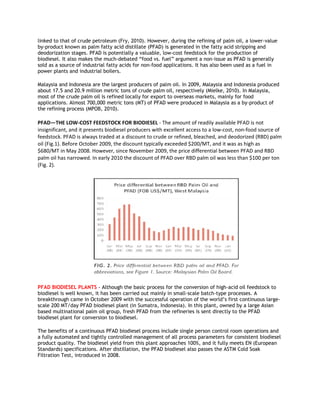
PFAD—THE LOW-COST FEEDSTOCK FOR BIODIESEL - The amount of readily available PFAD is not
insignificant, and it presents biodiesel producers with excellent access to a low-cost, non-food source of
feedstock. PFAD is always traded at a discount to crude or refined, bleached, and deodorized (RBD) palm
oil (Fig.1). Before October 2009, the discount typically exceeded $200/MT, and it was as high as
$680/MT in May 2008. However, since November 2009, the price differential between PFAD and RBD
palm oil has narrowed. In early 2010 the discount of PFAD over RBD palm oil was less than $100 per ton
(Fig. 2).


PFAD BIODIESEL PLANTS - Although the basic process for the conversion of high-acid oil feedstock to
biodiesel is well known, it has been carried out mainly in small-scale batch-type processes. A
breakthrough came in October 2009 with the successful operation of the world’s first continuous large-
scale 200 MT/day PFAD biodiesel plant (in Sumatra, Indonesia). In this plant, owned by a large Asian
based multinational palm oil group, fresh PFAD from the refineries is sent directly to the PFAD
biodiesel plant for conversion to biodiesel.

The benefits of a continuous PFAD biodiesel process include single person control room operations and
a fully automated and tightly controlled management of all process parameters for consistent biodiesel
product quality. The biodiesel yield from this plant approaches 100%, and it fully meets EN (European
Standards) specifications. After distillation, the PFAD biodiesel also passes the ASTM Cold Soak
Filtration Test, introduced in 2008.
Two more PFAD biodiesel plants using the above process technology will be operational in Pasir
Gudang, Malaysia and Kalimantan, Indonesia by May 2010. These plants can also operate using refined
oil feedstocks.

NEW GENERATION MULTIPLE FEEDSTOCK BIODIESEL PLANTS - By incorporating a continuous
esterification section, a biodiesel producer with a conventional sodium hydroxide/sodium methoxide-
based transesterification process now has the opportunity to possess a new, truly multiple feedstock
plant able to handle different raw materials including PFAD. By using the above processes, combined
with pretreatment and other processes, the variety of feedstock can be further expanded to include
low-quality and high free-fatty-acid (FFA) oils, thereby ensuring that a very wide range of low-cost
feed stocks are available to the biodiesel processor, thus ensuring the profitability of the plant.


PHYTOCHEMICALS FROM PFAD - PFAD also provides a source of value-added co-products for the
biodiesel producer. PFAD contains 72.7–92.6% FFA, with a small amount of unsaponifiable components
(1–2.5%) and the remainder neutral oil. The general characteristics of Malaysian PFAD are shown in
Table 1. Modern palm oil refineries consistently produce PFAD with FFA content higher than 88%, and
crude palm oil also contains non-glyceride minor components that have been associated with health
benefits, some of which are distilled off together with the FFA as unsaponifiable components.

The unsaponifiable materials of PFAD have long been considered a potential source of highly valuable
photochemical (Gapor, 2000). Vitamin E, phytosterols, and squalene are of particular interest, and
their beneficial effects are well documented.

In fact, tocotrienol from PFAD is being produced commercially. The vitamin E profile of Malaysian PFAD
is 10.3 wt% α-tocopherol, 18.7 wt% α-tocotrienol, 49.8 wt% γ-tocotrienol, and 14.6 wt% δ-tocotrienol
(Bonnie and Mohtar, 2009). Depending on the feedstock and processing conditions, some samples of
PFAD can have as much as 0.5% vitamin E, 0.4% phytosterols, and 0.8% squalene. These high-value co-
products further improve the profitability of PFAD biodiesel plants.

The initial step in the extraction of photochemical from PFAD is conversion of the fatty acids into a
methyl ester, that is, biodiesel. The methyl ester is then distilled in a short-path evaporator where the
phytochemicals are concentrated in the residues. The residues are further processed to produce the
high-value added phytochemicals. The distilled methyl ester is a high-quality biodiesel that will meet
all biodiesel EN and ASTM specifications, including the Cold Soak Filtration Test. Furthermore, other
parameters such as mono-, di-, and triglycerides content are reduced significantly, further enhancing
the fuel properties of the biodiesel.
CONCLUSIONS – Although about 80% of current world palm oil output is consumed for food or edible
use, non-food uses are increasingly becoming important, contributing to greater demand and higher
prices for palm oil. Usage in soaps, detergents and surfactants, cosmetics, pharmaceuticals,
nutraceuticals and some household and industrial products has been growing because of the move
away from petroleum-based products.

The global desire to substitute at least a small portion of fossil fuel use with renewable fuels has given
rise to increased demand for vegetable oils, one of the feedstock for biofuels. In addition to the
concern for the environment, relatively high fossil fuel prices have created a demand for alternative
cost-effective and clean fuels.

The challenge for biodiesel producers is to remain profitable, and one solution is to operate a new-
generation biodiesel plant that is truly multiple-feedstock capable. PFAD is one alternative low-cost
feedstock that is available today. PFAD also gives a producer the ability to produce high-value co-
products. Going one step further, this new-generation truly multiple-feedstock biodiesel plants can be
designed to accept low-quality and high-FFA oil feed stocks using proven process technologies that are
already operational in several plants today.

Oil Palm Supply chain

  • 1.
    Palm oil production Oilpalm is the most productive oil seed in the world. A single hectare of oil palm may yield 5,000 kilograms of crude oil, or nearly 6,000 liters of crude. Palm Oil an expeller-pressed food oil, obtained from fresh fruit bunches (FFB) of oil palm cultivated in plantations. Palm oil is the second largest edible oil and accounts for approximately 23 per cent of the world's fats and oil supply. Since 80 per cent of palm produced is used in food - its nutritional properties are of extreme importance. For comparison, soybeans and corn—crops often heralded as top biofuels sources—generate only 446 and 172 liters per hectare, respectively. Oil palm requires 7-11 times less land area than soybean, rapeseed and sunflower to produce the same amount of oil. Therefore, the use of palm oil for food and Biofuel has saved 97-159 million ha of land from being deforested for cultivation with lower yielding oil crops. This has avoided 27-45 billion tonnes of carbon dioxide (CO2-e) emissions. Oil palm also sequesters eight times more CO2 than soya bean. As a Biofuel, the use of palm biodiesel results in 62-82% Life Cycle Analysis Greenhouse Gas (LCA GHG) reduction when compared with fossil fuel. Palm oil is available in about 15 different grades, ranging from crude to semi-refined, and refined, crude fractionated, refined fractionated oil and refinery by-products. Crude Palm Oil (CPO), Crude Palmolein, RBD (refined, bleached, deodorized) Palm Oil, RBD Palmolein and Crude Palm Kernel Oil (CPKO) are the various edible forms of palm oil traded in the market. Economic importance -Palm oil has major applications in food manufacturing and in the chemical, cosmetic and pharmaceutical industries. • Palm oil olein and stearin are popularly used worldwide in making margarine, shortenings and confectionery, and in frying snack foods. • It also gives fried products a longer shelf life. • It has non-edible applications that include the manufacture of soaps, biodegradable detergents, and in oleo chemical products such as fatty acids, and other derivatives for the manufacture of cosmetics, pharmaceuticals and industrial products. Global Scenario -Palm oil dominates the global vegetable oil export trade. Malaysia and Indonesia are the two largest producers of palm oil accounting for 35.7Mt of world production, or 87% in 2007/08. Indonesia has nearly quadrupled output in the past decade from 5Mt in 1997/98 to around 18.3Mt in 2007/08 making it the largest producer of palm oil in the world. Low cost and high production values have the oil competing with soybean imports in Asia. Important festivals with their communal meals in China, India, Pakistan and Indonesia are strengthening edible oils consumption. In Europe, palm oil is quickly becoming a primary substitute for rapeseed and in the U.S.; palm oil is finding its way into an ever increasing amount of processed foods. Domestic Scenario -India, which is one of the largest importer and consumer of edible oils in the World, imports nearly 5 million tons of palm oil annually (mainly from Malaysia and Indonesia). India imports crude palm oil mainly from Indonesia while from Malaysia it imports mostly refined, bleached and deodorised (RBD) palm olein. Importance of Edible Oils in the Country’s Economy- Oilseeds and edible oils are two of the most sensitive essential commodities. India is one of the largest producers of oilseeds in the world and this sector occupies an important position in the agricultural economy and accounting for the estimated production of 28.21 million tons of nine cultivated oilseeds during the year 2007-08. India contributes about 6-7% of the world oilseeds production. Export of oil meals, oilseeds and
  • 2.
    minor oils hasincreased from 5.06 million tons in the financial year 2005-06 to 7.3 million tons in the financial year 2006-07. In terms of value, realization has gone up from Rs. 5514 crores to Rs.7997 crores. India accounted for about 6.4% of world oil meal export. Type of Oils commonly in use in India- India is fortunate in having a wide range of oilseeds crops grown in its different agro climatic zones. Groundnut, mustard/rapeseed, sesame, safflower, linseed, nigerseed/castor are the major traditionally cultivated oilseeds. Soybean and sunflower have also assumed importance in recent years. Coconut is most important amongst the plantation crops. Efforts are being made to grow oil palm in Andhra Pradesh, Karnataka, Tamil Nadu in addition to Kerala and Andaman & Nicobar Islands. Among the non-conventional oils, rice bran oil and cottonseed oil are the most important. In addition, oilseeds of tree and forest origin, which grow mostly in tribal inhabited areas, are also a significant source of oils. Figures pertaining to estimated production of major cultivated oilseeds, availability of edible oils from all domestic sources and consumption of edible oils (from Domestic and Import Sources) during the last few years are as under: ( In lakh Ton) Oil Year(Nov-Oct.) Production of Net availability of edible oils Consumption of Edible Oils Oilseeds from all domestic sources (from domestic and import sources) 2000-2001 184.40 54.99 96.76 2001-2002 206.63 61.46 104.68 2002-2003 148.39 46.64 90.29 2003-2004 251.86 71.40 124.30 2004-2005 243.54 72.47 117.89 2005-2006 279.79 83.16 126.04 2006-2007 242.89 73.70 115.87 2007-2008 297.55 86.54 142.62 Consumption Pattern of Edible Oils in India - India is a vast country and inhabitants of several of its regions have developed specific preference for certain oils largely depending upon the oils available in the region. For example, people in the South and West prefer groundnut oil while those in the East and North use mustard/rapeseed oil. Likewise several pockets in the South have a preference for coconut and sesame oil. Inhabitants of northern plain are basically hard fat consumers and therefore, prefer Vanaspati, a term used to denote a partially hydrogenated edible oil mixture. Major Features of Edible Oil Economy - Approximately 60% of the palm oil we consume has been further processed into a palm oil 'derivative' or blend; before it is incorporated into the products we buy from the supermarket. Palm oil is 'split' into derivatives to produce a wide range of products At the first stage it is split into liquid palm olein (80%) and solid palm stearin (20%). These might then be blended with other oils, or undergo further processes such as interesterification, to create new oils with different physical and chemical characteristics. These are used as ingredients within shortenings, margarines for pastry and cakes, frying oils, coffee whitener and emulsifiers. To complicate things further palm oil derivatives can themselves be ‘split’ a second time to produce ‘double fractionated’ palm olein, stearin etc. These are used in the production of a wide range of food products including gravy granules, suet mixes, frying oils, pastry margarine, snack foods and toffee fat. Refined oil from the palm kernel is used in beauty products. Palm kernel olein is used in confectionery, coatings and margarines. Palm kernel stearin is used in confectionery.
  • 3.
    India is theworld's largest buyer of palm oil. Palm oil is used in the manufacturing of soaps, ointments, cosmetics, detergents, and lubricants and also as cooking oil. Commercially palm oil is used in various forms such as crude palm oil, crude palmolien, refined bleached deodorized (RBD) palm oil, RBD palmolien and palm kernel oil. Palm oil is basically edible oil and almost 90% of the world production is used in for this purpose. The rest 10% of production accounts to the industrial uses. It is used as a substitute for cocoa butter and butter flat. This oil has a unique feature of remaining stable in a good range of temperatures and is often use to fry foods. Also, palm wine is made from tapping and fermenting the palm oil and it is very popular in the western African region. The combined world production of palm oil is around 35 million tons with Malaysia topping the production charts with around half of the production being done there. Indonesia and Nigeria follow Malaysia at the second and third rank. The production figure of palm oil makes it the second largest vegetable edible oil produced around the globe after soy oil. The production trend of palm oil has been up in the past few years accompanied by the consumption trend as well. An estimate of the per capita consumption of palm oil in the world is 9 pounds per year with the total consumption figure of around 33 million tons. China is the maximum palm oil consuming country of the world. The trade figures of palm oil make it incomparable to other vegetable oil traded round the globe. Approximately 80% of the world palm oil production (24 million tons) gets exported to the importing countries and this fact makes it the leading exported vegetable oil. The largest exporter of this oil is its largest producer, Malaysia, followed by Indonesia with the exports of around 12.5 million tons and 9.5 million tons respectively. These countries contribute to over 90% of the palm oil exported in a year. The export trend has also risen during the past few years. The other exporters of this oil are Papua New Guinea, Colombia, Sri Lanka, Singapore, Jordan, Thailand, European Union and United Arab Emirates. Palm oil producing countries - Palm oil is derived from the oil palm tree, which is cultivated in over 42 countries of the world and is largely used as edible cooking oil. Palm oil production in the world accounts up to around 35 million tons, it being at the second place regarding the edible vegetable oil production. The major producer countries of palm oil in the world along with their production figures pertaining to the year 2004-2005 are • Malaysia (15 million tons) • Indonesia (14 million tons) • Nigeria (0.8 million tons) • Thailand (0.7 million tons) • Colombia (0.65 million tons) • Papua New Guinea (0.38 million tons) • Cote d’Ivoire (0.34 million tons) • Ecuador (0.3 million tons) • Costa Rica (0.24 million tons) • Congo (0.2 million tons) Malaysia is the largest producer of palm oil in the world with approximately 43% contribution in the world’s production. Indonesia has been the closest competitor to the leader country in this production
  • 4.
    context. It contributesto approximately 40% in the world figures. The world production has increased with time and is still rising @ 7%. The same is the case with the area covered under the cultivation of oil palm tree. This crop is cultivated in around 28 million acres of land over the world. Production of palm oil in India - India holds a very small share of palm oil production in the world figures. It hardly contributes to the world production and is not able to satisfy its domestic consumption demand. It produces a mere 70000 tons of palm oil annually i.e. just 0.2% share in the total worlds produce. The state having the maximum production of palm oil in India is Kerala as it produces 20000 tons per year. Kerala, cultivating oil palm trees on around 12000 hectares of land, also hold the maximum acreage with 10000 hectares pertaining to a public sector enterprise namely Oil Palms India Ltd and the rest pertaining to the private sector. Godrej is the maximum oil palm plantation company in India producing over 20000 tons per year. India has been looking forward to increase its production a bit more to push it up to 3 Lakh tons in the year 2015 to 2020. Indian palm oil market - India is basically a net importer of the palm oil. It never had a production history in context of this oil. But it does have vast palm oil consumption and import background. India produces around 70000 tons of palm oil annually which stands at approximately 0.2% share in the world’s total production. Kerala is the largest palm producing state in India with 30% share in the total production figures of the country. Among the companies indulged in the production of palm oil, Godrej emerges as a leader with the same amount of production as Kerala. Indian palm oil consumption hovers around 5 million tons, which is a much bigger quantity as compared to the production figure. The country ranks 4th regarding its consumption level. It is not capable of fulfilling the domestic consumption demand and that is why it has to rely on imports of the oil. The major demand of palm oil arises from the food and cooking oil industries. After China and European Union, India is the third largest importer of vegetable oils. Palm oil contributes to around 48% of the total edible oils that are imported in the country. The countries imports of palm oil reach up to 3.7 million tons that is same as the consumption figure. This means that most of the countries demand is heavily dependent upon the countries import. Palm oil imports in the country are controlled with the help of high import duties imposed by the government. The countries from which palm oil is imported are Malaysia and Indonesia. The Indian palm oil market is largely organized and is in the hands large refining companies. Market Influencing Factors - • World demand and supply fluctuations of the competitive edible oils • Domestic demand and supply fluctuations of other oils and oilseeds • Seasonal cycles, as April to December is the peak production period • Import policies of the importing nations Major trading centers of palm oil Bursa Malaysian Derivatives (BMD) largest futures market for crude palm oil Indonesia Crude palm oil markets in India are 1. Kandla (Gujarat) 2. Mumbai (Maharashtra)
  • 5.
    3. Kakinada (AndhraPradesh) 4. Chennai (Tamil Nadu) 5. Vijayawada (Andhra Pradesh) 6. Haldia (West Bengal) 7. Indore (Madhya Pradesh) Crude palm oil is also traded at the Indian commodity exchanges like National Commodity & Derivatives Exchange ltd, Multi Commodity Exchange of India ltd and National Multi Commodity Exchange Ltd. Various oils imported 000Tons 2009-10 2008-09 2007-08 Soya oil 900 1000 750 Palm oil 6900 6650 5270 Sun oil 500 600 30 Lauric oils 250 250 200 Vanaspati 50 50 50 Others ------ 50 --- Total 8600 8600 6300 The Oil Palm - Palm oil is quickly emerging as the cooking medium of choice for the developing world, with both China and India being the largest importers of the substance. Worldwide demand for vegetable oil is expected to rise nearly 54% by 2020, with palm oil demand nearly doubling in that time frame. (To learn more about the consequences of rising demand, its low cost is one of the reasons for its growth. The oil palm is regarded as one of the most cost-effective vegetable oil crops, cultivating average yields of 3.5 to 5.0 tons of oil per hectare per year. Beyond Biofuel, the crop is used for a myriad of purposes from an ingredient in food products to engine lubricants to a base for cosmetics. Palm oil is becoming an increasingly important agricultural product for tropical countries around the world, especially as crude oil prices top.
  • 6.
    Comparative gallons/acre —Source: Mongabay Figure 1 What we know is that, on average, Biofuel crops grown in the tropics yield about five times as much energy as those grown in temperate zones. Corn produces 145 kg of oil per hectare per year, sunflowers 800 and rapeseed 1000. The tropical Jatropha produces 1590 kg of oil per hectare per year, oil palms a full 5000. A much higher energy and oil content from tropical crops means that the energy balance will be more positive for, say, Jatropha or palm oil than it is for, say, rapeseed oil.... Palm Oil Economics - Widely used in processed foods, such as margarine, and in cosmetics, palm oil is burning bright on commodity exchanges. With rising CPO demand due to additional pressure on supply for biofuels, the upward price trend is the expected outcome. Naturally, there are predictions that the CPO price will continue to rise. The competitiveness of the palm oil biofuels industry depends on the conventional oil price. At the current price quoted above, CPO costs about $120/barrel (using the standard conventional oil conversion 1 ton = 7.3 barrels). Rapeseed oil now makes up between 80 and 85 percent of the biodiesel produced by the EU, with soybean oil and a marginal quantity of palm oil accounting for the rest. The EU imports about 3.5 million tons of refined and crude palm oil every year, chiefly from Malaysia and Indonesia, and could supply up to a fifth of EU biodiesel demand by 2010, according to Fediol a vegetable oils trade organization. Some private investors are now scrambling to supply the nascent palm oil biofuels industry. At this time, Southeast Asia's palm oil biofuels business is where Brazil's sugar cane industry was 10 or 15 years ago. Regarding the food or fuel problem, there is enough palm oil to go around for the time being, but the balance may change should an economically viable industry ramp up in future years. This will all depend on conventional oil prices or government policies subsidizing biofuels use or production through tax breaks or direct investments.
  • 7.
    The Environmental Consequences- Even as Malaysia and Indonesia hope for a booming palm oil biodiesel export market, the EU is getting cold feet because of the destruction of Southeast Asia's forests. Indeed, the environmental news is very bad. Western countries see oil palm as a good source of Biofuel, a ‘clean’ alternative for fossil fuels. The European Union implements all kind of legislation for a large scale use of biofuels. Export of palm oil to European countries is growing rapidly. However, more than 26% of all Indonesian oil palm concessions are on peat lands, and similar figures apply to Malaysia. It is estimated that production of one ton of palm oil will result in an average emission of 20 tons of CO2 from peat decomposition alone – not taking into account the emissions from fire and other CO2 emissions during the production cycle. The Netherlands alone imported at least 400,000 tons of palm oil to meet its Kyoto target for 2005, thus actually increasing [its] greenhouse gas emissions. The Sub-Saharan Africa is having 201.5 million hectares of potential land suitable for crops; this is 16 times the total oil palm acreage in Indonesia and Malaysia, according to World Bank. If 1 million hectares of land is utilized on an annual basis for over two decades output could be to the tune of 38 million tons from 1.9 million tons in 2010; FAO statistics say. This means Africa can turn out to be a net exporter from its current status as an importer of palm oil at 3 million tons in 2010. Liberia-based Golden Veroleum has signed a deal worth $1.6 billion with the government of Liberia for a 500,000 acre estate grab and Golden Agri Resources, Singapore's second largest palm oil firm, plans to invest in the company. But production cost can be a deterrent. For instance, mapping of land rights can incur huge expenses, adding to production costs that range between $600 and $800 for a ton of palm oil in Africa. This is when compared to around $300 in Asia, according to a Reuter’s survey. Labor may be cheap in Africa, but availability of skilled laborers is an issue. Climate is also a factor. The World Bank Group announced the lifting of moratorium on its new investments in the palm oil sector and adopted a World Bank Group Framework and IFC Strategy to guide future engagement in the global palm oil sector. The new framework and strategy were developed following extensive consultations with a wide range of stakeholders including environmental and social NGOs, farmers, indigenous communities, private sector companies, and governments. Feedback received affirmed that, when guided by rigorous environmental and social protections, the palm oil sector can be an important contributor to growth and economic development and to overcoming poverty. FELDA Global Group, the world’s largest oil palm estate operator wants to replicate its home grown model of small hold cooperatives in Africa and help the Africans learn a trade in exchange of steady palm oil supplies. Specific Palm projects assessed included Africa:
  • 8.
    Ghana, Ivory Coast,Liberia, Sierra Leone, Nigeria, Cameroon, Congo, Kenya, Tanzania and Madagascar have Oil Palm. There have been many abandoned plantations there over the years without a good track record. Tied up in African politics is funding, where US investors / World Bank et al want to stick with stable governments - leaving places like Ghana as a favorite. China is investing there in both industry and farming anyway. Places like Belize, the Gulf side of Mexico, the Caribbean and Brazil offer much opportunity - with Brazil the bright spot as noted by Yves Moyen. Again the keys are farm practices and water, otherwise fertilizers used to ramp up production have other issues. The Palm plantations in the Pacific Rim are in a perfect climate with some great potential. • Palm oil is today the most produced vegetable oil in the world • Oil palm produces more than 34% of the world's eight major vegetable oils on less than 5% of the total area under oils crops • It requires the lowest fertilizer inputs per planted hectare • Between 1995 and 2010 palm oil production is more than tripled and in the same period world demand for palm oil increased sharply • Palm oil has been constantly more price competitive than soybean oil, sunflower oil and rapeseed oil • In the past 15 years global palm oil production grew at a much faster rate (+209%) than the expansion of mature oil palm area (+167%) • Fluctuations in palm oil production have virtually nothing to do with demand but are due to the yield cycle and extreme changes in rainfall • The most suitable areas for cultivation are around ten degrees off the equator • Ghana and Nigeria accounted for most of the production growth in Western Africa • The main consumers are India and China • The Port of Rotterdam is the leading trade hub for palm oil Palm oil refineries should venture into more downstream value-added products to remain profitable. “It is important to produce and export more value-added products as it would help increase margins for refineries. “The price of refined products does not move in tandem with the commodity’s high price. Therefore, with more value-added products produced such as margerine, soaps and cosmetics. The oleo chemical industry in Southeast Asia is expected to enjoy robust growth in 2010-2012, fueled by a short-term hike in demand from consumer markets and wider availability of raw materials such as palm oil, palm kernel oil and coconut oil. Long-term growth is expected to be stimulated by growing markets for green chemicals and uses in new applications. On the other hand, the Asian oleo chemical industry faces the challenges posed by the slowdown in global demand in export markets following the October 2008 economic crisis and increasing competition from cash-rich plantations and petrochemical companies that are keen to get a slice of the oleo chemical production pie. In Southeast Asia, oleo chemical production is mainly centered on the manufacture of fatty acids, fatty alcohols, methyl esters and refined glycerin. These then go into the end-user applications of surfactants, soap and detergents, cosmetics and food emulsifiers. New applications driving growth are
  • 9.
    in the areasof biolubricants, green chemicals, bioplastics and biopolymers. Although export markets and the global oleo chemical industry experienced a slowdown in 2009 in the aftermath of the crisis of October 2008, the first half of 2010 saw an improvement in demand for Asian-based oleo chemicals. INDUSTRY OUTLOOK - Fatty acid demand is expected to continue to be strong, fueled by growth in consumer products such as cosmetics and plastics. Prices of fatty acids in Asia are dependent on feedstock palm kernel, palm stearin and crude palm oil prices and tend to follow the price trends of these raw materials. The first half of 2010 saw prices of most fatty acid groups rising month-on-month, in tandem with higher feedstock values. In the second half of the year, prices of most fatty acids are also expected to remain firm as a result of higher projected feedstock values. The total capacity output of fatty acids in southeast Asia is estimated to be 3.5m tons in 2010, with oleo chemical production in Malaysia alone accounting for around 57% of that worldwide. Similarly, fatty alcohol production is expected to grow at a rate of 5% in 2010 as demand for consumer products such as detergents and industrial surfactants is expected to increase year on year. Prices have steadily increased for both mid-cut and long-chain alcohols since January and reached a historical high for mid- cut alcohols in August at levels above $2,000/ton (€1,531/ton) FOB (free on board) Southeast Asia. NEW USES FOR REFINED GLYCERIN - In the refined glycerin space, growth is expected to be slower in 2010 but is predicted to pick up in 2011-2012, fueled by newer applications such as those of epichlorohydrin (ECH), propylene glycol (PG) and other new applications currently under research, including aromatic solvents and polymers. 2010 has also seen weaker demand for refined glycerin as a result of oversupply in the market. The projected growth of the refined glycerin industry is around 5.8% in 2010. The estimated demand for refined glycerin in 2010 is expected to be around 280,000 tons, while it is estimated that supply from oleo chemical production including China, will be double demand, at 543,000 tons. Prices in the second half of the year are expected to remain soft-to-stable as the weak demand situation is likely to persist until the end of the year. MALAYSIA BEATS INDONESIA - Although Indonesia is the world's largest producer of palm oil - the most important feedstock for oleo chemical production - the country still trails behind Malaysia, the world's second-largest producer in the production capacity of oleo chemicals by a factor of roughly two. Indonesia owns a share of 12% of the world's 6m ton/year oleo chemical market. This equates to approximately 720,000 tons/year. On the other hand, Malaysia supplies 18.6% of global oleo chemical capacity, or 1.1m tons/year. The success of Malaysia as a leader of oleo chemicals in Asia stems from the country's technological capability to successfully process crude palm oil (CPO) into more than 120 types of downstream products. These are higher in value compared with Indonesia, which has the technology to produce only 10 types. Moreover, Indonesia's oleo chemical growth strategy focus is still centered on CPO production with little government intervention and aid. Investment and growth in the sector is mainly left to the private sector. Malaysia's oleo chemical industry continues to enjoy strong support from both the government and private sectors. The Malaysian government also aids the development of the downstream oleo chemical sector through the provision of stimulus packages. In contrast, the
  • 10.
    Indonesian government hasimposed an export tax of only 3% on CPO exports, leaving the development of the oleo chemical industry entirely to private sector plantation owners. Most of these are more interested in the profitable export of CPO, rather than investments into further downstream products such as esters, methyl stearates and amides. Moreover, the Indonesian government also lacks the funds to develop the oleo chemical industry, as well as to develop new plantations. Around 48% of fatty alcohol consumption in Indonesia is for detergent and cleaning materials and 11% goes into the production of antioxidants. Glycerin is used mainly in the production of soap, cosmetics and pharmaceuticals, accounting for 37% of Indonesia's glycerin consumption. Other uses for glycerin in the country are in the manufacture of alkyd resin and food products, both amounting to 24% of glycerin consumption in the country. Malaysia, on the other hand, is committed to boosting its leadership position in the oleochemical industry by developing its status as a global hub for palm oil and the preferred destination for foreign investments in oleo chemical- based products, bulking facilities and research and development. The country exported a total of 1,301,590 tons of oleo chemicals in January-July this year, according to the Malaysian Palm Oil Board. In addition, the Malaysian government has also committed to boost the palm oil industry's output in relation to the country's gross domestic product (GDP) to ringgits (M$) 21.9bn ($6.94bn), with M$69.3 billion in exports earnings, as part of the 10th Malaysia Plan period (2011-2015). INTEGRATION APPRECIATION - The government initiatives include development of palm oil industrial clusters into integrated sites for promoting downstream activities such as biofuels, oleo chemicals, biofertilizers, specialty food and biomass products, nutraceuticals and pharmaceuticals. These initiatives are expected to boost the country's reputation as a global leader in the value-added space of palm oil products. With 16 oleo chemical plants with a combined capacity of 1.9m tons/year, there is much potential for growth in the global oleo chemical space in Malaysia. FUTURE CAPACITY EXPANSION - The growth in the oleo chemical industry is expected to remain strong, especially in Malaysia. New capacity is expected to be added. This includes an expansion plan by Malaysia's Emery Oleo chemicals to boost its fatty acid capacity from 600,000 tons to 900,000 tons by 2012. Biotech companies Glycos Biotechnologies of the US and Malaysia's Bio-XCell have also entered a joint venture to build a biochemical and biotechnology center in Malaysia that would utilize glycerin to produce biochemicals. The center will be completed in 2012. In Indonesia, Singapore agriculture group Wilmar International has also entered a joint venture with US vegetable oil derivatives specialist Elevance Renewable Sciences to set up a 180,000 ton/year biorefinery at Surabaya, Indonesia, due to be operational in 2011. The biorefinery will produce a high- quality mix of oleo chemicals, among other products. These initiatives are expected to boost the country's reputation as a global leader.
  • 11.
    Indonesia is theworld's largest producer of the basic material, CPO. However, Indonesia is still lagging far behind Malaysia in the development of oleo-chemical industry. Malaysia's production capacity for oleo-chemicals is twice as large as that of Indonesia. Indonesia has only a 12% share of the world's oleo- chemical market of six million tons per year as against Malaysia's 18.6%. Malaysia's palm oil industry has succeeded in processing CPO to turn out more than 120 types of downstream products, which are much higher in value. Indonesia has so far could produce only more than 10 type. The Malaysian Palm Oil Board (MPOB), which is the governing body determining that country's policy in oil palm industry is the agency behind that success. Oleo-chemical industry is a strategic industry giving added value of more than 40% to the value of CPO and PKO. Indonesia, however, has recorded significant increase in its oleo-chemical production capacity in the past several years. There are a number of new players in the industry and old producers have expanded their capacity. The new investment indicates that the industry is still attractive and it is expected to continue to expand in the coming years with world's demand for oleo-chemicals growing by around 5% a year. Description of product - Oleo-chemical industry is an intermediate industry processing CPO and PKO to produce intermediate products to feed downstream industry both in food and non food sectors. Among the intermediate products are base oleo-chemicals (fatty acid, fatty alcohol, fatty amines, methyl ester and glycerol). The products are used as feedstock for pharmaceuticals, toiletries and cosmetics. Fatty acid could be used as basic material for various products but mainly soap and detergent. Based on a survey by Eva Suyenti the largest consumers of fatty acid are soap and detergent producers, followed by producers of oleo-chemical intermediate products and plastics. Most or 48% of fatty alcohol consumption in the country is for detergent and cleaning materials and 11% for antioxidant. Glycerin is used mainly as feedstock in the production of soap, cosmetics and pharmaceuticals, together accounting for 37% of glycerin consumption in the country. Other groups of products using glycerin as a basic material include alkyd resin and food products respectively accounting for 12 and 12 percent of the total consumption. Oleo-chemical production capacity grows fast - The country's focus in palm oil industry is still on CPO production. CPO is major export earner for Indonesia and has not made much headway in developing industry to process CPO into higher value products. Malaysia has been far ahead of Indonesia in developing its downstream palm oil industry producing oleo-chemicals. Oleo-chemical industry has expanded in various other countries such as Malaysia, the Philippines, China, and India The industry has grow fast in those countries to exceed the world's market requirement, that Indonesian industrialists think that capacity expansion would not be feasible. The producers of base oleo-chemicals are found mostly in Asia. The production of base oleo-chemicals in Asia grows by around 7.1 % per year; in America the growth rate is 2.4 %, and in Europe it is 1.3 %. The European Union announced their plan to form a joint venture on oleo chemical products, crude palm oil's derivative. Following the plan, the EU is likely to set up a partnership with Indonesia in downstream industries which focus mainly on agricultural products. Palm oil is being processed to produce a wide variety of palm based derivatives and end products including oleo chemicals. Products such as activated carbons and filter aids are being used to purify the liquid solution before they are being further processed to produce higher value derivatives.
  • 12.
    Palm based derivatives Catalysts Anti-Oxidants ActivatedClays Activated Carbons Filter Aids Fractionated/Distillated Fatty • Stearic Acid Acid • Lauric Acid • Soap Chips • Mystric Acid • Soap Noodles • Refined Glycerin Basic oleo chemicals are produced by splitting and further reactions of oils and fats: fatty acids, glycerin, fatty acid methyl esters, fatty alcohols and amines. The last two are included in the list of oleo chemical raw materials, primarily because of their importance in the preparations of further derivatives. The wide range of derivatives of oleo chemical raw materials such as fatty alcohol ethoxylates, fatty alcohol sulfates, fatty alcohol ether sulfates, quaternary ammonium compounds and soaps are summarized. Oleo chemicals such as fatty alcohols and glycerin from oils and fats have equivalents on the basis of petrochemicals. Using the customary terminology, petrochemical products are referred to as “synthetics.” They are included in the present discussion because in the application of oleo chemical raw materials the origin of the material is often less important than the structure. Oleo chemistry can be regarded as a mature branch of chemistry, with many applications for its products, but with few completely new fields. The challenge and the opportunities for oleo chemistry today lie in the changing economic and ecological conditions. Availability and price development of oils and fats are discussed with particular reference to European conditions, for these are the prerequisites if oleo chemicals are to be competitive and are to improve their chances in the marketplace. The importance and development of the oleo chemical raw material fatty acids, fatty acid methyl esters, glycerin, fatty alcohols and amines are considered on the basis of historical data. In considering future developments of oleo chemicals, the capacity, demand and the possible influence of petro chemistry or crude oil is discussed. The highly developed oleo chemical raw materials industry is a flexible supplier of medium-to long- chain fatty alkyl groups. These facts, together with the well organized supply lines for raw materials and the considerable potential of these renewable raw materials, could provide the
  • 13.
    necessary conditions forthe oleo chemical raw materials industry to fulfill its future tasks on a larger scale. This could arise, for example, due to the partial substitution of petrochemical surfactants, if this should become necessary as a result of developments in the price and availability of crude oil, or on grounds of ecological factors. Even though the market for oleo chemicals in the EC is considered relatively mature, it has been forced to undergo changes in recent years to encompass new consumer demands, especially concerning the long-term environmental performance of the chemical ingredients. According to a new report by international market research publisher Frost & Sullivan, the oleo chemicals market in the EC was estimated to have been worth $2,785 million in 1993 and is predicted to reach $3,087 million by the end of the study period in 1999. Oleo chemicals, comprised of materials produced by the splitting of oils and gas and by other processes such as fractionation, hydrogenation and interesterification, traditionally include both fatty alcohols and fatty amines in the range of basic oleo chemicals, although they are primarily derivatives of fatty acid methyl esters and of fatty acids. The market for chemical ingredients is dominated by fatty acids valued at $999 million in 1993 and forecast to reach $1,101 by 1999. Mostly - though not exclusively - the range of fatty acids comprises straight chain acids, with an even number of carbon atoms. Some acids containing odd numbers of carbon atoms have been identified, one example being C17 fatty acids found in tallow triglycerides. World production of fatty acids in 1993 amounted to 2.52 million tons, of which the EC countries consumed 908,000 tons. Even though the EC consumption figures have continued to grow, increasing imports have led to under-utilisation of European plants. The market for fatty alcohols, classified as detergent range and plasticizer range alcohols, was estimated to have been worth $709 million in 1993 and Frost & Sullivan expect this sector to rise to reach $794 million by the end of the study period in 1999. In the detergent range of alcohols, demand is expected to increase for the traditional alcohol- based surfactants, such as alcohol sulphates, ethoxylates, and ethoxysulphates and also for the newer surfactants such as alkyl polyglycosides which use fatty alcohol. "The alkyl polyglycosides, known as APG, could become a large volume end use of fatty alcohol within the decade." This is followed by fatty acid methyl esters, valued at $388 million in 1993 and predicted to reach $432 million by 1999. Currently 83.6 per cent of fatty acid methyl esters are
  • 14.
    used in theproduction of fatty alcohol, with the balance going into other derivatives such as amides esters, lubricants and bio-diesel. The surfactants industry continues to be the greatest end-use area of application either directly or indirectly for most of the different oleo chemicals. Within the oleo chemical sector, the principal oils used are palm oil, palm kernel, coconut and tallow. Though palm oil has been well-established in Europe for several years, both as a frying medium as well as a port of the oil blends for margarine, consumption has increased significantly over the decade to reach 1.5 million tons in 1993. In terms of suppliers, the European market for basic oleo chemicals is dominated by Unichema and Henkel. By far the largest national market is Germany, estimated to have been worth $866.2 million in 1993 and forecast to reach $959.1 million by 1999. This is followed by France and the UK, valued at $496.9 million and 411.6 million respectively in 1993. With oleo chemical sales of $501 million in 1993, Henkel can be regarded as a world leader in the production of natural alcohols and oleo chemicals used in the production of household detergents, shampoos and bathroom products. Few ways in which oleo chemicals are used: • Soaps and detergents: Industrial and domestic • Health and personal care: Culture media, tabletting aids, shampoos, soaps, creams, lotions, make-up • Food: Emulsifiers and specialties for bread, cakes and pastries, margarine, ice cream and confectionery • Animal feed: Nutritional supplements, emulsifiers for calf milk replacers • Electronics: Wire insulation, insulating varnishes, special-purpose plastic components • Industrial lubricants: General and specialty lubricants, base oils for non-toxic biodegradable lubricants • Leather: Softening, dressing, polishing and treating agents • Metalworking and foundries: Cutting oils, coolants, buffing and polishing compounds • Mining: Froth flotation of ores, surface-active agents for oil-well drilling muds • Paints and coatings: Alkyd and other resins, drying oils, protective coatings • Paper re-cycling: Removal of printing ink • Plastics: Stabilisers, plasticisers, mould release agents, lubricants, anti-statics, antifogging aids, polymerisation emulsifiers • Printing: Printing inks, paper coatings, photographic printing
  • 15.
    Rubber production: Vulcanising agents, softeners, mould release agents • Waxes: Ingredients in waxes and polishes Oil Palm in Ghana - Plantations include the three major ones established by the government-owned but foreign-assisted Ghana Oil Palm Development Co. (GOPDC) located around Kwae; the government/privately owned Twifo Oil Palm Plantations Ltd. (TOPP) located around Twifo Praso/Ntafrewaso; and the government/privately owned Benso Oil Palm Plantations Ltd. (BOPP) located around Benso/Adum Banso. Since about 1977, when they started, the three plantations have developed rapidly and contributed significantly towards the expansion of Ghana’s oil-palm hectares from 18,000 to 103,000 between 1970 and 1990. This growth of 24 per cent per annum has resulted in the re-emergence of the palm as a major commercial crop rivaling cocoa; has served as a basis for the fast-developing palm oil and other agro-industrial processing industries; and rendered the country more than self-sufficient in palm-oil production. According to the FAO, oil palm plantations covered 304,000 hectares in 2002, while a Europaid document describes the situation as follows: “In 2004, around 285,000 ha of oil palm was cultivated. Smallholders cultivated nearly 88% of the total area under production but produced only 72% of the oil palm fresh fruit bunch (FFB). The remaining 28% was produced by the private estates cultivating less than 12% of the total area. The existing plantations operate on the basis of a nucleus estate with associated smallholder schemes and independent out-growers. The out-growers own and cultivate oil palm on their land, receive planting material and other inputs and technical advice from the companies (usually on credit) to whom they are contractually obliged to sell their production.” The main companies are now mostly foreign: 1) Ghana Oil Palm Development Co. (GOPDC), privatized in 1995. this is currently owned by three Shareholders: Siat of Belgium, SSNIT of Ghana and ATMF, with Siat holding the majority shares. 2) In the Twifo Oil Palm Plantation Limited (TOPP) the major shareholders are Unilever and the government of Ghana. The Estate is situated at Twifo Ntafrewaso/Twifo Mampong area. TOPP is one of the largest producers of palm oil in Ghana. 3) The Benso Oil Palm Plantation Limited (BOPP) used to be a subsidiary of Unilever Ghana Limited and was recently sold to Singapore-based Wilmar International. 4) Norwegian Palm Ghana Limited (NORPALM), based at Prestea in the Ahanta West District of the Western Region. In 2000 this company took over the plantation from the former National Oil Palm Limited. The World Bank’s International Finance Corporation (IFC) says it “engaged extensively throughout the supply chain in the palm oil sector, with investments in plantations”. In Ghana, IFC investments amounted to US$ 12.5 million in 2007. More recently (2010), the media has informed about a “new global strategy … being developed by experts from the World Bank Group and International Finance Corporation (IFC). The strategy, to be ready in September 2010, is expected to quick-start a multi- million dollar oil palm programme for policymakers and government and will focus on access to financing, certification, land-use policy, technology transfer, and infrastructure development from the farm to the port, as well as pricing mechanism and marketing.” EuropAid –whose mission is to implement the European Commission’s external aid instruments- is also active on this issue and has called for a consultancy to carry out “Feasibility Studies and Plans for Establishment of Palm Oil Mills in Ghana.” The consultancy “will inform the formulation of further any
  • 16.
    support required fromGovernment, including the mobilization of adequate domestic and foreign investment from the private sector into the establishment of Palm Oil mills and related industries.” The EuropAid document mentions the “renewed global interest and demand in the crop in recent years” as a biofuel and mentions, as an example, “the European Union’s target of reducing green house emission by 20% by the year 2020 (partly through demanding that 10% of automobiles use bio-fuels)” that “could lead to a surge in demand.” The same document informs that the government intends “to develop 10,000 hectares of plantations in the short-term and in the medium term over 100,000 hectares to support primary processing and the manufacture and marketing of valued added products from palm and palm kernel oils. Over the long- term, it is estimated that 300,000 hectares of oil palm plantation would have developed and an oleo- chemical industry emerged.” Physical Refinery: Lowest Capacity mill is approx 2.5TPH which works out to 50TPD. It should cost about Rs 5 to 6 crore. Utilities, land etc would be additional. Palm oils consist mainly of glycerides and, like other oils in their crude form, small and variable portions of non-glyceride components as well. In order to render the oils to an edible form, some of these non-glycerides need to be either removed or reduced to acceptable levels. In term of solubility study – glycerides are of two broad types: oil insoluble and oil soluble. The insoluble impurities consisting of fruit fibers, nut shells and free moisture mainly, are readily removed. The oil soluble non-glycerides which include free fatty acids, phospholipids, trace metals, carotenoids, tocopherols or tocotrienols, oxidation products and sterols are more difficult to remove and thus, the oil needs to undergo various stages of refining. Not all of the above non-glyceride components are undesirable. The tocopherols and tocotrienols not only help to protect the oil from oxidation, which is detrimental to flavor and keep ability of the finished oil, but also have nutritional attributes, a- and b- carotene, the major constituents of carotenoids, are precursors of vitamin A. The other impurities generally are detrimental to the oil’s flavor, odor, and color and keep ability and thus influence the oil’s usefulness. The aim of refining is therefore to convert the crude oil to quality edible oil by removing objectionable impurities to the desired levels in the most efficient manner. This also means that, where possible, losses in the desirable component are kept minimal. The impurities which are contained in the crude palm oil (CPO) are shown in table: Substances Content Free Fatty Acid (FFA) 3 - 5% Gums (phospholipids, phosphotides) 300 ppm Dirt 0.01% Shell Trace Moisture and Impurities 0.15% Trace metal 0.50% Oxidation Products Trace
  • 17.
    Total Carotenoids 500 - 1000 mg/ke General speaking, the refining routes of palm oil is quite identical. There are two routes are taken to process crude oil into refined oil; which are chemical (basic) refining and physical refining. The methods differ basically in the way the fatty acids are removed from the oil. Physical refining, which eliminates the need for an effluent plant for the soap stock, involves subjecting the oil to steam distillation under higher temperature and vacuum for removal of the free fatty acids. The physical refining is used to remove the free fatty acids. The refining of physical plant is practiced to subject the oil to steam distillation. Physical Refinery Process Description - The raw material which is used by physical plant is crude palm oil (CPO) from the CPO storage tank. CPO is feed at the flow rate about 35-60 tons/hour. The initial temperature of CPO is at 40 – 60°C. The feed is pumped through the heat recovery system, that is plate heat exchanger to increase the temperature around 60 – 90°C. After that, there is about 20% of the CPO feed to into the slurry and mix with the bleaching earth (6 – 12kg/ton CPO) to form slurry (CPO + Bleaching earth). The agitator inside the slurry tank will mixed the CPO and bleaching earth completely. Then, the slurry will go into the bleacher. At the same time, another 80% of the CPO is pumped through another plate heat exchanger (PHE) and steam heater to increase the CPO temperature to 90 – 130°C (it is a desired temperature for the reaction between CPO and phosphoric acid). Then, the CPO feed is pumped to static mixers and the phosphoric acid is dosed at 0.35 – 0.45 kg/ton. Inside there, the intensive mixing is carried out with the crude oil for precipitation up the gums. The precipitation of gums will ease the later filtration process, avoid the scale formation in deodorizer and heating surface. The degumming CPO then will go into bleacher. In the bleacher, there are 20% slurry and 80% degummed CPO will mix together and the bleaching process occur. The practice of bleaching involves the addition of bleaching earth to remove any undesirable impurities (all pigments, trace metals, oxidation products) from CPO and this improves the initial taste, final flavor and oxidative stability of product. It also helps to overcome problems in subsequent processing by adsorption of soap traces, pro-oxidant metal ions, decomposes peroxides, color reduction, and adsorbs other minor impurities. The temperature inside the bleacher must be around 100°C – 130°C to get the optimum bleaching process for 30 minutes of bleaching period. The low pressure steam is purged into bleacher to agitate the concentrated slurry for a better bleaching condition. The slurry containing the oil and bleaching earth is then passed through the Niagara filter to give a clean, free from bleaching earth particles oil. The temperature must be maintain at around 80 – 120°C
  • 18.
    for good filtrationprocess. In the Niagara filter, the slurry passes through the filter leaves and the bleaching earth is trapped on the filter leaves. Actually, the bleaching earth must be clear from Niagara filter after45minutes in operation to get a good filtration. Bleached palm oil (BPO) from Niagara filter is then pumped into buffer tank as a temporary storage before further processing. Usually, a second check filter, trap filter is used in series with the Niagara filter to double ensure that no bleaching earth slips occur. The presence of bleaching earth fouls deodorizer, reduces the oxidative stability of the product oil and acts as a catalyst for dimerizaition and polymerization activities. So, the “blue test” is carried out for each batch of filtration to ensure the perfect filtration process. This test indicates whether any leaking is occurring in Niagara filter or trap filter. Hence, any corrective actions can be taken intermediately. The BPO comes out from the filter and passes through another series of heat recovery system, Schmidt plate heat exchanger and spiral (thermal oil: 250 – 305°C) heat exchanger to heat up the BPO from 80 – 120°C until 210 – 250°C. The hot BPO from spiral heat exchanger then proceeds to the next stage where the free fatty acid content and the color are further reduced and more important, it is deodorized to produce a product which is stable and bland in flavor. In the pre-stripping and deodorizing column, deacidification and deodorization process happen concurrently. Deodorization is a high temperature, high vacuum and steam distillation process. A deodorizer operates in the following manner: (1) dearates the oil; (2) heat up the oil, (3) steam strips the oil and (4) cools the oil before it leaves the system. All materials if contact are stainless steel. In the column, the oil is generally heated to approximately 240 – 280°C under vacuum. A vacuum of less than 10 torr is usually maintained by the use of ejectors and boosters. Heat bleaching of the oil occurs at this temperature through the thermal destruction of the carotenoid pigments. The use of direct steam ensures readily removal of residue free fatty acids, aldehydes and ketones which are responsible for unacceptable odor and flavors. The lower molecular weight of vaporized fatty acids rises up the column and pulls out by the vacuum system. The fatty acid vapor leaving the deodorizer are condensed and collected in the fatty acid condenser as fatty acid. The fatty acids then is cooled in the fatty acid cooler and discharged to the fatty acid storage tank with temperature around 60 – 80°C as palm fatty acid distillate (PFAD), a by-product from refinery process. The bottom product of the pre-stripper and deodorizer is Refined, Bleached, Deodorized Palm Oil (RBDPO). The hot RBDPO (250 – 280°C) is pumped through Schmidt PHE to transfer its heat to incoming BPO with lower temperature. Then, it passes through another trap filters to have the final oil polishing (120 – 140°C) to prevent the earth traces from reaching the product tank. After that, the RBDPO will
  • 19.
    pass through theRBDPO cooler and plate heat exchanger to transfer the heat to the CPO feed. The RBDPO then is pumped to the storage with temperature 50 – 80°C. Palm Fatty Acid Distillation Plant - The separation of liquid mixture into their several components is one of the major processes of the chemical industries, and distillation is the most widely used method of achieving this end: it is the key operation of the oil refinery. Though out the chemical industry the demand for pure products, coupled with a relentless pursuit of greater efficiency, has necessitated continued research into techniques of distillation. The distillation column is used in this purpose. The distillation column which have to be designed with a larger range in capacity than any other types of chemical engineering equipment, with single columns from 0.3 to 10m in diameter and from 3m to upwards of 75m in height. The purpose of designing is to achieve the desired product quality at minimum cost, but also to provide constant purity of product even though there may be some variation in feed composition. The vertical cylindrical column provides in a compact form, with the minimum of ground utilization, a large number of separate stages of vaporization and condensation. In practice, distillation may be carried out by either of two principal methods. The first method is based on the production of a vapor by boiling the liquid mixture to be separated and condensing the vapors without allowing any liquid to return to the still. There is then no reflux. The second method is based on the return of part of condensate to the still under such condition that this returning liquid is brought into intimate contact with the vapor on their way to the condenser. Either of these methods may be conducted as a continuous process or as a batch process. PFAD Plant Description a) Feed Raw Material - Palm Fatty Acid Distillate (PFAD) b) i) Major Product Produced - Distillate Fatty Acids (DFA) ii) By Product Produced - Precut-Lighter Fatty Acid Component - Residue PFAD Process Description - The feed Palm Fatty Acid Distillate (PFAD) from storage tank with temperature around 50 – 100°C will first passes through a heat exchanger network. The temperature of PFAD will increase to approximately 200 –220°C. Then the hot feed will enters to the Degasifier for separating some impurities and light fatty acid presented in the feed under vacuum system. After that, the heavy components of fatty acid (C10, C12, C14, C16 & C18) come out from the bottom of Degasifier will go into column C for more separation between light and heavy components of
  • 20.
    fatty acids. Beforethat, there are three distillation column are used in distillation process. The products of these 3 columns are as follow: o Column A: Precut o Column B: Distillate Fatty Acid (DFA) o Column C: Residue In column C, the feed with temperature 220 – 255°C will further heating by thermal oil boiler until temperature become 240 – 300°C under vacuum system. The fatty acids will evaporate under the vacuum condition and separation of light fatty acid and heavy fatty acid will occur. At the top of column C, the light fatty acid (precut with lower carbon number <C16) from the evaporation become vapor is continuously pulled out by the vacuum system. The precut then passed through the heat exchangers and cooled down by the soft water and PFAD feed before going to storage. At the same time, the heavy fatty acid from the bottom of Column C (C16 & C18) is pumped to Column B for further separation. There is high temperature inside the column B which is supplied by thermal oil reboiler (290 – 310°C) will contribute to the vaporization of fatty acids. Therefore the temperature will increase (220 – 250°C) during the distillation process because of the higher boiling point of the fatty acids feed. The light fatty acid (DFA) from the vaporization of fatty acid is pulled out by the vacuum system into a reflux holder. When the refluks is overflow, the excess DFA is pumped to the heat exchangers and cooled down by the soft water and the PFAD feed. The DFA then is further cooled down in spiral heat exchanger (hot water/DFA) and plate heat exchanger (Cooling tower water/DFA) before sending to storage at 60 – 90°C. On the other hand, the bottom product of column B is residue, the heavy fatty acids component is pumped to the heat exchanger (Residue/PFAD feed and Residue/Hot Water) before going to storage tank. The uncompleted distillate will recycles back to column B for further separation. Fractionation: Value added process? - The demand for liquid oils has increased in recent years, mainly for salad and cooking uses and an important property for such oils is low cloud point, which is the temperature at which turbidity appears when the oil is cooled under standard conditions. Liquids oils with a low cloud point are desirable because of the widespread use of household refrigeration. In order to cater for a wide range of markets, the refiners start to offer product which are “harder” (Stearin) and “more liquid” (olein) than palm oil. These are accomplished trough a simple process of fractionation which is based on two fundamental operations:  Crystallization
  • 21.
    Filtration Fractionation of palm oil can be described as follow. The triglycerides found in the oil have different melting points. At certain temperature, the lower melting temperature triglycerides will crystallize into solid separating the oils into both liquid (Olein) and solid (Stearin) fraction. The fraction can then be separated by filtration. It is worth mentioning that in palm oil fractionation, palm olein is the premium product and the palm stearin is the discount product. Fractionation of palm oil into palm olein and palm stearin is accomplished using two types of processes which are “Viz Dry” and “Detergent Fractionation”. Fractionation Plant Description a) Feed Raw Material - Refined Bleached deodorised Palm Oil (RBDPO) b) 1) Major Product Produced- Refined Bleached Deodorised Palm Olein (Olein) 2) By Product Produced - Refined Bleached Deodorised Stearin (Stearin) Fractionation Process Description - The dry fractionation is used to separate the palm olein and palm stearin from the RBDPO produced by physical treatment. The RBDPO is passed through the further fractionation process to get various grade of palm olein and palm stearin. Usually, there are three types of olein are produced: (1) normal grade olein, (2) super grade olein and (3) olein with cloud point 7 – 8°C. Crystallization Process -Firstly, the RBDPO feed must pass the quality specification, colour<2.6R and FFA< 0.075 is fed into the heat exchanger. The RBDPO feed is heated up by hot waters around 75°C. After that the oil is kept homogenized at about 70°C in homogenizes before the start of crystallization. The idea is to destroy any crystals present and to induce crystallization in a controlled manner in the crystallizer. After that, the oil is pumped to the crystallizer. The crystallization system is a batch type and is equipped with special crystallizers operating alternatively. These crystallizers are made up of vertical cylindrical vessel full of thermo-regulated water which submerged barrels containing the oil to be fractionated: each of these barrels is fitted with a mechanical agitator. An automatic station controls the temperature in the various crystallizers. The crystallization process is carried out to remove the higher melting glycerides which cause liquid oils to become cloudy and more viscous at low temperature. There are 3 factors (temperature, time and agitation), have a fundamental importance on the formation and character of the crystal: o The lowering of temperature causes, because of supersaturating the higher melting component to separate from a solution.
  • 22.
    o Agitation facilitates the formation of small crystals. o Time with a gradual decrease in temperature and stillness, promotes the formation of longer crystals. The solution is pumped batch-wise into the crystallizer according to a pre-established programme. In the crystallizer, the crystal formation and growth occurs as the oil is agitated and cooled sing chilled water and cool water filled in the jackets or cooling coils of the crystallizer. Cooling can be governed by controlling either the oil or water temperature. Filtration Process - After the crystallization process, the slurry from buffer tank passes through the filtration process for the physical separation between RBD palm stearin and RBD palm olein. Presently, the membrane filter is used for this filtration. Another alternative for this purpose is by employing drum filter for separation. The membrane filter is pressure filter where the filter pack comprising alternatively plates and frames, or a series of chamber is compressed between one fixed and one movable cover or bulk-head. The filter media are located between each individual element. Cake will build up in the hollow space between the elements and fall out of the press when the filter pack is opened. Composition of the filter pack is by means of electrically driven hydraulic system (75 bar), which controls the entire mechanical parts of units, head plates, filter plates, plate shifting device with the built in panel board. Hydrogenation - Hydrogenation is the most widely used method of all the oil modification processes, to reduce the degree of unsaturated in the fatty acid groups of the glycerides. It is a catalytic process whereby the numbers of double bonds are reduced and by the same time isomerization of the residual fatty acids is promoted. Liquid oils with unsaturated triglycerides are thus transformed into fats containing a higher % age of saturated triglycerides: Hydrogenation is often called hardening of oils and soft fats. Catalytic hydrogenation, which has been known in fat technology since the beginning of this century, is used increasingly for the preparation of ‘tailor-made’ fats. Depend on the condition of the reaction, the basic reaction can be shown as follows: H H H H R - C = C - R + H2 R- C – C – R Hydrogenation H H
  • 23.
    The complex systemconsists of three phases: liquid oil, gaseous hydrogen and solid catalyst. Hence there are many different internal surfaces through which the hydrogen molecules have to pass until they reach the double bonds of the unsaturated triglycerides adsorbed on the catalyst surface. As soon as the unsaturated bonds are saturated, the triglyceride moves off the catalyst surface, thus enabling the next unsaturated molecule to be adsorbed and processed. The overall hydrogenation rage depends on the quality of the reactant involved, the degree of refining of the oil to be hydrogenated, the activity and nature of the catalyst. In addition reaction parameters such as hydrogen pressure, catalyst concentration, reaction temperature, stirring, etc have an influence. In spite of these numerous reaction parameters that affecting the quality of the desired product, fat-technologist has resolved the operating conditions required for the preparation of tailor- made fats. This process is established mainly to add value to by byproducts from the refinery. The raw materials are from refinery: Palm Fatty Acid Distillate (PFAD) and Refined Bleached Deodorized (RBD). Basically, stearin is the main raw material for this plant. Hydrogenation Process Description - There are various kind of oils used as the feed of this plant depends on the market demands; there are DFA, PFAD, RBDSt, precut and split residue. Firstly, the fatty acid feed from the storage tank (60 – 70°C) is pumped to the feed preheater. In the feed preheater, the fatty acid feed is heated up by the hot hydrogenated FA from plant until 140 – 170°C, before entering the reactor for hydrogenation process. Then, the hot feed is transferred to the reactor autoclave for reaction. The reactor consisted of the nickel catalyst which plays an important role in the reaction as follow: 1. To avoid modifiers, such as sulphur, likely to give higher “trans” acid contents. 2. Comparatively high temperature to accelerate reduction of poly-unsaturated without formation of saturates. 3. Reduced the hydrogen gas pressure. 4. Lowering the iodine value to improve stability and good yield of liquid oil when winterized. 5. To remove materials responsible for clouding and solidification at low temperatures. Biodiesel can be made from a variety of renewable sources, such as vegetable oils (soybeans or other crops), recycled cooking grease, or animal fats. These feedstocks are used to manufacture a mixture of chemicals called fatty acid methyl esters (biodiesel). The European Union is the world leader in the production and consumption of biodiesel. Production of Biofuels Pam oil used for producing Biodiesel Palm oil is the largest volume triglyceride resource in the world. As the name indicates, palm oil is seed oil derived from the oil palm tree. Palm kernel oil is derived from the seed kernel, while palm oil
  • 24.
    is recovered fromthe seed pulp. Palm oil is a material of interest for biodiesel production. Palm oil is characterized by high (32-40%) palmitic acid and high (38-52%) oleic acid contents. The oil is semi-solid at room temperatures. The ester product has to be winterized to meet pour point and cloud point standards in temperate regions. How Biodiesel differs from diesel ●Higher Density ●Lower Heating Value ●Less Sulphur Content ●Continuous Distillation Curve ●Similar or Higher Cetane Number ●Somewhat Lower Oxidation Stability (lower Iodine figure) ●Higher Lubricity ≠Viscosity ●Gelling at Low Temperatures ●Will Harm Certain Plastics and Paint Types ●Nitrogen and Oxygen Content (stochiometric air demand is lower) Blending (bio-diesel) Biodiesel can be blended with conventional diesel in any ratio. Biodiesel can be blended with conventional diesel at either refinery, at intermediate storage depots or at refueling stations. In Austria and Germany, pure biodiesel is being used as a fuel for agricultural tractors and road vehicles. Another example is that in France 5% RME (rapeseed methyl ester) is blended in conventional diesel fuel. The blend level can be done as B2 to B5, which is essentially used for giving lubricity to the blend with diesel fuel. B2 and B5 signify that the percentage of bio-diesel in the blend is 2% and 5% respectively. B20 and B 100 are the remaining two most often used bio-diesel variants. The major application segments for B100 include national parks, marine, underground mining, and off- road vehicles. The B20 was originally chosen as an optimum between reductions in exhaust emissions and fuel cost. B20 provides about a 14% decrease in PM10 emissions, a 9% decrease in CO and a 7% decrease in hydrocarbons, compared with diesel. But it also entails a 2% increase in NOx. A key factor in favor of selection of B20 as an alternative fuel is that there is no investment required for new infrastructure to switch to biodiesel. The low-blend option, in the range of B2 to B5, is essentially the use of biodiesel as a diesel fuel additive to enhance lubricity. Low-level blends will also reduce emissions although the reductions will be proportional to the blend level so the reductions may be small. The B2 blend combines improved lubricity performance with a minimal increase in fuel price. Oil feed stocks have been and will remain important raw materials for specialty products like polymers, biolubricants, biosurfactants, and emulsifiers, in addition to biodiesel. Palm oil production has gained importance in the recent years, as it has many competitive advantages over other competing oils, such as having low cost of production, high yield, and being free from trans-fatty acids. The consumption of palm oil has increased rapidly in the past years, owing to its multiple uses in both food industry as well as non-food sectors. Most biodiesel plants use the conventional sodium hydroxide/sodium methoxide-based transesterification process, which requires highly priced refined oil feedstock. Although palm oil is one of the more competitive feedstocks for biodiesel production, it can be expensive because its price is
  • 25.
    linked to thatof crude petroleum (Fry, 2010). However, during the refining of palm oil, a lower-value by-product known as palm fatty acid distillate (PFAD) is generated in the fatty acid stripping and deodorization stages. PFAD is potentially a valuable, low-cost feedstock for the production of biodiesel. It also makes the much-debated “food vs. fuel” argument a non-issue as PFAD is generally sold as a source of industrial fatty acids for non-food applications. It has also been used as a fuel in power plants and industrial boilers. Malaysia and Indonesia are the largest producers of palm oil. In 2009, Malaysia and Indonesia produced about 17.5 and 20.9 million metric tons of crude palm oil, respectively (Mielke, 2010). In Malaysia, most of the crude palm oil is refined locally for export to overseas markets, mainly for food applications. Almost 700,000 metric tons (MT) of PFAD were produced in Malaysia as a by-product of the refining process (MPOB, 2010). PFAD—THE LOW-COST FEEDSTOCK FOR BIODIESEL - The amount of readily available PFAD is not insignificant, and it presents biodiesel producers with excellent access to a low-cost, non-food source of feedstock. PFAD is always traded at a discount to crude or refined, bleached, and deodorized (RBD) palm oil (Fig.1). Before October 2009, the discount typically exceeded $200/MT, and it was as high as $680/MT in May 2008. However, since November 2009, the price differential between PFAD and RBD palm oil has narrowed. In early 2010 the discount of PFAD over RBD palm oil was less than $100 per ton (Fig. 2). PFAD BIODIESEL PLANTS - Although the basic process for the conversion of high-acid oil feedstock to biodiesel is well known, it has been carried out mainly in small-scale batch-type processes. A breakthrough came in October 2009 with the successful operation of the world’s first continuous large- scale 200 MT/day PFAD biodiesel plant (in Sumatra, Indonesia). In this plant, owned by a large Asian based multinational palm oil group, fresh PFAD from the refineries is sent directly to the PFAD biodiesel plant for conversion to biodiesel. The benefits of a continuous PFAD biodiesel process include single person control room operations and a fully automated and tightly controlled management of all process parameters for consistent biodiesel product quality. The biodiesel yield from this plant approaches 100%, and it fully meets EN (European Standards) specifications. After distillation, the PFAD biodiesel also passes the ASTM Cold Soak Filtration Test, introduced in 2008.
  • 26.
    Two more PFADbiodiesel plants using the above process technology will be operational in Pasir Gudang, Malaysia and Kalimantan, Indonesia by May 2010. These plants can also operate using refined oil feedstocks. NEW GENERATION MULTIPLE FEEDSTOCK BIODIESEL PLANTS - By incorporating a continuous esterification section, a biodiesel producer with a conventional sodium hydroxide/sodium methoxide- based transesterification process now has the opportunity to possess a new, truly multiple feedstock plant able to handle different raw materials including PFAD. By using the above processes, combined with pretreatment and other processes, the variety of feedstock can be further expanded to include low-quality and high free-fatty-acid (FFA) oils, thereby ensuring that a very wide range of low-cost feed stocks are available to the biodiesel processor, thus ensuring the profitability of the plant. PHYTOCHEMICALS FROM PFAD - PFAD also provides a source of value-added co-products for the biodiesel producer. PFAD contains 72.7–92.6% FFA, with a small amount of unsaponifiable components (1–2.5%) and the remainder neutral oil. The general characteristics of Malaysian PFAD are shown in Table 1. Modern palm oil refineries consistently produce PFAD with FFA content higher than 88%, and crude palm oil also contains non-glyceride minor components that have been associated with health benefits, some of which are distilled off together with the FFA as unsaponifiable components. The unsaponifiable materials of PFAD have long been considered a potential source of highly valuable photochemical (Gapor, 2000). Vitamin E, phytosterols, and squalene are of particular interest, and their beneficial effects are well documented. In fact, tocotrienol from PFAD is being produced commercially. The vitamin E profile of Malaysian PFAD is 10.3 wt% α-tocopherol, 18.7 wt% α-tocotrienol, 49.8 wt% γ-tocotrienol, and 14.6 wt% δ-tocotrienol (Bonnie and Mohtar, 2009). Depending on the feedstock and processing conditions, some samples of PFAD can have as much as 0.5% vitamin E, 0.4% phytosterols, and 0.8% squalene. These high-value co- products further improve the profitability of PFAD biodiesel plants. The initial step in the extraction of photochemical from PFAD is conversion of the fatty acids into a methyl ester, that is, biodiesel. The methyl ester is then distilled in a short-path evaporator where the phytochemicals are concentrated in the residues. The residues are further processed to produce the high-value added phytochemicals. The distilled methyl ester is a high-quality biodiesel that will meet all biodiesel EN and ASTM specifications, including the Cold Soak Filtration Test. Furthermore, other parameters such as mono-, di-, and triglycerides content are reduced significantly, further enhancing the fuel properties of the biodiesel.
  • 27.
    CONCLUSIONS – Althoughabout 80% of current world palm oil output is consumed for food or edible use, non-food uses are increasingly becoming important, contributing to greater demand and higher prices for palm oil. Usage in soaps, detergents and surfactants, cosmetics, pharmaceuticals, nutraceuticals and some household and industrial products has been growing because of the move away from petroleum-based products. The global desire to substitute at least a small portion of fossil fuel use with renewable fuels has given rise to increased demand for vegetable oils, one of the feedstock for biofuels. In addition to the concern for the environment, relatively high fossil fuel prices have created a demand for alternative cost-effective and clean fuels. The challenge for biodiesel producers is to remain profitable, and one solution is to operate a new- generation biodiesel plant that is truly multiple-feedstock capable. PFAD is one alternative low-cost feedstock that is available today. PFAD also gives a producer the ability to produce high-value co- products. Going one step further, this new-generation truly multiple-feedstock biodiesel plants can be designed to accept low-quality and high-FFA oil feed stocks using proven process technologies that are already operational in several plants today.