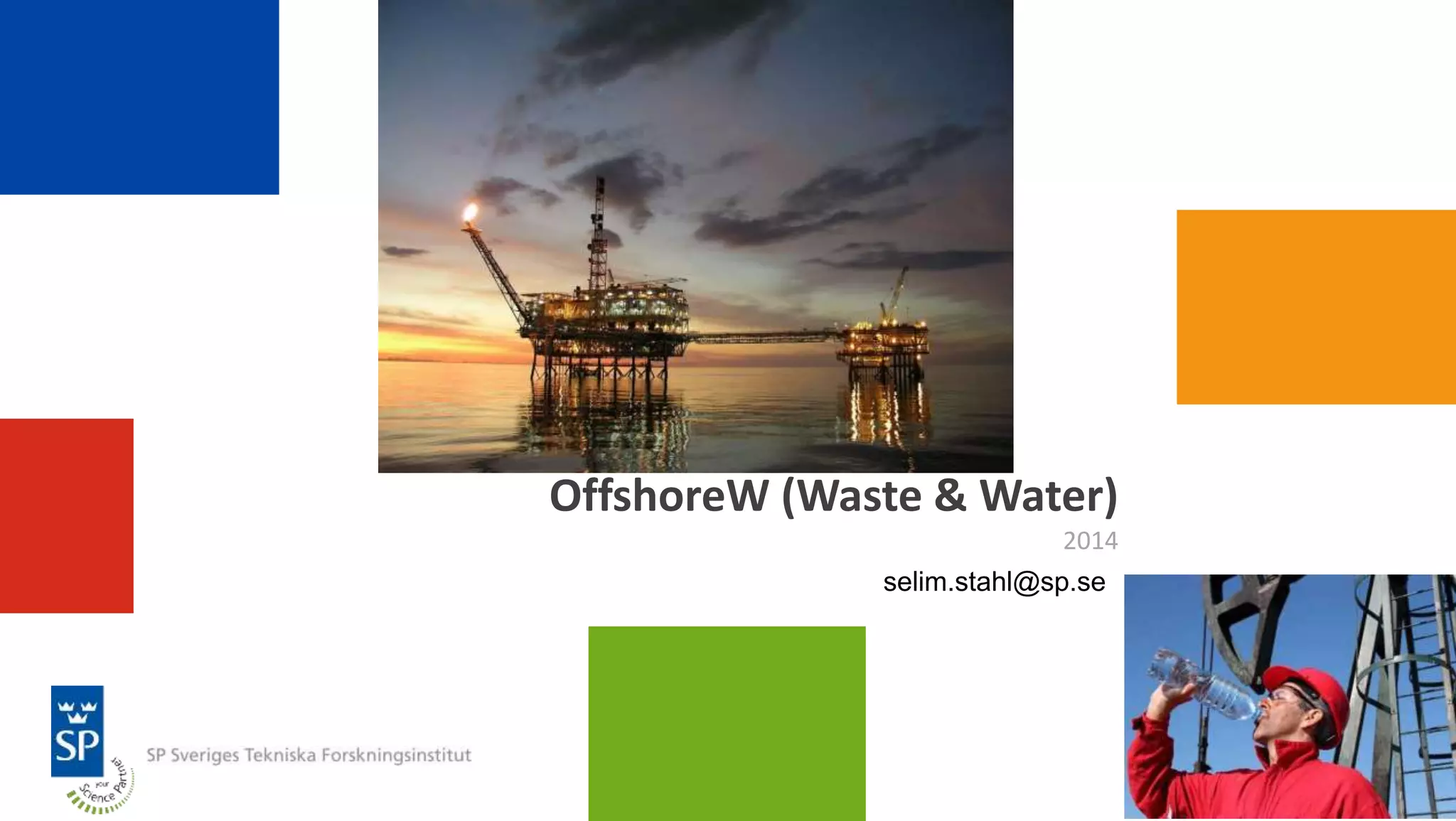
OffshoreW (Waste & Water)
2014
selim.stahl@sp.se
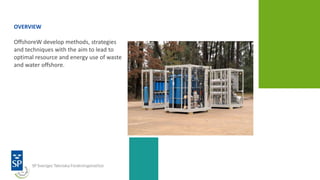
OVERVIEW
OffshoreW develop methods, strategies
and techniques with the aim to lead to
optimal resource and energy use of waste
and water offshore.
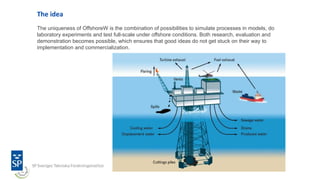
The uniqueness of OffshoreW is the combination of possibilities to simulate processes in models, do
laboratory experiments and test full-scale under offshore conditions. Both research, evaluation and
demonstration becomes possible, which ensures that good ideas do not get stuck on their way to
implementation and commercialization.
The idea
Focus
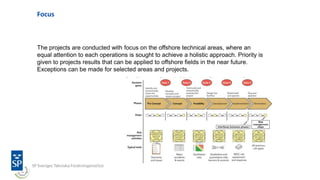
The projects are conducted with focus on the offshore technical areas, where an
equal attention to each operations is sought to achieve a holistic approach. Priority is
given to projects results that can be applied to offshore fields in the near future.
Exceptions can be made for selected areas and projects.
OFFSHORE SYSTEMANALYSIS
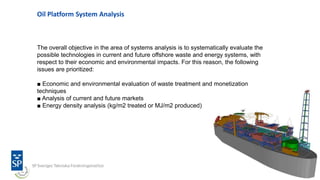
Oil Platform System Analysis
The overall objective in the area of systems analysis is to systematically evaluate the
possible technologies in current and future offshore waste and energy systems, with
respect to their economic and environmental impacts. For this reason, the following
issues are prioritized:
■ Economic and environmental evaluation of waste treatment and monetization
techniques
■ Analysis of current and future markets
■ Energy density analysis (kg/m2 treated or MJ/m2 produced)
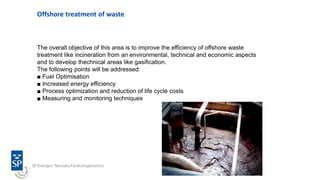
Offshore treatment of waste
The overall objective of this area is to improve the efficiency of offshore waste
treatment like incineration from an environmental, technical and economic aspects
and to develop thechnical areas like gasification.
The following points will be addressed:
■ Fuel Optimisation
■ Increased energy efficiency
■ Process optimization and reduction of life cycle costs
■ Measuring and monitoring techniques
Biological treatment and decomposition of waste
Systems and techniques for biological treatment must be designed so that optimal
operating economy with good access and minimal environmental impact is achieved.
In addition the marine environment can handle part of the waste streams which could
be beneficial for local fauna and flora. Primary products from biological streams are
brown water, biogas, digestate and food/compost.
Waste monetization is also possible with production of ethanol, methanol, methane
and hydrogen. These can be used in various areas offshore
The following points will be addressed:
■ Raw Inputs (Food & Beverage etc) Optimization and increased flexibility
■ Increased energy efficiency and offshore optimization
■ Reduction of life cycle costs
■ Measuring and monitoring techniques
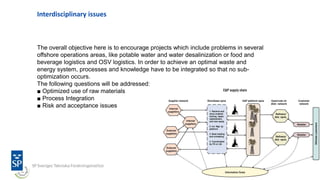
Interdisciplinary issues
The overall objective here is to encourage projects which include problems in several
offshore operations areas, like potable water and water desalinization or food and
beverage logistics and OSV logistics. In order to achieve an optimal waste and
energy system, processes and knowledge have to be integrated so that no sub-
optimization occurs.
The following questions will be addressed:
■ Optimized use of raw materials
■ Process Integration
■ Risk and acceptance issues
Offshore boundaries
The projects that are important to the whole waste chain, from the waste collected on
the platform and pretreated until it is fully processed, should be the main focus of
OffshoreW. Waste shall mean living quarters and industrial waste produced within
the offshore Oil & Gas infrastructures.
Activities in OffshoreW does not include technology development areas such as
design and consumer products, nor direct recycling of material flows recovered in the
waste streams.
The essential issue in OffshoreW is waste streams where the waste cannot possibly
be reuse or recycle (to replace virgin material) in a reasonable way.
A sharp distinction is difficult to do in terms of what materials streams that are
included. The core of OffshoreW is waste streams that are mixed today and are not
used for direct recycling or monetization.

Offshorew

  • 1.
    OffshoreW (Waste &Water) 2014 selim.stahl@sp.se
  • 2.
    OVERVIEW OffshoreW develop methods,strategies and techniques with the aim to lead to optimal resource and energy use of waste and water offshore.
  • 3.
    The uniqueness ofOffshoreW is the combination of possibilities to simulate processes in models, do laboratory experiments and test full-scale under offshore conditions. Both research, evaluation and demonstration becomes possible, which ensures that good ideas do not get stuck on their way to implementation and commercialization. The idea
  • 4.
    Focus The projects areconducted with focus on the offshore technical areas, where an equal attention to each operations is sought to achieve a holistic approach. Priority is given to projects results that can be applied to offshore fields in the near future. Exceptions can be made for selected areas and projects.
  • 5.
  • 6.
    Oil Platform SystemAnalysis The overall objective in the area of systems analysis is to systematically evaluate the possible technologies in current and future offshore waste and energy systems, with respect to their economic and environmental impacts. For this reason, the following issues are prioritized: ■ Economic and environmental evaluation of waste treatment and monetization techniques ■ Analysis of current and future markets ■ Energy density analysis (kg/m2 treated or MJ/m2 produced)
  • 7.
    Offshore treatment ofwaste The overall objective of this area is to improve the efficiency of offshore waste treatment like incineration from an environmental, technical and economic aspects and to develop thechnical areas like gasification. The following points will be addressed: ■ Fuel Optimisation ■ Increased energy efficiency ■ Process optimization and reduction of life cycle costs ■ Measuring and monitoring techniques
  • 8.
    Biological treatment anddecomposition of waste Systems and techniques for biological treatment must be designed so that optimal operating economy with good access and minimal environmental impact is achieved. In addition the marine environment can handle part of the waste streams which could be beneficial for local fauna and flora. Primary products from biological streams are brown water, biogas, digestate and food/compost. Waste monetization is also possible with production of ethanol, methanol, methane and hydrogen. These can be used in various areas offshore The following points will be addressed: ■ Raw Inputs (Food & Beverage etc) Optimization and increased flexibility ■ Increased energy efficiency and offshore optimization ■ Reduction of life cycle costs ■ Measuring and monitoring techniques
  • 9.
    Interdisciplinary issues The overallobjective here is to encourage projects which include problems in several offshore operations areas, like potable water and water desalinization or food and beverage logistics and OSV logistics. In order to achieve an optimal waste and energy system, processes and knowledge have to be integrated so that no sub- optimization occurs. The following questions will be addressed: ■ Optimized use of raw materials ■ Process Integration ■ Risk and acceptance issues
  • 10.
    Offshore boundaries The projectsthat are important to the whole waste chain, from the waste collected on the platform and pretreated until it is fully processed, should be the main focus of OffshoreW. Waste shall mean living quarters and industrial waste produced within the offshore Oil & Gas infrastructures. Activities in OffshoreW does not include technology development areas such as design and consumer products, nor direct recycling of material flows recovered in the waste streams. The essential issue in OffshoreW is waste streams where the waste cannot possibly be reuse or recycle (to replace virgin material) in a reasonable way. A sharp distinction is difficult to do in terms of what materials streams that are included. The core of OffshoreW is waste streams that are mixed today and are not used for direct recycling or monetization.

Editor's Notes

  • #5 RPK = revenue per km (source: airbus)
  • #7 RPK = revenue per km (source: airbus)
  • #8 RPK = revenue per km (source: airbus)
  • #9 RPK = revenue per km (source: airbus)
  • #10 RPK = revenue per km (source: airbus)