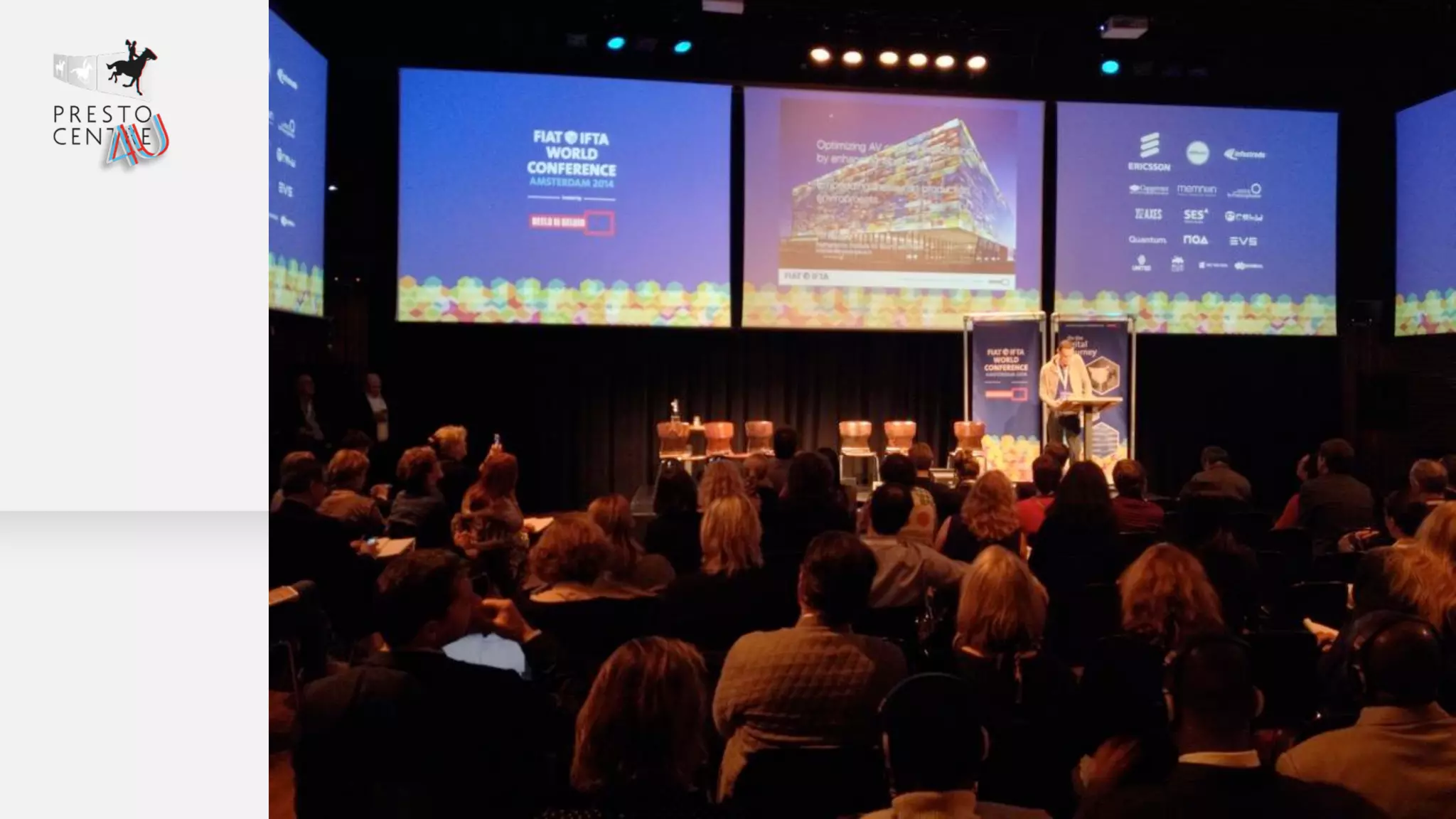
FIAT/IFTA Conference, October 22, 2014 
The Presto4U project is supported by the European Commission 
under the 7th Framework Programme (FP7) — Grant Agreement 600845 
Of communities 
and Practices 
#DP Innovation & Research 
Erwin Verbruggen 
Netherlands Institute for Sound and Vision
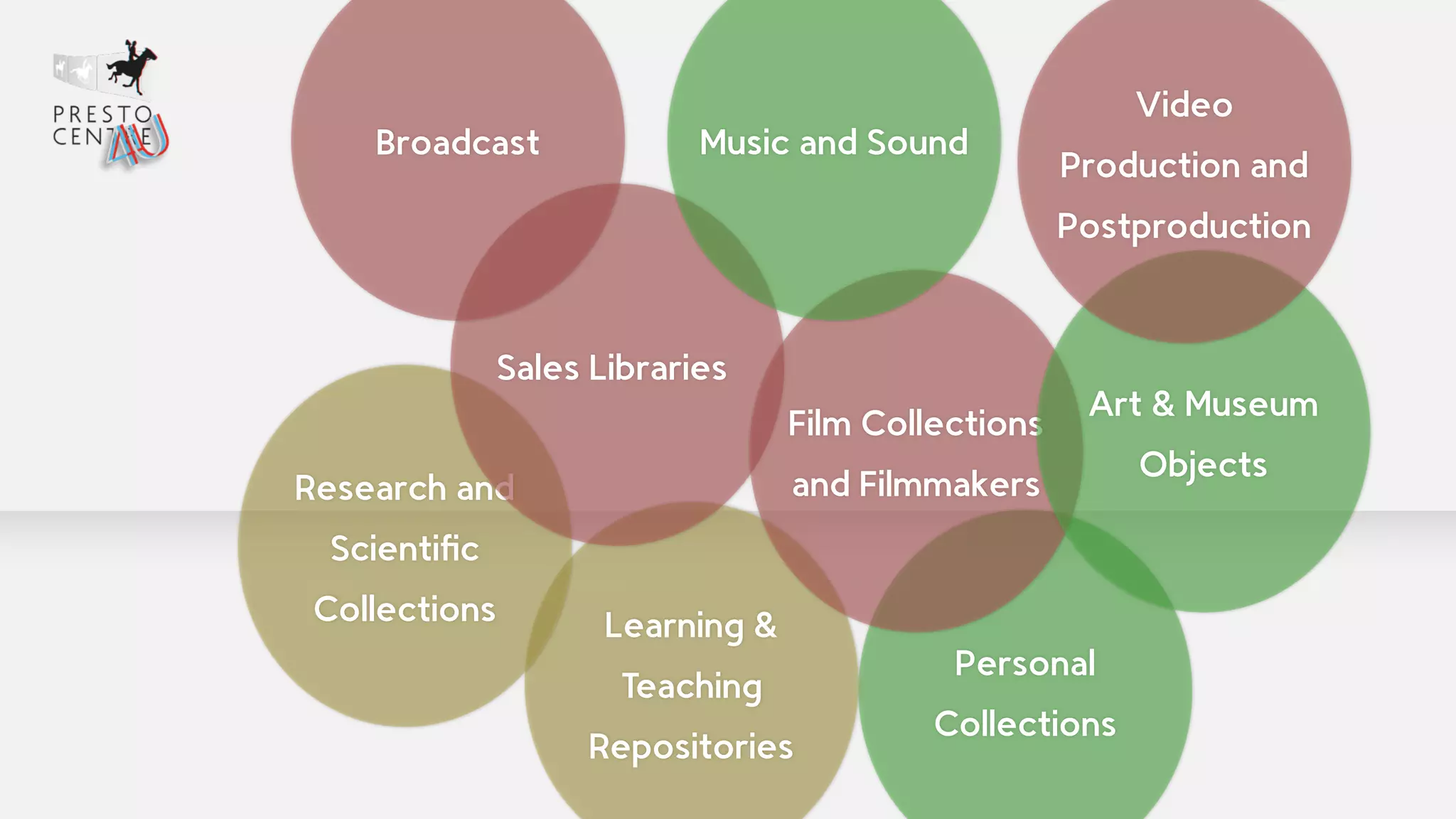
Personal 
Collections 
Sales Libraries 
Learning & 
Teaching 
Repositories 
Research and 
Scientific 
Collections 
Film Collections 
and Filmmakers 
Art & Museum 
Objects 
Broadcast Music and Sound 
Video 
Production and 
Postproduction
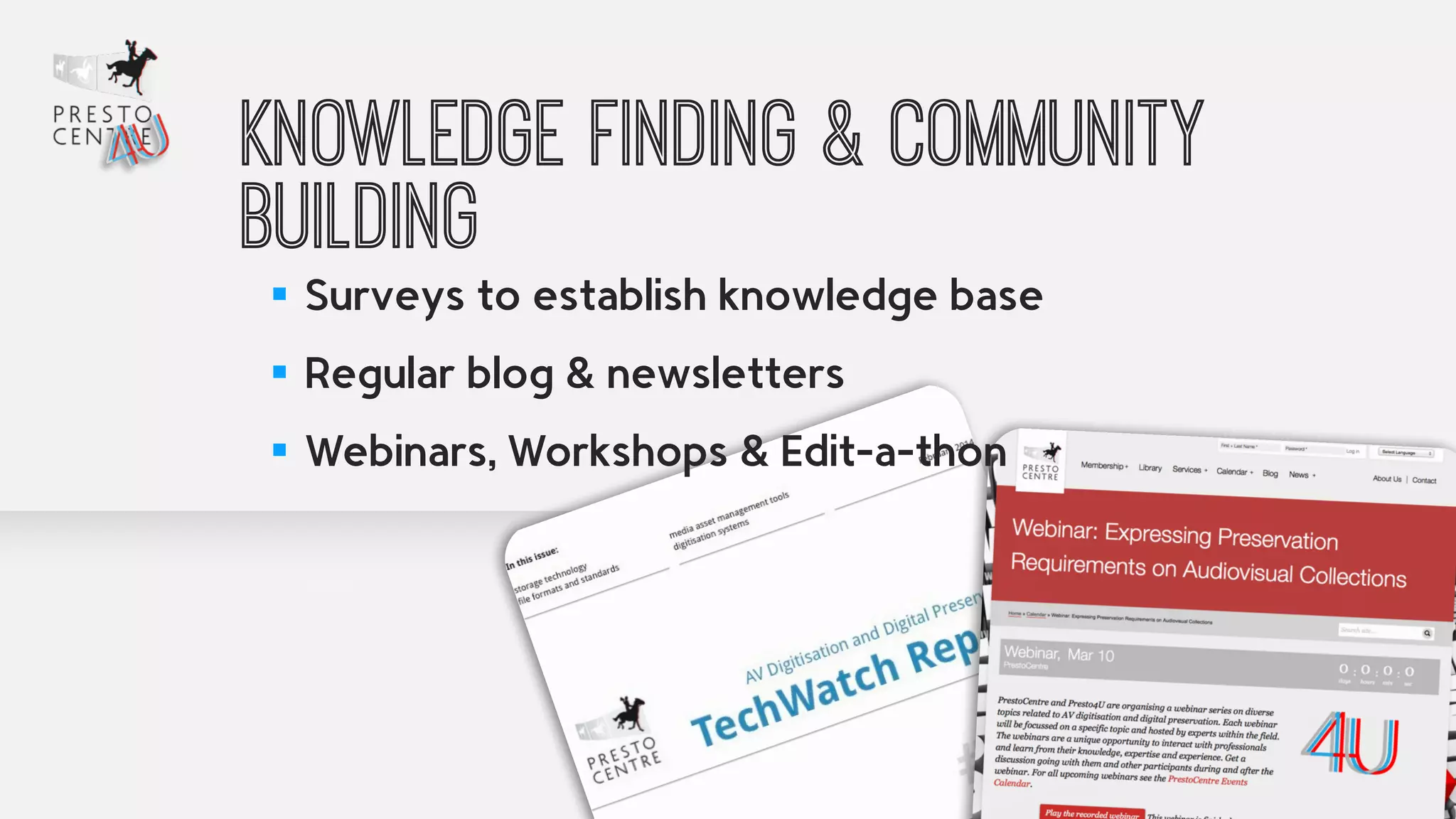
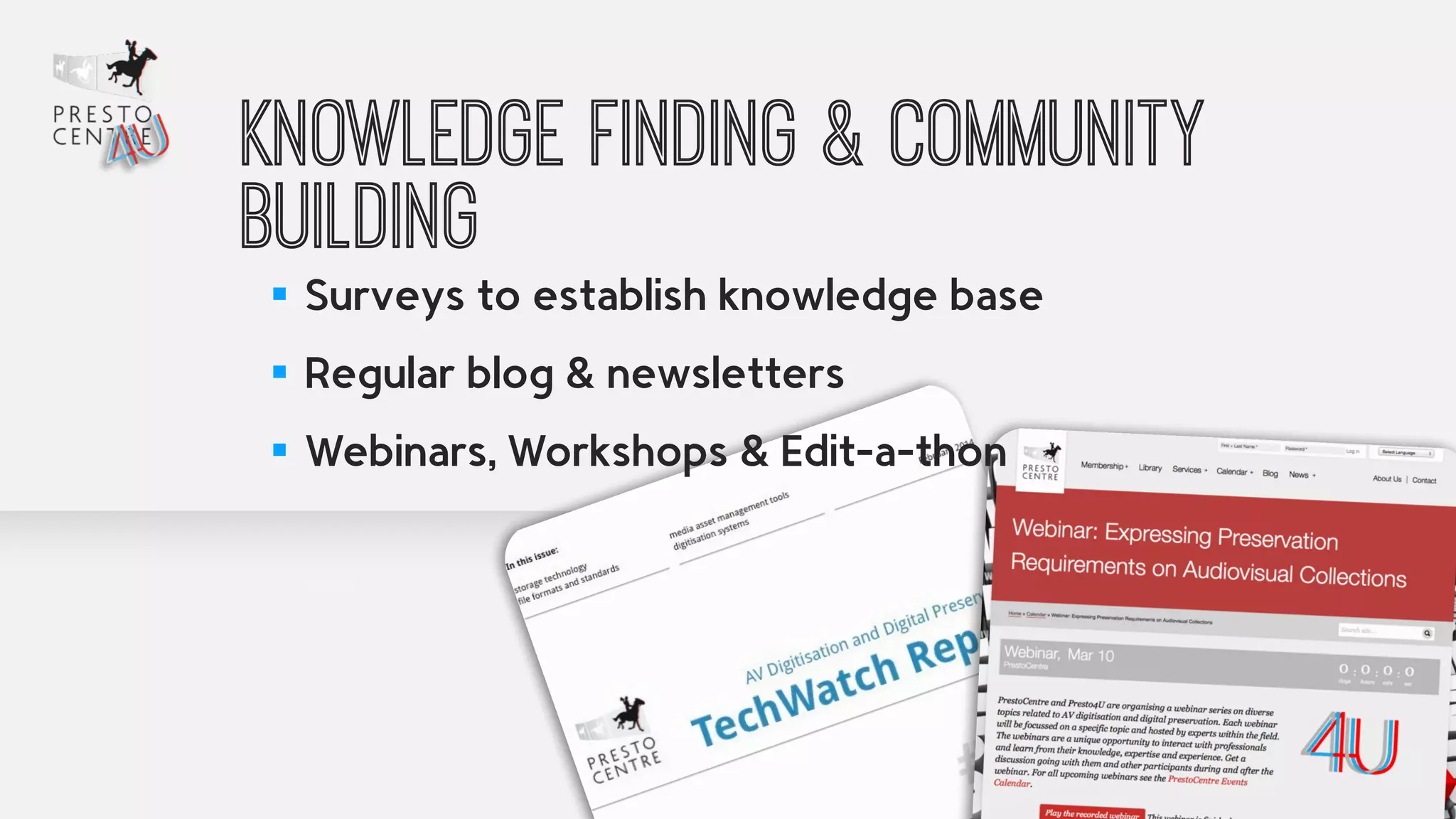
Knowledge finding & Community 
Building 
▪ Surveys to establish knowledge base 
▪ Regular blog & newsletters 
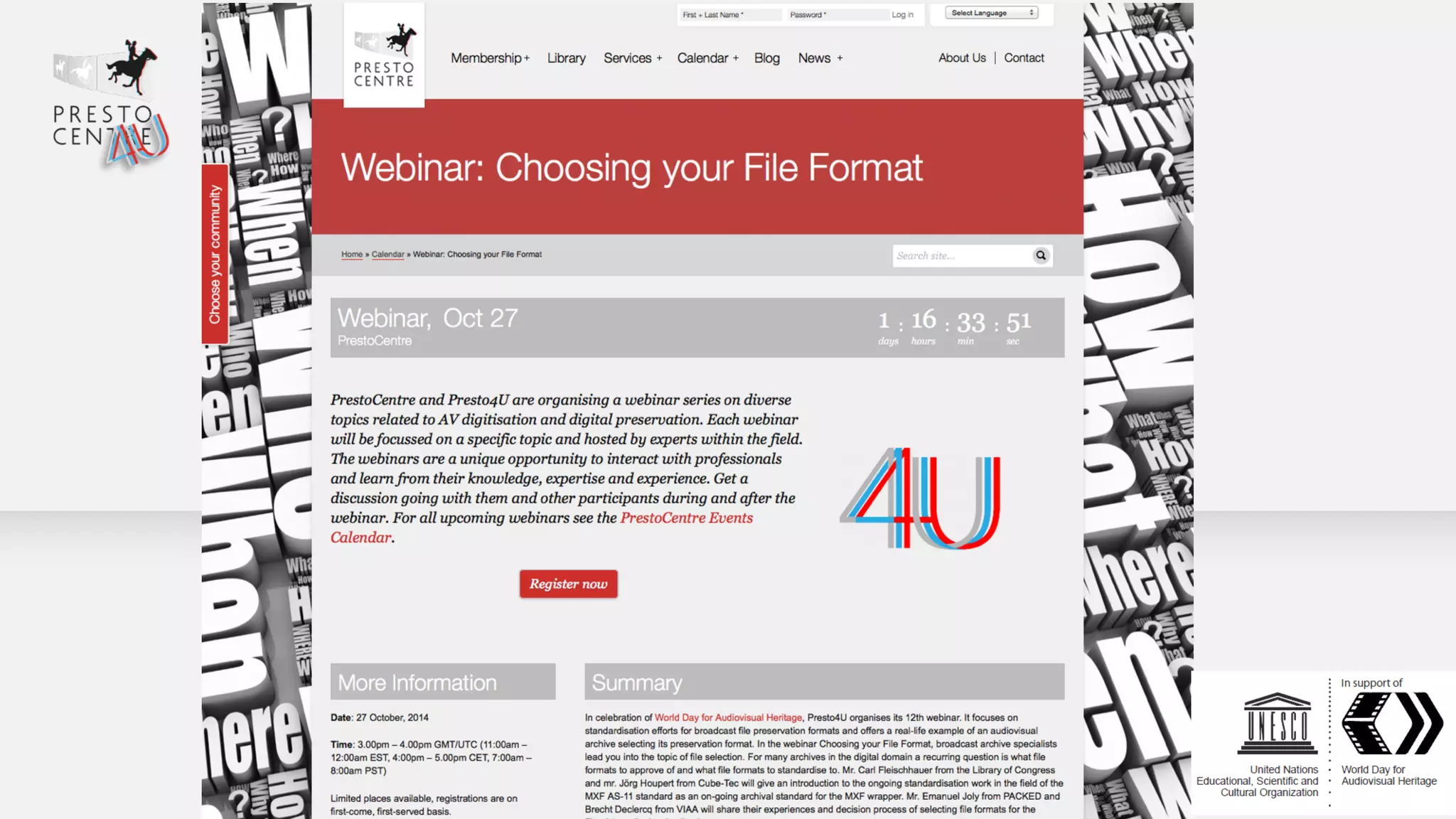
▪ Webinars, Workshops & Edit-a-thon
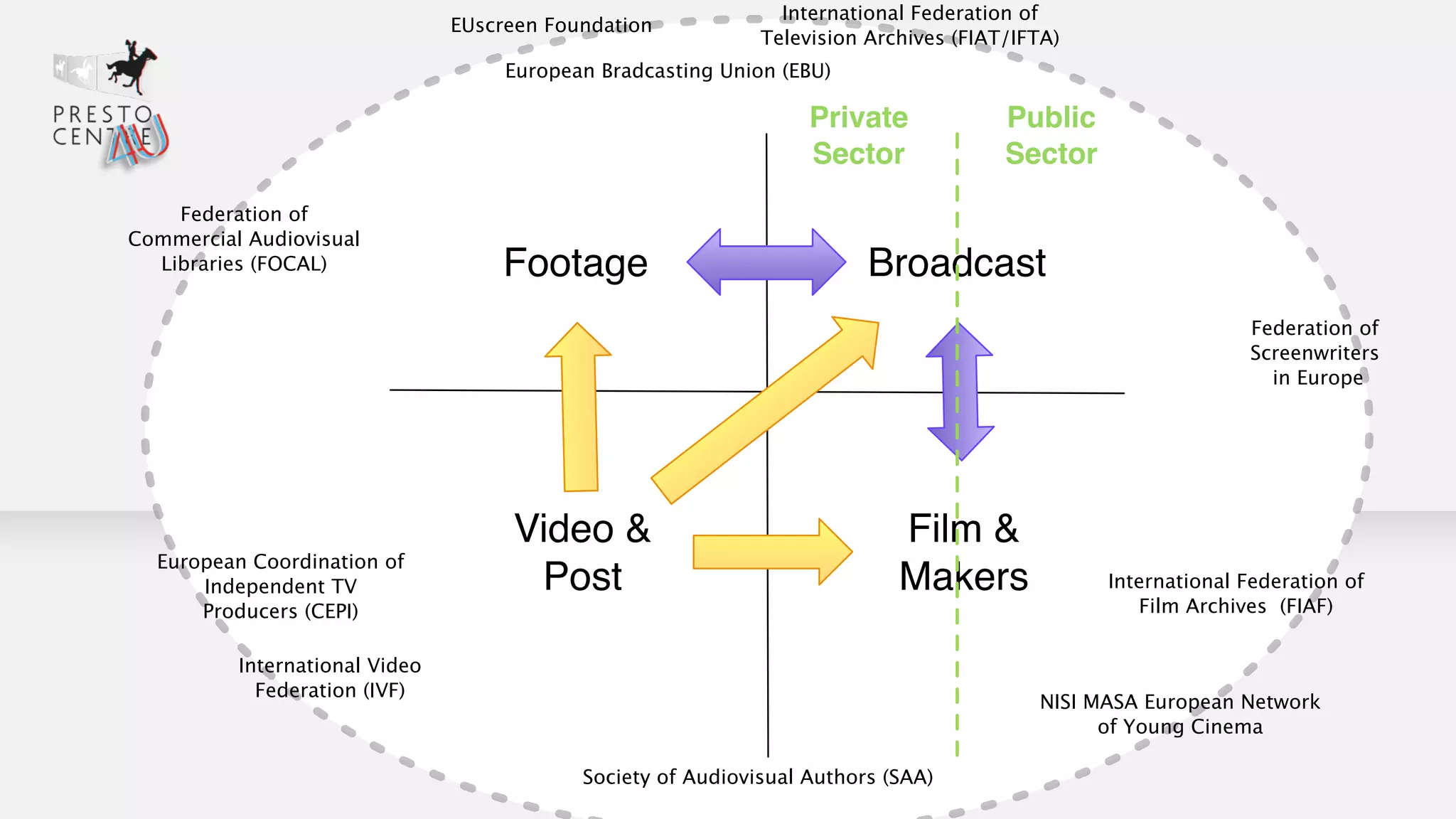
International Federation of 
Television Archives (FIAT/IFTA) 
Private 
Sector 
Public 
Sector 
Footage Broadcast 
Video & 
Post 
Film & 
Makers 
Federation of 
Commercial Audiovisual 
Libraries (FOCAL) 
International Video 
Federation (IVF) 
Society of Audiovisual Authors (SAA) 
Federation of 
Screenwriters 
in Europe 
European Bradcasting Union (EBU) 
International Federation of 
Film Archives (FIAF) 
EUscreen Foundation 
European Coordination of 
Independent TV 
Producers (CEPI) 
NISI MASA European Network 
of Young Cinema
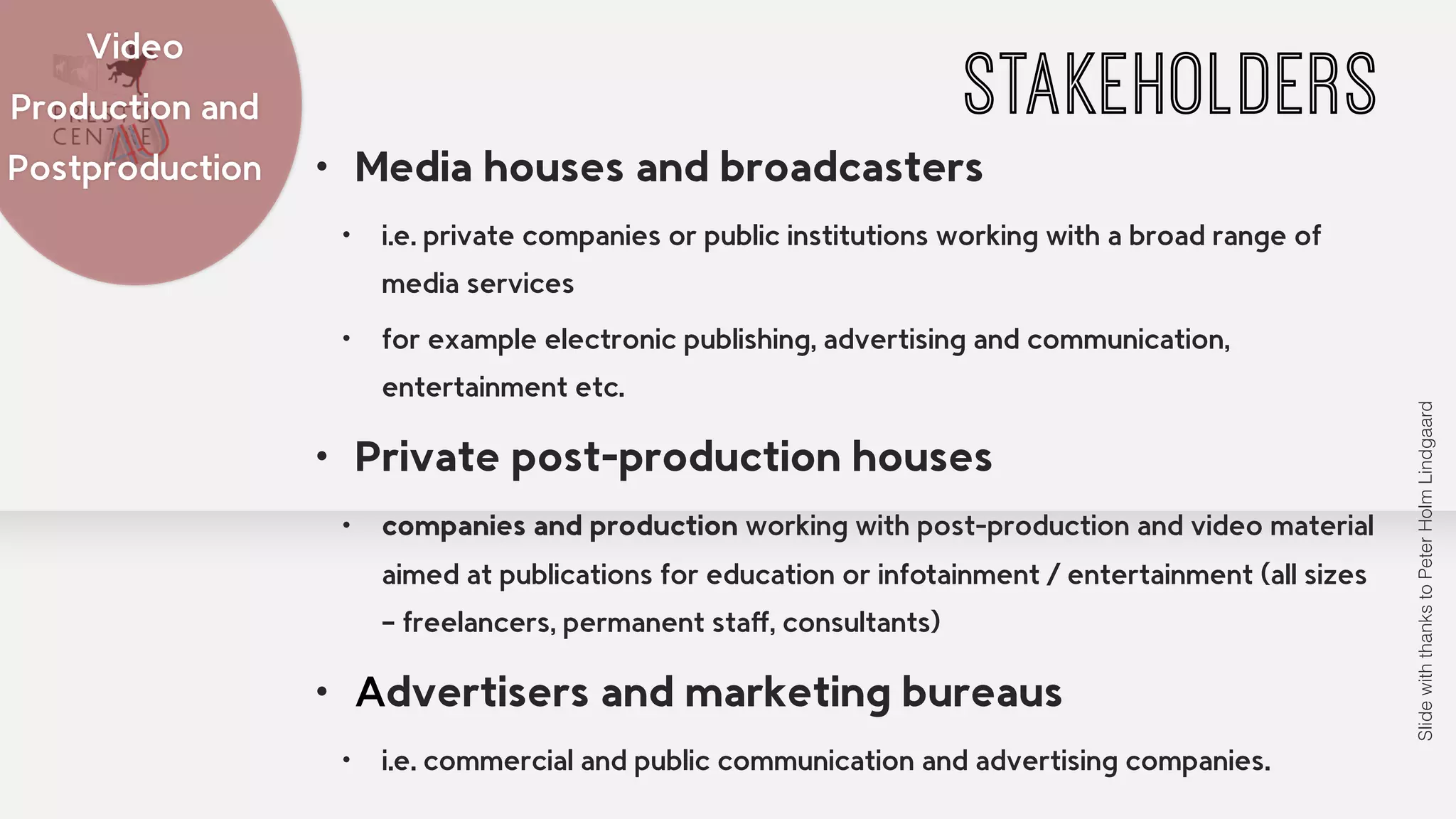
STAKEHOLDERS Video 
• Media houses and broadcasters 
• i.e. private companies or public institutions working with a broad range of 
media services 
• for example electronic publishing, advertising and communication, 
entertainment etc. 
• Private post-production houses 
• companies and production working with post-production and video material 
aimed at publications for education or infotainment / entertainment (all sizes 
– freelancers, permanent staff, consultants) 
• Advertisers and marketing bureaus 
• i.e. commercial and public communication and advertising companies. 
Production and 
Postproduction 
Slide with thanks to Peter Holm Lindgaard
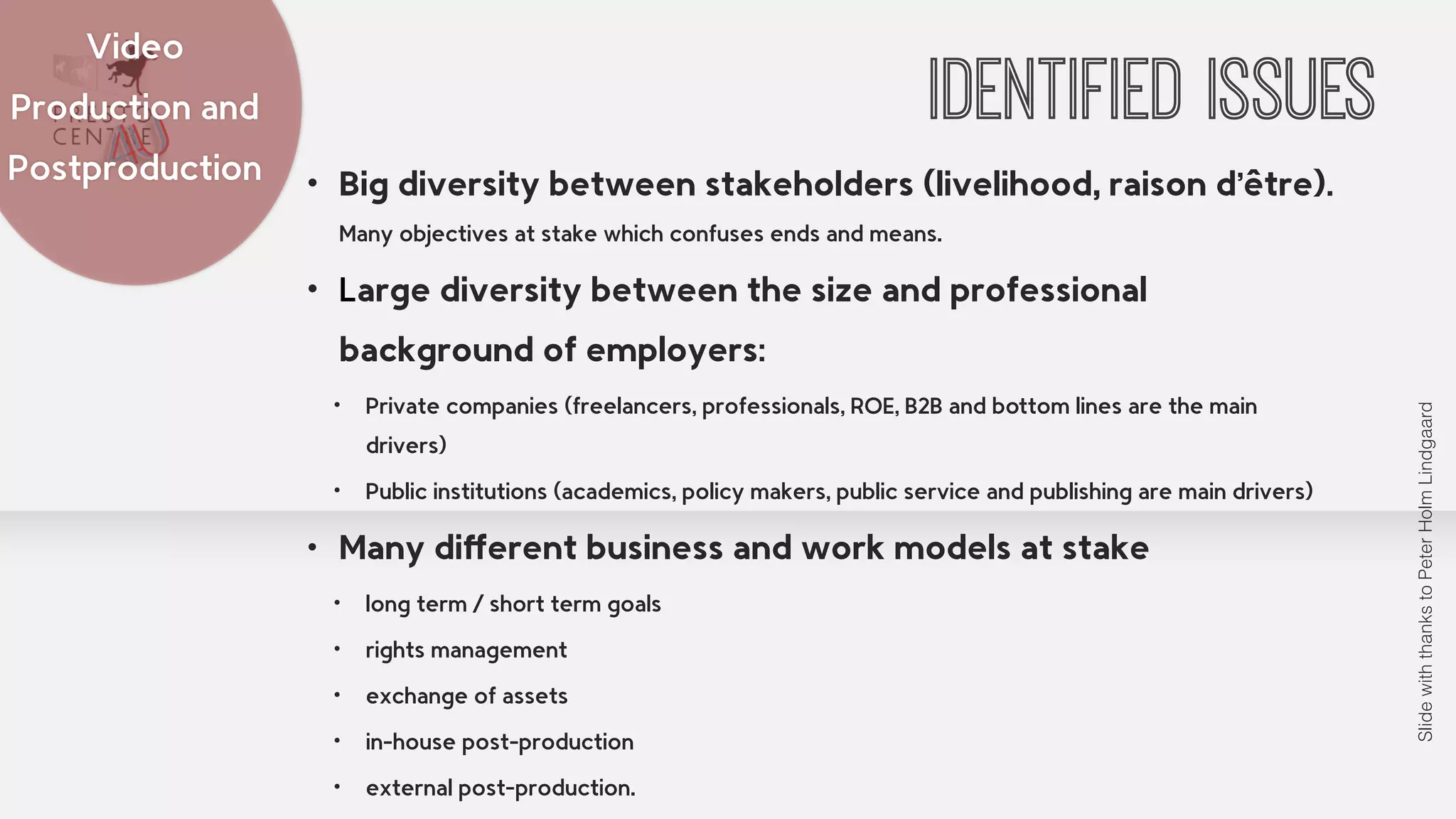
IDENTIFIED ISSUES Video 
• Big diversity between stakeholders (livelihood, raison d’être). 
Many objectives at stake which confuses ends and means. 
• Large diversity between the size and professional 
background of employers: 
• Private companies (freelancers, professionals, ROE, B2B and bottom lines are the main 
drivers) 
• Public institutions (academics, policy makers, public service and publishing are main drivers) 
• Many different business and work models at stake 
• long term / short term goals 
• rights management 
• exchange of assets 
• in-house post-production 
• external post-production. 
Production and 
Postproduction 
Slide with thanks to Peter Holm Lindgaard
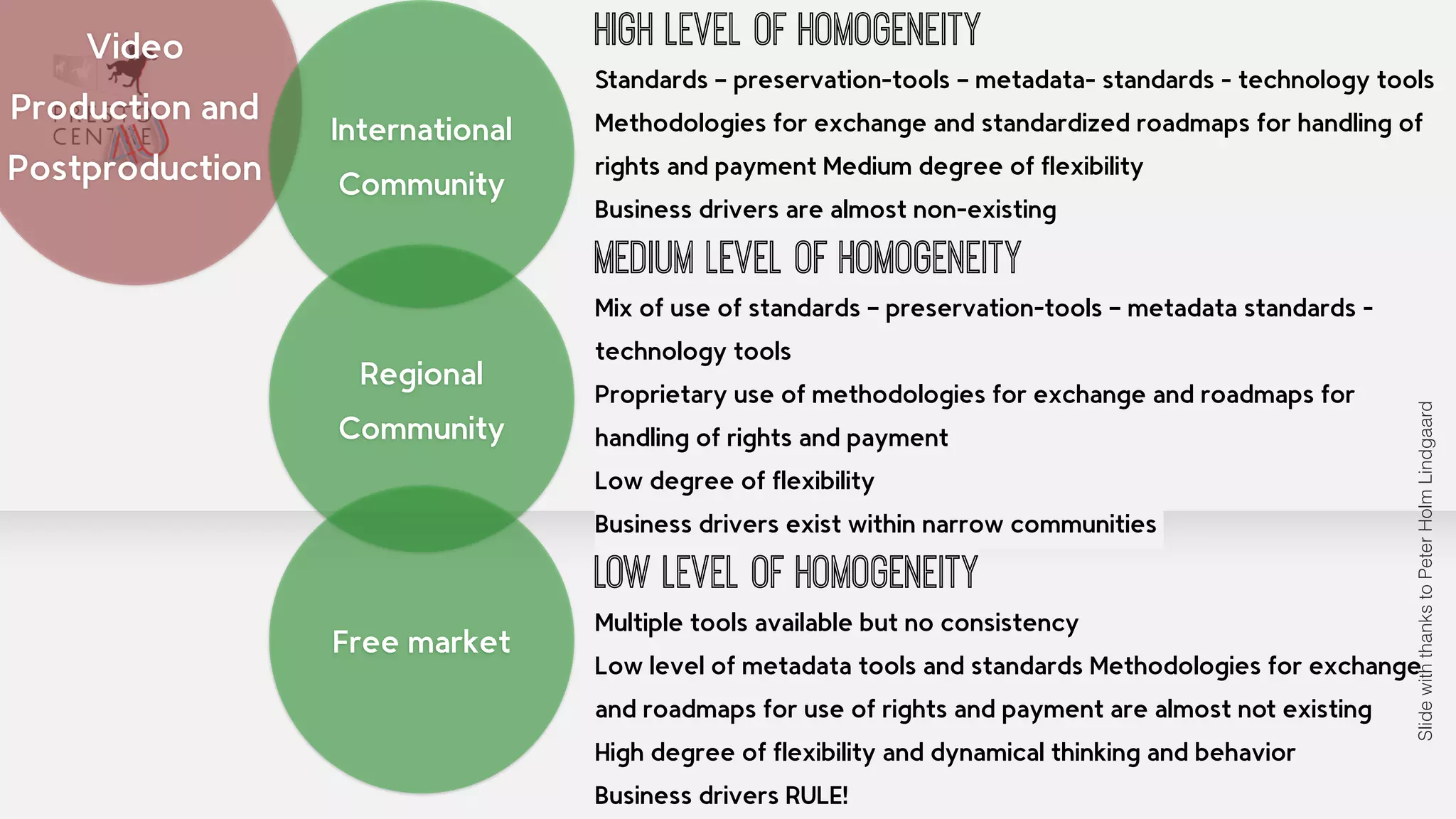
High level of homogeneity 
Standards – preservation-tools – metadata- standards - technology tools 
Methodologies for exchange and standardized roadmaps for handling of 
rights and payment Medium degree of flexibility 
Business drivers are almost non-existing 
Medium level of homogeneity 
Mix of use of standards – preservation-tools – metadata standards - 
technology tools 
Proprietary use of methodologies for exchange and roadmaps for 
handling of rights and payment 
Low degree of flexibility 
Business drivers exist within narrow communities 
Low level of homogeneity 
Multiple tools available but no consistency 
Low level of metadata tools and standards Methodologies for exchange 
and roadmaps for use of rights and payment are almost not existing 
High degree of flexibility and dynamical thinking and behavior 
Business drivers RULE! 
Video 
Production and 
Postproduction 
International 
Community 
Regional 
Community 
Free market 
Slide with thanks to Peter Holm Lindgaard
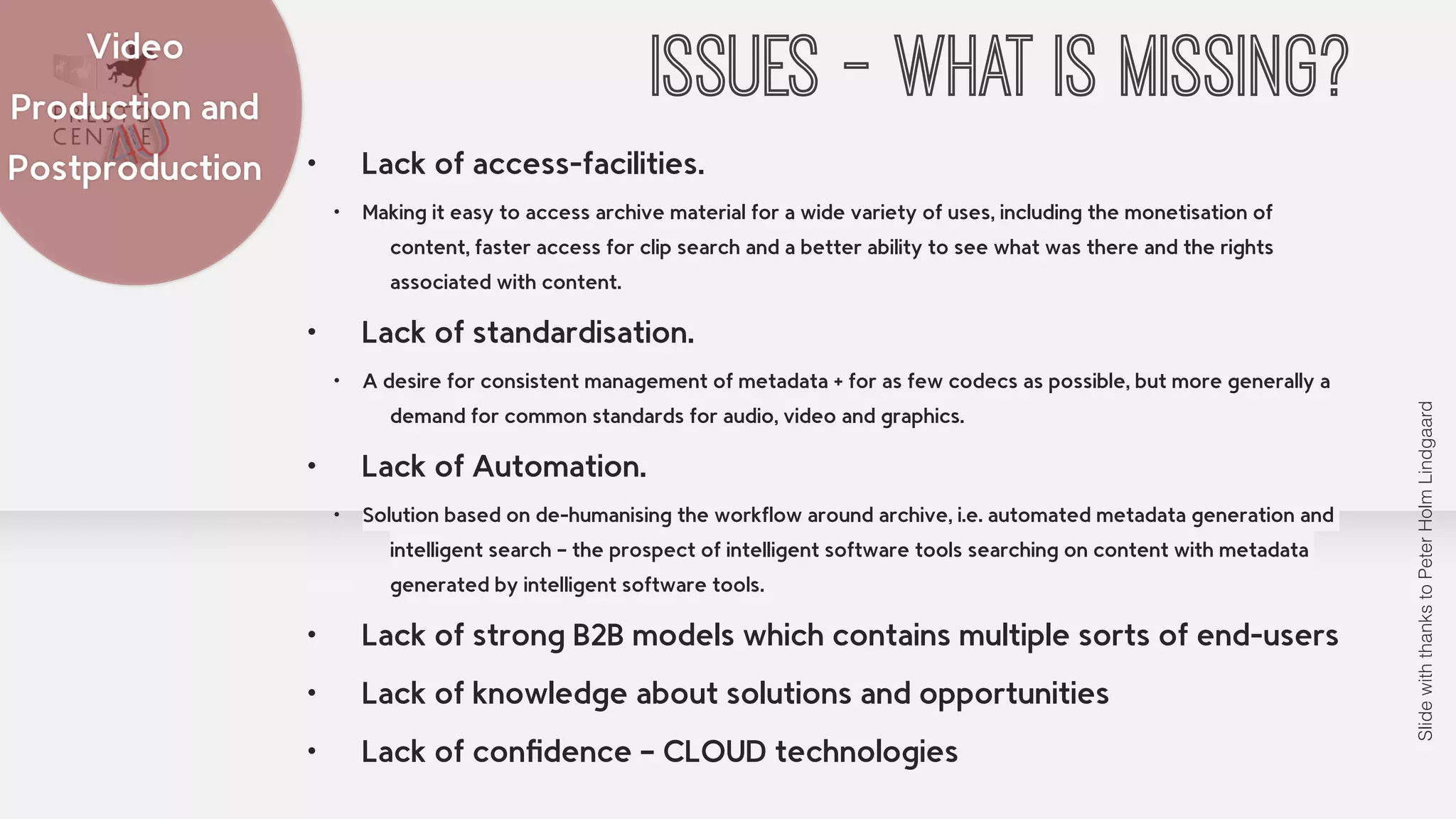
Video ISSUES - WHAT IS MISSING? 
• Lack of access-facilities. 
• Making it easy to access archive material for a wide variety of uses, including the monetisation of 
content, faster access for clip search and a better ability to see what was there and the rights 
associated with content. 
• Lack of standardisation. 
• A desire for consistent management of metadata + for as few codecs as possible, but more generally a 
demand for common standards for audio, video and graphics. 
• Lack of Automation. 
• Solution based on de-humanising the workflow around archive, i.e. automated metadata generation and 
intelligent search – the prospect of intelligent software tools searching on content with metadata 
generated by intelligent software tools. 
• Lack of strong B2B models which contains multiple sorts of end-users 
• Lack of knowledge about solutions and opportunities 
• Lack of confidence – CLOUD technologies 
Production and 
Postproduction 
Slide with thanks to Peter Holm Lindgaard
NEEDS FOR TOOLS AND INDUSTRIALISED ACTIONS 
• Sharing of preservation systems with defined content processing methods. 
• Need for making the tedious stuff automatic, and remove the need to input elementary / common preservation data. 
• Strong demand for tools or methods that would make it easy, simple and flexible to 
create versions for different destinations. 
• Intelligent management of versions, compiling, wrappers etc. 
• De-humanising the workflow around archive. 
• The prospect of intelligent software tools searching on content with metadata generated by intelligent software tools 
• Generic search, tracking and management-tools. 
• Tracking of content. More visibility of content as it moves through the workflow – e.g. by using QR-codes (like a DHL-order) 
• Outsourcing of distribution and delivery methods 
• external as well as internal / in-house 
• Sharing of storage solutions in flexible frameworks (SaaS). 
• Ability to manage workflows through centralised tooling, such as Cloud-based ones, for preservation, storage, and processing. 
• Flexible shopping and distribution facilities 
Video 
Production and 
Postproduction 
Slide with thanks to Peter Holm Lindgaard
Sales 
Libraries What footage sales archives do 
▪ They exploit commercially their AV holdings by selling clips and footage for use in media productions. 
▪ Today they generate revenues for more than $400 million per year 
▪ They sell footage, but at the same time they act as an archive, being obliged to practice some kind of 
preservation activities. 
The Community 
▪ Memory Institutions (e.g. Istituto Luce, INA, B&G, Imperial War Museum, British 
Pathé): 
▪ usually public co-funded 
▪ footage sales are not their core business 
▪ they have at least a “moral” duty of dealing with long term preservation 
▪ Private entities (e.g. Getty Images, ITN Source, Reuters, AP, Huntley Archive): 
▪ no public function 
▪ footage sales are their core business 
▪ market driven with a very pragmatic approach to digital preservation 
Slide with thanks to Marco Rendina
Sales ISTITUTO LUCE CASE 
Libraries 
Two main archives for digitised films: 
▪ 2k digitised film material 
▪ DPX files only 
▪ Priority given to unique prints, in danger reels 
▪ Any digitisation request that involves reels should pass first from here 
▪ HD digitised material 
▪ ProRes 422 
▪ It’s mainly the delivery archives for our clients 
▪ It’s generated from the 2k content …or from telecine 
Slide with thanks to Marco Rendina 
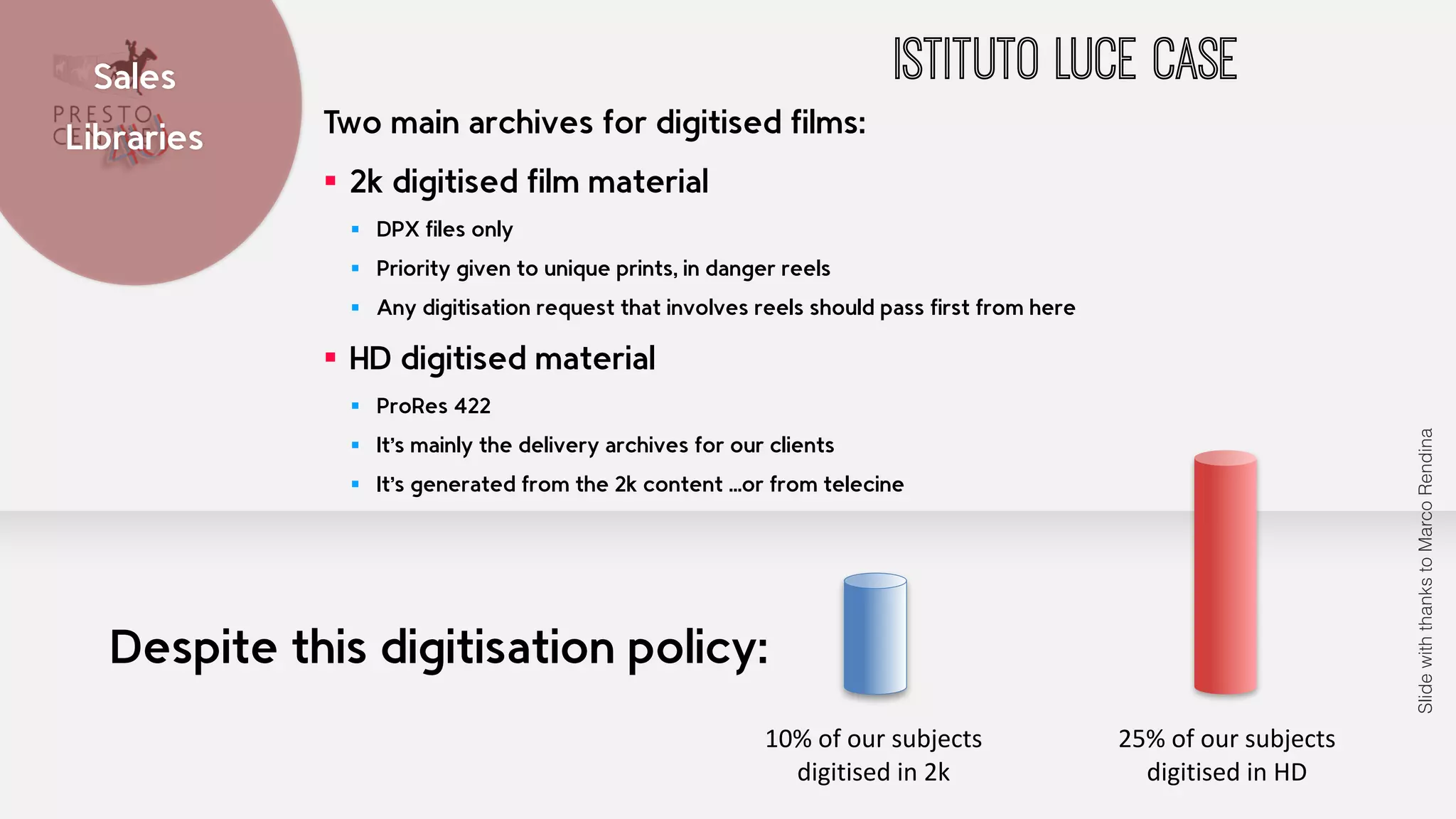
Despite this digitisation policy: 
10% 
of 
our 
subjects 
digitised 
in 
2k 
25% 
of 
our 
subjects 
digitised 
in 
HD
PRESTO4U Sales 
Libraries 
PRESERVATION 
CHALLENGES 
▪ Most of the technical challenges in digital 
preservation are similar to the ones of Film archives 
and Broadcasters 
▪ Special attention is given to descriptive metadata 
and rights metadata 
…but the big challenge is: 
▪ the tension between customer-driven activities/ 
policies and digital preservation plans 
Slide with thanks to Marco Rendina
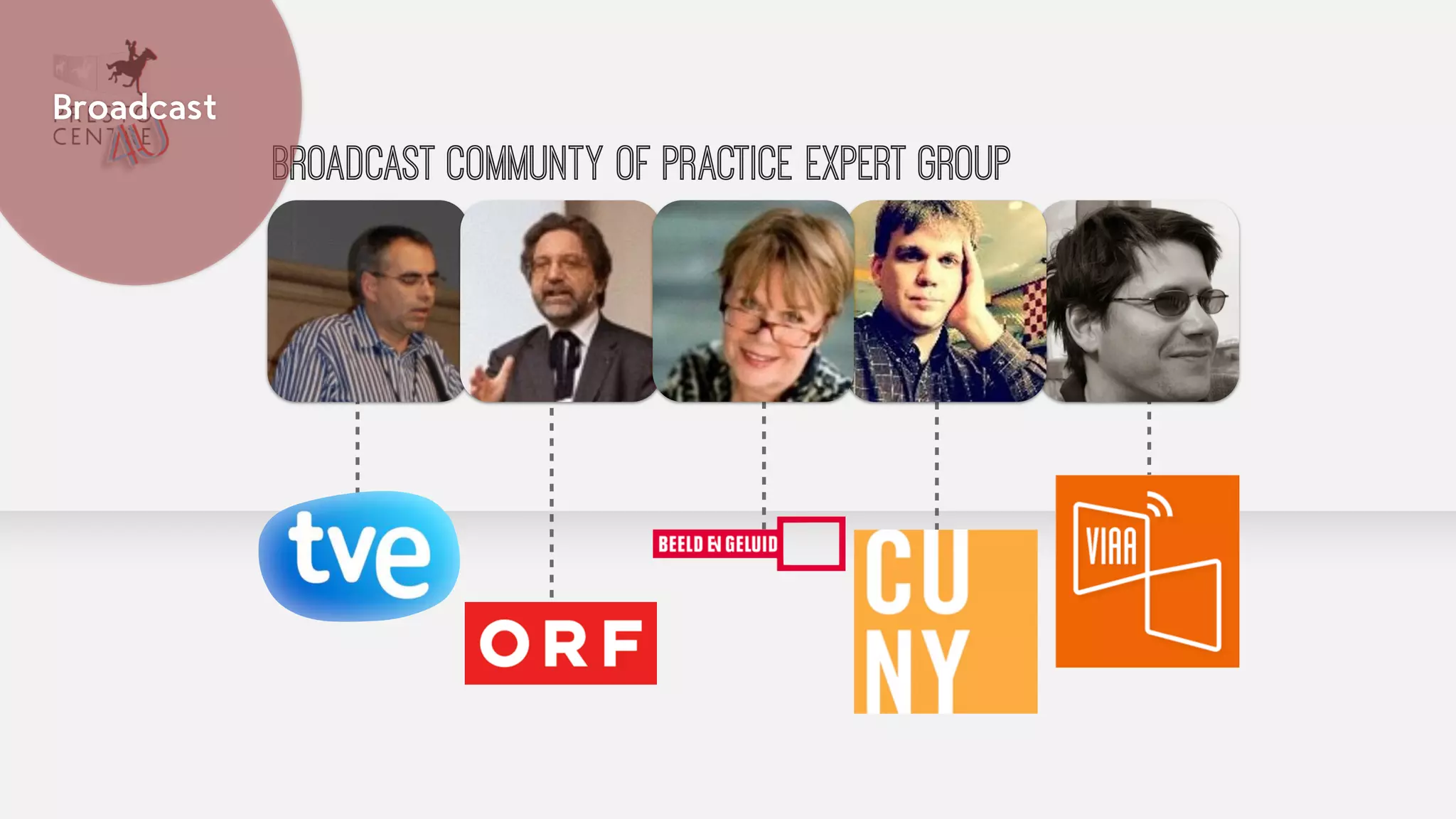
BROADCAST Communty of Practice Expert group 
Broadcast
‹nr.› Presto4u - Technology for Digital Audiovisual Media Preservation: www.presto4u.eu / www.prestocentre.org 
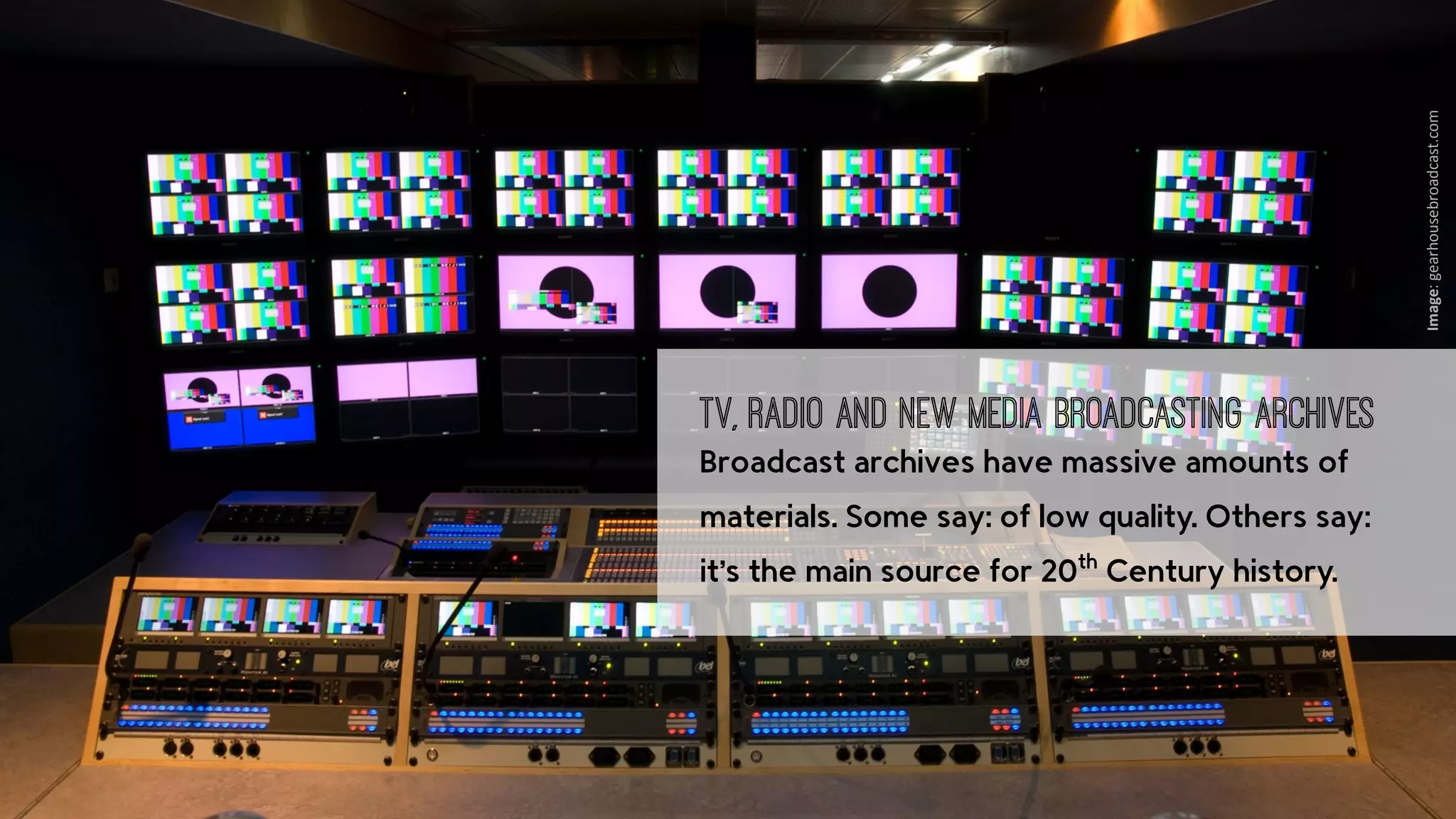
Image: 
gearhousebroadcast.com 
TV, Radio and New Media Broadcasting Archives 
Broadcast archives have massive amounts of 
materials. Some say: of low quality. Others say: 
it’s the main source for 20th Century history.
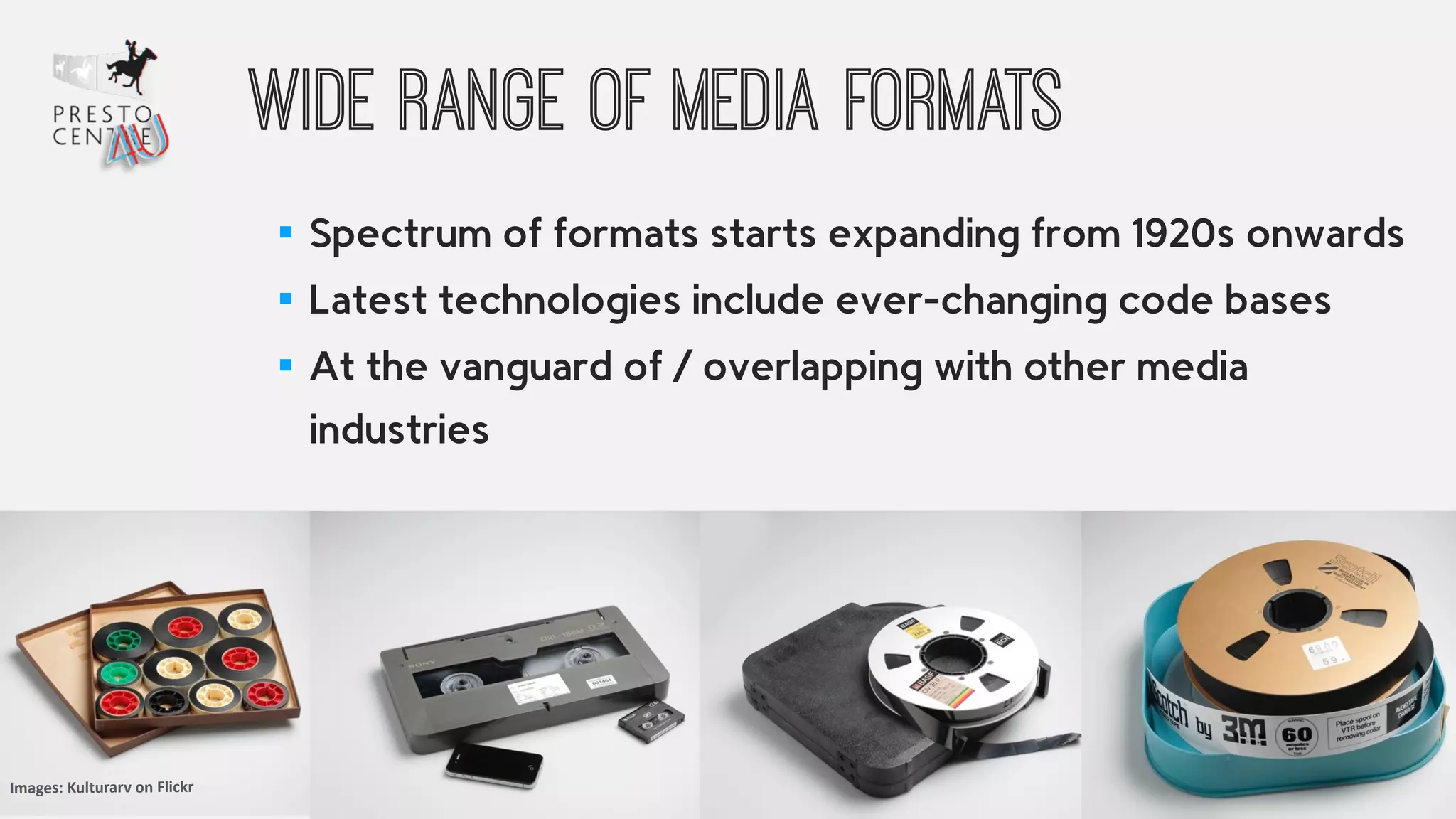
Wide range of media formats 
! 
▪ Spectrum of formats starts expanding from 1920s onwards 
▪ Latest technologies include ever-changing code bases 
▪ At the vanguard of / overlapping with other media 
industries 
Images: 
Kulturarv 
on 
Flickr
Domain is highly diverse 
▪ Many thousands of broadcast organisations (6379 broadcast 
companies in 40 European countries alone!) 
▪ Deposit laws are different in each and every country 
• National AV Institutions take up tasks of public broadcasters’ 
archives in some countries 
• Commercial broadcasters are left alone 
▪ Digitisation progress of legacy formats varies widely 
▪ Key moment going on: move from tape to data recording 
▪ Meanwhile access formats are on the move
‹nr.› Presto4u - Technology for Digital Audiovisual Media Preservation: www.presto4u.eu / www.prestocentre.org 
Image: 
Erwin 
Verbruggen 
CC 
BY-­‐SA 
2012. 
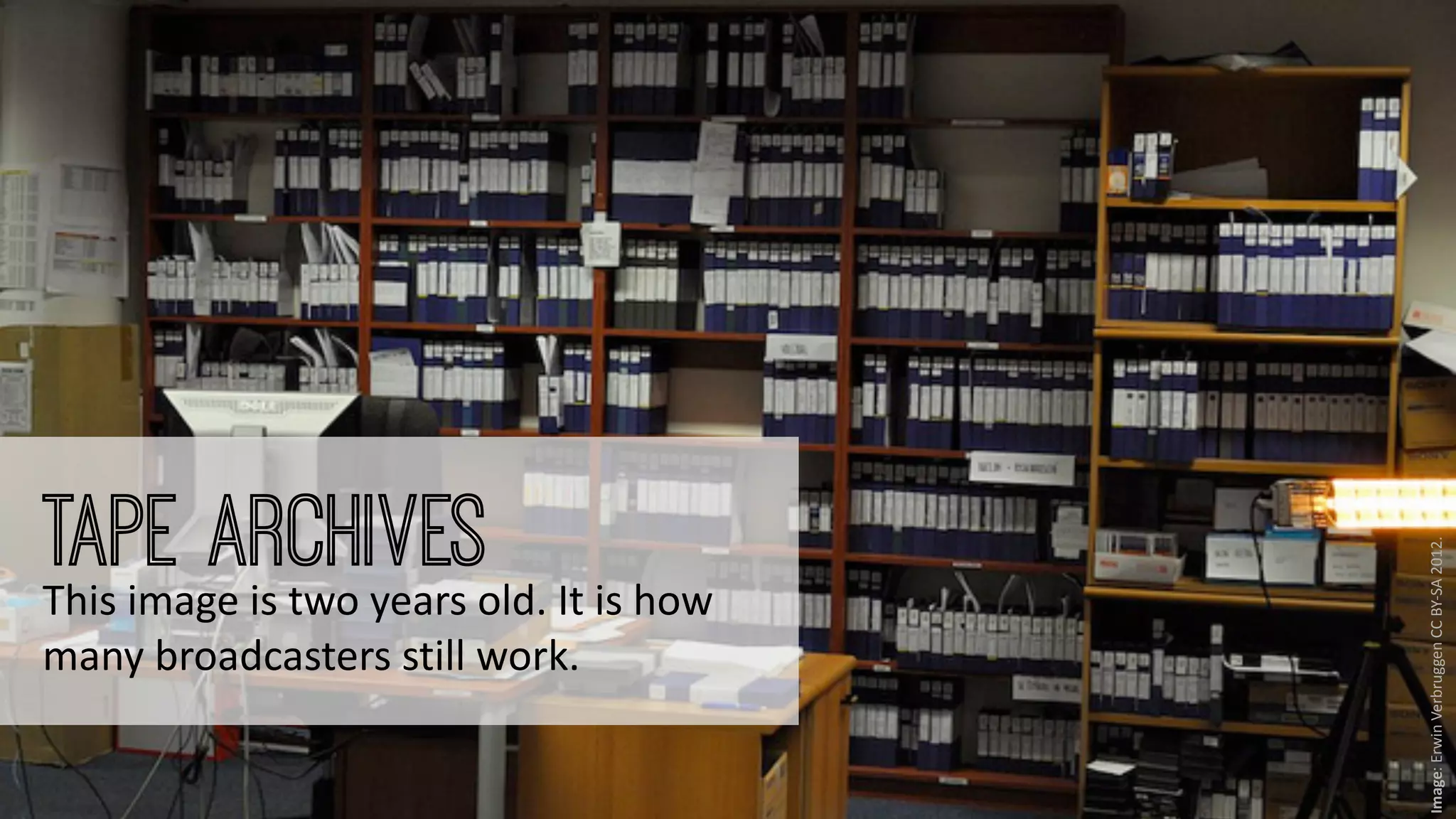
Tape Archives 
This 
image 
is 
two 
years 
old. 
It 
is 
how 
many 
broadcasters 
still 
work.
Impact on production workflows 
! 
▪ The archive has never had such an impact on production before 
▪ Archives are rebuilding workflows for metadata gathering, from 
the first steps of the production chain 
▪ Producers need to be ‘taught’ how to work with an all-digital 
archive workflow
‹nr.› Presto4u - Technology for Digital Audiovisual Media Preservation: www.presto4u.eu / www.prestocentre.org 
Image: 
Erwin 
Verbruggen 
CC 
BY-­‐SA 
2013. 
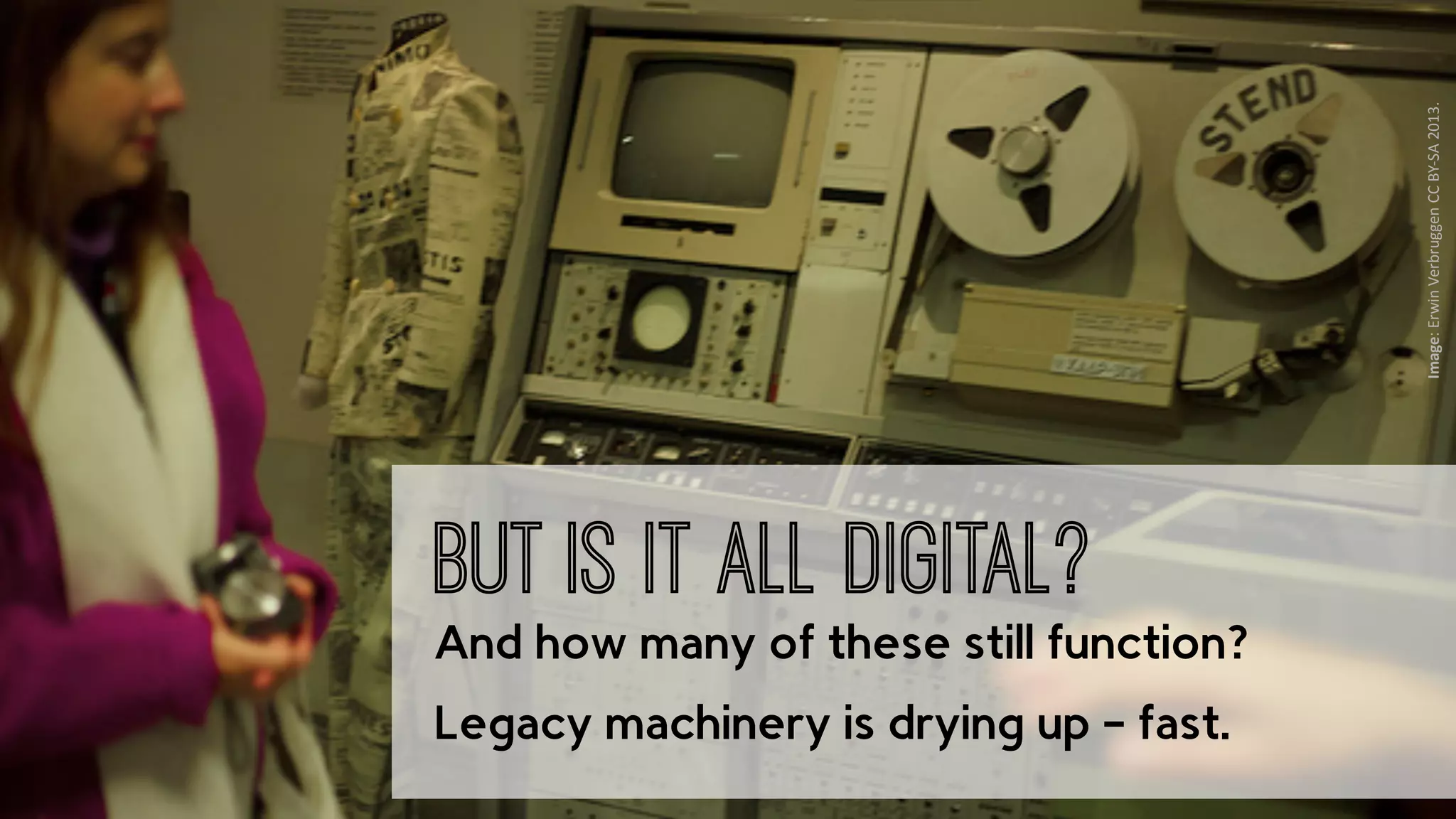
But is it all digital? 
And how many of these still function? 
Legacy machinery is drying up – fast.
And then, it’s digital 
▪ How do you keep track of the preservation process? 
▪ Reading bits & pieces 
▪ Maintaining quality throughout years of cataloguing 
! 
Born-digital: New paradigms? 
▪ On the fringes of the creation world: the web as storytelling platform 
▪ Web has been text-based, becoming increasingly audiovisual 
▪ Technological push supported by radio organisations, arte. 
▪ What chances, what futures for broadcast organisations?
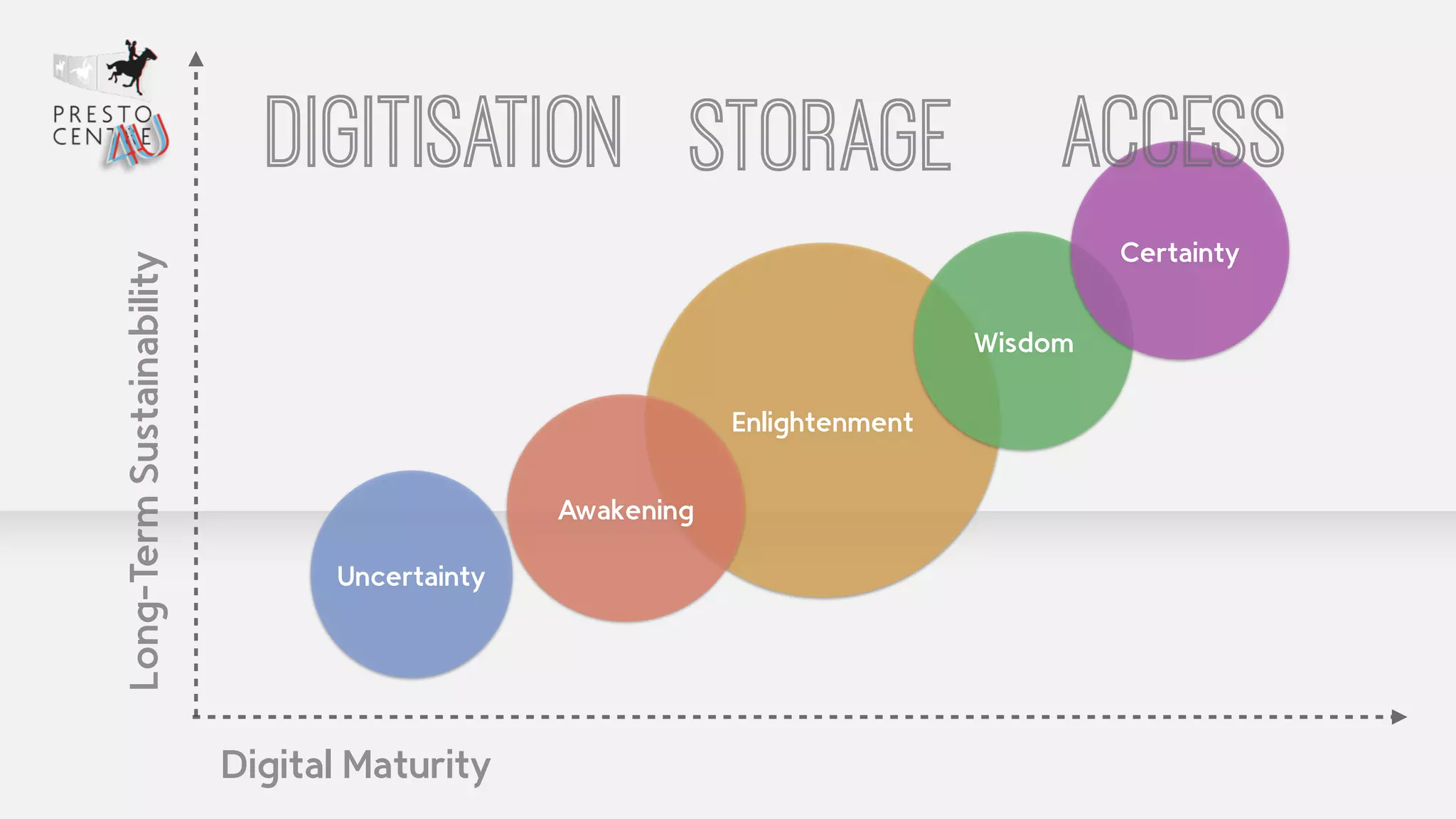
Enlightenment 
Wisdom 
Certainty 
Awakening 
Uncertainty 
Long-Term Sustainability 
Digitisation Storage Access 
Digital Maturity
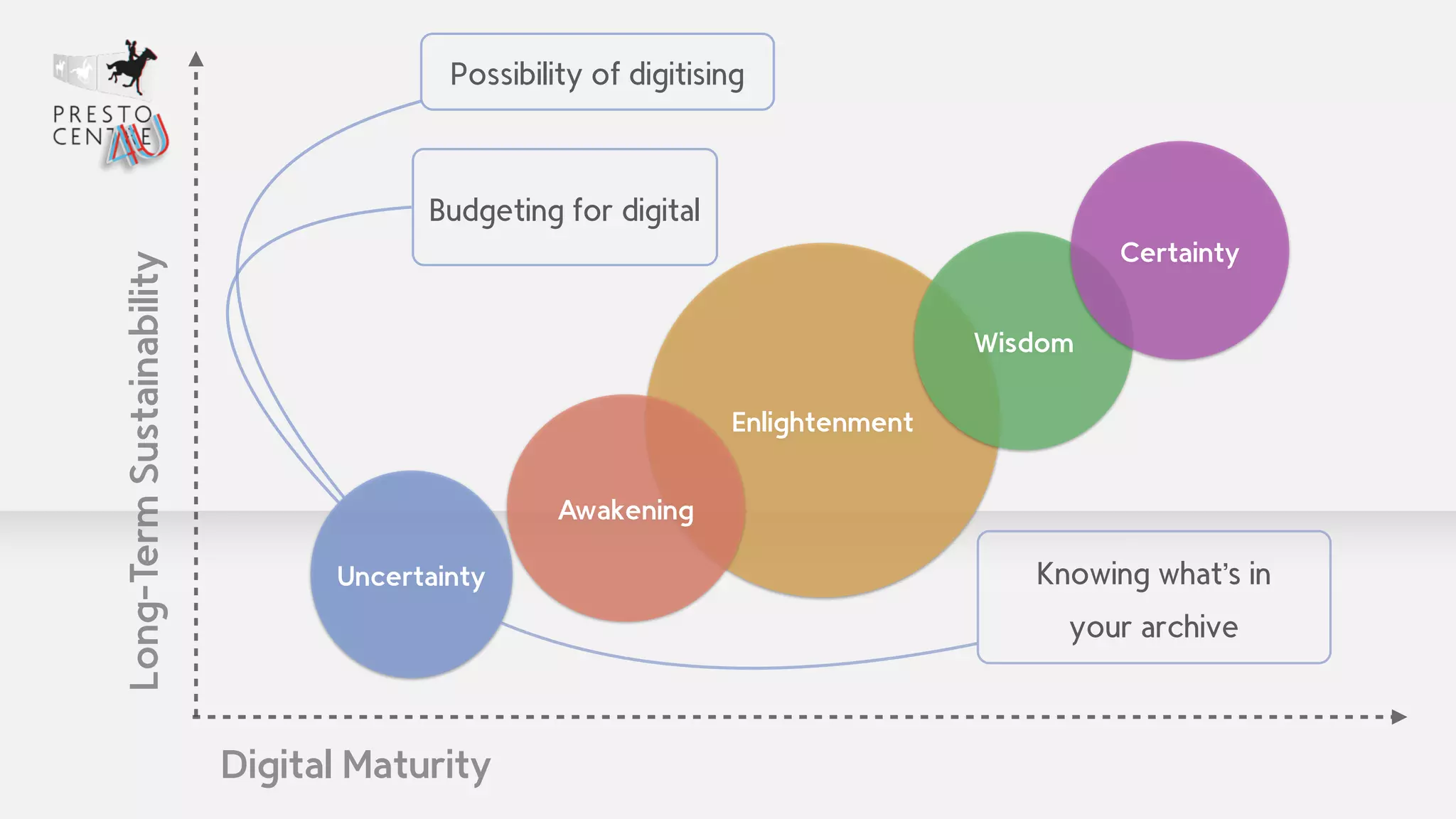
Enlightenment 
Wisdom 
Certainty 
Awakening 
Uncertainty 
Digital Maturity 
Long-Term Sustainability 
Possibility of digitising 
Budgeting for digital 
Knowing what’s in 
your archive
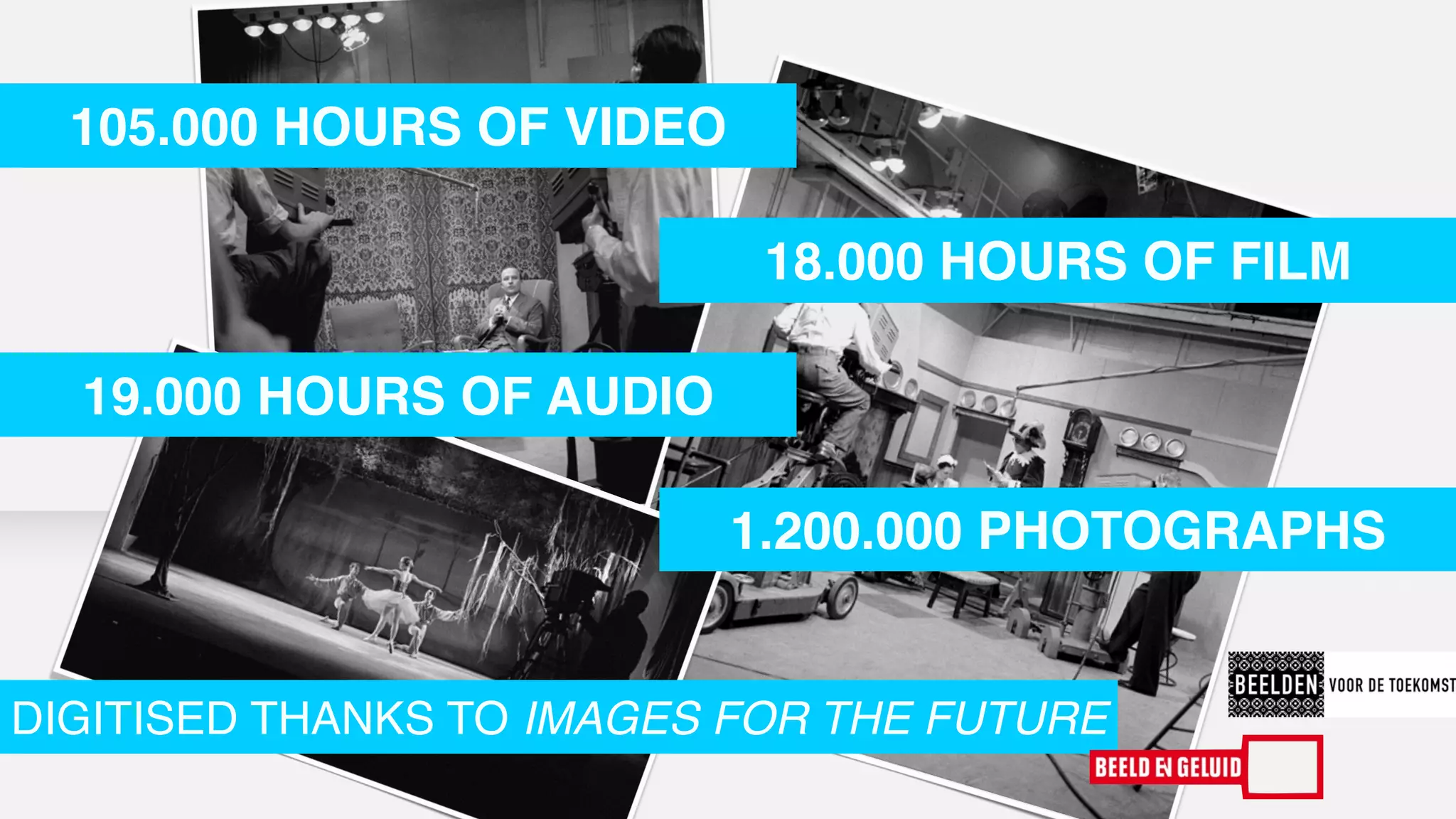
18.000 HOURS OF FILM 
105.000 HOURS OF VIDEO 
19.000 HOURS OF AUDIO 
1.200.000 PHOTOGRAPHS 
DIGITISED THANKS TO IMAGES FOR THE FUTURE
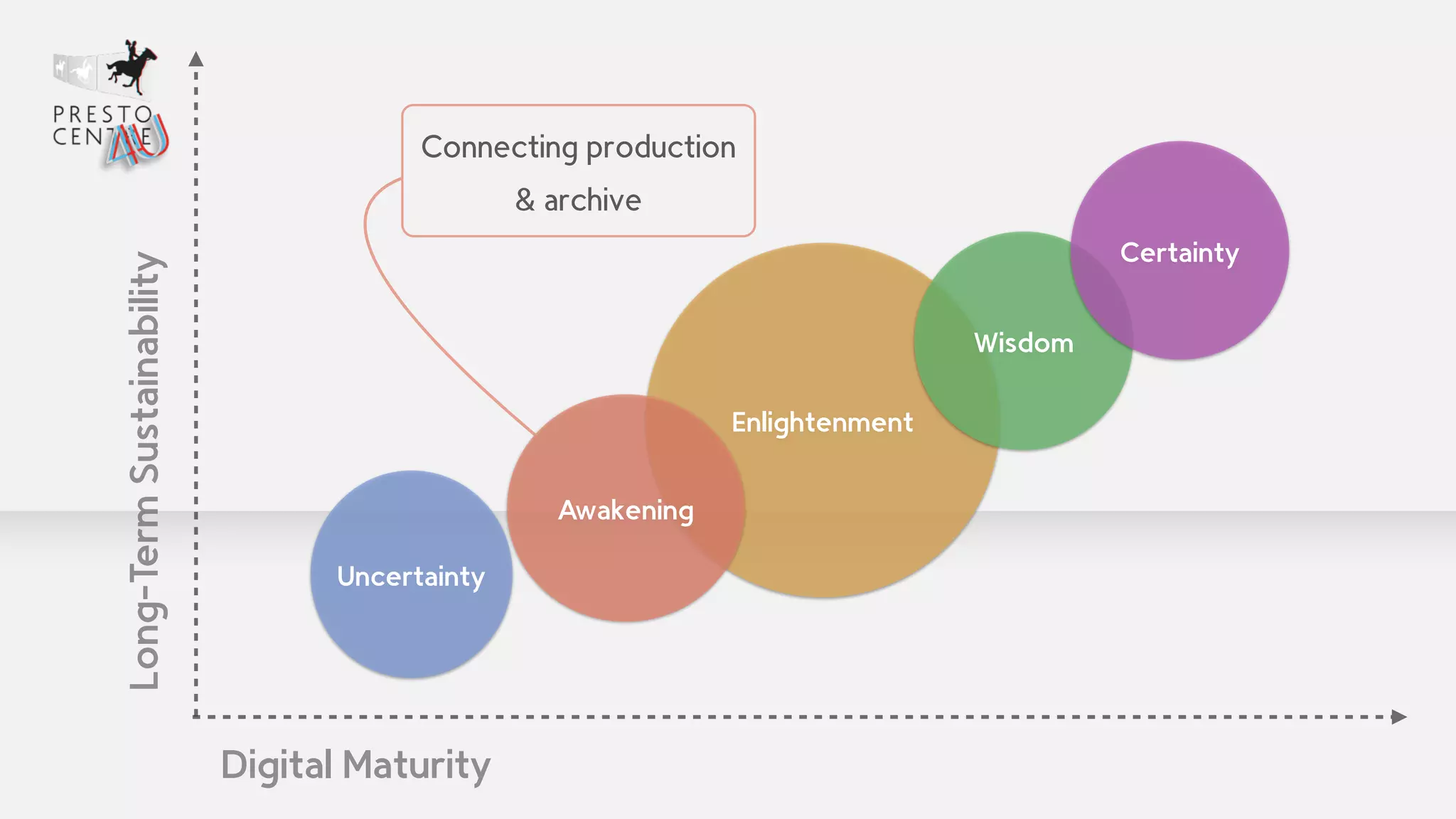
Enlightenment 
Wisdom 
Certainty 
Awakening 
Uncertainty 
Digital Maturity 
Long-Term Sustainability 
Connecting production 
& archive
Enlightenment 
Wisdom 
Certainty 
Awakening 
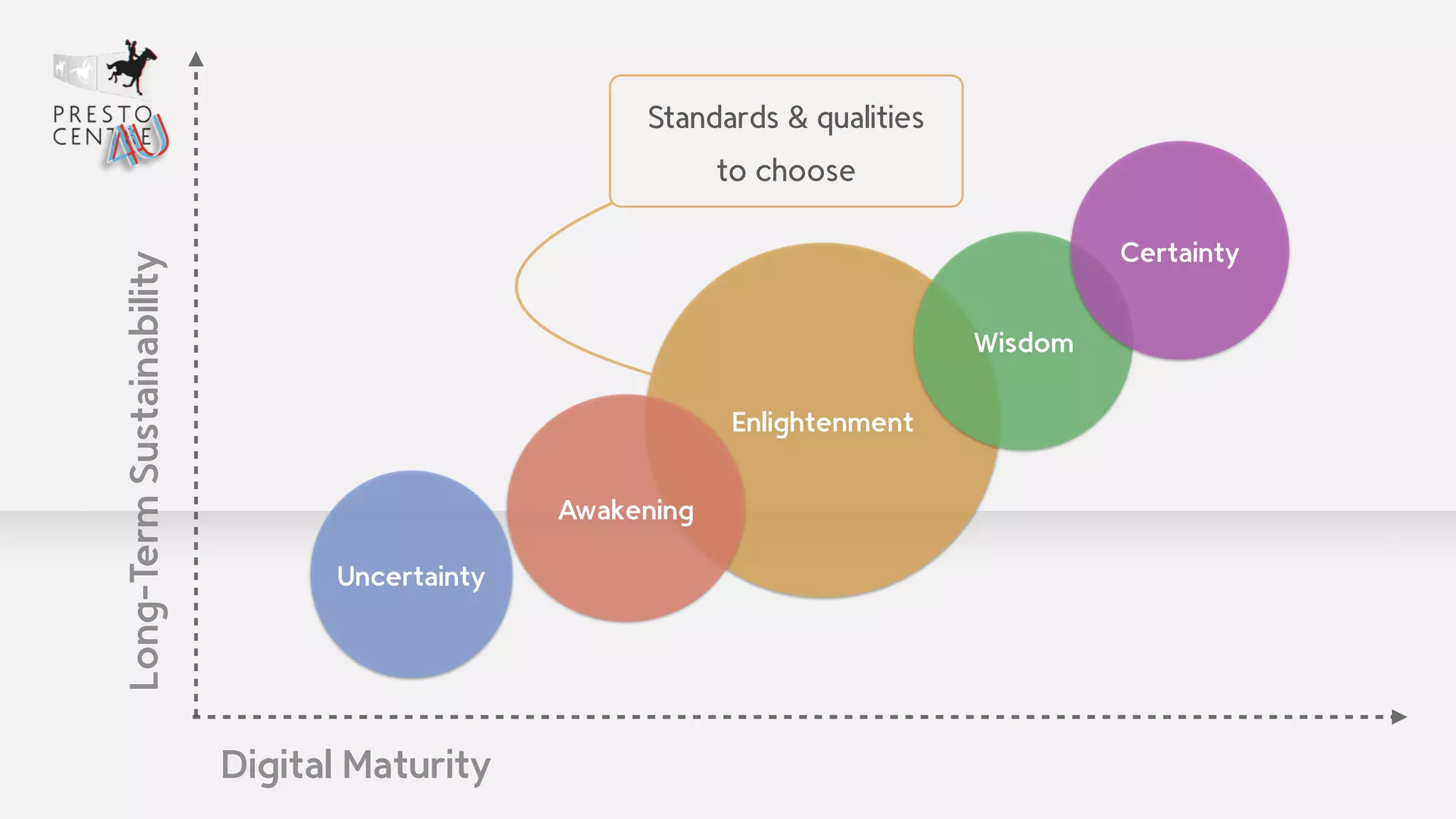
Uncertainty 
Digital Maturity 
Long-Term Sustainability 
Standards & qualities 
to choose
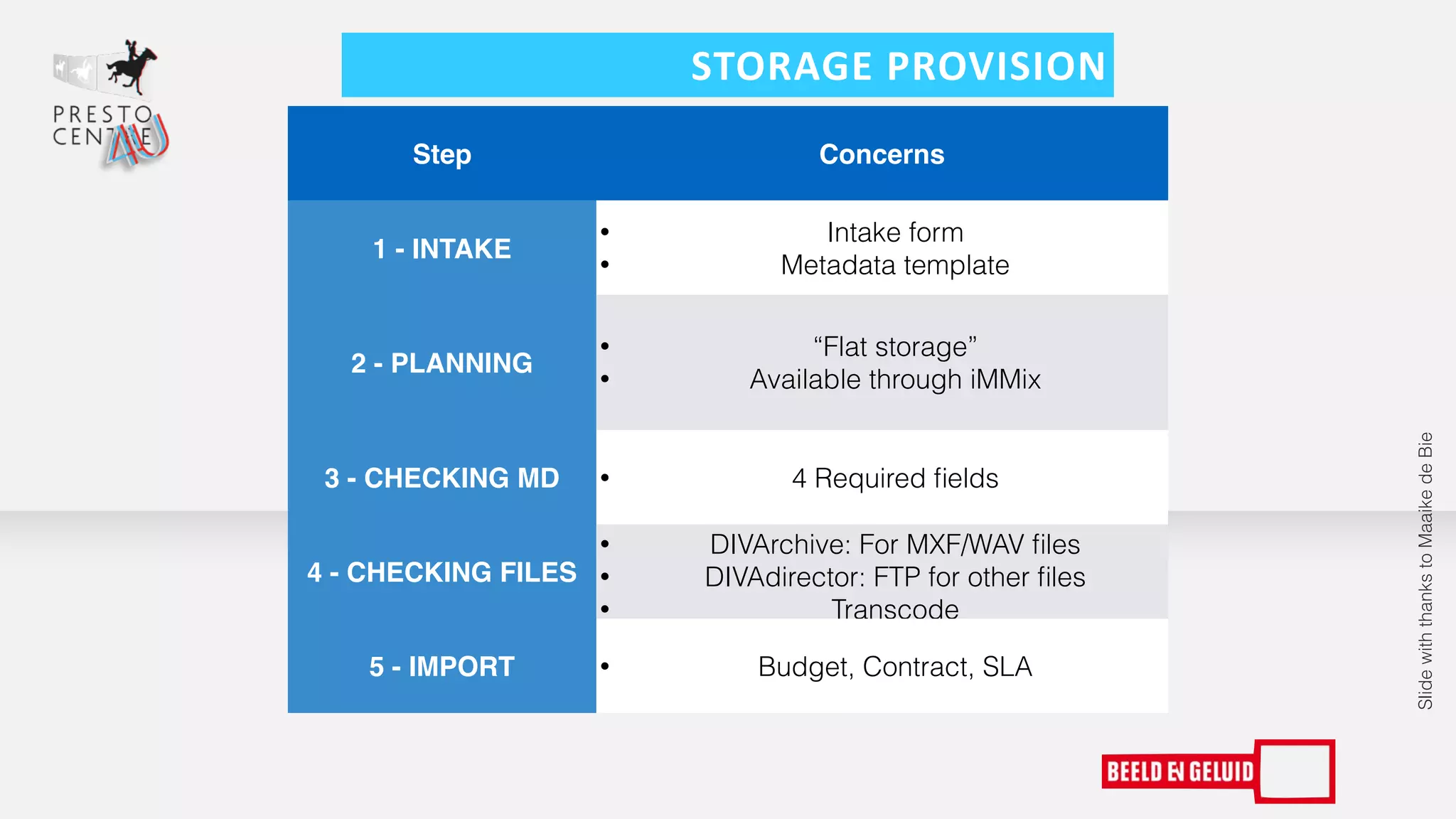
STORAGE 
PROVISION 
Slide with thanks to Maaike de Bie 
Step Concerns 
1 - INTAKE 
• Intake form 
• Metadata template 
2 - PLANNING 
• “Flat storage” 
• Available through iMMix 
3 - CHECKING MD • 4 Required fields 
4 - CHECKING FILES 
• DIVArchive: For MXF/WAV files 
• DIVAdirector: FTP for other files 
• Transcode 
5 - IMPORT • Budget, Contract, SLA
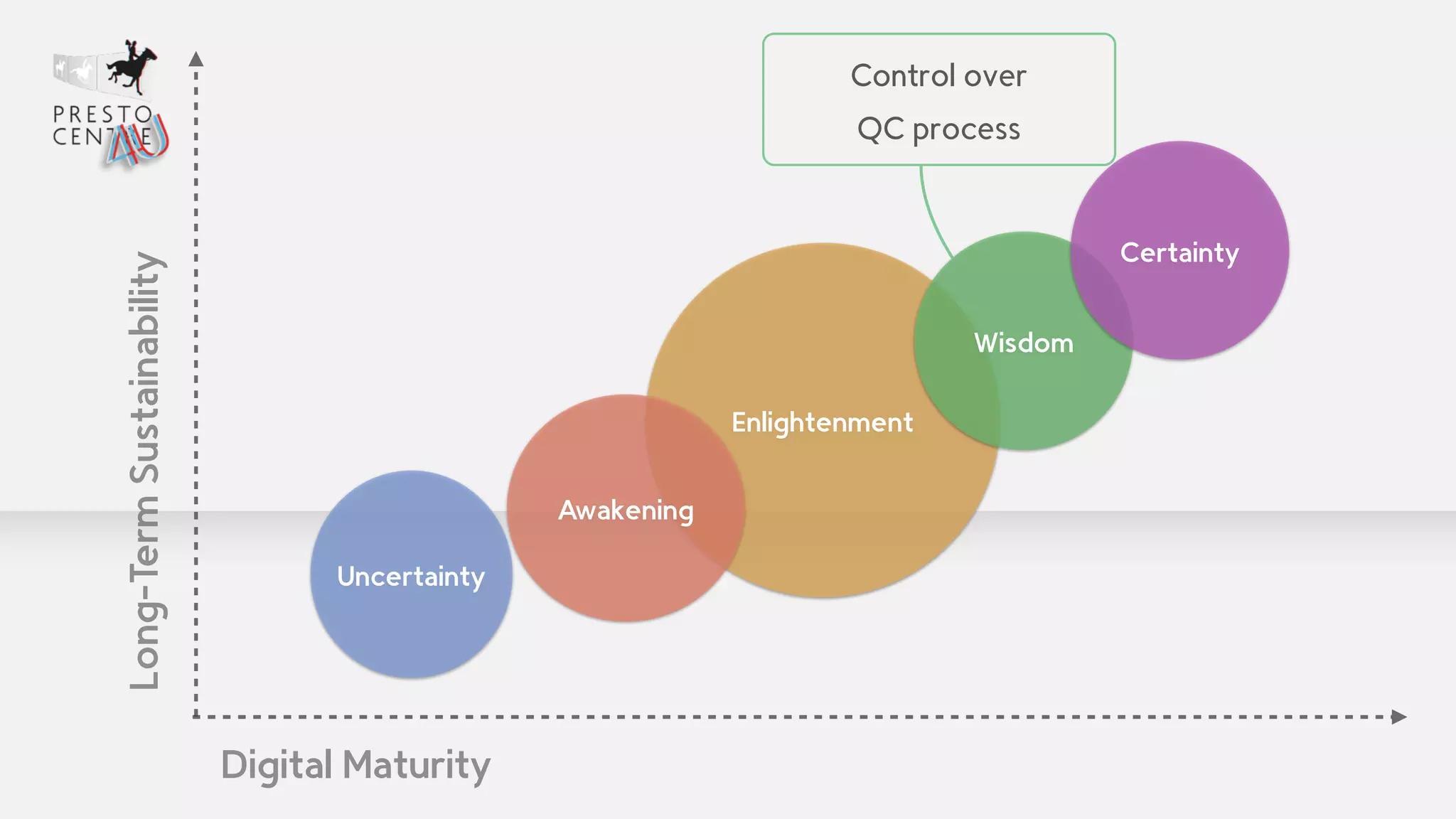
Enlightenment 
Wisdom 
Certainty 
Awakening 
Uncertainty 
Digital Maturity 
Long-Term Sustainability 
Control over 
QC process
Slide with thanks to Claudio Prandoni 
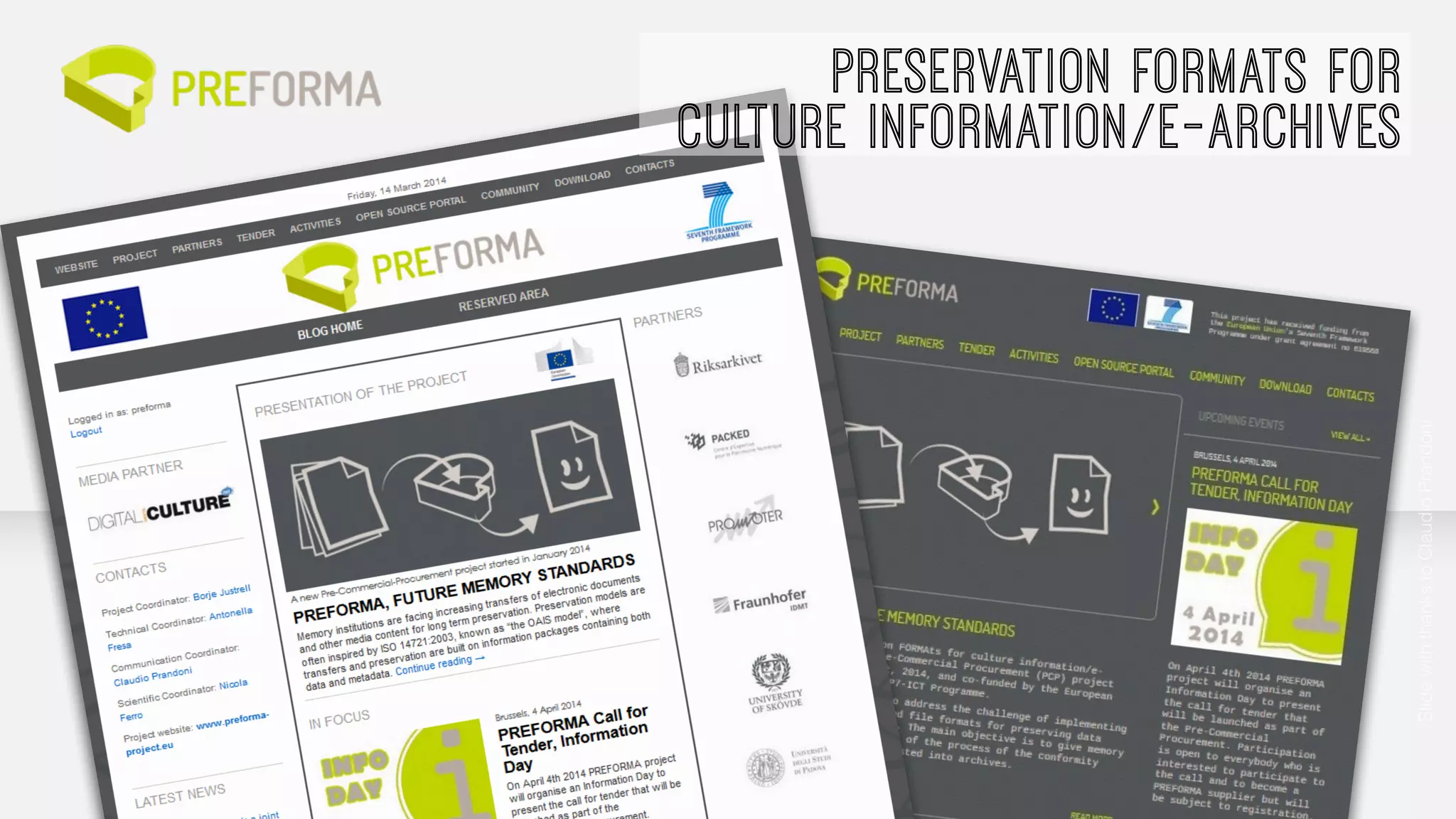
PRESERVATION FORMATS FOR 
CULTURE INFORMATION/E-ARCHIVES
Slide with thanks to Claudio Prandoni 
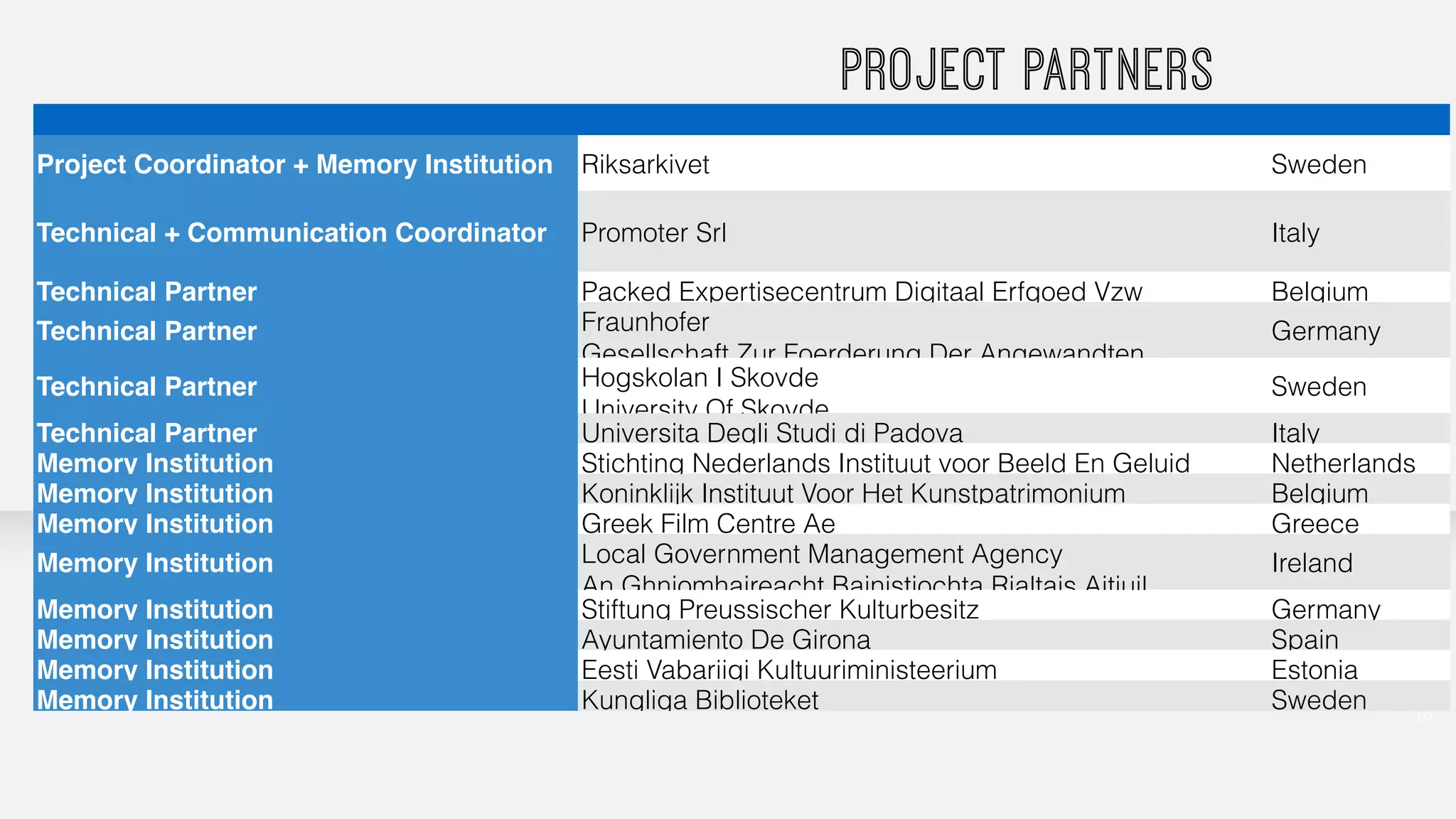
PROJECT PARTNERS 
Project Coordinator + Memory Institution Riksarkivet Sweden 
Technical + Communication Coordinator Promoter Srl Italy 
Technical Partner Packed Expertisecentrum Digitaal Erfgoed Vzw Belgium 
Technical Partner Fraunhofer 
Gesellschaft Zur Foerderung Der Angewandten 
Germany 
Technical Partner Hogskolan I Skovde 
University Of Skovde 
Sweden 
Technical Partner Universita Degli Studi di Padova Italy 
Memory Institution Stichting Nederlands Instituut voor Beeld En Geluid Netherlands 
Memory Institution Koninklijk Instituut Voor Het Kunstpatrimonium Belgium 
Memory Institution Greek Film Centre Ae Greece 
Memory Institution Local Government Management Agency 
An Ghniomhaireacht Bainistiochta Rialtais Aitiuil 
Ireland 
Memory Institution Stiftung Preussischer Kulturbesitz Germany 
Memory Institution Ayuntamiento De Girona Spain 
Memory Institution Eesti Vabariigi Kultuuriministeerium Estonia 
Memory Institution Kungliga Biblioteket Sweden
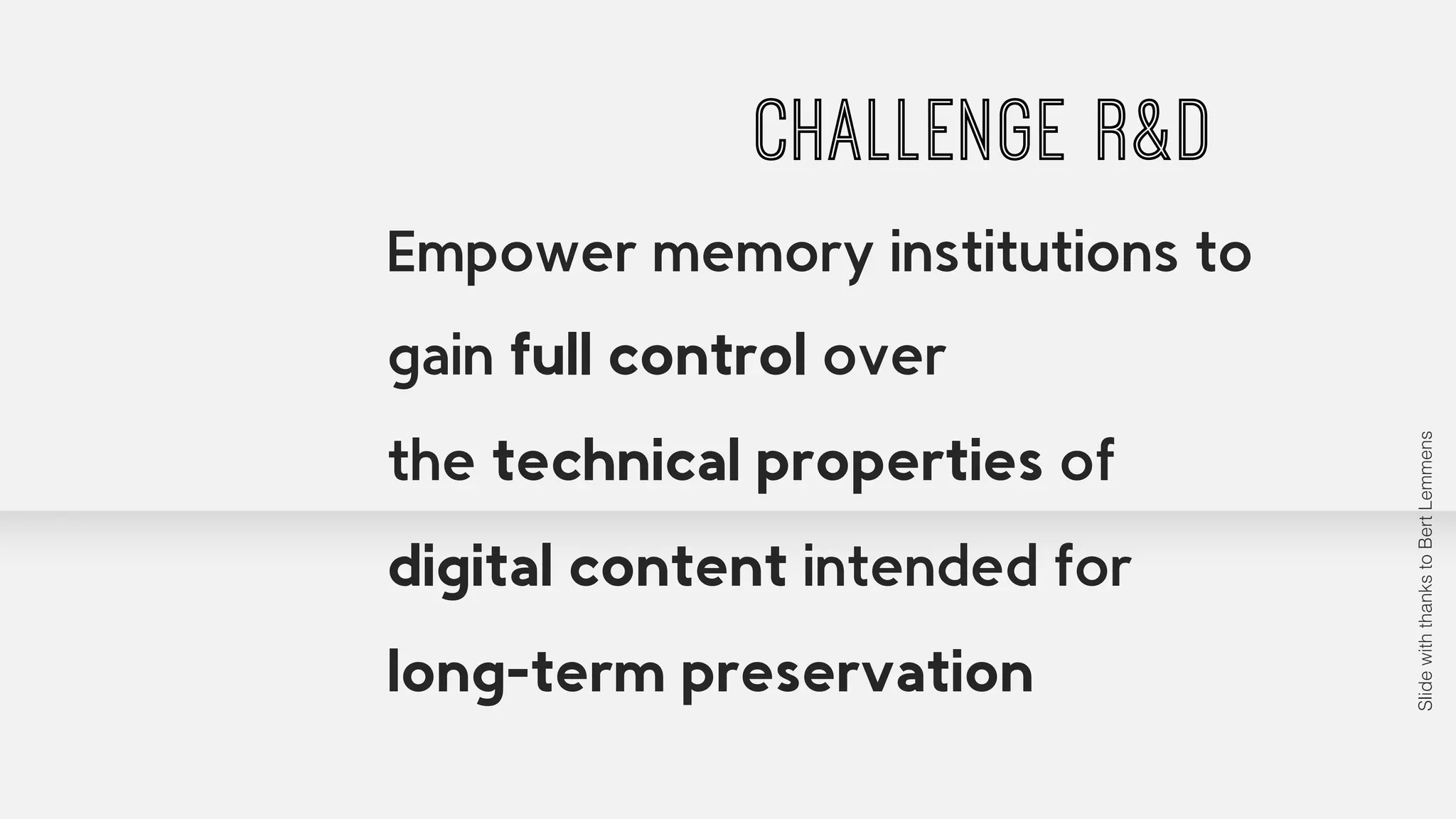
CHALLENGE R&D 
Empower memory institutions to 
gain full control over 
the technical properties of 
digital content intended for 
long-term preservation 
Slide with thanks to Bert Lemmens
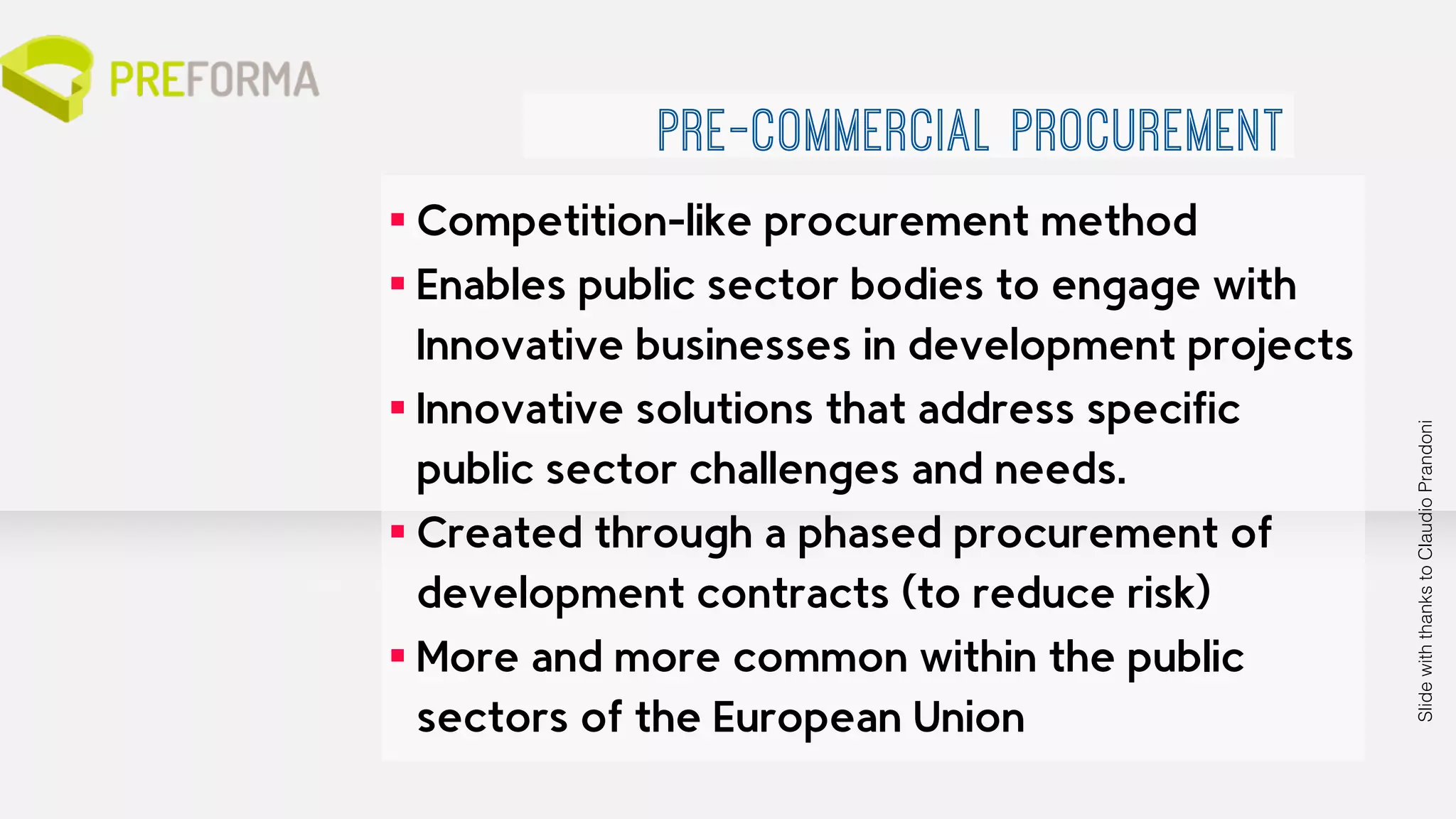
▪ Competition-like procurement method 
▪ Enables public sector bodies to engage with 
Innovative businesses in development projects 
▪ Innovative solutions that address specific 
public sector challenges and needs. 
▪ Created through a phased procurement of 
development contracts (to reduce risk) 
▪ More and more common within the public 
sectors of the European Union 
Slide with thanks to Claudio Prandoni 
PRE-COMMERCIAL PROCUREMENT
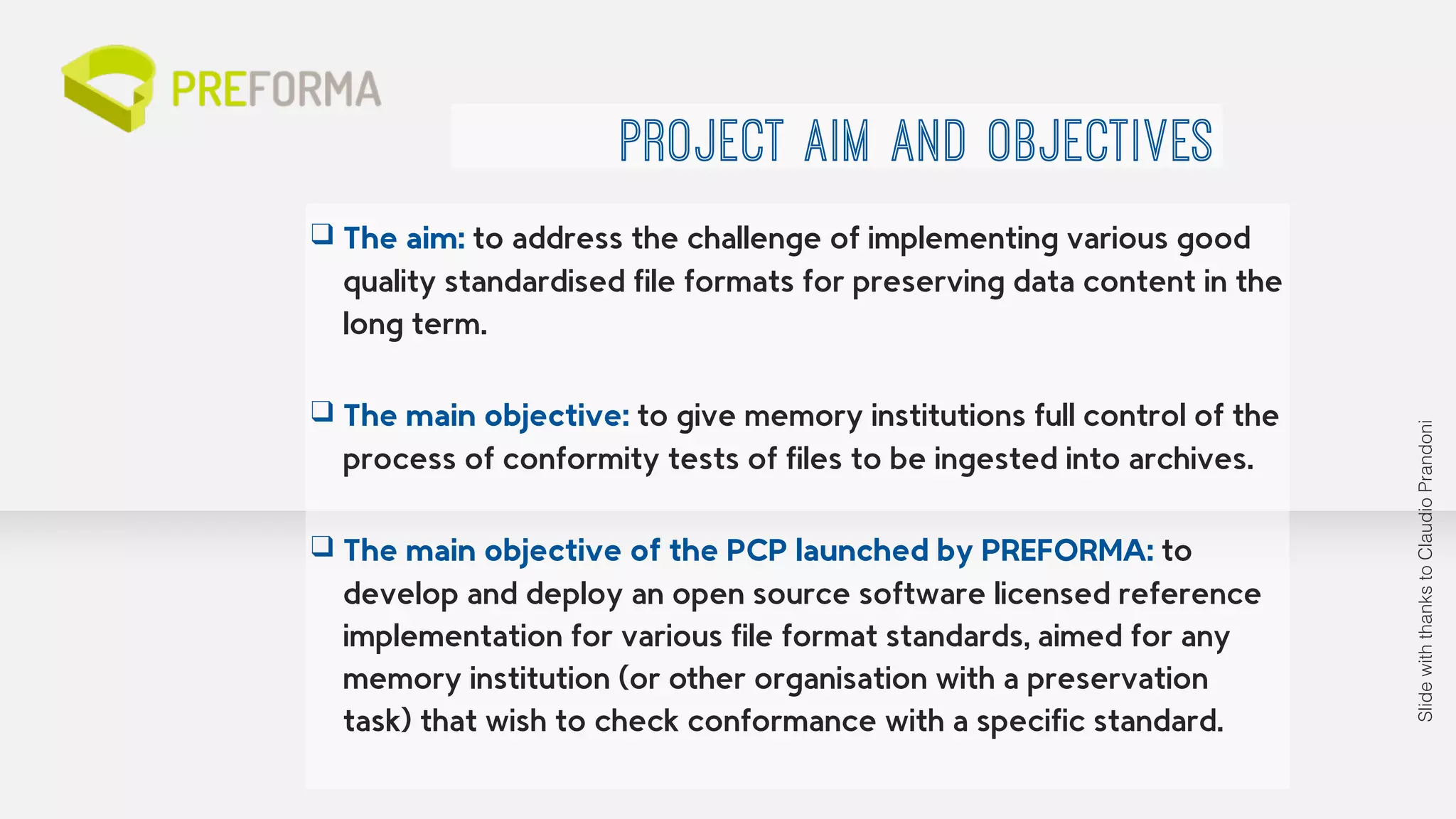
PROJECT AIM AND OBJECTIVES 
❑ The aim: to address the challenge of implementing various good 
quality standardised file formats for preserving data content in the 
long term. 
! 
❑ The main objective: to give memory institutions full control of the 
process of conformity tests of files to be ingested into archives. 
! 
❑ The main objective of the PCP launched by PREFORMA: to 
develop and deploy an open source software licensed reference 
implementation for various file format standards, aimed for any 
memory institution (or other organisation with a preservation 
task) that wish to check conformance with a specific standard. 
Slide with thanks to Claudio Prandoni
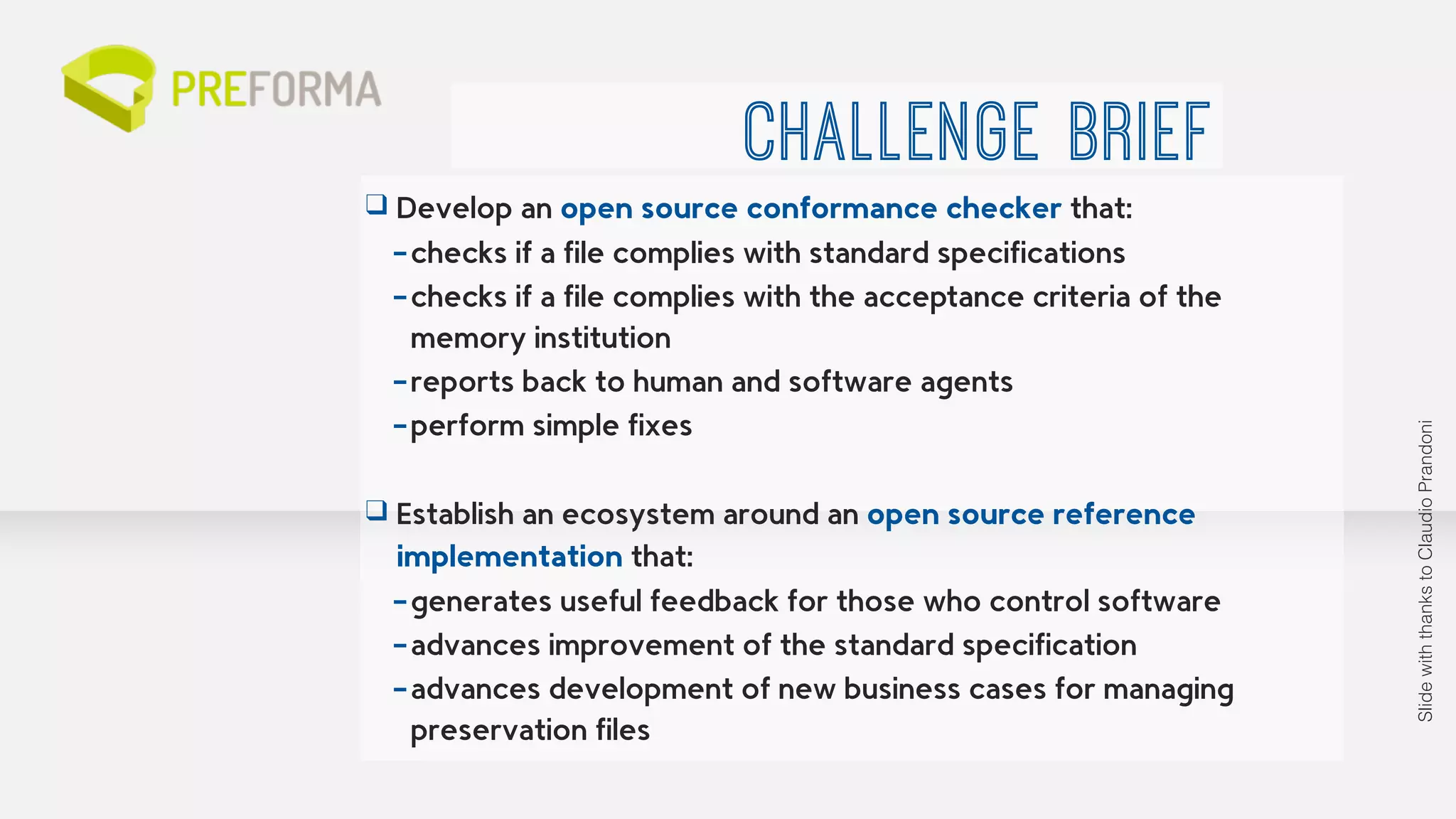
CHALLENGE BRIEF 
❑ Develop an open source conformance checker that: 
–checks if a file complies with standard specifications 
–checks if a file complies with the acceptance criteria of the 
memory institution 
–reports back to human and software agents 
–perform simple fixes 
! 
❑ Establish an ecosystem around an open source reference 
implementation that: 
–generates useful feedback for those who control software 
–advances improvement of the standard specification 
–advances development of new business cases for managing 
preservation files 
Slide with thanks to Claudio Prandoni
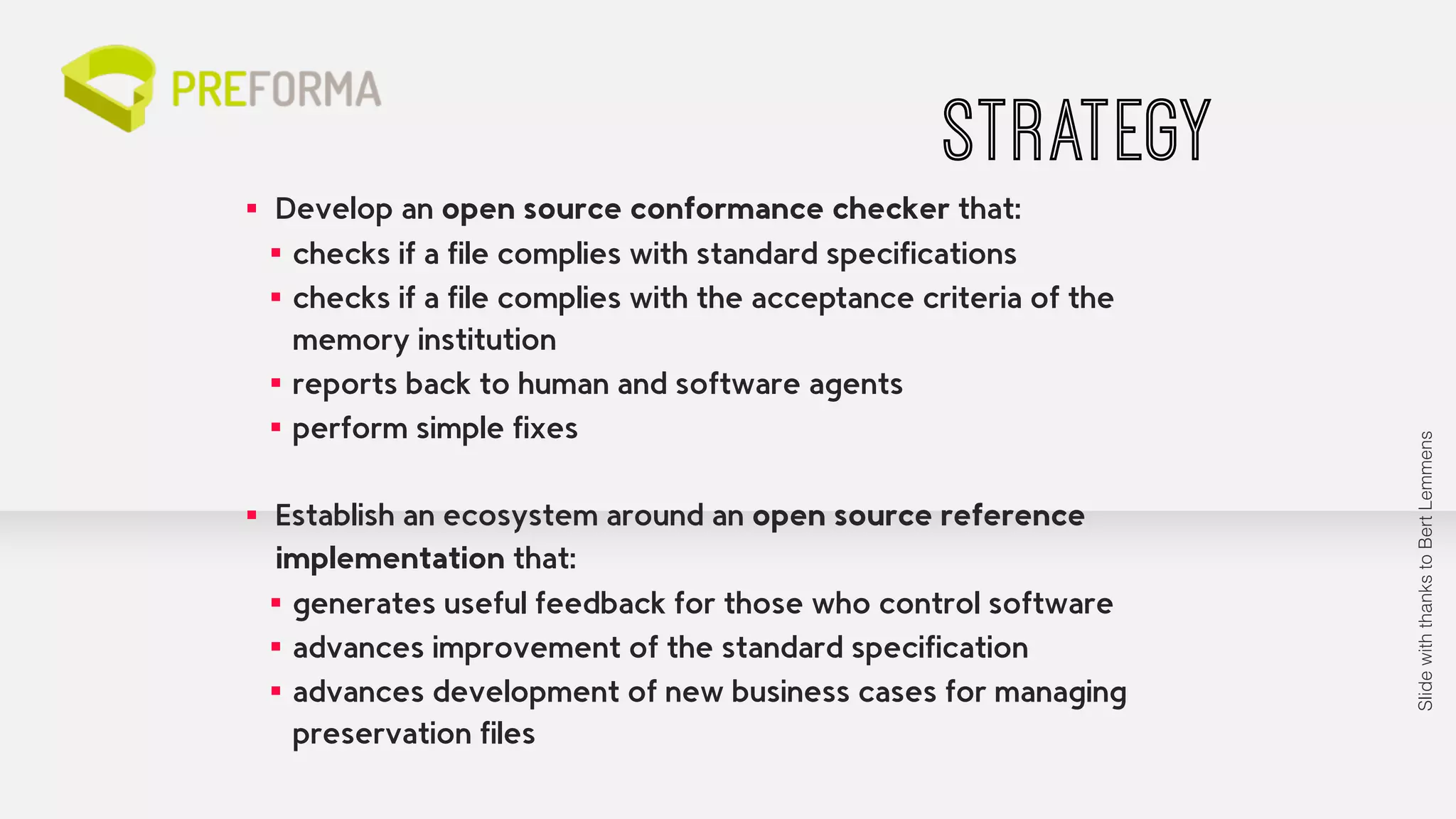
STRATEGY 
▪ Develop an open source conformance checker that: 
▪ checks if a file complies with standard specifications 
▪ checks if a file complies with the acceptance criteria of the 
memory institution 
▪ reports back to human and software agents 
▪ perform simple fixes 
▪ Establish an ecosystem around an open source reference 
implementation that: 
▪ generates useful feedback for those who control software 
▪ advances improvement of the standard specification 
▪ advances development of new business cases for managing 
preservation files 
Slide with thanks to Bert Lemmens
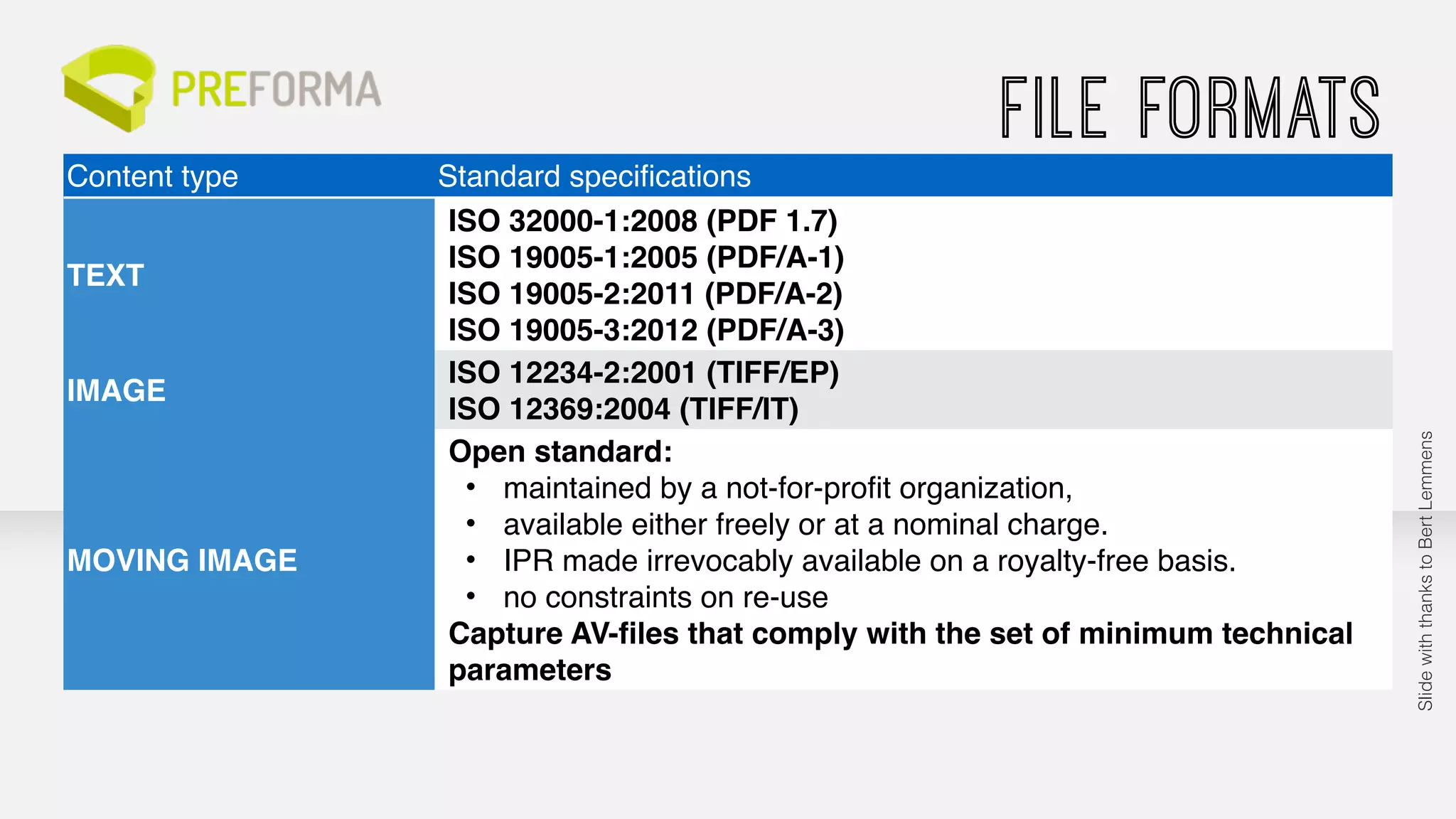
FILE FORMATS 
Content type Standard specifications 
TEXT 
ISO 32000-1:2008 (PDF 1.7)! 
ISO 19005-1:2005 (PDF/A-1) ! 
ISO 19005-2:2011 (PDF/A-2)! 
ISO 19005-3:2012 (PDF/A-3) 
IMAGE 
ISO 12234-2:2001 (TIFF/EP)! 
ISO 12369:2004 (TIFF/IT) 
MOVING IMAGE 
Open standard:! 
• maintained by a not-for-profit organization,! 
• available either freely or at a nominal charge. ! 
• IPR made irrevocably available on a royalty-free basis.! 
• no constraints on re-use ! 
Capture AV-files that comply with the set of minimum technical 
parameters 
Slide with thanks to Bert Lemmens
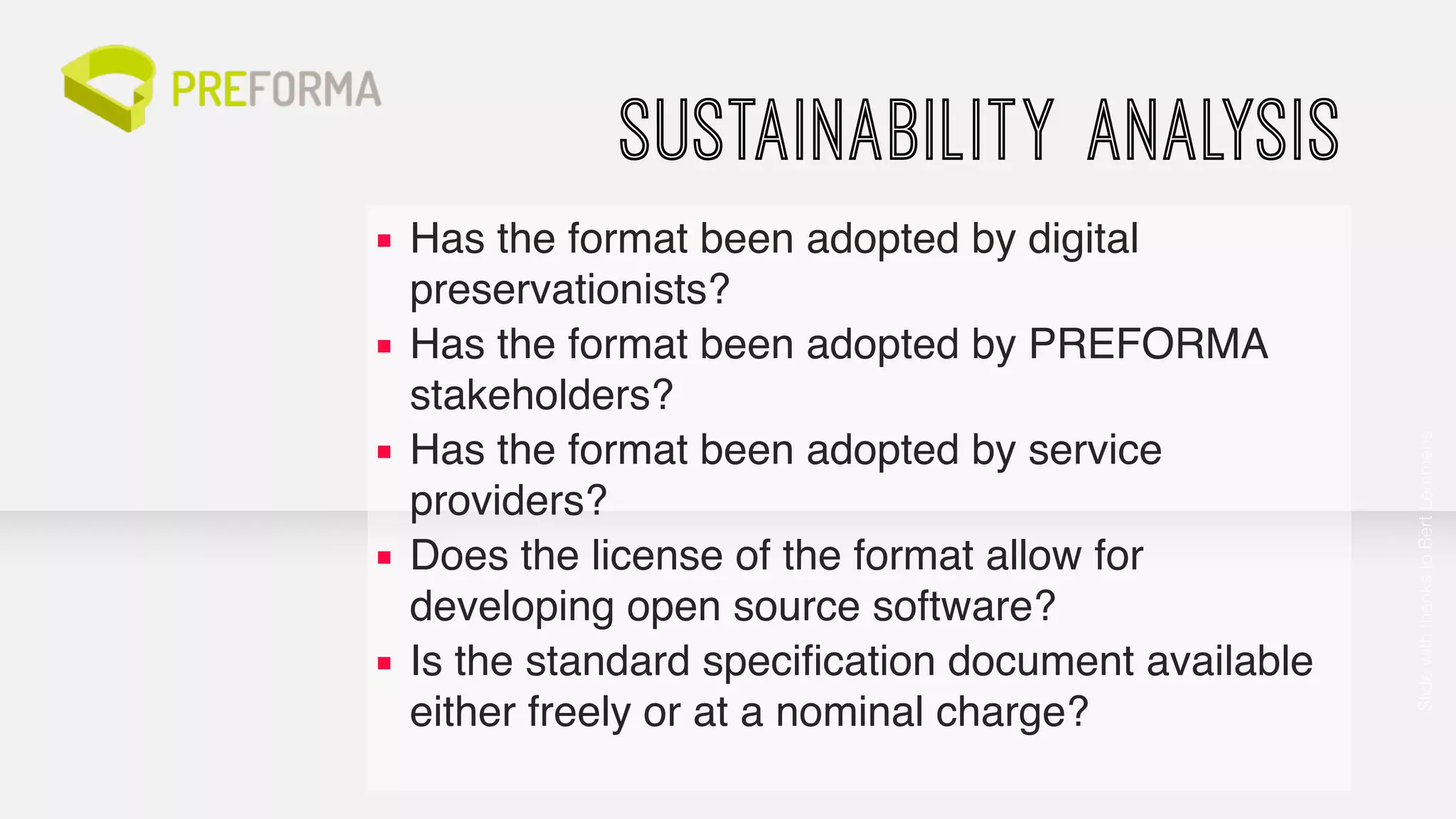
SUSTAINABILITY ANALYSIS 
▪ Has the format been adopted by digital 
preservationists?! 
▪ Has the format been adopted by PREFORMA 
stakeholders?! 
▪ Has the format been adopted by service 
providers?! 
▪ Does the license of the format allow for 
developing open source software?! 
▪ Is the standard specification document available 
either freely or at a nominal charge? 
Slide with thanks to Bert Lemmens
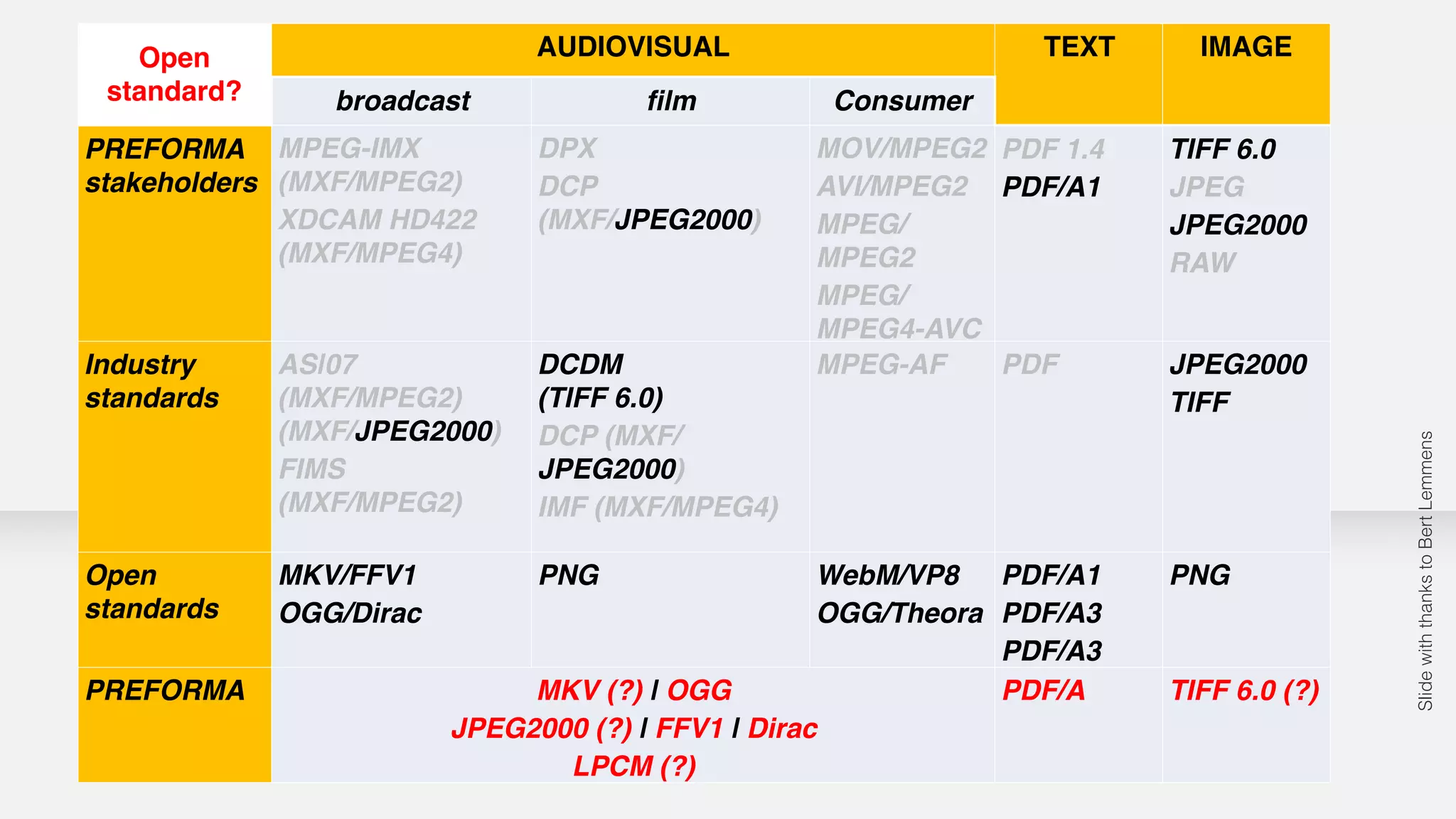
Open 
standard? 
AUDIOVISUAL TEXT IMAGE 
broadcast film Consumer 
PREFORMA 
stakeholders 
MPEG-IMX 
(MXF/MPEG2)" 
XDCAM HD422 
(MXF/MPEG4) 
DPX" 
DCP 
(MXF/JPEG2000) 
MOV/MPEG2" 
AVI/MPEG2" 
MPEG/ 
MPEG2" 
MPEG/ 
MPEG4-AVC 
PDF 1.4" 
PDF/A1 
TIFF 6.0" 
JPEG" 
JPEG2000" 
RAW 
Industry 
standards 
AS|07 
(MXF/MPEG2) 
(MXF/JPEG2000)" 
FIMS 
(MXF/MPEG2)" 
DCDM 
(TIFF 6.0)" 
DCP (MXF/ 
JPEG2000)" 
IMF (MXF/MPEG4) 
MPEG-AF PDF JPEG2000" 
TIFF 
Open 
standards 
MKV/FFV1" 
OGG/Dirac 
PNG WebM/VP8" 
OGG/Theora 
PDF/A1" 
PDF/A3" 
PDF/A3 
PNG 
PREFORMA MKV (?) | OGG" 
JPEG2000 (?) | FFV1 | Dirac" 
LPCM (?) 
PDF/A TIFF 6.0 (?) 
Slide with thanks to Bert Lemmens
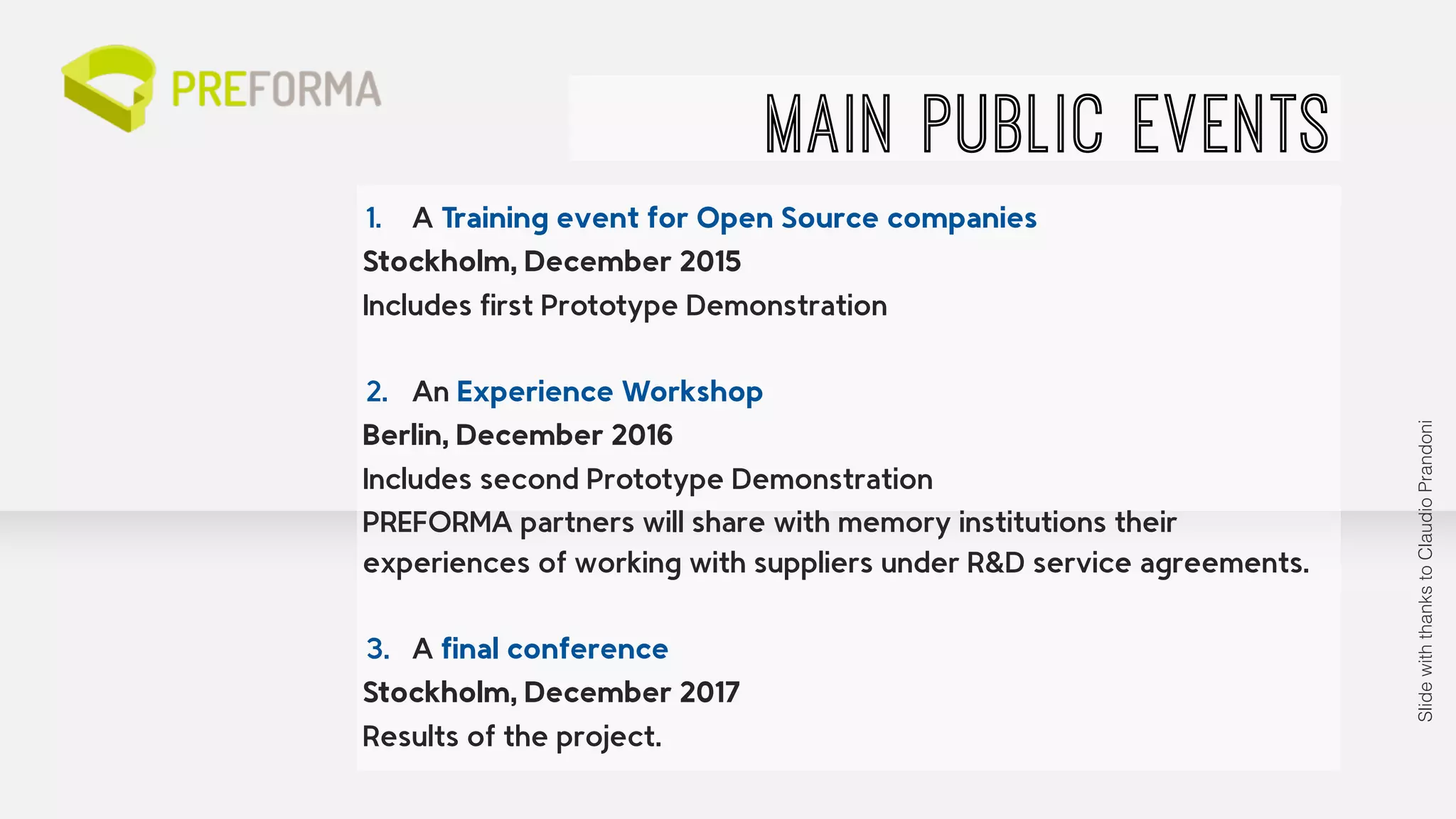
1. A Training event for Open Source companies 
Stockholm, December 2015 
Includes first Prototype Demonstration 
! 
2. An Experience Workshop 
Berlin, December 2016 
Includes second Prototype Demonstration 
PREFORMA partners will share with memory institutions their 
experiences of working with suppliers under R&D service agreements. 
! 
3. A final conference 
Stockholm, December 2017 
Results of the project. 
MAIN PUBLIC EVENTS 
Slide with thanks to Claudio Prandoni
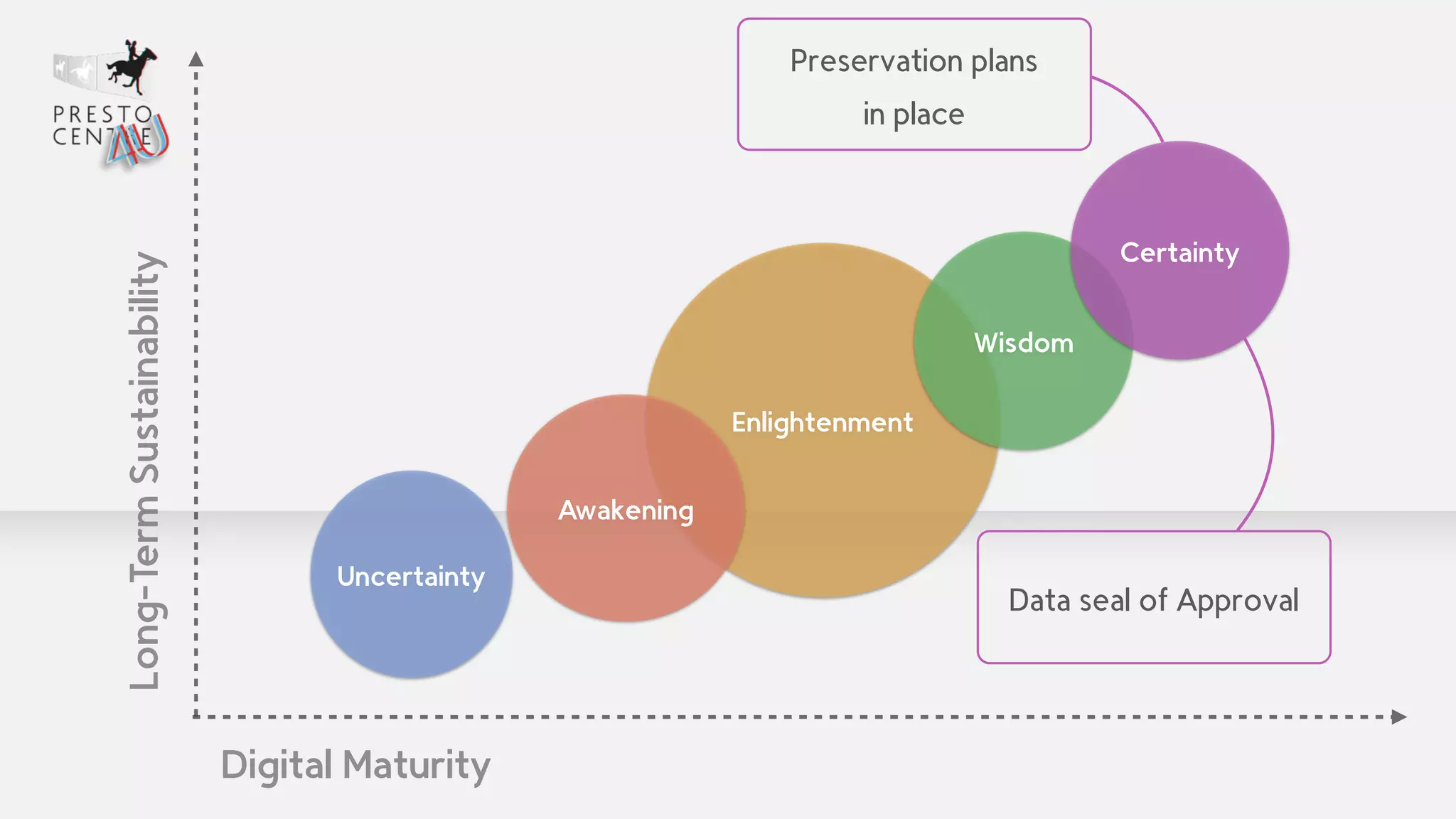
Preservation plans 
Enlightenment 
Wisdom 
Certainty 
Awakening 
Uncertainty 
Digital Maturity 
Long-Term Sustainability 
Data seal of Approval 
in place
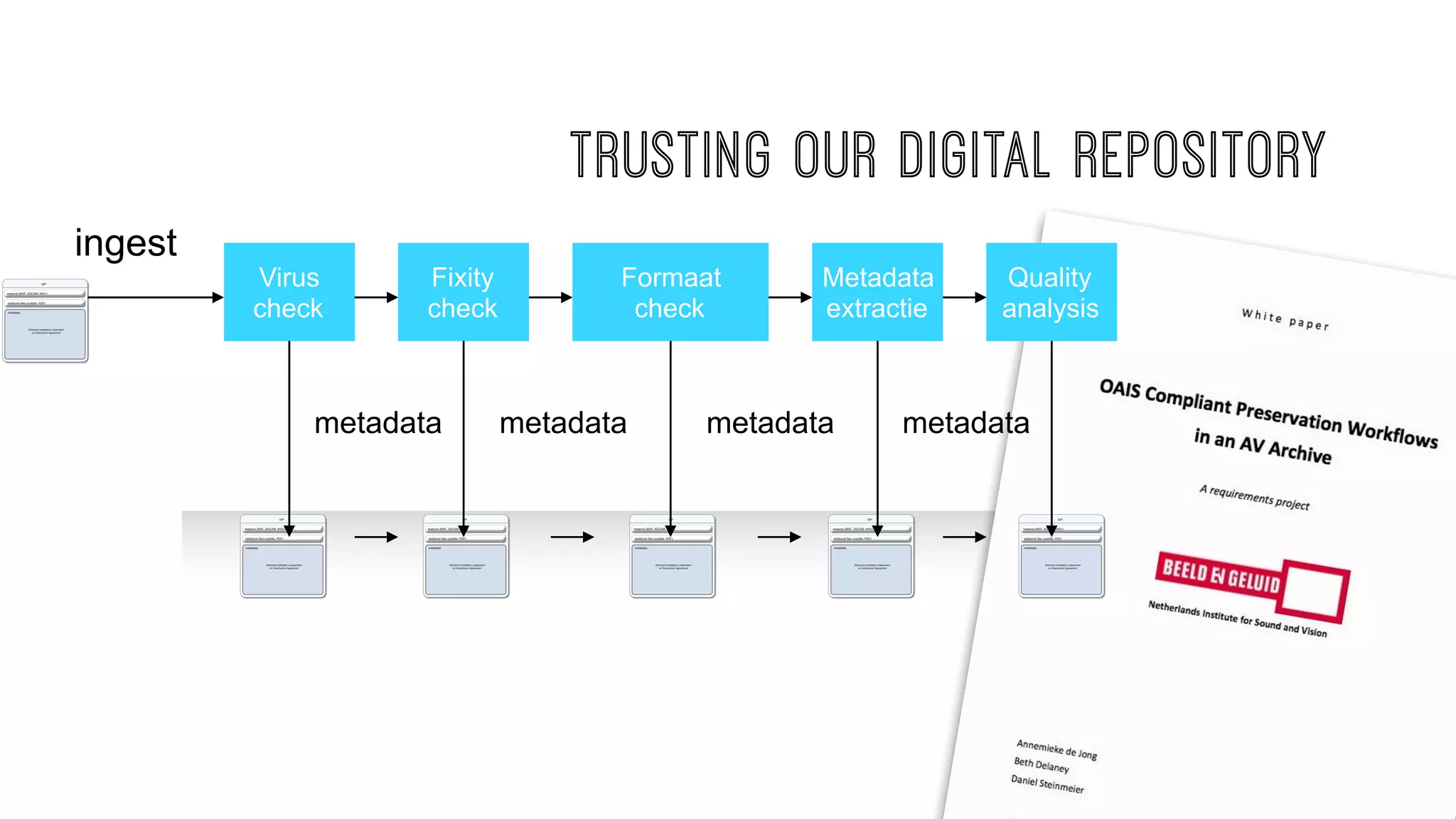
TRUSTING OUR DIGITAL REPOSITORY 
ingest 
Virus 
check 
Fixity 
check 
Formaat 
check 
Metadata 
extractie 
Quality 
analysis 
metadata metadata metadata metadata
Knowledge finding & Community 
Building 
▪ Surveys to establish knowledge base 
▪ Regular blog & newsletters 
▪ Webinars, Workshops & Edit-a-thon
Thank you 
everbruggen@beeldengeluid.nl 
@erwinverb 
Image: 
BBC 
Archive

Of Communities and Practices: Digital Preservation Innovation & Research

  • 1.
    FIAT/IFTA Conference, October22, 2014 The Presto4U project is supported by the European Commission under the 7th Framework Programme (FP7) — Grant Agreement 600845 Of communities and Practices #DP Innovation & Research Erwin Verbruggen Netherlands Institute for Sound and Vision
  • 2.
    Personal Collections SalesLibraries Learning & Teaching Repositories Research and Scientific Collections Film Collections and Filmmakers Art & Museum Objects Broadcast Music and Sound Video Production and Postproduction
  • 3.
    Knowledge finding &Community Building ▪ Surveys to establish knowledge base ▪ Regular blog & newsletters ▪ Webinars, Workshops & Edit-a-thon
  • 4.
    International Federation of Television Archives (FIAT/IFTA) Private Sector Public Sector Footage Broadcast Video & Post Film & Makers Federation of Commercial Audiovisual Libraries (FOCAL) International Video Federation (IVF) Society of Audiovisual Authors (SAA) Federation of Screenwriters in Europe European Bradcasting Union (EBU) International Federation of Film Archives (FIAF) EUscreen Foundation European Coordination of Independent TV Producers (CEPI) NISI MASA European Network of Young Cinema
  • 5.
    STAKEHOLDERS Video •Media houses and broadcasters • i.e. private companies or public institutions working with a broad range of media services • for example electronic publishing, advertising and communication, entertainment etc. • Private post-production houses • companies and production working with post-production and video material aimed at publications for education or infotainment / entertainment (all sizes – freelancers, permanent staff, consultants) • Advertisers and marketing bureaus • i.e. commercial and public communication and advertising companies. Production and Postproduction Slide with thanks to Peter Holm Lindgaard
  • 6.
    IDENTIFIED ISSUES Video • Big diversity between stakeholders (livelihood, raison d’être). Many objectives at stake which confuses ends and means. • Large diversity between the size and professional background of employers: • Private companies (freelancers, professionals, ROE, B2B and bottom lines are the main drivers) • Public institutions (academics, policy makers, public service and publishing are main drivers) • Many different business and work models at stake • long term / short term goals • rights management • exchange of assets • in-house post-production • external post-production. Production and Postproduction Slide with thanks to Peter Holm Lindgaard
  • 7.
    High level ofhomogeneity Standards – preservation-tools – metadata- standards - technology tools Methodologies for exchange and standardized roadmaps for handling of rights and payment Medium degree of flexibility Business drivers are almost non-existing Medium level of homogeneity Mix of use of standards – preservation-tools – metadata standards - technology tools Proprietary use of methodologies for exchange and roadmaps for handling of rights and payment Low degree of flexibility Business drivers exist within narrow communities Low level of homogeneity Multiple tools available but no consistency Low level of metadata tools and standards Methodologies for exchange and roadmaps for use of rights and payment are almost not existing High degree of flexibility and dynamical thinking and behavior Business drivers RULE! Video Production and Postproduction International Community Regional Community Free market Slide with thanks to Peter Holm Lindgaard
  • 8.
    Video ISSUES -WHAT IS MISSING? • Lack of access-facilities. • Making it easy to access archive material for a wide variety of uses, including the monetisation of content, faster access for clip search and a better ability to see what was there and the rights associated with content. • Lack of standardisation. • A desire for consistent management of metadata + for as few codecs as possible, but more generally a demand for common standards for audio, video and graphics. • Lack of Automation. • Solution based on de-humanising the workflow around archive, i.e. automated metadata generation and intelligent search – the prospect of intelligent software tools searching on content with metadata generated by intelligent software tools. • Lack of strong B2B models which contains multiple sorts of end-users • Lack of knowledge about solutions and opportunities • Lack of confidence – CLOUD technologies Production and Postproduction Slide with thanks to Peter Holm Lindgaard
  • 9.
    NEEDS FOR TOOLSAND INDUSTRIALISED ACTIONS • Sharing of preservation systems with defined content processing methods. • Need for making the tedious stuff automatic, and remove the need to input elementary / common preservation data. • Strong demand for tools or methods that would make it easy, simple and flexible to create versions for different destinations. • Intelligent management of versions, compiling, wrappers etc. • De-humanising the workflow around archive. • The prospect of intelligent software tools searching on content with metadata generated by intelligent software tools • Generic search, tracking and management-tools. • Tracking of content. More visibility of content as it moves through the workflow – e.g. by using QR-codes (like a DHL-order) • Outsourcing of distribution and delivery methods • external as well as internal / in-house • Sharing of storage solutions in flexible frameworks (SaaS). • Ability to manage workflows through centralised tooling, such as Cloud-based ones, for preservation, storage, and processing. • Flexible shopping and distribution facilities Video Production and Postproduction Slide with thanks to Peter Holm Lindgaard
  • 10.
    Sales Libraries Whatfootage sales archives do ▪ They exploit commercially their AV holdings by selling clips and footage for use in media productions. ▪ Today they generate revenues for more than $400 million per year ▪ They sell footage, but at the same time they act as an archive, being obliged to practice some kind of preservation activities. The Community ▪ Memory Institutions (e.g. Istituto Luce, INA, B&G, Imperial War Museum, British Pathé): ▪ usually public co-funded ▪ footage sales are not their core business ▪ they have at least a “moral” duty of dealing with long term preservation ▪ Private entities (e.g. Getty Images, ITN Source, Reuters, AP, Huntley Archive): ▪ no public function ▪ footage sales are their core business ▪ market driven with a very pragmatic approach to digital preservation Slide with thanks to Marco Rendina
  • 11.
    Sales ISTITUTO LUCECASE Libraries Two main archives for digitised films: ▪ 2k digitised film material ▪ DPX files only ▪ Priority given to unique prints, in danger reels ▪ Any digitisation request that involves reels should pass first from here ▪ HD digitised material ▪ ProRes 422 ▪ It’s mainly the delivery archives for our clients ▪ It’s generated from the 2k content …or from telecine Slide with thanks to Marco Rendina Despite this digitisation policy: 10% of our subjects digitised in 2k 25% of our subjects digitised in HD
  • 12.
    PRESTO4U Sales Libraries PRESERVATION CHALLENGES ▪ Most of the technical challenges in digital preservation are similar to the ones of Film archives and Broadcasters ▪ Special attention is given to descriptive metadata and rights metadata …but the big challenge is: ▪ the tension between customer-driven activities/ policies and digital preservation plans Slide with thanks to Marco Rendina
  • 13.
    BROADCAST Communty ofPractice Expert group Broadcast
  • 14.
    ‹nr.› Presto4u -Technology for Digital Audiovisual Media Preservation: www.presto4u.eu / www.prestocentre.org Image: gearhousebroadcast.com TV, Radio and New Media Broadcasting Archives Broadcast archives have massive amounts of materials. Some say: of low quality. Others say: it’s the main source for 20th Century history.
  • 15.
    Wide range ofmedia formats ! ▪ Spectrum of formats starts expanding from 1920s onwards ▪ Latest technologies include ever-changing code bases ▪ At the vanguard of / overlapping with other media industries Images: Kulturarv on Flickr
  • 16.
    Domain is highlydiverse ▪ Many thousands of broadcast organisations (6379 broadcast companies in 40 European countries alone!) ▪ Deposit laws are different in each and every country • National AV Institutions take up tasks of public broadcasters’ archives in some countries • Commercial broadcasters are left alone ▪ Digitisation progress of legacy formats varies widely ▪ Key moment going on: move from tape to data recording ▪ Meanwhile access formats are on the move
  • 17.
    ‹nr.› Presto4u -Technology for Digital Audiovisual Media Preservation: www.presto4u.eu / www.prestocentre.org Image: Erwin Verbruggen CC BY-­‐SA 2012. Tape Archives This image is two years old. It is how many broadcasters still work.
  • 18.
    Impact on productionworkflows ! ▪ The archive has never had such an impact on production before ▪ Archives are rebuilding workflows for metadata gathering, from the first steps of the production chain ▪ Producers need to be ‘taught’ how to work with an all-digital archive workflow
  • 19.
    ‹nr.› Presto4u -Technology for Digital Audiovisual Media Preservation: www.presto4u.eu / www.prestocentre.org Image: Erwin Verbruggen CC BY-­‐SA 2013. But is it all digital? And how many of these still function? Legacy machinery is drying up – fast.
  • 20.
    And then, it’sdigital ▪ How do you keep track of the preservation process? ▪ Reading bits & pieces ▪ Maintaining quality throughout years of cataloguing ! Born-digital: New paradigms? ▪ On the fringes of the creation world: the web as storytelling platform ▪ Web has been text-based, becoming increasingly audiovisual ▪ Technological push supported by radio organisations, arte. ▪ What chances, what futures for broadcast organisations?
  • 21.
    Enlightenment Wisdom Certainty Awakening Uncertainty Long-Term Sustainability Digitisation Storage Access Digital Maturity
  • 22.
    Enlightenment Wisdom Certainty Awakening Uncertainty Digital Maturity Long-Term Sustainability Possibility of digitising Budgeting for digital Knowing what’s in your archive
  • 23.
    18.000 HOURS OFFILM 105.000 HOURS OF VIDEO 19.000 HOURS OF AUDIO 1.200.000 PHOTOGRAPHS DIGITISED THANKS TO IMAGES FOR THE FUTURE
  • 24.
    Enlightenment Wisdom Certainty Awakening Uncertainty Digital Maturity Long-Term Sustainability Connecting production & archive
  • 26.
    Enlightenment Wisdom Certainty Awakening Uncertainty Digital Maturity Long-Term Sustainability Standards & qualities to choose
  • 27.
    STORAGE PROVISION Slidewith thanks to Maaike de Bie Step Concerns 1 - INTAKE • Intake form • Metadata template 2 - PLANNING • “Flat storage” • Available through iMMix 3 - CHECKING MD • 4 Required fields 4 - CHECKING FILES • DIVArchive: For MXF/WAV files • DIVAdirector: FTP for other files • Transcode 5 - IMPORT • Budget, Contract, SLA
  • 28.
    Enlightenment Wisdom Certainty Awakening Uncertainty Digital Maturity Long-Term Sustainability Control over QC process
  • 29.
    Slide with thanksto Claudio Prandoni PRESERVATION FORMATS FOR CULTURE INFORMATION/E-ARCHIVES
  • 30.
    Slide with thanksto Claudio Prandoni PROJECT PARTNERS Project Coordinator + Memory Institution Riksarkivet Sweden Technical + Communication Coordinator Promoter Srl Italy Technical Partner Packed Expertisecentrum Digitaal Erfgoed Vzw Belgium Technical Partner Fraunhofer Gesellschaft Zur Foerderung Der Angewandten Germany Technical Partner Hogskolan I Skovde University Of Skovde Sweden Technical Partner Universita Degli Studi di Padova Italy Memory Institution Stichting Nederlands Instituut voor Beeld En Geluid Netherlands Memory Institution Koninklijk Instituut Voor Het Kunstpatrimonium Belgium Memory Institution Greek Film Centre Ae Greece Memory Institution Local Government Management Agency An Ghniomhaireacht Bainistiochta Rialtais Aitiuil Ireland Memory Institution Stiftung Preussischer Kulturbesitz Germany Memory Institution Ayuntamiento De Girona Spain Memory Institution Eesti Vabariigi Kultuuriministeerium Estonia Memory Institution Kungliga Biblioteket Sweden
  • 31.
    CHALLENGE R&D Empowermemory institutions to gain full control over the technical properties of digital content intended for long-term preservation Slide with thanks to Bert Lemmens
  • 32.
    ▪ Competition-like procurementmethod ▪ Enables public sector bodies to engage with Innovative businesses in development projects ▪ Innovative solutions that address specific public sector challenges and needs. ▪ Created through a phased procurement of development contracts (to reduce risk) ▪ More and more common within the public sectors of the European Union Slide with thanks to Claudio Prandoni PRE-COMMERCIAL PROCUREMENT
  • 33.
    PROJECT AIM ANDOBJECTIVES ❑ The aim: to address the challenge of implementing various good quality standardised file formats for preserving data content in the long term. ! ❑ The main objective: to give memory institutions full control of the process of conformity tests of files to be ingested into archives. ! ❑ The main objective of the PCP launched by PREFORMA: to develop and deploy an open source software licensed reference implementation for various file format standards, aimed for any memory institution (or other organisation with a preservation task) that wish to check conformance with a specific standard. Slide with thanks to Claudio Prandoni
  • 34.
    CHALLENGE BRIEF ❑Develop an open source conformance checker that: –checks if a file complies with standard specifications –checks if a file complies with the acceptance criteria of the memory institution –reports back to human and software agents –perform simple fixes ! ❑ Establish an ecosystem around an open source reference implementation that: –generates useful feedback for those who control software –advances improvement of the standard specification –advances development of new business cases for managing preservation files Slide with thanks to Claudio Prandoni
  • 35.
    STRATEGY ▪ Developan open source conformance checker that: ▪ checks if a file complies with standard specifications ▪ checks if a file complies with the acceptance criteria of the memory institution ▪ reports back to human and software agents ▪ perform simple fixes ▪ Establish an ecosystem around an open source reference implementation that: ▪ generates useful feedback for those who control software ▪ advances improvement of the standard specification ▪ advances development of new business cases for managing preservation files Slide with thanks to Bert Lemmens
  • 36.
    FILE FORMATS Contenttype Standard specifications TEXT ISO 32000-1:2008 (PDF 1.7)! ISO 19005-1:2005 (PDF/A-1) ! ISO 19005-2:2011 (PDF/A-2)! ISO 19005-3:2012 (PDF/A-3) IMAGE ISO 12234-2:2001 (TIFF/EP)! ISO 12369:2004 (TIFF/IT) MOVING IMAGE Open standard:! • maintained by a not-for-profit organization,! • available either freely or at a nominal charge. ! • IPR made irrevocably available on a royalty-free basis.! • no constraints on re-use ! Capture AV-files that comply with the set of minimum technical parameters Slide with thanks to Bert Lemmens
  • 37.
    SUSTAINABILITY ANALYSIS ▪Has the format been adopted by digital preservationists?! ▪ Has the format been adopted by PREFORMA stakeholders?! ▪ Has the format been adopted by service providers?! ▪ Does the license of the format allow for developing open source software?! ▪ Is the standard specification document available either freely or at a nominal charge? Slide with thanks to Bert Lemmens
  • 38.
    Open standard? AUDIOVISUALTEXT IMAGE broadcast film Consumer PREFORMA stakeholders MPEG-IMX (MXF/MPEG2)" XDCAM HD422 (MXF/MPEG4) DPX" DCP (MXF/JPEG2000) MOV/MPEG2" AVI/MPEG2" MPEG/ MPEG2" MPEG/ MPEG4-AVC PDF 1.4" PDF/A1 TIFF 6.0" JPEG" JPEG2000" RAW Industry standards AS|07 (MXF/MPEG2) (MXF/JPEG2000)" FIMS (MXF/MPEG2)" DCDM (TIFF 6.0)" DCP (MXF/ JPEG2000)" IMF (MXF/MPEG4) MPEG-AF PDF JPEG2000" TIFF Open standards MKV/FFV1" OGG/Dirac PNG WebM/VP8" OGG/Theora PDF/A1" PDF/A3" PDF/A3 PNG PREFORMA MKV (?) | OGG" JPEG2000 (?) | FFV1 | Dirac" LPCM (?) PDF/A TIFF 6.0 (?) Slide with thanks to Bert Lemmens
  • 39.
    1. A Trainingevent for Open Source companies Stockholm, December 2015 Includes first Prototype Demonstration ! 2. An Experience Workshop Berlin, December 2016 Includes second Prototype Demonstration PREFORMA partners will share with memory institutions their experiences of working with suppliers under R&D service agreements. ! 3. A final conference Stockholm, December 2017 Results of the project. MAIN PUBLIC EVENTS Slide with thanks to Claudio Prandoni
  • 40.
    Preservation plans Enlightenment Wisdom Certainty Awakening Uncertainty Digital Maturity Long-Term Sustainability Data seal of Approval in place
  • 41.
    TRUSTING OUR DIGITALREPOSITORY ingest Virus check Fixity check Formaat check Metadata extractie Quality analysis metadata metadata metadata metadata
  • 42.
    Knowledge finding &Community Building ▪ Surveys to establish knowledge base ▪ Regular blog & newsletters ▪ Webinars, Workshops & Edit-a-thon
  • 44.
    Thank you everbruggen@beeldengeluid.nl @erwinverb Image: BBC Archive