From Chrysalis to Butterfly: Lifecycles of an 
OER Project 
Beck Pitt, The Open University (UK) 
OpenEd, November 2013 
@OER_Hub #oerrhub
Who we are, and what we 
do… 
The OER Research Hub project: 
• Research project investigating the impact OER on learning and teaching 
around the world 
• Work collaboratively with a range of projects, initiatives and organisations 
• Research is structured by 11 hypothesis and 4 sectors 
• Case studies / questionnaires / interviews / impact data 
• A project committed to sharing results and practices 
About me: 
• Research Assistant responsible for the informal learning sector work 
• Based at the Institute of Educational Technology, The Open University (UK): 
• Collaborations: School of Open, Bridge to Success and 
Connexions/OpenStax. I am also currently working with Co-PILOT and 
Siyavula 
This presentation…
Bridge to Success Project 
Overview 
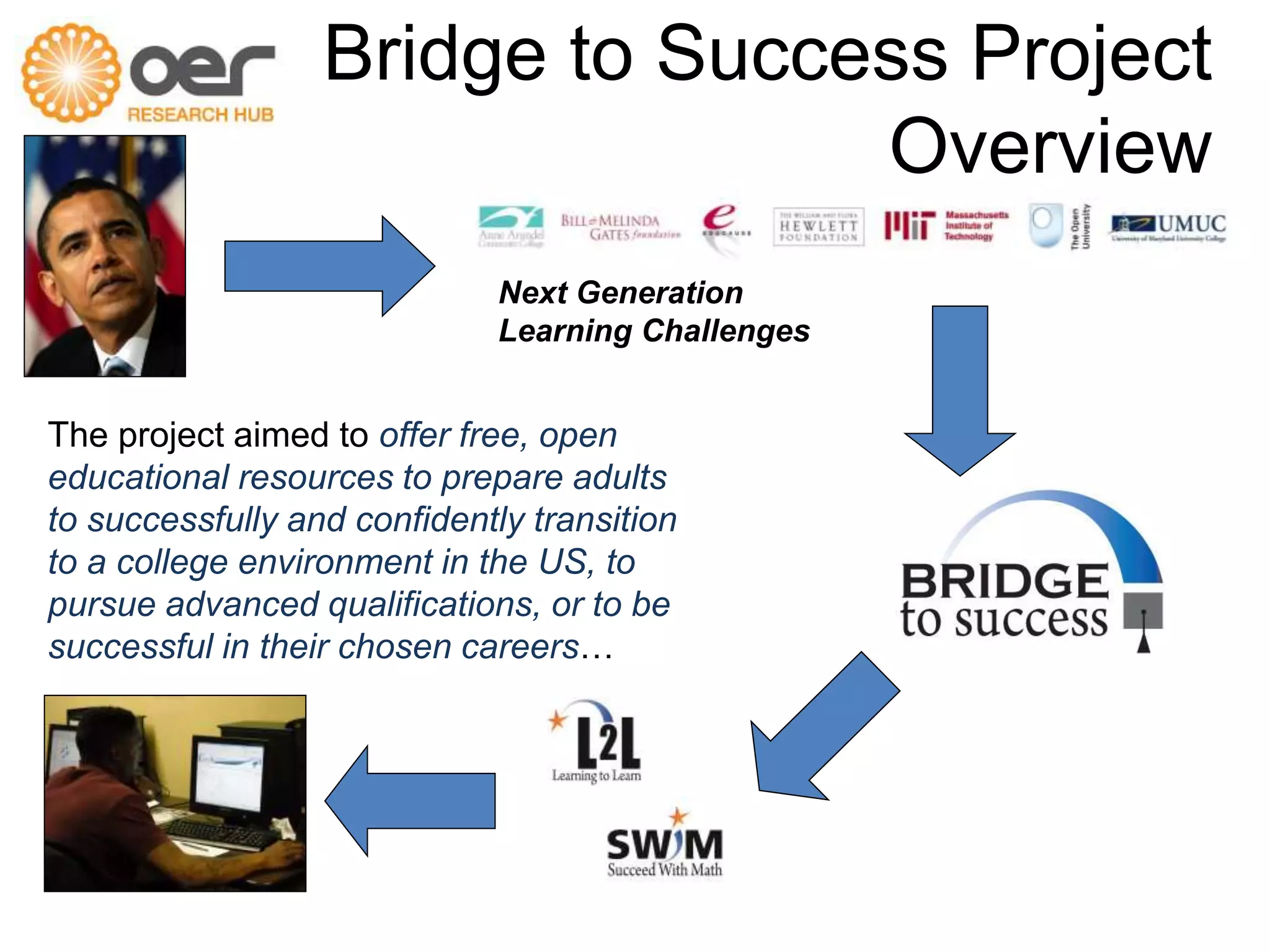
Next Generation 
Learning Challenges 
The project aimed to offer free, open 
educational resources to prepare adults 
to successfully and confidently transition 
to a college environment in the US, to 
pursue advanced qualifications, or to be 
successful in their chosen careers…
During the Project… 
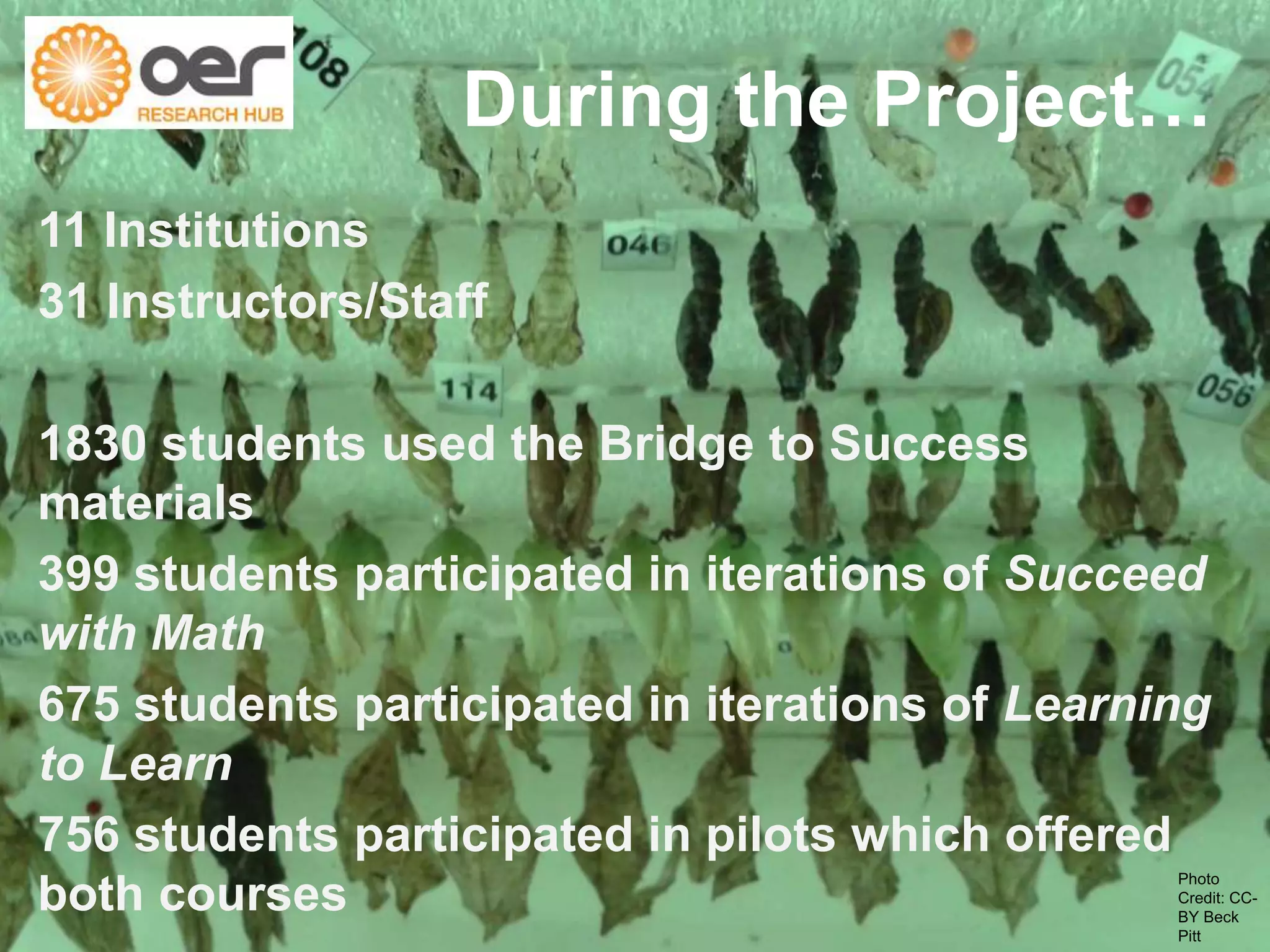
11 Institutions 
31 Instructors/Staff 
1830 students used the Bridge to Success 
materials 
399 students participated in iterations of Succeed 
with Math 
675 students participated in iterations of Learning 
to Learn 
756 students participated in pilots which offered 
both courses 
Photo 
Credit: CC-BY 
Beck 
Pitt
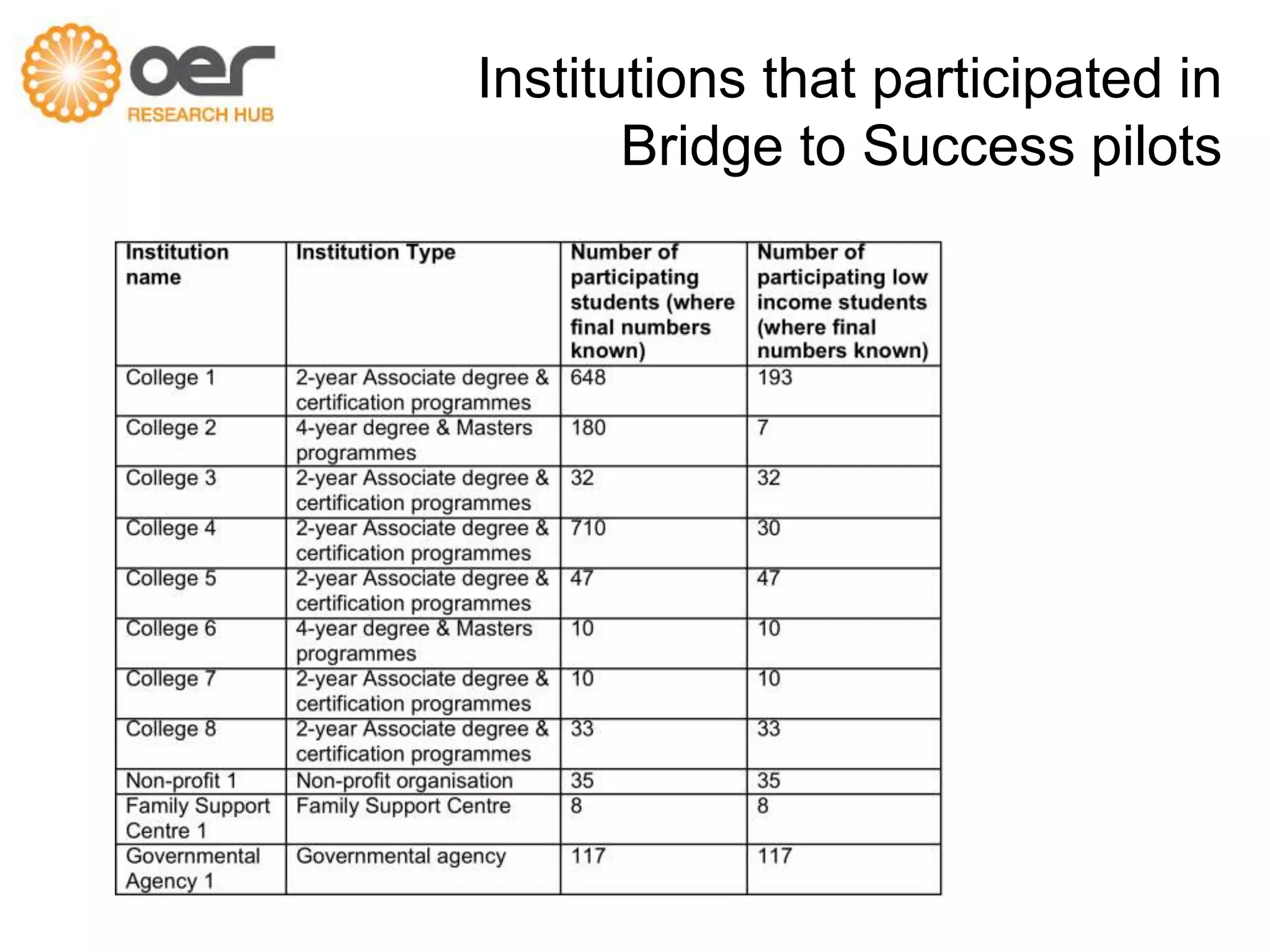
Institutions that participated in 
Bridge to Success pilots 
Screenshot of table from Pitt, McAndrew, Coughlan, Ebrahimi 
(2013)
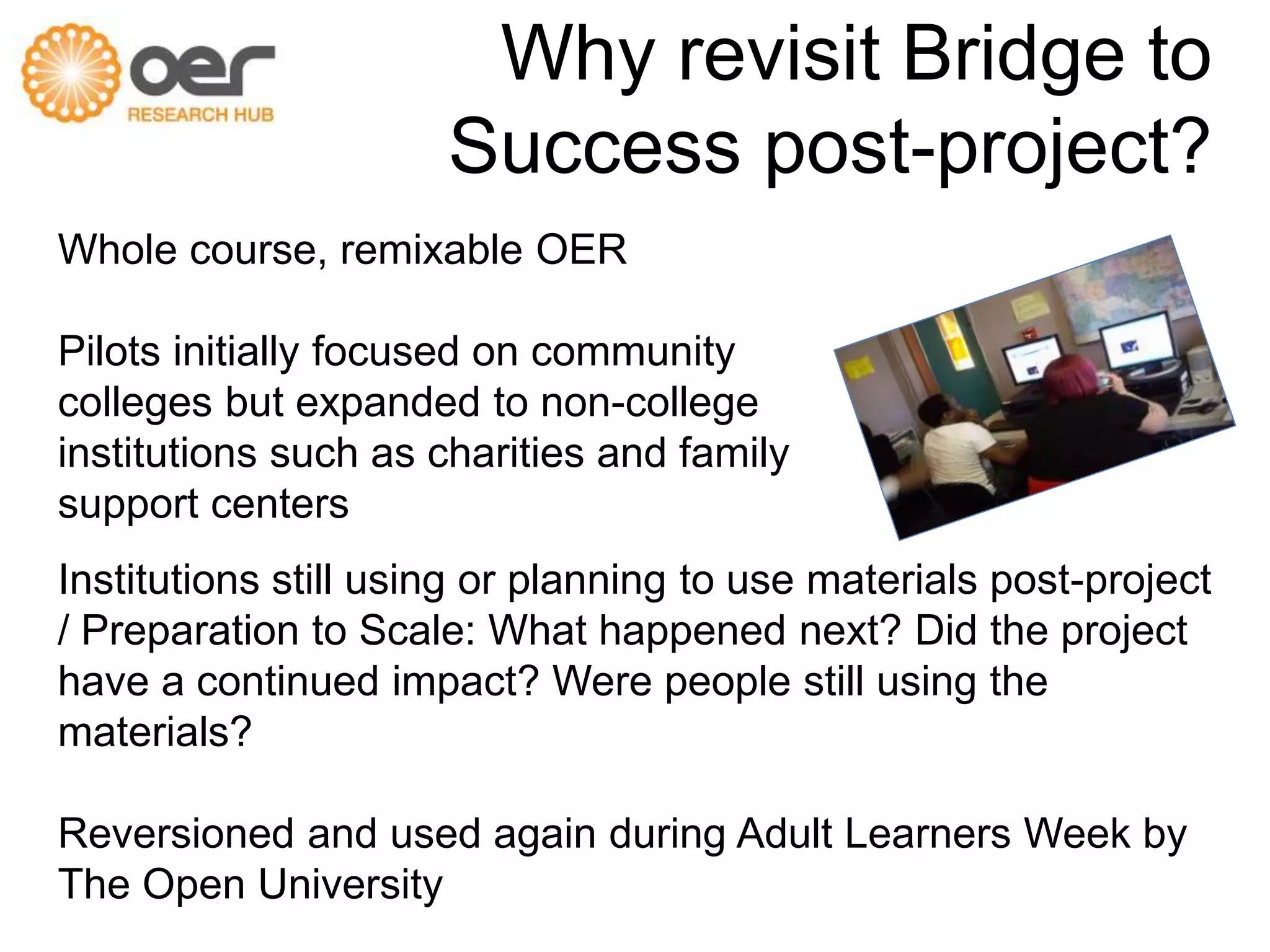
Why revisit Bridge to 
Success post-project? 
Whole course, remixable OER 
Pilots initially focused on community 
colleges but expanded to non-college 
institutions such as charities and family 
support centers 
Institutions still using or planning to use materials post-project 
/ Preparation to Scale: What happened next? Did the project 
have a continued impact? Were people still using the 
materials? 
Reversioned and used again during Adult Learners Week by 
The Open University
Which hypotheses? Why? 
Key hypotheses: 
Use of OER leads to improvement in student performance and satisfaction 
The open aspect of OER creates different usage and adoption patterns 
Hypotheses specifically aligned to Bridge to Success: 
Open Education acts as a bridge to formal education, and is complementary, not 
competitive, with it 
Bridge to Success was written to help students transition into college effectively 
and empower them (e.g. build their confidence) 
Participation in OER pilots and programs leads to policy change at an institutional 
level 
Were there any long-term impact of being involved in a project like Bridge to 
Success? 
Use of OER is an effective method for improving retention for at-risk students 
Bridge to Success pilots targeted low income and at risk groups of students
The open aspect of OER creates different usage and 
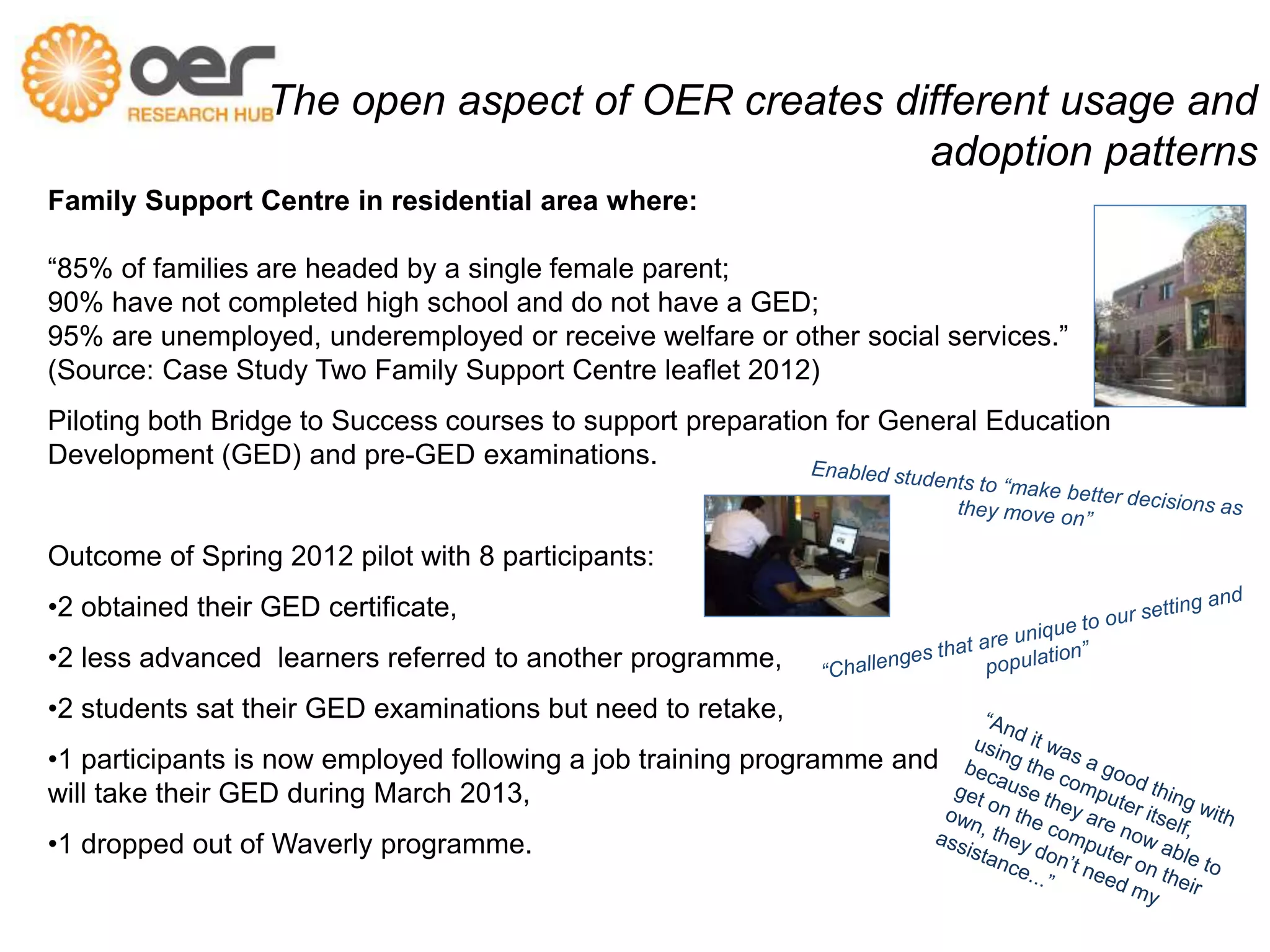
Family Support Centre in residential area where: 
adoption patterns 
“85% of families are headed by a single female parent; 
90% have not completed high school and do not have a GED; 
95% are unemployed, underemployed or receive welfare or other social services.” 
(Source: Case Study Two Family Support Centre leaflet 2012) 
Piloting both Bridge to Success courses to support preparation for General Education 
Development (GED) and pre-GED examinations. 
Outcome of Spring 2012 pilot with 8 participants: 
•2 obtained their GED certificate, 
•2 less advanced learners referred to another programme, 
•2 students sat their GED examinations but need to retake, 
•1 participants is now employed following a job training programme and 
will take their GED during March 2013, 
•1 dropped out of Waverly programme.
Use of OER leads to improvement in student performance 
and satisfaction 
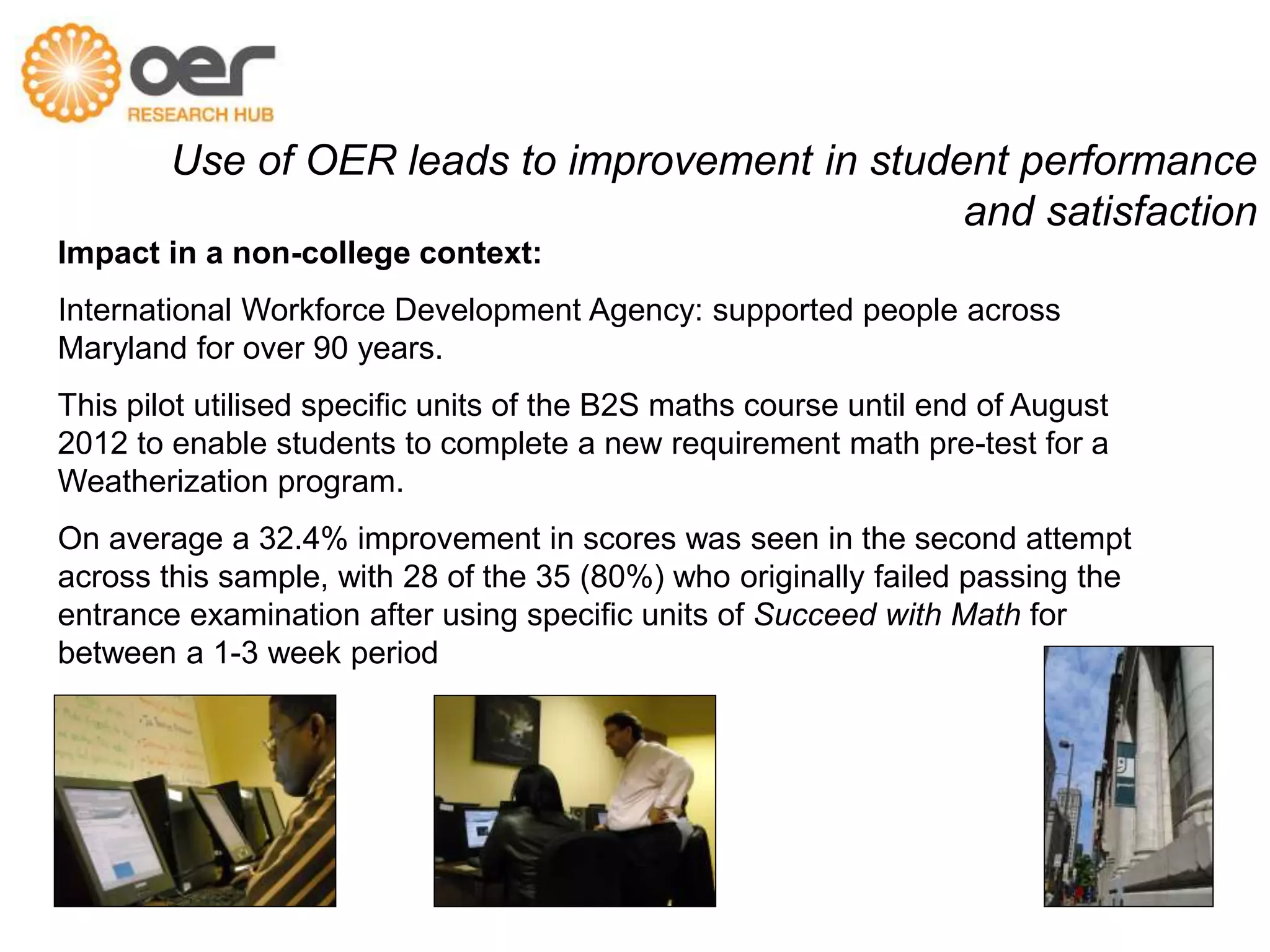
Impact in a non-college context: 
International Workforce Development Agency: supported people across 
Maryland for over 90 years. 
This pilot utilised specific units of the B2S maths course until end of August 
2012 to enable students to complete a new requirement math pre-test for a 
Weatherization program. 
“On average a 32.4% improvement in scores was seen in the second attempt 
across this sample, with 28 of the 35 (80%) who originally failed passing the 
entrance examination…” after using specific units of Succeed with Math for 
between a 1-3 week period 
Citation from Pitt, McAndrew, Coughlan, Ebrahimi (2013)
Use of OER leads to improvement in student performance 
and satisfaction 
“It was real informative, I may even work with my 4th grader cos she’s doing 
fractions and things now … she’s getting it… but this is real informative, and it 
helps…” 
“You all got it pretty basic and simple, y’all, y’all pretty do…so it’s as much easy as 
possible, I think I’ll be alright…” “I seen this all before, but 20 years ago…” 
“Person like me…I haven’t been to school for so long. But it’s not super hard 
getting back into it, but it takes time, takes a little bit of repetition.” 
“I’m not a computer literate person, I always dealt with things hands-on, it’s paper 
and pencil and I deal with things hands-on … I mean I came out of school in 
’88…For me to go online and learn online, it’s a challenge.” 
Student focus group/interviews, March 2012
Use of OER leads to improvement in student performance 
and satisfaction 
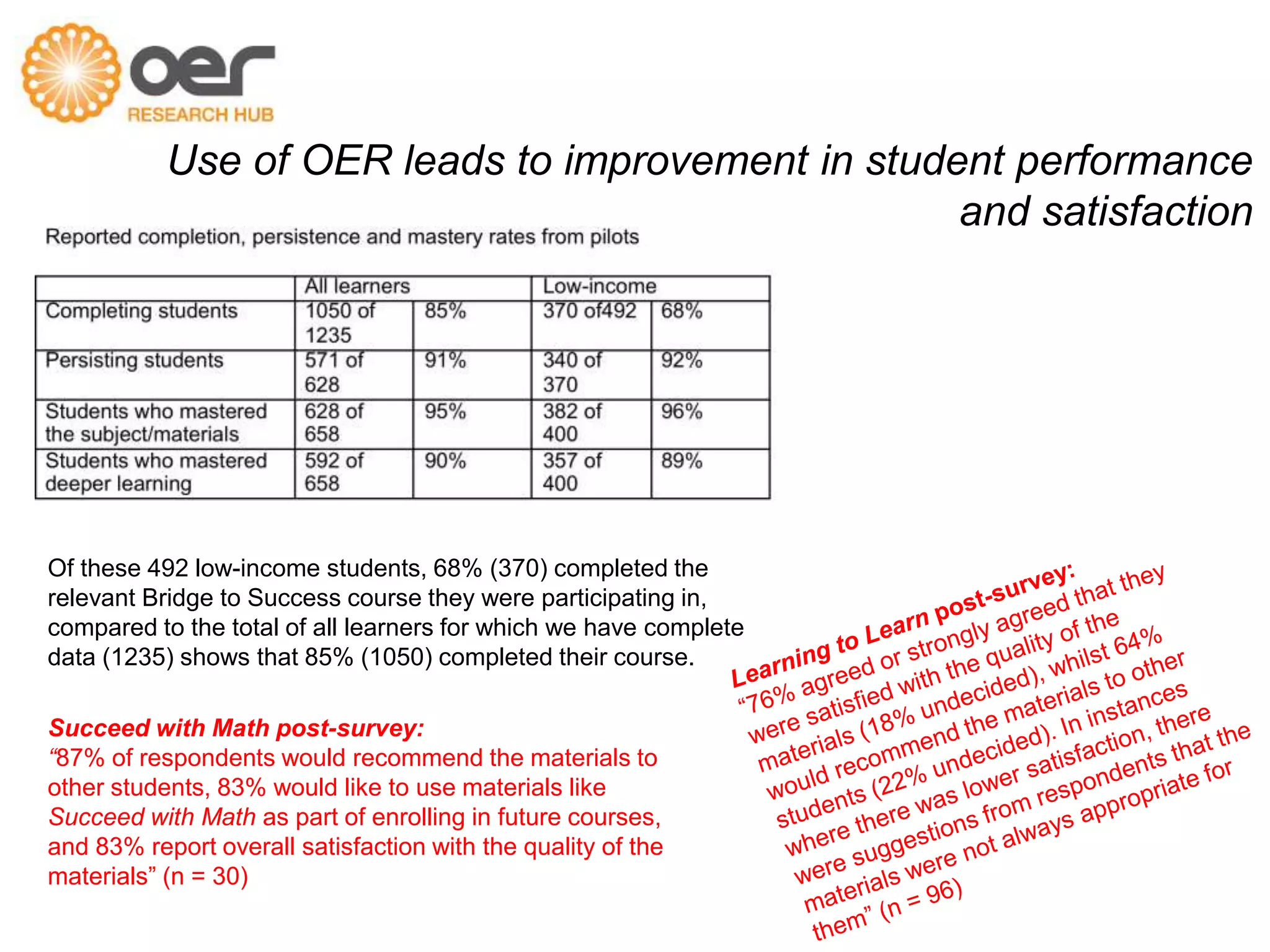
“Of these 492 low-income students, 68% (370) completed the 
relevant Bridge to Success course they were participating in, 
compared to the total of all learners for which we have complete 
data (1235) shows that 85% (1050) completed their course.” 
Succeed with Math post-survey: 
“87% of respondents would recommend the materials to 
other students, 83% would like to use materials like 
Succeed with Math as part of enrolling in future courses, 
and 83% report overall satisfaction with the quality of the 
materials” (n = 30) 
Screenshot of table and citations from Pitt, McAndrew, Coughlan, 
Ebrahimi (2013)
Participation in OER pilots and programs leads to policy 
change at an institutional level 
CASE STUDY ONE: 
Distance Learning University serving 92, 000 students. Non-traditional student 
base including high number of military students, African American students and 
many students who are in their early 30s returning to college after break in 
learning: 
“…Any anxiety they had when they left the traditional classroom has been 
typically amplified because they have a gap in their continuum of knowledge and 
exposure to the math…” (Instructor Interview, June 2013) 
131 students participated in 5 different pilots of Succeed with Math (36 on the 
hybrid course version and 24 on the purely online version of the course)
Participation in OER pilots and programs leads to policy 
change at an institutional level 
Used Succeed with Math course: hybrid and online. 
In hybrid versions once a week over three weeks discussed experiences of using 
Bridge to Success materials and held “group therapy sessions” where there was a 
“sharing [of] stories … about their anxiety about math … feeling like they were a 
community of people who shared similar experiences and similar concerns, that 
sort of support cohort… A range of math readiness or competency, still all had the 
common theme of anxiety around taking the mathematics program or course” 
(Instructor Interview, June 2013)
Participation in OER pilots and programs leads to policy 
change at an institutional level 
Case Study Example One: 
“So I think that Bridge to Success kind of got us thinking more about students when they 
come in the door, how do we help them, how do we assess them and how do we modularise 
the curriculum. Because it could be that they don’t need the entire course, that they need 
parts of the course. So I think Bridge to Success certainly helped us… I mean we’ve always 
thought about the student … But you really need to help them think about where they are 
when they come in the door, and what’s the best way for them to get a degree.” 
Case Study Example Two: 
“We have decided that textbooks/course materials are very expensive, and so we as a 
University want to do whatever we can to reduce the cost of course materials for students. So 
much so that we have another initiative in which we’re trying as much as possible to put e-resources 
in every class and not require the students to buy additional materials. So we would 
like to go as close as possible to the zero cost per course. And so this is perfect because … 
Bridge to Success kind of got us thinking about that…”
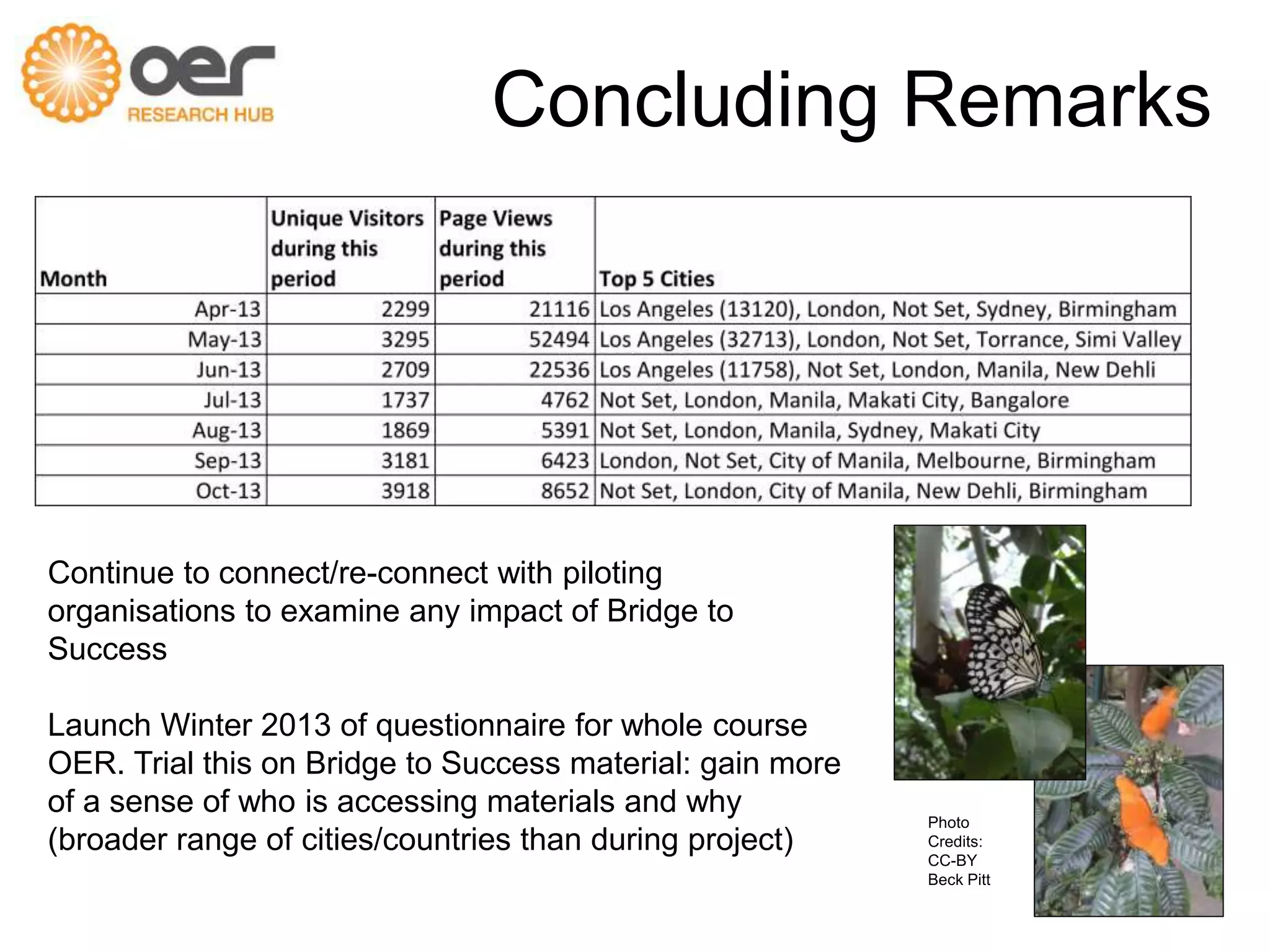
Concluding Remarks 
Continue to connect/re-connect with piloting 
organisations to examine any impact of Bridge to 
Success 
Launch Winter 2013 of questionnaire for whole course 
OER. Trial this on Bridge to Success material: gain more 
of a sense of who is accessing materials and why 
(broader range of cities/countries than during project) 
Photo 
Credits: 
CC-BY 
Beck Pitt
Bibliography/Credits 
Select bibliography: 
Bailey, T. & Cho, S.W. (2010). Developmental Education in Community Colleges. Available from: 
http://www2.ed.gov/PDFDocs/college-completion/07-developmental-education-in-community-colleges.pdf 
Bridge to Success Report One: Adaptation, Integration and Engagement 
Coughlan, T. Pitt, R. & McAndrew, P. Building Open Bridges: Collaborative Remixing and Reuse of Open Educational 
Resources across Organisations (2013 ACM SIGCHI Conference on Human Factors in Computing Systems “Changing 
Perspectives” (CHI 2013) Paris, France) 
Case Study Two Family Support Centre Leaflet 2012 
Pitt, R. McAndrew, P. Coughlan, T. & Ebrahimi, N. Assessing OER impact across organisations and learners: experiences 
from the Bridge to Success project (Due for publication in JIME, 2013) 
With special thanks to Nassim Ebrahimi, Patrick McAndrew and Tim Coughlan. Thanks also to Patrina Law and Rebecca 
Galley (The Open University) 
URLs: 
OER Research Hub: http://oerresearchhub.org 
Bridge to Success: http://bridge2success.aacc.edu
oerresearchhub.org 
@OER_Hub #oerrhub 
@BeckPitt

From Chrysalis to Butterfly: Lifecycles of an OER Project

  • 1.
    From Chrysalis toButterfly: Lifecycles of an OER Project Beck Pitt, The Open University (UK) OpenEd, November 2013 @OER_Hub #oerrhub
  • 2.
    Who we are,and what we do… The OER Research Hub project: • Research project investigating the impact OER on learning and teaching around the world • Work collaboratively with a range of projects, initiatives and organisations • Research is structured by 11 hypothesis and 4 sectors • Case studies / questionnaires / interviews / impact data • A project committed to sharing results and practices About me: • Research Assistant responsible for the informal learning sector work • Based at the Institute of Educational Technology, The Open University (UK): • Collaborations: School of Open, Bridge to Success and Connexions/OpenStax. I am also currently working with Co-PILOT and Siyavula This presentation…
  • 3.
    Bridge to SuccessProject Overview Next Generation Learning Challenges The project aimed to offer free, open educational resources to prepare adults to successfully and confidently transition to a college environment in the US, to pursue advanced qualifications, or to be successful in their chosen careers…
  • 4.
    During the Project… 11 Institutions 31 Instructors/Staff 1830 students used the Bridge to Success materials 399 students participated in iterations of Succeed with Math 675 students participated in iterations of Learning to Learn 756 students participated in pilots which offered both courses Photo Credit: CC-BY Beck Pitt
  • 5.
    Institutions that participatedin Bridge to Success pilots Screenshot of table from Pitt, McAndrew, Coughlan, Ebrahimi (2013)
  • 6.
    Why revisit Bridgeto Success post-project? Whole course, remixable OER Pilots initially focused on community colleges but expanded to non-college institutions such as charities and family support centers Institutions still using or planning to use materials post-project / Preparation to Scale: What happened next? Did the project have a continued impact? Were people still using the materials? Reversioned and used again during Adult Learners Week by The Open University
  • 7.
    Which hypotheses? Why? Key hypotheses: Use of OER leads to improvement in student performance and satisfaction The open aspect of OER creates different usage and adoption patterns Hypotheses specifically aligned to Bridge to Success: Open Education acts as a bridge to formal education, and is complementary, not competitive, with it Bridge to Success was written to help students transition into college effectively and empower them (e.g. build their confidence) Participation in OER pilots and programs leads to policy change at an institutional level Were there any long-term impact of being involved in a project like Bridge to Success? Use of OER is an effective method for improving retention for at-risk students Bridge to Success pilots targeted low income and at risk groups of students
  • 8.
    The open aspectof OER creates different usage and Family Support Centre in residential area where: adoption patterns “85% of families are headed by a single female parent; 90% have not completed high school and do not have a GED; 95% are unemployed, underemployed or receive welfare or other social services.” (Source: Case Study Two Family Support Centre leaflet 2012) Piloting both Bridge to Success courses to support preparation for General Education Development (GED) and pre-GED examinations. Outcome of Spring 2012 pilot with 8 participants: •2 obtained their GED certificate, •2 less advanced learners referred to another programme, •2 students sat their GED examinations but need to retake, •1 participants is now employed following a job training programme and will take their GED during March 2013, •1 dropped out of Waverly programme.
  • 9.
    Use of OERleads to improvement in student performance and satisfaction Impact in a non-college context: International Workforce Development Agency: supported people across Maryland for over 90 years. This pilot utilised specific units of the B2S maths course until end of August 2012 to enable students to complete a new requirement math pre-test for a Weatherization program. “On average a 32.4% improvement in scores was seen in the second attempt across this sample, with 28 of the 35 (80%) who originally failed passing the entrance examination…” after using specific units of Succeed with Math for between a 1-3 week period Citation from Pitt, McAndrew, Coughlan, Ebrahimi (2013)
  • 10.
    Use of OERleads to improvement in student performance and satisfaction “It was real informative, I may even work with my 4th grader cos she’s doing fractions and things now … she’s getting it… but this is real informative, and it helps…” “You all got it pretty basic and simple, y’all, y’all pretty do…so it’s as much easy as possible, I think I’ll be alright…” “I seen this all before, but 20 years ago…” “Person like me…I haven’t been to school for so long. But it’s not super hard getting back into it, but it takes time, takes a little bit of repetition.” “I’m not a computer literate person, I always dealt with things hands-on, it’s paper and pencil and I deal with things hands-on … I mean I came out of school in ’88…For me to go online and learn online, it’s a challenge.” Student focus group/interviews, March 2012
  • 11.
    Use of OERleads to improvement in student performance and satisfaction “Of these 492 low-income students, 68% (370) completed the relevant Bridge to Success course they were participating in, compared to the total of all learners for which we have complete data (1235) shows that 85% (1050) completed their course.” Succeed with Math post-survey: “87% of respondents would recommend the materials to other students, 83% would like to use materials like Succeed with Math as part of enrolling in future courses, and 83% report overall satisfaction with the quality of the materials” (n = 30) Screenshot of table and citations from Pitt, McAndrew, Coughlan, Ebrahimi (2013)
  • 12.
    Participation in OERpilots and programs leads to policy change at an institutional level CASE STUDY ONE: Distance Learning University serving 92, 000 students. Non-traditional student base including high number of military students, African American students and many students who are in their early 30s returning to college after break in learning: “…Any anxiety they had when they left the traditional classroom has been typically amplified because they have a gap in their continuum of knowledge and exposure to the math…” (Instructor Interview, June 2013) 131 students participated in 5 different pilots of Succeed with Math (36 on the hybrid course version and 24 on the purely online version of the course)
  • 13.
    Participation in OERpilots and programs leads to policy change at an institutional level Used Succeed with Math course: hybrid and online. In hybrid versions once a week over three weeks discussed experiences of using Bridge to Success materials and held “group therapy sessions” where there was a “sharing [of] stories … about their anxiety about math … feeling like they were a community of people who shared similar experiences and similar concerns, that sort of support cohort… A range of math readiness or competency, still all had the common theme of anxiety around taking the mathematics program or course” (Instructor Interview, June 2013)
  • 14.
    Participation in OERpilots and programs leads to policy change at an institutional level Case Study Example One: “So I think that Bridge to Success kind of got us thinking more about students when they come in the door, how do we help them, how do we assess them and how do we modularise the curriculum. Because it could be that they don’t need the entire course, that they need parts of the course. So I think Bridge to Success certainly helped us… I mean we’ve always thought about the student … But you really need to help them think about where they are when they come in the door, and what’s the best way for them to get a degree.” Case Study Example Two: “We have decided that textbooks/course materials are very expensive, and so we as a University want to do whatever we can to reduce the cost of course materials for students. So much so that we have another initiative in which we’re trying as much as possible to put e-resources in every class and not require the students to buy additional materials. So we would like to go as close as possible to the zero cost per course. And so this is perfect because … Bridge to Success kind of got us thinking about that…”
  • 15.
    Concluding Remarks Continueto connect/re-connect with piloting organisations to examine any impact of Bridge to Success Launch Winter 2013 of questionnaire for whole course OER. Trial this on Bridge to Success material: gain more of a sense of who is accessing materials and why (broader range of cities/countries than during project) Photo Credits: CC-BY Beck Pitt
  • 16.
    Bibliography/Credits Select bibliography: Bailey, T. & Cho, S.W. (2010). Developmental Education in Community Colleges. Available from: http://www2.ed.gov/PDFDocs/college-completion/07-developmental-education-in-community-colleges.pdf Bridge to Success Report One: Adaptation, Integration and Engagement Coughlan, T. Pitt, R. & McAndrew, P. Building Open Bridges: Collaborative Remixing and Reuse of Open Educational Resources across Organisations (2013 ACM SIGCHI Conference on Human Factors in Computing Systems “Changing Perspectives” (CHI 2013) Paris, France) Case Study Two Family Support Centre Leaflet 2012 Pitt, R. McAndrew, P. Coughlan, T. & Ebrahimi, N. Assessing OER impact across organisations and learners: experiences from the Bridge to Success project (Due for publication in JIME, 2013) With special thanks to Nassim Ebrahimi, Patrick McAndrew and Tim Coughlan. Thanks also to Patrina Law and Rebecca Galley (The Open University) URLs: OER Research Hub: http://oerresearchhub.org Bridge to Success: http://bridge2success.aacc.edu
  • 17.